Someday Scrooge Will Say No

Richard Ellenbogen recently sent an email to his distribution that highlighted an inevitable problem with New York State’s net-zero mandate of the Climate Leadership and Community Protection Act (Climate Act).  The plan is to electrify everything possible using renewable energy.  That brings up the problem that the local electric distribution system is not up to the task so it is likely that electric use could be limited at times in New York’s future.

Ellenbogen is the President [BIO] Allied Converters and frequently copies me on emails that address various issues associated with the Climate Act.  I have published other articles by Ellenbogen and a description of his keynote address to the Business Council of New York 2023 Renewable Energy Conference Energy titled: “Energy on Demand as the Life Blood of Business and Entrepreneurship in the State -video here:  Why NY State Must Rethink Its Energy Plan and Ten Suggestions to Help Fix the Problems.” I recently described his presentation on New York’s Energy Transition that is a detailed explanation why the State’s quest for zero emissions electricity generated by wind and solar is doomed to failure.

There are only a few people in New York that are trying to educate people about the risks of the Climate Act with as much passion as I am but Richard certainly fits that description.  He comes at the problem as an engineer who truly cares about the environment and how best to improve the environment without unintended consequences.  He has spent an enormous amount of time honing his presentation summarizing the problems he sees but most of all the environmental performance record of his business shows that he is walking the walk.  

Climate Act Overview

The Climate Act established a New York “Net Zero” target (85% reduction and 15% offset of emissions) by 2050.  It includes an interim 2030 reduction target of a 40% reduction by 2030 and a requirement that all electricity generated be “zero-emissions” by 2040. The Climate Action Council (CAC) is responsible for preparing the Scoping Plan that outlines how to “achieve the State’s bold clean energy and climate agenda.”  In brief, that plan is to electrify everything possible using zero-emissions electricity. The Integration Analysis prepared by the New York State Energy Research and Development Authority (NYSERDA) and its consultants quantifies the impact of the electrification strategies.  That material was used to develop the Draft Scoping Plan.  After a year-long review, the Scoping Plan recommendations were finalized at the end of 2022.  In 2023 the Scoping Plan recommendations were supposed to be implemented through regulation and legislation.  Ellenbogen’s discussion describes one of the issues that was not addressed in 2023.

Record Christmas Lights

Ellenbogen described a home in Union Vale, NY where the residents set the world record for most lights in a residential Christmas display with 720,420 lights in the display.  He provided links describing the the record lights from the New York Times:

I cannot get around the Times paywall so I could not see those articles but found a relevant story at Good Morning America that includes a video.

Ellenbogen writes:

Independent of any issues raised in the article, the following comment by a neighbor stands out.

Bernadette and William Burke, who love to watch the show from their hot tub, but for years could not use their washing machine or dishwasher while the lights were on. Mr. Gay said the problem was resolved when the electric company put the Gay house on its own transformer.

He estimated the power requirements:

Below is a table of power consumption of various Christmas bulbs. Using a back-of-the-napkin calculation, the display probably draws about 75 – 100 KVA.   Most utility transformers in residential areas are sized between 70 KVA and 150 KVA.  Below are photos from a NYSERDA report that I wrote in 2010 for the reactive power project I did for them.  Note that a transformer used to support five buildings in a Garden Apartment complex had a capacity of 150 KVA and a transformer for two buildings had a capacity of 75 KVA.  Both of these transformers operated near their capacity on a hot summer day and would far exceed that capacity with widespread installation of heat pumps.

Ellenbogen compared the power consumption of the display to heat pumps and car charging that are components of the Scoping Plan outline of control strategies to meet the Climate Act mandates:

The three heat pumps in my home will draw about 22 KW at peak load for 250,000 BTU of heat transfer in heating mode (1000 watts per ton  COP=3.52 ).  The power draw in cooling mode is about 60 % of that (600 watts per ton  COP=5.86 ).  We also have gas furnaces with an output of 400,000 BTU that will operate on extremely cold days or will operate if there is an issue with the heat pumps.

My car charges at a peak load of 14,000 watts.  I have seen loads of 38,000 watts on the power monitor at my house when I am charging the car during the winter.  When I built my house, I had a 400 amp 3phase service installed.  It can deliver 144 KVA ( 144,000 watts) at peak load and the transformer across the street is 150 KVA.  Most newer homes might have a 200 amp single phase service (40 KVA) and older homes will have a 100 amp or 150 amp service (20 – 30 KVA).

Discussion

Ellenbogen argues that the fact that a neighbor was impacted by a large load by a neighbor has ramifications when everyone has to increase their electrical requirements:

The point is that if the utility system can’t support a Christmas display, even a large one, and allow the neighbors to wash their clothes at the same time, how is it going to support the massive load of heat pumps and vehicle charging that is being mandated.  That combination will far exceed the demand of a Christmas light display.  As I have mentioned previously, every transformer in the state is going to have to be replaced or have their service upgraded as occurred at the home in the article.  The problem is that there is an acute transformer shortage along with a shortage of electricians and utilities are worried about having a sufficient number of transformers to recover after a bad storm, let alone having enough to rebuild the entire system.

Also note that the GMA piece on the record light display mentioned that the owners claim that their electric bill is only $300.  New York utilities are installing smart meters that will eventually enable them to charge customers different rates at different times of the day.  The idea is that they will increase rates to incentivize customers to reduce use during peak load periods.  In the all-electric future the peak load will be in the early evening when homeowners get home from work and turn on appliances.  I would not be surprised at all if the costs for the massive display might increase so much that they would be unable to afford the costs even with LED lights.

Although the utilities claim that customers will not lose control of their electric use, I suspect that is also inevitable because of the scale of the problem.  As a result, someday Scrooge will say no you cannot have a record light show.

Conclusion

Ellenbogen said he was going to send a magic wand to the Public Service Commission to help them with the Climate Act transition because they are going to need all the help that they can get.  I agree with his conclusion: “Since math and science have been thrown out the window in New York State, we might as well turn to the occult.”

New Year’s Resolution – Methane Response

Happy New Year!

I wrote an article for Watts Up With That  that described my New Year’s resolution: I resolve that when I hear anyone say that methane is more potent than carbon dioxide because the radiative forcing produced is greater, I will say that is only true in the laboratory on a dry molecular basis.  In the atmosphere, where it counts, methane is not nearly as potent.  I had hoped to get feedback and recommendations and I was not disappointed.  This post provides the rationale for my resolution.

I have followed the Climate Leadership and Community Protection Act (Climate Act) since it was first proposed, submitted comments on the Climate Act implementation plan, and have written over 380 articles about New York’s net-zero transition. The opinions expressed in this post do not reflect the position of any of my previous employers or any other organization I have been associated with, these comments are mine alone.

Rationale

I have heard the methane scare story everywhere but my primary concern is New York.  As part of New York’s Climate Act methane is irrationally disparaged as part of the war on natural gas.  The rationale used always revolves around the potency of methane relative to CO2.  I believe that the preponderance of information shows that the argument is incorrect.  I have developed a page that consolidates reasons why methane should not be vilified and updated it based on comments made.  The following summarizes my rationale.

Clyde Spencer explained that changes to radiation effects occur on a molecule-by-molecule basis in the atmosphere in an article titled The Misguided Crusade to Reduce Anthropogenic Methane Emissions.  The Climate Act tracks emissions by weight.  In the atmosphere CO2 is more than two orders of magnitude more abundant than CH4 on a molecular basis. The Climate Act uses the global warming potential that estimates the mid-range, long-term warming potential of CH4 is 32 times that of CO2.  However, that equivalence is for equal weights of the two gases!  Using a molecular basis (parts per million-volume mole-fraction) to account for the lighter CH4 molecule reveals that the annual contribution to warming is a fraction of that claimed for CO2.  Methane emissions on a molecular basis are increasing at a rate of 0.58% of CO2 increases.   Therefore, changes in methane emissions have insignificant effects.

Several commenters pointed out that that methane and water vapor affect the same area of the spectrum of outgoing radiation thus reducing the effect of any changes in methane concentrations. .Rud Istvan explained that:

Methane is a potent GHG in the lab because the lab uses a standard dry atmosphere.  I”n the real world methane’s two main infrared absorption bands (at about 3.5 and 8 microns) are completely overlapped by two of the several broader and much stronger water vapor absorption bands, specifically those from about 2.5-4 and 6-9 microns. In a world averaging about 2% specific humidity, any methane effect is literally swamped by water vapor effect.

Cyan quantified the effect of the spectral overlap “Water vapor reduces the potency of methane by about 82 percent at 80%RH. At 46% RH (from the US Standard Atmosphere) the reduction is less, at 75%.”

Andy May’s excellent summarization of Wijngaarden and Happer’s important paper “Dependence of Earth’s Thermal Radiation on Five Most Abundant Greenhouse Gases” takes a slightly different approach.  He explains that the greenhouse effect of methane is not only related to the effect on longwave radiation itself but also the concentration in the atmosphere.  Because the atmospheric concentration of methane is so small doubling concentrations change the “outgoing forcing by less than one percent”.  In other words, doubling emissions or cutting emissions in half of methane will have no measurable effect on global warming itself. A comment by “It does not add up” pointed out that Wijngaarden and Happer also produced a separate paper concentrating specifically on methane.

Ralph B. Alexander describes another molecular consideration ignored in the Climate Act.  Each greenhouse gas affects outgoing radiation differently across the bell-shaped radiation spectrum   One of the reasons that CO2 is considered the most important greenhouse gas is that its effect coincides with the peak of the bell shape.  On the other hand, the effect of CH4 is down in the tail of the bell shape.  As a result, the potential effect of CH4 is on the order of only 20% of the effect of CO2.

The residence time of the two gases is different.  Methane only has a lifetime of about 10-12 years in the atmosphere.  The “consensus” science claim is that 80% of the anthropogenic CO2 emissions are removed within 300 years.  (Note however that there are other estimates of much shorter residence times.) This means that CO2 is accumulating in the atmosphere.  CH4 is converted to CO2 and is then counted in the monthly CO2 measurements as part of the CO2 flux.  Because methane does not accumulate the same way as CO2 it should be handled differently.  However, the Climate Act doubles down.  Climate Act authors claimed it was necessary to use 20-year global warming potential (GWP) values because methane is estimated to be 28 to 36 greater than carbon dioxide for a 100-year time horizon but 84-87 greater GWP over a 20-year period.

Conclusion

The Climate Act uses explicit language to magnify the accounting for methane emissions that make the use of natural gas more expensive.  Last spring I described legislation that was proposed and endorsed by the Hochul Administration that would have changed the accounting to be consistent with the Intergovernmental Panel on Climate Change, the Environmental Protection Agency, and most other jurisdictions.  The climate activist community went nuts and the legislation never progressed. 

The problem is that I show here that the basis for their indignation is flawed as I point out in my resolution.  Methane does not have greater impacts than carbon dioxide and should not be treated as mandated by the Climate Act.  My recent article about righteous risks noted that the activists who push the evil methane narrative are driven more by moral idealism than pragmatic concerns.  In this instance, their demand for different treatment means that the proposed New York Cap-and-Invest program cannot join other jurisdictions because the emissions accounting will be different.  New York will have to develop all the infrastructure and regulations for its program on its own.

NYISO Comprehensive Reliability Plan

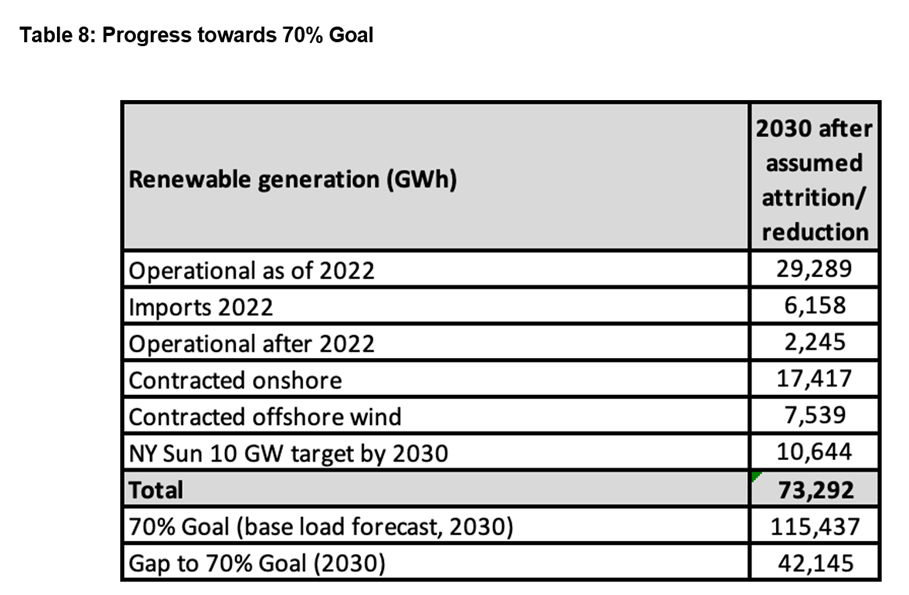
On November 29, 2023 the New York Independent System Operator (NYISO) released its 2023-2032 Comprehensive Reliability Plan (CRP).  This is a key part of New York’s reliability planning process and addresses the Climate Leadership & Community Protection Act (Climate Act) net zero transition mandate for the 70% renewable energy by 2030 and the zero-emissions grid by 2040.  The report includes recommendations that are odds with climate activists’ demands.  This post summarizes recommendations related to the Climate Act.

I have followed the Climate Act since it was first proposed, submitted comments on the Climate Act implementation plan, and have written over 350 articles about New York’s net-zero transition.  I have devoted a lot of time to the Climate Act because I believe the ambitions for a zero-emissions economy embodied in the Climate Act outstrip available renewable technology such that the net-zero transition will do more harm than good by increasing costs unacceptably, threatening electric system reliability, and causing significant unintended environmental impacts.  The opinions expressed in this post do not reflect the position of any of my previous employers or any other organization I have been associated with, these comments are mine alone.

Overview

The Climate Act established a New York “Net Zero” target (85% reduction and 15% offset of emissions) by 2050.  It includes an interim 2030 reduction target of a 40% reduction by 2030 and a requirement that all electricity generated be “zero-emissions” by 2040. The Climate Action Council (CAC) is responsible for preparing the Scoping Plan that outlines how to “achieve the State’s bold clean energy and climate agenda.”  In brief, that plan is to electrify everything possible using zero-emissions electricity. The Integration Analysis prepared by the New York State Energy Research and Development Authority (NYSERDA) and its consultants quantifies the impact of the electrification strategies.  That material was used to develop the Draft Scoping Plan.  After a year-long review, the Scoping Plan recommendations were finalized at the end of 2022.  In 2023 the Scoping Plan recommendations are supposed to be implemented through regulation, PSC orders, and legislation. 

In order to ensure that the onslaught of regulations and orders is feasible the NYISO follows its reliability planning process.  The press release for the 2023-2032 Comprehensive Reliability Plan (CRP) says that it “highlights growing risks to electric system reliability, including: projected increases in peak demand due to electrification of the transportation and building sectors; additional generator deactivations; delayed implementation of planned infrastructure projects; and extreme weather.” It is a part of the NYISO reliability planning process that “sets forth a plan to maintain a reliable bulk electric grid based on expected changes and conditions over a ten-year planning period.”  It is issued every two years.  The report and appendices are available from the NYISO.

Press Release Highlights

In this section I will annotate the points made in the press release.  The first paragraph after the introduction notes:

In addition to rising demand due to continued electrification, several large commercial projects in upstate New York are in development and are forecasted to significantly increase energy use over the planning period.  Further, state legislation enacted last year will require the phase-out of the New York Power Authority’s small natural gas plants located in New York City by December 31, 2030. If demand on the grid grows at a rate greater than the buildout of new generation and transmission, reliability deficiencies could arise within the CRP’s ten-year planning period. 

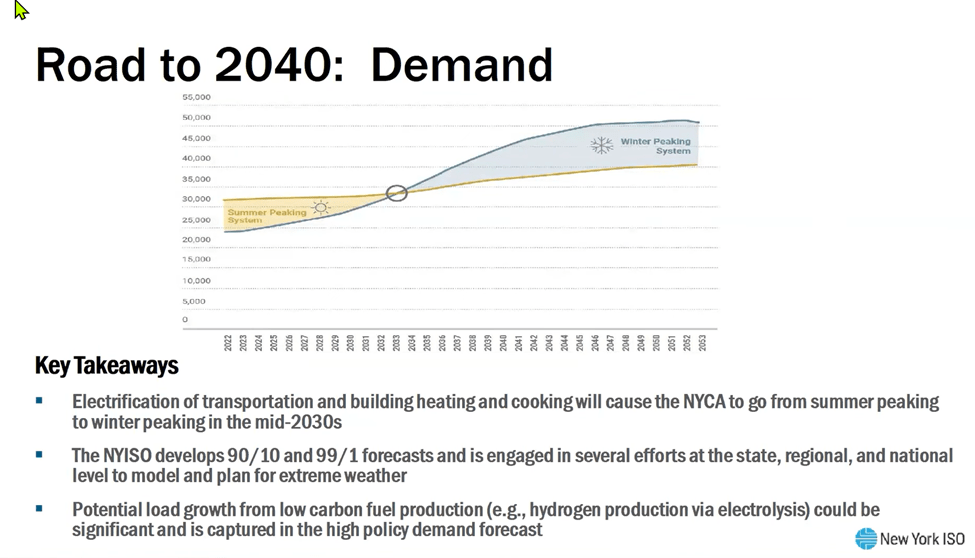
Electrification of the transportation and building sectors is a direct consequence of the Climate Act plan to reduce greenhouse gas emissions (GHG) by electrifying everything possible.  The building and transportation sectors are the two largest sectors of emissions.  There is no question that replacing energy used by direct combustion of fossil fuels with electricity will increase loads.  NYISO is particularly concerned that this transition will not only increase the loads but also shift the peak loads from summer to winter and affect the daily load patterns as well.

The electric grid is an incredibly complex system best left to experts.  The hubris of the progressive wing of the Democratic majority in the New York State Legislature that they should get involved in power planning is blatant pandering to favored constituencies.  The NYPA legislation is a case in point.  Phasing out the New York Power Authority’s small natural gas plants in New York City by any date certain is a risk that is major issue in the CRP.  Increasing load on one hand and retiring generation at the same time is a primary risk identified in the report.

The press release explains how the problem can be addressed:

The potential risks and resource needs identified in the CRP may be resolved by new capacity resources coming into service, construction of additional transmission facilities, increased energy efficiency, integration of distributed energy resources and/or growth in demand response participation.

I do not think that there are any surprises in these recommendations.  It is imperative to build more, connect more, and reduce load to the extent possible but electrification of buildings and transportation means we cannot expect much help there.

The press release highlights risks related to deployment of new resources:

“Our latest report demonstrates the continued importance of the NYISO’s in-depth planning process and the need to closely monitor the rapidly changing electric grid,” said Zach Smith, Vice President, System and Resource Planning.  “In this CRP, we highlight several risk factors that could adversely affect system reliability in the months and years ahead.”

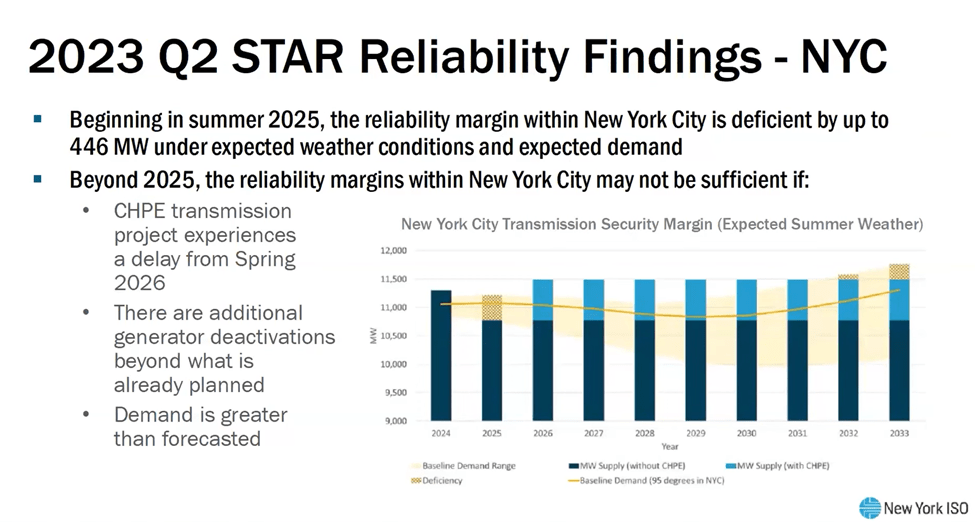
The plan underscores the importance of the timely completion of planned transmission projects – primarily the Champlain Hudson Power Express (CHPE) project – to maintain system reliability. Without the CHPE project in service by May 2026 or other offsetting solutions, reliability margins within New York City would be deficient beginning in 2026.

I cannot over-emphasize how important the NYISO planning process is during this transition.  It is the most prominent process to introduce reality.  Unfortunately, I am concerned that the transition to weather-dependent resources that cannot be dispatched and do not provide ancillary transmission support services is unprecedented and that even the experts at the NYISO will be unable to anticipate all the possible problems.  This could result in blackouts that will be more impactful than any of the potential impacts of a tweak to climatic conditions due to GHG emissions.

In the politicized energy policy environment of New York the NYISO cannot come out and say that risking the reliability of New York City’s electric grid by counting on a specific transmission project is unacceptable. Underscoring the importance of “timely completion” really means we should not make any changes to the existing system until the Champlain Hudson Power Express project is complete.  In addition there are risks to the technology.  I have heard anecdotal evidence that there have been issues with underwater electric cables connecting Long Island to the mainland that lasted longer than expected.  CHPE is mostly underwater from Quebec to New York City but there are above ground lines in Quebec that are even more liable to disruptions.

The strategy to electrify everything will shift the peak load from summer to winter.  This introduces additional issues:

Transition from a summer peaking system to a winter peaking system also poses challenges to grid reliability. This shift, driven by the electrification of the building and transportation sectors, is forecasted to occur within ten years. A winter peaking system introduces new reliability concerns, particularly around fuel availability for gas-fired generators. Based on a recent assessment of New York’s fuel and energy security, the CRP states the following:

Preliminary results of the 2023 Fuel and Energy Security study demonstrate that NYISO will need to rely significantly on dual-fuel generation resources to support winter system reliability into the next decade and changes to the resource mix may complicate system operations during multi-day cold snap conditions. The frequency and severity of projected potential loss of load events grow over the modeling time horizon as the generation mix evolves and the demand for electricity increases.

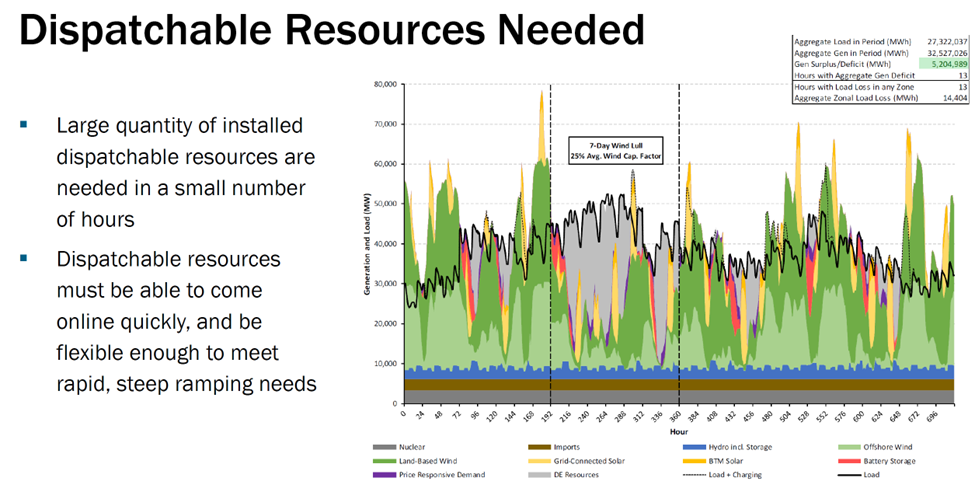
One of the prominent claims of the Scoping Plan is that the “zero-emissions” electric grid of the future will be “diverse”.  Nothing could be further from the truth.  The ugly secret of wind and solar resources is that their output is correlated.  The CRP notes: “Solar resources will have little to no output during the evening and nighttime hours and reduced output due to cloud cover, while wind resources can experience significant and sustained wind lulls. Periods of reduced renewable output will occur for short durations due to cloud cover or changes in wind speed and for prolonged periods across a daily/seasonal cycle.”  The CRP does not point out that wind lulls frequently occur over the entire state which magnifies the difficulties.

The New York generating system used to be more diverse than today.  New York regulated coal-firing out of business but the coal plants could store on-site fuel.  Natural gas is cheaper and has less environmental impact, but it is also used for home heating and thus subject to curtailment.  New York has significant oil-fired resources that have the advantage that they can be store oil on-site.  The reference to dual-fuel generation refers to the ability of certain facilities to burn oil and natural gas so that they can provide power when natural gas is curtailed.

The press release closes with the following:

Given the rapid pace of change on the bulk electric system, the NYISO will continue to monitor these and other developments to determine whether changing system resources and conditions could impact the reliability of the New York electric grid.

The competitive wholesale electricity markets administered by the NYISO are an essential tool to mitigate risks on the electric system, as well as facilitate the transition of the grid to increased renewables and decarbonization as required under state law.  The competitive markets continue to evolve and adapt to guide and attract new market entry and retention of resources that support reliability. 

The NYISO is a product of the de-regulated electric system that depends on markets.  I am not as optimistic as NYISO that the markets will succeed as suggested.  Energy developers have to be consider the risks and rewards of all the investments they make.  One of the problems in New York City is that the in-city peaking power plants are old.  I know that many of the facilities had plans to re-power with new and much cleaner units and had all the permits in place to build them. However, market uncertainties led to the decision not to build them.  Without expensive guaranteed subsidies I expect that this will be the case for renewable developments.  That sounds less and less like a de-regulated system to me.

Key Reliability Risk Takeaways

The CRP Executive Summary outlines the reliability risks.  There is an important caveat:

The CRP’s finding of no long-term reliability violations reflects the Reliability Planning Process assumptions, which are set in accordance with applicable reliability design criteria and NYISO’s procedures. There are, however, risk factors that could adversely affect system reliability over the planning horizon. These risk factors may arise for several reasons including climate, economic, regulatory, and policy drivers.
The ultimate concern is whether the risk factors are so problematic that it is appropriate to consider if a implementation pause is in order.  It is de rigor to say that climate will affect the availability of electricity, but they are really talking about extreme weather not climate. There are economic issues associated with the renewable developers that could slow or cancel developments,  The Hochul Administration is trying to remove all regulatory barriers but the Federal Energy Regulatory Commission, New York State Reliability Council, New York Public Service Commission, and even the NYISO have regulatory requirements that can affect implementation particularly on the arbitrary schedule of the Climate Act. 

The following list of key risks are all the result of the Climate Act net-zero transition.  In this overview I will include some brief comments.

The CRP is concerned with the speed of change in the electric grid.  Unsaid in the following is that there are no in-kind replacements available for the NYPA small gas plants.  Legislators may think that replacement is only a matter of political will, but reality is different.

The pace of generation retirements has exceeded the pace of resource additions to date. Should this trend continue, reliability needs will be identified both locationally and statewide. For example, retirement of the NYPA small gas plants without adequate replacement would result in a deficiency in New York City of more than 600 MW.

The list includes concerns related to the CHPE project which I addressed earlier:

The reliability of the grid is heavily reliant on the timely completion of planned transmission projects, chiefly the CHPE project. Without the CHPE project in service or other offsetting changes or solutions, the reliability margins would be deficient for the ten-year planning horizon.

The Climate Act transition to electrified heating and transportation is unprecedented. 

There is a clear upward trend forecasted in peak demand over the next ten years, with significant uncertainty driven by electrification of heating and transportation coupled with the development of multiple high-electric demand facilities (e.g., microchip fabrication and data centers). As the demand on the grid grows at a rate greater than the build out of generation and transmission, deficiencies could arise within the ten-year planning horizon.

The NYISO is making their best estimates of the effect on peak load but the estimates are uncertain.  Another big concern is the potential addition of major high demand facilities.  At the top of the list of high demand facilities is the proposed Micron chip fabrication plant near Syracuse which is expected to need as much power as Vermont and New Hampshire combined.

Another key risk is imported power:

New York’s current reliance on neighboring systems is expected to continue through the next ten years. Without emergency assistance from neighboring regions, New York would not have adequate resources throughout the next ten years.

Extreme weather has always been the biggest threat to reliability.  This risk is also listed:

Extreme events, such as heatwaves or storms, pose a threat to grid reliability throughout the planning horizon and could result in deficiencies to serve demand statewide, especially in New York City. This outlook could improve as more resources and transmission are added to New York City.

The CRP links imported power and extreme events.  The document states that:

Statewide resource adequacy during these extreme events relies on neighboring regions for assistance during emergencies. Grid analysis demonstrates that New York would not have adequate resources throughout the next ten years if not for emergency assistance. Such emergency assistance assumes availability of resources from neighboring systems to send power to New York in an event that New York resources are inadequate. The NYISO will maintain interregional collaboration with neighboring systems to monitor the availability of emergency assistance as the resource mix transitions throughout the entire Eastern Interconnection.

I think the extent of the reliance on imported power represents a new paradigm.  It is not clear to me that it is in the best interests of New York to be dependent upon other jurisdictions.  This is especially true as the dependency upon wind and solar resources increases throughout the Eastern Interconnection.  The fact is that the winter worst-case coldest temperature extreme events are associated with low wind and solar resource availability.  The under appreciated problem is that the extent of the low resource availability during those events goes beyond adjacent systems.  Those systems may not be able to provide emergency support even if they wanted to.

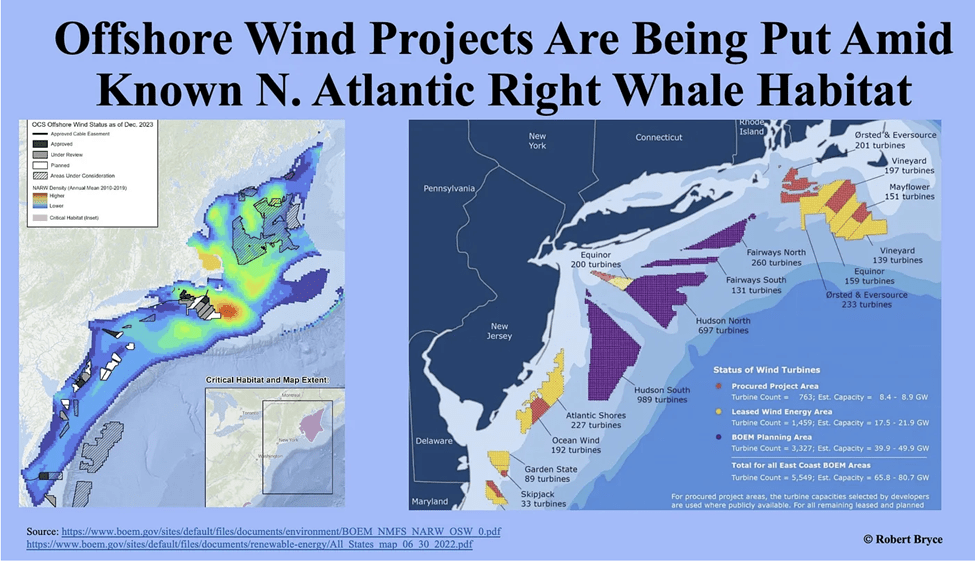
There is an unmentioned reliability risk with the potential for devasting consequences.  Projections for future New York electrical energy generation (MWh) call for offshore wind to provide between 15 and 20% of the annual energy needs of the grid.  If a category 4 hurricane hits the offshore wind farms, then a significant fraction of the wind turbines could be damaged or destroyed.  Replacing them in a timely fashion would be a huge problem.

The problems of a winter-peaking system are another reliability risk.  I cannot add anything to the CRP summary:

The New York statewide grid is projected to become a winter-peaking system in the mid-2030s, primarily driven by electrification of space heating and transportation. The New York statewide grid is reliable for normal weather in the winter for the next ten years, but deficiencies would arise as early as winter 2027-2028 for an extreme 1-in-100-year winter cold snap coupled with a shortage of gas fuel supply. This deficiency would grow to a 6,000 MW shortfall by winter 2032-2033. Additional deactivations of dual-fuel generation beyond what is planned will exacerbate the winter reliability risk.

The final reliability risk addresses changes to the planning process:

Planning for the more extreme system conditions of heatwaves, cold snaps, and fuel availability is currently beyond established design criteria. However, several reliability organizations are investigating whether applicable reliability rules and design criteria should be revised to account for these events.

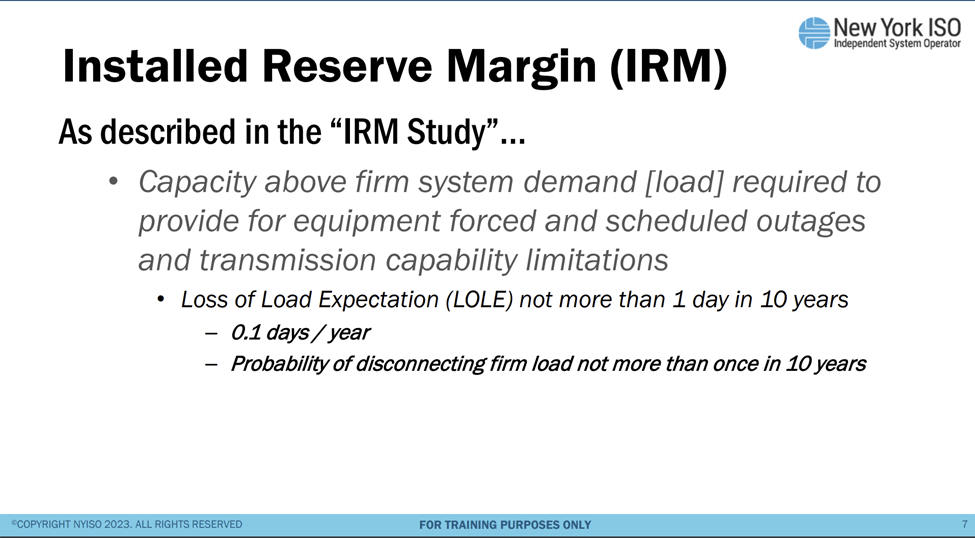
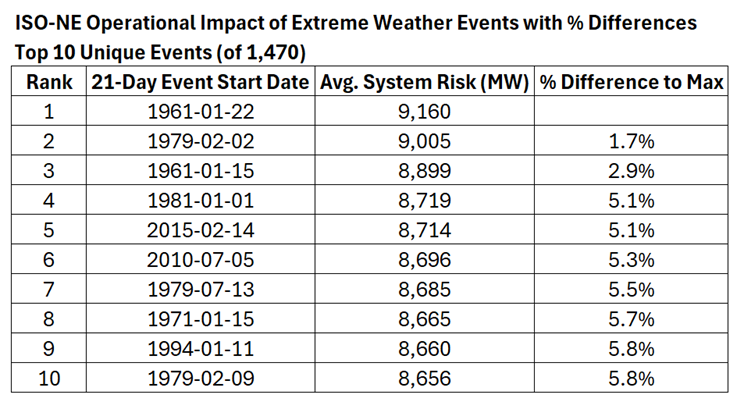
I am disappointed that the CRP did not mention the link between low wind energy resource availability and heatwaves and cold snaps.  Large and intense atmospheric high-pressure systems lead to the most extreme temperatures and cause light winds over enormous areas.  The reliability organizations are just getting their heads around the ramifications of the magnitude, duration, and extent of these events.  They have not addressed the effect on design criteria.  One of the primary criteria today is the loss of load expectation over a ten-year period.  If analysis determines that once every fifteen years that the expected availability of wind resources requires additional support, that means a new planning horizon. 

The unaddressed issue is where do you stop.  A 15-year criterion could require a substantial investment for some resource that will only be used once every fifteen years.  The problem is that you must make the investment because the weather conditions that cause the problem will occur- it is only a question of time.  If the investments are not made, then electricity won’t be available and a catastrophic blackout will occur.  In February 2021, the Texas electric grid failed to provide sufficient energy when it was needed.  The storm was the worst energy infrastructure failure in Texas history and 4.5 million homes and residences were without power, at least 246 people died, and total damages were at least $195 billion. 

Conclusion

The North American electric power grid has been described as the  largest machine in the world.  Incredibly all the fossil, hydro, and nuclear generating stations in the Eastern Interconnection from Saskatchewan to Florida, Oklahoma to Nova Scotia are connected and work together. It relies on the ability of operators to constantly match load demand with generation output.  In order to provide 60 Hz power, the generating turbines are synchronized to run at 3600 revolutions per minute.  Operators keep the voltages as constant as possible in the entire area but have the advantage that those turbines provide inertia, and they can dispatch generating resources as necessary.

The CRP raises important reliability issues, but I think it does not fully convey the magnitude of the proposed “zero-emissions” transition challenge.  The success of the existing power grid and the benefits of affordable and reliable power it provides developed over decades.  Converting the existing system to one that relies on weather-dependent resources and does not inherently provide the ancillary services such as inertia that are inherent to the turbines relied on presently is a massive challenge.  Meeting the ”zero-emission” by 2040 schedule mandated by politicians without relying on nuclear energy exacerbates that challenge.  It is not politically correct for the NYISO to call out this challenge in detail or to explicitly suggest that it is not possible without enormous reliability risks.  I have no such restraints.  Unless the Climate Act mandates are modified and the schedule changed, blackouts will result, and people will freeze to death in the dark;

Ellenbogen: New York State’s Energy Transition

Richard Ellenbogen recently gave an important presentation on New York State’s Energy Transition that details his concerns with the net -zero mandate of the Climate Leadership and Community Protection Act (CLCPA).  I think it is important that his message gets out to all New Yorkers. 

Unfortunately, the presentation is very detailed to avoid issues with those people who have a monetary interest in this process and the climate zealots who will undoubtedly disagree with the findings and recommendations.  This makes the video over two hours long and very dense.  This is beyond the attention span of most people.  I tried to address that problem by highlighting what I think are the primary points with links to the corresponding sections of the video.

Ellenbogen is the President [BIO] Allied Converters and frequently copies me on emails that address various issues associated with the CLCPA.  I have published other articles by him and a description of his keynote address to the Business Council of New York 2023 Renewable Energy Conference Energy titled: “Energy on Demand as the Life Blood of Business and Entrepreneurship in the State -video here:  Why NY State Must Rethink Its Energy Plan and Ten Suggestions to Help Fix the Problems.” There are only a few people in New York that are trying to educate people about the risks of the CLCPA with as much passion as I am but Richard certainly fits that description.  He comes at the problem as an engineer who truly cares about the environment and how best to improve the environment without unintended consequences.  He has spent an enormous amount of time honing his presentation summarizing the problems he sees but most of all the environmental performance record of his business shows that he is walking the walk.  

CLCPA Overview

The CLCPA established a New York “Net Zero” target (85% reduction and 15% offset of emissions) by 2050.  It includes an interim 2030 reduction target of a 40% reduction by 2030 and a requirement that all electricity generated be “zero-emissions” by 2040. The Climate Action Council (CAC) is responsible for preparing the Scoping Plan that outlines how to “achieve the State’s bold clean energy and climate agenda.”  In brief, that plan is to electrify everything possible using zero-emissions electricity. The Integration Analysis prepared by the New York State Energy Research and Development Authority (NYSERDA) and its consultants quantifies the impact of the electrification strategies.  That material was used to develop the Draft Scoping Plan.  After a year-long review, the Scoping Plan recommendations were finalized at the end of 2022.  In 2023 the Scoping Plan recommendations are supposed to be implemented through regulation and legislation.  Ellenbogen’s presentation focuses on these proposed implementation programs.

Presentation Introduction

The Introduction to the presentation explains:

The following video has been made as a public service for the citizens of New York State.  The speakers have no monetary interest in the fossil fuel industry or in any of the equipment manufacturers related to the energy transition.  The rental of the Pelham Picture House, used for the presentation, was covered at their personal expense.

Ellenbogen sent me an email that described the presentation.  He wrote:

The video has some major differences from the presentation that was done as the keynote presentation at the Business Council of NY State Renewable Energy Conference as recent events have made it more apparent that the NY State Energy plan has major flaws in its logic.  Those issues were not unexpected, however watching them occur in real time has made addressing the problems an imperative. Things are not going to get better.

There are several parts of the presentation.  Two videos were running prior to the presentation while people were entering the theater. One is a video describing the products his company makes and how his facility has been made more energy efficient. The second video explains sustainability at Allied Converters and how it has kept them in business despite New York’s high energy prices.  The presentation video itself includes an 8-minute introduction that that used these slides.  The rest of the video is an 80-minute presentation  (slide deck) followed by 45 minutes of questions and answers.

Ellenbogen notes:

The presentation is long because it is very detailed.  It was done that way because everyone that has a monetary interest in this process, along with the climate zealots, is going to try and disparage the information contained in the presentation so I tried to cover all of the issues to avoid that as much as possible.

I am very aware of problems related to trying to describe the intricacies and problems with the CLCPA transition.  It is related to one of my pragmatic environmentalist principles namely the BS Asymmetry Principle described by Alberto Brandolini: “The amount of energy necessary to refute BS is an order of magnitude bigger than to produce it.”  Richard and I must delve into the details to respond to the flaws of the CLCPA.  This is necessary but it also makes it difficult for people to handle the amount and complexity of information needed to explain flaws.  I tried to highlight what I think are the key points in the presentation with links to the corresponding section of the video in case readers do not have the time to listen to the whole thing.

Key Points

In the Introduction Ellenbogen presents an overview of the CLCPA and some of the problems.  A recurring theme in the presentation is that other jurisdictions, especially Germany.  that have been trying to do the same thing as planned in the CLCPA are not doing so well.  Ignoring their experience is risky. He argues that the CLCPA is a fantasy for the following reasons:

  1. Lack of energy to support the plan,
  2. The renewables needed cannot be installed on the mandated schedule,
  3. Costs to excecute the plan will be much greater than other emission reduction strategies,
  4. The plan will increase GHG emissions more than other strategies, and
  5. There are logic errors in the analyses.

John Ravitz from the Business Council of Westchester County collaborated with Ellenbogen to organize the presentation.  During his introduction he argued that we all want a better environment, but we have to do it the right way.  He emphasized the need to have honest conversations about how to get there.  I agree with all those points.  He also said something that confirmed what I had long suspected.  He pointed out that the CLCPA legislation was passed “in the dead of night” at the end of the session and “I guarantee you that 99.9% of the members of the New York State Legislature did not read the bill.”  He said they did not understand the schedule issues and unintended consequences that could happen.

The presentation itself starts with more background of what Ellenbogen did at his business and how that background worries him about the proposed plan to meet the CLCPA mandates. 

There are only two issues where I have substantially different opinions than Ellenbogen.  While I can agree that reducing emissions is a good thing I do not believe that greenhouse gas emission reductions will have any effect on extreme weather.  I toyed with including a more detailed argument for my belief and a response to Ellenbogen’s comments in this regard but I do not want to detract from the main point that the CLCPA is bad policy.

My concerns about the implementation of the CLCPA are very similar to Ellenbogen, but we are not exactly aligned.  One of his big departures from the narrative of the CLCPA acolytes is that he sees a place for new natural gas combined cycle turbines.  That is heresy to those who insist on zero emissions.  I agree with Rich on that, but I think the use of existing fossil-fired generating units is appropriate too because many units have installed additional controls, have lower emissions than in the past, and still fulfill critical reliability services.  There is no question that until the New York independent System Operator (NYOSO) determines those units can be shut down they have to remain available.  However, I believe that it may be appropriate to keep some of those units on standby longer than anyone else admits at this point because wind and solar resources availability during worst-case conditions is a much bigger problem than most people realize.  Those old units can be an insurance policy for those rare and relatively short-term events.

His description of the Complex Problem Conundrum is particularly important.  In the rush to reach zero the Climate Act does not account for likely ratepayer reactions.  If you force people to use something that is more expensive and does not work as well they may resort to alternatives that are even worse.   

Another important discussion explains why New York State energy policy is a mess.  He argues and I agree that political interference in the technical issues associated with operating a reliable and affordable electric energy system cannot end well.  It cannot be emphasized enough that a realistic cost/benefit analysis has not been done.  The Hochul Administration has never provided detailed documentation for the costs and expected emission reductions for the specific control strategies that are included in the Scoping Plan.  That should be the first component of an honest conversation.  His discussion goes on to list many of the obstacles to implementation that are also prime topics for conversations. 

I agree with Ellenbogen’s description of obstacles that must be overcome.  He points out that we are not learning from others and that “Insanity is doing the same thing over and over and expecting different results.”

I have written about the statement by Robert W. Howarth, Ph.D., the David R. Atkinson Professor of Ecology & Environmental Biology supporting the adoption of the Scoping Plan. Howarth claims to be an author of the CLCPA and was a member of the Climate Action Council. Ellenbogen addresses the academic article that Howarth co-authored that is the basis of the Climate Act presumption that no new technology is needed for the electric system transition and that the mandated schedule is possible. Because he is a graduate of Cornell, Ellenbogen felt it was necessary to explain his reasoning in his email:

To anyone at Cornell or Stanford that has a problem with the presentation at the 47 minute mark, I stand behind what I said.  There is information in those documents that was false in 2013 and that has been proven by the fact that in 2023, the technologies that they claimed were readily available then still don’t exist in a form that can be used on the utility system, but this document is being used as the basis for NY State Energy policy and people may die as a result.

Later in the presentation he references work by Cornell engineers that says the transition plan that is the basis of the CLCPA will fail.  It is really troubling that Ellenbogen and the power system experts at Cornell have not been able to influence New York energy policy away from the mis-guided and refuted academic paper co-authored by a biologist.   

The CLCPA will affect the way we heat our homes. Ellenbogen has personal experience with heat pumps and does a good job explaining why the focus on heat pumps as a solution by NYSERDA will fail.  He points out problems that have been observed in Germany in the following slide.

The CLCPA will also affect the way we cook.  The usual suspects have been vilifying natural gas stoves and the presentation addresses this component of the net-zero transition.   He argues that the health impact claims are not worth the paper they are printed on and the tradeoff between benefits and costs is poor.

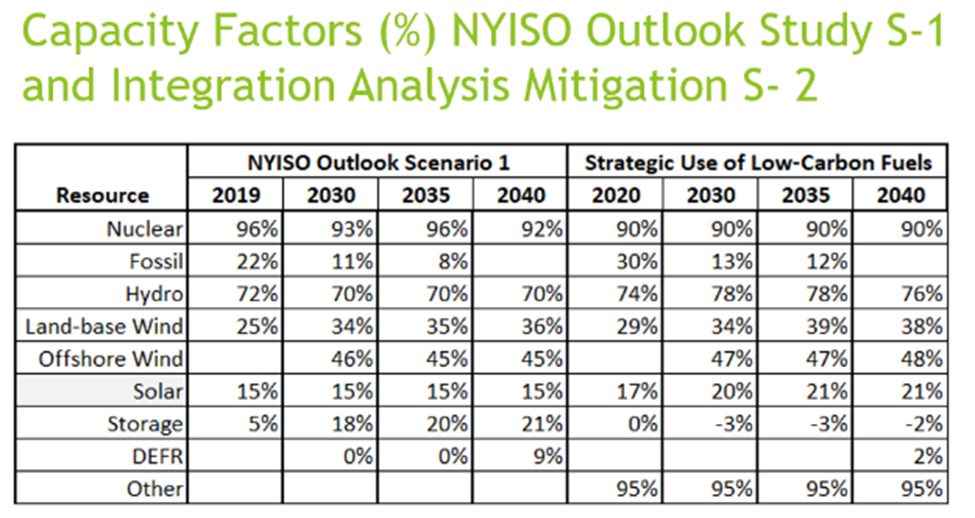
In order to explain why the Integration Analysis is fantasy he provides background information on the difference between power and energy and why capacity factors are important.  Ellenbogen repeatedly states that “I am not anti-renewable but you have to look at the numbers and be realistic”.  The power, energy, and capacity factor numbers affect the viability of a renewable energy powered electric grid.

He describes the analysis in the Scoping Plan for the CLCPA as fantasy.  The Power, energy, and capacity factor estimates in the Integration analysis are not realistic.  I love the description of the 20 GW of zero-carbon firm resource as “unicorn generation” because “you are as likely to see it as you are to see a unicorn.”  Everyone except Howarth and his acolytes believes that this zero-carbon firm resource is needed to address infrequent periods of extended low wind and solar resource availability.  The energy transition requires this new technology, but the State has unrealistic expectations for implementing it.

Ellenbogen’s presentation presents a rational alternative to the fantasies of the CLCPA implementation plan.  He looks at the electrical load necessary to replace the energy used for applications other than electric generation – heating, cooking, hot water, and transportation and concludes that on-site combustion of natural gas should have a role.  The Cornell study of energy storage shows a much higher estimate of amount needed and that increases costs significantly. 

For the cost of the storage needed you could build 6 or 7 nuclear plants that would produce dispatchable power and would last 60 years.  Wind and solar life expectancy is on the order of 20 years and batteries half of that which makes this transition strategy is much more expensive.  He notes that implementation costs are already starting to show up in rate cases and this will only continue.  His arguments for alternatives also point out that batteries will increase emissions until all the generation is zero-emissions.

Ellenbogen has refined his analysis over time.  I think his arguments to leave on-site combustion in place are particularly persuasive.  It is more efficient to use on-site generation.  He advocates for increased use of electric vehicles and allowing this generation frees up energy for them which means less generation is required.  He also recommends a pragmatic approach to reduce CO2 emissions from utility-scale co-generation.  The productivity in greenhouses increases substantially at higher CO2 levels and the CO2 is taken up by the plants.  I vaguely recall a plan to build greenhouses at the industrial park where the Micron chip fabrication plant is planned.  Using a co-generation power plant to provide the electricity needed by that facility, using the waste heat for fabrication processes, and supplying the CO2 to the greenhouses addresses multiple problems and reduces overall costs.

Finally, he makes recommendations to reduce personal utility costs and short- and long-term changes to the New York energy plan.  It is no surprise that energy efficiency is important for personal utility cost reductions.  For the energy plan he suggests the following short-term recommendations:

  1. Do not electrify buildings that run on natural gas,
  2. Focus heat pump deployment away from buildings that run on natural gas,
  3. Upgrade the grid infrastructure to support the electrification requirements,
  4. Increase support for electric vehicle infrastructure including grid support,
  5. Do not install large amounts of battery storage until renewable generation increases,
  6. Repower older generating plants with higher efficiency combined cycle natural gas units,
  7. Develop technologies other than electrolysis to generate green hydrogen,
  8. Focus natural gas resources on combined heat and power systems,
  9. Allow Micron to build a 2 GW combined cycle co-generation facility,
  10. Figure out how the utilities can install and interconnect the planned offshore wind,
  11. Set up pilot projects for greenhouse agriculture to ascertain values, and
  12. Authorize the establishment of pyrolysis projects for the elimination of plastic waste and organic waste and for generation of hydrogen that can be used to improve power plant efficiency.

In the long term he suggests adding 12 GW of nuclear to the generating system.

He concludes that New York should use common sense solutions to keep the lights on because when fantasies meet reality, reality always wins.  He notes that the CLCPA actually is hindering greenhouse gas emission efforts, risks reliability and will affect affordability. In the following slide he urges people to contact their State Senators and Assemblypersons to modify or repeal the CLCPA.

Q&A

If you are interested in the questions and answers they start at this point.  The session got heated when someone who subscribes to all of the CLCPA narrative talking points that Ellenbogen dismantled in his presentation asked why wind and solar alone can’t work and claimed nuclear has no place.  It got so bad that someone in the audience piped in and said if you cannot provide numbers supporting your position like Ellenbogen did then sit down because you wasting our time. 

Caveat

Ellenbogen has invested enormous time and energy into this presentation because of his personal conviction that the current plan is not a good idea.  He writes:

Keep in mind that I have no monetary interest in this but I have a huge problem with the questionable or deceptive at best, and  negligent at worst, science being used to justify these policies.  I have spent thousands of hours researching the details and have attended all of the meetings in Albany and elsewhere at my personal expense, both in time and money, as well as paying for the rental of the Picture House, along with John Ravitz.

Conclusion

Ellenbogen points out that the societal benefits are calculated as if New York is in a vacuum.  The fact is that completely eliminating New York greenhouse gas emissions will not have a meaningful effect on any of the impacts ascribed to climate change because the state’s total emissions are so small that they will be subsumed by emission increase elsewhere across the globe in a matter of weeks. He goes to great lengths so point out that he is not anti-renewable energy resources.  These points and others that disparage the CLCPA transition plan do not mean that we should not do something to reduce GHG emissions.  However, we should not “make up fantasies to justify it” or avoid honest conversations about how best to implement a transition to lower emissions.  It is time to honestly talk about the implications of this law.

Ellenbogen has the ear of many people at the agencies in Albany and unofficially they agree with his concerns.  Unfortunately, they are not in the position to say anything publicly because the CLCPA is a law and the agencies have been weaponized to support the political ambitions of the Administration in the last decade.  Speaking out of line with narrative is not a good career move for technical staff at the agencies.  Privately they admit that it will take a Texas-style blackout disaster to change the direction of the net-zero transition. The February 2021 Texas electric grid failure was the worst energy infrastructure failure in Texas history resulting in over 4.5 million homes and residences losing power in very cold weather, over 245 people dying and total damages of at least $195 billion. 

Remember that New York energy experts are warning that unless something is done this type of disaster is inevitable here. I prepared this summary of the presentation because I think it is important to educate New Yorkers.  I reiterate Ellenbogen’s recommendation: contact your State Senators and Assemblypersons to modify or repeal the CLCPA.  Contact the Governor’s Office so that the Administration gets the word that the loud environmental organizations are not the only ones concerned about this law.  Pass on this presentation to others who will be affected by this fantastical energy policy and encourage them to speak up.  It is too risky, we cannot afford it, and the plans are unsupportable.

Zero-Emissions Electric System Demonstration of Feasibility

I believe that single biggest flaw in the Climate Leadership & Community Protection Act (Climate Act) net zero transition is the failure to include a feasibility analysis.   I agree with Francis Menton, the Manhattan Contrarian, that the ultimate test would be a demonstration project to determine the feasibility of a fully wind/solar/battery electric generation system.  This post describes a series of articles by Ed A. Reid, Jr. at the Right Insight blog describing what he believes should be included in a grid-scale demonstration project.

I have followed the Climate Act since it was first proposed, submitted comments on the Climate Act implementation plan, and have written over 350 articles about New York’s net-zero transition.  I have devoted a lot of time to the Climate Act because I believe the ambitions for a zero-emissions economy embodied in the Climate Act outstrip available renewable technology such that the net-zero transition will do more harm than good by increasing costs unacceptably, threatening electric system reliability, and causing significant unintended environmental impacts.  The opinions expressed in this post do not reflect the position of any of my previous employers or any other organization I have been associated with, these comments are mine alone.

Overview

The Climate Act established a New York “Net Zero” target (85% reduction and 15% offset of emissions) by 2050.  It includes an interim 2030 reduction target of a 40% reduction by 2030 and a requirement that all electricity generated be “zero-emissions” by 2040. The Climate Action Council (CAC) is responsible for preparing the Scoping Plan that outlines how to “achieve the State’s bold clean energy and climate agenda.”  In brief, that plan is to electrify everything possible using zero-emissions electricity. The Integration Analysis prepared by the New York State Energy Research and Development Authority (NYSERDA) and its consultants quantifies the impact of the electrification strategies.  That material was used to develop the Draft Scoping Plan.  After a year-long review, the Scoping Plan recommendations were finalized at the end of 2022.  In 2023 the Scoping Plan recommendations are supposed to be implemented through regulation, PSC orders, and legislation. 

The Problem

In my opinion a feasibility analysis that addresses reliability, affordability, and cumulative environmental impacts should be a prerequisite for the proposed changes to the New York energy plan.  State leaders claim that the Scoping Plan is sufficient, but I disagree.  The Scoping Plan lists various control strategies that it claims meets the Climate Act requirements but no where does it document the expected costs, emission reductions, and assumption for the components of the control strategies in sufficient detail to verify the total costs necessary to determine expected costs to New Yorkers.  It does not even include projected ratepayer costs or an affordability standard.  Even though Climate Action Council members claimed that the Scoping Plan adequately addressed reliability, and some went so far as to say that no new technology was needed, the reality is that the New York Independent System Operator (NYISO) has raised many unaddressed reliability issues.  Furthermore, the NYISO, the Integration Analysis and the New York State Public Service Commission (PSC) agree to the need to “identify innovative technologies to ensure reliability of a zero-emissions electric grid”.  The most recent cumulative environmental impact assessment does not include between 20% and 40% more onshore wind, about twice as much offshore wind, and over three times as much distributed and utility-scale solar projected in the Scoping Plan.  In addition, no previous cumulative environmental impact analysis considered the impacts of massive energy storage facilities or the “zero-carbon firm resource” that the Integrated Analysis presumes will be provided by hydrogen resources. 

The NYISO is responsible for keeping the lights on in New York.  They have a very sophisticated resource adequacy modeling process and are required to provide regular reliability assessments.  There are staff dedicated to addressing those requirements and I have a lot of respect for their skill and body of knowledge.  They have been analyzing the electric system for many years and have a great understanding of the current electric system.  However, I have enough modeling experience and background to still be skeptical that the existing resource adequacy process will be able to address all the inter-related components and unintended consequences of the transition to an electric system that relies on weather-dependent and inverter-based resources.  As a result, I worry that some combination of circumstances will occur that causes unexpected reactions that will result in blackouts despite their best efforts.  We know that an electric grid that relies on nuclear and hydro “zero-emissions” resources will work.  What is needed is a demonstration project that can be used to test whether wind, solar, and energy storage resources can work and refine the resource adequacy modeling to address those resources.

Reid’s Renewable Demonstration

Ed Reid agrees with this need and writes “I believe it is essential that at least one large scale demonstration of a completely freestanding renewable plus storage powered grid be conducted under carefully controlled conditions.”  Even if such a project was implemented, he points out an important caveat: the long duration storage or alternative “zero-carbon firm resource” cannot be tested because neither resource is currently commercially available.

He proposes a demonstration for a selected zone within the grid. His proposal would only consider sources within the zone isolated from external sources of power and incorporate storage initially using “pseudo-storage” by tracking exports from the isolated zone and what is needed from outside the isolated zone. He suggests an iterative development process whereby:

The demonstration managers would be able to import electricity from external sources if required to avoid demonstration grid failure but would then be required to install additional generation capacity or contract for more pseudo-storage to avoid a repeat of the imminent grid failure condition. The demonstration managers should not be permitted to deliver electricity outside the demonstration zone, other than to pseudo-storage.

His first demonstration project article concludes:

It might be ideal to site the demonstration zone in the metropolitan Washington, DC area to assist agencies of the federal government and federal legislators to understand the various issues with a renewable plus storage grid in real time and work to resolve them in a timely fashion.

In the next article Reid argues that transparency should be a key component of the demonstration.  He proposes that the first step be complete documentation describing the generation and energy storage resources within the demonstration zone.  He goes on to explain:

The next step in the process would be the initial design of the renewable plus storage system to replace the existing conventional, dispatchable fossil generation resources. This would include designation of the types and capacities of the wind and solar generators, plus designation of the capacities and delivery rates of short, intermediate and long duration storage to be installed or simulated by pseudo-storage.

After a period of testing, the wind, solar, and energy storage resources “would be used to meet the contemporaneous demand of the grid and to charge both actual and pseudo-storage”.  The reporting system would track all the generation and energy usage.  He suggests that in order to address the affordability component that “all renewable generation and storage resources installed in the demonstration zone be capitalized at their full cost, with no federal or state incentives of any kind”.  

Market costs also must be tracked. 

He concludes the second article:

These approaches to the demonstration should assure that the demonstration zone facilities would be designed to be a reliable and flexible renewable electric system and that the electricity costs in the demonstration zone would representative of a renewable plus storage grid on a national scale.      

The third article suggests a reporting format for the renewable plus storage demonstration proposed.  If you are interested in those details, I refer you to the article.

The fourth article raises an important point about the ultimate viability of renewable energy plus storage electric system.  Climate Act accounting requirements mandate that fossil-fired generating resources include upstream emissions.  Reid points out that a true “zero-emissions” electric system should also eliminate emissions in the supply chain.  He argues:

The supply chain begins with the use of electric mining equipment to mine the raw materials required to fabricate the wind, solar and storage components of the renewable plus storage grid in US mines and the use of electric transportation to move these raw materials to the manufacturing facilities at which the components of the system would be fabricated. The fabrication of the components would occur in US plants using electric processing equipment.

The steel and cement required for installation of the system components would also be produced in US plants. In the case of the calcining of limestone to produce cement, carbon capture and storage (CCS) systems would be required to capture the CO2 released from the limestone.

Preparation of the installation sites for the wind and solar generators and the storage systems would be performed by US manufactured electric earthmoving equipment. The system components would be transported to the installation sites by US manufactured electric trucks or electrified trains and erected using US manufactured electric cranes.

Considering supply chain emissions introduces much more complexity.  He argues that all the claims about clean energy job creation ignore the current reality that the “current supply chains for wind turbines, solar collectors and storage batteries, all of which currently require mining and processing of minerals in Asia and Africa and frequently rely on foreign manufacture, particularly of solar collectors and wind turbines” has many jobs outside of the United States.  My concern is that it is not only the jobs but also there are lower environmental and safety considerations.  Finally, there is a moral aspect because the “mining and processing jobs in Asia and Africa and the manufacturing jobs in Asia reputedly rely on child, forced and prison labor”.

Conclusion

I think there is a clear need for a feasibility demonstration project.  Attempting to convert the current electric system that has evolved over decades to a system relying on significantly different resources by 2040 is such an enormous challenge that I think it is inappropriate to rely on modeling to check feasibility.  Reid describes a feasibility demonstration on a utility-scale.  Menton has argued for a smaller project:

Before embarking on “net zero” for a billion people, how about trying it out in a place with, say, 10,000, or 50,000, or 100,000 people.  See if it can actually work, and how much it will cost.  Then, if it works at reasonable cost, start expanding it.

While there are some large jurisdictions that have achieved very low-carbon grids, they did not do so by relying on underperforming intermittent wind and solar generation.  Instead, they achieved low emissions by using high-capacity-factor firm resources—namely hydropower and nuclear. To my knowledge no jurisdiction has demonstrated the ability to achieve “zero-emissions” using wind, solar, and energy storage.  Ideally a large-scale test such as the one proposed by Reid should be done before New York goes any further.  However, I think that even the small-scale demonstration proposed by Menton would show that the Climate Act “zero-emissions” electric system is infeasible on reliability and affordability grounds.

I believe that the fatal flaw of all “green” technologies is that they do not work all the time.  “On average”, “in general”, or for “many people”, it may be possible to argue that electric vehicles, heat pumps, or renewable generation technologies are feasible.  However, when the criteria are raised to include 24-7, 365 reliability and overall affordability with all the hidden costs included, then these technologies fail to deliver.  The only way I will be convinced otherwise is if there is a demonstration project that proves otherwise.

Coalition Calls for Rethinking of Energy Plan

A coalition of community-based environmental groups and a few individuals, including me, recently filed comments with the New York Public Service Commission (PSC).  Our comments called for reconsideration of the PSC’s plan for reducing power plant emissions principally with large-scale renewables to meet the mandates in the New York Climate Leadership & Community Protection Act (Climate Act).  This post describes the submitted comments.

I have followed the Climate Act since it was first proposed, submitted comments on the Climate Act implementation plan, and have written over 350 articles about New York’s net-zero transition.  I have devoted a lot of time to the Climate Act because I believe the ambitions for a zero-emissions economy embodied in the Climate Act outstrip available renewable technology such that the net-zero transition will do more harm than good by increasing costs unacceptably, threatening electric system reliability, and causing significant unintended environmental impacts.  The opinions expressed in this post do not reflect the position of any of my previous employers or any other organization I have been associated with, these comments are mine alone.

Overview

The Climate Act established a New York “Net Zero” target (85% reduction and 15% offset of emissions) by 2050.  It includes an interim 2030 reduction target of a 40% reduction by 2030 and a requirement that all electricity generated be “zero-emissions” by 2040. The Climate Action Council (CAC) is responsible for preparing the Scoping Plan that outlines how to “achieve the State’s bold clean energy and climate agenda.”  In brief, that plan is to electrify everything possible using zero-emissions electricity. The Integration Analysis prepared by the New York State Energy Research and Development Authority (NYSERDA) and its consultants quantifies the impact of the electrification strategies.  That material was used to develop the Draft Scoping Plan.  After a year-long review, the Scoping Plan recommendations were finalized at the end of 2022.  In 2023 the Scoping Plan recommendations are supposed to be implemented through regulation, PSC orders, and legislation.  The comments described follow a recent decision by the PSC to deny petitions seeking to amend contracts with renewable energy projects. 

Coalition Calls for Rethinking of Energy Plan

All Otsego recently described the comments submitted by an ad hoc coalition.  The submittal was filed to the Proceeding on Motion of the Commission to Implement a Large-Scale Renewable Program and a Clean Energy Standard, Case Number:15-E-0302.  The following listed parties submitted the comments: Glen Families Allied for the Responsible Management of Land (GlenFARMLand), Protect Columbia, Farmersville United, Freedom United, Litchfield United, Flyway Defense, No Big Wind, Centerville’s Concerned Citizens, Concerned Citizens of Rushford, Save Sauquoit Valley Views, StopCricketValley, Protect Orange County, Cattaraugus County Legislator Ginger D. Schroder, Esq, Gary Abraham, Esq., Roger Caiazza, David Sunderwith, and Greg Woodrich.

The All Otsego article provides a good summary of the comments:

TOWN OF COLUMBIA—A coalition of community-based environmental groups around the state filed comments with the New York Public Service Commission last week, calling for a reconsideration of the PSC’s plan for reducing power plant emissions principally with large-scale renewables.

According to the press release, the coalition is comprised of environmentally-minded people participating in the review of large-scale renewable energy projects around the state. The coalition points to physical constraints on the ability of wind and solar to contribute to carbon emission reductions and energy analysts who project that the electric grid will become less reliable as more intermittent renewables are connected. Backup power plants to ensure grid reliability and extensive infrastructure changes are needed to utilize wind and solar energy, coalition members contend, saying these are not warranted given the environmental damage renewables cause, along with potential health and safety hazards associated with the projects, including their battery storage systems.

“Large-scale renewables are being sited on prime agricultural land and are clearing thousands of acres of forests,” according to Ginger Schroder, a Cattaraugus County legislator and member of the coalition.

Schroder pointed to the 100-square-mile project area needed for the proposed Alle-Catt wind farm in western New York.

“Renewables require massive amounts of land, not only for sprawling solar and wind projects, but also for all of the additional transmission, storage, and backup generation needed. These are destroying communities,” Schroder said.

Steve Helmin with GlenFARMLand in the Town of Glen said, “Small rural communities across New York are being targeted as a result of poor planning and over-zealous expectations. The commission needs to step back and review what can work to meet our climate goals.”

Coalition member Nathan Seamon, with Protect Columbia in the Town of Columbia, added, “Since the passage of the Climate Leadership and Community Protection Act, New York State has moved from a 60 percent carbon-free grid in 2019 to one that is only 50 percent carbon-free today. Meanwhile, energy costs—for both natural gas and electricity—continue to rise.

“Upstate communities have been robbed of robust environmental review and fair tax revenue from underperforming industrial solar and wind projects which they are forced to host. How this makes any sense should be baffling to anyone who has paid attention to this over the past several years,” Seamon said.

The group is calling on the PSC to support a jobs and cost analysis of an energy transition that uses a diverse set of technologies, including nuclear and expanded hydropower, compared to one that relies on intermittent, unreliable, and environmentally unsound wind and solar.

“The Public Service Commission needs to put the words ‘leadership’ and ‘community’ back into the Climate Leadership and Community Protection Act,” coalition members insist. “Real climate leadership requires solutions that work in the real world and that do not destroy communities in the process.”

The 22-page document filed with the PSC on November 2 concludes: “…by respecting communities and embracing a balanced energy plan that supports the expansion of all carbon-free resources—including those capable of generating reliable electricity within an energy-dense footprint—the state can meet its climate goals, protect the environment and natural beauty of New York, and meet the needs of a vibrant economy. We urge the Commission to exercise its authority to help New York chart a course that accomplishes the latter.”

Can the State Respond?

Advocates for the Climate Act and the renewable energy developers argue that the energy transition must proceed no matter what because the Climate Act law says so.  However the recent PSC Order Denying Petitions Seeking to Amend Contracts with Renewable Energy Projects suggested that there are conditions that must be considered.  On page 39 of this order, it states:

We recognize that PSL §66-p(2) adds the pursuit of the 70 by 2030 and Zero Emissions by 2040 Targets to the Commission’s obligations but do not read the provisions of the more recent statute as superseding the Commission’s longstanding mandate to ensure that rates are just and reasonable. There is no indication in the statutory language or history that the legislature intended such a result, which could have the undesirable effect of driving ratepayer costs so high as to put the entire program at risk. To the contrary, the legislature provided the Commission with significant discretion under PSL §66-p(2) regarding how to establish the program to implement the 70 by 2030 and Zero Emissions by 2040 Targets by authorizing the Commission to “address impacts of the program on safe and adequate electric service in the state under reasonably foreseeable conditions,” as well as to “modify the obligations of jurisdictional load serving entities and/or the targets” based on consideration of such factors.

I believe that another provision of New York Public Service Law  § 66-p. “Establishment of a renewable energy program” includes safety valve conditions.  Section §66-p (4) states “The commission may temporarily suspend or modify the obligations under such program provided that the commission, after conducting a hearing as provided in section twenty of this chapter, makes a finding that the program impedes the provision of safe and adequate electric service; the program is likely to impair existing obligations and agreements; and/or that there is a significant increase in arrears or service disconnections that the commission determines is related to the program”. 

The PSC has a longstanding mandate to provide safe and adequate electric service.  The comments submitted describe many of the problems with the plan to use intermittent wind and solar resources that I believe will inevitably lead to unsafe and inadequate electric service.  I think that there are mechanisms that can be used to respond to the comments.  However, it is an open question whether the Hochul Administration will risk the wrath of the environmentalist constituency in the progressive left wing of her party and admit that implementation of the Climate Act may not be affordable and has unacceptable risks to reliability.

Discussion

I was asked to join the coalition late in the game so did not have a chance to provide comments to modify anything in the text.  Had I had a voice in the development of the text I would have pointed out that the claim that the New York State Department of Environmental Conservation (DEC) has not provided a Generic Environmental Impact Statement solar and wind development is incorrect.  They have done that evaluation, but it was completed in 2019 and does not consider the much larger number of wind turbines and solar panels that the Scoping Plan projects are necessary for the net-zero transition.  The cumulative ecological impact of the current plan due to its extremely low energy density and permanence of extensive infrastructure still needs to be evaluated. 

My only other quibble is the implication that fossil fuels should not be considered in the future.  Reliance on weather dependent wind and solar resources must address extreme variability in resource availability.  If that constraint is handled incorrectly, then electric energy will run out at the worst possible time.  The challenge of developing a dispatchable emissions-free resource to handle this possibility is immense.  The worst part, in my opinion, is that any long-duration storage option must push the physics envelope so this technology may be impossible.  Even if that challenge is overcome, the comments point out that the projected resources are on the order of the existing fossil fuel system resources and the expectation is that they will be used infrequently.  For example, if the future system is designed to provide support for a once in twenty-year event, then some portion of this resource will only be used every twenty years.  I cannot see any way to overcome the economics needed to pay the huge costs for this entirely new and untested resource such that it would be viable.  In order to address the problem, I think that retaining fossil fired resources for this rare but impactful event makes sense.  Even if the State came to its senses and developed nuclear resources as proposed in the comments, some share of reliable fossil resources probably makes economic sense.  The incremental global warming impact of those rarely fossil-fired resources would be insignificant.

Conclusion

The comments urge the PSC to “exercise its authority to avoid this tragedy by conducting substantive engineering, economic, and logistical analyses that should have occurred long before now.”  Obvious problems in other jurisdictions should be addressed now rather than wished away.  New York should also learn from places that successfully decarbonized. Throughout the world, “large economies that have achieved very low-carbon grids did so not by relying on underperforming intermittent generation, but instead by using high-capacity-factor firm resources—namely hydropower and nuclear—which are capable of producing abundant, reliable energy.”

The Wind is Always Blowing Somewhere Fallacy

I am fed up with rent-seeking capitalists and naïve academics who claim that wind, water, and solar resources are the only ones needed to provide reliable electric power.  This narrative was used as rationale for the Climate Leadership & Community Protection Act (Climate Act). This post shows by way of example that this is an unrealistic argument.

I have followed the Climate Act since it was first proposed, submitted comments on the Climate Act implementation plan, and have written over 350 articles about New York’s net-zero transition.  I have devoted a lot of time to the Climate Act because I believe the ambitions for a zero-emissions economy embodied in the Climate Act outstrip available renewable technology such that the net-zero transition will do more harm than good by increasing costs unacceptably, threatening electric system reliability, and causing significant unintended environmental impacts.  The opinions expressed in this post do not reflect the position of any of my previous employers or any other organization I have been associated with, these comments are mine alone.

Climate Act Background

The Climate Act established a New York “Net Zero” target (85% reduction and 15% offset of emissions) by 2050.  It includes an interim 2030 reduction target of a 40% reduction by 2030 and a requirement that all electricity generated be “zero-emissions” by 2040. The Climate Action Council is responsible for preparing the Scoping Plan that outlines how to “achieve the State’s bold clean energy and climate agenda.”  In brief, that plan is to electrify everything possible using zero-emissions electricity. The Integration Analysis prepared by the New York State Energy Research and Development Authority (NYSERDA) and its consultants quantifies the impact of the electrification strategies.  That material was used to develop the Draft Scoping Plan.  After a year-long review, the Scoping Plan recommendations were finalized at the end of 2022.  In 2023 the Scoping Plan recommendations are supposed to be implemented through regulation and legislation.  Over nine months into 2023 and reality is starting to set in and cast aspersions on the aspirational plans.

My primary focus over the last several years has been New York’s the Climate Leadership and Community Protection Act (Climate Act).   Robert W. Howarth authored sections of the Climate Act and was a member of the Climate Action Council that is responsible for preparing the Scoping Plan that outlines how to “achieve the State’s bold clean energy and climate agenda.” .  He submitted a statement supporting the Scoping Plan that exemplifies the narrative that no new technology is needed: 

I further wish to acknowledge the incredible role that Prof. Mark Jacobson of Stanford has played in moving the entire world towards a carbon-free future, including New York State. A decade ago, Jacobson, I and others laid out a specific plan for New York (Jacobson et al. 2013). In that peer-reviewed analysis, we demonstrated that our State could rapidly move away from fossil fuels and instead be fueled completely by the power of the wind, the sun, and hydro. We further demonstrated that it could be done completely with technologies available at that time (a decade ago), that it could be cost effective, that it would be hugely beneficial for public health and energy security, and that it would stimulate a large increase in well-paying jobs. I have seen nothing in the past decade that would dissuade me from pushing for the same path forward. The economic arguments have only grown stronger, the climate crisis more severe. The fundamental arguments remain the same.

I addressed Howarth’s claim and others in his statement in a post here late last year. I include this because it exemplifies the idea that wind, sun, and hydro can power New York’s electric grid completely.  In this post I consider the challenge of using wind, solar, and hydro to replace one component of the NY grid – New York City’s existing fossil fired units

According to the New York Independent System Operator (NYISO) Gold Book the New York City (Zone J) fossil generation summer capability in 2022 was 9,026 MW.  This represents the capacity needed to replace New York City’s fossil generation capacity at any hour.  For the purposes of this thought experiment,  I am going to ignore reliability rules related to transmission constraints and in-city generation.  I assume only that New York City needs dedicated availability of 9,026 MW.  There is no chance that an additional 9,026 MW of hydro can be developed in New York and there is no guarantee that the amount of capacity will only be needed during the day which means we cannot use solar.  This example estimates how much wind capacity from somewhere will be needed to provide this dedicated capacity requirement.

New York Wind Variability

In May 2022 I published Climate Act and New York State 2021 Wind Resources that evaluated New York State onshore wind availability.  I used a New York Independent System Operator (NYISO) resource that provides 2021 wind production and 2021 wind curtailment.  The data sets list the hourly total wind production and curtailments for the entire New York Control Area (NYCA).  I have summarized the data in the following table.  Curtailments are those hours when the system load is small enough that wind production is greater than what is needed so the wind power is curtailed, i.e., not used. 

Table 1: NYISO 2021 Hourly Wind Production at the Aggregated NYCA-Wide Level

These data are representative of every wind energy resource data set I have ever seen.  See, for example, analyses for Belgium by Michel at the Trust Yet Verify website or for Australia by Anton Lang.  The crux of the problem is that low-energy density wind resources are highly correlated across wide areas.  Across New York, and other regions, the wind speeds drop across the entire area frequently.  Frequently, as in every time a high-pressure system crosses over the area.  As a result, the mean annual average availability for all the NYCA onshore wind turbines is only 22% and the median is 16%. 

Moreover, I believe it is unlikely that additional sources in a region will change the availability much.  I do not expect any significant change to the low-end onshore wind numbers when all the land-based wind resources proposed to meet the Climate Act net-zero transition are developed.  The overall distribution of expected offshore wind will be similar although the numbers will show slightly higher availability. 

Implications

Wind variability has implications on the use of wind energy to replace firm dispatchable generation.  I use these data as a starting point for this analysis to explain why the fact that the wind is always blowing somewhere does not mean it can be used cost-effectively to replace dispatchable fossil-fired generating in an electric grid that relies on wind and solar as claimed by Dr. Howarth and others.

To estimate the wind resources needed to replace New York City’s 9,026 MW of existing fossil-fired generation I will use the distribution of New York land-based wind with the following assumptions.  In the absence of offshore observed wind energy historical data, I assumed that the wind production would be increased by a five-percentile category from the onshore wind distributions.  In other words, when the onshore wind is at the 75% percentile capacity availability level, I assumed that offshore wind resources are at the 80% capacity level. 

Table 2 estimates the amount of land-based or offshore wind capacity from the New York Control Area necessary to replace  New York City’s 9,026 MW fossil capacity.  Because the observed wind production capability at the 99th percentile is 78%, 11,563 MW of wind turbine capacity are needed (9,026 divided by 78%) to assure replacement of the existing fossil-fired units in New York City.  For reliability support the wind resources must be able to cover all the levels of wind resource availability.  Half of the time (50th percentile) 55,068 MW of capacity would be needed.  In order to ensure reliability, wind capacity must be available at all hours but the wind capacities at the lower end of the distribution are unrealistic so a system dependent upon only wind energy is going to have to go wherever the wind is blowing.  The proponents of the wind is always blowing somewhere respond that all New York must do is to import electricity from outside the NYCA to address this but have not used this kind of distribution to determine how much, from how far, would be necessary

Table 2: NYCA Wind Capacity Support Requirements to Replace NYC Fossil – 9,026 MW

To determine how much wind capacity is needed outside of New York, I first determined the

potential wind energy availability within the New York Control Area (NYCA).  For capacity potential I used the larger capacity projections for land-base and offshore wind from two different modeling analyses.  The offshore wind capacity (MW) in the Integration Analysis Scenario 2: Strategic Use of Low-Carbon Fuels was 12,675 MW.  The onshore wind capacity in the NYISO  2021-2040 System & Resource Outlookwas 19,087 MW. Table 3 uses those resource projections to provide estimates of the available energy in the NYCA at each resource potential level.  For each percentile I calculated the available capacity at each percentile for on-shore and offshore wind, summed them, and listed the deficit if the sum was less than 9,026 MW.  For this thought experiment, the projected wind resources can replace the fossil resources up to the 70th percentile if all the wind power can be dedicated just to New York City at the hour when 9,026 MW of wind capacity is needed in the City.  This means that somewhere between 65% and 70% of the time, wind resources outside the NYCA must provide additional power to replace New York City’s existing fossil resources.

Table 3: NYCA Wind Energy Available from Climate Act Wind Resource Projections

Table 4 provides an estimate of the wind generated capacity available to cover the deficit margin in Table 3 outside the control area in an area similar in size and characteristics to the NYCA 500 miles away from New York City.  For this thought experiment I assumed that the wind capacity at any hour in this region would be at a production percentile 25% higher than the corresponding NYCA percentile.  I believe that there is higher level of spatial correlation than those who believe that the wind is always blowing somewhere acknowledge.  In this example, when NYCA wind levels are at the 65th percentile I presume that 500 miles away the wind resource will be at the 90th percentile. Because I believe that wind in all regions of a similar size to New York will exhibit the same wind distribution pattern, a key takeaway is that wind resources 500 miles away are insufficient to always provide support when power outside the NYCA is needed.  The 500-mile resources only cover the NYCA deficit down to 55th NYCA percentile corresponding to the 500-mile 80th percentile.  We must go out at least another 500 miles for reliable power.

Table 4: Wind Resource Availability from 10,000 MW of Turbines 500 Miles from NYC

Table 5 provides an estimate of the additional wind generated capacity needed outside the control area in an area 1000 miles away from New York City. I assumed that the wind capacity at any hour would be at a production percentile 50% higher than the corresponding NYCA percentile.  In this example, when NYCA wind levels are at the 50th percentile I presume that 1000 miles away the wind resource will be at the maximum level of 86%.   Importantly, this assumption is the same as assuming there is no correlation between NYCA wind and 1000- mile wind.  I do assume that the correlation has the same directionality.  In other words, winds in both regions go down at the same time.  Of course, it is more complicated because “somewhere else” winds could go up when NYCA winds go down.  In order to address that issue an analysis for the entire onshore and offshore wind resource availability is needed.

The 1000-mile resource availabilities cover the NYCA deficit down to 25th NYCA percentile and the 1000-mile 75th percentile so we must go out another 500 miles to assure replacement of the existing fossil generation. 

Table 5: Wind Resource Availability from 10,000 MW of Turbines 1000 Miles from NYC

Table 6 provides an estimate of the additional wind generated capacity needed within NYCA and the 500- and 1000-mile resource areas in an area 1500 miles away from New York City. I assumed that the wind capacity at any hour would be at a production percentile 75% higher than the corresponding NYCA percentile.  In this example, when NYCA wind levels are at the 5th percentile I presume that 1000 miles away the wind resource will be at the 80th percentile.   Even the addition of these resources is insufficient to cover all the power needed by New York City existing fossil resources.  However, it is so close that adding another 1,049 MW of capacity in any of the regions would assure that New York City’s existing fossil generation could be replaced by resources where” the wind is always blowing”.

Table 6: Wind Resource Availability 1500 Miles from NYC

Discussion

The forgoing analysis confirms that the wind is indeed always blowing somewhere and that wind energy resources could replace the existing fossil generation in New York City as suggested by Howarth and others  However, just because it is possible does not mean it is feasible.  The fatal flaw is that New York City requires dedicated resources to replace existing generation when it is needed to keep the lights on.  This is particularly important because the high pressure systems that characterize low wind availability over large areas also are associated with hottest and coldest periods of the year when the electric load peaks and the need for reliable power is the greatest.

Existing fossil generation capacity in New York City totals 9,026 MW.  New York’s Climate Act projected onshore and offshore wind planned capacity is 31,762 MW.  Relying on wind only requires another 30,000 MW located “somewhere else”.  The fatal flaw to the wind blowing “somewhere else” argument for New York City is that those resources must be dedicated to New York City.  The idea that anyone could afford to build 10,000 MW and 500 mile transmission lines for use as backup that will only be used 65% of the time, another 10,000 MW and 1,000 mile transmission lines for backup 50% of the time, and another 10,000 MW with 1,00 mile transmission lines for backup 25% of the time is disconnected from reality. 

Of course, there are suggestions that the surplus power could be stored in batteries or used to make “green hydrogen” to address the low wind availability problem.  However, Howarth claimed that New York “could rapidly move away from fossil fuels and instead be fueled completely by the power of the wind, the sun, and hydro”  and that “it could be done completely with technologies available at that time (a decade ago) and that that it could be cost effective”.   This simple analysis suggests otherwise.

Conclusion

I agree with Francis Menton who has argued that we need a demonstration project to prove all the wind, solar, and energy storage components necessary for a zero-emissions electric grid that does not rely on nuclear power can work.  In addition, I believe that a comprehensive analysis of wind and solar resource availability across the continent that addresses the correlation and energy density deficiencies of wind and solar is also needed.  Based on my work, I think that this sort of analysis would show the need for far more resources than anyone is contemplating at this time.  If New York does not address these concerns correctly people will literally freeze to death in the dark.

The Climate Act Needs a Feasibility Demonstration

I have been writing about the Climate Leadership & Community Protection Act (Climate Act) for over four years and a constant theme in my work has been concerns about affordability and reliability.  For all the analyses and pontification by the State of New York about the net-zero transition, there still is no documentation describing the costs of the control strategies proposed by the Scoping Plan and estimates of how New Yorkers will pay for the transition.  The focus of this post is on reliability.  I believe that the only way we can be sure that the plans proposed to operate an electric grid that relies primarily on wind and solar is to prove it with a demonstration project.  The project should include all the key elements: wind and solar generation, energy storage, a dispatchable emissions-free resource and any other resources needed to provide necessary ancillary services.   This post highlights work by Francis Menton that advocates just such a demonstration project.

I have followed the Climate Act since it was first proposed, submitted comments on the Climate Act implementation plan, and have written over 350 articles about New York’s net-zero transition.  I have devoted a lot of time to the Climate Act because I believe the ambitions for a zero-emissions economy embodied in the Climate Act outstrip available renewable technology such that the net-zero transition will do more harm than good by increasing costs unacceptably, threatening electric system reliability, and causing significant unintended environmental impacts.  The opinions expressed in this post do not reflect the position of any of my previous employers or any other organization I have been associated with, these comments are mine alone.

Climate Act Background

The Climate Act established a New York “Net Zero” target (85% reduction and 15% offset of emissions) by 2050.  It includes an interim 2030 reduction target of a 40% reduction by 2030 and a requirement that all electricity generated be “zero-emissions” by 2040. The Climate Action Council is responsible for preparing the Scoping Plan that outlines how to “achieve the State’s bold clean energy and climate agenda.”  In brief, that plan is to electrify everything possible using zero-emissions electricity. The Integration Analysis prepared by the New York State Energy Research and Development Authority (NYSERDA) and its consultants quantifies the impact of the electrification strategies.  That material was used to develop the Draft Scoping Plan.  After a year-long review, the Scoping Plan recommendations were finalized at the end of 2022.  In 2023 the Scoping Plan recommendations are supposed to be implemented through regulation and legislation.  Over nine months into 2023 and reality is starting to set in and cast aspersions on the aspirational plans.

Demonstration Project Proposal

Last February I did a post on Climate Smart Communities and I proposed a challenge to the local governments that pledged to be climate smart.  Go for it, but not just this virtue-signaling public relations gesture to get some money.  I described Francis Menton’s article explaining that a demonstration project of a mainly renewables-based electrical grid is a common sense prerequisite before there are any more plans or pledges.  I said that Climate Smart Communities of New York should prove their bona fides and develop a demonstration project for their community to address the issues he raised:

Could anybody possibly be stupid enough to believe the line that wind and solar generators can provide reliable electricity to consumers that is cheaper than electricity generated by fossil fuels? It takes hardly any thought about the matter to realize that wind and solar don’t work when it is calm and dark, as it often is, and particularly so in the winter, when it is also generally cold. Thus a wind/solar electricity system needs full backup, or alternatively storage — things that add to and multiply costs. Surely, our political leaders and top energy gurus are fully aware of these things, and would not try to mislead the public about the cost of electricity from a predominantly wind/solar system.

……………..

Nobody would be happier than me to see a demonstration project built that showed that wind and solar could provide reliable electricity at low cost. Unfortunately, I know too much about the subject to think that that is likely, or even remotely possible. But at least the rest of us need to demand a demonstration project from the promoters of these fantasies.

A few days ago Menton followed up on his February post with What Passes For A “Demonstration Project” Among Our Government Geniuses.  I recommend readers check out both articles.  I will summarize the key points from the more recent article here.

Menton describes people who don’t support the need for an encompassing fossil-fuel-free renewable grid demonstration project.  Government officials and green energy advocates won’t support this because:

(1) they are not bright enough to understand the subject, or (2) their understanding is impaired because they are too blinded by religious fervor to “save the planet,” or (3) they are intentionally deceiving the public to make money or fame or career advancement for themselves. Or it could be all three!

Instead of a single comprehensive demonstration, net-zero proponents promote projects that only “attempt to demonstrate various portions of the full system that would be needed to provide reliable 24/7/365 electricity from predominantly wind and solar generation.”  I believe a common problem of all the “green” energy solutions is that they do not work all the time and renewable resource availability is correlated over large distances which makes demonstrations of individual components worthless.

Menton agrees and describes the example of the latest news on energy storage. He explain that on October 13, the Department of Energy announced big new grants and subsidies for a series of what they call “hydrogen hubs.” Here is a report from E&E News Energy Wire. Excerpt:

The Department of Energy on Friday announced seven projects that will receive $7 billion to build landmark hydrogen hubs, delivering a major boost to a nascent U.S. industry. The long-awaited move is a key piece of the Biden administration’s climate agenda. On Friday, the White House said it expects the DOE funding to help cut 25 million metric tons of carbon dioxide annually, roughly equivalent to removing 5.5 million gasoline-powered vehicles from the road each year. “With this historic investment, the Biden-Harris administration is laying the foundation for a new, American-led industry that will propel the global clean energy transition,” said Secretary of Energy Jennifer Granholm.

The New York placeholder for dispatchable emissions-free resources is “green” hydrogen.  Menton explains that according to this further piece from Energy Wire on August 21, the Biden Administration has set a goal of having the U.S. produce 10 million metric tons of “green” hydrogen (by electrolysis from water) by 2030. The E&E piece states that the massive funding for “hydrogen hubs” is for “demonstrations.”  He points out that this is not the demonstration project needed to prove viability of the net-zero transition because the demonstrations focus on production, storage, transport and consumption but not the integrated resource necessary.  He notes:

They are clearly leaving out the critical piece of the puzzle, which is the demonstration of how much of this hydrogen, and capacity to make more of it, will be needed, and at what cost, to get the country — or even some small town — through a full year (or two or five) without need for fossil fuel backup. That completely obvious elephant is not part of this multi-billion dollar “demonstration.”

Another dispatchable emissions-free resource for New York’s net-zero transition could be long duration energy storage. Menton notes that the Department of Energy has a “separate big bucks effort called the “Long Duration Storage Shot” that is throwing bucketsful of cash at various research efforts into batteries.”  Unfortunately, he notes:

The battery efforts are even farther removed from any relevant demonstration project. From DOE’s opening webpage describing that initiative (with a date of September 2021):

The U.S. Department of Energy’s (DOE) Energy Earthshots Initiative aims to accelerate breakthroughs of more abundant, affordable, and reliable clean energy solutions within the decade. Achieving the Energy Earthshots will help America tackle the toughest remaining barriers to addressing the climate crisis, and more quickly reach the Biden-Harris Administration’s goal of net-zero carbon emissions by 2050 while creating good-paying union jobs and growing the clean energy economy. . . . The Long Duration Storage Shot establishes a target to reduce the cost of grid-scale energy storage by 90% for systems that deliver 10+ hours of duration within the decade.

On September 22, 2023 the Administration announced some $325 million for “15 projects across 17 states and one tribal nation” to “accelerate the development” of these “long duration” battery technologies. He writes:

So are these battery technologies, or any one of them, even a potential solution to the problem of making a mostly wind/solar electricity grid work without fossil fuel backup? Again, you will not find any mention at those links, or at other government or advocate sites discussing the issue of how many of these batteries would be necessary and at what cost to actually fully back up a predominantly wind/solar grid and make it into a functional 24/7/365 electricity system.

I cannot over-emphasize how challenging these two technologies are.  I fear that some aspects of some of these demonstrations will be deemed a success which will be used to argue that the concerns of  organizations responsible for keeping the lights on and skeptical technical experts who have no vested interests in the green energy scam are unwarranted.  Theory, small prototype tests, and these demonstration projects all will not prove the feasibility of a fully-functioning wind/solar/hydrogen storage 24/7/365 electricity grid.

Another aspect of this is that until we have a proof-of-concept demonstration that incorporates all the components needed to get to a reliable system, we cannot know how much it will cost.  Menton argues that a rough cost estimate  “would come to a multiple (not necessarily a huge one, but nonetheless a multiple) of what our current electricity system costs.”  He does not bother to make an estimate writing:

The reason I’m not going to do it is that there as an obvious fact that tells you all you need to know, which is that no one in the country is spending their own private money to build out this system. They are all waiting for the government handouts. If this system could be built profitably at a cost competitive with what we have, there would be investors falling all over themselves to build it. When Thomas Edison built his first electricity plant, he did not go to the government for handouts to build it.  Because this is all a fantasy kept alive by government handouts, as soon as the handouts go away or even slow down, the whole thing will dry up and fade away.

Conclusion

We do not know if the net-zero transition is technically possible.  All we have is assurances from vested interests and slick marketing claims from the state.  Richard Feynman said “For a successful technology, reality must take precedence over public relations, for Nature cannot be fooled.”  Before New York goes any further, a comprehensive demonstration project for a smaller jurisdiction is the pragmatic approach.

Offshore Wind Lulls and Energy Storage Conundrum

A recent article by Ed Reid prompted me to put together this post.  Reid compared different Offshore Wind (OSW) developer estimates of the capacity factor of a couple of projects and found inconsistencies.  This article compares his results with Climate Leadership & Community Protection Act (Climate Act) OSW projections.  I also address energy storage implications associated with OSW.

I have followed the Climate Act since it was first proposed, submitted comments on the Climate Act implementation plan, and have written over 350 articles about New York’s net-zero transition.  I have devoted a lot of time to the Climate Act because I believe the ambitions for a zero-emissions economy embodied in the Climate Act outstrip available renewable technology such that the net-zero transition will do more harm than good by increasing costs unacceptably, threatening electric system reliability, and causing significant unintended environmental impacts.  The opinions expressed in this post do not reflect the position of the New York State Reliability Council, the Extreme Weather Working Group, any of my previous employers or any other organization I have been associated with, these comments are mine alone.

Climate Act Background

The Climate Act established a New York “Net Zero” target (85% reduction and 15% offset of emissions) by 2050.  It includes an interim 2030 reduction target of a 40% reduction by 2030 and a requirement that all electricity generated be “zero-emissions” by 2040. The Climate Action Council is responsible for preparing the Scoping Plan that outlines how to “achieve the State’s bold clean energy and climate agenda.”  In brief, that plan is to electrify everything possible using zero-emissions electricity. The Integration Analysis prepared by the New York State Energy Research and Development Authority (NYSERDA) and its consultants quantifies the impact of the electrification strategies.  That material was used to develop the Draft Scoping Plan.  After a year-long review, the Scoping Plan recommendations were finalized at the end of 2022.  In 2023 the Scoping Plan recommendations are supposed to be implemented through regulation and legislation. 

Off Shore Wind (OSW) is supposed to be a major renewable resource in the “zero-emissions” electric energy system.  The Climate Act mandates 9,000 MW of Off Shore Wind (OSW) generating capacity by 2035.  The Integration Analysis modeling used to develop the Scoping Plan projects OSW capacity at 6,200 MW by 2030, 9,096 MW by 2035 and reaches 14,364 MW in 2040.  On the other hand, the New York Independent System Operator 2021-2040 System & Resource Outlook expects 5,036 MW in 2030 and 9,000 MW in 2035 with no additional development after that.  By 2030 the Integration Analysis predicts that 14% of the electric energy (GWh) produced will come from OSW and the Resource Outlook predicts nearly as much (12%).  This is an extraordinary build-out for a resource that is currently non-existent. 

Capacity Factors

The capacity factor is a useful metric to understand and compare electric generation resources.  The annual capacity factor equals the actual observed generation (MWh) divided by maximum possible generation (capacity (MW) times 8,760 hours.  At sea the wind resource higher capacity factors are higher than onshore wind resources, primarily because there are no hills and vegetation to slow down wind.  Supporters of OSW tout the higher capacity factors of this resource as a big benefit. 

Ed Reid writing at The Right Insight describes issues with Offshore Wind (OSW) data used for claiming benefits.  Reid described developer claims for two projects:

Orsted’s recently approved Ocean Wind 1 development, to be located off the New Jersey coast near Atlantic City and Ocean City, would consist of one hundred 11MW wind turbine generators, for a total capacity of 1,100 MW. This would suggest annual generation, at a 100% capacity factor, of 9,600 GWh. The International Energy Agency uses a capacity factor of 50% for offshore wind. We will use that figure here, since there is no offshore wind capacity factor data for the US East Coast. This suggests annual production of approximately 4,800 GWh for Ocean Wind 1.

……………………..

Dominion Energy’s proposed Coastal Virginia Offshore Wind (CVOW) development, to be located off the Virginia coast near Norfolk, would consist of one hundred seventy-six 15 MW wind turbine generators, for a total capacity of 2,600 MW. This would suggest annual generation, at a 100% capacity factor, of approximately 22,800 GWh, or approximately 11,400 GWh at a 50% capacity factor.

The US Energy Information Administration reports average US residential electricity consumption as 10,600 kWh per year.  The developers describe the output of their projects in terms of the number of homes served. Reid estimates capacity factors for both projects using that information. Orsted projects that Ocean Wind 1 would serve 500,000 homes. Based on these numbers, Ocean wind would have to generate 5300 GWh per year, or a capacity factor of approximately 55%. Dominion projects that CVOW would serve 660,000 homes. Using the same approach, the annual capacity factor of the Dominium CVOW would be 30%.  Thar is far lower than the IEA figure.

I compared the New York Independent System Operator (NYISO) 2021-2040 System & Resource Outlook  modeling analysis with the Integration Analysis modeling and determined the capacity factors used.  The following table lists the capacity factors for different generating resources including offshore wind.  There is no question that OSW resources have higher capacity factors than onshore wind or solar. The NYISO annual projections are around 45% while the Integration Analysis projects slightly higher estimates no greater than 48%  These estimates are closer to the International Energy Agency capacity factor of 50% than either Ocean 1 or CVOW.  Note that the renewable resources capacity factors represent the best they can do but that the fossil capacity factor is low because, in part, they are displaced by wind and solar.  

Estimates and Averages

Reid describes average estimates used for the OSW developer claims:

The estimates above are based on a number of averages: average wind resource; average capacity factor; average maintenance and repair allowances; and, average residential electricity consumption. The available wind resource varies on time scales from minutes to hours to days to seasons, as does residential energy consumption and demand. The use of averages loses a lot of the detail of the match between customer load and generator output.

He explains that intermittent generation from wind turbines shifts the resources used in the grid:

Since each of these industrial wind installations would be connected to a grid with a far larger customer base than the claimed number of residential customers served, above average output would be absorbed by other loads on the grids, displacing a portion of the output from some form(s) of conventional generation. Below average generator output would require support from some form(s) of conventional generation.

In my opinion, the intermittency of wind and solar projects should be addressed by the developer.  As it stands now somebody else must provide supporting conventional generation or energy storage so wind and solar get a free ride.  Reid explains the problem:

Arguably, fluctuations in generator output and customer load could also be compensated for by additions to and withdrawals from some type of energy storage capacity. However, there is no energy storage capacity included in either of the wind projects discussed above. The issue of storage can be deferred as long as there is sufficient excess conventional generating capacity available to compensate for the fluctuation of the output of the wind facilities and maintain a capacity reserve margin. However, as conventional generating capacity is retired due to age or regulation, and additional intermittent renewable generating capacity is added, addressing the issue of storage cannot be avoided.

Extremes

All issues related to the net-zero transition are more complicated than expected at first glance.  In order to address this complexity, more explanation and analysis are required.  For example, in this instance Reid wrote a short article addressing average fluctuating wind resources.  He did not call out the extreme case when the wind resource is essentially zero for extended periods probably because it would have made the story too long.  However, I think this is a critical consideration.  Since the beginning of the Climate Act implementation process, lulls of renewable energy production, what I call the ultimate problem, has been a concern.

In their presentation to the Power Generation Advisory Panel on September 16, 2020 Energy + Environmental Economics (E3) noted that: “The need for dispatchable resources is most pronounced during winter periods of high demand for electrified heating and transportation and lower wind and solar output”.  They also noted that: “As the share of intermittent resources like wind and solar grows substantially, some studies suggest that complementing with firm, zero emission resources, such as bioenergy, synthesized fuels such as hydrogen, hydropower, carbon capture and sequestration, and nuclear generation could provide a number of benefits.”  Of particular interest is the graph of electric load and renewable generation because it shows that this problem may extend over multiple days.

Since the time of this presentation, the New York State Independent System Operator (NYISO), New York State Reliability Council, and Public Service Commission in the Order Initiating Process Regarding Zero Emissions Target in Case 15-E-0302 all have been considering the ramifications of this problem.  The New York State Reliability Council Extreme Weather Working Group (EWWG) was established to “identify actions to preserve New York Control Area reliability for extreme weather events and other extreme

system conditions” and create a corresponding action plan to “evaluate the potential need for

new resource adequacy and transmission planning design rules for planning the system to meet

extreme weather and other extreme conditions.”  Wind lulls are one of the extreme weather events being considered by the EWWG.

The EWWG looked at the observed correlation of the frequency and duration of low-wind episodes across the entire state, including the offshore wind development areas.  This summer they finalized a report titled Off Shore Wind Data Review – NYSRC Preliminary Findings (“OSW Report”) that is relevant to this discussion.  The OSW Report analysis was based on an NYISO analysis that made available 21 years of hourly wind data at seven wind development sites (Figure 1), extending from New Jersey to Rhode Island, prepared by its consultant DNV. DNV performed analysis of wind data translating meteorological data into detailed power profiles for each site including loss considerations.  The report describes frequency analysis and interregional impacts.

Figure 1: Seven Wind Development Sites Analyzed

The OSW Report wind lull analysis is relevant to this discussion.  The analysis defined wind lulls as periods of each hour of wind output of less than 5%-20%.  For extended periods of 24 hours or longer, lulls occur about 30 times per year on average. Wind lulls of 48 hours or longer occur on average about seven times per year, and wind lulls of 72 hours or longer occur on average two times per year.  About 70% of these wind lulls over the 21-year period occurred during the current peak load four-month summer period from June to September.

Of note, is the following finding:

Lastly an analysis was performed to identify the most persistent wind lull experienced in the 20-year wind data with net capacity factor less than 10% for the entire period across all seven wind sites. Analysis indicates wind lulls of up to 86 hours with an average energy output of approximately 5% net capacity factor occurring across all seven sites were observed in the DNV dataset (this compares to an average annual net capacity factor of approximately 45%). While data associated with longer periods than 21 years were not readily available it may be appropriate to characterize this as a 1 in 20 year extreme weather event.

Reid explained that compensating load can be provided by adjoining transmission operators.  This report addresses this concern relative to the OSW resource:

NY relies on emergency assistance from neighboring regions to achieve reliable system design, thus continued availability of surplus power from these areas is an important consideration. Similar to NY, policy makers from PJM and New England are also moving forward with policies to install large scale wind power to address decarbonization and planned shutdown of thermal units, with proposals in each region also totaling tens of thousands of MW. As noted in Section 3.0, OSW off the coast of the state of New Jersey is targeted at 7.5 GW by 2035 increasing to 11.0 GW by 2040, and similarly OSW off the coast of Rhode Island/ Massachusetts is targeted at 8.0 GW by 2035. In total PJM member States have announced off shore wind targets totaling 24 GW by 2035, and 32.7 GW by 2040.

The OSW Report compares the output from all seven wind sites during an interregional wind lull event which occurred August 8, 2017 – August 13, 2017.  Over that time period the following graph shows that the fraction of wind output from all the sites clearly correlates.  The implication is that compensating load will not be available from adjoining transmission operator’s OSW resources in periods like this.

The OSW Report concludes:

It is noted reliability of the traditional interconnected power system design relies on diversity of forced outage rates and independence of outage events. Correlation of interregional wind lulls eliminates diversity of loss of power output events associated with OSW and alters this aspect of system design.

Interregional wind lulls simultaneously impacting tens of thousands of MWs of interregional OSW located in PJM, NY and NE could reduce reserve sharing and emergency assistance available for support from neighboring control areas significantly impacting operational reliability and resource adequacy.

The most important point of this article is that the OSW Report documents correlation of interregional wind lulls.  I believe this problem extends to onshore and wind and solar resources.  I have looked at enough New York onshore wind data to be certain that this correlation extends to all the onshore wind resources in New York and adjoining regions.  When it comes to solar, cloudiness affecting New York State solar may not be as highly correlated with wind but at night every single solar facility will not be producing any power. 

One of the challenges faced by the EWWG is trying to determine the worst-case renewable resource lull.  NYISO has had DNV do a similar analysis for onshore wind and solar resources in New York using the same 21-year data set.  Metrological experts on the EWWG have suggested using as long an input meteorological dataset as possible for an analysis to obtain a fuller understanding of range and return period of events. 

Finally, there is one more complication.  The meteorological conditions that lead to the lowest wind resource availability are associated with the coldest and hottest periods of the year.  Those periods cause the peak annual loads.  Wind and solar may provide power most of the time but when electricity is needed the most, they are expected to provide their lowest output.  I think this is an enormous challenge to the proposed “zero-emissions” electric grid that can only be addressed by using nuclear power.

Energy Storage Implications

To always provide reliable electricity, energy storage is needed to cover periods when solar and wind are not available.  Obviously, energy storage is needed to cover the daily variation of solar.  Energy storage duration is not a large issue for this requirement.  On the other hand, there is a seasonal variation of solar irradiance and resulting power output that needs a long-duration storage solution.   There are no commercially available long-duration storage systems that can be expanded to meet New York’s requirements.  There are also seasonal variations in wind resource availability that require a long duration system.  The biggest problem is the worst-case renewable resource lull.  The EWWG analysis found a one in twenty-year resource deficiency which is something that no long-duration storage system could ever effectively address. 

There are serious energy storage technological hurdles that have not been resolved.  Francis Menton writing at the Manhattan Contrarian summarizes energy storage problems in a recent post on a new British Royal Society report “Large-scale energy storage.”  Menton explains (my emphasis added):

Having now put some time into studying this Report, I would characterize it as semi-competent. That is an enormous improvement over every other effort on this subject that I have seen from green energy advocates. But despite their promising start, the authors come nowhere near a sufficient showing that wind plus solar plus storage can make a viable and cost-effective electricity system. In the end, their quasi-religious commitment to a fossil-fuel-free future leads them to minimize and divert attention away from critical cost and feasibility issues. As a result, the Report, despite containing much valuable information, is actually useless for any public policy purpose.

As noted previously wind and solar resources will be at their lowest expected availability during periods when the electric load peaks.  When heating and transportation is electrified this problem is exacerbated, peak loads will occur in the winter when solar resources are inherently low.  The Scoping Plan glossed over this challenge and nothing since directly addresses the challenge.  The rational thing to do would be to develop demonstration projects to prove feasibility and cost of the new technology needed before dismantling the current system.  Francis Menton explains why this is necessary and how it could work. 

Conclusion

Ed Reid explains how OSW developers describe the output of their projects in terms of the number of homes served.  He found issues with their calculations.  The developers ignore the support needed to provide electricity to the homes served when the wind isn’t blowing.

Supporters of OSW tout the higher capacity factors of this resource as a big benefit.  Ed Reid describes deficiencies in their arguments using average data.  This article explains that the problem becomes more acute when shorter-term extended renewable resource lulls are considered.  OSW will perform better than other renewable resources during periods when the energy is not critically needed. The conundrum is that when it is needed most,  OSW will fail at the same time New York’s onshore wind resources fail so an as yet commercially unavailable energy storage technology is needed.  All indications are that this problem extends into the adjoining control areas so they cannot be counted on.  Addressing this issue is a critical reliability consideration.  If not addressed correctly then the grid will fail when needed most and people will freeze to death in the dark.

New Climate Reality is Passing New York By

Note: For quite a while now I have put my Citizens Guide to the Climate Act article as the top post on the website because it summarizes the Climate Leadership & Community Protection Act (Climate Act). This post updates my current thoughts about the Climate Act and will replaces that post at the top of the list of articles on October 2, 2023

There is a new climate reality and it is passing New York by.  New York decision makers are going to have to address the new reality that proves that the Hochul Administration’s Scoping Plan to implement the Climate Act will adversely affect affordability, reliability, and the environment.  This post highlights articles by others that address my concerns.

I have followed the Climate Act since it was first proposed, submitted comments on the Climate Act implementation plan, and have written over 350 articles about New York’s net-zero transition.  I have devoted a lot of time to the Climate Act because I believe the ambitions for a zero-emissions economy embodied in the Climate Act outstrip available renewable technology such that the net-zero transition will do more harm than good by increasing costs unacceptably, threatening electric system reliability, and have major unintended environmental impacts.  The opinions expressed in this post do not reflect the position of any of my previous employers or any other company I have been associated with, these comments are mine alone.

Climate Act Background

The Climate Act established a New York “Net Zero” target (85% reduction and 15% offset of emissions) by 2050.  It includes an interim 2030 reduction target of a 40% reduction by 2030 and a requirement that all electricity generated be “zero-emissions” by 2040. The Climate Action Council is responsible for preparing the Scoping Plan that outlines how to “achieve the State’s bold clean energy and climate agenda.”  In brief, that plan is to electrify everything possible using zero-emissions electricity. The Integration Analysis prepared by the New York State Energy Research and Development Authority (NYSERDA) and its consultants quantifies the impact of the electrification strategies.  That material was used to develop the Draft Scoping Plan.  After a year-long review, the Scoping Plan recommendations were finalized at the end of 2022.  In 2023 the Scoping Plan recommendations are supposed to be implemented through regulation and legislation. 

Climate Science

In the past several weeks there have been multiple articles highlighting issues that call into question the rationale for the Climate Act and Climate Act net-zero transition.   The rationale for the Climate Act is that there is an existential threat due to climate change.  However, the Epoch Times reports that is not a universally held position:

There’s no climate emergency. And the alarmist messaging pushed by global elites is purely political. That’s what 1,609 scientists and informed professionals stated when they signed the Global Climate Intelligence Group’s “World Climate Declaration.”

The article gives a good overview of the World Climate Declaration.  The declaration’s signatories include Nobel laureates, theoretical physicists, meteorologists, professors, and environmental scientists worldwide. The article quotes a few signatories who when asked by The Epoch Times why they signed the declaration stating that the “climate emergency” is a farce, they all stated a variation of “because it’s true.” 

In my case, I signed the Declaration because I do not think we understand natural climate variability well enough to be able to detect the effect of a relatively small change to the atmosphere’s radiative budget caused by mankind’s greenhouse gas (GHG) emissions.  There are so many poorly understood factors at play and the mathematical challenges of simulating the chaotic, non-linear processes are so immense that I think that claiming that Global Climate Models can simulate the atmosphere well enough to make major changes to the energy system of the world is absurd.

There is another important aspect.  One of the key points made in the Declaration is that climate science is overly politicized:

“Climate science should be less political, while climate policies should be more scientific,” the declaration begins. “Scientists should openly address uncertainties and exaggerations in their predictions of global warming, while politicians should dispassionately count the real costs as well as the imagined benefits of their policy measures.”

It seems to me that every day there is another mass media story attributing any extreme weather event to climate change and insinuating that the “science” has unequivocally shown that there is a link to mankind’s GHG emissions has made the weather more extreme.  The fact is that the latest research and the Intergovernmental Panel on Climate Change are finding that as Roger Pielke, Jr. explains the “projected climate futures have become radically less dire”.  He argues that the consensus has accepted a large change in expected warming due to a doubling of GHG emissions — from 4oC to 2.5oC or less.   Pielke notes that he has documented this trend  for years and has “been talking about the incredible shift in expectations for the future” recently.  Unfortunately he also notes: “Despite the growing recognition that our collective views of the future have changed quickly and dramatically, this change in perspective — a positive and encouraging one at that — has yet to feature in policy, media or scientific discussions of climate.”   He concludes “That silence can’t last, as reality is persistent.”

Affordability

I think this is the one issue that might force political change to the Climate Act net-zero transition.  A coalition of business organizations have called for a “reassessment” of how the Climate Act is being implemented highlighting current policies to determine “what is feasible, what is affordable and what is best for the future of the state.”  In response, Department of Environmental Conservation Commissioner Basil Seggos told Capital Tonight that “the costs of inaction are much higher.”  He goes on: “Listen, we know from two years of very intensive research that the cost of inaction on climate in New York far exceeds the cost of action by the tune of over $100 billion”I disagree.

The Scoping Plan that documents this claim by Seggos has been described as “a true masterpiece in how to hide what is important under an avalanche of words designed to make people never want to read it”.  No where is this more evident than in the tortuous documentation for this cost claim.  I documented the issues with costs and benefits in my  comments (social cost of carbon benefits, Scoping Plan benefits, and electric system costs).  In brief, the Hochul Administration has never provided concise documentation that includes the costs, expected emission reductions and assumptions used for the control strategies included in the Integration Analysis documentation making it impossible to verify their assumptions and cost estimates. 

The claim that the costs of inaction are more than the costs of action compares real costs to New Yorkers relative to societal benefits that can be charitably described as “biased high” or more appropriately “cherry picked” to maximize alleged benefits and, more importantly, do not directly offset consumer costs.  The benefits claimed are also poorly documented, misleading and the largest benefit is dependent upon an incorrect application of the value of carbon.  The plan claims $235 billion societal benefits for avoided greenhouse gas emissions.  I estimate those benefits should only be $60 billion.  The Scoping Plan gets the higher benefit by counting benefits multiple times.  If I lost 10 pounds five years ago, I cannot say I lost 50 pounds but that is what the plan says.  The cost benefit methodology was duplicitous because the cost comparisons were relative only to Climate Act requirements that did not include “already implemented” programs.  For example, this approach excludes the costs to transition to electric vehicles because that was a requirement mandated before the Climate Act.  I maintain that the total costs to transition to net-zero should be provided because that ultimately represents total consumer costs.  

It is also frustrating that the State ignores that other jurisdictions are finding costs are an issue.  In a recent article I noted that the Prime Minister of Great Britain, Rishi Sunak, said he would spare the public the “unacceptable costs” of net zero as he scaled back a string of flagship environmental policies. The fact is that every jurisdiction that has tried to transition away from fossil-fueled energy has seen a significant increase in consumer costs.  For example, Net Zero Watch recently published a report that describes six ways renewables increase electricity bills that makes that inevitable.   The article explains:

In order to reduce bills, a new generator generally has to force an old one to leave the electricity market — otherwise there are two sets of costs to cover. But with wind power, you can’t let anything leave the market, because one day there might be no wind.

The article goes on to explain that as well as adding excess capacity to the grid, renewables also have a series of other effects, each of which will push bills up further:

Renewables need subsidies, they cause inefficiency, they require new grid balancing services that need to be paid for; the list of all the different effects is surprisingly long. There is only one way a windfarm will push your power bills, and that’s upwards.

Reliability

Another flawed aspect of the Climate Act narrative is that a transition to a zero-emissions electric system is straight-forward and there are no significant technological challenges.  Terry Etam summed up the issues evident in the German transition that will also occur in New York.  In an article about the ramifications of the energy requirements for implementing artificial intelligence applications, he argued that the fossil-fired energy growth in the developing nations has been discouraged by the G7 nations.  However, those nations are pushing back on anything that is not in their best interests.  He writes:

The second big tectonic shift was on full display at the recent G20 summit. The African Union was admitted as a member, which was kind of a big deal, particularly for Africa, but also for the world in general. The addition acknowledges that other voices need to be on the world stage, a sense of humility the G7 has long lacked. The final communique issued at the end of the G20 summit included doses of common sense lacking from typical utterances of the G7: “We affirm that no country should have to choose between fighting poverty and fighting for the planet…It is also critical to account for the short-, medium-, and long-term impact of both the physical impact of climate change and transition policies, including on growth, inflation, and unemployment.” 

Contrast that with the west’s bizarre self-lobotomization when it comes to energy, as best personified by the entity furthest along the rapid-transition path, Germany: the dwindling economic powerhouse is chained to a green freight train it insists is under control, has shut down nuclear power plants with no low-emissions baseload to replace it, and in a final stunning swan dive to the pavement, is orchestrating the installation of 500,000 heat pumps per year to the grid, which will be in most demand in cold weather and will perform worst in cold weather, and will add a potential 10 gigawatts of cold-weather demand at the very instant the grid is least able to afford it, and for which there is no supply available anyway. A German energy economic university think tank says the additional cold-weather demand could only be met by new gas-fired power plants, which are not being built. In sum: Germany has shuttered its cleanest, most reliable energy; it has or is trying to banish hydrocarbons and replace them with intermittent power; and finally, is hastening adoption of devices that will function very well in 80 percent of conditions when it doesn’t matter much but will fail in a spectacularly deadly way at the point in time when they are needed the very most, because heat pumps will be turned up to 11 at the very time the grid will be the most taxed. German engineering isn’t what it used to be.

In the last several years I have concluded that intermittency of wind and solar is the fatal flaw for that technology.  The most important consideration is the need for energy storage.  Francis Menton writing at the Manhattan Contrarian summarizes energy storage problems in a recent post on a new British Royal Society report “Large-scale energy storage.”  This report suffers from the same problems afflicting the Climate Act Scoping Plan.  Menton explains:

Having now put some time into studying this Report, I would characterize it as semi-competent. That is an enormous improvement over every other effort on this subject that I have seen from green energy advocates. But despite their promising start, the authors come nowhere near a sufficient showing that wind plus solar plus storage can make a viable and cost-effective electricity system. In the end, their quasi-religious commitment to a fossil-fuel-free future leads them to minimize and divert attention away from critical cost and feasibility issues. As a result, the Report, despite containing much valuable information, is actually useless for any public policy purpose.

I believe that the insurmountable problem with energy storage backup for wind and solar is worst-case extremes.  The Royal Society report notes that “it would be prudent to add contingency against prolonged periods of very low supply”.  This contingency is the theoretical dispatchable emissions-free resource that the Integration Analysis, New York State Independent System Operator, New York State Reliability Council, and Public Service Commission in the Order Initiating Process Regarding Zero Emissions Target in Case 15-E-0302 all acknowledge is necessary.  Incredibly, the loudest voices on the Climate Action Council clung to the dogmatic position that no new technology like this resource was necessary and excluded any consideration of a backup plan to address the contingency that a not yet commercialized technology might never become commercially viable and affordable.

If New York State were to embrace nuclear energy, then there might be a chance to significantly reduce GHG emissions without affecting reliability.  Instead, the Scoping Plan placeholder option for this resource is green hydrogen.  Menton describes the hydrogen option proposal in the Royal Society report:

Since hydrogen is the one and only possible solution to the storage problem, the authors proceed to a lengthy consideration of what the future wind/solar/hydrogen electricity system will look like. There will be massive electrolyzers to get hydrogen from the sea. Salt deposits will be chemically dissolved to create vast underground caverns to store the hydrogen. Hydrogen will be transported to these vast caverns and stored there for years and decades, then transported to power plants to burn when needed. A fleet of power plants will burn the hydrogen when called upon to do so, although admittedly they may be idle most of the time, maybe even 90% of the time; but for a pinch, there must be sufficient thermal hydrogen-burning plants to supply the whole of peak demand when needed.

The Scoping Plan proposal is slightly different.  It envisions that the electrolyzers will be powered by wind and solar to create so-called “green” hydrogen.  Menton and I agree that the biggest unknown is the cost.  He raises the following cost issues:

  • How about the new network of pipelines to transport the hydrogen all over the place?
  • How about the entire new fleet of thermal power plants, capable of burning 100% hydrogen, and sufficient to meet 100% of peak demand when it’s night and the wind isn’t blowing.
  • They use a 5% interest rate for capital costs. That’s too low by at least half — should be 10% or more.
  • And can they really build all the wind turbines and solar panels and electrolyzers they are talking about at the prices they are projecting?

It gets worse in New York.  Ideologues on the Climate Action Council have taken the position that “zero-emissions” means no emissions of any kind.  They propose to use the hydrogen in fuel cells rather than combustion turbines because combustion turbines would emit nitrogen oxides emissions.  This adds another unproven “at the scale necessary” technology making it even less likely to succeed as well as adding another unknown cost.  In addition, it ignores that there are emissions associated with the so-called zero-emissions technologies that they espouse.  All they are advocating is moving the emissions elsewhere.

Environmental Impacts

I addressed the implications that the Scoping Plan only considers environmental impacts of fossil fueled energy in my Draft Scoping Plan Comments.  The life-cycle and upstream emissions and impacts are addressed but no impacts of the proposed “zero-emissions” resources or other energy storage technology are considered.  The fact is that there are significant environmental, economic, and social justice impacts associated with the production of those technologies. Furthermore, the most recent cumulative environmental impact analysis only considered a fraction of the total number of wind turbines and area covered by solar PV installations proposed in the Scoping Plan.  As a result, the ecological impacts on the immense area of impacted land and water have not been adequately addressed.

One of the more frustrating aspects of the Hochul Administration’s Climate Act implementation is the lack of a plan.  For example, consider utility-scale solar development.  There are no responsible solar siting requirements in place so solar developers routinely exceed the Department of Agriculture and Markets guidelines for protection of prime farmlands.  My solar development scorecard found that prime farmland comprises 21% of the project area of 18 approved utility-scale solar project permit applications which is double the Ag and Markets guideline. 

I am particularly concerned about environmental impacts associated with Off Shore Wind (OSW).  This will be a major renewable resource in the proposed Climate Act net-zero electric energy system.  The Climate Act mandates 9,000 MW of Off Shore Wind (OSW) generating capacity by 2035.  The Integration Analysis modeling used to develop the Scoping Plan projects OSW capacity at 6,200 MW by 2030, 9,096 MW by 2035 and reaches 14,364 MW in 2040.  I summarized several OSW issues in a recent article that highlighted an article by Craig Rucker titled Offshore Wind Power Isn’t ‘Clean and Green,’ and It Doesn’t Cut CO2 Emissions.  He explains:

A single 12 MW (megawatts) offshore wind turbine is taller than the Washington Monument, weighs around 4,000 tons, and requires mining and processing millions of tons of iron, copper, aluminum, rare earths and other ores, with much of the work done in Africa and China using fossil fuels and near slave labor.

Relying on wind just to provide electricity to power New York state on a hot summer day would require 30,000 megawatts. That means 2,500 Haliade-X 12 MW offshore turbines and all the materials that go into them. Powering the entire U.S. would require a 100 times more than that. 

These numbers are huge, but the situation is actually much worse.

This is because offshore turbines generate less than 40% of their “rated capacity.” Why? Because often there’s no wind at all for hours or days at a time. This requires a lot of extra capacity, which means a lot more windmills will have to be erected to charge millions of huge batteries, to ensure stable, reliable electricity supplies.

Once constructed, those turbines would hardly be earth or human friendly, either. They would severely impact aviation, shipping, fishing, submarines, and whales. They are hardly benign power sources.

The environmental impacts on whales of the OSW resources necessary to meet the net-zero transition are especially alarming.  Earlier this year I described the Citizens Campaign for the Environment virtual forum entitled Whale Tales and Whale Facts.  The sponsors wanted the public to hear the story that there was no evidence that site survey work was the cause of recent whale deaths.  I concluded that the ultimate problem with the forum was that they ignored the fact that construction noises will be substantially different than the ongoing site surveys and will probably be much more extensive when the massive planned construction starts.  The virtual forum noted a lack of funding for continued monitoring necessary to address the many concerns with massive offshore wind development to allay the concerns of the public.   Since then, the Save Right Whales Coalition (SRWC) has found issues with the incidental harassment of whales associated with the noise levels associated sonar surveys done in conjunction with OSW development.  I am very disappointed that the Hochul Administration is not investing in an adequate monitoring program that confirms that whales are not being harmed. 

Conclusion

This article was intended to summarize my current concerns about the impacts of the Climate Act transition on affordability, reliability, and the environment.  There is a growing realization that the alleged problem of global warming is not as big a threat as commonly assumed. Combined with the fact that New York GHG emissions are less than one half of one percent of global emissions and global emissions have been increasing on average by more than one half of one percent per year since 1990 the rationale for doing anything is weak.  It may not mean that we should not do something, but clearly we have time to address the affordability, reliability and environmental impact issues.

The Scoping Plan has not provided comprehensive and transparent cost estimates so New Yorkers have no idea what this will cost.  I explained why the Hochul Administration claim that the costs of inaction are more than the costs of action is misleading and inaccurate.  I believe that all New Yorkers should let it be known that they need to know the expected costs so they can determine if they support the transition.

When the energy system becomes all-electric the reliability of the electric system will be even more critical than today.  The State plan is to proceed as if there are no implementation issues.  The rational thing to do would be to develop demonstration projects to prove feasibility and cost of the new technology needed before dismantling the current system.  Francis Menton explains why this is necessary and how it could work.  There is no sign that is being considered.

It is particularly galling that organizations who claim to be in favor of a better environment have failed to support comprehensive cumulative environmental impact assessment and on-going impact monitoring assessment to potential impacts from wind, solar, and energy storage development on the scale necessary for the net-zero transition.  Maybe they don’t want to know that the concerns are real.

Mark Twain said: “It is easier to fool someone than it is to tell them they have been fooled.”    The politicians who support the Climate Act net-zero transition have been fooled into thinking it is affordable, will not affect reliability, and benefits the environment.  Unfortunately, it is very difficult to slow down, much less stop the unfolding train wreck of these policies.  I encourage readers to keep asking for a full cost accounting of all the proposed programs as the most obvious concern.