
NYISO Short-Term Assessment of Reliability October 2025 – Peaker Recommendations

On October 13, 2025 the New York Independent System Operator (NYISO) released its quarterly assessment of reliability of the bulk electric system.  I recently published an overview of the report that mentioned I was uncomfortable about some aspects of the recommendations.  This post describes the unique reliability rules for New York City that I think were not fully addressed relative to the replacement of New York City (NYC) peaker units. 

I am convinced that implementation of the Climate Act net-zero mandates will do more harm than good because of reliability and affordability risks.  I have followed the Climate Act since it was first proposed, submitted comments on the Climate Act implementation plan, and have written nearly 600 articles about New York’s net-zero transition.  The opinions expressed in this article do not reflect the position of any of my previous employers or any other organization I have been associated with, these comments are mine alone.

STAR Report and New York City

The NYISO 2025 Quarter 3 Short-Term Assessment of Reliability (STAR report) was released on October 13, 2025. If you want background information about the report I refer you to my take and what Richard Ellenbogen had to say. 

Environmental Justice organizations have made peaking power plants in New York City into an overblown issue, insisting that all peaking power plants must be shut down as soon as possible.  Even though the presumption of egregious harm from these plants is based on selective choice of metrics, poor understanding of air quality health impacts, and ignorance of air quality trends, pressure by this special interest constituency resulted in the Build Public Renewables Act of 2023 (BPRA) that mandates shutdown of New York Power Authority peaking power plants by 2030.  The NYPA units are state of the art, highly efficient, extremely low emissions, and only 27 years old. 

The STAR report findings of interest for this post relate to two old, inefficient, and high emitting peaking turbine facilities that were supposed to be retired earlier based on a Department of Environmental Conservation (DEC) rule if the shutdown did not threaten reliability.   The STAR report explains:

In this 2025 Quarter 3 STAR, the Gowanus Gas Turbine 2-1 through 2-8, Gowanus Gas Turbine 3-1 through 3-8, Narrows Gas Turbine 1-1 through 1-8 and Narrows Gas Turbine 2-1 through 2-8 units (collectively “Gowanus and Narrows”) have completed their generator deactivation notices and are now all Initiating Generators, requiring the NYISO and Con Edison to evaluate in this STAR if there are any Generator Deactivation Reliability Needs.

The STAR report identified a short-term reliability need beginning in summer 2025 within New York City primarily driven by a combination of forecasted increases in peak demand and the assumed unavailability of certain generation in New York City affected by the DEC regulation to limit emissions of nitrogen oxides, known as the “DEC Peaker Rule”.  The report states:

In accordance with the DEC Peaker Rule, the Gowanus and Narrows generators may extend operation for up to an additional two years (until May 1, 2029) if the NYISO or Con Edison determine that the reliability need still exists and a permanent solution has been identified and is in the process of construction but not yet online. The DEC Peaker Rule, however, does not provide for peaker generators to continue operating after this date without meeting the emissions requirements.

This STAR report concluded these facilities are needed until Bulk Power Transmission Facilities (BPTF) can replace them. 

NYC Reliability Rules

Before discussing the Bulk Power Transmission Facilities (BPTF) solution it is necessary to understand the unique reliability rules in NYC.  I acknowledge the use of Perplexity AI to generate a summary of these rules.  The reason for these rules is that NYC is a load pocket and within the City there are areas that are also considered load pockets.  To keep the lights on the following rules have been implemented:

  • Locational Capacity Requirements Framework – This rule establishes a minimum amount of capacity relative to the expected peak load.
  • Reliability Rule G.1: New York City System Operations – This rule includes a set of more stringent requirements than used in the rest of the state. 
  • Reliability Rule G.2: Loss of Gas Supply – New York City – This rule requires the system to be operated so that the loss of a single gas facility does not cause a blackout.  To meet this rule gas-fired units in the City must be able to burn liquid fuel.

STAR Solutions

This STAR report concluded that the Gowanus and Narrows facilities are needed until BPTF can replace them.  A BPTF is basically all the components of the transmission system (lines, transformers, and control systems) needed to move large amounts of electricity to where it is needed.

Consistent with the findings in 2023, this STAR continues to find that the New York City locality (Zone J) would be deficient in the summer through the entire five-year horizon without the completion and energization of future planned projects. This includes deficiencies on the BPTF and non-BPTF within Zone J.

Keep in mind that these facilities are needed to provide power during system peak loads.  There are four future BPTF projects described as components of the solution.

Gowanus-Greenwood 345/138 kV feeder – This project will upgrade the electric grid to resolve a local problem in NYC.  I do not see any issues with this project.

Champlain Hudson Power Express, 1,250 MW HVDC – This project brings hydropower from Quebec through a dedicated transmission line to NYC.  When it first was proposed the peak loads were in the summer.  The contract does not guarantee power from Hydro Quebec if it is needed within the province.  In the future of the Climate Act, peak loads will shift to the winter when New York winter peak loads increase due to heating electrification. Because this is when Quebec peak loads occur there is a high probability that power will not be available when NYC needs it.  I am not sure how the reliability rules will handle that contingency.

Empire Wind, 816 MW offshore wind –  According to Perplexity AI, this project is “under active construction and approximately 40% complete as of fall 2025. The project is progressing toward its targeted commercial operation date of 2027.”  Summer peak loads occur during heat waves and the meteorological conditions that favor the warmest temperatures are high pressure systems that cause light winds.  Those conditions will undoubtedly reduce offshore wind output.  Without sufficient storage this facility will not provide anywhere near 816 MW of power when it is needed most.

Propel NY Public Policy Transmission Project According to Perplexity AI, is a major electric transmission infrastructure initiative developed jointly by the New York Power Authority (NYPA) and New York Transco LLC to strengthen the electric grid and enable greater renewable energy delivery across southeastern New York State.  The infrastructure creates transmission capacity to deliver at least 3,000 megawatts (MW) of offshore wind energy from Long Island into the broader New York grid,  This has the same limitation as the Empire Wind project.  Without storage it will not provide energy when needed most.  In addition, there are issues associated with additional offshore wind development that suggest that 3,000 MW of offshore wind is unlikely.

The STAR report explains that these projects could address the identified reliability needs. Note however that there is a caveat that these projects must “demonstrate their planned power capabilities before the Gowanus and Narrows generating stations can be retired.”  Even then the STAR report mentions potential issues:

The range in the demand forecast for expected weather is driven by key assumptions, such as

population and economic growth, energy efficiency, the installation of behind-the-meter renewable energy resources, and electric vehicle adoption and charging patterns.

Once CHPE, Empire Wind, and the Propel NY Public Policy Transmission Project enter service and demonstrate their planned power capabilities, the margins improve substantially assuming all existing generators remain available, but gradually erode as forecasted demand for electricity grows. Even with the future planned projects delivering power according to schedule, there remains a risk of a Zone J deficiency in summer 2029, following the deactivation of Gowanus and Narrows, assuming all other generators in Zone J are available.

In my overview article on the STAR report I noted that there were issues associated with timing issues associated with the DEC Peaker Rule retirement deadline of May 1, 2029.  In my opinion,I think it is unlikely that in-kind replacements will be available by the May 1, 2029 deadline and that means the regulation must be modified. 

The Build Public Renewables Act of 2023 compounds the problem requiring retirement of New York Power Authority (NYPA) peaking plants.  The STAR report notes that “Beyond 2030, these deficiencies are further exacerbated with increasing demand for electricity and the planned deactivation of the NYPA small plants.”

Discussion

Although NYISO has become increasingly more vocal about the challenges meeting peaking load in the absence of natural gas peaker generating units, I am uncomfortable with the proposed BPTF projects proposed to solve the Gowanus and Narrows energy shortfall. 

The primary reason for the unique NYC reliability rules is experience with blackouts.  For example, the NYC blackout of July 1977 occurred when a storm knocked out transmission lines coming into the city and there was insufficient in-city generation to keep the system going.  Reliability Rule G.1 includes provisions for special operating rules during severe weather, enhanced operating reserves, and operating the system for a more stringent shutdown contingency that address the problems that led to the blackout.

I have great respect for the state’s electric resource planners.  The electric system has been called the most complex machine because it is an extraordinarily intricate and vast network involving thousands of generating plants, millions of miles of transmission and distribution lines, and hundreds of millions of users continuously relying on it.   The NYISO operators balance load and generation on a second-by-second basis, and the resource planners have provided the resources necessary for them to prevent blackouts.  Those peaking units s all provide dispatchable power without weather limitations and provide other ancillary electric system services precisely where needed.  Losing those resources makes the challenges even more difficult.

The STAR report warns that the grid is at a “significant inflection point” with converging threats including an aging generation fleet, rapid load growth, and difficulty developing new supply resources due to policy constraints, supply chain issues, and rising equipment costs.  In the future Climate Act grid, the renewable resources are going to require Dispatchable Emissions Free Resources (DEFR) during dark doldrums when wind and solar resources are low to non-existent for extended periods to ensure that sufficient energy is available.  Complicating the challenge is the fact that those conditions are also associated with extreme temperatures and peak loads.  These factors all tweak the system in complex ways that may be too complicated to anticipate.

I know the NYISO and New York State Reliability Council planners are considering the impact of increasing reliance on weather-dependent resources.  However, in my opinion, NYISO is not adequately acknowledging the intractable problem with an electric system that relies on renewables.  To date the primary concerns about the commercially unavailable DEFR technology are expected to occur in the late 2030’s as renewable penetration increases.  This may give time to address the issue.

However, I worry that this problem could become an issue in NYC sooner.  The CHPE, Empire Wind, and the Propel NY Public Policy Transmission Project projects are all weather dependent, and I think there is underappreciated correlation between the generating sources.  For an intense wintertime dark doldrum CHPE would not provide power if Hydro Quebec needs it for its ratepayers.  If the dark doldrum started with a strong snowstorm that ushered in a large high-pressure system, NYC’s rooftop solar units could be covered with snow reducing their output.  At the same time, the offshore wind resources could be becalmed.  In that scenario short-term energy storage will not be sufficient, DEFR would be needed. 

In a recent Capital Tonight segment Susan Arbetter interviewed Earthjustice attorney Rachel Spector..  I made a transcript and added my comments because I think the responses to her questions exemplify the position of environmental organizations that support the Climate Act.  It is troubling that in response to a question about the implications of the STAR report, Spector said “Well, this is a complicated issue, and I could talk for a while about what the NYISO put forward but I will say New York is not facing an energy crisis and the reports that are coming out are extremely conservative.”

Fortunately, the NYISO recognizes their responsibility to protect the citizens of New York requires conservative approaches based on decades of experience.  The STAR report recognizes that the BPTF projects must demonstrate their planned power capabilities before the peaking units can be retired.  Furthermore, the  Draft State Energy Plan found that reliability considerations will prevent the shutdown of any of the peaking power plants for the foreseeable future.  If the NYISO warnings are heeded and the ideological zealots are ignored the worst-case catastrophe should be avoided.

Conclusion

Keeping the lights on in NYC during peak load conditions is challenging.  In the future, the problem will become even more challenging because the meteorological conditions that cause the peak loads also are associated with low wind resource availability.  The STAR report lays the foundation to address these challenges but the usual suspects are whining that their recommendations are too conservative.

The NYC peak load problem addressed by the STAR report cannot be endangered by risky unproven environmentalist strategies.  Keeping the lights on is incredibly challenging at the best of times and a rushed transition away from existing system components is too risky to consider.  The STAR report describes a safe transition approach.  I believe that there is adequate time to address my concerns about the over-reliance on weather-dependent resources in the BPTF projects proposed.

Differences Between Article 10 and ORES Shortchange Local Concerns

A recent post, New York Solar Siting Travesty, explained why I think  the deployment of solar resources exemplifies the poor planning inherent in the Climate Leadership & Community Protection Act (Climate Act) net-zero transition plan.  I asked members of the Stop Energy Sprawl coalition for any thoughts on the post and Gary Abraham provided corrections and clarifications that are too good not to share.  In fact, he provided enough information for two posts.  This post describes how the Office of Renewable Energy Siting (ORES) ignores local stakeholders.

Gary Abraham is a lawyer who has been more deeply involved in the renewable energy siting process than I have. He represented a citizen group under State Environmental Quality Review Act (SEQRA) before Article 10 in the Everpower case (Town of Allegany). He represented municipalities or citizen groups in Article 10 proceedings in the cases of Cassadaga (the first Article 10 proceeding), Lighthouse Wind, and Alle-Catt and the Horseshoe Solar matter (Town of Rush) until it transferred to Office of Renewable Energy Siting under Exec. L. 94-c.

Overview

The Climate Act established a New York “Net Zero” target (85% reduction in GHG emissions and 15% offset of emissions) by 2050.  The Climate Action Council (CAC) was responsible for preparing the Scoping Plan that outlined how to “achieve the State’s bold clean energy and climate agenda.”  After a year-long review, the Scoping Plan was finalized at the end of 2022.  Since then, the State has been trying to implement the Scoping Plan recommendations through regulations, proceedings, and legislation.  However, this does not mean that there is a feasible plan that includes milestones, acceptability criteria for targets or boundary conditions that must be met to continue.  Climate Act implementation under the Scoping Plan consists of building as many renewable energy resources as possible, as fast as possible without regard to the wishes of those people affected by those resources all the while hoping that it will all work out.

Gary Abraham provided corrections and clarifications to my description of the ongoing solar siting debacle that I described recently.  My post explained that the Department of Agriculture & Markets and Department of Environmental Conservation land protection guidance has been ignored by the ORES when making permit decisions.  Gary offered his insight into the process.

Public Participation for Renewable Projects

My post noted that ORES was put in place because the existing permitting process was slow.  Based on my industry experience I said the process was slow and burdensome because there are extensive public participation requirements.  Gary corrected my perception saying, “That’s not only incomplete, as a standalone assertion, it’s not true.”  He explained:

Renewables developers are slow and can be burdensome NOT because there are extensive public participation requirements, but because developers commonly submit sloppy applications that require multiple rounds of agency comments identifying items that make the application incomplete, not ready for agency review. Agencies don’t want to and will not do developers’ work for them. Renewable energy developers (alone among industrial developers) think that New York’s generous policies will carry their applications through, even if deficient. They frequently don’t have enough money to do a professional job of planning and designing their projects, because they don’t get lucrative payments from government sources until after operations commence.

Gary described public participation in previous power plant permitting programs, Article X and the unimaginatively named successor Article 10.  I spent a lot of time preparing the analyses for permit applications under those programs but never became involved in the subsequent process.  Gary explains:

Public participation requirements have been gutted by ORES. Article 10 carried over the public participation requirements for power plants from its predecessor; Article X. Article 10 basically just added renewables and a few procedures tailored to renewables but treated large-scale wind and solar projects as power plants. Articles X and 10 both give local stakeholders intervenor party status as a right and the right to apply for intervenor funds. Article 10 also required the state Siting Board to consider the same range and depth of potential adverse impacts as would be considered under the State Environmental Quality Review Act (SEQRA), making its legal preemption of SEQRA reasonable. ORES has denied party status to all municipalities, even those seeking to defend the reasonability of their local land use laws, as well as most local stakeholders.

The crux of the problem for me is that ORES ignores local stakeholders. Abraham lays out this problem.

The ORES framework represents a fundamental recalibration of state-local power dynamics for renewable energy siting. Municipalities and other local stakeholders no longer have the right to participate in a permit proceeding.

Article 10 requires the applicant to reach out to the local community with activities “designed to encourage participation by stakeholders”. Article 10’s public participation mandate is presumed to require funding for experts and legal counsel both to identify and present stakeholders’ issues, and to prove the issues are real in the hearing. The permitting agency staff generally raise issues too.

 Article 10 provides that intervenor funds are available in two rounds.  In the pre-application phase where the applicant’s proposal is confronted with issues identified by local stakeholders, and the application phase where a complete application is on the table.  In the first phase the applicant, agency and intervenor issues are adjudicated, and applicants must provide $350 per megawatt of design capacity.  In the second round the required funding for intervenors is $1,000 per MW. For a 300 MW large-scale renewable project, that’s $105,000 and $300,000 for the two phases of review. Half of those funds must be provided for municipalities, the remainder for non-municipal stakeholders.

Under the ORES regime, stakeholders’ issues now must be supported by evidence and legal argument showing the issues are “substantive” and “significant”, a standard adopted from NYSDEC regulations. I represented municipalities and local stakeholders in NYSDEC permit proceedings and never had a problem meeting this standard for noise, odor and community character impacts. It’s a threshold test for whether to bring issues to an evidentiary hearing, where testimony from experts is heard. A “substantive” issue is one that, if proven, could require additional permit conditions or agency denial of a permit. A “significant” issue is one that is backed by an adequate offer of proof, generally supported by the proposed testimony of an expert about facts that could lead to the same result. An issue is “significant” if, based on the offer of proof, a reasonable person would want to inquire further. Thus, a hearing officer examines issues to decide whether a hearing to test the evidence offered by an intervenor party is warranted.

But there is no pre-application funding under ORES, and issues are consistently rejected in the application phase. As a result, stakeholders are almost always denied party status, and never given an opportunity to prove their issues have legs.

In denying party status, ORES has refused to apply the “reasonable person” standard required by its own regulations. Instead, no matter how much evidence the public provides in support of legitimate concerns, ORES routinely denies there are any issues because the Applicant and ORES Staff have their own experts with different conclusions. In any other litigation, barring opposing parties from putting on their case would be a fundamental denial of due process.

Examples

Abraham gave some examples and explained how ORES ignores local interests:

For example, in a recent case in Montgomery County, ORES held a site-specific visual impact report prepared by an independent consulting firm at a cost of nearly $60,000 did not raise a single issue warranting further review. In another case 650-foot-tall wind turbines visible from Cayuga, Otisco, and Skaneateles Lakes were proposed, ORES held that actual measurements by a town’s retained engineer demonstrating non-compliance with applicable standards were “speculative”, “conclusory”, and “mere opinion”. And even when expert input isn’t required, such as when a local stakeholder group recently demonstrated a developer was unable to obtain an interest in multiple parcels of land necessary for construction of the project, ORES refused to hold a hearing because landowner affirmations are not “expert reports”.

There is no hearing and a “general permit” (unknown under Article 10 or NYSDEC permitting practice) is granted, occasionally (but not always) accompanied by a few site-specific conditions. Applicants engage in the bare minimum of community outreach in advance of submitting an application, and therefore host municipalities and residents often find out about the project proposal too late to adequately present their issues. Even when municipalities attempt in good faith to raise issues before an application is due, developers are empowered by ORES to simply ignore local concerns. This contrasts with Article 10, where outreach plans are required, and often go through multiple rounds of comments from DPS Staff before accepted.

Perhaps the most egregious example of ORES’s over-reliance on “uniform standard conditions” (the general permit) is an ongoing case in Washington County. There, ORES recently issued a Draft Permit holding the “standard” mitigation requirement for impacts to grassland birds is appropriate. However, the project is not proposed to be sited in a standard location. The project surrounds a New York State DEC owned Wildlife Management Area for grassland birds.  Furthermore, it is in the center of the New York State designated Washington County Grassland Bird Concentration Area, an Audubon designated Important Bird Area, and Raptor Winter Concentration Area (“RWCA”) designated under the New York Natural Heritage Program. A local conservation group raised concerns that the “standard” mitigation provisions are not appropriate here and sought the assignment of a mediation judge. To date, ORES has failed to respond in any way. This sequence of events would never have occurred under Article 10, as the now-abandoned mandatory preapplication scoping would have prevented an agency from failing to appreciate such exceptional and unique local circumstances.

Both Article 10 and the ORES regime require a final decision within 12 months of receiving a complete application. But under Article 10 (and under NYSDEC permitting practice for industrial facilities), completing the application is a process subject to public participation. The application must comply with the regulatory requirements for applications. Under ORES, completing the application is a process shrouded in mystery, controlled by the agency outside the public’s eye.  

Going Forward

Abraham also has a recommendation for arguing for changes in these policies.

It won’t do to just identify the consequences of New York’s energy policy on farmland. The basis for the policy must be questioned. The Intergovernmental Panel on Climate Change (IPCC) recent sixth Assessment Report (see Work Group 1, chapter 12, Table 12.12) concludes that evidence with reasonable confidence does not exist that global warming (which has occurred: about 1.5ᴼF since ~1850) has caused any change in the frequency or intensity of most extreme weather events. Only heat waves and milder winters can be shown to have increased–with a net benefit to humanity, since more people die of cold than of heat.

IPCC has also said the extreme future scenario that powers the modeling of global temperature change out to 2100 in previous ARs (RCP8.5) is now implausible, not just unlikely. IPCC now says that the most likely future will see temperatures reach 2-3ᴼC over 1850 levels in the second half of this century and begin to decline by 2100. But NYSDEC’s sea level rise guidance (and most its projections for the future) is based on RCP8.5 projections.

We can implement measures to protect people and property from extreme weather (which isn’t new), but it is highly uncertain that we can change the climate. Nothing humanity has done so far (including substantial decarbonization in the last 50 years as new efficiencies have been adopted across the economy) has had any effect.

Climate alarmists in and out government need to be confronted with IPCC’s report on the state of the science, as well as the energy engineers who say “climate policy” is taking our electric systems off a cliff.

I often argue that New York’s emissions are only a half a percent of global emissions and global emissions are rising by more than that every year as proof we are on the wrong track.  Abraham’s rationale is more comprehensive and eviscerates all the counter arguments.  Very well said!

Conclusion

Although my experience with environmental permitting is extensive, it also is incomplete because it was limited to air quality assessments, and I was the specialist responsible for just that component.  Air quality permitting is like a cookbook where every input, analytical step, and result is consistent with well-established guidelines and checked by the Department of Environmental Conservation.  The results are compared against specific standards and acceptability is based on quantitative results.  In that world, public participation is mostly explanation of the process and results.  If the standards are met, then local communities have little say in the outcome.

On the other hand, wind and solar permitting projects deal almost exclusively in qualitative terms.  It is extremely frustrating to me that the few quantitative limits developed by state agency staff have been cast aside by ORES.  For example, in the Alle-Catt case, the NYS Department of Health testified that the 45-decibel limit on wind turbine noise now found in the ORES standard permit would put the public health in the host communities at risk. That’s five towns across three counties. Based on the best research available, the Health Department recommended a limit that is 6 decibels lower.   When ORES excludes all community input then the process is out of control and must be changed.

NYISO Short-Term Assessment of Reliability October 2025 – Overview

On October 13, 2025 the New York Independent System Operator (NYISO) released its quarterly assessment of reliability of the bulk electric system.  The analysis found a deficit in reliability margins for the New York City area and Long Island beginning in summer 2026. As a result, something must be done or there will be unacceptable risks to reliability that could cause power outages.  This post provides an overview of these findings.  If you want a good non-technical summary of this report, then I recommend Brendan Lyons article: NY’s electric grid operator warns of looming ‘reliability shortfalls’

I am convinced that implementation of the Climate Act net-zero mandates will do more harm than good because of reliability and affordability risks.  I have followed the Climate Act since it was first proposed, submitted comments on the Climate Act implementation plan, and have written nearly 600 articles about New York’s net-zero transition.  The opinions expressed in this article do not reflect the position of any of my previous employers or any other organization I have been associated with, these comments are mine alone.

STAR Report

NYISO describes the report as follows:

This report sets forth the 2025 Quarter 3 Short-Term Assessment of Reliability (“STAR”) findings for the five-year study period of July 15, 2025, through July 15, 2030, considering forecasts of peak power demand, planned upgrades to the transmission system, and changes to the generation mix over the next five years.

The risk of deficiencies beyond the needs identified in this STAR is even greater when considering a range of plausible futures with combined risks, such as the statistical likelihood of further generator retirements or failures. New York’s generation fleet is among the oldest in the country, and as these generators age, they are experiencing more frequent and longer outages. The 2025-2034 Comprehensive Reliability Plan, to be issued by the end of 2025, will provide further information regarding reliability risks over the next ten years.

New York City

Environmental Justice organizations have made peaking power plants in New York City into an overblown issue, insisting that all peaking power plants must be shut down as soon as possible.  Even though the presumption of egregious harm from these plants is based on selective choice of metrics, poor understanding of air quality health impacts,  and ignorance of air quality trends, pressure by this special interest constituency resulted in the Build Public Renewables Act of 2023 that mandates shutdown of New York Power Authority peaking power plants by 2030.  The Draft Energy Plan found that reliability considerations will prevent the shutdown of any of the peaking power plants for the foreseeable future. 

There are two old, inefficient, and high emitting peaking turbine facilities that were supposed to be retired earlier based on a Department of Environmental Conservation (DEC) rule if the shutdown did not threaten reliability.   The STAR report explains:

In this 2025 Quarter 3 STAR, the Gowanus Gas Turbine 2-1 through 2-8, Gowanus Gas Turbine 3-1 through 3-8, Narrows Gas Turbine 1-1 through 1-8 and Narrows Gas Turbine 2-1 through 2-8 units (collectively “Gowanus and Narrows”) have completed their generator deactivation notices and are now all Initiating Generators, requiring the NYISO and Con Edison to evaluate in this STAR if there are any Generator Deactivation Reliability Needs.

In the 2023 Quarter 2 STAR, the NYISO identified a short-term reliability need beginning in summer 2025 within New York City primarily driven by a combination of forecasted increases in peak demand and the assumed unavailability of certain generation in New York City affected by the DEC regulation to limit emissions of nitrogen oxides, known as the “DEC Peaker Rule”.

In accordance with the DEC Peaker Rule, the Gowanus and Narrows generators may extend operation for up to an additional two years (until May 1, 2029) if the NYISO or Con Edison determine that the reliability need still exists and a permanent solution has been identified and is in the process of construction but not yet online. The DEC Peaker Rule, however, does not provide for peaker generators to continue operating after this date without meeting the emissions requirements.

This STAR concluded these facilities are needed until Bulk Power Transmission Facilities (BPTF) can replace them.  A BPTF is basically all the components of the transmission system (lines, transformers, and control systems) needed to move large amounts of electricity from generating stations to where it is needed.

Consistent with the findings in 2023, this STAR continues to find that the New York City locality (Zone J) would be deficient in the summer through the entire five-year horizon without the completion and energization of future planned projects. This includes deficiencies on the BPTF and non-BPTF within Zone J. The future planned projects include:

Gowanus-Greenwood 345/138 kV feeder – May 2026

Champlain Hudson Power Express, 1,250 MW HVDC – May 2026

Empire Wind, 816 MW offshore wind – July 2027

Propel NY Public Policy Transmission Project – May 2030

The STAR goes on to explain that the NYISO analysis could address the identified reliability needs. Note however that there is a caveat that these projects must demonstrate their planned power capabilities before the Gowanus and Narrows generating stations can be retired.  Even then there are potential issues:

The range in the demand forecast for expected weather is driven by key assumptions, such as

population and economic growth, energy efficiency, the installation of behind-the-meter renewable energy resources, and electric vehicle adoption and charging patterns.

Once CHPE, Empire Wind, and the Propel NY Public Policy Transmission Project enter service and demonstrate their planned power capabilities, the margins improve substantially assuming all existing generators remain available, but gradually erode as forecasted demand for electricity grows. Even with the future planned projects delivering power according to schedule, there remains a risk of a Zone J deficiency in summer 2029, following the deactivation of Gowanus and Narrows, assuming all other generators in Zone J are available. Specifically, Zone J may be deficient by 68 MW over 5 hours (871 MWh) in 2029, which grows to 148 MW over 6 hours (1,249 MWh) in 2030. Beyond 2030, these deficiencies are further exacerbated with increasing demand for electricity and the planned deactivation of the NYPA small plants.

Clearly, there are timing issues associated with retiring the peaking units, demonstrating that the planned power capabilities work, and nagging issues associated with increasing load and the potential that other generators may retire or break down.

In accordance with the DEC Peaker Rule, the Gowanus and Narrows generators may extend operation for up to an additional two years (until May 1, 2029) if the NYISO or Con Edison determine that the reliability need still exists and a permanent solution has been identified and is in the process of construction but not yet online. The DEC Peaker Rule, however, does not provide for peaker generators to continue operating after this date without meeting the emissions requirements.

In my opinion,I think it is unlikely that in-kind replacements will be available by the May 1, 2029 deadline.  Eventually another NYISO STAR report will make a similar finding and NYISO will recommend extending the operation of these units. 

These are not the only NYC issues identified.  The closure of these units would also affect the Lower Hudson Valley.  The STAR also notes longer term concerns:

Once CHPE, Empire Wind, and the Propel NY Public Policy Transmission Project enter service and demonstrate their planned power capabilities, the margins improve substantially assuming all existing generators remain available, but gradually erode as forecasted demand for electricity grows. Even with the future planned projects delivering power according to schedule, there remains a risk of a Zone J deficiency in summer 2029, following the deactivation of Gowanus and Narrows, assuming all other generators in Zone J are available. Specifically, Zone J may be deficient by 68 MW over 5 hours (871 MWh) in 2029, which grows to 148 MW over 6 hours (1,249 MWh) in 2030. Beyond 2030, these deficiencies are further exacerbated with increasing demand for electricity and the planned deactivation of the NYPA small plants.

The NYPA small peaking plants are state of the art, highly efficient, extremely low emissions, and only 27 years old.  In my opinion shutting them down is not only virtue signaling but dangerous because of the reliability issues. 

Will the political appointees who run DEC allow revisions to the DEC Peaker Rule?  Will the politicians who passed Build Public Renewables Act of 2023 come to their senses when the deadline for those units comes up.   Stay tuned.

Long Island

In this 2025 Quarter 3 STAR NYISO also described similar issues for generators on Long Island.  The Pinelawn Power 1 (“Pinelawn”) and Far Rockaway Gas Turbine 1 and 2 (“Far Rockaway GTs”) completed their generator deactivation notices requiring the NYISO and LIPA determine if there are any generator deactivation reliability needs.  The bulk system deficiencies are driven by the deactivation of Far Rockaway and Pinelawn generators (203 MW nameplate total) in combination with the same factors that affected the New York City units.  NYISO explained:

This STAR finds that the BPTF in the Long Island locality (Zone K) is deficient, beginning in summer 2027 and continuing through the remaining five-year horizon, primarily driven by the deactivation of Pinelawn (82 MW nameplate) and the Far Rockaway GTs (121 MW nameplate total). In addition to the BPTF deficiency, LIPA also identified non-BPTF system deficiencies on the 69 kV system through the entire five-year horizon.

Once Sunrise Wind is delivering power as planned, the margins improve in summer 2028, followed by dramatic improvement in 2030 with the planned energization of the Propel NY project such that margins remain positive throughout the remainder of the planning horizon.

Like New York City the NYISO found:

In accordance with filed compliance plans for the DEC Peaker Rule, the Glenwood GT 3 and Shoreham 1 generators are assumed available until May 1, 2027 and unavailable thereafter. Additionally, the assumed capacity purchases from ISO New England into Zone K have been adjusted to account for a LIPA import of 288 MW from ISO-NE until April 2027, with zero flow scheduled thereafter. If these additional resources are available through the five-year horizon, the observed reliability need on the BTPF would be eliminated.

Discussion

This report deserves the attention that it has received but its results were treated differently by stakeholders. The American Public Power Association description exemplified industry takes on the results that simply expressed support for the highlights like I did here.  In a statement, the New York State Building Congress called it a “wakeup call” and called for urgent action that “means building, not delaying, critical projects such as the Northeast Supply Enhancement project, expanding transmission, adding storage, and modernizing our generation fleet.” 

On the other hand, Earth Justice ignored the conclusions saying that “Governor Hochul must accelerate transmission and battery storage to save New Yorkers money, not prop up expensive, polluting gas plants.”  They claimed without evidence that “new battery storage can supply most or all the identified need, and more electric transmission (particularly into New York City) can solve longer-term issues.” Their press release blamed cancellation of transmission projects and stalled projects in the interconnection queue that “would have supplied New York with abundant, affordable, clean energy.”

I mention these differing thoughts about the STAR because I am uncomfortable about some aspects of the recommendations.  I will follow up with another post that describes the unique reliability rules for New York City that I think were not fully addressed.  I also want to look at the solutions and the underlying problem because I think there is a disconnect.  Stay tuned.

Conclusion

If you ever wanted evidence that environmental organizations will never be happy and that they ignore experts when their results don’t fit their preconceived notions look no further than the Earth Justice response.  The NYISO is responsible for keeping the lights on.  Thomas Sowell has been quoted as saying: “It is hard to imagine a more stupid or more dangerous way of making decisions than by putting those decisions in the hands of people who pay no price for being wrong”.  In this instance, there is nothing more stupid or dangerous than ignoring the people who will pay the price if there are problems with the electric system.

Dennis Higgins Comments on the NYPA 2025 Draft Strategic Renewable Energy Plan

The New York Power Authority (NYPA) recently published for public comment the draft first update to its inaugural Strategic Plan for “developing new renewable energy generation projects to supply New Yorkers with affordable, reliable, and emissions-free electricity.”  Dennis Higgins graciously agreed to let me publicize his comments on the draft.

Dennis Higgins passes on his commentaries associated with New York’s Climate Leadership and Community Protection Act (Climate Act) to me.  He taught for just a few years at St Lawrence and Scranton University, but spent most of his career at SUNY Oneonta, teaching Mathematics and Computer Science.  He retired early, several years ago, in order to devote more time to home-schooling his four daughters. Dennis and his wife run a farm with large vegetable gardens where they keep horses and raise chickens, goats, and beef.  He has been involved in environmental and energy issues for a decade or more. Although he did work extensively with the ‘Big Greens’ in efforts to stop gas infrastructure, his views on what needs to happen, and his  opinions of Big Green advocacy, have forced him to part ways with their renewable energy agenda.

NYPA Strategic Plan

The New York political process and its one party rule uses the threat of shutting down state agencies to hijack annual budget vote to also include major policy legislation like the Climate Act.  Recently it seems that every budget bill includes another New York energy policy mandate.  The NYPA renewables responsibilities is an example:

The 2023-24 Enacted State Budget significantly expanded the New York Power Authority’s role in the renewable energy sector. Specifically, the new authority allows NYPA to plan, design, develop, finance, construct, own, operate, maintain and improve renewable energy generation projects to maintain an adequate and reliable supply of electric power and energy and support New York State’s renewable energy goals established in the Climate Leadership and Community Protection Act.

I think that mixing energy policy and politics is a recipe for disaster.  The hubris of the supporters of energy policy knows no bounds.  It is not only that their legislation mandates the impossible, but they also hamstring organizations in the state responsible for providing affordable, clean, and reliable electricity.  Upset that the deployment of renewable energy was not progressing fast enough to save the planet, the legislation forced NYPA to develop a strategic plan to deploy more renewable energy. 

NYPA published a draft of its Updated Strategic Plan on July 29, 2025, which details NYPA’s efforts to develop, own and operate renewable generation and energy storage projects to improve the reliability and resiliency of New York’s grid. The draft Updated Strategic Plan includes 20 new renewable generation projects and four energy storage projects. The plan also includes three new project portfolios that contain 152 storage systems. The new projects are located in every region throughout the state and represent a combined capacity of more than 3.8 gigawatts (GW). Including the first tranche of projects identified in the inaugural strategic plan—approved by the NYPA Board of Trustees in January—NYPA’s draft Updated Strategic Plan includes 64 projects and portfolios representing nearly seven gigawatts of capacity—enough electricity to power nearly seven million homes.

Cult Comments

Submitted comments on the 2025 NYPA Renewables Draft Updated Strategic Plan can be viewed. To give you a flavor of the political constituency that advocated for NYPA to have a role in renewables development I extracted the most common scripted commentGary Abernathy perfectly describes the people who submitted the scripted comments as “Worshipers at the altar of climate calamity”.

The worshipers have no concept of energy reality.  There are multiple reasons that deployment is slower than envisioned by the authors of the Climate Act.  They demand that NYPA double down on the number of public renewables going from the proposed 7 GW to 15 GW by 2030 because we need to “comply with the Climate Act, lower electricity bills, create 25,000 green union jobs, and end our fossil fuel dependence.”  The reason is “we face life-threatening heat waves, flash floods, skyrocketing energy bills, and an attack on climate action from the federal government.”  All emotion and no substantive justification.  In the real world wishing hard will not overcome the supply chain issues, permitting concerns, financing problems with higher interest rates, and skilled tradesmen shortages problems that have delayed deployment.

Higgins Comments

Higgins prepared extensive comments that questioned whether any energy plan “reliant upon low-capacity factor, land hungry assets will prove reliable or affordable.”  He also raises an important consideration for Upstate New Yorkers: will requiring the upstate region to forfeit land in what will prove a failed effort to power metro New York pass the ‘environmental justice’ litmus test.

His comments cover six points:

  1. NERC on the NY plan
  2. Neither academic nor empirical evidence indicate the state plan will succeed
  3. NERC warning — IBRs undermine grid reliability
  4. Capacity markets hammered by intermittent resources increasing energy costs and undermining reliability
  5. Intermittent resources will not prove economical or reliable according to Sweden and others
  6. NYISO has repeatedly warned of reliability issues

The first point addresses interconnection issues with neighboring jurisdictions.  He notes that the New York plan “assumes markets will be available for our excess wind and solar energy” so that we can sell excess when it is not needed.  He also points out that we will also be dependent upon our neighbors when New York wind and solar resources are not enough to support our needs.  Higgins explains that the North American Energy Reliability Corporation (NERC) has highlighted risks to the bulk power system from wind and solar deployments that require the massive transmission upgrades needed for those energy transfers.

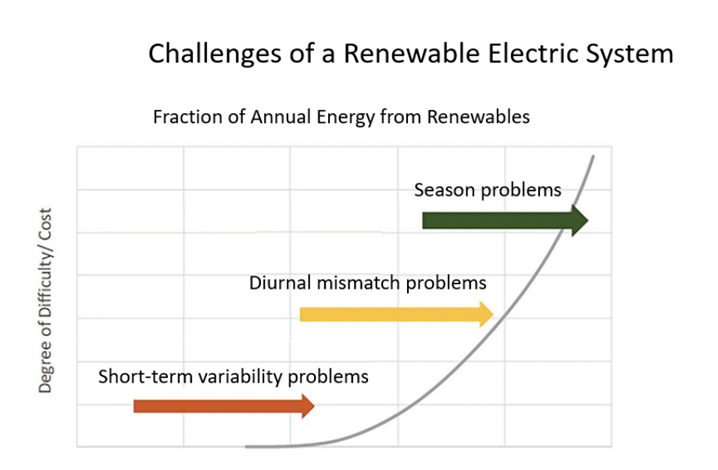
Higgins second point is one I constantly reiterate.  Academic studies and empirical evidence do not support New York’s renewable push.  He references the following National Renewable Energy Laboratory (NREL) chart that he says “shows the asymptotic costs of a system as penetration of renewables increases. Expensive battery energy storage can somewhat solve the “short term” variability of intermittent resource generation. But there is no day-night or seasonal solution.”  I would add that the chart should also include the long duration dark doldrum event problem in the upper right portion of the curve.  New York organizations responsible for the electric system all agree that a new dispatchable emission-free resource (DEFR) is needed.  I believe that including it would extend the graph exponentially higher.

In his third argument Higgins points out that NERC has also warned that inverter-based resources undermine grid reliability.  He quotes a NERC report:

Since 2016, NERC has analyzed numerous major events totaling more than 15,000 MW of unexpected generation reduction. These major events were not predicted through current planning processes. Furthermore, NERC studies were not able to replicate the system and resource behavior that occurred during the events, indicating systemic deficiencies in industry’s ability to accurately represent the performance of IBRs and study the effects of IBR on the bulk power system (BPS).

The fourth problem is that capacity markets are hammered by intermittent resources that increase energy costs and undermine reliability.  The necessity to have firm dispatchable resources needed to back up intermittent wind and solar means that in jurisdictions that are further down the renewable deployment path there is an increased need for peaker power plants that burn natural gas.  He describes the perverse economics that result.  This will exacerbate New York’s  energy affordability crisis

Higgins makes another point that I often raise.  Evidence from other jurisdictions shows that intermittent resources will not prove economical or reliable.  He cites results that show that

Controlling for country fixed effects and the rich dynamics of renewable energy capacity, we show that, all other things equal, a 1% percent increase in the share of fast reacting fossil technologies is associated with a 0.88% percent increase in renewable generation capacity in the long term.

Translated that means that for every MW of installed renewable capacity fast reacting dispatchable resources are necessary.  The only available resource is fossil-fired generators.  New York’s fossil fleet is aging.  Consequently, we are going to have to replace all the fossil plants in the long term or rely on more expensive battery storage and DEFR.  How can anyone claim that wind and solar are cheaper when they need one for one capacity backup is a mystery to me.

The final point that Higgins makes is that the New York Independent System Operator (NYISO has repeatedly warned of reliability issues.  He quotes the latest Power Trends report:

As traditional fossil-fueled generation deactivates in response to decarbonization goals and tighter emissions regulations, reliability margins on the grid are eroding. Further, the remaining fossil-fueled generation fleet, which provides many of the essential reliability services to the grid, is increasingly made up of aging resources, raising further concerns about grid reliability. Strong reliability margins enable the grid to meet peak demand, respond to sudden disturbances, and avoid outages. They also support the grid’s ability to respond to risks associated with extreme weather conditions. As these margins narrow, consumers face greater risk of outages if the resources needed for reliability are unavailable due to policy mandates or failures associated with aging equipment.

Higgins raises substantive issues that could derail the net-zero transition.  The political mandate to force NYPA to build as much renewable capacity as possible as quickly as possible ignores the very real possibility that the unresolved need for DEFR may mean that the renewable approach is a false solution.  Obviously, New York needs to pause implementation and consider the schedule and ambition of the Climate Act.

Request

Please consider submitting comments for the proceeding.  Written comments on the NYPA Renewables Strategic Plan can be submitted through Sept 12th here: https://publiccomments.nypa.gov/.  Explain that you are worried about costs and reliability and suggest that the strategic plan should take those factors into account.

State agencies tend to count the number of comments that support their positions to justify going ahead with their plans.  Even if you submit a comment that only says you agree with Vincent Gambini’s response to the scripted comments that say NYPA should build 15 GW of renewables by 2030, it would be useful.  For once, I would like to see comments from those of us outside the cult of climate catastrophes outnumber those zealots.

Conclusion

This process is yet another component of the Climate Act net-zero transition.  Even thought the costs are beginning to impact New York utility bills. the impacts of the Climate Act still are flying under the radar of most people.  It is just getting started and it would be better to stop it now than wait.  Contact your elected officials and demand accountability.

2024 New York State Wind Resources

I recently published a status update on New York State wind and solar capacity factors. Peter Carney alerted me to New York Independent System Operator hourly wind and wind curtailment data for 2024.  I have not been able to find those data sets since I evaluated the 2021 data so this article summarizes 2024 wind data.

I am convinced that implementation of the Climate Act net-zero mandates will do more harm than good because the energy density of wind and solar energy is too low and the resource intermittency too variable to ever support a reliable electric system relying on those resources. I have followed the Climate Act since it was first proposed, submitted comments on the Climate Act implementation plan, and have written over 540 articles about New York’s net-zero transition.  The opinions expressed in this article do not reflect the position of any of my previous employers or any other organization I have been associated with, these comments are mine alone.

Overview

The Climate Act established a New York “Net Zero” target (85% reduction in GHG emissions and 15% offset of emissions) by 2050.  It includes an interim reduction target of a 40% GHG reduction by 2030 and a mandate for zero-emissions electricity by 2040.  The Climate Action Council (CAC) was responsible for preparing the Scoping Plan that outlined how to “achieve the State’s bold clean energy and climate agenda.”  After a year-long review, the Scoping Plan was finalized at the end of 2022.  Since then, the State has been trying to implement the Scoping Plan recommendations through regulations, proceedings, and legislation. 

This article summarizes the hourly wind production (MW), hourly wind curtailments (MW) and capacity factors for 2024.  Production is simply the generation from all industrial wind turbines each hour.  The New York Independent System Operator (NYISO) describes curtailment of wind as limits on their output when it is economically or operationally necessary to reduce wind generation.  The capacity factor is a useful metric to understand electric generation resources.  The annual capacity factor for a generator equals the actual observed generation (MWh) divided by maximum possible generation (capacity in MW times the hours in a year). 

2024 Wind Resources

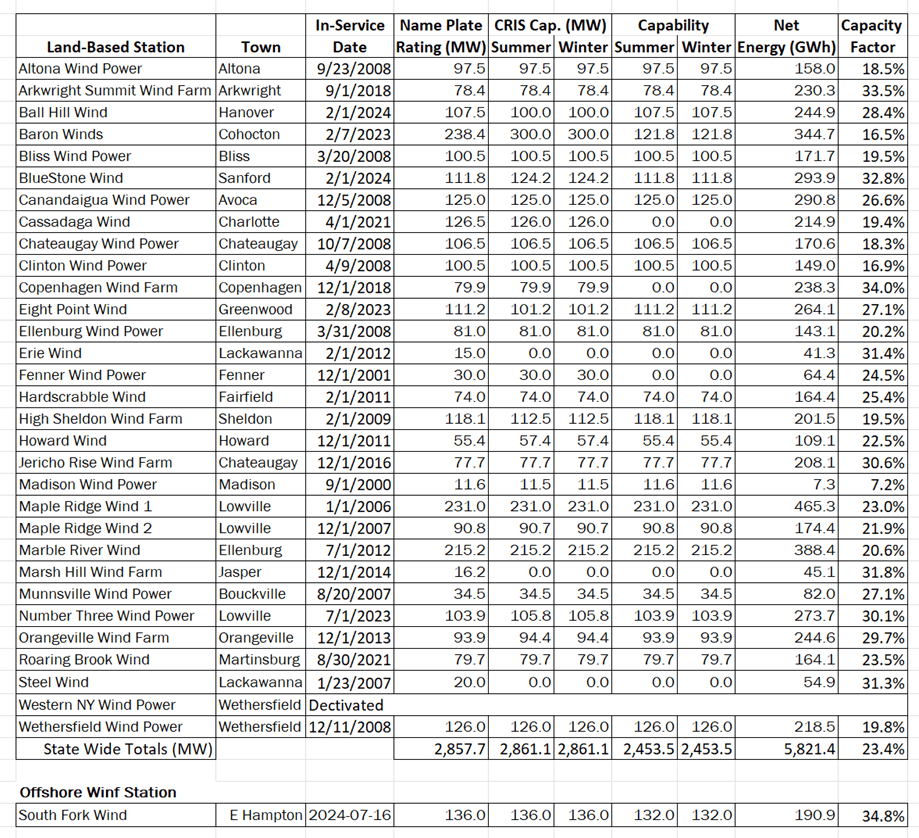
The New York Independent System Operator (NYISO) 2024 Load & Capacity Data Report (also known as the “Gold Book”) is now available at the NYISO website2025 Load & Capacity Data Report. Table 1 lists the capacity data and net energy produced for the wind generating units in New York from that report.

Table 1: NY 2024 Wind Facilities in the 2025 Gold Book

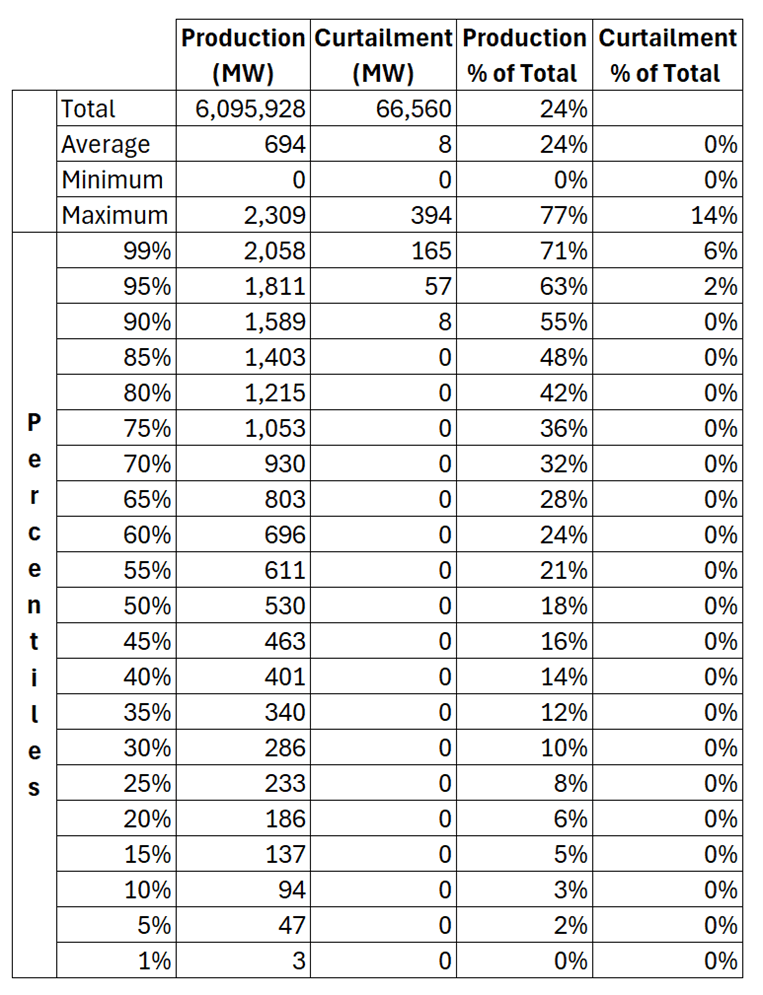
Table 2 summarizes the hourly NYISO wind production and curtailments in 2024.  I do not think that the production results are particularly impressive.  The percentiles are shown in the first column and the data indicate that wind power is greater than 71% of the total capacity only 87 hours (99th percentile) in 2024.  Three quarters of the time, the production is less than 1,053 MW equivalent to about one third of the total capacity.  If you assume that less than 10% of production is the threshold for appreciable support to the grid, then wind was not producing meaningful power 30% of the time.   I calculated that there was a period of 107 consecutive hours when the wind production was less than 10% of the total.  Curtailments do not appear to be an issue in New York yet.

Table 2: 2024 NYISO Hourly Wind Production Summary for the Entire New York Control Area

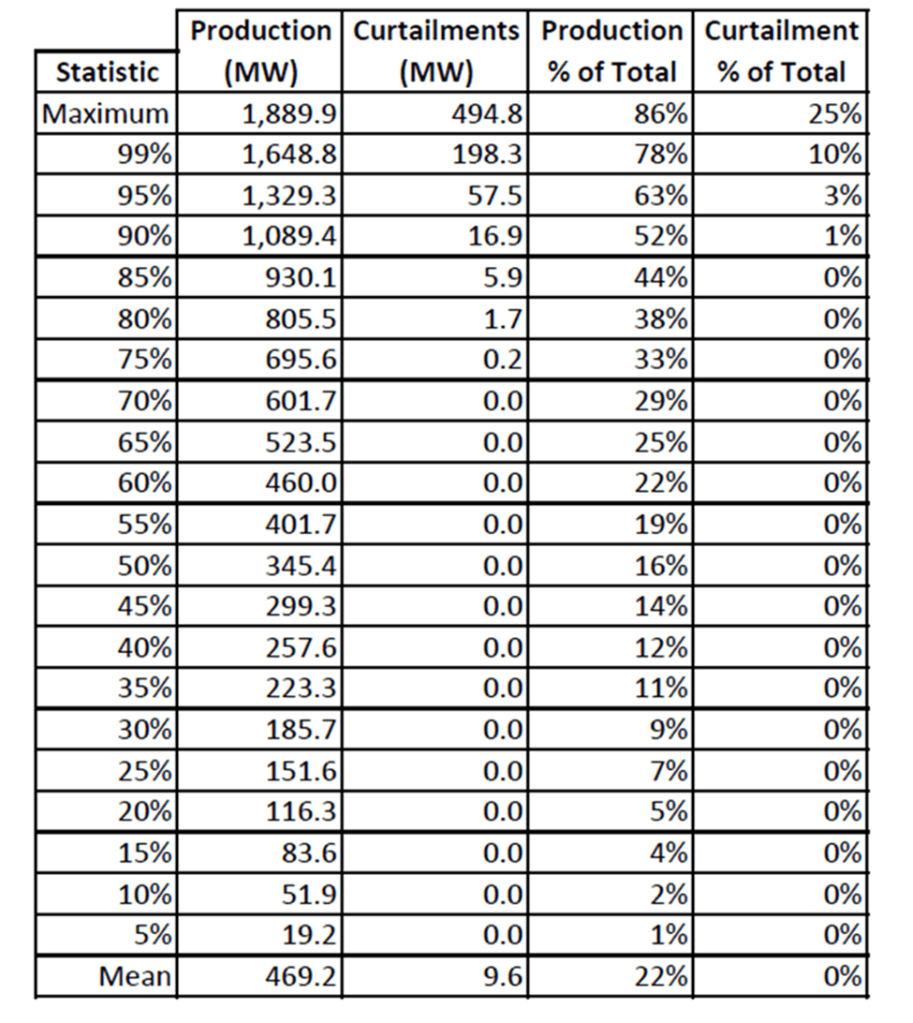
Table 3 summarizes the hourly production in 2021 and is useful to show interannual variation.  In 2021 the 99th percentile was slightly better at 78% compared to 71% in 2024.  At the 75th percentile production was 33% of the total in 2021 and in 2024 it was 36%.  The 10% threshold was 30% in both years.  In my opinion there was no substantive difference between 2021 and 2024.

Table 3: 2021 NYISO Hourly Wind Production Summary for the Entire New York Control Area

Curtailment Discussion

Parker Gallant keeps track of wind energy production in Ontario and the problem of what to do with excess wind energy when the production from Ontario exceeds the load.  The current strategy is to dump the excess power into Quebec, New York, and Michigan at a low price which has short-term consumer benefits to those jurisdictions.  However, Gallant has documented that through 4/26/25 dumping the excess wind and solar energy cost Ontario ratepayers a total for the month had reached $101 million which is about $20 per Ontario household.  I suspect that when New York builds all the wind capacity needed for the Climate Act that similar problems will occur in New York.  How that affects Ontario the curtailment situation in Ontario is open for discussion.

Production Discussion

The production results have an important ramification for resource planning.  The existing wind facilities are spread across the state and wind production is highly correlated.  Half the time the total generation capacity is around 17% of the total.  This means that improving energy production substantially requires a lot more generation capacity.  For example, in 2021 the production at the 25th percentile was 151.6 MW and in 2024 the production at the 25th percentile was 233 MW an increase of 81 MW.  However, the nameplate capacity in 2021 was 2,191 and in 2024 it was 2,858 MW an increase of 667 MW.  The investment of 667 MW of wind capacity only increased production 81 MW at the 25th percentile.

In my previous article I discussed the unreconciled differences between the Integration Analysis and observations.   Three years later there still hasn’t been any acknowledgement that the Integration Analysis overestimated the production capability of wind investments. This means that more wind development is necessary to meet the Climate Act goals.

Conclusion

The Climate Act 2040 zero-emissions target will require much greater reliance on wind and solar generating resources.  Unfortunately, the authors of the Climate Act did not recognize limitations for those resources.  These results show that land-based wind in New York is not a particularly good resource.  Wintertime solar is poor because of New York’s high latitude with short days in the winter and cloudiness downwind of the Great Lakes.   The ramifications on reliability and affordability of these poor resources has not been acknowledged.

Three years ago, I noted that it is imperative that the State conduct a detailed evaluation of renewable energy resource availability to determine the generation and energy storage requirements of the future New York electrical system.  There has been some progress in the evaluation of renewable resources, but the ramifications have not inspired any reaction by the those responsible for future energy planning.  In my opinion, resolving the issues shown in this article need to be addressed sooner rather than later.

New York Solar Siting Status

I recently had the opportunity to give a briefing on solar siting issues and think it is time to publish an update here.  In my opinion, the deployment of solar resources exemplifies poor planning inherent in the Climate Leadership & Community Protection Act (Climate Act) net-zero transition plan.

I am convinced that implementation of the Climate Act net-zero mandates will do more harm than good because of reliability and affordability risks.  I have followed the Climate Act since it was first proposed, submitted comments on the Climate Act implementation plan, and have written over 500 articles about New York’s net-zero transition.  The opinions expressed in this article do not reflect the position of any of my previous employers or any other organization I have been associated with, these comments are mine alone.

Overview

The Climate Act established a New York “Net Zero” target (85% reduction in GHG emissions and 15% offset of emissions) by 2050.  The Climate Action Council (CAC) was responsible for preparing the Scoping Plan that outlined how to “achieve the State’s bold clean energy and climate agenda.”  After a year-long review, the Scoping Plan was finalized at the end of 2022.  Since then, the State has been trying to implement the Scoping Plan recommendations through regulations, proceedings, and legislation. 

Solar Mandates

Public Service Law Section 66-p requires the Public Service Commission (PSC) to establish a renewable energy program.   Subsection 66-p(2) requires the PSC to establish a program to require that 70% of the

statewide electric generation shall be generated by renewable energy systems; and that by 2040 the statewide electrical demand system will be zero emissions. This basically codifies the Scoping Plan outline for a decarbonized electric system.

Both the Scoping Plan Key Drivers Output spreadsheet and the New York Independent System Operator (NYISO)  2021-2040 System & Resource Outlook  project a massive increase in New York solar capacity (Table 1).  Note that the solar generating capacity increases to over 20% of total capacity by 2030 for both scenarios.

Table 1: Installed Capacity (MW) NYISO Outlook Scenario 1 and Integration Analysis Mitigation Scenario 2 – Strategic Use of Low-Carbon Fuels

I have a solar siting issues page that documents my concerns.  In my briefing I highlighted three issues with the solar siting policy in New York since the inception of the Climate Act: protection of prime farmland, agrivoltaics policy, and inconsistency with the Scoping Plan,.  The farmland and agrivoltaics issues are addressed by Specialist Committees in the New York State’s Agricultural Technical Working Group.  At their last meeting in November 2024 there were updates for the Regional Agronomic Impacts of Solar Energy (RAISE) Specialist Committee, the Agrivoltaics Specialist Committee, and the Scorecard Specialist Committee that will be discussed below.

Farmland Protection

The New York Department of Agriculture and Markets has guidelines for solar siting.  New York Department of Agriculture and Markets testimony notes that “The Department’s goal is for projects to limit the conversion of agricultural areas within the Project Areas, to no more than 10% of soils classified by the Department’s NYS Agricultural Land Classification mineral soil groups 1-4, generally Prime Farmland soils, which represent the State’s most productive farmland.”  That seems reasonable to me because they are the Agency responsible for supporting New York agriculture.

I keep track of the status of projects with this guideline with a Prime Farmland Scorecard.  At this time only 12 of the 25 facilities with available data at the Office of Renewable Energy Permit Applications site meet those guidelines.  Two facilities had no impacts on prime farmland.  If they can do it, why can’t others.

Table 2: Prime Farmland Scorecard Updated May 25, 2025

It is extremely frustrating to me that the Department of Ag and Markets recommendation was not adopted as a matter of course for solar development permitting.  Instead, the New York State Energy Research & Development Authority (NYSERDA) is studying the issue.  The Smart Siting Scorecard considers this siting concern:

NYSERDA has developed the Smart Solar Siting Scorecard to 1) provide a tool to address multiple solar siting considerations and site management practices from the perspective of environmental, agricultural, and climate interests and 2) to provide criteria for renewable energy developers to consider in siting future projects, and include within project design, operations and maintenance, and decommissioning plans to encourage a balanced approach between renewable energy siting and other New York State policies, goals, and objectives. The Scorecard Specialist Committee provides input to NYSERDA on what avoidance and minimization approach to reduce impacts on these lands and how to value these approaches in a Scorecard format.  

I do not see any sign of urgency to finalize and implement farmland protections using the scorecard.  The Smart Siting Scorecard Specialist Committee has had three meetings this year:

Worse it does not appear that a solar development can get a failing grade for not doing smart siting.  In my opinion, this is lip service to the issue.

Agrivoltaics Policy

In my opinion, responsible solar siting policy would include agrivoltaics requirements that would mitigate impacts to agriculture.  NYSERDA is in charge of agrivoltaics policy: 

Agrivoltaics is a new and emerging combination of technologies that enhance climate resilience and allow sustainable food and energy production. From crop production to livestock grazing and pollinator habitat, agrivoltaics can support a wide range of agriculture practices.

This rapidly growing sector of the solar energy industry is undergoing considerable research, development, and demonstration in the United States and across the globe.

For the latest information and guidance, read the Growing Agrivoltaics in New York State report [PDF].

The New York State’s Agricultural Technical Working Group’s (A-TWG) Agrivoltaics Specialist Committee manages the agrivoltaics policy.  Based on the update at the A-TWG meeting last November, they have meetings and train farmers.  NYSERDA is supporting their efforts with the Agrivoltaics Research and Demonstration Request for Proposal (PON 5752).  The deadline to submit proposals was Sept 12th and contracts were supposed to be awarded in the first quarter of 2025. Nothing has been funded yet.

There is another agrivoltaics study: Regional Agronomic Impacts of Solar Energy (RAISE):

In 2022, the State Farmland Protection Working Group recommended the State initiate a study, to determine the potential benefits and/or burdens of renewable energy development related to New York’s agricultural industry. NYSERDA has convened a Specialist Committee under the A-TWG to assist NYSERDA to undertake a study or studies to assess the impact of solar development on the agricultural economy in the state. The study will inform State and regional policy, and will include an assessment of land use conversions, economic pressures, and other factors. The RAISE Specialist Committee shall:

  • Advise on developing scope(s) of work and associated study methodologies.
  • Identify information, data, and resources helpful to undertaking associated agricultural, economic, land use and other analyses.
  • Make recommendations on undertaking additional studies or actions.

I have found that NYSERDA sponsored research related to the Climate Act is designed to further the narrative that the transition is simple, cheap, and has inconsequential negative impacts.  The RAISE presentation at the last A-TWG meeting described takeaways for the impacts of solar development on agricultural  land values illustrates this on the following slide.  If solar lease rates are higher than agriculture lease rates, then it is obvious that landowners will preferentially lease to the solar developers making it more difficult for farmers who need to lease land to operate.  Note the weasel words – “limited research”, no “direct impact”, and could be “more vulnerable” in the description that try to avoid concluding the obvious.  The longer this report takes to be released the longer these negative impacts will persist and the more the developers can continue to negatively impact agriculture.

Scoping Plan Inconsistency

The capacity factor is a measure of how much energy can be provided by a generating facility in a year.  It is simply the amount of energy produced (MWh) divided by the capacity (MW) times the number of hours in the year.  Table 3 lists the capacity factors for the resources listed in Table 1. In my opinion, the Scoping Plan solar capacity factors are biased high.  I believe the only way these factors can be achieved is if the installed solar facilities use tilting axis solar panels.

Table 3: Capacity Factors (%) NYISO Outlook Study S-1 and Scoping Plan Scenario 2

I recently reported on the observed capacity factors of solar facilities.  Table 4 lists individual station factors.

Table 4: New York State Utility-Scale Solar Facility Capacity Factors Based on NYISO “Gold Book” Load & Capacity Data Reports Table III-1

Assuming a linear interpolation between the Scoping Plan Strategic Use of Low Carbon Fuels 2020 capacity factor of 17% and the 2023 factor of 20%, the expected capacity factor was 18.2%.  The observed capacity factors are lower than the Scoping Plan projection and I believe that is likely because NYSERDA does not require solar developers to install tilting axis solar panels to obtain subsidies from the State.

Discussion

The Scoping Plan is just an outline of emission reduction strategies that NYSERDA claims will achieve the goals of the Climate Act.  There never has been a feasibility analysis that proves that the Public Service Law Section 66-p requirement to establish a renewable energy program can work and there are no jurisdictions anywhere that have successfully developed an electric system that relies primarily on wind, solar, and energy storage. As far as I can tell, the Hochul Administration plan is to build as much wind and solar as possible, as fast as possible. That approach meant that there was no provision to develop responsible solar siting guidelines. 

The failure to plan has had negative consequences.  The decision to not require developers to meet the Department of Ag & Markets prime farmland protection guideline has led to the destruction of 6,650 acres of prime farmland.  The lack of an agrivoltaic policy means that very few developers are trying to mitigate the impact of solar panels.  The failure to require utility-scale solar facilities to use tilting-axis solar panels means that even more land will be covered in solar panels.

This was all preventable.  The claim that these programs had to be implemented as fast as possible because of the existential threat of climate change is no excuse.  If New York were able to eliminate all its GHG emissions, the effect of global emission increases elsewhere would supplant our efforts in one year.  New York GHG emissions are less than one half of one percent of global emissions and global emissions have been increasing on average by more than one half of one percent per year since 1990.  

Conclusion

NYSERDA has lost its way as a source of unbiased scientific information to guide energy policy in New York.  Their Climate Act responsibilities are opaque, their work products are biased to support the political narrative, there is no sense of urgency to address obvious deficiencies in current policy, and they do not respond to stakeholder concerns.  This has significant negative consequences for New York.

I cannot help but think that there is another reason for the development policy to build as much as possible as fast as possible.  The developers of these facilities push that narrative because they know that limits on using prime farmland and mandates to use tilting-axis solar panels will hurt their profitability.  It is all about the money.

Status Update on New York Wind and Solar Generation Capacity Factors

Note – Table 2 was corrected on May 25, 2025 at 21:30 EDT

Last year I published an article describing the New York Independent System Operator (NYISO) Load & Capacity Data Report (also known as the “Gold Book”) and how I used it.  This post uses the latest edition to determine the wind and solar capacity factors last year.

I am convinced that implementation of the Climate Act net-zero mandates will do more harm than good because the energy density of wind and solar energy is too low and the resource intermittency too variable to ever support a reliable electric system relying on those resources. I have followed the Climate Act since it was first proposed, submitted comments on the Climate Act implementation plan, and have written over 500 articles about New York’s net-zero transition.  The opinions expressed in this article do not reflect the position of any of my previous employers or any other organization I have been associated with, these comments are mine alone.

Overview

The Climate Act established a New York “Net Zero” target (85% reduction in GHG emissions and 15% offset of emissions) by 2050.  It includes an interim reduction target of a 40% GHG reduction by 2030 and a mandate for zero-emissions electricity by 2040.  The Climate Action Council (CAC) was responsible for preparing the Scoping Plan that outlined how to “achieve the State’s bold clean energy and climate agenda.”  After a year-long review, the Scoping Plan was finalized at the end of 2022.  Since then, the State has been trying to implement the Scoping Plan recommendations through regulations, proceedings, and legislation. 

.

Capacity Factor

The capacity factor is a useful metric to understand electric generation resources.  The annual capacity factor for a generator equals the actual observed generation (MWh) divided by maximum possible generation (capacity in MW times the hours in a year).  Projections for the amount of future wind and solar generation capacity needed for the Climate Act depend on capacity factor assumptions.

Not surprisingly, the aspirational schedule of the Climate Act has proven to be more difficult to implement than planned and many aspects of the transition are falling behind.  Worse, there has not been any indication that the Scoping Plan is being refined to incorporate the lessons learned in the years since it was drafted or address any of the issues raised in the comments.  The capacity factor assumptions are a prime example of an issue that needs to be addressed.

Wind and Solar Capacity Factor Projections

I have previously summarized future resource projections. The New York Independent System Operator (NYISO) 2021-2040 System & Resource Outlook is part of the NYISO Comprehensive System Planning Process.  That analysis included several scenarios for the future grid that includes capacity factor projections.  The Integration Analysis also included several scenarios and capacity factor projections.  In both instances the capacity factor projections determine how much wind and solar capacity will be needed in the future.

I am not the only one who submitted comments about the Scoping Plan capacity factors.  I pointed out that the Integration Analysis land-based wind capacity factors were unrealistically high.  The model projected the 2020 generation with a capacity factor of 29% but the 2021 observed capacity factor was only 22%.  The Integration Analysis model could not even get the starting year correct.  As a result, the Integration Analysis projections for the land-based wind capacity needed to meet the load are too low.  It is particularly disturbing that the State has never attempted to reconcile the NYISO projections and assumptions with the Integration Analysis.  For all renewable resources the Integration Analysis capacity factors are higher than the NYISO projections as shown in Table 1.

Table 1: Capacity Factors (%) NYISO Outlook Study S-1 and Integration Analysis Mitigation S-2

2024 Wind and Solar Observed Capacity Factors

The New York Independent System Operator (NYISO) 2024 Load & Capacity Data Report (also known as the “Gold Book”) is now available and has been posted on the NYISO website2025 Load & Capacity Data Report (Gold Book).  Many of the most useful tables are also provided as spreadsheets.  The following supplemental materials have also been posted:

The Existing Generating Facilities spreadsheet was used to calculate New York capacity factors.  Table 2 sums the capacities and net energy for all the combinations of primary fuel type and secondary fuel type for all the generators tracked by the NYISO.  This includes units that are in the market system as well as others that are not.  The nameplate capacity of generating units that use natural gas and can also burn number 2 fuel oil is the largest category in the state.

Table 2: 2025 NYISO Gold Book Tables III – 2a NYISO Market Generators and Table III – 2b Non-Market Generators 2023 Capacity, Energy, and Capacity Factors

Table 3 lists the capacity data and net energy produced for the wind generating units in New York.  Note that the Western NY Wind Power site was deactivated and that the offshore Southfork Wind Farm came on line on July 16, 2024.  Using the data, it is possible to calculate the capacity factors for each facility.  The NYISO Resource Outlook and the Integration Analysis both assume a land-based 34% capacity factor in 2030.  Only one wind farm exceeded 34% and there were seven more that were over 30% capacity of the 30 wind farms in New York.  In 2023 two exceeded 34% and three exceeded 30%.  The overall capacity factor was up from 21.8% to 23.4%.  To achieve the assumed capacity factor for 2030 most of the existing onshore wind farms will have to be replaced.  The Integration Analysis does not retire any of the existing wind farms which I suspect is so that the cost estimate does not have to include those costs.

One of the oft-touted benefits of offshore wind is that it will have higher capacity factors.  The NYISO Resource Outlook and the Integration Analysis both assume offshore wind capacity factors of at least 45% in 2030.  The annual observed capacity factor was only 34.8%.  I assumed that the full capacity was available on the in-service date.  That might explain why the offshore wind capacity is so low.

Table 3: NY 2024 Wind Facilities in the 2025 Gold Book

I have been tracking the wind farm capacity factors since 2006 as shown in Table 4.  There is nothing to suggest that 2024 was an abnormal year.  To meet the 2030 projections these wind farms are going to have to be replaced or a large number of wind farms with much higher capacity factors that will bring the average up will have to be built.  The data shown are also interesting as they show large interannual variation by site and the state overall.  Finally note that the NYISO wind capacity factor for 2019 was modeled as 25% but the observed capacity factor was  22.3%.  The Integration Analysis did not get their first year correct either.  It modeled the 2020 capacity factor as 29% but the observed capacity factor was only 23.9%.

Table 4: New York State Onshore Wind Facility Capacity Factors Based on NYISO “Gold Book” Load & Capacity Data Reports Table III-1

In 2024 the capacity factor of the solar facilities in New York was 17.7%, the highest capacity factor was 22.6% and the lowest capacity factor was 12.8%. The NYISO assumed a capacity factor of 15% from 2019 to 2040.  On the other hand, the Integration Analysis assumed a capacity factor of 17% in 2020, increasing to 20% by 2030 so they expected a capacity factor of 18.2% in 2024.  The observed capacity is less than the Integration Analysis.

Table 5: NY 2024 Utility-Scale Solar Facilities in the 2025 Gold Book

I have been tracking the industrial solar facility capacity factors since 2018 as shown in Table 6 but until 2022 there was only one reporting facility.  There is nothing to suggest that 2024 was an abnormal year. 

Table 6: New York State Utility-Scale Solar Facility Capacity Factors Based on NYISO “Gold Book” Load & Capacity Data Reports Table III-1

Discussion

The NYISO has interesting generation resource information available in its Gold Book.  As shown here, that information can be used to calculate the capacity factors for wind and solar resources in New York.  The annual wind capacity factors observed are consistently lower than the values used in the Integration Analysis which is being used to implement the state plan to meet the Climate Act mandates.  Solar is better but the statewide capacity factor is less than the Integration Analysis projection in 2024  As a result, The Scoping Plan is underpredicting the wind and solar resources necessary to generate the energy they project will be needed. That means that their cost projections are too low.

It is troubling that the differences shown here between the NYISO capacity factors and the Integration Analysis capacity factors have not been reconciled.  Worse, none of the differences between the two sets of projected resource projections have been addressed.  This matters not only because the differences affect the projected outcomes and the costs, but also because Integration Analysis projections are being used for the New York Cap-and-Invest (NYCI) Program proposal.A key component of the NYCI plan is the trajectory for allowance allocations.  NYCI’s reduction trajectory is based on the Integration Analysis and the overly optimistic capacity factors used means that they are projecting lower emissions than is likely to occur.  That imbalance could have significant consequences to the allowance market.

One other point is that these are annual metrics.  In order to assure that the electric grid will be able to provide energy when it is needed the most the NYISO must deal with resource availability over shorter periods.  Think of it as the capacity factor over the coldest week of the year.  That is a much more difficult issue and one that the Scoping Plan did not address and has not been addressed by the Public Service Commission.

Conclusion

This post documents the most recent wind and solar capacity factors observed in New York.  It is notable that the wind data show a lot of interannual variation that should be considered when projecting future resource availability.  Historical data have not been incorporated into an updated analysis of the generating resources needed to achieve the Climate Act goals. 

I have long argued that the State’s plans for implementing the Climate Act mandates must include a feasibility study that could address the observed variability and lower capacity factors.  Given the tremendous uncertainties like these shown here, I have recently decided that a feasibility study is not enough.  No jurisdiction anywhere has successfully demonstrated an electric grid that depends on wind and solar to the extent that the Scoping Plan does.  Before New York goes any further it should prove it can be done with a demonstration project.  Anything less risks catastrophic blackouts and enormous costs.

Champlain Hudson Power Express Payment in Lieu of Taxes Grift

One of the reasons that I decided to submit a statement in opposition to the Niagara Mohawk Power Corporation dba National Grid (NMPC) rate case proceeding was the lack of transparency on costs of the Climate Leadership & Community Protection Act (Climate Act) net zero transition.   This article describes a Climate Act cost to New Yorkers that uncaring Albany policy makers pass down to localities.

I am convinced that implementation of the Climate Act net-zero mandates will do more harm than good because of reliability and affordability risks.  I have followed the Climate Act since it was first proposed, submitted comments on the Climate Act implementation plan, and have written over 500 articles about New York’s net-zero transition.  The opinions expressed in this article do not reflect the position of any of my previous employers or any other organization I have been associated with, these comments are mine alone.

Overview

The Climate Act established a New York “Net Zero” target (85% reduction in GHG emissions and 15% offset of emissions) by 2050.  It includes an interim target of a 100% zero emission grid by 2040. The Climate Action Council (CAC) was responsible for preparing the Scoping Plan that outlined how to “achieve the State’s bold clean energy and climate agenda.”  After a year-long review, the Scoping Plan was finalized at the end of 2022.  Since then, the State has been trying to implement the Scoping Plan recommendations through regulations, proceedings, and legislation. 

Another Renewables Subsidy

One missing piece in the implementation of the Climate Act is an honest admission of costs.  Not only has the State failed to provide required cost information, but there is no accounting of all the costs like the property tax exemption for renewable projects.   Peter Carney explains the basis of the property tax subsidy:

New York State laws encourage projects that are aligned with specific public policies such as the development of renewable energy or infrastructure that supports the economy, in a variety of ways including Real Property Tax exemptions.

The laws provide the local county, town, and schools with the option of negotiating Payment In Lieu of Tax (PILOT) agreements to compensate the local jurisdictions for some of the lost tax revenue.

There are three outcomes for these potentially tax-exempt projects:

  1. The projects can be accepted as fully exempt (no tax revenues are collected) (TCSD has not done this).
  2. The local entities can negotiate Payment In Lieu of Taxes (PILOT) agreements that compensate the local jurisdictions for some of the lost tax revenue. (TCSD has done this with the recent energy projects.)
  3. The law also provides the affected governments with the several or joint ability to opt out of the tax exemptions provided by the state law, in which case the energy projects would be fully taxable. (The TCSD has not enacted such an opt-out provision and thus none of the energy projects will be taxed at their full value.)

New York State’s Real Property Tax Law (RPTL) Section 487 provides a 15-year tax exemption for properties with renewable energy systems, including solar, wind, and other clean energy technologies.  The costs of this tax forgiveness from PILOTs are not “hidden” rather the policy makers in Albany just don’t care about the costs imposed on local taxpayers.  It is setup as an “opt-out” rule that requires local jurisdictions to jump through hoops if they decide not to participate.  It automatically applies otherwise. 

PILOT agreements provide a structured payment system to developers that reduce their initial property tax burden to help support the new projects. Their benefits include “multifaceted effects on local economies, ranging from stimulating redevelopment to reshaping municipal revenue streams”. PILOT agreements in New York cover the following types of projects:

  • Manufacturing and industrial developments
  • Not-for-profit organizations
  • Renewable energy installations, particularly solar projects
  • Commercial and residential real estate developments
  • Economic revitalization initiatives

In my opinion, four of these five types of projects will provide value to the jurisdictions once the development is complete.  On the other hand, renewable energy installations do not.  New York GHG emissions are less than one half of one percent of global emissions and global emissions have been increasing on average by more than one half of one percent per year since 1990 so emission reduction projects in New York will be supplanted by increases elsewhere in a year..  Furthermore, New York’s statewide impact on global temperature is unmeasurable so no new project is going to impact global warming.

The response to my Perplexity AI query “How do New York Payment in lieu of tax agreements benefit jurisdictions for transmission or renewable energy projects?” claimed other benefits PILOT proponents thought these agreements would provide.  The query claimed seven benefits to the jurisdictions granting the PILOT:

  1. Predictable revenue streams – The basis of this is that traditional property tax arrangements can fluctuate with changes in assessment values, so the PILOT payments provide predictability.  I think that one thing that is predictable is that the tax revenues will be less than the traditional property tax proceeds.
  2. Growth-oriented payment structures – If the jurisdiction negotiates an escalation clause, then payments can increase.
  3. Revenue preservation mechanisms – “While PILOT agreements offer tax exemptions, they are designed to preserve a significant portion of the potential tax revenue that would have been generated without compromising project viability. Under New York law, PILOT amounts cannot exceed what the tax amount would have been without the exemption, creating a natural ceiling that balances developer needs with jurisdictional interests.”
  4. Economic development benefits – Proponents of PILOTs argue that the agreements support broad economic development but that only benefits New York if the installed infrastructure is manufactured in New York.
  5. Job creation and industry growth – The AI response claimed that there was remarkable growth in the renewable energy sector, but this is a weak argument in my opinion.  For an individual jurisdiction PILOT agreements for manufacturing or industrial projects will provide local jobs but the construction of a transmission line will only impact a local jurisdiction during construction and those jobs will not be local.  I do not think this is a benefit for a renewable project.
  6. Supporting the transition to clean energy – As noted previously, the Climate Act transition will have no tangible effect on global emissions or temperature, so it is only a virtue-signaling exercise.
  7. Jurisdictional control and flexibility – The Perplexity AI explanation states: “PILOT agreements provide local governments with significant control over how renewable energy projects are incentivized and taxed.”  It is not clear to me why local jurisdictions would care about incentives and taxation for renewable energy.

The Perplexity AI response claiming benefits for renewable energy projects from PILOT agreements gave an example of a successful agreement.  Note that the only reference cited for the following quotation was a Bethlehem Central School description of the PILOT:

The Champlain Hudson Power Express Project (CHPE) demonstrates how PILOT agreements work for large-scale transmission projects. This underground transmission line, delivering renewable energy from Canada to New York City, spans multiple jurisdictions including four towns, two villages, and four school districts

.

The Albany County Industrial Development Agency (IDA) structured a 30-year PILOT agreement for this project, significantly longer than typical 10-11 year terms. Payments are apportioned based on geographical coverage, with the Bethlehem Central School District receiving benefits proportional to the 2.14 miles of pipeline within its boundaries.

After reviewing the proposed PILOT terms, the school district found them reasonable, highlighting how these agreements can satisfy the needs of both developers and local jurisdictions.

After the acceptance of a PILOT agreement there is no way a school district is going to acknowledge any issues.  Before describing an example, here are more details on CHPE.

Champlain Hudson Power Express (CHPE)

This transmission project is intended to bring zero-carbon electricity from Quebec to New York City: “Two five-inch-diameter cables will be placed underwater or underground and run 339 miles from the U.S.-Canadian border, south through Lake Champlain, along and under the Hudson River, and eventually ending at a converter station that will be built in Astoria, Queens.”  This project has been underway for a long time.  The first regulatory filing was posted on March 30, 2010.  Construction finally started in September 2023 and the developers claim that as of April 2025 it is on schedule for an in-service date of May 2026. The New York Independent System Operator (NYISO) 2023-2032 Comprehensive Reliability Plan notes that the reliability of the grid is “heavily reliant on the timely completion of planned transmission projects, chiefly the Champlain Hudson Power Express (CHPE) project.”    

Note that it was designed with no substations or interconnections to the local or regional transmission system between Quebec and New York City along the CHPE route. The transmission line was designed as a point-to-point HVDC link, running continuously from the Hydro-Québec system at Hertel to the Astoria converter station.  This is not to say that an interconnection could be added later but for now it means that there are no local benefits once the line is in place.

CHPE Ticonderoga Central School PILOT

Peter Carney authored “A review of the Ticonderoga Central School District’s energy project PILOT agreements and impacts on taxpayers” (White Paper) that breaks down the effect of the PILOT agreements on local taxpayers that the Bethlehem Central School district description did not. Carney prepared the white paper to “document missed opportunities for the TCSD Board of Education (BoE) to increase non-tax school revenues, estimated at more than $1 million annually, from seven new energy projects. Consequently, rather than the energy projects paying their fair share of taxes, the taxpayers of Hague and Ticonderoga will need to make up the difference.” 

The White Paper analyzed six solar projects and CHPE.  It explains the impacts related to CHPE as follows:

This project is for the installation of a 1,250 MW DC transmission system from Hydro Quebec to New York City. Without the successful completion of this project, load shedding and blackouts are projected for NYC as soon as 2026vii. Clearly, this project will go forward to completion with or without a PILOT tax exemption.

Despite this, TCSD agreed to several disadvantageous terms:

  • The PILOT is a small fraction of the full tax: The PILOT Agreement forecasts that in the first year, TCSD will receive $122,770 or approximately one quarter of the fair share of taxes due from CHPE if taxed at full value.
  • The PILOT is calculated based on estimated construction costs, almost certain to be lower than the actual costs incurred several years later. Any costs above the preconstruction estimate will be fully tax exempt.
  • There are no PILOT payments until CHPE decides that the PILOT agreement should begin.
  • The payment schedule is back-end loaded with most of the payments due to be delivered in the last several years of the 30-year PILOT agreement.

The route for this system passes through TCSD jurisdiction for 9.26 miles. The first year PILOT payment for Essex County is fixed at $1,532,592 which will be divided among Essex County, seven host towns and six school districts based on a formulation that considers route distance, and full value tax rates for each jurisdiction for the first year the PILOT is effective.

TCSD copied the Town of Ticonderoga’s agreement, which copied the Essex County agreement, without considering that TCSD includes Hague and what impact that would have.

To the extent that Hague’s total Full Market Value assessment (FMV) increases compared to Ticonderoga’s, the Ticonderoga school tax rate decreases and therefore the TCSD will receive a reduced portion of the Essex County PILOT payments.

Discussion

The White Paper included the following table that reports the level of PILOT tax exemptions reported in NY.  Unfortunately, TCSD clearly passed up opportunities to be more protective of its taxpayers in its negotiations with CHPE. The only jurisdiction that gets value for providing tax breaks is New York City and they are taxing CHPE at the full value.  The opt-out provisions of New York’s Real Property Tax Law contributed to the sad state of affairs where a rural upstate school district unwittingly subsidizes a renewable energy project that provides no direct benefits to its taxpayers while the only entity that benefits charges the project as much as it can.

There are other costs associated with CHPE that are not obvious.  Carney wrote me that “Not only will CHPE receive New York State Energy Research & Development Authority subsidies that are many multiples of the New York City Locational Based Marginal Pricing (LBMP) they are also going to significantly increase the Locational Capacity Requirements for New York State thus increasing the capacity cost to New York City.  Through the magic of Perplexity AI, I have an explanation of his comment if you are interested.  Finally, if Niagara Mohawk/National Grid, Transco, and Con Ed built the CHPE it would be fully taxable, so the developers are unquestionably getting millions of dollars of tax breaks each year for 30 yrs on top of being paid many multiples of the LBMP in New York City.

Conclusion

CHPE offers a perfect example of the many subsidies and programs set up to facilitate renewable energy development. The Department of Public Service is required to report annually on the status of the implementation of the Climate Act and include cost impacts.  Not only is the 2024 report overdue, but it will not account for hidden costs like those described here.  Anyone who thinks that special interests are not taking advantage of these complexities at the expense of New Yorkers is naïve.

Implication of Assessment of Extreme Renewable Resource Lulls

Note: A version of this article was posted at Watts Up With That

I am convinced that implementation of the New York Climate Leadership & Community Protection Act (Climate Act) could have devastating impacts on New York residents as long if proponents ignore lessons that could be learned elsewhere and continue down the current path.  This post describes work done in Great Britain that has direct bearing on New York’s implementation plans and shows we need to re-think the tradeoffs of Climate Act implementation.

I believe that implementation of the Climate Act net-zero mandates will do more harm than good if the future electric system relies only on wind, solar, and energy storage because of reliability and affordability risks.  I have followed the Climate Act since it was first proposed, submitted comments on the Climate Act implementation plan, and have written over 500 articles about New York’s net-zero transition.  The opinions expressed in this article do not reflect the position of any of my previous employers or any other organization I have been associated with, these comments are mine alone.

Overview

The Climate Act established a New York “Net Zero” target (85% reduction in GHG emissions and 15% offset of emissions) by 2050.  It includes an interim reduction target of a 40% GHG reduction by 2030. The Climate Action Council (CAC) was responsible for preparing the Scoping Plan that outlined how to “achieve the State’s bold clean energy and climate agenda.”  After a year-long review, the Scoping Plan was finalized at the end of 2022.  Since then, the State has been trying to implement the Scoping Plan recommendations through regulations, proceedings, and legislation.  Recently, the State initiated the State Energy Plan process to update it to be consistent with the Climate Act.  It is not clear whether this proceeding will consider stakeholder comments that were ignored during the Scoping Plan process.

Renewable Resource Lulls

The Scoping Plan, Integration Analysis, New York Independent System Operator (NYISO), New York Department of Public Service, the New York State Reliability Council, and others all have noted that a new category of generating resources called Dispatchable Emissions-Free Resources (DEFR) is necessary to keep the lights on during periods of extended low wind and solar resource availability.  The frequency, duration, and intensity of wind and solar availability gaps must be known to properly plan to provide the generation, storage, and DEFR resources necessary to maintain reliable service.  Analyses done by the New York State Reliability Council Extreme Weather Working Group have shown that extended periods of low wind and solar resource availability will be challenging for the future New York electric system. 

On December 24, 2024 I submitted testimony for the December 18, 2024, Assembly Standing Committee on Energy Public Hearing regarding NYSERDA Spending and Program Review. I noted that the biggest feasibility challenge is the identified “gap” when wind and solar resources are low for long periods.  As one example of appropriate feasibility funding, I recommend analyzing the variability in low wind and solar resource availability.  The characteristics of the resource gaps must be quantified not only for New York but also for adjoining regional systems presuming that they also transition to an electric system with a similar reliance on wind and solar.

The Independent System Operator of New England (ISO-NE) Operational Impact of Extreme Weather Events  completed an analysis that addresses this need for New England.  The study evaluated 1-, 5-, and 21-day extreme cold and hot events using a database covering 1950 to 2021. The results found that the system risk or “the aggregated unavailable supply plus the exceptional demand” during an event increased as the lookback period increased.  If the resource adequacy planning for New England only looked at the last ten years, then the system risk would be 8,714 MW, but over the whole period of record, the worst system risk was 9,160 MW which represents a resource increase of 5.1%.  This means that the low renewable resource analysis should cover as long a period as possible to determine the longest period of exceptional demand and low renewable resources.

Great Britain Renewable Assessment

David Turver blogs about energy issues in Great Britain. In an October 2023 post  he describes a report from the Climate Change Committee (CCC),  their equivalent to New York’s Climate Action Council. He explains that the Royal Society (RS) Large Scale Electricity Storage report authored by Professor Chris Llewellyn-Smith claims that Great Britain can meet its demand for electricity with wind and solar, supported by large-scale hydrogen storage.  Large-scale hydrogen storage is the placeholder DEFR technology in the Scoping Plan, so this analysis is directly applicable to New York’s DEFR resource issue.

Turver argues that the report is deeply flawed. Among his concerns are the following:

They begin by assuming that electricity demand will be 570TWh in 2050 which represents roughly halving the energy demand across residential, transport and industrial and commercial categories. The evidence from Our World in Data shows that rich economies require high energy consumption to thrive. There are no rich countries with low energy consumption and those countries that have reduced energy consumption have grown more slowly, or even shrunk. The first extraordinary claim of low energy consumption fails because the evidence shows that if we allow that to happen, we will be much poorer.

The report then goes on to assume that the profile of electricity demand will be the same as today. However, as we move from gas to electricity to heat our homes and offices, the winter surge in electricity demand will be further exaggerated. Moreover, demand will change from year to year such as during the cold winter in 2010 that also coincided with a calm period when we would have generated much less renewable electricity. These variations in demand profile will lead to more generation capacity and an even bigger energy store than RS assumes, pushing up costs.

He goes on to argue that there are other flaws.  the report assumes unrealistic load factors for both onshore and offshore wind. It underestimates the amount of offshore wind needed and goes on to assume efficiencies and costs for hydrogen electrolysers, storage, and generation that do not stand up to scrutiny.  He also points out that the economic assumptions are flawed. 

He describes the “main positive aspect of the report”:

The thing that stands out most is the painstaking analysis that has been conducted to understand the very significant changes in the weather that occur on yearly and decadal timescales. They analysed wind and solar records over 37 years to estimate the level of variation we might expect from wind power.

In a recent article Turver includes a graphic that shows this issue using the 37 year database.

The analysis of 37 years is longer than anything done to date for New York.  He also points out an aspect of DEFR that relies on hydrogen storage that I had not considered previously.  It is not just the annual worst-case episode but there can be multi-year issues:

They found that we can sometimes have several consecutive years where the wind speed is lower than average. This means that if we are to have a grid powered solely by wind, solar and storage, then we need to build up massive stores of energy in the windy years to be used in the calmer years. They conclude that to consistently deliver their 570TWh of electricity each year, we would need 123TWh of hydrogen storage. Some of that hydrogen may have to be stored for a decade or more before it is used.

He also points out that the requirement for decadal storage is another flaw for any DEFR backup resource:

This has important implications for the economics of storage and effectively rules out batteries as the storage medium. Who would want to spend millions on building a battery or hydrogen storage cavern, even more to fill it and maintain it, yet not see any revenue from it for years after it was completed?

DEFR Backup Reliability Risk

Turver’s article raises the ultimate reliability risk for a weather-dependent electric system.  Today’s electric system resource planners for a conventional system base the amount of capacity that they think will be needed based on decades of observations of the fallibility of power plants.  The result is that they know the probability there will be a shortage of available capacity to meet load when the installed reserve system capacity margin is a fixed percentage of the expected load very well.  In New York State the installed reserve margin to meet the accepted probability of a loss of load expectation of an outage no more than once in ten years reliability metric is around 20%.

A fundamental observation is that there is no expectation that the failure of conventional power plants will be correlated.  We do not expect that many will fail at the same time.  That in turn means that even if we decided to set the reliability metric based on a one in thirty-year probability that there would not be much of an increase in the installed reserve margin.

That all changes when the electric system transitions to one dependent upon wind and solar weather-dependent resources.  We know that solar energy is zero and night and much lower in the winter.  Similarly, we know that wind energy is much lower in a high-pressure system, and that those systems are huge and cover all Great Britain and much of western Europe or eastern North America at the same time.  Exacerbating the problem is the fact that those conditions are associated with the hottest and coldest episodes with the greatest expected electric loads.

Turver’s post shows that looking at one year is absurd.  Not looking at the worst year on record is nearly as bad: “They used 1987 as a 1-in-20 year stress test, when they admit that 2010 was a 1-in-50 year event”.  The insurmountable problem is that we know that if an even longer period of record was used there would very likely be an even worse event.  Instead of the confidence in the current planning process that increasing the lookback period will not markedly change the resources needed for the worst case, relying on weather-dependent resources means that inevitably there will be a period of extreme weather that exceeds the planning criteria chosen and the expected resources based on those criteria.  The costs to provide DEFR backup support will be extraordinary and building excess capacity for a very rare event will significantly add to those costs.  This trade-off means that eventually there will be a catastrophic blackout when the load exceeds the storage capacity.

Conclusion

Turver’s articles are further evidence of the DEFR “gap” problems for any electric system that relies upon weather-dependent renewable resources.  The first problem is that you have to determine how much DEFR capacity is needed using as long record as possible.  The second problem is that there is no commercially available DEFR technology that is available to deploy for the aspirational Climate Act targets.  Thirdly, until a DEFR strategy is proposed we have no idea how much this will all cost so any claims that the Climate Act will be “affordable” are incomplete.  Finally, there is the insurmountable weather-related probability that eventually there will be a unusual set of weather conditions and load requirements that exceed the DEFR resources deployed. 

To sum up: we know that a new resource will be needed, we don’t know how much, what it will be, how much it will cost, and that whatever we do eventually it won’t be enough so people will die in a catastrophic blackout.  This is insanity.