
Energy Plan Board Meeting Misleading Information – Climate Change Impacts are Here

I recently wrote an article about the claim that renewable energy can reduce costs in the presentation by Jeff Freedman from the Atmospheric Sciences Research Center, University at Albany at the Energy Planning Board on March 3, 2025.  I concluded that the claim is based on hope not evidence.  Dr. Freedman’s presentation also included slides that support the Hochul Administration narrative that Greenhouse Gases (GHG) are the cause of the observed increases in global temperature and that the impacts of that warming are evident today.  This article explains why I disagree with those claims in Freedman’s presentation.

I am convinced that implementation of the New York Climate Leadership & Community Protection Act (Climate Act) net-zero mandates will do more harm than good if the future electric system relies only on wind, solar, and energy storage because of reliability and affordability risks.  I have followed the Climate Act since it was first proposed, submitted comments on the Climate Act implementation plan, and have written over 500 articles about New York’s net-zero transition.  The opinions expressed in this article do not reflect the position of any of my previous employers or any other organization I have been associated with, these comments are mine alone.

Energy Plan Overview

According to the New York State Energy Plan website (Accessed 3/16/25):

The State Energy Plan is a comprehensive roadmap to build a clean, resilient, and affordable energy system for all New Yorkers. The Plan provides broad program and policy development direction to guide energy-related decision-making in the public and private sectors within New York State.

The current Plan was initially published in 2015, and updated in 2020, when it was amended to align with the objectives of the 2019 Climate Leadership and Community Protection Act (Climate Act). Since the last update, the Climate Action Council produced its Scoping Plan, examining many of the energy issues that contribute to climate change and offering recommendations that are currently being implemented by the State.

On September 9, 2024, the Hochul Administration initiated the State Energy Plan process to update the Plan consistent with the Climate Act.  The goal of the planning process is to “map the state’s energy future by showing how the state can ensure adequate supplies of power, reduce demand through new technologies and energy efficiency, preserve the environment, reduce dependence on imported gas and oil, stimulate economic growth, and preserve the individual welfare of New York citizens and energy users.” The major question that must be addressed is whether the Hochul Administration will use the energy planning process as an opportunity to consider the advice of stakeholders in its stakeholder process or just an obligation with no attempt to meaningfully engage with any comments inconsistent with the narrative.

If the March 3 meeting is any indication, then the Energy Plan will be another political show extolling the virtues of the Climate Act and ignoring anything inconsistent with the political narrative.  In other words, it looks just like the Scoping Plan process.  Many of the appointees to the Climate Action Council chosen to approve the Scoping Plan were chosen because of their position within the Hochul Administration or political connections and not their technical expertise.  One feature of the Scoping Plan process was the New York State Energy Research & Development Authority (NYSERDA) strict adherence to the political narrative rather than full disclosure of inconsistent issues.  This article addresses several arguments made in the NYSERDA presentation by Freedman that misled the Energy Planning Board members.

Narrative Support

Climate Leadership & Community Protection Act Section 1. Legislative findings and declaration, subsection 3 defines the narrative:

Action undertaken by New York to reduce greenhouse emissions will have an impact on global greenhouse gas emissions and the rate of climate change. In addition, such action will encourage other jurisdictions to implement complementary greenhouse gas reduction strategies and provide an example of how such strategies can be implemented. It will also advance the development of green technologies and sustainable practices within the private sector, which can have far-reaching impacts such as a reduction in the cost of renewable energy components, and the creation of jobs and tax revenues in New York.

The  presentation slides for the March 3 meeting included Freedman’s Key Findings slide that support this narrative.   The first finding says that “Climate change is already constraining some sources of energy supply and stressing transmission and distribution infrastructure through extreme heat, changes in precipitation, and increasing storm intensity”.  The implication is that reducing GHG emissions in New York will affect the rate of climate change which they claim has already become evident.  The second finding that “Patterns of energy demand are shifting due to climate change and are expected to continue evolving over the coming decades” explicitly states that impacts are observable.

These findings were presented to the Energy Planning Boad as unequivocal statements of fact.  In reality, there is significant uncertainty that should be considered in the draft Energy Plan.

Comparison of CO2 and Global Temperature

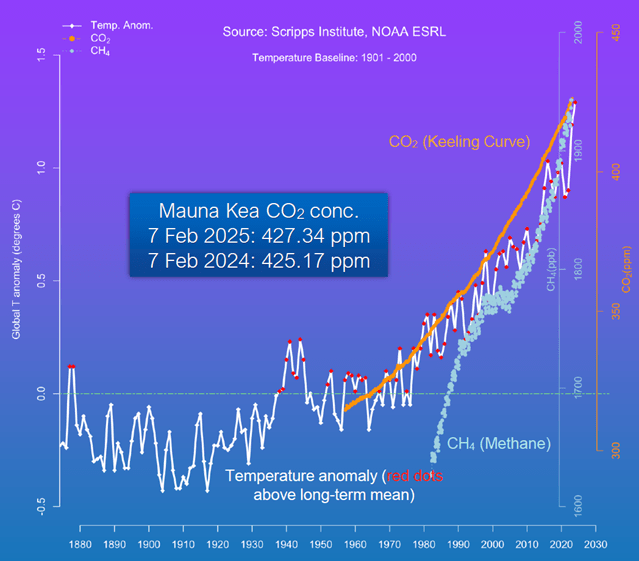
The common basis of the threat of climate change caused by human emissions of GHG is the graph comparing the concentration of CO2 and global temperatures that was included in Freedman’s presentation.  There is no question that increasing the concentration of GHG in the atmosphere will reduce the out-going long wave radiation which will warm the atmosphere, and the graph shows a correlation.  However, the conclusion that reducing New York’s GHG will affect global temperatures and the alleged weather impacts given the small contribution to the global concentration is unwarranted.

Esteemed climate scientist Richard Lindzen describes the energy budget in context:

The energy budget of this system involves the absorption and re-emission of about 200 watts per square meter. Doubling CO2 involves a 2% perturbation to this budget. So do minor changes in clouds and other features, and such changes are common. In this complex multifactor system, what is the likelihood of the climate (which, itself, consists in many variables and not just globally averaged temperature anomaly) is controlled by this 2% perturbation in a single variable?

Lindzen points out that believing this is “pretty close to believing in magic”.  Nonetheless, Freedman presents the graph of CO2 concentration and global temperature without any mention of the shortcomings and complexities of the climate system.

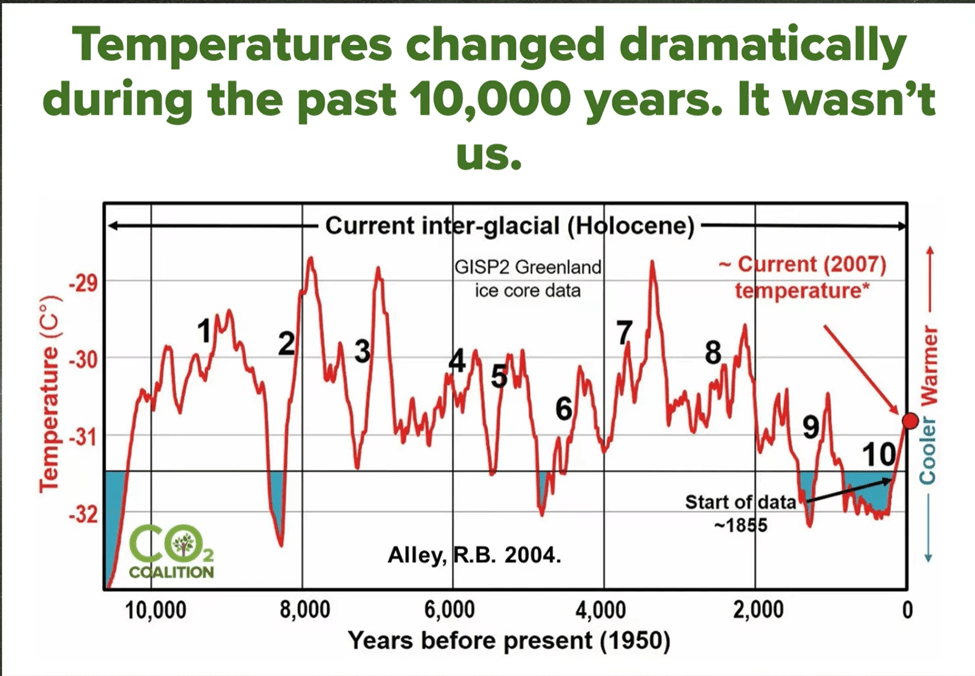
My point is that this is not as obvious a relationship as claimed.  Sabine Hossenfelder produces You Tube videos on science and technology.  Her climate change-related videos generally adhere to the narrative, but she has shown signs of waking up to reality. Peter Ridd commented on her awakening noting that she does not quite get there.  I call your attention to Ridd’s commentary where he talks about uncertainties about how the earth’s weather system works. Especially relevant to Freedman’s graphic is Ridd’s explanation of temperature and CO2 concentrations going further back in time than Freedman’s graph.  Ridd points out in the following graph that temperatures were higher many times in the last 10,000 years at the same time that CO2 concentrations were lower.  That directly contradicts the notion that global temperature is primarily driven by anthropogenic CO2 concentrations.

Climate vs. Weather

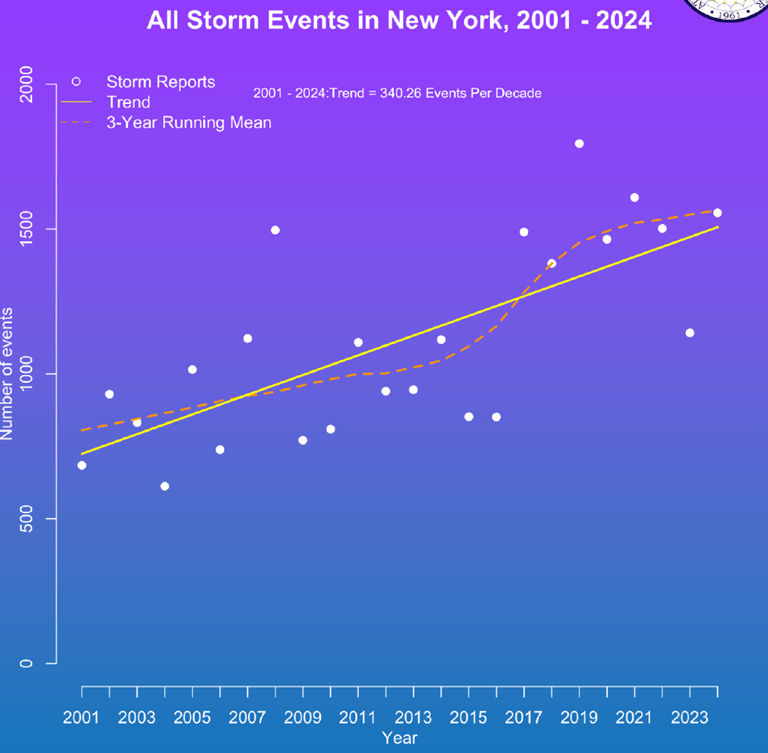
Freedman perpetuates the Climate Act myth that climate change is increasing extreme heat, changes in precipitation, and increasing storm intensity with a graph that shows increasing storm events in New York from 2001 to 2024.  In general, climate is what you expect, and weather is what you get.  To determine what you expect from climate, meteorologists use a 30-year climatological average.  Therefore, to have a climate trend you need to look at the difference between two 30-year averages at a minimum.  Freedman’s graph is a weather average trend unsuitable for making any climate trends claims.

After I drafted this article Anthony Watts summed up my problems with claims that climate change is an existential threat in a post entitled “Is Climate Change Real? Short Answer: Yes — But It’s Complicated.”  I published an article that quoted the article with my annotated comments relating the points he made to the Climate Act.  I highly recommend reading that aartilce.

Basis for Narrative Claims

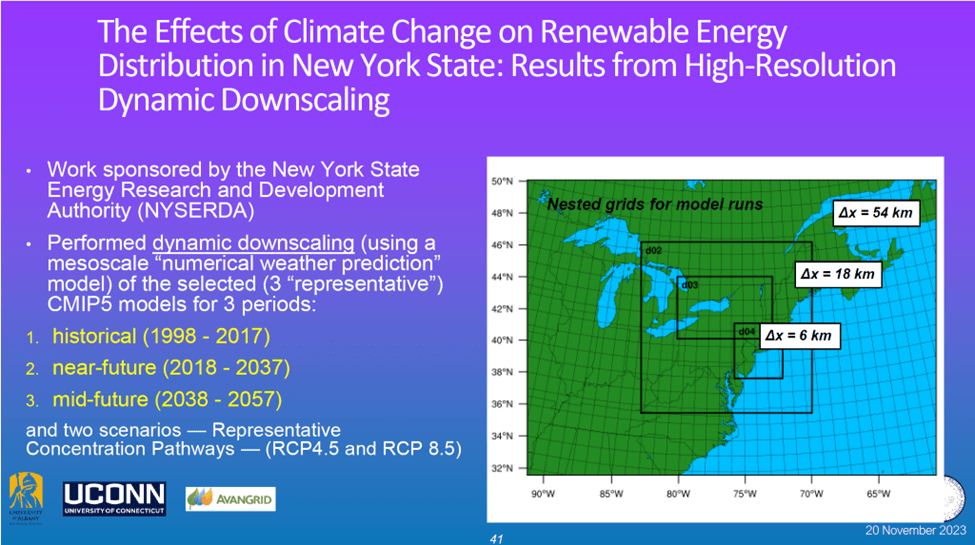
Expert presentations designed to promote the Climate Act narrative to an audience such as the Energy Planning Board often cite the results of modeling.  In this instance there is a slide that describes the “effects of climate change on renewable energy distribution in New York State” based on “results from high-resolution dynamic downscaling”.  Sounds very scientific and above reproach.

The grid size for CMIP5 (Coupled Model Intercomparison Project Phase 5) climate models typically ranges between 125 km to 300 km.  This is too coarse for predicting the impacts of climate change on New York so higher-resolution regional models have been used in projects sponsored by NYSERDA to project impacts.  This process is called dynamical downscaling.  Unmentioned are the errors and inherited biases in the process from the Global Climate Models (GCM) for the following:

  • Temperature trends: Persistent warm/cold biases in coastal and inland regions, exacerbated by future GCM projections exceeding historical maxima.
  • Precipitation patterns: Systematic underestimation of seasonal rainfall in regions like the Caribbean and Southern Africa.
  • Extreme events: Misrepresentation of high-frequency, low-intensity rainfall (“drizzle problem”) due to GCM limitations.

I think that those issues underestimate the problems because the fact is the GCM projections do not include the physics of clouds.  The problem is that coarse grid size cannot incorporate precipitation or extreme events.  This is not to say that the models don’t predict storms, just keep in mind that they are little more than guesses strongly influenced by the biases of the modelers. 

There are structural RCM limitations that introduce their own errors despite higher grid size resolution:

  • Simplified physics: Inadequate representation of convective processes and local interactions (e.g., lake effects).
  • Scale mismatches: Difficulty resolving sub-grid features even at 10–50 km resolutions.
  • Computational constraints: Limited ability to run multiple GCM-RCM combinations, reducing uncertainty sampling.

Those limitations are relevant to the purported New York results.  For five months of the year much of Upstate weather is strongly influenced by the Great Lakes.  Convective processes and local interactions like lake effect are erroneous in the RCM because the scale of the lake effects is smaller than the resolution of the models.  I have been working with weather models and Upstate mesoscale weather regimes for decades and I am positive that the model projections are poor at best.   Combined with the fact that the projections use a totally unrealistic estimate of future emissions (the RCP 8.5 scenario), I do not believe the results presented have any value. 

Discussion

NYSERDA scripted the presentation to the Energy Board so that it was completely consistent with the narrative that climate change impacts are occurring today.  I recently showed that the uncertainty of the historical temperature measurements is similar to the alleged temperature increase due to GHG emissions.  This post explains that the claimed trend in storm events is not a climatic trend because the time range is too short, and that the model projections of weather have limited value. As a result, the Energy Planning Board came away from the meeting erroneously believing that the effects of climate change are occurring now and that reducing New York GHG emissions will reduce those impacts.

This is not in the best interests of New York.  The New York energy plan is supposed to be a roadmap for a “clean, resilient, and affordable energy system for all New Yorkers.”   There are conflicting priorities and challenges for those three goals.  The State Energy Planning Board should be given all the information so that they can “focus on strategies to meet future energy needs and advance economy-wide decarbonization, while balancing reliability, affordability, environmental and public health impacts and economic growth.”  The presentation did not give any of the qualifying information about uncertainties, so it gave the Board a false basis for evaluating the Climate Act approach and schedule.

The basic strategy for decarbonizing the economy is electrification of all sectors.  Authors of the Climate Act believed that no new technology was needed for the transition of the electric sector to “zero emissions” using wind, solar, and hydro.  All the organizations responsible for electric system reliability agree that a new dispatchable, emissions-free resource is necessary for extended periods of low wind and solar resource availability so that presumption is wrong.  That means that the schedule must be adjusted to account for the necessity to develop, test, and deploy this new technology. 

 A primary driver for the Climate Act schedule was the perceived necessity to do something immediately because the effects of climate change are evident now.  As shown here, that argument is not supported when temperature trend uncertainty is considered, long-term trends of weather events are evaluated, and the weaknesses of global climate models are acknowledged.  Those results do not necessarily mean that it is inappropriate to do something, but the results do mean that the claims we must act immediately are unwarranted.  We have time to do this right.  I think that is a primary concept that should be incorporated into the Energy Plan.

Conclusion

I am disappointed that NYSERDA has become so politicized.  The NYSERDA presentation by Dr. Freedman gave the Energy Planning Board misleading information about the threat of climate change and the need to act immediately.  It is becoming increasingly evident that there are so many unanticipated issues associated with the Climate Act implementation that a pause to re-evaluate the schedule and goals is in order.  If NYSERDA documentation had not been politicized the Scoping Plan could have included caveats and achievement milestones to provide an off-ramp to a Plan B that is clearly necessary.  As it stands now, admitting delays and unavailable technologies will be a political embarrassment.  However, it is necessary to ensure that reliability, affordability, environmental and public health impacts, and economic growth goals can be achieved.

Upstate New York Air Source Heat Pump Experience

 “Green energy” advocates continue to lobby for the NY HEAT Act that would end “New York’s gas mandate and forced ratepayer subsidies for gas expansion”.  This is part of their irrational war on natural gas which will only be successful if they prevent the use of natural gas in the future which means a switch to heat pumps for heating.   Constantine Kontogiannis  has calculated the costs of heat pumps Upstate that complements an earlier analysis by Richard Ellenbogen for Downstate.

I am convinced that implementation of the New York Climate Leadership & Community Protection Act (Climate Act) net-zero mandates will do more harm than good if the future electric system relies only on wind, solar, and energy storage because of reliability and affordability risks.  I have followed the Climate Act since it was first proposed, submitted comments on the Climate Act implementation plan, and have written over 500 articles about New York’s net-zero transition.  The opinions expressed in this article do not reflect the position of any of my previous employers or any other organization I have been associated with, these comments are mine alone.

Background

The “NY HEAT Act that would end the gas mandate that proponents claim means that “a single home that wants to stay on the gas system can prevent an entire neighborhood from having the opportunity to receive cheaper, cleaner heating alternatives from their utility.”

I recently posted an article in collaboration with Rich Ellenbogen that detailed the excessive winter operating cost of a geothermal-source heat pump (GSHP) system at his Westchester County residence, using his secondary heating source (a high-efficiency natural gas boiler) for comparison). After it was posted I was contacted by Constantine Kontogiannis who offered to describe his experience with a heat pump.  Mr. Kontogiannis is a mechanical engineer by training with over 25 years of energy related experience.   I jumped at the opportunity for him to describe his heat pump experience.  The following is his lightly edited submittal.

Another Heat Pump Experience – Constantine Kontogiannis

If your readers are wondering how relevant Rich’s experience is to a typical participant of the NYS Clean Heat Program, I have some additional information that might be of interest.  In 2023, I installed a cold climate air-source heat pump (ccASHP) system at my residence in Albany.  According to the NYS Clean Heat 2022 Annual Report, ccASHP systems are much more common than GSHP systems in residential applications, with approximately 18,730 ccASHPs installed in New York State in 2022 (not including Long Island), compared to approximately 670 GSHPs.  That’s a ratio of about 28 to 1 in favor of ccASHP systems.

The stated goal of the NYS Clean Heat Program (which commenced in 2020) is to convert 100,000 homes to heat pumps statewide, and based on the 2022 Annual Report I would estimate that the program is nearly 75% of the way towards that objective.  The data collected so far implies that the vast majority of these heat pumps will be ccASHP systems just like the one that I recently installed.

When I was researching my various heat pump options, I was concerned about their cost effectiveness in heating mode.  So I decided to retain my existing natural gas heating system, which consists of a condensing boiler and radiant underfloor piping.  In hindsight, this proved to be a wise decision, as my 2023/24 heating costs were nearly double what they had been previously.  

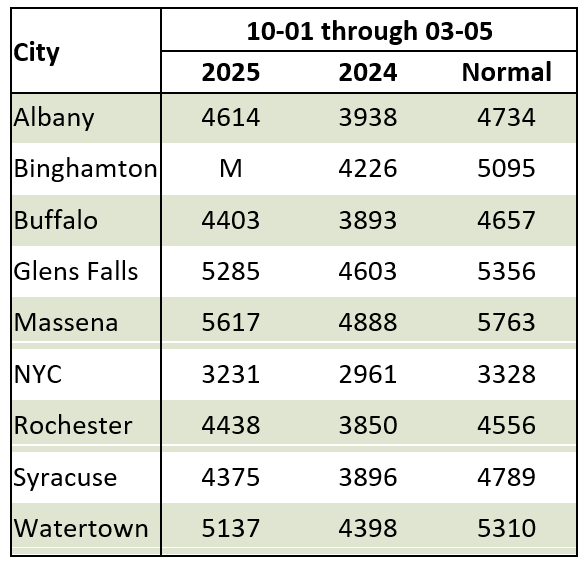
For the 2024/25 heating season, I decided to switch back to using my natural gas heating system instead.  Sure enough, my heating costs dropped substantially – even though this winter seemed to be much colder.  To confirm this, I found the following comparison of Heating Degree Days (HDDs) over the past two winters:

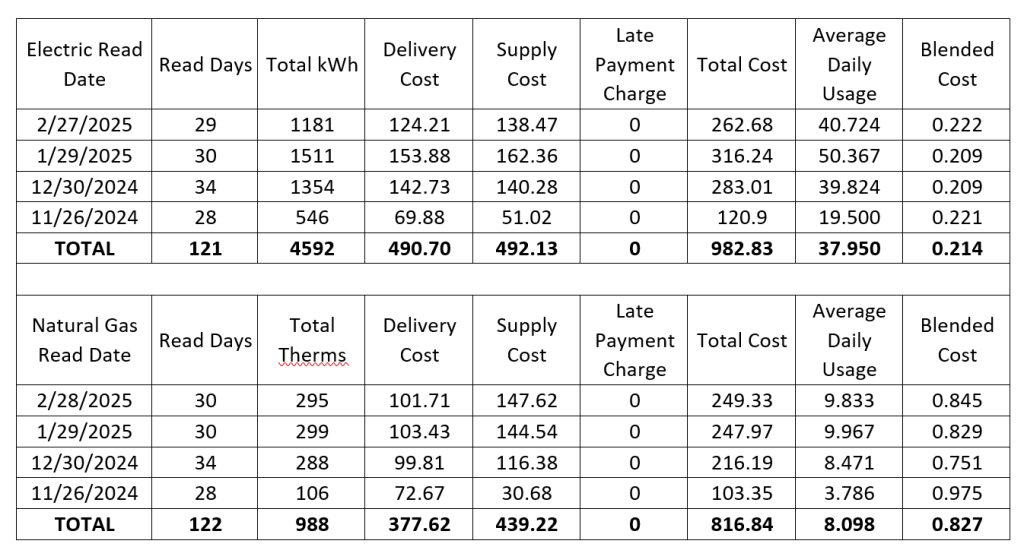
From this table, it’s pretty clear that the winter of 2024/25 was much colder than last year.  Here in Albany, our cumulative HDD for this winter was within 3% of a “Normal” heating season, which makes it an ideal time window to calculate the respective heat pump and natural gas system heating costs over a typical winter.  That’s what I decided to do, and to get started, I compiled a summary of my most recent energy and cost data:

(If you’re wondering why my electric consumption is so high from Thanksgiving to Valentines Day, it’s our exterior Christmas lights – they’re all LED, but maybe we go a bit overboard.)

From the table above, I used 988 Therms this winter at a total cost of roughly $817.  I have low temperature (110 degF) radiant underfloor piping, so my boiler is always set to operate in fully condensing mode at the rated 96% AFUE.  If I had chosen to use my heat pumps this winter, I would have needed approximately 948.5 equivalent Therms (988 x 0.96).  This translates to 27,791 kWh at a COP of 1, which is how much energy would be needed if I was using electric resistance heat (948.5 x 100,000 / 3,413).  

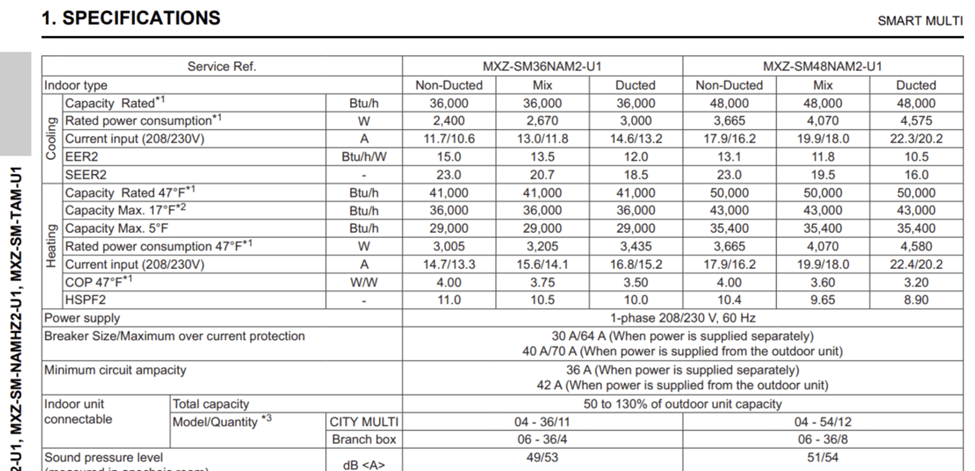
The appeal of heat pumps is their vastly improved COP compared to electric resistance heat.  To determine the seasonal COP of my ccASHP system in heating mode, it’s available in the manufacturer’s product data:

My heat pump system uses ducted 3-ton units – this is a common application, particularly when heat pumps are replacing an existing natural gas furnace and air conditioner combination.  Since ducted units retain the existing heating and cooling distribution ductwork, they are significantly less costly to install and more effective in heating dominant climates when compared to the alternative of using multiple split-system terminals throughout the house (in a ducted system, there’s generally at least one supply air register in each room).  

From the table above, my heat pumps have an HSPF2 rating of 10.0 (the left “Ducted” column).  This is a typical HSPF2 value for ccASHPs installed through the NYS Clean Heat Program, which requires a higher efficiency for program participation than generally stipulated by building code.  

To calculate the seasonal COP, we take the HSPF2, divide it by 0.85 and multiply it by 0.293, which is approximately 3.4 for my system.  Here’s the calculator .   

I discovered something interesting about the HSPF2 rating – it’s based on heating performance in a warmer region – Climate Zone 4, which only includes eight downstate counties in New York from Westchester to NYC through Long Island.  See the definitions at the bottom of this webpage  and the map.  

A higher resolution climate zone map with a table of the individual NY counties in each zone was used in this analysis.  From the earlier HDD table, the upstate cities in Climate Zone 5 (Albany, Syracuse, Rochester, and Buffalo) have roughly 40% more heating degree days than NYC, which is in Climate Zone 4.  So it’s likely that since I live in Climate Zone 5, the true seasonal COP of my heat pump system is lower than the value calculated from an HSPF2 rating in Climate Zone 4.  

But let’s put that aside for now – we’ll just be conservative and utilize the seasonal COP of 3.4 derived from the HSPF2 rating.  In an earlier paragraph, I calculated the equivalent energy at a COP of 1 required to heat my home this winter at 27,791 kWh.  Dividing this by the seasonal COP of 3.4 for our ccASHP system, our estimated heating energy consumption this winter would be 8,174 kWh.  

At my current winter electric rate of $0.214/kWh, this translates to a seasonal heating bill of $1,749.  That’s more than double my $817 natural gas bill this winter, 114% more to be exact.    

To offset a portion of the installation cost, the NYS Clean Heat Program provides an average rebate of $4,600 to replace a gas furnace with a ccASHP, and a $2,000 tax credit is also applicable.  But if the system costs between $8,000 and $12,000 to install, and then adds $900 to the utility bill every year, the rebate and tax credit aren’t very helpful.  Over a 15-year equipment lifespan, the detrimental cost impact could add up to $16,000 or more.  

Caiazza Comment

Proponents of NY HEAT suggest that one advantage of the legislation is to save money.  The New York State Energy Research & Development Authority (NYSERDA) produces featured stories  that “provide insights into New York’s clean energy transition and offer practical information for New Yorkers to incorporate clean energy into their homes and businesses.”  The Experience the Comfort of Clean Heat story does not explicitly address costs.  Kontogiannis and I agree that at one time NYSERDA claimed universal savings. To their credit NYSERDA’s Heat Pump Program description does explicitly state that replacing oil, propane, or electric baseboards with air source heat pumps as your primary heating source is a more efficient way to keep your home comfortable. I recently heard an advertisement by approved contractor who did not explain that savings were unlikely for a home that burns natural gas, apparently without any pushback from the program administrator.

The five-year estimate (2017-2021) of space heating totals of occupied housing units in New York shows that there are 7,530,150 housing units and 59.6% or 4,489,695 of them use utility gas for space heating.  The two analyses that compared heat pump costs and NYSERDA agree that natural gas heating is cheaper.  Kontogiannis estimates that at least 30,000 heat pumps installed through this NYSERDA program have replaced natural gas.  He notes that according to the 2022 summary report, “very few of the installations include the decommissioning of the previous heating system”.  As a result we are skeptical of any carbon savings claims. The bottom line is that the Climate Act will make home heat more costly for more than half of the state but I have not seen any advocate admitting that fact.

My thanks to Rich Ellenbogen and onstantine Kontogiannis for their insights.

Peer Review and Costs of Building Electrification for Commercial Users 

This is an article primarily by Richard Ellenbogen that estimates projected annual operating costs and emission reductions for New York commercial facilities when the new building codes are implemented.  It is also an example of how peer review should be done.

I am convinced that implementation of the New York Climate Act net-zero mandates will do more harm than good if the future electric system relies only on wind, solar, and energy storage because of reliability and affordability risks.  I have followed the Climate Act since it was first proposed, submitted comments on the Climate Act implementation plan, and have written over 500 articles about New York’s net-zero transition.  The opinions expressed in this article do not reflect the position of any of my previous employers or any other organization I have been associated with, these comments are mine alone.

Ellenbogen is the President [BIO] of Allied Converters and frequently copies me on emails that address various issues associated with the New York Climate Leadership and Community Protection Act (Climate Act). I have published other articles by Ellenbogen including a description of his keynote address to the Business Council of New York 2023 Renewable Energy Conference Energy titled: “Energy on Demand as the Life Blood of Business and Entrepreneurship in the State -video here:  Why NY State Must Rethink Its Energy Plan and Ten Suggestions to Help Fix the Problems”. He comes to the table as an engineer who truly cares about the environment and as an early adopter of renewable technologies at both his home and business two decades ago.

Heat Pump Hype

I am a long-time critic of the New York State Energy Research & Development Authority’s (NYDSERDA) biased promotion of all green energy technologies.  Their description of cold climate heat pumps is a good example: “Today’s cold-climate heat pumps are a smarter, more efficient option to keep your home comfortable all year long. These all-in-one heating and air conditioning systems are environmentally friendly, extremely efficient, and affordable to operate.”  In another example, they breathlessly exclaim that heat pumps outsell gas furnaces for the second straight year.  This claim uses national figures and could be solely the result of new building sales that are much stronger in southern states where heat pumps are a cost-effective choice.  Ellenbogen addresses the affordability claims below.

Ellenbogen Heat Pump Experience

Ellenbogen installed geothermal heat pumps when his house was completed in 2004.  He has 21 years of experience with them and has maintained a database of the performance and costs.  His monitoring system includes temperature sensors on the inputs and the outputs of the wells and water flow.  Because he uses a geothermal system, he can rely on it even during the coldest periods when air source heat pumps cannot extract enough energy from the air to keep the house warm.  Furthermore, his system uses deeper wells than are currently allowed by law that were legal when the system was developed.  They are also open loop which greatly increases their efficiency but that is also no longer allowed. In his configuration, his heat pumps can pull 7 tons of heat transfer per well where current geothermal wells are limited to about 2.5 tons per well.  As a result, his system can achieve a Coefficient of Performance (COP) of about 5.5 whereas current Geo-thermal systems can achieve a COP of about 3.5 with the restrictions on well depth and having to be closed loop.  During long periods of cold temperatures that force the heat pumps to run for extended periods, the well temperatures can drop and the efficiency of the system decreases so it will use more energy.

One of the things I admire as a techno-weenie is Ellenbogen’s quantitative nature.  He built his house “as a science project to satisfy his intellectual curiosity” and it has yielded an enormous amount of data. When the Indian Point nuclear station was operating, he ran a calculation and found his geo-thermal system was about 7% more carbon free than his 95% efficient modulating gas boilers that were originally installed as a backup in case of a power failure.  After New York politicians shut down Indian Point the carbon emissions of local electricity increased and the GHG emissions advantage vanished.  Given his concerns about GHG emissions he decided to figure out a cost and energy comparison.  He turned the heat pumps off this winter and used the duplicate gas system to compare with multiple years of data with the heat pumps operating.

The results are notable.  His gas bill went up less than the electric bill went down and this is for an electric system with an efficiency 57% higher than what can be built now during a colder winter.  The electric bill was about $8600 lower than it would have been with the heat pumps operating.  The gas bill only went up by $6057 for a net savings of $2543 using the natural gas heating and the current winter has been 120 degree days colder than last year.  That figure has been adjusted for the higher electricity prices this year.   Note that the heating system is well designed with 14,500 square feet of high mass radiant floors that use 100-degree water in the system and 18 separate zones which makes it even more efficient.  The large scale of the system removes measurement aberrations that might occur with a smaller system.

To compare the costs of heating with electricity and natural gas it is appropriate to compare the cost to generate the same amount of heat.  Table 1 lists the cost for the delivery of one therm (heat energy equal to 100,000 British thermal units) between a 95% efficient boiler and electric heat at relationship different Coefficient of Performance efficiency values.  A COP of 1 is inefficient.  A highly efficient ground source heat pump has a COP of 3.5.  Even an efficient ground source heat pump is 16% more expensive ($2.85 for one therm compared to $2.45 for a 95% efficient gas system in the Downstate New York area which covers 60% of the state’s population.  Also note that air source heat pumps on a very cold day can reach COP’s of 1 – 1.5 and easily go below 2.  As a result, they can be two to three times as expensive to operate.

Commercial Facility Projection

New York State legislators passed a prohibition on the installation of fossil fuel equipment and building systems starting in 2026 for small buildings and 2029 for larger ones. The prohibition starts in 2026 for new buildings up to 7 stories tall, except for commercial and industrial buildings larger than 100,000 square feet. There are exemptions for certain types of buildings including emergency backup power systems, manufacturing facilities, commercial food establishments, laboratories, hospitals and medical facilities, critical infrastructure (e.g., water treatment plants), agricultural buildings, crematoriums.

Ellenbogen applied the numbers derived from his house experiment to his business and extrapolated them to the 55,000 square foot factory which would fall under the less than 100,000 square foot rule for new construction after 2026.  Admittedly, there is no law currently in place that would require a developer who wanted to replicate Ellenbogen’s manufacturing facility because of the exemptions.  Eventually, however, the net-zero mandates will require all electric construction of all new facilities and for the replacement of existing equipment before the end of useful life.  Therefore, it is a relevant example of Climate Leadership and Community Protection Act (Climate Act). costs.

Ellenbogen’s home has a backup gas boiler heating system and his manufacturing plant has a combined heat and power system.  In 2002 he installed the first microturbine-based Combined Heat and Power (CHP) system in the Con Ed service area.  This approach generates electricity by burning natural gas.  Waste heat is recovered “to heat the building in the winter, or to be sent to absorption chillers to cool the building in the summer.”  This approach allows him to recover 70 to 75 percent of the energy content of the fuel and augments a solar array on the roof.

By doing a thermal analysis of his home’s gas usage he was able to determine what would be needed to heat the factory.  The end result is that removing gas from his manufacturing facility would raise energy bills to about $147,000, more than doubling them,  and raise his carbon footprint by about 15%.  The key takeaway is that even using the most efficient electric heating/cooling system available, it still means that this gas ban policy will cost businesses in NY state enormously while raising carbon emissions.  When and if the Downstate New York electric system reaches zero GHG emissions the carbon emissions will be reduced.

Environmental Impacts

Ellenbogen calculated that because the Downstate electric system is CO2 rate is 950 pounds per MWh according to 2022 EPA data, that the CO2 emissions from using the CHP system are actually less than if heat pumps were used.  He also pointed out he has replaced three compressors in his home’s ground source system over the past 21 years and each time the failure resulted in a full loss of refrigerant.  He said that it is not preventable and that you only find out when the unit gives a fault code with no early warning.

Discussion

This post is based on three emails from Ellenbogen.  I did not include all the calculation details he provided in the originals but will provide them if requested.  The reason for the three versions is that the details provided enabled a reader to point out an issue that he corrected.  Ellenbogen noted that:

Those damned Laws of Thermodynamics are getting in the way again, but this may be a teaching moment to show what a real peer review looks like and that we have to acknowledge errors to make sure that the best information is in the public space.  It also is a clear example of how we can’t escape those Laws in our calculations.  Miscalculations introduce errors and a failure to account for the Laws of Thermodynamics entirely when setting energy policy introduces huge errors.

This raises an issue with the implementation of the Climate Act.  The agencies responsible for the implementation plans have not provided adequate documentation to enable detailed review of the plan.  Even if it is possible to make a detailed comment on an obvious issue, there hasn’t been any acknowledgement of any problem, much less evidence of a revision to the plans.  The appropriate peer review process exemplified by Ellenbogen’s analysis is not a feature of the Climate Act stakeholder process.  As a result, Ellenbogen notes “errors are apparent across the entire spectrum of NY State’s Energy plan.”

Ellenbogen summarized his peer review concerns in this regard.

While I hate to beat on academia, it has a great deal of responsibility for NY State’s energy mess.  A certain University Professor that sat on the Climate Action Council still refuses to acknowledge that all of the technologies for this transition do not exist despite a Public Service Commission conference determining that fact in 2023.   Unfortunately, people in the legislature and certain environmental groups have adopted those ideas despite there being known large deficiencies in those theories as it applies to putting them into practice.  Untested theories that can’t be put into practice in the “Real World” are dangerous for society.  State residents shouldn’t be turned into a science project and that is what is happening. 

I received the following response to my email from a retired professor that now works in industry.  I have redacted portions to keep them anonymous.  While on average, the refrigerant replacement is every 20 years as there are three heat pumps, their observations are profound and are critical to understanding a huge issue now facing the NY State.  It follows in italics.

This is the most sobering analysis of a heating system I have ever read. I constantly hear about the miracles of heat pumps, but the carbon footprint is never honestly presented. Plus the replacement of freon every 7 years is never included. Thanks for providing a clear analysis of a day in the life of a NY business and resident.

I’m still enjoying life in XXXXXXXX, and in no longer being a professor. Academia lives in a bubble, and you can’t see that until you leave. Professors need to do a real sabbatical leave in industry and be forced to solve real problems, not problems they dream up. It’s tough out here! I thought I knew something about XXXXXX  after XX  years as an academic doing research, but XX years at XXXXXXX  has shown me I have much to learn. It is stimulating, I’m glad to be here. They need to have a similar experience.

Regarding the statement above, one of the reasons that the carbon footprints of heat pumps is never honestly mentioned is that the loudest voices in the space are the people selling them and other people don’t have enough experience to question the results.  I’ve been using them for 21 years.  My house was built as a science project to satisfy my intellectual curiosity.  It has yielded an enormous amount of data, some of which has been used by the state.

One of the major issues that I have with NY State policy is that many of the people that are hired to do the energy analyses for the government actually work for the manufacturers or other interested parties.  The reports read more like advertisements paid for by the NY State taxpayers than a sound scientific document.  I dealt with that in a 2020 paper on the Lansing Gas moratorium.  The company hired to do the Tompkins County energy analysis sold heat pumps and the resulting report reflected that and had a huge error in its results.  The paper is very relevant to the building electrification discussion.

Regarding the professor’s comments, when someone is forced to deal with the consequences of their decisions as occurs in industry, it greatly changes their perspective.  There are no negative consequences for someone theorizing about policy on a University Campus and that is okay because it can move society forward.  However, if they don’t really test those ideas before pushing them into society as a gospel, there will be huge problems and that is what we are now seeing in NY State.

Conclusion

The ramifications of New York’s Climate Act on business development are becoming evident.  In 2026, certain new buildings in New York will no longer be able to install fossil fuel equipment and building systems.  Richard Ellenbogen has performed a “science project” that proves that New York’s net-zero transition electrification plans for heating will be more expensive than using natural gas.  It is also notable that the experiment was best on a geothermal heat pump system that is more efficient than legally possible today.  Adding to the already large energy costs in New York is not a good way to attract and maintain manufacturing in the state. 

This exercise also shows the importance of robust peer review.  Ellenbogen’s first draft contained an error that was identified because he showed his work.  He acknowledged the problem and corrected his analysis.  New York’s Climate Act stakeholder process does not document analyses well enough for considered review and the Hochul Administration does not acknowledge any comments that do not comport with their narrative.  As a result, the broken stakeholder process in New York will likely ignore Ellenbogen’s real-world results. 

New York State 2024 GHG Emissions Inventory

This post describes the latest New York State (NYS) GHG emission inventory report that provides data through 2022.   The Climate Leadership & Community Protection Act (Climate Act) includes a target for a 40% reduction of greenhouse gas (GHG) emissions from 1990 levels by 2030 and the inventory has some implications relative to that target. 

I am convinced that implementation of the New York Climate Act net-zero mandates will do more harm than good if the future electric system relies only on wind, solar, and energy storage because of reliability and affordability risks.  I have followed the Climate Act since it was first proposed, submitted comments on the Climate Act implementation plan, and have written over 500 articles about New York’s net-zero transition.  The opinions expressed in this article do not reflect the position of any of my previous employers or any other organization I have been associated with, these comments are mine alone.

Overview

The Climate Act established a New York “Net Zero” target (85% reduction in GHG emissions and 15% offset of emissions) by 2050.  In addition to the 2030 GHG emission target, the electric sector is required to be 70% renewable. The Climate Action Council (CAC) was responsible for preparing the Scoping Plan that outlined how to “achieve the State’s bold clean energy and climate agenda.” The Scoping Plan was finalized at the end of 2022.  Since then, the State has been trying to implement the Scoping Plan recommendations through regulations, proceedings, and legislation. 

NYS GHG Emissions

At the end of 2024 the New York State Department of Environmental Conservation (DEC) released the 2024 statewide GHG emissions report (2024 GHG Report).  DEC is required by the Climate Act to follow unique inventory requirements.  I published an overview post of this greenhouse gas (GHG) inventory that described things that maximize emissions in an apparent attempt to make GHG emissions as large as possible.

Climate Act emissions accounting includes upstream emissions and is biased against methane.  Obviously if upstream emissions are included then the total increases but at the same time it makes the inventory incompatible with everybody else’s inventory.  There are two methane effects.  Global warming potential (GWP) weighs the radiative forcing of a gas against that of carbon dioxide over a specified time frame so that it is possible to compare the effects of different gases.  The values used by New York compare the effect on a molecular basis not on the basis of the gases in the atmosphere, so the numbers are biased.  Almost all jurisdictions use a 100-year GWP time horizon, but the Climate Act mandates the use of the 20-year GWP which increases carbon dioxide equivalent values. 

The 2024 GHG Report includes the following documents:

To calculate all the emissions in New York and estimate the upstream emissions it takes DEC, the New York State Energy Research & Development Authority (NYSERDA) and consultants two years to produce the reports.  This article compares NYS GHG inventory electric sector emissions with EPA emissions and GHG emissions through 2022 relative to the 2030 40% reduction target.

Electric Generating Unit Emission Trends

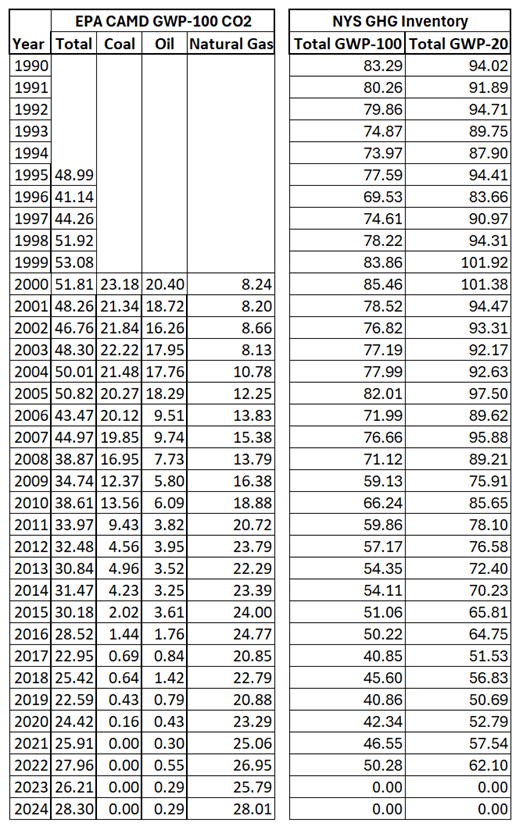
Last month I summarized New York electric sector emissions trends.  Electric generating units report emissions to the Environmental Protection Agency Clean Air Markets Division as part of the compliance requirements for the Acid Rain Program and other market-based programs that require accurate and complete emissions data.  Table 1 lists the EPA CO2 emissions by fuel type for the available years and the total electricity sector GHG emissions from the NYS GHG Inventory.

Table 1: EPA and NYS Electric Sector Emissions

The EPA electric sector emissions are significantly less than the NYS GHG inventory.  There are three primary reasons: the inclusion of upstream emissions, imported electricity emissions, and including three other greenhouse gases: methane (CH4), nitrous oxide N2O, and sulfur hexafluoride (SF6).  Note that the choice of the GWP-20 rather than GWP-100 increases the final numbers further.

2022 GHG Emissions

Table ES.2 in the Summary Report presents emissions for different sectors.  Electric generation emissions are listed as electric power fuel combustion, imported electricity, and as part of imported fossil fuels.  In 2022, GHG gas emissions from electric power fuel combustion totaled 27.79 million metric tons of carbon dioxide equivalent (mmt CO2e) using a 20-year global warming potential.  Imported electricity totaled 8.71 mmt CO2e.  Fuel combustion and imported electricity emissions were primarily CO2.  The Table ES.2 imported fossil fuel value shown covers all fossil fuel used in other sectors. 

NYS GHG Emissions Data

There is one notable feature of the GHG inventory.  DEC and NYSERDA previously conducted an analysis of statewide emissions in 1990 to establish a baseline for the “Statewide GHG Emission Limits” established by ECL 75-0107 and reflected in 6 NYCRR Part 496. It is important to understand that GHG emission inventories are not based completely on measured emissions.  The EPA CAMD data are based on direct measurements but all the other estimates are derived using emission factors and estimates of activities such as fuel use or vehicle miles traveled.  The last four emission inventories all have estimated a different 1990 value than the regulatory limit in Part 496.  The report notes “The 6 NYCRR Part 496 regulation may be revised at a later date using updated information. For your information, I have compiled all four tables explaining the differences between the estimate of gross statewide emissions in 1990 from the 6 NYCRR Part 496 rulemaking and in this report.

Trends in Sectors

The 2022 GHG Inventory includes four  sectoral reports for energy, industrial processes and product use, agriculture, forestry and land use, and waste.  The Summary Report describes the observed trends:

 In Figure ES.2, emissions are organized into the sectors described in the IPCC approach (IPCC 2006). The Energy sector encompasses emissions associated with the energy system, including electricity, transportation, and building/industrial heating. The Industrial Process and Product Use (or IPPU) sector covers emissions associated with manufacturing and manufactured products. The Waste sector encompasses any activities to manage human-generated wastes. Finally, the Agriculture, Forest, and Other Land Use (or AFOLU) sector encompasses emissions from the management of lands and livestock as well as net emission removals from land management and the long-term storage of carbon in durable goods.

The Energy sector represents the majority of emissions (76%, 2018-2022), but energy emissions in 2022 were 17.7% lower than in 1990 (Figure ES.2). The overall reduction in energy emissions was offset by increases in all other sectors and by a 1.7% decline in net emission removals. The largest increases occurred in IPPU due to the increasing use of hydrofluorocarbons (4.66mmt CO2e) and in AFOLU resulting from changes in agricultural practices (2.37mmt CO2e). Waste sector emissions declined by 4.36mmt COze over the period, primarily due to implementation of landfill gas capture systems.

Discussion

The implications of the GHG inventory are important.  The Climate Act includes a target for a 40% reduction of greenhouse gas (GHG) emissions from 1990 levels by 2030.  The NYS Part 496 1990 baseline emissions were 404.26 million metric ton (mmt) CO2e.  The total 2022 NYS emissions were 371.38 mmt CO2e which is only a 9% or 37.9 mmt CO2e reduction from the baseline.  The 2030 limit is 245.9 mmt CO2e which will require a further 34% or 163.4 mmt CO2e reduction. 

It is beyond the scope of the GHG inventory to provide any commentary regarding the achievability of meeting the 2030 target, but it is clear that, absent a miracle, the targets will not be met.  It is time for the Hochul Administration to acknowledge that the 2030 targets cannot be achieved.  The Climate Act requires that the Public Service Commission (PSC) issue a biennial review for notice and comment that considers “(a) progress in meeting the overall targets for deployment of renewable energy systems and zero emission sources, including factors that will or are likely to frustrate progress toward the targets; (b) distribution of systems by size and load zone; and (c) annual funding commitments and expenditures.”  The draft Clean Energy Standard Biennial Review Report released on July 1, 2024 will fulfill this requirement.  The final report was due at the end of 2024 but was delayed on December 17, 2024.  The draft document compared the renewable energy deployment progress relative to the Climate Act goal to obtain 70% of New York’s electricity from renewable sources by 2030.  It projects that the 70% by 2030 goal will not be achieved until 2033 when historic renewable resource deployments are considered.  The report did not address the 40% reduction of GHG emissions by 2030 target.

The Climate Act has always been a political ploy to gain favor with certain constituencies and has had little basis with reality.  Nowhere is the missing link to reality starker than regarding the implementation of emission reduction programs.  The green narrative is that the transition away from fossil fuels will be economic, simple, and only a matter of political will.  The reality is completely the opposite.  The fact is that to reduce GHG emissions to zero as mandated means that existing energy use of fossil fuels requires replacement of existing infrastructure, development of additional supporting infrastructure, and development of new implementation resources (supply chains and trained trades people).  To compound the challenge the Climate Act schedule was not developed on the basis of a rational plan.  Instead, the politicians arbitrarily chose the deadlines.  We are now seeing the results of this boondoggle and the ramifications are unclear.

Conclusion

The 2024 GHG emission inventory reports should be a wake-up call regarding Climate Act implementation.  It is clear that the 2030 GHG emission reduction target cannot be met.  In addition, the transition of the electric generating system requires a new technology to ensure reliability and the Hochul Administration has not yet responded to last summer’s Comptroller report that found that: “While PSC and NYSERDA have taken considerable steps to plan for the transition to renewable energy in accordance with the Climate Act and Clean Energy Standard, their plans did not comprise all essential components, including assessing risks to meeting goals and projecting costs.”  It is obvious that that New York State should pause implementation of the Climate Act and address the myriad issues uncovered to date.

Wind Blowing Somewhere Does Not Solve the Intermittency Problem

A version of this article was published at Watts Up With That

In October 2023 an article of mine was published that addressed the wind is always blowing somewhere fallacy used by green energy proponents to argue that large amounts of storage and any new dispatchable emissions-free resources are not necessary in a future electric system that relies on wind and solar generating resources.  I recently discovered the US Energy Information Administration Hourly Electric Grid Monitor that provides hourly net generation by energy source for the Lower 48 states.  This article describes 2024 energy source data with an emphasis on wind energy relative to the “wind is always blowing somewhere” claim.

I am convinced that implementation of the Climate Act net-zero mandates will do more harm than good if the future electric system relies only on wind, solar, and energy storage because of reliability and affordability risks.  I have followed the Climate Act since it was first proposed, submitted comments on the Climate Act implementation plan, and have written over 500 articles about New York’s net-zero transition.  The opinions expressed in this post do not reflect the position of any of my previous employers or any other organization I have been associated with, these comments are mine alone.

Overview

The Climate Act established a New York “Net Zero” target (85% reduction in GHG emissions and 15% offset of emissions) by 2050.  Two targets address the electric sector: 70% of the electricity must come from renewable energy by 2030 and all electricity must be generated by “zero-emissions” resources by 2040. The Climate Action Council (CAC) was responsible for preparing the Scoping Plan that outlined how to “achieve the State’s bold clean energy and climate agenda.” The Scoping Plan was finalized at the end of 2022.  Schussler’s article is relevant because the Scoping Plan proposes to meet the zero-emissions mandate using wind, solar, and energy storage.  In 2040, the Scoping Plan projected that39% of the electric energy would be provided by wind generation and 30% by solar.

Wind Lulls

CAC member Dr. Robert Howarth claims that he played a key role in the drafting of the Climate Act and his statement  at the meeting where the Scoping Plan was approved claims that: ”A decade ago, Jacobson, I and others laid out a specific plan for New York (Jacobson et al. 2013). In that peer-reviewed analysis, we demonstrated that our State could rapidly move away from fossil fuels and instead be fueled completely by the power of the wind, the sun, and hydro. We further demonstrated that it could be done completely with technologies available at that time (a decade ago)”.  More recently, Mark Jacobsen of Stanford acknowledges that wind intermittency is a challenge but claims that it can be simply addressed by developing interconnections, a mix of renewable energy sources, including wind, water, and solar, and implementing energy storage solutions.  The question addressed here is the extent of the interconnections needed to get to the wind blowing somewhere from New York

In the real world most analysts are not claiming that there is a simple solution to extended periods of low wind and solar resources.  In September Parker Gallant noted that industrial wind turbines (IWT) in Ontario “show up at the party, almost always, after everyone has left” in a post that described poor performance of the province’s wind turbines over a five day period in September 2024.  I evaluated the performance of New York’s 2,454 wind turbine fleet and found that there was an hour when the total generation was 0.2 MW during this September event.  David Theilen directly addressed the wind is always blowing somewhere argument with this graph using data from the US Energy Information Administration Hourly Electric Grid Monitor.

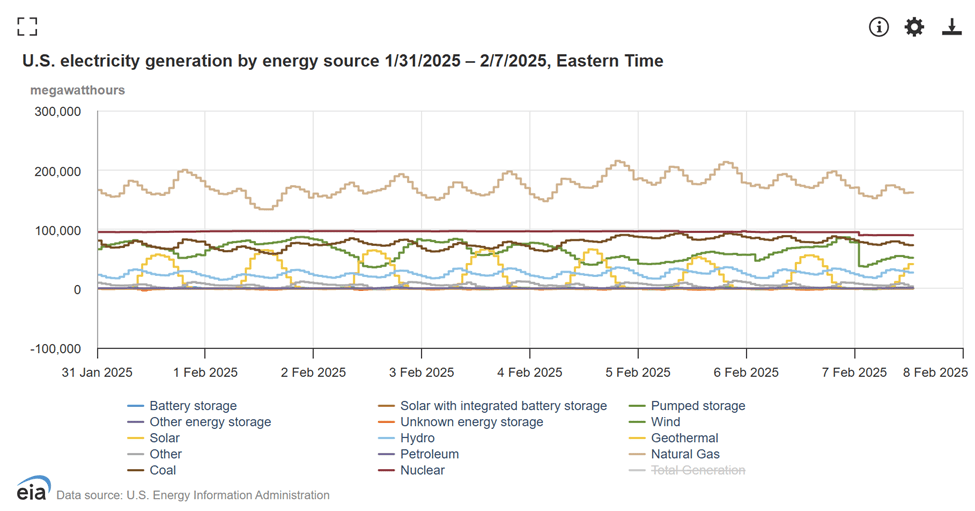
Figure 1: US Energy Information Administration Hourly Electric Grid Monitor December 2024

EIA data

I used the data dashboard at the US Energy Information Administration Hourly Electric Grid Monitor as the source of the hourly 2024 generation by energy source data used in this analysis.  EIA notes that this is “Hourly total net generation and net generation by energy source for the Lower 48 states.”   The settings widget enables a user to change the time and period albeit hourly data are only available for up to 31 days, so I had to import data by month.  There is another issue.  January generation categories included Wind, Solar, Hydro, Unknown, Other, Petroleum, Natural Gas, Coal, and Nuclear.  December generation categories changed to Battery storage, Solar with integrated battery storage, Pumped storage, Unknown energy storage, Wind, Solar, Hydro, Unknown, Other, Petroleum, Natural Gas, Coal, and Nuclear.  I made no attempt to account for the different categories when I downloaded the data.

Figure 2: US Energy Information Administration Hourly Electric Grid Monitor

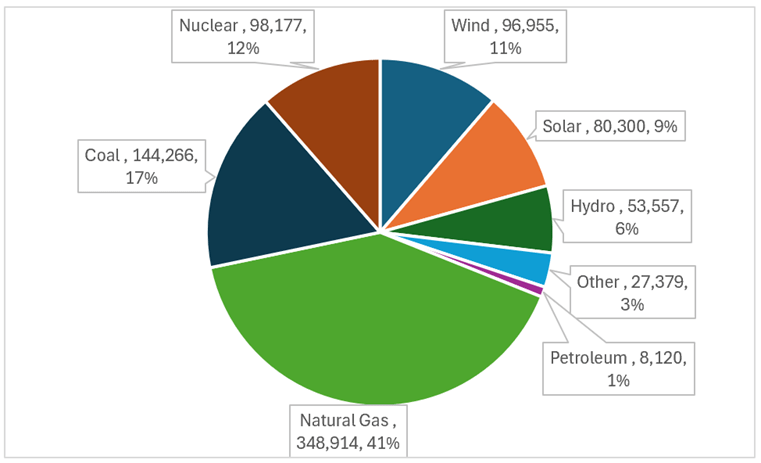
I wanted to show the installed capacity for the different energy sources but I was only able to find EIA values for solar – 107,400 MW.  Figure 3 shows the Maximum Hourly Generation (MW) in 2024 for the primary energy source categories that gives an idea how much capacity is installed for each energy source.  Note the maximum solar is 75% of the EIA installed capacity.  I expect the percentage of installed wind relative to the observed maximum hourly MW would be even less.

Figure 3: US Energy Information Administration Hourly Electric Grid Monitor 2024 Maximum Hourly Generation (MW)

Figure 4 lists the US Energy Information Administration Hourly Electric Grid Monitor 2024 Total Energy (GWh).  I was frankly surprised how much wind capacity was generated on an annual basis.  However, totals and averages are not the primary planning issue – determining how much energy is needed in the worst case is a prerequisite for reliability planning.

Figure 4: US Energy Information Administration Hourly Electric Grid Monitor 2024 Total Energy (GWh)

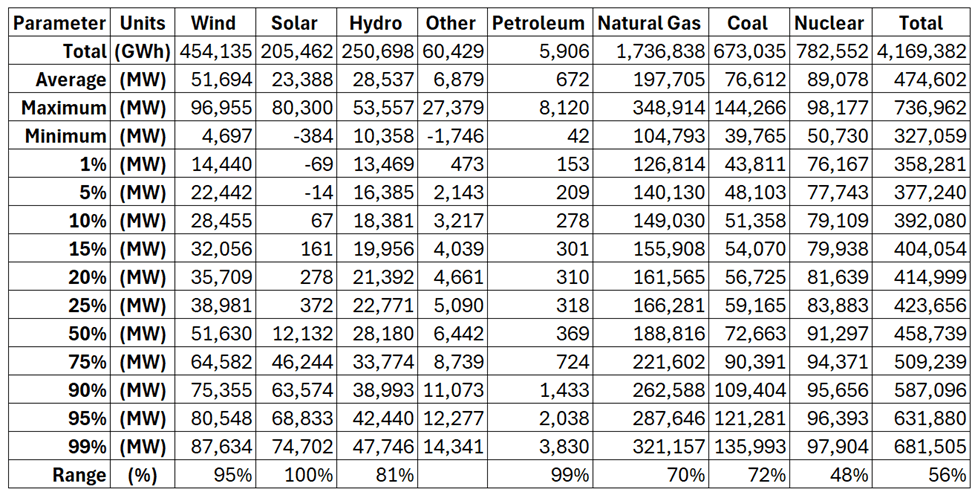
Table 1 summarizes nationwide energy source hourly data for 2024.  Solar has the most hourly variability because it is unavailable at night.  Wind has 95% variability and petroleum that is used for peaking purposes has 99% variability.  Only nuclear has less variability than the total energy.  The distribution of wind energy hourly output is notable. 

Table 1: US Energy Information Administration Electric Grid Monitor 2024 Hourly Data Distribution

For a general idea of the variability of the wind resource across the Lower 48 consider Figure 5 a graph of annual hourly data.

Figure 5: US Energy Information Administration Hourly Electric Grid Monitor 2024 Hourly Wind Energy Production (MW)

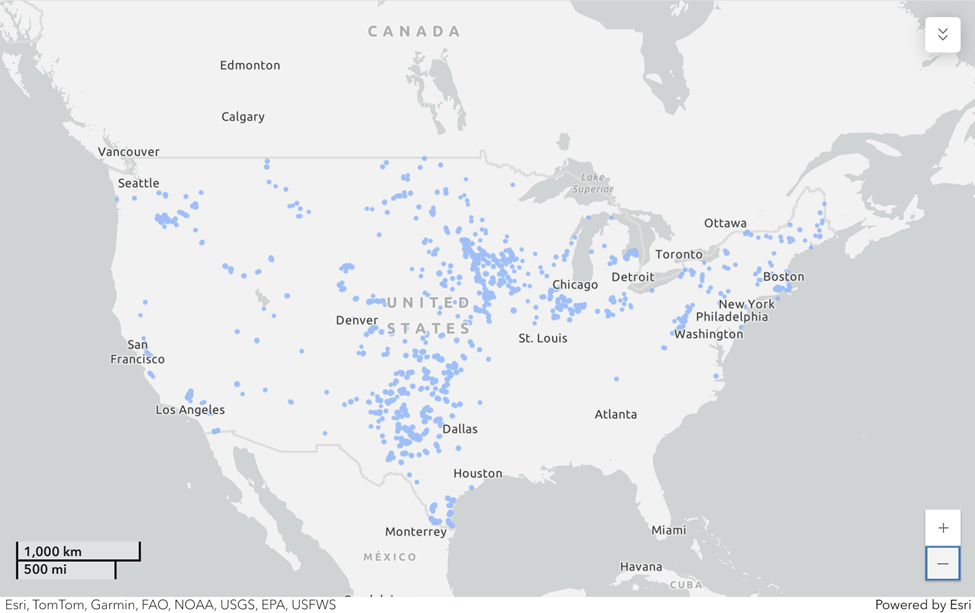
I could not find a map of wind energy facilities at the EIA website.  Synapse Energy has developed an interactive map of U.S. power plants, including wind facilities which is shown as Figure 6.

Figure 6: Synapse Energy Map of U.S. Wind Power Plants

Assuming that the EIA wind energy facilities are similar to those used by Synapse Energy, it is clear that there is a wide spatial distribution across the Lower 48.  Consider that if a wind lull in New York City was caused by a high-pressure system that covers everything east of the Mississippi that dedicated transmission to dedicated wind turbines 1,000 miles away would be required to ensure that New York State wind energy could be supplanted by wind elsewhere.  In the next step I analyzed temporal variation. 

Table 2 provides an estimate of wind lulls at different thresholds.  I evaluated the hourly data to determine the total available wind energy (GWh) available when the total available wind capacity was less than six percentile thresholds.  At the first percentile only 14,440 MW or less was generated.  This level is 15% of the maximum observed hourly wind capacity.  There were 14 episodes that met this threshold and total energy generated during those periods was 988 GWh.  From a planning standpoint the maximum duration is important.  There was a 14-hour period when all the Lower 48 wind facilities produced less than 15% of the maximum observed capacity and the total energy generated was only 29 GWh which is only 2% of the capability over that period.  At the 25th percentile, all the wind facilities produced 40% of the maximum observed capacity.  There were 180 episodes that met this threshold and total energy generated during those periods was 63,430 GWh.  For the maximum duration there was a 115-hour period when all the Lower 48 wind facilities produced less than 40% of the maximum observed capacity and the total energy generated was 2,319 GWh which is 21% of the capability over that period.

Table 2: US EIA Electric Grid Monitor 2024 Hourly Wind Lulls

Discussion

It is a stretch to try to extrapolate these data for planning purposes to determine the resource gap for a specific area.  A sophisticated analysis that addresses the location of the wind facilities, the interconnections between the facilities, and the generation from other resources on an hour-by-hour basis is required.  Nonetheless, using the data to guess the impacts is instructive.

To take advantage of the wind blowing somewhere argument it would be necessary to upgrade the transmission system.  Assuming that transmission is available there is still a clear need for backup energy.  If the entire wind energy system would need to produce 50% of the maximum observed capacity to cover both local and distant energy needs note that this analysis found that 25% of the time only 40% of the maximum was available. The worst case was a 115-hour period when all the Lower 48 wind facilities produced only b2,319 GWh of a possible 11,150 GWh.  Assuming 50% of the maximum is needed to support the system there would be an energy gap of 3,256 GWh over this 115-hour period.  At a cost of $148/kWh to $400/kWh the storage needed for this event would be $482 to $1,302 billion.

Recently, Russ Schussler (the Planning Engineer) published an article that argued that the intermittency issue addressed here might be solvable: “The long-term problems associated with wind and solar due to their intermittency could and may likely be made manageable with improved technology and decreasing costs.”  In my opinion, practically speaking it is not possible.  It would be necessary to upgrade the electric transmission system, deploy short-term storage, and develop and deploy a dispatchable emissions-free resource all to address short and infrequent periods and to somehow finance those resources with those constraints.

Importantly, even if intermittency can be addressed Schussler argues that there is a fatal flaw:

Overcoming intermittency though complex and expensive resource additions at best gets us around a molehill which will leave a huge mountain ahead. Where will grid support come from?  Wind, solar and batteries provide energy through an electronic inverter. In practice, they lean on and are supported by conventional rotating machines. Essential Reliability Services include the ability to ramp up and down, frequency support, inertia and voltage support. For more details on the real problem see this posting. “Wind and Solar Can’t Support the Grid” describes the situation and contains links to other past postings provide greater detail on the problems.

Conclusion

Green energy advocates who minimize the challenge of transitioning the electric grid to wind and solar rely on the claim that the “wind is always blowing somewhere”.   The 2024 wind energy data suggest otherwise.  I have no doubt that a proper electric reliability resource planning analysis would verify that my intermittency concerns are real and that revolving the issues would be prohibitively expensive.  Coupled with the grid support issues, the green dream of a wind and solar electric generating system is a fantasy that will never be viable.

New York State Electric Sector Emissions Trends

This is my annual update of electric utility sector emission trends in New York State.  The data presented are derived from the Environmental Protection Agency Clean Air Markets Division database.

I am convinced that implementation of the New York Climate Leadership & Community Protection Act (Climate Act) net-zero mandates will do more harm than good if the future electric system relies only on wind, solar, and energy storage because of reliability and affordability risks.  I have followed the Climate Act since it was first proposed, submitted comments on the Climate Act implementation plan, and have written over 500 articles about New York’s net-zero transition.  The opinions expressed in this article do not reflect the position of any of my previous employers or any other organization I have been associated with, these comments are mine alone.

Overview

The Climate Act established a New York “Net Zero” target (85% reduction in GHG emissions and 15% offset of emissions) by 2050.  It includes two electric sector targets: 70% of the electricity must come from renewable energy by 2030 and all electricity must be generated by “zero-emissions” resources by 2040. The Climate Action Council (CAC) was responsible for preparing the Scoping Plan that outlined how to “achieve the State’s bold clean energy and climate agenda.” The Scoping Plan was finalized at the end of 2022.  Since then, the State has been trying to implement the Scoping Plan recommendations through regulations, proceedings, and legislation.  Not surprisingly, the aspirational schedule of the Climate Act has proven to be more difficult to implement than planned.  This article shows that electric sector emissions increased in 2024 relative to 2023.

Electric Generating Unit Emission Trends

Electric generating units report emissions to the Environmental Protection Agency Clean Air Markets Division as part of the compliance requirements for the Acid Raiin Program and other market-based programs that require accurate and complete emissions data.  The 2024 emissions data submittal deadline was January 31, and I downloaded the data on 2/3/2025. 

The following table lists emissions and operating data since 2009 when the Regional Greenhouse Gas Initiative started.  Emissions of CO2, SO2, and NOx are down dramatically over this period. 

Table 1: New York State Emissions and Operating Parameter Trends

Table 2 lists CO2 emissions by fuel type since 2000.  It shows the impact of fuel switching.  The primary reason for the observed fuel switching is that the fracking revolution made the cost of natural gas so cheap relative to other fuels that every facility that could convert to natural gas did so.  New York banned the use of coal in 2021 which forced the retirement of the remaining coal plants.  The state still has some facilities that primarily burn residual oil but those run infrequently.  The takeaway message is that the fuel switching options are no longer available so future reductions will only come as zero-emissions resources displace facilities burning fossil fuels.

Table 2: New York State CO2 Emissions by Fuel Type

The following graph illustrates emission trends.  Note that I divided the CO2 emissions by 1,000 so that all the parameters would show up on the same plot.  The impact of the closure of the Indian Point nuclear facility starting in 2020 is clearly shown.  CO2 levels in 2024 were nearly as high as the 2016 levels.    Inter-annual variability is primarily due to weather variations but the primary reason for the higher CO2 emissions is the closure of Indian Point.

Figure 1: NYS Emission Trends – SO2 (tons), NOx (tons) & CO2 (1000 tons)

New York State GHG Emission Trends

The Climate Act requires the Department of Environmental Conservation to issue an annual report on statewide greenhouse gas emissions.   The current report covers the years 1990 through 2022 and was posted late last year. Inexplicably, the emission data are unavailable.  When it is available for download from Open Data NY I will update this summary to include GHG emission trends.

Discussion

New York has significantly reduced pollution emissions from the electric sector.  However, the reductions were due to fuel switching to natural gas.  There are two implications.  There are no more significant opportunities to reduce emissions via fuel switching.  That means New York State must provide the emission reductions by investments in zero-emissions technology that can displace existing generation.  New York’s policy decisions for emission reductions have been poor to date.  The natural gas fuel switching was driven by the economics of fracking natural gas which drove prices down elsewhere but not in New York because fracking is prohibited. The other emissions policy error was the closure of Indian Point.  According to the 2024 data, that decision set back emissions progress by years. 

Conclusion

When you look at the numbers shown in this post, the enormity of the emissions reduction challenge is clear. The Climate Act has been in place for five years.  The crash program to replace fossil fuels with wind and solar has shown no sign of emission reduction success.

Madison County Wind Farm Retirement

Postscript: On September 17, 2025 the wind turbine towers were imploded thus ending the life of the first New York wind farm.

In June 2024 I published Madison County Wind Farm – Theory vs. Results comparing the performance of the first New  York industrial wind facility with an old New York State Energy Research and Development Authority (NYSERDA) report projecting performance.  On January 14, 2025 the New York Independent System Operator (NYISO) posted a Completed Generator Deactivation Notice for the facility. 

I have followed the Climate Leadership & Community Protection Act (Climate Act)since it was first proposed, submitted comments on the Climate Act implementation plan, and have written over 490 articles about New York’s net-zero transition.  The opinions expressed in this article do not reflect the position of any of my previous employers or any other company I have been associated with, these comments are mine alone.

Overview

The Climate Act established a New York “Net Zero” target (85% reduction in GHG emissions and 15% offset of emissions) by 2050.  It includes an interim 2030 reduction target of a 40% GHG reduction by 2030.  The Climate Action Council (CAC) was responsible for preparing the Scoping Plan that outlined how to “achieve the State’s bold clean energy and climate agenda.”  The Integration Analysis prepared by NYSERDA and its consultants quantified the impact of the electrification strategies. The Scoping Plan was finalized at the end of 2022.

Madison Wind Farm

According to its Wikipedia page:

The Madison Wind Farm is a power generation plant located in the town of Madison, New York. Constructed in 1999-2000, it was the first wind farm completed in New York state and the first merchant wind farm in the country. The power plant consists of seven Vestas V66-1.65 MW wind turbines, generating enough energy to power up to 10,000 homes. The Vestas V66-1.65 MW wind turbines have a hub height of 67m and a 66m rotor diameter totally 100m to the top of the rotor.

It is now owned by EDP renewables.  There have been maintenance issues and last year I mentioned talk about decommissioning the project.  On January 14, 2025 NYISO posted a Completed Generator Deactivation Notice for the facility.  The notice said that the Nameplate capacity was 11.6 MW.  The notice stated that “The submitting entity has proposed to deactivate the Generator on May 1, 2025. The desired Retirement date is less than 365 days after the completed Notice was submitted.”

NYSERDA sponsored an assessment of the facility that was published in December 2003.  The Madison Windpower Project Final Report was prepared for NYSERDA by AWS Scientific, Inc.  The Abstract for the report stated that:

This report covers the development and operation of the Madison Windpower Project in Madison County, New York developed by PG&E Generating. The project began commercial operation in October 2000 and consists of seven Vestas V66-1.65 MW OptiSlip® wind turbines for a total capacity of 11.55 MW. Long­ term wind resource estimates predicted an annual hub-height average wind speed of 7.3 m/s. The net annual plant energy production was predicted to be 23,621 MWh, which would produce a capacity factor of 23.3%. The wind turbines were dispatched and controlled from the PG&E Pittsfield operations center, which was also responsible for substation maintenance. Vestas took charge of inspection, adjustment, and repair of the turbines (both scheduled and unscheduled) and established an operations and maintenance facility in the Madison area. The wind plant produced a total of 61,379 MWh of electricity for three years for an annual average of 20,460 MWh and an overall capacity factor of 21%. The capacity factor is lower than the expected value of 23.3% primarily due to lower than predicted wind speeds and turbine and grid outages.

Observed Operations

The New York Independent System Operator (NYISO) prepares a report describing load and capacity data for all New York generating units that participate in the electric market.  Universally known as the “Gold Book” it is the best reference for New York electric generation data. The 2024 Load & Capacity Data Report presents observed load and capacity data for 2023. The 2024 data are not available.  To prepare this summary of Madison Wind Farm operations I relied on a compilation of observed data from Gold Book reports back to 2006.

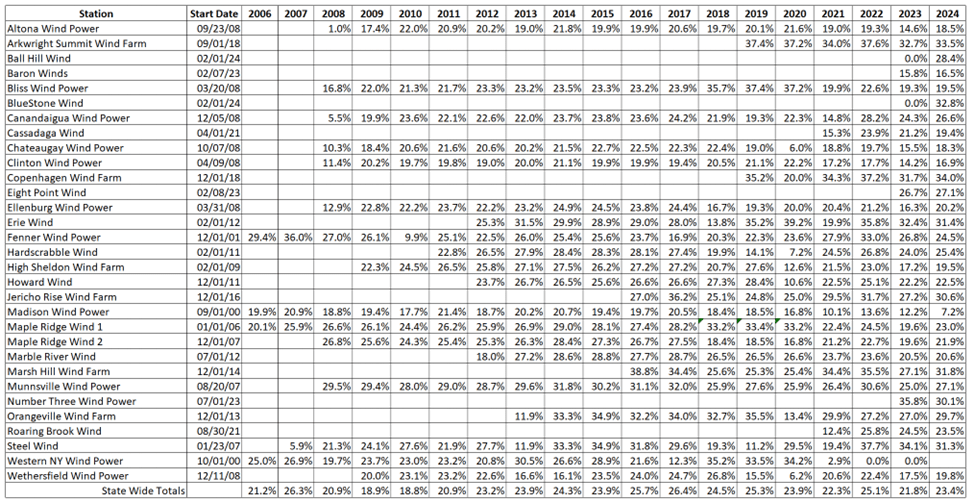
The following table lists the observed net energy (GWh) and capacity factors from 2006 to 2023, and the projections made in 2003 by AWS.  In that analysis the observed capacity factor was 21% in the first three years.  Since then, only one year achieved that level and in the last three years the capacity factor was less than 14%.  AWS projected that the energy production would be 23.6 GWh per year.  The last column in the table lists the observed minus projected annual deficit.

Table 1: Madison Wind Farm Performance Based on NYISO “Gold Book” Load & Capacity Data Report Table III-1 Including AWS 2003 Projections

Discussion

As the first industrial wind facility Madison Wind Farm performance was evaluated in the AWS project.  The report claims that it was a successful demonstration of large-scale wind development.  I agree that it provides power, and the information learned from it has been used to integrate other projects.  However, I have concerns about the poor availability and decreasing capacity factors.

In my previous article I noted that over-optimism is a characteristic of NYSERDA.  The NYSERDA Integration Analysis projected a state-wide wind capacity factor of 29% in 2020 increasing to 34% in 2030.  The Gold Book statewide capacity factor in 2020 was 23.9%.  The Integration Analysis projected land-based wind in 2030 would generate 5,043 GWh but using that capacity factor he actual production was only 4,162 GWh, 18% lower than they projected.  In addition, the Integration Analysis did not acknowledge that as wind systems age their performance drops.

In comments I submitted regarding the Draft Scoping Plan, I noted that the Integration Analysis assumes that the expected lifetimes of the wind facilities is indefinite.  As a result, units were assumed to remain online throughout the study period and no costs for replacements between now and 2050 were included.  This generator deactivation notice blows that assumption out of the water.

NYSERDA’s Integration Analysis quantified the generating resources that will be needed to meet the Climate Act mandates.  However, comparison of observed and projected energy production shows that they have overestimated energy production which means that more wind capacity will have to be developed and that the costs will necessarily be higher than they projected.  Now we have confirmation that the retirement of wind resources will occur which adds another layer of overestimated wind energy projection. 

There has not been any reconciliation between Integration Analysis projections and observations to refine projections.  This is in keeping with their complete lack of response to technical issues raised in comments on the Scoping Plan. 

Conclusion

The performance of the first wind farm in New York is considerably less than projected and now it is retiring after less than 25 years of operation.  The Madison Windpower Project Final Report found that the capacity factor 21% the first three years which was lower than the projected value of 23.3%.  Performance degraded over the period of record and was only 12% in 2023.  Over 18 years the facility produced 93.2 GWh less than projected.  This is another indication that the Scoping Plan projections for future wind operations were overly optimistic and means that the Scoping Plan costs for the net zero transition are too low.

This is just one more example of the flaws hidden behind a veneer of political slogans that claim all is well with the Climate Act.  Eventually it will become obvious that the Hochul Administration electric system “plan” is incompatible with reality.  It is past time to pause implementation and address the many issues that have been identified with the Scoping Plan.

Comments on DPS Definitions for Establishment of a Renewable Energy Program

On November 4, 2024, the Department of Public Service (DPS) staff proposed definitions for two key components of the 2040 target.   This post describes some of the comments submitted on the draft.  It is necessary to read between the lines of the electric industry comments to appreciate their concerns about the future electric system.

I am convinced that implementation of the New York Climate Leadership & Community Protection Act (Climate Act) net-zero mandates will do more harm than good if the future electric system relies only on wind, solar, and energy storage because of reliability and affordability risks.  I have followed the Climate Act since it was first proposed, submitted comments on the Climate Act implementation plan, and have written over 500 articles about New York’s net-zero transition.  The opinions expressed in this article do not reflect the position of any of my previous employers or any other organization I have been associated with, these comments are mine alone.

Summary – if you don’t have over ten minutes to read the whole thing

The Climate Act has a target that all electricity must be generated by “zero-emissions” resources by 2040. DPS staff proposed a definition of “zero-emissions” in November 2024 nearly five years after the law was promulgated.  It is increasingly obvious that the Scoping Plan is inadequate for the task of implementing a “zero emissions” electric system. Both the electric grid operator and a consortium of electric utilities provided comments on the proposed definition that emphasized the need for a comprehensive plan that prioritizes electric reliability.  Environmental advocacy organization comments underestimate the reliability challenges and recommend changes that would hinder development of a reliable grid.  I believe that the Hochul Administration is at a crossroads, and it is not clear that they will change direction to a rational approach based on reality or continue the present path of ideological purity.

Overview

The Climate Act established a New York “Net Zero” target (85% reduction in GHG emissions and 15% offset of emissions) by 2050.  Two targets address the electric sector: 70% of the electricity must come from renewable energy by 2030 and all electricity must be generated by “zero-emissions” resources by 2040. The Climate Action Council (CAC) was responsible for preparing the Scoping Plan that outlined how to “achieve the State’s bold clean energy and climate agenda.” The Scoping Plan was finalized at the end of 2022.  Since then, the State has been trying to implement the Scoping Plan recommendations through regulations, proceedings, and legislation. 

I believe that the biggest shortcoming of the Hochul Administration’s implementation of the Climate Act is the lack of a plan.  For example, to implement a transition to meet the mandate that all electricity must be generated by “zero-emissions” resources by 2040 it is first necessary to define “zero emissions”.  Amazingly, draft definitions were not proposed for over four years.  On November 4, 2024, the DPS staff proposal concerning definitions for key terms (Staff Proposal) in Public Service Law §66-p that finally defined “zero emissions”.  The Introduction of the Staff Proposal explains:

In this proposal, the Department of Public Service Staff (Staff) suggests interpretations of key terms in the provisions of the Climate Leadership and Community Protection Act (Climate Act), codified in Section 66-p of the Public Service Law (PSL), which directs the Public Service Commission (Commission) to establish a renewable energy program and design it to achieve particular targets. At issue in this proposal is the language of PSL §66-p(2)(b), which directs the Commission to establish a program pursuant to which, by the year 2040, the “statewide electrical demand system will be zero emissions.” Of particular note, neither of the terms “statewide electrical demand system” nor “zero emissions” are expressly defined in the Climate Act or in the PSL. This lack of statutory definition requires the Commission’s interpretation of these terms to ensure proper regulatory implementation.

This post describes some of the comments submitted on these definitions.

New York Independent System Operator (NYISO)

NYISO runs the electricity market and is “dedicated to planning a reliable grid of the future, leveraging open and fair electricity markets, and informing policymakers and stakeholders.”  They submitted their comments on January 21, 2025.  The NYISO frustrates me because they pull their punches when they file comments.  Rich Ellenbogen shares my frustration and sent me an email describing their filing that exemplifies my concern.  He wrote: “The NYISO is screaming between the lines of their filing again.  The filing is attached and addresses electricity reliability margins across the state”.  He commented on three of their comments.

NYISO comment on Page 4:

To achieve the zero-emission standard, significant quantities of new resources, which satisfy the zero-emission definition, and provide the necessary energy and reliability attributes, will be required to support a reliable electric system. Development, permitting, siting, and interconnection of existing and emerging zero-emission electricity supply will require significant capitalization over a relatively short period of time.

Ellenbogen Response:

Regarding the above statement, financing, siting, permitting, and interconnection will do nothing if the technologies don’t exist at scale to implement the plan.  At present, the necessary technologies don’t exist at scale or don’t exist at all, with the exception of nuclear which is a four-letter word in NY State.  You can’t buy and install Dispatchable Emission Free Resources (DEFR’s) that aren’t available and sufficient nuclear generation won’t exist at scale until well after the CLCPA mandated dates even if planning was started today.

NYISO comment on Page 5:

Overly restrictive compliance obligations could prevent emitting generators from operating to support system reliability or serving consumer demand and potentially force generators to retire before suitable replacement resources are available. Insufficient availability of electric generation could adversely impact public health, welfare, and safety.

NYISO comment on Page 6:

Electric system reliability margins are already close to minimum reliability requirements in certain areas across New York and are tightening. If these margins are totally depleted, the reliability of the grid would be at an unacceptable risk and power outages could disrupt normal life or negatively impact public health, welfare, and safety.  The NYISO’s 2024 Reliability Needs Assessment (“RNA”) identifies a reliability need beginning in summer 2033 within New York City, primarily driven by a combination of forecasted increases in peak demand, limited additional supply, the assumed retirement of the NYPA small gas plants based on state legislation, and assumed unavailability of generators impacted by the DEC Peaker Rule.

Ellenbogen Response:

A translation for the two statements above, simply put is: “If you don’t let us run the existing generation that we have and force us to shut them down to meet your standards of ideological purity, you won’t have any lights or electricity for anything else.  We are already running on fumes, and it is going to get worse.”

Why the NYISO can’t just come out and say what they mean without such subtlety is a disservice to the people of NY State.  No one wants to say outright how ridiculously bad the state energy policy is so everyone keeps beating around the bush and in the interim, the state is like a runaway train headed towards a collapsed bridge. 

The utilities aren’t doing a service for their ratepayers or themselves either.  I understand that they don’t want to run afoul of the state government and lose their certification, but they are the ones that are going to be turned into piñatas when this goes bad, which is inevitable.  It’s not a matter of if, just when.  Are people actually going to have to die before someone comes out directly and acknowledges how bad this energy policy is?

Joint Utilities

An ad hoc group of utilities also submitted comments.  The Joint Utilities are Central Hudson Gas & Electric Corporation, Consolidated Edison Company of New York, Inc. Niagara Mohawk Power Corporation d/b/a National Grid, New York State Electric & Gas Corporation, Orange and Rockland Utilities, Inc., and Rochester Gas and Electric Corporation. As Ellenbogen noted these companies face existential threats if they speak out too strongly in the politically charged New York environment because there are proposals to take them over and have the State operate them.  Even if the politicians don’t shut them down, the Hochul Administration certainly can punish the companies when their rate cases are decided.  Nonetheless, I agree that they are doing a disservice to their customers by not speaking out. Their comments on this proceeding are a step forward because they made recommendations that imply there are problems.

I was encouraged by the following statement because it aligns with my argument that there is no plan in place to implement the Climate Act:

The reliability of electricity in the state is of primary importance to the Joint Utilities. For the reasons set forth below, the Joint Utilities request that the Commission direct Staff to collaborate with the NYISO and the Joint Utilities to develop a comprehensive plan to achieve zero emissions generation to meet New York State’s demand by 2040 in a manner that ensures reliability of the electric system throughout the clean energy transition to a zero emissions electric system. This plan should address current supply and demand trends within the power sector. If the cessation of greenhouse gas-emitting generation post-2040 creates a large gap between supply and demand, the plan should also include strategies of how best to retain, manage and retire generation to maintain system reliability and resource adequacy.

It is important to read between the lines of this paragraph:

Clear guidance and decisive action are essential to advancing our state’s zero-emission targets while ensuring resource adequacy and affordability are not compromised. There are fewer than five years before the first target takes effect and only fifteen years to achieve zero emissions by 2040, so it is crucial to act promptly. From an electric planning, permitting, and construction perspective, the feasibility of this timeline will be significantly challenging.

My interpretation is that they are saying there isn’t clear guidance and decisive recommendations for action that ensure resource adequacy and affordability are not compromised.  I wholeheartedly agree. They also point out time is getting short to meet the electric sector targets.  When regulated companies with significant exposure to political retribution say “significantly challenging” they are really saying this won’t work!  The Joint Utility comments go on:

The Joint Utilities recommend that the Commission direct Staff to develop a clear roadmap that addresses future system needs, potential gaps in supply and demand and clear methodologies to characterize those gaps, clean energy technology readiness, sufficient access to generation to the extent gaps are identified, and resource attributes necessary for the reliable operation of New York’s electric system amid ongoing growth in intermittent renewable supply and electric demand.

I have been taught that failing to plan is planning to fail.  This comment is a clear indictment of the Scoping Plan and the transition implementation to date because it says that there is no comprehensive plan that addresses these concerns.  I endorse the Joint Utility recommendation that:

Given the potential for New York’s clean energy resources to fall short of demand, or suffer from delayed entry for various reasons, and the challenges associated with the commercial availability and maturity of new energy technologies, the Commission should require Staff to develop a plan for the development of incremental renewables, the retirement of non-compliant resources, and methodologies to address gaps between existing resources and the reliability needs of the system, while also ensuring that reliability and resource adequacy do not suffer.  Staff should also consider the development status and lead time of new and existing technologies from research and development to their commercial deployment. It is imperative to address these issues, set expectations and identify needs for the journey towards the 2040 zero emissions target.

The missing point is an explicit statement explaining if the Commission does not follow these recommendations, then there will be blackouts.  There is one other comment I want to highlight:

Lastly, the Coordinated Grid Planning Process (“CGPP”) confirms the conclusion of the NYISO and academic research that there is a large gap between supply and demand and “there is no consensus among CGPP participants about the technologies that could be deployed to meet the estimated 17GW need.” These factors are concerning, and it is imperative to incorporate these realities into the roadmap assumptions. While transitioning to a clean energy system, it is also imperative to ensure adequate generating resources are retained and available, regardless of technology, which is permissible because the Clean Energy Standard does not require the retirement of existing generators.

The large gap between supply and demand is referring to the dispatchable emissions-free resource (DEFR) issue that I discuss whenever I suggest a feasibility study is needed before any more money and effort is invested in what could be a false technology solution.  Note that the last sentence emphasizes that existing facilities should not be shut down prematurely. 

Environmental Advocacy Comments

Earthjustice, Sierra Club, the Alliance for Clean Energy New York, NY Renews, and Fossil Free Tompkins also filed comments.  I think that these organizations underestimate the challenge of meeting the large gap between supply and demand.  They submitted comments in June arguing that the December 2023 technical conference presentations had overestimated the magnitude of the gap.  In July I filed a comment  explaining that if anything, projections of the severity of the gap have been under-estimated because winds across large areas are correlated . Earthjustice and Sierra Club responded arguing among other things that “There is no reason to believe that wind speeds offshore of New York City, Long Island, and the Massachusetts Cape will be significantly correlated with land-based wind resources located in Upstate New York.”  I dropped the ball and have not responded to that documenting the results of an analysis released after their comments were filed that shows that New York onshore and offshore winds do correlate. 

I did publish an article describing a New York wind lull last September that shows that land-based wind resources do correlate with New York’s South Fork offshore wind project.  New York presently has 2,454 MW of wind capacity.  I analyzed a 192- hour period from 12 September 2024 hour 0000 to 19 September 2024 hour 2300. I found that the minimum wind capacity occurred on 13 September at hour 12 when a total of 0.2 MW of wind power was generated.  There were 96 hours representing half the period when the capacity of all the wind generation in New York was less than 5%.  All but one of the hours had a capacity factor of less than 20%.  Even the best was unimpressive.  The maximum wind capacity occurred on 19 September at hour 21 when 502 MW of wind power was generated, only 20.5% of the total capacity.  Because South Fork was in operation and included in the total, it is reasonable to assume that for at least 96 hours the wind speeds offshore were significantly correlated with New York land-based wind. 

The emphasis in the environmental organization comments on the zero-emission definition was ideological support of the strictest interpretation of “zero”.  They disagreed with pragmatic Department of Public Service recommendations and suggested that: “the Public Service Commission adopt a plain meaning interpretation of “emissions” that includes both greenhouse and non-greenhouse gases and interpret the “statewide electrical demand system” to include behind-the-meter resources that participate indirectly in jurisdictional markets.  Their suggestions make what I think is already impossible challenge even more difficult and expensive.

Conclusion

This post notes that both the NYISO and the Joint Utilities’ comments on the zero-emission definitions suggest that there will be consequences if there is no plan and recommend a re-assessment of the schedule.  I agree completely.

The environmental organizations who commented reiterated their ideological position that zero emissions of all pollutants is required and must occur as fast as possible to maintain the Climate Act schedule.  Those comments disregard all the indications that it is impossible,

The Trump Administration’s recent announcements, last summer’s acknowledgment that the 2030 electric sector goal would not be met, and the increasingly desperate comments by New York’s electric sector are all warnings to the Hochul Administration.  It seems to me that a pause to re-assess what can be done without endangering affordability and reliability could be proposed because of all the factors beyond New York’s control.

Ellenbogen asked whether people are going to have to die before someone comes out directly and acknowledges how bad this energy policy is.  I wish I was optimistic that this will not be the case but there is no evidence yet that the leadership of New York is willing to back off their ideological soapbox and admit the current Climate Act energy policy cannot work despite a plethora of evidence.

Implications of the Moss Landing Battery Plant Fire

Note – This post was updated with revised cost numbers on January 17 at 8:00 PM EST

According to the Mercury News “Flames and smoke in the community of Moss Landing and the Elkhorn Slough area in northern Monterey County largely were just smoldering late Friday morning following a major fire at a battery storage plant that brought evacuations.”  I think it is appropriate to consider the implications of this fire on their proposal by the PEAK Coalition who is dedicated to the shutdown of New York City peaking power plants.  In their report from last year,  Accelerate Now! The Fossil Fuel End Game 2.0 they described their plan to address harmful and racially disproportionate health impacts of the city’s peaker plants by replacing them with renewable energy and energy storage solutions. 

I am convinced that implementation of the New York Climate Act net-zero mandates will do more harm than good if the future electric system relies only on wind, solar, and energy storage because of reliability and affordability risks.  I have followed the Climate Act since it was first proposed, submitted comments on the Climate Act implementation plan, and have written over 490 articles about New York’s net-zero transition.  The opinions expressed in this article do not reflect the position of any of my previous employers or any other organization I have been associated with, these comments are mine alone.

Overview

The PEAK coalition has stated that “Fossil peaker plants in New York City are perhaps the most egregious energy-related example of what environmental injustice means today.”  The influence of this position on current New York State environmental policy has led to this issue finding its way into multiple environmental initiatives. I have prepared a summary of this issue that explains why the presumption of egregious harm is based on selective choice of metrics, poor understanding of air quality health impacts,  and ignorance of air quality trends.  The page documents my concerns based on my background in air pollution control theory, implementation, and evaluation over my 45+ year career as an air pollution meteorologist and extensive personal experience with peaking power plants and their role during high energy demand days.

Peak Coalition and Battery Storage

The Accelerate Now! The Fossil Fuel End Game 2.0 report concludes that “The pace of renewable energy, energy storage, and transmission development must increase.”  The following energy storage recommendations were made:

  • The most immediate and pressing step is to address the short-term reliability challenges that led NYISO to issue reliability must-run scenarios for the Gowanus and Narrows peaker plants. Governor Hochul must direct key decision-makers to fund and develop transmission and energy storage assets before May 2025 in order to minimize or eliminate the use of these peaker plants.
  • NYPA must be held accountable for the linked mandate to phase out their peaker plants in New York City and Long Island by accelerating the process of issuing, evaluating, awarding, and developing battery storage projects at the sites.
  • NYSERDA can and must develop new large-scale and community-led renewable energy and energy storage projects in an expedient manner and prioritize applications that will transition fossil fuel operations or develop distributed energy resources capacity.
  • Local leaders can play a significant role in educating the public on issues such as developing responsible solutions to address safety concerns without overburdening renewable energy and battery storage development due to misinformation.

Also note that the Peak Coalition emphasizes equity for the transition from traditional power plants for neighboring communities.  The report notes that the “phaseout of fossil fuel peaker plants creates new opportunities for communities to take back control over their future.”  This includes a demand to “allow community governance in renewable energy and battery storage”. 

The Peak Coalition webinar entitled Replacing NYC’s Peaker Plants with Clean Alternatives: Progress, Barriers, and Pathways Forward on February 6, 2024, also discussed battery storage.  Victor Davila, Community Organizer, THE POINT CDC included the following slide in his presentation that demands that battery storage replace peaking power plants.

Megan Carr, Skadden Fellow – Environmental Justice Program, New York Lawyers for the Public Interest talked about regulatory barriers including those for battery storage.  She illustrated her comments with the following slide.

 Regarding battery storage she said:

I want to talk about regulatory barriers.  There are real challenges to developing battery storage in New York City.  The city has additional codes and safety standards beyond the state standards when it comes to siting battery storage.  FDNY has a site-specific approval process for every potential energy development.  There are set back and clearance requirements that limit the possibility of rooftop solar across the city.  There are fire code regulations that continue to prevent lithium-ion batteries from being installed indoors and the second use of lithium-ion batteries is banned in New York City.  These limitations stem from real safety concerns.  We’ve all been horrified by the deadly e-bike fires that we’ve read about in the news.  To increase energy storage development in New York City without sacrificing safety we need greater education for the public and policymakers alike that looks at the nuance between different types of battery storage and does not just fear monger in the public about the risk of storage. 

The literal poster child for the Peak Coalition proposal is the Rise Light & Power Renewable Ravenswood initiative, a plan to transition Ravenswood Generating Station (shown below) into a clean energy hub. The plan involves the replacement of Ravenwood’s remaining peaking capacity with a mix of offshore wind, upstate renewables, district heating, and large-scale battery storage.

Not so Fast

A couple of years ago I put together a substantive post that discussed battery energy storage system (BESS) concerns.  I concluded that these systems must overcome space constraint issues and are not proven technology.  When a leading expert on batteries says: “Everybody has to be educated how to use these batteries safely”, I think the best course of action is to follow his advice.  It is not appropriate to make the residents of the disadvantaged communities near a BESS become unwilling lab rats to test whether a technology that can generate toxic gases, fires, and explosions is appropriate in an urban setting.  I am sure Ms. Carr believes that my article is “fear mongering the public about the risk of storage”.

Reality is confirming my concerns.

The Vistra Moss Landing Energy Storage Facility is the largest lithium battery energy storage system in the world, located in Moss Landing, California. It has a total capacity of 750 MW and 3,000 MWh, providing critical support to California’s electricity grid.  On January 16, 2025 a fire was reported at the facility shortly after 3 PM.  Mercury News reported that:

Fire Chief Joel Mendoza of the North County Fire Protection said at a Friday morning press conference said the fire had died down significantly by 8:30 a.m., down from its peak about 12 hours earlier.  The evacuations remained in place at 11 a.m. for about 1,200 residents

I understand that fire was in the 300-megawatt Phase I energy storage facility and reports indicated that 75% of the facility had burned.  The nearby Tesla storage facility was unharmed.

This is the third fire at the facility in the last three years.  They evacuated 8 square miles and closed a major highway.  What would happen in New York City if there was a fire at the poster child storage facility.

New York City Battery Storage Fire Impacts

Richard Ellenbogen saved me from having to figure out the impacts.  The following text in italics is from his email on the fire.

The Moss Landing Battery Plant fire is burning at a temperature of between 2500 – 5000 degrees Fahrenheit.   From reports, the fire encompasses 40% of the 300 MW facility.  At about 4 MW fitting in a 40 foot sea container sized package, there are about 30 sea container sized units on fire.  The first responders won’t be able to get close enough to the fire to fight it, a lot of the water sprayed on it would likely turn to steam before it hit the batteries, and Lithium battery fires turn water that does come into contact with them into hydrogen and oxygen.  Explosive fuel, an oxidizer, and a heat source aren’t a great combination.  At $400 per Kilowatt, $400,000 per Megawatt, that is $48 million in damage for the 120 Megawatts that are burning, not counting clean up costs and please explain to me how the technology can qualify as zero emission.

RC comment: Later reports said 75% of the 300 MW facility burned making it $90 million in damages.  The $400 per Kilowatt, $400,000 per Megawatt, that is $48 million numbers were updated to $400 per  KWh, $1600 per Kilowatt-hr or $1.6 million per megawatt – hr for four hour storage.  The costs are four times higher or $360 million.

Not to mention that any water sprayed on it would carry heavy metals and other toxins into the ground or into Monterey Bay. 

Besides the ridiculous cost of the storage and the short lifespan, this has been one of my arguments against these facilities for years.

At Moss Landing, there are 7676 acres under evacuation with only 1214 people living there.  At 640 acres per square mile, that is 12 square miles.  It is a circle with a radius of about two miles, much of which is over the Pacific Ocean.

RC comment:  Rich recalculated the radius to be 2.6 miles instead of 2 miles so even more of Manhattan would be in the danger zone.

RC Comment: Richard evaluated the impacts of a similar fire and evacuation recommendation for the poster child Ravenswood facility.

They are building a similar sized storage facility using the same technology at the location of the old Ravenswood Power Plant in Queens.  There is nothing that can be done to make it any safer than the Moss Landing Plant except the population in the evacuation area would be nearly one million.  The Ravenswood location is the Red Stick Pin on Vernon Blvd. across the East River from Roosevelt Island shown below. 

The average population density of NY City is 30,000 people per square mile.  It is the most densely populated city in the United States, except that figure also includes less densely populated areas in the outer boroughs.  The average population density of Manhattan is 73,000 people per square mile and a 12 Square mile evacuation zone would cover some of the most densely populated areas of Queens, Brooklyn, and Manhattan.  The evacuation zone would cover most of the map shown.   Two miles from Ravenswood extends to the West Side of Central Park due west, southwest to the Empire State building on 33rd Street and 5th Avenue, all of the East side of Manhattan above 30th Street up to 106th Street, and Queens and Brooklyn from the RFK Bridge down to Greenpoint.  That is the entire area circled by Routes 278 and 495.  Those are the Brooklyn Queens Expressway and the Long Island Expressway, roads that are notorious for being parking lots on a normal day. 

What would happen during a mass evacuation because of a battery fire that could also potentially impact the utility system and mass transit in a worst-case scenario, eliminating subways as a viable means of egress?  Grand Central Station would also fall within a 2 mile radius evacuation zone so would Metro North trains be able to operate?  What contamination would enter the East River during a similar fire at Ravenswood?  How many people would die in an evacuation like that from heart attacks, being crushed in a crowd or run over by vehicles, and how many other types of accidents that could occur in an evacuation of that size?  A 2 mile evacuation zone would also include all of the hospitals between  60th Street and 70th Street near the East River including Sloan Kettering and Weill- Cornell, and also NYU Langone Medical Center on 34th Street and the East River.  How will those facilities be evacuated?

Conclusion

The Peak Coalition demands that regulators “allow community governance in renewable energy and battery storage”.  I worry that addressing this constraint distracts from the complex issues involved with peaking power plant needs and fire safety mandates.

When Ms. Carr talked about the Fire Department of New York response to energy storage permitting her voice suggested that she did not agree with their requirements.   Even though she acknowledged that their “limitations stem from real safety concerns” she said: “To increase energy storage development in New York City without sacrificing safety we need greater education for the public and policymakers alike that looks at the nuance between different types of battery storage and does not just fear monger in the public about the risk of storage.”  These fires have implications for this recommendation.

The Peak Coalition has a very narrow focus that is based almost entirely on emotion.  Most importantly, they have no accountability when they disparage the agencies and organizations that are responsible for environmental protection, electric system reliability, and in this case fire hazards.  In my previous article I concluded that we should follow the advice of experts who say: “Everybody has to be educated how to use these batteries safely”.  Given the experience of Moss Landing, I think it is fair to ask if they can be operated safely and that it would be prudent to delay implementation until that can be shown. 

The alleged impacts of peaking power plants pale in comparison to the disastrous impacts of a battery energy storage fire.  That risk must be considered as the energy transition implementation plan is rolled out.  Crossing fingers and hoping that a fire will not happen is a prescription for disaster.