Note – This post was revised to clarify my recommendation that the Climate Action Council should propose affordability and reliability criteria to explain the Council should work with the PSC and NYISO for consideration in a stakeholder process similar to the development of the Scoping Plan on 8/21/24.
I have followed the Climate Act since it was first proposed, submitted comments on the Climate Act implementation plan, and have written over 450 articles about New York’s net-zero transition. The opinions expressed in this article do not reflect the position of any of my previous employers or any other organization have been associated with, these comments are mine alone.
Overview
The Climate Act established a New York “Net Zero” target (85% reduction in GHG emissions and 15% offset of emissions) by 2050. It includes an interim 2030 reduction target of a 40% reduction by 2030. Two targets address the electric sector: 70% of the electricity come from renewable energy by 2030 and a requirement that all electricity generated be “zero-emissions” resources by 2040. The Climate Action Council (CAC) was responsible for preparing the Scoping Plan that outlined how to “achieve the State’s bold clean energy and climate agenda.” The Integration Analysis prepared by the New York State Energy Research and Development Authority (NYSERDA) and its consultants quantifies the impact of the electrification strategies. That material was used to develop the Draft Scoping Plan outline of strategies. After a year-long review, the Scoping Plan was finalized at the end of 2022. Since then, the State has been trying to implement the Scoping Plan recommendations through regulations, proceedings, and legislation.
Recently three reports have come out that raise specific concerns about Climate Act implementation: schedule ambition, costs to implement, and electric system reliability risks.
The New York State Comptroller Office released an audit of the NYSERDA and PSC implementation efforts for the Climate Act titled Climate Act Goals – Planning, Procurements, and Progress Tracking (“Comptroller Report”). The audit found that: “The costs of transitioning to renewable energy are not known, nor have they been reasonably estimated”.
The Public Service Commission (PSC) recently released the Clean Energy Standard Biennial Review Report (“Biennial Report”) that compares the renewable energy deployment progress relative to the Climate Act goal to obtain 70% of New York’s electricity from renewable sources by 2030 (the 70% goal). It found that 2030 goal will likely not be achieved until 2033.
The New York Independent System Operator (NYISO) 2023-2042 System & Resource Outlook (“Resource Outlook”) described issues that threaten reliability and resilience of the current and future electric system. The report described current and future challenges for the electric system. The findings suggest that there will be significant reliability risks for the Climate Act transition.
Business Council of New York Statement
BCNY released their statement because it represents concerns expressed by various impacted businesses across New York about “the achievability of key Climate Act mandates and what that means for the future reliability and cost of the state’s energy system.” The statement calls for the “state to identify and make necessary mid-course corrections based on updated information and significant economic and market changes.” The statement argues that “These steps are essential to avoid significant unintended impacts on the well-being of New Yorkers and on the state’s economic competitiveness.” They note that “Importantly, we believe that New York can continue to be a leader in state-level climate policy, but it needs to take a workable, affordable approach to meeting its energy and emission goals.”
The statement notes that the Climate Act implementation process has not provided a “comprehensive, publicly accessible assessment of implementation costs, the comparative costs of policy alternative programs, and the impact of new policies on residential and business energy consumers.” This echoes the Comptroller Audit finding of inadequate cost information.
The statement also describes concerns about “the practical achievability of key CLCPA provisions and the consequences of basing major policy decisions on unworkable statutory mandates”. The Biennial Report notes that one of the statutory mandates will likely not be achieved.
The statement takes pains to note that they are not opposed to many of the proposed control strategies. However, “the state needs to ensure that its push toward emission reductions and the electrification of major sectors are technically and economically achievable.” This is one of the findings of the Resource Outlook.
The statement argues that “implementation challenges call for a reassessment of the underlying statutory mandates.” It notes that they want to work with the Administration, state legislators, and other climate stakeholders to address the issues raised. However, a specific path forward is not proposed. I propose such a path forward below.
Recommendation for Climate Act Review
Although it has received little notice, there is a provision for renewable energy programs that should be the foundation of the recommended reassessment. The Biennial Report refers to New York Public Service Law § 66-p (4). “Establishment of a renewable energy program” that states: “The commission may temporarily suspend or modify the obligations under such program provided that the commission, after conducting a hearing as provided in section twenty of this chapter, makes a finding that the program impedes the provision of safe and adequate electric service; the program is likely to impair existing obligations and agreements; and/or that there is a significant increase in arrears or service disconnections that the commission determines is related to the program”.
The essential first step for reassessment consideration is definition of the safety valve criteria in §66-p (4). What are the criteria for unsafe and inadequate electric service, impairment of existing obligations and agreements, and unacceptable increase in arrear or service disconnections? In my opinion, the Climate Action Council with the PSC and NYISO should propose suitable criteria for consideration in a stakeholder process similar to the development of the Scoping Plan.
The next step would be to provide the data necessary to determine the criteria for unsafe and inadequate electric service, impairment of existing obligations and agreements, and unacceptable increase in arrears or service disconnections. Given this legal provision it is appropriate that the information be tracked somewhere. The BCNY statement recommended an “accessible and understandable “dashboard” of the state’s climate change efforts, including a comprehensive accounting of direct state spending and state “directed” spending, the source of funds and their use, and the impact of these expenditures on achieving GHG emission reduction and renewable energy production goals.” The §66-p (4) criteria parameters should be included in the dashboard.
Conclusion
The three agency reports raise legitimate reasons to be concerned about the mandates and schedule of the Climate Act. The BCNY statement echoes those concerns and recommends a review and consideration of mid-course corrections. There is a legal provision to “temporarily suspend or modify the obligations” of a renewable energy program that defines criteria consistent with the concerns raised by the BCNY, the PSC Biennial Report, the Comptroller Report audit of Climate Act implementation, and the NYISO Resource Outlook. If the §66-p (4) criteria are explicitly defined and compared to observed data, it would form the basis for a pragmatic review of the Climate Act.
In a recent article describing a new category of generating resources called Dispatchable Emissions-Free Resources (DEFR) I noted there still are people who maintain that existing technologies—led by solar and wind—can solve the climate crisis. A recent op-ed titled “With New York’s climate action goals in question, governor’s comments on future role of nuclear power worry environmental advocates” at Riverhead Local provides an example.
I have followed the Climate Act since it was first proposed, submitted comments on the Climate Act implementation plan, and have written over 400 articles about New York’s net-zero transition. The opinions expressed in this article do not reflect the position of any of my previous employers or any other company or organization I have been associated with, these comments are mine alone.
Overview
The Climate Act established a New York “Net Zero” target (85% reduction in GHG emissions and 15% offset of emissions) by 2050. It includes an interim 2030 reduction target of a 40% reduction by 2030. Two targets address the electric sector: 70% of the electricity come from renewable energy by 2030 and a requirement that all electricity generated be “zero-emissions” resources by 2040. The Climate Action Council (CAC) was responsible for preparing the Scoping Plan that outlined how to “achieve the State’s bold clean energy and climate agenda.” The Integration Analysis prepared by the New York State Energy Research and Development Authority (NYSERDA) and its consultants quantifies the impact of the electrification strategies. That material was used to develop the Draft Scoping Plan outline of strategies. After a year-long review, the Scoping Plan was finalized at the end of 2022. Since then, the State has been trying to implement the Scoping Plan recommendations through regulations, proceedings, and legislation.
Three recent reports all have suggested that implementation of the Climate Act is not going as planned and that reassessment is necessary. The Public Service Commission (PSC) Clean Energy Standard Biennial Review Report found that the 70% renewable energy goal will likely not be achieved until 2033. The New York State Comptroller Office Climate Act Goals – Planning, Procurements, and Progress Tracking audit found that the PSC and NYSERDA implementation plans did not comprise all essential components, including “assessing risks to meeting goals and projecting costs.” The New York Independent System Operator (NYISO) 2023-2042 System & Resource Outlook described issues that threaten reliability and resilience of the current and future electric system.
Dispatchable Emissions-Free Resources
One of the most important reliability issues is the need for a new category of generating resources called Dispatchable Emissions-Free Resources (DEFR) necessary for a future grid that depends upon wind, solar, and energy storage resources. Reputable analyses of the future New York electric system agree that new technologies are necessary to keep the lights on during periods of extended low wind and solar resource availability. Despite the overwhelming consensus of the organizations responsible for keeping the lights on that DEFR is needed there are people who believe otherwise.
One such person is Karl Grossman. According to his bio published with the op-ed:
Karl is a veteran investigative reporter and columnist, the winner of numerous awards for his work and a member of the L.I. Journalism Hall of Fame. He is a professor of journalism at SUNY at Old Westbury and the author of eight books.
The basis of Grossman’s belief is Dr. Mark Z. Jacobson’s 2023 book “No Miracles Needed: How Today’s Technology Can Save Our Climate and Clean Our Air.” Grossman interviewed Jacobson and quoted him as saying: “Whether New York can reach the 70% goal by 2030 is a matter of social and political willpower. It is not a question of technology or economics.”
Grossman describes Jacobson’s claims, but I am not going to respond to those claims in detail. In my recent article about DEFR I explained why I know that Jacobson is wrong. In brief, I found six analyses describing the need for new technology: the Integration Analysis, New York Department of Public Service (DPS) Proceeding 15-E-0302 Technical Conference, NYISO Resource Outlook, Richard Ellenbogen, Cornell Biology and Environmental Engineering, and Nuclear New York. Jacobson and his protégé Dr. Robert Howarth frequently refer to their “peer-reviewed” work as validation but neglect the rebuttal peer-reviewed responses to their work and the many other peer-reviewed analyses that show DEFR is needed. Finally, I also found three books that refute the Jacobson book and his claims that the energy transition can be accomplished with no new technologies at low cost with large benefits.
Environmentalist Responses
I recently noted that Governor Hochul seems to be floating the idea that reassessment is necessary. Grossman noted that Newsday headlined a two-page spread two weeks ago: “Hochul Says New York Won’t Meet 2030 Climate Goal.” In the article, Newsday cited Gov. Kathy Hochul’s comments in an Albany Times Union newspaper podcast.
“We’re gonna get to our goals, but if we miss it by a couple of years—which is probably what’ll happen—the goals are still worthwhile,” Hochul said. But we have to think about the collateral damage of all of our major decisions… either mitigate them or you have to rethink them.” In the podcast, she also termed herself as “a staunch environmentalist.”
The Grossman op-ed described how environmentalists are reacting. Not surprisingly they still claim that the state has not done enough on renewable energy.
Judith Enck, for seven years regional administrator of the U.S. Environmental Protection Agency for an area that includes New York State and before that deputy secretary for the environment for two New York governors, said delaying the 70% goal “is a terrible decision by the governor. I hope she revisits it. We’re in a climate crisis. She says things have changed—and they have: the climate crisis has gotten worse. The governor should look at ways to accelerate meeting the goals, not delaying them.” Renewable energy, she said, is not a priority for state government.
Liz Moran, New York political advocate for the group Earthjustice, said: “The administration has been appearing to slow walk it from the jump. It’s a fear-based approach rather than a brave and bold approach that we need in the face of this crisis.”
“We’re certainly not ready to wave the white flag,” said Julie Tighe, president of the New York League of Conservation Voters.
Environmental advocates such as these ignore or disparage analyses such as the NYISO 2023-2042 System & Resource Outlook that describes issues that threaten reliability and resilience of the electric system. I recently described how the proposed transition that relies on wind and solar exacerbates their concerns. Unfortunately, the document is full of technical jargon and politically correct terminology, so the full implications of this analysis are not readily apparent. NYISO cannot bluntly say this cannot work as proposed on the schedule mandated but that is the underlying message.
Environmental advocates also ignore New York’s role in this global problem. Using GHG emissions data from Our World In Data I looked at recent NY emissions with global data. In 2021, NYS GHG emissions (GWP-100) were 247 million metric tonnes (MMT). GHG emissions from China were 13,774 MMT and from India were 3,879 MMT. The increase in emission from 2020 to 2021 were 498 MMT in China and 265 MMT in India. New York emissions will be supplanted by emissions from China or India in less than one year. Overall, New York’s emissions are less than a half a percent of global emissions. This does not necessarily mean that we should not do something, but it does mean that meeting the arbitrary goals of the Climate Act will not have a meaningful impact on global warming impacts.
Grossman’s op-ed goes on:
Meanwhile, Politico published a report in May headlined “New York policymakers thaw on nuclear energy.” The piece by Marie J. French began: “Gov. Kathy Hochul has cracked the door open to the potential for new, small nuclear power plants as a way for the state to try to meet its ambitious climate coals.”
The article told of this happening “at a private dinner with environmentalists April 29, according to two attendees who spoke on the condition of anonymity because of the private conversations. It’s not the first time that her administration has raised the idea. One of her top aides suggested as much earlier this year.”
Enck said last week: “I think the governor even speculating on nuclear power in New York is trouble.” Enck spoke of how decades were spent in “shutting down the Indian Point nuclear plants” 25 miles north of New York City. We “shouldn’t promote the same thing again.”
Nuclear is the only proven DEFR technology that can be expanded sufficiently to fulfill the energy requirements of the Climate Act goals. Nuclear energy generates zero-emissions electricity, provides firm power that does not require supplemental ancillary transmission support, has low land-use requirements, and requires less transmission development than wind and solar. The dangers of nuclear are consistently over-hyped. Bill Gates has pointed out that “nuclear energy, in terms of an overall safety record, is better than other energy.” It is a mystery to me why any environmental advocate continues to harbor this irrational fear of nuclear power and consider its use troubling,
Discussion
Grossman concludes:
The central message of Jacobson’s “No Miracles Needed” book is how existing technologies—led by solar and wind—can solve the climate crisis, and he emphasizes how nuclear power is not needed and also investing in it would obstruct a transition to green renewable energy.
I conclude Grossman has naively backed the wrong source for this op-ed. Even the Climate Act Scoping Plan acknowledges the need for the new DEFR technology directly contradicting Jacobson’s primary claim. The Scoping Plan also contradicts all the other cost, schedule, and technology requirement claims made by Jacobson. The NYISO 2023-2042 System & Resource Outlook findings are consistent with the Scoping Plan. In my opinion, the arguments of anyone who does not face any repercussions if proven wrong should be given much less weight than arguments from those who have responsibilities.
With regards to the nuclear power recommendations Grossman is also wrong. The article does not provide any rationale for not developing nuclear other it would obstruct the transition to green renewable energy. The fact is that France successful cut its GHG emissions using nuclear power, but no jurisdiction has managed similar electric sector reductions relying on wind and solar. As a utility meteorologist with over 40 years’ experience I think the variability of wind and solar is an insurmountable challenge for a reliable electric grid. In my opinion, one of the advantages of nuclear is that it would preclude the need for “green renewable energy”.
Conclusion
On August 5 Governor Hochul announced a Future Energy Economy Summit that will “gather feedback on strategies to accelerate renewable energy deployment and explore the potential role of next generation clean energy technologies”. Grossman’s op-ed is the first article I have seen to suggest that nuclear power should not be one of the next generation clean energy technologies. In my article describing the announcement of the summit I noted that it will be interesting to see how legislators, the Big Green NGOs, climate activists, and the renewable energy shills react to nuclear power. Based on this article it appears Big Green NGOs and climate activists will not acknowledge that nuclear and other pragmatic considerations are necessary for the Climate Act implementation.
The New York Independent System Operator recently released the 2023-2042 System & Resource Outlook (“Outlook”). It examines “a wide range of potential future system conditions and compares possible pathways to an increasingly greener resource mix.” This post summarizes the key findings of Appendix E: New York Renewable Profiles and Variability.
I have followed the Climate Act since it was first proposed, submitted comments on the Climate Act implementation plan, and have written over 400 articles about New York’s net-zero transition. The opinions expressed in this article do not reflect the position of any of my previous employers or any other organization have been associated with, these comments are mine alone.
Overview
The Climate Act established a New York “Net Zero” target (85% reduction in GHG emissions and 15% offset of emissions) by 2050. It includes an interim 2030 reduction target of a 40% GHG reduction by 2030, a 70% electric system renewable energy mandate by 2030, and a requirement that all electricity generated be “zero-emissions” resources by 2040. The Climate Action Council (CAC) was responsible for preparing the Scoping Plan that outlined how to “achieve the State’s bold clean energy and climate agenda.” The Integration Analysis prepared by the New York State Energy Research and Development Authority (NYSERDA) and its consultants quantifies the impact of the electrification strategies used to reduce greenhouse gas emissions. That material was used to develop the Draft Scoping Plan outline of strategies. After a year-long review, the Scoping Plan was finalized at the end of 2022. Since then, the State has been trying to implement the Scoping Plan recommendations through regulations, Public Service Commission orders, and legislation.
The Outlook examines a wide range of potential future system conditions and compares possible pathways to an increasingly greener resource mix. By simulating several possible future system configurations and forecasting the transmission constraints for each, the NYISO:
Postulates possible resource mixes that achieve New York’s public policy mandates, while maintaining reserve margins, and capacity requirements;
Identifies regions of New York where renewable or other resources may be unable to generate at their full capability due to transmission constraints;
Quantifies the extent to which these transmission constraints limit delivery of renewable energy to consumers; and
Highlights potential opportunities for transmission investment that may provide economic, policy, and/or operational benefits.
Renewable Resource Characterization
The information presented in Appendix E was developed by DNV. They modeled “long-term hourly simulated weather and generation profiles for representative offshore wind (OSW), land-based wind (LBW), and utility- scale solar (UPV) generators” in two phases. Initially DNV assessed the OSW production for seven locations. In the second phase, the analyzed LBW and UPV generation for nearly 80 LBW and UPV locations each throughout the state. The projections were used to “determine the zonal or county aggregate net capacity factor (NCF) profiles that the NYISO used as inputs for this Outlook.
The goal of this work is to estimate the energy production of LBW, OSW, and solar—both UPV and behind the meter (BTM) PV. The report explains:
The production amounts of each type of generation are considered when determining the representative days selected for the capacity expansion model and are used as hourly generation shapes in the production cost model for this Outlook. The NYISO acknowledges that advances in renewable energy technology are continuously occurring and can lead to improved performance among generators built in the later years of the study period. Offsetting this effect, however, is that better sites may be utilized before less favorable resource sites leading to older technology on more favorable sites. Moreover, once installed, equipment performance can degrade over time. While these impacts are known, the exact magnitude of the impacts is difficult to quantify. Accordingly, this Outlook does not make any assumptions about improved performance of renewable generators built in the later years of the study period or performance degradation of resources once in operation.
The NCF data can be combined with hypothetical wind and solar projects sited throughout the state and in the New York Bight on the Outer Continental Shelf to estimate the generation production that represents actual historical weather conditions. As the report notes: “The increasing weather dependent supply resources and electrified load will necessitate more attention be paid to the modeling of spatiotemporally correlated renewable generation and loads in long-term planning studies.”
These data can be used in multiple ways: “Resource production profiles can be characterized in various ways to describe interannual variability in, for example, resource output, hourly ramps, variability, and duration of low output.”
Metrics for Characterizing Renewable Production
There is a lot of information in this report that can be used to describe how renewable energy production will be affected by weather. For example, Figure 1 shows the interannual variation for the net capacity factor of land-based wind (LBW), utility-scale solar photovoltaic (UPV), and offshore wind (OSW). Net capacity factor (NCF) is the annual amount of electrical energy produced divided by the maximum potential energy that could be produced. This parameter is used to determine how many resources need to be built to provide sufficient generation production to supply the necessary load. The Integration Analysis assumed a single capacity factor value for the three generating resources and these figures show that a proper analysis of resource requirements needs to address the variability shown.
Figure E-1: Annual Capacity Factor of UPV, LBW, and OSW: 2030 Contract Case
I derived the latest Integration Analysis capacity factors from the total capacity (MW) and annual energy production (MWh). I calculated that the 2040 projected LBW capacity factor was 37%, OSW capacity factor was 47%, and the solar capacity factor was 21%. I eyeballed the capacity factors in Figure E-1 for Table 1 that lists annual capacity factors. The projected mean annual capacity factors were less than the Integration Analysis for LBW and OSW while the solar projection was more than the Integration Analysis value. This means that the wind generation capacity resources projected by the Integration Analysis are insufficient to meet the average resource availability. It would be much easier for electric resource projections if planners only had to worry about average resource availability, but to provide electricity all the time planners need to consider the worst-case scenario. The minimum average annual capacity factor over this 22-year period was less than the Integration Analysis projections for all three resource categories. This means that the Integration Analysis underestimates the average generating resources needed and thus the costs of implementation.
Table 1: Annual Capacity Factors
The figures in Appendix E include results for the entire 22-year period of record and 2018. The NYISO report supports their resource adequacy planning efforts that focus on an individual year, in this case 2018. Appendix E notes that “understanding the variation in production over the years by comparing the annual capacity factors by technology type provides an initial indication of the energy impact of the choice of 2018 relative to other years in the DNV database.” For this article, I only present the combined 2000-2001 results and have modified the following quoted text to exclude any references to 2018. The Appendix describes the characterization approach:
Renewable production profiles can be characterized on a more granular level by examining statistics within individual month and hour bins. Commonly referred to as “twelve by twenty-fours” (12×24), this calculation allows the diurnal and seasonal contributions of different renewable generation types to be accessed from the hourly timeseries. Further comparison of the net load provides insight on when and how much other supply resources are needed across the year and when there is a potential for renewable oversupply (i.e., negative net loads).
The graphics below present the hourly and monthly average NCF by technology type and present the NCF of the capacity weighted aggregation of UPV, LBW, and OSW. The figures show the averages over the 22-year period (2000-2021)
A number of salient features of the input data can be observed using this methodology. The concentration of UPV generation in the summer and mid-day hours is clearly observed, as well as comparably lower UPV generation in the winter months due to shorter daytime periods. In the shoulder months, UPV production is slightly higher in the spring relative to the fall. On the other hand, production of both LBW and OSW is concentrated on average to the winter evening hours, with this impact more pronounced for OSW than LBW. Across the board, OSW produces at higher NCF levels than LBW. The combined impact of the wind and UPV display clear features of each of the technologies with the highest overall renewable production during the summer mid-day. The lowest production persists during the evening hours in the summer and early fall with fleet capacity factors under 20% on average.
Electric resource planners need to consider these observations in their capacity resource projections. As noted previously, the planners cannot rely on projections based on annual averages because generation must always match load. The proposed dependence wind and solar means the resource availability considerations described above must be considered for future resource projections. These results are the most comprehensive estimates for New York to date. In short, they make all the Integration Analysis projections obsolete.
Figure E-2: “12×24” Average Net Capacity Factors for UPV, LBW, OSW, and Combined: 2030 Contract Case
The Appendix explains why this information is important:
By comparing renewable energy supply to the timing of the expected load, the remaining supply resources needed to serve demand (e.g., hydro, nuclear, imports, fossil-fuel and other generation, storage, and DEFRs) can be better understood. Using a similar framework to simplify the comparison, the figure below displays the variability in net load by displaying 12×24 charts for average, minimum, and maximum net load in GW. The figure displays net load over the 22-year period (assuming the same load in each year but varying the renewable energy shapes).
The Appendix goes on to describe an alternate way to present the data that focuses on supply requirements:
Average net loads are highest in the summer and winter evening hours after sunset. This indicates the need for additional supply beyond the assumed wind and solar resources to meet expected demand. Net loads are lowest during the mid-day spring and fall months when loads are lower and renewable energy production is generally high. The minimum net loads, which may be negative, provide an indication of the minimum generation levels needed from the remaining fleet when loads are lowest and renewable output is high. Negative net loads indicate intervals where the renewable energy supplied by wind and solar resources exceeds the demand on the New York Contral Area and coincides with times of low average net load during the shoulder mid-day periods, primarily due to the concentration of solar output.
Figure E-3: “12×24” Average, Minimum, and Maximum Net Loads (GW): 2030 Contract Case
The Appendix briefly describes how these observations could be addressed:
Storage resources would potentially be able to shift a significant amount of this excess mid-day renewable output during the day or across a few days. However, storage resources may not be fully capable of economically addressing the seasonal mismatch between times of low and negative net loads in the shoulder seasons and high positive net loads during peak season after the sun goes down. This impact is only exacerbated as weather-dependent electrified load (e.g., building heating) increases the potential peak load sensitivity of the system during temperature or weather extremes. This results in the requirement for even further supply resources to meet the larger net load peak without significant efforts to mitigate the potential peak load growth impacts.
After a discussion of ramping rate implications, the Appendix goes on to address low renewable resource availability ramifications and the analysis performed:
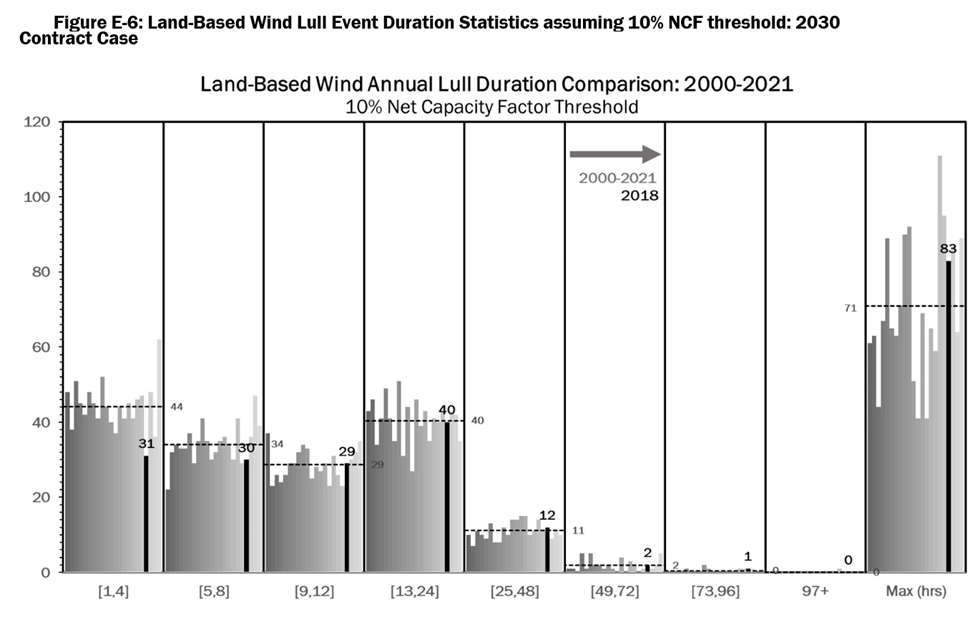
Characterization of the magnitude and frequency of low output intervals of renewable output is an important consideration when analyzing the impact of serving demand during longer duration events of low renewable production. Different output levels and durations must be considered, and one threshold must be selected to perform this analysis on an input renewable generation profile. For this analysis, low output events, or lulls, are defined as continuous durations where the production is below the identified threshold. Events are then binned by the duration of the number of hours for each event for each year. This analysis was performed for LBW, OSW, and a combination of LBW, OSW, and UPV to examine the impact of the combined assumed renewable fleet on the number of lulls of a given set of duration bins.
This issue has always been my biggest concern, so I was glad to see it addressed. Note, however, that the threshold selected makes all the difference in the results. The analysis presented uses a 10% NCF threshold which means that 90% of the resource capacity is unavailable. The question is what threshold should be used. This is a new planning criterion that should be watched carefully. The results show:
Figure E-6 presents the results of reviewing the LBW profiles over the 2000-2021 period on an annual basis assuming a 10% hourly NCF threshold (i.e., lull hours are defined as those with a NCF less than 0.1). The x-axis displays the event duration bins (e.g., “[1,4]” collect all one-to-four-hour events while “97+” collects all events that are 97 hours or longer) except for the last bin that displays the longest duration event in hours during the year. Each bar within a bin going from left to right represents the number of events in each duration bin for one year from 2000-2021, with 2018 labeled with black bars and the corresponding number of events. The dashed line across each bin shows the average value of the number of lulls (and maximum duration) across the 22-year period. The analysis shows that, in 2018, the longest event where LBW output stayed below 10% of capacity across New York was 83 hours long and there were 12 events between 25 and 48 hours long. The chart also shows that there were less short duration LBW lull events in 2018 relative to the 22-year average but that there were in general more lulls longer than one day in duration than in a typical year.
The Appendix also presents results for OSW:
Comparison of the DNV renewable production shapes shows that LBW has more and longer wind lulls than the OSW shapes. This is expected, in part, as OSW has higher average capacity factors as shown in the monthly-hourly analysis earlier in this section.
The combination of resource lulls is most useful for planning:
Combining the LBW, OSW, and UPV shapes on a capacity weighted basis and performing the same analysis results in less lulls of all durations because the diversity in timing of production from the different generation types has the effect removing or splitting longer lulls into more shorter events.
I modified Figure E-8 to highlight the worst-case duration of a combined lull as shown by the red line. It appears that there was a 36 period when 90% of the OSW, LBW and UPV resources were unavailable. Keep in mind that light winds are associated with high-pressure system weather that also correlates highly with extreme cold and hot temperatures that mean high electric loads. This has resource planning ramifications that must also be addressed.
The Appendix concludes:
Analysis of the input renewable and load shapes over the course of a single year can provide significant information about when additional resources will most likely be needed to provide additional supply to the system. Using the 22-years of simulated renewable NCF profiles applied to the zonal capacity mix in the 2030 Contract Case provides significant insight into general system characteristics and potential needs for additional supply resources. Comparative review of these metrics for the 2035 Lower and Higher Demand scenarios in the Policy Case shows largely similar features across all of the discussed metrics but with larger impacts due to the higher loads and slightly larger renewable builds present in the 2035 Policy Case relative to the 2030 Contract Case.
Discussion
The NYISO has started to incorporate weather variability in future planning for an electric system that depends on wind and solar resources. I want to make two points.
The current NYISO resource adequacy planning process is based on decades of experience with the existing system that relies on fossil, nuclear, and hydro resources. Over the years, the resource planners have developed a good idea how much surplus capacity is needed on the system to ensure that when the load peaks that there will be adequate generation in place to service the load. Those projections are based on the fact that outages across the system are not correlated for the most part. These data show that there are frequent periods when all of the wind and solar resources are expected to provide much lower output than their rated capacity. It appears that planners must account for a 36 hour period when all the LBW, OSW, and solar combined provide less than 10% of their rated capacity. This is a huge challenge.
The second point is that the developing adequate resource to backup the wind and solar resources during these extended low resource periods must now account for weather variability. These results are based on a 22-year data set and is analogous to the 100-year flood metric. For flood management planning, analysts use the 100-year flood probability of a certain flood height to develop a resilient plan for the flood plain. Future electric resource planning is going to have to develop something similar. I am concerned that while the ramifications of a flood that exceeds the planning criteria are bad, the effects of inadequate electric power when New York has electrified homes, businesses, and transportation will be catastrophic.
I have long advocated a similar analysis that expands on this one. Because New York depends on imports from adjoining regional transmission operators the geographical scope should be expanded to cover those regions. The period of record should be as long as possible. There are data available that could be used to extend the analysis to 1950. Even if the resource planning is based on such a study, the over dependence upon weather related resources means that eventually there will be an even worse resource lull that causes a catastrophic blackout. There is a limit to how much society can invest to avoid such an outcome, and I think that dynamic will inevitably lead to disaster.
In addition, note that these results show that the Integration Analysis projections for future wind and solar capacity are underestimated. The net capacity factors used are greater than the observed capacity factors. This is another aspect of the state plan that needs to be reconciled with the most current NYISO work.
Conclusion
These results highlight the complications that weather-dependent electric grid planning must address. Given the magnitude of the planning challenges I am not optimistic that planners will be able to anticipate all the effects to prevent reliability crises. The results also destroy the myth that the wind and solar future grid will be more resilient than the existing grid. That is just an empty slogan with no basis.
This is an intriguing development. On August 5 Governor Hochul announced a Future Energy Economy Summit that will “gather feedback on strategies to accelerate renewable energy deployment and explore the potential role of next generation clean energy technologies”. In this post I offer some thoughts on the reason for the summit and possible outcomes.
I have followed the Climate Act since it was first proposed, submitted comments on the Climate Act implementation plan, and have written over 400 articles about New York’s net-zero transition. The opinions expressed in this article do not reflect the position of any of my previous employers or any other organization that I have been associated with, these comments are mine alone.
Overview
The Climate Act established a New York “Net Zero” target (85% reduction in GHG emissions and 15% offset of emissions) by 2050. It includes an interim 2030 reduction target of a 40% GHG reduction by 2030, a 70% electric system renewable energy mandate by 2030, and a requirement that all electricity generated be “zero-emissions” resources by 2040. The Climate Action Council (CAC) was responsible for preparing the Scoping Plan that outlined how to “achieve the State’s bold clean energy and climate agenda.” The Integration Analysis prepared by the New York State Energy Research and Development Authority (NYSERDA) and its consultants quantifies the impact of the electrification strategies used to reduce greenhouse gas emissions. That material was used to develop the Draft Scoping Plan outline of strategies. After a year-long review, the Scoping Plan was finalized and approved by the CAC at the end of 2022. Since then, the State has been trying to implement the Scoping Plan recommendations through regulations, Public Service Commission orders, and legislation. However, recent reports have raised problems with the implementation process and Hochul has threatened to pause the process due to costs.
Announcement for Clean Energy Technology Summit
The press release for the Clean Energy Technology Summit stated:
Governor Kathy Hochul today announced New York State will convene global experts to discuss the role of next generation clean energy technologies and strategies to accelerate renewable energy deployment while collectively supporting economic development in New York. The “Future Energy Economy Summit,” to be held on September 4-5, will convene relevant state agencies and authorities, global and federal leaders, power producers, technical experts, labor groups, environmental groups, business groups and other interested stakeholders. The summit will explore how next generation clean energy technologies can support the establishment and expansion of commercial and industrial enterprises, as well as how the state can accelerate the deployment of dispatchable emissions-free resources that will be needed to bolster its notable and ongoing efforts to scale renewable energy.
Note that the summit is only one day. Registration is the only activity available the evening before the meeting. After the obligatory political bragging that I am not going to include, the press release went on to say:
The Governor has appointed New York State Energy Research and Development Authority (NYSERDA) Board Chair, Richard Kauffman, to serve as chair of the summit with contributions from leadership and staff from NYSERDA, the Department of Public Service (DPS), Empire State Development (ESD), New York Power Authority (NYPA), Department of Environmental Conservation (DEC), Department of Health (DOH), Division of Homeland Security and Emergency Services (DHSES) and Department of Labor (DOL).
I find it troubling that there will be so many agencies involved in the summit. The heavy involvement of different agencies suggests that his may end up being no more than a dog and pony show to highlight the Administration’s commitment to fighting climate change. Among the real issues that have to be addressed are those raised at last December’s technical conference entitled Zero Emissions by 2040 held as part of the Department of Public Service Proceeding 15-E-0302. The conference confirmed the need for a new category of generating resources called Dispatchable Emissions-Free Resources (DEFR) but there hasn’t been any public progress addressing this resource. The problem is DEFR technologies simply do not exist yet on a commercial scale, and it is very unlikely that the they will be available when needed to meet the arbitrary Climate Act schedule. There are hints in the next paragraph that the summit might be intended to address this problem.
New York State anticipates major growth in electric demand in coming years driven by historic economic development projects and the increased adoption of electrification technologies in the building and transportation sectors. Building upon New York State’s unprecedented and continued commitment to scaling up and accelerating renewable energy such as offshore wind, hydropower, solar and onshore wind statewide, a key component of the summit will be gathering further input on technologies including next generation geothermal, advanced nuclear, clean hydrogen, long duration energy storage, as well as other emerging technologies. The input received will inform State strategies in the use of these technologies to support economic development across the state and provide context for the Public Service Commission (Commission) proceeding that is investigating technologies that can help meet the 2040 zero-emissions electricity system target established through New York’s Climate Act.
The technologies mentioned, next generation geothermal, advanced nuclear, clean hydrogen, and long duration energy storage are all potential DEFR solutions. The following paragraph reinforces the idea that the summit is intended to address the need to implement currently unavailable DEFR technologies.
NYSERDA and DPS staff are currently developing technology and economic studies of diverse generation technologies that could complement the state’s wide scale deployment of renewable energy and play an expanded role in a decarbonizing economy. These studies will gather information and examine technologies ranging from small modular nuclear reactors to long-duration energy storage technologies to grid-forming inverters. The studies will complement the outputs from this summit and inform the State’s options for future generation including through the Commission’s proceeding.
So far the NYSERDA and DPS studies like the Scoping Plan are long on ambition and short on facts. Worse, there hasn’t been any meaningful attempt to engage stakeholders by responding to comments submitted. I worry that this summit is part of the packaging for whatever the Administration has already decided to do. We can only wait and see what happens at this meeting.
Unfortunately, resolving the technological challenge for DEFR development and implementation is not the only implementation problem. The green new deal aspect of the Climate Act mandates investments in disadvantaged communities which complicates implementation. While I agree that all the factors described in the following paragraph are important, I am worried that there is no mention of a feasibility analysis. The presumption of the state is that once they set a goal, it will happen despite the lack of any evidence that it is possible.
This summit will address advancing key factors to develop these technologies’ supply chain investments in New York, workforce opportunities, and how these investments can be leveraged to support large load growth and low-carbon economic development across New York while benefiting disadvantaged communities. The summit will also inform the development of a blueprint to advance issues and considerations for the deployment of advanced nuclear power generation and potentially leverage federal funding programs, including but not limited to, nuclear planning grants.
Summit Agenda
The only information on the summit itself is the following list of sessions:
Welcome Remarks and Morning Keynote
State of Technology
Status of Next Generation Energy Technologies
Luncheon Keynote
Insights from Large Consumers of Electricity
Global Perspectives: Representatives from other states and nations who are pursuing advanced nuclear installations.
New Nuclear Blueprint: Vet Draft Blueprint as framework for New Nuclear Master Plan
Two of the five panel discussions at the daylong conference will be focused on “new nuclear” technology such as small advanced nuclear reactors, according to a draft agenda.
The meeting also will include discussions about accelerating the deployment of renewable power sources like wind and solar. And there will be a focus on developing new power sources that can be dispatched when renewable power falls short.
Knauss interviewed Doreen Harris, president and CEO of the New York State Energy Research and Development Authority. She said the summit “will explore a wide variety of technologies for achieving a clean system” and went on to say:
At this point, nuclear power is a more mature technology than many alternatives, she said.
“It is actually a more, I’d say, advanced area of commercial viability, as opposed to some of the other resources that we see on the technical horizon at this point,’’ Harris said in an interview Monday.
NYSERDA plans to develop a roadmap for the potential deployment of new nuclear power, similar to the Offshore Wind Master Plan the authority crafted to guide development of that resource, Harris said. NYSERDA plans to gain expert feedback at the Syracuse summit to help prepare a policy for new nuclear power, she said.
“New nuclear is a resource that we see strong federal support for,’’ Harris said. And frankly, we see deployment of these technologies — such that it is, I would say, ripe for consideration. Is this a resource that New York would consider? But it’s not to say we have the answer to that.”
Discussion
Three recent reports all have suggested that reassessment is necessary. The Public Service Commission (PSC) Clean Energy Standard Biennial Review Report found that the 70% renewable energy goal will likely not be achieved until 2033. The New York State Comptroller Office Climate Act Goals – Planning, Procurements, and Progress Tracking audit found that the PSC and NYSERDA implementation plans did not comprise all essential components, including “assessing risks to meeting goals and projecting costs.” The New York Independent System Operator (NYISO) 2023-2042 System & Resource Outlook described issues that threaten reliability and resilience of the current and future electric system.
As a result of these findings and perhaps pressure by the business community, the governor said the state’s climate goals are something she “would love to meet, but also the cost has gone up so much. I now have to step back and say, ‘What is the cost on the typical New York family?’ Just like I did with congestion pricing.” The Department of Public Service Proceeding 15-E-0302 may also be influencing the Governor and precipitating the need for the summit.
The fact is that reality is an energy policy that was promulgated by motivated politicians without a vetted analysis of the scope and schedule was never going to be successful. This summit might be an attempt to provide political cover to broach the need for schedule adjustments and to consider alternatives that have thus far not been considered seriously in the implementation process. At the top of the list is the nuclear power that is the only technology that has a proven record of deep decarbonization success but most certainly cannot be deployed on the Climate Act schedule. It will be interesting to see how legislators, the Big Green NGOs, and the renewable energy shills react to this development. Will they acknowledge that nuclear is necessary for the Climate Act goals? Stay tuned.
The New York Independent System Operator recently released the 2023-2042 System & Resource Outlook (“Outlook”). It examines “a wide range of potential future system conditions and compares possible pathways to an increasingly greener resource mix.” This post summarizes the key findings of the report.
I have followed the Climate Act since it was first proposed, submitted comments on the Climate Act implementation plan, and have written over 400 articles about New York’s net-zero transition. The opinions expressed in this article do not reflect the position of any of my previous employers or any other organization have been associated with, these comments are mine alone.
Overview
The Climate Act established a New York “Net Zero” target (85% reduction in GHG emissions and 15% offset of emissions) by 2050. It includes an interim 2030 reduction target of a 40% GHG reduction by 2030, a 70% electric system renewable energy mandate by 2030, and a requirement that all electricity generated be “zero-emissions” resources by 2040. The Climate Action Council (CAC) was responsible for preparing the Scoping Plan that outlined how to “achieve the State’s bold clean energy and climate agenda.” The Integration Analysis prepared by the New York State Energy Research and Development Authority (NYSERDA) and its consultants quantifies the impact of the electrification strategies used to reduce greenhouse gas emissions. That material was used to develop the Draft Scoping Plan outline of strategies. After a year-long review, the Scoping Plan was finalized at the end of 2022. Since then, the State has been trying to implement the Scoping Plan recommendations through regulations, Public Service Commission orders, and legislation.
Recently two reports have come out that raise specific concerns about Climate Act implementation: schedule ambition and costs to implement.
The Public Service Commission (PSC) recently released the Clean Energy Standard Biennial Review Report (“Biennial Report”) that compares the renewable energy deployment progress relative to the Climate Act goal to obtain 70% of New York’s electricity from renewable sources by 2030 (the 70% goal). It found that 2030 goal will likely not be achieved until 2033
The New York State Comptroller Office released an audit of the NYSERDA and PSC implementation efforts for the Climate Act titled Climate Act Goals – Planning, Procurements, and Progress Tracking (“Comptroller Report”). The audit found that: “The costs of transitioning to renewable energy are not known, nor have they been reasonably estimated”.
The Outlook provides a third analysis that addresses issues that could affect electric system reliability.
Overview of the Outlook Report
The document and 11 appendices are available at the NYISO website:
The Outlook examines a wide range of potential future system conditions and compares possible pathways to an increasingly greener resource mix. By simulating several possible future system configurations and forecasting the transmission constraints for each, the NYISO:
Postulates possible resource mixes that achieve New York’s public policy mandates, while maintaining reserve margins, and capacity requirements;
Identifies regions of New York where renewable or other resources may be unable to generate at their full capability due to transmission constraints;
Quantifies the extent to which these transmission constraints limit delivery of renewable energy to consumers; and
Highlights potential opportunities for transmission investment that may provide economic, policy, and/or operational benefits.
This overview uses slides included in the presentation made by Zachary Smith from the NYISO to the New York State Reliability Council on July 12, 2024. I include all the slides in the presentation with my comments. The first slide is the introduction.
The analysis identified key findings that are grouped into three main drivers of the changes to the system: demand, resources, and transmission. The presentation described nine themes that characterize the state of the grid and incorporate the key findings.
The first theme is that “Public policies continue to drive rapid change in the electric system in the state.” As shown in the following slide there are numerous specific mandates in the Climate Act that will affect the electric grid. Another key theme is that “The wholesale electricity markets administered by the NYISO exist as an important tool to attract necessary investments to facilitate the transition of the grid in the coming decades.” The NYISO is a product of the de-regulated electric system that relies on market-based policies to maintain a “reliable, sustainable grid”. I mention this because the following slide states: “Competitive markets will channel investment to achieve these goals while maintaining reliability at the lowest possible cost” and I want to make a point. Transforming the electric grid to the extent mandated by the Climate Act is an enormous technological challenge. It is hard enough to figure out how this can be accomplished, but the NYISO has the added task of creating market mechanisms to implemeent the proposed technological solutions. Despite my tremendous respect for the technical capabilities of the NYISO I am worried that these two challenges may be too great to maintain reliability at a reasonable cost.
Two key findings were described relative to demand.
Electric energy consumption is projected to increase significantly in response to the economic development and decarbonization energy policies. The figure showing the new large load projects lists 10 projects totaling 1,846 MW.
Another of the Demand key findings was “Siting large loads in electrical proximity to renewable resources, or siting resources near large loads, may benefit both the loads and the resources, particularly if located upstream of known constraints.” It is not clear to me whether this has any relevance to the new load projects. The four North Country projects are near the St Lawrence hydro projects but all the power there is spoken for. On the other hand, there are no obvious renewable resources close to the 480MW Micron project in Central New York. The projected increase in demand shown in the next slide is extraordinary.
The NYISO has been arguing for a long time that the peak annual load will shift from the summer to the winter. The timing of the shift depends on the electrification of heating and transportation.
The next slide shows that the summer peak will increase due to building and transportation electrification. Note that the increase in load is not large.
One of the key themes in the presentation was that “New York is projected to become a winter-peaking system in the 2030s, primarily driven by electrification of space heating and transportation.” The next slide shows that they expect demand to nearly double in the winter.
The second main driver of changes to the system is supply resources. The following slide identifies four key findings.
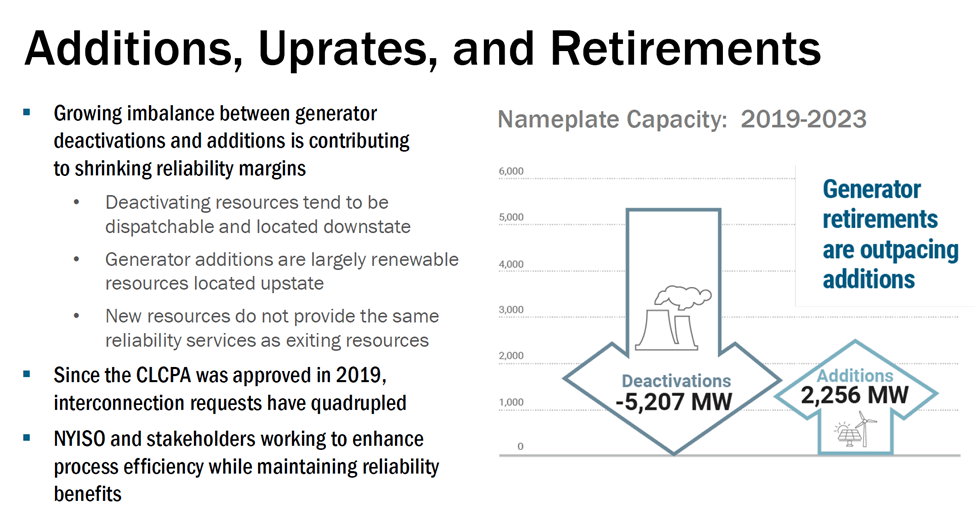
A primary NYISO concern is narrowing reliability margins. One of the key themes noted that “electrification programs and economic development initiatives are driving projected demand higher” and at the same time “Generator deactivations are outpacing new supply additions.” This was addressed as a key finding for supply resources: “The coordination of new generator additions and existing generator retirements is essential to maintain the reliability of the New York power system while simultaneously pursuing achievement of CLCPA” and “Uncertainty in siting new renewable generation could lead to delays in or inefficient expansion of the transmission and distribution systems.” The following slide illustrates the problem.
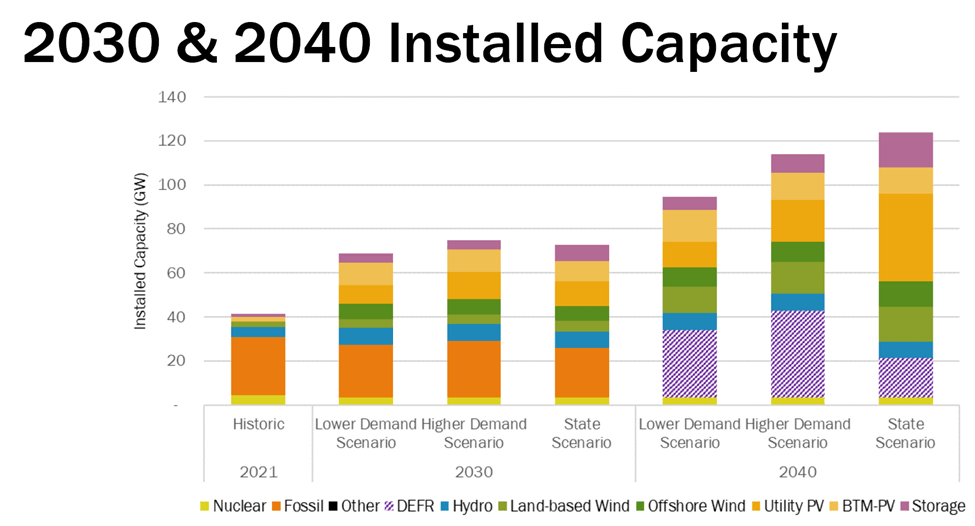
Another key finding for supply resources is that “New York will require three times the capacity of the current New York generation fleet to meet projected future electricity demands.” The following slide shows the expected changes in capacity.
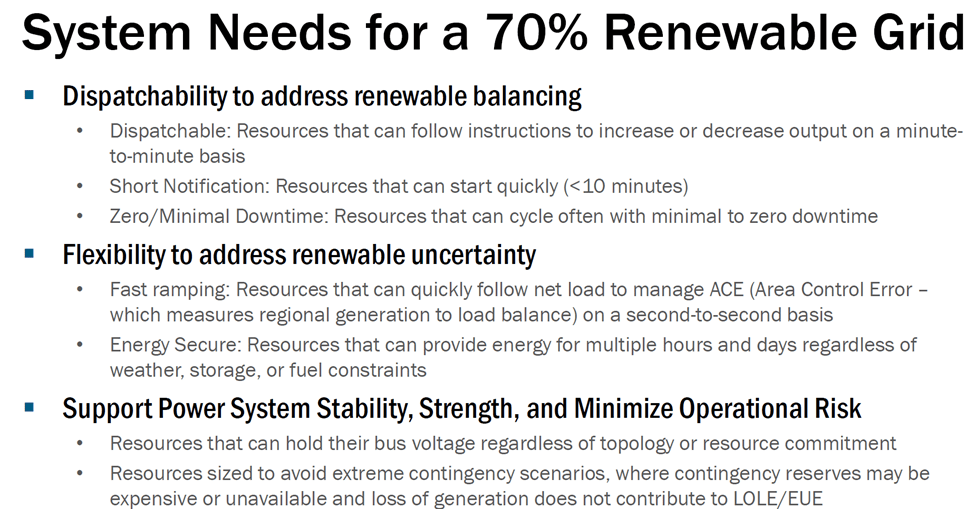
A key point is that the challenge is not just building more capacity there are other features needed in the future grid. The following slide notes that renewable energy needs to be supported by dispatchable resources. Those resources need to be able to respond quickly and be ‘energy secure”. In addition, there are other grid support services required to support “power system stability, strength, and minimize operational risk”.
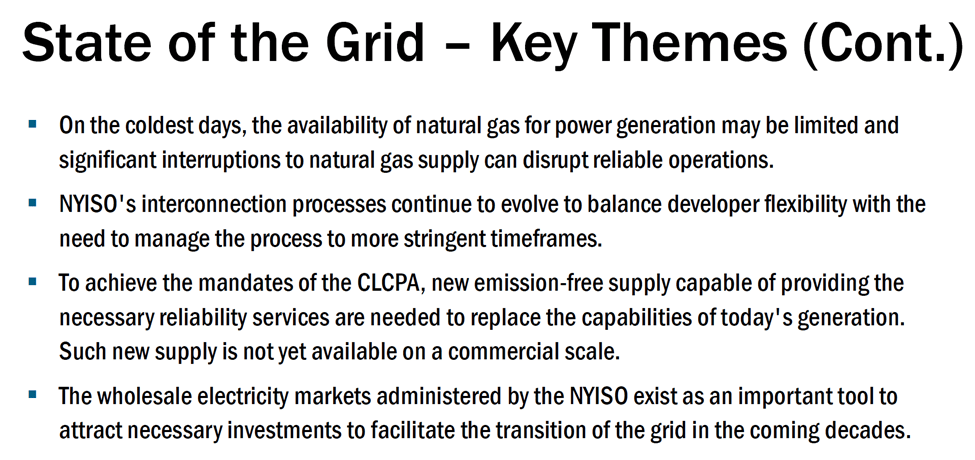
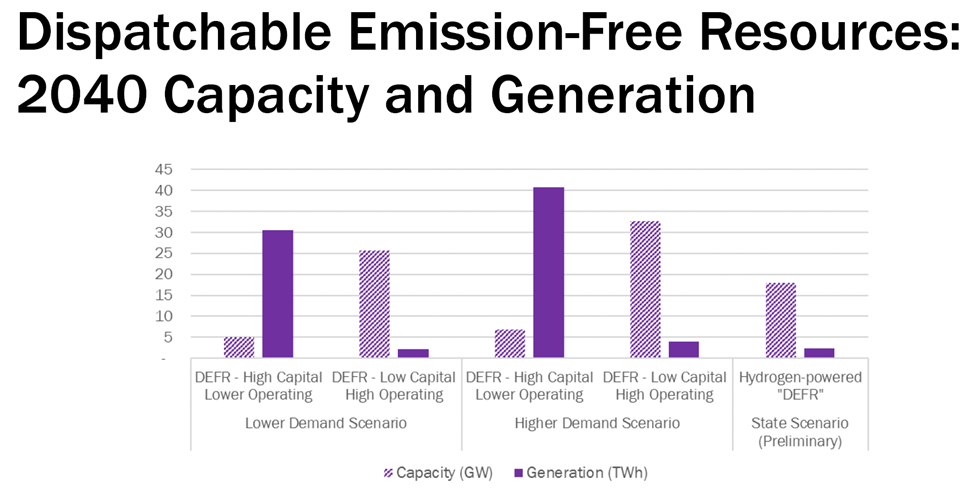
One of the key themes for the transition is “To achieve the mandates of the CLCPA, new emission-free supply capable of providing the necessary reliability services are needed to replace the capabilities of today’s generation. Such new supply is not yet available on a commercial scale. “ One of the key findings for supply resources states “Dispatchable emission-free resources must be developed to provide the capacity, energy, and other essential grid services required to achieve the policy mandate for a zero-emissions grid by 2040.” In other words, this is the resource that is needed to provide the system needs described in the previous slide. Appendix F is devoted to this resource. Dispatchable Emissions-Free Resources (DEFR) are needed for a future grid that depends upon wind, solar, and energy storage resources to keep the lights on during periods of extended low wind and solar resource availability. In my opinion, one of the important unresolved issues is the resource allocation difference between the NYISO projections and the Integration Analysis State Scenario shown in the following slide.
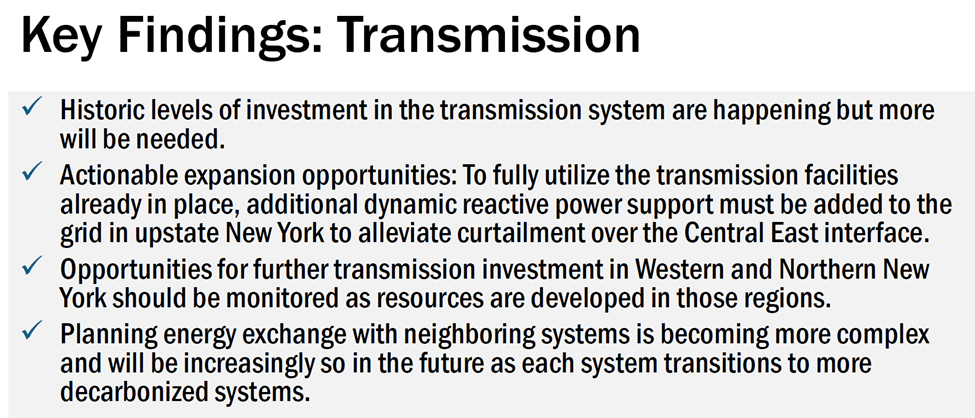
There are enough issues associated with this topic that I will come back to this in a subsequent post For this overview I will continue with the final main driver of electric system change – transmission. The following slide lists four key findings.
The first key finding is that “Historic levels of investment in the transmission system are happening but more will be needed.” The following slide lists seven ongoing transmission projects.
As noted, more transmission will be needed. The following slide describes the process for more transmission projects.
Another key finding is that there are “Actionable expansion opportunities: To fully utilize the transmission facilities already in place, additional dynamic reactive power support must be added to the grid in upstate New York to alleviate curtailment over the Central East interface.” This is illustrated in the following slide. I am not conversant in the technical details of this issue so I will quote from the Outlook report:
To fully utilize the transmission facilities already in place, additional dynamic reactive power support must be added to the grid in upstate New York to alleviate congestion caused by the Central East interface voltage performance. Reactive power supports the overall voltage performance of the grid and maybe provided by generators, dedicated fast responding dynamic reactive power devices, such as synchronous condensers or other power electronics (e.g., STATCOMs], or potentially other specialized Grid-Enhancing Technologies (GETs). This kind of specialized technology can improve the delivery of electricity via existing transmission lines. As the fossil fuel generators tied to the Central East voltage collapse limit are deactivated by 2040 to comply with the CLCPA mandate, the full benefits of the Segment A transmission project will be diminished leading to transmission congestion and renewable curtailment if left unaddressed.
The Outlook finds that by replacing the dynamic support services from these fossil fuel generators to support the Central East interface voltage performance, the future potential congestion across Central East could be largely eliminated and curtailment of renewable energy reduced by approximately 40-220 GWh in 2035.
The important point is that someone is going to have to pay for the dynamic support services necessary to get the renewable electric energy to where it is needed. When wind and solar supports brag about the low costs of solar and wind generation they are most certainly not including hidden costs like this in their estimates.
There were no slides specifically associated with the following key themes. Three themes address current reliability concerns:
The potential for delays in construction of new supply and transmission, higher than forecasted demand, and extreme weather are threatening reliability and resilience to the grid
Summer 2024: Electricity supplies are adequate to meet expected summer demand under normal conditions, but extreme weather and other factors pose reliability risks.
On the coldest days, the availability of natural gas for power generation may be limited and significant interruptions to natural gas supply can disrupt reliable operations.
Lastly, in order to expedite new renewable development, the NYISO processes have to be accelerated. Note however, that NYISO must worry about the unintended consequences of these new resources so there are limits on this:
NYISO’s interconnection processes continue to evolve to balance developer flexibility with the need to manage the process to more stringent timeframes.
Discussion
The key themes that describe the Resource Outlook state of the grid outline potential issues. In this section I describe the themes that posed issues threatening reliability and resilience to the grid but add some context that was not included in the slide presentation.
The themes describe the status of the electric system. This summer the electric system should be able to meet demand but “extreme weather and other factors pose reliability risks.” In the winter, “the availability of natural gas for power generation may be limited and significant interruptions to natural gas supply can disrupt reliable operations.” Unsaid were the ramifications of State policy decisions to limit natural gas pipelines to alleviate this availability problem.
The themes also address changes to the electric system. Public policies are one of the causes of rapid changes to New York’s electric system in the state. One of the consequences of the electrification mandate is that New York peak loads will occur in the winter in the 2030s. Another driver of change is the marked increase in loads partially due to electrification mandates but also due to economic initiatives and increased demand for computing resources. These changes have resulted in narrower reliability margins compounded by the unmentioned State policy decisions to force generator deactivations and preclude replacement with new fossil-fired generation.
Another issue raised in the themes is the schedule. There have been and will be delays in construction of new supply and transmission. NYISO recognizes that the interconnection process must change to keep up with the schedule but in this presentation did not describe the technological changes that complicate interconnection of inverter-based intermittent wind and solar resources.
I maintain that NYISO does not acknowledge that the need for “significant changes to the wholesale electricity markets administered by the NYISO” significantly complicates the transition. NYISO not only must identify the technology needed to provide a reliable and resilient system but must also conjure up a market mechanism that will entice developers to provide those resources.
A primary concern expressed in the presentation was the need for “new emission-free supply capable of providing the necessary reliability services are needed to replace the capabilities of today’s generation.” NYISO descriptions of DEFR always mention that “such new supply is not yet available on a commercial scale” but never articulate the risk to the reliability and resilience of the system of a policy that presumes that the resource will be developed as required. Another related concern is that planning for this resource in a weather-dependent electric grid must address the challenge that wind and solar resource output is frequently low at the same time. Alarmingly, the low resource availability typically occurs when the loads are highest which exacerbates the importance of a reliable DEFR solution.
Conclusion
The NYISO System and Resource Outlook describes issues that threaten reliability and resilience of the electric system. In my opinion, it is frustrating that the issue descriptions are couched in qualifying statements that disguise the magnitude of the challenges. It is left up to the reader to figure out that it is unlikely that the Climate Act mandates can be implemented without causing reliability crises. In my opinion, the requirements of the Climate Act demand too much, too soon and the proposed plan to rely on wind and solar will cause catastrophic blackouts.
In the past couple of weeks there has been a flurry of offshore wind related news. This post consolidates several of the important items. Climate Change Dispatch describes an analysis that implicates offshore wind surveys with whale deaths. Bud’s Offshore Energy has posted numerous articles describing the recent Nantucket offshore wind turbine failure and David Wojick explains the risk implications to further development.
I have followed the Climate Act since it was first proposed, submitted comments on the Climate Act implementation plan, and have written over 400 articles about New York’s net-zero transition. The opinions expressed in this article do not reflect the position of any of my previous employers or any other company I have been associated with, these comments are mine alone.
Overview
The Climate Act established a New York “Net Zero” target (85% reduction in GHG emissions and 15% offset of emissions) by 2050. It includes an interim 2030 reduction target of a 40% reduction by 2030 and a requirement that all electricity generated be “zero-emissions” resources by 2040. The Climate Action Council (CAC) was responsible for preparing the Scoping Plan that outlined how to “achieve the State’s bold clean energy and climate agenda.” The Integration Analysis prepared by the New York State Energy Research and Development Authority (NYSERDA) and its consultants quantifies the impact of the electrification strategies used to reduce greenhouse gas emissions. That material was used to develop the Draft Scoping Plan outline of strategies. After a year-long review, the Scoping Plan was finalized at the end of 2022. Since then, the State has been trying to implement the Scoping Plan recommendations through regulations, Public Service Commission orders, and legislation.
Offshore wind developments are a key decarbonization strategy. There is a target of 9,000 MW of offshore wind by 2035. However, there are overlooked risks to this strategy has described here.
Offshore Wind Impact on Whales
Climate Change Dispatch reports that a recent study finds that offshore wind survey vessels are causing whale deaths. The article explains:
Apostolos Gerasoulis, a Rutgers professor emeritus of computer science who co-created the search engine that powers Ask.com developed a software system dubbed Luna to identify any relationship between the dead whales and offshore wind survey vessels. He loaded NOAA data on whale deaths, the zigzag courses of survey ships, and even wave action into his computer system. Luna revealed patterns that Gerasoulis believes point to offshore wind survey vessels as the cause of the whale deaths.
Luna generates maps of the U.S. East Coast and plots the locations of offshore wind farms; the deaths of whales, dolphins, and porpoises; and the routes taken by various survey ships. The central region, including New York, New Jersey, and Rhode Island, had minimal survey traffic before 2016. After [2016], survey vessel traffic was an average of 50,300 miles per year, double the amount of the southern region. The number of humpback whale deaths also doubled, to 10.625 per year.
‘When comparing the south and central regions after offshore wind surveying started, the averages show an almost linear increase in humpback whale deaths – doubling the traffic results in doubling the whale deaths.”
Nantucket Wind Turbine Blade Failure
Bud’s Offshore Energy (BOE) blog covers “Energy Production, Safety, Pollution Prevention, and More” topics with an emphasis on offshore projects. In the last couple of weeks he has posted 12 articles about the wind turbine blade failure off Nantucket. I have briefly summarized them below.
On Saturday night (7/13) the Coast Guard warned Mariners as follows: “Coast Guard received a report of 03 floating debris 10 meters by 2 meters in the vicinity of approximately 26 NM SE of Marthas Vineyard and 22 NM SW of Nantucket in position 40 59.559N 070 25.404W. All marines are requested to use extreme caution while transiting the area.“
On Monday (7/15), Vineyard Wind confirmed that a turbine blade incident occurred on 7/13: “On Saturday evening, Vineyard Wind experienced blade damage on a wind turbine in its offshore development area. No personnel or third parties were in the vicinity of the turbine at the time, and all employees of Vineyard Wind and its contractors are safe and secure.”
On 7/16, Vineyard Wind issued another statement advising that they were deploying teams to Nantucket to clean up debris from the incident.
He also described the risks to marine mammals in Debris poses a significant risk to marine mammals. He said that the debris is a particular concern for baleen whales, like the endangered right whale, which filter large amounts of water. Per NOAA:
Marine Mammals: Many species of marine mammals have also been confirmed to eat marine debris. A review by Kühn and van Franeker found that 69 species of marine mammals have been found to ingest debris – that’s 56% of all marine mammals! This includes 44 species of odontocetes (toothed whales), manatees, and multiple seal species. Marine mammals are highly protected, which can make it difficult to research them. Most research on marine mammals takes place after an animal dies, making it difficult to understand what marine debris live animals eat. However, we do know that because baleen whales filter extremely large amounts of water while feeding, they may get plastic debris entangled in their baleen plates.
“This morning, a significant part of the remaining GE Vernova blade detached from the turbine. Maritime crews were onsite overnight preparing to respond to this development, though current weather conditions create a difficult working environment.”
“We are staying apprised of GE Vernova’s efforts to manage the situation, including the removal and recovery of the remaining blade attached to the turbine.”
Staying apprised? As operator, Vineyard Wind is fully responsible. This is their situation to manage.
BSEE has ordered Vineyard Wind to suspend power production and wind turbine generator construction.
Kudos to BSEE for their decisive and timely action. They need to better understand what happened before allowing operations and construction to continue.
Imagine the pressure on the regulator if the project was providing a significant portion of the region’s electricity.
BSEE’s comment that there has been “no harm to any marine resources or mammals from the incident” is premature given the extensive marine debris and the associated risks to mammals.
What about the CVA?
The regulations at 30 CFR § 285.707-712 assign important responsibilities to Certified Verification Agents (CVAs), independent third parties with established technical expertise. These responsibilities include detailed reviews of the design, fabrication, and installation plans.
Oddly, the CVA’s “Statement of Qualifications” and “Scope of Work and Verification Plan” have been redacted in their entirety from Vineyard Wind’s Construction and Operations Plan (COP) (see Appendix I-C and I-D).
Who was the CVA and why was that important information redacted?
Were any of the CVA requirements waived per 258.705?
Will BOEM, the lessor and Federal wind program manager, be making a statement? Will they be reassessing their COP review procedures?
BOEM should temper their over-the-top promotion of offshore wind. The complete shutdown of the first utility scale offshore wind farm heightens public concerns about the intermittency of this power source, and the need for reliable backup sources.
The post included BOE’s comments on the three factors listed in the excerpt:
Factor 1: Those “robust insurance policies” may soon be tested given the costs associated with the turbine blade incident and potential law suits. (The notice pasted below informs that Nantucket officials will meet on Tuesday to consider litigation. A question for attorneys is the extent to which Nantucket is compromised by their good “Good Neighbor Agreement” with Vineyard Wind. That agreement essentially calls on Nantucket to promote the Vineyard Wind projects in return for payments that seem modest relative to the economic benefits from tourism and fishing.)
Factor 2: To the extent that GE Vernova Haliade-X 13 megawatt turbines are proven technology (and that is very much in doubt), the use of proven technology doesn’t prevent premature abandonment associated with unexpected incidents.
Factor 3: Reliable power generation and predictable long-term income remain to be demonstrated.
The Vineyard Wind turbine incident, which littered Nantucket beaches, has also tarnished the US offshore wind program. BSEE has prudently halted Vineyard Wind operations and construction pending an investigation into the blade failure.
Offshore wind development is structure rich, so public confidence in the design of turbines and support platforms is critical. BOEM lists 37 active wind leases on the US OCS. Most of these leases have not yet reached the construction phase. A hold on the approval of any Construction and Operations Plans would seem to be appropriate pending completion of the Vineyard Wind investigations.
Per the leasing schedule below, BOEM intends to hold 4 wind sales during the remainder of 2024, all within a 3 month period. Only 1 sale is scheduled for each of the following 2 years. Deferring the 2024 sales until the investigations are complete would assist potential lessees by ensuring that the issues of concern were fully understood.
Unfortunately, BOEM’s failure to conduct a 2024 oil and gas lease sale has boxed in the wind program. The Inflation Reduction Act prohibits BOEM from issuing wind leases unless an oil and gas sale has been held within the previous year. Lease Sale 261 was held on 12/20/23 meaning that no wind leases may be issued after 12/20/24. BOEM has compressed the wind leasing schedule, presumably to beat the legislative deadline. It would have been better for both the oil and gas and the wind programs if at least one oil and gas sale had been held in 2024 as has been customary since the 1950s.
expressed “strong concerns and outrage” over the fractured Vineyard Wind turbine blade and the debris that washed ashore on Nantucket.
said the foam and fiberglass debris have “potential negative and adverse impact[s]” on the environment, marine life, and human health.
said fragments in the water pose a threat to shellfish, which are a crucial part of both the marine food web and also ingested by humans.
commented that the potential contamination of shellfish with fiberglass and other materials could have severe consequences for human consumption and public health.
criticized the lack of communication from federal officials to the tribe.
called for an “immediate stoppage” of offshore wind construction in U.S. waters until they can be evaluated for microfractures and other damages.
“While we continue to work to finalize our root cause analysis, our investigation to date indicates that the affected blade experienced a manufacturing deviation,” said GE Vernova CEO Scott Strazik. “We have not identified information indicating an engineering design flaw in the blade or information of a connection with the blade event we experienced at an offshore wind project in the UK, which was caused by an installation error out at sea. We are working with urgency to scrutinize our operations across offshore wind. Pace matters here. But we are going to be thorough, instead of rushed.”
“It’s been 11 days since the event, and just to reinforce from the start, we have no indications of an engineering design flaw,” Strazik said. “We have identified a material deviation or a manufacturing deviation in one of our factories that, through the inspection or quality assurance process, we should have identified. Because of that, we’re going to use our existing data and reinspect all of the blades we’ve made for offshore wind. For context, this factory in Gaspé, Canada where the material deviation existed we’ve made about 150 blades.
On July 26 BOE observed that the wind turbine company GE Vernova stock has taken a hit. The Vineyard Wind turbine blade incident, the main reason for the sharp decline in their stock value in mid-July, is described as follows:
VINEYARD WIND OFFSHORE WIND FARM. We are the manufacturer and supplier of turbines and blades and the installation contractor for Vineyard Wind 1 offshore wind farm in the Atlantic Ocean (Vineyard Wind), at which we have installed 24 of 62 Haliade-X 220m wind turbines to date. Subsequent to the period covered by this report, a wind turbine blade event occurred at Vineyard Wind. Debris from the blade was released into the Atlantic Ocean and some has washed ashore on nearby beaches. On July 15, 2024, the U.S. Bureau of Safety and Environmental Enforcement (BSEE) issued a suspension order to cease power production and the installation of new wind turbines at the project site, pending an investigation of the event. As of the date of the filing of this report, we are currently engaged in a root cause analysis of the incident. We do not have an indication as to when BSEE will modify or lift its suspension order. Under our contractual arrangement with the developer of Vineyard Wind, we may receive claims for damages, including liquidated damages for delayed completion, and other incremental or remedial costs. These amounts could be significant and adversely affect our cash collection timelines and contract profitability. We are currently unable to reasonably estimate what impact the event, any potential claims, or the related BSEE order would have on our financial position, results of operations and cash flows.
“Within only two to three years of commercial operation, the GE wind turbine generators have exhibited numerous material defects on major components and experienced several complete failures, at least one turbine blade liberation event, and other deficiencies,”
“The order comes as the bureau continues its oversight and investigation into the July 13, 2024, turbine generator blade failure. The order continues to prohibit Vineyard Wind 1 from generating electricity from any of the facilities or building any additional wind turbine generator towers, nacelles, or blades. This order also requires Vineyard Wind 1 to submit to BSEE an analysis of the risk to personnel and mitigation measures developed prior to personnel boarding any facility. Vineyard Wind 1 is not restricted from performing other activities besides those specifically directed for suspension or additional analysis. For example, Vineyard Wind 1 is still permitted to install inter-array cables and conduct surveys outside of the damaged turbine’s safety exclusion zone.”
“The technology may not be new, but the size and scale of the Haliade-X turbine is novel for the offshore wind industry. And these jumbo-sized turbines have only recently been installed in just two locations in the world within the last year – at Vineyard Wind off Nantucket, and the Dogger Bank Wind Farm off the northeast coast of England. The Haliade-X turbine blades – which are supposed to have at least a 25-year lifespan – have suffered failures in both locations.“
“At the Dogger Bank Wind Farm – which is being completed in three sections which combined will make up the largest offshore wind farm in the world – the first GE Vernova Haliade-X turbine was installed in the fall of 2023 and began producing power on Oct. 10. But little is known about the blade failure that occurred just months later during the first week of May 2024. The damaged blade was disclosed by Dogger Bank’s owners – SSE Renewables, Equinor, and Vårgrønn – a week after the incident. In a statement, the companies said only that “damage was sustained to a single blade on an installed turbine at Dogger Bank A offshore wind farm.”
“One reason the turbine blade incident at the Dogger Bank may not have generated more attention at the time is that the wind farm is located 100 miles off the coast of England, rather than just the 15 miles in the case of Vineyard Wind and Nantucket. If any debris was generated, it would have a far wider area to disperse in before nearing land – if it made it that far at all.“
In this article, I present some technical background on that risk. The facility will be one of the world’s biggest, with 176 enormous turbines. It is just getting started with pile driving, so no turbine blades have been installed to date. This is an opportune time to undertake caution.
The Nantucket turbines are made by GE, and they are the world’s largest in operation today at 13 MW, each driven by three huge 107-meter-long blades. That is 351 feet for those of us who do not speak metric. The Virginia turbines will be even bigger at 14 MW with 108 meters (354+ feet) long. They are made by Siemens Gamesa, or SG for short.
The GE turbines and blades have been in production for going on two years, so have some operational experience. The SG turbines and blades just came into production so there is no experience with them. One could say they are being beta tested off Virginia.
This newness in itself is a great concern. At three blades each, there are an incredible 528 blades with a combined length of over 57,000 meters (187,000 feet or 35 miles) of blades. To take first production blades to these huge lengths is surely very risky.
For context consider that the Nantucket Current article referenced by BOEM noted that:
The Haliade-X turbine is the same one Orsted – a partner in Vineyard Wind – is planning to use for offshore wind farms slated for the waters off New Jersey and Maryland.
Land-based turbines have come apart in Sweden, Germany, Lithuania, Cypress, Brazil, and the US (and presumably elsewhere).
With respect to New York, there are two New York projects that plan to use large turbines. Equinor’s Empire Wind 810 MW project provides comprehensive wind turbine information:
Vestas is the preferred supplier for wind turbine generators for Empire Wind. Vestas will deliver 138 V236-15MW wind turbine generators with a total generating capacity of around 2GW.
15 MW capacity
774 feet rotor diameter
886 feet high tip height
463,000 sqf swept area
On the other hand the 924 MW Sunrise Wind project developed by Ørsted and Eversource does not provide readily accessible turbine information. I could not find what kind of turbines are planned or any details on their characteristics.
Wojick goes on to explain some of the problems with these immense turbine blades.
Now let’s look at the blade stress physics just a bit, as it is amazing. SG has a quick look on their website, saying this:
“The rotational forces found in offshore wind turbines in operation put IMMENSE STRAIN ON THE BLADES and the rest of the wind turbine structure. (Emphasis added) At a tip speed of approximately 90 meters per second – equivalent to 324 kilometers per hour! (201 mph!) – and a projected lifetime of more than 25 years, high-quality and innovative design is imperative. For a 108-meter-long blade, the rotational forces are around a staggering 80 million newton meters, and the strain on the blades and the structure is intense! To put this into perspective, the force pulling on a human shoulder while spinning a 1 kg object around in an outstretched arm is only about 10 newton meters!”
Wojick sums up:
In summary, we have a newly huge blade, subject to immense stresses, made for the first time in an unusual way with a new composition and never tested in a hurricane. The high novelty risk to Virginia is obvious.
I have no doubts that the proposed offshore wind development will have enormous impacts on whales and other mammals. The big green environmental organizations are abandoning whales in general and the remaining North American Right Whales in particular. Bryce quotes an opponent of offshore wind: “What is Big Wind going to say when they kill the last whale? ‘Sorry’?”
Red flag warnings abound for New York’s offshore wind development using these unproven huge wind turbines. Wojick states the obvious “A sound engineering approach would be to build a few and see how they did over time.” He also points out that the existing turbines of this size are in Europe where the dangers of hurricanes are not present.
BOE provides a great concluding statement:
Greater transparency regarding turbine incidents, both in the US and internationally, is clearly needed. As we have learned from decades of experience with the oil and gas industry, most companies prefer reporting systems (if any) that protect details and information about the responsible parties from public disclosure. It’s the responsibility of the regulators to make sure that incident data and investigation reports are timely, complete, and publicly available. This is made more difficult by the promotional role that government agencies have assumed for offshore wind.
This article summarizes published posts describing a new category of generating resources called Dispatchable Emissions-Free Resources (DEFR) that many reputable electric energy analysts believe is necessary for a future grid that depends upon wind, solar, and energy storage resources. The reputable analyses of the future New York electric system agree that new technologies are necessary to keep the lights on during periods of extended low wind and solar resource availability. However there still is an influential group of people who maintain otherwise. Hence the need to document the reputable analyses.
I have followed the Climate Act since it was first proposed, submitted comments on the Climate Act implementation plan, and have written over 400 articles about New York’s net-zero transition. The opinions expressed in this article do not reflect the position of any of my previous employers or any other company I have been associated with, these comments are mine alone.
Overview
The Climate Act established a New York “Net Zero” target (85% reduction in GHG emissions and 15% offset of emissions) by 2050. It includes an interim 2030 reduction target of a 40% reduction by 2030 and a requirement that all electricity generated be “zero-emissions” resources by 2040. The Climate Action Council (CAC) was responsible for preparing the Scoping Plan that outlined how to “achieve the State’s bold clean energy and climate agenda.” The Integration Analysis prepared by the New York State Energy Research and Development Authority (NYSERDA) and its consultants quantifies the impact of the electrification strategies. That material was used to develop the Draft Scoping Plan outline of strategies. After a year-long review, the Scoping Plan was finalized at the end of 2022. Since then, the State has been trying to implement the Scoping Plan recommendations through regulations and legislation.
Compendium of DEFR Analyses
The following descriptions have been integrated into a Pragmatic Environmental of New York page that I can update as necessary and use as a reference. This article summarizes six analyses describing the need for DEFR: the Integration Analysis, New York Department of Public Service (DPS) Proceeding 15-E-0302 Technical Conference, NYISO Resource Outlook, Richard Ellenbogen, Cornell Biology and Environmental Engineering, and Nuclear New York. I also include the Jacobson and Howarth work that forms the basis for those who believe that no new technology is needed.
DEFR is not Required
When the Climate Action Council voted to accept the Scoping Plan draft, council members made statements justifying their positions. The statement of Robert W. Howarth, Ph.D., the David R. Atkinson Professor of Ecology & Environmental Biology at Cornell University argued that no new technologies are needed and was uncritically accepted by some members of the Council. Importantly, the leadership of the Council did not object to the following:
A decade ago, Jacobson, I and others laid out a specific plan for New York (Jacobson et al. 2013). In that peer-reviewed analysis, we demonstrated that our State could rapidly move away from fossil fuels and instead be fueled completely by the power of the wind, the sun, and hydro. We further demonstrated that it could be done completely with technologies available at that time (a decade ago), that it could be cost effective, that it would be hugely beneficial for public health and energy security, and that it would stimulate a large increase in well-paying jobs. I have seen nothing in the past decade that would dissuade me from pushing for the same path forward.
This is the reason I am compiling DEFR analyses because it simply is not consistent with any of the organizations accountable for New York energy policy. The basis of the no new technology claim is the “Wind, Water, and Solar” work of Professor Mark Jacobson of Stanford. In my summary of this belief, I showed that Howarth’s argument that no new technology is needed has been refuted in the peer reviewed literature. In the remainder of this article I describe six other analyses that conclude that DEFR is required.
The Jacobson approach wass described in a widely publicized November 2009 Scientific American article by Mark Jacobson and Mark Delucchi that suggested all electrical generation and ground transportation internationally could be supplied by wind, water and solar resources as early as 2030. However, other contemporary projections were less optimistic, for example two examples disagreed: the 2015 MIT Energy and Climate Outlook has low carbon sources worldwide as only 25% of primary energy by 2050, and renewables only 16% and the International Energy Agency’s two-degree scenario has renewables, including biomass, as less than 50%.
Howarth’s statement cites a specific plan for New York (Jacobson et al. 2013) that he and Jacobson laid out a decade ago. He says that “In that peer- reviewed analysis, we demonstrated that our State could rapidly move away from fossil fuels and instead be fueled completely by the power of the wind, the sun, and hydro.” There was a formal rebuttal paper to this analysis by Nathaniel Gilbraith, Paulina Jaramillo, Fan Tong, and Felipe Faria. The rebuttal paper argued that:
The feasibility analysis performed by Jacobson et al. (2013) is incomplete and scientifically questionable from both the technical and economic perspectives, and it implicitly assumes, without sufficient justification, that social criterion would not produce even larger feasibility barriers.
Jacobson et al. responded to that rebuttal claiming that “The main limitations are social and political, not technical or economic.” Given the significant differences between that analysis and the most recent projections by the organizations responsible for keeping the lights on, I agree with the Gilbraith et al. conclusion cited above. I do not believe that the 2013 WWS analysis includes a defensible feasibility analysis proving that a dispatchable, emissions free resource is not needed during extended periods of low wind and solar resource availability.
Three books include analyses that also refute the Jacobson work. Meredith Angwin’s 2020 book Shorting the Grid: The Hidden Fragility of Our Electric Grid cites academic work rebutting the Jacobson premise. Angwin also describes two other books that directly refute it. Roadmap to Nowhere: The Myth of Powering the Nation With Renewable Energy by Mike Conley and Tim Maloney is available as a free PDF download on the web. Mathijs Beckers, of the Netherlands, wrote The Non-Solutions Project, available as an ebook or paperback.
I conclude that the basis for the influential position that no new technology is needed is not supported by the Jacobson work. More importantly, the following analyses all conclude new technology is needed.
Integration Analysis
The Final Scoping Plan is the “official” Hochul Administration strategy description of the Climate Act transition. The Scoping Plan directly contradicts the statement that technologies available when the Howarth paper was written and today are sufficient for the transition away from fossil fuels. In particular, the Final Scoping Plan Appendix G, Section I page 49 states:
During a week with persistently low solar and wind generation, additional firm zero-carbon resources, beyond the contributions of existing nuclear, imports, and hydro, are needed to avoid a significant shortfall; Figure 34 demonstrates the system needs during this type of week. During the first day of this week, most of the short-duration battery storage is quickly depleted, and there are still several days in which wind and solar are not sufficient to meet demand. A zero-carbon firm resource becomes essential to maintaining system reliability during such instances. In the modeled pathways, the need for a firm zero-carbon resource is met with hydrogen-based resources; ultimately, this system need could be met by a number of different emerging technologies.
The analysis also recommends technologies for this resource:
Hydrogen effectively provides a form of storage to the system on the order of hundreds of hours. Large quantities of fuel can be produced during the spring and summer and then utilized over the course of the winter provided that there is sufficient fuel storage. In addition to hydrogen-based resources, the analysis also examined the potential to meet reliability needs with a long-duration battery storage solution. In this assessment, the firm zero-carbon capacity, as well as renewable resources needed to produce hydrogen, were removed from the system, and the analysis identified a need for 25 GW of 100-hour battery storage to replace the contributions of 21 GW of a fully dispatchable hydrogen-based resource, along with 14 GW of incremental renewable resources to provide storage charging.40 A 100-hour battery resource can provide firm capacity to meet system needs over several days. However, in contrast to a hydrogen-based resource, if sufficient excess energy is not available to fully recharge the batteries following a challenging stretch, their ability to meet a similar system need in subsequent weeks of the winter is diminished. As a result, a higher amount of 100-hour battery capacity is needed to meet the same level of reliability as hydrogen-based resources.
At the Zero Emissions by 2040 Technical Conference session Gap Characterization Kevin Steinberger, Director, Energy and Environmental Economics (E3) stated that their modeling consistently showed the need for a new resource that is firm, dispatchable, and has no emissions that can power the system for days without significant recharge from wind and solar resources.
NYISO Resource Outlook In all the resource analyses prepared by the New York Independent System Operator (NYISO) since Climate Act implementation began, the necessity of DEFR has been mentioned. In the spring of 2024 the Power Trends 2024 report notes:
Renewable energy generation, subject to sudden changes in weather, also provides new challenges to grid operators that must balance supply and demand in real time. These variables highlight the need for new generation technologies that can fill in when weather-dependent resources are unavailable. Such new technologies, collectively referred to as Dispatchable Emission Free Resources (DEFRs), must be dispatchable, emissions free, and able to respond quickly to changing grid conditions. Such technologies do not exist yet on a commercial scale.
DEFRs are a classification of emission- free resources that provide the reliability attributes of synchronous generation and can be dispatched to provide both energy and capacity over long durations. DEFRs must be developed and added to the system at scale to reliably serve demand when intermittent generation is unavailable. The lead time necessary for research, development, permitting, and construction of DEFR supply will require action well in advance of 2040 if state policy mandates under the CLCPA are to be achieved.
I described the presentation by Zachary Smith that gave an overview summary presentation of the DEFR issue. In his first slide (shown below) he gave an overview of the generating resource outlook to make the point that a large amount of new generating resources needs to be developed. The estimates shown are from the 2021-2040 System & Resource Outlook and represent two plausible load projections. He noted that there are “a lot of attributes that fossil fuel resources provide today that wind, solar, and energy storage simply cannot provide”. He also made the point that the DEFR replacements do not have to be a single technology but could be several technologies that in aggregate can replace the fossil generation.
Smith listed the attributes needed by DEFR in his presentation. In my description of his discussion I offered comments on this list of attributes.
Smith’s presentation lists the attributes of twelve sample technologies in the following slide. This represents the NYISO opinion of the capability of different technologies to meet the attributes necessary to maintain a reliable system. In the future grid the insistence that all fossil fired units must be shut down means that numerous technologies that meet some of the necessary attributes will be required. The added complexity of these technologies does not increase resiliency because wind, solar, battery and demand response are all energy limited. Ancillary support services will be a major consideration because wind, solar and battery do not provide those services. Just from this overview, it is clear that affordability and reliability will be challenges.
Attributes of Sample DEFR Technologies
Richard Ellenbogen
I described Richard Ellenbogen’s comments as part of the record for the Department of Public Service Proceeding 15-E-0302 related to the net -zero mandate of the Climate Leadership and Community Protection Act (CLCPA). His comments discuss “a viable, affordable, and rapidly executable Plan B to assist NY State in reducing its carbon footprint using technologies that actually exist at scale, unlike the technologies proposed by the CLCPA which only exist at scale in the fantasies of its proponents.”
Ellenbogen lays out reasons that things have changed as the Climate Act is implemented that could affect the schedule and viability of the Scoping Plan list of control strategies. He concludes that an alternative that does not go to zero provides a better solution. He argues that Interim Combined Cycle Natural Gas Generation phasing to nuclear over time is a far more cost effective and secure way to power the state than what the CLCPA is mandating. Recovering the Combined Cycle emissions in greenhouses will mitigate the negative effect of the carbon emissions. That will also provide energy security that renewables can’t, while simultaneously providing food security as climate change makes food production more challenging.
Cornell Biology and Environmental Engineering
In a post describing the Zero Emissions by 2040 Technical Conference session Gap Characterization I summarized work by Prof. C. Lindsay Anderson, Chair of Department of Biological and Environmental Engineering Cornell. Professor Anderson described an analysis her group did using a model they developed. They made projections for expected loads and potential resources then used 22 years of hourly historical data to model the system. Without considering cost constraints they assessed system vulnerabilities to evaluate periods where there was insufficient generation to meet projected loads. Even with optimistic projections they found there will be periods during the coldest and hottest periods where there will be insufficient generation from wind, solar, and energy storage resources. That gap must be filled with DEFR.
The report describes the results of a new modeling tool that allows an hour-by-hour analysis of electric system behavior. This approach enabled the authors to see details of the hourly operation of each energy source, features not disclosed by existing models. In my opinion, the CAIC analysis treats DEFR differently than the Integration Analysis does. I believe that when the Integration Analysis determines which resources should be applied to meet load for each hour, they use DEFR as a last resort. On the other hand, CAIC uses DEFR much more frequently. That could be due to a difference in the hourly projections of wind, solar, energy storage, and load for the two models or presumptions in the models.
They found that:
Our hour-by-hour analysis shows that the firm dispatchable source has to run two-thirds of the year. The total load has increased from today. The summer peak has been replaced by a much higher winter peak. That greater demand is met by the extended operation of the DEFR which runs during most evenings in the cooler portion of the year. In fact, we find a capacity factor — the fraction of potential output actually used –of 14.4%.
The report concludes:
We have shown, with a modeling tool capable of performing an hour-by-hour analysis, that dispatchable emission-free resources are essential to meeting the goal of a reliable, zero-emission grid. Further, this clean dispatchable source must be able to run a large portion of the year. The only such source likely to be available within the next several decades is nuclear power.
Conclusion
There is overwhelming evidence that a new category of generating resources is necessary for a future grid that depends upon wind, solar, and energy storage resources. Most analysts of the future New York electric system agree that DEFR is necessary to keep the lights on during periods of extended low wind and solar resource availability. At this point the only questions should be how much, what technologies can be used, and whether any technologies can provide the necessary services affordably. The Hochul Administration Scoping Plan does not provide that information in sufficient detail.
Finally, the work done since the completion of the Scoping Plan should put the myth that no new technologies are necessary to death. The Proceeding on Motion of the Commission to Implement a Large-Scale Renewable Program and a Clean Energy Standard – Zero Emissions Target Case No. 15-E-0302 addresses the need for DEFR. However,there does not appear to be a schedule to resolve the issues raised at the PSC technical conference Zero Emissions by 2040 session titled Gap Characterization last December. They should be resolved sooner rather than later.
Recently I posted two articles about the New York Home Energy Affordable Transition Act, or NY HEAT, legislation that was being considered by the New York legislature but did not pass in the legislative session. At the same time I posted the last article (13 May 2024) I sent the following to my NYS Assemblyman Al Stirpe: “I am opposed to the NY HEAT Act for the reasons in documented in this article: NY HEAT is not so hot”. This post describes the response I received on 11 July 2024.
I have followed the Climate Leadership & Community Protection Act (CLCPA) since it was first proposed, submitted comments on the CLCPA implementation plan, and have written over 400 articles about New York’s net-zero transition. I am convinced that the CLCPA will adversely affect affordability, reliability, and that the environmental impacts of the proposed transition are greater than the possible impacts of climate change. The opinions expressed in this post do not reflect the position of any of my previous employers or any other organization I have been associated with, these comments are mine alone.
Overview
The CLCPA established a New York “Net Zero” target (85% reduction in GHG emissions and 15% offset of emissions) by 2050. It includes an interim 2030 reduction target of a 40% reduction by 2030 and a requirement that all electricity generated be “zero-emissions” by 2040. The Climate Action Council (CAC) was responsible for preparing the Scoping Plan that outlines how to “achieve the State’s bold clean energy and climate agenda.” In brief, that plan is to electrify everything possible using zero-emissions electricity. The Integration Analysis prepared by the New York State Energy Research and Development Authority (NYSERDA) and its consultants quantifies the impact of the electrification strategies. That material was used to develop the Draft Scoping Plan outline of strategies. After a year-long review, the Scoping Plan was finalized at the end of 2022. In 2023 and 2024 the Scoping Plan recommendations were supposed to be implemented through regulation, PSC orders, and legislation. NY HEAT is an example of Climate Act legislation.
NY HEAT Act Response As noted I did a couple of articles about the HEAT act a couple of months ago. The first described Rich Ellenbogen’s response to Sane Energy Voice claims that NY HEAT Act should be enacted. The second article referenced additional op-eds that argue this legislation is not a good idea.
While I appreciate the fact that someone on Stipe’s staff responded to my note, the response was unsatisfactory. As is always the case, the amount of energy necessary to refute BS is an order of magnitude bigger than to produce it. In the following I provide my annotated comments to the email received from Assemblyman Stirpe.
The first paragraph was the usual boilerplate response:
Thank you for reaching out to me with your concerns regarding the NY HEAT Act. I greatly value the feedback I receive from my constituents, as it plays a crucial role in my decision-making process.
The meat of the response addressed NY HEAT:
First, I want to address some misconceptions about the NY HEAT Act. The Act will not eliminate existing gas services; it will end subsidies for new gas hookups. Currently, when a new home is constructed, the first 100 feet of gas hookup is free for the homeowner, with the cost being distributed among all ratepayers. The NY HEAT Act aims to remove this subsidy to encourage home builders to consider alternative energy sources, such as geothermal systems. If a developer chooses a geothermal system for a neighborhood instead of gas, the monthly heating and cooling costs could be 40%-50% lower, benefiting both the environment and New York homeowners.
The suggestion that NY HEAT will not eliminate existing gas services is solely concerned with the new gas hookups is either deliberate misinformation or outstanding naiveté. Consider the following sections of NY HEAT with my highlights:
Section 5: Amends section 30 of the public service law. Removes a residential customer’s legal entitlement to utility gas services, while maintaining this entitlement for electric service.
Section 7: Amends section 31, subdivisions 1,3, and 4, of the public service law. Implements the policy established in section 5 with respect to applications for electric and gas services. Acknowledges gas service may be limited or discontinued to facilitate achievement of the CLCPA climate justice and emission reduction mandates.
Section 8: Amends section 12 of the transportation corporations law. Removes the entitlement of non-residential customers to utility gas service, but maintains it for electric service.
Section 9: Amends section 66, subdivision 2, of the public service law and creates a new subdivision 12-e. Grants the commission authority to order the curtailment or discontinuance of the use gas for any customer, group of customers, or section of the gas distribution system, where the commission has determined that such curtailment or discontinuance is reasonably required to implement state energy policy.
Section 11: Repeals section 66-b of the public service law. Removes the entitlement to continuation of gas service following the demolition and reconstruction of any structure owned by a customer.
I am not a lawyer, but this language seems clear to me that the legislation is intended to do more than just change new gas hookup requirements. The only possible excuse is that the legislation does not explicitly include language to eliminate existing gas service. However, it clearly provides the enabling legislation to make it possible for the State to shut down gas service to existing customers. The claim that NY HEAT is solely concerned with the 100 foot rule is incorrect.
The rationale to eliminate the subsidy for new hookups claims that: “If a developer chooses a geothermal system for a neighborhood instead of gas, the monthly heating and cooling costs could be 40%-50% lower, benefiting both the environment and New York homeowners.” My response to that is show me the numbers. I am not going to take the time to find alternate numbers. However, my understanding is that geothermal systems are expensive to install and the oft-repeated narrative that a neighborhood system would bring down costs is long on wishful thinking and short on real world examples.
The response from Stirpe went on to provide the narrative rationale for NY HEAT:Addressing the climate crisis is essential, as record-breaking temperatures and fossil fuel emissions significantly contribute to global warming. The NY HEAT Act did not pass during this session, but it is important to take measures for mitigating the impact of fossil fuels on our planet. We all want our kids and grandkids to exist in a livable world.
Addressing the climate crisis is essential, as record-breaking temperatures and fossil fuel emissions significantly contribute to global warming. The NY HEAT Act did not pass during this session, but it is important to take measures for mitigating the impact of fossil fuels on our planet. We all want our kids and grandkids to exist in a livable world.
It is a Sisyphean task to try to debunk the emotional “existential” climate crisis rationale and the climate porn argument that every record-breaking temperature is proof that the climate is changing due to fossil fuel emissions that significantly contribute to global warming. There are many attempts to address those claims amongst my articles on the Climate Act but I think it is impossible to change many minds on those claims.
Importantly however is my unaddressed concern is about New York’s role in this global problem. Using GHG emissions data from Our World In Data I looked at emissions in the last year with global data. In 2021, NYS GHG emissions (GWP-100) were 247 million metric tonnes (MMT). GHG emissions from China were 13,774 MMT and from India were 3,879 MMT. The increase in emission from 2020 to 2021 were 498 MMT in China and 265 MMT in India. New York emissions will be supplanted by emissions from China or India in less than one year. New York’s emissions are less than a half a percent of global emissions. This does not necessarily mean that we should not do something, but it does mean that NY HEAT is not going to make a bit of difference to climate change impacts.
I also want to address the last emotional argument: “We all want our kids and grandkids to exist in a livable world”. I agree that we should be worried about our children and grandchildren. On the other hand, I know that the societal cost of carbon benefits are based on contrived calculations and that New York’s Value of Carbon calculations project alleged impacts out to 2300. The children and grandchildren argument changes when you understand that we are talking about the impacts today relative to those ten generations in the future. The emotional argument is less impactful when you consider the hubris involved with claims that we can predict or even imagine what the world will like 275 years in the future.
One final point about New York’s efforts to go to net-zero. My work indicates that New York’s Climate Act will do more harm than good. There are enormous challenges associated with the proposed energy plan that relies on wind and solar energy that have not been resolved and will undoubtedly affect reliability. Because the proposed energy plan relies on intermittent and diffuse generating resources the costs of just wind and solar capacity do not tell the whole story. When solutions are proposed for intermittent and diffuse wind and solar the costs involved skyrocket. It is also not clear that when all the environmental impacts are considered that the proposed energy sources will not cause more environmental harm than the alleged impacts of climate change.
Discussion
I distribute a fortnightly summary of my recent posts to an email distribution. I think one of the recipients is the Assemblyman’s communications director. The last paragraph suggests that the Assemblyman is aware of my work:
Thank you for your advocacy and engagement on behalf of our community’s well-being. If you have any questions about this or other issues, please feel free to contact me.
I doubt that there is a constituent in his district that has a greater understanding of the Climate Act and its ramifications for the state and its residents than I do. If I was asked to provide the Assemblyman one question that needs to be addressed, it would be how much will it cost to meet the 2040 target for 100% carbon-free emissions. The Hochul Administration claims that the costs of inaction are less than the cost of action. Does Assemblyman Stirpe know that claim only refers to the costs associated with the Climate Act itself? The baseline of “no-action” described in the Scoping Plan as “Business as usual plus implemented policies” includes the following programs:
Growth in housing units, population, commercial square footage, and GDP
Federal appliance standards
Economic fuel switching
New York State bioheat mandate
Estimate of New Efficiency, New York Energy Efficiency achieved by funded programs: HCR+NYPA, DPS (IOUs), LIPA, NYSERDA CEF (assumes market transformation maintains level of efficiency and electrification post-2025)
Funded building electrification (4% HP stock share by 2030)
Corporate Average Fuel Economy (CAFE) standards
Zero-emission vehicle mandate (8% LDV ZEV stock share by 2030)
Clean Energy Standard (70×30), including technology carveouts: (6 GW of behind-the-meter solar by 2025, 3 GW of battery storage by 2030, 9 GW of offshore wind by 2035, 1.25 GW of Tier 4 renewables by 2030)
That means that the costs of all these programs that are required to meet the Climate Act mandate of 100% carbon-free emissions by 2040 are not included in the evaluation “proving” that the costs of inaction are more than the costs of action. Sadly that is not the only deceptive analysis or down right incorrect approach used to make the claim.
It is also becoming clear that those of us that have argued that NY HEAT is dangerous and represents something too far, too soon are right. I would be willing to provide briefings that support my concerns. The Public Service Commission recently released its Clean Energy Standard Biennial Review Report. That report admits that the 2030 goal for 70% renewable energy will not be met. The New York State Comptroller Office released an audit of the NYSERDA and PSC implementation efforts for the Climate Act titled Climate Act Goals – Planning, Procurements, and Progress Tracking. It found that “the costs of transitioning to renewable energy are not known, nor have they been reasonably estimated”. Concerns raised by the New York Independent System Operator in its Power Trends 2024 report include decreasing reliability margins, electrification of heating and transportation will increase loads and shift the maximum to winter, the ambitious schedule, and the need for a new category of electric resources that are not yet commercially available. The issues raised in these reports mean that the mandates in NY HEAT are premature.
Conclusion
It is long past due for the Hochul Administration to provide New Yorkers with the real costs. My Assemblyman has not looked at the Scoping Plan in enough detail to understand the shortcomings and dangers of the current path. I think it would be prudent for New York to take a deep breath and pause implementation until questions about reliability, affordability, and environmental impacts are addressed openly and comprehensively. I would welcome the opportunity to explain why to him or anyone else.
The New York Department of Public Service (DPS) Proceeding 15-E-0302 addresses among other things a new category of generating resources called Dispatchable Emissions-Free Resources (DEFR). All credible analyses of the future New York electric system agree that new technologies are necessary to keep the lights on during periods of extended low wind and solar resource availability. This article describes the presumption of the authors of the Climate Leadership & Community Protection Act (Climate Act) that no new technologies would be required.
I have followed the Climate Act since it was first proposed, submitted comments on the Climate Act implementation plan, and have written over 400 articles about New York’s net-zero transition. The opinions expressed in this article do not reflect the position of any of my previous employers or any other company I have been associated with, these comments are mine alone.
Overview
The Climate Act established a New York “Net Zero” target (85% reduction in GHG emissions and 15% offset of emissions) by 2050. It includes an interim 2030 reduction target of a 40% reduction by 2030 and a requirement that all electricity generated be “zero-emissions” resources by 2040. The Climate Action Council (CAC) was responsible for preparing the Scoping Plan that outlined how to “achieve the State’s bold clean energy and climate agenda.” The Integration Analysis prepared by the New York State Energy Research and Development Authority (NYSERDA) and its consultants quantifies the impact of the electrification strategies. That material was used to develop the Draft Scoping Plan outline of strategies. After a year-long review, the Scoping Plan was finalized at the end of 2022. Since then, the State has been trying to implement the Scoping Plan recommendations through regulations and legislation.
I have written about the out-sized and misleading impact that Robert W. Howarth, Ph.D., the David R. Atkinson Professor of Ecology & Environmental Biology at Cornell University had on many of the members of the Climate Action Council. His statement supporting the approval of the Draft Scoping plan claimed that he played a key role in the drafting of the Climate Act and explained why he believes that no new technologies are needed to meet the Climate Act goals:
I further wish to acknowledge the incredible role that Prof. Mark Jacobson of Stanford has played in moving the entire world towards a carbon-free future, including New York State. A decade ago, Jacobson, I and others laid out a specific plan for New York (Jacobson et al. 2013). In that peer-reviewed analysis, we demonstrated that our State could rapidly move away from fossil fuels and instead be fueled completely by the power of the wind, the sun, and hydro. We further demonstrated that it could be done completely with technologies available at that time (a decade ago), that it could be cost effective, that it would be hugely beneficial for public health and energy security, and that it would stimulate a large increase in well-paying jobs. I have seen nothing in the past decade that would dissuade me from pushing for the same path forward. The economic arguments have only grown stronger, the climate crisis more severe. The fundamental arguments remain the same.
The presumption that “it could be done completely with technologies available at that time (a decade ago)” was a primary driver of the Climate Act schedule and confidence of success by the legislature and the Climate Action Council. The feeling was that all it takes is a matter of political will because the professor said it will work. Howarth appealed to the authority of peer-reviewed science to provide credibility for the Jacobson analysis that is the basis of his claims. However, science is a continuous process where hypotheses are constantly challenged and confirmed. In this instance Howarth neglected to mention the analyses that discredit the Jacobson work.
Jacobson Wind, Water, and Solar
The Jacobson analysis cited was a continuation of previous work broadly labeled as Wind, Water, and Solar. For example, in a widely publicized November 2009 Scientific American article, Mark Jacobson and Mark Delucchi suggested all electrical generation and ground transportation internationally could be supplied by wind, water and solar resources as early as 2030. However, other contemporary projections were less optimistic, for example two examples: the 2015 MIT Energy and Climate Outlook has low carbon sources worldwide as only 25% of primary energy by 2050, and renewables only 16% and the International Energy Agency’s two-degree scenario has renewables, including biomass, as less than 50%.
Howarth’s statement cites a specific plan for New York (Jacobson et al. 2013) that he and Jacobson laid out a decade ago. He says that “In that peer- reviewed analysis, we demonstrated that our State could rapidly move away from fossil fuels and instead be fueled completely by the power of the wind, the sun, and hydro.” Table 2 from that report follows. This analysis includes power from exotic resources such as waves, geothermal, tidal turbines, and concentrated solar power but no energy storage. It is significantly different than the projections in the Integration Analysis and the New York Independent System Operator (NYISO) 2021-2040 System & Resource Outlook that exclude all the exotic renewable generating capacity, contain significant amounts of energy storage, and include a new dispatchable, emissions-free resource for a set of resources that they think can provide sufficient electrical power for the future. Furthermore, Jacobson and Howarth claim that end-use power demand can be decreased by 37%. In my opinion, there are many flaws in his claims. For example, any analysis that suggests that concentrated solar power is a viable source of energy in New York is simply not credible because that resource would never work in New York. It is too cloudy to operate enough to cover costs and the environmental impacts would be too great.
There was a formal rebuttal paper to this analysis by Nathaniel Gilbraith, Paulina Jaramillo, Fan Tong, and Felipe Faria. The rebuttal paper argued that:
The feasibility analysis performed by Jacobson et al. (2013) is incomplete and scientifically questionable from both the technical and economic perspectives, and it implicitly assumes, without sufficient justification, that social criterion would not produce even larger feasibility barriers.
Jacobson et al. responded to that rebuttal claiming that “The main limitations are social and political, not technical or economic.” Given the significant differences between that analysis and the most recent projections by the organization responsible for keeping the lights on, I agree with the Gilbraith et al. conclusion cited above. I do not believe that the 2013 WWS analysis includes a defensible feasibility analysis.
Using Jacobson as the basis for the idea that the Climate Act transition needs no new technology gets worse. Unmentioned by Dr. Howarth is that in a 2015 article for a different iteration of the wind, water, and solar roadmap Clack et al, 2017 discredited the Jacobson approach:
In this paper, we evaluate that study and find significant shortcomings in the analysis. In particular, we point out that this work used invalid modeling tools, contained modeling errors, and made implausible and inadequately supported assumptions. Policy makers should treat with caution any visions of a rapid, reliable, and low-cost transition to entire energy systems that relies almost exclusively on wind, solar, and hydroelectric power.
In the scientific process, when issues with your work are noted, the proper response is to provide more evidence supporting your modeling tools, explain why the claimed errors are not errors, and defend your assumptions. Instead, Jacobson filed a lawsuit, demanding $10 million in damages, against the peer-reviewed scientific journal Proceedings of the National Academy of Sciences and the authors for their study showing that Jacobson made improper assumptions in order to make his claims that he had demonstrated U.S. energy could be provided exclusively by renewable energy, primarily wind, water, and solar. In my opinion this is an appalling attack on free speech and scientific inquiry but want to emphasize that the bad actions by Jacobson in no way should be attributed to Howarth.
In Meredith Angwin’s 2020 book Shorting the Grid: The Hidden Fragility of Our Electric Grid (Carnot Communications, Wilder, VT, 422 pp.) she also addressed the Jacobson analysis. Her description in a section entitled Hard-Core Renewables at page 195 is consistent with my portrayal above:
Wind and solar are the technologies that most people think about when they think of “renewables.” Indeed, many hard-core renewables advocates accept only solar, wind, and (sometimes) hydro as renewables. Biomass rarely makes the cut as a true renewable. Professor Mark Z. Jacobson of Stanford plans WWS (Wind Water Solar) as the energy sources for the world. In 2015, Jacobson and others published an article in the Proceedings of the National Academy of Sciences on using WWS for all purposes.125
In 2017, a group of professors headed by Christopher Clack responded with an evaluation article also in the Proceedings.126 The first paragraph of the Clack article stated that “We find that their (Jacobson analysis) involves errors, inappropriate methods, and implausible assumptions.” For example, their rebuttal paper pointed out that the Jacobson paper describes hydro power as providing 700 to 1300 GW. However, existing installed hydro capacity is 87 or 145 GW, depending on whether pumped hydro is included, and the most useful sites have already been exploited.127
When the Clack paper appeared, Jacobson published a letter in the same issue of the Proceedings, claiming “The premise and all error claims (of the Clack paper)… are demonstrably false.”128 Jacobson said that his assertion on the availability of hydro power was an “assumption,” not an error. As Jacobson wrote in the published letter: “The value of 1,300 GW is correct, because turbines were assumed added to existing reservoirs to increase their peak instantaneous discharge rate without increasing their average annual energy consumption.” Shortly after the Clack paper and the Jacobson rebuttal were published in the Proceedings, Jacobson sued Clack and the Proceedings for defamation.
Jacobson later dropped his lawsuit. On the Greentech Media website, Julian Spector wrote an article about the controversy and the lawsuit.129 In his article, Spector notes that “this ‘assumption’ (about hydro) was unwritten” in the original Jacobson article. In other words, in his original paper, Jacobson did not describe his assumption that multiple turbines would be added to existing dams. Frankly, adding about ten times as many turbines to existing powerhouses seems very unlikely to me. Dam construction is a massive undertaking. Putting many more turbines in an existing powerhouse … well, I can’t see how that could even work.130
Jacobson did drop his lawsuit, which should be a happy ending, I suppose. However, many people, including myself, feel that the fact that Jacobson even brought a lawsuit has had a chilling effect on the whole renewable-energy debate. If scientists can’t debate each other in peer-reviewed journals without fear of lawsuits, science will not be able to move forward very well.
There are two books directly refuting the Jacobson plan. Roadmap to Nowhere: The Myth of Powering the Nation With Renewable Energy by Mike Conley and Tim Maloney is available as a free PDF download on the web.131 Mathijs Beckers, of the Netherlands, wrote The Non-Solutions Project, available as an ebook or paperback.132 The work of these authors is clear and easy to follow.
Footnotes
Mark Z. Jacobson, Mark A. Delucchi, Mary A. Cameron, and Bethany A. Frew, “Low-cost solution to the grid reliability problem with 100% penetration of intermittent wind, water, and solar for all purposes,” Proceedings of the National Academy of Sciences, 112, no. 49 (December 8, 2015): 15060-15065, https://wwu .pnas.org/’content/112149115060.
Christopher T. M. Clack et al., “Evaluation of a proposal for reliable low- cost grid power with 100% wind, water, and solar,” Proceedings of the National Academy of Sciences 114, no. 26 (June 27, 2017): 6722-2627, https://www.pnas . o rg/con tent/114/2 6/6722.
Supporting information for the above article by Clack et al., https://www.pnas .org/content/pnas/suppl/2017/06/16/16103 81114. DCSupplemental/pnas. 1610381114 .sapp.pdf
Mark Z. Jacobson, Mark A. Delucchi, Mary A. Cameron, and Bethany A. Frew, “The United States can keep the grid stable at low cost with 100% clean, renewable energy in all sectors despite inaccurate claims” (letter), Proceedings of the National Academy of Sciences 114, no. 26 (June 27, 2017), https://www.pnas .org/content 1114126/P5021.
Besides my general knowledge of the grid and several visits to working dams, I also headed a project on predicting and preventing corrosion in the penstocks of several medium-size dams in mountainous country. This project was not published: it was only a report to the client, so I cannot provide a link. While I would not claim hydro power as an area of deep expertise for me, I have enough knowledge to be seriously skeptical about the idea of adding ten times as many turbines to existing hydro plants.
Mike Conley and Tim Maloney, “Road Map to Nowhere: The Myth of Powering the Nation with Renewable Energy,” Road Map to Nowhere (website), December 2017, https://www.roadmaptonowhere.com.
Mathijs Beckers, “The non-solutions project,” CreateSpace Independent Publishing Platform January 18, 2017), https://www.amazon.com/gp/product/ B01N6SN5El/re/=dbs_a_def_rwt_hsch_vapi_tkin_pl_il.
Conclusion
Much of this material was published 18 months ago. I wrote this article for two reasons. I wanted to update some information and add the reference by Angwin. The other reason is that I am compiling articles about DEFR to be used in a reference page.
Howarth’s argument that no new technology is needed has been refuted in the peer reviewed literature but also in other work. When I publish the reference page it will include multiple examples of other analyses that conclude that the new DEFR technology is required for New York’s electric grid zero-emissions transition. Successful implementation is not just a matter of political will.
It is unsettling that Howarth continues to claim that no new technology is needed in that light and relative to the lawsuits associated with Jacobson’s work. Angwin and I agree that Jacobson’s attempted lawsuit was because his work could not stand on its own. It is time for the Climate Action Council to disavow itself from any suggestions that DEFR will not be needed.
I have the pleasure to announce the availability of a new report prepared for New York Co-op and Condo Boards and Trade Associations regarding New York City Local Law 97 mandated conversion to electric heat. Local Law 97 mandates that “most buildings over 25,000 square feet are required to meet new energy efficiency and greenhouse gas emissions limits as of 2024, with stricter limits coming into effect in 2030.” Our report (“LL97 Impacts Report”) argues that in the absence of a credible and feasible plan demonstrating where the electricity will come from, backed up by a functioning Demonstration Project showing how the transformed grid will work and how much the electricity will cost, Co-op and Condo Boards cannot responsibly undergo the enormously costly process of conversion to electric heat.
I have followed the Climate Leadership & Community Protection Act (CLCPA) since it was first proposed, submitted comments on the CLCPA implementation plan, and have written over 400 articles about New York’s net-zero transition. I am convinced that the CLCPA will adversely affect affordability, reliability, and that the environmental impacts of the proposed transition are greater than the possible impacts of climate change. The opinions expressed in this post do not reflect the position of any of my previous employers or any other organization I have been associated with, these comments are mine alone.
Background
Co-authors Francis Menton, Richard Ellenbogen, and I prepared this report without compensation and on a pro bono basis because we felt duty-bound to warn people of the significant impending threat to their health and safety. We received no funding of any kind from the real estate industry, the energy industry, or anyone else for this report.
I believe that the three of us represent different but complementary backgrounds that provide a unique take on the implementation of this law. Francis Menton retired from the law firm Willkie Farr & Gallagher LLP after 31 years as a partner and brings a legal background to our team. He has written about climate and energy issues for publications including the City Journal, Gatestone Institute, Real Clear Energy, and others, and is the main author at ManhattanContrarian.com with many of his articles reposted here. Richard Ellenbogenhas a Bachelor’s degree and a Master’s Degree in Electrical Engineering from Cornell University. He worked at Bell Telephone Laboratories in their Power Systems Laboratory, before joining Allied Converters, a plastic food packaging manufacturer in New Rochelle, N.Y. As president of Allied Converters, Ellenbogen has overseen the company’s transformation into a green manufacturer with 100% waste recycling/repurposing, a 65 KW CHP System, and a 50-kilowatt solar array. Very few if any people in New York bring as much practical experience related to reducing energy use and lowering GHG emission. For nearly the past two decades, Allied Converters has generated approximately 80% of its electric energy onsite and has operated with a Carbon Footprint 40% lower than the utility system. I am a retired air pollution meteorologist who started working at the interface between the electric utility industry and New York regulatory agencies starting in 1981. I still closely follow New York regulatory initiatives and provide personal comments on energy and environment topics for regulatory proceedings and policy proposals. I author the Pragmatic Environmentalist of New York blog and occasionally post articles here.
Francis Menton’s daughter Jane lived in a Queens co-op and was on their Board when Local Law 97 (LL97) was passed. She and the members of her Board had an analysis done of the costs to meet the LL97 mandates. In short, it was unaffordable. Not only that, but Jane also knew, based on her understanding of energy constraints in NYC, that it was unworkable and would result in an energy catastrophe. She recruited her father to write a report explaining the limitations of the electric grid. Menton contacted me, I contacted Ellenbogen and the three of us agreed that, based on our backgrounds and experiences, we had a moral obligation to document the problems we expect will occur. This report is intended to provide information for a grass roots organization, directed by Jane, that we hope will coordinate a response by co-ops and condo boards throughout New York City (NYC).
Local Law 97
The goal of LL97 is to reduce the emissions produced by the city’s largest buildings 40 percent by 2030 and net zero by 2050. Similar to New York’s Climate Leadership and Community Protection Act (Climate Act) this is political theater without regard to practicality. The law also established the Local Law 97 Advisory Board and Climate Working Groups which are supposed to advise the city on how best to meet the LL97 mandates.
In December 2022, the NYC Buildings Department released a report (“NYC LL97”) from the LL97 Advisory Board. The NYC LL97 report “represents the culmination of hundreds of hours of work of the Advisory Board, Working Groups, and staff members who dedicated their time and expertise to help the City advance building energy efficiency and emissions reduction efforts”. This is a political document. LL97 mandated the appointment of sixteen people – eight appointed by the mayor and eight of appointed by the speaker of the City Council. In theory the membership was supposed to represent “key stakeholder interests from the building sector” but I can guarantee that the primary qualification for membership was alignment with the political goals – just like the advisory panels for the Climate Act’s planning process.
There were seven Climate Working Groups. These Working Groups “leveraged subject-matter experts in a variety of fields to present proposals to the Board on specific issue areas. I do not want to disparage the work of these folks but the basic working premise of all these efforts is that we must do this because it is the law. There are plenty of organizations that are happy to provide experts that can develop implementation plans that purport to show that it will work. Pursuant to LL97, the NYC LL97 report included “recommendations regarding several issues related to implementation of the law, including improving performance requirements to achieve at least a 40% reduction in aggregate GHG emissions by 2030”. The report provides these recommendations.
The NYC LL97 report includes chapters on calculating and reporting GHG emissions; recommendations for “tailored emission reduction approaches based on different building types; mechanisms for maximizing emission reductions; assistance to “assist properties, especially those in high need areas, with compliance, rather than to fine them for noncompliance” approaches to maximize “compliance with LL97 through clear communications to the public and robust, direct outreach to covered property owners and stakeholders”; achieving consistency across existing regulations; and recommendations for further analysis. The bottom line is that to meet the mandated emission limits buildings will eventually have to electrify their heating, cooking, and hot water systems.
The NYC LL97 report is incomplete. Like the Climate Act Scoping Plan, the report does not address feasibility. This is a particularly critical point because at the same time as this law is mandating increased use of electricity, the Climate Act mandates 70% renewable electrical generation by 2030 and 100% zero emissions generation by 2040. Our report (“LL97 Impacts Report”) argues that credible and feasible plan must be prepared that demonstrates where the electricity will come from. In order to guarantee health and safety a functioning Demonstration Project showing how the transformed grid will work and how much the electricity will cost is needed before Co-op and Condo Boards can responsibly undergo the enormously costly process of conversion to electric heat.
Report to Co-op and Condo Boards and Trade Associations regarding New York City Local Law 97
The LL97 Impacts Report points out that LL97 mandates that most large residential buildings in the City must convert to electric heat by 2030, and all of them by 2035. Such conversions, should they occur, will add substantially to the demand on the City’s electrical grid. Simultaneously, New York State has enacted the Climate Act, an even more comprehensive climate statute, that mandates that power plants that run on natural gas — the generators of most of the City’s reliable electricity — must be closed during the 2020s and 30s, and all of them closed by 2040. The State has also mandated that a portion of new vehicle sales be zero-emissions vehicles starting in 2026, ramping up to 100% of all such sales by 2035, further dramatically increasing the demand on the City’s grid. These several mandates are in irreconcilable conflict. They cannot all be met simultaneously; and, in combination, they will inevitably undermine the reliability of the City’s electric grid.
The LL97 Impacts Report points out that neither the State nor the City of New York has presented any credible plan demonstrating that in the early to mid-2030s there will be sufficient reliable electricity generation to meet the demands anticipated from both current uses, and from the large additions that have been mandated. Indeed, the State has admitted that, in lieu of a definitive plan, it relies instead on a speculative hope for new technologies not yet invented or deployed at scale to bridge the large gap in electricity supply that will inevitably arise from the conflicting mandates. The State can point to no Demonstration Project showing how its hope for a de-carbonized electrical grid can succeed, nor to any detailed projection of the anticipated costs.
Even the New York Independent System Operator (NYISO) – the entity responsible for maintaining the reliability of the grid it oversees – has recently issued warnings as to the looming dangers ahead from insufficient and unreliable electricity supply. In its recent 10-year Power Trends study, NYISO sees the danger of unreliability of the grid as arising no later than the phasing out by December 31, 2030 of the New York Power Authority’s small natural gas plants located in New York City. The NYISO report states:
“If demand on the grid grows at a rate greater than the buildout of new generation and transmission, reliability deficiencies could arise…”.
In addition, the Public Service Commission recently released its Clean Energy Standard Biennial Review Report that admits that the Climate Act 70% renewable electrical generation by 2030 goal will not be met until 2033 at the earliest. The report cites global interest rates, inflation, and supply chain pressures as factors affecting the progress needed to meet the 2030 mandate. Those factors also impact LL97 implementation.
The LL97 Impacts Report provides detailed descriptions of the issues raised in the NYISO and PSC report. It explains that the ongoing pursuit of New York’s irreconcilable energy mandates creates especially severe potential consequences for the City’s large co-ops and condominiums. The boards of most of these buildings currently face a mandatory 2030 deadline for conversion to electric heat. Complying with this mandate can only be done at very large cost, indeed a cost so large that it would stretch the finances of nearly all buildings to the breaking point. Boards also have under New York law a fiduciary duty to their shareholders and members, which encompasses protecting the health and safety of all residents, and not squandering their constituents’ money.
The LL97 Impacts Report notes that in the absence of a credible and feasible plan demonstrating where the electricity will come from, backed up by a functioning Demonstration Project showing how the transformed grid will work and how much the electricity will cost, Boards cannot responsibly undergo the enormously costly process of conversion to electric heat. Because of their fiduciary duties, Board members can face severe personal liability if, for example, they put their residents in the position of losing heat when the electrical grid fails on the coldest days of winter; or if they commit their building to borrowing large sums that must be repaid to install a heating system that then does not work when needed.
Conclusion
The NYC LL97 report falls far short of what is needed to provide Co-op and Condo Boards and the residents of those buildings with any assurance that the LL97 mandates can be met at the same time the Climate Act is transforming the electric energy system with massive deployments of wind, solar, and energy storage as well as not yet commercially available resources. This means extraordinary risks for keeping the heat on in the winter in NYC.
The fines that are slated to be imposed on buildings failing to convert by 2030, although substantial, are small compared to the combined exposures of conversion costs plus potential liabilities. Moreover, when it becomes apparent that the grid cannot handle the mandated demands, the laws imposing impossible and irreconcilable mandates must inevitably be modified. The LL97 Impacts Report concludes that no responsible Board can go down the road of converting a large building to electric heat until NYC proves that the mandates are demonstrably feasible without threatening the safety and welfare of affected residents.