NYISO Resource Outlook Dispatchable Emissions-Free Resource

A recent article of mine summarized analyses describing a new category of generating resources called Dispatchable Emissions-Free Resources (DEFR) necessary for a future grid that depends upon wind, solar, and energy storage resources. Most analysts of the future New York electric system agree that new technologies are necessary to keep the lights on during periods of extended low wind and solar resource availability.  This article describes Appendix F – Dispatchable Emission-Free Resources in the New York Independent System Operator 2023-2042 System & Resource Outlook (“Outlook”). 

I have followed the Climate Leadership & Community Protection Act (Climate Act)since it was first proposed, submitted comments on the Climate Act implementation plan, and have written over 450 articles about New York’s net-zero transition. The opinions expressed in this article do not reflect the position of any of my previous employers or any other organization I have been associated with, these comments are mine alone.

Overview

The Climate Act established a New York “Net Zero” target (85% reduction in GHG emissions and 15% offset of emissions) by 2050.  It includes an interim 2030 reduction target of a 40% reduction. Two targets address the electric sector: 70% of the electricity must come from renewable energy by 2030 and a requirement that all electricity generated be “zero-emissions” resources by 2040. The Climate Action Council (CAC) was responsible for preparing the Scoping Plan that outlined how to “achieve the State’s bold clean energy and climate agenda.” The Integration Analysis prepared by the New York State Energy Research and Development Authority (NYSERDA) and its consultants quantifies the impact of the electrification strategies.  That material was used to develop the Draft Scoping Plan outline of strategies.  After a year-long review, the Scoping Plan was finalized at the end of 2022.  Since then, the State has been trying to implement the Scoping Plan recommendations through regulations, proceedings, and legislation.

Dispatchable Emissions-Free Resources

In my Compendium of DEFR Analyses I summarized  published posts describing DEFR that is highlighted as a concern in the NYISO Outlook.  I described six analyses describing the need for DEFR: the Integration Analysis, New York Department of Public Service (DPS) Proceeding 15-E-0302 Technical Conference, NYISO Resource Outlook, Richard Ellenbogen, Cornell Biology and Environmental Engineering, and Nuclear New York. 

The Overview in Appendix F – Dispatchable Emission-Free Resources describes the reason DEFR is needed:

Numerous studies have shown that a system comprised of intermittent renewable energy resources and short-duration storage (i.e. 4 and 8-hour capacity duration) that cycle daily can economically meet demand in most hours across a year.

Importantly NYISO is responsible for meeting demand at all times.  Most of the time it is easy but there are times when it is not:

However, due to the seasonal mismatch in electricity demand and weather dependent production from wind and solar resources, there remains a significant amount of energy that must be shifted from the low net load intervals of the spring and fall seasons to the peak load times during the summer and winter months, as discussed in Appendix E: Renewable Profiles and Variability.

I described Appendix E previously.  The data presented in Appendix E show that there are frequent periods when all the wind and solar resources are expected to provide much lower output than their rated capacity.  It appears that planners must, at a minimum, account for a 36-hour period when all the land-based wind, offshore wind, and solar combined provide less than 10% of their rated capacity.  The Overview goes on:

Advances in technological, economic, and modeling approaches are needed to better quantify and characterize the seasonal energy gap that remains to be served after the coordinated economic dispatch of renewables and storage resources. The NYISO seeks to improve the representation of this fleet segment in each of its successive study, while understanding that characterization of emerging technology implementation pathways can introduce its own uncertainty into the model. The NYISO continues to recognize that there is a need for supply beyond renewables and storage resources that can provide dependability supply during the summer and winter peak periods and when the output of renewable resources is low.

In the remainder of this article I will summarize the different sections of Appendix F – Dispatchable Emission-Free Resources.

Technologies

Appendix F in the Outlook evaluates three DEFR options that they believe represent the most likely viable approach but concede that there still are concerns even with these:

While DEFRs represent a broad range of potential options for future supply resources, two technology pathways being discussed as potential options for commercialization are: 1) utilization of low- or zero-carbon intensity hydrogen (typically generated by electrolysis derived from renewable generation) in new or retrofit combustion turbine or fuel cell applications or 2) advanced small modular nuclear reactors, which are currently seeking approval from the relevant regulatory bodies to design and operate these resources. Currently, both technologies have shown limited commercial viability on the proof of concept. Even assuming that they are commercially viable, there remains significant work in the implementation and logistics that must be overcome to economically justify transitioning the dispatchable fleet to some combination of new technologies in the next 15 years. Long-duration energy storage could potentially serve in the role of the modeled DEFRs in the Outlook. In many respects, long-duration energy storage closely mimics various hydrogen production and conversion pathways. Long-duration energy storage adds to load in many hours, similar to electrolysis production of hydrogen. However, a notable difference is that electrolysis production of hydrogen has a lower round-trip efficiency when injecting energy into the system compared to other long duration energy storage technologies under development.

I have a concern about these pathways.  Hydrogen and advanced nuclear both “have shown limited commercial viability on the proof of concept”.  Commercial viability is particularly important in New York’s deregulated environment because the State must entice some developers to risk an enormous amount of money to provide the necessary resources.  Consider that “there remains significant work in the implementation and logistics that must be overcome to economically justify transitioning the dispatchable fleet to some combination of new technologies in the next 15 years”. As a result, I think the State is going to find it very difficult to convince anyone to take on the risk of either technology.    

In its description of DEFR option Appendix F also notes “Understanding that many aspects of these technologies are currently unknown, and their capabilities and characteristics could change as more experience is gained, there is no standout leader among the options”.  It goes on to conclude that “that a combination of resources and approaches will be needed to serve the role of the DEFR fleet”. 

The Resource Outlook provides projections for future generating resources, so it needs to include some technology options.  To fulfil this need and consider the uncertainties, the Outlook “modeled several generic DEFRs to represent the range of potential capital and operating costs. In particular, the Low Capital/High Operating cost (LcHo) and High Capital/Low Operating cost (HcLo) DEFRs modeled in this Outlook are informed primarily by hydrogen and nuclear technologies, respectively.” 

Capital and Operating Costs

The models that NYISO uses to project future generating resource requirements necessarily incorporate costs.  The capital and operating cost DEFR labels refer to high and low values but those are relative costs.  This section of Appendix F provides some indications of costs but does not include expected costs to the consumers in the report.  I think this information is very important, so I plan to return to this topic in a future post.

Because DEFR technologies are still in development the NYISO cannot use historical cost data.  Instead, they used information from six different sources to estimate costs.  The results are presented in the two following figures.

Figure F-1: Generator Capital Cost vs. Variable Operating & Maintenance, Fuel, and Emissions Costs

Figure F-2: Generator Capital Cost vs Fixed Operating & Maintenance Costs

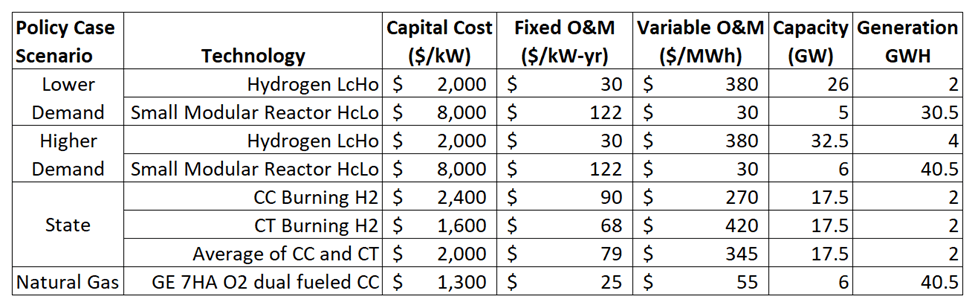
I have also included a graph of Dispatchable Emission-Free Resources: 2040 Capacity and Generation from the NYISO Public Information Session presentation on 8/8/24

For what it is worth the following table provides values for the DEFR costs from these three figures.  As noted, I will try to use these numbers to provide cost estimates in the future.  Regrettably the NYISO report does not provide specific numbers.

DEFR Cost Considerations

This section in Appendix F presented some of the factors that must be addressed when considering costs.  It explains that “since DEFRs are a developing technology, the first units built will likely be more expensive compared to similar DEFRs built thereafter”.  The Outlook used capital costs representing a mature deployment and “first-of-a-kind costs are not explicitly included as assumed cost components in this study”.  As the Outlook points out this means that “the costs for DEFRs in this Outlook are likely to be below the actual costs of the first DEFRs built on the system.” 

The Outlook points out that nuclear small modular reactors (SMRs) are a “developing technology and therefore, have varying approaches to their design”.  The theory is that “SMRs have the potential of reducing cost through the development and use of uniform designs”.   Although this will lower capital costs capital costs will still be higher than other technologies.  The expectation for DEFRs is that they will have low operating times and will ramp up and down.  The Outlook notes:

Like large-scale nuclear power plants, SMRs can mitigate the risk of high capital costs with lower operating costs and operating with high utilization rates. In other words, it is optimal for an SMR to consistently operate at 100% power to take advantage of its low operating cost. This has the potential to conflict with the notion of DEFRs being used for their ability to dispatch up and down based on variability in the load. The disconnect between a DEFR’s purpose and an SMR can be bridged by pairing the reactor with a behind-the-meter, dispatchable load. The SMR can remain at 100% power, while the behind-the-meter load dispatches up or down to effectively fluctuate the injection onto the grid, as needed.

Unsaid is the obvious alternative that if SMT nuclear is viable then it could be used to replace renewables rather than just provide backup support.  Nuclear energy generates zero-emissions electricity, provides firm power that does not require supplemental ancillary transmission support, has low land-use requirements, and requires less transmission development than wind and solar.  Going all in for nuclear would not eliminate the need for a peaking power source but it may be possible to use hydro for that purpose.  In a rational world keeping existing dual-fueled peaking plants available for this purpose would be an option too.

The Outlook also addresses hydrogen:

Hydrogen-burning combustion turbines or combined cycle units have effective cost mitigation strategies as well. To minimize hydrogen transport costs, the electrolyzer can be sited at the same facility as the resource. This eliminates the need for using an expensive hydrogen pipeline to import the hydrogen from elsewhere in state or even out of state. Additionally, as fossil fuel burning combustion turbines and combined cycle units retire, their assets can be repurposed and retrofit to burn hydrogen as a fuel instead. This has the potential to be less expensive than building a brand-new resource since many elements of the combustion turbine or combined cycle power plants can be reused with limited modification.

One of the more difficult electric system reliability problems is specifical considerations for New York City (NYC).  Specifically, there is a reliability requirement for in-city generation.  The 1977 NYC blackout was caused by transmission shutdowns and the inability of generating stations within the city to supply necessary load.  The reliability load specifies how much in-city generation must be available to replace the loss of transmission power.  I bring this up because this issue has not been discussed regarding DEFR.  There will have to be DEFR resources in NYC and if hydrogen is the chosen technology, then hydrogen will have to be stored within the city.  Hydrogen is a colorless, odorless, explosive gas that is hard to store.  What could go wrong.

Operating Parameters

This section describes how some technical parameters are defined and used.  The heat rate parameter is a measure of production efficiency, the lower the heat rate the less energy used to produce electricity.  Lower heat rate units operate more often.  The text lists the values used in the analysis.

There also is a discussion on the need for DEFRs to meet specific requirements such as the ability to be dispatched to follow load.  Existing nuclear power technologies in the US have not been used to provide this service.  The discussion describes how this service could be provided in future nuclear power designs.  It also notes that there is a possibility that future reactors could be re-fueled while online which is much different than today’s reactors that require significant outages to re-fuel.

Conclusion

The NYISO Resource Outlook chapter on DEFR provides further proof that new technology is in fact necessary for the future zero-emissions New York electric system mandated by the Climate Act.  The Hochul Administration has not provided cost estimates for the overall transition.  I believe that DEFR costs will be a particular problem because this resource is used as rare backup.  This report provides some cost information but not enough to estimate expected costs.

Has the Electricity Reality Check Arrived?

An article by Todd Snitchler originally published by RealClearEnergy  and republished at Watts Up With That provides an excellent overview of the issues confronting the electric system today.  It is also a response to clean energy advocates that demand that New York double down on its efforts to meet the Climate Leadership & Community Protection Act (Climate Act) mandates using wind and solar resources.  This post annotates the Snitchler article with comments framing the New York context.

I have followed the Climate Act since it was first proposed, submitted comments on the Climate Act implementation plan, and have written over 450 articles about New York’s net-zero transition.  The opinions expressed in this article do not reflect the position of any of my previous employers or any other organization I have been associated with, these comments are mine alone.

Overview

The Climate Act established a New York “Net Zero” target (85% reduction in GHG emissions and 15% offset of emissions) by 2050.  It includes an interim reduction target of a 40% GHG reduction by 2030, and two targets that address the electric sector: 70% of the electricity must come from renewable energy by 2030 and all electricity must be generated by “zero-emissions” resources by 2040. The Climate Action Council (CAC) was responsible for preparing the Scoping Plan that outlined how to “achieve the State’s bold clean energy and climate agenda.” The Integration Analysis prepared by the New York State Energy Research and Development Authority (NYSERDA) and its consultants quantifies the impact of the electrification strategies.  That material was used to develop the Draft Scoping Plan outline of strategies.  After a year-long review, the Scoping Plan was finalized at the end of 2022.  Since then, the State has been trying to implement the Scoping Plan recommendations through regulations, proceedings, and legislation.

On September 4-5 the Hochul Administration hosted a Future Energy Summit.  I have written several preliminary impression articles about it and plan to do a final summary after the video is posted.  My impression is that Hochul suggested the idea for the Summit, but the primary rationale is not obvious.  Initially I thought it was in response to three recent independent reports that found that there were schedule issues, inadequate cost support and potential reliability risks.  Those findings coupled with a Business Council of New York letter that cited those reports in a plea for a reassessment I thought were compelling reasons for a meeting.

However, the Summit did not address the problems identified.  There were a couple of passing mentions of some of the problems but none of the panelists made any statements contrary to the Administration’s narrative.  However, two sessions were devoted to incorporating nuclear energy in the implementation plan and a draft blueprint for consideration of advanced nuclear technologies was released for comment.  I now think that the purpose was to gauge the political blowback for that option.

In this context, Spectrum News with Susan Arbetter has recently hosted guests (here and here) to discuss the “benefits of nuclear energy, specifically as a dispatchable resource that can fill in the gaps that arise with solar and wind.”  The most recent interview was with Blair Horner from the New York Public Interest Research Group (NYPIRG).  I address his comments in my annotations of the article below.

Has the Electricity Reality Check Arrived?

The author of the article is Todd Snitchler.  He is President and CEO of the Electric Power Supply Association (EPSA).  He introduces the article by noting that dispatchable generation is needed.  For background keep in mind that electric system operators must balance the load with available generation constantly.  That challenge is much easier if they have resources available that can be dispatched, that is to say controlled, as needed. Wind and solar are not dispatchable.

At meetings of energy regulators, policymakers, consumer advocates, and industry this summer, the content and tone of the conversations around electric system reliability have changed dramatically. Executives from across the industry all agree that dispatchable generation is needed now and will be needed for many years to come.

Electric system owners have economic goals that are inordinately affected by politicians.  As a result, they are reticent to say anything that is inconsistent with the current political narrative.  In this case the political narrative is the constant refrain about the need to do something about the “existential” threat of climate change.  Consequently, everyone who knows better that works for the utilities or the state has not been speaking out about the risks of relying on generating resources that cannot be dispatched. However, reality is forcing their hands and suggestions that laws like the Climate Act might not work as touted are coming out.

Most prominently, the realization and willingness to say publicly that dispatchable resources like natural gas-fired generation will be needed as the energy expansion continues and load growth accelerates for the first time in decades is a welcome admission.

For several years the discussion around the future of the electrical grid was about how inexpensive it will be and how “out of political favor” resources would be moved off the grid in favor of politically favored ones without creating any disruptions or reliability challenges. And just like that, the story has changed – dramatically. Why?

Privately all the experts who really understand the electric system admit that the proposed Climate Act transition plan is very unlikely to work and certainly cannot work on the arbitrary schedule mandated by the Climate Act.  On the other hand, advocates like NYPIRG’s Horner cling to the incorrect notion that no new technologies are needed.  That belief underpinned the Climate Act law’s schedule and presumption that meeting the schedule was just a matter of political will.  Snitchler describes three reasons why plans like the Climate Act cannot work as advertised in the real world.

First, load growth – and a substantial amount of it is expected in the short term. The second is the pace of dispatchable generation retirements, without replacement generation with similar performance characteristics. The third is consistent and increasing warnings coming from reliability organizations and grid operators that a crisis is coming and coming quickly if system planning does not improve.

The authors of the Climate Act did not understand how the electric grid operates and the impacts of wind and solar intermittency on the proposed changes to the system.   In the interview with Arbetter at about the 2:00 mark Horner makes the point that the law established a schedule that must be met.  Ignoring all the issues related to the massive shift in resources proposed and all the difficulties associated pandemic impacts to supply chains, he whines that the Hochul Administration is not doing what they are supposed to be doing.  Snitchler’s description of grid operation realities is inconsistent with the Climate Act mandates so the State is in an impossible situation relative to the schedule.

What does this mean? In short, it is a long-awaited recognition of the reality of grid operations combined with the acknowledgment (albeit grudgingly in some circles) that dispatchable resources, like natural gas, will need to be retained and operated for a longer time horizon than many were willing to admit. This recognition matches the significant number of credible studies, including work done by McKinsey and EFI, that all said dispatchable natural gas generation would be needed even in a high renewable resource penetration scenario.

The problem of dispatchability is compounded in New York because natural gas generation is prohibited by the Climate Act.  Instead, the credible plans for the future electric system plan to use a not yet commercially available “Dispatchable Emissions-Free Resource (DEFR)”.  It is long past time that anyone who denies this need should be ignored in the conversation but unfortunately the Hochul Administration has not done anything to confront this problem.

That is not all.  Snitchler describes other issues that have impacted the Climate Act schedule that Horner ignores when he whines that the State is not meeting the schedule:

As the reality of load growth, supply chain issues, permitting, siting, and construction challenges impacting all types of resources settled in and the sharp warnings of imminent reliability issues combined, it became clear that the rhetoric was far ahead of reality. Recognizing the problem is the first step in solving it.

Unfortunately, there is a crisis brewing as the reliability margins shrink.  This summer there were operator alerts for generation emergencies.  Snitchler explains that this is largely due to retirements of fossil-fired generating resources before adequate replacements were available.  He goes on to recommend a solution.

Because all resources are now accountable for reliability, including dispatchable, intermittent, and storage resources, the requirement to acknowledge and adapt to grid realities is no longer optional – it’s mission critical. The retirement of significant amounts of dispatchable resources without adequate replacements has pushed us ever closer to a system with zero margin of error.

To correct this situation, policymakers and regulators should take steps to minimize the risk to customers. First, the timing gap between retirements and additions to the system must be addressed; we can’t let existing resources off the grid before the replacements are ready. The process for connecting new generation to the grid must be reformed to ensure projects match system needs, not just policy pronouncements. Permitting and siting reforms are needed so we can deliver development of all types of energy projects.

I agree with Snitchler that one thing that must be done is to readjust the aspirational targets of energy transition laws like the Climate Act.  I endorse the idea that offramps for reliability is necessary. 

Second, policymakers must temper enthusiasm and set goals that align with the reality of system needs and operational constraints. This could mean pausing policies that hinder the deployment of needed resources or including offramps in legislation to ensure grid reliability.

I do have a concern with his plea for siting reforms and pausing policies that hinder deployment of needed resources.  I do not agree if that approach is used to justify deploying wind and solar faster because I think there is a fundamental issue that has not been addressed.  Analyses of renewable resource availability have identified periods where DEFRs are required.  What has not yet been addressed is the risk that designing an electric system to meet a weather-dependent requirement will inevitably mean that practicality and affordability constraints will lead to a situation where an extreme event exceeds the planning criteria.  That would lead to blackouts.  I do not believe this has received adequate evaluation and discussion.  As a result, I think it is more appropriate to consider reliability constraints before proceeding to build as much solar and wind as possible as fast as possible.

Snitchler raises another practicality issue that is not on the radar of advocates like Horner.  New York policies must be consistent with other states or bad outcomes will result.  In addition, there must be a plan for developing a market signal for DEFRs.  This will be an expensive resource that is not used much raising market viability concerns.

Third, grid operators must move more quickly to adjust markets to send the appropriate signals that will drive investment of the required resources. States must recognize the broader benefits of market participation and positive outcomes for their constituents and stop merely demanding grid operators do what one state wants to the detriment of another. States must again appreciate that the benefits of their utilities joining markets far outweigh their ability to dictate resources and timelines and then disclaim responsibility for the issues those decisions create.

Advocates like Horner are first to accuse market participants of biased motives when there are inconsistencies with their goals.  Everyone wants a better environment and would like to reduce the risks of extreme weather impacts due to climate change.  Snitchler correctly points out that unrealistic goals raise the risk of reliability problems that, in my opinion, are a much worse outcome than effects of climate change that these policies could possibly alter.

To close, lest anyone accuse market participants of not wanting to reduce emissions or only wanting to profit from their current resources, this reality check in no way means walking away from striving to meet policy goals. Bottom line – we can set goals, but they must be tethered to operational reality to ensure success and reliability are both achieved.

Discussion

I think this is a good summary of issues confronting all the electric grid operators in the United States.  The risks in New York are even greater because of the unrealistic Climate Act mandates and the attitude of many that because it is a law the mandates must be met with no acknowledgement that there has never been a feasibility analysis to confirm whether it can be done and how fast it could be done.  It is unfortunate that the Future Energy Summit did not address these concerns.  I believe that a reassessment is overdue.

One of the most important topics for a reassessment is that the need for dispatchable resources destroys the myth that wind, solar, and energy storage are the only technologies needed.  Energy storage can provide some of the necessary dispatchability, but the overwhelming consensus is that new DEFR technology is necessary.  It is time to stop giving Robert Howarth, the self-avowed author the Climate Act, any platform to say “We can meet all of the energy needs of New York with solar, with hydro and wind and appropriate (energy) storage.’’  That statement is wrong and incorrectly influences advocacy groups like NYPIRG.

Conclusion

Snitchler summarizes the reality check issues that need to be confronted nationally and in New York.  If these issues continue to be ignored and unresolved, then the only outcome will be grid reliability problems.  I fear that there are many who will only admit that these problems are real only after there has been a catastrophic blackout.

New York Future Energy Economy Summit Post Meeting Preliminary Update

On August 5 Governor Hochul announced a Future Energy Economy Summit that will “gather feedback on strategies to accelerate renewable energy deployment and explore the potential role of next generation clean energy technologies”.  I described my initial thoughts on the summit and followed up with a second pre-meeting post.  This post describes my initial reaction to the meeting.  I will follow up with another post when the meeting recording is posted.

I have followed the Climate Act since it was first proposed, submitted comments on the Climate Act implementation plan, and have written over 450 articles about New York’s net-zero transition.  The opinions expressed in this article do not reflect the position of any of my previous employers or any other organization I have been associated with, these comments are mine alone.

Overview

The Climate Act established a New York “Net Zero” target (85% reduction in GHG emissions and 15% offset of emissions) by 2050.  It includes an interim 2030 reduction target of a 40% reduction by 2030. Two targets address the electric sector: 70% of the electricity must come from renewable energy by 2030 and all electricity must be generated by “zero-emissions” resources by 2040. The Climate Action Council (CAC) was responsible for preparing the Scoping Plan that outlined how to “achieve the State’s bold clean energy and climate agenda.” The Integration Analysis prepared by the New York State Energy Research and Development Authority (NYSERDA) and its consultants quantifies the impact of the electrification strategies.  That material was used to develop the Draft Scoping Plan outline of strategies.  After a year-long review, the Scoping Plan was finalized at the end of 2022.  Since then, the State has been trying to implement the Scoping Plan recommendations through regulations, proceedings, and legislation.

Setting the Stage for the Meeting

As I have noted previously there are many reasons why an assessment of the future energy economy is needed.  Three recent reports top the list.  The Public Service Commission (PSC) Clean Energy Standard Biennial Review Report found that the 70% renewable energy goal will likely not be achieved until at least 2033.  The New York State Comptroller Office Climate Act Goals – Planning, Procurements, and Progress Tracking audit found that the PSC and NYSERDA implementation plans did not comprise all essential components, including “assessing risks to meeting goals and projecting costs.”  The New York Independent System Operator (NYISO) 2023-2042 System & Resource Outlook described issues that threaten reliability and resilience of the current and future electric system. The Department of Public Service Proceeding 15-E-0302 may also be influencing the Governor and precipitating the need for the summit.   The Business Council of New York has cited those reports and gave other reasons why it is needed.  As a result, the governor said the state’s climate goals are something she “would love to meet, but also the cost has gone up so much. I now have to step back and say, ‘What is the cost on the typical New York family?’ Just like I did with congestion pricing.” 

Annotated Agenda

Welcome

  • Doreen Harris, President and CEO, New York State Energy Research and Development Authority
    • Reason to meet in Syracuse was because of Micron chip fabrication plant
    • Administration is committed to Climate Act goals but refinements may be necessary

Morning Keynote

  • Kathy Hochul, Governor Press Release
    • Reiterated commitment to Climate Act goals because of all the climate events
    • She managed to appeal to a wide range of her constituents with specific statements

Fireside Chat: State of Technology

  • David Crane, Under Secretary for Infrastructure, U.S. Department of Energy
  • Richard Kauffman, Chair, New York State Energy Research and Development Authority
    • I was not impressed with this session
    • Neither speaker has a technical background and it showed
    • Upton Sinclair’s quote is apropos: “It is difficult to get a man to understand something when his salary depends upon his not understanding it.

Accelerating Renewable Energy Deployment in New York State

  • Moderator, Georges Sassine, Vice President, Large Scale Renewables, New York State Energy Research and Development Authority
  • Laura Beane, President North America, Vestas
  • Lori Bird, Director of U.S. Energy Program and Polsky Chair for Renewable Energy, World Resources Institute
  • Eric Cohen, Head of Green Economy Banking, JP Morgan Chase
  • Frank Macchiarola, Chief Policy Officer, American Clean Power Association
  • Jonah Wagner, Senior Advisor to the Director, U.S. Department of Energy Loan Programs Office
    • All of these speakers have a vested interest in the clean energy transition so my notes are sparse
    • I posted a question asking if it was a good idea to build as much renewable energy as possible before the necessary dispatchable emissions-free resource technology is specified.  There was no response to the question.

Status of Next Generation Energy Technologies

  • Moderator, Brandon Owens, Vice President, Innovation, New York State Energy Research and Development Authority
  • Dr. William Acker, Executive Director, New York Battery and Energy Storage Technology Consortium
  • Dr. Monterey Gardiner, Chief Engineer, National Renewable Energy Lab
  • Dr. Benjamin Houlton, The Ronald P. Lynch Dean, Cornell College of Agriculture and Life Sciences
  • Dr. Jack Lewnard, Program Director, Advanced Research Projects Agency – Energy, U.S. Department of Energy
  • Jeffery Preece, Director of Research and Development, Electric Power Research Institute
  • Julie Tighe, President, New York League of Conservation Voters
    • One of the significant points made during the Summit is that certain industries are willing to pay more for reliable high-quality electric power. 
    • This broaches the idea that those companies would be willing to make investments in reliable power
    • It also acknowledges that certain industries recognize that a future grid that relies on wind, solar, and energy storage will not be reliable enough

Lunchtime Keynote Speaker Clean Energy Supply for Large Loads

  • Rich Powell, Chief Executive Officer, Clean Energy Buyers Association
    • He explained how large companies signal their climate virtue by claiming credits for zero-carbon generation virtually

Insights from Large Consumers of Electricity

  • Moderator, Hope Knight, President, CEO, and Commissioner, Empire State Development
  • Miranda Ballentine, Senior Advisor, Green Strategies
  • Amber Bieg, Lead Senior Program Manager for Global Sustainability, Micron 
  • Moshe (Mo) Bonder, Director, Business Development Low Carbon Solutions, National Grid Ventures
  • Jennifer Lupo, Vice President, Energy Solutions, Supply Chain & Leasing, The Raymond Corporation
  • Dr. Varun Sivaram, Senior Fellow for Energy and Climate, Council on Foreign Relations
    • This session gets into the real reason for the Summit
    • In order to do justice to the commentary I need to review the meeting recording
    • All these companies subscribe to the belief that it is important that the electricity they use be “clean”
    • There was even a suggestion that to be competitive, companies demand clean energy.  My impression was that affordability and reliability were weighed equally with cleanliness.  That does not seem appropriate, so I need to get exact quotes

Global Perspective: Advanced Nuclear Development in Other States and Nations

  • Moderator, Rory Christian, Chair, New York State Public Service Commission
  • Nicolle Butcher, Chief Operations Officer, Ontario Power Generation
  • Steve Chengelis, Senior Director of Future Nuclear, Electric Power Research Institute
  • Dr. John Parsons, Deputy Director for Research, MIT Center for Energy and Environmental Policy Research
  • Dr. Andrew Whittaker, SUNY Distinguished Professor, University of Buffalo
    • This session addressed the status of nuclear elsewhere
    • Questions were posed and answers debunking common anti-nuclear talking points were included

Blueprint for Consideration of Advanced Nuclear Technologies

  • Moderator, John Williams, Executive Vice President of Policy and Regulatory Affairs, New York State Energy Research and Development Authority
  • Armond Cohen, Chair, Clean Air Task Force
  • Judi Greenwald, Executive Director, Nuclear Innovation Alliance
  • Christine King, Director, U.S. Department of Energy’s Gateway for Accelerated Innovation in Nuclear Program
  • Greg Lancette, Business Manager, United Association of Plumbers and Steamfitters Local 81
  • J. Ryan McMahon II, Onondaga County Executive
  • Marc Nichol, Executive Director of New Nuclear, Nuclear Energy Institute
    • In the interest of full disclosure I bailed on this session

Wrap up and Next Steps

  • Doreen Harris, President and CEO, New York State Energy Research and Development Authority
  • I got into the meeting webinar when I got home in time for this
    • Harris read accolades to her boss’s vision to fight the crisis
    • She said there were three takeaways
    • She doubled down on the need for building renewables and making them the primary energy source
    • She acknowledged that dispatchable emission-free resources were needed
    • She argued that we must not miss the opportunity to leverage federal initiatives to fund New York’s transition.
    • She believes that the clean energy transition will grow a prosperous economy
  • Discussion

In an earlier post I noted that the State must confront the possibility that the safety valve criteria in New York Public Service Law  § 66-p (4) for unsafe and inadequate electric service, impairment of existing obligations and agreements, and unacceptable increase in arrear or service disconnections will be exceeded.  There was no suggestion whatsoever that the Hochul Administration has any doubts that a zero-carbon electric grid that relies on wind and solar will work.

It seems obvious that there are large consumers of electricity that want to at least be able to say that they use 100% renewable energy. I think this summit was in no small part designed to cater to those companies.  However, there were some hints that high quality electric power was enough of a concern that nuclear might be an acceptable option.

The other reason for this meeting was to broach the nuclear power option to the State.  The draft blueprint is potentially a referendum on its use.  I have no doubts that the anti-nuclear activists are frantically developing their plan to inundate the comment process with negative comments.  The political calculus of weighing the squeaky wheel crowd relative to the reliability of the wagon realists will be interesting.  Will the Administration admit that reliability and resiliency are not just slogans.

Conclusion

I remain convinced that the current Scoping Plan implementation will do more harm than good.  The Energy Summit could have been the start of a correction process that might reduce the inevitable increased risks to reliability, extraordinary price increases, and significant environmental impacts but that does not appear to be the case.  As I said before the Summit is another Macbeth story: “A tale told by an idiot, full of sound and fury, signifying nothing”.

Offshore Wind Costs

Last month I described a flurry of offshore wind related news and last week I provided an update describing additional news.  In my opinion these latest revelations suggest that a reassessment of the viability of offshore wind projects is in order.  I did not address the costs but a couple of articles that have appeared since then do suggest that costs should also be considered in the reassessment.

I have followed the Climate Act since it was first proposed, submitted comments on the Climate Act implementation plan, and have written over 450 articles about New York’s net-zero transition.  The opinions expressed in this article do not reflect the position of any of my previous employers or any other organization I have been associated with, these comments are mine alone.

Overview

The Climate Act established a New York “Net Zero” target (85% reduction in GHG emissions and 15% offset of emissions) by 2050.  It includes an interim 2030 reduction target of a 40% reduction by 2030. Two targets address the electric sector: 70% of the electricity must come from renewable energy by 2030 and all electricity has to be generated be “zero-emissions” resources by 2040. The Climate Action Council (CAC) was responsible for preparing the Scoping Plan that outlined how to “achieve the State’s bold clean energy and climate agenda.” The Integration Analysis prepared by the New York State Energy Research and Development Authority (NYSERDA) and its consultants quantifies the impact of the electrification strategies.  That material was used to develop the Draft Scoping Plan outline of strategies.  After a year-long review, the Scoping Plan was finalized at the end of 2022.  Since then, the State has been trying to implement the Scoping Plan recommendations through regulations, proceedings, and legislation.

Offshore wind developments are a key Climate Act decarbonization strategy.  There is a mandated target of 9,000 MW of offshore wind by 2035.  The Integration Analysis projects that offshore wind capacity will exceed 13 GW by 2040.  However, there are overlooked risks to this strategy that are now becoming obvious.  The fact is that the huge, proposed wind turbines have not been field tested.

Why Is Cheap Wind Power So Expensive?

Willis Eschenbach poses the cost question that is ignored by the green energy activists.  First he describes the overarching Biden Administration goals released in Marh 2021:

Eschenbach is a numbers guy and was immediately suspicious:

Hmmm, sez I, seems a mite ambitious. Current US grid-connected offshore wind is a mere 0.17 gigawatts … so we’d need to do ~ 175 times as much as we’ve done to date and do it in a short six years.

So I divided it out. There are 65 months until 2030. Thirty gigawatts is thirty thousand megawatts, less the 174 megawatts in place, that’s 29,826 megawatts more total generating capacity needed.

29,826 megawatts divided by 65 months means we’d have to add offshore wind generation to the tune of 465 additional megawatts of generation capacity per month. Every month. Starting now.

Get real. That’s not remotely possible. The biggest US offshore windfarm just came on line, 132 MW capacity. To reach the White House goal, every month we’d need to build three new windfarms of that size. No way that can happen. It’s just numbers picked out of the air to gain popular support.

Then he researched the expected time to get an offshore wind farm on line:

The time from the proposal of an offshore wind farm to its grid connection typically ranges from 7 to 10 years. This timeline can be broken down into several phases:

Pre-development and Planning (1-2 years): This phase involves site identification, feasibility studies, and initial environmental assessments.

Permitting and Approvals (3-5 years): Securing the necessary permits and approvals is often the most time-consuming part of the process. This includes detailed environmental impact assessments, consultations with stakeholders, and obtaining state and federal permits.

Construction (2-3 years): Once all approvals are secured, construction of the wind farm, including the installation of turbines and subsea cables, takes place. This phase also includes the grid connection process.

Commissioning and Testing (several months): After construction, the turbines are tested, and the wind farm is gradually brought online.

The bottom line is that if a project is not well along it will not be available by 2030.  He found cost information for South Fork Wind which in New York’s first offshore wind farm:

South Fork Wind just came online. This gives us a chance to look at some actual cost figures. It’s the biggest wind farm to date, a 132-megawatt addition to offshore wind. It cost $637 million.

However, Federal subsidies added $191 million to that, plus another couple of hundred million or so from Bureau of Ocean Energy Management (BOEM), the National Oceanic and Atmospheric Administration (NOAA), and the New York State Energy Research and Development Authority (NYSERDA).

Stop and consider. Some private company is building a six-hundred-million-dollar white elephant in the middle of the ocean, and it’s getting paid four hundred million of taxpayer money to do so.

So … what does the New York consumer get for all of this more than generous support?

The consumer gets wind power costing FOUR TIMES AS MUCH as the current cost of power in New York.

Stop and consider. Even when the developer gets two-thirds of the cost paid by the taxpayer, offshore wind power is still four times as expensive.

Eschenbach sums it up:

What’s next?

Well, I’m sure that what’s next is the Harris/Walz campaign will declare that they are 100% behind expensive, intermittent, unreliable wind power, and will claim that if elected, they’ll do what they already said they’d do when Ms. Harris was last elected, which was to screw the consumer and the taxpayer with the huge subsidies, tax breaks, and electricity costs of offshore wind.

Oh, yeah. They claim that the 30 GW of offshore wind will “avoid 78 million metric tonnes of CO2 emissions”. Tens of millions of tonnes, sounds impressive, right?

But IF the IPCC is correct, and that’s a big if, this will reduce the temperature in the year 2050 by …

… wait for it …

… 0.0016°C. Which is almost three-thousandths of one degree F.

Can we please pass a law saying people proposing any laws or regulations in the name of “climate change” be required to tell us (and show their math) how much actual temperature difference that will make by 2050?

All the points made in this article are direct analogies to what is happening in New York State.

Offshore Trojan Horses

Gordon Hughes from the National Center for Energy Analytics compares the subsidies for offshore wind projects to “the classic warning of the Trojan Horse legend,  “Beware of Greeks bearing gifts”—in other words, the hidden dangers of accepting something that seems too good to be true.”  He argues that “New York State ignored that warning when it agreed to pay very high prices for the electricity to be supplied from its new offshore wind farms—Empire Wind 1 and Sunrise Wind—located off the coast of Long Island.”  He continues:

In announcing the final agreements, New York Governor Kathy Hochul triumphantly claimed that the new projects would create more than 800 jobs during the construction phase and deliver more than $6 billion in economic benefits for the state over 25 years.

Rather less emphasis was given to the fact that New York will pay an average price of over $150 per MWh (megawatt hour) for the electricity generated by Empire Wind 1 and Sunrise Wind.That’s more than four times the average wholesale price of electricity in New York during 2023–24, $36 per MWh. The total annual premium over the wholesale market price for the power from these wind farms will be about $520 million per year at 2024 prices. Over 25 years, New York ratepayers will be paying about $13 billion for alleged benefits of $6 billion.

That is not all. Thanks to tax credits, U.S. taxpayers will cover at least 40% of the costs of constructing the wind farms. At a minimum cost of $5.5 million per MW (million watts) of capacity, the total federal subsidy for New York’s two wind farms will be at least $3.8 billion.

He also evaluates the jobs and economic claims made by the Hochul Administration.  He concludes that “The economic benefits of the two offshore wind farms are much lower than claimed by the governor and the jobs are, in large part, temporary assignments for professional services staff”. I would add that the temporary assignments will probably be filled by experienced staff from out of state.

Conclusion

The offshore wind proposed contracts are unsustainable.  Eschenbach suggests that folks in New York should be asked” “Are you willing to pay four times the going rate for electricity for the rest of your life to MAYBE cool the globe by three-thousandths of one degree Fahrenheit a quarter century from now?” I agree and think that these facts need to be publicized because most New Yorkers have no clue that Climate Act implementation inevitably will increase costs significantly.

Lastly, note that Climate Act proponents have always argued that one of the goals was to demonstrate leadership for the energy transition.  This article presents two examples where New York’s transition leadership is cited.  Unfortunately, both are bad examples showing what to avoid.

New York Future Energy Economy Summit Pre-Meeting Update

On August 5 Governor Hochul announced a Future Energy Economy Summit that will “gather feedback on strategies to accelerate renewable energy deployment and explore the potential role of next generation clean energy technologies”.  I described my initial thoughts on the summit and possible outcomes earlier.  This post provides a pre-meeting update.

I have followed the Climate Act since it was first proposed, submitted comments on the Climate Act implementation plan, and have written over 450 articles about New York’s net-zero transition.  The opinions expressed in this article do not reflect the position of any of my previous employers or any other organization I have been associated with, these comments are mine alone.

Overview

The Climate Act established a New York “Net Zero” target (85% reduction in GHG emissions and 15% offset of emissions) by 2050.  It includes an interim 2030 reduction target of a 40% reduction by 2030. Two targets address the electric sector: 70% of the electricity must come from renewable energy by 2030 and all electricity must be generated by “zero-emissions” resources by 2040. The Climate Action Council (CAC) was responsible for preparing the Scoping Plan that outlined how to “achieve the State’s bold clean energy and climate agenda.” The Integration Analysis prepared by the New York State Energy Research and Development Authority (NYSERDA) and its consultants quantifies the impact of the electrification strategies.  That material was used to develop the Draft Scoping Plan outline of strategies.  After a year-long review, the Scoping Plan was finalized at the end of 2022.  Since then, the State has been trying to implement the Scoping Plan recommendations through regulations, proceedings, and legislation.

Purpose

As I have noted previously there are many reasons why an assessment of the future energy economy is needed.  Three recent reports top the list.  The Public Service Commission (PSC) Clean Energy Standard Biennial Review Report found that the 70% renewable energy goal will likely not be achieved until at least 2033.  The New York State Comptroller Office Climate Act Goals – Planning, Procurements, and Progress Tracking audit found that the PSC and NYSERDA implementation plans did not comprise all essential components, including “assessing risks to meeting goals and projecting costs.”  The New York Independent System Operator (NYISO) 2023-2042 System & Resource Outlook described issues that threaten reliability and resilience of the current and future electric system. The Department of Public Service Proceeding 15-E-0302 may also be influencing the Governor and precipitating the need for the summit.   The Business Council of New York has cited those reports and gave other reasons why it is needed.  As a result, the governor said the state’s climate goals are something she “would love to meet, but also the cost has gone up so much. I now have to step back and say, ‘What is the cost on the typical New York family?’ Just like I did with congestion pricing.” 

Never forget that the Climate Act has always been mostly about politics and much less about rational energy policy.  I do not think that there is any question that this Summit is intended in part to gauge the reaction of favored political constituencies.  I have seen several notices from activist organizations calling for people to rally at the event against “false solutions” which I believe boils down to anything other than wind, solar, and energy storage.  With nuclear being at the top of the worst example of a false solution. 

In my opinion, the State must confront the possibility that the safety valve criteria in New York Public Service Law  § 66-p (4) for unsafe and inadequate electric service, impairment of existing obligations and agreements, and unacceptable increase in arrear or service disconnections will be exceeded.  I recently recommended that those criteria be specified so that there are quantifiable targets.  I hope that there are discussions that can further that requirement during the summit.

The other missing piece to date is the implementation plan for the transition.  The Scoping Plan is no more than a outline list of different strategies that someone has calculated will produce the emission reductions necessary and the energy required for New York State to meet the Climate Act mandates.  There is insufficient documentation to meaningfully critique the outline, and the Hochul Administration failed to respond to technical comments on the draft before it approved the Final draft.  A feasibility analysis has not been produced and must be included for a credible transition plan.  Better still would be a small-scale net-zero demonstration for an isolated jurisdiction that proves that an electric system can rely on intermittent wind and solar resources as the primary source of generation.  I hope that there will be discussion of this concept at the Summit.

Attendance

There is still no indication who will be on the panels.  In my original post I mentioned that I was worried that this would just be another dog and pony show. I cannot comment on this until I know who is on the panels.

Public participation has been restrictred  The meeting announcement mentioned that there was limited seating capacity for the event but at the same time it listed statements from eight different agencies.  I fail to see a connection between the Department of Health and Department of Labor with respect to energy policy.  If they send representatives, then fewer affected stakeholders or members of the public can attend.  I heard from several people who were waitlisted and asked a politician for help but did not get invited.  Contrary to my expectations, I managed to get invited.

Summit Agenda

On August 7 when I wrote the first summary of the Summit, I included the following list of sessions that had been posted:

  • Welcome Remarks and Morning Keynote
  • State of Technology
  • Status of Next Generation Energy Technologies
  • Luncheon Keynote
  • Insights from Large Consumers of Electricity
  • Global Perspectives: Representatives from other states and nations who are pursuing advanced nuclear installations.
  • New Nuclear Blueprint: Vet Draft Blueprint as framework for New Nuclear Master Plan
  • Wrap up and Next Steps

The agenda for the meeting on September 2 has changed.  The original first session “State of Technology” has been changed to “Accelerating Renewable Energy Deployment in New York State”.  The original first session “State of Technology” did not seem to be all that much different from the second session “Status of Next Generation Energy Technologies” so this makes sense.  However, the title “accelerating renewable energy deployment” suggests that no one is willing to conceded that building as much renewable energy as possible as fast as possible without a plan or feasibility analysis might not be a good idea.

At the PSC Zero Emissions by 2040 Technical Conference last December there were sessions devoted to pandering to real “false solutions” for a future economy.  Technology shills and activists subscribe to a dream that with enough energy conservation and “smart planning” the myriad problems identified by the organizations responsible for grid reliability can be ignored.  I fear that the Status of Next Generation Energy Technologies panel will include the same proposals without anyone on the panel providing contrary feedback.  It is long past time for the Hochul Administration to support the concerns expressed by the  PSC, NYISO and other organizations with reliability responsibilities and stop pretending that some of the cockamamie schemes suggested by irresponsible entities can provide meaningful future support.

The opening and luncheon keynote speakers will likely set the tone for the meeting.  One hour is set aside for the welcome and keynote presentations.  If that is nothing more than bragging about the “success” so far and excuses for the findings of the negative assessments, then I will have little hope for any meaningful results.  The same holds for the luncheon speaker.

One of the issues raised by the analyses to date is that loads will increase due to electrification of everything and new “Large Consumers of Electricity”.  The huge, proposed Micron chip fabrication plant is the prime example.  What are the odds that representatives from those facilities will tell the truth that unless there is demonstrated path to success or an alternative backup plan that it would be madness to invest billions of dollars because there is no assurance of reliable, affordable electricity.

The last two sessions address nuclear energy projects.  In my opinion, this is the primary driver of this Summit.  The only jurisdictions that have significantly reduced their GHG emissions from the electric sector without relying on hydro or geo-thermal resources used nuclear.  However, nuclear is unacceptable to many of the activists who are the strongest supporters of the Climate Act.  I have seen several pleas for people to come to rally against the false solutions.  The meeting was held in Syracuse and that just happens to be the closest city to three operating nuclear reactors.  I will be shocked if there aren’t visible signs of support from staff at those facilities.   

Conclusion

There are some encouraging signs that people are catching on that no matter how you feel about doing something about climate change the reality is that New York’s plan is deeply flawed.  I am convinced that the plan will do more harm than good.  The Energy Summit could be the start of a correction process that might reduce the inevitable increased risks to reliability, extraordinary price increases, and significant environmental impacts if there is no course correction.  On the other hand, it could be another story from Macbeth “A tale told by an idiot, full of sound and fury, signifying nothing”.

Stay tuned for an update later this week.

Renewable Generation Is Not Resilient

Recently Rory Christian, Chair and CEO of the Public Service Commission said, “We are modernizing the grid not to just take on the challenge of adopting more renewable energy but to create greater flexibility, greater resiliency and the ability to recover more quickly in the face of these extreme climate events”.  I believe that making our electric grid dependent upon weather-impacted resources is anything but resilient.  Richard Ellenbogen describes one resilience-related issue in this article.

Ellenbogen is the President [BIO] Allied Converters and frequently copies me on emails that address various issues associated with the Climate Leadership and Community Protection Act (Climate Act). I have published other articles by Ellenbogen including a description of his keynote address to the Business Council of New York 2023 Renewable Energy Conference Energy titled: “Energy on Demand as the Life Blood of Business and Entrepreneurship in the State -video here:  Why NY State Must Rethink Its Energy Plan and Ten Suggestions to Help Fix the Problems” and another video presentation he developed describing problems with Climate Act implementation.   He comes to the table as an engineer who truly cares about the environment and as an early adopter of renewable technologies going back to the 1990’s at both his home and business two decades ago.

Solar Inverter Resiliency Issue

Joanne Nova recently identified a major issue with Behind-the-Meter (BTM) solar. The article discusses the fact that all new solar inverters are internet connected and many of them are made in China. Last October it was found that they may have communication vulnerabilities where they could be turned off simultaneously.  She writes:

What if a few gigawatts of solar power disappeared without a warning or a cloud in the sky?

Imagine a hostile force had control of half your national power generation at lunchtime and could just flip a switch to bring you to your knees? Or how about a crime syndicate wanting a ransom paid by 5 pm?

Her article goes on to describe the problem in more detail.  Nova quotes Daniel Croft, CyberDaily (October 2023):


Cyber Security CRC chief executive Rachael Falk said… that an attack on the solar grid could spark a “black start” event, which could result in the entire power grid going down. … “This could bring down an entire power grid, and it could take a week to recover,” she said.

It turns out that security vulnerabilities have been identified in the Netherlands and the US.  In Australia half of the grid power can come from solar panels at noon.  As a result, Nova suggests that the solution is to test and possibly replace inverters and fix the software.

Ellenbogen recently distributed an email addressing this issue that is quoted below.  His solar panels have inverters too.  He writes:

This is something that hadn’t occurred to me as my inverters were older and only the power monitor was web connected.  I recently replaced the inverters at my house and those are web connected but everything is behind a firewall.  The inverters are also, in theory, American made.  It did occur to me when I was purchasing thermostats for the factory.  I will not buy a NEST or Honeywell internet connected thermostat because they all can be centrally controlled.  A few years ago, all the NEST thermostats in the US went offline.  They said that it was a computer glitch in their system, but was it?  If you don’t remember it, don’t try to Search for it.  It’s as though they scrubbed the internet of the event.  Google owns NEST.   You can find more information with Yahoo.   I remember it vividly because it confirmed my worst fears of why I didn’t buy one in the first place.

Ellenbogen explains that this is a problem:

This is a huge issue as, according to the NYISO Gold Book (Table below), there will be 4560 Megawatts at, maximum output, of BTM solar in NY State as of next year and the state is becoming very reliant on it.  If a significant portion of that was shut down simultaneously on a hot day at solar noon, the system would find it extremely difficult to respond to maintain stability.  If more of the present generation fleet is retired, the NYISO would find it almost impossible to ramp up generation quickly enough to offset the drop in generation.  It would be the equivalent of removing the entire nuclear fleet and one-third of the hydro generation from the system in an instant.  

He continues:

While many of the panels may not have that vulnerability, in the future they might and there will be even less backup generation to offset that.  With renewable projects under extreme financial pressure, the easiest place to cut corners would be in cyber-security because it wouldn’t be noticed until something happened.  In light of the article, it could also be the most hazardous place to cut corners.

Ellenbogen summarized:

When I was speaking at the Pelham Picture House last November, someone got up and said that they were glad Indian Point closed because it was a target of a terror attack.  That was last decades terrorist technique.  The new danger is hackers, or even worse, state actors that have implanted ticking time bombs throughout our energy infrastructure.  This is not being paranoid.  The Dutch hacker got into 4 million solar arrays in 150 countries.

Conclusion

Ellenbogen concluded his note saying “The question now is, what are the ISO’s and regulators around the country going to do about it?

As far as I can tell the issues that might affect resiliency like this are not on the radar of the people in charge of the Climate Act transition.  I am sure staff are aware of the problem described but I am also sure that there is no mandate in New York to minimize this risk.  Christian’s claim that adopting more renewable energy will provide greater resiliency is an empty slogan.

Pragmatic Recommendations for Climate Act Review

Note – This post was revised to clarify my recommendation that the Climate Action Council should propose affordability and reliability criteria to explain the Council should work with the PSC and NYISO for consideration in a stakeholder process similar to the development of the Scoping Plan on 8/21/24.

The Business Council of New York (BCNY) recently  shared a set of concerns and recommendations — supported by a diverse group of business and labor interests — addressing the state’s climate change response efforts, driven by mandates in the Climate Leadership & Community Protection Act (Climate Act).  This post describes the concerns and recommendations in the BCNY statement and proposes a path forward for review of the Climate Act.

I have followed the Climate Act since it was first proposed, submitted comments on the Climate Act implementation plan, and have written over 450 articles about New York’s net-zero transition.  The opinions expressed in this article do not reflect the position of any of my previous employers or any other organization have been associated with, these comments are mine alone.

Overview

The Climate Act established a New York “Net Zero” target (85% reduction in GHG emissions and 15% offset of emissions) by 2050.  It includes an interim 2030 reduction target of a 40% reduction by 2030. Two targets address the electric sector: 70% of the electricity come from renewable energy by 2030 and a requirement that all electricity generated be “zero-emissions” resources by 2040. The Climate Action Council (CAC) was responsible for preparing the Scoping Plan that outlined how to “achieve the State’s bold clean energy and climate agenda.” The Integration Analysis prepared by the New York State Energy Research and Development Authority (NYSERDA) and its consultants quantifies the impact of the electrification strategies.  That material was used to develop the Draft Scoping Plan outline of strategies.  After a year-long review, the Scoping Plan was finalized at the end of 2022.  Since then, the State has been trying to implement the Scoping Plan recommendations through regulations, proceedings, and legislation.

Recently three reports have come out that raise specific concerns about Climate Act implementation: schedule ambition, costs to implement, and electric system reliability risks.

The New York State Comptroller Office released an audit of the NYSERDA and PSC  implementation efforts for the Climate Act titled Climate Act Goals – Planning, Procurements, and Progress Tracking (“Comptroller Report”).  The audit found that: “The costs of transitioning to renewable energy are not known, nor have they been reasonably estimated”.

The Public Service Commission (PSC) recently released the Clean Energy Standard Biennial Review Report (“Biennial Report”) that compares the renewable energy deployment progress relative to the Climate Act goal to obtain 70% of New York’s electricity from renewable sources by 2030 (the 70% goal).  It found that 2030 goal will likely not be achieved until 2033.

The New York Independent System Operator (NYISO) 2023-2042 System & Resource Outlook (“Resource Outlook”) described issues that threaten reliability and resilience of the current and future electric system. The report described current and future challenges for the electric system.  The findings suggest that there will be significant reliability risks for the Climate Act transition.

Business Council of New York Statement

BCNY released their statement because it represents concerns expressed by various impacted businesses across New York about “the achievability of key Climate Act mandates and what that means for the future reliability and cost of the state’s energy system.”  The statement calls for the “state to identify and make necessary mid-course corrections based on updated information and significant economic and market changes.”   The statement argues that “These steps are essential to avoid significant unintended impacts on the well-being of New Yorkers and on the state’s economic competitiveness.”    They note that “Importantly, we believe that New York can continue to be a leader in state-level climate policy, but it needs to take a workable, affordable approach to meeting its energy and emission goals.”

The statement notes that the Climate Act implementation process has not provided a “comprehensive, publicly accessible assessment of implementation costs, the comparative costs of policy alternative programs, and the impact of new policies on residential and business energy consumers.”  This echoes the Comptroller Audit finding of inadequate cost information. 

The statement also describes concerns about “the practical achievability of key CLCPA provisions and the consequences of basing major policy decisions on unworkable statutory mandates”.  The Biennial Report notes that one of the statutory mandates will likely not be achieved.  

The statement takes pains to note that they are not opposed to many of the proposed control strategies.  However, “the state needs to ensure that its push toward emission reductions and the electrification of major sectors are technically and economically achievable.”  This is one of the findings of the Resource Outlook.

The statement argues that “implementation challenges call for a reassessment of the underlying statutory mandates.”  It notes that they want to work with the Administration, state legislators, and other climate stakeholders to address the issues raised.  However, a specific path forward is not proposed.  I propose such a path forward below.

Recommendation for Climate Act Review

Although it has received little notice, there is a provision for renewable energy programs that should be the foundation of the recommended reassessment.  The Biennial Report refers to New York Public Service Law  § 66-p (4). “Establishment of a renewable energy program” that states: “The commission may temporarily suspend or modify the obligations under such program provided that the commission, after conducting a hearing as provided in section twenty of this chapter, makes a finding that the program impedes the provision of safe and adequate electric service; the program is likely to impair existing obligations and agreements; and/or that there is a significant increase in arrears or service disconnections that the commission determines is related to the program”. 

The essential first step for reassessment consideration is definition of the safety valve criteria in §66-p (4).  What are the criteria for unsafe and inadequate electric service, impairment of existing obligations and agreements, and unacceptable increase in arrear or service disconnections?  In my opinion, the Climate Action Council with the PSC and NYISO should propose suitable criteria for consideration in a stakeholder process similar to the development of the Scoping Plan.

The next step would be to provide the data necessary to determine the criteria for unsafe and inadequate electric service, impairment of existing obligations and agreements, and unacceptable increase in arrears or service disconnections.  Given this legal provision it is appropriate that the information be tracked somewhere.  The BCNY statement recommended an “accessible and understandable “dashboard” of the state’s climate change efforts, including a comprehensive accounting of direct state spending and state “directed” spending, the source of funds and their use, and the impact of these expenditures on achieving GHG emission reduction and renewable energy production goals.”  The §66-p (4) criteria parameters should be included in the dashboard.

Conclusion

The three agency reports raise legitimate reasons to be concerned about the mandates and schedule of the Climate Act.  The BCNY statement echoes those concerns and recommends a review and consideration of mid-course corrections.  There is a legal provision to “temporarily suspend or modify the obligations” of a renewable energy program that defines criteria consistent with the concerns raised by the BCNY, the PSC Biennial Report, the Comptroller Report audit of Climate Act implementation, and the NYISO Resource Outlook.  If the §66-p (4) criteria are explicitly defined and compared to observed data, it would form the basis for a pragmatic review of the Climate Act.

Future Role of Nuclear Power Worries Environmental Advocates

Update 8/26/24: Riverhead local published my response to the original op-ed

In a recent article describing a new category of generating resources called Dispatchable Emissions-Free Resources (DEFR) I noted there still are people who maintain that existing technologies—led by solar and wind—can solve the climate crisis.  A recent op-ed titled “With New York’s climate action goals in question, governor’s comments on future role of nuclear power worry environmental advocates” at Riverhead Local provides an example.

I have followed the Climate Act since it was first proposed, submitted comments on the Climate Act implementation plan, and have written over 400 articles about New York’s net-zero transition.  The opinions expressed in this article do not reflect the position of any of my previous employers or any other company or organization I have been associated with, these comments are mine alone.

Overview

The Climate Act established a New York “Net Zero” target (85% reduction in GHG emissions and 15% offset of emissions) by 2050.  It includes an interim 2030 reduction target of a 40% reduction by 2030. Two targets address the electric sector: 70% of the electricity come from renewable energy by 2030 and a requirement that all electricity generated be “zero-emissions” resources by 2040. The Climate Action Council (CAC) was responsible for preparing the Scoping Plan that outlined how to “achieve the State’s bold clean energy and climate agenda.” The Integration Analysis prepared by the New York State Energy Research and Development Authority (NYSERDA) and its consultants quantifies the impact of the electrification strategies.  That material was used to develop the Draft Scoping Plan outline of strategies.  After a year-long review, the Scoping Plan was finalized at the end of 2022.  Since then, the State has been trying to implement the Scoping Plan recommendations through regulations, proceedings, and legislation.

Three recent reports all have suggested that implementation of the Climate Act is not going as planned and that reassessment is necessary.  The Public Service Commission (PSC) Clean Energy Standard Biennial Review Report found that the 70% renewable energy goal will likely not be achieved until 2033.  The New York State Comptroller Office Climate Act Goals – Planning, Procurements, and Progress Tracking audit found that the PSC and NYSERDA implementation plans did not comprise all essential components, including “assessing risks to meeting goals and projecting costs.”  The New York Independent System Operator (NYISO) 2023-2042 System & Resource Outlook described issues that threaten reliability and resilience of the current and future electric system.

Dispatchable Emissions-Free Resources

One of the most important reliability issues is the need for a new category of generating resources called Dispatchable Emissions-Free Resources (DEFR) necessary for a future grid that depends upon wind, solar, and energy storage resources. Reputable analyses of the future New York electric system agree that new technologies are necessary to keep the lights on during periods of extended low wind and solar resource availability.  Despite the overwhelming consensus of the organizations responsible for keeping the lights on that DEFR is needed there are people who believe otherwise.

One such person is Karl Grossman.  According to his bio published with the op-ed:

Karl is a veteran investigative reporter and columnist, the winner of numerous awards for his work and a member of the L.I. Journalism Hall of Fame. He is a professor of journalism at SUNY at Old Westbury and the author of eight books.

The basis of Grossman’s belief is Dr. Mark Z. Jacobson’s 2023 book “No Miracles Needed: How Today’s Technology Can Save Our Climate and Clean Our Air.”   Grossman interviewed Jacobson and quoted him as saying: “Whether New York can reach the 70% goal by 2030 is a matter of social and political willpower. It is not a question of technology or economics.” 

Grossman describes Jacobson’s claims, but I am not going to respond to those claims in detail.  In my recent article about DEFR I explained why I know that Jacobson is wrong.  In brief, I found six analyses describing the need for new technology: the Integration Analysis, New York Department of Public Service (DPS) Proceeding 15-E-0302 Technical Conference, NYISO Resource Outlook, Richard Ellenbogen, Cornell Biology and Environmental Engineering, and Nuclear New York.  Jacobson and his protégé Dr. Robert Howarth frequently refer to their “peer-reviewed” work as validation but neglect the rebuttal peer-reviewed responses to their work and the many other peer-reviewed analyses that show DEFR is needed.  Finally, I also found three books that refute the Jacobson book and his claims that the energy transition can be accomplished with no new technologies at low cost with large benefits.

Environmentalist Responses

I recently noted that Governor Hochul seems to be floating the idea that reassessment is necessary.  Grossman noted that Newsday headlined a two-page spread two weeks ago: “Hochul Says New York Won’t Meet 2030 Climate Goal.” In the article, Newsday cited Gov. Kathy Hochul’s comments in an Albany Times Union newspaper podcast.

“We’re gonna get to our goals, but if we miss it by a couple of years—which is probably what’ll happen—the goals are still worthwhile,” Hochul said. But we have to think about the collateral damage of all of our major decisions… either mitigate them or you have to rethink them.” In the podcast, she also termed herself as “a staunch environmentalist.”

The Grossman op-ed described how environmentalists are reacting.  Not surprisingly they still claim that the state has not done enough on renewable energy.

Judith Enck, for seven years regional administrator of the U.S. Environmental Protection Agency for an area that includes New York State and before that deputy secretary for the environment for two New York governors, said delaying the 70% goal “is a terrible decision by the governor. I hope she revisits it. We’re in a climate crisis. She says things have changed—and they have: the climate crisis has gotten worse. The governor should look at ways to accelerate meeting the goals, not delaying them.” Renewable energy, she said, is not a priority for state government.

Liz Moran, New York political advocate for the group Earthjustice, said: “The administration has been appearing to slow walk it from the jump. It’s a fear-based approach rather than a brave and bold approach that we need in the face of this crisis.” 

“We’re certainly not ready to wave the white flag,” said Julie Tighe, president of the New York League of Conservation Voters.

Environmental advocates such as these ignore or disparage analyses such as the NYISO 2023-2042 System & Resource Outlook that describes issues that threaten reliability and resilience of the electric system.  I recently described how the proposed transition that relies on wind and solar exacerbates their concerns. Unfortunately, the document is full of technical jargon and politically correct terminology, so the full implications of this analysis are not readily apparent.  NYISO cannot bluntly say this cannot work as proposed on the schedule mandated but that is the underlying message.

Environmental advocates also ignore New York’s role in this global problem.  Using GHG emissions data from Our World In Data I looked at recent NY emissions with global data.  In 2021, NYS GHG emissions (GWP-100) were 247 million metric tonnes (MMT).  GHG emissions from China were 13,774 MMT and from India were 3,879 MMT.  The increase in emission from 2020 to 2021 were 498 MMT in China and 265 MMT in India.  New York emissions will be supplanted by emissions from China or India in less than one year.  Overall, New York’s emissions are less than a half a percent of global emissions.  This does not necessarily mean that we should not do something, but it does mean that meeting the arbitrary goals of the Climate Act will not have a meaningful impact on global warming impacts.

Grossman’s op-ed goes on:

Meanwhile, Politico published a report in May headlined “New York policymakers thaw on nuclear energy.” The piece by Marie J. French began: “Gov. Kathy Hochul has cracked the door open to the potential for new, small nuclear power plants as a way for the state to try to meet its ambitious climate coals.”

The article told of this happening “at a private dinner with environmentalists April 29, according to two attendees who spoke on the condition of anonymity because of the private conversations. It’s not the first time that her administration has raised the idea. One of her top aides suggested as much earlier this year.”

Enck said last week: “I think the governor even speculating on nuclear power in New York is trouble.” Enck spoke of how decades were spent in “shutting down the Indian Point nuclear plants” 25 miles north of New York City. We “shouldn’t promote the same thing again.”

Nuclear is the only proven DEFR technology that can be expanded sufficiently to fulfill the energy requirements of the Climate Act goals.  Nuclear energy generates zero-emissions electricity, provides firm power that does not require supplemental ancillary transmission support, has low land-use requirements, and requires less transmission development than wind and solar.  The dangers of nuclear are consistently over-hyped.   Bill Gates has pointed out that “nuclear energy, in terms of an overall safety record, is better than other energy.”  It is a mystery to me why any environmental advocate continues to harbor this irrational fear of nuclear power and consider its use troubling,

Discussion

Grossman concludes:

The central message of Jacobson’s “No Miracles Needed” book is how existing technologies—led by solar and wind—can solve the climate crisis, and he emphasizes how nuclear power is not needed and also investing in it would obstruct a transition to green renewable energy.

I conclude Grossman has naively backed the wrong source for this op-ed.  Even the Climate Act Scoping Plan acknowledges the need for the new DEFR technology directly contradicting Jacobson’s primary claim.  The Scoping Plan also contradicts all the other cost, schedule, and technology requirement claims made by Jacobson.  The NYISO 2023-2042 System & Resource Outlook findings are consistent with the Scoping Plan.  In my opinion, the arguments of anyone who does not face any repercussions if proven wrong should be given much less weight than arguments from those who have responsibilities.

With regards to the nuclear power recommendations Grossman is also wrong.  The article does not provide any rationale for not developing nuclear other it would obstruct the transition to green renewable energy.  The fact is that France successful cut its GHG emissions using nuclear power, but no jurisdiction has managed similar electric sector reductions relying on wind and solar.  As a utility meteorologist with over 40 years’ experience I think the variability of wind and solar is an insurmountable challenge for a reliable electric grid.  In my opinion, one of the advantages of nuclear is that it would preclude the need for “green renewable energy”.

Conclusion

On August 5 Governor Hochul announced a Future Energy Economy Summit that will “gather feedback on strategies to accelerate renewable energy deployment and explore the potential role of next generation clean energy technologies”.  Grossman’s op-ed is the first article I have seen to suggest that nuclear power should not be one of the next generation clean energy technologies.  In my article describing the announcement of the summit I noted that it will be interesting to see how legislators, the Big Green NGOs, climate activists, and the renewable energy shills react to nuclear power. Based on this article it appears Big Green NGOs and climate activists will not acknowledge that nuclear and other pragmatic considerations are necessary for the Climate Act implementation.

NYISO System & Resource Outlook – Renewable Profiles and Variability

The New York Independent System Operator recently released the 2023-2042 System & Resource Outlook (“Outlook”).  It examines “a wide range of potential future system conditions and compares possible pathways to an increasingly greener resource mix.”  This post summarizes the key findings of Appendix E: New York Renewable Profiles and Variability.

I have followed the Climate Act since it was first proposed, submitted comments on the Climate Act implementation plan, and have written over 400 articles about New York’s net-zero transition.  The opinions expressed in this article do not reflect the position of any of my previous employers or any other organization have been associated with, these comments are mine alone.

Overview

The Climate Act established a New York “Net Zero” target (85% reduction in GHG emissions and 15% offset of emissions) by 2050.  It includes an interim 2030 reduction target of a 40% GHG reduction by 2030, a 70% electric system renewable energy  mandate by 2030, and a requirement that all electricity generated be “zero-emissions” resources by 2040. The Climate Action Council (CAC) was responsible for preparing the Scoping Plan that outlined how to “achieve the State’s bold clean energy and climate agenda.” The Integration Analysis prepared by the New York State Energy Research and Development Authority (NYSERDA) and its consultants quantifies the impact of the electrification strategies used to reduce greenhouse gas emissions.  That material was used to develop the Draft Scoping Plan outline of strategies.  After a year-long review, the Scoping Plan was finalized at the end of 2022.  Since then, the State has been trying to implement the Scoping Plan recommendations through regulations, Public Service Commission orders, and legislation.

Overview of the Outlook Report

I provided an overview of the NYISO 2023-2042 System & Resource Outlook earlier.  The document and 11 appendices are available at the NYISO website:

The Executive Summary explains that:

  • The Outlook examines a wide range of potential future system conditions and compares possible pathways to an increasingly greener resource mix. By simulating several possible future system configurations and forecasting the transmission constraints for each, the NYISO:
  • Postulates possible resource mixes that achieve New York’s public policy mandates, while maintaining reserve margins, and capacity requirements;
  • Identifies regions of New York where renewable or other resources may be unable to generate at their full capability due to transmission constraints;
  • Quantifies the extent to which these transmission constraints limit delivery of renewable energy to consumers; and
  • Highlights potential opportunities for transmission investment that may provide economic, policy, and/or operational benefits.

Renewable Resource Characterization

The information presented in Appendix E was developed by DNV.  They modeled “long-term hourly simulated weather and generation profiles for representative offshore wind (OSW), land-based wind (LBW), and utility- scale solar (UPV) generators” in two phases.  Initially DNV assessed the OSW production for seven locations.   In the second phase, the analyzed LBW and UPV generation for nearly 80 LBW and UPV locations each throughout the state.  The projections were used to “determine the zonal or county aggregate net capacity factor (NCF) profiles that the NYISO used as inputs for this Outlook.

The goal of this work is to estimate the energy production of LBW, OSW, and solar—both UPV and behind the meter (BTM) PV.  The report explains:

The production amounts of each type of generation are considered when determining the representative days selected for the capacity expansion model and are used as hourly generation shapes in the production cost model for this Outlook.  The NYISO acknowledges that advances in renewable energy technology are continuously occurring and can lead to improved performance among generators built in the later years of the study period. Offsetting this effect, however, is that better sites may be utilized before less favorable resource sites leading to older technology on more favorable sites. Moreover, once installed, equipment performance can degrade over time. While these impacts are known, the exact magnitude of the impacts is difficult to quantify. Accordingly, this Outlook does not make any assumptions about improved performance of renewable generators built in the later years of the study period or performance degradation of resources once in operation.

The NCF data can be combined with hypothetical wind and solar projects sited throughout the state and in the New York Bight on the Outer Continental Shelf to estimate the generation production that represents actual historical weather conditions.  As the report notes: “The increasing weather dependent supply resources and electrified load will necessitate more attention be paid to the modeling of spatiotemporally correlated renewable generation and loads in long-term planning studies.”

These data can be used in multiple ways: “Resource production profiles can be characterized in various ways to describe interannual variability in, for example, resource output, hourly ramps, variability, and duration of low output.”

Metrics for Characterizing Renewable Production

There is a lot of information in this report that can be used to describe how renewable energy production will be affected by weather.  For example, Figure 1 shows the interannual variation for the net capacity factor of land-based wind (LBW), utility-scale solar photovoltaic (UPV), and offshore wind (OSW).  Net capacity factor (NCF) is the annual amount of electrical energy produced divided by the maximum potential energy that could be produced.  This parameter is used to determine how many resources need to be built to provide sufficient generation production to supply the necessary load.  The Integration Analysis assumed a single capacity factor value for the three generating resources and these figures show that a proper analysis of resource requirements needs to address the variability shown.

Figure E-1: Annual Capacity Factor of UPV, LBW, and OSW: 2030 Contract Case

I derived the latest Integration Analysis capacity factors from the total capacity (MW) and annual energy production (MWh).  I calculated that the 2040 projected LBW capacity factor was 37%, OSW capacity factor was 47%, and the solar capacity factor was 21%.  I eyeballed the capacity factors in Figure E-1 for Table 1 that lists annual capacity factors.  The projected mean annual capacity factors were less than the Integration Analysis for LBW and OSW while the solar projection was more than the Integration Analysis value.  This means that the wind generation capacity resources projected by the Integration Analysis are insufficient to meet the average resource availability.  It would be much easier for electric resource projections if planners only had to worry about average resource availability, but to provide electricity all the time planners need to consider the worst-case scenario.  The minimum average annual capacity factor over this 22-year period was less than the Integration Analysis projections for all three resource categories.  This means that the Integration Analysis underestimates the average generating resources needed and thus the costs of implementation.

Table 1: Annual Capacity Factors

The figures in Appendix E include results for the entire 22-year period of record and 2018.  The NYISO report supports their resource adequacy planning efforts that focus on an individual year, in this case 2018.  Appendix E notes that “understanding the variation in production over the years by comparing the annual capacity factors by technology type provides an initial indication of the energy impact of the choice of 2018 relative to other years in the DNV database.” For this article, I only present the combined 2000-2001 results and have modified the following quoted text to exclude any references to 2018. The Appendix describes the characterization approach:  

Renewable production profiles can be characterized on a more granular level by examining statistics within individual month and hour bins. Commonly referred to as “twelve by twenty-fours” (12×24), this calculation allows the diurnal and seasonal contributions of different renewable generation types to be accessed from the hourly timeseries. Further comparison of the net load provides insight on when and how much other supply resources are needed across the year and when there is a potential for renewable oversupply (i.e., negative net loads).

The graphics below present the hourly and monthly average NCF by technology type and present the NCF of the capacity weighted aggregation of UPV, LBW, and OSW. The figures show the averages over the 22-year period (2000-2021)

A number of salient features of the input data can be observed using this methodology. The concentration of UPV generation in the summer and mid-day hours is clearly observed, as well as comparably lower UPV generation in the winter months due to shorter daytime periods. In the shoulder months, UPV production is slightly higher in the spring relative to the fall. On the other hand, production of both LBW and OSW is concentrated on average to the winter evening hours, with this impact more pronounced for OSW than LBW. Across the board, OSW produces at higher NCF levels than LBW. The combined impact of the wind and UPV display clear features of each of the technologies with the highest overall renewable production during the summer mid-day. The lowest production persists during the evening hours in the summer and early fall with fleet capacity factors under 20% on average.

Electric resource planners need to consider these observations in their capacity resource projections.  As noted previously, the planners cannot rely on projections based on annual averages because generation must always match load.  The proposed dependence wind and solar means the resource availability considerations described above must be considered for future resource projections.  These results are the most comprehensive estimates for New York to date.  In short, they make all the Integration Analysis projections obsolete.

Figure E-2: “12×24” Average Net Capacity Factors for UPV, LBW, OSW, and Combined: 2030 Contract Case

The Appendix explains why this information is important:

By comparing renewable energy supply to the timing of the expected load, the remaining supply resources needed to serve demand (e.g., hydro, nuclear, imports, fossil-fuel and other generation, storage, and DEFRs) can be better understood. Using a similar framework to simplify the comparison, the figure below displays the variability in net load by displaying 12×24 charts for average, minimum, and maximum net load in GW. The figure displays net load over the 22-year period (assuming the same load in each year but varying the renewable energy shapes).

The Appendix goes on to describe an alternate way to present the data that focuses on supply requirements:

Average net loads are highest in the summer and winter evening hours after sunset. This indicates the need for additional supply beyond the assumed wind and solar resources to meet expected demand. Net loads are lowest during the mid-day spring and fall months when loads are lower and renewable energy production is generally high. The minimum net loads, which may be negative, provide an indication of the minimum generation levels needed from the remaining fleet when loads are lowest and renewable output is high. Negative net loads indicate intervals where the renewable energy supplied by wind and solar resources exceeds the demand on the New York Contral Area and coincides with times of low average net load during the shoulder mid-day periods, primarily due to the concentration of solar output.

Figure E-3: “12×24” Average, Minimum, and Maximum Net Loads (GW): 2030 Contract Case

The Appendix briefly describes how these observations could be addressed:

Storage resources would potentially be able to shift a significant amount of this excess mid-day renewable output during the day or across a few days. However, storage resources may not be fully capable of economically addressing the seasonal mismatch between times of low and negative net loads in the shoulder seasons and high positive net loads during peak season after the sun goes down. This impact is only exacerbated as weather-dependent electrified load (e.g., building heating) increases the potential peak load sensitivity of the system during temperature or weather extremes. This results in the requirement for even further supply resources to meet the larger net load peak without significant efforts to mitigate the potential peak load growth impacts.

After a discussion of ramping rate implications, the Appendix goes on to address low renewable resource availability ramifications and the analysis performed:

Characterization of the magnitude and frequency of low output intervals of renewable output is an important consideration when analyzing the impact of serving demand during longer duration events of low renewable production. Different output levels and durations must be considered, and one threshold must be selected to perform this analysis on an input renewable generation profile. For this analysis, low output events, or lulls, are defined as continuous durations where the production is below the identified threshold. Events are then binned by the duration of the number of hours for each event for each year. This analysis was performed for LBW, OSW, and a combination of LBW, OSW, and UPV to examine the impact of the combined assumed renewable fleet on the number of lulls of a given set of duration bins.

This issue has always been my biggest concern, so I was glad to see it addressed.  Note, however, that the threshold selected makes all the difference in the results.  The analysis presented uses a 10% NCF threshold which means that 90% of the resource capacity is unavailable.  The question is what threshold should be used.  This is a new planning criterion that should be watched carefully.  The results show:

Figure E-6 presents the results of reviewing the LBW profiles over the 2000-2021 period on an annual basis assuming a 10% hourly NCF threshold (i.e., lull hours are defined as those with a NCF less than 0.1). The x-axis displays the event duration bins (e.g., “[1,4]” collect all one-to-four-hour events while “97+” collects all events that are 97 hours or longer) except for the last bin that displays the longest duration event in hours during the year. Each bar within a bin going from left to right represents the number of events in each duration bin for one year from 2000-2021, with 2018 labeled with black bars and the corresponding number of events. The dashed line across each bin shows the average value of the number of lulls (and maximum duration) across the 22-year period. The analysis shows that, in 2018, the longest event where LBW output stayed below 10% of capacity across New York was 83 hours long and there were 12 events between 25 and 48 hours long. The chart also shows that there were less short duration LBW lull events in 2018 relative to the 22-year average but that there were in general more lulls longer than one day in duration than in a typical year.

The Appendix also presents results for OSW:

Comparison of the DNV renewable production shapes shows that LBW has more and longer wind lulls than the OSW shapes. This is expected, in part, as OSW has higher average capacity factors as shown in the monthly-hourly analysis earlier in this section.

The combination of resource lulls is most useful for planning:

Combining the LBW, OSW, and UPV shapes on a capacity weighted basis and performing the same analysis results in less lulls of all durations because the diversity in timing of production from the different generation types has the effect removing or splitting longer lulls into more shorter events.

I modified Figure E-8 to highlight the worst-case duration of a combined lull as shown by the red line.  It appears that there was a 36 period when 90% of the OSW, LBW and UPV resources were unavailable.  Keep in mind that light winds are associated with high-pressure system weather that also correlates highly with extreme cold and hot temperatures that mean high electric loads.  This has resource planning ramifications that must also be addressed.

The Appendix concludes:

Analysis of the input renewable and load shapes over the course of a single year can provide significant information about when additional resources will most likely be needed to provide additional supply to the system. Using the 22-years of simulated renewable NCF profiles applied to the zonal capacity mix in the 2030 Contract Case provides significant insight into general system characteristics and potential needs for additional supply resources. Comparative review of these metrics for the 2035 Lower and Higher Demand scenarios in the Policy Case shows largely similar features across all of the discussed metrics but with larger impacts due to the higher loads and slightly larger renewable builds present in the 2035 Policy Case relative to the 2030 Contract Case.

Discussion

The NYISO has started to incorporate weather variability in future planning for an electric system that depends on wind and solar resources.  I want to make two points.

The current NYISO resource adequacy planning process is based on decades of experience with the existing system that relies on fossil, nuclear, and hydro resources.  Over the years, the resource planners have developed a good idea how much surplus capacity is needed on the system to ensure that when the load peaks that there will be adequate generation in place to service the load.  Those projections are based on the fact that outages across the system are not correlated for the most part.  These data show that there are frequent periods when all of the wind and solar resources are expected to provide much lower output than their rated capacity.  It appears that planners must account for a 36 hour period when all the LBW, OSW, and solar combined provide less than 10% of their rated capacity.  This is a huge challenge.

The second point is that the developing adequate resource to backup the wind and solar resources during these extended low resource periods must now account for weather variability.  These results are based on a 22-year data set and is analogous to the 100-year flood metric.  For flood management planning, analysts use the 100-year flood probability of a certain flood height to develop a resilient plan for the flood plain.  Future electric resource planning is going to have to develop something similar.  I am concerned that while the ramifications of a flood that exceeds the planning criteria are bad, the effects of inadequate electric power when New York has electrified homes, businesses, and transportation will be catastrophic.

I have long advocated a similar analysis that expands on this one.  Because New York depends on imports from adjoining regional transmission operators the geographical scope should be expanded to cover those regions.  The period of record should be as long as possible.  There are data available that could be used to extend the analysis to 1950.  Even if the resource planning is based on such a study, the over dependence upon weather related resources means that eventually there will be an even worse resource lull that causes a catastrophic blackout.  There is a limit to how much society can invest to avoid such an outcome, and I think that dynamic will inevitably lead to disaster. 

In addition, note that these results show that the Integration Analysis projections for future wind and solar capacity are underestimated.  The net capacity factors used are greater than the observed capacity factors.  This is another aspect of the state plan that needs to be reconciled with the most current NYISO work.

Conclusion

These results highlight the complications that weather-dependent electric grid planning must address.  Given the magnitude of the planning challenges I am not optimistic that planners will be able to anticipate all the effects to prevent reliability crises.  The results also destroy the myth that the wind and solar future grid will be more resilient than the existing grid.  That is just an empty slogan with no basis.