Climate Act Presumption That DEFR is Unnecessary

The New York Department of Public Service (DPS) Proceeding 15-E-0302 addresses among other things  a new category of generating resources called Dispatchable Emissions-Free Resources (DEFR).  All credible analyses of the future New York electric system agree that new technologies are necessary to keep the lights on during periods of extended low wind and solar resource availability.  This article describes the presumption of the authors of the Climate Leadership & Community Protection Act (Climate Act) that no new technologies would be required.

I have followed the Climate Act since it was first proposed, submitted comments on the Climate Act implementation plan, and have written over 400 articles about New York’s net-zero transition.  The opinions expressed in this article do not reflect the position of any of my previous employers or any other company I have been associated with, these comments are mine alone.

Overview

The Climate Act established a New York “Net Zero” target (85% reduction in GHG emissions and 15% offset of emissions) by 2050.  It includes an interim 2030 reduction target of a 40% reduction by 2030 and a requirement that all electricity generated be “zero-emissions” resources by 2040. The Climate Action Council (CAC) was responsible for preparing the Scoping Plan that outlined how to “achieve the State’s bold clean energy and climate agenda.” The Integration Analysis prepared by the New York State Energy Research and Development Authority (NYSERDA) and its consultants quantifies the impact of the electrification strategies.  That material was used to develop the Draft Scoping Plan outline of strategies.  After a year-long review, the Scoping Plan was finalized at the end of 2022.  Since then, the State has been trying to implement the Scoping Plan recommendations through regulations and legislation.

I have written about the out-sized and misleading impact that Robert W. Howarth, Ph.D., the David R. Atkinson Professor of Ecology & Environmental Biology at Cornell University had on many of the members of the Climate Action Council.  His statement supporting the approval of the Draft Scoping plan claimed that he played a key role in the drafting of the Climate Act and explained why he believes that no new technologies are needed to meet the Climate Act goals:

I further wish to acknowledge the incredible role that Prof. Mark Jacobson of Stanford has played in moving the entire world towards a carbon-free future, including New York State. A decade ago, Jacobson, I and others laid out a specific plan for New York (Jacobson et al. 2013). In that peer-reviewed analysis, we demonstrated that our State could rapidly move away from fossil fuels and instead be fueled completely by the power of the wind, the sun, and hydro. We further demonstrated that it could be done completely with technologies available at that time (a decade ago), that it could be cost effective, that it would be hugely beneficial for public health and energy security, and that it would stimulate a large increase in well-paying jobs. I have seen nothing in the past decade that would dissuade me from pushing for the same path forward. The economic arguments have only grown stronger, the climate crisis more severe. The fundamental arguments remain the same.

The presumption that “it could be done completely with technologies available at that time (a decade ago)” was a primary driver of the Climate Act schedule and confidence of success by the legislature and the Climate Action Council.  The feeling was that all it takes is a matter of political will because the professor said it will work.  Howarth appealed to the authority of peer-reviewed science to provide credibility for the Jacobson analysis that is the basis of his claims. However, science is a continuous process where hypotheses are constantly challenged and confirmed.  In this instance Howarth neglected to mention the analyses that discredit the Jacobson work. 

Jacobson Wind, Water, and Solar

The Jacobson analysis cited was a continuation of previous work broadly labeled as Wind, Water, and Solar.  For example, in a widely publicized November 2009 Scientific American article, Mark Jacobson and Mark Delucchi suggested all electrical generation and ground transportation internationally could be supplied by wind, water and solar resources as early as 2030. However, other contemporary projections were less optimistic, for example two examples: the 2015 MIT Energy and Climate Outlook has low carbon sources worldwide as only 25% of primary energy by 2050, and renewables only 16% and the International Energy Agency’s two-degree scenario has renewables, including biomass, as less than 50%.

Howarth’s statement cites a specific plan for New York (Jacobson et al. 2013) that he and Jacobson laid out a decade ago.  He says that “In that peer- reviewed analysis, we demonstrated that our State could rapidly move away from fossil fuels and instead be fueled completely by the power of the wind, the sun, and hydro.”   Table 2 from that report follows.  This analysis includes power from exotic resources such as waves, geothermal, tidal turbines, and concentrated solar power but no energy storage.  It is significantly different than the projections in the Integration Analysis and the New York Independent System Operator (NYISO) 2021-2040 System & Resource Outlook that exclude all the exotic renewable generating capacity, contain significant amounts of energy storage, and include a new dispatchable, emissions-free resource for a set of resources that they think can provide sufficient electrical power for the future.  Furthermore, Jacobson and Howarth claim that end-use power demand can be decreased by 37%.   In my opinion, there are many flaws in his claims.  For example, any analysis that suggests that concentrated solar power is a viable source of energy in New York is simply not credible because that resource would never work in New York.  It is too cloudy to operate enough to cover costs and the environmental impacts would be too great.

There was a formal rebuttal paper to this analysis by Nathaniel Gilbraith, Paulina Jaramillo, Fan Tong, and Felipe Faria. The rebuttal paper argued that: 

The feasibility analysis performed by Jacobson et al. (2013) is incomplete and scientifically questionable from both the technical and economic perspectives, and it implicitly assumes, without sufficient justification, that social criterion would not produce even larger feasibility barriers.

Jacobson et al. responded to that rebuttal claiming  that “The main limitations are social and political, not technical or economic.”  Given the significant differences between that analysis and the most recent projections by the organization responsible for keeping the lights on, I agree with the Gilbraith et al. conclusion cited above.  I do not believe that the 2013 WWS analysis includes a defensible feasibility analysis.

Using Jacobson as the basis for the idea that the Climate Act transition needs no new technology gets worse.  Unmentioned by Dr. Howarth is that in a 2015 article for a different iteration of the wind, water, and solar roadmap Clack et al, 2017 discredited the Jacobson approach:

In this paper, we evaluate that study and find significant shortcomings in the analysis. In particular, we point out that this work used invalid modeling tools, contained modeling errors, and made implausible and inadequately supported assumptions. Policy makers should treat with caution any visions of a rapid, reliable, and low-cost transition to entire energy systems that relies almost exclusively on wind, solar, and hydroelectric power.

In the scientific process, when issues with your work are noted, the proper response is to provide more evidence supporting your modeling tools, explain why the claimed errors are not errors, and defend your assumptions.  Instead, Jacobson filed a lawsuit, demanding $10 million in damages, against the peer-reviewed scientific journal Proceedings of the National Academy of Sciences and the authors for their study showing that Jacobson made improper assumptions in order to make his claims that he had demonstrated U.S. energy could be provided exclusively by renewable energy, primarily wind, water, and solar. In my opinion this is an appalling attack on free speech and scientific inquiry but want to emphasize that the bad actions by Jacobson in no way should be attributed to Howarth.

In February 2018, following a hearing at which PNAS argued for the case to be dismissed, Jacobson dropped the suit.  The defendants then filed, based on the anti-SLAPP — for “Strategic Lawsuit Against Public Participation” — statute in Washington, DC, for Jacobson to pay their legal fees. In September 2022, he was ordered to pay the defendants’ legal fees based on a statute “designed to provide for early dismissal of meritless lawsuits filed against people for the exercise of First Amendment rights.”  Jacobson appealed that award but lost that appeal in February 2024 thus closing this sad tale of academic controversy.

In Meredith Angwin’s 2020 book Shorting the Grid: The Hidden Fragility of Our Electric Grid (Carnot Communications, Wilder, VT, 422 pp.) she also addressed the Jacobson analysis.  Her description in a section entitled Hard-Core Renewables at page 195 is consistent with my portrayal above:

Wind and solar are the technologies that most people think about when they think of “renewables.” Indeed, many hard-core renewables advocates accept only solar, wind, and (sometimes) hydro as renewables. Biomass rarely makes the cut as a true renewable. Professor Mark Z. Jacobson of Stanford plans WWS (Wind Water Solar) as the energy sources for the world. In 2015, Jacobson and others published an article in the Proceedings of the National Academy of Sciences on using WWS for all purposes.125

In 2017, a group of professors headed by Christopher Clack responded with an evaluation article also in the Proceedings.126 The first paragraph of the Clack article stated that “We find that their (Jacobson analysis) involves errors, inappropriate methods, and implausible assumptions.” For example, their rebuttal paper pointed out that the Jacobson paper describes hydro power as providing 700 to 1300 GW. However, existing installed hydro capacity is 87 or 145 GW, depending on whether pumped hydro is included, and the most useful sites have already been exploited.127

When the Clack paper appeared, Jacobson published a letter in the same issue of the Proceedings, claiming “The premise and all error claims (of the Clack paper)… are demonstrably false.”128 Jacobson said that his assertion on the availability of hydro power was an “assumption,” not an error. As Jacobson wrote in the published letter: “The value of 1,300 GW is correct, because turbines were assumed added to existing reservoirs to increase their peak instantaneous discharge rate without increasing their average annual energy consumption.” Shortly after the Clack paper and the Jacobson rebuttal were published in the Proceedings, Jacobson sued Clack and the Proceedings for defamation.

Jacobson later dropped his lawsuit. On the Greentech Media website, Julian Spector wrote an article about the controversy and the lawsuit.129 In his article, Spector notes that “this ‘assumption’ (about hydro) was unwritten” in the original Jacobson article. In other words, in his original paper, Jacobson did not describe his assumption that multiple turbines would be added to existing dams. Frankly, adding about ten times as many turbines to existing powerhouses seems very unlikely to me. Dam construction is a massive undertaking. Putting many more turbines in an existing powerhouse … well, I can’t see how that could even work.130

Jacobson did drop his lawsuit, which should be a happy ending, I suppose. However, many people, including myself, feel that the fact that Jacobson even brought a lawsuit has had a chilling effect on the whole renewable-energy debate. If scientists can’t debate each other in peer-reviewed journals without fear of lawsuits, science will not be able to move forward very well.

There are two books directly refuting the Jacobson plan. Roadmap to Nowhere: The Myth of Powering the Nation With Renewable Energy by Mike Conley and Tim Maloney is available as a free PDF download on the web.131 Mathijs Beckers, of the Netherlands, wrote The Non-Solutions Project, available as an ebook or paperback.132 The work of these authors is clear and easy to follow.

Footnotes

  1. Mark Z. Jacobson, Mark A. Delucchi, Mary A. Cameron, and Bethany A. Frew, “Low-cost solution to the grid reliability problem with 100% penetration of intermittent wind, water, and solar for all purposes,” Proceedings of the National Academy of Sciences, 112, no. 49 (December 8, 2015): 15060-15065, https://wwu .pnas.org/’content/112149115060.
  2. Christopher T. M. Clack et al., “Evaluation of a proposal for reliable low- cost grid power with 100% wind, water, and solar,” Proceedings of the National Academy of Sciences 114, no. 26 (June 27, 2017): 6722-2627, https://www.pnas . o rg/con tent/114/2 6/6722.
  3. Supporting information for the above article by Clack et al., https://www.pnas .org/content/pnas/suppl/2017/06/16/16103 81114. DCSupplemental/pnas. 1610381114 .sapp.pdf
  4. Mark Z. Jacobson, Mark A. Delucchi, Mary A. Cameron, and Bethany A. Frew, “The United States can keep the grid stable at low cost with 100% clean, renewable energy in all sectors despite inaccurate claims” (letter), Proceedings of the National Academy of Sciences 114, no. 26 (June 27, 2017), https://www.pnas .org/content 1114126/P5021.
  5. Julian Spector, “Mark Jacobson Drops Lawsuit Against Critics of His 100% Renewables Plan,” gtm: (website of Greentech Media), February 26, 2018. https://www.greentechmedia.com/articles/read/mark-jacobson-drops-lawsnit- against-critics-of-his-100-renewables.
  6. Besides my general knowledge of the grid and several visits to working dams, I also headed a project on predicting and preventing corrosion in the penstocks of several medium-size dams in mountainous country. This project was not published: it was only a report to the client, so I cannot provide a link. While I would not claim hydro power as an area of deep expertise for me, I have enough knowledge to be seriously skeptical about the idea of adding ten times as many turbines to existing hydro plants.
  7. Mike Conley and Tim Maloney, “Road Map to Nowhere: The Myth of Powering the Nation with Renewable Energy,” Road Map to Nowhere (website), December 2017, https://www.roadmaptonowhere.com.
  8. Mathijs Beckers, “The non-solutions project,” CreateSpace Independent Publishing Platform January 18, 2017), https://www.amazon.com/gp/product/ B01N6SN5El/re/=dbs_a_def_rwt_hsch_vapi_tkin_pl_il.

Conclusion

Much of this material was published 18 months ago.  I wrote this article for two reasons.  I wanted to update some information and add the reference by Angwin.  The other reason is that I am compiling articles about DEFR to be used in a reference page.

Howarth’s argument that no new technology is needed has been refuted in the peer reviewed literature but also in other work.  When I publish the reference page it will include multiple examples of other analyses that conclude that the new DEFR technology is required for New York’s electric grid zero-emissions transition.  Successful implementation is not just a matter of political will.

It is unsettling that Howarth continues to claim that no new technology is needed in that light and relative to the lawsuits associated with Jacobson’s work.  Angwin and I agree that Jacobson’s attempted lawsuit was because his work could not stand on its own.  It is time for the Climate Action Council to disavow itself from any suggestions that DEFR will not be needed.

New York City Local Law 97 – Don’t Do It

I have the pleasure to announce the availability of a new report prepared for New York Co-op and Condo Boards and Trade Associations regarding New York City Local Law 97 mandated conversion to electric heat.  Local Law 97 mandates that “most buildings over 25,000 square feet are required to meet new energy efficiency and greenhouse gas emissions limits as of 2024, with stricter limits coming into effect in 2030.” Our report (“LL97 Impacts Report”) argues that in the absence of a credible and feasible plan demonstrating where the electricity will come from, backed up by a functioning Demonstration Project showing how the transformed grid will work and how much the electricity will cost, Co-op and Condo Boards cannot responsibly undergo the enormously costly process of conversion to electric heat. 

I have followed the Climate Leadership & Community Protection Act (CLCPA) since it was first proposed, submitted comments on the CLCPA implementation plan, and have written over 400 articles about New York’s net-zero transition. I am convinced that the CLCPA will adversely affect affordability, reliability, and that the environmental impacts of the proposed transition are greater than the possible impacts of climate change.  The opinions expressed in this post do not reflect the position of any of my previous employers or any other organization I have been associated with, these comments are mine alone.

Background

Co-authors Francis Menton, Richard Ellenbogen, and I prepared this report without compensation and on a pro bono basis because we felt duty-bound to warn people of the significant impending threat to their health and safety.  We received no funding of any kind from the real estate industry, the energy industry, or anyone else for this report.

I believe that the three of us represent different but complementary backgrounds that provide a unique take on the implementation of this law.  Francis Menton retired from the law firm Willkie Farr & Gallagher LLP after 31 years as a partner and brings a legal background to our team.  He has written about climate and energy issues for publications including the City Journal, Gatestone Institute, Real Clear Energy, and others, and is the main author at ManhattanContrarian.com with many of his articles reposted here.  Richard Ellenbogenhas a Bachelor’s degree and a Master’s Degree in Electrical Engineering from Cornell University.  He worked at Bell Telephone Laboratories in their Power Systems Laboratory, before joining Allied Converters, a plastic food packaging manufacturer in New Rochelle, N.Y.  As president of Allied Converters, Ellenbogen has overseen the company’s transformation into a green manufacturer with 100% waste recycling/repurposing, a 65 KW CHP System, and a 50-kilowatt solar array. Very few if any people in New York bring as much practical experience related to reducing energy use and lowering GHG emission.  For nearly the past two decades, Allied Converters has generated approximately 80% of its electric energy onsite and has operated with a Carbon Footprint 40% lower than the utility system. I am a retired air pollution meteorologist who started working at the interface between the electric utility industry and New York regulatory agencies starting in 1981.  I still closely follow New York regulatory initiatives and provide personal comments on energy and environment topics for regulatory proceedings and policy proposals.  I author the Pragmatic Environmentalist of New York blog and occasionally post articles here.

Francis Menton’s daughter Jane lived in a Queens co-op and was on their Board when Local Law 97 (LL97) was passed.  She and the members of her Board had an analysis done of the costs to meet the LL97 mandates.  In short, it was unaffordable. Not only that, but Jane also knew, based on her understanding of energy constraints in NYC, that it was unworkable and would result in an energy catastrophe. She recruited her father to write a report explaining the limitations of the electric grid.  Menton contacted me, I contacted Ellenbogen and the three of us agreed that, based on our backgrounds and experiences, we had a moral obligation to document the problems we expect will occur.  This report is intended to provide information for a grass roots organization, directed by Jane, that we hope will coordinate a response by co-ops and condo boards throughout New York City (NYC).

Local Law 97

The goal of LL97 is to reduce the emissions produced by the city’s largest buildings 40 percent by 2030 and net zero by 2050.  Similar to New York’s Climate Leadership and Community Protection Act (Climate Act) this is political theater without regard to practicality.  The law also established the Local Law 97 Advisory Board and Climate Working Groups which are supposed to advise the city on how best to meet the LL97 mandates.

In December 2022, the NYC Buildings Department released a report (“NYC LL97”) from the LL97 Advisory Board.  The NYC LL97 report “represents the culmination of hundreds of hours of work of the Advisory Board, Working Groups, and staff members who dedicated their time and expertise to help the City advance building energy efficiency and emissions reduction efforts”.  This is a political document.  LL97 mandated the appointment of sixteen people – eight appointed by the mayor and eight of appointed by the speaker of the City Council.  In theory the membership was supposed to represent “key stakeholder interests from the building sector” but I can guarantee that the primary qualification for membership was alignment with the political goals – just like the advisory panels for the Climate Act’s planning process. 

There were seven Climate Working Groups. These Working Groups “leveraged subject-matter experts in a variety of fields to present proposals to the Board on specific issue areas.  I do not want to disparage the work of these folks but the basic working premise of all these efforts is that we must do this because it is the law.  There are plenty of organizations that are happy to provide experts that can develop implementation plans that purport to show that it will work.  Pursuant to LL97, the NYC LL97 report included “recommendations regarding several issues related to implementation of the law, including improving performance requirements to achieve at least a 40% reduction in aggregate GHG emissions by 2030”. The report provides these recommendations.

The NYC LL97 report includes chapters on calculating and reporting GHG emissions; recommendations for “tailored emission reduction approaches based on different building types; mechanisms for maximizing emission reductions; assistance to “assist properties, especially those in high need areas, with compliance, rather than to fine them for noncompliance” approaches to maximize “compliance with LL97 through clear communications to the public and robust, direct outreach to covered property owners and stakeholders”; achieving consistency across existing regulations; and recommendations for further analysis.  The bottom line is that to meet the mandated emission limits buildings will eventually have to electrify their heating, cooking, and hot water systems.

The NYC LL97 report is incomplete.  Like the Climate Act Scoping Plan, the report does not address feasibility.  This is a particularly critical point because at the same time as this law is mandating increased use of electricity, the Climate Act mandates 70% renewable electrical generation by 2030 and 100% zero emissions generation by 2040.   Our report (“LL97 Impacts Report”) argues that credible and feasible plan must be prepared that demonstrates where the electricity will come from.  In order to guarantee health and safety a functioning Demonstration Project showing how the transformed grid will work and how much the electricity will cost is needed before Co-op and Condo Boards can responsibly undergo the enormously costly process of conversion to electric heat.

Report to Co-op and Condo Boards and Trade Associations regarding New York City Local Law 97

The LL97 Impacts Report points out that LL97 mandates that most large residential buildings in the City must convert to electric heat by 2030, and all of them by 2035.  Such conversions, should they occur, will add substantially to the demand on the City’s electrical grid.  Simultaneously, New York State has enacted the Climate Act, an even more comprehensive climate statute, that mandates that power plants that run on natural gas — the generators of most of the City’s reliable electricity — must be closed during the 2020s and 30s, and all of them closed by 2040.  The State has also mandated that a portion of new vehicle sales be zero-emissions vehicles starting in 2026, ramping up to 100% of all such sales by 2035, further dramatically increasing the demand on the City’s grid.  These several mandates are in irreconcilable conflict.  They cannot all be met simultaneously; and, in combination, they will inevitably undermine the reliability of the City’s electric grid.

The LL97 Impacts Report points out that neither the State nor the City of New York has presented any credible plan demonstrating that in the early to mid-2030s there will be sufficient reliable electricity generation to meet the demands anticipated from both current uses, and from the large additions that have been mandated.  Indeed, the State has admitted that, in lieu of a definitive plan, it relies instead on a speculative hope for new technologies not yet invented or deployed at scale to bridge the large gap in electricity supply that will inevitably arise from the conflicting mandates.  The State can point to no Demonstration Project showing how its hope for a de-carbonized electrical grid can succeed, nor to any detailed projection of the anticipated costs.

Even the New York Independent System Operator (NYISO) – the entity responsible for maintaining the reliability of the grid it oversees – has recently issued warnings as to the looming dangers ahead from insufficient and unreliable electricity supply.  In its recent 10-year Power Trends study, NYISO sees the danger of unreliability of the grid as arising no later than the phasing out by December 31, 2030 of the New York Power Authority’s small natural gas plants located in New York City. The NYISO report states:

 “If demand on the grid grows at a rate greater than the buildout of new generation and transmission, reliability deficiencies could arise…”. 

In addition, the Public Service Commission recently released its Clean Energy Standard Biennial Review Report that admits that the Climate Act 70% renewable electrical generation by 2030 goal will not be met until 2033 at the earliest.  The report cites global interest rates, inflation, and supply chain pressures as factors affecting the progress needed to meet the 2030 mandate.  Those factors also impact LL97 implementation.

The LL97 Impacts Report provides detailed descriptions of the issues raised in the NYISO and PSC report.  It explains that the ongoing pursuit of New York’s irreconcilable energy mandates creates especially severe potential consequences for the City’s large co-ops and condominiums. The boards of most of these buildings currently face a mandatory 2030 deadline for conversion to electric heat.  Complying with this mandate can only be done at very large cost, indeed a cost so large that it would stretch the finances of nearly all buildings to the breaking point.  Boards also have under New York law a fiduciary duty to their shareholders and members, which encompasses protecting the health and safety of all residents, and not squandering their constituents’ money.

The LL97 Impacts Report notes that in the absence of a credible and feasible plan demonstrating where the electricity will come from, backed up by a functioning Demonstration Project showing how the transformed grid will work and how much the electricity will cost, Boards cannot responsibly undergo the enormously costly process of conversion to electric heat.  Because of their fiduciary duties, Board members can face severe personal liability if, for example, they put their residents in the position of losing heat when the electrical grid fails on the coldest days of winter; or if they commit their building to borrowing large sums that must be repaid to install a heating system that then does not work when needed.

Conclusion

The NYC LL97 report falls far short of what is needed to provide Co-op and Condo Boards and the residents of those buildings with any assurance that the LL97 mandates can be met at the same time the Climate Act is transforming the electric energy system with massive deployments of wind, solar, and energy storage as well as not yet commercially available resources.  This means extraordinary risks for keeping the heat on in the winter in NYC.

The fines that are slated to be imposed on buildings failing to convert by 2030, although substantial, are small compared to the combined exposures of conversion costs plus potential liabilities.  Moreover, when it becomes apparent that the grid cannot handle the mandated demands, the laws imposing impossible and irreconcilable mandates must inevitably be modified.  The LL97 Impacts Report concludes that no responsible Board can go down the road of converting a large building to electric heat until NYC proves that the mandates are demonstrably feasible without threatening the safety and welfare of affected residents.

Filling the Gap in New York’s Decarbonization Plan: A New View of the Electric Grid

Nuclear New York, Inc. submitted the report “Filling the Gap in the State’s Decarbonization Plan” to the New York Department of Public Service (DPS) Proceeding 15-E-0302 related to a new category of generating resources called Dispatchable Emissions-Free Resources (DEFR).  All credible analyses of the future New York electric system agree that new technologies are necessary to keep the lights on during periods of extended low wind and solar resource availability.  This article documents this analysis.

I have followed the Climate Leadership & Community Protection Act (Climate Act)since it was first proposed, submitted comments on the Climate Act implementation plan, and have written over 400 articles about New York’s net-zero transition.  The opinions expressed in this article do not reflect the position of any of my previous employers or any other company I have been associated with, these comments are mine alone.

Overview

The Climate Act established a New York “Net Zero” target (85% reduction in GHG emissions and 15% offset of emissions) by 2050.  It includes an interim 2030 reduction target of a 40% reduction by 2030 and a requirement that all electricity generated be “zero-emissions” by 2040. The Climate Action Council (CAC) was responsible for preparing the Scoping Plan that outlined how to “achieve the State’s bold clean energy and climate agenda.” The Integration Analysis prepared by the New York State Energy Research and Development Authority (NYSERDA) and its consultants quantifies the impact of the electrification strategies.  That material was used to develop the Draft Scoping Plan outline of strategies.  After a year-long review, the Scoping Plan was finalized at the end of 2022. 

When the Climate Action Council voted to accept the Scoping Plan draft members made statements. I have previously described the outsized influence of Dr. Robert Howarth the David R. Atkinson Professor of Ecology & Environmental Biology at Cornell University on the findings of the Council. His statement, in support of approving the Scoping Plan draft included the following:

A decade ago, Jacobson, I and others laid out a specific plan for New York (Jacobson et al. 2013). In that peer-reviewed analysis, we demonstrated that our State could rapidly move away from fossil fuels and instead be fueled completely by the power of the wind, the sun, and hydro. We further demonstrated that it could be done completely with technologies available at that time (a decade ago), that it could be cost effective, that it would be hugely beneficial for public health and energy security, and that it would stimulate a large increase in well-paying jobs. I have seen nothing in the past decade that would dissuade me from pushing for the same path forward.

The Scoping Plan directly contradicts his statement that technologies available when the paper was written and today are sufficient for the transition away from fossil fuels.  The Scoping Plan itself explains why DEFR is necessary.  I provide more details about DEFR at a dedicated webpage and I am compiling a list of analyses that contend that it is necessary.   This post describes the Nuclear New York report “Filling the Gap in the State’s Decarbonization Plan” that also argues that New York’s plans have underestimated the need for dispatchable resources in the future.

A New View of the Electric Grid

The Filling the Gap in New York’s Decarbonization Plan: A New View of the Electric Grid report was authored by Leonard Rodberg, PhD, Research Director, Nuclear New York, Inc.; Consultant, Energy Policy; Reiner Kuhr, Founder, Center for Academic Collaborative Initiatives (CAIC); and Ahmad Nofal, Co-founder, CAIC.  The rest of this section quotes the Executive Summary and includes my annotations.

The report clearly describes the issue.  At the same time load is expected to increase significantly, New York is proposing to rely on wind and solar that needs a firm dispatchable resource aka DEFR:

New York State has seriously underestimated the need for a large firm dispatchable source (A firm dispatchable source is always available and able to supply whatever additional electric output is needed) in its future decarbonized grid.  The growth in demand from the expected electrification of automobiles and the heating of buildings requires that such a resource operate for more than a third of the year to provide a grid that is reliable and avoids rolling blackouts. 

I believe that an hourly analysis is necessary.  The authors used a model that “performs an hour-by-hour analysis of the projected electricity demand in 2040 to show how the in-state sources assumed in NYSERDA’s scenario actually behave when serving this varying demand.”  The Center for Academic Collaborative Initiatives model “uses spreadsheet software to calculate, for each hour throughout the year, how the available energy sources, including battery storage and the DEFR, will be used to meet projected electric load.”

We have analyzed a Renewable-Focused Plan (RFPlan) with characteristics similar to scenarios describing the state’s future electric grid prepared by the NYS Energy Research and Development Authority (NYSERDA) for the Climate Action Council. (CAC). Using a new modeling tool that allows an hour-by-hour analysis of electric system behavior, we can see details of the hourly operation of each energy source, features not disclosed by existing models, including that used by NYSERDA. We can also estimate the cost to the purchasers of electricity and taxpayers of these scenarios.

The authors used the installed capacities included in the Integration Analysis Scenario 3 but the model dictates how the units operate.

The State’s Climate Leadership and Community Protection Act (CLCPA) requires that the electric grid be free of greenhouse gas emissions by 2040. NYSERDA’s scenarios create a plan which depends almost entirely on generating electricity with renewable sources. They retain existing nuclear plants, but no new ones are added.

The Executive Summary outlines the approach used in the Scoping Plan:

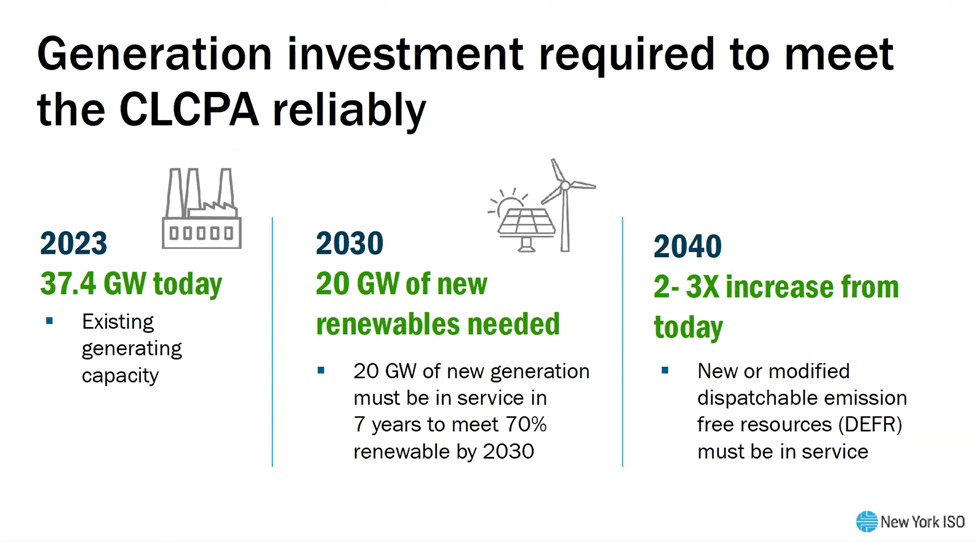
The Scoping Plan adopted by the CAC declares that “wind, water, and sunlight will power most of New York’s economy.”  While its focus is on renewable sources, the CAC does recognize the need for an additional clean source: “plan analysis and current studies show that the 2040 zero-emission goal requires between 15 and 45 gigawatts (GW) of electric power from dispatchable zero-emission resources”. However, NYSERDA finds that little more than 2% of the potential output of such a dispatchable emission-free resource (DEFR) will actually be used.

The authors explain that the Scoping Plan approach is based on a lot of wishful thinking:

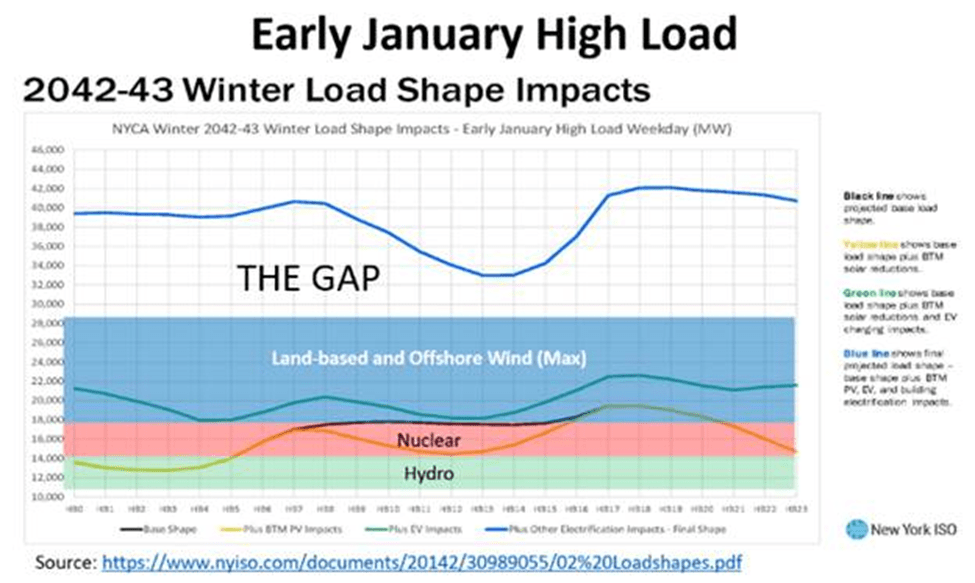
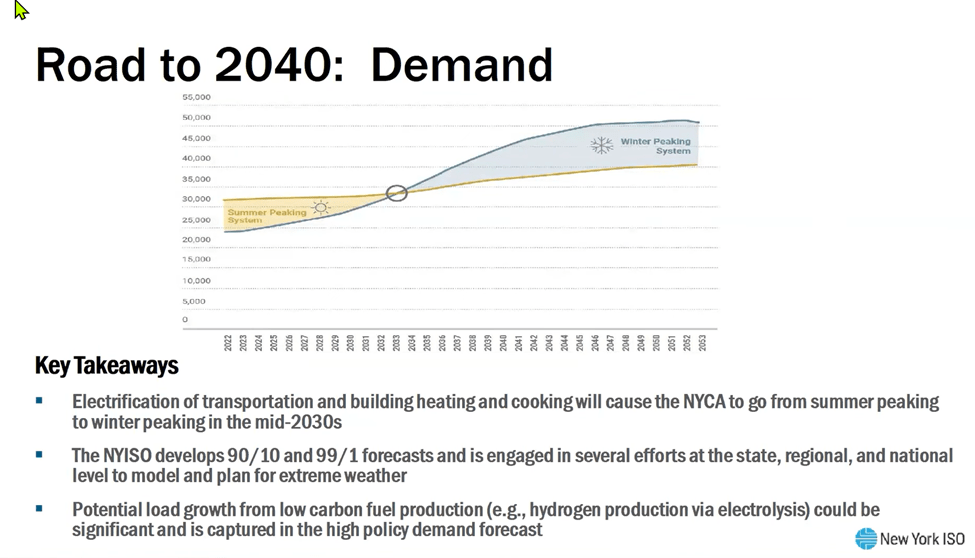
Simple arithmetic makes this seem highly questionable. By 2040, NYSERDA and NYISO, the grid operator, estimate that building and transportation electrification will have expanded so that the grid will have a peak load in winter of 46-50 GW. Yet, even with land-based and offshore wind blowing at full capacity, no more than 35 GW will be available during winter evenings. Little or no excess capacity exists to charge the batteries, and, of course, solar won’t be available. Much more than 2% of the dispatchable source’s potential output has to be available to get through the winter without blackouts.

The CAIC model projects a dramatic difference in the use of DEFR:

Our hour-by-hour analysis shows that the firm dispatchable source has to run two-thirds of the year. The total load has increased from today. The summer peak has been replaced by a much higher winter peak. That greater demand is met by the extended operation of the DEFR which runs during most evenings in the cooler portion of the year. In fact, we find a capacity factor — the fraction of potential output actually used –of 14.4%. Our detailed results are shown below.

In my opinion, the CAIC analysis treats DEFR differently than the Integration Analysis does.  I believe that when the Integration Analysis determines which resources should be applied to meet load, they use DEFR as a last resort.  On the other hand, CAIC uses DEFR much more frequently.  That could be due to a difference in the hourly projections of wind, solar, energy storage, and load for the two models or presumptions in the models.

The final aspect of the modeling is a proposal for an alternative approach:

In this paper we suggest alternatives to NYSERDA’s plan that use baseload nuclear power along with a nuclear-powered firm dispatchable resource (DEFR) to ensure a reliable grid. Our plan costs one-third less than the RFPlan.

DEFR Implications

The CAIC model was also used to evaluate the placeholder Integration Analysis DEFR technology:

NYSERDA suggests, in its Integration Analysis, the use of hydrogen produced with renewable generated electricity to fuel the DEFR. We have examined this case and find that supplying sufficient energy to produce the required hydrogen would necessitate a 40% increase in the number of solar and wind installations, beyond those envisioned in the RFPlan. We are unable to estimate that system’s cost, since it would require creating a new infrastructure to produce, transport, and store a large supply of hydrogen during the summer for use in the winter. Analyzing such a construction project is beyond the scope of this study.

It is not clear how the Integration Analysis deals with hydrogen.  I think that they believe that they have included sufficient wind and solar resources to support hydrogen production using electrolysis.  However, I also think that the Integration Analysis has arbitrarily decided that half of the needed hydrogen will come from out of state.  I think that is a wildly optimistic presumption and very unlikely to occur.  In any event, no one can estimate how much this will cost using the documentation provided.

Nuclear Option

Not surprisingly Nuclear New York proposes nuclear energy as a DEFR candidate.  The Scoping Plan makes a token suggestion that nuclear should be considered but there is no serious attempt to compare nuclear relative to their other technology recommendations.  The report describes the Nuclear New York proposal:

The following scenarios, which we term “Brighter Future,” build upon a 2022 policy proposal

prepared by Nuclear New York, Clean Energy Jobs Coalition NY, and A Campaign for a Green Nuclear Deal. Recognizing that much of New York’s electricity demand is constant throughout the year, Brighter Future utilizes nuclear power as a principal source of clean power throughout the year, not simply as a DEFR when solar and wind are incapable of meeting the load. Nuclear becomes the backbone of the system, not simply a backup to intermittent, weather-dependent renewables.

These scenarios include 7 GW of new baseload nuclear power – adding more than twice what is

already operating in upstate New York – along with 26 to 30 GW of DEFR. Far fewer solar and wind installations are needed; we assume 80% fewer installations than in RFPlan. Our grid model presently does not allow for the DEFR to charge batteries. Since adding batteries that are seldom charged adds unnecessary costs, we exclude them from the Brighter Future scenarios. We will evaluate their inclusion in future research.

The first, Brighter Future 1, has 9 GW of offshore wind, the minimum called for in the CLCPA.

Brighter Future 2 has no offshore wind and costs significantly less. Not only does offshore wind add to the system cost, but it will be shut down, and possibly seriously damaged whenever frequent and increasingly intense storms arrive from the Caribbean and South Atlantic.

The following table from the report summarizes their findings and provides total per-unit generation costs for in-state resources under two DEFR capital cost scenarios: current-cost at ~$6,000/kW and low-cost at ~$3,000/kW.

I agree that nuclear must be used if New York wants to decarbonize safely and suspect that the all-in costs of nuclear will be less than wind, solar, energy storage, and DEFR.

DEFR Options

The report also includes a section describing alternative DEFR technologies.  The report evaluates a number of suggested options:

  • Fuel cells or gas turbines powered by “green hydrogen”: Hydrogen fuel cells or combustion power plants similar to those now burning fossil fuels could run on “green hydrogen” produced in electrolyzers powered by renewable energy, as NYSERDA has suggested. However, such a plan requires the creation of an expensive infrastructure to transport and store the hydrogen, as well as a buildout of additional costly, land-hungry solar and wind facilities to power the hydrolysis plants that produce the hydrogen. Using hydrogen for energy storage is challenged, also, by the fact that the round-trip power-to-gas-to-power (P2G2P) efficiency is just 40%.34 This means more than twice as much additional energy is needed as will be generated by the DEFR, with a commensurate drain on material resources, land, and societal wealth.
  • Long-duration storage: This might help, but currently no realistic scalable form of such storage exists. If it did, it, too, would require a vast expansion of generating capacity if solar and wind power charges whatever storage medium is used.
  • Carbon capture and storage (CCS) attached to gas-fired power plants: This only exists on an experimental basis. It would add substantial cost to the power it was attached to, and there would be upstream leakage of greenhouse gases and other pollutants to the environment. The captured CO2 would have to be disposed of, presumably underground, adding additional cost as well as potential environmental damage.
  • Nuclear power: This is the DEFR energy source used in each of our scenarios, as well as for additional baseload generation in the Brighter Future scenarios. Only nuclear power has been demonstrated to have the necessary capabilities, not only in the gigawatt-scale reactors now operating in New York State and elsewhere, but in the smaller reactors now under commercial development and operating on submarines and ships for over fifty years (many designed in New York State at the Knolls Atomic Power Laboratory).
  • Alternate nuclear options: Alternate ways of using nuclear energy will deserve consideration.  Nuclear reactors, like most energy sources, are most cost-efficient when they run more of the time to meet demand. We found that the DEFR would be operating at partial capacity for most of the year. A more cost-effective plan might use a smaller number of reactors running continuously to produce hydrogen which could be used in fuel cells. Another option would be to use nuclear facilities to produce carbon-neutral synthetic fuels.35,36 Full analysis of the cost and suitability of these options is beyond the scope of this paper, but they deserve serious study.

I agree with their findings.  I will only believe that the State seriously wants to reduce carbon emission if and only if they abandon the wind and solar approach and go nuclear.  As this report explains it is the only viable approach. 

Discussion

The report lists some limitations of the modeling and their research.  Those include: a simplified view of the in-state transmission system, absence of reserves mandated by reliability requirements, fixed cost assumptions, a couple of potential refinements for the nuclear proposals, and optional DEFR designs.

I caution readers that this analysis is not as sophisticated as the work that NYISO does.  Transmission constraints will definitely affect the outcome of projections.  NYISO projections handle all the complications associated with those constraints.  I do not think that the Integration Analysis includes sophisticated transmission constraints either. 

Despite its limitations I do not believe that these limitations affect the general outcomes: DEFR is needed and nuclear is the best option available because it markedly reduces the amount needed.

Dunkelflaute

Dunkelflaute is a “German term that is used in the energy industry to describe a period of multiple consecutive days in which low or minimal energy can be generated by renewable energy sources, such as solar or wind”.  Of course this describes the conditions that drive the need for DEFR. 

In response to comments I submitted on this topic to the  Proceeding on Motion of the Commission to Implement a Large-Scale Renewable Program and a Clean Energy Standard – Zero Emissions Target Case No. 15-E-0302author Leonard Rodberg sent me the following information:

Your analysis of the frequency of overcast and wind lull (“Dunkelflaute”) conditions is impressive and important. However, there are much larger problems with the State’s renewable-focused plan which they and everyone else seem to be ignoring.

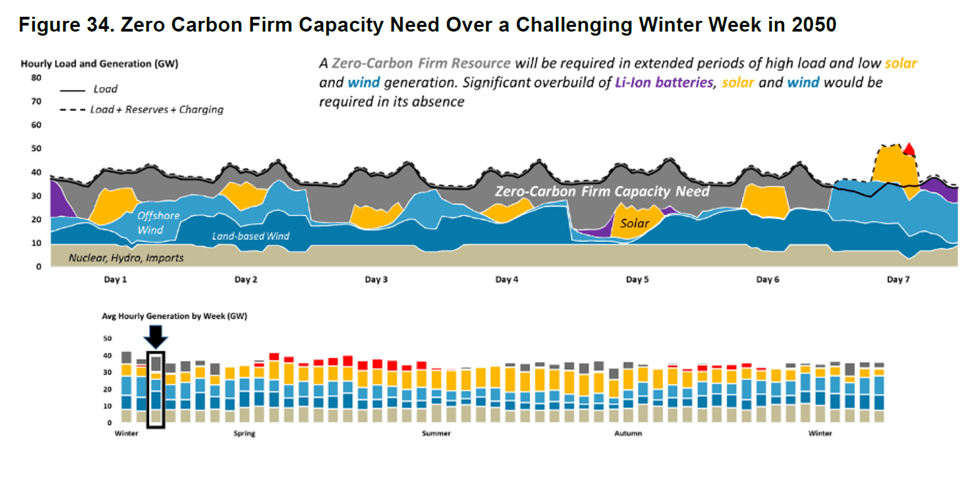
On many winter nights in a fossil-free 2040, there will only be wind and the remaining nuclear and hydro to power the grid. No sun, of course, and batteries uncharged since there’s no excess power during the day to charge them. The result will be many nights when the grid shuts down unless a gap-filling clean firm source is available.

In fact, it’s even worse than that. Both NYSERDA and NYISO project winter peaks of 46-50 GW, but even with their projected wind power at its peak output, there’s just 35 GW available (see the graph below). No one seems to have bothered to add these up, and the model they’re using hides it .

The gap is large and is present much of the year. I’ve used an hourly dispatch model to show what’s really likely to happen in that situation. It’s shown and explained here. (This is a reference to the report described in this article.)

I included this because I think it reinforces the position I wanted to publicize.  DEFR is necessary and the State’s analyses are not treating it well.

Conclusion

I concur with the report conclusion:

We have shown, with a modeling tool capable of performing an hour-by-hour analysis, that

dispatchable emission-free resources are essential to meeting the goal of a reliable, zero-emission grid.  Further, this clean dispatchable source must be able to run a large portion of the year. The only such source likely to be available within the next several decades is nuclear power. The state will further benefit from the deployment of additional baseload nuclear power. This combination of nuclear resources will be more cost-efficient and environmentally-protective than an alternative focused on intermittent weather dependent sources.

Finally note that is another analysis that destroys the Climate Action Council argument that New York can rapidly move away from fossil fuels and instead be fueled completely by the power of the wind, the sun, and hydro using  technologies available at this time.  That is simply not true.

Madison County Wind Farm – Theory vs. Results

I recently stumbled upon an old New York State Energy Research and Development Authority report describing the first New  York industrial wind facility.  This post compares the projections for the facility with the observed performance.

I have followed the Climate Leadership & Community Protection Act (Climate Act)since it was first proposed, submitted comments on the Climate Act implementation plan, and have written over 400 articles about New York’s net-zero transition.  The opinions expressed in this article do not reflect the position of any of my previous employers or any other company I have been associated with, these comments are mine alone.

Overview

The Climate Act established a New York “Net Zero” target (85% reduction in GHG emissions and 15% offset of emissions) by 2050.  It includes an interim 2030 reduction target of a 40% reduction by 2030 and a requirement that all electricity generated be “zero-emissions” by 2040. The Climate Action Council (CAC) was responsible for preparing the Scoping Plan that outlined how to “achieve the State’s bold clean energy and climate agenda.”  In brief, that plan is to electrify everything possible using zero-emissions electricity. The Integration Analysis prepared by the New York State Energy Research and Development Authority (NYSERDA) and its consultants quantifies the impact of the electrification strategies.  That material was used to develop the Draft Scoping Plan outline of strategies.  After a year-long review, the Scoping Plan was finalized at the end of 2022.  Since then State agencies and the legislature have been attempting to implement the plans.

Madison Wind Farm

According to its Wikipedia page:

The Madison Wind Farm is a power generation plant located in the town of Madison, New York. Constructed in 1999-2000, it was the first wind farm completed in New York state and the first merchant wind farm in the country. The power plant consists of seven Vestas V66-1.65 MW wind turbines,[1] generating enough energy to power up to 10,000 homes. The Vestas V66-1.65 MW wind turbines have a hub height of 67m and a 66m rotor diameter totally 100m to the top of the rotor 

It is now owned by EDP renewables.  There have been maintenance issues and talk of decommissioning but could not find anything to confirm that.

The Madison Windpower Project Final Report was prepared for NYSERDA by AWS Scientific, Inc. December 2003.  The Abstract for the report stated that:

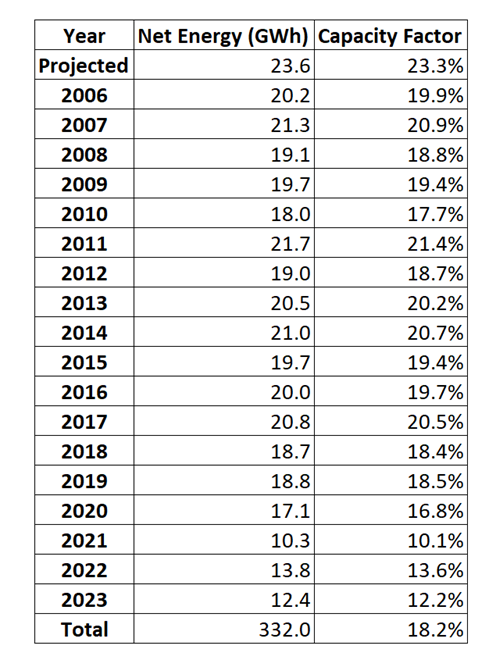
This report covers the development and operation of the Madison Windpower Project in Madison County, New York developed by PG&E Generating. The project began commercial operation in October 2000 and consists of seven Vestas V66-1.65 MW OptiSlip® wind turbines for a total capacity of 11.55 MW. Long­ term wind resource estimates predicted an annual hub-height average wind speed of 7.3 m/s. The net annual plant energy production was predicted to be 23,621 MWh, which would produce a capacity factor of 23.3%. The wind turbines were dispatched and controlled from the PG&E Pittsfield operations center, which was also responsible for substation maintenance. Vestas took charge of inspection, adjustment, and repair of the turbines (both scheduled and unscheduled) and established an operations and maintenance facility in the Madison area. The wind plant produced a total of 61,379 MWh of electricity for three years for an annual average of 20,460 MWh and an overall capacity factor of 21%. The capacity factor is lower than the expected value of 23.3% primarily due to lower than predicted wind speeds and turbine and grid outages.

Observed Operations

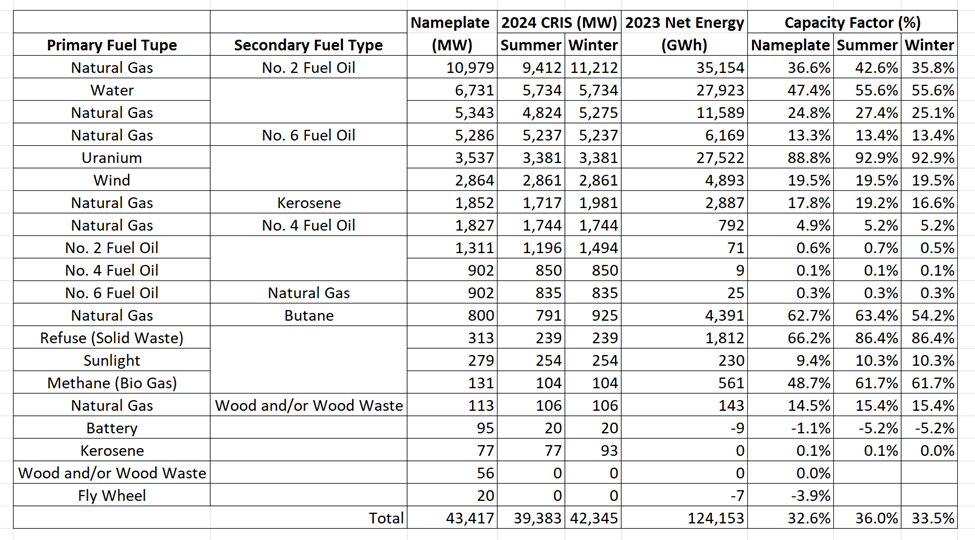
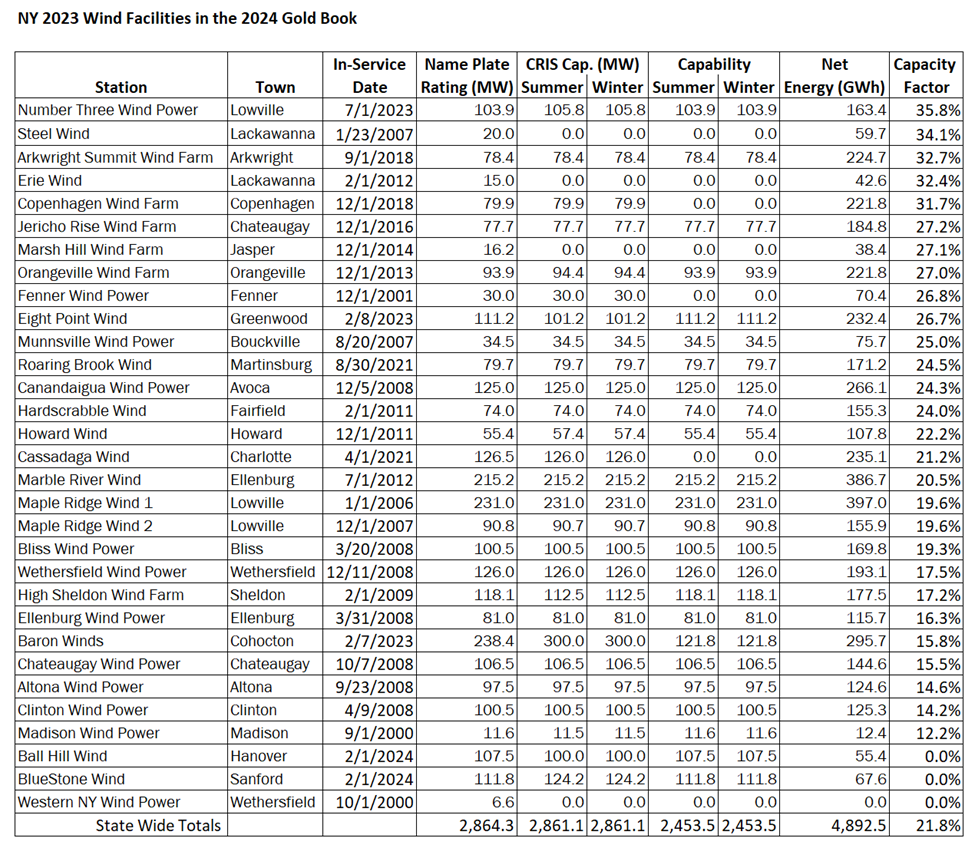
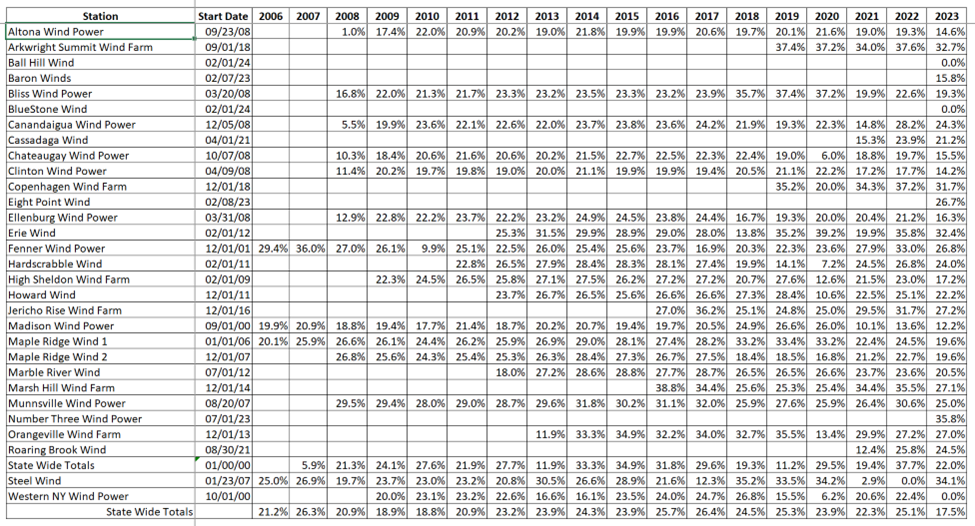
The New York Independent System Operator (NYISO) prepares a report describing load and capacity data for all New York generating units that participate in the electric market.  Universally known s the “Gold Book” it is the best reference for New York electric generation data.  The 2024 Load & Capacity Data Report presents load and capacity data for 2024 and future years. To prepare this summary of Madison Wind Farm operations I relied on a compilation of observed data from Gold Book reports dating back to 2006.

The following table lists the observed net energy (GWh) and capacity factors from 2006 to 2023 and the projections made in 2003 by AWS.  In that analysis the observed capacity factor was 21% in the first three years.  Since then, only one year achieved that level and the last three years the capacity factor was less than 14%. AWS projected that 425 GWh would be produced since 2006 but the energy produced by this facility was only 332 GWh, 22% less.

Table 1: Madison Wind Farm Performance Based on NYISO “Gold Book” Load & Capacity Data Report Table III-1 Including AWS 2003 Projections

The Conclusion of the AWS report summarizes the key findings:

The experience at Madison shows that the energy production from a wind facility is primarily dependent on the actual wind experienced and the performance and reliability of the turbines. The Vestas V66 turbines performed well when they were online because they produced the expected amount of energy for a given windspeed. However, the actual wind speeds experienced during the period and the reliability of the turbines were both lower than expected.

The wind speeds were lower than expected due to the incomplete meteorological record used to predict the wind resource, the lower-than-average wind speeds in this region of the state during plant operation, and the difference in elevation of the project met towers. This experience demonstrates the need to have sufficient long-term meteorological data in order to predict a wind plant’s energy production accurately. Continued evaluation of the projected wind speeds during plant operation can clarify trends and enhance understanding of the site’s wind resource. As such, it is expected that the overall wind resource at Madison will be more favorable during the lifetime of the plant.

The reliability of the machines was lower than expected due to the gearbox failures and other component difficulties discussed earlier in the report. These failures highlight the need for robust turbine reliability warrantees to protect turbine owners against loss of revenue in the case of such unexpected turbine component failures. On the positive side, excellent lightning protection in the V66 resulted in fewer outages due to static discharge than have been observed at other sites.

Discussion

As the first industrial wind facility Madison Wind Farm performance was evaluated in the AWS project.  The report claims that it was a successful demonstration of large-scale wind development.  I agree that it provides power and the information learned from it has been used to integrate other projects.  However, I have concerns about the poor availability and decreasing capacity factors.

It was obvious at the time of the analysis that the projected capacity factor was lower than projected.  The report argues that this was due to inadequate meteorological monitoring but optimistically notes the wind resource will be “more favorable during the lifetime of the plant”.  That did not happen.  The actual production since 2006 is 22% lower than they anticipated.

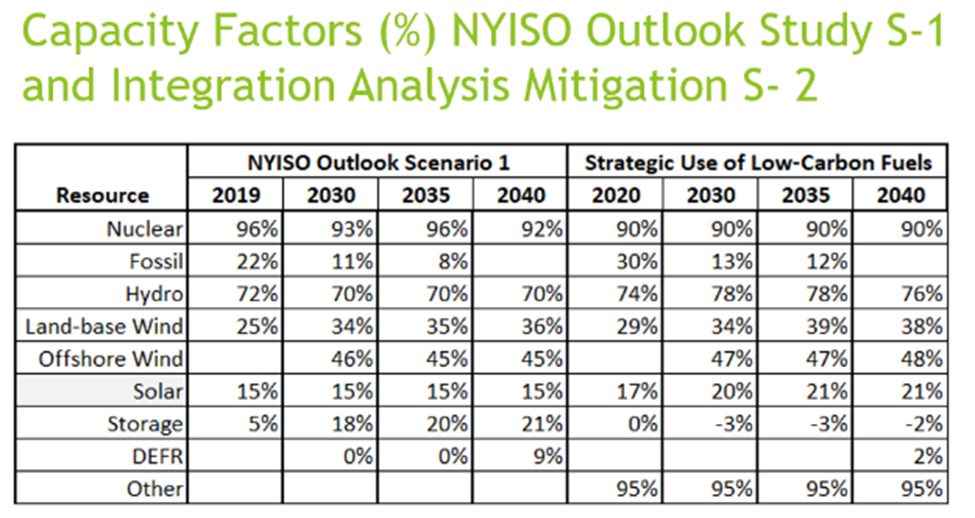
I think over-optimism is a characteristic of NYSERDA.  The NYSERDA Integration Analysis projected a state-wide wind capacity factor of 29% in 2020 increasing to 34% in 2030.  The Gold Book statewide capacity factor in 2020 was 23.9%.  The Integration Analysis projected New York land-based wind in 2030 would generate 5,043 GWh but the actual production was only 4,162 GWh, 18% lower than they projected.  In addition, the Integration Analysis did not acknowledge that as wind systems age their performance drops.

NYSERDA’s Integration Analysis quantified the generating resources that will be needed to meet the Climate Act mandates.  However, comparison of observed and projected energy production shows that they have overestimated energy production which means that more wind capacity will have to be developed and that the costs will necessarily be higher than they projected.  Unfortunately, there has not been any reconciliation between Integration Analysis projections and observations to refine their projections.  This is in keeping with their complete lack of response to technical issues raised in comments on the Scoping Plan. 

Conclusion

The performance of the first wind farm in New York is considerably less than projected.  This is consistent with the observed and projected Integration Analysis 2020 statewide wind generation.  These results should be used to refine the Scoping Plan but there is no indication that NYSERDA is considering such an effort. This is just one more example of the flaws hidden behind a veneer of political slogans that claim all is well with the Climate Act.  Eventually it will become obvious that the Hochul Administration electric system “plan” is incompatible with reality.  Unfortunately failing to address these issues promptly will increase costs and reliability risks

Solar Developer “Disinformation” Reality

Charles Rotter passed along a link to an article by a solar energy developer in New York that claims disinformation campaigns were hurting New York’s implementation of the Climate Leadership and Community Protection Act (Climate Act).  After I looked at the article, I can safely say that it’s another example of my pragmatic environmental principle Observation on Environmental Issue Stakeholders: The more vociferous/louder the criticisms made by a stakeholder the more likely that the stakeholder is guilty of the same thing.  This post looks at disinformation claims associated with a solar development project in New York.

I have followed the Climate Act since it was first proposed, submitted comments on the Climate Act implementation plan, and have written over 400 articles about New York’s net-zero transition. The opinions expressed in this post do not reflect the position of any of my previous employers or any other organization I have been associated with, these comments are mine alone.

Overview

The Climate Act established a New York “Net Zero” target (85% reduction in GHG emissions and 15% offset of emissions) by 2050.  It includes an interim 2030 reduction target of a 40% reduction by 2030 and a requirement that all electricity generated be “zero-emissions” by 2040. The Climate Action Council (CAC) was responsible for preparing the Scoping Plan that outlined how to “achieve the State’s bold clean energy and climate agenda.”  In brief, that plan is to electrify everything possible using zero-emissions electricity. The Integration Analysis prepared by the New York State Energy Research and Development Authority (NYSERDA) and its consultants quantifies the impact of the electrification strategies.  That material was used to develop the Draft Scoping Plan outline of strategies.  After a year-long review, the Scoping Plan was finalized at the end of 2022. 

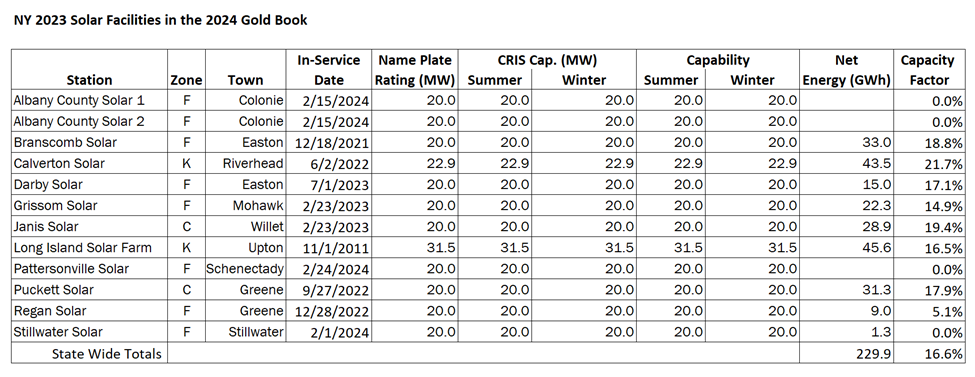
Correction 6/13/2024: Keith Schue contacted me to say that I had used the wrong numbers in this statement: “The Integration Analysis projects that 5,574 MW by 2030 compared with 21,058 MW in 2023 so solar deployment must double over the next seven years.”  Boy did I ever use the wrong numbers.  Those are the onshore wind numbers.  The utility-scale solar facility capacity that is included in the NYISO market in 2023 was only 254 MW and the Behind the Meter (BTM) distributed solar included in the Integration Analysis estimate was 5,172 MW for a solar total of 5,426.  NYISO projects that BTM solar in 2030 will be 10,015 MW and the Integrated Analysis projected 2030 solar capacity is 18,646 MW which means that utility-scale solar capacity will have to increase from 254 MW to 8,631 MW.

Hecate Energy Shepherd’s Run Solar Farm

Hecate Energy’s Shepherd’s Run is a 42 MW utility-scale solar facility located in Copake, NY in the Hudson River Valley southeast of Albany.  According to Hecate: “It will be configured as a ground-mounted solar facility with PV panels on galvanized steel tracker racking structures. It will include rows of single-axis trackers, oriented in a north-south direction, that rotate the PV panels from east to west following the sun’s daily path.”  They also claim that “The 42-MW solar farm is expected to annually generate approximately 70,000 MWh of energy — enough to meet the average annual consumption of over 9,500 New York households.”  That works out to a capacity factor of 19.3%.  The permitting documents note that the project area is 880 acres, the project footprint is 267 acres and there will be 138.3 acres “located inside the Project security fencing” which I assume means that is the area to be covered by solar panels.

This area of the Hudson Valley has attracted influential folks with money from New York City because of the beauty and rural character of the region which has led to a couple of things.  I think that contributes to the attention this project has received in the national media.  Bloomberg Opinion described it as “The Solar farm that almost destroyed Copake, NY”.   In a Reveal podcast, The Center for Investigative Reporting also addressed the project in “Sunblocked: Resistance to Solar in Farm Country” with the byline “Across the country, rural communities are pushing back against large-scale solar development”.  The other aspect of the moneyed class influence is the desire and the money to fight against anything that detracts from the reasons the “Citidiots” invaded this area.

In 2017 Hecate identified this area for solar development because it offered room for solar development, a nearby electrical substation, and according to the Bloomberg article “Democratic political leadership, and a relatively liberal bent, Copake seemed poised to be a welcoming environment for renewable energy.”  I believe Hecate originally submitted a permit application under New York’s original electric utility siting program, but I cannot find any links for that application.  However, local opposition sprang up early in that process.  The town changed its zoning rules to stymie large solar developments.  Hecate changed to a new permitting process implemented to expedite renewable energy development.  On November 23, 2021, they submitted a notice of intent to file for an application to the New York State Office of Renewable Energy (ORES) that can overrule any “home rule” regulations by the residents directly affected by a solar or wind facility.

The local NPR account of the status of the project, Shepherd’s Run solar farm moving ahead in Copake, produced last November noted:

In June 2021 the town of Copake joined 12 other municipalities along with some environmental and conservation advocate organizations in filing a lawsuit in state Supreme Court of Albany County against the state Office of Renewable Energy Siting, an agency created to fast-track the permitting process for new renewable energy projects. The suit alleged that the agency was attempting to circumvent local zoning laws. In May 2023, Justices of the Third Department state Appellate Court upheld a lower court ruling dismissing the lawsuit.

The NPR article went on to explain the remaining parts of the permitting process that included public hearings in January.  However in early January the public hearings were called off because the Town of Copake filed a motion to dismiss the application because 60 acres of the project property were sold to someone who did not want anything to do with the project.  The ORES permit application website notes under “denied applications” that the application was denied without prejudice.

Disinformation Campaign

After years of effort and cost, Hecate was not happy with the decision.  The article “Disinformation Campaigns Are Hurting New York’s Clean Energy Future” was published at RealClearEnergy and authored by Matt Levine who is the “project director for the Shepherd’s Run Solar Farm and senior director of development for Hecate Energy.”  He claims that the opposition was the result of disinformation as noted in the excerpts below.

After the obligatory praise for “the ambitious goals set by the landmark climate law passed in 2019” he jumps right into the evils of disinformation campaigns:

Whether or not you support accelerating clean energy projects, we should all be able to agree that disinformation campaigns are a disservice to the public. Honest policy debates demand clear and accurate information. But earlier this year, NPR highlighted the prevalence of disinformation and increasing pressure on local officials, who are often charged with approving renewable energy projects.

Their reporting focused on groups like Citizens for Responsible Solar, who are part of a growing national effort to orchestrate opposition to renewable energy in rural communities across the U.S. The national group has helped smaller local groups fight solar projects in at least 10 states, according to its website.

This NPR article referenced a group called Citizens for Responsible Solar that argues that “Solar belongs on rooftops, near highways, commercial, industrial-zoned land, marginal or contaminated areas, not on rural-agricultural land.”   The organization and a group of locals organized opposition to a solar project in Virginia but there is no indication that there is any link between that group and anything at the Shepherd’s Run Solar Farm.  Levine goes on:

By blocking projects that could generate economic activity and passive tax revenue in rural areas, these campaigns are hurting the communities they purport to protect, both economically and environmentally. Nevertheless, groups like these are becoming so successful at spreading disinformation that a 2022 report by the Sabin Center at Columbia University found 121 local policies around the country that are aimed at blocking or restricting renewable energy development, a 18% increase from the previous year.

Solar developers are quick to point out that a landowner gets revenue when a solar project is developed and there are tax incentives.  However, when land is taken out of production it will reduce farm jobs. While economic activity may be improved during construction once the facility is operational there are very few economic benefits to essential local businesses.  Furthermore, taking the land out of production may make other farmers who have been renting that land to make their operations viable will not be able to support investments they have made in facilities, livestock, or equipment.  Levine continues:

In New York, an investigation by the Public Accountability Initiative found that since 2016, a multifaceted campaign by the fossil fuel industry has spent more than $15.5 million to undermine efforts to promote clean energy. Unfortunately, much of that work has relied on false and misleading information.

The claim that there is an enormous effort by the fossil fuel industry to provide false and misleading information ignores the funding and level of effort by non-governmental organizations who espouse the climate industry’s narrative and the source of their funding.  The Natural Resources Defense Council had a total income of $193,144,386 and paid $125,417,997 in salaries in 2023.  Their experts web page notes a position for the Utility Regulatory Director, New York, Climate & Energy and that 69 other experts have done analyses in New York.  That is just one organization.  There are dozens more organizations in New York that support the climate industry and their work is rife with false and misleading information.

The playbook is usually the same. Groups with innocuous sounding names — New Yorkers for Affordable Energy, for example – claim the mantle of grassroots support while actually doing the bidding of the natural gas industry. They lean heavily on misleading industry talking points that falsely claim the transition to renewable energy would “damage New York’s families and businesses.

I can find nothing to disagree with his characterization that New Yorkers for Affordable Energy is funded by the natural gas industry.  However, the docket for the project does not include anything from the organization or the one individual mentioned on their web page in the 627 filed documents or the 1,000 public comments in the docket for the permit.  He simply names an industry supported organization and suggests that their very existence is unacceptable.

Eventually Levine gets to Shepherd’s run and blames misinformation as the reason that there was so much vociferous opposition.

As a renewable energy developer working in several states in the Eastern U.S., I see the impact of these efforts on the ground. Take the town of Copake in Upstate New York, where Hecate Energy plans to build the 42 GW Shepherd’s Run Solar Farm.

This is exactly the type of project New York must accelerate if the state has any chance of meeting the state’s renewable energy goals. Yet, opponents have implemented tactics that have delayed the project for years, running the now-standard playbook.

See if this sounds familiar: a group with an innocuous sounding name – in this case Sensible Solar for Rural New York – bills itself as a grassroots organization and claims to support clean energy. Media reports and state disclosure forms show them hiring the same lobbying firms and marketing teams employed by the fossil fuel industry and its allies to oppose clean energy projects.

They echo the same talking points used by national opposition groups, relying on false or misleading claims about farmland being permanently destroyed, adverse impacts to nearby watersheds, and reduction in property values.

I recommend the Reveal Podcast “Sunblocked: Resistance to Solar in Farm Country” because it describes the nuances of the Shepherd’s Run support and opposition.  Interviews with one family that sold leases to Hecate, Hecate spokesmen, another farmer who was using the land that will no longer be available, Town Board members, an expert on support and opposition to similar projects, and organizers of Sensible Solar for Rural New York provide a good cross section of those involved.  While some of the opponents were against the project simply because it is in their backyards many argued that they would accept the project if it were done sensibly.

I was involved in many development projects in my career, so I sympathize with the Hecate project developers.  There is no way that you can make everyone happy, and some individuals will never be satisfied.  In my opinion, the solution is to be upfront with the facts and be sure to meet or exceed all the regulatory guidance. 

Prime Farmland

I am not a big fan of solar development in New York and have published a page that describes my concerns.  My biggest concern is that the Hochul Administration has not required solar developers to adhere to all the NYS Department of Agriculture and Markets (NYSDAM) guidelines that have been described in prepared testimony that I believe represent best practices and should be mandatory going forward.  In particular, “The Department’s goal is for projects to limit the conversion of agricultural areas within the Project Areas, to no more than 10% of soils classified by the Department’s NYS Agricultural Land Classification mineral soil groups 1-4, generally Prime Farmland soils, which represent the State’s most productive farmland.”   I think this is a reasonable guideline and one that should be a mandatory requirement for all future projects.

The initial application for the project Agricultural Appendix 15 February 2022 stated that: “Relative to agricultural soils, the Project Area includes approximately 12.41% (218.00 acres) of land classified as Prime Farmland, 5.33% (93.70 acres) as Prime Farmland if Drained, 10.27% (180.42 acres) as Farmland of Statewide Importance, and 21.99% (386.44 acres) as Not Prime Farmland.”   Note that they admit that they exceed the NYSDAM guidelines.

In a revised version of the Agricultural Appendix submitted on January 2023 this discussion is revised:

The total Project Footprint will include approximately 265 acres and includes the limits of all temporary and permanent impacts associated with the construction and operation of the Project.  There are 197.69 acres of active agricultural land in the Project Footprint. The Project is designed within a fenced and contained area, and no active agricultural practices will occur within the fenced area containing the solar arrays during the operation of the Project. Therefore, the applicable NYSDAM Guidelines will be followed during construction with respect to temporary features (such as construction laydown yards). If applicable NYSDAM Guidelines cannot be implemented, the Applicant will consult with NYSDAM to discuss acceptable and appropriate alternatives. The Applicant will follow the NYSDAM Guidelines during Project decommissioning and site restoration.

Two comments on this.  The prime farmland numbers are missing and the NYSDAM Guidelines they refer to are the construction guidelines and not the guidelines for the protection of prime farmland that NYSDAM staff references in their prepared testimony for every application.

The final Revised Agricultural Appendix dated June 2023 included the following:

Hecate Energy Columbia County 1 LLC (the Applicant) has developed this Agricultural Plan in accordance with 19 NYCRR § 900-2.16 in order to avoid, minimize, and mitigate agricultural impacts to active agricultural lands within NYS Agricultural Land Classified Mineral Soil Groups (MSG) 1 through 4 to the maximum extent practicable, consistent with the New York State Department of Agriculture and Markets (NYSDAM) Guidelines for Solar Energy Projects (“NYSDAM Guidelines” or “Guidelines”).

Two comments on this section.  The reference to prime farmland has switched to the technical description of soil types and the references to Guidelines are again for the construction impacts.  The phrase that they tried to avoid, minimize, and mitigate agricultural impacts is not exactly true because they picked only the NYSDAM guidance that that they were required to follow.  Furthermore, in response to a notice of incomplete application they were asked to provide the acreages for each soil classification.  Their response in the final revision states:

There are approximately 200 acres of active agricultural land in the Project Footprint. As described in Exhibit 15 Section 15(b) of the Application, of the 199.98 acres of active agricultural land in the Project Footprint, 143.86 acres are classified as MSG 1-4. The Project is designed within a fenced and contained area, and no active agricultural practices will occur within the fenced area containing the solar arrays during the operation of the Project. Of the 162.8 acres of MSG 1-4 in the Project Footprint, and 143.86 acres are identified as active agricultural land. Therefore, the applicable NYSDAM Guidelines will be followed during construction with respect to temporary features (such as construction laydown yards) and permanent features (such as permanent access roads) within the 143.86 acres of active agricultural lands, as defined by 19 NYCRR § 900-2.16(c), within New York State Agricultural Land MSGs 1-4. If applicable NYSDAM Guidelines cannot be implemented, the Applicant will consult with NYSDAM to discuss acceptable and appropriate alternatives. The Applicant will follow the NYSDAM Guidelines during Project decommissioning and site restoration.

Note that the incriminating percentages were not included.  Obfuscation is the name of the game for the acreages.  Elsewhere the project footprint is listed as 267 acres but here they describe the active agricultural land (200 acres).  They do admit that 143.86 acres are prime farmland and that works out to 16% of the project area of 880 acres (also not provide in this paragraph) far exceeding the NYSDAM protection of prime farmland protection guidance of no more that 10%.

Maps of the locations of prime farmland and the location of the solar panels show that the developers chose the expedient and cheapest development option.  If the land is flat and has no trees then installing solar panels is simplified.  The example map below shows why the residents are so exercised by the development.

Figure 15-11. Map 3 of 5 ORES and Local Zoning Requirements with MSG 1-4 Soils-Active June 2023

Discussion

The Hochul Administration has not mandated that utility-scale solar development must comply with all Department of Agriculture and Markets guidelines.  Solar developers routinely ignore that guideline.  My latest scorecard of this parameter shows that only seven of the 20 projects included as updated in March 2024 met the prime farmland guidance and that overall solar projects have destroyed 8,801 acres of prime farmland and totaling 20% of the project areas.  However, it does show that meeting the guideline can be done.

This is not the fault of the solar developers.  In the absence of any requirement to meet that guidance the cost-effective solution for the out-of-state developers is to ignore the guidance.  The fact that the Hochul Administration has instituted that requirement for smaller distributed solar projects is infuriating to me and has the distinct whiff of cronyism and lobbyist influence.  That is not the only missing protection.  There are no requirements for agrivoltaics that at least try to support farming or requirements for tilting axis solar panels consistent with the implementation plans.  To their credit, Hecate was planning to use the tilting axis panels and their projected a capacity factor of 19.3% is better than last year’s statewide average.  Using fixed panels means that more panels must be installed.

I do not have any sympathy for Hecate project manager Matt Levine’s claims that a pervasive cult of fossil-fuel funded disinformation was the primary driver for the opposition to the project.  Clearly, they took the expedient approach to develop the prime farmland in the project area knowing full well that it exceeded New York guidelines for farmland protection.  Moreover, the language in the article and application cover up that decision.  If the application is not above board in every respect, then the locals sense they are being taken for a ride.  Unfortunately, the only reason that the project was rejected was because of a last-minute change in ownership that nullified the application.  If it not for that reason, then the application would have been approved despite the well-founded local opposition.

Conclusion

I do not think that solar energy that will not provide adequate support to the electric grid when it is needed the most (winter peak loads) is a sustainable electric grid resource so I oppose its use for utility-scale applications.  But if that is state policy to develop solar then at least deployment should minimize impacts.  That is not the case in New York. The real disinformation in this instance is the insistence that there are no legitimate problems with solar deployment as suggested by the author of “Disinformation Campaigns Are Hurting New York’s Clean Energy Future”.

Status Update on New York Wind and Solar Capacity Factors

Last year I published an article describing the New York Independent System Operator (NYISO) Load & Capacity Data Report (also known as the “Gold Book”) and how I used it.  This post uses the latest edition to determine the wind and solar capacity factors last year.

I have followed the Climate Act since it was first proposed, submitted comments on the Climate Act implementation plan, and have written over 400 articles about New York’s net-zero transition. The opinions expressed in this post do not reflect the position of any of my previous employers or any other organization I have been associated with, these comments are mine alone.

Overview

The Climate Act established a New York “Net Zero” target (85% reduction in GHG emissions and 15% offset of emissions) by 2050.  It includes an interim 2030 reduction target of a 40% reduction by 2030 and a requirement that all electricity generated be “zero-emissions” by 2040. The Climate Action Council (CAC) was responsible for preparing the Scoping Plan that outlined how to “achieve the State’s bold clean energy and climate agenda.”  In brief, that plan is to electrify everything possible using zero-emissions electricity. The Integration Analysis prepared by the New York State Energy Research and Development Authority (NYSERDA) and its consultants quantifies the impact of the electrification strategies.  That material was used to develop the Draft Scoping Plan outline of strategies.  After a year-long review, the Scoping Plan was finalized at the end of 2022.  In 2023 the Scoping Plan recommendations were supposed to be implemented through regulation, PSC orders, and legislation.  That process is falling behind as the enormity of the challenge becomes clearer.

Capacity Factor

The capacity factor is a useful metric to understand electric generation resources.  The annual capacity factor for a generator equals the actual observed generation (MWh) divided by maximum possible generation (capacity in MW times the hours in a year).  Projections for the amount of future wind and solar generation capacity needed for the Climate Act depend on capacity factor assumptions.

Not surprisingly, the aspirational schedule of the Climate Act has proven to be more difficult to implement than planned and many aspects of the transition are falling behind.  Worse, there has not been any indication that the Scoping Plan is being refined to incorporate the lessons learned in the years since it was drafted or address any of the issues u raised in the comments.  The capacity factor assumptions are a prime example of an issue that needs to be addressed.

Wind and Solar Capacity Factor Projections

I have previously summarized future resource projections. The New York Independent System Operator (NYISO) 2021-2040 System & Resource Outlook is part of the NYISO Comprehensive System Planning Process.  That analysis included several scenarios for the future grid that includes capacity factor projections.  The Integration Analysis also included several scenarios and capacity factor projections.  In both instances the capacity factor projections determine how much wind and solar capacity will be needed in the future.

I am not the only one who submitted comments about the Scoping Plan capacity factors.  I pointed out that the Integration Analysis land-based wind capacity factors were unrealistically high.  The model projected the 2020 generation with a capacity factor of 29% but the 2021 observed capacity factor was only 22%.  The Integration Analysis model could not even get the starting year correct.  As a result, the Integration Analysis projections for the land-based wind capacity needed to meet the load are too low.  It is particularly disturbing that the State has never attempted to reconcile the NYISO projections and assumptions with the Integration Analysis.  For all renewable resources the Integration Analysis capacity factors are higher than the NYISO projections as shown below.

2023 Wind and Solar Observed Capacity Factors

The New York Independent System Operator (NYISO) 2024 Load & Capacity Data Report (also known as the “Gold Book”) is now available and has been posted on the NYISO website: 2024 Load & Capacity Data Report (Gold Book).  Many of the most useful tables are also provided as spreadsheets.  The following supplemental materials have also been posted:

The Existing Generating Facilities spreadsheet was used to calculate New York capacity factors.  The first table sums the capacities and net energy for all the combinations of primary fuel type and secondary fuel type for all the generators tracked by the NYISO.  This includes units that are in the market system as well as others that are not.  The nameplate capacity of generating units that use natural gas and can also burn number 2 fuel oil is the largest category in the state.

2024 NYISO Gold Book Tables III – 2a NYISO Market Generators and Table III – 2b Non-Market Generators 2023 Capacity, Energy, and Capacity Factors

The next table lists the capacity data and net energy produced for the wind generating units in New York.  Using that data, it is possible to calculate the capacity factors for each facility.  The NYISO Resource Outlook and the Integration Analysis both assume a 34% capacity factor in 2030.  Only two wind farms exceeded 34% and there were only three more that were over 30% capacity of the 31 wind farms in New York.  The overall capacity factor was 21.8%.  In order to achieve the assumed capacity factor for 2030 most of the existing wind farms will have to be replaced.  The Integration Analysis does not retire any of the existing wind farms which I suspect is so that the cost estimate does not have to include those costs.

I have been tracking the wind farm capacity factors since 2006 as shown in the next table.  There is nothing to suggest that 2023 was an abnormal year.  In order to meet the 2030 projections these wind farms are going to have to be replaced or a large number of wind farms with much higher capacity factors that will bring the average up will have to be built.  The data shown are also interesting as they show large interannual variation by site and the state overall.  Finally note that the NYISO wind capacity factor for 2019 was modeled as 25% but the observed capacity factor was  22.3%.  The Integration Analysis did not get their first year correct either.  It modeled the 2020 capacity factor as 29% but the observed capacity factor was only 23.9%.

New York State Wind Facility Capacity Factors Based on NYISO “Gold Book” Load & Capacity Data Reports Table III-1

There is much less historical information available for solar facilities so only the 2023 data are presented.  In 2023 the capacity factor of the solar facilities in New York was 16.8%, the highest capacity factor was 21.7% and the lowest credible capacity factor was 14.9%. The NYISO assumed a capacity factor of 15% from 2019  to 2040.  On the other hand, the Integration Analysis assumed a capacity factor of 17% in 2020 increasing to 20% by 2030. 

Discussion

The NYISO has interesting generation resource information available in its Gold Book.  As shown here, that information can be used to calculate the capacity factors for wind and solar resources in New York.  The annual capacity factors observed are consistently lower than the values used in the Integration Analysis which is being used to implement the state plan to meet the Climate Act mandates.  As a result, The Scoping Plan is underpredicting the wind and solar resources necessary to generate the energy they project will be needed. That also means that their cost projections are too low.

It is troubling that the differences shown here between the NYISO capacity factors and the Integration Analysis capacity factors have not been reconciled.  Worse, none of the differences between the two sets of projected resource projections have been addressed.  This matters not only because the differences affect the projected outcomes and the costs, but also because Integration Analysis projections are being used for the New York Cap-and-Invest (NYCI) Program proposal.  A key component of the NYCI plan is the trajectory for allowance allocations.  NYCI’s reduction trajectory is based on the Integration Analysis and the overly optimistic capacity factors used means that they are projecting lower emissions than is likely to occur.  That imbalance could have significant consequences to the allowance market.

One other point is that these are annual metrics.  In order to assure that the electric grid will be able to provide energy when it is needed the most the NYISO must deal with resource availability over shorter periods.  Think of it as the capacity factor over the coldest week of the year.  That is a much more difficult issue and one that the Scoping Plan has not addressed.

Conclusion

This post documents the most recent wind and solar capacity factors observed in New York.  It is notable that the wind data show a lot of interannual variation that should be considered when projecting future resource availability.  These data have not been incorporated into an updated analysis of the generating resources needed to achieve the Climate Act goals. 

I have long argued that the State’s plans for implementing the Climate Act mandates must include a feasibility study that could address the observed variability and lower capacity factors.  Given the tremendous uncertainties like these shown here, I have recently decided that a feasibility study is not enough.  No jurisdiction anywhere has successfully demonstrated an electric grid that depends on wind and solar to the extent that the Scoping Plan does.  Before New York goes any further it should prove it can be done with a demonstration project.  Anything less risks catastrophic blackouts and enormous costs.

Grid Planning to Meet Climate Act Goals Documentation

Note:  This documents all the slides in the Grid Planning to Meet Climate Act Goal presentation.  I also prepared a summary of the material in this post.

In order to meet the Climate Leadership & Community Protection Act (Climate Act) mandates for a zero-emissions electric grid by 2040 a massive effort to deploy wind, solar, and energy storage resources and an enormous upgrade to the electric transmission system is needed.  I have previously described issues associated with generating portion of this transition.  This post documents the Alliance for Clean Energy New York (ACENY) webinar “Grid Planning to Meet Climate Act Goals” that addressed the transmission challenges in a lot of detail.  A summary is also available.

I have followed the Climate Act since it was first proposed, submitted comments on the Climate Act implementation plan, and have written over 400 articles about New York’s net-zero transition. The opinions expressed in this post do not reflect the position of any of my previous employers or any other organization I have been associated with, these comments are mine alone.

Overview

The Climate Act established a New York “Net Zero” target (85% reduction in GHG emissions and 15% offset of emissions) by 2050.  It includes an interim 2030 reduction target of a 40% reduction by 2030 and a requirement that all electricity generated be “zero-emissions” by 2040. The Climate Action Council (CAC) was responsible for preparing the Scoping Plan that outlined how to “achieve the State’s bold clean energy and climate agenda.”  In brief, that plan is to electrify everything possible using zero-emissions electricity. The Integration Analysis prepared by the New York State Energy Research and Development Authority (NYSERDA) and its consultants quantifies the impact of the electrification strategies.  That material was used to develop the Draft Scoping Plan outline of strategies.  After a year-long review, the Scoping Plan was finalized at the end of 2022.  In 2023 the Scoping Plan recommendations were supposed to be implemented through regulation, PSC orders, and legislation.  Not surprisingly, the aspirational schedule of the Climate Act has proven to be more difficult to implement than planned and many aspects of the transition are falling behind. 

ACENY Webinar

On April 11, 2024, Alliance for Clean Energy New York (ACENY) hosted a webinar entitled “Grid Planning to Meet Climate Act Goals” that was recorded on a video.  The webinar was moderated by Chris Casey, from the NRDC and featured speakers from the Department of Public Service (DPS), New York Independent System Operator (NYISO), and National Grid.  This article describes each speakers presentation and provides links to sections of the video so that readers can follow the presentations.
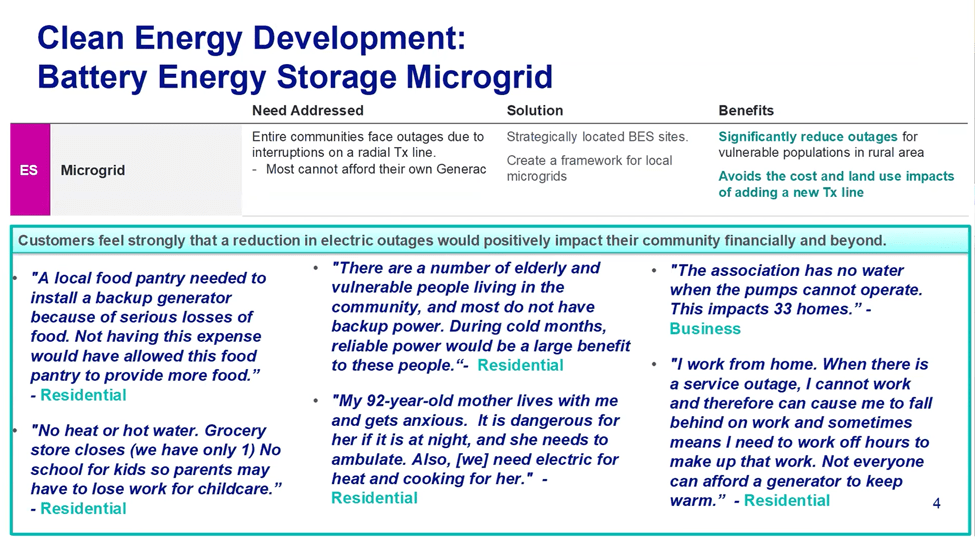
Chris Casey, a lawyer from the NRDC opened the webinar with an overview. It was not surprising that his Chris Casey, a lawyer from the NRDC opened the webinar with an overview. It was not surprising that his introduction ticked all the boxes.  New York is on the “forefront of the transition to address the “impacts of destructive climate change”, increase access to “affordable” renewable energy, bolster “resilience against life-threatening extreme energy events”, all while “creating jobs and delivering substantial economic benefits”.  Behind the rhetoric, however, reality lurks, and it does not look so grand.  In the following sections I include slides and links to the section of the video that discusses the slide.

DPS Presentation

Elizabeth Grisaru (Senior Policy Advisor) from the DPS made the first presentation “Planning for Future Electric System Needs”.  One of her main job responsibilities is transmission planning associated with the Climate Act transition.  During her introduction she included a slide that illustrates the connections between generators and customers that were the focus of the webinar.

The “Impact of Climate Objectives” slide describes the general issues associated with the transition.

The description of the slide “PSC Initiatives since 2020” outlined projects costing over $6 billion that are over and above what is needed to keep the system running.  The investments are for both Climate Act needs and reliability issues.  What was not included was the breakdown between the two needs or any estimate of how much more will be needed.  It is clear that many more investments will be required.

The transition to an electric system that depends upon diffuse wind and solar requires a significant upgrade to the transmission system.  The PSC has a new “Coordinated Grid Planning Process” to address this issue. 

Note, however, that the first of the new CGPP reports is not going to be available until the Fall of 2025.  It is not clear if the CGPP is going to help at all to meet the 2030 target.

The DPS final slide addresses outstanding issues.  On one hand existing sources of generation are being forced to retire while on the other hand electrification initiatives are increasing loads.  She claimed that at the PSC “We all agree reliability is the most important thing we have to worry about”.

NYISO Presentation

NYISO Director of System Planning Yachi Lin talked about their plans to implement a clean and reliable grid.  Her introductory explanation gave a good overview of the NYISO.  The following slide describes the planning process.  There is a two-year cycle of reliability planning that includes quarterly checks on the status of the system. 

The following slide describes the generation system and the investments expected to be needed.  Existing generating capacity is 37.4 GW, but an additional 20 GW must be in service in seven years to meet the 2030 goal.  The unanswered question was whether this is feasible.

Lin explained that additional transmission is needed to meet the 2030 70% renewable energy goal.  The following slide shows different areas of the state that do not have adequate transmission capabilities to prevent curtailments.

To respond to the need for additional transmission the NYISO planning process is supporting “unprecedented expansion”.

The quarterly Short-Term Assessment of Reliability (STAR) reports should be required reading for anyone interested in the New York electric system so Lin’s explanation is important.  The following slide notes that last years second quarter report noted that there was a reliability deficit of 446 MW in the summer of 2025.  The deficit was projected because of fossil unit deactivations.  In response, NYISO opened a solicitation for market solutions or regulatory solutions.  No feasible market solution was submitted. 

To maintain reliability, NYISO had to resort to a regulatory solution.  They designated two peaking generation plants as reliability needs and postponed their retirement for two years.  The NY Department of Environmental Conservation “Peaker Rule” incorporates this provision and there is a potential for an additional two-year extension. If the Champlain Hudson Power Express transmission project is delayed beyond 2026 the additional extension might be required.

The Comprehensive Reliability Planning report incorporates changes associated with demand growth. In the following slide NYISO describes expected changes.  As mentioned previously, fossil generator retirements and growth in demand are primary changes to the system.  Part of the load demand shift changes the peak loads from summer to winter.  This is troublesome because the winter diurnal peak will occur when there is no solar.  She also mentioned the dual-fuel units.  Many New York generating units normally burn natural gas because it is cheaper but have the capability to switch to oil firing when natural gas is needed by residential consumers.  The increased reliance on these units which at the same time are targeted for retirement is a problem.  The CRP analysis also identified added risks.  The addition of the Micron chip fab plant near Syracuse will add load equivalent to the total load of Vermont and New Hampshire.  The New York Power Authority operates small natural gas plants in New York City that are supposed to be phased out by December 2030 due to political pressure.  Lin had to make the obligatory gesture to climate change extreme weather as a risk.  Finally, the shift to a weather-dependent generating system mans that reliability design criteria need to be revised to account for extreme weather conditions outside current planning horizons.

The next four slides summarize the challenges to meet the 2040 Climate Act mandate for a “zero-emissions” electric grid.  The next slide repeats the points raised in the previous slide.  Lin remarked that the year of the cross over from summer to winter peaking can only be guessed at this time.  Depending on the trends in load it could be almost anytime in the next decade.  The 90/10 and 99/1 forecasts are probability estimates for the likelihood of extreme weather events.  The final bullet in the slide points out that there could be substantial load growth needed to provide reliability services.  The NYISO includes a high load policy case that incorporates this load.

The next slide lists the challenges on the generation side.  Lin makes the point that generation issues extend beyond simply evaluating the capacity needed to match the load projections.  Wind, solar, and energy storage are inverter-based resources that require ancillary service support to make the transmissions system reliable.  Weak-grid interconnection and common mode failures are issues that most people, including me, do not understand well.  The key point is that all the people that I know understand these issues are worried but there was never any indication of concern by the Climate Action Council.  Consequently, the Scoping Plan outline produced by the Hochul Administration to guide the energy transition is incomplete.  Lin makes the little recognized point that the Dispatchable Emissions Free Resources are not needed just for the long periods of low renewable resource availability but also to provide these ancillary services.

The next slide addresses DEFR specifically. I will not discuss this much because I covered the Department of Public Service (DPS) two-day technical conference last December that focused on characterization of the potential “gap” caused by low renewable energy resource availability over long periods of time.  I mentioned but did not emphasize the importance of providing the “reliability attributes of retired synchronous generation”.

The focus of this webinar was on the transmission challenges as covered in the following slide.  Lin explained that transmission expansion is required to get the diffuse wind and solar energy from where it is collected to where it is needed.  The existing system is not adequate for this task.

In the next slide Lin explained how the NYISO is working with the PSC to identify the needed bulk and local transmission needed. 

The final slide in Lin’s presentation presented the planning process expected progress.  There is an enormous amount of work underway but the analysts have a big challenge dealing with changes in the development of resources.  As noted earlier, the 2026 expectation is that the Champlain Hudson Power Express project will be online.  Even after years of development work the right of way is still not fully permitted and there are numerous examples of supply chain issues delaying other projects so the planning process is subject to massive uncertainty.

National Grid Presentation

Brad Franey Vice President Clean Energy Development explained how National Grid is addressing the need for transmission support.  As he points out the utilities receive funding for their transmission and distribution (T&D) system investments from rate cases.  Those rate cases are, in no small part, influenced by politics.    As a result, none of New York’s utility companies are going to overtly challenge the political narrative that the Climate Act objectives can be achieved on schedules mandated by the law.  The following slide probably went through multiple iterations to achieve a description of plans that checks all the boxes for what the company thinks that the politicians want to hear. 

I live in Upstate New York so I was particularly interested in the “Upstate Upgrade” described in the following slide.  The following slide rationalizes the costs for the upgrades to over 1,000 miles of lines.  In his description Franey gave the example of a town that attracts snow mobile tourists in the winter.  The last two years there have been snow droughts because they “no longer have the snow like they used to.” Construction of a line nearby brought in a lot of business and locals said that those saved businesses.  The entire slide is devoted to the mantra that the Climate Act will create jobs and investments.  Last year I described the DPS rulemaking that foisted these projects on the Upstate ratepayers.  This slide avoids the things I found: National Grid residential ratepayers will see their bills increase 3.8%, the fact that these upgrades are needed to get renewable energy to Downstate so don’t benefit the ratepayers directly, or that the percentage increase for upstate ratepayers will be greater than the increase for ratepayers who directly benefit from the investments. 

The next slide gives an example of their proposed reliability solutions. He included the obligatory argument that we are seeing more “frequent storms” that ignores the differences between weather and climate.  He went on to give examples where a reduction in outages would positively impact their community.  The proposed solution is a microgrid with battery energy storage.  In my opinion, however, this is another example of a clean energy solution that works well most of the time but will fail when needed most.  The problem here is the specification for battery storage.  In the future New York system when home heating and transportation are both electrified the worst case will be an extended outage due to an extreme weather event like an ice storm.  Specifying the battery storage for an ice storm event that occurs every 20 years will probably be too costly but when the inevitable ice storm does occur everyone in the microgrid will be at extreme risk because the energy storage system will run out of power.  Fossil fuels are energy dense and can be stored making them much better for emergency backup.

Another initiative that National Grid is starting to support is public charging.  Again ratepayers get to pick up the tab for something that most will not use and don’t ever want to use.  Their analysis indicates that the load at the service plazas along the thruway could go up to 20 to 40 MW which is the same load as “a small town or major sports stadium.”  In order to provide that load they need to upgrade the local infrastructure.  They are planning to use mobile energy storage along the Thruway until infrastructure is developed.  This bridge to wires solution is a pragmatic approach given the likely futility of heavy duty electric trucks.

The latest rate case included funding for smart meters.  Franey describes this initiative in the next slide.  Ostensibly this is supposed to help consumers better understand their energy use and facilitate outage response but the ability to try to reduce peak loads either through rate mechanisms or eventually managing electric use are certainly on the table.

Questions and Answers

The question and answer portion of the webinar was interesting.   The first question asked was “Is reliability a prerequisite for everything else or is it co-equal with our policy objectives?”  I have heard suggestions that policy objectives should be considered more than they are currently but anyone hoping to hear that there have been changes to protections in place to make sure that our policies don’t get ahead of reliability would have been disappointed in the answers.  Elizabeth Grisaru from the DPS made it clear that reliability comes first, that there are “off ramps” for the implementation schedule and that the PSC will not let our zeal for meeting de-carbonization goals get out in front of reliability.  Yachi Lin from the NYISO emphasized the point that they are constantly evaluating reliability.  The quarterly Short term assessment of reliability and the longer term reliability needs assessment both address it.  She admitted that we are going to have outages because the network is not built to be 100% risk-free or outage free.  The alternative it “gold plating the system” which we cannot afford. 

The next question asked about interconnections when the grid is not ready to take new renewables.  How does that come into play and how will this be alleviated?  Grisaru from the DPS acknowledged that if the system is not ready then developer has to pay for interconnection upgrades.  They are trying to address this but it takes time. Franey from National Grid said that they are working on the issue but reliability has to be maintained.

There was a question about the different planning cycles.  I think this question came before the NYISO described their processes.  Grisaru from the DPS explained that the Coordinated Grip Plan Process is supposed to put it all together.  Liu from NYISO explained that constant planning is responding to continual changes to the system.  Every new development changes some aspect of the T&D system in some way.

The panel responded to the question how does the public policy planning processes differ.  Grisaru explained that when the DPS sees a need on the bulk transmission system they contact the NYISO to start a process to look for a solution.  The NYISO system outlook can also identify bulk transmission requirements.

A question about longer planning processes planning and deployment timing was also addressed.  Liu explained that the NYISO resource adequacy process identifies risk factors and the timelines to develop the responses.  Franey explained that the building component is the fastest but still takes years.  The process has to determine what is needed and where before the planning permitting, and construction plans can be developed.  Only when all that is done can construction begin but there are procurement and supply chain issues that also have to be addressed.

How can the state policies that affect energy use affect transmission planning.  Climate activists are proponents of smart grids, energy efficiency, and other technologies that reduce energy use as a way to minimize the need for transmission development.  In response, Grisaru explained that non-wires solution have been used for a long time and is incorporated into the Coordinated Grip Plan Process.  The problem is that the de-carbonization transformation is going to require transmission solutions.  Franey explained that urban city electrification (bringing rural diffuse renewables to the cities) is going to be the next challenge,

Discussion

My impression of the speakers at this meeting is that they were desperately trying to make the point that the transmission challenges for the Climate Act mandates and schedule were impossible goals without actually saying that.  I believe that all the technical people who really understand the electric grid in the DPS, NYISO and the electric companies are being held hostage to the political narrative that “All is well”.  That did not work out for Kevin Bacon in Animal House and it won’t work out here either.

The transmission challenges are different than the generation challenges.  While it may not be necessary to develop and deploy a not yet commercially available technology like the generation sector to make this all work there still are inverter-based resource integration issues that need to be resolved.  I have the utmost respect for the electric system engineers, but I fear that they will be hit by unanticipated combinations of conditions that they could not foresee.  The result will be blackouts.

In my opinion the bigger problem is the scale of the transmission upgrades and additions needed.  New York has already committed to $6 billion to start “unbottling” renewable resources which is code in New York for Upstate utilities paying for support for New York City access to renewables.  New York also has plans for three major bulk transmission projects to get hydroelectric power from Quebec, another to collect the energy from part of Upstate to New York City, and the third to start the process of connecting the expected 9 GW of offshore wind into the grid.  Nobody has admitted to the total costs.

The other New York problem that I suspect is common elsewhere is that the politicians who enacted these net-zero laws were more concerned with the optics of aspirational timelines and not the feasibility of those schedules.  A question about longer planning processes planning and deployment timing made the point that the NYISO resource adequacy process that identifies specific need for transmission development, New York’s de-regulated market process to propose, bid, and choose the development, and the project planning, permitting, and construction plans development which all need to  be completed before construction can begin takes a lot of time.  Reading between the lines all the speakers are highly skeptical that the artificial deadlines of the Climate Act can be achieved.

One final point not addressed in the webinar but certainly affecting the viability of New York’s energy transition goal is the decarbonization of heating and transportation.  That is going to require a complete rewiring of the distribution network.

Conclusion

The magnitude, costs, and technical challenges of the generation and transmission electric grid transition ensure that that there is no question that New York will hit the Green Energy Wall.  The Hochul Administration has not provided a feasibility analysis that includes the expected costs, ensures that current reliability standards can be maintained, and documents the cumulative environmental impacts of the generation resources and the transmission and distribution deployments for the electric system to meet the 2030 70% renewable energy mandate.  The fact that no jurisdiction anywhere has developed a system that depends on wind and solar as in the proposed New York system suggests that a proof of concept demonstration is appropriate.

Grid Planning to Meet Climate Act Goals Summary

Note:  This is a summary of the presentation that is a version of a post at Watts Up With That.  In order to prepare the summary, I documented all the slides and made that into another post.

In order to meet the Climate Leadership & Community Protection Act (Climate Act) mandates for a zero-emissions electric grid by 2040 a massive effort to deploy wind, solar, and energy storage resources and an enormous upgrade to the electric transmission system is needed.  I have previously described issues associated with generating portion of this transition.  This post summarizes the Alliance for Clean Energy New York (ACENY) webinar “Grid Planning to Meet Climate Act Goals” that addressed the transmission challenges in a lot of detail. 

I have followed the Climate Act since it was first proposed, submitted comments on the Climate Act implementation plan, and have written over 400 articles about New York’s net-zero transition. The opinions expressed in this post do not reflect the position of any of my previous employers or any other organization I have been associated with, these comments are mine alone.

Overview

The Climate Act established a New York “Net Zero” target (85% reduction in GHG emissions and 15% offset of emissions) by 2050.  It includes an interim 2030 reduction target of a 40% reduction by 2030 and a requirement that all electricity generated be “zero-emissions” by 2040. The Climate Action Council (CAC) was responsible for preparing the Scoping Plan that outlined how to “achieve the State’s bold clean energy and climate agenda.”  In brief, that plan is to electrify everything possible using zero-emissions electricity. The Integration Analysis prepared by the New York State Energy Research and Development Authority (NYSERDA) and its consultants quantifies the impact of the electrification strategies.  That material was used to develop the Draft Scoping Plan outline of strategies.  After a year-long review, the Scoping Plan was finalized at the end of 2022.  In 2023 the Scoping Plan recommendations were supposed to be implemented through regulation, PSC orders, and legislation.  Not surprisingly, the aspirational schedule of the Climate Act has proven to be more difficult to implement than planned and many aspects of the transition are falling behind. 

ACENY Webinar

On April 11, 2024, the Alliance for Clean Energy New York (ACENY) hosted a webinar entitled “Grid Planning to Meet Climate Act Goals” that was recorded on a video.  The webinar was moderated by Chris Casey, from the Natural Resources Defense Council (NRDC) and featured speakers from the Department of Public Service (DPS), New York Independent System Operator (NYISO), and National Grid.  This article describes each speaker’s presentation and provides links to sections of the video so that readers can follow the presentations.

Chris Casey, a lawyer from the NRDC opened the webinar with an overview. It was not surprising that his introduction ticked all the boxes.  New York is on the “forefront of the transition to address the “impacts of destructive climate change”, increase access to “affordable” renewable energy, bolster “resilience against life-threatening extreme energy events”, all while “creating jobs and delivering substantial economic benefits”.  Behind the rhetoric, however, reality lurks, and it does not look so grand.  In the following sections I include slides and links to the section of the video that discusses the slide.

DPS Presentation

Elizabeth Grisaru (Senior Policy Advisor) from the DPS made the first presentation “Planning for Future Electric System Needs”.  One of her main job responsibilities is transmission planning associated with the Climate Act transition.  During her introduction she included a slide that illustrates the connections between generators and customers that were the focus of the webinar.

Since the inception of the Climate Act, DPS has begun several initiatives.  These projects total $6 billion over and above what is needed to keep the system running.  The investments are for both Climate Act needs and reliability issues.  What was not included was the breakdown between the two needs or any estimate of how much more will be needed.  Clearly many more investments will be required.

The transition to an electric system that depends upon diffuse wind and solar requires a significant upgrade to the transmission system.  The PSC has a new “Coordinated Grid Planning Process” to address this issue.  However, the first report will not be available until the fall of 2025.  The Climate Act an interim 2030 electric grid target of 70% power from renewable sources by 2030 and a requirement that all electricity generated be “zero-emissions” by 2040. I have to say I don’t think the schedules match.

The DPS final slide addresses outstanding issues.  On one hand existing sources of generation are being forced to retire while on the other hand electrification initiatives are increasing loads.  Grisaru claimed that at the PSC “We all agree reliability is the most important thing we have to worry about”.

NYISO Presentation

NYISO Director of System Planning Yachi Lin talked about their plans to implement a clean and reliable grid.  The following slide describes the NYISO planning process.  There is a two-year cycle of reliability planning that includes quarterly checks on the status of the system.  NYISO is constantly evaluating future reliability needs.

The following slide describes the generation system and the investments expected to be needed.  Existing generating capacity is 37.4 GW, but an additional 20 GW must be in service in seven years to meet the 2030 goal.  Note that the feasibility question has been studiously avoided by the state and the NYISO and utility companies have not overtly called the aspirational schedule out as impractical.

Lin explained that additional transmission is needed to meet the 2030 70% renewable energy goal.  There are different areas of the state that do not have adequate transmission capabilities to move the solar and wind power out without curtailments.  To address those needs the NYISO planning process is supporting “unprecedented expansion”.

One of the planning reports is the quarterly Short-Term Assessment of Reliability (STAR).   Anyone interested in the status of the New York electric system would do well to listen to Lin’s explanation. The following slide notes that last year’s second quarter report noted that there was a reliability deficit of 446 MW in the summer of 2025.  The deficit was projected because of fossil unit deactivations.  In response, NYISO opened a solicitation for market solutions or regulatory solutions.  No feasible market solution was submitted so they had to go to Plan B.

To maintain reliability, NYISO had to resort to a regulatory solution.  They designated two peaking generation plants as reliability needs and postponed their retirement for two years.  The NY Department of Environmental Conservation “Peaker Rule” incorporates this provision and there is a potential for an additional two-year extension. If the Champlain Hudson Power Express transmission project is delayed beyond 2026 the additional extension might be required.

The Comprehensive Reliability Planning (CRP) report incorporates changes associated with demand growth. In the following slide NYISO describes expected changes.  As mentioned previously, fossil generator retirements and growth in demand are primary expected changes to the system.  Part of the load demand shift changes the peak loads from summer to winter.  This is troublesome because the winter diurnal peak will occur when there is no solar.  She also mentioned the dual-fuel units.  Many New York generating units normally burn natural gas because it is cheaper but have the capability to switch to oil firing when natural gas is needed by residential consumers.  The increased reliance on these units, which at the same time are targeted for retirement is a problem.  The CRP analysis also identified added risks.  The addition of the Micron chip fab plant near Syracuse will add load equivalent to the total load of Vermont and New Hampshire.  The New York Power Authority operates small natural gas plants in New York City that are supposed to be phased out by December 2030 due to political pressure.  Lin had to make the obligatory gesture that climate changes to extreme weather was a risk.  Finally, the shift to a weather-dependent generating system means that reliability design criteria need to be revised to account for extreme weather conditions outside current planning horizons.

The next four slides summarize the challenges to meet the 2040 Climate Act mandate for a “zero-emissions” electric grid.  The next slide repeats the points raised in the previous slide.  Lin remarked that the year of the cross over from summer to winter peaking can only be guessed at this time.  Depending on the trends in load it could be almost any time in the next decade.  The 90/10 and 99/1 forecasts are probability estimates for the likelihood of extreme weather events.  The final bullet in the slide points out that there could be substantial load growth needed to provide reliability services.  The NYISO includes a high load policy case that incorporates this possibility.

The next slide lists the challenges on the generation side.  Lin makes the point that generation issues extend beyond simply evaluating the capacity needed to match the load projections.  Wind, solar, and energy storage are inverter-based resources that require ancillary service support to make the transmissions system reliable.  Weak-grid interconnection and common mode failures are issues that most people, including me, do not understand well.  The key point is that all the people that I know who understand these issues are worried but there has not been any wavering of the official political position that all is well.  Consequently, the Scoping Plan outline produced by the Hochul Administration to guide the energy transition is incomplete.  Lin makes the little recognized point that the Dispatchable Emissions Free Resources are not needed just for the long periods of low renewable resource availability but also to provide these ancillary services.

The next slide addresses DEFR specifically. I will not discuss this much because I covered the Department The next slide addresses DEFR specifically. I will not discuss this much because I already covered the Department of Public Service (DPS) two-day technical conference last December that focused on characterization of the potential “gap” caused by low renewable energy resource availability over long periods of time.  I mentioned but did not emphasize the importance of providing the “reliability attributes of retired synchronous generation”.

The focus of this webinar was on the transmission challenges as covered in the following slide.  Lin explained that transmission expansion is required to get the diffuse wind and solar energy from where it is collected to where it is needed.  The existing system is not adequate for this task.

The final slide in Lin’s presentation presented the planning process expected progress.  There is an enormous amount of work underway, but the analysts have a big challenge dealing with changes in the development of resources.  As noted earlier, the 2026 expectation is that the Champlain Hudson Power Express project will be online.  Even after years of development work the right of way is still not fully permitted and there are numerous examples of supply chain issues delaying other projects, so this may not occur.  Clearly longer-term planning is subject to massive uncertainty.

National Grid Presentation Brad Franey Vice President Clean Energy Development explained how National Grid is addressing the need for transmission support.  As he points out the utilities receive funding for their transmission and distribution (T&D) system investments from rate cases.  Those rate cases are, in no small part, influenced by politics.    As a result, New York’s utility companies are held hostage and are not going to overtly challenge the political narrative that the Climate Act objectives can be achieved on schedules mandated by the law.  The following slide probably went through multiple iterations to achieve a description of plans that checks all the boxes for what the company thinks that the politicians want to hear.

In the remainder of his presentation he described specific projects that the utility is doing in its service territory.  If you are interested in that information, check out my post that covers all the slides.

Questions and Answers

The question and answer portion of the webinar was interesting.   The first question asked was “Is reliability a prerequisite for everything else or is it co-equal with our policy objectives?”  I have heard suggestions from climate activists that policy objectives should be considered more than they are currently but anyone hoping to hear that there have been changes to protections in place to make sure that those policies don’t get ahead of reliability would have been disappointed in the answers.  Elizabeth Grisaru from the DPS made it clear that reliability comes first, that there are “off ramps” for the implementation schedule, and that the PSC will not let the zeal for meeting de-carbonization goals get out in front of reliability.  Yachi Lin from the NYISO emphasized the point that they are constantly evaluating reliability.  The quarterly short term assessment of reliability and the longer term reliability needs assessment both address it.  She admitted that we are going to have outages because the network is not built to be 100% risk-free or outage free.  The alternative it “gold plating the system” which we cannot afford. 

that the NYISO resource adequacy process identifies risk factors and the timelines to develop the responses.  Franey explained that the building component is the fastest but still takes years.  The process has to determine what is needed and where before the planning permitting, and construction plans can be developed.  Only when all that is done can construction begin but there are potential delays due to procurement and supply chain issues that also must be addressed. 

Discussion

My impression of the speakers at this meeting is that they were desperately trying to make the point that the transmission challenges for the Climate Act mandates and schedule were impossible goals without actually saying that.  I believe that all the technical people who really understand the electric grid in the DPS, NYISO and the electric companies are being held hostage to the political narrative that “All is well”.  That did not work out for Kevin Bacon in Animal House and it won’t work out here either.

The transmission challenges are different than the generation challenges.  While it may not be necessary to develop and deploy a not yet commercially available technology like the generation sector to make this all work there still are inverter-based resource integration issues that need to be resolved.  I have the utmost respect for the electric system engineers, but I fear that they will be hit by unanticipated combinations of conditions that they could not foresee.  The result will be blackouts.

In my opinion the bigger problem is the scale of the transmission upgrades and additions needed.  New York has already committed $6 billion to start “unbottling” renewable resources which is code in New York for Upstate utilities paying for support for New York City access to renewables.  New York also has plans for three major bulk transmission projects to get hydroelectric power from Quebec, another to collect the energy from part of Upstate to New York City, and the third to start the process of connecting the expected 9 GW of offshore wind into the grid.  Nobody has admitted to the total costs.

The other New York problem that I suspect is common elsewhere is that the politicians who enacted these net-zero laws were more concerned with the optics of aspirational timelines and not the feasibility of those schedules.  A question about longer planning processes planning and deployment timing made the point that the NYISO resource adequacy process that identifies specific need for transmission development, New York’s de-regulated market process to propose, bid, and choose the development, and the project planning, permitting, and construction plans development which all need to  be completed before construction can begin takes a lot of time.  Reading between the lines all the speakers are highly skeptical that the artificial deadlines of the Climate Act can be achieved.

One final point not addressed in the webinar but certainly affecting the viability of New York’s energy transition goal is the decarbonization of heating and transportation.  That is going to require a complete rewiring of the distribution network.

Conclusion

The magnitude, costs, and technical challenges of the generation and transmission electric grid transition ensure that that there is no question that New York will hit the Green Energy Wall.  The Hochul Administration has not provided a feasibility analysis that includes the expected costs, ensures that current reliability standards can be maintained, and documents the cumulative environmental impacts of the generation resources and the transmission and distribution deployments for the electric system to meet the 2030 70% renewable energy mandate.  The fact that no jurisdiction anywhere has developed a system that depends on wind and solar as in the proposed New York system suggests that a proof-of-concept demonstration is appropriate.

New York Assembly Cap and Dividend Bill Naiveté

In order to meet the Climate Leadership & Community Protection Act (Climate Act) the Hochul Administration has proposed the New York Cap-and-Invest (NYCI) program.  The regulatory process to set up this market-based emissions trading program is underway.  Not content to let the that process play out Assemblyperson Anna Kelles has introduced a bill to “amend the environmental conservation law and the public authorities law, in relation to establishing an economy-wide cap and invest program to support greenhouse gas emissions reductions in the state”.  Unfortunately, the basis for this legislation is flawed because its authors do not understand what makes market-based emission reduction programs work.

I have followed the Climate Act since it was first proposed, submitted comments on the Climate Act implementation plan, and have written over 400 articles about New York’s net-zero transition. I have worked on every emissions trading program affecting electric generating facilities in New York since 1990 including the Acid Rain Program, Regional Greenhouse Gas Initiative (RGGI), and several Nitrogen Oxide programs since the inception of those programs. I also participated in RGGI Auction 41 and successfully won allowances which I held for several years.  I follow and write about the RGGI cap and invest CO2 pollution control program and New York carbon pricing initiatives so my background is particularly suited for evaluating the NYCI proposal and this proposed legislation. The opinions expressed in this post do not reflect the position of any of my previous employers or any other organization I have been associated with, these comments are mine alone.

Overview

The Climate Act established a New York “Net Zero” target (85% reduction in GHG emissions and 15% offset of emissions) by 2050.  It includes an interim 2030 reduction target of a 40% reduction by 2030 and a requirement that all electricity generated be “zero-emissions” by 2040. The Climate Action Council (CAC) was responsible for preparing the Scoping Plan that outlined how to “achieve the State’s bold clean energy and climate agenda.”  In brief, that plan is to electrify everything possible using zero-emissions electricity. The Integration Analysis prepared by the New York State Energy Research and Development Authority (NYSERDA) and its consultants quantifies the impact of the electrification strategies.  That material was used to develop the Draft Scoping Plan outline of strategies.  After a year-long review, the Scoping Plan was finalized at the end of 2022.  In 2023 the Scoping Plan recommendations were supposed to be implemented through regulation, PSC orders, and legislation.  Not surprisingly, the aspirational schedule of the Climate Act has proven to be more difficult to implement than planned and many aspects of the transition are falling behind.  NYCI is an example of a program that is taking longer to develop than is consistent with the mandates.

Capital Tonight Interview with Kelles

Susan Arbetter interviewed Kelles about her legislation on Capital Tonight.  The description of the interview stated:

New York state Assemblymember Anna Kelles has introduced legislation that serves as an alternative to the state’s emerging cap and trade system.

Cap and trade is a program used to help meet climate goals by capping pollution and then authorizing tradable allowances between companies, creating a new market.

New York is currently creating a cap and trade system under its 2019 climate law.

Assemblymember Kelles is carrying legislation that would transform this system into what she’s calling a “cap and invest” system. She joined Capital Tonight’s Susan Arbetter to discuss her bill.

The video for the interview is embedded in the description.  Arbetter introduced the interview with a slide “Cap and Trade” that made the following points:

  • Caps emissions in New York
  • Emissions credits for sale
  • Companies can sell emissions credits for profit
  • Proposal would reinvest revenues of credit sales in climate projects

Arbetter claims that the Kelles legislative proposal would make the market-based system a cap and invest program.  There is disconnect here.  The NYCI proposal is a cap-and-invest program as I have described previously.  The program will cap emissions in New York.  The permits to emit a ton of GHG emissions, known as allowances, will be distributed primarily though auctions.  The proceeds will be used to invest in projects that reduce GHG emissions and prioritize investments in “frontline disadvantaged communities”.  Arbetter’ s statement that companies can sell the allowances for profit is technically true, but the reality is that the affected companies buy what they need for their own compliance and do not purchase allowances at the auctions to play the market for profit.  On the other hand, there are no limits to participation in the proposed NYCI design so traders can purchase allowances and try to make profits.

Arbetter asked Kelles what she was not happy with in the proposed NYCI design. The first reason she gave was that “instead of what we agreed to in last year’s budget to create a cap-and-invest program this is instead a cap-and-trade program”.  As noted previously, the state plan is a cap-and-invest program.  I think her mis-conception is that NYCI allows trading of the allowances, so it is “cap-and-trade”.  NYCI also allows entities to bank or carry over unused allowances between compliance periods. 

The Kelles legislation includes the following that upends the approach used in all previous market-based emission reduction systems:

§ 75-0123. Use of allowances.

1. Allowances must be submitted to the department for the full  amount of greenhouse gas emissions emitted during a given compliance period. If greenhouse gas emissions emitted during a given compliance period exceed allowances submitted for such compliance period, such shortfall shall be penalized pursuant to section 75-0129 of this article.

2. Any allowances not submitted at the end of the compliance period in which  they  are  issued by the authority shall automatically expire one hundred eighty days after the end  of  such  compliance  period  if  not submitted prior to such date of expiration.

3. Allowances shall not be tradable, sellable, exchangeable, or otherwise transferable.

In addition to these limitations in NYCI there is a three-year compliance period and in the Kelles legislation there is a one-year compliance period.  These differences destroy the flexibility that has made market-based emissions control program successful.  All programs include penalties if an affected source is unable to surrender an allowance for each ton emitted.  The limitations that allowances not used expire and that allowances “shall not be tradable, sellable, exchangeable, or otherwise transferable” are incompatible with previous programs and would be unfair to market participants.

The NYCI proposal builds on the experience of RGGI which New York State claims has been successful and has worked for market participants.  NYCI offers the allowances in quarterly auctions and compliance is for a three-year period.   Participants in the program will develop a bidding strategy to purchase the number of allowances that they expect to use during the compliance period.  Experience in the RGGI cap-and-invest program showed that a three-year compliance period enabled affected sources to effectively match their allowance needs with their emissions.  Because GHG emissions are closely tied to energy use, emissions vary with weather conditions with more emissions and allowances needed in hot or cold years and less in average conditions.  The ability to bank and trade allowances enables entities to correct their projections and account for inter-annual variation.

In the Kelles proposal if each individual source did not match their allowances purchases based on projected operations to their actual emissions, then they would be stuck with excess allowances that they cannot sell or trade and will expire.  That is an unfair approach.  In the first place, allowances are purchased in lots of 1,000.  The odds of any source emissions being in multiples of 1,000 is nearly zero and many sources total emissions are less than 1,000.  As it stands now, a company with multiple sources purchases allowances for them all and allocates them to individual accounts for compliance.  This practice would be outlawed by the prohibition on trading. Many participants rely on emission marketers who purchase allowances at auction for resale or facilitate trades between those companies that have excess allowances and those that need them.  Small companies rely on these marketers for their allowances because they don’t have the expertise to participate in the auctions.  The RGGI cap-and-invest approach enables flexibility that makes compliance cost-effective.

Another issue that Kelles said she was not happy with is that NYCI “creates an extensive secondary market”.  One example she gave was that the limit on the number of allowances purchased is 25% so you “could have a situation potentially where only four entities own all the allowances” and they could exert market control and sell them for profit.  This has been an on-going concern with RGGI, but they included a market monitoring component expressly to address the concern.  RGGI started in 2009 and the problem has not come up.  NYCI proposes to use the same mechanism.

Kelles also said that her legislation would shift the emphasis to investments rather than profits which she wants to see.  When you look at a market-based emissions system from the outside, the activist community that is providing information to Kelles only see dollar signs and believe that somehow industry is profiting from the program at the expense of consumers.  I also think that academics have contributed to this perception because they believe that the allowances are treated as marketable commodities by the compliance entities.  In reality, entities affected by these emissions trading programs prioritize compliance above all and rarely treat the allowances as a source of profit.  It is simply wrong to think of these programs as evil because there are some profits involved.  Those profits incentivize the flexibility that in the big picture reduces overall costs.

The activists who are influencing Kelles rank protections to disadvantaged communities very high.  There are very few examples where emissions market programs have adversely affected those communities and most studies disagree.  The bigger problem with this concern is that market-based emissions programs are not designed to address local issues.  Kelles said that emitters are predominantly in disadvantaged communities, and it is “necessary to reduce the GHG emissions that are negatively impacting those communities”.  Greenhouse gases do not have direct health-based air quality impacts so activists use co-pollutants for the adverse impacts claims.  That ignores the fact that there are programs in place designed to address co-pollutants emitted by sources in disadvantaged communities.  Clearly the reason we are reducing GHG emissions is to influence global climate change so claiming negative local impacts is a stretch.  Moreover, it is necessary to put what we can do to affect climate change impacts in context.  In 2021 CO2 emissions in the Chinese energy sector increased by 400 million tons. Total New York GHG emissions for all greenhouse gases and all sectors in 2021 were 268 million tons so eliminating New York emissions  Anything we do will be completely replace by emissions elsewhere in less than a year.

Kelles also stated that she was not happy that NYCI is considering not obligating the electricity sector to participate in NYCI.  She suggested that because there are power plants in disadvantaged communities that not including them eliminates the ability to protect residents there.  I believe that the decision to exclude the electricity sector at the start is a practicality issue.  They already are covered in RGGI and the agencies do not have sufficient resources to include them and everything else at the same time.  My impression was that the electricity sector will be added later.  With respect to her concern about the power plants in disadvantaged communities that whole issue is a contrived artifact of environmental justice activists.  The presumption of egregious harm from power plants in disadvantaged communities is based on selective choice of metrics, poor understanding of air quality health impacts, and ignorance of air quality trends.

There also was a discussion of the emissions intensive and trade exposed industries provisions.  These are industries that will be put to disadvantage when they try to compete against companies outside New York that do not have the NYCI costs.  Kelles claims that her plan is to encourage them to transition to renewable energy infrastructure without acknowledging the competitive implications of that transition.  I frankly have not followed the particulars of this aspect because I think it is hopeless.  There will be inevitable increased costs and, at some point, industries will not be able to compete.  The Business Council of New York memo in opposition to the legislation addresses these concerns.

Discussion

I am going to limit this article to the issues raised in the Arbetter interview.  There are some other examples where the poor understanding of components of these programs that led to the success of previous programs will be hampered or destroyed by this legislation.  The examples included are sufficient to show the legislation is flawed because its authors do not understand what makes market-based emission reduction programs work.

First, and foremost, market-based emission reduction programs are trading programs.  The ability to buy, sell, or trade allowances and bank them for later use enables the flexibility that makes these programs a cost-effective solution.  Eliminate them and there is no assurance that they will work like previous programs.

NYCI is called a cap-and-dividend program because the primary way that allowances will be distributed is through an auction.  The proceeds from the auction are the dividends that will be invested to reduce emissions and minimize impacts to disadvantaged communities of the inarguably regressive energy costs necessary to implement the zero-emissions by 2040 Climate Act mandate.

In my opinion, the guardrails around the allowance costs are so inflexible that NYCI is basically a carbon tax.  The Kelles legislation would remove any pretense that the program is anything but a tax.  There are some advantages to that and some disadvantages too but I think that if there is any legislation is passed it should be to set a carbon tax because that is the responsibility of the legislature.

There is no question that disadvantaged communities have had disproportionate historical impacts.  However, cap-and-invest programs are not the appropriate tool to protect them and reduce their environmental impacts because cap-and-invest programs are designed for regional and global pollutant reductions.  There are regulations in place that address local impacts and the Department of Environmental Conservation is implementing additional regulations to strengthen and enhance those safeguards.  The demands of environmental justice activists that have influenced this legislation unfortunately demand zero impacts without any consideration of pragmatic tradeoffs.  For example, the focus on peaking power plants ignores the vital role those facilities play to keep the lights on despite results that show that the alleged impacts are over-stated.

Conclusion

The fundamental flaw in the Climate Act is the presumption by its authors that getting to net-zero emissions was only a matter of political will.  There never has been an open and transparent feasibility analysis to clearly account for the necessary costs and threats to system reliability but all indications are that this cannot work as outlined in the Scoping Plan.

On the other hand, the NYCI proposal builds on the existing RGGI model.  That program has shown how a cap-and-invest program can ensure compliance and raise money for investments fairly.  The Kelles legislation ignores the factors that made RGGI work and eliminates them.  That will ensure that the program does not provide any pretense of cost-effective reductions.

The presumption of the Hochul Administration and the Kelles legislation is that a cap-and-dividend program will work as well as previous programs.  I think the real debate should be whether that is a justified position because I think the differences between the ambition of this program and previous programs is far greater.  When the results of previous programs are considered the odds that NYCI will work as hoped are not very good.

Roger Pilke, Jr – Bullish on Solar

I have great admiration for Roger Pielke, Jr and his work on addressing climate change.  However, his recent post explaining why he is bullish on solar does not stand up to his usual standards.  This post explains why I disagree with his optimism for solar in the context of New York’s net-zero transition.

I have followed the Climate Leadership & Community Protection Act (CLCPA) since it was first proposed, submitted comments on the CLCPA implementation plan, and have written over 400 articles about New York’s net-zero transition. I am convinced that the CLCPA will adversely affect affordability, reliability, and that the environmental impacts of the proposed transition are greater than the possible impacts of climate change.  The opinions expressed in this post do not reflect the position of any of my previous employers or any other organization I have been associated with, these comments are mine alone.

Overview

The CLCPA established a New York “Net Zero” target (85% reduction in GHG emissions and 15% offset of emissions) by 2050.  It includes an interim 2030 reduction target of a 40% reduction by 2030 and a requirement that all electricity generated be “zero-emissions” by 2040. The CLCPAion Council (CAC) was responsible for preparing the Scoping Plan that outlines how to “achieve the State’s bold clean energy and climate agenda.”  In brief, that plan is to electrify everything possible using zero-emissions electricity. The Integration Analysis prepared by the New York State Energy Research and Development Authority (NYSERDA) and its consultants quantifies the impact of the electrification strategies.  That material was used to develop the Draft Scoping Plan outline of strategies.  After a year-long review, the Scoping Plan was finalized at the end of 2022.  In 2023 the Scoping Plan recommendations were supposed to be implemented through regulation, PSC orders, and legislation. 

I have documented issues with New York’s solar energy rollout and its issues.  The Scoping Plan uses unrealistic estimates of the energy that can be produced by solar in New York so the estimate that New York will need 18.9 GW in 2030 and 43.4 GW in 2040 of solar capacity are too low.  There is no policy in place to protect prime farmland from utility-scale solar development and over 8,000 acres of prime farmland have been lost.  The last cumulative environmental impact assessment did not address the total solar capacity that is now expected.

Bullish on Solar

Pielke’s blog post gave three reasons why he is “very bullish on solar energy technologies — solar is scalable, solar is cheap and getting cheaper, and solar is safe, simple, and popular.”  I am not bullish on solar for reasons that Pielke mentioned but did not follow through on.  Importantly my primary concern is New York’s Climate Act net-zero transition and some of his caveats are inapplicable to New York.  Pielke does not quality his bullishness relative to any geographical limitations. 

First, I want to explain my overarching concern.  My Climate Act issues are related reliability when the system depends on weather-related wind and solar for most of the electric power generation as outlined in the Scoping Plan.  Electric system resource adequacy planning must address the worst-case conditions and this challenge is made more difficult when intermittent wind and solar resources are used.  While Pielke recognizes the challenge of extended periods of low solar availability, I do not think Pielke’s enthusiasm for solar considers this challenge enough.

Scalable Solar

Pielke argues that solar can be installed incrementally from rooftops to massive utility-scale arrays.  He points out that “in the U.S., the Energy Information Agency (EIA) reports that about one third of solar generation comes from small-scale solar (defined as less than 1 MW capacity)”.   This gives unquestioned flexibility for the development of resource capacity but that comes at a system reliability cost.

The New York Independent System Operator (NYISO) is responsible for matching generation with load.  Small-scale solar is “behind the meter” and cannot be controlled by the electric system operator.  Instead, they analyze its capacity to reduce the load from those locations that have solar installations.  The problem is that this capability fluctuates and cannot be always relied on.  For example, roof top arrays can be affected by accumulated snow and the NYISO has no idea how much that will affect load in the winter.

The other scalability issue is that solar resource value is geographically limited.  What works in low-latitudes and “sunshine” states will not work as well in New York’s high latitudes and cloudy regions downwind of the Great Lakes.  In the worst case a solar array above the Arctic Circle may work well in the summer but is useless in the winter.  New York is not as bad but, in the winter, the solar resource is much reduced and the NYISO does not count on any solar for the diurnal peak.

Solar Affordability

I am a big fan of Pielke’s work and have included his Iron Law of Climate Policy as one of my pragmatic environmentalist principles.  He argues that it is appropriate relative to solar energy:

The Iron Law of climate policy means that it is difficult to motivate an energy transition by intentionally making types of energy appreciably more expensive. But is also means that when clean energy becomes cheaper, it readily gobbles up market share, eventually displacing dirtier and more expensive energy.

He includes a graph of the cost of solar modules with time that shows the module costs have declined 99.6% since 1976.  Not mentioned is that solar modules lose efficiency over time and that their expected lifetimes are half those of conventional fossil plants.  Pielke argues:

The low costs of solar energy, which are positioned to drop even further, has led some in the U.S. to question — quite fairly — why federal subsidies for wind energy are necessary today and far into the future. With or without U.S. subsidies, solar costs should be expected to continue to drop, motivating further deployment, which will lead to greater reductions in costs — a virtuous cycle.

I am worried about how solar energy can be used for the New York Climate Act net-zero transition, specifically the intermittency.   Pielke acknowledges the issue:

Even if solar were free, the technology will always have an intermittency problem when the sun doesn’t shine. The New York Times explained last week that massive battery storage can smooth over demand, but it cannot address intermittency with today’s technologies:

Today’s lithium-ion batteries typically only deliver power for two to four hours before needing to recharge. If costs keep falling, battery companies might be able to extend that to eight or ten hours (it’s a matter of adding more battery packs) but it may not be economical to go far beyond that, said Nate Blair, an energy storage expert at the National Renewable Energy Laboratory.

That means additional long-duration storage technologies could be needed. If California wants to rely largely on renewable energy, it will have to handle weeklong periods where there’s no wind and little sun. Another challenge: There’s far more solar power available in summer than in winter, and no battery today can store electricity for months to manage those seasonal disparities.

I have three problems with claiming that solar is cheap and getting cheaper while ignoring the storage costs.  Storage for solar is needed on different scales.  As noted, there is a difference between summer and winter but there is even a daily difference.  The expected annual output of solar is on the order of 25% of the total which means that a system to provide 100 MW of constant energy would need to overbuild solar to 400MW of capacity and roughly 300 MW of storage.  That is the average annual need and when the worst-case long duration solar drought is considered energy storage becomes impracticable so a new dispatchable emissions-free resource is needed. In the real world, it is even more complicated, and every complication adds more capacity requirements.  All these considerations add to the costs and are not considered by Pielke.

My second problem is that as Pielke notes today’s technology cannot address intermittency.  His solution is pragmatic but not applicable to the Climate Act transition to zero-emissions electricity:

As solar gets cheaper, it will see continued expansion, but accompanying that expansion will be the associated costs of reliable back-up generation, which today means natural gas. Even though natural gas is a fossil fuel, the expanded use of solar backed up by gas has considerable potential to reduce emissions, especially in places where that combo displaces coal generation. The low costs of solar mean that we should expect to see more such displacement.

The third problem is that solar and energy storage are inverter-based resources.  It turns out that solar, energy storage, and wind do not provide ancillary services needed to maintain the electric grid.  If you have no idea what I am talking about I recommend the Practical Engineering  You Tube channel video Connecting Solar to the Grid is Harder than You Think

New York’s aspirational goal is to eliminate fossil-fueled generation so natural gas backup is off the table.  Even if natural gas backup were a potential solution, cost projections should consider all the costs of solar plus energy storage versus just using natural gas and nuclear.  At some point a solar plus natural gas backup system will need new fossil generating units.  That approach would necessitate over-built solar, energy storage, ancillary support services, and backup natural gas resources.  If you just used natural gas you eliminate all those other components.  However, using natural gas for baseload electricity is a waste of this valuable resource.  Nuclear is a great zero-emissions baseload resource but has some deficiencies that are best resolved using natural gas units.  In my opinion, a full life cycle analysis that incorporates the life expectancies of the resources would show that renewables would be the more expensive option and also require development of new resources.

Solar is Safe, Simple, and Popular.

Pielke’s argument for safety relies on a review by Our World in Data that finds that the safest source of energy production, as measured by deaths per terawatt-hour of production is solar.  His arguments for simple and popular follow:

Searching Google Scholar, I have not been able to find a single paper addressing fears of solar energy. There are of course concerns about solar supply chainssolar waste, and risks to solar installations but these issues are common across all energy technologies.

A 2023 survey by Glocalities of 21,000+ people in 21 countries found solar energy to be the most favored energy technology, and overwhelmingly so, with 68% favoring solar over other technologies, as shown in the figure below.

The strong public support for solar and lack of public fears mean that among energy technologies, solar has strong political tailwinds that are unique in the energy space. Correspondingly, the ongoing expansion of solar generation will face much less opposition than proposed new wind and nuclear.  Of course, the fact that effective solar deployment also means more gas back-up may result in greater opposition in the future from those who believe that we can just stop fossil fuel use.

Compared to solar energy technologies, wind technologies appear like a convoluted series of Rube Goldberg devices. To be sure, modern wind turbines are a testament to human ingenuity and technological prowess. But they are also massive installations with many moving parts often exposed to harsh conditions — offshore wind in particular. Solar technologies are elegantly simple in comparison.

I cannot document anything different.  Anecdotally however, the “not in my backyard” folks are not enamored when a utility-scale solar development is built nearby.  Given the space requirements for solar energy that is no small consideration.  I do not disagree that in comparison to wind technologies solar is simpler but the additional technologies necessary to integrate solar to the grid are anything but simple and untested at commercial scale to boot.

Discussion

After years of research and study of the challenges of wind, solar, and energy storage I have evolved away from any support for those technologies in anything but niche applications.  Ultimately, relying upon weather-dependent resources necessitates unacceptable risk.  The weeklong periods where there’s no wind and little sun  mentioned earlier introduces tradeoffs not present in the existing electric system.  After decades of experience with the components of the existing electric system the electric planners at the NYISO and other regional operators have a very good understanding of resource availability.  The key point is that they do not have to worry about correlated outages across the electric system.  In the future, relying on wind and solar means that there will be correlated periods across vast areas when wind and solar resources are low.  Furthermore, those periods correspond to the highest load demands at the same time the Climate Act wants to electrify everything possible. 

The proposals for electric system resources in New York call for enormous additions of wind, solar, energy storage, and the as yet unidentified dispatchable emissions free resource.  Just building it is an enormous challenge.  The video Connecting Solar to the Grid is Harder than You Think notes that there are poorly understood aspects of the inverter-based resources on the grid.  Despite my admiration for the capabilities of the electric planning community, the fact is that they will be in a steep learning curve and the odds favor learning by experience.  That experience means blackouts.

That is not the worst of it.  It is well recognized now that the long duration wind and solar droughts is a massive problem.  However, what is not clear to many is the scale of the problem.  In my opinion, the most dangerous future period will be an immense polar vortex that covers most of the North American Interconnect.  In that case there will be no imports from where the wind is blowing, or the sun is shining.  The problem is that you cannot build an electric system based on a one in fifty-year return period because the resources can never be paid off.  But it will happen and when it does electricity will run out.  Inevitably there will be a massive blackout that endangers the health and safety of millions of people. 

I believe that the pursuit of zero-emissions electricity is a mirage.  To justify this transition imaginary benefits are conjured up but the immense costs of trying to do it will be real.  The conjured health benefits will be dwarfed by real deaths when there is no heat, no transportation, and no lights during the coldest period of the year.

Conclusion

Pielke’s optimism for solar neglects key considerations.  There are geographical areas and niche applications where it may make sense to rely on solar.  New York’s high latitude and cloudiness is one location where it does not.  I do not disagree that it is scalable and safe.  His arguments for solar cheapness ignore the expensive challenge to integrate solar energy into the electric grid when and where it is needed.  Full consideration of the ancillary services requirements suggests that it will not be simple either.  When enormous tracts of land are covered up with solar panels I think that its popularity will wane.  I am not a New York solar energy optimist.