
New York Assembly Cap and Dividend Bill Naiveté

In order to meet the Climate Leadership & Community Protection Act (Climate Act) the Hochul Administration has proposed the New York Cap-and-Invest (NYCI) program.  The regulatory process to set up this market-based emissions trading program is underway.  Not content to let the that process play out Assemblyperson Anna Kelles has introduced a bill to “amend the environmental conservation law and the public authorities law, in relation to establishing an economy-wide cap and invest program to support greenhouse gas emissions reductions in the state”.  Unfortunately, the basis for this legislation is flawed because its authors do not understand what makes market-based emission reduction programs work.

I have followed the Climate Act since it was first proposed, submitted comments on the Climate Act implementation plan, and have written over 400 articles about New York’s net-zero transition. I have worked on every emissions trading program affecting electric generating facilities in New York since 1990 including the Acid Rain Program, Regional Greenhouse Gas Initiative (RGGI), and several Nitrogen Oxide programs since the inception of those programs. I also participated in RGGI Auction 41 and successfully won allowances which I held for several years.  I follow and write about the RGGI cap and invest CO2 pollution control program and New York carbon pricing initiatives so my background is particularly suited for evaluating the NYCI proposal and this proposed legislation. The opinions expressed in this post do not reflect the position of any of my previous employers or any other organization I have been associated with, these comments are mine alone.

Overview

The Climate Act established a New York “Net Zero” target (85% reduction in GHG emissions and 15% offset of emissions) by 2050.  It includes an interim 2030 reduction target of a 40% reduction by 2030 and a requirement that all electricity generated be “zero-emissions” by 2040. The Climate Action Council (CAC) was responsible for preparing the Scoping Plan that outlined how to “achieve the State’s bold clean energy and climate agenda.”  In brief, that plan is to electrify everything possible using zero-emissions electricity. The Integration Analysis prepared by the New York State Energy Research and Development Authority (NYSERDA) and its consultants quantifies the impact of the electrification strategies.  That material was used to develop the Draft Scoping Plan outline of strategies.  After a year-long review, the Scoping Plan was finalized at the end of 2022.  In 2023 the Scoping Plan recommendations were supposed to be implemented through regulation, PSC orders, and legislation.  Not surprisingly, the aspirational schedule of the Climate Act has proven to be more difficult to implement than planned and many aspects of the transition are falling behind.  NYCI is an example of a program that is taking longer to develop than is consistent with the mandates.

Capital Tonight Interview with Kelles

Susan Arbetter interviewed Kelles about her legislation on Capital Tonight.  The description of the interview stated:

New York state Assemblymember Anna Kelles has introduced legislation that serves as an alternative to the state’s emerging cap and trade system.

Cap and trade is a program used to help meet climate goals by capping pollution and then authorizing tradable allowances between companies, creating a new market.

New York is currently creating a cap and trade system under its 2019 climate law.

Assemblymember Kelles is carrying legislation that would transform this system into what she’s calling a “cap and invest” system. She joined Capital Tonight’s Susan Arbetter to discuss her bill.

The video for the interview is embedded in the description.  Arbetter introduced the interview with a slide “Cap and Trade” that made the following points:

  • Caps emissions in New York
  • Emissions credits for sale
  • Companies can sell emissions credits for profit
  • Proposal would reinvest revenues of credit sales in climate projects

Arbetter claims that the Kelles legislative proposal would make the market-based system a cap and invest program.  There is disconnect here.  The NYCI proposal is a cap-and-invest program as I have described previously.  The program will cap emissions in New York.  The permits to emit a ton of GHG emissions, known as allowances, will be distributed primarily though auctions.  The proceeds will be used to invest in projects that reduce GHG emissions and prioritize investments in “frontline disadvantaged communities”.  Arbetter’ s statement that companies can sell the allowances for profit is technically true, but the reality is that the affected companies buy what they need for their own compliance and do not purchase allowances at the auctions to play the market for profit.  On the other hand, there are no limits to participation in the proposed NYCI design so traders can purchase allowances and try to make profits.

Arbetter asked Kelles what she was not happy with in the proposed NYCI design. The first reason she gave was that “instead of what we agreed to in last year’s budget to create a cap-and-invest program this is instead a cap-and-trade program”.  As noted previously, the state plan is a cap-and-invest program.  I think her mis-conception is that NYCI allows trading of the allowances, so it is “cap-and-trade”.  NYCI also allows entities to bank or carry over unused allowances between compliance periods. 

The Kelles legislation includes the following that upends the approach used in all previous market-based emission reduction systems:

§ 75-0123. Use of allowances.

1. Allowances must be submitted to the department for the full  amount of greenhouse gas emissions emitted during a given compliance period. If greenhouse gas emissions emitted during a given compliance period exceed allowances submitted for such compliance period, such shortfall shall be penalized pursuant to section 75-0129 of this article.

2. Any allowances not submitted at the end of the compliance period in which  they  are  issued by the authority shall automatically expire one hundred eighty days after the end  of  such  compliance  period  if  not submitted prior to such date of expiration.

3. Allowances shall not be tradable, sellable, exchangeable, or otherwise transferable.

In addition to these limitations in NYCI there is a three-year compliance period and in the Kelles legislation there is a one-year compliance period.  These differences destroy the flexibility that has made market-based emissions control program successful.  All programs include penalties if an affected source is unable to surrender an allowance for each ton emitted.  The limitations that allowances not used expire and that allowances “shall not be tradable, sellable, exchangeable, or otherwise transferable” are incompatible with previous programs and would be unfair to market participants.

The NYCI proposal builds on the experience of RGGI which New York State claims has been successful and has worked for market participants.  NYCI offers the allowances in quarterly auctions and compliance is for a three-year period.   Participants in the program will develop a bidding strategy to purchase the number of allowances that they expect to use during the compliance period.  Experience in the RGGI cap-and-invest program showed that a three-year compliance period enabled affected sources to effectively match their allowance needs with their emissions.  Because GHG emissions are closely tied to energy use, emissions vary with weather conditions with more emissions and allowances needed in hot or cold years and less in average conditions.  The ability to bank and trade allowances enables entities to correct their projections and account for inter-annual variation.

In the Kelles proposal if each individual source did not match their allowances purchases based on projected operations to their actual emissions, then they would be stuck with excess allowances that they cannot sell or trade and will expire.  That is an unfair approach.  In the first place, allowances are purchased in lots of 1,000.  The odds of any source emissions being in multiples of 1,000 is nearly zero and many sources total emissions are less than 1,000.  As it stands now, a company with multiple sources purchases allowances for them all and allocates them to individual accounts for compliance.  This practice would be outlawed by the prohibition on trading. Many participants rely on emission marketers who purchase allowances at auction for resale or facilitate trades between those companies that have excess allowances and those that need them.  Small companies rely on these marketers for their allowances because they don’t have the expertise to participate in the auctions.  The RGGI cap-and-invest approach enables flexibility that makes compliance cost-effective.

Another issue that Kelles said she was not happy with is that NYCI “creates an extensive secondary market”.  One example she gave was that the limit on the number of allowances purchased is 25% so you “could have a situation potentially where only four entities own all the allowances” and they could exert market control and sell them for profit.  This has been an on-going concern with RGGI, but they included a market monitoring component expressly to address the concern.  RGGI started in 2009 and the problem has not come up.  NYCI proposes to use the same mechanism.

Kelles also said that her legislation would shift the emphasis to investments rather than profits which she wants to see.  When you look at a market-based emissions system from the outside, the activist community that is providing information to Kelles only see dollar signs and believe that somehow industry is profiting from the program at the expense of consumers.  I also think that academics have contributed to this perception because they believe that the allowances are treated as marketable commodities by the compliance entities.  In reality, entities affected by these emissions trading programs prioritize compliance above all and rarely treat the allowances as a source of profit.  It is simply wrong to think of these programs as evil because there are some profits involved.  Those profits incentivize the flexibility that in the big picture reduces overall costs.

The activists who are influencing Kelles rank protections to disadvantaged communities very high.  There are very few examples where emissions market programs have adversely affected those communities and most studies disagree.  The bigger problem with this concern is that market-based emissions programs are not designed to address local issues.  Kelles said that emitters are predominantly in disadvantaged communities, and it is “necessary to reduce the GHG emissions that are negatively impacting those communities”.  Greenhouse gases do not have direct health-based air quality impacts so activists use co-pollutants for the adverse impacts claims.  That ignores the fact that there are programs in place designed to address co-pollutants emitted by sources in disadvantaged communities.  Clearly the reason we are reducing GHG emissions is to influence global climate change so claiming negative local impacts is a stretch.  Moreover, it is necessary to put what we can do to affect climate change impacts in context.  In 2021 CO2 emissions in the Chinese energy sector increased by 400 million tons. Total New York GHG emissions for all greenhouse gases and all sectors in 2021 were 268 million tons so eliminating New York emissions  Anything we do will be completely replace by emissions elsewhere in less than a year.

Kelles also stated that she was not happy that NYCI is considering not obligating the electricity sector to participate in NYCI.  She suggested that because there are power plants in disadvantaged communities that not including them eliminates the ability to protect residents there.  I believe that the decision to exclude the electricity sector at the start is a practicality issue.  They already are covered in RGGI and the agencies do not have sufficient resources to include them and everything else at the same time.  My impression was that the electricity sector will be added later.  With respect to her concern about the power plants in disadvantaged communities that whole issue is a contrived artifact of environmental justice activists.  The presumption of egregious harm from power plants in disadvantaged communities is based on selective choice of metrics, poor understanding of air quality health impacts, and ignorance of air quality trends.

There also was a discussion of the emissions intensive and trade exposed industries provisions.  These are industries that will be put to disadvantage when they try to compete against companies outside New York that do not have the NYCI costs.  Kelles claims that her plan is to encourage them to transition to renewable energy infrastructure without acknowledging the competitive implications of that transition.  I frankly have not followed the particulars of this aspect because I think it is hopeless.  There will be inevitable increased costs and, at some point, industries will not be able to compete.  The Business Council of New York memo in opposition to the legislation addresses these concerns.

Discussion

I am going to limit this article to the issues raised in the Arbetter interview.  There are some other examples where the poor understanding of components of these programs that led to the success of previous programs will be hampered or destroyed by this legislation.  The examples included are sufficient to show the legislation is flawed because its authors do not understand what makes market-based emission reduction programs work.

First, and foremost, market-based emission reduction programs are trading programs.  The ability to buy, sell, or trade allowances and bank them for later use enables the flexibility that makes these programs a cost-effective solution.  Eliminate them and there is no assurance that they will work like previous programs.

NYCI is called a cap-and-dividend program because the primary way that allowances will be distributed is through an auction.  The proceeds from the auction are the dividends that will be invested to reduce emissions and minimize impacts to disadvantaged communities of the inarguably regressive energy costs necessary to implement the zero-emissions by 2040 Climate Act mandate.

In my opinion, the guardrails around the allowance costs are so inflexible that NYCI is basically a carbon tax.  The Kelles legislation would remove any pretense that the program is anything but a tax.  There are some advantages to that and some disadvantages too but I think that if there is any legislation is passed it should be to set a carbon tax because that is the responsibility of the legislature.

There is no question that disadvantaged communities have had disproportionate historical impacts.  However, cap-and-invest programs are not the appropriate tool to protect them and reduce their environmental impacts because cap-and-invest programs are designed for regional and global pollutant reductions.  There are regulations in place that address local impacts and the Department of Environmental Conservation is implementing additional regulations to strengthen and enhance those safeguards.  The demands of environmental justice activists that have influenced this legislation unfortunately demand zero impacts without any consideration of pragmatic tradeoffs.  For example, the focus on peaking power plants ignores the vital role those facilities play to keep the lights on despite results that show that the alleged impacts are over-stated.

Conclusion

The fundamental flaw in the Climate Act is the presumption by its authors that getting to net-zero emissions was only a matter of political will.  There never has been an open and transparent feasibility analysis to clearly account for the necessary costs and threats to system reliability but all indications are that this cannot work as outlined in the Scoping Plan.

On the other hand, the NYCI proposal builds on the existing RGGI model.  That program has shown how a cap-and-invest program can ensure compliance and raise money for investments fairly.  The Kelles legislation ignores the factors that made RGGI work and eliminates them.  That will ensure that the program does not provide any pretense of cost-effective reductions.

The presumption of the Hochul Administration and the Kelles legislation is that a cap-and-dividend program will work as well as previous programs.  I think the real debate should be whether that is a justified position because I think the differences between the ambition of this program and previous programs is far greater.  When the results of previous programs are considered the odds that NYCI will work as hoped are not very good.

Roger Pilke, Jr – Bullish on Solar

I have great admiration for Roger Pielke, Jr and his work on addressing climate change.  However, his recent post explaining why he is bullish on solar does not stand up to his usual standards.  This post explains why I disagree with his optimism for solar in the context of New York’s net-zero transition.

I have followed the Climate Leadership & Community Protection Act (CLCPA) since it was first proposed, submitted comments on the CLCPA implementation plan, and have written over 400 articles about New York’s net-zero transition. I am convinced that the CLCPA will adversely affect affordability, reliability, and that the environmental impacts of the proposed transition are greater than the possible impacts of climate change.  The opinions expressed in this post do not reflect the position of any of my previous employers or any other organization I have been associated with, these comments are mine alone.

Overview

The CLCPA established a New York “Net Zero” target (85% reduction in GHG emissions and 15% offset of emissions) by 2050.  It includes an interim 2030 reduction target of a 40% reduction by 2030 and a requirement that all electricity generated be “zero-emissions” by 2040. The CLCPAion Council (CAC) was responsible for preparing the Scoping Plan that outlines how to “achieve the State’s bold clean energy and climate agenda.”  In brief, that plan is to electrify everything possible using zero-emissions electricity. The Integration Analysis prepared by the New York State Energy Research and Development Authority (NYSERDA) and its consultants quantifies the impact of the electrification strategies.  That material was used to develop the Draft Scoping Plan outline of strategies.  After a year-long review, the Scoping Plan was finalized at the end of 2022.  In 2023 the Scoping Plan recommendations were supposed to be implemented through regulation, PSC orders, and legislation. 

I have documented issues with New York’s solar energy rollout and its issues.  The Scoping Plan uses unrealistic estimates of the energy that can be produced by solar in New York so the estimate that New York will need 18.9 GW in 2030 and 43.4 GW in 2040 of solar capacity are too low.  There is no policy in place to protect prime farmland from utility-scale solar development and over 8,000 acres of prime farmland have been lost.  The last cumulative environmental impact assessment did not address the total solar capacity that is now expected.

Bullish on Solar

Pielke’s blog post gave three reasons why he is “very bullish on solar energy technologies — solar is scalable, solar is cheap and getting cheaper, and solar is safe, simple, and popular.”  I am not bullish on solar for reasons that Pielke mentioned but did not follow through on.  Importantly my primary concern is New York’s Climate Act net-zero transition and some of his caveats are inapplicable to New York.  Pielke does not quality his bullishness relative to any geographical limitations. 

First, I want to explain my overarching concern.  My Climate Act issues are related reliability when the system depends on weather-related wind and solar for most of the electric power generation as outlined in the Scoping Plan.  Electric system resource adequacy planning must address the worst-case conditions and this challenge is made more difficult when intermittent wind and solar resources are used.  While Pielke recognizes the challenge of extended periods of low solar availability, I do not think Pielke’s enthusiasm for solar considers this challenge enough.

Scalable Solar

Pielke argues that solar can be installed incrementally from rooftops to massive utility-scale arrays.  He points out that “in the U.S., the Energy Information Agency (EIA) reports that about one third of solar generation comes from small-scale solar (defined as less than 1 MW capacity)”.   This gives unquestioned flexibility for the development of resource capacity but that comes at a system reliability cost.

The New York Independent System Operator (NYISO) is responsible for matching generation with load.  Small-scale solar is “behind the meter” and cannot be controlled by the electric system operator.  Instead, they analyze its capacity to reduce the load from those locations that have solar installations.  The problem is that this capability fluctuates and cannot be always relied on.  For example, roof top arrays can be affected by accumulated snow and the NYISO has no idea how much that will affect load in the winter.

The other scalability issue is that solar resource value is geographically limited.  What works in low-latitudes and “sunshine” states will not work as well in New York’s high latitudes and cloudy regions downwind of the Great Lakes.  In the worst case a solar array above the Arctic Circle may work well in the summer but is useless in the winter.  New York is not as bad but, in the winter, the solar resource is much reduced and the NYISO does not count on any solar for the diurnal peak.

Solar Affordability

I am a big fan of Pielke’s work and have included his Iron Law of Climate Policy as one of my pragmatic environmentalist principles.  He argues that it is appropriate relative to solar energy:

The Iron Law of climate policy means that it is difficult to motivate an energy transition by intentionally making types of energy appreciably more expensive. But is also means that when clean energy becomes cheaper, it readily gobbles up market share, eventually displacing dirtier and more expensive energy.

He includes a graph of the cost of solar modules with time that shows the module costs have declined 99.6% since 1976.  Not mentioned is that solar modules lose efficiency over time and that their expected lifetimes are half those of conventional fossil plants.  Pielke argues:

The low costs of solar energy, which are positioned to drop even further, has led some in the U.S. to question — quite fairly — why federal subsidies for wind energy are necessary today and far into the future. With or without U.S. subsidies, solar costs should be expected to continue to drop, motivating further deployment, which will lead to greater reductions in costs — a virtuous cycle.

I am worried about how solar energy can be used for the New York Climate Act net-zero transition, specifically the intermittency.   Pielke acknowledges the issue:

Even if solar were free, the technology will always have an intermittency problem when the sun doesn’t shine. The New York Times explained last week that massive battery storage can smooth over demand, but it cannot address intermittency with today’s technologies:

Today’s lithium-ion batteries typically only deliver power for two to four hours before needing to recharge. If costs keep falling, battery companies might be able to extend that to eight or ten hours (it’s a matter of adding more battery packs) but it may not be economical to go far beyond that, said Nate Blair, an energy storage expert at the National Renewable Energy Laboratory.

That means additional long-duration storage technologies could be needed. If California wants to rely largely on renewable energy, it will have to handle weeklong periods where there’s no wind and little sun. Another challenge: There’s far more solar power available in summer than in winter, and no battery today can store electricity for months to manage those seasonal disparities.

I have three problems with claiming that solar is cheap and getting cheaper while ignoring the storage costs.  Storage for solar is needed on different scales.  As noted, there is a difference between summer and winter but there is even a daily difference.  The expected annual output of solar is on the order of 25% of the total which means that a system to provide 100 MW of constant energy would need to overbuild solar to 400MW of capacity and roughly 300 MW of storage.  That is the average annual need and when the worst-case long duration solar drought is considered energy storage becomes impracticable so a new dispatchable emissions-free resource is needed. In the real world, it is even more complicated, and every complication adds more capacity requirements.  All these considerations add to the costs and are not considered by Pielke.

My second problem is that as Pielke notes today’s technology cannot address intermittency.  His solution is pragmatic but not applicable to the Climate Act transition to zero-emissions electricity:

As solar gets cheaper, it will see continued expansion, but accompanying that expansion will be the associated costs of reliable back-up generation, which today means natural gas. Even though natural gas is a fossil fuel, the expanded use of solar backed up by gas has considerable potential to reduce emissions, especially in places where that combo displaces coal generation. The low costs of solar mean that we should expect to see more such displacement.

The third problem is that solar and energy storage are inverter-based resources.  It turns out that solar, energy storage, and wind do not provide ancillary services needed to maintain the electric grid.  If you have no idea what I am talking about I recommend the Practical Engineering  You Tube channel video Connecting Solar to the Grid is Harder than You Think

New York’s aspirational goal is to eliminate fossil-fueled generation so natural gas backup is off the table.  Even if natural gas backup were a potential solution, cost projections should consider all the costs of solar plus energy storage versus just using natural gas and nuclear.  At some point a solar plus natural gas backup system will need new fossil generating units.  That approach would necessitate over-built solar, energy storage, ancillary support services, and backup natural gas resources.  If you just used natural gas you eliminate all those other components.  However, using natural gas for baseload electricity is a waste of this valuable resource.  Nuclear is a great zero-emissions baseload resource but has some deficiencies that are best resolved using natural gas units.  In my opinion, a full life cycle analysis that incorporates the life expectancies of the resources would show that renewables would be the more expensive option and also require development of new resources.

Solar is Safe, Simple, and Popular.

Pielke’s argument for safety relies on a review by Our World in Data that finds that the safest source of energy production, as measured by deaths per terawatt-hour of production is solar.  His arguments for simple and popular follow:

Searching Google Scholar, I have not been able to find a single paper addressing fears of solar energy. There are of course concerns about solar supply chainssolar waste, and risks to solar installations but these issues are common across all energy technologies.

A 2023 survey by Glocalities of 21,000+ people in 21 countries found solar energy to be the most favored energy technology, and overwhelmingly so, with 68% favoring solar over other technologies, as shown in the figure below.

The strong public support for solar and lack of public fears mean that among energy technologies, solar has strong political tailwinds that are unique in the energy space. Correspondingly, the ongoing expansion of solar generation will face much less opposition than proposed new wind and nuclear.  Of course, the fact that effective solar deployment also means more gas back-up may result in greater opposition in the future from those who believe that we can just stop fossil fuel use.

Compared to solar energy technologies, wind technologies appear like a convoluted series of Rube Goldberg devices. To be sure, modern wind turbines are a testament to human ingenuity and technological prowess. But they are also massive installations with many moving parts often exposed to harsh conditions — offshore wind in particular. Solar technologies are elegantly simple in comparison.

I cannot document anything different.  Anecdotally however, the “not in my backyard” folks are not enamored when a utility-scale solar development is built nearby.  Given the space requirements for solar energy that is no small consideration.  I do not disagree that in comparison to wind technologies solar is simpler but the additional technologies necessary to integrate solar to the grid are anything but simple and untested at commercial scale to boot.

Discussion

After years of research and study of the challenges of wind, solar, and energy storage I have evolved away from any support for those technologies in anything but niche applications.  Ultimately, relying upon weather-dependent resources necessitates unacceptable risk.  The weeklong periods where there’s no wind and little sun  mentioned earlier introduces tradeoffs not present in the existing electric system.  After decades of experience with the components of the existing electric system the electric planners at the NYISO and other regional operators have a very good understanding of resource availability.  The key point is that they do not have to worry about correlated outages across the electric system.  In the future, relying on wind and solar means that there will be correlated periods across vast areas when wind and solar resources are low.  Furthermore, those periods correspond to the highest load demands at the same time the Climate Act wants to electrify everything possible. 

The proposals for electric system resources in New York call for enormous additions of wind, solar, energy storage, and the as yet unidentified dispatchable emissions free resource.  Just building it is an enormous challenge.  The video Connecting Solar to the Grid is Harder than You Think notes that there are poorly understood aspects of the inverter-based resources on the grid.  Despite my admiration for the capabilities of the electric planning community, the fact is that they will be in a steep learning curve and the odds favor learning by experience.  That experience means blackouts.

That is not the worst of it.  It is well recognized now that the long duration wind and solar droughts is a massive problem.  However, what is not clear to many is the scale of the problem.  In my opinion, the most dangerous future period will be an immense polar vortex that covers most of the North American Interconnect.  In that case there will be no imports from where the wind is blowing, or the sun is shining.  The problem is that you cannot build an electric system based on a one in fifty-year return period because the resources can never be paid off.  But it will happen and when it does electricity will run out.  Inevitably there will be a massive blackout that endangers the health and safety of millions of people. 

I believe that the pursuit of zero-emissions electricity is a mirage.  To justify this transition imaginary benefits are conjured up but the immense costs of trying to do it will be real.  The conjured health benefits will be dwarfed by real deaths when there is no heat, no transportation, and no lights during the coldest period of the year.

Conclusion

Pielke’s optimism for solar neglects key considerations.  There are geographical areas and niche applications where it may make sense to rely on solar.  New York’s high latitude and cloudiness is one location where it does not.  I do not disagree that it is scalable and safe.  His arguments for solar cheapness ignore the expensive challenge to integrate solar energy into the electric grid when and where it is needed.  Full consideration of the ancillary services requirements suggests that it will not be simple either.  When enormous tracts of land are covered up with solar panels I think that its popularity will wane.  I am not a New York solar energy optimist.

Facebook Post that Gets It

Pragmatic Environmentalist of New York Principle 6 is Roger Pielke Jr’s: Iron Law of Climate: “While people are often willing to pay some price for achieving climate objectives, that willingness has its limits.”  A recent Facebook comment to a National Grid Facebook social media campaign post provides a perfect example related to New York’s Climate Leadership & Community Protection Act (Climate Act).

I have followed the Climate Act since it was first proposed, submitted comments on the Climate Act implementation plan, and have written over 400 articles about New York’s net-zero transition. The opinions expressed in this post do not reflect the position of any of my previous employers or any other organization I have been associated with, these comments are mine alone.

Overview

The Climate Act established a New York “Net Zero” target (85% reduction in GHG emissions and 15% offset of emissions) by 2050.  It includes an interim 2030 reduction target of a 40% reduction by 2030 and a requirement that all electricity generated be “zero-emissions” by 2040. The Climate Action Council (CAC) was responsible for preparing the Scoping Plan that outlines how to “achieve the State’s bold clean energy and climate agenda.”  In brief, that plan is to electrify everything possible using zero-emissions electricity. The Integration Analysis prepared by the New York State Energy Research and Development Authority (NYSERDA) and its consultants quantifies the impact of the electrification strategies.  That material was used to develop the Draft Scoping Plan outline of strategies.  After a year-long review, the Scoping Plan was finalized at the end of 2022.  In 2023 the Scoping Plan recommendations were supposed to be implemented through regulation, PSC orders, and legislation.  Not surprisingly, the aspirational schedule of the Climate Act has proven to be more difficult to implement than planned and many aspects of the transition are falling behind.  There is growing evidence that the state will be unable to achieve its goals without significantly affecting the cost of living and doing business in New York and harming the reliability of its electric grid.

National Grid

In my opinion no company doing in business can publicly question the Climate Act narrative without facing the wrath of emotion-driven activists and getting crosswise with the Hochul Administration.  Although the Public Service Commission utility rate-making process to establish “just and reasonable” rates is supposed to be apolitical, the old days when governors appointed Commissioners from both parties to maintain balance are gone.  I have no doubt whatsoever that any utility that does not encourage electrification to save the environment at every opportunity would find itself not getting their rate case proposals approved.  Moreover, an electric utility has incentives to sell more electricity.  The problem is that electrification everywhere is not a pragmatic solution.

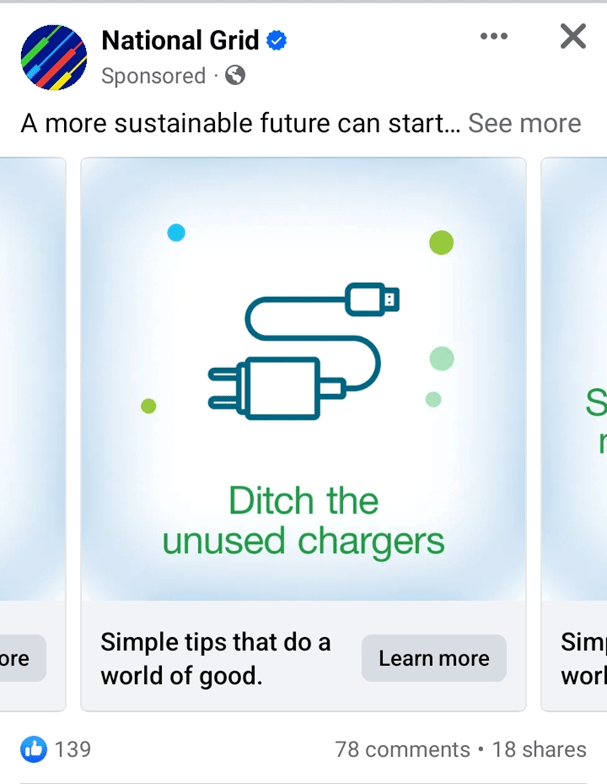
I am in the former Niagara Mohawk Power Corporation service territory now served by National Grid New York. Given the political climate of New York it is no surprise that National Grid advocates for the “Journey to net-zero”.   I am not a big social media person but do get on Facebook occasionally.  Frequently, there are posts from National Grid advocating for the latest and greatest gadgets for electrification. For example, the following recently showed up.

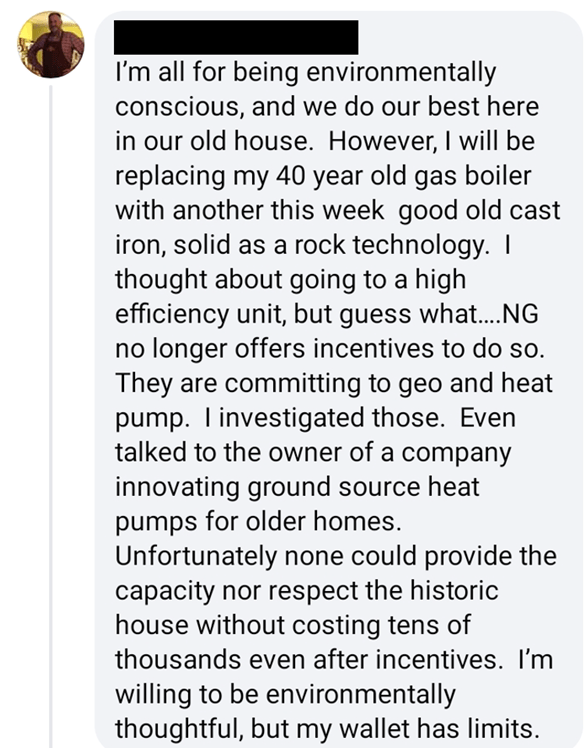
There were options for different “learn more” links.  What caught my eye was the following comment to this post. It the perfect example of Pielke’s Iron Law:

The Iron Law can be described as wallets have limits.  Beyond the simple cost impacts there is another concern.  The National Grid Upstate New York Residential Gas Heating program is paused and not accepting rebate applications. National Grid is forgoing efficiencies now to encourage adoption of cold-climate heat pumps.  This is disservice to National Grid ratepayers because it does not acknowledge thatthe State’s Scoping Plan to implement the Climate Act notes that not all homes will be able to electrify home heating safely and affordably.  Exactly the case in this example. It is not only that there is a cost factor but there is a safety factor for electrification.  Removing incentives for homeowners that have no other choices is short-sighted.

Conclusion

Implementation of the Climate Act is going to affect affordability and safety.  The public is starting to catch on to these impacts.  It is time to pause implementation until the Hochul Administration provides comprehensive and transparent cost estimates for the transition and the Public Service Commission provides a plan to ensure safe and reliable service to electric customers for an electric system that relies on wind and solar.  The utility industry is not going to step up and ask for an implementation pause so it is up to the voters of the state to make their concerns known.

Ellenbogen On NY Heats

According to New York climate activist non-governmental organizations New York is “failing to lead on climate.”   Sane Energy Voice claims that following Governor Hochul’s scrapping of major offshore wind projects, Assembly Speaker Heastie’s decision to ditch the popular NY HEAT Act signifies New York’s failure to lead on climate.  Richard Ellenbogen responded to the press release with an email that I reproduce here.

Richard Ellenbogen recently submitted comments as part of the record for the Department of Public Service Proceeding 15-E-0302 related to the net -zero mandate of the Last spring          “Order initiating a process regarding the zero-emissions target” that will “identify innovative technologies to ensure reliability of a zero-emissions electric grid”.   His comments discuss “a viable, affordable, and rapidly executable  Plan B to assist NY State in reducing its carbon footprint  using technologies that actually exist at scale, unlike the technologies proposed by the CLCPA which only exist at scale in the fantasies of its proponents.”  I think it is important that his message gets out to all New Yorkers to try to avert the inevitable collision between aspiration and reality.

Ellenbogen is the President [BIO] Allied Converters and frequently copies me on emails that address various issues associated with the Climate Leadership and Community Protection Act (CLCPA). I have published other articles by Ellenbogen, a description of his keynote address to the Business Council of New York 2023 Renewable Energy Conference Energy titled: “Energy on Demand as the Life Blood of Business and Entrepreneurship in the State -video here:  Why NY State Must Rethink Its Energy Plan and Ten Suggestions to Help Fix the Problems”,  another video presentation he developed describing problems with CLCPA implementation and a summary of his submitted comments as part of the record for the Department of Public Service Proceeding 15-E-0302 related to the CLCPA net -zero mandate.  There are only a few people in New York that are trying to educate people about the risks of the CLCPA with as much passion as I am, but Richard certainly fits that description.  He comes at the problem as an engineer who truly cares about the environment and how best to improve the environment without unintended consequences.  He has spent an enormous amount of time honing his presentation summarizing the problems he sees but most of all the environmental performance record of his business shows that he is walking the walk.  

CLCPA Overview

The CLCPA established a New York “Net Zero” target (85% reduction and 15% offset of emissions) by 2050.  It includes an interim 2030 reduction target of a 40% reduction by 2030 and a requirement that all electricity generated be “zero-emissions” by 2040. The Climate Action Council (CAC) is responsible for preparing the Scoping Plan that outlines how to “achieve the State’s bold clean energy and climate agenda.”  In brief, that plan is to electrify everything possible using zero-emissions electricity. The Integration Analysis prepared by the New York State Energy Research and Development Authority (NYSERDA) and its consultants quantifies the impact of the electrification strategies.  That material was used to develop the Draft Scoping Plan.  After a year-long review, the Scoping Plan recommendations were finalized at the end of 2022.  In 2023 the Scoping Plan recommendations were supposed to be implemented through regulation and legislation.  For the most part that did not happen so in 2024 organizations like Sane Energy Voice  are lobbying for various legislation to advance their agendas.

NY Heats

According to a report released by NY Renews, the if the full NY Home Energy Affordable Transition bill were passed “the 25% of New York residents who have high energy burdens would cut their bills by over 44% and save an average of $136 a month.” The mission of Sane Energy Project is to replace fracked gas infrastructure with 100% democratically controlled, renewable energy in New York State. We build every campaign through a lens of racial, social, and ecological justice.

Richard Ellenbogen responded to this press release:

In a one-two punch this past week, a small group of corporate-backed Democratic legislators brought us closer to climate catastrophe by bowing to fossil fuel lobbyists and lawyers in shaping New York’s energy and economic policy. Now, more than ever, it’s time to fight hard and resist this insidious takeover.

Last Friday, under the leadership of Governor Kathy Hochul, the New York State Energy and Resource Development Authority (NYSERDA) rejected three major offshore wind projects that Sane Energy Project had championed since 2015 when we led the campaign to stop the construction of a massive offshore liquefied fracked gas port complex near the  Rockaway Peninsula and Long Beach that would have foreclosed the development of these wind projects.  

Also on Friday, the final New York State budget omitted the critical NY HEAT Act, which over 100 legislators co-sponsored. The New York Home Energy Affordable Transition Act would have facilitated an orderly transition from expensive and toxic fracked gas by ending subsidies that enrich the gas industry. Moreover, it would have capped energy bills for low- and middle-income households at 6% of their income, a crucial measure for safeguarding vulnerable New Yorkers. 

Every year in Albany, a handful of officials determine the state’s future. Swayed by energy industry lobbyists, they disregard scientific evidence, the climate law, and constituents’ demands. Our elected officials’ failure to champion sound energy policy sets a dangerous precedent.

Kim Fraczek, Director of Sane Energy Project, said, “Governor Hochul and Assembly Speaker Carl Heastie have chosen to prioritize corporate interests over the well-being of New Yorkers by scrapping significant offshore wind projects and excluding the crucial NY HEAT Act from the state budget. Their inaction is further underscored by National Grid’s egregious proposal to increase monthly bills for downstate residents by at least $30 to maintain their outdated, polluting gas system. We hold Hochul and Heastie responsible for future utility bill hikes and climate disasters, as their decisions blatantly ignore the urgency to transition to renewable energy and protect the most vulnerable communities.”

Current negotiations surrounding National Grid’s proposed rate hike threaten to tighten the fossil fuel industry’s grip on New Yorkers. Sane Energy Project is focused on state regulators, who can choose energy efficiency and investment in thermal energy networks or perpetuate wasteful investments in National Grid’s antiquated gas system.  

Before I describe Ellenbogen’s response I want to address the offshore wind projects.  The emotion laden description of recent events: “Swayed by energy industry lobbyists, they disregard scientific evidence, the climate law, and constituents’ demands” is at odds with reality.  NYSERDA did not want to reject the three major offshore wind projects.  Instead, “GE Vernova’s decision to alter its offshore wind turbine product from the initially proposed 18 MW Haliade-X platform to a 15.5/16.5 MW platform resulted in significant changes to the projects proposed into the solicitation.”  When NYSERDA announced the contract awards last October all the subcontractor agreements should have been clearly identified and signed off by all parties involved in the work, including things like what equipment, what labor costs, you name it.  After an award there is some negotiation but that should not be a big lift because the details were already identified in the proposal/budget.  The size of the turbines should have been specified in the proposal. If GE as a subcontractor then changed the deal it would make the whole proposal unfundable.  This is the last thing NYSERDA and Governor Hochul wanted because it means a big delay in the timeline as they need to have go back for another round of approvals and new contracts.

Ellenbogen on NY Heats

Other than a few formatting edits the following is all by Ellenbogen.

While I appreciate your passion, the  science behind your email is misguided.  As someone that decarbonized my home and business over two decades ago as the two following links document, I can assure you that there is nothing “sane” about NY Heats.  It will literally be a death knell for both NY State residents and the state economy with absolutely no benefit to the environment.  FYI, I have absolutely no interests in the fossil fuel industry but as an engineer for over forty years,  I have a firm belief that all public policies have to be based upon scientific accuracy.  NY Heats and the CLCPA throw science and math out the window.

In a climate like NY State’s, NY Heats defies the Laws of Thermodynamics beyond there also being enormous logistical issues with implementing  it.

  1. It will double or triple the load on every transformer in the state meaning that they will all have to be replaced, except those transformers don’t exist and there is an acute transformer shortage in the entire US at the moment.  The doubling or tripling of load will also mean replacing all of the wires in NY State which will take about 60 years.  Further, that will require an enormous amount of aluminum and there isn’t enough aluminum available to make beverage cans, let alone millions of miles of electrical conductors.  Three aluminum smelters have closed in the United States in the past two years because their electric rates were too expensive, which is indicative of a shortage of electricity driving up the prices.  There have been numerous articles written recently that indicate that the United States is running out of energy.
  • That same electric shortage will also provide insufficient energy to operate the heat pumps that would be installed under Local Law 97 and NY Heats.  Despite everyone’s wishful thinking, renewables are too intermittent and have too low of an energy density  to successfully operate the expanded utility system that would be required under NY Heats.  The NYS Public Service Commission is desperately looking for DEFR’s (Dispatchable Emission Free Resources) except with the exception of Nuclear which takes 17 years to get approved and sited, that technology does not exist and it is decades away so any increases in load that would result from NY Heats will increase fossil fuel generation where it is far less efficient than the onsite combustion of Natural Gas.  The NYISO is already having difficulty meeting the scheduled deadline for closing the fossil fuel peaker plants and has extended their closing dates.  That is going to be repeated extensively because there just isn’t enough energy and adding more solar panels and wind turbines will complicate that effort after a certain point.  Look at what is currently happening in California.  They are dumping solar because they over subsidized it and there is too much.  The storage technology needed to utilize it is far too expensive to implement at that scale.  If you look at NYSERDA’s 6 GW Enregy Storage report from 2022, they indicated that 1000+ hours would be needed to support the system.  Even at 1000 hours for 6 GW at the price of storage in the report, that would cost $3.5 Trillion, or 15 times NY State’s annual budget and those batteries would last only ten years and have to be replaced.   While battery costs have come down slightly since 2022, it has not been nearly enough to make them cost effective.  The physics and the economics just don’t work.  It has also been clearly documented that air source heat pumps double utility bills.  That higher cost is a function of the holistic system wide energy inefficiencies of the air source heat pumps.  Hydrogen storage technology is decades away at the utility scale needed.  It is very difficult to store and transport and it presents its own GHG issues if it leaks.
  • There is insufficient labor to execute the plan.  There is a shortage of both electricians and plumbers and worse, there are not enough people to train even if they could develop the training programs.  There are currently 500,000 open manufacturing jobs in the US, the same cohort of people that would be used for renewable and heat pump installation.  The unemployment rate is near historic lows.   Further, one thing that no one should want is inexperienced people handling the refrigerants involved with heat pump installation as those have carbon footprints 300 – 1000 times higher than CO2 and 10 – 30 times higher than methane.  The leakage that will result from inexperienced workers handling refrigerants would be devastating.  A Columbia University study indicated that one-half of Arctic ice melt resulted from the use of refrigerants.
  • Regarding Offshore Wind, those bids were declined because the costs were far higher than the current electric rates.  If the state has any hope of decarbonizing, alienating 60% of its population downstate with exorbitant electric rates is not the way to do it.  That is especially true when 1.2 million downstate utility customers are already $1.8 billion in arrears.  Further, the ships needed to install the offshore wind don’t exist at present.  The first Jones Act compliant ship, the Dominion Charybdis left dry dock last week.  The $650 million vessel is taking five years to build and will not be ready until late 2024/ early 2025.  If they start another now, it will not be ready until 2028- 2029.  The lack of the ships raises the installation costs far above where they otherwise would be which explains why the bids here are about double those in Europe where they have about 16-18  available jack ships.  The balance of the world’s approximately 50 jack ships are in Southeast Asia.  Energy cost increases resulted in the repeal of the Ontario, Canada energy plan after only 10 years.  The same thing will happen in NY State if they aren’t careful.

Decarbonization is necessary but it must follow the Laws of Physics and be mathematically possible to implement.  The NY State plan doesn’t adhere to those requirements.  There are things that adhere to science and mathematical accuracy that can be done to reduce the state’s carbon footprint but the CLCPA and NY Heats do not fall within that criteria.

Conclusion

In an email Ellenbogen concludes that “For anyone that understands energy math, the bill is a farce.   The points made in it also don’t adhere to economic reality for the residents of NY State.”  I completely agree with his conclusions.

Comments on the New York Part 490 Projected Sea-Level Rise Amendments

The New York State Department of Environmental Conservation (DEC) has proposed Amendments to Part 490, Projected Sea Level Rise and Comments that are due on April 29.  This post describes my comments on the proposed amendment and requests that New Yorkers who reading this before April 29 submit comments.  Don’t worry, I will give language.

The proposed amendments revise the projections of future sea-level rise required by New York regulations.  It is flawed because the methodology estimates an unrealistically high projected sea-level for the Community Risk and Resiliency Act flood risk management applications that will use the projections.  Unless more realistic estimates are used permitting applications in areas near tidal zones will be required to incorporate flood levels that will not be expected in the lifetime of the project.  That would be a hidden cost for the net-zero  transition of the Climate Leadership & Community Protection Act (Climate Act).

I have followed the Climate Act since it was first proposed, submitted comments on the Climate Act implementation plan, and have written over 400 articles about New York’s net-zero transition. The opinions expressed in this post do not reflect the position of any of my previous employers or any other organization I have been associated with, these comments are mine alone.

Overview

The summary of the Part 490 proposed amendments states that: “The goal of the proposed amendments is to provide up-to-date science-based projections of future sea level rise.”  This is another example of the many ways that the Climate Act is intruding on many aspects of society.  The Climate Act established a New York “Net Zero” target (85% reduction in GHG emissions and 15% offset of emissions) by 2050.  It includes an interim 2030 reduction target of a 40% reduction by 2030 and a requirement that all electricity generated be “zero-emissions” by 2040. The Climate Action Council (CAC) was responsible for preparing the Scoping Plan that outlines how to “achieve the State’s bold clean energy and climate agenda.”  In brief, that plan is to electrify everything possible using zero-emissions electricity. The Integration Analysis prepared by the New York State Energy Research and Development Authority (NYSERDA) and its consultants quantifies the impact of the electrification strategies.  That material was used to develop the Draft Scoping Plan outline of strategies.  After a year-long review, the Scoping Plan was finalized at the end of 2022.  In 2023 the Scoping Plan recommendations were supposed to be implemented through regulation, PSC orders, and legislation but implementation is behind schedule.  The proposed amendments to the sea-level projections are a hidden aspect of the Climate Act that has significant potential impacts.

Part 490 Projected Sea-Level Rise

The Regulatory Impact Statement (RIS) for this proceeding describes the regulation’s statutory authority and legislative objectives, the proposed changes, needs and benefits, and costs.  It explains:

On September 22, 2014, the Community Risk and Resiliency Act, Chapter 355 of the Laws of 2014 (CRRA), was signed into law. CRRA, among other things, established Environmental Conservation Law (ECL) § 3-0319. ECL § 3-0319 requires the Department of Environmental Conservation (Department) to adopt regulations establishing science-based sea level rise projections for New York State and to update them no less than every five years. The Department established a new Part 490 of Title 6 of New York Codes, Rules, and Regulations (6 NYCRR), “Projected Sea-level Rise” (Part 490) in February 2017 and is updating the regulation through the current rulemaking.

The proposed amendments are an update of the 2017 sea-level rise projections.  While I am not absolutely sure I believe the reason that this amendment was delayed was because the primary reference, New York Research & Development Authority New York State Climate Impacts Assessment, was not available within the five-year period.  Even so, the documents for the Assessment are all marked “Interim Version for Public Release” which calls into question their use for a policy document.

The summary of the Part 490 proposed amendments states that:

The goal of the proposed amendments is to provide up-to-date science-based projections of future sea level rise. Part 490 does not create a mandate on local governments. Part 490 does not impose any compliance obligations on any entity.

While technically and legally correct, the excuse not to include costs and the argument that there are no compliance obligations or mandates on local governments has significant ramifications.  The fact is that there are compliance obligations that are affected by the Part 490 rulemaking.  DEC selectively chose to emphasize analyses that support the “high-end storyline” without regard to how the sea-level rise projections will be used. There are relevant, plausibility, timing, and cost implications that I believe should be added to the Regulatory Impact Statement.

Mandates on Local Governments

The CRRA as amended by the Climate Act clearly creates indirect mandates on local governments.  The New York State Flood Risk Management Guidance for Implementation of the Community Risk and Resiliency Act  includes “recommendations” for the use of sea-level rise that are essentially mandates.  In another example where the projections are used, the DEC webpage Mainstreaming Consideration of Climate Change includes the following:

Consideration of future physical climate risk

As originally enacted, the CRRA required applicants for permits or funding in a number of specified programs to demonstrate that future physical climate risk due to sea-level rise, storm surge and flooding had been considered in project design, and that DEC consider incorporating these factors into certain facility-siting regulations.  The CLCPA amended the CRRA to include all permits subject to the Uniform Procedures Act. The CLCPA also expanded the scope of the CRRA to require consideration of all climate hazards, not only sea-level rise, storm surge and flooding, in these permit programs. 

In my comments I argued that that while Part 490 may not directly create a mandate on local governments, all permits must consider the sea-level rise climate hazard which is essentially a mandate affecting all governmental agencies.

Part 490 Proposed Amendments

The RIS description of the proposed sea-level rise projection amendments with my annotated comments follows:

Table 4. Updated projections of sea level rise for three tidal regions of New York State, based on the Department’s proposed methodology. Projections are in inches, relative to a 1995-2014 baseline, and are based on a combination of the SSP2-4.5, SSP5-8.5-medium-confidence and SSP5-8.5-low-confidence projections, with the addition of a RIM scenario.

Part 490 is intended to give permitting authorities information on the full range of potential sea-level rise.  In reality the CRRA design considerations that use the sea-level rise projections focus on the highest values.  New York State Flood Risk Management Guidance for Implementation of the Community Risk and Resiliency Act  states that “Applicants and programs are also encouraged to consider the following during project siting, design and review” states:

Applicants for projects involving new or replacement critical infrastructure should consider the full range of projected flooding, including the highest adopted projections of sea-level rise, during the expected service life of the project. Where adherence to the highest guideline is not feasible, due to practicality, costs, risk tolerance, and/or environmental effects, applicants should carefully describe and justify designs not adhering to the most restrictive guideline.

Note the requirement to use “the highest adopted projections of sea-level rise” includes the caveat to consider the “expected service life of the project”.  That is  missing piece in the RIS.   The RIS emphasizes the point that the Intergovernmental Panel on Climate Change (IPCC) has not indicated the relative probabilities that any of the illustrative scenarios included in the latest assessment report (AR6) will occur.  However, CRRA infrastructure applications need to consider the likelihood of sea-level rise levels to determine practicality, costs, risk tolerance, and/or environmental effects.  The RIS argues that focusing on the most probable outcome has risks and warns of much higher potential sea-levels. 

Furthermore, Hinkel et al. (2015) warn that sea level rise projections based on process-based models, such as those used by IPCC, are primarily intended for the purpose of understanding earth system physics and are not appropriate for risk-based decision making as they do not fully incorporate the effects of accelerated ice melt. They warn that projections based on the IPCC AR5 projections of mean global sea level rise of 11 to 39 inches by 2100 may not be adequate for risk management due to the intolerably high residual risk associated with rapid ice melting Parris et al. (2012) also cautioned that focusing only on the most probable outcome could lead to vulnerability or maladaptation.

The reference to “intolerably high residual high residual risk associated with rapid ice melting” ignores the expected service life of the project consideration.  The RIS explains that the decision makers need to understand the full range of potential risk but does not acknowledge that their presentation of results discourages the use of anything but the high projections.  The result is that development near the tidal shoreline is planning for extremely high projected sea-level rise.  A New York City project to increase a park to handle 8 to 10 feet of sea-level rise is include in “a $1.45 billion flood protection project that backers say befits the nation’s largest city, a massive project that will include the construction of a 2.4-mile system of walls and gates along the East River”.  That is only a fraction of the harbor front in the City so it makes sense to use more reasonable estimates of sea-level rise given the need to protect the entire harbor of New York, but it is easier for DEC to just recommend the biggest number to “be safe”.

Decision makers, including residents and local leaders, should understand the full range of potential risk. Communities and stakeholders in New York State that have been presented with the ClimAID projections have tended to adopt and plan for high levels of sea level rise rather than more moderate levels. These stakeholders have placed a high degree of importance on ensuring the viability of proposed infrastructure investments and the social and economic fabric of their communities from even unlikely eventualities.

The “science-based” regulation and the guidance did a disservice to New Yorkers because the risk management approach did not adequately address tradeoffs between costs and likelihood of “unlikely eventualities”.  The sea-level rise projections rely on cherry-picked studies and ignoring any work that does not fit the extreme scenario used and that is not “science”. Unlikely things that just might happen in the distant future are not “eventualities”. All the extreme sea-level rise projections use the implausible high emissions scenario embodied in Representative Concentration Pathway (RCP) or Shared Socio-economic Pathways (SSP) RCP/SSP8.5.  There is overwhelming evidence that the coal use, population growth, and neglect to consider any decarbonization policy assumptions in those scenarios are inconsistent with observed reality.  The National Oceanic Atmospheric Administration (NOAA) Geophysical Fluid Dynamics Laboratory (GFDL) description of their globcal climate modeling approach that states “SSP5-8.5 is a very high greenhouse gas emissions scenario – and unlikely to happen – where carbon dioxide emissions triple by 2075″ and does not use it for their recommended projections.

Notwithstanding the arguments in the following paragraph from the RIS trying to justify its use, the fact is that using these projections are inappropriate to use in this context.  I do not dispute that the potential for rapid ice melt exists that would cause a spike in sea levels.  However, I maintain that is improper to use in this context because it is a low probability event but that in the time frame of CRRA infrastructure projects it is a much lower possibility. The argument that Part 490 guidance must address sea level rise that will “likely occur at some point” without consideration of the use of the projections is inappropriate.  The State simply cannot afford the ramifications of the insistence to remove risk entirely.

Finally, as explained above, sea level rise will continue for many centuries as the earth system comes into equilibrium over many centuries or even millennia. Thus, the question for decision makers is not if a critical sea level will be reached, but when. Strauss (2013) calculated that historic emissions have already committed the globe to a mean sea level rise of 6.2 feet. Levermann et al. (2013) estimated that the current international target of 2°C warming will result in an eventual mean global sea level rise of more than 15 feet after 2000 years. Thus, a full range of projections in Part 490 that includes higher values is appropriate to allow for consideration of a level of sea level rise that will likely occur at some point, even if the timing of such occurrence is uncertain. The Department acknowledges that current GHG emissions policies would result in actual emissions lower than projected by SSP5-8.5. Thus, the inclusion of higher projections of sea level rise, especially those based on SSP5-8.5, could lead to consideration of conditions that are unlikely to occur, at least in the more immediate future. Unfortunately, current literature does not provide a basis for assessment of the emissions levels at which ice shelf and marine ice cliff instability, important factors in sea level rise in high emissions scenarios, such as SSP5-8.5, become significant.

This paragraph characterizes my concern that the purpose of the sea-level rise projections was not considered enough.  Preparing for the next 2000 years for a city that was founded only 400 years ago is silly.

This gap in the literature, however, does not relieve decision makers from the responsibility to at least consider the potential consequences of future events about which scientific uncertainty remains. Adoption of several levels of projections allows for consideration of risk tolerance in decision making. The high or RIM projections might be used for long-term projects for which there is low risk tolerance, for example, while lower projections may be appropriate for consideration in situations in which risk tolerance is high. Inclusion of low-confidence, but plausible, projections provide benchmarks against which long-term decisions, e.g., those regarding critical infrastructure and land-use change, can be evaluated for high-consequence events. If Part 490 did not include higher projections of sea level rise, decision makers would not be able to even consider the possibility of such levels occurring. The Department proposes, therefore, to adhere to the recommendation of Stammer et al. (2019) to include “high-end storylines,” that reflect physical processes about which high uncertainty exists, i.e., the RIM scenario, with probabilistic projections.

The last paragraph in this section clearly describes the misguided DEC approach.  There is no question that decision-making when there is high scientific uncertainty is difficult.  From a risk management perspective all factors must be considered.  In this instance, the recommendation to use the higher sea-level rise projections for long-term projects does not consider CRRA infrastructure life expectancies which are shorter than the time frame of the high-risk impacts.  Furthermore, it can be argued that the “low” confidence sea-level rise estimates are “no” confidence events because they rely on SSP-8.5 which is implausible.  I do not believe that a “high-end storyline” approach is appropriate for regulatory guidance.

Summary of My Comments

My detailed comments describe the observed sea-level rise at the Battery monitoring station in New York City, the methodology used to project sea-level rise, and compare the sea-level rise projections and observations (table below).  The following table compares the projected sea-levels using the observed from 1850 to present and 1984 to present with the projections of sea-level rise. Importantly the observed sea-level rise is less than the 50th percentile, “medium confidence” Part 490 sea-level projections.  In other words, the observations indicate that the medium confidence projections are conservative estimates of sea-level rise.  I also found that comparing the acceleration of sea-level rise necessary to comport with the projected rates with the observations indicates that there is no sign that the “high-end storyline” projections are realistic.

Compare 2024 proposed sea level rise projections (inches of rise relative to 1995-2014  baseline) to sea-level rise projected using observed trends since 1850 and 2014 at the Battery Monitoring Station

The RIS argues that observed sea-level rise projections are not appropriate to use for future estimates because they do not account for projected global warming.  To address this concern the Energy and Environmental Alliance of New York proposed a “pledge and review” alternative approach in 2016.  My comments argue that this is a better approach.  Given the uncertainties of modeling both global warming and the associated sea-level rise along with the model over-estimates of warming it is prudent to assume that the sea-level trend observed over the last 150 years will continue until the observations indicate otherwise. 

There is a section in my comments that describes how the sea-level rise projections are intended to be used for flood risk management.  The RIS does not consider that flood risk management must incorporate probability of occurrence.  The Part 490 sea-level rise projections do not because of the emphasis on the “high-end storyline”.  Even though the RIS appropriately describes all the scenarios and how the data were collected and used, the RIS risk analysis is flawed because it does not weigh potential results against benefits and consequences.  The comments describe a more appropriate risk management approach. 

Summary of Recommendations

The sea-level rise projections in the proposed amendment need to be reconsidered.  The over-arching problem is that the low-likelihood, high-impact storyline that incorporates the rapid ice melt scenario is dependent upon the RCP/SSP 8.5 high emissions scenario and does not account for the near-term applicability of the sea-level projections for CRRA applications.  Even the RIS acknowledges that “current GHG emissions policies would result in actual emissions lower than projected by SSP5-8.5.”  Because the high greenhouse gas emissions are a necessary condition for the rapid ice melt low-likelihood, high impact scenario, that emissions scenario should not be used for sea-level rise recommendations.  Furthermore, the timing of the rapid ice melt scenario is extremely unlikely to occur in the time frame of infrastructure projects in the New York State Flood Risk Management Guidance for Implementation of the Community Risk and Resiliency Act  guidance that refers to Part 490 sea-level rise.  

The RIS claims that because Part 490 “will not impose any costs on any entity because the regulation consists only of sea level rise projections and does not impose any standards or compliance obligations” that no costs are associated with Part 490.  However, the pertinent cost issue is the difference between the recommended alternative and the alternatives described in the RIS. The “high-end storyline” approach has an impact on costs and the failure of the RIS to address them is a disservice to the citizens who will have to foot the bill.  The RIS should be modified to compare costs with the alternatives included.

Any projection that uses the RCP/SSP 8.5 high emissions scenario overestimates sea-level rise values.  Given the acknowledged uncertainties with sea-level projections and the over-predictions of global warming with current global climate models, the pledge and review approach should be used to determine if accelerated sea-level rise consistent with the “high-end storyline” projections are observed.  The sea-level projections consistent with SSP2-4.5 should be used because these sea level rise projections are associated with the most likely conservative estimates of potential emissions and the numbers are consistent with observed sea-level rise.  If future observations indicate that this scenario is no longer conservative then the projections can be modified accordingly.

How To Provide Written Comments

I encourage my New York readers to submit written comments by the 5:00 PM April 29, 2024 deadline. I have prepared a detailed explanation of the process at this link.  The link also includes a condensed comment that addresses the key points described above.

The link provides the recommended comment. 

  1. Enter the following address in your address line: climate.regs@dec.ny.gov
  2. Put Comments on Part 490 in the Subject line
  3. Copy the comment text in the link into the body of your email. 
  4. Submit it

If you are inexperienced with the DEC rulemaking process let me explain what happens next.  If you are lucky, you will get an acknowledgement that your comment was received.  DEC staff are required to read the public comments and the rulemaking requires a response to comment document.  At some point there will be a document that includes a response to each comment and recommendation.  It would be especially useful if you have a specific example of a concern related to the projections to include that in your comments. If you prepare your own comments, then they will have to respond to that separately, but all the comments submitted using my recommendation will be consolidated.  Reading comments and writing a response does not mean DEC will change anything in their proposed rulemaking.   

I have submitted comments for countless proceedings over the last 40 years.  Sadly, over the years DEC has become more and more politically driven to the point now that all rulemaking policy decisions are ultimately decided by the Administration regardless of the science.  To increase the chance that any of the comments and recommendations will actually be implemented, I suggest sending a copy to your legislators.  Like most of the Climate Act implementation components very few people know what is happening and the ramifications of the actions.  If the legislators start asking the Administration questions about the use of implausible scenarios that will make development near the shorelines more expensive, there may be a political response towards consideration of tradeoffs.  Absent that the only solace is the record will show that the State was warned that their policies were ill-advised when the proposed sea-level recommendations fall far below the observed rise.

The rule-making process includes a perfunctory public hearing.  The Part 490 hearing was held on April 22.  The hearing officer described the rule making process and Mark Lowery from DEC went through the following slide.  That was all over in ten minutes.  Two people signed up to give comments.  I signed up but could not talk because of a persistent cough.  The other person’s comments were totally unrelated.  She wanted to thank DEC for setting up raptor nesting boxes.  For the record all comments are considered equally so nothing was lost.  In fact, I showed up for a hearing one time and a friend from DEC who was working on the proceeding basically said the hearings were a waste of time and that they preferred the written comments.

Conclusion

Given the poor turnout for the public hearing, there does not appear to be much interest in this rulemaking.  I doubt that these comments and recommendations will have any effect on the rulemaking because there is too much institutional inertia.  The record for some rulemakings makes a big deal about the number of comments that support their position.  If the negative comments outweigh those supporting the proposal, then it will be interesting to see how the documentation spins that.  In order to find out please, submit a comment.  Thanks.

NYSERDA Solar Quiz Misinformation

I recently covered an article by Ken Girardin who broke the story of New York’s latest attempt to shore up public support for the Climate Leadership & Community Protection Act (Climate Act).  In brief, the New York State Energy Research and Development Agency (NYSERDA) are hiring a public relations outfit, using $500,000 per year of public money, to “maintain a positive narrative” and “respond to negative viewpoints” about the state’s Climate Act. This article shows the likely result of that effort – NYSERDA’s Think You Know Solar – Take the Solar Quiz.

I have followed the Climate Act  since it was first proposed, submitted comments on the Climate Act implementation plan, and have written over 400 articles about New York’s net-zero transition. I have devoted a page to solar issues that describes my concerns with solar development in New York. The opinions expressed in this post do not reflect the position of any of my previous employers or any other organization I have been associated with, these comments are mine alone.

The Climate Act established a New York “Net Zero” target (85% reduction in GHG emissions and 15% offset of emissions) by 2050.  Despite the enormous impacts to energy affordability, threats to electric system reliability, and mandates affecting personal energy choices I believe many New Yorkers are unaware of the law. In 2023 transition recommendations were supposed to be implemented through regulation, Public Service Commission orders, and legislation.  Not surprisingly, the aspirational schedule of the Climate Act has proven to be more difficult to implement than planned. 

Solar Quiz

On March 21, 2024 I received an email announcing the Solar Quiz.  This link is the web view version. In the rest of this section, I respond to its contents.

The quiz opens with the obligatory picture of roof-mounted solar panels.

The cheerful opening introductory paragraph leads off with the narrative: “free and abundant light” gives us electricity” from this “incredible clean energy technology”.

You may already know that solar panels convert the sun’s free and abundant light into electricity. Pretty great, right?

So, we thought we’d give you a quick quiz to test your solar smarts. Let’s see how much you really know about this incredible clean energy technology.

Sunlight may be a “free” energy source but there are costs to collect and use that energy.  That detail must be in the next quiz which will come out when the geothermal energy source from Hell freezes over.

The entire Climate Act legislation and narrative is characterized by black and white cartoon descriptions.  Consider the first quiz question:

Q: Do solar panels work on cloudy days?

A: Yes!

Because the panels collect light, they still function on cloudy days even though efficiency is somewhat reduced.

“Somewhat reduced”?  A negligible amount or a lot?  Let’s take a look at the potential range.

Their illustration:

My illustrations of today’s views from the NYS Mesonet Buffalo meteorological station.  This site is notable because it is surrounded by solar panels.  I am not sure how much that affects whether the meteorological data collected are representative but it does let us address the question of solar variability on this worst case condition – cloudy and snow covered.

Buffalo March 23, 2024 14:15:28 UTC or 10:15:28 EDT

Buffalo March 23, 2024 17:20:27 UTC or 13:20:27 EDT

Here is a graph of the temperature (red, orange), dew point temperature (green), and solar insolation (yellow) over the last seven days ending 23 March 2024 at 16Z or Noon EDT.  Regrettably the parameter of interest is in yellow.

Note that solar insolation is 170 watts per meter squared (W/m2) at 10:15 EDT in the first picture and 420 W/m2 at 13:20 EDT the time of the second picture.  Reasons for the difference include the tine of day because the second picture is closer to solar noon and the clouds are darker which could mean they are thicker in the first picture.  It would be interesting to see the effect of the snow on the panels if data from that solar facility could be obtained.

To guess the effect of clouds I looked at the last seven days of data from the same site.  I have put arrows on the peak solar insolation for the last six days.  Presumably there were three days without clouds because the solar insolation exceeded 800 W/m2.  There were two days when the peak insolation was around 500 W/m2, one day when the peak was no more than 350 W/m2, and on the most recent day it appears that the data from the daily graph peaks a little over 400 W/m2.  I guess the point is that even on a cloudy day solar power is “Somewhat reduced” to half and does not go to zero.  I am sure that some power would be generated even when the panels are covered by snow but the reduction sure is more than “somewhat” reduced, closer to nearly zero is my guess.

Of course, solar is zero at night.  Not to worry the solar quiz addresses this.

Q: If I have solar panels, will my house still have energy at night?

A: Yes.

Solar-powered homes collect excess energy and pass it to the grid for future use, and if you don’t have excess energy stored you pull energy from the grid at any time, like when it’s dark. Another option for night-time energy use is on-site battery storage, which collects excess energy and saves it for when it’s needed.

This is egregious misinformation.  The electric system instantaneously balances load and generation.  Any excess energy passed to the grid has to be used at that time or stored.  In my opinion the worst subsidy for residential solar is the unacknowledged cost to provide grid energy when the sun does not shine.  Somebody else is paying for the infrastructure (storage or alternative sources) necessary so that solar-equipped residences can “pull energy from the grid at any time”.  Inevitably the “net-metering” rules will have to be changed so this subsidy is reduced or eliminated.  The mention of on-site battery storage is a start, but the reality is that the largest reliability cost is associated with extreme conditions and providing enough solar panels and energy storage to start to address that problem is uneconomic for an individual.  If this was not the case, then folks would be going off the grid entirely.

The next question has no interest to me:

Q: When was the first solar panel installed?

A: In 1883, by American inventor Charles Fritts in Manhattan.

Solar energy (the photovoltaic effect) was discovered in 1839 by Edmond Becquerel, a French physicist who studied light.

The next question is relevant.  Consistent with the rest of the quiz the answer provides no nuances or specific information.

Q: How long do solar panels last?

A: About 25 years

The efficiency of solar panels decreases over time. However, a lot of factors contribute to lifespan, such as weather, installation, maintenance, and quality.

The narrative answer is that “most residential solar panels should operate for 25 years before degradation (or reduced energy production) is noticeable.”   The National Renewable Energy Laboratory notes that “the rate of degradation is typically around 0.5% to 0.8 % per year but varies among different types and brands of solar panels.”  If I define “noticeable” degradation as a 10% loss of efficiency, then at 0.5% per year the degradation is noticeable at 23 years and at 0.8% per year the degradation is noticeable at 15 years. 

The next quiz question addresses solar panel land use.

Q: What is it called when land is used for both solar panels and agriculture?

A: Agrivoltaics

In some places, farmers are experimenting with grazing livestock (solar grazing), growing native grasses, and even fruits and vegetables around solar panel installations.

Sounds great.  Note that they did not talk about agrivoltaics in New York.  There is a reason. The State has set up the New York State Agricultural Technical Working Group to address this in New York but there has been no progress mandating this approach.  As I will explain in the following discussion, I am unimpressed with that effort.

The last question in the quiz manages to get in a bit of bragging.

Q: Which U.S. state is the top community solar market in the country?

A: New York!

As of December 2023, more than two gigawatts of community solar have been installed in New York – enough to power nearly 400,000 homes.

Of course the point that they can power 400,000 homes only when the sun is shining is unmentioned.

New York’s Disgraceful Solar Implementation Record

So much for the quiz.  How is New York’s solar implementation policy going?  

I believe that the development of solar resources is considered above all other concerns which will not end well.  I submitted comments on the Draft Scoping Plan two years ago calling for a moratorium of utility-scale solar development because the New York State Department of Agriculture and Markets (Ag & Market) policies on solar energy projects that protect prime farmland were being ignored and programs designed to protect prime farmland and reduce impacts were being developed but not implemented.  Two years later the policies are still being developed and I estimate that 20 projects have  permits to construct and only seven meet the Ag & Markets policy.

In their comments for solar project applications the Department of Ag and Markets prepared testimony has noted that “The Department’s goal is for projects to limit the conversion of agricultural areas within the Project Areas, to no more than 10% of soils classified by the Department’s NYS Agricultural Land Classification mineral soil groups 1-4, generally Prime Farmland soils, which represent the State’s most productive farmland.”  The lack of a responsible solar implementation policy has meant that of the 20 projects with applications only seven meet this criterion as shown in my Solar Project Scorecard.  These results show that it is possible to protect prime farmland, but that New York State has failed to mandate that all projects meet the reqirement.  As far as I can tell, there are no provisions in any of the permitting requirements that mandate farmland protections consistent with Department of Ag & Markets recommendations.

If there are no specific requirements for protecting farmland then what about other mitigation strategies.  One responsible solar siting mitigation strategy would be to combine agriculture and solar land use – agrivoltaics.  Last October, the report Growing Agrivoltaics in New York was released.

The report outlines the results of a limited literature review to advance understanding of opportunities for agrivoltaics by reviewing New York State’s current agricultural landscape; the current situation of agrivoltaics pilots and programs; and solar design considerations related to integration of agricultural activities and solar power generation. In aggregation with additional State efforts to understand land-use implications of large-scale solar (LSS) development, results inform potential future actions to provide education on best practices for implementation of agrivoltaics projects in New York State.

The report provides good background information.  It includes a good description of the permitting process. It mentions the New York State Farmland Protection Working Group which was formed in 2021 “to consider and recommend strategies to the State on the siting process of major renewable energy facilities and to minimize the impact of siting on productive agricultural soils on working farms”.  It also notes that additional agrivoltaic research has been proposed.  They managed to come up with a definition:

A simultaneous use of land for solar photovoltaic power generation and agricultural production of “crops, livestock, and livestock products” as that phrase is defined by Agriculture & Markets Law (AML) §301(2).

I am unimpressed because the report is long on research recommendations and short of any sign of urgency to implement anything. 

The fact is that the drive to install as much as possible as quickly as possible is affecting agricultural lands across the state and local communities.  One of the readers of my blog, Lenny Prezorski from the Cold Spring Farm  in Schoharie County recently wrote me a note.  The following is a lightly edited version.

Schoharie County like much of rural NY, is losing prime farmland to solar development.    One project is under construction and another is seeking approval from ORES.

Last week our state and local officials held a news conference at the Salisbury dairy farm which adjoins the NextEra East Point solar project in the Town of Sharon.  A number of impacts were discussed.   This news article details those concerns.  For example, the highway superintendent has been fighting with solar contractors since the project started.  His efforts to correct the damage to town roads have fallen on deaf ears in Albany.  Despite the claims from the developer, they continue to do as they may with no oversight.

On the same day as the news conference our local newspaper ran an article noting that the property for the project was up for sale.  The article notes that the parcel has “1,100 acres on a working, income-producing farm, with a log cabin home, and “seeping vista views” stunning views of both the Mohawk Valley and Catskill Mountains.”  However, There’s just one catch:

Three hundred thirty five of those acres, across eight parcels, are covered in solar panels as part of NextEra Energy’s 50-MW project mostly off Route 20 and Gilbert’s Corners Road, but also Pomella, Beech and Sakon Roads.

Coldwell Banker is listing the site at 485 Gilberts Corner Road for $15,350,000; the listing went up February 20.

The site, according to the description “is one of the largest working solar farms in all of New York State, secured by a 25-year lease with guaranteed lease payments totaling in excess of $20 million.

“This property portfolio consists of over 1,000 acres of farmland and solar arrays on eight separate tax parcels—including a working farm with barns and residences.

“The largest portion on this income-producing portfolio is from the 25-year lease on the solar panels, covering 355 acres.

Prezorski  continues:

How deep are the pockets that these projects can be sold, I assume at a profit, before they are complete?  I understand that Rock District Solar in the Town of Carlisle has been sold 2 or 3 times and it hasn’t even received approval.

It is too late for the Town of Sharon but it hopefully isn’t too late for the proposal in Carlisle.

Prezorski describes problems with the accelerated permitting process.

Rock District attempted to get local approval from the Carlisle Planning Board.  During the public comment period I submitted a detailed report which exposed errors and omissions in the Environmental Assessment Form.    Once appraised of these facts they immediately withdrew their application from the town and submitted it to Office of Renewable Energy Siting.  I’ve prepared a report which primarily focuses on the loss the prime farmland and potential impact to groundwater resources in our karst landscape.

The EAF located the project in the wrong watershed.  It neglected to document that runoff from the site flows directly into a sinkhole which feeds the longest cave system in NYS.  The application submitted to ORES contains the same erroneous data.  How do we ensure that NYS follows their own laws?    This is the question I posed to our local leaders and to you too.

Unfortunately, I do not have any answer for the question how do we get the state to follow our own laws.

Concluding Remarks

The Think You Know Solar – Take the Solar Quiz is an example of mis-misplaced priorities of the Hochul Administration.  The cute little public relations quiz demonstrably misinforms the public.  Sunlight may be a “free” energy source but the costs to collect and use that energy are ignored.  While it is encouraging that solar panels can generate electricity even on cloudy days the implications of reduced output are not addressed.  Claiming that solar panels last for 25 years ignores that they are also expected to generate 10% less power in a shorter period.  Finally, the answer to the question “will my house still have energy at night?” displays a lack of understanding of how the electric system works and downplays the enormous challenge and costs to provide that energy that are not covered by residential solar owners.

Meanwhile, back in reality the article describing the local stakeholder concerns with the state’s control over solar farm projects describes what is happening away from Albany.  As noted previously, the developers are affecting roads and not fixing damage.  The state is over-riding local code enforcement and safety issues are evident.  In order to expedite renewable development, the State has implemented new permitting requirements that over-ride landowner rights and local government control. 

I believe that this situation has led to a disgraceful solar siting process.  Despite assurances prime farmland is not being protected.  Proponents of “responsible solar siting” that includes things like agrivoltaics are long on talk and promises of more research but short on urgency to do anything to implement something.  Prezorski explained that the expedited permitting process is enabling errors that could have significant consequences.  Finally, the state has no requirements that the solar developments are constructed to meet the Scoping Plan performance expectations.  As a result, even more solar development will be required to meet the generation and capacity requirements.

No amount of public relations investment to spin stories to be consistent with the Hochul Administration narrative are going to be able to hide the reality of the disgraceful utility-scale solar siting policies. Those policies are going to cause much more harm than acknowledged by the State.

Climate Act DEFR Cost Estimate

My previous post summarized the presentation given by Zachary Smith from the New York Independent System Operator (NYISO) describing Dispatchable Emissions-Free Resources (DEFR).  All credible projections for the generating resources needed for the zero emissions target in New York’s Climate Leadership & Community Protection Act (Climate Act) include this  new category of generating resources called Dispatchable Emissions-Free Resources (DEFR).  It is necessary to keep the lights on during periods of extended low wind and solar resource availability.  This post uses the cost projections for recently awarded United Kingdom contracts for commercial scale green hydrogen production projects to estimate how much Climate Act DEFR might cost.

I have followed the Climate Act since it was first proposed, submitted comments on the Climate Act implementation plan, and have written over 380 articles about New York’s net-zero transition. The opinions expressed in this post do not reflect the position of any of my previous employers or any other organization I have been associated with, these comments are mine alone.

Overview

The Climate Act established a New York “Net Zero” target (85% reduction in GHG emissions and 15% offset of emissions) by 2050.  It includes an interim 2030 reduction target of a 40% reduction by 2030 and a requirement that all electricity generated be “zero-emissions” by 2040. The Climate Action Council (CAC) is responsible for preparing the Scoping Plan that outlines how to “achieve the State’s bold clean energy and climate agenda.”  In brief, that plan is to electrify everything possible using zero-emissions electricity. The Integration Analysis prepared by the New York State Energy Research and Development Authority (NYSERDA) and its consultants quantifies the impact of the electrification strategies.  That material was used to develop the Draft Scoping Plan outline of strategies.  After a year-long review, the Scoping Plan was finalized at the end of 2022.  In 2023 the Scoping Plan recommendations were supposed to be implemented through regulation, PSC orders, and legislation.  Not surprisingly, the aspirational schedule of the Climate Act has proven to be more difficult to implement than planned and many aspects of the transition are falling behind.  DEFR is a particularly challenging problem.  When political fantasies meet reality, reality always wins.

New York Net-Zero Transition DEFR

The presentation given by Zachary Smith summarized in my recent post gave an overview of the DEFR issue.  I am not going to repeat the descriptive information again.  For the purposes of this article, the Integration Analysis identified the need for a generating resource that could be dispatched as needed and did not have any emissions.  The placeholder technology listed in the Integration Analysis was green hydrogen.  The following table lists the projected capacity for DEFR in the NYISO the 2021-2040 System & Resource Outlook and the Integration Analysis. Note that the Resource Outlook  projecta that 44,750 MW of DEFR will be needed by 2040, that the Integration Analysis Strategic Use of Low-Carbon Fuels scenario projects 17,992 MW by 2040, and that in 2019 the fossil fuel generation in the state was 26,262 MW.

The energy production projected for DEFR from the NYISO Resource Outlook and the Integration Analysis are shown in the following table.  The largest difference between the two projections is that NYISO projects that DEFR will generate ten times more energy.  It turns out that NYISO has DEFR generating 14% of the total energy in 2040 but Integration Analysis projects only 1%.  I am very disappointed that the Hochul Administration has not reconciled the two projections.

Green Hydrogen Production

Proponents of zero emissions energy sources tout the use of “green” hydrogen.  This is hydrogen that is produced using renewable energy rather than other fossil fuels or other sources.  It is recognized that over-building wind and solar is a necessary part of an electric system that relies on these intermittent sources of power.  One of the purported benefits of green hydrogen is that when the wind and solar availability is higher than the system load instead of curtailing excess wind and solar power that it could be used to power electrolyzers to create hydrogen.  That is the theory, but the reality is that no one is producing hydrogen at commercial-scale yet.

Paul Homewood writing at the Not a Lot of People Know That blog described the recent announcement that the United Kingdom’s Department of Energy Security & Net Zero awarded contracts for green hydrogen projects.  The announcement states:

Following the launch of the first hydrogen allocation round (HAR1) in July 2022, we have selected the successful projects to be offered contracts. We are pleased to announce 11 successful projects, totaling 125MW capacity.

HAR1 puts the UK in a leading position internationally: this represents the largest number of commercial scale green hydrogen production projects announced at once anywhere in Europe. This round will provide over £2 billion of revenue support from the Hydrogen Production Business Model, which will start to be paid once projects become operational. Over £90 million from the Net Zero Hydrogen Fund has been allocated to support the construction of these projects.

We have conducted a robust allocation process to ensure only deliverable projects that represent value for money are awarded contracts. The 11 projects have been agreed at a weighted average [footnote 1] strike price of £241/MWh (£175/MWh in 2012 prices). This compares well to the strike prices of other nascent technologies such as floating offshore wind and tidal stream.

The thing that caught my eye in Homewood’s article was that there were cost numbers: “The 11 projects have been agreed at a weighted average strike price of £241/MWh”.    In renewable energy contracts the government agrees to a “strike price” per megawatt-hour that the renewable energy developer will receive for its delivery of electric energy produced by the renewable energy source.  In this case electric energy from the green hydrogen source.  The previous table lists the DEFR electric energy expected so as a first cut estimate I simply multiplied the expected MWh by the strike price.  The following table shows that green hydrogen production could cost between $10.4 billion and $1.1 billion per year by 2040.  This is the annual cost and does not include any construction subsidies.

Discussion

This just represents the start of the costs for the green hydrogen DEFR support.  Making it is just part of the process.  It has to be stored, transported to where it will be used, and, if the zealots on the Climate Action Council have their way, used in fuel cells.  Each of those components adds costs.  Homewood points out two other issues: 

What is interesting is that the strike prices will be tied to changes in the market price of gas: “The subsidy will vary relative to changes in the reference (natural gas) price”.

The schemes all appear to be electrolyzers, and they all claim that only renewable electricity will be used, an absurd assumption! None of them say what they will do when there is not enough wind and solar power to meet demand – will they idle their plants, or will they carry on as usual taking whatever power the grid can supply?

That is not all.  One of the things I have wondered about is process efficiency.  When making anything the most efficient thing to do is to get the process up and running efficiently and just let it go.  Depending on variable wind and solar makes that a challenge.  Is New York’s plan going to include its own energy storage to make the process work well?   I see no realistic scenario where this will work.

Conclusion

The Climate Action Council did not fully acknowledge the necessity or the challenge of the DEFR technology.  The Department of Public Service Proceeding 15-E-0302 is intended to “identify technologies that can close the gap between the capabilities of existing renewable energy technologies and future system reliability needs, and more broadly identify the actions needed to pursue attainment of the Zero Emission by 2040 Target” directly contradicts the Council’s position.   This post suggests that the placeholder DEFR option of green hydrogen could adversely affect affordability even if viable DEFR technologies can be identified.

NYISO DEFR Summary

As part of the Department of Public Service Proceeding 15-E-0302 a technical conference was held on December 11 and 12, 2023 entitled Zero Emissions by 2040.  A  zero-emissions electric system is a key part of New York’s Climate Leadership & Community Protection Act (Climate Act) and all credible projections for the generating resources needed for the zero emissions Climate Act target  have noted that a new category of generating resources called Dispatchable Emissions-Free Resources (DEFR) is necessary to keep the lights on during periods of extended low wind and solar resource availability.  This post summarizes the presentation given by Zachary Smith from the New York Independent System Operator (NYISO) describing DEFR.

I have followed the Climate Act since it was first proposed, submitted comments on the Climate Act implementation plan, and have written over 380 articles about New York’s net-zero transition. The opinions expressed in this post do not reflect the position of any of my previous employers or any other organization I have been associated with, these comments are mine alone.

Overview

The Climate Act established a New York “Net Zero” target (85% reduction in GHG emissions and 15% offset of emissions) by 2050.  It includes an interim 2030 reduction target of a 40% reduction by 2030 and a requirement that all electricity generated be “zero-emissions” by 2040. The Climate Action Council (CAC) is responsible for preparing the Scoping Plan that outlines how to “achieve the State’s bold clean energy and climate agenda.”  In brief, that plan is to electrify everything possible using zero-emissions electricity. The Integration Analysis prepared by the New York State Energy Research and Development Authority (NYSERDA) and its consultants quantifies the impact of the electrification strategies.  That material was used to develop the Draft Scoping Plan outline of strategies.  After a year-long review, the Scoping Plan was finalized at the end of 2022.  In 2023 the Scoping Plan recommendations were supposed to be implemented through regulation, PSC orders, and legislation.  Not surprisingly, the aspirational schedule of the Climate Act has proven to be more difficult to implement than planned and many aspects of the transition are falling behind.  DEFR is a particularly challenging problem.  When political fantasies meet reality, reality always wins.

Presentation

The presentation given by Zachary Smith gave an overview of the DEFR issue.  In his first slide (shown below) he gave an overview of the generating resource outlook to make the point that a large amount of new generating resources needs to be developed.  I believe that the estimates are from the 2021-2040 System & Resource Outlook.  For context I have included a table that lists the capacity for the different resources for one of the Resource Outlook scenarios and one of the scenarios from the Integration Analysis.  Of particular note, both projections estimate that DEFR capacity (MW) will be similar to the amount of current fossil capacity. 

The ultimate problem for reliability in an electric system that depends on wind and solar is illustrated in the following slide from Smith’s presentation.  It highlights a 7-day wind lull when the average wind capacity is 25%.  The sum of the grey area under the curve during that period is the amount of energy (MWh) that must be provided by DEFR sources based on an analysis of historical weather data. If there are insufficient resources during a wind lull, then load cannot be met.  The consequences of that situation would be catastrophic.

In order to meet this need for dispatchable resources Smith explained that dispatchable emission-free resources (DEFRs) must be developed and deployed throughout New York:

  • As resources shift from fossil generators to zero emission resources, essential grid services, such as operating reserves, ramping, regulation, voltage support, and black start, must be available to provide New Yorkers with a reliable and predictable electric system that consumers require.
  • DEFRs will be required to provide both energy and capacity over long durations, as well as the reliability attributes of retiring synchronous generation. The attributes do not need to be encapsulated in a singular technology, but in aggregate the system needs a sufficient collection of these services to be reliable.

The NYISO must toe the political correctness line so Smith downplays the enormity of the challenge to bring DEFR on-line in the timeframe necessary to meet the arbitrary Climate Act schedule.  Smith lists the attributes needed by DEFR in his presentation.  In the following I offer my comments on his list of attributes.

Smith’s first attribute for DEFR is that it must have “dependable fuel sources that are carbon free and allow these resources to be brought online when required”.  Clearly intermittent wind and solar do not meet this fundamental requirement. 

The second DEFR attribute is that it must be “non-energy limited and capable of providing energy for multiple hours and days regardless of weather, storage, or fuel constraints”.  This is a particular concern of mine.  Wind and solar resources correlate in time and space.  In other words, when the wind is light at one wind farm in New York it is very likely that all the wind turbines are experiencing light winds.  The seven-day wind lull example in the dispatchable resources needed figure illustrates the problem.  If there are insufficient resources during that wind lull, then load cannot be met.  My concern is that I think we do not know what the worst case low renewable resource availability period is.  Until there has been more analysis done then I believe that the New York electric grid is risking catastrophe.

The NYISO operators balance generation with load constantly.  Smith describes several attributes necessary for this requirement.  DEFR must be able to “to follow instructions to increase or decrease output on a minute-to-minute basis”.  There has to be “flexibility to be dispatched through a wide operating range with a low minimum output”. Finally, DEFR must be “fast ramping to inject or reduce the energy based on changes to net load which may be driven by changes to load or intermittent generation output”. 

In addition to the attributes needed when units are operating, there are startup attributes.  DEFR must be “quick-start to come online within 15 minutes” and capable of “multiple starts so resources can be brought online or switched off multiple times through the day as required based on changes to the generation profile and load”.  Smith explains that a range or DEFR generation will likely be required so not every DEFR has to be capable of every attribute for matching load but sufficient amounts for the system requirement will be needed.

In addition to the generating requirements that cannot be supplied by wind and solar there are ancillary support services for the transmission system.  Smith describes three transmission support DEFR attributes:

  • Inertial Response and frequency control to maintain power system stability and arrest frequency decline post-fault;
  • Dynamic Reactive Control to support grid voltage; and
  • High Short Circuit Current contribution to ensure appropriate fault detection and clearance.

Smith’s presentation lists the attributes of twelve sample technologies in the following slide.  When I started working for Niagara Mohawk in 1981 utilities were responsible for providing the generation for load in their service territories.  They were proud of the diversity of their generation fleet that included coal-, gas- and oil-fired fossil, hydro, pumped storage, and nuclear.  The generation all had a dependable fuel source and only the pumped hydro was energy limited but that was not an issue because it was used so shave diurnal peak loads.  Only nuclear was not dispatchable but that did not matter because it was used for unvarying base load.  There were resources in each system to provide all the other reliability attributes.  Demand response was used sparingly but was included.

Attributes of Sample DEFR Technologies

In the future grid the insistence that all fossil fired units have to be shut down means that seven technologies that meet some of the necessary attributes will be required.  The added complexity of these technologies does not increase resiliency because wind, solar, battery and demand response are all energy limited.  Ancillary support services will be a major consideration because wind, solar and battery do not provide those services.  Just from this overview, it is clear that affordability and reliability will be challenges.

Conclusion

Smith’s presentation is an excellent overview of need, attributes, and some potential resources that meet the need for dispatchable emissions-free generation.  Any suggestion that some combination of these resources are not needed is simply wrong.  Unsaid is the relative difficulty trying to develop these resources to meet the Climate Act net-zero transition schedule.

New York RGGI Operating Plan Amendment 2024

The Regional Greenhouse Gas Initiative (RGGI) is a market-based program to reduce emissions from electric generating units.  This post describes my comments on the New York State Energy Research & Development Authority (NYSERDA) Regional Greenhouse Gas Initiative (RGGI) Operating Plan Amendment (“Amendment”) for 2024. 

The Amendment describes the plans to use the RGGI proceeds in the next several years.  Although supporters of RGGI claim that it is a successful model to emulate, my comments explain the implications of the actual results not only to the RGGI program but also for the Climate Leadership and Community Protection Act (Climate Act).  There are no substantive changes in this regard since I submitted comments on last year’s operating plan.  What has changed is my tolerance for the perfunctory responsiveness of NYSERDA to stakeholder comments. 

I have been involved in the RGGI program process since its inception.  I blog about the details of the RGGI program because very few seem to want to provide any criticisms of the program.   I submitted comments on the Climate Act implementation plan and have written over 370 articles about New York’s net-zero transition because I believe the ambitions for a zero-emissions economy embodied in the Climate Act outstrip available renewable technology such that the net-zero transition will do more harm than good.  The opinions expressed in this post do not reflect the position of any of my previous employers or any other company I have been associated with, these comments are mine alone.

Background

RGGI is a market-based program to reduce greenhouse gas emissions (Factsheet). It has been a cooperative effort among the states of Connecticut, Delaware, Maine, Maryland, Massachusetts, New Hampshire, New York, Rhode Island, and Vermont to cap and reduce CO2 emissions from the power sector since 2008.  New Jersey was in at the beginning, dropped out for years, and re-joined in 2020. Virginia joined in 2021 but has since withdrawn and Pennsylvania has joined but is not actively participating in auctions due to on-going litigation. According to a RGGI website: “The RGGI states issue CO2 allowances which are distributed almost entirely through regional auctions, resulting in proceeds for reinvestment in strategic energy and consumer programs. Programs funded with RGGI investments have spanned a wide range of consumers, providing benefits and improvements to private homes, local businesses, multi-family housing, industrial facilities, community buildings, retail customers, and more.” 

NYSERDA Operating Plan Amendment

NYSERDA designed and implemented a process to develop and annually update an Operating Plan which summarizes and describes the initiatives to be supported by RGGI auction proceeds.  On an annual basis, the Authority “engages stakeholders representing the environmental community, the electric generation community, consumer benefit organizations and interested members of the general public to assist with the development of an annual amendment to the Operating Plan.”

The draft Amendment explains that New York State invests RGGI proceeds to support comprehensive strategies that best achieve the RGGI greenhouse gas emissions reduction goals pursuant to 21 NYCRR Part 507.  The programs in the portfolio of initiatives are designed to support the pursuit of the State’s greenhouse gas emissions reduction goals by:

  • Deploying commercially available energy efficiency and renewable energy technologies;
  • Building the State’s capacity for long-term carbon reduction;
  • Empowering New York communities to reduce carbon pollution, and transition to cleaner energy;
  • Stimulating entrepreneurship and growth of clean energy and carbon abatement companies in New York; and
  • Creating innovative financing to increase adoption of clean energy and carbon abatement in the State.

The draft Amendment notes that the initiatives described represent program activity proposed for the 2024 Operating Plan. The funding levels for each program include previously approved and the amounts proposed for FY24-25 through FY26-27. 

This post summarizes the comments I submitted on the proposed Operating Plan Amendment.  Given the obvious disdain that NYSERDA has for public stakeholder input I did not expend the level of effort I did last year. My comments rely heavily on last year’s analyses and are separated into two main parts.  The first repeats my 2023 evaluation that described the observed New York State (NYS) emission reductions from the electric sector since 2000.  The Plan needs to focus its efforts and put more emphasis on programs that directly, indirectly, or potentially reduce carbon dioxide (CO2) from the electric generating units affected by RGGI.  Failure to do so will cause problems achieving the Climate Act 2030 mandates to produce 70% of electricity from renewable sources and increasing energy efficiency from 2012 levels by 23%.  The second section offers my comments on the specific programs in the 2024 Amendment.  Finally, I document the poor public stakeholder engagement process. To address that I copied the Board in my submittal so that I could be sure that they at least had the opportunity to see my comments.

Comment Summary

I think the ultimate problem in the Amendment is that RGGI proceeds are used to support too many Climate Act programs outside of the electric sector. RGGI is an electric sector emissions reduction program, so it is inappropriate to use the auction proceeds for any program that will not materially decrease emissions directly or indirectly through energy efficiency reductions.  There are multiple programs in the amendment that do not meet those criteria.  Those mis-allocated funds should be transferred to programs that do affect emissions.

RGGI supporters claim that the RGGI funds have played a meaningful role in the observed emission reductions at RGGI sources, but that claim is exaggerated.  The historical emission trends of NYS electric generating units (EGU) provide valuable insight for future emission strategies.  I found that between 2000 and 2021 New York EGU emissions have dropped from 57,114,438 tons to 28,546,529 tons, a decrease of 50%.  NYS EGU CO2 emissions were 35% lower in 2022 than the three-year baseline emissions before RGGI started.  However, I showed that emissions have dropped primarily because coal and oil fueled generation has essentially gone to zero.  Natural gas has increased to cover the generation from those fuels but because it has lower CO2 emission rates New York emissions have gone down.

According to Table 2 in Semi-Annual Status Report through December 31, 2022, the cumulative annual net greenhouse gas emission committed savings are 1,725,544 tons through the end of 2022.  That is 9.5% of the observed reduction of 16,196,531 tons since the three-year baseline before the start of RGGI. I conclude that the primary reason for the observed electric sector emission reductions in New York was due to fuel switching.

These observations are relevant for the future of EGU emission reductions required for RGGI and the Climate Act. Fuel switching is no longer an option in New York.  Coal is no longer used and oil emissions from the RGGI affected sources are as low as they are going to get without retirement of oil-fired sources.  The average CO2 emissions reduction per year from RGGI investments has been 95,716 tons since 2013.  New York Part 242 CO2 Budget Trading Program specifies an annual reduction of RGGI allowances of 880,493 per year starting in 2022 and continuing to 2030.  That reduction is nearly ten times more than the reductions from RGGI auction proceed investments.  The Climate Act is going to require even more emission reductions.  Electric generating unit owners and operators have no options available for additional emission reductions other than reducing their operating times.  It is incumbent upon NYSERDA to invest RGGI funds to incentivize and subsidize carbon-free generation and reduce energy use so that the RGGI sources can reduce operations and not jeopardize system reliability.  If the sources are unable to reduce operations safely, then the Climate Act targets will be jeopardized.

In the second section of the comments, I evaluated the Amendment programs.  The comments describe program investments for six categories.  The first three categories cover programs that directly, indirectly or could potentially decrease RGGI-affected source emissions.  Those programs total 33% of the investments.  I also included a category for programs that will add load that could potentially increase RGGI source emissions which totals 24% of the investments.  Programs that do not affect emissions are funded with 35% of the proceeds and administrative costs total another 8%.  Because there is inadequate documentation, my categorizations are estimates.  Even if those estimates were refined, I believe this represents an improper allocation of resources.

In order to address the need for strategies that can displace RGGI-affected source generation the RGGI Operating Plan Amendment needs to reevaluate priorities.  NYSERDA must verify that other investments will provide the necessary reduction in RGGI-affected source emissions in order to justify spending more than half the RGGI proceeds on programs unrelated to RGGI emissions.  My comments on specific amendments recommended that most of the unrelated programs not be funded.

I only had specific comments on one proposed program. The Climate Act is pushing the envelope of zero-emissions technology, so the Scoping Plan Implementation Research program is certainly appropriate.  I recommend that this program fund projects for dispatchable emissions-free resource DEFR) requirements and the question of wind and solar resource availability during winter doldrums.

Stakeholder Process

I have been involved with stakeholder comments for regulatory proceedings in New York since 1981 and the NYSERDA engagement process is the least responsive.  Before the turn of the century, New York agencies asked questions early in the process, were receptive to comments received, and valued input from subject matter experts no matter their affiliation.   After 2000, that dynamic started to shift – agencies did not seek input from subject matter experts as much and there was less and less response to comments.  Recently the comments I submit ,and comments from industry in general, are submitted knowing that a substantive response is unlikely.

I think there are two reasons for this attitude change.  The first is simply the political emphasis on all decisions.  Over the years I have become friends with people in the regulatory agencies and privately they admit that all decisions are ultimately made based more on politics than technical feasibility.  The political appointees only hear what they want to hear from the agency technical staff.  The second reason is a shift away from pragmatic science-based approaches.  I recently posted an article about Righteous Risks and the Climate Act that describes the introduction to a series of articles by David Zaruk that characterizes the new approach.  He defines righteous risks as the “threat of harm to societal well-being arising from a value-based approach that filters facts and data with an ethical perspective.”  The problem with this approach is that “decisions are influenced by what is perceived as ethical rather than what is rational or scientific.”

There is another dynamic with respect to stakeholder comments for NYSERDA programs.  New York has always had a strong commitment to research and development.  Before de-regulation of the electric and gas industry utilities were required to fund R&D programs themselves with oversight from state agencies.  After de-regulation the funding commitment for R&D remained but state agencies, primarily NYSERDA, gained complete control.  It did not take long for the politicians to glom onto this pot of money for their own ends.  The stakeholder process has become a perfunctory obligation rather than an opportunity for improvement.  Without the threat of independent research by the utilities NYSERDA arrogantly assumes that they are the only subject matter experts that matter and don’t need input from anyone other than those chosen by politicians to further their aims.  

The final stakeholder process dynamic is that the State uses RGGI proceeds as a slush fund.  In the most egregious example, Governor Patterson diverted $90 million of the RGGI revneues for budget deficit reduction in 2009.  In 2018, Environmental Advocates of New York released a report that found that the Cuomo Administration was more circumspect, they simply supplanted costs associated with existing programs that pursued the State’s greenhouse gas emissions reduction goals.  Not to be outdone by the Administration, the Legislature passed the Electric Generation Facility Cessation Mitigation Program and diverted $69 million from RGGI proceeds to provide property tax relief for local governments and school districts facing a loss of revenue attributed to the closure, temporary or otherwise, of a power plant.  I have no doubts whatsoever that many of the RGGI-funded programs under the Hochul Administration continue this sorry tradition in one way or another.  I submitted these comments knowing that money talks and that the chance of reallocating money in the state bureaucracy has a vanishingly small chance of happening no matter how rational or scientific the arguments for change.

NYSERDA Stakeholder Responsiveness

The NYSERDA Use of Auction Proceeds website states:

Similar to other programs that NYSERDA administers, stakeholder input is important to us. On an annual basis, the Authority engages stakeholders representing the environmental community, the electric generation community, consumer benefit organizations and interested members of the general public to assist with the development of an annual update to the Operating Plan. NYSERDA seeks feedback on the design and implementation of programs described in the Operating Plan to help us maximize the effectiveness of RGGI funded programs.

In reality it is apparent that NYSERDA does not take this obligation seriously.  A proper stakeholder process demonstrates appreciation of the obligation by responding to the comments.  There must be some indication that someone read them, considered the points made, and took the stakeholder input into account.  The 2023 Operating Plan amendment process showed no sign of that.

Last year I spent a lot of time preparing detailed comments on the 2023 Operating Plan Amendment. 

The NYSERDA Planning Committee approved the 2023 RGGI Operating Plan at their January 25, 2023 meeting.  The proposed revisions to the Regional Greenhouse Gas Initiative Operating

Plan was presented to the Committee by John Williams, Executive Vice President for Policy and Regulatory Affairs. His opening statement reflects the perfunctory nature of the approval and includes the only acknowledgement and response to stakeholder comments:

Thank you Shere and everybody. We’ll move this one along pretty quickly. We’re here with our

annual routine RGGI approval process. So the, the Members have received both the three year

plan that we’re proposing as well as a memo of summarizing all that. Just some high points here

for awareness. You know, we did engage our annual process to come up with our proposal and

present that to stakeholders. And on December 12th we held a webinar for receipt of stakeholder input on that. So some participation there and some exchange of thoughts happening at that December 12th webinar. The proposal was also open for written public comments through January 6th, and we did receive a couple of comments there. The proposal you have was you know, does take those public feedback into account.

It is very easy to say the proposal takes public feedback into account but there is no available documentation explaining what feedback was included, what feedback recommendations were excluded, or why those decisions were made.  In fact, there is no indication of how feedback was addressed.  If they were serious, NYSERDA staff would prepare a report that lists all the points made in the comments with recommendations on how they should be handled for management review and approval.  Williams’s response mentions a memo but there is no indication of what it included, and it is not available as part of the record.  I think that it should be part of the record and that it should contain the summary of stakeholder comments and the NYSERDA responses.

This year’s stakeholder process actively discouraged public involvement.  The Amendment and meeting announcement were posted on December 1.  The Operating Plan Stakeholder Meeting was held on December 8, 2023.  The opportunity to join the meeting by phone or webinar required the use of a password that was not provided. There is no indication in the meeting recording that any participant figured out that nobody outside of NYSERDA joined the webinar. The video of the 12/8/23 meeting was not put online until December 15, 2023. To NYSERDA’s credit a separate webinar to offer the public an opportunity to ask questions on December 20.  However, they only allocated a half an hour.  I submitted questions before the webinar and time ran out before they responded to all of them.  The video recording of the Q&A meeting was provided on 12/27/23.  Comments were due by the close of business on December 29, 2023.  Expecting meaningful comments two weeks after the posting of the video with the Christmas holiday in between is not realistic.  In fact, it seems to be a deliberate attempt to squelch input.

Given the lack of responsiveness to those comments and the dismissive approach taken to the stakeholder process this year I saw no value in spending as much time on this operating amendment as I did last year.  I did not update all the analyses to use the most current data.  In order to be sure that the NYSERDA Board members had at least had the opportunity to see my comments I copied them in my submittal.

Conclusion

The State of New York has consistently allocated RGGI auction proceeds inconsistent with the stated goals of the program.  As long as emissions were going down then this impropriety had no impact on RGGI program goals.  The emission reduction low-hanging fruit are gone and now cost-effective and efficient emission reductions are needed.  The failure of the 2024 RGGI operating plan to recognize this need could very well mean that the Climate Act emission reduction targets will not be achieved.  It gets worse because the New York Cap-and-Invest (NYCI) program that is supposed to be developed in 2024 will include compliance limits.  If state investments do not produce emission reductions consistent with the NYCI limits then the only compliance option could be to stop emitting to produce electricity. In other words, the stakes have been raised and NYSERDA has not caught on.

The regulatory review stakeholder process is a game.  In my retirement it has become a hobby of mine to continue my involvement with the Climate Act regulatory proceedings.   Given the change in attitudes at state agencies I respond to requests for comments knowing full well that if I am lucky, I will get some indication that someone read the comments, but I expect nothing else.  I persevere because I consider my submitted comments a marker.  When this inevitably all blows up the record will show that they had been warned.  Unfortunately, the odds are that the ideologues pushing these policies will have moved on to a new grift so they will never be held accountable.

NY Public Service Commission “Gap” Reality Disconnect

As part of the Department of Public Service Proceeding 15-E-0302 a technical conference was held on December 11 and 12, 2023 entitled Zero Emissions by 2040.  The conference focused on characterization of the potential “gap” discussed in the May 14, 2023 Order.  The gap is expected because “renewable energy resources may not be capable of meeting the full range of electric system reliability needs that will arise as fossil generation is replaced.”  The conference included panel discussions on potential technologies to fill the gap.  The topics at the conference directly relate to my concerns associated with the reliability implications of New York’s Climate Leadership & Community Protection Act (Climate Act) so I watched the webinar and will be developing comments for submittal.  This article offers my first impression of the disconnect of those who deny the gap and reality.

I have followed the Climate Act since it was first proposed, submitted comments on the Climate Act implementation plan, and have written over 380 articles about New York’s net-zero transition. The opinions expressed in this post do not reflect the position of any of my previous employers or any other organization I have been associated with, these comments are mine alone.

Overview

The Climate Act established a New York “Net Zero” target (85% reduction in GHG emissions and 15% offset of emissions) by 2050.  It includes an interim 2030 reduction target of a 40% reduction by 2030 and a requirement that all electricity generated be “zero-emissions” by 2040. The Climate Action Council (CAC) is responsible for preparing the Scoping Plan that outlines how to “achieve the State’s bold clean energy and climate agenda.”  In brief, that plan is to electrify everything possible using zero-emissions electricity. The Integration Analysis prepared by the New York State Energy Research and Development Authority (NYSERDA) and its consultants quantifies the impact of the electrification strategies.  That material was used to develop the Draft Scoping Plan outline of strategies.  After a year-long review, the Scoping Plan was finalized at the end of 2022.  In 2023 the Scoping Plan recommendations are supposed to be implemented through regulation, PSC orders, and legislation. 

Gap Proceeding

In May 2023, the New York Public Service Commission (PSC) initiated a process to “identify technologies that can close the gap between the capabilities of existing renewable energy technologies and future system reliability needs, and more broadly identify the actions needed to pursue attainment of the Zero Emission by 2040 Target” for New York electric generating sources intended to address that need. I discussed that in a post last May. The May 14, 2023 Order included a requirement for a technical conference to focus on characterization of the potential “gap” and technologies that could shrink or fill that gap.

The pathway established by the Clean Energy Standard (CES) Modification Order focuses on options for procuring sufficient renewable energy resources to meet CLCPA requirements. However, several studies indicate that renewable energy resources may not be capable of meeting the full range of electric system reliability needs that will arise as fossil generation is replaced. These studies suggest that there is a gap between the capabilities of existing renewable energy technology and expected future system reliability requirements. The Independent Power Producers of New York, Inc., New York State Building and Construction Trades Council, and New York State AFL-CIO (Petitioners) also raised this issue in a petition filed in this proceeding on August 18, 2021 (Zero Emissions Petition or Petition).

This Order responds to the Petition and initiates a process to identify technologies that can close the gap between the capabilities of existing renewable energy technologies and future system reliability needs, and more broadly identify the actions needed to pursue attainment of the Zero Emission by 2040 Target. As a first step, rather than adopting a new CES tier as requested in the Zero Emissions Petition, this Order seeks input from stakeholders on options for addressing that gap. In particular, the Commission welcomes responses to the questions posed in the body of this Order and directs the Department of Public Service staff (Staff), in consultation with the New York State Energy Research and Development Authority (NYSERDA), to convene a technical conference that addresses the same list of questions.

I will prepare another post on the Zero Emissions by 2040 Conference itself with more details when the webinar recordings are available.  This post is only going to address the disconnect between climate activists who deny the gap and reality.

The Gap

There is an important point to keep in mind.  The experts who are responsible for reliability on the electric grid plan for the worst-case scenario to minimize outages. I think the fatal flaw in all the “clean and green” energy technologies touted for the future is that they don’t work all the time.  Unfortunately, they don’t work when needed most, i.e., the coldest periods when loads are highest.

The gap is caused by the correlation in time and space of renewable resource availability.  There is perfect correlation of all solar resources at night when the solar panels all go to zero.  Weather systems affect wind and solar resource availability, and the size of those systems means that there is strong correlation between the conditions that cause high and low resource availability.  Most large-scale weather systems exceed the size of New York so there are frequent periods when all the in-state wind and solar resources are low across the state.  As a result, over-building wind and solar cannot solve the gap.

I have addressed the ramifications of this in the past using the work of Michel at the Trust, yet Verify blogMost recently he graphed solar and wind electricity generation as a percentage of daily demand for the Belgian electric system. Over the last nine years solar and wind capacity (MW) in Belgium has increased significantly so the maximum daily share of wind and solar has increased.  However, the minimum share has not changed much reflecting the correlation of wind and solar across Belgium.  When it is calm at one wind turbine most of the other wind turbines have light winds too. It does not matter how many turbines there are if they all go calm at the same time.

New York is larger than Belgium but there is no expectation that there would be a different observation.  The New York and Belgium problems are exacerbated because weather systems can be so large that they affect large portions of the continent.  As a result, if other electric operating regions adjacent to New York become reliant on wind and solar importing electricity from outside New York will be affected. 

When I submit comments to this proceeding, I am going to emphasize the point that we will not know how to design resources to fill the gap until we understand the magnitude, duration, and scale of low wind and solar resource availability conditions across the Eastern Interconnect that provides imported power to New York.  I recently looked at the potential to solve this problem using the wind that is “always blowing somewhere”.  The ultimate problem is that dedicated resources are needed to supply energy to New York in the worst-case scenario and that would mean dedicated 1,000 mile transmission lines and a large number of wind turbines devoted to that purpose.  It is simply not cost-effective.  This result leads to the need for the new resources discussed at the Zero Emissions by 2040 Conference.

Disconnected Activists

I copied the chat log from the webinar display during the conference because there was information that I wanted to preserve. For example, Anshul Gupta, NYCP at  11:39 AM on 12/11/2023 asked: “NYCP documented National Fuel Gas’ disinformation campaign that Clarke mentioned in comments on NFG’s long-term gas plan”.  He wrote an op-ed for lohud.com The gas industry is trying to sway critical NY climate policy. Here’s why that epitomizes the impression I have that climate activists are disconnected from the reality of the gap.

In the op-ed he claims that scaremongering claims described below are false:

As we get close to finally implementing the CLCPA, New Yorkers are being subject to incessant scaremongering on how their energy reliability and affordability is threatened by the law, particularly by its building decarbonization goals. The grid can’t handle the electric heat pumps’ load, we are told. That our energy bills will skyrocket, that we’ll be forced to spend $20,000 to upgrade our homes, or that fossil gas can be replaced by renewable natural gas and hydrogen.

He describes himself as a “research scientist and a Steering Committee member of the New York Chapters Coalition of the Climate Reality Project, an international organization founded and led by former Vice President Al Gore”.  For my part I am pretty comfortable saying that most of what thinks is not true is closer to fact.  However, my bigger concern is the suggestion that saying energy reliability and affordability is threatened by the law is scaremongering.  The whole reason for the PSC Zero Emissions by 2040 Conference is concerns about reliability.  Apparently, he thinks that the PSC is scaremongering.

On the second day 10:30 AM Valdi Weiderpass (Chair Susquehanna Group, Atlantic Chapter, Sierra Club) recommended ‘No Miracles Needed’ by Mark Jacobsen because it says we can transition to renewables without exotic means.  Unfortunately the Climate Act is based on the flawed work of Jacobson and Howarth.  That wind, water, and solar” analysis ignores correlation issues and claims that no new technology is needed.  The fact that experts in the Integration Analysis itself, the New York Independent System Operator (NYISO) in every recent report on resource adequacy, and this proceeding all say “renewable energy resources may not be capable of meeting the full range of electric system reliability needs that will arise as fossil generation is replaced”  does not dissuade Weiderpass from his belief in the work of Jacobson.

Wind, Water, and Solar Has Been Refuted

In order to address the flawed wind, water, and solar work I think the following description from a year-old post is appropriate to repeat here.  It is not only the agencies responsible for reliability that are saying new technology is needed and wind, water, and solar are insufficient.  Supporters of this argument must ignore that Jacobson’s arguments have been refuted.

When the Climate Action Council voted on the Scoping Plan last year the statement of Robert W. Howarth, Ph.D., the David R. Atkinson Professor of Ecology & Environmental Biology at Cornell University exposed the basis of the “no new technology is needed” argument in the Climate Act:

I further wish to acknowledge the incredible role that Prof. Mark Jacobson of Stanford has played in moving the entire world towards a carbon-free future, including New York State. A decade ago, Jacobson, I and others laid out a specific plan for New York (Jacobson et al. 2013). In that peer-reviewed analysis, we demonstrated that our State could rapidly move away from fossil fuels and instead be fueled completely by the power of the wind, the sun, and hydro. We further demonstrated that it could be done completely with technologies available at that time (a decade ago), that it could be cost effective, that it would be hugely beneficial for public health and energy security, and that it would stimulate a large increase in well-paying jobs. I have seen nothing in the past decade that would dissuade me from pushing for the same path forward. The economic arguments have only grown stronger, the climate crisis more severe. The fundamental arguments remain the same.

I believe that this is the fundamental basis for the Climate Act’s aggressive schedule because it suggests there are no implementation issues, only a matter of political will.  The Jacobson analysis approach unfortunately is pretty much the same as the Integration Analysis modeling approach for the Scoping Plan.  Both modeling efforts project future load requirements, then list a bunch of control strategies, estimate the energy they could produce, and presume everything will work together if we cross our fingers.  Neither does feasibility analysis that considers reliability, affordability, or cumulative environmental impacts. Note, however, the Integration Analysis does conclude that a new zero-emissions dispatchable resource is needed.

Howarth appeals to the authority of peer-reviewed science to provide credibility to the Jacobson analysis. However, science is a continuous process where hypotheses are constantly challenged and confirmed.  In this instance Howarth neglects to mention the analyses that discredit the Jacobson work. 

The Jacobson analysis cited was a continuation of previous work.  For example, in a widely publicized November 2009 Scientific American article, Mark Jacobson and Mark Delucchi, suggested all electrical generation and ground transportation internationally could be supplied by wind, water and solar resources as early as 2030. However, other contemporary projections were less optimistic. Two examples: the 2015 MIT Energy and Climate Outlook has low carbon sources worldwide as only 25% of primary energy by 2050, and renewables only 16% and the International Energy Agency’s two-degree scenario has renewables, including biomass, as less than 50%.

Howarth’s statement cites a specific plan for New York (Jacobson et al. 2013) that he and Jacobson laid out a decade ago.  He says that “In that peer- reviewed analysis, we demonstrated that our State could rapidly move away from fossil fuels and instead be fueled completely by the power of the wind, the sun, and hydro.”   Table 2 from that report follows.  This analysis includes power from exotic resources such as waves, geothermal, tidal turbines, and concentrated solar power but no energy storage.  It is significantly different than the projections in the Integration Analysis and the New York Independent System Operator (NYISO) 2021-2040 System & Resource Outlook that exclude all the exotic renewable generating capacity, contain significant amounts of energy storage, and include a new dispatchable, emissions-free resource for a set of resources that they think is necessary to provide sufficient electrical power for the future. In my opinion, any analysis that suggests that concentrated solar power is a viable source of energy in New York is simply not credible because that resource would never work in New York.  It is too cloudy to operate enough to cover costs and the environmental impacts would be too great. Furthermore, Jacobson and Howarth claim that end-use power demand can be decreased by 37%.    I question whether we can electrify all other energy uses and decrease end-use power demand.

There was a formal rebuttal paper to this analysis. The rebuttal paper argued that: 

The feasibility analysis performed by Jacobson et al. (2013) is incomplete and scientifically questionable from both the technical and economic perspectives, and it implicitly assumes, without sufficient justification, that social criterion would not produce even larger feasibility barriers.

Jacobson et al. responded to that rebuttal claiming  that “The main limitations are social and political, not technical or economic.”  Given the significant differences between that analysis and the most recent projections by the organization responsible for keeping the lights on, I agree with the rebuttal conclusion cited above.  I do not believe that the 2013 analysis includes a defensible feasibility analysis.

Using Jacobson as the basis for the Climate Act transition has an even larger credibility problem.  Unmentioned by Dr. Howarth is that in a 2015 article for a different iteration of the wind, water, and solar roadmap Clack et al, 2017 discredited the Jacobson approach:

In this paper, we evaluate that study and find significant shortcomings in the analysis. In particular, we point out that this work used invalid modeling tools, contained modeling errors, and made implausible and inadequately supported assumptions. Policy makers should treat with caution any visions of a rapid, reliable, and low-cost transition to entire energy systems that relies almost exclusively on wind, solar, and hydroelectric power.

In the scientific process, when issues with your work are noted, the proper response is to provide more evidence supporting your modeling tools, explain why the claimed errors are not errors, and defend your assumptions.  Instead, Jacobson filed a lawsuit, demanding $10 million in damages, against the peer-reviewed scientific journal Proceedings of the National Academy of Sciences and the authors for their study showing that Jacobson made improper assumptions in order to make his claims that he (and by extension Howarth) had demonstrated U.S. energy could be provided exclusively by renewable energy, primarily wind, water, and solar. In my opinion this is an appalling attack on free speech and scientific inquiry but want to emphasize that the bad actions by Jacobson in no way should be attributed to Howarth.

In February 2018, following a hearing at which PNAS argued for the case to be dismissed, Jacobson dropped the suit.  The defendants then filed, based on the anti-SLAPP — for “Strategic Lawsuit Against Public Participation” — statute in Washington, DC, for Jacobson to pay their legal fees. In September 2022, he was ordered to pay the defendants’ legal fees based on a statute “designed to provide for early dismissal of meritless lawsuits filed against people for the exercise of First Amendment rights.” 

In my opinion Jacobson’s attempted lawsuit was because his work could not stand on its own.  Therefore, it is unsettling that it is claimed to be the basis of the Climate Act.  Howarth’s statement explicitly lays out his position for the Jacobson analysis:

We further demonstrated that it could be done completely with technologies available at that time (a decade ago), that it could be cost effective, that it would be hugely beneficial for public health and energy security, and that it would stimulate a large increase in well-paying jobs.

Unfortunately, Howarth’s technology demonstration is not supportable.  Nonetheless, it forms the basis for the Climate Act schedule and zero-emission electric system by 2040 mandate.  The Climate Action Council has embraced it despite the conflicting projections in the Integration Analysis and the NYISO Resource Outlook that reject it.  This PSC proceeding is the final reason to disregard the claim that existing technology is sufficient for the transition. 

Discussion

I have asked myself many times why climate advocates ignore anything that does not fit their narrative that climate change is an existential threat and the energy transition away from fossil fuels will be painless, save money, and solve the threat of climate change.  Francis Menton recently addressed this in  a post entitled Climate Advocacy: Incompetence or Intentional Fraud?   He describes an article about the electricity system on one of Spain’s Canary Islands, El Hierro, that claims “it ran its electricity system entirely on wind and water power for 28 consecutive days.”  Menton has advocated for a real-world test of the claims that an electric grid can be run solely on today’s renewable energy systems.  He explains that this system is the closest thing we have to such a field study: “The El Hierro system has wind turbines and energy storage from a pumped hydro system with nameplate capacity seemingly well in excess of peak electricity usage on the island.”  It turns out that it is not working out:

And yet, despite having such a rare near-perfect site for a large pumped hydro storage facility, the El Hierro system does not have nearly the energy storage needed to provide full-time electricity from the wind/storage system.  It would need to multiply its storage capacity by at least an order of magnitude to come close to 100% electricity from this system.  Meanwhile, most of its electricity comes from a backup diesel generator.

Menton addresses the disconnect of advocates in his conclusion:

So, is the piece mere incompetence, or intentional fraud?  Several factors would seem to give strong support to the inference of intentional fraud — failure to mention the diesel backup at all; failure to mention the number of hours in each recent year where the diesel backup had to be called into activity to keep the lights on, and whether that number of hours was trending up or down; failure even to consider how much energy storage would be needed to enable the system to operate full time without the diesel backup, and whether there are any plans to provide that amount of storage or at what cost.  Is it possible that someone could write a piece on this subject without even being aware of these issues?  You be the judge!

I think the comments by Gupta and Weiderpass should be judged similarly.  Is it possible that any climate activist who is so involved in an advocacy organization would not be aware of the reliability and affordability issues.  I will be generous and say there is a third possibility.  If they remain in their insular world where anything contrary to their beliefs is labeled as disinformation, then they may not know any better. 

The question is what would it take for them to change their minds?  Given that the belief that no new technology is only possible if you don’t read the Integration Analysis details, you believe that the NYISO is a shill for fossil fuel interests, so their reports are biased, and think that the PSC does not understand the electric system. Instead, they believe in a couple of academics. I have long thought that when the problems described by NYISO cause a blackout that the activists would get it.  Now I think the climate advocacy bubble will blame something else and the true believers will continue to deny reality.

Conclusion

It is disappointing that those who claim to support the “science” and denigrate anything inconsistent have it exactly wrong.  The Climate Act dependency on the work of Jacobson and Howarth is flawed and the experts who are responsible for the electric system have it right.  There is no question that technology that is not commercially available is needed unless New York comes to its senses and embraces nuclear power.  Anyone who argues we can transition to renewables without exotic means is wrong and is distracting from the real issues at hand.

There is an important ramification of the Scoping Plan’s implicit endorsement of the no new technology paradigm.  Because all the technology was assumed to be available, the Climate Act implementation schedule is overly optimistic.  The risks of forging ahead to meet the “zero emissions” by 2040 goal without knowing the potential costs of technology that is not commercially available and even whether some of the technologies will work as assumed is assumed are extraordinarily high.

Climate activists constantly urge action without delay because of the climate crisis.  Those arguments never address the impact of New York GHG emissions on global warming.  New York GHG emissions are less than one half of one percent of global emissions and global emissions have been increasing on average by more than one half of one percent per year since 1990.  As a result, the elimination of New York emissions will be replaced by increases elsewhere in less than a year.  Weighing the risks to reliability and affordability against the negligible risks on climate change posed by New York emissions clearly destroys the myth that urgent action is required.  That is not to say that New York should not do something, but it clearly argues that we have time to make sure that the actions taken do not do more harm than good.