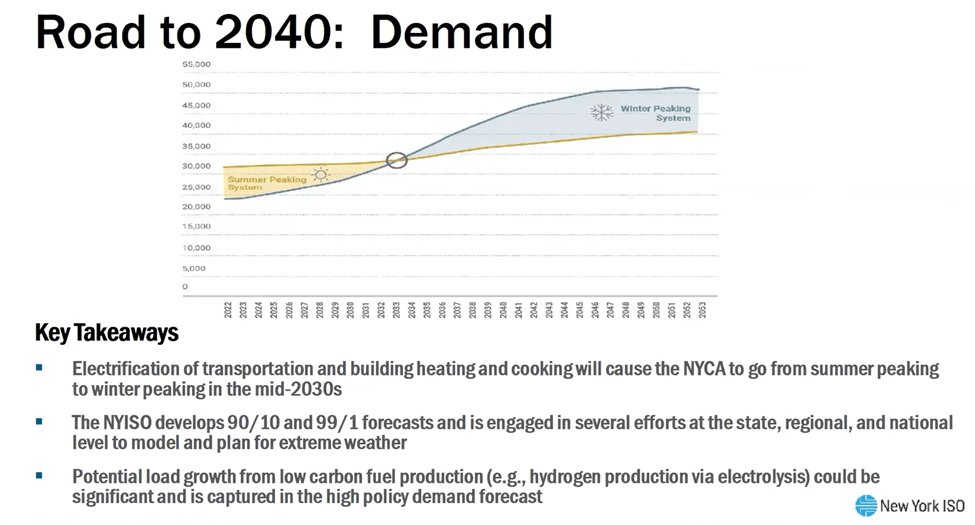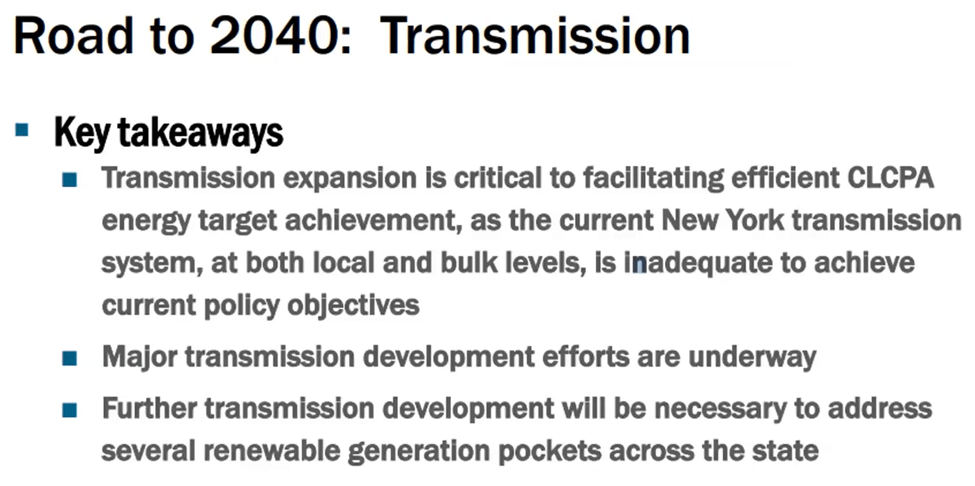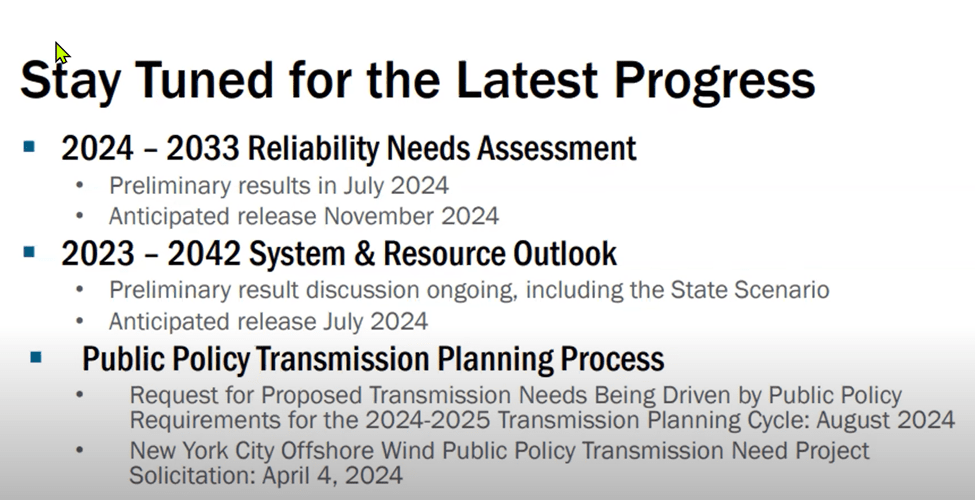

NYISO DEFR Summary

As part of the Department of Public Service Proceeding 15-E-0302 a technical conference was held on December 11 and 12, 2023 entitled Zero Emissions by 2040.  A  zero-emissions electric system is a key part of New York’s Climate Leadership & Community Protection Act (Climate Act) and all credible projections for the generating resources needed for the zero emissions Climate Act target  have noted that a new category of generating resources called Dispatchable Emissions-Free Resources (DEFR) is necessary to keep the lights on during periods of extended low wind and solar resource availability.  This post summarizes the presentation given by Zachary Smith from the New York Independent System Operator (NYISO) describing DEFR.

I have followed the Climate Act since it was first proposed, submitted comments on the Climate Act implementation plan, and have written over 380 articles about New York’s net-zero transition. The opinions expressed in this post do not reflect the position of any of my previous employers or any other organization I have been associated with, these comments are mine alone.

Overview

The Climate Act established a New York “Net Zero” target (85% reduction in GHG emissions and 15% offset of emissions) by 2050.  It includes an interim 2030 reduction target of a 40% reduction by 2030 and a requirement that all electricity generated be “zero-emissions” by 2040. The Climate Action Council (CAC) is responsible for preparing the Scoping Plan that outlines how to “achieve the State’s bold clean energy and climate agenda.”  In brief, that plan is to electrify everything possible using zero-emissions electricity. The Integration Analysis prepared by the New York State Energy Research and Development Authority (NYSERDA) and its consultants quantifies the impact of the electrification strategies.  That material was used to develop the Draft Scoping Plan outline of strategies.  After a year-long review, the Scoping Plan was finalized at the end of 2022.  In 2023 the Scoping Plan recommendations were supposed to be implemented through regulation, PSC orders, and legislation.  Not surprisingly, the aspirational schedule of the Climate Act has proven to be more difficult to implement than planned and many aspects of the transition are falling behind.  DEFR is a particularly challenging problem.  When political fantasies meet reality, reality always wins.

Presentation

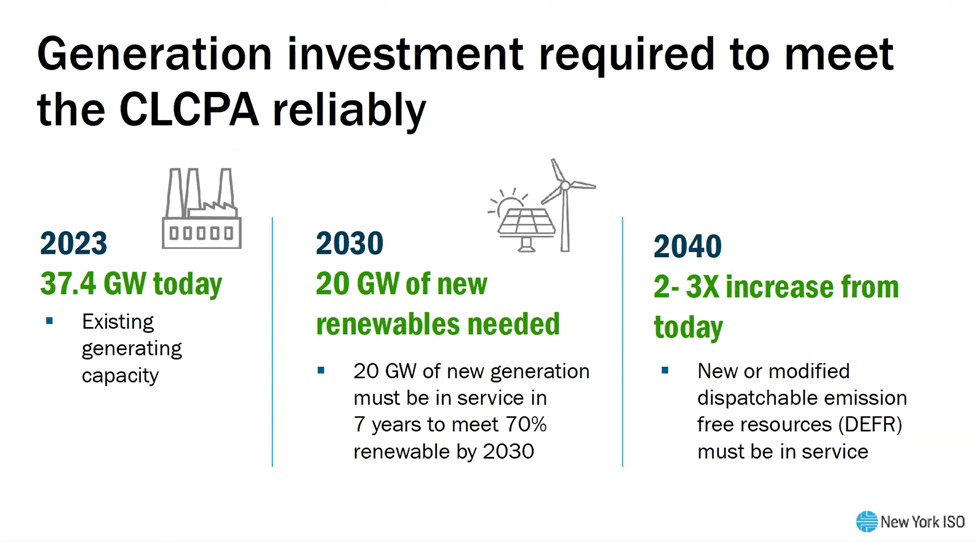
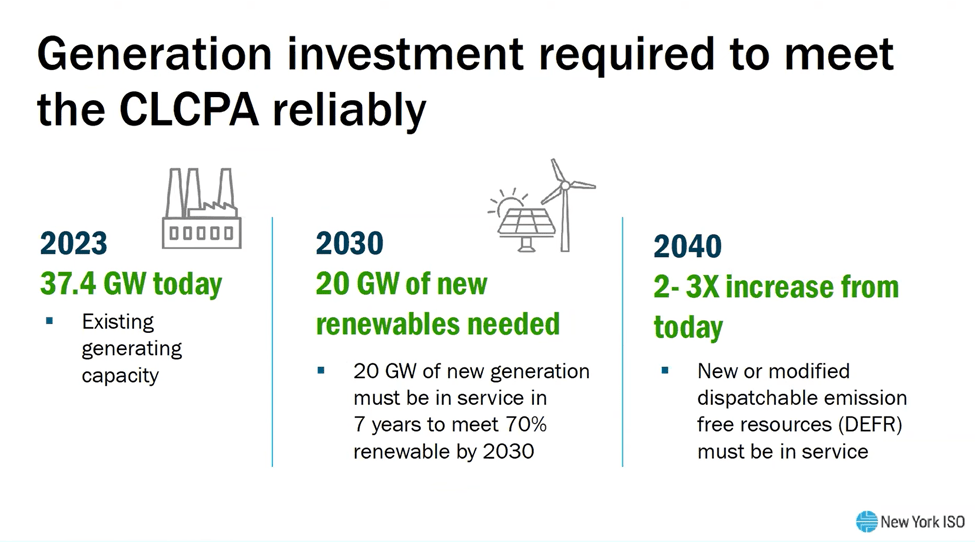
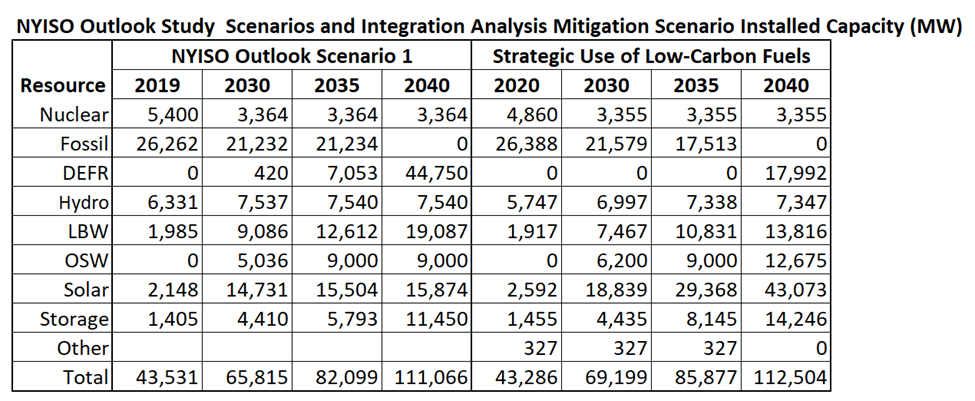
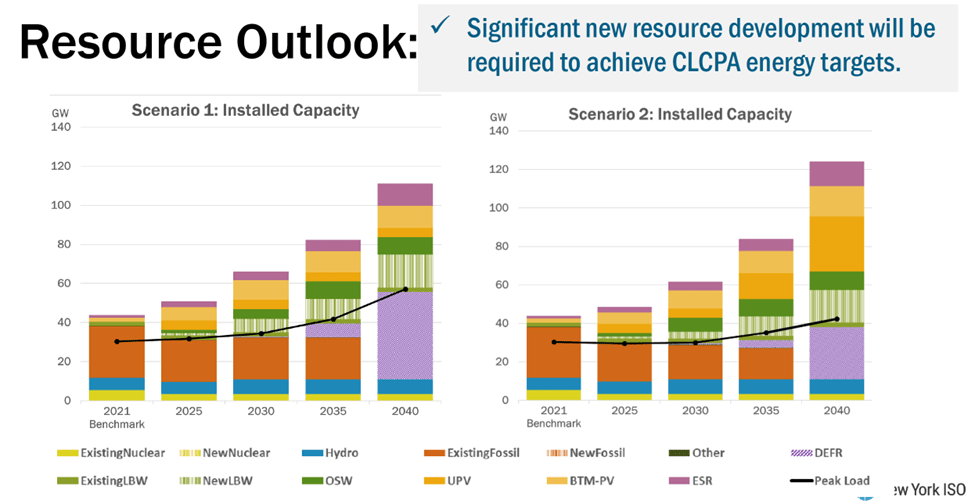
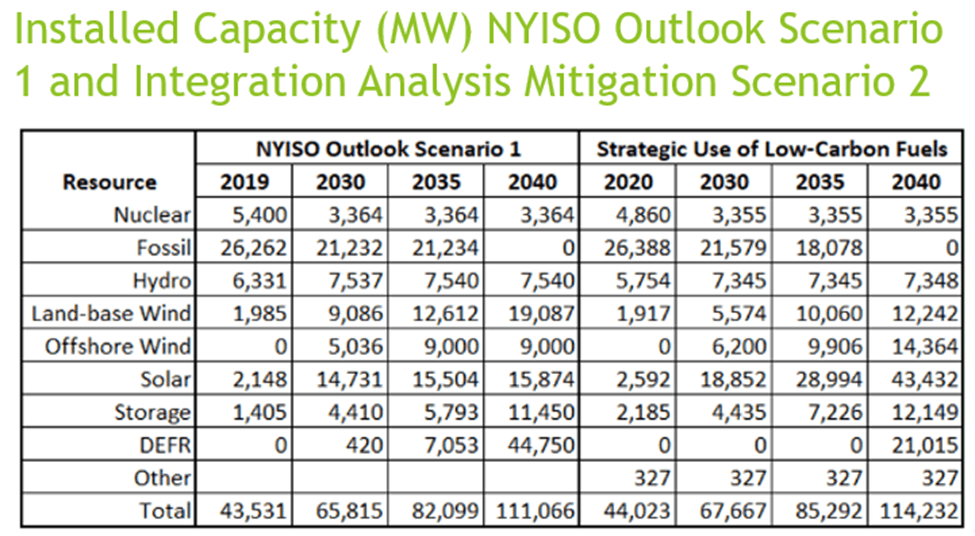
The presentation given by Zachary Smith gave an overview of the DEFR issue.  In his first slide (shown below) he gave an overview of the generating resource outlook to make the point that a large amount of new generating resources needs to be developed.  I believe that the estimates are from the 2021-2040 System & Resource Outlook.  For context I have included a table that lists the capacity for the different resources for one of the Resource Outlook scenarios and one of the scenarios from the Integration Analysis.  Of particular note, both projections estimate that DEFR capacity (MW) will be similar to the amount of current fossil capacity. 

The ultimate problem for reliability in an electric system that depends on wind and solar is illustrated in the following slide from Smith’s presentation.  It highlights a 7-day wind lull when the average wind capacity is 25%.  The sum of the grey area under the curve during that period is the amount of energy (MWh) that must be provided by DEFR sources based on an analysis of historical weather data. If there are insufficient resources during a wind lull, then load cannot be met.  The consequences of that situation would be catastrophic.

In order to meet this need for dispatchable resources Smith explained that dispatchable emission-free resources (DEFRs) must be developed and deployed throughout New York:

  • As resources shift from fossil generators to zero emission resources, essential grid services, such as operating reserves, ramping, regulation, voltage support, and black start, must be available to provide New Yorkers with a reliable and predictable electric system that consumers require.
  • DEFRs will be required to provide both energy and capacity over long durations, as well as the reliability attributes of retiring synchronous generation. The attributes do not need to be encapsulated in a singular technology, but in aggregate the system needs a sufficient collection of these services to be reliable.

The NYISO must toe the political correctness line so Smith downplays the enormity of the challenge to bring DEFR on-line in the timeframe necessary to meet the arbitrary Climate Act schedule.  Smith lists the attributes needed by DEFR in his presentation.  In the following I offer my comments on his list of attributes.

Smith’s first attribute for DEFR is that it must have “dependable fuel sources that are carbon free and allow these resources to be brought online when required”.  Clearly intermittent wind and solar do not meet this fundamental requirement. 

The second DEFR attribute is that it must be “non-energy limited and capable of providing energy for multiple hours and days regardless of weather, storage, or fuel constraints”.  This is a particular concern of mine.  Wind and solar resources correlate in time and space.  In other words, when the wind is light at one wind farm in New York it is very likely that all the wind turbines are experiencing light winds.  The seven-day wind lull example in the dispatchable resources needed figure illustrates the problem.  If there are insufficient resources during that wind lull, then load cannot be met.  My concern is that I think we do not know what the worst case low renewable resource availability period is.  Until there has been more analysis done then I believe that the New York electric grid is risking catastrophe.

The NYISO operators balance generation with load constantly.  Smith describes several attributes necessary for this requirement.  DEFR must be able to “to follow instructions to increase or decrease output on a minute-to-minute basis”.  There has to be “flexibility to be dispatched through a wide operating range with a low minimum output”. Finally, DEFR must be “fast ramping to inject or reduce the energy based on changes to net load which may be driven by changes to load or intermittent generation output”. 

In addition to the attributes needed when units are operating, there are startup attributes.  DEFR must be “quick-start to come online within 15 minutes” and capable of “multiple starts so resources can be brought online or switched off multiple times through the day as required based on changes to the generation profile and load”.  Smith explains that a range or DEFR generation will likely be required so not every DEFR has to be capable of every attribute for matching load but sufficient amounts for the system requirement will be needed.

In addition to the generating requirements that cannot be supplied by wind and solar there are ancillary support services for the transmission system.  Smith describes three transmission support DEFR attributes:

  • Inertial Response and frequency control to maintain power system stability and arrest frequency decline post-fault;
  • Dynamic Reactive Control to support grid voltage; and
  • High Short Circuit Current contribution to ensure appropriate fault detection and clearance.

Smith’s presentation lists the attributes of twelve sample technologies in the following slide.  When I started working for Niagara Mohawk in 1981 utilities were responsible for providing the generation for load in their service territories.  They were proud of the diversity of their generation fleet that included coal-, gas- and oil-fired fossil, hydro, pumped storage, and nuclear.  The generation all had a dependable fuel source and only the pumped hydro was energy limited but that was not an issue because it was used so shave diurnal peak loads.  Only nuclear was not dispatchable but that did not matter because it was used for unvarying base load.  There were resources in each system to provide all the other reliability attributes.  Demand response was used sparingly but was included.

Attributes of Sample DEFR Technologies

In the future grid the insistence that all fossil fired units have to be shut down means that seven technologies that meet some of the necessary attributes will be required.  The added complexity of these technologies does not increase resiliency because wind, solar, battery and demand response are all energy limited.  Ancillary support services will be a major consideration because wind, solar and battery do not provide those services.  Just from this overview, it is clear that affordability and reliability will be challenges.

Conclusion

Smith’s presentation is an excellent overview of need, attributes, and some potential resources that meet the need for dispatchable emissions-free generation.  Any suggestion that some combination of these resources are not needed is simply wrong.  Unsaid is the relative difficulty trying to develop these resources to meet the Climate Act net-zero transition schedule.

New York RGGI Operating Plan Amendment 2024

The Regional Greenhouse Gas Initiative (RGGI) is a market-based program to reduce emissions from electric generating units.  This post describes my comments on the New York State Energy Research & Development Authority (NYSERDA) Regional Greenhouse Gas Initiative (RGGI) Operating Plan Amendment (“Amendment”) for 2024. 

The Amendment describes the plans to use the RGGI proceeds in the next several years.  Although supporters of RGGI claim that it is a successful model to emulate, my comments explain the implications of the actual results not only to the RGGI program but also for the Climate Leadership and Community Protection Act (Climate Act).  There are no substantive changes in this regard since I submitted comments on last year’s operating plan.  What has changed is my tolerance for the perfunctory responsiveness of NYSERDA to stakeholder comments. 

I have been involved in the RGGI program process since its inception.  I blog about the details of the RGGI program because very few seem to want to provide any criticisms of the program.   I submitted comments on the Climate Act implementation plan and have written over 370 articles about New York’s net-zero transition because I believe the ambitions for a zero-emissions economy embodied in the Climate Act outstrip available renewable technology such that the net-zero transition will do more harm than good.  The opinions expressed in this post do not reflect the position of any of my previous employers or any other company I have been associated with, these comments are mine alone.

Background

RGGI is a market-based program to reduce greenhouse gas emissions (Factsheet). It has been a cooperative effort among the states of Connecticut, Delaware, Maine, Maryland, Massachusetts, New Hampshire, New York, Rhode Island, and Vermont to cap and reduce CO2 emissions from the power sector since 2008.  New Jersey was in at the beginning, dropped out for years, and re-joined in 2020. Virginia joined in 2021 but has since withdrawn and Pennsylvania has joined but is not actively participating in auctions due to on-going litigation. According to a RGGI website: “The RGGI states issue CO2 allowances which are distributed almost entirely through regional auctions, resulting in proceeds for reinvestment in strategic energy and consumer programs. Programs funded with RGGI investments have spanned a wide range of consumers, providing benefits and improvements to private homes, local businesses, multi-family housing, industrial facilities, community buildings, retail customers, and more.” 

NYSERDA Operating Plan Amendment

NYSERDA designed and implemented a process to develop and annually update an Operating Plan which summarizes and describes the initiatives to be supported by RGGI auction proceeds.  On an annual basis, the Authority “engages stakeholders representing the environmental community, the electric generation community, consumer benefit organizations and interested members of the general public to assist with the development of an annual amendment to the Operating Plan.”

The draft Amendment explains that New York State invests RGGI proceeds to support comprehensive strategies that best achieve the RGGI greenhouse gas emissions reduction goals pursuant to 21 NYCRR Part 507.  The programs in the portfolio of initiatives are designed to support the pursuit of the State’s greenhouse gas emissions reduction goals by:

  • Deploying commercially available energy efficiency and renewable energy technologies;
  • Building the State’s capacity for long-term carbon reduction;
  • Empowering New York communities to reduce carbon pollution, and transition to cleaner energy;
  • Stimulating entrepreneurship and growth of clean energy and carbon abatement companies in New York; and
  • Creating innovative financing to increase adoption of clean energy and carbon abatement in the State.

The draft Amendment notes that the initiatives described represent program activity proposed for the 2024 Operating Plan. The funding levels for each program include previously approved and the amounts proposed for FY24-25 through FY26-27. 

This post summarizes the comments I submitted on the proposed Operating Plan Amendment.  Given the obvious disdain that NYSERDA has for public stakeholder input I did not expend the level of effort I did last year. My comments rely heavily on last year’s analyses and are separated into two main parts.  The first repeats my 2023 evaluation that described the observed New York State (NYS) emission reductions from the electric sector since 2000.  The Plan needs to focus its efforts and put more emphasis on programs that directly, indirectly, or potentially reduce carbon dioxide (CO2) from the electric generating units affected by RGGI.  Failure to do so will cause problems achieving the Climate Act 2030 mandates to produce 70% of electricity from renewable sources and increasing energy efficiency from 2012 levels by 23%.  The second section offers my comments on the specific programs in the 2024 Amendment.  Finally, I document the poor public stakeholder engagement process. To address that I copied the Board in my submittal so that I could be sure that they at least had the opportunity to see my comments.

Comment Summary

I think the ultimate problem in the Amendment is that RGGI proceeds are used to support too many Climate Act programs outside of the electric sector. RGGI is an electric sector emissions reduction program, so it is inappropriate to use the auction proceeds for any program that will not materially decrease emissions directly or indirectly through energy efficiency reductions.  There are multiple programs in the amendment that do not meet those criteria.  Those mis-allocated funds should be transferred to programs that do affect emissions.

RGGI supporters claim that the RGGI funds have played a meaningful role in the observed emission reductions at RGGI sources, but that claim is exaggerated.  The historical emission trends of NYS electric generating units (EGU) provide valuable insight for future emission strategies.  I found that between 2000 and 2021 New York EGU emissions have dropped from 57,114,438 tons to 28,546,529 tons, a decrease of 50%.  NYS EGU CO2 emissions were 35% lower in 2022 than the three-year baseline emissions before RGGI started.  However, I showed that emissions have dropped primarily because coal and oil fueled generation has essentially gone to zero.  Natural gas has increased to cover the generation from those fuels but because it has lower CO2 emission rates New York emissions have gone down.

According to Table 2 in Semi-Annual Status Report through December 31, 2022, the cumulative annual net greenhouse gas emission committed savings are 1,725,544 tons through the end of 2022.  That is 9.5% of the observed reduction of 16,196,531 tons since the three-year baseline before the start of RGGI. I conclude that the primary reason for the observed electric sector emission reductions in New York was due to fuel switching.

These observations are relevant for the future of EGU emission reductions required for RGGI and the Climate Act. Fuel switching is no longer an option in New York.  Coal is no longer used and oil emissions from the RGGI affected sources are as low as they are going to get without retirement of oil-fired sources.  The average CO2 emissions reduction per year from RGGI investments has been 95,716 tons since 2013.  New York Part 242 CO2 Budget Trading Program specifies an annual reduction of RGGI allowances of 880,493 per year starting in 2022 and continuing to 2030.  That reduction is nearly ten times more than the reductions from RGGI auction proceed investments.  The Climate Act is going to require even more emission reductions.  Electric generating unit owners and operators have no options available for additional emission reductions other than reducing their operating times.  It is incumbent upon NYSERDA to invest RGGI funds to incentivize and subsidize carbon-free generation and reduce energy use so that the RGGI sources can reduce operations and not jeopardize system reliability.  If the sources are unable to reduce operations safely, then the Climate Act targets will be jeopardized.

In the second section of the comments, I evaluated the Amendment programs.  The comments describe program investments for six categories.  The first three categories cover programs that directly, indirectly or could potentially decrease RGGI-affected source emissions.  Those programs total 33% of the investments.  I also included a category for programs that will add load that could potentially increase RGGI source emissions which totals 24% of the investments.  Programs that do not affect emissions are funded with 35% of the proceeds and administrative costs total another 8%.  Because there is inadequate documentation, my categorizations are estimates.  Even if those estimates were refined, I believe this represents an improper allocation of resources.

In order to address the need for strategies that can displace RGGI-affected source generation the RGGI Operating Plan Amendment needs to reevaluate priorities.  NYSERDA must verify that other investments will provide the necessary reduction in RGGI-affected source emissions in order to justify spending more than half the RGGI proceeds on programs unrelated to RGGI emissions.  My comments on specific amendments recommended that most of the unrelated programs not be funded.

I only had specific comments on one proposed program. The Climate Act is pushing the envelope of zero-emissions technology, so the Scoping Plan Implementation Research program is certainly appropriate.  I recommend that this program fund projects for dispatchable emissions-free resource DEFR) requirements and the question of wind and solar resource availability during winter doldrums.
Stakeholder Process

I have been involved with stakeholder comments for regulatory proceedings in New York since 1981 and the NYSERDA engagement process is the least responsive.  Before the turn of the century, New York agencies asked questions early in the process, were receptive to comments received, and valued input from subject matter experts no matter their affiliation.   After 2000, that dynamic started to shift – agencies did not seek input from subject matter experts as much and there was less and less response to comments.  Recently the comments I submit ,and comments from industry in general, are submitted knowing that a substantive response is unlikely.

I think there are two reasons for this attitude change.  The first is simply the political emphasis on all decisions.  Over the years I have become friends with people in the regulatory agencies and privately they admit that all decisions are ultimately made based more on politics than technical feasibility.  The political appointees only hear what they want to hear from the agency technical staff.  The second reason is a shift away from pragmatic science-based approaches.  I recently posted an article about Righteous Risks and the Climate Act that describes the introduction to a series of articles by David Zaruk that characterizes the new approach.  He defines righteous risks as the “threat of harm to societal well-being arising from a value-based approach that filters facts and data with an ethical perspective.”  The problem with this approach is that “decisions are influenced by what is perceived as ethical rather than what is rational or scientific.”

There is another dynamic with respect to stakeholder comments for NYSERDA programs.  New York has always had a strong commitment to research and development.  Before de-regulation of the electric and gas industry utilities were required to fund R&D programs themselves with oversight from state agencies.  After de-regulation the funding commitment for R&D remained but state agencies, primarily NYSERDA, gained complete control.  It did not take long for the politicians to glom onto this pot of money for their own ends.  The stakeholder process has become a perfunctory obligation rather than an opportunity for improvement.  Without the threat of independent research by the utilities NYSERDA arrogantly assumes that they are the only subject matter experts that matter and don’t need input from anyone other than those chosen by politicians to further their aims.  

The final stakeholder process dynamic is that the State uses RGGI proceeds as a slush fund.  In the most egregious example, Governor Patterson diverted $90 million of the RGGI revneues for budget deficit reduction in 2009.  In 2018, Environmental Advocates of New York released a report that found that the Cuomo Administration was more circumspect, they simply supplanted costs associated with existing programs that pursued the State’s greenhouse gas emissions reduction goals.  Not to be outdone by the Administration, the Legislature passed the Electric Generation Facility Cessation Mitigation Program and diverted $69 million from RGGI proceeds to provide property tax relief for local governments and school districts facing a loss of revenue attributed to the closure, temporary or otherwise, of a power plant.  I have no doubts whatsoever that many of the RGGI-funded programs under the Hochul Administration continue this sorry tradition in one way or another.  I submitted these comments knowing that money talks and that the chance of reallocating money in the state bureaucracy has a vanishingly small chance of happening no matter how rational or scientific the arguments for change.

NYSERDA Stakeholder Responsiveness

The NYSERDA Use of Auction Proceeds website states:

Similar to other programs that NYSERDA administers, stakeholder input is important to us. On an annual basis, the Authority engages stakeholders representing the environmental community, the electric generation community, consumer benefit organizations and interested members of the general public to assist with the development of an annual update to the Operating Plan. NYSERDA seeks feedback on the design and implementation of programs described in the Operating Plan to help us maximize the effectiveness of RGGI funded programs.

In reality it is apparent that NYSERDA does not take this obligation seriously.  A proper stakeholder process demonstrates appreciation of the obligation by responding to the comments.  There must be some indication that someone read them, considered the points made, and took the stakeholder input into account.  The 2023 Operating Plan amendment process showed no sign of that.

Last year I spent a lot of time preparing detailed comments on the 2023 Operating Plan Amendment. 

The NYSERDA Planning Committee approved the 2023 RGGI Operating Plan at their January 25, 2023 meeting.  The proposed revisions to the Regional Greenhouse Gas Initiative Operating

Plan was presented to the Committee by John Williams, Executive Vice President for Policy and Regulatory Affairs. His opening statement reflects the perfunctory nature of the approval and includes the only acknowledgement and response to stakeholder comments:

Thank you Shere and everybody. We’ll move this one along pretty quickly. We’re here with our

annual routine RGGI approval process. So the, the Members have received both the three year

plan that we’re proposing as well as a memo of summarizing all that. Just some high points here

for awareness. You know, we did engage our annual process to come up with our proposal and

present that to stakeholders. And on December 12th we held a webinar for receipt of stakeholder input on that. So some participation there and some exchange of thoughts happening at that December 12th webinar. The proposal was also open for written public comments through January 6th, and we did receive a couple of comments there. The proposal you have was you know, does take those public feedback into account.

It is very easy to say the proposal takes public feedback into account but there is no available documentation explaining what feedback was included, what feedback recommendations were excluded, or why those decisions were made.  In fact, there is no indication of how feedback was addressed.  If they were serious, NYSERDA staff would prepare a report that lists all the points made in the comments with recommendations on how they should be handled for management review and approval.  Williams’s response mentions a memo but there is no indication of what it included, and it is not available as part of the record.  I think that it should be part of the record and that it should contain the summary of stakeholder comments and the NYSERDA responses.

This year’s stakeholder process actively discouraged public involvement.  The Amendment and meeting announcement were posted on December 1.  The Operating Plan Stakeholder Meeting was held on December 8, 2023.  The opportunity to join the meeting by phone or webinar required the use of a password that was not provided. There is no indication in the meeting recording that any participant figured out that nobody outside of NYSERDA joined the webinar. The video of the 12/8/23 meeting was not put online until December 15, 2023. To NYSERDA’s credit a separate webinar to offer the public an opportunity to ask questions on December 20.  However, they only allocated a half an hour.  I submitted questions before the webinar and time ran out before they responded to all of them.  The video recording of the Q&A meeting was provided on 12/27/23.  Comments were due by the close of business on December 29, 2023.  Expecting meaningful comments two weeks after the posting of the video with the Christmas holiday in between is not realistic.  In fact, it seems to be a deliberate attempt to squelch input.

Given the lack of responsiveness to those comments and the dismissive approach taken to the stakeholder process this year I saw no value in spending as much time on this operating amendment as I did last year.  I did not update all the analyses to use the most current data.  In order to be sure that the NYSERDA Board members had at least had the opportunity to see my comments I copied them in my submittal.

Conclusion

The State of New York has consistently allocated RGGI auction proceeds inconsistent with the stated goals of the program.  As long as emissions were going down then this impropriety had no impact on RGGI program goals.  The emission reduction low-hanging fruit are gone and now cost-effective and efficient emission reductions are needed.  The failure of the 2024 RGGI operating plan to recognize this need could very well mean that the Climate Act emission reduction targets will not be achieved.  It gets worse because the New York Cap-and-Invest (NYCI) program that is supposed to be developed in 2024 will include compliance limits.  If state investments do not produce emission reductions consistent with the NYCI limits then the only compliance option could be to stop emitting to produce electricity. In other words, the stakes have been raised and NYSERDA has not caught on.

The regulatory review stakeholder process is a game.  In my retirement it has become a hobby of mine to continue my involvement with the Climate Act regulatory proceedings.   Given the change in attitudes at state agencies I respond to requests for comments knowing full well that if I am lucky, I will get some indication that someone read the comments, but I expect nothing else.  I persevere because I consider my submitted comments a marker.  When this inevitably all blows up the record will show that they had been warned.  Unfortunately, the odds are that the ideologues pushing these policies will have moved on to a new grift so they will never be held accountable.

NY Public Service Commission “Gap” Reality Disconnect

As part of the Department of Public Service Proceeding 15-E-0302 a technical conference was held on December 11 and 12, 2023 entitled Zero Emissions by 2040.  The conference focused on characterization of the potential “gap” discussed in the May 14, 2023 Order.  The gap is expected because “renewable energy resources may not be capable of meeting the full range of electric system reliability needs that will arise as fossil generation is replaced.”  The conference included panel discussions on potential technologies to fill the gap.  The topics at the conference directly relate to my concerns associated with the reliability implications of New York’s Climate Leadership & Community Protection Act (Climate Act) so I watched the webinar and will be developing comments for submittal.  This article offers my first impression of the disconnect of those who deny the gap and reality.

I have followed the Climate Act since it was first proposed, submitted comments on the Climate Act implementation plan, and have written over 380 articles about New York’s net-zero transition. The opinions expressed in this post do not reflect the position of any of my previous employers or any other organization I have been associated with, these comments are mine alone.

Overview

The Climate Act established a New York “Net Zero” target (85% reduction in GHG emissions and 15% offset of emissions) by 2050.  It includes an interim 2030 reduction target of a 40% reduction by 2030 and a requirement that all electricity generated be “zero-emissions” by 2040. The Climate Action Council (CAC) is responsible for preparing the Scoping Plan that outlines how to “achieve the State’s bold clean energy and climate agenda.”  In brief, that plan is to electrify everything possible using zero-emissions electricity. The Integration Analysis prepared by the New York State Energy Research and Development Authority (NYSERDA) and its consultants quantifies the impact of the electrification strategies.  That material was used to develop the Draft Scoping Plan outline of strategies.  After a year-long review, the Scoping Plan was finalized at the end of 2022.  In 2023 the Scoping Plan recommendations are supposed to be implemented through regulation, PSC orders, and legislation. 

Gap Proceeding

In May 2023, the New York Public Service Commission (PSC) initiated a process to “identify technologies that can close the gap between the capabilities of existing renewable energy technologies and future system reliability needs, and more broadly identify the actions needed to pursue attainment of the Zero Emission by 2040 Target” for New York electric generating sources intended to address that need. I discussed that in a post last May. The May 14, 2023 Order included a requirement for a technical conference to focus on characterization of the potential “gap” and technologies that could shrink or fill that gap.

The pathway established by the Clean Energy Standard (CES) Modification Order focuses on options for procuring sufficient renewable energy resources to meet CLCPA requirements. However, several studies indicate that renewable energy resources may not be capable of meeting the full range of electric system reliability needs that will arise as fossil generation is replaced. These studies suggest that there is a gap between the capabilities of existing renewable energy technology and expected future system reliability requirements. The Independent Power Producers of New York, Inc., New York State Building and Construction Trades Council, and New York State AFL-CIO (Petitioners) also raised this issue in a petition filed in this proceeding on August 18, 2021 (Zero Emissions Petition or Petition).

This Order responds to the Petition and initiates a process to identify technologies that can close the gap between the capabilities of existing renewable energy technologies and future system reliability needs, and more broadly identify the actions needed to pursue attainment of the Zero Emission by 2040 Target. As a first step, rather than adopting a new CES tier as requested in the Zero Emissions Petition, this Order seeks input from stakeholders on options for addressing that gap. In particular, the Commission welcomes responses to the questions posed in the body of this Order and directs the Department of Public Service staff (Staff), in consultation with the New York State Energy Research and Development Authority (NYSERDA), to convene a technical conference that addresses the same list of questions.

I will prepare another post on the Zero Emissions by 2040 Conference itself with more details when the webinar recordings are available.  This post is only going to address the disconnect between climate activists who deny the gap and reality.

The Gap

There is an important point to keep in mind.  The experts who are responsible for reliability on the electric grid plan for the worst-case scenario to minimize outages. I think the fatal flaw in all the “clean and green” energy technologies touted for the future is that they don’t work all the time.  Unfortunately, they don’t work when needed most, i.e., the coldest periods when loads are highest.

The gap is caused by the correlation in time and space of renewable resource availability.  There is perfect correlation of all solar resources at night when the solar panels all go to zero.  Weather systems affect wind and solar resource availability, and the size of those systems means that there is strong correlation between the conditions that cause high and low resource availability.  Most large-scale weather systems exceed the size of New York so there are frequent periods when all the in-state wind and solar resources are low across the state.  As a result, over-building wind and solar cannot solve the gap.

I have addressed the ramifications of this in the past using the work of Michel at the Trust, yet Verify blogMost recently he graphed solar and wind electricity generation as a percentage of daily demand for the Belgian electric system. Over the last nine years solar and wind capacity (MW) in Belgium has increased significantly so the maximum daily share of wind and solar has increased.  However, the minimum share has not changed much reflecting the correlation of wind and solar across Belgium.  When it is calm at one wind turbine most of the other wind turbines have light winds too. It does not matter how many turbines there are if they all go calm at the same time.

New York is larger than Belgium but there is no expectation that there would be a different observation.  The New York and Belgium problems are exacerbated because weather systems can be so large that they affect large portions of the continent.  As a result, if other electric operating regions adjacent to New York become reliant on wind and solar importing electricity from outside New York will be affected. 

When I submit comments to this proceeding, I am going to emphasize the point that we will not know how to design resources to fill the gap until we understand the magnitude, duration, and scale of low wind and solar resource availability conditions across the Eastern Interconnect that provides imported power to New York.  I recently looked at the potential to solve this problem using the wind that is “always blowing somewhere”.  The ultimate problem is that dedicated resources are needed to supply energy to New York in the worst-case scenario and that would mean dedicated 1,000 mile transmission lines and a large number of wind turbines devoted to that purpose.  It is simply not cost-effective.  This result leads to the need for the new resources discussed at the Zero Emissions by 2040 Conference.

Disconnected Activists

I copied the chat log from the webinar display during the conference because there was information that I wanted to preserve. For example, Anshul Gupta, NYCP at  11:39 AM on 12/11/2023 asked: “NYCP documented National Fuel Gas’ disinformation campaign that Clarke mentioned in comments on NFG’s long-term gas plan”.  He wrote an op-ed for lohud.com The gas industry is trying to sway critical NY climate policy. Here’s why that epitomizes the impression I have that climate activists are disconnected from the reality of the gap.

In the op-ed he claims that scaremongering claims described below are false:

As we get close to finally implementing the CLCPA, New Yorkers are being subject to incessant scaremongering on how their energy reliability and affordability is threatened by the law, particularly by its building decarbonization goals. The grid can’t handle the electric heat pumps’ load, we are told. That our energy bills will skyrocket, that we’ll be forced to spend $20,000 to upgrade our homes, or that fossil gas can be replaced by renewable natural gas and hydrogen.

He describes himself as a “research scientist and a Steering Committee member of the New York Chapters Coalition of the Climate Reality Project, an international organization founded and led by former Vice President Al Gore”.  For my part I am pretty comfortable saying that most of what thinks is not true is closer to fact.  However, my bigger concern is the suggestion that saying energy reliability and affordability is threatened by the law is scaremongering.  The whole reason for the PSC Zero Emissions by 2040 Conference is concerns about reliability.  Apparently, he thinks that the PSC is scaremongering.

On the second day 10:30 AM Valdi Weiderpass (Chair Susquehanna Group, Atlantic Chapter, Sierra Club) recommended ‘No Miracles Needed’ by Mark Jacobsen because it says we can transition to renewables without exotic means.  Unfortunately the Climate Act is based on the flawed work of Jacobson and Howarth.  That wind, water, and solar” analysis ignores correlation issues and claims that no new technology is needed.  The fact that experts in the Integration Analysis itself, the New York Independent System Operator (NYISO) in every recent report on resource adequacy, and this proceeding all say “renewable energy resources may not be capable of meeting the full range of electric system reliability needs that will arise as fossil generation is replaced”  does not dissuade Weiderpass from his belief in the work of Jacobson.

Wind, Water, and Solar Has Been Refuted

In order to address the flawed wind, water, and solar work I think the following description from a year-old post is appropriate to repeat here.  It is not only the agencies responsible for reliability that are saying new technology is needed and wind, water, and solar are insufficient.  Supporters of this argument must ignore that Jacobson’s arguments have been refuted.

When the Climate Action Council voted on the Scoping Plan last year the statement of Robert W. Howarth, Ph.D., the David R. Atkinson Professor of Ecology & Environmental Biology at Cornell University exposed the basis of the “no new technology is needed” argument in the Climate Act:

I further wish to acknowledge the incredible role that Prof. Mark Jacobson of Stanford has played in moving the entire world towards a carbon-free future, including New York State. A decade ago, Jacobson, I and others laid out a specific plan for New York (Jacobson et al. 2013). In that peer-reviewed analysis, we demonstrated that our State could rapidly move away from fossil fuels and instead be fueled completely by the power of the wind, the sun, and hydro. We further demonstrated that it could be done completely with technologies available at that time (a decade ago), that it could be cost effective, that it would be hugely beneficial for public health and energy security, and that it would stimulate a large increase in well-paying jobs. I have seen nothing in the past decade that would dissuade me from pushing for the same path forward. The economic arguments have only grown stronger, the climate crisis more severe. The fundamental arguments remain the same.

I believe that this is the fundamental basis for the Climate Act’s aggressive schedule because it suggests there are no implementation issues, only a matter of political will.  The Jacobson analysis approach unfortunately is pretty much the same as the Integration Analysis modeling approach for the Scoping Plan.  Both modeling efforts project future load requirements, then list a bunch of control strategies, estimate the energy they could produce, and presume everything will work together if we cross our fingers.  Neither does feasibility analysis that considers reliability, affordability, or cumulative environmental impacts. Note, however, the Integration Analysis does conclude that a new zero-emissions dispatchable resource is needed.

Howarth appeals to the authority of peer-reviewed science to provide credibility to the Jacobson analysis. However, science is a continuous process where hypotheses are constantly challenged and confirmed.  In this instance Howarth neglects to mention the analyses that discredit the Jacobson work. 

The Jacobson analysis cited was a continuation of previous work.  For example, in a widely publicized November 2009 Scientific American article, Mark Jacobson and Mark Delucchi, suggested all electrical generation and ground transportation internationally could be supplied by wind, water and solar resources as early as 2030. However, other contemporary projections were less optimistic. Two examples: the 2015 MIT Energy and Climate Outlook has low carbon sources worldwide as only 25% of primary energy by 2050, and renewables only 16% and the International Energy Agency’s two-degree scenario has renewables, including biomass, as less than 50%.

Howarth’s statement cites a specific plan for New York (Jacobson et al. 2013) that he and Jacobson laid out a decade ago.  He says that “In that peer- reviewed analysis, we demonstrated that our State could rapidly move away from fossil fuels and instead be fueled completely by the power of the wind, the sun, and hydro.”   Table 2 from that report follows.  This analysis includes power from exotic resources such as waves, geothermal, tidal turbines, and concentrated solar power but no energy storage.  It is significantly different than the projections in the Integration Analysis and the New York Independent System Operator (NYISO) 2021-2040 System & Resource Outlook that exclude all the exotic renewable generating capacity, contain significant amounts of energy storage, and include a new dispatchable, emissions-free resource for a set of resources that they think is necessary to provide sufficient electrical power for the future. In my opinion, any analysis that suggests that concentrated solar power is a viable source of energy in New York is simply not credible because that resource would never work in New York.  It is too cloudy to operate enough to cover costs and the environmental impacts would be too great. Furthermore, Jacobson and Howarth claim that end-use power demand can be decreased by 37%.    I question whether we can electrify all other energy uses and decrease end-use power demand.

There was a formal rebuttal paper to this analysis. The rebuttal paper argued that: 

The feasibility analysis performed by Jacobson et al. (2013) is incomplete and scientifically questionable from both the technical and economic perspectives, and it implicitly assumes, without sufficient justification, that social criterion would not produce even larger feasibility barriers.

Jacobson et al. responded to that rebuttal claiming  that “The main limitations are social and political, not technical or economic.”  Given the significant differences between that analysis and the most recent projections by the organization responsible for keeping the lights on, I agree with the rebuttal conclusion cited above.  I do not believe that the 2013 analysis includes a defensible feasibility analysis.

Using Jacobson as the basis for the Climate Act transition has an even larger credibility problem.  Unmentioned by Dr. Howarth is that in a 2015 article for a different iteration of the wind, water, and solar roadmap Clack et al, 2017 discredited the Jacobson approach:

In this paper, we evaluate that study and find significant shortcomings in the analysis. In particular, we point out that this work used invalid modeling tools, contained modeling errors, and made implausible and inadequately supported assumptions. Policy makers should treat with caution any visions of a rapid, reliable, and low-cost transition to entire energy systems that relies almost exclusively on wind, solar, and hydroelectric power.

In the scientific process, when issues with your work are noted, the proper response is to provide more evidence supporting your modeling tools, explain why the claimed errors are not errors, and defend your assumptions.  Instead, Jacobson filed a lawsuit, demanding $10 million in damages, against the peer-reviewed scientific journal Proceedings of the National Academy of Sciences and the authors for their study showing that Jacobson made improper assumptions in order to make his claims that he (and by extension Howarth) had demonstrated U.S. energy could be provided exclusively by renewable energy, primarily wind, water, and solar. In my opinion this is an appalling attack on free speech and scientific inquiry but want to emphasize that the bad actions by Jacobson in no way should be attributed to Howarth.

In February 2018, following a hearing at which PNAS argued for the case to be dismissed, Jacobson dropped the suit.  The defendants then filed, based on the anti-SLAPP — for “Strategic Lawsuit Against Public Participation” — statute in Washington, DC, for Jacobson to pay their legal fees. In September 2022, he was ordered to pay the defendants’ legal fees based on a statute “designed to provide for early dismissal of meritless lawsuits filed against people for the exercise of First Amendment rights.” 

In my opinion Jacobson’s attempted lawsuit was because his work could not stand on its own.  Therefore, it is unsettling that it is claimed to be the basis of the Climate Act.  Howarth’s statement explicitly lays out his position for the Jacobson analysis:

We further demonstrated that it could be done completely with technologies available at that time (a decade ago), that it could be cost effective, that it would be hugely beneficial for public health and energy security, and that it would stimulate a large increase in well-paying jobs.

Unfortunately, Howarth’s technology demonstration is not supportable.  Nonetheless, it forms the basis for the Climate Act schedule and zero-emission electric system by 2040 mandate.  The Climate Action Council has embraced it despite the conflicting projections in the Integration Analysis and the NYISO Resource Outlook that reject it.  This PSC proceeding is the final reason to disregard the claim that existing technology is sufficient for the transition. 

Discussion

I have asked myself many times why climate advocates ignore anything that does not fit their narrative that climate change is an existential threat and the energy transition away from fossil fuels will be painless, save money, and solve the threat of climate change.  Francis Menton recently addressed this in  a post entitled Climate Advocacy: Incompetence or Intentional Fraud?   He describes an article about the electricity system on one of Spain’s Canary Islands, El Hierro, that claims “it ran its electricity system entirely on wind and water power for 28 consecutive days.”  Menton has advocated for a real-world test of the claims that an electric grid can be run solely on today’s renewable energy systems.  He explains that this system is the closest thing we have to such a field study: “The El Hierro system has wind turbines and energy storage from a pumped hydro system with nameplate capacity seemingly well in excess of peak electricity usage on the island.”  It turns out that it is not working out:

And yet, despite having such a rare near-perfect site for a large pumped hydro storage facility, the El Hierro system does not have nearly the energy storage needed to provide full-time electricity from the wind/storage system.  It would need to multiply its storage capacity by at least an order of magnitude to come close to 100% electricity from this system.  Meanwhile, most of its electricity comes from a backup diesel generator.

Menton addresses the disconnect of advocates in his conclusion:

So, is the piece mere incompetence, or intentional fraud?  Several factors would seem to give strong support to the inference of intentional fraud — failure to mention the diesel backup at all; failure to mention the number of hours in each recent year where the diesel backup had to be called into activity to keep the lights on, and whether that number of hours was trending up or down; failure even to consider how much energy storage would be needed to enable the system to operate full time without the diesel backup, and whether there are any plans to provide that amount of storage or at what cost.  Is it possible that someone could write a piece on this subject without even being aware of these issues?  You be the judge!

I think the comments by Gupta and Weiderpass should be judged similarly.  Is it possible that any climate activist who is so involved in an advocacy organization would not be aware of the reliability and affordability issues.  I will be generous and say there is a third possibility.  If they remain in their insular world where anything contrary to their beliefs is labeled as disinformation, then they may not know any better. 

The question is what would it take for them to change their minds?  Given that the belief that no new technology is only possible if you don’t read the Integration Analysis details, you believe that the NYISO is a shill for fossil fuel interests, so their reports are biased, and think that the PSC does not understand the electric system. Instead, they believe in a couple of academics. I have long thought that when the problems described by NYISO cause a blackout that the activists would get it.  Now I think the climate advocacy bubble will blame something else and the true believers will continue to deny reality.

Conclusion

It is disappointing that those who claim to support the “science” and denigrate anything inconsistent have it exactly wrong.  The Climate Act dependency on the work of Jacobson and Howarth is flawed and the experts who are responsible for the electric system have it right.  There is no question that technology that is not commercially available is needed unless New York comes to its senses and embraces nuclear power.  Anyone who argues we can transition to renewables without exotic means is wrong and is distracting from the real issues at hand.

There is an important ramification of the Scoping Plan’s implicit endorsement of the no new technology paradigm.  Because all the technology was assumed to be available, the Climate Act implementation schedule is overly optimistic.  The risks of forging ahead to meet the “zero emissions” by 2040 goal without knowing the potential costs of technology that is not commercially available and even whether some of the technologies will work as assumed is assumed are extraordinarily high.

Climate activists constantly urge action without delay because of the climate crisis.  Those arguments never address the impact of New York GHG emissions on global warming.  New York GHG emissions are less than one half of one percent of global emissions and global emissions have been increasing on average by more than one half of one percent per year since 1990.  As a result, the elimination of New York emissions will be replaced by increases elsewhere in less than a year.  Weighing the risks to reliability and affordability against the negligible risks on climate change posed by New York emissions clearly destroys the myth that urgent action is required.  That is not to say that New York should not do something, but it clearly argues that we have time to make sure that the actions taken do not do more harm than good.

America’s Largest-Ever Investment in Renewable Energy

On October 24, 2023, Governor Kathy Hochul announced “the largest state investment in renewable energy in United States history” including three offshore wind and 22 land-based renewable energy projects “totaling 6.4 gigawatts of clean energy, enough to power 2.6 million New York homes and deliver approximately 12 percent of New York’s electricity needs once completed.” These projections are needed to implement the New York Climate Leadership & Community Protection Act (Climate Act).  This post looks behind the hype and what it really means.

I have followed the Climate Act since it was first proposed, submitted comments on the Climate Act implementation plan, and have written over 350 articles about New York’s net-zero transition.  I have devoted a lot of time to the Climate Act because I believe the ambitions for a zero-emissions economy embodied in the Climate Act outstrip available renewable technology such that the net-zero transition will do more harm than good by increasing costs unacceptably, threatening electric system reliability, and causing significant unintended environmental impacts.  The opinions expressed in this post do not reflect the position of any of my previous employers or any other organization I have been associated with, these comments are mine alone.

Overview

The Climate Act established a New York “Net Zero” target (85% reduction and 15% offset of emissions) by 2050.  It includes an interim 2030 reduction target of a 40% reduction by 2030 and a requirement that all electricity generated be “zero-emissions” by 2040. The Climate Action Council (CAC) is responsible for preparing the Scoping Plan that outlines how to “achieve the State’s bold clean energy and climate agenda.”  In brief, that plan is to electrify everything possible using zero-emissions electricity. The Integration Analysis prepared by the New York State Energy Research and Development Authority (NYSERDA) and its consultants quantifies the impact of the electrification strategies.  That material was used to develop the Draft Scoping Plan.  After a year-long review, the Scoping Plan recommendations were finalized at the end of 2022.  In 2023 the Scoping Plan recommendations are supposed to be implemented through regulation and legislation.  In addition, New York must contract with developers to provide the enormous wind and solar resources necessary for a zero-emission grid.

If it’s failing, double down

One of the rules Irina Slav  argues that the net-zero transition leadership climate crusaders follow is  “If it’s failing, double down”.  New York’s transition has not reached the point where we have performance data that shows that renewables cannot deliver the promises of Climate Act advocates.  However, Hochul’s announcement for more new contracted projects when existing projects under development have begged for renegotiation  is a perfect example of this rule.

In mid-October the Public Service Commission denied requests by European energy firms Orsted, Equinor, BP and other renewable developers to charge customers billions of dollars more under future power sale contracts for four offshore wind and 86 land-based renewable projects.  “These projects must be financially sustainable to proceed,” Molly Morris, president of Equinor Renewables Americas, told Reuters, noting Equinor and BP will “assess the impact of the state’s decision on these projects.”   Soon thereafter Governor Hochul announced a “10-Point Action Plan to Expand the Renewable Energy Industry and Support High-Quality Clean Jobs in New York State”.  A couple of weeks later New York State Energy Research & Development Authority (NYSERDA)  described  what was included in the doubling down “largest-ever investment in renewable energy”.  According to the announcement, “Three offshore wind and 22 land-based renewable energy projects totaling 6.4 gigawatts will power 2.6 million New York homes and deliver 12% of New York’s electricity needs in 2030”.  This post unpacks these claims and looks at the projects themselves.

Offshore Wind Projects

The NYSERDA offshore wind project page describes the results of NYSERDA’s third competitive offshore wind solicitation:

NYSERDA provisionally awarded three projects totaling 4,032 MW, enough to power 2 million homes: Attentive Energy One (developed by TotalEnergies, Rise Light & Power, and Corio Generation), Community Offshore Wind (developed by RWE Offshore Renewables and National Grid Ventures), and Excelsior Wind (developed by Vineyard Offshore).

There is no question that this project award is a key component of the net-zero transition.  One of the legal mandates of the Climate Act is 9,000 MW of offshore wind by 2035.  The Scoping Plan Integration Analysis projects offshore wind capacity of 6,200 MW by 2030 and 9,000 MW by 2035. The capacity in these projects is 45% of the mandate.  NYSERDA claims these projects are supposed to provide about ten percent of New York’s electricity load, but I estimate that the energy produced is closer to 9% in 2030.

The Solicitation Awards Fact Sheet explains that the combined portfolio of projects is expected to:

  • Generate enough renewable, locally-produced energy to power more than 2 million homes, or approximately 10 percent of New York’s electricity load.
  • Deliver $3.4 billion in commitments to Disadvantaged Communities, in alignment with New York’s Climate Act goals.
  • Contribute more than $85 million to support wildlife and fisheries research, mitigation, and enhancement.
  • Deliver over $100 million to training New York’s workforce to build and service offshore wind projects.
  • Commit nearly $300 million to Minority and Women Owned Business Enterprises (MWBEs) and Service-Disabled Veteran Owned Businesses (SDVOBs).
  • Reduce greenhouse gas emissions by 7 million metric tons annually, the equivalent of taking over 1.6 million cars off the road every year.
  • Provide billions of dollars in public health benefits resulting from reduced exposure to harmful pollutants—including fewer episodes of illness and premature death, fewer days of school or work missed, less disruption of business, and lower health care costs.
  • Commit to purchase more than $500 million in U.S. iron and steel and to include Project Labor Agreements, labor peace agreements, and prevailing wages.

The expectations for these projects cover a wide range of benefits to favored constituencies.  The Climate Act mandates that at least 35% of the investments support Disadvantaged Communities but just how that is calculated is unresolved.  I worry that funding the transition is going to be expensive enough without diluting the efficiency with this type of mandate.  I wish I could say that the $85 million to support wildlife and fisheries research will cover the costs to monitor the effect of construction on whales but I am not optimistic that will be the case.  There is no question that the trades workforce has to be expanded for all the construction projects, but I am not sure throwing money at it is going to create incentives for people to choose those careers.  The money towards specific businesses is transparent pandering to a political constituency and increases the difficulties of the transition. NYSERDA claims 7 million metric tons of reductions per year, but I estimate 3.9 million metric tons.  The claim for billions of public health benefits does not stand up to scrutiny.  The final $500 million commitment is another transparent appeal to a political constituency, this time organized labor.

The NYSERDA 2022 solicitation page provides information about costs to New Yorkers:

All three projects are anticipated to enter commercial operation by 2030. The average bill impact for customers over the life of the projects will be approximately 2.73 percent, or about $2.93 per month. The weighted average strike price of the awarded offshore wind projects over the life of the contracts is $96.72 per megawatt hour in 2023 (real) dollars, which equates to a nominal weighted average strike price of $145.07 per megawatt hour. The strike prices comprising the weighted average cited above are subject to certain adjustments in accordance with the terms of the awarded contracts, including, in some cases, adjustments based on certain price indices, interconnection costs and/or receipt of qualifying federal support.

The $2.93 for these offshore wind resources needed for the net-zero transition does not tell the whole cost impact story.  The Hochul Administration has not owned up to the costs for all the other offshore projects, or the costs for the onshore wind resources, solar energy resources, the energy storage resources, and the dispatchable emissions-free resources that make up the supply component of future electric bills.  Nor have they explained the cost impacts on the delivery component costs of future electric bills that will be needed to pay for the transmission and distribution electric system upgrades needed to get the renewable energy where it is needed. 

The offshore wind industry is new and requires development of infrastructure and supply chain support.  The announcement also includes this: 

Delivering on Governor Hochul’s commitment to make New York State a hub for the U.S. offshore wind supply chain, this procurement includes continued support for offshore wind turbine manufacturing, which leverages over $2 in privately committed capital for every $1 of New York public funding.

NYSERDA is also awarding $300 million in state investment to enable the development of two supply chain facilities including nacelle manufacturing and assembly by GE Vernova, along with blade manufacturing developed by LM Wind Power Blades USA, both planned for New York’s Capital Region. This investment has the capacity to supply almost one-third of the total regional demand for offshore wind by 2035, which will unlock $968 million in public and private funding, create 1,700 direct and indirect jobs backed by prevailing wage and project labor agreements, and result in over $3 billion in direct spending in the State. Additionally, these projects also align with available federal tax credits, enabling future savings to New York’s ratepayers.

This is another buried cost of the Climate Act transition.  They brag that they are leveraging over $2 in privately committed capital for every $1 of New York public funding.  I see that as a 33% subsidy.  The rest of the discussion is another example of political pandering.

New York’s Land-Based Renewable Energy Procurement

The NYSERDA announcement also described other projects included in the procurement:

In addition, New York also announced its latest round of conditional land-based large-scale renewable awards, which are comprised of 14 new solar projects, six wind repowering projects, one new wind project, and one return-to-service hydroelectric project, totaling a combined 2,410 megawatts – enough new renewable generation to power over 560,000 New York homes annually for at least 20 years. These projects are expected to spur over $4 billion in direct investments and create over 4,100 good-paying short- and long-term jobs across New York State.

As shown in the following table there are four sets of projects in the procurement.  There are 14 solar projects totaling 1,495 MW, six wind project repowering projects totaling 612 MW, a new 298 MW wind project, and a 5 MW hydropower project.

The Large-scale Renewables 2022 Renewable Energy Standard Solicitation summary states:

NYSERDA awarded 22 large-scale renewable energy projects from the 2022 Renewable Energy Standard solicitation. The awarded projects are located throughout New York, including one paired with a utility-scale energy storage facility. Planned to be operational by 2028, these projects are expected to spur over $4 billion of direct investment and will create more than 4,100 short- and long-term jobs in development, construction, and operations and maintenance. Payments under these awards will not commence until projects have begun commercial operation after having obtained all required permits and local approvals.

The description of these projects leaves out some relevant points.  These awards do not guarantee the projects will be built because not all the projects have completed applications and given the volatility of the supply chains and inflation the developers may decide not to proceed if they think they cannot make money.  All these are intermittent sources and require energy storage to guarantee that the energy can be used when it is needed.  Of the total of 2,410 MW proposed the only energy storage facility included is only for 20 MW capacity and I could not find out how much energy (MW-hours) were planned.  Somebody else is going to have to subsidize these projects for the energy storage necessary to keep the lights on.  The description talks about the direct investments and job creation but neglects to point out that the largest solar project is not in New York State so the job creation does not accrue to New York.

The Solicitation summary goes on to claim:

As these projects proceed, NYSERDA will continue to work with their developers, other State agencies, and stakeholders to preserve and protect New York’s valuable agricultural and environmental resources as part of the project development process. Once operational, these projects will add 2,410 megawatts of new renewable capacity and are expected to generate enough clean energy to power more than 560,000 homes each year and reduce carbon emissions by more than 2 million metric tons annually, the equivalent to taking over 440,000 cars off the road every year.

The claim that NYSERDA will work with the developers to “preserve and protect New York’s valuable agricultural and environmental resources as part of the project development process is a hollow gesture.  As I have said many times there is no implementation plan that formally protects those resources and until a plan that explicitly protects farmland and cumulative environmental resources is implemented this is all just talk.  My estimate of the carbon dioxide reduction is consistent with the 2 million metric ton projection.  Finally, note that these projects will provide 3.1% of the expected load in 2030.

Finally, the cost impacts are described:

The average bill impact for customers over the life of the projects will be approximately 0.31 percent, or about $0.32 per month. The weighted average strike price of the awarded projects over the life of the contracts is $60.93 per megawatt hour in 2023 (real) dollars, which equates to a nominal weighted average strike price of $80.96 per megawatt hour. The strike prices comprising the weighted averages cited above are subject to certain adjustments in accordance with the terms of the awarded contracts based on certain price indices

There is a ramification of the six wind repowering projects that affect 612 MW of capacity.  All six projects came online in 2008.  I found a description that said:

Operational since 2009, Altona Wind is a project to which AES is excited to bring new life. The repowering of the wind park will incorporate significant component and control systems replacement with design improvements, resulting in greater energy production and improved energy reliability and availability. Repowering will ensure continued, significant economic benefits to the local community via HCA (Host Community Agreements) and PILOT (Payments in Lieu of Taxes) agreements.

This is notable because the Integration Analysis did not retire any of the existing wind resources in its projections.  It appears that the total costs out to 2050 should include repowering costs every 15 to 20 years.  The failure to incorporate that nuance means that the cost projections that NYSERDA claims show that benefits outweigh the costs are biased low.

Conclusion

The political theater associated with the “largest state investment in renewable energy in United States history” hides real problems. My experience with every aspect of the Climate Act is that detailed examination uncovers more uncertainty related to reliability.  A key consideration renewable resources is energy storage but only one of the 22 projects included any energy storage (20 MW of storage to 2,410 MW of generating capacity with no estimate of energy ,MWh, storage capability). There is no feasibility analysis that demonstrates that the current approach will work.  Instead, the only plan appears to be contract for as many resources as possible and hope it all works.  Coupled with the aspects of the transition plan that are designed to appeal to particular political constituencies regardless of their effectiveness relative to the transition, this approach is doomed.

My other concern is costs.  To their credit the announcements did include an expected cost to consumers totaling $3.25 per month for 12% of the energy needs in 2030. Assuming the costs for the remaining energy needs are the same, the increase in costs jumps to over $27 per month just for energy supply.  The Hochul Administration has never provided all the costs to consumers for the Climate Act or provided details of the costs and expected emission reductions associated with the Scoping Plan control strategies.  I have found that the Integration Analysis used to develop the Scoping Plan assumed that renewable development costs would decrease over time.  Recent events have shown that is not happening.  In addition, the fact that a renewable developer has a contract to repower wind turbines demonstrates that the Integration Analysis presumption that replacements out to 2050 were not needed is wrong.  Therefore, the costs will be much higher than claimed.

Despite the lack of a feasibility analysis and the flawed cost estimates the Hochul Administration is racing ahead doubling down that someday the reliability issues will be resolved and the costs will fall.  I think the New York electric system is headed to a reliability and affordability crisis.

City & State’s Clean Energy Summit

I attended City & State’s Clean Energy in New York Summit – New York’s Path to Sustainability (the “Summit”) on November 16, 2023 with Francis Menton author of the Manhattan Contrarian blog.  The summit was organized “to discuss opportunities that NY’s ambitious energy strategy created for new investment” and the two of us were the only ones who were skeptical of the whole business.  This post compares Menton’s description of the meeting and the “official” description with my personal observations.

The only reason for the Summit is the Climate Leadership & Community Protection Act (Climate Act).  I have followed the Climate Act since it was first proposed, submitted comments on the Climate Act implementation plan, and have written over 350 articles about New York’s net-zero transition.  I have devoted a lot of time to the Climate Act because I believe the ambitions for a zero-emissions economy embodied in the Climate Act outstrip available renewable technology such that the net-zero transition will do more harm than good by increasing costs unacceptably, threatening electric system reliability, and causing significant unintended environmental impacts.  The opinions expressed in this post do not reflect the position of any of my previous employers or any other organization I have been associated with, these comments are mine alone.

Overview

The Climate Act established a New York “Net Zero” target (85% reduction and 15% offset of emissions) by 2050.  It includes an interim 2030 reduction target of a 40% reduction by 2030 and a requirement that all electricity generated be “zero-emissions” by 2040. The Climate Action Council (CAC) is responsible for preparing the Scoping Plan that outlines how to “achieve the State’s bold clean energy and climate agenda.”  In brief, that plan is to electrify everything possible using zero-emissions electricity. The Integration Analysis prepared by the New York State Energy Research and Development Authority (NYSERDA) and its consultants quantifies the impact of the electrification strategies.  That material was used to develop the Draft Scoping Plan.  After a year-long review, the Scoping Plan recommendations were finalized at the end of 2022.  In 2023 the Scoping Plan recommendations are supposed to be implemented through regulation, PSC orders, and legislation. 

According to their webpage, “City & State is the premier media organization dedicated to covering New York’s local and state politics and policy. Our in-depth, non-partisan coverage serves New York’s leaders every day as a trusted guide to the issues impacting New York.” The Summit was billed as: their “first ever Clean Energy in NY Summit to discuss opportunities that NY’s ambitious energy strategy created for new investment.”  The description went on: “Panels will focus on large-scale renewable projects; the future of large-scale renewable procurement activity both onshore and offshore; the financial incentives to develop resources in vulnerable communities; as well as the emerging activity in hydrogen hubs, transportation decarbonization, and the state’s very active storage procurement market.”  In my opinion “non-partisan” coverage would make a concerted attempt to balance the enthusiasm of proponents of the new investment with some recognition of the challenges of the proposed transition but there were very few of that type of questions for the panelists.

I characterize this as a pep rally for the true believers and climate grifter industry.  The slick booklet containing the program for the Summit outlined the program, included speaker biographies, and included advertising blurbs for the sponsors.  A comparison of the sponsors and participant panelists, moderators, and remarks made by sponsors confirms that participants were chosen mostly based on sponsorship.  Ony the New York State Laborers Union, Anbaric transmission developers, and the New York renewable trade group Alliance for Clean Energy Solutions New York sponsors did not participate in the Summit.  The remaining participants were from New York State agencies, New York City agencies, other renewable developers, media representatives, or politicians.

This post will describe the “official” version of the meeting with Menton’s description and my thoughts.

City & State Overview

The meeting program had a keynote address and five panels.  The panels included “New York’s Path to Achieve its Clean Energy Goals”, Leading the Way in Offshore Wind”, “Achieving Climate Smart Communities”, “New York’s Energy: Impact, Economic Development + Workforce”, and “Protecting New York from Climate Threats and Reducing Carbon Emissions”.  There were four opportunities for “remarks” that gave the sponsors an opportunity to give their spiels and an inordinate amount of time was spent going over the panelist backgrounds.  As as a result there was little meat in the panel discussions.

The City & State description of the meeting gives a good flavor of the meeting.  The article states:

Clint Plummer, the CEO of Rise Light & Power, led off the discussion on the city’s clean energy transition efforts by addressing Gov. Kathy Hochul’s 10-point action plan to tackle inflationary pressures on project implementation. “The administration of Gov. Kathy Hochul implemented a 10-point plan in which they are delivering on New York’s transition with major new clean energy projects and investments in the supply chain,” he said. “So we not only are able to deliver projects today, but we do it with jobs that are based right here in New York state. And we do it in a way that mitigates against the volatility of the global supply chain.”

A truly non-partisan summit would have raised questions about these claims.  There was very little discussion of the magnitude of the issues mentioned.  For example, the Rise Light & Power business model is to offer everything that superficially meets the net-zero transition resource development narrative that fits its business model and ignore all the other resources necessary for a reliable electric grid as somebody else’s problem.  His comments check all the boxes for the Hochul Administration narrative but did little else.

When he introduced Doreen Harris, he said there is “nobody I trust more” to lead the transition.  After watching the net-zero transition roll out over the last several years, I have the exact opposite view. She claimed that there is a plan for implementation, but the Scoping Plan is only a list of control strategies with no demonstration of feasibility.  She also referenced the 10-point plan saying: “Talk about a major commitment to clean energy that was made at a moment in which we need to demonstrate that commitment to action.”  She went on:

With investments in renewable infrastructure rising, Harris also addressed concerns over existing contracts. “The elephant in the room is what is going to happen with the existing contracts that we have,” she said. “I want you to know, very soon, you will see some next steps we’ll be taking to address the ultimate challenges that they face. The Public Service Commission’s denial of the industry petitions is one that we obviously reacted very quickly to, knowing that we need these projects to move forward, not only in an affordable way, but in a competitive way.”

Her reference to doing something very soon was the announcement later that day that the existing contracts would be put out to be re-bid.  I described this in a recent post concluding that allowing the contact costs to be revised guarantees that the costs will be increased substantially.  The primary reason I distrust Harris is her claim to be concerned about affordability because under her oversight of the Scoping Plan, there has not been a full accounting of costs, no admission of expected consumer costs, and no documentation of the current status of energy poverty in New York.  The only affordability response by Harris has been that the costs of inaction are more than the costs of action, which I have repeatedly shown is a misleading and inaccurate claim both in Scoping Plan comments that were never addressed and in articles on my blog.

Manhattan Contrarian Description

Francis Menton did not pull any punches describing his thoughts on the Summit.  I encourage everyone to read his account.  He correctly points out that none of the substantive issues associated with the net-zero transition were mentioned, much less considered.  He says it was “essentially all mindless happy talk.” 

Menton highlights the happy talk slogans that were used frequently by all the speakers. He provided some quotes by Gregory Lampman, the Director of Offshore Wind at NYSERDA.  (“We’re the leader. . . .  We have a bias toward action. . . .  long term sustainability . . . something we can be proud of”).  My notes include the following from John O’Leary of the Governor’s Office: “laboratory for democracy”, “pivotal moment in time”, and “confidence in ability to move forward”.  These kinds of comments were the rule and not the exception.

My Observations

One aspect of the keynote presentation by Harris annoyed me but also led to the only positive aspect of any the panelist’s remarks.  NYSERDA has a whole department dedicated to public presentations and press releases all of which must be approved by the Hochul Administration.  The keynote presentation threw in the line “Who doesn’t love heat pumps” which drew applause and, to his ever-lasting credit, boos from Francis Menton. I was encouraged later in the program when Carrie Woerner, an assemblywoman from Glens Falls, managed to respond to the implication that heat pumps are a universal solution with no down sides. She basically quoted material from the James Hanley heat pump article about costs and the likelihood that people will switch to resistance furnaces instead of heat pumps because of the cost. 

I took a bunch of notes, but it would be a waste of time to bother to document all the biased comments, inaccurate arguments, and appeals to the preferred political constituencies during the day.  They far outweighed any mentions of potential concerns.  This was not an opportunity for the developers and affected entities to discuss possible problems and how they could be resolved.

Conclusion

Menton and I agree that this was nothing more than a revival meeting for the camp followers of the “clean energy miracle solution for the climate change threat” cult. I don’t think many outside the cult understand how immense the political support for this cult is and how the amount of money involved surely keeps the whole scam going. 

Menton concludes that:

It is completely clear that the people running New York’s supposed energy transition do not have the slightest hint of competence.  I suppose that’s for the better, because people who were actually competent could keep the charade going for a much longer time.  With this crowd, the collapse will come sooner, although not nearly soon enough.

I agree that this eventually has to collapse with or without competent advocates.  Unfortunately,  I fear that it will be so far in the future that the damages from the inane energy policy will cause irreparable harm to New York.

New York Heat Pump Transition

For over three years one of my particular concerns associated with the New York State Climate Leadership & Community Protection Act (Climate Act) net zero transition is residential electrification with an emphasis on home heating.  I have been meaning to do an update on this topic but have had other priorities.  Empire Center fellow James Hanley has prepared a new study that provides a great update: Cold Reality: The Cost and Challenge of Compulsory Home Electrification in New York (“Cold Reality”).  This post summarizes the study and my impressions of the analysis.

I have followed the Climate Act since it was first proposed, submitted comments on the Climate Act implementation plan, and have written over 350 articles about New York’s net-zero transition.  I have devoted a lot of time to the Climate Act because I believe the ambitions for a zero-emissions economy embodied in the Climate Act outstrip available renewable technology such that the net-zero transition will do more harm than good by increasing costs unacceptably, threatening electric system reliability, and causing significant cumulative environmental impacts.  The opinions expressed in this post do not reflect the position of any of my previous employers or any other organization I have been associated with, these comments are mine alone.

Climate Act Background

The Climate Act established a New York “Net Zero” target (85% reduction and 15% offset of emissions) by 2050.  It includes an interim 2030 reduction target of a 40% reduction by 2030 and a requirement that all electricity generated be “zero-emissions” by 2040. The Climate Action Council is responsible for preparing the Scoping Plan that outlines how to “achieve the State’s bold clean energy and climate agenda.”  In brief, that plan is to electrify everything possible using zero-emissions electricity. The Integration Analysis prepared by the New York State Energy Research and Development Authority (NYSERDA) and its consultants quantifies the impact of the electrification strategies.  That material was used to develop the Draft Scoping Plan.  After a year-long review, the Scoping Plan recommendations were finalized at the end of 2022.  In 2023 the Scoping Plan recommendations are supposed to be implemented through regulation, utility rate cases, and legislation. 

I have written extensively about residential home heating strategies in the Scoping Plan. In Climate Act Draft Scoping Plan Building Sector Scenarios I compared the Draft Scoping Plan residential heating scenarios and concluded a feasibility study is needed to determine whether any of the recommendations can be implemented.  I submitted comments on the costs of residential heating electrification in the Draft Scoping Plan.  My comments showed that the Plan did not provide sufficient information to assess the potential costs of the electrification strategies proposed.  One of the key factors affecting cost and feasibility is the need to upgrade the building shell to ensure comfort during the coldest weather when using heat pumps.  I also did a post that documented the results of my home energy audit that consolidated all my concerns with heat pumps.  If you are interested in more home heating background information, an article describing my interview with Susan Arbetter at Capital Tonight gave an overview of heat pump technology and described building shells.  Like every other aspect of the Climate Act transition heating electrification is more complex and costly than the Scoping Plan admits.

NY’s Electric-Heat Push Faces Cold Reality

James Hanley’s Cold Reality is described as follows:

New York’s plan to steer homeowners and landlords toward electric heat could backfire due to high costs and practical concerns, according to a new study from the Empire Center for Public Policy.  

In Cold Reality: The Cost and Challenge of Compulsory Home Electrification in New York, Empire Center fellow James Hanley looks at the state’s plan to prohibit homeowners from replacing gas and oil furnaces after 2029 and for them to instead install heat pumps. Homeowners, he explains, face both higher equipment costs and potentially high weatherization costs to accommodate heat pumps, which can operate at lower monthly costs but require better insulation. 

Even with extensive state and federal subsidies, Hanley warns, the upfront price-tag of heat pumps and weatherization will likely push homeowners to instead buy low-cost but energy-hungry electric furnaces that will put considerably greater stress on the electric grid—making the state’s overall electrification goals harder to reach. 

“This is the fundamental problem at the heart of New York’s command-and-control attempt to restructure its economy to make what amount to barely detectable reductions in global emissions,” said Hanley. “Albany can ban things, but it can’t control how people replace them.”  

Hanley notes that the impact of this policy will be felt most in rural New York, where the median household income of owner-occupied homes is the lowest, and points out that the state could instead reduce emissions by setting clean fuel standards that encourage the use of biofuels. 

Annotated Executive Summary

I n this section I quote the Executive Summary and offer my comments.

The Scoping Plan recommends that the State pass legislation that prohibits fuel-fired home heating but has not addressed all the consequences:

In 2030, New York may begin a policy of forcing New York families to use electricity for home heating instead of fuels like heating oil, propane and natural gas. Homeowners whose furnaces fail in midwinter will face a choice between spending tens of thousands of dollars on heat pumps while waiting for weeks or more to have their homes weatherized or buying inexpensive but energy-hungry electric furnaces. Their choices have significant implications for household budgets, utility companies providing electricity, and policymakers who need to ensure a sufficient amount of electricity production to meet the public’s needs.

Hanley does a good job explaining some of the nuances to the electrification that are not addressed in the Scoping Plan.  For example, he points out that if a furnace breaks down in the winter, that there are limited options for replacement.  You might be able put in a replacement heat pump quickly but the insulation and weatherization required to make heat pumps work in the coldest weather take longer to install. 

The Climate Act is a political construct.  The goals set were never evaluated with respect to feasibility.  The Climate Action Council did not address the consequences of the schedule proposed:

New York’s 2019 Climate Leadership and Community Protection Act (CLCPA) calls for reducing statewide greenhouse gas emissions by 85 percent by 2050 (from a 1990 baseline). The Climate Action Council has proposed meeting that goal in part by electrifying 85 percent of the state’s buildings. But it also has recommended a prohibition on the replacement of fuel-burning furnaces as of 2030, which would push the mandate closer to 100 percent electrification as units reach their normal end of life.

Hanley breaks down residential building energy production:

Over six million residential units in New York use fuels for heating, with over five million also using them for hot-water heating, and over four million using them for cooking. While most of those homes use natural gas, more than 1.7 million New Yorkers use propane, heating oil or kerosene1 for heat, with over a million using those fuels for hot water as well.

The Scoping Plan did not address these differences.  There are reasons that each fuel is being used and there are ramifications that may make a one size fits all electrification mandate problematic.  The analysis addresses some of the complications of the electrification mandate.  While the Scoping Plan admits that there should be exceptions to the mandate, it is not clear how those would be incorporated.  As Hanley points out, heat pumps have issues:

The state’s compulsory electrification program— forcing consumers to replace end-of-life fuel-fired appliances with electric appliances—recommends that building owners, including homeowners, install heat pumps. Because heat pumps do not warm the air as much as fuel-fired furnaces, heat pump installation involves additional costs for home weatherization. In cold climate regions, air-source heat pump users may also need to pay for a supplemental heat source, and due to the risk of power outages, risk-averse electric heat users may also need to purchase backup power generators.

Cold Reality does a good job in the report explaining how the plan will disproportionately affect the rural poor.  He describes other issues as well:

The costs of heat pump installation and building shell weatherization are high and will place a substantial economic burden on many homeowners, even with state and federal subsidies, as shown by the following numbers:

  • The cost of installing a heat pump and weatherizing a home: $14,600 – $46,200;
  • Heat pump and weatherization’s share of the median household income of owner-occupied homes in lower-income counties: 20 percent to 70 percent; and
  • How long it will take homeowners to recover costs through energy savings: 8 years to 19 years.

The Climate Act Scoping Plan emphasizes the climate justice aspect of implementation by focusing on Disadvantaged Communities.  I worry that emphasis will overlook the rural poor who will be disproportionately impacted by the electrification of heating costs described because rural poor may not be in a Disadvantaged Community.  If there is no hope that the electrification costs can be recovered by energy savings, then this is a serious problem.  Hanley points out that there are ramifications on the implementation strategy too:

State policy will likely drive homeowners to instead buy more energy-intensive electric resistance furnaces that have lower upfront costs but cost more to operate. Even with higher annual energy costs, it will take 18 to 60 years for total costs to equal the cost of a heat pump installation plus home weatherization.

I agree that the consequences of this choice have enormous implications:

Widespread adoption of electric resistance furnaces would further increase electricity demand, challenging utilities as they rebuild the state’s electric grid to deliver higher electric loads and policymakers as they struggle to close a sizable future gap in winter electricity production.

Whether homeowners choose heat pumps or electric resistance heaters, the future of oil and propane distribution firms appears dire. Based on their respective expected operational lives, propane furnaces may be eliminated between 2047 and 2050, while oil furnaces would be eliminated between 2056 and 2063.

One point not mentioned by Hanley is that propane is used more often for mobile homes.  Those residences cannot be insulated enough to enable the use of heat pumps so I expect that this would be another long-term use of propane in addition to those he describes:

Because there are a variety of out-of-home uses of propane, the propane industry will not completely disappear in New York, although it will dwindle and need to consolidate. With fewer alternative uses for heating oil, the heating oil delivery industry may be eliminated entirely.

Hanley correctly points out that the expected reductions in greenhouse gas emissions are inconsequential relative to global emissions.  However his description does not mention that the increase of global greenhouse gas emissions elsewhere means that the reductions will be supplanted by those increases in a matter of days:

The global effect of the costly compulsory electrification will be a reduction in greenhouse gas emissions of less than 5/100 of one percent. In choosing this approach, New York has closed the door on a more affordable means of reducing greenhouse gas emissions, clean fuel standards that promote biodiesel and renewable propane.

In that context, it is insane to not consider the affordable alternatives he describes.

Discussion

Cold Reality does an excellent job explaining issues associated with heat pumps in New York.  I want to make the point that Hanley addressed the major problems but could not address all the issues.  There are other problems that don’t have as much of an impact and are down in the weeds so far that trying to include them would detract from the report.

My post that documented the results of my home energy audit with a knowledgeable and experienced auditor raised some of the other issues.  I do not dispute that heat pump technology can work in New York State.  However, it is not simply a matter of swapping out a fossil-fired furnace for a heat pump because it is not just the furnace that has to be replaced.  Hanley explained that because the temperature of the air from a heat pump is lower than a fuel-fired furnace, the building shell needs to be upgraded to improve insulation and reduce air infiltration.  He did not point out that it may be necessary to change the duct work because a greater volume of air is needed to provide the necessary heat and that a heat exchanger might have to be added too.  Hanley described the trained tradesmen problem but I think it is not just a matter of installation workers it is also a matter of designers.  There simply will not be enough trained and experienced auditor/designers available because of the learning curve.  As a result, I fear many heat pump systems will not be designed properly.  That will exacerbate the load problems described in Cold Reality because the solution will be to add space heaters to stay warm.

Conclusion

There are many components of the Climate Act transition but very few will have as big an impact on individuals as the home heating electrification mandate.  Hanley’s Cold Reality is a great overview of the problems associated with the heat pump “solution” that have not been addressed by the Hochul Administration. He offers a solution to reduce impacts that I think makes sense.

In my opinion, however, there are even more problems than the problems Hanley describes in his conclusion:

New York’s proposed program of compulsory electrification could impose enormous costs on homeowners while making nearly unmeasurable gains in reducing global greenhouse gas emissions. As of 2030, homeowners will be faced with the choice of committing up to 70 percent of their annual incomes toward the purchase of heat pumps and upgrading their home’s shells or buying electric resistance heaters at just 3 percent to 10 percent of that cost.

The low rate of electric heating in many of the state’s more rural and lower-income counties means much of the choice will fall on homeowners who can least afford it.

And those who have unexpected equipment failures in midwinter may not be able to arrange contractors for their necessary shell upgrades in time to ensure comfort for the remainder of the season.

While the state’s Climate Action Council recommends heat pumps because they use less energy, the cost advantage of electric resistance heaters could lead to large numbers of homeowners choosing them.  This would increase the energy demands of the state beyond what has been predicted, challenging utilities as they rebuild the grid to deliver higher electric loads and challenging policymakers to close a predicted, and potentially growing, shortfall in future wintertime electricity production.

Upstate New York Smart Meters

I live in the Upstate New York National Grid service territory and recently received a notice that Smart Meters are coming.  Because I am aware of issues associated with this technology, I decided to research what this is all about.  My particular concern is that it could enable involuntary demand response capabilities associated with the New York State’s Climate Leadership & Community Protection Act (Climate Act) net zero transition.

Cutting to the chase: I have decided to let them install the smart meter in my home.  The costs to opt-out of them is greater than the risks that they will be used to potentially control my energy use someday in the future. 

I have followed the Climate Act since it was first proposed, submitted comments on the Climate Act implementation plan, and have written over 350 articles about New York’s net-zero transition.  I have devoted a lot of time to the Climate Act because I believe the ambitions for a zero-emissions economy embodied in the Climate Act outstrip available renewable technology such that the net-zero transition will do more harm than good by increasing costs unacceptably, threatening electric system reliability, and causing significant cumulative environmental impacts.  The opinions expressed in this post do not reflect the position of any of my previous employers or any other organization I have been associated with, these comments are mine alone.

Climate Act Background

The Climate Act established a New York “Net Zero” target (85% reduction and 15% offset of emissions) by 2050.  It includes an interim 2030 reduction target of a 40% reduction by 2030 and a requirement that all electricity generated be “zero-emissions” by 2040. The Climate Action Council is responsible for preparing the Scoping Plan that outlines how to “achieve the State’s bold clean energy and climate agenda.”  In brief, that plan is to electrify everything possible using zero-emissions electricity. The Integration Analysis prepared by the New York State Energy Research and Development Authority (NYSERDA) and its consultants quantifies the impact of the electrification strategies.  That material was used to develop the Draft Scoping Plan.  After a year-long review, the Scoping Plan recommendations were finalized at the end of 2022.  In 2023 the Scoping Plan recommendations are supposed to be implemented through regulation, utility rate cases, and legislation. 

The Scoping Plan is more of a list of potential strategies than an implementation plan because it does not provide a blueprint of the steps needed to implement the strategies proposed to meet the reduction targets.  The building sector currently has the highest Greenhouse Gas (GHG) emissions.  The strategies proposed to reduce greenhouse gas emissions include electrification, energy efficiency, energy conservation, and demand response shifts.  According to the Department of Energy: “Demand response provides an opportunity for consumers to play a significant role in the operation of the electric grid by reducing or shifting their electricity usage during peak periods in response to time-based rates or other forms of financial incentives”.   The Scoping Plan suggests using this as a resource option for balancing supply and demand.  I have no problem with voluntary demand response programs but given the challenge of balancing supply and demand when electric generation is weather-dependent, I worry that these programs could get to the point that the utility can control my energy use without my permission.

What is Happening? 

National Grid’s Upstate New York Rate Case Settlement Agreement (Cases 20-E-0380 and 20-G-381) included rate increases that “reflect incremental IT-related capital investments” for Advanced Metering Infrastructure (AMI).  The discussion in the Order Authorizing Implementation of Advanced Metering Infrastructure With Modifications that was issued on November 20, 2020 describes the rationale for AMI, aka smart meters (modified to label acronyms):

With Advanced Metering Infrastructure (AMI), National Grid can improve its response to power outages, as the Company will have more accurate and granular information regarding the voltage and current status of customers’ services. AMI can empower customers by providing them with information about their energy usage and allowing them to take action to manage their electric and gas costs. The AMI meter and communication system can be used to enhance the safety of the electric and gas system by allowing National Grid to remotely monitor facilities and receive alerts when abnormal conditions are detected. Moreover, AMI is an important and valuable contribution to enabling the Company to assume the role of the Distributed System Platform (DSP), to increasing use of Distributed Energy Resources (DERs) to support system operation, to increasing the use of measures such as Volt-Var Optimization (VVO) to reduce energy use and emissions, and to facilitating customer access to products and services provided by third-parties.

The first major benefit category is Avoided Operation and Maintenance (O&M) Costs, estimated at $188 million. This includes operational savings from remote customer connects and disconnects, better storm response with the integration of Outage Management Systems (OMS) and AMI, reduced meter reading costs, and reduced meter investigation costs.

The second major benefit category is Avoided Program Costs, estimated at $354 million. This includes avoided costs of replacing automated meter reading (AMR) meters, avoiding additional sensors to support the DSP, and metering for customers eligible for Value of Distributed Energy Resources (VDER) according to the Company’s tariff.


The third major benefit category is Customer Benefits, estimated at $251 million for the time varying pricing (TVP) rate opt-out scenario and $165 million for the TVP rate opt-in scenario. This includes reduced energy from Volt-Var Optimization (VVO); customer response to granular energy usage information communicated via the Company’s website and through high-usage alerts, and to the TVP rate; and reduced demand costs for customers who charge electric vehicles during off-peak periods.

Proponents of the electric grid transition away from centralized power plants burning fossil fuels argue that it is more efficient to use on-site energy production using wind and solar.  The idea to use Distributed Energy Resources (DER) in the electric system has been around for a while but so far, the generators primarily use fossil fuels.  In the future, the theory says DER and the Distributed System Platform (DSP) described will accommodate intermittent wind and solar resources in the so-called “smart grid”.  Volt/VAR optimization (VVO) is another aspect of the smart grid.  It is a process of optimally managing voltage levels and reactive power to achieve more efficient gird operation by reducing system losses, peak demand, or energy consumption or a combination of the three.

National Grid Voluntary Peak Demand Program

Upstate New York National Grid has voluntary programs for energy consumption incentives on high energy demand days in place today.  These programs control the thermostats at participant homes rather than controlling the meter for the house.  The Connected Solutions program description notes that:

Energy use peaks during certain seasons, especially on the hottest and coldest days of the year.  When you cool your home or small business using electricity during summer or keep it warm using natural gas in winter, Connected Solutions will reward you for using less energy during those peak times. 

When you use less energy on peak demand days you help manage the cost of energy, protect the environment and infrastructure, and you help our communities stay safe and comfortable.

In Upstate New York there are programs for the summer and winter.  The summer description states:

On hot summer days, when the grid is stressed, it is important to conserve energy. Reducing energy at these times reduces energy costs and decreases pollution.

National Grid has made it easy for you to conserve energy at these peak times. After you enroll your qualified thermostat, National Grid will automatically send a signal to your thermostat to precool your home or small business before the peak event and increase your thermostat setting during the peak event.

Here is some information on when peak events may occur:

  • May-September
  • Non-holidays
  • There are typically 10 – 15 peak events every summer.

The winter description states:

On extremely cold days, when the demand for natural gas is at its highest in Upstate New York, it is important to conserve energy. Reducing your natural gas use at these times reduces energy costs. By shifting your energy use for a couple of hours during peak demand days you can help lower the stress on our system, save money and ensure our communities are safe and comfortable.

Connected Solutions Gas has made it easy for you to conserve energy during these times and will reward you for your participation. After you enroll a qualified, wi-fi enabled thermostat connected to your boiler or furnace, we will automatically send it a signal to preheat your home or small business before the peak event times and then temporarily decrease the temperature by a couple of degrees for the duration of the event. After the event has passed, your thermostat will automatically go back to your preferred temperature.

Here is some information on when peak events may occur:

  • November-March on days when temperatures drop well below average
  • 6 a.m. to 10 a.m. or 4 p.m. to 8 p.m.
  • There are typically 2 – 5 peak events every winter.

It is possible to opt out of a peak event anytime by changing your thermostat setting for both programs.  However, if you opt out of peak events National Grid may unenroll participants from the program for the following year.

National Grid Smart Meters

Against this backdrop I was interested when National Grid recently sent a bill insert, Smart meters are coming soon, that describes what is coming.  The information provided states:

  • MORE CUSTOMER CONTROL: continuous, secure access to your energy data—for more insight into your energy efficiency and usage decisions.  
  • FASTER, NEAR REAL-TIME ENERGY READINGS: available within minutes, through your My Account portal.
  • FASTER RESPONSE: enhanced outage monitoring and storm response.
  • AND MORE FEATURES — still to come

It’s all part of our ongoing commitment to empower customers—while working to build a more reliable, robust and climate-friendly energy grid for the future. Learn about your new smart meter at ngrid.com/smartmeter.

This webpage describes the rollout:

Like any aging appliance, your existing utility meter will need to be replaced soon. We are in the process of replacing current meters with smart meters in many of the regions we serve.

These smart meters incorporate proven, sophisticated technology which will improve service and reliability, while also giving you more control over your energy usage, faster, near real-time energy readings and an overall faster response. Smart meters are part of our ongoing commitment to empower our customers while working to build a more reliable, robust, and climate-friendly energy grid for the future.

One of the things that really isn’t explained clearly is that the smart meters will be installed unless the customer opts out.  There is a link to opt-out of a smart meter buried in the National Grid web page.  However, there are fees if a customer chooses to opt-out.  The enrollment fee is $44.63 for an electric customer, $61.19 for a gas customer or $89.03 for both.  The monthly fee for manual meter reads is $11.64 for electric or gas customers or $17.71 for both.

Concerns

If the only purpose of the smart meters was to automatically read my meters I would not be concerned.  However, I know that the challenge to reduce building sector emissions is so great that I worry that I will be involuntarily affected by the smart meters.

The description of smart meters claims that the smart meters will determine whether an outage is caused by the system or something within a home.  If it is a system outage, then National Grid will be informed quickly. 

The meters will provide hourly usage data.  I think it is inevitable that utility bills will be based on the time of the day rates with higher prices during peak demand times.  I can choose to save money by running my appliances when rates are lower.  As long as I get to choose when I can run my appliances, I can begrudgingly live with that.

It is not clear to me how the planned smart meters installations affect the Distributed System Platform and the Volt/VAR optimization benefits described above.  I do not know if my smart meter will be used to involuntarily control my energy consumption.  All the information provided so far indicates that there is no plan to do that yet.

However, I wondered whether the proposed smart meters had the capability to do that in the future.  I thought I would try to find out if that was the case.  I called National Grid and asked if the meters being installed could be used for involuntary demand response now or could be upgraded to do that later.  Once I got through to a human I was told “I don’t think so”.  I asked if I could talk to the folks doing the installations.  It turns out that National Grid has partnered with Utility Partners of America to do the installations. 

I ended up submitting the question to Utility Partners of America.  I asked “Can National Grid control my energy usage with this new smart meter?”  I received the following response: 

No, the smart meter will not give National Grid access to control your energy usage. We collect the same usage data we have always collected through existing meters just in more frequent intervals. However, National Grid does have Demand Response programs available for customers and while participation in those programs is voluntary, signed consent is required by the customer.

Conclusion

In brief, National Grid is installing smart meters to eliminate manual meter reading and automate outage reporting.  It will also provide more detailed energy use information that will enable them to start time varying pricing which will mean higher costs if you want to run appliances at peak energy use times.  There are other alleged technical advantages associated with the Climate Act transition plan.

My major concern was that they could involuntarily control my energy use.  I accept that this is not part of the current plan.  Everyone denies this could be possible with these meters.  However, I remain unconvinced that someday down the road, that such a program could be implemented. 

I have decided to let them install the smart meter in my home.  The costs to opt-out of them is greater than the risks that they will be used to potentially control my energy use someday in the future. 

Enough Land  How will solar development affect upstate New York agriculture?

I have been writing about the Climate Leadership & Community Protection Act (Climate Act) for over four years and one of my primary concerns is the effect of solar developments on New York agriculture.  Kris Martin sent me the Enough Land:  How will solar development affect upstate New York agriculture? white paper (“White Paper”) on agricultural land use and solar buildout in Upstate NY that she just completed. It is a well-researched analysis that looks at how much solar capacity we need to meet Climate Act goals and how much farmland that will require..  Kris has kindly offered to let me provide it to my readers.

I have followed the Climate Act since it was first proposed, submitted comments on the Climate Act implementation plan, and have written over 350 articles about New York’s net-zero transition.  I have frequently written about issues related to solar development and Upstate agriculture. I have devoted a lot of time to the Climate Act because I believe the ambitions for a zero-emissions economy embodied in the Climate Act outstrip available renewable technology such that the net-zero transition will do more harm than good by increasing costs unacceptably, threatening electric system reliability, causing significant unintended environmental impacts, and adversely affecting the way of life in rural New York.  The opinions expressed in this post do not reflect the position of any of my previous employers or any other organization I have been associated with, these comments are mine alone.

Climate Act Background

The Climate Act established a New York “Net Zero” target (85% reduction and 15% offset of emissions) by 2050.  It includes an interim 2030 reduction target of a 40% reduction by 2030 and a requirement that all electricity generated be “zero-emissions” by 2040. The Climate Action Council is responsible for preparing the Scoping Plan that outlines how to “achieve the State’s bold clean energy and climate agenda.”  In brief, that plan is to electrify everything possible using zero-emissions electricity. The Integration Analysis prepared by the New York State Energy Research and Development Authority (NYSERDA) and its consultants quantifies the impact of the electrification strategies.  That material was used to develop the Draft Scoping Plan.  After a year-long review, the Scoping Plan recommendations were finalized at the end of 2022.  In 2023 the Scoping Plan recommendations are supposed to be implemented through regulation and legislation. 

Kris Martin

Kris sent me the following biographical information:

I grew up in a western NY farming community with three colleges; I’ve had a lifelong interest in agriculture and technology. I earned a BA from SUNY Empire State College and an MS in technical communication from Rensselaer Polytechnic Institute.  After graduating, I worked as a software engineer and technical writer at IBM Research receiving national and international awards for my writing. Upon retiring, I moved back to western NY. 

The preface describes the impetus for the white paper.  She had heard the argument that the solar buildout for New York would only require 1% of the state’s farmland.  She did a quick analysis and realized that a more realistic estimate was needed.  She explains:

Maybe I could come up with more realistic estimates. Supporters of large-scale solar and those who opposed it needed some real numbers. I could produce them in a couple of weekends. That was over three years ago.

I can certainly sympathize with that time estimate.  In my experience, nothing associated with any component of the Climate Act is as simple as it first appears.  As a result, any analysis and documentation takes much longer than I originally thought.  That is especially true if you want to document exactly what you found so that the analysis is credible.  The description of the document includes this disclaimer: “This document is neither a statistical analysis nor an academic work; it should not be used as a formal reference.”  It may not be a peer-reviewed work but it is referenced well, the calculations documented, and the conclusions are supported by the work.  It is citizen-science at its finest and I would have no qualms quoting it in my work.

Enough Land

Martin describes the document:

Many upstate New York residents object to solar development on farmland, arguing that we should prioritize food production over energy generation. Others dismiss these concerns as unnecessary. This paper uses government and industry data—along with stated assumptions—to estimate how much agricultural land New York State’s expected level of solar buildout will require. The assessment also places solar land use in the larger context of the state’s farmland losses.

The chapters that follow address these overall questions:

  • Why do we need to site solar facilities on farmland?
  • How much solar capacity will the state need by 2050?
  • How much farmland will this require?
  • How much agricultural land do we have?
  • What effects does solar buildout have on agriculture?

Appendices provide more information on related topics.

She explains that the questions addressed in the white paper are simple: how much solar energy do we need, and how much farmland will it re-quire and what do these amounts mean for upstate agriculture?

Results

Cutting to the chase, Martin compares the acreage of New York State farmland as of 2017 and the acreage required by 2040 and 2050 for solar development in the following table.  She explains:

The claim that solar development will require only 1% of New York State’s land is roughly correct. On the other hand, solar buildout will require more than 1% of the state’s farmland.

Note that these numbers reflect acreage on the facility site; they do not include land used for mitigation or land taken out of production around facilities because it is less accessible or abandoned for other reasons.

I like the White Paper because it provides context for everything covered.  Estimating the amount of land is dependent upon area per solar panel installation and how much capacity is required for the Climate Act.  Those topics are covered in sufficient detail that it is clear why the numbers used were chosen.  This extends to the results.  There is a chapter that “considers the loss of farmland that has been occurring over the last century and speculates on the reasons for farmland conversion over that period.”  The White Paper provides a projection of expected additional farmland and cropland losses by 2050 not related to solar development.  While there are inconsistencies in the data used such that there is “missing” land, the results are troubling.

The section “How Much Land” assesses cumulative farmland losses from both solar and non-solar causes and puts the estimates in context.  Martin addresses the question whether this is a little or a lot but finds that more context is needed.  She explains: “Let us consider some of the factors relating to our current and future land use, and their relationship to solar development.” 

  • The explanation takes up an entire chapter.  The chapter looks at the following issues:
  • Climate change and agriculture
  • Farmland values in New York and other states
  • Farming and farmers
  • Concentrations of solar development, with examples
  • Agrivoltaic solutions

I really liked this chapter because it frames the issues very well.  My goal as a pragmatic environmentalist is to try to provide the information that I think should be considered when decisions are made.  Invariably there are tradeoffs and the decisions made will reflect value judgements.  This chapter provides the information and avoids making conclusions about which tradeoffs are appropriate. 
One aspect of solar development that I had not considered previously is the effect of co-locating solar developments in the same area.  When several grid-scale solar projects are concentrated in one agricultural area there are adverse impacts to the remaining farmers.  I have long contended that the State has failed to provide a cumulative environmental impact assessment for the currently projected amount of solar and wind development.  The Final Supplemental Generic Environmental Impact Statement (SGEIS) for the Climate Leadership and Community Protection Act was released on September 17, 2020 and only included 13,200 MW of utility-scale solar.  This analysis assumes that utility-scale solar will be on the order of 45,000 MW or over three times what the State analyzed.

Discussion

After three years of extensive work Kris Martin has assembled a great resource on solar development and its potential impacts on New York agriculture.  She confronts the tradeoffs:

Ultimately, we may be facing a conflict between the rights of landowners to use farmland for any legal purpose and our collective need for farmland as a vital resource. Because most of us do respect the long hours, hard work, and inherent risks that farmers take, we naturally sympathize with their decisions to take farmland out of production or change the focus of their operations by leasing or selling land for solar development.

Farming is not an altogether benevolent activity. It can reduce biological diversity, introduce harmful chemicals into the environment, and consume massive subsidies that fail to improve life for many farmers or increase the production of affordable, healthy food and other agricultural products.

Do we have enough farmland for solar buildout on the scale required to meet Climate Act goals? Keep in mind that the Climate Act is a law, not simple policy. Its success depends on our having more farmland than we need in order to produce food, fiber, and fuel.

The answer to this question may be somewhat subjective. We may not even know the answers until it is too late to do much about the issue.

She includes recommendations for state policymakers, solar developers, community leaders, other individuals, and host farmers.

Conclusion

My takeaway from the White Paper is that it provides the context that the Hochul Administration should have provided for solar development.  The fact is that there still is no utility-scale solar development plan for the Climate Act.  There is no mandate to follow the Department of Agriculture & Markets targets for conversion of agricultural lands or explanation why meeting the targets should not be mandated.  The Scoping Plan estimates for solar capacity availability assume that tracking solar panels are used but the that is not mandated so fixed panel systems are being installed.  That means even more land will be taken up by industrial solar development.  Finally, there is no mandate for agrivoltaics.  This White Paper shows what should have been done. 

I agree with Martin’s conclusion:

We cannot afford to make bad decisions about farmland or energy production. Today’s priorities may become tomorrow’s regrets. The conflicts identified here will require all our efforts, open-mindedness, and thoughtful engagement to negotiate.

New York Zero Emissions Proceeding: Richard Ellenbogen Comments

The New York State Public Service Commission (PSC) recently initiated an “Order initiating a process regarding the zero-emissions target” that will “identify innovative technologies to ensure reliability of a zero-emissions electric grid”.  Implementation of the Climate Leadership & Community Protection Act (Climate Act) started soon after the law was passed at the end of 2019.  It was recognized early that “as renewable resources and storage facilities are added to the State’s energy supply, additional clean-energy resources capable of responding to fluctuating conditions might be needed to maintain the reliability of the electric grid”.  I recently summarized the proceeding and my comments.  This post summarizes the comments by Richard Ellenbogen that I think describe the overarching problems of the Climate Act.

I have been following the Climate Act since it was first proposed. I submitted comments on the Climate Act implementation plan and have written over 300 articles about New York’s net-zero transition.  I have extensive experience with meteorological aspects of electric generation because I have worked in the sector as a meteorologist for over four decades.  I have devoted a lot of time to the Climate Act and the issues raised in this proceeding because I believe the ambitions for a zero-emissions economy embodied in the Climate Act outstrip available renewable technology such that the net-zero transition will do more harm than good.  I represent the Environmental Energy Alliance of New York on the New York State Reliability Council Extreme Weather Working Group.  The opinions expressed in this article do not reflect the position of the Alliance, the Reliability Council, the Extreme Weather Working Group, any of my previous employers or any other company I have been associated with, these comments are mine alone.

Climate Act Background

The Climate Act established a New York “Net Zero” target (85% reduction and 15% offset of emissions) by 2050 and an interim 2030 target of a 40% reduction by 2030. The Climate Action Council is responsible for preparing the Scoping Plan that outlines how to “achieve the State’s bold clean energy and climate agenda.”  In brief, that plan is to electrify everything possible and power the electric grid with zero-emissions generating resources by 2040.  The Integration Analysis prepared by the New York State Energy Research and Development Authority (NYSERDA) and its consultants quantifies the impact of the electrification strategies.  That material was used to write a Draft Scoping Plan.  After a year-long review the Scoping Plan recommendations were finalized at the end of 2022.  In 2023 the Scoping Plan recommendations are supposed to be implemented through regulation and legislation.  The zero emissions analysis is part of that effort.

Ellenbogen Background

I have published other articles by Ellenbogen because he truly cares about the environment and the environmental performance record of his business shows that he knows how to protect the environment while running a business.   At the Business Council of New York 2023 Renewable Energy Conference Energy he [BIO] gave the keynote address (presentation and video) –  Why NY State Must Rethink Its Energy Plan and Ten Suggestions to Help Fix the Problems.”  which I summarized here.  His comment submittal includes more background information.

Comments

Ellenbogen’s comments are available on the DPS DMM website.  Many of the points in the Business Council keynote presentation were incorporated into his comments.

His introduction notes:

While Mr. Ellenbogen is in favor of the decarbonization identified in the CLCPA, the way that the policy is structured cannot possibly work and it is going to cost the state hundreds of billions of dollars, while not reducing atmospheric carbon, and worse yet, it precludes methods of reducing carbon emissions that actually will work much more rapidly based upon the physics of how utility systems actually operate.

Issues Raised in the Comments

He goes on to describe five issues related to Climate Act bet-zero transition:

  1. There is a lack of available energy to support the Plan
  2. Costs to implement the Plan will far exceed other, better solutions

These costs accrue based upon shortages of materials and skilled labor, high energy storage costs, and a lack of financial adequacy

  1. Atmospheric Carbon Levels will rise far above what could be achieved using other alternatives
  2. Planned timing mandates are unachievable
  3. There are major non sequitur issues contained within the CLCPA


He argues that the Scoping Plan does not accurately estimate the energy available from wind and solar and how much energy will be needed when the electrification proposed is in place.  His analyses, indicate that “even if all of the renewables specified in the CLCPA are installed, the state will still be over 100,000 GWh short of what is needed and there will be hundreds of hours of rolling blackouts annually.”   He also notes that renewable facility installation rate is falling behind the Scoping Plan schedule.

Ellenbogen has hands-on experience designing, building and operating a low-carbon energy system for his business.  Based on that background he believes “project costs will far exceed other, better solutions, based upon a shortage of materials, labor, and capital needed to complete Plan implementation”.  This is based on energy storage requirements, transmission upgrades, and the materials and labor needed to resolve those needs.

He points out that GHG emissions will not decrease as quickly as projected because the renewable energy/ carbon free energy resources won’t be available in time.  When other sectors of the economy are electrified that means that the additional loads will be supported by fossil fuel generation.  He points out that the demands for no new fossil fuel infrastructure means that old power plants will be kept on line longer.  He argues that building new, more efficient power plants for the decades long transition is the better solution.

The reason for this proceeding is that there is only one zero-emissions resource that fulfills most of the electric system requirements and nuclear is politically toxic.  In addition, it is unlikely that even if nuclear power were embraced it would be unlikely that the targets of the Climate Act could be met.  His discussion of schedule issues also raise a problem associated with the proposed dispatchable emissions-free resource (DEFR) included in the Scoping Plan.  As envisioned there, these resources will only be used 3% of the time:

That doesn’t work in the real world. Most generating technologies don’t lend themselves well to being dormant 97% of the time. Additionally, based upon the math, the 3% is an extremely low estimate. It would be far more cost effective to build more nuclear generation and fewer renewables. That would remove the intermittency issue and the storage cost issue documented earlier.

Finally, Ellenbogen explains that the conclusions of the Climate Act are based on fantasy.   He notes that the projected solar annual energy production from the listed capacity requires an annual capacity factor of 22% but that the state has a solar capacity factor of 13% when the arrays are new.  As a result, the calculated solar output is overestimated by 72% or 51,000 GWh. Using the correct solar capacity factor results in only 70,768 GWh of solar output in 2050, 51,000 GWh less. Combined with his estimate that the amount of energy needed is going to be 120,000 GWh more than the 2050 Scoping Plan projections is the reason he believes “that we can expect hundreds of hours of rolling blackouts every year if the Climate Act is executed as planned. “

Viable Alternatives in the Comments

Ellenbogen argues that natural gas-fired combined cycle power plants are a viable alternative during the transition.  They can be built relatively quickly and would replace the old more inefficient power plants that have to be kept on-line in the absence of adequate resources.  He makes a persuasive case that the huge electricity load of the proposed Micron chip fabrication plant north of Syracuse should include a combined cycle co-generation plant that would provide both electricity and heat for the facility.  He explains:

With regard to Micron Technologies, one could be built on-site that would eliminate 350 GWh of line loss while also providing Micron easy access to high temperature thermal energy. The Energy on Demand aspect of the generating plants also eliminates the need for trillions of dollars of battery storage. It is not a perfect solution, but it is a far better solution than “ideal” solutions that can’t be executed because of the previously documented issues. As hydrogen technologies are perfected and a sufficient supply of hydrogen is developed, hydrogen injection technologies can help to further reduce the GHG emissions of the plants.

Overview Conclusion

He concludes:

The prior analysis is based upon facts, math, and physics, not opinions or wishful thinking.. The issues don’t require an understanding of calculus. They just require an open mind and a knowledge of arithmetic. People can’t only say, “Follow the science” when it tells them what they want to hear. Any engineer knows that science, math, and reality can screw up the best plans.

Einstein defined “Insanity” as repeating the same thing over and over again and expecting different results. Why is NY State repeating Germany’s failed renewable experiment that hasn’t worked in 33 years and expecting it to work in seven years or seventeen years. The results in NY State are going to be just as bad as they have been in Germany. However, time is now an issue and significant GHG reductions need to be achieved quickly. The CLCPA in New York State will not be any more successful than Germany policy has been in their efforts to combat climate change.

NY State is currently in the CLCPA, mandating a non-functional utility system which will be plagued by greater fossil fuel use, higher carbon emissions, energy failures, and stability issues that will result in deaths, and a mass exodus of people and businesses that will destroy the tax base and with it, the state economy.

Response to Questions

The zero-emissions proceeding request for comments included 14 questions.  He did not respond to specific questions  Instead, I quote his response “Regarding Answers to Some of the 14 Questions”:

“How should zero be defined?” Zero is zero. If they meant otherwise, they should have used the word “low”. Carbon offset projects still have to be distinguished from true zero emission technologies such as solar, wind, and nuclear. If the state wants to offer credits to a process that offsets carbon for accounting purposes, that’s fine but don’t call it zero. It should be in a separate “offset” category.

Regarding Carbon Capture, many of the technologies cool the exhaust to separate the CO2 as a liquid and either use it in other materials or pump it underground in a deep well to sequester it. While that will greatly reduce atmospheric CO2, it will greatly increase energy use. That energy has to be accounted for. Where is it going to come from?

Regarding “Green Hydrogen”, hydrogen electrolysis should not qualify. There is going to be an enormous shortage of electrical energy to support the utility system, even if all of the renewables are magically installed. A recent study done in Australia found that if all of their current proposals to produce green hydrogen by electrolysis were implemented, the total energy required would exceed all of Australia’s generating capacity. The math will be no different in NY State. A better solution would be to generate hydrogen by investing in a thermo-chemical process using the waste heat of the nuclear plants to power or by using the NYSERDA Biomass Power Guide qualifying waste to energy plants to generate the hydrogen.

Pragmatic Environmentalist Conclusion

I highly recommend reading his comments.  Ellenbogen offers alternatives that would be cheaper, will reduce GHG emissions in the short term, and are technologies that will actually “work much more rapidly based upon the physics of how utility systems actually operate.”  Alas he argues that going to zero is not appropriate.  The ideologues on the Climate Action Council who shaped the Scoping Plan demand perfection but do not seem to comprehend that the real world makes that impossible.

I don’t think the ideologues understand the risk to their goals.  The proposed Scoping Plan cannot work as written and will cost enormous amounts of money.  There is no indication that proponents understand the risks to reliable energy inherent in the Scoping Plan and that poor energy policy will cause greater health and economic damage than climate change.  When these problems get to the point that they cannot be denied, I believe it is likely that public backlash will be so strong that there will be no appetite for any of the idealistic dogma in the Scoping Plan energy policy.  Moreover, even the alternatives proposed by Ellenbogen will be off the table for future energy policy. 

Micron Chip Plant Impact Update

A recent report by the Syracuse Post Standard described the most recent environmental impact assessment for the Micron Technology’s planned semiconductor plant.  Last month I described the keynote address for the Business Council of New York 2023 Renewable Energy Conference Energy by Richard Ellenbogen.   I contacted Ellenbogen to let him know that the original projection of for energy use that would be the same as the state of Vermont has been expanded to the same as Vermont and New Hampshire.  This post describes Ellenbogen’s reaction to that news.

Ellenbogen is President [BIO] of Allied Converters and frequently copies me on emails that address various issues associated with New York’s Climate Leadership and Community Protection Act (CLCPA).  I have published other articles by Ellenbogen because he truly cares about the environment and the environmental performance record of his business shows that he is walking the walk.   When he sent a copy of the presentation I asked if I could it post after the conference.

Why NY State Must Rethink Its Energy Plan

Ellenbogen’s keynote address was titled “Why NY State Must Rethink Its Energy Plan and Ten Suggestions to Help Fix the Problems.”  My post on the presentation  summarized the power point presentation for his keynote address.

One of his suggestions concerned the Micron plant:

Allow Micron Technologies to build a combined cycle plant the size of Cricket Valley Energy Center on their property. The Micron facility will use more energy than the state of Vermont. With generation on-site, the thermal energy could be used at the plant and the 350 GWh of annual line loss will be eliminated. Instead of making them look “green” on paper by buying carbon credits, let them be green in reality with high efficiency generation and have lower energy costs to make them more competitive and able to recoup the $5 billion rebate without faking it. That will eliminate the increase in statewide energy use related to the facility.

Micron Environmental Impact

Glen Coin and Tim Knauss provided an update (subscribers only unfortunately) on the environmental impacts of the facility.  Their article included the following statements:

The new estimates of water and energy use are for entire the complex when finished 20 years from now. The company plans to build the four fabrication plants, or fabs, sequentially: Construction of fab 1 starting in November 2024, and work on the fourth fab completed by 2043.

When the Clay complex is complete in 2043, it would use more water and more electricity than all of the company’s factories and offices in use today. The Clay complex will consume 16 billion kilowatt-hours of electricity per year; according to the 2023 sustainability report, all of the company’s fabs now use a combined 11 billion kilowatt hours

Sixteen billion kilowatt-hours per year is enough for more than 2 million average households.

The Micron fab would use about the same amount of electricity as Vermont and New Hampshire combined, according to data from the U.S. Energy Information Administration.

Ellenbogen Update

Ellenbogen prepared the following update after I sent him the article:

I have been using the Micron facility as an example of how the CLCPA is actually going to increase NY State’s carbon footprint because transmitting all of that energy to the Micron site, as much as is used by the state of Vermont,  over long distances was going to result in an amount of lost energy on the wires that could operate 1-3/4 Cornell Universities.  One of my readers sent me an update of energy use because now it is projected that the Clay complex will consume 16 billion kilowatt-hours of electricity per year, as much as Vermont and New Hampshire combined, or 16,000 Gigawatt Hours annually (16 Tera-watt hours).  That is double the original projections and the idea that this could be supported with renewable generation is laughable.  16,000 GWh is an 11%  increase in NY State electric usage just related to the one facility.  The line loss will also double to consume the output of about  a 100 megawatt fossil fuel plant under continuous operation.

To put the Micron facility’s usage into perspective, in its last full year of operation the 2 Gigawatt Indian Point nuclear plant generated 16.3 Tera-watt hours so the Micron facility will need to be supported by a 2 Gigawatt fossil fuel or nuclear plant on site or  2.1 Gigawatts of generation off site, 5% more.  NY State’s policy makes absolutely no sense.  To run the Micron facility would require using about 4 GW of the projected 9 GW of offshore wind to support the plant or 16 GW of solar arrays covering 128,000 acres (80 acres per 10 MW)  or 200 Square miles.  NY State has 7 million acres of farmland so solar arrays to support the Micron facility  would use almost 2% of the farmland in the state and would also require an enormous amount of battery storage, the cost of which would greatly exceed the cost of a nuclear plant on site.  A combined cycle generating plant on site would be about 75% less than the cost of the nuclear plant.  Both the combined cycle gas plant and the nuclear plant on-site offer the option of recovering the waste heat and using it in the plant to make Micron even more energy efficient.  With regard to the solar and wind, NY State is having major difficulties getting all of their renewable projects finished because of cost issues and interconnection issues, let alone adding this gigantic lead weight to the Camel’s back.
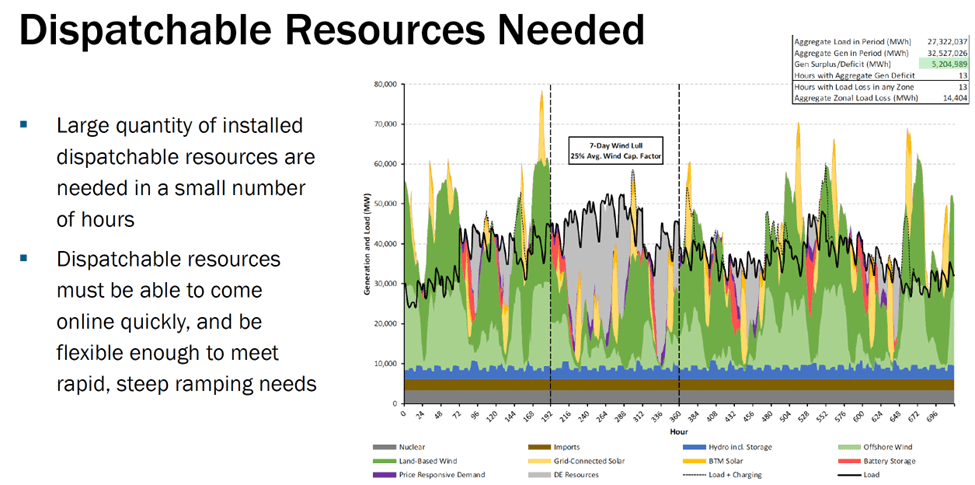
The politicians can say whatever they want about the wonders of the CLCPA but the mathematical analysis of the project says that the CLCPA and the mandate for Micron to buy Carbon credits is going to raise NY State’s carbon footprint substantially while also raising Micron’s costs.  It’s a Lose-Lose proposition for everyone.

That’s what happens when you outsource utility planning to Climate Scientists and environmental activists that have no understanding of what they are doing, which is what NY State has done.

Conclusion

I agree with Ellenbogen’s points.  The obvious approach for the energy needed by Micron would be co-generation.  As much as I would like to say that this should be provided by nuclear, I agree with him that costs and implementation time preclude that option now so a combined cycle natural gas-fired plant is the pragmatic choice.  Either option produces waste heat that can be used at the facility which increases the energy efficiency.  As he says the expectation that renewables can provide the necessary power on top of the existing load needs is laughable.  Importantly, a facility like this must have uninterruptible power and providing that from wind and solar is an extreme challenge. Finally, I want to close with one of Ellenbogen’s points from his presentation: “When fantasies meet reality, reality always wins.”  The Climate Act renewable plans are fantasy and the inevitable clash with reality is going to be interesting to watch.