
NYISO Short-Term Assessment of Reliability July 2023

On July 14, 2023 the New York Independent System Operator (NYISO) released its quarterly assessment of reliability of the bulk electric system.  The analysis found a deficit in reliability margins for the New York City area beginning in summer 2025. As a result, something must be done or there will be unacceptable risks to reliability that could cause power outages.  Unfortunately, it is difficult to understand the reasons for this finding because of the complexity of the subject.  This post includes a detailed explanation of the report and its implications.  If you want a good non-technical summary, then I recommend James Hanley’s post Get Ready for the New York City Blackout of 2025.

I have been following the Climate Leadership & Community Protection Act (Climate Act) since it was first proposed.  I submitted comments on the Climate Act implementation plan and have written over 300 articles about New York’s net-zero transition.  I have devoted a lot of time to the Climate Act and New York’s energy planning because I believe the ambitions for a zero-emissions economy embodied in the Climate Act outstrip available renewable technology such that the net-zero transition will do more harm than good.  Unfortunately, trying to explain the risks and issues associated with the transition is difficult because of the complexity of the problems and the fact that expert reports are dense and filled with jargon.  The opinions expressed in this article do not reflect the position any of my previous employers or any other company I have been associated with, these comments are mine alone.

Resource Adequacy Assessments

The NYISO is responsible power system reliability and competitive markets for New York.  As part of that mission NYISO determines whether generating resources and the transmission system can adequately meet expected load.  They describe the resource adequacy analyses as follows:

Resource adequacy is the ability of the electric system to supply the aggregate electrical demand and energy requirements of the firm load at all times, considering scheduled and reasonably expected unscheduled outages of system elements. The NYISO performs resource adequacy assessments on a probabilistic basis to capture the random nature of system element outages. If a system has sufficient transmission and generation, the probability of an unplanned disconnection of firm load is equal to or less than the system’s standard, which is expressed as a loss of load expectation (LOLE). Consistent with the Northeast Power Coordinating Council and New York State Reliability Council criterion, the New York State bulk power system is planned to meet an LOLE that, at any given point in time, is less than or equal to an involuntary firm load disconnection that is not more frequent than once in every 10 years, or 0.1 event days per year.

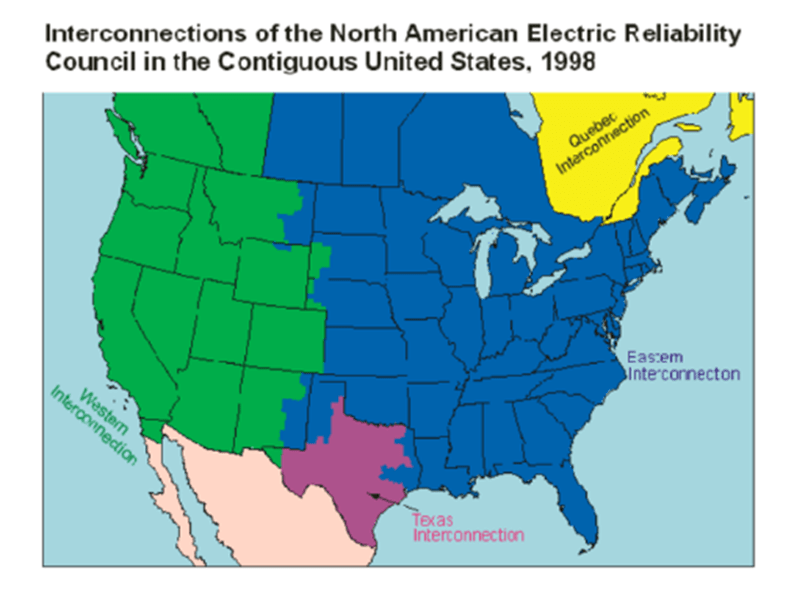
So what does that mean?  The first point is that the electric system is very complicated.  I summarized my skepticism of the net-zero transition earlier this year in an article that included an overview of the electric system.   Incredibly all the fossil, hydro, and nuclear generating stations in the Eastern Interconnection shown below work together.  In order to provide electricity, the generating turbines are synchronized to turn at 1800 revolutions per minute.  Operators keeps the voltages as constant as possible in the entire area but rely on those turbines to provide inertia as well as voltage control and that can be dispatched as necessary to match load.  The NYISO operates the New York State control area within the Interconnection.  In addition to the day-to-day operation, they plan for resource adequacy to ensure that the operators have generating resources available so that they can constantly match load. 

The NYISO resource adequacy assessments rely on decades of observed characteristics of generating resources, the transmission system, and system load to develop the likelihood  of system element outages. If a system has sufficient transmission and generation, then when a problem occurs (say lightning hits a transmission line) the system can respond without an extended outage.  The NYISO has a well-established process to identify reliability needs. The analyses consider how the system can react to various combinations of issues based on historical observations of the existing system to determine the loss of load expectation (LOLE). The organizations overseeing New York reliability,  the Northeast Power Coordinating Council and New York State Reliability Council, mandate that the New York State bulk power system is planned to meet the LOLE standard that any involuntary firm load disconnection  is not more frequent than once in every 10 years, or 0.1 event days per year.

Annotated Executive Summary

This section quotes the Executive Summary in the report and explains the contents.  As part of an on-going reliability assessment process the NYISO analyzes any expected changes to the generation and transmission system:

This report sets forth the 2023 Quarter 2 Short-Term Assessment of Reliability (“STAR”) findings for the five-year study period of April 15, 2023, through April 15, 2028, considering forecasts of peak power demand, planned upgrades to the transmission system, and changes to the generation mix over the next five years.

The analysis finds that there are issues associated with peaking power plants in New York City.  I have been involved with this problem and these facilities since 2000.  This topic has been the subject of multiple articles on this blog and I have summarized my articles as on overview that I can reference when the issue resurfaces.  The Executive Summary notes: 

This assessment finds a reliability need beginning in summer 2025 within New York City primarily driven by a combination of forecasted increases in peak demand and the assumed unavailability of certain generation in New York City affected by the “Peaker Rule.”  In 2019, the New York State Department of Environmental Conservation adopted a regulation to limit nitrogen oxides (NOx) emissions from simple-cycle combustion turbines, referred to as the “Peaker Rule” (https://www.dec.ny.gov/regulations/116131.html)  

The Peaker Rule culminated a decade-long process whereby the New York State Department of Environmental Conservation (DEC) instituted a framework to retire or control the “peakers”.  The DEC, NYISO, facility owners and Consolidate Edison, the load serving entity for New York City, all worked together to ensure that the retirement would not endanger reliability.  This latest analysis suggests that there are still issues to be resolved:

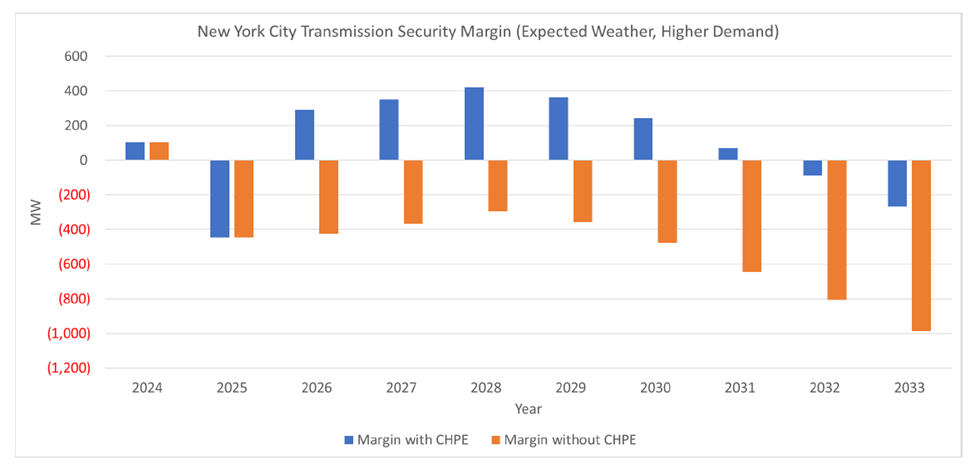
Combustion turbines known as “peakers” typically operate to maintain bulk power system reliability during the most stressful operating conditions, such as periods of peak electricity demand. As of May 1, 2023, 1,027 MW of affected peakers have deactivated or limited their operation. An additional 590 MW of peakers are expected to become unavailable beginning May 1, 2025, all of which are in New York City.   With the additional peakers unavailable, the bulk power transmission system will not be able to securely and reliably serve the forecasted demand in New York City (Zone J). Specifically, the New York City zone is deficient by as much as 446 MW for a duration of nine hours on the peak day during expected weather conditions when accounting for forecasted economic growth and policy-driven increases in demand.

The following paragraph explains that the reliability need is expected because the latest projections of generation, load, and transmission availability have changed over time:

The reliability need is based on a deficient transmission security margin that accounts for expected generator availability, transmission limitations, and updated demand forecasts using data published in the 2023 Load & Capacity Data Report (“Gold Book”). The transmission security margin represents the balance between demand for electricity and the power supply available from generation and transmission to serve that demand. This assessment recognizes that there is uncertainty in the demand forecast due to uncertainties in key assumptions including population and economic growth, the proliferation of energy efficiency, the installation of behind-the-meter renewable energy resources, and electric vehicle adoption and charging patterns. These risks are accounted for in the transmission security margin calculations by incorporating the lower and higher bounds as a range of forecasted conditions during expected weather, specified in the Gold Book as the policy scenario forecasts. The lower and higher demand policy scenario forecasts reflect achievement of policy targets through alternative pathways and assume the same weather factors as the baseline demand forecast.

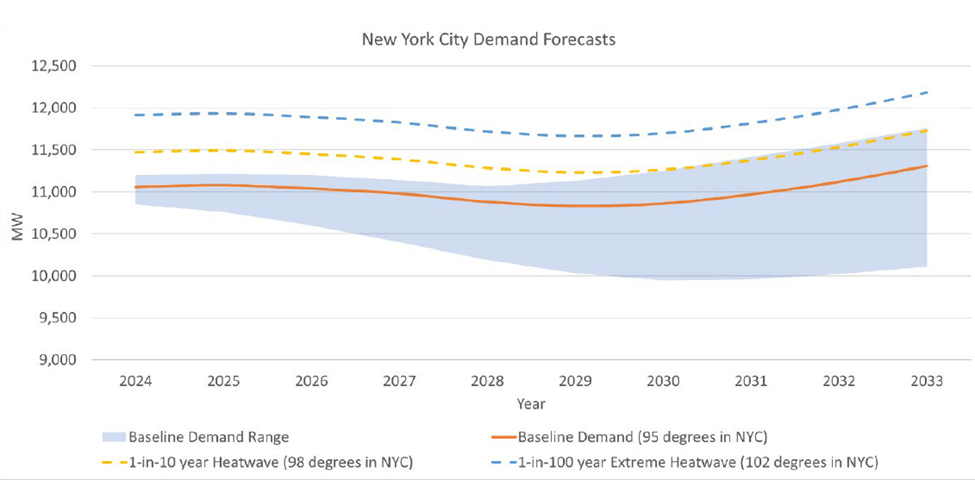
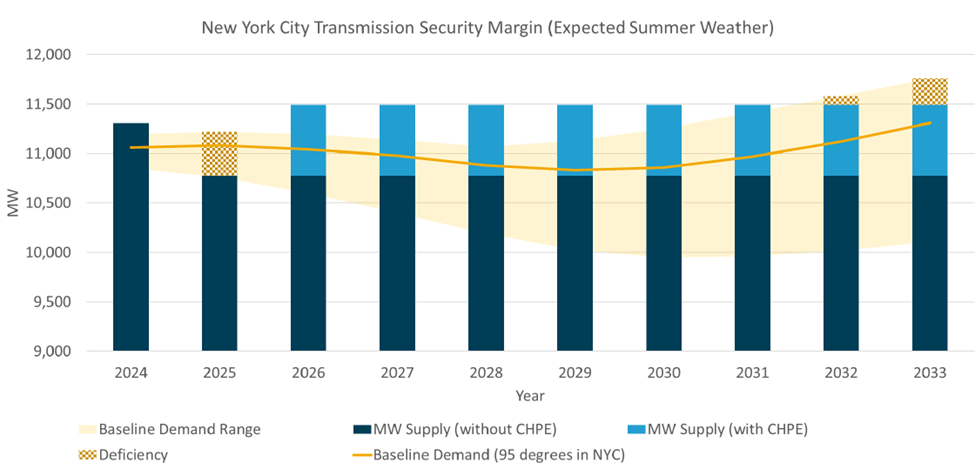
The Gold Book is the standard for electric data in New York. The following figure shows the range of the demand forecasts for New York City.  I want to point out one thing.  The emphasis is on providing generation for the peak load.  This is a significantly more difficult problem than estimating the generation necessary for an average year.  There are more short-term constraints that could affect generation and load that can be ignored on average.  

I have some experience with the resource modeling projections and cannot over-emphasize the complexity of all the factors incorporated in the models.  Unfortunately, there is a lot of uncertainty associated with projecting all those factors.  That is why the NYISO is constantly re-evaluating the model inputs and projections.  In addition, they are always looking to refine the model itself.  Based on their latest estimates:

Under the baseline forecast for coincident summer peak demand, the New York City transmission security margin would be deficient by 306 MW in 2025 for a duration of 7 hours. However, accounting for uncertainties in key demand forecast assumptions, the higher bound of expected demand under baseline weather conditions (95 degrees Fahrenheit) in 2025 results in a deficiency of 446 MW over 9 hours. The deficiency would be significantly greater if New York City experiences a heatwave (98 degrees Fahrenheit) or an extreme heatwave (102 degrees Fahrenheit).

The NYISO is banking on one project to address this problem after 2025.

Overall, the New York City transmission security margin is expected to improve in 2026 if the Champlain Hudson Power Express (CHPE) connection from Hydro Quebec to New York City enters service on schedule in spring 2026, but the margin gradually erodes through time thereafter as expected demand for electricity grows. Beyond 2025, the forecasted reliability margins within New York City may not be sufficient if (i) the CHPE project experiences a significant delay, (ii) additional power plants become unavailable, or (iii) demand significantly exceeds current forecasts. Without the CHPE project in service or other offsetting changes or solutions, the reliability margins continue to be deficient for the ten-year planning horizon. In addition, while CHPE is expected to contribute to reliability in the summer, the facility is not expected to provide any capacity in the winter.

I am uncomfortable that there is this much reliance on a single project to address the problems identified.  I discussed the start of construction late last year for the Champlain Hudson Power Express (CHPE) project.  It is a 339-mile underground transmission line capable of bringing 1,250 MW from the Province of Quebec to Astoria Queens in New York City.  I explained that I was worried about the schedule and costs of the project.  The NYISO Resource Adequacy analyses must necessarily rely on the developer’s prediction for completion.  Richard Ellenbogen and I share the timeliness concern.  Richard noted that the project was proposed in 2011 and the PSC authorized it on 4/18/13.  It has been 11.5 years since it was proposed, 9.5 years since it was authorized, and construction started a year after the funding contract was signed.  In addition, it has recently come out that landowners on sections of the right-of-way that are on land have just been informed that they will be impacted.  The likelihood of additional delays seems high.  Given that other renewable projects are being re-evaluated because of price increases due to inflation and increased cost of materials it seems that this project will also have the same problems.  Given its importance to New York City reliability, I cannot conceive of any scenario in which the State will not grant any cost overruns requested by the developers. This project is already expensive equating to an estimated increase in customer electric bills of 2.1 – 4.1% (or $2.08 – $4.08 per month for the average residential customer.  I am confident that at the end of the day the final costs will be much higher.

The STAR quarterly report did not limit its analysis to just New York City.

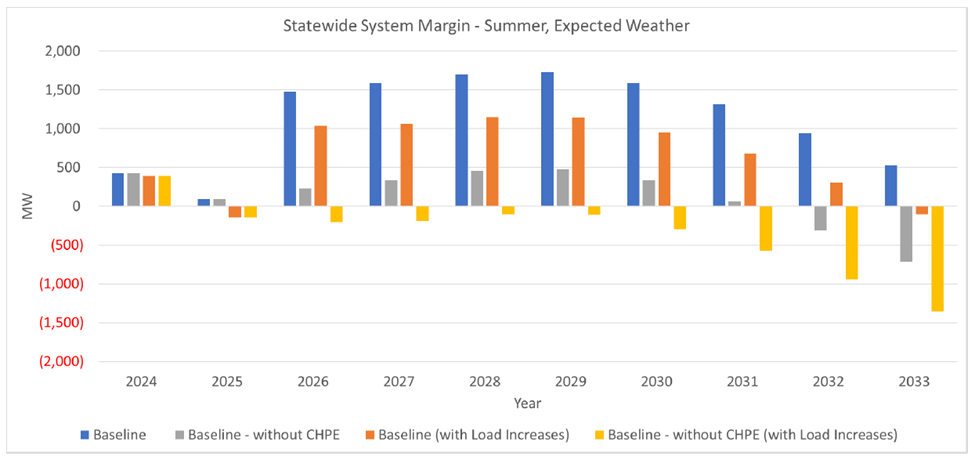
In addition to New York City, this assessment also evaluated the transmission security margins for the statewide system as well as Lower Hudson Valley and Long Island localities. For these localities, the planned Bulk Power Transmission Facilities (“BPTF”) through the study period are within applicable reliability criteria based on the baseline summer coincident peak demand forecast with expected weather and with the planned projects meeting their proposed in-service dates. The NYISO assessed the resource adequacy of the overall system and found no resource adequacy reliability needs.

The NYISO is a product of the de-regulated New York electric system.  As such they are ardent supporters of “market” solutions.  This adds a layer of uncertainty because NYISO must develop some sort of incentive for a developer to provide the necessary resources.  If it was an attractive investment, then I would expect that someone would already be developing the necessary resources.  In addition, Con Ed must also determine if local transmission upgrades can resolve the problem.

The short-term need observed in 2025 is a Near-Term Reliability Need. As a result, solutions will be solicited, evaluated, and addressed in accordance with the NYISO Short-Term Reliability Process. The need arises within the Con Edison Transmission District; therefore, Con Edison is the Responsible Transmission Owner for developing a regulated solution.(Reference NYISO’s Open Access Transmission Tariff Section 38.3.6)

The report identifies another particular issue that illustrates why regular STAR analyses are required and why this issue is coming up now.  Although all the affected parties may know that there will be changes to the system and have reasonable expectations what they will be, the NYISO cannot officially act until certain filings are made.

Central Hudson identified transmission security issues in its transmission district on its non-BPTF system. These are primarily driven by the assumed unavailability of certain generation in its district affected by the Peaker Rule. Given that those generators have not yet provided complete Generator Deactivation Notices to the NYISO, the local non-BPTF criteria violations identified by Central Hudson are being provided for information but were not assessed to identify possible Generator Deactivation Reliability Needs at this time.

The report also describes an upcoming issue that will be considered officially in a subsequent report. The “informational scenario” considers interconnecting large loads:  the Micron New York semiconductor manufacturing (530 MW in 2030), the Air Products and Chemicals (Q#1446), and other load changes that increase load another 694 MW.

As an informational scenario, this STAR includes an evaluation of the impact of additional large load interconnection projects primarily in western and central New York. The anticipated increases to the demand forecast due to these large loads in 2025 is 764 MW which results in a corresponding reduction to the available margin, such that in 2025 the statewide system margin is projected to be deficient of 145MW. By 2033, additional large loads increase the demand by 1,224 MW which results in a corresponding deficient margin of 104 MW. If CHPE does not begin operation, the state wide system margin is projected to be deficient for all years 2025 through 2033 when considering the additional large loads. The 2023 Quarter 3 STAR will include these load projects and the associated system margin impacts. The solution to the New York City reliability need identified in this STAR may also address the state wide system margin concern.

The Executive Summary summarizes their approach:

The wholesale electricity markets administered by the NYISO are an important tool to help mitigate these risks. The markets are designed, and continue to evolve and adapt, to send appropriate price signals for new market entry and the retention of resources that assist in maintaining reliability. The potential risks and resource needs identified in the NYISO’s analyses may be resolved by new capacity resources coming into service, construction of additional transmission facilities, and/or increased energy efficiency and integration of demand-side resources. The NYISO is tracking the progression of many projects that may contribute to grid reliability, including numerous offshore wind facilities that have not yet met the inclusion rules for reliability assessments. The NYISO will continue to monitor these resources and other developments to determine whether changing system resources and conditions could impact the reliability of the New York bulk electric grid.

Note that there are three ways the problem identified can be resolved: building new capacity resources, construction of additional transmission facilities, and/or reducing load expectations with increased energy efficiency and integration of demand-side resources.  Even if the Hochul Administration came to its senses and decided to facilitate the construction of dependable generating capacity, that is to say, fossil-fired generators, there is no way that any generating resource to support reliability could get built in this timeframe.  My rule of thumb for just getting permits in New York City is a minimum of three years.  The summer of 2025 is only two years away.  Of course, the possibility of any new fossil infrastructure is very unlikely anyway.  Designing, permitting, and building additional transmission facilities may not take quite as long but I cannot imagine this solution could be available in two years.  There already are great expectations for reducing load so I cannot imagine any scenario that could reduce additional load on the order necessary to meet the identified load shortfall.

The final paragraph in the Executive Summary describes the specific filings that will trigger further STAR revisions.

As generators that are subject to the DEC’s Peaker Rule submit their Generator Deactivation Notices, the NYISO and the responsible Transmission Owners will continue to evaluate in future STARs whether Generator Deactivation Reliability Needs arise from the deactivation of Initiating Generators. (Reference NYISO’s Open Access Transmission Tariff Section 38.1 state that an “Initiating Generator” is “a Generator with a nameplate rating that exceeds 1 MW that submits a Generator Deactivation Notice for purposes of becoming Retire or entering into a Mothball Outage or that has entered into an Installed Capacity (ICAP) Ineligible Forced Outage pursuant to Section 5.18.2.1 of the ISO Services Tariff which action is being evaluated by the ISO in accordance with its Short-Term Reliability Process requirements in this Section 38 of the ISO Open Access Transmission Tariff.

Discussion

The Findings section expands the description of the problem found.  Without changes to existing load pattern the summer peak load demand in New York City would be “deficient by 306 MW in 2025 for a duration of 7 hours”.  There are uncertainties in the load demand forecasts.  Assuming the upper bound of “demand under baseline weather conditions (95 degrees Fahrenheit) in 2025 results in a deficiency of 446 MW over 9 hours.” If the weather is hotter or lasts for an extended period the “deficiency would be significantly greater.” This exemplifies the tradeoffs the NYISO and NYSRC must make when assessing resource adequacy and reliability standards.  If the deficiency is “significantly greater” then it will be impossible to manage the load without rolling blackouts.

The NYISO writes: “The deficient margin is primarily due to the increased demand forecasts within New York City combined with the planned unavailability of simple-cycle combustion turbines to comply with the DEC’s Peaker Rule in 2025”.   Apparently, it is not politically correct to point out that Hochul Administration’s policy that finalized the shutdown of 2,000 MW of nuclear power and the disapproval of a plan to build a 1,040 MW, eventually reduced to 437 MW, combined cycle facility exacerbated this problem and that if those resources were available there would not be a problem.

As it stands now, I expect that the solution will be an extension of the operating permits for the peaking turbines because there is no other viable solution to maintain reliability.

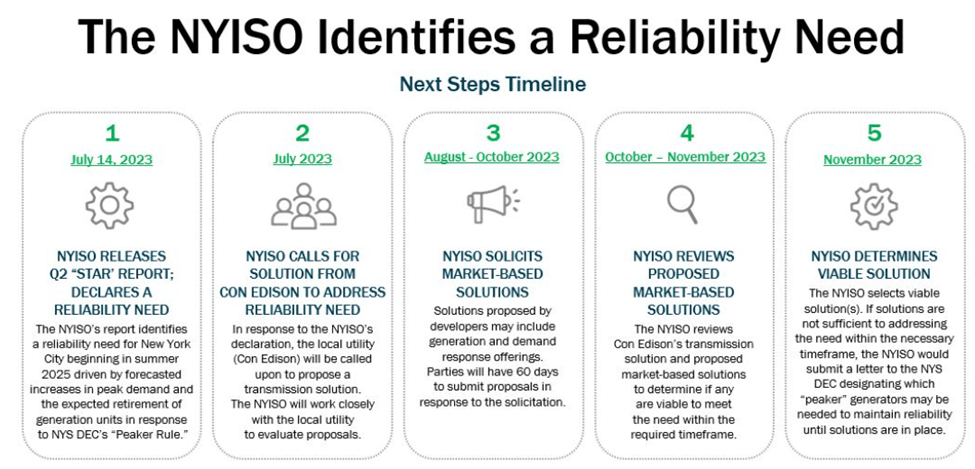
The NYISO describes the process and explains how it will be resolved in the following figure.  They have identified the reliability need.  They will ask Consolidated Edison if the problem can be resolved with transmission system revisions in Step 2.  At the same time in Step 3, NYISO will solicit  market-based solutions from other developers.  In the next step NYISO reviews the proposed solutions “to determine if they are viable and sufficient to address the identified need.”  The NYISO description of the last step notes:

Timing is an essential component of the NYISO’s evaluation. If proposed solutions are not viable or sufficient to meet the identified reliability need, interim solutions must be in place to keep the grid reliable. One potential outcome could include relying on generators that are subject to the DEC’s Peaker Rule to remain in operation until a permanent solution is in place. The DEC’s Peaker Rule anticipated this scenario when it authorized the NYISO to designate certain units to remain in operation beyond 2025 on an as-needed basis for reliability. Based on findings from its Short-Term Reliability Process, the NYISO may designate certain units, in sufficient quantity, to remain in operation for an additional two years (until May 1, 2027) with the potential of an additional two-year extension (to May 1, 2029) if a permanent solution that is needed to maintain reliability has been selected but is not yet online. The NYISO would only temporarily retain peakers as a last-step approach if it does not expect solutions to be in place when the identified reliability need is expected in 2025.

Reaction

Utility Dive described the report.  Their article quotes Zach Smith, vice president of system and resource planning for the NYISO as saying the assessment “reflects the extraordinary challenges of the grid in transition.”  It also notes that the report acknowledges “uncertainty” in the demand forecast surrounding assumptions including population and economic growth, the proliferation of energy efficiency, the installation of behind-the-meter renewable energy resources, and EV adoption and charging patterns.

The reaction of parties in New York State was predictable.  Marie French writing at Politico solicited comments from the Hochul Administration:

“To be clear: The reliability of our grid is not in question,” Hochul spokesperson Katy Zielinski said in a statement. “We are committed to ensuring New Yorkers have a reliable and affordable power supply — and we can do this while accomplishing our nation-leading climate goals. Governor Hochul remains fully committed to rapidly decreasing emissions and setting an example for how clean energy and reliability can go hand-in-hand.”

French said that Zielinski cited the planned Canadian hydropower line, the Clean Path line and offshore wind projects as ways to bring more renewables into New York City.   There is a fundamental issue with these projects because they all rely heavily on distant  transmission that is overly vulnerable to outages  One of the New York City blackouts occurred because a transmission line into the city went down and in-city generation could not be brought up fast enough to react to the loss of energy supply.  There are specific reliability rules in place that mandate a minimum capability of in-city generation when storms threaten transmission lines into the City.  I am not sure how this will be addressed in the future.  The Canadian hydropower line may not be affected by storms but still could go down unexpectedly for other reasons.  The Clean Path project is “is comprised of more than 20 renewable energy generation projects and an approximate 175-mile, underground transmission line.  I am guessing that the argument is that an underground line can provide power that is not subject to storm outages so is exempt from the transmission line reliability rule.   However, even if they are much less likely to go out, when they do have problems fixing them is much more difficult.  Counting on offshore wind as a viable replacement in the City is very risky unless it is coupled with sufficient energy storage to cover the energy needs for an entire heat wave because the meteorological conditions that cause extreme heat are associated with high-pressure systems that also have light winds.

The Peak Coalition has been the primary mover for peaking power plant environmental justice.  French mentioned their statement that notes:

PEAK Coalition is gravely concerned with the impact that the reliability deficit estimated in the Short-Term Assessment of Reliability (STAR) report for Q2 of 2023 released by the New York Independent Systems Operator (NYISO) will have on communities that live near power plants. We encourage all stakeholders involved in the energy planning process to take concrete action to prevent delaying the closure of fossil fuel peaker plants in 2025 and beyond.  These plants harm the communities that surround them every hour that they operate. PEAK refuses to accept a scenario in which environmental justice communities must suffer further harm to guarantee further profligate summertime energy consumption in commercial buildings and wealthy communities.

I have evaluated the EJ claims.  The PEAK coalition has stated that “Fossil peaker plants in New York City are perhaps the most egregious energy-related example of what environmental injustice means today.”  The influence of this position on current New York State environmental policy has led to this issue finding its way into multiple environmental initiatives. However, the presumption of egregious harm is based on selective choice of metrics, poor understanding of air quality health impacts,  and ignorance of air quality trends.  

As noted previously the NYISO is invested in market solutions. French also got a statement from the NYISO that is completely consistent with that approach:

“We’ve identified the reliability need, so we’re confident that’s present for summer 2025,” said NYISO spokesman Kevin Lanahan. “We’re also confident that we can solve the reliability [need]. That’s the nature of our planning process, to identify those issues with enough time to solve the problems so we’re confident we can find the solution and keep the system reliable.”

French also got a statement from Gavin Donohue at the Independent Power Producers:

“The pace of play is not keeping up with pace of promises, and this report makes that clear,” said Independent Power Producers of New York president and CEO Gavin Donohue, who represents the state’s existing nuclear, renewable and predominantly fossil fuel power plants. “This report should draw attention from state officials in shaping realistic public policies. I encourage the NYISO to identify solutions that are market-based so we can set ourselves on the pathway to a cleaner energy future, while maintaining the reliability of our grid at affordable rates.”

James Hanley from the Empire Center summarizes the implications well.  He concludes:

The mistake New York has made is not its goal to eventually reduce NOx emissions but its rush to shut down the peakers — and Indian Point — before developing reliable replacement sources of power. Notably, the Department of Environmental Conservation rejected proposals by NRG Energy to update nearly 1,000 megawatts of electricity production in the city to newer, cleaner-burning, and NOx-standard compliant combined-cycle power plants, claiming that NRG “failed to demonstrate the need or justification for the proposed project.”

This “shutdown first, replace later” model was a major cause of rolling blackouts on the West Coast, but New York authorities didn’t bother to learn from California’s experience. Simple common sense would indicate that the wise approach would be to find assured sources of reliable and dispatchable electricity production before taking critical power plants offline. Sadly, common sense was the first victim of New York energy policy. Even more sadly, it won’t be the last.

Conclusion

Despite assurances from Hochul spokesperson Katy Zielinski, the reliability of the New York City grid is in question. The plans rely on resources that are new to New York and that increases uncertainty.  Presuming that proposed projects will replace operational facilities on the schedule proposed is very risky. 

There is another dynamic here that will be interesting to watch.  Peaker power plants are a primary scapegoat for the New York City EJ community.  The PEAK Coalition has already gone on record stating that “If NYISO is forced to issue reliability-must-run orders, New Yorkers will know that electric utilities and state governments willingly failed to act to protect communities most impacted by fossil fuel emissions and climate change”.  The electric utilities and state government have failed to explain the potential impacts to the disadvantaged communities if fossil-fired peaking units are not replaced with proven technology.  The risks to those communities imposed by the presence of such resources are not nearly as large as the risks to those communities from blackouts.  Keeping the lights on is the better social choice.

Thanks to Russell Schussler for review and helpful comments.  Any technical errors are mine.

ACE NY Agrivoltaics Support

In order to implement the Climate Leadership & Community Protection Act (Climate Act) New York must support “unprecedented levels of investment in new generation”.  This post addresses the duplicity of the members of the Alliance for Clean Energy New York (ACE NY) who have organized a campaign to send letters supporting agrivoltaics to the legislators at the same time they are covering swaths of prime farmland with solar panels.

I have been following the Climate Act since it was first proposed. I submitted comments on the Climate Act implementation plan and have written over 300 articles about New York’s net-zero transition because I believe the ambitions for a zero-emissions economy embodied in the Climate Act outstrip available renewable technology such that the net-zero transition will do more harm than good.  The opinions expressed in this post do not reflect the position of any of my previous employers or any other company I have been associated with, these comments are mine alone.

Climate Act Background

The Climate Act established a New York “Net Zero” target (85% reduction and 15% offset of emissions) by 2050 and an interim 2030 target of a 40% reduction by 2030. The Climate Action Council is responsible for preparing the Scoping Plan that outlines how to “achieve the State’s bold clean energy and climate agenda.”  In brief, that plan is to electrify everything possible and power the electric grid with zero-emissions generating resources by 2040.  The Integration Analysis prepared by the New York State Energy Research and Development Authority (NYSERDA) and its consultants quantifies the impact of the electrification strategies.  That material was used to write a Draft Scoping Plan.  After a year-long review the Scoping Plan recommendations were finalized at the end of 2022.  In 2023 the Scoping Plan recommendations are supposed to be implemented through regulation and legislation.

One of the more serious problems with the Hochul Administration net-zero transition is that there is no implementation plan.  The “unprecedented levels of investment in new generation” includes between 14,731 MW (New York State Independent System Operator 2021-2040 System & Resource Outlook) and 18,852 MW (Integration Analysis) of solar development by 2030.  One example of the lack of a plan is that the Integration Analysis projection presumes that the utility-scale solar development will use tracking solar panels with a capacity factor of 20%.  However, most permitted New York solar developments are using fixed solar panels with lower capacity factors because there is no mandate that they use the more expensive technology.  That means that the projection of 18,852 MW is low.  I believe a proper implementation plan would include limitations to protect prime farmland from solar development.

ACE NY

The Alliance for Clean Energy New York (ACE

NY) mission is to “promote the use of clean, renewable electricity technologies and energy efficiency in New York State, in order to increase energy diversity and security, boost economic development, improve public health, and reduce air pollution”.   ACE NY members are “a mix of private companies and non-profit organizations”.  It is a well-connected lobbying organization for the crony capitalist grifters who are building the renewables required by the Climate Act.  Of the 16 organizations on the Board of Directors, six are non-governmental organizations (two based in New York) and of the remaining ten companies only one (Sealed, an insulation and HVAC company that partners with New York utilities) is a New York based company.  The rest are out of state developers who will bear no repercussions when the affordability and reliability of the New York electric system tanks.

The ACE NY 2023 priorities for large-scale, grid-connected renewables defines their agenda.  It includes the following:

  • Continued NYSERDA competitive procurement program, on schedule, under the Clean Energy Standard, to contract for renewable energy at a pace that will achieve 70% renewable electricity by 2030, with a fair and transparent evaluation process for bids, reasonable contract requirements, and contract amendments when necessary.
  • Solid progress on transmission, including Public Service Commission (PSC) approval of local and bulk transmission system upgrades, designation of a public policy transmission need (PPTN) upstate, New York Power Authority contributions to transmission upgrades, selection of a transmission solution for the Long Island Offshore Wind Export PPTN, and decision-making around other transmission needs to enable offshore wind development.
  • For offshore wind project development, the announcement of one or more new contracts, paired with state port and supply chain investments, and the issuance of a 2023 offshore wind solicitation.
  • An efficient and timely interconnection process at the NYISO, including a Class Year that takes one year and significant reforms and improvements to the process.
  • NYISO rules that are fair and favorable for renewables, such as capacity market rules that don’t disadvantage renewable energy or storage.
  • Efficient permitting, as evidenced by steady progress by the Office of Renewable Energy Siting. Our goal is to allow responsible developers to move steadily and predictably through the process in a timely manner, so that there is a healthy pipeline of diverse projects. Also, improvements to the species impact mitigation process.
  • The continued ability of solar developers to lease land from farmers to host the solar projects NY needs to achieve its clean energy and climate goals, plus advancement of co-located solar and agriculture to demonstrate emerging approaches to both.
  • A significant cohort of wind and solar projects successfully reaching the construction phase during 2023 and becoming operational.
  • For offshore wind planning, the establishment of a goal of 15 GW of offshore wind by 2040 and 20 GW by 2050, plus the issuance of an Offshore Wind Power Master Plan 2.0 that includes a roadmap for offshore wind power development in the deep ocean.
  • Standardized and fair taxation of wind and solar projects at the local level, and elimination of unfair renewable energy bans and moratoria at the local level.
  • A successful competitive Tier 2 program to support renewable resources built before 2015, or another means of support for these projects, plus rules that enable and encourage renewables repowering.
  • Reasonable requirements for decommissioning projects and avoidance of end-of-life disposal requirements that vary from town-to-town. Support for the development of solar panel recycling facilities in New York.
  • New York state pursuit of an economy-wide carbon cap-and-invest policy. 

This list of priorities boils down to build as much as possible as fast possible with as few restrictions as we can get away with.  “Efficient” permitting is a euphemism for let us do whatever we want with as few restrictions as possible.  There is a mention of improvements to “species impact mitigation process”.  In other words, some member’s project got slowed down because the rules that have applied to electric generation development to protect the environment and wildlife prior to the Climate Act have not been changed fast enough.  There is another priority to eliminate “unfair renewable energy bans and moratoria on the local level”.  That translates to the State has not over turned home rule enough to suit us.

ACE NY Agrivoltaics Letter to Legislators

The ACE NY website has a section “Support Agrivoltaics in New York State” that provides a way to send a form letter to legislators supporting agrivoltaics:

As New Yorkers, we believe that solar energy and farming can exist alongside one another, and each industry can help to bolster the other in meaningful ways while also supporting individual farmers and their communities.  

The benefits of agrivoltaics are abundant. They include: 

  • A new, stable income source for farmers, to keep NY farmers in farming;
  • Protection and conservation of soil with a reversable use of land;
  • New tax revenue for communities that host solar projects; and
  • Opportunities to host solar projects and produce more clean electricity;

SEND A LETTER TO YOUR LEGISLATORS SUPPORTING AGRIVOLTAICS
 

Please let your legislators know you support agrivoltaics in New York state. New York farmers should be able to host solar installations, if they choose to, and get income to help their farms.

For starters note that the description “as New Yorkers” does not apply to any of the development companies on the Board of Directors so take their beliefs with a grain of salt.  None of them will be affected when New York farming is adversely affected.  The stable income applies to the farmers who no longer want to farm.  It will raise prices for those who choose to continue to farm.  One of the stories perpetuated by the developers is that the solar developments are only temporary.  The reality is that we will continue to need the solar power so it beggars the mind why one can argue that these facilities won’t be re-developed with new panels when the developments reach the end of their useful life.  The next section discusses the status of New York solar development and belies the claims that ACE NY members care about New York agriculture.

New York Solar Development

I have written multiple articles about solar development and impacts to the agricultural sector in New York.  In my opinion the State should provide a plan for responsible siting for all solar facilities. There is a policy option roadmap for the proposed 10 GW of distributed solar development.  However, there is not an equivalent set of policies for utility-scale solar development.   Given the magnitude of the potential impacts to prime farmland I submitted a comment to the Climate Action Council recommending that they impose a moratorium on the development of utility-scale solar projects until permitting requirements have been established for responsible solar siting and protection of prime farmlands. Not surprisingly there has never been any response.

I described a workshop “What’s the Deal with Renewable Energy & Agriculture?” co-hosted by New Yorkers for Clean Power (NYCP) and Alliance for Clean Energy NY (ACENY) that discussed the compatibility of solar energy development and agriculture in New York State late last year.  In my opinion, all the speakers were advocating responsible solar development that minimizes the use of the best agricultural farmland soils.  Whatever your position is with respect to the industrial solar development that to me is a key requirement.  If a project meets all the New York State Department of Agriculture and Markets (Ag and Markets) guidelines and the Office of Renewable Energy Siting requirements then, given the current state law mandating massive buildouts of solar energy, the application should be approved.  The problem is that many of the recently permitted solar facilities do not meet that criterion.

In particulate, I think it is very unfortunate that Department of Agriculture and Markets guidelines to protect prime farmland are ignored.  The guidelines have been described in prepared testimony by Michael Saviola from the Department of Agriculture and Markets that I believe represent best practices and should be mandatory.  In particular, “The Department’s goal is for projects to limit the conversion of agricultural areas within the Project Areas, to no more than 10% of soils classified by the Department’s NYS Agricultural Land Classification mineral soil groups 1-4, generally Prime Farmland soils, which represent the State’s most productive farmland.”   I think this is a reasonable goal and one that should be a mandatory requirement for all projects.

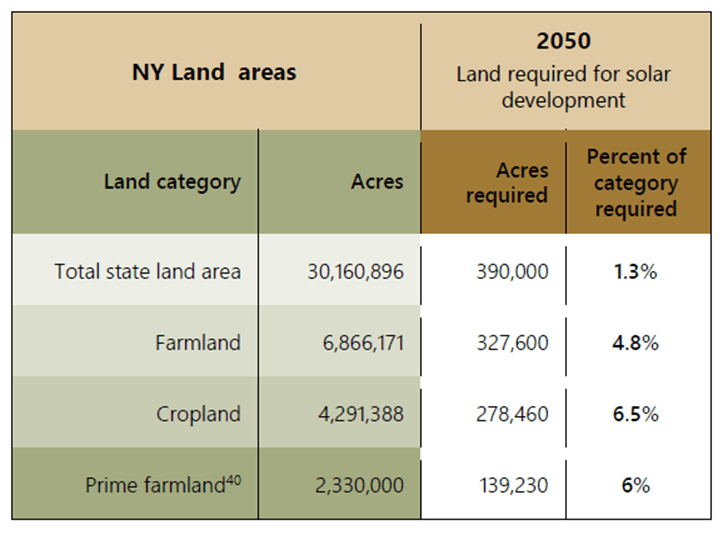
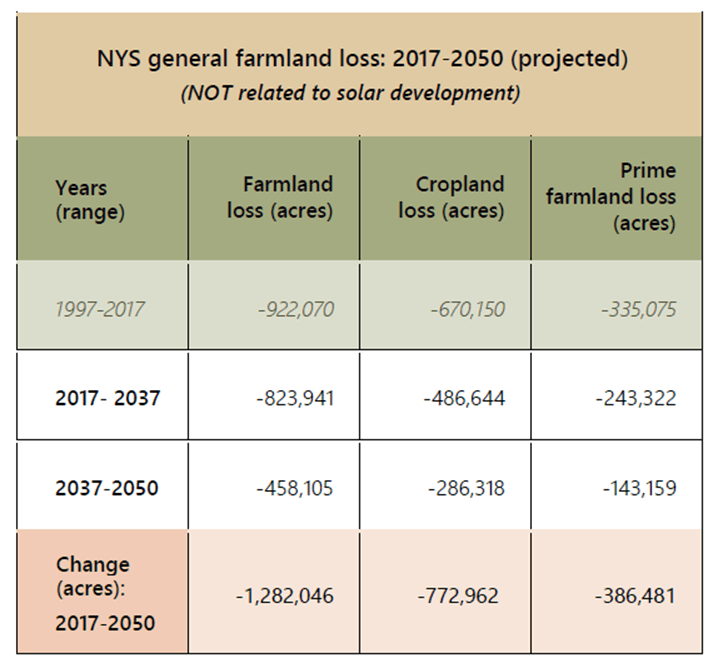
I have started tracking the loss of prime farmland and the ramifications of not enforcing those guidelines.  The following table lists approved solar projects and my estimates of the loss of prime farmland.  Of the 15 recently approved projects listed only five meet the farmland conversion guidelines of the Department of Agriculture and Markets as of May 21, 2023.

Discussion

As noted previously there is no implementation plan.  On December 12, 2022 Governor Hochul announced that “a special working group of state agencies and agricultural community stakeholders will collaborate to support New York farmers and help boost the agricultural industry” that could be a start. The press release stated that “This working group will be critical to tackling several challenges within New York’s agricultural industry, and my administration will continue to work with farmers to address their needs and reimagine farming in our state.”  Searching for any follow up to the announcement five months later yielded no results.  While the Hochul Administration fiddles time away the loss of prime farmland continues.

Conclusion

The New York Office of Renewable Energy Siting (ORES) approved Hecate Energy’s permit for the 500-megawatt (MW) Cider Solar Farm on July 25, 2022.  My article on the project explained that the Cider Solar Farm will be a 500-megawatt photovoltaic solar facility capable of supplying 920,000 MWh (21% capacity factor) located in the towns of Elba and East Oakfield, Genesee County, NY.  Right in line with the ACE NY 2023 priorities, ORES over-ruled the Towns of Elba and Oakfield zoning ordinances that were “unreasonably burdensome” for the developer.  The 4,650 acre Project Site is 41% Prime Farmland (1,912 acres) and another 27% (1,252 acres) would be Prime Farmland if drained.  Until such time that the state develops responsible solar siting mandates that protect prime farmland consistent with the Department of Agriculture and Markets solar siting guidelines projects like this that removes 3,163 acres of prime farmland (68% of the project site!) from production will continue to be built. 

The ACE NY letter writing campaign in support of agrivoltaics suggests that ACE NY members care about the New York agricultural sector.  In reality, it is a public relations gesture.  If ACE NY members truly cared about New York farmers then they should be developing projects that meet the Department of Agriculture and Markets solar siting guidelines and incorporating agrivoltaics in their projects.  As noted, the guidelines can be met but most projects don’t bother to meet them.  Agrivoltaics have been mentioned in some of the permit applications that I have read but it is usually an afterthought or promise to consider it in the future.  I have never seen it included as a permit condition commitment.

Guest Post: More Hidden Costs – Gas Stove Replacements

Richard Ellenbogen frequently copies me on emails that address various issues associated with New York’s Climate Leadership and Community Protection Act (Climate Act).  I asked his permission to present his analysis describing the incorrect and hidden costs associated with installing induction ranges for residential cooking.

I have published other articles by Ellenbogen because he truly cares about the environment and the environmental performance record of his business shows that he is walking the walk.   Ellenbogen is the President of Allied Converters  that manufactures food packaging.  His facility is about 55,000 square feet and does a lot of manufacturing with heat to seal the bags, all electrically driven.  The facility has solar panels and uses co-generation.  He explains:

In 2008, the average energy cost per square foot for a commercial facility in  Westchester was $1.80.  We were at 33% of that 12 years later and even with the increases, we are at 62% of that 14 years later.  That has been done while having a carbon footprint 30% – 40% lower than the utility system.  The $1.80 per foot  also included commercial office space and our operation is far more energy intensive than an office.  We use energy extremely efficiently and as a result, our bills are much lower than everyone else. 

Induction Cooktops

The impetus for his analysis was an article was in the NY Times entitled How to Buy the Best Induction Cooktop.   Richard’s evaluation addresses the costs in detail.  The following is his text.

Nowhere does it mention the hidden costs of conversion and with one exception, the cooktops all over $1000 before tax.  Also, those are just cooktops with no oven.  Complete cooktops  and ovens can cost $2500 or more.  You have to click on one of the links in the article to find  information about the conversion costs and the link does not go into great detail about those costs.  It just says that you will have to call an electrician.

The apartment building where my daughter lives in New York City was built in 2003, so it is a new building by City standards.  As a reference, I just replaced the gas stove in her apartment last week.  It cost $1150 including tax, delivery, and installation.  It also included an oven.  A gas detector is available from Amazon for about $25 for anyone concerned about methane emissions.

Below are two photos of her breaker panel.  An induction range needs a 2 pole 50 amp circuit breaker.  As you can see from the photos, the capacity of the panel is 125 amps but it is already fully populated with 2 air conditioners and other appliances on the panel.  While breakers could be rearranged to fit a breaker for the induction range, the panel would be operating at or above its capacity.  There is no extra capacity on the panel to support the induction range.  Installation would require new, higher capacity lines from the basement of the building plus a new breaker panel with a capacity of about 200 amps.

That also doesn’t explain where the manpower will come from to install all of these cook tops/induction ranges when there is a shortage of electricians.

You can add about $2000 for the new breaker panel and the new circuit for the stove, plus painting and patching to fix the holes that the electrician will leave behind.  You can also add $300 – $400 for new pots that will work with your range.  Running a new service from the basement to support the larger panel would add an additional $2000 – $4000 per apartment that would have to be covered by the building management and would end up reflected in higher common charges.  This is all to replace a device that is used about 2 hours per day.  In older buildings, the costs would likely be higher.  It doesn’t take long to reach $8000 in costs, or about eight times what just replacing the gas range would cost using far less labor.

At least 60% of the state lives in even older housing stock that would have similar issues.  Con Ed is having difficulty just supporting air conditioning in many older buildings because their electrical services date to the 1940’s – 1950’s or earlier and the electrical services weren’t sized for that, let alone adding hundreds of induction ranges to these buildings.

There are so many other issues of a far larger magnitude that need to be dealt with prior to incurring the expenses of building electrification that will yield relatively little, if any, improvement in GHG emissions.

However, the media doesn’t want to delve deeply into the downsides for fear of angering their readers.  It’s far easier to paint a rosy picture of induction ranges saving the world and keeping Greenland from melting.

And for those that say that gas stoves cause childhood asthma, there is a slide from my upcoming PowerPoint copied below.

Old gas stoves should be replaced, but we don’t need to spend an extra  $72 billion doing it.

Closing Remarks

This is another very good evaluation by Ellenbogen.  His analysis addresses a topic that I did not evaluate but it reinforces my disappointment that the Scoping Plan did not offer adequate documentation to verify their prediction.  Every check on the Integration Analysis numbers that form the basis of the Scoping Plan shows that problems.  I found no suggestion that the wiring issues raised by Ellenbogen have been included in the Scoping Plan.  Comparison of their unit costs of cooking equipment with what is on the market today shows huge differences.  The exclusion of ovens from the cooking costs is biases the estimates low. 

I did have one concern about the analysis and after discussion with him there is another overlooked issue.   I checked the Integration Analysis input assumptions spreadsheet to check Ellenbogen’s estimate of total costs using the data in the following table. 

I multiplied the number of cooking appliances by the documented unit costs and found that the cost to convert all fossil-fired cooking appliances to induction stoves using the 2023 unit cost is $1.9 billion and increases to $3.2 billion if electric resistance stoves have to be converted too.  The Integration Analysis unit costs are bogus because they don’t include ovens and are laughably low compared to today’s prices.  Assuming more realistic $2500 for a induction cooktop and oven, $735 for electric resistance, and $1,175 for natural gas range and oven, the cost difference to replace the gas and LPG equipment with the induction alternative is $6.1 billion and increases to $12 billion if the electric resistance stoves have to be converted too.  That does not address the hidden cost of the electric service upgrades.  Ellenbogen estimates that cost is around $8,000.  I think that is high overall so I assumed that all the natural gas and LPG homes would have to get upgraded electric service for the cooking equipment at $4,000.  That kicks the total conversion costs to $23.8 billion.  If the electric resistance stoves have to get upgraded to more efficient induction equipment and no electric service upgrades are required that brings the total to $29.7 billion.  That is less than his estimate but still a huge number compared to any estimate using the Integration Analysis. 

Residential Cooking Stocks and Costs in Integration Analysis

IA-Tech-Supplement-Annex-1-Input-Assumptions Tabs Bldg_Res Stock and Bldg_Res Device Cost

I sent my version of this analysis to Ellenbogen for review and comment.  I was particularly interested in his thoughts about my numbers.  He responded that he had talked to his electrical contractor about the prices.  The contractor confirmed that these cost prices are valid for Westchester County and Long Island but are low for New York City.  Ellenbogen made the point to me that addressing the cost differential is necessary because New York City is 42% of the population of the state and Westchester and Long Island add another 23%.  Our work shows that in order to credibly calculate the electric service upgrades necessary for induction cooktops the Integration Analysis should have determined what was necessary for the three categories of residential housing (single family, small multi-family, and large multi-family) and included regional variations in labor costs across the state. 

Incredibly there is no sign that electric upgrade costs were included at all.  I believe that the Scoping Plan residential cooking costs that incorporate the necessary electric service upgrades are short between $30 and $72 billion.  That is a significant fraction of the alleged benefits of between $115 and $130 billion.

New York Sea-Level Rise Projection Methodology Update

This article describes my response to the New York State Department of Environmental Conservation (DEC) request for comment on its proposed method for development of updated projections of sea level rise along New York State’s tidal coast.  The proposed methodology is consistent with the one-sided science in the Climate Leadership & Community Protection Act (Climate Act).  In this case, however, DEC will actually respond to the comments received.

When DEC adopted the Projected Sea-level Rise regulation in February 2017 I was still working and had not started this blog but I did review the initial projections for sea-level rise. So this is a follow up to my earlier work.  I have been following the Climate Act since it was first proposed. I submitted comments on the Climate Act implementation plan and have written over 300 articles about New York’s net-zero transition because I believe the ambitions for a zero-emissions economy embodied in the Climate Act outstrip available renewable technology such that the net-zero transition will do more harm than good.  The opinions expressed in this post do not reflect the position of any of my previous employers or any other company I have been associated with, these comments are mine alone.

Background

The “Request for Pre-Proposal Comment” document included a background description of the proceeding:

On September 22, 2014, Governor Andrew Cuomo signed into law the Community Risk and Resiliency Act, Chapter 355 of the Laws of 2014 (CRRA). CRRA is intended to ensure that decisions regarding permits regulated by the Uniform Procedures Act and certain expenditures and facility-siting regulations consider future physical risk due to climate change, including sea level rise. Among other things, CRRA amended the New York State Environmental Conservation Law (ECL) to require DEC to adopt regulations establishing science-based State sea level rise projections and to update those projections at least every five years (ECL § 3- 0319). Pursuant to this requirement, DEC adopted 6 NYCRR Part 490, Projected Sea-level Rise1 in February 2017 and is now seeking comment related to the required update.

The announcement for the pre-proposal request for comments stated:

Pursuant to the Community Risk and Resiliency Act, the New York State Department of Environmental Conservation (DEC) is preparing to update the official New York State sea level rise projections as codified in 6 NYCRR Part 490, Projected Sea-level Rise. DEC requests pre-proposal comment on its method for development of updated projections of sea level rise in New York State’s tidal waters. Pre-proposal comments should focus on the method DEC has proposed for development of projections and the resulting projections, and not on application of those projections in regulatory, planning, funding or other decision-making processes. DEC will consider all comments received on its proposed methodology and projections in preparing its final proposed projections for the update to Part 490.

The Climate Act established a New York “Net Zero” target (85% reduction and 15% offset of emissions) by 2050 and an interim 2030 target of a 40% reduction by 2030. The Climate Action Council is responsible for preparing the Scoping Plan that outlines how to “achieve the State’s bold clean energy and climate agenda.”  In brief, that plan is to electrify everything possible and power the electric gride with zero-emissions generating resources by 2040.  The Integration Analysis prepared by the New York State Energy Research and Development Authority (NYSERDA) and its consultants quantifies the impact of the electrification strategies.  That material was used to write a Draft Scoping Plan.  After a year-long review the Scoping Plan recommendations were finalized at the end of 2022 but there was no compilation of responses to comments received.  In 2023 the Scoping Plan recommendations are supposed to be implemented through regulation and legislation.  Note that there is no explicit link between the Climate Act and the projections for sea-level rise in Part 490.  However, I was struck by the overt bias towards extreme values in the proposed methodology that is entirely consistent with the rationale of the Climate Act.

Proposed Methodology Comments

The “Request for Pre-Proposal Comment” document described the proposed methodology to project future sea-level rise:

In its Part 490 update, to ensure consistency in its regulatory and other programs, DEC intends to maintain the projection format used in the original Part 490 regulation. That is, the express terms will provide low, low-medium, medium, high-medium and high projections for three tidal regions of the State, as defined in the original regulation. However, the 2020s projections will be replaced by projections for the 2030s. Projections for the 2050s, 2080s and 2100 will be included, as in the original regulation. As discussed below, DEC proposes to include projections for the year 2150 in the updated regulation and to include a very high projection that reflects a potential low-probability, high-consequence rapid ice melt (RIM) scenario.

I refer readers to the “Request for Pre-Proposal Comment” document for a full description of the proposed methodology.  My comments addressed two aspects of the proposal: how well did the earlier projections do compared to observed sea-level rise since 2017 and whether the choice of the sea-level rise scenarios covers the full range of the possible projections of sea-level rise.

My background includes extensive air quality model development and model verification experience.  As a result, I strongly believe that model predictions should be compared to observations whenever possible.  In this case, the Battery sea-level rise monitoring site, which has the longest record in New York State, can be compared to the previous projections .  According to the documentation:

The mean sea level (MSL) trend at The Battery, NY, USA is +2.91 mm/year with a 95% confidence interval of ±0.08 mm/year, based on monthly mean sea level data from 1856 to 2023. That is equivalent to a change of 0.95 feet in 100 years. (R‑squared = 0.839)

Figure 1 from SeaLevel.info lists the monthly data and the calculated trend. 

Figure 1: Mean Sea Level at The Battery, NY, USA  (NOAA 8518750, 960-121, PSMSL 12)

I compared the observed data with the DEC Part 490 Table 2 projections from 2017 and the proposed projections for this update.  I downloaded the seasonally-adjusted monthly MSL data from NOAA in CSV format and calculated five-year average MSL and trend values.  Figure 2 plots those values and the Part 490 Table 2 2025 projections from the 2017 regulation and the 2035 Projections in the proposed methodology.  The low projection made in 2017 for the 2020’s is comparable to the last 5-year average observed data but it appears that the trend will still be lower than the projection.  None of the other projections or the 2035 projections using the proposed methodology are credible relative to the observed sea-level rise. 

Figure 2: Observed 5-Year Average Battery Sea-Level Rise and Part 490 Table 2 2025 Projections from 2017 and 2035 Projections in the Proposed Methodology

My understanding of the goal is that DEC wants to ensure that the sea-level projections cover the full range of possible futures that planners should consider.  In that case, then it is obvious that a projection based on extrapolation of the existing trend should be included.   It is easy to do that for the Battery location and the Montauk site also has historical data that can be used.  If the goal is to address flooding in the upper reaches of the Hudson River, for example in Albany/Troy, it gets more complicated.  In that case, rainfall flooding (as in 1984) should be included.  Albany tidal influences are regulated by the Sea Level at the Battery and rainfall flooding is not considered in sea level rise estimates.

My comments also addressed my model verification background concerns.  I pointed out that there is another aspect of the comparison between the projected sea-level rises in the current Part 490 and the observed sea-level rise show in Figure 2.  Weather forecasting skill evaluations use two naïve forecasts: persistence and climatology.  If a forecaster does consistently make a maximum temperature forecast for tomorrow that is better than simply assuming tomorrow’s maximum temperature equals todays and the average climatological temperature, then the forecaster has no skill.  The difference between the observed sea-level rise and the projections does not suggest a skillful forecast using the previous methodology.  The projections for the proposed methodology suggest an even greater sea-level rise than the previous methodology so I think they are even less likely to be skillful.

My comments also addressed DEC’s choice of three of the seven sea-level rise scenarios from IPCC AR 6 projections that are readily available.  According to the “Request for Pre-Proposal Comment” document:

To provide for consideration of a range of possible futures, including potential for low-probability, high-consequence sea level rise scenarios associated with rapid melt of land-based ice, DEC proposes adoption of projections based on a blending of projections associated with three illustrative scenarios:

  • SSP2-4.5 – consistent with Paris Agreement Nationally Determined Contributions
  • SSP5-8.5 – medium confidence – additional amplifying feedback mechanisms
  • SSP5-8.5 – low confidence – includes some rapid ice melt

It is disappointing that DEC proposes to use two illustrative scenarios that rely on the widely debunked SSP5-8.5 emission scenarios.  I referenced a recent “primer” by Roger Pielke, Jr. that describes the out-of-date scenarios of the IPCC.  He explains why the scenario is “obviously, undeniably implausible”:

All of RCP8.5, SSP5-8.5 and SSP3-7.0 assume that the world is going to massively increase consumption of coal in the future. The scenarios project that we will replace natural gas with coal, we will replace nuclear with coal, we will replace wind and solar, we will even chose to abandon gasoline for cars and use coal-to-liquid as fuel. If that sound ridiculous — it is!

My comments recommend that at least one of the SSP-8.5 scenarios be replaced with SSP2-3.4 which Pielke suggests represents a “central scenario based off of current trends and near-term projections”.  I argued that failure to include a plausible emissions scenario means that the Part 490 projections do not represent the full range of projected sea-level scenarios.

Discussion

As noted by DEC the CRRA amended the New York State Environmental Conservation Law (ECL) to require DEC to adopt regulations establishing science-based State sea level rise.  My comments noted that I am disappointed with the overt apocalypse bias in the Part 490 projection methodology proposed and used in the previous assessment.  In both cases, DEC has chosen to hype the worst-case (“low probability, high consequence) projections by selectively choosing the scenarios that further the narrative of an existential climate crisis.  I don’t think science-based regulatory proceedings should selectively choose scenarios to bias results.  It is inappropriate on one hand to invoke the IPCC “science” as the ultimate rationale for the projections, but then invoke “expert judgement” to maximize the projections by claiming that IPCC did not provide sufficient rigor.  I believe the result is a set of projections that do not provide representative sea-level rise projections for planning purposes.

Conclusion

The proposed methodology guarantees that Part 490 projections of sea-level rise for New York State’s tidal coast will over-estimate potential planning requirements.  The proposed methodology provides biased estimates of sea-level rise through the selective choice of IPCC sea-level rise scenarios that are based on an unlikely emissions future.  I recommended in my comments that the projections include one that extrapolates the observed trend of sea-level rise and one of the IPCC SSP-8.5 emission scenarios be replaced with the SSP2-3.4 emission scenario.

It will be interesting to see how DEC responds to the suggestion to include reasonable lower bound estimates of sea-level rise.  Although DEC typically responds the responses can simply be thank you for your thoughts.  That acknowledgement is more than I received for any of the extensive comments I submitted on the Climate Act Scoping Plan so at least I will know that someone read them.

One final note, this is the start of this proceeding.  It will be interesting to see how they address the application of the projections in regulatory, planning, funding or other decision-making processes.  At that time I expect more parties to participate in the process.  Stay tuned.

NYS Climate Act Town Hall in Poughkeepsie on May 18 2023

Betsy Cashen wrote to let me know that her local group (website is neighbors2neighbors.net) has planned an educational event in Poughkeepsie, NY on Thursday, May 18th, 2023 from 7-9pm.  She asked me to share the meeting notice with anyone in the area who may be interested in learning more about the Climate Act.

Organizers

The group organizing the meeting represents Columbia County residents who want to create a resilient community by informing our neighbors and asking questions.  Some of the questions of concern:

  • Why the sudden push to ban the appliances we use to cook and heat our homes?
  • How feasible and reliable is it to heat our homes with expensive and vulnerable electricity made with fossil fuels?
  • Why blanket our best farmland with solar panels?
  • Why is New York State overriding home rule?
  • Why insist there is consensus when there isn’t?
  • Why does the State insist there is only one answer to a problem?

My impression is that they are trying to reach out to the Climate Smart Communities (CSC) program supports  I described that program earlier this year.  It is supposed to help local governments take action to reduce greenhouse gas emissions and adapt to a changing climate. The questions raised point out that the ‘Climate Smart’ slogan is great marketing but doesn’t seem all that smart. 

Meeting Announcement

This is a follow up to a meeting held on February 16, 2023 (video here).  There will be three speakers: James Hanley, Sara Traberman, and Bobbie Ann Cox, followed by Q&A. Key points that will be covered by the speakers and why it’s important for all stakeholders– local & county officials, Climate Smart task force members, and the general public- to attend:

  • The NYS Climate Act and CAC Scoping Plan is a “Lose-Lose” for upstate towns and counties
  • The “all electric” mandates are infeasible and present a health and safety danger to all New Yorkers
  • Permitting process for solar and wind farm developers renders local laws, codes, and master plans irrelevant and inconsequential
  • Part N in the 2023 NYS Budget provides an 80% property tax break to solar/wind developers leaving towns and counties to make up the revenue shortfall
  • Proper environmental impact reviews are not conducted and represent significant danger to habitats, waterways, farmland
  • No decommissioning or recycling plan or process for solar panels or EV batteries at end of useful life
  • Who pays for the hazardous waste disposal of solar panels and EV batteries?
  • The CAC Scoping Plan feigns to have included input from an advisory committee representing local and county governance; however, the committee did not include anyone currently holding a public office.
  • Local elected officials and their constituents must have a say in how solar and wind projects will be implemented in their towns and counties.  Join us to learn more and ask questions at the Climate Act Town Hall on Thursday, May 18th, 2023 7-9pm at Faith Assembly of God, 25 Golf Club Lane, Poughkeepsie.

Speakers: Dr. James Hanley, Empire Center for Public Policy – empirecenter.org

Sensible Solar for Rural New York – sensiblesolarny.org

Bobbie Anne Cox, Esq. Uniting NYS – unitingnys.com

The meeting will be held on Thursday, May 18th, 2023, from 7-9pm, at Faith Assembly of God,

25 Golf Club Lane, Poughkeepsie, NY

The flyer announcement notes:

When the Climate Leadership and Community Protection Act (CLCPA–aka The Climate Act) passed in 2019, few New Yorkers even knew what happened. Albany legislators set extreme, unrealistic targets for carbon reductions without specifying how those goals would be accomplished. That would be left to an appointed Climate Action Council (CAC). In December 2022, the CAC submitted its final plan to the Governor and legislature for implementation. Plans to force people to convert to electric homes, water heaters, cars, stoves, and buildings or face substantial surcharges and carbon taxes will backfire. We can’t afford tens of thousands of dollars in new costs! Nor do we want the electric grid to become even more unreliable, or see electric rates soar. The details of the CLCPA/Climate Act raise huge concerns, and you owe it to yourself to learn more, and make your voice heard!

What we don’t know can hurt us.

Comment

If I were not 3.5 hours away from the meeting I would attend.  I encourage readers to pass this on to anyone in the mid-Hudson Valley because I agree with their concerns.  Most New Yorkers are still unaware of the magnitude of the changes and costs required to implement the mandated transition to net-zero by 2050.  I have been following the Climate Act since it was first proposed and have written over 300 articles about it.  I am convinced that the Hochul Administration does not understand the magnitude of the changes, the risks to reliability, the impacts on affordability, and the environmental impacts of the wind and solar resources that they propose to use.  The Scoping Plan is a list of control strategies but there hasn’t been a feasibility analysis to prove that it will work.  Worse, there is no implementation plan.  There are virtually no limitations on the deployment of utility-scale solar and as a result I estimate that over 6,000 acres of prime farmland will be covered by solar panels by projects approved to date.  Unless the Hochul Administration gets its act together this will continue unabated.

Climate Act Offshore Wind New Uncertainty

This is a short post that illustrates my observation that any every component of the Climate Leadership & Community Protection Act (Climate Act) net-zero transition plans are more uncertain, more complicated, and likely more expensive than admitted by the Hochul Administration.  This example concerns off-shore wind development.

I have been following the Climate Act since it was first proposed. I submitted comments on the Climate Act implementation plan and have written over 300 articles about New York’s net-zero transition because I believe the ambitions for a zero-emissions economy embodied in the Climate Act outstrip available renewable technology such that the net-zero transition will do more harm than good.  The opinions expressed in this post do not reflect the position of any of my previous employers or any other company I have been associated with, these comments are mine alone.

Climate Act Background

The Climate Act established a New York “Net Zero” target (85% reduction and 15% offset of emissions) by 2050 and an interim 2030 target of a 40% reduction by 2030. The Climate Action Council is responsible for preparing the Scoping Plan that outlines how to “achieve the State’s bold clean energy and climate agenda.”  In brief, that plan is to electrify everything possible and power the electric gride with zero-emissions generating resources by 2040.  The Integration Analysis prepared by the New York State Energy Research and Development Authority (NYSERDA) and its consultants quantifies the impact of the electrification strategies.  That material was used to write a Draft Scoping Plan.  After a year-long review the Scoping Plan recommendations were finalized at the end of 2022.  In 2023 the Scoping Plan recommendations are supposed to be implemented through regulation and legislation.

The authors of the Climate Act included some arbitrary renewable energy development requirements.  The offshore wind mandate is 9,000 MW of offshore wind by 2035.  This is a big component of the capacity (10%) and energy produced (16%) in the Integration Analysis projections for the 2035 energy mix.  By 2040 the projections increase offshore wind capacity to between 12,675 MW and 15,358 MW and the energy produced to over 20% of the total GWhr.  On the other hand the New York Independent System Operator (NYISO) 2021-2040 System & Resource Outlook does not add any additional offshore wind after the 2035 goal.

I believe the attraction of offshore wind for Climate Act proponents is its capacity factor.  The annual capacity factor equals the actual observed generation (MWh) divided by maximum possible generation (capacity (MW) times the 8,760 hours.  Offshore wind turbines are supposed to have capacity factors of over 45% which is more than double the Integration Analysis projection for solar capacity factors.  The high capacity factor is possible because there are no wind speed reductions due to rough terrain and the plan is to build huge turbines.  The U.S. Department of Energy says the cost of offshore-wind power has fallen by more than 50% since 2014, thanks largely to increasing scale.  Turbine output depends on the area of the circle swept by the blades and wind speed, which is stronger higher up. That means fewer turbines, and less raw material, for the same amount of power

How Big is Too Big?

The impetus for this post was two items that came across my desk on the same day.  A trade press outlook for New York renewable energy development claimed that the 132-MW South Fork Offshore Wind Project, being developed by Ørsted A/S and Eversource Energy, will start operations in 2023.  According to the facility website: “South Fork Wind brings unparalleled experience to Long Island. The 132 MW offshore wind farm will address East Hampton’s energy needs, producing enough clean energy to power 70,000 homes. When complete, the 12 turbines will be out of sight from East Hampton beaches. Construction started in early 2022.”  Dividing 132 MW by 12 turbines finds that they are building 11 MW turbines.

The second article How Big is Too Big for an Offshore Wind Turbine by Ed Ballard included the following figure that shows that offshore wind turbines are getting bigger over time.  It appears that the South Fork Wind 11 MW turbines will equal the forecast average turbine size in Europe.    However, the article points out there is a problem with these large turbines.

In particular, a renewable-energy insurance provider has reported “ that component failures in turbines with 8-megawatt capacity or greater occur on average after just over a year.”  According to their experience that compares with over five years for turbines of 4-to-8 megawatts.  The insurer, GCube, owned by Japan’s Tokio Marine HCC, report was based on its claims data and information from other market participants. The company says it has insured more than 100 gigawatts of renewables assets since the 1980s.

Ballard writes:

Some problems reflect the rapid introduction of new models. Losses from defective materials or workmanship, electrical failures and gearbox failures are rising, GCube said.  Other issues show how larger turbines are testing the industry’s supply chain. Some 55% of claims involved turbines of 8 megawatts or more and occurred during the construction phase, reflecting the difficulty of handling them, GCube said.

The average claim size has increased from 1 million pounds, worth approximately $1.25 million, in 2012, to over $7 million. GCube said that is down to the cost of parts and repairs on larger systems. Only a few of the vessels that install turbines can handle the largest ones, and diverting them for repair jobs is expensive.

Discussion

The Integration Analysis provided the quantitative support for the Scoping Plan control strategies.  However, the Scoping Plan just provides a list of possible strategies that the Integration Analysis modeling claims provides the emission reductions necessary to meet the Climate Act net-zero transition targets.  The State’s analysts have yet to do a feasibility analysis that shows how all the component pieces will work together and evaluates the timeline.  The ultimate problem is that even a feasibility analysis is dependent upon projections of future resource development using new technologies.  The problem described here is one of the lessons learned that I think are difficult to incorporate into a feasibility analysis projection but will have significant impacts.

There are a couple of offshore wind ramifications.  I doubt that the cost of insurance was included in the cost projections for offshore wind development buried in the Integration Analysis modeling and I am certain that there was no documentation explicitly listing what costs were included in the offshore wind projections.  I suspect that increased insurance costs were not included in the developer plans. More importantly, the big attraction of offshore wind turbines that are larger than 10 MW was the high capacity factor.  If there are component failures and issues making repairs, then the capacity factor benefits will be wiped out.  That affects the energy production estimates which in turn affects the amount of capacity needed to keep the lights on. 

Conclusion

South Fork Wind expects to come on line in 2023.  The failure rate of the 11 MW turbines being installed hasn’t been publicly considered by the developer or the Hochul Administration.  I am sure when South Shore Wind comes on line and starts producing power that there will be press releases claiming that this is proof that the net-zero transition is on target.  If there are component failures that news will be buried.  Worse, the startup of offshore wind generation will be used to argue that existing fossil fired power plants can be shut down despite the unknown reliability performance of this new technology.

Climate Act and the Gold Book

One of the difficulties addressing the Climate Leadership & Community Protection Act (Climate Act) is that there are so many numbers associated with so many aspects of the mandated transition to net zero.  One problem with the numbers is that quality varies so much .  There is one source of New York electric system data that is of such high quality that it is the gold standard and has been referred to as the gold book for many years.  This post provides links to the latest version that came out on April 28 and provides an example of how I use the data.

I have been following the Climate Act since it was first proposed. I submitted comments on the Climate Act implementation plan and have written over 300 articles about New York’s net-zero transition because I believe the ambitions for a zero-emissions economy embodied in the Climate Act outstrip available renewable technology such that the net-zero transition will do more harm than good.  The opinions expressed in this post do not reflect the position of any of my previous employers or any other company I have been associated with, these comments are mine alone.

Climate Act Background

The Climate Leadership & Community Protection Act (Climate Act) established a New York “Net Zero” target (85% reduction and 15% offset of emissions) by 2050 and an interim 2030 target of a 40% reduction by 2030. The Climate Action Council is responsible for preparing the Scoping Plan that outlines how to “achieve the State’s bold clean energy and climate agenda.”  In brief, that plan is to electrify everything possible and power the electric gride with zero-emissions generating resources by 2040.  The Integration Analysis prepared by the New York State Energy Research and Development Authority (NYSERDA) and its consultants quantifies the impact of the electrification strategies.  That material was used to write a Draft Scoping Plan.  After a year-long review the Scoping Plan recommendations were finalized at the end of 2022.  In 2023 the Scoping Plan recommendations are supposed to be implemented through regulation and legislation.

Gold Book

The New York Independent System Operator (NYISO) 2023 Load & Capacity Data Report (also known as the “Gold Book”) is now available and has been posted on the NYISO website: 2023 Load & Capacity Data Report (Gold Book).  The overview describes the contents:

In this Load and Capacity Data report (“Gold Book”), the New York Independent System Operator, Inc. (“NYISO”) presents load and capacity data for 2023 and future years. Energy and peak forecasts are provided through 2053 by NYISO Load Zone (referenced in the rest of this document as “Zone”) and for the New York Control Area (“NYCA”). Generating capacity is projected through 2033. The information reported in this document is current as of March 15, 2023, unless otherwise noted. The seven sections of this Gold Book address the following topics:

  • Historical and forecast seasonal peak demand and energy usage, and energy efficiency, electrification, and other distributed energy resources and load-modifying impacts;
  • Existing and proposed generation and other capacity resources; and
  • Existing and proposed transmission facilities.

It is particularly useful because many of the most useful tables are also provided as spreadsheets.  The following supplemental materials have also been posted:
2023 NYCA Existing Generating Facilities
2023 Gold Book Baseline Forecast Tables
2023 Gold Book Higher Demand Policy Scenario Tables
2023 Gold Book Lower Demand Policy Scenario Tables
2023 Gold Book Forecast Graphs

New York Wind Resources

The capacity factor is a useful metric to understand electric generation resources.  The annual capacity factor equals the actual observed generation (MWh) divided by maximum possible generation (capacity (MW) times the 8,760 hours.  Table III – 2a in the NYCA existing generating facilities spreadsheet lists generating station data that can be used to calculate capacity factors for each generating facility in the state.  I developed a spreadsheet that calculates the capacity factors for all the current New York State wind facilities, excerpted below.  Note that these are all onshore wind facilities because no offshore wind has been developed yet.

Last year I used the Gold Book data to evaluate New York wind resources.  I found that there are limitations to New York’s wind resource capability.  Dietmar Detering and I have corresponded about the Integration Analysis wind resource projections.  He has found that “The Integration Analysis predicts between 10,997 MW and 13,239 MW of land-based wind installed within New York by 2050, and estimates annual generation between 31,224 GWh and 37,896 GWh which corresponds to a capacity factor of about 33%.  The capacity factor table shows that the maximum state-wide capacity was 28% in 2014 and was 25.1% in 2022.  In order to accurately estimate how many wind resources will be needed those discrepancies need to be reconciled.

In last year’s post I discussed the results. In 2021 the lowest value was the most recent so I suggested that New York’s decreasing capacity factors could reflect the age of the fleet.  However,  in 2022 the capacity factor went up again.  I don’t see any general relationship between the age of most of the units and capacity factor reductions except for the two oldest facilities.  The Madison and Western NY facilities came on line in 2000. Given that there was no generation in 2022 for Western NY I presume that it has been retired.  Madison capacity factors the last two years have been about half of the generation in previous years.  As far as I can tell the Integration Analysis assumes “indefinite” expected lifetimes for energy storage, wind and solar infrastructure and assigns lifetimes to other resources despite the fact that expected renewable resource lifetimes are half that of other resources.  Based on this information ignoring expected lifetimes is inappropriate.

Finally, there is another aspect of the Integration Analysis that is too simplistic.  The observed capacity factors over the last ten years show quite a bit of variability between the various wind facilities and between each year.  In order to provide adequate renewable energy, this variability must be considered.  In particular, if the average wind capacity factors are used to project how much wind capacity is needed, then when there is a year with low wind availability there won’t be enough energy available.  I have seen no indication that the Integration Analysis considered this aspect.

Conclusion

The aptly named Gold Book is the ultimate source for New York electricity system data.  There is a wealth of information about New York’s load and generating resources.  This post showed just one example of the usefulness of the data relative to understanding the Climate Act transition plan. Unfortunately, the Integration Analysis did not incorporate information in the Gold Book.  As shown here the Scoping Plan estimates of wind resources needed apparently do not consider inter-annual variability.  The capacity factor used in the analysis is more representative of an upper bound than a realistic value for planning purposes.  As a result, the projected wind resources needed are lower than what will be needed to keep the lights on and the costs needed to provide the power are lower than they should be.

Climate Act and Solid Waste Management

The New York State Department of Environmental Conservation held an informational webinar (presentation slides and recording) on April 11, 2023 on the proposed solid waste management plan for New York State.  This post looks at the relationship between this plan and the Climate Leadership & Community Protection Act (Climate Act).  The Climate Act mandates emission reductions from all sectors of the economy but has not provided analyses supporting the feasibility of achieving those reductions on the schedule required. 

I have been following the Climate Act since it was first proposed. I submitted comments on the Climate Act implementation plan and written over 300 articles about New York’s net-zero transition because I believe the ambitions for a zero-emissions economy embodied in the Climate Act outstrip available renewable technology such that the net-zero transition will do more harm than good.  The opinions expressed in this post do not reflect the position of any of my previous employers or any other company I have been associated with, these comments are mine alone.

Climate Act Background

The Climate Act established a New York “Net Zero” target (85% reduction and 15% offset of emissions) by 2050 and an interim 2030 target of a 40% reduction by 2030. The Climate Action Council is responsible for preparing the Scoping Plan that outlines how to “achieve the State’s bold clean energy and climate agenda.”  In brief, that plan is to electrify everything possible and power the electric gride with zero-emissions generating resources by 2040.  The Integration Analysis prepared by the New York State Energy Research and Development Authority (NYSERDA) and its consultants quantifies the impact of the electrification strategies.  That material was used to write a Draft Scoping Plan.  After a year-long review the Scoping Plan recommendations were finalized at the end of 2022.  In 2023 the Scoping Plan recommendations are supposed to be implemented through regulation and legislation.

Solid Waste Proposed Plan

This section lists material from the DEC Draft New York State Solid Waste Management Plan website.  This plan is subtitled: Building the Circular Economy Through Sustainable Materials Management (2023 – 2032).  DEC writes:

To protect communities and mitigate the effects of climate change, the New York State Solid Waste Management Plan (Plan) builds upon sustained efforts to reduce waste and advance the state’s transition to a circular economy, helping to change New Yorkers’ understanding of waste and their relationship to it. The Plan intends to guide actions over the next decade, from the beginning of 2023 to the end of 2032, and builds upon the State’s 2010 Beyond Waste Plan.

The Plan sets forth six major Focus Areas with goals and action items to move the circular economy and materials management industry forward in New York State:

  • Waste Prevention, Reduction, and Reuse
  • Recycling and Recycling Market Development and Resiliency
  • Product Stewardship and Extended Producer Responsibility
  • Organics Reduction and Recycling
  • Toxics in Products
  • Design and Operation of Solid Waste Management Facilities and Related Activities

View the Plan

The DEC also noted that people wishing to comment on the draft New York State Solid Waste Management Plan have the opportunity to submit written comments until May 15, 2023. Comments can be submitted by email to NYSSolidWastePlan@dec.ny.gov. Please include “Comments on SSWMP” in the subject line of the email.

Waste Sector and the Climate Act

The following graph lists historical and projected waste sector GHG emissions using two global warming potential accounting approaches: one over 20 years and the other over 100 years.  More details on the differences and the data source are provided in a recent article.  In the graph historical data are used from 1990 to 2020, there are a couple of years that mix available data and projections, and from 2023 to 2030 the projected values assume a linear reduction each year to meet the 2030 Climate Act target of a 40% reduction in GHG emissions from the 1990 baseline. The waste sector emissions trends are interesting.  Note that a 30% emissions reduction (12.6 MMT CO2e) is required from 2020 to 2030 in order to meet the 40% reduction from the 1990 baseline mandate. Note, however that while the GWP-100 required emission reduction is only 4.6 MMT CO2e it still represents a 30% reduction.  I am not aware of any control technology that can be expected to provide that kind of reduction.  The question of the day is whether the DEC’s solid waste management plan provides a strategy to meet these targets.

Overview of the DEC Plan

At 16:02 of the meeting recording the DEC describes the “vision” of the plan shown in the following slide.  The presentation said they think we can achieve these visions. Subsequently, the presentation expanded on the “climate change mitigation is fully implemented” component.  In 2020 the waste sector emissions were 12% of the total so reductions must be implemented in order to meet the Climate Act targets. Also note that a major point of emphasis in the presentation was the point that solid waste facilities are located primarily in disadvantaged communities.

J.D. Allen writing on the WSHU radio website did an excellent job describing the plan and the current status of waste in the state. He explained:

New York is hearing feedback from communities that have been disproportionately impacted by waste disposal and transfer facilities. It’s part of a solid waste management plan the state works on every 10 years.

The plan is intended to guide the state over the next decade — from the beginning of 2023 to the end of 2032 — to reduce waste and advance the state’s transition to a circular economy, said David Vitale, division director for materials management at the state Department of Environmental Conservation.

The public is allowed to comment on New York’s solid waste management plan through May 15. However, environmental advocates, municipal leaders and the private sector are dubious about some sections of the proposal.

Allen went on to quote David Vitale:

“Waste management is different in different parts of our state,” Vitale said about the plan based on statewide data from 2018 — well before the pandemic disrupted the system and information collection. “We have different programs, we have different needs and different challenges. And so all of that is captured in there.”

“[But] waste is a concept of the past,” he continued.

He said that will mean changing New Yorkers’ understanding of waste and their relationship to it by reducing the amount of plastic, paper and organic waste that enter the waste stream, while finding innovative ways to reuse and recycle waste that would typically end up in landfills and other facilities.

Allen also explained:

This is compounded by state goals to protect communities and mitigate the effects of climate change. By 2030, New York seeks to curb greenhouse gas emissions to 40% of 1990 levels by 2030 and 85% by 2050. Waste makes up 12% of the state’s contribution.

Vitale reminded New Yorkers during an informational meeting on the statewide draft plan on Tuesday that it’s also important to get involved in conversations about how trash is handled locally.

“The primacy for solid waste management rests with local governments,” he said. “We are a home-ruled state. That’s how the laws are set up; That’s where the authorities are. The state doesn’t have that particular authority.”

“So it’s most important to have this information available and to be used as part of that […] local solid waste management planning process,” Vitale continued.

Allen wrote:

Towns on Long Island have been critical of the state Department of Environmental Conservation for not taking a more active role in creating regional waste management plans. Vitale said it’s a responsibility that falls on towns on Long Island — and counties in the rest of New York, under state law. Six of 13 towns on Long Island have yet to update their expired local waste management plans.

More than half of New York state’s waste stream — and nearly 90% of New York City’s total waste stream — is managed in facilities located in disadvantaged communities. Last month, the state identified these communities to steer millions of dollars in funding to reduce greenhouse gas emissions that contribute to climate change. “The concerns from some of those committees now have data to validate those issues that they have dealt with,” Vitale said.

Among the more than 1,700 disadvantaged communities statewide are coastline neighborhoods of New York City, central Brooklyn, and portions of northern Manhattan and the Bronx.

On Long Island, most of the 85 U.S. Census tracts selected are communities of color, and have existing or remnants of waste infrastructure. This includes around the Brookhaven Landfill, one of two facilities remaining in the region that handles the disposal of waste from more than two million residents — and which is scheduled to close over the next few years.

Residents have organized to call for the town to open hearings to brainstorm around a zero waste and equitable waste management. Yet, the Town of Brookhaven’s local solid waste management plan expired in 2009. According to freedom of information requests, the town has no record of any zero-waste planning between January 2020 and March 2023.

Vitale said unburdening these communities of waste infrastructure could be considered as part of state and local solid waste management planning. By 2050, New York has a goal to reduce landfilling by 85%. “It’s intended to be as open and transparent as we can with our processes. And the data that we have in these plans, hopefully can be used for that purpose,” he said

Statewide, the draft plan recommends 33 legislative actions aligned with the 2019 Climate Leadership and Community Protection Act. The plan calls on New York to expand existing law to require smaller businesses to donate food and scrap organic waste, and adopt an Extended Producer Responsibility law to shift the responsibility of reducing paper and plastic waste to manufacturers.

Another proposal would create a surcharge on the thousands of tons of waste being landfilled or burned into ash in New York and all waste generated and being sent out of state. Several projects statewide — including four waste transfer stations that are in different stages of approval on Long Island — seek to haul garbage to landfills in Ohio, Pennsylvania and other states.

Allen went on to explain:

“There needs to be a state plan for organics composting to avert combining clean organics with inherently contaminated sewer sludge and spreading/generating pollution through landfilling and burning,” Mary Arnald, co-founder of Civics United for Railroad Environmental Solutions (CURES) in Queens, said in a comment during the video conference. “This can’t be left to the private sector because that’s setting up a wild west of competition.”

A surcharge — at least $5 per ton — could not only “help disincentivize disposal, but also generate $133 million per year” to provide financial support for reduction, reuse and recycling projects, according to the draft plan. Over 30 states already use some form of fee structure.

“Without industry within New York state to create the circular economy to process, and little literature published or released from the state-funded education institution research,” Brookhaven Town Waste Management Commissioner Christine Fetten warned that a per-ton disposal disincentive surcharge “would result in an increase in illegal dumping.”

Professionals and everyday New Yorkers alike want an extension to the comment period to allow testimony for a few more days to an additional month.

Discussion

My first impression is that the Solid Waste Management Plan proposal is long on slogans and short on action items starting with “Waste is a thing of the past”.   For example, the presentation says it will “empower residents to compost at home or through community programs”.  This is a needed to reduce organic material methane emissions.  That sounds great but in practice it is a gigantic pain in the neck based on my personal experience.  In order to compost you must have space for a separate container to collect compostable material, space for a separate container for pickup for a community program or your own personal compost bin, and time to work the compost and use the composted material.  Oh, by the way, if not done correctly, compost making can create odors and spread disease and weeds when used.  The thought that this be universally adopted so “waste is a thing of the past” is magical thinking.

Allen described a couple of the recommendations.  The first is for New York to expand existing law to require smaller businesses to donate food and scrap organic waste, and adopt an Extended Producer Responsibility law to shift the responsibility of reducing paper and plastic waste to manufacturers.  He also noted that there is a proposal to create a surcharge on the thousands of tons of waste being landfilled or burned into ash in New York and all waste generated and being sent out of state.  In both instances those plans would necessarily add costs for consumers.

Conclusion

This is not the first solid waste management plan.  I would bet a lot of money the last plan had many similar goals and targets.  There was no documentation provided that showed how well New York’s plan has been working to date which suggests they had nothing to show.  Why in the world do they think it will work as planned this time?

This is yet another component of the Climate Act that is long on slogans, wishful thinking, and magical solutions but totally devoid of realistic plans with supporting feasibility analyses and cost estimates.  This will come to a head as soon as the cap and invest program starts tracking emission reduction progress against the Climate Act mandates. When that happens the gap between observed reductions and needed reductions can no longer be ignored.  Reality will eventually win.

Climate Act Revisions Kerfuffle

Update: There is an update to this issue available here: Climate Act – Global Warming Potential 4/11/2023

According to Merriam-Webster a kerfuffle is a disturbance or commotion typically caused by a dispute or conflict and it perfectly describes the response to the Hochul Administration’s proposal to make some changes to the greenhouse gas emissions accounting approach in the Climate Leadership & Community Protection Act (Climate Act).  It is being described as revisions that will gut the Climate Act and reward the evil fossil fuel industry.  This post explains why I think it injects a bit of sanity in the transition plan but misconceptions abound on both sides of all the ramifications.

I have been following the Climate Act since it was first proposed and have submitted comments on the Climate Act implementation plan and written over 300 articles about New York’s net-zero transition because I believe the ambitions for a zero-emissions economy embodied in the Climate Act outstrip available renewable technology such that the net-zero transition will do more harm than good.  The opinions expressed in this post do not reflect the position of any of my previous employers or any other company I have been associated with, these comments are mine alone.

Climate Act Background

The Climate Act established a New York “Net Zero” target (85% reduction and 15% offset of emissions) by 2050. The Climate Action Council is responsible for preparing the Scoping Plan that outlines how to “achieve the State’s bold clean energy and climate agenda.”  In brief, that plan is to electrify everything possible and power the electric gride with zero-emissions generating resources by 2040.  The Integration Analysis prepared by the New York State Energy Research and Development Authority (NYSERDA) and its consultants quantifies the impact of the electrification strategies.  That material was used to write a Draft Scoping Plan.  After a year-long review the Scoping Plan recommendations were finalized at the end of 2022.  In 2023 the Scoping Plan recommendations are supposed to be implemented through regulation and legislation.

Greenhouse Gas Emission Accounting System Revisions

The proposed S.6030 (Parker)/A.6039 (Barrett) legislation has been endorsed by the Hochul Administration.  The Business Council explains that the bill:

– Reverts New York’s emissions accounting methodology to one using a one hundred year timeframe for assessing the global warming impact of emissions, moving away from the demanding accounting system mandated by the Climate Leadership and Community Protection Act. In doing so, this makes New York’s approach comparable to that employed by the IPCC, the U.S. Environmental Protection Agency, and the three other states – California, Oregon, and Washington – that have explicitly adopted a GHG accounting methodology.

– It specifically requires using full life-cycle analysis (using the Argonne Labs GREET model) for all systems resulting in GHG emissions in New York State, which will align the state with recent federal green incentive programs adopted in the Inflation Reduction Act. Access to those federal incentives will promote additional green energy investments in New York.

– Consistent with the use of full life-cycle analysis, it specifically requires the inclusion in the state’s emission inventory emissions related to the production and transmission of biofuels imported into New York State.

– It more appropriately measures the net emissions from renewable fuels, making these clearer alternative fuels available to New Yorkers at lower costs, by excluding from the state’s GHG inventory CO2 emissions from the combustion of biomass and biofuels. This approach is consistent with the United Nation’s Intergovernmental Panel on Climate Change’s accounting approach, and the GREET model, as these emissions were recently removed from the atmosphere and will be removed again in future growing seasons.

The Hochul Administration claims that changing the accounting methodology will also change the costs to consumers.  Climate Action Council co-chairs Doreen Harris and Basil Seggos argued that:

“First and foremost, the governor is trying to maintain New York’s leadership on climate. It’s a core principle that she brought into office and we have been carrying that out for several years,” said Seggos.

But Gov. Hochul instructed both the DEC and NYSERDA to look at the affordability of Cap & Invest.

“We began running the numbers on that, based on some of the metrics being used by Washington state and some of our own, and revealed some…potentially extraordinary costs affiliated with the program,” Seggos explained. “So that’s really what this is.  It isn’t a focus necessarily on methane itself, or any particular pollutant. It is how do we implement the CLCPA in a way that doesn’t put extraordinary costs on the pockets of New Yorkers.”

The task before DEC and NYSERDA is three-fold: To launch Cap & Invest, generate revenue to offset the cost of the transition and keep the whole system affordable.

The Climate Action Council’s scoping plan was released in December using the 20-year methane metrics. When asked if there had been a more recent analysis, NYSERDA’s Doreen Harris said yes.

“What the governor has asked us to do, and what we have now delivered, is an analysis around one piece (of the CLCPA), answering the question of how does one get from here to there,” Harris said. “This Cap & Invest proposal is an important part of not only capping emissions, but also investing revenues toward the change that we seek.”

Harris explained that under the CLCPA’s accounting framework, New Yorkers would be paying “substantially more out of their pockets, at the pump, to heat their homes and beyond.”

At the same time, she agreed that the original cost analysis of the transition by the Climate Action Council indicated that the benefits of action, using the 20-year methane metric, far outweighed the costs of the transition.

I don’t know what to make of these arguments.  In the first place they offered no documentation to support it.  In the second place Harris re-iterated the claim that “the benefits of action, using the 20-year methane metric, far outweighed the costs of the transition” without mentioning the caveat that the Scoping Plan only considered the costs of the Climate Act and not the costs of already implemented programs so the total costs of the transition were not considered in the claim.  Importantly all the costs will directly affect New Yorkers but the benefits are societal benefits that provide indirect benefits.  When all the costs and benefits are unraveled the Hochul Administration claim that the benefits out-weigh the costs are nothing more than a shell game.  Finally, I think the Hochul Administration is worried about the ratepayer costs of the cap and invest program but that is only a revenue stream.  The actual, and yet to be provided, costs are those associated with all the control strategies buried in the Scoping Plan recommendations.  I am not sure how much of an effect, if any, the 20-year GWP accounting has on the amount of wind, solar, and energy storage resources needed for the net zero transition.

Activist Responses to the Proposed Revisions

In one word the response to the legislation has been  “meltdown”.  For example, NY Renews, a coalition of over 300 environmental, justice, faith, labor, and community groups that bills itself as the “force behind the nation’s most progressive climate law” had this to say:

S6030/A6039 is part of a larger pattern of attacks by the fossil fuel industry that threaten to sabotage New York’s nation-leading climate law, the Climate Leadership and Community Protection Act, and roll back hard-won standards for accurately accounting for the impacts of greenhouse gas emissions, particularly methane. If passed, the bill would change how the state measures methane and carbon dioxide emissions, pave the way for polluting corporations to emit without consequence, and harm the health and well-being of frontline community members who live, work, play, and pray in neighborhoods across NYS. 

NY Renews unequivocally opposes the inclusion of this bill in the state budget and any deal that would include it. We’re calling on the state legislature to uphold the Climate Act as written into law and reject amendments that would threaten its power to protect and prepare New Yorkers facing the worst effects of the climate crisis.

Another example of the response is the April 3, 2023 “Save the CLCPA Action Party” webinar.  It was an hour-long rally the troops to contact elected representatives.  The meeting was in coordination with the Climate Action Now application that simplifies lobbying with actions in the app:  

Like contacting your elected officials, emailing CEOs, or Tweeting at celebrities to step up – can be taken with just a few touches in just a few seconds. We’ve done all the work for you so that you don’t have to. Don’t know who your elected officials are? Give the app your location, and it will tell you. Don’t know how to contact them? The app has their phone numbers and Twitter handles. Don’t know what to tell them? We give you personalized, boilerplate messages that you can accept or modify.

As a result of the webinar 1500 messages were sent to elected representatives claiming that this legislation will eviscerate the Climate Act.

Finally, in an example of “if we don’t get our way we aren’t going to play” there was a Climate Act meeting boycott. On April 3, 2023 the Department of Environmental Conservation announced a meeting of the Climate Justice Working Group for the next day.  This meeting was to include the approval of minutes from the previous meeting and a group discussion following the finalization of the disadvantaged communities criteria on March 27.  All the Environmental Justice members of the Working Group boycotted or left the call because of this legislation so the call ended after only 45 minutes. 

Discussion

I think this legislation introduces some rationality into the implementation process.  There are no changes to the basic structure and objectives of the Climate Act so the claims of egregious harm of the proponents are unwarranted.  The emission reduction targets and schedules stay the same but it will have several significant beneficial impacts.

The ideologues who wrote the Climate Act placed an inordinate emphasis on vilifying the use of natural gas to the point that they mandated a unique accounting methodology.  Global warming potential (GWP) weighs the radiative forcing of a gas against that of carbon dioxide over a specified time frame so that it is possible to compare the effects of different gases.  The Climate Act mandated the use of a 20-year GWP at the time when every other jurisdiction was using a 100-year GWP.  One of the cornerstones of the Hochul Administration’s plan to fund the transition is a market-based program called cap and invest.  If New York is ever to become a part of such a program with other jurisdictions it is necessary that our accounting is the same as everybody else.

There are effects on the achievability of the Climate Act reduction mandates relative to the use of the 100-year GWP rather than the 20-year GWP.  It will reduce baseline and observed emissions on the order of 20 percent.  It also shifts the emphasis on what needs to be controlled in each sector and the relative importance of sector emissions.  I have no idea whether that makes achieving the targets easier or not.

I am intrigued by the provision that requires using full life-cycle analysis using the Argonne Labs Greenhouse gases, Regulated Emissions, and Energy use in Technologies (GREET) model.  I am not familiar with that model but I believe that it is necessary for New York State’s cap and invest model to use standardized and replicable emissions accounting for the proposed cap and invest program.  This model will likely fulfill that requirement.   

Proponents of the proposed legislation claim that it will allow investors in New York to access significant federal tax incentives under the Inflation Reduction Act of 2022 (IRA)  credits for clean fuel and clean hydrogen production, as these tax credit programs specifically require the use of the GREET model to determine climate impact scores.  The discussion at the “Save the CLCPA Action Party” claimed that Senator Schumer had said that there was no link between the IRA and whether New York uses GWP-20 year accounting.  I suspect that there is a technical issue here.  If the IRA requires the use of GREET and GREET uses 100-year GWP, then I think it is an implicit requirement.

Ultimately NY Renews and its membership have an irrational hatred of methane that was exemplified by the 20-year GWP accounting methodology.  During the “Save the CLCPA Action Party” each speaker argued that Dr. Robert Howarth’s vision of methane and the 20-year GWP accounting was correct and that he represented the best science on the subject.  It is not clear to me why the David R. Atkinson Professor of Ecology & Environmental Biology at Cornell University is considered a climate scientist with impeccable qualifications that preclude any criticism of his arguments.  His understanding of the role of methane on global warming is flawed.  I charitably ascribe his incorrect views to his lack of background in atmospheric physics.  I have summarized the methane issues ignored by Howarth.  For starters, the measurements that quantify the difference between carbon dioxide and methane effects on radiative transfer are done on a molecule-to-molecule basis.  The effect of those pollutants on global warming, which is the reason for the Climate Act, should account for the differences of those pollutants in the atmosphere not in the lab on a molecule-to-molecule basis.  If the world outside a laboratory effects of concentrations in the atmosphere, the molecular weights instead of mass, the wavelengths where methane acts on outgoing radiation, and the saturation effect of GHG concentrations are considered correctly, the use of the 20-year GWP is not justified as mandated in the Climate Act.

Conclusion

On one hand it is encouraging to see that the Hochul Administration has recognized that their plans will have significant affordability impacts and are trying to do something about it.  On the other hand, there still is no comprehensive accounting for their cost projections so we have to guess at the effects.  In any event, the proposed legislation is a marked improvement over the existing Climate Act.  If the goal is an ideologically pure green new deal then opposition is warranted.  On the other hand, if the goal is to implement a GHG emissions reduction program that has an improved chance of actually working then it makes sense. 

The following picture describes the Climate Act as it stands.  As long as the State goes straight and does not have to consider what happens if we have to make a turn then it might work.  When that does not happen there will be consequences.

Micron Electrical Needs and the Climate Act

One of the few members of the New York State media who has been taking the time to evaluate the potential impacts of the Climate Leadership and Community Protection Act (Climate Act) is Tim Knauss writing for the Syracuse Post Standard.  He recently had another good article published that addressed the energy needs of Micron Technology’s planned semiconductor fabrication plant,  His takeaway message was that, when fully complete, would consume more energy than the State of Vermont.  Richard Ellenbogen frequently copies me on emails that address various issues associated with New York’s Climate Act.  I asked his permission to present his evaluation of this article.

I believe that Ellenbogen truly cares about the environment and the environmental performance record of his business shows that he is walking the walk.   Ellenbogen is the President of Allied Converters  that manufactures food packaging.  His facility is about 55,000 square feet and does a lot of manufacturing with heat to seal the bags, all electrically driven.  The facility has solar panels and uses co-generation.  He explains:

In 2008, the average energy cost per square foot for a commercial facility in  Westchester was $1.80.  We were at 16% of that 12 years later and even with the increases, we are at 62% of that 14 years later.  That has been done while having a carbon footprint 30% – 40% lower than the utility system.  The $1.80 per foot  also included commercial office space and our operation is far more energy intensive than an office.  We use energy extremely efficiently and as a result, our bills are much lower than everyone else. 

Micron and the Climate Act

Knauss wrote an article that asked the question: How would Micron’s electricity-hogging plant here live with NY’s war on fossil fuels?  He explained:

When fully built, the complex of four chip fabs would use 640 million kilowatt-hours a month, more than enough for 1 million average New York homes.

Micron has promised to buy all that electricity from renewable sources, a promise that reflects New York state’s commitment to have an emission-free electric grid by 2040.  But Micron could find it tough to keep that promise unless the floodgates open to new wind and solar farms.

It’s one of the least-discussed challenges of the Micron project, as New York’s signature economic development success story collides with a major environmental aspiration.

Micron announced in October that it planned to invest up to $100 billion building four giant chip fabs at a 1,400-acre site in Clay. The fabs would employ up to 9,000 people directly and could spin off 40,000 more jobs, state officials said.

The development won’t happen all at once. Micron said it plans to start producing chips in 2026 and will fully build the complex within 20 years.

Knauss explained that the construction schedule coincides with implementation of the Climate Act.  By 2040 the law mandates the elimination of fossil fuels from the electric system.  As part of the plan to eliminate fossil fuel emissions everything possible will be electrified which means that load is going to have to go up:

Even before Micron surfaced, operators of the statewide electric grid were estimating an 8.7% increase in electricity consumption by 2035, according to forecasts by the New York Independent System Operator.

Micron could add another 5%, according to estimates worked up by National Grid and Micron as part of a term sheet agreement with state officials. The documents indicate that Micron could draw an average of 928 megawatts – the output of a large nuclear plant – as soon as 2035.

I have not followed the Micron agreement very closely but it depends a lot upon Federal and State incentives.  Those incentives come with strings attached:

Micron’s promise to use all renewable power is more than goodwill. Its ability to collect up to $5.5 billion in state subsidies depends on that pledge.

According to the term sheet Micron signed with economic development officials, the company agreed to use “100% renewable energy for electricity.”

Micron must enter a state-approved sustainability plan in exchange for the billions in aid. The plan has not been finalized yet, but there will be plenty of wiggle room. State economic development officials aren’t likely to box in Micron if it prevents the company from building.

There is a relevant component to the agreement.  According to their plans Micron intends to use natural gas for heating. Knauss claims (I have not verified) that “the company also would be exempt, as a manufacturer, from proposed state legislation that would require most buildings eventually to go all-electric.”

Ellenbogen Fact Check and Alternative Approach

Ellenbogen has a number of recipients on his email chain and one of them sent him the link to the Knauss article and asked the following question:

Rich, check out the following article. Micron is making promises about 100% renewable energy that they can’t keep without cheating. Maybe they will buy credits for curtailed electricity that never gets on the grid from solar panels in California. Also note the exceptions they are getting to use gas for heating while everyone else needs to electrify.  According to this, Micron will consume more electricity than all of Vermont. If so, they ought to be building their own on-site nuclear plant. (Seriously.) That would actually give them the process heat they need, too.

Ellenbogen responded with the following analysis.

I fact checked his information and the Micron chip factory actually will use more electric energy than the state of Vermont.  The factory will use 8.12 Terawatt hours per year and Vermont’s annual electric load is only 5 Terawatt hours, with a Terawatt Hour equaling 1,000 Gigawatt Hours.  Wondering how Vermont’s electric load could be so small, I checked and their onsite heating is only 6.26% electrified with the other 93.74% coming from fossil fuels or wood.  A pie chart documenting that is below and everything that you might ever want to know about Vermont’s electric utility system is in this pdf.

Ellenbogen hits the nail on the head when he points out that fossil-fired backup is necessary:

What I find interesting is that all companies want to locate in upstate NY and then claim that they are only using “green” energy from Niagara Falls or the upstate nuclear plants, ignoring the fact that all marginal generation in NY State will be provided by fossil fuels for many decades into the future.  While the Micron facility justifies the energy expense because of the 9,000 jobs, a realistic analysis has to be done regarding the best way to provide energy for that facility.

A nuclear plant would be a great zero-emissions alternative but the politically driven energy policy of New York would have to change dramatically to address the practical issues he points out:

While the person that sent me the email is correct about the use of a nuclear plant being the most environmentally friendly way to supply this facility, the $15 billion for a one gigawatt nuclear plant would add 15% to the projected $100 billion price tag and might make it non-cost effective.  It would also take a very long time to get the approvals and build the facility.   Additionally, the words “Nuclear Energy” might be the only words uttered in NY State that are more toxic than the words “Fossil Fuels”.   Chip manufacturing facilities use ovens at about 1000 degrees-C to bake the silicon wafers accounting for their enormous energy use.  Many processes use high energy lasers and microwaves, as well.

Ellenbogen goes on to evaluate how much solar would be needed.  I have some questions about the battery storage requirements and cost numbers but my numbers come to the same conclusion:

If we look at renewable options, to supply the 8.12 Terawatt hours  with solar arrays  at this facility,  accounting for storage losses,  would require a 9.28 Gigawatt array.  At 7.5 acres per megawatt of solar array would require 69,600 acres or 110 square miles of solar arrays.  To acquire farmland upstate to support that at the going rate of $3200 per acre, the land alone would cost about $221 million.  The array, at $2/watt would cost $18.56 billion and we haven’t calculated the storage costs or the interconnection costs yet, but 1 Gigawatt of storage for 90 days, which is the minimum that would be needed, would require a 2.16 billion KWh battery.    At $500 per KWh,  less than last year’s battery cost, the battery would cost $ 1.08 trillion.  Coupled with the array cost and the land, the total cost will be $ 1.098 trillion dollars or more than ten times the cost of the fabrication facility.    A large percentage of the $1.098 trillion battery packs would have to be replaced every 10 years as the batteries decayed and became unusable.

Even without the battery storage, the 9.3 Gigawatt array would cost more than the nuclear generating plant and would be unable to support the Micron facility (without batteries). It would add almost 20% to the project cost.  Renewables are less expensive than fossil fuel generation per kilowatt-hour if the batteries are not included.  However, where a fossil fuel or nuclear powered utility system does not need batteries, an intermittent renewable system will and that is where the price comparison collapses as the battery storage makes the renewables non cost competitive.

Ellenbogen also looks at using offshore wind.  Importantly he draws on his practical experience with carbon credits to discredit this alternative:

Alternatively, instead of solar the facility would require about 3 GW of the proposed 9 GW of offshore wind but the batteries would still be needed.  Either way, the numbers for this are ludicrous and no business will locate to NY State under these conditions.  Alternatively, the state is going to require Micron to buy carbon credits which is just putting lipstick on a pig because the emissions will still be there.  They will just be gone on paper.  I am familiar with carbon credits as I have been selling the credits from my arrays to utilities in Washington DC for 12 years.  They are designed as an incentive to make utilities want to install their own renewables rather than purchase the credits.  However, if they truly worked as planned, after 12 years the utilities would have installed the renewables and there would be a glut of credits available causing the price to drop.  In 2010, I was receiving about $440 per megawatt-hour of solar energy that we generated.  Last month, I sold them for $410 per megawatt-hour so the price has only dropped by 7% in 12 years.  While renewable generation has been installed to support Washington’s utility system, the credits have not been enough to induce the utilities to invest heavily in renewable construction.   If the Washington DC Government raised the price of the credits high enough to  induce the utilities to build their own renewables,  the utility bills would increase too much and the public would scream at the policy makers. 

Recall that Ellenbogen has developed an energy-efficient solution for his manufacturing facility.  He explains how that could work for Micron:

A far better solution that would also be cost effective would be to site a 1 Gigawatt combined cycle gas generating facility next to the Micron plant to provide its energy needs without long transmission lines that will increase line losses.  By doing that, the Micron facility could also take advantage of the excess thermal energy for its heating and air conditioning needs, which will be substantial.  It would be a co-generating plant on steroids and would relieve a lot of stress on the state’s transmission system.  A generating plant the size of the recently built Cricket Valley Energy Center (1.1 Gigawatts) would suffice.  That only cost $ 1.58 billion which is a small investment of an additional 1.6% compared to the $100 billion facility cost and would save the company money on its energy bills and simultaneously make them more cost competitive.  Additionally, the Cricket Valley Energy Center sits on 193 acres, 0.002 or 0.2% of the land area of the equivalent solar array.  Micron would recoup the $1.58 billion cost from energy savings..  Rather than the state forcing Micron to pretend to be environmentally friendly, Micron would actually be environmentally friendly.  However, the gas bans will preclude using this option all over the state because it doesn’t meet the ideological purity test.

He concludes his writeup:

This is what I was saying regarding the state’s policy actually increasing carbon footprint.  NY State’s energy policy may seem environmentally friendly, but it is just the opposite and will increase carbon emissions.  The policies don’t make any sense from an economic standpoint or an environmental standpoint.

Conclusion

Tim Knauss continues to impress me. He has done another fine job evaluating a technical issue clearly and accurately devoid.

With regards to the Micron plan – reality is always going to win.  The state’s hocus pocus shell game of energy and environmental policies don’t actually decrease costs.  Ellenbogen has offered an alternative that has worked for him and will work for Micron.   Unfortunately, the ideologues in the State won’t consider his approach.  I hope that this does not scuttle the implementation of the Micron plans.

Ellenbogen’s cover email concludes: “This is a classic example of how NY State’s Climate Law is going to raise Carbon Footprint, raise energy costs,  and damage the state economy, echoing my remarks at the Capital on Monday.”