The implementation plan for New York’s Climate Leadership and Community Protection Act (Climate Act) “Net Zero” target (85% reduction and 15% offset of emissions) by 2050 is being developed. Here is a question for the Climate Action Council. How do you expect to avoid the affordability and reliability issues evident in Europe occurring as their net-zero policies are implemented?
I have written extensively on implementation of the Climate Act and submitted extensive comments on the Draft Scoping Plan. Everyone wants to do right by the environment to the extent that efforts will make a positive impact at an affordable cost. Based on my analysis of the Climate Act I don’t think that will be the case. I believe that the ambitions for a zero-emissions economy outstrip available renewable technology such that the transition to an electric system relying on wind and solar will do more harm than good. The opinions expressed in this post do not reflect the position of any of my previous employers or any other company I have been associated with, these comments are mine alone.
Climate Act Background
The Climate Act established theClimate Action Council who is responsible for preparing the Scoping Plan that will “achieve the State’s bold clean energy and climate agenda”. They were assisted by Advisory Panels who developed and presented strategies to meet the goals. Those strategies were used to develop the Integration Analysis prepared by New York State Energy Research and Development Authority (NYSERDA) and its consultants that quantified the impact of the strategies. That analysis was used to develop the Draft Scoping Plan that was released for public comment on December 30, 2021 and will be finalized in 2022. The Climate Action Council has set up three subgroups to consider alternative fuels, economy-wide strategies to fund the transition, and gas system transition. While I do not deny that these are worthwhile topics, I am disappointed that reliability, feasibility, and affordability are not being explicitly considered. This is of particular concern given the energy affordability and reliability crises underway in Europe.
Great Britain Affordability
Net Zero Watch publishes a newsletter that describes climate and decarbonization policies, what they cost, whether they are delivering and what their real impact is on the environment. Based in Great Britain they are following the affordability impacts of current net-zero energy policy. The latest reports from their newsletter are disturbing.
The Office of Gas and Electricity Markets (OFGEM), supporting the Gas and Electricity Markets Authority, is the government regulator for the electricity and downstream natural gas markets in Great Britain. The energy price cap is a backstop protection from the government for people who default onto their supplier’s basic energy tariff. Ofgem calculates the cap level that suppliers must apply to these tariffs.
According to the Independent, August 27, 2022, the “United Kingdom faces ‘catastrophe’ after energy bills soar 80% amid warning price cap could hit £7,000”. The article notes that:
Regulator Ofgem has revealed that the price cap, which is supposed to protect consumers from unfair energy bill increases, will rise to £3,549 per year for an average household – more than three times last winter’s level. That is expected to leave some 8.9 million households in fuel poverty, charity bosses have said, with a “real risk” that children will go hungry as Britain’s poorest see almost half of their income taken up by gas and electricity.
There also were articles describing the impacts beyond the obvious energy poverty ratepayer effects. The energy caps apply only to consumers but not, for example, health care providers. It has been reported that:
The chief executive of Care England said providers faced a staggering 683 per cent increase in energy costs during the past 12 months, with bills expected to rise again early next year. For gas and electricity, the costs were £660 per bed, per year, this time last year; this week, care providers have to pay an astonishing £5,166.
The Daily Telegraph writes that this is not just a problem for low-income people. In an interview with the Telegraph, Nadhim Zahawi said that “support cannot be confined to families on benefits and added that gas prices could remain punishingly high for two years.” He went on to say: “If you are a senior nurse or a senior teacher on £45,000 a year, you’re having your energy bills go up by 80 per cent and will probably rise even higher in the new year – it’s really hard”.
An editorial in the Wall Street Journal brings home the impacts of these high prices. It notes that the latest price increases bring the average household’s annual bill to £3,549 and that the median household income is £31,400. That means that for half of the households if their average annual budget for central heating, cooking, and keeping the lights on is equal to the average that the percentage of income spent on energy is over 11%. New York has an energy poverty target of only 6% so if the adverse affordability effects of New York net-zero implementation are anyway similar then we can expect a major increase in the number of households in energy poverty.
German Reliability
Writing at No Tricks Zone, P. Gosselin translates an article from Die kalte Sonne. He explains that Germany’s massive, subsidized expansion of electricity generation from renewable sources has squeezed conventional generation units out of the market. Two experts warn of growing grid instability.
The conclusion of the two is very alarming. Here, too, not a word about “storage facilities galore. Here, reality clashes with the wishful thinking of some green energy protagonists who think there is enough storage and that all that needs to be done is to change the “mindset,” as Patrick Graichen put it.
The continued expansion of highly volatile renewable energy sources and the further displacement of more conventional generation units from the market are making the power grid increasingly sensitive to weather-related fluctuations. Unusual weather phenomena such as dark doldrums pose significant challenges to the security and stability of supply to the power grid. The largely intermittent output of solar and wind farms does not correlate with fluctuations in electricity demand.
The excess supply of renewable energy should be buffered during periods of low electricity demand, and the stored capacity should be injected back into the grid during periods of high electricity demand when fewer renewable sources are available. However, large battery energy storage systems, which have been promisingly announced, are still not on the horizon due to their low capacity and maturity, as well as their exorbitantly high cost of deployment.”
At this point, at the latest, some people’s ears should be ringing:
As long as economic energy storage systems are not established, even proponents of the current direction of Germany’s energy transition will have to admit that reliable conventional power plants will be needed for a long time to come.”
This article is also an urgent reading recommendation for politicians and experts who like to be interviewed.
The authors also conclude:
The importance of nuclear power plants for security of supply in base-load operation and their and their ability to operate the grid in parallel with renewable renewable energies have been demonstrated. The nuclear power plants appear to be well suited for the energy made to achieve the future goal of carbon-free power generation. However, the Atomic Energy Act foresees an early end to nuclear power generation by the end of 2022.”
So without nuclear power in Germany, grid stability problems are a future certainty.
Conclusion
At the August 23, 2022 Climate Action Council meeting some of the comments were discussed. Among the 35,000 comments submitted were around 900 with attachments including “some still being reviewed and summarized”. There was no mention of a couple of points I raised in comments about specific Climate Act mandates including one for the Climate Action Council to consider results from other jurisdictions and another for the New York Public Service Law § 66-p. “Establishment of a renewable energy program” safety valve conditions for affordability and reliability. In order to address both mandates the Climate Action Council should respond to the question: How do you expect to avoid the affordability and reliability issues evident in Europe occurring as their net-zero policies are implemented?
I don’t think there is any way to avoid the issues seen in Europe. So, I have to wonder whether the Climate Action Council is willfully or naively ignoring the energy crisis as it unfolds. In any case failure to account for the issues will ensure that New York goes over the same cliff.
The Climate Leadership and Community Protection Act (Climate Act) has a legal mandate for New York State greenhouse gas emissions to meet the ambitious net-zero goal by 2050. At the May 26 Climate Action Council meeting the topic of misinformation came up. I found that discussion troubling and the proposed response unacceptable.
Everyone wants to do right by the environment to the extent that they can afford to and not be unduly burdened by the effects of environmental policies. I submitted comments on the Plan and have written extensively on implementation of New York’s response to that risk because I believe the ambitions for a zero-emissions economy embodied in the Climate Act outstrip available renewable technology such that it will adversely affect reliability, impact affordability, risk safety, affect lifestyles, and will have worse impacts on the environment than the purported effects of climate change in New York. New York’s Greenhouse Gas (GHG) emissions are less than one half one percent of global emissions and since 1990 global GHG emissions have increased by more than one half a percent per year. Moreover, the reductions cannot measurably affect global warming when implemented. The opinions expressed in this post do not reflect the position of any of my previous employers or any other company I have been associated with, these comments are mine alone.
Climate Act Background
The Climate Act establishes a “Net Zero” target (85% reduction and 15% offset of emissions) by 2050. The Climate Action Council is responsible for preparing the Scoping Plan that will “achieve the State’s bold clean energy and climate agenda”. They were assisted by Advisory Panels who developed and presented strategies to the meet the goals to the Council. Those strategies were used to develop the integration analysis prepared by the New York State Energy Research and Development Authority (NYSERDA) and its consultants that quantified the impact of the strategies. That material was used to write Draft Scoping Plan that was released for public comment at the end of 2021. The Climate Action Council will revise the Draft Scoping Plan based on comments and other expert input in 2022 with the goal to finalize the Scoping Plan by the end of the year.
The May 26, 2022 Climate Action Council meeting (recording) included an agenda item for Council members to describe their impressions of comments made at the public hearings I think the public hearings was the first time that opinions from outside the echo chamber of Albany politics and climate advocacy were heard by Council members. Unfortunately, the reaction to those objections was dismissive. This article lists examples of explicit Council claims about misinformation and misunderstandings in the public hearing presentations. I note that there are inconsistencies between their remarks about what they think is in the Draft Scoping Plan and what is actually in it. In particular there are issues with the Council remarks regarding reliability of the projected future electric grid, heat pumps, and jobs.
Propaganda
The members of the Council that were most concerned about misinformation also argued that a public information campaign was needed so that the “correct” story could be heard. I argue below that it is important that the public outreach present a balanced overview of all of the issues so that the public can decide for themselves. Otherwise, the public information effort will just be propaganda.
I follow a blog that had a recent article about human language and persuasion that included a good summary of propaganda. The article, A Serf’s Primer on Human Language, described the contents of Joseph Goebbels diary (translated by Louis Lochner). The diary describes the basic principles of propaganda:
Avoid abstract ideas – appeal to the emotions.
Constantly repeat just a few ideas.
Give only one side of an argument.
Constantly criticize your opponent.
I do not believe that there is any parallel between the motives of the Nazi party to indoctrinate a country to accept the evils of that regime and the Climate Action Council’s public information campaign. However, I do want to point out that propaganda can pervert any public decision-making processes. Therefore, the plan for public information should avoid unintentionally using these principles.
Misinformation and Misunderstandings
Two Council members talked about misinformation and misunderstandings but did not describe specific examples. Basil Seggos discussed his thoughts starting at 19:50 of the recording and brought up the subject of public engagement. He admitted that when they got out into public that they gained a better appreciation of the scale of the challenge. He said it was tough to communicate the challenges but when on to say there is lots of “misinformation and misunderstanding but also lots of excitement and support”. Raya Salter (speaking at 37:27 of the recording) claimed that there are two lobbying groups: paid advocacy community and the paid misinformation community. She said there were well-funded efforts to spread the misinformation and that there is no voice challenging it. I think these remarks represent criticism of the opponents of the plan and those who support it in principle but think that adjustments and alternatives would improve it.
Another topic for misinformation according Council member comments was concerns about the reliability of an electric system that relies on wind and solar. Paul Shepson (starting at 23:39 of the recording said:
Mis-representation I see as on-going. One of you mentioned the word reliability. I think the word reliability is very intentionally presented as a way of expressing the improper idea that renewable energy will not be reliable. I don’t accept that will be the case. In fact, it cannot be the case for the CLCPA that installation of renewable energy, the conversion to renewable energy, will be unreliable. It cannot be.
Robert Howarth, starting at 32:52 of the recording) picked up on the same issue. He said that fear and confusion is based on mis-information but we have information to counter that and help ease the fears. He stated that he thought reliability is one of those issues: “Clearly one can run a 100% renewable grid with reliability”, although he did admit it had to be done carefully. Two quotes from a recent New York Independent System Operator presentation directly contradict them: “Significant uncertainty is related to cost / availability of Dispatchable Emissions Free Resource IDEFR) technologies, as well as regulatory definition of ‘zero-emissions’ compliant technologies” and “Some scenarios do not represent realistic system performance but are helpful in identifying directional impacts and sensitivity to key variables”. I have explained that is as close as a technical report can come to saying this won’t work as you can get without actually saying it. Advocates for renewable energy solutions constantly repeat the argument that the technology works but don’t address the arguments from those who point out all the issues.
Disparaging speaker remarks about heat pumps for heating electrification were also described as misinformation. Robert Howarth (starting at 32:52 of the recording) said that another area for misinformation is heating with heat pumps. He has one and has repeatedly said that his works. He went on to say that “Anyone who says otherwise is just misinforming”. He concluded that there are forces out there that are working to counter our messages with misinformation. He hit three out of four propaganda principles: Constantly repeat just a few ideas, give only one side of an argument, and criticize your opponent.
Robert Rodriguez (starting at 43:25 of the recording) also addressed heat pumps. He said that the Council has to communicate directly with homeowners and rate payers about what this means. He claimed that the misinformation campaign listed four different numbers for home electrification and was using hyperbole about the impacts to scare senior citizens. This appeals to emotions because the opposition is scaring senior citizens.
I want to make a specific point about the Rodriguez claim that four different cost estimates for home electrification means it has to be misinformation. I showed in my comments that there are two types of heat pumps and two levels of building shell improvements in the Integration Analysis. As a result, there are four cost estimates in the Draft Scoping Plan. Furthermore, there are issues related to expectations for those estimates. My reading is that depending on where you live you could have a comfortable home with the cheaper air source heat pump and a basic building shell in some areas of the state like Long Island but in the coldest areas like Lake Placid, you might need to go with the more expensive ground source heat pump and the more expensive deep building shell. I think the Council should address the following before casting aspersions on those who are raising issues:
How are homeowners expected to know what building shell upgrades will be needed to maintain comfort and safety in the winter?
Today as long as the structure was compliant with the code at the time of construction it can legally exist and does not have to be upgraded when exchanging hands. What are you going to recommend to drive the changes in building codes necessary to force building shell upgrades?
If homeowners have the option to choose to use supplemental electric resistance heating over the more expensive building shell upgrades will the distribution system be able to handle the extra load when needed the most?
In the event of a prolonged winter outage (for example due to an ice storm) what is the plan to prevent people from freezing in the dark?
Paul Shepson (starting at 22:05 of the recording) picked up on the misunderstanding and misinformation label in his comments about job losses. He said that speakers worried about potential loss of jobs were misinformed because they apparently think that job impacts would be immediate. He said that the transition will be gradual, giving lots of people lots of time to adjust, re-train and so on. Labeling comments as misinformation and then giving one side of the argument is certainly an unintentional bit of propaganda.
There wasn’t a oft-repeated reference to the appeal to emotions principle during this meeting only because there wasn’t a recent storm. After every extreme weather event affecting New York over the last two years, the subsequent Climate Action Council meeting made the emotional argument that it was surely a sign of climate Armageddon. I cannot imagine that the public education program would not also rely on that approach.
Voices of Reason
I was encouraged that there were some rational comments from a couple of the Council members. Dennis Eisenbach, (starting at 51:09 of the recording) felt it was necessary to speak up because he said he was “starting to get concerned about some of the comments made by some Council members”. He said that: “It is almost like we are dismissing critical input maybe because we don’t agree with it or doesn’t flow naturally in what we are trying to do with the scoping plan document so that concerns me a little bit.” He suggested that “If there are issues that are out there brought up by the public or whoever brought them up that kind of like create a misunderstanding or misleading premise let’s develop a frequently asked questions section of our plan”. He concluded: “I don’t want us to be in a position that we are determining what is valid and what is not valid from the eyes of the individuals trying to provide input because if you want to shut down input this is a good way of doing it”. I agree with his comments.
Rose Harvey (starting at 46:52 of the recording) pointed out that information labeled as misleading might not be misinformation. She said these topics are so complex that it is easy to not understand everything. She admitted she doesn’t understand everything Council members are saying. I think that is a key admission. Some of the more vocal Council members talk a good game but there is no indication that they have the background and experience to have an educated opinion on some of the topics they so confidently talk about.
Conclusion
I have no doubts whatsoever that the intent of most of those Council members asking for a public information campaign was to sell the plan by only giving one side of the story. The outreach will appeal to emotions and repeat a limited number of points. I would not be surprised at all if the outreach manages to criticize anyone who has raised issues. That is unacceptable.
Instead, I think what is needed is transparency to instill public confidence. The universal question everyone has is how much is this going to cost me. For example, relative to home heating with heat pumps, the public information campaign should address the points mentioned above so that homeowners understand the range of potential impacts on costs. I repeatedly made the point in my Draft Scoping Plan comments that the Final Scoping Plan should describe all control measures, assumptions used, the expected costs for those measures and the expected emission reductions for the Reference Case, the Advisory Panel scenario and the three mitigation scenarios. That way, and only that way, will the Climate Action Council avoid misinformation itself, meet its obligation to provide full disclosure of costs and benefits, and avoid unintentional cost propaganda.
The Climate Leadership and Community Protection Act (Climate Act) has a legal mandate for New York State greenhouse gas emissions to meet the ambitious net-zero goal by 2050. To this point the Climate Action Council has failed to incorporate explicit Climate Act mandates related to expertise, an implementation safety valve, costs and benefits documentation, and consideration of the experiences of other jurisdictions. This article describes my comment on the mandates.
Everyone wants to do right by the environment to the extent that they can afford to and not be unduly burdened by the effects of environmental policies. I have written extensively on implementation of New York’s response to that risk because I believe the ambitions for a zero-emissions economy embodied in the Climate Act outstrip available renewable technology such that it will adversely affect reliability, impact affordability, risk safety, affect lifestyles, and will have worse impacts on the environment than the purported effects of climate change in New York. New York’s Greenhouse Gas (GHG) emissions are less than one half one percent of global emissions and since 1990 global GHG emissions have increased by more than one half a percent per year. Moreover, the reductions cannot measurably affect global warming when implemented. This page documents all the comments that I submitted as part of the Climate Leadership and Community Protection Act implementation process. The opinions expressed in this post do not reflect the position of any of my previous employers or any other company I have been associated with, these comments are mine alone.
Climate Act Background
The Climate Act establishes a “Net Zero” target (85% reduction and 15% offset of emissions) by 2050. The Climate Action Council is responsible for preparing the Scoping Plan that will “achieve the State’s bold clean energy and climate agenda”. They were assisted by Advisory Panels who developed and presented strategies to the meet the goals to the Council. Those strategies were used to develop the integration analysis prepared by the New York State Energy Research and Development Authority (NYSERDA) and its consultants that quantified the impact of the strategies. That material was used to write Draft Scoping Plan that was released for public comment at the end of 2021. The Climate Action Council will revise the Draft Scoping Plan based on comments and other expert input in 2022 with the goal to finalize the Scoping Plan by the end of the year.
Comments
My comment addressed four specific mandates in the Climate Act related to the Climate Action Council. I have seen no sign that the Draft Scoping Plan will be evaluated with consideration of those mandates. The Climate Act defines the composition and responsibilities of the Climate Action Council in § 75-0103 and I addressed the expertise, safety valve, costs and benefits, and consideration of other jurisdiction mandates.
Expertise
Section 2 of § 75-0103 notes that “at large members shall include at all times individuals with expertise in issues relating to climate change mitigation and/or adaptation, such as environmental justice, labor, public health and regulated industries.” It is unreasonable to expect that all the members of the Climate Action Council will have the background, education, and experience to understand all the aspects of the net-zero energy transition but the ultimate product of the Scoping Plan is a set of recommendations that will inform the next Energy Plan so that expertise is needed. Unfortunately of the 23 members of the Council only eight come from energy sector organizations or have some background in the energy sector.
It is worrisome that some members who don’t have all that much background and experience still make flat statements that reliability is not a problem with a 100% renewable system. The New York Independent System Operator’s 2022 Power Trends Report paints a different picture of the net-zero electric system stating flatly: “The New York grid faces unprecedented reliability challenges as the clean-energy transition gains momentum.”
Obviously, the experts responsible for maintaining current standards of reliability have to have the final say whether the recommendations for the New York Energy Plan are acceptable. I strongly recommend that the Climate Action Council lay out a plan to work with the New York Independent System Operator (NYISO) and New York State Reliability Council experts to resolve differences between the electric generating projections in the Draft Scoping Plan and those made by the NYISO.
Safety Valve
The members of the Climate Action Council who think that there are not issues associated with reliability associated with a 100% renewable grid also believe that the energy transition must proceed no matter what because the law says so. However, New York Public Service Law § 66-p. “Establishment of a renewable energy program” includes a safety valve condition: “(4) The commission may temporarily suspend or modify the obligations under such program provided that the commission, after conducting a hearing as provided in section twenty of this chapter, makes a finding that the program impedes the provision of safe and adequate electric service; the program is likely to impair existing obligations and agreements; and/or that there is a significant increase in arrears or service disconnections that the commission determines is related to the program”.
I recommend that the Council define the safety valve provisions for safe and adequate electric service, impairing existing obligations, and increase in arrears or service disconnections. I recommend that those conditions be established up front and then be used to guide future development. Implementation plans should be evaluated against those criteria, proceed only if the conditions are met, and then tracked during implementation to see if they are being maintained. How else is it possible to meet those criteria?
Costs and Benefits
In section 14,b of § 75-0103 the Climate Act specifically states that the costs and benefits analysis must: “Evaluate, using the best available economic models, emission estimation techniques and other scientific methods, the total potential costs and potential economic and non-economic benefits of the plan for reducing greenhouse gases, and make such evaluation publicly available.”
This information is not currently available. The only costs and benefits data support the claim in the Draft Scoping Plan that “The cost of inaction exceeds the cost of action by more than $90 billion”. Initially, the only information provided in the supporting documentation was a series of figures as I documented in an article on my blog. No numbers for the figures were provided. It was not until May 29 that some of the numbers that were used in the Benefits and Costs chapter of Appendix G of the Draft Scoping Plan were made available.
However, the additional information provided does not meet the mandate to make the total potential costs and benefits publicly available. There is no breakdown of costs within sectors that is needed to evaluate the validity of the estimates. I recommend that the Council address this mandate by defining what will meet this requirement. I believe that the Final Scoping Plan documentation should provide sufficient information so that anyone can readily determine the costs and emission reductions for their particular concerns. In my opinion in order to fulfill this obligation, the Final Scoping Plan must describe all control measures, assumptions used, the expected costs for those measures and the expected emission reductions for the Reference Case, the Advisory Panel scenario and the three mitigation scenarios.
Other Jurisdictions
In section 16 of § 75-0103 there is a mandate to consider efforts at other jurisdictions: “The council shall identify existing climate change mitigation and adaptation efforts at the federal, state, and local levels and may make recommendations regarding how such policies may improve the state’s efforts.” There has been very little discussion of efforts at other jurisdictions. The few times other jurisdictions were discussed it was mostly related to calls for greater aspirational goals. I think that the emphasis should be on lessons learned so we can avoid the problems observed at other jurisdictions and that the scope should be expanded to include international jurisdictions that are trying to enact similar net-zero programs.
At the top of the list of problems at other jurisdictions that should be considered is the February 2021 Texas energy debacle. For whatever reason the Texas electric system did not have enough generating resources available to meet the peak load requirements when Texans needed it most. If New York’s implementation plan for net-zero leads to a similar situation where there isn’t enough energy available, then the result will be the same: massive costs and deaths due to a lack of heat. The Climate Action Council must make sure that the Final Scoping Plan prevents this from happening.
I also recommend that the Council expand the scope. There were recent reliability problems in Australia have to be considered so that similar problems do not occur in New York. The United Kingdom and German affordability problems are also a concern that should be addressed by the Council. If we do not learn from the experience of others than we are certainly doomed to make the same mistakes.
Conclusion
I am very disappointed that the leadership of the Climate Action Council has not addressed Council meetings on the safety valve provisions. The existence of those conditions has not even been mentioned and it should have been when the suggestion was made that even there are no checks and balances on implementation programs. As a result, the Final Scoping Plan may not be viable against reliability and affordability criteria.
This year subgroups have been established to address the natural gas transition, advanced fuels, and an economy-wide approach to fund the transition. All these are important topics but the underlying and unaddressed issue is how to evaluate those strategies. I believe that the evaluation criteria should be based on New York Public Service Law § 66-p. “Establishment of a renewable energy program” safety valve conditions. Unfortunately, the Council has not established any evaluation criteria.
Ultimately, the lack of focus suggests to me that the State is just going through the motions of the public stakeholder process and even the Climate Action Council deliberations. The answer is in the back of the book and it would take a miracle to make meaningful changes to the Scoping Plan that detract from the narrative that meeting net-zero is only a matter of political will.
Everyone wants to do right by the environment to the extent that they can afford to and not be unduly burdened by the effects of environmental policies. I have written extensively on implementation of New York’s response to climate change risk because I believe the ambitions for a zero-emissions economy embodied in the Climate Act outstrip available renewable technology such that it will adversely affect reliability, impact affordability, risk safety, affect lifestyles, and will have worse impacts on the environment than the purported effects of climate change in New York. New York’s Greenhouse Gas (GHG) emissions are less than one half one percent of global emissions and since 1990 global GHG emissions have increased by more than one half a percent per year. Moreover, the reductions cannot measurably affect global warming when implemented. The opinions expressed in this post do not reflect the position of any of my previous employers or any other company I have been associated with, these comments are mine alone.
Climate Act Background
The Climate Act establishes a “Net Zero” target (85% reduction and 15% offset of emissions) by 2050. The Climate Action Council is responsible for preparing the Scoping Plan that will “achieve the State’s bold clean energy and climate agenda”. They were assisted by Advisory Panels who developed and presented strategies to meet the goals. Those strategies were used to develop the Integration Analysis prepared by the New York State Energy Research and Development Authority (NYSERDA) and its consultants that quantified the impact of the strategies. That analysis was used to develop the Draft Scoping Plan that was released for public comment on December 30, 2021. Comments on the draft can be submitted until July 1, 2022.
I recently posted an article describing the composition, responsibilities and consideration requirement mandates in the Climate Act related to the Climate Action Council. Of particular relevance to this article is the requirement that “at large members shall include at all times individuals with expertise in issues relating to climate change mitigation and/or adaptation, such as environmental justice, labor, public health and regulated industries.” There are three aspects of the final Scoping Plan that have to be considered by the Climate Action Council according to the Climate Act. The Climate Act specifically states that the costs and benefits analysis must: “Evaluate, using the best available economic models, emission estimation techniques and other scientific methods, the total potential costs and potential economic and non-economic benefits of the plan for reducing greenhouse gases, and make such evaluation publicly available.” There also is a mandate to consider efforts at other jurisdictions: “The council shall identify existing climate change mitigation and adaptation efforts at the federal, state, and local levels and may make recommendations regarding how such policies may improve the state’s efforts.” Finally, in, § 66-p. “Establishment of a renewable energy program” there is a safety valve: “The commission may temporarily suspend or modify the obligations under such program provided that the commission, after conducting a hearing as provided in section twenty of this chapter, makes a finding that the program impedes the provision of safe and adequate electric service; the program is likely to impair existing obligations and agreements; and/or that there is a significant increase in arrears or service disconnections that the commission determines is related to the program”.
Climate Action Council Discussion of Public Hearing Comments
The May 26, 2022 Climate Action Council meeting included an agenda item for Council members to describe their impressions of comments made at the public hearings I have prepared an overview summary of all the comments made during the Update on Public Hearings and Comments agenda item. It lists names, affiliations, and the time for the start of their comments for each speaker on the recording and my notes on the points they made.
The original schedule for the entire meeting only allocated 90 minutes. This agenda item alone took 75 minutes. The discussion started at 14:36 in the video recording. Every speaker went out of their way to laud the organization, format and logistics of the public hearings so I am not going to include that in my discussion of the comments.
Sarah Osgood, Director of the Climate Action Council, gave the update on the public hearings (15:25 of the recording). She noted that 700 people spoke at the hearings. In general, most were in support of the direction of the plan but she explained that there were more themes within that support. The themes that she mentioned were the importance of environmental justice and equity, requests for more financial incentives and concerns about lack of funding, concerns about potential job losses, affordability of electricity in the transition, the use of green hydrogen, and that speakers noted the importance of public awareness and community outreach campaigns. She said more people Downstate addressed public health impacts while reliability and EV implementation concerns were more of a concern Upstate. Finally, she said that there were requests for comment period extensions. That was a topic discussed later in the meeting. For the record, the Council has since extended the comment period until July 1.
I have one thought about her overview. I agree with the perception that most speakers were in support of the idea that we need to do something. That point was also made by many of the Council members when they described their perceptions. At the Syracuse meeting my breakdown of the speakers counted only twelve who voiced reservations or opposition; 26 supported of the Climate Act because of their concerns about climate change impacts; another 17 supporters supported it because they had an agenda beyond concerns about climate change impacts; and another four crony capitalists who showed up to support their business model.
While I agree that most speakers supported the direction of the plan, there were Council members that implied that those speakers were a representative sample of all New Yorkers. Peter Iwanowicz, Executive Director, Environmental Advocates NY (starting at 40:16 of the recording) said “we heard from a lot of average New Yorkers at these hearings”. He went on to say the speakers represent the “can do spirit” of people and businesses who are ready to go with the clean energy economy. In my opinion those who want to participate in the clean energy economy were motivated to show up because they were aware of this effort whereas many New Yorkers still are not. In my breakdown of supporters nearly half have the ulterior motive trying to make money off this. This is the same group of folks that Osgood noted were requesting more financial incentives and had concerns about lack of funding. None of the people in this category represent “average” New Yorkers.
One aspect of the overview not mentioned by Osgood was the support of nuclear power. Dr. James Hanson is very well known for his climate change advocacy. According to Wikipedia his 1988 Congressional testimony on climate change helped raise broad awareness of global warming. He has also advocated action to avoid dangerous climate change. Speaking at 39:31 in the recording at the Albany meeting he said he was shocked by this plan, went on to explain that nuclear power is necessary going forward, and said it would not work out well if it was not given more emphasis. The nuclear support theme was mentioned by multiple speakers at most of the hearings I listened to. It is not clear whether not mentioning those speakers was an oversight.
Another theme concerned negative comments. For example, Co-Chair of the Council Basil Seggos, Commissioner, New York State Department of Environmental Conservation discussed his thoughts starting at 19:50 of the recording. He brought up the subject of public engagement. He admitted that when they got out into public that they gained a better appreciation of the scale of the challenge. He said it was tough to communicate the challenges and went on to say there is lots of “misinformation and misunderstanding but also lots of excitement and support”. Raya Salter, Lead Policy Organizer, NY Renews (speaking at 37:27 of the recording) claimed that there are two lobbying groups: paid advocacy community and the paid misinformation community. She said there were well-funded efforts to spread the misinformation and that there is no voice challenging it. My perception of these comments is that they both believe that anyone who disagrees is wrong and must be shut up because they are all paid shills of the evil fossil fuel industry. In the following I will address several of the examples of claimed mis-information and misunderstanding.
Clean Energy Worker Transition
Paul Shepson, Dean, School of Marine and Atmospheric Sciences at Stony Brook University (starting at 22:05 of the recording) picked up on the misunderstanding and misinformation label in his comments. He was the first to disparage the speakers who were worried about loss of livelihood. He said that they were misinformed because they apparently think that job impacts would be immediate. He went on to say that the transition will be gradual, giving lots of people lots of time to adjust, re-train and so on. His attitude is personally disappointing to me. The fact is that they will have plenty of time to change their careers. No appreciation that changing careers means starting over, very likely in a job that will never pay as well as they are paid now. For an academic shielded from job security issues through tenure for much of his career to dismiss their concerns as a misunderstanding is tone-deaf and insulting.
Residential Heating
Another example of claimed misinformation was that commenters were making disparaging remarks about heat pumps for heating electrification. I think Council members also were aware of the public relations campaign that has raised awareness about their residential heating electrification plans. Robert Howarth, Professor, Ecology and Environmental Biology at Cornell (starting at 32:52 of the recording) said that another area for misinformation is heating electrification using heat pumps. He has one and loses no opportunity to say that heat pumps work in cold climates because his does. He said that “Anyone who says otherwise is just misinforming”. He went on to say that there are forces out there that are working to counter our messages with misinformation. Robert Rodriguez, Acting Secretary of State, New York State Department of State (starting at 43:25 of the recording) also addressed this topic. He said that the Council has to communicate directly with homeowners and rate payers about what this means. He claimed that the misinformation campaign listed four different numbers for home electrification and was using hyperbole about the impacts to scare senior citizens.
I spent a lot of time delving into the Integration Analysis for my comments and am pretty comfortable saying that I know more about what is specifically in the Integration Analysis and the Draft Scoping Plan about residential heating electrification than just about anyone on the Climate Action Council. Last month I described what I had picked out of those documents in an interview on Capital Tonight:
Ground source heat pumps are more effective in cold weather than air source heat pumps, but they are also more expensive. For example, according to the draft scoping plan device cost estimates, an air source heat pump will cost about $14,678, plus another $1,140 for the electric resistance backup.
Installation for a ground source heat pump is much more involved and could cost a homeowner $34,082, according to Caiazza.
If you invest in a basic shell to insulate your home, the cost would be $6,409. The cost of a deep shell would be upwards of $45,136.
According to Caiazza, the price range for heat pumps, installation and supplemental heat could be between $22,227 and $79,218, using the scoping plan’s estimates.
I want to make a specific point about the Rodriguez claim that four different cost estimates for home electrification means it has to be misinformation. There are two types of heat pumps and two levels of building shell improvements in the Integration Analysis. As a result, there are four cost estimates in the Draft Scoping Plan. My reading is that depending on where you live you could have a comfortable home with the cheaper air source heat pump and a basic building shell in some areas of the state like Long Island but in the coldest areas like Lake Placid, you might need to go with the more expensive ground source heat pump and the more expensive deep building shell. However, the Draft Scoping Plan does not explain what is expected of homeowners but the implication is clear that you need to improve your building shell when you install a heat pump. Dr. Howarth may be right when he says that the technology to make it work is available but I have never heard him mention building shell upgrades are required. Furthermore, no one associated with the Climate Act has ever admitted that the cost savings from the efficiency improvements for the heat pump and building shell improvements are not enough to offset the conversion costs for a natural gas fired home, see for example this research. There are savings for propane and fuel oil but not natural gas.
Reliability
I am just going to raise a couple of questions for this topic because it deserves its own post. Paul Shepson Dean, School of Marine and Atmospheric Sciences at Stony Brook University Mis-representation at 23:39 of the recording said:
Mis-representation I see as on going. One of you mentioned the word reliability. I think the word reliability is very intentionally presented as a way of expressing the improper idea that renewable energy will not be reliable. I don’t accept that will be the case. In fact, it cannot be the case for the CLCPA that installation of renewable energy, the conversion to renewable energy, will be unreliable. It cannot be.
Robert Howarth, Professor, Ecology and Environmental Biology at Cornell (starting at 32:52 of the recording) picked up on that theme. He said that fear and confusion is based on mis-information but we have information to counter that and help ease the fears. He stated that he thought reliability is one of those issues: “Clearly one can run a 100% renewable grid with reliability”.
I was so taken aback by Shepson’s comment that I dashed off an email to him. (Not surprisingly he never responded.) I called his attention to one of my recent posts. He dismissed the difficulties of a transition to a renewable resource but the fact is that the Council has not listened to the reliability experts at the New York Independent System Operator or the New York State Reliability Council. My article highlighted two quotes from a recent NYISO presentation: “Significant uncertainty is related to cost / availability of Dispatchable Emissions Free Resource IDEFR) technologies, as well as regulatory definition of ‘zero-emissions’ compliant technologies” and “Some scenarios do not represent realistic system performance but are helpful in identifying directional impacts and sensitivity to key variables”. That is as close as a technical report can come to saying this won’t work as you can get without actually saying it. Furthermore, during the presentation discussion the point was made that the capacity projected numbers indicate an enormous amount of generation is needed to replace the shutdown of fossil-fired generation and implement the transition. That result was described as just “stunning”. Someone asked whether anyone on the Council is looking at what this means. These experts are clearly worried about the enormous resources that have to be built to meet to transition the New York electric grid to a net-zero.
Here are questions for these academics who consider themselves experts on the reliability of the zero-emissions electric grid. Firstly, name a single jurisdiction that has successfully entirely converted their electric grid away from fossil fuels by using wind and solar renewables. Secondly, name a single jurisdiction that has started the transition to an electric grid that relies on wind and solar that has not seen a marked increase in costs. Thirdly, explain how the Scoping Plan’s electric grid plans will prevent the electric market reliability issues seen in Australia on June 13, 2022.
Voices of Reason
I would be remiss to not point out the rational comments from a couple of the Council members. Rose Harvey, Senior Fellow for Parks and Open Space, Regional Plan Association (starting at 46:52 of the recording) pointed out that information labeled as misleading might not be misinformation. She said these topics are so complex that it is easy to not understand everything. She admitted she doesn’t understand everything Council members are saying. I think that is a key admission. Some of the more vocal Council members talk a good game but there is no indication that they have the background and experience to have an educated opinion on some of the topics they so confidently talk about. A little more humility and a lot more reliance on subject matter experts would markedly improve the quality of the final Scoping Plan.
Dennis Eisenbach, President, Viridi Parente (51:09 of the recording) felt it was necessary to speak up because he said he was “starting to get concerned about some of the comments made by some Council members”. He said that: “It is almost like we are dismissing critical input maybe because we don’t agree with it or doesn’t flow naturally in what we are trying to do with the scoping plan document so that concerns me a little bit.” He suggested that “If there are issues that are out there brought up by the public or whoever brought them up that kind of like create a misunderstanding or misleading premise let’s develop a frequently asked questions section of our plan”. He concluded: “I don’t want us to be in a position that we are determining what is valid and what is not valid from the eyes of the individuals trying to provide input because if you want to shut down input this is a good way of doing it”. It is well worth listening to all his comments.
Discussion
I am very concerned about the majority of comments made about the speakers at the public hearings. For one thing, the natural tendency to focus on those speakers whose views align with your own definitely colored the summary descriptions. There was no recognition that speakers only had two minutes to speak and that might be the reason there were so few dissenting topics. Finally, the suggestion that the speakers were a representative sample of average New Yorkers may lead to the conclusion that they have overwhelming support. However, there is no reason to believe that the distribution of comments made represents the feelings of even a fraction of New Yorkers. In my opinion the Council needs to get out into the average New Yorker’s world and strike up conversations about particular aspects of the Scoping Plant that directly affect people. I have found that when I tell people the plan is to switch to electric heat the most frequent response is “what am I supposed to do when the electricity goes out?”. Average New Yorkers have figured out that natural gas, fuel oil and propane heating system fuels are much less likely to have outages than the electric “fuel” proposed. How do Council members propose to respond to that?
I applaud Rose Harvey for stating the obvious fact that it is impossible for all Council members to be experts in all aspects of the enormous scope of the Scoping Plan. Unfortunately, that leads to a lack of understanding of the caveats and conditions of many of the claims made. At the top of my list of examples of this problem is the cost benefit analysis. I am pretty sure that the majority of the Council don’t understand that the claim “The cost of inaction exceeds the cost of action by more than $90 billion” includes the caveat that the benefits are “relative to the Reference Case”. The authors of the Draft Scoping Plan and the leadership of the Council have completely neglected explaining the implications and ramifications of that condition. Based on my analyses this claim that the benefits out-weigh the costs is incorrect. There are other similar claims in the Draft Scoping Plan that do not explain the implications of the caveats and conditions used.
I think that the emphasis on misinformation and misunderstanding by vocal members of the Council is hypocritical. Ostensibly the public comment period is to ask for full representation of the issues. The impression I got was that regardless of your expertise if you are on the wrong side of the majority plan you are deemed wrong and dismissed out of hand. That’s insulting and should be beneath those enabling it. The Council leadership should take the comments of Dennis Eisenbach to heart and follow his advice: “I don’t want us to be in a position that we are determining what is valid and what is not valid from the eyes of the individuals trying to provide input because if you want to shut down input this is a good way of doing it”.
My biggest concern is reliability and that comes from working in the electric generating industry for over 40 years. However, I am only a professional not an expert. There is a clear need to respect the opinion of professionals who are experts in the area of reliability rather than the dismissive conclusions of academics from other disciplines entirely. Confronting this issue openly and transparently with the organizations and their experts is a critical need that does not appear to be on the docket for the Climate Action Council. A little more humility on the part of certain Council members and a lot more reliance on subject matter experts would markedly improve the quality of the final Scoping Plan.
Conclusion
In the overview of the Climate Act above I described four Climate Act mandates for the Council. Instead of focusing on how the public perceives specific issues like reliability and heat pumps, the Council should be considering how to address those mandates in their review of the Draft Scoping Plan.
The Climate Act has always been more about political theater than truly trying to address climate change while maintaining current standards of affordability, reliability, and environmental protections. This extends to the membership of the Climate Action Council. The political definition for Council qualifications, “at large members shall include at all times individuals with expertise in issues relating to climate change mitigation and/or adaptation, such as environmental justice, labor, public health and regulated industries” gave lip service to expertise but ending up naming at large members by affinity group associations. With all due respect to the agency heads the technical expertise necessary to meaningfully contribute to the development of the Scoping Plan was not a qualification criterion for those positions. That has led the Climate Action Council astray because members cannot be experts in all the aspects of the energy transition.
The Climate Act specifically states that the costs and benefits analysis must: “Evaluate, using the best available economic models, emission estimation techniques and other scientific methods, the total potential costs and potential economic and non-economic benefits of the plan for reducing greenhouse gases, and make such evaluation publicly available.” The Council has not but should address this requirement by defining what will meet this requirement. In my opinion in order to fulfill this obligation, the Final Scoping Plan must describe all control measures, assumptions used, the expected costs for those measures and the expected emission reductions for the Reference Case, the Advisory Panel scenario and the three mitigation scenarios.
There also is a mandate to consider efforts at other jurisdictions: “The council shall identify existing climate change mitigation and adaptation efforts at the federal, state, and local levels and may make recommendations regarding how such policies may improve the state’s efforts.” As I write this there is an electric grid market issue that may lead to widespread load shedding and blackouts in Australia. The ultimate problem is a hostile environment for dispatchable power generators has led to a shortage when wind and solar resources are low. The Council should consider how similar energy transition programs have affected reliability and affordability so that the Climate Act transition does not have similar problems.
Finally, there are members of the Climate Action Council who believe that the energy transition must proceed no matter what because the law says so. However, New York Public Service Law § 66-p. “Establishment of a renewable energy program” includes a safety valve condition: “(4) The commission may temporarily suspend or modify the obligations under such program provided that the commission, after conducting a hearing as provided in section twenty of this chapter, makes a finding that the program impedes the provision of safe and adequate electric service; the program is likely to impair existing obligations and agreements; and/or that there is a significant increase in arrears or service disconnections that the commission determines is related to the program”. The Council should be defining the provisions for safe and adequate electric service, impairing existing obligations, and increase in arrears or service disconnections. Those conditions should be established up front, implementation plans should be evaluated against those criteria, and then tracked during implementation to see if they are being maintained.
The Climate Leadership and Community Protection Act (Climate Act) has a legal mandate for New York State greenhouse gas emissions to meet the ambitious net-zero goal by 2050. This post describes Climate Act requirements for the Climate Action Council responsible to develop the plan to meet that goal.
Everyone wants to do right by the environment to the extent that they can afford to and not be unduly burdened by the effects of environmental policies. I have written extensively on implementation of New York’s response to that risk because I believe the ambitions for a zero-emissions economy embodied in the Climate Act outstrip available renewable technology such that it will adversely affect reliability, impact affordability, risk safety, affect lifestyles, and will have worse impacts on the environment than the purported effects of climate change in New York. New York’s Greenhouse Gas (GHG) emissions are less than one half one percent of global emissions and since 1990 global GHG emissions have increased by more than one half a percent per year. Moreover, the reductions cannot measurably affect global warming when implemented. The opinions expressed in this post do not reflect the position of any of my previous employers or any other company I have been associated with, these comments are mine alone.
Climate Act Background
The Climate Act establishes a “Net Zero” target (85% reduction and 15% offset of emissions) by 2050. The Climate Action Council is responsible for preparing the Scoping Plan that will “achieve the State’s bold clean energy and climate agenda”. They were assisted by Advisory Panels who developed and presented strategies to the meet the goals to the Council. Those strategies were used to develop the integration analysis prepared by the New York State Energy Research and Development Authority (NYSERDA) and its consultants that quantified the impact of the strategies. That analysis was used to develop the Draft Scoping Plan that was released for public comment on December 30, 2021. Comments on the draft can be submitted until July 1, 2022.
This post was drafted as part of my analysis to determine how the comments will be considered by the Climate Action Council. As shown below there are specific mandates for the Scoping Plan and public comments in the Climate Act itself.
Climate Action Council in the Climate Act
The Climate Act defines the composition and responsibilities of the Climate Action Council in § 75-0103.
In this section I will summarize the sections of the law related to the Council and provide comments.
Section 1 establishes the Climate Action Council and describes its membership. Up until last month there were 22 members, but now another member has been added. Twelve members are agency heads appointed by the Governor. The remaining “at large” members are non-agency “experts”, two appointed by the governor, three each appointed by majority leaders of the Assembly and Senate and one each appointed by the minority leaders of the Assembly and Senate. It is not clear who decided to add a position and who chose the new member who represents labor unions. Naïve me would think it would require a change to the law.
Note the member responsibilities. All but three are high-ranking administrators which presumably means that in order to provide any meaningful responses they have to rely on their staff to provide synopses of the material presented to the Council so that they can make comments and keep up with their other responsibilities. Frankly I would be shocked if most of the agency heads do anything other than what they are told to do by the Administration. There are only three staff level people who I expect would have to provide comments based entirely on their own work.
I prepared a summary table of Council membership. Of the 23 members of the Council only 8 come from energy sector organizations or have some background in the energy sector. Four of the energy sector members are agency heads and two others represent renewable energy organizations. Gavin Donohue represents the Independent Power Producers of New York an organization that represents both renewable and traditional energy organizations. The only member from the traditional energy sector is Donna DeCarolis, President of National Fuel Gas. She is the only member outside of state agencies that has any responsibility for keeping energy available to customers and who has no ties to the zero-emissions agenda. On the other hand, there are four appointees and one agency head that are primarily interested in environmental interests. One of these members also represents environmental justice interests.
Section 2 notes that “at large members shall include at all times individuals with expertise in issues relating to climate change mitigation and/or adaptation, such as environmental justice, labor, public health and regulated industries.” It isn’t clear to me what this language intended. Does “include at all times individuals with expertise in issues relating to climate change mitigation and/or adaptation” mean they are all supposed to have climate change expertise representing environmental justice, labor, public health and regulated industries? I have not seen indications that many at large members have any particular expertise in climate change mitigation and/or adaptation albeit those terms are so loose to not have a lot of meeting. It is extremely telling that energy sector expertise is not mentioned as a specific criteria unless you assume that regulated industries refers to the energy utilities.
Sections 3 and 4 state that members will not be compensated and defines that the Commissioner of the Department of Environmental Conservation and head of the New York State Energy Research & Development Authority will be co-chairs.
One reason for this post is to try to understand how the Council will make decisions about the Scoping Plan. Section 5 states that “each member of the council shall be entitled to one vote”, and that “The council’s approval and adoption of the final scoping plan pursuant to this section, and any subsequent interim updates thereto, shall require a supermajority of the council.”.
Section 6 explains how to replace vacancies. It is not clear to me that at-large members would change if the ruling party in the assembly or senate changes. I think it is important to note that the Governor directly chose two members and indirectly chose 12 others through the agency heads. Consequently, the administration controls the actions of the Council and that could change with a different governor.
Section 7 describes the Advisory Panels that provided “recommendations to the council on specific topics, in its preparation of the scoping plan, and interim updates to the scoping plan, and in fulfilling the council’s ongoing duties”. They no longer are active so I am not going to discuss them here. I did a posts on the Power Generation Advisory Panel and their enabling initiatives last year if you are interested.
Section 8 convenes a just transition working group. In my opinion, this was a political ploy to garner support from specific constituencies. With regards to my primary concerns related to the Scoping Plan this group has little influence.
Section 9 basically mandated that NYSERDA will provide the support necessary to complete the Scoping Plan.
Section 10 states that “The council shall consult with the Climate Justice Working Group (CJWG) established in section 75-0111 of this article, the Department of State Utility Intervention Unit, and the federally designated electric bulk system operator.” I believe that there is inordinate deference paid to the CJWG but will address that in a separate article. It is not clear to me whether the federally designated electric bulk system operator refers to the New York Independent System Operator (NYISO). If so, I have not seen many signs of that consultation. If not then excluding NYISO is an egregious error. In any event the New York State Reliability Council should have been included.
Section 11 defines the Scoping Plan and schedule for reporting:
The council shall on or before two years of the effective date of this article, prepare and approve a scoping plan outlining the recommendations for attaining the statewide greenhouse gas emissions limits in accordance with the schedule established in section 75-0107 of this article, and for the reduction of emissions beyond eighty-five percent, net zero emissions in all sectors of the economy, which shall inform the state energy planning board’s adoption of a state energy plan in accordance with section 6-104 of the energy law. The first state energy plan issued subsequent to completion of the scoping plan required by this section shall incorporate the recommendations of the council.
The New York Energy Plan is the “comprehensive roadmap to build a clean, resilient, and affordable energy system for all New Yorkers”. When I started working in the New York electric utility sector the emphasis was on reliability and affordability and the energy plan was developed by energy experts. The last Reliability Study was in 2012. Since then, the emphasis has shifted such that now politically correct “clean” energy is the top priority. In addition, the energy plan is no longer drafted by energy sector experts. Instead it is supposed to “incorporate the recommendations of the council” with minimal Council member energy system expertise. There is no question in my mind that reliability and affordability are at risk with this approach.
Section 12 sets the logistical requirements. It specifies that the draft scoping plan will be developed in “consultation with the environmental justice advisory group, and the climate justice working group”, hold regional public comment hearings, and provide “meaningful opportunities for public comment from all segments of the population that will be impacted by the plan”. Finally, it mandates that “On or before three years of the effective date of this article, the council shall submit the final scoping plan to the governor, the speaker of the assembly and the temporary president of the senate and post such plan on its website.”
In my opinion, the Climate Act and the scoping plan process have focused too much on specific aspects and not enough on the big picture. In Section 13 there are specific requirements to “ensure the attainment of the statewide greenhouse gas emissions limits”. The measures and actions considered in such scoping plan shall at a minimum include:
a. Performance-based standards for sources of greenhouse gas emissions, including but not limited to sources in the transportation, building, industrial, commercial, and agricultural sectors.
b. Measures to reduce emissions from the electricity sector by displacing fossil-fuel fired electricity with renewable electricity or energy efficiency.
c. Land-use and transportation planning measures aimed at reducing greenhouse gas emissions from motor vehicles.
d. Measures to achieve long-term carbon sequestration and/or promote best management practices in land use, agriculture and forestry.
e. Measures to achieve six gigawatts of distributed solar energy capacity installed in the state by two thousand twenty-five, nine gigawatts of offshore wind capacity installed by two thousand thirty-five, a statewide energy efficiency goal of one hundred eighty-five trillion British thermal units energy reduction from the two thousand twenty-five forecast; and three gigawatts of statewide energy storage capacity by two thousand thirty.
f. Measures to promote the beneficial electrification of personal and freight transport and other strategies to reduce greenhouse gas emissions from the transportation sector.
g. Measures to achieve reductions in energy use in existing residential or commercial buildings, including the beneficial electrification of water and space heating in buildings, establishing appliance efficiency standards, strengthening building energy codes, requiring annual building energy benchmarking, disclosing energy efficiency in home sales, and expanding the ability of state facilities to utilize performance contracting.
h. Recommendations to aid in the transition of the state workforce and the rapidly emerging clean energy industry.
i. Measures to achieve healthy forests that support clean air and water, biodiversity, and sequester carbon.
j. Measures to limit the use of chemicals, substances or products that contribute to global climate change when released to the atmosphere, but are not intended for end-use combustion.
k. Mechanisms to limit emission leakage as defined in subdivision eleven of section 75-0101 of this article.
l. Verifiable, enforceable and voluntary emissions reduction measures.
Section 14 specifies how the Council will develop the Scoping Plan. The Council is supposed to “Consider all relevant information pertaining to greenhouse gas emissions reduction programs in states in the United States Climate Alliance, as well as other states, regions, localities, and nations.” Unfortunately, I haven’t seen much sign in the draft plan that discusses the experience of other jurisdictions. I cannot help but wonder if that is related to the fact that experiences elsewhere have seen affordability and reliability issues.
Section 14 also states:
b. Evaluate, using the best available economic models, emission estimation techniques and other scientific methods, the total potential costs and potential economic and non-economic benefits of the plan for reducing greenhouse gases, and make such evaluation publicly available. In conducting this evaluation, the council shall quantify:
i. The economic and social benefits of greenhouse gas emissions reductions, taking into account the value of carbon, established by the department pursuant to section 75-0113 of this article, any other tools that the council deems useful and pertinent for this analysis, and any environmental, economic and public health co-benefits (such as the reduction of co-pollutants and the diversification of energy sources); and
ii. The costs of implementing proposed emissions reduction measures, and the emissions reductions that the council anticipates achieving through these measures.
c. Take into account the relative contribution of each source or source category to statewide greenhouse gas emissions, and the potential for adverse effects on small businesses, and recommend a de minimis threshold of greenhouse gas emissions below which emission reduction requirements will not apply.
d. Identify measures to maximize reductions of both greenhouse gas emissions and co-pollutants in disadvantaged communities as identified pursuant to section 75-0111 of this article.
In my opinion, the Draft Scoping Plan does not include “the total potential costs and potential economic and non-economic benefits of the plan for reducing greenhouse gases” so it does not “make such evaluation publicly available”. In order to meet that requirement, I believe that all control measures should be listed, with the assumptions used, with the costs and expected emission reductions for each one provided. The Draft Scoping Plan does include cost and benefit analyses. Unfortunately, even though specific cost numbers are not available my analysis disagrees with theirs.
In Section 15 there is a requirement to update the plan at least once every five years and “make such updates available to the governor, the speaker of the assembly and the temporary president of the senate and post such updates on its website”.
Section 16 includes another mandate to consider efforts at other jurisdictions. It states: “The council shall identify existing climate change mitigation and adaptation efforts at the federal, state, and local levels and may make recommendations regarding how such policies may improve the state’s efforts.”
Finally, Section 17 requires the council to “maintain a website that includes public access to the scoping plan and greenhouse gas limit information”.
Update on Public Hearings and Comments
At the May 26, 2022 Climate Action Council meeting there was an update on the public hearings held and a discussion on the plan to deal with the comments. The following slide notes the highlights. At the time of the meeting, they had received nearly 18,000 written comments. Obviously, those will take an enormous effort to review. The comment response plan presented says that every comment will be reviewed. The comments will be categorized by staff reviewers. The Council will get a summary of the comment categories and “synthesis” of the comments. Then the Council and sub-groups will be consider comments. Staff will provide “proposed approaches to incorporate/respond to feedback”. They promised that the comments will be posted on the Climate Act website.
My reading of this and the impression I got from the meeting is that the Climate Action Council is going through the motions of the public comment process. From what I have seen the review process has not started in earnest. If the public comments were truly going to be considered then I think it would be appropriate to make comment distillation an on-going process from the get go. I also don’t see why the comments have not been posted to the website. It would be relatively easy to just provide a list of comments as they have been received and there is no reason why they couldn’t also list the comments in some broad categories. At the meeting there was some discussion asking why there hasn’t been any information about the comments provided to the Council. The response was that because past experience showed there are a lot of submissions received at the end of the comment period that they didn’t want to deal with that. That does nothing to dissuade my impression that the comment process is all for show.
Discussion
This post was drafted as part of my analysis to determine how the comments will be considered by the Climate Action Council. It is impossible for any individual to review even the 18,000 comments received to date. Therefore, I agree that the only way to handle this is for staff reviewers to categorize and summarize comments. Even with that approach the sheer number of comments that have to be addressed is daunting. As a result, there will be a lot of judgement on the part of staff relative to the comments that rise to the level where review by the Climate Action Council is deemed necessary.
This is where my concerns about expertise come to the fore. A fraction of the comments will obviously not require Council consideration for a variety of reasons like being outside the scope of the Draft Scoping Plan. The response will simply be “thank you but your comment is outside the scope”. Comments that support particular points also fall into the no controversy category. The problem is that when it comes to controversial issues only eight members have energy sector expertise so it is not clear how energy controversies will be resolved correctly. I am particularly concerned that comments could be summarily dismissed in the screening process either by staff or in initial discussions by Council members that simply don’t have enough background and experience to understand the issue raised.
For example, consider my comments regarding the claimed benefits of the social cost of carbon. I raised a technical issue that affects the claim that the “cost of inaction exceeds the cost of action by more than $90 billion”. I showed that the methodology used inflates the numbers but most importantly, it is inappropriate to claim the benefits of an annual reduction of a ton of greenhouse gas over any lifetime or to compare it with avoided emissions. The Draft Scoping Plan claims benefits of between $235 and $250 billion but my calculation shows that the true benefit should be less than $60 billion. I am pretty comfortable saying that no one on the Council understands this issue so how are they going to be able to knowledgably vote on how to respond to this comment?
Finally, the voting process is mostly for show anyway. Because the Governor directly or indirectly appointed 14 members to the Council, those beholden to the Administration will vote as they are told. This is where it is going to get interesting. There are some vocal at large members who hold some extreme views on future strategies. For example, there are those that believe that the Climate Act has a mandate for no combustion because that is the only zero-emissions “solution”. Realistically, however, that precludes a lot of things that have no practical alternative (aviation is at the head of that list) or are strong personal preferences. Strictly speaking no combustion means no wood burning and that is simply unacceptable to many in rural areas who cannot afford any other alternative. Given the political pushback from rural areas I cannot imagine that Administration votes for the Scoping Plan would endorse the no combustion approach.
Conclusion
There are three aspects of the final Scoping Plan that have to be considered by the Climate Action Council according to the Climate Act. Unfortunately, I don’t think they will necessarily be addressed based on the the composition of the Council membership.
The Climate Act specifically states that the costs and benefits analysis must: “Evaluate, using the best available economic models, emission estimation techniques and other scientific methods, the total potential costs and potential economic and non-economic benefits of the plan for reducing greenhouse gases, and make such evaluation publicly available.” That information is not in the Draft Scoping Plan and the Council has not raised the issue.
The Climate Act includes a mandate to consider efforts at other jurisdictions: “The council shall identify existing climate change mitigation and adaptation efforts at the federal, state, and local levels and may make recommendations regarding how such policies may improve the state’s efforts.” That information is not in the Draft Scoping Plan and the Council has not raised the issue.
Some of the at large members have taken the position that implementation is necessary without restrictions because the Climate Act has specific emission reduction targets. However, § 66-p. “Establishment of a renewable energy program” includes a safety valve: “The commission may temporarily suspend or modify the obligations under such program provided that the commission, after conducting a hearing as provided in section twenty of this chapter, makes a finding that the program impedes the provision of safe and adequate electric service; the program is likely to impair existing obligations and agreements; and/or that there is a significant increase in arrears or service disconnections that the commission determines is related to the program”. I believe that requires the final Scoping Plan to consider reliability (safe and adequate electric service) and affordability (significant increase in arrears or service disconnections).
In my opinion, the Climate Act and the scoping plan process have focused too much on specific aspects and not enough on the big picture. For example, one council member said that staff should look into community ground-based heat pumps initiatives and the final draft addresses that concern. That is an in the weeds initiative that is well within the noise of emission reduction projections. The big picture is maintaining reliability and affordability. What the Council should be addressing is the standards for safe and adequate electric service and the criteria for significant increase in arrears or service disconnections. The current reliability acceptability standard is a loss of load expectation one day in ten years. When the electric system is dependent upon variable sources of wind and solar is that stringent enough? Will another reliability criterion have to be developed? A recent legislative proposal included a requirement for state agencies to identify policies to ensure affordable housing and affordable electricity (meaning that electricity costs no more than 6% of a residential customer’s income) for all-electric buildings. The Council should address whether that is the appropriate metric for the Climate Act and insist that the current status of that parameter be included in the final Scoping Plan.


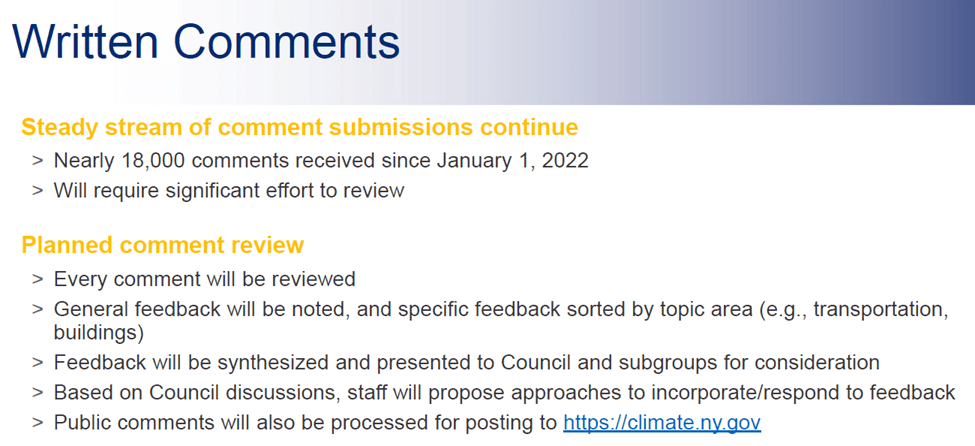
 Pragmatic Environmentalist of New York