

Reliability is the Fatal Flaw of Net Zero

The plan for New York’s  Climate Leadership & Community Protection Act (Climate Act) net zero transition is to electrify everything possible using wind and solar generating resources.   My primary concern is the reliability risks associated with the transition of the electric grid that took decades to develop based on dispatchable generating resources to one that depends upon intermittent and diffuse wind and solar by 2040.  This blog post highlights articles that reinforce my fear that the reliability of any electric grid that relies on wind and solar is fatally flawed.

I submitted comments on the Climate Act implementation plan and have written over 300 articles about New York’s net-zero transition because I believe the ambitions for a zero-emissions economy embodied in the Climate Act outstrip available renewable technology such that the net-zero transition will do more harm than good.  The opinions expressed in this post do not reflect the position of any of my previous employers or any other company I have been associated with, these comments are mine alone.

Climate Act Background

The Climate Act established a New York “Net Zero” target (85% reduction and 15% offset of emissions) by 2050. The Climate Action Council is responsible for preparing the Scoping Plan that outlines how to “achieve the State’s bold clean energy and climate agenda.”  In brief, that plan is to electrify everything possible and power the electric gride with zero-emissions generating resources by 2040.  The Integration Analysis prepared by the New York State Energy Research and Development Authority (NYSERDA) and its consultants quantifies the impact of the electrification strategies.  That material was used to write a Draft Scoping Plan.  After a year-long review the Scoping Plan recommendations were finalized at the end of 2022.  In 2023 the Scoping Plan recommendations are supposed to be implemented through regulation and legislation.

Australian Renewables Integration

Chris Morris – a semi-retired power station engineer from New Zealand, and Russ Schussler – an electrical System Planning Engineer, have written a series of three articles about the unfolding disaster in Australia as they implement a net-zero electric grid. 

The first article explains what they are doing in Australia and what is happening to their electric grid.  Although there are significant differences between the Australian electric system and the North American system, there are proposals that will reduce those differences.  In particular, the Biden Administration plan to eliminate fossil fuels as a form of energy generation in the U.S. by 2035 with targets of 80% renewable energy generation by 2030 and 100% carbon-free electricity five years later, will inevitably lead to the same problems already observed.

The authors explain that:

Wind and solar, the unreliables, are now a significant part of the current NEM generation but the backbone is still coal – over 60% of the energy. Wind is less than 15% and grid solar 5%.

They note that “There is also the significant presence of domestic PV”.   Importantly. they found that:  “even at those levels, the intermittency and unpredictability has had major detrimental impacts on power stability.”  In particular, they state:

Management of the grid on a day-to-day basis depends on reliable generation and dispatchability. The renewables offer neither. For wind, there is often the mantra that the wind is blowing somewhere. The actual data does not back that up. A skeptic has for a number of years compiled the daily wind generation on the NEM. The results are revealing. The graph shown below is for just one month, June 2022. There is a synchronicity in the output of all the windfarms. To cope with the drop in those declines from wind, that is a lot of power that needs to be quickly ramped up.  If the wind isn’t blowing and it is night-time, where will the energy to make up the dip come from? The mainstay 400MW+ coal units that form the background of the energy supply can take three days to get to full load if cold.
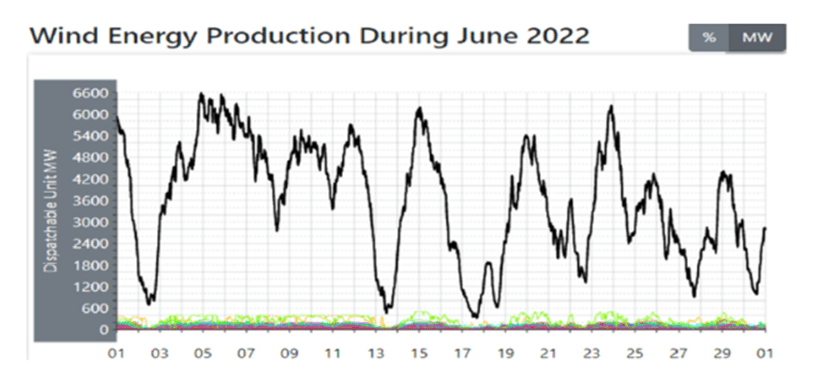
I maintain that current wind, solar, and energy storage technology is inadequate to support an electric system that can maintain current standards of reliability.  The second article describes some of the innovations that are being tried in the Australian transition and note that they hype about “success” does not match reality.  Both authors are engineers and describe some issues associated with the required new technologies.  For example, there is a tendency to dismiss identified problems because there is a project or work by academics that claims industry changing innovations are just around the corner.  They show that these “claims are often overblown or misunderstood”.

Advocates make claims about the penetration of wind and solar resources in components of the grid without admitting that the numbers they cite are only possible because of support from outside the component traditional generating resources.  One major problem with wind and solar is that fossil-fired, nuclear, and hydro generating units produce electricity by spinning turbines that are synchronized to run at 3600 revolutions per minute.  That inherent characteristic provides necessary support to the transmission system.  Wind and solar generators are asynchronous and do not provide that service.  The authors explain the ramifications:

Not too long ago many pointed towards Germany as showing how a grid could accommodate high levels of renewables. This was a very misleading picture. The physics of the grid do not care who owns what. Synchronous resources from a neighbor’s generators provide support across the European grid, despite differences in language and nationality. Electricity flows quickly, approaching the speed of light, over every potential path to support all parts of the system regardless of who owns what. The German component is supported by conventional generation from neighboring systems including coal resources in Poland.

The article goes on to evaluate specific claims about the South Australian component of the grid related to synchronous power.  It turns out that in South Australia they have installed “synchronous condensers to maintain the grid without their synchronous gas generating units”. When anyone claims that wind and solar are cheaper than natural gas units, they are not incorporating the cost of some technology like synchronous condensers necessary to keep the lights on. 

Schussler has previously explained that there are two major problem areas with the net zero transition: getting energy from renewables instead of fossil fuels and having the grid work with intermittent asynchronous renewable resources.  Clearly if we are to have a working system it is necessary to address them together.  As it stands now the emphasis in Australia and New York for that matter, has been on the first problem.  The authors note “It is mind-boggling that an entity committed to an energy transition would seek to maximize efforts in regard to changing energy resources while hoping a miracle will occur allowing that energy to be delivered in an economic and reliable manner.”  They go on to say (their emphasis included):

It is simple to take out coal, if you don’t care what happens next. It is going to be incredibly difficult, if at all possible, to enable the replacement.  Significant roles will be demanded from all resources but that may not be enough. A lot of attention needs to be paid when baseload generation comes off, and a lot of challenges without practical solutions will likely emerge.  A lot of needed things needed don’t exist yet and may not ever exist. The energy system may be unrecognizable, maybe because it will no longer resembles an economic and reliable power system.

The third article discusses other ancillary services that are necessary to keep the electric system operating reliably and then goes on to see how the grid is being impacted by increasing levels of wind and solar resource deployment.  I am not going to describe their concerns about reactive power, frequency control, & inertia, reserves, load shedding, system functions during frequency excursions except to note that all these issues were ignored in the Scoping Plan.   If you are interested in reliability issues, I recommend the article.  The authors conclude:

The above is a simplified explanation of what is needed for reliable grid operation. Proponents of renewable energy do not want to discuss concerns of this sort, particularly the costs involved. When forced to address these issues, they rely on magical thinking, advocating for technologies that either do not yet exist or have not yet been proven to work reliably on a grid. The known solutions are expensive, but the renewable sector doesn’t want to pay for them – their mantra remains that renewables are cheaper than fossil fuels so the others should pay for them – hiding the expense. Add in the costs from the needed system support requirements described above, then renewables are significantly more expensive (and less reliable) than conventional generation. The extra costs of renewables support are being paid for a deteriorating quality of electricity supply. That is why there is a new industry adage – Cheap renewables are very expensive.

Futility of Wind Power

Francis Menton writing at the Manhattan Contrarian describes a new report by Bill Ponton that explores the effects and costs of continuing increases in generation of electricity from wind titled “The Cost of Increasing UK Wind Power Capacity: A Reality Check.” .  This analysis addresses what I call the ultimate problem of an electric grid relying on wind and solar.  The variability of those two resources is so great that there are huge issues trying to plan and develop the resources needed for periods when both resources are weak or nonexistent. 

Ponton examines the relationship between energy generation and power capacity for wind resources.  This is the same issue mentioned in the first article described above.  In particular, advocates claim that all that needs to be done is to have the political will to build enough renewable generation capacity.  What they don’t consider is just how much would be needed. In Ponton’s analysis he increases the wind generation capacity for every hour in a record of generation and load for 2022.  He finds that because the wind lulls cover so many facilities that doubling the generation capacity does not double the percent of UK electricity from wind from 24% to 48%, but only to 40%. He then goes on to triple and quadruple the wind resource capacity to produce the following graph:
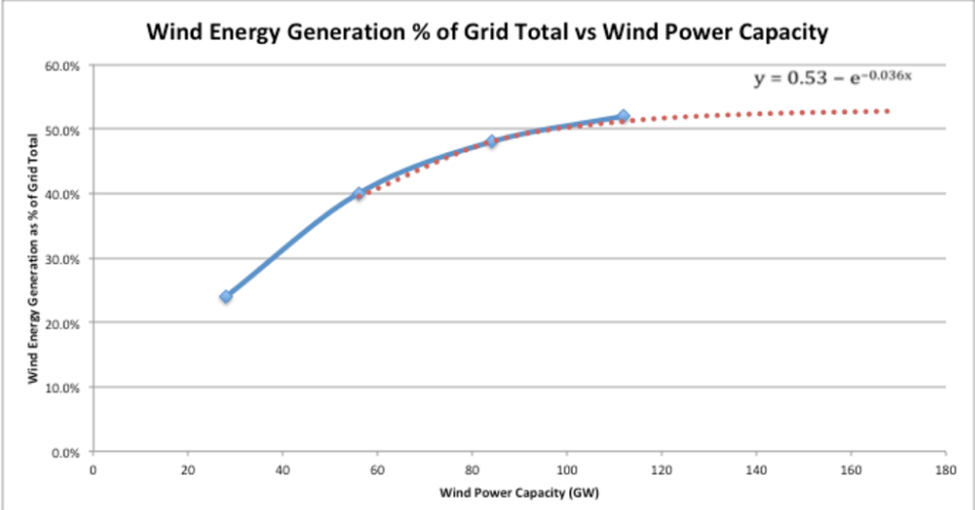
Note that the percent of generation from wind approaches a limit asymptotically.  The percentage of electricity generated from wind deployment in any scenario still experience rapidly slowing increases as more wind capacity is added, and will approach a limit asymptotically. Menton points out that “This means that each incremental addition of wind generation capacity produces electricity that is more and more costly, with the costs accelerating rapidly after the tripling of existing capacity.”  Menton promises that he will follow up with more results from the Ponton report so stay tuned.

Conclusion

All of these articles raise significant reliability concerns that were ignored in the Scoping Plan.  Morris and Schussler believe it is “most likely that costs will increase significantly and reliability will degrade considerably” even if Australians do a great job of implementing all the planned changes. I agree with their conclusion that “Higher energy costs will hurt their consumers and industry while moving manufacturing and industry away from Australia to areas with cheaper (fossil fuel based) energy. The end result may cause far greater environmental harm.”  If New York fails to heed these warning the result will be the same.

Question for the Climate Action Council

The implementation plan for New York’s Climate Leadership and Community Protection Act (Climate Act) “Net Zero” target (85% reduction and 15% offset of emissions) by 2050 is being developed.  Here is a question for the Climate Action Council.  How do you expect to avoid the affordability and reliability issues evident in Europe occurring as their net-zero policies are implemented?

I have written extensively on implementation of the Climate Act and submitted extensive comments on the Draft Scoping Plan.  Everyone wants to do right by the environment to the extent that efforts will make a positive impact at an affordable cost.  Based on my analysis of the Climate Act I don’t think that will be the case.  I believe that the ambitions for a zero-emissions economy outstrip available renewable technology such that the transition to an electric system relying on wind and solar will do more harm than good.  The opinions expressed in this post do not reflect the position of any of my previous employers or any other company I have been associated with, these comments are mine alone.

Climate Act Background

The Climate Act established the Climate Action Council who is responsible for preparing the Scoping Plan that will “achieve the State’s bold clean energy and climate agenda”.  They were assisted by Advisory Panels who developed and presented strategies to meet the goals.  Those strategies were used to develop the Integration Analysis prepared by New York State Energy Research and Development Authority (NYSERDA) and its consultants that quantified the impact of the strategies.  That analysis was used to develop the Draft Scoping Plan that was released for public comment on December 30, 2021 and will be finalized in 2022.  The Climate Action Council has set up three subgroups to consider alternative fuels, economy-wide strategies to fund the transition, and gas system transition.  While I do not deny that these are worthwhile topics, I am disappointed that reliability, feasibility, and affordability are not being explicitly considered.  This is of particular concern given the energy affordability and reliability crises underway in Europe.

Great Britain Affordability

Net Zero Watch publishes a newsletter that describes climate and decarbonization policies, what they cost, whether they are delivering and what their real impact is on the environment.  Based in Great Britain they are following the affordability impacts of current net-zero energy policy.  The latest reports from their newsletter are disturbing.

The Office of Gas and Electricity Markets (OFGEM), supporting the Gas and Electricity Markets Authority, is the government regulator for the electricity and downstream natural gas markets in Great Britain.  The energy price cap is a backstop protection from the government for people who default onto their supplier’s basic energy tariff. Ofgem calculates the cap level that suppliers must apply to these tariffs. 

According to the Independent, August 27, 2022, the “United Kingdom faces ‘catastrophe’ after energy bills soar 80% amid warning price cap could hit £7,000”.  The article notes that:

Regulator Ofgem has revealed that the price cap, which is supposed to protect consumers from unfair energy bill increases, will rise to £3,549 per year for an average household – more than three times last winter’s level. That is expected to leave some 8.9 million households in fuel poverty, charity bosses have said, with a “real risk” that children will go hungry as Britain’s poorest see almost half of their income taken up by gas and electricity.

There also were articles describing the impacts beyond the obvious energy poverty ratepayer effects.  The energy caps apply only to consumers but not, for example, health care providers.  It has been reported that:

The chief executive of Care England said providers faced a staggering 683 per cent increase in energy costs during the past 12 months, with bills expected to rise again early next year. For gas and electricity, the costs were £660 per bed, per year, this time last year; this week, care providers have to pay an astonishing £5,166.

The Daily Telegraph writes that this is not just a problem for low-income people.  In an interview with the Telegraph, Nadhim Zahawi said that “support cannot be confined to families on benefits and added that gas prices could remain punishingly high for two years.”  He went on to say: “If you are a senior nurse or a senior teacher on £45,000 a year, you’re having your energy bills go up by 80 per cent and will probably rise even higher in the new year – it’s really hard”.

An editorial in the Wall Street Journal brings home the impacts of these high prices.  It notes that the latest price increases bring the average household’s annual bill to £3,549 and that the median household income is £31,400.  That means that for half of the households if their average annual budget for central heating, cooking, and keeping the lights on is equal to the average that the percentage of income spent on energy is over 11%.  New York has an energy poverty target of only 6% so if the adverse affordability effects of New York net-zero implementation are anyway similar then we can expect a major increase in the number of households in energy poverty.

German Reliability

Writing at No Tricks Zone, P. Gosselin translates an article from Die kalte Sonne.  He explains that Germany’s massive, subsidized expansion of electricity generation from renewable sources has squeezed conventional generation units out of the market. Two experts warn of growing grid instability.

Quo Vadis, Grid Stability?

The conclusion of the two is very alarming. Here, too, not a word about “storage facilities galore. Here, reality clashes with the wishful thinking of some green energy protagonists who think there is enough storage and that all that needs to be done is to change the “mindset,” as Patrick Graichen put it.

The continued expansion of highly volatile renewable energy sources and the further displacement of more conventional generation units from the market are making the power grid increasingly sensitive to weather-related fluctuations. Unusual weather phenomena such as dark doldrums pose significant challenges to the security and stability of supply to the power grid. The largely intermittent output of solar and wind farms does not correlate with fluctuations in electricity demand.

The excess supply of renewable energy should be buffered during periods of low electricity demand, and the stored capacity should be injected back into the grid during periods of high electricity demand when fewer renewable sources are available. However, large battery energy storage systems, which have been promisingly announced, are still not on the horizon due to their low capacity and maturity, as well as their exorbitantly high cost of deployment.”

At this point, at the latest, some people’s ears should be ringing:

As long as economic energy storage systems are not established, even proponents of the current direction of Germany’s energy transition will have to admit that reliable conventional power plants will be needed for a long time to come.”

This article is also an urgent reading recommendation for politicians and experts who like to be interviewed.

The authors also conclude:

The importance of nuclear power plants for security of supply in base-load operation and their and their ability to operate the grid in parallel with renewable renewable energies have been demonstrated. The nuclear power plants appear to be well suited for the energy made to achieve the future goal of carbon-free power generation. However, the Atomic Energy Act foresees an early end to nuclear power generation by the end of 2022.”

So without nuclear power in Germany, grid stability problems are a future certainty.

Conclusion

At the August 23, 2022 Climate Action Council meeting some of the comments were discussed.  Among the 35,000 comments submitted were around 900 with attachments including “some still being reviewed and summarized”.  There was no mention of a couple of points I raised in comments about specific Climate Act mandates including one for the Climate Action Council  to consider results from other jurisdictions and another for the New York Public Service Law  § 66-p. “Establishment of a renewable energy program” safety valve conditions for affordability and reliability.  In order to address both mandates the Climate Action Council should respond to the question: How do you expect to avoid the affordability and reliability issues evident in Europe occurring as their net-zero policies are implemented?

I don’t think there is any way to avoid the issues seen in Europe.  So, I have to wonder whether the Climate Action Council is willfully or naively ignoring the energy crisis as it unfolds.  In any case failure to account for the issues will ensure that New York goes over the same cliff.

Europe’s Green Experiment

There are two glaring deficiencies in the implementation process for New York’s Climate Leadership and Community Protection Act (Climate Act): lack of detail about the costs to implement the transition to net zero and disregarding the experiences of other jurisdictions.  This post summarizes the current situation of the European plan to meet the same target as New York.  The Global Warming Policy Foundation just released a report entitled Europe’s Green Experiment – A Costly Failure in Unilateral Climate Policy.  I believe the Climate Action Council should explain how New York’s plan could possibly avoid the issues identified in this report in their Final Scoping Plan.

Everyone wants to do right by the environment to the extent that efforts will make a positive impact at an affordable level.  I have written extensively on implementation of New York’s Climate Act because I believe the ambitions for a zero-emissions economy embodied in the Climate Act outstrip available renewable technology such that it will do more harm than good.  The opinions expressed in this post are based on my extensive meteorological education and background and do not reflect the position of any of my previous employers or any other company I have been associated with, these comments are mine alone.

Climate Act Background

The Climate Act establishes a “Net Zero” target (85% reduction and 15% offset of emissions) by 2050. The Climate Action Council is responsible for preparing the Scoping Plan that will “achieve the State’s bold clean energy and climate agenda”.  They were assisted by Advisory Panels who developed and presented strategies to the meet the goals to the Council.  Those strategies were used to develop the integration analysis prepared by the New York State Energy Research and Development Authority (NYSERDA) and its consultants that quantified the impact of the strategies.  That material was used to write Draft Scoping Plan that was released for public comment at the end of 2021. The Climate Action Council will revise the Draft Scoping Plan based on comments and other expert input in 2022 with the goal to finalize the Scoping Plan by the end of the year.

In section 16 of the Climate Act § 75-0103 there is a mandate to consider efforts at other jurisdictions: “The council shall identify existing climate change mitigation and adaptation efforts at the federal, state, and local levels and may make recommendations regarding how such policies may improve the state’s efforts.”  There has been very little discussion of efforts at other jurisdictions.  The few times other jurisdictions were discussed it was mostly related to calls for greater aspirational goals.  The remainder of this article describes why I believe the European experience should be considered by the Climate Action Council.

Europe’s Green Experiment

John Constable wrote the new report describing the economic impact of European green policies. The European Climate Law:

…..raises the EU’s 2030 emissions reduction target to at least 55% from 40% and makes climate neutrality by 2050 legally binding.  The Climate Law is part of the European Green Deal, the EU’s roadmap towards climate neutrality. To reach its climate goal, the European Union has come up with an ambitious package of legislation known as “Fit for 55 in 2030. It comprises 13 interlinked revised laws and six proposed laws on climate and energy.

Constable writes:

These policies were built on a long-standing interest in renewable energy flows, stretching back into the 1930s but first prominent in response to the oil shocks of the 1970s. After 1990, this interest crystallised as demanding targets for levels of renewable energy in final energy consumption, starting in earnest in 2009, and the Emissions Trading Scheme, which began in 2005. These policy instruments were supported by a concerted and extensive program of public communications and supplementary environmental regulation, such as the Large Combustion Plant Directive of 2001, and its successor the Industrial Emissions Directive of 2016, both intended to address industrial release of harmful substances.

This general environmental effort has been tremendous, but the results are still poorly understood by the public upon whom the experiment has been performed. A host of pertinent questions hang in the air unanswered:

Have the EU member states reduced their emissions?

Have they reduced them in a cost-effective manner?

Are the policies setting an economically compelling example to other countries?

Has a self-supporting and internationally competitive green economy emerged in Europe?

Is Europe a leading developer of low carbon technologies?

How much has the green experiment cost?

Have there been any unintended consequences?

Can it continue?

What has been learned?

The report contains 14 sections that are all relevant to New York’s plans:

  • The Emissions Trading Scheme
  • Growth in renewable energy
  • Conventional electricity generation
  • Renewable heat and cooling
  • Renewable transport fuel
  • Total renewable energy progress
  • Costs and benefits
  • Energy efficiency
  • Energy prices in the EU
  • Energy production, consumption and productivity
  • Emissions in the EU
  • Green jobs and other jobs
  • Has the EU learned from its experiment?
  • The energy transition illusion and the future of European prosperity

I recommend that anyone interested in potential issues with New York’s plans read the report.  I am only going to summarize a few of the findings listed in the summary.

The section on the European Union Emissions Trading Scheme is relevant because the Climate Action Council has setup a subgroup to consider a carbon pricing scheme for New York.  The report notes that:

The Phase 3 of the European Union Emissions Trading Scheme (EU ETS) ran from 2013–2021 has added €78 billion to consumer costs in the bloc, with the annual cost now amounting to about €17 billion.  In 2020, EU member states paid €1.2 billion of ETS revenue to electro-intensive industries to compensate them for cost increases caused by the ETS itself in 2019. This amounts to about 12% of total ETS costs in that year and is clear evidence that the ETS has a detrimental effect on competitiveness. Germany paid €546 million, some 17% of its ETS revenue.

I see no reason to expect that similar costs to consumers will also occur if New York sets up a similar scheme.

The summary description of electricity, gas and transport fuel prices should be a cautionary tale.  It is impossible to compare the Draft Scoping Plan cost projections with the results observed because there is insufficient detail in the Draft Scoping Plan.  The report compares European Union (EU) energy costs to the world’s largest economies in the G20.  It found that in the period 2008 to 2018:

Electricity prices to households in the EU have been 80% above those in the G20.  Electricity prices to industries in the EU have been about 30% above those in the G20.  Gas prices to households in the EU have been approximately double those in the G20.  Gas prices to industries in the EU have been between 20% and 30% above those in the G20.  Diesel prices in the EU have been approximately 10% to 40% above those in the G20.  Petrol prices in the EU have been approximately 30% to 50% above those in the G20.  The EU’s underlying wholesale prices for electricity and gas were similar to those in the G20, and for both petrol and diesel the EU’s wholesale prices were below those in the G20, both indicating that the EU’s higher energy prices are due to policy.

I believe that the results shown for conventional generation capacity and system load factor will be replicated in New York.  The summary states:

In the period 1990–2020, total EU electricity generation capacity has nearly doubled due to growth in renewables, while thermal capacity, which remains essential to system stability, has declined sharply due to regulation and lack of investment signals.  Electricity industry productivity has fallen because the enlarged generation fleet serves a smaller demand. In 1990 the EU’s generation fleet load factor was approximately 56%, but by 2020 this has fallen to 37%.

In a recent post on the carbon pricing subgroup I noted that New York’s investments in emissions abatement costs have been very high so far.  The report notes:

Carbon dioxide abatement costs in the EU are on average several times greater than even high-end estimates of the social cost of carbon ($100/tCO2e), indicating that the economic harm of the EU’s mitigation policies is greater than is the climate change it aims to prevent.

One of the big claims in the Draft Scoping Plan is that the transition plan will provide jobs.  However, the results in Europe suggest that may not work out as proposed.  The summary of green industrial growth explains that:

Employment in the European wind and solar industries has contracted sharply since 2008, with the Spanish industry falling from over 200,000 jobs in 2008 to under 50,000 in 2021, and the German industry halving from over 60,000 to under 30,000 full-time equivalent jobs. Despite a small absolute increase in employment, the EU’s share of global renewables industry employment has fallen from 20% in 2012 to 13% in 2021, and the bloc has substantial presence only in those areas of low-carbon technology, such as biomass, where there is little international competition.  Subsidised deployment in Europe has failed to give European industries a secure position in the world markets for renewable energy equipment. The field is now dominated by China.

Conclusion

Constable concludes: “In spite of the overwhelmingly negative results from Europe’s green experiment 1990 to 2021, the EU Commission appears to have learned nothing; it has announced still more ambitious targets for low-carbon energy, and has even promised to reduce energy consumption still further, in spite of the obvious dangers.”  He suggests that “policy correction is inevitable but entails significant reductions in European standards of living”.  I agree with him that this will be the case in New York. 

The Climate Action Council should explain to the residents of New York why their plan will not result in the problems that have been observed in Europe.  If they cannot do that then this ideological experiment should be put on hold until they can prove otherwise.

Manifesto for a New Prime Minister – Climate Act Lesson from Great Britain

Over the past several months I have been preparing comments on the Draft Scoping Plan for the  Climate Leadership and Community Protection Act (Climate Act) which is New York’s version of the United Kingdom Net Zero plan.  Recently Paul Homewood published Manifesto for a New Prime Minister that offered a plan to address the fact that while polls say the public is in favor of Net Zero, they also show that they don’t want to pay for it.  Homewood’s manifesto does not propose to cancel Net Zero.  Instead, he proposes recommendations to modify it.  I suggest that adapting this manifesto to New York is appropriate now because the impacts seen in Great Britain are inevitable here.

Everyone wants to do right by the environment to the extent that they can afford to and not be unduly burdened by the effects of environmental policies.  I submitted comments on the Plan and have written extensively on implementation of New York’s response to that risk because I believe the ambitions for a zero-emissions economy embodied in the Climate Act outstrip available renewable technology such that it will adversely affect reliability, impact affordability, risk safety, affect lifestyles, and will have worse impacts on the environment than the purported effects of climate change in New York.  New York’s Greenhouse Gas (GHG) emissions are less than one half one percent of global emissions and since 1990 global GHG emissions have increased by more than one half a percent per year.  Moreover, the reductions cannot measurably affect global warming when implemented.   The opinions expressed in this post do not reflect the position of any of my previous employers or any other company I have been associated with, these comments are mine alone.

Climate Act Background

The Climate Act establishes a “Net Zero” target (85% reduction and 15% offset of emissions) by 2050. The Climate Action Council is responsible for preparing the Scoping Plan that will “achieve the State’s bold clean energy and climate agenda”.  They were assisted by Advisory Panels who developed and presented strategies to the meet the goals to the Council.  Those strategies were used to develop the integration analysis prepared by the New York State Energy Research and Development Authority (NYSERDA) and its consultants that tried to quantify the impact of the strategies.  That material was used to write a Draft Scoping Plan that was released for public comment at the end of 2021. The Climate Action Council states that it will revise the Draft Scoping Plan based on comments and other expert input in 2022 with the goal to finalize the Scoping Plan by the end of the year.

MANIFESTO FOR 2022

Paul Homewood’s Manifesto for a New Prime Minister lists 16 policy actions that he believes would reverse course from what he describes as a “hard left eco agenda in the British Net Zero plan.  I have attached the Manifesto to the end of this post.  In the following I offer my annotated comments to the manifesto.

In the Preamble Homewood describes the problem and his recommendations.

It is gradually dawning on the public just how ruinously expensive and suicidal the Net Zero project is going to be.  Sadly though, Net Zero is embedded across all the main political parties, throughout the establishment and the media. There is therefore no realistic chance that it will be abandoned anytime soon.  However, there are a number of things which could and should be done, that would effectively put the brakes on Net Zero and help to reduce some of the costs already being incurred by the public because of climate policy.

Implementation of the New York Climate Act has just started so the public has not had any direct experience on costs yet.  Moreover, the cost information in the Draft Scoping Plan is notably vague and what is provided is misleading.  The New York situation is similar inasmuch as the establishment is firmly behind the Climate Act and I fear that if push came to shove that the Republicans would not come out to completely repudiate it.  Instead, the ideas embodied in the Manifesto might be acceptable.

Homewood proposes two fundamental principles:

All government actions regarding Net Zero should be consistent with two fundamental principles:

1) Policy should be affordable, both for the public and government finances.

2) Decarbonization in future should not be at a faster rate than the rest of the world.

I wholeheartedly agree with these.  Affordability has to be a primary concern.  I argued in my comments that the implementation program should be conditional based on a standard of affordability.  It is also hard to argue that our action should not be considered in the context of the rest of the world.  New York emissions are less than half a percent of global emissions so action on our own will not affect global warming.  Therefore, it is only logical that our implementation should be tied somehow to global actions.  I believe it would be far better for New York to invest in the development of zero-carbon technology that costs less than to try to use today’s wind, solar, and energy storage technology.

Homewood describes 16 policy actions in his manifesto:

1) All Carbon Budget targets should be suspended.

The Climate Act has similar targets and they should also be suspended or made contingent upon meeting certain standards of affordability, reliability and environment impacts.

2) The proposed ban on gas boilers should be postponed until alternatives are cost competitive

New York has not reached the point where natural gas, fuel oil, and propane fired furnace bans have been enacted.  New York should prove its affordability case before passing legislation banning those furnaces.

3) The proposed ban on petrol/diesel cars should also be postponed, until:

a) Alternatives are cost competitive

b) Solutions are found for the millions of drivers without off-street parking

c) A nationwide charging network is established, with sufficient capacity and at no cost to the public purse

d) The electricity grid and distribution network has been upgraded

These are appropriate conditions for electric vehicle implementation in New York.

4) Immediately abolish carbon pricing and the UK Emissions Trading System, which is already driving up power prices.

The Climate Action Council is debating carbon pricing schemes at this time.  Carbon pricing legislation was proposed last year but failed to advance to a vote given the opposition.  This year New York State suspended the gas tax which is entirely inconsistent with the plan to raise fuel costs.

5) Implement an Intermittency Tax for wind and solar generators, so that they bear the cost of standby and grid balancing, instead of electricity consumers.

The market rules for wind and solar generators are still under development in New York.  It is only a matter of time until this becomes an issue.  In my opinion, the market price paid to generators should be made a function of dispatchability.  Full price should only be paid to those generators that are fully dispatchable.

6) Implement a Windfall Tax on all recipients of Renewable Obligation Certificates, who currently benefit from high wholesale power prices in addition to ROCs, which currently cost consumers £6bn a year. The revenue to be used to offset ROC costs currently added to electricity bills.

7) End all constraint payments to wind farms

I am not conversant whether New York policies are similar and would need to be addressed.

8) Put a stop to all new subsidies for renewable energy

If it is so wonderful and so cheap why would new subsidies be required anyway?

9) Fully commit to a long tern future for North Sea oil and gas, necessary to encourage development. This must include a recognition of the need for substantial amounts of natural gas in the medium term.

10) End the ban on fracking, and lift all unnecessary restrictions which were previously in place.

In the context of the global energy crisis a case can be made that New York’s failure to permit natural gas pipelines to New England is the not in the best interest of national security because New England is dependent upon Russian natural gas due to lack of supply.  The Draft Scoping Plan makes references to trying to reduce dependency upon out-of-state fuel supplies but ignores the fact that the ban on fracking precludes New York from developing its own in-state supply.

11) Extend the life of existing coal power plants.

New York has closed its last coal plant and now the energy innumerates are clamoring to shut down all fossil fuel plants.  That would be a disastrous policy.

12) Fast track mini nuclear development.

I endorse the recommendations of New York Energy and Climate Advocates who call for including nuclear power in the Draft Scoping Plan recommendations. Personally I think the most promising approach is small modular reactors.

13) Immediately approve the Cumbria coal mine

There is no New York coal mining.

14) Guarantee that no new taxes will be raised, designed to “encourage” consumers away from high carbon consumption. In particular, no new tax on meat or gas.

I agree with this recommendation.

15) Put an immediate stop on plans to force landlords to meet higher energy efficiency and low-carbon standards

There are similar plans in New York that will increase costs to those least able to afford them.  I agree with this limitation.

16) Put an end to plans to ban mortgages for homes which don’t meet energy efficiency and low-carbon standards.

There is nothing like this in New York but the state also hasn’t legislated a policy to force homeowners to meet energy efficiency and low-carbon standards yet either.

Homewood concludes with a description of the financial impacts of the recommendations.  He claims that his suggestions for carbon pricing, intermittency tax, windfall tax, and constraint payments would provide total savings of £9.9 billion and would reduce average household energy bills by £366 a year.  New York has not provided any estimates of average household energy bill impacts.  I believe the inevitable costs for the Climate Act would be multiples of that household cost.

Conclusion

I want to re-emphasize the point that polls in the United Kingdom say the public is in favor of Net Zero but they also show that they don’t want to pay for it.  I convinced that the majority of New Yorkers are not even aware of the Climate Act.  Even if people know about the Climate Act, they cannot find cost information because it is being withheld, obscured, and covered up.  As a result, New York is not as far along as Great Britain in facing up to the inevitable problems with affordability that have been observed at every jurisdiction where zero-emission transitions have been attempted.

The Climate Act has a mandate to the Climate Action Council to consider what is happening in other jurisdictions.  If the Climate Action Council considers what is happening in the United Kingdom and Germany at this time the necessity for conditional implementation would be obvious.   In my opinion, the desirability of these recommendations may not be obvious now but over time it will become clear that this is the way to go.

MANIFESTO FOR 2022

Preamble

It is gradually dawning on the public just how ruinously expensive and suicidal the Net Zero project is going to be.

Sadly though, Net Zero is embedded across all the main political parties, throughout the establishment and the media. There is therefore no realistic chance that it will be abandoned anytime soon.

However, there are a number of things which could and should be done, that would effectively put the brakes on Net Zero and help to reduce some of the costs already being incurred by the public because of climate policy.

Fundamental Principles

All government actions regarding Net Zero should be consistent with two fundamental principles:

1) Policy should be affordable, both for the public and government finances.

2) Decarbonization in future should not be at a faster rate than the rest of the world.

Policy Actions

The following actions are therefore proposed:

1) All Carbon Budget targets should be suspended.

2) The proposed ban on gas boilers should be postponed until alternatives are cost competitive

3) The proposed ban on petrol/diesel cars should also be postponed, until:

a) Alternatives are cost competitive

b) Solutions are found for the millions of drivers without off-street parking

c) A nationwide charging network is established, with sufficient capacity and at no cost to the public purse

d) The electricity grid and distribution network has been upgraded

4) Immediately abolish carbon pricing and the UK Emissions Trading System, which is already driving up power prices.

5) Implement an Intermittency Tax for wind and solar generators, so that they bear the cost of standby and grid balancing, instead of electricity consumers.

6) Implement a Windfall Tax on all recipients of Renewable Obligation Certificates, who currently benefit from high wholesale power prices in addition to ROCs, which currently cost consumers £6bn a year. The revenue to be used to offset ROC costs currently added to electricity bills.

7) End all constraint payments to wind farms

8) Put a stop to all new subsidies for renewable energy

9) Fully commit to a long tern future for North Sea oil and gas, necessary to encourage development. This must include a recognition of the need for substantial amounts of natural gas in the medium term.

10) End the ban on fracking, and lift all unnecessary restrictions which were previously in place.

11) Extend the life of existing coal power plants.

12) Fast track mini nuclear development.

13) Immediately approve the Cumbria coal mine

14) Guarantee that no new taxes will be raised, designed to “encourage” consumers away from high carbon consumption. In particular, no new tax on meat or gas.

15) Put an immediate stop on plans to force landlords to meet higher energy efficiency and low-carbon standards

16) Put an end to plans to ban mortgages for homes which don’t meet energy efficiency and low-carbon standards.

Financial Impact

Many of the above actions could be speedily introduced and would have an immediate impact on energy bills.

For instance:

  • Carbon pricing – £1.4bn
  • Intermittency tax – £2.0bn
  • Windfall Tax – £6.4bn
  • Constraint payments – £0.1bn

A total saving of £9.9 billion would reduce average household energy bills by £366 a year.