
New York Assembly Cap and Dividend Bill Naiveté

In order to meet the Climate Leadership & Community Protection Act (Climate Act) the Hochul Administration has proposed the New York Cap-and-Invest (NYCI) program.  The regulatory process to set up this market-based emissions trading program is underway.  Not content to let the that process play out Assemblyperson Anna Kelles has introduced a bill to “amend the environmental conservation law and the public authorities law, in relation to establishing an economy-wide cap and invest program to support greenhouse gas emissions reductions in the state”.  Unfortunately, the basis for this legislation is flawed because its authors do not understand what makes market-based emission reduction programs work.

I have followed the Climate Act since it was first proposed, submitted comments on the Climate Act implementation plan, and have written over 400 articles about New York’s net-zero transition. I have worked on every emissions trading program affecting electric generating facilities in New York since 1990 including the Acid Rain Program, Regional Greenhouse Gas Initiative (RGGI), and several Nitrogen Oxide programs since the inception of those programs. I also participated in RGGI Auction 41 and successfully won allowances which I held for several years.  I follow and write about the RGGI cap and invest CO2 pollution control program and New York carbon pricing initiatives so my background is particularly suited for evaluating the NYCI proposal and this proposed legislation. The opinions expressed in this post do not reflect the position of any of my previous employers or any other organization I have been associated with, these comments are mine alone.

Overview

The Climate Act established a New York “Net Zero” target (85% reduction in GHG emissions and 15% offset of emissions) by 2050.  It includes an interim 2030 reduction target of a 40% reduction by 2030 and a requirement that all electricity generated be “zero-emissions” by 2040. The Climate Action Council (CAC) was responsible for preparing the Scoping Plan that outlined how to “achieve the State’s bold clean energy and climate agenda.”  In brief, that plan is to electrify everything possible using zero-emissions electricity. The Integration Analysis prepared by the New York State Energy Research and Development Authority (NYSERDA) and its consultants quantifies the impact of the electrification strategies.  That material was used to develop the Draft Scoping Plan outline of strategies.  After a year-long review, the Scoping Plan was finalized at the end of 2022.  In 2023 the Scoping Plan recommendations were supposed to be implemented through regulation, PSC orders, and legislation.  Not surprisingly, the aspirational schedule of the Climate Act has proven to be more difficult to implement than planned and many aspects of the transition are falling behind.  NYCI is an example of a program that is taking longer to develop than is consistent with the mandates.

Capital Tonight Interview with Kelles

Susan Arbetter interviewed Kelles about her legislation on Capital Tonight.  The description of the interview stated:

New York state Assemblymember Anna Kelles has introduced legislation that serves as an alternative to the state’s emerging cap and trade system.

Cap and trade is a program used to help meet climate goals by capping pollution and then authorizing tradable allowances between companies, creating a new market.

New York is currently creating a cap and trade system under its 2019 climate law.

Assemblymember Kelles is carrying legislation that would transform this system into what she’s calling a “cap and invest” system. She joined Capital Tonight’s Susan Arbetter to discuss her bill.

The video for the interview is embedded in the description.  Arbetter introduced the interview with a slide “Cap and Trade” that made the following points:

  • Caps emissions in New York
  • Emissions credits for sale
  • Companies can sell emissions credits for profit
  • Proposal would reinvest revenues of credit sales in climate projects

Arbetter claims that the Kelles legislative proposal would make the market-based system a cap and invest program.  There is disconnect here.  The NYCI proposal is a cap-and-invest program as I have described previously.  The program will cap emissions in New York.  The permits to emit a ton of GHG emissions, known as allowances, will be distributed primarily though auctions.  The proceeds will be used to invest in projects that reduce GHG emissions and prioritize investments in “frontline disadvantaged communities”.  Arbetter’ s statement that companies can sell the allowances for profit is technically true, but the reality is that the affected companies buy what they need for their own compliance and do not purchase allowances at the auctions to play the market for profit.  On the other hand, there are no limits to participation in the proposed NYCI design so traders can purchase allowances and try to make profits.

Arbetter asked Kelles what she was not happy with in the proposed NYCI design. The first reason she gave was that “instead of what we agreed to in last year’s budget to create a cap-and-invest program this is instead a cap-and-trade program”.  As noted previously, the state plan is a cap-and-invest program.  I think her mis-conception is that NYCI allows trading of the allowances, so it is “cap-and-trade”.  NYCI also allows entities to bank or carry over unused allowances between compliance periods. 

The Kelles legislation includes the following that upends the approach used in all previous market-based emission reduction systems:

§ 75-0123. Use of allowances.

1. Allowances must be submitted to the department for the full  amount of greenhouse gas emissions emitted during a given compliance period. If greenhouse gas emissions emitted during a given compliance period exceed allowances submitted for such compliance period, such shortfall shall be penalized pursuant to section 75-0129 of this article.

2. Any allowances not submitted at the end of the compliance period in which  they  are  issued by the authority shall automatically expire one hundred eighty days after the end  of  such  compliance  period  if  not submitted prior to such date of expiration.

3. Allowances shall not be tradable, sellable, exchangeable, or otherwise transferable.

In addition to these limitations in NYCI there is a three-year compliance period and in the Kelles legislation there is a one-year compliance period.  These differences destroy the flexibility that has made market-based emissions control program successful.  All programs include penalties if an affected source is unable to surrender an allowance for each ton emitted.  The limitations that allowances not used expire and that allowances “shall not be tradable, sellable, exchangeable, or otherwise transferable” are incompatible with previous programs and would be unfair to market participants.

The NYCI proposal builds on the experience of RGGI which New York State claims has been successful and has worked for market participants.  NYCI offers the allowances in quarterly auctions and compliance is for a three-year period.   Participants in the program will develop a bidding strategy to purchase the number of allowances that they expect to use during the compliance period.  Experience in the RGGI cap-and-invest program showed that a three-year compliance period enabled affected sources to effectively match their allowance needs with their emissions.  Because GHG emissions are closely tied to energy use, emissions vary with weather conditions with more emissions and allowances needed in hot or cold years and less in average conditions.  The ability to bank and trade allowances enables entities to correct their projections and account for inter-annual variation.

In the Kelles proposal if each individual source did not match their allowances purchases based on projected operations to their actual emissions, then they would be stuck with excess allowances that they cannot sell or trade and will expire.  That is an unfair approach.  In the first place, allowances are purchased in lots of 1,000.  The odds of any source emissions being in multiples of 1,000 is nearly zero and many sources total emissions are less than 1,000.  As it stands now, a company with multiple sources purchases allowances for them all and allocates them to individual accounts for compliance.  This practice would be outlawed by the prohibition on trading. Many participants rely on emission marketers who purchase allowances at auction for resale or facilitate trades between those companies that have excess allowances and those that need them.  Small companies rely on these marketers for their allowances because they don’t have the expertise to participate in the auctions.  The RGGI cap-and-invest approach enables flexibility that makes compliance cost-effective.

Another issue that Kelles said she was not happy with is that NYCI “creates an extensive secondary market”.  One example she gave was that the limit on the number of allowances purchased is 25% so you “could have a situation potentially where only four entities own all the allowances” and they could exert market control and sell them for profit.  This has been an on-going concern with RGGI, but they included a market monitoring component expressly to address the concern.  RGGI started in 2009 and the problem has not come up.  NYCI proposes to use the same mechanism.

Kelles also said that her legislation would shift the emphasis to investments rather than profits which she wants to see.  When you look at a market-based emissions system from the outside, the activist community that is providing information to Kelles only see dollar signs and believe that somehow industry is profiting from the program at the expense of consumers.  I also think that academics have contributed to this perception because they believe that the allowances are treated as marketable commodities by the compliance entities.  In reality, entities affected by these emissions trading programs prioritize compliance above all and rarely treat the allowances as a source of profit.  It is simply wrong to think of these programs as evil because there are some profits involved.  Those profits incentivize the flexibility that in the big picture reduces overall costs.

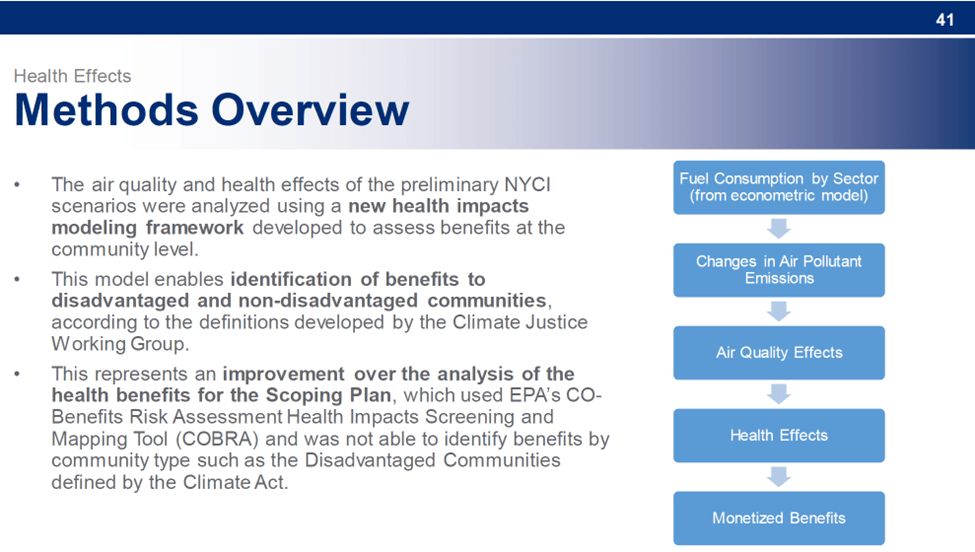
The activists who are influencing Kelles rank protections to disadvantaged communities very high.  There are very few examples where emissions market programs have adversely affected those communities and most studies disagree.  The bigger problem with this concern is that market-based emissions programs are not designed to address local issues.  Kelles said that emitters are predominantly in disadvantaged communities, and it is “necessary to reduce the GHG emissions that are negatively impacting those communities”.  Greenhouse gases do not have direct health-based air quality impacts so activists use co-pollutants for the adverse impacts claims.  That ignores the fact that there are programs in place designed to address co-pollutants emitted by sources in disadvantaged communities.  Clearly the reason we are reducing GHG emissions is to influence global climate change so claiming negative local impacts is a stretch.  Moreover, it is necessary to put what we can do to affect climate change impacts in context.  In 2021 CO2 emissions in the Chinese energy sector increased by 400 million tons. Total New York GHG emissions for all greenhouse gases and all sectors in 2021 were 268 million tons so eliminating New York emissions  Anything we do will be completely replace by emissions elsewhere in less than a year.

Kelles also stated that she was not happy that NYCI is considering not obligating the electricity sector to participate in NYCI.  She suggested that because there are power plants in disadvantaged communities that not including them eliminates the ability to protect residents there.  I believe that the decision to exclude the electricity sector at the start is a practicality issue.  They already are covered in RGGI and the agencies do not have sufficient resources to include them and everything else at the same time.  My impression was that the electricity sector will be added later.  With respect to her concern about the power plants in disadvantaged communities that whole issue is a contrived artifact of environmental justice activists.  The presumption of egregious harm from power plants in disadvantaged communities is based on selective choice of metrics, poor understanding of air quality health impacts, and ignorance of air quality trends.

There also was a discussion of the emissions intensive and trade exposed industries provisions.  These are industries that will be put to disadvantage when they try to compete against companies outside New York that do not have the NYCI costs.  Kelles claims that her plan is to encourage them to transition to renewable energy infrastructure without acknowledging the competitive implications of that transition.  I frankly have not followed the particulars of this aspect because I think it is hopeless.  There will be inevitable increased costs and, at some point, industries will not be able to compete.  The Business Council of New York memo in opposition to the legislation addresses these concerns.

Discussion

I am going to limit this article to the issues raised in the Arbetter interview.  There are some other examples where the poor understanding of components of these programs that led to the success of previous programs will be hampered or destroyed by this legislation.  The examples included are sufficient to show the legislation is flawed because its authors do not understand what makes market-based emission reduction programs work.

First, and foremost, market-based emission reduction programs are trading programs.  The ability to buy, sell, or trade allowances and bank them for later use enables the flexibility that makes these programs a cost-effective solution.  Eliminate them and there is no assurance that they will work like previous programs.

NYCI is called a cap-and-dividend program because the primary way that allowances will be distributed is through an auction.  The proceeds from the auction are the dividends that will be invested to reduce emissions and minimize impacts to disadvantaged communities of the inarguably regressive energy costs necessary to implement the zero-emissions by 2040 Climate Act mandate.

In my opinion, the guardrails around the allowance costs are so inflexible that NYCI is basically a carbon tax.  The Kelles legislation would remove any pretense that the program is anything but a tax.  There are some advantages to that and some disadvantages too but I think that if there is any legislation is passed it should be to set a carbon tax because that is the responsibility of the legislature.

There is no question that disadvantaged communities have had disproportionate historical impacts.  However, cap-and-invest programs are not the appropriate tool to protect them and reduce their environmental impacts because cap-and-invest programs are designed for regional and global pollutant reductions.  There are regulations in place that address local impacts and the Department of Environmental Conservation is implementing additional regulations to strengthen and enhance those safeguards.  The demands of environmental justice activists that have influenced this legislation unfortunately demand zero impacts without any consideration of pragmatic tradeoffs.  For example, the focus on peaking power plants ignores the vital role those facilities play to keep the lights on despite results that show that the alleged impacts are over-stated.

Conclusion

The fundamental flaw in the Climate Act is the presumption by its authors that getting to net-zero emissions was only a matter of political will.  There never has been an open and transparent feasibility analysis to clearly account for the necessary costs and threats to system reliability but all indications are that this cannot work as outlined in the Scoping Plan.

On the other hand, the NYCI proposal builds on the existing RGGI model.  That program has shown how a cap-and-invest program can ensure compliance and raise money for investments fairly.  The Kelles legislation ignores the factors that made RGGI work and eliminates them.  That will ensure that the program does not provide any pretense of cost-effective reductions.

The presumption of the Hochul Administration and the Kelles legislation is that a cap-and-dividend program will work as well as previous programs.  I think the real debate should be whether that is a justified position because I think the differences between the ambition of this program and previous programs is far greater.  When the results of previous programs are considered the odds that NYCI will work as hoped are not very good.

Roger Pilke, Jr – Bullish on Solar

I have great admiration for Roger Pielke, Jr and his work on addressing climate change.  However, his recent post explaining why he is bullish on solar does not stand up to his usual standards.  This post explains why I disagree with his optimism for solar in the context of New York’s net-zero transition.

I have followed the Climate Leadership & Community Protection Act (CLCPA) since it was first proposed, submitted comments on the CLCPA implementation plan, and have written over 400 articles about New York’s net-zero transition. I am convinced that the CLCPA will adversely affect affordability, reliability, and that the environmental impacts of the proposed transition are greater than the possible impacts of climate change.  The opinions expressed in this post do not reflect the position of any of my previous employers or any other organization I have been associated with, these comments are mine alone.

Overview

The CLCPA established a New York “Net Zero” target (85% reduction in GHG emissions and 15% offset of emissions) by 2050.  It includes an interim 2030 reduction target of a 40% reduction by 2030 and a requirement that all electricity generated be “zero-emissions” by 2040. The CLCPAion Council (CAC) was responsible for preparing the Scoping Plan that outlines how to “achieve the State’s bold clean energy and climate agenda.”  In brief, that plan is to electrify everything possible using zero-emissions electricity. The Integration Analysis prepared by the New York State Energy Research and Development Authority (NYSERDA) and its consultants quantifies the impact of the electrification strategies.  That material was used to develop the Draft Scoping Plan outline of strategies.  After a year-long review, the Scoping Plan was finalized at the end of 2022.  In 2023 the Scoping Plan recommendations were supposed to be implemented through regulation, PSC orders, and legislation. 

I have documented issues with New York’s solar energy rollout and its issues.  The Scoping Plan uses unrealistic estimates of the energy that can be produced by solar in New York so the estimate that New York will need 18.9 GW in 2030 and 43.4 GW in 2040 of solar capacity are too low.  There is no policy in place to protect prime farmland from utility-scale solar development and over 8,000 acres of prime farmland have been lost.  The last cumulative environmental impact assessment did not address the total solar capacity that is now expected.

Bullish on Solar

Pielke’s blog post gave three reasons why he is “very bullish on solar energy technologies — solar is scalable, solar is cheap and getting cheaper, and solar is safe, simple, and popular.”  I am not bullish on solar for reasons that Pielke mentioned but did not follow through on.  Importantly my primary concern is New York’s Climate Act net-zero transition and some of his caveats are inapplicable to New York.  Pielke does not quality his bullishness relative to any geographical limitations. 

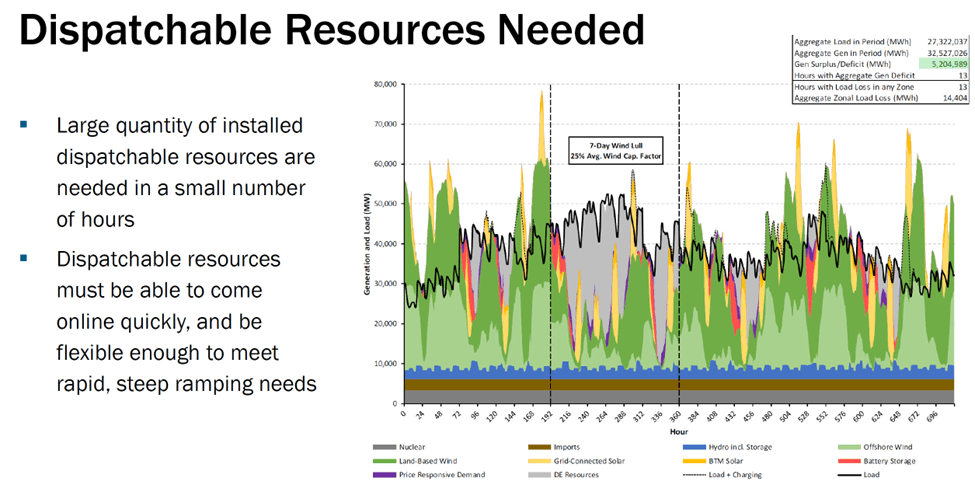
First, I want to explain my overarching concern.  My Climate Act issues are related reliability when the system depends on weather-related wind and solar for most of the electric power generation as outlined in the Scoping Plan.  Electric system resource adequacy planning must address the worst-case conditions and this challenge is made more difficult when intermittent wind and solar resources are used.  While Pielke recognizes the challenge of extended periods of low solar availability, I do not think Pielke’s enthusiasm for solar considers this challenge enough.

Scalable Solar

Pielke argues that solar can be installed incrementally from rooftops to massive utility-scale arrays.  He points out that “in the U.S., the Energy Information Agency (EIA) reports that about one third of solar generation comes from small-scale solar (defined as less than 1 MW capacity)”.   This gives unquestioned flexibility for the development of resource capacity but that comes at a system reliability cost.

The New York Independent System Operator (NYISO) is responsible for matching generation with load.  Small-scale solar is “behind the meter” and cannot be controlled by the electric system operator.  Instead, they analyze its capacity to reduce the load from those locations that have solar installations.  The problem is that this capability fluctuates and cannot be always relied on.  For example, roof top arrays can be affected by accumulated snow and the NYISO has no idea how much that will affect load in the winter.

The other scalability issue is that solar resource value is geographically limited.  What works in low-latitudes and “sunshine” states will not work as well in New York’s high latitudes and cloudy regions downwind of the Great Lakes.  In the worst case a solar array above the Arctic Circle may work well in the summer but is useless in the winter.  New York is not as bad but, in the winter, the solar resource is much reduced and the NYISO does not count on any solar for the diurnal peak.

Solar Affordability

I am a big fan of Pielke’s work and have included his Iron Law of Climate Policy as one of my pragmatic environmentalist principles.  He argues that it is appropriate relative to solar energy:

The Iron Law of climate policy means that it is difficult to motivate an energy transition by intentionally making types of energy appreciably more expensive. But is also means that when clean energy becomes cheaper, it readily gobbles up market share, eventually displacing dirtier and more expensive energy.

He includes a graph of the cost of solar modules with time that shows the module costs have declined 99.6% since 1976.  Not mentioned is that solar modules lose efficiency over time and that their expected lifetimes are half those of conventional fossil plants.  Pielke argues:

The low costs of solar energy, which are positioned to drop even further, has led some in the U.S. to question — quite fairly — why federal subsidies for wind energy are necessary today and far into the future. With or without U.S. subsidies, solar costs should be expected to continue to drop, motivating further deployment, which will lead to greater reductions in costs — a virtuous cycle.

I am worried about how solar energy can be used for the New York Climate Act net-zero transition, specifically the intermittency.   Pielke acknowledges the issue:

Even if solar were free, the technology will always have an intermittency problem when the sun doesn’t shine. The New York Times explained last week that massive battery storage can smooth over demand, but it cannot address intermittency with today’s technologies:

Today’s lithium-ion batteries typically only deliver power for two to four hours before needing to recharge. If costs keep falling, battery companies might be able to extend that to eight or ten hours (it’s a matter of adding more battery packs) but it may not be economical to go far beyond that, said Nate Blair, an energy storage expert at the National Renewable Energy Laboratory.

That means additional long-duration storage technologies could be needed. If California wants to rely largely on renewable energy, it will have to handle weeklong periods where there’s no wind and little sun. Another challenge: There’s far more solar power available in summer than in winter, and no battery today can store electricity for months to manage those seasonal disparities.

I have three problems with claiming that solar is cheap and getting cheaper while ignoring the storage costs.  Storage for solar is needed on different scales.  As noted, there is a difference between summer and winter but there is even a daily difference.  The expected annual output of solar is on the order of 25% of the total which means that a system to provide 100 MW of constant energy would need to overbuild solar to 400MW of capacity and roughly 300 MW of storage.  That is the average annual need and when the worst-case long duration solar drought is considered energy storage becomes impracticable so a new dispatchable emissions-free resource is needed. In the real world, it is even more complicated, and every complication adds more capacity requirements.  All these considerations add to the costs and are not considered by Pielke.

My second problem is that as Pielke notes today’s technology cannot address intermittency.  His solution is pragmatic but not applicable to the Climate Act transition to zero-emissions electricity:

As solar gets cheaper, it will see continued expansion, but accompanying that expansion will be the associated costs of reliable back-up generation, which today means natural gas. Even though natural gas is a fossil fuel, the expanded use of solar backed up by gas has considerable potential to reduce emissions, especially in places where that combo displaces coal generation. The low costs of solar mean that we should expect to see more such displacement.

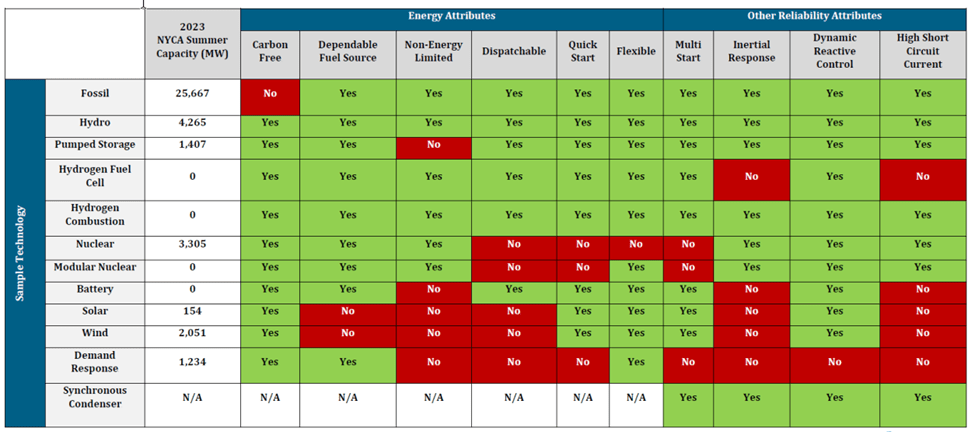
The third problem is that solar and energy storage are inverter-based resources.  It turns out that solar, energy storage, and wind do not provide ancillary services needed to maintain the electric grid.  If you have no idea what I am talking about I recommend the Practical Engineering  You Tube channel video Connecting Solar to the Grid is Harder than You Think

New York’s aspirational goal is to eliminate fossil-fueled generation so natural gas backup is off the table.  Even if natural gas backup were a potential solution, cost projections should consider all the costs of solar plus energy storage versus just using natural gas and nuclear.  At some point a solar plus natural gas backup system will need new fossil generating units.  That approach would necessitate over-built solar, energy storage, ancillary support services, and backup natural gas resources.  If you just used natural gas you eliminate all those other components.  However, using natural gas for baseload electricity is a waste of this valuable resource.  Nuclear is a great zero-emissions baseload resource but has some deficiencies that are best resolved using natural gas units.  In my opinion, a full life cycle analysis that incorporates the life expectancies of the resources would show that renewables would be the more expensive option and also require development of new resources.

Solar is Safe, Simple, and Popular.

Pielke’s argument for safety relies on a review by Our World in Data that finds that the safest source of energy production, as measured by deaths per terawatt-hour of production is solar.  His arguments for simple and popular follow:

Searching Google Scholar, I have not been able to find a single paper addressing fears of solar energy. There are of course concerns about solar supply chainssolar waste, and risks to solar installations but these issues are common across all energy technologies.

A 2023 survey by Glocalities of 21,000+ people in 21 countries found solar energy to be the most favored energy technology, and overwhelmingly so, with 68% favoring solar over other technologies, as shown in the figure below.

The strong public support for solar and lack of public fears mean that among energy technologies, solar has strong political tailwinds that are unique in the energy space. Correspondingly, the ongoing expansion of solar generation will face much less opposition than proposed new wind and nuclear.  Of course, the fact that effective solar deployment also means more gas back-up may result in greater opposition in the future from those who believe that we can just stop fossil fuel use.

Compared to solar energy technologies, wind technologies appear like a convoluted series of Rube Goldberg devices. To be sure, modern wind turbines are a testament to human ingenuity and technological prowess. But they are also massive installations with many moving parts often exposed to harsh conditions — offshore wind in particular. Solar technologies are elegantly simple in comparison.

I cannot document anything different.  Anecdotally however, the “not in my backyard” folks are not enamored when a utility-scale solar development is built nearby.  Given the space requirements for solar energy that is no small consideration.  I do not disagree that in comparison to wind technologies solar is simpler but the additional technologies necessary to integrate solar to the grid are anything but simple and untested at commercial scale to boot.

Discussion

After years of research and study of the challenges of wind, solar, and energy storage I have evolved away from any support for those technologies in anything but niche applications.  Ultimately, relying upon weather-dependent resources necessitates unacceptable risk.  The weeklong periods where there’s no wind and little sun  mentioned earlier introduces tradeoffs not present in the existing electric system.  After decades of experience with the components of the existing electric system the electric planners at the NYISO and other regional operators have a very good understanding of resource availability.  The key point is that they do not have to worry about correlated outages across the electric system.  In the future, relying on wind and solar means that there will be correlated periods across vast areas when wind and solar resources are low.  Furthermore, those periods correspond to the highest load demands at the same time the Climate Act wants to electrify everything possible. 

The proposals for electric system resources in New York call for enormous additions of wind, solar, energy storage, and the as yet unidentified dispatchable emissions free resource.  Just building it is an enormous challenge.  The video Connecting Solar to the Grid is Harder than You Think notes that there are poorly understood aspects of the inverter-based resources on the grid.  Despite my admiration for the capabilities of the electric planning community, the fact is that they will be in a steep learning curve and the odds favor learning by experience.  That experience means blackouts.

That is not the worst of it.  It is well recognized now that the long duration wind and solar droughts is a massive problem.  However, what is not clear to many is the scale of the problem.  In my opinion, the most dangerous future period will be an immense polar vortex that covers most of the North American Interconnect.  In that case there will be no imports from where the wind is blowing, or the sun is shining.  The problem is that you cannot build an electric system based on a one in fifty-year return period because the resources can never be paid off.  But it will happen and when it does electricity will run out.  Inevitably there will be a massive blackout that endangers the health and safety of millions of people. 

I believe that the pursuit of zero-emissions electricity is a mirage.  To justify this transition imaginary benefits are conjured up but the immense costs of trying to do it will be real.  The conjured health benefits will be dwarfed by real deaths when there is no heat, no transportation, and no lights during the coldest period of the year.

Conclusion

Pielke’s optimism for solar neglects key considerations.  There are geographical areas and niche applications where it may make sense to rely on solar.  New York’s high latitude and cloudiness is one location where it does not.  I do not disagree that it is scalable and safe.  His arguments for solar cheapness ignore the expensive challenge to integrate solar energy into the electric grid when and where it is needed.  Full consideration of the ancillary services requirements suggests that it will not be simple either.  When enormous tracts of land are covered up with solar panels I think that its popularity will wane.  I am not a New York solar energy optimist.

NY HEAT is not so hot

According to New York climate activist non-governmental organizations New York is “failing to lead on climate.”   These organizations are lobbying very hard for the New York Home Energy Affordable Transition Act, or NY HEAT, legislation currently being considered.  I recently described Rich Ellenbogen’s response to Sane Energy Voice claims that NY HEAT Act should be enacted.  This post documents additional op-eds that argue this legislation not a good idea.

I have followed the Climate Leadership & Community Protection Act (CLCPA) since it was first proposed, submitted comments on the CLCPA implementation plan, and have written over 400 articles about New York’s net-zero transition. I am convinced that the CLCPA will adversely affect affordability, reliability, and that the environmental impacts of the proposed transition are greater than the possible impacts of climate change.  The opinions expressed in this post do not reflect the position of any of my previous employers or any other organization I have been associated with, these comments are mine alone.

Overview

The CLCPA established a New York “Net Zero” target (85% reduction in GHG emissions and 15% offset of emissions) by 2050.  It includes an interim 2030 reduction target of a 40% reduction by 2030 and a requirement that all electricity generated be “zero-emissions” by 2040. The CLCPAion Council (CAC) was responsible for preparing the Scoping Plan that outlines how to “achieve the State’s bold clean energy and climate agenda.”  In brief, that plan is to electrify everything possible using zero-emissions electricity. The Integration Analysis prepared by the New York State Energy Research and Development Authority (NYSERDA) and its consultants quantifies the impact of the electrification strategies.  That material was used to develop the Draft Scoping Plan outline of strategies.  After a year-long review, the Scoping Plan was finalized at the end of 2022.  In 2023 the Scoping Plan recommendations were supposed to be implemented through regulation, PSC orders, and legislation.  NY HEAT is an example of Climate Act legislation.  Not surprisingly, implementation is falling behind as the difficult challenges are addressed.

NY HEAT

According to Environmental Advocates of New York:

The purpose of the bill is to give the Public Service Commission the authority and direction needed to align gas utility regulation and gas system planning with the Climate Leadership and Community Protection Act (CLCPA) mandates. Overall, the bill removes the legal basis and subsidies driving the expansion of gas systems and requires the commission to adopt rules and develop a statewide gas service transition plan that is consistent with decreasing gas reliance and, where appropriate, decommissioning gas systems.

Fossil fuels burned in buildings for heating, hot water, and cooking account for approximately one-third of greenhouse gas emissions in New York State. Additionally, heating and cooking with fossil fuels like natural gas quietly impact our indoor air quality, contributing to cases of asthma and heart disease.  The Public Service Law, as is, promotes gas system expansion in its stated obligation to serve customers and its business model. This undermines the important climate justice directives and binding emissions limits in the CLCPA. Instead of letting this incompatibility issue continue, this bill better aligns the rules and business practices of the Commission with reduced gas reliance, transition to more sustainable utilities, and prevents energy bill burden among low-income ratepayers.

The bill makes several amendments to the Public Service Law. One of which includes directing the Commission to integrate “the utility sector achievement of the CLCPA” as a core planning objective to its public service responsibilities. Notably, this bill codifies the state goal that low-to-moderate income customers must be protected from bearing energy burdens greater than 6% of their income, including those burdens imposed by the cost to purchase and operate electric equipment.

The overarching problem with NY HEAT is that it is another piece of energy legislation drafted by climate activist non-governmental organizations and pushed by gullible politicians.  The biases of these constituencies and their lack of technical expertise has led to the situation where New York is mandated to meet an aspirational schedule that can only be met by revoking the laws of physics.  Energy policy should not be dictated by politicians and NGOs that have no responsibilities for their actions.

Alternate Views from the Real World

This post provides three op-ed pieces that provide other reasons that NY HEAT is inappropriate.  On Sunday May 12, the New York Daily News published pieces by NY State Senator George Borrello and one co-authored by Richard Ellenbogen and myself.  Last week Dennis Higgins had another opinion piece published by All Otsego.

Senator Borrello’s paywalled opinion was titled: Don’t raise the N.Y. HEAT Act: We have to be honest about energy costs.  Borrello represents the 57th state Senate District which includes Cattaraugus, Chautauqua, Genesee and Wyoming counties, as well as a portion of Allegany County. He is also a member of the Senate Energy Committee.  He stated:

The failure of climate-related items to pass in the “Big Ugly” of the New York State budget was no accident. Reason prevailed among pragmatic lawmakers, and reality set in that the New York Home Energy Affordable Transition Act (NY HEAT) would have placed New Yorkers at risk and wreaked havoc with reliability and affordability.

However, advocates have regrouped and are waging a media campaign, arguing that NY HEAT is necessary to “save New Yorkers billions every year,” trying to confuse the public and pressure lawmakers into passing this horrendous piece of legislation. We cannot let ideology and a radical climate agenda override facts and real progress.

Unfortunately, false and misleading claims about the cost savings that New York ratepayers would realize under the NY HEAT Act are everywhere. Those perpetrating this narrative conveniently ignore the costs to New Yorkers that will come with a mandated conversion to an all-electric future for the state. These advocates also sell their drastic, one-size-fits-all solution as the only path forward.

The fact is, there is a more balanced approach that addresses pollution and environmental concerns without threatening safety, reliability, and affordability. The balanced approach clearly works: our state is already one of the greenest in the nation, ranking seventh in renewable-sourced electricity generation. Much of the credit goes to hydroelectric power, which supplies 21% of New York’s total in-state power generation.

While the HEAT Act would end the 100-foot rule requiring utilities to connect new customers within 100 feet of an existing gas pipeline, it should be noted that utilities are already taking steps in this direction. They are proposing provisions that would allow them to voluntarily make determinations on new service connections based on relevant factors.

While we all recognize the value in pursuing a cleaner energy future, we must acknowledge that utilities have a legal and moral obligation to replace aging pipe infrastructure to ensure safe, reliable service to all their customers and the communities they serve. Claims by advocates that the maintenance of natural gas infrastructure is a burden on ratepayers that would disappear under the HEAT Act are disingenuous, at best.

The reality is that ratepayers already subsidize the maintenance of all utilities — electric, water, and sewer. Utility maintenance costs will not disappear if the HEAT Act is enacted. Additionally, many of the cost estimates being cited for critical maintenance of gas infrastructure are grossly inflated, which only serves to further mislead the public.

The real factors fueling utility rate increases are largely driven by government. More than 70% of the bill for the average ratepayer is the result of the following: federal and state pipeline safety mandates, property tax increases, expanded energy efficiency programs, supports for low-income customers, state-mandated purchases of costly wind and solar energy, increases in the cost of capital, supply chain shortages and inflation.

The replacement of pipes, while a regulatory mandate, is not a major driver — and those costs are just a fraction of what’s to come once the impacts of renewables and new transmission lines hit customer bills later this decade.

Finally, NY HEAT Act advocates are conspicuously silent about the fact that electrifying homes is many times more expensive than pipe replacement, and residents often bear those costs on their own.

According to a recent analysis, electrifying just one co-op in Brooklyn took four years and cost nearly $1 million. Even with rebates, that comes out to $40,000 per apartment, and residents are now responsible for the full cost of heating their homes, rather than sharing costs with the entire building. The cost to operate those electrical systems to heat homes will cost more on a monthly basis than to heat that same home on natural gas.

The reality is that the most fervent advocates of New York’s aggressive climate agenda believe that no cost is too great to address the climate crisis. That is why they misrepresent the facts and mislead New Yorkers into believing a transition to all-electric will save them money. The truth is that New Yorkers are in for a far costlier and less reliable energy future if proposals like the HEAT Act are adopted.

Rich Ellenbogen and I had an op-ed published next to the Senator’s.  The title of our paywalled piece was “Don’t raise the N.Y. HEAT Act: It threatens the safety of all New Yorkers”.  We wrote:

The New York Home Energy Affordable Transition Act, or NY HEAT, is before the Legislature now. However, until questions regarding its feasibility, affordability, and reliability are answered, the HEAT Act should be allowed to lay dormant.

The Climate Leadership & Community Protection Act (NYS’s climate law) mandates that the electric grid be 100% zero emissions by 2040, and the law’s scoping plan projects that by 2040 more than 60% of the capacity and more than 69% of the energy will come from wind and solar.

This total transformation of New York’s energy production and use is being undertaken in spite of the fact that no jurisdiction anywhere in the world has yet succeeded in raising the percentage of the supply of electricity to its grid from wind and solar — beyond about 50% of total supply — on a consistent basis.

The reason for these limits is because both wind and solar are intermittent and therefore unreliable. As a result of these realities, the state Public Service Commission is considering what new technologies must be developed to address those coldest and hottest periods where there will be insufficient generation from existing wind, solar, and energy storage technologies.

Unfortunately, there is no commercially available technology that can be deployed in sufficient quantities today for this reliability requirement. As a consequence of these facts on the ground (and in the air), it is prudent for New York’s decisionmakers to determine the technological feasibility of the zero emissions transition before passing NY HEAT.

The Empire Center’s recent Green Guardrails describes why the Climate Law implementation plan is flawed. It notes that “The process that has played out in the five years since the law’s passage has been marred by a lack of transparency, with state officials failing to issue legally required cost estimates and crucial studies designed to guide state energy policy.” Before the state passes NY HEAT, a full, transparent accounting of all the costs, benefits, and emission reductions for the proposed control strategies is necessary.

It is premature — and unquestionably dangerous — to mandate the additional electrification requirements of NY HEAT. The mandate to deploy massive amounts of wind, solar, and energy storage resources, and simultaneously upgrade and expand the distribution and transmission systems, means that an enormous quantity of transformers, wires, and generating equipment will be required.

There already is a shortage of transformers which will inevitably get worse and spread to other infrastructure components. Even if the hardware is available, there is insufficient labor to execute the plan. There is also a shortage of both electricians and plumbers, and there are not enough people to train even if they could develop the training programs. Without these new resources, current reliability standards of the electric grid cannot be maintained.

NY HEAT removes the “obligation to serve,” a regulation that requires utilities to offer natural gas to any customer who requests it; and the bill also enables the network to be decommissioned in favor of neighborhood-scale electrification. In addition, it will codify a goal of protecting residential customers from paying more than 6% of their household income for energy bills.

When NY HEAT eliminates the obligation to serve, and enables the decommissioning of existing gas systems, it eliminates consumer choice and does not acknowledge — as the state’s scoping plan to implement the Climate Law does — that not all homes will be able to electrify home heating safely and affordably.

A political mandate to decommission a gas network is a drastic step that should only be undertaken until the full ramifications of New York’s total energy transformation is understood. Otherwise, we risk jeopardizing the safety of all New Yorkers.

Lastly, the HEAT bill’s proposal to limit energy bills to no more than 6% of a household’s income is an inadequate energy poverty safeguard. It does not cover household costs: to replace existing home heating equipment with the preferred heat pump alternatives; to upgrade building shells to eliminate or minimize the time that backup heating systems will be needed; to pay for backup heating systems if needed; or to pay for the upgrades to the electric service for the household to cover the increased electric load when the entire household is electrified.

The shortcomings of the HEAT bill are to some extent a product of its authors’ faulty assumptions, but they are exacerbated by the even more unrealistic and unachievable goals built into the larger Climate Law. Until these issues are properly addressed, we should set aside the HEAT bill because it will simply make a bad situation worse.

The Dennis Higgins article in the All Otsego Partial Observer was titled HEAT Act Nothing But a Hot Mess.  He wrote:

The proposed NY HEAT Act, which would mandate a rapid transition to air-source heat pumps, is yet another toxic plan, currently shunted to the back burner in Albany. Although it did not make it into the budget, with pressure from advocates it could be passed this session. NY HEAT, like its Climate Leadership and Community Protection Act launch pad, runs counter to sound engineering and responsible fiscal policy. What’s wrong with it? Let me count the ways.

A five-ton ASHP unit may cost $9,000.00. Installation in the New York City area would cost as much as the pump, assuming existing panel boxes could support the load. There is currently a shortage of plumbers and electricians to do that work. New panel boxes, wiring, and post-installation repair, combined with labor shortages, would serve to increase costs and undermine any timetable. Further, an ASHP may require 5,000 kilowatt-hours a year. Electric bills are already climbing, as rate-payers finance new transmission lines and utilities deal with gas shortages. For homes and apartments with new pumps, electric bills could double.

The independent system (grid) operator, the NYISO, is projecting a 450-megawatt capacity shortfall in the metro region as early as summer 2025, assuming normal weather conditions and without factoring in NY HEAT’s additional load. With building and vehicle electrification, the NYISO already expects demand to double in the next 25 years. But NY HEAT implementation would require a capacity-constrained grid to deliver lots more electricity in the very near term.

Increased electricity demand would in turn increase the load on every transformer in the state. Transformers would have to be replaced, but—as has been reported on National Public Radio and elsewhere—replacements do not exist. The increases to load would also require replacing transmission lines. This could take decades and would require lots of aluminum. Currently, there isn’t enough aluminum for beverage cans, let alone thousands of miles of wire.

Even ignoring the sluggish pace of buildout and lack of battery support, solar and onshore wind are intermittent and have low-energy density, rendering them unsuitable to support additional demand. Offshore wind will not help. Many of New York’s offshore wind projects were cancelled. Driving bid prices and cancellations, supply-chain and construction hurdles mean significant offshore installation may not happen this decade. The Jones Act prohibits foreign jack ships from installing turbines in U.S. waters. The U.S.’s first Jones-Act-compliant ship, Dominion’s Charybdis, may not be ready until early 2025 and is already booked for Virginia’s 2.6 gigawatt project.

Ultimately, increases in demand from ASHPs—a Micron factory, bitcoin mining, or AI hubs—will rely on our fleet of fossil-fuel power plants. The metro region is currently at capacity, so peaker plants will continue to be needed. Even before the NY HEAT proposal, NYISO indicated that deadlines for closing peakers will need to be extended. Gas supply constraints downstate mean Cricket Valley—a combined-cycle plant in Dover—can’t currently run at full capacity. Compression expansion projects on the Iroquois and Algonquin pipelines may be needed to fuel peakers and big plants at Ravenswood and Cricket Valley, as well as for private homes.

If California is a model for New York, it is also an admonition. California is 20 years ahead of us in solar and wind installations and has about 40 percent intermittent capacity. California can boast a solar capacity factor twice what New York gets and has deserts in which to put the panels. Nevertheless, it has extended deadlines for closing gas plants and, with an EPA waiver, has also built new ones. Even with the largest lithium-ion battery in the world, California can’t store summer solar and had to dump about three terawatt-hours of energy last year. Can New York do better? The state Energy Research and Development Authority’s storage projections would cost hundreds of billions of dollars for batteries that might last 10 years. And if all that storage were fully charged, we could not keep the lights on in New York City—let alone the rest of the state—for one day.

New York currently has only about eight percent renewable capacity. To meet a 70 percent-by-2030 renewable target, industrial solar and wind installed over the last 30 years would have to be multiplied six-fold in four years. There is no reason, beyond press releases, to believe this can happen. Rural opposition to solar and wind buildout has also grown. 2020 Executive Law 94-C established the Office of Renewable Energy Siting to speed up installation. ORES can ignore local legislation and even reasonable environmental safeguards in project permitting. Last year’s budget requires communities to use an assessment formula supplied by Albany, cutting tax revenue by up to 80 percent. As reported (4/30/2024 Times Union), a dozen towns in Schoharie are suing the state over the current assessment model. Combined with eminent domain authority for developers to run wire and poles—in this year’s budget—we can expect significantly more pushback from communities. Environmentalists concerned with preservation of farmland and forest, increasing eagle-and-bat deaths, as well as water supply threats from large wind installations, are also raising their voices.

Who will pay for NY HEAT? The cost of a $672-million bailout for a few of the hundreds of thousands of utility customers currently in arrears will be borne by other utility customers. Every New Yorker will help fund subsidies for industrial solar and wind projects which could gobble up a million acres and yet fail to provide reliable electricity.

It continues to be a mistake to let political appointees and Big Green organizers craft energy policy. CLCPA and NY HEAT do not meet the fiscal or engineering standards needed to shape a reliable, carbon-free grid.

Conclusion

This legislation was passed by both the Assembly and the Senate – remember that next November.  It currently awaits a decision by Governor Hochul.  I urge readers to call 518/ 474-8390 or email the Governor’s office urging her not to sign this legislation.

Separating NRDC “Facts” From Fiction Reality Check

The lead to the Natural Resources Defense Council (NRDC) blog post Separating Fact from Fiction: Setting the Record Straight on New York’s Climate Law states “Don’t be fooled by the fossil-fueled campaigns to delay climate progress. The Climate Leadership and Community Protection Act is New York State’s chance for a cleaner, healthier future.”  It goes on to refute four claims allegedly pushed by fossil fuel industry.  I am only going to respond to one of the responses.

I have followed the Climate Leadership & Community Protection Act (CLCPA) since it was first proposed, submitted comments on the CLCPA implementation plan, and have written over 400 articles about New York’s net-zero transition. I am convinced that the CLCPA will adversely affect affordability, reliability, and that the environmental impacts of the proposed transition are greater than the possible impacts of climate change.  The opinions expressed in this post do not reflect the position of any of my previous employers or any other organization I have been associated with, these comments are mine alone.

Overview

The CLCPA established a New York “Net Zero” target (85% reduction in GHG emissions and 15% offset of emissions) by 2050.  It includes an interim 2030 reduction target of a 40% reduction by 2030 and a requirement that all electricity generated be “zero-emissions” by 2040. The CLCPAion Council (CAC) was responsible for preparing the Scoping Plan that outlines how to “achieve the State’s bold clean energy and climate agenda.”  In brief, that plan is to electrify everything possible using zero-emissions electricity. The Integration Analysis prepared by the New York State Energy Research and Development Authority (NYSERDA) and its consultants quantifies the impact of the electrification strategies.  That material was used to develop the Draft Scoping Plan outline of strategies.  After a year-long review, the Scoping Plan was finalized at the end of 2022.  In 2023 the Scoping Plan recommendations were supposed to be implemented through regulation, PSC orders, and legislation. 

The NRDC blog post describes the Scoping Plan framework as “pathways for a planned and orderly transition to a clean, resilient energy future.”  The Scoping Plan is just a list of potential control strategies that when combined are supposed to meet the CLCPA mandates.  A feasibility analysis has never been completed to show that the list of strategies is practical.  Furthermore, transparent accounting for the costs of the transition have not been provided and the Cumulative Environmental Impact Assessment has not been updated to account for the Scoping Plan estimates of the wind, solar, and energy storage resources needed.

NRDC Setting the Record Straight

The blog post Separating Fact from Fiction: Setting the Record Straight on New York’s Climate Law includes responses to four claims:

  1. The CLCPA will result in higher energy costs for ratepayers because it is costly to implement.
  2. The CLCPA will reduce the reliability of energy delivered to homes and businesses.
  3. Your gas stove is going to be taken away from you.
  4. There will be an adverse impact on the state’s overall economic climate that will discourage new investments and job growth.

I am only going to address the response to the second claim that the CLCPA will “reduce reliability of energy delivered to homes and businesses”.  The response to that claim states:

The framework outlined by the CLCPA-mandated Scoping Plan provides pathways for a planned and orderly transition to a clean, resilient energy future. The idea of a regenerative rather than an extractive economy strikes fear in the fossil fuel industry, which has been making record profits from recent price fluctuations and market volatility; in reality, reliability failures are often due to fossil-fueled superstorms and the historical lack of investment in our nation’s aging infrastructure. By contrast, homegrown renewable energy can and will be more resilient, more plentiful, and more cost-effective than finite oil and gas resources.

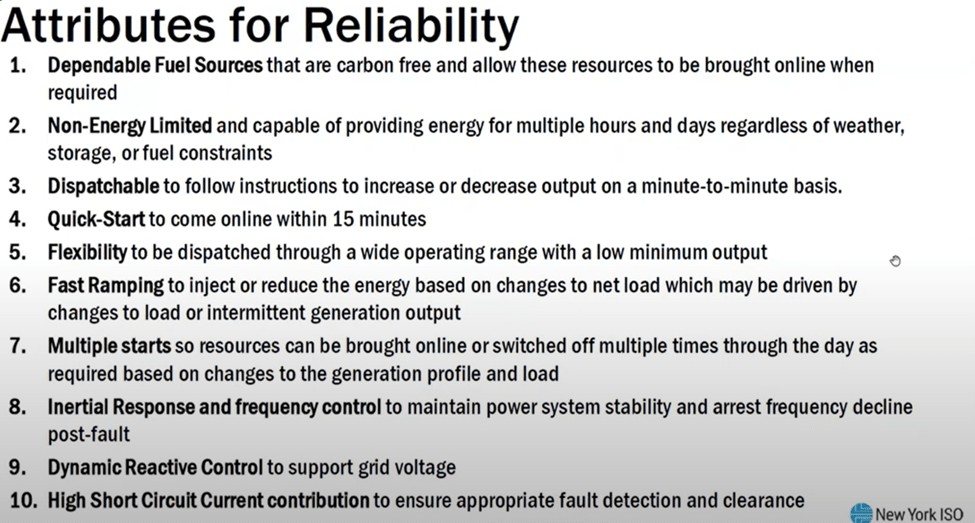
I will address each of these statements.  The first sentence states “The framework outlined by the CLCPA-mandated Scoping Plan provides pathways for a planned and orderly transition to a clean, resilient energy future.”  As noted previously there has never been a feasibility analysis to determine if the components of the Scoping Plan are practical.  The Climate Action Council never resolved the discrepancy between the Council faction that believed that no new technology is needed for the transition and the experts responsible for the system that argued otherwise.  A recent technical conference showed that the work of  Prof. C. Lindsay Anderson, Chair of Department of Biological and Environmental Engineering Cornell; Zach Smith, VP System Resource Planning, New York Independent System Operator; and Kevin Steinberger, Director, Energy and Environmental Economics all found that a new resource that can be dispatched when needed, is firmly available, and has no emissions is needed.  Technologies to meet this requirement are not commercially available at this time.  Moreover, no jurisdiction anywhere has been able to convert their electric system to one that relies on wind, solar, and energy storage.  Given the myriad technical issues that must be overcome to provide electricity when it is needed most, I think the most prudent course of action would be a demonstration project because the transition to the energy system mandated by the CLCPA would be unprecedented.

The second sentence unnecessarily questions the motivations of those who worry about reliability “The idea of a regenerative rather than an extractive economy strikes fear in the fossil fuel industry, which has been making record profits from recent price fluctuations and market volatility; in reality, reliability failures are often due to fossil-fueled superstorms and the historical lack of investment in our nation’s aging infrastructure.”  The concern about profiting from price fluctuations and market volatility is naïve.  When the electricity market is dominated by weather dependent generating resources the variability of wind and solar output will increase price fluctuations.  The New York Independent System Operator will have to modify the electric market to address this volatility as they learn how this new aspect of the system affects prices.  I have been involved with the weather-related impacts on the electric system for over 40 years and it has always been true that extreme weather has the greatest impact on system outages.  A common theme throughout this blog post is that all weather events are necessarily related to climate change without acknowledging that extreme weather events exactly like those before the climate change would still have major impacts.  Any increase in severity due to climate change is just a tweak and not the primary driver.

The final sentence got my attention: “By contrast, homegrown renewable energy can and will be more resilient, more plentiful, and more cost-effective than finite oil and gas resources.”  I wondered how the author managed to claim that extreme weather will have more of an effect on today’s generators in weather proof buildings than the exposed wind turbines and solar panels.  The more resilient reference was to the Babcock Ranch a Florida “solar town” that fared well during recent hurricanes.  The article claims the town came out of Hurricane Ian “almost unscathed and notes that one resident says they survived ‘by design.’  Florida Power and Light is proud of the Babcock Ranch solar system:

Babcock Ranch’s clean energy efforts were taken to the next level when FPL created the largest solar-plus-storage system operating in the U.S. today. Each of the ten large gray steel battery storage units at the FPL Babcock Ranch Solar Energy Center can store 1 megawatt of power and discharge for 4 hours. The adjacent 440 acres with 330,000 solar panels can generate up to 74.5 megawatts of power. Currently the solar installation generates more power than the town needs, so the surplus goes into the electric power grid. The new battery storage system ensures a steady output of power even on partly cloudy days.

There are two resiliency features that matter: Babcock Ranch was built 30 feet above sea level and all power lines are buried underground to keep them safe from strong winds.  New York’s net zero transition does not include buried power lines.  The Babcock Ranch website refutes the claim that “homegrown renewable energy can and will be more resilient”:

Electric power always flows from the nearest generation, so during the day the town will use energy from the FPL Babcock Ranch Solar Energy Center. When the sun goes down and the solar plant is not generating energy, Babcock Ranch will pull electricity off the grid from the closest FPL natural-gas power plant.

Babcock Ranch is not clean energy self-sufficient as the Climate Act envisions the entire state will be. The NRDC response also claims that renewable energy is more plentiful and more cost-effective than finite oil and gas resources.  It may be true that solar and wind energy is free but harvesting those resources, storing them for when they will be needed during an extended period of light winds in the winter when solar resources are low is an extraordinary challenge that requires the new resource described above.  Like all the Green Energy solutions advocated by the NRDC, wind and solar may work well most of the time but when you really need them, they don’t work at all.  The concern about finite oil and gas resources ignores the value of their storable concentrated energy and whether running out is a concern in the foreseeable future.

Conclusion

I believe I have shown that the NRDC fact-check claims that the CLCPA energy transition does not threaten reliability are invalid.  Ignoring the mounting evidence that this may be an insurmountable challenge is not in the best interest of New Yorkers.  At a minimum, CLCPA implementation should be delayed until we are sure that we can afford the CLCPA mandates, prove that the transition will not adversely affect reliability, and understand all the cumulative environmental impacts.

As is typical, whenever someone is screaming about misinformation it usually means that they are guilty of that charge.  In addition, trying to respond to this tripe takes an order of magnitude more work to respond.  Finally, whenever I make the effort to check the numbers I find the alarmists have their thumbs on the scale and are peddling a narrative to support their livelihoods.  I only wish that they could be held accountable when reality slaps their aspirational net-zero transition dreams back to earth.

Facebook Post that Gets It

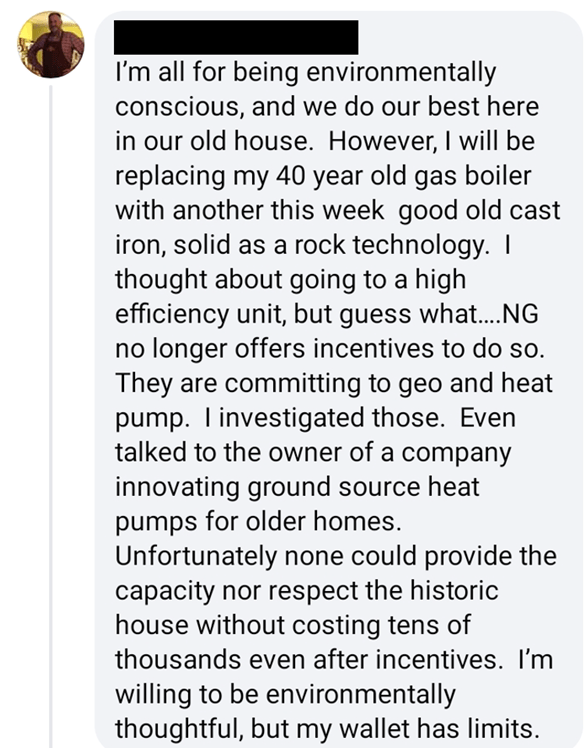
Pragmatic Environmentalist of New York Principle 6 is Roger Pielke Jr’s: Iron Law of Climate: “While people are often willing to pay some price for achieving climate objectives, that willingness has its limits.”  A recent Facebook comment to a National Grid Facebook social media campaign post provides a perfect example related to New York’s Climate Leadership & Community Protection Act (Climate Act).

I have followed the Climate Act since it was first proposed, submitted comments on the Climate Act implementation plan, and have written over 400 articles about New York’s net-zero transition. The opinions expressed in this post do not reflect the position of any of my previous employers or any other organization I have been associated with, these comments are mine alone.

Overview

The Climate Act established a New York “Net Zero” target (85% reduction in GHG emissions and 15% offset of emissions) by 2050.  It includes an interim 2030 reduction target of a 40% reduction by 2030 and a requirement that all electricity generated be “zero-emissions” by 2040. The Climate Action Council (CAC) was responsible for preparing the Scoping Plan that outlines how to “achieve the State’s bold clean energy and climate agenda.”  In brief, that plan is to electrify everything possible using zero-emissions electricity. The Integration Analysis prepared by the New York State Energy Research and Development Authority (NYSERDA) and its consultants quantifies the impact of the electrification strategies.  That material was used to develop the Draft Scoping Plan outline of strategies.  After a year-long review, the Scoping Plan was finalized at the end of 2022.  In 2023 the Scoping Plan recommendations were supposed to be implemented through regulation, PSC orders, and legislation.  Not surprisingly, the aspirational schedule of the Climate Act has proven to be more difficult to implement than planned and many aspects of the transition are falling behind.  There is growing evidence that the state will be unable to achieve its goals without significantly affecting the cost of living and doing business in New York and harming the reliability of its electric grid.

National Grid

In my opinion no company doing in business can publicly question the Climate Act narrative without facing the wrath of emotion-driven activists and getting crosswise with the Hochul Administration.  Although the Public Service Commission utility rate-making process to establish “just and reasonable” rates is supposed to be apolitical, the old days when governors appointed Commissioners from both parties to maintain balance are gone.  I have no doubt whatsoever that any utility that does not encourage electrification to save the environment at every opportunity would find itself not getting their rate case proposals approved.  Moreover, an electric utility has incentives to sell more electricity.  The problem is that electrification everywhere is not a pragmatic solution.

I am in the former Niagara Mohawk Power Corporation service territory now served by National Grid New York. Given the political climate of New York it is no surprise that National Grid advocates for the “Journey to net-zero”.   I am not a big social media person but do get on Facebook occasionally.  Frequently, there are posts from National Grid advocating for the latest and greatest gadgets for electrification. For example, the following recently showed up.

There were options for different “learn more” links.  What caught my eye was the following comment to this post. It the perfect example of Pielke’s Iron Law:

The Iron Law can be described as wallets have limits.  Beyond the simple cost impacts there is another concern.  The National Grid Upstate New York Residential Gas Heating program is paused and not accepting rebate applications. National Grid is forgoing efficiencies now to encourage adoption of cold-climate heat pumps.  This is disservice to National Grid ratepayers because it does not acknowledge thatthe State’s Scoping Plan to implement the Climate Act notes that not all homes will be able to electrify home heating safely and affordably.  Exactly the case in this example. It is not only that there is a cost factor but there is a safety factor for electrification.  Removing incentives for homeowners that have no other choices is short-sighted.

Conclusion

Implementation of the Climate Act is going to affect affordability and safety.  The public is starting to catch on to these impacts.  It is time to pause implementation until the Hochul Administration provides comprehensive and transparent cost estimates for the transition and the Public Service Commission provides a plan to ensure safe and reliable service to electric customers for an electric system that relies on wind and solar.  The utility industry is not going to step up and ask for an implementation pause so it is up to the voters of the state to make their concerns known.

Ellenbogen On NY Heats

According to New York climate activist non-governmental organizations New York is “failing to lead on climate.”   Sane Energy Voice claims that following Governor Hochul’s scrapping of major offshore wind projects, Assembly Speaker Heastie’s decision to ditch the popular NY HEAT Act signifies New York’s failure to lead on climate.  Richard Ellenbogen responded to the press release with an email that I reproduce here.

Richard Ellenbogen recently submitted comments as part of the record for the Department of Public Service Proceeding 15-E-0302 related to the net -zero mandate of the Last spring          “Order initiating a process regarding the zero-emissions target” that will “identify innovative technologies to ensure reliability of a zero-emissions electric grid”.   His comments discuss “a viable, affordable, and rapidly executable  Plan B to assist NY State in reducing its carbon footprint  using technologies that actually exist at scale, unlike the technologies proposed by the CLCPA which only exist at scale in the fantasies of its proponents.”  I think it is important that his message gets out to all New Yorkers to try to avert the inevitable collision between aspiration and reality.

Ellenbogen is the President [BIO] Allied Converters and frequently copies me on emails that address various issues associated with the Climate Leadership and Community Protection Act (CLCPA). I have published other articles by Ellenbogen, a description of his keynote address to the Business Council of New York 2023 Renewable Energy Conference Energy titled: “Energy on Demand as the Life Blood of Business and Entrepreneurship in the State -video here:  Why NY State Must Rethink Its Energy Plan and Ten Suggestions to Help Fix the Problems”,  another video presentation he developed describing problems with CLCPA implementation and a summary of his submitted comments as part of the record for the Department of Public Service Proceeding 15-E-0302 related to the CLCPA net -zero mandate.  There are only a few people in New York that are trying to educate people about the risks of the CLCPA with as much passion as I am, but Richard certainly fits that description.  He comes at the problem as an engineer who truly cares about the environment and how best to improve the environment without unintended consequences.  He has spent an enormous amount of time honing his presentation summarizing the problems he sees but most of all the environmental performance record of his business shows that he is walking the walk.  

CLCPA Overview

The CLCPA established a New York “Net Zero” target (85% reduction and 15% offset of emissions) by 2050.  It includes an interim 2030 reduction target of a 40% reduction by 2030 and a requirement that all electricity generated be “zero-emissions” by 2040. The Climate Action Council (CAC) is responsible for preparing the Scoping Plan that outlines how to “achieve the State’s bold clean energy and climate agenda.”  In brief, that plan is to electrify everything possible using zero-emissions electricity. The Integration Analysis prepared by the New York State Energy Research and Development Authority (NYSERDA) and its consultants quantifies the impact of the electrification strategies.  That material was used to develop the Draft Scoping Plan.  After a year-long review, the Scoping Plan recommendations were finalized at the end of 2022.  In 2023 the Scoping Plan recommendations were supposed to be implemented through regulation and legislation.  For the most part that did not happen so in 2024 organizations like Sane Energy Voice  are lobbying for various legislation to advance their agendas.

NY Heats

According to a report released by NY Renews, the if the full NY Home Energy Affordable Transition bill were passed “the 25% of New York residents who have high energy burdens would cut their bills by over 44% and save an average of $136 a month.” The mission of Sane Energy Project is to replace fracked gas infrastructure with 100% democratically controlled, renewable energy in New York State. We build every campaign through a lens of racial, social, and ecological justice.

Richard Ellenbogen responded to this press release:

In a one-two punch this past week, a small group of corporate-backed Democratic legislators brought us closer to climate catastrophe by bowing to fossil fuel lobbyists and lawyers in shaping New York’s energy and economic policy. Now, more than ever, it’s time to fight hard and resist this insidious takeover.

Last Friday, under the leadership of Governor Kathy Hochul, the New York State Energy and Resource Development Authority (NYSERDA) rejected three major offshore wind projects that Sane Energy Project had championed since 2015 when we led the campaign to stop the construction of a massive offshore liquefied fracked gas port complex near the  Rockaway Peninsula and Long Beach that would have foreclosed the development of these wind projects.  

Also on Friday, the final New York State budget omitted the critical NY HEAT Act, which over 100 legislators co-sponsored. The New York Home Energy Affordable Transition Act would have facilitated an orderly transition from expensive and toxic fracked gas by ending subsidies that enrich the gas industry. Moreover, it would have capped energy bills for low- and middle-income households at 6% of their income, a crucial measure for safeguarding vulnerable New Yorkers. 

Every year in Albany, a handful of officials determine the state’s future. Swayed by energy industry lobbyists, they disregard scientific evidence, the climate law, and constituents’ demands. Our elected officials’ failure to champion sound energy policy sets a dangerous precedent.

Kim Fraczek, Director of Sane Energy Project, said, “Governor Hochul and Assembly Speaker Carl Heastie have chosen to prioritize corporate interests over the well-being of New Yorkers by scrapping significant offshore wind projects and excluding the crucial NY HEAT Act from the state budget. Their inaction is further underscored by National Grid’s egregious proposal to increase monthly bills for downstate residents by at least $30 to maintain their outdated, polluting gas system. We hold Hochul and Heastie responsible for future utility bill hikes and climate disasters, as their decisions blatantly ignore the urgency to transition to renewable energy and protect the most vulnerable communities.”

Current negotiations surrounding National Grid’s proposed rate hike threaten to tighten the fossil fuel industry’s grip on New Yorkers. Sane Energy Project is focused on state regulators, who can choose energy efficiency and investment in thermal energy networks or perpetuate wasteful investments in National Grid’s antiquated gas system.  

Before I describe Ellenbogen’s response I want to address the offshore wind projects.  The emotion laden description of recent events: “Swayed by energy industry lobbyists, they disregard scientific evidence, the climate law, and constituents’ demands” is at odds with reality.  NYSERDA did not want to reject the three major offshore wind projects.  Instead, “GE Vernova’s decision to alter its offshore wind turbine product from the initially proposed 18 MW Haliade-X platform to a 15.5/16.5 MW platform resulted in significant changes to the projects proposed into the solicitation.”  When NYSERDA announced the contract awards last October all the subcontractor agreements should have been clearly identified and signed off by all parties involved in the work, including things like what equipment, what labor costs, you name it.  After an award there is some negotiation but that should not be a big lift because the details were already identified in the proposal/budget.  The size of the turbines should have been specified in the proposal. If GE as a subcontractor then changed the deal it would make the whole proposal unfundable.  This is the last thing NYSERDA and Governor Hochul wanted because it means a big delay in the timeline as they need to have go back for another round of approvals and new contracts.

Ellenbogen on NY Heats

Other than a few formatting edits the following is all by Ellenbogen.

While I appreciate your passion, the  science behind your email is misguided.  As someone that decarbonized my home and business over two decades ago as the two following links document, I can assure you that there is nothing “sane” about NY Heats.  It will literally be a death knell for both NY State residents and the state economy with absolutely no benefit to the environment.  FYI, I have absolutely no interests in the fossil fuel industry but as an engineer for over forty years,  I have a firm belief that all public policies have to be based upon scientific accuracy.  NY Heats and the CLCPA throw science and math out the window.

In a climate like NY State’s, NY Heats defies the Laws of Thermodynamics beyond there also being enormous logistical issues with implementing  it.

  1. It will double or triple the load on every transformer in the state meaning that they will all have to be replaced, except those transformers don’t exist and there is an acute transformer shortage in the entire US at the moment.  The doubling or tripling of load will also mean replacing all of the wires in NY State which will take about 60 years.  Further, that will require an enormous amount of aluminum and there isn’t enough aluminum available to make beverage cans, let alone millions of miles of electrical conductors.  Three aluminum smelters have closed in the United States in the past two years because their electric rates were too expensive, which is indicative of a shortage of electricity driving up the prices.  There have been numerous articles written recently that indicate that the United States is running out of energy.
  • That same electric shortage will also provide insufficient energy to operate the heat pumps that would be installed under Local Law 97 and NY Heats.  Despite everyone’s wishful thinking, renewables are too intermittent and have too low of an energy density  to successfully operate the expanded utility system that would be required under NY Heats.  The NYS Public Service Commission is desperately looking for DEFR’s (Dispatchable Emission Free Resources) except with the exception of Nuclear which takes 17 years to get approved and sited, that technology does not exist and it is decades away so any increases in load that would result from NY Heats will increase fossil fuel generation where it is far less efficient than the onsite combustion of Natural Gas.  The NYISO is already having difficulty meeting the scheduled deadline for closing the fossil fuel peaker plants and has extended their closing dates.  That is going to be repeated extensively because there just isn’t enough energy and adding more solar panels and wind turbines will complicate that effort after a certain point.  Look at what is currently happening in California.  They are dumping solar because they over subsidized it and there is too much.  The storage technology needed to utilize it is far too expensive to implement at that scale.  If you look at NYSERDA’s 6 GW Enregy Storage report from 2022, they indicated that 1000+ hours would be needed to support the system.  Even at 1000 hours for 6 GW at the price of storage in the report, that would cost $3.5 Trillion, or 15 times NY State’s annual budget and those batteries would last only ten years and have to be replaced.   While battery costs have come down slightly since 2022, it has not been nearly enough to make them cost effective.  The physics and the economics just don’t work.  It has also been clearly documented that air source heat pumps double utility bills.  That higher cost is a function of the holistic system wide energy inefficiencies of the air source heat pumps.  Hydrogen storage technology is decades away at the utility scale needed.  It is very difficult to store and transport and it presents its own GHG issues if it leaks.
  • There is insufficient labor to execute the plan.  There is a shortage of both electricians and plumbers and worse, there are not enough people to train even if they could develop the training programs.  There are currently 500,000 open manufacturing jobs in the US, the same cohort of people that would be used for renewable and heat pump installation.  The unemployment rate is near historic lows.   Further, one thing that no one should want is inexperienced people handling the refrigerants involved with heat pump installation as those have carbon footprints 300 – 1000 times higher than CO2 and 10 – 30 times higher than methane.  The leakage that will result from inexperienced workers handling refrigerants would be devastating.  A Columbia University study indicated that one-half of Arctic ice melt resulted from the use of refrigerants.
  • Regarding Offshore Wind, those bids were declined because the costs were far higher than the current electric rates.  If the state has any hope of decarbonizing, alienating 60% of its population downstate with exorbitant electric rates is not the way to do it.  That is especially true when 1.2 million downstate utility customers are already $1.8 billion in arrears.  Further, the ships needed to install the offshore wind don’t exist at present.  The first Jones Act compliant ship, the Dominion Charybdis left dry dock last week.  The $650 million vessel is taking five years to build and will not be ready until late 2024/ early 2025.  If they start another now, it will not be ready until 2028- 2029.  The lack of the ships raises the installation costs far above where they otherwise would be which explains why the bids here are about double those in Europe where they have about 16-18  available jack ships.  The balance of the world’s approximately 50 jack ships are in Southeast Asia.  Energy cost increases resulted in the repeal of the Ontario, Canada energy plan after only 10 years.  The same thing will happen in NY State if they aren’t careful.

Decarbonization is necessary but it must follow the Laws of Physics and be mathematically possible to implement.  The NY State plan doesn’t adhere to those requirements.  There are things that adhere to science and mathematical accuracy that can be done to reduce the state’s carbon footprint but the CLCPA and NY Heats do not fall within that criteria.

Conclusion

In an email Ellenbogen concludes that “For anyone that understands energy math, the bill is a farce.   The points made in it also don’t adhere to economic reality for the residents of NY State.”  I completely agree with his conclusions.

Comments on the New York Part 490 Projected Sea-Level Rise Amendments

The New York State Department of Environmental Conservation (DEC) has proposed Amendments to Part 490, Projected Sea Level Rise and Comments that are due on April 29.  This post describes my comments on the proposed amendment and requests that New Yorkers who reading this before April 29 submit comments.  Don’t worry, I will give language.

The proposed amendments revise the projections of future sea-level rise required by New York regulations.  It is flawed because the methodology estimates an unrealistically high projected sea-level for the Community Risk and Resiliency Act flood risk management applications that will use the projections.  Unless more realistic estimates are used permitting applications in areas near tidal zones will be required to incorporate flood levels that will not be expected in the lifetime of the project.  That would be a hidden cost for the net-zero  transition of the Climate Leadership & Community Protection Act (Climate Act).

I have followed the Climate Act since it was first proposed, submitted comments on the Climate Act implementation plan, and have written over 400 articles about New York’s net-zero transition. The opinions expressed in this post do not reflect the position of any of my previous employers or any other organization I have been associated with, these comments are mine alone.

Overview

The summary of the Part 490 proposed amendments states that: “The goal of the proposed amendments is to provide up-to-date science-based projections of future sea level rise.”  This is another example of the many ways that the Climate Act is intruding on many aspects of society.  The Climate Act established a New York “Net Zero” target (85% reduction in GHG emissions and 15% offset of emissions) by 2050.  It includes an interim 2030 reduction target of a 40% reduction by 2030 and a requirement that all electricity generated be “zero-emissions” by 2040. The Climate Action Council (CAC) was responsible for preparing the Scoping Plan that outlines how to “achieve the State’s bold clean energy and climate agenda.”  In brief, that plan is to electrify everything possible using zero-emissions electricity. The Integration Analysis prepared by the New York State Energy Research and Development Authority (NYSERDA) and its consultants quantifies the impact of the electrification strategies.  That material was used to develop the Draft Scoping Plan outline of strategies.  After a year-long review, the Scoping Plan was finalized at the end of 2022.  In 2023 the Scoping Plan recommendations were supposed to be implemented through regulation, PSC orders, and legislation but implementation is behind schedule.  The proposed amendments to the sea-level projections are a hidden aspect of the Climate Act that has significant potential impacts.

Part 490 Projected Sea-Level Rise

The Regulatory Impact Statement (RIS) for this proceeding describes the regulation’s statutory authority and legislative objectives, the proposed changes, needs and benefits, and costs.  It explains:

On September 22, 2014, the Community Risk and Resiliency Act, Chapter 355 of the Laws of 2014 (CRRA), was signed into law. CRRA, among other things, established Environmental Conservation Law (ECL) § 3-0319. ECL § 3-0319 requires the Department of Environmental Conservation (Department) to adopt regulations establishing science-based sea level rise projections for New York State and to update them no less than every five years. The Department established a new Part 490 of Title 6 of New York Codes, Rules, and Regulations (6 NYCRR), “Projected Sea-level Rise” (Part 490) in February 2017 and is updating the regulation through the current rulemaking.

The proposed amendments are an update of the 2017 sea-level rise projections.  While I am not absolutely sure I believe the reason that this amendment was delayed was because the primary reference, New York Research & Development Authority New York State Climate Impacts Assessment, was not available within the five-year period.  Even so, the documents for the Assessment are all marked “Interim Version for Public Release” which calls into question their use for a policy document.

The summary of the Part 490 proposed amendments states that:

The goal of the proposed amendments is to provide up-to-date science-based projections of future sea level rise. Part 490 does not create a mandate on local governments. Part 490 does not impose any compliance obligations on any entity.

While technically and legally correct, the excuse not to include costs and the argument that there are no compliance obligations or mandates on local governments has significant ramifications.  The fact is that there are compliance obligations that are affected by the Part 490 rulemaking.  DEC selectively chose to emphasize analyses that support the “high-end storyline” without regard to how the sea-level rise projections will be used. There are relevant, plausibility, timing, and cost implications that I believe should be added to the Regulatory Impact Statement.

Mandates on Local Governments

The CRRA as amended by the Climate Act clearly creates indirect mandates on local governments.  The New York State Flood Risk Management Guidance for Implementation of the Community Risk and Resiliency Act  includes “recommendations” for the use of sea-level rise that are essentially mandates.  In another example where the projections are used, the DEC webpage Mainstreaming Consideration of Climate Change includes the following:

Consideration of future physical climate risk

As originally enacted, the CRRA required applicants for permits or funding in a number of specified programs to demonstrate that future physical climate risk due to sea-level rise, storm surge and flooding had been considered in project design, and that DEC consider incorporating these factors into certain facility-siting regulations.  The CLCPA amended the CRRA to include all permits subject to the Uniform Procedures Act. The CLCPA also expanded the scope of the CRRA to require consideration of all climate hazards, not only sea-level rise, storm surge and flooding, in these permit programs. 

In my comments I argued that that while Part 490 may not directly create a mandate on local governments, all permits must consider the sea-level rise climate hazard which is essentially a mandate affecting all governmental agencies.

Part 490 Proposed Amendments

The RIS description of the proposed sea-level rise projection amendments with my annotated comments follows:

Table 4. Updated projections of sea level rise for three tidal regions of New York State, based on the Department’s proposed methodology. Projections are in inches, relative to a 1995-2014 baseline, and are based on a combination of the SSP2-4.5, SSP5-8.5-medium-confidence and SSP5-8.5-low-confidence projections, with the addition of a RIM scenario.

Part 490 is intended to give permitting authorities information on the full range of potential sea-level rise.  In reality the CRRA design considerations that use the sea-level rise projections focus on the highest values.  New York State Flood Risk Management Guidance for Implementation of the Community Risk and Resiliency Act  states that “Applicants and programs are also encouraged to consider the following during project siting, design and review” states:

Applicants for projects involving new or replacement critical infrastructure should consider the full range of projected flooding, including the highest adopted projections of sea-level rise, during the expected service life of the project. Where adherence to the highest guideline is not feasible, due to practicality, costs, risk tolerance, and/or environmental effects, applicants should carefully describe and justify designs not adhering to the most restrictive guideline.

Note the requirement to use “the highest adopted projections of sea-level rise” includes the caveat to consider the “expected service life of the project”.  That is  missing piece in the RIS.   The RIS emphasizes the point that the Intergovernmental Panel on Climate Change (IPCC) has not indicated the relative probabilities that any of the illustrative scenarios included in the latest assessment report (AR6) will occur.  However, CRRA infrastructure applications need to consider the likelihood of sea-level rise levels to determine practicality, costs, risk tolerance, and/or environmental effects.  The RIS argues that focusing on the most probable outcome has risks and warns of much higher potential sea-levels. 

Furthermore, Hinkel et al. (2015) warn that sea level rise projections based on process-based models, such as those used by IPCC, are primarily intended for the purpose of understanding earth system physics and are not appropriate for risk-based decision making as they do not fully incorporate the effects of accelerated ice melt. They warn that projections based on the IPCC AR5 projections of mean global sea level rise of 11 to 39 inches by 2100 may not be adequate for risk management due to the intolerably high residual risk associated with rapid ice melting Parris et al. (2012) also cautioned that focusing only on the most probable outcome could lead to vulnerability or maladaptation.

The reference to “intolerably high residual high residual risk associated with rapid ice melting” ignores the expected service life of the project consideration.  The RIS explains that the decision makers need to understand the full range of potential risk but does not acknowledge that their presentation of results discourages the use of anything but the high projections.  The result is that development near the tidal shoreline is planning for extremely high projected sea-level rise.  A New York City project to increase a park to handle 8 to 10 feet of sea-level rise is include in “a $1.45 billion flood protection project that backers say befits the nation’s largest city, a massive project that will include the construction of a 2.4-mile system of walls and gates along the East River”.  That is only a fraction of the harbor front in the City so it makes sense to use more reasonable estimates of sea-level rise given the need to protect the entire harbor of New York, but it is easier for DEC to just recommend the biggest number to “be safe”.

Decision makers, including residents and local leaders, should understand the full range of potential risk. Communities and stakeholders in New York State that have been presented with the ClimAID projections have tended to adopt and plan for high levels of sea level rise rather than more moderate levels. These stakeholders have placed a high degree of importance on ensuring the viability of proposed infrastructure investments and the social and economic fabric of their communities from even unlikely eventualities.

The “science-based” regulation and the guidance did a disservice to New Yorkers because the risk management approach did not adequately address tradeoffs between costs and likelihood of “unlikely eventualities”.  The sea-level rise projections rely on cherry-picked studies and ignoring any work that does not fit the extreme scenario used and that is not “science”. Unlikely things that just might happen in the distant future are not “eventualities”. All the extreme sea-level rise projections use the implausible high emissions scenario embodied in Representative Concentration Pathway (RCP) or Shared Socio-economic Pathways (SSP) RCP/SSP8.5.  There is overwhelming evidence that the coal use, population growth, and neglect to consider any decarbonization policy assumptions in those scenarios are inconsistent with observed reality.  The National Oceanic Atmospheric Administration (NOAA) Geophysical Fluid Dynamics Laboratory (GFDL) description of their globcal climate modeling approach that states “SSP5-8.5 is a very high greenhouse gas emissions scenario – and unlikely to happen – where carbon dioxide emissions triple by 2075″ and does not use it for their recommended projections.

Notwithstanding the arguments in the following paragraph from the RIS trying to justify its use, the fact is that using these projections are inappropriate to use in this context.  I do not dispute that the potential for rapid ice melt exists that would cause a spike in sea levels.  However, I maintain that is improper to use in this context because it is a low probability event but that in the time frame of CRRA infrastructure projects it is a much lower possibility. The argument that Part 490 guidance must address sea level rise that will “likely occur at some point” without consideration of the use of the projections is inappropriate.  The State simply cannot afford the ramifications of the insistence to remove risk entirely.

Finally, as explained above, sea level rise will continue for many centuries as the earth system comes into equilibrium over many centuries or even millennia. Thus, the question for decision makers is not if a critical sea level will be reached, but when. Strauss (2013) calculated that historic emissions have already committed the globe to a mean sea level rise of 6.2 feet. Levermann et al. (2013) estimated that the current international target of 2°C warming will result in an eventual mean global sea level rise of more than 15 feet after 2000 years. Thus, a full range of projections in Part 490 that includes higher values is appropriate to allow for consideration of a level of sea level rise that will likely occur at some point, even if the timing of such occurrence is uncertain. The Department acknowledges that current GHG emissions policies would result in actual emissions lower than projected by SSP5-8.5. Thus, the inclusion of higher projections of sea level rise, especially those based on SSP5-8.5, could lead to consideration of conditions that are unlikely to occur, at least in the more immediate future. Unfortunately, current literature does not provide a basis for assessment of the emissions levels at which ice shelf and marine ice cliff instability, important factors in sea level rise in high emissions scenarios, such as SSP5-8.5, become significant.

This paragraph characterizes my concern that the purpose of the sea-level rise projections was not considered enough.  Preparing for the next 2000 years for a city that was founded only 400 years ago is silly.

This gap in the literature, however, does not relieve decision makers from the responsibility to at least consider the potential consequences of future events about which scientific uncertainty remains. Adoption of several levels of projections allows for consideration of risk tolerance in decision making. The high or RIM projections might be used for long-term projects for which there is low risk tolerance, for example, while lower projections may be appropriate for consideration in situations in which risk tolerance is high. Inclusion of low-confidence, but plausible, projections provide benchmarks against which long-term decisions, e.g., those regarding critical infrastructure and land-use change, can be evaluated for high-consequence events. If Part 490 did not include higher projections of sea level rise, decision makers would not be able to even consider the possibility of such levels occurring. The Department proposes, therefore, to adhere to the recommendation of Stammer et al. (2019) to include “high-end storylines,” that reflect physical processes about which high uncertainty exists, i.e., the RIM scenario, with probabilistic projections.

The last paragraph in this section clearly describes the misguided DEC approach.  There is no question that decision-making when there is high scientific uncertainty is difficult.  From a risk management perspective all factors must be considered.  In this instance, the recommendation to use the higher sea-level rise projections for long-term projects does not consider CRRA infrastructure life expectancies which are shorter than the time frame of the high-risk impacts.  Furthermore, it can be argued that the “low” confidence sea-level rise estimates are “no” confidence events because they rely on SSP-8.5 which is implausible.  I do not believe that a “high-end storyline” approach is appropriate for regulatory guidance.

Summary of My Comments

My detailed comments describe the observed sea-level rise at the Battery monitoring station in New York City, the methodology used to project sea-level rise, and compare the sea-level rise projections and observations (table below).  The following table compares the projected sea-levels using the observed from 1850 to present and 1984 to present with the projections of sea-level rise. Importantly the observed sea-level rise is less than the 50th percentile, “medium confidence” Part 490 sea-level projections.  In other words, the observations indicate that the medium confidence projections are conservative estimates of sea-level rise.  I also found that comparing the acceleration of sea-level rise necessary to comport with the projected rates with the observations indicates that there is no sign that the “high-end storyline” projections are realistic.

Compare 2024 proposed sea level rise projections (inches of rise relative to 1995-2014  baseline) to sea-level rise projected using observed trends since 1850 and 2014 at the Battery Monitoring Station

The RIS argues that observed sea-level rise projections are not appropriate to use for future estimates because they do not account for projected global warming.  To address this concern the Energy and Environmental Alliance of New York proposed a “pledge and review” alternative approach in 2016.  My comments argue that this is a better approach.  Given the uncertainties of modeling both global warming and the associated sea-level rise along with the model over-estimates of warming it is prudent to assume that the sea-level trend observed over the last 150 years will continue until the observations indicate otherwise. 

There is a section in my comments that describes how the sea-level rise projections are intended to be used for flood risk management.  The RIS does not consider that flood risk management must incorporate probability of occurrence.  The Part 490 sea-level rise projections do not because of the emphasis on the “high-end storyline”.  Even though the RIS appropriately describes all the scenarios and how the data were collected and used, the RIS risk analysis is flawed because it does not weigh potential results against benefits and consequences.  The comments describe a more appropriate risk management approach. 

Summary of Recommendations

The sea-level rise projections in the proposed amendment need to be reconsidered.  The over-arching problem is that the low-likelihood, high-impact storyline that incorporates the rapid ice melt scenario is dependent upon the RCP/SSP 8.5 high emissions scenario and does not account for the near-term applicability of the sea-level projections for CRRA applications.  Even the RIS acknowledges that “current GHG emissions policies would result in actual emissions lower than projected by SSP5-8.5.”  Because the high greenhouse gas emissions are a necessary condition for the rapid ice melt low-likelihood, high impact scenario, that emissions scenario should not be used for sea-level rise recommendations.  Furthermore, the timing of the rapid ice melt scenario is extremely unlikely to occur in the time frame of infrastructure projects in the New York State Flood Risk Management Guidance for Implementation of the Community Risk and Resiliency Act  guidance that refers to Part 490 sea-level rise.  

The RIS claims that because Part 490 “will not impose any costs on any entity because the regulation consists only of sea level rise projections and does not impose any standards or compliance obligations” that no costs are associated with Part 490.  However, the pertinent cost issue is the difference between the recommended alternative and the alternatives described in the RIS. The “high-end storyline” approach has an impact on costs and the failure of the RIS to address them is a disservice to the citizens who will have to foot the bill.  The RIS should be modified to compare costs with the alternatives included.

Any projection that uses the RCP/SSP 8.5 high emissions scenario overestimates sea-level rise values.  Given the acknowledged uncertainties with sea-level projections and the over-predictions of global warming with current global climate models, the pledge and review approach should be used to determine if accelerated sea-level rise consistent with the “high-end storyline” projections are observed.  The sea-level projections consistent with SSP2-4.5 should be used because these sea level rise projections are associated with the most likely conservative estimates of potential emissions and the numbers are consistent with observed sea-level rise.  If future observations indicate that this scenario is no longer conservative then the projections can be modified accordingly.

How To Provide Written Comments

I encourage my New York readers to submit written comments by the 5:00 PM April 29, 2024 deadline. I have prepared a detailed explanation of the process at this link.  The link also includes a condensed comment that addresses the key points described above.

The link provides the recommended comment. 

  1. Enter the following address in your address line: climate.regs@dec.ny.gov
  2. Put Comments on Part 490 in the Subject line
  3. Copy the comment text in the link into the body of your email. 
  4. Submit it

If you are inexperienced with the DEC rulemaking process let me explain what happens next.  If you are lucky, you will get an acknowledgement that your comment was received.  DEC staff are required to read the public comments and the rulemaking requires a response to comment document.  At some point there will be a document that includes a response to each comment and recommendation.  It would be especially useful if you have a specific example of a concern related to the projections to include that in your comments. If you prepare your own comments, then they will have to respond to that separately, but all the comments submitted using my recommendation will be consolidated.  Reading comments and writing a response does not mean DEC will change anything in their proposed rulemaking.   

I have submitted comments for countless proceedings over the last 40 years.  Sadly, over the years DEC has become more and more politically driven to the point now that all rulemaking policy decisions are ultimately decided by the Administration regardless of the science.  To increase the chance that any of the comments and recommendations will actually be implemented, I suggest sending a copy to your legislators.  Like most of the Climate Act implementation components very few people know what is happening and the ramifications of the actions.  If the legislators start asking the Administration questions about the use of implausible scenarios that will make development near the shorelines more expensive, there may be a political response towards consideration of tradeoffs.  Absent that the only solace is the record will show that the State was warned that their policies were ill-advised when the proposed sea-level recommendations fall far below the observed rise.

The rule-making process includes a perfunctory public hearing.  The Part 490 hearing was held on April 22.  The hearing officer described the rule making process and Mark Lowery from DEC went through the following slide.  That was all over in ten minutes.  Two people signed up to give comments.  I signed up but could not talk because of a persistent cough.  The other person’s comments were totally unrelated.  She wanted to thank DEC for setting up raptor nesting boxes.  For the record all comments are considered equally so nothing was lost.  In fact, I showed up for a hearing one time and a friend from DEC who was working on the proceeding basically said the hearings were a waste of time and that they preferred the written comments.

Conclusion

Given the poor turnout for the public hearing, there does not appear to be much interest in this rulemaking.  I doubt that these comments and recommendations will have any effect on the rulemaking because there is too much institutional inertia.  The record for some rulemakings makes a big deal about the number of comments that support their position.  If the negative comments outweigh those supporting the proposal, then it will be interesting to see how the documentation spins that.  In order to find out please, submit a comment.  Thanks.

Natural Climate Variability

A recent Associated Press story noted that “For the 10th consecutive month, Earth in March set a new monthly record for global heat — with both air temperatures and the world’s oceans hitting an all-time high for the month, the European Union climate agency Copernicus said.”  It went on to state that “Climate scientists attribute most of the record heat to human-caused climate change from carbon dioxide and methane emissions produced by the burning of coal, oil and natural gas.”  This post provides evidence that human-caused climate change was not the primary cause for the records.

The rationale used for New York’s Climate Leadership & Community Protection Act (Climate Act) that reducing GHG emissions will affect climate is of special interest to me.  However, I question whether we know enough about natural climate variability to legitimately make that claim.  I have followed the Climate Act since it was first proposed, submitted comments on the Climate Act implementation plan, and have written over 400 articles about New York’s net-zero transition. The opinions expressed in this post do not reflect the position of any of my previous employers or any other organization I have been associated with, these comments are mine alone.

Observed Climate Variability

The video Climate the Movie: The Cold Truth includes a very good description of historical temperatures and CO2 trends.  It provides examples why claims that today’s observations indicate unprecedented heat in earth’s history are wrong.  In geologic time scales temperatures today are not at all unusual and because we are in an ice age all previous non-ice age geologic epochs were warmer.  Over the last 2,000 years there also have been periods of warmer temperatures.  The video goes on to compare CO2 trends over those periods to show that there is no link. 

In a recent post I addressed the basic tenet of anthropogenic global warming catastrophists, like the authors of the Climate Act, that the correlation between CO2 and global warming evident since 1976 proves that CO2 is the control knob for climate.   Andy May prepared an Annotated Bibliography for Climate the Movie that includes a section titled “From 1945 to 1976 the world cooled”.  It includes the following plot of global temperatures and carbon dioxide.  Climate Act proponents believe that increasing temperatures since the end of the Little Ice Age are caused by increases in CO2.  This graph does not support that claim.  From 1850 to 1910 temperatures trend slightly down and CO2 trends slightly up.  From 1910 to 1944 there is little change in the CO2 trend but the temperature trends up markedly.  CO2 emissions don’t start to rise significantly until the end of World War II in 1945 but from 1944 to 1976 the global temperature trends down.  For the remaining two periods shown in the graph temperature and CO2 correlate well.

The caption highlights the key point.  There is good correlation between CO2 concentrations in the atmosphere after 1980 but the correlation is poor before that.  I believe this shows that natural climate variation caused the 1910 to 1944 warming.  I do not believe that anyone has proven that the same natural climate drivers are not affecting the recent warming. 

The National Oceanic and Atmospheric Administration (NOAA) recently posted a comment that contradicts the existential threat narrative and supports those who argue natural climate variability is the main driver of climate change.  It states that “The amount of CO2 in the atmosphere today is comparable to around 4.3 million years ago, when sea level was about 75 ft higher than today, the average temp was 7 degrees F higher than in pre-industrial times, & large forests occupied areas of the Arctic that are now tundra.”  Climate the Movie shows that going back further in time that CO2 levels were much higher than today. It is not clear to me why there is supposed to be an existential threat to society when temperature and CO2 concentrations were higher in the past and the ecosystems survived.

Recent Warming

The claims for recent global temperature records reference NASA satellite data.  This data set only goes back to 1979 but it provides the greatest representative coverage of the globe because it does not depend on randomly spaced surface measuring stations.  In the following graph note the large spike in recent months.

Note that the spikiness in these measurements is not reflected in the atmospheric concentrations of CO2 measurements.  According to NOAA’s CO2 measurements:

The global surface concentration of CO2, averaged across all 12 months of 2023, was 419.3 parts per million (ppm), an increase of 2.8 ppm during the year. This was the 12th consecutive year CO2 increased by more than 2 ppm, extending the highest sustained rate of CO2 increases during the 65-year monitoring record. Three consecutive years of CO2  growth of 2 ppm or more had not been seen in NOAA’s monitoring records prior to 2014. Atmospheric CO2 is now more than 50% higher than pre-industrial levels.

If CO2 really is the control knob, then why is there so much inter-annual variation in temperature at the same time there is so little variation in the CO2 trend?  The only possible explanation activists have is that there are some natural variation processes.  Picking and choosing CO2 as the cause of the increasing trend while simultaneously acknowledging that there also are natural processes affecting the observed temperatures does not seem to be a particularly strong position to me.

Most Recent Warming

The Associated Press article claimed that “Climate scientists attribute most of the record heat to human-caused climate change from carbon dioxide and methane emissions produced by the burning of coal, oil and natural gas.”  The reality is that not all climate scientists support the claim that most of the record-breaking heat was caused by anthropogenic greenhouse gases.    

Javier Vinós described the recent warming explaining that this spike in temperatures marked the warmest period recorded by instruments and that the recent change was exceptional.  He found that “the temperature increase from the previous record was the largest in 153 years, at +0.17°C. This level of increase from previous records is remarkable, even for a year that has been recorded as the warmest on record.”  If there had been a spike in GHG emissions that preceded this warming spike, then I would be more supportive of the CO2 is the control knob theory.  It turns out that there was no spike in human emissions but there was a natural spike.  The Tonga-Hunga underwater volcanic eruption blasted unprecedented amounts of water vapor into high levels of the atmosphere.  Water vapor is more effective than CO2 as a greenhouse gas so this could be part of the reason for the recent warming spike.

There is another natural phenomenon likely responsible for some of the warming.  Surface water temperatures in the Pacific Ocean oscillate between warm (El Niño) and cold phases (La Niña ) of the El Niño-Southern Oscillation or “ENSO”.  The winter of 2023 occurred during an El Niño when the ocean releases heat into the atmosphere and has been associated with marked increases in global temperatures.  However, the 2023 El Niño was a weak year so its contribution to the observed warming was minimal.

In an article entitled “State of the climate – summer 2023“, Judith Curry examined the top of the atmosphere radiation balance.  As of June 2023, her analysis suggests that the water vapor increase in long-wave radiation warming from the Tonga-Hunga underwater volcanic eruption was offset by the short-wave aerosol particle cooling.  She gave other reasons for the observed warming records:

The exceptionally warm global temperature in 2023 is part of a trend of warming since 2015 that is associated primarily with greater absorption of solar radiation in the earth-atmosphere system.  This increase in absorbed solar radiation is driven by a slow decline in springtime snow extent, but primary by a reduction in reflection from the atmosphere driven by reduced cloudiness and to a lesser extent a reduction in atmospheric aerosol.  Any increase in the greenhouse effect from increasing CO2 (which impacts the longwave radiation budget) is lost in the noise.

She lists three reasons for the warming.  The slow decline in springtime snow extent has been linked to the warming trend as we come out of the Little Ice Age.  Clouds affect global temperatures.  Within the atmosphere more low clouds reduce temperatures by reflecting more sunlight but increased high clouds increase temperatures.  Particles or aerosols also scatter light and can affect temperatures by blocking sunlight.  She attributes the observed warming to the reduction in reflection from the atmosphere driven by reduced low-level cloudiness and to a lesser extent a reduction in atmospheric aerosol particles.  Low-level cloudiness trends are not well understood and are not included in climate models.  The aerosol changes are attributed to changes in the sulfur content of ship fuel. Most importantly, she points out that increasing CO2 effects are “lost in the noise” which directly contradicts the Associated Press article.

Conclusion

The rationale for the multi-billion Climate Act net-zero transition is the alleged link between climate change and greenhouse gas emissions.  Undoubtedly the emissions increases have some greenhouse effect on global temperatures, but the effects of natural climate variability not only must have been responsible for all of the historical variations in global temperatures but also appear to be the primary driver even during the most recent period when carbon dioxide emissions and global temperatures are well-correlated. The rationale for the Climate Act transition is weak at best.

Zero Emissions by 2040 Gap Characterization

A different version of this article was published at Watts Up With That.

As part of the Department of Public Service Proceeding 15-E-0302 a technical conference was held on December 11 and 12, 2023 entitled Zero Emissions by 2040.  A  zero-emissions electric system is a key part of New York’s Climate Leadership & Community Protection Act (Climate Act) and all credible projections for the generating resources needed for the zero emissions Climate Act target  have noted that a new category of generating resources called Dispatchable Emissions-Free Resources (DEFR) is necessary to keep the lights on during periods of extended low wind and solar resource availability.  Previously I published an article describing the slide presentation by Zachary Smith from the New York Independent System Operator (NYISO) describing DEFR.  The video of the meeting is available now and this article describes the first session of the meeting – Gap Characterization.

I have followed the Climate Act since it was first proposed, submitted comments on the Climate Act implementation plan, and have written over 400 articles about New York’s net-zero transition. The opinions expressed in this post do not reflect the position of any of my previous employers or any other organization I have been associated with, these comments are mine alone.

Overview

The Climate Act established a New York “Net Zero” target (85% reduction in GHG emissions and 15% offset of emissions) by 2050.  It includes an interim 2030 reduction target of a 40% reduction by 2030 and a requirement that all electricity generated be “zero-emissions” by 2040. The Climate Action Council (CAC) was responsible for preparing the Scoping Plan that outlines how to “achieve the State’s bold clean energy and climate agenda.”  In brief, that plan is to electrify everything possible using zero-emissions electricity. The Integration Analysis prepared by the New York State Energy Research and Development Authority (NYSERDA) and its consultants quantifies the impact of the electrification strategies.  That material was used to develop the Draft Scoping Plan outline of strategies.  After a year-long review, the Scoping Plan was finalized at the end of 2022.  In 2023 the Scoping Plan recommendations were supposed to be implemented through regulation, PSC orders, and legislation.  Not surprisingly, the aspirational schedule of the Climate Act has proven to be more difficult to implement than planned and many aspects of the transition are falling behind.  DEFR is a particularly challenging problem.  When political fantasies meet reality, reality always wins.

Gap Characterization

The Department of Public Service (DPS) convened a two-day technical conference on December 11,  2023.  The conference focused on characterization of the potential “gap” discussed in the May 14, 2023 Proceeding 15-E-0302 Order and technologies that could shrink or fill that gap.

The first session (video) of the conference was titled Characterizing the potential “gap”.  It addressed resource adequacy, transmission security, and grid stability arising from shuttering fossil fuel-fired resources and increased loads due to the Climate Act electrification strategies.  It was moderated by Schuyler Matteson from DPS.  There were four panelists and I have included links to the location in the video with their introductions: 

  • Deidre Altobell, Chief Transmission Planning Engineer Consolidated Edison.  She represented the concerns of the New York City electric system provider.  New York City has unique issues within the New York State electric power market that are a particular challenge for a transition to a system dependent upon renewables.
  • Prof. C. Lindsay Anderson, Chair of Department of Biological and Environmental Engineering Cornell.  Professor Anderson provided an independent check on the work of other electric system planning analysts because her group has modeled resources necessary for the New York electric system transition.
  • Zach Smith, VP System Resource Planning, New York Independent System Operator (NYISO).  NYISO is “responsible for operating wholesale power markets that trade electricity, capacity, transmission congestion contracts, and related products, in addition to administering auctions for the sale of capacity.”  As part of those responsibilities NYISO has done extensive modeling resource projections of the net-zero transition.
  • Kevin Steinberger, Director, Energy and Environmental Economics (E3).  As part of the New York Climate Act transition plan an Integration Analysis was performed that included an assessment of the electric system net-zero transition resources.  E3 provided the quantitative analysis for that effort.

The description for the meeting described the items for discussion:

  • Existence of a “gap,” based on physical and planning requirements of the grid.
  • Resource adequacy, transmission security, and grid stability components of the potential resource-reliability gap that is expected to emerge in New York as fossil-fired generation resources are shut down pursuant to CLCPA requirements.
  • How models used by NYISO, the Climate Action Council, and others identify this “gap” and estimate its size and timing.
  • Information to seek/develop through additional studies conducted as part of the Coordinated Grid Planning Process and/or ongoing NYISO Reliability Needs Assessment.

This article only discusses one of the sessions in the Technical Conference.  The DPS website provides information on the other sessions and links to the videos of the discussions.  There is plenty of fodder for additional posts, but I also have a long list of obligations and other topics to cover so I am not going to address anything else here.

Gap Characterization Session

After the introductions the moderator asked a series of questions.  This section lists the questions with a link to that location in the video.  I highlight some of my concerns and points made by the panelists

The first questions was: “How do we know if there is a gap?”  Professor Anderson described an analysis her group did.  They made projections for expected loads and potential resources then used 22 years of hourly historical data to model the system.  Without considering cost constraints they assessed system vulnerabilities to evaluate periods where there was insufficient generation to meet projected loads.  Even with optimistic projections they found there will be periods during the coldest and hottest periods where there will be insufficient generation from wind, solar, and energy storage resources.  Steinberger also responded that their modeling consistently showed the need for a new resource that is firm, dispatchable, and has no emissions that can power the system for days without significant recharge from wind and solar resources.  He stressed the importance of considering actual historical meteorological conditions because renewable energy production is dependent on weather conditions.

Zachary Smith gave an overview summary presentation of the DEFR issue that was the focus of an earlier post of mine.  In his first slide (shown below) he gave an overview of the generating resource outlook to make the point that a large amount of new generating resources needs to be developed.  The estimates shown are from the 2021-2040 System & Resource Outlook and represent two plausible load projections.  He noted that there are “a lot of attributes that fossil fuel resources provide today that wind, solar, and energy storage simply cannot provide”.  He also made the point that the DEFR replacements do not have to be a single technology but could be several technologies that in aggregate can replace the fossil generation.

The ultimate problem for reliability in an electric system that depends on wind and solar is illustrated in the following slide from Smith’s presentation.  It highlights a 7-day wind lull when the wind, solar, and energy storage are insufficient to meet demand.  The replacement resources must be able to ramp up quickly, stay online for a long period, and provide ancillary services to support the transmission system.  The sum of the grey area under the curve during that period is the amount of energy (MWh) that must be provided by DEFR sources based on an analysis of historical weather data. If there are insufficient resources during a wind lull, then the load cannot be met.  The consequences of that situation would be catastrophic.

To meet this need for dispatchable resources Smith explained that dispatchable emission-free resources (DEFRs) must be developed and deployed throughout New York:

  • As resources shift from fossil generators to zero emission resources, essential grid services, such as operating reserves, ramping, regulation, voltage support, and black start, must be available to provide New Yorkers with a reliable and predictable electric system that consumers require.
  • DEFRs will be required to provide both energy and capacity over long durations, as well as the reliability attributes of retiring synchronous generation. The attributes do not need to be encapsulated in a singular technology, but in aggregate the system needs a sufficient collection of these services to be reliable.

The NYISO must toe the political correctness line, so Smith downplays the enormity of the challenge to bring DEFR online in the timeframe necessary to meet the arbitrary Climate Act schedule.  I have no such restrictions so I will note that I think that anyone who thinks that this can be done is crazy.  Smith lists the attributes needed by DEFR in his presentation.  In the following I offer my comments on his list of attributes.

Smith’s first attribute for DEFR is that it must have “dependable fuel sources that are carbon free and allow these resources to be brought online when required”.  Clearly intermittent wind and solar do not meet this fundamental requirement. 

The second DEFR attribute is that it must be “non-energy limited and capable of providing energy for multiple hours and days regardless of weather, storage, or fuel constraints”.  This is a particular concern of mine.  Wind and solar resources correlate in time and space.  In other words, when the wind is light at one wind farm in New York it is very likely that all the wind farms in the state are experiencing light winds.  The seven-day wind lull example in the dispatchable resources needed figure illustrates the problem.  If there are insufficient resources during that wind lull, then the load cannot be met.  My concern is that I think we do not know what the worst case low renewable resource availability period is.  Until there has been more analysis done then I believe that planning to prevent reliability issues is inadequate.

The NYISO operators balance generation with load constantly.  Smith describes several attributes necessary for this requirement.  DEFR must be able to “to follow instructions to increase or decrease output on a minute-to-minute basis”.  There must be “flexibility to be dispatched through a wide operating range with a low minimum output”. Finally, DEFR must be “fast ramping to inject or reduce the energy based on changes to net load which may be driven by changes to load or intermittent generation output”. 

In addition to the attributes needed when units are operating, there are startup attributes.  DEFR must be “quick start to come online within 15 minutes” and capable of “multiple starts so resources can be brought online or switched off multiple times through the day as required based on changes to the generation profile and load”.  Smith explains that a range or DEFR generation will likely be required.  Not every DEFR must be capable of every attribute for matching load but sufficient amounts each attribute for the system requirement will be required.

In addition to the generating requirements that cannot be supplied by wind and solar, there are ancillary support services for the transmission system.  Smith describes three transmission support DEFR attributes:

  • Inertial Response and frequency control to maintain power system stability and arrest frequency decline post-fault;
  • Dynamic Reactive Control to support grid voltage; and
  • High Short Circuit Current contribution to ensure appropriate fault detection and clearance.

Smith’s presentation lists the attributes of twelve sample technologies in the following slide.  This represents the NYISO opinion of the capability of different technologies to meet the attributes necessary to maintain a reliable system.  In the future grid the insistence that all fossil fired units must be shut down means that numerous technologies that meet some of the necessary attributes will be required.  The added complexity of these technologies does not increase resiliency because wind, solar, battery and demand response are all energy limited.  Ancillary support services will be a major consideration because wind, solar and battery do not provide those services.  Just from this overview, it is clear that affordability and reliability will be challenges.

Attributes of Sample DEFR Technologies

The moderator asked for Altobell’s reaction relative to the situation in New York City.  She noted that Con Ed agrees with NYISO analyses and that their work has shown similar results.  She made the point that there is a minimum amount of generation that must be on-line in New York City to provide reactive support.   She explained that the location of that generation is important.  Importantly, she noted that we cannot let any more fossil retire until replacement services are provided.

Altobell also described some of the reliability standards that they are required to address.  For example, the reliability standard N-1-1 addresses the loss of the two largest components on the system and the ability to recover from the loss of those two components.  This criterion is considered on a daily and on a long-term basis.  Currently the system relies on quick start units to get the system back to normal after the loss of large components but the peaking turbines that have historically been used for this are being retired which complicates compliance with the requirement.

In another example of a hidden cost of the net-zero transition Altobell explained that the New York City transmission system needs to be modified to eliminate load pockets.  Historically Con Ed has relied on generating resources that were located to serve those load pockets.  To replace those resources, the load pockets have to be eliminated to open up the system.  This is complicated by the fact that there isn’t much room available for infrastructure like substations.

I was interested in her comments on inverter-based resources relative to a dispatchable resources.   She noted that 1,000 MW of offshore wind is equivalent to 100 MW of dispatchable resources in transmission security analyses.  That means to replace the 2,000 MW of dispatchable Indian Point power that the State shut down, 20,000 MW of offshore wind must be deployed.  Note that the Climate Act mandates 9,000 MW of offshore wind which is far less than what is needed to simply replace Indian Point.

The next question from the moderator addressed the quantity of resources necessary to address the gap.  Specifically, he asked can wind, solar, short-duration solar, and improvements to the transmission system eliminate the gap.  Professor Anderson explained that her team’s work found that adding more of each technology is not going to solve the gap problem.  It is not just that we need more, we need it in the right places. 

The moderator reflected the consensus of the panelists when he noted the New York gaps cannot be solved using existing technology because of the physical characteristics of the grid and the location of load in the state.  He followed up by asking Steinburg when the gap will show up, how quickly do we need to react, and what is the magnitude of the resources necessary to respond.  Steinburg said the work his group did for the Integration Analysis showed that the timing of the gap problem depends on the rate of electrification and retirements of existing fossil resources.  The problem will be worse in the winter once the load peak shifts to account for electric heating and electric vehicles.  Smith noted that the NYISO expects that New York will be a winter peaking system in the ”early to mid- 2030’s”.

Schyler Matteson, the moderator, pointed out that before the DEFR resources can be deployed a long period of planning, permitting, construction, and inter-connection is required.  He stated that this could be on the order of seven years.  He followed up with a question to Smith about how planning for the system reserve margins and the local transmission security issues most prevalent in New York City will affect the process to develop DEFR to replace existing fossil.  Smith emphasized the point that this is a challenge that will require extensive collaboration between agencies.  In order to address the retirement issues NYISO has instituted a quarterly “short-term assessment of reliability” process.  While this reactively addresses generator deactivation notices, NYISO is also trying to consider longer-term issues.  In particular, the Department of Environmental Conservation has a rule promulgated to retire old peaking combustion turbines.  In that process, NYISO temporarily extended the retirement dates until reliability solutions could be deployed.  Smith emphasized that a similar process needs to be incorporated as part of the Climate Act net-zero transition.  Smith went on to point out that some of the DEFR required is not yet commercially available so there is even more lead time than required to simply deploy the resources.  Altobell explained that there is another consideration – outage scheduling.  The existing system still has to operate and the outages when changes can be made without threatening reliability are getting smaller and smaller.

The moderator gave his summary of the panel discussion and asked for comments.  He said a gap “definitely exists”, that gap is flexible based on the future load characteristics, the generation mix, load profiles, and transmission constraints.  The gap is starting to show up around 2035 and is definitely an issue by 2040.  DEFR needs to be commercially available during the deployment planning period.  Three different analyses showed that on the order of 20 to 30 GW of capacity is needed.  Gaps of four maybe five days occur as much as every few years.  Smith pointed out that future planning also has to address extreme events and the need for resilience.

The session ended by discussing a question raised in the chat.  The question raised was how do we characterize what the maximum DEFR need is?  Smith replied that more analysis is needed.  He mentioned that the New York State Reliability Council is charged with addressing this issue.  It is necessary to define the worst-case conditions and then decide how to design the system to deal with it.  Altobell supported his comments and pointed out that the Reliability Council has an Extreme Weather Working Group that is looking at gap characteristics.  They are also addressing the reliability rules that will be needed when the projected amounts of inverter-based resources (wind, solar, and energy storage) are deployed. 

Discussion

At the Climate Action Council meeting to vote on the approval of the Scoping Plan Dr. Robert Howarth summarized his statement  supporting his vote to approve the Scoping Plan.  His statement notes that:

I further wish to acknowledge the incredible role that Prof. Mark Jacobson of Stanford has played in moving the entire world towards a carbon-free future, including New York State. A decade ago, Jacobson, I and others laid out a specific plan for New York (Jacobson et al. 2013). In that peer-reviewed analysis, we demonstrated that our State could rapidly move away from fossil fuels and instead be fueled completely by the power of the wind, the sun, and hydro. We further demonstrated that it could be done completely with technologies available at that time (a decade ago), that it could be cost effective, that it would be hugely beneficial for public health and energy security, and that it would stimulate a large increase in well-paying jobs. I have seen nothing in the past decade that would dissuade me from pushing for the same path forward. The economic arguments have only grown stronger, the climate crisis more severe. The fundamental arguments remain the same.

The position that “it could be done completely with technologies available at that time” had an out-sized influence on the Climate Action Council decision to approve the Scoping Plan.  After all, if there are no technological barriers then it is simply a matter of political will. 

This session is proof that this belief is wrong.  The work of  Prof. C. Lindsay Anderson, Chair of Department of Biological and Environmental Engineering Cornell; Zach Smith, VP System Resource Planning, New York Independent System Operator; and Kevin Steinberger, Director, Energy and Environmental Economics all found that a new resource that has all the attributes of fossil-fired peaking units but without any emissions is needed.  Ultimately, the failure of the Hochul Administration to step and point out that the Integration Analysis that formed the basis of the Scoping Plan pointed out the need for this resource will have serious implications.

I have two worries. The first concern is that there are resource candidate technologies that are not commercially available.  There is a long road between theory and lab prototype tests and having a technology available that can be deployed to maintain reliability.  It is likely that many of the candidate technologies will fail this test.  Secondly, even if the technologies are viable there are issues related to deployment time and costs.  The Climate Act net-zero transition includes an ambitious schedule and there are affordability concerns.  Neither issue can be addressed at this time.

A more immediate concern is the push to retire existing fossil-fired resources as soon as possible.  This panel discussion showed that the belief that wind, solar, and energy storage are resources that can just be plugged into the New York City electric system to replace peaking power plants is dangerous.  Those existing facilities provide much more than electric energy and wind, solar, and energy storage don’t provide those other necessary services.  The session made the point that location matters and that there are spatial limitations in the City that could very well preclude development of alternative technology with different footprint requirements.  Eventually, someone is going to have to stand up and tell the vocal environmental justice advocates that their demands to shut down peaking power plants cannot be met.

Conclusion

It is not clear where the Department of Public Service is going to go with issues raised at this technical conference.  So far, the transition plan narrative has been based on the misplaced belief that no new technologies are needed.  This gave the crony capitalists selling the wind, solar, and energy storage resources the opportunity to make the plan all about building as much as possible as fast as possible.  Is there any chance that these technical issues will cause a change in direction? 

Basis of New York Cap and Invest Health Benefits Claims

For the first two months of 2024 the New York State Department of Environmental Conservation (DEC) and the New York Energy Research & Development Authority (NYSERDA) have been working on the  New York Cap-and-Invest (NYCI) Program stakeholder engagement process.  As part of the stakeholder engagement process there was a webinar describing the Preliminary Scenario Analyses.  One thing that caught my attention was the claim that health benefits could be as much as $15.7 billion in 2035 because of NYCI implementation.

Two recent blog posts described a literature article about the development of the Linear No Threshold (LNT) model for cancer risk that is the basis of the NYCI health benefits claim. This post describes the Journal of Occupational and Environmental Hygiene paper by Edward Calabrese “Cancer risk assessment, its wretched history and what it means for public health”   and the NYCI health benefits claims.

I have followed the Climate Leadership & Community Protection Act (Climate Act)  since it was first proposed, submitted comments on the Climate Act implementation plan, and have written over 400 articles about New York’s net-zero transition. The opinions expressed in this post do not reflect the position of any of my previous employers or any other organization I have been associated with, these comments are mine alone.

Overview

The Climate Act established a New York “Net Zero” target (85% reduction in GHG emissions and 15% offset of emissions) by 2050.  It includes an interim 2030 reduction target of a 40% reduction by 2030 and a requirement that all electricity generated be “zero-emissions” by 2040. The Climate Action Council (CAC) is responsible for preparing the Scoping Plan that outlines how to “achieve the State’s bold clean energy and climate agenda.”  In brief, that plan is to electrify everything possible using zero-emissions electricity. The Integration Analysis prepared by the New York State Energy Research and Development Authority (NYSERDA) and its consultants quantifies the impact of the electrification strategies.  That material was used to develop the Draft Scoping Plan outline of strategies.  After a year-long review, the Scoping Plan was finalized at the end of 2022.  In 2023 the Scoping Plan recommendations were supposed to be implemented through regulation, PSC orders, and legislation.  Not surprisingly, the aspirational schedule of the Climate Act has proven to be more difficult to implement than planned.  NYSERDA and DEC are attempting to promulgate rules for NYCI so that the program starts in 2025 and the regulatory package will claim significant health impacts that I think are unjustified.

Linear No Threshold Model

The weekly newsletter “The Week That Was: 2024-03-23” produced by the Science and Environmental Policy Project includes a section titled “Lack of Science Integrity” that describes the Edward Calabrese “Cancer risk assessment, its wretched history and what it means for public health”   paper.  That post walks the reader through the paper with extensive quotes including the introduction:

The story about to unfold in this commentary will be disturbing but perhaps not too surprising now in contemporary society. You will be taken on a path of discovery that explores the history of cancer risk assessment for radiation and chemical carcinogens. This commentary is about a history of errors made by scientific leaders that have long remained hidden and uncorrected. The evidence shows that major biases led to deliberate misrepresentations (i.e., blatant dishonesties) of the scientific record by the very people society was supposed to trust, including multiple Nobel Prize winners. Equally troubling have been the dishonest actions of organizations, such as major advisory bodies, including the US NAS and the journal Science that have repeatedly succumbed to violations of the public trust. As disappointing and upsetting as such statements are, it is hard to believe that this historical record could get even more corrupt, but it does. It has become known that major US scientists conducting important mutation and cancer studies hid data and deliberately withheld results from the public and scientific community. Why? Because the findings didn’t fit their preconceived beliefs and would not enhance opportunities to obtain more funding for themselves and their programs. Yes, the destructive self-interest of the research community, especially governmental and university scientists, in this case, presents a prominent but long hidden dimension that unfolds in a complex journey of discovery.

Society is faced with questions over who can be trusted in today’s world: government, scientists, prestigious advisory groups, like the United States National Academy of Sciences (US NAS), and major journals like Science, Nature, The Lancet, and others. These have historically all been the entities that society has trusted for decades. The historical record presented here, therefore, involves powerful and high-profile individuals and groups that manipulated the public for personal gain and is presented in the following eight-part expose.

If you are interested, then I encourage you to read the rest of the SEPP newsletter and the article itself but the implications are not immediately obvious without background.  Originally, I thought I would use this post as the basis for describing the background of problems identified in the Calabrese paper.  However, Francis Menton wrote a post doing just what I was planning to do. 

Menton notes that:

Calabrese’s article is long (18 two-column single-space pages) and goes into detail of the names involved, the particular pieces of evidence suppressed along the way, the manipulation of members of committees to get to desired outcomes, and so forth. It has a lengthy bibliography, including references to multiple prior articles of his own where he has been piecing together and building the story of the LNT fraud for years. If you are interested in this subject, I highly recommend this article.

Menton argues that this approach is a candidate for the greatest scientific fraud of all time.  He writes:

This fraud goes by the common acronym of “LNT,” which stands for the “linear no threshold” hypothesis of causation of diseases, particularly cancer, from environmental factors. The LNT hypothesis is the basis for huge swaths of enormously costly regulation, probably the large majority of environmental regulatory cost outside the sphere of “climate.” In a March 7 article in the Journal of Occupational and Environmental Hygiene, a guy named Edward Calabrese makes the case that the LNT hypothesis has been advanced by means of intentional fraud since its inception nearly 100 years ago. The title of the article is “Cancer risk assessment, its wretched history and what it means for public health.”

He describes the basis of the approach:

The LNT hypothesis theorizes that if a chemical or phenomenon (e.g., radiation) is established as dangerous at some dosage, no matter how high, then it must also be dangerous at small dosages, no matter how tiny. That conclusion follows if the relation of dose to danger is linear, with no threshold below which the danger goes away. A tiny dose may have a tiny danger, but as long as the dose/danger relationship is linear without threshold, then there is no safe dose.

This approach was originally developed to address cancer risk from nuclear radiation exposure, but the principle is now applied in other ways.

Calabrese’s article provides a thorough history of the origins of the LNT hypothesis, and how it was advanced and promoted by the suppression of definitive contrary evidence. By the 1970s the LNT hypothesis had the backing of the National Academy of Sciences and had been adopted by the EPA as the basis for regulating hazardous chemicals and radiation. The EPA continues to use the LNT approach in its regulatory efforts today, even as evidence accumulates that it is wrong and has been based on fraud from the outset. And thus, the LNT hypothesis is the fundamental reason why nuclear power plants are so expensive and difficult to build; why no long-term solution for storage of spent nuclear fuel can be found; why EPA constantly proposes new regulations lowering allowable levels of emissions of chemical substances like mercury or PCBs; why pesticides and herbicides like glyphosate become the subject of multi-billion dollar liability disasters; and so forth.

Menton goes on to explain:

The LNT hypothesis may at first seem intuitively likely to be true. For example, it is established that large doses of radiation can induce mutations that can lead to cancer. So why then couldn’t a single item of radiation, like one alpha particle or a single gamma ray, induce the mutation that initiates the disease? But Calabrese points out that the LNT hypothesis presumes that mutations are rare, and that the body has no capacity to repair ongoing mutations. What research has revealed is that, far from being rare, mutations are extremely common; and the body has a large capacity to repair them. Thus, a small external source of mutations, like background or low-dose radiation, is easily dealt with, and if anything helps to stimulate and exercise the body’s natural repair system. Only when an external force causes very extensive mutations exceeding the body’s capacity to repair — i.e., when some threshold is crossed — does the external force increase the risk of cancer or other disease. From Calabrese, page 16:

[T]he most dominating cause of evolution is our metabolism which induces millions of mutations per day in each cell, with 99.99999% being repaired each day. If our repair systems were not so exceptionally good, life would not exist. Our metabolism produces about 200 million times more genetic damage events per cell per day than that induced by background radiation. There is no contest between the two. What this means is that our body is our biggest enemy; it also means that it is also our best friend. The body’s great repair mechanisms evolved not to prevent and repair damage from background radiation but to fix the damage that our metabolism induces each day. Thus, the body’s repair systems are designed by nature to protect our bodies against ourselves, with background radiation being a very tiny and insignificant factor.

Sadly, this approach is widely used and now provides “justification” for many environmental regulations.  Proponents calculate a relationship between health effects at two high levels then extrapolate the dose response curve to ridiculously low levels.  Even though there is a tiny effect multiplying the impact over a large population provides scary projections for things like asthma exacerbation.  Menton explains why it has become so pervasive.

So how did the LNT hypothesis gain such enormous sway, and become the basis for extensive and destructive government decision-making for decades? Calabrese points out that, by contrast to the threshold hypothesis, the LNT hypothesis has the potential to induce great fear in the public, and thus to stimulate large opportunities for funding and career advancement:

[T]he experts got the radiation and chemical mutation idea wrong from the start but they convinced many that they were correct and created debilitating fear in the population at the same time. We also learned that one of the reasons that these great scientists created such fears was to advance their careers and to get a constant flow of government grant monies.

In the next section I will show how NYSERDA and DEC have used this approach for NYCI.  Menton provides a good segue to that section:

Meanwhile, our government and its “experts” merrily go forth regulating on the basis of the LNT hypothesis, and imposing enormous costs on society for no benefit. From Calabrese’s Conclusion:

[The scientists who promoted the LNT hypothesis] were driven by ideological and self-serving professional biases that would lead to both falsifications of the research record and suppression of key scientific findings, all to establish the LNT model for hereditary and cancer risk assessment, replacing the threshold dose-response model. This troubling history has now been revealed in a long series of peer-reviewed publications by the author and summarized in a broad conversational manner in this Commentary. This troubling history remained hidden from regulatory agencies around the globe since its inception. These groups simply and uncritically accepted a flawed and corrupt history, assuming that it was accurate and reliable. Yet this path of historical ignorance led the US EPA, and other national regulatory agencies, to accept a dishonest foundation upon which to base and frame cancer risk assessment, terribly failing in their public service mission.

New York Cap and Invest Health Impacts

The purpose of this article is to show the basis for the projected health effects of NYCI. At the January 26, 2024 webinar the methodology for the health effects was described.   In brief, fuel consumption changes by sector projected by their modeling were used to estimate changes in emissions.  The changes in emissions reduce ambient air quality levels and this leads to the alleged health benefit improvements.  Because the emissions estimates cannot be broken down into detail the air quality impacts also are broad estimates.  EPA’s CO-Benefits Risk Assessment Health Impacts Screening and Mapping Tool uses the LNT approach to estimate health impacts, primarily for improvements in inhalable particulate matter that is 2.5 microns or smaller.

The projected health impacts description claims that there are substantial benefits.

The NYCI Preliminary Analysis Data Annex spreadsheet includes supplementary health effects data for the webinar presentation and  a table that estimates impacts on air quality and health.  The following table excerpts some of the health benefits projections.  Frankly, I think that all these improvements are well within normal variation so the whole exercise has little value.  Note that I expected that each of the benefits would be linearly proportional to the change in concentrations but applying the ratio of 2025 to 2030 improved concentrations to the health benefits did not match exactly.  In all cases the assumed proportional benefit was less than the benefits shown.

Despite the lack of an exact linear match, I believe the results are close enough to use them to project health benefits between the inhalable particulate concentrations in 2000 relative to 2022.  The Department of Environmental Conservation runs a network of inhalable particulate monitoring stations across the state and summarizes the results in its Ambient Air Quality Reports.  I extracted the annual average concentrations for seven widely ranged sites with the longest records.  All the stations show significant improvements in the inhalable concentrations over the period of record.  I calculated the average of these sites in 2000 11.4 micro grams per cubic meter and 2022 6.0 micro grams per cubic meter for a statewide improvement of 5.4.

New York State Annual Average Inhalable Particulate Air Quality (micro grams per cubic meter) Trend

The following table compares the observed improvement in air quality and projects health benefit improvements proportional to the change in inhalable particulates.  If there has been an observed reduction of over one million emergency room visits for asthma between 2000 and 2022 then I will believe the NYCI health benefit projections.  I have never seen anyone verify this health benefit model which should be easy to do.  I expect that the results would be inconvenient, and proponents of this methodology know this so it has never been done.

Conclusion

In every instance I have checked the Hochul Administration has overstated the benefits and understated the costs of the net-zero transition.  New York’s cap-and-invest projected health benefits are a vivid example of how NYSERDA manipulates the narrative to claim benefits that far exceed any reasonable interpretation.  I think Menton’s conclusion is an appropriate: “As of today, there is no evident retreat by EPA or other U.S. regulatory agencies from the LNT model. Fear sells, and they have no ability or incentive to self-correct.”