Coalition Calls for Rethinking of Energy Plan

A coalition of community-based environmental groups and a few individuals, including me, recently filed comments with the New York Public Service Commission (PSC).  Our comments called for reconsideration of the PSC’s plan for reducing power plant emissions principally with large-scale renewables to meet the mandates in the New York Climate Leadership & Community Protection Act (Climate Act).  This post describes the submitted comments.

I have followed the Climate Act since it was first proposed, submitted comments on the Climate Act implementation plan, and have written over 350 articles about New York’s net-zero transition.  I have devoted a lot of time to the Climate Act because I believe the ambitions for a zero-emissions economy embodied in the Climate Act outstrip available renewable technology such that the net-zero transition will do more harm than good by increasing costs unacceptably, threatening electric system reliability, and causing significant unintended environmental impacts.  The opinions expressed in this post do not reflect the position of any of my previous employers or any other organization I have been associated with, these comments are mine alone.

Overview

The Climate Act established a New York “Net Zero” target (85% reduction and 15% offset of emissions) by 2050.  It includes an interim 2030 reduction target of a 40% reduction by 2030 and a requirement that all electricity generated be “zero-emissions” by 2040. The Climate Action Council (CAC) is responsible for preparing the Scoping Plan that outlines how to “achieve the State’s bold clean energy and climate agenda.”  In brief, that plan is to electrify everything possible using zero-emissions electricity. The Integration Analysis prepared by the New York State Energy Research and Development Authority (NYSERDA) and its consultants quantifies the impact of the electrification strategies.  That material was used to develop the Draft Scoping Plan.  After a year-long review, the Scoping Plan recommendations were finalized at the end of 2022.  In 2023 the Scoping Plan recommendations are supposed to be implemented through regulation, PSC orders, and legislation.  The comments described follow a recent decision by the PSC to deny petitions seeking to amend contracts with renewable energy projects. 

Coalition Calls for Rethinking of Energy Plan

All Otsego recently described the comments submitted by an ad hoc coalition.  The submittal was filed to the Proceeding on Motion of the Commission to Implement a Large-Scale Renewable Program and a Clean Energy Standard, Case Number:15-E-0302.  The following listed parties submitted the comments: Glen Families Allied for the Responsible Management of Land (GlenFARMLand), Protect Columbia, Farmersville United, Freedom United, Litchfield United, Flyway Defense, No Big Wind, Centerville’s Concerned Citizens, Concerned Citizens of Rushford, Save Sauquoit Valley Views, StopCricketValley, Protect Orange County, Cattaraugus County Legislator Ginger D. Schroder, Esq, Gary Abraham, Esq., Roger Caiazza, David Sunderwith, and Greg Woodrich.

The All Otsego article provides a good summary of the comments:

TOWN OF COLUMBIA—A coalition of community-based environmental groups around the state filed comments with the New York Public Service Commission last week, calling for a reconsideration of the PSC’s plan for reducing power plant emissions principally with large-scale renewables.

According to the press release, the coalition is comprised of environmentally-minded people participating in the review of large-scale renewable energy projects around the state. The coalition points to physical constraints on the ability of wind and solar to contribute to carbon emission reductions and energy analysts who project that the electric grid will become less reliable as more intermittent renewables are connected. Backup power plants to ensure grid reliability and extensive infrastructure changes are needed to utilize wind and solar energy, coalition members contend, saying these are not warranted given the environmental damage renewables cause, along with potential health and safety hazards associated with the projects, including their battery storage systems.

“Large-scale renewables are being sited on prime agricultural land and are clearing thousands of acres of forests,” according to Ginger Schroder, a Cattaraugus County legislator and member of the coalition.

Schroder pointed to the 100-square-mile project area needed for the proposed Alle-Catt wind farm in western New York.

“Renewables require massive amounts of land, not only for sprawling solar and wind projects, but also for all of the additional transmission, storage, and backup generation needed. These are destroying communities,” Schroder said.

Steve Helmin with GlenFARMLand in the Town of Glen said, “Small rural communities across New York are being targeted as a result of poor planning and over-zealous expectations. The commission needs to step back and review what can work to meet our climate goals.”

Coalition member Nathan Seamon, with Protect Columbia in the Town of Columbia, added, “Since the passage of the Climate Leadership and Community Protection Act, New York State has moved from a 60 percent carbon-free grid in 2019 to one that is only 50 percent carbon-free today. Meanwhile, energy costs—for both natural gas and electricity—continue to rise.

“Upstate communities have been robbed of robust environmental review and fair tax revenue from underperforming industrial solar and wind projects which they are forced to host. How this makes any sense should be baffling to anyone who has paid attention to this over the past several years,” Seamon said.

The group is calling on the PSC to support a jobs and cost analysis of an energy transition that uses a diverse set of technologies, including nuclear and expanded hydropower, compared to one that relies on intermittent, unreliable, and environmentally unsound wind and solar.

“The Public Service Commission needs to put the words ‘leadership’ and ‘community’ back into the Climate Leadership and Community Protection Act,” coalition members insist. “Real climate leadership requires solutions that work in the real world and that do not destroy communities in the process.”

The 22-page document filed with the PSC on November 2 concludes: “…by respecting communities and embracing a balanced energy plan that supports the expansion of all carbon-free resources—including those capable of generating reliable electricity within an energy-dense footprint—the state can meet its climate goals, protect the environment and natural beauty of New York, and meet the needs of a vibrant economy. We urge the Commission to exercise its authority to help New York chart a course that accomplishes the latter.”

Can the State Respond?

Advocates for the Climate Act and the renewable energy developers argue that the energy transition must proceed no matter what because the Climate Act law says so.  However the recent PSC Order Denying Petitions Seeking to Amend Contracts with Renewable Energy Projects suggested that there are conditions that must be considered.  On page 39 of this order, it states:

We recognize that PSL §66-p(2) adds the pursuit of the 70 by 2030 and Zero Emissions by 2040 Targets to the Commission’s obligations but do not read the provisions of the more recent statute as superseding the Commission’s longstanding mandate to ensure that rates are just and reasonable. There is no indication in the statutory language or history that the legislature intended such a result, which could have the undesirable effect of driving ratepayer costs so high as to put the entire program at risk. To the contrary, the legislature provided the Commission with significant discretion under PSL §66-p(2) regarding how to establish the program to implement the 70 by 2030 and Zero Emissions by 2040 Targets by authorizing the Commission to “address impacts of the program on safe and adequate electric service in the state under reasonably foreseeable conditions,” as well as to “modify the obligations of jurisdictional load serving entities and/or the targets” based on consideration of such factors.

I believe that another provision of New York Public Service Law  § 66-p. “Establishment of a renewable energy program” includes safety valve conditions.  Section §66-p (4) states “The commission may temporarily suspend or modify the obligations under such program provided that the commission, after conducting a hearing as provided in section twenty of this chapter, makes a finding that the program impedes the provision of safe and adequate electric service; the program is likely to impair existing obligations and agreements; and/or that there is a significant increase in arrears or service disconnections that the commission determines is related to the program”. 

The PSC has a longstanding mandate to provide safe and adequate electric service.  The comments submitted describe many of the problems with the plan to use intermittent wind and solar resources that I believe will inevitably lead to unsafe and inadequate electric service.  I think that there are mechanisms that can be used to respond to the comments.  However, it is an open question whether the Hochul Administration will risk the wrath of the environmentalist constituency in the progressive left wing of her party and admit that implementation of the Climate Act may not be affordable and has unacceptable risks to reliability.

Discussion

I was asked to join the coalition late in the game so did not have a chance to provide comments to modify anything in the text.  Had I had a voice in the development of the text I would have pointed out that the claim that the New York State Department of Environmental Conservation (DEC) has not provided a Generic Environmental Impact Statement solar and wind development is incorrect.  They have done that evaluation, but it was completed in 2019 and does not consider the much larger number of wind turbines and solar panels that the Scoping Plan projects are necessary for the net-zero transition.  The cumulative ecological impact of the current plan due to its extremely low energy density and permanence of extensive infrastructure still needs to be evaluated. 

My only other quibble is the implication that fossil fuels should not be considered in the future.  Reliance on weather dependent wind and solar resources must address extreme variability in resource availability.  If that constraint is handled incorrectly, then electric energy will run out at the worst possible time.  The challenge of developing a dispatchable emissions-free resource to handle this possibility is immense.  The worst part, in my opinion, is that any long-duration storage option must push the physics envelope so this technology may be impossible.  Even if that challenge is overcome, the comments point out that the projected resources are on the order of the existing fossil fuel system resources and the expectation is that they will be used infrequently.  For example, if the future system is designed to provide support for a once in twenty-year event, then some portion of this resource will only be used every twenty years.  I cannot see any way to overcome the economics needed to pay the huge costs for this entirely new and untested resource such that it would be viable.  In order to address the problem, I think that retaining fossil fired resources for this rare but impactful event makes sense.  Even if the State came to its senses and developed nuclear resources as proposed in the comments, some share of reliable fossil resources probably makes economic sense.  The incremental global warming impact of those rarely fossil-fired resources would be insignificant.

Conclusion

The comments urge the PSC to “exercise its authority to avoid this tragedy by conducting substantive engineering, economic, and logistical analyses that should have occurred long before now.”  Obvious problems in other jurisdictions should be addressed now rather than wished away.  New York should also learn from places that successfully decarbonized. Throughout the world, “large economies that have achieved very low-carbon grids did so not by relying on underperforming intermittent generation, but instead by using high-capacity-factor firm resources—namely hydropower and nuclear—which are capable of producing abundant, reliable energy.”
Prioritizing Justice in New York State Climate Policy

This article was also published at Watts Up With That

In September Resources for the Future released Prioritizing Justice in New York State Climate Policy: Cleaner Air for Disadvantaged Communities which is described as an investigation of local air quality impacts on disadvantaged communities from implementation of the New York Climate Leadership & Community Protection Act (Climate Act).  I submitted it to the wider audience at Watts Up With That because the topic is relevant for other jurisdictions as well as New York for two reasons.    Firstly, environmental justice is a component of the Climate Act and many other current GHG emissions reduction initiatives, and this document explains the rationale behind its inclusion. Secondly, it is a disturbing example of the machinations and cherry picking associated with the scientific justification of the demands of environmental justice advocates.

I have followed the Climate Act since it was first proposed, submitted comments on the Climate Act implementation plan, and have written over 350 articles about New York’s net-zero transition.  I have devoted a lot of time to the Climate Act because I believe the ambitions for a zero-emissions economy embodied in the Climate Act outstrip available renewable technology such that the net-zero transition will do more harm than good by increasing costs unacceptably, threatening electric system reliability, and causing significant unintended environmental impacts.  The opinions expressed in this post do not reflect the position of any of my previous employers or any other organization I have been associated with, these comments are mine alone.

Overview

The Climate Act established a New York “Net Zero” target (85% reduction and 15% offset of emissions) by 2050.  It includes an interim 2030 reduction target of a 40% reduction by 2030 and a requirement that all electricity generated be “zero-emissions” by 2040. The Climate Action Council (CAC) is responsible for preparing the Scoping Plan that outlines how to “achieve the State’s bold clean energy and climate agenda.”  In brief, that plan is to electrify everything possible using zero-emissions electricity. The Integration Analysis prepared by the New York State Energy Research and Development Authority (NYSERDA) and its consultants quantifies the impact of the electrification strategies.  That material was used to develop the Draft Scoping Plan.  After a year-long review, the Scoping Plan recommendations were finalized at the end of 2022.  In 2023 the Scoping Plan recommendations are supposed to be implemented through regulation and legislation.  Environmental Justice advocates are providing input to the development of the regulations and legislation.

The report was prepared by Resources for the Future (RFF).  They are an independent, nonprofit research institution in Washington, DC.  The mission for Resources for the Future is to “improve environmental, energy, and natural resource decisions through impartial economic research and policy engagement.”  They claim to be committed to being the “most widely trusted source of research insights and policy solutions leading to a healthy environment and a thriving economy.”  RFF is a 501(c) non-profit organization and has to file a Form 990 Return of Organization Exempt fFrom Income Tax report.  According to the 2021 report, they employed 98 people, had a total revenue of $13 million, had a payroll of  $10.7 million, and had fundraising expenses totaling $1.2 million in fiscal year 2021.

The publication announcement for the report says:

Our country and New York State (NYS) in particular are striving to meet the interrelated challenges of decarbonization and environmental justice. Historically unjust systems and policies have led to a disproportional air pollution burden on low-income communities and communities of color. As a result, the federal and NYS governments have resolved to meet their climate goals while improving air quality conditions in disadvantaged communities.

Bringing together leading environmental justice advocates, economic researchers, public health scientists, and air quality modelers, Resources for the Future (RFF) and the New York City Environmental Justice Alliance (NYC-EJA) along with researchers at Yale, UC Davis, and Northeastern University have partnered to investigate local air quality impacts on disadvantaged communities from implementation of the NY Climate Leadership and Community Protection Act (CLCPA). Specifically, we compare two sets of policies, both in line with the statutory requirements of the law but differing in their ambition and the degree to which they focus on aiding disadvantaged communities, with a business-as-usual (control) case in 2030. One policy case (inspired by recommendations of the Climate Action Council, CAC) models what the New York State government may implement, which includes policies discussed in other jurisdictions and proposed by New York policymakers. The other case (representing what many stakeholders recommend) was crafted by a team led by NYC-EJA and included many environmental and climate justice advocates in New York, who prioritized community protection and directing benefits to marginalized communities. We modeled the impact of policies on the electric power, on-road transportation, ports, and residential building sectors; the effects these policies have on emissions of direct fine particulate matter (PM2.5) and its precursors nitrogen oxides, sulfur dioxide, and volatile organic compounds (NOx, SO2, and VOCs); and the resulting PM2.5 concentrations experienced by disadvantaged communities and nondisadvantaged communities alike.

Environmental Justice

In the last few years environmental justice considerations have been incorporated into many proposed environmental policies.  Addressing the alleged existential threat of climate change is embroiled in politics and proponents for political net-zero transition legislation incorporate components designed to appeal to specific constituencies.  For example, every press release associated with the Climate Act touts all the well-paying jobs created to appeal to trade unions.  New York’s Climate Act included the environmental justice component to cater to its advocacy constituency.  The Section 1 introduction to the report explains:

One of the most prominent examples of justice-oriented climate policy is New York State’s recent climate law, the Climate Leadership and Community Protection Act (CLCPA). As the state moves to implement this groundbreaking law, rigorous research and analysis are needed to shed light on policy design options that can achieve the dual goals of cutting GHG emissions and improving air quality and other public health outcomes for “disadvantaged communities,” as defined by the state. This requirement is the motivation for this study.

The Introduction to the report lays out the environmental justice problem:

As a result of historically unjust systems and policies, the neighborhoods where low-income communities and communities of color live, work, learn, and play are often sites for or affected by polluting infrastructure, vehicle congestion, and other environmental hazards. Racist systems and policies along with economic discrimination continue to diminish the health and quality of life of communities of color and low-income communities and make them more at risk to other hazards like climate change (Peña-Parr 2020; Donaghy et al. 2023). As fossil fuel consumption and pollution have increased exponentially over the past century, not only has the climate change outlook worsened, but vulnerable communities have also disproportionally suffered injury, disease, death, displacement, and loss of property because of these same trends (Resnik 2022).

I do not dispute that disadvantaged communities have suffered historically disproportionate impacts of environmental pollution.  I agree that something should be done about it, but I worry that the only thing that will placate the most vocal of the environmental justice advocates is zero impacts without any consideration of tradeoffs.  The last sentence exemplifies my concern.  Conflating fossil fuel consumption and pollution increases with vulnerable community impacts ignores all the health and quality of life improvements that accompanied the increased use of fossil fuels over the last century.  There is no acknowledgement of the tremendous improvements in environmental quality over the last 50 years nor are there any reservations that the “zero-emissions” solutions bandied about simply move the emissions elsewhere and that those impacts could be much worse than the impacts described in this report.  Unfortunately, I think this is normal for environmental justice advocacy so similar arguments will eventually influence environmental policy elsewhere.

New York Climate Policy and Environmental Justice Landscape

Section 2 of the document notes that the Climate Act “explicitly sets goals for environmental and climate justice— addressing the disinvestment and disproportionate environmental burdens that communities of color and low-income communities have experienced.” The preamble to the Act states that “actions undertaken by New York State to mitigate GHG emissions should prioritize the safety and health of disadvantaged communities, control potential regressive impacts of future climate change mitigation and adaptation policies on these communities and prioritize the allocation of public investments in these areas.”

Importantly the Climate Act requires reductions in greenhouse gas emissions (GHG) but also refers to  co-pollutants.  It specifically directs the New York State Department of Environmental Conservation (DEC) to “ensure that activities undertaken to comply with the regulations do not result in a net increase in co-pollutant emissions or otherwise disproportionately burden disadvantaged communities”.  Advocates claim that this requires state regulations to prioritize air quality in disadvantaged communities.  Environmental burdens are not supposed to be shifted from wealthier communities to lower-income, minority communities. The Act also established the Climate Justice Working Group (CJWG) that was tasked with establishing criteria for identifying disadvantaged communities and representing environmental justice priorities throughout the various stages of CLCPA implementation. Finally, there is a stipulation that 35 to 40 percent of the benefits and investments go to disadvantaged communities.

The EJ sub-section notes:

Historically, low-income communities and communities of color have been systematically disinvested from, with racist policies and practices such as redlining used to value certain neighborhoods and residents above others (Hoffman et al. 2020). These policies and systems have caused wealth and resource gaps that endure to this day, investing in quality-of-life improvements in wealthier areas while pushing polluting industries into lower-income communities (Hoffman et al. 2020; Nardone et al. 2020; Schell et al. 2020).  We see these disparities reflected in the location of power plants, transportation depots, and city parks. The impacts of this unequal investment are clear in public health data, with environmentally driven poor health outcomes like asthma most prevalent in EJ communities (New York City Department of Health and Mental Hygiene 2020).

I have concerns with this summary.  On the face of it, it appears that the solution for these policies is to shut down the power plants and transportation depots and replace them with parks.  Needless to say, space is at a tremendous premium in New York City.  It is easy to say shut down the power plants and transportation depots, but they serve critical support functions.  There are no viable replacement technologies available that do not require space so it is not clear how this can be accomplished to comply with this.

The primary analysis in this report is related to air quality health outcomes with an emphasis on asthma and other respiratory problems.  The presumption is that the poor health outcomes are driven by outdoor environmental burdens.  However, there are so many confounding factors associated with asthma and respiratory illnesses (e.g. smoking) that this is a weak presumption.  Nonetheless, EJ stakeholders are demanding that the climate change solutions be done in “a way that centers racial and economic justice, addressing this history of abuse” and are focusing on air pollution.

RFF Research

The RFF research “seeks to inform” the policies that phase out behaviors and technologies that generate GHG emissions.  Their analysis analyzed the GHG and air pollution impacts of three policy cases:

  1. A business-as-usual (BAU) case, meant to represent what would happen to emissions and air quality without the actions contemplated in the two policy cases;
  2. The stakeholder policy case (SPC), meant to reflect EJ policy priorities; and
  3. The Climate Action Council-inspired policy case (CPC), meant to reflect a plausible set of policies coming out of the state’s scoping plan process, which defines the policy goals and tools that ought to be used to meet the legal requirements of the Climate Act.

The RFF analysis evaluates policy outcome differences between disadvantaged communities and non disadvantaged communities.  They calculated a metric they call the climate health and vulnerability index and compare that to a map of EJ impacts.  The primary air quality metric used is Particulate Matter with diameters that are 2.5 microns or smaller (PM2.5) also known as inhalable particulates.

 RFF summarizes the approach: “Using this EJ screen and map, we track the effects of changing PM2.5 concentrations on disadvantaged and other communities.”  They go on to claim:

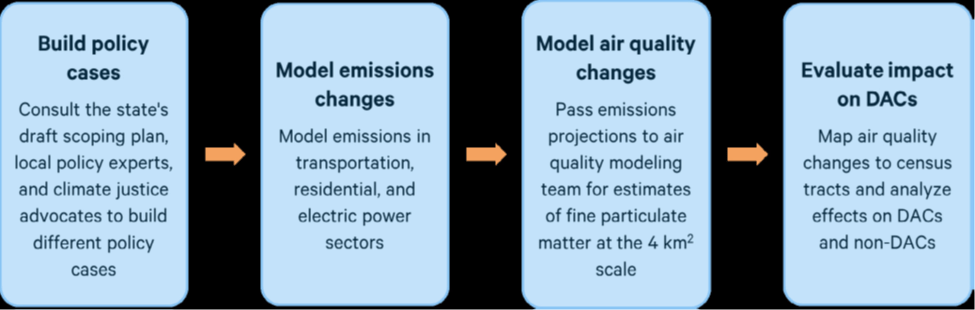
Several characteristics of our research set it apart from other research efforts. Our contribution to examining the outcomes of decarbonization policies on EJ communities at a state level is unique. Additionally, we use a combination of behavioral models and one of the most sophisticated air quality models to assess and trace the consequences of the two policy cases for disadvantaged communities (DACs) and non-DACs. Further, mapping these results visually at the 4km2 scale gives readers an unprecedented ability to assess and understand the geographic distribution of results.

Figure 1 from the document outlines the evaluation process.  I noted that this document is a disturbing example of the machinations and malfeasance associated with the scientific justification for the environmental justice impacts advocates are using to justify their demands.  Each one of these components has flaws that make the results questionable at best.

Policy Cases

My primary concern with machinations is related to the assumptions and biases of the modelers used to differentiate between the policy cases described before.  Each of the policy cases includes numerous control strategy policies.  The report notes:

Not all these policies are explicitly mentioned in the scoping plan. Our modeling work is based on behavioral responses to economic policies, so we had to add detail and specificity to policies where none existed. The CAC-Inspired Policy Case represents one reasonable interpretation of how the priorities in the scoping plan may be executed. The details were established using a mix of New York policy proposals, examples from other state and federal climate policy proposals, and feedback from New York policy experts.

There are concerns with this description because there are so many opportunities to tailor the results to the desired outcome.  The modeling is based on “behavioral responses” which boils down to someone saying, for example, there is a fuel price increase that will make public transit attractive to commuters.  The choice of that price point and the number of affected commuters is pure speculation. Even the choice of policies makes a difference and adding policies not explicitly addressed in the scoping plan is problematic.  The scoping plan policies were developed over a couple of years, so it is unlikely that the scooping plan missed any viable options.  Finally, the stakeholder policy case includes policies that appeal to the advocates but have little connection to reality.  For example, “more ambitious ZEV goals for 2030 in the medium and heavy-duty vehicle sector” sound nice but converting trucks is so difficult that doing it faster is unlikely.

Model Emission Changes

The RFF analysis addressed the emissions projections with three analyses.  The report describes the: Economic Modeling Results, which describes estimated changes in energy demand and technology adoption across our modeled sectors; Greenhouse Gas, PM2.5, and Precursor Emissions Results, which describes estimated emissions changes in our modeled sectors; and Location of Emissions Changes, which describes the location of estimated changes in PM2.5 emissions.  If projected emissions are wrong. then the air quality impacts cannot be correct.  Developing an inventory of emissions for the modeling domain is an enormous effort and there are many opportunities to tailor results to a desired outcome.

The economic modeling results illustrate how behavior presumptions affect the results:

Compared with the BAU, the policy cases also increase the average fuel economy of on-road vehicles by about 15 percent.  The largest difference between the policy cases is in fuel consumption, which is driven by the different prices on carbon emissions. Fuel consumption is about 6 percent lower in the CPC and 12 percent lower in the SPC compared with the BAU. The SPC reduces fuel consumption more than the CPC because of its higher carbon price.

This another example of model assumption bias affecting the results.  The elasticity of fuel consumption relative to higher carbon price is certainly open to a wide range of interpretations. 

Another opportunity for biased reasoning comes when emission rates are chosen for GHG emissions.  The report addresses carbon dioxide and methane GHG emissions not only within the state but also upstream.  The document states “This methane leakage rate for natural gas implies that approximately 2.4 percent of natural gas leaks.”  That quote references a study from 2013, and then claims that the number has stood up well considering other (more recent) reports.  That number is typically of emissions reported by the Environmental Defense Fund from research they did in the Permian Basin, which is the leakiest of all the basins because the main output of the wells is liquid, and the gas is just an annoying byproduct that gets (poorly) flared.  The Appalachian shales like the Utica and the Marcellus have much lower leakage rates, and the National Energy Technology Lab (NETL) estimates that 88% of the natural gas burned in the Northeast U.S, comes from those two shale plays.  NETL shows Appalachian leak rates for the entire value chain at about 0.5%.  Furthermore, ONE Future companies collect and report data that shows that total value chain numbers are also less than 0.5%.  This means that RFF air quality projections associated with methane are 3.8 times higher than projections using the appropriate values for New York.

To its credit, the report emphasizes the difference between emissions and air quality impacts.  EJ advocates frequently overlook the distinction.  The report explains:

To get at this geography of pollution (and related disparities in pollution exposure), we begin by studying where emissions occur—emissions from burning fossil fuels (and some waste and biomass) to generate electricity, heat homes, and power heavy trucks and passenger vehicles on New York roads. Identifying the location of emissions is a prerequisite for determining where pollution ultimately settles (after being mixed and morphed in the atmosphere), which is how we determine the geography of air quality and associated public health implications, discussed below. It is important for the reader to make a clear distinction between emissions and air quality—a distinction we will continue to discuss.

Model Air Quality

Even though the report appropriately describes the difference between emissions and air quality impacts, I have problems with the analysis. The purpose of the analysis is to determine impacts to disadvantaged communities, but the spatial scale used for the inventory and modeling analysis is too coarse to accurately represent what is happening at the neighborhood level.  The report admits that this is a problem:

We also acknowledge that important boundaries to our research may influence the interpretation of the results. For example, our air quality modeling is at a 4km2 grid resolution, which in some cases is larger than a DAC boundary. We use one of the most advanced air quality models for our estimates, which incorporates detailed representations of atmospheric science and chemical processes. We have selected a spatial resolution that preserves the accuracy of that model. To aid in the interpretation of our work, we describe the limitations and caveat for our analysis in Appendix G, including a small error in the transportation emissions used as an input in the air quality model.

The authors can brag all they want about the capabilities of the model and its detailed representation, but the fact is that it is not suited to projecting what is happening on a neighborhood level.  The model they use predicts regional air quality impacts at a 32 km2 grid cell resolution, they interpolated those observations down to a 4km2 grid, and claim to be able to reasonably predict down to a disadvantaged community neighborhood.  Also note that they are only predicting annual averages.  For the reasons mentioned and many others, I do not accept that this only affects interpretation of the results.  Based on decades of air quality modeling experience I think the analysis uses an invalid methodology so I am not even going to present the results.

Discussion

Here is the thing, the report admits as much.  Appendix G. Research Limitations and Caveats in the report admits that there are limitations to the analysis.  It notes that “When modeling community exposure to air pollution, it is ideal to have the most geographically granular analysis possible, given that actual pollution exposure may vary at a level as granular as a city block.  Nonetheless, they present results.

The level of effort necessary to accurately estimate representative air quality burdens in disadvantaged community neighborhoods is immense.  The air quality model used by RFF is appropriate for regional analyses but that is just one component of localized air quality burdens.  At the neighborhood level, emissions and air quality impacts must be broken down to small spatial and temporal scales.  When predicting emissions at the community level details that cannot be incorporated into regional models for particulates must be included. For example, on a regional level the emissions from a char-grilling restaurant do not matter but in the neighborhood they might.  Because of the justified importance of this issue this is an area of active research.  I am confident that there will be surprises coming for the advocacy community when improved source attribution results are incorporated into policy making.  Spoiler alert – it is not the peaking power plants so vilified by the advocates.  Unless the problem sources are correctly identified, the problem cannot be solved.

Conclusion

I published this here because it foreshadows what I believe will be used to justify EJ demands elsewhere.  The RFF report explains the rationale behind the inclusion of EJ considerations. While I acknowledge that it is appropriate to minimize impacts to disadvantaged communities that have disproportionate impacts, I suspect that resolution is going to be more about emotional arguments than air quality impact science.  As a result, trying to get any new source permitted or renewing existing source permits is going to be more difficult.

I also wanted to highlight the machinations needed to justify the proposed responses.  I described a few of the issues with the modeling approach used but could have provided many more.  RFF all but admits that their modeling approach is inappropriate, but the caveats will not be mentioned when the results are used by the EJ advocate audience.  In addition, there is an inordinate opportunity for modeling assumptions to tailor the results to the preconceived answer desired including cherry picking input references.  As a result, I think the results have no value and did not describe them.  Nevertheless, this report will be referenced and used as justification for onerous permit requirements for any facility that might affect EJ communities.

Articles of Note 12 November 2023

Sometimes I just don’t have time to put together an article about specific posts about the net-zero transition and climate change that I have read that I think are relevant.  This is a summary of posts that I think would be of interest to my readers.

I have been following the Climate Leadership & Community Protection Act (Climate Act) since it was first proposed and most of the articles described are related to it. I have devoted a lot of time to the Climate Act because I believe the ambitions for a zero-emissions economy embodied in the Climate Act outstrip available renewable technology such that the net-zero transition will do more harm than good. The opinions expressed in this article do not reflect the position of any of my previous employers or any other company I have been associated with, these comments are mine alone.

Videos

Turbine graveyards sprawled across Texas Independent journalist Ron Kendall Jr warns of “turbine graveyards” which have been popping up over the US state of Texas as turbine blades reach their useable life.  Texas is home to more than 15,000 wind turbines and has been dubbed a “clean energy powerhouse”.  In a documentary produced by Yucca Films, Mr Kendall Jr investigates the lifespan of the turbines and where they go once used.  Transcript here.

Climate Fact Check

Steve Milloy does a monthly fact check of climate change impact claims.  This month he debunked ten claims:

  • Amphibians going extinct because of climate change
  • Sizzling September
  • Melting Himalayan glacier causes deadly flood
  • Alaskan king crab harvest hurt by climate change
  • Summers getting hotter
  • Climate change hurting pumpkins
  • Tragic Himalayan avalanche caused by climate change
  • Butterflies hurt by warming
  • Soaring heat deaths in Arizona
  • World cup skiing affected by climate change

In every case he explained why the claims were baseless.  For the most part the explanations boiled down to weather is not “climate change”.

Climate Transition Endgame

Eric Worral describes a report from the Australian Lowy Institute titled Private finance cannot lead the global response to climate change.  He quotes the document:

Misplaced faith in private sector solutions delays the redistribution of trillions from developed countries and multilateral institutions.

In response to the looming trillion-dollar global climate finance shortfall, a broad array of policymakers, international bureaucrats, environmentalists, and financial institutions have called for the urgent scaling up of private climate investments.

The logic of private finance mobilisation starts by recognising that developing countries will need climate finance “amounting to US$5.8–5.9 trillion up until 2030”. In the face of such eye-watering sums, private finance offers an enticing solution. By leveraging comparatively small government financing into substantial private investments, governments and international organisations can turn “billions into trillions”, sidestepping the problem facing developed countries of how to justify domestically the global redistribution of trillions of dollars.

Alternatively, developing countries have advocated for a suite of multilateral measures, including sovereign debt cancellation, the redistribution of IMF-issued Special Drawing Rights (SDRs), increased concessional development financing, and even global carbon taxes. These proposals are often perceived to be concerned with global justice and equity, as opposed to efficacy. However, this distinction becomes blurred when the US$5.8–5.9 trillion climate finance needs of developing countries are interrogated more closely.

Private finance is clearly no panacea for the climate crisis. It is no wonder that the developing countries have long called for far more drastic levels of public and multilateral financing. Rather than seeking to pursue global economic justice alone, developing countries have been acutely aware that trillions of developed country government dollars need to be put on the table. If developing country financing asks are honoured, US$5.8–5.9 trillion would be well within reach. But the challenge remains getting developed countries on board. Proposals such as political economist Dani Rodrik’s “bridging compact” hold some promise, although any equivalent global consensus could only emerge following the recognition that a private finance-centred approach doesn’t provide a workable alternative.

Worral points out that the rushed removal of $5.8-5.9 trillion from the economies of wealthy nations would have major impacts to schools, hospitals, roads, policing.  These are all the things that matter to ordinary people and surely would cause enormous public reaction.  He believes that “the fake climate crisis movement is on the verge of collapsing under the weight of its own absurdity.”  I only hope that is true.

Setting Utility Rates

Kevin Kilty does a great job describing how utilities are setting rates as the generating resources used on the grid change.   Whenever Kevin publishes an article I learn something.  I have been involved in the electric utility industry for decades and have never really paid much attention to the details of the rate case process and I learned a lot about the process.  He explained his motivation for the article:

My principal goal is this. Many of us are pretty certain that pouring more renewable energy into a network makes delivered energy more expensive and less reliable. We often point to a graph that shows costs rising with percent renewable contributions to generating capacity. Yet, our antagonists claim that adding energy from renewables should, and in fact does, reduce utility costs. They have data, too. We strengthen our case by demonstrating specific reasons, or lack thereof, for rising utility bills. The rate setting process ought to make those reasons visible.

I also suspect most people know little about rate setting and are unaware about its complexity. It’s important to understand this bit of the order of battle.

Kilty makes the reasonable observation that the rate setting process should make the rationale for increases visible but admits that this is a challenge because the issues are so complex.  He explains how the shift to weather-dependent wind and solar resources complicates this process bur explains the obvious problems.  In New York the politics of the ruling party’s preference for this transition and the Climate Act make it easy for the utility companies to go with the flow and ignore the politically inconvenient facts associated with the transition.  I do not think there is any incentive for these companies to fight for what they know is right.

Kilty concludes that the happy talk about wind energy saving customers money will never substitute for reliable operation. Whining about thermal assets being inflexible and preventing full adoption of wind and solar is simply public relations blather.  The intermittency of wind and solar combined with the steady decline of coal-fired resources are major problems that must be addressed for a reliable system but are being ignored in the rate case he is following. 

Electrify Everything Means Higher Energy Costs

Robert Bryce uses Federal data to show why residential electrification means higher prices,  he Energy Information Administration released its Winter Fuels Outlook for 2023-24 shows that “an average U.S. homeowner who uses electricity to heat their home will pay about $462 more this winter than ones who use natural gas.” That means heating with electricity costs about 77% more than heating with natural gas.

In addition to the fuel costs Bryce raises two issues.  He quotes Glenn Ducat’s new book, Blue Oasis No More: Why We’re Not Going to “Beat” Global Warming and What We Need To Do About It, who says burning natural gas directly “is at least twice as efficient and emits about half as much CO2 as processes that use electricity produced from fossil fuels. Converting process-heat applications to electricity before the electricity grid is completely carbon-free will increase CO2 emissions.”

His second point is that electrify everything push is terrible for energy security:

The first rule of energy security is to have diversity of supply. It makes no sense­ ­— none­­ — to put all of our eggs in one energy basket. Yet, that’s precisely what the electrify everything crowd wants to do. Even worse, they want to do it when our electric grid is cracking under existing demand, and regulators and market watchers, including the Federal Energy Regulatory Commission and North American Electric Reliability Corporation, are warning of reliability problems on our electric grid.

I agree with his conclusion that “The goals of policymakers should be to ensure that energy is affordable, reliable, and resilient. Trying to electrify everything will achieve the opposite.”

New York Energy Burden Definition

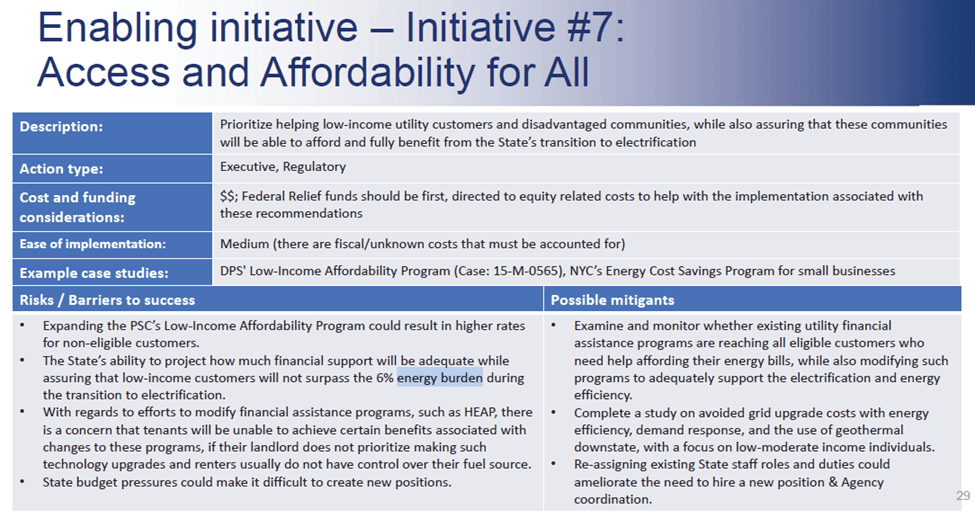
I worry that the implementation of New York’s Climate Leadership & Community Protection Act (Climate Act) is going to increase the cost of energy to those least able to afford it.  New York State does not have a clearly defined affordability threshold for the Climate Act nor does it track energy burden metrics.  The only metric referenced in the Climate Act Scoping Plan is a Public Service Commission target energy burden set at or below 6 percent of household income for all low-income households in New York State.  This post addresses that metric.

I have followed the Climate Act since it was first proposed, submitted comments on the Climate Act implementation plan, and have written over 350 articles about New York’s net-zero transition.  I have devoted a lot of time to the Climate Act because I believe the ambitions for a zero-emissions economy embodied in the Climate Act outstrip available renewable technology such that the net-zero transition will do more harm than good by increasing costs unacceptably, threatening electric system reliability, and causing significant unintended environmental impacts.  The opinions expressed in this post do not reflect the position of any of my previous employers or any other organization I have been associated with, these comments are mine alone.

Climate Act Background

The Climate Act established a New York “Net Zero” target (85% reduction and 15% offset of emissions) by 2050.  It includes an interim 2030 reduction target of a 40% reduction by 2030 and a requirement that all electricity generated be “zero-emissions” by 2040. The Climate Action Council is responsible for preparing the Scoping Plan that outlines how to “achieve the State’s bold clean energy and climate agenda.”  In brief, that plan is to electrify everything possible using zero-emissions electricity. The Integration Analysis prepared by the New York State Energy Research and Development Authority (NYSERDA) and its consultants quantifies the impact of the electrification strategies.  That material was used to develop the Draft Scoping Plan.  After a year-long review, the Scoping Plan recommendations were finalized at the end of 2022.  In 2023 the Scoping Plan recommendations are supposed to be implemented through regulation and legislation. 

Renewable Energy Program Affordability Concerns

Proponents of the Climate Act don’t acknowledge that there is a affordability safety valve.  New York Public Service Law  § 66-p (4). “Establishment of a renewable energy program” includes constraints for affordability and reliability that could be used to limit the damage of Climate Act implementation.  § 66-p (4) states: “The commission may temporarily suspend or modify the obligations under such program provided that the commission, after conducting a hearing as provided in section twenty of this chapter, makes a finding that the program impedes the provision of safe and adequate electric service; the program is likely to impair existing obligations and agreements; and/or that there is a significant increase in arrears or service disconnections that the commission determines is related to the program”. 

There are affordability considerations regarding the constraint “significant increase in arrears or service disconnections”.  I believe that the Hochul Administration’s Climate Action Council should define what that means.  For example, Addressing Energy Poverty in the US offers possible criteria:

According to the U.S. Department of Energy, the average energy burden for low-income households is 8.6%. That is three times higher than for non-low income households, which is about 3%.  And according to the Kleinman Center for Energy Policy at University of Pennsylvania, more than one-third of US households are experiencing “energy poverty,” having difficulty affording the energy they need to keep the lights on and heat and cool their home. 

I think that New York should define its energy poverty targets and track them.  Once the standard is defined, the status of the standard in New York should be monitored and made publicly available, and a threshold for acceptability established.  For example, if the New York state low-income standard is 8.6% and the baseline energy burden level is 9%, then if the average energy burden increases to 10% provisions to temporarily suspend or modify the obligations should be triggered. 

In order to implement my recommendation, the first task would be to establish the energy burden standard.  As far as I can determine there is only one existing candidate.  The Public Service Commission has a target energy burden set at or below 6 percent of household income for all low-income households in New York State.  Reviewing it raises questions about its suitability for this purpose.

Order Adopting Low Income Program Modifications and Directing Utility Filings

The six percent target was included as part of Public Service Commission (PSC) Case Number: 14-M-0565, the Proceeding on Motion of the Commission to Examine Programs to Address Energy Affordability for Low Income Utility Customers.  According to the PSC: “The primary purposes of the proceeding are to standardize utility low-income programs to reflect best practices where appropriate, streamline the regulatory process, and ensure consistency with the Commission’s statutory and policy objectives.”  On May 20, 2016 the Order Adopting Low Income Program Modifications and Directing Utility Findings adopted “a policy that an energy burden at or below 6% of household income shall be the target level for all 2.3 million low income households in New York.” 

The order notes that:

There is no universal measure of energy affordability; however, a widely accepted principle is that total shelter costs should not exceed 30% of income. For example, this percentage is often used by lenders to determine affordability of mortgage payments. It is further reasonable to expect that utility costs should not exceed 20% of shelter costs, leading to the conclusion that an affordable energy burden should be at or below 6% of household income (20% x 30% = 6%). A 6% energy burden is the target energy burden used for affordability programs in several states (e.g., New Jersey and Ohio), and thus appears to be reasonable. It also corresponds to what U.S. Energy Information Administration data reflects is the upper end of middle- and upper-income customer household energy burdens (generally in the range of 1 to 5%). The Commission therefore adopts a policy that an energy burden at or below 6% of household income shall be the target level for all low-income customers.  The policy applies to customers who heat with electricity or natural gas. 

The energy burden statistics cited in the Staff Report suggest a significant energy divide exists for low-income households. About 2.3 million households are at or below 200% of FPL, with an energy affordability “gap,” i.e., an average annual energy burden above the 6% level.  Approximately 1.4 million of these households receive a HEAP benefit; however, for the 2013-2014 program year, only about 316,000 of those households received a benefit for utility service.

The Order notes that reducing this energy burden will be a challenge:

Closing such a wide gap for 2.3 million low-income households is a non-trivial pursuit, and will require a comprehensive effort that involves all of the tools at the state’s disposal, including, but not limited to, utility ratepayer-funded programs. A central role in achieving energy affordability for low income customers is played by the financial assistance programs administered by the Office of Temporary and Disability Assistance (OTDA), including the Home Energy Assistance Program (HEAP). Another important role is played by low income energy efficiency programs such as the Weatherization Assistance Program administered by New York State Homes and Community Renewal (HCR) and the ratepayer–funded EmPower-NY program administered by the New York State Energy Research and Development Authority (NYSERDA). Utility ratepayer funded programs also include the rate discount programs under discussion here, as well as investments designed to create opportunities for low income households to benefit from the cost savings offered by Distributed Energy Resources.

The Order goes on to offer suggestions to close the gap.  It argues that a holistic approach among many state agencies is needed.  For that to work there must be better coordination “among the various governmental and private agencies” that address this issue.  The Order suggests that “achieving an optimal design will require building new partnerships and new mechanisms for identifying and enrolling eligible households”. 

The most tangible aspect of the Order to address the energy burden problem was to establish low-income bill discount programs for each of the major electric and gas utilities. This included standardization of utility energy affordability programs statewide to “reflect best practices where appropriate, streamlining of rate cases, and greater consistency between the programs and the Commission’s statutory and policy objectives.” 

On Augst 13, 2021 a press release describing the expansion of the low-income affordability program noted:

To reach the target of no more than a 6 percent energy burden for low-income New Yorkers, it would be necessary to coordinate and leverage all available resources at the State’s disposal, including multiple sources of financial assistance to lower customers’ bills, energy efficiency measures to reduce usage, and access to clean energy sources to lower the cost of the energy itself. As part of the Commission’s decision, Commission staff will work closely with other entities, including OTDA and the utilities, to ensure that low-income customers receive the assistance they need.

The utility companies submit quarterly reports documenting the number of low-income customers receiving discounts and the amount of money distributed.  However, I have been unable to find any documentation describing how many customers meet the 6% energy burden criteria, much less any information on how those numbers are changing.  The biggest problem with this energy burden program is that it only applies to electric and gas utility customers.  Citizens who heat with fuel oil, propane, or wood are not covered.

Sc=oping Plan Energy Burden

The only reference in the Scoping Plan to the PSC low-income energy burden target of 6% was in Appendix A, the Enabling Initiative #7 slide in the Power Generation Advisory Panel Considerations.  The relevant sentence states a potential barrier to success is “The State’s ability to project how much financial support will be adequate while assuring that low-income customers will not surpass the 6% energy burden during the transition to electrification”.   As noted previously, this ignores citizens who do not heat with electricity or natural gas.

I am aware of only one other suggestion for an affordability metric.  In the 2021-2022 legislative session there was a proposal that included a requirement for state agencies to identify policies to ensure affordable housing and affordable electricity using an “affordability of electricity” metric that was defined as “electricity  does not cost more than six percent of a residential customer’s  income.” 

I don’t think either is the appropriate metric for the Climate Act transition.  The legislative proposal only addresses electricity and the PSC energy burden target only addresses only utility bills.  This fails to address the concerns of citizens who heat their homes with fuels not provided by a utility such as heating oil or propane.  The Climate Action Council has proposed a cap-and-invest program that will put a price on gasoline and diesel fuels.  Those should also be considered part of the energy burden.

Reality Disconnect

The Order Adopting Low Income Program Modifications narrative on the clean energy transition is inconsistent with the experience of every jurisdiction that has tried to replace existing sources of electrical generation with wind, solar, and storage. The total costs to integrate intermittent and diffuse wind and solar inevitably increase costs.  The argument in the Order claims:

In addition, the best solution for all customers, including low income, lies in facilitating opportunities to invest in clean energy and the means to reduce energy costs. Greater access and support for low income and underserved communities to Distributed Energy Resources is the best way to narrow the affordability gap that needs to be filled with direct financial assistance for customers with low incomes. Greater access to advanced energy management products to increase efficiency for low-income customers will empower those for whom these savings may have the greatest value, as well as allowing the most disadvantaged customers more choice in how they manage and consume energy.

There are two aspects to the claim that clean energy will reduce energy costs that are problems.  The first problem is the cost of new generating capacity in general.  The New York State Energy Research & Development Authority recently announced that investments in three offshore wind and 22 land-based renewable energy projects totaling 6.4 gigawatts.  For the offshore wind projects “the average bill impact for customers over the life of the projects will be approximately 2.73 percent, or about $2.93 per month.”  For the other projects the average bill impact for customers over the life of the projects will be approximately 0.31 percent, or about $0.32 per month.  If future projects somehow stay at the same price despite the costs of inflation, supply chain issues, and all the other reasons that developers for existing projects recently argued when calling for renegotiation of their project contracts, then the average monthly bill impacts will be $16.40 per month for the projected offshore wind, onshore wind, and solar capacity needed in 2030.  That is just the cost of additional generating capacity and does not include the energy storage needed to address intermittency or transmission upgrades needed to address diffusivity.   The Order’s claim that clean energy will reduce energy costs is unsupportable.

The second problem is that those additional costs necessitate changes to low-income customer support.  In order to maintain the same relative level of energy burden more money will be required for these higher costs.  Furthermore, the higher costs will mean more people will qualify for energy burden support.  That additional money must be covered by the remaining ratepayers, driving their costs higher, and increasing the number of people that quality for energy burden support.  At some point this spiral of costs will become unsustainable.

Conclusion

Increased energy costs are regressive taxes and impact those least able to afford them the most.  I believe that the net-zero transition will inevitably increase energy costs.  Surely there is a point when the costs are unaffordable overall or the impacts to low-income ratepayers are unacceptable. 

I believe it is necessary to establish a energy burden standard. The first step to address this problem is to develop a transparent metric for energy burden.  The Public Service Commission target energy burden of 6 percent of household income only applies to utility costs.  A metric that considers all energy costs including transportation has to be developed.  The second step would be to establish energy burden acceptability criteria that could be used to comply with the New York Public Service Law  § 66-p (4) affordability considerations associate with the constraint “significant increase in arrears or service disconnections”.  Finally, a transparent and readily available tracking system needs to be established.

Clearly there is a reluctance by any of the politicians supporting the clean energy transition to be accountable for costs.  There is an existing energy burden metric but the status of ratepayers relative to the 6 percent metric is not documented.  It is almost as if the State does not want us to know where we stand.  As such, the possibility of properly tracking energy poverty is unlikely.  I think that is to the great shame of the proponents of the clean energy transition.

New York Heat Pump Transition

For over three years one of my particular concerns associated with the New York State Climate Leadership & Community Protection Act (Climate Act) net zero transition is residential electrification with an emphasis on home heating.  I have been meaning to do an update on this topic but have had other priorities.  Empire Center fellow James Hanley has prepared a new study that provides a great update: Cold Reality: The Cost and Challenge of Compulsory Home Electrification in New York (“Cold Reality”).  This post summarizes the study and my impressions of the analysis.

I have followed the Climate Act since it was first proposed, submitted comments on the Climate Act implementation plan, and have written over 350 articles about New York’s net-zero transition.  I have devoted a lot of time to the Climate Act because I believe the ambitions for a zero-emissions economy embodied in the Climate Act outstrip available renewable technology such that the net-zero transition will do more harm than good by increasing costs unacceptably, threatening electric system reliability, and causing significant cumulative environmental impacts.  The opinions expressed in this post do not reflect the position of any of my previous employers or any other organization I have been associated with, these comments are mine alone.

Climate Act Background

The Climate Act established a New York “Net Zero” target (85% reduction and 15% offset of emissions) by 2050.  It includes an interim 2030 reduction target of a 40% reduction by 2030 and a requirement that all electricity generated be “zero-emissions” by 2040. The Climate Action Council is responsible for preparing the Scoping Plan that outlines how to “achieve the State’s bold clean energy and climate agenda.”  In brief, that plan is to electrify everything possible using zero-emissions electricity. The Integration Analysis prepared by the New York State Energy Research and Development Authority (NYSERDA) and its consultants quantifies the impact of the electrification strategies.  That material was used to develop the Draft Scoping Plan.  After a year-long review, the Scoping Plan recommendations were finalized at the end of 2022.  In 2023 the Scoping Plan recommendations are supposed to be implemented through regulation, utility rate cases, and legislation. 

I have written extensively about residential home heating strategies in the Scoping Plan. In Climate Act Draft Scoping Plan Building Sector Scenarios I compared the Draft Scoping Plan residential heating scenarios and concluded a feasibility study is needed to determine whether any of the recommendations can be implemented.  I submitted comments on the costs of residential heating electrification in the Draft Scoping Plan.  My comments showed that the Plan did not provide sufficient information to assess the potential costs of the electrification strategies proposed.  One of the key factors affecting cost and feasibility is the need to upgrade the building shell to ensure comfort during the coldest weather when using heat pumps.  I also did a post that documented the results of my home energy audit that consolidated all my concerns with heat pumps.  If you are interested in more home heating background information, an article describing my interview with Susan Arbetter at Capital Tonight gave an overview of heat pump technology and described building shells.  Like every other aspect of the Climate Act transition heating electrification is more complex and costly than the Scoping Plan admits.

NY’s Electric-Heat Push Faces Cold Reality

James Hanley’s Cold Reality is described as follows:

New York’s plan to steer homeowners and landlords toward electric heat could backfire due to high costs and practical concerns, according to a new study from the Empire Center for Public Policy.  

In Cold Reality: The Cost and Challenge of Compulsory Home Electrification in New York, Empire Center fellow James Hanley looks at the state’s plan to prohibit homeowners from replacing gas and oil furnaces after 2029 and for them to instead install heat pumps. Homeowners, he explains, face both higher equipment costs and potentially high weatherization costs to accommodate heat pumps, which can operate at lower monthly costs but require better insulation. 

Even with extensive state and federal subsidies, Hanley warns, the upfront price-tag of heat pumps and weatherization will likely push homeowners to instead buy low-cost but energy-hungry electric furnaces that will put considerably greater stress on the electric grid—making the state’s overall electrification goals harder to reach. 

“This is the fundamental problem at the heart of New York’s command-and-control attempt to restructure its economy to make what amount to barely detectable reductions in global emissions,” said Hanley. “Albany can ban things, but it can’t control how people replace them.”  

Hanley notes that the impact of this policy will be felt most in rural New York, where the median household income of owner-occupied homes is the lowest, and points out that the state could instead reduce emissions by setting clean fuel standards that encourage the use of biofuels. 

Annotated Executive Summary

I n this section I quote the Executive Summary and offer my comments.

The Scoping Plan recommends that the State pass legislation that prohibits fuel-fired home heating but has not addressed all the consequences:

In 2030, New York may begin a policy of forcing New York families to use electricity for home heating instead of fuels like heating oil, propane and natural gas. Homeowners whose furnaces fail in midwinter will face a choice between spending tens of thousands of dollars on heat pumps while waiting for weeks or more to have their homes weatherized or buying inexpensive but energy-hungry electric furnaces. Their choices have significant implications for household budgets, utility companies providing electricity, and policymakers who need to ensure a sufficient amount of electricity production to meet the public’s needs.

Hanley does a good job explaining some of the nuances to the electrification that are not addressed in the Scoping Plan.  For example, he points out that if a furnace breaks down in the winter, that there are limited options for replacement.  You might be able put in a replacement heat pump quickly but the insulation and weatherization required to make heat pumps work in the coldest weather take longer to install. 

The Climate Act is a political construct.  The goals set were never evaluated with respect to feasibility.  The Climate Action Council did not address the consequences of the schedule proposed:

New York’s 2019 Climate Leadership and Community Protection Act (CLCPA) calls for reducing statewide greenhouse gas emissions by 85 percent by 2050 (from a 1990 baseline). The Climate Action Council has proposed meeting that goal in part by electrifying 85 percent of the state’s buildings. But it also has recommended a prohibition on the replacement of fuel-burning furnaces as of 2030, which would push the mandate closer to 100 percent electrification as units reach their normal end of life.

Hanley breaks down residential building energy production:

Over six million residential units in New York use fuels for heating, with over five million also using them for hot-water heating, and over four million using them for cooking. While most of those homes use natural gas, more than 1.7 million New Yorkers use propane, heating oil or kerosene1 for heat, with over a million using those fuels for hot water as well.

The Scoping Plan did not address these differences.  There are reasons that each fuel is being used and there are ramifications that may make a one size fits all electrification mandate problematic.  The analysis addresses some of the complications of the electrification mandate.  While the Scoping Plan admits that there should be exceptions to the mandate, it is not clear how those would be incorporated.  As Hanley points out, heat pumps have issues:

The state’s compulsory electrification program— forcing consumers to replace end-of-life fuel-fired appliances with electric appliances—recommends that building owners, including homeowners, install heat pumps. Because heat pumps do not warm the air as much as fuel-fired furnaces, heat pump installation involves additional costs for home weatherization. In cold climate regions, air-source heat pump users may also need to pay for a supplemental heat source, and due to the risk of power outages, risk-averse electric heat users may also need to purchase backup power generators.

Cold Reality does a good job in the report explaining how the plan will disproportionately affect the rural poor.  He describes other issues as well:

The costs of heat pump installation and building shell weatherization are high and will place a substantial economic burden on many homeowners, even with state and federal subsidies, as shown by the following numbers:

  • The cost of installing a heat pump and weatherizing a home: $14,600 – $46,200;
  • Heat pump and weatherization’s share of the median household income of owner-occupied homes in lower-income counties: 20 percent to 70 percent; and
  • How long it will take homeowners to recover costs through energy savings: 8 years to 19 years.

The Climate Act Scoping Plan emphasizes the climate justice aspect of implementation by focusing on Disadvantaged Communities.  I worry that emphasis will overlook the rural poor who will be disproportionately impacted by the electrification of heating costs described because rural poor may not be in a Disadvantaged Community.  If there is no hope that the electrification costs can be recovered by energy savings, then this is a serious problem.  Hanley points out that there are ramifications on the implementation strategy too:

State policy will likely drive homeowners to instead buy more energy-intensive electric resistance furnaces that have lower upfront costs but cost more to operate. Even with higher annual energy costs, it will take 18 to 60 years for total costs to equal the cost of a heat pump installation plus home weatherization.

I agree that the consequences of this choice have enormous implications:

Widespread adoption of electric resistance furnaces would further increase electricity demand, challenging utilities as they rebuild the state’s electric grid to deliver higher electric loads and policymakers as they struggle to close a sizable future gap in winter electricity production.

Whether homeowners choose heat pumps or electric resistance heaters, the future of oil and propane distribution firms appears dire. Based on their respective expected operational lives, propane furnaces may be eliminated between 2047 and 2050, while oil furnaces would be eliminated between 2056 and 2063.

One point not mentioned by Hanley is that propane is used more often for mobile homes.  Those residences cannot be insulated enough to enable the use of heat pumps so I expect that this would be another long-term use of propane in addition to those he describes:

Because there are a variety of out-of-home uses of propane, the propane industry will not completely disappear in New York, although it will dwindle and need to consolidate. With fewer alternative uses for heating oil, the heating oil delivery industry may be eliminated entirely.

Hanley correctly points out that the expected reductions in greenhouse gas emissions are inconsequential relative to global emissions.  However his description does not mention that the increase of global greenhouse gas emissions elsewhere means that the reductions will be supplanted by those increases in a matter of days:

The global effect of the costly compulsory electrification will be a reduction in greenhouse gas emissions of less than 5/100 of one percent. In choosing this approach, New York has closed the door on a more affordable means of reducing greenhouse gas emissions, clean fuel standards that promote biodiesel and renewable propane.

In that context, it is insane to not consider the affordable alternatives he describes.

Discussion

Cold Reality does an excellent job explaining issues associated with heat pumps in New York.  I want to make the point that Hanley addressed the major problems but could not address all the issues.  There are other problems that don’t have as much of an impact and are down in the weeds so far that trying to include them would detract from the report.

My post that documented the results of my home energy audit with a knowledgeable and experienced auditor raised some of the other issues.  I do not dispute that heat pump technology can work in New York State.  However, it is not simply a matter of swapping out a fossil-fired furnace for a heat pump because it is not just the furnace that has to be replaced.  Hanley explained that because the temperature of the air from a heat pump is lower than a fuel-fired furnace, the building shell needs to be upgraded to improve insulation and reduce air infiltration.  He did not point out that it may be necessary to change the duct work because a greater volume of air is needed to provide the necessary heat and that a heat exchanger might have to be added too.  Hanley described the trained tradesmen problem but I think it is not just a matter of installation workers it is also a matter of designers.  There simply will not be enough trained and experienced auditor/designers available because of the learning curve.  As a result, I fear many heat pump systems will not be designed properly.  That will exacerbate the load problems described in Cold Reality because the solution will be to add space heaters to stay warm.

Conclusion

There are many components of the Climate Act transition but very few will have as big an impact on individuals as the home heating electrification mandate.  Hanley’s Cold Reality is a great overview of the problems associated with the heat pump “solution” that have not been addressed by the Hochul Administration. He offers a solution to reduce impacts that I think makes sense.

In my opinion, however, there are even more problems than the problems Hanley describes in his conclusion:

New York’s proposed program of compulsory electrification could impose enormous costs on homeowners while making nearly unmeasurable gains in reducing global greenhouse gas emissions. As of 2030, homeowners will be faced with the choice of committing up to 70 percent of their annual incomes toward the purchase of heat pumps and upgrading their home’s shells or buying electric resistance heaters at just 3 percent to 10 percent of that cost.

The low rate of electric heating in many of the state’s more rural and lower-income counties means much of the choice will fall on homeowners who can least afford it.

And those who have unexpected equipment failures in midwinter may not be able to arrange contractors for their necessary shell upgrades in time to ensure comfort for the remainder of the season.

While the state’s Climate Action Council recommends heat pumps because they use less energy, the cost advantage of electric resistance heaters could lead to large numbers of homeowners choosing them.  This would increase the energy demands of the state beyond what has been predicted, challenging utilities as they rebuild the grid to deliver higher electric loads and challenging policymakers to close a predicted, and potentially growing, shortfall in future wintertime electricity production.

Upstate New York Smart Meters

I live in the Upstate New York National Grid service territory and recently received a notice that Smart Meters are coming.  Because I am aware of issues associated with this technology, I decided to research what this is all about.  My particular concern is that it could enable involuntary demand response capabilities associated with the New York State’s Climate Leadership & Community Protection Act (Climate Act) net zero transition.

Cutting to the chase: I have decided to let them install the smart meter in my home.  The costs to opt-out of them is greater than the risks that they will be used to potentially control my energy use someday in the future. 

I have followed the Climate Act since it was first proposed, submitted comments on the Climate Act implementation plan, and have written over 350 articles about New York’s net-zero transition.  I have devoted a lot of time to the Climate Act because I believe the ambitions for a zero-emissions economy embodied in the Climate Act outstrip available renewable technology such that the net-zero transition will do more harm than good by increasing costs unacceptably, threatening electric system reliability, and causing significant cumulative environmental impacts.  The opinions expressed in this post do not reflect the position of any of my previous employers or any other organization I have been associated with, these comments are mine alone.

Climate Act Background

The Climate Act established a New York “Net Zero” target (85% reduction and 15% offset of emissions) by 2050.  It includes an interim 2030 reduction target of a 40% reduction by 2030 and a requirement that all electricity generated be “zero-emissions” by 2040. The Climate Action Council is responsible for preparing the Scoping Plan that outlines how to “achieve the State’s bold clean energy and climate agenda.”  In brief, that plan is to electrify everything possible using zero-emissions electricity. The Integration Analysis prepared by the New York State Energy Research and Development Authority (NYSERDA) and its consultants quantifies the impact of the electrification strategies.  That material was used to develop the Draft Scoping Plan.  After a year-long review, the Scoping Plan recommendations were finalized at the end of 2022.  In 2023 the Scoping Plan recommendations are supposed to be implemented through regulation, utility rate cases, and legislation. 

The Scoping Plan is more of a list of potential strategies than an implementation plan because it does not provide a blueprint of the steps needed to implement the strategies proposed to meet the reduction targets.  The building sector currently has the highest Greenhouse Gas (GHG) emissions.  The strategies proposed to reduce greenhouse gas emissions include electrification, energy efficiency, energy conservation, and demand response shifts.  According to the Department of Energy: “Demand response provides an opportunity for consumers to play a significant role in the operation of the electric grid by reducing or shifting their electricity usage during peak periods in response to time-based rates or other forms of financial incentives”.   The Scoping Plan suggests using this as a resource option for balancing supply and demand.  I have no problem with voluntary demand response programs but given the challenge of balancing supply and demand when electric generation is weather-dependent, I worry that these programs could get to the point that the utility can control my energy use without my permission.

What is Happening? 

National Grid’s Upstate New York Rate Case Settlement Agreement (Cases 20-E-0380 and 20-G-381) included rate increases that “reflect incremental IT-related capital investments” for Advanced Metering Infrastructure (AMI).  The discussion in the Order Authorizing Implementation of Advanced Metering Infrastructure With Modifications that was issued on November 20, 2020 describes the rationale for AMI, aka smart meters (modified to label acronyms):

With Advanced Metering Infrastructure (AMI), National Grid can improve its response to power outages, as the Company will have more accurate and granular information regarding the voltage and current status of customers’ services. AMI can empower customers by providing them with information about their energy usage and allowing them to take action to manage their electric and gas costs. The AMI meter and communication system can be used to enhance the safety of the electric and gas system by allowing National Grid to remotely monitor facilities and receive alerts when abnormal conditions are detected. Moreover, AMI is an important and valuable contribution to enabling the Company to assume the role of the Distributed System Platform (DSP), to increasing use of Distributed Energy Resources (DERs) to support system operation, to increasing the use of measures such as Volt-Var Optimization (VVO) to reduce energy use and emissions, and to facilitating customer access to products and services provided by third-parties.

The first major benefit category is Avoided Operation and Maintenance (O&M) Costs, estimated at $188 million. This includes operational savings from remote customer connects and disconnects, better storm response with the integration of Outage Management Systems (OMS) and AMI, reduced meter reading costs, and reduced meter investigation costs.

The second major benefit category is Avoided Program Costs, estimated at $354 million. This includes avoided costs of replacing automated meter reading (AMR) meters, avoiding additional sensors to support the DSP, and metering for customers eligible for Value of Distributed Energy Resources (VDER) according to the Company’s tariff.


The third major benefit category is Customer Benefits, estimated at $251 million for the time varying pricing (TVP) rate opt-out scenario and $165 million for the TVP rate opt-in scenario. This includes reduced energy from Volt-Var Optimization (VVO); customer response to granular energy usage information communicated via the Company’s website and through high-usage alerts, and to the TVP rate; and reduced demand costs for customers who charge electric vehicles during off-peak periods.

Proponents of the electric grid transition away from centralized power plants burning fossil fuels argue that it is more efficient to use on-site energy production using wind and solar.  The idea to use Distributed Energy Resources (DER) in the electric system has been around for a while but so far, the generators primarily use fossil fuels.  In the future, the theory says DER and the Distributed System Platform (DSP) described will accommodate intermittent wind and solar resources in the so-called “smart grid”.  Volt/VAR optimization (VVO) is another aspect of the smart grid.  It is a process of optimally managing voltage levels and reactive power to achieve more efficient gird operation by reducing system losses, peak demand, or energy consumption or a combination of the three.

National Grid Voluntary Peak Demand Program

Upstate New York National Grid has voluntary programs for energy consumption incentives on high energy demand days in place today.  These programs control the thermostats at participant homes rather than controlling the meter for the house.  The Connected Solutions program description notes that:

Energy use peaks during certain seasons, especially on the hottest and coldest days of the year.  When you cool your home or small business using electricity during summer or keep it warm using natural gas in winter, Connected Solutions will reward you for using less energy during those peak times. 

When you use less energy on peak demand days you help manage the cost of energy, protect the environment and infrastructure, and you help our communities stay safe and comfortable.

In Upstate New York there are programs for the summer and winter.  The summer description states:

On hot summer days, when the grid is stressed, it is important to conserve energy. Reducing energy at these times reduces energy costs and decreases pollution.

National Grid has made it easy for you to conserve energy at these peak times. After you enroll your qualified thermostat, National Grid will automatically send a signal to your thermostat to precool your home or small business before the peak event and increase your thermostat setting during the peak event.

Here is some information on when peak events may occur:

  • May-September
  • Non-holidays
  • There are typically 10 – 15 peak events every summer.

The winter description states:

On extremely cold days, when the demand for natural gas is at its highest in Upstate New York, it is important to conserve energy. Reducing your natural gas use at these times reduces energy costs. By shifting your energy use for a couple of hours during peak demand days you can help lower the stress on our system, save money and ensure our communities are safe and comfortable.

Connected Solutions Gas has made it easy for you to conserve energy during these times and will reward you for your participation. After you enroll a qualified, wi-fi enabled thermostat connected to your boiler or furnace, we will automatically send it a signal to preheat your home or small business before the peak event times and then temporarily decrease the temperature by a couple of degrees for the duration of the event. After the event has passed, your thermostat will automatically go back to your preferred temperature.

Here is some information on when peak events may occur:

  • November-March on days when temperatures drop well below average
  • 6 a.m. to 10 a.m. or 4 p.m. to 8 p.m.
  • There are typically 2 – 5 peak events every winter.

It is possible to opt out of a peak event anytime by changing your thermostat setting for both programs.  However, if you opt out of peak events National Grid may unenroll participants from the program for the following year.

National Grid Smart Meters

Against this backdrop I was interested when National Grid recently sent a bill insert, Smart meters are coming soon, that describes what is coming.  The information provided states:

  • MORE CUSTOMER CONTROL: continuous, secure access to your energy data—for more insight into your energy efficiency and usage decisions.  
  • FASTER, NEAR REAL-TIME ENERGY READINGS: available within minutes, through your My Account portal.
  • FASTER RESPONSE: enhanced outage monitoring and storm response.
  • AND MORE FEATURES — still to come

It’s all part of our ongoing commitment to empower customers—while working to build a more reliable, robust and climate-friendly energy grid for the future. Learn about your new smart meter at ngrid.com/smartmeter.

This webpage describes the rollout:

Like any aging appliance, your existing utility meter will need to be replaced soon. We are in the process of replacing current meters with smart meters in many of the regions we serve.

These smart meters incorporate proven, sophisticated technology which will improve service and reliability, while also giving you more control over your energy usage, faster, near real-time energy readings and an overall faster response. Smart meters are part of our ongoing commitment to empower our customers while working to build a more reliable, robust, and climate-friendly energy grid for the future.

One of the things that really isn’t explained clearly is that the smart meters will be installed unless the customer opts out.  There is a link to opt-out of a smart meter buried in the National Grid web page.  However, there are fees if a customer chooses to opt-out.  The enrollment fee is $44.63 for an electric customer, $61.19 for a gas customer or $89.03 for both.  The monthly fee for manual meter reads is $11.64 for electric or gas customers or $17.71 for both.

Concerns

If the only purpose of the smart meters was to automatically read my meters I would not be concerned.  However, I know that the challenge to reduce building sector emissions is so great that I worry that I will be involuntarily affected by the smart meters.

The description of smart meters claims that the smart meters will determine whether an outage is caused by the system or something within a home.  If it is a system outage, then National Grid will be informed quickly. 

The meters will provide hourly usage data.  I think it is inevitable that utility bills will be based on the time of the day rates with higher prices during peak demand times.  I can choose to save money by running my appliances when rates are lower.  As long as I get to choose when I can run my appliances, I can begrudgingly live with that.

It is not clear to me how the planned smart meters installations affect the Distributed System Platform and the Volt/VAR optimization benefits described above.  I do not know if my smart meter will be used to involuntarily control my energy consumption.  All the information provided so far indicates that there is no plan to do that yet.

However, I wondered whether the proposed smart meters had the capability to do that in the future.  I thought I would try to find out if that was the case.  I called National Grid and asked if the meters being installed could be used for involuntary demand response now or could be upgraded to do that later.  Once I got through to a human I was told “I don’t think so”.  I asked if I could talk to the folks doing the installations.  It turns out that National Grid has partnered with Utility Partners of America to do the installations. 

I ended up submitting the question to Utility Partners of America.  I asked “Can National Grid control my energy usage with this new smart meter?”  I received the following response: 

No, the smart meter will not give National Grid access to control your energy usage. We collect the same usage data we have always collected through existing meters just in more frequent intervals. However, National Grid does have Demand Response programs available for customers and while participation in those programs is voluntary, signed consent is required by the customer.

Conclusion

In brief, National Grid is installing smart meters to eliminate manual meter reading and automate outage reporting.  It will also provide more detailed energy use information that will enable them to start time varying pricing which will mean higher costs if you want to run appliances at peak energy use times.  There are other alleged technical advantages associated with the Climate Act transition plan.

My major concern was that they could involuntarily control my energy use.  I accept that this is not part of the current plan.  Everyone denies this could be possible with these meters.  However, I remain unconvinced that someday down the road, that such a program could be implemented. 

I have decided to let them install the smart meter in my home.  The costs to opt-out of them is greater than the risks that they will be used to potentially control my energy use someday in the future. 

Enough Land  How will solar development affect upstate New York agriculture?

I have been writing about the Climate Leadership & Community Protection Act (Climate Act) for over four years and one of my primary concerns is the effect of solar developments on New York agriculture.  Kris Martin sent me the Enough Land:  How will solar development affect upstate New York agriculture? white paper (“White Paper”) on agricultural land use and solar buildout in Upstate NY that she just completed. It is a well-researched analysis that looks at how much solar capacity we need to meet Climate Act goals and how much farmland that will require..  Kris has kindly offered to let me provide it to my readers.

I have followed the Climate Act since it was first proposed, submitted comments on the Climate Act implementation plan, and have written over 350 articles about New York’s net-zero transition.  I have frequently written about issues related to solar development and Upstate agriculture. I have devoted a lot of time to the Climate Act because I believe the ambitions for a zero-emissions economy embodied in the Climate Act outstrip available renewable technology such that the net-zero transition will do more harm than good by increasing costs unacceptably, threatening electric system reliability, causing significant unintended environmental impacts, and adversely affecting the way of life in rural New York.  The opinions expressed in this post do not reflect the position of any of my previous employers or any other organization I have been associated with, these comments are mine alone.

Climate Act Background

The Climate Act established a New York “Net Zero” target (85% reduction and 15% offset of emissions) by 2050.  It includes an interim 2030 reduction target of a 40% reduction by 2030 and a requirement that all electricity generated be “zero-emissions” by 2040. The Climate Action Council is responsible for preparing the Scoping Plan that outlines how to “achieve the State’s bold clean energy and climate agenda.”  In brief, that plan is to electrify everything possible using zero-emissions electricity. The Integration Analysis prepared by the New York State Energy Research and Development Authority (NYSERDA) and its consultants quantifies the impact of the electrification strategies.  That material was used to develop the Draft Scoping Plan.  After a year-long review, the Scoping Plan recommendations were finalized at the end of 2022.  In 2023 the Scoping Plan recommendations are supposed to be implemented through regulation and legislation. 

Kris Martin

Kris sent me the following biographical information:

I grew up in a western NY farming community with three colleges; I’ve had a lifelong interest in agriculture and technology. I earned a BA from SUNY Empire State College and an MS in technical communication from Rensselaer Polytechnic Institute.  After graduating, I worked as a software engineer and technical writer at IBM Research receiving national and international awards for my writing. Upon retiring, I moved back to western NY. 

The preface describes the impetus for the white paper.  She had heard the argument that the solar buildout for New York would only require 1% of the state’s farmland.  She did a quick analysis and realized that a more realistic estimate was needed.  She explains:

Maybe I could come up with more realistic estimates. Supporters of large-scale solar and those who opposed it needed some real numbers. I could produce them in a couple of weekends. That was over three years ago.

I can certainly sympathize with that time estimate.  In my experience, nothing associated with any component of the Climate Act is as simple as it first appears.  As a result, any analysis and documentation takes much longer than I originally thought.  That is especially true if you want to document exactly what you found so that the analysis is credible.  The description of the document includes this disclaimer: “This document is neither a statistical analysis nor an academic work; it should not be used as a formal reference.”  It may not be a peer-reviewed work but it is referenced well, the calculations documented, and the conclusions are supported by the work.  It is citizen-science at its finest and I would have no qualms quoting it in my work.

Enough Land

Martin describes the document:

Many upstate New York residents object to solar development on farmland, arguing that we should prioritize food production over energy generation. Others dismiss these concerns as unnecessary. This paper uses government and industry data—along with stated assumptions—to estimate how much agricultural land New York State’s expected level of solar buildout will require. The assessment also places solar land use in the larger context of the state’s farmland losses.

The chapters that follow address these overall questions:

  • Why do we need to site solar facilities on farmland?
  • How much solar capacity will the state need by 2050?
  • How much farmland will this require?
  • How much agricultural land do we have?
  • What effects does solar buildout have on agriculture?

Appendices provide more information on related topics.

She explains that the questions addressed in the white paper are simple: how much solar energy do we need, and how much farmland will it re-quire and what do these amounts mean for upstate agriculture?

Results

Cutting to the chase, Martin compares the acreage of New York State farmland as of 2017 and the acreage required by 2040 and 2050 for solar development in the following table.  She explains:

The claim that solar development will require only 1% of New York State’s land is roughly correct. On the other hand, solar buildout will require more than 1% of the state’s farmland.

Note that these numbers reflect acreage on the facility site; they do not include land used for mitigation or land taken out of production around facilities because it is less accessible or abandoned for other reasons.

I like the White Paper because it provides context for everything covered.  Estimating the amount of land is dependent upon area per solar panel installation and how much capacity is required for the Climate Act.  Those topics are covered in sufficient detail that it is clear why the numbers used were chosen.  This extends to the results.  There is a chapter that “considers the loss of farmland that has been occurring over the last century and speculates on the reasons for farmland conversion over that period.”  The White Paper provides a projection of expected additional farmland and cropland losses by 2050 not related to solar development.  While there are inconsistencies in the data used such that there is “missing” land, the results are troubling.

The section “How Much Land” assesses cumulative farmland losses from both solar and non-solar causes and puts the estimates in context.  Martin addresses the question whether this is a little or a lot but finds that more context is needed.  She explains: “Let us consider some of the factors relating to our current and future land use, and their relationship to solar development.” 

  • The explanation takes up an entire chapter.  The chapter looks at the following issues:
  • Climate change and agriculture
  • Farmland values in New York and other states
  • Farming and farmers
  • Concentrations of solar development, with examples
  • Agrivoltaic solutions

I really liked this chapter because it frames the issues very well.  My goal as a pragmatic environmentalist is to try to provide the information that I think should be considered when decisions are made.  Invariably there are tradeoffs and the decisions made will reflect value judgements.  This chapter provides the information and avoids making conclusions about which tradeoffs are appropriate. 

One aspect of solar development that I had not considered previously is the effect of co-locating solar developments in the same area.  When several grid-scale solar projects are concentrated in one agricultural area there are adverse impacts to the remaining farmers.  I have long contended that the State has failed to provide a cumulative environmental impact assessment for the currently projected amount of solar and wind development.  The Final Supplemental Generic Environmental Impact Statement (SGEIS) for the Climate Leadership and Community Protection Act was released on September 17, 2020 and only included 13,200 MW of utility-scale solar.  This analysis assumes that utility-scale solar will be on the order of 45,000 MW or over three times what the State analyzed.

Discussion

After three years of extensive work Kris Martin has assembled a great resource on solar development and its potential impacts on New York agriculture.  She confronts the tradeoffs:

Ultimately, we may be facing a conflict between the rights of landowners to use farmland for any legal purpose and our collective need for farmland as a vital resource. Because most of us do respect the long hours, hard work, and inherent risks that farmers take, we naturally sympathize with their decisions to take farmland out of production or change the focus of their operations by leasing or selling land for solar development.

Farming is not an altogether benevolent activity. It can reduce biological diversity, introduce harmful chemicals into the environment, and consume massive subsidies that fail to improve life for many farmers or increase the production of affordable, healthy food and other agricultural products.

Do we have enough farmland for solar buildout on the scale required to meet Climate Act goals? Keep in mind that the Climate Act is a law, not simple policy. Its success depends on our having more farmland than we need in order to produce food, fiber, and fuel.

The answer to this question may be somewhat subjective. We may not even know the answers until it is too late to do much about the issue.

She includes recommendations for state policymakers, solar developers, community leaders, other individuals, and host farmers.

Conclusion

My takeaway from the White Paper is that it provides the context that the Hochul Administration should have provided for solar development.  The fact is that there still is no utility-scale solar development plan for the Climate Act.  There is no mandate to follow the Department of Agriculture & Markets targets for conversion of agricultural lands or explanation why meeting the targets should not be mandated.  The Scoping Plan estimates for solar capacity availability assume that tracking solar panels are used but the that is not mandated so fixed panel systems are being installed.  That means even more land will be taken up by industrial solar development.  Finally, there is no mandate for agrivoltaics.  This White Paper shows what should have been done. 

I agree with Martin’s conclusion:

We cannot afford to make bad decisions about farmland or energy production. Today’s priorities may become tomorrow’s regrets. The conflicts identified here will require all our efforts, open-mindedness, and thoughtful engagement to negotiate.

New York’s Energy Transition Club

Ron Clutz wrote an article describing an article by Irina Slav that lists the rules strictly followed by leaders of the Great Energy Transition at her substack Irina Slav on Energy.   I want to illustrate how proponents of the Climate Leadership & Community Protection Act (Climate Act) follow these rules.  In the end, however, reality will win out and the energy transition will flounder.

I have followed the Climate Act since it was first proposed, submitted comments on the Climate Act implementation plan, and have written over 350 articles about New York’s net-zero transition.  I have devoted a lot of time to the Climate Act because I believe the ambitions for a zero-emissions economy embodied in the Climate Act outstrip available renewable technology such that the net-zero transition will do more harm than good by increasing costs unacceptably, threatening electric system reliability, and causing significant unintended environmental impacts.  The opinions expressed in this post do not reflect the position of any of my previous employers or any other organization I have been associated with, these comments are mine alone.

Background

The Climate Act established a New York “Net Zero” target (85% reduction and 15% offset of emissions) by 2050.  It includes an interim 2030 reduction target of a 40% reduction by 2030 and a requirement that all electricity generated be “zero-emissions” by 2040. The Climate Action Council is responsible for preparing the Scoping Plan that outlines how to “achieve the State’s bold clean energy and climate agenda.”  In brief, that plan is to electrify everything possible using zero-emissions electricity. The Integration Analysis prepared by the New York State Energy Research and Development Authority (NYSERDA) and its consultants quantifies the impact of the electrification strategies.  That material was used to develop the Draft Scoping Plan.  After a year-long review, the Scoping Plan recommendations were finalized at the end of 2022.  In 2023 the Scoping Plan recommendations are supposed to be implemented through regulation and legislation. 

Irina Slav  describes net-sero transition leadership as “climate crusaders, climateers, a cult, and other, less polite words.”  She points out this crowd is a club that follows six rules:

Rule #1: We do not talk about the problems. (Unless we absolutely have to.)

Rule #2: Facts are obsolete. Only the transition matters. (Until facts punch you in the face.)

Rule #3: Tell a lie big enough and keep repeating it

Rule #4: If it’s failing, double down

Rule #5: Words and numbers are weapons

Rule #6: Questions are denial

Rule #1: Do Not Talk About Problems

Irina Slav gave an example for this rule citing an International Energy Agency report  that said the world needed to replace and build 50 million miles of transmission lines to make the transition work.  She explained:  

This would only take $600 billion annually by 2030, which is double the current investment rate for transmission lines. For context, the global transmission line network is half the length the IEA says we need right now.

The expansion needs to take place by 2040 because Climate Targets. In other words, the world needs to double its transmission line network in a matter of less than 20 years… after it took a century to build all the lines we currently have. Realistic, right?

In fairness, the IEA does hint that there might be a slight problem with securing all of the raw materials necessary for this enormous undertaking. It absolutely had to admit it, what with miners crying shortage all the time, annoying people. But that cannot stop the transition. Else we get global broiling.

The New York Independent System Operator’s 2021-2040 System & Resource Outlook notes that “A minimum of 5 TWh of renewable energy in 2030 and 10 TWh in 2035 is projected to be curtailed due to transmission limitations in renewable pockets.”  The report notes that “Without investment in transmission, these areas of the New York grid will experience persistent and significant limitations to deliver the renewable power from these pockets to consumers in the upcoming years.”  New York’s Energy Transition Club has not addressed supply chain materials issues, skilled labor shortages, or funding for the transmission projects necessary for the schedule needed to meet Climate Act mandates.

Rule #2: Facts are obsolete

Slav’s second rule states “Facts are obsolete. Only the transition matters. (Until facts punch you in the face.)”  She explains that the UK government had a plan to replace gas heating systems in homes with hydrogen but “following massive opposition from the target community, the government ditched the trial plan and started mumbling that maybe hydrogen for heating is not such a marvelous idea.”  She explains:

The facts: hydrogen — green hydrogen, that is — is expensive. All hydrogen is also dangerous, which makes the green variety even more expensive. At the time the plans were made, these facts were shunned. The opposition of the locals in the village of Whitby, however, prompted their return to the scene, ultimately leading to this piece of news: Hydrogen for UK home heating should be ruled out, says infrastructure adviser

Summed up, the match between facts and fantasy in hydrogen sounds like this, per the FT: ““We do not see any role for hydrogen in the future of home heating,” said Nick Winser, NIC commissioner, arguing it was “simply not ready at scale” and risked being an inefficient use of green electricity.”

The leaders of the New York’s Energy Transition Club are in the New York State Energy Research & Development Authority.  This organization is responsible for the Integration Analysis that supports the Scoping Plan and they chose to use “green” hydrogen as the place holder for the dispatchable emissions-free resource (DEFR) included in future generating resource projections.  All the issues raised by Slav are relevant for this plan.  An article by Steve Goreham expands on “green” hydrogen problems and the facts that have been ignored by NYSERDA.

Rule #3: Tell a lie big enough and keep repeating it

Slav explains the derivation of this rule.  Here’s the whole quote:

“If you tell a lie big enough and keep repeating it, people will eventually come to believe it. The lie can be maintained only for such time as the State can shield the people from the political, economic and/or military consequences of the lie. It thus becomes vitally important for the State to use all of its powers to repress dissent, for the truth is the mortal enemy of the lie, and thus by extension, the truth is the greatest enemy of the State.”

She notes:

It kind of feels I can add nothing constructive to this description of the climate change narrative, especially if you consider the source, which appears to be (though not verbatim, I understand) a little book called Mein Kampf. I mean, if a tactic was tried in one context and it worked splendidly, you can totally make it work in another, and I’m not being ironic. The tactic does work.

Despite the Climate Act requirement in section 16 of § 75-0103 to consider efforts at other jurisdictions and observed increases in energy costs in Europe, NYSERDA continues the “big lie” that the transition will be affordable.  After the Public Service Commission decision to deny an increase in contract prices for renewable projects, NYSERDA announced the award of 6.5 GW of two award groups renewable energy.  Doreen Harris, president and CEO of NYSERDA said “In this case, the two award groups combined will have an impact of about $3 a month on your average New York residential consumer” and “Affordable, but we certainly keep that central to our work.”  Unfortunately, she has never admitted how much they expect the total costs for the transition, instead deceptively claiming that “the costs of inaction are greater than the costs of action”.

Rule #4: If it’s failing, double down

Slav describes this rule:

The countries with the greatest wind and solar power generation capacity in the EU also have some of the highest electricity prices. This is a mystery to absolutely no one with rudimentary mental acuity. And yet the billions continue flowing into wind and solar. And then, once a gas crunch hits, they start flowing into households.

Wind and solar clearly cannot work at the scale their fans want them to work. It is physically and financially impossible for them to make sense at that scale at this point in time. The evidence is there on a daily basis, courtesy of Electricity Maps and, I’m sure, other real-time tracking websites.

Transition Club has no truck with evidence, however, unless it’s the right kind of evidence, such as record-setting wind/solar output for some day or another. The rest is dismissed as irrelevant, disinformation, or simply ignored. And the billions keep flowing because there are targets to be hit in wind and solar installations. Whatever it takes.

New York’s transition has not reached the point where we have performance data.  However, doubling down examples abound.  In mid-October the Public Service Commission denied requests by European energy firms Orsted, Equinor, BP and other renewable developers to charge customers billions of dollars more under future power sale contracts for four offshore wind and 86 land-based renewable projects.  “These projects must be financially sustainable to proceed,” Molly Morris, president of Equinor Renewables Americas, told Reuters, noting Equinor and BP will “assess the impact of the state’s decision on these projects.”   On the same day Governor Hochul announced a “10-Point Action Plan to Expand the Renewable Energy Industry and Support High-Quality Clean Jobs in New York State”.  A couple of weeks later NYSERDA announced the largest-ever investment in renewable energy described previously.  The Hochul Administration has never related the new cost projections to the never revealed estimates in the Integration Analysis.  The Integration Analysis assumed that renewable development costs would decrease over time and that is not happening.  Nonetheless we race ahead doubling down that someday the costs will fall.

Rule #5: Words and numbers are weapons

Irina Slav’s fifth rule:

Old but gold and put to good use by the Club. All the talk about global boiling, the highway to hell, the accelerating extreme weather, the climate catastrophe and all the rest of it are water to the Transition Club agitprop mill. It keeps the lie going.

Numbers are even better: from the 99% of climate scientists who are in agreement about the climate and related catastrophies to all the CO2 emission updates and the horrific temperature readings from this summer we get actual numbers that stoke up fears that the planet is dying and we’re on our way out with it unless we kill the oil and gas industry and go full-wind/solar.

Or unless we check how the authors of the 99% consensus study came to their conclusion and what their sample size was, what the significance of those emission updates is for the total content of CO2 in the atmosphere, and how those temperatures were measured during the summer.

This rule is commonly involked by Club members.  For example, an opinion piece by Francesca Rheannon, co-chair of the Climate Reality Project-Long Island Chapter and a member of the East Hampton Energy and Sustainability Advisory Committee, exemplifies the Club call to action:

I have long been anxiously observing our world as it moves ever closer to the boiling point, noting the growing impacts of climate chaos on our daily lives. This past summer’s orange skies were terrifyingly otherworldly. Atlantic hurricanes are not just stronger, but getting stronger faster and less predictably. This year, we have (so far) dodged the bullet. But what will happen next year or the year after that? My house insurance premium has soared and my broker said the cause was anticipated increased risk from hurricanes. And the policy only covers up to Category 2 hurricane damage; any damages above that fall entirely on me.

Roger Pielke, Jr. addresses global hurricane facts.  For the North Atlantic offshore of Long Island he explains that the National Oceanic and Atmospheric Administration has recently concluded:   

In summary, it is premature to conclude with high confidence that human-caused increases in greenhouse gases have caused a change in past Atlantic basin hurricane activity that is outside the range of natural variability, although greenhouse gases are strongly linked to global warming.

Rule #6: Questions are denial

Slav describes the sixth rule:

This rule evolved organically from following all the others and sprouted actual disinformation laws, at least in the EU, for now, and not-so-official reporting rules for the media that require the climate narrative to be reported as fact despite evidence to the contrary, said evidence being dismissed as science denial and denialist propaganda, even when — and perhaps especially when — it comes from actual scientists.

Apparently, these days there are two kinds the scientists, the right and the wrong kind. The wrong kind are those asking questions, even though science is by definition a process that involves a lot of question-asking.

Per the Oxford Dictionary science means “the systematic study of the structure and behaviour of the physical and natural world through observation, experimentation, and the testing of theories against the evidence obtained.”

Not in the transition era, it doesn’t. In the transition era, there is a right kind of observation and computer modelling to replace experimentation and testing of theories against evidence. Then there is the wrong kind, which is any systematic study of the physical and natural world that questions the right kind, using evidence.

During the development of the Climate Act Scoping Plan there was no discussion of the scientific rationale for the net-zero transition.  Any thought that there could be questions about the need to move as quickly as possible was not considered.  However, the “Questions are denial rule” was still a prominent talking point by members of the Climate Action Council.

The May 26, 2022 Climate Action Council meeting  (recording) included an agenda item for Council members to describe their impressions of comments made at the public hearings  Many commenters expressed concern about reliability.   Paul Shepson invoked this rule when he said:

Mis-representation I see as on-going.  One of you mentioned the word reliability.  I think the word reliability is very intentionally presented as a way of expressing the improper idea that renewable energy will not be reliable.  I don’t accept that will be the case.  In fact, it cannot be the case for the CLCPA that installation of renewable energy, the conversion to renewable energy, will be unreliable.  It cannot be.

Robert Howarth also invoked this rule when he said that fear and confusion is based on mis-information but we have information to counter that and help ease the fears.  He stated that he thought reliability is one of those issues: “Clearly one can run a 100% renewable grid with reliability”.  A quote from a recent New York Independent System Operator presentation question both claims that dismiss reliability issues associated with renewable energy: “Significant uncertainty is related to cost / availability of Dispatchable Emissions Free Resource IDEFR) technologies, as well as regulatory definition of ‘zero-emissions’ compliant technologies”.

Conclusion

I believe that these rules are followed by New York’s Energy Transition Club.  Slav’s description of these rules is amusing but illustrates some of the techniques used to further the net-zero transition.  She points out that people cannot be shielded from the consequences of these rules for very long because reality always wins.

Update on Washington State Cap-and-Invest Program Impacts

Paul Fundingsland has been sending me his thoughts on the implementation of Washington State’s experiences with their cap-and-invest “putting a price on carbon” scheme.  This dispatch from the front lines of the cap-and-invest war on citizens covers three items: the letter he got from Puget Sound Energy about his natural gas bill,  an opinion piece describing ways to reduce the cost burden on citizens, and an article explaining how the program is affecting trucking companies.  I believe this is what is headed to New York and appreciate the time he has taken sending the information.

Paul describes himself as “An Obsessive Climate Change Generalist”.   Although he is a retired professor, he says he has no scientific or other degrees specific to these kinds of issues that can be cited as offering personal official expertise or credibility. What he does have is a two decades old avid, enthusiastic, obsession with all things Climate Change related. 

Background

The Climate Leadership & Community Protection Act (Climate Act) established a New York “Net Zero” target (85% reduction and 15% offset of emissions) by 2050.  It includes an interim 2030 reduction target of a 40% reduction by 2030 and a requirement that all electricity generated be “zero-emissions” by 2040. The Climate Action Council is responsible for preparing the Scoping Plan that outlines how to “achieve the State’s bold clean energy and climate agenda.”  In brief, that plan is to electrify everything possible using zero-emissions electricity. The Integration Analysis prepared by the New York State Energy Research and Development Authority (NYSERDA) and its consultants quantifies the impact of the electrification strategies.  That material was used to develop the Draft Scoping Plan.  After a year-long review, the Scoping Plan recommendations were finalized at the end of 2022.  In 2023 the Scoping Plan recommendations are supposed to be implemented through regulation and legislation.  New York’s cap-and-invest program is supposed to address one of those recommendations.

The New York State Department of Environmental Conservation (DEC) has developed an official website for cap and invest.  It states:

An economywide Cap-and-Invest Program will establish a declining cap on greenhouse gas emissions, limit potential costs to New Yorkers, invest proceeds in programs that drive emission reductions in an equitable manner, and maintain the competitiveness of New York businesses and industries. Cap-and-Invest will ensure the state meets the greenhouse gas emission reduction requirements set forth in the Climate Leadership and Community Protection Act (Climate Act).

I started writing about the effects of the Washington Cap-and-Invest Program last summer.  Washington State Gasoline Prices Are a Precursor to New York’s Future and the article published at Watts Up With That – Do Washington State Residents Know Why Their Gasoline Prices Are So High Now? addressed the observation that gas prices in Washing spiked soon after the first auction of the program.  I also published Washington State Gasoline Prices and Public Perceptions that consolidated responses from Washington residents in the comments from the Watts Up With That article. 

Paul contacted me soon after those articles came out with his thoughts that I turned into posts here. The first article on Washington State gas prices described his opinion of how the program came to be and concluded that it is a “state tax shell game preying on the less affluent”.  He later sent a long email that I turned into a post that described how the program has been evolving. 

My initial impression of Washington GHG emissions is that there are no “easy” emission reductions because the target sectors are transportation, residential-industrial-commercial heating, and “other”.  Fundingsland agrees pointing out that:

It’s going to be extremely difficult and may not even be possible for Washington State to be able to claim any meaningful or significant emission reductions based on this tax-and-reallocate scheme given the state’s overall energy use configuration combined with all the various emission allowance exemptions. 

In fact, there is a very high probability there will be next to zero emission reductions and perhaps even an increase.

Washington Climate Commitment Act

Washington’s Climate Commitment Act appears to be even more aspirational than California or New York.  The Washington Department of Ecology (“Ecology”) web page explains:

The Climate Commitment Act (CCA) caps and reduces greenhouse gas (GHG) emissions from Washington’s largest emitting sources and industries, allowing businesses to find the most efficient path to lower carbon emissions. This powerful program works alongside other critical climate policies to help Washington achieve its commitment to reducing GHG emissions by 95% by 2050.

The state plans in Washington, California, and New York all aim for net-zero emissions where greenhouse gas (GHG) emissions are equal to the amount of GHG that are removed.  Washington’s emission reduction target is 95% by 2050.  California is shooting for 85% by 2045 while New York’s target is 85% by 2050 but covers the whole economy.  In addition to the target levels and dates there are differences in what GHG emissions are included, how the mass quantities are calculated, and which sectors of the economy must comply. 

According to the Washington State Department of Ecology description of their cap-and-invest program:

In 2021, the Washington Legislature passed the Climate Commitment Act (or CCA) which establishes a comprehensive, market-based program to reduce carbon pollution and achieve the greenhouse gas limits set in state law. The program started on Jan. 1, 2023, and the first emissions allowance auction was held on Feb. 28.

Businesses covered by the program must obtain allowances equal to their emissions and submit them to Ecology according to a staggered four-year compliance schedule. The first compliance deadline is Nov. 1, 2024, at which time businesses need to have allowances to cover just 30% of their 2023 emissions.

Puget Sound Energy Response

Paul sent information that was used for another article based on a local news update noting that natural gas company Puget Sound Energy (PSE) had announced a 3% rate price hike due to their mandated “Cap & Invest” auction allowance costs. He noted that:

The companies required to participate in the auction allowances are simply passing these costs to their bottom line along to their customers. In essence, the State taxes the company and the company taxes its customers. 

What makes this particular example more disgusting than usual is the fact that PSE wanted to simply include a line item on the customer’s bill identifying this cost but the Washington Utilities and Transportation Commission (UTC) actually made it illegal to do so claiming that would make for a “lengthy confusing” bill. 

Even though PSE was not allowed to include the costs of the program in their utility bill they are not keeping silent on the reason for the associated cost increase.  Paul’s latest correspondence noted that: PSE is being very transparent about why this price increase is happening. It is a direct result of the State’s mandated “Cap & Invest” program. 

As far as I can tell according to this web site pse.com/cca my November bill will increase somewhere in the neighborhood of 3%. This is the second documented result of the Washington State required “emissions allowances auctions” (forced permit purchases required to emit greenhouse gases) held quarterly affecting businesses like PSE and ultimately it’s customers. The first example being this past summer’s overnight increase of $.43 a gallon for gas attributed to this scheme.

Since the state mandates that PSE and other companies in the state identified as emitting notable amounts of CO2 must participate in quarterly scheduled “emission allowances auctions”, it is easy to anticipate these kinds of price increases will continue to rise, perhaps at an alarming rate in both transparent and un-transparent ways for the foreseeable future.

The following letter from PSE indicates I can also expect a price increase for the same reasons on my electrical bill from them once they work out those cost details. When that happens, that will be the third documented price increase as a direct result of the recently initiated Washington State “emission allowances auctions” under its “Cap (Tax) & Invest” scheme.

Paul explains:

These are just the obvious examples of Washington State forced increased bottom line public business costs being passed on to their customers. Most of the affected companies in the Washington State scheme do not have the high profile of a utility or refinery with their traceable and identifiable costs and results. The price increases for the other companies will also be passed along to their customers but are much more difficult to identify and document. But they are there none the less, un-transparently adversely affecting the finances of every state citizen especially the lower-, middle-, and fixed-income brackets.

Affordability

The New York Cap-and-Invest Program is supposed to address affordability with a political solution.  According to the official website for cap and invest:   “Governor Hochul’s Consumer Climate Action Account will deliver at least 30 percent in future Cap-and-Invest proceeds to New Yorkers every year to mitigate consumer costs.”

Paul sent along an opinion piece describing political solutions for Washington.  It states:

Today, there are four proposals on the table. Most legislators in the majority have remained silent, and presumably want to use these funds to pay for new or existing programs. Sen. Mark Mullet, D-Issaquah, would like to use these funds to reduce car-tab fees for two years, but this would shortchange the transportation budget resulting in a shell-game in which Carbon Commitment Act (CCA) dollars are used to backfill transportation funds. His proposal also calls for lowering compliance obligations in the short-term, which means increasing carbon emissions.

Finally, Senate Republican Leader John Braun wants to use these funds for property-tax exemptions and credits to renters.

Rep. Mary Dye, R-Pomeroy, and I have a simpler plan. We would send all extra funds back to Washington drivers as CAR check. Unlike Sen. Mullet’s proposal, our bill would not change car-tab fee amounts or emission reductions. Drivers get a rebate, and we adhere to our emission reduction goals.

Fundingsland notes that these represent signs of pushback as the “climate taxes” imposed by the State’s scheme are being realistically viewed as exorbitant and start to adversely affect the citizens. He explains:

Various groups appear to be trying to come up with ways to get funds back out of the state government and returned to the citizens.   Let’s see: Washington State taxes the companies. The companies pass those costs along to their consumers. Some of those monies are somehow then given from the State back to the citizens. And, of course there will bureaucratic “processing” costs at every level of the monies going in and coming back out.

Can it be any more convoluted? It Probably will if given a chance.

Sector Fuel Exemptions

Finally, Paul sent another article describing another political solution to the cost problem.  Certain industry sectors are supposed to be exempt from any fuel surcharges fuel companies pass along to customers due to the cap-and-trade program.  The article explains:

Last week, Joel Creswell – the Washington State Department of Ecology’s climate pollution reduction program manager – touted progress regarding exempting certain industries from paying a fuel tax based on the state’s carbon emission auctions.

“So, we’ve really made significant progress on the exempt fuels issue,” he told the Senate Environment, Energy & Technology Committee on Oct. 9.

According to the Department of Agriculture, certain types of fuel or categories of fuel usage in the agriculture, maritime and aviation sectors are exempt from the fuel surcharge.

The Center Square reached out to various organizations to get their take on Creswell’s assessment.

Washington Trucking Association President and CEO Sheri Call was less sanguine about implementation of the fuel tax exemption.

“It’s definitely more rosy than in reality, and it still doesn’t take into consideration the complex nature of the trucking industry and multiple things that our members do, so I’m still disappointed, honestly,” Call said of Creswell’s assessment. “The work group didn’t really produce much of anything.”

…….

Call said small carriers – mentioning a two-truck operation in eastern Washington – are being hit especially hard, noting that not all of them have “a direct line of sight to covered entities.”  She went on to say, “So, they’re not going to make a 50-mile round trip out of their way to buy fuel from a supplier who has offered this exemption.”

Small carriers are struggling, she explained.  “For those small carriers who have no choice, they’re trying to fuel as efficiently and cheaply as they can,” she said.

Call mentioned some dollar figures to bring home the impact of the fuel surcharge.  “This two truck operation – to them, it’s a $20,000 to $25,000 additional cost to fuel a year, and that’s just one story,” Call said. “I have people who are spending $20,000 to $25,000 a month on fuel because of the surcharge. So, it’s still significant. People are still hurting. and it’s, honestly, it’s a really bad time.”

The current state of the economy isn’t helping, she lamented.  “So for us to be suffering with the highest or second-highest fuel prices in the nation right now when the economy is doing so poorly, especially for freight, it’s just a bad combination,” Call said. “It’s a terrible thing to be doing business in Washington. But I’m hearing from carriers who, because of the economic situation, they’re basically instructing their drivers to top off in Washington but do not fuel.”

Honestly, I distrust any political “fix” to a problem created by a political policy.  Paul agrees:

Let’s see: Washington State taxes the companies. The companies pass those costs along to their consumers. Some of those monies are somehow then given from the State back to the citizens. And of course there will bureaucratic “processing” costs at every level of the monies going in and coming back out.  Can it be any more convoluted? It Probably will if given a chance.

Conclusion

These developments are fascinating.  I am impressed that Puget Sound Energy went to its customers directly to explain why the costs spiked in October.  Frankly, I don’t see that happening with New York utilities.  It is telling that politicians are starting to figure out that being associated with higher energy costs is not necessarily a good political position.  However, tacking on another political “fix” is unlikely to work.  This is made clear by the trucking industry problems.  There is a program to help certain sectors but it is not working in practice and the little guys are getting hurt the most.

The reason I appreciate hearing from Paul and publishing his thoughts is that everything that is happening in Washington will likely happen in New York.  I believe that proponents of cap-and-dividend programs have unrealistic expectations for these programs.  Setting caps that can only be met indirectly by substitution of an alternate “zero-emissions” resource is dangerous because if the alternatives do not become available to meet the arbitrary emission reduction targets, then the only option for affected sources to comply is to shut down.  Even if that “works” I completely agree with Paul’s cost observation:

Washington State thinks it is encouraging greenhouse gas emitting companies to change their ways with its “Cap (Tax) & Invest” scheme when in fact it is just punishing its own citizens through these companies with an unreasonable heftier financial burden now, for an unverifiable, seriously dubious, theoretical computer modeled climate benefit 80 years in the future.

I sympathize with him when he told me that he is not looking forward to the effects of the next quarterly emissions allocations auction circus because of the associated financial consequences.  It is coming to New York and will also cause energy prices to spike.  He concludes:

This money “circus” will be interesting to watch unfold. But not so much fun watching my money help pay for this absurd spectacle.

The Wind is Always Blowing Somewhere Fallacy

I am fed up with rent-seeking capitalists and naïve academics who claim that wind, water, and solar resources are the only ones needed to provide reliable electric power.  This narrative was used as rationale for the Climate Leadership & Community Protection Act (Climate Act). This post shows by way of example that this is an unrealistic argument.

I have followed the Climate Act since it was first proposed, submitted comments on the Climate Act implementation plan, and have written over 350 articles about New York’s net-zero transition.  I have devoted a lot of time to the Climate Act because I believe the ambitions for a zero-emissions economy embodied in the Climate Act outstrip available renewable technology such that the net-zero transition will do more harm than good by increasing costs unacceptably, threatening electric system reliability, and causing significant unintended environmental impacts.  The opinions expressed in this post do not reflect the position of any of my previous employers or any other organization I have been associated with, these comments are mine alone.

Climate Act Background

The Climate Act established a New York “Net Zero” target (85% reduction and 15% offset of emissions) by 2050.  It includes an interim 2030 reduction target of a 40% reduction by 2030 and a requirement that all electricity generated be “zero-emissions” by 2040. The Climate Action Council is responsible for preparing the Scoping Plan that outlines how to “achieve the State’s bold clean energy and climate agenda.”  In brief, that plan is to electrify everything possible using zero-emissions electricity. The Integration Analysis prepared by the New York State Energy Research and Development Authority (NYSERDA) and its consultants quantifies the impact of the electrification strategies.  That material was used to develop the Draft Scoping Plan.  After a year-long review, the Scoping Plan recommendations were finalized at the end of 2022.  In 2023 the Scoping Plan recommendations are supposed to be implemented through regulation and legislation.  Over nine months into 2023 and reality is starting to set in and cast aspersions on the aspirational plans.

My primary focus over the last several years has been New York’s the Climate Leadership and Community Protection Act (Climate Act).   Robert W. Howarth authored sections of the Climate Act and was a member of the Climate Action Council that is responsible for preparing the Scoping Plan that outlines how to “achieve the State’s bold clean energy and climate agenda.” .  He submitted a statement supporting the Scoping Plan that exemplifies the narrative that no new technology is needed: 

I further wish to acknowledge the incredible role that Prof. Mark Jacobson of Stanford has played in moving the entire world towards a carbon-free future, including New York State. A decade ago, Jacobson, I and others laid out a specific plan for New York (Jacobson et al. 2013). In that peer-reviewed analysis, we demonstrated that our State could rapidly move away from fossil fuels and instead be fueled completely by the power of the wind, the sun, and hydro. We further demonstrated that it could be done completely with technologies available at that time (a decade ago), that it could be cost effective, that it would be hugely beneficial for public health and energy security, and that it would stimulate a large increase in well-paying jobs. I have seen nothing in the past decade that would dissuade me from pushing for the same path forward. The economic arguments have only grown stronger, the climate crisis more severe. The fundamental arguments remain the same.

I addressed Howarth’s claim and others in his statement in a post here late last year. I include this because it exemplifies the idea that wind, sun, and hydro can power New York’s electric grid completely.  In this post I consider the challenge of using wind, solar, and hydro to replace one component of the NY grid – New York City’s existing fossil fired units

According to the New York Independent System Operator (NYISO) Gold Book the New York City (Zone J) fossil generation summer capability in 2022 was 9,026 MW.  This represents the capacity needed to replace New York City’s fossil generation capacity at any hour.  For the purposes of this thought experiment,  I am going to ignore reliability rules related to transmission constraints and in-city generation.  I assume only that New York City needs dedicated availability of 9,026 MW.  There is no chance that an additional 9,026 MW of hydro can be developed in New York and there is no guarantee that the amount of capacity will only be needed during the day which means we cannot use solar.  This example estimates how much wind capacity from somewhere will be needed to provide this dedicated capacity requirement.

New York Wind Variability

In May 2022 I published Climate Act and New York State 2021 Wind Resources that evaluated New York State onshore wind availability.  I used a New York Independent System Operator (NYISO) resource that provides 2021 wind production and 2021 wind curtailment.  The data sets list the hourly total wind production and curtailments for the entire New York Control Area (NYCA).  I have summarized the data in the following table.  Curtailments are those hours when the system load is small enough that wind production is greater than what is needed so the wind power is curtailed, i.e., not used. 

Table 1: NYISO 2021 Hourly Wind Production at the Aggregated NYCA-Wide Level

These data are representative of every wind energy resource data set I have ever seen.  See, for example, analyses for Belgium by Michel at the Trust Yet Verify website or for Australia by Anton Lang.  The crux of the problem is that low-energy density wind resources are highly correlated across wide areas.  Across New York, and other regions, the wind speeds drop across the entire area frequently.  Frequently, as in every time a high-pressure system crosses over the area.  As a result, the mean annual average availability for all the NYCA onshore wind turbines is only 22% and the median is 16%. 

Moreover, I believe it is unlikely that additional sources in a region will change the availability much.  I do not expect any significant change to the low-end onshore wind numbers when all the land-based wind resources proposed to meet the Climate Act net-zero transition are developed.  The overall distribution of expected offshore wind will be similar although the numbers will show slightly higher availability. 

Implications

Wind variability has implications on the use of wind energy to replace firm dispatchable generation.  I use these data as a starting point for this analysis to explain why the fact that the wind is always blowing somewhere does not mean it can be used cost-effectively to replace dispatchable fossil-fired generating in an electric grid that relies on wind and solar as claimed by Dr. Howarth and others.

To estimate the wind resources needed to replace New York City’s 9,026 MW of existing fossil-fired generation I will use the distribution of New York land-based wind with the following assumptions.  In the absence of offshore observed wind energy historical data, I assumed that the wind production would be increased by a five-percentile category from the onshore wind distributions.  In other words, when the onshore wind is at the 75% percentile capacity availability level, I assumed that offshore wind resources are at the 80% capacity level. 

Table 2 estimates the amount of land-based or offshore wind capacity from the New York Control Area necessary to replace  New York City’s 9,026 MW fossil capacity.  Because the observed wind production capability at the 99th percentile is 78%, 11,563 MW of wind turbine capacity are needed (9,026 divided by 78%) to assure replacement of the existing fossil-fired units in New York City.  For reliability support the wind resources must be able to cover all the levels of wind resource availability.  Half of the time (50th percentile) 55,068 MW of capacity would be needed.  In order to ensure reliability, wind capacity must be available at all hours but the wind capacities at the lower end of the distribution are unrealistic so a system dependent upon only wind energy is going to have to go wherever the wind is blowing.  The proponents of the wind is always blowing somewhere respond that all New York must do is to import electricity from outside the NYCA to address this but have not used this kind of distribution to determine how much, from how far, would be necessary

Table 2: NYCA Wind Capacity Support Requirements to Replace NYC Fossil – 9,026 MW

To determine how much wind capacity is needed outside of New York, I first determined the

potential wind energy availability within the New York Control Area (NYCA).  For capacity potential I used the larger capacity projections for land-base and offshore wind from two different modeling analyses.  The offshore wind capacity (MW) in the Integration Analysis Scenario 2: Strategic Use of Low-Carbon Fuels was 12,675 MW.  The onshore wind capacity in the NYISO  2021-2040 System & Resource Outlookwas 19,087 MW. Table 3 uses those resource projections to provide estimates of the available energy in the NYCA at each resource potential level.  For each percentile I calculated the available capacity at each percentile for on-shore and offshore wind, summed them, and listed the deficit if the sum was less than 9,026 MW.  For this thought experiment, the projected wind resources can replace the fossil resources up to the 70th percentile if all the wind power can be dedicated just to New York City at the hour when 9,026 MW of wind capacity is needed in the City.  This means that somewhere between 65% and 70% of the time, wind resources outside the NYCA must provide additional power to replace New York City’s existing fossil resources.

Table 3: NYCA Wind Energy Available from Climate Act Wind Resource Projections

Table 4 provides an estimate of the wind generated capacity available to cover the deficit margin in Table 3 outside the control area in an area similar in size and characteristics to the NYCA 500 miles away from New York City.  For this thought experiment I assumed that the wind capacity at any hour in this region would be at a production percentile 25% higher than the corresponding NYCA percentile.  I believe that there is higher level of spatial correlation than those who believe that the wind is always blowing somewhere acknowledge.  In this example, when NYCA wind levels are at the 65th percentile I presume that 500 miles away the wind resource will be at the 90th percentile. Because I believe that wind in all regions of a similar size to New York will exhibit the same wind distribution pattern, a key takeaway is that wind resources 500 miles away are insufficient to always provide support when power outside the NYCA is needed.  The 500-mile resources only cover the NYCA deficit down to 55th NYCA percentile corresponding to the 500-mile 80th percentile.  We must go out at least another 500 miles for reliable power.

Table 4: Wind Resource Availability from 10,000 MW of Turbines 500 Miles from NYC

Table 5 provides an estimate of the additional wind generated capacity needed outside the control area in an area 1000 miles away from New York City. I assumed that the wind capacity at any hour would be at a production percentile 50% higher than the corresponding NYCA percentile.  In this example, when NYCA wind levels are at the 50th percentile I presume that 1000 miles away the wind resource will be at the maximum level of 86%.   Importantly, this assumption is the same as assuming there is no correlation between NYCA wind and 1000- mile wind.  I do assume that the correlation has the same directionality.  In other words, winds in both regions go down at the same time.  Of course, it is more complicated because “somewhere else” winds could go up when NYCA winds go down.  In order to address that issue an analysis for the entire onshore and offshore wind resource availability is needed.

The 1000-mile resource availabilities cover the NYCA deficit down to 25th NYCA percentile and the 1000-mile 75th percentile so we must go out another 500 miles to assure replacement of the existing fossil generation. 

Table 5: Wind Resource Availability from 10,000 MW of Turbines 1000 Miles from NYC

Table 6 provides an estimate of the additional wind generated capacity needed within NYCA and the 500- and 1000-mile resource areas in an area 1500 miles away from New York City. I assumed that the wind capacity at any hour would be at a production percentile 75% higher than the corresponding NYCA percentile.  In this example, when NYCA wind levels are at the 5th percentile I presume that 1000 miles away the wind resource will be at the 80th percentile.   Even the addition of these resources is insufficient to cover all the power needed by New York City existing fossil resources.  However, it is so close that adding another 1,049 MW of capacity in any of the regions would assure that New York City’s existing fossil generation could be replaced by resources where” the wind is always blowing”.

Table 6: Wind Resource Availability 1500 Miles from NYC

Discussion

The forgoing analysis confirms that the wind is indeed always blowing somewhere and that wind energy resources could replace the existing fossil generation in New York City as suggested by Howarth and others  However, just because it is possible does not mean it is feasible.  The fatal flaw is that New York City requires dedicated resources to replace existing generation when it is needed to keep the lights on.  This is particularly important because the high pressure systems that characterize low wind availability over large areas also are associated with hottest and coldest periods of the year when the electric load peaks and the need for reliable power is the greatest.

Existing fossil generation capacity in New York City totals 9,026 MW.  New York’s Climate Act projected onshore and offshore wind planned capacity is 31,762 MW.  Relying on wind only requires another 30,000 MW located “somewhere else”.  The fatal flaw to the wind blowing “somewhere else” argument for New York City is that those resources must be dedicated to New York City.  The idea that anyone could afford to build 10,000 MW and 500 mile transmission lines for use as backup that will only be used 65% of the time, another 10,000 MW and 1,000 mile transmission lines for backup 50% of the time, and another 10,000 MW with 1,00 mile transmission lines for backup 25% of the time is disconnected from reality. 

Of course, there are suggestions that the surplus power could be stored in batteries or used to make “green hydrogen” to address the low wind availability problem.  However, Howarth claimed that New York “could rapidly move away from fossil fuels and instead be fueled completely by the power of the wind, the sun, and hydro”  and that “it could be done completely with technologies available at that time (a decade ago) and that that it could be cost effective”.   This simple analysis suggests otherwise.

Conclusion

I agree with Francis Menton who has argued that we need a demonstration project to prove all the wind, solar, and energy storage components necessary for a zero-emissions electric grid that does not rely on nuclear power can work.  In addition, I believe that a comprehensive analysis of wind and solar resource availability across the continent that addresses the correlation and energy density deficiencies of wind and solar is also needed.  Based on my work, I think that this sort of analysis would show the need for far more resources than anyone is contemplating at this time.  If New York does not address these concerns correctly people will literally freeze to death in the dark.