
Arctic Blast Foreshadows Problems with Climate Act Renewable Future

This past Friday and Saturday (February 3-4 2023) there was a brief shot intensely cold air to the Northeast US.  This post includes a couple of descriptions of the implications of this weather event relative to the Climate Leadership and Community Protection Act  (Climate Act) and I present some data describing the event.

This is another article about the Climate Act implementation plan that I have written because I believe the ambitions for a zero-emissions economy embodied in the Climate Act outstrip available renewable technology such that the net-zero transition will do more harm than good.  The opinions expressed in this post do not reflect the position of any of my previous employers or any other company I have been associated with, these comments are mine alone.

I am Thankful – Mark Stevens

Mark is a regular reader at this blog and has contributed several recent items for posting.  He is a retired science and technology teacher from Long Island.  His email to me this weekend is a perfect introduction to the issues raised by this weather event.

It was 3 degrees F Saturday morning with a wind chill of -3 degrees.  All night the north wind raged, rattling “sealed” windows and doors but still blowing frigid air through them. I did everything I could: raise the boiler’s temperature, cover the big expanse of glass on the patio doors windows, pull the shades.  I even added an electric heater in the room my tropical parrot resides so he doesn’t get a fatal pneumonia.

The possibility of a power failure crossed my mind with the overhead wires, high winds, many surrounding trees, and almost monthly power interruptions in the past.  It would be an absolutely worst-case scenario if the power went out tonight. Frozen pipes next? I have a backup generator but the thought of going out in the howling cold night, fueling it, hooking it up, starting it, and monitoring the systems wasn’t that appealing.

But LIPA’s tree trimming maintenance and generation/distribution system upkeep allowed the power to stay on through the night and into the next day as I write this. We’re cozy, comfortable and safe.  This kind of cold can kill.

I’m thankful we have a reliable, cost-effective electrical generation and distribution system.  I’m thankful I have a natural gas-fired boiler that works 24/7 keeping me and my family safe and alive.  I am thankful that I don’t rely on intermittent, expensive wind and solar generation as electricity sources that can fail at any time leaving me without power.  I’m grateful I don’t have to rely on “backup” battery power that is grossly inadequate, expensive, highly polluting to manufacture and can cause a non-extinguishable toxic gas fire. I pray it does not change.

What’s Keeping the Heat On – James Hanley

James is a Fellow at the Empire Center.  His post yesterday is a great overview of the problem facing New York as it continues the implementation of the Climate Act.

As another Arctic blast hits the Northeast and temperatures plunge, more energy is needed to keep New Yorkers warm.   Where is that energy coming from? 

A lot of it comes from natural gas, but there’s a big supply problem. Because of the state’s ban on fracking and its refusal to allow new and upgraded natural gas infrastructure, not enough gas can get to power plants to generate the electricity needed to keep the lights and heat on in everyone’s houses during times of extreme demand. 

What gas is available gets bid up to eye-wateringly high prices. It’s hard to speak meaningfully of an average price for natural gas because the market is volatile, but the 2022 high price in Pennsylvania was $12.95 per million British thermal units (mmbtu). According to one energy industry source, during last Christmas’s cold snap, the price in New York hit $100 per mmbtu. 

That translated into an electricity price of nearly 90 cents per kilowatt hour, compared to the average New York price of 19 cents. 

That assumes the power plant can even get the gas it needs to operate. With such severe gas shortages, some natural gas-fired plants had to shut down for lack of fuel. What gets burned to take their place – fuel oil – is not only expensive, but also much dirtier and producing more carbon dioxide than natural gas. 

So, ironically, because New York has limited the supply of the much cleaner burning natural gas in order to prevent pollution and CO2, the power industry has no choice at times but to spew more pollution into disadvantaged communities and add more carbon to the atmosphere. 

The hope is that renewables will one day suffice to supply the electricity we need to heat our homes on a day like this. That hope is irresponsible, because wind and solar aren’t reliable and there is no available “clean” backup power source. 

Below is a graph from the New York Independent System Operator’s (NYISO) real-time dashboard, showing fuel use on February 2 into the early hours of February 3. On what was otherwise a reasonably good day for wind power (the light green line), we can see it declining in the early hours of February 3 as the cold front moved in, while the use of dual fuel generators (the top line), which can burn fuel oil, dramatically increased. Building more wind turbines has limited effect – as the wind drops across the state, all the turbines decrease in output. 
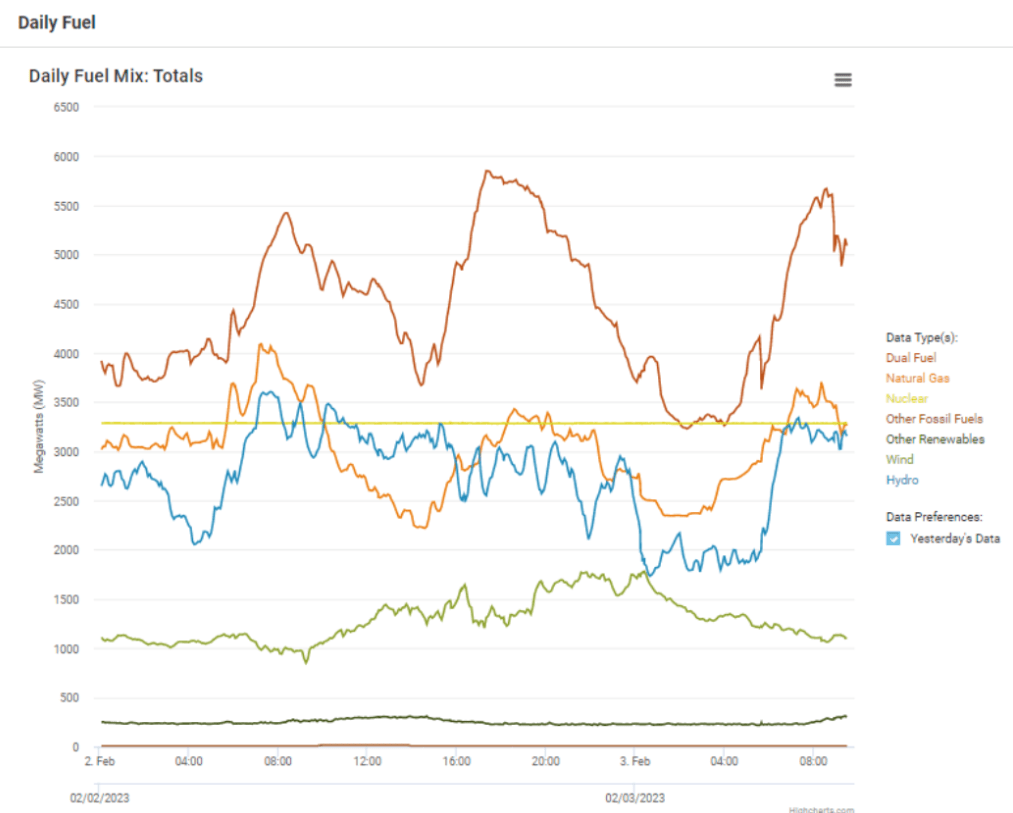
NYISO has repeatedly warned – and the Climate Action Council’s Scoping Plan admits – that wind and solar will not be sufficient. New York will need between 25 and 45 gigawatts of dispatchable power – power that unlike wind and sun, but like natural gas, fuel oil, and hydro, can be turned on and off at will. 

To comply with the Climate Leadership and Community Protection Act (CLCPA), these sources are supposed to be emissions free, leading NYISO to coin the ugly acronym DEFRs – dispatchable emissions-free resources. But they coined that term because they can’t identify any source that meets that standard and is currently available at utility scale and a commercially competitive price. 

This means that for the foreseeable future, fossil fuels will be the only proven source of dispatchable backup to keep the heat and lights on during weather that is killingly cold. Since New York no longer has any coal plants, that can be oil – which is more polluting and has higher carbon content – or natural gas. 

The CLCPA has a clear goal of eliminating all greenhouse gas emitting power production by 2040, which would mean shutting down all natural gas-fired power plants. But it also provides a path for keeping open those plants that are necessary to ensure a reliable electrical supply. That path, however, faces considerable political opposition. 

New York will soon be forced to make a choice: plunging forward with shutting down natural gas-fired power plants, risking rolling blackouts during extreme cold, or moving forward more slowly on its emissions goals, but keeping the heat on. There is no third way.

The Numbers

The past two days were ideally suited to staying inside.  I am a numbers guy so I spent time the last several days watching the weather and the electric system using two different resources.  The go to resource for weather observations in New York is the NYS Mesonet At UAlbany.  I watched the arctic air come into the region and then tracked the event over time.  The NYISO Real-Time Dashboard is a fascinating link into the New York electricity market.  I suspected correctly that this weather would cause a spike in electric load and I could see that play out over the period.

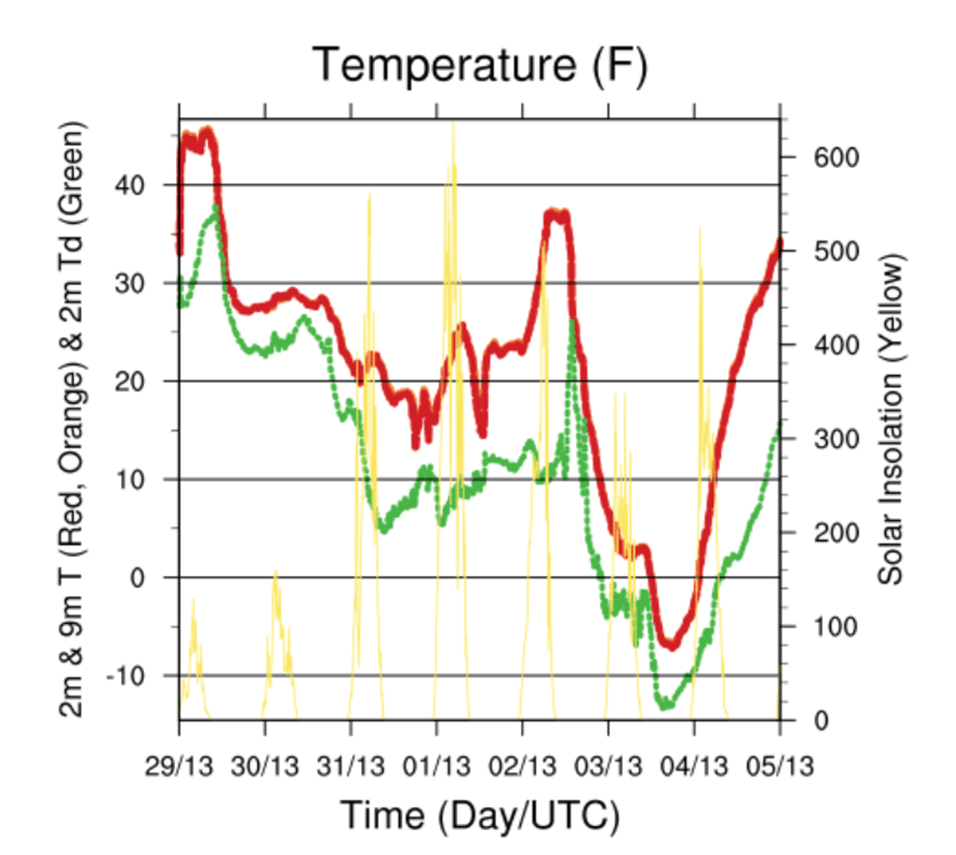
The weather data presented here is all from the NYS Mesonet at the University of Albany.  The following graph lists the last seven days of temperature, dew point temperature, and solar irradiance data at Elbridge, NY which is near my home.  Note that at the time I write this it is February 5 at 8:00 AM and that corresponds to 05/13 or 1300 universal coordinated time or Greenwich mean time, the standard for meteorological observations.  On the night of February 2 the temperature (red) was around 38oF about 7:00 PM EST or 0000 UTC.  Then the front came through and the temperature plunged overnight and during the day before briefly leveling out a few degrees above zero until nightfall when it dropped down to 7 or so below.
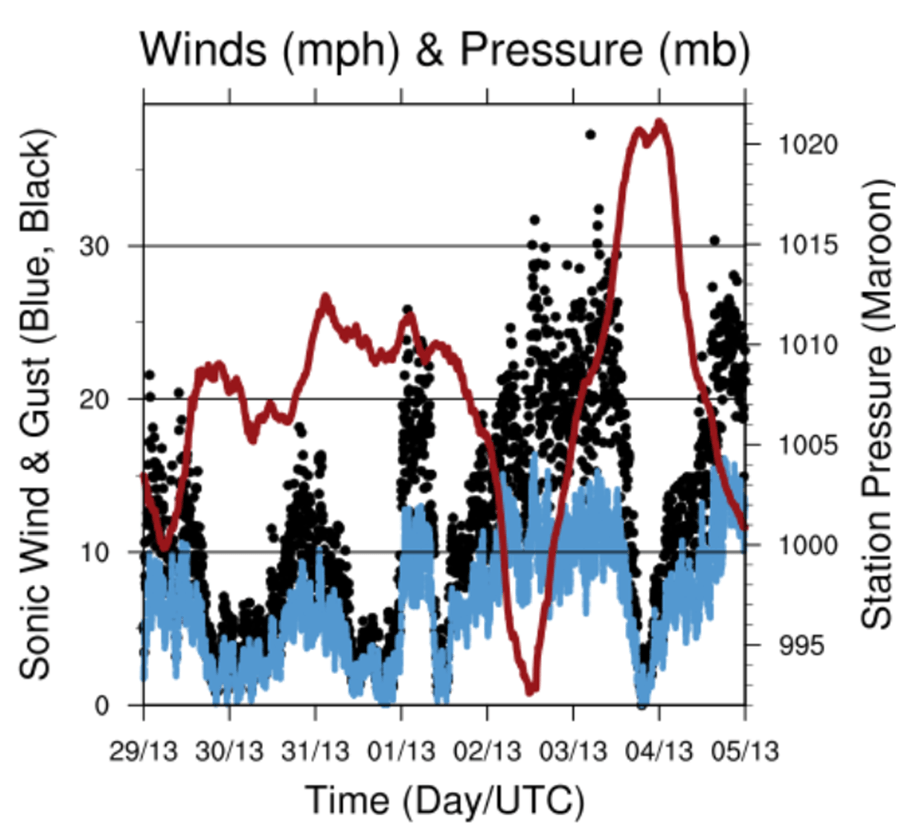
The next graph is for the same time period but shows the wind speed, wind gusts, and pressure.  Frontal passage was accompanied with a dip in the station pressure.  The pressure gradient was strong for most of the period so winds were steady slightly above 10 mph with gusts peaking at 38 mph.
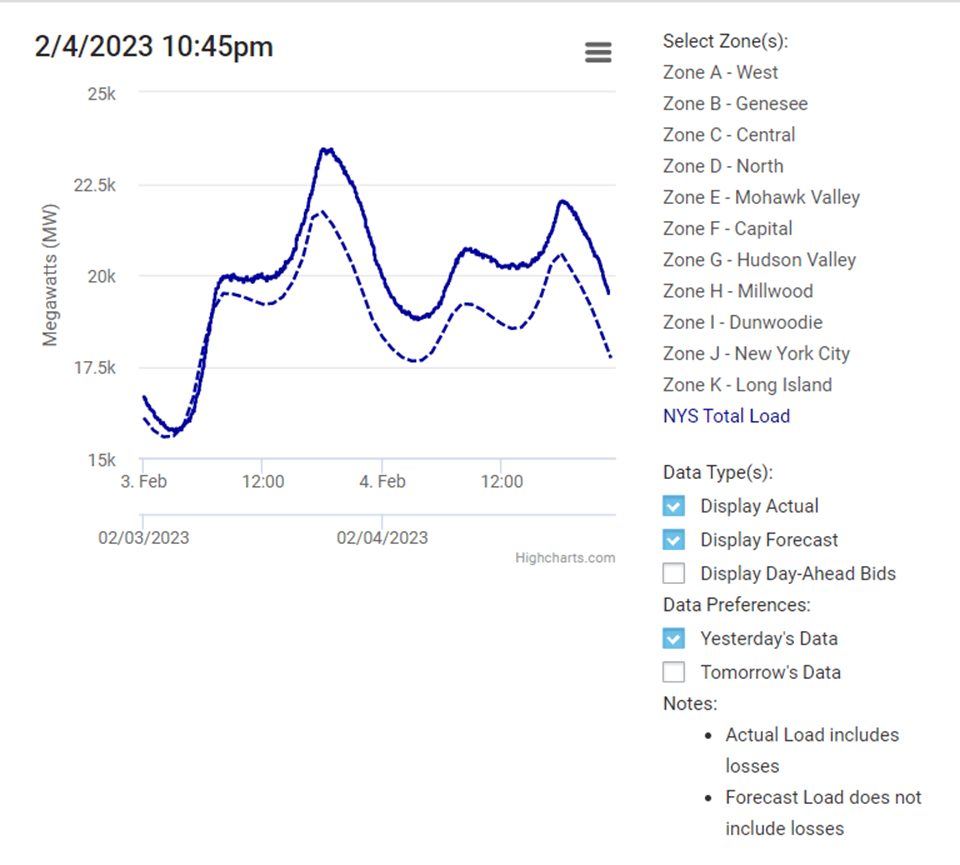
The NYISO Real-Time Dashboard has two relevant graphical displays:  the load and real-time fuel mix. The following graph shows the actual and forecast New York total load on February 3-4 (all times are EST).  It is noteworthy that the actual loads on both days were  significantly higher than forecast loads.  The load peaked on 2/3 at 6:50 PM at 23,447 MW and at 6:10 PM on 2/4 at 21,990 MW. 
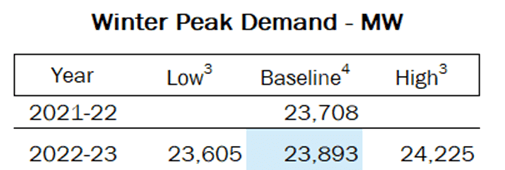
The NYISO 2022 Load and Capacity Data report winter peak demand projections are all greater than the observed peak loads so this should not have been a demand response problem with the existing fleet.
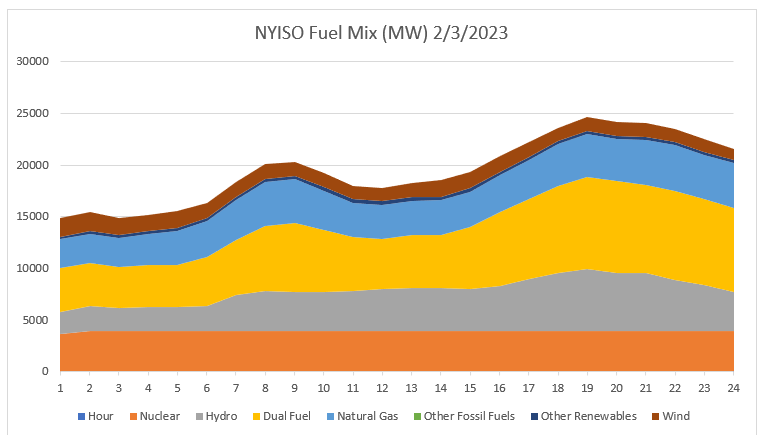
The real-time fuel mix data shows how the existing fleet met the peak loads during this weather event.  The following table lists the daily statistics for the different fuel types.  The fuel-mix categories are Nuclear; Hydro, including pumped storage; Dual Fuel, units that burn natural gas and other fossil fuels; Natural Gas only; Other Fossil Fuels, units that burn oil only; Other Renewables are facilities that produce power from solar, energy storage resources, methane, refuse or wood; and Wind (at this time exclusively land-based wind).
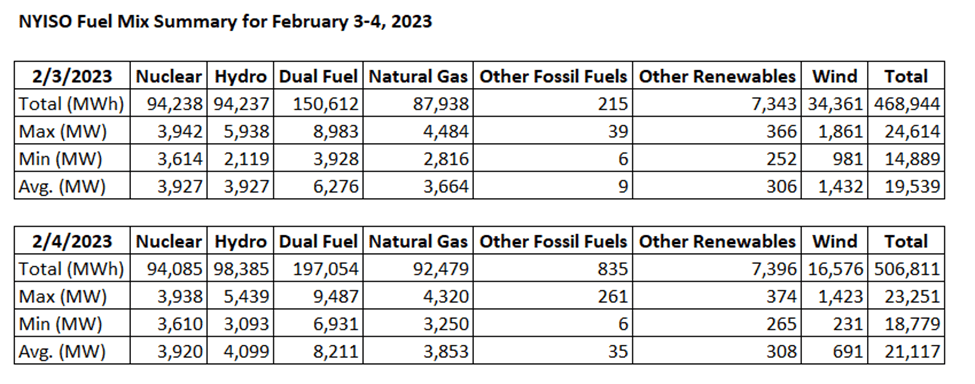
The graphs show how important the fossil fuel units are to keeping the lights on.  One notable feature of the fuel type data on 2/3 is that the wind generation was not very high even though winds across the state were quite high.  I believe this is because wind turbines don’t provide optimal power if the winds are too light or too strong.  The strong winds on this date apparently affected the wind production so even on a windy day New York’s land based wind provided only 65% of the maximum potential capability.
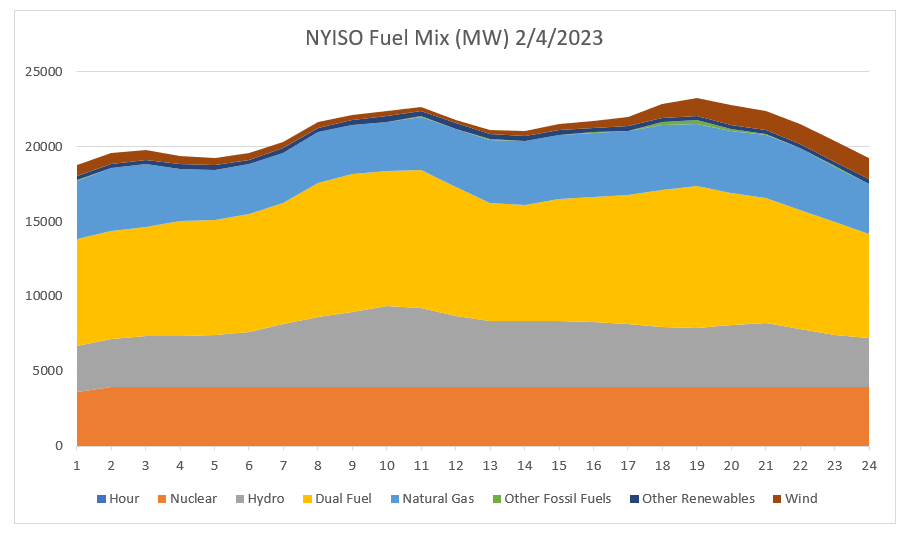
On 2/4/2023 the wind resource was affected by light winds.  On this date New York’s land based wind provided only 32% of the maximum potential capability.
Conclusion

Stevens explains how important it is for our safety and well-being to have fossil fuels available during extremely cold weather.  Hanley showed that natural gas played an important role keeping the lights on during this arctic blast and described some of the uncertainty associated with the planned net-zero transition.  My contribution was to provide more documentation for the weather, resulting electric load peak, and the contribution of different fuels to meeting that peak.  I am going to follow up on this post with a deeper dive into the resource availability and implications to the Scoping Plan recommendations for generating resource allocations.

Hanley’s conclusion is spot on:

New York will soon be forced to make a choice: plunging forward with shutting down natural gas-fired power plants, risking rolling blackouts during extreme cold, or moving forward more slowly on its emissions goals, but keeping the heat on. There is no third way.
Empire Center Ten Reasons Climate Act May Cost More Than It Is Worth

James Hanley from the Empire Center published Ten Reasons the Climate Leadership and Community Protection Act May Cost More than It’s Worth (“Ten Reasons”) that explains why massive political promises like the Climate Leadership & Community Protection Act (Climate Act) often cost more than they’re worth, wasting taxpayers’ money.  While I agree with his ten reasons, this post explains why the costs are even worse than he describes.

I submitted comments on the Climate Act implementation plan and have written over 275 articles about New York’s net-zero transition because I believe the ambitions for a zero-emissions economy embodied in the Climate Act outstrip available renewable technology such that the net-zero transition will do more harm than good.  The opinions expressed in this post do not reflect the position of any of my previous employers or any other company I have been associated with, these comments are mine alone.

Background

The Climate Act established a “Net Zero” target (85% reduction and 15% offset of emissions) by 2050. The Climate Action Council is responsible for the Scoping Plan that outlines how to “achieve the State’s bold clean energy and climate agenda.”  In brief, that plan is to electrify everything possible and power the electric gride with zero-emissions generating resources by 2040.  The Integration Analysis prepared by the New York State Energy Research and Development Authority (NYSERDA) and its consultants quantifies the impact of the electrification strategies.  That material was used to write a Draft Scoping Plan that was revised in 2022 and the Final Scoping Plan  was approved on  December 19, 2022.  In 2023 the plan is to develop regulations and legislation to implement the Scoping Plan recommendations.

In the following section I reproduce Hanley’s post with my bold italicized comments.

Ten Reasons

Over budget, over time, over and over – that’s the iron law of megaprojects.  

Megaprojects are transformational, multi-billion-dollar, multi-year projects involving numerous public and private stakeholders. 90 percent come in over budget, often two, three or even more times over, and they often underdeliver on the promised benefits.  

In short, despite political promises to the contrary, they often cost more than they’re worth, wasting taxpayers’ money. 

Some notable examples of megaproject cost overruns include California’s high speed rail (years behind schedule and at least three times over budget), Boston’s Big Dig (completed five years late and more than five times over budget) and New York’s own Long Island Railroad East Side Access (12 years behind schedule and – with a budget that’s grown from $3.5 billion to between $11 and $15 billion – three to four times over budget). And that’s not New York’s only over-budget transit project

Those are all small potatoes compared to New York’s Climate Leadership and Community Protection Act (CLCPA). The overall benefit-cost analysis for the CLCPA predicts a cost of $280-$340 billion – around 20 times the cost of the East Side Access project – to radically transform New York to a net-zero greenhouse gas emissions economy. The benefit is supposed to be $420-$430 billion, for a net gain of $80-$150 billion.  

The Scoping Plan benefit-cost analysis is a shell game disguising misleading and inaccurate information.  In short, the $280-$340 billion costs only represent the costs of the Climate Act itself and not the total costs to meet the net-zero by 2050 target.  The Scoping Plan costs specifically exclude the costs of “Already Implemented” programs including the following:

  • Growth in housing units, population, commercial square footage, and GDP
  • Federal appliance standards
  • Economic fuel switching
  • New York State bioheat mandate
  • Estimate of New Efficiency, New York Energy Efficiency achieved by funded programs: HCR+NYPA, DPS (IOUs), LIPA, NYSERDA CEF (assumes market transformation maintains level of efficiency and electrification post-2025)
  • Funded building electrification (4% HP stock share by 2030)
  • Corporate Average Fuel Economy (CAFE) standards
  • Zero-emission vehicle mandate (8% LDV ZEV stock share by 2030)
  • Clean Energy Standard (70×30), including technology carveouts: (6 GW of behind-the-meter solar by 2025, 3 GW of battery storage by 2030, 9 GW of offshore wind by 2035, 1.25 GW of Tier 4 renewables by 2030)

The Scoping Plan documentation is not sufficiently detailed to determine the expected costs of these programs or to determine if the benefits calculations included the benefits of the emission reductions from these programs.  I have not doubt, however, that if these costs are included that the total would be greater than the benefits and I suspect very strongly that the benefits from these programs were included even if the costs were not. The shell game definition: “A fraud or deception perpetrated by shifting conspicuous things to hide something else”  is certainly an apt description of the Scoping Plan benefit-cost analysis.

That’s a good deal, if it really works out that way. Unfortunately, based on the history of megaprojects, it’s unlikely to provide so much benefit.  

Based on my evaluation it is not a good deal from the get go.  All of Hanley’s discussion of megaprojects below is in addition to the inaccurate starting point.

If we take the lower end cost estimate and assume the policy only costs half again as much – which would make it a rare megaproject success story – the cost would rise to $420 billion, exactly wiping out the lower end estimate of the gains.  

If it came in at twice the low-end cost estimate – which is common for such big and complex programs – it would cost $560 billion, resulting in a net loss of at least $220 billion. Three times over budget would mean a net loss of at least $410 billion – closing in on half a trillion dollars wasted. 

And if the benefits are less than predicted – which is also common – the outcome gets even worse. 

The issue is not that there aren’t any benefits. At least some of the claimed benefits are real. But just like buying a car or a meal, it’s possible to overpay for what we’re getting.  

Part of the general reason for the predictable cost overruns is that these projects tend to be exceptionally complex and innovative, novel ideas which nobody really knows how to execute well due to lack of experience. New York’s CLCPA-supporting politicians and advocates love to boast about the CLCPA being a nation-leading policy, which is to say it’s something nobody has experience doing. 

Another reason – known both from research and from the mouth of a famous politician – is that advocates sometimes intentionally mislead the public about the costs and benefits of megaprojects. Perhaps no CLCPA supporters are consciously lying about its costs, but it seems evident that it would be uncomfortable for them to dig deeply into the issue of megaproject cost, and whatever doubts they may have they are not voicing them.  

Ultimately the Climate Act is a political initiative designed to appeal to specific constituencies within the state.  In that context the Scoping Plan itself is just a tool to cater to those constituencies.  Authors of the Scoping Plan may not have lied but they did intentionally mislead the public as I have explained in posts and comments.  The response to comments submitted did not address any of the issues I raised.

But we shouldn’t look at the CLCPA as just a single megaproject. It’s actually a large group of them. Among the projects within the CLCPA that are, or may ultimately scale up to the size of, megaprojects are:  

  1. The build-out of electric vehicle charging infrastructure; 
  2. Transitioning the state’s school buses to all electric; 
  3. Transitioning the state’s public transit buses to all-electric; 
  4. Promotion of smart-growth for mobility-oriented (biking and walking) development. 
  5. Electrifying 85 percent of residential/commercial space by 2050; 
  6. Achieving 70 percent renewable electricity by 2030; 
  7. Developing 6 megawatts of battery storage; 
  8. Building 9,000–18,000 megawatts of offshore wind; 
  9. Building the grid for renewable energy transmission; 
  10. The overall agricultural and forestry portion of the CLCPA Scoping Plan
  11. Achieving dramatic reductions in the amount of solid waste being produced and disposed of; 
  12. Decarbonizing the statewide natural gas distribution system. 


That comes to at least 12 distinct policy areas within the CLCPA that are each likely to be multi-billion dollar projects on their own. Depending on how one analyzes the Act and its Scoping Plan, this may be an incomplete list. 

Keep in mind the “already implemented program” costs in the $280-$340 billion costs of the Scoping Plan.  Those programs at least include: The build-out of electric vehicle charging infrastructure; transitioning the state’s school buses to all electric; transitioning the state’s public transit buses to all-electric; developing 3 MW of the 6MW of battery storage; and building 9,000 MW of the 18,000 MW of offshore wind.

This means at least 12 opportunities for mega-failure in the CLCPA. And with 90 percent of megaprojects coming in over budget, we should expect at least 10 or 11 of these to experience substantial cost overruns. 

But saying that megaprojects tend to come in over budget and short on benefits is not enough. It’s fair to ask why this particular set of megaprojects that collectively make up the CLCPA are likely to do so. So, in addition to the sheer innovative complexity of the CLCPA’s bid to transition New York to a net zero economy, here are 10 reasons why the Climate Act’s costs may be understated, and its benefits overstated. 

  1. Inflation Bites   
    Projects that take multiple years to complete face the risk of inflation. When the CLCPA’s benefit-cost analysis was conducted, the analysts could not have anticipated that inflation would surge, pushing up the cost of materials and labor. Particularly hard hit so far have been offshore wind projects. 

    Inflation has moderated somewhat lately, but on-going large federal deficits could cause it to remain at higher levels than anticipated.
  1. Cap-and-Invest May Cause Business Flight
    Policies that cap emissions of particular chemicals, then reduce those caps over time and allow trading of emissions allowances, can be the most cost-effective way of reducing emissions when done at the national or multi-national level. Even if businesses move their operations to another country, a tariff on their emissions can be levied to either make businesses pay for those emissions or incentivize firms to reduce them.

    But cap-and-invest is ill-suited to the state level. First, it is easier for businesses to move out of state – or refuse to move into the state – than to move out of country. It is likely that other states competing for business investment will use the Empire State’s emissions cap as a way to leverage firms to look to their states for investment rather than to New York.

    This means a state-level cap-and-invest scheme is likely to diminish business investment, reducing the state’s economic growth and therefore tax revenues.

    Second, a state cannot enact an emissions tariff because it would violate the U.S. Constitution’s interstate commerce clause, so there is no cudgel to force emissions reductions on businesses that move operations out of state.  This means less overall reduction in greenhouse gas emissions because those emissions just occur elsewhere.

    This emissions “leakage,” and loss of tax revenue, can also occur if GHG-emitting in-state businesses become less competitive due to compliance costs and lose market share to out-of-state competitors.

    This kind of leakage has long plagued California’s cap-and-trade program. In New York’s case, because a majority of the CLCPA’s claimed benefits come from greenhouse gas reductions, it means a potentially very large reduction in the benefits of the policy.

    To minimize business flight and emissions leakage, the Climate Action Council proposes giving away emissions allowances to emissions-intensive and trade-exposed businesses – those that are most likely to find it more cost-effective to leave than to buy emissions allowances. But this may only be a temporary reprieve for these industries, as the number of emissions allowances is required to decline over time, and some businesses may never find it more cost-effective to reduce their emissions than to move operations out of state.

    Giving away emissions allowances also means the state will take in less revenue from auctions of emissions permits, having given away many for free, and so will have less money to invest in CLCPA policies, further reducing the law’s benefits.
  1. Union Job Requirements Drive Up Costs
    The Climate Action Council’s Scoping Plan – the roadmap for Climate Act implementation – calls for the use of union labor and project-labor agreements. But jobs go on the cost side of the ledger rather than the benefits side, so anything that increases the cost of labor increases the overall cost of the policy.

    How much this will drive up the total cost of the Climate Act has not been analyzed, but past reporting by the Empire Center shows that prevailing wage requirements can add 13 to 25 percent to project costs. And it’s not as though there aren’t New Yorkers willing to give the public a better deal – around two-thirds of workers in New York’s construction sector are non-unionized, but they will be locked out of CLCPA projects.
  2. Overbuilding of Renewable Energy and Building Energy Backup Is Costly
    The most undeniable truth about wind and solar power is that they are unreliable – the wind can fail, the sky can become clouded or night can fall, just when you need the electricity most. According to the New York Independent System Operator, New York must develop 15-45 GW of dispatchable zero-emission electricity generation resources. That’s in comparison to a total of roughly 40 gigawatts of total installed capacity today, and it must be in addition to any new wind and solar power developments.

    At a minimum, this means we have to overbuild solar and wind resources in the hopes that somewhere in the state the wind will be blowing and the sun shining. But because New York is too geographically small to ensure that the wind is always blowing, or the sun always shining, somewhere in the state, New York will also need to build backup energy sources.

    What these greenhouse gas emission-free resources will be – and how much they will cost – is currently unknown, because none are yet commercially available or competitively priced. Hydrogen is a possibility, but the cost will have to fall dramatically and quickly to keep backup power affordable.

    Batteries are also intended to be part of the backup system, although they are only good for meeting peak demand for a few hours. They are currently very expensive, even though – like all technologies – the learning curve continues to push down their price. However, materials costs for batteries may remain high for years, because demand is growing rapidly while supply chains are hindered both by political opposition to minerals mining and geopolitical constraints on mining and refining.
  3. The Cost of Redeveloping the Grid Is Unpredictable
    New York currently has, in effect, two largely – although not completely – separate power grids. One is upstate and draws heavily on hydroelectric and nuclear power. The other is mostly downstate and based on natural gas and dual-fuel power plants. Both are based on controllable and dispatchable forms of electricity production.

    To eliminate fossil fuel electricity generation and rely much more heavily on variable, uncontrollable, sources like wind and solar, New York must expand its transmission grid to move electricity from where it will be produced – primarily upstate and off-shore – to where it is needed. But this grid will have to be built so that energy can be delivered from whichever sources happen to be producing at a given time, which means more miles of high voltage transmission lines than ever before.

    Experts can make a first-pass estimate of the cost of building out all this new transmission, but the complexity of working through multiple political jurisdictions and satisfying numerous stakeholders is one of the leading causes of megaproject cost overruns. Few people want high-voltage transmission lines near their homes, and merely fighting the political battles to site these lines across numerous municipalities and counties could drive up the end cost significantly.

There is another aspect of the transmission system that the Scoping Plan glossed over.  Because wind and solar resources are inverter-based they do not provide ancillary services necessary to keep the transmission system stable.  As far as I can tell this issue was not addressed by the Scoping Plan and that means there are unaddressed technological and cost issues.

  1. The Jones Act Increases Offshore Windpower Costs
    The Jones Act is a law requiring ships moving cargo between U.S. ports to be U.S. built, owned, crewed, and flagged. There are no Jones Act compliant off-shore wind turbine building vessels in the U.S., although at least one is under construction (at an inflated cost because it has to be U.S. built). Because of the Jones Act, the available ships have to operate out of Canada or rely on the more expensive and dangerous process of having Jones Act compliant “feeder barges” bring materials out to the work site.
  2. The True Social Cost of Carbon Is Unknown
    Most of the benefit of the Climate Act doesn’t go to New Yorkers but is a world-wide benefit from the reduction of CO2 emissions. To estimate this benefit, a social cost per ton of CO2 has to be estimated. New York’s Department of Environmental Conservation (DEC) set the cost at $124 per ton for 2022, rising each year.

    But nobody truly knows the social cost of CO2. The number varies wildly between different models used to estimate it. The Biden administration has tentatively set the social cost of CO2 at $51 per ton, while it works to develop a new official estimate. Even if their estimate comes in higher than the tentative setting, it may be considerably lower than what the DEC estimates.

    Even the DEC’s own estimates diverge dependent on the discount rate used, and they chose to use only low discount rates that mathematically increase the social cost of CO2 emissions. There is no expert agreement on what discount rate should be used, and if a higher discount rate was used the social cost of CO2 would be much lower, and therefore the benefit from eliminating it would be much lower.

    While it’s not impossible that the DEC has underestimated the social cost of carbon – which would make the benefits of the CLCPA even larger than estimated – it’s at least as, if not more, likely that they’ve overestimated the social cost for political reasons, meaning the benefits could be far lower than predicted.

The primary driver of the benefits is the social cost of carbon and Hanley’s description of these issues is spot on.  There are other issues associated with social cost of carbon that I discussed in my Draft Scoping Plan comments.  The biggest inaccuracy is that it is inappropriate to claim social cost of carbon benefits of an annual reduction of a ton of greenhouse gas over any lifetime or to compare it with avoided emissions. The Value of Carbon guidance incorrectly calculates benefits by applying the value of an emission reduction multiple times.  Using that trick and the other manipulations results in New York societal benefits more than 21 times higher than benefits using everybody else’s methodology. When just the over-counting error is corrected, the total societal benefits range between negative $74.5 billion and negative $49.5 billion. 

  1. Some Alleged Benefits Are Dubious
    Not all of the claimed benefits in the benefit-cost analysis pass the sniff test. The most dubious of these is the assumption that indoor trip-and-fall hazards will be mitigated while weatherizing homes, producing almost $2 billion in health improvements. But there is no inherent connection between weatherization – replacing old windows adding insulation, sealing drafts – and removing interior trip hazards. It could happen, but to say it will is purely speculative.

    Another dubious assumption is that people will walk and bike significantly more, creating a claimed $40 billion health benefit – nearly 10 percent of all estimated benefits. But this requires major reconstruction of cities and reduced suburbanization, all in less than three decades. If that doesn’t happen and people fail to change their behavior, this benefit will be drastically reduced at best, and quite possibly come in at close to zero.

My comments on Scoping Plan benefit claims agreed with these dubious claims and also noted that the if the claims related to air quality improvements were accurate then we should be able to observe improvements due to the sixteen times greater observed air quality improvements than the projected improvements due to the Climate Act.  Until their projections are verified, I do not accept their projections.

  1. Subsidies Will Need to Increase, Creating Deadweight Economic Losses
    The Scoping Plan proposes transitioning most homes to heat pumps. Currently the only subsidies are $5,000 for geothermal systems, which is too small an amount to enable moderate- to low-income homeowners to afford them. To accomplish this goal, subsidies will have to increase substantially. Most likely this subsidy will be paid for by increases in utility rates, a de facto tax increase on ratepayers.

    But both taxes and subsidies create deadweight economic losses, increasing the cost of the policy in ways that were probably not accounted for in the benefit-cost model.

    The loss caused by the subsidy will be at least partially offset by the positive externality of reduced carbon emissions, but how much so is challenging to determine (in part because we don’t know the social cost of CO2). Ultimately, the size of these deadweight costs is unknown – and may remain so – but they are real and potentially significant.
  2. There Is No Focused Benefit-Cost Analysis of Individual Projects
    The benefit-cost analysis is a global analysis of the whole Climate Act, produced before the consultants even knew what specific policies would be proposed. None of the individual policies proposed have received a focused benefit-cost analysis.

    Even getting those right might be challenging, given that so many of these individual projects are megaprojects all on their own. But by focusing on specific policies, there is at least a better chance of achieving accuracy.

    An example of a missed opportunity is the requirement that all school districts shift to electric school buses. This will cost at least $8 – $15 billion – a broad estimate that needs to be narrowed down – but the value of the benefits is unknown. While benefits such as reductions in air pollution and improvements in student health are real, we have no dollar amount estimate of them.

    We do know that much of the benefit could be gained less expensively by shifting to clean fuel vehicles or buying newer – cleaner burning – diesel buses. Which of these approaches would provide the best benefit to cost ratio, making for the best use of taxpayer dollars? We don’t know because no analysis was conducted before creating the policy. 

Conclusion  

Perhaps not all these problems will come to pass. Inflation could moderate and remain low. Business flight and avoidance of New York due to cap-and-invest might be reduced if other states join a regional plan. Supply chain challenges for battery materials might be overcome. But others are sure to play a role, such as unionization of green jobs, the effect of the Jones Act, and the deadweight economic loss from subsidies and taxation. In addition, there could be other issues not addressed here that could cause CLCPA costs to increase. This is not intended to be a complete list.  

For these reasons, as well as the dismal history of such gigantic public ventures, it’s virtually certain that at least some, if not most, of the individual megaprojects within the CLCPA will be over budget. By how much is anyone’s guess, but it takes an unwarranted leap of faith to be confident that this time will be different. And as noted above, all it would take is for the cumulative effect of budget overruns to push the CLCPA’s cost up by half – a far better performance than most megaprojects – to completely wipe out any gains.

When the fact that the Scoping Plan costs do not include the “already implemented” programs are considered this analysis is overly optimistic.  Even without considering all the problems described in this analysis the total costs of all the programs necessart to meet the net-zero by 2050 target are greater than the alleged and impossibly optimistic benefits cited in the Scoping Plan.  Any claims that the costs of inaction are greater than the costs of inaction by proponents of the Climate Act are simply wrong.

Climate Act Scoping Plan Toolkit

The Climate Leadership & Community Protection Act (Climate Act) website was extensively revised at the start of 2023.  It includes a link for the Scoping Plan Toolkit which is described as “resource to help community and partner organizations” with specific “resources to facilitate conversations about New York’s climate work.”  As I was working on an article about the cap and invest program I noticed that there were two fact sheet pdf files for cap and invest: Cap-and-Invest One Pager [PDF] and Cap-and-Invest vs. Cap-and-Trade vs. Carbon Tax [PDF].  This is a short post about the new format of the website and the cap and invest “toolkits”.

The opinions expressed in this post do not reflect the position of any of my previous employers or any other company I have been associated with, these comments are mine alone.

Climate Act Website

The Climate Act website was revised at the start of 2023.  Now it is a public relations site to sell the Climate Act.  It has been revised so that it is more accessible to smart phones with large text fonts and splashy graphics.  The main internal links cover “Our Impact”, “Get Involved”, News & Events”, “Resources” and “Partner Toolkit”.  I list the links within each of these categories below:

“Our Impacts”

“Get Involved”

“News & Events”

“Resources”

“Partner Toolkit” Fact Sheets

There is blog post fodder in every one of these links. For example, the lead for the Addressing Energy Affordability Concerns link says “As energy prices rise, we must power our future focused on clean and renewable resources.”  Not included in the platitudes and talking points within the link is a reference to the experience of any jurisdiction that has pushed the use of wind and solar resources over fossil fuel that has actually lowered consumer bills.  It is all flash and style for pushing the narrative without substance. 

Cap and Invest Toolkit Fact Sheets

This post is going to introduce issues associated with the cap and invest toolkits.  There are two fact sheets for the cap and invest program:  Cap-and-Invest One Pager [PDF] and Cap-and-Invest vs. Cap-and-Trade vs. Carbon Tax [PDF].  When I first started looking at these resources. I found that they both linked to the cap and invest program one pager.  I alerted a contact I have known for years because there is no contact on the web pages.  The next morning the link to the Cap-and-Invest vs. Cap-and-Trade vs. Carbon Tax  was changed so someone else caught the problem.  I also question the label of the one pager document. The author’s interpretation is that a one pager means two sides of one page.  I think the generally accepted implication is to condense the summary to a single page.

I am going to do a more detailed post on the cap and invest plan toolkits but for now I just want to make one point.  Both fact sheets extoll the virtues and success of the Regional Greenhouse Gas Initiative (RGGI) cap and invest program.  New York utilities have been covered by that program since 2009 and New York agencies never lose the opportunity to claim that it has been a success.  I have been involved in the RGGI program process since its inception and have written many articles about the details of the RGGI program.

In early December I evaluated the 2020 RGGI Investment Proceeds report that describes the results of RGGI investments over the entire region.  I found that since the beginning of the RGGI program CO2 emissions have been reduced more than 50% but that RGGI funded control programs have been responsible for only 5.6% of the observed reductions.  The main reason for the reductions has been fuel switching to natural gas.  When the sum of the RGGI investments is divided by the sum of the annual emission reductions the CO2 emission reduction efficiency is $818 per ton of CO2 reduced. 

In late December I did a similar analysis of just the New York investment proceed results.  I found that in New York since the beginning of the RGGI program CO2 emissions have been reduced 39% in 2021 but the reduction was 47% until the State shutdown the Indian Point nuclear station.  The RGGI funded control programs have been responsible for only 16% of the observed reductions.  The main reason for the reductions has been fuel switching to natural gas.  When the sum of the RGGI investments is divided by the sum of the annual emission reductions the CO2 emission reduction efficiency is $565 per ton of CO2 reduced. 

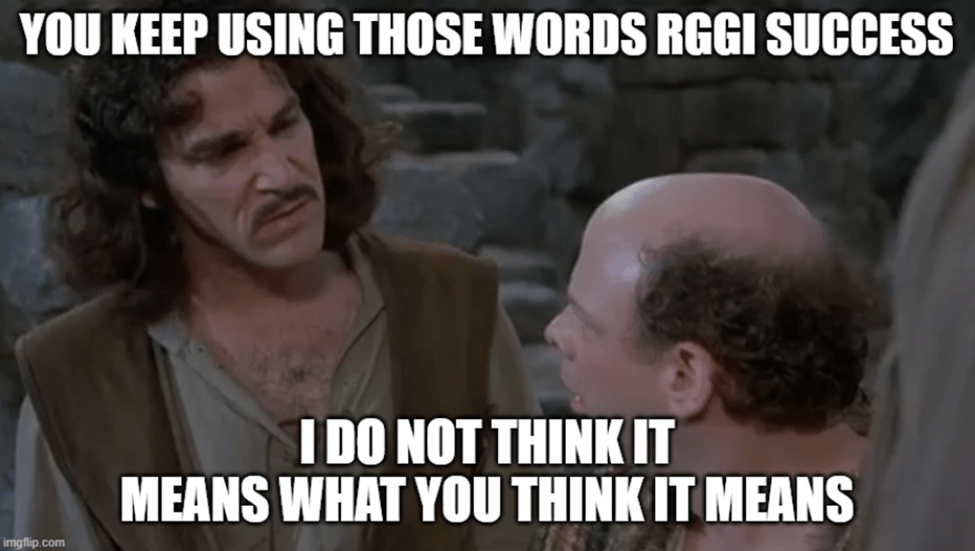
I conclude that RGGI is not an effective CO2 emission reduction program and that because the emission reduction efficiency of the RGGI investments is far greater than any social cost of carbon metric yet proposed that the investments are not cost-effective.  RGGI success is the eye of the beholder.

The Climate Act and Gas Stove Bans

Mention of a ban on gas stoves recently caused a national uproar.   Closer to home the New York State Climate Leadership & Community Protection Act (CLCPA) implementation plan calls for zero-emission equipment, including stoves, in new and existing buildings.  When pressed about New York’s plans Governor Hochul said “”I know it’s a concern because a lot of people are misrepresenting what this is all about”.  I think the misrepresentation is on the part of the Hochul Administration,

I submitted comments on the Climate Act implementation plan and have written over 275 articles about New York’s net-zero transition because I believe the ambitions for a zero-emissions economy embodied in the Climate Act outstrip available renewable technology such that the net-zero transition will do more harm than good.  The opinions expressed in this post do not reflect the position of any of my previous employers or any other company I have been associated with, these comments are mine alone.

Background

The Climate Act established a “Net Zero” target (85% reduction and 15% offset of emissions) by 2050. The Climate Action Council is responsible for the Scoping Plan that outlines how to “achieve the State’s bold clean energy and climate agenda.”  In brief, that plan is to electrify everything possible and power the electric gride with zero-emissions generating resources by 2040.  The Integration Analysis prepared by the New York State Energy Research and Development Authority (NYSERDA) and its consultants quantifies the impact of the electrification strategies.  That material was used to write a Draft Scoping Plan that was revised in 2022 and the Final Scoping Plan  was approved on  December 19, 2022. 

There are multiple aspects of a ban on gas stoves that I have wanted to address.  Fortunately, most of the points I wanted to make have already been made so this post is more of an overview of other work than original effort on my part.

Childhood Asthma and Gas Stoves

The initial reason for the recent uproar about gas stoves was a study published in an open-source journal called Population Attributable Fraction of Gas Stoves and Childhood Asthma in the United States (Gruenwald et al., 2022).  The sound bite takeaway from the study was that gas stoves are responsible for 12.7% of childhood asthma in the US.  I don’t have a lot of faith in any study that claims an air pollution association with asthma rates but was not relishing trying to develop an analysis.

Blair King writing on his blog did a masterful job eviscerating the claims in the paper.  In brief, the study was based upon a 2013 paper that used old data from the 1980’s and 1990’s.  The analysis was done using a 70-year-old statistical tool called PAF which is widely used in epidemiological studies.  However, the tool breaks down when multiple risk factors (confounding variables) are present.  For asthma, there are no fewer than seven risk factors so the analytical tool becomes useless.  I recommend reading his article but the conclusion nails the issue:

To conclude, I can only restate that the Gruenwald et al paper seems to have some clear challenges that would typically preclude it from consideration in a policy-making process.

  • Its underlying data is of low statistical power.
  • Its conclusion is directly contradicted by more recent studies with significantly greater statistical power. and
  • It relies on a statistical tool that is considered invalid in situations with confounding variables yet it is being used to analyze an association that is absolutely rife with confounding variables.

Put simply, this is not the study I would rely on to make a major policy change that will affect millions of people and will cost billions to implement. As to its conclusion: are 12.7% of childhood asthma cases in the US attributable to cooking with natural gas? Based on the points above, that conclusion is almost certainly not the case.

This isn’t the first time that a study that is weak science is used as an argument for sweeping policy changes.  What did surprise me is how quickly the story raced through the media.  Robert Bryce explained how that happened in his post The billionaires behind the gas bans.  I highly recommend that you read the whole thing but I present some highlights below.

He explained that he started looking into a new organization called the Climate Imperative Foundation in late 2021 when he read a story that the new group has a planned budget of $180 million annually over five years for a total of $900 million.  When he investigated the source of the money, he discovered that two of the  most recognizable names on the six-person board are Silicon Valley venture capitalist John Doerr and Laurene Powell Jobs, the widow of late Apple CEO Steve Jobs. Forbes magazine estimates that Doerr has a net worth of $12.7 billion. Forbes puts Jobs’ net worth at $17.7 billion. Unsurprisingly Bryce found that most of the money is coming from Doerr and Jobs.

His article explains why the emergence of the Climate Imperative Foundation is important:

First, it shows that the effort to “electrify everything” and ban the use of natural gas in homes and businesses – and that includes gas stoves — is part of a years-long, lavishly funded campaign that is being bankrolled by some of the world’s richest people.

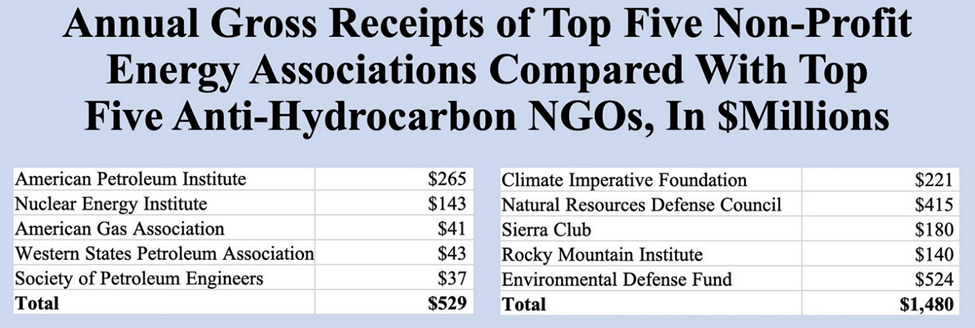
Second, despite numerous claims about how nefarious actors are blocking the much-hyped “energy transition,” the size of Climate Imperative’s budget provides more evidence that the NGO-corporate-industrial-climate complex has far more money than the pro-hydrocarbon and pro-nuclear groups. Indeed, the anti-hydrocarbon NGOs (most of which are also stridently anti-nuclear) have loads of money, media backing, and momentum. As can be seen in the graphic below, the five biggest anti-hydrocarbon NGOs are now collecting about $1.5 billion per year from their donors. (All data is from Guidestar.) That sum is roughly three times more than the amount being collected by the top five non-profit associations that are either pro-hydrocarbon or pro-nuclear.

Third, banning the direct use of natural gas in homes and businesses may be worse for the climate. You read that right. Burning gas directly allows consumers to use about 90% of the energy contained in the fuel. Using gas indirectly — by converting it into electricity and then using that juice to power a heat pump, stove, or water heater — wastes more than half of the energy in the fuel. That point was made by Glenn Ducat, in his excellent new book, Blue Oasis No More: Why We’re Not Going to “Beat” Global Warming and What We Need To Do About It. Ducat is a Ph.D. nuclear engineer who worked at Argonne National Lab, as well as at two electric utilities. He explains “Burning natural gas by residential commercial and industrial customers is at least twice as efficient and emits about half as much CO2 as processes that use electricity produced from fossil fuels. Converting process-heat applications to electricity before the electricity grid is completely carbon-free will increase CO2 emissions.” (Emphasis in the original.)

In the interest of full disclosure, I note that the New York plan is to eventually use electricity from zero-emissions sources.  However, there are life-cycle energy use issues with wind, solar and energy storage that mean the Climate Act transition does not reduces CO2 as much as it claims because of the efficiency of burning  natural gas directly for heating, cooking and hot water.

Bryce documents how the efforts to demonize gas stoves has rolled out since 2020.  One of the authors of the 12.7% asthma paper is employed by the Rocky Mountain Institute (RMI) which has published other articles that make the same claims.  He provides other evidence that this paper doesn’t stand up to scrutiny. 

He went on to investigate where RMI gets their funding. 

Some of it is coming from Amazon billionaire Jeff Bezos. In 2020, the Bezos Earth Fund gave RMI $10 million, which the group said will be used to “reduce GHG emissions from homes, commercial structures, and other buildings, enabling RMI to increase its current work with a coalition of partners in key states. The project will focus on making all U.S. buildings carbon-free by 2040 by advocating for all-electric new construction…”

Bezos also has provided $100 million grant to the National Resources Defense Council.  The Sierra Club is getting funds from Michael Bloomberg’s Bloomberg Philanthropies, including $500 million to the Beyond Carbon project.  His article clearly shows that the narrative that the fossil and nuclear industries are providing massive money to funding disinformation while the noble NGOs struggle to find enough money to counter their claims is false. 

Bryce makes two final points:

The first is the hypocrisy of billionaires funding efforts to slash hydrocarbon use while they are consuming staggering amounts of hydrocarbons. According to a 2020 article in Vanity Fair, Michael Bloomberg owns eight houses in New York state alone, and “he also reportedly owns several properties in London, Florida, Colorado, and Bermuda.” Thus, Bloomberg may own a dozen houses. How many of those houses have gas stoves? I’ll make a wild guess and bet that it’s more than one. Oh, and according to Vanity Fair, while he was mayor of New York, Bloomberg “was known to spend weekends” at his house in Bermuda, “traveling back and forth on private jets.” And what is fueling those private jets? I’m guessing here, but it’s probably not organic quinoa.

The final bit of hypocrisy at work here is the regressive nature of the gas bans. Indeed, it’s clear that banning natural gas will mean higher costs for consumers. Last March, in the Federal Register, the Department of Energy published its annual estimate for residential energy costs. It found that on a per-BTU basis, electricity costs about 3.5 times more than natural gas. It also found that gas was, by far, the cheapest form of in-home energy, costing less than half as much as fuels like kerosene, propane, and heating oil.

That means that efforts to ban natural gas are, in practice, an energy tax on the poor and the middle class. During a recent interview, Jennifer Hernandez, a California-based lawyer who represents The 200, a coalition of Latino groups that has sued the state over its climate policies, told me that “Natural gas is the last source of in-home affordable energy. And these climate extremists can’t stand it.”

The Scoping Plan and All-Electric Homes

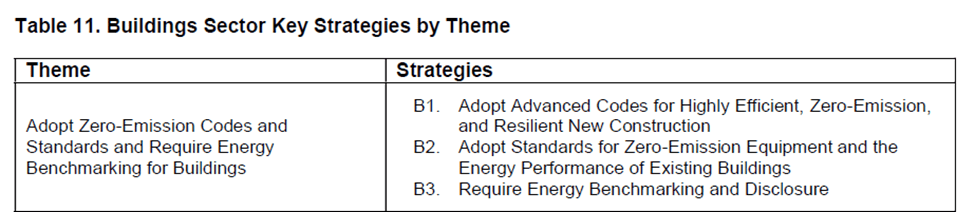
Governor Hochul has been pushing back on the notion that her Administration is coming after residential gas stoves.  The final thing I wanted to address was the Scoping Plan strategies for buildings particularly as they relate to electric appliances.  Table 11 (page 183) from the Scoping Plan Chapter on Buildings explicitly says adopt standards for zero-emission equipment.  Clearly that precludes gas stoves at some point.

James Hanley from the Empire Center wrote a great explanation of the truths of the Scoping Plan and the gas stove ban.  I reproduce his post in its entirety below:

Governor Hochul is pushing back against the fear that she’s coming after homeowners’ gas stoves. She insists that she’s not, and that she’d “like to deal in the truth here because a lot of that isn’t getting out.”  

Fair enough, so let’s deal with that truth. 

First, it’s true that Hochul didn’t recommend a gas stove ban in her 2023 State of the State address. While she did say she wants to “prohibit the sale of any new fossil fuel heating equipment by no later than 2030 for smaller buildings, and no later than 2035 for larger buildings,” she made no mention of prohibiting the sale of other fossil fuel appliances – stoves, hot water heaters, and clothes dryers. 

But the Governor’s silence on those appliances doesn’t settle the issue, and any suggestion that it does violates her urging that we “deal in the truth.” 

The truth is that the Climate Action Council’s Scoping Plan explicitly recommends banning sales of fossil-fuel fired hot water heaters in 2030 and fossil-fuel fired clothes dryers and stoves in 2035.  

The truth is that this Scoping Plan is the roadmap that the state legislature and all state agencies are supposed to follow to implement the Climate Leadership and Community Protection Act (CLCPA). 

The truth is that the Governor or her successor(s) could follow up this year’s recommendations for action in future years, or the legislature could on its own. 

The truth is that the Department of Environmental Conservation is supposed to make rules implementing the CLCPA and could begin the regulatory rule-making process to ban these appliances without the Governor’s direct prompting. 

And the truth is that advocates of eliminating all fossil-fuel equipment from New York’s economy are not going to give up in despair just because the Governor didn’t – at least not yet – advocate every recommendation from the Scoping Plan. 

There’s another, less visible truth, as well. The goal of anti-fossil fuel activists is to continually reduce the use of natural gas until the pipeline distribution system becomes economically unsustainable. The Scoping Plan has a whole chapter discussing the “strategic downsizing” of the gas system. And while the goal of making it economically unsustainable is not made explicit, it is the foreseeable result of this downsizing strategy.  

The more homes that are forced or incentivized to switch to all-electric, the fewer gas customers there are left to cover the cost of maintaining this large distribution system. That will put cost pressure on those remaining gas customers, forcing more of them to switch to electricity. That puts further cost pressure on the remaining customers, and so on, until maintaining the system is no longer financially sustainable. 

With this long-range strategy, no explicit ban is even necessary.  

This will not affect propane stoves and appliances, of course, because they are not fed by a pipeline system. So they may get at least a temporary reprieve. But they are clearly targeted by the Scoping Plan and anti-fossil fuel activists as well.  

In brief, while it’s true that Hochul did not propose a ban on replacement fossil fuel-powered appliances in this year’s State of the State address, there is plenty of time between now and 2035 for her, a successor, or the DEC to act in conformity to the recommendations set out in the state’s CLCPA Scoping Plan. Even if they don’t act to enact an explicit ban, the Scoping Plan lays out of goal of diminishing the infrastructure for gas delivery.  

So don’t believe those who are now naysaying the idea of a gas appliance ban. Gas and propane users will need to organize effectively to make their voices heard if they are to prevent a forced transition to electric appliances. 

For the record the Scoping Plan Chapter on Buildings on page 190 states the following for residential applications:

These zero-emission standards across a range of equipment types should apply starting in the years noted below.

2030: Adopt zero-emission standards that prohibit replacements (at end of useful life) of residential-sized equipment used for the combustion of fossil fuels for heating and cooling and hot water. The standards beginning in 2030 should regulate equipment sized to typically serve single-family homes and low-rise residential buildings with up to 49 housing units.

2035: Adopt zero-emission standards that prohibit replacements (at end of useful life) of fossil fuel appliances for cooking and clothes drying.

Discussion

It has been said of the Scoping Plan that “The plan is a true masterpiece in how to hide what is important under an avalanche of words designed to make people never want to read it”.   I have spent most of last year trying to interpret what is important and can confirm that statement.  It is a political document intended to push the agenda of the Hochul Administration which is apparently to pander to the emotional needs of the constituency that believes that there is a climate crisis and an easy and painless solution.  There are enormous ignored tradeoffs associated with the complete transformation of the energy system that has been built up over one hundred years to one with zero-emissions in the 27 years to 2050.  Nothing is as simple as portrayed in the Plan or the politician’s descriptions of what is going to happen. 

The biggest problem with the Scoping Plan is that it does not address any of the many “what if?” questions.  Consider the electrification of home cooking appliances in this regard.  I believe that the overarching what if question related to all-electric homes is what if there is an ice storm.  During an extended wintertime blackout, a gas or propane stove can be used for cooking and for limited heating.  An all-electric home without electricity has nothing. Those differences could mean a life or death situation.

Richard Ellenbogen mentioned some transition issues in a letter:

Additionally, if you ban the sale of gas ranges, what happens if your existing gas range breaks.  Do you have to rewire your home to install a new stove and then buy all new pots to work with an inductive cook top?  What are you supposed to do for cooking while you wait a month for an electrician to install a service that can cost thousands of dollars depending on the existing service?  I have a breaker panel within thirty feet of the stove in my house and my house has an existing 400 amp service which is far larger than most will.  Even if I had to switch ranges, it would cost at least $2000 for the electrical work, excluding patching and painting of the holes needed to run the cable, just to run the service.  That is beyond the cost of the range.  Inductive cook tops, which are safer and use less energy, are three times the cost of a gas range, independent of the $400 set of pots and pans that will work with it.   If the existing service and breaker panels were inadequate, you can add $6000 to that figure, at least.  What if you live in a high-rise apartment and the board or building management doesn’t have the funds to rewire the entire building when your stove breaks?  The gas range in my daughter’s apartment needed replacing.  We had a new one installed for $750, delivered.  Not that we could have installed an electric range anyway because the electrical service wasn’t there, but an equivalent inductive range started at $2000 and went up from there.  $2400 with pots and pans.  That was two years ago.

Finally, the effect of the billionaire funding sources should not be ignored.  Anyone associated in any way with the fossil fuel industry is portrayed as a shill such that their work should be disregarded as propaganda.  Because funding sources are a legitimate concern, I maintain that it is important to understand the source of anyone’s funding.  To say that an organization that gets its funding from a donor with a specific agenda is not exactly the same situation as a fossil fuel shill is naïve.  In both cases it does not mean that the results are wrong but that they must stand up on their merits.  (By the way that is the reason that my posts typically include references.)  In this instance the claims of significant health impacts of gas stoves do not withstand scrutiny so the publicized studies do not warrant banning their future use.

Conclusion

The Hochul Administration’s war on natural gas and propane is irrational.  While methane does have a more potent impact on the greenhouse effect than carbon dioxide in a molecular comparison, in the atmosphere methane does not have anywhere near the effect of carbon dioxide.  The atmospheric residence time is on the order of 12 years so methane does not build up in the atmosphere.  Furthermore, there is a large body of evidence showing that the claimed health impacts of methane combustion are weak.  Those fundamental flaws destroy the rationale to eliminate the use of natural gas and propane as planned in the Scoping Plan. 

On the other hand, there are significant benefits for the use of natural gas and propane. It is cheaper.  It is energy dense and can be transported easily so when it is combusted in a modern high efficiency appliance you get a lot of bang for the buck with relatively small impacts.  I suspect that many New Yorkers appreciate its dependability relative to electricity.  It allowed my family to survive two extended blackouts and I am not sure what we would have done without it.

I have found that New York’s emissions are less than one half of one percent of global emissions and that the average increase in global emissions is greater than one half of one percent.  In other words, even if we eliminate our emissions, the increase in global emissions will replace our reductions in less than a year.  That does not mean we should not do something but it does mean that we can and should take the time to be sure that the things we mandate do not do more harm than good.  Until such time that the Hochul Administration is held accountable to answer the what if questions not addressed in the Scoping Plan it is likely that the transition to net-zero will do more harm than good.

The politicians who are downplaying the idea of a gas appliance ban are just kicking the can down the road to be somebody else’s problem.  Someway or somehow every building in New York State is going to be electrified to the maximum extent possible according to the Scoping Plan.  Gas and propane users must make their voices heard if they are to prevent a forced transition to electric appliances. Please contact your elected officials and tell them we must have full accountability before a mandated transition.

Guest Post: South Shore Long Island Whale Die Off

This is a guest post by Mark Stevens, a regular reader at this blog.  Mark is a retired science and technology teacher from Long Island.  I have been meaning to do a post on whales and the offshore wind industry so this was timely.

What’s Going On

The NY Post reported a 7th dead whale washed up on the Jersey shore. A humpback washed up on the Amagansett shore in December. Eight dead whales in two months?  Moreover, David Wojick recently reported that on January 18, 2023 there was a NOAA fisheries media teleconference that noted:

Since January 2016, NOAA Fisheries has been monitoring an Unusual Mortality Event for humpback whales with elevated strandings along the entire East Coast. There are currently 178 humpback whales included in the unusual mortality event.  Partial or full necropsy examinations were conducted on approximately half of the whales. Of the whales examined, about 40% had evidence of human interaction, either ship strike or entanglement. And to date, no whale mortality has been attributed to offshore wind activities.

The transcript makes for fascinating reading.  The Fisheries spokespersons went to great lengths to make the point that no whale mortalities have been directly linked to offshore wind development.  But there were notable conditions in those statements: “We do not have evidence that would support the connection between the survey work and these recent stranding events or any stranding events in the last several years.”  The other key condition is that the offshore wind development is doing survey work now and not construction.  The open question is whether or not offshore wind development could kill whales.

Bloomberg reports that planned wind projects off the New England coast threaten to harm the region’s dwindling population of endangered right whales, according to a US government marine scientist.  The warning from a top National Oceanic and Atmospheric Administration official, obtained by Bloomberg under a Freedom of Information Act request, underscores the potential legal and environmental perils of offshore wind development along the coast.  Both initial construction of wind projects and decades of expected operation threaten to imperil right whales in southern New England waters, Sean Hayes, chief of the protected species branch at NOAA’s National Northeast Fisheries Science Center, said in a May 13 letter to Interior Department officials.  The department is weighing at least 10 proposals to install wind turbines in shallow Atlantic waters — projects key to fulfilling Biden’s 2030 goal.

The NOAA fisheries media teleconference claimed that survey work had not been linked to  whale strandings.  Surveys entail prolonged use of “machine gun sonar” emits an incredibly loud noise several times a second, often for hours at a time, as the ship slowly maps the sea floor.Mapping often takes many days to complete. A blaster can log hundreds of miles surveying a 10-by-10 mile site.

There are lots of ways this sonar blasting might cause whales to die. Simply fleeing the incredible noise could cause ship strikes or fish gear entanglements, the two leading causes of whale deaths. Or the whales could be deafened, increasing their chances of being struck by a ship later on. Direct bleeding injury, like getting their ears damaged, is another known risk, possibly leading to death from infection. So there can be a big time difference between blasting and death.  Sonar blasting in one place could easily lead to multiple whale deaths hundreds of miles away. If one of these blasters suddenly goes off near a group of whales they might go off in different directions, then slowly die.  It is not guaranteed that the dead whales will wash up on shore.

The NOAA fisheries media teleconference did not address construction impacts.  Sound travels 5 times faster in water and humpback whale sounds can travel thousands of miles according to Scientific American.  Pile driving the hundreds of enormous monopiles that hold up the turbine towers and blades will be far louder than the sonic blasters, especially with eight sites going at once. These construction sites range from Virginia to Massachusetts, with a concentration off New Jersey and Long Island.  This is shown to cause whale mortality.

The impetus for the The NOAA fisheries media teleconference was related to humpback whales strandings. However, some of the dead whales off New Jersey are endangered sperm whales. And there are the severely endangered North Atlantic Right Whales throughout the area where offshore wind developments are planned.

Offshore Wind and the Climate Act

New York’s Climate Leadership and Community Protection Act (Climate Act) established a “Net Zero” target (85% reduction and 15% offset of emissions) by 2050. The Climate Act requires that by 2030, 70% of electricity will be generated from renewable energy sources such as solar and wind and calls for the development of 9,000 megawatts of offshore wind energy by 2035.

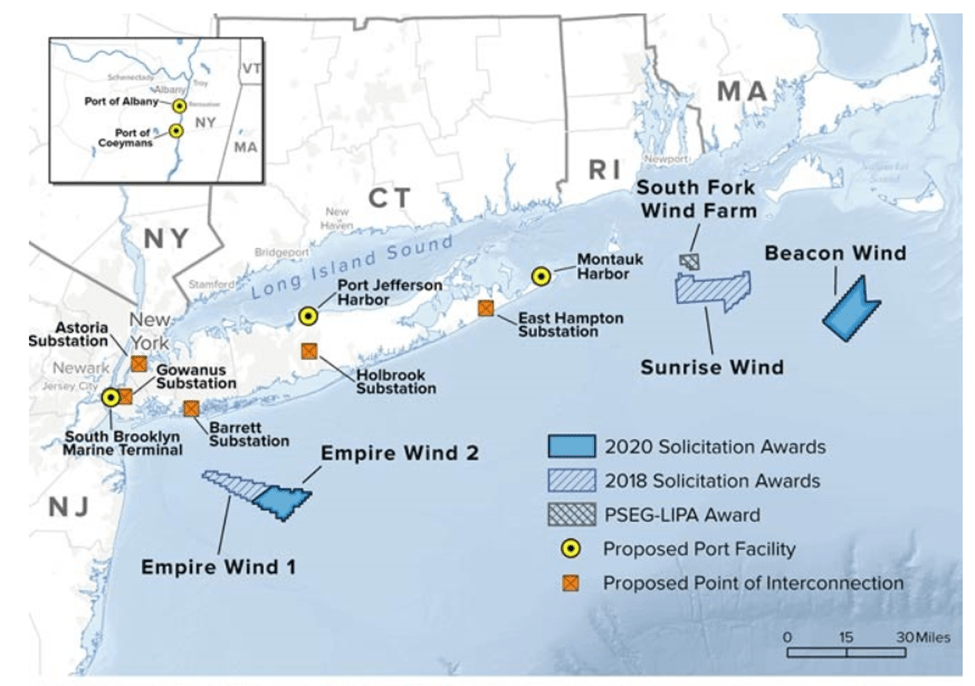
According to the New York State Offshore Wind Overview five projects have been procured: South Fork (132 MW), Empire Wind  1&2 (816 MW and 1,260 MW), Sunrise Wind (924 MW), and Beacon Wind https://www.beaconwind.com/about/(1,230 MW).  Unfortunately, the websites do not provide consistent information but the best guess number of turbines is 316 for a total of 4,362 MW.  At that rate, the 9,000 MW target will require 652 turbines with capacities between 11 and 15 MW.  On January 26, 2023 bids were due for another round of Climate Act offshore wind development.

Is it time to re-think offshore wind?

In order to do the offshore wind development site surveys an incidental harassment authorization is required.  The first  fact is that the huge 2016 jump in annual humpback mortality coincides with the huge jump in NOAA Incidental Harassment Authorizations.  The second fact is that this is just the start of whale harassment when hundreds of enormous monopiles are driven into the seabed for the massive deployment of offshore wind.  When construction gets into full swing there will be multiple pile drivers hammering away which can only result in impacts beyond incidental harassment.

In addition to the hundreds of bird strikes including bald eagles and others, wind turbines are massive killing machines here and around the world.  And the fact that they produce energy about ¼ of their nameplate capacity, cost hundreds of billions of dollars with huge taxpayer subsidies, are intermittent and still need fossil generation backup when the wind stops, require 10s of thousands of acres, have shortened life in the harsh marine environment; require more steel, concrete, copper, and materials than conventional generation of the same output; have monstrous fiberglass blades which are not recyclable, why are we blindly building them?  In addition, most wind projects are built by foreign companies. Do we want billions of ratepayer dollars and taxpayer subsidies going overseas?

According to a study by the Center For Management Analysis of CW Post/LIU, Dr. Matt Cordero determined repowering the Northport Power Station alone with state-of-the-art technology will produce 3500+ MW (more than Empire Wind), cut emissions over 90%, cost less than Empire, use fewer materials, use a fraction of the area that ALREADY EXISTS with a power station and in-place infrastructure, will have zero bird strikes and whale deaths, provide tax benefits for the community, will last decades longer and is on call 24/7 vs. intermittent (20% of the time) wind. 

Furthermore, intermittent wind and solar need massive battery backup and storage with huge costs, land requirements, massive pollution and greenhouse gas emissions for ore extraction and fabrication, and pose a deadly hazard to the region if it catches on an unextinguishable fire that emits deadly gasses.

Emission reduction by NYS will have an undetectable effect on global emissions, especially with China, Russia, India and others building dozens of coal power plants.  They will have reliable, life-saving, cost-effective electricity generation.  States with a large portion of renewables like California, Texas, North Carolina have high rates, power failures, rolling blackouts and a restricted weather operating range, and they IMPORT reliable power from other states, thus relocating emissions to surrounding states. Tesla and others left California for those reasons.  Are they really cutting emissions?

Finally,   the European Union, especially Germany and the UK have shuttered nuclear and fossil generation, relying on unreliable wind and solar sources.  Costs are so high, people must decide whether to buy electric heat or food, and  industries are leaving for other countries with cheaper and more reliable electricity, resulting in unemployment, poverty and economic collapse.

We currently have a reliable, cost-effective generation mix of fossil, wind, solar, hydro and nuclear.  New York State must seriously rethink replacing that generation with intermittent wind and solar.  Our survival and economy depend on it.

No New Fossil Fuel Infrastructure Question

I recently got an email from Ronald Stein that raised an energy literacy issue that has been something I wanted to write about for some time.  New York’s Climate Leadership and Community Protection Act  (Climate Act) mandates a transition of the energy system to one with no fossil fuel infrastructure.  What about the 6,000 products that are manufactured using fossil fuel feedstocks?

Everyone wants to do right by the environment to the extent that they can afford to and not be unduly burdened by the effects of environmental policies.  Unfortunately, looking solely at fossil fuels as evil and not considering the enormous benefits of fossil fuel as an energy source and as the material used to manufacture so many items used by society is misplaced.   I submitted comments on the Climate Act implementation plan and have written over 275 articles about New York’s net-zero transition because I believe the ambitions for a zero-emissions economy embodied in the Climate Act outstrip available renewable technology such that the net-zero transition will do more harm than good.  The opinions expressed in this post do not reflect the position of any of my previous employers or any other company I have been associated with, these comments are mine alone.

Energy Literacy

In this section I quote and paraphrase the material from the email.

Ronald Stein is a professional engineer, energy advisor, and national TV commentator, Ron has spent much of his life trying to get more people to truly understand energy – where it comes from, how it works, and what we can expect in the future. After starting off his career as a project manager for refineries and chemical plants, Ron later did a stint at Universal Studios where he oversaw the building of the Jaws ride. Eventually, he would start his own company, PTS Advance, which partners with engineering firms and refineries to augment their core staff when excess needs arise. The family-owned business now has locations across the country, with over 1000 contractors staffing various energy infrastructure projects.

His email explained:

Energy literacy starts with the knowledge that renewable energy is only intermittent electricity generated from weather dependent breezes and sunshine. For the 8 billion on this planet, wind turbines and solar panels cannot manufacture any of the 6,000 products in our daily lives, nor any of the fuels for ships, planes, militaries, and space programs.

It went on to provide a few takeaways on energy literacy, i.e., the elephant in the room that no one wants to talk about:

The potential for nuclear fusion for unlimited zero-emission electricity is exciting. It has the potential, in the decades ahead, to wean the world from coal and natural gas for electricity generation.

Facing reality, fusion, like wind, solar, nuclear, and hydro, ONLY generate electricity. None can manufacture any products, or fuels for transportation infrastructures needed by the 8 billion on this planet.

On the other hand, we have crude oil that is never used for generating electricity, AND is virtually useless until its manufactured into usable products via the 700 refineries around the world.

Today, the world’s 8 billion are dependent on more than 6,000 products made from the oil derivatives manufactured from crude oil, and the 50,000-merchant ships and 50,000 jets, and militaries, and space programs are based on the fuels manufactured from crude oil.

We may have long-range plans to generate electricity from wind, solar, and nuclear fusion, but no plans to replace crude oil that is manufactured into everything in our daily lives.

Energy literacy will enhance one’s comprehension that the cost of energy affects everything, from the food we eat, the clothes we wear, transportation, communications, housing, healthcare, and the leisurely living made possible by energy.

The world needs to comprehend that energy is more than intermittent electricity from wind and solar. Ever since the discovery of the versatility of products available from petroleum derivatives, and the beginning of manufacturing and assembly of cars, truck, airplanes, and military equipment, the world has had almost 200 years to develop clones or generics to replace the crude oil derivatives that are the basis of more than 6,000 products we use such as: medications, electronics, communications, tires, asphalt, and fertilizers.

The social needs of our materialistic societies are most likely going to remain for continuous, uninterruptable, and reliable electricity from coal, natural gas, or nuclear electricity generation backup, and for all those chemicals derivatives that get manufactured out of crude oil, that makes everything else that’s part of our daily lifestyles and economies.

The purpose of the email was to announce a podcast posted January 14, 2023 at Energy Media about the elephant in the room, the products manufactured from fossil fuels that built the world from 1 to 8 billion in less than 200 years, beginning right after the discovery of oil.  Ron explains:

There’s no doubt about it, our entire modern society – from medication to food to infrastructure and beyond – all was made possible thanks to the discovery of oil. When talking about the energy transition, Ron cautions dropping oil and gas before reliable alternatives are readily available. To him, that’s like “jumping out of a plane without a parachute.”

For more, check out Ron’s interview with The Epoch Times  for a video that has already been viewed more than 200,000 times! “The 35-minute YouTube video is a conversation about the elephant in the room that no one wants to talk about: the lack of energy literacy in the bizarre California energy policies.”  The emphasis on the video is on California’s policies.  It is entirely relevant to New York’s Climate Act.

Climate Act Implications Conclusion

One of the talking points of proponents of the Climate Act is that many clean energy jobs will be created.  Stein’s work makes the point that the clean energy jobs are only associated with making electricity.  In addition, most of the clean energy jobs are construction jobs and not associated with operating the generating resources.  New York’s over-riding emphasis on reducing GHG emissions means that fossil fuels that can be used to make electricity but also provide fuel for heating and transportation and support manufacturing will be prohibited.  I am pretty sure that is going to lead to a net loss of jobs.

The other relevant point is that the Climate Act fails to consider any positive impacts of fossil fuels.  Eliminating fossil fuel infrastructure in the state means that no manufacturing that uses fossil fuels as feed stock will be welcome in the state.  I also find it hypocritical that there is no backup plan for the replacing fossil fuel feedstocks used to make the products in the following figure.

Stein makes the important point that today’s society requires not only reliable electricity but all the chemicals derivatives that get manufactured out of crude oil and natural gas.  Failure to consider the value of 6,000 products that are manufactured using fossil fuel feedstocks under values fossil fuel benefits to society in the Climate Act.

No Electric Car for Me Guest Post

Guest post by Mark Stevens

This is a guest post by Mark Stevens, a regular reader at this blog.  Mark is a retired science and technology teacher.  When he sent an email with this I asked if I could post it and he agreed.

Cut Greenhouse gasses!  Save The Planet!  A better vehicle!  Really?

 I didn’t know EVs (electric vehicles) are about 1000 lbs. heavier than their petroleum equivalents and therefore have higher brake wear (increased particulates), tire wear (increased nano particles), and require more charging energy.

 I didn’t know EVs’ batteries lose power in the cold and reduce their range, and the batteries need replacing after several years approaching half the cost of the vehicle.

I didn’t know the rare elements needed in EVs like lithium, cobalt, copper, nickel are mined in third world countries where child slave labor is used to mine the metals and the metals obtained are refined resulting in mass poisoning of the land and water and massive greenhouse gas emissions are emitted in  the refining.

 I didn’t know the grid doesn’t have the capacity to charge EVs on a massive scale which will lead to rolling blackouts like California, North Carolina and Texas when many families are charging at the same time.

 I didn’t know that electricity providers will boost rates significantly higher to charge EVs at home resulting in  cost-of-operation higher than a gasoline car.

I didn’t know the total greenhouse gas emissions in EV cars from obtaining rare earths to fabrication to end-of-life disposal is greater than that of conventional cars.

I didn’t know that if EVs were really viable they wouldn’t need thousands of dollars of taxpayer subsidies.

I didn’t know EV batteries can suddenly explode in an unstoppable fire that emits toxic gasses.  This results in ordinances requiring EVs to NOT park in garages.

I didn’t know the EVs’ components are not easily recyclable and end-of-life disposition is a major problem for landfills, recyclers and incinerators.

I didn’t know Connecticut’s fleet of electric busses were withdrawn due to several catastrophic fires.

I didn’t know a home charger costs thousands of dollars.

I didn’t know a 500 mile trip would require hours of recharging on the way.

I didn’t know I would have to detour and spend time finding a street charger.

I didn’t know low and middle-income Americans will find using and affording a new or used  electric car will be unaffordable.

I didn’t know the tax on your gasoline to keep our roads maintained will soon be replaced by a special tax on your electric vehicle registration as make-up.

 I’ll stay with my gasoline-powered car.

Solar Development Prime Farmland Scorecard

I have written enough articles on solar siting issues that I have setup a page that summarizes them all.  The original intent of this blog post was to announce the addition of a scorecard documenting the loss of prime farmland allowed by the Hochul Administration’s solar siting policies.  However, one of the latest solar project approvals was for a project that proposes to build on marginal farmland proving that it can be done so I have added a description of that project.

New York’s Climate Leadership and Community Protection Act (Climate Act) Act establishes a “Net Zero” target (85% reduction and 15% offset of emissions) by 2050.  I have written extensively on implementation of the Climate Act.  Everyone wants to do right by the environment to the extent that efforts will make a positive impact at an affordable level but the current implementation policies are doing more harm than good.  The opinions expressed in this post do not reflect the position of any of my previous employers or any other company I have been associated with, these comments are mine alone.

Solar Siting Issues

I became aware of the particular issues of utility-scale solar development on agriculture after I had a couple of people contact me describing issues that they had and suggested that I look into the issue.  The problems that they raised are real, solutions to mitigate problems are available, but in the rush to develop as many renewable resources as quickly as possible the State of New York has dropped the ball on responsible utility-scale solar development.  Given the massive amount of projected utility-scale solar generation capacity required to meet Climate Act goals the rush to develop solar projects could easily lead to the permanent loss of significant amounts of prime farmland that will hurt farming communities and endanger Climate Act strategies to sequester carbon in soil. 

The New York State Department of Agriculture and Markets (DAM) has guidelines for solar developments.  In prepared testimony Michael Saviola explained: “The Department’s goal is for projects to limit the conversion of agricultural areas within the Project Areas, to no more than 10% of soils classified by the Department’s NYS Agricultural Land Classification mineral soil groups 1-4, generally Prime Farmland soils, which represent the State’s most productive farmland.”  

Solar Siting Farmland Scorecard

In order to document the State’s irresponsible solar siting policies, I have developed a scorecard to track of the loss of prime farmland.  I used Exhibit 15: Agricultural Resources in the solar project permit applications for the data. A list of applications is available at the New York State Office of Renewable Energy Siting that references the docket for each permit.  I have tried to accurately represent the project area, project footprint, and the area of prime farmland in each permit application but the applications do not use the same terminology so my interpretations might be inconsistent. 

The following scorecard table lists the project names and the permitting authority.  The original power sector permits were handled by the Department of Public Service Article 10 process but now the state rams over-rides any local concerns with the New York Office of Renewable Energy Siting (ORES).  The table lists photovoltaic capacity (MW) for each project.  My interpretation of the project area is that it represents the land under contract to the project developer for locations being evaluated for placement of project facilities, including the proposed collection substation and interconnection facilities.  I interpret the Project Footprint as only the area of the project components.  All the applications are required to include an exhibit for agricultural resources that specifies how much of the project area and footprint are soil types that are defined as prime farmland.  Mineral Soil Groups 1 through 4 are considered to be highly productive soils by DAM.  I calculated the Percentage Prime column as the sum of the prime farmland soil categories divided by the Project Area to compare with the  DAM goal for projects to limit the conversion of agricultural areas within the Project Areas, to no more than 10% of soils classified as Prime Farmland soils.

Update: The latest Update of the Scorecard is available here.

At this time, there are seven approved projects that have accessible Agricultural Resources exhibits (Homer Solar’s exhibit is unavailable).  Six of the seven projects exceed the DAM goal for limited conversion.  I should also note the DAM has made the point that once this land is converted to industrial solar panels that is unlikely that it will be converted back to farmland simply because the need for solar power will never go away as the Climate Act net-zero goals are implemented.  The developers piously claim that the most of the project footprint can be converted back but I side with DAM that this is a transparent excuse of no value.

The solar development scorecard lists a total of seven applications that have been approved for a total of 1,339 MW.  The total project areas cover 17,430 acres and the project footprints total 7,912 acres.  Despite the best efforts of Department of Agriculture and Market staff to prevent the loss of Prime Farmland, these projects were approved and the prime area lost for farming in these projects totals 4,216 acres or 24% of the combined project areas.

Discussion

In early January Governor Hochul announced approval of siting permits for three major solar energy centers including Tracy and Riverside.  Frankly I was wondering if any industrial solar development would propose to develop land that met the DAM 10% goal so I was pleased to see the Tracy application.  It is possible to develop solar facilities on marginal farmland.

I think the Agricultural Resources exhibit descriptions of the Riverside Solar and Tracy Solar projects are instructive.

The Riverside Solar application states:

The Applicant has worked with participating landowners to site Facility components in order to minimize impacts and allow for continued agricultural use on land adjacent to the Facility Site. The Facility will be constructed in accordance with the NYSAGM guidance document “Guidelines for Solar Energy Projects – Construction Mitigation for Agricultural Lands”, dated October of 2019 (NYSAGM Guidelines), which is discussed further below in Section 15(c). During the construction and operational life of the Facility 1,012 acres of land within the Facility fence line will be taken out of agricultural production and will be utilized for solar energy components. Additionally, the Facility Site includes approximately 366 acres of land located in areas of MSG 2-4. There are no occurrences of MSG 1 soils at the Facility as is indicated in Table 15-4 below. Areas not within MSG 1-4 were evaluated for the feasibility of siting Facility components as practicable. However, for various reasons such as landowner preferences, presence of wetlands and streams, and efficient siting of Facility components to reduce fragmentation and appropriately consolidate the Facility and minimize the overall footprint, the Applicant was unable to further consolidate or arrange the Facility layout to significantly reduce the use of land in MSG 2-4 areas. Following the decommissioning of the Facility the land can be restored to its agricultural use. While in operation, the Facility will utilize agricultural land for solar energy production. This will ensure that parcels remain intact during the life of the Facility, rather than being sold or subdivided for other purposes that may not allow the land to be reverted to agricultural use. The Facility will allow for continued agricultural use on parcels excluded from the Facility and will protect the viable agricultural land being utilized by the Facility for future use following decommissioning at the end of the Facility’s useful life.

In the absence of a state policy for responsible solar siting, out-of-state developer AES  can come in with these lame excuses and take another 292 acres of prime farmland out of production.  The referenced Table 15-4 is nearly six pages of individual soil types without a summary listing.  I interpret the obfuscation relative to the relevant prime farmland statistics to mean that they know full well just how inappropriate this application is.

On the other hand, the EDF Renewables Tracy Solar project clearly defines their impacts to agriculture:

The Facility footprint consists of 864 acres, defined as the area within the limits of disturbance (LOD). Within the Facility footprint, 816 acres are active agriculture, based on the active agriculture analysis described in Section 15.9.1. Table 15.8-1 summarizes the agricultural areas of the Facility footprint affected by construction and operation. Construction will result in temporary impacts where it will not be feasible to continue farming due to construction laydown areas and temporary workspaces. Operation will remove active agricultural land from farming for the life of the Facility.

Figure 15-8 in Appendix 15-A depicts mineral soil groups present within the Facility Site. Table 15.9-1 identifies the mineral soil coverage within the Facility Site and Facility footprint. Soil groups identified by NYSDAM as Mineral Soil Groups 1 through 4 are considered to be highly productive soils (NYSDAM 2021). Mineral Soil Groups 3, 5, 6, 7, and 8 are present within the Facility Site.

It is apparent that the Tracy Solar project has proposed to install solar panels on marginal farmland.  Surely this is an example that should be the standard for all future development.

Conclusion

The implications of these two projects does not reflect well on the New York State solar siting requirements.  The Tracy Solar projects shows that marginal farmland can be used for solar panels.    As it stands now solar developers are free to come into the state and put up as many solar panels as they want on as much prime farmland as they want in direct contravention of DAM goals.  In addition, there are no solar capability standards so developers are free to install fixed panel racking systems that cost less but do not meet the capacity expectations of the Scoping Plan.  The state has not updated its cumulative environmental impact assessment for the larger renewable energy capacities in the mitigation scenarios so the full consequences of the necessary 40,000 MW of solar development are unknown.  I submitted a comment to the Council in March calling for a moratorium on utility-scale solar siting in March that was ignored.  The most frustrating part to me is that the State has instituted responsible solar siting guidelines in the policy option roadmap for the proposed 10 GW of distributed solar development.  The failure to simply require those requirements for utility scale solar developments is baffling.

Until the Hochul Administration institutes responsible utility-scale solar siting guidelines similar to the roadmap for distributed solar development there will be significant and irreplaceable loss of Prime Farmland and damage to farming communities across the state. 

Syracuse Post Standard All-Electric Homes Opinions

I recently described an article in the Syracuse Post Standard entitled New York state’s move to all-electric homes: How expensive is it? Will it work? by Tim Knauss. I recommended it because it does a nice job describing a complex issue but I described points that I think should have had more emphasis.  I also submitted a letter to the editor that was published that hit the key points of the blog post.  This post addresses another letter to the editor that claims that the point that I made that electrification as a substitution for gas heat would intensify dangers was wrong.

Everyone wants to do right by the environment to the extent that they can afford to and not be unduly burdened by the effects of environmental policies.  I submitted comments on the Climate Act implementation plan and have written over 275 articles about New York’s net-zero transition because I believe the ambitions for a zero-emissions economy embodied in the Climate Act outstrip available renewable technology such that the net-zero transition will do more harm than good.  The opinions expressed in this post do not reflect the position of any of my previous employers or any other company I have been associated with, these comments are mine alone.

Climate Act Background

The Climate Leadership and Community Protection Act (Climate Act) established a “Net Zero” target (85% reduction and 15% offset of emissions) by 2050. The Climate Action Council is responsible for the Scoping Plan that outlines how to “achieve the State’s bold clean energy and climate agenda.”  In brief, that plan is to electrify everything possible and power the electric gride with zero-emissions generating resources by 2040.  The Integration Analysis prepared by the New York State Energy Research and Development Authority (NYSERDA) and its consultants quantifies the impact of the electrification strategies.  That material was used to write a Draft Scoping Plan that was revised during 2022. The Final Scoping Plan  was approved on December 19, 2022.  Unfortunately, the revisions only addressed the language of the draft plan and not the substance of the numbers used from the Integration Analysis.

Buffalo storm’s danger also came to people in homes heated by natural gas

The Post Standard published three letters to the editors related to the Knauss article.  Two of the articles expressed concern about the dangers of heat pumps and the resulting lack of heat during periods when electricity blackouts occur.  Hanah Ehrenreich argued that we should know better than to question the Scoping Plan.

Recent letters to the editor by Roger Caiazza and David Seeley (”Dangers and possibilities of NY’s all-electric future,” Jan. 4, 2023) argue electrification as a substitution for gas heat would intensify dangers, with the Buffalo storm as the example. If they had read Tim Knauss’ well-informed and straightforward reporting on New York’s implementation strategy for the 2019 Climate Leadership and Community Protection Act, they would know better.

Two years have been spent in a detailed implementation development process including scientists, representatives of the fossil fuel industry and utility companies, labor leaders, environmentalists, and many months of public input.

The description of the Scoping Plan as a detailed implementation development process is naïve.   The Scoping Plan has been described as a “true masterpiece in how to hide what is important under an avalanche of words designed to make people never want to read it.”  I suspect that because all these experts worked for two years and there was public input, then the public perception is that means the Scoping Plan included a feasibility analysis.  The fact is that the plan did not determine whether all the aspects could work as proposed to maintain current standards of reliability, prevent significant risks to affordability, and would not cause significant adverse environmental impacts.  Also, as I said in my letter, the state plan does not address “what if” questions.

Ehrenreich goes on to say:

Buffalo residents — old and young — died in their natural gas-heated homes. Gas heat does not operate without electricity. Those gas-heated homes that lost power were 30 degrees indoors. Meanwhile, homes in Buffalo that maintained electricity still had heat, which saved lives.

I have a couple of problems with this paragraph.  The first point is that while it is true that gas heat does not operate without electricity, gas stoves can be lighted with a match providing some heat and hot food which is impossible in an all-electric home.  More importantly, a fossil fueled generator can be used to provide the power necessary for gas furnaces to operate.  One of the “what if” questions so far unanswered is what happens to all the people who have invested in emergency generators. Even if the State allows them in the future, where is the fuel going to come from when all other uses are outlawed?  The second point is the line “homes in Buffalo that maintained electricity still had heat, which saved lives”.  Home in Buffalo that had electricity could run their gas furnaces and that saved lives too.  People who died in homes with gas furnaces would have died in electric homes too.

There could be another interpretation of this paragraph.  My letter to the editor made the point that at some point there will always be insufficient energy for a heat pump to create heat inside a home.  I think that Ehrenreich might have interpreted that to mean that I was saying that they don’t work at all.  The technology has improved so that an advanced heat pump can provide heat to a lower temperature but if the temperature is below 15o F no heat pump will work well. 

Ehrenreich states:

Ductless mini-split heat pumps in my 1920 home provide consistent heat (air conditioning in the summer) without the astronomical cost of retrofitting the original furnace and vents. A National Grid comparison ranked my home as high efficiency, with fall 2022 as overall lowest electricity costs.

The point that I tried to make is that the impression that replacing an existing fossil-fired furnace with a heat pump is all that needs to be done for all the weather conditions that we can expect in Upstate New York is not likely to be true.  In addition to properly sizing the heat pumps and making sure the right type is purchased, there are issues with the building shell, ventilation, and the distribution system within the house that have to be addressed for a successful conversion.  It might work most of the time but if it does not work all the times that a gas furnace does then there will inevitably be a crisis.

Ehrenreich says:

Meanwhile, gas heat dependency is forcing friends in the United Kingdom and Germany to cook with wood and dress indoors as if they were going skiing.

The same energy crisis that is causing problems with gas heat dependency are also affecting electricity prices which have the same effects.  The gas dependency issue is ultimately a lack of supply because the United Kingdom and Germany have failed to develop their own sources of fossil fuels.  Oh wait, that is exactly what New York is doing with the ban on natural gas development and I maintain that ultimately this will lead to problems that could have been avoided.


Ehrenreich concludes:

The climate is in crisis and the stunted natural gas industry is dragging homes and families into a state of emergency.  New York state has stepped into the national forefront by taking essential legislative action. We need to do everything possible to welcome and speed this implementation.

New York’s greenhouse emissions are less than one half of one percent of global emissions and global emissions have been increasing by more than one half of one percent per year.  The fact that anything we do to reduce emissions will be offset in a year does not mean that we should not do something but it does mean we should take the time to do it right.  Folks like Ehrenreich are convinced that we have to act immediately because they have been brainwashed by the incessant propaganda from activists and the media.  A Critical Examination of the Six Pillars of Climate Change Despair does a good job explaining why the rationale that there is a crisis is wrong. 

Conclusion

I despair that so many people have such entrenched opinions about the problem of climate change and the alleged simple and inexpensive solution that they have closed their minds to reality.  Anyone who claims to have an open mind should consider the following.  Steven Koonin’s book What Climate Science Tells Us, What It Doesn’t, and Why It Matters does an excellent job critiquing the science behind the concerns about climate change but it is pretty technical so this video is a good overview. Frankly I am more concerned that New York is going down a path that requires dependency upon renewable energy because I am convinced that current renewable technology won’t work

In 2023 the State is going to be developing regulations and proposing regulations to implement the outline of the net-zero transition described in the Scoping Plan.  I encourage all New Yorkers to get involved and demand a feasibility analysis to determine whether the arbitrary greenhouse gas emissions targets in the Climate Act can be met reliably, affordably, and with acceptable environmental impacts.  Before passing any legislation or endorsing a regulatory approach for any component of the Climate Act, the Hochul Administration must be held accountable for feasibility analyses and explanations how New Yorkers will survive when there is an ice storm after everything is converted to electricity.  Anything less is a dangerous abrogation of the public’s right to safe and affordable energy. 

New York Annual Climate Act Investment Requirements

I recently described my initial impression of the New York cap and invest program  and noted that it was not clear what the target revenue cap would be.  This post looks at some alternative revenue projections.

I submitted comments on the Climate Act implementation plan and have written over 270 articles about New York’s net-zero transition because I believe the ambitions for a zero-emissions economy embodied in the Climate Act outstrip available renewable technology such that the net-zero transition will do more harm than good.  I also follow and write about the Regional Greenhouse Gas Initiative (RGGI) market-based CO2 pollution control program for electric generating units in the NE United States.    I have extensive experience with air pollution control theory, implementation, and evaluation having worked on every cap-and-trade program affecting electric generating facilities in New York including the Acid Rain Program, RGGI, and several Nitrogen Oxide programs. The opinions expressed in this post do not reflect the position of any of my previous employers or any other company I have been associated with, these comments are mine alone.

Climate Act Background

The Climate Act established a “Net Zero” target (85% reduction and 15% offset of emissions) by 2050. The Climate Action Council is responsible for the Scoping Plan that outlines how to “achieve the State’s bold clean energy and climate agenda.”  In brief, that plan is to electrify everything possible and power the electric gride with zero-emissions generating resources by 2040.  The Integration Analysis prepared by the New York State Energy Research and Development Authority (NYSERDA) and its consultants quantifies the impact of the electrification strategies.  That material was used to write a Draft Scoping Plan that was revised in 2022 and the Final Scoping Plan  was approved on  December 19, 2022.  Unfortunately, the revisions only addressed the language of the draft plan and not the substance of the numbers used from the Integration Analysis.

Investment Projection

My initial impression of the New York cap and invest program post calculated a revenue projection for the proposed cap and invest program.  From 2025 to 2030 I estimate that emissions will have to go down 14.76 million tons per year to meet the 2030 GHG emissions target.  New York’s investments in the Regional Greenhouse Gas Initiative yield an expected cost per ton reduced of $537 for a total of $7.9 billion.  Governor Hochul proposed “legislation to create a universal Climate Action Rebate that, subject to a stakeholder and rulemaking process, is expected to drive more than $1 billion in annual cap-and-invest proceeds to New Yorkers”.  If the $1 billion is added then the total revenues would be $9 billion per year.

Scoping Plan Cost Projection

The primary documentation for the numbers presented in the Scoping Plan is the Tech Supplement Annex 2. Key Drivers Outputs spreadsheet. The Scoping Plan has been described as a “true masterpiece in how to hide what is important under an avalanche of words designed to make people never want to read it.”  The spreadsheet is worse.  Not only is the information provided buried in a massive spreadsheet but the authors of the Integration Analysis presented misleading, inaccurate, and biased data to support the narrative that the costs of inaction are more than the costs of action. I have extracted the relevant tabs from the massive reference spreadsheet into my analysis spreadsheet to address the first concern.

The data in the Integration Analysis that is used in the Scoping Plan is misleading.  On one hand as many numbers are possible are only provided relative to a Reference Case instead of a status quo or business-as-usual case that represents the full costs of the control strategies necessary to meet the net-zero by 2050 Climate Act goal.  I maintain that the true cost of New York’s net-zero transition by 2050 should include all costs associated with all programs designed to reduce GHG emissions.  The authors of the Integration Analysis and Scoping Plan excluded decarbonization costs that I believe should be included and provided insufficient documentation to enable anyone to determine what is in or out of the Reference Case.  For example, consider the supporting data for Figure 48 (Fig 48 tab in my spreadsheet). 

Note the transportation investments in the Reference Case total $1.056 trillion but that the cost for the Low-Carbon Fuels scenario is only $3.4 billion more.  That means most of the costs associated with capital and operating expenses for light-duty vehicles, medium- and heavy-duty vehicles, and buses as well as charging infrastructure costs are buried in the Reference Case because these costs are a lot more than $3.4 billion.

The cost data in the Integration Analysis that is used in the Scoping Plan is inaccurate.  For example, in the calculations for the new wind, solar, and energy storage resources needed to replace existing fossil-fired resources it is assumed that none of the existing or newly developed resources reach their effective life expectancy.  Wind, solar, and energy storage resources all have expected lifetime less than 25 years and it is more than 25 years to 2050 so this inaccurately underestimates the cost of electric generation.

The data in the Integration Analysis that is used in the Scoping Plan is biased.  Wind and solar resources are intermittent so the assumption of the amount of energy produced affects the projected capacity of resources needed.  Without exception the future amount of energy from wind and solar resources is biased high relative to the New York Independent System Operator projections.  As a result, the costs projected are unreasonably low.  Based on my evaluation the Integration Analysis biased every choice to make the zero-emissions replacement resources cheaper.

I emphasize that the annual revenue numbers that I believe should be clearly listed in the Integration Analysis and Scoping Plan are not provided so I can only make an estimate.  Given all the limitations described above, the revenue values in the final row in the Figure 48 table shown above should be used cautiously.  The annual expenditure values listed are the difference between the mitigation scenarios and the Reference Case divided by the number of investment years (27) from 2024 to 2050.  The values range between $10 and $11 billion.

Other Cost Projections

I have heard other numbers tossed around so I did a bit of research to find other values.

In testimony regarding the environmental provisions of Governor Cuomo’s Executive Budget Proposal for SFY 2020-2021, Peter Iwanowicz, Executive Director, Environmental Advocates of NY, January 27, 2020 stated:

The costs of inaction are enormous. Based on the widely accepted social cost of carbon pollution of $50 per ton, New York has $10.2 billion dollars in costs per year attributed to the pollution we emit that is fueling climate change. This is a staggering blow to our health, our environment, our communities, and our economy.

Back calculating this projection assumes 204 million tons which is about the total CO2 emissions for 2017.  The problem is that social cost of carbon parameter can only be applied once because it represents all the impacts from the time of the reduction to 2300.  Counting them more than once is the same as claiming that because I lost ten pounds five years ago that I lost 50 pounds.

New York Lawyers for the Public Interest Nov. 8 Elections show that New Yorkers Overwhelming Support Climate Funding:

The Bond Act is a good start—but it’s not enough. It’s been three years since New York passed our landmark climate law, the Climate Leadership and Community Protection Act (CLCPA), and we’re far from achieving the law’s mandate of largely decarbonizing the state economy by 2040. The state’s own analysis shows that we’ll need to invest roughly $15 billion a year by 2030, and $45 billion a year by 2050.

The Integration Analysis does include annual projections for net direct costs of between $10.4 and $12.2 billion for 2030 and between $41.0 and $41.3 billion in 2050.

New York Renews: Climate Coalition launches campaign for state action

Among NY Renews’ key goals for the upcoming legislative session is the creation of a $10 billion Climate and Community Protection Fund, modeled after the state’s Environmental Protection Fund. It’s an amount in line with the Climate Action Council’s estimates of what meeting the goals in the climate plan will cost: $10 to 15 billion a year, whether the costs are paid by the state, the federal government, industry, ordinary New Yorkers, or a mix of all of the above.

There are enough options for guessing what the Council estimates as costs that these numbers are consistent.

I found a couple of independent estimates of the total costs to meet the net-zero target by 2050: An article by Ken Gregory critiques a report  by Thomas Tanton “Cost of Electrification: A State-by-State Analysis and Results”.  In Tanton’s analysis the estimated total installed cost (overnight) is approximately for New York is $1.465 trillion or $54.3 billion per year.  Gregory’s total national capital cost of electrification is $433 trillion and New York’s proportional share based on Tanton is $22.2 trillion.  Overbuilding solar and wind by 21% reduces New York overall costs to $18.2 trillion.  Allowing fossil fuels with carbon capture and storage to provide 50% of the electricity demand reduces New York’s estimated costs to $1.2 trillion or $44.4 billion per year.

Conclusion

The New York Senate held a public hearing to examine legislative and budgetary actions necessary to implement the Climate Act Scoping Plan on January 19, 2023.  One of the primary concerns of the legislative and budgetary actions has to be how much money is required.  I modified the draft of this post to submit as a comment.  The main point I wanted to make is that it is very important that the Legislature understand that the numbers presented in the Scoping Plan are inappropriate for any future legislative actions.  Those actions must be based on the total costs of implementation and not just the costs relative to a Reference Case.  Beyond that I offered no substantive recommendation for revenues needed because of the inadequate documentation in the Scoping Plan.

I determined the emissions reduction trajectory needed to meet the 2040 GHG emissions target, calculated the control cost per ton removed based on the RGGI auction proceed investments, and found that a total of $7.9 billion per year is needed.  That is the low-end cost of the projections.  At the upper end three projections exceed $45 billion a year.  All these estimates will impose extraordinary cost burdens on New Yorkers.  No one in the Hochul Administration has owned up to these costs.  When will this news become public knowledge?

Finally, all the cost per ton reduced estimates in these projections exceed the New York State Value of Carbon guidance.  The Frequently Asked Questions guidance states:

The term value of carbon is any representation of monetary cost applied to a unit of greenhouse gas emissions, expressed in terms of the net cost of societal damages (i.e., the “social cost of carbon”), marginal greenhouse gas abatement cost, or using another approach. DEC recommends that State agencies use a damages-based value of carbon for cost-benefit analysis, for describing societal benefits, and evaluating other types of decisions, such as state procurement, contracts, grants, or permitting.

This means that all these projected costs exceed the cost-benefit analysis for describing societal benefits.  New York’s greenhouse emissions are less than one half of one percent of global emissions and global emissions have been increasing by more than one half of one percent per year.  The facts that the expected investments exceed the societal benefits values and that all New York emission reductions will be replaced by emissions from elsewhere in a year does not mean that we should not do something, but it does mean we should take the time to do it right.