This is part of my continuing coverage of the New York State Energy Plan. After a series of Energy Planning Board meetings this year, on July 23, 2025, the Draft Energy Plan was released for comment. While there are some indications that reality is dawning on the Hochul Administration, the meetings, the description of the document, and my brief review of the document, there are still troubling aspects of this process.
I am convinced that implementation of the New York Climate Leadership & Community Protection Act (Climate Act or CLCPA) net-zero mandates will do more harm than good if the future electric system relies only on wind, solar, and energy storage because of reliability and affordability risks. I have followed the Climate Act since it was first proposed, submitted comments on the Climate Act implementation plan, and have written over 550 articles about New York’s net-zero transition. The opinions expressed in this article do not reflect the position of any of my previous employers or any other organization I have been associated with, these comments are mine alone.
The State Energy Plan is a comprehensive roadmap to build a clean, resilient, and affordable energy system for all New Yorkers. The Plan provides broad program and policy development direction to guide energy-related decision-making in the public and private sectors within New York State.
Responsibility for implementing the Energy Plan as well as all the Climate Act programs lies with the New York State Energy Research & Development Authority (NYSERDA). Over my career I have seen an ever-increasing level of political influence on the research priorities and, more recently, the research results. If something that could embarrass the administration manages to get funded, the results get buried if they don’t fit the narrative. This bias was blatantly obvious during the development of the Scoping Plan and it evident here too.
I have provided more background information and a list of previous articles on my Energy Plan page. My biggest concerns are whether the Hochul Administration will use the Energy Plan process as an opportunity to consider the implications of the observed transition so far and if the advice of stakeholders in its stakeholder process will be treated as an opportunity to improve the transition or an obligation with no attempt to meaningfully engage with any comments inconsistent with the narrative
July 23, 2025 Board Meeting
The materials for the meeting include the following:
The Draft Energy Plan documents will be updated to remove the “under consideration” caveats. I will post articles on details of the meeting later.
Initial Impression
Yesterday’s meeting was a vivid reminder that everything associated with the Climate Act is politically motivated. It was a political theater from start to end. They pretended that the Board could provide meaningful comment that might prevent the release of the draft plan but the schedule for hearings and end date for submitting comments was spelled out in all the documents. With very few exceptions, everything was scripted including the transition between speakers. After presentations, there were very few questions. Questions would require going off the script. During the discussion about whether to release the Draft Energy Plan the responses by board members were scripted too.
The NYISO representative commented that his organization had been working with NYSERDA. I got the impression from the commentary and some of the findings mentioned that outside experts have been involved. While that is encouraging, it remains to be seen how the process will acknowledge and reconcile differences of opinion.
Affordability
There were numerous references to affordability in the meeting presentation. I asked my new best friend, Perplexity AI, how many? I acknowledge the use of Perplexity (https://www.perplexity.ai/) to generate the following summary.
The NYS Energy Plan presentation contains numerous references to affordability, emphasizing its importance throughout. Based on a detailed review of the full presentation text, here is the count and context for the most relevant references:
The word “affordable” and its variants (such as “affordability”) appear at least 28 times in the presentation.
References span across core planning goals, specific program actions, sector recommendations, and equity discussions.
Key references by section include:
Planning Goals and Principles: Affordability is listed as a guiding principle, alongside reliability, equity, and environmental health (slides 75-76, 79-80).
Program Actions: The Energy Affordability Policy and bill discount programs for lower-income and below-median-income customers are called out specifically (slide 7, 43).
Sector Strategies: Explaining the goal of affordable zero-emission vehicles and affordable, reliable transit (slides 25, 27-28).
DAC and Equity: Additional references address minimizing costs for electric ratepayers, reducing disproportionate energy burdens (slides 29, 34, 80, 43).
Summary: The presentation repeatedly highlights affordability as a defining priority for New York’s energy transition—both as a policy goal and via specific programs, especially for low- and moderate-income and disadvantaged communities.
I am sure that the Draft Energy Plan will also emphasize affordability and reliability. For example, the Summary for Policymakers “pending Board consideration” released at the meeting says the Energy Plan will be “Advancing abundant, reliable, affordable, and clean energy for New York”.
This is a controversial topic for me. Until such time that those criteria are defined, talking about affordability is nothing more than a political slogan. I am going to comment that it is necessary to establish specific affordability, reliability, and environmental impact criteria, set up a tracking mechanism for each, and formulate a mandatory course of action when the criteria are exceeded for the Hochul Administration to have any credibility regarding these key conditions.
Going Forward
A common refrain during the discussion of the release of the Energy Plan was the importance of stakeholder involvement. This is also a controversial topic for me. In a matter as complex as the New York energy system, there will be differing opinions about substantive aspects of the different components of the energy system. The only way for the development process to be credible is for stakeholder comments to be documented and the rationale for how controversies were resolved explained so that when the Energy Planning Board votes to approve it, they will have all the information.
The Climate Act implementation process was not a model to follow. The differences of opinion between stakeholders and NYSERDA during the Scoping Plan process were not documented. During the Energy Plan presentations, there were references when speakers implied surprise that the results to date did not comport with the expectations of the analysis performed for the Scoping Plan. In more than one instance, they referred to something that I know was brought up and ignored during the Scoping Plan stakeholder process. I cannot recommend strongly enough that this process should respond to all comments and reconcile any differences between NYSERDA and NYISO electric grid projections in a clear and transparent manner.
Politics
Unfortunately, my recommendations flounder on the political reality of New York. The Democratic Party controls the New York Assembly and Senate, and the Governor is a Democrat. The Energy Planning Board membership consists of ten agency heads, appointees of the Governor, Speaker of the Assembly, President of the Senate, and Presiding Officer of the New York State Independent System Operator (NYISO). Of the fourteen members only two have technical energy backgrounds. All decisions will be decided based on political considerations. Given the fact that the politicians got us into this mess, I have little hope that they will willingly get us onto a pragmatic path based on reality.
Conclusion
I am encouraged that the Hochul Administration has finally realized that the Climate Act schedule and ambition are impossible to meet. The presentations at this meeting are consistent with that epiphany. It is not clear how they intend to reconcile the problems that introduces.
In my opinion, there are two critical requirements for a satisfactory Energy Plan. Defining metrics for affordability, reliability, and acceptable environmental impacts should be a primary component of the Energy Plan. A transparent and comprehensive stakeholder process is needed for credibility. I do not expect that my concerns will be addressed.
I am convinced that implementation of the New York Climate Leadership & Community Protection Act (Climate Act or CLCPA) net-zero mandates will do more harm than good if the future electric system relies only on wind, solar, and energy storage because of reliability and affordability risks. I have followed the Climate Act since it was first proposed, submitted comments on the Climate Act implementation plan, and have written over 550 articles about New York’s net-zero transition. The opinions expressed in this article do not reflect the position of any of my previous employers or any other organization I have been associated with, these comments are mine alone.
The State Energy Plan is a comprehensive roadmap to build a clean, resilient, and affordable energy system for all New Yorkers. The Plan provides broad program and policy development direction to guide energy-related decision-making in the public and private sectors within New York State.
I have provided more background information and a list of previous articles on my Energy Plan page. My biggest concerns are whether the Hochul Administration will use the Energy Plan process as an opportunity to consider the implications of the observed transition so far and if the advice of stakeholders in its stakeholder process will be treated as an opportunity to improve the transition or an obligation with no attempt to meaningfully engage with any comments inconsistent with the narrative
June 25, 2025 Board Meeting
The materials for the meeting include the following:
I have included links to the locations of the video in the following descriptions. Also note that a transcript of the presentations is included at the meeting recording video platform. There is a nice feature for this video. If you set auto scroll on, then you can follow the presentation transcript. All quotes below come from that transcript.
Nick Patane, Assistant Director for policy analysis at NYSERDA, presented the preliminary economywide results from the modeling analyses. This article starts at his presentation description of the gas system findings.
Figure 1 describes the projected changes in the gas system infrastructure. The description notes:
The gas system remains a significant energy delivery resource in all cases over the study period which will require continued investment for safe and reliable provision
In the No Action case, new construction and fuel switching from oil and electric resistance would lead to gas system expansion
All electric new construction and building electrification programs show potential to stem near term statewide customer growth in Current Policies and Additional Action cases, with impacts felt more fully in the later period
Utility Long Term Plans suggests a range of future customer counts, with significant regional variability
The strategic use of hybrid heating to minimize electric peaks in Net Zero B yields a larger gas network. However, each customer would need to use less gas to preserve the economywide emissions limit
Note that there is a lot of uncertainty. The area shaded in blue covers the range of projections from the long-term plans submitted by the utilities. The “Net Zero” scenarios include pathways designed to reach Climate Act goals and indicate the challenge of the transition. It is all well and good to show 20% of the gas customers are converted in ten years but it is not clear how that could be achieved. Furthermore, there is another magical, wishful thinking solution in the “Net Zero B” scenario. This scenario is included to reduce electric load during the winter peak when electric load peaks. However, expecting that “each customer would need to use less gas to preserve the economywide emissions limit” overall and not just during system peaks is unlikely simply because heating with natural gas is cheaper than heating with heat pumps.
Figure 1: Gas System Infrastructure
The graph of gas system consumption (Figure 2) is like the gas system customer graph. The shapes of the lines and shaded area are similar. The description states:
In combination, statewide Residential and Commercial consumption declines across the cases with improved energy efficiency and electrification
Utility Long Term Plans suggest a range of potential consumption scenarios, with regional variability
Regional variation and peak day needs could still require local gas system investment
The Net Zero cases see transformational consumption decline with accelerated building electrification and shell adoption
In my opinion, when NYSERDA projects a “transformational consumption decline” it is not enough to say that it can be achieved. It is necessary to prove it. Why will gas customers be willing to change their consumption. What is in it for them? In my personal experience, I looked into a heat pump but found that it could not resolve a heating problem in my home. Furthermore, in my experience, we have never had a gas outage but have lived through two extended electric blackouts. During the ice storm outage, we relied upon natural gas, for heating, cooking, and hot water. That loss of resiliency is a huge advantage for natural gas. What is in it for me and many others to convert to an all-electric home?
Figure 2: Gas system consumption
Patane described the economywide emissions graph in Figure 3. He pointed out that “emissions are currently 9.4% below the 1990 statewide emission limit baseline, and 20% below 2005 statewide emission levels” but did not acknowledge that those changes were due to reductions in the electric and industrial sectors. That is important because there are very few future reductions available from those sectors.
In the future the presentation claims “Major drivers of carbon reduction across all cases include transportation electrification, device efficiency improvements, and building shell improvements”. It is magical, wishful thinking to presume that the reductions needed can be achieved with those drivers. Blithely stating that “NY clean energy policies lead to further carbon reduction in CP/AA including: renewables deployment, more aggressive building/transportation electrification, and improved building codes” without a feasibility analysis is misleading at best.
Note that they admit that the 2030 40% reduction in emissions target will not be met until 2034 at best but in the core program scenarios not until 2036. The last bullet, “While there is significant uncertainty, this progress is threatened by recent federal action but strengthened by state action such as the recent $1 billion decarbonization commitment”, is more slogan than substance.
Figure 3: Climate Act Economywide Emissions
The presentation also included a similar emission reduction graph but used Intergovernmental Panel on Climate Change (IPCC) accounting. As part of their irrational vilification of natural gas, the Climate Act authors included a novel emissions accounting system that makes it more difficult to achieve the Climate Act targets. These results are consistent with everyone else. The bullets for Figure 4, Economywide emissions – IPCC accounting state:
When applying the conventional format for governmental accounting, most recently reported emissions were 23% percent below the 1990 statewide emission limit baseline
Current Policies are within 2 MMT of 40% net reduction by 2030, Additional Action and Net Zero cases achieve 40% reduction by 2030
I am not sure why this is included unless NYSERDA is hinting that the Climate Act should be amended to use the greenhouse gas accounting system everybody else uses. That would be logical but when this idea was floated a couple of years ago the climate activists who are the most vocal proponents of the Climate Act had a tantrum, and the idea was withdrawn.
Figure 4: Economywide emissions – IPCC accounting
The remainder of Patane’s presentation discussed takeaways.
The near term (2030) takeaway infrastructure story description states:
Energy system is evolving in meaningful ways – new loads causing system growth, replacement of aging stock leading to improved efficiency, some native adoption of technologies is already underway
State actions are helping to accelerate this evolution – major drivers of change include:
Clean electricity progress, such as 6 gigawatts of distributed solar, completion of South Fork Wind, 1 gigawatt Champlain Hudson Power Express transmission line for new hydropower import along with Empire Wind 1 and Sunrise Wind under construction, and contracting for 10 gigawatts of large- scale renewable energy projects
Transportation initiatives
All electric new construction, advanced building codes, and heat pump and efficiency programs
$1 billion decarbonization commitment by New York State in 2025
Incremental progress by 2030 is muted as it will take time for effects to translate into stock transformation
Those takeaways do not mean much without a feasibility analysis that addresses costs, schedule, and uncertainty. My concerns are exacerbated when the long term (2040) infrastructure story is presented:
Long term (2040) infrastructure Current Policies and Additional Action
• The impacts of existing policies will be felt more fully over time. By 2040,17-24% of the residential heating stock is heat pumps, and 53-59% of the LDV stock is ZEV
• A significant transformation of the energy system occurs in both Current Policies and Additional Action
• By 2040, electric loads increase 23-26% to 198-202TWh and peaks increase 22-23% to 37 GW
• Gas consumption in buildings declines 16-22% when compared to 2025, but the gas system remains a crucial energy delivery system across all cases and regional variation and peak day needs could require new gas system infrastructure
• Final energy served by electricity increases from 19% in 2025 to 28-29% in 2040, and final energy served by direct fossil fuel consumption decreases from 78% in 2025 to 63-67% in 2040
• A significant scale up of renewables deployment is needed to achieve 0x40, which is threatened by economic and emerging federal policy challenges
I cannot overemphasize the enormous difference between wishful thinking in the Pathways Analysis modeling and a feasibility analysis. Is a “significant transformation” possible or is it only a figment of modeling wishful thinking? For example, they claim that over half the vehicles in use in 2040 will be zero emissions and I predict that will be true when pigs fly. The scope of changes to personal choice is enormous but cannot be included in the modeling. In the real world, “Economic and emerging federal policy challenges” are existential threats to the Climate Act transition.
The next set of takeaways begrudgingly acknowledges my concerns.
• New York State’s existing policies are establishing a foundation for economywide emissions reductions, with notable progress in power generation, transportation, and buildings
• However, progress has been impacted by factors including disruptions caused by the COVID-19 pandemic and subsequent inflation and supply chain disruptions and global events, such as the energy supply and price impacts resulting from the Russian invasion of Ukraine
• In addition, evolving federal policies and tariffs introduce uncertainty into the state’s near-term emissions trajectory
However, no path forward to incorporate them was proposed.
The final takeaways are critical. In the long-term “Timelines to achieve a 40% reduction in emissions continue to be influenced by external shifts”. New York cannot control those external shifts so now what. The bullet “Under the current set of assumptions the planning scenarios will hit 40% reduction as soon as 2036” conveniently ignores the fact that the target is 2030. The final takeaway “Achieving the long-term net-zero economywide emissions goal by 2050 will likely necessitate substantial incremental efforts beyond what existing policies currently envision.” The feasibility of the existing policies has never been proven, and the costs have not been acknowledged.
Discussion
After this presentation, Doreen Harris provided her thoughts. I think responding to her claims is a good way to discuss the findings. Her remarks included the following:
I’d say that when we think about planning, I appreciate the fact that the planning scenarios that Nick presented today factor in multiple goals in a realistic way for each sector in the energy system. And I think that’s something that’s very important for us as we are planning in the long term is that this uncertainty requires, multiple scenarios to really, ensure that we’re meeting this affordable, reliable, clean, resilient grid of the future, given that uncertainty.
This encapsulates my fundamental issue with the NYSERDA Pathways Analysis. The modeling demonstrated how different strategies could affect the energy system. However, modeling is not a feasibility analysis that addresses whether the grid of the future will be affordable, reliable, clean,, and resilient. Worse the Hochul Administration has never defined acceptable affordability, reliability, and resilience. Without defining those terms and evaluating the feasibility of meeting the criteria established, “affordable, reliable, clean, resilient grid of the future” is just a slogan.
But I think the insight into a range of possible energy pathways helps us to develop strategies that allow us to stay adaptable. And although we will be making progress, of course, toward our policy objectives, that adaptability, I think, will be quite central, to our longer term needs.
Not hard to interpret this as meaning we are going to have to change things going forward.
And as mentioned earlier, we know we face challenges. These are challenges that the Climate Action Council did perhaps not foresee in twenty nineteen and, the subsequent years as we advanced the scoping plan. But importantly and perhaps in a dynamic way, our ability to bring new renewable generation online may continue to be affected by actions at the federal level. So this is something that may evolve as this year develops and something that is hugely, significant relative to the other issues that we’re describing.
Under her watch, NYSERDA ignored stakeholder comments that raised these challenges. Now she acts surprised. If this process is the same as the Scoping Plan process the result will be similar.
But also with respect to the analysis, it shows us that reliability needs may require the maintenance or repowering of natural gas generating units in the twenty thirties and beyond. And this is where I had wanted to highlight the consistency of this analysis with the power trends reports that that Rich just, mentioned earlier today, where we see a call for repowering both renewable and combustion generating units in that time frame.
The NYISO has been repeating their reliability concerns since before the Climate Act was passed. Her staff dismissed differences in the modeling as not significant. Now we see that the experts were right all along.
However, even so, even with these challenges, this analysis also shows us we can continue to make progress toward a clean energy economy. So even in the scenario where we experienced significantly reduced build rates, I want to highlight the fact that renewable generation could increase seventy percent between 2025 and 2035.
There still is no recognition that building as much renewable generation as possible as quickly as possible might be a false solution.
And while electricity use is expected to grow in part from economic development and electrification of transport and home heating, all major fuels that New York uses today, including natural gas and petroleum fuels, will continue to meaningfully contribute to our energy mix through 2040.
I am sure every environmental organization in the state are plotting how they can throw another tantrum to prevent any relaxation of the 2040 goals. The question is whether the Hochul Administration will finally become the adults in the room and say sorry.
So, in summary, this assessment demonstrates that even as we make progress, it is critically important to continue investment in all fuel systems, a diverse set of fuel systems to ensure safe and reliable provision of energy services for all New Yorkers.
All I can say is prove how your assessment will work, respond to all comments this time, and reconcile any differences between NYSERDA and NYISO electric grid projections.
Conclusion
I am encouraged that the Hochul Administration has finally realized that the Climate Act schedule and ambition are impossible to meet. The presentations at this meeting are consistent with that epiphany.
On the agenda for the next meeting is to discuss whether the draft energy plan will be released. Stay tuned.
Note: This post was updated on 7/22/25 to note that the “Limited Building Rate Scenario” projects a zero-emissions grid in 2045, five years later than the Climate Act target.
This is part of my continuing coverage of the New York State Energy Plan. My intent is to describe most of the sections of the June 25, 2025, meeting presentation. As part of my attempt to reduce the size of my articles I will focus this article on a portion of the modeling results with a follow up post with the rest. Previous articles described the Pathways Analysis that is being used to project energy scenarios for the draft energy plan and the modeling scenarios used in the Pathways Analysis.
I am convinced that implementation of the New York Climate Leadership & Community Protection Act (Climate Act or CLCPA) net-zero mandates will do more harm than good if the future electric system relies only on wind, solar, and energy storage because of reliability and affordability risks. I have followed the Climate Act since it was first proposed, submitted comments on the Climate Act implementation plan, and have written over 550 articles about New York’s net-zero transition. The opinions expressed in this article do not reflect the position of any of my previous employers or any other organization I have been associated with, these comments are mine alone.
The State Energy Plan is a comprehensive roadmap to build a clean, resilient, and affordable energy system for all New Yorkers. The Plan provides broad program and policy development direction to guide energy-related decision-making in the public and private sectors within New York State.
I have provided more background information and a list of previous articles on my Energy Plan page. My biggest concerns are whether the Hochul Administration will use the Energy Plan process as an opportunity to consider the implications of the observed transition so far and if the advice of stakeholders in its stakeholder process will be treated as an opportunity to improve the transition or as an obligation with no attempt to meaningfully engage with any comments inconsistent with the narrative
June 25, 2025 Board Meeting
The materials for the meeting include the following:
I have included links to the locations of the video in the following descriptions. Also note that a transcript of the presentations is included at the meeting recording video platform. There is a nice feature for this video. If you set auto scroll on, then you can follow the presentation transcript. All quotes below come from that transcript.
I previously summarized this meeting’s presentations that described the analyses conducted for the State Energy Plan, the modeling approach, and described the electricity topic area. This article will describe the load projections and electric sector’s economywide results.
Economywide Results
Nick Patane, Assistant Director for policy analysis at NYSERDA presented the preliminary economywide results from the modeling analyses. This modeling analysis is consistent with the Integration Analysis in the Scoping Plan and the New York Independent System Operator (NYISO) projections. They all expect significant increases in total and peak electric loads due to electrification of buildings and transportation. There need to be transformational changes to all sectors to meet the Climate Act goals.
Figure 1 graphs the annual load projections. The presentation slide states:
Loads grow in all cases over the study period, driven especially by new large loads (+16 TWh) and to various extents vehicle electrification
Vehicle electrification drives significant additional load growth (+14-17 TWh) in Current Policies and Additional Action
Building efficiency plays an important role in offsetting building electrification load growth in Current Policies and Additional Action, underscoring the importance of these investments The Net Zero cases see the greatest load growth driven by significant additional building and industrial electrification which would require a transformational infrastructure buildout
In my previous posts I pointed out that the Pathways Analysis scenario “Current Policies” includes programs that are necessary to meet Climate Act targets. I expect that when NYSERDA presents costs they will present them relative to current policies rather than to “no action”. If added loads are proportional to costs, then this graph shows that approach will underestimate total consumer costs.
Figure 1: Annual Loads
Figure 2 describes the annual peak load. The presentation slide states:
New large loads (+2.5 GW) and vehicle electrification to varying degrees will drive peak load growth in all cases, necessitating a system expansion
Vehicle electrification further increases peak growth in the Current Policies and Additional Action cases (+3.5 GW)
Accelerated heat pump adoption in the Net Zero cases drives further peak growth, but the effects are somewhat mitigated in Net Zero B due to the increased hybrid heating
No Action, Current Policies, and Additional Action remain summer peaking through 2040. Net Zero A becomes winter peaking, while Net Zero B becomes dual peaking
Flexible loads can play an important role in mitigating peak growth (contributing up to 1 GW in peak reductions by 2040 in Current Policies and Additional Action)
In the past NYSERDA has classified vehicle electrification as a “current policy” because it was a federal policy. The Trump Administration has made it known that they are going to stop the electric vehicle mandates of the prior Administration, so this removes support of 3.5GW that New York is now going to have to deploy without help. One of the magic tricks of the NYSERDA plan is using flexible loads to mitigate peak growth. That consists of assuming that 2.5 GW new large loads will be willing to shut down operations at the whim of low wind and solar resource production. That is not conducive to manufacturing profitability.
Figure 2: Annual Peak Loads
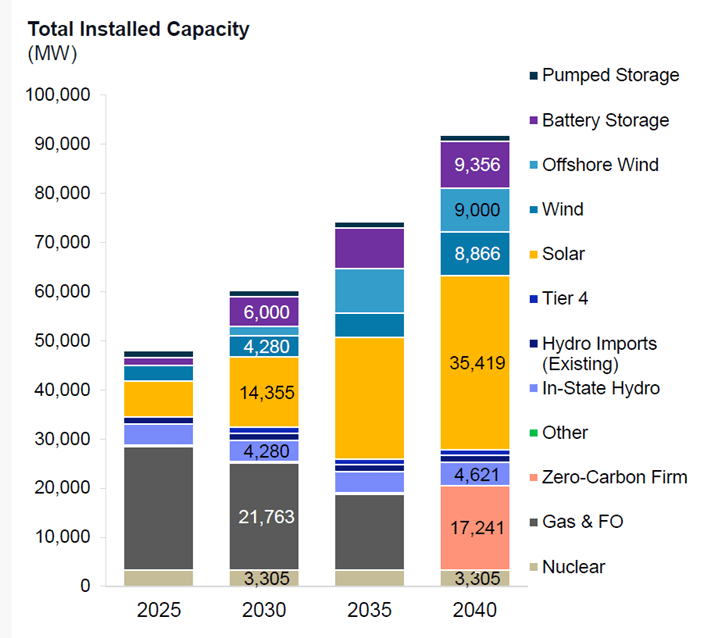
Figure 3 contains some eye-opening points about the additional actions needed in the electric sector to meet the Climate Act mandates. NYSERDA mentions that the Pathways Analysis agrees with the CES Biennial Review that the 70% renewable goal cannot be met until 2033. In a massive under statement they note that “A significant ramp up of deployment will be needed to achieve zero by 2040”. NYSERDA again mentions a “significant buildout of a diverse set of resources” is required. Existing hydro and nuclear must be kept online to meet the zero emissions by 2040 mandate. In a major concession they admit that while “Many aging combustion units retire over the model period. 6 GW are repowered, and the 17 GW fleet is converted to run on Hydrogen by 2040”. Assuming that hydrogen will be available is sufficient quantities in 2040 is magical thinking as is claiming that the combustion fleet will be smaller due to “availability of other firm resources, like storage and Tier 4 hydro imports”. If there is such a thing as wishful and magical thinking, then this bullet exemplifies it: “Zero emission resource definition is under development and hydrogen serves as an illustrative resource for firm dispatchable power”.
Figure 3: Electric Sector Capacity (MW) Buildout
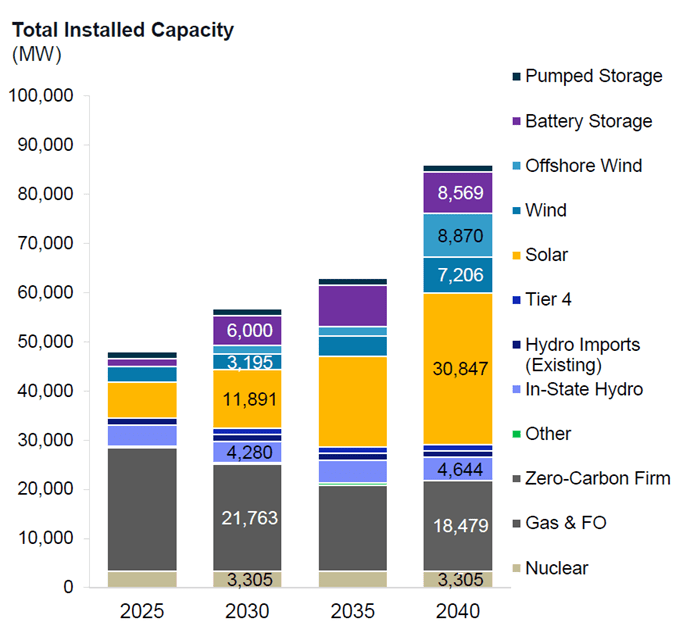
It is notable that NYSERDA concedes, without admitting all the ramifications, that the electricity capacity buildouts in their original scenarios are wishful thinking. I say this because there is another projection included – the “Limited Building Rate Scenario”. Figure 4 shows the installed capacity projections for it but true to their perfect record of making things difficult for reviewers the colors in the columns for different technologies change. If you were like me and wondered what the difference in the zero-carbon firm resources (called dispatchable emissions-free resources (DEFR) by everyone else in the state) drop from 17,241 MW to 4,644 MW. The description notes that:
• Deployment challenges (including federal impact on attrition and permitting) could lead to a meaningful reduction in renewable build rates
• While there are still significant additions of renewables, this sensitivity shows a meaningful reduction in solar and wind capacity compared to the core scenario in 2040
There is no admission that among the deployment challenges was an unrealistic schedule and no implementation plan was developed. They try to save some face by saying that they still build out solar and wind capacity, oblivious to the fact that might not be a good thing.
Environmental Justice organizations have made the peaking power plants in New York City a non-negotiable issue, insisting that all peaking power plants must be shut down as soon as possible. Even though the presumption of egregious harm from these plants is based on selective choice of metrics, poor understanding of air quality health impacts, and ignorance of air quality trends, pressure by this special interest constituency resulted in the Build Public Renewables Act of 2023 that mandates shutdown of New York Power Authority peaking power plants by 2030. This modeling by NYSERDA found that reliability considerations will prevent the shutdown of all the peaking power plants:
• Zone J repowers 2.2 GW of combustion units in 2035, and overall combustion needs in 2040 are 1.2 GW higher than the core scenario, but still lower than the start of the modeling period
• While gas generation is 50 TWh lower than 2025, 15 TWh of natural gas generation is needed in 2040 to meet energy needs. Alternately this need could be met via:
• ~2 GW of new nuclear and likely additional transmission,
RNG combustion in the power sector, or
• Some blend of these two resource options (new nuclear and RNG)
The alternatives to the fossil plants are not likely to occur. 2 GW of new nuclear is never going to get developed in New York by 2040 and there isn’t enough renewable natural gas (RNG) to provide the necessary power.
At the end of the description of this slide, there is an admission that the existing schedule is unlikely. Patane notes that this sensitivity scenario provides a zero-emissions grid in 2045.
Figure 4: Limited build rate sensitivity
Discussion
The results presented in this presentation admit that there are enormous challenges confronting the Hochul Administration’s implementation of the Climate Act. It is still necessary to read between the lines and understand the implications of some statements, but the handwriting is on the wall.
The presentation concedes that New York State is not on target to meet the 2030 70% renewable goal and probably will not meet it until 2033. The inclusion of an alternate scenario that keeps fossil-fired units in operation post 2040 is the between the lines” admission that the present strategy is not going to work as envisioned by the authors of the Climate Act. That scenario is supposed to provide a zero-emissions grid by 2045, five years late.
Unfortunately, there are unacknowledged fundamental issues. There are references to electric system strategies that sound fine in theory but have not been shown to work in practice. For example, the presentation states that the plan is to use flexible loads to mitigate peak growth. Assuming that 2.5 GW new large loads will be willing to shut down operations at the whim of low wind and solar resource production is not likely viable. That is not conducive to manufacturing profitability.
In my opinion, the biggest problem is that the wind, solar, and energy storage approach advocated in the Climate Act requires backup resources for capacity, energy, and ancillary support services not present in wind, solar, and current energy storage systems. Nuclear power is mentioned as a solution several times but if that is the only viable backup solution, then renewables cannot be implemented without it. But nuclear can completely replace renewables, eliminating the need for massive backup resource. Therefore, it would be prudent to pause renewable development until feasibility is proven because nuclear generation may be the only viable path to zero emissions.
There are political ramifications. The New York Independent System Operator (NYISO) Power Trends 2025 report “underscores the heightened uncertainty of future system conditions and key assumptions such as population and economic growth, installation of behind-the-meter renewable resources, electric vehicle adoption and charging patterns.“ Environmental organizations have responded by claiming that NYISO’s “conclusions and messaging in Power Trends are not supported by the evidence and perpetuate the false narrative that more gas is needed or is less costly.” Reality bats last and the Pathways Framework is reflecting reality that gas is needed. Politically however, the environmental zealots will never change their minds and concede that corrections and adjustments are necessary much less admit that the whole endeavor is fatally flawed. Given that the Climate Act has always been about politics, how this plays out will be fascinating political theater.
Conclusion
New York is at a crossroads The inevitability of Climate Act implementation viability being a political liability has been acknowledged even by Hochul. The modeling analysis concedes that the schedule and ambition of the Climate Act is not achievable. This is the perfect opportunity for politicians to stop a program that even they must realize is not working according to plan. The Energy Plan could be used to conclude the schedule and the aspirations of the Climate Act need to be reconsidered. The political implications to that approach are significant.
I believe that Governor Hochul’s Administration has forced New York utilities to incorporate programs to try to meet the goals of the Climate Act despite never proving that it is feasible, never defining what is affordable, and mounting evidence that implementation is not working out as planned. My frustration that no one is acting on those concerns led me to join Constantine Kontogiannis in a submittal in the Niagara Mohawk Power Corporation dba National Grid (NMPC) rate case proceeding in May. In June we submitted testimony in the Consolidated Edison Company of New York (Con Ed) rate case with Richard Ellenbogen and Francis Menton. This article outlines our concerns and describes our testimony.
I have followed the Climate Leadership & Community Protection Act (Climate Act or CLCPA) since it was first proposed, submitted comments on the Climate Act implementation plan, and have written over 500 articles about New York’s net-zero transition. I am convinced that implementation of the Climate Act net-zero mandates will do more harm than good if the future electric system relies only on wind, solar, and energy storage because of reliability and affordability risks. The opinions expressed in this article do not reflect the position of any of my previous employers or any other organization I have been associated with, these comments are mine alone.
Background
I have never paid much attention to utility rate cases until this spring. My frustration that no one has reacted to my concerns about the pitfalls of the Climate Act forced me into participating. Kontogiannis and I got to the NMPC rate case late in the process. Briefly, the utility Con Ed outlines its rate case plan; intervenors react; a Joint Proposal (JP) is hammered out between the utility, the Department of Public Service (DPS), and intervenors; the JP is submitted to the Public Service Commission (PSC); and they decide on the fate of the rate case. Kontogiannis and I intervened in the NMPC rate case by submitting a statement in opposition to the JP settlement plan. Kontogiannis, Ellenbogen, Menton, and I (“Independent Intervenors”) intervened in the Con Ed rate case by submitting testimony regarding the draft JP, essentially one step before in the process than our intervention in the NMPC rate case.
My role in both interventions was to pull together our concerns in the NMPC statement in opposition and the Con Ed testimony documents. Both rate cases are now in a phase that is beyond my comprehension so I cannot begin to explain what is going on and how we will interact with the parties. Moreover, in the Con Ed case all discussions are confidential. I have no idea how this will turn out.
Con Ed Testimony
Our submittal included a testimony (formatted as questions and answers) along with seven exhibits.
In the testimony we first described our backgrounds. I stated that I was a retired utility meteorologist, described my career, and mentioned that I write this blog. Ellenbogen is an electrical engineer who is President of Allied Converters where he has pioneered how “green” manufacturing can work. Constantine Kontogiannis is an engineer who has decades of experience providing energy consulting services. Menton is a retired lawyer and now writes articles at his Manhattan Contrarian blog that analyze New York’s energy transition.
We explained we are participating in the rate case because we share the common concern that there are unacknowledged thresholds associated with Climate Act affordability, reliability and environmental impacts. We believe that wind and solar cannot adequately supply the grid, cannot maintain reliability without redundant backup, and will drive up costs dramatically for consumers. The building and transportation electrification initiatives proposed by Con Ed in the rate proceedings will dramatically compound these detrimental impacts. Our testimony describes our concerns and makes recommendations to address them.
Our testimony argued that it has become apparent that the goals of the Climate Act are not feasible and are putting the health and safety of New Yorkers at risk, while simultaneously adding huge costs to the electrical system. We made four arguments:
It is time for the PSC to invoke PSL Section 66-P(4) and, under that authority, suspend CLCPA obligations contained in this rate case.
Our testimony addresses problems related to CLCPA obligations confronting Con Ed specifically as they apply to these rate proceedings.
The rate case includes programs and initiatives needed to comply with the requirements of the CLCPA, but they are incompatible with the mandates for safe, reliable and affordable service.
The Independent Intervenors propose pausing implementation of CLCPA aspects of the rate case that are not cost-effective on their own and redirect funding to interim solutions to reduce carbon emissions and costs while improving reliability that are cost-effective.
We found that the New York emissions reductions possible are negligible relative to global emissions and the resulting global temperature change is infinitesimally small. This does not mean that we should not do something, but it does mean that concerns about the schedule and pace of emission reductions are misplaced.
Safety Valve
This issue is an obsession of mine so I was the primary author of the description and the related exhibit. Clearly there are limits to how much Climate Act implementation can cost. It frustrates me to no end that Public Service Law (PSL) 66-p(4) is a safeguard mechanism that could define that limit but it has been ignored. PSL Section 66-p charges the Commission with implementing renewable energy programs but includes feasibility safety valve conditions for affordability and reliability. In this proceeding and the NMPC rate case, I pointed out that the safety valve criterion for a significant increase in the number of customers in arrears has been exceeded. There hasn’t been a response yet in this case but I described the DPS response to the same argument in the NMPC case. I expect DPS to similarly argue that they must follow the Climate Act law conveniently overlooking the fact that PSL 66 is a law too. They argued that addressing this is beyond the scope of a rate case proceeding. The DPS response to the need for affordability and reliability safety valves clearly is a failure to support their broad mandate to ensure consumer access to safe, reliable utility service at just and reasonable rates.
Affordability and Environmental Impacts
We acknowledge that Con Ed is in a difficult position. They must meet CLCPA obligations even though there is mounting evidence that implementation will have negative consequences.
Our testimony noted that energy costs are affecting affordability and that has housing security implications. There is another aspect of affordability affecting New York City residents. One of our exhibits addressed Local Law 97, the New York’s legislation mandating building electrification Ellenbogen found that until the New York City electric generators are zero emissions, the forced conversion will actually increase emissions. Ellenbogen’s personal experience electrifying his manufacturing facility and home has convinced him that New York City has underestimated the logistical challenge of citywide conversions with new technologies. Ellenbogen evaluated costs and argues that LL97 is unaffordable. Finally, because his electric system monitors electric use and characteristics, he has data proving that electrified buildings will require Con Ed to upgrade its electric service.
Feasibility
The rate case includes programs and initiatives needed to comply with the requirements of the CLCPA. We believe they are incompatible with the mandates for safe, reliable and affordable service because the schedule and ambition of the mandates were not based on feasibility. We referenced the New York Independent System Operator (NYISO) 2025 Power Trends report and enumerated specific issues raised that should be considered in this rate case.
Another obsession of mine is the need to back up weather-dependent resources during periods of extended low wind and solar availability. In our testimony we pointed out that a new resource that is dispatchable and emissions-free (DEFR) is needed to address this challenge. Acknowledging the problem is only the first step in resolving it. Electric planners are still trying to figure out how to incorporate the need for DEFR into reliability planning criteria. Determining how much DEFR will be needed requires extensive analysis of historical observations. The biggest challenge is that there are no commercially viable DEFR technologies available.
At present, the only mature technology that can act as a DEFR in New York is nuclear. Conventional nuclear has been met with a great deal of resistance in NY State and even with the recent change of mindset, development of additional nuclear plants will take at least 15 – 20 years based upon the last two nuclear plants built, Vogtle 3 & 4 in Georgia. It is estimated that Small Modular Reactors will not be available for deployment until well after 2035. We asked what technologies will be available to support the wind and solar buildout presumed in the Company rate case?
Misplaced Priorities
We explained that the Climate Act includes priorities that detract from a pragmatic decarbonization plan. The demonization of natural gas by the Climate Action Council (CAC) that was responsible for the Scoping Plan outline of implementation strategies precludes what we believe is part of the best decarbonization approach. An exhibit is included that concludes that reducing the use of natural gas is irrational at this time.
Ellenbogen’s experience with cost effectively reducing his own Con Ed utility bills while simultaneously reducing its carbon footprint is a clear example of what can be done with proper planning and an adherence to science-based solutions. Ellenbogen’s manufacturing plant currently generates or offsets 72% of its electrical energy use onsite with a building carbon footprint 30% – 40% lower than the electricity supplied by Con Ed. Not only does the facility reduce Con Ed load by generating on-site power, but the facility also reduces reactive loads that increases grid capacity and reduces transmission and distribution system energy losses. Unfortunately, there is a problem with the approach. The low energy cost was accomplished using a natural gas-powered high efficiency Combined Heat and Power System (CHP) and a large solar array. The aspirational goal of zero emissions and the irrational vilification of methane precludes replicating these proven results.
Primary Concern
We are very concerned that the rate case JP ignores the grid integrity concerns identified in NYISO Power Trends 2025 and has not reconciled the significant shortfall in renewable generation identified in the Clean Energy Standard Biennial Review. The PSC order announcing the release of the Biennial Review acknowledges that the renewable generation goal of seventy percent in the year 2030 is not just impossible, but that we’re actually headed in the wrong direction – statewide renewable energy production was slightly over forty six percent of the total in the year 2022, but is actually projected to drop to less than forty four and one-half percent in the year 2030. This is in large part due to building and transportation electrification load growth outpacing new generation coming online. At the same time, the NYISO is warning of significant reliability issues due to both load growth and CLCPA-induced natural gas constraints. As currently designed, this rate proceeding will dramatically increase ratepayer cost and decrease electric grid reliability, while failing to produce any tangible lifecycle sustainability benefit.
Recommendations
The Independent Intervenors offered specific recommendations. There were three primary recommendations.
We recommend that the Con Ed rate case contribution to CLCPA transportation sector investments should be limited to improving traction power regeneration across the Metropolitan Transportation Authority (MTA) with a specific focus on the New York City Transit subway system. We estimated that focusing all transportation electrification efforts within this rate proceeding on improving subway traction power regeneration will save more than 400 gigawatt hours annually, and the electric cost savings alone will contribute roughly 80 million dollars per year towards the cost of this project. More importantly, this project will reduce coincident peak load between 0.6 and 0.9 gigawatts across the subway system and also provide voltage and frequency regulation and support in many load pockets throughout New York City. Directing all rate case transportation electrification funding will also provide the greatest return on investment and net sustainability benefits for ratepayers, many of whom are also regular users of the subway system.
Our second recommendation was to focus all building electrification efforts within this rate case solely on transitioning approximately one thousand five hundred existing customers of Con Ed’s steam system to electric cooling and hybrid heating solutions. This focus will provide the biggest bang for the buck in efficiency improvements, will reduce water use, and reduce impacts on the municipal sewer system, while also decreasing the overall load on waste treatment facilities. Directing all building electrification funding in this rate proceeding to this subset of the New York City building stock will provide the greatest reliability, affordability, and sustainability benefits to ratepayers.
Based on our finding that Local Law 97 used blatantly false and fictitious emission improvement projections we recommended a fuel-neutral approach to the local law is advisable. A particular emphasis should be placed on ensuring Cob Ed’s local electric distribution system headroom is maintained and not diminished solely for the purpose of building and/or transportation electrification. Moreover, in order to ensure ratepayer affordability, no energy efficiency project should be promoted that has a benefit to cost ratio of less than two.
Conclusion
Our experience with energy efficiency programs, electric energy systems, and fossil fuel operations led us to propose an interim decarbonization solution that avoids the risk of a costly false solution. We proposed pausing implementation of CLCPA aspects of the rate case and concentrate on interim solutions to reduce carbon emissions and costs while improving reliability.
The Regional Greenhouse Gas Initiative (RGGI) is a market-based program to reduce CO2 emissions from electric generating units. One aspect of RGGI is a regular review of the program status and need for adjustments. On July 3, 2025, RGGI announced that results of the Third Program Review. Based on my analysis of the planned revisions, the RGGI States only delayed the inevitable reckoning of the futility of this program to achieve the goal of a “zero-emissions” electric system. When I was researching that article, I used Perplexity AI to help me figure out a way to consider RGGI’s impact on ratepayer costs that is the topic of this post.
Dealing with the RGGI regulatory and political landscapes is challenging enough that affected entities seldom see value in speaking out about fundamental issues associated with the program. I have been involved in the RGGI program process since its inception and have no such restrictions when writing about the details of the RGGI program. I have worked on every cap-and-trade program affecting electric generating facilities in New York including RGGI, the Acid Rain Program, and several Nitrogen Oxide programs, since the inception of those programs. I also participated in RGGI Auction 41 successfully winning allowances and holding them for several years. The opinions expressed in this post do not reflect the position of any of my previous employers or any other organization I have been associated with, these comments are mine alone.
Background
RGGI is a market-based program to reduce greenhouse gas emissions (GHG) (Factsheet). It has been a cooperative effort among the states of Connecticut, Delaware, Maine, Maryland, Massachusetts, New Hampshire, New York, Rhode Island, and Vermont to cap and reduce CO2 emissions from the power sector since 2008. New Jersey was in at the beginning, dropped out for years, and re-joined in 2020. Virginia joined in 2021 but has since withdrawn, and Pennsylvania has joined but is not actively participating in auctions due to on-going litigation. According to a RGGI website:
The RGGI states issue CO2 allowances that are distributed almost entirely through regional auctions, resulting in proceeds for reinvestment in strategic energy and consumer programs.
Proceeds were invested in programs including energy efficiency, clean and renewable energy, beneficial electrification, greenhouse gas abatement and climate change adaptation, and direct bill assistance. Energy efficiency continued to receive the largest share of investments.
Despite the claims about the success of RGGI, the reality is that the only thing it is good at is raising money. Suggestions that RGGI has been responsible for the observed reductions in CO2 emissions over the life of the program ignore the importance of fuel switching and the poor performance of RGGI auction proceed investments in reducing emissions.
The RGGI States regularly review successes, impacts, and design elements of the program. The latest review is the third iteration of the effort. It started in February 2021 and finally was completed in June 2025, years behind schedule.
If you are interested in the revisions made to the program, please refer to my previous RGGI post. The primary rule revisions addressed the need to reduce the cap allocations to be consistent with various RGGI State decarbonization goals. In my opinion, the political mandates for zero electric system emissions by 2040 are infeasible. The changes to RGGI modify the allowance allocation schedule but include a “cost containment reserve” that adds allowances at a higher cost. The focus of this article is on the impact of the RGGI auction price on consumer costs historically and because of the Third Program Review revisions.
Bottom-Up Analysis of RGGI Impact on Consumer Costs
I used Perplexity AI to provide documentation about the effect of RGGI allowance prices on consumer costs. I ended up submitting two questions that provide a description of RGGI Allowance Costs and Their Impact on Electricity Prices with a follow up focusing on New York specific RGGI impacts. In both instances the AI research failed to find documentation that I could decipher well enough to develop a methodology to estimate historical cost impacts and future projected cost impacts.
The research responses explained the components that flow allowance prices into consumer costs. There is a direct relationship between CO2 emissions for a fossil unit and the effect of RGGI allowance prices that shows up in wholesale prices. In New York those cost adders affect the location-based market price in different control zones that makes estimating rate payer impacts difficult. The first response described an ISO-New England case study that provided wholesale price impacts of RGGI. Unfortunately, my primary interest is the cost to consumers and the path from wholesale prices to retail costs is mostly opaque.
The AI response did find references that concluded that “Current retail riders in NJ and DE range 0.40–0.50 ¢/kWh, adding $3–$5 to an average monthly bill—well below other volatility drivers such as natural-gas commodity swings or capacity-market resets.” However, I found nothing about costs in New York.
Trying to estimate residential cost impacts of RGGI using this information would be a bottom-up analysis that starts with specific details that affect electric rates and incorporates other detailed information to project impacts. Given that I could not find sufficient detailed information for each component of costs I gave up trying this approach.
Top-Down Approach to Estimate the Effect of RGGI on Residential Costs
Note: Table numbers refer to tables in the Addendum
For the top-down analysis, I assumed that residential rates are affected by RGGI compliance costs proportional to the total RGGI compliance cost fraction of total electric revenues. I used Perplexity AI to find the total electricity revenues for the residential sector for each RGGI state. The cost of RGGI compliance charged to customers equals the state-level emissions released times the allowance price for each ton emitted. Details of the methodology used to estimate ratepayer impacts are described in the Addendum to the post. It is included because I believe that analyses are more credible when the approach is documented. However, most readers likely do not want to deal with those details so they are not in the main body.
I used data from multiple sources. Emissions data came from the EPA Clean Air Markets Program Data system that documents power plant emissions from various market trading programs. Table 1 in the Addendum lists the annual emissions by state for all units affected by the RGGI program. For allowance prices I calculated annual averages from the quarterly allowance auction prices in the RGGI Market Monitor Auction Reports (Table 2 in the Addendum). I used Perplexity AI to provide revenues by the residential, commercial, and industrial sectors data (Table 3). That analysis was based on information from the US Energy Information Agency but there was only information available for three years. The percentage of total revenue costs caused by RGGI costs is derived from that information (Table 4). I also used Perplexity AI to provide the electricity rates for 2020, 2022 and 2023.
At this point I had all the data necessary to determine the impact of RGGI allowance costs on residential rates for the three years with rate data. I averaged the data from those three years. The RGGI compliance % of total revenues equals the RGGI compliance costs divided by the total electric costs (Table 5a). The average state residential rates (Table 5b) are from another AI search. Table 5c lists the calculated state residential cost attributable to RGGI (¢/kWh) by multiplying the compliance percentage of the average state residential rates. Note that these estimates are in the range of the “current retail riders in NJ and DE that range 0.40–0.50 ¢/kWh.” Table 5a Table 5b Table 5c
I used this information to estimate the impact of RGGI compliance costs on residential rates (¢/kWh) since the start of the program (Table 6 in the Addendum). In this analysis it is assumed that the annual residential rates in any one year are proportional to the average values listed in Table 5c. For example, the Connecticut 2009 estimated residential rate equals the average rate (0.48) multiplied by the Table 2 annual compliance cost in 2009 ($20,108,464) divided by average compliance cost ($109,179,789).
I do not keep track of my residential rate and do not expect others do either. Table 7 estimates the costs for a typical consumer that uses 750 kWh per month. This is the most important RGGI impact for consumers. The Perplexity AI response noted that “adding $3–$5 to an average monthly bill—is well below other volatility drivers such as natural-gas commodity swings or capacity-market resets.” Note that my estimate of RGGI consumer costs was well below even those levels until 2024. That probably accounts for why consumers have not paid much attention to RGGI.
Table 7: Monthly RGGI Residential Costs for 750 kWh per Month Electric Use
Future Projections
This cost estimation methodology can also be used to estimate future impacts to ratepayers in the RGGI states. I described the assumptions and details of my approach in the Addendum. Table 7 estimates future costs for a typical consumer that uses 750 kWh per month. The monthly cost impact of RGGI peaks in 2030. Rhode Island ratepayer would pay the most, $13.75 a month additional because of RGGI that year. New York ratepayers could pay an additional $5.57 a month because of RGGI in 2030.
Table 11: Future Monthly RGGI Residential Costs for 750 kWh per Month Electric Use
Caveats
The future costs and emissions will be affected by factors that I did not include. There is a significant bank of allowances that will keep emissions higher than the allocations for some time. The sale of banked allowances from non-compliance entities to affected sources that need allowances to operate will increase costs to consumers.
Discussion
There are some interesting facets of the Third Program Review buried in this information.
Although this approach does not cover all the nuances of RGGI allowance prices on residential prices I am comfortable that the projections are reasonable. The first takeaway is that residential average monthly bill impacts of RGGI are “well below other volatility drivers such as natural-gas commodity swings or capacity-market resets.”
The Third Program Review took a long time to finalize and I think that reflects the unprecedented aspects they are confronting. Market based programs rarely establish caps that less than the affected sources can achieve without shutting down. This is the situation in the RGGI states going forward. Typically, costs per ton removed increase as emissions approach zero, so this is a significant challenge for the effectiveness of this strategy for zero-target programs like New York’s Climate Leadership & Community Protection Act.
One problem with the cap and invest approach that incorporates a declining cap that goes to zero is that as the number of allowances decreases the funds available to invest in emission reductions goes down. Table 12 illustrates how the RGGI States got around this problem for now. It lists the allowance cap, the CCR trigger prices and CCR allowance allocations through 2037 when the policy ends. I calculated the total allowances and potential revenues. The RGGI States deferred the problem of declining revenues by setting the CCR Tier 2 trigger price increase the same as the allowance cap decrease.
Table 12: Third Program Review Allowance Allocation Parameters and Expected Revenues
In theory, after 2033 the revenues should stabilize at $1.9 billion a year. Unresolved is that this approach does not get to zero emissions – they level off at just under 23 million tons after 2040. I would also expect that as the allowances get scarcer, that the allowance prices will go up due to demand. There is a potential for very high allowance prices that would affect consumers. Note, that the benefits of the auction sales occur at the time of the auction. Sales of banked allowances only profit the holders of the banked allowances.
Finally I want to reiterate a point made in my previous article on the RGGI Third Program Review. I am convinced that no GHG emission reduction cap-and-invest program will succeed. Danny Cullenward and David Victor’s book Making Climate Policy Work explains why. They note that the level of expenditures needed to implement the net-zero transition vastly exceeds the “funds that can be readily appropriated from market mechanisms”. Even though RGGI allowance prices will increase significantly, they still will be insufficient to fund the necessary development of zero emission resources. Based on this analysis RGGI won’t provide sufficient revenue to support zero decarbonization even if the RGGI States were not squandering revenues on non-emission reduction related programs
Conclusion
The Third Program Review Policy Update features an allowance allocation schedule that is consistent with RGGI State net-zero regulations. That trajectory is inconsistent with wind and solar deployment history and reasonable expectations. As a result, there eventually will be insufficient allowances available for CO2 emitting generation resources to operate.
This analysis of consumer cost impacts has one bright side. It does not appear that reasonably expected allowance prices will meaningfully impact consumers. The allowance prices are too low to cause impacts. At the same time it is clear that there aren’t enough revenues to fully fund emission reduction strategies needed to achieve zero emissions.
The use of a CCR and addition of a second CCR will delay the inevitable reckoning and ensure that for the next ten years there will be a steady source of revenues. Raising money is the only success story for RGGI. The question whether the investments of those revenues was well spent is a story for another time.
Addendum: Top-Down Analysis Description
The methodology used to estimate ratepayer impacts is described in the Addendum to the post. This is included because I believe that analyses are more credible when the approach is documented.
In this analysis it is assumed that residential rates are affected by RGGI compliance costs proportional to the total RGGI compliance cost fraction of total electric revenues.
The cost of RGGI compliance is assumed equal to the annual emissions times the annual auction allowance cost. I used data from the EPA Clean Air Markets Program Data system that documents power plant emissions from various market trading programs. Table 1 lists the annual emissions by state for all units affected by the RGGI program.
Table 1: RGGI Annual CO2 Emissions (tons)
The state-wide cost of RGGI compliance is the cost of allowances times the emissions. Table 2 is based on quarterly allowance auction prices from the RGGI Market Monitor Auction Reports. I calculated the annual numbers that are listed as an average of the quarterly values.
Table 2: Annual RGGI Compliance Costs
Table 3 lists the total state electricity revenues for the three years that Perplexity AI could provide revenues by the residential, commercial, and industrial sectors.
Table 3: RGGI State Electricity Revenues ($millions) for the Available Annual Data
Using the annual RGGI compliance costs (Table 2) and the annual electricity revenues (Table 3) produces the percentage of total revenue costs that are caused by RGGI costs in Table 4.
Table 4: RGGI Compliance Costs % of total revenues for the Available Annual Data
I also used Perplexity AI to provide the electricity rates for 2020, 2022 and 2023 (not shown). I averaged the values from those years for the Average RGGI Compliance % of total revenues (Table 5a) and the Average State Residential Rates (Table 5b). Table 5c lists the calculated state residential cost attributable to RGGI (¢/kWh) by multiplying the compliance percentage of the average state residential rates.
Table 5a:Average RGGI Compliance % of total revenues, Table 5b:AverageState Residential Rates (¢/kWh) and Table 5c:Calculated State Residential Cost Attributable to RGGI (¢/kWh)
Table 5a Table 5b Table 5c
Table 6 estimates the impact of RGGI compliance costs on residential rates (¢/kWh). In this analysis it is assumed that the annual residential rates in any one year are proportional to the average values listed in Table 5c. For example, the Connecticut 2009 estimated residential rate equals the average rate (0.48) multiplied by the Table 2 annual compliance cost in 2009 ($20,108,464) divided by average compliance cost ($109,179,789).
Table 6: Annual Historical Estimated RGGI Residential Rate by State (¢/kWh)
In my opinion, the rate values are not relatable. Table 7 estimates the costs for a typical consumer that uses 750 kWh per month. This is the most important RGGI impact for consumers. In my opinion, the historical costs for a typical consumer are not remarkably much higher even with the much greater allowance prices of late.
Table 7: Monthly RGGI Residential Costs for 750 kWh per Month Electric Use
This cost estimation methodology can also be used to estimate future impacts to ratepayers in the RGGI states. The first step is to estimate annual emissions. In my previous article about the RGGI Third Program Review I argued that the addition of two Cost Containment Reserve (CCR) tiers pushed the inevitable reckoning that future emission reductions consistent with the aggressive reduction trajectory are unlikely. The RGGI summary of the Third Program Review includes a figure that shows the allowance allocation trajectories. The figure compares the current regional base cap (light blue) with the updated cap trajectory (dark blue). The orange and yellow lines display the total updated regional cap if all allowances are released from the updated first and second CCR tier, respectively.
This figure compares the current regional base cap (light blue) with the updated cap trajectory (dark blue). The orange and yellow lines display the total updated regional cap if all allowances are released from the updated first and second Cost Containment Reserve tiers, respectively.
I based my future emission reduction projection on these curves. Table 8 lists my annual projections. I included the observed emissions from 2022 to 2024. I assumed that in 2027, the first year of revised RGGI allowance allocation policy, the emissions would equal the policy update allocation plus CCR #1. For 2025 and 2026, I used a linear interpolation between the average of 2022-2024 and the 2027 values. In 2030 I assumed emissions would equal the policy update allocation plus allowances from both CCR #1 and CCR #2 as shown in Table 8.
Table 8: Projected Annual RGGI Emissions
To get the annual RGGI compliance costs it is necessary to multiply the projected emissions by the expected allowance price. For 2025 through 2029 I assumed that the allowance price would equal the first CCR trigger. Starting in 2030 I used the trigger price for CCR #2. Table 9 lists the allowance prices and the compliance costs. Note that the expected compliance costs peak in 2030 and then start to decline as the number of allowances drops.
Table 9: Projected Annual RGGI Compliance Costs
Table 10 estimates the impact of RGGI compliance costs on residential rates (¢/kWh) using the methodology described for Table 6.
Table 10: Annual Projected Future RGGI Impacts on Residential Rate by State (¢/kWh)
Table 11 estimates the costs for a typical consumer that uses 750 kWh per month. The monthly cost impact of RGGI peaks in 2030. Rhode Island ratepayer would pay the most, $13.75 a month additional because of RGGI that year. New York ratepayer could pay an additional $5.57 a month because of RGGI in 2030.
Table 11: Future Monthly RGGI Residential Costs for 750 kWh per Month Electric Use
I am very frustrated with the New York Climate Leadership & Community Protection Act (Climate Act) net zero transition because the reality is that there are so many issues coming up with the schedule and ambition of the Climate Act that it is obvious that we need to pause implementation and figure out how best to proceed. This article describes more reasons to pause implementation.
I am convinced that implementation of the Climate Act net-zero mandates will do more harm than good because the energy density of wind and solar energy is too low and the resource intermittency too variable to ever support a reliable electric system relying on those resources. I have followed the Climate Act since it was first proposed, submitted comments on the Climate Act implementation plan, and have written over 550 articles about New York’s net-zero transition. The opinions expressed in this article do not reflect the position of any of my previous employers or any other organization I have been associated with, these comments are mine alone.
The report evaluated multiple scenarios for power plant retirements across the country. One scenario allows the retirement of 104,000 MW of power plant capacity that intends to retire and adds 209,000 MW of Tier 1 resources to the grid by 2030. The Tier 1 resources are overwhelmingly wind, solar, or battery storage. It only includes 20,000 MW of new natural gas capacity expected to come online by 2030, along with 31,000 MW of additional 4-hour batteries, 124,000 MW of new solar, and 32,000 MW of incremental wind. If the plants that have announced retirement go offline, then coal capacity will go down 72,000 MW and gas capacity almost 5,000 MW.
At the same time, the analysis expects “electricity demand for data centers to increase by 52,000 MW by 2030, representing about 6.7 percent of the current average peak demand in the United States.” Orr and Rolling note that one of the future load projections is “projecting zero demand increases in New England or New York, resulting from data centers.” They speculated that “it could be due to tight electricity supplies and consistently high prices in these regions.”
They described the expected impacts on reliability. The report found “huge blackouts throughout much of the country” if all the plants that have announced retirements are allowed to go offline. They also noted:
In a somewhat unexpected finding, the DOE report did not find capacity shortfalls in ISO New England or New York in either of the scenarios studied. This is likely due to the fact that load growth is expected to be small in both of these areas because there is no expected data center demand growth in these regions in the DOE study.
In my opinion, the future load projections did not consider the potential load impact of new manufacturing facilities in New York, most notably the Micron chip fabrication plant. That undoubtedly would affect capacity shortfalls.
Orr and Rolling note that this report is an indication that the Department of Energy is stopping the “childish fantasy that America can shut down its reliable coal and natural gas plants and rely on wind, solar, and battery storage to meet surging electricity demand, it’s clear the energy adults are now back in charge.” It is also time for New York to stop its own childish fantasy that existing fossil-fired power plants can be shut down here.
Lessons from Europe – Germany
Brawl Street Journal (BSJ) explains how Germany’s energy policies are affecting neighboring jurisdictions. The article recounts the bureaucratic morass of European Union energy policy. Teresa Ribera, the woman who “helped turn Spain into blackout country” is now the EU Commissioner in charge of competition policy.” In that role, she “plays a powerful part in shaping Germany’s energy choices.”
Germany has figured out that wind and solar don’t work all the time. Instead of pinning their hopes on a magical solution like New York is proposing, they are planning to deploy “21 GW of new gas-fired backup plants.” BSJ explains the problem with this plan:
These plants would operate so rarely, their revenues wouldn’t come close to covering their fixed costs. No sane investor would finance them without some form of guaranteed support. In other words: subsidies.
And that’s where Ribera comes in. As the European Commissioner overseeing competition policy, she effectively gets to say whether Germany can subsidize these gas plants or not. Given her past as a fierce advocate for a 100% renewable grid in Spain, you can probably guess where this is going.
In its quest for clean energy the EU is pulling the plug on fossil fuel infrastructure subsidies.
In the past, the Commission signaled it might tolerate up to 5 GW of new gas plants in Germany to help secure supply. But anything beyond that? Only if the plants are designed to eventually run on hydrogen — an option so expensive and speculative it borders on science fiction.
The result is that German coal plants will have to run longer. I love the summation:
This creates the absurd situation that high-emission coal must run longer because support for lower-emission gas plants is being denied. It’s the kind of logic you’d expect from a socialist economy where outcomes don’t matter, only ideological purity.
This is exactly what is happening here. We already shut down the coal plants but there are a large number of old, inefficient, and relatively high emitting gas units still in operation. The Hochul Administration blocked plans by several plants to repower their old turbines with modern and efficient combined-cycle turbines. The result is that high-emission units must run longer because support for lower-emission gas plants is being denied. The most recent Energy Planning Board meeting presentations hinted at the need to repower units but there is a tortuous path between suggesting that and having some developer commit to building modern new units and getting them on line.
More Lessons from Europe – Spain
Ed Reid explains that the blackout in Spain earlier this year raises many questions about the “stability and resilience of renewable powered grids”. He listed the following questions:
Can a renewable plus storage grid operate reliably and stably?
What is the maximum percentage of renewables consistent with reliability?
Is there a maximum percentage of solar generation on a reliable grid?
Is there a maximum percentage of wind generation on a reliable grid?
Does a reliable grid require inertia; and, if so, how much?
Is the physical location of the inertia sources on the grid important?
What is the relative inertia contribution of steam turbines vs. gas turbines?
What would be the inertia contributions of small modular nuclear generators?
What is the effect of modulated output on inertia contribution?
What effect does grid-scale storage have on inertia?
Can inertia be effectively provided electronically?
These are fundamental questions that proponents of the Climate Act have ignored to date. It is time that we make sure their “solution” will work. These must be addressed by the Energy Plan for it to have any credibility.
Media Energy Credibility
It may just be me, but it seems that the claims by clean energy zealots are becoming ever more hysterical and shrill in the face of evidence that the Trump Administration is advancing a practical, adult energy policy. The global energy transition is faltering but the media still is claiming otherwise. Robert Bryce describes “What The Media Still Won’t Tell You About The Energy Transition”.
There is no energy transition. Just don’t expect the media to tell you the truth about it.
Of course, I could provide dozens, or even hundreds, of other examples of climate-focused journalists, academics from elite universities (hello, Princeton!), and policymakers making risible claims about our energy future and how the world will soon be fueled by “clean” sources like wind, solar, and batteries, with some nuclear and maybe a bit of hydropower, thrown in for good measure. As I explained two years ago in “The Anti-Industry Industry,” the “energy transition” narrative is relentlessly promoted by the NGO-corporate-industrial-climate-media complex, a multi-billion-dollar-per-year business that includes dozens of NGOs and media outlets that promote anti-hydrocarbon agendas. The World Economic Forum even maintains an “Energy Transition Index.”
He uses the latest edition of the Energy Institute’s Statistical Review of World Energy to show that the world runs on hydrocarbons. There is no question that wind and solar capacity is growing but “in 2024, just 3% of global primary energy came from wind and solar while 87% came from hydrocarbons. The costs of the failed transition are staggering: “Since 2004, about $5.4 trillion has been spent on solar and wind, and yet they are still only providing 3% of the world’s primary energy.”
One of the annoying arguments from the useful idiots who support the energy transition is that “Big Oil” is spending huge amounts of money to spread misinformation. The Department of Energy report described above makes it clear that shutting down more US coal capacity would cause blackouts. Bryce notes:
Who is really spreading misinformation with massive funding?
The Energy Plan process currently underway appears to be acknowledging that the Climate Act transition plan’s schedule and ambition are out of reach and must be re-assessed. That message is in direct contradiction to much of the media narrative. The Hochul Administration is going to face backlash from the media when it bows to reality.
Conclusion
New York’s energy planners must openly address grid reliability, resource adequacy, and practical transition timelines. Until these fundamental concerns are resolved, pausing the Climate Act’s implementation is the only responsible course.
I am very frustrated with the New York Climate Leadership & Community Protection Act (Climate Act) net zero transition because the reality is that there are so many issues coming up with the schedule and ambition of the Climate Act that it is obvious that we need to pause implementation and figure out how best to proceed. This article describes reasons to pause implementation.
I am convinced that implementation of the Climate Act net-zero mandates will do more harm than good because the energy density of wind and solar energy is too low and the resource intermittency too variable to ever support a reliable electric system relying on those resources. I have followed the Climate Act since it was first proposed, submitted comments on the Climate Act implementation plan, and have written over 500 articles about New York’s net-zero transition. The opinions expressed in this article do not reflect the position of any of my previous employers or any other organization I have been associated with, these comments are mine alone.
Call for a Pause
Tom Shepstone wrote an article about a letter from 18 New York Republican Senators calling on Governor Hochul to declare a State of Emergency and “halt Climate Act mandates.” I was meaning to write about this but can now just quote his article. Tom wrote “I applaud the following letter these folks just sent to Kathy Hochul (emphasis added):
The Honorable Kathy Hochul Governor of New York State New York State Capitol Building Albany, NY 12224
Subject: Energy State of Emergency
Dear Governor Hochul,
We write today with a deep sense of urgency to respectfullyurge you to issue a State Declaration of Disaster Emergency pursuant to Executive Law §28, in response to escalating reliability concerns surrounding our electric grid and the rapidly rising energy costs burdening New York ratepayers. In accordance with Executive Law §29-A, we further request the suspension of laws enacted under the Climate Leadership and Community Protection Act (CLCPA), Chapter 106 of the Laws of 2019.
The current trajectory toward an all-electric future presents serious and immediate threats to both the reliability of our power grid and the affordability of energy for New Yorkers. Just last month, the New York Independent System Operator (NYISO) issued multiple Energy Warnings due to a significant decline in operating reserves – underscoring the fragility of the system under current policies.
Legislation stemming from the CLCPA, including mandates for electric vehicles, electric school buses, electric buildings, the repeal of the “100-foot rule,” and a Cap-and-Invest program risks overloading the grid at a time when demand is growing and reliable energy supply is increasingly constrained.
In addition to these reliability concerns, the economic toll of the CLCPA implementation is becoming untenable. A conservative estimate places the total cost of the law’s implementation at
$340 billion.Electricity rates in New York are now 48% higher than the national average and 35% higher than in neighboring Pennsylvania. Alarmingly, nearly 20% of a typical utility bill now consists of government-imposed charges, a figure likely to rise further without intervention.
These realities point to a transition plan that is not only unsustainable but one that risks creating an economic and energy disaster. We believe a pause is essential – one that allows for reassessment, thoughtful adjustment, and a renewed commitment to an energy policy that balances environmental responsibility with reliability and affordability.
We urge your administration to convene a comprehensive review process involving a wide range of stakeholders – industry experts, energy producers, ratepayer advocates, labor and local communities. We further advocate for an “all-of-the-above” energy policy that does not rely solely on wind and solar but also embraces dependable energy sources.
We encourage your administration to continue to push forward with nuclear energy development but let the private sector take the lead. At the same time, we respectfully ask you to reconsider your administration’s stance toward natural gas, a critical and dependable energy source for millions of New Yorkers. Natural gas must remain part of our diverse and resilient energy mix.
This is a pivotal moment for our state’s energy future. We urge you to act now to protect the stability of our energy grid and the economic well-being of all New Yorkers.
Sincerely,
Senator Robert G. Ortt
Senator Tom O’Mara
Senator Mario Mattera
Senator Steve Chan
Senator Jake Ashby
Senator Peter Oberacker
Senator Pam Helming
Senator Mark Walczyk
Senator Dan Stec
Senator Steve Rhoads
Senator Alexis Weik
Senator George Borrello
Senator William Weber
Senator Patrick Gallivan
Senator Dean Murray
Senator Jack M. Martins
Senator Joseph Griffo
Senator Andrew Lanza
Tom went on to note that “Kathy Hochul called it grandstanding, of course. What else is she going to do? Here’s some of what her people had to say, which tells quite a different story:”
The Governor has made it clear she’s taking an all-of-the-above approach to energy that prioritizes affordability, reliability, and sustainability…
Hochul did acknowledge last week that the economic environment has changed since the CLCPA was passed under former Gov. Andrew Cuomo.
“It all goes back a number of years and I’ve had to take a close look and realize that we cannot accomplish what those objectives were back before I became governor in a timeframe that’s gonna not hurt rate payers. So we’re slowing things down. I wanna make sure people know that,” the governor said last Tuesday.
Doreen Harris, president and CEO of the New York State Energy Research and Development Authority (NYSERDA), acknowledged the change in policy, telling Capital Tonight on Wednesday that while the achievement of the climate law is still one potential scenario, the state’s emerging draft energy plan also looks at the challenges the law is facing, including roadblocks at the federal level.
Shepstone concluded:
“All the above” is the first step toward admitting the unreliables are not only not helpful, but also dangerous to the grid. And, then there is “one potential outcome.” I’d say that’s a complete win for our friend Roger Caiazza, who has successfully predicted every bit of this!
For the record, when I wrote to Shepstone and thanked him for the shoutout I noted that my predictions have always bet on physics batting last. Politicians can deny reality for only so long.
Prove It.
Ed Reid makes the point that I have often made that proponents of a renewable plus storage energy grid need a successful demonstration project before we are convinced that it will work. Maybe this will be the face-saving outcome for the Hochul Administration when they bow to the inevitable need to pause implementation. Francis Menton, Rich Ellenbogen, and I have nominated Ithaca separately, Menton explains our perfectly aligned reasoning.
Climate Alarmism and the Media
For physics realists and green energy skeptics like myself it is very frustrating that all media accounts connect any extreme weather event to climate change. This article by Matt Vespa describes Michael Shellenberger’s shared frustration:
This piece is a bit more unconventional than his usual work, but Michael Shellenberger was interested in exploring how climate alarmism has become a lucrative industry in the media. It goes beyond ‘fear sells’ and ‘if it bleeds it leads’ models. It’s panic pornography in its worst form, so bad that one in five children in the United Kingdom suffered nightmares about our impending doom from climate change, manufactured by the media.
He used the recent Texas floods as an example, a tragic event where storms ripped through central Texas, flooding the Guadalupe River in Kerr County, killing at least 100 people. That body count is destined to rise. The river rose 20-plus feet in 90 minutes. The media ran with this cockamamie narrative that it was Donald Trump’s fault due to cuts to NOAA and the National Weather Service, all of which don’t go into effect until next year. Then, there was the ‘NWS was short-staffed,’ which was also debunked—NWS had extra staffers for this system. They also sent alerts; the problem is that no one got them. This area doesn’t have a flood warning system. When it was initially pitched, the public was not keen on the cost.
Shellenberger explained that floods are not new, they’re not caused by climate change, and other nations have adapted to flooding.
30 Items of Evidence that the Rationale is Collapsing
Wonderful straight talk from U.S. Energy Secretary Chris Wright: “𝑁𝑒𝑡 𝑧𝑒𝑟𝑜 𝑏𝑦 2050 𝑖𝑠 𝑗𝑢𝑠𝑡 𝑛𝑜𝑛𝑠𝑒𝑛𝑠𝑒“; he suggests climate change alarmism is “a quasi-cult religion”.
This is part of my continuing coverage of the New York State Energy Plan. This is the first update to the Plan since the Climate Leadership & Community Protection Act (Climate Act) was implemented so it has important ramifications on the net-zero transition. My intent is to describe most of the sections of the June 25, 2025, meeting presentation. As part of my attempt to reduce the size of my articles I will focus this article on the Pathways Analysis modeling approach that is being used for the draft Energy Plan. Note that this article is out of order. I published what was intended as a follow on to this earlier this week.
I am convinced that implementation of the Climate Act) net-zero mandates will do more harm than good if the future electric system relies only on wind, solar, and energy storage because of reliability and affordability risks. I have followed the Climate Act since it was first proposed, submitted comments on the Climate Act implementation plan, and have written over 550 articles about New York’s net-zero transition. The opinions expressed in this article do not reflect the position of any of my previous employers or any other organization I have been associated with, these comments are mine alone.
The State Energy Plan is a comprehensive roadmap to build a clean, resilient, and affordable energy system for all New Yorkers. The Plan provides broad program and policy development direction to guide energy-related decision-making in the public and private sectors within New York State.
I have provided more background information and a list of previous articles on my Energy Plan page. My biggest concerns are whether the Hochul Administration will use the Energy Plan process as an opportunity to consider the implications of the observed transition so far and if the advice of stakeholders in its stakeholder process will be treated as an opportunity to improve the transition or an obligation with no attempt to meaningfully engage with any comments inconsistent with the narrative
June 25, 2025 Board Meeting
The materials for the meeting include the following:
I have included links to the locations of the video in the following descriptions. Also note that a transcript of the presentations is included at the meeting recording video platform. There is a nice feature for this video. If you set auto scroll on then you can follow the presentation transcript. All quotes below come from that transcript.
I previously summarized this meeting’s presentations that described the analyses conducted for the State Energy Plan and described the electricity topic area. This article will evaluate one aspect of the overarching Pathways Analysis, namely the bottom-up modeling framework.
Pathways Analysis
Doreen Harris, head honcho of the New York State Energy Research & Development Authority and co-chair of the Climate Action Council, introduced the Pathways Analysis discussion. The Pathways Analysis is the Energy Plan equivalent of the Scoping Plan’s Integration Analysis. Recall that the Integration Analysis was the quantitative assessment of emission reduction strategies that formed the basis of the Scoping Plan outline of policy strategies to achieve the Climate Act net-zero transition. Harris emphasized that while similar, the assessment approaches for both analyses are different. The Integration Analysis was “top down” whereas the Pathways Analysis is “bottoms up”. There are significant differences between these methodologies.
The Integration Analysis top-down approach started with large-scale policy strategies and used the Energy and Environmental Economics (E3) using model framework to choose a selection of policy options that produced the necessary emission reductions. Never forget that the feasibility of those policy option expectations and implementation schedule were never tested for feasibility.
The bottom-up approach starts with specific policy options and determines how they can be used to achieve the targets. On the face of it the bottoms-up approach is more grounded to reality. However, when Harris explained the approach she listed adjustable factors:
This analysis uses a bottom-up assessment of the various energy supply and delivery systems that will be available to meet forecasted energy needs through 2040, accounting for policies, technology availability, and consumer uptake, and the energy planning law requirements to consider energy affordability, reliability, economic development and jobs, equity, and environmental needs.
Accounting considerations and energy planning law have many levers that can be manipulated to get the desired answer. Absent transparent documentation that describes the assumptions for all those considerations and a process that engages the subject matter stakeholders for refining them, this bottom approach will not be grounded in reality .
Consider, for example, the different levers Harris described that can affect infrastructure deployment:
Disruptions due to the pandemic
Resulting supply chain disruptions
Inflation, and
Changes in energy policy from the Federal Administration, including the potential to cancel tax credits provided under the Inflation Reduction Act, planned denial of permits for wind generation, and attempts to remove state based clean car and clean truck rules by revoking California’s ability to enforce stricter vehicle emission standards.
Missing from this list is physics. Years from now, historians will look back and wonder why New York State went down this path without considering the immutable laws of physics that precluded some of the naïve assumptions inherent in the proposed wholesale transition to diffuse and intermittent weather-dependent generating resources.
Pathways Outlook
The presentations to the Energy Planning Board hint that there are issues. It is still necessary to read between the lines to understand the implications. In one of the biggest under-statements of this transition process Harris conceded that the considerations will “likely impact state progress on statutory emissions goals”.
She went on to state “I would say we are continuing to monitor changes in federal policy and may need to explore the impacts of these changes in the final state energy plan that we will be driving toward this year.” Then Harris claimed that:
Yet even with these challenges, the current analysis shows that New York can build on our successes, such as the creation of the nation’s largest green bank, the deployment of six gigawatts of distributed solar ahead of schedule, the completion of South Fork wind, the groundbreaking for the Champlain Hudson Power Express, Empire Wind One, and Sunrise Wind. And, of course, we have governor Hochul’s commitment to invest over a billion dollars of public funds in the sustainable future program, the largest single climate investment in state history.
I suspect that the recent passage of the “big, beautiful bill” is not going to represent a minor adjustment in renewable energy development. Federal policies affected all the claimed success stories Harris described so a complete re-assessment is warranted.
Discussion New York is at a crossroads The inevitability of Climate Cost affordability being a political liability has been acknowledged even by Hochul.
I am particularly incensed by this statement by Harris: “Importantly, this analysis demonstrates that we can continue to make meaningful progress toward our energy goals while preserving reliability and affordability for our citizens.” They have not defined affordability or what reliability risks are acceptable. Without those definitions this is just a slogan.
New York’s Climate Act implementation was not well planned. The Scoping Plan’s Integration Analysis ignored the impact of uncertainty on their projects, and the stakeholder process did not acknowledge input contrary to their narrative. I will concede that the supply chain effects of the Pandemic were unanticipated, but I am pretty sure stakeholders comments mentioned the risk that if everybody is planning a similar electrification transition that there will be supply chain competition as the suppliers gear up. It is not clear how much of the supply chain issue is due to that competition as opposed to the convenient scapegoat of the pandemic.
Conclusion
As mentioned before, there is every indication that slavish devotion to the aspirational goals of the Climate Act is the goal of the Energy Plan process. At the same time NYSERDA and DPS claim that the transition “must be managed within the constraints imposed by Federal and State reliability requirements and at a justifiable cost to ratepayers.” Qualitatively the Governor’s recent admission that Climate Act costs contribute to recent rate case increases means that the planned transition is not affordable. If the State were to establish specific limits, then I am sure affordability would be cause for a reassessment of the schedule and ambition of the Climate Act. This should be a cornerstone objective of the Energy Plan.
This is part of my continuing coverage of the New York State Energy Plan. My intent is to describe most of the sections of the June 25, 2025, meeting presentation. As part of my attempt to reduce the size of my articles I will focus this article on the Pathways Analysis modeling approach scenarios. A previous article introduced the Pathways Analysis that is being used for the draft Energy Plan
I am convinced that implementation of the New York Climate Leadership & Community Protection Act (Climate Act or CLCPA) net-zero mandates will do more harm than good if the future electric system relies only on wind, solar, and energy storage because of reliability and affordability risks. I have followed the Climate Act since it was first proposed, submitted comments on the Climate Act implementation plan, and have written over 550 articles about New York’s net-zero transition. The opinions expressed in this article do not reflect the position of any of my previous employers or any other organization I have been associated with, these comments are mine alone.
The State Energy Plan is a comprehensive roadmap to build a clean, resilient, and affordable energy system for all New Yorkers. The Plan provides broad program and policy development direction to guide energy-related decision-making in the public and private sectors within New York State.
I have provided more background information and a list of previous articles on my Energy Plan page. My biggest concerns are whether the Hochul Administration will use the Energy Plan process as an opportunity to consider the implications of the observed transition so far and if the advice of stakeholders in its stakeholder process will be treated as an opportunity to improve the transition or an obligation with no attempt to meaningfully engage with any comments inconsistent with the narrative
June 25, 2025 Board Meeting
The materials for the meeting include the following:
I have included links to the locations of the video in the following descriptions. Also note that a transcript of the presentations is included at the meeting recording video platform. There is a nice feature for this video. If you set auto scroll on then you can follow the presentation transcript. All quotes below come from that transcript.
I previously summarized this meeting’s presentations that described the analyses conducted for the State Energy Plan and described the electricity topic area. I also published an overview of the Pathways Analysis. This article addresses the bottom-up modeling framework.
I’d first like to acknowledge that conducting such analysis during a time of uncertainty is challenging, as Chair Harris noted. And it’s true with all aspects of our economy, the energy system has been impacted by the supply chain disruptions, high interest rates, inflation, and changing federal policy landscape. Yet the work must provide a rigorous economy wide view of how New York will meet the energy needs over the planning horizon while making progress on the state’s policy objectives.
Unfortunately, there is a difference between saying there is uncertainty and applying that constraint to the modeling analysis. After acknowledging uncertainty, Mas said the “the work must provide a rigorous economy wide view of how New York will meet the energy needs over the planning horizon while making progress on the state’s policy objectives.” My primary concern with this kind of modeling is that I know that the results are affected by modeler biases and their choice of assumptions. This sentence all but explicitly admits that NYSERDA is going to get an answer consistent with the Climate Act schedule and ambition. Even though Mas went on to qualify his assertion, I remain unconvinced:
Looking out over fifteen years requires assumptions regarding technology progress and policy achievement. To address uncertainties in both these areas, the analysis takes a realistic yet ambitious approach and explores several potential scenarios to better understand the full spectrum of possible outcomes.
One of the significant failings of the Scoping Plan modeling is that NYSERDA did not show their work, especially the assumptions made. When there were enough details for explicit stakeholder comments showing issues, they were ignored. I fully expect that NYSERDA will continue that approach. If that happens then “realistic yet ambitious approach” is no more than a slogan.
Pathways Analysis Modeling Approach
Nick Patane, Assistant director for policy analysis at NYSERDA described the pathways analysis modeling approach in more detail. His description of the modeling approach never mentioned which model was being used which leads me to believe that this is an in-house analysis. He explained:
There’s two main modules that we use in the analysis. The first is our economy wide model. This model takes as input, key data from other NYSERDA industry studies and programs. It models stock turnover and sales of, key equipment across, the buildings, transportation, and other demand sectors. This allows us to develop a perspective on fuel use as well as electric loads and peaks, and net emissions.
Our information on electric loads is then passed off to the second module, which is our electric sector model. This module, builds out an electric system to meet those loads, maintain reliability, and achieve any scenario specific, policy constraints.
That information on the electric system costs and emissions then feeds back to the economy wide model, for an aggregated roll up of economy wide benefits and costs.
This is an enormous effort and full of opportunities to tweak results towards a desired outcome. NYSERDA analysts must interpret each of these factors for every energy component across every sector of the economy. The description of the economywide model describes six factors that affect the results. Consider just “Models stocks, turnover, and sales of equipment across sectors, e.g., buildings, transport”. Later in his presentation Patane mentions building shells, the protective envelope of a building that includes insulation and energy efficiency windows and doors. To model that NYSERDA must estimate the New York building shell status across the state, determine what could be done to improve the building stock, and how much increased efficiency will change the energy use. Clearly, reasonable people can make different assumptions about these factors that in aggregate and over time can generate significantly different results. With all due respect, if I was the analyst charged with determining “how New York will meet the energy needs” in a politicized organization, my choices might be guided by the desired results. This reinforces the absolute need for clear and transparent documentation.
After describing current energy use noting that buildings (50%) and transportation (40%) are the primary energy uses today, Patane described five energy future scenarios to estimate the potential impact of different policies. The first scenario is “No Action”:
Our first case is what we call the no action case. You could think of this as sort of the world absent the climate act and the New York, state and local energy policies that have stemmed from it. It includes an extension of historic policy interventions, native market adoption, and federal policies as of the time of the modeling earlier this year.
Recognize here again that there’s significant uncertainty on the future of many federal clean energy policies, and we plan to explore any impacts of future changes, as we go into the final energy plan.
This case will act as a point of comparison against which we can compare the other scenarios to understand what are the net benefits and that costs and other trade offs of New York’s clean energy policies.
The results of the modeling are affected by the definition of the strategies used in the No Action case. In my opinion, I want to know what reduction strategies will be imposed on me and how much it is going to cost me to achieve the Climate Act goals. I do not care which clean energy policy requires them. This is another opportunity that NYSERDA used in the Scoping Plan analysis to modify the results to fit the desired outcome. In the Scoping Plan impacts of the policies were compared to a Reference Case that included “already implemented programs” that resulted hid significant costs to meet Climate Act targets. The interpretation of “extension of historic policy interventions, native market adoption, and federal policies” all could have similar impacts to the point where claiming this is a “no action” scenario is misleading. In my opinion, there should be a sixth case that excludes all programs necessary to achieve Climate Act goals.
I agree with the other strategy scenarios They cover the full gamut of potential outcomes. Note that the “Current Policies” scenario includes “deployment of clean electric generation in line with the Clean Energy Standard biennial review”, which concedes that the 2030 70% renewable grid target cannot be achieved until 2033. The third scenario is “Additional Action”:
This case includes all the policies from current policies and then layers on top of that, continued acceleration of adoption of clean energy technologies out to the future from some mix of future policies.
These can include things like environmental markets, increasing investments, and other recommendations, from the individual sectors of the the state energy plan.
As Doreen noted in her introductory remarks, current policies and additional actions are our core planning cases for this exercise. They represent a more bottoms up accounting.
For example, current policies reflecting the energy system that we expect under current policies, additional action reflecting achievable, but ambitious further progress.
This is where the modeling analysis starts to get into wishful thinking. Are there any indications that “achievable, but ambitious further progress” is possible? Even without the Federal policy changes that threaten the anticipated renewable deployments it has become clear that affordability and reliability issues can no longer be ignored.
The two remaining scenarios address pathways to net zero by 2050. Reading between the lines there is acknowledgement that this target will be an enormous challenge.
These scenarios continue to lean on similar levers like electrification and efficiency, but to much greater extent Also introducing new levers that aren’t contemplated by current policies.
In our work, we have two different net zero scenarios. The primary difference here is the use of hybrid heating for buildings that retain a gas connection for use on the coldest days.
Net Zero A has limited use of this hybrid heat pump, and more all electric customers. Net Zero B has expanded use of customers that retain a supplemental gas heating system. And this allows us to sort of explore the potential value of a larger residual gas network on mitigating, electric system peaks, and the associated building costs.
The inclusion of a scenario that maintains gas supply is a good starting point to acknowledge that going to zero emissions massively increases costs and complexity. I believe that this is entirely appropriate to include.
Discussion
The recent passage of the Big, Beautiful Bill Act will have massive implications for the Climate Act net-zero transition. In the meantime, the Energy Plan proceeding goes on. The presentations are a mixed bag. There are acknowledgements of the potential impacts of uncertainty which is good. I am disappointed by the similarities to the Pathways Analysis “No Action” scenario and the Scoping Plan “Reference Case”. NYSERDA is not following standard practice with this and the potential for misleading results looms large.
I cannot over emphasize the necessity of clear and transparent documentation. If it is not provided, then the results will not be credible. I hope, but do not expect, that NYSERDA will address the comments of stakeholders.
It has become clear to me that addressing all the issues in this meeting’s presentations while keeping my articles to around 2,000 words is going to mean more posts than I originally anticipated. Stay tuned.
Conclusion
New York is at a crossroads The inevitability of Climate Cost affordability being a political liability has been acknowledged even by Hochul. Saying that there is “significant uncertainty on the future of many federal clean energy policies” is quite the understatement. Frankly, the potential for existential changes to renewable energy development must now be considered. This is the perfect opportunity for politicians to stop a program that even they must realize is not working according to plan. Throw in the ability to blame somebody else now, I bet we soon see something along the line of we wanted to do this but Bad Trump made us stop. The alternative is to use this process and conclude the schedule and aspirations of the Climate Act need to be reconsidered. That will take a lot of time though.
The Institute for Policy Integrity at New York University School of Law recently publishedThe Scale of Significance: Power Plants: The U.S. Power Sector’s Annual Climate Pollution Causes Thousands of Deaths and Massive Economic Damage”. The lede provoked an immediate negative reaction from this retired utility meteorologist. It is typical of the superficial analyses that activists use to support the Climate Leadership & Community Protection Act (Climate Act).
I am convinced that implementation of the Climate Act net-zero mandates will do more harm than good because the energy density of wind and solar energy is too low and the resource intermittency too variable to ever support a reliable electric system relying on those resources. I have followed the Climate Act since it was first proposed, submitted comments on the Climate Act implementation plan, and have written over 550 articles about New York’s net-zero transition. The opinions expressed in this article do not reflect the position of any of my previous employers or any other organization I have been associated with, these comments are mine alone.
Overview
The Climate Act established a New York “Net Zero” target (85% reduction in GHG emissions and 15% offset of emissions) by 2050. The Climate Action Council (CAC) was responsible for preparing the Scoping Plan that outlined how to “achieve the State’s bold clean energy and climate agenda.” After a year-long review, the Scoping Plan was finalized at the end of 2022. Since then, the State has been trying to implement the Scoping Plan recommendations through regulations, proceedings, and legislation.
The Trump Administration is openly questioning the significance of U.S. contributions to climate change, playing down U.S. greenhouse gas emissions as contributing only “some mysterious amount above zero to climate change.” According to a leaked draft of a proposed regulatory repeal, Trump’s EPA will compare the U.S. power sector’s greenhouse gas emissions to worldwide totals and find, judged on that relative scale, the sector’s contribution to climate change is neither “significant” nor “meaningful.” That kind of skewed appraisal would produce the reductio ad absurdum under which no U.S. sector, sliced thinly enough, is ever a significant source of greenhouse gases—a clearly irrational outcome.
By any measure, emissions from major U.S. industries like the electric power sector contribute significantly to climate damages. The best available evidence shows that each year of greenhouse gas emissions from U.S. coal-fired and gas-fired power plants will contribute to climate damages responsible for thousands of U.S. deaths and hundreds of billions in economics harms.
The report was authored by Peter H. Howard and Jason A. Schwartz. The document states that “Peter Howard is the Economics Director at the Institute for Policy Integrity, where Jason A. Schwartz is the Legal Director.”
Arguments
The reductio ad absurdum remark refers to the relative scale of US power plant pollution. It is based on the following graph. While US power plant emissions are likely still significant, using cumulative emissions from 1990 to 2022 is enormously misleading. The start of that period was before the results of massive emission reduction programs kicked in. Since then, the Acid Rain Program reduced SO2 emissions 93%, numerous nitrogen oxide emission reduction programs to reduce ozone pollution cut emissions 86%, and the fracking revolution made natural gas cheaper than coal and oil which reduced CO2 emissions 15%. Using cumulative emissions ignores those reductions. Moreover, changes to the rules impacts future emissions so the use of 30-year old data is misleading.
The authors also argue that power plant emissions must be reduced because:
One useful way to confirm that a sector’s contributions to climate change merit regulation is to evaluate whether the benefits of reducing that sector’s emissions justify the costs. From that perspective, the U.S. power sector unquestionably makes a meaningful contribution to climate change that is worth regulating. EPA’s 2024 carbon pollution standards for fossil-fuel-fired power plants, for example, entailed less than a billion dollars in costs per year and in return achieved $14 billion per year in climate benefits (not to mention an additional $6.3 billion per year in health benefits from reduction of co-pollutants)
The estimates are from the Fact Sheet for the Carbon Pollution Standards for Fossil Fuel-Fired Power Plants Final Rule, Standards And Regulatory Impact Analysis. This nonsense does not deserve a detailed rebuttal. EPA climate benefits were calculated based on the Social Cost of Carbon (SCC). Value judgements by biased analysts over-estimate societal benefit claims in the EPA Final Rule. Furthermore, the Fact Sheet states: “The Regulatory Impact Assessment projects 1.38 billion metric tons total of CO2 avoided from 2028-2047 systemwide along with tens of thousands of tons of nitrogen oxides (NOx), sulfur dioxide (SO2), and fine particulate matter (PM2.5). The use of avoided emissions increases the total, but SCC benefits are based on annual emission reductions. That approach coupled with biased SCC results in massive numbers that are not realistic.
The report also argues that US action will prompt other countries to cut their emissions in response to our reductions: “Regardless, most claims about leakage overlook how countries may be just as—or even more likely to—reciprocally reduce their own emissions in response to U.S. emissions-cutting policies and goals”. The report disparages the idea that foreign countries will increase their emissions in response and suggests that leakage is not an issue. In the real world when an industry that depends on electrical energy cannot afford to stay in business in the US because the alternative to fossil-fueled electric production is so much more expensive, their product will be produced elsewhere. It is very likely that the alternative location does not have the same pollution and efficiency standards so the emissions will go elsewhere and increase to boot. Claiming otherwise is magical thinking.
If you substitute New York for U.S., then you get the rationale proponents of the Climate Act use to claim that New York will inspire other states to reduce their emissions. I doubt that will be the case. I know that increased costs to do business in NY will surely incentivize companies to move where prices are cheaper.
There are other easily debunked claims that I do not have the time to address. However, I cannot let the claim that “The U.S. power sector’s annual emissions will cause thousands of U.S.. mortalities” go without a response. If their claims have merit, then the change in any of the claimed morbidity and mortality health effects should have improved from 1990 to the present proportional to the observed emission reductions. I have never seen any analysis that made such a claim, so I say that their projections are hokum. If any reader has found such an analysis, please let us all know.
Conclusion
The report claims that the Trump Administration did a “skewed appraisal” when it claimed that US power plant emissions are not significant. The report concludes that “By any measure, emissions from major U.S. industries, like the electric power sector contribute significantly to climate damages.” The measures described in the report are biased, based on selective choice of metrics, and ignore historical emissions improvements. That fits my definition of a skewed appraisal. The pot is calling the kettle black.