

In a recent article I noted instances where Governor Hochul and Public Service Commission Chair Rory Christian have raised the possibility for limited changes to the Climate Leadership & Community Protection Act (Climate Act) interim targets. The main driver for the proposal to make Climate Act changes is affordability. Proponents insist that renewables currently provide cheapest electricity. I address this myth based on an article by Matt Jacobson at Matt’s Substack.
I am convinced that implementation of the Climate Act net-zero mandates will do more harm than good if the future electric system relies only on wind, solar, and energy storage because of reliability and affordability risks. I have followed the Climate Act since it was first proposed, submitted comments on the Climate Act implementation plan, and have written over 600 articles about New York’s net-zero transition. The opinions expressed in this article do not reflect the position of any of my previous employers or any other organization I have been associated with, these comments are mine alone.
Overview
The Climate Act established a New York “Net Zero” target (85% reduction in GHG emissions and 15% offset of emissions) by 2050. It includes an interim reduction target of a 40% GHG reduction by 2030. Two targets address the electric sector: 70% of the electricity must come from renewable energy by 2030 and all electricity must be generated by “zero-emissions” resources by 2040. A recent recommendation by Governor Hochul to adjust the deadlines has spurred conversations about the schedule and ambition of the Climate Act. A primary concern is affordability.
I have long been meaning to address the myth that renewables can provide cheap electricity. I was working on an article today and ran across Jacobson’s article. My goal was to put something together that was simple and his article does better than the one I was working on so I am publishing this. Not to worry I will beat the myth to death when I publish the other draft.
Matt Jacobson writes about energy markets, infrastructure, and policy in New England. He is a business development executive at Summit Natural Gas of Maine, a Naval Academy graduate, and a former U.S. Air Force pilot. A quick review of his articles shows that he is fighting the same nonsense that I am addressing in New York. I highlight his arguments below with my comments.
The Chart Behind the Claim
Jacobson describes the problem.
For years now, we’ve been told that solar and wind are the cheapest sources of electricity. That claim shows up everywhere—in headlines, policy discussions, and investor decks—and it’s usually backed by some version of a simple cost comparison like this.
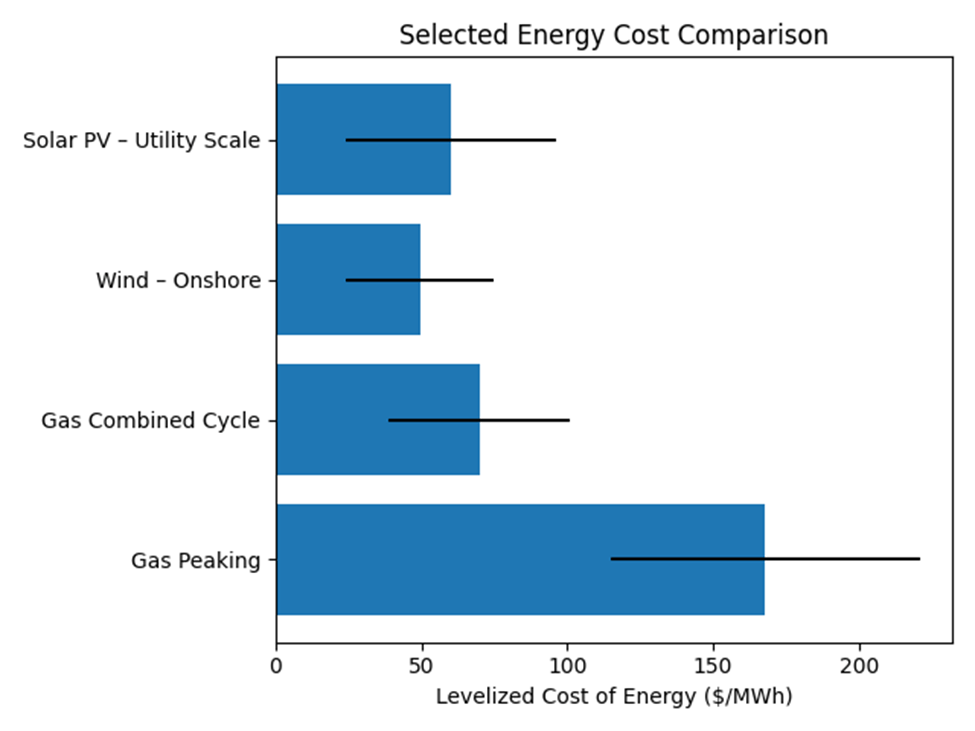
On its face, the conclusion is obvious. Solar and wind appear to be the lowest-cost options, while gas looks more expensive. The chart isn’t wrong—but it’s incomplete. And when incomplete math drives policy, the system ends up costing more than advertised. It measures the cost of producing electricity when it’s available—not the cost of running a grid. Those are very different things.
It’s also worth noting that rooftop solar doesn’t operate in a vacuum. Net energy billing ties compensation to retail rates rather than system value, so deployment follows customer economics—not grid needs. The result is more distribution upgrades, more complex power flows, and costs that don’t always line up with system benefit—all while the grid still has to be built for peak demand.
This is great – simple, direct and spot on.
What the Chart Misses
Jacobson points out the biggest flaw in the analyses that supported the Climate Act transition plan.
The grid doesn’t run on averages. It runs on the worst day of the year—cold, dark, and still.
That’s the moment the entire system is tested, and the moment that determines what it actually costs.
Wind and solar can be cheap when they produce power, but that’s not the same thing as delivering power when it’s needed. Cheap electricity isn’t the same as dependable electricity.
A power system has to be built to meet demand at all times, not just when conditions are favorable. That means having enough capacity available to carry the load even when intermittent resources aren’t producing. It also means maintaining the infrastructure, fuel supply, and operational flexibility to respond when conditions change.
Once you look at it that way, the gap becomes obvious. The cost of producing electricity is only one piece of the puzzle. The cost of making sure it’s there when you need it is what actually defines the system.
What This Looks Like in the Real World
One of the biggest failures of the Climate Act is ignoring what is happening in other jurisdictions that are further ahead in their net-zero transition.
If this still feels theoretical, you can see it play out in real time in places that have leaned heavily into solar.
California now produces so much solar power at midday that electricity prices can collapse to near zero—or even go negative, because supply exceeds demand. That sounds like a success until a few hours later, when the sun sets and demand is still high. At that point, the system has to replace a large amount of lost generation very quickly. Dispatchable plants ramp, imports increase, and prices rise as the system scrambles to maintain balance.
Nothing about that is free. The system still has to be built to handle both conditions—the oversupply in the middle of the day and the shortfall in the evening. That means maintaining capacity that sits idle for part of the day and then runs hard when it’s needed most.
Batteries can shift some of that midday solar into the evening, but only within limits. Most grid-scale batteries today are designed to discharge for a few hours, not to carry a system through multi-day weather events or extended winter peaks. Batteries don’t know where electricity comes from—they respond to price. And in many hours, that price is set by a grid still dominated by natural gas.
To rely on them as a full solution, you would have to build enough excess generation to charge them and enough storage to carry the system when that generation isn’t there. That means building significantly more capacity than you otherwise would, and then maintaining a system that is both larger and more complex.
Also note that New York agencies agree that traditional storage is insufficient for multi-day dark doldrums and have recommended developing a new technology for those periods.
The Simple Reality Check
I agree completely with this:
There’s a simple way to test the claim that wind and solar are now the cheapest sources of electricity. Look at the places that use the most of them. If the claim were true, those places should have the lowest electricity prices.
They don’t. States like California, which have invested heavily in solar, consistently have some of the highest electricity prices in the country, while many lower-cost regions rely more heavily on power plants that can run when needed.
At some point you have to decide whether to trust the model or what’s actually happening.
What It Actually Takes to Run a Grid
In my next post on the myth of cheap renewables I will provide more detail about this topic.
What’s missing from that original chart is everything required to make the system work. A power system doesn’t just produce electricity—it has to deliver it reliably, at all times, under all conditions.
That means maintaining backup generation for when the sun isn’t shining and the wind isn’t blowing. It means building storage to shift energy across hours or days. It means expanding transmission to move power from where it’s produced to where it’s needed. And it means carrying enough redundancy in the system to ensure it doesn’t fail under stress.
None of that is free, and none of it is optional.
Once those requirements are included, the economics change. The question is no longer which resource produces the cheapest electricity in isolation, but what combination of resources can meet demand reliably. That’s a very different problem—and a much more expensive one.
Additional Complications
I prepared this post to address the myth of cheap renewables. Jacobson goes on to discuss other topics. He describes the Myth of “Transition” as the idea that we are switching from one energy system to another. He makes a persuasive argument that historical energy transitions added more energy to the system and did not substitute for the one before it. “ Wind and solar are being added to the grid, but the underlying system that ensures reliability—power plants that can run when needed, fuel supply, and infrastructure—has not gone away.”
I have followed the Climate Act since 2019 and when I tell people about it that usually have never heard about it but their response is invariably what about reliability. Jacobson explains: “In colder regions, people rely on fuels that work when it matters—natural gas, oil, propane—because they can deliver heat on demand.”
What This Means for New England and New York
Jacobson’s description of what is happening in New England is apropos to New York.
On the coldest winter evenings, solar output is effectively zero, wind is often unreliable, and demand is at its highest. The system has to meet that demand regardless of conditions, which means relying on power plants that can run when needed and the fuel supply required to support them.
But the issue isn’t just winter. Solar production is concentrated in the middle of the day, while demand often peaks in the early morning and evening. It also varies by season, producing far more energy in the summer than in the winter, when the system is under the most stress.
That mismatch matters. Even when solar is producing, it often isn’t producing when the system needs it most.
In those moments, the grid isn’t running on what was cheapest to build—it’s running on what is available. And in New England, that often means natural gas, supplemented by oil and imports when the system is tight.
That reality drives cost. The region has to maintain the infrastructure and fuel supply to meet peak demand while also building out additional resources that may or may not be available when needed. The result is a system that is more expensive to operate, not less.
Complexity and Risk
Jacobson points out we are changing how the electric grid operates.
As we push toward more wind, solar, and battery systems, we’re not just changing where electricity comes from—we’re changing how the grid operates.
The traditional system relied on large, predictable power plants that provided stability as a byproduct of how they ran. The newer system relies far more on power electronics, software, and coordination to keep everything in balance. That can work, but it’s inherently more complex.
In pilot training, you learn that the best flights are boring. That only happens with preparation, simplicity, and margin for error. As complexity increases, so does the chance something goes wrong. Power systems aren’t that different.
There’s also a dimension here that gets far less attention: risk. Building out these systems increases reliance on global supply chains for critical materials and components, and much of that supply chain runs through China. China dominates the refining of many key minerals and manufactures the vast majority of the world’s solar panels. Producing those panels is energy-intensive, and much of that energy comes from coal.
None of that makes the technology unusable, but it does change the risk profile. We’re shifting part of our energy system—from fuel we control domestically to supply chains we don’t—while making long-term decisions about infrastructure that will be in place for decades.
The Bottom Line
Jacobson’s bottom line will also serve as my conclusion.
The original chart isn’t wrong. It’s just incomplete.
It tells you what it costs to produce electricity under ideal conditions, but it leaves out what it takes to run a system that has to perform under real ones. Once you account for reliability, timing, infrastructure, and risk, the picture changes.
We haven’t built a cheaper system. We’ve built a larger one—one that layers intermittent resources on top of the infrastructure required to keep the lights on when wind and solar aren’t producing.
And that cost doesn’t disappear. It shows up in higher rates, more complexity, and a system that is harder to operate and more fragile.
My thanks to Matt Jacobson for a clear explanation why wind and solar are not the cheapest form of new generation.


