Roger Pielke Jr on Climate Variability

Roger Pielke, Jr. described the underappreciated importance of climate variability in a recent post.  It is increasingly obvious that there are so many issues coming up with the New York Climate Leadership & Community Protection Act (Climate Act) net zero transition that we need to pause implementation and figure out how best to proceed.  Pielke’s article raises another example.

I am convinced that implementation of the Climate Act net-zero mandates will do more harm than good because the proposed green energy programs are crimes against physics.  The energy density of wind and solar energy is too low and the resource intermittency too variable to ever support a reliable electric system relying on those resources. I have followed the Climate Act since it was first proposed, submitted comments on the Climate Act implementation plan, and have written over 500 articles about New York’s net-zero transition.  The opinions expressed in this article do not reflect the position of any of my previous employers or any other organization I have been associated with, these comments are mine alone.

Overview

The Climate Act established a New York “Net Zero” target (85% reduction in GHG emissions and 15% offset of emissions) by 2050.  It includes an interim reduction target of a 40% GHG reduction by 2030. The Climate Action Council (CAC) was responsible for preparing the Scoping Plan that outlined how to “achieve the State’s bold clean energy and climate agenda.”  After a year-long review, the Scoping Plan was finalized at the end of 2022.  Since then, the State has been trying to implement the Scoping Plan recommendations through regulations, proceedings, and legislation.  However, in the rush to meet Climate Act mandates fundamental concepts and concerns are being ignored.

Climate Variability

One of the frustrating characteristics of climate advocates is the constant attribution of any unusual weather to climate change.  I have noted that a climatological average is normally based on a 30-year averaging period and explained that climate change could be defined as the difference.  As is the case with all aspects of climate change issues, there is more nuance and detail than obvious at first glance.

Roger Pielke, Jr. provides nuance and detail to the question “what is climate change.”

One of the most pervasive misunderstandings of climate — even among some who publish on climate — is the belief that any long-term trend in a measured climate variable indicates a change in climate, as defined by the Intergovernmental Panel on Climate Change (IPCC}. In practice, “long-term” is often defined to be only a few decades worth of observations.  Some trends in observational data are not an indication of a change in climate, and others are — telling the difference is not easy when it comes to extreme weather events.

He explains that the first issue is that climate data like any observation set of natural phenomena fluctuates naturally.  A post at Climate Etc. explains:

According to the IPCC, “climate variability refers to variations in the mean state and other statistics (such as standard deviations, the occurrence of extremes, etc.) of the climate on all spatial and temporal scales beyond that of individual weather events. Variability may be due to natural internal processes within the climate system (internal variability), or to variations in natural or anthropogenic external forcing (external variability).”

Pielke explains why this should be considered when estimating climate change effects:

The IPCC AR6 explains that the detection of a change in climate requires some certainty that the trend is not simply due to climate variability: “An identified change is detected in observations if its likelihood of occurrence by chance due to internal variability alone is determined to be small, for example, <10%.”

Quantifying internal variability with respect to any climate metric is challenging, typically with multiple valid interpretations possible. Superimposed upon the challenge is the fact that internal variability itself has been influenced by human factors, notably the emission of greenhouse gases.

Pielke notes that a common simplifying assumption is that the observed weather would not change were it not for “human influence”.  The problem is that it is too frequently applied to short observational records to claim climate change impacts.  Pielke notes that this is flawed because:  

The current climate varies on timescales both greater and less than 30 years. The IPCC AR6 defines climate variability:

“Deviations of climate variables from a given mean state (including the occurrence of extremes, etc.) at all spatial and temporal scales beyond that of individual weather events. Variability may be intrinsic, due to fluctuations of processes internal to the climate system (internal variability), or extrinsic, due to variations in natural or anthropogenic external forcing (forced variability).”

Pielke’s post goes on to address the question “How near or far into the past does one need to go to adequately characterize a ‘current climate’?” to use as the baseline for a climate change comparison. He uses flood data for various periods to show how easy it is to find a “convincing” trend showing larger floods over time since 1897 consistent with the hypothesis that increased greenhouse gases are causing the increase based on the data used.  However, when data prior to 1897 Hirsch (2011) explain that:

. . . we get a very different and more complex picture. . . Now we would say that although there has been some increase in flood magnitudes over time, the pattern is no longer very consistent with a hypothesis that this is driven by greenhouse gas increases in the atmosphere. The high values in the 19th Century are inconsistent with this hypothesis. In fact, one could put forward the argument that there are two populations of annual floods at this location. One is the population that spanned the years of about 1900 to 1941, and the other population existed before 1900 and after 1942. Without the benefit of the longer record, we could easily conclude that the data were highly supportive of a greenhouse-gas driven trend in flood magnitudes, but with it we find ourselves having to entertain other highly plausible hypotheses about an abruptly shifting population, with shifts that take place at time scales of many decades. The data do not negate the possibility that greenhouse forcing is a significant factor here, but they make it much more difficult to argue that these data provide a clear demonstration of the effect of enhanced greenhouse gas forcing on flood magnitudes.

Pielke goes on to describe how this issue affects the US government’s approach to flood policy.  He notes that a common application of flood risk fails to account for this problem.  This challenge has been long recognized by flood experts. Leslie Bond described this 20 years ago:

In the statistical estimation of a flood peak of a specific recurrence interval requires that all of the recorded peak flows be accurate and that the record be stable over the period of the record and the period for which the estimate is to be applied. That is, if there is a 50-year record of stream flow from 1931 through 1980, and you want a current estimate of the 1% flood to be valid for 30 years, the hydrology, the meteorology and the hydraulics must be stable from 1930 through 2034. In fact, we do not have sufficient historic rainfall data to be sure that the meteorology is stable, and few watersheds in the world are not changing as a result of urbanization, deforestation, agriculture, grazing or other causes.

Climate Act Implications

I have long-standing concerns about wind and solar resource availability.  The issues described by Pielke related to long-term weather observations are relevant to that problem.  It is obvious that we need to know the worst-case scenario for low wind and solar resource availability to determine how much long-term storage and/or some magical dispatchable emissions-free resource is needed to provide sufficient energy during resource droughts.  His references to floods are apropos because I believe we need to develop a probabilistic resource drought parameter equivalent to the 100-year flood. 

I have always believed that we should use as long a period of data as possible to determine that parameter.  These results complicate wind and solar-depending electrical system planning because it means even using the longest period of data may specify requirements incorrectly.  Also note that we apparently must worry about not just storage but also whatever weather conditions that cause extreme inertial frequency fluctuations that can lead to blackouts like in Spain.

My ultimate concern is that electrical planners currently base their reliability projections based on decades of experience with power plant outages that are uncorrelated.  They have a good handle on the failure probabilities and how much installed reserve capacity is needed as backup.  In the future the reliability requirements for wind and solar resource availability will be driven by weather that is fickler than plant shutdown variability.  In addition, this variability correlates over large areas so many of the wind and solar resources will behave the same. 

In my opinion, the likelihood of exceeding the planning parameters is much greater for a weather dependent electric system than today’s grid.  When everybody and everything possible is electrified, and the resource drought planning criteria are exceeded, the results will be catastrophic.

Conclusion

Pielke concludes:

A main reason why the IPCC has not achieved detection of trends in most measures of extreme weather events, and does not expect to this century, is the magnitude of expected trends — based on model projections — in the context of documented variability.

This does not mean that humans are not influencing the climate system or extreme events, or that such influences are not important. It certainly does not mean that we should forget about mitigation and adaptation policies.

What it does mean is that the climate is more variable than many appreciate. A quest to identify trends and ascribe causality to them should not obscure the fact that whatever role humans play in altering the climate, society needs to be robust to a much wider range of possibilities than we’ve observed.

Weather-dependent resources add reliability risks. There has been insufficient consideration of this risk and Pielke’s work indicates that there will be a wider range of possibilities than what we can estimate using available data.  This is another reason that we need to pause the Climate Act  implementation process.  It appears that if you want to decarbonize safely then nuclear power is the way to go because it removes these risks.

Climate Whiplash and California Wildfires

The difference between weather and climate is constantly mistaken by Climate Leadership & Community Protection Act (Climate Act) advocates and has been the subject of articles at this blog.  Recently Southern California wildfires have been blamed on climate change.  Patrick Brown addressed the question how much did “Climate Whiplash” impact the Los Angeles fires.  His excellent analysis raises issues that I want to highlight.

I have been a practicing meteorologist for nearly 50 years, was a Certified Consulting Meteorologist, and have B.S. and M.S. degrees in meteorology.  My particular expertise is air pollution meteorology in the electric utility sector with a focus on meteorological and pollution measurements.  The opinions expressed in this post do not reflect the position of any of my previous employers or any other organization I have been associated with, these comments are mine alone.

Weather vs. Climate

The Climate Act legislation and the implementation meetings confuse weather and climate.  According to the National Oceanic and Atmospheric Administration’s National Ocean Service “Weather reflects short-term conditions of the atmosphere while climate is the average daily weather for an extended period of time at a certain location.”  The referenced article goes on to explain “Climate is what you expect, weather is what you get.” 

Hydroclimate Volatility

Patrick Brown described the Swain et al. (2025): Hydroclimate Volatility on a Warming Earth Nature review paper. He quoted the first line of the UCLA Press Release for the paper: “Los Angeles is burning, and accelerating hydroclimate whiplash is the key climate connection.”  He then stated: “Thanks in no small part to the huge journalistic audience that lead author Dr. Daniel Swain commands, the “climate whiplash” vernacular was immediately adopted in international headlines covering the recent Los Angeles fires.”  This is a classic example of an extreme weather event that is linked to climate change by organizations and individuals that have a vested interest in advancing the threat of climate change.

Brown noted that: “the paper has demonstrated incredible reach and is in the 99.99th percentile in terms of online attention for all research (not just climate research) of a similar age.”  However he echoes my concern: “But as is the case for so much high-profile climate science, there is a large gap between the impression conveyed by the coverage and the impression left from the observational data.”

Climate Whiplash

I have never heard of the concept of climate whiplash before this story broke.  Brown explains:

Dangerous, intense wildfires require dry vegetation. The idea behind the climate whiplash connection to the Los Angeles fires is that very wet winters in Southern California in 2022-2023 and 2023-2024 enabled a great deal of vegetation growth but that the very dry beginning of the 2024-2025 winter allowed that vegetation to dry out, resulting in a landscape primed for uncontrollable wildfires. Swain explains the mechanism in interviews with Adam Conover and Neil deGrasse Tyson.

In order for this to be a climate change problem, we need to know whether these events are increasing.  Brown noted that:

The idea being conveyed is that these climate whiplash events are dramatically increasing not just in Southern California, but globally.  “Every fraction of a degree of warming speeds the growing destructive power of the transitions” Swain said.

Brown described background for this concept:

Taking a step back, the fundamental theory undergirding changing “hydroclimate” (think water cycle where we are considering not just how precipitation provides moisture but also how evaporation takes moisture) whiplash is nothing new. It is a basic fact of atmospheric physics that a warmer atmosphere can “hold” more water vapor (about 7% more per °C of warming). This warming influence on the water cycle has been discussed in detail since at least the 1980s (e.g., Manabe, & Wetherald, 1986)). At first, most research discussed a general intensification of the water cycle, typically emphasizing that already dry areas would get drier and already wet areas would get wetter as the globe warmed. However, by the mid-2000s, studies like Trenberth et al. (2003), Chou & Neelin (2004), Meehl et al. (2005), and Held & Soden (2006) began pointing out that the same physics (warmer atmosphere holds more moisture) can drive larger variability in the same place—heavier rain events juxtaposed with prolonged and/or more intense dry spells.

These concepts are taught regularly as a part of Climate Change 101 classes, including my own, and they are accepted as consensus climate science, articulated with “high confidence” in the IPCC’s most recent assessment report:

“A warmer climate increases moisture transport into weather systems, which, on average, makes wet seasons and events wetter (high confidence)”

“Warming over land drives an increase in atmospheric evaporative demand and the severity of droughts (high confidence).”

The reason I wanted to highlight Brown’s analysis of this paper is because he highlights a key complication for the general public’s understanding of climate change.  It is accepted that a warmer climate increases moisture in the atmosphere and drought severity.  The implications of those mechanisms are important with respect to GHG emission reduction policies.  The question is so what? What is the magnitude of the change, what impacts might result from these mechanisms, and do we expect that changes in global temperatures due to GHG emissions will result in significant impacts from these mechanisms are all questions that should be addressed.

I fully endorse Brown’s explanation:

However, I like to point out that it is useful to break down lines of evidence in climate science into categories of

  1. Historical observations/trends
  2. Fundamental theory
  3. Mathematical modeling

I know from teaching the “wet gets wetter, dry gets drier” concept that the evidence for increased variability in the same location is much stronger in the theory and modeling categories than it is in observations. This is important because observations should take precedence over the other two. Focusing on observations tells us a lot about how big of an effect we’re talking about (i.e., do we see major trends emerge through the noise of the observation system and natural variability?). Furthermore, a fundamental point of doing science is to explain observations. The canonical order of operations is that first you observe some phenomenon, and then you use the tools of theory and modeling to make sense of it.

I cannot over-emphasize the point that observations should take precedence over theory or modeling.

Observations

Brown goes on to evaluate observations of the whiplash where increased precipitation enabled a great deal of vegetation growth followed by a period of decreased precipitation that allowed that vegetation to dry out, “resulting in a landscape primed for uncontrollable wildfires”.  I am only going to summarize two of the results.

Brown evaluated observations of year-to-year water cycle variability following the methodology of the Swain et al. (2025) paper. Note that he only evaluated the effect over land because it has no effect on wildfires if it occurs over the ocean.  He did not find any compelling evidence for an increase in these events in California.  The results for global land were described:

So, over all global land, at the timescale that is most relevant to the Los Angeles fires (annual), in the premiere observational dataset (ERA5), using Swain et al. (2025)’s own data, we have seen a long-term decrease in whiplash frequency (this, by the way, is acknowledged in passing in the text of Swain et al. (2025) on page 37).

Let’s pause for a second to recall the first line of the UCLA press release (“Los Angeles is burning, and accelerating hydroclimate whiplash is the key climate connection.”) and the global news coverage it generated. Would any reader of this coverage have any idea about the incredibly important caveats above? Not that I can tell.

In the next section Brown discussed the magnitude of changes in annual water cycle variability.  He stated that:

Now, to be fair, Swain et al. (2025) purport to show evidence of increasing whiplash frequency at multiple timescales, spatial extents (over the ocean, for example), and in other datasets.

However, highlighting changes in arbitrarily-defined “event” frequency without reporting changes in “event” magnitude is misleading, and it goes against one of the core recommendations of the National Academies of Sciences 2016 report on Attribution of Extreme Weather Events in the Context of Climate Change. As Ted Shepherd recently put it in his presentation to the committee responsible for the next such report: “Frequency is the more impressive number, but magnitude is perhaps the more physically interpretable number.”

Brown’s analysis of the magnitude of the changes found: “1 we see no long-term increase in water cycle variability at the location and timescale relevant to the Los Angeles fires.”

Patrick Brown Summary

Brown’s summary is important.  He notes that the choice of analysis data used affects the conclusion:

While “climate whiplash events” may be increasing in frequency under most of the very specific, selected definitions used and datasets investigated in Swain et al. (2025), the general idea that annual precipitation (or more generally, the water cycle, which includes evaporation) is becoming dramatically more variable is not supported when a broader set of datasets and definitions are used.

Brown worries that this analysis and the publicity it received is a problem:

Would a reader of Swain et al. (2025), or especially its coverage, have any idea about the weakness of its broader conclusions or the lack of robustness of its results to different definitions and datasets? Almost certainly not, and I contend that this is a major problem for public understanding and trust in climate science.

One of my over-arching issues with the existential threat narrative is that the accepted science is distorted with respect to reality of natural variability.  Brown explains:

Why don’t we see a robust increase in water cycle variability given the strong theory underpinning “wet gets wetter, dry gets drier”? For one thing, the theoretical size of the effect is known to be quite small relative to natural, unforced variability, making it inherently difficult to detect. For example, we see in Figure 7 above that year-to-year rainfall in Los Angeles naturally varies by as much as 300%, yet the signal we are looking for is one to two orders of magnitude less than this. It is also apparently the case that observational uncertainty is larger than the signal (or there would not be such disagreement between datasets). Physically, perhaps increasing mean precipitation is offsetting the increase in calculated evaporation in the SPEI index, reducing its variability. Maybe reduced temperature variability (via arctic amplification) is reducing calculated evaporation variability.

I agree with Brown’s concluding remark:

My main discomfort with Swain et al. (2025) and its rollout is that it appears that the primary goal was to create and disseminate the “climate whiplash” meme rather than conduct a truly rigorous evaluation of the evidence, including countervailing evidence. Ultimately, this makes the research a much larger advance in marketing than an advance in science.

Conclusion

Patrick Brown does an excellent job eviscerating the climate whiplash headlined stories based on Swain et al. (2025)’s recent paper.  It is frustrating that biased analyses that confirm pre-conceived get so much attention.  It will require many evaluations like Brown’s to address the misinformation.

There is another important point.  There is no question that adding greenhouse gases to the atmosphere will result in warming and that the warming will result in “wet gets wetter, dry gets drier”.  However, Brown shows that the magnitude of these effects is important and that checks based on historical observations indicate that those effects are about the same as natural variability.  Whenever I have evaluated similar claims, I found the same result.  Claims that climate change impacts are observable now are not supported by historical observations.

Hurricane Helene Hype Nonsense

The basis of the emotion driven narrative that there is an existential threat of climate change is fueled by endless articles and opinion pieces in the mass media that conflate every extreme weather event with climate change.  Remember climate is what you expect, and weather is what you get.  This article describes how the hucksters incorrectly make the extreme weather devastation caused when a rare weather pattern caused the storm to stall into an example of climate change impacts when a hurricane in hurricane alley during the hurricane season occurred.

I have followed the Climate Leadership & Community Protection Act (Climate Act)since it was first proposed, submitted comments on the Climate Act implementation plan, and have written over 450 articles about New York’s net-zero transition. The difference between weather and climate has been a theme in many articles. The opinions expressed in this article do not reflect the position of any of my previous employers or any other organization I have been associated with, these comments are mine alone.

Overview

The rationale for the Climate Act is the existential threat of climate change and the Hochul Administration never misses an opportunity to describe every weather extreme as a more proof.  The Climate Act established a New York “Net Zero” target (85% reduction in GHG emissions and 15% offset of emissions) by 2050.  It includes an interim 2030 reduction target of a 40% reduction. Two targets address the electric sector: 70% of the electricity must come from renewable energy by 2030 and a requirement that all electricity generated be “zero-emissions” resources by 2040. The Climate Action Council (CAC) was responsible for preparing the Scoping Plan that outlined how to “achieve the State’s bold clean energy and climate agenda.” The Integration Analysis prepared by the New York State Energy Research and Development Authority (NYSERDA) and its consultants quantifies the impact of the electrification strategies.  That material was used to develop the Draft Scoping Plan outline of strategies.  After a year-long review, the Scoping Plan was finalized at the end of 2022.  Since then, the State has been trying to implement the Scoping Plan recommendations through regulations, proceedings, and legislation.

Good Energy Hype

I was prompted to write this post when I came across an opinion piece in the LA Times: Helene destroyed my hometown. I don’t want climate change stories of false hope by Anna Jane Joyner.  She is the founder and chief executive of the “story support nonprofit” Good Energy.  Last March I did an article about Irina Slaw’s article “Burn, Hollywood, burn” where she called out the blatant indoctrination and propaganda associated Good Energy – “Story support for the age of climate change”.

After noting that she had been checking on the weather and evacuation plans while preparing to board a plane on her way to NYC Climate Week  Joyner writes:

The hurricane didn’t come for my partner and me this time, but it destroyed my hometown in the mountains of North Carolina. I’ve spent 20 years working on climate and I live between Los Angeles and the Gulf Coast of Alabama, where I’ve reckoned with the likelihood of one day losing our home. I’ve also accepted that worsening fires, droughts and heat waves could make Southern California unlivable. But Asheville was considered a climate haven. I’ve always told family members we can never sell our homes there. It is utterly unfathomable that it would be devastated first by one of the worst climate disasters in U.S. history. Helene showed us nowhere is safe. 

Joyner went on to provide descriptions of the destruction caused by storm.  This was followed by her attempt to link the storm to climate change and her climate change false hope argument:

Scientists estimate that climate change increased Hurricane Helene’s rainfall by up to 50% in parts of the Carolinas and Georgia, dumping more than 40 trillion gallons of water. At NYC Climate Week, the annual awareness event held alongside the U.N. General Assembly, the disconnect from this shattering reality was surreal. There were fancy parties, cheerful sun imagery and giant signs reading “HOPE.” The dominant theme was: We can solve this! We need to tell hopeful climate stories! But there’s no “solving” a hurricane wiping out western North Carolina, hundreds of miles from the sea. Only focusing on optimism is like telling a cancer patient that everything will be OK if they just stay positive. At best, it comes across as out of touch; at worst, it feels callous. Yes, we can still prevent the worst impacts and must demand our governments scale solutions and act urgently, but we cannot minimize the horrors unfolding now, or that it will get worse in the coming years.

It gets worse:

Fossil fuel executives have known since the 1970s that burning oil, coal and gas would cause escalating climate catastrophes and worldwide suffering. Yet they lied, sacrificed our safety for their greed and just unleashed an apocalypse on my hometown. Their actions will condemn children today to a planet that’s more hell than Earth by the end of the century if we don’t stop them. It isn’t just a tragedy; it’s a crime against humanity.

Not to worry Joyner will be available to solve this problem by providing stories:

What’s happening in North Carolina doesn’t feel real. I have no emotional framework for this, no story to help me. Right now, what I desperately need are authentic stories that help us figure out how to be human in this changing world, to face this overwhelming crisis with bravery. Stories that help us navigate our very understandable fear, anxiety, grief, despair, uncertainty and anger in a way that allows us to feel seen. Stories that make us laugh — not in ignoring our reality, but in the midst of it — and stories that remind us there’s still so much beauty here to fight for. That capture how, in the living nightmare of climate disasters, people demonstrate extraordinary kindness and creativity, as they’re doing in Asheville and Black Mountain at this very moment. And we need stories that expose the guilt of the fossil fuel industry.

Reality

A quick review of recent articles at Watts Up With That demonstrates that the devastation of the remnants of Helene in the Asheville region was an extreme weather event and not evidence of climate change.

Paul Homewood did a nice summary of the data for Hurricane Helene.  His description of the Asheville rain notes:

In Asheville, North Carolina, a total of 13.98 inches (35.52 centimeters) of rain fell from September 25 to 27, according to National Weather Service records. The storm swamped neighborhoods, damaged roads, caused landslides, knocked out electricity and cell service, and forced many residents to evacuate to temporary shelters. Record flood crests were observed on multiple rivers in the state. Flooding was widespread across the southern Appalachians; preliminary rainfall totals neared or exceeded 10 inches (25 centimeters) in parts of Georgia, North Carolina, South Carolina, Tennessee, and Virginia.

Note that the 14 inches of rain occurred over three days.  Joyner referenced a statement that climate change increased Hurricane Helene’s rainfall by up to 50% in parts of the Carolinas and Georgia.  I found that the reference stated that “In one provisional rapid attribution statement, a trio of scientists at the Lawrence Berkeley National Laboratory said the rainfall over the 24 hours Helene moved through was made up to 20 times more likely in these areas because of global warming.”  Comparing the 24 hours in this reference to the three-day storm total makes it clear that storm motion was not considered in rapid attribution statement. 

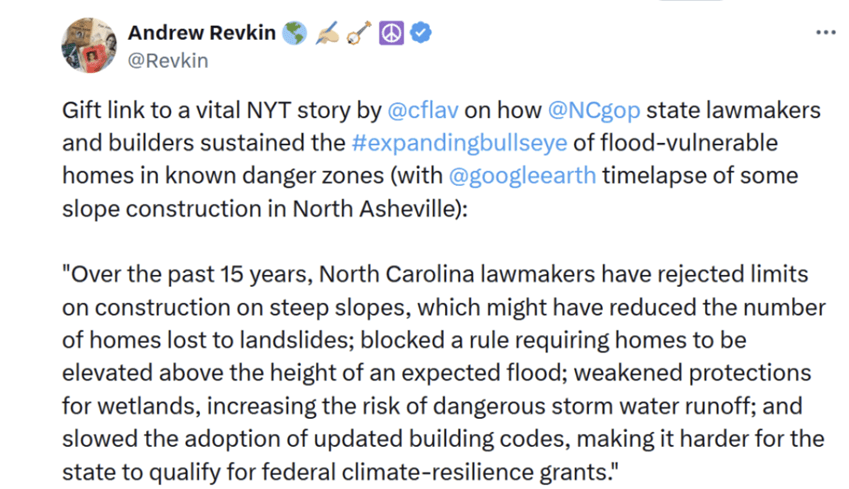
Charles Rotter’s article on the observations of Steve McIntyre and Andy Revkin about the real lessons to be learned from the storm completes the destruction of the arguments in Joyner’s op-ed.  McIntyre explains that flood control dams were planned for some of the rivers that had devastating floods but were not built.  Clearly there are negative consequences of building dams and positive benefits associated with keeping the rivers open.  But if you want to prevent flood damage when you keep the rivers free of dams then you should take prudent actions.  Revkin points out that was not the case:

Finally, Revkin described a 1960 report “Floods on French Broad and Swannanoa Rivers around Asheville” explaining what was likely to happen:

Andy reported that the report stated that developments around Asheville “would cause these great floods of the past to be higher if they occurred again. Land fills and buildings in the flood plain and the many bridges across the streams have seriously reduced flood flow capacity.” “On the French Broad River, a flood of the same discharge as the 1916 flood would today be 3 to 4 feet higher between Pearson Bridge and West Asheville Viaduct than the actual flood elevation. On the Swannanoa River, a repetition of the 1916 flood would be up to 2. 5 feet higher today at Biltmore and up to 15 feet higher upstream from the Recreation Park dam.”

Anthony Watts described a couple of articles from Climate Realism that debunked the media claims about climate change effects on the storm.  He shows that the claims of climate change worsening storms such as Helene just don’t hold up.  Of particular note, is the reference to a massive flood in Asheville in 1916. Matthew Wielicki provides a good comparison of this storm and the 1916 storm.  He found that the 1916 flood peaked at 23 feet.  In this storm the peak was 24.7 feet. 

Note that the 1960 report projected that if there was another 1916 storm that the flood would be between 3 to 4 higher because of development.  Hurricane Helene flood waters peaked at less than two feet higher than the 1916 storm.  It was development and not climate change.

Conclusion

Joyner concluded her article:

I need help making meaning of all this, and stories have always been how humans make sense of our world. But as I grieve an unimaginable loss, the last thing I want are optimistic stories about hope. As climate scientist Kate Marvel says: “We need courage, not hope, to face climate change.”

I find it difficult to sympathize with the grief of someone who provides Hollywood “story support for the age of climate change” because reality paints a different picture of the world.  The data show that Helene was a rather typical hurricane in hurricane alley that occurred in the hurricane season.  Devastating floods in Asheville have occurred before and evidence suggests that the greater observed flood peak was probably due to development.  There is nothing to suggest that this is anything but an extreme weather event and it certainly is no evidence of any kind of worsening climate change impacts.

In my opinion, the worst part of this is that the usual suspects are using this tragedy to call for US reductions in fossil fuel to prevent this from happening again.  Putting aside the lack of a causal link between GHG emissions and specific weather events, the relative magnitude of US and global emissions, and the rate of change of those emissions, the indisputable fact is that storms causing this kind of devastation have happened before and will happen again whatever is done to mitigate emissions.  If nothing is done to adapt to this observed extreme weather, then the tragedy will inevitably occur again.  Obviously we need to reassess where we are making our investments.

The Difference Between Weather and Climate is Important

I recently published an article about the difference between weather and climate that was in response to a friend who consistently links weather events to climate change on his Facebook account.  The reason for this post is his response to my latest explanation that ended with him saying “I’m comfortable with being wrong.   It’s not a death match.”  This post explains why it matters.

I will explain the problem with the successful propaganda campaign to convince the general population that unusual weather events justify New York’s Climate Leadership & Community Protection Act (Climate Act).  I have followed the Climate Act since it was first proposed, submitted comments on the Climate Act implementation plan, and have written over 400 articles about New York’s net-zero transition. The opinions expressed in this post do not reflect the position of any of my previous employers or any other organization I have been associated with, these comments are mine alone.

Overview

The Climate Act established a New York “Net Zero” target (85% reduction in GHG emissions and 15% offset of emissions) by 2050.  It includes an interim 2030 reduction target of a 40% reduction by 2030 and a requirement that all electricity generated be “zero-emissions” by 2040. The Climate Action Council (CAC) is responsible for preparing the Scoping Plan that outlines how to “achieve the State’s bold clean energy and climate agenda.”  In brief, that plan is to electrify everything possible using zero-emissions electricity. The Integration Analysis prepared by the New York State Energy Research and Development Authority (NYSERDA) and its consultants quantifies the impact of the electrification strategies.  That material was used to develop the Draft Scoping Plan outline of strategies.  After a year-long review, the Scoping Plan was finalized at the end of 2022.  In 2023 the Scoping Plan recommendations were supposed to be implemented through regulation, PSC orders, and legislation.  Not surprisingly, the aspirational schedule of the Climate Act has proven to be more difficult to implement than planned and many aspects of the transition are falling behind. 

Examples of the Causal Link

In order to keep the public’s support for the Climate Act net-zero transition the Hochul Administration links recent extreme weather events to climate change.  The impetus of this article were two recent Facebook posts by my friend.  The first said that “So it wasn’t so long ago that there was a thing called “snow” and included a memory of a hike during the winter of 2014-2015 when there were “MASSIVE snow dumps in the Catskills”.  Yesterday the second post noted that he had heard spring peepers.  This small chorus frog is “one sure sign of spring” and my friend noted that hearing them on March 8 was “by far the EARLIEST EVER”.

Climate Change and California Atmospheric Rivers

In my articles responding to the presumption that these weather events are tied to climate change I have explained that according to the National Oceanic and Atmospheric Administration’s National Ocean Service “Weather reflects short-term conditions of the atmosphere while climate is the average daily weather for an extended period of time at a certain location.”  That article goes on to explain “Climate is what you expect, weather is what you get.”  Rather than trying to expand on my arguments I think this recent article by Chris Martz provides good insight. 

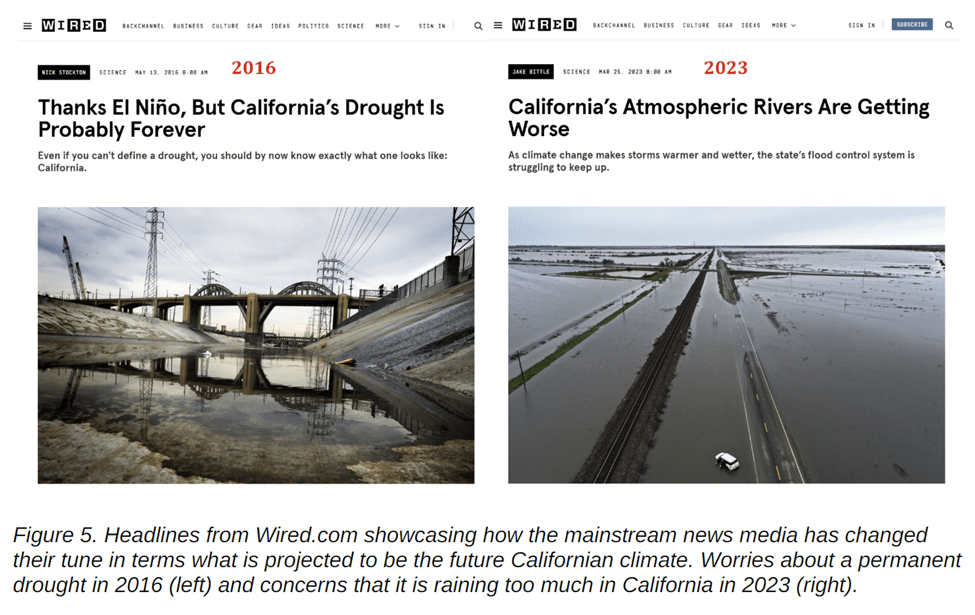
In his article Martz addresses those who will claim that the recent rounds of atmospheric rivers that have brought rainfall for days and recent heavy snowfalls to California are linked to climate change.  He describes the news cycle that had been harping for years on the “megadrought” that would put California in a permanent drought because of climate change.  The last two years of above average precipitation have destroyed that story.  Martz writes:

Faced with the reality that these “forever drought” predictions from nearly a decade ago were woefully wrong, academics and their media mouthpieces have had one of two options, either:

  1. Admit that the “permanent drought” prediction was wrong, or,
  2. Change their tune quietly to say that human-induced climate change is making California wetter by “fueling” the atmospheric rivers that provide the bulk of the state’s annual rainfall budget, and hope the rest of us don’t notice.

And, of course, the second option is the one academics and government scientists decided to go with (Figure 5).

 Martz goes on to describe atmospheric rivers and their potential for serious impacts.  Then he addresses the question whether “human-induced climate change plays a role, and to what extent if that is indeed the case.”  He notes:

I should prepend this discussion with the disclaimer that climate change itself does not cause any single weather event to occur. Climate is nothing but a statistical measure of various atmospheric state variables over a period of at least 30-years, preferably longer. The statistics may be organized into averages or “climate normals,” distributions and extremes. Each provides some sort of insight as to the weather one might expect at any given point in space or time. As the old saying goes, “climate is what you expect, weather is what you get.” Climate changes, both naturally and through man-made forcings, over a period of several decades. The equations of motion which physically explain how extreme weather phenomena occur do not change with the climatic base state.

I think he does a good job explaining what meteorologists should consider when trying to attribute weather events to climate change.

So, the question becomes, how does a changing climatic base state alter specific characteristics of atmospheric river events? In this case, there are two facets that atmospheric scientists care about:

  1. Has there been a detectable increase in extratropical cyclone activity [and the accompaniment intense winds] that atmospheric rivers are associated with in the observational record? How is this expected to change in the future?
  • How has extreme rainfall associated with atmospheric rivers changed as the climate has warmed? How is this expected to change in the future?

In a nutshell, depending on which of the two key issues above are examined, we reach contrasting conclusions, showcasing the sheer complexity of the coupled ocean-atmosphere system. To elaborate, if we make the assumption that the planet continues to warm, extratropical cyclone activity and their associated extreme winds should wane, but extreme rainfall, on the contrary, should be enhanced.

Like every other aspect of climate change policy this is much more complicated than it appears at first glance.  He does a great job breaking down all the factors at play.  For example, the warmer climate means more moisture “super-charging” extreme weather.  He says in response: “Simply put, just because more water vapor can occupy the air at higher temperatures does not mean that it will.”  I recommend reading his article in its entirety to understand how difficult it is to make a definitive link between climate change and weather events.

Why it Matters

After I sent the link to the article to my friend he responded:

I might quibble with “The equations of motion which physically explain how extreme weather phenomena occur do not change with the climatic base state.”    No, the equations don’t change, but the inputs do, right?   So, more heat = more [whatever], etc.     I appreciate the skepticism, but, clearly, there is something going on out there beyond the bounds of “normal”.   But then again, you can be skeptical and say that my human timeframe is far too short to make such judgments – perhaps.    But even beyond my mere mortal years, it seems that we’re seeing the furthest outliers of “weather” data that you might expect for a given season.  

The frustration to me is that he gets it when he says, “my human timeframe is far too short to make such judgments”.  Anecdotal evidence linking weather events and climate change is going to always be wrong because weather is what you get and climate is what you expect and our time frame is too short for climate comparisons.

However, that is not the problem.  The issue is his concluding remarks:

I’m comfortable with being wrong.   It’s not a death match.

My concern is that ultimately the conflation of every unusual weather event to climate change is linked to the preposterous idea that if New York converts its energy system to meet the Climate Act net-zero goals there will be an effect on the unusual weather events observed.  I am convinced that the present trajectory of the Climate Act mandates aspirational goals that are dangerous.  In February 2021, the Texas electric grid failed to provide sufficient energy when it was needed.  The storm was the worst energy infrastructure failure in Texas history and resulted in at least 246 people dying and total damages were at least $195 billion.  The Hochul Administration has not demonstrated that the Climate Act goals are feasible and will not endanger the reliability of the New York electric system.  The same thing that happened to Texas could happen in New York.

Discussion

There is another related weather and climate related issue.  I fear that the emphasis on ever more dangerous weather in the future due to climate change is diverting resources away from addressing observed weather problems.  There is a limit to the resources available to address weather-related issues despite the value in doing so.  Over building infrastructure in one place to account for potential issues related to climate change likely means that improving infrastructure elsewhere for observed weather events will not be funded.

As noted previously, the rationale to do something and the response to climate change is much more complicated than it first appears.  The recent article Minding the Sciences—Wicked Science and Understanding Climate Change: Uncertainty, Risk, and Pragmatics by Joe Nalven reviews Judith Curry’s book, Climate Uncertainty and Risk and its discussion of these policies.

Nalven writes:

I am often surprised how California state and local entities craft policies they believe would put us on the path to addressing the complex dynamics of what we label climate change. Whether these efforts—a bullet train to and from small cities, banning the sale of gasoline cars by 2035, limiting the use of gas appliances, and similar aggressive policies—make real-world sense or whether they are a virtue-signaling crystal ball without a feasible way of measuring those efforts remains to be seen.

This is the nub of the Climate Act problem.  Can we come up with net-zero transition policies that will not do more harm than good.  Nalven’s article describes how Curry lays out the wicked problem of whether climate action is necessary and how it should be addressed given the uncertainties.  Nalven sums up:

Curry’s approach stands in stark contrast to the overreach and catastrophizing by climate justice warriors. Those warriors and their acolytes are unlikely to be persuaded by Curry’s pragmatic, but seemingly slower, approach to a changing climate.

There is no magic wand, no scientific alchemy, that can easily upend cognitive catastrophizing about weather events.

“The disconnect between historical data for the past 100 years and climate model-based projections of worsening extreme weather events presents a real conundrum regarding the basis on which to assess risk and make policies when theory and historical data are in such disagreement.”

Conclusion

Chris Martz sums up my concern about the mis-allocation of resources based on the fear of climate change:

Whether or not climate change is having any meaningful impact on the extreme weather events we care about is irrelevant in the need to raise awareness to the fact that we continue to develop in disaster-prone areas and the necessity to improve societal resilience through better zoning codes and community planning. Mother Nature always has and always will throw curveballs in our direction, regardless of what the climate is doing in the long-term, and being better equipped to mitigate disaster losses or prevent them in the first place must be a focal point of engineers, emergency managers and policymakers in the years and decades to come.

Sitting on our hands and blaming climate change for everything is really a waste of time that would be better spent finding solutions to real-world problems such that our children and grandchildren have a safer world to live in.

Against this backdrop, the cartoon-like presumption that any unusual weather is tied to climate change and thus needs to be addressed whatever the cost needs to be confronted.  The difference between weather and climate does matter. N

Weather and Climate Revisited

I have been a persistent critic of the Hochul Administration’s consistent linking of any extreme weather event to climate change as rationale for the Climate Leadership & Community Protection Act (Climate Act).  In my articles responding to the claims I explain that according to the National Oceanic and Atmospheric Administration’s National Ocean Service “Weather reflects short-term conditions of the atmosphere while climate is the average daily weather for an extended period of time at a certain location.”  The referenced article goes on to explain “Climate is what you expect, weather is what you get.”  This post is in respond to a friend who says that he has “grappled with this statement in the past, but still don’t fully understand it”

I have followed the Climate Act since it was first proposed, submitted comments on the Climate Act implementation plan, and have written over 400 articles about New York’s net-zero transition. The opinions expressed in this post do not reflect the position of any of my previous employers or any other organization I have been associated with, these comments are mine alone.

Overview

The Climate Act established a New York “Net Zero” target (85% reduction in GHG emissions and 15% offset of emissions) by 2050.  It includes an interim 2030 reduction target of a 40% reduction by 2030 and a requirement that all electricity generated be “zero-emissions” by 2040. The Climate Action Council (CAC) is responsible for preparing the Scoping Plan that outlines how to “achieve the State’s bold clean energy and climate agenda.”  In brief, that plan is to electrify everything possible using zero-emissions electricity. The Integration Analysis prepared by the New York State Energy Research and Development Authority (NYSERDA) and its consultants quantifies the impact of the electrification strategies.  That material was used to develop the Draft Scoping Plan outline of strategies.  After a year-long review, the Scoping Plan was finalized at the end of 2022.  In 2023 the Scoping Plan recommendations were supposed to be implemented through regulation, PSC orders, and legislation.  Not surprisingly, the aspirational schedule of the Climate Act has proven to be more difficult to implement than planned and many aspects of the transition are falling behind.  In order to keep the public’s support for the transition the Hochul Administration links recent extreme weather events to climate change.

Weather vs. Climate

The link between extreme weather and climate is commonly made by the mass media egged on by climate activists.  In response I have a page devoted to rebuttals to these claims.  I also have another page addressing climate change attribution.  I have noted that the standard climatological average is 30 years.  In order to think about a change in today’s climate averages you really should compare the current 30 years against the previous 30 years.  In order to get a trend, you need to look at as much data as possible.  On the face of it that might seem easy but the reality is that the conditions for a representative trend are difficult to achieve.  Ideally you need to use the same instruments, the same methodology, and keep the conditions around the observing location the same.

My reader friend still doesn’t understand why I am so dismissive of these claims. He wrote:

Perhaps there is a different way for you to say it that I will understand.    It seems reasonable to conclude that an individual weather event can be plausibly linked to a changing climate, if the question can be asked: “But for ____  ______,   would this have happened?”  

I think that laypeople have heard the narrative that climate change is affecting weather today so often that it “seems reasonable that an individual weather event can be plausibly linked to a changing climate”.   When I did a search on the term “what conditions can impact the weather” all that came up were articles arguing that there is a link.  This story is everywhere so the presumption that there is a plausible link is logical.  I show why that is wrong below.

My Response

I have given some thought to his perception relative to mine.  For the record, I have a BS and a MS in meteorology, have been working in the field for 50 years, but have limited forecasting experience because my emphasis has been air pollution meteorology.  I think that as a result of my background I know what is involved with weather forecasting and when I weigh all the parameters affecting a weather event relative to the limited effects associated global warming, I dismiss claims that climate change can cause any weather events.  There might be a tweak in the observed observations but that is all.

Let me explain by considering what is involved with a weather forecast.  Weather.US lists results from different weather forecast models.  This link provides a response to the question what are weather forecast models?:

Numerical Weather Prediction

Weather models, known formally as “Numerical Weather Prediction” are at the core of modern weather forecasts. All the forecast information you see at weather.us is powered by weather models, do what are they and how do they work?

Weather models are simulations of the future state of the atmosphere out through time. Millions of observations are used as initial conditions in trillions of calculations, producing a three dimensional picture of what the atmosphere might look like at some time in the future. Massive computers are used to do these calculations at incredibly fast speeds to enable simulations to cover the entire globe, and extend up to two weeks into the future.

Global vs Regional models

There are two general types of weather models, global models and regional models. Global models produce forecast output for the whole globe, generally extending a week or two into the future. Because these models cover a wider area, and a longer timespan, they’re generally run at a lower resolution, both spatially (fewer forecast points per given area) and temporally (fewer time points get a forecast).

Regional models on the other hand have much higher resolutions, but only cover some part (region) of the globe, and only provide forecasts a couple days out in time. The advantage with these models is that their higher resolution lets them “see” features that the global models miss, most notably including thunderstorms.

Why are there so many models and how are they different?

Many different national weather centers have supercomputers that run weather models. Each of these is slightly different, using different equations to solve for various physical processes that shape our weather patterns. Many of them also have slightly different resolutions, and use slightly different combinations of initial data sources.

These slight differences multiply out through time because the atmosphere is a chaotic system. This also means any errors that the models make in the near term become exponentially larger with time. This is why the forecast for a week from now is far less accurate than the forecast for tomorrow.

Weather modelling centers attempt to control for the influence of chaos by running ensemble systems that each use slightly different initial conditions. Each ensemble “member” then produces a forecast as if its set of initial conditions were correct. This provides some way of quantifying how likely a given forecast outcome is, helping to show forecast uncertainty.

My education and background included an emphasis on measuring parameters that affect weather forecasts.  The discussion above notes that models start with initial conditions that are based on these meteorological variables.  The World Meteorological Organization Measurement of Meteorological Variables report describes measuring techniques for the following parameters that all affect weather forecasts:

  • Present weather
  • Past weather
  • Wind direction and speed
  • Cloud amount
  • Cloud type
  • Cloud-base height
  • Visibility
  • Temperature
  • Relative humidity
  • Atmospheric pressure
  • Precipitation
  • Snow cover
  • Sunshine and/ or solar radiation
  • Soil temperature
  • Evaporation

Keep in mind that the initial conditions must not only include the surface observations but also observations of wind, temperature, and humidity in layers above ground.  As noted above, there are many different types of forecasts and the use of these parameters is determined by the type of forecast.  For example, if I was forecasting the impacts of air pollution within 50 miles of a source, I would not be concerned about soil temperature and evaporation. 

In this response I am addressing whether individual extreme weather events (less than a week) can be linked to climate change associated with the greenhouse gas (GHG) effect.  Increased GHGs reduces long-wave radiation (earth surface temperature) creating warming.  No weather forecast model incorporates long-wave radiation measurements because the variation is so small over a week.  Claims that climate change is affecting weather events associated with the GHG effect presume that there is warming that affects the events. 

Given all the parameters that affect weather forecasts I do not think that a tweak in temperature can be linked to the cause of a specific event for two reasons.  The first is that the temperature effect associated with the greenhouse effect is only of many parameters associated with weather events and I don’t think it has a high impact on extreme events.  The second reason is related to the discussion above about the chaotic atmosphere.  It states that “Weather modelling centers attempt to control for the influence of chaos by running ensemble systems that each use slightly different initial conditions.”   The change in atmospheric radiation due to GHG emissions is smaller than the initial conditions variation.

Given my lack of forecasting experience it is appropriate to consider another source.  Presumably climate change would have the greatest impact on heat wave.  Dr. Cliff Mass describes the effect of global warming on the Pacific Northwest Heatwave of 2021.  His synopsis:

Society needs accurate information in order to make crucial environmental decisions. Unfortunately, there has been a substantial amount of miscommunication and unscientific handwaving about the recent Northwest heatwave, and this blog post uses rigorous science to set the record straight. First, the specific ingredients that led to the heatwave are discussed, including a high-amplitude ridge of high pressure and an approaching low-pressure area that “supercharged” the warming. Second, it is shown that global warming only contributed a small about (1-2F) of the 30-40F heatwave and that proposed global warming amplification mechanisms (e.g., droughts, enhanced ridging/high pressure) cannot explain the severe heat event. It is shown that high-resolution climate models do not produce more extreme high temperatures under the modest global warming of the past several decades and that global warming may even work against extreme warming in our region. Importantly, this blog demonstrates that there is no trend towards more high-temperature records. Finally, the communication of exaggerated and unfounded claims by the media, some politicians, and several activists are discussed.

Conclusion

The premise that it seems reasonable in the statement “It seems reasonable to conclude that an individual weather event can be plausibly linked to a changing climate, if the question can be asked: ‘But for ____  ______,   would this have happened?’  “ is flawed.  The greenhouse effect is only one of many parameters affecting weather and the change in atmospheric radiation due to GHG emissions is smaller than the initial conditions variation used to address chaotic atmospheric conditions means that there is no provable link.  The suggestion that climate change causes unusual weather events ultimately is an unfalsifiable hypothesis because no test can ever show that it is not real because it cannot be detected.

The Solution to Extreme Weather Issues is not to Reduce GHG Emissions

As a meteorologist I find it frustrating that every extreme weather event is considered a reflection of “a “new normal” due to the effects of climate change”.  As a pragmatic environmentalist, it is even more frustrating when a report comes out criticizing New York’s infrastructure resiliency to minimize the effects of extreme weather but fails to pick up the tradeoffs between resiliency infrastructure investments versus reducing greenhouse gas emissions that will supposedly prevent extreme weather.   This article describes an example of this dynamic: the New York City Metropolitan Transit Authority (MTA) extreme weather resiliency plan.

I have followed the Climate Leadership & Community Protection Act (Climate Act) since it was first proposed, submitted comments on the Climate Act implementation plan, and have written over 350 articles about New York’s net-zero transition.  I have devoted a lot of time to the Climate Act because I believe the ambitions for a zero-emissions economy embodied in the Climate Act outstrip available renewable technology such that the net-zero transition will do more harm than good by increasing costs unacceptably, threatening electric system reliability, and causing significant unintended environmental impacts.  The opinions expressed in this post do not reflect the position of the New York State Reliability Council, the Extreme Weather Working Group, any of my previous employers or any other organization I have been associated with, these comments are mine alone.

Climate Act Background

The Climate Act established a New York “Net Zero” target (85% reduction and 15% offset of emissions) by 2050.  It includes an interim 2030 reduction target of a 40% reduction by 2030 and a requirement that all electricity generated be “zero-emissions” by 2040. The Climate Action Council is responsible for preparing the Scoping Plan that outlines how to “achieve the State’s bold clean energy and climate agenda.”  In brief, that plan is to electrify everything possible using zero-emissions electricity. The Integration Analysis prepared by the New York State Energy Research and Development Authority (NYSERDA) and its consultants quantifies the impact of the electrification strategies.  That material was used to develop the Draft Scoping Plan.  After a year-long review, the Scoping Plan recommendations were finalized at the end of 2022.  In 2023 the Scoping Plan recommendations are supposed to be implemented through regulation and legislation. 

New York City Flooding

On September 29, 2023, CNN reported that “Record rain in New York City generates ‘life-threatening’ flooding, overwhelms streets and subways”.  Fox News said New York received record rain:

“Friday’s deluge dropped 8.05 inches of rain at JFK Airport, making it the wettest day on record, beating Hurricane Irene’s daily record set back on Aug. 14, 2011, the National Weather Service said. Widespread rain totals of 4 to 6 inches were New York City, Long Island and Hudson Valley, with locally higher amounts in excess of 7 inches of rain.

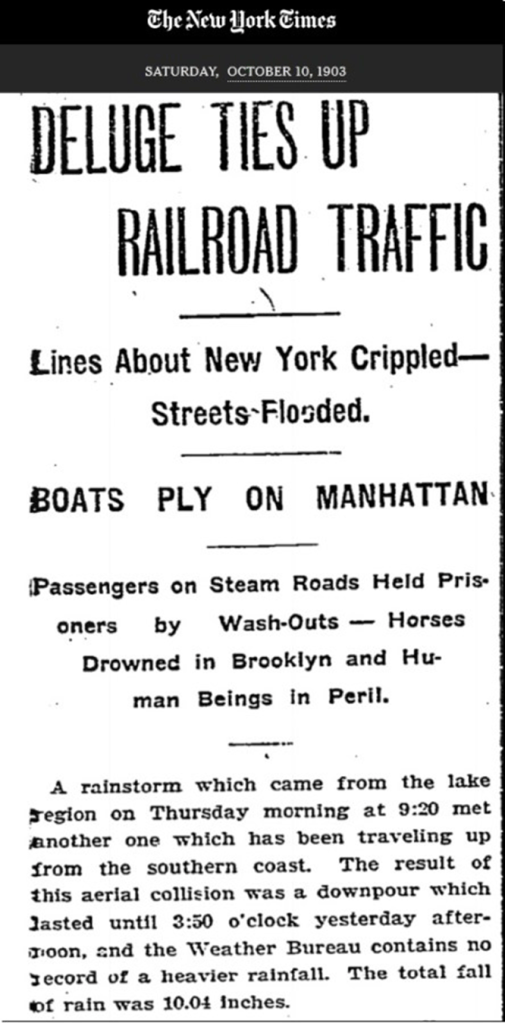
Tony Heller does a great job documenting historical accounts of extreme weather events.  He found that on October 8, 1903 New York received 10.04 inches of rain.

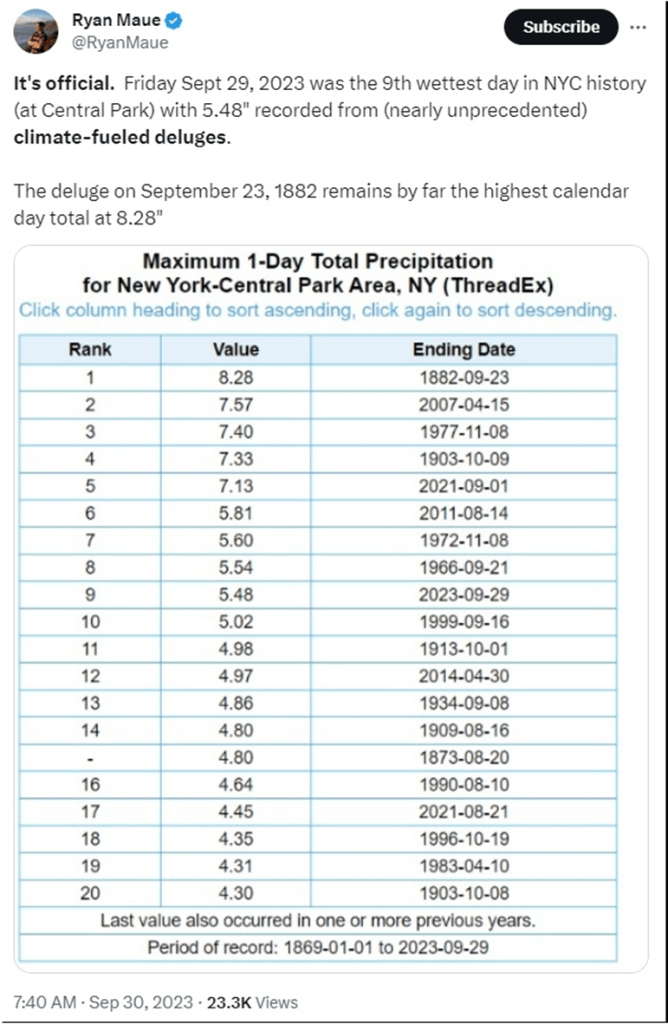
Ryan Maue checked out the Central Park precipitation data and found that on September 23, 1882 the site measured the highest daily value of 8.28” and that this recent event was the 9th wettest day at that site.

Nonetheless, it did not prevent the usual suspects, including Governor Hochul from blaming climate change: “This is unfortunately what we have to expect as the new normal”.  She also described the storm as “Mother Nature at her most powerful.”  “This was the kind of rain that was once unimaginable — we called them once-in-a- century storms,” Hochul said Saturday. “But this is the third time since I was sworn in two years ago, I’ve had a once-in-a-century storm.” 

Of course, this storm will also be used as more justification by the same crowd to implement the Climate Act.  Because it is generally accepted that climate change caused by GHG emissions did not kick in until after 1950, the higher historical precipitation in 1882 and 1903 conclusively falsify the Governor’s “new normal” and the idea that GHG emission reductions can prevent further similar storms. 

MTA Climate Resilience Upgrades

Flooding caused major disruptions to New York’s subway system, according to the Metropolitan Transportation Agency.  The flash flood caused “full or partial suspension of service on half the lines in the system, with MTA officials saying full service was restored by 8:30 p.m after 20 million gallons of water were pumped out of the subway”. On a personal note, the subway closures forced my grand-daughter to stay with a classmate in Manhattan rather than going home to Brooklyn that day.

A couple of days earlier, the MTA published a 20-year needs assessment report that said “Some 400 miles of subway tracks, half of Metro-North’s Hudson Line and several Long Island Rail Road stations are in dire need of upgrades to stave off flooding and other extreme weather exacerbated by climate change.”  The Resilience Improvement weblink states:

Climate change is here—and we must prepare. Over the next two decades, climate change projections indicate that the New York region will experience more frequent and intense coastal storms, more than twice the current number of torrential rainfall events, and triple the current number of extreme heat days over 90 degrees. Meanwhile, sea levels will rise approximately 2.5 feet by the 2050s and almost 5 feet by the 2080s.

Our infrastructure was not built to withstand future climate conditions. We’ve made significant progress retrofitting, renovating, and rebuilding infrastructure in anticipation of future climate conditions, but climate change won’t wait for us to finish. For our systems to keep running as lifelines through the coming climate-induced crises, we must move faster.

On the same day of the storm, the State Comptroller’s office released “Risk Assessment and Implementation of Measures to Address Extreme Weather Conditions”.   The objective of this audit was:

To determine whether the Metropolitan Transportation Authority (MTA) – New York City Transit (Transit) identified potential damage to its system and developed plans to mitigate the effect of extreme weather conditions and flooding. We also determined whether the MTA tested/updated the plans and inspected and maintained the equipment to ensure they can be deployed when needed. Our audit covered the period from April 2009 to August 2022.

The key findings of the report include the following:

To date, the MTA has not implemented one of the most important recommendations of the 2009 Report – the development of the climate change adaptation master plan. Since Superstorm Sandy, Transit has assessed and identified areas of its system that are at risk of flooding from extreme weather events and developed and carried out capital projects to both correct damage caused by Superstorm Sandy and mitigate potential flooding conditions in the Transit system. Further:

  • Our review of a sample of 23 of 221 capital projects intended to correct or prevent damage found that projects were often incomplete in scope of work, not finished on time or within budget, or insufficiently documented. Just two of six critical stations that Transit indicated should have been made more watertight and resistant to potential flooding were completed in one project we reviewed. Another project was initiated to prevent flood water from entering 14 fan plants; however, only 11 fan plants were mitigated. Transit officials stated the three remaining fan plants were completed but did not provide documentation to support their statements. (Fan plants are facilities with large vent gratings and fans located atop shafts connected to the Transit tunnels.)
  • Transit did not sufficiently document inspections of individual pieces of equipment. Instead, it reported more broadly by subway stations or by rooms in off-site facilities that were inspected. In one instance, because not all rooms were inspected at a facility, we were able to determine that 51 of 72 pieces of equipment in our sample were not inspected between January 2021 and August 2022.
  • While Transit has developed winter, hurricane, rain, and extreme heat plans, we found that these plans were inconsistently activated, with no documentation explaining the rationale for decision making. In our sample of 18 weather events, plans were not activated for six events that included tropical storms, hurricanes, or coastal flooding.

I support the concept to identify and address potential flooding conditions. My problem with this report is that it does not recognize the differences between weather and climate, namely weather is going to cause flooding conditions whether or not climate change exacerbates the impacts.  It seems that climate change must be included as part of the marketing to get support for the audit.

Discussion

Response to the 20-year plan included the concern by advocates that no costs were attached to the plans for the improvements that MTA says is necessary.  For example:

“While the MTA’s needs assessment is thorough and shows that our transit system is in dire need of investment, it lacks dollar figures showing exactly how much money will be needed to fix the subways, buses, and commuter railroads,” wrote Rachael Fauss with the good government group Reinvent Albany in an email. “The needs of everyday riders must come first. In an environment of limited resources, it is essential that we prioritize capital projects based on objective measures of need, not politics, to repair the subways, buses and commuter railroads and ensure that they continue to best serve New Yorkers in this era of climate change.”

I think it is important to consider whether the net-zero transition GHG emission reduction measures in New York State will have any material effect on the extreme weather events that caused the problems observed during the latest flash flood.  The answer to that question is no.  As noted previously, the fact that there were days with greater rainfall before GHG emissions allegedly became the driver of observed global warming suggests that GHG emissions reductions would have to go to pre-industrial levels to just keep rainfall rates at the same level as 1882.  That is clearly an ambitious target even if you believe that GHG concentrations are a driver of extreme weather and I don’t believe that.  It gets worse.  New York GHG emissions are less than one half of one percent of global emissions and global emissions have been increasing on average by more than one half of one percent per year since 1990.  Even if GHG emissions in New York were to get to zero, that reduction will be supplanted by increases elsewhere in less than a year.

Conclusion

One of my pragmatic principles is Russel Schussler’s observation that “We can do almost anything we want, but we can’t do everything”.  In this instance the costs of the Climate Act’s net-zero transition should be considered relative to the MTA plan.  The upgrades necessary to prevent extreme rainfall events and storm surge from flooding New York’s subway system will be enormous but at the end of the day those investments would have a measurable effect.  In order to get to net-zero, the costs will be an order of magnitude greater than “enormous” with no hope for a measurable effect on severe weather.  I agree with Rachel Fauss: “it is essential that we prioritize capital projects based on objective measures of need, not politics”.

The disconnect between MTA, the media, and even Fauss in this example is frustrating.  For example, Rachael Fauss noted that the investments are necessary “in this era of climate change” misses the point that climate is what you expect and weather is what you get.  Climate change had very little effect on this event and certainly not enough to cause the storm or materially change its impacts.  Ultimately, throwing away money on a pointless virtue-signaling net-zero transition will likely forestall the investments needed to maintain and strengthen the resiliency of the subway system.  Reducing New York GHG emissions in a quest to minimize  extreme weather issues in New York is not going to work and will be counter-productive for real solutions.

Climate and Weather Are Not the Same

A couple of articles came to my attention recently that exemplify the mainstream narrative that climate change impacts are pervasive and catastrophic.  Both make the fundamental mistake of confusing weather and climate.  At the same time, I read two other articles that explained why the propaganda supporting the mainstream narrative is so pervasive.   This article highlights those stories because they are relevant to the rationale for New York’s Climate Leadership & Community Protection Act (Climate Act).

I have been following the Climate Act since it was first proposed, submitted comments on the Climate Act implementation plan, and have written over 350 articles about New York’s net-zero transition.  I have devoted a lot of time to the Climate Act because I believe the ambitions for a zero-emissions economy embodied in the Climate Act outstrip available renewable technology such that the net-zero transition will do more harm than good.  The opinions expressed in this post do not reflect the position of any of my previous employers or any other company I have been associated with, these comments are mine alone.

Climate Act Background

The Climate Act established a New York “Net Zero” target (85% reduction and 15% offset of emissions) by 2050.  It includes an interim 2030 reduction target of a 40% reduction by 2030 and a requirement that all electricity generated be “zero-emissions” by 2040. The Climate Action Council is responsible for preparing the Scoping Plan that outlines how to “achieve the State’s bold clean energy and climate agenda.”  In brief, that plan is to electrify everything possible using zero-emissions electricity. The Integration Analysis prepared by the New York State Energy Research and Development Authority (NYSERDA) and its consultants quantifies the impact of the electrification strategies.  That material was used to develop the Draft Scoping Plan.  After a year-long review, the Scoping Plan recommendations were finalized at the end of 2022.  In 2023 the Scoping Plan recommendations are supposed to be implemented through regulation and legislation. 

Mainstream Narrative Enforcement

I recently posted an article about Patrick Brown’s explanation of How to Publish a High-Profile Climate Change Research Paper.  There were two versions of his story and he followed up with Correcting the Record Regarding My Essay in The Free Press.  I described the story that emphasized the journal article aspect.  Charles Rotter described how Brown tried to get widespread media coverage. He used the following techniques to maximize exposure:

  • Consider the influence of climate change in isolation without any suggestion that climate change might not be the dominant driver of the impacts described;
  • Ignore or downplay practical actions that can counter the impact of climate change;
  • Focus the discussion and graphics on metrics that will generate the most eye-popping numbers; and
  • Choose the timescale for the analysis to magnify the impacts

In another article Kip Hansen explained that there are climate news organizations that provide local newspaper and TV stations with propaganda talking points and articles.  He explains:

I know that that sounds like a “conspiracy theory”… but it is not a conspiracy theory if it is true and if those involved in the act of conspiring together not only do so openly but  proudly publicize their actions.

The lesson today comes from an email I received from Covering Climate Now which characterizes itself this way:  “CCNow collaborates with journalists and newsrooms to produce more informed and urgent climate stories, to make climate a part of every beat in the newsroom — from politics and weather to business and culture”  and when they say “urgent” climate stories, they mean the more alarming and frightening, the better. 

Mainstream Narrative Example Stories

My recent morning routine was ruined by a couple of stories in the local paper.  The first was an opinion piece from the Washington Post that claimed that “My husband has farmed for 4 decades. Climate change might end his run.”  The second story was an article that argued that Canadian wildfires and extreme weather fueled a huge crop of poison ivy in Central New York this summer.

The farming article described the trial and tribulations of hay farming.  Lisa Cohen writes:

But as we come to the end of the wettest July on record, “make hay while the sun shines” has been shifting from self-evident axiom to rueful irony. Yes, you have to make hay while you can. But also you need sunshine to make hay.

Here’s how it works. It takes at least two sunny days to complete the cycle: mow, dry, rake, bale. Much of that time is waiting for the sun to do its work. (The hay must dry completely, because moisture can breed heat-producing bacteria deep inside a bale — which might then spontaneously combust and burn down a barn.) In theory, if Adam mowed a field on a Tuesday morning, he could expect to bale it late Wednesday afternoon.

In a good year — what we used to call a normal year — Adam would have extended stretches of sunny days that went like this: Mow in the morning, then unload wagons piled with bales from fields mowed two days before, then, in the afternoon, rake and finally bale the field he mowed yesterday.

In 2019 an acquaintance made a similar claim about climate change and haying.  I analyzed a Hay Harvest Climate Trend  and concluded that climate numerical analysis results are likely ambiguous, picking a climatic trend out of weather records is not simple, and, most importantly, any statistically significant trends are likely smaller than the observed inter-annual variation.   As a result, anecdotal claims of observed changes of weather parameters due to climate change are likely biased and unsubstantiated. 

My hay trend data analysis showed ambiguous results.  It suggested that there is conflicting support for a climate-change induced problem with hay harvesting in August and September.  The New York site at Mohonk House data indicate a statistically significant trend in more days suitable for harvesting hay whereas another observation site in Ithaca data indicate a trend towards less days suitable for harvesting hay but the trend is insignificant.  At both stations there is a negative statistically significant trend in the number of growing degree days.  Depending upon your intent, statistics can “prove” an argument that there is a problem or there isn’t a climate change problem.  This work supports my belief that hay harvesting variation is caused by the vagaries of weather not climate change.

The Canadian wildfires and extreme weather fueled a furious crop of poison ivy in Central New York this summer article in the Syracuse Post Standard by Steve Featherstone starts reasonably enough. 

Poison ivy is having a banner year in Central New York, climbing up trees and creeping into yards with greater vigor than ever.

“I’ve been in this business for almost 30-plus years and I’ve not seen it this bad,” said Dave Oakley, groundcrews supervisor for TJ’s Lawns Plus in Cicero.

Many landscapers and master gardeners we spoke to, from Watertown to Ithaca, Baldwinsville to Chittenango, report similar observations: poison ivy’s growth this season has been explosive.

So why is this year different? Doug Beyel, owner of Chittenango Landscape, blames last spring’s drought, which was followed by plenty of rain and warm temperatures.

“When you get a heat wave, most plants will go dormant or die,” Beyel said. “If they don’t die, as soon as they get the moisture they need to survive, they’ll explode and push out a ton of growth, and that’s exactly what happened. Plants just took off.”

The following table shows that May was dry but that the last three months were wet.  It is not surprising then that the poison ivy “explosive” growth was noticeable. 

The article could have been content to show that this was a good growing year for everything that survived the drought including poison ivy.  The article does a good job describing the plant, its growing habits, why it causes problems, and how to deal with it.  Apparently, that information was not good enough because the author also blamed climate change for the poison ivy problem this year.

Consider the claims relative to Brown’s climate change narrative techniques.  For example, one technique considers the influence of climate change in isolation without any suggestion that climate change might not be the dominant driver of the impacts described.  In this instance the following claim makes no attempt to determine if this summer’s moisture pattern was unusual or part of a trend.

Climate change is fueling the growth of many plants, especially poison ivy, which grows larger, faster, and even more potent.

The article already explained that this year’s weather was the primary cause of the plant growth pattern.  The absence of any context about climate relative to weather makes the claim that climate change had any effect whatsoever entirely without basis.

It gets worse because Featherstone invokes the threat of GHG emissions not only affecting the climate but also the growth of poison ivy.   

There’s another factor that’s fueling the growth of many plants, especially poison ivy: climate change. We’re pumping ever more carbon dioxide, a key component in photosynthesis, into the atmosphere.

Because poison ivy doesn’t have branches, stems, or a trunk to support, it can channel all that extra energy into “growing larger, faster,” said Kim Adams, extension biologist for the State University of New York College of Environmental Science and Forestry.

Adams citeda 2006 study from scientists at Duke University showing that poison ivy “benefitted hugely” from increased carbon dioxide levels, more than doubling in biomass (149%) compared to plants grown under ambient conditions.

A quick check on the 2006 study shows that the authors also followed the climate threat narrative playbook.  In the 6-year study at the Duke University Free-Air CO2 Enrichment (FACE) experiment, the study evaluated the impacts of elevated atmospheric CO2 on poison ivy growth.  However, they increased the CO2 level (200 ppm above the ambient level of ≈370 ppm) to levels unrepresentative of current conditions.  They chose a timescale for the analysis to magnify the impacts by using what they claimed represented the predicted global concentration in 2050.  In order to do that they had to use an unrealistic estimate of future emissions.  I believe these numbers are more representative of global concentration in 2100 or later.

The article goes on to quote Kim Adams, extension biologist for the State University of New York College of Environmental Science and Forestry, who notes that the article claims that urushiol production was increased.  Not mentioned was that the article said urushiol may “may increase under elevated CO2” when grown in “low resource levels and/or in competitive environments”.  I think the following is an example of focusing the discussion on metrics that will generate the most eye-popping numbers”:

What’s worse, the turbo-charged poison ivy vines were also more toxic to humans.  “The chemical that we’re allergic to, urushiol”—the compound in poison ivy sap that causes itchy blisters in 85% of the population—”was more effective,” Adams said.

I sensed that there were issues with some of these statements so I asked a friend and colleague to review this text to see if I was correct.  She asked a subject matter expert for his thoughts.  He scanned the article and picked up on the poison ivy claims.  He agreed that “in the Duke Forest FACTS site (Free-Air CO2 enrichments study), poison ivy was apparently the biggest “winner” when it came to response to CO2 enrichment.”  However, he also stated that the Duke researchers acted consistent with Patrick Brown’s characterization because they always had a “gloom and doom” agenda and consistently promoted those results above all else.

His biggest concern was a fundamental problem with the study design.  The Duke researchers tried to say that, after 5 or 6 years of CO2 exposure, the pine response flatlined (which is true) indicating that these ecosystems will quickly acclimate to higher CO2 (which is not true).  The design flaw was “In the next to last year of study, the entire stand around the FACTS site was thinned because it had reached crown closure and competition (light, nutrients, water) was resulting in a decline in growth rate – a very normal occurrence for a 15-yr-old loblolly pine stand which is why it was thinned – to reallocate resource to the best trees and increase growth rate in these trees.”  He explained that:

In wildlife biology they talk about carrying capacity (k) as the number of animals a site will maintain; the same is true for carbon – a site will only hold a finite amount of C (we can alter that via management – e.g., fertilization – but it remains a finite number).  So, what had happened at the Duke site is they didn’t consider this in the study.  In itself, that would have been fine; however, to conclude that the tress had acclimated to the high CO2 was inaccurate.

When I pointed this out at a meeting where these data were presented, I was told I didn’t know what I was talking about.  I first told them, that I was probably one of only a few at the meeting with an actual degree and experience in forestry management.  Then told them to back up their conclusion and prove me wrong – thin the study, leave the CO2 on, and see if the E/A response doesn’t return; they never did.

In my opinion, those revelations discount the probability that the poison ivy claims are as acute and pervasive as claimed in the 2006 study.  It gets worse because Adams suggests that there could be a short-term effect.  I believe the following paragraph is wild conjecture:

Earlier this summer, wildfires in Canada turned skies over Central New York a hazy, apocalyptic orange. Adams speculates that the smoky air, laden with extra carbon dioxide from the fires, might have given poison ivy vines an additional boost.

The National Oceanic and Atmospheric Administration website shows CO2 trends.  The following graph shows the large seasonal variation in Hawaii.  I could not find any short-term ambient concentration data for New York.  I imagine it would show an even more pronounced seasonal fluctuation because there is little local production in the winter.  Frankly I would be surprised if local CO2 concentrations would have shown any effect of the wildfires because the local concentrations are dominated by local vegetation.  The smoke showed up so markedly because the baseline was low.  Even if I am wrong, wouldn’t the smoke have reduced the sunlight reducing photosynthesis?  Ultimately, in the absence of local data showing a substantive increase in CO2 during the wildfire smoke episodes, there is no evidence supporting the claim the poison ivy growth was given a boost.

Conclusion

I have two issues with these articles.  In the first place both authors do not understand the difference between weather and climate.  In simple terms, climate is what you expect and weather is what you get.  Any effect of climate change on hay harvesting weather or poison ivy growth this year was unlikely to be discernable relative to natural weather variability.  Both authors presumed that there was a climate change effect but did not provide any evidence of it. 

My second problem is that climate change was included for no apparent reason other than to further the climate threat narrative.  Patrick Brown argued that:

To put it bluntly, climate science has become less about understanding the complexities of the world and more about serving as a kind of Cassandra, urgently warning the public about the dangers of climate change. However understandable this instinct may be, it distorts a great deal of climate science research, misinforms the public, and most importantly, makes practical solutions more difficult to achieve. 

This problem with climate science research also permeates the mass media’s representation of climate change.  The constant drumbeat of gloom, doom, and despair about climate change impacts associated with every unusual weather event is pushing the public into unwarranted concern and poor energy policy choices.

Post Script

I had hoped to work the following Scott Adams comic strip into the article but could not find an appropriate place to make the point that much of the claims of climate change danger are based on climate models.  I don’t think they have demonstrated enough skill to warrant their use for setting public policy so I agree with premise of the comic.