It seems that every day we are faced with another claim that we are facing an existential threat from climate change and the proof is right in front of us. So simple, so obvious and so wrong. I do not have time to do my own analysis so I am going to use the work of others to rebut the fear mongering stories about these events tied to climate change in July.
July was the Hottest Month Ever
The story that July was the hottest month in 120,000 years is the best example of the media glomming on to a story that does not stand up to scrutiny. A post at Watts Up With That explains:
Via The Australian: Cliff Mass, professor of Atmospheric Sciences at University of Washington, said the public was being “misinformed on a massive scale”: “It‘s terrible. I think it’s a disaster. There’s a stunning amount of exaggeration and hype of extreme weather and heatwaves, and it’s very counter-productive,” he told The Australian in an interview. “I’m not a contrarian. I‘m pretty mainstream in a very large [academic] department, and I think most of these claims are unfounded and problematic”. …
Professor Mass said the climate was “radically warmer” around 1000 years ago during what’s known as the Medieval Warm Period, when agriculture thrived in parts of now ice-covered Greenland. “If you really go back far enough there were swamps near the North Pole, and the other thing to keep in mind is that we‘re coming out of a cold period, a Little Ice Age from roughly 1600 to 1850”.
#
John Christy, a professor of Atmospheric Sciences at the University of Alabama at Huntsville, said heatwaves in the first half of the 20th century were at least as intense as those of more recent decades based on consistent, long-term weather stations going back over a century. “I haven‘t seen anything yet this summer that’s an all-time record for these long-term stations, 1936 still holds by far the record for the most number of stations with the hottest-ever temperatures,” he told The Australian, referring to the year of a great heatwave in North America that killed thousands.
Professor Christy said an explosion of the number of weather stations in the US and around the world had made historical comparisons difficult because some stations only went back a few years; meanwhile, creeping urbanization had subjected existing weather stations to additional heat. “In Houston, for example, in the centre it is now between 6 and 9 degrees Fahrenheit warmer than the surrounding countryside,” he explained in an interview with The Australian.
Professor Christy, conceding a slight warming trend over the last 45 years, said July could be the warmest month on record based on global temperatures measured by satellites – “just edging out 1998” – but such measures only went back to 1979.
Phoenix Heat Wave
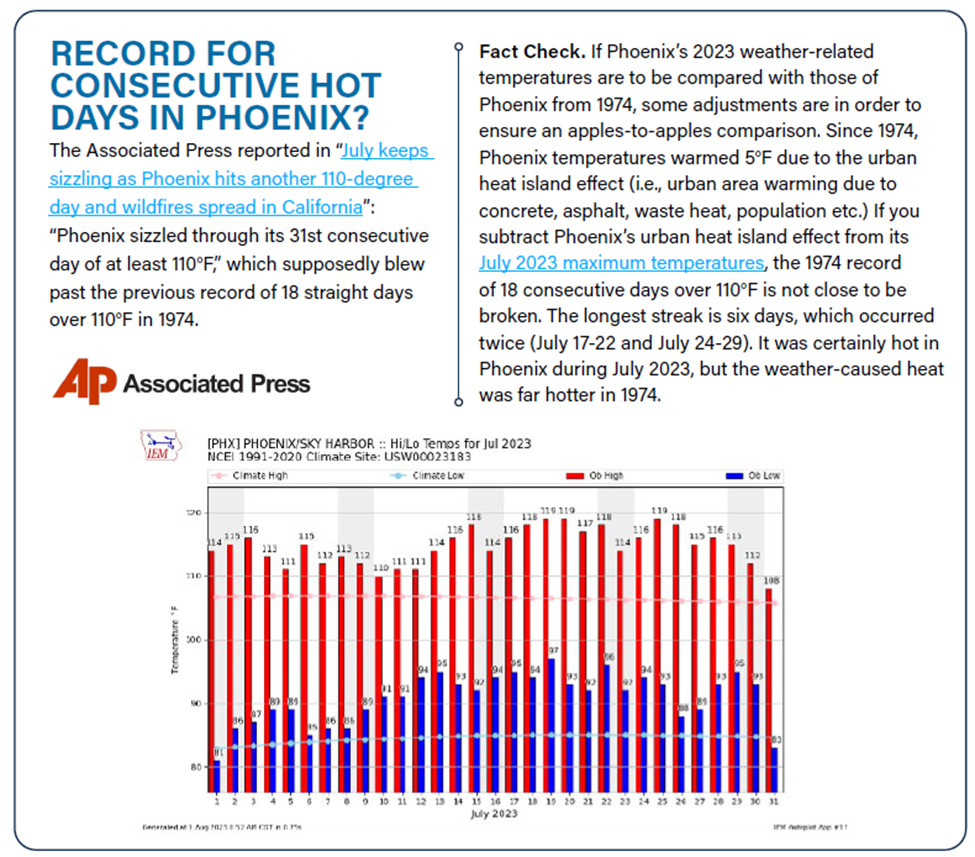
Phoenix Arizona had a streak of 31 days when the high temperature was 110 degrees or higher. The article, “Explaining The Heat Wave: Separating Weather From Climate Change,” claims that recent warming trends in Phoenix, Arizona are due primarily to increasing atmospheric carbon dioxide levels in the atmosphere. However, this is false because data show that the high levels of warming, especially at night and as measured at an airport, are primarily due to urbanization over time, with the modest warming of the past hundred-plus years playing a very small part in comparison. Another rebuttal notes:
But, it must be climate change, look how hot it was!” My dear readers, that’s why they named it Death Valley. The Monthly Report from the U.S. National Weather Service for the Death Valley station shows that every day during July this year, the average daily temperature (Daily Maximum + Daily Minimum divided by 2) was in excess of 100 °F (37.7 °C). That’s the average! The daily highs were above 110 °F (43 °C) every single day, above 120 °F (49 °F) twenty of the days.
Is this unusual? Is this “extreme”? No, the U.S. National Park Service reports on the general the Weather in Death Valley: “Death Valley is famous as the hottest place on earth and driest place in North America. The world record highest air temperature of 134°F (57°C) was recorded at Furnace Creek on July 10, 1913. [ emphasis mine – kh ] Summer temperatures often top 120°F (49°C) in the shade with overnight lows dipping into the 90s°F (mid-30s°C.) Average rainfall is less than 2 inches (5 cm), a fraction of what most deserts receive. Occasional thunderstorms, especially in late summer, can cause flash floods.” All of those conditions, except the record high temperature of 1913, occurred this summer in Death Valley, just as the National Park Service advised visitors to expect. There was not any extreme weather, it was usual weather for Death Valley.
Climate Fact Check
If you want short rebuttal summaries to these and other false climate change stories for July check out this fact check report. It covers the following stories: monthly average temperature is the hottest, the UN proclamation that we are in an era of global boiling, the hottest day in 125,000 years, Atlantic current to collapse by 2025, record for hot days in Phoenix, hottest day in Death Valley, emissions causing hot oceans, hottest seawater ever, and more.
Heat Health Impacts
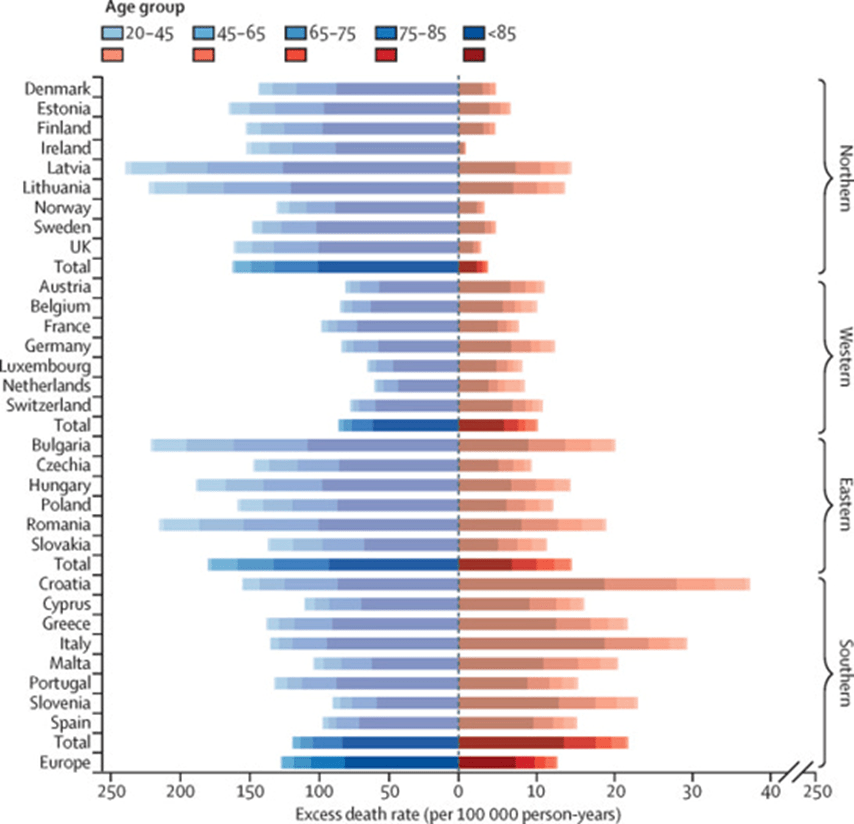
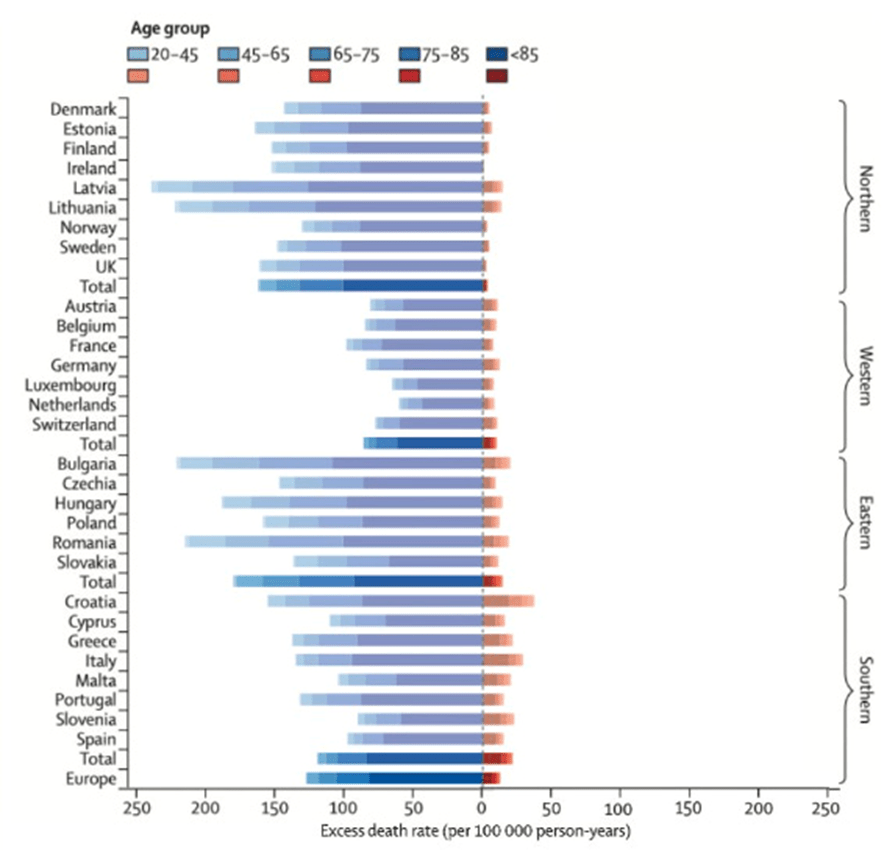
The rationale for alarm for the excessive heat stories is the argument that heat results in more deaths than any other weather-related event. Five years ago I explained why there are analyses that find “most of the temperature-related mortality burden was attributable to the contribution of cold”. Studies that show that extreme heat results in more deaths than any other weather-related event use a data base that only includes direct deaths. An epidemiological study that does include indirect deaths concludes most deaths are associated with moderate cold weather. Roger Pielke Jr. reports how this information can be presented to support the alarmist version:
The Lancet was caught red-handed publishing a figure that, to be as fair as possible, lent itself to misinterpretation (it was first called to my attention by Bjorn Lomborg and is in a paper by Masselot et al. 2023).
Take a look and decide for yourself. Here is the original figure comparing mortality from cold (blue) and heat (orange) in Europe from 2000-2019.
And here is how it looks when the data is graphed using a consistent scale.
Another Examples of Propaganda
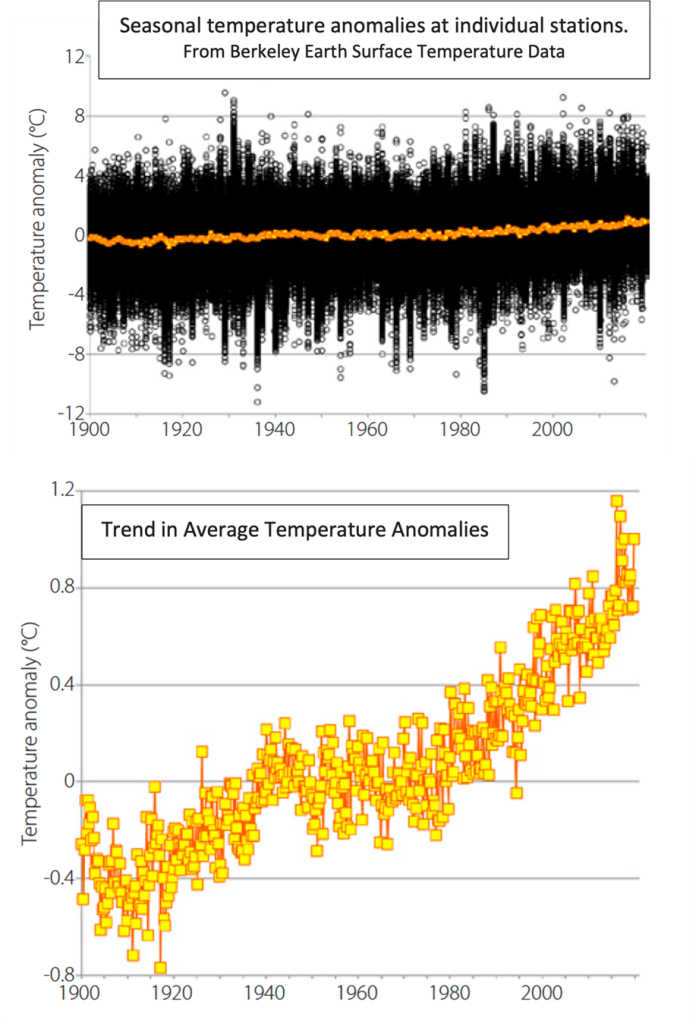
We have all seen the graphs that show inexorable global warming. However this article describes how “alarmist scientists have scared the bejesus out of people by turning a very small temperature change into a monster.” Jim Steele writes:
Dr. Lindzen graphed the average seasonal anomalies for each weather station in the BEST temperature data base from 1900 to the present. A station’s anomaly is defined as any deviation from its 30-year mean. The results are not very scary. On any given day about half the weather stations experience warm anomalies while half experience cooling anomalies.
Most anomalies cluster between ± 4°C (+/- 7.2°F) causing each data point to merge into the thick black band of the graph. Still, larger anomalies are not uncommon, so the y-axis of the above graph scales between ± 12°C (+/- 21.6°F). The yellow dots represent the average for those anomalies on any given day. We see a small trend that is relatively tiny compared to the variation in actual temperatures. Not very scary either.
So, the showtime graphs isolate the average anomalies from reality, as done in the bottom graph. Now the scale on the y-axis only spans from -0.8°C (-1.4°F) to 1.2°C (2.2°F), turning a small 1°C (1.8°F) rise over 120 years into the illusion of a monster increase. That allows click-bait media, alarmists scientists and politicians to claim that climate change could lead to mass extinctions.
Reporting Issues Influence Results
Roger Pielke Jr. is an expert on the topic of global disaster accounting. He recently posted an article that makes two relevant points to this post:
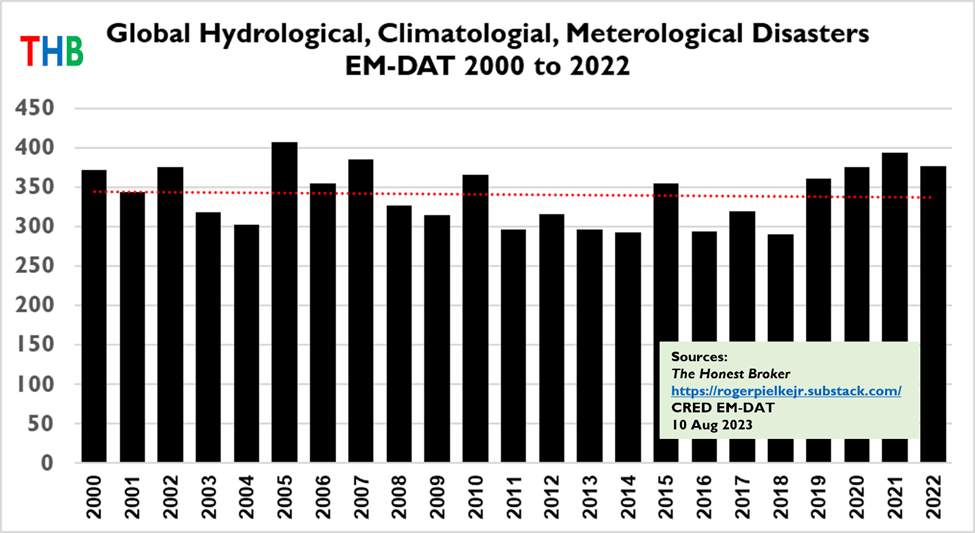
Below is the updated time series of global hydrological, climatological and meteorological disasters in the EM-DAT database, along with the linear trend, over the period 2000 to 2022.
You can see that there is no upwards trend. This lack of trend has not been reported by anyone in the legacy media (and I would be happy to be corrected). However, the completely false notion that global weather and climate disasters have increased and will continue to increase is commonly reported in the legacy media, buoyed by the promotion of false information by organizations that include the United Nations. In 2020 the U.N. claimed falsely of a “staggering rise in climate-related disasters over the last twenty years.”
The second point he makes is careful examination of the disaster data clearly shows that “the increase in disasters in its database to 2000 is due to better reporting, and not changes in underlying counts of actual disasters.” He concludes: “Regardless what happens with trends in disaster counts, it is absolutely essential to remember that if you are looking for a signal of changes in climate — always look directly at weather and climate data, not data on economic or human impacts.”
Conclusion
There is a constant barrage of doom and gloom articles connecting any extreme weather event or disaster to the existential threat of climate change. In my opinion they all are more propaganda than unbiased reporting. Every time I have checked a weather event attributed to climate change claim on my own, I have found that the issue is more complex and less threatening than portrayed. Don’t get scared by these stories!
A real short post. I have been following the Climate Leadership & Community Protection Act (Climate Act) since it was first proposed, submitted comments on the Climate Act implementation plan, and have written over 300 articles about New York’s net-zero transition. My boilerplate introductory material notes that I have devoted a lot of time to the Climate Act because I believe the ambitions for a zero-emissions economy embodied in the Climate Act outstrip available renewable technology such that the net-zero transition will do more harm than good. The recommended videos in this post support my position.
The opinions expressed in this post do not reflect the position of any of my previous employers or any other company I have been associated with, these comments are mine alone.
Climate Policies Hurt the Environment
There is very little career upside for anyone in a regulatory agency to speak up about the environmental impacts of wind and solar development. Consequently, there is not much apparent support for my belief that the Climate Act net-zero transition will do more harm than good. This post links to a video interview with John Baker, retired Assistant Chief with California Fish and Wildlife Department who describes double standards he experienced while enforcing California’s environmental laws:
“In the name of green energy, we’re sacrificing wildlife species. Because of the power mandates, we’re unable to enforce the take of that. I don’t think they have thought what that cost is to us as Californians and to the environment as a whole.”
Baker describes the pragmatic tradeoffs that have been ignored in the rush for net-zero transition.
Climate Fearmongering
Paul Homewood introduces a video with Neil Oliver: Weather maps are among the most blatant forms of fearmongering deployed so far. He notes that British weather maps on TV now use daily temperature maps with frightening colors. He calls out the fearmongers by describing historical European heat waves and goes on to call attention to the hypocrisy of the loudest voices. Finally he notes that the 99.7% of scientists meme is a “scam”.
As they say in the investment business, past performance is no guarantee of future profits. Just because the climatistas consistently got it woefully wrong in the past does not mean that this time around they aren’t right. They could be right this time. There may be a wolf for real this time.
But here’s the thing. They got it wrong in the past for a particular set of reasons. Those same reasons continue to apply in the present case too. Therefore, past performance guarantees the present performance to be precisely the same.
New York’s response to climate change is the Climate Leadership & Community Protection Act (Climate Act). I have been following the Climate Act since it was first proposed, submitted comments on the Climate Act implementation plan, and have written over 300 articles about New York’s net-zero transition. I have devoted a lot of time to the Climate Act because I believe the ambitions for a zero-emissions economy embodied in the Climate Act outstrip available renewable technology such that the net-zero transition will do more harm than good. The opinions expressed in this post do not reflect the position of any of my previous employers or any other company I have been associated with, these comments are mine alone.
Climate Act Background
The Climate Act established a New York “Net Zero” target (85% reduction and 15% offset of emissions) by 2050 and an interim 2030 target of a 40% reduction by 2030. The Climate Action Council is responsible for preparing the Scoping Plan that outlines how to “achieve the State’s bold clean energy and climate agenda.” In brief, that plan is to electrify everything possible and power the electric grid with zero-emissions generating resources by 2040. The Integration Analysis prepared by the New York State Energy Research and Development Authority (NYSERDA) and its consultants quantifies the impact of the electrification strategies. That material was used to write a Draft Scoping Plan. After a year-long review the Scoping Plan recommendations were finalized at the end of 2022. In 2023 the Scoping Plan recommendations are supposed to be implemented through regulation and legislation.
The three commentaries described here all claim that more action is needed because of the climate crisis. All three overestimate the impacts and underestimate the challenges. All three authors have vested interests in their narratives that I believe go beyond environmental concerns. I describe the commentaries below.
The Canadian wildfires are not normal. More than 11 million acres have burned or are on fire, decimating forests, killing wildlife and threatening homes. This is due to record drought, shifting weather patterns, and a changing climate.
What’s to stop it from happening here? If you think the smoke was bad, wait until we have our own wildfires.
Her arguments that the weather is getting worse around here rely entirely on anecdotal evidence that does not stand up to examination. For example, she ignores similar poor air quality events from wildfires during the Little Ice Age 200 years ago when she claims that the wildfire smoke is due to a changing climate.
She goes on to provide an oversimplified explanation of the greenhouse effect and claims that ignoring the emissions will lead to catastrophe: “As our planet gets warmer, weather patterns change, causing extreme temperatures, droughts and floods. As this continues, climate change worsens.” I have no doubt that she believes that “The only solution is to decrease carbon and methane emissions” and that the personal actions she advocates are necessary.
The other article featured on the front page of the Sunday Post-Standard was titled NY’s economic future requires robust, reliable EV infrastructure. Mark Lichtenstein described his belief that electric vehicle (EV) infrastructure is necessary: “If we delay, we risk falling short during this critical time to strengthen our economy, attract a talented workforce, improve our environment, and lead New York’s advance into a clean energy future.” He is executive operating and chief sustainability officer at the SUNY College of Environmental Science and Forestry, in Syracuse.
He gave EV overview information and argued that recent growth in the EV vehicle registrations portends future success. Notably lacking is that the numbers he presented lacked context. For example, “New York is leading the way — as one of the top five states for EV registrations — with just over 139,100 EVs as of this April” sounds great but not mentioned is that this is less than one half a percent of total registrations.
The point of his commentary was that New York must do more to encourage the transition. He listed “key pieces to the puzzle” that need to be addressed:
Will our electric generation also be climate-friendly?
Can our electric distribution infrastructure handle the increase in demand?
How and where will we charge these new EVs?
Can we improve the speed and convenience of chargers? and
Will we effectively address any associated environmental concerns related to the materials needed to construct EVs, as well as the safe disposal of components?
He argued that these issues need to be resolved:
The demand for this enhanced effort is immediate, as Central New York is currently poised for a significant transformation. It must happen now. Consider that Micron is bringing nearly 50,000 jobs and a host of supplier businesses to the region over the next two decades. This requires an infrastructure that can support a massive new amount of electrified passenger vehicles, as well as the medium- and heavy-duty trucks expected to make up an increasingly large share of the EV fleet.
If we delay, we risk falling short during this critical time to strengthen our economy, attract a talented workforce, improve our environment, and lead New York’s advance into a clean energy future.
Personally, I don’t think that the EV transition will strengthen our local economy because the significant costs necessary to support it will divert money away from our economy. No one is claiming that the vehicles, batteries, and charging infrastructure will be constructed here so all that money will go elsewhere. I also doubt that EV infrastructure will be a significant factor for attracting a talented workforce.
She argued that: “The twin challenges of expanding access to affordable housing and combating climate change present a unique opportunity that New York can’t afford to let slip away.” The commentary was little more than an advertisement for the New York State Energy Research and Development Authority’s (NYSERDA) Carbon Neutral Portfolio Support program that is “working with real estate owners, developers and manufacturers who are willing to take the lead in designing, building and operating low-carbon and carbon-neutral buildings through its Commercial New Construction Program”.
She argues that this renovation should include existing public housing developments and describes the state program. She explains:
My company, Beacon Communities, an industry leader in affordable and mixed-income housing development in the Northeast and MidAtlantic, is proud to be the first developer in New York to participate in this program.
Supported by up to $250,000 in state funding, we’re working with Syracuse-based Northeast Green Building Consulting and Ithaca’s Taitem Engineering to review our entire 2.5 million-square-foot New York housing portfolio and design a blueprint to make all existing buildings as clean and resilient as possible while meeting clean energy requirements in new projects.
She concludes:
This is an exciting and critical time for the state and specifically for Central New York. We’re at a tipping point when it comes to both housing needs and climate change, and we should use every tool at our disposal to build the new, green communities of the future. We can’t afford to waste this moment — or this opportunity — to make positive change.
Discussion
I think all three commentaries deserve rebuttals but they don’t deserve much time. As I noted Kriesel’s characterization of the climate change issue was simplistic and shallow. Her belief that individuals can make a difference is rebutted by Lomborg. Lichtenstein claims that readers of the paper should be motivated to support EV infrastructure because it will support the Micron semi-conductor plant proposal. I find that a stretch. Moreover, he did not really address the costs to implement the infrastructure required. Kovel argued that expanding access to affordable housing is important and gloms on to New York’s Climate Act building electrification efforts as a rationale.
Cynic that I am, I note that all three authors have biases in their backgrounds that I think drive their opinions. Kriesel is a politician and is catering to a particular constituency when she repeats the climate crisis narrative. The only thing missing was a promise to pass legislation if elected. Mark Lichtenstein is a professional environmentalist. His entire career has been devoted to sustainability. In addition to his role as the executive operating and chief sustainability officer at the SUNY College of Environmental Science and Forestry he is “the founder and principal of Embrace Impatience Associates, and the principal of Lichtenstein Consulting, providing training and consultation on board development, circular economy, communications, conflict management, environmental finance, facilitation, leadership, negotiation, recycling, resiliency, and sustainability.” Kovel is CEO of Beacon Communities a real-estate developer that is using state money to re-develop its holdings under the guise of disadvantaged community support. It is entirely appropriate to upgrade affordable housing but I worry that the administrative costs of a Boston-based developer will reduce the amount of money spent on the housing needs.
Conclusion
I was encouraged that I got the opportunity to present my explanation why I believe the ambitions for solar technology will do more harm than good to the readers of the Syracuse Post-Standard. On the other hand, it was frustrating to read three flawed commentaries the following week. Because there are restrictions on frequency of guest opinions I could not comment on those flaws. All three have inherent flaws. Moreover, the biased opinions of a naïve politician, a professional environmentalist whose career depends on a crisis, and a rent-seeking crony capitalist are evident with a bit of research but I doubt that many readers will take the time.
Expert’s view of solar energy’s potential in NY is far too sunny
The June 12, 2023, commentary “Five reasons New Yorkers should embrace a solar energy future” by Richard Perez, Ph.D., claims to “clarify common misunderstandings about solar energy and demonstrate its potential to provide an abundant, reliable, affordable and environmentally friendly energy future for New York.” I disagree with his reasons.
Perez claim the Earth receives more solar energy than the total annual energy consumption of all economies, combined, in a week but ignores that availability when and where needed is a critical requirement. In New York, the winter solar resource is poor because the days are short, the irradiance is low because the sun is low in the sky, and clouds and snow-covered panels contribute to low solar resource availability.
“Solar technology is improving” is another claimed reason but solar energy in New York is limited because of the latitude and weather so there are limits to the value of technological improvements. If it is so good, then why does deployment rely on direct subsidies?
While solar energy may not have environmental impacts in New York, that does not mean that there are no impacts. Instead. they are moved elsewhere, likely where environmental constraints and social justice concerns are not as strict. The rare earth metals necessary for solar, wind and battery technology require massive amount of mining and the disposal of all the solar panels are significant unconsidered environmental issues.
Perez dismisses land use issues because “a 100% renewable PV/wind future for New York would require less than 1% of the state’s total area.” There is no mandate that solar developments meet the Department of Agriculture and Markets prime farmland protection goal. Projects approved to date have converted 21% of the prime farmland within project areas to unusable land. There is no requirement for utility-scale solar projects to use tracking solar panels, so more panels are required than originally estimated.
Perez claims that “utility-scale solar electricity has become the least expensive form of electricity generation” but that only refers power capacity (MW). When you consider the relative amount of energy that can be produced annually, the storage needed to provide energy when the sun isn’t shining, the shorter life expectancy of PV panels, transmission support service requirements and the need for a new dispatchable, emissions-free resource, then the cost of solar energy provided when and where needed is much higher than conventional sources of electricity.
The suggestion that a system depending on solar energy will be more dependable than the existing system would be laughable if it were not so dangerous. The reliability of the existing electric system has evolved over decades using dispatchable resources with inherent qualities that support the transmission of electric energy. The net-zero electric system will depend upon wind and solar resources hoping they will be available when needed, additional resources to support transmission requirements, and a new resource that is not commercially available. This is a recipe for disaster because if the resource adequacy planning does not correctly estimate the worst-case period of abnormally low wind and solar energy availability then the energy needed to keep the lights on and homes heated will not be available when needed most. People will freeze to death in the dark.
I have been an air pollution meteorologist for over 40 years and the recent wildfire smoke event is unprecedented in my career. Not surprisingly the usual suspects have claimed that there is a link to climate change. This article addresses whether this event is linked to climate change.
I have a page of other examples of weather affected by climate change claims that fail upon close examination. I have been following the rationale that uses examples like this for the Climate Leadership & Community Protection Act (Climate Act) since it was first proposed and have written over 300 articles about New York’s net-zero transition. The opinions expressed in this post do not reflect the position of any of my previous employers or any other company I have been associated with, these comments are mine alone.
June Air Pollution Episode
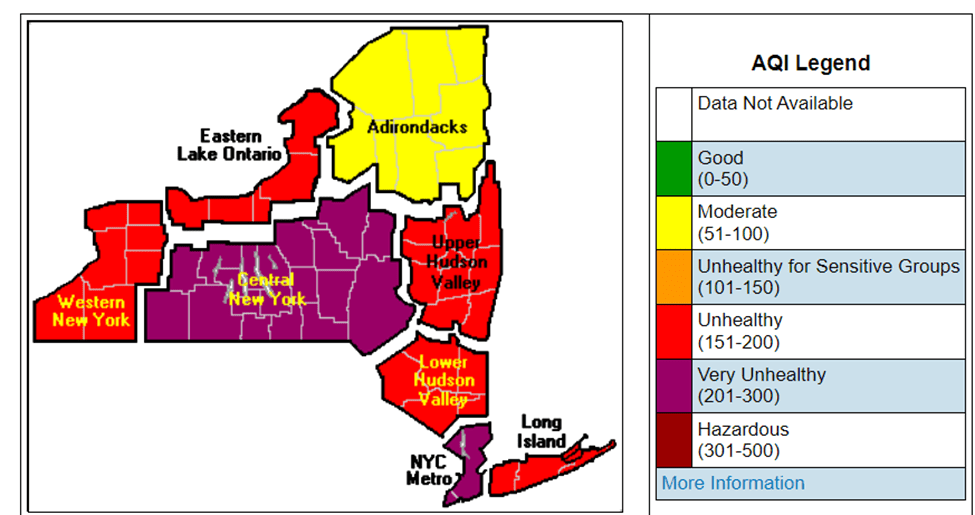
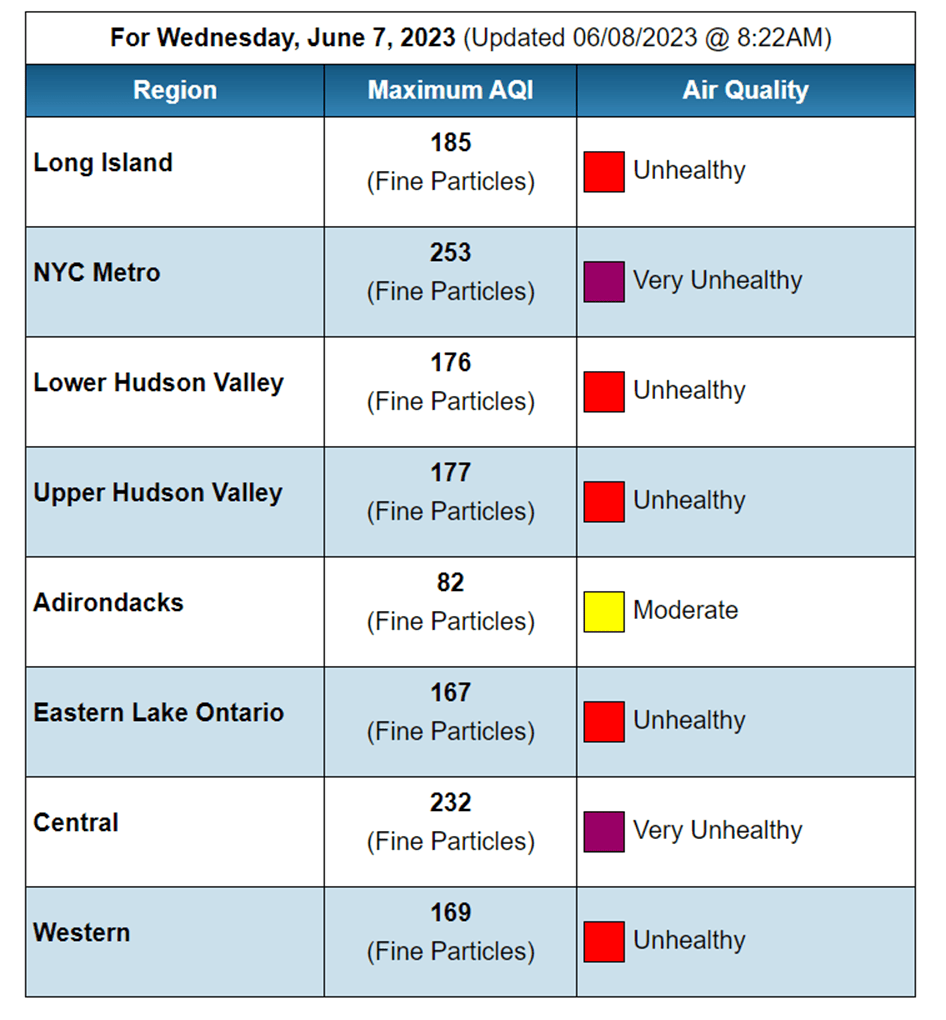
On June 7, 2023 the smoke and air quality impacts of wildfires in Quebec and Ontario were very high in New York State. I live in the Central New York region and I can attest that you could smell the smoke and taking a deep breath made me want to cough. The following information from the New York Department of Environmental Conservation summarize the air quality index observations.
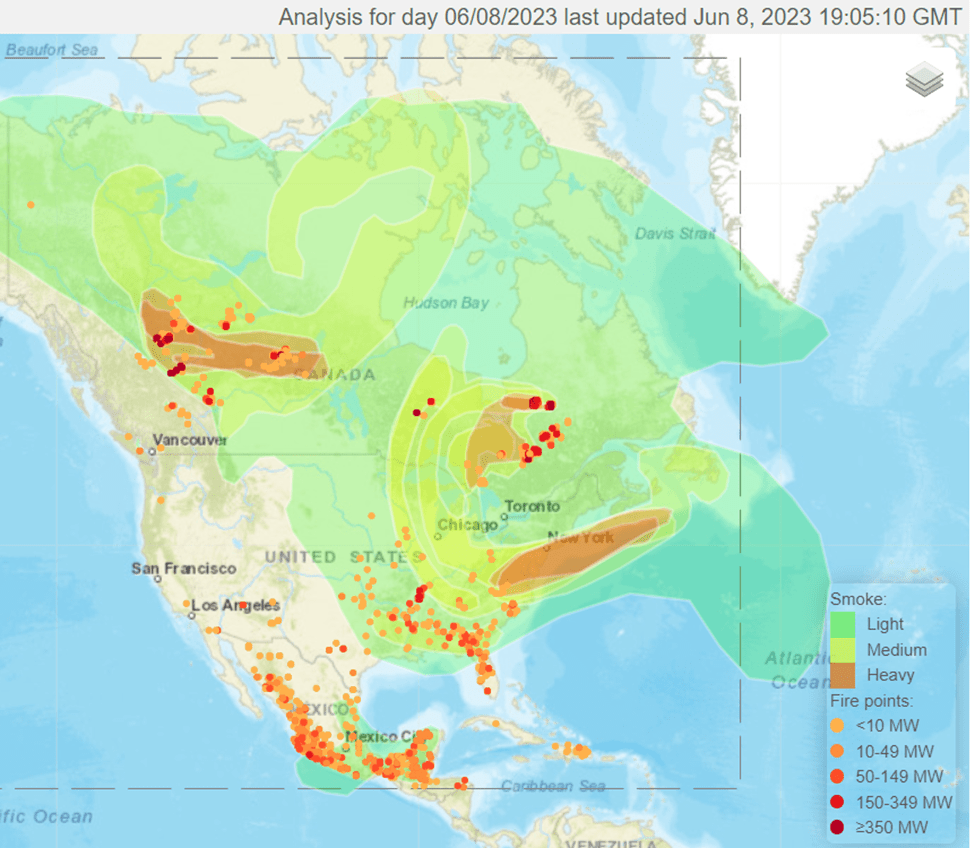
Satellite imagery shows the location of the fires. Note this is for the day after the data listed above.
The smoke was coming from Canada, where more than four hundred wildfires are currently burning. We do not know what caused many of them—a dropped cigarette, lightning, a downed electrical wire—but they are raging through the boreal forests of British Columbia, Alberta, and now Quebec. Wildfires are nothing new in these woodlands, but these are much earlier and larger than usual. And, like so many recent fires, they are directly linked to weeks of anomalous extreme heat. Climate change has created longer, hottersummers; worsened droughts; and fuelled vast bark-beetle infestations that have killed billions of trees.
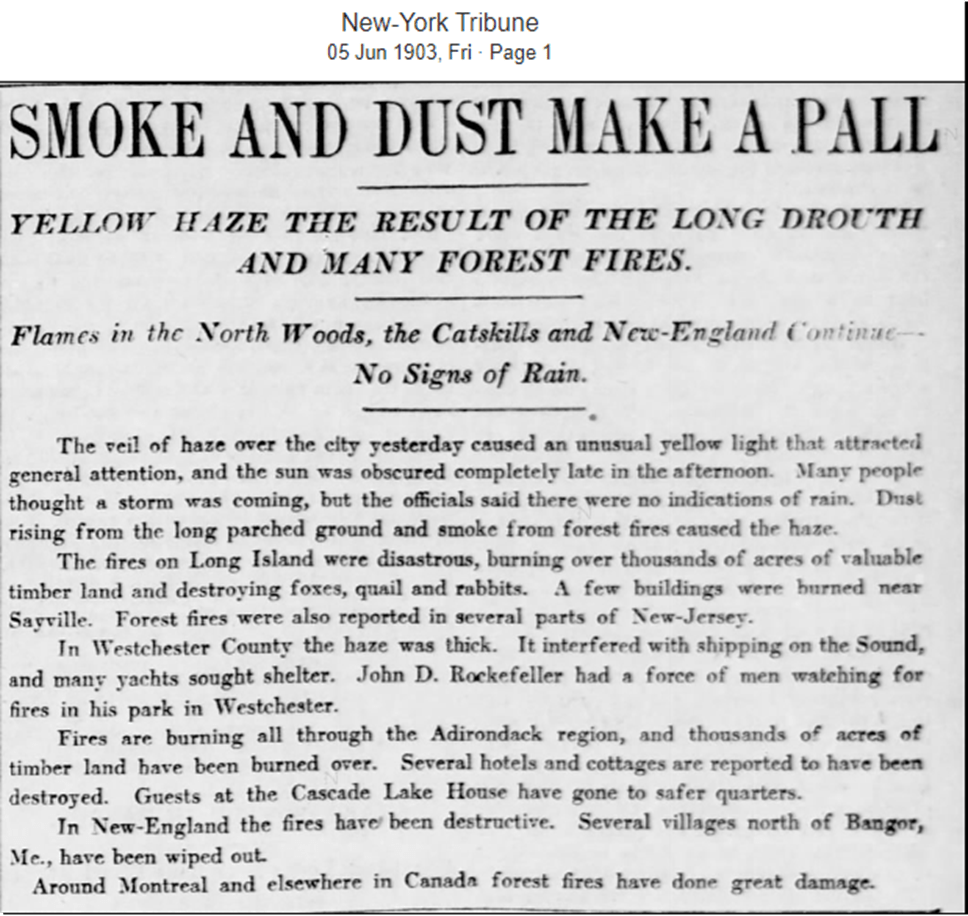
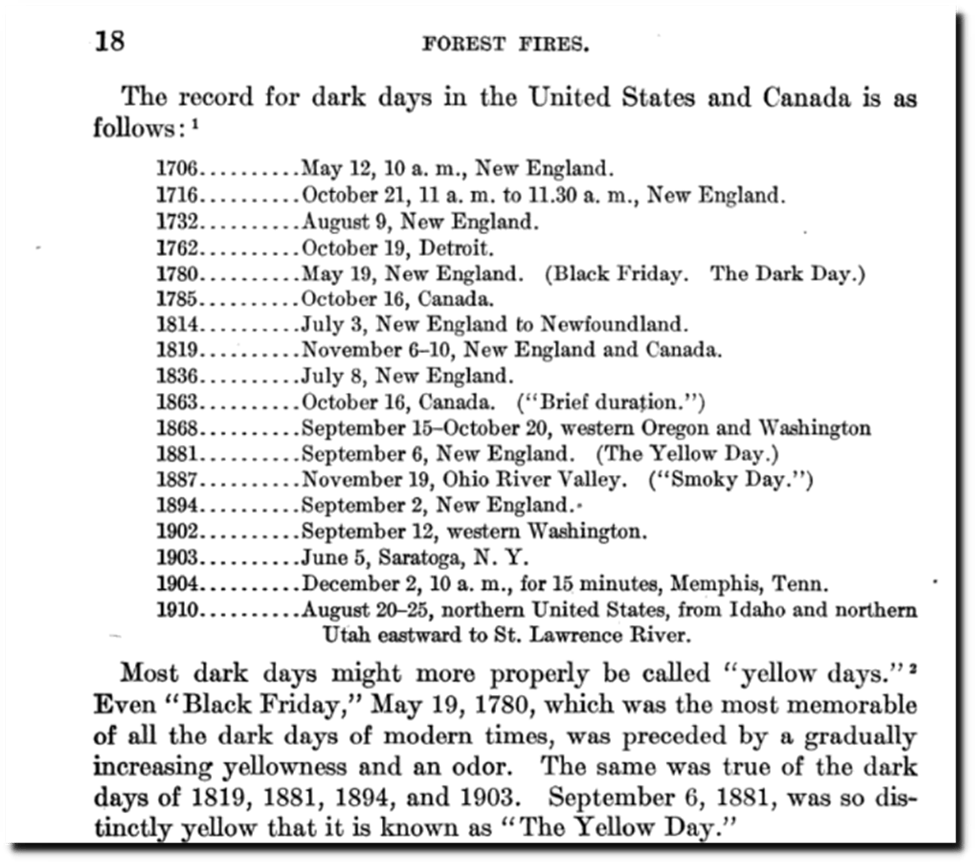
Consider the claims: wildfires are earlier and larger than usual and directly linked to weeks of extreme heat. In order to associate these with the climate change narrative then the claim that these are unusual compared to the past. Tony Heller writing at Real Climate Science does a great job combing through historical accounts of weather events. In this case he described Dark Days In New England that included the following:
He found a list of similar historic “dark days” that affected New York and New England earlier than this event in May 1706, May 1780, and June 1903. Other similar events occurred in 1716, 1732, 1814, 1819, 1836, 1881, and 1894.
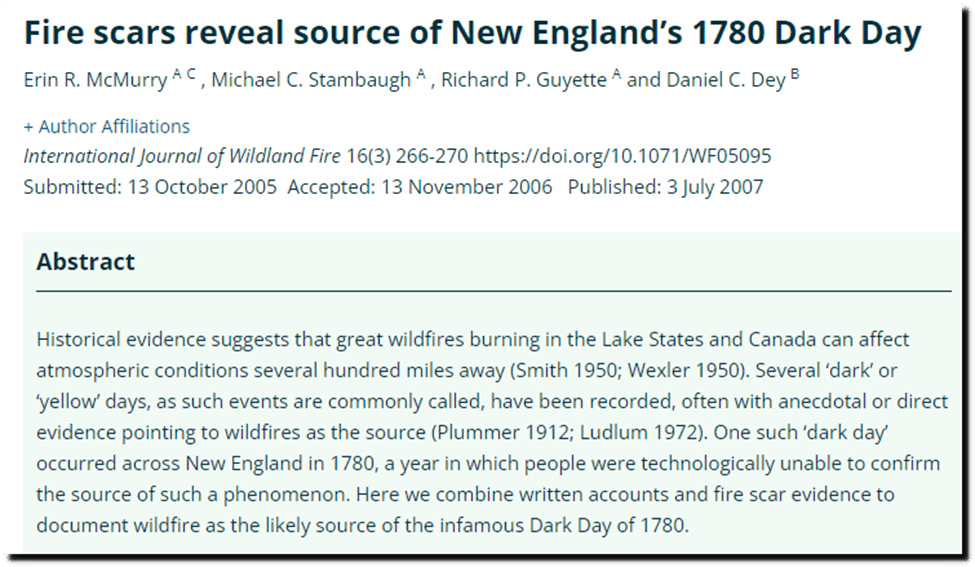
A published paper provides detail about the 1780 dark day in New England.
When considering the claim that climate change’s higher temperatures contribute to these wildfires that have obviously been happening in the Northeastern US for centuries is that in the 1700’s temperatures were much colder. The Little Ice Age lasted from the fourteenth century until the mid 1800’s.
Wildfires are a complex phenomenon and the media does not tell the whole story. Roger Pielke, Jr. explains discusses aspects of wildfires that he sees as missing in the public discussion. He makes the following points in his article.
The Intergovernmental Panel on Climate Change has not detected or attributed fire occurrence or area burned to human-caused climate change but does see a potential effect on fire weather in the USA:
The IPCC expresses “medium confidence” (about 50-50) that in some regions there are positive trends in conditions of “fire weather”: “There is medium confidence that weather conditions that promote wildfires (fire weather) have become more probable in southern Europe, northern Eurasia, the USA, and Australia over the last century”
Globally, emissions from wildfires has decreased globally over recent decades, as well as in many regions. He explains:
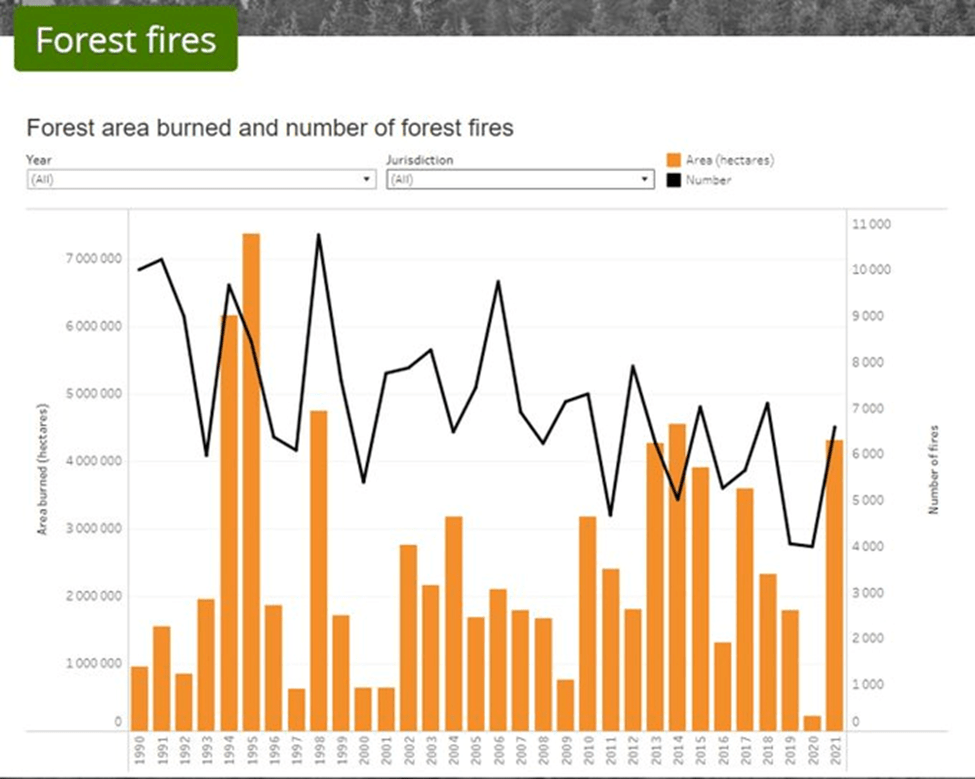
Canada — the focus of extensive fire activity this week polluting the air in the eastern U.S. and elsewhere — has not seen an increase in fire activity in recent decades, as you can see in the figure below, showing official data.
He concludes:
What you should take from it is the following:
Wildfire globally has decreased in recent decades;
Still, some regions have seen increases;
Neither Canada nor Quebec have not seen such increases this century;
Fire incidence across Canada is lower today than in centuries past.
Conclusion
Just because there is an extreme weather-related event that is unprecedented in one’s experience that does not mean that there is any evidence of climate change. In this example, as with all the similar events I have researched, there is little to no suggestion that climate change could possibly be related to the event. There were similar days of heavy smoke in the Northeastern US during the Little Ice Age which directly contradicts the narrative that the current warm period is any kind of a factor in these wild fires.
The latest Intergovernmental Panel on Climate Change (IPCC) Synthesis Report was recently released. Cloaked in the veneer of “the science” it claims that human activities have “unequivocally caused global warming, with global surface temperature reaching 1.1°C above 1850–1900 in 2011–2020.” The reality is much more nuanced.
The opinions expressed in this post do not reflect the position of any of my previous employers or any other company I have been associated with, these comments are mine alone.
Background
The Climate Leadership & Community Protection Act (Climate Act) has been a primary focus of this blog the last several years. I have written over 300 articles about New York’s net-zero transition because I believe the ambitions for a zero-emissions economy embodied in the Climate Act outstrip available renewable technology such that the net-zero transition will do more harm than good. I have not published many articles about the climate change rationale for the Climate Act because I don’t think the political momentum to do something in New York can be slowed because of the religious devotion to the existential climate threat narrative. The latest IPCC report will further that narrative but it turns out that was the purpose of the report. Since the release of the IPCC report, two authors who have had extensive experience with the IPCC process have published articles that demonstrate that the IPCC has “strayed far from its role to assess the scientific literature in support of policy making”. As a result there is more politics than science behind the headlines about the IPCC analysis dominating the recent news.
Before proceeding, it is important to understand that the IPCC is not a single entity or group of people. It is many different groups doing many different things, with many strengths — for instance, WG1 on extremes was particularly good. The IPCC also has some notable weaknesses — its reliance on out-of-date scenarios most obviously. The Synthesis Report was written by a small group of people. For better or worse, the work of this small group of people reflects upon the entire IPCC and the years of effort leading to this week’s report.
If I were an IPCC participant not involved with the Synthesis Report, I’d be pretty upset. My view is that the IPCC has strayed far from its role to assess the scientific literature in support of policy making. Its has increasingly taken on a stance of explicit political advocacy and as it does so it has ignored and even misrepresented relevant science. The IPCC needs a complete overhaul.
He goes on to argue that the document has become scientific assessment minus the science:
Six reports, dozens of drafts, hundreds of authors, thousands of citations, tens of thousands of pages, almost a decade of effort – and after all that, here is the top-line conclusion of the past nine years of work under the umbrella of the Intergovernmental Panel on Climate Change: “Urgent climate action can secure a liveable future for all”
That’s it. Generic and empty political exhortation that is all-so-common in climate advocacy. No science at all.
The new report downplays research showing that extreme scenarios are increasingly implausible and once again centers research that emphasizes RCP8.5 and SSP5-8.5. The report justifies this emphasis when it states in a footnote buried deep in the report: “Very high emission scenarios have become less likely but cannot be ruled out.”
This is far too clever. An alien invasion next week is also low likelihood, but cannot be ruled out.
None of the relevant literature on scenario plausibility is cited in the Synthesis Report, despite appearing in the most recent IPCC assessment reports. The “cannot ruled out” gambit gives the IPCC a way to keep extreme scenarios at the center of the report while evading any discussion of plausibility.
Pielke’s particular expertise is quantification of loss and damage impacts of extreme weather. The IPCC relies on loss and damage as the rationale why action is needed: Economic impacts attributable to climate change are increasingly affecting peoples’ livelihoods and are causing economic and societal impacts across national boundaries”. Pielke explains that rather than explaining what they mean and quantifying those impacts, the IPCC “relies on a series vague, imprecise and readily mis-interpretable statements.” There is a reason. There is a lot of research that runs contrary to the narrative:
Readers here will know that the overall number of weather and climate disasters have decreased so far this century, economic losses as down as a proportion of economic activity and deaths and people affected by extremes are sharply down in recent decades.
In an effort to aid the work of the IPCC in 2020 I published a literature review of 54 studies on loss and damage which quantified the relative roles of climate and development in economic losses from weather extremes. The IPCC not only ignored my review, but in its literature review it also ignored 53 of the 54 papers, choosing to cite only one paper which asserted the attribution of losses to greenhouse gas emissions – the other 53 did not. None of this data or research gets mentioned by the IPCC, which is just remarkable.
The new IPCC Report is a synthesis of the three reports that constitute the Sixth Assessment Report, plus three special reports. This Synthesis Report does not introduce any new information or findings. While the IPCC Reports include some good material, the Summary for Policy Makers for the Synthesis Report emphasizes weakly justified findings on climate impacts driven by extreme emission scenarios, and politicized policy recommendations on emissions reductions.
It is important to understand that projections for future impacts are dependent upon two things: the atmospheric effects of greenhouse gases in the atmosphere and the amount of emissions entering the atmosphere. Curry and Pielke have both argued for years that the IPCC has used biased emissions estimates. Curry states:
The most important finding of the past 5 years is that the extreme emissions scenarios RCP8.5 and SSP5-8.5, commonly referred to as “business-as-usual” scenarios, are now widely recognized as implausible. These extreme scenarios have been dropped by UN Conference of the Parties to the UN Climate Agreement. However, the new Synthesis Report continues to emphasize these extreme scenarios, while this important finding is buried in a footnote: “Very high emission scenarios have become less likely but cannot be ruled out.”
The extreme emissions scenarios are associated with alarming projections of 4-5oC of warming by 2100. The most recent Conference of the Parties (COP27) is working from a baseline temperature projection based on a medium emissions scenario of 2.5oC by 2100. Since 1.2oC of warming has already occurred from the baseline period in the late 19th century, the amount of warming projected for the remainder of the 21st century under the medium emissions scenario is only about one third of the warming projections under the extreme emissions scenario.
She ties these emission scenarios to the “loss and damage” rationale used by the IPCC:
The Synthesis Report emphasizes “loss and damage” as a central reason why action is needed. It is therefore difficult to overstate the importance of the shift in expectations for future extreme weather events and sea level rise, that is associated with rejection of the extreme emissions scenarios. Rejecting these extreme scenarios has rendered obsolete much of the climate impacts literature and assessments of the past decade, that have focused on these scenarios. In particular, the extreme emissions scenario dominates the impacts that are featured prominently in the new Synthesis Report.
Clearly, the climate “crisis” isn’t what it used to be. Rather than acknowledging this fact as good news, the IPCC and UN officials are doubling down on the “alarm” regarding the urgency of reducing emissions by eliminating fossil fuels. You might think that if warming is less than we thought, then the priorities would shift away from emissions reductions and towards reducing our vulnerability to weather and climate extremes. However, that hasn’t been the case.
The IPCC has been characterized as a “knowledge monopoly,” with its dominant authority in the UN climate deliberations. The IPCC claims that it is “policy-neutral” and “never policy-prescriptive.” However, the IPCC has strayed far from its chartered role of assessing the scientific literature in support of policy making. The entire framing of the IPCC Reports is now around the mitigation of climate change through emissions reductions.
Not only has the IPCC increasingly taken on a stance of explicit political advocacy, but it is misleading policy makers by its continued emphasis on extreme climate outcomes driven by the implausible extreme emissions scenarios. With its explicit political advocacy, combined with misleading information, the IPCC risks losing its privileged position in international policy debates.
The impact of these alarming IPCC reports and rhetoric by UN officials is this. Climate change has become a grand narrative in which human-caused climate change has become a dominant cause of societal problems. Everything that goes wrong reinforces the conviction that there is only one thing we can do to prevent societal problems—stop burning fossil fuels. This grand narrative leads us to think that if we solve the problem of burning fossil fuels, then these other problems would also be solved. This belief leads us away from a deeper investigation of the true causes of these other problems. The end result is a narrowing of the viewpoints and policy options that we are willing to consider in dealing with complex issues such as energy systems, water resources, public health, weather disasters, and national security.
Conclusion
I wanted to publish something about the latest IPCC report because it is being promoted as definitive science. The thing to keep in mind is that the scientists who wrote the analyses in the IPCC reports, were not the primary authors of the Synthesis Report and had no hand in the Summary of the Synthesis Report that is the basis for all the news reports. As a result, do not panic over the claims of doom and gloom.
Both Pielke and Curry argue that the IPCC process is flawed. Pielke concludes: “Between the IPCC Synthesis Report’s evasion of the most recent literature on scenarios and the games it has played with loss and damage research and evidence, the IPCC is skating close to becoming a source of climate misinformation.” Curry concludes that “The IPCC Reports have become “bumper sticker” climate science – making a political statement while using the overall reputation of science to give authority to a politically manufactured consensus.”
Roger Pielke, Jr. has been analyzing climate change risks since 1994. This post highlights his article published today that explains “explosive testimony this week argues that climate research has a serious conflict of interest problem.” At a recent meeting I heard several people who have caught on that this is a problem based on their gut instincts. Here’s documentation proving that they are correct.
Pielke’s climate research has strayed from the orthodoxy so he has been decried as a heretic. As he puts it:
I have argued that climate change poses risks and deserves significant action in response. I’ve also argued that our response efforts to date have been woefully inadequate. My views, which I have not been shy about sharing, have led some to try to exclude or remove me from the discussion, with some considerable success.
Blowback to his work is so bad now that when I did an internet search for his credentials the popup list of search suggestions included “Roger Pielke Jr climate denier”. He must have struck a nerve when he documented the fact that the continuing litany of so-called proof of climate apocalypse is not supported by the data because he was attacked by many. Based on the flak he receives he must be over the target because powerful people have tried all sorts of things to shut him up.
Here is his article in its entirety
Recently I was surprised to see a Tweet from a climate researcher who I’ve known for a while that looked like an advertisement for a particular renewable energy company. The researcher was promoting the company to his many followers. Reading on, I saw that the researcher disclosed that he was being paid by the company and had an equity interest. So it was an advertisement. Academics can also be investors, right? So no problem?
Well, here is the problem. This researcher was one of the central analysts whose work was used to design and then promote the passage of the Inflation Reduction Act. The company he is promoting is a direct beneficiary of that legislation. At the same time, the researcher claims that his analyses offer an “independent environmental and economic evaluation of federal energy and climate policies.” BS. There’s a sucker born every minute.
I called out the researcher on Twitter for taking money not just from one but from many companies that are direct beneficiaries of the legislation he helped to design and sell to policymakers and the public. He responded to me in a huff — proclaiming his noble intent and track record of advocacy for renewable energy for many years (almost as bad as the climate researcher who told me she could not have a conflict of interest because her husband was a preacher). All that may well be true, but goodness, this absolutely stinks.
I’m not naming the researcher (you can find him easily enough), because his case is far from unique in climate research these days, and this post is about a far bigger more important issue.
There is a gold rush going on in climate research right now, as researchers scramble to cash in on their new-found access to politicians and philanthropists. As Professor Jessica Weinkle of the University of North Carolina-Wilmington stated in her opening remarks in testimony before the U.S. Senate last week, “Today, it is not easy to separate the going-ons in climate change research from the special interests of financial institutions.”
She continues:
The landscape of climate change research is made complicated by an outcropping of non-profit advocacy organizations that double as analytic consultants, hold contracts with private companies and government entities, and engage in official government expert advisory roles- all while publishing in the peer reviewed literature and creating media storms.
This is not really an issue of any one entity. It is pervasive.
Experts monetizing their expertise is one important reason why people become experts, and there is no problem with people seeking to make a buck. But where expertise and financial interests intersect, things can get complicated. That is why there are robust mechanisms in place for the disclosure and mitigation of financial conflicts of interest, a subject I’ve focused on for decades.
All of this is just common sense. Your doctor can’t prescribe you drugs from a company that pays him fees. You wouldn’t think much of a report on smoking and health from a researcher supported by the tobacco industry. Should climate researchers play by a different set of rules, because the cause is so important?
Call me a stickler, but in my view, the more important the cause, the more important it is to enforce standards of research integrity.
Following her testimony, Weinkle addressed a few questions that were raised at the Senate hearing. Here is her response to the first one:
Well… I don’t know if it was really a question. It was a set up to imply that the only conflicts of interest that should matter are those coming from the fossil fuel industry.
I don’t agree. At. All.
Frankly, that’s absurd.
In fact, when people argue that the only conflicts of interest that matter are those held by their opponents they are saying that the rules of the game don’t apply to themselves or those that support them.
Conflicts of interest are a concern for scientific integrity no matter where the money is coming from.
Further, it was implied in the hearing that only the fossil fuel industry hides what they are doing by donating to non profit groups that then do research. No.
I encourage you to read Professor Weinkle’s testimony in full. She cites three examples of many that raise serious questions of financial conflicts of interest in climate research (see the testimony for all the footnotes, which I removed here):
Central bank stress testing scenarios are developed by researchers who are also lead authors on IPCC reports and have important roles in organizing the international modeling community in the development of IPCC scenarios. Funding for central bank scenario development and the most recent meeting of the scenario modeling community comes from influential organizations including, Bloomberg Philanthropies, ClimateWorks, and the Bezos Earth Fund.
McKinsey & Company used a climate consultancy to produce a series of widely influential reports on climate change financial risks. In defense of their use of RCP 8.5 the report cited a peer-reviewed publication written by its own consultants. The researchers did not declare their COI as consultants for McKinsey or their association with the asset management firm, Wellington. Shortly after publication of the article one of its authors landed a political position while the authors’ home institution announced coordinated efforts with Wellington to influence SEC regulatory decisions.
The Risky Business Project, an academic-industry research collaboration was organized by three wealthy politicians with the goal to “mak[e] the climate threat feel real.” Research products are important components to national climate and sea level rise assessments, and a policy advocacy tool used to evaluate real estate flood risk. Core members of the research collaboration move seamlessly between private consulting, policymaker science advisory positions, and academic research.
Again, this stinks.
Nothing could be more delegitimizing to climate science and policy than a toxic combination of unmitigated financial conflicts of interest and claims that climate researchers, by virtue of the noble cause, are exempt from the rules that govern every other setting where expertise and money intersect.
I’ll let Professor Weinkle have the last word today:
Climate change science demonstrates an underappreciated dynamic system of conflicts of interest among climate change researchers, advocacy organizations, and the financial industry.
If you haven’t subscribed to Professor Weinkle’s Substack, called Conflicted — run, don’t walk, and sign up — link below.
Early this year I described the outsized influence of a few individuals on the Climate Act and the Climate Action Council. When the Council deigned to address any dissenting comments regarding the implementation analyses, most of the members dismissed those considerations as misinformation funded by the fossil fuel industry. I believe they ignored a more serious instance of a conflict of interest.
This article first appeared at Watts Up With That. I slightly modified the first paragraph but the rest is the same. This represents my opinion and not the opinion of any of my previous employers or any other company with which I have been associated.
Based on the Time Magazine opinion piece, “What Comes After the Coming Climate Anarchy?”, we may have reached a point where no facts have to be included in a climate fear porn editorial. This is just a short introduction to the piece and the author. I encourage you to read it yourself. After my post was published David Middleton wrote another article about the opinion piece covering much the same ground. His version has much better graphics.
The author is Parag Khanna who Time describes as a founder of Future Map and author of the new book MOVE: The Forces Uprooting Us. According to Khanna’s long bio, he is a “leading global strategy advisor, world traveler, and best-selling author”. He is Founder & CEO of Climate Alpha, an AI-powered analytics platform that forecasts asset values because “the next real estate boom will be in climate resilient regions”. He also is Founder & Managing Partner of FutureMap, a data and scenario based strategic advisory firm that “navigates the dynamics of globalization”. Dr. Khanna “holds a PhD in international relations from the London School of Economics, and Bachelors and Masters degrees from the School of Foreign Service at Georgetown University”. A quick look at the School of Foreign Service Georgetown core curriculum offers no suggestion of any scientific requirements that could provide a basis for Dr. Khanna’s climate beliefs.
The opinion piece starts out with correlation causation fallacy endemic to the scientifically illiterate and climate innumerate crisis mongers. He notes that in 2021, “global carbon dioxide emissions reached 36.3 billion tons, the highest volume ever recorded” and that this year “the number of international refugees will cross 30 million, also the highest figure ever”. Then he explains the basis for his climate anarchy belief: “As sea levels and temperatures rise and geopolitical tensions flare, it’s hard to avoid the conclusion that humanity is veering towards systemic breakdown”.
This is just a windup to:
Today it’s fashionable to speak of civilizational collapse. The U.N. Food and Agriculture Organization’s (FAO) states that just a 1.5 degree Celsius rise will prove devastating to the world’s food systems by 2025. Meanwhile, the most recent IPCC report warns that we must reverse emissions by 2025 or face an irreversible accelerating breakdown in critical ecosystems, and that even if the Paris agreement goals are implemented, a 2.4 degree Celsius rise is all but inevitable. In other words, the “worst case” RCP 8.5 scenario used in many climate models is actually a baseline. The large but banal numbers you read—$2 trillion in annual economic damage, 10-15% lower global GDP, etc.—are themselves likely massively understated. The climate bill just passed by the Senate is barely a consolation prize in this drama: a welcome measure, but also too little to bring rains back to drought-stricken regions in America or worldwide.
Then there is this:
Let’s assume that we are indeed hurtling towards the worst-case scenario by 2050: Hundreds of millions of people perish in heatwaves and forest fires, earthquakes and tsunamis, droughts and floods, state failures and protracted wars. Henry Gee, editor of the magazine Nature, wrote in an essay in Scientific American in late 2021 that even absent the hazards of climate change and nuclear war, humankind was heading towards extinction due to declining genetic variety and sperm quality.
He goes on to predict that even in the most plausibly dire scenarios billions of people will survive. He says that current population stands at eight billion but claims as a result of these dire scenarios “the world population would likely still stand at 6 billion people by 2050”. As you read on this opinion piece is simply an infomercial for Climate Alpha and FutureMap. He believes that climate migrations will be necessary for the survivors. His future vision is pockets of reliable agricultural output and relative climate resilience that may become havens for climate refugees.
He concludes:
What these surviving societies and communities will have in common is that they are able to unwind the complexity that has felled our predecessors. They rely less on far-flung global supply chains by locally growing their own food, generating energy from renewable resources, and utilizing additive manufacturing. A combination of prepping and nomadism, high-tech and simple, are the ingredients for species-level survival.
These demographic, geographic, and technological shifts are evidence that we are already doing things differently now rather than waiting for an inevitable “collapse” or mass extinction event. They also suggest the embrace of a new model of civilization that is both more mobile and more sustainable than our present sedentary and industrial one. The collapse of civilizations is a feature of history, but Civilization with a big ‘C’ carries on, absorbing useful technologies and values from the past before it is buried. Today’s innovations will be tomorrow’s platforms. Indeed, the faster we embrace these artifacts of our next Civilization, the more likely we are to avoid the collapse of our present one. Humanity will come together again—whether or not it falls apart first.
Comments
In my opinion there are several major flaws in his arguments. Apparently, his projections are based on the RCP 8.5 scenario because he thinks it is “actually a baseline”. Roger Pielke, Jr. has noted that the misuse of RCP8.5 is pervasive. Larry Kummer writing at Climate Etc. explains that it is a useful worst-case scenario, but not “business as usual”. For crying out loud even the BBC understands that the scenario is “exceedingly unlikely”. Relying on that scenario invalidates his projections.
Khanna’s worst-case scenario statement “Hundreds of millions of people perish in heatwaves and forest fires, earthquakes and tsunamis, droughts and floods, state failures and protracted wars” is absurd. He has to address the many examples that show that weather-related impacts have been going down as global temperatures have increased such as those described by Willis Eschenbach in “Where Is The “Climate Emergency?”. The theme of his opinion is climate anarchy so why are earthquakes and tsunamis included? I concede that his flawed climate projections could stress states and prolong wars but I am not convinced that climate is a major driver.
Finally, his argument that climate is a major driver is contradicted by his dependence on the Sustainable Development Index, a “ranking of countries that meet their people’s needs with low per capita resource consumption”. He states that the best performers are “Costa Rica, Albania, Georgia, and other less populated countries around middle-income status”. The fact that Costa Rica is in a tropical region and thus much warmer than mid-latitude Albania and Georgia suggests that warm climates are not a limiting factor for sustainable development.
Khanna may be a leading global strategy advisor, world traveler, and best-selling author but his lack of understanding of the uncertainties associated with climate change are evident in this editorial. Not unlike many of those advocates for climate change action, upon close review it appears that following the money is his motivation.
Just when I think that the climate-related madness cannot get any shoddier something comes up even worse. The American Meteorological Society (AMS) Council adopted a special statement on 8 July 2022 in response to the Supreme Court decision West Virginia vs. EPA that takes the level of climate change hysteria to a whole new level.
New York’s Climate Leadership and Community Protection Act (Climate Act) plans to reach net-zero by 2050 that are outlined in the Draft Scoping Plan fully align with the material in this Statement. I submitted comments on the Plan and have written extensively on implementation of New York’s response to that risk because I don’t agree that the alleged problem can be solved simply and affordably. The opinions expressed in this post do not reflect the position of any of my previous employers or any other company I have been associated with, these comments are mine alone.
The AMS is deeply concerned by the United States’ inadequate response to climate change and the dangers it poses to the nation and all life. This inadequacy is illustrated most recently–but by no means only–through the Supreme Court decision West Virginia v. EPA.
Climate change is a highly solvable problem and the available solutions offer tremendous opportunity for societal advancement and climate protection. We applaud the many people throughout the country who are working constructively to tackle climate change, including many government officials, politicians, members of the public, scientists, and members of the business community.
All people should know that:
1. Climate change is extraordinarily dangerous to humanity and all life
> Climate is a basic life-support system for people and all life.
> Global climate changes occurring now are larger and faster than any humanity is known to have endured since our societal transition to agriculture.
> The physical characteristics of the planet, biological systems and the resources they provide, and social institutions we have created all depend heavily on climate, are central to human well-being, and are sensitive to climate change.
2. People are changing climate
> Multiple independent lines of scientific evidence confirm that people bear responsibility.
> The warming effect of our greenhouse gas emissions is demonstrated through laboratory experiments, evidence from past changes in climate on Earth, and the role of greenhouse gasses on other planets.
> The patterns of climate change occurring now match the characteristics we expect from our greenhouse gasses and not the other potential drivers of change: the sun, volcanoes, aerosols, changes in land-use, or natural variability.
3. The scientific conclusions summarized here result from decades of intensive research and examination
> The scientific evidence has been assessed comprehensively by independent scientific institutions and independent experts that consider all evidence.
> Accuracy is central to credibility for scientific institutions such as the U.S. National Academy of Sciences, the American Meteorological Society, and American Association for the Advancement of Science, all of which have assessed climate science.
> No broadly contradictory assessments from credible scientific organizations exist.
4. Solutions are available and highly promising–a serious reason for optimism.
> Greenhouse gas emissions are an economically harmful market failure. Those who emit pollution to the atmosphere shift the costs of climate damage onto everyone, including future generations. Making emitters pay for all the costs of their use of our atmosphere would help correct this failure and thereby improve economic well-being.
> Regulatory approaches can speed the adoption of best practices, require broadly beneficial technologies, promote public interest, and enhance equity and fairness.
> As a result, reducing greenhouse gas emissions can increase climate security, national security, the well-being of biological systems, and economic vitality.
> Existing and emerging technologies such as roof-top solar, electric vehicles, and electric heat pumps can reduce greenhouse gas emissions, improve air quality in our homes and cities, and often provide superior products or services.
> Building our resilience to climate impacts (adaptation) makes communities stronger and better able to deal with both existing vulnerabilities and emerging threats.
People are changing climate and it poses serious risks to humanity. There are a wide range of response options that are well understood, many of which would be broadly beneficial. We will need to work together to harness human ingenuity to address climate change. Therein lies an even greater opportunity for humanity. If we can address our climate problem, we will have a new template for the wide range of challenges and opportunities facing us at this point in the 21st century.
Discussion
Tony Heller writing at Real Climate Science eviscerated the “Climate change is extraordinarily dangerous to humanity and all life” statement. He showed that natural disasters are decreasing and life expectancy has doubled since fossil fuel use has become widespread across the globe. Willis Elsenbach’s post Where is the Climate Emergency is a more comprehensive rebuttal to this statement. My comments on similar claims in the Draft Scoping Plan also argued that if you actually look at the data that these threats are unsupportable.
I stopped being a member of the AMS in 2012 when the organization ranked advocacy above science. I tried to argue that their approach was wrong but the responses back showed that they were not interested in toning down their advocacy. The arguments supporting the “People are changing climate” statement appear to be talking points for the public. Near the end of the Trump Administration a series of short, easily understandable brochures that support the general view that there is no climate crisis or climate emergency, and pointing out the widespread misinformation being promoted by alarmists through the media were prepared. The following brochures address the other side of these arguments:
The section “The scientific conclusions summarized here result from decades of intensive research and examination” is a direct appeal to authority. The recent Global Warming Golden Goose article summarizes the follow the money trail that suggests that the scientific institutions we are supposed to trust are not necessarily interested in only scientific truth and enlightenment. It amuses me that the first ones to scream that deniers are on the payroll of big oil are most likely to be directly benefiting from big green funding organizations.
The next section “Solutions are available and highly promising” shows an amazing lack of self-awareness. The point of the previous section was that you should trust only the “experts”. Why in the world would anyone expect that the American Meteorological Society has expertise in energy solutions. The vague, content-free arguments are a joke to anyone who has spent any time looking at the tremendous technological difficulties associated with running today’s society using intermittent and diffuse wind and solar or even follows today’s energy issues. Any proposed transition plan that does not list nuclear power at the top of the list is not credible because that is the only source of dispatchable emissions-free electricity that can be scaled up. I also have to wonder whether the authors follow current energy news. My feed of followed websites this weekend had articles on copper shortages that will preclude the net zero by 2050 transition, the amount of solar panels needed for the transition, the German net-zero transition is running out of energy, and the current Texas heat wave is straining power supplies so much that electric car owners are being asked to charge off-peak. My Draft Scoping Plan comments focused on the many instances where New York’s plan to transition to net-zero is anything but easy. All of these issues invalidate the claim that the climate threat is “easily solvable”.
Once upon a time I was proud to be a member of the American Meteorological Society. This policy statement is so embarrassing I don’t want to admit I was associated with a scientific organization that could publish something this far detached from reality. Unfortunately, it will undoubtedly be used by advocates to “prove” that something can be done. In my opinion I have no doubts that the suggested solutions will cause more harm than good.
In a special to the Washington Post Oliver Uberti opines that “Trust in meteorology has saved lives. The same is possible for climate science”. The former senior design editor for the National Geographic and co-author of three critically acclaimed books of maps and graphics does an excellent job tracing the history of weather forecasting and mapping. Unfortunately he leaps to the conclusion that because meteorological forecasting has worked well and we now “have access to ample climate data and data visualization that gives us the knowledge to take bold actions”.
Uberti writes:
“The long history of weather forecasting and weather mapping shows that having access to good data can help us make better choices in our own lives. Trust in meteorology has made our communities, commutes and commerce safer — and the same is possible for climate science.”
I recommend reading most of the article. He traces the history of weather observations and mapping from 1856 when the first director of the Smithsonian Institution, Joseph Henry, started posting the nation’s weather on a map at its headquarters. Eventually he managed to persuade telegraph companies to transmit weather reports each day and eventually he managed to have 500 observers reporting. However, the Civil War crippled the network. Increase A. Lapham, a self-taught naturalist and scientist proposed a storm-warning service that was established under the U.S. Army Signal Office in 1870. Even though the impetus was for a warning system, it was many years before the system actually made storm warning forecasts. Uberti explains that eventually the importance of storm forecasting was realized, warnings made meaningful safety contributions, and combining science with good communications and visuals “helped the public better understand the weather shaping their lives and this enabled them to take action”.
Then Uberti goes off the rails:
“The 10 hottest years on record have occurred since Katrina inundated New Orleans in 2005. And as sea surface temperatures have risen, so have the number of tropical cyclones, as well as their size, force and saturation. In fact, many of the world’s costliest storms in terms of property damage have occurred since Katrina.”
“Two hundred years ago, a 10-day forecast would have seemed preposterous. Now we can predict if we’ll need an umbrella tomorrow or a snowplow next week. Imagine if we planned careers, bought homes, built infrastructure and passed policy based on 50-year forecasts as routinely as we plan our weeks by five-day ones.”
“Unlike our predecessors of the 19th or even 20th centuries, we have access to ample climate data and data visualization that give us the knowledge to take bold actions. What we do with that knowledge is a matter of political will. It may be too late to stop the coming storm, but we still have time to board our windows.”
It is amazing to me that authors like Uberti don’t see the obvious difference between the trust the public has in weather forecasts and misgivings about climate forecasts. Weather forecasts have verified their skill over years of observations and can prove improvements over time. Andy May’s recent article documenting that the Old Farmer’s Almanac has a better forecast record, for 230 years, than the Intergovernmental Panel on Climate Change (IPCC) has for 30 years suggests that there is little reason the general public should trust climate forecasts. The post includes a couple of figures plotting IPPC climate model projections with observations that clearly disprove any notion of model skill.
Sorry, the suggestion that passing policy based on 50-year climate science forecasts is somehow supported by the success of weather forecast models is mis-guided at best.
—————————————————————————————————————————————
Roger Caiazza blogs on New York energy and environmental issues at Pragmatic Environmentalist of New York. This represents his opinion and not the opinion of any of his previous employers or any other company with which he has been associated.
A friend recently posted information on Facebook that the Texas blackout situation was a “literal perfect storm test if an all-renewable energy plan would work”. The Facebook police posted a warning that there was “missing context” but I will explain why there was missing context in the missing context claim.
I while away my time in retirement publishing a blog on New York environmental and energy issues and have written extensively on New York’s attempts to address climate change by reducing greenhouse emissions. For this context I wrote a post explaining the lessons that should be learned by New York in their quest to save the planet and another responding to a newspaper article asking whether something similar could happen in New York. Short answers: New York has to be very careful with their plans or they will end up in the same situation as Texas in the future and New York’s electricity market is currently structured differently than Texas so it is very unlikely that the same thing could happen today.
The Facebook missing context check claims that because failure of natural gas and other fossil sources was the primary problem with the blackouts this February it is unfair to claim this was an appropriate test of an all-renewable energy plan. However, their arguments fail to consider a couple of things.
In the first place the claim in the post was that this was a test of an all-renewable energy system. One way to consider generating availability is the capacity factor which is the actual electricity generated divided by the maximum electricity possible. If we look at the capacity factors for Texas generation types during the crisis, midnight 2/15 to noon 2/18, then we can try to determine the cause of the crisis. None of the energy sources performed particularly well. It is clear that in all-renewable energy system a lot would have to be done to replace the lack of wind and solar generation. Note that 30,000 MW of wind at a cost of some $70 billion producing 650 MWs when it was desperately needed is a failure on the magnitude of the Maginot Line in World War 2. My first problem with the fact checkers is that even though the fossil plants failed to do well in this situation, the resources needed to keep the lights on in an all-renewable energy system for a future situation would be so immense and so expensive that they may not be feasible and that was the point of the claim.
Figure 1 ERCOT Capacity Factors 2/15/21:0000 to 2/18/21:1200
In my opinion the actual root cause to the problem is that the Texas energy market only pays generators when they produce power. Most other electric markets pay generators for capacity or the ability to provide electricity when it is needed. Texas had a very similar situation ten years ago which also led to blackouts. If you don’t pay generators to be available in critical if rare situations they simply will not invest for those periods. In this case, the wind mills could have spent extra for cold weather upgrades, the natural gas infrastructure could add heat tracing so equipment did not freeze, and the nuclear plants could have protected their water systems and this catastrophe could have been avoided. All of that would have been done if the market paid for capacity.
There is a bigger problem associated with the lack of a capacity market in Texas that the Facebook fact checkers completely ignore in their missing context claim. A former electric utility planning engineer described his impression of the problems that lead to the debacle and noted that the purpose of the payment for energy only market strategy was “to aid the profitability of intermittent wind and solar resources and increase their penetration levels.” Put another way, because renewables don’t provide capacity that means having a capacity market disadvantages renewables.
I conclude that the Facebook fact checkers were more interested in damage control against claims that renewable energy has weaknesses than objectively addressing the claims. The original claim is that an all-renewable energy system would most likely fail even more under the conditions that occurred and that has nothing to do with the fact that fossil fueled sources failed in this event. The other flaw in their fact check is that the ultimate cause of the failure, payments only for energy, is the preferred approach for renewables advocates. If they get their way blackouts will be inevitable.