Commentary on Recent Articles January 18, 2025

This is an update of articles that I have read that I want to mention but only have time to summarize briefly.  I have also included links to some other items of interest.  Previous commentaries are available here

I have been following the Climate Leadership & Community Protection Act (Climate Act) since it was first proposed and most of the articles described below are related to the net-zero transition.  I have devoted a lot of time to the Climate Act because I believe the ambitions for a zero-emissions economy embodied in the Climate Act outstrip available renewable technology such that the net-zero transition will do more harm than good. The opinions expressed in this article do not reflect the position of any of my previous employers or any other company I have been associated with, these comments are mine alone.

Videos

Recommended – Steve Koonin – Is there a climate emergency

Alex Epstein and Jordan Peterson – How to Solve All of America’s Energy Problems Transcript and Video

Brian Gitt – Confessions of an environmentalist

Sea-Level Rise News

I recently described the responses by the Department of Environmental Conservation (DEC) to my comments on the Amendment to Part 490 Projected Sea-Level Rise. My primary criticism was that the DEC methodology yields absurdly high estimates of sea level rise.  The biggest driver of that was because they rely on estimates of the future global warming based on emission projections that are acknowledged by most scientists as impossible.  I did not mention that they also relied on a limited number of controversial analyses that claimed that rapid Antarctic ice melt was possible. 

Kip Hansen recently reported that:

Antarctic ice melt has been an ongoing scientific controversy for more than a decade.  Oddly, the warring parties are all at the same U.S. Federal Agency.  The war, which involved  salvos of papers between the NASA’s GRACE Ice Mass team and H. Jay Zwally and his team.

Hansen reports the news that:

The news is that some clever scientists — Collin M. Schohn, Neal R. Iverson, Lucas K. Zoe , Jacob R. Fowler, and Natasha Morgan-Witts — had decided that instead of blindly following the long-standing formulas for glacier ice flow, maybe they ought to find out, using real experiments, if those formulas actually reflect what happens in the physical universe where glaciers, ice under pressure, are flowing and melting.  It took them ten years.

The story is covered in this SciTechDaily article:  Glacier Experts Uncover Critical Flaw in Sea-Level Rise PredictionsThe article is a press release from Iowa State University (the by line is theirs).  It says:

New research shows temperate glacier ice flows more steadily than previously thought, leading to lower projections of sea-level rise.

The bottom line described by Hansen is further evidence that the sea level rise projections in Part 490 are unacceptably high:

New research shows temperate glacier ice flows more steadily, linearly and not exponentially,  contrary to our previous understanding,  and this leads to far lower projections of future sea-level rise due to any glacier melt in Greenland and Antarctica.

Climate Discussion Nexus (CDN)

CDN is run by John Robson and produces a highly recommended weekly newsletter. The latest edition includes a story about access to electricity.  His piece starts with complaints about some technical problems with electronic gadgets including Gmail’s “The operation cannot be performed because the message has been changed”, surely the most useless bug in history”.  He goes on to say “If you think we’re being petty and whiny about First World problems, you’re right. Because what people should hate is that, for instance, 17 million human beings in Latin America and the Caribbean alone never face any of those issues because they don’t have access to electricity, never mind a frozen web page.”   Robson goes on to point out:

Half a billion people don’t have to worry about the light switch not working because there isn’t one. And yet countless well-fed activists with more selfies on their phone than they can sort look at those numbers and think we must prevent them from burning natural gas or coal, stop them building nuclear reactors and keep inhaling particulates from wood and dung if they stupidly persist in cooking what little food they’ve managed to obtain. While hating us for lacking compassion and concern for the future.

Energy Transition Challenges

Rick Dunn described the visions, delusions, and nightmares of the proposed energy transition in a well-documented piece that includes good graphics.  He made a good point that transition challenges are related to primary energy consumption.  In 2023 “wind and solar only represented 2.6% of total U.S. primary energy consumption in 2023, and ‘evil’ fossil fuels (hydrocarbons) represented 83%.”  He notes:

To help digest the stunningly low numbers for wind and solar it is important to keep in mind that energy represents the capacity to do work and that direct use of combustible fuels in residential, commercial, industrial and transportation sectors is where the vast majority of work on the planet is being done today.

I concur with his conclusion that “Dogma has replaced physics, engineering, and economics in shaping energy policies. Citizens must demand far more from their elected officials and utility leaders.”

Americans rejected Biden’s expensive climate agenda, but New York still offers it a safe haven

Kevin Killough wrote an article describing New York’s climate agenda that I mention here because he referenced my work extensively.  I think he captured my concerns well. 

Caiazza said that nuclear power is the only viable DEFR option. Though there are financial challenges that need to be addressed with nuclear energy, that’s true of any emissions-free, reliable option. And nuclear energy would overwhelm intermittent resources. 

“Here is the thing. If the only viable DEFR solution is nuclear, then the wind, solar, and energy storage approach they are advocating cannot be implemented without nuclear power. I estimate that 24 GW of nuclear can replace 178 GW of wind, water and battery storage. Developing nuclear eliminates the need for a huge DEFR backup resource and massive buildout of wind turbines and solar panels sprawling over the state’s lands and water,” Caiazza said.

California Withdraws EPA Clean Truck Waiver Request

Here is another reason that the Climate Act transition is not going to happen.  The regulations necessary to convert heavy duty trucks to zero-emissions alternatives are not going forward.  According to a Reuters news report:

California said on Tuesday it has withdrawn its request for a federal waiver to require commercial truckers to transition to zero-emissions vehicles, preempting an expected denial from the incoming administration of President-elect Donald Trump.

The withdrawal was among several pollution-fighting waiver requests filed with the Environmental Protection Agency that was dropped by the California Air Resources Board (CARB), according to documents posted on Tuesday.

“The withdrawal is an important step given the uncertainty presented by the incoming administration that previously attacked California’s programs to protect public health and the climate and has said will continue to oppose those programs,” CARB Chair Liane Randolph said in a statement.

California’s Advanced Clean Fleets rule aimed to set timelines for operators of trucks carrying everything from U.S. mail and UPS packages to 40-foot containers of goods and other cargo, to switch to zero-emissions vehicles such as those powered by electric batteries.

Exxon Litigation

Doomberg described (paywalled) an Exxon lawsuit against California Attorney General Rob Bonta personally, along with five environmental groups, accusing the defendants of disparagement, defamation, tortious interference, and civil conspiracy after Bonta and these groups sued Exxon for their advanced plastic recycling technologies. “Exxon’s opening 40-page salvo in this case is quite the page-turner.  The brief says “It is also a case about the corrupting influence of foreign money in the American legal system and about the sordid for-profit incentives and outright greed that tries to hide behind so-called public impact litigation.”

The thrust of the Exxon’s argument is that Bonta’s legal assault was actually the brainchild of the brash Australian billionaire Andrew Forrest, founder of Fortescue Mining Group.  The article explains that Forrest had a scheme to address plastic pollution that Exxon refused to join because it was a clear violation of US antitrust law.  Now Forrest is funding this high-profile environmental litigation attack through the State of California and stand-in environmental groups.  Doomberg closed by asking how many attacks on fossil fuel energy infrastructure might be funded by wealthy foreign interests with hidden agendas as opposed to truly spontaneous political uprisings funded by concerned citizens?  In my humble opinion, the irrational and over-the-top attacks on natural gas is likely one such example.

Personal Comments Submitted on NYS Value of Carbon Update

This post summarizes comments I submitted to the New York Department of Environmental Conservation (DEC) in response to a request for feedback on “additional updates to the guidance to align methodologies with recent updates from the U.S. Environmental Protection Agency.”

I have followed the Climate Leadership & Community Protection Act (Climate Act)since it was first proposed, submitted comments on the Climate Act implementation plan, and have written over 400 articles about New York’s net-zero transitionThe opinions expressed in this article do not reflect the position of any of my previous employers or any other company I have been associated with, these comments are mine alone.

Overview

The Climate Act established a New York “Net Zero” target (85% reduction in GHG emissions and 15% offset of emissions) by 2050.  It includes an interim 2030 reduction target of a 40% reduction by 2030 and a requirement that all electricity generated be “zero-emissions” by 2040. The Climate Action Council (CAC) was responsible for preparing the Scoping Plan that outlined how to “achieve the State’s bold clean energy and climate agenda.”  In brief, that plan is to electrify everything possible using zero-emissions electricity. The Integration Analysis prepared by the New York State Energy Research and Development Authority (NYSERDA) and its consultants quantifies the impact of the electrification strategies.  That material was used to develop the Draft Scoping Plan outline of strategies.  After a year-long review, the Scoping Plan was finalized at the end of 2022.  Since then, there have been regulatory and legislative initiatives to implement the recommendations, but progress has been slow.

The value of carbon requirement was one of the first initiatives.  Four years ago, I published an article on section § 75-0113 of the Climate Act.  That section explicitly mandates how the value of carbon will be determined:

  1. No later than one year after the effective date of this article, the department, in consultation with the New York state energy research and development authority, shall establish a social cost of carbon for use by state agencies, expressed in terms of dollars per ton of carbon dioxide equivalent.
  2. The social cost of carbon shall serve as a monetary estimate of the value of not emitting a ton of greenhouse gas emissions. As determined by the department, the social cost of carbon may be based on marginal greenhouse gas abatement costs or on the global economic, environmental, and social impacts of emitting a marginal ton of greenhouse gas emissions into the atmosphere, utilizing a range of appropriate discount rates, including a rate of zero.
  3. In developing the social cost of carbon, the department shall consider prior or existing estimates of the social cost of carbon issued or adopted by the federal government, appropriate international bodies, or other appropriate and reputable scientific organizations.

The DEC published the calculation methodology as mandated and has since updated New York’s Value of Carbon Guidance.  The DEC Climate Change Guidance Documents webpage notes that it was established for use by State entities to “aid decision-making and for the State to demonstrate the global societal value of actions to reduce greenhouse gas emissions in line with the requirements of the Climate Leadership and Community Protection Act.”  It includes an Appendix that provides social cost values for the greenhouse gases incorporated into the Climate Act.  Also note that the documents include a report by the New York State Energy Research & Development Authority (NYSERDA) and Resources for the Future that was used to determine the values used.

Comment Process

The bottom line is that the DEC goes through the motions for the comment process.  I pretend that someone will listen when I comment, the agencies pretend to appreciate my comments but inevitably go on to do whatever fits the political narrative, and, in most cases, I never hear anything about my comments.  There is a requirement that requires DEC to respond to comments for proposed regulations so at least I get some feedback.  It is not clear to me whether this request for feedback requires responses to comments received.  When the original draft guidance was proposed DEC went through the regulatory process which included a formal comment period and required them to respond to comments.  I described my November 2020 comments in a post and followed up with commentary on their response to my in January 2021. 

As frustrated as I am with the DEC stakeholder process it is orders of magnitude better than the NYSERDA stakeholder process.  Even when responses are not required, DEC staff acknowledges followup questions and sometimes answers them.  I believe that they are also subject to intense political pressure to maintain the Administration’s narrative on all things climate-related. NYSERDA’s stakeholder process for the Scoping Plan consisted of a list of comments received and a heavily condensed and biased summary of the comments received.  They consistently refuse to answer questions about technical issues or the resolution of comments received.  I appreciate DEC staff for being open to discussion and condemn NYSERDA for ignoring stakeholders that do not agree with the political narrative.

Social Cost of Carbon Comment

Given the unlikelihood of any changes based on my comments, I did not spend a lot of time developing comments.  Moreover, the request for feedback regarded using new information from EPA.  Any attempt to argue that EPA got it wrong after EPA went through a similar process would have no chance of success.

Nonetheless I took the opportunity to argue that the societal value of greenhouse gas emission reductions approach is not in the public consciousness.  I stated:

All the proposed changes will increase the value of greenhouse gas emission reductions.  The contrived metric projects the benefits of reducing GHG emissions on future global warming impacts including those on agriculture, energy, and forestry, as well as sea-level rises, water resources, storms, biodiversity, cardiovascular and respiratory diseases, and vector-borne diseases (like malaria), and diarrhea.  Richard Tol describes the value of greenhouse gas emission reductions thusly: “In sum, the causal chain from carbon dioxide emission to social cost of carbon is long, complex and contingent on human decisions that are at least partly unrelated to climate policy. The social cost of carbon is, at least in part, also the social cost of underinvestment in infectious disease, the social cost of institutional failure in coastal countries, and so on.”

The Request for Feedback notes that “the new approach to discounting addresses public concerns regarding intergenerational equity.”  For the record I have two issues with these concerns.  I do not believe that the public raised concerns about intergenerational equity.  Instead, that concern was raised by climate activists and non-governmental organizations whose monomaniacal focus on the alleged existential threat of climate change disregards any tradeoffs between costs, reliability, and environmental impacts of their favored solutions and the contrived benefits they claim.  The second issue is that the public is unaware of these contrived calculations.  If they were aware that New York’s Value of Carbon calculations project alleged impacts out to 2300, I am sure that they would wonder about the impacts today relative to those ten generations in the future.  They would not look kindly at the hubris involved with claims that we can predict or even imagine what the world would like 275 years in the future. Moreover, Bjorn Lomborg notes in his 2020 book False Alarm – How Climate Change Panic Costs Us Trillions, Hurts the Poor, and Fails to Fix the Planet (Basic Books, New York, NY ISBN 978-1-5416-4746-6, 305pp.)  that the costs of global warming will only reach 2.6% of GDP by 2100 but that global GDP will be so much higher at that time that this number is insignificant.

A recent article by Alex Trembath gives another take about why this metric is troubling.  In response to his views about the social cost of carbon he did not want to disregard it entirely but said:

fundamentally, impossible. And it’s not just the fat tails of climate risk distribution, the controversies about the discount rate, or the other long-standing hurdles to a more robust SCC consensus. It’s that climate change is a slow-moving and massively complex global threat. We simply have no access to essential information, such as the size of the global economy decades from now and its resilience to climate impacts or even the exact sensitivity of the climate to emissions, that would inform a robust cost-benefit analysis. 

Substantive Comment

I only made one substantive comment on the Value of Carbon methodology.  I make this comment every chance I get and so far, have not been able to get a change.  In short, I am convinced that the State calculation methodology is incorrect.

My comment addresses the “Estimating the emission reduction benefits of a plan or goal” section in the 2023 version of the Value of Carbon Guideline that states:

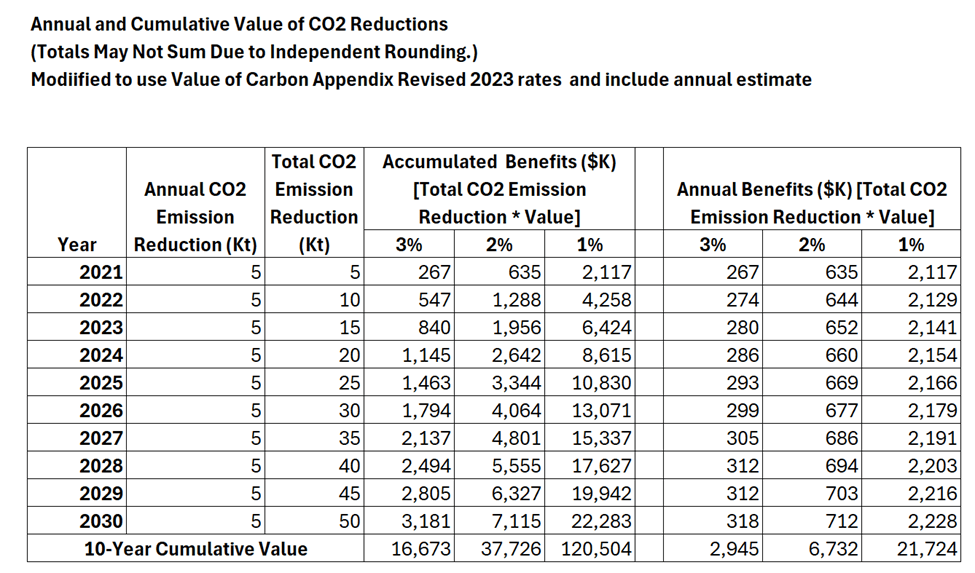
Estimating the emission reduction benefits of a plan or goal. An agency has developed a strategic plan with the goal of reducing carbon dioxide emissions 50% over ten years from current levels, or 50,000 metric tons over 10 years. In order to determine the benefits to society in terms of avoided damages, the agency will need to determine the annual level of emission reductions (or emissions avoided) compared to a no action scenario. If split evenly across all 10 years, the annual reduction is 5,000 metric tons per year (see table).

The net present value of the plan is equal to the cumulative benefit of the emission reductions that happened each year (adjusted for the discount rate). In other words, the value of carbon is applied to each year, based on the reduction from the no action case, 100,000 tons in this case. The Appendix provides the value of carbon for each year. For example, the social cost of carbon dioxide in 2021 at a 2% discount rate is $123 per metric ton. The value of the reductions in 2021 are equal to $123 times 5,000 metric tons, or $615,000; in 2022 $124 times 10,000 tons, etc. This calculation would be carried out for each year and for each discount rate of interest. The results for all three recommended discount rates are provided below. [The table below modifies the Guidance document with updated values of carbon and the correct annual benefits.]

My comments noted that the Climate Act mandates an 85% reduction in greenhouse gas emissions from 1990 levels by 2050.   I believe that New York’s Value of Carbon should be applied in the context of the reduction of greenhouse gas emissions necessary to meet that goal.  In particular, the reduction in annual emissions year to year.  In this context, I believe that the guidance approach is wrong because it applies the social cost multiple times for each ton reduced.  It is inappropriate to claim the benefits of an annual reduction of a ton of greenhouse gas over any lifetime or to compare it with avoided emissions. As shown above, the Value of Carbon methodology sums project benefits for every year for some unspecified lifetime subsequent to the year the reductions.  The value of carbon for an emission reduction is based on all the damages that occur from the year that ton of carbon is reduced out to 2300.  Clearly, using cumulative values for this parameter is incorrect because it counts those values over and over.  I contact social cost of carbon expert Dr. Richard Tol about my interpretaton of the lifetime savings approach and he confirmed that “The SCC should not be compared to life-time savings or life-time costs (unless the project life is one year)”. 

The preceding table calculates the benefits of the example project correctly. Note that if done correctly that the projected benefits are at least 5.5 times less than the in the flawed Value of Carbon methodology.

As mentioned before, although I am frustrated by the DEC stakeholder process, I did manage to get DEC staff to define their position on this topic.  As I described in another article, I wrote to DEC and Climate Action Council about this problem in the guidance document.  I received the following response:

We did consider your comments and discussed them with NYSERDA and RFF. We ultimately decided to stay with the recommendation of applying the Value of Carbon as described in the guidance as that is consistent with how it is applied in benefit-cost analyses at the state and federal level. 

When applying the Value of Carbon, we are not looking at the lifetime benefits rather, we are looking at it in the context of the time frame for a proposed policy in comparison to a baseline. Our guidance provides examples of how this could be applied. For example, the first example application is a project that reduces emissions 5,000 metric tons a year over 10 years. In the second year you would multiply the Value of Carbon times 10,000 metric tons because although 5,000 metric tons were reduced the year before, emissions in year 2 are 10,000 metric tons lower compared to the baseline where no policy was implemented. You follow this same methodology for each year of the program and then take the net present value for each year to get the total net present value for the project. If you were to only use the marginal emissions reduction each year, you would be ignoring the difference from the baseline which is what a benefit-cost analysis is supposed to be comparing the policy to. 

The integration analysis will apply the Value of Carbon in a similar manner as it compares the policies under consideration in comparison with a baseline of no-action. 

I should have explicitly referenced this in my comments.  It does not address my primary concern that the proper cost-benefit analysis is for meeting the Climate Act mandated target of an 85% reduction in GHG since 1990.  Moreover, the benefit-cost analysis argument further biases their societal benefit claims when numbers are presented to the public.

Conclusion

To justify implementation of the Climate Act, the Hochul Administration political narrative is “that the costs of inaction are more than the costs of action”.  The Scoping Plan basis for the claim included air quality health benefits, active transportation, and energy efficiency interventions in low- and middle-income homes.  These benefits were not large enough to prove the case.  The largest benefits claimed were based on the value of carbon avoided cost of GHG emissions.  Absent the incorrect value of carbon methodology, the costs of action are more than the costs of inaction.  I submitted this as a Scoping Plan comment and made the comment in a public hearing but have never received any response.

I do not expect any meaningful response to these comments. Most disappointing however is that despite my documentation of this error and other shenanigans used by the Scoping Plan authors to make sure they could claim benefits were greater than costs there has never been any response to them.  Perhaps they hope that ignoring it means that it will just go away.  It is not for a lack of trying but trying to shift the political narrative of New York’s climate policy is unlikely to succeed.  It does give me something to do in retirement though. 

Response to My Comments on the New York Value of Carbon Guidance

The Climate Leadership and Community Protection Act (CLCPA) mandates that the state establish a value of carbon for use in the implementation of the law.  On December 30, 2020 New York’s Department of Environmental Conservation (DEC) announced finalization of this guidance.  This post summarizes the final guidance and describes the response to comments on the draft guidance document.  In general, the guidance document and the responses all are consistent with the CLCPA narrative that climate change is an imminent, inevitable disaster that can only be averted by reducing greenhouse gas emissions.

I submitted comments because this law will affect the affordability and reliability of New York’s energy.   I am a retired electric generation utility meteorologist with nearly 40-years of experience analyzing the effects of environmental regulations on electric and gas operations.  I have written a series of posts on the feasibility, implications and consequences of this aspect of the law and another series of posts on carbon pricing initiatives.  The opinions expressed in this post do not reflect the position of any of my previous employers or any other company I have been associated with, these comments are mine alone.

Background

On July 18, 2019 New York Governor Andrew Cuomo signed CLCPA, which establishes targets for decreasing greenhouse gas emissions, increasing renewable electricity production, and improving energy efficiency.  It was described as the most ambitious and comprehensive climate and clean energy legislation in the country when Cuomo signed the legislation.  I have summarized the schedule, implementation components, and provide links to the legislation itself at CLCPA Summary Implementation Requirements.

The CLCPA requires the New York State Department of Environmental Conservation (DEC), in consultation with the New York State Energy Research and Development Authority (NYSERDA), to establish guidance for a value of carbon for use by State agencies. According to the DEC press release:

“The guidance is different than a regulation and does not propose a carbon price, fee, or compliance obligation. It is a metric that will be broadly applicable to all State agencies and authorities to demonstrate the global societal value of actions to reduce greenhouse gas emissions. The guidance establishes a value of carbon focused on the federal social cost of carbon and incorporates public comments DEC received when the draft guidance was proposed earlier this year, including recommending a lower central discount rate of two percent, which should be reported alongside a one and three percent discount rate for informational purposes. In some decision-making contexts, particularly those that have a history of valuing carbon, such as the New York electric industry, the guidance suggests that alternative approaches to valuing carbon may be more appropriate for both resource valuation and benefit-cost analyses.  Use of the lower central discount rate translates into a 2020 central value of carbon dioxide of $125 per ton; methane of $2,782 per ton; and nitrous oxide of $44,727 per ton.”

The Value of Carbon Guidance provides values for carbon dioxide, methane, and nitrous oxide for use by State agencies along with recommended guidelines for the use of these and other values by State entities. Four documents were made available:

In section §75-0113, Value of Carbon the CLCPA states that the “social cost of carbon shall serve as a monetary estimate of the value of not emitting a ton of greenhouse gas emissions” and that “As determined by the department, the social cost of carbon may be based on marginal greenhouse gas abatement costs or on the global economic, environmental, and social impacts of emitting a marginal ton of greenhouse gas emissions into the atmosphere, utilizing a range of appropriate discount rates, including a rate of zero.”  The law states that DEC “shall consider prior or existing estimates of the social cost of carbon issued or adopted by the federal government, appropriate international bodies, or other appropriate and reputable scientific organizations.”

Response to Comments

In general, a major point in my comments was that I believe the focus of the guidance is wrong.  According to the document:

“The purpose of this guidance is to aid State entities in decision making by establishing a monetary value of greenhouse gas emission reductions or increases that reflects global societal impacts. This guidance does not itself establish a price or fee on emissions, and the value of carbon presented here is not the only value that may be used by the State. Alternative methods for establishing a value of carbon may be used by State entities, including the Department, as needed to achieve the goals and requirements of the CLCPA as well as other State goals, such as to protect public safety, welfare, and the environment.”

The guidance does not recognize that the CLCPA has specific targets so the proper way to address social costs is through a cost efficiency approach.  The damages approach recommended in the guidance is an efficiency concept inappropriate when developing control measures.  The emphasis of the guidance is on state agency use and not for supporting the Climate Action Council scoping plan mandate.

DEC’s responses to comments are listed below with my italicized reply below each paragraph.

“The Department received comments from individuals, elected officials, municipal officials, environmental advocacy groups, community groups, academic and other nonprofit research institutions, and private businesses particularly those related to the electricity sector. Most commenters responded to DEC’s specific request for input on the selection of a central discount rate or commented on three other areas: the use of a range of discount rates, the application of other approaches such as marginal abatement, or technical details of the damages-based or marginal abatement approaches. As discussed in the Guidance, DEC is providing guidelines regarding the use of the damages-based approach to enable New York State agencies to use this tool, where needed. DEC is not seeking to develop guidelines for the use of other approaches, such as marginal abatement, at this time.”

My comments explained that there are other metrics that describe ‘equivalences’ between climate-changing species used to determine contributions to climate impacts.  Tol et al (2012) present a unifying framework that clarifies the relationships among four metrics establishing ‘equivalences’ among emissions of various species. Importantly, the framework distinguishes between cost benefits and cost effectiveness. This paper explains that once a cap is set, you should not use the social cost of carbon. The social cost of carbon is an efficiency concept. Establishing a price incentivizes society to develop the most efficient response to that price but does not guarantee specific emission levels. Once a specific target is established in a cap that violates the efficiency principle inherent in the social cost of carbon.  Instead, the cap requires that emissions are valued to the shadow price of the cap. There was no response to this argument.

 “The majority of commenters who responded to DEC’s request for feedback on the selection of a central discount rate support the lower of the two suggested values, i.e., 2% rather than the 2.5% that was previously established as the lower bound of discount rates by the federal government. Some of these commenters suggested that the central rate should be no higher than 2%. Other commenters requested a rate that is lower, such as zero or 1%, or suggested that the DEC should adopt higher rates that would be consistent with that previously used by other New York State agencies and the federal government.”

 A lower discount rate produces higher values which supports the narrative of the CLCPA and likely the majority of the commenters who have a vested interest in climate change catastrophes.  My argument that on a global basis using lower discount rates memorializes the status quo for the world’s poor was ignored.

“While DEC maintains that the public is best informed by reporting a range of discount rates, given the responses received, DEC has revised the Guidance to apply a central 2% discount rate. However, as many commenters pointed out, the damages-based approach is continually refined and improved and DEC will continue to consider incorporating new research. DEC will also consider additional ways to address uncertainty and intergenerational equity issues raised by the commenters, such as through a declining discount rate or the incorporation of a 95th percentile on the central discount rate, as the research continues to improve. While not specifically raised in the public comments, one issue with applying a non-standard discount rate, such as 2%, is that this affects the applicability of published analyses, because the analyses are unlikely to apply the same discount rate.”

I raised problems with damages-based approaches in my comments but one would not know that from this response. 

“Several commenters took issue with the use of a range of discount rates and stated a preference that DEC require all State entities to use one discount rate. DEC has revised the Guidance to clarify the initial intent of the Guidance. Namely, DEC’s guidance follows the federal government’s approach to using the damages-based value of carbon, under which agencies use the central rate, but also report the results for a higher and lower rate. DEC did not intend to suggest that State entities use any discount rate within the range. Instead, DEC suggests that, if State agencies apply a damages-based value of carbon as a part of their decision-making, they should use the 2% discount rate to estimate the value (as opposed to the federal government’s central rate of 3%) and also report the values estimated using the 1% and 3% discount rates. This enables the public to see the effect of the discount rate and, in the case of the 3% rate, compare their assessment to federal actions and previous State policies.”

I agree with the DEC response that the public should be able to see the effect of the discount rate.  The suggestion in my comments that the public should also be able to see the effect of the time horizon, the location of impacts, and equilibrium climate sensitivity was ignored.  I also argued that the one reference used to justify using a lower discount rate was inadequate and that additional justification was needed.  There were no changes to the document to respond to that.

“The remaining comments covered a diverse set of topics, including topics beyond the scope of the Guidance. DEC will use all relevant feedback in refining the Guidance and in developing future guidance. An example is to provide additional guidance on how to consider public health impacts and the social costs for co-pollutants. The CLCPA specifically refers to the social cost of emitting greenhouse gases into the atmosphere, but the Guidance does discuss how the damages-based approach can be used to assess other impacts and other pollutants. The Guidance is a complement to other, more standard methods used.”

Topics beyond the scope of the Guidance are ignored if they don’t fit the narrative.  I raised fundamental issues raised about the mis-use of the value of carbon when emission targets have been chosen and no response.  Instead, they highlight comments that claim the values are too low.  Honestly, if they want to provide New York’s citizens information rather than just propaganda they should describe both sides of the valuation issues, explain why they chose what that chose, and explain why only the negative externalities of fossil fuels are considered without any consideration of the benefits.

Conclusion

Because it appears that a primary goal of this process is to memorialize a value of carbon to justify agency actions, the public deserves to know how the real costs are balanced against the theorized cost benefits.  When CLCPA strategies are announced and cost savings are claimed the public deserves to know that the savings are based on global not New York benefits, savings out to 2300, do not represent the latest climate sensitivity science, and that no consensus exists on what approach or rate to use for discounting uncertain climate impacts over long time horizons.  Instead, the basis is buried in a technical document that does not even acknowledge that there are uncertainties and issues with basis for cost savings based on these values of carbon.

Furthermore, there are fundamental technical considerations overlooked or ignored by the guidance and response to comments. New York State CLCPA implementation is trying to choose between many expensive policy options while at the same time attempting to understand which one (or what mix) will be the least expensive and have the fewest negative impacts on the existing system. If good picks are made then state ratepayers will spend the least amount of a lot of money, but if they are wrong, we will be left with lots of negative outcomes and even higher costs for a long time.  A value of carbon approach that addressed that concern as its primary goal would be great support to address this problem.


Response to My Comments on Part 496 – Climate Leadership and Community Protection Act 1990 Emissions Baseline

In late October 2020 I submitted personal comments on the New York Department of Environmental Conservation (DEC) proposed Part 496 that defined the emissions limits for the Climate Leadership and Community Protection Act (CLCPA).  That law sets targets based on 1990 emissions and this regulation developed the emission inventory for 1990.  The rule was recently adopted and the regulatory package included a document that assessed public comments.  This post follows up on the post on my comments and describes their response to my comments.  It is relevant to CLCPA implementation because the DEC did not respond to my primary objective – monitoring data do not support the emphasis on methane emissions in the inventory and the CLCPA.

I am following the implementation of the CLCPA closely because it affects my future as a New Yorker.  If DEC gets the 1990 baseline wrong it will be all the more difficult to get to the aggressive CLCPA targets.  The opinions expressed in this post do not reflect the position of any of my previous employers or any other company I have been associated with, these comments are mine alone.

Background

This 1990 emissions inventory is important because many of the targets of the CLCPA are based on reductions from this baseline.  For example, there is a target to reduce GHG emissions to 60 percent of 1990 emissions levels by 2030.  The CLCPA includes specific requirements for the 1990 emission inventory that I am positive no legislator who voted for the law understood.  

The law mandates an aggressive schedule for developing this inventory.  The CLCPA 1990 baseline is supposed to be set by the end of 2020 but the first statewide greenhouse gas emissions report isn’t due until 2021.  The statewide emissions report is defined as a “comprehensive evaluation of the inventory best available science and methods of analysis, including the comparison and reconciliation of emission estimates from all sources, fuel consumption, field data, and peer-reviewed research”.  It “shall clearly explain the methodology and analysis used in the department’s determination of greenhouse gas emissions and shall include a detailed explanation of any changes in methodology or analysis, adjustments made to prior estimates, as needed, and any other information necessary to establish a scientifically credible account of change”.  The 1990 baseline for the statewide GHG emission limits has similar quality requirements: “In order to ensure the most accurate determination feasible, the department shall utilize the best available scientific, technological, and economic information on greenhouse gas emissions and consult with the council, stakeholders, and the public in order to ensure that all emissions are accurately reflected in its determination of 1990 emissions levels”.

I compared the proposed Part 496 1990 emission inventory with the previous “official” New York greenhouse gas emission inventory that was prepared by the New York State Energy Research and Development Authority (NYSERDA) in two earlier posts.  The Part 496 Regulatory Impact Statement (RIS) includes a section titled Key Requirements of the 1990 Emission Baseline section that explains the CLCPA mandates that required DEC to develop a new official inventory.   These requirements significantly affect the greenhouse gas (GHG) emission total for the State.  According to the latest edition of the NYSERDA GHG emission inventory (July 2019) Table S-2 New York State GHG Emissions 1990–2016 the New York State 1990 GHG emissions were 236.18 MMtCO2e The proposed Part 496 regulation 1990 emissions inventory total is 401.38 MMtCO2e for an increase of 165.2 MMtCO2e.  When the draft Part 496 regulation came out, I described the differences between these two inventories.

Summary of 1990 Emission Inventories   
Final Rule Regulatory Impact Statement Table 1 Inventory in GWP20.
SectorCO2CH4N2OPFCsHFCsSF6Total
Energy259.9671.761.32  4.00337.04
IPPU1.76  0.900.050.012.72
AFOLU0.0513.074.01   17.13
Waste3.0349.350.50   52.88
Total264.80134.195.830.900.054.01409.77
        
NYSERDA July 2019 Table S-2 Emission Inventory in GWP100
SectorCO2CH4N2OPFCsHFCsSF6Total
Energy168.84 3.120.83   172.80
IPPU1.16   0.349.48 0.17 11.15
AFOLU 4.51 4.25   8.86
Waste 12.2 0.61    12.80
Total170 19.835.790.349.480.17205.61

Response to Comments

To its credit New York State requires that DEC respond to comments on proposed regulations.  Unfortunately, too often the answer is in the back of the book and this is considered just a formality.  In my opinion this was the case with the response to my  comment Part 496.  I consolidated and annotated all the responses to my comments in DEC response to Caiazza Comments.  I will just highlight a few of my concerns with their responses.

For a variety of reasons DEC dismissed my comments suggesting that the documentation was inadequate. I claim that in order to “utilize the best available scientific, technological, and economic information on greenhouse gas emissions and consult with the council, stakeholders, and the public in order to ensure that all emissions are accurately reflected in its determination of 1990 emissions levels”, that DEC must document each value listed in the inventory with the emission factor, activity factors or throughput, and the reference and rationale for each.  DEC claims that they provided the information.  I maintain that it is impossible to replicate their numbers with the information provided because the references are so vague that it is impossible to trace the necessary information back to the references provided.

It is particularly troubling to me that the response to comments does not address changes to the draft and final inventory.  As shown below there were substantive changes to the CO2 and CH4 emissions.   As it stands now the council, stakeholders and public just have to accept the numbers without explanation – hardly a hallmark of “best available scientific, technological, and economic information” required by the CLCPA.  Clearly, if there was adequate documentation he derivation of each number and the differences could be easily explained. 

Difference Between the Proposed Total Statewide Greenhouse Gas Emissions in 1990 by IPCC Sector and Gas, in GWP20 and the Final Emissions

SectorCO2CH4N2OPFCsHFCsSF6Total
Energy5.531.640.010007.17
IPPU0.090000.0300.12
AFOLU0000000
Waste01.100001.1
Total5.622.74000.0308.39

My over-arching comment was that there was too much of an emphasis on methane.  DEC summarized my comment as follows: “Some commenters suggested additional or alternative emission limits, including interim limits to maintain momentum or targets that recognize the long-term impacts of GHGs. Otherwise, the law over-emphasizes the role of methane or under-emphasizes the role of carbon dioxide by applying the 20-year rather than the more standard 100-year GWP.”   DEC evaded a direct response by correctly noting that the CLCPA required consideration of the upstream emissions and the 20-year GWP.  The authors of the CLCPA deliberately included those provisions as part of New York’s irrational war against natural gas.  While this accounts for much of the differences between the two inventories, the state’s choice of emission factors also contributes. DEC did not directly respond to a critical question about their inventory.

I have been involved with emissions inventories for over 45 years.   One thing I learned early on was that however much time and effort is spent on an emission inventory the ultimate check on any emissions inventory is comparison of the inventory estimate with observed ambient monitoring.  If there is a high quality, long-term monitoring network that measures the pollutant in the inventory and those measurements do not reflect the trend in the inventory then the inventory is wrong.

Lan et al., 2019 evaluated data from the National Oceanic and Atmospheric Administration Global Greenhouse Gas Reference Network and determined trends for 2006–2015.  This covers the period when the primary target of the CLCPA upstream emissions requirement, Pennsylvania shale-gas production, increased tremendously.  According to the plain language summary for the report: “In the past decade, natural gas production in the United States has increased by ~46%. Methane emissions associated with oil and natural gas productions have raised concerns since methane is a potent greenhouse gas with the second largest influence on global warming. Recent studies show conflicting results regarding whether methane emissions from oil and gas operations have been increased in the United States. Based on long‐term and well‐calibrated measurements, we find that (i) there is no large increase of total methane emissions in the United States in the past decade; (ii) there is a modest increase in oil and gas methane emissions, but this increase is much lower than some previous studies suggest; and (iii) the assumption of a time‐constant relationship between methane and ethane emissions has resulted in major overestimation of an oil and gas emissions trend in some previous studies.”

As a result of the fact that the relevant high quality, long-term monitoring network does not show a trend consistent with the Part 496 presumption that a big source of methane is from Pennsylvania natural gas extraction, I believe that unequivocally shows these calculations of methane emissions from shale gas are invalid.

Conclusion

The CLCPA mandates that the law will be implemented using “best” science.  Part 496 does not meet that condition.  Francis Menton explains the exposition of the scientific method from physicist Richard Feynman’s classic series of recorded lectures: “[W]e compute the consequences of the [hypothesis], to see what, if this is right, if this law we guess is right, to see what it would imply and then we compare the computation results to nature or we say compare to experiment or experience, compare it directly with observations to see if it works.  If it disagrees with experiment, it’s wrong.  In that simple statement is the key to science. . . . “

I found references that directly contradicted the Part 496 methane emissions and, more importantly, a citation that found that the observed monitoring observations of methane do not support the inflated values used in the inventory.  It disagrees, it’s wrong, so the Part 496 inventory fails a basic tenet of science.  DEC’s response to comments did not address this issue.

My Comments on the Cross State Air Pollution Rule Update December 2020

This post describes the comments I submitted to the Environmental Protection Agency (EPA) on their latest proposed revision to the Cross State Air Pollution Rule.  I have only posted once since Thanksgiving because I was called out of retirement to help the Environmental Energy Alliance of New York (EEANY) develop their comments on this rule-making but despite all the time I spent on them I was unable to include everything I thought was important.  So, I submitted my own comments.  This is a simple description.  I have prepared  a detailed summary of my comments on updated Cross State Air Pollution Rule that provides more details.

I am a mostly retired air quality meteorologist who was involved in continuous emissions monitoring system compliance reporting at the start of the Acid Rain Program, regulatory analysis of all the subsequent cap and trade programs affecting New York, and several regional ozone modeling efforts.  I was asked to help develop the EEANY comments on this rule because I was the primary author for the last iteration of their comments.  I submitted the comments to expand on some of their arguments and to address additional issues not in their purview.  The opinions expressed in this post and in my comments do not reflect the position of EEANY, any other of my previous employers or any other company I have been associated with, they represent my personal opinion.

Background

CSAPR was promulgated to address Ozone air quality which is the most intractable air quality problem in the United States.  Despite years of effort, ozone regularly exceeds the national ambient air quality standard.  It is formed in a photo-chemical reaction from nitrogen oxides (NOx,) created in any combustion process, and volatile organic compounds, basically anything with an odor.  As a result, there are many sources, both man-made and natural, that must be considered on a regional scale, which complicates the transport and dispersion of the pollution, in order to develop a control program to limit ozone.  Because the pollution crosses state lines this has become a controversy between states.  In the eastern US, the conditions conducive to ozone formation (Hazy, hot and humid heat waves) also drive-up energy demand and increase emissions from the electric generating sector.

This specific rule was amended because a court ruled that previous attempts still do not reduce observed levels of ozone enough.  According to EPA the rule works as follows:

EPA sets a pollution limit (emission budget) for each of the states covered by CSAPR.  Authorizations to emit pollution, known as allowances, are allocated to affected sources based on these state emissions budgets. The rule provides flexibility to affected sources, allowing sources in each state to determine their own compliance path. This includes adding or operating control technologies, upgrading or improving controls, switching fuels, and using allowances. Sources can buy and sell allowances and bank (save) allowances for future use as long as each source holds enough allowances to account for its emissions by the end of the compliance period.

In the proposed rule, like any other emissions trading program, each affected source is required to submit one allowance for each ton emitted during the trading season.  In CSAPR EPA set a cap for each state and then allocated allowances amongst the affected sources.  There is another complicating aspect of the rule related to interstate pollution.  In order to limit a state’s contributions to downwind exceedances the proposed program includes assurance levels that act as a cap on a state’s NOx emissions during the Ozone Season.  The assurance level equals the allowance allocation plus the variability limit that accounts for the year-to-year differences due to weather, electric demand and disruptions.   If a state exceeds their assurance level then sources that exceed their assurance levels within that state will be assessed a 3-to-1 allowance surrender for each ton emitted above the  assurance level.

My concern and that of the EEANY member companies is that the proposed New York emission budget is so limited and New York sources have such limited opportunities for further reductions that the sources will be forced to rely on the market for the allowances needed to operate throughout the ozone season.  However, there are aspects of the proposed rule that are unprecedented and, especially since the program is not finalized but will start on May 1, 2021, that mean that the market may not be as liquid as EPA assumes.  In the following I will explain these issues from a New York-centric position.

Comments

NYS Electric Generating Units (EGUs) have made significant reductions in NOx emissions as shown in the New York State Ozone Season NOx and Operating Parameters Trends table.  There are two implications to the current observed NOx emissions rates in New York.  Firstly, because emissions are so low the pollution control costs for any further reductions will be very high.  Secondly, there may not be many more reductions possible no the matter the cost.  As a result, it is important that EPA allocate the appropriate number of allowances to New York.

The CSAPR update rule is a cap-and-trade air or emissions trading pollution control program.  The first phase in any such program is to establish how many allowances are to be allocated.  In this rule EPA used a three-step methodology:

      1. Determine a future baseline that represents the current emissions levels with adjustments for retirements and new sources,
      2. Factor in additional mitigation controls that adjust the baseline to account for reductions available at a specified cost threshold, and
      3. Account for shifts in generation caused by the baseline adjustments and additional controls.

My biggest problem with EPA’s methodology is that EPA does not account for the retirement of nuclear generation.  When the last unit at the Indian Point nuclear generating station retires before the 2021 ozone season that means that 12% of the state’s generation will have to be replaced compared to the baseline that EPA used.  In the short term that means replacing zero-NOx emitting generation with generation that does emit NOx.  The EEANY comments explain that nuclear retirements in the 12-state trading system mean that the baseline should be adjusted.  EEANY shows that the authors of the rule did not understand the implications of the metric used to determine whether further controls are possible at their chosen cost threshold so that means EPA over-estimates potential NOx reductions.  EEANY proposed specific recommendations and suggestions for baseline and control technology changes and suggested incorporating a safety valve to offer a compliance pathway in the face of the uncertainties.

My Comments

EEANY discussed potential issues with the emissions trading market.  I included a description of several broad aspects of cap-and-trade programs to expand on the arguments for improving the chances of market success.  Despite the success of all previous EPA cap and trade programs there are aspects of the proposed action that are unprecedented and could conceivably threaten the viability of this trading program.  My comments illustrated the potential impact of the proposed allocations on New York by way of examples.

In my comments I developed an example ozone season emissions scenario to test the EPA allocations that were based on 2019 emissions.  I simply used the preliminary emission estimates from the 2020 ozone season.  Indian Point Unit 2 retired in April 2020 so last summer’s emissions reflect the additional generation needed to replace that retired energy.  In order to account for the retirement of Indian Point Unit 3 I prorated 2020 ozone season emissions by the ratio of generation produced by Indian Point 3 to the total ozone season generation in 2020. That adds 512 tons of NOx to the baseline.  The preliminary 2020 Ozone Season data available from EPA Clean Air Markets Division air markets program data website is 3,563 tons and would be projected to be 4,075 tons when the replacement power emissions are added.

The next step in the projection is to determine how many allowances are available.  EPA proposes a New York emissions budget of 3,137 tons.  The variability limit is 659 tons.  Recall that is supposed to account for year-to-year differences due to weather, electric demand and disruptions and that if state-wide emissions are greater than the sum of the budget and variability limit, or assurance level, that EPA imposes penalties.  The 5% set-aside for New Sources affects this projection in two ways.  Firstly, 157 tons are taken from the budget and not available to existing sources.  Secondly, in this example, the 94 tons emitted by the new sources in New York during 2020 are covered by this set-aside.  The allowances at the beginning of the ozone season equal the emissions budget plus the allowance bank or variability limit less the 157-ton new source set-aside. As a result, there will be 3,639 allowances available at the start of the Ozone Season on May 1, 2021.

In my example I compared 2020 adjusted emissions to the allowances available.  EPA acknowledges that affected sources set aside a contingency to account for monitoring problems and for sources that have to purchase allowances for compliance. I believe a minimum of 2.5% or 102 tons of the 4,075 emissions expected is appropriate for this contingency.  The correct emissions to compare relative to the 3,659 allowances available is the 2020 adjusted emissions plus the contingency buffer minus the 2020 new source emissions or 4,083 tons.  Note that the difference between the total set-aside and the emissions (63 tons) flows back into New York’s available allowance pool but not until after reconciliation so that means that the allowances available for New York sources are effectively reduced by 63 tons in this example.

The allowance margin represents the difference between emissions and allowances.  The difference between the available allowances and effective emissions is -444.  The negative number means that New York State will have to obtain allowances from the market to meet its compliance obligations and monitoring contingency.  Importantly, because the emissions in this example are 279 tons greater than the assurance level two additional allowances for each excess ton would have to be surrendered for compliance for a total of 558 additional allowances meaning that a total of 4,641allowances would be needed to cover the emissions, the CEMS contingency buffer, and the compliance assurance penalty.  In this example New York sources would have to go outside the state for 1,002 allowances for compliance.

In my comments I included a second example that calculated the numbers on a unit-by-unit basis and then determined the allowances need for each facility.  There are 70 CSAPR Group 3 facilities in New York.  In the analogous example case only 31 of the facilities would be able to comply with the proposed allocations.  Seven facilities would be able to comply without exceeding their assurance levels but 32 facilities would be required to surrender additional allowances.  I concluded that New York facilities would have to get 2,534 allowances from the market.

Unquestionably market-based emissions trading programs have been a success to date.  However, past success does not necessarily ensure future success.  I think market certainty is a primary driver for success and believe that the proposed program has enough uncertainty that success is not assured.

 A successful emissions trading program has a robust and liquid allowance market that allows affected sources to operate as needed while meeting the emissions reductions. There are several conditions that lead to a successful program.  I believe the most important key to success is the ability for some sources to be able to over control.  Sources that can install cost-effective controls and reduce emissions below their allowance allocations, can sell excess allowances to sources with more expensive compliance options. In order for that to work the cap has to be set so that over-control is possible.  In addition, in order to be able to use the allowances produced by sources who can over control, the market must be mature enough that those sources have enough market certainty that they are willing to generate those allowances and sell them.  Most programs have included a substantial time period between the final rule promulgation and start of the program that included credit for early reductions such that additional allowances were generated. Finally, the market must be large enough that other trading considerations don’t influence the market.  Many of the states in the affected region are de-regulated so generating companies compete with each other.  It is not unreasonable to expect that might influence a decision to sell allowances.

The proposed rule may not meet all these conditions.  EEANY’s comments showed that unless the baseline includes an adjustment for nuclear retirements it will be set so low that NY generators who have few remaining options to make further reductions will have to rely on the market to match historic operations.  EEANY also described issues with EPA’s assumptions for potential SCR optimization that mean that even meeting the proposed allocation levels may not be possible.  The short time between promulgation and the start of the trading program prevents any early reductions.  In my comments I described other factors affecting trading decisions.  In my comments I explained that there is a disconnect between market-based program theory and industry reality that leads regulators and academics to believe that emissions trading will be driven by economic considerations.  I believe there are regulatory, corporate, and personal reasons for an affected source to treat allowances as a compliance mechanism rather than a commodity for potential sales profit as presumed by market theory.  I described several other practical issues with emissions trading why the program in the proposed rule may not be as successful as past programs.

I also explained that EPA’s proposed allocations reduce the 12-state baseline, allocations and allowance bank for the five-month Ozone Season in an attempt to reduce emissions are fatally flawed. Ozone exceedances are an episodic feature associated with high energy demand lasting no more than several days and there is no guarantee that emissions during the episode are lowered sufficiently to reduce ozone during episodes using a seasonal trading program.  As it stands a higher emitting unit will incorporate a high price for their energy produced reflecting the scarcity of allowances.  As a result, the unit will not be called on to provide power unless the price is high and because high prices occur when demand is high the higher emitting units will still operate during ozone episodes.  In my opinion the only way to address the episodic nature of ozone episodes with a cap-and-trade program is to have a trading program over a time period consistent with the problem.

There is one final aspect of all this that needs to be mentioned.  The electric generation sector is not the only source of ozone precursor emissions.  Emissions from this sector are an easy target because the ultimate costs to the consumer are buried in utility bills so regulators can “hide” from the ramifications of the added costs.  On the other hand, motor vehicle exhaust is a major source of pre-cursors but any limitations on mobile sources directly impact the public so regulators could not deny their culpability.  My point is that even with all realistic electric sector reductions, that there still is no guarantee that the ozone levels will get below the national ambient air quality standard limits.

Conclusion

Despite the success of cap-and-trade air pollution control programs to date, it is inappropriate to expect that future programs will necessarily succeed as well if the reasons for past success are not considered.  The proposed EPA CSAPR trading programs does not consider those factors in its allowance allocations and schedule.

I have concerns about the level of the cap.  New York State has a remarkable record reducing NOX emissions and has a new regulation that will further reduce emissions with new limits on its peaking units.  Nonetheless, EPA’s proposed cap requires half the state’s facilities to rely on trading to meet their compliance requirements if future emissions equal 2020 emissions.  No sources in New York can over-control and provide sufficient allowances for state compliance which means that the inter-state trading is required and that means that the compliance assurance penalty is a concern.  EPA’s proposed baseline does not account for the fixed increase in emissions due to nuclear retirements over and above the inter-annual variability due to weather, demand or disruptions.  In New York the loss of 12% of the state’s nuclear generation means that this will definitely impact future emissions. The theory of cap-and-trade markets does not recognize the reality of industry practices that all lead to the inescapable conclusion that mark liquidity is a real concern in the proposed program.

Therefore, it would be prudent for EPA to revise the baselines to account for nuclear retirements and correct the SCR optimization reductions for new allocations and variability limits.  Furthermore, because of the aggressive schedule a safety valve which allows the use of Group 2 allowances is a reasonable backstop in the event of unexpected developments.  If adjustments are not made to the allowances available and weather, demand or disruptions increase NOx emissions, then there could be situations where the only compliance option available is to limit operations.


My Comments on the New York Value of Carbon Guidance Document

The Climate Leadership and Community Protection Act (CLCPA) mandates that the state establish a value of carbon for use in the implementation of the law.  This post describes my comments  on the draft guidance document “Establishing a Value of Carbon, Guidelines for Use by State Agencies” document released on October 29, 2020.  I submitted comments because this law will affect the affordability and reliability of New York’s energy.

I am a retired electric generation utility meteorologist with nearly 40-years of experience analyzing the effects of environmental regulations on electric and gas operations.  I have written a series of posts on the feasibility, implications and consequences of this aspect of the law and another series of posts on carbon pricing initiatives.  The opinions expressed in this post do not reflect the position of any of my previous employers or any other company I have been associated with, these comments are mine alone.

Background

On July 18, 2019 New York Governor Andrew Cuomo signed CLCPA, which establishes targets for decreasing greenhouse gas emissions, increasing renewable electricity production, and improving energy efficiency.  It was described as the most ambitious and comprehensive climate and clean energy legislation in the country when Cuomo signed the legislation.  I have summarized the schedule, implementation components, and provide links to the legislation itself at CLCPA Summary Implementation Requirements.

The CLCPA requires the New York State Department of Environmental Conservation (DEC), in consultation with the New York State Energy Research and Development Authority (NYSERDA), to establish a value of carbon for use by State agencies. The Draft Value of Carbon Guidance provides values for carbon dioxide, methane, and nitrous oxide for use by State agencies along with recommended guidelines for the use of these and other values by State entities.  Three documents were made available:

In section §75-0113, Value of Carbon the CLCPA states that the “social cost of carbon shall serve as a monetary estimate of the value of not emitting a ton of greenhouse gas emissions” and that “As determined by the department, the social cost of carbon may be based on marginal greenhouse gas abatement costs or on the global economic, environmental, and social impacts of emitting a marginal ton of greenhouse gas emissions into the atmosphere, utilizing a range of appropriate discount rates, including a rate of zero.”  The law states that DEC “shall consider prior or existing estimates of the social cost of carbon issued or adopted by the federal government, appropriate international bodies, or other appropriate and reputable scientific organizations.”

My comments explain why I think the focus of the guidance is wrong.  The guidance does not recognize that when the CLCPA chose specific targets that the proper way to address social costs is through a cost efficiency approach.  The damages approach recommended in the guidance is an efficiency concept.  DEC emphasized use of their proposed values “that can be used by State entities to aid decision- making and used as a tool for the State to demonstrate the global societal value of actions to reduce greenhouse gas emissions.”  The emphasis was clearly on state agency use and not for meeting the CLCPA targets and less on providing guidelines for state agencies.

Guidance Comments

An overview of the Value of Carbon Guidance was presented Maureen Leddy at the 24 November 2020 Climate Action Council Meeting. I will annotate the Value of Carbon Guidance slides  below with excerpts from the comments I submitted.

The first slide is titled “Value of Carbon Reduction” and notes that the “CLCPA requires DEC, in coordination with NYSERDA, to establish a Value of Carbon as an evaluation tool for agency decision making”.  The lists the following requirements:

        • Describe damages and marginal abatement cost approaches
        • Consider a range of discount rates, including zero
        • Consider the social cost of carbon in other jurisdictions
        • Provide values for non-C02 greenhouse gases

I think the guidance ultimately provides cost effectiveness justification for the CLCPA.  As a result, I believe that the document should explain the concept of the social cost approach targeted for the general public.  Blastland et al. (2020) describe an approach for evidence communication that I suggested would be an appropriate template for the public primer.  The authors suggest that communications should offer “balance, not false balance”.  I argued that this is a major short-coming in the guidance and supporting memo documents because the full range of opinions on social cost methodologies was not included.

My comments addressed technical aspects of the damages and marginal abatement cost approaches.  The biggest problem with their description and the recommendation to use the damages approach is that they ignored the concept that once a cap is set, you should not use the damages approach exemplified by the social cost of carbon. The social cost of carbon is an efficiency concept. Establishing a price incentivizes society to develop the most efficient response to that price but does not guarantee specific emission levels. Once a specific target is established in a cap that violates the efficiency principle inherent in the social cost of carbon.  I pointed out that in its recent review of the federal IWG social cost of carbon, the U.S. Government Accountability Office referred to the marginal abatement cost approach as a type of “target-consistent approach” to valuing emissions, which reflects the fact that this approach establishes a value that depends in part on the relevant emission reduction target.

Also included in the first slide was the target timeline of milestones to meet CLCPA deadline

Milestone Date
Stakeholder conference July 2020
Public comment period ends November 27, 2020
Final released (CLCPA requirement) January 1,2021

I pointed out that the time between the end of the public comment period and the final release date was very short given the importance of the document.  Importantly the implication that the document was required by the CLCPA is based on a mis-reading of the law that states it was supposed to be released “No later than one year after the effective date of this article”.  The law was signed in July 2019 so this should have been released back in July 2020.  Because the date has been missed delaying release long enough for full evaluation and response is appropriate.


The second slide, “Draft Value of Carbon Guidance” stated that the proposed guidance:

      • Provides background on different ways to value greenhouse gas emissions reductions
        • Damages approach and marginal abatement cost
      • Recommends the U.S. Interagency Working Group’s (IWG) damages-based value of carbon, also referred to as the social cost of carbon, as appropriate for most agency decision making
      • Considers a range of discount rates, including zero
        • Recommends 1%-3% ($421-$53per ton of C02 in 2020 dollars)
        • Seeking comment on central value of 2% or 2.5% ($125 or $79 per ton of CO2 in 2020 dollars)
      • Discusses how to value non-CO2 greenhouse gases
        • Values are provided for CO2, N02 and CH4, as per IWG
        • Values for other gases will be added as the research evolves
        • CLCPA20-yr GWP does not change these values
      • Details specific considerations for State agencies on how to use a damages-based approach

I think part of the rationale is that the IWG damages-based value of carbon is a more established concept and that more information would have to be developed to use the marginal abatement approach.  The guidance touts the IWG as the best approach but then goes on to ignore the recommendations of the IWG when it comes to the choice of the discount value.  I argued that they did not provide sufficient justification to recommend the changes proposed.

The guidance document recommends that the non-CO2 greenhouse gases be valued individually.  I agree with that approach but I pointed out that there are ramifications to that relative to methane.  Carbon dioxide is long-lived and accumulates over time because it stays in the atmosphere.  Methane is a short-lived (10 to 12 years) pollutant that lasts in the atmosphere less.  Because the CLCPA targets set a hard cap on methane emissions twelve years after the cap limit is reached the impact of methane on warming is done.  It stands to reason that the economic impact on aspects of the economy, such as energy use, health, and agriculture, projected from these climatic changes is also done.  I suggested that the social cost impacts needed to be revised to reflect that reality.

There is a basic problem with the way the guidance document is framed.  While it is valuable that State agencies have guidance on how to use a damages approach, it is even more important to provide support for the CLCPA implementation process.  The use of the damages approach over the marginal abatement cost approach handicaps CLCPA implementation of the most cost-effective strategies.

The second slide also stated that “This guidance is not a regulation and does not set a carbon price nor impose any fees.”  This caveat has been included in every DEC document on the value of carbon but the reality is that the guidance will be used to set a carbon price for the imposition of fees if the New York Independent System Operator Carbon Price proposal is implemented.  I would expect that it would be also used if New York joins the Transportation Climate Initiative.

The third slide, DEC Draft Value of Carbon Guidance, basically repeated all the points made in previous slides.  Two points do need to be addressed:

      • State agencies may utilize the Value of Carbon to aid many forms of decision-making related to permitting, environmental review, rulemakings, funding, procurement, etc.
      • Guidance does not create a price, fee, or compliance obligation.

It is not clear that if the value of carbon is used in decision-making related to permitting how that cannot be considered a compliance obligation.  Maybe it is just intended to “prove” that the actions can be justified because the costs may be less than the social costs calculated using the recommended values.  That may also explain why the IWG recommended values which yield lower social costs are not recommended.

I specifically suggested that the guidance document incorporate the Blastland et al., (2020) simple tip to display information in a table rather than stating them in the text to address the implications of the assumptions used to develop the recommended values of carbon.  I suggested that a table be included that lists the effects of assumptions on the social cost values.  My comments addressed the effects of location of benefits (guidance benefits are primarily global and not New York specific), time horizon (the benefits extend out to 2300), the sensitivity of the climate to greenhouse gases (IWG estimates do not use the most recent modeled estimates of the sensitivity), and the discount rate.  Of those parameters only the differences in discount rates were discussed.  However, the underlying ramifications of the discount rate choice were not explained.

Finally, I recommended that the evaluation of carbon pricing policies in Canada by McKitrick (2016) be considered.  He explains that “there may be many reasons to recommend carbon pricing as climate policy, but if it is implemented without diligently abiding by the principles that make it work, it will not work as planned, and the harm to the Canadian economy could well outweigh the benefits created by reducing our country’s already negligible level of global CO2 emissions”.  Clearly this is entirely relevant to New York.  Importantly he notes:

“However, a beneficial outcome is not guaranteed: certain rules must be observed in order for carbon pricing to have its intended effect of achieving the optimal balance between emission reduction and economic growth. First and foremost, carbon pricing only works in the absence of any other emission regulations. If pricing is layered on top of an emission-regulating regime already in place (such as emission caps or feed-in-tariff programs), it will not only fail to produce the desired effects in terms of emission rationing, it will have distortionary effects that cause disproportionate damage in the economy. Carbon taxes are meant to replace all other climate-related regulation, while the revenue from the taxes should not be funnelled into substitute goods, like renewable power (pricing lets the market decide which of those substitutes are worth funding) but returned directly to taxpayers.”

Conclusion

Because it appears that a primary goal of this process is to memorialize a value of carbon to justify agency actions, the public deserves to know how the real costs are balanced against the theorized cost benefits.  When CLCPA strategies are announced and cost savings are claimed the public deserves to know that the savings are based on global not New York benefits, savings out to 2300, and do not represent the latest climate sensitivity science.  If the total costs are close to the purported benefits this may be acceptable but I have no doubt that the total costs per ton will far exceed even these conjured values.

Furthermore, there are fundamental technical considerations overlooked or ignored by the guidance. New York State CLCPA implementation is trying to choose between many expensive policy options while at the same time attempting to understand which one (or what mix) will be the least expensive and have the fewest negative impacts on the existing system. If good picks are made then state ratepayers will spend the least amount of a lot of money, but if they are wrong, we will be left with lots of negative outcomes and even higher costs for a long time.  Picking the correct value of carbon metric and values is critical to doing this right.  A comprehensive response to comments justifying the choices made is an integral part of doing this right.

My comments on the FERC Carbon Pricing Policy

Earlier I described the Federal Energy Regulatory Commission (FERC) technical conference regarding Carbon Pricing in Organized Wholesale Electricity Markets held on September 30, 2020.  On October 15, 2020 FERC proposed a policy statement to “clarify that it has jurisdiction over organized wholesale electric market rules that incorporate a state-determined carbon price in those markets. I also described the proposed policy statement that seeks to encourage regional electric market operators to explore and consider the benefits of establishing such rules.”

The post on the policy statement mentioned that I intended to personally comment on the concerns I raised in my personal blog post on the FERC technical conference.   I submitted comments as a private citizen.  The technical conference convinced FERC commissioners that carbon-pricing was an “efficient” market-based tool but nobody asked and no one proved that they work.  In my opinion the first rule of efficient policy is that it works.  I believe that those who support carbon pricing on theoretical economic grounds are overlooking or are unaware of practical issues I have raised.  Cynic that I am, I think the primary value to FERC and the RTO/ISO operators is that the carbon price makes their lives easier.  That it will have significant impacts on consumers and not do anything for the climate is somebody else’s problem.

In order to determine whether any carbon pricing proposal will affect the justness and reasonableness of rates I argued that the Commission must consider whether the proposal will reduce carbon dioxide emissions at a cost below some standard of reasonableness.  There is a cost where the abatement costs exceed any estimates of the cost impacts of CO2 on the climate.  Despite its flaws the Social Cost of Carbon (SCC), the present-day value of projected future net damages from emitting a ton of CO2 today, is a widely used metric to establish a reasonable value.  Because my primary concern is New York’s Climate Leadership and Community Protection Act (CLCPA) I proposed using New York’s proposal to use the Interagency Working Group 2016 estimates that translate into a 2020 value of carbon dioxide of $53-421 per ton, with a central value of $79-125 per ton”.

The FERC notice of the proposed policy statement on Carbon Pricing in Organized Wholesale Electric Markets states that “We agree that proposals to incorporate a state-determined carbon price in RTO/ISO markets could, if properly designed and implemented, significantly improve the efficiency of those markets”.  I argued that there are practical reasons why it is impossible to properly design and implement a carbon pricing scheme that will affect efficiency of those markets in the best interests of the public.

Carbon pricing is a climate policy approach that charges sources for the tons of carbon dioxide that they emit.  A Resources for the Future (RFF) summary lists several attributes that they claim makes carbon pricing more attractive than other potential policies to reduce carbon dioxide emissions:

      • Carbon pricing allows emitters to choose the most efficient method to reduce emissions.
      • An economy-wide carbon price applies a uniform price on CO₂ emissions regardless of the source.
      • A carbon price encourages individuals and businesses to reduce their carbon emissions more than conventional regulations.
      • A carbon price creates a new revenue stream that can be used in a number of ways.

I compared those attributes to the real-world of carbon pricing.

RFF states that “carbon pricing allows emitters to choose the most efficient method to reduce emissions”.  In the context of power plants under FERC jurisdiction this is mostly irrelevant.  In the first place, there are no cost-effective add-on controls for CO2 reductions, so fossil-fired electrical generators only have limited options.  For an individual power plant operator, the only effective approach is to switch to a lower emitting fuel.  Power plants can also be replaced in whole or part by alternative generation, but the business model of most de-regulated generating companies precludes the option to develop replacement generation. I have shown that in RGGI the market participants don’t behave as expected by economic market theory so the markets don’t necessarily behave as the economists think they should.  As a result, all the modeling and laboratory testing economic results “proving” market efficiency should be viewed cynically.  I believe that even though carbon pricing advocates have convinced themselves that somehow carbon pricing is different than a tax, the reality is that because of the limited options for compliance any carbon price is treated just like a tax by electric generating operators.  Because energy taxes are inherently regressive, the carbon price result is not in the best interest of low-income ratepayers.

There is another aspect to carbon emissions reductions that is relevant to FERC.  In order to replace firm, dispatchable fossil-fired capacity the total costs to make in-kind replacement with renewable wind and solar have to be included.  No one at the technical conference addressed how a carbon price signal for generators would lead to the development of the transmission and ancillary grid support services necessary to support intermittent and diffuse wind and solar generation.  An electric system carbon price requires any generator that emits CO2 to include a carbon price in their bid which serves to provide the non-emitting generators with more revenue.  However, solar and wind generators are not paying the full cost to get the power from the generator to consumers when and where it is needed.  Because solar and wind are intermittent, as renewables become a larger share of electric production energy storage or energy now provided by traditional generating sources will be needed but there is no carbon price revenue stream for energy storage.  Because solar and wind are diffuse, transmission resources are needed but solar and wind do not directly provide grid services like traditional electric generating stations.  Energy storage systems could provide that support but they are not subsidized by the increased cost to emitting generators.  When the carbon pricing proposal simply increases the cost of the energy generated, I think that approach will lead to cost shifting where the total costs of fossil fuel alternatives have to be directly or indirectly subsidized by the public.

RFF and the economists at the FERC Technical Conference all agree that an economy-wide carbon price that applies a uniform price on CO₂ emissions, regardless of the source, is the ideal solution.  On the other hand, speakers at the conference admitted that this ideal implementation was unlikely.  Pollution leakage refers to the situation where a pollution reduction policy simply moves the pollution around the globe rather than actually reducing it. Economic leakage is a problem where the increased costs inside the control area leads to business leaving for non-affected areas.  There also is an economic leakage effect in electric systems where a carbon policy in one jurisdiction may affect the dispatch order and increase costs to consumers in another jurisdiction.  As a result, work arounds are necessary to address leakage which complicates the implementation and may lead to unintended consequences.

RFF’s third attribute stated that ‘A carbon price encourages individuals and businesses to reduce their carbon emissions more than conventional regulations”.   There are several problems with this ideal.  In a situation where there is a specific target like New York’s CLCPA 2040 target for zero emissions from the electric sector, it is necessary to consider the total costs and then the necessary carbon price. In order for a carbon price to effectuate this change the carbon price has to equal the cost of the conversion divided by the total tons emitted over the implementation period.  I conservatively estimated the cost for New York to meet the state’s goal of a zero-emissions electric sector by 2040 as $620 per ton.  The cost for converting the country by 2035 as has been proposed would be much higher because the number of years in the implementation period is shorter and the reduction costs themselves would be higher because New York’s starting point for emissions is relatively lower.  Recall that the highest social cost of carbon value that New York is considering is no more than $421 per ton.

The second problem is that individuals and businesses also have limited opportunities to reduce carbon emissions.  One commentator points out that “The only logical reason for a carbon tax is to reduce emissions. Such a tax might help to reduce energy consumption, but only at punitive levels, because energy demand is so inelastic. Therefore, the real intention is to make fossil fuels so expensive that renewables can eventually become competitive, along with carbon capture and sequestration, hydrogen heating etc.”

In order for a carbon price to be more effective than conventional regulation the funds received will have to be spent effectively.   I have evaluated the results of the investments made by regulatory agencies to date in RGGI measured as the cost per ton reduced.  The RGGI states have been investing investments of RGGI proceeds since 2008 but their investments to date are only directly responsible for less than 5% of the total observed reductions.  Furthermore, from the start of the program in 2009 through 2017, RGGI has invested $2,527,635,414 and reduced annual CO2 emissions 2,818,775 tons.  The resulting cost efficiency, $897 per ton reduced, far exceeds the range of SCC values representing the value of reducing CO2 today to prevent damages in the future.

Theory says that the carbon price alone can incentivize lower emitting energy production and that the market choices will be more efficient than government-mandated choices. Ultimately the market signal question is whether the SCC value is sufficient to incentivize the market to invest in zero GHG emitting generation resources.  There is no sign that RGGI motivated the market to act and it is not clear that the carbon pricing schemes proposed under the purview of FERC will provide enough incentive either.

The final RFF attribute stated that “A carbon price creates a new revenue stream that can be used in a number of ways.”  This attribute is more of a concern on the value of the approach than a direct impact on the electric generation sector.  The revenue stream from a carbon pricing stream could be very large.  In the classical theory of carbon pricing those revenues are re-distributed to offset other taxes so that the consumers come out whole.  In practice all or part of the revenues have usually been diverted away from direct consumer rebates to fund carbon reduction programs. If carbon reduction programs are dependent upon a continuing revenue stream there is a fundamental problem.  As CO2 is reduced revenues decrease and eventually either the carbon price has to increase to a very high level or the revenues used to fund mitigation programs will be insufficient to make further reductions.

Conclusion

In order to convince me that carbon pricing has a hope of working in the US electricity market I would need to see an estimate of the cost to convert the nation’s electric system to zero emissions and combine that with recent emissions to develop a cost per ton for the transition.   I believe that the cost for converting the country by 2035 would be much higher than any estimate of the social cost of carbon.

If the estimated emissions reduction cost per ton is higher than the social cost of carbon, then the costs to mitigate climate change effects are greater than the alleged impacts.  A rational alternative response would be to invest in research and development to produce cheaper zero emissions electric generating resources and finance adaptation measures until such time that cost-effective zero-emission resources are available.  I asked if FERC does not hold the States to this just and reasonable standard then who will?

I concluded that RTO/ISO market rules that incorporate a state-determined carbon price in RTO/ISO markets cannot be just and reasonable for the rate payers whatever the value to the RTO/ISO market operators.  I note that among the advocates for carbon pricing at the Technical Conference were RTO/ISO operators who apparently believe that carbon pricing will make their regulatory responsibilities easier.  However, a carbon price will have significant impacts on consumers and not cost effectively reduce CO2 emissions.

My Climate Leadership and Community Protection Act Part 496 Comments

On July 18, 2019 New York Governor Andrew Cuomo signed the Climate Leadership and Community Protection Act (CLCPA), which establishes targets for decreasing greenhouse gas emissions, increasing renewable electricity production, and improving energy efficiency.  I have summarized the schedule, implementation components, and provide links to the legislation itself at CLCPA Summary Implementation Requirements.  On August 14, 2020 New York State Department of Environmental Conservation (DEC) Commissioner Basil Seggos released proposed part 496 regulations that defined the 1990 baseline emissions inventory for the CLCPA.   This post summarizes the comments I submitted on October 26, 2020.

I am following the implementation of the CLCPA closely because it affects my future as a New Yorker.  If they get it wrong it will be all the more difficult to get to the aggressive CLCPA targets.  The opinions expressed in this post do not reflect the position of any of my previous employers or any other company I have been associated with, these comments are mine alone.

Background

This 1990 emissions inventory is important because many of the targets of the CLCPA are based on reductions from this baseline.  For example, there is a target to reduce GHG emissions to 60 percent of 1990 emissions levels by 2030.  The CLCPA includes specific requirements for the 1990 emission inventory that I am positive no legislator who voted for the law understood.

The law mandates an aggressive schedule for developing this inventory.  The CLCPA 1990 baseline is supposed to be set in 2020 but the first statewide greenhouse gas emissions report isn’t due until 2021.  The statewide emissions report is defined as a “comprehensive evaluation of the inventory best available science and methods of analysis, including the comparison and reconciliation of emission estimates from all sources, fuel consumption, field data, and peer-reviewed research”.  It “shall clearly explain the methodology and analysis used in the department’s determination of greenhouse gas emissions and shall include a detailed explanation of any changes in methodology or analysis, adjustments made to prior estimates, as needed, and any other information necessary to establish a scientifically credible account of change”.  The 1990 baseline for the statewide GHG emission limits has similar quality requirements: “In order to ensure the most accurate determination feasible, the department shall utilize the best available scientific, technological, and economic information on greenhouse gas emissions and consult with the council, stakeholders, and the public in order to ensure that all emissions are accurately reflected in its determination of 1990 emissions levels”.

I compared the proposed Part 496 1990 emission inventory with the previous “official” New York greenhouse gas emission inventory that was prepared by the New York State Energy Research and Development Authority (NYSERDA) in two earlier posts.  The Part 496 Regulatory Impact Statement (RIS) includes a section titled Key Requirements of the 1990 Emission Baseline section that explains the CLCPA mandates that required DEC to develop a new official inventory.   These requirements significantly affect the greenhouse gas (GHG) emission total for the State.  According to the latest edition of the NYSERDA GHG emission inventory (July 2019) Table S-2 New York State GHG Emissions 1990–2016 the New York State 1990 GHG emissions were 236.18 MMtCO2e The proposed Part 496 regulation 1990 emissions inventory total is 401.38 MMtCO2e for an increase of 165.2 MMtCO2e.

Summary of 1990 Emission Inventories
Regulatory Impact Statement Table 1 Inventory in GWP20.
Sector CO2 CH4 N2O PFCs HFCs SF6 Total
Energy 254.43 70.12 1.31 4.00 329.87
IPPU 1.67 0.00 0.00 0.90 0.02 0.01 2.60
AFOLU 0.05 13.07 4.01 17.13
Waste 3.03 48.25 0.50 51.78
Total 259.18 131.45 5.83 0.90 0.02 4.01 401.38
NYSERDA July 2019 Table S-2 Emission Inventory in GWP100
Sector CO2 CH4 N2O PFCs HFCs SF6 Total
Energy 208.96
IPPU 3.99
AFOLU 8.37
Waste 14.86
Total 236.18

Comments

In my first comment I addressed the contradiction in the emission inventory requirements in two sections of the CLCPA.  How can § 75-0107, Statewide greenhouse gas emissions limits, establish a limit estimated pursuant to § 75-0105 which is due later than this requirement?  Both sections mandate the use of the “best available” information and consultation with the public, but the timing requirements preclude that from happening.

As shown above there are significant differences in the Part 496 proposed inventory and the July 2019 NYSERDA inventory.  The July 2019 emission inventory relied primarily on Intergovernmental Panel on Climate Change (IPCC) methods but because of CLCPA mandates, GHG emissions that occur outside of the boundaries of New York State have to be included if they are associated with the use of energy within the State and the carbon equivalent emissions have to use a global warming potential time horizon of 20 years instead of 100 years.  One basic flaw in the Part 496 regulation’s supporting documentation is that in order to be complete the emission factor, activity factors or throughput and the reference for those choices made for each value listed in the inventory has to be provided.  That information is not available.

The RIS is the only documentation provided for the proposed Part 496 inventory and it only provides less than ten applicable references justifying the values chosen.  Given the significant departure from IPCC protocols, the documentation is inadequate.  Reading the RIS gives the impression that methane inventorying is without controversy.  However, as shown in the references I provided, Methane Reference Summary, this clearly is not the case. The overview paper  M. Saunois et al.2020: The Global Methane Budget 2000–2017 notes in the abstract: “The relative importance of CH4 compared to CO2 depends on its shorter atmospheric lifetime, stronger warming potential, and variations in atmospheric growth rate over the past decade, the causes of which are still debated. Two major challenges in reducing uncertainties in the atmospheric growth rate arise from the variety of geographically overlapping CH4 sources and from the destruction of CH4 by short-lived hydroxyl radicals (OH)”.  In order to justify the values used in the inventory these issues should be addressed in the documentation.

The major difference in this inventory compared to previous NYS inventories is due to changes in the methane inventory.  I believe that the changes in the inventory due to methane can be traced to Dr. Robert Howarth.  He not only helped draft the Climate Act but also now is a vocal member of the Climate Action Council.  While this accounts for his outsized impact on the inventory that does not necessarily mean that his views justify the changes.  In the Howarth 2020 paper he claims “Some evidence indicates that shale-gas development in North America may have contributed one-third of the total global increase in methane emissions from all sources over the past decade (Howarth 2019).”  This paper and other similar papers claim that “methane emissions can contribute significantly to the GHG footprint of natural gas, including shale gas”.  There is a problem however, because much other evidence contradicts those claims.

In my comments I provided references with other evidence that I think should be included in the documentation.  While it may be that the State will choose to ignore those results, there is a CLCPA mandate to provide a “detailed explanation of any changes in methodology or analysis, adjustments made to prior estimates, as needed, and any other information necessary to establish a scientifically credible account of change”.  Clearly the existing documentation fails to meet that standard.

Based on my experience I believe there is a huge hurdle for Howarth’s methane inventory.  Although I have been involved with emissions inventories for over 45 years, I do not have specific experience with natural gas production emissions.  However, over that time I learned early on that the gold standard check on any emissions inventory is comparison of the inventory estimate with observed ambient monitoring.  If there is a high quality, long-term monitoring network that measures the pollutant in the inventory and those measurements do not reflect the trend in the inventory then the inventory is wrong.  Lan et al., 2019 evaluated data from the National Oceanic and Atmospheric Administration Global Greenhouse Gas Reference Network and determined trends for 2006–2015.  This covers the period when Pennsylvania shale-gas production increased tremendously.  According to the plain language summary for the report:

“In the past decade, natural gas production in the United States has increased by ~46%. Methane emissions associated with oil and natural gas productions have raised concerns since methane is a potent greenhouse gas with the second largest influence on global warming. Recent studies show conflicting results regarding whether methane emissions from oil and gas operations have been increased in the United States. Based on long‐term and well‐calibrated measurements, we find that (i) there is no large increase of total methane emissions in the United States in the past decade; (ii) there is a modest increase in oil and gas methane emissions, but this increase is much lower than some previous studies suggest; and (iii) the assumption of a time‐constant relationship between methane and ethane emissions has resulted in major overestimation of an oil and gas emissions trend in some previous studies.”

As a result of the fact that the relevant high quality, long-term monitoring network does not show a trend consistent with the work of Howarth I believe that unequivocally supports Dr Lewan’s conclusion that his ideas, perspectives, and calculations on methane emissions from shale gas are invalid.  If the State cannot explain this inconsistency then their inventory is wrong.

Conclusion

In order to meet the “best available science and methods of analysis” criteria of the CLCPA, the DEC documentation should address the current methane debate by summarizing articles on both sides of methodology differences, explain how those differences affect the Part 496 1990 emission inventory relative to previous inventories, and then provide the rationale for picking one approach over the other.  Because this level of detail is not provided, I recommended that the Part 496 inventory should be re-proposed with that information.

There is a big issue lurking in these numbers.  Part 496 lists the baseline GHG emissions inventory for 1990 but the State has not provided their estimated inventory for a recent year.  The GHG inventory with the most recent data covers the period 1990 to 2016 and was published in July 2019.  That inventory is not consistent with the requirements of the CLCPA, but in that inventory New York’s CO2 emissions went from 236.2 MMtCO2e to 205.6 MMtCO2e a 13% decrease.  I would not be surprised that the revised inventory’s emphasis on methane will show that there is a much smaller decrease over that time frame.  That will make attaining the 2030 CLCPA 40% reduction from 1990 emissions level harder to meet.

Climate Leadership and Community Protection Act White Paper Comment

In the summer of 2019 Governor Cuomo and the New York State Legislature passed the Climate Leadership and Community Protection Act (Climate Act) and this summer the implementation process is in full swing.  I have written a series of posts on the feasibility, implications and consequences of this aspect of the law based on evaluation of data.  This post documents comments  I submitted to the New York Department of Public Service (DPS) on the White Paper on Clean Energy Standard Procurements to Implement New York’s Climate Leadership and Community Protection Act (White Paper).

I am a retired electric utility meteorologist with nearly 40-years experience analyzing the effects of meteorology on electric operations. I believe that gives me a relatively unique background to consider the potential effects of energy policies related to doing “something” about climate change.  The opinions expressed in this post do not reflect the position of any of my previous employers or any other company I have been associated with, these comments are mine alone.

I am following the implementation of the Climate Act because I believe it will affect the affordability and reliability of New York’s energy.  The White Paper outlines how the DPS proposes to provide subsidies to get sufficient renewable resources built to meet the Climate Act targets.  I submitted comments because the definition of “renewable energy systems” as amended in the public service law with the addition of section 66-p is inconsistent with the reliability of the future electric system.

Renewable Energy System Definition

The Climate Act states:

      • 66-p. Establishment of a renewable energy program.
        1. As used in this section:

(b) “renewable energy systems” means systems that generate electricity or thermal energy through use of the following technologies: solar thermal, photovoltaics, on land and offshore wind, hydroelectric, geothermal electric, geothermal ground source heat, tidal energy, wave energy, ocean thermal, and fuel cells which do not utilize a fossil fuel resource in the process of generating electricity.

Problem

At the second Climate Action Council meeting on June 24, 2020 Energy and Environmental Economics (E3) presented results from their report “Pathways to Deep Carbonization in New York State”.  I have analyzed options for the future Climate Act electric system and agree with their concern about multiple-day periods when wind and solar resources could provide negligible power to the grid.  The report notes that “This long-duration (interday) challenge can be solved through a combination of large-scale hydro resources, renewable natural gas (RNG) or synthetic fuels such as hydrogen, Carbon Capture Storage (CCS), and nuclear power”.  During the question and answer period following the presentation, Climate Action Council members argued that RNG was not acceptable because it was not included in the definition of renewable energy systems.  In my opinion, there are two problems with the definition in that light: firm capacity and air source heat pumps.

E3 explains in their report that “Firm capacity is the amount of energy available for power production which can be guaranteed to be available at a given time. As the share of variable resources like wind and solar grows substantially, firm capacity resources will be needed to ensure year-round reliability, especially during periods of low renewables output.”  The options that they included in their deep carbonization pathway included two that are unlikely sources of much additional capacity in New York, large-scale hydro and nuclear, because of development concerns while two others, synthetic fuels and carbon capture storage, are only at the demonstration technical readiness level according to the International Energy Agency.  That leaves RNG as the most likely source of firm capacity.  Based on my work I believe that the alternative approach of using energy storage for this application will be a major technological challenge and surely will be extraordinarily expensive so excluding RNG would make providing firm capacity more difficult.  Therefore, I recommend that this technology not be rejected due to the magnitude of the firm capacity problem.

The argument that RNG is not a “renewable energy system” is based entirely on the fact that it is not explicitly included in the definition.  Note, however, that “geothermal ground source heat” is included but air source heat pumps are not.  As a result, then does that also mean the air source heat pumps are not an acceptable technology to meet the requirements of the Climate Act?  In order to meet the GHG emission reduction targets electrification of heating will be necessary.  Because air source heat pumps are cheaper and easier to install than ground source heat pumps, they are the preferred alternative.  Because this resource is necessary for the Climate Act it should be considered a renewable energy system even though it is not explicitly included in the definition.

Conclusion

It will be interesting to see whether RNG is accepted as a renewable energy system.  I have no doubt that it was deliberately excluded from the Climate Act definition because some well-connected but naïve lobbyist successfully argued to exclude that technology.  I don’t know why this technology is unacceptable but the fact is that in order to provide sufficient electric power during the long-duration low renewable resource periods New York needs as many sources of firm capacity as possible.  I believe that E3 knows this and had to propose the technology in order to reduce the need for energy storage.  They have not provided cost estimates yet but they know the numbers will be staggering if the necessary firm capacity has to be provided by battery energy storage.  The naïve opponents of RNG must not understand this inconvenient truth.

One final note, while I believe that RNG is needed, I do not believe it will solve the problem.  There simply are not enough sources of RNG that can provide enough stored gas to make much of a difference for the critical long-duration low renewable resource period peak load when that load includes electrification of heating and vehicles.