I have written extensively on implementation of the Climate Act because I believe the solutions proposed will adversely affect reliability and affordability, will have worse impacts on the environment than the purported effects of climate change, and cannot measurably affect global warming when implemented. The opinions expressed in this post do not reflect the position of any of my previous employers or any other company I have been associated with, these comments are mine alone.
Garnet Energy Center
The Garnet Energy Center is a proposed 200-megawatt solar project with 20 megawatts of energy storage located in the town of Conquest in Cayuga County, N.Y. The developer, NextEra Energy Resources, has 22 projects in New York. “It operates primarily as a wholesale power generator, providing power and environmental attributes to utilities, retail electricity providers, power cooperatives, municipal electric providers and large industrial companies. It owns and operates more than 21,000 megawatts of generating assets located primarily in 36 states and Canada as of year-end 2018.”
According to the July 2021 Proposed Array Layout the project area is 2,288 acres and the facility area (area within in project fence line) is 1,054 acres. The fenced area encloses the solar arrays, inverters, energy storage modules and the project substation. A revelation to me was that the developer only has six land owners lined up for the project and three of them provide the bulk of the property.
Project Benefits
According to the project benefits website: “The Garnet Energy Center will create new jobs, generate long-term revenue and deliver economic development to Cayuga County and the town of Conquest.” During the meeting issues were raised relative to these claims that I had not previously considered.
There is a “Benefits for the Local Community” section on the website. Consider their claims relative to other interpretations.
“Garnet is expected to provide millions in revenue to the town of Conquest, Cayuga County and the school district to invest in infrastructure, additional services and resources for residents.” Money is the driver for all renewable developments. The new state siting law is called the Accelerated Renewable Energy and Community Benefit Act and implies that the affected communities will get a windfall of additional money, just like this proposed benefit. Unsaid is the likelihood that the money to the school districts will likely be offset by decreases in state aid. In other words, some of this money could be a wash.
“The project will create three to four full-time positions and 250+ jobs during construction.” On the other hand, six farms will no longer be active. That means at least six full-time farming positions will be lost.
“There will be opportunities for local businesses to supply materials to support the construction of the project, and service-industry businesses such as hotels, restaurants and entertainment venues will benefit from an increase in worker activity throughout construction.” These are all temporary opportunities. There are no hotels or restaurants in the closest hamlets to the project site and other than road materials it is unlikely that local businesses will be able to supply other materials to support construction. On the other hand, over the life of the project the loss of six farms means that local businesses that supply the materials to support farmers will lose business.
In addition, Dan points out that when this project takes cropland out of production it will force other less productive, more environmentally sensitive land to be farmed. Moreover, farm communities rely on a network of support businesses- equipment dealers, feed mills, crop input retailers, hardware stores, veterinarians, nutritionists, crop advisors, accountants and other professionals. When communities lose farms, they eventually lose all of these services. Garnet claims that land used for industrial solar can be brought back into production. This may be true, albeit at large expense. However, when a community loses its agricultural support community, it is never coming back.
“The project will invest a substantial amount of money in construction labor, creating employment opportunities for those in the construction trades, including equipment operators, truck drivers, laborers and electricians.” While that will be the case the fact is that Conquest, NY is a vey rural area. When this project is completed those construction trade opportunities will move on to another area, likely too far for anyone in the affected community to commute.
Finally, the developers claim that Garnet will provide support for local farmers. “Through land agreements, Garnet Energy Center will support the agricultural economy by infusing revenue into family farms and diversifying their income. This income saves farm jobs and will increase the economic activity from these essential local businesses. The Garnet Energy Center will support family farms in the town of Conquest.” However a quick look at the July 2021 Proposed Array Layout shows that the solar arrays completely cover the properties of the farmers who are renting their land for the project. That is not diversification of income it is replacement of farming income with rental payments.
Dan points out there are there are unintended, far-reaching consequences of this land conversion. Although the increase in rental payments personally benefits the landowner, other positive community impacts of farming are lost. The farm will no longer spend money in the local community for the seed that would have been planted, the fertilizer that would have been applied, or the crop protection services provided by a local retailer. The opportunity for skilled farmworkers to ply their trade is also lost. Farms that have invested in facilities and machinery have fewer acres to spread that investment over. Mechanics that repair that equipment see their client base shrink. When all of these inputs are added up, non-rental cash costs for an acre of corn are well over $500 per acre.
Land Use
The Land Use & Local Government Advisory Panel submitted enabling strategies to the Climate Action Council last spring. The strategy for guiding future growth states:
Develop criteria and incentives for regional entities and counties to identify priority development areas (including areas appropriate for clean energy siting) and priority conservation areas in consultation with local jurisdictions and communities. Priority Development Areas may include Brownfield Opportunity Areas, downtowns, central businesses districts, municipal centers, hamlets, former industrial districts, infill projects in developed areas, obsolete fossil fuel-based power plants, re-development/adaptive re-use of existing buildings, TOD/Equitable TOD, disadvantaged communities (as defined by the Climate Justice Working Group), dead/dying malls and vacant property clusters designated by land banks, among others. Priority Conservation Areas may include wetlands, riparian areas, forests, agricultural lands and other natural areas and working lands that preserve and restore vital habitats, landscape connectivity, biodiversity, natural water movement, local food security and passive recreation, among others.
This strategy is a day late and a dollar short relative to the land rush of renewable development grifters rushing into the state to glom onto the current policy of building as much as possible as quick possible without any plan. The fact is that wind and solar energy siting requires much more land than available at any of the priority development areas simply because wind and solar energy are diffuse and require large areas to collect it. As a result, much development will take place in priority conservation areas. In addition, one of the strategies to sequester carbon to meet the net-zero target is to enhance soil productivity in agricultural areas and it is clear that there is a dis-connect between that strategy and the current land grab of prime agricultural land for solar development.
Conclusion
Many of my relatives were farmers and I can certainly understand why a farmer would prefer to rent their land for a guaranteed income free of the many risks and intensely hard labor needed to survive. It is incumbent upon the state to understand that while the farmers who rent their land make out well that there are downsides to solar development on the community and neighbors. The characterization by Garnet Solar that the project will support the agricultural economy overall is simply wrong. It will reduce farm jobs and the economic activity may be improved during construction but once the facility is operational there are very few economic benefits to essential local businesses.
There is no master plan for the Climate Act. The scoping plan that is supposed to be completed by the end of the year will present policies but there is no overall strategy to balance all the requirements of the Climate Act. All the currently proposed industrial solar projects are being developed without direction. It is unlikely that this will work out in the best interests of the state, affected communities, or neighbors to the projects.
The Climate Leadership and Community Protection Act (Climate Act) codifies a New York approach to achieving net-zero emissions by 2050. Unfortunately, the rationale for this massive transformation of the entire energy sector is suspect because the science contained in the Intergovernmental Panel on Climate Change (IPCC) assessment of global warming was not understood. Dr. Steven Koonin’s “Unsettled: What Climate Science Tells Us, What It Doesn’t, and Why It Matters” translates the IPCC scientific reports into plain English and explains why a more reasoned approach to climate change is more appropriate.
I have written extensively on implementation of the CLCPA because I believe the ambitions for a zero-emissions economy outstrip available technology such that it will adversely affect reliability and affordability, will have worse impacts on the environment than the purported effects of climate change, and cannot measurably affect global warming when implemented. The opinions expressed in this post do not reflect the position of any of my previous employers or any other company I have been associated with, these comments are mine alone.
The rationale for the Climate Act is that climate change is “the greatest threat facing life as we know it” based on the “science”. However, the authors of the Climate Act, the politicians who voted for the it, and the individuals charged with developing a plan to meet its targets did not choose to follow the science contained in the IPCC assessment of global warming for what I think are a variety of reasons. Caught up by massive publicity to push the climate catastrophe narrative these folks were either naïve, did not bother to try to understand or know full well that the science buried in the scientific reports contain major uncertainties and results that show this is an issue that can be addressed better.
Dr. Steven Koonin is a theoretical physicist, director of the Center for Urban Science and Progress at New York University, and a professor in the Department of Civil and Urban Engineering at NYU’s Tandon School of Engineering. From 2009 to 2011, he was Under Secretary for Science, Department of Energy, in the Obama administration. His book “Unsettled: What Climate Science Tells Us, What It Doesn’t, and Why It Matters” translates the IPCC scientific reports into plain English and does a great job explaining issues with the climate model results. His background as a scientific advisor in the Obama Administration gives him the background to ask the right questions to develop a policy that will not do more harm than good. He makes a great case that the Climate Act is on the wrong path.
I highly recommend this book for anyone who wants an in-depth description of the problems with the current climate change narrative that the science is settled and supports the massive transformation to a net-zero economy. The Global Warming Policy Foundation (GWPF) had Koonin give the 2021 Annual GWPF lecture based on his book in London on November 16, 2021 that serves as a good advertisement for the book. The video of the lecture takes about 40 minutes of your time to get an excellent summary of the issues described in detail in the book.
GWPF Lecture Slides
In this section I will give an overview of the lecture. I took screen shots of the slides in the lecture. His first slide (discussed at 5:10 in the recording) gave examples of the alarming stories we have heard in the leadup and during the 2021 Conference of Parties meeting in Glasgow Scotland in November 2021.
[1] The ultimate problem with the climate modeling is that it cannot simulate clouds. In order to solve the physical equations in a global climate the world has to be divided up into a three-dimensional grid. The equations are calculated for each grid cell and repeated to generate a forecast. My particular problem is that the grid cell size needed in order to do these calculations are on the order of 100 km horizontally, the vertical height is often 1 km and they do the calculations every 30 minutes or so. As a result, the models cannot simulate clouds. Instead the climate modelers develop parameters to project the effect of global warming on clouds. That single parametrization is a big enough driver of climate that this model component alone could dominate the GCM projections. This uncertainty is well understood in climate science by those who have worked with these models. However, the problems with parameterization is not well understood and its ramifications on the policy decisions is poorly understood by most of those who advocate eliminating fossil fuel use.
Dr. Koonin went on to explain (6:35 in the recording) where these stories come from. The IPCC and a similar organization, the US National Climate Assessment have developed what has become to be known as the “consensus” for climate change science. Very few people have waded through all those reports and I am comfortable saying that no policy decision makers have read them. The book explains why the material in the scientific assessments say important and surprising things that have not been considered in the Climate Act and bely the narrative that there is a climate crisis.
The book gives examples (8:10 in the recording) of surprises where commonly held beliefs about climate change science are not supported. Please keep in mind that there are multiple lines of evidence and sources of data to support any climate science claim. The point is that while we are incessantly told that the science is certain and settled, the reality is that the scientific assessment reports and other analyses actually show information that runs contrary to the narrative.
Dr. Koonin explains (10:30 in the recording) how the unsettled science with alternative viewpoints has morphed into the climate crisis story in the next slide. Scientific analyses of observations and modeling simulations are numerous and not understood by many people. The IPCC and the equivalent US organizations summarize the literature in assessment reports. However, even those are overly technical for most policy makers so summaries are developed. Press releases describing the assessment results invariably highlight the scariest results and that is what usually drives public and decision maker perceptions. He concludes this discussion with a description of the bad behavior that turned the unsettled science into the current narrative of climate crisis certainty:
Confusing weather with climate
Confusing “climate change” with “a changing climate”
Highlighting recent trends without historical context
Implausibly extreme emissions scenarios termed “business as usual”
Minimization of uncertainties
Alarming predictions that never materialize and are soon forgotten
Non-expert and activist reporters aiming to persuade rather than to inform
Suppression of legitimate divergence from the consensus (“denier”,…)
All of this behavior has been evident during the Climate Act implementation process.
Dr. Koonin goes on to give specific examples of data contradicting the commonly understanding of increasing hurricane intensity and numbers and sea-level rise. The book includes more examples and provides greater detail. Importantly, remember that all his information is directly from the scientific assessment reports not filtered through the telephone game. The common perception of the existential threat of climate change are the result of the bad behavior he describes. Hurricane trends are described at 13:02 in the recording.
Sea-level trends are described at 14:08 in the recording.
Koonin uses the discussion of sea-level variability in the IPCC latest report as an example of how the real story is obscured in the report at 15:02 in the recording. It is well worth listening to this bit to understand the games that are played to tell the story.
In addition to the perverted historical observation stories, the projections for climate change impacts in general and sea-level rise in particular are biased as shown at 17:38 in the recording. The Climate Act rationale relies on these projections and does not recognize the issues raised for the Manhattan sea-level trends shown in the following slide.
The next slide (19:35 in the recording) looks at Nile River water level over 900 years to illustrate the point that there is always variation in a climate data observation set.
Last summer there was an extraordinary period of high temperatures in the Pacific Northwest that was wrongly attributed to climate change. However, the historical record of high temperatures (22:25 in the recording) does not indicate any trend that could be ascribed to climate change due to greenhouse gas concentrations increasing over time.
Another Climate Act claim is that there are climatic trends in precipitation. Again, the actual historical data don’t support those claims (23:02 in the recording).
The next slide (24:50 in the recording) addresses SW United States and California droughts. He explained that there is no apparent trend in the Southwest but there seems to be a trend for droughts in California.
The climate crisis narrative ascribes the recent forest fire problems in California to a climate change in droughts but the following slide (24:45 in the recording) explains that forest management and development are also factors for forest fire damages.
One of the fundamental arguments for the Climate Act was that there will be major economic impacts if we don’t do something. The economic impact of warming slide (27:41 in the recording) gives examples of media coverage of those impacts and shows that the alarming numbers are given out of context. If you consider these values relative to the total costs they are “in the noise” of expected variability.
One of the major points in the book that was too complicated to include in the lecture was the over-reliance on an unrealistic projection (RCP8.5 on the chart) for future emissions. All of the most alarming projections use this very questionable assessment and, as a result, are very unlikely (29:32 in the recording).
Even when the unrealistic estimates of future emissions are used the impacts of climate change will “be small relative to the impacts of other drivers” (30:15 in the recording). He concludes that this should not be considered a climate crisis.
In the final section of the lecture and the book he discusses the likelihood that there will be global action to reduce greenhouse gas emissions. He concludes that global “net zero” by 2050 is a fantasy in the developed world because of the importance of reliable energy systems, the difficulty of transforming the energy sector away from fossil fuels, and the potential that ill-conceived changes will have negative consequences (31:03in the recording). With respect to the Climate Act note that he believes that backlash is likely when the public becomes aware of the reliability risks and enormous costs of the net-zero transformation.
In the next slide (34:18 in the recording) he addresses whether net-zero is possible in the developing world. Given the facts that energy demand is correlated with well-being and that “fossil fuels are the most convenient and reliable way to meet growing demand” he believes that there are self-interests and moral obligations to meet that energy demand using fossil fuels. As a result, greenhouse gas emissions will continue to rise.
Koonin explains that if you want to decarbonize in the best way(35:42 in the recording) that it is necessary to optimize the rate of decarbonization. If you go too fast you incur costs due to disrupting the system (e.g., blackouts due to reliability issues) and extra costs because the technology is immature. If you go too slow there are greater risks of climate damages.
Koonin ran out of time to discuss the slide at 36:53 in the recording. He makes the point in this slide that the “largest cost of a green grid is not generation but reliability”.
At 37:04 in the recording he stated that adaptation will be dominant response and explained why. Also note that he makes the point that it is a lot easier to adapt if you’re richer than if you’re poorer. As a result the best global solution may be to help developing countries move along to more prosperity.
In the slide described at 36:18 in the recording he makes a point that is prominent in the book. It is inappropriate to “misrepresent the science to persuade rather than to inform”. He notes that Jonathan Gruber was one of the primary architects of Obamacare and in the quotation admits to exploiting the lack of understanding of economics of the American voter. The architects of the Climate Act certainly did the same thing to con the New York legislature and Governor to pass the plan to “do something” about climate change with the provisions included. I believe that all of the problems noted that result from this misrepresentation are part of the fallout of the Climate Act.
Finally, he recommended (40:05 in the recording) a course forward. He says first we need to not panic and put more emphasis on adaptation rather than mitigation. He concludes that decarbonization pathways were put together by people who have no sense of the real world.
Conclusion
Koonin’s concludes that “precipitous climate action can be much more dangerous than any climate change you can imagine. I concur. If you want a readable description of the basis for our belief than I recommend reading his book.
I have written extensively on implementation of the CLCPA because I believe the ambitions for a zero-emissions economy outstrip available technology such that it will adversely affect reliability and affordability, will have worse impacts on the environment than the purported effects of climate change, and cannot measurably affect global warming when implemented. The opinions expressed in this post do not reflect the position of any of my previous employers or any other company I have been associated with, these comments are mine alone.
Developing a plan to transform the energy sector of the State of New York is an enormous challenge so the New York State Energy Research and Development Authority (NYSERDA) and its consultants are providing technical support to translate the recommended strategies into specific policy options in an integration analysis. An overview of the results of this integration analysis were presented to the Climate Action Council at the two October meetings. There is a notable lack of documentation available for the analysis so meaningfully reviewing the plan is difficult.
The integration analysis models the complete New York energy sector. The modeling includes a reference case that projects how the economy and energy sector will evolve out to 2050 in the absence of any Climate Act policies or mandates. The following slide from the first integration analysis presentation lists the four mitigation scenarios that were developed to compare with the reference case. The first simply developed energy strategies that implemented the advisory panel recommendations but the results showed that even more stringent policies were needed because the 2030 targets were not met. The second mitigation scenario meets the 2030 targets by using low-carbon fuels to meet the critical need for dispatchable resources to keep the lights on. The third scenario placates the members of the Climate Action Council that naively demanded that no combustion is necessary despite the lack of a proven technology that can keep the lights on in the worst-case scenarios. Because some members of the Climate Action Council are dupes who don’t appreciate the technological hurdles and risks to reliability of the transition to zero-emissions using renewable energy and have no personal accountability for recommending policies that put New York at risk of catastrophic blackouts, there is a fourth mitigation scenario that looks at options for eliminating combustion as much as possible as soon as possible.
Related Environmental Impact Statements
Consistent with 6 New York Codes, Rules and Regulations (NYCRR) §617.9(a)(7), a Generic Environmental Impact Statement is the appropriate mechanism for assessing environmental impacts related to the Climate Act. On September 17, 2020 the Final Supplemental Generic Environmental Impact Statement (SGEIS) for the Climate Leadership and Community Protection Act was released. It evaluated the environmental impacts associated with the incremental resources needed to comply with the Climate Act and built upon and incorporated by reference relevant material from four prior State Environmental Quality Review Act (SEQRA) analyses. Each of the analyses evaluated the environmental impact of the expected renewable energy resources needed at the time of the analysis was done. The most recent version considered the impact not only of previous New York proceedings but also the mandates in the Climate Act.
According to the 2020 SGEIS report:
Exhibit 2-5 summarizes the current renewable energy generation in New York, in addition to the offshore wind and distributed solar procurement goals, and the estimate of utility-scale solar capacity required to meet the meet the 70 by 30 goal. This SGEIS is evaluating a range of utility-scale solar that can maximize the competitive outcome, including up to an incremental 6,300 MW of utility-scale solar. Procurement of 5,800 MW of offshore wind by 2030 represents a portion of the 9,000 MW by 2035 procurement goal. Distributed solar capacity by 2030 is expected to exceed the 6,000 MW by 2025 procurement goal by an additional 3,000 MW and would reduce the amount of installed capacity procured through Tier 1.
Integration Analysis Expected Renewable Capacity The problem is that the original expectations of renewable capacity for the Climate Act falls far short of the renewable capacity requirements in the integration analysis for 2050. The integration analysis initial results presentation includes the following graphic that lists the capacity needed for each renewable energy source.
The following table compares the integration analysis installed capacity with the SGEIS Exhibit 2-5 expected renewable capacity. The integrated analysis does not differentiate between distributed solar and utility-scale solar. In order to compare the expected values, I pro-rated the total solar by the distributed and utility-scale solar values from the SGEIS. The table shows that the environmental impact statements done to date considered renewable resource capacities far less than what the integration analysis expects will be needed: one and half times more onshore wind, nearly twice as much offshore wind, and over three times as much distributed and utility-scale solar. In addition, no previous analysis considered the environmental impacts of massive energy storage facilities or the “zero-carbon firm resource” that the integrated analysis presumes will be provided by hydrogen resources. Moreover, these are just the generating resources. There will also be significant environmental impacts associated with the transmission system additions and upgrades necessary to get the renewable resources into the grid.
There is no question that the integrated analysis renewable resources should be addressed in another environmental impact statement. Assuming 3.3 MW turbines (average turbine size in the Article Ten queue in 2020), integrated analysis Scenario 2 calls for over 1,100 more turbines. The solar projects in the Article Ten queue in 2020 averaged 9.3 acres of equipment area per MW and that means that the SGEIS solar equipment area covered was 110 square miles and the Scenario 2 solar equipment area covered would be 353 square miles.
Conclusion
On January 8, 2021 I published an article on CLCPA Cumulative Environmental Impacts that concluded the biggest deficiency in the CLCPA was the lack of a feasibility study that incorporates environmental impact criteria. I also noted that when there is an “official” estimate of those resources clearly a cumulative environmental impact analysis for those resources should be completed as soon as possible. Now that we have those resource estimates another environmental impact assessment that covers the increased wind and solar resources as well as the energy storage, the zero-emission firm resource, and transmission system impacts needed is necessary.
At the time I noted that there should be a threshold for unacceptable environmental impacts. For example, I am worried about eagles. If you had told me 30 years ago that I would ever see a Bald Eagle from my home I would have been doubtful. Now that has occurred and I am not willing to chance that environmental victory. Because there are a limited number of eagles and their reproduction rates are low, I imagine that wildlife biologists could develop a criterion on the acceptable annual rate of state-wide eagle deaths from wind turbines. There were 426 occupied bald eagle nest sites in New York in 2017. It is obvious that a more detailed projection of wind turbine impacts on this rare resource is needed. Environmental thresholds should be included in the scoping analysis.
The New York Climate Leadership and Community Protection Act (Climate Act) integration analysis initial results were discussed at the October 1, 2021 Climate Action Council meeting (meeting recording available here). There are many warning signs that the proposed plan is incredibly risky but the Climate Action Council has not shown any sign of concern. Perhaps the moral of a children’s story will remind them that the first principle of electric energy planning should be to not endanger reliability and if there are warning signs, they should re-examine the direction of their policies.
Developing a plan to transform the energy sector of the State of New York is an enormous challenge so the New York State Energy Research and Development Authority (NYSERDA) and its consultants are providing technical support to translate the recommended strategies into specific policy options. The results of this integration analysis were presented to the Climate Action Council in two October meetings.
The integration analysis models the complete New York energy sector. It includes a reference case that projects how the economy and energy sector will evolve out to 2050 in the absence of any Climate Act policies or mandates. The following slide from the first integration analysis presentation lists the four mitigation scenarios that were developed to compare with the reference case. The first simply developed energy strategies that implemented the advisory panel recommendations but the results showed that even more stringent policies were needed because the 2030 targets were not met. The second mitigation scenario meets the 2030 targets by using low-carbon fuels to meet the critical need for dispatchable resources to keep the lights on. The third scenario placates the members of the Climate Action Council that naively demanded that no combustion is necessary despite the lack of a proven technology that can keep the lights on in the worst-case scenarios. Because some members of the Climate Action Council are dupes who don’t appreciate the technological hurdles and risks to reliability of the transition to zero-emissions using renewable energy and have no personal accountability for recommending policies that put New York at risk of catastrophic blackouts, there is a fourth mitigation scenario that looks at options for eliminating combustion as much as possible as soon as possible.
Tootle
I have an interest in trains no doubt enhanced by early childhood stories like the classic Little Golden Book story of Tootle. The moral of this story is apropos for the Climate Action Council. According to the Little Gold Books fandom site the story synopsis is:
The protagonist is Tootle, a baby locomotive who is attending train school, hoping to grow up to be the Flyer on the New York-Chicago route. His schoolwork involves such tasks as stopping at red flags and pulling a dining car without spilling the soup. Most important, however, is that he must stay on the rails no matter what…Bill his good friend and teacher tells Tootle that trains are not professional unless they get 100 A+ on staying on the rails no mater what. One day when Tootle is practicing the rule a horse challenges him to a race to the river. Tootle goes faster but loses his race lead to the horse when he turns a curve so he gets off the tracks and ties with the horse. In the days that follow Tootle becomes fond of playing in the meadow and not staying on the tracks and Bill quickly discovers what Tootle has been doing. Not wanting to take away the offer of being a flyer Bill decides a plan with the mayor to put Tootle back on the tracks. One day when Tootle is driving the railroad he hops off the tracks to play in the meadow but sees red flags everywhere in the grasses and he is upset due to having to stop at red flags; trains hate nothing more than stopping. Tootle then sees Bill with a green flag over the railings and having learned his lesson gets back on the track and says that playing in the meadow only brings red flags to trains. In response to the lesson learned the town cheers for him and rewards Tootle the flyer of the route to Chicago. In the days that follow when Tootle becomes elderly he teaches some new locomotives some advice including “Stay on the rails no matter what.”
On August 2, 2021, the New York State Energy Research and Development Authority (NYSERDA) held a Reliability Planning Speaker Session to describe New York’s reliability issues to the advisory panels and Climate Action Council and in my summary of the presentations I noted that there were warnings.. The New York State Reliability Council notes that “substantial clean energy and dispatchable resources, some with yet to be developed technology, over and above the capacity of all existing fossil resources that will be replaced” needs to be developed. The New York Independent System Operator (NYISO) explicitly points out that a “large quantity of installed dispatchable energy resources is needed in a small number of hours” that “must be able to come on line quickly, and be flexible enough to meet rapid, steep ramping needs” but only implicitly points out that these are magical resources that do not exist yet for utility-scale needs. The utility consultation group explained that “technology development and diversity of clean resources are essential for long term success” but provide no details of the enormity of that task. Even the Department of Public Service made the point that “evaluating and implementing advanced technologies to enhance the capability of the existing and future transmission and distribution system” is necessary for future reliability.
The latest red flag warning comes from the NYISO. In a presentation describing the 2021 -2030 Comprehensive Reliability Plan, one of the key takeaways in their analysis of the requirements needed to make the New York electric system zero-emissions by 2040 is that “Dispatchable resources that are emissions-free, and on the scale needed, are not yet available or currently in the NYISO interconnection Queue”.
Integration Analysis Reliability Solution
The integration analysis could not ignore the need for a zero-emissions dispatchable or “firm” resource. All of the mitigation scenarios include a zero-carbon firm resource installed capacity ranging from 15 to 23 GW. According to the following slide, “firm capacity is provided by hydrogen resources to meet multi-day reliability needs”. I documented the technological readiness of hydrogen for transport, storage, production and generation from the International Energy Agency (IEA) “Special Report on Clean Energy Innovation” report. At this time there are only technologies available for transport and storage that are mature enough that New York can count on as part of the “firm capacity hydrogen resource”. The necessary production and generation technologies are not as mature. The IEA assessed technology on a 11-point scale. There are two generation technologies that are two levels away from being proven and mature technologies with all other options rated lower. There is one production technology that is rated as one level away from being mature. The technologies needed for hydrogen to be usable as a firm zero emissions capacity need evolutionary improvements to stay competitive and even then, would need further integration efforts. Furthermore, I only evaluated technological feasibility and not costs or environmental impacts. There are plenty of concerns related to the hydrogen economy overlooked in the integration analysis that must be addressed before they can be used. Bottom line is that all these issues represent many red flags for this technological “solution”.
Conclusion
Tootle leaned that it is necessary to stay on track “no matter what” when he was confronted by many red flags waving. The Climate Action Council needs to remember that in order for an energy plan to stay on track it must make reliability the first priority. At this time, they are off track and ignoring many red flags waving. There is no viable zero-emissions firm capacity in existence that fulfills that resource requirement. If they don’t get on track then the energy plan will fail to maintain current reliability standards and New Yorkers will pay the price with blackouts.
I have written extensively on implementation of the CLCPA because I believe the ambitions for a zero-emissions economy outstrip available technology such that it will adversely affect reliability and affordability, will have worse impacts on the environment than the purported effects of climate change, and cannot measurably affect global warming when implemented. The opinions expressed in this post do not reflect the position of any of my previous employers or any other company I have been associated with, these comments are mine alone.
Developing a plan to transform the energy sector of the State of New York is an enormous challenge so the New York State Energy Research and Development Authority (NYSERDA) and its consultants are providing technical support to translate the recommended strategies into specific policy options. The results of this integration analysis were presented to the Climate Action Council in two October meetings.
The integration analysis models the complete New York energy sector. It includes a reference case that projects how the economy and energy sector will evolve out to 2050 in the absence of any Climate Act policies or mandates. The following slide from the first integration analysis presentation lists the four mitigation scenarios that were developed to compare with the reference case. The first simply developed energy strategies that implemented the advisory panel recommendations but the results showed that even more stringent policies were needed because the 2030 targets were not met. The second mitigation scenario meets the 2030 targets by using low-carbon fuels to meet the critical need for dispatchable resources to keep the lights on. The third scenario placates the members of the Climate Action Council that naively demanded that no combustion is necessary despite the lack of a proven technology that can keep the lights on in the worst-case scenarios. Because some members of the Climate Action Council are dupes who don’t appreciate the technological hurdles and risks to reliability of the transition to zero-emissions using renewable energy and have no personal accountability for recommending policies that put New York at risk of catastrophic blackouts, there is a fourth mitigation scenario that looks at options for eliminating combustion as much as possible as soon as possible.
Benefits Overview
It is difficult to describe the benefit calculations in any detail because the documentation consists of a power point presentation that offers little supporting information. The discussion of the benefits and costs analysis starts at 1:11:30 in the recording of the presentation by Carl Mas. The first slide discussed the resource cost analysis approach.
The next slide explained (1:14:33 of the recording) that the value of avoided greenhouse gas (GHG) emissions will be calculated based on guidance provided by the Department of Environmental Conservation (DEC). This externality benefit is called for in the law and was not discussed in the presentation after the introduction. In a previous post I evaluated this benefit. Note that the slide says they calculate the value of avoided greenhouse gas emissions. I explained that approach incorrectly uses the social cost of carbon metric values by applying them to avoided emissions rather than the emission reductions themselves. The integration analysis claims reducing GHG emissions will provide societal benefits of avoided economic damages of $260 billion. The correct value is much less. According to §496.4 Statewide Greenhouse Gas Emission Limits (a) “For the purposes of this Part, the estimated level of statewide greenhouse gas emissions in 1990 is 409.78 million metric tons of carbon dioxide equivalent, using a GWP20 as provided in Section 496.5 of this Part”. The DEC Value of Avoided Carbon Guidance recommends a social cost of $121 in 2020 and $172 in 2050. If New York had magically eliminated all of the 409.78 million tons of GHG in 2020 the societal benefit of those reductions would have been $49.6 billion making the integration analysis 5.24 times too high. If all the reductions occurred in 2050 the societal benefit would be $70.5 billion making the integration analysis 3.7 times too high.
The next slide (1:15:34 of the recording) summarized the approach used in the analysis. He noted that inhalable particulates (PM2.5) was “really the core driver of our asthma, heart attacks, and early mortality” health impacts. They came up with a couple of other potential health benefits. This section is a good overview of the “angles” they are taking to monetize health benefits.
The summary of the benefits (1:28:55 of the recording) introduces the idea that the cost of inaction exceeds the cost of action by more than $80 billion. The benefits breakdown in the “Strategic Use of Low Carbon Fuels” scenario into two categories. In the first there are $160 billion in benefits due to improvements in air quality, increased active transportation, and energy efficiency interventions in low- and moderate- income homes. Reducing GHG emissions avoid social costs due to climate change to the tune of $260 billion. The claim is that there is a $420 billion benefit to society when the Climate Act emission reduction programs are implemented.
After a discussion of the cost estimates, the presentation went into the details of the health effects benefits (2:59:40 of the recording). Note that in the introduction to the health effects “deep dive” there is a “spoiler alert” that wood smoke is an important driver of health impacts and that as we electrify and do energy efficiency, we will be reducing wood smoke as well. Mas then re-iterated that three components were analyzed (3:01:16 of the recording).
According to the key findings slide (3:02:25 of the recording) the health impacts have a high and low range of benefits. While they have “honored” that the higher values are model outputs they use a number from the higher end of the range because it is “conservative” and they don’t include the impacts of ozone and toxics. Note that most of the impacts are experienced in state but there are benefits to downwind states.
Air Quality Benefits
According to the presentation (3:05:34 of the recording):
Air quality improvements can avoid:
Tens of thousands premature deaths
Thousands of non-fatal heart attacks
Thousands of other hospitalizations
Thousands of asthma-related emergency room visits
Hundreds of thousands lost workdays
Note that these air quality improvements are monetized to come up with the benefit dollars.
The next slide (3:06: 04 of the recording) breaks down the projected health benefits across scenarios 2 and 3 by the areas affected and primary driver.
The “Annual health benefits” slide (3:07: 47 of the recording) shows “what the discounting and time value of money do” to the results. Note that benefits grow over time.
The next slide I will discuss (3:08:27 of the recording) shows where the inhalable particulate emissions are coming from. I am not comfortable with this slide based on my experience. In particular his claim that “It may be surprising to some that most of the PM2.5 comes from non-combustion sources” runs contrary to my long-held understanding but that will have to be a topic for another article. The point of this slide is that wood burning is a bad actor: “It is not that we are burning a lot of wood but it is very dirty when it is burned.”
The next slide (3:11:17 of the recording) shows the emissions for nitrogen oxides (NOx). The slide shows that most of the NOx comes from combustion and that very little of it comes from wood burning. Mas concludes that in order to reduce these emissions we need to “go after” the on-road vehicle fleet and in-building fuel combustion.
The next slide (3:12: 53 of the recording) shows the health benefits by sector. The key finding in this slide is that there are significant health benefits if residential and commercial wood burning is reduced. He re-iterates the claim that as we electrify buildings and improve energy efficiency that wood burning will go down. Outside of the Albany bubble there is an inconvenient fact. Most people who burn wood do it because it is the most economical solution for home heating in their situation. In rural areas many people have wood lots and the fuel is free. Until such time that electrifying homes and providing improved energy efficiency is free, I don’t see why the integration analysis can assume that there will be significant reductions in wood burning.
The “Per Capita Health Benefits” slide (3:14: 08 of the recording) is the first of a series of slides that presents data on a county basis. They present the data on a per capita basis to normalize the results. The broad swath of upstate counties gets most of their benefits from emission reductions with wood combustion in scenario 2 “strategic use of low carbon fuels”. There is a similar slide for the “accelerated transition away from combustion” scenario that is in the presentation but not included here.
The next slide (3:16:16 of the recording) excludes the benefits of wood combustion for scenario 2. This shows the health benefits from reducing fossil fuel emissions. New York City and Long Island would benefit the most if those emissions were reduced. There is another similar slide for scenario 3. It shows that three counties are kicked up from the 300 – 1,000 health benefit cost level to the 1,000 – 4,000 cost level.
In his description of the slide that shows the projected reduction in PM2.5 annual average concentrations (3:17:39 of the recording) Mas mis-spoke when he says we are going to look at CO2 concentrations that drive the health benefits. Actually, as mentioned earlier, he said that the health benefits are driven by inhalable particulates, PM2.5. This slide shows the results of decreasing emissions from both the wood smoke and fossil fuel sources due to the integration analysis projected changes due to their electrification and energy efficiency policies. Mas claims that there are “deep” reductions across the state but the highest possible reduction is only 0.35 µg/m3.
The next slide (3:18:58 of the recording) shows the annual reductions when the benefits of avoided wood combustion are not included. The results mirror the per capita health benefits. Avoided wood combustion reductions are mostly upstate and New York City and Long Island impacts from reduced fossil fuel combustion are still high.
Discussion of Air Quality Health Benefits
I looked into the air quality health benefits in detail in a previous post so I will not go into details here. The point of my previous analysis is that although Mas claims that there are “deep” reductions of PM2.5 concentrations by 2050 across the state, the highest possible reduction is 0.35 µg/m3. The following table shows that in 2020, the state-wide annual average using seven monitors that had data going back to 1999 was 6.0 µg/m3. In 2000, the average was 11.4 µg/m3 which is a reduction of 5.4 µg/m3. The COBRA health benefits model used here assumes that there is a linear relationship between health impacts and pollutant concentrations. The claimed $160 billion health benefits occur by preventing “tens of thousands premature deaths, thousands of non-fatal heart attacks, thousands of other hospitalizations, thousands of asthma-related emergency room visits, and hundreds of thousands lost workdays”. Using a linear relationship and an order of magnitude larger observed reduction of inhalable particulates between 2000 and 2020 then their model predicts that the observed reductions should have prevented, for example, millions of lost workdays. Until such time as NYSERDA can validate their modeling by showing that there were observed reductions of the purported health impacts between 2000 and 2020, I do not accept these results.
These health effects were discussed starting at 3:20:45 of the recording. There are two health benefits: people are healthier because they are walking or cycling and there are fewer traffic accidents. Mas went through these very quickly because of the schedule of the call so there wasn’t much explanation. He did note that they adapted a national model for New York State.
The next slide (3:21:26 of the recording) listed the results. The benefits accrue later in the implementation period as the active transportation policies get implemented.
Active Transportation Discussion
In a nutshell this benefit is based on programs that “encourage” personal transportation choices away from personal vehicles and then claims that it works out because it is good for you. These results are based on adapting a national model to New York. There is insufficient information to determine how they addressed winter. In the first place, walking and cycling in the winter is markedly more dangerous than other times of the year. In fact, both modes are so uncomfortable that it is likely that many people will fall back on personal vehicles in the winter. Both factors could reduce the benefits.
Energy Efficiency Health Benefits
The next slide (3:22:01 of the recording) introduced energy efficiency health effects. In order to conjure up these benefits NYSERDA used several studies instead of a model. The studies are not referenced in enough detail to access them and it appears that all are “grey” literature, that is to say have not been peer-reviewed. One of the references is from the American Council for an Energy-Efficient Economy who is a nonprofit research organization that “develops transformative policies to reduce energy waste and combat climate change.” They state that their “independent analysis” aims “to build a vibrant and equitable economy – one that uses energy more productively, reduces costs, protects the environment, and promotes the health, safety, and well-being of everyone.” They may be independent but they certainly are biased. As a result, there is every reason to expect that their estimates are likely high.
This research aligns with some of NYSERDA’s thinking about low- and moderate- consumers energy efficiency and fulfills the Climate Act requirements to target benefits to disadvantaged communities.
The next slide (3:23:35 of the recording) gives a breakdown of the benefits claimed. The predominate benefit is reduced asthma-related incidents. This is not from changes in the ambient air but due to improvements in the indoor air quality. This must mean that the proposed energy efficiency programs include ventilation air exchange components because airtight well-insulated building envelopes could increase indoor air concentrations.
The next slide (3:24:28 of the recording) shows that the benefits increase over time.
Energy Efficiency Benefits Discussion
I am leery of these claims. In the first place they are dependent upon research from organizations that are looking for particular answers. The energy efficiency component has to include an air exchange component to reduce asthma-related incidents that would increase as weatherization reduces infiltration. I have no idea how this strategy can reduce trip or fall injuries. Health benefits from reduced hot and cold thermal stress are claimed which makes sense. The final benefit is reduced CO poisonings presumably because combustion within homes is reduced. However, the integration analysis does not address how residents will keep warm when everything is electrified and there is an ice storm. A substantial number of the 151 deaths in the February 2021 Texas energy crisis died from CO poisoning trying to keep warm when they lost power.
Conclusion
The intent of this post was to document the health benefits claimed in the integration analysis. Readers should keep in mind that the costs are real. Completely re-building the entire New York energy sector will cost $340 billion for the strategic use of low carbon fuels scenario. On the other hand, all the benefits claimed are societal benefits that cannot directly offset the personal costs to New Yorkers. In that regard the benefits claims are tone deaf. Mas noted that most of the impacts are experienced in state but “there are benefits to downwind states”. While those benefits may feel good the fact is that they do nothing to reduce the real costs to New Yorkers.
Furthermore, the benefit estimates of benefits are heavily dependent upon value judgements and analysis assumptions. The air quality health benefits analysis assumes there is a linear relationship between health outcomes and changes in inhalable particulate concentrations that should be verified using New York before anyone can accept the proposed benefits. There is insufficient information to evaluate the active transportation and energy efficiency benefit claims. In a previous post, I explained that the state policy for the value of carbon incorrectly accounts for benefits. As a result, I disagree with the ultimate claim that the societal benefits of the Climate Act emission reductions out-weigh the real costs.
I have written extensively on implementation of the CLCPA because I believe the ambitions for a zero-emissions economy outstrip available technology such that it will adversely affect reliability and affordability, will have worse impacts on the environment than the purported effects of climate change, and cannot measurably affect global warming when implemented. The opinions expressed in this post do not reflect the position of any of my previous employers or any other company I have been associated with, these comments are mine alone.
Developing a plan to transform the energy sector of the State of New York is an enormous challenge so the New York State Energy Research and Development Authority (NYSERDA) and its consultants are providing technical support to translate the recommended strategies into specific policy options in an integration analysis. An overview of the results of this integration analysis were presented to the Climate Action Council at the two October meetings. There is a notable lack of documentation available for the analysis so meaningfully reviewing the plan is difficult.
The integration analysis models the complete New York energy sector. The modeling includes a reference case that projects how the economy and energy sector will evolve out to 2050 in the absence of any Climate Act policies or mandates. The following slide from the first integration analysis presentation lists the four mitigation scenarios that were developed to compare with the reference case. The first simply developed energy strategies that implemented the advisory panel recommendations but the results showed that even more stringent policies were needed because the 2030 targets were not met. The second mitigation scenario meets the 2030 targets by using low-carbon fuels to meet the critical need for dispatchable resources to keep the lights on. The third scenario placates the members of the Climate Action Council that naively demanded that no combustion is necessary despite the lack of a proven technology that can keep the lights on in the worst-case scenarios. Because some members of the Climate Action Council are dupes who don’t appreciate the technological hurdles and risks to reliability of the transition to zero-emissions using renewable energy and have no personal accountability for recommending policies that put New York at risk of catastrophic blackouts, there is a fourth mitigation scenario that looks at options for eliminating combustion as much as possible as soon as possible.
Reliability
This article documents how the integration analysis addresses reliability. There is a long history of blackouts in New York State in general and New York City in particular that is a primary driver of reliability concerns in the state. In 1959 and 1961 surges in electrical use caused blackouts and changes were made to the New York City system to better protect the city’s power grid. The 1965 blackout was the first regional blackout and spurred New York’s investor-owned utilities to setup the New York Power Pool to coordinate the state’s electric grid. There was another blackout in 1977 that was limited to New York City directly related to the fact that most of New York City is on islands and is a load pocket. As a result of this blackout, reliability constraints were strengthened to ensure that when storms threaten transmission into the City that sufficient in-City generation is available to prevent a re-occurrence. In 2003 there was another regional blackout and grid operators developed procedures to prevent it from happening again. In 2012 tropical storm Sandy caused massive blackouts exacerbated by flood protection weaknesses. Since then, there have been investments to strengthen the infrastructure to prevent a reoccurrence. Reliability planning is a constant concern for the electrical system professionals who operate the system and are responsible for keeping the lights on. Because the system is so complex it is very difficult to anticipate all the things that might go wrong. Despite best efforts, however, the reality is that the primary mode of reliability improvement was in response to observed problems.
New York Reliability Planning
In response to stakeholder recommendations the New York State Energy Research and Development Authority held a Reliability Planning Speaker Session on August 2, 2021 for the edification of the Climate Action Council (presentation and recording). This section summarizes points made during that speaker session.
There are two independent organizations responsible for New York reliability: New York State Reliability Council (NYSRC) and New York State Independent Operator (NYISO). The NYSRC is a Federal Energy Regulatory Council (FERC) approved entity responsible for “the promulgation of reliability standards for New York, which are mandatory requirements for the New York Independent System Operator”. The Climate Action Council presentation included a slide describing what is needed to operate the electric system reliably. The takeaway message of the NYSRC to the Climate Action Council was:
With the intermittency of renewables and the electrification of the economy, substantial clean energy and dispatchable resources, some with yet to be developed technology, over and above the capacity of all existing fossil resources that will be replaced, will be required to maintain reliability in the transition to meeting CLCPA requirements.
For clarification, a dispatchable resource is a generator that can increase or decrease its output energy depending on the needs of the electric grid. The operators who manage the system balance the load and generation on a minute-by-minute basis. The critical future reliability challenge is how to manage this balancing act when there are large amounts of wind and solar energy resources that cannot be dispatched.
The NYISO Frequently Asked Questions webpage explains how the organization originated. After the Northeast Blackout of 1965, New York’s seven investor-owned utility companies established a predecessor organization, the New York Power Pool (NYPP), to address the reliability problems exposed by the blackout. In the 1990s New York’s electric system was de-regulated and the Federal Energy Regulatory Commission (FERC) recommended the formation of independent entities to manage energy transmission and the NYISO was established to replace the NYPP.
The NYISO manages the electric system. They operate the control center mentioned in the previous slide that balances the instantaneous supply of electricity between the generators and customers across the state in the de-regulated electricity market. In addition, the NYISO has to plan for future changes to the system and the biggest factor for change is the Climate Act. Their recent Power Trends 2021: New York’s Clean Energy Grid of the Future report describes how hourly demand patterns fluctuate diurnally and seasonally today and how they expect it will change in the future. One NYISO analysis projected future winter energy production by resource type and found that the worst-case future resource concern will be a winter-time wind lull. During those periods solar resources are low because days are short and the sun is at a low angle, and wind resources can be less than 25% of the wind capacity for seven days at a time. Consequently, there is a need for a large quantity of installed dispatchable energy resources needed for a small number of hours. They must be able to come on line quickly and be flexible enough to meet rapid and steep ramping needs. The problem is that no such zero-emissions resource has been deployed at the scale necessary to keep the lights on in New York.
In addition to these organizations, the New York State Department of Public Service (DPS) has oversight of utility reliability planning. This covers traditional transmission & distribution investment planning and the utilities’ obligation to “reliably serve forecasted customer loads”. There is a nuance to this that is not universally understood. This process is used to ensure adequate transmission and distribution capability to serve customers but the production of the electricity itself is not included. Instead, the wholesale market overseen by the NYISO provides the power. This nuance is usually neglected in the projections of future resources. If the market signals are not correct then New York could find itself without sufficient generating resources. Their summary of reliability considerations makes many of the same points addressed in the NYSRC and NYISO as shown in the following slide.
Integration Analysis
All three organizations conclude that dispatchable resources are a critical future necessity. The integration analysis prepared to support the development of the scoping plan that will modify New York’s energy system to meet the targets of the Climate Act includes a “zero-carbon firm resource” to fulfill the requirement for a zero-emissions dispatchable resource. In the integration analysis scenarios, the zero-carbon firm capacity resource is provided by 15 to 23 GW of hydrogen resources to meet multi-day reliability needs.
However, there is no mention in the presentation just how risky a proposition it is to rely on hydrogen resources. I documented the technological readiness of hydrogen for transport, storage, production and generation from the International Energy Agency (IEA) “Special Report on Clean Energy Innovation” report. Hydrogen is used as a raw material in the petrochemical industry so storage in tanks and transport in dedicated pipelines are mature technologies that New York can count on as part of the “firm capacity hydrogen resource”. However, the production and generation technologies are not as mature. The two higher rated generation technologies are rated as “First of a Kind Commercial – Commercial demonstration, full scale deployment in final form” in technological readiness. The next category of technical readiness is described as “Commercial Operation in Relevant Environment – Solution is commercially available, needs evolutionary improvement to stay competitive” so the likely generation technologies would need have to be successfully employed in a relevant commercial operation to get to the same level. There is one production technology that is rated at that readiness level. In order for the production and generation technologies to be considered a stable technology with predictable growth there have to be evolutionary improvements to stay competitive and even then, would need further integration efforts. Furthermore, I only evaluated technological feasibility and not costs or environmental impacts. There are plenty of concerns related to the hydrogen economy overlooked in the integration analysis that must be addressed in the scoping plan.
Reliability Risks
The integration analysis short-changes reliability. The Initial Results presentation includes the word reliability six times but never addresses the fact that the proposed critical firm dispatchable resource has not been employed on the scale needed to keep New York lights on. Overlooking the importance of reliability ignores experiences elsewhere where renewable resource integration issues led to blackouts. There was a short blackout in Great Britain associated with a very short-term spike in resources. California is having trouble dealing with the diurnal variation of renewable resources that have resulted in rolling blackouts. Finally, Texas had a catastrophic blackout because they didn’t provide a strong enough market signal for resources needed for an extreme cold event accompanied with calm winds.
Great Britain
In August 2019, there was an unusual set of circumstances in Great Britain that led to a short blackout for 1.1 million customers. According to the interim report summary describing the incident:
Prior to 4:52pm on Friday 9th August 2019, Great Britain’s electricity system was operating as normal. There was some heavy rain and lightning, it was windy and warm – it was not unusual weather for this time of year. Overall, demand for the day was forecast to be similar to what was experienced on the previous Friday. Around 30% of the generation was from wind, 30% from gas and 20% from Nuclear and 10% from interconnectors.
At 4:52pm there was a lightning strike on a transmission circuit (the Eaton Socon – Wymondley Main). The protection systems operated and cleared the lightning in under 0.1 seconds. The line then returned to normal operation after c. 20 seconds. There was some loss of small embedded generation which was connected to the distribution system (c. 500MW) due to the lightning strike. All of this is normal and expected for a lightning strike on a transmission line.
However, immediately following the lightning strike and within seconds of each other:
Hornsea off-shore windfarm reduced its energy supply to the grid
Little Barford gas power station reduced its energy supply to the grid
The total generation lost from these two transmission connected generators was 1,378MW. This unexpected loss of generation meant that the frequency fell very quickly and went outside the normal range of 50.5Hz – 49.5Hz.
The ESO was keeping 1,000MW of automatic “backup” power at that time – this level is what is required under the regulatory approved Security and Quality of Supply Standards (SQSS) and is designed to cover the loss of the single biggest generator to the grid.
All the “backup power” and tools the ESO normally uses and had available to manage the frequency were used (this included 472MW of battery storage). However, the scale of generation loss meant that the frequency fell to a level (48.8Hz) where secondary backup systems were required to disconnect some demand (the Low Frequency Demand Disconnection scheme) and these automatically kicked in to recover the frequency and ensure the safety and integrity of the network
This system automatically disconnected customers on the distribution network in a controlled way and in line with parameters pre-set by the Distribution Network Operators. In this instance c. 5% of GB’s electricity demand was turned off (c. 1GW) to protect the other 95%. This has not happened in over a decade and is an extremely rare event. This resulted in approximately 1.1m customers being without power for a period.
The disconnection of demand along with the actions of the ESO Control Room to dispatch additional generation returned the system to a normal stable state by 5:06pm. The DNOs then commenced reconnecting customers and supply was returned to all customers by 5:37pm.
On October 25, 2021 the New York Independent System Operator (NYISO) released the draft 2021-2030 Comprehensive Reliability Plan that is part of the New York reliability planning process. This report notes that “Substantial zero-emission dispatchable resources will be required to fully replace fossil generation”. It goes on to explain that the grid in transition will have to address the following problem:
Most renewable generators will be connected to the grid asynchronously through power electronic devices (i.e., inverter-based resources). The ability of inverter-based resources to function properly often depends on the strength of the grid at or near the interconnection of the resources. Grid strength is a commonly used term to describe how the system responds to system changes (e.g., changes in load, and equipment switching). In a “strong” system, the voltage and angle are relatively insensitive to changes in current injection from the inverter-based resource. Inverter-based resources connecting to a portion of the system rich in synchronous generation that is electrically close or relatively large are likely connecting to a strong portion of the system. Inverter-based resources connected to a “weak” portion of the grid may be subject to instability, adverse control interactions, and other issues.
I believe this concern is related to the blackout in Great Britain described above. There is no indication in the integration analysis documentation that they have addressed this requirement.
The climate change-induced extreme heat storm across the western United States resulted in the demand for electricity exceeding the existing electricity resource planning targets. The existing resource planning processes are not designed to fully address an extreme heat storm like the one experienced in mid-August.
In transitioning to a reliable, clean and affordable resource mix, resource planning targets have not kept pace to lead to sufficient resources that can be relied upon to meet demand in the early evening hours. This makes balancing demand and supply more challenging. These challenges were amplified by the extreme heat storm.
Some practices in the day-ahead energy market exacerbated the supply challenges under highly stressed conditions.
In a nutshell the CAISO did not plan well enough. Although CAISO is supposed to be independent, they very likely operate under intense political scrutiny and pressure like the New York Independent System Operator. The first reason uses the excuse that climate change contributed is, in my opinion, weak because heat storms are not a new type of weather and every analysis of supposed climate change induced events that I have evaluated turned out to be weather and not climate. If their analysis had correctly accounted for past observed events and had included a tweak of increased temperature for climate change, then their resource planning should have been able to address the heat storm. In addition, electrical load is a factor not only of weather extremes but also changes in electrical use. I suspect that the effect of additional load is greater than the effect of climate change.
The second reason probably is the fundamental cause. I suspect that political pressure forced it to be listed second. In the context of New York’s Climate Act push to use renewables the key point is that “resource planning targets have not kept pace to lead to sufficient resources that can be relied upon to meet demand in the early evening hours”. The Climate Act integration analysis is not refined enough to provide any assurance that their proposed resource mix will prevent this kind of problem. If New York resource planning does not account for all the variables associated with the transition to zero-emissions generation, then the same problems observed in California will happen in New York.
Texas
Severe winter weather in Texas in February 2021 caused at least 151 deaths, property damage of $18 billion, and higher costs of $50 billion for electricity over normal prices during the storm. I do not believe that the 2021 Texas energy debacle was caused by the lack of wind and solar resources but the fact is that they were not available when needed most. The situation does foreshadow the difficulty providing reliable electricity in a system that depends on renewables when the wind isn’t blowing at night. The primary cause for the blackouts was a lack of planning manifested by an electric market that only pays for the energy produced. As a result, there was no incentive to develop the capacity needed for rare extreme conditions so when it was needed it simply was not there. Both Federal and Texas policy prioritized and subsidized unreliable energy sources (wind and solar) at the expense of reliable ones (natural gas, coal and nuclear) for decades and this was a contributing factor. The problem that New York has to address to avoid a similar problem is that the coldest air of the winter and the highest demand occurs when Arctic air moves in behind a cold front. This frigid air is associated with a cold core high pressure system pushing the front. Those high-pressure systems have very little wind and, in the winter, there is little solar energy available in the best case and none when panels are covered with snow.
The importance of this issue has been highlighted by the Analysis Group Climate Change Impact and Resilience Study and similar work by E3 for the Climate Action Council implementation process. Both have found that a winter-time wind lull is the critical planning criterion and both note that a resource category that provides firm, dispatchable and zero-emissions generation is needed when wind and solar resources are low or non-existent. In my opinion no one has done an adequate job evaluating historical weather data to determine the likely worst-case scenario for low renewable resource availability and I have recommended a technique that would provide an assessment of the frequency, duration, and intensity of those renewable resource droughts. Until that or something similar is done then the assessments are not adequate and a blackout similar to the Texas event is inevitable.
Conclusion
Despite numerous appeals for an increased emphasis the Climate Act process is short-changing reliability concerns. The Climate Act mandated advisory panels provided aspirational recommendations and the integration analysis has converted them into policy options. So far, the Climate Action Council has not stepped up and asked if the proposed policy options are technologically feasible for maintaining current reliability levels, much less whether the costs and environmental impacts are acceptable.
The integration analysis states that hydrogen resources will provide the reliability resource support necessary to keep the lights on, but offer no documentation why this technology should be trusted. Based on the IEA technology assessment I do not believe that hydrogen resources or any other technology available at this time is zero-emissions, able to come on line quickly, and flexible enough to meet rapid and steep ramping requirements. Until clean energy innovation has produced technologies that are proven to work as needed with those characteristics it is premature to chase the aspirational goal of net-zero emissions without risking our current reliability standards.
I have written extensively on implementation of the CLCPA because I believe the ambitions for a zero-emissions economy outstrip available technology such that it will adversely affect reliability and affordability, will have worse impacts on the environment than the purported effects of climate change, and cannot measurably affect global warming when implemented. The opinions expressed in this post do not reflect the position of any of my previous employers or any other company I have been associated with, these comments are mine alone.
Clean Energy Innovation Background
The IEA “Special Report on Clean Energy Innovation” report concludes that innovation is necessary for jurisdictions and companies to fulfill their de-carbonization targets and lists the current status of many potential technologies. The IEA website describing this report explains why innovation is necessary and the magnitude of the effort needed to decarbonize and the innovation necessary to make it work. The Energy Transition Plan Clean Energy Technology Guide is a useful summary of around 400 component technologies and identifies their stage of readiness for the market. It includes an interactive section where you can choose a sector, various filters and get a summary of the readiness of different technologies. There also is a poster that you can download to see similar information. IEA uses the technology readiness level (TRL) scale to assess where a technology is on its journey from initial idea to market use that I used to assess the status of some the necessary technology needed for Climate Act implementation.
Climate Act Background
Implementation for the Climate Act implementation began soon after the law became effective in January 2020. The law established the Climate Action Council whose charge was to develop a scoping plan to meet the targets. The Council was supported by seven advisory panels who between late summer 2020 and spring 2021 developed strategies for the required emission reductions. Last summer they were turned into specific policies by the New York State Energy Research & Development Authority (NYSERDA) and its consultant by using an economy-wide energy model that quantifies emissions and costs. The results from the integration analysis are being incorporated into the draft scoping plan so that the scoping plan can be finalized by the Climate Action Council by the end of the year. Next year the public and other stakeholders will get to comment on the scoping plan.
In recent Climate Action Council meetings (October 1, 2021 and October 14, 2021), the initial results of the integration analysis were presented. The integration analysis compares the model output for a reference case that estimates emissions and costs assuming no Climate Act policies with four scenarios that incorporate different emission reduction strategies. The results presentation described specific recommended strategies and provided the first inkling of the costs and alleged benefits. I am convinced that most New Yorkers have no idea what is included in the state’s plan to do “something” about climate change.
Renewable Resource Reliability Concern
One of the problems with the politicized structure of the Climate Action Council is that very few of the people appointed to develop recommendations for the scoping plan have the background and experience to understand the enormity of the technological challenges to the energy system transition away from fossil fuels. They have been lulled into a false sense of security by the renewable energy grifters on the panels and fear of retribution if concerns are raised from the entities charged with maintaining a reliable electric system, I believe there are real risks of catastrophic system-wide blackouts. If you look there are hints that the transition path is not without peril.
On October 25, 2021 the New York Independent System Operator (NYISO) released the draft 2021-2030 Comprehensive Reliability Plan that is part of the New York reliability planning process. While this report only runs out to 2030 the report also includes a section on the reliability and resiliency challenges further out:
Looking ahead to 2040, the policy for an emissions-free electricity supply will require the development of new technology. Substantial zero-emission dispatchable resources will be required to fully replace fossil generation.
The new technology is some form of zero-emission dispatchable generating. Electric system grid operators have to balance load and generating resources on a minute-by-minute basis. It is always a challenge but as long as the operators have generating resources that they can dispatch (that is to say increase or decrease generation on demand) to match the load then the fact that large blackouts are very rare proves that they are doing a good job.
The existing system has enough dispatchable resource availability to balance the system at this time but the Comprehensive Reliability Plan describes one of the problems, albeit in technical terms, that the grid in transition will have to address:
Most renewable generators will be connected to the grid asynchronously through power electronic devices (i.e., inverter-based resources). The ability of inverter-based resources to function properly often depends on the strength of the grid at or near the interconnection of the resources. Grid strength is a commonly used term to describe how the system responds to system changes (e.g., changes in load, and equipment switching). In a “strong” system, the voltage and angle are relatively insensitive to changes in current injection from the inverter-based resource. Inverter-based resources connecting to a portion of the system rich in synchronous generation that is electrically close or relatively large are likely connecting to a strong portion of the system. Inverter-based resources connected to a “weak” portion of the grid may be subject to instability, adverse control interactions, and other issues.
A full explanation of the electric grid is beyond the scope of this article but if you want more information here is a summary. In brief, this paragraph’s concern about synchronicity is related to the fact that all generators connected are synchronized. “Synchronous” generators create electricity by spinning a magnet in a coil of wire. The strength of the system in the description basically refers to the spinning inertia of all the generators producing power. As long as there are a lot of them then the system is “strong”. Wind and solar generators produce electricity for the grid through an inverter so are asynchronous and do not provide any ancillary support services for the grid. As more and more wind and solar are added this disadvantage increases and at some point, there will not be enough inertia among other things to keep the grid stable. Importantly, no one knows at what point the grid will become so unstable that safety mechanisms trip out a “weak” region to prevent problems elsewhere.
In addition to the ancillary support concerns renewable energy is intermittent. One New York Independent System Operator (NYISO) analysis projected future winter energy production by resource type and found that the worst-case future resource concern will be a winter-time wind lull. During those periods solar resources are low because days are short and the sun is at a low angle, and wind resources can be less than 25% of the wind capacity for seven days at a time. Consequently, there is a need for a large quantity of installed dispatchable energy resources needed for a small number of hours. They must be able to come on line quickly and be flexible enough to meet rapid and steep ramping needs.
The integration analysis prepared to support the development of the scoping plan that will modify New York’s energy system to meet the targets of the Climate Act includes a “zero-carbon firm resource” to fulfill that requirement. The integration analysis projects that between 14.6 GW and 20.7 GW of this resource will be needed in the future. The integration analysis states that “firm capacity is provided by hydrogen resources to meet multi-day reliability needs, ranging from 15 to 23 GW”
IEA Hydrogen Resources Readiness
This section describes the readiness of hydrogen resources for this firm capacity resource. The integration analysis lacks detailed documentation. The only reference to the plan to use hydrogen resources is that it will be the source of the firm capacity to meet reliability needs. As a result, it is necessary to make some guesses about the technologies that could be used.
The first issue is the readiness of the hydrogen resources as described in the Energy Transition Plan Clean Energy Technology Guide. I extracted the hydrogen resources from that guide into a table, Hydrogen Technology Readiness Level. The IEA Guide groups technology into four categories: production, storage, transport, and generation and estimates readiness level on an 11-category scale.
There are fourteen production technologies listed. I assume that the only CLCPA acceptable technology is electrolysis using excess electricity produced by wind and solar generating resources. There are four electrolysis technologies: seawater electrolysis, solid oxide electrolyser cell, polymer electrolyte membrane, and alkaline. Given that off-shore wind is supposed to account for 17-20 GW of capacity in the future integration analysis scenarios seawater electrolysis might be an option but it is only at the “Concept Needs Validation – Solution needs to be prototyped and applied” readiness level. The solid oxide electrolyser cell is at the “Pre-Commercial Demonstration – Solution working in expected conditions” readiness level. Hydrogen production using the polymer electrolyte membrane technology is rated at the “First of a Kind Commercial – Commercial demonstration, full scale deployment in final form” readiness level. The alkaline electrolysis production technology is the highest rated technology described as “Commercial Operation in Relevant Environment – Solution is commercially available, needs evolutionary improvement to stay competitive”. Note, however, that before this technology can be considered a stable technology with predictable growth that it needs evolutionary improvement to stay competitive and even then, would need to further integration efforts.
There are three storage technologies listed: depleted oil & gas field, aquifer, salt cavern storage, and storage tanks. The depleted oil & gas field, aquifer and salt cavern storage technologies are only available where there is an appropriate geological formation so there are limitations on availability. The remaining technology option, tank storage is rated “Proof of Stability Reached – Predictable growth” which means that the technology can be relied on for hydrogen storage.
There are four transport technologies listed: hydrogen blending in natural gas network, liquid hydrogen tanker, liquid organic-hydrogen carrier tanker, and pipeline. I assume that the liquid hydrogen tanker and liquid organic-hydrogen carrier tanker technologies will not be used. I have heard suggestions that hydrogen blending in natural gas network could be used because it would reduce the infrastructure development requirements. However, its technical readiness level is “Pre-Commercial Demonstration – Solution working in expected conditions” which is a long way from a dependable technology. Fortunately, pipelines are rated “Proof of Stability Reached – Predictable growth” so they can be used albeit they would require a new pipeline network.
There are eight generation technologies listed. I assume that only the high-temperature fuel cell, hybrid fuel cell-gas turbine system, and hydrogen gas-fired turbine technologies would be considered. Both the high-temperature fuel cell technology and hydrogen gas-fired turbine are rated as “First of a Kind Commercial – Commercial demonstration, full scale deployment in final form”. The hybrid fuel cell-gas turbine system is rated “Full Prototype at Scale – Prototype prove at scale in conditions to be deployed”.
Hydrogen is used as a raw material in the petrochemical industry so storage in tanks and transport in dedicated pipelines are mature technologies that New York can count on as part of the “firm capacity hydrogen resource”. However, the production and generation technologies are not as mature. The two higher rated generation technologies are not as ready as the highest rated production technology and would have to be successfully employed in a relevant commercial operation to get to the same level. All the technologies cannot be considered a stable technology with predictable growth until there are evolutionary improvements to stay competitive and even then, would need further integration efforts.
“Without a major acceleration in clean energy innovation, net-zero emissions targets will not be achievable. The world has seen a proliferating number of pledges by numerous governments and companies to reach net-zero carbon dioxide (CO2) emissions in the coming decades as part of global efforts to meet long-term sustainability goals, such as the Paris Agreement on climate change. But there is a stark disconnect between these high-profile pledges and the current state of clean energy technology. While the technologies in use today can deliver a large amount of the emissions reductions called for by these goals, they are insufficient on their own to bring the world to net zero while ensuring energy systems remain secure – even with much stronger policies supporting them”.
The integration analysis states that hydrogen resources will provide the reliability resource support necessary to keep the lights on, but offer no documentation why this technology should be trusted. Based on the IEA technology assessment I do not believe that hydrogen resources or any other technology is available at this time that is zero-emissions, able to come on line quickly and flexible enough to meet rapid and steep ramping requirements. Until clean energy innovation has produced technologies that are proven to work as needed with those characteristics it is premature to chase the aspirational goal of net-zero emissions without risking our current reliability standards. Furthermore, I have only discussed technological feasibility and not costs or environmental impacts. There are plenty of concerns related to the hydrogen economy overlooked in the integration analysis that must be addressed in the scoping plan.
I have written extensively on implementation of the CLCPA because I believe the ambitions for a zero-emissions economy outstrip available technology such that it will adversely affect reliability and affordability, will have worse impacts on the environment than the purported effects of climate change, and cannot measurably affect global warming when implemented. The opinions expressed in this post do not reflect the position of any of my previous employers or any other company I have been associated with, these comments are mine alone.
Developing a plan to transform the energy sector of the State of New York is an enormous challenge so the New York State Energy Research and Development Authority (NYSERDA) and its consultants are providing technical support to translate the recommended strategies into specific policy options. The results of this integration analysis were presented to the Climate Action Council in two October meetings.
The integration analysis models the complete New York energy sector. It includes a reference case that projects how the economy and energy sector will evolve out to 2050 in the absence of any Climate Act policies or mandates. The following slide from the first integration analysis presentation lists the four mitigation scenarios that were developed to compare with the reference case. The first simply developed energy strategies that implemented the advisory panel recommendations but the results showed that even more stringent policies were needed because the 2030 targets were not met. The second mitigation scenario meets the 2030 targets by using low-carbon fuels to meet the critical need for dispatchable resources to keep the lights on. The third scenario placates the members of the Climate Action Council that naively demanded that no combustion is necessary despite the lack of a proven technology that can keep the lights on in the worst-case scenarios. Because some members of the Climate Action Council are dupes who don’t appreciate the technological hurdles and risks to reliability of the transition to zero-emissions using renewable energy and have no personal accountability for recommending policies that put New York at risk of catastrophic blackouts, there is a fourth mitigation scenario that looks at options for eliminating combustion as much as possible as soon as possible.
Costs
It is difficult to describe the cost calculations in any detail because the documentation consists of a power point presentation and an appendix with a few other slides. The description of the cost categories (discussed at 1:29:40 in the recording) in the following slide are all I had available to try to understand their estimates. For example, the description of electricity system states that it “Includes incremental capital and operating costs for electricity generation, transmission (including embedded system costs), distribution systems, and in-state hydrogen production costs”. It is impossible to evaluate what they mean by this generalization and the only breakdown of these costs is in a graph so resolving specific costs per category is only an approximation.
The scenario cost assessment (discussed at 1:31:26 in the recording) presents the net present value of net direct costs relative to the reference case over the years 2020 to 2050. Keep in mind that the strategies propose to electrify everything possible and that means that the electric needs of homes will be much higher than today. Also consider that much of the electric system is in need of upgrade and replacement even without the Climate Act and that will require substantially more revenue. In the example, electricity system costs include “incremental capital and operating costs” for distribution systems. There is no documentation available to see what they assumed in the reference case relative to the incremental additional costs.
The following slide compares the costs of Scenarios 2 and 3. Each bar on the left consists of the total net costs (values above zero) and the fuel savings (values below zero). The costs for each category are the incremental costs, for example the higher cost of a heat pump relative to the cost of a gas furnace. There is a blue diamond on the bar that represents the difference between the net costs and fuel savings and that is the value they list elsewhere for the costs. The brackets around the diamond are their uncertainty ranges. The key findings on the right are self-explanatory. Note that the major difference between the scenario 2 and scenario 3 costs is the expenditures necessary to produce the renewable fuels.
The next slide (discussed at 1:35:00 in the recording) lists the Scenario 2, strategic use of low-carbon fuels, annual net direct costs. In the early years the net direct costs are on the order of $10 billion per year, equivalent to 0.6% of GSP in 2030. In the later years the costs are on the order of $50 billion per year, equivalent to 2.0% of GSP in 2050. There is a similar slide for Scenario 3.
The next slide shown here (discussed at 1:37:25 in the recording) compares the annual direct system expenditure costs for scenarios 2 and 3 relative to current direct costs. The slide claims that the change in direct costs over time is “moderate” relative to total system expenditure in 2030 and 2050 because the system expenditure costs in 2030: are only 7.1 – 8.6% higher and in 2050 are only 24 – 27% higher. The presentation argues that the changes are primarily a re-orientation away from fossil fuel infrastructure to the zero-emissions infrastructure and that is the “larger part of the story”.
The final slide in the cost presentation (discussed at 1:38:58 in the recording) looks at the cumulative costs over the period 2020 to 2050. According to this analysis over the 30 years New York has to invest $2.7 trillion dollars to make sure that our houses are “keeping us warm” and that our vehicles can “move us from point A to point B” so we have to invest that money no matter what we do. The integration analysis claims that the net direct costs to invest in the zero-emissions transition is merely a 10-12% adder to the energy system costs.
Summary and Conclusion
There is insufficient information to evaluate whether the cost projections withstand scrutiny. In order to estimate the costs of technology that does not exist at scale there has to be a wide range of possibilities. Slide 87 in the October 14, 2021 presentation to the Climate Action Council discusses technical cost sensitivity. It notes that the “Integration Analysis includes sensitivity on cost for key demand side technologies, meant to represent an ‘innovation’ world view in which these technologies achieve significant price declines relative to reference case forecast”. As an example, they note that this “includes a 20% decrease in price for heat pumps, electric vehicles”. Given that electric car prices are getting more expensive because battery costs are increasing as lithium supplies are strained and many other jurisdictions are also implementing net-zero programs which will strain supplies further, I think that the 20% decrease in electric vehicle prices forecast is unlikely to verify. My impression is that these cost estimates are biased low as a result.
The total system expenditures over the period 2020 to 2050 predicted for the reference case are $2.7 trillion and the cost with the re-oriented Climate Act expenditures is roughly $3 trillion so the integration analysis claims that the implementation costs are only $340 billion. However other analysts predict higher costs for electrification. For example, the Energy & Environment Legal Institute (E&E Legal) state-by-state report on the capital cost associated with “electrification” for states and the nation. The report, and its accompanying data spreadsheet, gives a different picture for New York. It estimates that in order to convert the entire economy to use electricity as a fuel the estimated costs are $119 billion to go to 100% renewable electricity; $208 billion for the transportation sector; $320 billion for direct use infrastructure; $63 billion for households; $541 billion for commercial buildings; $181 billion for on-road vehicles; and $34 billion for off road vehicles, for a grand total of $1.465 trillion. The integration analysis projections are net relative to the difference between a zero-emissions alternative relative to existing technology but without their assumptions we cannot make a direct comparison with this analysis.
The integration analysis cost estimates for Scenarios 2 and 3 are roughly the same. Scenario 2 net present value costs over the period 2020 to 2050 are $340 billion. In the early years the net direct costs are on the order of $10 billion per year, equivalent to “only” 0.6% of GSP in 2030. What is not mentioned is that works out to $170 per month for a family of four. In the later years the costs are on the order of $50 billion per year, equivalent to 2.0% of GSP in 2050 and that works out to $850 per month for a family of four.
On October 26,2021, the AP-NORC Center and the Energy Policy Institute at the University of Chicago (EPIC) released the results of a survey that claimed that a majority of Americans regard climate change as a problem of “high importance”. It also included survey questions asking whether respondents would support, oppose, or neither support or oppose a law that imposed “a fee on carbon to combat climate change”. The survey question asked “If the law passed, it would increase the average amount your household pays each month for energy, including electricity, heating gas, and gasoline or diesel for your car by a total of X dollars per month” where respondents were randomly assigned a $1, $10, $20, $40, $75, or $100 cost increase. For a $1 per month increase, 45% would support, 30% would oppose, and 25% would neither support or oppose. For a $100 per month increase, 20% would support, 62% would oppose, and 18% would neither support or oppose. I can only conclude that $170 per month for a household in the early years of the Climate Act would be opposed by an even greater margin and that the $850 per month cost increase would be universally opposed.
The presentation discussion downplays the cost increases for the transition as simply a modest investment above our business-as-usual expenditures. However, when put in terms of personal reference the extraordinary costs are startling. Furthermore, the fact is that the business-as-usual expenditures have a proven track record providing safe and reliable energy. On the other hand, the zero-emissions technologies proposed are unproven. As far as I can tell, they may work most of the time but there are serious concerns whether they will work when needed the most. Until the technology catches up with the reality of a zero-emissions transition it is foolhardy to proceed as planned given these eye-watering costs.
Recent presentations on the integration analysis strategies to meet the Climate Leadership and Community Protection Act (Climate Act) targets are providing insight into the impacts on personal choice and costs necessary to meet the so-called “net-zero” goals. There is a lot of information in the presentations and it takes effort to unpack what they are saying, why they are saying it and how they came to their recommendations. This post looks at one aspect of the alleged benefits of the Climate Act and its implications for the public.
I have written extensively on implementation of the CLCPA because I believe the ambitions for a zero-emissions economy outstrip available technology such that it will adversely affect reliability and affordability, will have worse impacts on the environment than the purported effects of climate change, and cannot measurably affect global warming when implemented. The opinions expressed in this post do not reflect the position of any of my previous employers or any other company I have been associated with, these comments are mine alone.
Background
Implementation for the Climate Act implementation began soon after the law became effective in January 2020. The law established the Climate Action Council whose charge was to develop a scoping plan to meet the targets. The Council was supported by seven advisory panels who between late summer 2020 and spring 2021 developed strategies for the required emission reductions. Over the summer they were turned into specific policies by the New York State Energy Research & Development Authority (NYSERDA) and its consultant by using an economy-wide energy model that quantifies emissions and costs. The results from the integration analysis are being incorporated into the draft scoping plan in October so that the scoping plan can be finalized by the Climate Action Council by the end of the year. Next year the public and other stakeholders will get to comment on the scoping plan
In recent Climate Action Council meetings (October 1, 2021 and October 14, 2021), the initial results of the integration analysis were presented. The analysis compares the model output for a reference case that estimates emissions and costs assuming no Climate Act policies with four scenarios that incorporate different emission reduction strategies. The results presentation described specific recommended strategies and provided the first inkling of the costs and alleged benefits. I am convinced that most New Yorkers have no idea what is included in the state’s plan to do “something” about climate change. This article addresses the primary driver of the health benefits – inhalable particulates or PM2.5.
Claimed Inhalable ParticulateHealth Benefits
The integration analysis included health co-benefits analysis to estimate and quantify health benefits of mitigation scenarios relative to a reference case. They did a county level analysis using EPA’s CO Benefits Risk Assessment (COBRA) Health Impacts Screening and Mapping Tool customized with detailed inputs specific to NYS and the pathways scenarios analyzed. The model projects ambient air quality based on SO2, VOC, NOX , and direct PM2.5 emissions and the ensuing changes in annual PM2.5 concentrations from 2020 to 2050. The results include 12 different health outcomes, such as premature mortality, heart attacks, hospitalizations, asthma exacerbation and emergency room visits, and lost workdays.
I cannot over-emphasize the point that modeling inhalable particulates air quality is a challenge. In addition to direct PM2.5 emissions from a wide range of sources these particles also form as a byproduct of reactions in the atmosphere. As a result, a large area that includes upwind sources has to be analyzed and that means transport becomes complicated. As a result of these complexities and a lack of verification studies I am suspicious of the results.
The presentation on October 14, 2021 (meeting recording at 3:00:00) claimed that:
Decarbonization of New York can result in a substantial health benefit from improved air quality, on the order of $50 –$120 billion from 2020 to 2050 (based on reduced mortality and other health outcomes).
Benefits would be experienced throughout the state and downwind of the state in
neighboring states.
Benefits of reduced fossil fuel combustion are higher in urban areas due to both higher emissions and larger impacted population.
Benefits of reduced wood combustion are higher in upstate areas
Annual benefits grow over time as pollution rates decrease.
The presentation also claimed that air quality improvements can avoid:
Tens of thousands premature deaths
Thousands of non-fatal heart attacks
Thousands of other hospitalizations
Thousands of asthma-related emergency room visits
Hundreds of thousands lost workdays
The integration analysis modeling monetizes the air quality improvements over the period 2020 to 2050 to come up with the $50 –$120 billion claimed health benefits. The components of the benefits are described in the following slide (meeting recording at 3:06:43). It shows that the two largest sources of benefits are coming from “benefits of all other reduced combustion (downstate)” and “benefits of reduced wood combustion (upstate)”. The integration analysis develops strategies to meet the targets but it does not specify how regulations will be written to implement them. In order to realize those benefits upstate home heating with wood has to be replaced by electrification and energy efficiency effectively banning wood heating. Policy options could include a wood burning prohibition mandate or they could assume that their electrification and energy efficiency solutions are so wonderful that everyone will willingly convert. Authors could also believe that the efficiency of wood-burning furnaces could be improved so much that the impacts will be reduced. In practice, however, getting any combustion source “tuned” to minimize emissions is an operator challenge and I think it is unlikely that owners will take the time and effort to master that skill.
New York Inhalable Particulate Trends
Over the past 30 years there has been a remarkable decline in SO2, VOC, NOX, and direct PM2.5 emissions and the observed annual average inhalable particulate concentrations at seven locations across the state have declined in response as shown below. Inhalable particulate monitoring started in the late 1990’s but since 2000 the annual averages have dropped between 30% and 60%. These reductions are mostly due to decreased SO2 and NOX emissions caused by the Acid Rain Program and ozone reduction programs.
New York State PM2.5 Trends
Inhalable Particulate Emissions and Benefits Projections
The integration analysis presentation (meeting recording at 3:08:26) includes the following slide that describes where the emissions are coming from that provide the alleged benefits. The key point here is that the modeling projects that roughly three quarters of the expected inhalable particulate emissions in 2025 come from commercial and residential wood burning and industrial wood burning is another big chunk. According to Carl Mas “It is not that we are burning a lot of wood, it is that it is very dirty when it is burned”.
Not surprisingly, the projected health benefits by sector analysis comes to the conclusion that if there was no wood combustion there would be benefits. This provides the benefit justification to offset the costs for the electrification, home energy efficiency, and wood stove energy efficiency strategies.
Inhalable Particulate Air Quality Projections
The integration analysis presentation (meeting recording at 3:17:42) presents the PM2.5 air quality projections that drive the benefits analysis. Carl Mas claims that we are getting “deep” reductions of inhalable particulates across the whole state but the highest annual average value is no greater than 0.35 µg/m3. That is a pretty small concentration that I suspect, but could not document, is near the precision of the monitoring system.
It is also informative to compare the predicted decrease in inhalable particulate concentration resulting from the Climate Act strategies to the observed decrease from 2000 to 2020. As shown in the following figure where I inserted the observed decreases from the seven PM2.5 ambient monitoring stations used before, all but one of the monitoring sites observed a PM2.5 decrease a factor of ten greater than the largest predicted reduction. On average, the observed reduction between 2000 and 2020 was fifteen times greater than the predicted future decrease.
Discussion
The EPA’s relationship between inhalable particulates and health benefits, as exemplified by the COBRA model, has been used as the primary benefit-cost rationale for many air quality regulations. At this time New York state is in compliance with the inhalable particulate national ambient air quality standard which is the legally enforceable mechanism to protect human health. These projections claim that there is no threshold for health impacts and that there is a linear relationship between health impacts and ambient concentrations. For example, in September, 2011 US EPA Administrator Lisa Jackson testified to Congress that fine particles kill hundreds of thousands of people in America every year, a claim based on EPA epidemiology and extrapolated projections. However, Enstrom tested the validity of this relationship and found no effect of fine particulates. Nonetheless, these results have been used for years to justify regulations and legislation and from the basis of these Climate Act benefits.
In order to convince me that the relationship used to predict these benefits is correct I need to see verification of the health benefits with a reduction in inhalable particulate concentrations. In order to do the verification correctly, the EPA Environmental Benefits Mapping and Analysis Program should be used. That model uses similar health outcome predictions to COBRA but uses observed air quality changes as its input. The linear model used to project the health benefits should show proportional impacts to the integration analysis projections. If that relationship is correct then there should be observable reductions (on the order of 15 times great than the integration analysis predictions) in all the health outcomes used.
Conclusion
I do not accept the linear no-threshold model for air pollution health analysis mostly because the National Ambient Air Quality Standards are based on a threshold approach. Consider this example as an illustration of my cynicism. No one questions the fact that prolonged exposure to wood smoke can cause health problems. I have no doubt that there are health studies that have conclusively shown that at high pollution levels people have contracted cancer. For the sake of argument, assume that the health studies have found that wood smoke at a continuous dose of 100 ppm for one year causes cancer. The linear no-threshold model can extrapolate that dose response down to 0.00019 ppm per minute. Using that extrapolation relationship, if 5,256 people sitting around campfires were exposed to the 100-ppm dose for one minute then linear no-threshold models claim one of them will get cancer from that dose. Anyone who has sat around a campfire probably has been downwind of the smoke and received a dose of wood smoke. It does not matter what the actual health impact dose response rate is, if you extrapolate that down to the dose of people sitting around a campfire and multiply that by all the people sitting around campfires the linear no-threshold model predicts an impact.
Comparison of the observed reductions of inhalable particulate ambient concentrations since 2000 and the projected decreases expected due to the climate act suggests that NYSERDA could validate their health impact benefit claims. They claim benefits by preventing tens of thousands premature deaths, thousands of non-fatal heart attacks, thousands of other hospitalizations, thousands of asthma-related emergency room visits, and hundreds of thousands lost workdays. Using their linear relationship and an order of magnitude larger observed reduction of inhalable particulates then the relationship should show up. I find it hard to believe that the reduction in inhalable particulates has actually prevented millions of lost workdays.
Finally, note that the integration analysis only presents strategy recommendation. At the end of 2022 the scoping plan will be finalized and the next year NY agencies will have to develop implementing regulations. In this example, will they actually prohibit wood burning to ensure that the greenhouse gas emission targets and the projected health benefits are realized? Maybe they will just assume that their electrification and home heating energy efficiency programs will be so popular that everyone will convert willingly. I don’t think that will work given that many of the people that I know who use wood for heating, get the fuel from their own woodlots. Electric options have to be significantly more expensive for them. Finally note that they might believe that wood stove energy efficiency programs will improve performance and reduce inhalable particulate emissions. I don’t think that is a realistic hope because maintaining efficiency is too difficult for typical home owners.
I gave a presentation titled “Climate Act – All Pain and No Gain” describing the New York Climate Leadership and Community Protection Act (Climate Act) to the New York Propane Gas Association Fall Conference on October 25, 2021. This post summarizes the presentation because it gives a good overview of issues related to the Climate Act.
I have written extensively on implementation of the CLCPA because I believe the ambitions for a zero-emissions economy outstrip available technology such that it will adversely affect reliability and affordability, will have worse impacts on the environment than the purported effects of climate change, and cannot measurably affect global warming when implemented. The opinions expressed in this post do not reflect the position of any of my previous employers or any other company I have been associated with, these comments are mine alone.
Background
According to their website the New York Propane Gas Association (NYPGA) is “a member-focused trade organization providing services that communicate, educate and promote the propane industry in New York”. I led off the discussion of the Climate act with my overview presentation on the Climate Act. The second speaker, Richard Goldberg from Warm Thoughts Communications, described their plans to fight the Climate Act. Finally, Assemblyman Phil Palmesano updated the group on the climate initiatives political situation in Albany. I am only going to discuss my presentation in this post.
Presentation
Because the slides and annotated slides with references are available I will not go through every slide in the presentation. Instead, I will highlight the points that I was trying to make and only include a few slides. There were four main topics: an overview of the science, a summary of the Climate Act, a description why I think there is no gain from the Climate Act and an explanation why it is all pain.
For the science overview I used slides prepared by Dr. Judith Curry that she graciously allowed me to use. One problem I had is that there is so much material that I could have presented it was difficult to pare down the content to fit the 30-minute time slot. I only used the first three slides from Dr Curry’s presentation. The first slide described the common perception of the climate crisis. The second explained problems with the climate crisis narrative:
We’ve vastly oversimplified both the problem and its solutions
The complexity and uncertainty surrounding climate change is being kept away from the public and policy debates.
Rapid reductions in emissions are technologically and politically infeasible on a global scale
I also included her summary of the 97% climate science consensus and the disagreements about the current state of climate science:
How much of the recent warming has been caused by humans?
How much the planet will warm in the 21st century?
Whether warming is ‘dangerous’
And how we should respond to the warming to improve human well-being
My summary of the Climate Act used graphics from the New York agency publications. I noted that the rationale for the Climate Act is that we need to do something to address the “the greatest threat facing life as we know it” but explained that I did not have time to demonstrate that this claim is an exaggeration, see this example of the material I would have used if I had time. When I showed a list of the Climate Act targets, I explained that they were developed by motivated special interest authors and that the limits were set entirely to fit a political agenda with no thought of feasibility.
While I tried to avoid getting into the details of the greenhouse effect, I had to address a couple of points. I included a slide describing the greenhouse effect as background for the discussion of global warming potential (GWP) after a slide listing the six greenhouse gases covered by the Climate Act. The GWP is used to intercompare the effects of different greenhouse gases. It is a function of the gases’ ability to absorb radiation and their residence time in the atmosphere. The Climate Act vilifies methane by using a 20-year GWP time scale whereas, everybody else uses a 100-year GWP time scale. This triples the importance of methane in the accounting for all the gases. However, if the Climate Act is really intended to address the potential for New York emissions to cause global warming this is inappropriate. The actual effect of a greenhouse gas on global warming is a function not only of GWP but also observed atmospheric concentrations. Because the concentration of methane is so low in the atmosphere, doubling the concentration will “change the outgoing forcing by less than one percent”. In other words even if we control methane it will have not effect on global warming.
I included the following table that showed where the state currently stands relative to the 2030 goal of a 40% reduction of greenhouse gas emissions. The data in the table were extracted from the advisory panel presentations and are a sum of all six greenhouse gases expressed in million metric tons of carbon dioxide equivalent – adjusted for the 20-year global warming potential. In the most recent year of data (2018), emissions were only 8% less than 1990. Getting an additional 32% by 2030 is an ambitious goal. I also pointed out that Climate Act methane obsession increases residential, commercial, and waste sector emissions to nearly half the total in 2018.
My no gain for the Climate Act argument is that it will not have an effect on global warming. If the point is that we want to reduce global warming to reduce the effects we constantly hear about in the media, then perhaps it is time to re-think this approach. I showed that if New York manages to eliminate all the 1990 emissions that we can only expect a reduction, or a “savings,” to global warming of approximately 0.0097°C by the year 2100. Given that atmospheric temperature measurements only have a precision of 0.1°C that means we will never measure the change due to the Climate Act. In addition, we will never perceive that reduction using the general rule of thumb for temperature change with elevation or latitude because the predicted temperature savings is equivalent to a vertical distance change of 39 inches or latitudinal distance change of 0.9 miles. Most importantly emission increases elsewhere overwhelm any reductions New York can make. For example, emissions from coal plants under construction and completed in China in 2019 will subsume the reductions of all of New York in less than two years.
I also argued that there is a moral case for using fossil fuels that makes it very likely that fossil fuel will be the appropriate choice to provide reliable, affordable, and abundant electricity to the over 1.2 billion people in the world who don’t currently have it. The following slides shows that even as CO2 emissions have gone up poverty has decreased, life expectancy has increased and population has increased. Similar results for other parameters representing human well being show the same thing.
My presentation went on to describe how the Climate Act implementation was set up and the current status. I explained that the law established the Climate Action Council to develop a scoping plan to meet the targets. It has 22 members and 14 members were appointed indirectly or directly by former Governor Cuomo. Those members were chosen for political purposes rather than technical expertise. Technical expertise was supposed to come from the advisory panels composed of people with expertise or direct involvement. Unfortunately, direct involvement meant politically correct so technical expertise was short-changed. The result was that the proposed strategies from the panels are more aspirational than practical.
I went on to explain that the strategy recommendations developed since last year have been turned into specific policies by the New York State Energy Research & Development Authority (NYSERDA) and its consultant by using an economy-wide energy model that quantifies emissions and costs. The results from the integration analysis are being incorporated into the draft scoping plan in October so that the scoping plan can be finalized by the Climate Action Council by the end of the year. Next year the public and other stakeholders will get to comment on the scoping plan
In recent Climate Action Council meetings (October 1, 2021 and October 14, 2021), the initial results of the integration analysis were presented. The analysis compares the model output for a reference case that estimates emissions and costs assuming no Climate Act policies with different scenarios that incorporate emission reduction strategies. All of the analyses have common themes as shown in the following slide. They will have major impacts to reliability, cost, and personal choice. For the presentation I concentrated on the theme for “more rapid and widespread end-use electrification & efficiency” that translates into mandates for electrification of heating, cooking, and hot-water.
Four scenarios are included in the integration analysis. Scenario 1 incorporates recommendations by the Advisory Panels for potential reduction strategies that included ambitious actions but the emission reductions were only 34% by 2030 instead of the 40% target. The remaining scenarios were designed to meet the 40% target at a minimum and include even more ambitious actions. Scenario 2: uses low carbon fuels (bioenergy and hydrogen) for combustion for difficult to electrify applications and for times of low renewable availability. In order to placate the members of the Climate Action Council who believe that all forms of combustion are bad Scenario 3 reduces combustion as much as possible and accelerates electrification of buildings and transportation actions. Scenario 4 was developed to respond to those on the Climate Action Council who think that more reductions faster are possible which pushes all the actions further.
At the October 1, 2021 Climate Action Council meeting new findings from the integration strategies were described. The one I find most unsettling notes that meeting the targets will require: “unprecedented rate of adoption of novel and potentially disruptive technologies and measures”. I explained that I did not know what a disruptive technology was so I had to look it up. I found a reference that explained that disruptive technologies “significantly alter the way consumers, industries, or businesses operate” and a “disruptive technology is one that enters the mainstream and changes the way most people think or behave.” However, that same reference notes that there are disadvantages: “New technology is typically untested and unrefined during its early stages and development can continue for years” and “innovations go through a period of problem-solving”. The problem is that the Climate Act schedule precludes most testing and problem-solving for these technologies For example, one of the low-carbon fuels proposed is green hydrogen produced by hydrolysis of water powered by wind and solar but the economic viability of this new technology is unclear. Beyond the mere unproven mechanics of the process as a way to store intermittent wind and solar for later use, the logistics of deploying the technology as well as the environmental impacts have not been addressed. The bottom line is that depending on disruptive technologies to meet the Climate Act goals is incredibly risky.
For this presentation I concentrated on the theme for “more rapid and widespread end-use electrification & efficiency” and specifically discussed the potential mandates for electrification of heating. The silver bullet technology for home heating is the heat pump. I explained that they are more efficient than combustion and they have the advantage that they can provide both cooling and heating. I noted that they basically are refrigerators operated in reverse. Instead of taking heat out of the refrigerator to cool it they take heat out of the environment to warm the house. There are two types of heat pumps. Ground-source heat pumps use energy in ground that does not vary as much but are more costly and more difficult to retrofit. Air-source heat pumps are cheaper and can be retrofit more easily. However, they use atmospheric energy so they require backup heating capability in New York because there is insufficient energy available outside when the temperatures go below zero deg. F. I went back to the refrigerator analogy to make the point that refrigerators work well because they are insulated and well-sealed. In order to work as well in a building, comparable insulation and building shell efficiencies are needed. Clearly that is unlikely in most homes.
I explained that the mitigation scenarios all have mandates for heat pump installations. I extracted the heat pump strategies in the October 1, 2021 building sector descriptions for the following table. The scenarios assume that all furnaces sold in 2035 will be heat pumps and include a transition of heat pump sales (77% to 80%) by 2029. Note that this modeling does not propose how people will be coerced into those sales before the 2035 mandate. The modeling also makes assumptions about the number of heat pumps in the system by 2035 and 2050. Scenario 2 assumes 80% of the heat pumps installed are air source and Scenario 3 is a “lower share”. Backup is mostly electric in Scenario 2 and is all electric in scenario 3. It is interesting to note that only Scenario 3 admits that retirement before the end of useful life of fossil-fired furnaces is needed. It is not clear how they would design a regulation to enforce that mandate.
I explained that there are three painful aspects of the Climate Act
Strategies don’t work everywhere
Strategies don’t work all the time
In some cases that is just a nuisance
In other cases, it could be dangerous
Without significant revisions I think it could lead to catastrophe
Real costs will be substantial and their purported benefits are unrealistic
It is not possible to offset consumer costs with the benefits claimed
I gave three examples of Climate Act strategies that do not work everywhere. One of the prominent buzz phrases in the advisory planning recommendations is “smart planning” which basically boils down to strategies that reduce energy use such that less generation is needed. One prominent example is to combine residential, commercial, and retail in one location to reduce energy use. For example, a smartly planned development could enable residents to walk to a grocery store rather than having to drive. However, in order to work the population density has to be high enough to support the grocery store. I don’t see how that strategy could work outside of New York City and its immediate suburbs. A major strategy to reduce transportation emissions is to enhance public transit to enable people to reduce vehicle use but this also needs a minimum population density and is unlikely to ever be a viable alternative in rural areas. Note that the Climate Action Council members who want to eliminate combustion sources would eliminate the use of wood burning for home heating. I believe that would be a non-starter for many rural residents who use their wood lots to provide the energy for heating their homes.
I noted that there are three examples of Climate Act strategies that do not work all the time. The second major strategy to reduce transportation emissions is to electrify vehicles. I will admit that electric vehicles work well for limited applications but they have limitations relative to gas powered cars. For example, I could use an electric vehicle for most of my local trips around Syracuse but I also use the car to visit family in Brooklyn. I don’t think that is a viable option with an electric vehicle because I would have to stop en route to charge up the car and then compete with around a million other car owners to find a place to charge when in the city. However, it is just a nuisance because I have the alternative of taking a train or flying down.
The Climate Act strategy to electrify home heating is more problematic. While heat pumps have advantages, the inescapable fact is that air source heat pumps don’t work well in really cold weather when you need heat the most. In my case, in order to ensure that I have sufficient heat when the temperature is below zero, I am going to have to have a backup radiant electric heat that is inconvenient and expensive. When everyone in my neighborhood has been forced to install similar systems, we will have to hope that the local distribution system will be able to handle the extra load because trying to heat our houses with toasters is not energy efficient. I also have to hope that my house service can handle the extra load at the time of critical need. If I get this wrong, it is not only inconvenient but also dangerous. I don’t think the odds of everyone getting this right are very high.
There is an even worse possibility. The future electric system is going to depend on intermittent wind and solar energy to provide electricity. If electric system planning gets this wrong the results could be catastrophic. I have previously described this situation as the Ultimate Problem with the Climate Act. In early 2020 a couple of analyses highlighted this issue as shown in the following slide. In order to keep the lights on grid operators have to balance load and generation which is relatively easy when the majority of the generators can be dispatched to do the matching. However, wind and solar are not dispatchable so it gets more complicated. In their presentation to the Power Generation Advisory Panel on September 16, 2020, E3 included a slide titled Electricity Supply – Firm Capacity that stated that: “The need for dispatchable resources is most pronounced during winter periods of high demand for electrified heating and transportation and lower wind and solar output”. They noted that they had found multi-day periods with low wind and solar output as shown in the slide when the renewable resource energy was far less than the load needed.
In order to provide sufficient electrical energy to power the future grid when home heating and transportation loads are added to the electrical loads, we have to know the frequency, duration and intensity of the periods when there is low wind and solar output. In February 2021, there was a disaster in Texas caused in part because the electrical system failed when it was needed most. Energy problems were related to the fact that the Texas electricity market only pays for the power produced, nuclear and fossil generators were not sufficiently resilient to cold weather, and the cold weather was accompanied by light winds so wind resources were mostly useless. In order to keep the grid operating they had rolling blackouts.
Superstorm Sandy , often mentioned as a reason why we need to implement the Climate Act, killed 147 people and caused $70 billion in property damages. The Texas energy debacle in February 2021 caused at least 151 deaths, property damage of $18 billion, and $50 billion for electricity over normal prices during the storm. Note that because one aspect of smart planning is to increase the cost of electricity when load is highest, that prices will be highest when backup resistance heating is required so there will be similar increases in cost over normal prices. If New York similarly mis-judges the availability of renewable resources similar impacts can be expected.
There is an even more concerning issue. If New York does its planning correctly the frequency, duration and intensity of low solar and wind output periods will be known and, assuming the disruptive technologies necessary do work as hoped, the electrical grid may be able to avoid a renewable resource reliability crisis. However, those are predictable conditions. What happens for a black swan event? The projected amount of offshore wind resources in 2050 is 10% of the capacity and 20% of the energy. What happens when a Category 4 hurricane hits the offshore wind farms? That would have the potential to destroy a significant portion of New York’s electrical generating resources for years. Maybe not at the same scale but an ice storm would also be problematic when everything is electrified. Clearly anyone who claims that a wind and solar energy system is “resilient” is pushing the envelope for credibility.
The final painful aspect of the Climate Act is the cost. The first summary of costs and benefits was presented at the October 14, 2021 Climate Action Council Meeting and I provided my first impression here. Costs in Scenario 2 are estimated to be $340 billion and if we start spending that in 2025 that is over $13 billion per year. They claim that the cost of inaction exceeds the cost of action by more than $80 billion. The basis for that claim is that improvements in air quality, increased active transportation, and energy efficiency interventions provide health benefits ranging from $160 – 170 billion and that reduced GHG emissions avoid economic impacts of damages caused by climate change equaling approximately $260 billion.
Conclusion
I concluded with five takeaways:
We’ve vastly oversimplified both the problem and its solutions
Over-reliance on technological innovation is incredibly risky
Strategies proposed don’t work all the time and you need them the most when they don’t work
Texas energy debacle was caused in part by over-reliance on renewables and costs were equivalent to the costs of superstorm Sandy
The bottom line is that the solutions don’t add up
I think the presentation was well received. It was encouraging to talk to like-minded individuals because this is a hot button topic that I have found best to avoid because the true believers cannot be persuaded that there are issues and uncertainties associated with the science. It is troubling that I see the same slavish devotion to the premise that renewable energy solutions can replace the existing system if we only have the political will. On the other hand, now that we have specific policy recommendations, I am convinced that a list of what will be required will awaken the majority of New Yorkers to what is coming at them. Then we can explain the fact that the ambitions for a zero-emissions economy are not affordable and increase energy reliability risks too much with available technology. It is appropriate to call time out and determine a better course of action than the Climate Act.


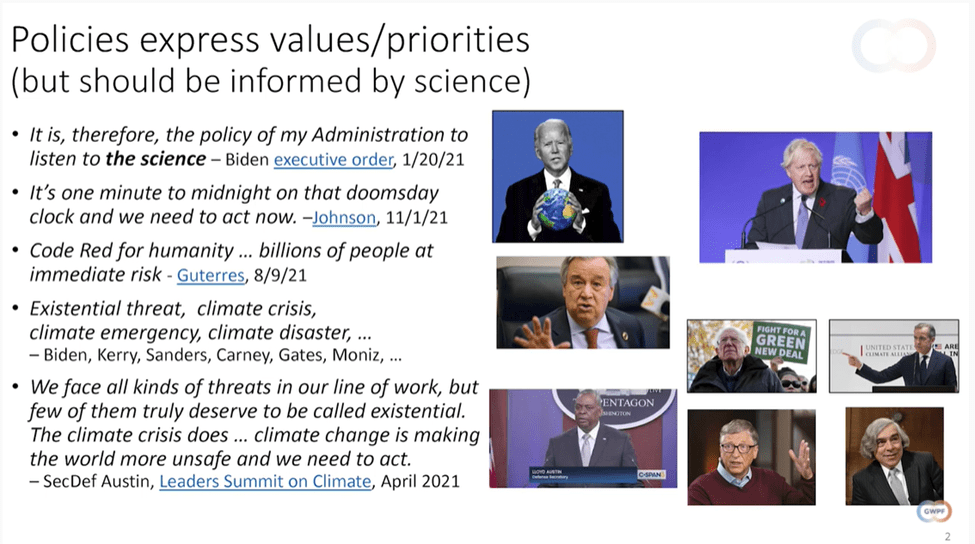
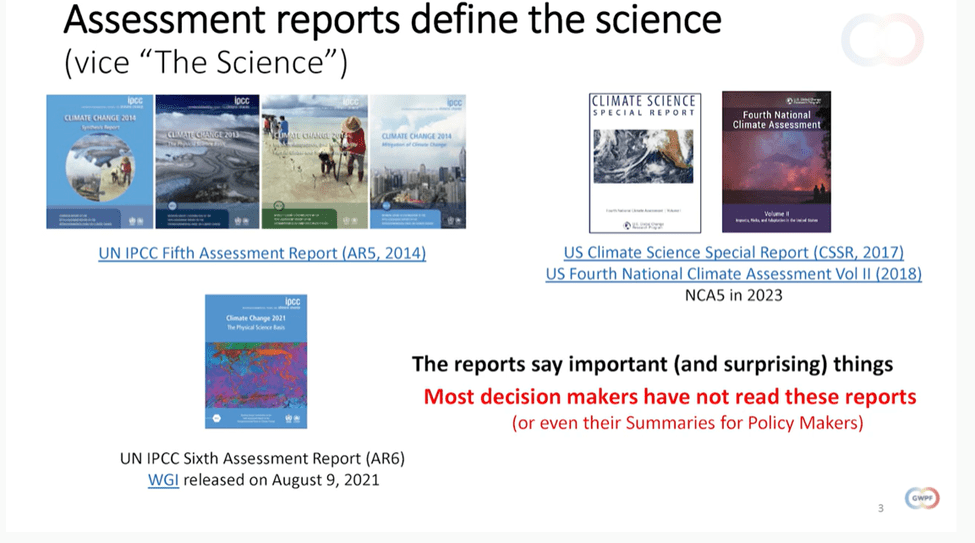


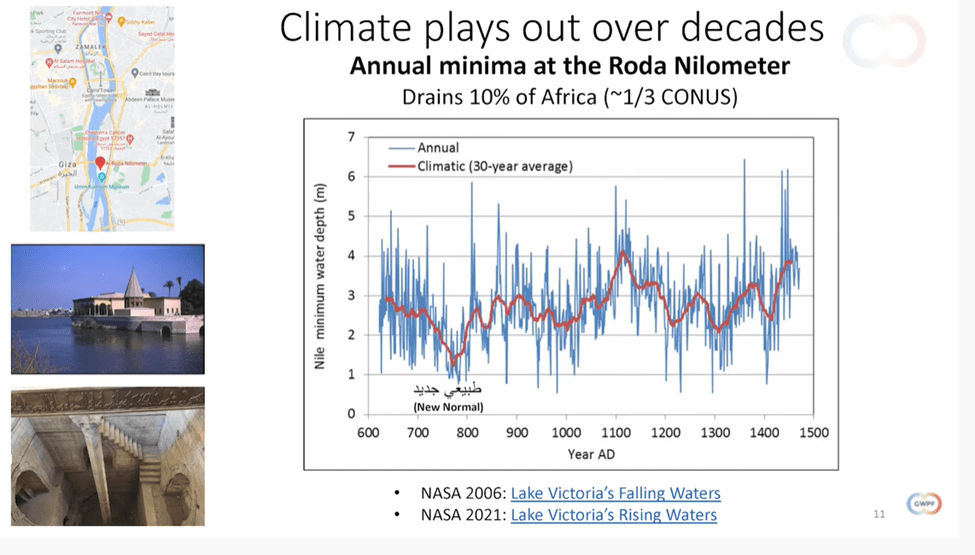


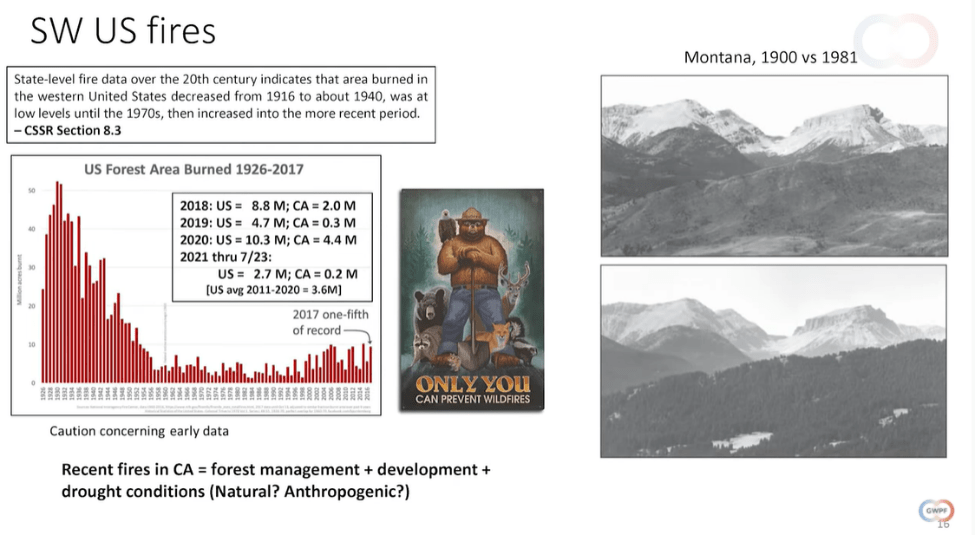
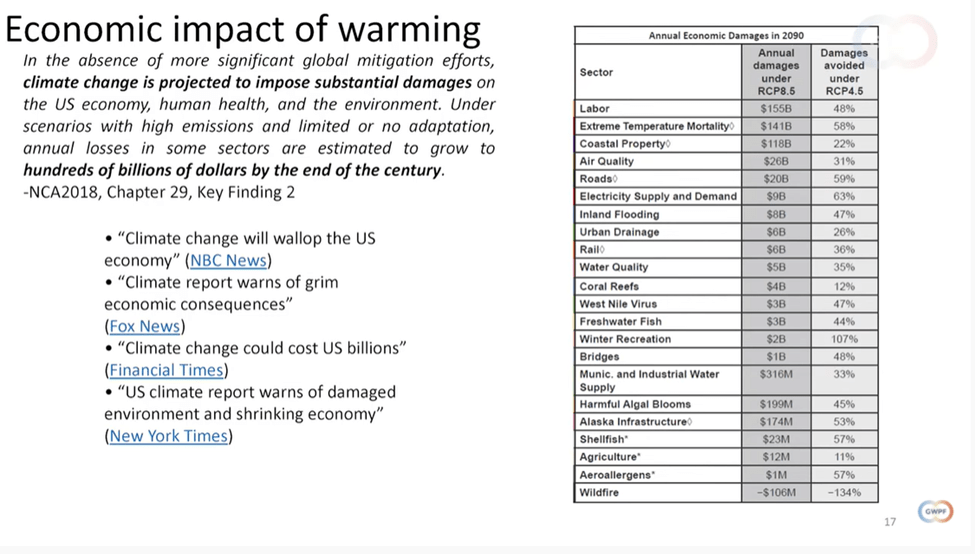


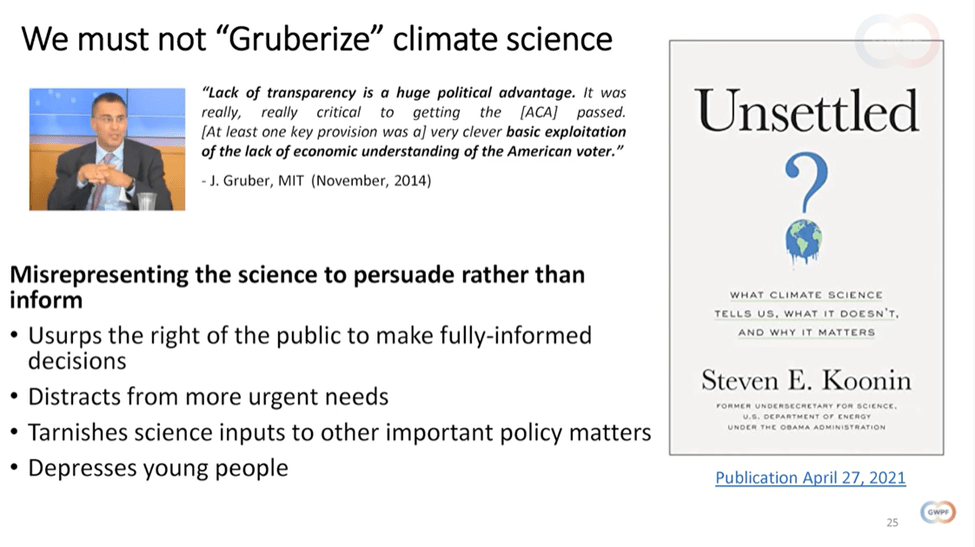



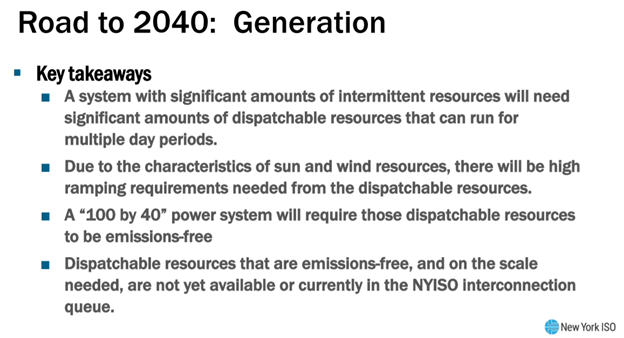
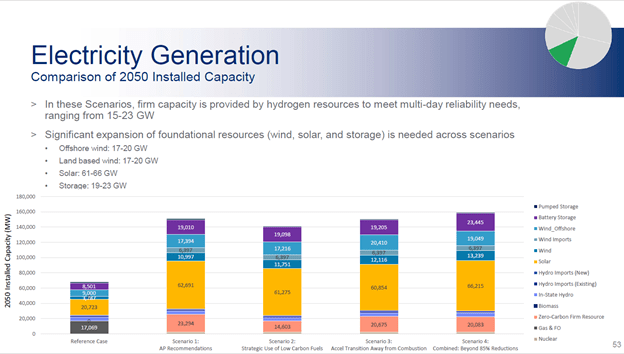
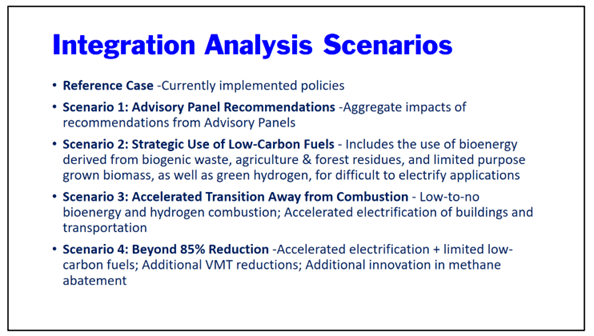


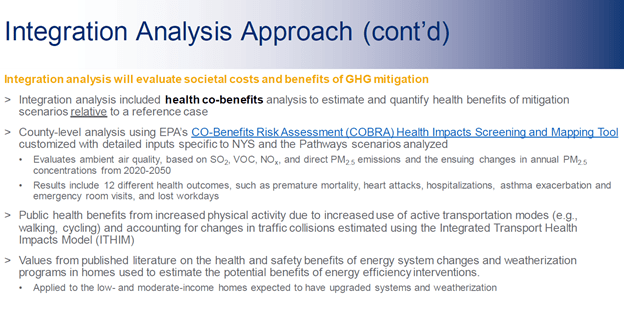


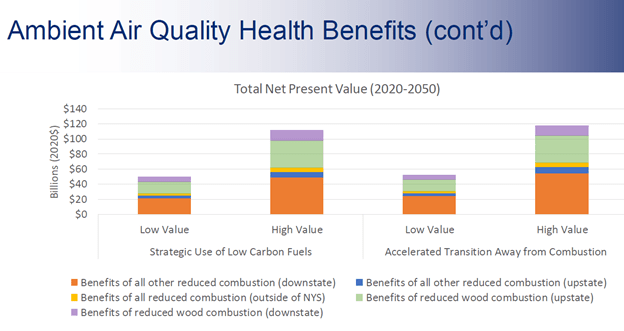
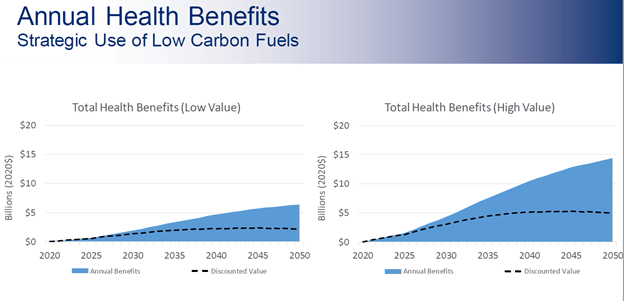
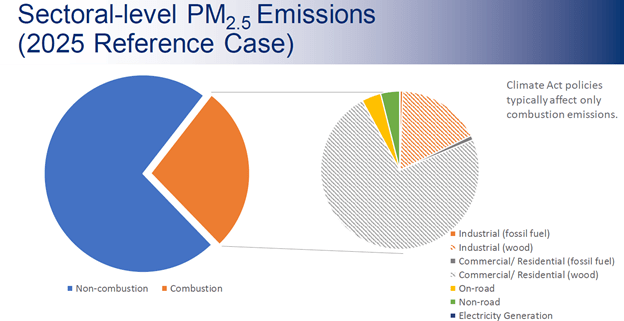
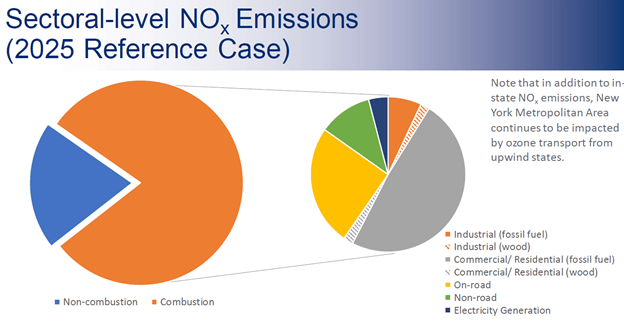
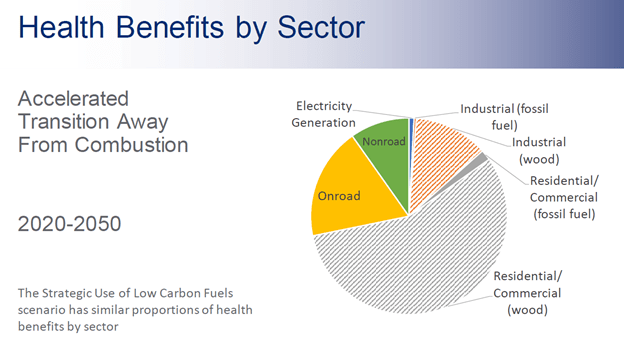
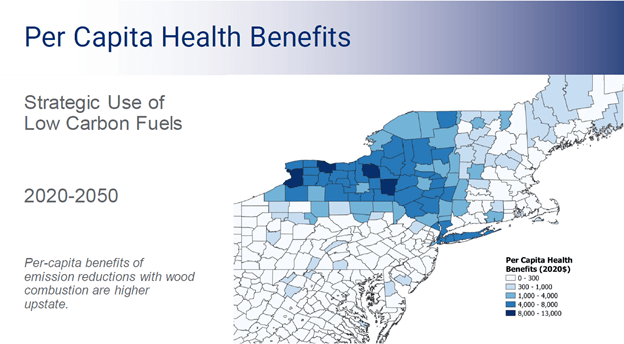
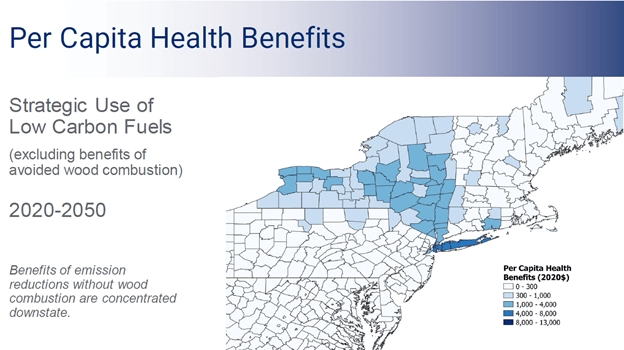


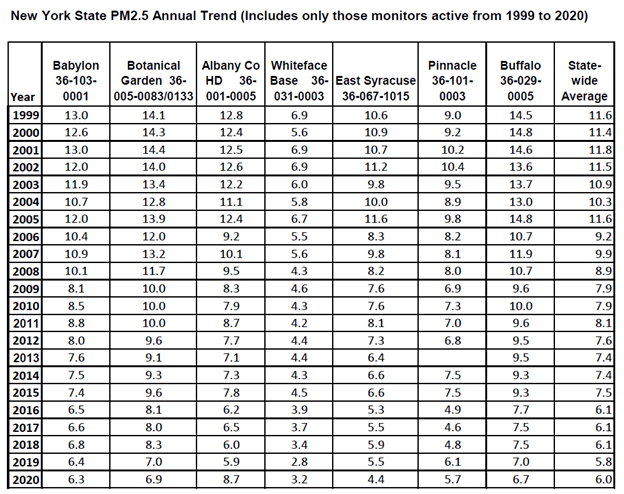


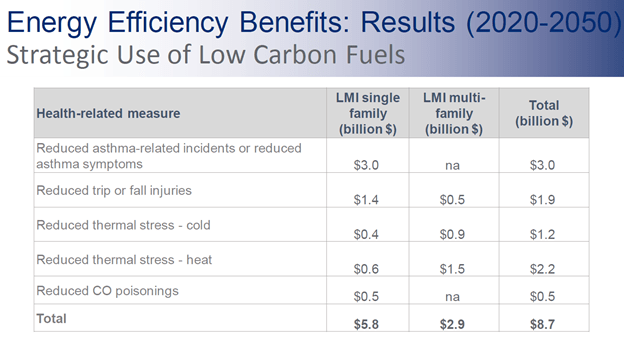


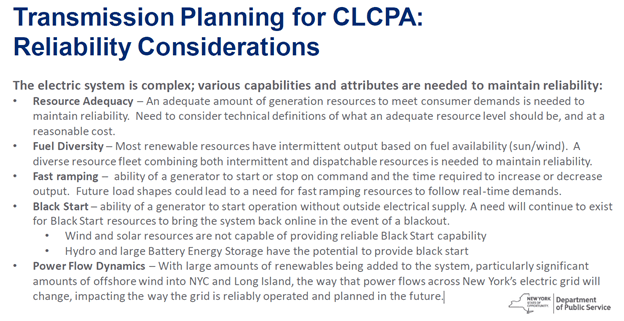


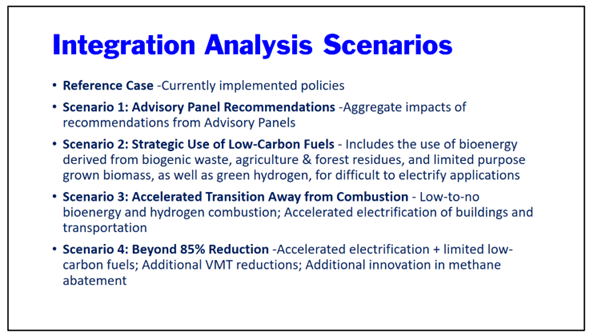

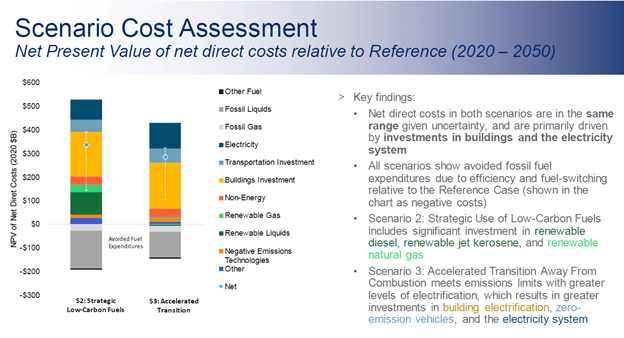
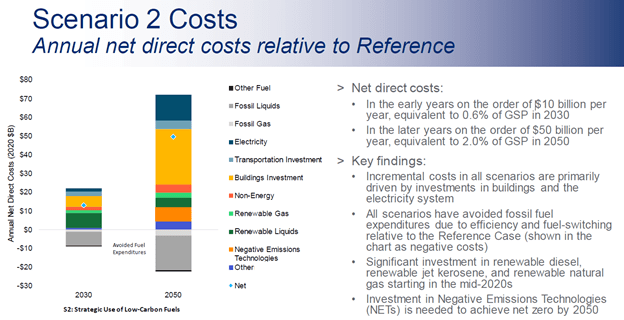

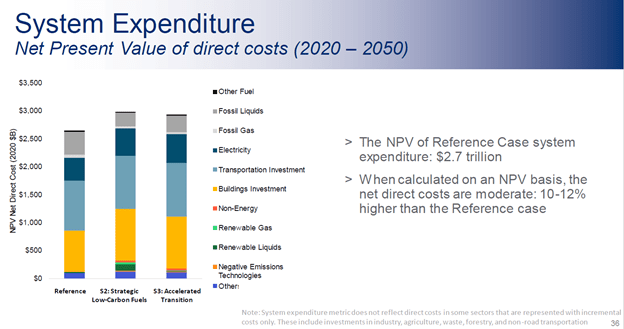
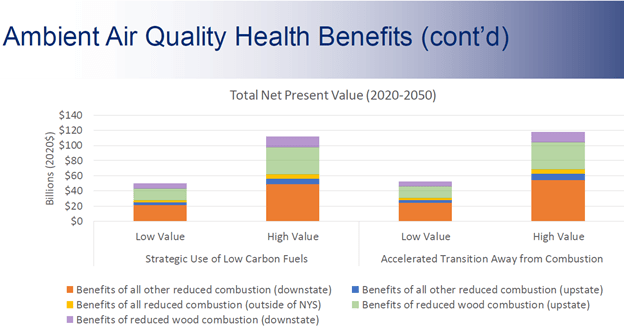


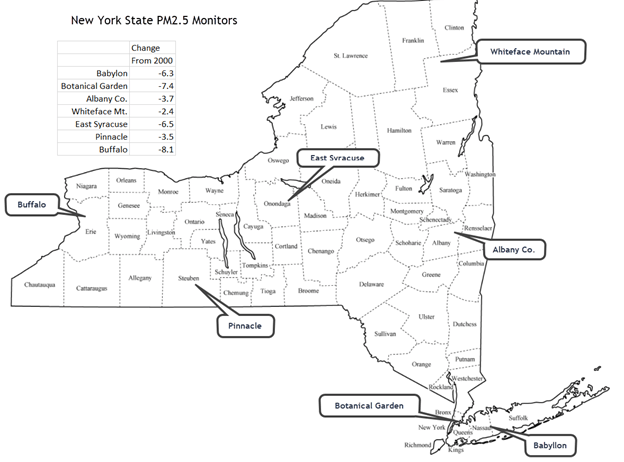


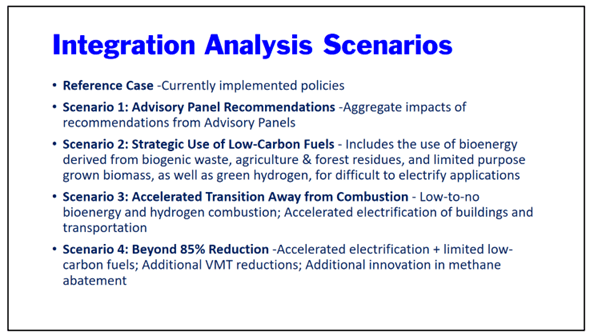
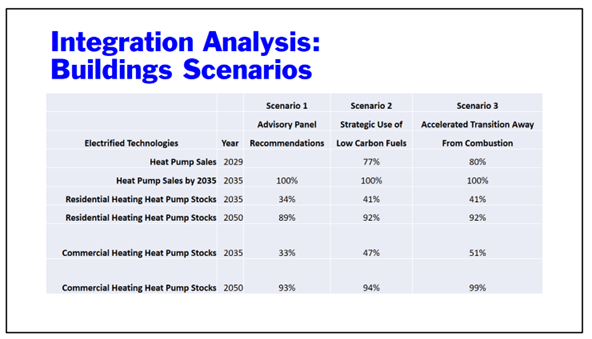

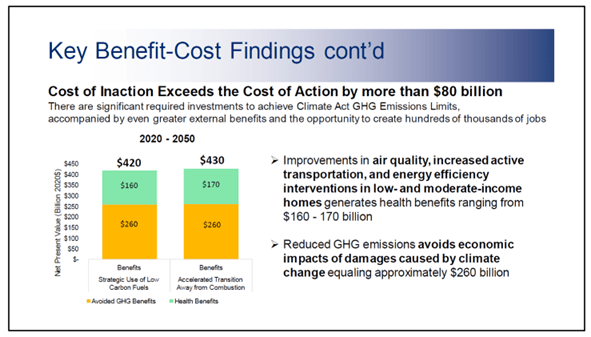
 Pragmatic Environmentalist of New York