Letter to the State Energy Planning Board

The last several weeks I have written multiple articles about the State Energy Plan and the Energy Planning Board.  This post describes a letter I sent to the members of the Energy Planning Board that said that it was premature to approve the Plan at this time.  I wrote this post to document the fact that Board was told that there were issues before they voted to approve the Energy Plan because someday it will be obvious that approving the plan was a mistake.

In short, implementing New York’s net-zero dreams are unaffordable.  The State Energy Plan analysis of total monthly household energy costs estimates that the capital costs  to install replacement appliances and vehicles that can meet the Climate Act zero-emissions mandate is nearly $600 a month more than replacement with conventional household appliances and vehicles even when the savings of more efficient equipment are considered.

I am convinced that implementation of the New York Climate Leadership & Community Protection Act (Climate Act or CLCPA) net-zero mandates will do more harm than good if the future electric system relies only on wind, solar, and energy storage because of reliability and affordability risks.  I have followed the Climate Act since it was first proposed, submitted comments on the Climate Act implementation plan, and have written over 600 articles about New York’s net-zero transition.  The opinions expressed in this article do not reflect the position of any of my previous employers or any other organization I have been associated with, these comments are mine alone.

Energy Plan

The New York State Energy Plan is billed as a “comprehensive roadmap to build a clean, resilient, and affordable energy system for all New Yorkers”. I have provided background information and a list of relevant articles including summaries of recent meetings on my Energy Plan page. My latest article discussed presentations of findings from analyses completed since last summer (presentation and recording) at the December 1 meeting. 

NYSERDA presentations and documentation are carefully curated to amplify the political messaging of the Hochul Administration, so it is necessary to read between the lines and carefully check all the statements that are made.  The most important finding in the presentation on December 1 is what I think is a clear admission of expected unaffordable costs necessary for New York households to achieve the Climate Act mandates for zero emissions.  I have explained how I derived the $600 a monthcost estimates in multiple posts and in a summary description of the Equipment Cost Sensitivity slide in the NYSERDA energy affordability presentation.

This information is not explicitly mentioned in the Energy Affordability Fact Sheet (Fact Sheet).  I recognize that this is an extraordinary claim, so I prepared two articles focusing just on the calculation of that estimate.  The Energy Affordability Initial Thoughts at SEP Board Meeting on 12/1/2025 article was my first attempt to document this finding. My latest article specifically addressed the claims in the Fact Sheet but also documented the location of every value in the Energy Affordability Data Annex spreadsheet published on 4 December 2025 after my first article on this topic. 

State Energy Plan Process

This description of the process is based on the Summary for Policy Makers Public Input, Section 1.2, . On September 9, 2024 the Hochul Administration initiated the development of the State Energy Plan announcing the release of a draft scope of the plan.  The Board solicited written public comment on the Draft Scope from September 9, 2024 to December 16, 2024.  Comments were reviewed and incorporated into the final Scope, which was adopted by the Board in March 2025.  In July 2025, the Board approved the release of the Draft Plan for public comment.  The public comment period ran from July 23, 2025 to October 6, 2025.   Nearly 15,000 written comments on the Draft Plan were submitted, with over 250 from organizations and the balance from individuals (80% of which were through 13 comment campaigns).  A “thematic summary of public comments” was discussed at the November 2025 meeting of the Energy Planning Board.  On December 16, 2025, the final act in the process will occur when the Board summarily approves the State Energy Plan.

The process is playacting.  The outcome was never in doubt.  Despite claims about the value of public engagement and input to inform the development of the State Energy Plan there is no record that all the input was considered.  On October 7th the Energy Plan comment website promised that “All comments will be posted on the State Energy Plan website as soon as practicable” but they still are not posted.  During the State Energy Planning Board meeting presentation on November 13 Karl Maas stated: “This presentation and its appendix, which includes comments on each plan chapter, will be posted after this meeting.”  I used Perplexity AI to search for the appendix and confirmed that my search of the Energy Plan website had not missed that this was posted.  Perplexity concluded: “The State Energy Planning Board appears to have failed to follow through on its commitment to publicly release the detailed comments appendix, despite the explicit promise made during the meeting. This lack of transparency undermines the credibility of the public comment process for the Draft State Energy Plan.”

The bottom line is that the Energy Planning Board was never told anything that negatively reflected on the Administration’s narrative that the Energy Plan implementation meeting the Climate Act mandates would Be a comprehensive roadmap to “build a clean, resilient, and affordable energy system for all New Yorkers”.

My Letter

My final effort to reach the Energy Planning Board to reconsider rubber stamping the Administration’s overly optimistic Energy Plan was to send the following letter to the Board.

I am writing to the members of the State Energy Planning Board  to argue that it is premature to consider and act upon a resolution to adopt the State Energy Plan at the Board meeting scheduled for December 16, 2025.  The Energy Plan is supposed to be a “comprehensive roadmap to build a clean, resilient, and affordable energy system for all New Yorkers”. The draft documents labeled “pending board decision” show that there are untenable upfront costs that New Yorkers would face if the State follows the existing State Energy Plan roadmap to achieve the Legislature’s aspirational 2030 deadlines.

The State Energy Plan will have no energy affordability credibility if the Energy Planning Board adopts a plan that its analyses show is unaffordable.  The 2025 Energy Plan Data Annex spreadsheet titled Energy Affordability Outputs and Input Data contains unacceptable affordability information.  In the Equipment Cost Sensitivity slide there are monthly total energy costs including levelized equipment costs for a single household profile.  As documented here, the projections for a moderate-income household in Upstate New York that uses natural gas found the difference between replacement of conventional existing equipment and the highly efficient electrification equipment necessary for Climate Leadership & Community Protection Act (CLCPA) compliance increases monthly average energy expenditures $594 when capital costs are considered.  Only the wealthy could consider that affordable.

The Attorney General’s Office agrees that there are the “insurmountable upfront costs” if the Energy Plan is consistent with the CLCPA as it stands.  Earlier this year there was a court case considering whether the Department of Environmental Conservation had to issue final regulations establishing economy-wide greenhouse gas emission (GHG) limits.   During the case, the Attorney General  submitted a letter that addressed “two categories of new developments: (1) the publication of the 2025 Draft New York State Energy Plan by the New York State Energy Planning Board on July 23, 2025 and (2) additional actions by the federal government that impede New York’s efforts to achieve the CLCPA.”  The letter argued that it was inappropriate to implement regulations that would ensure compliance with the 2030 40% reduction in GHG emissions CLCPA mandate because meeting the target is “currently infeasible”. 

Ordering achievement of the 2030 target would equate to even higher costs than the net zero scenarios and would affect consumers even sooner. Undoubtedly, greenhouse-gas reducing policies can lead to longer-term benefits such as health improvements. This does not, however, offset the insurmountable upfront costs that New Yorkers would face if DEC were forced to try to achieve the Legislature’s aspirational emissions reductions by the 2030 deadline rather than proceeding at an ambitious but sustainable pace.

There is no obvious record of what insurmountable State Energy Plan upfront costs led to that statement in the Attorney General letter, but the statement is consistent with the Equipment Cost Sensitivity analysis.  I find it troubling that this finding received so little attention in the NYSERDA presentations to the Board.  This information is not explicitly mentioned in the Energy Affordability Fact Sheet, in the Volume I: Summary for Policymakers or in the Energy Affordability Impacts Analysis chapter.  The findings were mentioned in a 41 second segment of the December 1 Energy Affordability presentation (Page 8 in the annotated transcript):  “What we can take away is that the net costs for efficient electrification journeys could be thirty five to forty percent higher than conventional replacement when accounting for equipment, reinforcing the importance of action to address upfront equipment costs so that households are able to access the benefits of these systems.” 

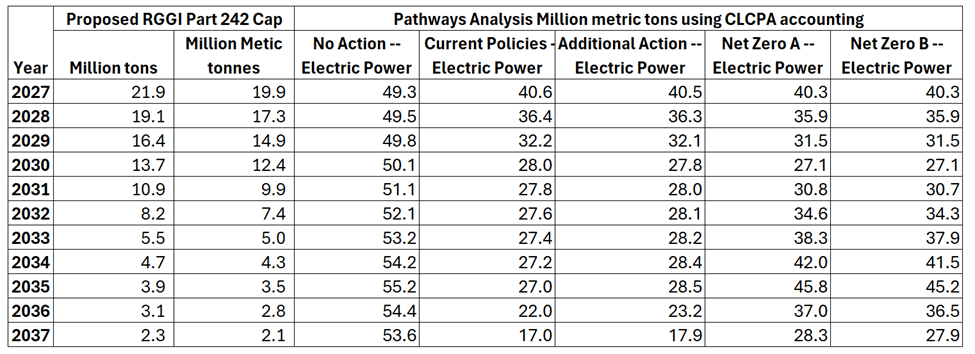
In addition, the Pathways Analysis shows that meeting the 2030 CLCPA 40% GHG emission reduction target and electric system 70% renewable energy mandates are impossible.  Those results are consistent with other State agency findings.  I believe that these conclusions and the affordability results clearly show that it is time to amend the CLCPA  consistent with the Ulster County New York Supreme Court decision ordering the Department of Environmental Conservation to issue final regulations establishing economy-wide greenhouse gas emission (GHG) limits on or before Feb. 6, 2026 or go to the Legislature and get the Climate Act 2030 GHG reduction mandate schedule changed.   The Hochul Administration and DEC appealed the decision on November 25, 2025 claiming that “it is impossible for the Department to simultaneously comply with both the Court’s order and its substantive statutory obligations.” 

The State Energy Plan for approval on December 16, 2025, does not recognize these findings.  Ignoring them to meet an arbitrary schedule means the Plan will be immediately obsolete.  The Plan must explicitly state that the CLCPA mandates cannot be achieved and are unaffordable so must be amended for a State Energy Plan that ensures a clean, resilient, and affordable energy system for all New Yorkers.  Failure to do so would be a serious disservice to New Yorkers.

Discussion

I do not expect that there will ever be any acknowledgment of the letter.  This post documents that the State Energy Planning Board was told that total monthly household energy costs estimates for the capital costs  to install replacement appliances and vehicles that can meet the Climate Act zero-emissions mandate are nearly $600 a month more than replacement with conventional household appliances and vehicles even when the savings of more efficient equipment are considered.  Only the wealthy could consider that affordable.  The Energy Plan is supposed to consider affordability so ignoring this finding destroys the credibility of the document.

Conclusion

My hobby of fighting the Climate Act mandates certainly keeps me busy but certainly does not have any effect on New York energy policy.  I hope that someday I will be able to say I told you so.

NYSERDA Energy Plan Affordability Fact Sheet

On December 11, 2025 the New York State Energy Research & Development Authority (NYSEDA) announced that “Pre-Decisional Materials are Available” for the next meeting of the Energy Planning Board.  It included a link to the Affordability Analysis Overview Fact Sheet that describes affordability impacts.  This post documents differences between the Fact Sheet key points and recent articles on this blog and at Watts Up With That that argued that the projected costs are so great that it is time to reconsider the Climate Leadership & Community Protection Act (Climate Act) and premature for the Energy Planning Board to vote on an energy roadmap that purports to support affordability.

I am convinced that implementation of the Climate Act net-zero mandates will do more harm than good if the future electric system relies only on wind, solar, and energy storage because of reliability and affordability risks.  I have followed the Climate Act since it was first proposed, submitted comments on the Climate Act implementation plan, and have written over 600 articles about New York’s net-zero transition.  The opinions expressed in this article do not reflect the position of any of my previous employers or any other organization I have been associated with, these comments are mine alone.

State Energy Plan

The New York State Energy Plan is a “comprehensive roadmap to build a clean, resilient, and affordable energy system for all New Yorkers”. I have provided background information and a list of relevant articles including summaries of recent meetings on my Energy Plan page.  NYSERDA released the Draft Energy Plan last summer.  Stakeholder comments were accepted until early October.  The Energy Planning Board has the responsibility to approve the document.  After two recent meetings that described stakeholder comments (presentation and recording) and presented findings from analyses completed since the release of the Draft Energy Plan (presentation and recording) they will meet on December 16, 2025 to “consider and act upon a resolution to adopt the State Energy Plan”.

Overview

In addition to the articles arguing that the Climate Act needs to reconsidered, I also published an article describing my thoughts about the State Energy Planning Board (SEP) meeting on December 1, 2025 that described the NYSERDA energy affordability analysis.   The key point made in my articles is that the projected monthly energy cost increase necessary to convert an Upstate household that uses fossil fuel for the home and transportation to the equipment necessary to comply with the emission reductions necessary to achieve the Climate Act is extraordinary.  The monthly energy expense cost difference to replace existing fossil fuel equipment with new equipment relative to “zero emissions” electrification equipment is $593 a month in 2031, which is 43% more than the cost for conventional equipment replacement.  This article also updates the supporting information used consistent with the Energy Affordability Data Annex spreadsheet published on 4 December 2025.  To forestall any complaints that I am making up numbers this documents the numbers and provide context for NYSERDA claims.

Energy Affordability Fact Sheet

The contents of the Affordability Analysis Overview Fact Sheet are reproduced below.

The Fact Sheet includes the following text including highlighting:

Policy and market solutions that focus on lowering upfront costs and other barriers to adoption for a range of energy-saving choices — such as building envelope efficiency, efficient appliances and equipment, and electric vehicles — can enable households to lower their energy bills. This can help to alleviate energy insecurity and energy burdens.

While New Yorkers on average spend less on utility, heating fuel, and transportation fuel bills combined than the average American, New York households and residents across the country face overarching affordability challenges.

Drivers of household affordability include expenditures in areas such as housing, transportation, food, and healthcare. Energy, as a subset of transportation and housing costs, is an important driver of affordability challenges for many households. Low- and moderate-income households are more likely experience substantial cost burdens related to meeting their energy needs.

Due in part to proactive policies to boost energy efficiency and affordability, average utility, heating fuel, and transportation fuel spending for New York households is $700 less every year compared to the national average. These findings are reinforced by recent analysis from the U.S. Energy Information Administration, which finds that New York State has the second lowest per capita energy expenditure in the nation.

There is a stark contrast between the Fact Sheet energy affordability message and mine.  The supporting documentation does support the Fact Sheet takeaway message that  “The energy affordability analysis shows that the use of new, efficient equipment and electrification can cut energy spending by $100 to over $300 every month for many New York households, across energy costs for transportation and heating and utility bills.”  However, the supporting information and a sensitivity analysis  show that the monthly energy expense costs that consider the capital expense (CapEx) for new equipment present a vastly different conclusion.  It is no coincidence that the Fact Sheet emphasizes that “Policy and market solutions that focus on lowering upfront costs” can enable households to lower their energy bills.  Left unsaid is that if upfront capital costs are not lowered that the expected costs are unaffordable.

Energy Affordability Analysis

The December 2025 Energy Affordability Data Annex spreadsheet (Annex Spreadsheet)  and the Energy Affordability Impacts Analysis (Impact Analysis) document provide the supporting documentation for the Fact Sheet. To project potential future costs based on continued use of fossil fuels relative to two levels of electrification and emission reduction, the modelers considered eleven household energy use categories based on location, income levels, and energy equipment.

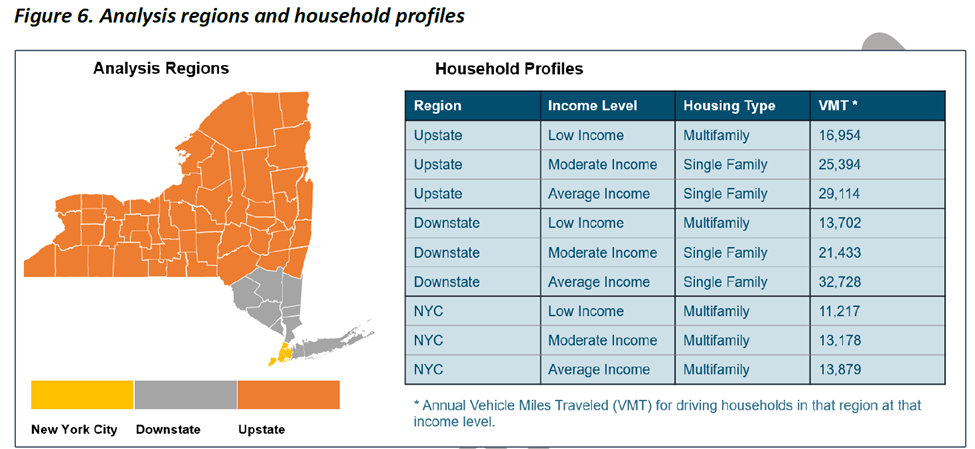
Figure 3 shows the analysis regions and summarizes household profiles used.  The three income level definitions are:

• Low-income includes households with incomes at or below 60 percent of State Median Income.

• Moderate-income includes households with incomes above 60 percent but below 80 percent of State Median Income or Area Median Income, whichever is higher

• Average income uses the average income of a household in an analysis region to represent households with incomes that fall above the low- or moderate-income range.

Figure 3: Figure 6 from the Impact Analysis

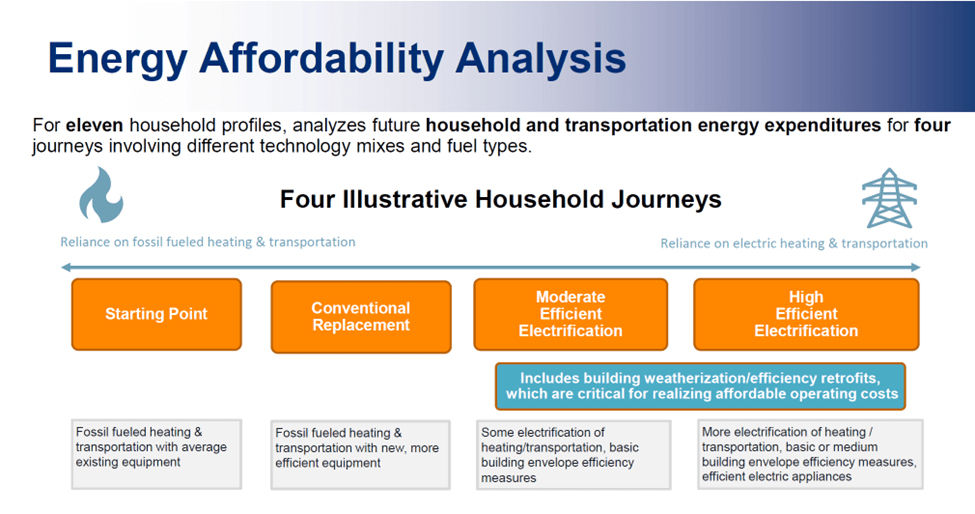
For each of the eleven household profiles four scenarios or journeys were considered:

  • Starting Point using fossil fueled heating and transportation with average existing equipment.
  • Conventional Replacement: Fossil fueled heating and transportation with new, more efficient equipment
  • Moderate Efficient Electrification: Some electrification of heating and transportation, with basic building envelope efficiency measures
  • High Efficient Electrification: More electrification of heating and transportation, with basic or medium building envelope efficiency measures, and efficient electric appliances

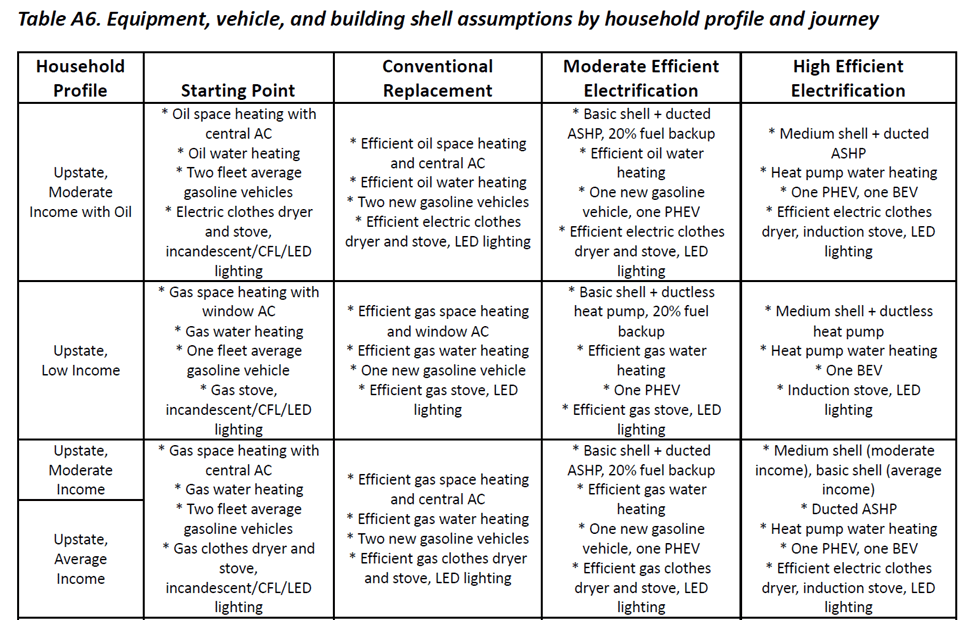
Table A-6 in the Impact Analysis document describes the equipment, vehicle, and building shell assumptions by household profile and scenario.  Figure 4 is an excerpt from that table that lists the four Upstate household profiles.  NYSERDA did a sensitivity analysis that included the equipment costs for one household profile: Upstate New York moderate income.  The starting point household for that scenario uses gas space heating with central AC, gas water heating, has two average gasoline vehicles, uses a gas clothes dryer and stove, and has a mixture of incandescent/CFL/LED lighting.  Conventional replacement for that household replaces all these systems with more efficient models.  In the “High Efficient Electrification” scenario existing systems are replaced with a medium building shell, ducted air source heat pump, heat pump water heating, one plugin hybrid electric vehicle and one battery electric vehicle, efficient electric clothes dryer, induction stove, and LED lighting.

Figure 4: Excerpt from Table A6 in the Impact Analysis Document

Energy Affordability Results

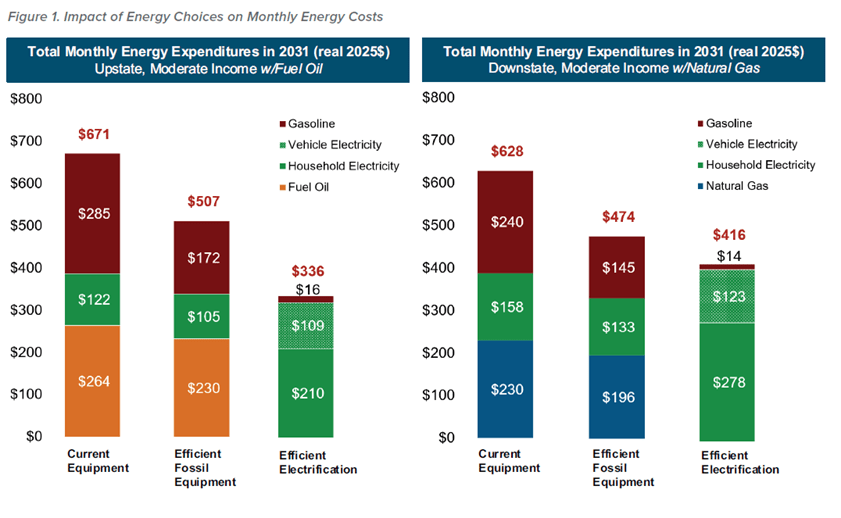
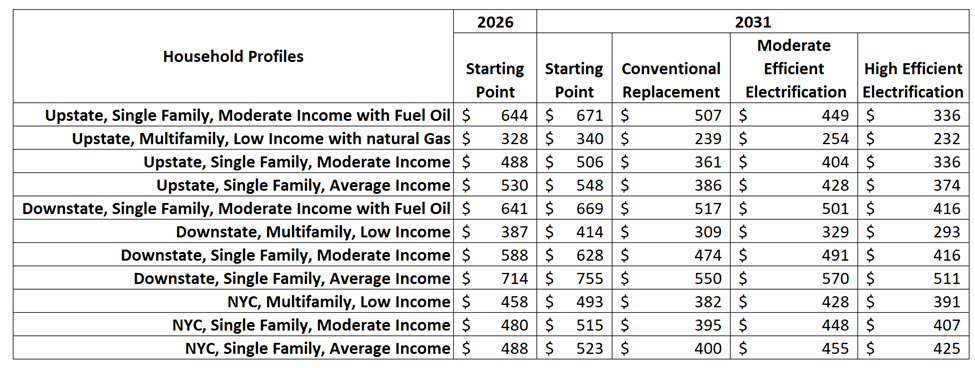
The monthly energy costs shown in Figure 1 in the Fact Sheet are derived from the Annex Spreadsheet in tables “Upstate Results” and Downstate Results”. For each of the eleven household profiles, data for the total monthly household energy and expenditures (real 2025 $) breaks down costs by four cost components: household electricity and fuel and vehicle electricity and fuel.  The Fact Sheet simply graphs two examples to illustrate the claim that monthly household expenditures will decrease in 2031 for the four future scenarios.  All the results show the same thing (Table 1).  When an existing household does nothing costs do rise between 2026 and 2031.  If the household upgrades their existing systems with more efficient conventional equipment the monthly energy bills go down.  If the household upgrades with the two electrification scenarios the monthly energy bills go down more.

Table 1: Household Profile Total Monthly Household Energy and Transportation Energy Expenditures (real 2025 $) excluding CapEx

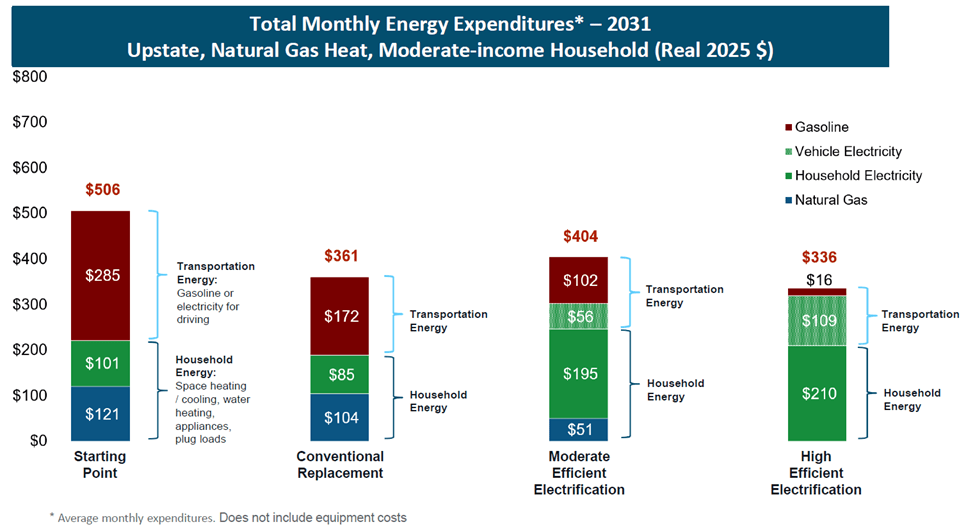
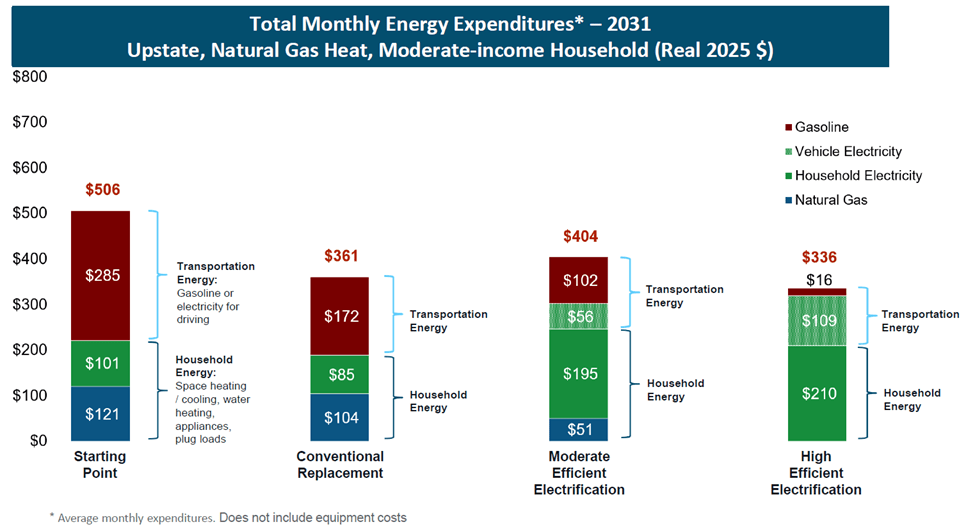
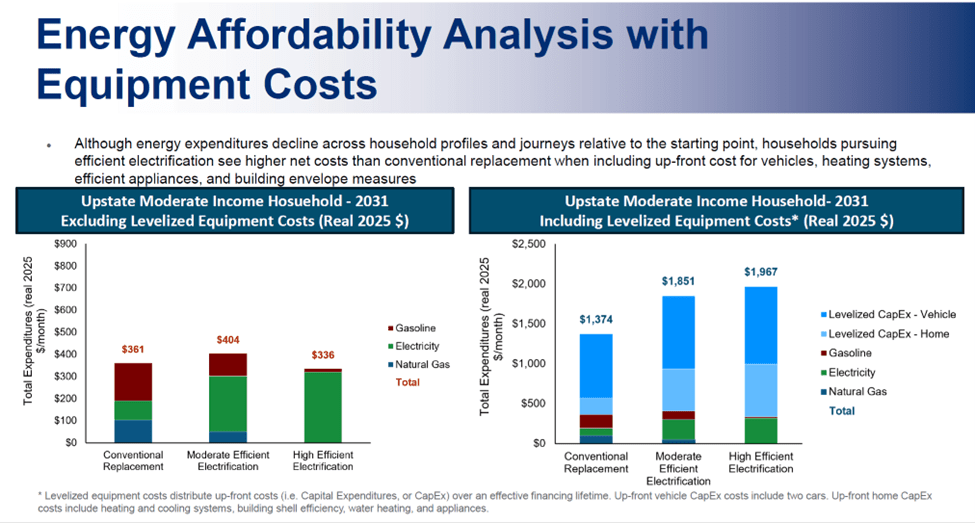
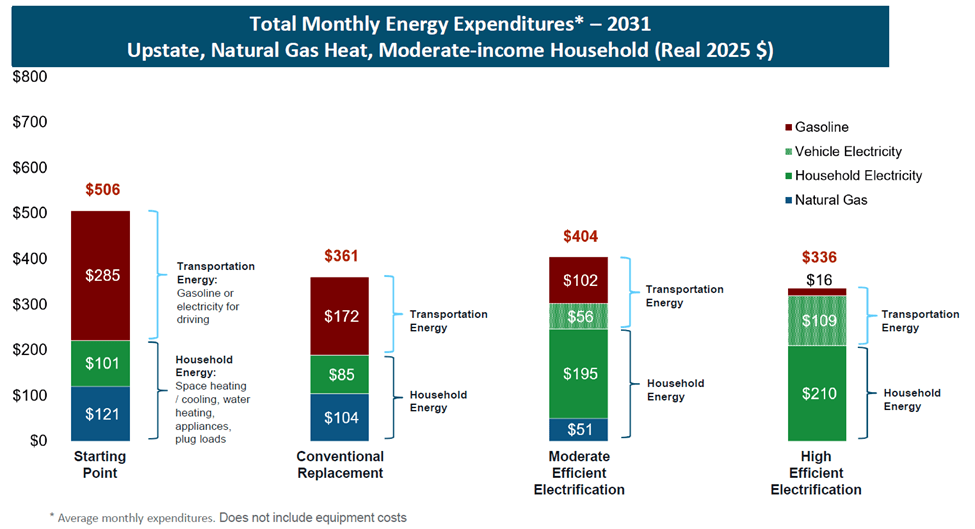
The meeting on December 1 emphasized a similar story.  Figure 5 from that presentation shows the data for the Upstate New York, natural gas, moderate income household using data from Annex Spreadsheet in table “Upstate Results.  The reason for the difference between my work and these NYSERDA results is buried at the bottom of the figure.  There is a notation that states: “Average monthly expenditures. Does not include equipment costs”. 

Figure 5: NYS Energy Planning Board Meeting Presentation Slide 40

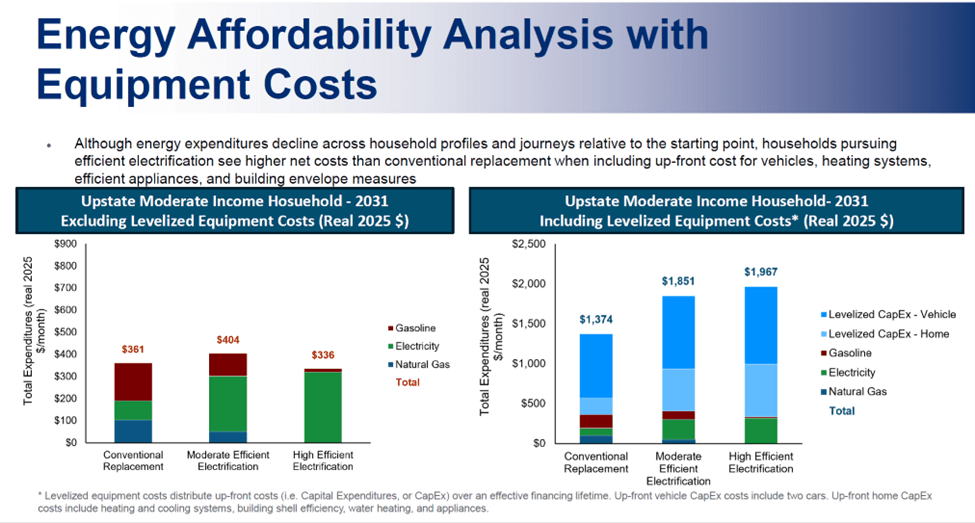
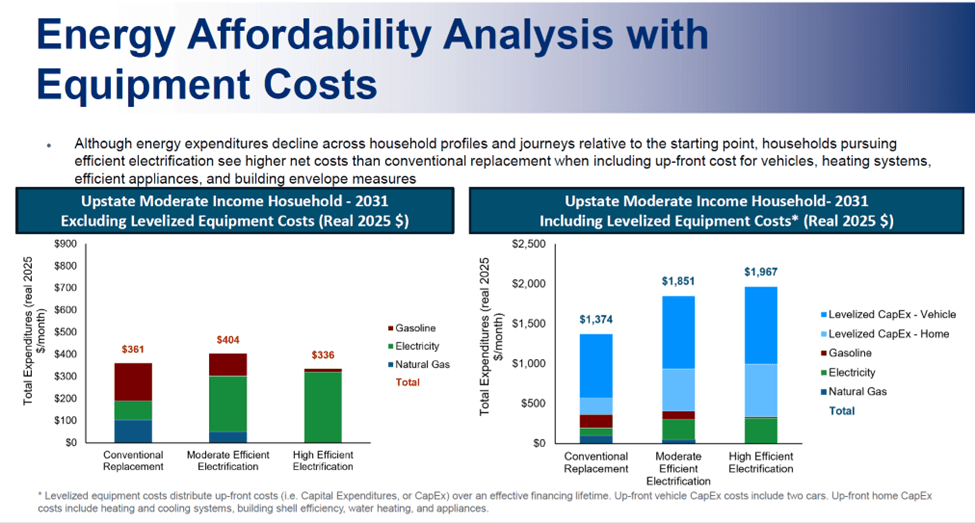
It turns out that including equipment costs makes a difference as shown in the Figure 6. This information is in Annex Spreadsheet in table “Equipment Cost Summary”.

Figure 6: NYS Energy Planning Board Meeting Presentation Slide 43

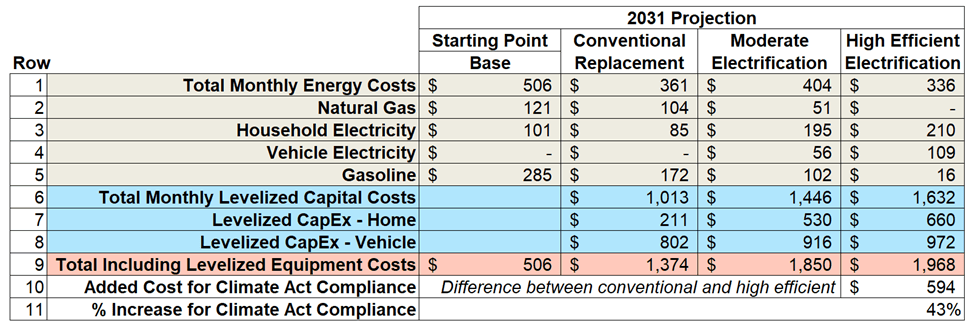
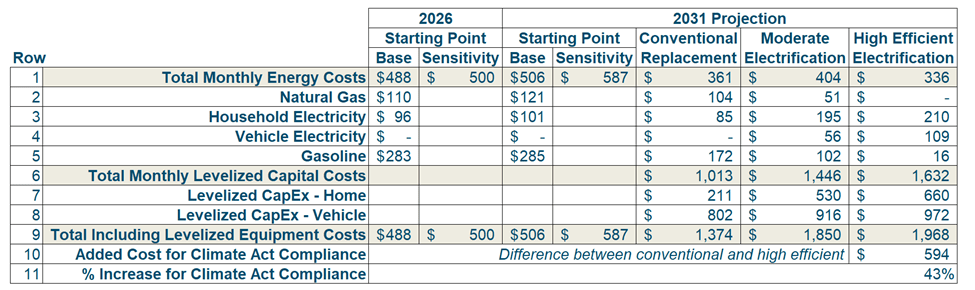
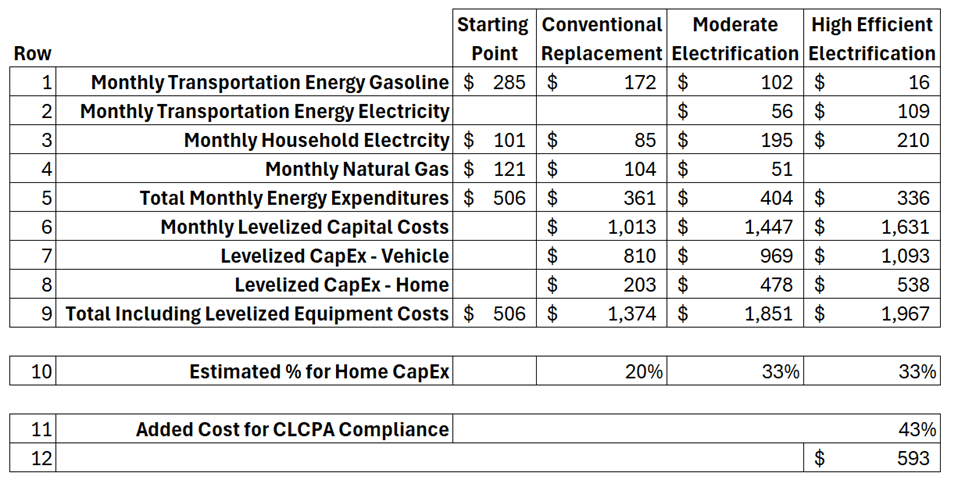
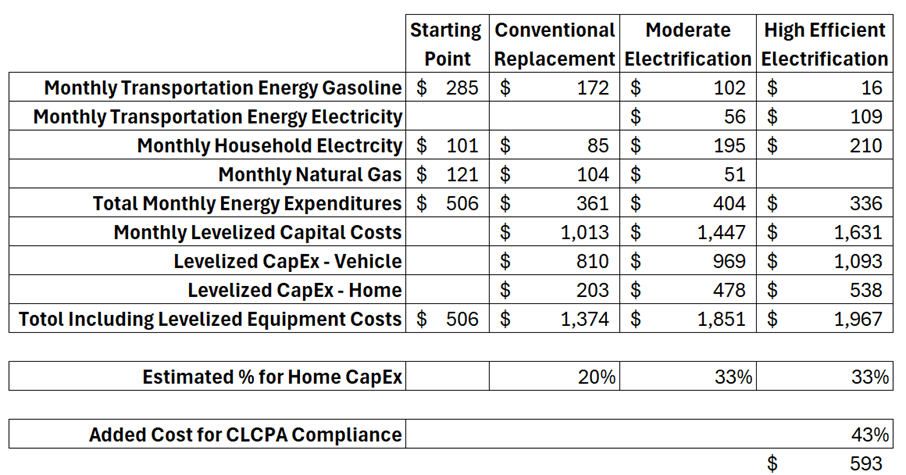
I extracted information from these Annex Spreadsheet “Upstate Results” and “Equipment Cost Summary” tables to prepare Table 2 that was used to prepare these bar chaarts.  Rows 1-4 list the monthly energy expenditures with the total in row 5 from the “Upstate Results” table.  The increase in efficiency decreases monthly energy costs for all three journeys but that changes when CapEx is considered.  The CapEx monthly total costs in rows in row 6-8 are from the “Equipment Cost Summary” table.  Row 9 lists the sum of the total monthly energy costs and rows 6 and 7 the total monthly levelized capital costs for home and vehicle.  The cost of Climate Act compliance is the difference between replacement of conventional equipment and the highly efficient electrification equipment.  Row 10 shows this difference.  It lists the $594 increase in costs necessary for Climate Act compliance and row 11 lists the percentage increase as 43%. 

Table 2: Upstate New York Moderate Income Household That Uses Natural Gas for Heat Projected Monthly Costs and Costs Necessary to Comply with the Climate Act

NYSERDA Affordability Messaging

The Energy Affordability Fact Sheet highlights the point that “The energy affordability analysis shows that the use of new, efficient equipment and electrification can cut energy spending by $100 to over $300 every month for many New York households, across energy costs for transportation and heating and utility bills.”  It acknowledges that New Yorkers face “overarching affordability challenges” and that

“Energy, as a subset of transportation and housing costs, is an important driver of affordability challenges for many households.”   However, it does not acknowledge that when the equipment’s capital expense costs necessary to achieve the Climate Act mandates are included in the projected total monthly energy costs that costs are certainly not affordable.

There is another aspect of the NYSERDA messaging.  I prepared an annotated transcript for the energy affordability presentation at the Energy Planning Board meeting on December 1 that includes a heading for questions made during the meeting with a link to each person who commented or asked a question. Chair Doreen Harris of the Energy Planning Board asked NYSERDA presenter James Wilcox about energy price uncertainty.  He admitted that the key driver of change over the next five years is “change in energy price”.  The modeling shows that this could increase household energy spending 3% to 8% in the starting point base case but could go up to as much as 14% to 19% even if they do nothing as shown in the ”Sensitivity” columns under the Starting Point 2026 and 2031 scenarios shown in Table 2.  Chair Harris extracted a response from him that summarizes the second public message: “That is what I was trying to elicit: What does doing nothing get you?”  These data show that even if you do nothing costs could rise as much as 19% if you exclude the CapEx costs of compliant equipment.  That is misleading because the equipment costs are the main cause of future costs and not changes in energy prices.  It is also emblematic of another NYSERDA message that costs are going to go up anyway and that the costs to comply with the Climate Act are less so we can still continue to pursue this initiative.

Discussion

On Oct. 24, 2025, there was an Albany County New York Supreme Court decision ordering the Department of Environmental Conservation (DEC) to issue final Climate Act implementing regulations establishing economy-wide greenhouse gas emission (GHG) limits on or before Feb. 6, 2026 or go to the Legislature and get the Climate Act 2030 GHG reduction mandate schedule changed.   During the legal proceeding the State Attorney General submitted a letter that argued that it was inappropriate to implement regulations that would ensure compliance with the 2030 40% reduction in GHG emissions Climate Act mandate because meeting the target is “currently infeasible”.  That argument was undoubtedly based on the total cost including CapEx for households results of the single equipment cost sensitivity analysis.

The State Energy Planning Board will meet on December 16, 2025 to “consider and act upon a resolution to adopt the State Energy Plan”.  The Energy Plan is a “comprehensive roadmap to build a clean, resilient, and affordable energy system for all New Yorkers”.  How can the Energy Planning Board members vote to approve something that will increase monthly energy bills nearly $600 a month and claim any credibility for an affordable energy system?  Clearly the answer is they cannot which means the whole process is only for show.

There is no question in my mind that the total cost, including CapEx results are being downplayed as much as possible.  Nowhere in the supporting quantitative information are results presented for all the households evaluated.  I believe that those results were calculated but not presented because of the affordability implications.  Iin addition, there is insufficient information provided that would enable independent analysis to calculate the CapEx costs for the other scenarios.

New York GHG emissions are less than one half of one percent of global emissions and global emissions have been increasing on average by more than one half of one percent per year since 1990.  The fact that New York cannot solve global warming by itself coupled with these extraordinary costs in the face of an acknowledged energy affordability challenge is a very strong case to reconsider the proposed Energy Plan and rethink the Climate Act.

Conclusion

When I tell people that I have spent a lot of time evaluating the Climate Act they usually ask how much is this going to cost.  When I tell them that that the Scoping Plan comprehensive roadmap to “build a clean, resilient, and affordable energy system for all New Yorkers” estimates that when the cost to buy the necessary infrastructure to meet the Climate Act are included households could see an increase of %594 per month they are shocked.  The Affordability Fact Sheet talks about affordability and gives numbers to the suggest affordability.  However, NYSERDA covered up the finding in the Energy Plan modeling that Climate Act compliance is anything but affordable.   This must be addressed.

Time to Reconsider the Climate Act Press Release

A recent court decision and findings presented at the 1 December 2025 State Energy Planning (SEP) Board meeting present overwhelming evidence that implementing the Climate Leadership & Community Protection Act (Climate Act)  as mandated will be unaffordable and the 2030 CLCPA 40% emission reduction target and 70% renewable energy in the electric system mandate will not be achieved.  I don’t think that most New Yorkers are aware of the Climate Act much less its potential impacts, so I prepared a press release that I distributed to various New York press outlets explaining why it is time to reconsider the Climate Act.   This article documents the findings included in the press release and refers to recent articles published on this blog.

I am convinced that implementation of the Climate Act net-zero mandates will do more harm than good if the future electric system relies only on wind, solar, and energy storage because of reliability and affordability risks.  I have followed the Climate Act since it was first proposed, submitted comments on the Climate Act implementation plan, and have written over 600 articles about New York’s net-zero transition.  The opinions expressed in this article do not reflect the position of any of my previous employers or any other organization I have been associated with, these comments are mine alone.

Overview

The Climate Act established a New York “Net Zero” target (85% reduction in GHG emissions and 15% offset of emissions) by 2050 and has two interim 2030 targets: 70% of the electricity must come from renewable energy and GHG emissions must be reduced 40%.  The Climate Action Council (CAC) was responsible for preparing the Scoping Plan that outlined how to “achieve the State’s bold clean energy and climate agenda.” The Integration Analysis prepared by the New York State Energy Research and Development Authority (NYSERDA) and its consultants quantified the impact of the electrification strategies.  That material was used to develop the Draft Scoping Plan outline of strategies.  After a year-long review, the Scoping Plan was finalized at the end of 2022.  Since then, the State has been trying to implement the Scoping Plan recommendations through regulations, proceedings, and legislation. 

Note there is a second implementation law.  Public Service Law (PSL) Section 66-P, Establishment of a renewable energy program, that requires the Public Service Commission to establish a program to ensure the State meets the 2030 and 2040 electric system Climate Act requirements.  

Energy Plan Overview

In 2025 another overarching evaluation of the energy system was initiated.  According to the New York State Energy Plan website (Accessed 3/16/25):

The State Energy Plan is a comprehensive roadmap to build a clean, resilient, and affordable energy system for all New Yorkers. The Plan provides broad program and policy development direction to guide energy-related decision-making in the public and private sectors within New York State.

The New York State Energy Research & Development Authority (NYSERDA) released the Draft Energy Plan last summer.  Stakeholder comments were accepted until early October.  The Energy Planning Board has the responsibility to approve the document. At the November 13, 2025 Board meeting there was a perfunctory description of the comments received.  There was another meeting on December 1 that presented results from additional analyses.  During the wrap up for the latest meeting Chair Doreen Harris said the Board will meet later this month to approve the plan. I have provided background information and a list of relevant articles on my Energy Plan page

Court Decision

On Oct. 24, 2025, there was an Albany County New York Supreme Court decision ordering the Department of Environmental Conservation to issue final regulations establishing economy-wide greenhouse gas emission (GHG) limits on or before Feb. 6, 2026 or go to the Legislature and get the Climate Act 2030 GHG reduction mandate schedule changed.   On November 3, I published an article providing detailed information about the decision. 

In another article I explained that during the legal process the State submitted a letter that addressed “two categories of new developments: (1) the publication of the 2025 Draft New York State Energy Plan by the New York State Energy Planning Board on July 23, 2025 and (2) additional actions by the federal government that impede New York’s efforts to achieve the Climate Act.”  The letter argued that it was inappropriate to implement regulations that would ensure compliance with the 2030 40% reduction in GHG emissions Climate Act mandate because meeting the target is “currently infeasible”. 

Ordering achievement of the 2030 target would equate to even higher costs than the net zero scenarios and would affect consumers even sooner. Undoubtedly, greenhouse-gas reducing policies can lead to longer-term benefits such as health improvements. This does not, however, offset the insurmountable upfront costs that New Yorkers would face if DEC were forced to try to achieve the Legislature’s aspirational emissions reductions by the 2030 deadline rather than proceeding at an ambitious but sustainable pace.

The letter concluded that the Climate Act is unaffordable:

Petitioners have not shown a plausible scenario where the 2030 greenhouse gas reduction goal can be achieved without inflicting unanticipated and undue harm on New York consumers, and the concrete analysis in the 2025 Draft Energy Plan dispels any uncertainty on the topic: New Yorkers will face alarming financial consequences if speed is given preference over sustainability.

The Judge acknowledged that this information was relevant but ruled that DEC must promulgate regulations implementing a law however persuasive their arguments it is inappropriate are. The Hochul Administration and DEC appealed the decision on November 25, 2025 claiming that “it is impossible for the Department to simultaneously comply with both the Court’s order and its substantive statutory obligations.” 

Energy Affordability

In addition to the Attorney General’s supplemental letter arguing that the Climate Act is unaffordable, there were findings presented at the State Energy Planning (SEP) Board meeting on December 1, 2025 that present extraordinary cost estimates.  My article on the Energy Affordability presentation at the meeting documents the projections for a moderate-income household in Upstate New York that uses natural gas.  My article found the difference between replacement of conventional existing equipment and the highly efficient electrification equipment necessary for CLCPA compliance increases monthly average energy expenditures $593 when capital costs are considered. That number was in a slide but there was only passing mention of the cost.

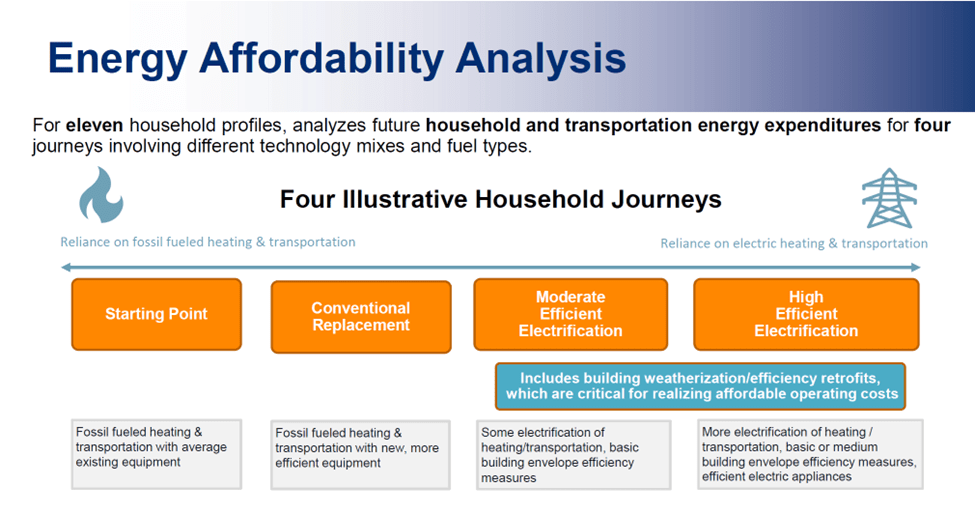
I derived explanatory numbers from information presented at the SEP Board meeting.  The following energy affordability analysis slide summarizes the projection approach.  It explains that for eleven household profiles, NYSERDA evaluated future household and transportation energy expenditures for four cases involving different technology mixes and fuel types.  These “Illustrative Household Journeys” include:

  • Starting Point: Fossil fueled heating and transportation with average existing equipment
  • Conventional Replacement: Fossil fueled heating and transportation with new, more efficient equipment
  • Moderate Efficient Electrification: Some electrification of heating and transportation, with basic building envelope efficiency measures
  • High Efficient Electrification: More electrification of heating and transportation, with basic or medium building envelope efficiency measures, and efficient electric appliances

Slides were presented that describe the four journeys for several profiles.   My numbers were derived from the typical Upstate moderate-income household that uses natural gas for heat household profile.  This was the only profile that included all the information needed to project total cost.  In the following slide,  three projected “household journeys” reduce monthly energy expenditures relative to the current starting point.  However, buried at the bottom of the page is the notation that these values are “Average monthly expenditures. Does not include equipment costs”. 

It turns out that including equipment costs makes a difference as shown in the next slide.

I extracted information from these slides to prepare Table 1.  Rows 1-4 list the monthly energy expenditures with the total in row 5 from the first slide.  The increase in efficiency decreases monthly energy costs for all three journeys but that changes when CapEx is considered.  The CapEx monthly total cost in row 6 is available on the second slide.  However, the breakdown between the costs of a new plugin hybrid electric vehicle (moderate electrification) in row 7 and a battery electric vehicle (high efficiency electrification) relative to home energy electrification row 8 is not listed on the included slides.  I estimated the percentage of home electrification from the size of the blue bars on the right side of the second slide. (Row 10). When the CapEx costs are included all the projected alternative journeys are more expensive.  Row 9 lists the total monthly energy costs including the costs of equipment from the second slide.  The cost of Climate Act compliance is the difference between replacement of conventional equipment and the highly efficient electrification equipment.  Row 12 lists the $593 difference  necessary for Climate Act compliance and row 11 lists the 43% increase in energy costs. 

Table 1: Upstate New York Moderate Income Household That Uses Natural Gas for Heat Projected Monthly Costs and Costs Necessary to Comply with the Climate Act

The affordability messaging is embedded in this table.  I prepared an annotated transcript for this presentation that includes a heading for questions made during the meeting with a link to each person who commented or asked a question. I believe that this presentation and the questions asked was scripted to further the messaging of the Administration.  Chair Doreen Harris of the Energy Planning Board asked NYSERDA presenter James Wilcox about energy price uncertainty.  He admitted that the key driver of change over the next five years is “change in energy price”.  The modeling shows that this could increase household energy spending 3% to 8% in the starting point base case but could go up to as much as 14% to 19% even if they do nothing.  Chair Harris elicited a response from him that summarizes the public messaging: “That is what I was trying to elicit: What does doing nothing get you?”  Even if you do nothing costs could rise as much as 19%.  That is misleading because the equipment costs are the main causes of future cost not changes in energy prices.

The presentations emphasized that Climate Act costs are not the primary energy cost increase driver and that multiple factors beyond climate policy contribute to expected costs.  The other implementation cost message in the NYSERDA presentations is that the additional costs to meet the Climate Act mandates are smaller than expected cost increases.  This table quantifies that claim.  If this example household replaces its internal combustion car with another one and replaces household appliances with natural gas appliances total costs will go up $868 from $506 to $1,374.  The cost to meet the Climate Act mandates beyond conventional replacement is “only”  $593 more which is less than the cost of conventional replacement. 

I think the magnitude of these impacts are being downplayed as much as possible.  After I published my analysis I went to the Draft Energy Plan supporting documentation page and reviewed the Energy Affordability Outputs and Input Data spreadsheet.  The equipment costs are only provided as a sensitivity for one household. I think that this is by design because these costs are so extraordinary.  I believe these numbers indicate a serious energy affordability crisis is coming.  In my opinion, including an additional 43% cost increase is unconscionable.  New York GHG emissions are less than one half of one percent of global emissions and global emissions have been increasing on average by more than one half of one percent per year since 1990.  New York cannot solve global warming by itself. 

Implementation Timing

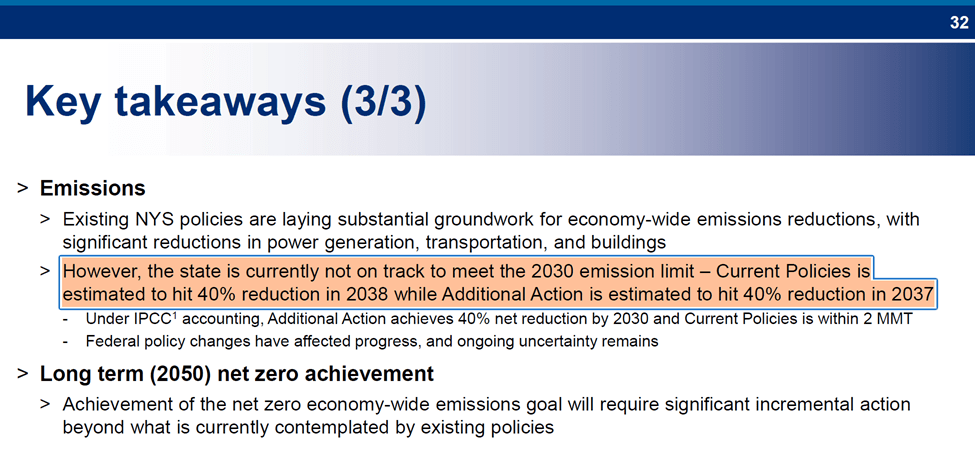
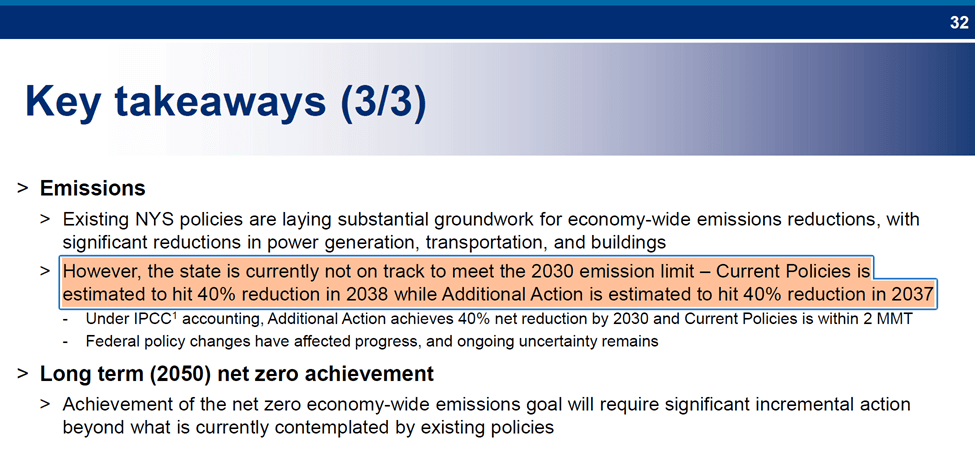
I summarized my initial thoughts about the Pathways Analysis presentation at the December SEP Planning Board meeting.  The presentation found that neither the CLCPA 40% GHG emission reduction target nor the electric system 70% renewable energy mandate would be achieved on time.  The “Key Takeaways (3/3)” Slide (#31) in the meeting presentation states that “the state is currently not on track to meet the 2030 emission limit – Current Policies is estimated to hit 40% reduction in 2038 while Additional Action is estimated to hit 40% reduction in 2037.” 

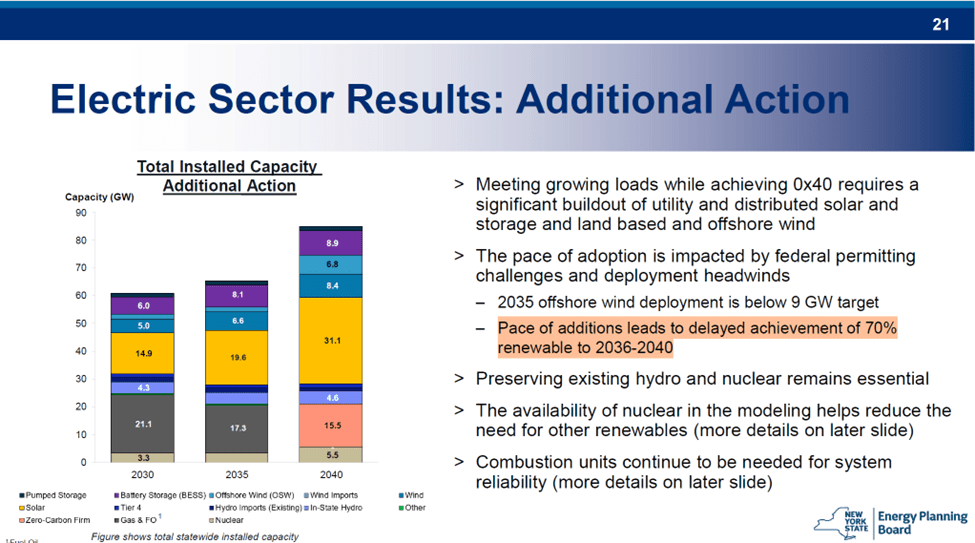
The Electric Sector Results: Additional Action slide (#21) states that “Pace of additions leads to delayed achievement of 70% renewable to 2036-2040”.

Discussion

The Court Decision and the Energy Plan findings are not the only reasons given by state agencies that it would be appropriate to reconsider the Climate Act.  I described three other findings in an article last month. The New York State Comptroller Office audit of the NYSERDA and PSC  implementation efforts for the Climate Act was an early acknowledgement that the implementation plan needs to be revised.  The Public Service Commission (PSC) compared the renewable energy deployment progress relative to the Climate Act goal to obtain 70% of New York’s electricity from renewable sources by 2030. The final Clean Energy Standard Biennial Review Report document found that 2030 goal will likely not be achieved until 2033.  Finally, The Second Informational Report prepared by Department of Public Service (DPS) staff described four feasibility concerns: the 2030 renewable energy target is “likely unattainable”, offshore wind faces major obstacles, transmission remains a “critical bottleneck”, and grid reliability challenges are mounting

There have been other recent articles arguing that New York has impossible targets.  David Wojick recently published an article explaining implementation issues that I backed up with observed data.  Tom Shepstone describes a New York Post editorial that cites a Progressive Policy Institute article that calls the Climate Act an “undeniable” failure.

These findings should inspire the Hochul Administration to amend the  Climate Act.  It is troubling that the SEP Board meeting presentations did not mention these ramifications in the presentation.  Furthermore, there has been no sign that the Hochul Administration or the majority leadership in the Legislature are amenable to considering amendments to the Climate Act.

Conclusion

I was motivated to publish this and distribute it to the media because these findings have significant implications for the future New York energy system.  In the near term, something must be done to reconcile the reality that the CLCPA schedule is too ambitious to have any hope of compliance.  More importantly, the findings described should become the basis for a discussion of more New Yorkers.  As it stands now New York energy policy is being guided by a small but extremely vocal and motivated constituency that does not understand the physics of the energy system.  Thomas Sowell has been quoted as saying: “It is hard to imagine a more stupid or more dangerous way of making decisions than by putting those decisions in the hands of people who pay no price for being wrong”.  In this instance, there is nothing more stupid or dangerous than ignoring the people who will pay the price if there are problems with the energy system.

Energy Affordability at Energy Planning Board Meeting on 12/1/2025

On December 6, 2025, I published an article describing my initial thoughts about the State Energy Planning Board (SEP) meeting on December 1 that discussed updated Pathways modeling for the State Energy Plan.  This post describes the presentations at the meeting that covered energy affordability.  I will cover the health benefits and employment analysis in another post.

I am convinced that implementation of the New York Climate Leadership & Community Protection Act (Climate Act or CLCPA) net-zero mandates will do more harm than good if the future electric system relies only on wind, solar, and energy storage because of reliability and affordability risks.  I have followed the Climate Act since it was first proposed, submitted comments on the Climate Act implementation plan, and have written over 600 articles about New York’s net-zero transition.  The opinions expressed in this article do not reflect the position of any of my previous employers or any other organization I have been associated with, these comments are mine alone.

Energy Plan Overview

According to the New York State Energy Plan website (Accessed 3/16/25):

The State Energy Plan is a comprehensive roadmap to build a clean, resilient, and affordable energy system for all New Yorkers. The Plan provides broad program and policy development direction to guide energy-related decision-making in the public and private sectors within New York State.

The New York State Energy Research & Development Authority (NYSERDA) prepared the Draft Energy Plan last summer.  Stakeholder comments were accepted until early October.  The Energy Planning Board has the responsibility to approve the document. At the November 13, 2025 Board meeting there was a perfunctory description of the comments received.  During the wrap up for this meeting Chair Doreen Harris said the Board will meet later this month to approve the plan before the end of the year. I have provided background information and a list of previous articles on my Energy Plan page

Meeting Overview

There were three items on the agenda: approval of last meeting minutes, discuss analyses conducted for the Energy Plan, and consider any new business.  The recording of the meeting available here included a transcript.  I created an edited transcript for the Pathways Analysis presentation and a separate transcript for the energy affordability, health benefits, and employment presentations. These annotated versions include tables and headings.

In this meeting NYSERDA described the updated Pathways Analysis—the modeling exercise that underpins New York’s triennial State Energy Plan. In my opinion, the entire Energy Planning Board process is political theater.  The members of the Board were chosen mostly for political reasons and not technical expertise.  Everyone involved is going through the motions. 

My last post explained that the updated Pathways Analysis described in the first part of this meeting found that the 2030 Climate Act goals will not be achieved on time.  The aspirational schedule of the Climate Act was never realistic, and these results are simply acknowledgement of that fact.  The topics featured in the remaining sessions support the positive spin narrative that the Hochul administration is trying to convey to the public to save some face regarding Climate Act implementation.  This post will highlight key points of the narrative.  I want to emphasize that this narrative is based mostly on political messaging, so it is appropriate to assume that every NYSERDA point has been approved by the Hochul Administration.

Energy Affordability

James Wilcox presented the Household Energy Affordability Analysis Update. He said that NYSERDA “reviewed key analysis structure and assumptions based on stakeholder feedback and new data availability”.  The claim regarding review of stakeholder feedback is the first narrative speaking point.  There will be a subsequent post detailing how New York State agency claim that all stakeholder feedback was considered is unsupported by evidence.  While there are indications that some feedback from outside NYSERDA was incorporated in the updated analyses, later I will detail instances where comments inconsistent with the intended story line were ignored.

Wilcox summarized the updates:

  • For Base Case, moved to an electric and gas price forecast based on the trend of total bills from bill history
  • Added a higher energy price growth sensitivity based on the trend of total bills from recent bill history combined with recent DPS/utility projections
  • Although numbers have shifted, key takeaways remain the same
  • Net result from changes is a higher growth rate for electricity and gas rates

The affordability messaging has been consistent.  NYSERDA acknowledges that there are energy affordability challenges.  The Climate Act embeds environmental justice principles throughout its implementation framework, so descriptions include low- and moderate- income household impacts that are consistent with this narrative talking point,  Unsurprisingly, those households are “more likely to experience energy affordability challenges”.

The following energy affordability analysis slide explains that for eleven household profiles, NYSERDA evaluated future household and transportation energy expenditures for four cases involving different technology mixes and fuel types.  These “Illustrative Household Journeys” include:

  • Starting Point: Fossil fueled heating and transportation with average existing equipment
  • Conventional Replacement: Fossil fueled heating and transportation with new, more efficient equipment
  • Moderate Efficient Electrification: Some electrification of heating and transportation, with basic building envelope efficiency measures
  • High Efficient Electrification: More electrification of heating and transportation, with basic or medium building envelope efficiency measures, and efficient electric appliances

Slides were presented that describe the four journeys for several profiles.   The following example describes monthly expenditures for a typical Upstate moderate-income household that uses natural gas for heat.  Relative to the current starting point all three projected “household journeys” reduce monthly energy expenditures.  However, buried at the bottom of the page is the notation that these values are “Average monthly expenditures. Does not include equipment costs”. 

It turns out that including equipment costs makes a difference as shown in the next slide.

The Hochul/NYSERDA story is that monthly energy expenditures will go down when investments in moderate electrification or high efficiency electrification necessary for Climate Act compliance are made.  The public release sound bite press releases will emphasize that point and barely acknowledge that the costs that include the capital expenses (CapEx) for the equipment costs tell a different story.  I summarized all this information in Table 1.  The first four rows list the monthly energy expenditures with the total in the fifth line.  The CapEx monthly total cost is listed but the breakdown between the costs of a new plugin hybrid electric vehicle (moderate electrification) and a battery electric vehicle (high efficiency electrification) relative to home energy electrification is not provided.  I estimated the percentage of home electrification from the bars in the previous figure.  When those CapEx costs are included all the projected alternative journeys are more expensive.  Note that the difference between replacement of conventional equipment and the highly efficient electrification equipment necessary for Climate Act compliance increases monthly average energy expenditures $593, a whopping 43% increase in energy costs.  That is the cost of Climate Act compliance.

Table 1: Upstate New York Moderate Income Household That Uses Natural Gas for Heat Projected Monthly Costs and Costs Necessary to Comply with the Climate Act

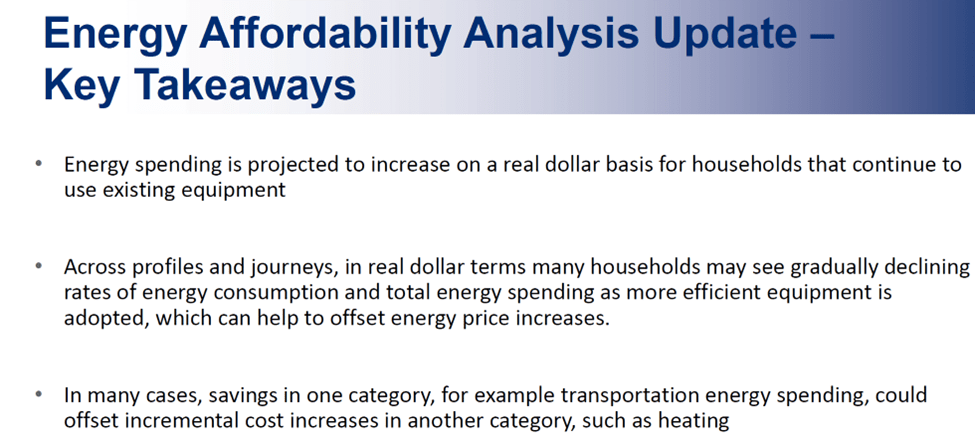
The following key takeaways slide summarizes the messages that NYSERDA and Hochul want the Energy Planning Board and public to accept.  The first statement suggests that if households continue to use existing equipment that energy spending will increase.  But households “see gradually declining rates of energy consumption and total energy spending as more efficient equipment is adopted” then that “can help to offset energy price increases”.  That advocates going forward despite a tacit acknowledgement that it may not save money, just reduce the increase.  The final takeaway points out that according to their numbers transportation energy spending could offset incremental cost increases for home heating.  I cannot overemphasize enough that results from this kind of modeling are completely dependent upon input assumptions.  That means that the modelers can get any answer they want.  It is therefore very telling that these takeaways cannot avoid the conclusion that the transition will incur significant costs. The modelers could not completely avoid reality.

Ultimately, the question is how much will all this cost. During his presentation Wilcox stated: “What we can take away is that the net costs for efficient electrification journeys could be 35% to 40% higher than conventional replacement when accounting for equipment, reinforcing the importance of action to address upfront equipment costs so that households are able to access the benefits of these systems.”   NYSERDA is left hoping that there will be a magical solution that will reduce upfront costs so that the projections might be palatable.

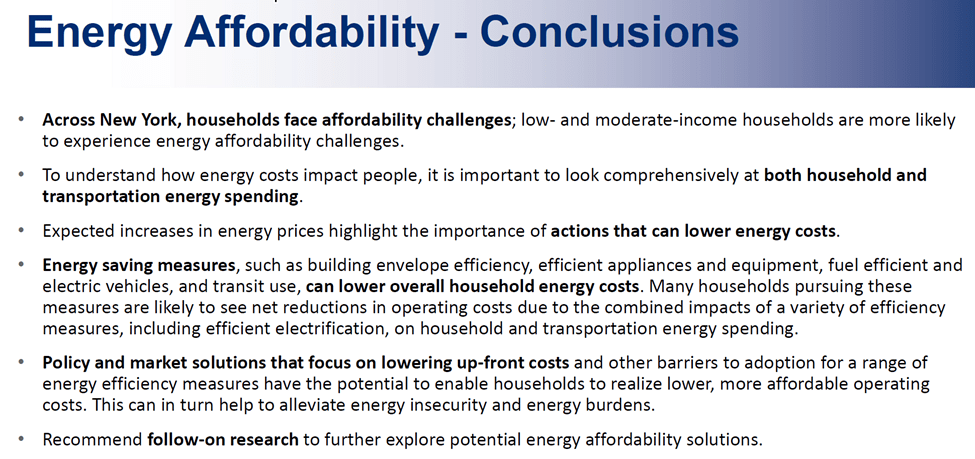
The conclusions sums up the energy affordability messaging.  There is an energy affordability problem that impacts low- and moderate-income households more with the implication that focus on those households will improve the situation.  Energy costs impact both household and transportation spending.  This needs to be emphasized because NYSERDA cannot claim monthly energy benefits for many household profiles if transportation costs are not included.  Wilcox concludes the obvious point that “expected increases in energy prices highlight the importance of actions that can lower energy costs”.  In my opinion the point that doing nothing is the least impactful action is not acknowledged.  The importance of energy savings measures is highlighted.  However, I don’t think this will provide as many benefits as they do because this has been emphasized for decades so the simple fixes and obvious solutions have already been implemented.  It is easy to say that “Policy and market solutions that focus on lowering up-front costs” may make this more affordable, but no suggestions how that can be done or why anyone would expect that this may happen are offered.  Finally, there is the recommendation of all analysts that have no clue how to get the preferred answer to “do further research”.

Presentation Discussion Topics

The annotated transcript for this presentation includes a heading for questions made during the meeting with a link to each person who commented or asked a question. 

Chair Doreen Harris asked about the differences between Upstate and Downstate.  Wilcox explained that there are climatic differences, transportation patterns are different, and the predominant type of housing is different.  Harris followed up stating:

I think that’s important because that’s one of the reasons why we had to produce so many variations, right? Like, it reflects the diversity of our state in a way that means that the answer isn’t the same for everyone, depending on their own experience and the way they live.

Because I believe that this presentation was scripted to further the messaging of the Administration, I think it is telling that she wanted to emphasize impacts are not the same for everyone.  I am not sure why, however. 

The rationale for her second question about what happens if households do not upgrade is obvious.  The projections show that all replacement scenarios doubles costs so doing nothing is an attractive option.  Not only is that a great argument against an implementation schedule, but it establishes a significant public acceptance hurdle.  Wilcox admitted that the key driver of change over the next five years is “change in energy price”.  The modeling shows that this will increase household energy spending 3% to 8% in the starting point base case but could go up to as much as 14% to 19% even if they do nothing. 

The questions and answers went on:

Harris: “And then, James, maybe to kind of take those percentages in context, was it in that higher price sensitivity, a household that did nothing could see as much as one hundred dollars a month increased costs. Is that about right?

Wilcox: “Yeah. That’s correct.”

Harris: “So there’s a substantial increase with these energy prices for folks who don’t take any action. Thank you. That is what I was trying to elicit: What does doing nothing get you?

To summarize, the Chair of the Energy Planning Board was trying to elicit a specific point from her staff that there will be a substantial increase in energy prices even if people don’t take any action.  Her staff person Wilcox could have destroyed his career if he had pointed out that the minimum increase in any of the scenarios that replaced household and transportation equipment is 1.7 times greater than current costs which is far greater than the greatest impact of doing nothing which was 0.19 times greater.

After that the rest of the questions were a comedown.  There were suggestions that the new technologies might offer new opportunities that might somehow, someway, mitigate the cold equations that show this is unaffordable.  There was also a suggestion made that all would work out if New Yorkers used public transit.

Discussion

Presumably the Attorney General Office supplemental letter  that argued that promulgating regulations for the Climate Act target would cause “undue harm” used in the New York Supreme Court litigation was developed with the assistance of NYSERDA.  That letter claimed that the Climate Act mandates are infeasible due to excessive costs that are “unaffordable for consumers”.  All these numbers confirm that there are affordability issues.

This finding sums up Climate Act affordability.  For a moderate-income household in Upstate New York that uses natural gas the difference between replacement of conventional equipment and the highly efficient electrification equipment necessary for Climate Act compliance increases monthly average energy expenditures $593, a whopping 43% increase in energy costs. 

There are ten other household profiles.  The presentation did not provide sufficient information for a similar assessment of any of those other profiles.  The State Energy Plan document web page does not list any updates to the draft materials from last summer so I am not able to develop an overview of all the household profile results.  Also note that the documentation does not provide backup to the graphs and tables presented in the Energy Plan reports so this is no small task.

Conclusion

Any argument that the Climate Act transition will not be extraordinarily expensive can be refuted by using the data included in this presentation.  Coupled with the Pathways Analysis presentation described previously that found that neither 2030 Climate Act target will be met before 2036, the only appropriate course of action is to reconsider the Climate Act.  Given that it will require accountability by the politicians who got New York into this mess I am not optimistic.

Initial Thoughts on Energy Planning Board Meeting on 1 December 2025

Note: Updated on 12/10/2025 to add a slide 32 from the presentation

On November 13 I published an article describing my initial thoughts about the State Energy Planning Board meeting that day that discussed public comments on the Draft State Energy Plan document.  I had intended to follow up with another post providing more detail, but other projects got in the way.  This post describes the latest meeting held on December 1.

I am convinced that implementation of the New York Climate Leadership & Community Protection Act (Climate Act or CLCPA) net-zero mandates will do more harm than good if the future electric system relies only on wind, solar, and energy storage because of reliability and affordability risks.  I have followed the Climate Act since it was first proposed, submitted comments on the Climate Act implementation plan, and have written over 600 articles about New York’s net-zero transition.  The opinions expressed in this article do not reflect the position of any of my previous employers or any other organization I have been associated with, these comments are mine alone.

I acknowledge the use of Perplexity AI to generate summaries and references included in this document.  The focus of this article is how the results of the Pathways Analysis relate to Climate Act goals.  Note that I went so far as to request that the response be written up.

Energy Plan Overview

According to the New York State Energy Plan website (Accessed 3/16/25):

The State Energy Plan is a comprehensive roadmap to build a clean, resilient, and affordable energy system for all New Yorkers. The Plan provides broad program and policy development direction to guide energy-related decision-making in the public and private sectors within New York State.

I have provided background information and a list of previous articles on my Energy Plan page

Meeting Overview

There were three items on the agenda: approval of last meeting minutes, discuss analyses conducted for the Energy Plan, and consider any new business.  The recording of the meeting available here included a transcript.  I created an edited transcript that has headings and includes the slides.

The New York State Energy Research & Development Authority (NYSERDA) prepared a Draft Energy Plan last summer.  Stakeholder comments were accepted until early October.  At the last Energy Planning Board meeting there was a perfunctory description of the comments received.  In this meeting NYSERDA described the updated Pathways Analysis—the modeling exercise that underpins New York’s triennial State Energy Plan.

Implementation Timing

Under New York’s own Climate Act accounting framework—the methodology that matters for compliance—no scenario modeled by NYSERDA hits the 40% economy-wide GHG reduction target by 2030. Not the “current policies” case. Not the “additional action” case. None of them.  Instead, the core planning cases achieve the 40% GHG emission reduction by 2030 mandate in roughly 2037–2038, a full 7–8 years later than the statute requires.  The 70% renewable electricity target by 2030 is also behind schedule.  Offshore wind permitting delays push that into the 2036–2040 window.

This is not a surprise to anyone closely tracking federal policy and state implementation. However, this is the first time that it is not necessary to read between the lines of the NYSERDA presentations.  NYSERDA laid it out in black-and-white.  The State is no longer pretending the Climate Act is on schedule.

Federal Rollbacks and Deployment Headwinds

The updated modeling incorporates two major factors that were not included in the draft plan.

The draft plan was counting on extensive Federal support but there have been policy changes. The modeling breaks this down by sector:

  • Across the electric sector: $25 billion in lost investment tax credit (ITC) and production tax credit (PTC) for renewables and related credits.
  • Buildings: ~$1.5 billion in lost heat pump and efficiency incentives by 2040.
  • Transportation: ~$4.5 billion in lost EV incentives, plus higher long-term fuel costs if the Advanced Clean Car and Advanced Clean Truck programs are also repealed.
  • Offshore wind deployment delays. Federal permitting obstruction and supply-chain headwinds are slowing the pace of offshore wind additions.
  • Offshore wind deployment delays. Federal permitting obstruction and supply-chain headwinds are slowing the pace of offshore wind additions. The 2035 offshore wind capacity in the modeling is below the 9 GW target, which cascades into delays across the entire renewable timeline.

The second factor is that issues with siting constraints are slowing the physical deployment of wind and solar deployment relative to the unrealistic presumptions in the Draft plan.  Offshore wind deployment delays because of changes in Federal permitting and supply-chain issues are slowing the pace of offshore wind additions. The 2035 offshore wind capacity in the modeling is below the 9 GW target, which cascades into delays across the entire renewable timeline.

Policy Implications

The Perplexity AI summary listed six takeaways.

  1. NYSERDA plainly states that the 2030 targets cannot be met using the Climate Act’s accounting as shown on the Key Takeaways (3/3) Slide 32 shown below.. However, the presentation just described this analysis result and not the implication that this means that the Climate Act must be amended to shift the schedule.
  • The building sector urgently need more aggressive policy actions to achieve Climate Act goals. The gap between current-policy building decarbonization and a net-zero-consistent path is large, and it’s growing. Stronger codes, more financing, larger direct-install programs, and targeted support for renters and low-income owners are all needed.
  • The transition of the gas system requires active management and investment. This isn’t a “let the market sort it out” situation. Utilities, the PSC, and the state need coordinated strategies for how gas infrastructure evolves over time—including decisions about when and where to invest in network modernization versus when to accelerate targeted electrification.
  • The presentation noted the importance of Dispatchable Emissions Free Resources (DEFR).  I disagree with the optionality adjective, however. There is nothing optional about the need for these new and unproven resources.  The description of green hydrogen illustrates why it won’t solve the problem. The presentation argues the state should be actively exploring, piloting, and supporting a portfolio of zero-carbon dispatchable technologies. RNG, long-duration storage, ammonia, and others all deserve serious development support.
  • Federal policy is now a binding constraint. New York can optimize its own policies, but it cannot outrun federal rollbacks. The state’s energy strategy increasingly needs to figure out how to replace Federal funding, procure projects to lock in tax credits before phase-outs, and re-structure policy design that works even if federal support evaporates.
  • Nuclear is back in the conversation, and that’s not a bad thing. The modeling shows that nuclear power, where available and deployable, reduces system costs and relieves pressure on renewables and DEFR. The presentation argues that the state should pursue the NYPA project, explore other Small Modular Reactor and advanced reactor opportunities, and think carefully about lifecycle extension of existing assets.

Stakeholder Comments

I am extremely disappointed with the stakeholder process.  In my comments at the first virtual public hearing and a subsequent written comment I explained that the lack of documentation on the disposition of stakeholder comments undermined the credibility of the process and the opportunity to improve the Energy Plan.  The only acknowledgment of the comments received is a promise that “all comments will be posted on the State Energy Plan website as soon as practicable”.  It has been two months since that promise was posted and the comments still are not posted.

This matters because the presentation at this meeting claimed the Pathways Analysis finds that the additional-action case generates net societal benefits of about $18 billion by 2040, with roughly $19 billion in aggregate net-present-value benefits through 2040, when carbon and health benefits are factored in.  However, in my unacknowledged comments I pointed out that the cost accounting in the Pathways Analysis “No Action” scenario only includes costs associated with the Climate Act law, not the cost to meet the Climate Act targets.  The misleading “No Action” scenario is not a baseline that excludes all programs necessary to achieve the Climate Act targets because it includes legacy programs in place prior to the Climate Act.  Furthermore, in other comments I identified issues that reduced the alleged benefits.  If costs and benefits were properly addressed, then I suspect that there would not be net societal benefits.

Discussion

I recently described the Oct. 24, 2025 New York Supreme Court decision and order in a case pitting environmental organizations against the New York State Department of Environmental Conservation (DEC).  The judge ordered DEC to issue final regulations establishing economy-wide greenhouse gas emission (GHG) limits on or before Feb. 6, 2026 or go to the Legislature and get the Climate Act 2030 GHG reduction mandate changed. Importantly, during the trial , the Attorney General Office submitted a supplemental letter  that argued that promulgating regulations for the Climate Act target would cause “undue harm” because the Climate Act mandates are infeasible due to excessive costs that are “unaffordable for consumers” to bear.  Subsequently, DEC appealed the decision which postpones resolution of the problem.

The rationale for the Judge’s decision coupled with the acknowledgement that the costs are unaffordable and the updated Pathways Analysis finding that the 2030 targets cannot be met using the Climate Act’s accounting methodology should mean that the Climate Act itself needs to be amended.  This important finding was not mentioned in the presentation.  Furthermore, there has been no sign that the Hochul Administration or the majority leadership in the Legislature are amenable to considering amendments to the Climate Act.

There is another aspect to this.  The Climate Act is not the only law that includes the mandates for the net-zero transition.  New York Public Service Law § 66 “Establishment of a renewable energy program” describes energy systems that are prohibit some of the findings in the updated Pathways Analysis.  It appears to me that this legislation also needs to be amended.

I will follow up with another post on this meeting because there are more issues that I did not address.

Conclusion

Reality bats last.  The findings of the updated Pathways Analysis reflect that fact.  The aspirational schedule of the Climate Act was never realistic, and these results are simply acknowledgement of that fact.  It remains to be seen how the identified problems and the implicit feasibility concerns described will be addressed.  Given that it will require accountability by the politicians who got New York into this mess I am not optimistic.

Initial Thoughts on Energy Planning Board Meeting on 13 November 2025

Yesterday I published a post that described my thoughts about today’s State Energy Planning Board meeting that discussed public comments on the Draft State Energy Plan document.  This post describes my  initial thoughts about the meeting and compares my predictions for the outcome. 

I am convinced that implementation of the New York Climate Leadership & Community Protection Act (Climate Act or CLCPA) net-zero mandates will do more harm than good if the future electric system relies only on wind, solar, and energy storage because of reliability and affordability risks.  I have followed the Climate Act since it was first proposed, submitted comments on the Climate Act implementation plan, and have written nearly 600 articles about New York’s net-zero transition.  The opinions expressed in this article do not reflect the position of any of my previous employers or any other organization I have been associated with, these comments are mine alone.

Energy Plan Overview

According to the New York State Energy Plan website (Accessed 3/16/25):

The State Energy Plan is a comprehensive roadmap to build a clean, resilient, and affordable energy system for all New Yorkers. The Plan provides broad program and policy development direction to guide energy-related decision-making in the public and private sectors within New York State.

I have provided background information and a list of previous articles on my Energy Plan page

Meeting Overview

There were three items on the agenda: approval of last meeting minutes, discuss public comments on the Draft Energy Plan, and consider any new business. As has been the case for previous meetings Chair Doreen Harris added an Update on the status of the net-zero transition.

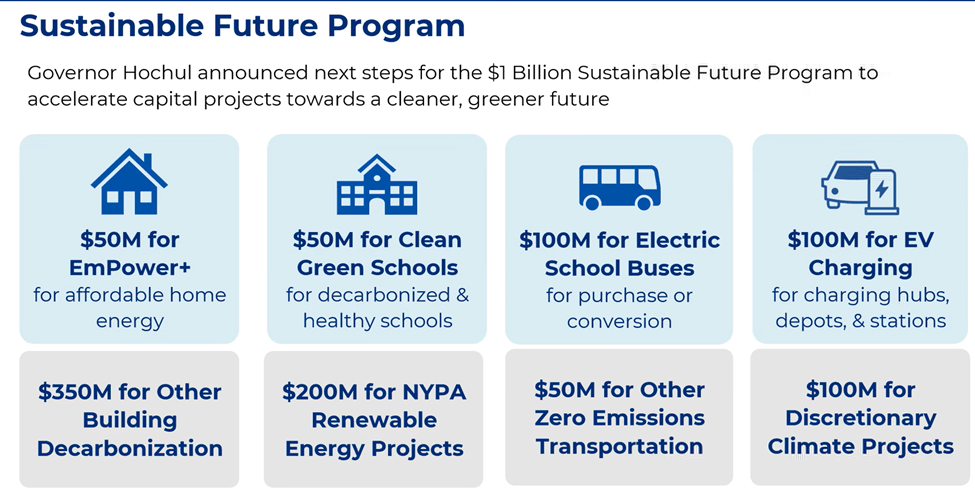
The highlight of the update discussion was not what was mentioned but what was not mentioned.  I did not make a copy of the first slide that included impacts of Federal rollbacks on New York’s clean energy industry where it was mentioned that “reporting has estimated that more than 6,200 jobs and $2.5B in investments have been lost or delayed in 2025 due to the Trump administration’s energy policies.”  Harris put in a plug for Governor Hochul’s $1 billion Sustainable Future Program. The following slide shows where the money is allocated.

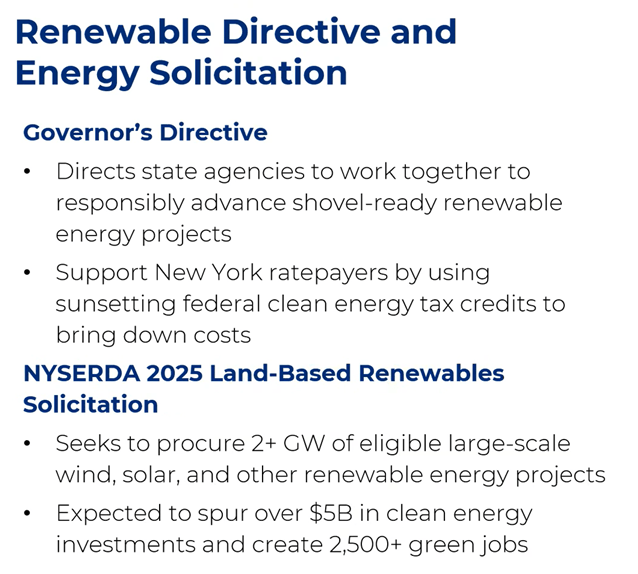
Harris described the renewable directive and energy solicitation.

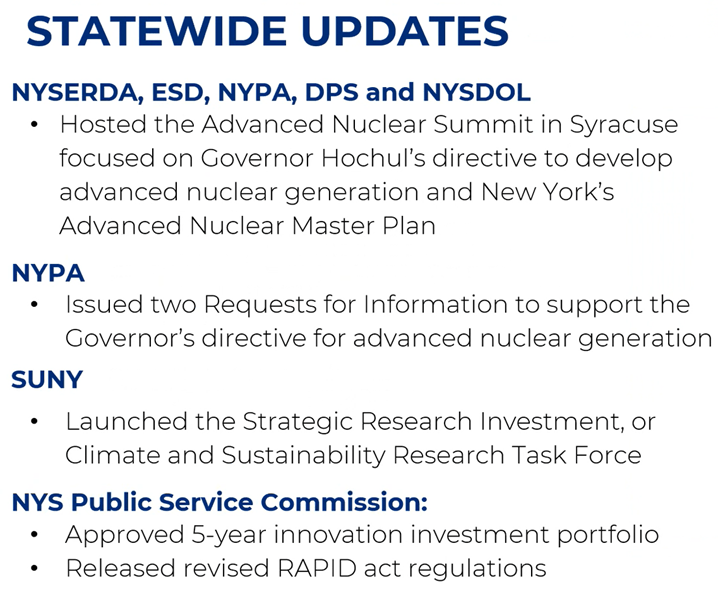
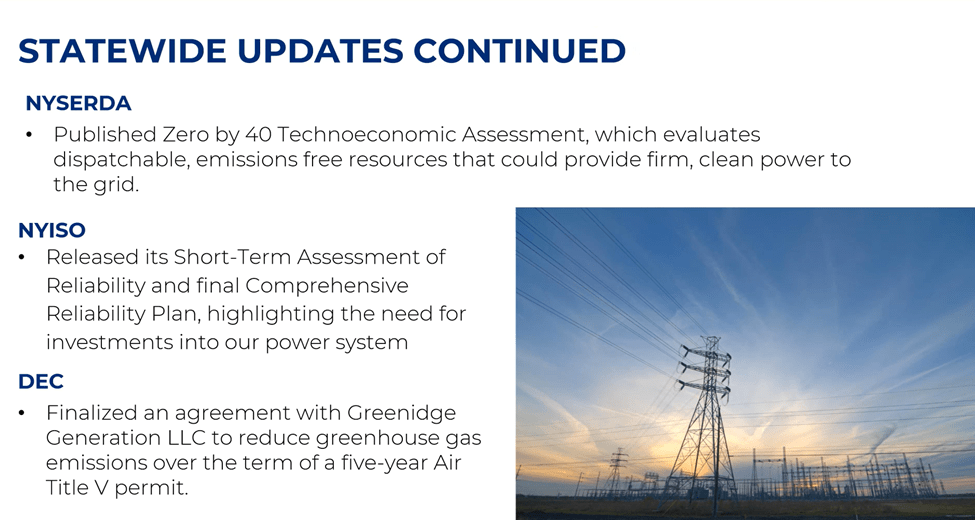
Harris also mentioned that the New York State Department of Environmental Conservation (DEC) approved required permits for the proposed Northeast Supply Enhancement (NESE) pipeline project, that the Constitution pipeline application was withdrawn, and that the air permit for the Greenidge crypto mining facility had been approved.  There also were a couple of slides for statewide updates. 

That covers what was mentioned in the Update.  Conspicuous by its absence, there was no mention of the Supreme Court decision described in yesterday’s post.  On Oct. 24, 2025,  New York Albany Supreme Court issued a decision in a case brought by environmental organizations that sued the New York State Department of Environmental Conservation (DEC).  The judge ordered DEC to issue final regulations establishing economy-wide greenhouse gas emission (GHG) limits on or before Feb. 6, 2026 or go to the Legislature and get the Climate Act 2030 GHG reduction mandate changed.  Importantly, the Attorney General Office supplemental letter submitted during the trial stated that the Climate Act target would cause “undue harm”:

Petitioners have not shown a plausible scenario where the 2030 greenhouse gas reduction goal can be achieved without inflicting unanticipated and undue harm on New York consumers, and the concrete analysis in the 2025 Draft Energy Plan dispels any uncertainty on the topic: New Yorkers will face alarming financial consequences if speed is given preference over sustainability.

In my opinion, the fact that the Attorney General said this is unaffordable and the Judge said they need to consider changing the law is important information relative to the Energy Plan so it was inappropriate to exclude this as part of the update. 

Public Comment Discussions

My previous article highlighted four issues that I thought should be addressed in the discussion of the public comments.  Unfortunately, the presentations gave no indication whatsoever that individual comments would be addressed.  I will follow up with another post that describes the presentation specifics.  For this post I will only describe my initial impression relative to issues raised yesterday.

In my first oral comments I stated that unless the process includes stakeholder meetings that give the public to ask clarifying questions and there is a commitment to document the response to all comments submitted, the stakeholder process will have no credibility.  The fact that people asked for more meetings was mentioned during the meeting but no reason that they did not hold them was given.  My suggestions for changes to make the comment process credible were ignored.

The New York Independent System Operator (NYISO) comments included recommendations that are sure to infuriate proponents of the Climate Act. They say that we are not ready to retire existing fossil-fired generating plants, the necessary resources to replace them will not be ready any time soon so we need to build new fossil-fired units, and maintaining existing nuclear facilities is necessary.  I was very disappointed that the discussion of comments was just an overview and that the impression given was that the greater number of comments supporting a particular position the greater the value of the comment.  NYISO had some unique opinions and there was no acknowledgement of their positions relative to others on things like the need to keep fossil fired infrastructure in place.

I submitted comments that described significant problems with the Health Benefits Analysis chapter including over-simplification of the air quality analysis used to predict health impacts, failure to correctly verify the new model used,  claiming health benefits when there is no observed relationship between annual average PM2.5 and emergency room visits related to asthma, and suggesting significant benefits when the effects are much less than the observed inter-annual variation. Another characteristic of the NYSERDA description of comments was that there was no indication that any of the numbers in the Draft Plan or Pathways Analysis were incorrect anywhere.  The Energy Planning Board can only assume that the NYSERDA work is infallible and above reproach.

I also submitted comments that described why New York is not ready to eliminate the use of natural gas.  I addressed natural gas use for transportation, unacknowledged advantages for natural gas used for electric generation, arbitrary permitting decisions that have blocked necessary infrastructure projects, and the use at peaking power plants that provide critical reliability support.  As I will show in a subsequent post, this topic was popular.  The following slide exemplifies the briefing approach as it only shows themes of the comments.  There is nothing explicit in this to suggest a link to my concerns. I want to make the point that I never heard the word feasibility in any of the presentations.  NYISO says you need natural gas but “others urge leaning further into renewables, energy storage, electrification, and/or the efficient use of energy to reduce reliance on fossil fuels.  How will this contradiction get resolved?

Discussion

When the meeting materials are released, I will follow up with more observations on the comments.  However, it is probably a waste of time because this process is not credible.  While there are some indications that reality is dawning on the Hochul Administration, these presentations show that NYSERDA, undoubtedly at the behest of the Administration, is using the Energy Plan process to fulfill an obligation and further their energy agenda.  Unfortunately for the Governor there is a loud faction of her party that demand doubling down on renewable energy resources at the same time reality is showing that simply will not work.  This tradeoff colors everything related to energy policy.  It appears that the Administration is going to try to placate both sides by not taking public positions on controversial issues.

All signs are that NYSERDA did not use the Energy Plan as an opportunity to consider the implications of the observed transition and improve the transition going forward.  There is no indication that there will be any attempt to meaningfully engage with stakeholders and address feasibility.

Conclusion

The Energy Plan should be based on energy and physical reality.  Unfortunately, there are clean energy ideologues who cannot accept that their presumptions are indefensible relative to those standards.  Sooner or later this conflict must be resolved, and it will cause political fallout for the Governor.  Holding the safety of the citizens of New York hostage for political gain will not end well.

Predictions for 13 November 2025 Energy Planning Board Meeting

On July 23, 2025, the Draft Energy Plan was released for comment and comments were due on October 6, 2025.  On November 13 the State Energy Planning Board will meet to discuss public comments on the Draft document.  I predict that the New York State Energy Research & Development Authority (NYSERDA) will avoid specifics and only describe the comments received in general terms.  I have no expectations that NYSERDA will provide a summary of comments received or document how comments submitted were treated.  The Draft Energy Plan also has addressed affordability, but it is not clear how that will be treated going forward.  I will publish a summary soon after the meeting to verify my prediction.

I am convinced that implementation of the New York Climate Leadership & Community Protection Act (Climate Act or CLCPA) net-zero mandates will do more harm than good if the future electric system relies only on wind, solar, and energy storage because of reliability and affordability risks.  I have followed the Climate Act since it was first proposed, submitted comments on the Climate Act implementation plan, and have written nearly 600 articles about New York’s net-zero transition.  The opinions expressed in this article do not reflect the position of any of my previous employers or any other organization I have been associated with, these comments are mine alone.

Energy Plan Overview

According to the New York State Energy Plan website (Accessed 3/16/25):

The State Energy Plan is a comprehensive roadmap to build a clean, resilient, and affordable energy system for all New Yorkers. The Plan provides broad program and policy development direction to guide energy-related decision-making in the public and private sectors within New York State.

I have provided background information and a list of previous articles on my Energy Plan page.  While there are some indications that reality is dawning on the Hochul Administration, the process has not given me a lot of confidence that those concerns will be addressed sufficiently. My biggest concerns are whether the Hochul Administration will use the Energy Plan process as an opportunity to consider the implications of the observed transition so far and if the advice of stakeholders in its stakeholder process will be treated as an opportunity to improve the transition or an obligation with no attempt to meaningfully engage with any comments inconsistent with the narrative.

Supreme Court Decision

There is another interesting angle to this meeting.  I recently described the Oct. 24, 2025,  New York Albany Supreme Court decision as a fork in the road.  Multiple environmental organizations sued the New York State Department of Environmental Conservation (DEC).  The judge ordered DEC to issue final regulations establishing economy-wide greenhouse gas emission (GHG) limits on or before Feb. 6, 2026 or go to the Legislature and get the Climate Act 2030 GHG reduction mandate changed.  There has been no indication yet how this will be addressed.

This is relevant to the resolution of the Draft Energy Plan because during the legal process the State submitted a letter  that addressed “two categories of new developments: (1) the publication of the 2025 Draft New York State Energy Plan by the New York State Energy Planning Board on July 23, 2025 and (2) additional actions by the federal government that impede New York’s efforts to achieve the Climate Act.  The letter argued that it was inappropriate to implement regulations that would ensure compliance with the 2030 40% reduction in GHG emissions Climate Act mandate because meeting the target is “currently infeasible”. 

Ordering achievement of the 2030 target would equate to even higher costs than the net zero scenarios and would affect consumers even sooner. Undoubtedly, greenhouse-gas reducing policies can lead to longer-term benefits such as health improvements. This does not, however, offset the insurmountable upfront costs that New Yorkers would face if DEC were forced to try to achieve the Legislature’s aspirational emissions reductions by the 2030 deadline rather than proceeding at an ambitious but sustainable pace.

The letter concluded that the Climate Act is unaffordable:

Petitioners have not shown a plausible scenario where the 2030 greenhouse gas reduction goal can be achieved without inflicting unanticipated and undue harm on New York consumers, and the concrete analysis in the 2025 Draft Energy Plan dispels any uncertainty on the topic: New Yorkers will face alarming financial consequences if speed is given preference over sustainability.

The biggest question for the State Energy Planning Board discuss of the resolution of the Draft Energy Plan is how this acknowledged affordability issue will be addressed.

Resolution of My Comments

My Energy Plan page lists 6 articles describing the Pathways Analysis that provided quantitative information for the Draft Energy Plan and 18 more articles about comments on the Plan.  Here are some highlights that I will be watching for

The New York Independent System Operator (NYISO) comments included recommendations that are sure to infuriate proponents of the Climate Act. They say that we are not ready to retire existing fossil-fired generating plants, the necessary resources to replace them will not be ready any time soon so we need to build new fossil-fired units, and maintaining existing nuclear facilities is necessary.  Will these reality-based comments be incorporated in the Final Energy Plan?

I submitted comments that described significant problems with the Health Benefits Analysis chapter including over-simplification of the air quality analysis used to predict health impacts, failure to correctly verify the new model used,  claiming health benefits when there is no observed relationship between annual average PM2.5 and emergency room visits related to asthma, and suggesting significant benefits when the effects are much less than the observed inter-annual variation. This makes the Draft plan claims of benefits invalid.  Will the final energy plan acknowledge this?  

I also submitted comments that described why New York is not ready to eliminate the use of natural gas.  I addressed natural gas use for transportation, unacknowledged advantages for natural gas used for electric generation, arbitrary permitting decisions that have blocked necessary infrastructure projects, and the use at peaking power plants that provide critical reliability support.  Will NYSERDA support natural gas use?

In my first oral comments I stated that unless the process includes stakeholder meetings that give the public to ask clarifying questions and there is a commitment to document the response to all comments submitted, the stakeholder process will have no credibility.  NYSERDA never held a stakeholder meeting, and I doubt that the comment responses will be documented.

Discussion

This will be interesting.  Despite my pessimism that NYSERDA will meaningfully respond to all stakeholder input, the meeting’s discussion of affordability relative to the position of the Attorney General’s supplemental letter will be fascinating.  I also wonder if they will acknowledge that something must be done relative to the judge’s decision.  In the best case, they will describe a path forward.

Stay tuned.

Renewable Reliability Risk Reasons to Pause

The implementation plans for the New York Climate Leadership & Community Protection Act (Climate Act) net zero transition relies on inverter-based resources like wind, solar, and energy storage.  This article highlights a couple of recent documents that describe the reliability challenges introduced by these resources.  These reports are another reason we need to pause implementation because I think they make an argument that these problems are unreconcilable.   

I am convinced that implementation of the Climate Act net-zero mandates will do more harm than good because the energy density of wind and solar energy is too low and the resource intermittency too variable to ever support a reliable electric system relying on those resources. I have followed the Climate Act since it was first proposed, submitted comments on the Climate Act implementation plan, and have written nearly 600 articles about New York’s net-zero transition.  The opinions expressed in this article do not reflect the position of any of my previous employers or any other organization I have been associated with, these comments are mine alone.

Inverter-Based Resources

I acknowledge the use of Perplexity AI to generate this summary of inverter-based resources (IBR).  The Perplexity description of issues notes:

While renewable energy sources such as wind, solar photovoltaic systems, and battery storage are essential for achieving sustainability goals, their fundamental differences from traditional synchronous generators create unprecedented challenges for grid stability and reliability. Unlike conventional power plants that rely on massive rotating machinery to provide inherent system support services, IBRs interface with the grid through power electronic converters that lack the natural physical characteristics essential for traditional grid stability mechanisms

I described a Watt-Logic article in September that gives an overview explanation of the “importance of voltage control and reactive power” that were the root cause of the Spanish blackout.  In short, the existing system depends upon synchronous generators that convert mechanical energy (spinning turbines) into electrical energy, producing alternating current that matches the frequency of the electric grid.  These generators inherently provide important electric grid functions that are difficult to replicate with inverter-based resources like wind, solar, and energy storage.  The problem is that not only do inverter-based resources not perform many of these functions, but they can also de-stabilize the grid in certain, poorly understood circumstances.

NYISO Draft Energy Plan Comments

I have written a couple of articles that described  comments submitted by the New York Independent System Operator (NYISO) on the New York Draft State Energy Plan.  One article summarized the NYISO comments and the other described their recommendations,  This article will highlight a couple of points made that were not covered in those two articles.

NYISO Technology Comments

The NYISO Comments on Emerging Technologies and Other Resource Development describes the resources needed:

The resources the electric system will require must include sufficient reliable, dispatchable, and dependable supply resources to maintain the level of service New Yorkers expect. The electric generation fleet must collectively maintain a balance of the attributes listed below:

  1. Zero-emission/carbon free (i.e., the qualification criteria for the Zero-Emissions by 2040 Target);
  2. Dependable Fuel Sources that allow these resources to be brought online when required and to operate based on system needs;
  3. Non-Energy Limited and capable of providing energy for multiple hours and days regardless of weather, storage, or fuel constraints;
  4. Dispatchable to follow instructions to increase or decrease output on a minute-to-minute basis;
  5. Quick-Start to come online within 15 minutes;
  6. Flexibility to be dispatched through a wide operating range with a low minimum output;
  7. Fast Ramping to increase or reduce energy injections based on changes to net load which may be driven by changes to load or intermittent generation output;
  8. Multiple starts so resources can be brought online or switched off multiple times through the day as required based on changes to the generation profile and load;
  9. Inertial Response and frequency control to maintain power system stability and arrest frequency decline post-fault;
  10. Dynamic Reactive Control to support grid voltage; and
  11. High Short Circuit Current contribution to ensure appropriate fault detection and clearance.

My concern is that these resources do not presently exist.  More importantly, there are no commercially available technologies for some of these resources and grid operators will eventually have to learn how to employ them to prevent blackouts caused by IBRs and intermittency of wind and solar resources.

NYISO Reliability Metrics

I want to highlight the NYISO recommendations for reliability metrics that were discussed in the Electricity Chapter of the Draft Plan:

Consider whether the current reliability-related metrics should be supplemented given the evolving nature of the grid and increased risks of high-impact reliability events. New York should consider whether the current reliability-related metrics (i.e. loss of load expectation) should be supplemented given the evolving nature of the grid and the increased risks of high-impact reliability events. Establishing criteria for metrics like expected unserved energy (EUE) may help supplement traditional LOLE-based criteria by providing information about risks of long-duration outages. As fuel availability will be incorporated into the NYISO’s capacity accreditation framework, additional consideration should be given to whether this adjustment to capacity accreditation provides sufficient incentives and compensation to resources for attributes needed to ensure energy adequacy and resilience to extreme weather events from both a planning and operational perspective (e.g. compensation for fuel storage capabilities).

This is important.  In my opinion, the biggest unresolved reliability risk associated with Climate Act implementation is addressed in Case 15-E-0302 – Proceeding on Motion of the Commission to Implement a Large-Scale Renewable Program and Clean Energy Standard.  Responsible New York agencies all agree that new Dispatchable Emissions-Free Resource (DEFR) technologies are needed to make a solar and wind-reliant electric energy system viable during extended periods of low wind and solar resource availability.  In early August I submitted a filing that I prepared with Richard Ellenbogen, Constatine Kontogiannis, and Francis Menton to New York Public Service Commission Case 22-M-0149 – Proceeding on Motion of the Commission Assessing implementation of and Compliance with the Requirements and Targets of the Climate Leadership and Community Protection.  Exhibit 4 – Resource Gap Characterization describes the challenges of defining the frequency, duration, and intensity of low wind and solar resource availability (known as dark doldrums) events.  I do not believe that policy makers understand the ramifications associated with a fundamental planning component of this resource – how much is needed.  The reliability metric for this question is unresolved.

Exhibit 4 describes the issues associated with the resource planning objective for dark doldrum episodes.  Comparison of results from different evaluation periods indicates that the longer the evaluation period the more likely that the worst-case event will be discovered.  New York has not done an analysis using the longest possible data set.   I believe the goal of an evaluation over the longer period would be to define a probabilistic range of return periods for dark doldrum events similar to 100-year floods that could be used for electric system planning.  The unresolved issue is how long should the evaluation period be for the metric used to determine how much DEFR is needed.

A fundamental observation is that there is no expectation that the failure of conventional power plants will be correlated.  We do not expect that many will fail at the same time.  That in turn means that even if we decided to set the reliability metric based on, for example, a one in thirty-year probability instead of one in ten-year probability, there would not be much of an increase in the installed reserve margin.  The under-appreciated problem is that the wind and solar resources go to low values over large areas at the same time.  This means that the installed reserve margin or any other reliability metric in a wind and solar dependent electric system will increase significantly to cover the worst case.  That is a significant challenge because of the tradeoff between the enormous costs of this necessary but infrequently used resource and the risks if insufficient electric energy is available when the de-carbonized energy system is completely electrified.  This economic and safety tradeoff is much less of an issue in the existing system.

Until now, my concerns about the wind and solar dependent system have focused on supply during low resource periods.  The Iberian Peninsula blackout was caused by IBR operations issue.

April 2025 Iberian Peninsula Blackout

The second document describes what can happen when the existing grid becomes overly reliant upon inverter-based resources without providing sufficient backup resource development.  “On April 28, 2025, at 12:33:24 CET, a blackout encompassed Spain, Portugal, and parts of southwest France, leaving over 50 million people without power. The loss of electricity cost Spain an estimated $1.82 billion in economic output and damages.”  Deric Tilson writing at the Ecomodernist delves into the minute-by-minute description of exactly what caused the blackout.  He includes an excellent description of the technical reasons behind the blackout.

The article also poses the question whether a similar blackout could hit the American grid.  He explains:

A month after the blackout, the North American Electric Reliability Corporation (NERC) gave a presentation to the Federal Energy Regulatory Commission in which several potential areas of concern were identified:

  • Insufficient voltage regulation to handle large oscillations
  • Unreliable voltage regulation to prevent a system collapse
  • Poor tolerance of inverter-based resources to handle voltage oscillations
  • Potential gaps in operations planning

The key lesson learned by US grid operators and NERC was that if increased voltage leads to generators tripping, which then results in a lowering of frequency, load shedding measures meant to protect the grid will cause voltages to increase further if there is not enough spinning generation. 

Tilson presents some reasons why he thinks that the US grid is more resilient than Spain.  He argues that:

As technologies have developed and been introduced to energy systems, the grid has grown in its complexity. Intermittent resources and renewables added an extra layer of complexity to what is already a complex system. The structures and institutions that govern the grid were made when all the generation was made up of large fossil fuel plants and hydroelectric turbines; the specific cascading failure seen in Spain would have been unlikely in a more conventional grid. These institutions need to evolve with the technology; if they don’t, the grid will become increasingly unreliable.

He concludes:

Some are waiting expectantly for the results of official investigations into what caused the Iberian blackout; they want some person, policy, or technology to blame. But, electrical systems are not so simple as to care about your pet policies. We need a wide variety of generation sources and types: stable baseload power to always be on and provide generation in all hours of the day; quick, responsive power for when demand is changing rapidly; and emergency power for when there are outages. Grids are more reliable when there is diversity. Nuclear, natural gas, wind, hydroelectric dams, diesel, geothermal, and coal can all contribute to a resilient system.

Conclusion

It is encouraging that the NYISO comments highlighted agreement with points made in the Draft Energy Plan.  That suggests that the New York State Energy Research & Development Authority (NYSERDA) is getting the message about reliability issues.  Of course, the proof will be if the Final State Energy Plan includes the recommendations based on the points NYISO highlighted. 

I think these are two more reasons to pause the Climate Act net-zero transition because the need for “a wide variety of generation sources and types” is recognized but not defined. Adding wind and solar without sufficient support services risks blackouts but necessary support services have not been defined.  Should the inverter-based resources have limits on production?  How should the limits vary as additional support services are deployed?  The electric grid is too complex, and the impacts of a blackout are too severe to risk changing the electric system without a plan committed to reliability. 

There is intense pressure to meet an arbitrary decarbonization schedule determined by the naïve authors of the Climate Act.  The implementation should be paused until a feasibility analysis determines what is needed, when it can be deployed, and whether we can afford to build those resources.  In my opinion it is possible that such an analysis could conclude that the reliability risks of wind and solar- dependent electric systems are too great and that a system based on nuclear power is better.

New York Independent System Operator Draft Energy Plan Comments Recommendations

My last post described  comments submitted by the New York Independent System Operator (NYISO) on the New York Draft State Energy Plan prepared by the New York State Energy Research & Development Authority (NYSERDA).  This post summarizes the NYISO recommendations.

Net-Zero Aspirations

The Climate Leadership & Community Protection Act (Climate Act) established a New York “Net Zero” target (85% reduction in GHG emissions and 15% offset of emissions) by 2050 and has two electric sector targets: 70% of the electricity must come from renewable energy by 2030 and all electricity must be generated by “zero-emissions” resources by 2040.

According to the New York State Energy Plan website: “The State Energy Plan is a comprehensive roadmap to build a clean, resilient, and affordable energy system for all New Yorkers.”  This is the first update of the Energy Plan since the Climate Act was passed in 2019, so it will incorporate the net-zero mandates.  I have provided more background information and a list of previous articles on the Energy Plan on a page dedicated to the process. 

NYISO Overview of System Trends

The NYISO comments point out that there are three “structural trends” that create significant uncertainty about the future electric system:

The New York grid is at an inflection point, driven by the convergence of three structural trends: the aging of the existing generation fleet, the rapid growth of large loads, and the increasing difficulty of developing new dispatchable resources. These trends are not isolated, they are compounding. Generators in New York are among the oldest in the country. Large energy-intensive economic development projects, such as semiconductor manufacturing plants and data centers, are driving up demand for electricity significantly after relatively flat demand trends over the last decade. Collectively, all these elements create uncertain conditions today, in the near term, and in the longer term, and each uncertainty has the real potential to cause major impacts on electric system reliability. All electric industry stakeholders, including the state agencies involved, must be aware of and factor these concerns into their planning and strategy.

The NYISO comments describe the electric grid inflection point driven by several structural trends.  I believe their comments and recommendations also represent a Climate Act inflection point.  The NYISO comments and the Draft Energy Plan include statements that contradict the heretofore sacrosanct underlying assumptions of the authors of the law.  The majority of the Climate Action Council supported  Dr. Robert Howarth who believed that the transition away from fossil fuels would require no new technology, could be done quickly, could “be fueled completely by the power of the wind, the sun, and hydro”, that it would “be cost effective, that it would be hugely beneficial for public health and energy security, and that it would stimulate a large increase in well-paying jobs.”  I have argued that none of these beliefs are supportable but state organizations have not forcefully agreed with my comments.

It is encouraging that five NYISO concerns described in their comments contradict those fundamental presumptions:

  1. Electric Grid Concerns Exist Today
  2. Repowering Existing Generation and Introducing New Generation Will Prove Critical to Maintaining Electric System Reliability
  3. Existing Nuclear Generation is Critical to Meeting the Demands of New Yorkers
  4. Emerging Technologies and Other Resource Development
  5. Key Risk Factors Shaping the Grid

Furthermore, there are six extensive quotations from the Draft Energy Plan that NYISO supports.  I have included those quotes in an addendum to this article.  They represent previously unacknowledged NYSERDA departures from the Climate Act ambition and schedule:

  1. The State will need to be strategic about the pace of combustion unit retirements and/or replacement
  2. Combustion generating units will remain essential parts of electric grid reliability and affordability. Retirement of these units will not be able to occur until resources that provide the same grid reliability attributes are put in place.
  3. A primary challenge for New York’s energy system is its advancing age, which creates unique risks for reliability.
  4. The State will need to be strategic in identifying and integrating clean firm technologies that have the attributes necessary to support the achievement of a zero emissions electric grid by 2040.
  5. For the electricity system, continue to incorporate the impacts of climate change into future reliability planning scenarios.
  6. Consider whether the current reliability-related metrics should be supplemented given the evolving nature of the grid and increased risks of high-impact reliability events

This article describes NYISO recommendations associated with their concerns and these quotes.  These admissions suggest that the NYSERDA Draft Energy Plan offers hope that reality is finally filtering through to New York energy policy. 

Recommendations

This section describes the recommendations from NYISO.  I believe they support my hope that we are at an inflection point regarding Climate Act implementation.

To this point the political belief that building as much renewable energy as possible as fast as possible would mean that fossil-fired generating units could quickly be retired.  NYISO recommends otherwise:

The final State Energy Plan must include a recommendation consistent with the Draft Plan observations that combustion generating units “remain essential parts of electric grid reliability and affordability, and retirement of these units will not be able to occur until resources that provide the same grid reliability attributes are put in to place.”

Soon after the passage of the Climate Act, the New York State Department of Environmental Conservation, undoubtedly at the direction of the Hochul Administration and cheered on by all the environmental organizations in the state, denied permits for new natural gas-fired power plants at Danskhammer and Astoria (including my thought) because they were inconsistent with the Climate Act.  The NYISO suggests that this was a fatal conceit because there were no plans to maintain reliability, just the presumption that the transition was only a matter of political will.  Frankly, it was disappointing that the NYISO did not comment during the permitting process and say it would be premature to reject the applications until all the ramifications were considered.  Now NYISO says:

The electric system needs all existing generation resources and needs new generation resources before the current fleet suffers a catastrophic failure that jeopardizes the health, safety, and welfare of New Yorkers. The final State Energy Plan must include a recommendation removing barriers to new resources to address the age of the generation resources that are critical to maintaining electric system reliability.

Better late than never but in my opinion, NYISO could have submitted the following comment as part of the permitting process for the proposed facilities that were rejected:

The age of the existing generation fleet and the lack of viable alternative technologies require steps to use the best technology currently available.  The final State Energy Plan must include a recommendation to facilitate development of natural gas-fired combustion generation to immediately support electric system reliability and be available until new, dispatchable, emission-free generating technologies are commercially available to support electric system reliability, e.g., hydrogen and advanced nuclear.

Anyone who understands the electric system understands that nuclear resources must be part of a lower carbon electric system.  Ideological zealots do not accept that and still demand no nuclear power in the future.  I agree with NYISO’s recommendation to keep existing nuclear facilities in operation:

The reliability attributes and overall energy production that nuclear resources provide to

the electric system unquestionably demonstrate the need for these resources to remain available in New York. The final State Energy Plan must include the recommendation from the Draft Plan to complete the ZEC program “evaluation prior to any federal relicensing application deadlines, to ensure the continued operation of the existing nuclear fleet to contribute to climate goals and help maintain fuel diversity and fuel security.

The NYISO made a pragmatic recommendation for emerging technologies and noted that continued investments in current technologies are needed:

Given the significant need for resources demonstrated by the Outlook and contemplated in the Draft Plan, the final State Energy Plan should explore all emerging technologies, while focusing on promising technologies that will be readily available sooner and continuing to invest in current technologies including repowering fossil-fuel-fired generation to support fuel diversity and overall electric system reliability

The Recommendations section in the NYISO comments makes suggestions for inclusion in the Final State Energy Plan:

The NYISO applauds the Draft Plan’s efforts to holistically consider the multiple goals and long-range planning objectives around New York’s energy systems. The NYISO maintains that a reliable electric system supported by competitive wholesale markets must serve as the cornerstone to meet New Yorkers’ daily needs and advance broader economic objectives. The final State Energy Plan must focus on energy system reliability and acknowledge that both the near- and long-term future of the electric system are subject to numerous uncertainties. These uncertainties must be continually reevaluated through impactful, independent analysis, and planning processes like the NYISO’s Reliability Planning Process.

Schedule Inconsistencies

Problems associated with the Hochul Administration’s blind adherence to the Climate Act law are occurring today.  The NYISO comments stated:

During the summer of 2025, the NYISO was forced to declare several energy emergencies due to tight supply conditions as heat waves affected much of the Eastern Interconnection and real-time demand approached the seasonal 90/10 forecasts.

Reliability studies have shown that current and future electric system reliability in New York is, in part, dependent on scheduled imports and emergency assistance from neighboring control areas. New York’s eroding statewide reliability margins assume that all firm scheduled imports from neighboring systems are available when needed.  However, these neighbors are experiencing tighter margins for many of the same reasons as New York and may not be able to deliver power to New York due to their own system needs.

The NYISO comments point out that the implementation schedule is falling behind and that it is unlikely to get better anytime soon.

Supply chain issues are currently driving long lead times for the delivery of equipment needed to construct energy infrastructure and delays in receiving necessary permits to build projects increase risk for planned projects to meet their proposed in-service dates. Projects facing these uncertainties could include key transmission projects like Champlain Hudson Power Express (“CHPE”) and Propel NY Alternate Solution, which are expected to be necessary to improve and maintain overall electric system reliability.

The NYISO’s Reliability Planning Process currently assumes that more than 4,400 MW of new resources will be in service by the end of 2028, a majority of which are comprised of solar resources and offshore wind resources. Recent actions taken by the federal government have drastically impacted the prospective development and construction of offshore wind and other renewable resources.

Potential delays for these types of projects have become more likely since the Draft Plan was prepared and issued. Any delay or cancellation of these resources coming into service will have adverse effects on system reliability.

Discussion

I think there are indications that the realistic approach recommended in the NYISO comments are being considered as illustrated by some NYSERDA statements in the Draft Energy Plan.  Unfortunately, the ideological environmental organizations who take credit for the passage of the Climate Act vociferously argue that the Climate Act law requires that the Act’s mandates must be met.  However, they do not acknowledge New York Public Service Law § 66-p (PSL 66-P) “Establishment of a renewable energy program” that includes safety valve conditions for affordability and reliability. 

In my opinion, the Hochul Administration has excuses that they can use to deflect the maniac response.  In early August I co-authored a filing to New York Public Service Commission (PSC) Case 22-M-0149 – Proceeding on Motion of the Commission Assessing implementation of and Compliance with the Requirements and Targets of the Climate Leadership and Community Protection.  The filing argued that there are sufficient circumstances to warrant the PSC commencing a hearing process to consider modification and extension of New York Renewable Energy Program timelines consistent with PSL 66-P.  If the PSC were to act on our filing, then they could pause implementation.

Given that the entire process has always been about politics the more likely excuse is to blame the Trump Administration. Draft Energy Plan Section 1 of the Summary for Policymakers at p. 3 provides a draft rationale for this approach.  It states:

The federal administration’s energy and unpredictable tariff policies bring additional political and regulatory uncertainty, which threatens critical federal support for clean energy development and creates barriers to private investment. This includes the rollback of tax credits provided under the Inflation Reduction Act, planned denial of permits for wind generation, and attempts to remove state-based clean car and clean truck rules.

I believe that resolving these constraints is going to come to a head by the end of the year.  If the Final Energy Plan incorporates the NYISO recommendations, then it acknowledges that the Climate Act mandates cannot be achieved on schedule.  The meltdown of the proponent constituency will be enormous.

Conclusion

I cannot over emphasize how much I agree with the NYISO description of the importance of the electric system:

Progress towards the Climate Act goals, other public policies, and supplying the electricity that New Yorkers demand requires the State Energy Plan to support a well-functioning, reliable electric power sector. Reliable electric power is the foundation of the State’s plans to electrify other aspects of the economy and to reduce emissions. The NYISO urges the Board and NYSERDA to consider these comments and prioritize electric system reliability in the final State Energy Plan.

If the State continues the implementation approach embedded in the Scoping Plan I have no doubts that there will be a blackout.   The negative impacts will not be model predictions or value-laden possible societal costs.  Instead, there will be real deaths, enormous costs, and unnecessary time and effort fixing the problems identified by the NYISO. 

Given that New York cannot solve global warming on its own, it is time for politicians to modify the schedule of the Climate Act and define acceptability limits for affordability, reliability, and environmental impacts.   It is also time for the Hochul Administration to grow a spine and incorporate all the NYISO recommendations in the Final State Energy Plan despite the inevitable environmental community backlash.  Will the political calculus cater to a constituency that does not understand the electric system and will never be happy or will they move to keep the lights on?

Addendum: NYISO Draft Energy Plan Quotes

This addendum lists the NYISO comments that reference sections of the Draft Energy Plan that are consistent with their concerns.

In the discussion of eroding reliability margins NYISO quotes the Draft Plan saying it “accurately points out” that:

The State will need to be strategic about the pace of combustion unit retirements and/or replacements as it works towards its clean energy goals and to meet reliability needs as quickly and cost-effectively as possible. Combustion generating units will remain essential parts of electric grid reliability and affordability, and retirement of these units will not be able to occur until resources that provide the same grid reliability attributes are put in place. New York will seek to carefully manage the retirement of existing assets and evaluate whether there is a need for new generation that is compatible with long-term policy targets.

NYISO goes on to note that “This theme continues in the Electricity chapter of the Draft Plan.”

Combustion generating units will remain essential parts of electric grid reliability and affordability. Retirement of these units will not be able to occur until resources that provide the same grid reliability attributes are put in place. Additionally, there are specific considerations with respect to the small clean power plants, or “peaking units”, owned and operated by NYPA. By 2030, NYPA will cease production of electricity at its peaking units unless the closure of any specific facility would result in increased emissions in a DAC or the facility is needed for reliability. With these strategic and statutory considerations, New York will seek to carefully manage the retirement of existing assets and evaluate whether there is need for new generation that is compatible with long-term policy targets.

In the section describing the age of the generation fleet NYISO states that it “supports and emphasizes the Draft Plan’s observations around aging generation”:

A primary challenge for New York’s energy system is its advancing age, which creates unique risks for reliability. The NYISO has reported, for example, that by 2028 a quarter of the state’s combustion generators (by capacity) will reach an age at which most such facilities are retired. For several utilities serving the Hudson Valley and Upstate New York, 60 percent to over 95 percent of transmission structures are 70 years old or older. The oldest still operational natural gas pipeline in New York dates to the Centennial, turning 150 years old next year. This aging infrastructure is more prone to failure, requiring more costly repairs, and results in a greater environmental impact than newer technologies.

The discussion of emerging technologies states “The Draft Plan accurately recognizes that”:

The State will need to be strategic in identifying and integrating clean firm technologies that have the attributes necessary to support the achievement of a zero emissions electric grid by 2040. Results from the study described in Section 4.3 will be leveraged to identify and propose pathways for the deployment of those technologies that have the greatest potential to solve the reliability needs expected to arise with the energy transition. The State will also pursue continued support for innovation and demonstration projects, as appropriate. These efforts will be critical, as many of the technologies under consideration to meet system needs for firm, dispatchable capacity (e.g., combustion of alternative fuels, nuclear, long-duration energy storage, etc.) are not commercially available at scale today.

NYISO comments describe key risk factors shaping the grid.  Included in the discussion of weather risks is support for the following Draft Plan recommendation:

For the electricity system, continue to incorporate the impacts of climate change into future reliability planning scenarios. Further consider whether the current reliability-related metrics should be supplemented given the evolving nature of the grid and the increased risks of high-impact reliability events. Establishing criteria for metrics like effective unserved energy (EUE) may help supplement traditional criteria based on loss of load expectation (LOLE) by providing information about risks of long-duration outages

Later in the same section NYISO states “The final State Energy Plan should include the related recommendations discussed in the Electricity Chapter of the Draft Plan”:

Consider whether the current reliability-related metrics should be supplemented given the evolving nature of the grid and increased risks of high-impact reliability events. New York should consider whether the current reliability-related metrics (i.e. loss of load expectation) should be supplemented given the evolving nature of the grid and the increased risks of high-impact reliability events. Establishing criteria for metrics like expected unserved energy (EUE) may help supplement traditional LOLE-based criteria by providing information about risks of long-duration outages. As fuel availability will be incorporated into the NYISO’s capacity accreditation framework, additional consideration should be given to whether this adjustment to capacity accreditation provides sufficient incentives and compensation to resources for attributes needed to ensure energy adequacy and resilience to extreme weather events from both a planning and operational perspective (e.g. compensation for fuel storage capabilities).

Draft Energy Plan Comments Made by the New York Independent System Operator

The New York Draft State Energy Plan prepared by the New York State Energy Research & Development Authority (NYSERDA) comment period closed on October 6.    This post summarizes the comments submitted by the New York Independent System Operator (NYISO).  It turned out that there was so much information that I am going to do a follow up post describing their recommendations.

Net-Zero Aspirations

The Climate Leadership & Community Protection Act (Climate Act) established a New York “Net Zero” target (85% reduction in GHG emissions and 15% offset of emissions) by 2050 and has two electric sector targets: 70% of the electricity must come from renewable energy by 2030 and all electricity must be generated by “zero-emissions” resources by 2040.

According to the New York State Energy Plan website: “The State Energy Plan is a comprehensive roadmap to build a clean, resilient, and affordable energy system for all New Yorkers.”  This is the first update of the Energy Plan since the Climate Act was passed in 2019, so it is being revised to incorporate the net-zero mandates.  I have provided more background information and a list of previous articles on my Energy Plan page

NYISO Overview of System Trends

The NYISO comments point out that there are three “structural trends” that create significant uncertainty about the future electric system:

The New York grid is at an inflection point, driven by the convergence of three structural trends: the aging of the existing generation fleet, the rapid growth of large loads, and the increasing difficulty of developing new dispatchable resources. These trends are not isolated, they are compounding. Generators in New York are among the oldest in the country. Large energy-intensive economic development projects, such as semiconductor manufacturing plants and data centers, are driving up demand for electricity significantly after relatively flat demand trends over the last decade. Collectively, all these elements create uncertain conditions today, in the near term, and in the longer term, and each uncertainty has the real potential to cause major impacts on electric system reliability. All electric industry stakeholders, including the state agencies involved, must be aware of and factor these concerns into their planning and strategy.

The comments describe five concerns associated with these trends:

  1. Electric Grid Concerns Exist Today
  2. Repowering Existing Generation and Introducing New Generation Will Prove Critical to Maintaining Electric System Reliability
  3. Existing Nuclear Generation is Critical to Meeting the Demands of New Yorkers
  4. Emerging Technologies and Other Resource Development
  5. Key Risk Factors Shaping the Grid

I will summarize each of these concerns

Today’s Electric Grid Concerns

The discussion of the current electric grid concerns addressed two of the structural concerns. The first discussion addressed the fact that reliability margins are eroding.  Simply put more generation resources are retiring than being brought online: “As of June 2025, 4,315 MW have left the system while only 2,274 MW have been added since the passage of the Climate Act.”. 

I submitted comments that explained that I believe that NYSERDA was only paying lip service to the stakeholder process.  In the absence of a commitment to provide written documentation responding to all comments submitted that I decided not to try to review the Draft Energy Plan in any detail.  Due to the press of other commitments, I only provided comments on the Health Benefits Analysis Chapter.  I did not even read the other chapters.  As a result, I was pleasantly surprised that the NYISO comments noted that the Electricity chapter of the Draft Plan “accurately points out” that:

Combustion generating units will remain essential parts of electric grid reliability and affordability. Retirement of these units will not be able to occur until resources that provide the same grid reliability attributes are put in place. Additionally, there are specific considerations with respect to the small clean power plants, or “peaking units”, owned and operated by NYPA. By 2030, NYPA will cease production of electricity at its peaking units unless the closure of any specific facility would result in increased emissions in a DAC or the facility is needed for reliability.

I agree that these are accurate statements.  I provided a comment that pointed out that the Climate Act dismissal of natural gas attributes was irrational and that the arguments about problems with peaking units were wrong.  The continued operation of these facilities will have no discernable impact on local neighborhood air quality and shutting them down is solely political virtue-signaling

The NYISO comments also noted that New York’s generators are among the oldest generators in the nation.  I knew they were old but I was surprised that “New York’s statewide fleet of fossil-fuel-based generation includes more than 10,000 MW that has been in operation for more than 50 years.”  Also, NYISO “supports and emphasizes” the Draft Energy Plan’s comment on the transmission system: “For several utilities serving the Hudson Valley and Upstate New York, 60 percent to over 95 percent of transmission structures are 70 years old or older.”  In a rational world this problem would affect recommendations in the State Energy Plan.

The other structural concern address the fact that energy intensive development is driving up demand for electricity.  Now, development projects, “such as microchip fabrication, bitcoin mining, and data centers, are projected to be major drivers of load growth, in addition to the electrification of the building and transportation sectors”.  Their comments note that:

Large load projects can also be added to the system at a much faster pace than the new generation projects required to serve them. In the short term, this i) increases the pace required for constructing new renewable generation projects and ii) increases the reliance on existing fossil-fuel-fired generators, which thereby increases CO2 emissions. The coordination of new large load additions, new generation capacity, and retention of existing generators is very important to support economic development, maintain adequate generation capacity, and protect electric system reliability.

While I agree with most of the NYISO comments I am not optimistic about the potential that “Some large load projects also present opportunities to the electric grid with expected flexibility in the amount and timing of their demand for electricity from the grid.”  The only new load that applies to is bit coin mining.  I do not believe that semi-conductor manufacturing and data centers will cut back their operations for demand response programs.

The NYISO comments point out that “Access to renewable generation resources, sufficiency of overall generation available, and a robust transmission network should increasingly be an integral part of the consideration of where to locate large load projects.”  I do not disagree but wish they had recommended co-generation as an alternative approach for these new sources.

Repowering and New Generation

I support the pragmatic suggestions that “Repowering existing generation can offer a bridge between old and new, the past and the future” and “Integrating new efficient fossil-fuel-based generation (which may be capable of operating with lower- or zero-emissions fuels in the future) will immediately improve electric system reliability and reduce total emissions”.  The following sums up:

Using natural gas as the basis for combustion units for the foreseeable future necessitates improving and upgrading the aging generation fleet.  Upgrading the existing fleet not only can help with a stepped approach to emissions reductions by replacing older, higher emitting turbines with new, low-emissions cutting-edge technology, it also holds the potential for avoiding future generator failures and improves generating flexibility that allows for more renewable energy generation, therefore bolstering grid reliability and further reducing emissions.

The NYISO comments addressed the need for replacing existing fossil fuel resources.  While I wholeheartedly agree I also know that this is a line in the sand for many environmental organizations.  The suggestion to repower existing generation and build new generators will ignite a passionate demand to kibosh that plan despite the argument that “new generation will prove critical to maintaining electric system reliability”.   Thomas Sowell’s observation that “It is hard to imagine a more stupid or more dangerous way of making decisions than by putting those decisions in the hands of people who pay no price for being wrong” is apropos but it will come at a political cost for the ideological constituency that thinks that anyone who disagrees is evil.

Nuclear Generation

Similarly, the NYISO recommendation that “existing nuclear generation is critical to meeting the demands of New Yorkers” is certain to upset a vocal minority.  They will still demand shutdowns even when the organization responsible for keeping the lights on says the existing nuclear facilities are needed because “Without the dynamic voltage support services of these key resources the electric system could not transmit power generated by emission-free resources in Western NY to serve load statewide.”  Stay tuned to see how the final State Energy Plan resolves this.

Emerging Technologies

The NYISO comments discussed the importance of emerging technologies and other resource development:

As noted in the Draft Plan, many of the technologies necessary to meet system needs for firm, dispatchable capacity are not yet commercially available at scale. The development of these technologies must start now as these technologies need to be proven and deployed to the electric grid before the resources that currently supply the energy that consumers demand and the reliability attributes needed to support the grid can be retired.

There are vocal organizations that believe this is not true and that it is only a matter of “political will”.  Again, we need to watch the resolution of this closely.  It is long past time that New York energy policy return to those who are responsible for keeping the lights on and not the loudest voices in the room.

Key Risk Factors

The final technical discussion of concerns addressed key risk factors shaping the grid.  NYISO stated that

Given the significant need for resources demonstrated by the Outlook and contemplated in the Draft Plan, the final State Energy Plan should explore all emerging technologies, while focusing on promising technologies that will be readily available sooner and continuing to invest in current technologies including repowering fossil-fuel-fired generation to support fuel diversity and overall electric system reliability.

This is a pragmatic approach.  I hope this makes it into the final State Energy Plan.

Discussion

The conclusion of the NYISO comments stated that:

Strategic coordination between market design, planning, and policy will be essential to address emerging risks and maintain a reliable electric system. A reliable electric system is the only way to protect our health, safety, and welfare, and to meet the demands of societal preferences and public policies driving greater electricity usage. Reliable, dispatchable, and dependable electric generation is critical to every aspect of New Yorkers’ daily lives and is vital to the state’s economy.

I think these should be prime considerations in the Draft Energy Plan.  The NYISO comments describe elements that “create uncertain conditions today, in the near term, and in the longer term, and each uncertainty has the real potential to cause major impacts on electric system reliability.”  As much as I admire NYISO staff and analytic capabilities I think the massive changes associated with relying on inverter-based resources to the most complex machine ever created will inevitably cause reliability issues unless the schedule is made contingent upon feasibility analyses and methodical testing.

It is also disappointing that the affordability component of the electrical system transition has never been addressed by NYISO.  The NYISO resource modeling analysis includes cost information necessary to develop future projections of resource distributions.  I suspect that their cost projections are significantly higher than the NYSERDA work so release of that information would be politically embarrassing.  While I sympathize with the need to get along with politicians, I believe it is not in the best interests of the citizens of New York who have never been provided with transparent cost estimates.

Conclusion

The description of the uncertainties associated with three structural trends in the New York grid should be a wakeup call to New York politicians because they explicitly say the plan cannot work on the current schedule.  The final State Energy Plan will ultimately be consistent with some political narrative and not necessarily what the experts are saying.   Milton Friedman noted: “One of the great mistakes is to judge policies and programs by their intentions rather than their results”.  The NYISO comments clearly state the results are inconsistent with the aspirational intentions of the Climate Act.  It is time for the politicians to concede that we need to pause implementation and reassess what is possible with current technology.