
Energy Plan 25 June 2025 Meeting – Economywide Results 2 – July 22, 2025

This is part of my continuing coverage of the New York State Energy Plan.  Previous articles described the Pathways Analysis that is being used to project energy scenarios for the draft energy plan and the modeling scenarios used in the Pathways Analysis.  This is the second part of my description of the economywide results.

I am convinced that implementation of the New York Climate Leadership & Community Protection Act (Climate Act or CLCPA) net-zero mandates will do more harm than good if the future electric system relies only on wind, solar, and energy storage because of reliability and affordability risks.  I have followed the Climate Act since it was first proposed, submitted comments on the Climate Act implementation plan, and have written over 550 articles about New York’s net-zero transition.  The opinions expressed in this article do not reflect the position of any of my previous employers or any other organization I have been associated with, these comments are mine alone.

Energy Plan Overview

According to the New York State Energy Plan website (Accessed 3/16/25):

The State Energy Plan is a comprehensive roadmap to build a clean, resilient, and affordable energy system for all New Yorkers. The Plan provides broad program and policy development direction to guide energy-related decision-making in the public and private sectors within New York State.

I have provided more background information and a list of previous articles on my Energy Plan page.  My biggest concerns are whether the Hochul Administration will use the Energy Plan process as an opportunity to consider the implications of the observed transition so far and if the advice of stakeholders in its stakeholder process will be treated as an opportunity to improve the transition or an obligation with no attempt to meaningfully engage with any comments inconsistent with the narrative

June 25, 2025 Board Meeting

The materials for the meeting include the following:

I have included links to the locations of the video in the following descriptions.  Also note that a transcript of the presentations is included at the meeting recording video platform.  There is a nice feature for this video.  If you set auto scroll on, then you can follow the presentation transcript.  All quotes below come from that transcript.

I previously summarized this meeting’s presentations that described the analyses conducted for the State Energy Plan, the modeling approach, and described the electricity topic area. This article describes the rest of the economywide results started in the previous post.

Economywide Results

Nick Patane, Assistant Director for policy analysis at NYSERDA, presented the preliminary economywide results from the modeling analyses.  This article starts at his presentation description of the gas system findings.

Figure 1 describes the projected changes in the gas system infrastructure.  The description notes:

  • The gas system remains a significant energy delivery resource in all cases over the study period which will require continued investment for safe and reliable provision
  • In the No Action case, new construction and fuel switching from oil and electric resistance would lead to gas system expansion
  • All electric new construction and building electrification programs show potential to stem near term statewide customer growth in Current Policies and Additional Action cases, with impacts felt more fully in the later period
  • Utility Long Term Plans suggests a range of future customer counts, with significant regional variability
  • The strategic use of hybrid heating to minimize electric peaks in Net Zero B yields a larger gas network. However, each customer would need to use less gas to preserve the economywide emissions limit

Note that there is a lot of uncertainty.  The area shaded in blue covers the range of projections from the long-term plans submitted by the utilities.  The “Net Zero” scenarios include pathways designed to reach Climate Act goals and indicate the challenge of the transition.  It is all well and good to show 20% of the gas customers are converted in ten years but it is not clear how that could be achieved.  Furthermore, there is another magical, wishful thinking solution in the “Net Zero B” scenario.  This scenario is included to reduce electric load during the winter peak when electric load peaks.  However, expecting that “each customer would need to use less gas to preserve the economywide emissions limit” overall and not just during system peaks is unlikely simply because heating with natural gas is cheaper than heating with heat pumps.

Figure 1: Gas System Infrastructure

The graph of gas system consumption (Figure 2) is like the gas system customer graph.  The shapes of the lines and shaded area are similar.  The description states:

  • In combination, statewide Residential and Commercial consumption declines across the cases with improved energy efficiency and electrification
  • Utility Long Term Plans suggest a range of potential consumption scenarios, with regional variability
  • Regional variation and peak day needs could still require local gas system investment
  • The Net Zero cases see transformational consumption decline with accelerated building electrification and shell adoption

In my opinion, when NYSERDA projects a “transformational consumption decline” it is not enough to say that it can be achieved.  It is necessary to prove it.  Why will gas customers be willing to change their consumption.  What is in it for them?  In my personal experience, I looked into a heat pump but found that it could not resolve a heating problem in my home.  Furthermore, in my experience, we have never had a gas outage but have lived through two extended electric blackouts.  During the ice storm outage, we relied upon natural gas, for heating, cooking, and hot water.  That loss of resiliency is a huge advantage for natural gas.  What is in it for me and many others to convert to an all-electric home?

Figure 2: Gas system consumption

Patane described the economywide emissions graph in Figure 3.  He pointed out that “emissions are currently 9.4% below the 1990 statewide emission limit baseline, and 20% below 2005 statewide emission levels” but did not acknowledge that those changes were due to reductions in the electric and industrial sectors.  That is important because there are very few future reductions available from those sectors. 

In the future the presentation claims “Major drivers of carbon reduction across all cases include transportation electrification, device efficiency improvements, and building shell improvements”.  It is magical, wishful thinking to presume that the reductions needed can be achieved with those drivers.  Blithely stating that “NY clean energy policies lead to further carbon reduction in CP/AA including: renewables deployment, more aggressive building/transportation electrification, and improved building codes” without a feasibility analysis is misleading at best. 

Note that they admit that the  2030 40% reduction in emissions target will not be met until 2034 at best but in the core program scenarios not until 2036.  The last bullet, “While there is significant uncertainty, this progress is threatened by recent federal action but strengthened by state action such as the recent $1 billion decarbonization commitment”, is more slogan than substance. 

Figure 3: Climate Act Economywide Emissions

The presentation also included a similar emission reduction graph but used Intergovernmental Panel on Climate Change (IPCC) accounting.  As part of their irrational vilification of natural gas, the Climate Act authors included a novel emissions accounting system that makes it more difficult to achieve the Climate Act targets.  These results are consistent with everyone else.  The bullets for Figure 4, Economywide emissions – IPCC accounting state:

  • When applying the conventional format for governmental accounting, most recently reported emissions were 23% percent below the 1990 statewide emission limit baseline
  • Current Policies are within 2 MMT of 40% net reduction by 2030, Additional Action and Net Zero cases achieve 40% reduction by 2030

I am not sure why this is included unless NYSERDA is hinting that the Climate Act should be amended to use the greenhouse gas accounting system everybody else uses.  That would be logical but when this idea was floated a couple of years ago the climate activists who are the most vocal proponents of the Climate Act had a tantrum, and the idea was withdrawn.

Figure 4: Economywide emissions – IPCC accounting

The remainder of Patane’s presentation discussed takeaways. 

The near term (2030) takeaway infrastructure story description states:

  • Energy system is evolving in meaningful ways – new loads causing system growth, replacement of aging stock leading to improved efficiency, some native adoption of technologies is already underway
  • State actions are helping to accelerate this evolution – major drivers of change include:
    • Clean electricity progress, such as 6 gigawatts of distributed solar, completion of South Fork Wind, 1 gigawatt Champlain Hudson Power Express transmission line for new hydropower import along with Empire Wind 1 and Sunrise Wind under construction, and contracting for 10 gigawatts of large- scale renewable energy projects
    • Transportation initiatives
    • All electric new construction, advanced building codes, and heat pump and efficiency programs
    • $1 billion decarbonization commitment by New York State in 2025
  • Incremental progress by 2030 is muted as it will take time for effects to translate into stock transformation

Those takeaways do not mean much without a feasibility analysis that addresses costs, schedule, and uncertainty.  My concerns are exacerbated when the long term (2040) infrastructure story is presented:

Long term (2040) infrastructure Current Policies and Additional Action

•            The impacts of existing policies will be felt more fully over time. By 2040,17-24% of the residential heating stock is heat pumps, and 53-59% of the LDV stock is ZEV

•            A significant transformation of the energy system occurs in both Current Policies and Additional Action

•            By 2040, electric loads increase 23-26% to 198-202TWh and peaks increase 22-23% to 37 GW

•            Gas consumption in buildings declines 16-22% when compared to 2025, but the gas system remains a crucial energy delivery system across all cases and regional variation and peak day needs could require new gas system infrastructure

•            Final energy served by electricity increases from 19% in 2025 to 28-29% in 2040, and final energy served by direct fossil fuel consumption decreases from 78% in 2025 to 63-67% in 2040

•            A significant scale up of renewables deployment is needed to achieve 0x40, which is threatened by economic and emerging federal policy challenges

I cannot overemphasize the enormous difference between wishful thinking in the Pathways Analysis modeling and a feasibility analysis.  Is a “significant transformation” possible or is it only a figment of modeling wishful thinking?  For example, they claim that over half the vehicles in use in 2040 will be zero emissions and I predict that will be true when pigs fly.  The scope of changes to personal choice is enormous but cannot be included in the modeling. In the real world, “Economic and emerging federal policy challenges” are existential threats to the Climate Act transition.

The next set of takeaways begrudgingly acknowledges my concerns. 

Emissions Outlook: Navigating External Uncertainties

•            New York State’s existing policies are establishing a foundation for economywide emissions reductions, with notable progress in power generation, transportation, and buildings

•            However, progress has been impacted by factors including disruptions caused by the COVID-19 pandemic and subsequent inflation and supply chain disruptions and global events, such as the energy supply and price impacts resulting from the Russian invasion of Ukraine

•            In addition, evolving federal policies and tariffs introduce uncertainty into the state’s near-term emissions trajectory

However, no path forward to incorporate them was proposed. 

The final takeaways are critical.   In the long-term “Timelines to achieve a 40% reduction in emissions continue to be influenced by external shifts”.  New York cannot control those external shifts so now what.  The bullet “Under the current set of assumptions the planning scenarios will hit 40% reduction as soon as 2036” conveniently ignores the fact that the target is 2030.  The final takeaway “Achieving the long-term net-zero economywide emissions goal by 2050 will likely necessitate substantial incremental efforts beyond what existing policies currently envision.”  The feasibility of the existing policies has never been proven, and the costs have not been acknowledged. 

Discussion

After this presentation, Doreen Harris provided her thoughts.  I think responding to her claims is a good way to discuss the findings.  Her remarks included the following:

I’d say that when we think about planning, I appreciate the fact that the planning scenarios that Nick presented today factor in multiple goals in a realistic way for each sector in the energy system. And I think that’s something that’s very important for us as we are planning in the long term is that this uncertainty requires, multiple scenarios to really, ensure that we’re meeting this affordable, reliable, clean, resilient grid of the future, given that uncertainty.

This encapsulates my fundamental issue with the NYSERDA Pathways Analysis.  The modeling demonstrated how different strategies could affect the energy system.  However, modeling is not a feasibility analysis that addresses whether the grid of the future will be affordable, reliable, clean,, and resilient.  Worse the Hochul Administration has never defined acceptable affordability, reliability, and resilience.  Without defining those terms and evaluating the feasibility of meeting the criteria established, “affordable, reliable, clean, resilient grid of the future” is just a slogan.

But I think the insight into a range of possible energy pathways helps us to develop strategies that allow us to stay adaptable.  And although we will be making progress, of course, toward our policy objectives, that adaptability, I think, will be quite central, to our longer term needs.

Not hard to interpret this as meaning we are going to have to change things going forward.

And as mentioned earlier, we know we face challenges. These are challenges that the Climate Action Council did perhaps not foresee in twenty nineteen and, the subsequent years as we advanced the scoping plan. But importantly and perhaps in a dynamic way, our ability to bring new renewable generation online may continue to be affected by actions at the federal level. So this is something that may evolve as this year develops and something that is hugely, significant relative to the other issues that we’re describing.

Under her watch, NYSERDA ignored stakeholder comments that raised these challenges.  Now she acts surprised.  If this process is the same as the Scoping Plan process the result will be similar.

But also with respect to the analysis, it shows us that reliability needs may require the maintenance or repowering of natural gas generating units in the twenty thirties and beyond. And this is where I had wanted to highlight the consistency of this analysis with the power trends reports that that Rich just, mentioned earlier today, where we see a call for repowering both renewable and combustion generating units in that time frame.

The NYISO has been repeating their reliability concerns since before the Climate Act was passed.  Her staff dismissed differences in the modeling as not significant.  Now we see that the experts were right all along.

However, even so, even with these challenges, this analysis also shows us we can continue to make progress toward a clean energy economy.  So even in the scenario where we experienced significantly reduced build rates, I want to highlight the fact that renewable generation could increase seventy percent between 2025 and 2035.

There still is no recognition that building as much renewable generation as possible as quickly as possible might be a false solution. 

And while electricity use is expected to grow in part from economic development and electrification of transport and home heating, all major fuels that New York uses today, including natural gas and petroleum fuels, will continue to meaningfully contribute to our energy mix through 2040.

I am sure every environmental organization in the state are plotting how they can throw another tantrum to prevent any relaxation of the 2040 goals. The question is whether the Hochul Administration will finally become the adults in the room and say sorry.

So, in summary, this assessment demonstrates that even as we make progress, it is critically important to continue investment in all fuel systems, a diverse set of fuel systems to ensure safe and reliable provision of energy services for all New Yorkers.

All I can say is prove how your assessment will work, respond to all comments this time, and reconcile any differences between NYSERDA and NYISO electric grid projections.

Conclusion

I am encouraged that the Hochul Administration has finally realized that the Climate Act schedule and ambition are impossible to meet.  The presentations at this meeting are consistent with that epiphany. 

On the agenda for the next meeting is to discuss whether the draft energy plan will be released.  Stay tuned.

Energy Plan 25 June 2025 Meeting – Economywide Results – 1

Note: This post was updated on 7/22/25 to note that the “Limited Building Rate Scenario” projects a zero-emissions grid in 2045, five years later than the Climate Act target. 

This is part of my continuing coverage of the New York State Energy Plan.  My intent is to describe most of the sections of the June 25, 2025, meeting presentation.  As part of my attempt to reduce the size of my articles I will focus this article on a portion of the modeling results with a follow up post with the rest.  Previous articles described the Pathways Analysis that is being used to project energy scenarios for the draft energy plan and the modeling scenarios used in the Pathways Analysis.

I am convinced that implementation of the New York Climate Leadership & Community Protection Act (Climate Act or CLCPA) net-zero mandates will do more harm than good if the future electric system relies only on wind, solar, and energy storage because of reliability and affordability risks.  I have followed the Climate Act since it was first proposed, submitted comments on the Climate Act implementation plan, and have written over 550 articles about New York’s net-zero transition.  The opinions expressed in this article do not reflect the position of any of my previous employers or any other organization I have been associated with, these comments are mine alone.

Energy Plan Overview

According to the New York State Energy Plan website (Accessed 3/16/25):

The State Energy Plan is a comprehensive roadmap to build a clean, resilient, and affordable energy system for all New Yorkers. The Plan provides broad program and policy development direction to guide energy-related decision-making in the public and private sectors within New York State.

I have provided more background information and a list of previous articles on my Energy Plan page.  My biggest concerns are whether the Hochul Administration will use the Energy Plan process as an opportunity to consider the implications of the observed transition so far and if the advice of stakeholders in its stakeholder process will be treated as an opportunity to improve the transition or as an obligation with no attempt to meaningfully engage with any comments inconsistent with the narrative

June 25, 2025 Board Meeting

The materials for the meeting include the following:

I have included links to the locations of the video in the following descriptions.  Also note that a transcript of the presentations is included at the meeting recording video platform.  There is a nice feature for this video.  If you set auto scroll on, then you can follow the presentation transcript.  All quotes below come from that transcript.

I previously summarized this meeting’s presentations that described the analyses conducted for the State Energy Plan, the modeling approach, and described the electricity topic area. This article will describe the load projections and electric sector’s economywide results.

Economywide Results

Nick Patane, Assistant Director for policy analysis at NYSERDA presented the preliminary economywide results from the modeling analyses.  This modeling analysis is consistent with the Integration Analysis in the Scoping Plan and the New York Independent System Operator (NYISO) projections.  They all expect significant increases in total and peak electric loads due to electrification of buildings and transportation.  There need to be transformational changes to all sectors to meet the Climate Act goals.

Figure 1 graphs the annual load projections.  The presentation slide states:

  • Loads grow in all cases over the study period, driven especially by new large loads (+16 TWh) and to various extents vehicle electrification
  • Vehicle electrification drives significant additional load growth (+14-17 TWh) in Current Policies and Additional Action
  • Building efficiency plays an important role in offsetting building electrification load growth in Current Policies and Additional Action, underscoring the importance of these investments The Net Zero cases see the greatest load growth driven by significant additional building and industrial electrification which would require a transformational infrastructure buildout

In my previous posts I pointed out that the Pathways Analysis scenario “Current Policies” includes programs that are necessary to meet Climate Act targets.  I expect that when NYSERDA presents costs they will present them relative to current policies rather than to “no action”.  If added loads are proportional to costs, then this graph shows that approach will underestimate total consumer costs.

Figure 1: Annual Loads

Figure 2 describes the annual peak load.  The presentation slide states:

  • New large loads (+2.5 GW) and vehicle electrification to varying degrees will drive peak load growth in all cases, necessitating a system expansion
  • Vehicle electrification further increases peak growth in the Current Policies and Additional Action cases (+3.5 GW)
  • Accelerated heat pump adoption in the Net Zero cases drives further peak growth, but the effects are somewhat mitigated in Net Zero B due to the increased hybrid heating
  • No Action, Current Policies, and Additional Action remain summer peaking through 2040. Net Zero A becomes winter peaking, while Net Zero B becomes dual peaking
  • Flexible loads can play an important role in mitigating peak growth (contributing up to 1 GW in peak reductions by 2040 in Current Policies and Additional Action)

In the past NYSERDA has classified vehicle electrification as a “current policy” because it was a federal policy.  The Trump Administration has made it known that they are going to stop the electric vehicle mandates of the prior Administration, so this removes support of 3.5GW that New York is now going to have to deploy without help.  One of the magic tricks of the NYSERDA plan is using flexible loads to mitigate peak growth.  That consists of assuming that 2.5 GW new large loads will be willing to shut down operations at the whim of low wind and solar resource production.  That is not conducive to manufacturing profitability.

Figure 2: Annual Peak Loads

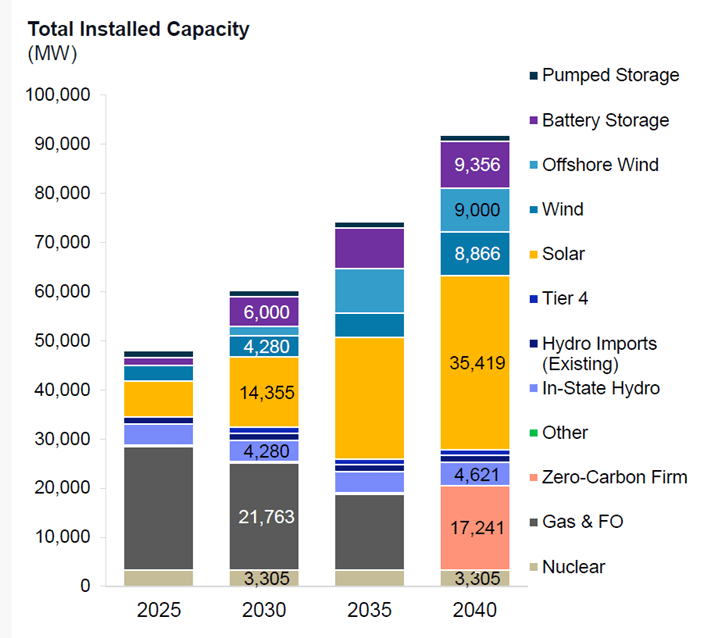
Figure 3 contains some eye-opening points about the additional actions needed in the electric sector to meet the Climate Act mandates.  NYSERDA mentions that the Pathways Analysis agrees with the CES Biennial Review that the 70% renewable goal cannot be met until 2033.  In a massive under statement they note that “A significant ramp up of deployment will be needed to achieve zero by 2040”.  NYSERDA again mentions a “significant buildout of a diverse set of resources” is required.  Existing hydro and nuclear must be kept online to meet the zero emissions by 2040 mandate.  In a major concession they admit that while “Many aging combustion units retire over the model period. 6 GW are repowered, and the 17 GW fleet is converted to run on Hydrogen by 2040”.  Assuming that hydrogen will be available is sufficient quantities in 2040 is magical thinking as is claiming that the combustion fleet will be smaller due to “availability of other firm resources, like storage and Tier 4 hydro imports”.  If there is such a thing as wishful and magical thinking, then this bullet exemplifies it: “Zero emission resource definition is under development and hydrogen serves as an illustrative resource for firm dispatchable power”.

Figure 3: Electric Sector Capacity (MW) Buildout

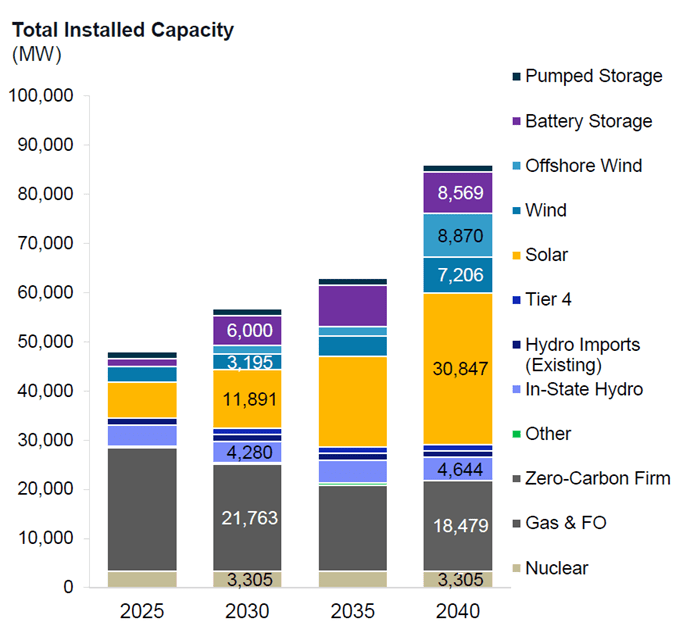
It is notable that NYSERDA concedes, without admitting all the ramifications, that the electricity capacity buildouts in their original scenarios are wishful thinking.  I say this because there is another projection included – the “Limited Building Rate Scenario”.  Figure 4 shows the installed capacity projections for it but true to their perfect record of making things difficult for reviewers the colors in the columns for different technologies change.  If you were like me and wondered what the difference in the zero-carbon firm resources (called dispatchable emissions-free resources (DEFR) by everyone else in the state) drop from 17,241 MW to 4,644 MW.  The description notes that:

•            Deployment challenges (including federal impact on attrition and permitting) could lead to a meaningful reduction in renewable build rates

•            While there are still significant additions of renewables, this sensitivity shows a meaningful reduction in solar and wind capacity compared to the core scenario in 2040

There is no admission that among the deployment challenges was an unrealistic schedule and no implementation plan was developed.  They try to save some face by saying that they still build out solar and wind capacity, oblivious to the fact that might not be a good thing.

Environmental Justice organizations have made the peaking power plants in New York City a non-negotiable issue, insisting that all peaking power plants must be shut down as soon as possible.  Even though the presumption of egregious harm from these plants is based on selective choice of metrics, poor understanding of air quality health impacts,  and ignorance of air quality trends, pressure by this special interest constituency resulted in the Build Public Renewables Act of 2023 that mandates shutdown of New York Power Authority peaking power plants by 2030.  This modeling by NYSERDA found that reliability considerations will prevent the shutdown of all the peaking power plants:

•            Zone J repowers 2.2 GW of combustion units in 2035, and overall combustion needs in 2040 are 1.2 GW higher than the core scenario, but still lower than the start of the modeling period

•            While gas generation is 50 TWh lower than 2025, 15 TWh of natural gas generation is needed in 2040 to meet energy needs. Alternately this need could be met via:

•            ~2 GW of new nuclear and likely additional transmission,

  • RNG combustion in the power sector, or

•            Some blend of these two resource options (new nuclear and RNG)

The alternatives to the fossil plants are not likely to occur.  2 GW of new nuclear is never going to get developed in New York by 2040 and there isn’t enough renewable natural gas (RNG) to provide the necessary power.

At the end of the description of this slide, there is an admission that the existing schedule is unlikely.  Patane notes that this sensitivity scenario provides a zero-emissions grid in 2045.

Figure 4: Limited build rate sensitivity

Discussion

The results presented in this presentation admit that there are enormous challenges confronting the Hochul Administration’s implementation of the Climate Act.  It is still necessary to read between the lines and understand the implications of some statements, but the handwriting is on the wall.

The presentation concedes that New York State is not on target to meet the 2030 70% renewable goal and probably will not meet it until 2033.  The inclusion of an alternate scenario that keeps fossil-fired units in operation post 2040 is the between the lines” admission that the present strategy is not going to work as envisioned by the authors of the Climate Act. That scenario is supposed to provide a zero-emissions grid by 2045, five years late.

Unfortunately, there are unacknowledged fundamental issues.  There are references to electric system strategies that sound fine in theory but have not been shown to work in practice.  For example, the presentation states that the plan is to use flexible loads to mitigate peak growth.  Assuming that 2.5 GW new large loads will be willing to shut down operations at the whim of low wind and solar resource production is not likely viable.  That is not conducive to manufacturing profitability.

In my opinion, the biggest problem is that the wind, solar, and energy storage approach advocated in the Climate Act requires backup resources for capacity, energy, and ancillary support services not present in wind, solar, and current energy storage systems.  Nuclear power is mentioned as a solution several times but if that is the only viable backup solution, then renewables cannot be implemented without it.  But nuclear can completely replace renewables, eliminating the need for massive backup resource.  Therefore, it would be prudent to pause renewable development until feasibility is proven because nuclear generation may be the only viable path to zero emissions.

There are political ramifications.  The New York Independent System Operator (NYISO) Power Trends 2025 report “underscores the heightened uncertainty of future system conditions and key assumptions such as population and economic growth, installation of behind-the-meter renewable resources, electric vehicle adoption and charging patterns.“  Environmental organizations have responded by claiming that  NYISO’s “conclusions and messaging in Power Trends are not supported by the evidence and perpetuate the false narrative that more gas is needed or is less costly.” Reality bats last and the Pathways Framework is reflecting reality that gas is needed.  Politically however, the environmental zealots will never change their minds and concede that corrections and adjustments are necessary much less admit that the whole endeavor is fatally flawed.  Given that the Climate Act has always been about politics, how this plays out will be fascinating political theater.

Conclusion

New York is at a crossroads  The inevitability of Climate Act implementation viability being a political liability has been acknowledged even by Hochul.  The modeling analysis concedes that the schedule and ambition of the Climate Act is not achievable.  This is the perfect opportunity for politicians to stop a program that even they must realize is not working according to plan.  The Energy Plan could be used to conclude the schedule and the aspirations of the Climate Act need to be reconsidered.  The political implications to that approach are significant.

Energy Plan 25 June 2025 Meeting – Pathways Analysis Modeling Approach

This is part of my continuing coverage of the New York State Energy Plan.  This is the first update to the Plan since the Climate Leadership & Community Protection Act (Climate Act) was implemented so it has important ramifications on the net-zero transition.  My intent is to describe most of the sections of the June 25, 2025, meeting presentation.  As part of my attempt to reduce the size of my articles I will focus this article on the Pathways Analysis modeling approach that is being used for the draft Energy Plan.  Note that this article is out of order.  I published what was intended as a follow on to this earlier this week.

I am convinced that implementation of the Climate Act) net-zero mandates will do more harm than good if the future electric system relies only on wind, solar, and energy storage because of reliability and affordability risks.  I have followed the Climate Act since it was first proposed, submitted comments on the Climate Act implementation plan, and have written over 550 articles about New York’s net-zero transition.  The opinions expressed in this article do not reflect the position of any of my previous employers or any other organization I have been associated with, these comments are mine alone.

Energy Plan Overview

According to the New York State Energy Plan website (Accessed 3/16/25):

The State Energy Plan is a comprehensive roadmap to build a clean, resilient, and affordable energy system for all New Yorkers. The Plan provides broad program and policy development direction to guide energy-related decision-making in the public and private sectors within New York State.

I have provided more background information and a list of previous articles on my Energy Plan page.  My biggest concerns are whether the Hochul Administration will use the Energy Plan process as an opportunity to consider the implications of the observed transition so far and if the advice of stakeholders in its stakeholder process will be treated as an opportunity to improve the transition or an obligation with no attempt to meaningfully engage with any comments inconsistent with the narrative

June 25, 2025 Board Meeting

The materials for the meeting include the following:

I have included links to the locations of the video in the following descriptions.  Also note that a transcript of the presentations is included at the meeting recording video platform.  There is a nice feature for this video.  If you set auto scroll on then  you can follow the presentation transcript.  All quotes below come from that transcript.

I previously summarized this meeting’s presentations that described the analyses conducted for the State Energy Plan and described the electricity topic area. This article will evaluate one aspect of the overarching Pathways Analysis, namely the bottom-up modeling framework.

Pathways Analysis

Doreen Harris, head honcho of the New York State Energy Research & Development Authority and co-chair of the Climate Action Council, introduced the Pathways Analysis discussion.  The Pathways Analysis is the Energy Plan equivalent of the Scoping Plan’s Integration Analysis.  Recall that the Integration Analysis was the quantitative assessment of emission reduction strategies that formed the basis of the Scoping Plan outline of policy strategies to achieve the Climate Act net-zero transition.  Harris emphasized that while similar, the assessment approaches for both analyses are different.  The Integration Analysis was “top down” whereas the Pathways Analysis is “bottoms up”.  There are significant differences between these methodologies. 

The Integration Analysis top-down approach started with large-scale policy strategies and used the Energy and Environmental Economics (E3) using model framework to choose a selection of policy options that produced the necessary emission reductions.  Never forget that the feasibility of those policy option expectations and implementation schedule were never tested for feasibility.

The bottom-up approach starts with specific policy options and determines how they can be used to achieve the targets.  On the face of it the bottoms-up approach is more grounded to reality.  However, when Harris explained the approach she listed adjustable factors:

This analysis uses a bottom-up assessment of the various energy supply and delivery systems that will be available to meet forecasted energy needs through 2040, accounting for policies, technology availability, and consumer uptake, and the energy planning law requirements to consider energy affordability, reliability, economic development and jobs, equity, and environmental needs.

Accounting considerations and energy planning law have many levers that can be manipulated to get the desired answer.  Absent transparent documentation that describes the assumptions for all those considerations and a process that engages the subject matter stakeholders for refining them, this bottom approach will not be grounded in reality .

Consider, for example, the different levers Harris described that can affect infrastructure deployment:

  • Disruptions due to the pandemic
  • Resulting supply chain disruptions
  • Inflation, and
  • Changes in energy policy from the Federal Administration, including the potential to cancel tax credits provided under the Inflation Reduction Act, planned denial of permits for wind generation, and attempts to remove state based clean car and clean truck rules by revoking California’s ability to enforce stricter vehicle emission standards.

Missing from this list is physics.  Years from now, historians will look back and wonder why New York State went down this path without considering the immutable laws of physics that precluded some of the naïve assumptions inherent in the proposed wholesale transition to diffuse and intermittent weather-dependent generating resources.

Pathways Outlook

The presentations to the Energy Planning Board hint that there are issues.  It is still necessary to read between the lines to understand the implications.  In one of the biggest under-statements of this transition process Harris conceded that the considerations will “likely impact state progress on statutory emissions goals”.

She went on to state “I would say we are continuing to monitor changes in federal policy and may need to explore the impacts of these changes in the final state energy plan that we will be driving toward this year.”   Then Harris claimed that:

Yet even with these challenges, the current analysis shows that New York can build on our successes, such as the creation of the nation’s largest green bank, the deployment of six gigawatts of distributed solar ahead of schedule, the completion of South Fork wind, the groundbreaking for the Champlain Hudson Power Express, Empire Wind One, and Sunrise Wind. And, of course, we have governor Hochul’s commitment to invest over a billion dollars of public funds in the sustainable future program, the largest single climate investment in state history.

I suspect that the recent passage of the “big, beautiful bill” is not going to represent a minor adjustment in renewable energy development.  Federal policies affected all the claimed success stories Harris described so a complete re-assessment is warranted.

Discussion
New York is at a crossroads  The inevitability of Climate Cost affordability being a political liability has been acknowledged even by Hochul

I am particularly incensed by this statement by Harris: “Importantly, this analysis demonstrates that we can continue to make meaningful progress toward our energy goals while preserving reliability and affordability for our citizens.”  They have not defined affordability or what reliability risks are acceptable.  Without those definitions this is just a slogan.

New York’s Climate Act implementation was not well planned.  The Scoping Plan’s Integration Analysis ignored the impact of uncertainty on their projects, and the stakeholder process did not acknowledge input contrary to their narrative.  I will concede that the supply chain effects of the Pandemic were unanticipated, but I am pretty sure stakeholders comments mentioned the risk that if everybody is planning a similar electrification transition that there will be supply chain competition as the suppliers gear up.  It is not clear how much of the supply chain issue is due to that competition as opposed to the convenient scapegoat of the pandemic.

Conclusion

As mentioned before, there is every indication that slavish devotion to the aspirational goals of the Climate Act is the goal of the Energy Plan process.  At the same time NYSERDA and DPS claim that the transition “must be managed within the constraints imposed by Federal and State reliability requirements and at a justifiable cost to ratepayers.”  Qualitatively the Governor’s recent admission that Climate Act costs contribute to recent rate case increases means that the planned transition is not affordable.  If the State were to establish specific limits, then I am sure affordability would be cause for a reassessment of the schedule and ambition of the Climate Act.  This should be a cornerstone objective of the Energy Plan.

Energy Plan 25 June 2025 Meeting – Modeling Analysis Scenarios

This is part of my continuing coverage of the New York State Energy Plan.  My intent is to describe most of the sections of the June 25, 2025, meeting presentation.  As part of my attempt to reduce the size of my articles I will focus this article on the Pathways Analysis modeling approach scenarios.  A previous article introduced the Pathways Analysis that is being used for the draft Energy Plan

I am convinced that implementation of the New York Climate Leadership & Community Protection Act (Climate Act or CLCPA) net-zero mandates will do more harm than good if the future electric system relies only on wind, solar, and energy storage because of reliability and affordability risks.  I have followed the Climate Act since it was first proposed, submitted comments on the Climate Act implementation plan, and have written over 550 articles about New York’s net-zero transition.  The opinions expressed in this article do not reflect the position of any of my previous employers or any other organization I have been associated with, these comments are mine alone.

Energy Plan Overview

According to the New York State Energy Plan website (Accessed 3/16/25):

The State Energy Plan is a comprehensive roadmap to build a clean, resilient, and affordable energy system for all New Yorkers. The Plan provides broad program and policy development direction to guide energy-related decision-making in the public and private sectors within New York State.

I have provided more background information and a list of previous articles on my Energy Plan page.  My biggest concerns are whether the Hochul Administration will use the Energy Plan process as an opportunity to consider the implications of the observed transition so far and if the advice of stakeholders in its stakeholder process will be treated as an opportunity to improve the transition or an obligation with no attempt to meaningfully engage with any comments inconsistent with the narrative

June 25, 2025 Board Meeting

The materials for the meeting include the following:

I have included links to the locations of the video in the following descriptions.  Also note that a transcript of the presentations is included at the meeting recording video platform.  There is a nice feature for this video.  If you set auto scroll on then you can follow the presentation transcript.  All quotes below come from that transcript.

I previously summarized this meeting’s presentations that described the analyses conducted for the State Energy Plan and described the electricity topic area. I also published an overview of the Pathways Analysis.  This article addresses the bottom-up modeling framework.

Pathways Analysis Introduction

Karl Mas introduced the modeling framework discussion.  It is notable that he acknowledged that there are issues:

I’d first like to acknowledge that conducting such analysis during a time of uncertainty is challenging, as Chair Harris noted.  And it’s true with all aspects of our economy, the energy system has been impacted by the supply chain disruptions, high interest rates, inflation, and changing federal policy landscape. Yet the work must provide a rigorous economy wide view of how New York will meet the energy needs over the planning horizon while making progress on the state’s policy objectives.

Unfortunately, there is a difference between saying there is uncertainty and applying that constraint to the modeling analysis.  After acknowledging uncertainty, Mas said the “the work must provide a rigorous economy wide view of how New York will meet the energy needs over the planning horizon while making progress on the state’s policy objectives.”  My primary concern with this kind of modeling is that I know that the results are affected by modeler biases and their choice of assumptions.  This sentence all but explicitly admits that NYSERDA is going to get an answer consistent with the Climate Act schedule and ambition.  Even though Mas went on to qualify his assertion, I remain unconvinced:

Looking out over fifteen years requires assumptions regarding technology progress and policy achievement. To address uncertainties in both these areas, the analysis takes a realistic yet ambitious approach and explores several potential scenarios to better understand the full spectrum of possible outcomes.

One of the significant failings of the Scoping Plan modeling is that NYSERDA did not show their work, especially the assumptions made.  When there were enough details for explicit stakeholder comments showing issues, they were ignored.  I fully expect that NYSERDA will continue that approach.  If that happens then “realistic yet ambitious approach” is no more than a slogan.

Pathways Analysis Modeling Approach

Nick Patane, Assistant director for policy analysis at NYSERDA described the pathways analysis modeling approach in more detail.  His description of the modeling approach never mentioned which model was being used which leads me to believe that this is an in-house analysis.  He explained:

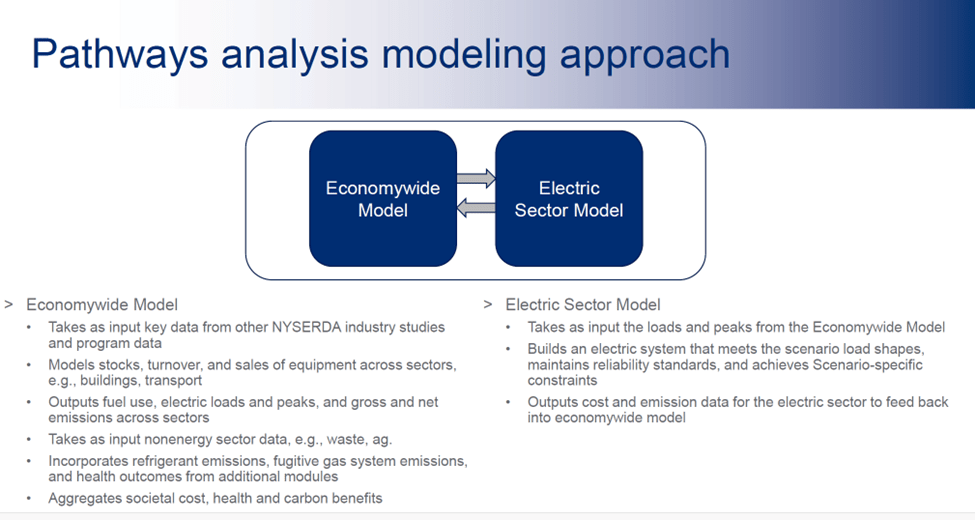
There’s two main modules that we use in the analysis. The first is our economy wide model. This model takes as input, key data from other NYSERDA industry studies and programs. It models stock turnover and sales of, key equipment across, the buildings, transportation, and other demand sectors. This allows us to develop a perspective on fuel use as well as electric loads and peaks, and net emissions.

Our information on electric loads is then passed off to the second module, which is our electric sector model. This module, builds out an electric system to meet those loads, maintain reliability, and achieve any scenario specific, policy constraints.

That information on the electric system costs and emissions then feeds back to the economy wide model, for an aggregated roll up of economy wide benefits and costs.

This is an enormous effort and full of opportunities to tweak results towards a desired outcome.  NYSERDA analysts must interpret each of these factors for every energy component across every sector of the economy. The description of the economywide model describes six factors that affect the results.  Consider just “Models stocks, turnover, and sales of equipment across sectors, e.g., buildings, transport”.  Later in his presentation Patane mentions building shells, the protective envelope of a building that includes insulation and energy efficiency windows and doors.  To model that NYSERDA must estimate the New York building shell status across the state, determine what could be done to improve the building stock, and how much increased efficiency will change the energy use.  Clearly, reasonable people can make different assumptions about these factors that in aggregate and over time can generate significantly different results.  With all due respect, if I was the analyst charged with determining “how New York will meet the energy needs” in a politicized organization, my choices might be guided by the desired results.  This reinforces the absolute need for clear and transparent documentation.

After describing current energy use noting that buildings (50%) and transportation (40%) are the primary energy uses today, Patane described five energy future scenarios to estimate the potential impact of different policies.  The first scenario is “No Action”:

Our first case is what we call the no action case. You could think of this as sort of the world absent the climate act and the New York, state and local energy policies that have stemmed from it. It includes an extension of historic policy interventions, native market adoption, and federal policies as of the time of the modeling earlier this year.

Recognize here again that there’s significant uncertainty on the future of many federal clean energy policies, and we plan to explore any impacts of future changes, as we go into the final energy plan.

This case will act as a point of comparison against which we can compare the other scenarios to understand what are the net benefits and that costs and other trade offs of New York’s clean energy policies.

The results of the modeling are affected by the definition of the strategies used in the No Action case.  In my opinion, I want to know what reduction strategies will be imposed on me and how much it is going to cost me to achieve the Climate Act goals.  I do not care which clean energy policy requires them.  This is another opportunity that NYSERDA used in the Scoping Plan analysis to modify the results to fit the desired outcome.  In the Scoping Plan impacts of the policies were compared to a Reference Case that included “already implemented programs” that resulted hid significant costs to meet Climate Act targets.  The interpretation of “extension of historic policy interventions, native market adoption, and federal policies” all could have similar impacts to the point where claiming this is a “no action” scenario is misleading.  In my opinion, there should be a sixth case that excludes all programs necessary to achieve Climate Act goals. 

I agree with the other strategy scenarios   They cover the full gamut of potential outcomes.   Note that the “Current Policies” scenario includes “deployment of clean electric generation in line with the Clean Energy Standard biennial review”, which concedes that the 2030 70% renewable grid target cannot be achieved until 2033.   The third scenario is “Additional Action”:

This case includes all the policies from current policies and then layers on top of that, continued acceleration of adoption of clean energy technologies out to the future from some mix of future policies.

These can include things like environmental markets, increasing investments, and other recommendations, from the individual sectors of the the state energy plan.

As Doreen noted in her introductory remarks, current policies and additional actions are our core planning cases for this exercise. They represent a more bottoms up accounting.

For example, current policies reflecting the energy system that we expect under current policies, additional action reflecting achievable, but ambitious further progress.

This is where the modeling analysis starts to get into wishful thinking.  Are there any indications that “achievable, but ambitious further progress” is possible?  Even without the Federal policy changes that threaten the anticipated renewable deployments it has become clear that affordability and reliability issues can no longer be ignored.

The two remaining scenarios address pathways to net zero by 2050.  Reading between the lines there is acknowledgement that this target will be an enormous challenge. 

These scenarios continue to lean on similar levers like electrification and efficiency, but to much greater extent Also introducing new levers that aren’t contemplated by current policies.

In our work, we have two different net zero scenarios. The primary difference here is the use of hybrid heating for buildings that retain a gas connection for use on the coldest days.

Net Zero A has limited use of this hybrid heat pump, and more all electric customers. Net Zero B has expanded use of customers that retain a supplemental gas heating system. And this allows us to sort of explore the potential value of a larger residual gas network on mitigating, electric system peaks, and the associated building costs.

The inclusion of a scenario that maintains gas supply is a good starting point to acknowledge that going to zero emissions massively increases costs and complexity.  I believe that this is entirely appropriate to include. 

Discussion

The recent passage of the Big, Beautiful Bill Act will have massive implications for the Climate Act net-zero transition.  In the meantime, the Energy Plan proceeding goes on.  The presentations are a mixed bag.  There are acknowledgements of the potential impacts of uncertainty which is good.  I am disappointed by the similarities to the Pathways Analysis “No Action” scenario and the Scoping Plan “Reference Case”.  NYSERDA is not following standard practice with this and the potential for misleading results looms large.

I cannot over emphasize the necessity of clear and transparent documentation.  If it is not provided, then the results will not be credible.  I hope, but do not expect, that NYSERDA will address the comments of stakeholders. 

It has become clear to me that addressing all the issues in this meeting’s presentations while keeping my articles to around 2,000 words is going to mean more posts than I originally anticipated.  Stay tuned.

Conclusion

New York is at a crossroads  The inevitability of Climate Cost affordability being a political liability has been acknowledged even by Hochul.  Saying that there is “significant uncertainty on the future of many federal clean energy policies” is quite the understatement.  Frankly, the potential for existential changes to renewable energy development must now be considered.  This is the perfect opportunity for politicians to stop a program that even they must realize is not working according to plan.  Throw in the ability to blame somebody else now, I bet we soon see something along the line of we wanted to do this but Bad Trump made us stop.  The alternative is to use this process and conclude the schedule and aspirations of the Climate Act need to be reconsidered.  That will take a lot of time though.

Energy Plan 25 June 2025 Meeting – Electricity Topic

This is part of my continuing coverage of the New York State Energy Plan.  My intent is to describe most of the sections of the June 25, 2025 meeting presentation.  This article addresses the discussion of the electricity portion of the draft Energy Plan document.  My friend Tom Shepstone described the natural gas section so I don’t have to do that one.

I am convinced that implementation of the New York Climate Leadership & Community Protection Act (Climate Act or CLCPA) net-zero mandates will do more harm than good if the future electric system relies only on wind, solar, and energy storage because of reliability and affordability risks.  I have followed the Climate Act since it was first proposed, submitted comments on the Climate Act implementation plan, and have written over 540 articles about New York’s net-zero transition.  The opinions expressed in this article do not reflect the position of any of my previous employers or any other organization I have been associated with, these comments are mine alone.

Energy Plan Overview

According to the New York State Energy Plan website (Accessed 3/16/25):

The State Energy Plan is a comprehensive roadmap to build a clean, resilient, and affordable energy system for all New Yorkers. The Plan provides broad program and policy development direction to guide energy-related decision-making in the public and private sectors within New York State.

I have provided more background information and a list of previous articles on my Energy Plan page.  Sad to say but this process looks like a repeat of the Scoping Plan process where New York State Energy Research & Development Authority (NYSERDA) provides numbers that align with the desired political outcome and goes through the pro forma motions of a stakeholder process.  In my opinion, stakeholder input should be treated as more than just an obligation.  There is no sign that NYSERDA considers stakeholder input because the only way to prove that input is considered is to provide a response to comments document that describes how comments were considered.  This has been noticeably lacking in NYSERDA Climate Act documentation.   Obviously, the Energy Planning Board needs to hear both sides of issues to provide a meaningful input to the process.  Otherwise, the Board is just a figurehead entity that provides the appearance of deliberation but does not engage in actual review.

June 25, 2025 Board Meeting

The materials for the meeting include the following:

I previously summarized the presentations that described the analyses conducted for the State Energy Plan and those that covered Energy Plan topic areas. I have included links to the locations of the video in the following descriptions.  Also note that a transcript of the presentations is included at the meeting recording video platform.  There is a nice feature for this video.  If you set auto scroll on then  you can follow the presentation transcript.  All quotes below come from that transcript.

This article will describe the electricity topic area in the draft Energy Plan document.

Topic Area – Electricity

David Coup, assistant director on NYSERDA’s Policy Analysis and Research team, and Jessica Waldorf, Chief of Staff and Director of Policy Implementation at the Department of Public Service read the electricity topic script.  Waldorf set the theme of the presentation acknowledging “major challenges” in the first slide:

Waldorf stated that the “The electric chapter focuses on the key theme of needing to have reliable power at reasonable rates, because it is the backbone of the State’s economy and critical to our public health and safety.”  This is typical for New York State.  The statement sounds good and addresses an absolute need, but the reality is there is no substance or follow-through to the commitment.  In this instance if the State were committed to reliable power at reasonable rates, they would define what that means.  Clearly there is some limit to what New York can afford to pay but the criteria for the safety valves  for affordability and reliability have not been defined.

The presentation went on to describe six slides.  One takeaway is this is the first acknowledgement of some key challenges that have not been mentioned before.  However, in my opinion the presentation does not convey the myriad issues associated with some of the topics mentioned in passing. 

All the topic slides have a similar format.  There is a list of key existing state actions and related recommendations.  However, the uncertainties and seriousness of the challenges for the recommendations are not mentioned.  I think this gave the Energy Planning Board members a false sense of security.

The first slide title said “New York State will continue to support the deployment of clean energy resources including large scale renewables (LSR), distributed and community solar to meet demand and preserve reliability.”  Earlier in the meeting the uncertainty and challenges of the deployment were mentioned.  However, there was no explicit acknowledgement of the Biennial Report findings that found that the meeting the 2030 targets would not be possible until at least 2033.

Two of the recommendations are related and are of particular interest to me.  The first acknowledges that planning is required for existing sources: “Continue to evaluate the State’s existing clean firm capacity resources since they will be critical to achieving a zero-emissions grid.”  The second confronts the reality of New York City peaking power plants: “The State will need to be strategic about the pace of combustion unit retirements and/or replacements as it works to pursue achievement of its clean energy targets.”  Waldorf explained:

This section of the chapter highlights the importance of the state needing to be mindful about managing the retirement of downstate units in a manner that won’t cause air quality to worsen and disadvantaged communities and will not cause negative system reliability impacts.  It also discusses a statutory requirement that the New York Power Authority has, and as part of that, the requirement to conduct an air emissions analysis prior to any retirement of these facilities.

I described my position on peaking power plants on a dedicated page and asked Perplexity AI to compare my arguments against the Peak Coalition position.  The implementation issue is that that a politically favored group has demanded that the peaking units be shut down but this presentation acknowledges there is an issue.  Wordsmithing this problem and promising more analyses that cannot possibly affect the outcome will only postpone political accountability for the inevitable decision that shutting those units down to placate a political constituency is not going to keep the lights on.

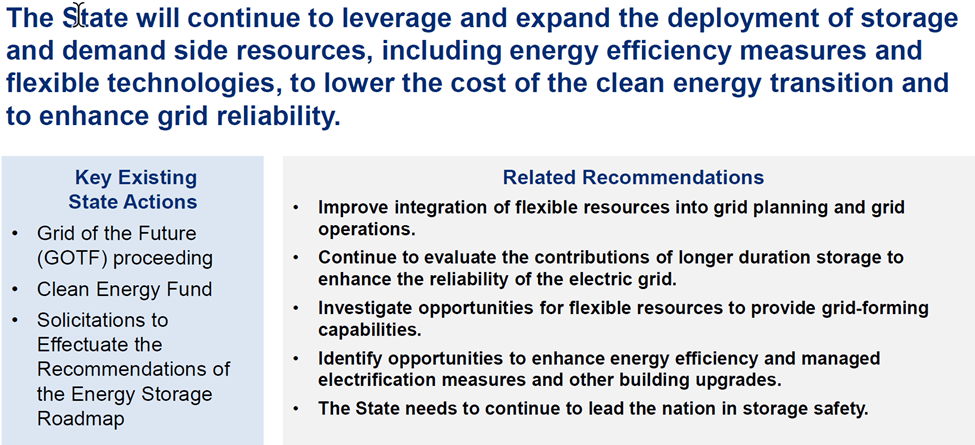
The title of the second slide states: “The State will continue to leverage and expand the deployment of storage and demand side resources, including energy efficiency measures and flexible technologies, to lower the cost of the clean energy transition and to enhance grid reliability.”  The lack of uncertainty descriptions and not including a rating of technological maturity and challenges for the proposed storage and demand side resources is a significant flaw.  In my opinion, most of the recommendations are basically magical thinking.

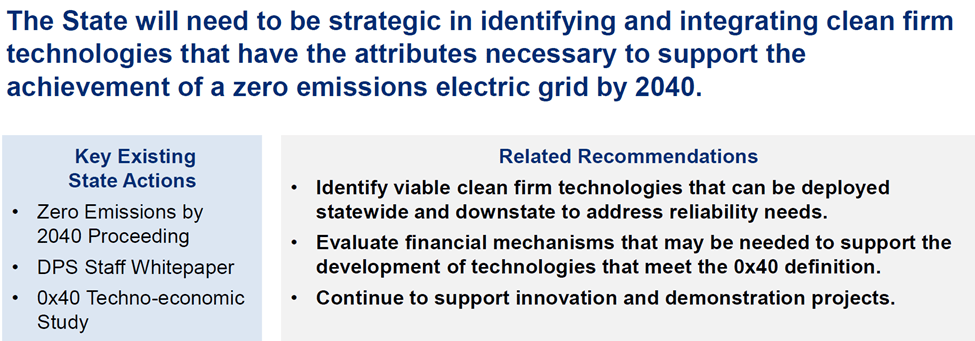
The next slide title states: “The State will need to be strategic in identifying and integrating clean firm technologies that have the attributes necessary to support the achievement of a zero emissions electric grid by 2040.”  This is the most egregious failure to admit the challenge of “identifying and integrating” technologies.  This is a veiled reference to the Dispatchable Emissions-Free Resource that is an acknowledged prerequisite for the proposed weather-dependent electric system.  The State is studying the issue but there is no timeline for definitive recommendations how the state should go forward.  I think that the Energy Planning Board needs to know that the chances are essentially zero that technologies that are not commercially viable and must be tested, permitted, and deployed at the scale projected on a timeline consistent with the Climate Act mandates will be availble.  This should have been discussed.

Furthermore, consider the key existing state actions.  The Zero emissions by 2040 Proceeding is in place but nothing has happened since early 2024 so there is no apparent sense of urgency regarding plans for DEFR.  The DPS Staff Whitepaper refers to a November 2024 technical document that defined zero emissions and the statewide electrical demand system and recommended how to treat imports.  The PSC has not yet acted on the paper.    The zero by 2040 techno-economic study refers to an on-going research study.  In my opinion all these efforts represent the starting point of a planned transition.  Implementing them as we go along does not bode well.

The fourth slide headline notes “The State will continue to advance smart and strategic energy system planning to enhance system reliability and drive down the cost of necessary transmission and distribution system investments.”  This slide is bafflegab, i.e., wordy jargon whose purpose, in this instance, is to obscure the challenge of maintaining current reliability standards while massively implementing unprecedented changes to the system.  The Coordinated Grid Planning Process is a great example of what needs to be done but the reality is that it should have been set up before New York embarked on this transition.  Moreover, it only addresses transmission.  They mention that we should “pursue integrated electricity and natural gas system planning” recognizes that something similar is needed in that realm.  Implementation planning in retrospect is not a recipe for success.

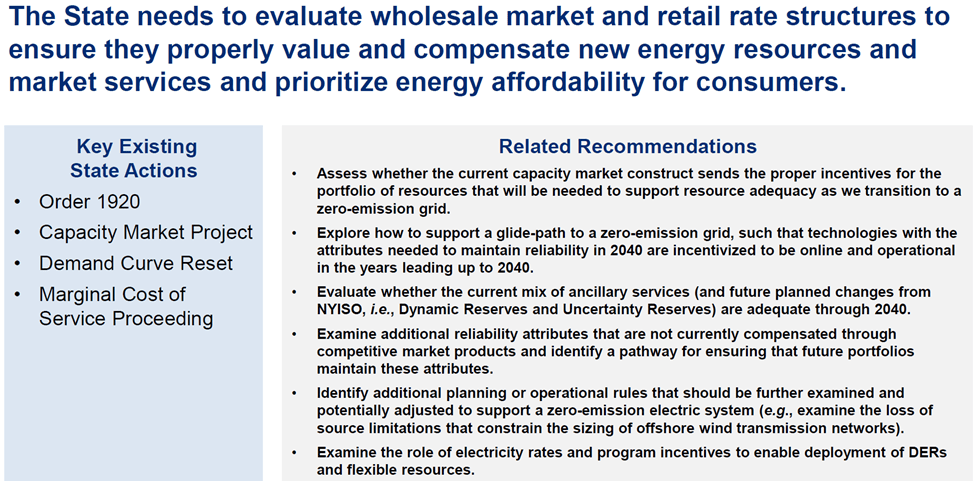
The next slide’s headline states: “The State needs to evaluate wholesale market and retail rate structures to ensure they properly value and compensate new energy resources and market services and prioritize energy affordability for consumers.”  Coup acknowledges that “There’s a lot of things here on this slide that talk about assessing, exploring, and evaluating.”  In other words, we are not doing this now. This is another example of the lack of planning inherent in CLCPA net-zero transition planning to date.

The final slide title states: “Future investments in our energy system must be designed to withstand the impacts of a changing climate.”  This slide and Coup’s description frustrates me to no end as a meteorologist. New York State climate change doctrine is completely consistent with the media narrative.  Roger Pielke, Jr. just reposted an article describing the media’s narrative. His section on extreme weather is consistent with Coup’s statement and encapsulated my concern:

Weather is a renewable resource. It happens every day, and somewhere it is extreme. Hurricanes, tornadoes, floods, drought, hail, oh my! It has become fundamental to the climate beat to associate, link, connect — pick your favorite — the extreme event that just happened with climate change. Forget the IPCC and rigorous standards of detection and attribution. There are studies to cherry pick, quotable experts and a new cottage industry of rapid event attribution studies. Extreme weather is no longer about the weather.

The solution is simple – “withstand the impacts of a changing climate” should be changed to “withstand the impacts of extreme weather”.  We are not even planning for the past now.  My message to NYSERDA is to get back to me when you have accounted for past extreme weather and then we can discuss climate change impacts.

Discussion
I have takeaway messages for the Energy Planning members.  The impression I got from the presentations at the 25 June 2025 Energy Plan meeting is that NYSERDA and DPS have the implementation of the Climate Act under control.  It cannot be emphasized strongly enough that the reality is different.  In the real world the presentations only scraped the surface of the number and magnitude of the issues facing New York’s implementation of the Climate Act.

For an example of the complexity not acknowledged, consider the statement in the last slide in the presentation that stated that “Establishing criteria for metrics like expected unserved energy (EUE) may help supplement traditional LOLE-based criteria by providing information about risks of long-duration outages.”  EUE stands for Expected Unserved Energy.  It is the summation of the expected number of megawatt hours of demand that will not be served in a given time period as a result of demand exceeding the available capacity across all hours.  This parameter addresses issues associated with the long duration wind and solar resource lulls that is the driver for the need for DEFR.  I have concluded that this issue causes insurmountable reliability risks.  Eventually there will be an unusual set of weather conditions and load requirements that exceed the EUE criteria.  When that happens for the future net-zero system there won’t be enough energy for all the electrified sectors and a catastrophic blackout will result.  In my opinion, the Energy Planning Board should consider risks like this for the proposed Energy Plan.  I do not expect that NYSERDA or DPS will willingly raise this issue.

Reading between the lines reveals that the draft Energy Plan concedes the electric system transition is not well planned.  Consider that New York State will “advance smart and strategic energy system planning“ is predicated on coming up with ways to do that.  If they are “assessing, exploring and evaluating” ways to be smart, then what does that say about current planning?  My Google AI Assistant says the opposite would be “unstructured or haphazard planning, which lacks clear goals, measurable outcomes, and a coherent approach to achieving objectives”.  I agree.

Finally, there are multiple references to stakeholder input in this presentation.  Until NYSERDA documents how they treated stakeholder input, the implication that they value this input rings hollow. 

Conclusion

There is every indication that slavish devotion to the aspirational goals of the Climate Act is still the goal of the Energy Plan process.  At the same time NYSERDA and DPS claim that the transition “must be managed within the constraints imposed by Federal and State reliability requirements and at a justifiable cost to ratepayers.”  There are no quantifiable criteria for affordability and reliability.  If there were safety valve criteria, then I have no doubt that they would be exceeded because a weather-reliant electric system will never be affordable or safe.

Energy Plan Board 25 June 2025 Meeting Overview

The development of the New York State Energy Plan is underway but I have been remiss on providing updates.  Frankly, there hasn’t been too much to write about until the latest meeting on June 25, 2025. The last meeting had some interesting presentations because there were hints that even the New York State Energy Research & Development Authority (NYSERDA) is beginning to admit that there are issues associated with Climate Leadership & Community Protection Act (Climate Act or CLCPA) enactment.

I am convinced that implementation of the New York Climate Act net-zero mandates will do more harm than good if the future electric system relies only on wind, solar, and energy storage because of reliability and affordability risks.  I have followed the Climate Act since it was first proposed, submitted comments on the Climate Act implementation plan, and have written over 540 articles about New York’s net-zero transition.  The opinions expressed in this article do not reflect the position of any of my previous employers or any other organization I have been associated with, these comments are mine alone.

Energy Plan Overview

According to the New York State Energy Plan website (Accessed 3/16/25):

The State Energy Plan is a comprehensive roadmap to build a clean, resilient, and affordable energy system for all New Yorkers. The Plan provides broad program and policy development direction to guide energy-related decision-making in the public and private sectors within New York State.

On September 9, 2024, the Hochul Administration initiated the State Energy Plan process to update the Plan consistent with the Climate Act.  The goal of the planning process is to “map the state’s energy future by showing how the state can ensure adequate supplies of power, reduce demand through new technologies and energy efficiency, preserve the environment, reduce dependence on imported gas and oil, stimulate economic growth, and preserve the individual welfare of New York citizens and energy users.” The major question that must be addressed is whether the Hochul Administration will use the energy planning process as an opportunity to consider the advice of stakeholders in its stakeholder process or will stakeholder involvement just be an obligation with no attempt to meaningfully engage with any comments inconsistent with the narrative.

I have previously published articles about this process. On November 15 New Yorkers for Clean Power (NYCP) sponsored a related webinar titled “Get Charged Up for the New York Energy Plan”.  My first post on this webinar described the response to my question does New York need a Climate Act feasibility analysis. I also addressed the presentation by Janet Joseph who was deeply involved in the development of the Scoping Plan noting that she admitted that issues associated with reliability and affordability are real problems.  My post on the March 3 meeting explained that I was discouraged because the format and approach is so similar to the Scoping Plan process that I think that NYSERRDA is following the same script.  It looks just like the Scoping Plan process where the numbers were tortured to provide the desired analysis then tied up into a pretty package.  NYSERDA went through the motions of a stakeholder process but never responded to comments in a meaningful way.  I fear this is the plan for this document as well.

June 25, 2025 Board Meeting

The materials for the meeting include the following:

There were two important agenda items for the meeting

  1. To discuss analysis conducted for the State Energy Plan.
  2. To discuss select Energy Plan topic areas.

I have included links to the locations of the video in the following descriptions.  Also note that a transcript of the presentations is included at the meeting recording video platform.  There is a nice feature for this video.  If you scroll down into the transcript you can follow the presentation.  All quotes below come from that transcript.

The discussion of the analysis conducted for the State Energy Plan described “two overarching analyses”.  The Pathways Analysis and topic plan areas are summarized below.

Pathways Analysis Overview of Energy Modeling

Doreen Harris teed up this presentation.  Although this work does a similar assessment of the strategies needed to achieve the Climate Act mandates as the Scoping Plan, the approach is different.  For the Scoping Plan the modeling was a top-down approach: “We looked at the emissions requirements in the Climate Act and demonstrated the nature of the changes that would be needed to meet those emissions limits.”  After acknowledging challenging headwinds, Harris claimed there has been extraordinary progress and that the Energy Plan modeling builds off progress to date in its bottom up approach:

This analysis uses a bottom up assessment of the various energy supply and delivery systems that will be available to meet forecasted energy needs through 2040, accounting for policies, technology availability, and consumer uptake, and the energy planning law requirements to consider energy affordability, reliability, economic development and jobs, equity, and environmental needs.

For those not attuned to modeling this is simply a different way to cook the books.  If the assumptions for affordability, reliability associated with the policies, technological availability, and other aspects that affect the rate of deployment are transparently documented it would be an improvement.  However, if the input is treated like a black box and stakeholder input is not appreciated as adding value, then the results will not be credible.  There are many ways to make assumptions to get a preferred answer.

Karl Mas who was responsible for much of the Scoping Plan modeling introduced the detailed presentation.  His introduction was noteworthy because he admitted that the modeling was uncertain:

I’d first like to acknowledge that, conducting such analysis during a time of uncertainty is challenging, as Chair Harris noted.

And it’s true with all aspects of our economy, the energy system has been impacted by the supply chain disruptions, high interest rates, inflation, and changing federal policy landscape. Yet the work must provide a rigorous economy wide view of how New York will meet the energy needs over the planning horizon while making progress on the state’s policy objectives.

Looking out over fifteen years requires assumptions regarding technology progress and policy achievement. To address uncertainties in both these areas, the analysis takes a realistic yet ambitious approach and explores several potential scenarios to better understand the full spectrum of possible outcomes.

Nick Patane gave the detailed presentation. I will follow up with another post that delves into details about this modeling.

Pathways Analysis Overview of Energy Affordability

The second pathways analysis described energy affordability.  Karl Mas also introduced this presentation noting that:

Understanding how our energy planning efforts might impact New Yorkers can be a critical consideration that’s run through our entire plan. This new analysis provides a detailed view into the variation of potential future energy spend by New York households, allowing us to tailor planning considerations to best meet the needs of all New Yorkers.

James Wilcox presented the details.  To get a flavor of what was presented consider the household modeling “snapshots”.  Clearly there are many ways to interpret household energy consumption today and even more ways to estimate how changes could be made to get future reductions.  I cannot over-estimate enough that without comprehensive and transparent documentation of those assumptions the results will not be credible.  The Scoping Plan documentation failed to provide the necessary level of documentation.  It remains to be seen whether this modeling will do so.

In my opinion, energy affordability is the most important Climate Act consideration.  Wilcox admitted there were “overarching affordability challenges”:

However, low and moderate income households are more likely to experience energy affordability challenges.  To understand how energy costs impact people, it’s important to look comprehensively at both household energy and also transportation energy spending.

Energy saving measures, such as building envelope efficiency, efficient appliances and equipment, fuel efficient and electric vehicles, and transit use can lower overall household energy costs. Many households pursuing these measures are likely to see net reductions in operating costs due to the combined impacts of a variety of efficiency measures, including electric efficient electrification on household energy and transportation energy spending.

And finally, policy and market solutions that focus on lowering upfront costs and other barriers to adoption for a range of energy efficiency measures have the potential to enable households to realize lower, more affordable operating costs. And this can, in turn, help to alleviate energy insecurity and energy burdens.

In contrast to the first presentation there were multiple questions about this work.  I intend to follow up on this topic with another post too.

State Energy Plan Topic Areas

After a break there were six presentations on topic areas:

I will follow up with another post that addresses these too.  At this point it seems if I go into detail on any one of these topics then I must cover more and the post will spiral out of control.  Stay tuned.

Discussion

I want to make two points on my initial read of this meeting.  Energy affordability is important, but it appears that the State is still only paying lip service to the problem. 

In the first place, while Jessica Waldorf from the Department of Public Service mentioned that work continues to develop the resources mandated by the Clean Energy Standard, she only acknowledged the existence of the Biennial Review.  On December 18, 2024, the New York Assembly Committee on Energy held a public hearing to gather information and asked Waldorf about the status of the Informational Report covering 2023 data that provides cost recoveries, benefits, expected ratepayer impacts and other information.  On January 13, 2025 the DPS said that “The Department is currently preparing the Second CLCPA Report and anticipates presenting it to the Commission in 2025”.  This is important information that is a year overdue.

There is another worrisome aspect of the modeling.  Waldorf stated that “The cost recoveries, benefits, and other information reported here are mainly focused on the direct effects of CLCPA implementation.”  As I have noted previously, this focus on direct effects of the CLCPA does not cover all the costs of implementation.  For example, my utility company must include programs to meet the CLCPA mandated goals not just the CLCPA mandated programs.  The focus on CLCPA programs iexcludes substantive costs.  I think NYSERDA is trying to do it again.

Conclusion

Given the myriad effects and unintended consequences of the Climate Act implementation, I think it is incumbent upon the State to be fully upfront with the costs and challenges of the transition.  Unfortunately, it has become politicized, and the costs are being covered up.  Stay tuned for in-depth analyses of the Energy Plan presentations at this meeting.