
will be held on Monday, December 19, 2022, at 1:00 p.m. This post describes my overview impression of the process and the likely outcome of the vote. I think it is relevant outside of New York because it gives a template for implementing a net-zero transition program.
Climate Act Background
The Climate Act establishes a “Net Zero” target (85% reduction and 15% offset of emissions) by 2050. The Climate Action Council is responsible for preparing the Scoping Plan that will outline how to “achieve the State’s bold clean energy and climate agenda.” In brief, that plan is to electrify everything possible and power the electric grid with zero-emissions generating resources by 2040. The Integration Analysis prepared by the New York State Energy Research and Development Authority (NYSERDA) and its consultants quantifies the impact of the electrification strategies. That material was used by staff from various State agencies to write a Draft Scoping Plan that was released for public comment at the end of 2021. The Climate Action Council is required to finalize the Scoping Plan by the end of the 2022 so this meeting will meet that requirement. If anyone has a masochistic desire to view the meeting, details are available at the Climate Act meetings and events page.
Legislation enacting net-zero targets by 2050 are political ploys catering to specific constituencies. The prime narrative of the Climate Act is featured on their web page:
Our Future is at stake and that’s why New York State is committed to the most aggressive clean energy and climate plan in the country. Each of us has a role in protecting our communities and ensuring a sustainable future for every New Yorker. If we each do our part, we’ll lower harmful emissions in the air we breathe while transforming New York’s economy, creating new jobs, and building more resilient communities.
The authors of the Climate Act legislation believed that meeting the net-zero target was only a matter of political will. I believe that any similar legislation will follow the script used in New York. Despite the apparent objectivity of the implementation framework, it is just is a façade. The Climate Act established the Climate Action Council to direct the development of the Scoping Plan. It consists of 22 members that were chosen by ideology not expertise. There are 12 agency members: all appointed by the Governor, and 10 at-large members: two non-agency representatives appointed by the Governor, three representatives appointed by the Speaker of the Assembly, one representative appointed by the minority leader of the Assembly, three representatives appointed by the Temporary President of the Senate, and one representative appointed by the minority leader of the Senate. Not surprisingly, the legislation passed when both the Senate and Assembly were controlled by the Democratic party so all but two Council members are slanted one way. The upcoming vote on the Scoping Plan must pass by a super majority of 15 votes but it is purely a formality because of the makeup of the Council. The only question is whether anyone will cast a symbolic “no” vote for approval.
Public Comments
Similar programs will make a big deal about public participation. The Council has bragged about their stakeholder process noting that the comment period was longer than required. The Climate Act public comment period covered six months and included eleven Public Hearings where 700 people spoke. Approximately 35,000 comments were received but around 25,000 comments were “potentially the same or substantially similar”, i.e., form letters. That left on the order of 10,000 unique comments. It was obviously impossible for the Council members to read them all so agency staff had to read, categorize, and summarize all the comments. That filter certainly shaped the response to the comments because they got to pick and choose which comments received attention.
Agency staff presentations to the Council described themes of the comments with very little specificity. There was clear bias in the theme presentations – anything inconsistent with the narrative was disparaged, downplayed, or ignored. I recently noted that the Climate Action Council treatment of stakeholder comments basically ignored anything that conflicted with the narrative of the Climate Act. I suspect that any similar program will also have a phony public participation process.
There is another problem I believe will be common with other initiatives. The Council emphasis was on the language in the Draft Scoping Plan and not on any technical issues. I spent an inordinate amount of time evaluating technical issues associated with the Integration Analysis this year and prepared a summary that described all my comments. No comments associated with Integration Analysis technical methodology or errors were discussed at any of the Climate Action Council meetings and it is not clear that the Council members are even aware that specific integration analysis issues were raised. I have no illusions that my comments were necessarily important but the fact that technical comments from organizations responsible for the New York electric grid were also ignored is beyond troubling.
What’s Next
The political motivation for the Climate Act was we must do something to address the existential threat of climate change. In the political calculus the important thing was to establish a politically correct target and ignore implementation details. In New York the biggest missing piece was how to fund all the necessary components of the net-zero transition. When something similar comes to your state watch the bait and switch between supporting legislation that is subject to voter disapproval and agency regulation which is more or less at the whim of the Administration.
Next year the Department of Environmental Conservation (DEC) will promulgate enforceable regulations to ensure achievement of the Statewide GHG emission limits. The regulations will be based on the Scoping Plan framework. The Plan does not include a feasibility analysis so it is not clear how regulations can be promulgated when the implementation risks to reliability, affordability, and the environment are unknown. When questions arose about those nasty little details came up at Council meetings the response by the leadership was that the Scoping Plan was just an outline and those issues would be addressed later. I fully expect that when the regulations are discussed in the public consultatin process the nasty little details will be ignored because the Hochul Administration will say the Scoping Plan is a mandate of the legislation. The circular argument can only end badly.
Conclusion
The New York Scoping Plan approval vote will be on December 19. I predict that the vote will be overwhelmingly in favor of approving the Plan. Each council member will be given the opportunity to make a statement when they vote. I predict those statements will be laden with emotion and likely fact-free. I also predict that if the ideologues continue control the implementation process then costs will sky rocket, that there will be a catastrophic blackout that causes death and destruction, and that blanketing the state with wind mills and solar panels will cause significant environmental harm.
I will publish an update with the highlights of the meeting when they post the link to the meeting recording.
The Climate Leadership and Community Protection Act (Climate Act) final draft Scoping Plan framework for the transition plan has been released. It has become clear recently that the Hochul Administration approach to the net-zero transition is to follow the narrative that meeting a net-zero by 2050 target is simply a matter of political will. As with all political descriptions, the components of this narrative are overly simplified and conflicting information is ignored or disparaged. This post discusses the heat pump “solution” to home heating.
Everyone wants to do right by the environment to the extent that they can afford to and not be unduly burdened by the effects of environmental policies. I submitted comments on the Climate Act implementation plan and have written over 250 articles about New York’s net-zero transition because I believe the ambitions for a zero-emissions economy embodied in the Climate Act outstrip available renewable technology such that the net-zero transition will do more harm than good. The opinions expressed in this post do not reflect the position of any of my previous employers or any other company I have been associated with, these comments are mine alone.
Climate Act Background
The Climate Act establishes a “Net Zero” target (85% reduction and 15% offset of emissions) by 2050. The Climate Action Council is responsible for preparing the Scoping Plan that will outline how to “achieve the State’s bold clean energy and climate agenda.” In brief, that plan is to electrify everything possible and power the electric gride with zero-emissions generating resources by 2040. The Integration Analysis prepared by the New York State Energy Research and Development Authority (NYSERDA) and its consultants quantifies the impact of the electrification strategies. That material was used to write a Draft Scoping Plan that was released for public comment at the end of 2021. The Climate Action Council is required to finalize the Scoping Plan by the end of the 2022.
I have published a couple of recent articles about this process. I noted that the Climate Action Council treatment of stakeholder comments basically ignored anything that conflicted with the narratives of the Draft Scoping Plan so the Council lost the opportunity to correct any deficiencies. The second article pointed out that the Hochul Administration has not included responses to stakeholder comments in the process. As a result, it is not clear whether the issues raised were even considered.
The buildings sector is currently the largest source of greenhouse gas (GHG) emissions in New York State. As a result, reducing emissions from home heating is a key component of the Scoping Plan implementation framework. Heat pumps are a prominent part of the state’s residential electrification plans and its narrative that installing a heat pump is easy, cost-effective, and will provide a satisifactory level of comfort. If you are interested in more home heating background information, an article describing my interview with Susan Arbetter at Capital Tonight gave an overview of heat pump technology and described building shells. In the energy efficiency world, building shells refer to the insulation, infiltration, window treatments and ventilation components of the building.
Political narratives over-simplify their solutions and this is a major flaw in the heat pump story preached in the Scoping Plan and by its acolytes. Last summer I did an article about heat pump technology that concluded that it can work in New York State. However, I showed that it is not simply a matter of swapping out a fossil-fired furnace for a heat pump. The potential for the conversion to be done improperly is high because there are numerous complications. Based on a discussion with an expert HVAC technician I now understand that it is not just the furnace but the whole heating system and building shell that needs revisions too. The air infiltration, inflow, interior duct, and exhaust requirements are much higher priorities than I realized. Some of these issues are mentioned by the Hochul Administration in the Scoping Plan and the public education indoctrination public service advertising but the implications on heat performance are ignored.
This article addresses one detail of the residential home heating challenge that I believe did not receive proper emphasis in the Draft Scoping Plan. It is based on comments that I submitted that to this point have not been acknowledged. The Council has recently repeated its promise that comments will be acknowledged but has not clarified what that means. In particular, I am going to discuss the New York regional differences in climate presentation at the November 21, 2022 Climate Action Council meeting.
Council Presentation New York Regional Differences in Climate
During the buildings discussion of the staff response to Climate Action Council comments two slides were included. The discussion of the first slide explained the importance of cold temperatures for heat pump performance. Apparently, the Council asked why three regions were called out in the Draft Scoping Plan text as the coldest regions of the state. The presentation noted that the Draft said that the North Country, Mohawk Valley, and Capital regions are the coldest and went to say that heating systems there are designed to keep buildings warm even when temperatures fall below zero Fahrenheit.
The Hochul Administration narrative is that “These cold climate air source heat pumps do work well in New York’s climate” and this point was explicitly included in the presentation. The presentation mentioned the appropriate qualifiers shown in the figure that equipment quality, proper design and installation, envelope efficiency, and the temperature difference between indoors and outdoors also impact performance.
The presentation explained that Northeast Energy Efficiency Partnerships (NEEP) maintains a specification and product list that identifies specific air source heat pumps that work during extreme cold weather. The presentation noted that “in very cold conditions the heating capacity, or output from the heat pump efficiency drops.” The explanation noted that the NEEP list includes equipment that report the heating capacity at 5o F and meets or exceed a specified efficiency at that temperature.
The discussion of the regional differences in temperature claimed that in southern and coastal regions and along the Great Lakes the minimum winter temperatures stay above 5o F. The map on the preceding figure was used to show this visually. The implication was that as long as you use an air source heat pump from the NEEP product list that meets the 5o F criterion that you are good to go.
The next slide includes a table with 99% design values for heating capacity calculations. This is the outdoor temperature that a location stays above 99% of the hours in a year, based on a 30-year average. The presentation claimed that the North Country, Mohawk Valley, and Capital regions had the lowest heating design temperatures so that was the basis for their being listed in the text as the coldest regions.
Caiazza Comments on Residential Heating Electrification
My residential heating electrification comments on the Draft Scoping Plan noted that home electrification is a primary concern for New Yorkers given the importance of affordability and the impact to every household. The Draft Scoping Plan considers two aspects of residential heating electrification in Appendix G: Integration Analysis Technical Supplement. The first aspect is conversion of furnaces.The second aspect is the energy efficiency and building shell improvements necessary. In order to determine which technologies are needed for a particular location, the regional differences in climate within New York State must be considered. The Appendix G documentation includes NYSERDA climate zone categories for each county. As far as I can tell, these climate zones use the International Energy Conservation Code. As shown below there are only three climate zones and they are similar but not the same as the normal minimum January temperature map in the presentation described ablove.
Figure 1: New York State Climate Zones in the Integration Analysis
My written comments argued that there is a better, more detailed climate zone map for building shell upgrade estimates. The United States Department of Agriculture plant hardiness map has nine zones for New York (Figure 2). It uses the average annual extreme minimum temperature for its classification that I believe that is a better indicator for building shells when using heat pumps. Notably there are prominent differences that I believe make a more refined classification system appropriate. In my comments I argued that the average minimum is above zero for only two of the nine zones, corresponding roughly to Integration Analysis climate zone 3. I categorized this as zone 4. For the most part it appears that New York Climate zone 5 should correspond to NYSDA zones 6a and 6b. As a result, I limited zone 5 to the lower Hudson Valley and counties along the Great Lakes. I categorized all the counties in the Mid- and Upper Hudson Valley as zone 6 as well the counties along the Pennsylvania border except Chautauqua County along Lake Erie. If the average annual extreme minimum temperature is less than equal to -10oF (USFDA zones 3b, 4a, 4b, 6a, and 6b) then I believe another climate zone should be included. I categorized Allegheny and Cattaraugus counties as well as counties in the Adirondacks as climate zone 7 to meet this criterion.
Figure 2: USDA Plant Hardiness Map
My comments used this more refined climate zone categorization and found that the building shell categorization used in the Draft Scoping Plan underestimates the level of building shell upgrades needed for effective air source heat pump installations. The Draft Scoping Plan claims only 26% of New York residences need deep shell upgrades. I estimate that more than half will need to have deep shell upgrades. Consequently, the Integration Analysis cost estimates for electrifying residences significantly underestimates the costs and the ease of implementation for air source heat pumps.
Discussion
There has been no acknowledgement that my comments were made known to the Climate Action Council and certainly no indication that the Council considered them in their comments to the Agency Staff who are responsible for the final draft of the Scoping Plan. Nonetheless, there is a link between the response to the cold region question in the presentation at the November 21, 2022 meeting and my comments. My comment that a different approach (such as Figure 2) to define the appropriate heating technology requirements than the climate zones shown in Figure 1 was inadvertently confirmed by this presentation. In the presentation they showed a different graphic to describe the climatic differences and referenced an even better metric – the 99% design values.
I believe that a comparison of a map of the 99% design values and the plant hardiness zone map would show much better agreement than the NYSERDA climate map does to the 99% design values. I do not believe that the Integration Analysis did not used the 99% design values when they estimated the cold-climate air source heat pump requirements or the appropriate building shell upgrades necessary to make air source heat pumps effective in New York’s climate. I found that a better metric nearly doubled the number of residences that would have to be upgraded to a better building shell standard. The presentation did not mention the relevant issue that I brought up in my comments.
The Hochul Administration narrative is that cold climate air source heat pumps work well in New York’s climate and that is true but with a whole host of caveats that make a difference. Cold climate air source heat pumps all have a drop off in performance if the outside temperature gets cold enough. If the only consideration was the quality of the heat pump, then I believe the overarching issue would be the acceptability criterion. If the heat pump works acceptably 99% of the time that means there still are 87 hours a year when they will not provide sufficient heat. It would be useful to the public if the differences between the 99% design values and the plant hardiness zone maps were explained because the county-wide 99% design value may not be appropriate everywhere in the county. The greatest flaw in the Scoping Plan narratives is that “what if” questions are not addressed like what will happen when heat pumps are improperly installed and there isn’t sufficient heat.
Another aspect of political narratives is over-simplification. The presentation did include the appropriate qualifiers explaining that in addition to the heat pump other factors, like proper design and installation; appropriate specification of the design value; and envelope efficiency must be considered. The impact of these considerations and any related stakeholder comments was not discussed. In my opinion this furthers the incorrect impression that simply installing in a cold-climate air source heat pump is easy and effective.
Conclusion
The November 21, 2022 Climate Action Council meeting discussion of the cold regions of New York exposed several flaws in the Hochul Administration’s Draft Scoping Plan revision process. In response to the question about the cold regions a different description of the New York cold temperature climatology was used than what was in the Integration Analysis documentation. My comments on the Draft Scoping Plan argued that the Integration Analysis cold regions were not detailed enough and the choice of a different document supports that. In my opinion the heating 99% heating design values are an even better indicator of cold regions in New York.
I believe that a comparison of a map of 99% design values and the plant hardiness zone map I porposed would show much better agreement than the NYSERDA climate map does to the 99% design values. The important point is that the Integration Analysis did not use the 99% design values when they estimated the appropriate building shell upgrades necessary to make air source heat pumps effective in New York’s climate. I found that a better metric nearly doubled the number of residences that would have to be upgraded to a better building shell standard. The presentation did not mention the relevant issue that I brought up in my comments.
I conclude that the residential home heating plan proposed in the Scoping Plan under-estimates the degree of difficulty of this transition. The political narrative suggests that residential heating electrification is mostly just about installing heat pumps. However, proper design and installation, envelope efficiency, and the temperature difference between indoors and outdoors impact performance as much as the installation of a high-quality heat pump. The State is doing a disservice to the residents by not clearly acknowledging the complications for an adequate electric heat source. Finally, they have yet to propose a plan when heating is electrified and an ice storm knocks off power for days in the winter. It is very disappointing that my comments in this regard have been ignored.
The last several years I have spent an inordinate amount of time evaluating the Climate Leadership and Community Protection Act (Climate Act) and its legal mandate for New York State greenhouse gas emissions to meet the ambitious net-zero goal by 2050. I recently published an article describing some of the overarching issues that have not been adequately addressed in the transition plan to meet the net-zero goal. I used the Climate Action Council’s failure to protect prime farmland from utility-scale solar development as one example. This post highlights recently signed legislation and an announcement by Governor Hochul that provides further proof that when the government says we are here to help it is likely a day late and a dollar short.
Everyone wants to do right by the environment to the extent that they can afford to and not be unduly burdened by the effects of environmental policies. I submitted comments on the Climate Act implementation plan and have written over 250 articles about New York’s net-zero transition because I believe the ambitions for a zero-emissions economy embodied in the Climate Act outstrip available renewable technology such that the net-zero transition will do more harm than good. The opinions expressed in this post do not reflect the position of any of my previous employers or any other company I have been associated with, these comments are mine alone.
Climate Act Background
The Climate Act establishes a “Net Zero” target (85% reduction and 15% offset of emissions) by 2050. The Climate Action Council is responsible for preparing the Scoping Plan that will outline how to “achieve the State’s bold clean energy and climate agenda.” The Integration Analysis prepared by the New York State Energy Research and Development Authority (NYSERDA) and its consultants quantifies the impact of the strategies. That material was used to write a Draft Scoping Plan that was released for public comment at the end of 2021. The Climate Action Council is required to finalize the Scoping Plan by the end of the 2022.
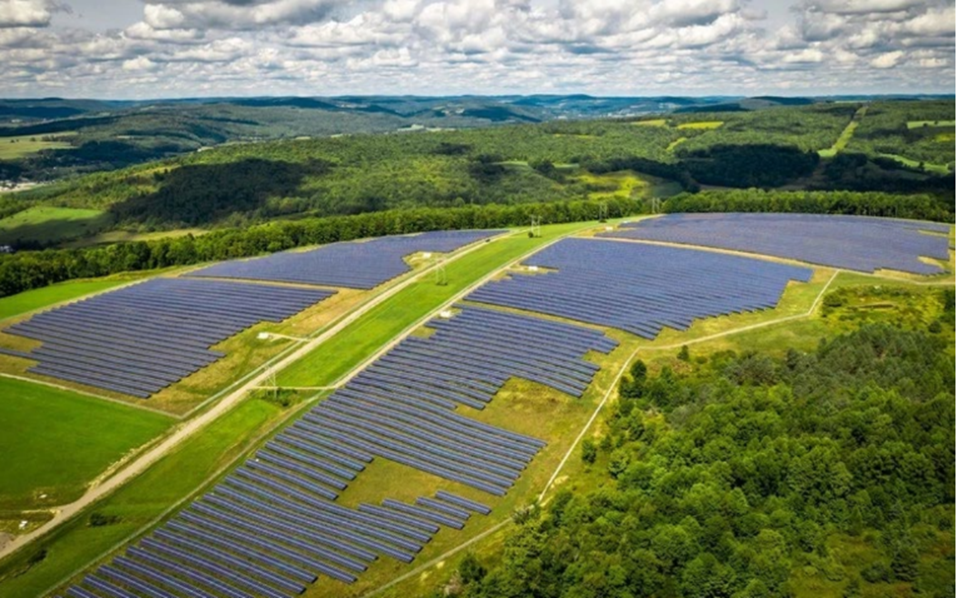
In order to meet the net-zero target the general strategy is to electrify everything primarily using newly developed wind and solar resources. According to the NYISO 2021-2040 System & Resource Outlook there were 1,985 MW of land-based wind and 2,148 MW of solar in 2019. The Draft Scoping Plan spreadsheet Appendix G: Annex 2: Key Drivers and Outputs projects that in 2040 when all the electricity in New York must be zero emissions that there will be 12,242 MW of land-based wind and 43,342 MW of solar. I documented that the solar projects in the Article Ten queue in 2020 averaged 9.3 acres of equipment area per MW. Using that estimate of land required, the Draft Scoping Plan mitigation scenarios would require over 900 square miles of solar equipment.
This post explains why the state’s response to the impact of the land needed for these developments is too little and too late to prevent serious issues. I have written enough articles on solar siting issues that I have setup a page that summarizes them all. Given the massive amount of projected utility-scale solar generation capacity required to meet Climate Act goals the rush to develop solar projects could easily lead to the permanent loss of significant amounts of prime farmland that will hurt farming communities and endanger Climate Act strategies to sequester carbon in soil. Solar developers argue that a landowner gets revenue when a solar project is developed. However, when land is taken out of production it will reduce farm jobs and the economic activity may be improved during construction but once the facility is operational there are very few economic benefits to essential local businesses. Furthermore, taking the land out of production may make other farmers who have been renting that land to make their operations viable will not be able to support investments made in facilities, livestock, or equipment.
State Actions to Protect Farmlands
First, let me describe New York’s inaction. In a recent post describing the Climate Action Council’s transition plan approach I explained that there are already serious land use issues because there is no implementation plan in place. Because there is no policy regarding utility-scale solar siting requirements relative to prime farmland the developers are thumbing their noses at the Department of Agriculture and Markets. The Department has a policy in place to protect prime farmland but developers claim that there is “no statutory or regulatory support” for the policy so it can be ignored. The Hochul Administration permitting authorities have apparently placed renewable development as the highest priority without any assessment of the impacts identified by its regulatory agencies.
On December 12, 2022 Governor Hochul announced that “a special working group of state agencies and agricultural community stakeholders will collaborate to support New York farmers and help boost the agricultural industry”. The press release stated that “This working group will be critical to tackling several challenges within New York’s agricultural industry, and my administration will continue to work with farmers to address their needs and reimagine farming in our state.” The press release explains that:
The Task Force will initially focus on, but not be limited to, the following topics:
Transportation – address challenges involving the movement of agricultural commodities and products while understanding the needs for investment in roads, bridges and other vital infrastructure to bring products to market.
Labor – identify and build the next generation of farmers and farmworkers to support a diverse industry with the skills and workers required to operate modern farms.
The environment – address and remove obstacles to capital investments in manure management, on-farm energy production, and the transition to alternative fuel sources that limit the ability of some farms to meet the State’s climate goals and become carbon neutral.
Housing for workers – increase worker housing to provide workers with a safe living environment that is close to farms and assures for sustained and daily production.
Taxation – provide clearer guidance on property tax administration and improve access to existing tax relief programs.
Farmland protection – review existing programs and identify ways that the State can ensure that productive farmland remains accessible, in production, and continues to feed New Yorkers.
Expand procurement – of local food products by various state agencies to build local food supply chains and better connect with New York farms.
On December 6, 2022 Senate bill (S8889A) to create the Agricultural and Farmland Viability Protection Fund was signed. It will bolster efforts to protect agricultural land from being permanently removed from farming to make way for solar development. The press release for this states:
Currently, all solar projects receiving funding through NYSERDA’s NY-Sun incentive program that site projects on active farmland must pay a penalty, which currently goes into the State’s General Fund. S8889A-Hinchey requires that all penalty money collected be deposited instead into the new Agricultural and Farmland Viability Protection Fund and allocated to state and local farmland protection programs.
I apologize but I am not going to get into the details of this legislation. I applaud the intent to get the money where it should logically go to try to redress the problem. However, it does not seem likely that it will be much help to a farmer who lost the land he needed and was renting to a solar developer that can afford to pay more. Furthermore, NY-Sun is the state’s initiative to expand distributed solar so this law does not cover the utility-scale solar projects that are my primary concern.
The most frustrating thing is that a solution is readily available. Last December I described a webinar hosted by New Yorkers for Clean Power (NYCP) and Alliance for Clean Energy NY (ACENY) entitled “What’s the Deal with Renewable Energy & Agriculture?” that discussed the compatibility of renewable energy and agriculture in New York State. One part of the solution discussed during the presentation could be the New York State Energy Research & Development Authority Agricultural Technical Working Group. This group released an interim final report last May that described “strategies to integrate renewable energy sources into working landscapes with minimal impact on agriculture, including the need for more research; the potential for financial incentives; and proposed tools for State and local governments”. Protection of prime farmland is a prime component of this report.
Incredibly it gets even more tone deaf in New York. The NY-Sun program is New York State’s initiative to encourage distributed generation solar. The projects participating in the NY-Sun program are “typically five MW alternating current or smaller, and do not fit the definition of a Major Renewable Energy Facility”. The interim final report notes that:
On April 19, 2022, the Public Service Commission approved the Roadmap, charting a path towards achieving an expanded goal of at least 10 gigawatts of distributed solar by 2030 and continues the NY-Sun program. NY-Sun Commercial/Industrial (C/I) projects located in an agricultural district must comply with AGM’s Solar Construction Guidelines. If the project utilizes over 30 acres of MSG 1-4, it is required to make Agricultural Mitigation Payment to the fund administered by NYSERDA. Since being implemented, these requirements have already demonstrated their effectiveness. In 2021, all 50 distributed solar projects subject to these requirements, totaling 1,037 acres of affected area, have committed to avoiding and minimizing impacts to important agricultural lands in consideration of the solar layout and complying with the Solar Construction Guidelines.
The bottom line is that there is a solar siting policy that addresses my concerns in place but only for the small solar projects. Since I started tracking solar development project approvals late last year, a total of five applications have been approved for a total of 1,120 MW. The total project areas cover 14,812 acres and the project footprints total 5,728 acres. Despite the best efforts of Department of Agriculture and Markets staff to prevent the loss of Prime Farmland, the area that will be unavailable for farming in these projects totals 3,920 acres or 26% of the combined project areas. This is bad enough but all three Draft Scoping Plan mitigation scenarios call for over 40,000 MW of solar development and there are no protections.
Conclusion
Hochul’s press release for the special working group included statements of support from New York State Department of Agriculture and Markets Commissioner Richard A. Ball; New York Farm Bureau President David Fisher; Brian Reeves, President of the New York State Vegetable Growers Association; Tonya Van Slyke, Northeast Dairy Producers Association Executive Director; Jim Bittner, owner of Bittner Singer Orchards and Interim Director of the New York State Horticulture Society; and Jeffery M. Fetter, President of Scolaro Fetter Grizanti & McGough, P.C. and Chairman of the Business and Tax Practice and Agricultural Services Groups. If these people truly care about the agricultural sector, then they should demand a moratorium on utility-scale solar developments until a responsible solar siting policy is put in place for utility-scale solar development.
The moratorium would be lifted when the special working group develops policy recommendations. At a minimum that utility-scale solar developments should adhere to the Department of Agriculture and Markets goal for projects to limit the conversion of agricultural areas within the Project Areas, to no more than 10% of soils classified by the Department’s NYS Agricultural Land Classification mineral soil groups 1-4, generally Prime Farmland soils, which represent the State’s most productive farmland. It would be best if the same farmland protection criteria contained in the Public Service Commission distributed solar Roadmap were applied to all solar projects.
I have met people affected by these huge utility-scale solar projects. It is so frustrating that their concerns and the viability of neighboring farms are being ignored when there are protections in place for smaller solar projects when the solutions are in place for small projects. I wonder why and the only thing I can think of is that money talks.
The Climate Action Council is responsible for the framework of the New York Climate Leadership and Community Protection Act (Climate Act) transition plan to meet the ambitious net-zero goal by 2050. I recently published an article explaining why I think that they have failed to address key overarching issues. This post illustrates my specific concerns related to affordability based on a more thorough review of the Climate Action Council’s discussions.
Everyone wants to do right by the environment to the extent that they can afford to and not be unduly burdened by the effects of environmental policies. I submitted comments on the Climate Act implementation plan and have written over 250 articles about New York’s net-zero transition because I believe the ambitions for a zero-emissions economy embodied in the Climate Act outstrip available renewable technology such that the net-zero transition will do more harm than good. The opinions expressed in this post do not reflect the position of any of my previous employers or any other company I have been associated with, these comments are mine alone.
Climate Act Background
The Climate Act establishes a “Net Zero” target (85% reduction and 15% offset of emissions) by 2050. The Climate Action Council is responsible for preparing the Scoping Plan that will outline how to “achieve the State’s bold clean energy and climate agenda.” The Integration Analysis prepared by the New York State Energy Research and Development Authority (NYSERDA) and its consultants quantifies the impact of the strategies. That material was used to write a Draft Scoping Plan that was released for public comment at the end of 2021. In my recent article I provided a detailed explanation of the plan for the rest of the year and described the lost opportunities for the Council to provide meaningful guidance for the rest of the transition plan implementation. I will only provide highlights here.
The meeting presentation for the 5 December 2022 Climate Action Council meeting described the remaining steps for 2022. That meeting was the last chance for any desired revisions to the Scoping Plan draft. The last draft will be circulated the week of December 12 and the Council will vote on it on December 19, 2022. Next year the Department of Environmental Conservation (DEC) will promulgate enforceable regulations to ensure achievement of the Statewide GHG emission limits. This is a very ambitious schedule and it will be hampered by the fact that the Scoping Plan is only a framework. It does not include a feasibility analysis so it is not clear how regulations can be promulgated when the implementation risks to reliability, affordability, and the environment are unknown.
In my previous article I noted that I was very disappointed by the Climate Action Council response to comments. There is no sign that the Hochul Administration considered the comment period as anything but a bothersome obligation that had to be fulfilled. It was certainly not considered an opportunity to improve, correct, or clarify the Scoping Plan. Because there were over 10,000 unique comments submitted, the Administration used Agency staff to review the comments. Staff organized the comments into themes for presentation to the Council. Summaries of public comments by theme were presented to the Council at five meetings this fall. That is a tremendous amount of information that I have just started looking at in detail.
Affordability Discussion
In my previous article I argued that the Hochul Administration’s leadership on the Climate Action Council inappropriately catered to the ideological biases of the members and, as a result, focused on relatively minor details at the expense of significant overarching issues. I described example issues associated with the lack of response to my personal comments and the lost opportunity to provide meaningful guidance for issues associated with reliability, affordability, and cumulative environmental impacts. My over-riding concern is that conditional guidance is necessary for safe regulatory implementation. This post addresses more detailed issues associated with affordability and provides some insight into the Hochul Administration’s response to public comments.
The discussion of the public stakeholder comments had four components. The meeting presentations had slides that described the public comment themes. An Agency staff person gave an overview of those slides and then explained the Agency staff recommendations to modify the Scoping Plan draft to address those themes. The final component of this review of public comments was a discussion with the Climate Action Council members.
I am going to limit this affordability discussion to the electric system chapter of the Draft Scoping Plan although I know that the reliability issue was discussed elsewhere. The Electricity feedback discussion came up at the 10/25/22 Climate Action Council Meeting. The following slide is the primary instance where affordability is mentioned.
In her presentation on the themes, Jessica Waldorf described the summary electricity themes developed by Agency staff using this slide as part of the presentation. My general impression of the summaries to the Council is that there was clear bias in the theme presentations – anything inconsistent with narrative was disparaged, downplayed, or ignored. In this example, even though affordability was the lead issue in the summary theme slide it was not mentioned in her overview. She summarized phasing out fossil fuel power generation infrastructure without mentioning affordability. The consistent narrative of the Hochul Administration is that the Climate Act transition does not have any affordability issues and it was ignored here. Administration priorities such as the bitcoin mining ban and the reuse of fossil plant sites were highlighted. According to the minutes:
Phasing out fossil fuel power generation infrastructure, including a ban on bitcoin mining and reusing existing fossil fuel power plant sites for battery storage or low-carbon fuel networks, support and opposition to nuclear generation, and continuing the Tier 2 program to support existing hydropower and renewables to ensure baseline renewable generation.
To her credit the description of the Staff recommendations for changes to the draft Final Scoping Plan did address affordability as the Minutes note:
The responsible and equitable phase out of fossil fuel generation facilities by adding and clarifying text regarding the potential repurpose of fossil fuel generation facilities, coordinating with the New York State Reliability Council and the New York State Independent System Operator in the reliability planning process, prioritizing the retirement or repurposing of fossil fuel generating facilities in Disadvantaged Communities, and maintaining energy affordability and reliability during decarbonization.
On the other hand, the slide used for the presentation put affordability as the last topic.
The final component of the Climate Action Council public comment discussion is Agency Staff response to comments from Climate Action Council Members. Affordability was the first topic raised. According to the minutes:
In response to an inquiry from Dr. Shepson as to the definition of “energy affordability”, Ms. Waldorf responded that the Gas System Transition Subgroup defined it to be consistent with NYS Public Service Commission policy which ensure that consumers don’t suffer from more than 6% of their income on their energy burden.
In response to a comment and inquiry from Raya Salter regarding energy affordability, believing that using the word “maintaining” is a misnomer given her belief that New York is among the most expensive energy cost states, and whether the Inflation Reduction Act opportunities have been considered to reduce energy affordability burdens, Ms. Waldorf responded that the recommendations do address the possibility of price volatility, including the potential for federal funding to mitigate price volatility. Mr. Mas noted that the final Integration Analysis will include references to the potential opportunities from the Inflation Reduction Act within each of the sectors. Ms. Salter noted the importance of keeping equity and justice at the center of the price volatility considerations.
Affordability Lost Opportunity
In my previous post about the Climate Action Council’s lost opportunities to responsibly lead the process, I noted that every jurisdiction that has tried to implement a similar transition plan has seen significant price increases of electricity (see the following figure) The missing piece in the affordability presentation and the apparent direction of the final Scoping Plan is completely ignoring the possibility that the costs of the transition could be so high that the implementation on the Climate Act mandated schedule may not be feasible. My comments raised the concept that implementation should be conditional. If the transition exceeds the affordability, reliability, and environmental impact thresholds determined by the Council that re-assessment at least is appropriate. In my opinion this decision could extend to a full stop on the transition until the technology catches up with the ambition.
In my previous article I said that the Climate Act Council should have discussed affordability but reviewing the documentation that came out after I had drafted the article, they did discuss it. However, the discussion was inadequate because it missed the main point.
Dr. Shepson asked the appropriate question: what does “energy affordability” means in quantitative terms. Waldorf responded that the Gas System Transition Subgroup defined maintaining energy affordability to be consistent with New York State Public Service Commission (PSC) policy which ensures that consumers don’t suffer from more than 6% of their income on their energy burden. Raya Salter said “maintaining” is a misnomer because she believes that New York is among the most expensive energy cost states, so “It is not affordable now.”
As has been the case with every aspect of the Climate Act transition I have looked at in detail, this is more complicated and has implications beyond the pronouncements from the authors of the Scoping Plan. The PSC Energy Affordability Policy (EAP) states: “an energy burden at or below 6% of household income shall be the target level for all 2.3 million low-income households in New York” per Case 14-M-0565, Order Adopting Low Income Program Modifications and Directing Utility Filings, p. 3 issued May 20, 2016. Department of Public Service Proceeding, Case 14-M-0565 – Proceeding on Motion of the Commission to Examine Programs to Address Energy Affordability for Low Income Utility Customers, sets up a Percentage of Income Payment Plan. In the New York plan funding is provided to low-income households such that their energy burden is kept at or below 6%. The relevant problem is that there is an upper limit on program funding. If electricity costs increase too much than that limit will be exceeded and more people will have energy burdens exceeding the 6% of household income policy goal.
Shepson and Salter almost got to the main point but fell short. It is not sufficient to just reference the PSC Energy Affordability Policy. The Climate Action Council should have discussed the implications of the metric and whether it is appropriate for this application. The discussion should have addressed the following. It is not clear whether all low-income households comply with that metric now. What is the status of the funding relative to the upper limit on program funding? If in the future that metric is exceeded then what? There also is a presumption that energy poverty is only a problem with lower income households but the numbers affected are tied to the definition of an acceptable energy burden. The Council should have discussed these over-arching issues and current state policies explained to the Council. I also believe that the State should track the status of energy poverty burden current status numbers. It is not available as far as I can tell on the Open NY website that is the supposed repository of all New York quantitative data.
I submitted the following comment on the Draft Scoping Plan that addressed these issues. Apparently, it did not rise to the level where it was a theme that should have been addressed.
Because there are limitations to existing technology the Final Scoping Plan must incorporate conditions based on reliability and affordability. The Climate Action Council should define the criteria for reliability and affordability and then establish conditions incorporating those criteria. For example, a recent legislative proposal included a requirement for state agencies to identify policies to ensure affordable housing and affordable electricity (defined as electricity costs no more than 6% of a residential customer’s income) for all-electric buildings. Alternatively, Addressing Energy Poverty in the US offers other possible criteria:
“According to the U.S. Department of Energy, the average energy burden for low-income households is 8.6%. That is three times higher than for non-low income households, which is about 3%. And according to the Kleinman Center for Energy Policy at University of Pennsylvania, more than one-third of US households are experiencing “energy poverty,” having difficulty affording the energy they need to keep the lights on and heat and cool their home.”
Once the Council has established the appropriate affordability metric and the current status of that metric has been determined, then a condition using the metric can be established. For example, if the criterion is that the average energy burden cannot increase above the average and the Integration Analysis projects that a certain mitigation strategy could lead to an increase above the average then that strategy should not be implemented until the costs come down or a subsidy can be set up to prevent exceeding the criterion.
Ultimately, I believe the Council should have spent more time discussing what the quantitative measure of affordability should be. It is not clear when, at the end of 2021, there were 1.267 million utility accounts in arrears totaling $1.7 billion whether the PSC Energy Affordability Policy is working and how well it represents the current state of utility costs. Raya Salter is correct saying there is a problem now and even maintaining current levels is unacceptable.
I believe that the Council should establish an affordability metric and provide status information. If the costs exceed some acceptability threshold that they define, then I believe there should be a response. I believe that the tremendous costs of the Climate Act transition will exceed any reasonable threshold for acceptability.
I am also disappointed that the Council did not work with the Climate Justice Working Group on the topic of affordability for those least able to afford energy price increases. For all the social justice concerns addressed why wasn’t prevention of regressive energy price increases on disadvantaged communities a priority. The poor will be hit hardest by any energy price increase and there was nary a peep of concern. There should have been a push to provide the energy poverty metric determined by census tract so that any disproportionate impacts on disadvantaged communities could be tracked and addressed.
Conclusion
The affordability issue is a prime example of the Hochul Administration’s failure to address any issues raised that are inconsistent with their narrative. In this case the narrative is that the costs of inaction are greater than the costs of action and that cost impacts to will be small and manageable. This flies in the face of the results at all other jurisdictions that have tried to implement something similar.
I am disappointed that my comments on affordability did not rise to the level of a theme whereby they warranted a mention in the Agency Staff presentation on public comments received. More concerning is that the concerns of the Climate Action Council members were given short shrift. Shepson and Salter almost got to the core issue that there are “what if” questions related to the 6% PSC policy but in the rush to meet the deadline they got an answer that was not responsive. The Stafff answer does not address how to quantify reliability vis-à-vis the PSC policy and does not necessarily address the on-going problem of energy affordability.
The last several years I have spent an inordinate amount of time evaluating the Climate Leadership and Community Protection Act (Climate Act) and its legal mandate for New York State greenhouse gas emissions to meet the ambitious net-zero goal by 2050. Over the past two years I have watched with disbelief as the folks charged with developing the framework for the transition used their positions to push their personal agendas at the expense of the people of New York. Rather than addressing fundamental overarching issues, the Council has been bogged down arguing about emotional issues and details. This post describes the lost opportunities for the Council to improve, correct, or clarify the Scoping Plan so that the transition to net-zero will result in an affordable and reliable energy system with minimal adverse environmental impacts.
Everyone wants to do right by the environment to the extent that they can afford to and not be unduly burdened by the effects of environmental policies. I submitted comments on the Climate Act implementation plan and have written over 250 articles about New York’s net-zero transition because I believe the ambitions for a zero-emissions economy embodied in the Climate Act outstrip available renewable technology such that the net-zero transition will do more harm than good. The opinions expressed in this post do not reflect the position of any of my previous employers or any other company I have been associated with, these comments are mine alone.
Climate Act Background
The Climate Act establishes a “Net Zero” target (85% reduction and 15% offset of emissions) by 2050. The Climate Action Council is responsible for preparing the Scoping Plan that will outline how to “achieve the State’s bold clean energy and climate agenda.” The Integration Analysis prepared by the New York State Energy Research and Development Authority (NYSERDA) and its consultants quantifies the impact of the strategies. That material was used to write a Draft Scoping Plan that was released for public comment at the end of 2021. The Climate Action Council is required to finalize the Scoping Plan by the end of the 2022.
The meeting presentation for the 5 December 2022 Climate Action Council meeting described the remaining steps for 2022. The meeting discussed any final desired revisions to the draft of the Final Scoping Plan. One slide notes that the “Co-Chairs of the Council may make non-substantive, editorial or grammatical changes deemed necessary for clarity or accuracy of the Scoping Plan (e.g., correcting footnotes) prior to its publication”. They plan to share the Executive Summary the week of December 5 and the final version of the Scoping Plan for voting will be circulated the week of December 12. Voting is scheduled for December 19, 2022. The final Scoping Plan will be submitted to the Governor, the speaker of the Assembly, and the Temporary President of the Senate and made available to the public shortly after the voting meeting on December 19 on the Climate Act website.
In 2023 the Department of Environmental Conservation (DEC) will promulgate enforceable regulations by the end of the year to ensure achievement of the Statewide GHG emission limits. That process will include public workshops and consultation with the Climate Action Council, the Environmental Justice Advisory Group, the Climate Justice Working Group, representatives of regulated entities, community organizations, environmental groups, health professionals, labor unions, municipal corporations, trade associations and other stakeholders. At least two public hearings and a 120-day public comment period must be provided. Only after this extensive stakeholder process concludes is DEC authorized to propose the 2024 Implementing Regulations.
This is a very ambitious schedule and it will be hampered by the fact that the Scoping Plan is only a framework. It does not include a feasibility analysis so it is not clear how regulations can be promulgated when the risks to reliability, affordability, and the environment are unknown. Without that information a regulated schedule for transition components runs the risk of unacceptable impacts. There are already obvious issues associated with the lack of an implementation plan. Finally, the cumulative environmental impact statement mandated by state law has not been updated to incorporate the latest estimates of the resources necessary for the net-zero transition. This post will address these three lost overarching opportunities for the Climate Action Council.
Climate Action Council
The Climate Act established the Climate Action Council to develop the Scoping Plan. It consists of 22 members that were chosen by ideology not expertise. There are 12 agency members and 10 at-large members: two non-agency representatives appointed by the Governor, three representatives appointed by the Speaker of the Assembly, one representative appointed by the minority leader of the Assembly, three representatives appointed by the Temporary President of the Senate, and one representative appointed by the minority leader of the Senate. The upcoming vote on the Scoping Plan must pass by a super majority of 15 votes. Note that the Governor has 14 appointees on the Council: all the agency heads and two direct picks.
I am very disappointed by the response to comments. The comment period ran from the beginning of the year to early July, but it was treated as an obligation not as an opportunity to improve, correct, or clarify the Scoping Plan. If they were serious about addressing comments then the process would have been on-going from the start of the year. Staff should have been reviewing comments as they came in and categorizing them. For example, some comments addressed specific non-controversial problems such as typographical errors. Others addressed specific methodological issues in the Integration Analysis. Because those had a direct bearing on the veracity of the Draft Scoping Plan they should have been summarized and responses developed for Council review and consideration. Instead, the staff presented the Council with summaries of the themes of the comments submitted.
The political theater of the public comment period included eleven Public Hearings where 700 people spoke. Approximately 35,000 comments were received but around 25,000 comments were “potentially the same or substantially similar”, i.e., form letters. That left on the order of 10,000 unique comments and it was obviously impossible for the Council members to read them all. As a result, agency staff had to read, categorize, and summarize all the comments. It appears that agency staff who were charged with reading them did not start in earnest until the end of the comment period so the very real issues associated with processing got short shrift. Publicly all I saw was presentations to the Council that listed themes of the comments with very little specificity and it is not clear if other documentation was available to the Council. There was clear bias in the theme presentations – anything inconsistent with narrative was disparaged, downplayed, or ignored. No comments associated with Integration Analysis methodology or errors were discussed at any of the Climate Action Council meetings and it is not clear that the Council members are even aware that specifc integration analysis issues were raised.
I think that the Hochul Administration decided early on to treat stakeholder comments only as an obligation. At one of the Council meetings, it was stated that all comments would be “acknowledged” and they promised to make the comments available to the public. During the last attempt to develop a New York Climate Plan the State provided a copy of all the comments and a response to each one of them. I am sure that the State will argue that they were overwhelmed by 10,000 unique comments but on the other hand they are proposing to completely change the energy system of the state and commit New Yorkers to higher costs and significant reliability risks. I thought that they would do something similar to the previous program but there is no sign that is the case. The comments are not even publicly available at the same time the revised draft of the Scoping Plan has been finalized. It is a slap in the face to all the people who submitted comments that it appears that there will be no acknowledgement of their concerns until the Scoping Plan is completed. What better way to say “we don’t care and you don’t matter.”
Lost Opportunities
Regrettably, the Climate Action Council actions over the last 12 months have concentrated on specific political narratives. The Hochul Administration’s narrative is appeasement of the constituencies that view as their political base. For example, in the presentations on comments received, specific comments raised by the Climate Justice Working Group were addressed. There was no similar acknowledgement of comments from the New York Independent System Operator on the vitally important electric grid. The revisions to the Draft Scoping Plan appear to be more reflective of the issues raised by the ideologues on the Council than anything submitted by stakeholders. The staff presentations describing stakeholder comments were quick to acknowledge numbers that supported the ideological narrative and were quicker to disparage anything that did not even if there were many comments making the point.
The result is that the focus of the Council has been on specifics, and only parts of the specifics, but not overarching issues. This section will describe the lost opportunities for my three major concerns: reliability, affordability, and environmental impacts.
Reliability
One of the more frustrating aspects of the last year is the presumption of expertise by some Climate Action Council members who have no relevant background or experience on topics on which they confidently preach. Astoundingly, when it comes to electric grid reliability, they have gone so far to state anyone who disagrees with them is a mis-informer. For example, Paul Shepson, Dean, School of Marine and Atmospheric Sciences at Stony Brook University, (starting at 23:39 of the 26 May 2022 Council meeting recording said:
Mis-representation I see as on-going. One of you mentioned the word reliability. I think the word reliability is very intentionally presented as a way of expressing the improper idea that renewable energy will not be reliable. I don’t accept that will be the case. In fact, it cannot be the case for the CLCPA that installation of renewable energy, the conversion to renewable energy, will be unreliable. It cannot be.
Robert Howarth, Professor, Ecology and Environmental Biology at Cornell, starting at 32:52 of the recording) picked up on the same issue. He said that fear and confusion is based on mis-information but we have information to counter that and help ease the fears. He stated that he thought reliability is one of those issues: “Clearly one can run a 100% renewable grid with reliability”, although he did admit it had to be done carefully.
Two quotes from a recent New York Independent System Operator presentation directly contradict them: “Significant uncertainty is related to cost / availability of Dispatchable Emissions Free Resource (DEFR) technologies, as well as regulatory definition of ‘zero-emissions’ compliant technologies” and “Some scenarios do not represent realistic system performance but are helpful in identifying directional impacts and sensitivity to key variables”. I have explained that is as close as a technical report can come to saying this won’t work as you can get without actually saying it. For more information about the required but currently unavailable DEFR technologies see my DEFR page.
DEFRs that provide sustained on-demand power and system stability will be essential to meeting policy objectives while maintaining a reliable electric grid. While essential to the grid of the future, such DEFR technologies are not commercially viable today. DEFRs will require committed public and private investment in research and development efforts to identify the most efficient and cost-effective technologies with a view towards the development and eventual adoption of commercially viable resources. The development and construction lead times necessary for these technologies may extend beyond policy target dates.
I recently gave a presentation describing my skeptical concerns about the Climate Act. I wrote it as if I were trying to persuade folks like Shepson and Howarth that there are legitimate reliability concerns. In my blog post summary of that presentation, I described the basics of the electric grid making the point that our electric grid system has taken decades to reach the current reliability levels using resources that can be dispatched as needed. A system that relies on wind and solar needs DEFR to provide the operators with an option to match load when it is needed the most. I believe that all the experts who are responsible for electric reliability are concerned that a plan that relies on any technology that is not commercially viable today to replace resources by 2040 has significant inherent risks.
I am disappointed that the Hochul Administration did not make it clear that debating reliability arguments were beyond the scope of the Council. They should have accepted the input of the organizations responsible for electric grid reliability that warn there are issues. Rather than debating whether there are risks, the Climate Action Council should have been discussing what they should be doing about that risk. The biggest question is whether any reduction in reliability standards is acceptable in order to meet the Climate Act transition to net-zero targets. Most of the expert concern revolves around the aggressive schedule. The Council should have discussed whether a conditional schedule based on the availability of DEFR might be necessary and made recommendations for the criteria that should be used to determine whether that is necessary.
Affordability
If the Hochul Administration would bother to ask the public about the Climate Act I suspect the first question that the public wants answered is how much is this going to cost? It is amazing that the only information provided to the Council and public was the claim that the costs of inaction are greater than the costs of action based on various versions of the following figure. There is no documentation for the expected specific costs and emission reductions of the control strategies proposed so very little meaningful critiques are possible. The Council should have demanded better documentation than what was provided.
My comments eviscerating their claim that the costs of inaction are greater than the costs of action is the most egregious example of irresponsible replies to stakeholder comments. I made verbal comments at the Syracuse Draft Scoping Plan public hearing on April 26 and submitted written comments that explained why the costs of inaction are greater than the costs of action claim based on this figure are misleading and inaccurate. I followed up later with a more detailed explanation in another submitted written comment. There is no way that the reviewers of the written comments or the members of the Council that were present at the Syracuse can say that they were not aware of my comments.
I am sure that they were ignored because they destroy the narrative. The claim is misleading because the values shown are relative to the Reference Case rather than a Business-as-usual case that is usually used in these analyses. The Reference Case includes the Statewide zero-emissions vehicle mandate among other things because it is “already implemented.” Does anyone really believe that the zero-emissions vehicle mandate is anything but a necessary component of the Climate Act costs? Excluding that program alone means that $700 billion in costs are not included in the costs for the Climate Act shown in the figure. Furthermore, the benefits incorrectly count the societal benefits of avoided carbon emissions multiple times. The claimed $235 to $250 billion in those benefits should be no more than $60 billion. If just those two “tricks” are corrected then the costs far exceed the benefits.
Obviously, this is a basic underlying presumption of the Draft Scoping Plan that the Council should have discussed. My claims should have been described and the authors of the Integration Analysis should have been held accountable to explain why they did what they did and why they disagree with my arguments. Only then could the Council discuss and decide whether this claim is appropriate.
There is a bigger problem however. Every jurisdiction that has tried to implement a similar transition plan has seen significant price increases of electricity. The Climate Act Council should have discussed affordability. If the costs exceed some threshold, then I believe there should be a response. It is up to the Council to define that affordability threshold. The NY REV Energy Affordability Policy intends to limit energy costs to no more than 6% of income as per the 2016 order from the Public Service Commission. The Council should have determined where the State stands with respect to this metric now. I have tried multiple times to find where the state stands relative to this or any other energy poverty metric but have been unable to find it. The Council should have demanded that this metric be made readily available so that it can be tracked as the transition plan progresses. Then their discussion could have turned to the “what if” question if the metric gets worse what should be done.
I am also disappointed that the Council did not work with the Climate Justice Working Group on the topic of affordability for those least able to afford energy price increases. For all the social justice concerns addressed why wasn’t prevention of regressive energy price increases a priority. The poor will be hit hardest by any energy price increase and there was nary a peep of concern. There should have been a push to provide the energy poverty metric determined by census tract so that any disproportionate impacts on disadvantaged communities could be tracked and addressed.
Environmental Impacts
The complete lack of concern relative to the cumulative environmental impacts of the massive amounts of wind, solar, and energy storage required for the net-zero transition is another disappointment. On September 17, 2020 the Final Supplemental Generic Environmental Impact Statement (SGEIS) for the Climate Leadership and Community Protection Act was released. I estimated that the Draft Scoping Plan calls for at least 497 more onshore wind turbines, 493 more offshore wind turbines and 602 more square miles covered with solar equipment than was considered in that cumulative impact statement. In addition, the environmental impacts of battery energy storage were not addressed and it is impossible to project the impacts of the environmental impacts of the dispatchable emissions-free resource that it included in the capacity projections because a technology has not been specified. I commented that an updated impact statement that addresses all these issues is necessary but this topic was not mentioned as a theme at Council meetings.
The Climate Action Council should have considered whether thresholds for unacceptable cumulative environmental impacts are appropriate. I believe that without addressing this problem that it is likely that the environmental impacts from the massive wind and solar resource developments will have far worse impacts than anything that can be ascribed to climate change caused by New York emissions but this issue was never discussed. For example, I project that at least 216 Bald Eagles could be killed every year when there are 9,445 MW of on-shore wind. There were 426 occupied bald eagle nest sites in New York in 2017. I am not a wildlife biologist but those numbers indicate to me that there will be major threats to the survivability of Bald Eagles in New York. I recommended that the Final Scoping Plan include proposed thresholds for unacceptable environmental impacts like this but the comment was never mentioned as a theme at the Council meetings.
There is another environmental impact aspect that I think the Council should have addressed. I have written enough articles on solar siting issues that I have setup a page that summarizes them all. I became aware of the particular issues of utility-scale solar development on agriculture after I had a couple of people contact my blog describing issues that they had and suggested that I look into the issue. The problems that they raised are real, the solutions are available, but in the rush to develop as many renewable resources as quickly as possible, the Hochul Administration has dropped the ball on responsible utility-scale solar development. Given the massive amount of projected utility-scale solar generation capacity required to meet Climate Act goals the rush to develop solar projects could easily lead to the permanent loss of significant amounts of prime farmland that will hurt farming communities and endanger Climate Act strategies to sequester carbon in soil.
I submitted a comment to the Council in March calling for a moratorium on utility-scale solar siting in March but that too has been ignored. Since I started tracking solar development project approvals last year, a total of five applications have been approved for a total of 1,120 MW. The total project areas cover 14,812 acres and the project footprints total 5,728 acres. Despite the best efforts of Department of Agriculture and Market staff to prevent the loss of Prime Farmland, these projects were approved and the prime area lost for farming in these projects totals 3,920 acres or 26% of the combined project areas. This is bad enough but all three Draft Scoping Plan mitigation scenarios call for over 40,000 MW of solar development so imagine how much more prime farmland will be lost if nothing changes. The Climate Action Council should have addressed this issue and decided whether responsible solar siting guidelines similar to the policy option roadmap for the proposed 10 GW of distributed solar development should be instated. As a result of Hochul Administration inaction there will be significant and irreplaceable loss of prime farmland and damage to farming communities across the state.
There is another aspect of this that the Council should have addressed. The New York State Department of Agriculture and Markets (AGM) “discourages the conversion of farmland to a non-agricultural use”. With respect to utility-scale renewable energy projects, “The Department’s goal is for projects to limit the conversion of agricultural areas within the Project Areas, to no more than 10% of soils classified by the Department’s NYS Agricultural Land Classification mineral soil groups 1-4, generally Prime Farmland soils, which represent the State’s most productive farmland”. The latest solar development permit application that was approved included this response to AGM concerns:
In addition, no statutory or regulatory support is cited for AGM’s proposed 10% or less Prime Farmland soil conversion “goal” that “the production of food is more essential than the generation of [renewable] electricity,” or that soil classifications 1-4 should be avoided, even if it means interfering with the development of a renewable facility contracted to sell renewable energy credits to NYSERDA. The Certificate Conditions conserve and protect agricultural lands; it is the responsibility of AGM, and not private solar developers, to encourage the development of farming. That charge cannot be used to thwart the renewable energy goals of the State.
While Council members spent time arguing over their personal agenda issues out-of-state developers are coming into the State throwing up as much renewable energy as possible completely disregarding the New York regulatory agencies charged with protecting the State’s larger issues. The Hochul Administration has apparently placed renewable development as the highest priority without any assessment of the impacts identified by its regulatory agencies. The Council should have discussed whether the agencies will be allowed to do their jobs and protect the interests of the state as a whole or will be muzzled and ignored all in the name of the Climate Act.
There is one final point that I raised in comments that the Council has apparently never addressed. New York’s contribution to global emissions of greenhouse gases is too small to expect that there will be any measurable improvement to the alleged effects of climate change on New York. Moreover, as shown in the following graph New York’s emissions have been consistently less than the global increase in emissions since the early 1990’s. I found that New York’s emissions are less than one half of one percent of global emissions and that the average increase in global emissions is greater than one half of one percent. In other words, even if we eliminate our emissions the increase in global emissions will be replace them in less than a year. Considering this information, Why is not a conditional and measured transition approach warranted? Why didn’t the Council consider these tradeoffs.
Conclusion
I spent a lot of time preparing comments on the Draft Scoping Plan trying to improve, correct, and clarify it so that the transition to net-zero will more likely result in an affordable and reliable energy system with minimal adverse environmental impacts. I have seen absolutely no sign that the Hochul Administration ever had any intention of making changes to the Scoping Plan framework for the future energy system based on comments that ran contrary to their politically driven agenda. There are no indications that any of my comments made it past the agency staff screening step to reach the Climate Action Council membership for consideration.
The Climate Action Council revisions to the Draft Scoping Plan has focused on details and ignored overarching issues. If the Council were truly doing its job, they would be working with the New York Independent System Operator and the New York State Reliability Council to determine if the current reliability standards are adequate or must modified for the future electric grid. If the Hochul Administration was truly worried about disadvantaged communities they would have required the Council to recommend an energy poverty metric and would have set up a clear and transparent tracking system for it at the census tract level. If Co-Chair of the Council and DEC Commissioner Basil Seggos took his responsibility for the environment seriously, he would have had a cumulative environmental impact statement completed that addressed the Integration Analysis projected renewable resource development levels and had the Council discuss environmental impact acceptability thresholds. If Co-Chair of the Climate Action Council and President of the New York State Energy Research & Development Authority Doreen Harris wanted her organization to provide objective information and analysis, the issues I raised relative to the misleading and inaccurate cost benefit analysis would have been addressed by the Council. If Council member and Commissioner of the Department of Ag and Markets Richard Ball truly cared about New York farms he would have demanded a responsible solar siting policy for utility-scale solar development that protects prime farmland.
The Hochul Administration’s treatment of the stakeholder comments has been an insult to anyone who took the time to develop comments. This does not portend well for the public consultation process mandated for next year. Unfortunately, the ultimate issue is that if the zero-emissions electric grid plan is inadequate because the Council ignored critical issues raised by stakeholders, people will freeze to death in the dark.
Normally I publish an annual analysis of the Regional Greenhouse Gas Initiative (RGGI) annual Investments of Proceeds update soon after the release of the report but I was busy preparing comments on the New York Climate Leadership & Community Protection Act so this update is very late. This is the fifth installment of my annual updates on the RGGI proceeds report. This post compares the claims about the success of the investments against reality. As in my previous posts I have found that the claims that RGGI successfully provides substantive emission reductions are unfounded.
I have been involved in the RGGI program process since its inception. I blog about the details of the RGGI program because very few seem to want to provide any criticisms of the program. The opinions expressed in this post do not reflect the position of any of my previous employers or any other company I have been associated with, these comments are mine alone.
Background
RGGI is a market-based program to reduce greenhouse gas emissions (Factsheet). It has been a cooperative effort among the states of Connecticut, Delaware, Maine, Maryland, Massachusetts, New Hampshire, New York, Rhode Island, and Vermont to cap and reduce CO2 emissions from the power sector since 2008. New Jersey was in at the beginning, dropped out for years, and re-joined in 2020. Virginia joined in 2021 and Pennsylvania has joined but is not actively participating in auctions due to on-going litigation. According to a RGGI website: “The RGGI states issue CO2 allowances which are distributed almost entirely through regional auctions, resulting in proceeds for reinvestment in strategic energy and consumer programs. Programs funded with RGGI investments have spanned a wide range of consumers, providing benefits and improvements to private homes, local businesses, multi-family housing, industrial facilities, community buildings, retail customers, and more.”
The latest investment proceeds update was released in May 2022. The Investment of RGGI Proceeds in 2020 report tracks the investment of the RGGI proceeds and the benefits of these investments throughout the region. According to the report, the RGGI states invested $196 million in 2020 auction proceeds and expect lifetime benefits of the RGGI investments made in 2020 to include $1.9 billion in lifetime energy bill savings and 6.6 million short tons of CO2 emissions avoided. The report breaks down the investment categories as follows:
Energy efficiency makes up 35% of 2020 RGGI investments and 53% of cumulative investments. Programs funded by these investments in 2020 are expected to return about $1.2 billion in lifetime energy bill savings to more than 56,000 participating households and over 700 businesses in the region and avoid the release of 4.6 million short tons of CO2.
Clean and renewable energy makes up 18% of 2020 RGGI investments and 14% of cumulative investments. RGGI investments in these technologies in 2020 are expected to return over $600 million in lifetime energy bill savings and avoid the release of more than 1.7 million short tons of CO2.
Beneficial electrification makes up 11% of 2020 RGGI investments and 3% of cumulative investments. RGGI investments in beneficial electrification in 2020 are expected to avoid the release of 177,000 short tons of CO2 and return nearly $90 million in lifetime savings.
Greenhouse gas abatement makes up 5% of 2020 RGGI investments and 8% of cumulative investments. RGGI investments in greenhouse gas (GHG) abatement in 2020 are expected to avoid the release of more than 160,000 short tons of CO2 and to return over $51 million in lifetime savings.
Direct bill assistance makes up 19% of 2020 RGGI investments and 16% of cumulative investments. Direct bill assistance programs funded through RGGI in 2020 have returned over $37 million in credits or assistance to consumers.
There was a change in these categories in this report relative to previous reports. This is the first version of this report which includes beneficial electrification as its own investment category. In previous versions of this report, investments in beneficial electrification programs were included within the other major investment categories.
Emissions Reductions
In my previous articles on the Proceeds reports, I have argued that RGGI mis-leads readers when they claim that the RGGI states have reduced power sector CO2 pollution over 50% since 2009. In the following table, I list the 9-state RGGI emissions and percentage reduction from a three-year baseline before the program started in 2009.
I have argued that the implication in the 50% claim is that the RGGI program were primarily responsible for the observed reduction even as the economy grew (Figure 1 from the report).
I believe that their insinuation that RGGI was primarily responsible for the emission reductions is wrong. The following table lists the emissions by fuel types for these nine RGGI states. It is obvious that the primary cause of the emission reductions was the fuel switch from coal and residual oil to natural gas. This fuel switch occurred because it was economic to do so. I believe that RGGI had very little to do with these fuel switches because fuel costs are the biggest driver for operational costs and the cost adder of the RGGI carbon price was too small to drive the use of natural gas over coal and oil.
I believe that the appropriate measure of RGGI emissions reductions is the decrease due to the investments made with the auction proceeds so I compared the annual reductions made by RGGI investments. The biggest flaw in the RGGI report is that it does not provide the annual RGGI investment CO2 reduction values accumulated since the beginning of the program. In order to make a comparison to the CO2 reduction goals I had to sum the values in the previous reports to provide that information.
The following table lists the annual avoided CO2 emissions generated by the RGGI investments from previous reports. The accumulated total of the annual reductions from RGGI investments is 3,658,696 tons while the difference between the three-year baseline of 2006-2008 and 2020 emissions is 65,079,196 tons. The RGGI investments are only directly responsible for 5.6% of the total observed annual reductions over the baseline to 2020 timeframe!
Although proponents claim that this program has been an unqualified success I disagree. Based on the numbers there are some important caveats to the simplistic comparison of before and after emissions. The numbers in the previous paragraph show that emission reductions from direct RGGI investments were only responsible for 5.6% of the observed reductions. In a detailed article I showed that fuel switching was the most effective driver of emissions reductions since the inception of RGGI and responsible for most of the reductions.
Benefits
Table 1 from the report lists two benefits of 2020 RGGI Investments: emission reductions and energy bill savings. Energy bill savings derive from investments in energy efficiency savings and other efforts that directly reduce costs to consumers. These energy saving benefits typically account for total savings over the lifetime of the project investment. RGGI does the same thing with the CO2 emission reductions but I think that is misleading because the emission reduction metric is annual emissions and not lifetime emissions.
Emission Reduction Cost Efficiency
There is another aspect of this report that is mis-leading and after arguing with RGGI and New York State about the issue, I have concluded that the deception is intentional. In particular, I believe that a primary concern for GHG emission reduction policies is the cost effectiveness of the policies and I have argued that this report should provide the information necessary to determine a cost per ton reduced value for control programs for comparison to the social cost of carbon. If the societal benefits represented by the social cost of carbon for GHG emission reductions are greater than the control costs for those reductions, then there is value in making the reductions. If not, then the control programs are not effective.
Recall that RGGI provides lifetime CO2 emission reductions but I think that is misleading because it suggests that the emission reduction cost efficiency of the investments is the total investments divided by the lifetime benefits of those benefits. For example, dividing the 2020 investments of $196 million by the lifetime avoided CO2 emissions yields a value of $29. The Biden administration is re-evaluating the social cost of carbon values but for the time being has announced an initial estimate of $51 per ton and this suggests that RGGI investments are cost effective relative to the social cost of carbon.
However, the social cost of carbon value is calculated for an annual reduction of one ton. In particular, the social cost of carbon is an estimate, in dollars, of the present discounted value of the benefits of reducing annual emissions by a metric ton. (Note that my numbers do not include the relatively small conversion to metric tons for a proper comparison to the social cost of carbon.) In order to calculate the CO2 emissions reduction efficiency consistent with the social cost of carbon, the proper estimate is the total investments since the start of the program divided by sum of the annual emission reductions. The problem is that the RGGI reports do not provide that total and instead only provide the sum of the annual lifetime CO2 avoided emissions.
The Proceeds reports always include a caveat that the states continually refine their estimates and update their methodologies, but the annual numbers are not updated to reflect those changes. Ideally to get the best estimate of the annual numbers the RGGI states should provide the revised annual numbers for each year of the program. Because that is not the case, I have had to rely on the original annual numbers provided in previous editions of the report. As noted previously, I sum the values in the previous reports to provide that information as shown in the Accumulated Annual Regional Greenhouse Gas Initiative Benefits Through 2020 table. The accumulated total of the annual reductions from RGGI investments is 3,658,696 tons through December 31, 2020. The sum of the RGGI investments in the previous table is $2,991,215,917 over that time frame. The appropriate comparison to the social cost of carbon is $2.991 billion divided by 3,658,696 tons or $818 per ton reduced.
Conclusion
The 2020 RGGI Investment Proceeds report tries to put a positive spin on the poor performance of RGGI auction proceeds reducing CO2. The alleged purpose of the program is to reduce CO2 from the electric generating sector to alleviate impacts of climate change. Since the beginning of the RGGI program RGGI funded control programs have been responsible for 5.6% of the observed reductions. The report does not directly provide the numbers necessary to calculate that estimate which I have come to believe is deliberate. When the sum of the RGGI investments is divided by the sum of the annual emission reductions the CO2 emission reduction efficiency is $818 per ton of CO2 reduced. I conclude that RGGI is not an effective CO2 emission reduction program.
The last several years I have spent an inordinate amount of time evaluating the Climate Leadership and Community Protection Act (Climate Act) and its legal mandate for New York State greenhouse gas emissions to meet the ambitious net-zero goal by 2050. As the implementation outline for the transition to a net-zero evolves I have been struck by the number of people involved with the transition that insist on reducing their perceived priority risks to zero. That is the antithesis of a pragmatic approach and I have tried to understand where those folks are coming from. This post describes some recent articles at the Risk Monger blog that address the motivations of those who want zero risks.
Everyone wants to do right by the environment to the extent that they can afford to and not be unduly burdened by the effects of environmental policies. I submitted comments on the Climate Act implementation plan and have written over 250 articles about New York’s net-zero transition because I believe the ambitions for a zero-emissions economy embodied in the Climate Act outstrip available renewable technology such that the net-zero transition will do more harm than good. The opinions expressed in this post do not reflect the position of any of my previous employers or any other company I have been associated with, these comments are mine alone.
Climate Act Background and Risk Management
The Climate Act establishes a “Net Zero” target (85% reduction and 15% offset of emissions) by 2050. The Climate Action Council is responsible for preparing the Scoping Plan that will “achieve the State’s bold clean energy and climate agenda”. The Integration Analysis prepared by the New York State Energy Research and Development Authority (NYSERDA) and its consultants quantifies the impact of the strategies. That material was used to write a Draft Scoping Plan that was released for public comment at the end of 2021. The Climate Action Council states that it will finalize the Scoping Plan by the end of the year. Climate Action Council meetings have included discussions about revisions to the Draft Scoping Plan that emphasize the need for zero risk that is the opposite of a pragmatic approach to the risks of climate change.
I addressed risk management for the Climate Act in August 2020. That article and this one relies on work done the Risk Monger, a blog “meant to challenge simplistic solutions to hard problems on environmental-health risks”. The author of the blog, David Zaruk, is an EU risk and science communications specialist since 2000, active in European Union (EU) policy events and science in society questions of the use of the Precautionary Principle. He is a professor at Odisee University College where he lectures on Communications, Marketing, EU Lobbying and Public Relations. In my opinion, he clearly explains the complexities of risk management and I recommend his work highly.
Zero Risk Motivations
Zaruk has argued that the Precautionary Principle, a strategy to cope with possible risks where scientific understanding is incomplete, has led many to rely on the idea that to be safe we have to eliminate all risks as a precaution. Zaruk explains that the problem is that policy-makers and politicians have confused this uncertainty management tool with risk management. In the August 2020 article I described his analysis and conclusion of the failures of risk management of the COVID-19 response. While fascinating on its own, it also provides a cautionary tale relative to New York’s energy policy and implementation of the Climate Act.
This article describes some of his recent work and its relevance to the Climate Act implementation process. Over the last couple of months, he has published four relevant articles that I will summarize below:
This article makes the point that the definite article has been “abused by activists needing definite truths to win policy debates on complex problems.” When someone describes, for example, “The” science they are claiming certainty on issues that are anything but certain. Zaruck writes:
Improperly using “the” in front of an abstract noun is part of a game to claim authority, isolate dissenters, simplify an issue and close dialogue. In declaring: “This is the science on XYZ” an activist is attempting to own the issue and shut down any discussion or analysis. In a policy framework where there may be uncertainty or grey areas, imposing a “the” provides a wedge between others’ false opinions and “the” truth. It is staking a claim to colonise a debate. Interestingly, it cannot be applied to issues that don’t allow for simplification or are too broad and complex. We do not speak of “the” food or “the” health without qualifications.
In reality, science is a continuous process where hypotheses are constantly challenged and confirmed. Zaruk notes that it refers to “a process – a method – not some body of truth”. When Climate Act proponents invoke “the” science, they are referring to is a consensus view. Zaruk notes that arguing consensus is “a politicized pronouncement of the state of scientific research” and points out that “A consensus abhors sceptics (ostracizing them as deniers)”. In reality a scientist must always be skeptical.
Zaruk addresses the definite article related to the environment:
When it is used with a definite article, it implies that the environment is a place … perhaps where biodiversity is being “stored”. Is it in some location, outside of urban areas, in “nature”? But nature is a proper noun (personified in Mother Nature). As a construct, “the” environment appears to be in peril since we are being told how we can save it by polluting less, using natural products, having fewer children… Saving “the” environment means we all get to go to some Shangri-La, living longer and more harmoniously with nature. With simple views comes simplistic polarisation: natural = good (part of “the” environment); synthetic = bad (part of man).
Oversimplifying humankind in the world relative to nature turns issues into a simple dichotomy. Good vs. bad. safe or unsafe, or us-vs-them. He notes that: “For them, industry, corporations, conventional farmers… are against the environment and they are for it.” In reality, however the environment is everywhere and affects everything in a complex, unpredictable manner. He explains that activists are playing a divide and conquer approach for their own interests. He notes that:
Worse, hard-core activists have separated the environment from humanity and potentially beneficial technological solutions. In other words, the only way to “save” the environment is to keep humans away from “it”, to stop doing what we have been doing and let it heal itself (see Charles Mann’s The Wizard and the Prophet). These misanthropes welcome any environmental events as fuel for their hatred but their anti-technology solutions are simply “failure by design”.
He also addresses the climate consensus:
But what is a consensus and what does it mean? Formally, a consensus is anything above 50% but that lacks political impact. 100% agreement is impossible but as close to 100% is desirable. Certain scientific facts are rarely disputed and widely accepted (Newton’s laws are not considered theories, certain human limitations are self-evident…) but it is not so much whether a position has been tested and retested, but that the scientific method is a mindset: Always be prepared to question and re-evaluate. By arguing for a consensus – “the” science – the scientific method is being suppressed by some political interest.
If we spoke outside of the definite article – not of “the” science, “the” environment or “the” climate but of scientific issues on environmental concerns and climate evolutions, such transcendence would not be possible. Our discourse would shift from the dogmatic beliefs to pragmatic solutions and ridiculous conclusions would be rightfully challenged. This is not something that activists would want and we have not taken much notice of their linguistic deception.
Zaruk concludes:
I suppose what gets to me the most about these manipulative ideologues making claims on behalf of “the” truth (on subject matters which most science-minded people are struggling to find pragmatic solutions to complex problems) is their sanctimonious moral elitism. That their righteous condemnations were built on an illegitimate consensus, arbitrary divisions, linguistic deceptions and simplification just adds to their hypocrisy. They are pompous zealots cloaked and choked in their own false piety and any respect or trust they will have manufactured from their manipulative wordplay will be short-lived.
This essay is the first chapter of his analysis of the vilification of industry by activists that don’t want to weigh the benefits, risks, and costs of alternatives. He notes that in Europe industry lobbyists are just going through the motions and have given up on the policy process. This is also evident in New York. All of the electric generating companies and delivery companies know that there are major challenges associated with the net-zero transition but have not stood up and publicly rebuked the current plans. The New York Independent System Operator and the New York State Reliability Council have carefully fashioned their comments and reports to not offend the Hochul Administration’s pursuit of what the experts know very likely won’t work on the schedule proposed.
Zaruk explains that the tactic of not strongly engaging in the policy process will only work for so long before it is too late to salvage their business. The electric utility companies are going along with all the risks hoping someone will speak up and demand accountability. For their part they continue their public sustainability campaigns supporting doing something about climate change and keep their concerns about the transition buried in industry comments that no one reads and the Climate Action Council ignores. The ultimate question is will be anyone be willing to be the bad guy?
This essay explains how the policy process that has been corrupted by activists demonizing industry will eventually cause problems. Zaruk notes that corporations “do not consider the ramifications – that the constant media assault, reputation, and trust destruction and political denormalization of industry are an existential threat.” In New York the utility companies publicize their sustainability programs and their own net-zero plans and seem to think that the public will embrace their actions and not treat them like Big Tobacco pariahs. Unfortunately, Zaruk argues that is not the case.
In Europe Zaruk points that that:
The last decade has seen a rather audacious move by activist NGOs (and some policymakers particularly in Brussels) to ostracise most industries from the public policy dialogue process, create public revulsion and denormalise companies as stakeholders and social actors. This proved to be a successful strategy during the war on tobacco and many of their campaign tools are now simply being copy-pasted to other industries. Some, particularly in the financial industry, have bought into the activist campaigns and are courting public favour by considering a degrowth strategy or a capitalism reset. But can such a beast seriously hide its stripes?
This is exactly what has happened with the Climate Action Council. Of the 22 members on the Council only two represent industry interests and their input is constantly disparaged. More importantly, the Hochul Administration has ignored industry expert concerns about all the technical challenges of the net-zero transition. The Scoping Plan drafts may refer to reliability a lot but there hasn’t been any suggestion that reliability concerns might slow the schedule.
Zaruk describes the concept of industry vilification:
I came across the word “tobacconisation” while reading an American activist conference report, Establishing Accountability for Climate Change Damages: Lessons from Tobacco Control, masterminded by Naomi Oreskes, the Union for Concerned Scientists and the Climate Accountability Institute in 2012 in La Jolla, California. This meeting of lawyers, activists and scientists argued that the tobacco industry lobby did not capitulate in the Tobacco Master Settlement Agreement because of the science, regulatory restrictions or public outrage. They gave in because of the insurmountable financial costs of endless waves of tort litigation that threatened to wipe out the industry. So the La Jolla Plaintiff Playbook was to take that same strategy and apply it to the petroleum industry – to destroy public trust and then litigate the hell out of oil companies for damages due to climate change until they either go bankrupt or change their business model.
Zaruk describes three key activist tobacconisation strategies being applied against most industries. The first is adversarial regulation. This is a strategy where regulatory scientists effect change not through the democratic policy process but through the courts. With respect to the Climate Act at least the legislation was passed by the state legislature, albeit it was written by activists and I doubt that very few supporters understood the risks, costs, and challenges.
The second strategy is to limit communications and ban advertising. Activists have a key role in this playbook to raise public outrage against targeted companies. With respect to the Climate Act, they are aided by a compliant media that parrots the main talking points without any challenges. If anyone dares to suggest anything that does not hew to the narrative then the activists demean those remarks and smear the speaker. Zaruk explains that “they need to ostracise the company or industry and exclude them from any role as a societal actor.”
The final strategy is public outrage trumps bad science. Zaruk describes it as follows:
Public outrage against Big Tobacco meant that poor science (on the health risks of second-hand smoke or vaping) could be glanced over with little scrutiny in the policy process. People were fed up with the industry and just wanted to believe the research claims were accurate.
Opportunistic public officials wanting to play to the loud activist mobs need simply reach for the precautionary safety pin to gain favour without any risk of data or evidence interfering with this strategy. For policymakers, it is a no-brainer to play the precaution card (demanding that the substance is proven with certainty to be 100% safe prior to acting) rather than lock horns with angry activist groups with friends in the media.
Zaruk describes three approaches to fight the zero-risk mentality. He suggests: “demand a White Paper articulating a rational strategy on the use of the precautionary principle within a clear risk management process.” His primary concern is the EU policies but New York is following the same approach. He states that “the hazard-based policy approach has to branded for what it is: irrational.”
His second approach is to call out the non-governmental organizations (NGOs) that drive much of this policy. They “break rules, act without respect for moral principles (unlike industry, very few NGOs have an ethical code of conduct that guides their behaviour) and ignore evidence and data in their campaigns.” This is problematic with respect to the Climate Act because there are members of the Climate Action Council and the advisory panels who are from prominent climate activist NGOs.
Finally, he points out that the rules of engagement need to apply to all. There is evidence that the NGOs actively supporting the Climate Act have had access to material not available to all. In no small part that is probably because some Council members are from these NGOs. The end result is that the regulatory process has become biased.
Zaruk’s second essay on the industry complex describes the business of demonizing industry. He says:
The last two decades of relentless anti-industry attacks in the media, cinema and policy arenas have taught industry actors to be quiet in public, but they should not be ashamed of what their innovations and technologies have brought to humanity. We are living longer with a better quality of life, direct access to better food while feeding a growing global population, enjoying amazing personal communications devices, travelling faster and safer and accessing information in seconds. But all we hear about industry in the public sphere is resentment and animosity. This is the “Industry Complex.”
Zaruk describes one of the ironies of the professional hatred of industry. He notes that:
Most of the people throwing brown beans at artwork or spray painting corporate offices are from a privileged class that have never experienced want. The tragic consequence of such “altruistic” zealot demonstrations is that the victims from the policy decisions they are forcing through are the most vulnerable in society, and will never be heard.
In New York primary funding for the ideological war on natural gas comes from trust funds controlled by the ultra-rich who have never experienced work. I think one of the problems with the privileged and ultra-rich classes is that they have very little experience dealing with real-world problems associated with making things work. For example, people who have not done much gardening may want to ban pesticides but they haven’t had a bug infestation wipe out a crop. They have no experience with the fact that reality bats last.
Zaruk points out that the definition of industry has expanded beyond manufacturing. In particular:
“Industry” is now an umbrella term referring to any capitalist venture that may involve risk, inequity, and unequal access to markets. This definition makes targets because of shared social justice tenets of anyone associated taking risks. All perceived problems are blamed on “industry” all the while ignoring all the benefits derived from their activities. The vilification of fossil fuels is a perfect example. Despite the fact that all metrics show improvements in all quality-of-life metrics with increased use of fossil fuels, their continued use is attacked.
Zaruk gives an example of violence in France related to farming practices and states:
We can’t simply brush these people off as confused and frightened Luddites. Opportunistic activists have twisted reality, converting fear and uncertainty into a dangerously powerful political force. As one commentator on BFM decried: “This is the collapse of rationality “. Not only do they believe their hateful bullshit, they are relentlessly spreading it with a missionary zeal via an unaccountable social media propaganda tool (while the rest of us remain tolerant or uninformed).
This is entirely apropos of the ideologues pushing the net-zero transition in New York. They can say just about anything and get away with it. Activist organizations claim that the public is in favor of net-zero but the question is whether that support is limited to a loud minority of activist ideologues? Will the majority be heard when they lose their jobs while their energy and food costs go through the roof? I have always thought that would be inevitable conclusion but as long as people only listen to what they want to, then they will likely not speak up or place blame incorrectly.
Zaruk explains that many irrational policy decisions are justified by activist anti-industry objectives. For example, consider the European decisions to shut nuclear reactors even though there is an energy crisis looming. Zaruk notes that:
In the face of an energy crisis, ecologists are holding firm in Germany and Belgium against keeping some nuclear reactors from being decommissioned arguing that such a move would be supporting big business. Greenpeace claimed shutting down these reactors would give energy production back to the people. Renewables like wind and solar have the image of small, locally produced energy (from nature), enjoying a virtuous halo that belies the big companies making these technologies or managing the big wind parks and solar farms.
I believe that Zaruk’s conclusions of the European solution is consistent with what is happening in New York relative to the net-zero transition. He notes:
These decisions are not based on issues of cost, efficiency, and benefits, but only on an ideology built on the hatred of industry. Thus, the pro-renewables and pro-organic policies dominating the European Commission Green Deal strategy are not based on facts or research but ideology. They are, in a word, irrational.
In this essay Zaruk argues that it is time for regulators to “start doing their job: making the hard decisions and managing risks rather than promising a world of zero risk to a public that has come to expect simple solutions to complex problems.” He argues that it is time for a return to Realpolitik: “making the best choices from a finite list of options and circumstances rather than continuing the current approach of false promises that someone else will have to pay for”.
Zaruk explains the concept of Realpolitik:
It is not a new concept. The term “Realpolitik” was in use several decades before Bismarck (commonly referred to as the father of Realpolitik). It was developed by Ludwig von Rochau who tried to introduce Enlightened, liberal ideas, post 1848, into a political world that was embedded in less rational cultural, nationalistic and religious power dynamics (much like the green dogma pushing many Western political spheres today). Realpolitik is often best understood by what it is not: it refers to decisions not made solely on issues of ideology and morality. In other words, Realpolitik refers to pragmatic decisions based on best possible outcomes and compromises (something done when leaders have to face unpleasant realities). Ideologues can easily ignore scientific facts when imposing their power but Realpolitikers will follow the best available science while appealing to reason.
He explains that in Europe as in New York, politicians shutdown nuclear facilities to placate the loud, activist minority but did not consider “pragmatic alternatives or a rational transition plan.” He said “a Realpolitiker would not have shut down the nuclear power stations until the energy transition was safely achieved.” It gets worse in New York because the Department of Environmental Conservation is proposing regulations that require existing fossil-fired generating plants to consider compliance with the Climate Act as part of their operating permit extensions. It is possible that they could shut down those facilities before alternatives consistent with the Climate Act are operating.
Zaruk argues that “we should aim for safer rather than safe.” He points out:
Safer is something risk managers in industry measure and continually strive for while safe is an emotional ideal that cannot be measured or, for that matter, reached. We will never have safe, but we can always strive for safer. This is where a more pragmatic, Realpolitik approach would be more successful than any arbitrary risk aversion.
Realpolitik accepts that a perfect world is a pipe dream. Freed from the shackles of seeking the totally safe, they get to work on risk management, reducing exposures to as low as reasonably possible (achievable) and making the world (products, substances, systems…) better – safer. They seek a world with lower risks for more people, not zero risks for all people. We need to turn away from the fundamentalist activist mindset and adopt a more industrial, scientific approach (as seen in product stewardship): of continuous improvement, constant iteration, and technological refinement.
Conclusion
Zaruk provided a good summary of his work and if you replace Brussels with Albany, it is apropos to New York:
It is patently clear industry actors in Brussels cannot continue to do what they have been doing. Brussels has far too many activists with special interests solely dedicated to seeing industry and capitalism fail. They have money, passion and limited ethical constraints as they execute their objectives with missionary zeal. This series on the Industry Complex has tried to show how anti-industry militants have worked to destroy trust in all industries (excluding them from the policy process and equating the word “industry” with some immoral interpretation of lobbying) and using the same tactics that worked with the decline of the tobacco industry. Using the emerging communications tools to create an atmosphere of fear and hate, these activists have successfully generated a narrative that the only solution to our problems is to remove industry, their innovations and their technologies. And their solutions are getting even more extreme (with, for example, 6000 environmental militants recently attacking an irrigation pond project on a farm in France for being too “industrial”). Policymakers, perceiving these loud voices as representative, have adopted the path of virtue politics rather than Realpolitik (of policy by aspiration and ideology rather than practical solutions relying on the best available evidence).
The Climate Act and the transition plan embodied in the Draft Scoping Plan is full of examples where the perceived risks of fossil fuels are comprehensively addressed but none of the risks of the proposed alternatives are addressed. The most glaring Climate Act example is the requirement that the full life cycle and upstream emissions associated with fossil fuels must be considered to eliminate those risks. Those considerations are not applied to wind, solar, and battery technologies. The benefits of the current energy system are ignored and the risks of the net-zero future system minimized. This approach will not work out in the best interests of New York.
Richard Ellenbogen and I have been corresponding about Governor Hochul’s announcement that the Champlain Hudson Power Express transmission project has started construction. According to the press release this “accelerates progress to achieve New York’s goal of 70 percent of electricity statewide from renewable sources by 2030 on path to a zero-emission grid”. Unfortunately, Richard and I agree that there is more to the story than appears on the surface.
Everyone wants to do right by the environment to the extent that they can afford to and not be unduly burdened by the effects of environmental policies. I submitted comments on the Climate Act implementation plan and have written over 250 articles about New York’s net-zero transition because I believe the ambitions for a zero-emissions economy embodied in the Climate Act outstrip available renewable technology such that it will do more harm than good. The opinions expressed in this post do not reflect the position of any of my previous employers or any other company I have been associated with, these comments are mine alone.
Climate Act Background
The Climate Act establishes a “Net Zero” target (85% reduction and 15% offset of emissions) by 2050. The Climate Action Council is responsible for preparing the Scoping Plan that will “achieve the State’s bold clean energy and climate agenda.” The Integration Analysis prepared by the New York State Energy Research and Development Authority (NYSERDA) and its consultants quantifies the impact of the control strategies. That material was used to write a Draft Scoping Plan that was released for public comment at the end of 2021. The Climate Action Council states that it will finalize the Scoping Plan by the end of the year. I maintain that there are two underlying issues with the Climate Action Council approach for the transition plan: the Draft Scoping Plan does not include a feasibility analysis and the Council has not developed an implementation plan.
The ultimate problem for the future electric grid that is dependent upon wind and solar are weak when the load peaks in the winter because space heating is electrified. Wind lulls can reduce wind resources for days and solar resources are inherently low availability because the days are shorter, the sun is lower in the sky, and areas downwind of the Great Lakes are obscured with lake-effect clouds. The experts responsible for electric system reliability at the New York Independent System Operator (NYISO) and the New York State Reliability Council (NYSRC) both highlighted (here and here) the importance of Dispatchable Emissions-Free Resources (DEFR) to address future winter-time wind lulls in their Draft Scoping Plan comments. The Draft Scoping Plan also includes DEFR as a necessary component of the future grid to address this problem. I am particularly concerned that the Hochul Administration has not confronted the feasibility of DEFR. What options are there, how likely are they to be available when needed to meet the schedule of the Climate Act and how much will they cost should be a priority but the Council has essentially ignored the challenge and has not responded to NYISO and NYSRC comments. Furthermore, if an implementation plan was in place, it could encourage zero-emissions resources availability during future winter-time wind lulls, for example by discouraging utility-scale solar development where lake-effect snow is heavy.
Champlain Hudson Power Express
The Champlain Hudson Power Express (CHPE) project is a 339-mile underground transmission line capable of bringing 1,250 MW from the Province of Quebec to Astoria Queens in New York City. According to the press release it “accelerates progress to achieve New York’s goal of 70 percent of electricity statewide from renewable sources by 2030 on path to a zero-emission grid. It also is touted as bringing zero-emissions hydro electricity from Hydro Quebec directly into New York City so it can displace fossil-fired generating units.
I have published two previous articles about the project. The first described the residential cost impacts of the New York State Energy Research and Development Authority (NYSERDA) contracts with H.Q. Energy Services (U.S.) Inc. (HQUS) for the CHPE project. A year ago on November 30, 2021 Governor Hochul announced that the finalized contract for CHPE was awarded as part of the Tier 4 Clean Energy Standard that is intended to increase the penetration of renewable energy into New York City. My focus was on Department of Public Service petition: “The costs of program payments for the purchase of Tier 4 Renewable Energy Credits from the projects are projected as $5.9 – $11.6 billion, equating to an estimated increase in customer electric bills of 2.1 – 4.1% (or $2.08 – $4.08 per month for the average residential customer) on average across the State for the 25-year period of the Tier 4 contracts.” This is one of the few admissions of potential costs by the Hochul Administration. I estimated that if those costs represent subsidies needed for all the Integration Analysis renewable resources that the annual ratepayer cost increase range would between $168 and $359 for the average residential customer.
The second article described the comments submitted by Nuclear New York to the Department of Public Service on the Tier 4 contracts. Their comments pointed out that the contract payment formula treats CHPE like baseload power sources but without actually getting baseload service:
Quebec and NYC often experience the same weather. Consequently, CHPE will deliver electricity during low or moderate demand periods. But Hydro Quebec will keep all power at home during grim winter weeks, such as on January 22 of this year: Exports to ISO-NE (the New England grid) were reduced to the contracted minimum, and, instead of exporting power to New York, Quebec needed to import power from New York. On really cold days in the Northeast, NYC will get no power via CHPE and will again rely on fossil-fueled “peaker plants”. Yes, CHPE will get paid little for their electricity in the wholesale market if they fail to serve NYC in times of most desperate need. However, New Yorkers are still going to pay plenty for the Renewable Energy Credits generated during “nice weather” hours.
The lack of an implementation plan directly relates to this problem. As noted above the ultimate problem is getting as much zero-emissions electric energy as possible in order during the low renewable resource periods that are also expected to the highest load periods. Without an implementation plan in place, New York State committed to paying CHPE for capacity that is not guaranteed when we need it the most.
Implementation Issues
Three implementation issues concern me: the schedule, the costs, and jobs.
One of the most challenging aspects of the Climate Act is the schedule. As part of their planning responsibilities the New York State Independent System Operator (NYISO) recently released the 2022 Reliability Needs Assessment (RNA) that highlighted this concern concluding “while there is not an immediate reliability need, changes in the economy, new generation technology, extreme weather and policy drivers are creating challenges for the future grid that may require actions to avoid interruptions in electric service.” NYISO specifically referenced the CHPE project in the RNA findings:
The summer reliability margins improve in 2026 with the scheduled addition of the Champlain Hudson Power Express (CHPE) connection from Hydro Quebec to New York City but reduce through time as demand grows within New York City. While CHPE will contribute to reliability in the summer, the facility is not obligated to provide any capacity in the winter. The NYISO is expected to be a winter peaking system in the next decade as vehicle fleets and buildings electrify.
While transmission security within New York City is maintained through the ten-year period in accordance with current design criteria, the margins are very tight and decrease to approximately 50 MW by 2025. With the addition of CHPE project in 2026, the margin improves but reduces to near 100 MW by 2032.
The reliability margins within New York City may not be sufficient even for expected weather if the CHPE project experiences a significant delay.
Richard Ellenbogen and I share this concern. Richard described the project timeline. The project was proposed in 2011 and the PSC authorized it on 4/18/13. It has been 11.5 years since it was proposed, 9.5 years since it was authorized, and construction just started a year after the funding contract was signed. The likelihood of additional delays seems high.
The Draft Scoping Plan does not include detailed control strategy costs but from what I have been able to ascertain, it is clear that the potential costs are minimized. The record of this project reinforces my concerns. Ellenbogen points out that the CHPE website has an entry from 11/1 noting that financing for the $6 billion project had been obtained but it was originally $2 billion when it was proposed ($2.65 billion in 2022 dollars). That cost is 2.3 times the original cost. We agree that these projects are rarely ever completed on budget and with all the issues with supply chains and worldwide inflation I think this one will not be completed anywhere near the budgeted cost.
The Hochul press release said “the clean energy line is an example of how officials in the state are working to “confront climate change challenges and energy challenges together, in the meantime, creating great jobs for a cleaner, healthier New York.” It is notable that the New York State Energy Research & Development Authority press release for the construction start announcement emphasized a “major project labor agreement”:
The construction of this green infrastructure project, which begins following the execution of a major union labor agreement between the developer and New York State Building and Construction Trades, is expected to bring $3.5 billion in economic benefits to New Yorkers while creating nearly 1,400 family-sustaining union jobs during construction.
I recently addressed the State’s Clean Energy Industry Report and its handling of these “great” jobs. One point overlooked by Hochul is that while there may be “1,400 family-sustaining union jobs during construction” the number of permanent jobs is miniscule. Furthermore, the project will provide 1,250 MW of power to New York City but this is a fraction of 2,000 MW of power lost due to the shutdown of Indian Point. That shutdown meant the loss of over 1,000 permanent union jobs. While this project may “confront climate change challenges and energy challenges together” it does not replace the loss of Indian Point that was more effective in that regard.
Conclusion
I agree that this line is needed to maintain New York’s electric grid reliability and that the start of construction is encouraging. However, there are associated reliability and affordability feasibility concerns. The latest NYISO RNA report emphasizes that there could be reliability problems if there are further delays to completion of this project. The Climate Act transition plan schedule is ambitious and the Council has not considered a “Plan B” if there are unavoidable implementation delays for any of the components of the plan. This project is expensive equating to an estimated increase in customer electric bills of 2.1 – 4.1% (or $2.08 – $4.08 per month for the average residential customer) for just one component of the total resources needed. The Climate Action Council has not disclosed the total expected costs of the Integration Analysis transition plan or expected ratepayer impacts.
In addition to the feasibility issues this project exposes failures of the state’s lack of an implementation plan. The biggest challenge for the future zero-emissions electric grid is the winter-time lull when renewable resources are low. This project is not obligated to provide any capacity during those periods. Consequently, it is likely that more DEFR will be required. Unless the Hochul Administration comes to its senses and starts encouraging the development of the only scalable proven dispatchable emissions-free resource, nuclear power, this increases the risk that DEFR won’t be available as planned because the alternative technologies are speculative at this time.
One problem I have when I am writing a blog post is that there is a target rich environment. In this case I was working on a post about Governor Hochul’s announcement concerning the Champlain Hudson Power Express (CHPE) transmission project starting construction. One topic I wanted to address in the post concerned jobs and another Hochul announcement about a record number of clean energy jobs came up in our discussion that needed to be addressed.. This post describes the 2022 New York Clean Energy Industry Report.
Everyone wants to do right by the environment to the extent that they can afford to and not be unduly burdened by the effects of environmental policies. I submitted comments on the Climate Act implementation plan and have written over 250 articles about New York’s net-zero transition because I believe the ambitions for a zero-emissions economy embodied in the Climate Act outstrip available renewable technology such that it will do more harm than good. The opinions expressed in this post do not reflect the position of any of my previous employers or any other company I have been associated with, these comments are mine alone.
Climate Act Background
The Climate Act establishes a “Net Zero” target (85% reduction and 15% offset of emissions) by 2050. The Climate Action Council is responsible for preparing the Scoping Plan that will “achieve the State’s bold clean energy and climate agenda”. The Integration Analysis prepared by the New York State Energy Research and Development Authority (NYSERDA) and its consultants quantifies the impact of the strategies. That material was used to write a Draft Scoping Plan that was released for public comment at the end of 2021. The Climate Action Council states that it will finalize the Scoping Plan by the end of the year. There are two underlying problems with the Climate Action Council approach for the transition plan: the Draft Scoping Plan does not include a feasibility analysis and the Council has not considered the need for an implementation plan.
A major emphasis in the transition planning is on clean energy industry jobs. The Climate Act required a Just Transition Working Group Jobs Study to “provide a robust understanding of the impacts of climate change mitigation, to assess potential effects on the job market, and to understand impacts to training, education, and workforce development.” The creation of clean energy jobs has been a point of emphasis as an advantage of the net-zero transition and the Climate Act mandated regular updates on the number of clean energy jobs in the state.
More than 165,000 New Yorkers had clean energy jobs at the end of 2021, up from 157,686 in 2020.
New York’s clean energy employment grew 5% from 2020 through 2021 – gaining over 7,000 jobs in 12 months.
Employment met or exceeded pre-pandemic levels in almost all technology sectors. Renewable electric power generation, alternative transportation, renewable fuels, grid modernization, and energy storage all reached or surpassed their pre-pandemic employment levels by the end of 2021.
The alternative transportation technology sector saw unprecedented growth between 2020 and 2021 and employment expanded by almost 26% or 2,318 jobs in just 12 months.
Solar accounted for the largest share of job gains in the renewable electric power generation technology sector.
The industries with the largest job growth were labor and civic organizations, software publishers, durable goods merchant wholesalers, and machinery, equipment, and supplies wholesalers
There are times when I read something that is a “You have to be kidding me” moment. For example, the claim that the largest clean energy job growth was in the in the labor and civic organizations sector was one of those. The Climate Act mandates that the Just Transition Working Group estimate “the number of jobs created to counter climate change, which shall include but not be limited to the energy sector, building sector, and working lands sector”. I am sure that labor and civic organizations sector was not necessarily what the authors of the Climate Act had in mind.
Discussion
I had been talking to Richard Ellenbogen about the CHPE announcement and the topic of jobs came up. Richard and I both critiqued the Clean Energy Industry Report that had been mentioned. He pointed out that out of the 165,000 employed on their list, 87% (124,000) work in “Energy Efficiency” (page 15), so that could include anyone that installs insulation. Those jobs existed before renewable energy was a thing. He used two different insulation installers on his house in 2004 and a different one on his factory in 2000. It appears to both of us that there is an opportunity to inflate numbers depending upon the classification of building contractors.
I dug a little deeper into the report and confirmed plenty of opportunities for NYSERDA to inflate numbers. I found out that they use something called “clean energy employment intensity” that are “used to identify the concentration, or intensity, of clean energy activities”. The claim that there are 165,000 employed in the clean energy sector (Figure 2 from the document page 12) “includes all workers that dedicate any amount of their labor hours or work week to clean energy goods and services. As such, an electrician who spends only a quarter of their work week installing or servicing solar panels would be counted as a clean energy worker”. For emphasis it does say any amount of their labor hours counts as a clean energy job.
My first thought was that they include the intensity-adjusted clean energy employment metric because even they admit that the 165,000 employed in the sector claim is a stretch when anyone who spends any amount of time is counted. Upon further review I am not convinced that is the case. The document states (page 16):
The metric weights each job according to how much time workers were reported to spend on clean energy activities: the categories include less than half of their labor hours, half to the majority of their labor hours, or all of their labor hours. These categories correspond with the following delineations: 0 to 49 percent of labor hours, 50 to 99 percent of labor hours, and 100 percent of labor hours.
The description goes on to say:
An increase in total employment would indicate that there are more workers in the labor market overall servicing clean energy technologies, while an increase in intensity adjusted employment indicates that these workers are dedicating a larger proportion of their work week and labor hours to clean energy-specific activities; this could be the result of increased policy support or financial incentives spurring market demand for clean energy goods and services. For instance, a traditional HVAC worker might have spent only a third of their work week installing or maintaining energy efficient HVAC technologies in 2016. If a state began offering rebates in 2017 for efficient heat pumps, that traditional HVAC worker would likely be spending more of their labor hours or work week installing high-efficiency heat pumps. This increase in activity per worker would not necessarily result in overall job growth in Figure 2 but would be captured as an increase in intensity-adjusted clean energy employment in Figure 8.
The last statement in this section leads me to believe that this metric is not supposed to address the dis-information that any time whatsoever spent on clean energy work qualifies the job to be a clean energy job. It says that an increase in activity per worker would not necessarily result in overall job growth in the total numbers. Instead, it “would be captured as an increase in intensity-adjusted clean energy employment”. What I had hoped that the State would do was to report the clean energy jobs as full-time equivalents using the fractional time spent. In other words, two employees that work 50% of the time on clean energy projects are equivalent to one full-time equivalent position. The fact that they don’t do it that way and instead conjure up an intensity adjustment metric shows, as Richard Ellenbogen explains, that while they are trying to do something to explain the employment opportunities “this looks more like a political document for the non-thinking”.
The document states that there is a full description of their methodology in Appendix A. However, there is no meat to that documentation. The appendix is titled Clean Energy Technology List. It only includes the following text:
A clean energy job is defined as any worker that is directly involved with the research, development, production, manufacture, distribution, sales, implementation, installation, or repair of components, goods, or services related to the following sectors of the clean energy economy: Renewable Electric Power Generation; Grid Modernization and Energy Storage; Energy Efficiency; Renewable Fuels; and Alternative Transportation. These jobs also include supporting services such as consulting, finance, tax, and legal services related to energy.
The remainder of the Appendix only lists sub-sector jobs for each of the sectors of the economy listed above as shown below. I believe that ay time spent on any job on the clean energy technology list qualifies the employee to be a clean-energy job holder.
According to the numbers, the clean energy industry jobs are an increase of 18,200 since 2016, 13,400 of those in “Energy Efficiency”. New York State employment is at 57% of 19.5 million people or about 11.1 million. The 165,000 is 1.4% of the state’s total workforce. The increase in what they call “Clean Energy Jobs” is 0.0012 or about 1/10 of 1% of the state workforce over the past five years.
The following figure from the report lists the industry sectors that had employment gains. Keep in mind that if a labor organization changes the job description for any staff to include weekly updates of renewable energy developments that counts as one of these jobs because the claimed jobs “includes all workers that dedicate any amount of their labor hours or work week to clean energy goods and services”. Moreover, I am not sure why any rational person would count jobs at a software publisher as a clean energy job.
Another area for misleading information is construction jobs. A New York Daily News article about the CHPE project states: “An agreement between the developer tasked with completing the line and New York State Building and Construction Trades means the project will lead to about 1,400 union jobs.” If one of the CHPE contractors was building a non-clean energy project but now sends his workers to build the transmission line I suspect they are counted as new clean-energy jobs. There are two issues. The first is that the construction jobs are temporary and this approach does not seem to take that into account. The second is that if the contractor goes to work on another non-clean energy project after this project ends but a year later puts them to work on a new clean-energy project I am sure the State will count those as new jobs.
Ellenbogen and I talked about the issue of finding people to work. We both have talked to contractors that told us they cannot find enough people to work. What does that say about the future increase in these numbers? To do what they want to do, they will have to increase that number to about 250,00 – 300,000, at least a third of that in Renewable Electric Power Generation and Grid Modernization. The increase in those two categories over the past five years is 3,300, so at the current rate of increase it will take 50 years to reach the number that they need. That is about 25 years after they expect to complete their plan.
Finally, there is one other aspect of the report that concerns me. The New York Daily News article about the CHPE project notes that the project will lead to about 1,400 union construction jobs. It will provide 1,250 MW or power to New York City. This report does an inadequate job addressing the loss of jobs from other New York State policies. For example, the shutdown of Indian Point meant the loss of over 1,000 permanent union jobs and 2,000 MW of New York City power. In other words, the unknown number of permanent additional jobs in the report numbers probably means that that there has been a net loss in New York due to the Indian Point shutdown and CHPE will not replace the loss of Indian Point capacity.
Conclusion
Whenever I have evaluated any component of the Climate Act, I have found that there is no acknowledgement that issues are more complicated, uncertain, and costly than portrayed by the State. Unfortunately, there is a bigger issue because there are instances where the documentation provided is misleading and inaccurate. In my opinion the Clean Energy Industry Report is misleading. It would be more appropriate to provide the impact of clean energy jobs as a function of full-time equivalents instead of counting clean energy jobs as any that “dedicate any amount of their labor hours or work week to clean energy goods and services.” In addition, the reporting of that metric is likely high because there is a bias towards more emphasis on clean energy goods and services. As it stands there is a clear bias towards higher numbers supporting the narratives of the Climate Act.
This is a summary of the presentation I gave to the Central New York Chapter Air & Waste Management Association on November 29, 2022 explaining why I believe that the risks, costs, and impacts of the Climate Leadership and Community Protection Act (Climate Act) exceed the protections, savings, and benefits.
Everyone wants to do right by the environment to the extent that they can afford to and not be unduly burdened by the effects of environmental policies. I submitted 23 comments on the Climate Act implementation plan and have published over 250 blog posts on New York’s net-zero transition because I believe the ambitions for a zero-emissions economy embodied in the Climate Act outstrip available renewable technology such that this supposed cure will be worse than the disease. The opinions expressed in this post do not reflect the position of any of my previous employers or any other company I have been associated with, these comments are mine alone.
Introduction
I explained that given the time constraints it was only possible to give sound bites to describe why I am skeptical of the ultimate impacts of the Climate Act. This blog post gives an overview of the presentation and, more importantly, a link to detailed information supporting my arguments. Everything presented draws on my blog posts and Draft Scoping Plan comments.
I discussed three primary concerns: reliability, affordability and environmental impacts. In every instance, my evaluation of the components of the transition plan has found that issues are more complicated, uncertain, and costly than portrayed by the State. Moreover, they have not provided a feasibility analysis to document whether their list of control strategies could work. In addition there is no implementation plan. The Climate Act is simply too fast and too far.
Overview of the Climate Act
I described the transition plan for New York’s Climate Act “Net Zero” target (85% reduction and 15% offset of emissions) by 2050. The Climate Action Council has been working to develop plans to implement the Act. The 22 members of the Council were chosen for their ideology and not their expertise and the lack of clear direction by the Hochul Administration led to misplaced priorities. Instead of focusing on overarching policy issues there has been inordinate attention to personal concerns of Council members.
Over the summer of 2021 the New York State Energy Research & Development Authority (NYSERDA) and its consultant Energy + Environmental Economics (E3) prepared an Integration Analysis to “estimate the economy-wide benefits, costs, and GHG emissions reductions associated with pathways that achieve the Climate Act GHG emission limits and carbon neutrality goal”. Integration Analysis quantitative implementation strategies were incorporated into the Draft Scoping Plan when it was released at the end of 2021. Since the end of the public comment period in early July 2022 the Climate Action Council has been addressing the comments received as part of the development of the Final Scoping Plan. Most recently they have been revising the Scoping Plan to come up with a final document. The intention is to release the Final Scoping Plan by the end of the year.
I expressed my disappointment with the public stakeholder process associated with the Draft Scoping Plan comments. Seven hundred people spoke at Climate Act Public Hearings and around 35,000 comments were received. However, on the order of 25,000 comments were “potentially the same or substantially similar”, i.e., form letters. That still left 10,000 unique comments that the Council promised would be “acknowledged”. In my opinion, the comment process was treated as an obligation not as an opportunity to improve, correct, or clarify the scoping plan.
Of course it is unreasonable to expect that the Council members could be expected to review all the comments themselves. Agency staff categorized the comments and then filtered them in presentations to the Climate Action Council that described themes with very little specificity. I think there was a clear bias in the presentations. Anything inconsistent with Administration’s narrative was disparaged, downplayed, or ignored. I was most disappointed that no comments on the fundamental basis of the Draft Scoping Plan, that is to say the Integration Analysis, were mentioned, much less discussed.
I also addressed the Climate Act mandates for 2023. The expectation is that the regulations that implement policies that force the transition away from fossil fuels will be implemented by the end of 2023. However, the Climate Act also mandates a public comment and consultation process before promulgating regulations. It requires the Department of Environmental Conservation (DEC) to complete a public comment and consultation process before it can promulgate the 2024 Implementing Regulations. This process includes public workshops and consultation with the Climate Action Council, the Environmental Justice Advisory Group, the Climate Justice Working Group, representatives of regulated entities, community organizations, environmental groups, health professionals, labor unions, municipal corporations, trade associations and other stakeholders. At least two public hearings and a 120-day public comment period must be provided. Only after this extensive stakeholder process concludes is DEC authorized to propose the implementing regulations. When the regulations are formally proposed the State Administrative Procedures Act requires a 60 day public comment period, public hearings, and that the agency respond to all comments. I think this is a very ambitious plan.
Electric Grid Risks
Many of the most vocal supporters of the Climate Act believe that existing renewable technology is sufficient to transition the New York electric grid to zero-emissions resources by 2040 and that suggestions that may not be true are misinformation. In order to address that fallacy my presentation concentrated on my concerns about the reliability risks of an electric grid that is dependent upon intermittent and diffuse renewable resources. The electric grid is crucial to New York’s energy future because the primary de-carbonization strategy is to electrify everything possible using those resources. I described the existing grid, generation resource planning, the current New York State system, and the projected New York State system. Electric grid reliability requires that generation resources match electric load at all times and the challenges associated with wind and solar in this regard are ignored by those who believe that existing technology is sufficient.
I made the point that failure to adequately plan will mean an inevitable catastrophic blackout like the Texas February 2021 blackout. In short, weather related issues due to freezing rain, snow and then an extended period of cold weather led to periods when the generating resources did not match the load necessary. The storm was the worst energy infrastructure failure in Texas history. Over 4.5 million homes and residences were without power, at least 246 people died, and total damages were at least $195 billion.
In order to illustrate the basic electric grid I included the following diagram. It shows that generating station provide power using turbine generators that convert mechanical energy into electric energy using water, steam, or other means to spin the turbines. I have heard the argument that the grid is inefficient because there are power losses between the generating station and the users but the fact is that New York will always be dependent upon a transmission system because there is insufficient space in New York City for sufficient renewable resources to provide the energy needed to keep the lights on. Power output from generating plants is stepped up at substation transformers for long distance transmission and then substation transformers step down the power for the distribution system for use by consumers.
I included the following diagram to make the point that New York is in the Eastern Interconnection which is the largest machine in the world. Incredibly all the fossil, hydro, and nuclear generating stations in the Eastern Interconnection work together. In order to provide 60 Hz power the generating turbines are synchronized to run at 3600 revolutions per minute. Operators keeps the voltages as constant as possible in the entire area but have the advantage that those turbines provide inertia and they can dispatch generating resources as necessary. Unfortunately, wind and solar resources are inverter based and cannot be dispatched as needed.
New York State has its own regional operator – the New York Independent System Operator (NYISO). Within Power the Eastern Interconnection system operators match the load with the generation in smaller regional systems. Regional system operators manage imports and exports between neighboring systems. New York has unique system constraints related to New York City and Long Island that warrant its own system operator.
NYISO operates the electric grid for New York State. There are 11 control areas with specific load, interconnection, and generation characteristics that must be addressed on a six-second basis to keep the lights on. New York State’s major challenge is that there are limits to transmission to the highly populated New York City and Long Island control areas. The NYISO has to address different time scales for load management:
Sub-minute fluctuations are addressed automatically
Hourly and daily fluctuations are handled by operators
Annual peaks require planning so that operators can respond
New York’s high reliability performance standards are the result of decades of experience working with dispatchable resources and implementation of specific metrics developed after blackouts in 1965 and 1977.
In order to educate those who believe that existing renewable resources are sufficient for maintaining current reliability standards I described generation resource planning. The following load duration curve is a key concern of load management planning. There are three general resources. Baseline resources ideally are dispatched so they can run at a constant rate which enables the resource owners to tune the units to run as efficiently as possible. Daily load variations require some resources to follow load during the day. The biggest planning challenge is capacity and energy for peak loads that occur when temperatures are highest or lowest. Before deregulation, each utility was responsible for meeting all these resource needs. In New York City the solution for the peak load problem was a fleet of simple-cycle turbines dedicated for use to provide peaking power when and where needed.
The problem with existing renewable resource technology is matching load when the system is dependent upon renewable resources that cannot be dispatched and provide variable energy. This is a new and difficult challenge. It is exacerbated by intermittent renewable energy availability associated with peak loads. Load peaks with the coldest and hottest weather but those conditions typically are low wind resource periods. Wind lulls in the winter when solar is low availability is the critical reliability issue.
The NYISO 2022 Power Trends Report includes this description of the capacity (power available in MW) for the existing system. It shows that 70% of installed capacity is fossil fueled and 25% is zero emissions. Wind and other renewables (solar energy, energy storage resources, methane, refuse, or wood) account for only 6% of installed capacity. Note that NYISO does not measure distributed solar directly. In their accounting it reduces the load so less generation is needed.
The NYISO 2022 Power Trends Report includes this description of Energy Production (MWh). Note that 50% of New York’s generated electricity is zero-emissions. There is a Climate Act target to “Increase renewable sources to 70 percent by 2030” that does not include zero-emissions nuclear. One reason that I am skeptical of the Climate Act is because 24% of renewable source energy produced is hydro and hydro pumped storage. Wind and other renewables (solar energy, energy storage resources, methane, refuse, or wood) account for 5% of energy produced. The 29% of the energy produced from renewable sources is far less than the 70% by 2030 target. I don’t think that it is feasible to develop over 29GW of renewable resources between now and 2030 with supply chain issues, constraints on permitting, procurement, and construction when development of supporting infrastructure is also needed for off-shore wind development.
The capacity factor is a useful metric to understand electric generation resources. The annual capacity factor equals the actual observed generation (MWh) divided by maximum possible generation (capacity (MW) times the 8,760 hours. In New York nuclear is a key contributor but the Administration recently shut down 2,000 MW at Indian Point. At this time the simple-cycle peaking turbines are being phased out and peaking power is produced by oil-fired units and spare capacity in the gas and dual fuel units. Note that oil is a unique New York resource. Imagine the difficulty replacing that capacity with a resource that would only need to run 1% of the time. Note that in 2021 New York land-based wind only had a 22% capacity factor.
It is commonly argued that renewables are the cheapest type of new electric generating resources. For example, that was the claim in a Dave Davies interview on National Public Radio Fresh Air: “A new climate reality is taking shape as renewables become widespread” with New York Times staff writer David Wallace-Wells. Wallace-Wells said: “In fact, according to one study, 90% of the world now lives in places where building new renewable capacity would be cheaper than building new dirty capacity. And indeed, in a lot of places, it’s already cheaper to build new renewables than even to continue running old fossil fuel plants.” He went on to say “…we should be going all in on renewables here. We shouldn’t be building new coal or new oil or new gas capacity.”
The key to this claim is the reference to capacity. If that were the only factor involved in getting the electricity when and where it is needed 24-7, 365 days a year without losing load due to extreme (one in ten year) conditions then his argument that we shouldn’t be building new coal, oil, or natural gas capacity” would be valid. It is not. Obviously electric users want power even when the wind is not blowing at night. Electric system innumerates under-estimate the challenge of the energy storage requirements for extreme renewable resource lulls which correlate well with weather events that are safety threats because of extreme cold and heat.
Given time restraints I could not fully describe all the NYISO’s planning responsibilities. I did not include the following slide but made the point that their modeling analyses incorporate all of the complexities of the New York electric system. I did not describe the three primary components of their responsibilities: comprehensive system planning which examines near-term and longer-term issues impacting reliability, economic, and public policy transmission planning; interconnection planning to evaluate the reliability implications of resources interconnecting and deactivating from the grid; and inter-regional planning with neighboring grid operators. One of the primary functions of the NYISO is electric system planning. NYISO modeling incorporates all the complexities of the eleven control areas in the New York energy system.
I included the following summary of the NYISO Comprehensive System Planning Process to show all the components and to highlight the recent addition of a new component. In order to address the Climate Act NYISO added “Develop the System & Resource Outlook” component that looks at a longer planning horizon that was included previously.
The first report for the resource outlook component was released a couple of months ago. The 2021-2040 System & Resource Outlook can be downloaded from NYISO and a datasheet summary of key takeaways of the Outlook report is also available. The summary describes the four key findings: an unprecedented buildout of new generation is needed, load will increase when we electrify everything, transmission is necessary and must be expended to get diffuse renewables to New York City and a new resource has been identified: Dispatchable Emissions-Free Resource (DEFR). That resource is essentially a fossil-fueled turbine without any emissions.
I compared the NYISO Resource Outlook modeling analysis with the Integration Analysis modeling. The Outlook analysis was based on three scenarios. In order to evaluate the effects of different policy options, this kind of modeling analysis projects future conditions for a baseline or business-as-usual case. The evaluation analysis makes projections for different policy options, and then the results are compared relative to the business-as-usual case. NYISO ran two policy scenarios: one based on their estimates of future demand and one that tried to simulate the Integration Analysis projections. I compared their scenario 1 to the Integration Analysis in the presentation.
The Integration Analysis modeling was used to develop the Draft Scoping Plan. It is important to note that contrary to usual practice the Integration Analysis baseline was a reference case that included “already implemented” programs. In other words there are some programs incorporated into the Reference Case that only exist to reduce GHG emissions. This definition of the Reference Case instead of a Business-As-Usual case is different practice and motivated to get a specific answer. The Integration Analysis considered four different policy projections. The first considered the Advisory Panel recommendations for control measures, but the modeling showed that they did not meet the Climate Act targets. The Integration Analysis came up with three mitigation scenarios that did meet the targets. The model used for the analysis is not as sophisticated as the NYISO model. Modelers plugged in a set of control measures at varying efficiencies until they met the targets. Note, however, they have not claimed that the scenario measures as scoped out will provide electricity that meets current reliability standards. In my opinion this approach gave the impression to the Council that meeting the targets would be relatively easy. Council members requested scenarios that considered a faster implementation schedule and more reductions that the 85% target. The cost/benefit results claim that those more stringent scenarios provide more benefits primarily because of reduced costs. I think that is a counter-intuitive result so my comparison was against Scenario 2: Strategic Use of Low-Carbon Fuels.
I compare the installed capacity for the two models in the next table. As noted by the NYISO, an extraordinary development of renewables by 2030 is required and both models agree on that. There also are some key differences. The NYISO modeling projects more onshore wind, less offshore wind, less solar, and more DEFR. The NYISO model simultaneously optimizes resource capabilities and costs to come up with a least-cost solution. I think the wind differences are due to cost and availability differences. The two modeling approaches handle distributed solar differently. NYISO does not measure generation from distributed sources and only considers it as a way to reduce the load needed. The Integration Analysis explicitly includes distributed solar capacity and generation as an output. Note that existing storage is pumped hydro but any new storage will be batteries. Finally, it is notable that both modeling analyses project that 2040 DEFR will be comparable to existing fossil capacity albeit NYISO projects significantly more and Integration Analysis a little less.
I compare the energy produced (GWh) for the two models in the next table. The largest difference between the models is that NYISO projects that DEFR generates ten times more energy. It turns out that NYISO has DEFR generating 14% of the total energy in 2040 but Integration Analysis projects only 1%. NYISO projects more onshore wind than offshore wind and the Integration Analysis projects the opposite. There is huge difference between solar but I believe that is related to the fact that NYISO does not explicitly include distributed solar. Clearly the two models handle storage differently.
I noted earlier that I was disappointed that the Hochul Administration ignored my comments on the Integration Analysis. The capacity factor table shows one of the points I made in my comments. I pointed out that the Integration Analysis land-based wind capacity factors were unrealistically high. The model projected the 2020 generation with a capacity factor of 29% but the 2021 observed capacity factor was only 22%. As a result the Integration Analysis projections for the land-based wind needed to meet the load is too low. For all renewable resources the Integration Analysis capacity factors are higher than the NYISO projections. I prefer the projections from the organization responsible for New York reliability to those from the unelected bureaucrats who have no such responsibilities.
There is one other point in this table. The DEFR capacity factors are different. To this point the extra capacity needed to keep the lights on during peaking periods was provided by relatively cheap sources of energy. When new peaking resources were needed, cheap simple-cycle turbines were installed. Currently peak energy resources are primarily from existing old, amortized facilities. As we shall see, the new DEFR required to keep the system working will use much more expensive resources. In our deregulated system the NYISO will have to develop a market payment scheme to cover those increased costs.
As noted earlier, I believe that the NYISO projections based on more sophisticated modeling has a much better chance than the Integration Analysis to describe a mix or resources that will maintain current reliability standards. Nonetheless, I have reservations about any projections because the future electric grid will depend on unprecedented amounts of renewable energy resources. The following slide lists six of concerns for an electric system dependent upon renewable resources. For my presentation I only mentioned the first three. Because wind and solar are intermittent that means you have to have storage for daily, seasonal, and peak load requirements. The lack of an implementation plan ignores that wind and solar success is location specific. New York needs a plan that encourages development where the resource is better during the winter lulls. Specifically, it is not a good idea to offer the same incentives to utility-scale developments on the Tug Hill plateau where over 200” of snow are common as areas where snowfall amounts are lower. The third concern is reliability services and they are a reason that wind and solar are far more expensive for deliverable energy than fossil.
I found a good summary of the essential reliability services in a paper by National Renewable Energy Laboratory authors entitled Getting to 100%: Six strategies for the challenging last 10%. It describes ancillary services that must be provided to keep the transmission system going. Wind and solar do not provide those services so someone, somewhere else has to provide them at some additional cost.
The ultimate reliability problem is illustrated in the following figure. This graph illustrates the long-duration wind lull problem from an early presentation to the Climate Action Council. It explicitly points out that firm capacity (DEFR) is needed to meet multi-day periods of low wind and solar resource availability. The Council has known about the problem all along but have basically pushed it aside as inconvenient. The thing to remember is that in order to prevent catastrophic blackouts caused because intermittent wind and solar are unavailable, NYISO and the Integration Analysis are both banking on DEFR capacity. Using wind, solar and storage exclusively makes meeting the worst-case renewable resource gap much more difficult.
There is no doubt that the fate of future reliability is inextricably tied to DEFR success. The next slide discusses DEFR options. The Draft Scoping Plan acknowledges the need for DEFR and proposes seasonal hydrogen storage as a placeholder technology. NYISO, while explaining that the resource is necessary, has offered no recommendations what technology could fill the need. The NREL authors of Getting to 100%: Six strategies for the challenging last 10% described six DEFR strategies
Seasonal storage which could be hydrogen or some other kind of long term storage solution
Renewable energy is basically overbuilding with battery energy storage. I believe this represents the preferred approach of those who claim existing technology is sufficient.
Existing technology adherents also claim that demand side resources can flatten the load peaks so much that less DEFR is needed
The problem with other renewables (e.g. hydro) in New York is that they cannot be scaled up enough to meet identified needs
Nuclear is the only proven and scalable DEFR technology currently available but it is a toxic option for NY politicians
Carbon capture is unacceptable to the activists and has technological challenges that make it an unlikely a DEFR option.
Because of the challenges of carbon sequestration to net out the 15% net-zero emissions, the Draft Scoping plan mentions the CO2 removal strategy but in my opinion it is unlikely.
There are two approaches advocated by those who believe that existing technology is sufficient to maintain electric system reliability in a zero-emissions electric grid. Some claim that only minimal storage is needed because renewables are available somewhere else, that is to say, the wind is always blowing somewhere. Others claim that overbuilding renewables supplemented with battery energy storage systems is a viable solution.
While the concept that the wind is always blowing somewhere else is indisputably true the issue is that in order to keep the lights on we need power at specific times and places from a dedicated source. New York City’s peaking turbines were located in specific locations to maintain reliability and they were dedicated to that application. New York’s reliability standards were developed based on decades of experience that showed that a certain installed reserve margin would guarantee that New York reliability standards could be maintained. Against that backdrop consider the following weather map on February 17, 2021. The Texas energy debacle was associated with this intensely cold polar vortex huge high pressure system. Remember that winds are higher when the isobars are close together. On this day there are light winds from New York to the southeast, west, and north including the proposed New York offshore wind development area. There are packed isobars in northeastern New England, in the western Great Plains, and central Gulf Coast. In order for New York to guarantee wind energy availability from those locations, wind turbines and the transmission lines between New York and those locations would have to be dedicated for our use. Otherwise I think it is obvious that jurisdictions in between would claim those resources for their own use during these high energy demand days. It is unreasonable to expect that building those resources for a once in a few years situation could possibly be an economic solution.
Another way of looking at this issue is to consider the NYISO fuel mix data available at the NYISO Real-Time Dashboard. I downloaded four days of February 2021 data to generate the following table. It shows that a high pressure system reduces wind resource availability across the state. The data show that less than a quarter of the daily wind capacity is available for this period. Note that the worst-case hour on 2/18/21 at 7:00 AM wind production was only 138 MW out of a New York total of 1,985 MW for a capacity factor of 7%. If we were to overbuild wind resources to replace the fossil capacity of 7,191 MW on that hour you would need 102,729 MW of wind resources.
Clearly, overbuilding alone is not a viable solution. You have to have new energy storage and the currently available technology is battery energy storage systems. Both the Integration Analysis and NYISO Resource Outlook optimized the balance between renewables and storage but still found that DEFR was needed. Existing technology proponents claim that over-building wind, solar, and storage is viable but have not countered the NYISO or Integration Analysis modeling results. I am concerned about the risks associated with the current preferred technology: lithium-ion storage battery systems. The first risk is logistical inasmuch as battery storage footprints are larger than the existing peaking turbine sites so finding space for the batteries is an issue. Worse is the fact that lithium-ion storage batteries have the risk of thermal runaway fires and explosions that trade an acute health risk for chronic, and speculative, in my opinion, risks. Paul Christensen, Professor of Pure and Applied Electrochemistry at Newcastle University in the United Kingdom gave a presentation at PV magazine’s Insight Australia event in 2021 that describes the risks. His videos of thermal runaway tests are terrifying. He is one of the world’s leading experts on battery fires and safety and said global uptake of lithium-ion battery technology has “outstripped” our knowledge of the risks. He also stated that he is “astounded and appalled that if there is no appreciation of the safety issues involved” with large battery energy storage systems. This is another feasibility issue that is unaddressed by the Draft Scoping Plan.
Hydrogen storage is the Draft Scoping Plan DEFR placeholder technology. The plan is to use wind and solar electrolysis to produce “green” hydrogen from water. The stored hydrogen would either be combusted to power turbines or used in fuel cells. There are fundamental issues associated with the use of hydrogen that I detail on my blog. Hydrogen generation, storage and use loses much more energy than alternatives and may not even have a net energy benefit so it is unlikely to be sustainable. In order for it to provide the necessary peaking power in New York City a colorless, odorless, hard to store explosive gas will have to be stored and used. I don’t think that the technology will be embraced in the City. All the infrastructure necessary to produce, store, and use will have to be built and paid for to meet a projected capacity factor of 2%. I doubt that makes economic sense.
I concluded my discussion of the risks to electric system reliability by summing up the NYISO Resource Outlook Key Findings Datasheet. According to the organization that is responsible for keeping the lights on, DEFR is necessary for future reliability. Because a politically acceptable DEFR that can be scaled up to meet the levels needed for reliability is not currently available, a new technology has to be developed, tested, and put on line well before 2040. The NYISO makes the point that until you have the necessary DEFR technology on line shutting down existing fossil generation is inappropriate. I am disappointed that the NYISO Resource Outlook has not mentioned any costs. This is likely to be a particular issue relative to DEFR. Clearly conditional implementation dependent upon the availability of DEFR would be a rational approach.
There is no documentation that lists the specific costs of control strategies, the expected benefits, or the expected emission reductions making it impossible to estimate the total costs of the Climate Act. That information is necessary to determine whether the Integration Analysis projections are feasible. The Draft Scoping Plan claims that the cost of inaction is more than the cost of action but a variation of this graph is the only documentation for that claim. I directly addressed this misleading and inaccurate statement in my comments at the Syracuse public hearing but there has been no response or mention of the issues I raised at any Climate Action Council meeting. The statement is misleading because costs are given relative to the Reference Case and not a business-as-usual case as explained earlier. I believe that the Reference Case includes at least the cost of the “already implemented” electric vehicle mandate. That means that all of the costs for electric vehicles, charging infrastructure, and distribution system upgrades necessary for electric vehicle charging are excluded from the cost of action. Correcting that “trick” would mean the costs of action are more than the costs of inaction.
There is another egregious cheat that further undermines the claim. It is inaccurate because the Draft Scoping Plan counts the societal benefits of avoided greenhouse gas emissions multiple times. My Draft Scoping Plan comments on benefits documents why I believe that their claim for $235 billion in societal benefits should only be $60 billion. Their approach is equivalent to me saying that because I lost 10 pounds five years ago, I can say that I lost 50 pounds. Correcting that error would also by itself invalidate their benefits claim. Bottom line is that I estimate that the real costs are at least $760 billion more than the imaginary claimed benefits.
In my opinion one of the biggest environmental success stories in my lifetime is the reintroduction of Bald Eagles. When I moved to Syracuse in 1981 it was inconceivable that it would be possible to see a Bald Eagle from my home but I have seen several in the last few years. One of the missing pieces of the Climate Act implementation plan is an update of the Cumulative Environmental Impact Statement to reflect the latest estimates of the number of wind turbines and areal extent of solar panels. I worry that the combined effect of all that development will threaten Bald Eagles.
The following table was not included in the presentation but shows the capacity of the resources not considered in the cumulative impact statements. Clearly, much more renewable capacity will be required than has been evaluated.
Comparison of Integrated Analysis Projected Capacity and Cumulative Environmental Impact Statements (MW)
The following table used in the presentation shows the number of wind turbines and areal extent considered in the completed cumulative impact statements relative to the projected numbers in the Integration Analysis. The Draft Scoping Plan calls for at least 497 more onshore wind turbines, 493 more offshore wind turbines and 602 more square miles covered with solar equipment than has been evaluated in cumulative analysis.
I have considered the avian impact of the Bluestone Wind Project in Broome County New York to show impacts for a single facility. It will have up to 33 turbines and have a capability of up to 124 MW covering 5,652 acres. Over the 30-year expected lifetime of the facility the analysis estimates that 85 Bald Eagles and 21 federally protected Eastern Golden Eagles will be killed. A first-order approximation1 is to scale those numbers to the total capacity projected for the Draft Scoping Plan. This back of the envelope approximation suggests that at least 216 Bald Eagles could be killed every year when there are 9,445 MW of on-shore wind. There were 426 occupied bald eagle nest sites in New York in 2017. In my comments on this topic I stated that the Final Scoping Plan must include proposed thresholds for unacceptable environmental impacts like this. There has been no response whatsoever to my comment.
When New York’s GHG emissions are considered relative to global emissions I conclude that New York only action is pointless. In the presentation I compared New York emissions to global emissions in two graphs. I used CO2 and GHG emissions data for the world’s countries and consolidated the data in a spreadsheet. I used the New York State GHG data set CO2e AR4 100 year global warming potential GHG values for consistency. Plotted on the same graph New York GHG and CO2 emissions cannot be differentiated from zero.
When the New York emissions are plotted relative to global emission increases the futility of New York affecting global emissions is shown. The trend results indicate that the year-to-year trend in GHG emissions was positive 21 of 26 years and for CO2 emissions was positive 24 of 30 years. In order to show this information graphically I calculated the rolling 3-year average change in emissions by year. New York’s emissions are only 0.45% of global emissions and the average change in three-year rolling average emissions is greater than 1%. In other words, whatever New York does to reduce emissions will be supplanted by global emissions increases in less than a year.
Climate Act advocates frequently argue that New York needs to take action because our economy is large. I analyzed that claim recently and summarized the data here. The 2020 Gross State Product (GSP) ranks ninth if compared to the Gross Domestic Product (GDP) of countries in the world. However, when New York’s GHG 2016 emissions are compared to emissions from other countries, New York ranks 35th. More importantly, a country’s emissions divided by its GDP is a measure of GHG emission efficiency. New York ranks third in this category trailing only Switzerland and Sweden.
Despite the fact that the ostensible rationale for GHG emission reduction policies is to reduce global warming impacts, the Draft Scoping Plan continues an unbroken string of the Administration not reporting the effects of a policy proposal on global warming. The reason is simple. The change to global warming from eliminating New York GHG emissions are simply too small to be measured much less have an effect on any of the purported damages of greenhouse gas emissions. I have calculated the expected impact on global warming as only 0.01°C by the year 2100 if New York’s GHG emissions are eliminated.
Conclusion
My presentation explained why I am skeptical of the value of the Climate Act. Attempting to get to zero emissions is an extraordinary challenge that is downplayed by the Climate Act, the Council and the Draft Scoping Plan so most people are unaware of the likelihood of success. The experts say we need DEFR but it has to be developed for New York in less than a decade which I believe is unlikely. There is no reason to expect that the costs won’t be huge despite the Hochul Administration’s cover up of costs and benefits. The cumulative impacts of the required renewable developments have not been evaluated and could be unacceptable. There is no plan for implementation so there are going to be problems. Finally, what is going to happen when we have electrified everything and there is an ice storm? Extreme weather events can have devastating consequences on a more fragile wind and solar electricity network. I am particularly worried about ice storms. On a local level it is not clear how the public will be able to survive a multi-day power outage caused by an ice storm when the Climate Act mandates electric heat and electric vehicles but the bigger reliability concern is that fact that ice storms can take out transmission lines. The January 1998 North American ice storm struck the St Lawrence valley causing massive damage and required weeks to reconstruct the electric grid. When everything is electrified how will it be possible to rebuild?