New York Pollution Justice Act of 2021 – What Were They Thinking?

Just when I think New York politicians cannot do anything more stupid something comes out that proves me wrong.  On March 3, 2021 the New York State Senate passed the New York Pollution Justice Act of 2021.  According to this law power plants that only run during peak periods are ripping off consumers, causing health impacts, and can be replaced with renewable energy systems.  The premise is wrong, the rationale is incorrect, and the solution is risky.  Coming so close to the Texas energy debacle any rational politician might think it would be inappropriate to try to dictate energy policy but the New York Senate majority thinks otherwise.

I am a retired electric utility meteorologist with nearly 40 years-experience analyzing the effects of meteorology on electric operations.  I have been involved with peaking power plants in particular for over 20 years both from a compliance reporting standpoint and also evaluation of impacts and options for these sources.  This background served me well analyzing this issue.  The opinions expressed in this post do not reflect the position of any of my previous employers or any other company I have been associated with, these comments are mine alone.

Overview of the New York Pollution Justice Act of 2021

The law affects a power plant that is located within one mile of an environmental justice community and is a “Replaceable peaker plant” defined as a major electric generating facility as defined in paragraph b of subdivision one of section 19-0312  that burns coal, oil, diesel or natural gas and was operational and generated electricity less than fifteen percent of the year during at least two years between two thousand ten through two thousand  nineteen.  Such plants must be replaced by the construction and operation of a renewable energy system, battery or energy storage, or transmission and distribution infrastructure that enables the provision of the equivalent maximum annual power output achieved by the replaceable peaker.

The owner or operator of a replaceable peaker plant has to include a mandatory replacement and compliance plan with an application to renew an operating permit.  That plan has to include a proposed strategy to “replace the plant with renewable energy systems or battery storage or a combination thereof”.  A timetable for implementation of the proposed replacement strategy is required that “shall not exceed five years from the date of renewal of the operating permit and that shall ensure that the renewable energy systems and battery storage are fully operational, and the operations of the peaker plant can be completely replaced, on or before five years from the date of renewal of the operating permit”

Background

The genesis of this law is the Physicians, Scientists, and Engineers (PSE) for Healthy Energy report Opportunities for Replacing Peaker Plants with Energy Storage in New York State.  The text for the New York specific report describes the alleged problem:

“Across New York, 49 oil- and gas-fired peaker power plants and peaking units at larger plants help meet statewide peak electric demand.  These include both combustion turbines designed to ramp quickly to meet peak demand, and aging steam turbines now used infrequently to meet peak needs. More than a third of New York’s peaker plants burn primarily oil, and three-quarters are over 30 years old resulting in numerous inefficient plants with high rates of greenhouse gas and criteria pollutant emissions for every unit of electricity generated. Some of these plants are in very urban areas: ten plants have more than a million people living within three miles. One-third of the plants are located in areas the state considers to be environmental justice communities, where vulnerable populations typically already experience high levels of health and environmental burdens. New York has set energy storage targets and recently designed peaker plant emission reduction targets, providing an opportunity to replace inefficient, high-emitting peaker plants in vulnerable communities throughout the state with energy storage and solar.”

These findings were picked up on by the New York City PEAK Coalition.  They released a report in the spring of 2020 entitled: “Dirty Energy, Big Money”.  Last year I wrote three posts on this topic.   The first post provided information on the primary air quality problem associated with these facilities, the organizations behind the report, the State’s response to date, the underlying issue of environmental justice and addressed the motivation for the analysis.  The second post addressed the rationale and feasibility of the proposed plan relative to environmental effects, affordability, and reliability.  Finally, I discussed the Opportunities for Replacing Peaker Plants with Energy Storage in New York State document that provided technical information used by the PEAK Coalition.  I  summarized all three of the technical posts in simpler fashion.  Finally note that I looked at the trends of inhalable particulates in New York City relative to the claims of a dire health threat.

Statement of Findings

In this post I will address the points made in § 19-1301, Statement of findings in the text of the Pollution Justice Law.  I will list the text and follow that with italicized and indented comments.

  1. Electric generating units that generally operate during periods of peak electricity demand are known as peaker plants. Many peaker plants in the state are older fossil fuel-fired units that emit greenhouse gases and a variety of other harmful air pollutants including sulfur oxides, nitrogen oxides, particulates and mercury.

In order to identify peaking power plants PSE evaluated data from power plants across the country based on fuel type, capacity, technology and how much they ran.  This is a blunt approach that cannot address any of the nuances that have resulted in some units running for short times.  These units are typically vilified as old, inefficient, and high emitters but the PSE classification includes newer efficient units with low emission rates. There are simple cycle turbines in New York City that were built specifically to provide peaking power which have been the focus of regulatory efforts that are old, inefficient and high emitters but last year the Department of Environmental Conservation promulgated regulations to phase them out.  Large oil-fired units that run little because their fuel costs are so high are also included and the proposed legal remedy is not a cost-effective replacement for those units.

 The pollutants listed are misleading.  Greenhouse gases are emitted but there is a law specifically designed to address them.  No New York power plants burn coal so only natural gas and oil are burned and that means that mercury is not emitted at detectable levels.  There are stringent sulfur in fuel limits for oil across the state but particularly in New York City, so sulfur oxides emissions are low.  Particulate emissions from oil-firing are also low.  Natural gas emissions of particulates and sulfur oxides are essentially zero.  In my opinion then, the emissions of those pollutants are non-issues.  The New York metropolitan area is in non-attainment for ozone so the real pollutant of concern is nitrogen oxides because it is a precursor to ozone. 

  1. A substantial number of peaker plants are located in or adjacent to environmental justice communities in the city of New York and Long Island that already bear disproportionate pollution burdens due to a history of siting pollution sources in those communities. More than one million New Yorkers live within one mile of a peaker plant.

Potential environmental justice areas, based on DEC Commissioner Policy 29 on Environmental Justice and Permitting (CP-29), are U.S. Census block groups of 250 to 500 households each that, in the Census, had populations that met or exceeded at least one of the following statistical thresholds:

          1. At least 51.1% of the population in an urban area reported themselves to be members of minority groups; or
          2. At least 33.8% of the population in a rural area reported themselves to be members of minority groups; or
          3. At least 23.59% of the population in an urban or rural area had household incomes below the federal poverty level.

I closed out my career working at the NRG Oswego Harbor Power plant. It turns out that the neighborhood surrounding the plant is a potential environmental justice area. This plant has two 850 MW oil-fired boilers and because the cost of oil is usually higher than natural gas the unit does not run much.  Therefore, because this is a peaking power plant and in an environmental justice neighborhood, I believe the law applies to the plant.

  1. Pollutants from peaker plants contribute to significant public health problems. According to the New York city department of health and mental hygiene’s air pollution and the health of New Yorkers report: “each year, PM2.5 pollution in (New York City) causes more than 3,000 deaths, 2,000 hospital admissions for lung and heart conditions, and approximately 6,000 emergency department visits for asthma in children and adults.” According to the report, each year exposures to ozone concentrations above background levels cause an estimated “400 premature deaths, 850 hospitalizations for asthma and 4,500 emergency department visits for asthma.”

 The claim that there are significant public health problems is based on the New York City Department of Health and Mental Hygiene’s (DOHMH) Air Pollution and the Health of New Yorkers report.  Based on their results the report notes that: “Even a feasible, modest reduction (10%) in PM2.5 concentrations could prevent more than 300 premature deaths, 200 hospital admissions and 600 emergency department visits”.  In my analysis of New York City inhalable particulates, I found that between the time of this study and the most recent comparable three-year period the PM2.5 concentrations decreased 38%.  In order to convince me that the PM2.5 health impacts claimed by MOHDOH and this law are correct I need to see confirmation with observed data showing health improvements on the order of the claimed health impacts.

  1. Peaker plants often operate during summer months when air pollution levels are highest and their emissions add to existing pollution burdens in environmental justice communities and contribute to adverse health effects in those communities from air pollution.

There is a well-established peaking power plant problem.  In the first place, in order to provide electricity to everyone who needs it when they need it the New York Independent System Operator (NYISO) has to balance power availability with the load on the system.  NYISO is responsible not only for the real-time deliver of power but also for reliability planning.  If the load did not vary this would be much less difficult but the reality is that load varies diurnally and seasonally.  Most important is meeting demand when loads are highest in the summer and winter when it is necessary to provide electricity to maintain the health and well-being of customers. Ultimately the problem boils down to the fact that there are short periods when so much load is needed that there are units dedicated by intent or circumstances to provide just that load during the year. 

 The second driver for this issue is that the hot and humid conditions that cause the high energy use in the summer peak are also the conditions conducive to ozone formation and higher levels of PM2.5.  New York State has been working on the issue of emissions and air quality on high electric demand days specifically since at least 2006.  While there is an undeniable link between high energy demand and the high emissions that create peak ozone levels there also should be an over-riding requirement to keep the power on when it is needed most.

 The argument made here is that these peaking plants are dis-proportionally dis-advantaging the neighboring environmental justice communities.  However, the health impacts that they cite are from inhalable particulates and ozone.  Both of the these are secondary pollutants not directly emitted by power plants.  It takes time for inhalable particulates and ozone to be created by emissions from the plants and in that time the pollution has been transported away from neighboring communities.  It is simply incorrect to ascribe health impacts from these pollutants to neighborhood power plants.  Finally, claiming neighborhood impacts at Oswego is absurd because the pollutants are emitted from stacks that are 700 feet high.  It is virtually impossible for any pollutants to reach the ground in the adjacent neighborhood.

  1. The owners and operators of peaker plants have received billions of dollars in capacity payments from ratepayers over the last decade to subsidize operation of their plants, even though the plants primarily operate during peak load periods.

One of the reasons that there were blackouts in Texas during a period of peak load was that Texas does not pay for capacity.  Simply put, the politicians in Texas decided that subsidizing power plants to run when you need them most was not necessary.  New York Senators apparently agree that a power plant that makes money by providing blackout protection for consumers is such a bad thing that they are willing to risk it in New York. However, the fact that these units are paid to only operate during peak load periods is an insurance feature not a flaw.

  1. Fossil fuel-burning peaker plants can be replaced with renewable energy systems that will eliminate or significantly reduce air pollution impacts to environmental justice communities from peaker plant operations.

Renewable advocates rarely acknowledge that there are inherent advantages to fossil fuels.  At the top of the list is the fact that fossil-fired power plants can be dispatched when needed.  The Oswego power plant burns oil that is stored on-site and can operate throughout any peak load period.  Many of the other plants targeted by this legislation also store oil on-site for precisely the same reason.  In order to replace these units with renewable energy it is not enough to just build wind turbines and solar panels but enough storage has to be provided for at least a couple of days of operation.

 The 2030 Climate Leadership and Community Protection Act (CLCPA) energy storage target is 3000 MW.  Conspicuous by its absence is how many hours are associated with that figure but my guess is they are talking about 4 hours so the total is 12,000 MWh.  In order to replace just the Oswego power plant’s capability to run for say 36 hours with renewable and storage would take over half the 2030 power storage capacity goal but over five times as much energy would be needed.  In order to replace the Oswego’s peaking capability energy storage and renewable power has to be dedicated to that purpose.  It does not make economic sense to invest in that much renewable power and energy storage only to be used less than 10% of the time.

 NYISO’s reliability planning process determines if there are sufficient resources when the probability of an unplanned disconnection of firm load (loss of load expectation, or “LOLE”) is equal to or less than the standard of once in every 10 years or 0.1 events per year.”  In Texas there were seven cold snaps similar to the one that caused the outages in the last 60 years so the probability is 0.13 events per year.  The peaking power plants targeted by this legislation are part of the solution to LOLE reliability planning.  It is not clear to me what combination of solar, wind, and energy storages would be required to meet replace the peaking power plants in a multi-day winter wind lull but I am sure that the numbers would be extraordinary.  Presumably at some time the CLCPA implementation process will address this but at this time no one knows.

  1. Replacement of fossil fuel-burning peaker plants with renewable energy systems is in the public interest, will save millions of dollars in environmental and human health-related damages, will promote environmental justice and will assist in meeting the greenhouse gas emission reduction and energy storage goals of the climate leadership and community protection act.

The public interest is affordable and reliable electricity.  State agencies have not identified the renewable resources necessary to replace all fossil-fired generation by 2040 and meet current reliability standards so it is presumptuous of the New York Senate to presume that their mandated solution is possible in the time frame in this law.  The millions of dollars in damages claims is not substantiated and given that the emissions from units that run so little are small it is unlikely.  The purported effect on environmental justice communities is based on air quality impacts from inhalable particulates and ozone that are not direct impacts on those communities.  It is unclear why another law is needed to assist in meeting the CLCPA and logic suggests that it is likely that a better choice to let the CLCPA play out than to add a complicating factor.

Implementation

Besides the facts that the premise is wrong, the rationale is incorrect, and the solution is risky, there are a couple of implementation concerns.  Peaking power plants are a critical resource during peak load periods.  However, definition 8 in § 19-1303 says “’Replace’ or ‘replacement’ means the construction and operation of by the construction and operation of a renewable energy system, battery or energy storage, or transmission and distribution infrastructure that enables the provision of the equivalent maximum annual power output achieved by the replaceable peaker”.  Power output is the capacity in MW and the peak load need is the energy in MWh.  The critical parameter for peak load is energy output.  This language directly benefits renewable developers who cannot provide dispatchable energy but it puts New York at risk of a blackout similar to Texas because renewables may not be available to provide all the energy needed during peak loads whatever their maximum annual power output is.

I am also concerned about the language requiring a replaceable peaker plant owner or operator to include a proposed strategy to “replace the plant with renewable energy systems or battery storage or a combination thereof” in an operating permit.  Developing such a strategy requires a major investment in time and money that could well be beyond the capabilities of an owner or operator.  My suspicion is that in such a case the independent power producer will simply surrender the permit and walk away from the state.

The bill authors have not identified the affected units nor has any study been done that shows proposed replacement solutions can keep the system reliable.  I could find no list of units to be affected by this bill. It only seems decent that the authors should identify the units, provide notice to the affected generators and host communities. What about the real property tax implications?  The existing fossil generating stations pay taxes but replacement renewables won’t by located in the same communities nor will they pay taxes at a rate equivalent to fossil plant.

Conclusion

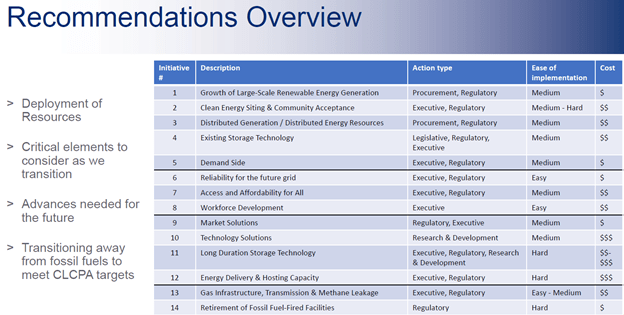
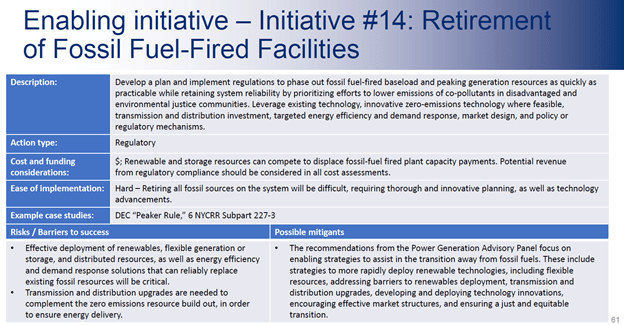
This is deeply flawed legislation.  The premise is wrong because peaking power plants are not inherently bad because they provide critical support to the electric system when needed most.  The rationale that these peaking power plants are directly affecting air quality in adjacent environmental justice neighborhoods is incorrect because the health impacts are claimed from secondary pollutants that do not form before they are transported away from the neighborhood.  Replacing all the peaking plants covered by this law in the time frame mandated is extremely risky because the technology available today is not up to the task as shown in the Power Generation Advisory Panel emphasis on research and development.

Given that there was a power outage disaster in Texas less than a month ago I am extremely disappointed that the New York Senate as taken it upon themselves to dictate energy policy to the electric sector.  Although the complete story of what happened in Texas is unknown at this time, it is clear that extremely cold weather caused a major peak load event.  Past New York energy policy has emphasized the need for diverse set of dispatchable resources to prevent reliability problems in these situations.  This legislation risks reliability in its mandate for resources that are not diverse and technology that have not been tested at the scale needed.


Climate Leadership and Community Protection Act – NYISO Resilience Study and the Texas Energy Debacle: New York Worst Case

I recently wrote that the energy debacle that occurred in Texas is unlikely in New York today because of market and system differences but if the Climate Leadership and Community Protection Act (CLCPA) is implemented incorrectly something similar is inevitable.  Last fall the Analysis Group completed their Climate Change Impact and Resilience Study (“Resilience Study”) for the New York Independent System Operator (NYISO).    The study evaluated different resource scenarios that meet the 2040 CLCPA zero-emissions mandate for various weather and load scenarios.  The findings do not portend well for New York’s energy future and raise important questions for New York’s planning.  In this first post discussing the Resilience Study findings relative to the Texas Energy Debacle I will compare New York’s future reliability problem relative to the Texas weather that caused their problems.  This is a long detailed post but will provide background for future posts on other aspects of this issue.

I have written extensively on implementation of the CLCPA closely because its implementation affects my future as a New Yorker.  I have described the law in general, evaluated its feasibility, estimated costs, described supporting regulations, listed the scoping plan strategies, summarized some of the meetings and complained that its advocates constantly confuse weather and climate.  The opinions expressed in this post do not reflect the position of any of my previous employers or any other company I have been associated with, these comments are mine alone.

Texas Energy Debacle

In brief, the ultimate cause of the blackouts and resulting problems in Texas was due to poor planning.  The weather in Texas during the storm was extreme but not unprecedented.  Similar cold snaps occurred in 2011, 1991, 1990, 1989, 1983, 1963, and 1961 and there were electrical outages in 2011.   Because there is no apparent trend in low daily maximum temperatures (see Tony Heller’s graph), climate change is not a factor.  This was a weather event.

Clearly the Texas electricity market failed to provide adequate resiliency for these conditions.  I agree with Becky Klein, former commissioner and chairman of the Public Utility Commission of Texas who writes that the questions that need to be considered now are:

      • Are we prepared to pay more for electricity and water to ensure higher levels of reliability?
      • And if so, how much more?
      • How can we be better prepared for “outlier” events, regardless of their probability?
      • Would it make sense to require state-wide scenario planning that includes coordinated drills that test both our operational and communication capabilities across multiple entities?

As New York transitions its electric system to one dependent upon renewables all of these questions need to be addressed.  Fortunately, the NYISO Climate Change Impact and Resilience Study lays the foundation to start to address those questions in New York.

Ultimate Problem

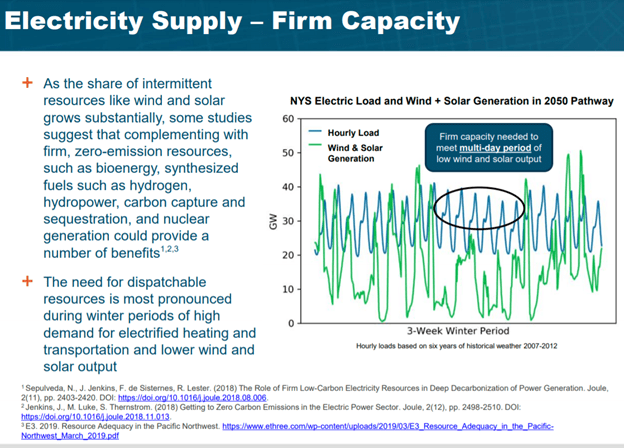
I have described what I believe is the ultimate problem previously.  Both E3 in their presentation to the Power Generation Advisory Panel on September 16 and the Analysis Group  in their September 10, 2020  presentation to NYISO explained that in order to meet the CLCPA emissions reduction goals that a resource category that provides firm, dispatchable and zero-emissions generation is needed.  E3 gives examples such as “such as bioenergy, synthesized fuels such as hydrogen, hydropower, carbon capture and sequestration, and nuclear generation” but the Analysis Group avoids being specific.  The  International Energy Agency (IEA) recently published “Special Report on Clean Energy Innovation” that classified the technology readiness level of the technologies that could possibly be both dispatchable without GHG emissions.  The bottom line is that none of the E3 examples of firm, dispatchable and zero-emissions technologies are close to being ready for adoption except nuclear and hydro which I believe are unlikely to provide any meaningful support for New York.

Climate Change Impact and Resilience Study

According to the report:

“In 2020, NYISO contracted with Analysis Group (AG) to complete this Climate Change Phase II Study (“Phase II Study”). The Phase II Study is designed to review the potential impacts on power system reliability of the (1) the electricity demand projections for 2040 developed in the preceding Climate Change Phase I Study, and (2) potential impacts on system load and resource availability associated with the impact of climate change on the power system in New York (“climate disruptions”).The climate disruptions considered include items that could potentially occur or intensify with a changing climate and that affect power system reliability, such as more frequent and severe storms, extended extreme temperature events (e.g., heat waves and cold snaps), and other meteorological events (e.g., wind lulls, droughts, and ice storms).”

As the Texas experience shows, it is necessary to address potential impacts of extreme weather on power system reliability.  However, in my opinion, there is a significant weakness in the Analysis Group’s team because it does not include a meteorologist.  If one was on the team this language probably would have been modified to make the point that natural variability in weather events such as extended extreme temperature events (e.g., heat waves and cold snaps), and other meteorological events (e.g., wind lulls, droughts, and ice storms) currently is much larger than any climate change induced variations.  As a result, I refer to this report as the Resilience Study rather than the Climate Study.  The report continually refers to climate disruptions which in reality are actually extreme weather events but that does not detract from the value of the analysis itself.

I refer you to the report for a detailed description of the Analysis Group modeling approach summarized in their Figure ES-1.  As input they used two long-term hourly zonal-level load forecasts that reflect state policy goals and climate effects developed by ITRON.  The Analysis Group energy balance model analyzed two load scenarios: a reference case and the CLCPA case that includes the expected increases in load due to heating and transportation electrification.  Four sets of generating system resources were considered.  The Resilience Study estimated what they thought would be needed to meet the load requirements and they also include the NYISO Grid in Transition estimates.  A reference scenario and an expected resource scenario for both were evaluated.  They considered weather disruptions including heat waves, cold snaps, wind lulls, wind storm disruptions, ice storms, and droughts.  The result was a set of 72 analyses projecting the amount of each type of energy resource needed and the potential for resource inadequacy for a 30-day evaluation period.

Last October, soon after the Climate Change Phase II study came out, I prepared a post evaluating whether it adequately addressed the weather disruptions.  Unfortunately, I don’t think it does.  The evaluation period was too short and importantly they did not evaluate extreme wind and solar availability over the same periods.  I also believe that monitoring data from a network with more spatial resolution must be done to adequately represent the effect of lake-effect clouds and precipitation.  Nonetheless the analysis represents a good start addressing the problem of extreme weather.

NY LOLE planning

According to the 2020 NYISO Reliability Needs Assessment: “The New York system is deemed to have sufficient resources if the probability of an unplanned disconnection of firm load (loss of load expectation, or “LOLE”) is equal to or less than the standard of once in every 10 years or 0.1 events per year.”  The reliability planning process starts with the Reliability Needs Assessment (RNA) followed by the Comprehensive Reliability Plan.  I will only discuss the RNA here.  It evaluates “the reliability of the New York bulk electric grid through 2030, considering forecasts of peak power demand, planned upgrades to the transmission system, and changes to the generation mix over the next ten years.”  A base case “includes projected impacts driven by limitations on generator emissions”.  Different scenarios “include an in-depth look at certain policy goals from the CLCPA” and “reliability risks associated with the cumulative impact of environmental laws and regulations”.

The RNA document explains that:

“Resource adequacy is the ability of the electric system to supply the aggregate electrical demand and energy requirements of the customers at all times, taking into account scheduled and reasonably expected unscheduled outages of system elements. Resource adequacy considers the transmission systems, generation resources, and other capacity resources, such as demand response. The NYISO performs resource adequacy assessments on a probabilistic basis to capture the random natures of system element outages. If a system has sufficient transmission and generation, the probability of an unplanned disconnection of firm load is equal to or less than the system’s standard, which is expressed as a loss of load expectation (LOLE).  The New York State bulk power system is planned to meet an LOLE that, at any given point in time, is less than or equal to an involuntary firm load disconnection that is not more frequent than once in every 10 years, or 0.1 events per year. This requirement forms the basis of New York’s Installed Reserve Margin (IRM) requirement and is analyzed on a statewide basis.”

“If Reliability Needs are identified, various amounts and locations of compensatory MW required for the NYCA to satisfy those needs are determined to translate the criteria violations to understandable quantities. Compensatory MW amounts are determined by adding generic capacity resources to NYISO zones to effectively satisfy the needs. The compensatory MW amounts and locations are based on a review of binding transmission constraints and zonal LOLE determinations in an iterative process to determine various combinations that will result in reliability criteria being met. These additions are used to estimate the amount of resources generally needed to satisfy Reliability Needs. The compensatory MW additions are not intended to represent specific proposed solutions. Resource needs could potentially be met by other combinations of resources in other areas including generation, transmission and demand response measures.”

The relevant question after the Texas energy debacle is whether this planning process adequately protects New Yorkers from a similar blackout.

Climate Change Impact and Resilience Study Loss of Load Occurrences

The Resilience Study includes a generic resource intended to “identify the attributes of any additional resources that may be needed to avoid or reduce Loss of Load Occurrences (LOLO).  This is similar to the NYISO Loss of Load Event but does not imply a specific frequency of occurrence like the LOLO.  The Analysis Group labels these resources as dispatchable and emissions‐free resources (“DE Resources”).  They “cover any circumstances where the resource sets are insufficient to meet identified demand, and to evaluate what attributes such a resource must have to help meet reliability needs”.  These are the resources described in the Ultimate Problem section above.

The Resilience Study identified LOLO periods in 26 of the 72 scenarios evaluated.  Overall, there were 414 hours with a loss of load identified totaling 331,065 MWh.  Fourteen periods were associated with extreme weather events such as hurricanes, wind storms or icing while the other twelve were associated with a scarcity of renewable wind and hydro resources.  Note that there was no specific scenario for a solar energy lull analogous to the wind energy lulls evaluated.

The extreme weather events are outliers.  Over the 14 periods, 323 hours totaling 258,504 MWh were identified as having loss of load.  Recall that Becky Klein wrote that one of the questions that need to be considered now is “How can we be better prepared for “outlier” events, regardless of their probability?”  The key question is probability of occurrence for these events and a logical first step would be to determine how often these events happen.  It is also important to determine what could be done to reduce impacts.  Recall that the NYISO RNA process determines the various amounts and locations of compensatory MW required to reduce the probability of these events.  It is not clear to me that any amount of additional resources could mitigate these impacts.  Preparation for the outliers would probably focus on hardening infrastructure which is beyond the scope of this article.

On the other hand, the scarce renewable energy resources scenarios can be addressed by specifying compensatory MW requirements.  For the twelve periods identified there were 91 hours totaling 72,561 MWh.  Nine of the periods were associated with periods of calm winds and three with droughts.  I agree with E3 who has highlighted the critical period of concern to be a multi-day winter period of light winds.

For example, consider scenario 13 which considers CLCPA conditions during a state-wide wind lull in the winter with the set of resources chosen to handle the CLCPA target of zero emissions.   Over the 30 day analysis period the Resilience Study estimates that 9,043,988 MWh will be generated by 35,200 MW of land-based wind, 5,288,985 MWH will be generated by 21,063 MW of offshore wind, 503,859 MWh will be generated by 10,878 MW of behind-the-meter solar, 1,951,742 MWh will be generated by 39,262 MW of utility-scale grid solar, 2,027,789 MWh will be generated by 4,486 MW of hydro pondage and run of the river hydro, 2,422,224 MWh will be generated by 4,364 MW of nuclear, 2,023,200 MWh will be imported, 98,672 MWh will be generated by 1,170 MW of pumped storage, 800,462 MWh will be provided by 15,600 MW of battery energy storage over 189 hours, demand response will displace 3,412 MW and 566,429 MWh over 276 hours, and the 32,317 MW of the DE resource will generate 3,653,404 MWh over 278 hours.  Over the 30 days 28,380754 MWh will be generated but even these resources will be unable to prevent LOLO totaling 13 hours and 14,404 MWh.

I believe it would be more appropriate for future analyses to consider shorter time periods in greater detail.  In this case consider the seven-day period from hour 192 to hour 360.  This is the critical period where the most DE resources are required and when the hours with load loss occurred.  I think that the uncolored area under the load curve around hour 264 represents the load loss period.  Note that battery storage was used up early in the critical period.  In order to fully replace all the DE resources MWh would take an extraordinary amount of additional energy storage.  Clearly the big problem is a lack of land-based and offshore wind.  In the winter, solar is just not going to be able to cover the loss of wind across the state.  Furthermore, it is not clear to me that the solar energy output reflects snow cover impacts.  It appears that no amount of over-building of wind and solar coupled with battery energy storage is going to be able to solve this renewable resource problem.

The Resilience Study analysis reinforces the fact that the multi-day winter wind lull is a critical period for reliability. In my comments on the resource adequacy hearing and elsewhere I have argued that actual short-term meteorological data from the NYS Mesonet system must be used to correctly characterize the renewable resource availability for New York in general and in areas downwind of the Great Lakes in particular. This type of evaluation is necessary to completely characterize the resource availability during the multi-day winter wind lull.  I believe that using those data in conjunction with a meteorological evaluation of the weather systems that cause these conditions could also develop a frequency of occurrence distribution that could be used to extend the Loss of Load Occurrence estimates to Loss of Load Expectation projections.

Independent System Operator – New England (ISO-NE) recently had an analysis done, Analysis of Stochastic Dataset for ISO-NE, that purports to provide frequency of occurrence information.  I am not comfortable that they have actually done what they thought they did.  In their analysis they used a statistical re-sampling technique that I am not sure adequately considers serial correlation and the relationships between wind and solar resource availability.  In their February 20, 2020 presentation to the ISO-NE Planning Advisory Committee, Wind and Power Time Series Modeling of ISO-NE Wind Plants, Methodology and Analysis of Results, they describe a wind mapping system that generates high-resolution mesoscale wind maps.  The report notes that “wind generation is very likely to be high during the peak load hour” and goes on to say that “this appears to be due to passing cold fronts associated with strong low-pressure systems that drive wind speeds across New England”.  In the February 2020 presentation there is a table with wind turbine power curve basics that shows a cutoff speed for low wind speeds and high wind speeds.  I am very sure that the Analysis Group cutoffs were different than the ones used in this study because there is a difference in wind output for wind storms.  While another good start I believe that this analysis also comes up short adequately characterizing the lowest renewable energy resource availability period.

Conclusion

The Analysis Group writes: “The variability of meteorological conditions that govern the output from wind and solar resources presents a fundamental challenge to relying on those resources to meet electricity demand.”  I agree completely.

In Texas there were seven cold snaps similar to the one that caused the outages in the last 60 years so the frequency of occurrence is 8 divided by 60 or 0.13 events per year.  New York’s LOLE standard is 0.1 events per year so the NYISO planning process is supposed to address this kind of event.  The relevant question for New York is how often do we expect a multi-day winter wind lull.  My answer to that is every year but the intensity varies.  For example, from 2/14/21:2300 until 2/15/21:1600 there were 15 of 17 hours when the wind output was less than 10% of the nameplate capacity and all of New York’s on-shore wind turbines produced a total of 765 MWh for a capacity factor of 2.6%.  This period wasn’t as intense as the Resilience Study conditions and I did not determine the duration of the wind lull but it was just a random choice.  We won’t know how often and how intense these periods are until an analysis specifically designed to evaluate New York’s renewable resource potential is completed using fine-resolution meteorological monitoring data.

As to whether New York’s reliability planning process adequately protects New Yorkers I must reserve judgement.  NYISO has the responsibility for this protection but can only guess at what the CLCPA process will propose as its resource mix.  Until that time, they cannot do the evaluation work necessary to determine future reliability so it is unfair to pass judgement.  I will note however that the Analysis Group and NYISO have identified serious challenges that must be overcome to make a reliable system that meets the CLCPA mandates.

In my opinion, those challenges will prove to be impossible to meet without a marked degradation of reliability.  Future posts will explain why I believe that to be the case.

Climate Leadership and Community Protection Act Lack of Responsiveness to Comments

Update 2/26/21: On Date: Fri, Feb 26, 2021 at 1:44 PM Suzanne Hagell, PhD, a Climate Policy Analyst, Office of Climate Change from the New York Department of Environmental Conservation responded to the email that precipitated this post.  The response is added at the end.  I will leave it to the reader to determine if the response was appropriate.

I have been trying to get involved and stay involved in the Climate Leadership and Community Protection Act (CLCPA) implementation process over the past year.  This post documents the lack of responsiveness within the process to this point.

I have written extensively on implementation of the CLCPA closely because its implementation affects my future as a New Yorker.  I have described the law in general, evaluated its feasibility, estimated costs, described supporting regulations, listed the scoping plan strategies, summarized some of the meetings and complained that its advocates constantly confuse weather and climate.  The opinions expressed in this post do not reflect the position of any of my previous employers or any other company I have been associated with, these comments are mine alone.

According to the Climate Act webpage the Climate Action Council will lead the transition:

The New York State Climate Action Council (Council) is a 22-member committee that will prepare a Scoping Plan to achieve the State’s bold clean energy and climate agenda. The Council will also oversee the establishment of sector-specific advisory panels and working groups and will work in consultation with the Climate Justice Working Group and the Environmental Justice Advisory Group.

In order to get involved with the process I have been following the advisory panel activities as well as I can.  The webpage explains how the public can provide input:

The advisory panels of the Climate Action Council and the Just Transition Working Group will host public meetings throughout 2021. The advisory panels will hold sector-specific discussions that will provide recommendations to the Council for consideration as it develops a Scoping Plan to achieve New York’s ambitious greenhouse gas reduction targets. The Just Transition Working Group will help ensure an equitable transition for New York’s workforce in the State’s renewable energy economy.

The Advisory Panel meetings and materials page announces meetings and provides summaries of the public meetings.  However, the lack of updates in general and the  process in particular does not lend itself well to providing meaningful comments.  In the first place the Power Generation panel has not updated its meeting materials for three weeks despite the fact that there have been two meetings held at the date of this writing.  I blame that panel for some of the lack of responsiveness.

However, there is a systemic problem.  At the bottom of the page it says “Past meeting materials are updated on this page every Friday. Meeting notes and presentations received from Panels by 5 p.m. ET. Tuesday will be added to the website by Friday of that week.”  I take issue with it taking three working days to get ready to post the material.  That is not that big an effort but is an inconvenience for some state worker.  Furthermore, why wait until Friday?  If the State process truly wants to have public involvement then assign several people who make posting material received from the advisory panels within two working days.

Unfortunately, that is not the biggest problem.  The CLCPA law mandates that there be public involvement.  However, whether any of the information received is actually considered by any of the panels or addressed by any of the agencies is another matter.

Consider, for example, that I found an error in New York State guidance document Establishing a Value of Carbon, Guidelines for Use by State Agencies (the “Guidance”).  I sent an email to several staff who I know have responsibilities associated with the issue and two weeks after submitting my comments I have not received any response.

In particular the Guidance includes a recommendation how to estimate emission reduction benefits for a plan or goal.  I believe that the guidance approach is wrong because it applies the social cost multiple times for an emission reduction so I recommended that the Guidance be revised.

In the Guidance section entitled “Estimating the emission reduction benefits of a plan or goal” an example is included that states:

The net present value of the plan is equal to the cumulative benefit of the emission reductions that happened each year (adjusted for the discount rate). In other words, the value of carbon is applied to each year, based on the reduction from the no action case, 100,000 tons in this case. The Appendix provides the value of carbon for each year. For example, the social cost of carbon dioxide in 2021 at a 2% discount rate is $127 per metric ton. The value of the reductions in 2021 are equal to $127 times 5,000 metric tons, or $635,000; in 2022 $129 times 10,000 tons, etc. This calculation would be carried out for each year and for each discount rate of interest.

The IWG damages approach value is the net present benefit of reducing carbon dioxide emissions by one ton.  The calculation methodology determines that value from the year of the reduction out to 2300.  It is inappropriate to claim the benefits of the annual reduction over any lifetime.  Consider that in this example, if the reductions were all made in the first year the value would be 50,000 times $127 or $6,350,000, but the guidance approach estimates a value of $37,715,000 using this methodology.

I did not catch this error until after the comment period ended so I sent the email.  However, in my comments on their stakeholder webinar I made the comment that the New York State Energy Research and Development Authority practice of calculating lifetime savings in a similar fashion was incorrect.  In order to verify my understanding, I contacted Dr. Richard Tol, Professor of the Economics of Climate Change at Vrije Universiteit Amsterdam and a Professor of Economics at the University of Sussex who has direct experience estimating the social cost of carbon.  He graciously responded and explained that “The SCC should not be compared to life-time savings or life-time costs (unless the project life is one year).”

My email concluded that the Value of Carbon guidance example methodology in the Guidance section “Estimating the emission reduction benefits of a plan or goal” inappropriately considers lifetime benefits.  That is inconsistent with social cost damages approach methodology used to derive the social costs so it should be revised.

Conclusion

While the CLCPA mandates that the public be involved in the development of scoping plan, those are just words and the reality is different.  The system does not encourage meaningful participation because meeting information is available promptly after the meetings.  There is no indication that the panel members are aware of comments received.  Worse is the lack of response from agency staff responsible for guidance documentation when errors were noted.  I posted this article to document these issues.

Update 2/26/21: In response to the email I sent Wednesday, February 10, 2021 2:27 PM I received this:

From: Hagell, Suzanne E (DEC)
Date: Fri, Feb 26, 2021 at 1:44 PM
Subject: Re: Value of Guidance Document Emission Reduction Benefit Calculation Example
To: Roger Caiazza
Cc: Pandich, Jason P (DEC)

Hi, Roger. My apologies for not getting back to you right away. This is really useful. Jason and I will take a look at the issue that you’re raising and talk to our colleagues at NYSERDA as we develop the accounting for the Scoping Plan.

I expect that we will be making additional updates to the Value of Carbon guidance and this would be one update that could be addressed.

Suzanne


Environmental Justice Risks from Hyper-Local Monitoring are Exaggerated

Note:  This post was also published at Watts Up With That

According to Bloomberg Law, Biden’s Hefty Clean Air To-Do List Follows Early Big Promises means that air quality standards have to be revised and must incorporate social justice and climate concerns.  Based on what I have seen this push will rely less on science and more on emotion.

The Bloomberg article states:

“Revising clean air rules is a cornerstone of climate and justice policies, two areas that the Biden administration has set as priorities.  Clean air experts in areas that carry a disproportionate burden of dirty air say that runaway air pollution remains a chronic problem, reflecting neglect of low-income neighborhoods and communities of color, exacerbated by air monitor disparities.”

“Portable air quality monitors used in the South Bronx and Brooklyn caught particulate matter quantities 20 times higher in some areas than levels reported by state-run monitors, according to new data from a neighborhood-level air monitoring study by the New York City Environmental Justice Alliance, or NYC-EJA.  The findings highlight insufficient air monitoring for targeted environmental justice communities, and show why one generalized air policy may not be enough to mitigate pollution for hard-hit areas, said Jalisa Gilmore, research analyst for NYC-EJA.  “That’s why we have a little bit more emphasis on hyper local monitoring, and making sure that we actually get the interventions that are most appropriate for the community,” she said.”

The New York City hyper local monitoring program is described in the Community Air Mapping Project for Environmental Justice (CAMP-EJ) findings and recommendations report.  In brief:

“Because New York City has only 13 high-performance ambient air monitoring sites, air pollution exposures are poorly characterized at the neighborhood level. To address this data gap, CAMP-EJ utilized dozens of low-cost, portable air quality monitors to measure hyperlocal air quality and characterize air pollution exposures at more refined spatial and temporal scales than is possible using existing City and State data. The results of our air monitoring campaign shed light on the disproportionate public health burdens imposed on environmental justice communities from industrial pollution, trucking, and transportation infrastructure.”

The analysis found that local facilities and expressways are big polluters, traffic congestion fouls the air twice every day, and that hyperlocal measurements show inhalable particulate matter are twenty times higher than state-run monitors.  I was not surprised by the first two findings but the claim that hyperlocal measurements were much higher than state-run monitors surprised me.

I have experience running air quality monitoring networks with particulate matter monitors.  I found that measuring particulates was always difficult to do correctly and more so with smaller aerodynamic particles like the inhalable or 2.5 micron particles.  In the project, “CAMP-EJ participants used the AirBeam2, a low-cost, palm-sized air quality instrument that measures PM2.5, and AirCasting, an open-source environmental data visualization platform that consists of an Android app and online mapping System”.

The going price for an AirBeam 2 is around $250 and the state-run monitors systems use instruments that go for $25,000.  The state-run system has a detailed quality assurance plan and includes quality control tests which I doubt were included in the community monitoring program so my first thought is just how accurate are these personal monitors?  According to the report: “The AirBeam2’s PM2.5 measurements are “quite accurate” according to a performance evaluation conducted by South Coast Air Quality Management District, which compared the performance of the AirBeam2 to reference monitors.”

However, the South Coast Air Quality Management District evaluation report I found told a different story.  Three sensors were tested against a reference FEM FRIMM PM 2.5 monitoring instrument similar to the one used in the New York State network.  According to the concluding discussion:

“Accuracy: Overall, the three AirBeam sensors showed very low accuracy compared to FEM GRIMM at 20 °C and 40% RH, when varying PM2.5 mass concentration from 10 to 50 μg/m3. The AirBeam sensors significantly overestimated the FEM GRIMM readings. According to the method of calculating accuracy, the % accuracy for the sensors were all negative. When PM2.5mass conc. was over 50 μg/m3, Airbeam sensors reached plateau of 315 μg/m3.”

Don’t get me wrong, I have no doubt that the CAMP-EJ main conclusions, local facilities and expressways are big polluters and traffic congestion fouls the air twice every day, are correct.  However, the monitors used over-estimated inhalable particulate concentrations considerably, particularly at the higher rates they claimed are hurting local communities.  As a result, the numbers that they claim prove the need to act are incorrect.

Facebook Missing Context in Missing Context Label

A friend recently posted information on Facebook that the Texas blackout situation was a “literal perfect storm test if an all-renewable energy plan would work”.  The Facebook police posted a warning that there was “missing context” but I will explain why there was missing context in the missing context claim.

I while away my time in retirement publishing a blog on New York environmental and energy issues and have written extensively on New York’s attempts to address climate change by reducing greenhouse emissions.  For this context I wrote a post explaining the lessons that should be learned by New York in their quest to save the planet and another responding to a newspaper article asking whether something similar could happen in New York.  Short answers: New York has to be very careful with their plans or they will end up in the same situation as Texas in the future and New York’s electricity market is currently structured differently than Texas so it is very unlikely that the same thing could happen today.    

The Facebook missing context check claims that because failure of natural gas and other fossil sources was the primary problem with the blackouts this February it is unfair to claim this was an appropriate test of an all-renewable energy plan.  However, their arguments fail to consider a couple of things.

In the first place the claim in the post was that this was a test of an all-renewable energy system.  One way to consider generating availability is the capacity factor which is the actual electricity generated divided by the maximum electricity possible.   If we look at the capacity factors for Texas generation types during the crisis, midnight 2/15 to noon 2/18, then we can try to determine the cause of the crisis. None of the energy sources performed particularly well.  It is clear that in all-renewable energy system a lot would have to be done to replace the lack of wind and solar generation.  Note that 30,000 MW of wind at a cost of some $70 billion producing 650 MWs when it was desperately needed is a failure on the magnitude of the Maginot Line in World War 2. My first problem with the fact checkers is that even though the fossil plants failed to do well in this situation, the resources needed to keep the lights on in an all-renewable energy system for a future situation would be so immense and so expensive that they may not be feasible and that was the point of the claim.

Figure 1 ERCOT Capacity Factors 2/15/21:0000 to 2/18/21:1200

In my opinion the actual root cause to the problem is that the Texas energy market only pays generators when they produce power.  Most other electric markets pay generators for capacity or the ability to provide electricity when it is needed.  Texas had a very similar situation ten years ago which also led to blackouts.  If you don’t pay generators to be available in critical if rare situations they simply will not invest for those periods.   In this case, the wind mills could have spent extra for cold weather upgrades, the natural gas infrastructure could add heat tracing so equipment did not freeze, and the nuclear plants could have protected their water systems and this catastrophe could have been avoided.  All of that would have been done if the market paid for capacity.   

There is a bigger problem associated with the lack of a capacity market in Texas that the Facebook fact checkers completely ignore in their missing context claim.  A former electric utility planning engineer described his impression of the problems that lead to the debacle and noted that the purpose of the payment for energy only market strategy was “to aid the profitability of intermittent wind and solar resources and increase their penetration levels.” Put another way, because renewables don’t provide capacity that means having a capacity market disadvantages renewables.

I conclude that the Facebook fact checkers were more interested in damage control against claims that renewable energy has weaknesses than objectively addressing the claims.  The original claim is that an all-renewable energy system would most likely fail even more under the conditions that occurred and that has nothing to do with the fact that fossil fueled sources failed in this event.  The other flaw in their fact check is that the ultimate cause of the failure, payments only for energy, is the preferred approach for renewables advocates.  If they get their way blackouts will be inevitable.

Albany Times Union “Could a Texas-size power failure hit New York?”

On February 17, 2021 Rick Karlin at the Albany, NY Times Union wrote an article comparing the Texas electrical grid and the New York grid relative to the power failures in Texas caused by extreme cold.  I agree with his conclusion that New York’s grid is sufficiently different than Texas so that something similar is unlikely to happen in New York.  However, I disagree with the experts that he interviewed that believe the primary problem going forward is the transmission system.  Instead, I think that trying to meet the Climate Leadership and Community Protection Act (CLCPA) zero-emissions mandate by 2040 for the electric system is the biggest challenge to future electric system reliability.

I have written extensively on implementation of the CLCPA closely because its implementation affects my future as a New Yorker.  I have described the law in general, evaluated its feasibility, estimated costs, described supporting regulations, listed the scoping plan strategies, summarized some of the meetings and complained that its advocates constantly confuse weather and climate.  The opinions expressed in this post do not reflect the position of any of my previous employers or any other company I have been associated with, these comments are mine alone.

Could a Texas-size power failure hit New York

Mr. Karlin interviewed a number of experts who argued that a mass failure of the state’s power grid was unlikely for a number of reasons. However, he went on to say “that doesn’t mean Empire State residents don’t have other threats to worry about.”  First, I will comment on the statements from the experts and then I will argue that their transmission threats are secondary to what I think is the primary threat for a future blackout.

I agree that one of the Texas problems is that their power grid has relatively few links to other transmission systems.  Karlin quoted Luigi Vanfretti, a professor of electrical engineering at Rensselaer Polytechnic Institute, who said “It’s about the ability to route the power”.  In this line of thought, if one state has a shortfall, electricity can easily be moved from another state.  Nick Bassill, a meteorologist and director of research and development at the University at Albany’s Center Of Excellence in Weather and Climate Analytics claimed that “Neighboring Oklahoma was also hit with record cold and snow but they didn’t have the mass outages Texas did since they could easily get power from other states”.  However, since the time of the article it became clear that neighboring grids were having similar problems and their own outages.  In the final analysis I believe that this is not the root cause of the problem.

Karlin pointed out a difference between Texas and New York is that Texas power plants “operate with looser regulations compared to New York, particularly when it comes to the Empire State’s stringent rules about having certain levels of capacity and spare fuel”.  He explained that:

“Power plants in New York have to demonstrate a certain maximum capacity, or the amount of power they can produce running at full steam, even though they may only rarely have to do so. These requirements are enforced through credits that can be sold in a capacity market, which Texas doesn’t have. There’s more.  In New York City, for instance, gas plants, which typically use either gas or oil, must have backup supplies of oil in case there is a gas line disruption or shortage.”

Another claimed difference is that Texas is heavily reliant on natural gas and wind whereas New York has a more diversified energy supply.  Although some have blamed the lack of wind production during the outage as a primary driver “most experts contacted by the Times Union said the stuck turbines were minimal compared to the frozen gas infrastructure”. “The gas pipes freezing was key,” said Vanfretti.  In New York Karlin explained that:

“Thirty nine percent of New York state’s power comes from fossil fuels meaning the plants can burn gas or oil (gas has been in favor lately due to low prices).  Another 22 percent is hydropower and about 30 percent is nuclear, as of 2019. Wind was 3 percent as of 2019.”

Karlin also explained that “Texas isn’t built for blizzards”.  Clearly “homes as well as gas line infrastructure in Texas aren’t designed or built for snow and cold, just as New York isn’t built for extreme heat.”  He went on to say that:

As temperatures plummeted, Texans turned their electric heaters or gas furnaces to the maximum, putting extra demand on gas lines that would normally feed power plants, leading to rolling blackouts.  “When you’re plunging down close to zero in northern Texas, suddenly there is a huge demand for heating,” said UAlbany’s Bassill, meaning that there may not be enough for power plants. “It’s the worst of both worlds.”

Finally, Karlin argued that New York’s bigger threat “likely lies with the state’s creaky system of power lines – many of which are above ground and vulnerable to storm damage”.  He explained that:

Venfretti believes the outdated transmission system, along with what he said is the primitive 1980s-era hardware used to monitor and control many power line substations, are among the biggest vulnerabilities.  The push for clean renewable energy is driving innovation in power generation but the transmission part of the equation is lagging, said Venfretti. It’s like a person buying a shiny new Mercedes to drive down a crumbling pot-holed road.  “The last thing people think about is the road they are going to drive their Mercedes on,” he said.

My Take on the Differences Between New York and Texas

I posted an article on the Texas situation and its implications for New York energy policy on February 18.  One distinction between this article and my analysis and a couple of others I found is that we addressed the systemic cause more than the specifics of this energy problem.  Ultimately the problem boils down to the importance of reliability.  In 2001 the draft New York energy policy stated: “Greater diversity in the types of fuel used for energy production could benefit all market participants, ensuring adequate fuel supplies and dampening price volatility.”  Everyone in the energy planning process at that time took as a fundamental principle that diversity meant a balanced and diverse portfolio with different kinds of dispatchable electric energy: coal, natural gas, oil, nuclear, and hydro.  The greater diversity mantra included different ways to transport oil and coal including railroads and barges as well as the ability to have fuels that could be stored for use as needed.  I believe that the New York energy planners who incorporated that mantra developed an energy system that is much more resilient to extreme weather than the Texas system.

The  systemic problem is the failure of Texas to include capacity payment in their market.  If the system is unwilling to pay for the power needed during rare events then the inevitable result will be a blackout.  It is incredible to me that a similar problem occurred in 2011 and that steps were not taken to fix them in ten years.   A former electric utility Planning Engineer has described his impression of the problems that lead to the debacle.  He agrees that the particular problem is that Texas only pays for the energy produced.  As a result, there is no incentive to develop the capacity needed for rare extreme conditions so when it was needed it simply was not there.  Importantly, he believes that the purpose of the payment for energy only market strategy was “to aid the profitability of intermittent wind and solar resources and increase their penetration levels.”

It appears to me that there is a shift to the same mis-guided policy priorities now underway in New York.  Planning Engineer explains that “Having a strong technical knowledge of the power system along with some expertise in finance, rates and costs can help one see the folly of a variety of policies adopted to support many of today’s wind and solar projects. Very few policy makers possess anything close to the skill sets needed for such an evaluation. Furthermore, while policy makers could listen to experts, their voices are drowned out by those with vested interests in wind and solar technology who garner considerable support from those ideologically inclined to support renewables regardless of impacts.”  This describes New York’s Climate Action Council and advisory panel Climate Leadership and Community Protection Act process perfectly.

Karlin interviewed Gavin Donohue, president and CEO of the Independent Power Producers of New York, who explained that New York’s current diversity of power sources provides a measure of resiliency.  Note, however, that when New York outlawed the use of coal at power plants they eliminated a source of power that used a fuel that could be stored on-site and stockpiled for emergencies.  The Climate Act eliminates the use of fossil fuel by 2040 further reducing balance, diversity, and flexibility to handle weather related load peaks.  It is not clear what will be needed to replace those attributes in the future.

Karlin also noted extreme weather events such as the derecho windstorms that took out power for several days in the Capital Region last fall, Superstorm Sandy in 2012, and the massive ice storm that in 1998 left eastern Ontario, Quebec, New Brunswick and a sliver of northern New York without power for weeks. While that wasn’t due to problems in power plants or a lack of alternate fuels, a diverse and balanced energy system is better able to address the impact of miles and miles of downed power lines.

Up to this point I only had minor issues with the article but then he wrote:

Others stress that redundancy going forward should be in renewables, given the climate havoc that greenhouse gases have caused.  “We need to be moving as swiftly as possible to 100% renewable energy,” remarked Peter Iwanowicz, executive director of Environmental Advocates NY.

Contrary to popular impression it is extremely unlikely that weather events associated with changes in the climate observed to date can be attributed to greenhouse gas impacts.  Advocates constantly confuse weather and climate and every time I have examined a weather event supposedly associated with climate change I have not been able to find a climatic change effect.  Following the usual pattern, there already are claims that the power system impacts were somehow due to climate change and not inadequate planning for this kind of extreme weather event.  Ten years ago, in February 2011, there was a similar extreme cold snap and blackouts also resulted because “coal and natural gas plants and electric utility companies didn’t have the resources to maintain service.”  If these conditions happened ten years ago then changes in climate did not increase the need for planning to meet events of the recent past.

Even more problematic is the suggestion that “moving as swiftly as possible to 100% renewable energy” will make society more resilient because there will be more redundancy.  The fact is that calling wind and solar diverse and redundant is a gross mis-characterization.  Solar energy is not diverse when every single solar facility in the state goes off-line at night.  Wind energy is not redundant when the winds are calm at night.  I believe that a comprehensive analysis of the New York joint frequency distribution of wind and solar energy resource availability is needed to determine the worst-case reliability needs scenario.  It is imperative to consider wind and solar availability over the same period and given that Texas extreme weather had a 10-year reoccurrence period I would say that the analysis should consider a minimum of ten years.  When the wind and solar resource availabilities are known then, and only then, can the wind, solar and energy storage resources necessary to prevent cold weather blackouts be established.  This has not been done.

Ultimately the problem is that the worst-case wind and solar renewable resource availability period is rare.  Keep in mind that New York’s Climate Act intends to reduce all fossil fuel emissions so heating and transportation will also have to be electrified.  That means that all the smart planning in the world is not going to be able to shave peak loads much if any.  If the worst-case resource availability period is associated with a period of high energy use then the electric system will be stressed.  In order to be able to provide adequate power during those periods will require expensive energy storage solutions which have not been identified in the Climate Act implementation process.

Conclusion

For the most part I agree with the conclusions in Karlin’s article. Up until this time the chances of extreme winter weather causing an electric energy shortage in New York similar to Texas are essentially nil.  Energy planners in State agencies, the Power Pool and at the utilities were committed to preventing it by developing an electric energy system with different kinds of dispatchable electric energy, developing on-site fuel storage with inventories able to cover extreme cases and enabling transport and delivery alternatives. Their foresight and commitment have given us a resilient electric system.

However, under the Climate Act everything changes when wind and solar replace fossil fuels.  The article did not mention that one reason that Texas does not have a capacity market is that payment for energy only was to aid the profitability of intermittent wind and solar resources and increase their penetration levels.  In New York’s electric market regulators are wrestling with a market design that can provide the appropriate signal for investors to provide power during the rare worst-case weather conditions that caused the Texas power failures.  That will be an experiment that may or not may be successful.

The experts interviewed believe that problems with the transmission system will be the biggest future vulnerability.  I disagree because I believe that reliance on just wind and solar during worst-case weather conditions is going to be a much bigger problem.  The fact is that there are inherent advantages to fossil fuels that cannot be easily overcome with intermittent and diffuse wind and solar.  At one time the New York energy planning process was more concerned about reliability and affordability for New York ratepayers than catering to ideological activists whose precautionary fears of potential climate change impacts override consideration of unintended reliability outcomes and costs.  I conclude that a Texas energy debacle is currently unlikely today but inevitable if New York’s Climate Act is implemented as currently mandated.

Climate Leadership and Community Protection Act Initial Thoughts on Texas Energy Debacle

As I watched the Texas energy debacle unfold the last several days, I thought that I would end up posting an article about the implications for New York’s Climate Leadership and Community Protection Act (CLCPA).  This is my first response. It is becoming clear that the rolling blackouts and exorbitant electric prices that occurred in Texas were related to a lack of market support for diversity and resilient generation. There is no question in my mind that the CLCPA electric system envisioned by the Climate Action Council will be even less diverse and resilient so something similar in New York is inevitable if the transition unfolds as I expect.

I have written extensively on implementation of the CLCPA closely because its implementation affects my future as a New Yorker.  I have described the law in general, evaluated its feasibility, estimated costs, described supporting regulations, listed the scoping plan strategies, summarized some of the meetings and complained that its advocates constantly confuse weather and climate.  The opinions expressed in this post do not reflect the position of any of my previous employers or any other company I have been associated with, these comments are mine alone.

Texas Energy Debacle

As I write this on February 18, 2021 the causes of the electric system problems in Texas are unknown.  What is certain is that power outages left millions in the dark and without heat when a bitter cold snap brought snow, ice and temperatures in the single digits.  Electric loads hit record levels even as the electric system operators instituted rolling electric outages to reduce the power used in order to prevent even bigger blackouts.  There also appear to be issues with the generators not being able to provide enough power.  The wind resources were way down because of icing but apparently the natural gas fired units had trouble getting sufficient gas to run because the priority was for residential use. 

I have one anecdote that may be relevant.  When New York State deregulated the utility companies and I left Niagara Mohawk Power Corporation to go with NRG Energy who purchased the fossil plants I supported, one of the cultural awakenings was going to other power plants across the country.  One vivid memory was a visit to the massive Parish power plant outside of Houston and being able to see all the infrastructure.  I have heard that visitors from the south were also similarly impressed when visiting northern power plants and not being able to see all the infrastructure because the power house was enclosed.  The reason northern power plants are enclosed because trying to run a power plant when things freeze is very difficult.  I have heard that there are indications that monitoring equipment and water lines were failing due to the cold Texas weather.

One other note is that claims that these impacts were somehow due to climate change and not inadequate planning for this kind of extreme weather event are complete baloney.  Ten years ago, in February 2011, there was a similar extreme cold snap and blackouts also resulted because “coal and natural gas plants and electric utility companies didn’t have the resources to maintain service.”  If these conditions happened ten years ago then the root cause is weather and not climate.  Anyone claiming otherwise is ill-informed, naïve or lying.

Diversity and Resiliency

At one time the New York energy planning process was more concerned about reliability and affordability for New York ratepayers than catering to ideological activists whose precautionary fears of climate change override consideration of unintended consequences.  For example, the Draft New York State Energy Plan and Draft Environmental Impact Statement dated December 2001 includes this ultimate truth: “Greater diversity in the types of fuel used for energy production could benefit all market participants, ensuring adequate fuel supplies and dampening price volatility.”  Unfortunately, the first inklings of the renewable energy initiatives to come also showed up: “Moreover, a balanced portfolio of energy resources provides greater economic development opportunities within the State, particularly in the development of indigenous energy resources, including renewable energy resources, and energy service reliability.” 

The 2001 draft was the oldest energy plan I could find.  You will have to trust me when I say that everyone involved in this energy plan and earlier iterations, took as a fundamental principle that diversity meant a balanced and diverse portfolio with different kinds of dispatchable electric energy: coal, natural gas, oil, nuclear, and hydro.  The greater diversity mantra included different ways to transport oil and coal including railroads and barges as well as the ability to have fuels that could be stored for use as needed.  Arguably New York’s concern for reliability and avoiding blackouts is linked to New York City blackouts and the looting and vandalism that occurred during the 1977 blackout.  After every blackout extensive steps were taken to prevent a re-occurrence due to the same conditions and, more importantly, drove self-examination to address similar situations that might cause blackouts.  Although this process improved resiliency that term was not in use in 2002 and it was not used once in the draft energy plan.

Texas Lessons for the CLCPA

Alex Epstein summarized the resiliency problems that caused the Texas energy debacle in the following tweet and provided more details on his blog.

In my opinion the Texas debacle occurred because the energy regulators failed to manage the system to address the problems that occurred in 2011.  Epstein persuasively explains that a large part of the reason that they did not address those problems was because energy policy priorities were hijacked to policy that has prioritized the adoption of unreliable wind/solar energy over reliable energy.  A former electric utility Planning Engineer has described his impression of the problems that lead to the debacle.  He thinks that the particular problem is that Texas only pays for the energy produced.  As a result, there is no incentive to develop the capacity needed for rare extreme conditions so when it was needed it simply was not there.  The purpose of the payment for energy only market strategy was “to aid the profitability of intermittent wind and solar resources and increase their penetration levels.”

It appears to me that the same mis-guided policy priorities are underway in New York.  Planning Engineer explains that “Having a strong technical knowledge of the power system along with some expertise in finance, rates and costs can help one see the folly of a variety of policies adopted to support many of today’s wind and solar projects. Very few policy makers possess anything close to the skill sets needed for such an evaluation. Furthermore, while policy makers could listen to experts, their voices are drowned out by those with vested interests in wind and solar technology who garner considerable support from those ideologically inclined to support renewables regardless of impacts.”  This describes New York’s Climate Action Council and advisory panel process perfectly. 

What About New York?

In the early afternoon of February 15, I found out about the Texas problems and on a whim checked the New York Independent System Operator real-time dashboard to see what how much wind energy was available from the 24 facilities and nameplate capacity of 1,985 MW.  In hour 12 the entire on-shore wind fleet of New York generated 2 MWh.  Later I downloaded data and found that from 2/14/21:2300 until 2/15/21:1600 there were 15 of 17 hours when the wind output was less than 10% of the nameplate capacity and totaled New York’s on-shore wind turbines produced a total of 765 MWh for a capacity factor of 2.6%. 

What about solar?  The NYISO does not provide solar generation data like it does for wind.  However, we know that nine hours were basically dark so there was no solar.  The CLCPA goal is 6,000 MW by 2025. That much solar and New York’s 2020 on-shore wind turbines that produced a total of 519 MWh those nine hours results in a pathetic capacity factor of 0.7%.  I also used the NYS Mesonet data to estimate that the total solar insolation available on February 15 was around 16% of the insolation available at the peak of availability near the summer solstice when the days are longest.  Clearly relying on wind and solar when these conditions occur is going to be a challenge because energy storage will be required to bridge the gap.

In 2040 all electricity currently produced by fossil fuels is supposed to be produced by zero emissions sources.  The “vested interests in wind and solar technology who garner considerable support from those ideologically inclined to support renewables regardless of impacts” intend that the replacement power will come from wind and solar.  Over the entire 17-hour winter doldrum fossil units produced 1,424,942 MWH and during the no-solar 9-hour period fossil units produced 588,838.  The best thing that can be said is that at least load is low in the early morning when solar energy is non-existent.  However, that does not help the fact that a minimum of 1,424,942 MWH less whatever solar energy can come from hopefully not snow-covered solar panels will have to come from storage. 

Note that a more detailed analysis to determine when wind and solar was able to replace all the energy produced by fossil units is needed to determine the total needed.  Assuming that the total energy will be at least equal to the 15-hour period energy when solar energy included and that the energy storage systems can provide power for four hours that means that 356,911 MW of energy storage are needed.  New York’s energy storage goal is 3,000 MW of energy storage by 2030.  That means that a minimum of two orders of magnitude more energy storage is needed just to cover this one period chosen simply by chance.  I believe that the State must do a comprehensive analysis of the joint frequency distribution of wind and solar energy resource availability to determine the worst-case reliability needs scenario.  It can be argued that even that analysis is inadequate because it would presume that wind and solar generating sources haven’t been damaged by an ice storm.  If New York fails to do this kind of analysis then an energy debacle comparable to Texas is the inevitable result.

Conclusion

The fact is that there are inherent advantages to fossil fuels that cannot be easily overcome with intermittent and diffuse wind and solar.  In the past the chances of extreme winter weather causing an electric energy shortage in New York were essentially nil.  Energy planners in State agencies, the Power Pool and at the utilities were committed to preventing it by developing an electric energy system with different kinds of dispatchable electric energy, developing on-site fuel storage with inventories able to cover extreme cases and enabling transport and delivery alternatives.  In the future, however, politicians have subverted energy policy for their agendas pushing reliance on just wind and solar. That is going to be an extreme challenge and calling that kind of system “diverse” is simply wrong.

To date all the analyses of wind and solar extremes have been limited to separate evaluation periods over shorter periods than I think are needed.  It is imperative to consider wind and solar availability over the same period and given that Texas extreme weather had a 10-year reoccurrence period I would say that the analysis should consider a minimum of ten years.  When the wind and solar resource availabilities are known then, and only then, can the wind, solar and energy storage requirements to prevent cold weather blackouts be established.

I encourage you to read Planning Engineer’s description of his impression of the problems that caused the Texas energy debacle.  New York’s de-regulated electric market is going to have to develop a market mechanism to support both the wind and solar generation facilities but also the energy storage needed to provide all the energy needed for a cold snap and the increased load when heating and transportation are electrified.  For example, say that the CLCPA planners determine that 200,000 MW of energy storage are needed to meet 90% of the energy requirements annually for their wind and solar development scenario, but 300,000 MW is needed for 95%, and 400,000 is needed for 99.9%.  Using those numbers means that 100,000 MW of energy storage will have to be supported in only 4.9% of the year so prices must be very high for a market solution.  Renewable energy advocates claim that “smart planning”, which I believe incorporates real-time pricing, will reduce the peaks but that is only theory.  The more likely reality is that because energy is really needed during these extreme weather events people will do whatever it takes to stay warm and end up paying exorbitant prices for that power.  It cannot end well for those least able to pay for their energy needs.

I conclude that a Texas energy debacle is currently unlikely today but inevitable if the CLCPA is implemented as currently mandated.

Climate Leadership and Community Protection Act Power Generation Advisory Panel Public Input Session 3 February 2021

The 3 February 2021 Power Generation Advisory Panel included a chance for public input that deserves comment. Twenty-three people were given two minutes to speak.  More than half the presenters argued that nuclear power needs to be considered.  Only three speakers representing environmental advocacy or justice spoke.  Finally, the concluding thoughts of Department of Public Service Commissioner Rhodes claimed that the process has been unbiased.

On July 18, 2019 New York Governor Andrew Cuomo signed the Climate Leadership and Community Protection Act (CLCPA), which establishes targets for decreasing greenhouse gas emissions, increasing renewable electricity production, and improving energy efficiency.  I have written extensively on implementation of the CLCPA closely because its implementation affects my future as a New Yorker.  I have described the law in general, evaluated its feasibility, estimated costs, described supporting regulations, listed the scoping plan strategies, summarized some of the meetings and complained that its advocates constantly confuse weather and climate.  The opinions expressed in this post do not reflect the position of any of my previous employers or any other company I have been associated with, these comments are mine alone.

Public Input

At the 3 February 2021 Power Generation Advisory Panel there was a brief overview of the efforts of the Climate Action Council and the panel’s focus areas and discussions to date.  Most of the meeting was opened to the public to provide their thoughts and input. The meeting notes provide a brief summary of those comments and I have summarized the speaker’s affiliations and categorized their positions in a table.  My speaker categories included customer advocates, environmental justice and environmental activists, renewable energy development advocates, and a couple of people representing miscellaneous concerns.

I was surprised by the number of people who spoke out for nuclear power and I suspect so was the Panel.  I believe they were all associated with a pro Indian Point group.  All their comments were similar.  Clearly shutting down 2,000 MW of zero emission nuclear generating capacity is counter-productive if you really believe that climate change caused by anthropogenic greenhouse gas emissions is the existential threat used as the rationale for the CLCPA.  Commenters pointed out that CO2 emissions will go up as a result of the shutdown and that developing additional nuclear power should be considered as a strategy for the zero-emissions future.

I was also surprised by the fact that there were only four people arguing that wind and solar development needs to be supported more and accelerated.  I am not sure about the propriety of an organization represented on the panel to have a speaker present public comments.  Two people claimed community solar deserves more support.  The final speaker in this category was from Generate Capital, a sustainability investment firm who suggested new renewable technology is ready to implement.

I was one of two consumer advocates speakers.  It is difficult to say much in two minutes but I tried to point out concerns with affordability, reliability and feasibility.  The other speaker also addressed affordability and made the point that investments have be prioritized and cost-effective.

I was shocked that only three environmental activists spoke and two of them were worried about specific issues.  The one true believer said we have to act faster because we are running out of time.    I predict that future public sessions will be inundated with people making those claims and suggesting that wind and solar will solve all energy problems.  A lady from Fossil Free Tompkins County complained that behind the meter natural gas facilities are inimical with the CLCPA and that allowing a former coal-fired power plant to run on gas was wrong.  The environmental justice speaker was worried about a gas pipeline that was being built in her neighborhood.

The last two categories only had one speaker.  One lady who was worried about renewable development equity because most of the renewables will be sited Upstate and coincidentally some near her.  A student in a masters program in sustainability made the good point that reginal planning efforts to date have concentrated on transportation and more emphasis should be placed on renewable development.

Rhode Concluding Remarks

The lead person for the panel is Department of Public Service Commissioner John Rhodes.  I will end this post with an evaluation of his remarks.  The meeting notes described his concluding thoughts as follows:

      • Appreciates and takes seriously the various comments that have been made. A thread of pro-nuclear environmentalism has been quite a presence of this chat.
      • Assures everyone that nothing nefarious in the composition of the panel.
      • Panel was selected by the CAC after a lot of input and deliberation, no bias desired, trying to make the most helpful recommendations.
      • Panel able to respond with better recommendations now that public has voiced this input

I believe that “thread of pro-nuclear environmentalism has been quite a presence of this chat” confirms my suspicion that the agency staff who are supporting this panel had no idea that was going to happen.  They are going to have to go into damage control mode because the arguments that retiring Indian Point is counter-productive are persuasive.  I suspect that the response will be to close ranks and ignore the issue.

The other nuclear speaker concern was that there was no one representing nuclear issues on the panel.  Rhodes response rings hollow.  He claimed that there was nothing nefarious in the composition of the panel.  Based on the definition “infamous by way of being extremely wicked: wicked in the extreme; heinous; abominable; atrociously sinful or villainous; or detestably vile” that may be true but claiming that no bias was desired is baloney.

I researched the membership of the Power Generation Advisory Panel last year.  The CLCPA Power Generation Advisory Panel attachment summarizes each member with a link to their organization including, where appropriate, a brief description of their organization’s mission, along with a summary of the individual named to the panel.  In order to be unbiased, the membership of the panel should have included members with expertise in all energy sectors.  The lack of a nuclear representative is a concern but the lack of anyone from the transmission utility industry is clear evidence of bias.  I understand from sources is that the utility industry tried to get representation but “after input and deliberation” a decision to exclude them was made by the Cuomo Administration.  That was clearly a mistake as evidenced by the fact that some sort of utility support group is currently being organized to provide expertise to the process.

The Advisory Panel is made up of people more representative of organizations supporting the political narrative of the CLCPA than the technical expertise necessary to implement the transition to zero emissions.  In an earlier post, I categorized the organizations represented by the 14 non-state agency members: three members work for generating companies, two renewable and one fossil oriented; one member is from the New York Independent System Operator, the state’s grid operating company; one member is a consultant for energy and sustainability issues; and the remaining eight members were from advocacy organizations representing either renewable technologies, the environment, or trade unions, with one representing ratepayers.


As I feared the representatives with the technical expertise to recognize the technological challenges are being drowned out by those that believe the myth of renewable energy magical solutions.  For example, in an electric energy system powered primarily by wind and solar, the transmission system has to be supported by services that are currently provided by fossil, nuclear and hydro generation but not available from wind and solar.  The power generation advisory panel should be leading the charge to make sure the transmission ancillary service problem is addressed but the issue has not even been raised at their public meetings.  Instead, there have been extensive discussions about the peaker power plant issue which I believe is an emotional problem not supported by reality.   I have seen no sign of any response to the comments I submitted to this panel on that topic.

Conclusion

The first public input session for the CLCPA power generation advisory panel was encouraging because there were comments presented by environmentalists arguing for the development of nuclear power in the future and pointing out that retiring existing nuclear facilities was counter-productive and someone else supported my affordability concerns.  However, I predict that future public input sessions will be dominated by environmental activists and renewable energy supporters.

John Rhodes claims that the advisory panel makeup was designed to be unbiased rings hollow when you look at the makeup of the members.  Representatives from the nuclear sector and transmission utilities should be on the panel.

Climate Leadership and Community Protection Act Simple Value of Carbon Reduction Benefits

The popular narrative is greenhouse gas emission reductions are necessary to prevent climate change impacts.  In order to justify the monetary costs and loss of personal choices necessary to make those reductions a parameter was developed to “put the effects of climate change into economic terms to help policymakers and other decisionmakers understand the economic impacts of decisions that would increase or decrease emissions.”  At the January 19, 2021 Climate Action Council meeting there was a discussion of New York’s version of this parameter and it has become clear that the Council intends to use it to claim that the costs imposed on New Yorkers are “cost-effective”.  The problem is that they will be comparing real costs today against contrived value-driven estimates of speculative impacts occurring in the far future elsewhere.  In this post I explain the methodology used to value greenhouse gas emission reductions and how assumptions and value judgements radically change the estimated benefits.

On July 18, 2019 New York Governor Andrew Cuomo signed the Climate Leadership and Community Protection Act (CLCPA), which establishes targets for decreasing greenhouse gas emissions, increasing renewable electricity production, and improving energy efficiency.  It was described as the most ambitious and comprehensive climate and clean energy legislation in the country when Cuomo signed the legislation.

I have summarized the CLCPA Summary Implementation Requirements and  written extensively on implementation of the CLCPA closely because its implementation affects my future as a New Yorker.  I have described the law in general, evaluated its feasibility, estimated costs, described supporting regulations, listed the scoping plan strategies, summarized some of the meetings and complained that its advocates constantly confuse weather and climateThe opinions expressed in this post do not reflect the position of any of my previous employers or any other company I have been associated with, these comments are mine alone.

Background

The CLCPA requires that the Department of Environmental Conservation (DEC), in consultation with the New York State Energy Research and Development Authority (NYSERDA), establish a value of carbon for use by State agencies. This value of carbon represents the present-day value of projected future net damages from emitting a ton of CO2 today.  A draft document was issued for comments in October 2020 and in December the Value of Carbon Guidance (“Guidance”), an appendix with values for carbon dioxide, methane, and nitrous oxide, and a supporting memo were released for use by State agencies along with recommended guidelines for the use of these and other values by State entities.

I followed the development of this guidance throughout the process and if you want to get into the weeds then check out my previous posts. In an earlier post I quantified the impacts of different assumptions in the social cost valuation process and that post documents the information in this post.  I also described the background of the value of carbon after the initial stakeholder webinar, documented the comments I submitted on the draft document, and described the DEC response to my comments.

The Guidance has prepared estimates, in dollars, of the economic damages that would result from emitting one additional ton of greenhouse gases into the atmosphere to justify the costs of mitigating strategies.  Resources for the Future (RFF) prepared an overview summary of the process used to calculate these values and described how the values are used in policy analysis.  Note that Guidance supporting memo was prepared by the New York State Energy Research & Development Authority (NYSERDA) and RFF and includes much of the same information.  The Guidance recommends using the damages approach to valuing carbon.  RFF refers to the value of carbon using that approach as the Social Cost of Carbon (SCC) and I will use the value of carbon and SCC interchangeably in this post.  According to RFF:

The point of this post is that there many choices that affect the value of the SCC. The emissions, climate response and economic calculations are based on research and expertise from many different fields, such as climate science, demography, and economics. While proponents of this approach give the impression that the input presumptions are based on the “science”, the reality is that assumptions made by model developers play as much of a role as “science” on the results.  Inevitably the assumption decisions are subject to value judgements and the biases of the researchers.  RFF also notes that “the modeling must incorporate information that is inherently uncertain, such as projections of future economic growth.”

The Guidance document makes a recommendation for the value of the SCC to use: “The Department specifically recommends that State entities provide an assessment using a central value that is estimated at the 2 percent discount rate as the primary value for decision-making, while also reporting the impacts at 1 and 3 percent to provide a comprehensive analysis.” For CO2 this translates into a 2020 value of carbon dioxide of $53-421 per ton, with a central value of $125 per ton. The full set of values for 2020-2050 is provided in the separate Appendix tables.

Discussion

All evidence suggests that the Climate Action Council responsible for developing a plan to implement the law intends to estimate monetary benefits by multiplying the values of carbon in the Guidance document and the observed emission reductions to claim that the costs of their strategies to reduce emissions are outweighed by those benefits.  Using their recommended values and the official 1990 baseline emissions for all the greenhouse gases included in the CLCPA the total benefits total $668 billion:

Table 1: Recommended Value of Carbon Guidance 1990 Reduction Benefits (millions)

CO2CH4N2OPFCsHFCsSF6NF3Total
$33,100$373,317$260,758$113$6$501$0$667,795

In my detailed post I documented different factors that affect the benefits calculations.  In this post I will qualitatively describe the value judgements used to, in my opinion, maximize the CLCPA narrative that there is value in the proposed emission reductions.  One example of narrative-driven value judgement is the global warming potential (GWP) time horizon.  This parameter weighs the radiative forcing of a gas against that of carbon dioxide over a specified time frame.  Most jurisdictions use a 100-year GWP time horizon but the CLCPA law mandates the use of the 20-year GWP that increases methane (CH4) reductions associated with natural gas.  Note that in Table 1 methane benefits are three times higher than the benefits of CO2.  If the 100-year GWP values were used then reduction benefits would drop 34% 

The biggest driver of social costs from greenhouse gases is the discount value which is used to estimate how much money invested today would be worth in the future so that we can link today’s costs to the future.  It is accepted that there is no consensus or uniform scientific basis for the selection of a discount rate. The CLCPA implementation process claims to follow the “science” but it appears that is only when it is consistent with their narrative to maximize the benefits of reductions.  For example, the Obama Administration Integrated Working Group (IWG) chose a central value 3% and only published results down to 2.5% but New York chose to use 2% as the central value which results in social costs over two times larger.  Combining the GWP and discount value judgements, if New York followed the IWG recommendations the benefits would be 70% lower.

There are other parameters that affect the social benefits of emission reductions.  Part of the argument for using a lower discount rate is that it helps protect our children and grandchildren but the Guidance calculates future net damages out 300 years, far future many generations away.  No one could have imagined the technology available in today’s society one hundred years ago so it is an act of extreme hubris to claim that any projection of how the world will operate in 100 years, much less 300 years, should be used to guide current actions.  In testimony before the U.S. House of Representatives Subcommittee on Environment Committee on Oversight and Reform on September 24, 2020, by Kevin D. Dayaratna determined that if economic impacts are only considered out 150 years the social benefits are reduced 14%.

The entire rationale for the CLCPA is that there is a climate emergency threat to society because of climate change due to greenhouse gas emissions.  The process does not recognize that the climate models used to predict this future are speculative.  One way to minimize modeling uncertainty is to use historical data to estimate climate sensitivity to greenhouse gases.  Dayaratna showed that an empirical approach reduced benefits 48%.

New York chose to calculate world-wide benefits of reductions because “climate change is a global problem”.  It is a fact that climate change impacts will be felt most by countries that are too poor to be resilient.  However, I believe that anyone having trouble paying energy bills today would be hard pressed to accept the higher costs imposed by the CLCPA if they know that their descendants will derive little benefit from today’s sacrifices because most of the benefits will accrue elsewhere.  Considering only benefits that would accrue to the United States from reductions instead of global benefits reduces the benefits 86%.

Conclusion

To sum up, greenhouse gas emission reductions under the CLCPA using the recommended assumptions are supposed to provide benefits of $668 billion.  Using the Obama Administration recommended assumptions the benefits go down to $201 billion.  Using different value-driven estimates, reducing speculation by using observations rather than models, estimates that go out “only” 150 years instead of 300 years, and counting only benefits that occur in the United States instead of the globe results in benefits that are reduced to $12.5 billion.

Ultimately, the value of carbon methodology relies on a complex causal chain from carbon dioxide emissions to social impacts that are alleged to result from those emissions.  Richard Tol testified that these connections are “long, complex and contingent on human decisions that are at least partly unrelated to climate policy. The social cost of carbon is, at least in part, also the social cost of underinvestment in infectious disease, the social cost of institutional failure in coastal countries, and so on.”  The fact is that this process focuses exclusively on negative externalities and completely ignores the benefits of fossil fuels.  I believe these facts make this a contrived process.

One final point.  After all these machinations, the social cost values chosen when applied to the 1990 baseline emissions indicate that reducing those emissions will result in $668 billion in benefits.  The Climate Action Council is charged with developing an implementation plan that should include costs.  What happens if those costs are greater than these benefits?

Climate Leadership and Community Protection Act NY Value of Carbon Cost Effectiveness

At the January 19, 2021 Climate Action Council meeting there was a discussion of New York’s value of carbon guidance document and it has become clear that the Council intends to use the value of carbon to claim that the costs imposed on New Yorkers are “cost-effective”.  The problem is that they will be comparing real costs today against contrived value-driven estimates of speculative impacts occurring in the far future elsewhere.  This extensive post provides context for their numbers that maximize the costs and addresses explanations of the value of carbon guidance provided at the meeting. 

On July 18, 2019 New York Governor Andrew Cuomo signed the Climate Leadership and Community Protection Act (CLCPA), which establishes targets for decreasing greenhouse gas emissions, increasing renewable electricity production, and improving energy efficiency.  It was described as the most ambitious and comprehensive climate and clean energy legislation in the country when Cuomo signed the legislation.

I have summarized the CLCPA Summary Implementation Requirements and  written extensively on implementation of the CLCPA closely because its implementation affects my future as a New Yorker.  I have described the law in general, evaluated its feasibility, estimated costs, described supporting regulations, listed the scoping plan strategies, summarized some of the meetings and complained that its advocates constantly confuse weather and climate.  The opinions expressed in this post do not reflect the position of any of my previous employers or any other company I have been associated with, these comments are mine alone.

In this post I tried to simplify the discussion as much as possible but still ended up with a post that was too long.  In order to address this, I rearranged the order of the sections.  I provide background information first followed by a synopsis that presents the key findings and conclusions.  If you want to learn where the numbers come from a simplified description of the methodology used to calculate the key findings comes next.  Finally, I present a more detailed description of the CO2 societal cost analysis to provide even more details for anyone interested.  Because I have not figured out how to format tables and show them in the text each table has a link to a formatted version. Stay tuned for an even simpler version if this one gets too wonky.

Background

The CLCPA requires that the Department of Environmental Conservation (DEC), in consultation with the New York State Energy Research and Development Authority (NYSERDA), establish a value of carbon for use by State agencies. This value of carbon represents the present-day value of projected future net damages from emitting a ton of CO2 today.  A draft document was issued for comments in October 2020 and in December the Value of Carbon Guidance (“Guidance”), an appendix with values for carbon dioxide, methane, and nitrous oxide, and a supporting memo were released for use by State agencies along with recommended guidelines for the use of these and other values by State entities.

I followed the development of this guidance throughout the process and if you want to get into the weeds then check out my previous posts.  I described the background of the value of carbon after the initial stakeholder webinar, documented the comments I submitted on the draft document, and described the DEC response to my comments.  Be forewarned however, these posts are wonky.  In this post I attempted to show how differences in purported reduction benefits vary as a function of different assumptions.

The Guidance has prepared estimates, in dollars, of the economic damages that would result from emitting one additional ton of greenhouse gases into the atmosphere to justify the costs of mitigating strategies.  Resources for the Future (RFF) prepared an overview summary of the process used to calculate these values and described how the values are used in policy analysis.  Note that Guidance supporting memo was prepared by the New York State Energy Research & Development Authority (NYSERDA) and RFF and includes much of the same information.  The Guidance recommends using the damages approach to valuing carbon.  RFF refers to the value of carbon using that approach as the Social Cost of Carbon (SCC) and I will use the value of carbon and SCC interchangeably in this post.  According to RFF:

The point of this post is that there many choices that affect the value of the SCC. The emissions, climate response and economic calculations are based on research and expertise from many different fields, such as climate science, demography, and economics. While proponents of this approach give the impression that the input presumptions are based on the “science”, the reality is that assumptions made by model developers play as much of a role as “science” on the results.  Inevitably the assumption decisions are subject to value judgements and the biases of the researchers.  RFF also notes that “the modeling must incorporate information that is inherently uncertain, such as projections of future economic growth.”

The Guidance document makes a recommendation for the value of the SCC to use: “The Department specifically recommends that State entities provide an assessment using a central value that is estimated at the 2 percent discount rate as the primary value for decision-making, while also reporting the impacts at 1 and 3 percent to provide a comprehensive analysis.” For CO2 this translates into a 2020 value of carbon dioxide of $53-421 per ton, with a central value of $125 per ton. The full set of values for 2020-2050 is provided in the separate Appendix tables.

Synopsis

All evidence suggests that the Climate Action Council responsible for developing a plan to implement the law intends to use the monetary benefits derived by multiplying the values of carbon in the Guidance document and the observed emissions to claim that the costs of their strategies to reduce emissions are outweighed by those benefits.  The problem is that they will be comparing real costs today against contrived value-driven estimates of speculative impacts occurring in the far future elsewhere as I show in this post.  Table 1 lists the monetary benefits for seven assumption scenarios that result in a benefits range of $668 billion to 12.6 $billion.

Table 1: Alternative New York 1990 Value of GHG Reduction Benefits ($millions)

1) CLCPA Value of Carbon Guidance 2% Discount & GWP-20
CO2CH4N2OPFCsHFCsSF6NF3Total
$33,100$373,317$260,758$113$6$501$0$667,795

2) CLCPA Value of Carbon Guidance 2% Discount Rate & GWP-100

CO2CH4N2OPFCsHFCsSF6NF3Total
$33,100$111,113$294,751$170$3$653$0$439,789
3) IWG 3% Discount Rate Using GWP-100
CO2CH4N2OPFCsHFCsSF6NF3Total
$14,034$60,988$125,764$72$1$277$0$201,136
4) Dayaratna 300 year horizon, 3% Discount Rate Using GWP-100
CO2CH4N2OPFCsHFCsSF6NF3Total
$10,007$33,592$89,109$51$1$197$0$132,957
 5) Dayaratna 150 year horizon, 3% Discount Rate Using GWP-100 (-14.3%)
CO2CH4N2OPFCsHFCsSF6NF3Total
$12,025$52,257$107,759$62$1$237$0$172,342
 6) Dayaratna empirical ECS, 150 year horizon, 3% Discount Rate Using GWP-100 (-48%)
CO2CH4N2OPFCsHFCsSF6NF3Total
$6,256$27,187$56,061$32$0$123$0$89,660
7) Domestic benefits, empirical ECS, 150 yr horizon, 3% Rate Using GWP-100 (-86%)
CO2CH4N2OPFCsHFCsSF6NF3Total
$876$3,806$7,849$4$0$17$0$12,552

Section 1 lists the benefits (2020 social cost times 1990 emissions for each greenhouse gas.  One example of narrative-driven value judgement is the global warming potential (GWP) time horizon.  This parameter weighs the radiative forcing of a gas against that of carbon dioxide over a specified time frame.  Most jurisdictions use a 100-year GWP time horizon but the CLCPA law mandates the use of the 20-year GWP.   As a result, methane reductions associated with natural gas are valued three times higher as shown in Section 2.

The biggest driver of social costs from greenhouse gases is the discount value which is used to estimate how much money invested today would be worth in the future so that we can link today’s costs to the future.  It is accepted that there is no consensus or uniform scientific basis for the selection of a discount rate. The CLCPA implementation process claims to follow the “science” but it appears that is only when it is consistent with their narrative to maximize the benefits of reductions.  For example, the Obama Administration Integrated Working Group (IWG) chose a central value 3% and only published results down to 2.5% but New York chose to use 2% as the central value which results in social costs over two times larger (Section 3).

In order to consider the effect of other parameters, I calculated social benefits values based on different assumptions derived from testimony before the U.S. House of Representatives Subcommittee on Environment Committee on Oversight and Reform by Kevin D. Dayaratna.  Section 4 lists his estimated benefits using the same assumptions as the IWG.  I calculated the % reduction between Section 4 and each of the different assumptions and applied the resulting percentage reductions cumulatively to the Section 3 benefits.

Part of the argument for using a lower discount rate is that it helps protect our children and grandchildren but the Guidance calculates future net damages out 300 years, many generations away.  Moreover, it is an act of extreme hubris to claim that any projection of how the world will operate in 100 years, much less 300 years, should be used to guide current actions simply because no one could have imagined the technology available in today’s society one hundred years ago.  If the economic impacts are only considered out 150 years the social costs are reduced 14%. (Section 3 benefits times (1- 14%))

The entire rationale for the CLCPA is that there is a climate emergency threat to society because of climate change due to greenhouse gas emissions.  The process does not recognize that the climate models used to predict this future are not without shortcomings.  One way to minimize modeling uncertainty is to use historical data to estimate climate sensitivity to greenhouse gases and, as shown here, that can reduce impacts 48%.

New York chose to calculate world-wide benefits of reductions because climate change is a global problem.  It is a fact that climate change impacts will be felt most by countries that are too poor to be resilient.  However, I believe that anyone having trouble paying energy bills today would be hard pressed to accept the higher costs imposed by the CLCPA if they know that their descendants will derive little benefit from today’s sacrifices.  Considering only benefits that would accrue to the United States from reductions instead of global benefits reduces the value of carbon 86%.

To sum up, greenhouse gas emission reductions under the CLCPA using the recommended assumptions are supposed to provide benefits of $668 billion.  Using the Obama Administration recommended assumptions the benefits go down to $201 billion.  At the extreme end of value and scientific judgements the benefits are as low as $12.5 billion.

Ultimately, the value of carbon methodology relies on a complex causal chain from carbon dioxide emissions to social impacts that are alleged to result from those emissions.  Richard Tol testified that these connections are “long, complex and contingent on human decisions that are at least partly unrelated to climate policy. The social cost of carbon is, at least in part, also the social cost of underinvestment in infectious disease, the social cost of institutional failure in coastal countries, and so on.”  The fact is that this process focuses exclusively on negative externalities and completely ignores the benefits of fossil fuels.  I believe these facts make this a contrived process.

One final point.  After all these machinations, the social cost values chosen when applied to the 1990 baseline emissions indicate that reducing those emissions will result in $668 billion in benefits.  The Climate Action Council is charged with developing an implementation plan that should include costs.  What happens if those costs are greater than these benefits?

Greenhouse Gas Reduction Benefits Estimates

This section describes the methodology used to calculate the values shown in Table 1.

The Climate Action Council plans to multiply the values of CO2 in the Guidance document by CO2 emissions to come up with “benefits”.  Table 2, NY Social Cost of CO2 Value of Reductions ($millions), lists the recommended 2020 values for CO2, the DEC Part 496 CLCPA baseline emissions, and the total benefits for completely eliminating 1990 emissions (multiplies the Guidance values by the emissions). It shows how differences in the assumptions changes the potential benefit costs for CO2 for three different discount rates.  In the absence of a recent estimate of New York CO2 emissions I used the DEC official baseline 1990 value of 264.8 million metric tons of CO2 to estimate the potential benefits. Using the 2020 value of carbon dioxide of $53-421 per ton, with a central value of $125 per ton and the 1990 emissions the benefits of eliminating those emissions ranges between $111.5 billion and $14.0 billion with a central value of $33.1 billion.

Table 2: Recommended NY Social Cost of CO2 Value of Reductions ($millions)

2020 Value of Greenhouse Gas Reductions
DiscountCO2CH4N2OPFCsHFCsSF6NF3
1%$421$6,578$140,766$421$421$421$421
2%$125$2,782$44,727$125$125$125$125
3%$53$1,527$19,084$53$53$53$53
1990 Statewide Greenhouse Gas Emissions (million metric tonnes)
GWPCO2CH4N2OPFCsHFCsSF6NF3
GWP20264.8134.195.830.90.054.010
GWP100264.839.946.591.360.025.220
Recommended Value of Carbon Benefits (millions)
DiscountCO2CH4N2OPFCsHFCsSF6NF3Total
2%$33,100$373,317$260,758$113$6$501$0$667,795

The first, and arguably, the biggest judgement that has to be made when the values are developed is the economic discount rate.  According to the Guidance document “Discounting is a common and useful aspect of economic analyses that allows for the balancing of present versus future value and it has been widely discussed in the literature, particularly in its application to the federal social cost of carbon. However, the selection of the discount rate has a large effect on the estimate of the value of carbon, and there is no consensus or uniform scientific basis for the selection of a discount rate.”  I emphasized the key point that there is no consensus for selecting the discount rate chosen.   The discount price chosen boils down to value judgements on the part of the State and the model developers.

During the January 19, 2021 Climate Action Council meeting, Jared Snyder, New York Department of Environmental Conservation Deputy Commissioner for Air Resources, Climate Change, & Energy, described the NY Value of Carbon Guidance and talked about the discount rate choices.  I tried to transcribe his comments but did edit out superfluous wording.   He stated that: “We proposed central values of 2 or 2.5% for public comment.  The Obama Administration did use 3% but a number of economists have indicated their views that 3% is somewhat too high and recommended looking at and establishing a value of carbon based on lower values.”   A key point is that the Integrated Working Group did a more thorough analysis of the discount rates and chose a central value that was not even proposed for comment.  The Guidance 2% value is $72 more per ton and results in increased benefits of over $19 billion compared to the IWG 3% value.  In my opinion the Guidance did not adequately justify their choice to deviate from the IWG expert analysis.

Snyder went on to say that based on information from various economists, “we moved towards the 2% range based on a view that impacts that occur significantly in the future that impact our children, grandchildren and the like, are still important and we did not want to discount those too much.”  He concluded “Informed by the economists and that value judgement we decided that 2% is an appropriate value”.  Snyder states that the discount rate values “impacts in the future versus impacts now”.  An alternative explanation is that the discount rate is used to estimate how much money invested today would be worth in the future so that we can link today’s costs to the future.  Snyder’s response is disingenuous because while it may be appropriate to value impacts today similar to impacts tomorrow for our children and grandchildren, the SCC valuation process considers impacts out to 2300.  According to the internet there are 25.2 years in a generation which means that benefits are being calculated for twelve generations, not exactly our children and grand-children.

There are two other aspects of the CLCPA law that directly affect the social costs.  In addition to CO2, the CLCPA mandates that other greenhouse gases should also be addressed: methane (CH4), nitrous oxide (N2O), hydrofluorocarbons, perfluorocarbons, sulfur hexafluoride (SF6).  According to the Guidance document, Global Warming Potential (GWP) weighs the radiative forcing of a gas against that of carbon dioxide over a specified time frame.  Contrary to every other jurisdiction the CLCPA mandates that the specified time frame is 20 years, while everyone else uses 100 years. EPA notes in  Understanding Global Warming Potentials that the ”20-year GWP prioritizes gases with shorter lifetimes, because it does not consider impacts that happen more than 20 years after the emissions occur”.

In order to consider the impacts of other greenhouse gases relative to CO2, the concept of equivalency is used. Carbon dioxide equivalence is “a simple way to normalize all these greenhouse gases and other climate influences in standard units based on the radiative forcing of a unit of carbon dioxide over a specified timeframe (generally set at 100 years)”.  The Guidance document found sufficient information to develop social cost values for methane and nitrous oxides so those numbers are used directly.  The CO2 equivalents are used in the subsequent analysis for hydrofluorocarbons, perfluorocarbons, sulfur hexafluoride (SF6), and nitrogen trifluoride (NF3), which was included in the Part 496 inventory despite the fact that the numbers are listed as zeros.

Table 3 lists the values of carbon that New York included in the Guidance document, GWP-20 and GWP-100 for 1%, 2% and 3% discount rates.  The recommended central value benefits are $668 billion and the range of benefits goes from $201 billion to $1.86 trillion for all the greenhouse gases in the CLCPA.  Note that methane benefits are more than half of the total and an order of magnitude greater than the CO2 benefits. Using the 20-year GWP increases the benefits three times the 100-year GWP benefits. Nitrous oxide benefits are over seven times greater than carbon dioxide benefits.

Table 3: NY Social Cost of CO2 Value of Reductions ($millions)
CLCPA Social Cost Requirements – Value of Carbon Guidance Recommendations
2020 Value of Greenhouse Gas Reductions
DiscountCO2CH4N2OPFCsHFCsSF6NF3
1%$421$6,578$140,766$421$421$421$421
2%$125$2,782$44,727$125$125$125$125
3%$53$1,527$19,084$53$53$53$53
1990 Statewide Greenhouse Gas Emissions (million metric tonnes)
GWPCO2CH4N2OPFCsHFCsSF6NF3
GWP20264.8134.195.830.90.054.010
GWP100264.839.946.591.360.025.220
D.R.GWPCO2CH4N2OPFCsHFCsSF6NF3Total
1%GWP20$111,481$882,702$820,666$379$21$1,688$0$1,816,937
2%GWP20$33,100$373,317$260,758$113$6$501$0$667,795
3%GWP20$14,034$204,908$111,260$48$3$213$0$330,465
1%GWP100$111,481$262,725$927,648$573$8$2,198$0$1,304,633
2%GWP100$33,100$111,113$294,751$170$3$653$0$439,789
3%GWP100$14,034$60,988$125,764$72$1$277$0$201,136

Table 1, Alternative New York 1990 Value of GHG Reduction Benefits ($millions), lists seven scenarios that compare the reduction benefits as a function of different assumptions and value judgements.  The first section, CLCPA Value of Carbon Guidance 2% Discount & GWP-20, reproduces the recommended benefits from Table 2.  The second section, CLCPA Value of Carbon Guidance 2% Discount Rate & GWP-100, compares the differences in benefits when using the 100-year GWP commonly used.  Total benefits drop from $668 billion to $440 billion.  Using the IWG approach, 3% discount rate and 100-year GWP, the total benefits drop to $201 billion.  The only values I have for the IWG approach are for CO2.  To calculate the remaining gases, I made the crude assumption that their social costs would be proportional to the change in social costs of CO2 using values from the second section.

In the remaining analyses I calculate social benefits values based on different assumptions derived from testimony before the U.S. House of Representatives Subcommittee on Environment Committee on Oversight and Reform on September 24, 2020, by Kevin D. Dayaratna.  He used one of the primary integrated assessment models (DICE) used by the IWG to calculate SC-CO2 to calculate the social costs for different scenarios.  My derived values are rough estimates and I applied the reductions in each analysis to accumulate the impacts.  In order to refine the numbers, it is necessary to run multiple models thousands of times and that is way beyond my capabilities.

In the section of Table 1 labeled Dayaratna 300 year horizon, 3% Discount Rate Using GWP-100 (-70%) I list the his values for comparison to the IWG values in the third section.  There is the same issue for the other gases as described for the IWG section and I applied the same approach.

Recall that Snyder justified the 2% discount rate “based on a view that impacts that occur significantly in the future that impact our children, grandchildren and the like, are still important and we did not want to discount those too much.” Note however, that the economic modeling calculates cost impacts 300 years out. But because the impacts of climate change will become more evident further in the future the benefits of reductions today will be much more of a factor closer to 2300.  Dayaratna estimated the effect of the time horizon calculating the social costs out 150 years instead of the 300-year time horizon and found that assumption reduces societal benefits by 14%.

The effect of greenhouse gases on climate is a fundamental driver of the impacts and is another factor affecting the social cost estimates.  Equilibrium climate sensitivity (ECS) is the expected change in temperature when the atmospheric CO2 concentration doubles.  The IWG analysis depended upon outdated, model-derived ECS values.   In his testimony before the Environment Committee on Oversight and Reform on September 24, 2020, Dayaratna also estimated the effect of the ECS on the SC-CO2.  In section 6, he used an ECS estimate based on observed data and found that the benefits would be reduced 48%. 

Snyder’s presentation also noted that the benefits were calculated on a global basis because it is a global problem.  This is another value judgement and the public should be aware of the effect on the benefit values.  In 2017, President Trump signed Executive Order 13783 and Federal projects used social cost estimates based on the same approach as the IWG but differed in two aspects: the only damages that were considered were those in the United States and different values were used to convert to present costs.  A recent GAO report show that changing just those two variables results in very different damage estimates.  I estimate that would reduce benefits another 86%.

By using different value judgements and a different ECS value the $668 billion in societal benefits from greenhouse gas reductions under the CLCPA are reduced to $12.5 billion in benefits.

CO2 Methodology

For the summary analysis I considered all the greenhouse gases but that necessitates the crude assumption that their social costs would be proportional to the change in social costs of CO2.  This section provides a more-detailed description of my CO2 calculation methodology and the discussion of value of carbon cost effectiveness at the January 19, 2021 Climate Action Council meeting.  I suggest that this section is best used as a stand-alone reference to the previous text.

The Climate Action Council plans to multiply the values of carbon in the Guidance document by the greenhouse gas emissions to come up with “benefits”.  Table 4, NY Climate Social Cost of CO2 Value of Reductions ($millions), shows how differences in the assumptions changes the negative externality costs for CO2.  In the absence of a recent estimate of New York CO2 emissions I will use the DEC official baseline 1990 value of 264.8 million metric tons of CO2 to estimate the potential benefits.  The benefits are simply the 1990 emissions multiplied by the values of CO2.

Table 4: NY Social Cost of CO2 Value of Reductions ($millions)
DEC Value of Carbon Guidance 
 
1990 NY CO2 Emissions (million metric tonnes) 
264.8Per DEC Part 496
DiscountValueBenefit of Reductions
1%$421$111,481
2%$125$33,100
3%$53$14,034

According to the Guidance document “Discounting is a common and useful aspect of economic analyses that allows for the balancing of present versus future value and it has been widely discussed in the literature, particularly in its application to the federal social cost of carbon. However, the selection of the discount rate has a large effect on the estimate of the value of carbon, and there is no consensus or uniform scientific basis for the selection of a discount rate.”  I emphasized the key point that there is no consensus for selecting the discount rate chosen.   The price chosen boils down to value judgements on the part of the State.

During the January 19, 2021 Climate Action Council meeting, at 1:23:30 in the video of the meeting Jared Snyder, New York Department of Environmental Conservation Deputy Commissioner for Air Resources, Climate Change, & Energy, described the NY Value of Carbon Guidance.   Snyder explained that “one of the key issues in establishing the value of carbon is establishing a discount rate”.  He went on to say that refers to: ”How do you value impacts in the future versus impacts now?”. He claimed that if you value impacts now the same as impacts in the future you would apply a discount rate of zero.  He noted that in the past experts have looked at discounts in a range of 2% to 5% which values current impacts more than future impacts.  He explained that the Guidance considered a range of discount rates, including zero.  It recommends a central value of 2% ($125 per ton of CO2 in 2020 dollars) with an evaluation range of 1% to 3% ($421 –$53 per ton of CO2 in 2020.  As shown in Table 1 that translates into total benefits due to New York CO2 reductions of $33.1 billion at the central value with an evaluation range of $111.5 billion to $14.0 billion.

After Snyder’s presentation, Council member Bob Howarth asked for the justification of the choice of the discount value especially because the CLCPA mandates evaluation of a zero discount rate.  I tried to transcribe the response made by Snyder to this question but did edit out superfluous wording.   He stated that: “We proposed central values of 2 or 2.5% for public comment.  The Obama Administration did use 3% but a number of economists have indicated their views that 3% is somewhat too high and recommended looking at and establishing a value of carbon based on lower values.”   He went on to say that based on information from various economists, “we moved towards the 2% range based on a view that impacts that occur significantly in the future that impact our children, grandchildren and the like, are still important and we did not want to discount those too much.”  He concluded “Informed by the economists and that value judgement we decided that 2% is an appropriate value”. 

Snyder’s response does not give all the details.  Snyder states that the discount rate values “impacts in the future versus impacts now”.  An alternative explanation is that the discount rate is used to estimate how much money invested today would be worth in the future so that we can link today’s costs to the future.  Snyder states that the Obama Administration recommended a central value estimate of 3%.  The Guidance and supporting Memo discuss the discount rate and address some of the controversies associated with choosing a value.  The Guidance notes that “The federal IWG’s central value applies a 3 percent discount rate that is consistent with the economics literature and in the federal government’s Circular A-4 guidance for the consumption rate of interest” Neither mention that Circular A-4 guidelines state that all cost/benefit analyses are to be scored using both a 3% and a 7% discount rate.  Both the IWG and the Guidance document used their values to choose the rates used.

There are two other aspects of the CLCPA law that directly affect the social costs.  In addition to CO2, the CLCPA mandates that other greenhouse gases should also be addressed: methane (CH4), nitrous oxide (N2O), hydrofluorocarbons, perfluorocarbons, sulfur hexafluoride (SF6).  According to the Guidance document, Global Warming Potential (GWP) weighs the radiative forcing of a gas against that of carbon dioxide over a specified time frame.  Contrary to every other jurisdiction the CLCPA mandates that the specified time frame is 20 years, while everyone else uses 100 years. 

In order to consider the impacts of other greenhouse gases relative to CO2, the concept of equivalency is used. Carbon dioxide equivalence is “a simple way to normalize all these greenhouse gases and other climate influences in standard units based on the radiative forcing of a unit of carbon dioxide over a specified timeframe (generally set at 100 years)”.  The Guidance document found sufficient information to develop social cost values for methane and nitrous oxides so those numbers are used directly.  The CO2 equivalents are used in the subsequent analysis for hydrofluorocarbons, perfluorocarbons, sulfur hexafluoride (SF6), and nitrogen trifluoride (NF3) which was included in the Part 496 inventory despite the fact that the numbers are listed as zeros. In testimony before the U.S. House of Representatives Subcommittee on Environment Committee on Oversight and Reform on September 24, 2020, Kevin D. Dayaratna estimated the effect of a wider range of discount rates.  He used one of the primary integrated assessment models (DICE) used by the IWG to calculate SC-CO2 to calculate the social costs for different scenarios.  As shown in Table 5 the range of total benefits based on different discount rates ranges by an order of magnitude from $1.5 billion to $15 billion. 

Table 5: NY Social Cost of CO2 Value of Reductions ($millions)
DICE Model Average SCC End Year 2300 
 
1990 NY CO2 Emissions (million metric tonnes) 
DiscountValueBenefit of Reductions
2.5%$56.92$15,072
3.0%$37.79$10,007
5.0%$12.10$3,204
7.0%$5.87$1,554

Snyder said that based on information from various economists, “we moved towards the 2% range based on a view that impacts that occur significantly in the future that impact our children, grandchildren and the like, are still important and we did not want to discount those too much.” The fact is that the in order to justify using a low discount rate people have to know that the Guidance methodology calculated cost impacts 300 years out and according to the internet there are 25.2 years in a generation which means that benefits are being calculated for twelve generations, not exactly our children and grand-children.  Proponents argue that because most of the warming caused by carbon dioxide emissions persists for many years, changes in carbon dioxide emissions today may affect economic outcomes for centuries to come.  This is described as leaving the world a better place for our grand-children. But because the impacts of climate change will become more evident further in the future the benefits of reductions today will not be a factor until further in the future.  Dayaratna estimated the effect of the time horizon calculating the social costs out 150 years instead of the 300-year time horizon.  Table 6 compares the time horizons using the same discount rates and shows that he found that using a 2.5% discount rate the 150 year time horizon total benefits would drop by 22% but at a 7% discount rate they only drop 0.3%. 

Table 6: NY Social Cost of CO2 Value of Reductions ($millions)
Comaparison of 300 Year and 150 Year Estimates
 
1990 NY CO2 Emissions (million metric tonnes) 
264.8Per DEC Part 496
DICE Model Average SCC End Year 2300
DiscountValueBenefit of Reductions
2.5%$56.92$15,072
3.0%$37.79$10,007
5.0%$12.10$3,204
7.0%$5.87$1,554
DICE Model Average SCC – End Year 2150
DiscountValueBenefit of Reductions
2.5%$44.41$11,760
3.0%$32.38$8,574
5.0%$11.85$3,138
7.0%$5.85$1,549

Snyder’s presentation also noted that the benefits were calculated on a global basis because it is a global problem.  This is a value judgement and in the interest of full disclosure the effects should be noted.  In 2017, President Trump signed Executive Order 13783 which, among other actions, disbanded the IWG and stated that the estimates generated by the Interagency Working Group were not representative of government policy.  Federal projects used social cost estimates based on the same approach as the IWG but differed in two aspects: the only damages that were considered were those in the United States and different values were used to convert to present costs.  A recent GAO report show that changing just those two variables results in very different damage estimates.  As shown in Table 7, at the common 3% discount rate, the prior federal estimate a was $50 but the current federal estimate is only $7.  The value of the reductions goes down from $13.2 billion to $1.9 billion.

Table 7: NY Social Cost of CO2 Value of Reductions ($millions)
Global vs Domestic Damages at 3% Discount Rate
ImpactsValueBenefit of Reductions
Global$50.00$13,240
Domestic$7.00$1,854

The effect of greenhouse gases on climate is a fundamental driver of the impacts and is another factor affecting the social cost estimates.  Equilibrium climate sensitivity (ECS) is the expected change in temperature when the atmospheric CO2 concentration doubles.  The IWG analysis depended upon outdated, model-derived ECS values.   In his testimony before the Environment Committee on Oversight and Reform on September 24, 2020, Dayaratna also estimated the effect of the ECS on the SC-CO2.  Table 8 shows using the Lewis and Curry 2015 ECS values (based on monitoring and not modeling) that in 2020 for a discount rate of 2.5%, the SC-CO2 is reduced 49% using a 300-year time horizon and that the reduction decreases for future estimates.   Using those values, the benefits of the reductions goes from $15.1 billion down to $7.7 billion at the 2.5% discount rate.

Table 8: NY Social Cost of CO2 Value of Reductions ($millions)
DICE Model Average SCC – ECS Distribution Updated in
 Lewis and Curry (2015), End Year 2300
DiscountValueBenefit of Reductions
2.5%$28.92$7,658
3.0%$19.66$5,206
5.0%$6.86$1,817
7.0%$3.57$945
DICE Model Average SCC End Year 2300
DiscountValueBenefit of Reductions
2.5%$56.92$15,072
3.0%$37.79$10,007
5.0%$12.10$3,204
7.0%$5.87$1,554