

Heat pumps are the central building-electrification technology in New York’s Climate Leadership and Community Protection Act (Climate Act) transition plans. They are proposed as the default space- and water-heating technology in new buildings and the primary replacement for fossil-fired equipment at end of life in existing buildings. Like many other technologies in the State’s plans there are implementation issues. Con Edison’s heat pump engagement plan is being sold as a way to “help customers use all of the tools at their disposal to save on energy bills,” but Richard Ellenbogen’s comments make a simple, uncomfortable point: in downstate New York, the math and physics say most gas‑to‑heat‑pump conversions will raise winter bills and increase fossil generation, not cut them. This post summarizes Ellenbogen’s submittal. I acknowledge the use of Perplexity AI to generate summaries and references included in this document.
Ellenbogen is the President [BIO] of Allied Converters and frequently comments on various issues associated with the New York). I have published other articles by Ellenbogen including a description of his keynote address to the Business Council of New York 2023 Renewable Energy Conference Energy titled: “Energy on Demand as the Life Blood of Business and Entrepreneurship in the State -video here: Why NY State Must Rethink Its Energy Plan and Ten Suggestions to Help Fix the Problems”. He is an engineer who truly cares about the environment but understands the practicality of clean energy solutions based on his experience as an early adopter of renewable technologies at both his home and business two decades ago.
Heat Pump Filings
On June 18, 2026, Alliance for a Green Economy, Environmental Defense Fund,, and Rewiring America (“Commenters”) submitted “feedback and recommended improvement” regarding the Draft Heat Pump Operating Economics Customer Engagement Plan filed by Consolidated Edison Company of New York in the Case 25-E-0072 – Proceeding on Motion of the Commission as to the Rates, Charges, Rules and Regulations of Consolidated Edison Company of New York, Inc. for Electric Service on April 21, 2026. On June 26, 2026 Richard Ellenbogen filed A Response to the AGREE and EDF Document On Heat Pumps and the Actual Costs Of Operating Them in NY State.
The Commenters embrace heat pumps and push Con Edison to go further: they want the Company to use its Customer Analytics, Reporting, and Engagement analytics platform, advanced metering infrastructure, and Clean Heat rebate programs to steer customers into “heat pump‑friendly” rates such as SC 1 Rate III and IV that, in theory, will leave those customers better off. Their overarching promise is that outreach efforts, tools, and rate designs are meant to help customers “save on energy bills” while electrifying heating and supporting clean‑energy adoption.
The Math Doesn’t Support the Promise
Ellenbogen opens his June 25, 2026 filing by quoting that EDF/AGREE/Rewiring America sentence about helping heat pump customers save on energy bills, and then turns it on its head. “In the Con Edison service area, using the term Heat Pumps and Help Customers Save on their Energy Bills is a contradiction in terms,” he writes, arguing that the utilities and PSC, with the help of these advocacy groups, are pushing customers into technologies that will raise bills without an honest warning about the downside.
He labels the policy “malfeasance,” especially for gas‑heated homes, because the underlying prices and climate mean air‑source heat pumps will deliver significantly higher operating costs for much of a downstate winter than an efficient gas furnace. Importantly, Ellenbogen stresses that he is not anti‑electrification: he decarbonized his factory and home two decades ago with ground‑source heat pumps and on‑site generation, has long experience measuring performance and costs, and drives an electric car. His critique is aimed at ignoring physics and economics in favor of a narrative.
Numbers Behind His Critique
Ellenbogen’s argument rests on concrete numbers, not abstract assertions.
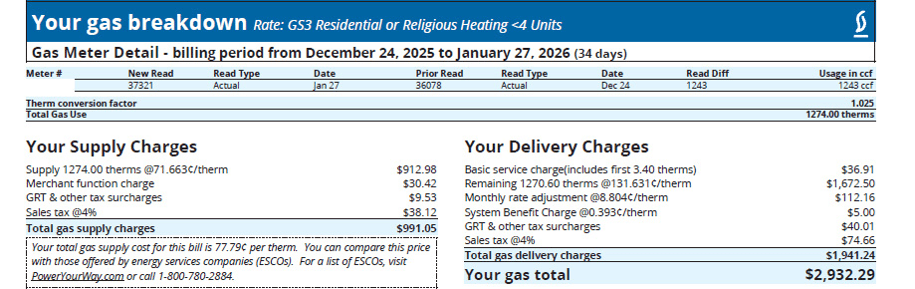
He starts with his own recent Con Edison bills for a Manhattan condo: an electric bill for June 2026 showing 1,388 kWh used at a total cost of $567.56, which works out to about $0.4089 per kWh (Figure 1), and a January 2026 gas bill showing 1,274 therms at $2.30 per therm (Figure 2).
Figure 1 – ELECTRIC BILL CON ED SERVICE AREA – JUNE 2026 DURING COOLING SEASON
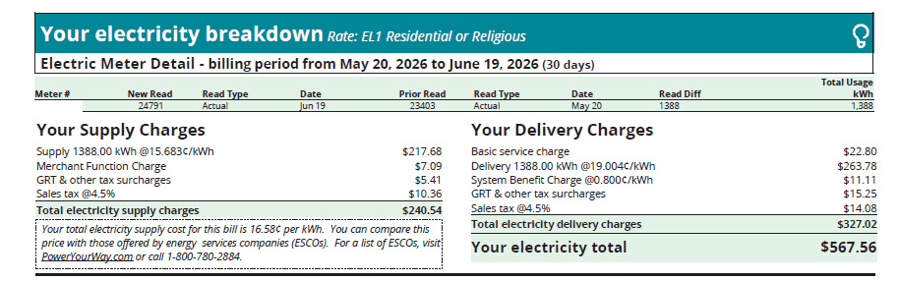
Figure 2 – GAS BILL CON ED SERVICE AREA JANUARY 2026 DURING HEATING SEASON
He then applies basic heat‑pump physics. A therm is 100,000 BTU and equals 29.3 kWh of heat. A heat pump’s Coefficient of Performance (COP) tells you how many units of heat you get per unit of electric input. The effective electric cost to deliver one therm of heat is:

Using a COP–temperature curve from a pro‑heat‑pump document for Fort Collins, he maps that onto New York City winter conditions. From Central Park temperature data, he notes that the average outdoor temperature for November–March was about 38°F, dropping to roughly 32°F for December–February, and to about 19.8°F during the 17 coldest days. On those temperatures, the curve yields:
- Five‑month winter average: COP ≈ 3.2 → cost ≈ $3.75 per delivered therm
- Core winter (Dec–Feb): COP ≈ 2.8 → cost ≈ $4.45 per therm.
- Coldest 17 days: COP ≈ 2.3 → cost ≈ $5.46 per therm.
He compares this to a modern 95%‑efficient gas furnace: January’s $2.30 per therm becomes about $2.42 per delivered therm after accounting for efficiency. From these figures, he calculates that over the full five‑month season the heat pump customer pays about 35% more per therm than the gas customer, about 46% more during the December–February core winter months, and roughly 56% more during the coldest 17 days.
Those percentages are not hypothetical; they are based on Con Edison’s actual retail prices and documented COP values at the temperatures New York actually sees, and they apply to exactly the downstate customers EDF and allies want Con Ed to tell “you can save on your bills” if you adopt a heat pump.
Emissions Reality on Today’ New York Grid
If the heat pump story were “pay more now to emit much less,” there would still be an honest tradeoff to discuss. Ellenbogen’s next point is that, under current conditions, downstate heat pump loads often emit more, not less, per unit of delivered heat than efficient gas. He cites Cornell research showing that additional marginal electric load in New York at times of peak demand is supplied by fossil fuel plants, not by a “clean” mix, and reproduces a graph indicating that incremental electric consumption drives incremental fossil generation.
Appendix 3 of his filing pulls EPA generation emissions data for New York and highlights that NYC/Westchester generation has an emissions intensity of about 865 pounds carbon dioxide equivalent (CO₂e) per MWh. He juxtaposes this with Local Law 97’s assumption of 630 pounds per MWh for city building compliance, calling the policy number “37 percent lower than reality” and arguing that such optimistic accounting hides the true emissions impact of winter heat‑pump loads.
Operationally, he points out that during the coldest periods, constrained gas pipelines force dual‑fuel plants to switch from natural gas to oil, which increases stack emissions by roughly 50% and adds significant particulate matter. The more winter heat is shifted from onsite gas combustion to electric heat pumps under today’s grid mix and constraints, the more fossil fuel is burned upstream, especially oil.
In that context, the claim that rate‑design tweaks and engagement tools will turn heat pumps into a reliable emissions‑saving strategy for Con Edison customers looks, in his words, like another case where “anything that doesn’t support the CLCPA Lie is obscured behind curtains.”
System Build‑Out, Retrofit Costs, and Arrears
Ellenbogen then zooms out beyond device‑level economics to the broader system and household impacts of the policy the Commenters are promoting.
On the grid side, he notes that a roughly 45.6% rise in heat‑pump operating costs between milder and very cold conditions corresponds to a similar increase in peak electric demand during cold snaps, forcing a rebuild of conductors, transformers, and building circuits to carry higher loads. Con Edison’s current rate case already includes around $200 million aimed at expanding the system for electrification, plus profits on increased electric revenue relative to gas and on that capital spending.
New York Independent System Operator (NYISO) projections he cites show peak load rising from about 31.3 GW today to 40 GW by 2036 and 68 GW by 2054, with no affordable, firm zero‑carbon resource ready to fill the gap in the required time frame. In his view, this means New York will lean even harder on gas and oil plants just to keep the lights (and heat pumps) on.
At the building level, he points to studies estimating that comprehensive conversions to electric heat—new equipment, wiring, and envelope work—will cost $50,000–$150,000 per dwelling unit. At current interest rates, he calculates that adds about $300–$900 per month to carrying costs over 30 years, a huge burden in a city where roughly one‑third of residents already spend half their income on housing.
Utility debt in New York has passed $1.7 billion, with more than a million households behind on bills, In the Con Edison service area, average arrears can exceed average monthly rent. Ellenbogen’s question is straightforward: why are the Commenters pushing technology that raises winter heating costs by 35–56% on top of that, while telling regulators and customers it will “save on energy bills”?
Where Heat Pumps Make Sense
Despite the sharp tone, Ellenbogen does identify niches where heat pumps make more sense and alternatives that could deliver genuine savings and emissions reductions without massive electrification.
He notes that switching from oil boilers to heat pumps can be economically and environmentally attractive, because oil fuel and maintenance costs are high and oil’s emissions are worse than gas. Using recent winter oil prices, he estimates an average delivered cost of about $3.50 per therm with an 88% efficient oil system, only slightly lower than the heat‑pump cost at the five‑month winter COP—but with higher maintenance and chimney expenses that heat pumps avoid.
For the broader building stock, he argues New York could focus first on measures that reduce thermal loads and combustion regardless of fuel: improving building envelopes, insulating pipes, and replacing old combustion equipment with more efficient models. These “unsexy” projects cut bills and emissions, cost less than full electrification, and actually reduce utility revenues by reducing consumption—a signal, in his view, that they benefit customers rather than just utilities and vendors.
Conclusion
He closes by describing himself as “anti‑stupidity, not anti‑electrification,” insisting that when math, physics, history, and economics all say a project will fail, continuing anyway with other people’s money is either insanity or a scam. For New York heat‑pump policy, his message to regulators and advocates is that they must start with the true system prices, COPs, marginal emissions, and customer balance sheets, not with aspiration and rate‑design optimism.
Finally, I recently published a guest post of heat pump carveouts by Scott Endler that raises other isses. Endler argues that carving out a special rate class for heat pumps is the wrong fix; a capacity‑based, technology‑neutral delivery charge tied to real‑time grid conditions would be fairer, more durable, and far more honest about who actually drives system costs.


