

“Green energy” advocates continue to lobby for the NY HEAT Act that would end “New York’s gas mandate and forced ratepayer subsidies for gas expansion”. This is part of their irrational war on natural gas which will only be successful if they prevent the use of natural gas in the future which means a switch to heat pumps for heating. Constantine Kontogiannis has calculated the costs of heat pumps Upstate that complements an earlier analysis by Richard Ellenbogen for Downstate.
I am convinced that implementation of the New York Climate Leadership & Community Protection Act (Climate Act) net-zero mandates will do more harm than good if the future electric system relies only on wind, solar, and energy storage because of reliability and affordability risks. I have followed the Climate Act since it was first proposed, submitted comments on the Climate Act implementation plan, and have written over 500 articles about New York’s net-zero transition. The opinions expressed in this article do not reflect the position of any of my previous employers or any other organization I have been associated with, these comments are mine alone.
Background
The “NY HEAT Act that would end the gas mandate that proponents claim means that “a single home that wants to stay on the gas system can prevent an entire neighborhood from having the opportunity to receive cheaper, cleaner heating alternatives from their utility.”
I recently posted an article in collaboration with Rich Ellenbogen that detailed the excessive winter operating cost of a geothermal-source heat pump (GSHP) system at his Westchester County residence, using his secondary heating source (a high-efficiency natural gas boiler) for comparison). After it was posted I was contacted by Constantine Kontogiannis who offered to describe his experience with a heat pump. Mr. Kontogiannis is a mechanical engineer by training with over 25 years of energy related experience. I jumped at the opportunity for him to describe his heat pump experience. The following is his lightly edited submittal.
Another Heat Pump Experience – Constantine Kontogiannis
If your readers are wondering how relevant Rich’s experience is to a typical participant of the NYS Clean Heat Program, I have some additional information that might be of interest. In 2023, I installed a cold climate air-source heat pump (ccASHP) system at my residence in Albany. According to the NYS Clean Heat 2022 Annual Report, ccASHP systems are much more common than GSHP systems in residential applications, with approximately 18,730 ccASHPs installed in New York State in 2022 (not including Long Island), compared to approximately 670 GSHPs. That’s a ratio of about 28 to 1 in favor of ccASHP systems.
The stated goal of the NYS Clean Heat Program (which commenced in 2020) is to convert 100,000 homes to heat pumps statewide, and based on the 2022 Annual Report I would estimate that the program is nearly 75% of the way towards that objective. The data collected so far implies that the vast majority of these heat pumps will be ccASHP systems just like the one that I recently installed.
When I was researching my various heat pump options, I was concerned about their cost effectiveness in heating mode. So I decided to retain my existing natural gas heating system, which consists of a condensing boiler and radiant underfloor piping. In hindsight, this proved to be a wise decision, as my 2023/24 heating costs were nearly double what they had been previously.
For the 2024/25 heating season, I decided to switch back to using my natural gas heating system instead. Sure enough, my heating costs dropped substantially – even though this winter seemed to be much colder. To confirm this, I found the following comparison of Heating Degree Days (HDDs) over the past two winters:
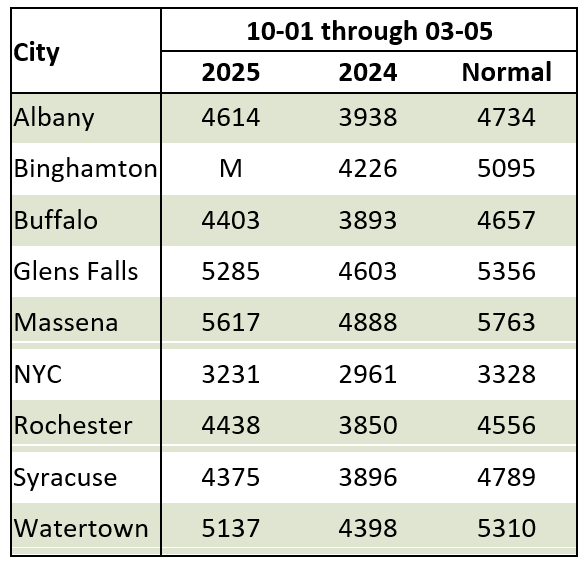
From this table, it’s pretty clear that the winter of 2024/25 was much colder than last year. Here in Albany, our cumulative HDD for this winter was within 3% of a “Normal” heating season, which makes it an ideal time window to calculate the respective heat pump and natural gas system heating costs over a typical winter. That’s what I decided to do, and to get started, I compiled a summary of my most recent energy and cost data:
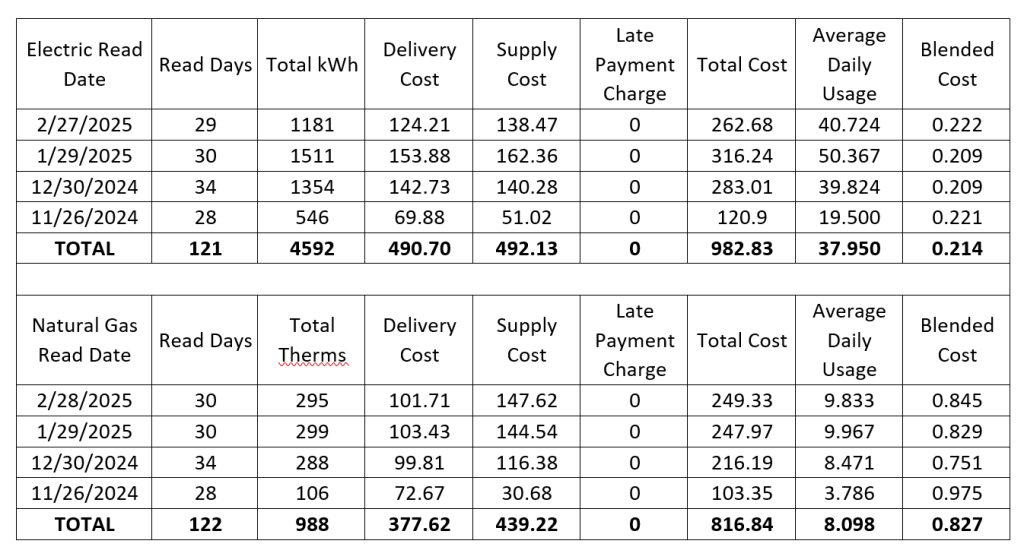
(If you’re wondering why my electric consumption is so high from Thanksgiving to Valentines Day, it’s our exterior Christmas lights – they’re all LED, but maybe we go a bit overboard.)
From the table above, I used 988 Therms this winter at a total cost of roughly $817. I have low temperature (110 degF) radiant underfloor piping, so my boiler is always set to operate in fully condensing mode at the rated 96% AFUE. If I had chosen to use my heat pumps this winter, I would have needed approximately 948.5 equivalent Therms (988 x 0.96). This translates to 27,791 kWh at a COP of 1, which is how much energy would be needed if I was using electric resistance heat (948.5 x 100,000 / 3,413).
The appeal of heat pumps is their vastly improved COP compared to electric resistance heat. To determine the seasonal COP of my ccASHP system in heating mode, it’s available in the manufacturer’s product data:
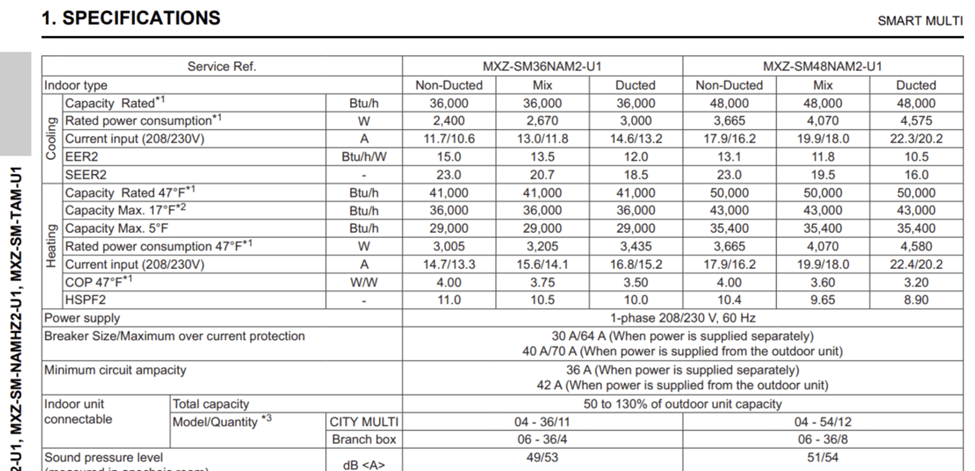
My heat pump system uses ducted 3-ton units – this is a common application, particularly when heat pumps are replacing an existing natural gas furnace and air conditioner combination. Since ducted units retain the existing heating and cooling distribution ductwork, they are significantly less costly to install and more effective in heating dominant climates when compared to the alternative of using multiple split-system terminals throughout the house (in a ducted system, there’s generally at least one supply air register in each room).
From the table above, my heat pumps have an HSPF2 rating of 10.0 (the left “Ducted” column). This is a typical HSPF2 value for ccASHPs installed through the NYS Clean Heat Program, which requires a higher efficiency for program participation than generally stipulated by building code.
To calculate the seasonal COP, we take the HSPF2, divide it by 0.85 and multiply it by 0.293, which is approximately 3.4 for my system. Here’s the calculator .
I discovered something interesting about the HSPF2 rating – it’s based on heating performance in a warmer region – Climate Zone 4, which only includes eight downstate counties in New York from Westchester to NYC through Long Island. See the definitions at the bottom of this webpage and the map.
A higher resolution climate zone map with a table of the individual NY counties in each zone was used in this analysis. From the earlier HDD table, the upstate cities in Climate Zone 5 (Albany, Syracuse, Rochester, and Buffalo) have roughly 40% more heating degree days than NYC, which is in Climate Zone 4. So it’s likely that since I live in Climate Zone 5, the true seasonal COP of my heat pump system is lower than the value calculated from an HSPF2 rating in Climate Zone 4.
But let’s put that aside for now – we’ll just be conservative and utilize the seasonal COP of 3.4 derived from the HSPF2 rating. In an earlier paragraph, I calculated the equivalent energy at a COP of 1 required to heat my home this winter at 27,791 kWh. Dividing this by the seasonal COP of 3.4 for our ccASHP system, our estimated heating energy consumption this winter would be 8,174 kWh.
At my current winter electric rate of $0.214/kWh, this translates to a seasonal heating bill of $1,749. That’s more than double my $817 natural gas bill this winter, 114% more to be exact.
To offset a portion of the installation cost, the NYS Clean Heat Program provides an average rebate of $4,600 to replace a gas furnace with a ccASHP, and a $2,000 tax credit is also applicable. But if the system costs between $8,000 and $12,000 to install, and then adds $900 to the utility bill every year, the rebate and tax credit aren’t very helpful. Over a 15-year equipment lifespan, the detrimental cost impact could add up to $16,000 or more.
Caiazza Comment
Proponents of NY HEAT suggest that one advantage of the legislation is to save money. The New York State Energy Research & Development Authority (NYSERDA) produces featured stories that “provide insights into New York’s clean energy transition and offer practical information for New Yorkers to incorporate clean energy into their homes and businesses.” The Experience the Comfort of Clean Heat story does not explicitly address costs. Kontogiannis and I agree that at one time NYSERDA claimed universal savings. To their credit NYSERDA’s Heat Pump Program description does explicitly state that replacing oil, propane, or electric baseboards with air source heat pumps as your primary heating source is a more efficient way to keep your home comfortable. I recently heard an advertisement by approved contractor who did not explain that savings were unlikely for a home that burns natural gas, apparently without any pushback from the program administrator.
The five-year estimate (2017-2021) of space heating totals of occupied housing units in New York shows that there are 7,530,150 housing units and 59.6% or 4,489,695 of them use utility gas for space heating. The two analyses that compared heat pump costs and NYSERDA agree that natural gas heating is cheaper. Kontogiannis estimates that at least 30,000 heat pumps installed through this NYSERDA program have replaced natural gas. He notes that according to the 2022 summary report, “very few of the installations include the decommissioning of the previous heating system”. As a result we are skeptical of any carbon savings claims. The bottom line is that the Climate Act will make home heat more costly for more than half of the state but I have not seen any advocate admitting that fact.
My thanks to Rich Ellenbogen and onstantine Kontogiannis for their insights.

 Pragmatic Environmentalist of New York
In upstate rural areas, where there’s no natural gas service, most people burn wood for some portion of their winter heating needs. Wood costs about $65/cord split and delivered (compared to about $250 outside San Diego according to my brother). Many like myself cut wood from their own land (I used mostly blown-down trees). I used two Energy Star rated woodstoves for a 1,900 sq. ft. home. I have a fuel oil furnace I use about 10% of the time — for an hour or so in the morning (unless my wife or I are up in the middle of the night to throw some sticks into the woodstove, which is Energy Star rated). 12-15 cords per season is enough to keep the place very comfortable, and we’re planning on insulating better to reduce our firewood wood use. Wood is free, and fuel oil costs us about $500 per year. Oil and gas for two chainsaws, a splitter and a tractor is another $200/yr. The 30+ year-old furnace crapped out last week and was replaced just yesterday for just under $800. Heat pumps (under favorable conditions, I doubt one would do the job) would keep us healthy for the times when (as happened this year) there were days of -18 degrees F (no wind chill factor).
LikeLiked by 1 person
Constantine Kontogiannis did an interesting and helpful comparison of the heating costs of a ccASHP and a natural gas heating system. We have a “hybrid” system where a ccASHP works in tandem with a forced air natural gas furnace. On cold days (less than 15 degrees above zero Fahrenheit) only the furnace operates. Otherwise, the ccASHP and furnace take turns during the day. Often the furnace will operate to increase the house temperature when we awake and the ccASHP runs to maintain that temperature throughout the day. It was a warm winter in the Twin Cities this year and our heating days totaled 4845 which was comparable to what Constantine experienced. The total cost for electricity and natural gas was $800, which was again comparable to Constantine’s costs. Of course, there are a number of specific conditions that make a direct comparison of our experience with his difficult. It’s safe to say that people who live in cold climates would be better off having a hybrid system rather than relying solely on a ccASHP for heating. However, if considering only operating costs, the hybrid system can be as economical as a natural gas system. I am not sure how resistant baseboard heating would compare to a ccASHP, but I suspect that a ccASHP might have the upper hand in that comparison.
LikeLiked by 1 person