
The New York Independent System Operator (NYISO) released its 2025-2044 System & Resource Outlook (Outlook on July 22, 2026. The report is framed as a reliability and resource planning document — not an affordability study — but the cost implications buried in its findings are hard to miss. NYISO never uses the word “affordability” as a headline, but the numbers do the talking. Here’s what jumped out at me, and why I think it validates concerns I’ve been raising for years about the Climate Act’s implementation trajectory and associated costs.
I am convinced that implementation of the Climate Leadership & Community Protection Act (Climate Act) net-zero mandates will do more harm than good if the future electric system relies only on wind, solar, and energy storage because of reliability risks, unacceptable costs, and adverse environmental impacts. I have followed the Climate Act since it was first proposed, submitted comments on the Climate Act implementation plan, and have written over 650 articles about New York’s net-zero transition. The opinions expressed in this article do not reflect the position of any of my previous employers or any other organization I have been associated with, these comments are mine alone. I acknowledge the use of Perplexity AI to generate an initial draft of this article.
Background
The NYISO is responsible for electric resource planning for New York State. The Comprehensive System Planning Process (CSPP) consists of four components: the Local Transmission Planning Process (LTPP), the Reliability Planning Process (RPP), the Economic Planning Process, and the Public Policy Transmission Planning Process. I discussed this process in my earlier article about the Outlook. On August 3, 2026 the NYISO hosted a public information briefing on the document and the slide presentation gives a good overview.
Capacity Needed for Full Zero-Emissions
The Outlook evaluates 20 scenarios (up from just five in the prior 2023-2042 Outlook), varying demand growth, resource availability, and policy stringency. I think the most striking finding is that futures requiring a 100% zero-emissions grid by 2044 require roughly 105 GW of new resources under higher demand conditions, compared to just 30-60 GW for “policy-relaxed” futures that allow continued operation of repowered and new dispatchable fossil generation. Scenarios with no clean energy targets at all land at just 10-35 GW.
For context, New York has added less than 15 GW of new resources to the entire system in the last 25 years. NYISO is telling us, in its own understated way, that the full Climate Act pathway demands a buildout of a scale this state has never attempted — and that relaxing the emissions target by even a modest amount cuts the required build by two to three times.
That is not a subtle distinction. Every gigawatt of new capacity must be paid for by somebody, and in New York that somebody is ratepayers. When NYISO says policy design “significantly impacts scale of new resource development,” what they’re really saying is policy design significantly impacts your electric bill.
Hydrogen: The Expensive Bet NYISO Wants to Avoid
Here’s a detail that deserves more attention than it’s getting. The place holder Dispatchable Emissions Free Resource (DEFR) necessary to keep the lights on during extended periods of low renewable resource availability in the Scoping Plan was hydrogen-fueled generation. In the fully zero-emissions scenarios, NYISO’s modeling leans on up to 30 GW of hydrogen-fueled generation to provide firm capacity during peak periods — capacity that renewables can’t reliably deliver on their own. The catch: hydrogen-based generation “is not currently available at commercial scale and would require significant investment in infrastructure for fuel production, storage, and transportation, which does not exist today.” It’s the only technology in the entire study that isn’t commercially available now.
Dark doldrums are a significant challenge for a wind and solar dependent electric system but are rare. NYISO’s report notes hydrogen would be expected to run infrequently, at low utilization, because of high operating costs. So we’re talking about building tens of gigawatts of a generation type that’s unproven, expensive to fuel, and would sit mostly idle waiting for the infrequent periods when it is actually needed. Policy-relaxed pathways eliminate this requirement entirely by letting existing and repowered fossil units continue providing that same firm capacity function. This is about as clean an illustration as you’ll find of the tradeoff between chasing a zero-emissions label and containing costs.
Downstate Ratepayers Are Already Feeling the Squeeze
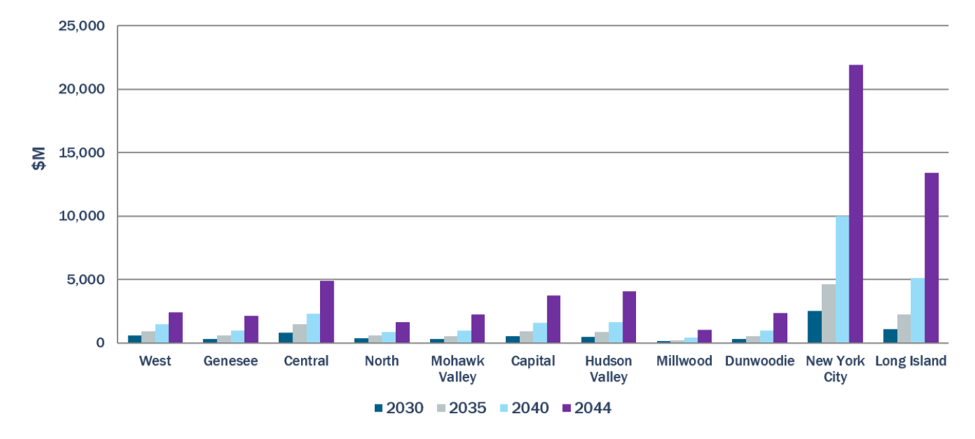
Figure 8 in the report — “Tightened Supply Conditions Drive Higher Downstate Load Payments” — is the closest thing in this document to a real affordability chart, even though NYISO doesn’t call it that. Under the Contract Case (which assumes only currently-committed resources come online, with no additional buildout), modeled load payments in New York City and Long Island climb sharply between 2030 and 2044, dramatically outpacing every other zone in the state. The report’s own explanation: as generator retirements outpace new firm capacity, downstate load centers become increasingly reliant on imports and “higher-cost resources,” and NYISO explicitly ties this to “increased energy prices.”
Outlook Figure 8: Tightened Supply Conditions Drive Higher Downstate Load Payments
Source: 2025-2044 System & Resource Outlook
This isn’t a hypothetical far-future problem, either. The report states system conditions could become “increasingly susceptible to constrained conditions as early as the mid-2030s” — well within a decade. Note that the costs increase in every region, but if you’re a downstate ratepayer, the Outlook is telling you that the bill for current state energy policy starts arriving in less than ten years.
Even Current Commitments Aren’t Enough
Maybe the most sobering line in the whole report: “Current resource commitments alone, even assuming all resources that have been awarded Renewable Energy Credit (REC) contracts come into service, are insufficient to meet future system needs over the Outlook horizon.” Read that again. Even in the best case where every renewable energy credit contract signed to date actually gets built on time — which, given New York’s track record of delayed offshore wind and slowed renewable development that this same report acknowledges, is itself optimistic — the system still falls short of what’s needed. That’s before you even get to the question of whether ratepayers can absorb the cost of closing that gap.
The report also quietly concedes that under Higher Demand conditions, the Climate Act-aligned scenario does not achieve the 9 GW offshore wind target by 2035 or the 70% renewable-by-2033 requirement, citing real-world constraints reflected in NYSERDA’s own Large-Scale Renewables Supply Curve. I’ve written about this gap between statutory targets and physical/economic reality before — it’s good to see NYISO’s modeling now says so explicitly.
Transmission Fixes: The Cheap Insurance Policy
To its credit, NYISO does flag some lower-cost opportunities that any policymaker serious about affordability should prioritize. Chief among them: targeted dynamic voltage support upgrades at the Central East interface, which constrains the flow of power from upstate generation to downstate load. NYISO frames this as a way to “increase transfer capability and better utilize existing infrastructure” — bureaucratic language for “get more out of the wires we already have instead of building new ones.” Similarly, bulk transmission upgrades in Northern New York are recommended to prevent curtailment of low-cost renewable output that would otherwise get stranded behind transmission constraints — power that ratepayers already paid to develop but can’t use.
These are the kind of targeted, relatively low-capital investments that should be the easy, no-regrets wins in any planning conversation. Compare that to the cost of building 30 GW of hydrogen infrastructure from scratch, and the contrast couldn’t be sharper.
Discussion
Strip away NYISO’s carefully neutral “objective, fact-based planning insights” framing, and here’s what the 2025-2044 Outlook is actually telling New York’s policymakers:
- The stringency of the zero-emissions mandate is the single biggest cost lever available. Relaxing it, even partially, cuts required new capacity by two to three times.
- Betting on hydrogen to fill the capacity gap is a bet on an unproven, expensive technology — and one that policy-relaxed pathways don’t need to make at all.
- Downstate ratepayers are on track for materially higher costs starting as soon as the mid-2030s, driven by tightening supply and increased reliance on higher-cost generation.
- Even full delivery on today’s contracted renewable projects won’t be enough, meaning more spending is coming no matter what.
- The cheapest wins are transmission fixes, not new generation — squeezing more capacity out of existing infrastructure at Central East and unlocking stranded renewable output in Northern New York.
Conclusion
I have long wished that the “independent” NYISO would be more explicit in its analyses about the dangers of political interference in the electric system. They are not in the business of telling Albany politicians what New York climate policy should be, but when their numbers show that the most ambitious version of the Climate Act costs two to three times more in new infrastructure, relies on a technology that doesn’t commercially exist, and hits all New Yorkers with rising bills especially Downstate with its already high prices within the decade — that’s a set of facts policymakers ignore at their own, and ratepayers’, peril.

 Pragmatic Environmentalist of New York