

Governor Hochul has said that affordability comes first, however this post shows that her Regional Greenhouse Gas Initiative (RGGI) record says otherwise. I recently wrote about the implications of the New York approval of RGGI amendments which finalized New York’s alignment with the RGGI Third Program Review Model Rule on August 5, 2026. That post focused on the flaws in the “nearly 6-to-1” ratepayer benefit cost savings claim. This post makes a related but separate point: whatever the merits of the emissions math, the price record of the RGGI program itself is an inconvenient fact for a Governor who has made affordability her signature message. Because of the importance of consumer costs, I have updated and fully documented my consumer cost estimates.
I have been involved in the RGGI program process since its inception and have been writing about problems with the RGGI program here. I have worked on every cap-and-trade program affecting electric generating facilities in New York including RGGI, the Acid Rain Program, and several Nitrogen Oxide programs, since the inception of those programs. The opinions expressed in this post do not reflect the position of any of my previous employers or any other organization I have been associated with. These comments are mine alone. I acknowledge the use of Perplexity AI to generate material included in this document.
Background information about RGGI is available in the previous post and I have prepared a technical support document that explains the calculation methodology and provides cost background information.
The affordability claim meets reality
Governor Hochul has repeatedly told New Yorkers that affordability is her top priority. Her 2026 agenda and the May 2026 relief package were both framed explicitly as responses to high utility and gasoline costs. That framing invites a simple test: have the energy policies her Administration has advanced and defended made electricity more or less expensive?
On the RGGI allowance price alone, the answer is not close. When Hochul took office in late August 2021, the most recent completed auction — Auction 52 on June 2, 2021 — had cleared at $7.60 per ton. The first auction after she became Governor, Auction 53 in September 2021, cleared at $9.30. The most recent completed auction as of this writing, Auction 72 on June 3, 2026, cleared at $35.00 per allowance, selling all 18,349,699 allowances offered for total regional proceeds of about $642.2 million. New York proceeds were $194.7 million on the sale of 5,563,451 allowances. At the time this was written, the secondary market for RGGI allowances is trading above $35.00 per allowance.
Measured from the first full auction of her tenure, that is an increase of $25.70 per ton, or 276% over a five-year period. The RGGI carbon price has multiplied nearly three times over on her watch, and it did so with the active participation of the state agencies she oversees — Department of Environmental Conservation (DEC), New York State Energy Research & Development Authority (NYSERDA), and the Department of Public Service (DPS), all of which take part in RGGI program design, auction administration, and the decisions that determine how aggressively the RGGI allowance cap is tightened. There is no doubt that the recent price rise is related at least in part to the recently approved DEC amendments that mandate an arbitrary auction cap reduction consistent with state laws but are inconsistent with emission reductions that can be expected from RGGI auction revenue investments.
RGGI consumer costs
DEC and NYSERDA’s press release describing the final amendments claims RGGI investments have generated “nearly $12 billion in net ratepayer savings” against roughly $2 billion invested. This benefit cost ratio only considers ratepayer costs of RGGI allowance auction investments. The Technical Support Document describes the source of those values, and it clearly only refers to auction revenues.
I have made this point in prior posts and it bears repeating because the Administration’s messaging has not acknowledged that there is a market clearing price effect. RGGI requires fossil-fueled generators to hold an allowance for every ton of CO2 they emit. That allowance price becomes a variable operating cost for the generator and part of their bid to market. In New York’s marginal-price wholesale electricity market, when an emitting generator sets the clearing price for an interval, its allowance cost is part of the bid and can raise the total energy price paid to every accepted resource in that interval — not merely reimburse the emitting unit for the allowances it bought. Non-emitting and even imported resources can collect the higher price despite bearing little or none of the underlying RGGI cost themselves.
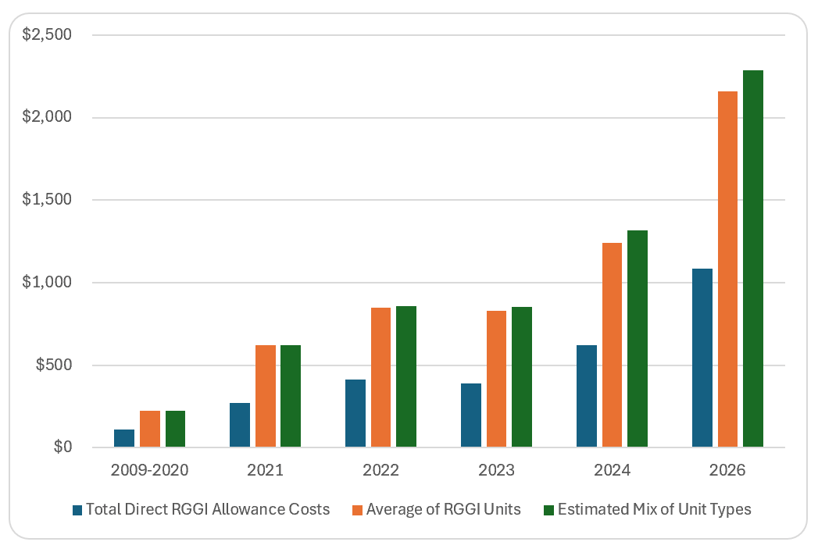
Table 1 lists the total annual estimated RGGI costs. For consistency with the NYSERDA and DEC analyses I estimated annual RGGI costs through 2024, but I estimated a cost for 2026 by scaling the average auction price of allowances in 2024 by the Auction 72 $35 allowance cost. The Administration messaging only considers the cost of allowances sold in auction – the total direct RGGI allowance cost row. As described in the Technical Support Document I calculated estimates that include the variable operating costs in the wholesale electric market. When those costs are included the price impact of RGGI doubles and costs are rising steeply (Figure 1). We have complete numbers for 2024. Between 2021 when Hochul took office the annual RGGI costs have increased $233 million or 37%. Holding everything else constant but pro-rating the total by the Auction 72 $35 allowance cost the 2026 annual cost increases $1,317 million or more than 2.7 times higher.
Table 1: Total Annual RGGI Costs($ millions)

Figure 1: Total Annual RGGI Cost Trend ($ millions)
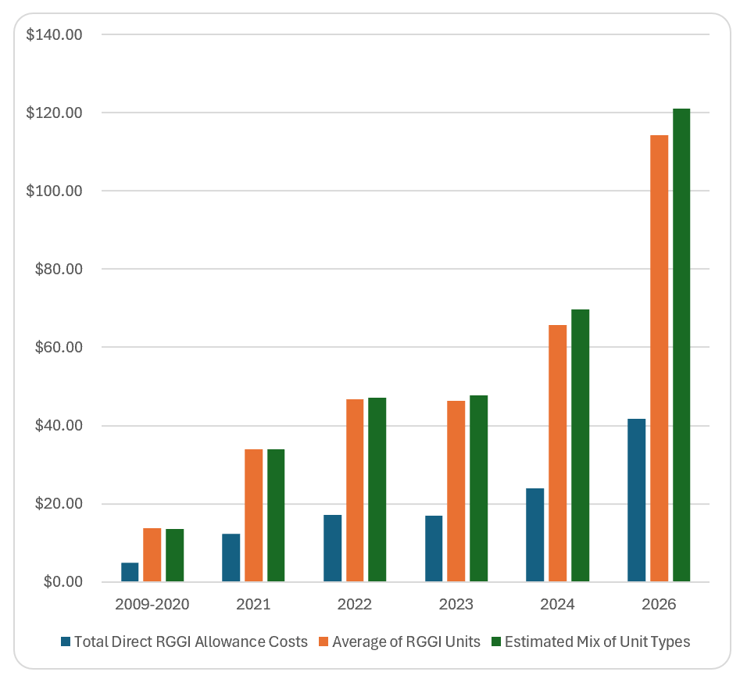
I also estimated the annual cost to residential customers. A typical New York residential electric customer uses approximately 570 kWh per month (about 6.9 MWh annually). Table 2 lists the annual estimated RGGI costs for residential consumers. If the only costs considered are the direct cost of allowances the estimated costs are half as much as when the wholesale electric market costs are included. For example, in 2024 allowance costs were $24 a year but the total cost was $70 for the estimated mix of unit types. Between 2021 when Hochul took office and 2024 the residential annual RGGI costs have more than doubled. Holding everything else constant but pro-rating the total by the Auction 72 $35 allowance cost the annual cost increases $121 a year or more than 2.5 times higher. This represents over 7% of residential electric costs. This continues a trend (Figure 2) that I expect to continue to grow.
Table 2: Annual Residential Cost of RGGI ($)

Figure 2: Annual Residential Cost of RGGI ($) Trend
These cost estimates show the RGGI price increase does not stay contained to a line item on the emitting generator’s books. It works its way into wholesale prices, and from there into what load-serving entities — and retail customers — pay for the electric commodity they consume.
None of that disappears because the state collects auction revenue and calls the proceeds an “investment.” Consumers pay the higher embedded cost first, through what they are charged for each kilowatt of electricity. Only a portion of the allowance proceeds comes back later, to selected programs, or selected bill-credit recipients. A household that does not qualify for a program, cannot front the money for an efficiency upgrade, or simply does not live in a service territory where a credit is applied still pays the RGGI-driven cost with nothing returned.
The “6-to-1 return” does not rebut this
DEC and NYSERDA’s press release describing the final amendments claims RGGI investments have generated “nearly $12 billion in net ratepayer savings” against roughly $2 billion invested — a “nearly 6-to-1” return that supposedly proves affordability is being served. The Technical Support Document explains the source of those values. I evaluated that NYSERDA report and the qualifications matter: the $12.334 billion figure is not verified net ratepayer savings. NYSERDA itself calls it “Energy Bill Savings to Participating Customers,” a modeled, expected-lifetime estimate that includes savings from projects still in the pipeline, has generally not been adjusted through evaluation, measurement, and verification, and is compared against historical expenditures rather than against the full cost of the program to all ratepayers, including the market-clearing-price effect described above.
There is also a time-value-of-money problem that a colleague who prefers to remain anonymous framed better than I have seen it framed elsewhere: RGGI takes a dollar from the consumer now and, through delayed, partially administered programs, returns a fraction of that dollar’s value later — with the people who fall short of program eligibility or who face the ordinary friction of applying for assistance left to absorb the difference in full, indefinitely. Discount that delayed, diminished return to present value and the headline “6-to-1” ratio looks a great deal less generous than it is advertised to be. And a meaningful share of the RGGI-driven cost embedded in electricity bills — the wholesale-market cost adder described above — is never captured by any investment program at all. It simply flows through to consumers as a cost, full stop, with no delayed benefit on the other end. The exemplifies a true affordability issue for most energy consumers who are not eligible for the programs or credits created for a small percentage of energy customers.
My numbers show that when the energy costs are included the 6 to 1 benefit ratio is unsupported.
The contradiction Hochul has not had to answer
The same Administration that says it wants to protect New Yorkers from high energy costs signed off on a Third Program Review that lowers the regional RGGI cap sharply through 2037, with steeper annual reductions from 2027 through 2033. A tighter cap means a smaller supply of allowances at a time when there is growing electricity demand — precisely the dynamic that has already pushed the allowance price up 40 percent in a single quarter this year. RGGI’s own market monitor has acknowledged the resulting affordability and scarcity concerns are real, not hypothetical.
An affordability agenda should not rest on imposing a rising energy charge today while pointing to a modeled, largely unverified, multi-year savings projection as the offset. Governor Hochul cannot credibly claim affordability is her governing priority while her Administration has overseen — and just locked in further tightening of — a program whose price has risen nearly fourfold on her watch.
Discussion
In my opinion, the cost of RGGI allowances is another buried cost of the clean energy transition that very few people know about. In 2024 the impact of RGGI allowances accounted for $70 per year or 4.2% of a typical residential electric bill. Projecting the latest sharp rise in allowances raises the costs to $121 per year or 7.2% of a typical residential electric bill. At a time when there is an energy affordability crisis it is fair to ask whether New Yorkers are willing to pay for this program?
The Administration messaging about the “6-to-1” benefit to cost claim is unsupportable and self-promoting at best. If they want to prove a positive benefit/cost ratio then they should request that NYISO provide the wholesale market impact calculated with the hourly data that only they have. For the benefits they should only consider savings actually returned to consumers, broken out from savings that are committed but not yet delivering measured savings. They should also only include verified, evaluated-and-measured bill savings — not modeled lifetime projections — compared against the total full cost.
Until that accounting exists, “nearly 6-to-1” is a talking point, not a demonstrated result. New Yorkers who have watched the RGGI price climb from $9.30 to $35.00 per ton since Hochul took office are entitled to something better than the assurance that the difference will average out favorably over a very long period of time while losing the time value of the dollar spent today for energy consumed.
Conclusion
The combination of New York’s wholesale electric-market structure and the recent sharp increase in RGGI allowance prices means that the program is no longer a marginal cost with little consequence for consumers. It is now a meaningful contributor to residential electric bills.
My review of NYSERDA’s reported results indicates that RGGI-funded investments have produced relatively little measured progress toward the program’s core purpose: reducing emissions from the electric generating units subject to the RGGI cap. Using the State’s reported cumulative annualized program benefits, I estimate a cost of approximately $583 per ton of CO2 reduced. Moreover, the RGGI investment-related savings represent only about 4.7% of the electric-sector emissions reductions observed since the program began. Most of the historic reduction appears instead to be associated with fuel switching from coal and oil to lower-emitting natural gas—a transition that offers little opportunity for additional reductions going forward.
That mismatch matters because RGGI is fundamentally a power-sector compliance program, not simply a source of funding for otherwise worthwhile State initiatives. If allowance costs are adding more than 7% to residential electric bills, then New York should be able to demonstrate that the revenues are being directed first to cost-effective measures that reduce emissions from RGGI-covered sources, lower customer bills, and help maintain reliable compliance with an increasingly stringent cap.
Governor Hochul has emphasized energy affordability. That commitment should require an independent, transparent review of whether New York’s continued participation in RGGI—as presently designed and implemented—delivers emissions reductions and consumer benefits proportionate to its cost. If it does not, then withdrawal from RGGI, or at minimum a fundamental restructuring of the program and its revenue-allocation rules, should be considered a necessary test of rational energy policy.


Roger,
Would you have time For a call? I finished an op ed on RGGI and some of the cost implications and I would be interested in comparing notes
Justin Wilcox 585-208-5444
Get Outlook for iOShttps://aka.ms/o0ukef ________________________________
LikeLiked by 1 person