On October 9, 2026 Doreen Harris announced that the New York State Energy Planning Board (Board) will convene on December 9, 2026 to kick off the new Energy Infrastructure Development Plan (EIDP) process. Earlier this week I characterized it here as process commitment, not the planning commitment I think is needed. I also had a description posted at the Empire Center for Public Policy. Richard Ellenbogen also responded to the EIDP this week in an email. This post reproduces his email modified only for posting format.
Ellenbogen is the President [BIO] of Allied Converters and frequently comments on various issues associated with the New York Climate Leadership and Community Protection Act (Climate Act). I have published other articles by Ellenbogen. He is an engineer who truly cares about the environment but understands the practicality of clean energy solutions based on his experience as an early adopter of renewable technologies at both his home and business two decades ago.
After Seven Years of NY State’s Failing Energy Policies, The Chickens Are Coming Home to Roost
NY State has been chasing impractical energy goals since they passed the CLCPA in 2019. Several of us warned the state about the shortsightedness of their policies at that time. This week, NY State announced the Energy Infrastructure Development Plan (EIDP), while stating, ” The EIDP will complement New York’s existing energy planning process, with the goal of better coordinating how and when new clean energy sources come online. We’re going to have to build out just a tremendous amount of all of these resources, and we want to make sure that we do it in the most cost-effective way, and we think that’s going to require, effectively, integrated resource planning. The new initiative comes as the state’s independent grid operator, the New York Independent System Operator (NYISO), announced they are expecting a reliability shortfall in the next decade without state intervention.”
The reason that NY State has the reliability shortfall in the first place that the NYISO is documenting are the very policies that the Hochul Administration now seems to be doubling down on with the EIDP. They have been focused on shutting down firm generation and putting all of their eggs in the renewable basket. After seven years those eggs are hatching, and the chickens are coming home to roost as will be clearly documented below.
The EIDP complementing Energy policies that aren’t working won’t make them work any better. It will only throw good money after bad and raise costs. That is currently happening with NYPA’s purchasing solar arrays that the private developers can’t afford and ultimately dumping the costs onto the backs of ratepayers and taxpayers while claiming to perform a public service.
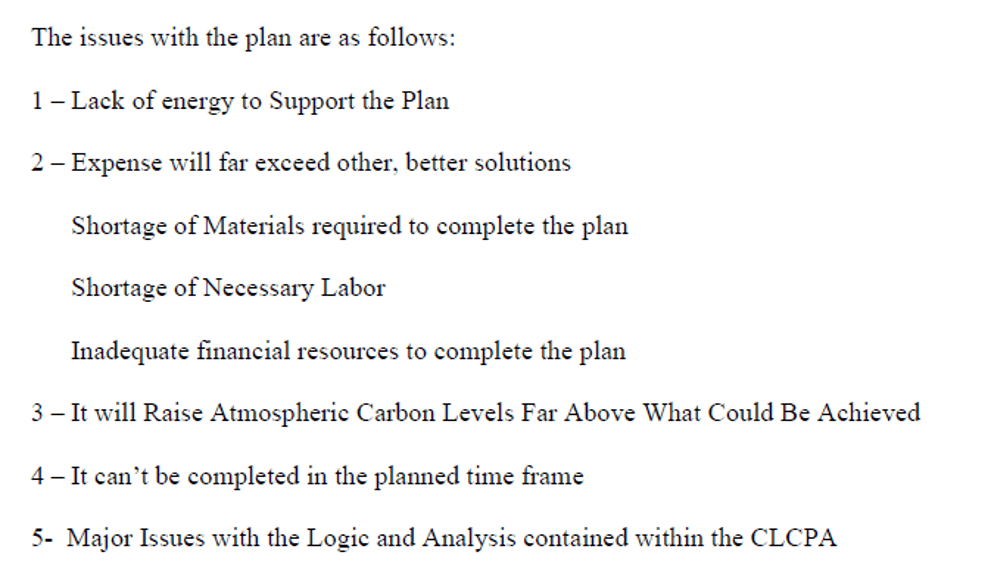
A large reason for the debacle is that whenever engineers propose a plan, one of the first steps is to ensure that the resources exist to make the plan work. However, NY State’s Energy Plan wasn’t designed by engineers. It was designed by a biologist and some climate activists and NY State skipped the resource adequacy step with their energy planning. The state has evidently been hoping for the past seven years that a fairy godmother would step in to fix the mess because nothing in the current planning coming out of Albany is going to address the issues. In August 2023, I wrote a document for the PSC as part of 15-E-0302 explaining why the CLCPA would not work. On page 4 of the filing, the following five issues are documented. Note the issues documented in number 2, below.
In the last week, two documents have been published. One was sent out by Robert Bryce on his Substack titled “The Great Grid Hardware Shock“, and clearly documents the rapid rise in equipment costs, much of it due to shortages. For example, there has been an acute transformer shortage for many years. A second document published on October 4, titled “The World is Running Out of Ore“, shows that the world is running out of copper. The use of renewable generation compounds the problem. Why is that?
The following table shows the land areas and annual energy outputs of 500 Megawatt generators in solar, wind, gas, and nuclear.
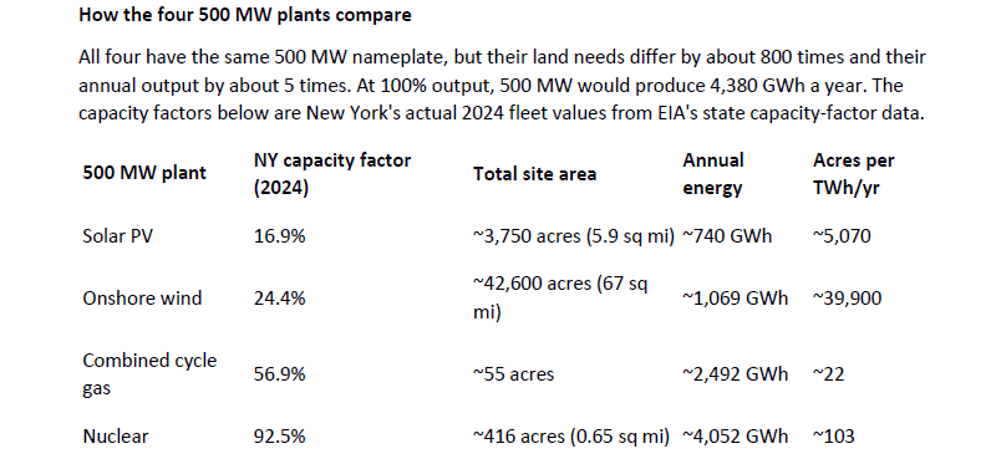
As the power capacities are all the same, the electrical conductors will have to be similarly sized for the peak power output but as can clearly be seen, the solar array is 230 times larger per Terawatt-hour than the equivalent sized gas plant (5070 acres vs. 22 acres) and only produces 30% of the annual energy of the gas plant (740 GWh vs. 2492 GWh). The full comparison uses numbers based on EIA documentation for NY State. The vastly larger area will require far more transmission capacity for 30% of the energy output.
For wind in NY State, the numbers are worse. The wind farm is 1800 times larger per terawatt-hour than the gas plant. The nuclear plant is five times larger per terawatt-hour than the gas plant, but it generates 62% more energy. These numbers clearly explain why so many renewable projects are failing in NY State. They are just too expensive so if NY State truly wants to be “Cost effective”, as they claim, they are going to have to rethink their policies.
The CleanPath Project (Renewable Transmission Cable and Generation) that failed in late 2024 is an example of the issues. It was too expensive for the amount of energy that it would provide. The following graph, copied from “The World is running out of Ore” document, shows the relative ore costs per terawatt-hour of generation for various generating technologies. It shows exactly what was explained previously. The energy systems with a lower power density occupy much larger areas, generate less energy, and have far higher costs per unit of energy generated.
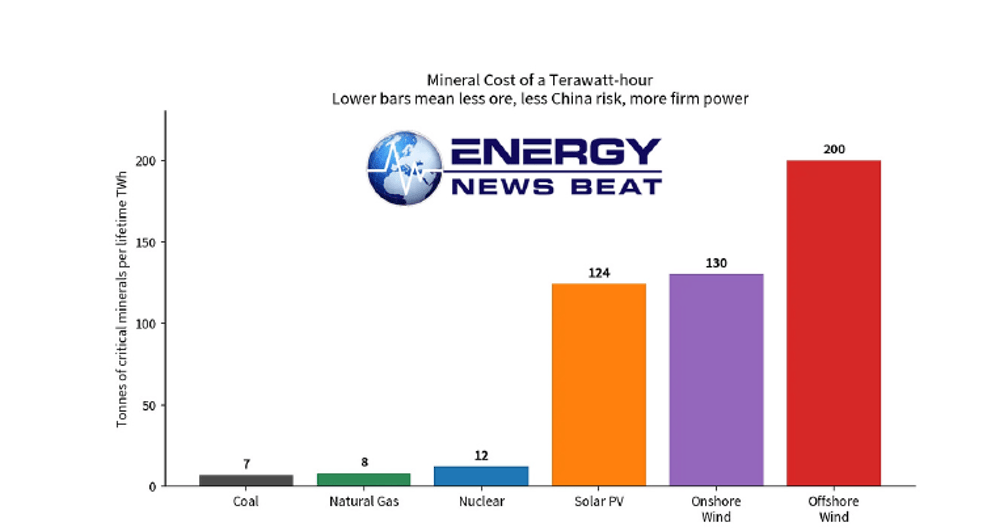
Source: The World is running out of Ore
It isn’t just copper that is in short supply. Aluminum is also in short supply because several smelters have closed over the past several years due to high energy costs.
Beyond the material shortages are the labor shortages. It requires far more labor to interconnect a 40,000 acre generating plant than a 22 acre or a 100 acre generating plant.
In addition to the costs of the interconnections are the costs of the associated equipment needed to make renewables functional on the utility system. That includes synchronous condensers needed to add grid inertia to a renewable system. Also needed will be large amounts of energy storage for times of low wind and sun. Based upon NYSERDA’s 6 GW Energy Storage report, the required energy storage could cost between $2 Trillion and $3 Trillion to achieve the same functionality as the Combined Cycle Gas plants or the Nuclear Plants. No one at the state level has ever explained where the trillions of dollars are going to come from.
The state government is talking about reducing energy costs while adopting policies that are going to increase costs and are simultaneously impossible to implement due to resource inadequacy.
If NY State can’t build what they are planning, they will never solve the generation shortfall we are currently living with. What the facts are showing is that there is no cost-effective way to build out the renewable resources that they seem determined to inflict upon the State’s ratepayers in opposition to math, physics, and economics.
It will only get worse as the older, existing firm generation plants fail because of age. We will all be living in the dark and paying more for the privilege.
State Energy Planning Board to Kick Off New Energy Infrastructure Development Plan Process
In closing for my reader’s attention I enclose the text of the Doreen Harris announcement. Ellenbogen and I agree that there is no suggestion that the State is really willing to address the challenges he has described here because there is no acknowledgement that there are issues.
I’m pleased to share that the New York State Energy Planning Board (Board) will convene on December 9, 2026. The meeting will kick off the new Energy Infrastructure Development Plan (EIDP) process as part of the ongoing New York State Energy Plan work to provide an actionable plan for the infrastructure that New York needs to modernize its power grid and keep pace with the energy demands of economic growth. Importantly, the plan will guide the State’s energy infrastructure investment decisions over the coming decades and supports Governor Hochul’s Climate Week directive as part of her Clean, Highly Affordable, Reliable Grid Expansion (CHARGE) agenda to advance affordable, abundant, reliable, and clean energy within New York State.
The Board and supporting State agency staff will establish a transparent process to release an interim plan in 2027 and to finalize the first comprehensive Energy Infrastructure Development Plan by December 2029. The forthcoming EIDP process will include multiple opportunities for energy industry stakeholders and the public to engage and provide input.
I invite you to attend the meeting to be held at the Albany Capital Center, Meeting Room 2B/2C at 55 Eagle St, Albany, New York beginning at 2:00 p.m. ET. This meeting is open to the public for listening, both virtually and in-person with registration.
I look forward to reconvening the Board to address New York’s energy needs through an expanded planning framework.
Stay tuned.


