

A similar but condensed version of this article was published at Watts Up With That
Regular readers know I have spent this year documenting how New York regulators sell the Regional Greenhouse Gas Initiative (RGGI) as a successful cap-and-invest program while allowance prices climb. Virginia’s return to the program deserves its own post. Governor Abigail Spanberger made affordability the cornerstone word of her campaign, and her energy plan promised to “negotiate the best ratepayer deal to rejoin RGGI.” For a Governor who ran on affordability, the entire Virginia RGGI re-entry process has been shocking. Incredibly it is even worse than New York.
Virginia’s first auction back in the program cleared at $37.65 per allowance, raising $259 million for the Commonwealth. The last auction before Virginia left cleared at $14.88. Dominion Energy has asked the State Corporation Commission (SCC) to reinstate its RGGI rider at $13.00 per month for a typical residential customer, or $10.36 under its mitigation proposal. When the rider was removed in June 2024 it was $4.43 per month.
This post walks through the decisions that made the deal worse for ratepayers, drawing on the 2026 Virginia Energy Plan (VEP) and a presentation by William Shobe of the University of Virginia and member of the Virginia Air Pollution Control Board, “Explaining the RGGI price path.” Shobe helped design RGGI and is no program critic, which makes his slides especially useful.
This post is based on an outline from an anonymous colleague from the electric utility industry. I have been involved in the RGGI program process since its inception and frequently write about the details of the RGGI program. The opinions expressed in this post do not reflect the position of any of my previous employers or any other organization I have been associated with, these comments are mine alone. I acknowledge the use of Perplexity AI to help research and draft this post.
Rushing in six months early
The General Assembly did not have to force a mid-year return. The 2025 Model Rule changes take effect on January 1, 2027, and the budget language itself required DEQ to align Virginia’s regulation with the new Model Rule “no later than January 1, 2027.” Instead, the February “caboose” budget, HB 29, directed agencies to repeal the 2023 exit regulation and reinstate the old one within 90 days. Virginia resumed participation on July 1, 2026.
The market noticed. Argus Media reported that the RGGI price rally was “likely kickstarted, at least in part, by news that Virginia would rejoin RGGI as soon as 1 July, six months earlier than what most market participants had anticipated.” Shobe’s slides show secondary prices going from $28.88 on April 13 to $52.88 on May 4 before falling back. The early start also meant that Dominion had to buy allowances in the September auction before its cost-recovery mechanism had been reinstated. Customers will pay for those eight months plus financing, which Appalachian Voices estimated could reach $17 million.
Cutting the 2026 budget in half instead of adjusting for the season
Virginia’s 2026 base budget was simply cut in half, to 11.48 million tons of the 22.96 million tons a full year would have received. Electric-sector emissions are not spread evenly across the year, though. The July–December period includes the summer peak, when fossil units run the hardest. Shobe’s presentation notes that Virginia’s covered sources emitted about 17 million tons in the second half of 2025, roughly 50% more than the six-month budget they were given (Figure 1, Panel A). A seasonally adjusted allocation would have reduced the impact; without one, Virginia came back shorter on day one.
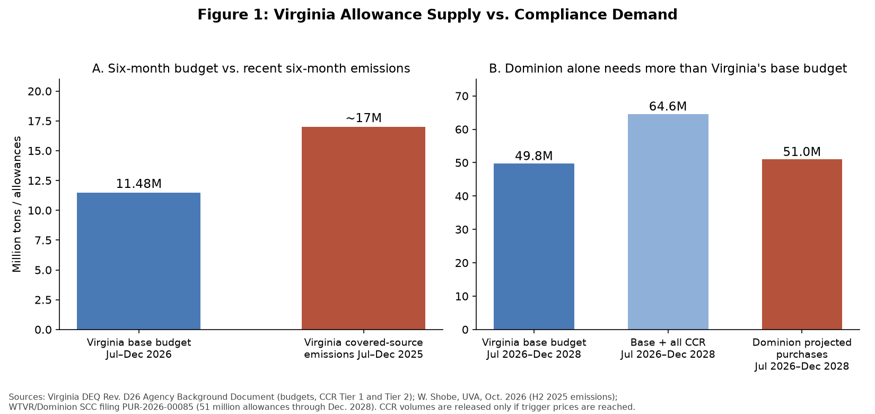
Figure 1: Virginia Allowance Supply vs. Compliance Demand. Budgets from the DEQ Rev. D26 Agency Background Document; Dominion purchase estimate from WTVR’s report on the Dominion SCC filing; second-half 2025 emissions from Shobe (UVA).
Leakage
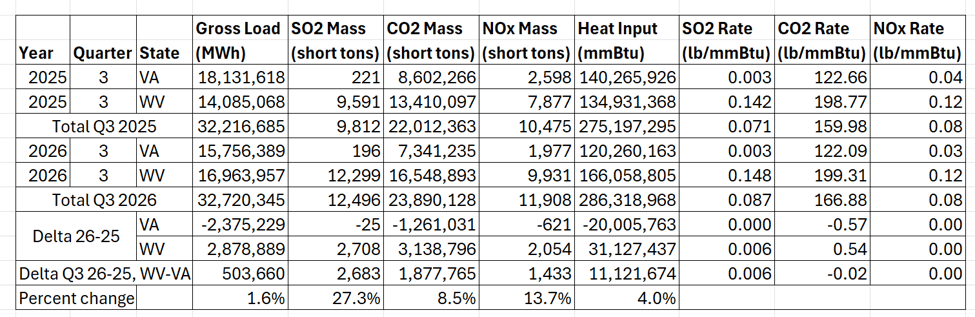
Virginia is in the PJM RTO. When Virginia generating units add the cost of purchasing RGGI allowances to their bid prices it makes them less competitive compared to other states like West Virginia. There is no doubt that this increases overall emissions or leakage. Table 1 compares statewide emissions for facilities that report gross load and had data available for the third quarter of 2026. That excluded three facilities for data availability and 12 that report steam load. If you assume that the cost differential created by the RGGI adder caused all of the changes in quarter 3 between 2025 and 2026 then the upper bound leakage would be 1.9 million tons of CO2, 2,683 tons of SO2 and 1,433 tons of NOx. This is a gross estimate because I do not have all the data necessary or the time to do it right.
Table 1: Comparison of WV and VA facilities in the third quarter of 2025 and 2026
No stakeholder engagement
Every step bypassed Virginia’s Administrative Process Act (APA). The HB 29 language says that any regulatory action needed to rejoin is “hereby exempted from the provisions of the Administrative Process Act” and is to be completed “without further action by the State Air Pollution Control Board.” The Town Hall record for the reinstatement regulation states: “No comment period held for this exempt action/stage.”
The second rulemaking, Revision D26, sets Virginia’s budgets through 2037 and beyond, and it worked the same way. DEQ said that because the budget bill required it, the action “will not have an associated public comment period.” The DEQ Director adopted it on September 24, 2026, again without Board action. The decision setting compliance costs for every Virginia power plant for the next decade got no public comment, no APA economic analysis, and no citizen-board vote.
“Aligned” to modeling that never included Virginia
The legislation directs DEQ to “align” Virginia’s regulation with the Third Program Review. That review, however, was carried out by the ten states excluding Virginia then participating, and the electricity-sector modeling behind the cap was a ten-state exercise. Even the Virginia Energy Plan labels its cap table “Summary of RGGI Regional Allowance Cap Updates, not including Virginia.”
DEQ and RGGI’s consultant ICF did not model Virginia. It used a formula. The agency took Virginia’s 2026 budget of 22.96 million tons, which dates to the 2020 regulation, and then followed the RGGI trajectory reductions, cutting 2.55 million tons a year from 2027 to 2033 and 0.73 million tons a year from 2033 to 2037. That leaves 2.19 million tons in 2037. No analysis tested whether Virginia’s fleet can meet that path, or at what cost.
The world has also changed a lot since the program-review modeling was done. Shobe’s slides show that the 2017 cap was set when RGGI generation was modeled to fall about 5% between 2017 and 2031. Dominion’s ten-year growth forecast has since gone from 0.4% to 2.2% to 5.0% a year, and Virginia commercial sales rose 29.6 TWh from 2019 to 2025. On the supply side, the VEP admits that “Virginia’s investor-owned utilities resource additions are not on track to meet the VCEA’s net zero goals.” Higher demand and slower renewable buildout both push allowance demand up.
The final budget also turned out tighter than the one the Energy Plan was built on. The VEP modeled base allowances falling to 2.64 million in 2037. It said that forecast was 99.87% of DEQ’s preliminary revised trajectory, “suggesting a high amount of certainty.” The final D26 rule sets the 2037 base budget at 2,186,667 tons, about 17% lower.
The Energy Plan still depends on natural gas
There is a basic conflict between the cap and the state’s own plan. In the VEP’s Current Policies, moderate load case, Virginia adds about 6.7 GW of new natural gas capacity between 2029 and 2034 (Figure 56), and the plan’s projections keep roughly 13 to 15 GW of natural gas capacity serving the Commonwealth through 2045. According to the VEP, Dominion’s 2025 Integrated Resource Plan calls for roughly 8 GW of new gas, with no fossil retirements, and the company intends to use the VCEA reliability exception to keep units running. Meanwhile, Virginia’s base budget drops from 20.4 million tons in 2027 to 5.1 million tons in 2033. A gas fleet that grows while the cap falls 75% in six years has only one outcome: Virginia buys allowances from everyone else at whatever price the market sets.
No in-state projection of regulated-source emissions
Virginia has never published a projection of what its RGGI-covered sources are likely to emit compared with its budget. The VEP does not provide one either. Its capacity expansion model forced compliance by assuming “Virginia electric utilities will purchase and retire at least all the base and CCR allowances prorated for Virginia.” The plan concedes that the model “is more restrictive than the actual operation of RGGI in the Commonwealth. In reality, Virginia entities could purchase allowances that are allocated to other states.” The question that decides what ratepayers will pay, namely how many allowances Virginia sources will need beyond Virginia’s allocation, was never studied.
Net buyers cannot be sheltered by their own auction revenue
The Governor’s affordability argument depends on the bill credit. The budget sends 45% of RGGI revenue back as bill credits to residential, small business, and church customers. The VEP says these classes “were assigned 41% of the costs related to RGGI compliance,” so they “should expect a net credit.” The Governor said “average monthly bills could drop by as much as $36 annually.”
The arithmetic only works if Virginia sells roughly as many allowances as Virginia sources buy. It does not. Shobe’s slide is titled plainly: “Virginia is likely a net buyer.” Dominion alone expects to buy 51 million allowances from July 2026 through December 2028 at a projected cost of roughly $1.2 billion. Virginia’s base budget for that same period adds up to only 49.75 million tons (Figure 1, Panel B). The cost of RGGI is on the retail side and any imported or clean electricity that serves local load is not covered. It is not about how much is emitted in state vs. how much is purchased. Instead it is more whether Virginia fossil generation covers the entire footprint to shelter the consumers. Any import or clean generation is still sold at the marginal cost that is a RGGI fossil generator, so RGGI costs are borne by the entire load, and the State is only able to collect from the in-state generation, which is only a percentage of total generation.
Large commercial, industrial customers, and ratepayers from municipal utilities who buy power from independent power producers like Potomac Energy Center are not among the classes receiving the credit, and their higher costs show up in the price of everything Virginians buy. The credit also comes at the expense of the programs RGGI was supposed to fund. The Virginia Mercury notes that the amendment means less money for low-income energy efficiency and flood preparedness, which previously received 50% and 45% of proceeds. Ratepayers pay more to get less of the “investment” used to justify RGGI. As of the October 28 SCC hearing, the method for calculating the credit still had not been finalized.
Scarcity, not speculation
RGGI supporters often blame high prices on speculators, implying prices will fall on their own. Shobe rejects that idea. His slide is titled “Scarcity, not speculation.” Auction 73 drew 65 bidders, with bids at 2.6 times supply. Investor-held surplus fell from 60 million to 37 million allowances between the second quarters of 2025 and 2026, and 71% of allowances in circulation are now held by compliance-oriented entities. “A speculative bubble would show investors accumulating. The data show the opposite.”
He also notes that the Cost Containment Reserve “sold out in the first auction of every year since 2024, so the CCR no longer caps the price,” and that second-quarter 2026 futures traded above the $29.25 Tier 2 trigger, meaning “the market expects both tiers to be exhausted in 2027.” His conclusion: current prices “reflect both increased emission reduction ambition and increased demand growth.”
If high prices come from scarcity, they are structural, not temporary. The cap falls faster after 2027, data center load keeps growing, and the Energy Plan builds more gas. Nothing in the program design brings prices back to 2021–2023 levels.
Is Dominion collecting RGGI twice?
The last issue is one the SCC needs to examine before February 5, 2027. RGGI costs reach customers in two ways. The first is the rider, which recovers what Dominion pays for allowances. The second is the wholesale market. As Shobe explained to VPM, in PJM “any generator that has carbon-intensive generation has to add that RGGI price” to its offer. When an emitting unit sets the locational marginal price (LMP), every megawatt-hour clearing in that interval, including nuclear, solar, and imports, gets paid the higher price.
So the SCC should ask several questions:
- When Dominion’s fossil units clear at RGGI-inflated LMPs, do the extra PJM energy revenues fully flow back to customers as an offset to Rider RGGI, or does the rider recover allowance costs that the market has already paid?
- How much of the RGGI cost built into LMPs reaches Dominion customers through power purchased from merchant Virginia units and through the roughly 30% of Virginia’s electricity that is imported? None of that is counted in the rider or offset by the credit.
- How much of the higher wholesale price is simply a windfall for non-emitting generators that never buy an allowance?
In my New York work, counting that wholesale-market effect roughly doubles the consumer cost compared with counting direct allowance purchases alone. Virginia’s $10-to-$13 rider debate leaves that half of the cost out entirely.
What an affordability Governor should have done
A Governor who meant what she said about affordability would have waited until January 1, 2027, when the new Model Rule takes effect. She would have run the rulemaking through the Administrative Process Act with a real economic analysis and published a projection of Virginia’s covered-source emissions against the budget before agreeing to a trajectory that assumes Virginia is like New England. She would have required the SCC to account for the wholesale-price effect before telling families the credit makes them whole. None of that happened. Virginia rushed in at the worst possible time, accepted a cap built for other states, skipped every public check, the program is shifting generation to West Virginia units that emit more pollutants and is presenting a partial refund of its own residents’ money as a savings program.
Governor Spanberger promised to negotiate “the best ratepayer deal.” As far as I can tell, there was no negotiation and there is no deal. Virginians are left with a higher bill and a credit that can’t cover it.
Governor Hochul also ran on an affordability platform. Unfortunately, the hypocrisy of her claims relative to her energy affordability record did not make a difference with New York voters.


