Over the last six months I have been working with several colleagues to intervene in New York rate cases in an attempt to get someone to listen to us regarding the futility of the Climate Leadership & Community Protection Act (Climate Act) net-zero transition. In our current effort we intervened in the Consolidated Edison of New York (Con Ed) rate case. Francis Menton recently described our latest objection that provides an overview of this effort. This article reproduces Richard Ellenbogen’s long and detailed explanation of why the system is broken.
Richard Ellenbogen has been speaking to NY State policy makers and regulators since 2019 regarding the deficiencies inherent in NY State Energy policy. He has a proven record implementing carbon reduction programs at his own manufacturing business in Westchester County where it has reduced its electric utility load by 80% while reducing its carbon footprint by 30% – 40% below that of the downstate system. I have previously published other articles by Ellenbogen including a summary description of his issues with the Climate Act.
The following is a lightly edited copy of an email Ellenbogen sent on 15 December 2025.
Overview
I have just spent the past six months as a party to the Con Ed rate case (25-E-0072 and 25-G-0073) as part of a group called the Independent Intervenors that also includes Roger Caiazza and Francis Menton. It is six months of my life that I will never get back.
I say that because the system is fatally flawed and skewed against the rate payer and towards special interests. The DPS (Department of Public Services) is supposed to protect the interests of the rate payer but from what I saw, their primary goal was expediency and trying to avoid angering special interest groups to avoid political blowback.
Four months during the middle of the rate case is done in forced confidentiality. All the parties get into a “room” in forced secrecy to negotiate except no one was negotiating on behalf of the rate payers despite claims to the contrary. I compare this period to an incident that occurred when I was nine and playing ball inside the house. I chipped a glass lampshade. To keep from having to explain what happened, I turned the chipped part towards the wall and hoped that my mother wouldn’t see it. That is no different than what occurred during this rate case. Just as I did with the lampshade, they are hiding things from the rate payers and hoping that they won’t notice except the ramifications of this are far more impactful than a broken lamp. They are deluding themselves because just as I told state officials regarding the Climate Act almost seven years ago, the political pork serving no engineering purpose built into this case is going to negatively impact the ratepayers of both NY City and Westchester. It is tangentially related to the Real Estate Board of New York (REBNY) analysis which I will address later in this document. It highlights only one negative aspect of the hearings and state and city policy but the impact on city residents will be crippling.
The result of the negotiations is called the Joint Proposal (JP) and parties either accept it or reject it and those objections can be resolved at a Post Settlement Hearing which occurred on Wednesday December 3. The Joint Proposal runs 379 pages.
Our Objections
We chose to object to the settlement and were offered the opportunity to question witnesses from DPS and Con Ed. Part of me thinks that if I had been a better litigator, I might have accomplished more during the hearing but part of me realizes that the sole purpose of the accepting parties was to object to every document that we submitted. References to the documents are included. I take no issue with the judges as they did their jobs according to the limits of court procedure, however the reality of the process does not work in the ratepayer’s favor for several reasons. I only took issue with two statements made by the judges, but I bit my tongue to avoid drawing their ire. I will elaborate on those two incidents below.
First, despite the judges being there, the hearing is controlled by attorneys and staff that clearly have absolutely no understanding about how the utility system works. I learned that in 2008 when I beat up Con Ed’s lawyers during a tariff hearing before the DPS. Things have not improved over the past 17 years. Their sole purpose in these hearings, along with NY City’s Lawyers, EDF’s (Environmental Defense Fund) lawyers, and DPS lawyers, was to try to disallow anything that might contradict the accepted JP. The attorneys may understand the law but they don’t understand energy distribution systems, nor do they apparently care to. Further, using the term, “Environmental Defense”, anywhere near this rate case is an oxymoron. This JP is an affront to the environment along with being an affront to ratepayers. The impact of math and physics on energy systems, the acknowledgement of which was so lacking in this settlement process, dictated that.
Second, we were allowed to ask questions of the DPS and Con Ed staff, but I quickly learned that all they had to say was that they were unfamiliar with any document that we presented and then they didn’t have to answer any questions about the document. Several of these were state documents published by the New York Independent System Operator (NYISO) and New York State Energy Research & Development Authority (NYSERDA) that we would hope that people responsible for the utility system would be aware of. Their ignorance or willful ignorance of critical aspects of utility system operations and published reports don’t bode well and goes a long way to explaining the rapidly rising utility rates and impending energy shortages that the NYISO has stated will impact the downstate region within the next few years. This highlights one issue that I had with a judge’s statement where he said, “Staff can’t be expected to know everything.” Except they are being paid to know things. Why was it that three unpaid volunteers knew more about what was wrong with this than people that are being paid to run the system?
Third, Con Ed staff could not pass Electrical Engineering 101, which is a problem for a company that is operating the electric utility system for nine million people. That was highlighted by a judge’s statement after we asked about Local Law 97. The judge stated that (paraphrased) “Local Law 97 is the law and it wasn’t a matter for discussion.” I almost stood up and said, “But there is a higher law, and it can’t be negotiated with.” But I didn’t feel that would have had any effect despite being true. The problem with all of NY State energy policy is that it defies the physics and math of “Natural Law” and those don’t care about the Climate Act, Local Law 97, or this Joint Proposal. These people seem to believe that if they state their positions loudly enough and shut down dissent, they will prevail. As I said to Roger Caiazza on the phone the other day, we will eventually prevail because physical law says that we have to. It’s only a question of how much damage will be done by these laws and to NY residents in the process. NY State is learning that firsthand as they have now realized that their precious Climate Act is driving up utility rates to a level where it is breaking the backs of rate payers and that they can’t hit their emission targets. That is something that was obvious seven years ago and they were told that this would happen.
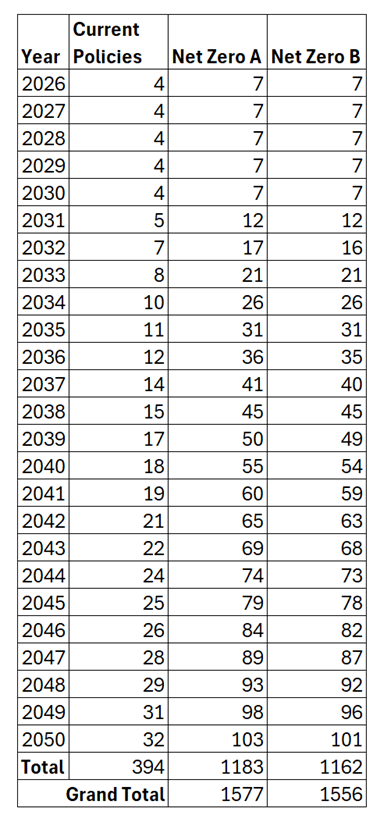
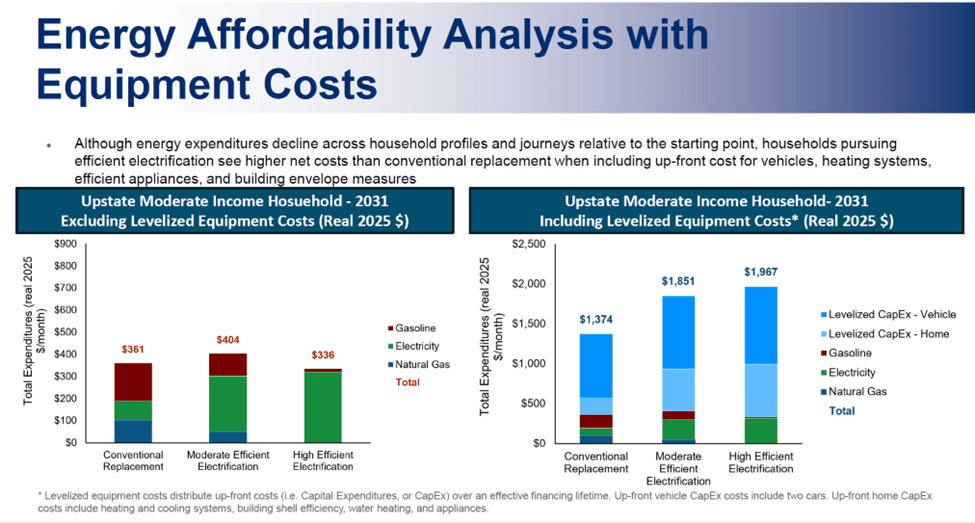
As Roger Caiazza noted recently, the State Energy Plan analysis of total monthly energy costs expects the cost of capital to install replacement appliances and vehicles that can meet the Climate Act zero-emissions mandate is nearly $600 a month more than replacement with conventional household appliances and vehicles even after the savings of more efficient equipment are factored in. Beyond the high rates, the state’s renewable percentage relative to load is projected to drop by 2% over the next 5 years. A document that we tried to present during the December 3 hearing clearly showing that, based upon an analysis of a state report, was objected to by the attorneys in the room and was disallowed as irrelevant.
Our issues with state policy in general and this rate case in particular can be explained by the following analogy. As you may or may not remember from high school physics, the acceleration due to earth’s gravity is 9.8 meters/second2. Imagine if Boeing or Airbus arbitrarily declared that the acceleration due to gravity was not 9.8 meters/second2 but was instead 47% lower than that at 5.2 meters/second2 and then invested hundreds of millions of dollars designing planes to that standard. It would allow them to build planes with smaller engines, reducing their costs, and also declare that their planes had a much longer range reducing fuel costs for the airlines. However, if they ever built a plane to those specifications and tried to fly it, it would drop like a stone because as I mentioned previously, the laws of physics are not negotiable. Additionally, all the money spent engineering, developing, and building the planes to the false metric would be wasted. NY City has essentially done the same thing to the generation metrics in its Local Law 97 as was shown in the prior analogy and the system is going to drop like a stone if they try to implement it. The Con Ed JP is working to support this policy that defies natural law and ratepayers are going to suffer as a result, left holding the bag with enormous amounts of money being wasted on a futile effort.
Our position in this case was simple. Don’t spend money on unnecessary electrical equipment that won’t help the ratepayer during the three year period covered by this case. That seemed to be too difficult of a concept for DPS staff, Con Ed staff, and all of the lawyers in the room to comprehend. Keep in mind that if parties to the case push their pet projects, even though the math says that they won’t work, if those projects are in the JP, then Con Ed gets to build more stuff and make their percentage profit on it. There is about $838 million worth of construction projects (New Business Capital) in the JP. We wanted to present a fully accurate figure of how much of that is related to unnecessary projects to support building electrification in support of Local Law 97 that the state has now started to roll back elsewhere because the process will be crippling to rate payers. However, Con Ed stated that they couldn’t break out those figures although NY State was able to do that for the state system. By our estimate, about one third of that $838 million could be eliminated, or about $270 million – $300 million. However, removing that would reduce Con Ed’s profits by $27 – $30 million and NY City would lose the property taxes imposed on that $270 million – $300 million of infrastructure. For those in Westchester that think that this doesn’t impact them, electrification costs across the entire Con Ed system are distributed proportionally across all Con Ed ratepayers. So even though no one in Westchester voted for the City Council that passed Local Law 97, residents of Westchester will be paying for both the additional electrification and the NY City taxes applied to it. About 250 years ago, a bunch of tea was thrown into a harbor regarding a similar situation.
Beyond replacing aging infrastructure, there is one project in particular that would greatly improve the downstate energy system and that is to replace 75% of the train cars in the NY City Subway system that don’t currently have regenerative braking systems. Calculations indicate that peak system load could be reduced by 500 Megawatts of peak load and thousands of Gigawatt-hours of energy use annually simply by buying new train cars. That would also greatly decrease emissions and reduce car maintenance. However, we were told that this was outside the scope of the rates case even though it is the fastest, simplest, and least expensive way to harden the downstate energy system. It would also help to reduce transit costs.
Objection Rationale Facts
The balance of this email will include a detailed discussion of why the JP is not in the interests of the rate payers using documents and math that we tried to introduce during the hearing, but which were objected to, or the staff plead ignorance so we couldn’t question them on it. Understanding the documents requires nothing more than a knowledge of simple arithmetic and the following facts.
- A BTU is a British Thermal Unit. A KBtu is 1000 BTU’s. A Therm (Unit of gas billing done by the utility) is 100,000 BTU’s or 100 KBTU’s.
- A Kilowatt-Hour (KWh) equates to the energy used by a load of 1000 watts for one hour or alternatively that of a 100 watt light bulb for 10 hours. The utility bills for KWh used during a one month period.
- There are 29.3 KWh in a Therm (100,000 BTU). That is an energy equivalence.
- Carbon Emissions are measured in Metric Tons ( t or mt in the documents) which are 2204 pounds in Imperial units.
- Power (P) = Current (I) x Voltage (V). P=I xV. As the system voltage is constant, as loads increase, power demand increases and current increases proportionally. This is taught in high school physics and Electrical Engineering 101 but is part of what was objected to by the parties in the case.
- Wires are not perfect conductors. They have a resistance (R) and the energy losses are measured in watts (W). Losses on the wires equal I2 xR. So as the power demands increase, the current increases and the line loss increases. Line loss appears as heat in the wires and components of the utility system, such as transformers. If the load doubles, P doubles, I doubles and the line loss increases by a factor of four. Line loss costs are paid for by the ratepayers as part of the “Delivery” portion of the bill.
- As wires get hotter, their resistance increases. One of the documents shows the equation for this but simply put, for every 18 degree increase in temperature above 70 degrees-F, the resistance of aluminum or copper (the primary conductors used on the utility system) will increase by 4% and line loss for those components will increase by 4%. When I received a grant from the state in 2010 to analyze line losses and mitigate them, Con Ed mounted power monitors I built onto their poles that measured the before and after of the process. However, these monitors also measured the temperature of the transformers that they were connected to. On a 90-degree summer day, the metal shell of the transformers reached over 140 degrees-F, indicating at least a 16% increase of resistance. If the exterior of the transformer in the open air was 140 degrees, the interior was likely substantially hotter.
A July 2008 presentation by Con Ed at a DPS session on line losses (Case 08-E-0751) that was initiated based upon a paper I wrote showed that the average line loss over the course of a year was 7%. That included an average of 3% losses during the winter when loads are lower and wires and equipment are cooler and 11% losses during the summer when loads are higher and wires and equipment are hotter. I tried to use a slide from their presentation, but they objected to their own documents because they said that it was 17 years old and not applicable. The following will show how ridiculous that objection was. Con Ed has not publicly released line loss data since 2008 but it can be clearly shown that the 7% is the low end of line loss and it is going to get worse, not better. The NYISO has predicted that loads are going to increase and if state policies are followed, NY State’s loads will peak during the winter by 2033 instead of during the summer as they do now. As a result, winter line losses will approach the 11% of summer line losses and the average line loss will increase from 7% to 11%.. Despite the colder winter temperatures, the even higher pending winter loads will raise the losses to near those encountered during the summer. Further, Con Ed has not replaced a lot of the equipment on the system since 2007 so there is no reason to believe that line loss has decreased. The image below is from the project that I did in 2010 and both of those transformers were not new then and are still in use 15 years later. The small grey electrical boxes below the transformers are the power monitors I built and if you look at the Monitor 11 photo, you will see a small beige patch with a wire connected to the power monitor halfway up the transformer. That is the temperature sensor. There were four monitors located on transformers in various locations in New Rochelle and they communicated via Zigbee and ethernet to a computer in my home that collected data every few seconds.

If someone needs to wonder about how old the infrastructure in the Con Ed system is, EIOP 23441915 Ed Koch Queensboro Bridge 13kV Riser Replacement in the JP is to replace an extremely old transmission cable on one of the East River bridges. We didn’t object to that as it is a necessary expense, and it is those types of projects that need to be executed. Throughout the list of EIOP’s are statements saying that equipment shortages may complicate their ability to be executed. That raises the question, “Why are we building unnecessary projects that are very likely to compromise supply chains and the ability to build necessary projects?” I copied the first two pages of an article from the IEEE Spectrum Magazine, February, 2025 (Institute of Electrical and Electronic Engineers) that documents the acute transformer shortage facing the entire world. It is a large document and it is behind a firewall so if anyone wants the full copy, feel free to ask me for it. Transformer shortages are affecting energy projects everywhere.
Another example of the age of the downstate system is made clearly evident by this caption copied from page 30 of the NYISO 2025-2034 Reliability Analysis documenting the age of NY City’s generation fleet. The rest of the downstate system isn’t much newer. The caption speaks for itself.
New York’s generation fleet is among the oldest in the country. Compared to generation in other Independent System Operator (ISO)/Regional Transmission Operator (RTO) regions in the United States, NYCA generation ranks among the oldest or second oldest in each of the natural gas steam turbine, combustion turbine, and combined cycle technology types. This is particularly apparent in New York City where the average age of a steam turbine is 65 years.
Objection Rationale
With knowledge of the facts listed and the associated information, the balance of the discussion will be understandable.
Why is line loss important in a discussion about electric heat? Emissions data for on-site gas combustion is based upon emissions at the building level. However, emissions data for the generators is based upon looking at the source which is the generating plant. But heat pumps use the electrical energy at the building level so energy lost on the wires adds to their carbon footprint unless the system is 100% renewable or carbon free. The heating caused by line loss also contributes to wear and tear on the system components leading to earlier failures. The recent NYISO 2025 – 2034 reliability study clearly showed that the downstate system is only 5% carbon free and 95% fossil fuel supported. This means that every heat pump is going to eventually be 10% more carbon intensive than what they are calculating. Complicating that fact is the state’s inability to build sufficient renewables reflected in the cancellation of the CleanPath renewable project and the cancellation of several offshore wind bids over a year prior to Trump taking office. All of that was due to excessive costs so expecting that the system will get less carbon intensive is not realistic. Exhibit 14 is a copy of the state’s 2024 draft biennial review. It has since been finalized. Exhibit 12 is an analysis of data in the review done by Roger Caiazza that clearly shows that the state’s carbon free generation relative to load is going to DECREASE by 2% by 2030 so despite the Climate Act being in effect for 11 years by that time, emissions are increasing. The baseline was done after the closure of Indian Point, so the loss of that carbon free energy is not a factor in the calculations.
Why is Local Law 97 such an albatross? It is an ideological document that is designed to remove gas combustion from the city and electrify all onsite heating. It is going to impose penalties on every building that can’t meet certain emission metrics. The problem is that the math to support that concept doesn’t work so the city embedded fake metrics into the law to support the concept so that it would look like it is working. There are several issues with that and documents that we tried to introduce into the case to document these issues were objected to by the attorneys as irrelevant even though they clearly showed why the JP would be wasting taxpayer and ratepayer money. To get around the fact that the numbers didn’t support their policies, the city arbitrarily decreased the emissions metric for downstate generation to 630 pounds per Megawatt-Hour (MWh). They will begin fining buildings based upon that in the near future. But a document published by the US EPA states that the downstate NY emissions are 865 pounds per MWh. If line loss is figured in, the energy to run building electrification will emit 930 pounds per MWh, 47% higher. Then they state that in 2030, the emissions will magically be reduced to 315 pounds per Megawatt-Hour, 50% of the fake 2025 value despite NY State documenting a 2% increase in emissions by 2030. All of this is being done to make their policies look feasible and environmentally friendly. They are as feasible as the airplanes designed to the wrong gravity constant. The line loss calculations are in Exhibit 13 and the Local Law 97 information is in Exhibit 10. The analysis of why heat pumps run less efficiently than gas boilers on the Con Ed system and will cost more is in Exhibit 9. That fact is confirmed by a NYSERDA report released in 2019. In the Abstract of the document on page ii, it states the following. Note the text in bold font.
This Report describes NYSERDA’s analysis of the costs, benefits, and adoption opportunities for small-scale residential heat pumps in New York State over the period to 2025. The Report concludes that, based on a conservative application of constraint assumptions, heat pumps could serve approximately half of the thermal energy load in the small residential sector, with potential to increase this estimate as barriers such as landlord-tenant constraints or availability of hydronic heat pump systems are overcome. Achievable adoption potential for small-scale residential heat pumps is assessed to be around 7.5 TBtu of incremental site energy savings from oil and resistance heating replacements by 2025.
It was not promoting gas heat replacements, just oil and resistance heat replacements. Tables within the document clearly show higher costs for ASHP’s when compared to gas combustion. The reason for that appears in the two charts below that were shown to NYSERDA in May of 2019 and they agreed that the numbers matched theirs. Notice that the air source heat pumps have higher emissions on the downstate system than gas but they have lower emissions than oil and radiant heat.


DPS Staff and Con Ed staff said that they were unaware of the NYSERDA document so we weren’t allowed to question them on it. However, that fact didn’t stop NY City or Con Ed from misrepresenting the conclusions of the NYSERDA document and attempting to replace gas units to the detriment of NY City and Westchester residents. The costs were originally presented to NYSERDA in 2019 as well. They were updated in 2023. The analysis in Exhibit 9 clearly shows that dependent on the outdoor winter temperature, it will cost 40% more to heat with an air source heat pump at 30 degrees-F and 118% more at 5 degrees-F (2.18 times the cost) based upon utility rates this past February when gas costs were highest. It was objected to by the parties because they couldn’t establish provenance, although I took ownership in a sworn document presented to the judges. We even offered to have me testify to explain the documents but that was objected to at a pre-trial conference. I was one of the last people that they wanted to have testify. DPS asked me to go to Albany in 2008 for the 08-E-0751 conference to “embarrass the utilities” because they should have been providing the information to DPS that I provided but they failed to. While they may not be aware of that event, they are aware of my writings. During the confidential portion of the hearing I was called “Inflammatory, Unprofessional, and anti-electrification” because I mentioned that some of the parties should go back and take high school physics and math. They ignored the fact that I was one of the earliest adopters of renewable and geo-thermal technologies in the state over twenty years ago. I am not against electrification. I am against electrification that math and physics dictates will not work and will simultaneously cause more environmental damage in the process.
As a gift to certain parties, Con Ed is offering a new/modified tariff rate SC1-IV for heat pump users. It will give them a special rate for a period of one year if they switch to electric heating. After the year is up, the heat pump user may end up back on the regular SC-1 rate that will have the costs mentioned previously and the special tariff rate is being subsidized by the non-heat pump users on the regular rate (SC-1) because the money has to come from somewhere. On Page 54 of the JP (page 63 of the JP pdf) it specifically states the following:
The Company will make the following modifications to special provision (H) of SC 1 in the tariff. First, a customer who takes service under Rate III or Rate IV of SC 1 for the first time during the term of the rate plan in Case 25-E-0072 may be eligible to receive a price guarantee for one year. This represents an extension of the existing price guarantee for Rate IV and adds Rate III to the list of eligible rate classes for which the price guarantee applies.
Second, the Company will remove the language that limits the number of customers eligible for the price guarantee to no more than 500 ground source heat pump customers and no more than 500 air source heat pump customers during the term of the rate plan. The price guarantee will now be available to all new or existing residential customers operating air source heat pumps or ground source heat pumps commencing billing for the first time under SC 1 Rate III or Rate IV during the term of the rate plan.
Finally, a customer that leaves SC1 Rate III or Rate IV prior to the conclusion of the first twelve-month period will receive a credit, if applicable, based on the period during which the customer took service under SC1 Rate III or Rate IV.
It does not document what happens to those customers after the twelve month period expires. It’s great for Con Ed because they will be charging the poor fools that switched to ASHP’s double to heat their homes after a year. If anyone is on the SC-1 electric rate, you will be paying for people to switch to heat pumps, raising their rates and yours, while also raising carbon emissions in the name of Environmental Defense.
Beyond the costs of operating the equipment is the cost of the conversion which was highlighted by the $600 additional per month for the state plan. Exhibit H is attached which is an article about a Brooklyn co-op that converted from oil heat to electrification at a cost of $50,000 per unit ($40,000 after rebate but the rebate money will quickly run out). Also attached is a snapshot of a Loan Calculation for what a $50,000 mortgage would cost at 6% amortized over 30 years. It is $300 additional per month that a resident will have to pay every month for the next 30 years and $50,000 is the low end of electrification conversions. Estimates for Co-Op City’s cost of compliance for Local Law 97 have approached $2 billion for its 15,732 units in 35 buildings. That averages out to $130,000 per apartment and would add $780 per month to the carrying cost of every unit in the complex. These are the concerns highlighted in the REBNY report, attached. There is absolutely no way to make these policies work because they defy natural law.
Adding to the issues, there is a NYSERDA PowerPoint from August 2022. The slide from page 19 of the report is shown below. Note that it says that the Energy Use Intensity for an Air Source Heat Pump (ASHP) is almost 10 times higher in heating mode than in cooling mode. Except our utility system has difficulties now on a hot day in the summer. This past June, the NYISO declared an emergency during a heat wave. How is that going to translate to a heating technology that could magnify that figure by a factor of TEN on a very cold day during the winter?
The additional carrying costs mentioned previously and the 40% – 118% higher operational costs don’t include Con Ed’s costs for upgrading their system to deliver the higher energy load needed to run the ASHP’s. This rate case with its $270 million additional is the tip of the iceberg. This is going to be the norm for decades to come.

They are also promoting these policies while the NYISO is stating that NY State’s generation margins are critically low so what is going to power the heat pump use intensity. The following graph, copied from page 30 of the NYISO 2025-2034 Reliability Document, shows the declining generation margins on the NY State System with potential for blackouts starting in 2027. This will be weather dependent.

Concluding Remarks
I could present another ten pages of arguments that would just show more of the inane policies that NY State and NY City are proposing with several more pages of documentation, but after a while it just gets redundant.
The bottom line is that they are not looking out for the ratepayer. Special interests have overlaid an ideology devoid of reality onto the utility system either because they drank the Kool-Aid or they are exploiting those that did to make a buck from it and we are all going to pay for it. The policy is inevitably going to fail but how much damage will be done to the ratepayers in the process?
The Independent intervenors have done what we can. It is now up to anyone reading this to stand up and protest against what is about to happen to your utility costs and the utility system. If people don’t, they will get what they deserve along with a high probability of not having any electricity at all. Feel free to forward this. I finish with the following observation.
In May 2025, the designer of the Hydrogen Bomb, Richard Garwin, died. He spent the last 70 years of his life arguing against the use of the device he designed and he advised several Presidents. In his obituary, he was quoted as having said, “I don’t go after stupidity in general, just stupidity that is expensive or dangerous.” NY State’s Energy plans and Con Ed’s JP in support of it are exactly what he would have argued against. Stupid because it tries to defy natural law and as a result it is both Expensive and Dangerous.
Postscript After I completed this post Rich sent a note.
The timing of this release is interesting. We may be having an impact even if it isn’t everything that we want. We forced the NYISO document into their record and mentioning people dying in their rate case transcript may have tied their hands and forced them to act.