Balancing the risks and benefits of environmental initiatives
Author: rogercaiazza
I am a meteorologist (BS and MS degrees), was certified as a consulting meteorologist and have worked in the air quality industry for over 40 years. I author two blogs. Environmental staff in any industry have to be pragmatic balancing risks and benefits and (https://pragmaticenvironmentalistofnewyork.blog/) reflects that outlook. The second blog addresses the New York State Reforming the Energy Vision initiative (https://reformingtheenergyvisioninconvenienttruths.wordpress.com). Any of my comments on the web or posts on my blogs are my opinion only. In no way do they reflect the position of any of my past employers or any company I was associated with.
I have been so busy lately with net-zero transition implementation issues that I have not had time to put together an article about every relevant topic I have discovered. This is a summary of articles that I think would be of interest to my readers.
I have been following the Climate Leadership & Community Protection Act (Climate Act) since it was first proposed and most of the articles described below are related to the net-zero transition. I have devoted a lot of time to the Climate Act because I believe the ambitions for a zero-emissions economy embodied in the Climate Act outstrip available renewable technology such that the net-zero transition will do more harm than good. The opinions expressed in this article do not reflect the position of any of my previous employers or any other company I have been associated with, these comments are mine alone.
Videos
Good news about climate Judith Curry explains why the climate and environment is going fine.
Climate Discussion Nexus has a “backgrounder” video look at “how scientists use temperature proxies to estimate past climate conditions … and in some cases misuse them because they’re so sure what the evidence should say that they ignore what it does say.”
Charles Rotter wrote a masterful takedown of the latest net-zero transition fantasy – the national goal of a zero-emissions freight sector.
The Biden-Harris zero-emissions freight initiative, with its lofty ambitions and sweeping promises, is emblematic of a broader trend in contemporary environmental policymaking: prioritizing grandiose goals over grounded feasibility studies and economic realism. This plan, rather than being a practical roadmap for any type of environmental improvement, is a political statement intended to signal virtue rather than effectuate its stated goals.
In summary, this “strategy” is nothing more than a modern-day environmental quixote, tilting at windmills of pollution with a lance of impracticality and a shield of buzzwords like “environmental justice.”
The Climate Act is no different than this strategy.
Impact of NYS GHG Emissions on Global Temperature
Parker Gallant Energy Perspectives published Actual Impact of CO2 Emissions On Global Temperature that was written and researched by Pav Penna. Penna researched the Intergovernmental Panel on Climate Change’s most recent teport:
IPCC estimates that the impact on temperature of a trillion tonnes of atmospheric CO2 emissions is “likely in the range of 1.0 to 2.3°C” – a very broad range indeed. This is equivalent to 0.00001 to 0.000023°C per megatonne. IPCC’s “expert opinion” suggests a “best estimate” of 1.65°C per trillion tonnes of CO2.
Using that number, if New York’s 2021 GHG emissions were eliminated the impact on global temperature would be 0.00044 deg C. A quantity that cannot be measured.
Net-Zero Transition Issues
Epic Emissions Engagement: Irina Slav describes the inevitable collision of the Big Tech companies who are counting on carbon credits to achieve net-zero status and the staff at the Science Based Targets initiative that these companies fund. She concludes:
It’s a catastrophe unfolding in slow motion and it was unavoidable. Call it a case of Frankenstein’s monster and while the monster of climate activism cannot run away from its corporate creators and wreak havoc on the global village, taming it has become increasingly hard. The monster has developed an overwhelming sense of mission that has trumped any and all other considerations, including survival. The fight between green money and green muscle may end up being the show of the decade.
Mark P. Mills – When Politics and Physics Collide. The belief that mandates and massive subsidies can summon a world without fossil fuels is magical thinking.
While policies can favor one class of technology over another, neither political rhetoric nor financial largesse can make the impossible possible. Start with some basics. It’s not just that currently over 80 percent of our energy needs are met directly by burning oil, natural gas, and coal—a share that has declined by only a few percentage points over the past several decades; the key fact is that 100 percent of everything in civilized society, including the favored “green energy” machines themselves, depends on using hydrocarbons somewhere in the supply chains and systems. The scale of today’s green policy interventions is unprecedented, targeting the fuels that anchor the affordability and availability of everything.
Bjorn Lomborg explains that Trillions in taxpayer subsidies haven’t made wind and solar power cheaper or better for Americans:
A new study looking at the United States shows that to achieve 100% solar or wind electricity with sufficient backup, the US would need to be able to store almost three months’ worth of annual electricity. It currently has seven minutes of battery storage. Just to pay for the batteries would cost the US five times its current GDP. And it would have to repurchase the batteries when they expire after just 15 years.
Francis Menton describes a report by Thomas Pyle of the Institute for Energy Research put out a list of “200 Ways the Biden Administration and Democrats Have Made it Harder to Produce Oil & Gas.” He goes on to show there is not much to show for all those efforts. He concludes: “Our current rulers think that they have infinite ability to tell the people how to live, and infinite money to force the people to change their ways. They are wrong, and reality will catch up to them, if only gradually.”
One of the main points in Climate the Movie is that clouds are a major driver of climate change. This article describes a theory that explains long-term solar variation and its effects on clouds. Javier Vinós concludes that there are two pieces of good news.
The first is that solar activity cannot rise above the 20th century maximum. It is not like CO₂, which can keep going up. The Sun’s activity can stay high or go down, but it cannot go up, so the warming should not accelerate and should not be dangerous. The second piece of good news is that if much of the 20th century warming is due to the Sun, then there is no climate emergency.
According to New York climate activist non-governmental organizations New York is “failing to lead on climate.” Sane Energy Voice claims that following Governor Hochul’s scrapping of major offshore wind projects, Assembly Speaker Heastie’s decision to ditch the popular NY HEAT Act signifies New York’s failure to lead on climate. Richard Ellenbogen responded to the press release with an email that I reproduce here.
Richard Ellenbogen recently submitted comments as part of the record for the Department of Public Service Proceeding 15-E-0302 related to the net -zero mandate of the Last spring “Order initiating a process regarding the zero-emissions target” that will “identify innovative technologies to ensure reliability of a zero-emissions electric grid”. His comments discuss “a viable, affordable, and rapidly executable Plan B to assist NY State in reducing its carbon footprint using technologies that actually exist at scale, unlike the technologies proposed by the CLCPA which only exist at scale in the fantasies of its proponents.” I think it is important that his message gets out to all New Yorkers to try to avert the inevitable collision between aspiration and reality.
Ellenbogen is the President [BIO] Allied Converters and frequently copies me on emails that address various issues associated with the Climate Leadership and Community Protection Act (CLCPA). I have published other articles by Ellenbogen, a description of his keynote address to the Business Council of New York 2023 Renewable Energy Conference Energy titled: “Energy on Demand as the Life Blood of Business and Entrepreneurship in the State -video here: Why NY State Must Rethink Its Energy Plan and Ten Suggestions to Help Fix the Problems”, another video presentation he developed describing problems with CLCPA implementation and a summary of his submitted comments as part of the record for the Department of Public Service Proceeding 15-E-0302 related to the CLCPA net -zero mandate. There are only a few people in New York that are trying to educate people about the risks of the CLCPA with as much passion as I am, but Richard certainly fits that description. He comes at the problem as an engineer who truly cares about the environment and how best to improve the environment without unintended consequences. He has spent an enormous amount of time honing his presentation summarizing the problems he sees but most of all the environmental performance record of his business shows that he is walking the walk.
CLCPA Overview
The CLCPA established a New York “Net Zero” target (85% reduction and 15% offset of emissions) by 2050. It includes an interim 2030 reduction target of a 40% reduction by 2030 and a requirement that all electricity generated be “zero-emissions” by 2040. The Climate Action Council (CAC) is responsible for preparing the Scoping Plan that outlines how to “achieve the State’s bold clean energy and climate agenda.” In brief, that plan is to electrify everything possible using zero-emissions electricity. The Integration Analysis prepared by the New York State Energy Research and Development Authority (NYSERDA) and its consultants quantifies the impact of the electrification strategies. That material was used to develop the Draft Scoping Plan. After a year-long review, the Scoping Plan recommendations were finalized at the end of 2022. In 2023 the Scoping Plan recommendations were supposed to be implemented through regulation and legislation. For the most part that did not happen so in 2024 organizations like Sane Energy Voice are lobbying for various legislation to advance their agendas.
NY Heats
According to a report released by NY Renews, the if the full NY Home Energy Affordable Transition bill were passed “the 25% of New York residents who have high energy burdens would cut their bills by over 44% and save an average of $136 a month.” The mission of Sane Energy Project is to replace fracked gas infrastructure with 100% democratically controlled, renewable energy in New York State. We build every campaign through a lens of racial, social, and ecological justice.
Richard Ellenbogen responded to this press release:
In a one-two punch this past week, a small group of corporate-backed Democratic legislators brought us closer to climate catastrophe by bowing to fossil fuel lobbyists and lawyers in shaping New York’s energy and economic policy. Now, more than ever, it’s time to fight hard and resist this insidious takeover.
Last Friday, under the leadership of Governor Kathy Hochul, the New York State Energy and Resource Development Authority (NYSERDA) rejected three major offshore wind projects that Sane Energy Project had championed since 2015 when we led the campaign to stop the construction of a massive offshore liquefied fracked gas port complex near the Rockaway Peninsula and Long Beach that would have foreclosed the development of these wind projects.
Also on Friday, the final New York State budget omitted the critical NY HEAT Act, which over 100 legislators co-sponsored. The New York Home Energy Affordable Transition Act would have facilitated an orderly transition from expensive and toxic fracked gas by ending subsidies that enrich the gas industry. Moreover, it would have capped energy bills for low- and middle-income households at 6% of their income, a crucial measure for safeguarding vulnerable New Yorkers.
Every year in Albany, a handful of officials determine the state’s future. Swayed by energy industry lobbyists, they disregard scientific evidence, the climate law, and constituents’ demands. Our elected officials’ failure to champion sound energy policy sets a dangerous precedent.
Kim Fraczek, Director of Sane Energy Project, said, “Governor Hochul and Assembly Speaker Carl Heastie have chosen to prioritize corporate interests over the well-being of New Yorkers by scrapping significant offshore wind projects and excluding the crucial NY HEAT Act from the state budget. Their inaction is further underscored by National Grid’s egregious proposal to increase monthly bills for downstate residents by at least $30 to maintain their outdated, polluting gas system. We hold Hochul and Heastie responsible for future utility bill hikes and climate disasters, as their decisions blatantly ignore the urgency to transition to renewable energy and protect the most vulnerable communities.”
Current negotiations surrounding National Grid’s proposed rate hike threaten to tighten the fossil fuel industry’s grip on New Yorkers. Sane Energy Project is focused on state regulators, who can choose energy efficiency and investment in thermal energy networks or perpetuate wasteful investments in National Grid’s antiquated gas system.
Before I describe Ellenbogen’s response I want to address the offshore wind projects. The emotion laden description of recent events: “Swayed by energy industry lobbyists, they disregard scientific evidence, the climate law, and constituents’ demands” is at odds with reality. NYSERDA did not want to reject the three major offshore wind projects. Instead, “GE Vernova’s decision to alter its offshore wind turbine product from the initially proposed 18 MW Haliade-X platform to a 15.5/16.5 MW platform resulted in significant changes to the projects proposed into the solicitation.” When NYSERDA announced the contract awards last October all the subcontractor agreements should have been clearly identified and signed off by all parties involved in the work, including things like what equipment, what labor costs, you name it. After an award there is some negotiation but that should not be a big lift because the details were already identified in the proposal/budget. The size of the turbines should have been specified in the proposal. If GE as a subcontractor then changed the deal it would make the whole proposal unfundable. This is the last thing NYSERDA and Governor Hochul wanted because it means a big delay in the timeline as they need to have go back for another round of approvals and new contracts.
Ellenbogen on NY Heats
Other than a few formatting edits the following is all by Ellenbogen.
While I appreciate your passion, the science behind your email is misguided. As someone that decarbonized my home and business over two decades ago as the two following links document, I can assure you that there is nothing “sane” about NY Heats. It will literally be a death knell for both NY State residents and the state economy with absolutely no benefit to the environment. FYI, I have absolutely no interests in the fossil fuel industry but as an engineer for over forty years, I have a firm belief that all public policies have to be based upon scientific accuracy. NY Heats and the CLCPA throw science and math out the window.
In a climate like NY State’s, NY Heats defies the Laws of Thermodynamics beyond there also being enormous logistical issues with implementing it.
It will double or triple the load on every transformer in the state meaning that they will all have to be replaced, except those transformers don’t exist and there is an acute transformer shortage in the entire US at the moment. The doubling or tripling of load will also mean replacing all of the wires in NY State which will take about 60 years. Further, that will require an enormous amount of aluminum and there isn’t enough aluminum available to make beverage cans, let alone millions of miles of electrical conductors. Three aluminum smelters have closed in the United States in the past two years because their electric rates were too expensive, which is indicative of a shortage of electricity driving up the prices. There have been numerous articles written recently that indicate that the United States is running out of energy.
That same electric shortage will also provide insufficient energy to operate the heat pumps that would be installed under Local Law 97 and NY Heats. Despite everyone’s wishful thinking, renewables are too intermittent and have too low of an energy density to successfully operate the expanded utility system that would be required under NY Heats. The NYS Public Service Commission is desperately looking for DEFR’s (Dispatchable Emission Free Resources) except with the exception of Nuclear which takes 17 years to get approved and sited, that technology does not exist and it is decades away so any increases in load that would result from NY Heats will increase fossil fuel generation where it is far less efficient than the onsite combustion of Natural Gas. The NYISO is already having difficulty meeting the scheduled deadline for closing the fossil fuel peaker plants and has extended their closing dates. That is going to be repeated extensively because there just isn’t enough energy and adding more solar panels and wind turbines will complicate that effort after a certain point. Look at what is currently happening in California. They are dumping solar because they over subsidized it and there is too much. The storage technology needed to utilize it is far too expensive to implement at that scale. If you look at NYSERDA’s 6 GW Enregy Storage report from 2022, they indicated that 1000+ hours would be needed to support the system. Even at 1000 hours for 6 GW at the price of storage in the report, that would cost $3.5 Trillion, or 15 times NY State’s annual budget and those batteries would last only ten years and have to be replaced. While battery costs have come down slightly since 2022, it has not been nearly enough to make them cost effective. The physics and the economics just don’t work. It has also been clearly documented that air source heat pumps double utility bills. That higher cost is a function of the holistic system wide energy inefficiencies of the air source heat pumps. Hydrogen storage technology is decades away at the utility scale needed. It is very difficult to store and transport and it presents its own GHG issues if it leaks.
There is insufficient labor to execute the plan. There is a shortage of both electricians and plumbers and worse, there are not enough people to train even if they could develop the training programs. There are currently 500,000 open manufacturing jobs in the US, the same cohort of people that would be used for renewable and heat pump installation. The unemployment rate is near historic lows. Further, one thing that no one should want is inexperienced people handling the refrigerants involved with heat pump installation as those have carbon footprints 300 – 1000 times higher than CO2 and 10 – 30 times higher than methane. The leakage that will result from inexperienced workers handling refrigerants would be devastating. A Columbia University study indicated that one-half of Arctic ice melt resulted from the use of refrigerants.
Regarding Offshore Wind, those bids were declined because the costs were far higher than the current electric rates. If the state has any hope of decarbonizing, alienating 60% of its population downstate with exorbitant electric rates is not the way to do it. That is especially true when 1.2 million downstate utility customers are already $1.8 billion in arrears. Further, the ships needed to install the offshore wind don’t exist at present. The first Jones Act compliant ship, the Dominion Charybdis left dry dock last week. The $650 million vessel is taking five years to build and will not be ready until late 2024/ early 2025. If they start another now, it will not be ready until 2028- 2029. The lack of the ships raises the installation costs far above where they otherwise would be which explains why the bids here are about double those in Europe where they have about 16-18 available jack ships. The balance of the world’s approximately 50 jack ships are in Southeast Asia. Energy cost increases resulted in the repeal of the Ontario, Canada energy plan after only 10 years. The same thing will happen in NY State if they aren’t careful.
Decarbonization is necessary but it must follow the Laws of Physics and be mathematically possible to implement. The NY State plan doesn’t adhere to those requirements. There are things that adhere to science and mathematical accuracy that can be done to reduce the state’s carbon footprint but the CLCPA and NY Heats do not fall within that criteria.
Conclusion
In an email Ellenbogen concludes that “For anyone that understands energy math, the bill is a farce. The points made in it also don’t adhere to economic reality for the residents of NY State.” I completely agree with his conclusions.
The New York State Department of Environmental Conservation (DEC) has proposed Amendments to Part 490, Projected Sea Level Rise andComments that are due on April 29. This post describes my comments on the proposed amendment and requests that New Yorkers who reading this before April 29 submit comments. Don’t worry, I will give language.
The proposed amendments revise the projections of future sea-level rise required by New York regulations. It is flawed because the methodology estimates an unrealistically high projected sea-level for the Community Risk and Resiliency Act flood risk management applications that will use the projections. Unless more realistic estimates are used permitting applications in areas near tidal zones will be required to incorporate flood levels that will not be expected in the lifetime of the project. That would be a hidden cost for the net-zero transition of the Climate Leadership & Community Protection Act (Climate Act).
I have followed the Climate Act since it was first proposed, submitted comments on the Climate Act implementation plan, and have written over 400 articles about New York’s net-zero transition. The opinions expressed in this post do not reflect the position of any of my previous employers or any other organization I have been associated with, these comments are mine alone.
Overview
The summary of the Part 490 proposed amendments states that: “The goal of the proposed amendments is to provide up-to-date science-based projections of future sea level rise.” This is another example of the many ways that the Climate Act is intruding on many aspects of society. The Climate Act established a New York “Net Zero” target (85% reduction in GHG emissions and 15% offset of emissions) by 2050. It includes an interim 2030 reduction target of a 40% reduction by 2030 and a requirement that all electricity generated be “zero-emissions” by 2040. The Climate Action Council (CAC) was responsible for preparing the Scoping Plan that outlines how to “achieve the State’s bold clean energy and climate agenda.” In brief, that plan is to electrify everything possible using zero-emissions electricity. The Integration Analysis prepared by the New York State Energy Research and Development Authority (NYSERDA) and its consultants quantifies the impact of the electrification strategies. That material was used to develop the Draft Scoping Plan outline of strategies. After a year-long review, the Scoping Plan was finalized at the end of 2022. In 2023 the Scoping Plan recommendations were supposed to be implemented through regulation, PSC orders, and legislation but implementation is behind schedule. The proposed amendments to the sea-level projections are a hidden aspect of the Climate Act that has significant potential impacts.
Part 490 Projected Sea-Level Rise
The Regulatory Impact Statement (RIS) for this proceeding describes the regulation’s statutory authority and legislative objectives, the proposed changes, needs and benefits, and costs. It explains:
On September 22, 2014, the Community Risk and Resiliency Act, Chapter 355 of the Laws of 2014 (CRRA), was signed into law. CRRA, among other things, established Environmental Conservation Law (ECL) § 3-0319. ECL § 3-0319 requires the Department of Environmental Conservation (Department) to adopt regulations establishing science-based sea level rise projections for New York State and to update them no less than every five years. The Department established a new Part 490 of Title 6 of New York Codes, Rules, and Regulations (6 NYCRR), “Projected Sea-level Rise” (Part 490) in February 2017 and is updating the regulation through the current rulemaking.
The proposed amendments are an update of the 2017 sea-level rise projections. While I am not absolutely sure I believe the reason that this amendment was delayed was because the primary reference, New York Research & Development Authority New York State Climate Impacts Assessment, was not available within the five-year period. Even so, the documents for the Assessment are all marked “Interim Version for Public Release” which calls into question their use for a policy document.
The goal of the proposed amendments is to provide up-to-date science-based projections of future sea level rise. Part 490 does not create a mandate on local governments. Part 490 does not impose any compliance obligations on any entity.
While technically and legally correct, the excuse not to include costs and the argument that there are no compliance obligations or mandates on local governments has significant ramifications. The fact is that there are compliance obligations that are affected by the Part 490 rulemaking. DEC selectively chose to emphasize analyses that support the “high-end storyline” without regard to how the sea-level rise projections will be used. There are relevant, plausibility, timing, and cost implications that I believe should be added to the Regulatory Impact Statement.
As originally enacted, the CRRA required applicants for permits or funding in a number of specified programs to demonstrate that future physical climate risk due to sea-level rise, storm surge and flooding had been considered in project design, and that DEC consider incorporating these factors into certain facility-siting regulations. The CLCPA amended the CRRA to include all permits subject to the Uniform Procedures Act. The CLCPA also expanded the scope of the CRRA to require consideration of all climate hazards, not only sea-level rise, storm surge and flooding, in these permit programs.
In my comments I argued that that while Part 490 may not directly create a mandate on local governments, all permits must consider the sea-level rise climate hazard which is essentially a mandate affecting all governmental agencies.
Part 490 Proposed Amendments
The RIS description of the proposed sea-level rise projection amendments with my annotated comments follows:
Table 4. Updated projections of sea level rise for three tidal regions of New York State, based on the Department’s proposed methodology. Projections are in inches, relative to a 1995-2014 baseline, and are based on a combination of the SSP2-4.5, SSP5-8.5-medium-confidence and SSP5-8.5-low-confidence projections, with the addition of a RIM scenario.
Part 490 is intended to give permitting authorities information on the full range of potential sea-level rise. In reality the CRRA design considerations that use the sea-level rise projections focus on the highest values. New York State Flood Risk Management Guidance for Implementation of the Community Risk and Resiliency Act states that “Applicants and programs are also encouraged to consider the following during project siting, design and review” states:
Applicants for projects involving new or replacement critical infrastructure should consider the full range of projected flooding, including the highest adopted projections of sea-level rise, during the expected service life of the project. Where adherence to the highest guideline is not feasible, due to practicality, costs, risk tolerance, and/or environmental effects, applicants should carefully describe and justify designs not adhering to the most restrictive guideline.
Note the requirement to use “the highest adopted projections of sea-level rise” includes the caveat to consider the “expected service life of the project”. That is missing piece in the RIS. The RIS emphasizes the point that the Intergovernmental Panel on Climate Change (IPCC) has not indicated the relative probabilities that any of the illustrative scenarios included in the latest assessment report (AR6) will occur. However, CRRA infrastructure applications need to consider the likelihood of sea-level rise levels to determine practicality, costs, risk tolerance, and/or environmental effects. The RIS argues that focusing on the most probable outcome has risks and warns of much higher potential sea-levels.
Furthermore, Hinkel et al. (2015) warn that sea level rise projections based on process-based models, such as those used by IPCC, are primarily intended for the purpose of understanding earth system physics and are not appropriate for risk-based decision making as they do not fully incorporate the effects of accelerated ice melt. They warn that projections based on the IPCC AR5 projections of mean global sea level rise of 11 to 39 inches by 2100 may not be adequate for risk management due to the intolerably high residual risk associated with rapid ice melting Parris et al. (2012) also cautioned that focusing only on the most probable outcome could lead to vulnerability or maladaptation.
The reference to “intolerably high residual high residual risk associated with rapid ice melting” ignores the expected service life of the project consideration. The RIS explains that the decision makers need to understand the full range of potential risk but does not acknowledge that their presentation of results discourages the use of anything but the high projections. The result is that development near the tidal shoreline is planning for extremely high projected sea-level rise. A New York City project to increase a park to handle 8 to 10 feet of sea-level rise is include in “a $1.45 billion flood protection project that backers say befits the nation’s largest city, a massive project that will include the construction of a 2.4-mile system of walls and gates along the East River”. That is only a fraction of the harbor front in the City so it makes sense to use more reasonable estimates of sea-level rise given the need to protect the entire harbor of New York, but it is easier for DEC to just recommend the biggest number to “be safe”.
Decision makers, including residents and local leaders, should understand the full range of potential risk. Communities and stakeholders in New York State that have been presented with the ClimAID projections have tended to adopt and plan for high levels of sea level rise rather than more moderate levels. These stakeholders have placed a high degree of importance on ensuring the viability of proposed infrastructure investments and the social and economic fabric of their communities from even unlikely eventualities.
The “science-based” regulation and the guidance did a disservice to New Yorkers because the risk management approach did not adequately address tradeoffs between costs and likelihood of “unlikely eventualities”. The sea-level rise projections rely on cherry-picked studies and ignoring any work that does not fit the extreme scenario used and that is not “science”. Unlikely things that just might happen in the distant future are not “eventualities”. All the extreme sea-level rise projections use the implausible high emissions scenario embodied in Representative Concentration Pathway (RCP) or Shared Socio-economic Pathways (SSP) RCP/SSP8.5. There is overwhelming evidence that the coal use, population growth, and neglect to consider any decarbonization policy assumptions in those scenarios are inconsistent with observed reality. The National Oceanic Atmospheric Administration (NOAA) Geophysical Fluid Dynamics Laboratory (GFDL) description of their globcal climate modeling approach that states “SSP5-8.5 is a very high greenhouse gas emissions scenario – and unlikely to happen – where carbon dioxide emissions triple by 2075″ and does not use it for their recommended projections.
Notwithstanding the arguments in the following paragraph from the RIS trying to justify its use, the fact is that using these projections are inappropriate to use in this context. I do not dispute that the potential for rapid ice melt exists that would cause a spike in sea levels. However, I maintain that is improper to use in this context because it is a low probability event but that in the time frame of CRRA infrastructure projects it is a much lower possibility. The argument that Part 490 guidance must address sea level rise that will “likely occur at some point” without consideration of the use of the projections is inappropriate. The State simply cannot afford the ramifications of the insistence to remove risk entirely.
Finally, as explained above, sea level rise will continue for many centuries as the earth system comes into equilibrium over many centuries or even millennia. Thus, the question for decision makers is not if a critical sea level will be reached, but when. Strauss (2013) calculated that historic emissions have already committed the globe to a mean sea level rise of 6.2 feet. Levermann et al. (2013) estimated that the current international target of 2°C warming will result in an eventual mean global sea level rise of more than 15 feet after 2000 years. Thus, a full range of projections in Part 490 that includes higher values is appropriate to allow for consideration of a level of sea level rise that will likely occur at some point, even if the timing of such occurrence is uncertain. The Department acknowledges that current GHG emissions policies would result in actual emissions lower than projected by SSP5-8.5. Thus, the inclusion of higher projections of sea level rise, especially those based on SSP5-8.5, could lead to consideration of conditions that are unlikely to occur, at least in the more immediate future. Unfortunately, current literature does not provide a basis for assessment of the emissions levels at which ice shelf and marine ice cliff instability, important factors in sea level rise in high emissions scenarios, such as SSP5-8.5, become significant.
This paragraph characterizes my concern that the purpose of the sea-level rise projections was not considered enough. Preparing for the next 2000 years for a city that was founded only 400 years ago is silly.
This gap in the literature, however, does not relieve decision makers from the responsibility to at least consider the potential consequences of future events about which scientific uncertainty remains. Adoption of several levels of projections allows for consideration of risk tolerance in decision making. The high or RIM projections might be used for long-term projects for which there is low risk tolerance, for example, while lower projections may be appropriate for consideration in situations in which risk tolerance is high. Inclusion of low-confidence, but plausible, projections provide benchmarks against which long-term decisions, e.g., those regarding critical infrastructure and land-use change, can be evaluated for high-consequence events. If Part 490 did not include higher projections of sea level rise, decision makers would not be able to even consider the possibility of such levels occurring. The Department proposes, therefore, to adhere to the recommendation of Stammer et al. (2019) to include “high-end storylines,” that reflect physical processes about which high uncertainty exists, i.e., the RIM scenario, with probabilistic projections.
The last paragraph in this section clearly describes the misguided DEC approach. There is no question that decision-making when there is high scientific uncertainty is difficult. From a risk management perspective all factors must be considered. In this instance, the recommendation to use the higher sea-level rise projections for long-term projects does not consider CRRA infrastructure life expectancies which are shorter than the time frame of the high-risk impacts. Furthermore, it can be argued that the “low” confidence sea-level rise estimates are “no” confidence events because they rely on SSP-8.5 which is implausible. I do not believe that a “high-end storyline” approach is appropriate for regulatory guidance.
Summary of My Comments
My detailed comments describe the observed sea-level rise at the Battery monitoring station in New York City, the methodology used to project sea-level rise, and compare the sea-level rise projections and observations (table below). The following table compares the projected sea-levels using the observed from 1850 to present and 1984 to present with the projections of sea-level rise. Importantly the observed sea-level rise is less than the 50th percentile, “medium confidence” Part 490 sea-level projections. In other words, the observations indicate that the medium confidence projections are conservative estimates of sea-level rise. I also found that comparing the acceleration of sea-level rise necessary to comport with the projected rates with the observations indicates that there is no sign that the “high-end storyline” projections are realistic.
Compare 2024 proposed sea level rise projections (inches of rise relative to 1995-2014 baseline) to sea-level rise projected using observed trends since 1850 and 2014 at the Battery Monitoring Station
The RIS argues that observed sea-level rise projections are not appropriate to use for future estimates because they do not account for projected global warming. To address this concern the Energy and Environmental Alliance of New York proposed a “pledge and review” alternative approach in 2016. My comments argue that this is a better approach. Given the uncertainties of modeling both global warming and the associated sea-level rise along with the model over-estimates of warming it is prudent to assume that the sea-level trend observed over the last 150 years will continue until the observations indicate otherwise.
There is a section in my comments that describes how the sea-level rise projections are intended to be used for flood risk management. The RIS does not consider that flood risk management must incorporate probability of occurrence. The Part 490 sea-level rise projections do not because of the emphasis on the “high-end storyline”. Even though the RIS appropriately describes all the scenarios and how the data were collected and used, the RIS risk analysis is flawed because it does not weigh potential results against benefits and consequences. The comments describe a more appropriate risk management approach.
Summary of Recommendations
The sea-level rise projections in the proposed amendment need to be reconsidered. The over-arching problem is that the low-likelihood, high-impact storyline that incorporates the rapid ice melt scenario is dependent upon the RCP/SSP 8.5 high emissions scenario and does not account for the near-term applicability of the sea-level projections for CRRA applications. Even the RIS acknowledges that “current GHG emissions policies would result in actual emissions lower than projected by SSP5-8.5.” Because the high greenhouse gas emissions are a necessary condition for the rapid ice melt low-likelihood, high impact scenario, that emissions scenario should not be used for sea-level rise recommendations. Furthermore, the timing of the rapid ice melt scenario is extremely unlikely to occur in the time frame of infrastructure projects in the New York State Flood Risk Management Guidance for Implementation of the Community Risk and Resiliency Act guidance that refers to Part 490 sea-level rise.
The RIS claims that because Part 490 “will not impose any costs on any entity because the regulation consists only of sea level rise projections and does not impose any standards or compliance obligations” that no costs are associated with Part 490. However, the pertinent cost issue is the difference between the recommended alternative and the alternatives described in the RIS. The “high-end storyline” approach has an impact on costs and the failure of the RIS to address them is a disservice to the citizens who will have to foot the bill. The RIS should be modified to compare costs with the alternatives included.
Any projection that uses the RCP/SSP 8.5 high emissions scenario overestimates sea-level rise values. Given the acknowledged uncertainties with sea-level projections and the over-predictions of global warming with current global climate models, the pledge and review approach should be used to determine if accelerated sea-level rise consistent with the “high-end storyline” projections are observed. The sea-level projections consistent with SSP2-4.5 should be used because these sea level rise projections are associated with the most likely conservative estimates of potential emissions and the numbers are consistent with observed sea-level rise. If future observations indicate that this scenario is no longer conservative then the projections can be modified accordingly.
How To Provide Written Comments
I encourage my New York readers to submit written comments by the 5:00 PM April 29, 2024 deadline. I have prepared a detailed explanation of the process at this link. The link also includes a condensed comment that addresses the key points described above.
Copy the comment text in the link into the body of your email.
Submit it
If you are inexperienced with the DEC rulemaking process let me explain what happens next. If you are lucky, you will get an acknowledgement that your comment was received. DEC staff are required to read the public comments and the rulemaking requires a response to comment document. At some point there will be a document that includes a response to each comment and recommendation. It would be especially useful if you have a specific example of a concern related to the projections to include that in your comments. If you prepare your own comments, then they will have to respond to that separately, but all the comments submitted using my recommendation will be consolidated. Reading comments and writing a response does not mean DEC will change anything in their proposed rulemaking.
I have submitted comments for countless proceedings over the last 40 years. Sadly, over the years DEC has become more and more politically driven to the point now that all rulemaking policy decisions are ultimately decided by the Administration regardless of the science. To increase the chance that any of the comments and recommendations will actually be implemented, I suggest sending a copy to your legislators. Like most of the Climate Act implementation components very few people know what is happening and the ramifications of the actions. If the legislators start asking the Administration questions about the use of implausible scenarios that will make development near the shorelines more expensive, there may be a political response towards consideration of tradeoffs. Absent that the only solace is the record will show that the State was warned that their policies were ill-advised when the proposed sea-level recommendations fall far below the observed rise.
The rule-making process includes a perfunctory public hearing. The Part 490 hearing was held on April 22. The hearing officer described the rule making process and Mark Lowery from DEC went through the following slide. That was all over in ten minutes. Two people signed up to give comments. I signed up but could not talk because of a persistent cough. The other person’s comments were totally unrelated. She wanted to thank DEC for setting up raptor nesting boxes. For the record all comments are considered equally so nothing was lost. In fact, I showed up for a hearing one time and a friend from DEC who was working on the proceeding basically said the hearings were a waste of time and that they preferred the written comments.
Conclusion
Given the poor turnout for the public hearing, there does not appear to be much interest in this rulemaking. I doubt that these comments and recommendations will have any effect on the rulemaking because there is too much institutional inertia. The record for some rulemakings makes a big deal about the number of comments that support their position. If the negative comments outweigh those supporting the proposal, then it will be interesting to see how the documentation spins that. In order to find out please, submit a comment. Thanks.
I have been so busy lately with net-zero transition implementation issues that I have not had time to put together an article about every relevant topic I have discovered. This is a summary of articles that I think would be of interest to my readers.
I have been following the Climate Leadership & Community Protection Act (Climate Act) since it was first proposed and most of the articles described below are related to the net-zero transition. I have devoted a lot of time to the Climate Act because I believe the ambitions for a zero-emissions economy embodied in the Climate Act outstrip available renewable technology such that the net-zero transition will do more harm than good. The opinions expressed in this article do not reflect the position of any of my previous employers or any other company I have been associated with, these comments are mine alone.
John Robson at Climate Discussion Nexus has prepared a new video that addresses why loony climate decisions keep getting made. In his latest “Fact Check” video “When Backroom Met Zealot” he shows how green zealots spewed misinformation at an Ottawa City Council committee that then voted unanimously and without debate in favour of their proposal. He debunks the zealots, so you will know what to say when they show up in your town.
Hurricane threats to offshore wind turbines There is a summary of the video and links to documentation available here. Spoiler – The New Jersey Board of Public Utilities in charge of permitting offshore wind projects said that the Atlantic hurricanes are a significant potential threat. More alarming is that the BPU has stated that there’s been really little technical research um about the effects of hurricanes on the offshore wind projects.
The “real plaudits for the recent idiotic climate change verdict from the European Court of Human Rights (ECHR) belong to the elite billionaire paymasters behind lawfare activists such as Greenpeace and Client Earth. Greenpeace bankrolled the Swiss ladies and Client Earth supplied some of the legal arguments. The case is likely to throw a spotlight on the role that a few moneyed forces are playing in using the judicial system to enforce their insane Net Zero collectivisation on populations around the world.
Always insightful and rational, Judith Curry has prepared a response “to help innoculate us from this fresh new climate hell of litigation.”. The entire article is worth a read. Her summary states:
There will be a continuing need for fossil fuels. Rapid restrictions to fossil fuels before cleaner energy is available interferes with more highly ranked sustainability goals – no poverty, no hunger, affordable and clean energy, and industry-innovation-infrastructure. There is no human right to a safe or stable climate. Apart from the lack of an international agreement, such a “right” contains too many contradictions to be meaningful.
Defending the Narrative
When it comes to reporting on climate-related issues please be aware that the Associated Press makes no attempt to provide any information that contradicts the climate alarmist narrative.
The Absurdity of the Electric Vehicle Transition: The Institute for Energy Research explains the flaws in the Biden Administration emissions tailpipe rule that will force electric vehicles on us all. To which I can add an anecdote. I have a friend in the car business who is familiar with the electric vehicle market. He told me this weekend that Tesla announced a 50% increase in the cost of replacement batteries. This makes buying a new one more viable and fosters the sales of EVs. All the regulations require new EV sales but there are no incentives to keep them on the road.
Joke of the Week – well maybe a tragic commentary on these times. ‘Spirit Whales’ (which ‘no-one believes exist’) hold up Australia’s most expensive energy project. “If the gas project was to go ahead, the Spirit Whales would be endangered. And if the Spirit Whales were killed, none of the creatures of the sea would know what do to. Short of Aqua Man stepping in to save the day, the planet would be sunk. How did the Federal Court know all of this? Raelene Cooper! Ms Cooper, or as her activist friends like to call her, the Custodian of Whale Dreaming, speaks to the Spirit Whales. And they speak to her. Seriously. This was in evidence presented to the Federal Court.”
A recent Associated Press story noted that “For the 10th consecutive month, Earth in March set a new monthly record for global heat — with both air temperatures and the world’s oceans hitting an all-time high for the month, the European Union climate agency Copernicus said.” It went on to state that “Climate scientists attribute most of the record heat to human-caused climate change from carbon dioxide and methane emissions produced by the burning of coal, oil and natural gas.” This post provides evidence that human-caused climate change was not the primary cause for the records.
The rationale used for New York’s Climate Leadership & Community Protection Act (Climate Act) that reducing GHG emissions will affect climate is of special interest to me. However, I question whether we know enough about natural climate variability to legitimately make that claim. I have followed the Climate Act since it was first proposed, submitted comments on the Climate Act implementation plan, and have written over 400 articles about New York’s net-zero transition. The opinions expressed in this post do not reflect the position of any of my previous employers or any other organization I have been associated with, these comments are mine alone.
Observed Climate Variability
The video Climate the Movie: The Cold Truth includes a very good description of historical temperatures and CO2 trends. It provides examples why claims that today’s observations indicate unprecedented heat in earth’s history are wrong. In geologic time scales temperatures today are not at all unusual and because we are in an ice age all previous non-ice age geologic epochs were warmer. Over the last 2,000 years there also have been periods of warmer temperatures. The video goes on to compare CO2 trends over those periods to show that there is no link.
In a recent post I addressed the basic tenet of anthropogenic global warming catastrophists, like the authors of the Climate Act, that the correlation between CO2 and global warming evident since 1976 proves that CO2 is the control knob for climate. Andy May prepared an Annotated Bibliography for Climate the Movie that includes a section titled “From 1945 to 1976 the world cooled”. It includes the following plot of global temperatures and carbon dioxide. Climate Act proponents believe that increasing temperatures since the end of the Little Ice Age are caused by increases in CO2. This graph does not support that claim. From 1850 to 1910 temperatures trend slightly down and CO2 trends slightly up. From 1910 to 1944 there is little change in the CO2 trend but the temperature trends up markedly. CO2 emissions don’t start to rise significantly until the end of World War II in 1945 but from 1944 to 1976 the global temperature trends down. For the remaining two periods shown in the graph temperature and CO2 correlate well.
The caption highlights the key point. There is good correlation between CO2 concentrations in the atmosphere after 1980 but the correlation is poor before that. I believe this shows that natural climate variation caused the 1910 to 1944 warming. I do not believe that anyone has proven that the same natural climate drivers are not affecting the recent warming.
The National Oceanic and Atmospheric Administration (NOAA) recently posted a comment that contradicts the existential threat narrative and supports those who argue natural climate variability is the main driver of climate change. It states that “The amount of CO2 in the atmosphere today is comparable to around 4.3 million years ago, when sea level was about 75 ft higher than today, the average temp was 7 degrees F higher than in pre-industrial times, & large forests occupied areas of the Arctic that are now tundra.” Climate the Movie shows that going back further in time that CO2 levels were much higher than today. It is not clear to me why there is supposed to be an existential threat to society when temperature and CO2 concentrations were higher in the past and the ecosystems survived.
Recent Warming
The claims for recent global temperature records reference NASA satellite data. This data set only goes back to 1979 but it provides the greatest representative coverage of the globe because it does not depend on randomly spaced surface measuring stations. In the following graph note the large spike in recent months.
Note that the spikiness in these measurements is not reflected in the atmospheric concentrations of CO2 measurements. According to NOAA’s CO2 measurements:
The global surface concentration of CO2, averaged across all 12 months of 2023, was 419.3 parts per million (ppm), an increase of 2.8 ppm during the year. This was the 12th consecutive year CO2 increased by more than 2 ppm, extending the highest sustained rate of CO2 increases during the 65-year monitoring record. Three consecutive years of CO2 growth of 2 ppm or more had not been seen in NOAA’s monitoring records prior to 2014. Atmospheric CO2 is now more than 50% higher than pre-industrial levels.
If CO2 really is the control knob, then why is there so much inter-annual variation in temperature at the same time there is so little variation in the CO2 trend? The only possible explanation activists have is that there are some natural variation processes. Picking and choosing CO2 as the cause of the increasing trend while simultaneously acknowledging that there also are natural processes affecting the observed temperatures does not seem to be a particularly strong position to me.
Most Recent Warming
The Associated Press article claimed that “Climate scientists attribute most of the record heat to human-caused climate change from carbon dioxide and methane emissions produced by the burning of coal, oil and natural gas.” The reality is that not all climate scientists support the claim that most of the record-breaking heat was caused by anthropogenic greenhouse gases.
Javier Vinós described the recent warming explaining that this spike in temperatures marked the warmest period recorded by instruments and that the recent change was exceptional. He found that “the temperature increase from the previous record was the largest in 153 years, at +0.17°C. This level of increase from previous records is remarkable, even for a year that has been recorded as the warmest on record.” If there had been a spike in GHG emissions that preceded this warming spike, then I would be more supportive of the CO2 is the control knob theory. It turns out that there was no spike in human emissions but there was a natural spike. The Tonga-Hunga underwater volcanic eruption blasted unprecedented amounts of water vapor into high levels of the atmosphere. Water vapor is more effective than CO2 as a greenhouse gas so this could be part of the reason for the recent warming spike.
There is another natural phenomenon likely responsible for some of the warming. Surface water temperatures in the Pacific Ocean oscillate between warm (El Niño) and cold phases (La Niña ) of the El Niño-Southern Oscillation or “ENSO”. The winter of 2023 occurred during an El Niño when the ocean releases heat into the atmosphere and has been associated with marked increases in global temperatures. However, the 2023 El Niño was a weak year so its contribution to the observed warming was minimal.
In an article entitled “State of the climate – summer 2023“, Judith Curry examined the top of the atmosphere radiation balance. As of June 2023, her analysis suggests that the water vapor increase in long-wave radiation warming from the Tonga-Hunga underwater volcanic eruption was offset by the short-wave aerosol particle cooling. She gave other reasons for the observed warming records:
The exceptionally warm global temperature in 2023 is part of a trend of warming since 2015 that is associated primarily with greater absorption of solar radiation in the earth-atmosphere system. This increase in absorbed solar radiation is driven by a slow decline in springtime snow extent, but primary by a reduction in reflection from the atmosphere driven by reduced cloudiness and to a lesser extent a reduction in atmospheric aerosol. Any increase in the greenhouse effect from increasing CO2 (which impacts the longwave radiation budget) is lost in the noise.
She lists three reasons for the warming. The slow decline in springtime snow extent has been linked to the warming trend as we come out of the Little Ice Age. Clouds affect global temperatures. Within the atmosphere more low clouds reduce temperatures by reflecting more sunlight but increased high clouds increase temperatures. Particles or aerosols also scatter light and can affect temperatures by blocking sunlight. She attributes the observed warming to the reduction in reflection from the atmosphere driven by reduced low-level cloudiness and to a lesser extent a reduction in atmospheric aerosol particles. Low-level cloudiness trends are not well understood and are not included in climate models. The aerosol changes are attributed to changes in the sulfur content of ship fuel. Most importantly, she points out that increasing CO2 effects are “lost in the noise” which directly contradicts the Associated Press article.
Conclusion
The rationale for the multi-billion Climate Act net-zero transition is the alleged link between climate change and greenhouse gas emissions. Undoubtedly the emissions increases have some greenhouse effect on global temperatures, but the effects of natural climate variability not only must have been responsible for all of the historical variations in global temperatures but also appear to be the primary driver even during the most recent period when carbon dioxide emissions and global temperatures are well-correlated. The rationale for the Climate Act transition is weak at best.
As part of the Department of Public Service Proceeding 15-E-0302 a technical conference was held on December 11 and 12, 2023 entitled Zero Emissions by 2040. A zero-emissions electric system is a key part of New York’s Climate Leadership & Community Protection Act (Climate Act) and all credible projections for the generating resources needed for the zero emissions Climate Act target have noted that a new category of generating resources called Dispatchable Emissions-Free Resources (DEFR) is necessary to keep the lights on during periods of extended low wind and solar resource availability. Previously I published an article describing the slide presentation by Zachary Smith from the New York Independent System Operator (NYISO) describing DEFR. The video of the meeting is available now and this article describes the first session of the meeting – Gap Characterization.
I have followed the Climate Act since it was first proposed, submitted comments on the Climate Act implementation plan, and have written over 400 articles about New York’s net-zero transition. The opinions expressed in this post do not reflect the position of any of my previous employers or any other organization I have been associated with, these comments are mine alone.
Overview
The Climate Act established a New York “Net Zero” target (85% reduction in GHG emissions and 15% offset of emissions) by 2050. It includes an interim 2030 reduction target of a 40% reduction by 2030 and a requirement that all electricity generated be “zero-emissions” by 2040. The Climate Action Council (CAC) was responsible for preparing the Scoping Plan that outlines how to “achieve the State’s bold clean energy and climate agenda.” In brief, that plan is to electrify everything possible using zero-emissions electricity. The Integration Analysis prepared by the New York State Energy Research and Development Authority (NYSERDA) and its consultants quantifies the impact of the electrification strategies. That material was used to develop the Draft Scoping Plan outline of strategies. After a year-long review, the Scoping Plan was finalized at the end of 2022. In 2023 the Scoping Plan recommendations were supposed to be implemented through regulation, PSC orders, and legislation. Not surprisingly, the aspirational schedule of the Climate Act has proven to be more difficult to implement than planned and many aspects of the transition are falling behind. DEFR is a particularly challenging problem. When political fantasies meet reality, reality always wins.
Gap Characterization
The Department of Public Service (DPS) convened a two-day technical conference on December 11, 2023. The conference focused on characterization of the potential “gap” discussed in the May 14, 2023 Proceeding 15-E-0302 Order and technologies that could shrink or fill that gap.
The first session (video) of the conference was titled Characterizing the potential “gap”. It addressed resource adequacy, transmission security, and grid stability arising from shuttering fossil fuel-fired resources and increased loads due to the Climate Act electrification strategies. It was moderated by Schuyler Matteson from DPS. There were four panelists and I have included links to the location in the video with their introductions:
Deidre Altobell, Chief Transmission Planning Engineer Consolidated Edison. She represented the concerns of the New York City electric system provider. New York City has unique issues within the New York State electric power market that are a particular challenge for a transition to a system dependent upon renewables.
Prof. C. Lindsay Anderson, Chair of Department of Biological and Environmental Engineering Cornell. Professor Anderson provided an independent check on the work of other electric system planning analysts because her group has modeled resources necessary for the New York electric system transition.
Zach Smith, VP System Resource Planning, New York Independent System Operator (NYISO). NYISO is “responsible for operating wholesale power markets that trade electricity, capacity, transmission congestion contracts, and related products, in addition to administering auctions for the sale of capacity.” As part of those responsibilities NYISO has done extensive modeling resource projections of the net-zero transition.
Kevin Steinberger, Director, Energy and Environmental Economics (E3). As part of the New York Climate Act transition plan an Integration Analysis was performed that included an assessment of the electric system net-zero transition resources. E3 provided the quantitative analysis for that effort.
The description for the meeting described the items for discussion:
Existence of a “gap,” based on physical and planning requirements of the grid.
Resource adequacy, transmission security, and grid stability components of the potential resource-reliability gap that is expected to emerge in New York as fossil-fired generation resources are shut down pursuant to CLCPA requirements.
How models used by NYISO, the Climate Action Council, and others identify this “gap” and estimate its size and timing.
Information to seek/develop through additional studies conducted as part of the Coordinated Grid Planning Process and/or ongoing NYISO Reliability Needs Assessment.
This article only discusses one of the sessions in the Technical Conference. The DPS website provides information on the other sessions and links to the videos of the discussions. There is plenty of fodder for additional posts, but I also have a long list of obligations and other topics to cover so I am not going to address anything else here.
Gap Characterization Session
After the introductions the moderator asked a series of questions. This section lists the questions with a link to that location in the video. I highlight some of my concerns and points made by the panelists
The first questions was: “How do we know if there is a gap?” Professor Anderson described an analysis her group did. They made projections for expected loads and potential resources then used 22 years of hourly historical data to model the system. Without considering cost constraints they assessed system vulnerabilities to evaluate periods where there was insufficient generation to meet projected loads. Even with optimistic projections they found there will be periods during the coldest and hottest periods where there will be insufficient generation from wind, solar, and energy storage resources. Steinberger also responded that their modeling consistently showed the need for a new resource that is firm, dispatchable, and has no emissions that can power the system for days without significant recharge from wind and solar resources. He stressed the importance of considering actual historical meteorological conditions because renewable energy production is dependent on weather conditions.
Zachary Smith gave an overview summary presentation of the DEFR issue that was the focus of an earlier post of mine. In his first slide (shown below) he gave an overview of the generating resource outlook to make the point that a large amount of new generating resources needs to be developed. The estimates shown are from the 2021-2040 System & Resource Outlook and represent two plausible load projections. He noted that there are “a lot of attributes that fossil fuel resources provide today that wind, solar, and energy storage simply cannot provide”. He also made the point that the DEFR replacements do not have to be a single technology but could be several technologies that in aggregate can replace the fossil generation.
The ultimate problem for reliability in an electric system that depends on wind and solar is illustrated in the following slide from Smith’s presentation. It highlights a 7-day wind lull when the wind, solar, and energy storage are insufficient to meet demand. The replacement resources must be able to ramp up quickly, stay online for a long period, and provide ancillary services to support the transmission system. The sum of the grey area under the curve during that period is the amount of energy (MWh) that must be provided by DEFR sources based on an analysis of historical weather data. If there are insufficient resources during a wind lull, then the load cannot be met. The consequences of that situation would be catastrophic.
To meet this need for dispatchable resources Smith explained that dispatchable emission-free resources (DEFRs) must be developed and deployed throughout New York:
As resources shift from fossil generators to zero emission resources, essential grid services, such as operating reserves, ramping, regulation, voltage support, and black start, must be available to provide New Yorkers with a reliable and predictable electric system that consumers require.
DEFRs will be required to provide both energy and capacity over long durations, as well as the reliability attributes of retiring synchronous generation. The attributes do not need to be encapsulated in a singular technology, but in aggregate the system needs a sufficient collection of these services to be reliable.
The NYISO must toe the political correctness line, so Smith downplays the enormity of the challenge to bring DEFR online in the timeframe necessary to meet the arbitrary Climate Act schedule. I have no such restrictions so I will note that I think that anyone who thinks that this can be done is crazy. Smith lists the attributes needed by DEFR in his presentation. In the following I offer my comments on his list of attributes.
Smith’s first attribute for DEFR is that it must have “dependable fuel sources that are carbon free and allow these resources to be brought online when required”. Clearly intermittent wind and solar do not meet this fundamental requirement.
The second DEFR attribute is that it must be “non-energy limited and capable of providing energy for multiple hours and days regardless of weather, storage, or fuel constraints”. This is a particular concern of mine. Wind and solar resources correlate in time and space. In other words, when the wind is light at one wind farm in New York it is very likely that all the wind farms in the state are experiencing light winds. The seven-day wind lull example in the dispatchable resources needed figure illustrates the problem. If there are insufficient resources during that wind lull, then the load cannot be met. My concern is that I think we do not know what the worst case low renewable resource availability period is. Until there has been more analysis done then I believe that planning to prevent reliability issues is inadequate.
The NYISO operators balance generation with load constantly. Smith describes several attributes necessary for this requirement. DEFR must be able to “to follow instructions to increase or decrease output on a minute-to-minute basis”. There must be “flexibility to be dispatched through a wide operating range with a low minimum output”. Finally, DEFR must be “fast ramping to inject or reduce the energy based on changes to net load which may be driven by changes to load or intermittent generation output”.
In addition to the attributes needed when units are operating, there are startup attributes. DEFR must be “quick start to come online within 15 minutes” and capable of “multiple starts so resources can be brought online or switched off multiple times through the day as required based on changes to the generation profile and load”. Smith explains that a range or DEFR generation will likely be required. Not every DEFR must be capable of every attribute for matching load but sufficient amounts each attribute for the system requirement will be required.
In addition to the generating requirements that cannot be supplied by wind and solar, there are ancillary support services for the transmission system. Smith describes three transmission support DEFR attributes:
Inertial Response and frequency control to maintain power system stability and arrest frequency decline post-fault;
Dynamic Reactive Control to support grid voltage; and
High Short Circuit Current contribution to ensure appropriate fault detection and clearance.
Smith’s presentation lists the attributes of twelve sample technologies in the following slide. This represents the NYISO opinion of the capability of different technologies to meet the attributes necessary to maintain a reliable system. In the future grid the insistence that all fossil fired units must be shut down means that numerous technologies that meet some of the necessary attributes will be required. The added complexity of these technologies does not increase resiliency because wind, solar, battery and demand response are all energy limited. Ancillary support services will be a major consideration because wind, solar and battery do not provide those services. Just from this overview, it is clear that affordability and reliability will be challenges.
Attributes of Sample DEFR Technologies
The moderator asked for Altobell’s reaction relative to the situation in New York City. She noted that Con Ed agrees with NYISO analyses and that their work has shown similar results. She made the point that there is a minimum amount of generation that must be on-line in New York City to provide reactive support. She explained that the location of that generation is important. Importantly, she noted that we cannot let any more fossil retire until replacement services are provided.
Altobell also described some of the reliability standards that they are required to address. For example, the reliability standard N-1-1 addresses the loss of the two largest components on the system and the ability to recover from the loss of those two components. This criterion is considered on a daily and on a long-term basis. Currently the system relies on quick start units to get the system back to normal after the loss of large components but the peaking turbines that have historically been used for this are being retired which complicates compliance with the requirement.
In another example of a hidden cost of the net-zero transition Altobell explained that the New York City transmission system needs to be modified to eliminate load pockets. Historically Con Ed has relied on generating resources that were located to serve those load pockets. To replace those resources, the load pockets have to be eliminated to open up the system. This is complicated by the fact that there isn’t much room available for infrastructure like substations.
I was interested in her comments on inverter-based resources relative to a dispatchable resources. She noted that 1,000 MW of offshore wind is equivalent to 100 MW of dispatchable resources in transmission security analyses. That means to replace the 2,000 MW of dispatchable Indian Point power that the State shut down, 20,000 MW of offshore wind must be deployed. Note that the Climate Act mandates 9,000 MW of offshore wind which is far less than what is needed to simply replace Indian Point.
The next question from the moderator addressed the quantity of resources necessary to address the gap. Specifically, he asked can wind, solar, short-duration solar, and improvements to the transmission system eliminate the gap. Professor Anderson explained that her team’s work found that adding more of each technology is not going to solve the gap problem. It is not just that we need more, we need it in the right places.
The moderator reflected the consensus of the panelists when he noted the New York gaps cannot be solved using existing technology because of the physical characteristics of the grid and the location of load in the state. He followed up by asking Steinburg when the gap will show up, how quickly do we need to react, and what is the magnitude of the resources necessary to respond. Steinburg said the work his group did for the Integration Analysis showed that the timing of the gap problem depends on the rate of electrification and retirements of existing fossil resources. The problem will be worse in the winter once the load peak shifts to account for electric heating and electric vehicles. Smith noted that the NYISO expects that New York will be a winter peaking system in the ”early to mid- 2030’s”.
Schyler Matteson, the moderator, pointed out that before the DEFR resources can be deployed a long period of planning, permitting, construction, and inter-connection is required. He stated that this could be on the order of seven years. He followed up with a question to Smith about how planning for the system reserve margins and the local transmission security issues most prevalent in New York City will affect the process to develop DEFR to replace existing fossil. Smith emphasized the point that this is a challenge that will require extensive collaboration between agencies. In order to address the retirement issues NYISO has instituted a quarterly “short-term assessment of reliability” process. While this reactively addresses generator deactivation notices, NYISO is also trying to consider longer-term issues. In particular, the Department of Environmental Conservation has a rule promulgated to retire old peaking combustion turbines. In that process, NYISO temporarily extended the retirement dates until reliability solutions could be deployed. Smith emphasized that a similar process needs to be incorporated as part of the Climate Act net-zero transition. Smith went on to point out that some of the DEFR required is not yet commercially available so there is even more lead time than required to simply deploy the resources. Altobell explained that there is another consideration – outage scheduling. The existing system still has to operate and the outages when changes can be made without threatening reliability are getting smaller and smaller.
The moderator gave his summary of the panel discussion and asked for comments. He said a gap “definitely exists”, that gap is flexible based on the future load characteristics, the generation mix, load profiles, and transmission constraints. The gap is starting to show up around 2035 and is definitely an issue by 2040. DEFR needs to be commercially available during the deployment planning period. Three different analyses showed that on the order of 20 to 30 GW of capacity is needed. Gaps of four maybe five days occur as much as every few years. Smith pointed out that future planning also has to address extreme events and the need for resilience.
The session ended by discussing a question raised in the chat. The question raised was how do we characterize what the maximum DEFR need is? Smith replied that more analysis is needed. He mentioned that the New York State Reliability Council is charged with addressing this issue. It is necessary to define the worst-case conditions and then decide how to design the system to deal with it. Altobell supported his comments and pointed out that the Reliability Council has an Extreme Weather Working Group that is looking at gap characteristics. They are also addressing the reliability rules that will be needed when the projected amounts of inverter-based resources (wind, solar, and energy storage) are deployed.
Discussion
At the Climate Action Council meeting to vote on the approval of the Scoping Plan Dr. Robert Howarth summarized his statement supporting his vote to approve the Scoping Plan. His statement notes that:
I further wish to acknowledge the incredible role that Prof. Mark Jacobson of Stanford has played in moving the entire world towards a carbon-free future, including New York State. A decade ago, Jacobson, I and others laid out a specific plan for New York (Jacobson et al. 2013). In that peer-reviewed analysis, we demonstrated that our State could rapidly move away from fossil fuels and instead be fueled completely by the power of the wind, the sun, and hydro. We further demonstrated that it could be done completely with technologies available at that time (a decade ago), that it could be cost effective, that it would be hugely beneficial for public health and energy security, and that it would stimulate a large increase in well-paying jobs. I have seen nothing in the past decade that would dissuade me from pushing for the same path forward. The economic arguments have only grown stronger, the climate crisis more severe. The fundamental arguments remain the same.
The position that “it could be done completely with technologies available at that time” had an out-sized influence on the Climate Action Council decision to approve the Scoping Plan. After all, if there are no technological barriers then it is simply a matter of political will.
This session is proof that this belief is wrong. The work of Prof. C. Lindsay Anderson, Chair of Department of Biological and Environmental Engineering Cornell; Zach Smith, VP System Resource Planning, New York Independent System Operator; and Kevin Steinberger, Director, Energy and Environmental Economics all found that a new resource that has all the attributes of fossil-fired peaking units but without any emissions is needed. Ultimately, the failure of the Hochul Administration to step and point out that the Integration Analysis that formed the basis of the Scoping Plan pointed out the need for this resource will have serious implications.
I have two worries. The first concern is that there are resource candidate technologies that are not commercially available. There is a long road between theory and lab prototype tests and having a technology available that can be deployed to maintain reliability. It is likely that many of the candidate technologies will fail this test. Secondly, even if the technologies are viable there are issues related to deployment time and costs. The Climate Act net-zero transition includes an ambitious schedule and there are affordability concerns. Neither issue can be addressed at this time.
A more immediate concern is the push to retire existing fossil-fired resources as soon as possible. This panel discussion showed that the belief that wind, solar, and energy storage are resources that can just be plugged into the New York City electric system to replace peaking power plants is dangerous. Those existing facilities provide much more than electric energy and wind, solar, and energy storage don’t provide those other necessary services. The session made the point that location matters and that there are spatial limitations in the City that could very well preclude development of alternative technology with different footprint requirements. Eventually, someone is going to have to stand up and tell the vocal environmental justice advocates that their demands to shut down peaking power plants cannot be met.
Conclusion
It is not clear where the Department of Public Service is going to go with issues raised at this technical conference. So far, the transition plan narrative has been based on the misplaced belief that no new technologies are needed. This gave the crony capitalists selling the wind, solar, and energy storage resources the opportunity to make the plan all about building as much as possible as fast as possible. Is there any chance that these technical issues will cause a change in direction?
For the first two months of 2024 the New York State Department of Environmental Conservation (DEC) and the New York Energy Research & Development Authority (NYSERDA) have been working on the New York Cap-and-Invest (NYCI) Program stakeholder engagement process. As part of the stakeholder engagement process there was a webinar describing the Preliminary Scenario Analyses. One thing that caught my attention was the claim that health benefits could be as much as $15.7 billion in 2035 because of NYCI implementation.
Two recent blog posts described a literature article about the development of the Linear No Threshold (LNT) model for cancer risk that is the basis of the NYCI health benefits claim. This post describes the Journal of Occupational and Environmental Hygiene paper by Edward Calabrese “Cancer risk assessment, its wretched history and what it means for public health” and the NYCI health benefits claims.
I have followed the Climate Leadership & Community Protection Act (Climate Act) since it was first proposed, submitted comments on the Climate Act implementation plan, and have written over 400 articles about New York’s net-zero transition. The opinions expressed in this post do not reflect the position of any of my previous employers or any other organization I have been associated with, these comments are mine alone.
Overview
The Climate Act established a New York “Net Zero” target (85% reduction in GHG emissions and 15% offset of emissions) by 2050. It includes an interim 2030 reduction target of a 40% reduction by 2030 and a requirement that all electricity generated be “zero-emissions” by 2040. The Climate Action Council (CAC) is responsible for preparing the Scoping Plan that outlines how to “achieve the State’s bold clean energy and climate agenda.” In brief, that plan is to electrify everything possible using zero-emissions electricity. The Integration Analysis prepared by the New York State Energy Research and Development Authority (NYSERDA) and its consultants quantifies the impact of the electrification strategies. That material was used to develop the Draft Scoping Plan outline of strategies. After a year-long review, the Scoping Plan was finalized at the end of 2022. In 2023 the Scoping Plan recommendations were supposed to be implemented through regulation, PSC orders, and legislation. Not surprisingly, the aspirational schedule of the Climate Act has proven to be more difficult to implement than planned. NYSERDA and DEC are attempting to promulgate rules for NYCI so that the program starts in 2025 and the regulatory package will claim significant health impacts that I think are unjustified.
The story about to unfold in this commentary will be disturbing but perhaps not too surprising now in contemporary society. You will be taken on a path of discovery that explores the history of cancer risk assessment for radiation and chemical carcinogens. This commentary is about a history of errors made by scientific leaders that have long remained hidden and uncorrected. The evidence shows that major biases led to deliberate misrepresentations (i.e., blatant dishonesties) of the scientific record by the very people society was supposed to trust, including multiple Nobel Prize winners. Equally troubling have been the dishonest actions of organizations, such as major advisory bodies, including the US NAS and the journal Science that have repeatedly succumbed to violations of the public trust. As disappointing and upsetting as such statements are, it is hard to believe that this historical record could get even more corrupt, but it does. It has become known that major US scientists conducting important mutation and cancer studies hid data and deliberately withheld results from the public and scientific community. Why? Because the findings didn’t fit their preconceived beliefs and would not enhance opportunities to obtain more funding for themselves and their programs. Yes, the destructive self-interest of the research community, especially governmental and university scientists, in this case, presents a prominent but long hidden dimension that unfolds in a complex journey of discovery.
Society is faced with questions over who can be trusted in today’s world: government, scientists, prestigious advisory groups, like the United States National Academy of Sciences (US NAS), and major journals like Science, Nature, The Lancet, and others. These have historically all been the entities that society has trusted for decades. The historical record presented here, therefore, involves powerful and high-profile individuals and groups that manipulated the public for personal gain and is presented in the following eight-part expose.
If you are interested, then I encourage you to read the rest of the SEPP newsletter and the article itself but the implications are not immediately obvious without background. Originally, I thought I would use this post as the basis for describing the background of problems identified in the Calabrese paper. However, Francis Menton wrote a post doing just what I was planning to do.
Menton notes that:
Calabrese’s article is long (18 two-column single-space pages) and goes into detail of the names involved, the particular pieces of evidence suppressed along the way, the manipulation of members of committees to get to desired outcomes, and so forth. It has a lengthy bibliography, including references to multiple prior articles of his own where he has been piecing together and building the story of the LNT fraud for years. If you are interested in this subject, I highly recommend this article.
Menton argues that this approach is a candidate for the greatest scientific fraud of all time. He writes:
This fraud goes by the common acronym of “LNT,” which stands for the “linear no threshold” hypothesis of causation of diseases, particularly cancer, from environmental factors. The LNT hypothesis is the basis for huge swaths of enormously costly regulation, probably the large majority of environmental regulatory cost outside the sphere of “climate.” In a March 7 article in the Journal of Occupational and Environmental Hygiene, a guy named Edward Calabrese makes the case that the LNT hypothesis has been advanced by means of intentional fraud since its inception nearly 100 years ago. The title of the article is “Cancer risk assessment, its wretched history and what it means for public health.”
He describes the basis of the approach:
The LNT hypothesis theorizes that if a chemical or phenomenon (e.g., radiation) is established as dangerous at some dosage, no matter how high, then it must also be dangerous at small dosages, no matter how tiny. That conclusion follows if the relation of dose to danger is linear, with no threshold below which the danger goes away. A tiny dose may have a tiny danger, but as long as the dose/danger relationship is linear without threshold, then there is no safe dose.
This approach was originally developed to address cancer risk from nuclear radiation exposure, but the principle is now applied in other ways.
Calabrese’s article provides a thorough history of the origins of the LNT hypothesis, and how it was advanced and promoted by the suppression of definitive contrary evidence. By the 1970s the LNT hypothesis had the backing of the National Academy of Sciences and had been adopted by the EPA as the basis for regulating hazardous chemicals and radiation. The EPA continues to use the LNT approach in its regulatory efforts today, even as evidence accumulates that it is wrong and has been based on fraud from the outset. And thus, the LNT hypothesis is the fundamental reason why nuclear power plants are so expensive and difficult to build; why no long-term solution for storage of spent nuclear fuel can be found; why EPA constantly proposes new regulations lowering allowable levels of emissions of chemical substances like mercury or PCBs; why pesticides and herbicides like glyphosate become the subject of multi-billion dollar liability disasters; and so forth.
Menton goes on to explain:
The LNT hypothesis may at first seem intuitively likely to be true. For example, it is established that large doses of radiation can induce mutations that can lead to cancer. So why then couldn’t a single item of radiation, like one alpha particle or a single gamma ray, induce the mutation that initiates the disease? But Calabrese points out that the LNT hypothesis presumes that mutations are rare, and that the body has no capacity to repair ongoing mutations. What research has revealed is that, far from being rare, mutations are extremely common; and the body has a large capacity to repair them. Thus, a small external source of mutations, like background or low-dose radiation, is easily dealt with, and if anything helps to stimulate and exercise the body’s natural repair system. Only when an external force causes very extensive mutations exceeding the body’s capacity to repair — i.e., when some threshold is crossed — does the external force increase the risk of cancer or other disease. From Calabrese, page 16:
[T]he most dominating cause of evolution is our metabolism which induces millions of mutations per day in each cell, with 99.99999% being repaired each day. If our repair systems were not so exceptionally good, life would not exist. Our metabolism produces about 200 million times more genetic damage events per cell per day than that induced by background radiation. There is no contest between the two. What this means is that our body is our biggest enemy; it also means that it is also our best friend. The body’s great repair mechanisms evolved not to prevent and repair damage from background radiation but to fix the damage that our metabolism induces each day. Thus, the body’s repair systems are designed by nature to protect our bodies against ourselves, with background radiation being a very tiny and insignificant factor.
Sadly, this approach is widely used and now provides “justification” for many environmental regulations. Proponents calculate a relationship between health effects at two high levels then extrapolate the dose response curve to ridiculously low levels. Even though there is a tiny effect multiplying the impact over a large population provides scary projections for things like asthma exacerbation. Menton explains why it has become so pervasive.
So how did the LNT hypothesis gain such enormous sway, and become the basis for extensive and destructive government decision-making for decades? Calabrese points out that, by contrast to the threshold hypothesis, the LNT hypothesis has the potential to induce great fear in the public, and thus to stimulate large opportunities for funding and career advancement:
[T]he experts got the radiation and chemical mutation idea wrong from the start but they convinced many that they were correct and created debilitating fear in the population at the same time. We also learned that one of the reasons that these great scientists created such fears was to advance their careers and to get a constant flow of government grant monies.
In the next section I will show how NYSERDA and DEC have used this approach for NYCI. Menton provides a good segue to that section:
Meanwhile, our government and its “experts” merrily go forth regulating on the basis of the LNT hypothesis, and imposing enormous costs on society for no benefit. From Calabrese’s Conclusion:
[The scientists who promoted the LNT hypothesis] were driven by ideological and self-serving professional biases that would lead to both falsifications of the research record and suppression of key scientific findings, all to establish the LNT model for hereditary and cancer risk assessment, replacing the threshold dose-response model. This troubling history has now been revealed in a long series of peer-reviewed publications by the author and summarized in a broad conversational manner in this Commentary. This troubling history remained hidden from regulatory agencies around the globe since its inception. These groups simply and uncritically accepted a flawed and corrupt history, assuming that it was accurate and reliable. Yet this path of historical ignorance led the US EPA, and other national regulatory agencies, to accept a dishonest foundation upon which to base and frame cancer risk assessment, terribly failing in their public service mission.
New York Cap and Invest Health Impacts
The purpose of this article is to show the basis for the projected health effects of NYCI. At the January 26, 2024 webinar the methodology for the health effects was described. In brief, fuel consumption changes by sector projected by their modeling were used to estimate changes in emissions. The changes in emissions reduce ambient air quality levels and this leads to the alleged health benefit improvements. Because the emissions estimates cannot be broken down into detail the air quality impacts also are broad estimates. EPA’s CO-Benefits Risk Assessment Health Impacts Screening and Mapping Tool uses the LNT approach to estimate health impacts, primarily for improvements in inhalable particulate matter that is 2.5 microns or smaller.
The projected health impacts description claims that there are substantial benefits.
The NYCI Preliminary Analysis Data Annex spreadsheet includes supplementary health effects data for the webinar presentation and a table that estimates impacts on air quality and health. The following table excerpts some of the health benefits projections. Frankly, I think that all these improvements are well within normal variation so the whole exercise has little value. Note that I expected that each of the benefits would be linearly proportional to the change in concentrations but applying the ratio of 2025 to 2030 improved concentrations to the health benefits did not match exactly. In all cases the assumed proportional benefit was less than the benefits shown.
Despite the lack of an exact linear match, I believe the results are close enough to use them to project health benefits between the inhalable particulate concentrations in 2000 relative to 2022. The Department of Environmental Conservation runs a network of inhalable particulate monitoring stations across the state and summarizes the results in its Ambient Air Quality Reports. I extracted the annual average concentrations for seven widely ranged sites with the longest records. All the stations show significant improvements in the inhalable concentrations over the period of record. I calculated the average of these sites in 2000 11.4 micro grams per cubic meter and 2022 6.0 micro grams per cubic meter for a statewide improvement of 5.4.
New York State Annual Average Inhalable Particulate Air Quality (micro grams per cubic meter) Trend
The following table compares the observed improvement in air quality and projects health benefit improvements proportional to the change in inhalable particulates. If there has been an observed reduction of over one million emergency room visits for asthma between 2000 and 2022 then I will believe the NYCI health benefit projections. I have never seen anyone verify this health benefit model which should be easy to do. I expect that the results would be inconvenient, and proponents of this methodology know this so it has never been done.
Conclusion
In every instance I have checked the Hochul Administration has overstated the benefits and understated the costs of the net-zero transition. New York’s cap-and-invest projected health benefits are a vivid example of how NYSERDA manipulates the narrative to claim benefits that far exceed any reasonable interpretation. I think Menton’s conclusion is an appropriate: “As of today, there is no evident retreat by EPA or other U.S. regulatory agencies from the LNT model. Fear sells, and they have no ability or incentive to self-correct.”
Paul Driessen explains why “the materials, costs and survivability for wind turbines on massive floating platforms defy reality”. I also learned more about floating turbines and wind turbines in general from the comments on this article.
I have an interest in offshore wind because the resource is a key part of New York’s Climate Leadership & Community Protection Act (Climate Act) net-zero transition plan. I have followed the Climate Act since it was first proposed, submitted comments on the Climate Act implementation plan, and have written over 400 articles about New York’s net-zero transition. The opinions expressed in this post do not reflect the position of any of my previous employers or any other organization I have been associated with, these comments are mine alone.
Can “clean energy” schemes get any crazier?
Paul Driessen’s article notes that Federal agencies are designating area where the sea bed is so deep that a conventional offshore wind turbine won’t work.
The US Interior Department’s Bureau of Ocean Energy Management recently designated two Wind Energy Areas in deepwater areas off the Oregon coast. BOEM is also reviewing offshore wind energy development options for the Gulf of Maine, Central Atlantic, Gulf of Mexico, and maybe Great Lakes.
They’re part of Team Biden’s plan to deploy 30,000 megawatts of offshore wind energy capacity by 2030 and 15,000 MW of floating offshore wind energy capacity by 2035. Capacity is what the turbines could generate, when the wind is blowing at optimal speeds, perhaps 30-40% of the year.
I was particularly attracted to his article because he used New York as an example of to put these numbers in perspective. For the record, the Climate Act mandates 9,000 MW of offshore wind and the outline for implementing the transition in the Integration Analysis projects that the 2040 total will be 14,364 MW. Driessen notes:
30,000 MW is what 2,500 12-MW turbines could generate. It’s enough to meet New York State’s current peak electricity needs on a hot summer day. Add the electricity required to replace gasoline cars and natural gas furnaces and stoves, meet surging AI, data center and streaming video demands, and charge grid-scale backup batteries – and New York alone would likely need 10,000 12-MW offshore turbines.
Meeting the soaring electricity needs of all US states would require hundreds of thousands more.
Not unlike New Yorks shameless promotion of clean energy solutions, Driessen comments on the information accompanying the announcement:
BOEM nevertheless insists that “Offshore wind is a once-in-a-generation opportunity to build a new clean energy industry, tackle the climate crisis, and create good-paying jobs, while ensuring economic opportunities for all communities.”
Note to be outdone in baseless puffery, the Department of Energy extols the Administration’s goal of “decarbonizing” the entire US electric grid by 2035 and says “offshore wind is especially well-suited” for generating “clean energy.” Two-thirds of all US offshore wind potential, it says, exists over ocean areas so deep that turbines must be mounted on floating platforms anchored to the seafloor by mooring lines tied to suction piles sunk into bottom sediments.
DOE even claims it will somehow reduce the cost of floating deepwater wind energy to $45 per megawatt-hour by 2035. (That’s 45¢ per kilowatt-hour, triple what most Americans now pay.) To buttress its claims, DOE presents maps, artist’s renderings and images of floating turbine arrays.
These claims exhibit the same departure from reality as New York:
It’s almost as though these government officials actually believe they can solve the alleged climate crisis by simply issuing proclamations, regulations, drawings, press releases and subsidies – and Voila!
Mines open, raw materials materialize, and millions of wind turbines, billions of solar panels, billions of vehicle and grid-scale batteries, millions of miles of transmission lines, millions of transformers and other technologies get manufactured and installed – affordably and with no fossil fuels, greenhouse gas emissions, toxic air and water pollutants, child and slave labor, or other evils (all at minimal cost), while endangered species and other environmental conflicts disappear (or are relegated to irrelevance) … and cornucopias of clean, renewable, reliable, affordable electricity are rapidly generated worldwide.
Driessen describes some other issues with floating wind turbines:
12-MW offshore turbines are 850 feet tall, carry three 350-foot-long blades, and weigh thousands of tons. To date, few have been installed anywhere, none have been subjected to major hurricanes, and none have been mounted on deepwater floating platforms. Indeed, no such platform-mounted turbines exist outside the realm of concepts and ten-foot models in wind tunnels and test tanks.
The Kincardine floating turbines in the North Sea southeast of Aberdeen, Scotland are much smaller, and the strongest wind gusts recorded there were in the 83–123 mph range. Sustained wind speeds for category 3-5 hurricanes range from 111 to 157 mph and greater. Some of the worst US landfalling hurricanes reached 126 mph (Katrina, 2003) to 167 mph (Andrew, 1997). The strongest winds ever off the Oregon coast exceeded 100 mph (1962 and 1995).
Subsurface and semisubmersible structures for the smaller 2.0–9.5-MW deepwater turbines weigh 2,000 to 8,000 tons. New semisubmersible platforms for deepwater oil production can be over 30,000 tons and cost a billion dollars or more. Yet even they are probably not large enough for the monstrous 15-MW beasts that the Biden Administration, CNN and others are extolling.
The Climate Act mandates that all conceivable associated impacts with fossil fuels are considered. On the other hand the upstream impacts of the “zero-emissions” resources are ignored. Driessen points out:
It’s almost impossible to conceive of the amounts of steel and other raw materials that would be needed for each of these gigantic turbines and support systems; the amounts of ore that would have to be extracted to obtain those materials; the fossil fuels required to mine and process the ores, manufacture the turbines, blades and support systems, and transport and install them; the cost to build each of them.
Based on average deposits being mined today, the 110,000 tons of copper required for 30,000 MW of offshore turbine alone would require removing some 65,000,000 tons of ore and overlying rock. That doesn’t include copper for marine cables, transmission lines, transformers and other equipment – or the other metals and minerals.
It is inconceivable that these deepwater wind turbine systems could ever recoup all the energy and costs – or offset all the greenhouse gas emissions – involved in building them, no matter how many years they generate electricity. Indeed, those years may be very short, due to violent storms and constant salt spray.
Driessen notes that some companies are bailing out of deepwater wind projects but others are still playing the game:
That Shell Oil, among the world’s most experienced offshore oil developers, has dropped out of deepwater wind projects should say a lot about the viability of the far-fetched deepwater schemes Team Biden is promoting, to forcibly transform America’s energy and economic system.
That some companies are still in the game underscores how their risks are being forcibly subsidized and underwritten by taxpayers and consumers, who are being dragooned into these schemes by politicians and bureaucrats who likewise have no real skin in the game. Their leasing bids are plummeting, their electricity price demands soaring.
Interesting Comments
In addition to the article itself there were interesting comments at Watts Up With That. For example, the following comments provided more background information on floating wind:
Orsted have a quick guide to the 4 different types of floating offshore wind – Tension leg platform, Semi submersible, Barge and Spar buoy and their advantages and disadvantages.
That salt eats the heck out of everything-a well known fixed data point for all manner of marine (meaning ocean going) structures. Maritime ships, for example, seldom operate more than 30 years because of salt except for some military ships that carry such an abundance of high cost technology that the extraordinary cost to repair salt-induced failures is (or may be) worth it. Ships plying the Great Lakes can easily exceed 50 years or sometimes much more, until their basic economic parameters are exceeded by more recent technology.
Wind turbines fixed in the ocean’s bottom are equally subject to the mayhem caused by salt air in addition to the vagaries of wind speed and direction. Currently, because of these vagaries failure of gears and bearings are the major cost centers in keeping such machines operating. Mount them on floating barges and you add increased bearing and gear loading from the pitch, roll, rise and fall of the barges. Even more maintenance will be required. Yes, maritime ships survive such motions but the bearings and gears (if any) are specifically designed to do this and are truly massive structures, far too heavy to be mounted at the top of a 400 foot tall pole. If the Biden politicians think they barge mounted turbines are a good idea, at the very least, they could build just one or two and see what happens in 10 years before building hundreds.
Their proposal to do the latter is truly truly nutty.
I am not a structural engineer, but I can just imagine the torsional loads an 850-foot-tall wind turbine puts on the tower structure and base. The mooring cables would be under tremendous stresses. This paper explores the bucking loads on towers, the most common failure of wind turbines.
Torsion is twisting, you can imagine a torsion load if you picture a stuck drill bit or a drive shaft on a car. The bigger load is bending, which is the loading best imagined by the picturing the centre section of the beam in a see-saw. Bending loads try to change the shape of straight beams into bananas, etc.
Since the wind turbine nacelle is going to rotate to orient it into the wind, the torsion loads can be managed. It would be significantly worse if the nacelle was incorrectly aligned, with the blades aligned so that the rotating axis of the fan was at 90 degrees to the wind direction. This would result in large torsion loads but is still quite simple to disperse to the foundations.
The issue I see, with a three bladed fan, is that on every rotation two blades will be on one side and then as the top blade swings over, there are then two blades on the the other, etc This will set up a cyclic torsion load, an even number of blades would have eliminated this load. Strange they did this, cyclic loads lead to fatigue.
I’d be more concerned about BENDING loads, eg the ones caused by a horizontal force applied at the top of a post. These forces get larger as the length of the post increases, or as the load increases. Both obviously increasing as the demand for larger fan diameters and taller towers materialise from the dreams of the renewable fraternity.
And of course, no matter what wind speed you design for, sooner or later that speed will be exceeded, it’s just a matter of time. If we are forced to build them, then who gets to pick up the pieces. With heavy falling objects, NIMBY has real meaning, especially if you are in the drop zone.
In the following comment Rud Istvan addressed the effect of increasing wind speeds with height. One meteorological phenomenon that I have not heard much about is a nocturnal low-level jet. Wind speed varies with height due to surface friction. At times nocturnal radiational cooling decouples the mixed layer from upper layers creating a layer of notably higher wind speeds above a relatively calm layer. The description below of turbine wobble has to be exacerbated during these conditions.
The primary failure mode of big onshore wind turbines is axial bearing failure. The problem is inherent, since wind speed is higher aloft so the bearings wobble as each of the three blades reaches peak height.
Any wave induced sway on a floating offshore turbine makes the wobble problem worse and axial bearing failure earlier and less predictable. Beefier bearings have not solved this problem onshore; they for sure wouldn’t offshore.
Not a wild guess, just very good intuition.
The final comment did not directly address floating wind but was too good to not include. One of the hidden challenges of the net-zero transition is staffing.
The one ‘Reality’ that almost everyone misses entirely is the workforce required to achieve everything necessary to reach all this wondrous ‘decarbonisation’.
A report recently written by Michael Kelly, the inaugural Prince Philip Professor of Technology at the University of Cambridge, Fellow of the Royal Society and of the Royal Academy of Engineering exposed this a few years ago, and nothing has changed since.
In the UK, at least, we have one third of the skilled workforce to conduct all the changes required by trained engineers, builders, technicians etc. and our education and training system is not geared up to provide more, and won’t be for many years even assuming changes are made now.
A traditional solution to this would be to attract immigrant workers from the continent. The problem here though is, Europe is also short of their own labour to achieve their decarbonisation goals.
The UK’s usual fallback solution (and it’s been done many times before) is to announce to the public, with great fanfare, a job creation scheme where they will launch vocational training at local tech. colleges. Lots of votes in that particular scam.
The routine is, a whole bunch of youngsters are recruited to train up as technicians at local colleges. They recognise an opportunity so rush out and recruit a few untrained mates, start a business to do the rudimentary work like home insulation and perhaps even installing Heat Pumps.
We have seen it all before with the 1970’s double glazing scam, the 1990’s cavity wall insulation scam and the 2010’s domestic Solar Arrays (as they were grandly called) and it all ends with the same result. Thousands of householders spending lots of money to wind up with lots of problems and innumerable Cowboy business suddenly going bust because, well, that’s what Cowboy businesses do. Guarantees are worthless, even if underwritten by the government because the installation was substandard and of course, the government won’t cover that. Caveat emptor.
It takes years for this to manifest itself as an abject failure and the MSM will be recruited by the government to tidy up the loose ends with recognition of the phenomenon, a few cases won in court, and then nothing. It’s all forgotten about.
We already have a shortage of STEM qualified individuals who will be required to deal with the enormous demands of the commercial wind and solar industry. Of course, universities will suddenly take a great deal of interest in STEM subjects instead of Phd’s in Macramé or flower arranging.
Evidence of all this?
My middle aged son landed a job to monitor small scale wind turbines remotely from home. A laptop in his living room. He was a failed musician, dropped out of his college course as an electrician, but excelled as a short order cook in a sandwich bar. He now believes he knows everything there is to know about wind turbines and is, naturally, an passionate advocate for the cause of climate change.
I hasten to add I had no influence on his formative years whatsoever.
These are the rocks the climate scam will perish on, not the theory or counter theory of whether or not CO2 causes warming, it will be the practicalities of implementing the solutions to it.
Conclusion
I published this article because it provides great background information on floating offshore wind turbines. Fortunately, no one has proposed any for New York yet but there probably is some location serving New York where someone will claim this technology is needed.
I concur with Driessen’s conclusion: “It’s time to say, “Enough! We’re going to keep our nuclear and fossil fuel energy, until you prove beyond a reasonable doubt that your alternatives provide equally abundant, reliable, affordable energy.”
I have been so busy lately with net-zero transition implementation issues that I have not had time to put together an article about every relevant topic I have discovered. This is a summary of articles that I think would be of interest to my readers. One recommendation, please watch the video “Climate the Movie”.
I have been following the Climate Leadership & Community Protection Act (Climate Act) since it was first proposed and most of the articles described below are related to the net-zero transition. I have devoted a lot of time to the Climate Act because I believe the ambitions for a zero-emissions economy embodied in the Climate Act outstrip available renewable technology such that the net-zero transition will do more harm than good. The opinions expressed in this article do not reflect the position of any of my previous employers or any other company I have been associated with, these comments are mine alone.
Podcast/Videos
I highly recommend watching this video “Climate the Movie”. It exposes the climate alarm as an invented scare without any basis in science. It shows that mainstream studies and official data do not support the claim that we are witnessing an increase in extreme weather events. It emphatically counters the claim that current temperatures and levels of atmospheric CO2 are unusually and worryingly high. On the contrary, it is very clearly the case, as can be seen in all mainstream studies, that, compared to the last half billion years of earth’s history, both current temperatures and CO2 levels are extremely and unusually low. We are currently in an ice age. It also shows that there is no evidence that changing levels of CO2 (it has changed many times) has ever ‘driven’ climate change in the past.
The film explores the nature of the consensus behind climate change. It describes the origins of the climate funding bandwagon, and the rise of the trillion-dollar climate industry. It describes the hundreds of thousands of jobs that depend on the climate crisis. It explains the enormous pressure on scientists and others not to question the climate alarm: the withdrawal of funds, rejection by science journals, social ostracism.
But the climate alarm is much more than a funding and jobs bandwagon. The film explores the politics of climate. From the beginning, the climate scare was political. The culprit was free-market industrial capitalism. The solution was higher taxes and more regulation. From the start, the climate alarm appealed to, and has been adopted and promoted by, those groups who favour bigger government.
Today’s technology impresses me. In particular, the ability to do a pod cast in New Zealand from my house. Reality Check radio interviewed me on the folly of a net-zero transition.
Climate Discussion Nexus has a new “Fact Check” video on heat waves “Dousing The Hot Hype”, that refutes the alarmist claims that they are becoming more common or more severe or even that the models expect
Alex Epstein notes that the world faces a serious crisis, one that will ruin whole economies and lead to needless suffering and death. The crisis is related to climate change, but not in the way you’re probably thinking. It’s the global energy crisis—a man-made crisis created by climate change policies.
Climate Act
This is a very nice letter to the editor arguing that the Climate Act should not be rushed.
One usually overlooked feature of the Climate Act is the requirement to try to minimize impacts to disadvantaged communities. The Climate Act requires the State “to invest or direct resources in a manner designed to ensure that disadvantaged communities receive at least 35 percent, with the goal of at least 40 percent, of overall benefits of spending.” Essentially that means that everybody else will be subsidizing that constituency. Potentially that could lead to something like a California electric rate structure initiative or here to “charge people based on their income rather than what they actually just use.”
In New York there is tremendous pressure to shut down existing natural gas fired power plants and the mere suggestion of building a new facility brings howls of outrage. In Europe 72 GW of gas plants are being built as nations realize the cannot power an electric grid on solar and wind alone.
One of the greatest misleading claims for the transition to wind and solar is that it will be more resilient. I don’t agree with that because they are relatively fragile sources of power. I feat that when New York becomes reliant on offshore wind that a hurricane will eventually damage those facilities. In Texas theory and reality collided as a hail storm caused major damage at a 3,300 acre 350 MW solar project. There are fears of toxic pollution too.
The failure of New York to acknowledge the problems observed in Europe can only mean that the state will have the same problems. The German energy transition threatens to be an unaffordable, unrealizable disaster, according to the government’s own independent auditors
At this time the New York State plan is to build as much wind and solar as possible as fast as possible. In order to expedite this development the concerns of local communities and environmental issues have been squashed with the passage of laws slipped into the budget negotiations. Now there are rumblings that “comprehensive permitting reform” is needed to expedite construction of green energy projects. However, Democrats in Washington have not been able to agree on how this should be done. Incredibly, Democrat-backed permitting reform bill unveiled in December would hand out billions in grants for eco-activist nonprofits to conduct environmental reviews on green government projects. Always follow the money.
State of the Climate
Although it gets into the weeds an article by Javier Vinós at Climate Etc. raises some important issues. Vinós notes that “Beginning in June 2023, the last seven months of the year marked the warmest period on record, significantly exceeding previous records.” Dr. Vinós downplays the role of the current El Niño that is usually associated with an uptick in temperatures. He says that the January 2022 Hunga Tonga underwater volcanic eruption, that boosted upper atmospheric water vapor by a remarkable 10%, is the most likely cause of the recent warming. As the excess water leaves the atmosphere, observes Vinós, it will induce a cooling effect at the surface potentially lowering temperatures for the next three to four years. Importantly, neither the El Niño nor the volcano effect are represented in the climate models that claim that CO2 is the control know for climate.
A new report published by the Global Warming Policy Foundation challenges the popular but mistaken belief that weather extremes – such as flooding, droughts, hurricanes, tornadoes and wildfires – are more common and more intense today because of climate change.
End Game
Ronald Stein argues that “renewables will destroy America’s lifestyle back to the pre-1800s”.
At the same time, World Health Organization “Special Envoy for Climate Change & Health” Vanessa Kerry, daughter of multi-millionaire John Kerry, says: “We must accept that there is no other way forward than to phase out our reliance on fossil fuels”. My comment to her: you go first and get back to me when your carbon footprint is lower than mine.
Emissions in China
China’s energy sector CO2 emissions increased 5.2% in 2023. Based on the following figure I estimate that the average increase in emissions over the 2020 to 2023 time frame was 404.548 million tons from the energy sector. Total New York GHG emissions for all greenhouse gases and all sectors in 2021 was 268.302. Anything we do in New York will be subsumed by Chinese energy sector emission increases in less than a year.
I recently watched two videos related to climate change. In Climate the Movie: The Cold Truth there is a very good description of historical temperatures and CO2 trends. In a Debate on Climate Alarmism Dr. Jordan Peterson and Steven Bonnell II also addressed the link between temperature and CO2. This article explains why Bonnell’s rationale that we must reduce CO2 emissions to avert catastrophe includes an example of cherry picking “when people choose data that supports their position and “ignore evidence that they dislike”.
The rationale used for New York’s Climate Leadership & Community Protection Act (Climate Act) that reducing GHG emissions will affect climate is of special interest to me. This example is a key component of that rationale. I have followed the Climate Act since it was first proposed, submitted comments on the Climate Act implementation plan, and have written over 400 articles about New York’s net-zero transition. The opinions expressed in this post do not reflect the position of any of my previous employers or any other organization I have been associated with, these comments are mine alone.
Debate on Climate Alarmism
The video clip is only for a portion of longer discussion. There were a couple of issues discussed that piqued my interest. Peterson and Bonnell argued about the ethics of subjecting the world’s poor to hardships now in the hopes of preventing worse impacts in the future. The subject of this post is their debate about climate model limitations and the historical record of temperature and CO2 emissions.
Bonnell supports the narrative that because we have recently seen the hottest years on record that coincides with increases in GHG emissions that this correlation proves causation. He argued that because we just had another one of the hottest years that must mean something. Peterson responded that the hottest period depends on the time frame. They argued about which time frames should be used. I am going to address Bonnell’s claim that from the start of the industrial age the temperatures have risen faster than in the past. This is cherry picking because the start of the industrial age is just about the same as the end of the Little Ice Age. I recently watched “Climate the Movie” and recalled that it included descriptions of temperature trends that contradicted this claim.
Climate the Movie: The Cold Truth
If you haven’t seen this video, then I strongly recommend that you do so before the thought police force it underground. It does a superb job explaining the manufactured climate crisis, the biased science, and the implications of this mis-placed allocation of resources to “solve” it. In addition, it is a great resource of pragmatic responses to the mainstream narrative. Andy May has provided a great addition to the documentary with his Annotated Bibliography for it. He provides references and supporting information for the material that I found very useful when putting this together.
Global Warming Trends
The rationale for changing the world’s energy system away from fossil fuels is the alleged link between global temperature trends and CO2 and other greenhouse gas emissions. Climate the Movie confronts the mainstream narrative in this segment of the video. Historical temperature trends over the last 50 million years show that we are at the end of an ice age and activists are “saying it is too hot”. The 5-million-year record shows a trend to lower temperatures accompanied by greater fluctuations. Another graph covers the current ice age with lows during periods when the globe is covered in ice and slightly warmer periods when the glaciers are minimal. The temperatures over the last 2,000 years are shown with Roman Warm Period, the cold dark age, the medieval warm period, and the Little Ice Age leading up to today.
In my opinion, the variations over the last 2,000 years are compelling evidence that natural climate variation is so large that any tweak from a change in the greenhouse gas effect is minimal. If I thought that we understood this natural climate variation, then I would be more receptive to claims that climate model projections for the future are credible.
The documentary discusses evidence that CO2 is a driver of climate change that is the ultimate rationale for New York’s Climate Act and any other plan to transform the energy system. Recall that cherry picking “ignores evidence” inconsistent with advocacy arguments. Historically CO2 and temperature are correlated but temperature increases before CO2 increases completely contrary to the premise. This inconsistency is surely ignored evidence characterizing cherry picking.
The documentary also addresses Bonnell’s claim that the correlation of CO2 and temperature from the start of the industrial age is evidence that we can control the climate by limiting CO2 emissions. This video segment compares recent CO2 emissions and temperature changes, but to rebut this claim Andy May’s Annotated Bibliography provides more persuasive documentation.
The Annotated Bibliography includes a section titled “From 1945 to 1976 the world cooled”. It includes the following plot of global temperatures and carbon dioxide. Bonnell believes that increasing temperatures since the end of the Little Ice Age are caused by increases in CO2. This graph does not support that claim. From 1850 to 1910 temperatures trend slightly down and CO2 trends slightly up. From 1910 to 1944 there is little change in the CO2 trend but the temperature trends up markedly. CO2 emissions don’t start to rise significantly until the end of World War II in 1945 but from 1944 to 1976 the global temperature trends down. For the remaining two periods shown in the graph temperature and CO2 correlate well.
The following table lists the temperature trends (degrees C per century) for all five periods shown in the graph. Bonnell’s claim that the correlation of CO2 and temperature from the start of the industrial age is proof that we can control the climate by limiting CO2 emissions is clearly contradicted by this information. In the first place, CO2 cannot be a driver until emission increases post 1944. There is a good correlation between 1976 and the present but two things have to be ignored for the rationale to be valid. Temperature did not trend upwards until 32 years after the CO2 emissions increased significantly and there was a similar increase in temperature from 1910 to 1944 as that observed since 1976. I believe this shows that natural climate variation caused the 1910 to 1944 warming and I do not believe that anyone has proven that the same natural climate drivers are not affecting the recent warming. I think you could even argue that the observed natural climate variation that caused the first warming of 1.4 deg C per century should be subtracted from the late 20th century warming of 1.8 deg C per century to put an bound on anthropogenic effects. That means that CO2 induced warming could not be more than 0.4 deg C per century. I do not think that represents catastrophic warming because it is much less than the interannual temperature variation observed.
Discussion
Watts Up With That recently re-published an article by Francis Menton that addressed New York’s desperate attempts to cover up the inescapable fact that using currently available wind, solar, and energy storage technologies will not work. At his blog and Watts Up With That there are many more comments than I see here. One comment caught my eye.
They can cite no evidence or peer reviewed scientific sources that contradict anthropogenic global warming. They have no consistent scientific theory of the behavior of the climate system. It’s ‘every man for himself’ in the Denial Community. They cherry pick data and argue illogically.
I replied to that comment “I think that the new video Climate the Movie – The Cold Truth contradicts just about everything that you say here.” His comment is a great example of my Pragmatic Environmentalist of New York Principle 5: The more vociferous/louder the criticisms made by a stakeholder the more likely that the stakeholder is guilty of the same thing.
Consider his comments relative to this issue. Andy May has provided extensive evidence including peer reviewed articles documenting the observed temperature and CO2 emissions trends. The basic tenet of anthropogenic global warming believers like Beaton is that the correlation between CO2 and global warming evident since 1976 proves that CO2 is the control knob for climate. Simple analysis shows that there is no correlation between 1850 and 1976 and there was a similar period of warming from 1910 to 1944 so that claim cannot be true.
The issue of no consistent scientific theory describes the unfortunate fact that we do not understand natural climate variability. The warming since 1850 has been inconsistent and must include significant natural inputs but there is no agreement about those effects. Until we understand natural drivers I cannot see any reason to place any faith in projections of climate out for hundreds of years.
Finally, the claim that deniers cherry pick data is ripe (sorry I could not resist the pun) for comment. Bonnell simply repeats the mantra that since 1850 temperatures have gone up and GHG emissions have gone up so there must be a link. I showed that to make that argument he had to cherry pick the data to support the claim.
Conclusion
Climate the Movie: The Cold Truth is a valuable resource to address the over-simplified theory of anthropogenic climate change due to greenhouse gas emissions. In this example, the claim that recent record warmth has to be related to those emissions is not supported by the trends of warming and emissions since 1850. That claim can only be justified by cherry picking data.




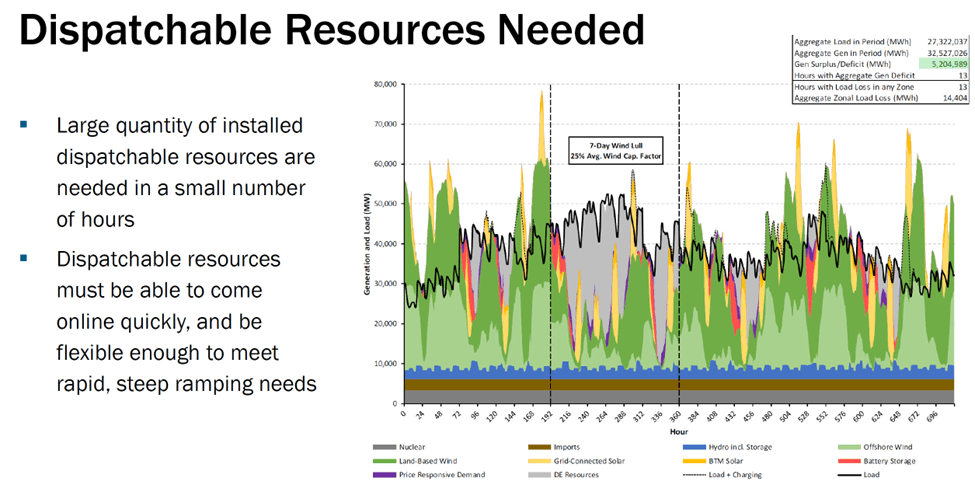
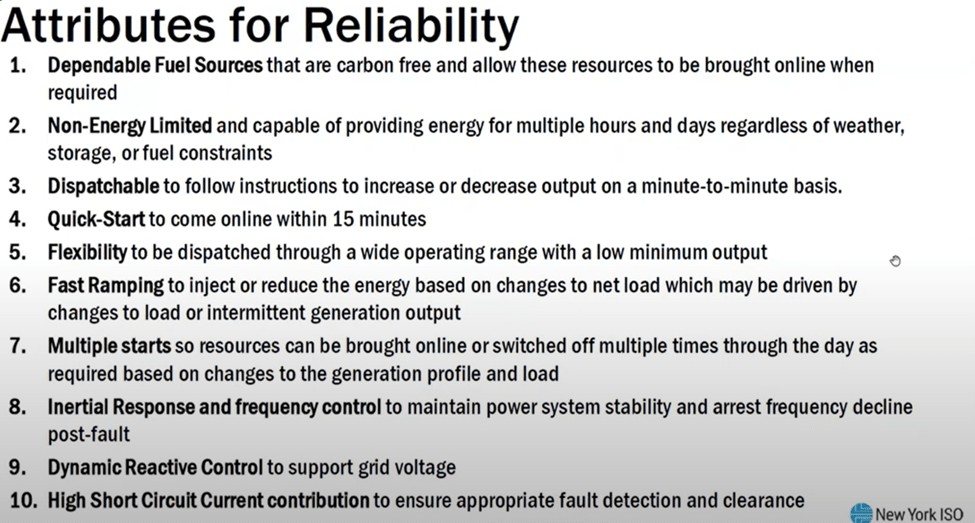
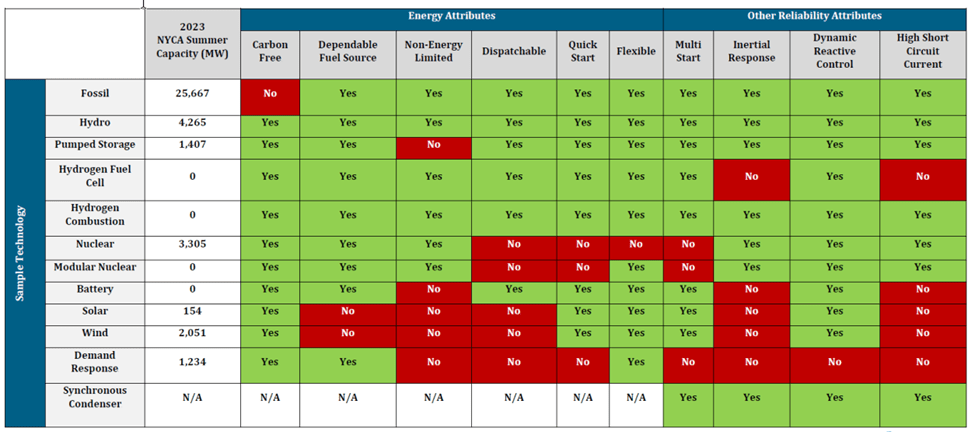
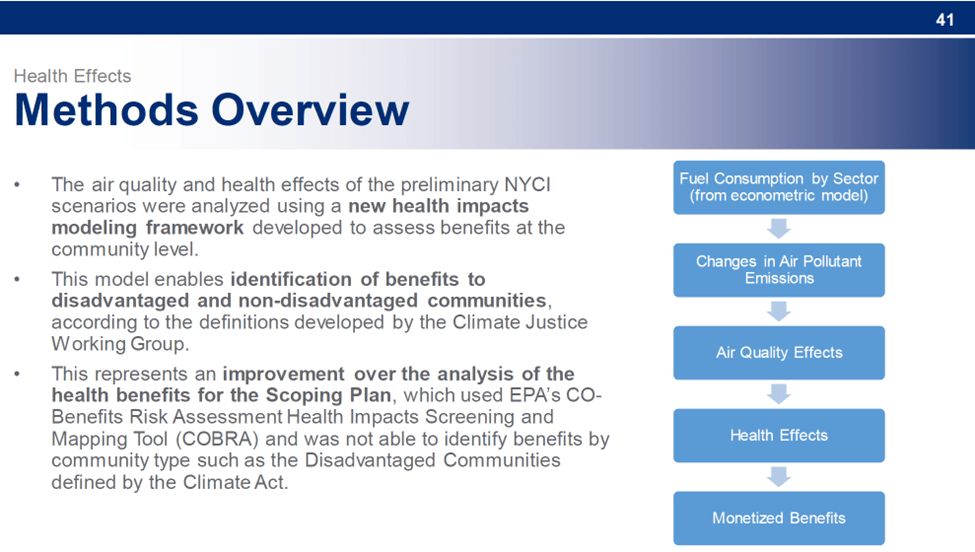
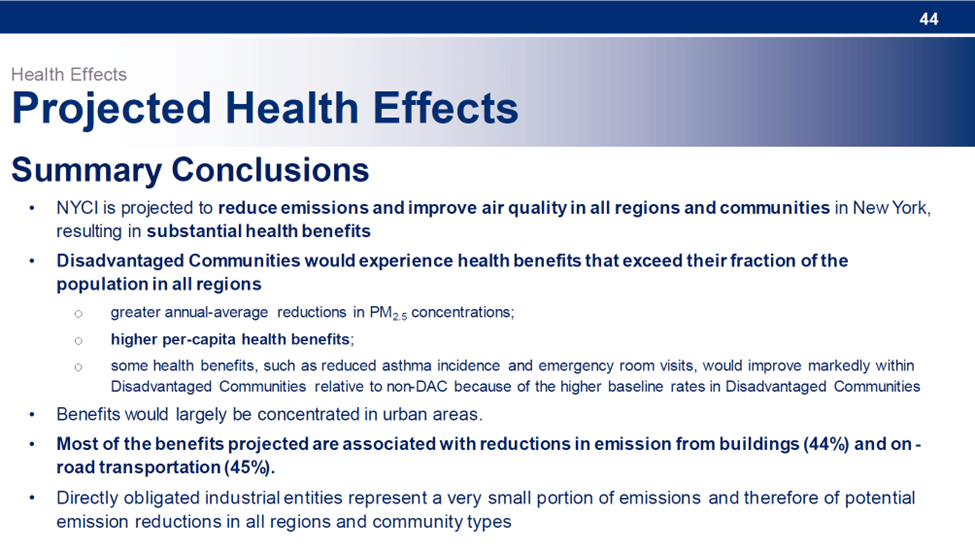
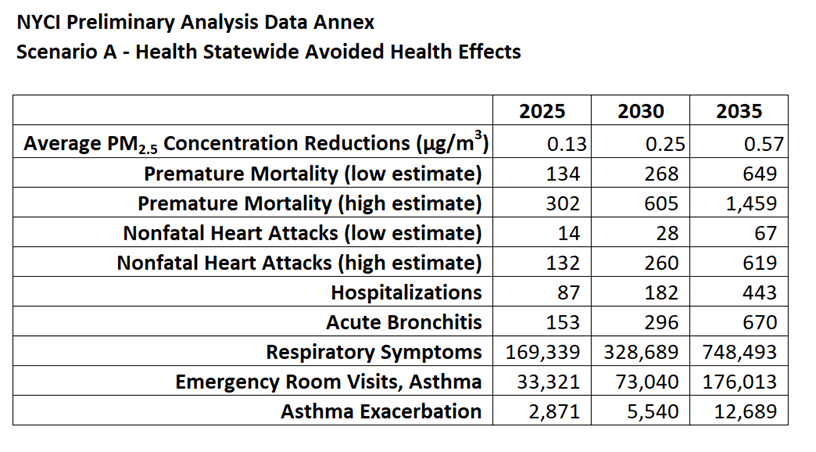
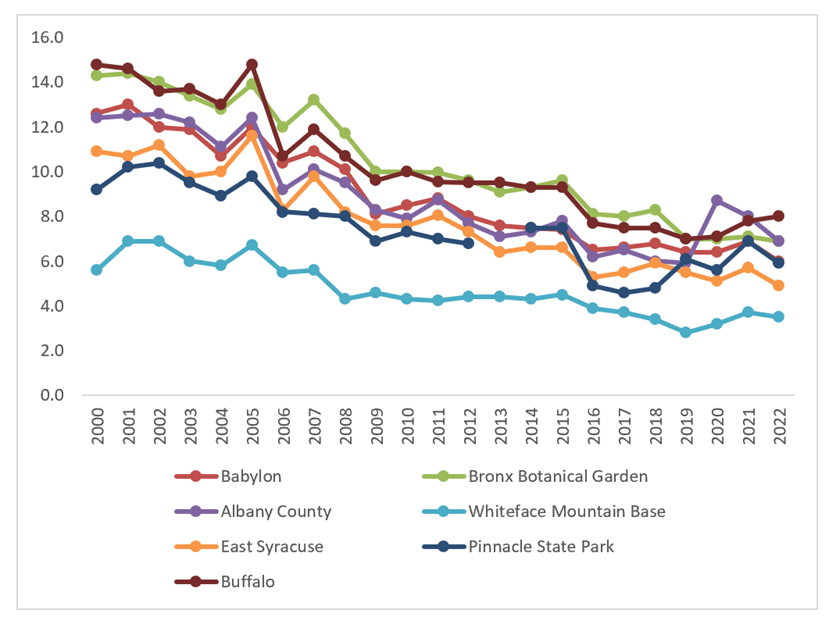
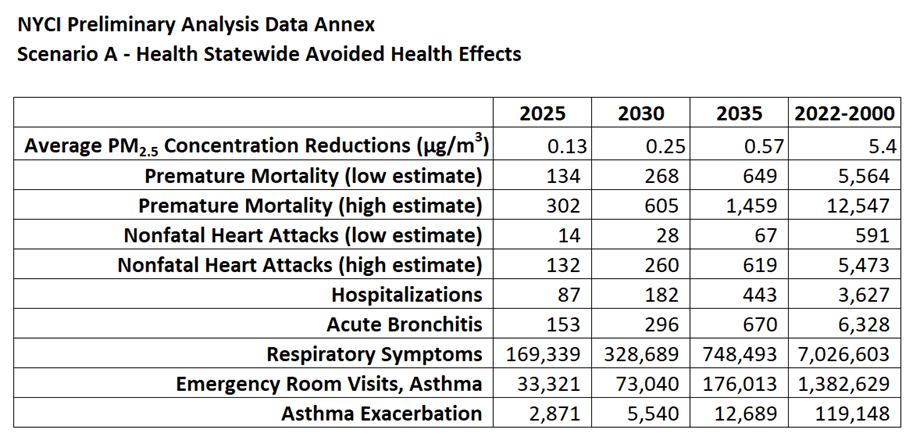
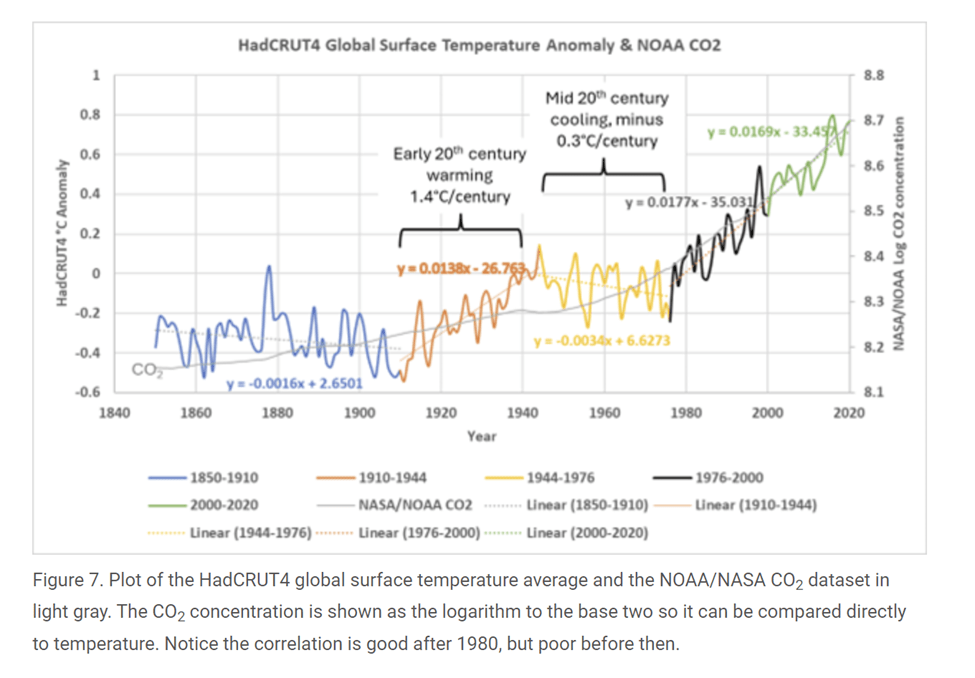
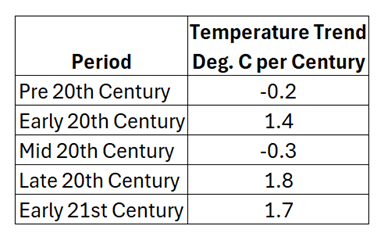
 Pragmatic Environmentalist of New York