Why NY State Must Rethink Its Energy Plan

At the Business Council of New York 2023 Renewable Energy Conference Energy Richard Ellenbogen, President [BIO] Allied Converters, gave the keynote address.  This post summarizes the power point presentation for his address: “Energy on Demand as the Life Blood of Business and Entrepreneurship in the State –  Why NY State Must Rethink Its Energy Plan and Ten Suggestions to Help Fix the Problems.” 

Ellenbogen frequently copies me on emails that address various issues associated with New York’s Climate Leadership and Community Protection Act (CLCPA).  I have published other articles by Ellenbogen because he truly cares about the environment and the environmental performance record of his business shows that he is walking the walk.   When he sent a copy of the presentation I asked if I could it post after the conference.

Climate Leadership and Community Protection Act Background

The CLCPA established a New York “Net Zero” target (85% reduction and 15% offset of emissions) by 2050 and an interim 2030 target of a 40% reduction by 2030. The Climate Action Council is responsible for preparing the Scoping Plan that outlines how to “achieve the State’s bold clean energy and climate agenda.”  In brief, that plan is to electrify everything possible and power the electric grid with zero-emissions generating resources by 2040.  The Integration Analysis prepared by the New York State Energy Research and Development Authority (NYSERDA) and its consultants quantifies the impact of the electrification strategies.  That material was used to write a Draft Scoping Plan.  After a year-long review the Scoping Plan recommendations were finalized at the end of 2022.  In 2023 the Scoping Plan recommendations are supposed to be implemented through regulation and legislation. 

Richard Ellenbogen

I have published other articles by Ellenbogen because he truly cares about the environment and the environmental performance record of his business shows that he is walking the walk.   His bio is available at the Business Council website.

Ellenbogen’s presentation covers four major points before making recommendations.  I summarize each of these points in the following.

Energy System

Ellenbogen  describes the energy system as an introduction to the problem and what he thinks we should do.  He explains that we want an energy system that provides reliable, affordable, and clean power but that based on what has been happening in Germany the current plan will negatively impact all those features.  He argues that climate change is a real issue and that methane also needs to be addressed.  He makes a good argument that the plans to eliminate natural gas before zero emission sources of electrical generation will decrease the rate of decarbonization.  He projects that the costs of CLCPA implementation will exceed $4 trillion because the entire electric transmission, distribution, and electric service system will have to be replaced.  These costs are far in excess of anything that the Hochul Administration has  claimed.  His introduction concludes that we need to adjust the plan.
Implementation

Ellenbogen describes obstacles to implementation in the next section.  He lists ten specific obstacles and then goes on to highlight a few issues.  He addresses heat pumps and gas stoves.  His presentation points out that converting to heat pumps “will not reduce GHG emissions or energy prices on a generation system supported by fossil fuels”.  Germany has tried to do this and it has not worked out as planned.  In particular, he explains in Germany that “it just moved the CO2 emissions to a different location with an as large or larger CO2 footprint and with much higher operating costs!”.  He points out that Germany’s past 30-year history is New York’s future.  There are similar concerns about gas stove and explains why the conclusions of recent gas stove studies are “extremely questionable” that are being used to justify banning those appliances.

In order to describe the difficulties associated with implementation he delves into the physics of power and energy.  They are not the same thing as shown in the following slide.  CLCPA  proponents often do not properly recognize the distinction and that misleads the public on the capabilities of wind and solar generation.  He also describes the capabilities of different types of generation.

CLCPA Fantasy

The physics lessons are necessary to show why the CLCPA Scoping Plan is a fantasy.  He compares the power and energy projections in the Integration Analysis and then explains why the documentation is using unrealistic energy estimates.  As a result, he points out that “the solar energy output is being over-estimated in the CLCPA by 72%”.  There is a slide that describes the CLCPA generation plan that concludes that the assumptions are unrealistic.  Keep in mind that the Integration Analysis model back calculated the resources required to meet the CLCPA targets but did not incorporate a feasibility analysis to determine if those assumptions were realistic.  He points out that the benefits claimed do not consider state emissions relative to the rest of the world:  “NY state could eliminate 100% of its GHG emissions and not affect damages caused by climate change”.  He also notes that “in the last two years the rest of the world GHG emissions increased seven times as much” as New York total emissions.

Reality

Ellenbogen summarizes New York State energy in a chart with four columns that list energy use in  gigawatt-hours:

  1. Total existing energy use
  2. Energy use if it was fully converted to electric systems
  3. The amount of storage expected to be installed by 2040 according to the recently released NYSERDA NY state energy roadmap
  4. The amount of new renewable generation that will be installed by 2035.

He makes two points with the graph.  The renewable energy installation schedule is falling behind as he predicted in March 2019.  The other point is that converting buildings to all electric energy has a hidden problem.   Natural gas deliveries to homes are “used with an efficiency over 80% to 95% during onsite combustion so replacing it will require staggering amounts of electrical generation.”  In order to replace it power plants will have to generate the needed electricity because the renewables won’t be reading in time.   Power plant efficiencies are in the range of 33% – 50% and there is another 7% energy loss on transmission lines delivering it to the end user.

Short-term Recommendations

 His presentation explains that we need to decrease energy use and increase renewable energy development to reduce the carbon footprint.  He goes on to describe problems with energy storage.  All this leads up to his recommendation to keep onsite gas combustion in place so that less energy is needed to heat homes and energy storage is not needed.  He makes a total of ten short-term recommendations that will rapidly reduce GHG emissions with much lower installation costs while also slowing or reversing utility bill increases.  The ten recommendations are:

1 – Do not electrify buildings that run on natural gas – while it will reduce GHG at the building, it will increase it as much at the generating plants While forcing residents and the utilities to incur enormous rewiring costs. There will be no reduction in column a (fossil fuel consumption).  Also, the gas stove analysis that was done recently was mathematically flawed and should not be used to set public policy. However old gas stoves should be replaced with new ones and a gas detector.

2 – Focus heat pump efforts on locations that use oil heat or that use radiant electric heat. Those locations will see a significant reduction of GHG and heat pumps will reduce grid load when compared to radiant electric heat.

3 – Focus resources on expanding grid infrastructure. This will reduce the cost of installing solar in upstate locations and reduce the number of system cancellations allowing the state to increase renewable energy development.

4 – Increasing grid infrastructure will also help with the installation of chargers for the electric vehicle wave that is about to arrive, with or without the state mandate.

5 – Do not install large amounts of battery storage until there is sufficient renewable generation to support the storage. It will increase fossil fuel usage while incurring an enormous capital outlay and starving other projects of funding. They will also decay well before sufficient renewable generation is installed.

6 – Replace older generating plants with higher efficiency combined cycle natural gas generating plants. The state will need the energy to support the EV’s and the newer plants are far more efficient. It will lower energy use, reduce gas usage and put downward pressure on the commodity price.

7 – Develop technologies other than electrolysis to generate green hydrogen (thermochemical, pyrolisis, etc.) Place an emphasis on hydrogen injection into natural gas combustion plants. It will decrease gas usage and increase combustion temperatures which reduces NOx emissions and overall energy use It will greatly lower GHG emissions at those generating Plants

8 – Focus available natural gas resources on combined heat and power systems. It will reduce the utility bills for the system owners while also reducing requirements for grid infrastructure. Allow multiple buildings to form micro-grids to utilize the thermal output and increase the generation capacity. It will greatly reduce statewide energy use and reduce the need for as much transmission infrastructure

9 – Allow Micron Technologies to build a combined cycle plant the size of Cricket Valley Energy Center on their property. The Micron facility will use more energy than the state of Vermont. With generation on-site, the thermal energy could be used at the plant and the 350 GWh of annual line loss will be eliminated. Instead of making them look “green” on paper by buying carbon credits, let them be green

in reality with high efficiency generation and have lower energy costs to make them more competitive and able to recoup the $5 billion rebate without faking it. That will eliminate the increase in statewide energy use related to the facility.

10 – Figure out how the utilities can interconnect the 9 GW of offshore wind because at the moment, no one is certain how to do it. There is limited space for underwater cables. Without that, energy curtailments will occur and impede the increase of renewable energy development, unless they use the alternative idea which is to run transmission lines across Long Island where there will be inevitable NIMBY delays.

Long-Term Recommendation

His long-term recommendations call for the development of 12 GW of nuclear generation.  That is equivalent to six facilities the size of the recently closed down Indian Point plant.  He suggests that they should use a circular fuel cycle to cut down on nuclear waste and be located near existing plants that already have necessary infrastructure.  He argues that the fatal flaw of the state’s plan is the cost of the energy storage required to backup wind and solar.  Even though nuclear is expensive the costs will be much lower than the any storage options.  In addition, the land required to provide the power would only be 3% of the land for just the solar developments.

Conclusion

Ellenbogen provides a rational and pragmatic approach to greatly reduce GHG emissions at costs that would be far less expensive than the costs of the CLCPA.  At some point the Hochul Administration is going to have to confront the reality that no amount of dodgy cost benefit analysis can avoid the reality of enormous costs.  Also ignored are the technological challenges associated with a new resource that can be dispatched without generating emissions.  Ellenbogen proposes to use the only proven resource that meets those requirements and I agree that his long-term recommendation to develop nuclear power is the only chance to succeed.   I fully support his argument that New York State is headed down a path that has not worked elsewhere as described in the following slide.

RGGI Investment Report Lessons for Cap and Invest Programs

This article was cross-posted at Watts Up With That

Cap-and-invest emission reduction programs are supposed to effectively reduce emissions and generate revenues.  The Regional Greenhouse Gas Initiative (RGGI) is an electric sector cap-and-invest program in the NE United States that can provide insight into the potential of these programs.  This post reviews the latest RGGI annual Investments of Proceeds report to determine how well the investments are producing emission reductions and the lessons that should be kept in mind from the observed results.

I have been following the Climate Leadership & Community Protection Act (Climate Act) since it was first proposed. I submitted comments on the Climate Act implementation plan and have written over 300 articles about New York’s net-zero transition.  I also have been involved in the RGGI program process since its inception.  I blog about the details of the RGGI program because very few seem to want to provide any criticisms of the program. The opinions expressed in this post do not reflect the position of any of my previous employers or any other company I have been associated with, these comments are mine alone.

Background

RGGI is a market-based program to reduce greenhouse gas emissions. According to RGGI:

The Regional Greenhouse Gas Initiative (RGGI) is a cooperative effort among the states of Connecticut, Delaware, Maine, Maryland, Massachusetts, New Hampshire, New Jersey, New York, Pennsylvania, Rhode Island, Vermont, and Virginia to cap and reduce power sector CO2 emissions. 

RGGI is composed of individual CO2 Budget Trading Programs in each participating state. Through independent regulations, based on the RGGI Model Rule, each state’s CO2 Budget Trading Program limits emissions of CO2 from electric power plants, issues CO2 allowances and establishes participation in regional CO2 allowance auctions.

RGGI Proceeds Investment Report

The 2021 investment proceeds report was released on June 27, 2023.  According to the press release:

The participating states of the Regional Greenhouse Gas Initiative (RGGI) today released a report tracking the investment of proceeds generated from RGGI’s regional CO2 allowance auctions. The report tracks investments of RGGI proceeds in 2021, providing state-specific success stories and program highlights. The RGGI states have individual discretion over how to invest proceeds according to state-specific goals. Accordingly, states direct funds to a wide variety of programs, touching all aspects of the energy sector.

In 2021, $374 million in RGGI proceeds were invested in programs including energy efficiency, clean and renewable energy, beneficial electrification, greenhouse gas abatement, and direct bill assistance. Over their lifetime, these 2021 investments are projected to provide participating households and businesses with $1.2 billion in energy bill savings and avoid the emission of 4.4 million short tons of CO2.

I reviewed the report on my blog.  I did not submit that review for publication here because there was nothing notably different in the annual claims that RGGI successfully provides substantive emission reductions.  The avowed purpose of the program is to reduce CO2 from the electric generating sector to alleviate impacts of climate change and the report provides data to support its “success”.  However, the report does not directly provide the information necessary to determine annual emission reductions that can be used to compare with emission targets.  New York, for example, has targets based on 2030 emissions relative to a 1990 baseline.  Lifetime emission reductions are irrelevant to evaluate the status of that metric.

The press release and report claim 4.4 million short tons of avoided lifetime CO2 emissions.  However, the sum of the annual CO2 emissions reductions is only 235,229 short tons.  I found that since the beginning of the RGGI program RGGI funded control programs have been responsible for 6.7% of the observed reductions.  When the sum of the RGGI investments is divided by the sum of the annual emission reductions the CO2 emission reduction efficiency is $927 per ton of CO2 reduced.  I concluded that although RGGI has been effective raising revenues, it is not an effective CO2 emission reduction program.

New York is planning its version of cap-and-invest and when I started an evaluation of the different investments made, I wanted to make the point that some investments are more appropriate than others because of cost-effectiveness differences.  During the analysis I realized that there were lessons to be learned that are relevant to all these programs so I submitted this article for publication here.

RGGI Investment Summary

The 2021 investment proceeds report (“Investment Report”) breaks down the investments into five major categories.  I summarized the claimed benefits of the RGGI investments in Table 1.  The Investment Report only lists the percentage of revenues for each category so I calculated the investments per category by multiplying the total revenues by each percentage share.

In the following sections I discuss the results for each sector. 

Energy efficiency

The Investment Report states:

Energy efficiency remains the largest portion of 2021 RGGI investments, at 51%. Over the lifetime of the installed measures, 2021 RGGI investments in energy efficiency are projected to save participants over $417 million on energy bills, providing benefits to more than 34,000 participating households and 570 participating businesses. They are also projected to avoid the release of 2.3 million short tons of CO2 (see Table 2).

The Investment Report explains how the investments are used:

Energy efficiency improvements can be achieved cost-effectively by upgrading appliances and lighting, weatherizing and insulating buildings, upgrading HVAC at offices, and improving industrial processes. For example, occupancy sensors automatically turn lights off when a room or building is not in use, saving significant amounts of energy. These programs allow consumers and businesses to take full advantage of modern appliances, heating, and cooling, increasing the comfort of homes, offices, and businesses while using less energy and saving on their energy bills.

Proponents of green energy investments always talk up the jobs created.  Table 1 notes that $191 million was invested in energy efficiency projects and the following text claims that the projects created 427 direct job-years.  Dividing the total revenues by the job-years yields that each job year cost $446,698.

Energy efficiency also creates jobs. Programs such as home retrofits directly spur employment gains in housing and construction, with 2021 RGGI investments projected to create an estimated additional 427 direct job-years across participating states. Lower energy costs also create numerous benefits across the economy, allowing businesses to expand and families to save and invest in other priorities.

The Investment Report goes on to extol the virtues of energy efficiency program benefits and claims that RGGI states have made the “region a leader in this field.”  Not mentioned is that energy efficiency is not a very effective annual CO2 emission reduction tool.  On an annual basis these investments reduced CO2 emissions by 114,547 tons and at a total cost of $191 million that means the reductions cost $1,665 per ton.  New York must reduce its building sector emissions about 25 million tons by 2030.  If energy efficiency were the only reduction strategy used the cost would be over $41 billion.

Clean and renewable energy

The Investment Report notes:

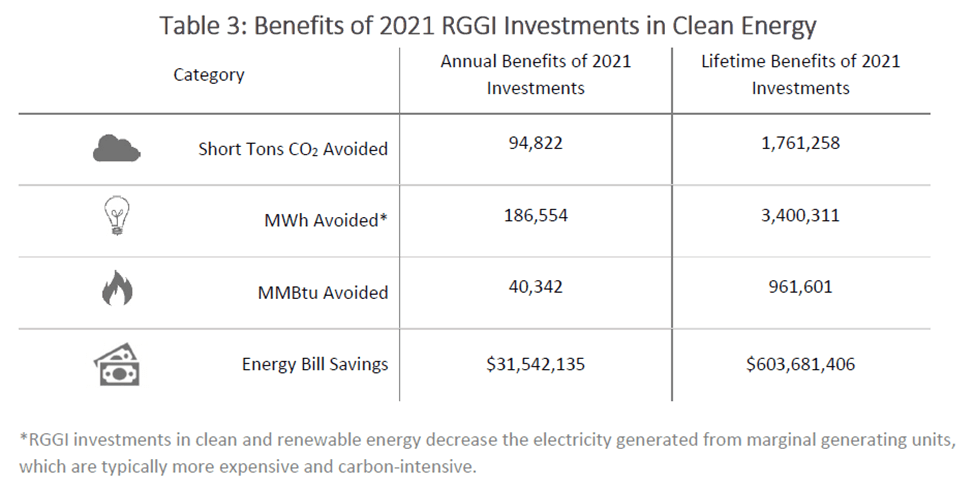
Clean and renewable energy represents 4% of 2021 RGGI investments in the region. Over the lifetime of the projects installed in 2021, these investments are projected to offset $604 million in energy expenses. They are also projected to avoid the release of nearly 1.8 million short tons of CO2 emissions (see Table 3).

Frankly I did not find the explanation in the Investment Report very useful describing what the projects cover:

Clean energy systems require labor to install, which creates jobs and boosts local economic activity. Energy expenditures that might otherwise flow to out-of-state fossil fuel resources stay within the region. As with energy efficiency, “behind-the-meter” programs also contribute to lowering wholesale electricity prices by lowering the demand for electricity at the wholesale level. As demand for electricity decreases, the most expensive power plants run less often, driving long-term prices down for all consumers. Households and businesses both with and without clean energy systems save money on bills.

Updated 7/3/2023 at 8:40 AM

I originally said:

Based on a skim of the state-by-state descriptions, I think clean energy projects refer to building electrification projects like installing heat pumps.  However, the description of beneficial electrification explicitly refers to heat pump installations so I am not sure.   

A comment by Nick Stokes on the Watts Up With That article cleared up my confusion:

“Based on a skim of the state-by-state descriptions, I think clean energy projects refer to building electrification projects like installing heat pumps. However, the description of beneficial electrification explicitly refers to heat pump installations so I am not sure.”

No, if you look down a bit further they clearly mean renewable generation:

“While RGGI investments are just a small part of widespread clean and renewable energy investments in the region, together these actions are having a measurable impact on the energy mix. Since 2008, RGGI states have increased their non-hydro renewable generation by 103%. In 2021 the RGGI states derived 60% of total generation from clean or renewable sources.“

The money they spent was only a small fraction of total investment. Goodness knows how they converted that to an annual saving.

I also corrected the following paragraph:

On an annual basis these investments reduced CO2 emissions by 94,822 tons and at a total cost of $15 million that means the reductions cost $158 per ton.  New York must reduce its electric sector emissions about 18 million tons by 2030.  If simple replacement of power capacity were the only conversion consideration, the cost to transition would be $2.8 billion.  Unfortunately using averages has problems so this is a massive under-estimate.

Beneficial electrification

The Investment Report describes Beneficial Electrification thusly:

Beneficial electrification refers to programs that reduce carbon emissions by displacing direct fossil fuel use with electric power. In contrast to energy efficiency programs, which reduce electricity or fuels usage, beneficial electrification programs can increase MWh consumption, but result in a net reduction in carbon emissions. Examples include programs that promote the use of electric vehicles, reducing oil consumption, or the installation of electric heat pumps, reducing heating fuel and natural gas consumption.

Beneficial electrification represents 13% of 2021 RGGI investments in the region. Over their lifetime, the investments in beneficial electrification made in 2021 are expected to avoid 369,000 short tons of CO2 emissions and result in $164 million in customer bill savings. Beneficial electrification investments will yield even greater emissions reduction benefits over time, as renewables take up a larger portion of the electric grid composition. Investments in beneficial electrification programs, and the resulting bill savings, also lead to job creation and spur local economic activity.

On an annual basis these investments reduced CO2 emissions by 25,270 tons and at a total cost of $49 million that means the reductions cost $1,924 per ton.  New York must reduce its building sector emissions about 25 million tons by 2030.  If beneficial electrification of buildings was the only reduction strategy used the cost would be $48 billion. 

There is a problem with the projects listed relative to the intent of the program.  The description of the program states: “The Regional Greenhouse Gas Initiative (RGGI) is a cooperative, market-based effort among the states of Connecticut, Delaware, Maine, Maryland, Massachusetts, New Hampshire, New Jersey, New York, Pennsylvania, Rhode Island, Vermont, and Virginia to cap and reduce CO2 emissions from the power sector”, my emphasis added.  All of the examples listed, “programs that promote the use of electric vehicles, reducing oil consumption, or the installation of electric heat pumps, reducing heating fuel and natural gas consumption” increase electric load.  Most RGGI states have exhausted switching to lower carbon-content fuels that have provided most of the observed reductions to date.  Future reductions in the electric sector will rely on the displacement of fossil fuel generation with added zero-emissions sources, primarily wind and solar.  Funding programs that increase load works against that requirement. 

Greenhouse gas abatement and climate change adaptation

The Investment Report states:

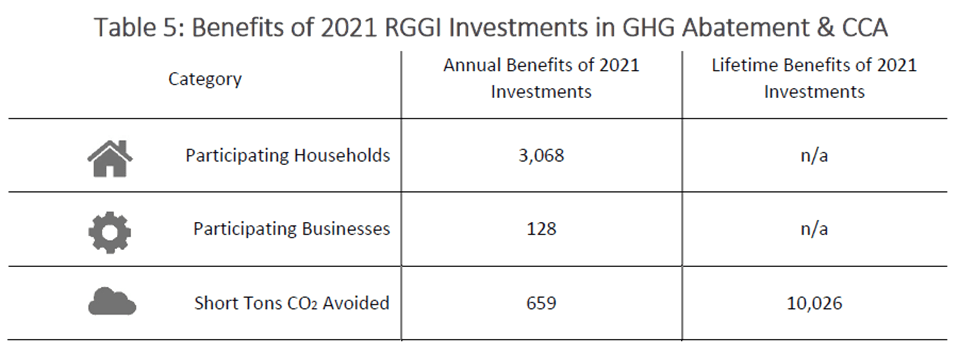
Greenhouse gas (GHG) abatement and climate change adaption (CCA) is a broad category encompassing other ways of reducing greenhouse gases, apart from energy efficiency and clean and renewable energy, as well as projects that focus on preparing for and addressing the impacts of climate change on local communities. Approximately 11% of 2021 RGGI investments supported GHG abatement and CCA programs. Over their lifetime, the investments made in 2021 are expected to avoid the release of over 10,000 short tons of CO2 (see Table 5).

Programs in the GHG abatement and CCA category may vary significantly and may drive GHG emission reductions in multiple sectors. For example, technology, research, and development programs are tracked as GHG abatement and CCA, as they may lead to advancements resulting in the reduction of greenhouse gases. Climate change policy research, coastal resilience, and flood preparedness programs are also tracked as GHG abatement and CCA.

GHG abatement and CCA programs vary in the types of benefits they provide. Some projects reduce electricity and fossil fuel use as part of their efforts to reduce overall emissions, generating economic benefits similar to those realized through energy efficiency and clean and renewable energy programs. Other projects may not return immediately trackable benefits within the scope of this report, but still provide important long-term benefits in climate preparedness and mitigation.

On an annual basis these investments reduced CO2 emissions by 659 tons and at a total cost of $41 million that means the reductions cost $62,468 per ton.  However appropriate these programs are for responses to alleged climate change impacts, the programs are not helping reduce emissions at electric generating sources meaningfully. 

Direct bill assistance

The Invest Report describes this sector:

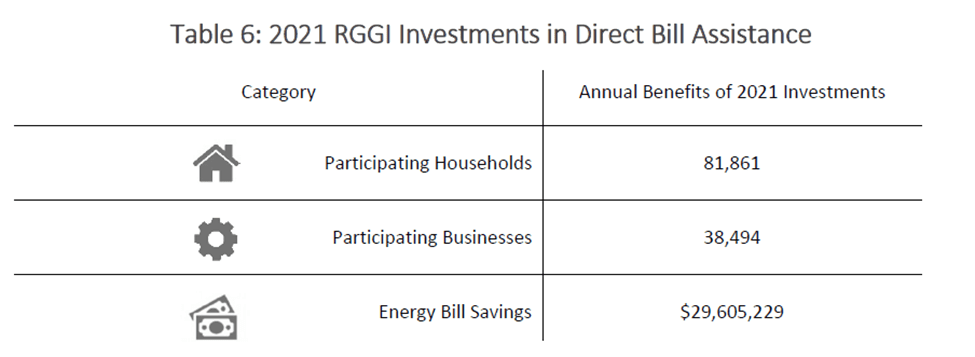
Direct bill assistance returns money to consumers as a rebate on their energy bills. Approximately 13% of 2021 RGGI investments have funded direct bill assistance. RGGI investments in direct bill assistance in 2021 returned $30 million in bill savings to energy consumers in over 81,000 households and 38,000 businesses (see Table 6)

These programs provide rate relief to electricity consumers in the RGGI region. Some programs provide assistance specifically to low-income families, while other programs provide small on-bill credits to all consumers.

Direct bill assistance typically appears as a credit on a consumer’s electricity bill. Direct bill assistance programs support economic activity by providing funds directly to consumers, who can then spend those funds on other priorities. Unlike energy efficiency or clean energy programs (which generate benefits for the lifetime of the installed measures), direct bill assistance programs provide benefits only for the length of the bill-assistance program. Direct bill assistance programs also do not reduce or affect wholesale electricity prices.

This category accounts for 13% ($49 million) of the $374 million total revenues that were invested in 2021.  Obviously, there were no CO2 emission reductions associated with this category. There is no question that an increase in energy costs is very regressive so assisting those least able to afford higher energy costs is appropriate.  On the other hand, if the intent of a price on carbon is to change behavior, then providing rebates reduces that incentive.

Administrative costs and the costs to support RGGI, Inc. add another $26 million to the funds that do not provide any CO2 emission reductions.

Overall, the RGGI states invested $374 million of the auction revenues in 2021.  The goal of RGGI is to reduce electric sector emissions on an annual basis.  The avoided CO2 on an annual basis totaled 235,298 tons at a rate of $1,589 per ton reduced. 

Discussion

Politicians and climate activists have embraced cap-and-invest emission reduction programs as an effective solution to GHG emission reduction goals.  The allure of a source of revenues and compliance certainty using climate policies that apparently have worked in the past is strong.  The problem is these folks have not paid adequate attention to what made previous policies work and whether there are significant differences between their plans and existing programs.

In that regard there are lessons to be learned from the RGGI Investment Report for all cap-and-invest programs.   RGGI effectively raised revenues.  Chart 5: RGGI Investments as a Subset of Total Proceeds in the Investment Report shown below notes that through the end of 2021 the RGGI states raised $4.7 billion dollars.  However, there is a lesson to be learned.  The chart also reveals there is a problem with that much money and politicians.  In 2021, none of the RGGI states diverted money to the general fund but that has occurred in the past to the tune of 6% of the revenues collected.  The $282.5 million that went to general funds was political expediency pure and simple.  Just because there was no longer a line item does not mean that the practice no longer occurs.  At least in New York, agencies are using RGGI funds as a slush fund to cover administrative costs that should be covered elsewhere.

There is an unacknowledged dynamic lesson to be learned.  The rationale for this kind of pollution control program is to reduce emissions.  GHG emission reductions require investments because the reality is that most control options are not cost-effective by themselves.  However, the success of these programs in raising money has attracted all sorts of interest beyond pollution control.   While there are inappropriate uses for this money there are also proper uses like direct bill assistance.  The problem is that there is so much pressure for the revenues raised that I believe it is likely that there will be insufficient money available to fund the necessary emission reductions.  Furthermore, environmental justices is a prominent feature of recent cap-and-invest programs included to “benefit those communities that bear the most environmental burdens”.  This will put even more pressure on using auction revenues for purposes that do not directly reduce emissions.

One of the features of cap-and-invest programs is that they offer compliance certainty with emission targets.  The unrecognized problem is that previous programs included feasibility analyses to set the caps.  For example, EPA’s latest multi-state emission trading programs evaluated the existing control equipment at each electric generating station in most of the country and established its cap based on that analysis.  GHG emission targets established by legislation did not include unbiased feasibility analyses and relied on political aspirations. 

This has not been a problem in the RGGI program yet.  The aspirations for emission reductions were low when the program started in 2009.  To date the emission permits or allowances have been comfortably in excess of the cap on emissions but that is no longer the case.  So far, the poor performance of RGGI auction proceeds reducing CO2 has not been an issue.  In the future, however, reductions from RGGI investments must be improved to meet proposed program goals.   

I evaluated the influential book Making Climate Policy Work  analysis of RGGI.  Authors Danny Cullenward and David Victor show how the politics of creating and maintaining market-based policies render them ineffective nearly everywhere they have been applied.  They recognize the enormity of the challenge to transform industry and energy use on the scale necessary for deep decarbonization.  They write that the “requirements for profound industrial change are difficult to initiate, sustain, and run to completion.”  Because this is hard, they call for “realism about solutions.”  Their book includes an evaluation of RGGI.  I agree with the authors that the results of RGGI and other programs suggest that programs like the NYCI proposal will generate revenues.  However, we also agree that the amount of money needed for decarbonization is likely more than any such market can bear. 

In the future, the diversion of funds away from emission reduction efforts and the amount of money needed means that the compliance certainty feature could cause a big problem.  Fossil fuels and GHG emissions are closely linked to energy use.  The ultimate compliance strategy for any GHG emission limitation program is stop using fossil fuels.  If there is no replacement energy available that means that compliance will lead to an artificial energy shortage unless there is a safety valve or affected sources pay a penalty.  My concern is that the pressure to spend money on programs that do not reduce emissions could result in insufficient money to make the necessary reductions.

Conclusion

The lessons of RGGI should be concerning for all cap-and-invest programs.  The benefits of RGGI are not as successful as alleged and I believe that other cap-and-invest programs will have similar results.  Jobs created is touted as a benefit but they are expensive.  Politicians and money must be watched closely or the money will be diverted to unintended uses.  Although CO2 emissions in the RGGI region are down around 50% since the start of the program, RGGI funded control programs have only been responsible for 6.7% of the observed reductions.  When the sum of the RGGI investments is divided by the sum of the annual emission reductions the CO2 emission reduction efficiency is $927 per ton of CO2 reduced.  That value is far in excess of the social cost of carbon societal benefits.

I started this analysis because I thought it would identify RGGI investment programs that have effectively reduced GHG emissions.  There aren’t any.  The latest Investment Report only identifies a single category with a control effectiveness under a thousand dollars and that one is in excess of all Social Cost of Carbon costs.  Those who claim that cap-and-invest programs are an effective solution are not considering all the results of RGGI. 

Feedback from Washington State on Gas Prices Increases Due to Cap and Invest 

Last week I published Washington State Gasoline Prices Are a Precursor to New York’s Future, which was a variation of an article published at Watts Up With That – Do Washington State Residents Know Why Their Gasoline Prices Are So High Now?.  I also published Washington State Gasoline Prices and Public Perceptions that consolidated responses from Washington residents in the comments from the Watts Up With That article.  All the articles addressed recent reports that gasoline prices in the State of Washington are now higher than California.  The posts show that there is an obvious link between Washington’s new cap and invest program and gasoline prices.  This post elevates a comment on my original article from Paul Fundingsland who offered his take.

Paul describes himself as “An Obsessive Climate Change Generalist”.   Although he is a retired professor, he say he has no scientific or other degrees specific to these kinds of issues that can be cited as offering personal official expertise or credibility. What he does have is a two decades old avid, enthusiastic, obsession with all things Climate Change related. 

His lightly edited comment follows.

Fundingsland Comment

In order to see why our gas prices are so high there are a few background issues that may help explain. First, Washington has no income tax other than the just instituted tax on Capital Gains over $250,000. So, the two main ways the Washington government uses to tax the populous is with a hefty gas tax, (the third highest in the nation) and a more than hefty liquor tax combined with the general state sales tax and other state taxes on marijuana etc.

Second, Washington State is basically a one-party state, much like California. So, the usual checks and balances with a two party system are very difficult to come by. Third, the current head of our one-party state, Governor Inslee, is an avowed climate change alarmist having even attempted to run for president on that issue in the last national election.

Our Governor actually thinks the world is watching what Washington state is doing to lower CO2 and that we will set the example for the rest of the world to follow. So, he exhibits obvious signs of delusion. Neither he nor basically anyone else of note in our legislative system has any idea what is going on in the rest of the world regarding energy, especially in the undeveloped world including China & India.

Our legislature is living in a national and international energy ignorant “bubble” and being led by a likable but oblivious energy ignorant crusading climate change alarmist. This is not a desirable circumstance for rational energy policy making decisions.

The legislature was bright enough to realize they couldn’t get a straight forward transparent “climate” tax passed to deal with real and projected environmental issues. Instead under the guises of combating climate change, the legislature came up with “Tax and Invest”. Hey, maybe that qualifies us to get some of that 350 billion “Inflation Reduction Act” federal money.

The Washington legislature connived up this ridiculous convoluted regressive tax scam pretending that it is going to help show the world how to reduce CO2 thus saving the planet from computer modeled future bad weather Armageddon. Never mind that this kind of tax is designed to place a specifically heavier financial load on the middle, lower and fixed income classes.

In the real world this “Tax and Invest” scam is nothing more than a regressive tax and redistribution scheme of the taxed monies supposedly for environmental benefits. Although many of these environmental projects are certainly worthy of mitigating, taxing the CO 2 emitters who then tax us after running it through who knows how many levels of paid government bureaucrats to get whatever funds are left for environmental mitigation is definitely a torturous and wasteful way of attempting to achieve fruitful goals.

At the end of the day, the CO2 emitters get to keep on emitting. It just costs them more. So of course, they just pass along the costs to us. In this case at the gas pump. “Climate Change” is thus being utilized in Washington State in a covert way to extract more “tax” money from the state populace.

And if that isn’t bad enough, the state has a sordid record of keeping its word on where even issue specific referendum voted on and “earmarked” money will be spent, let alone legislated monies. The taxed monies have an embarrassing history of disappearing from their original approved referendum or legislated intention and finding their way into the general fund.

On a state level, now the folks who pushed the “tax and Invest” scheme are saying they didn’t think or weren’t advised the gas price would go up that much. Maybe a nickel or so. Obviously, these clowns did not have a clue how this was going to work. But gee, are they ever happy about all that money they got rolling in at the constituent’s expense. As a senior citizen on a fixed income, I’m not happy about that. Some of that “tax & invest” is my money.

The Washington State “tax and Invest” scheme is a convoluted regressive tax hurting those in the middle, fixed, and lower income brackets the most. It will have zero effect on stopping the climate from changing. It’s a state tax shell game preying on the less affluent.

It’s safe to assume there is not a single legislator or bureaucrat from the Governor on down in the state of Washington who can tell you how much less warming this ridiculous, expensive counterproductive scheme will achieve.

Comments

This does not portend well for New York.  The positive thing relative to Washington is that our Governor Hochul is not an “avowed climate change alarmist”  She is just going with the flow of the Progressive climate change alarmists and grifters in the Legislature.  New York taxes everything that moves so that is a difference with Washington.  The root of the problem is that New York is also a one-party state without checks and balances just like Washington.

I worry because just about everything else described here is similar New York.  Both states think they can lead by example for the rest of the world to follow without a thought that if their poorly designed transition plans fail that they will set an example for the rest of the world that they did not intend.  Both states are scamming their citizens with a regressive tax masquerading as something else. 

I want to highlight one point Fundingsland made: “At the end of the day, the CO2 emitters get to keep on emitting. It just costs them more.”  In my opinion that is exactly what has happened with the Regional Greenhouse Gas Initiative electric utility cap-and-invest program. The affected sources treat the added cost just like a tax.  In order to displace fossil-fired electric generators it is necessary to build zero-emissions generating resources.  The point is that affected generators are not developing those alternative resources to replace their units.  That is not their business model so someone else will have to build those resources.  I suspect that this will also be the case for all affected sources in the New York program.

The crony capitalists who are building the replacement resources will only do so if the money is right   The unaddressed dynamic is the cost necessary to attract those investments relative to what the public will accept.  Authors Danny Cullenward and David Victor explain in Making Climate Policy Work  that the ultimate costs for the net-zero transition are likely higher than the public will accept so smokescreen programs like the Washington and New York cap-and-invest scams are used to delay the inevitable reckoning.

I hope that New Yorkers can be educated to understand what is coming.  The Hochul administration will come up with models and analyses that will claim, just like Washington did, that the costs for implementation will be minimal.  The real costs will be much higher, just like Washington is finding out and just like the experience of every other jurisdiction that has tried to use wind and solar to replace fossil-fired generation.  If New Yorkers are told what is coming and why, then it might be possible to hold the politicians pushing this nonsense accountable.

My thanks to Paul for providing such an exhaustive and illustrative response to my request for feedback from Washington State residents. 

Investment of RGGI Proceeds Report for 2021

This is the sixth installment of my annual updates on the Regional Greenhouse Gas Initiative (RGGI) annual Investments of Proceeds report.  This post compares the claims about the success of the investments against reality.  As in my previous posts I have found that the claims that RGGI successfully provides substantive emission reductions are unfounded.

I have been involved in the RGGI program process since its inception.  I blog about the details of the RGGI program because very few seem to want to provide any criticisms of the program. The opinions expressed in this post do not reflect the position of any of my previous employers or any other company I have been associated with, these comments are mine alone.

Background

RGGI is a market-based program to reduce greenhouse gas emissions (Factsheet). It has been a cooperative effort among the states of Connecticut, Delaware, Maine, Maryland, Massachusetts, New Hampshire, New York, Rhode Island, and Vermont to cap and reduce CO2 emissions from the power sector since 2008.  New Jersey was in at the beginning, dropped out for years, and re-joined in 2020. Virginia joined in 2021 and is getting out at the end of this year.  Pennsylvania has joined but is not actively participating in everything due to on-going litigation. According to a RGGI website: “The RGGI states issue CO2 allowances which are distributed almost entirely through regional auctions, resulting in proceeds for reinvestment in strategic energy and consumer programs. Programs funded with RGGI investments have spanned a wide range of consumers, providing benefits and improvements to private homes, local businesses, multi-family housing, industrial facilities, community buildings, retail customers, and more.”

Proceeds Investment Report

The 2021 investment proceeds report was released on June 27, 2023.  According to the press release:

The participating states of the Regional Greenhouse Gas Initiative (RGGI) today released a report tracking the investment of proceeds generated from RGGI’s regional CO2 allowance auctions. The report tracks investments of RGGI proceeds in 2021, providing state-specific success stories and program highlights. The RGGI states have individual discretion over how to invest proceeds according to state-specific goals. Accordingly, states direct funds to a wide variety of programs, touching all aspects of the energy sector.

In 2021, $374 million in RGGI proceeds were invested in programs including energy efficiency, clean and renewable energy, beneficial electrification, greenhouse gas abatement, and direct bill assistance. Over their lifetime, these 2021 investments are projected to provide participating households and businesses with $1.2 billion in energy bill savings and avoid the emission of 4.4 million short tons of CO2.

The largest share of the investments was directed to energy efficiency, with 51% of the 2021 total. Other categories receiving significant investments include direct bill assistance, clean and renewable energy programs, beneficial electrification, and greenhouse gas abatement and climate adaptation programs. For more details on both 2021 and cumulative investments and benefits.

The report breaks down the investments into five major categories:

Energy efficiency makes up 51% of 2021 RGGI investments and 55% of cumulative investments. Programs funded by these investments in 2021 are expected to return about $418 million in lifetime energy bill savings to more than 34,000 participating households and over 570 businesses in the region and avoid the release of 2.3 million short tons of CO2.

Clean and renewable energy makes up 4% of 2021 RGGI investments and 13% of cumulative investments. RGGI investments in these technologies in 2021 are expected to return over $600 million in lifetime energy bill savings and avoid the release of more than 1.7 million short tons of CO2.

Beneficial electrification makes up 13% of 2021 RGGI investments and 3% of cumulative investments. RGGI investments in beneficial electrification in 2021 are expected to avoid the release of 370,000 short tons of CO2 and return nearly $164 million in lifetime savings.

Greenhouse gas abatement and climate change adaptation makes up 11% of 2021 RGGI investments and 8% of cumulative investments. RGGI investments in greenhouse gas (GHG) abatement and climate change adaptation (CCA) in 2021 are expected to avoid the release of more than 10,000 short tons of CO2 and to return over $20 million in lifetime savings.

Direct bill assistance makes up 14% of 2021 RGGI investments and 13% of cumulative investments. Direct bill assistance programs funded through RGGI in 2021 have returned over $29 million in credits or assistance to consumers.

Emissions Reductions

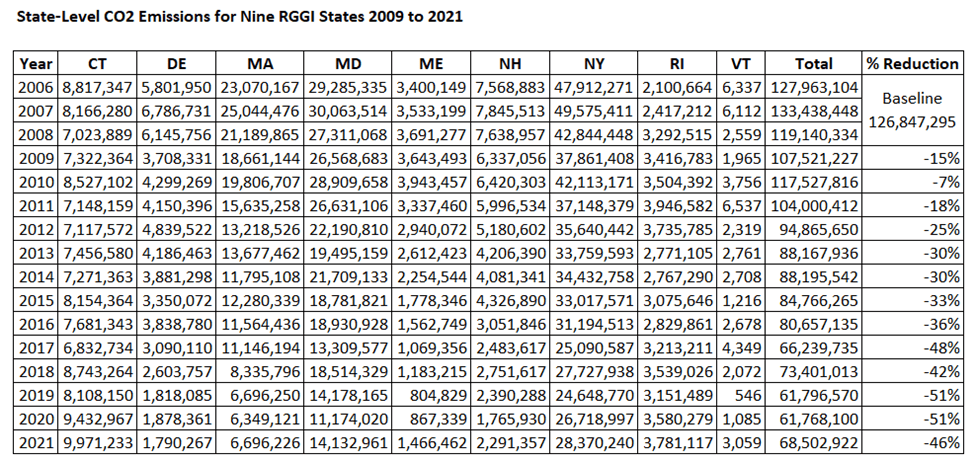
In my previous articles on the Proceeds reports, I have argued that RGGI mis-leads readers when they claim that the RGGI states have reduced power sector CO2 pollution over 50% since 2009. In the following table, I list the 9-state RGGI emissions and percentage reduction from a three-year baseline before the program started in 2009.

I have argued that the implication in the report’s 50% claim is that the RGGI program investments were primarily responsible for the observed reduction even as the economy grew (Figure 1 from the report).

I believe that their insinuation that RGGI was primarily responsible for the emission reductions is wrong.  The following table lists the emissions by fuel types for these nine RGGI states.  It is obvious that the primary cause of the emission reductions was the fuel switch from coal and residual oil to natural gas.  This fuel switch occurred because it was economic to do so.  I believe that RGGI had little to do with these fuel switches because fuel costs are the biggest driver for operational costs and the cost adder of the RGGI carbon price was too small to drive the use of natural gas over coal and oil. 

I believe that the appropriate measure of RGGI emissions reductions is the decrease due to the investments made with the auction proceeds so I compared the annual reductions made by RGGI investments.  The biggest flaw in the RGGI report is that it does not provide the annual RGGI investment CO2 reduction values accumulated since the beginning of the program.  In order to make a comparison to the CO2 reduction goals I had to sum the values in the previous reports to provide that information. 

The following table lists the annual avoided CO2 emissions generated by the RGGI investments from previous reports.  The accumulated total of the annual reductions from RGGI investments is 3,893,925 tons while the difference between the three-year baseline of 2006-2008 and 2021 emissions is 58,334,373 tons.  The RGGI investments are only directly responsible for 6.7% of the total observed annual reductions over the baseline to 2021 timeframe! 

Although proponents claim that this program has been an unqualified success I disagree.  Based on the numbers there are some important caveats to the simplistic comparison of before and after emissions.   The numbers in the previous paragraph show that emission reductions from direct RGGI investments were only responsible for 6.7% of the observed reductions.   In a detailed article I showed that fuel switching was the most effective driver of emissions reductions since the inception of RGGI and responsible for most of the reductions.

Benefits

Table 1 from the report lists two benefits of 2021 RGGI Investments: emission reductions and energy bill savings.  Energy bill savings derive from investments in energy efficiency savings and other efforts that directly reduce costs to consumers.  These energy saving benefits typically account for total savings over the lifetime of the project investment.  RGGI does the same thing with the CO2 emission reductions but I think that is misleading because the emission reduction metric is annual emissions and not lifetime emissions. 

Emission Reduction Cost Efficiency

There is another aspect of this report that is mis-leading and after arguing with RGGI and New York State about the issue, I have concluded that the deception is intentional.  In particular, I believe that a primary concern for GHG emission reduction policies is the cost effectiveness of the policies and I have argued that this report should provide the information necessary to determine a cost per ton reduced value for control programs for comparison to the social cost of carbon.  If the societal benefits represented by the social cost of carbon for GHG emission reductions are greater than the control costs for those reductions, then there is value in making the reductions.  If not, then the control programs are not effective.

Recall that RGGI provides lifetime CO2 emission reductions but I think that is misleading because it suggests that the emission reduction cost efficiency of the investments is the total investments divided by the lifetime benefits of those benefits.   For example, dividing the 2021 investments of $374 million by the lifetime avoided CO2 emissions (4,445,594) yields a value of $84.  The Biden administration is re-evaluating the social cost of carbon values but for the time being has announced an initial estimate of $51 per ton and this suggests that RGGI investments are close to being cost effective relative to the Federal social cost of carbon.

However, the social cost of carbon value is calculated for an annual reduction of one ton.  In particular, the social cost of carbon is an estimate, in dollars, of the present discounted value of the benefits of reducing annual emissions by a metric ton. I believe that using the lifetime emissions approach is wrong because it applies the social cost multiple times for each ton reduced.  It is inappropriate to claim the benefits of an annual reduction of a ton of greenhouse gas over any lifetime or to compare it with avoided emissions.  In my comments on the New York Climate Act Scoping Plan, I explained that the value of carbon for an emission reduction is based on all the damages that occur from the year that the ton of carbon is reduced out to 2300.  Clearly, using cumulative values for this parameter is incorrect because it counts those values over and over.  I contacted social cost of carbon expert Dr. Richard Tol about my interpretation of the use of lifetime savings and he confirmed that “The SCC should not be compared to life-time savings or life-time costs (unless the project life is one year)”. 

In order to calculate the CO2 emissions reduction efficiency consistent with the social cost of carbon, the proper estimate is the total investments since the start of the program divided by sum of the annual emission reductions.  The problem is that the RGGI reports do not provide that total and instead only provide the sum of the annual lifetime CO2 avoided emissions.  The Proceeds reports always include a caveat that the states continually refine their estimates and update their methodologies, but the annual numbers are not updated to reflect those changes.  Ideally to get the best estimate of the annual numbers the RGGI states should provide the revised annual numbers for each year of the program. Because that is not the case, I have had to rely on the original annual numbers provided in previous editions of the report.  I sum the values in the previous reports to provide that information as shown in the Accumulated Annual Regional Greenhouse Gas Initiative Benefits Through 2021 table shown above.  The accumulated total of the annual reductions from RGGI investments is 3,893,925 tons through December 31, 2021. The sum of the RGGI investments in the previous table is $3,608,950,013 over that time frame.  The appropriate comparison to the social cost of carbon is $3.609 billion divided by 3,893,925 tons or $927 per ton reduced. 

Conclusion

The 2021 RGGI Investment Proceeds report tries to put a positive spin on the poor performance of RGGI auction proceeds reducing CO2.  The alleged purpose of the program is to reduce CO2 from the electric generating sector to alleviate impacts of climate change.  Since the beginning of the RGGI program RGGI funded control programs have been responsible for 6.7% of the observed reductions.  The report does not directly provide the numbers necessary to calculate that estimate which I have come to believe is deliberate.  When the sum of the RGGI investments is divided by the sum of the annual emission reductions the CO2 emission reduction efficiency is $927 per ton of CO2 reduced.  I conclude that although RGGI has been effective raising revenues it is not an effective CO2 emission reduction program.

Washington State Gasoline Prices and Public Perceptions

I published Washington State Gasoline Prices Are a Precursor to New York’s Future a couple of days ago that was a variation of an article published at Watts Up With That – Do Washington State Residents Know Why Their Gasoline Prices Are So High Now?.  The Watts Up With That article asked for feedback from Washington residents about the cost impacts of this cap-and-invest program policy.

Recent reports note that gasoline prices in the State of Washington are now higher than California.  This is also the first year of Washington’s cap-and-invest program  a “comprehensive, market-based program to reduce carbon pollution and achieve the greenhouse gas limits” set in the Climate Commitment Act.  The posts show that there is an obvious link between Washington’s new cap and trade program and gasoline prices.  This article discusses the comments on the Watts Up With That article.

I have been following the Climate Leadership & Community Protection Act (Climate Act) since it was first proposed. I submitted comments on the Climate Act implementation plan and have written over 300 articles about New York’s net-zero transition.  I have extensive experience with air pollution control theory, implementation, and evaluation having worked on every cap-and-trade program affecting electric generating facilities in New York including the Acid Rain Program, RGGI, and several Nitrogen Oxide programs since the inception of those programs. I follow and write about the RGGI cap and invest CO2 pollution control program so my background is particularly suited for this proposal.   I have devoted a lot of time to the Climate Act because I believe the ambitions for a zero-emissions economy embodied in the Climate Act outstrip available renewable technology such that the net-zero transition will do more harm than good.  The opinions expressed in this post do not reflect the position of any of my previous employers or any other company I have been associated with, these comments are mine alone.

Background

I refer readers to either previous article Washington State Gasoline Prices Are a Precursor to New York’s Future or Do Washington State Residents Know Why Their Gasoline Prices Are So High Now? for background information on the New York and Washington cap-and-invest programs. 

The articles explained that “The average cost of regular gasoline in Washington state has jumped by 32 cents over the past month to $4.93 a gallon, according to AAA” according to an article

California is no longer America’s most expensive state for gas.  Another article says that some experts connected the dots to the new legislation.  In my opinion, the key point is that the cost of Washington gasoline has risen more relative to the price increases elsewhere so that now Washington has the highest prices in the nation.  The first two auctions for the Washington cap-and-invest program sold 14,770,222 allowances and raised $780,829,117 averaging $52.87 per allowance.  According to the US Energy Information Administration 17.86 lbs of CO2 are emitted per gallon of finished motor gasoline which means that 112 gallons burned equals one ton.  That works out to $0.47 a gallon needed to cover the cost of allowances necessary to purchase the allowances and that is a unique Washington cost adder. 

I concluded that there is a clear link between the pass-through cost that gasoline suppliers must pay and the fact that Washington State gasoline prices have increased more than other states.  One of the reasons for my obsession following similar policies in New York is that observed significant cost increases with little real benefits should engender a political response.  If it can be shown that there are real and significant costs as opposed to the “no real impact” claims made by net-zero proponents the politicians who supported these policies should be held accountable.  The question is whether the residents of Washington have figured out that their gasoline prices are so high because of the politicians who promulgated this policy.  I closed that I would appreciate any feedback from Washington residents about the cost impacts of this cap-and-invest program policy.

Comments

The article was published in the middle of the night in the USA so the first comments were from Great Britain where it was pointed out that the Washington costs of gasoline were a fraction of the costs there. 

Ron Long and ToldYouSo  brought up the overarching issue.  Washington and New York emissions are so low relative to global emissions that nothing they will do will have any chance of affecting climate change even if there is a relationship between GHG emissions and global warming.

Alex Long submitted the first comment relative to accountability.  He argued that abortion is an overriding issue for many democrats. 

The point of this is simple: It does not matter how high gasoline will cost, it does not matter how bad crime gets, it does not matter if people’s rights are taken away because of a virus — the democrat can safely get re-elected only because they support abortion. A politician’s only concern is to get elected or re-elected. The democrats know a significant number of people will blindly vote for them because abortion. Thus, all the democrats have to do is keep abortion legal and they will safely win the election. That was the lesson I learned in 2022.

Accountability Comments

Steve Oregon said that Washington residents are clueless about the politician’s gas price hike.  He went on:

An associate of mine owns a major gas station in southern Washington and raises the issue with his customers often. The have no idea their legislature and governor raised the price of gas as the did.


ALL of the Washington media parrots the politicians with NEVER any additional clarification or truth provided.


The short of it is Washington State is a thoroughly Democrat cesspool of public deceit and dysfunction.

Jebstang66 pointed out that Washington’s hydro power is a tremendous and clean asset.  He described Washington politics.

The State is run by extreme Leftist politicians who have the majority in every important place in government here including the WA State Supreme Court. So they pass draconian climate laws without viable opposition. Cap and trade along with “The Clean Energy Transformation Act (CETA) in 2019 which requires that all utilities eliminate coal by 2025 and provide carbon neutral electricity by 2030. Many stakeholders, utility officials and industry leaders warned that losing baseload sources like coal would increase the probability of brownouts and blackouts if demand increased, a likely occurrence in the next ten years.”  It is tax scheme to increase the size and control of State Government. The media here controls the narrative so most people are misinformed.

A comment from kvt1100 described the cost difference between Washington and Oregon:

I live in Eastern WA and gas here today is $4.75/gallon and 30 miles south in Oregon it is $4.35/gallon. Last year the prices in Oregon and Washington were near equal. WA is abusing its constituents by taxing us to pay for our Governor’s pet environmental projects. None of which will amount to any meaningful decrease in wicked CO2. Neighbors and family members are unaware of the price gouging by our governor.

Waforests summarized the situation well:

I am *extremely* aware of what’s causing the price hike (in part because i pay attention; I also follow the WPC’s analysis).

This is a perfect example of politicians not understanding the policies they put in place. Inslee said it would simply be an increase of “pennies” (unless he meant 50 of them).

And it doesn’t even *do* anything: it doesn’t help the planet in a meaningful way, and it just hurts poor and rural folk the most.

John Hultquist described the situation in Washington and raised the point that this will disproportionately hit the poor:

 Without looking stuff up:
A Washington State initiative was passed a few years ago to raise taxes by about 25¢/gallon for each of two years. Roads and bridges were in need of repair and cost of labor and materials were increasing. Work around the State is noticeable. That is good.


Washington has no internal sources of petroleum. Imports have come from Alaska and B.C. to the Cherry Point Refinery. Also, gasoline reaches central WA at Moses Lake via the 531 mile Yellowstone Pipeline from Billings, MT. From Moses Lake, it is delivered by truck to farther destinations, such as where I live 71 miles west. All not so good.


I do not think most people in Washington State are aware of the cap-and-invest program. The State is about 60% Democrat affiliated and the elites from the Inslee administration on down are pleased with themselves. Summarizing: WA is leading in the green movement to save the Planet.
If the poor suffer – we don’t give a schist.Dreadful.

There were a couple succinct responses.  I liked Janice Moore’s response to the question whether residents are aware of the problem and the reason: “Yes, some of us do. Answer: Democrats.” 

Alexei stated: “The “cap & invest” program is clearly a carbon tax and promoted by our departing governor Inslee but I doubt it will be met with much resistance by the credulous climate electorate here that have kept him in office for so long.”

Beta Blocker gave a detailed response:

I live in a rural area of the southeastern corner of the state in a place which is a wide spot in the road you would miss altogether if you didn’t already know it was there.

Concerns are being raised inside the local public utility districts, and among knowledgeable people familiar with energy issues in the US Northwest, that the coal plants which serve the region are being closed faster than they are being replaced.

A decade ago, the plan was to replace those coal plants with gas-fired power plants. Ten years later, new-build gas-fired power generation is completely off the table as an alternative to coal.

Nuclear hasn’t been formally rejected in Washington State, but the hard reality is that new-build nuclear couldn’t be delivered in a time-frame which would make any real difference to the emerging situation.

This trend towards closing coal-fired plants without replacement by equivalent generation is certain to continue and is even likely to accelerate as the Biden Administration and the EPA put more pressure on the region’s politicians and on the power utilities to reduce their carbon emissions in accordance with the EPA’s new emission rules.

The Western Electricity Coordination Council and the Northwest Power and Conservation Council are both downplaying the risks of electricity shortages in the US west and in the US northwest.

Inside the power planning models, megawatt-hours saved through energy conservation measures are being employed as fully equivalent to megawatt-hours generated and consumed. This is the means by which the risk of blackouts is being pencil-whipped away.

The bottom line is that the risk of blackouts occurring in the US Northwest is increasing rapidly. One independent risk analysis cited in a recent behind-the-paywall article in ANS Nuclear News sees our blackout risk increasing from 5% today in the year 2023 to greater than 25% after 2025.

Just like it is in California and in New York State, there isn’t one person in a hundred living in the US Northwest who has a clue about what is now happening with the reliability of our electricity supply.

Finally, Major Meteor describes the ultimate response to this kind of program:

The impact this is having on Washington residents is that some of them are moving to states that have common sense. So moving to Tennessee I figure my cost of living is easily $5K to $6K less with about $500 per year of that being gas taxes and I don’t even drive much. So if I am handing them $6K per year, I just want to know what they do with that extra money. Doesn’t look like society or my family benefits from the extra burden at all. I’m out.

Conclusion

Unfortunately, these responses are completely consistent with my experiences in New York.  Very few people know about these programs and the potential ramifications.  I am disappointed that even when Washington residents are confronted with inarguable proof that the programs are leading to significant cost increases that many of those affected still have not caught on.

I think the problem is that this issue and the programs to address it are just background noise.  Every day there is another story claiming it is climate change is here now and once in a while there is a political statement bragging about doing something.  When the time comes to vote, other issues are more important and the Progressives still get elected.  The point is that they did not get elected to pursue the cockamamie climate change control programs even if they think that they did.  How about a referendum to ask the people whether they want to proceed down this path?

Letters to the Albany Times Union – Alter Climate Plan and Flaws in Cap and Invest

I have been trying for a long time to get a letter to the editor published in the Albany Times Union.  In early June they finally published my summary of flaws on the New York Cap-and-Invest Program.  Dennis Higgins had another letter published describing issues raised by the New York Independent System Operator (NYISO) Power Trends report.  This post provides both letters.

I published a guest post by Dennis Higgins on the importance of nuclear energy to a sustainable future in May.  He spent most of his career at SUNY Oneonta, teaching Mathematics and Computer Science.  He has been involved in environmental and energy issues for a decade or more. Although he did work extensively with the ‘Big Greens’ in efforts to stop gas infrastructure, his views on what needs to happen, and his  opinions of Big Green advocacy, have served to separate them.

I have been following the Climate Leadership & Community Protection Act (Climate Act) since it was first proposed. I submitted comments on the Climate Act implementation plan and have written over 300 articles about New York’s net-zero transition.  I have devoted a lot of time to the Climate Act because I believe the ambitions for a zero-emissions economy embodied in the Climate Act outstrip available renewable technology such that the net-zero transition will do more harm than good.  The opinions expressed in my letter to the editor do not reflect the position of any of my previous employers or any other company I have been associated with, those comments are mine alone.

Our letters follow.

State needs to alter ‘dumb’ climate plan

Dennis Higgins, Otego

The Climate Action Council released the state’s energy scoping plan last year. The state continues to ignore criticism that its scheme, cooked up out of slogans, utterly disconnected from reality, will fail. The grid operator, New York Independent System Operator, just released its 2023 Power Trends report, which slams the plan. Will state leaders listen?

The state plan requires tripling energy imports and exports. New York hopes to sell — rather than dump — excess solar midsummer but wants neighbors to provide us with energy the rest of the time. What if there’s none to be had? The report states: “These reduced margins potentially limit the ability to import electricity from neighboring regions, putting greater importance on available supply and transmission within New York.”

NYISO indicates that the proposed solar and wind buildout will cause dangerous reliability issues. NYISO is constrained by federal tariffs to ensure that outages don’t happen. The report states: “Increasing levels of intermittent generation combined with increasing demand in response to electrification are expected to result in at least 17,000 MW of existing fossil-fueled generating capacity, which must be retained to continue to reliably serve forecasted ‘peak’ demand days in 2030.”

NYISO says that, with Indian Point’s closure, fossil fuels now provide half the state’s electricity. Since 2019, emissions have increased by tens of millions of tons yearly. If, in 2030, fossil fuels still provide 40 percent to 50 percent of our electricity, state leaders may realize that the 70 percent-renewable goal failed.

Texas and California show how critical it is to have sufficient grid capacity. France and Sweden decarbonized with nuclear power in 10-15 years. Canada, Britain and Japan will build emission-free nuclear. Perhaps New York will revise its dumb plan. 

Flaws In New York’s Cap-and-Invest Proposal

Roger Caiazza, Liverpool

The Hochul Administration has started its process to develop an economywide Cap-and-Invest Program that will “establish a declining cap on greenhouse gas emissions, limit potential costs to New Yorkers, invest proceeds in programs that drive emission reductions in an equitable manner, and maintain the competitiveness of New York businesses and industries.” 

There is an unrecognized dynamic between the stated goals.  The New York Independent System Operator has stated that the CLCPA net-zero transition is “driving the need for unprecedented levels of investment in new generation to achieve decarbonization and maintain system reliability”.

The Administration must provide an estimate of how much these investments will cost in order determine how much money must be raised by the Cap-and-Invest program.  If the investments are insufficient then the energy system will fail to meet the cap limits.  Also needed is a feasibility analysis for the transition schedule that considers supply chain and trained labor constraints.  Even if the money is available, it may not be possible to build it fast enough to meet the arbitrary CLCPA schedule.

The Cap-and-Invest program is described as a simple solution that will address the Administration’s goals.  The ultimate compliance strategy for the program is stop using fossil fuels.  If there is no replacement energy available that means that compliance will lead to an artificial energy shortage.  H.L. Mencken noted that “For every complex problem there is an answer that is clear, simple, and wrong.”

Discussion

Higgins agrees with my opinion that the Power Trends report raises serious issues about reliability.  It is notable that he brought up issues I did not address in my article about the report.  We are in complete agreement New York’s Climate Act Scoping Plan is a dumb plan and that the NYISO Power Trends supports our position.

Washington State Gasoline Prices Are a Precursor to New York’s Future

Recent reports note that gasoline prices in the State of Washington are now higher than California.  This is also the first year of Washington’s cap-and-invest program  a “comprehensive, market-based program to reduce carbon pollution and achieve the greenhouse gas limits” set in the Climate Commitment Act.  This post shows that there is an obvious link between Washington’s new cap and trade program and gasoline prices.

I have been following the Climate Leadership & Community Protection Act (Climate Act) since it was first proposed. I submitted comments on the Climate Act implementation plan and have written over 300 articles about New York’s net-zero transition.  I have extensive experience with air pollution control theory, implementation, and evaluation having worked on every cap-and-trade program affecting electric generating facilities in New York including the Acid Rain Program, RGGI, and several Nitrogen Oxide programs since the inception of those programs. I follow and write about the RGGI cap and invest CO2 pollution control program so my background is particularly suited for this proposal.   I have devoted a lot of time to the Climate Act because I believe the ambitions for a zero-emissions economy embodied in the Climate Act outstrip available renewable technology such that the net-zero transition will do more harm than good.  The opinions expressed in this post do not reflect the position of any of my previous employers or any other company I have been associated with, these comments are mine alone.

Climate Act Background

The Climate Act established a New York “Net Zero” target (85% reduction and 15% offset of emissions) by 2050 and an interim 2030 target of a 40% reduction by 2030. The Climate Action Council is responsible for preparing the Scoping Plan that outlines how to “achieve the State’s bold clean energy and climate agenda.”  In brief, that plan is to electrify everything possible and power the electric grid with zero-emissions generating resources by 2040.  The Integration Analysis prepared by the New York State Energy Research and Development Authority (NYSERDA) and its consultants quantifies the impact of the electrification strategies.  That material was used to write a Draft Scoping Plan.  After a year-long review the Scoping Plan recommendations were finalized at the end of 2022.  In 2023 the Scoping Plan recommendations are supposed to be implemented through regulation and legislation. 

The New York Cap and Invest program is one of the Scoping Plan recommendations.  The New York State Department of Environmental Conservation (DEC) and New York State Energy Research and Development Authority (NYSERDA)  are hosting webinars designed “to inform the public and encourage written feedback during the initial phase of outreach” for New York’s proposed cap and invest program. 

DEC and NYSERDA have developed an official website for cap and invest.  It states:

An economywide Cap-and-Invest Program will establish a declining cap on greenhouse gas emissions, limit potential costs to New Yorkers, invest proceeds in programs that drive emission reductions in an equitable manner, and maintain the competitiveness of New York businesses and industries. Cap-and-Invest will ensure the state meets the greenhouse gas emission reduction requirements set forth in the Climate Leadership and Community Protection Act (Climate Act).

I have written other articles that provide background on the New York Cap-and-Invest program (NYCI).  I recently posted a Commentary overview for the New York Cap & Invest (NYCI) program that was written for a non-technical audience. In late March I summarized my previous articles on the New York cap and invest proposal in a post designed to brief politicians about the proposal if you want more technical information.  There also is a page that describes all my carbon pricing initiatives articles that includes a section listing articles about the New York Cap and Invest (NYCI) proceeding.

Washington Climate Commitment Act

Although a bit late to the party for addressing the threat of climate change, Washington’s Climate Commitment Act appears to be even more aspirational than California and New York.  The Washington Department of Ecology (“Ecology”) web page explains:

The Climate Commitment Act (CCA) caps and reduces greenhouse gas (GHG) emissions from Washington’s largest emitting sources and industries, allowing businesses to find the most efficient path to lower carbon emissions. This powerful program works alongside other critical climate policies to help Washington achieve its commitment to reducing GHG emissions by 95% by 2050.

The state plans in Washington, California, and New York all aim for net-zero emissions where greenhouse gas (GHG) emissions are equal to the amount of GHG that are removed.  Washington’s emission reduction target is 95% by 2050.  California is shooting for 85% by 2045 while New York’s target is 85% by 2050.  In addition to the target levels and dates there are differences in what GHG emissions are included, how the mass quantities are calculated, and which sectors of the economy must comply.  Nonetheless, I am sure a case can be made that Washington is the most aspirational.

A key component of the strategy of all three states is an emissions market program variation called cap-and-invest.  According to NYSERDA the permits to emit a ton of pollution (the allowance) are distributed freely in a cap and trade program but in a cap-and-invest program the allowances are sold at auction and the proceeds are invested to enable the reductions required.  A more cynical description of the difference would say that cap and trade programs are market-based systems that encourage the free market to find the least cost approach to meet the limits while cap-and-invest programs are disguised carbon taxes.

Cap-and-invest Analytics

My primary interest at the moment is the New York State cap-and-invest program initiative.  As part of the stakeholder outreach process, on June 20, 2023 a webinar (presentation slide deck and session recording) on the program’s analysis inputs and methods that will “assess potential market outcomes and impact from the proposed New York Cap-and-Invest (NYCI) program”.  What caught my attention was a comment that the McKinsey Vivid Economics team would model the cap-and-invest auction and that they had done similar analytic projects for the State of Washington (Video at 13:42).

According to a Ecology web site the Vivid Economics report  shows “new climate change initiatives deliver significant benefits at minimal costs.”  I have never been impressed with most economic analyses of emissions trading program.  John von Neumann famously said “With four parameters I can fit an elephant, and with five I can make him wiggle his trunk.”  I am skeptical about the value of global climate models because so many parameters are needed to simulate different physical processes in the atmosphere but at least there are physical relationships involved.  Analytical models of cap-and-invest programs parameterize just about everything including human behavior.  I have no confidence in their results.  During the webinar I asked whether the Vivid Economics model had been verified.  Not surprisingly there was no answer.

The Ecology web site report  specifically addressed gasoline price projections based on economic modeling:

Economic report shows little impact on gas prices

Washington’s new Clean Fuel Standard will mean less than a 1-cent per gallon difference in the price consumers pay at the gas pump in 2023, according to estimates in a third-party economic analysis. Prices could rise up to 2-cents in 2024, and 4-cents in 2025, the report shows. 

Ecology commissioned Berkeley Research Group to evaluate the Clean Fuel Standard’s impact on the retail cost of gas and diesel fuels, and the electricity for electric vehicles. Berkeley is an independent, globally-recognized consultant with a long track record of providing high-quality reports across a wide range of markets and industries.

Research shows regulations like the Clean Fuel Standard play a minor role in gas prices compared to the shifts in the U.S. economy and disruptions to crude oil supply and demand caused by global events, such as the pandemic and Russia’s invasion of Ukraine.

Legislators passed the Clean Fuel Standard in 2021. It will take effect in 2023. It requires fuel suppliers to gradually reduce the “carbon intensity” of transportation fuels 20% by 2038, enough to cut Washington’s statewide greenhouse gas emissions by 4.3 million metric tons per year. Transportation is the largest source of greenhouse gas emissions in Washington, accounting for 45% of total emissions.

The analysis shows price impacts vary over the next 12 years, and then drop to nearly zero as the number of electric cars increase and there’s a shift to cleaner energy.

Read the report on the Clean Fuel Standard webpage.

Washington Gasoline Prices

What actually happened?  “The average cost of regular gasoline in Washington state has jumped by 32 cents over the past month to $4.93 a gallon, according to AAA” according to an article, California is no longer America’s most expensive state for gas.  Another article says that some experts connected the dots to the new legislation. 

Clearly the reasons for gasoline price volatility are always complicated. Another article explains:

What is causing the spike is a matter of intense debate. Some point to the state’s new “cap and invest” emissions program, which was implemented in January. The program sets a limit — or cap — on overall carbon emissions in the state and requires businesses (including fuel suppliers) to obtain allowances equal to their covered greenhouse gas emissions. These allowances can be obtained through quarterly auctions hosted by the Washington State Department of Ecology. They can also be bought and sold on a secondary market, similar to a stock or bond.

According to Todd Myers with the Washington Policy Center, this program means drivers will pay more at the pump.  “The way fuel suppliers in California and Washington have done it is that they have simply, rather than try to speculate what the future prices will be, incorporated the cost of the allowances immediately into gas prices,” Myers told KIRO Newsradio. “So, what you see is, the gas price almost immediately reflects what those prices are.”

But Luke Martland, Climate Commitment Act Implementation Manager with the state Department of Ecology, claimed it’s not that simple.  “What determines what we pay at the pump in Washington is supply and demand: The war in Ukraine, what Saudi Arabia may do, how much profit oil companies take from the sales. It’s a whole bunch of factors — and cap and invest might be one of those factors. But to say there’s a direct connection is simply not accurate.”

Patrick DeHaan, Head of Petroleum Analysis for GasBuddy, said the link between the cap-and-trade program and gas price increases is clear.

In my opinion, the key point is that the cost of Washington gasoline has risen more relative to the price increases elsewhere so that now Washington has the highest prices in the nation.  The first two auctions for the Washington cap-and-invest program sold 14,770,222 allowances and raised $780,829,117 averaging $52.87 per allowance.  According to the US Energy Information Administration 17.86 lbs of CO2 are emitted per gallon of finished motor gasoline which means that 112 gallons burned equals one ton.  That works out to $0.47 a gallon needed to cover the cost of allowances necessary to purchase the allowances and that is a unique Washington cost adder.  I agree with DeHaan – the link is clear.

Ramifications

There is a clear link between the pass-through cost that gasoline suppliers must pay and the fact that Washington State gasoline prices have increased more than other states.  One of the reasons for my obsession following similar policies in New York is that observed significant cost increases with little real benefits should engender a political response.  If it can be shown that there are real and significant costs as opposed to the “no real impact” claims made by net-zero proponents the politicians who supported these policies should be held accountable.  The question is whether the residents of Washington have figured out that their gasoline prices are so high because of the politicians who promulgated this policy.

 I cannot over-emphasize my belief that similar cost increases are coming to New York as a result of the NYCI proposal.  Although the Hochul Administration professes the desire to make the program affordable the inescapable fact is that there have been significant cost increases where ever a jurisdiction has tried to eliminate GHG emissions.  In addition, there is a complicating consideration inasmuch as higher costs are necessary/  The New York Independent System Operator has stated that the Climate Leadership & Community Protection Act (Climate Act) net-zero transition is “driving the need for unprecedented levels of investment in new generation to achieve decarbonization and maintain system reliability”.  The analytical modeling must consider the balance between affordability and investing in Disadvantaged Communities principles against the investments needed.  If the investments are insufficient then the energy system will fail to meet the cap limits.  The modeling also must address the feasibility of the transition schedule that considers permitting delays, supply chain issues and trained labor constraints.  Even if the money is available, it may not be possible to build it fast enough to meet the arbitrary Climate Act schedule and the modeling must reflect that possibility.

I conclude that in order to generate the revenues necessary to meet the Climate Act emission reduction targets that significantly higher energy prices will be required just like we are observing in Washington.  When those cost increases become evident I hope that the politicians who supported the Climate Act are held accountable for the costs and limited benefits.

Five Reasons New Yorkers Should Not Embrace a Solar Energy Future

On June 18, 2023 the Syracuse Post Standard published a commentary, Five Reasons New Yorkers Should Embrace a Solar Energy Future by Richard Perez, Ph.D.  According to the introduction “This essay aims to clarify common misunderstandings about solar energy and demonstrate its potential to provide an abundant, reliable, affordable and environmentally friendly energy future for New York”.  This post explains why I disagree with just about everything in the essay.

The only reason that New York is pushing solar as part of the energy future of New York is the Climate Leadership & Community Protection Act (Climate Act).  I have been following the Climate Act since it was first proposed, submitted comments on the Climate Act implementation plan, and have written over 300 articles about New York’s net-zero transition.  I have devoted a lot of time to the Climate Act because I believe the ambitions for a zero-emissions economy embodied in the Climate Act outstrip available renewable technology such that the net-zero transition will do more harm than good.  The opinions expressed in this post do not reflect the position of any of my previous employers or any other company I have been associated with, these comments are mine alone.

Climate Act Background

The Climate Act established a New York “Net Zero” target (85% reduction and 15% offset of emissions) by 2050 and an interim 2030 target of a 40% reduction by 2030. The Climate Action Council is responsible for preparing the Scoping Plan that outlines how to “achieve the State’s bold clean energy and climate agenda.”  In brief, that plan is to electrify everything possible and power the electric grid with zero-emissions generating resources by 2040.  The Integration Analysis prepared by the New York State Energy Research and Development Authority (NYSERDA) and its consultants quantifies the impact of the electrification strategies.  That material was used to write a Draft Scoping Plan.  After a year-long review the Scoping Plan recommendations were finalized at the end of 2022.  In 2023 the Scoping Plan recommendations are supposed to be implemented through regulation and legislation. 

According to the New York Independent System Operator (NYISO) “Gold Book” load and capacity report, in 2022 there were a total of 4,444 MW of solar nameplate capacity (154 MW of utility-scale solar and 4,290 MW of behind-the-meter) on-line in the state.   However, implementation of the Climate Act transition to net-zero will significantly increase that amount by 2030.  By 2030 the New York State Energy Research & Development Authority (NYSERDA) and consultant Energy + Environmental Economics (E3) Integration Analysis that provides quantitative estimates of resources for the Scoping Plan projects a total of 18,852 MW and the NYISO 2021-2040 System & Resource Outlook projects 14,731 MW.

Commentary

Against that backdrop I address the five reasons Dr. Perez uses to promote solar energy.

Abundance: The sun is a vast energy resource that powers our planet’s weather and sustains life. In just a few hours, Earth receives more solar energy than the total annual energy consumption of all economies, combined. In a week, it receives more solar energy than the combined reserves of coal, oil, natural gas and uranium.

So what?  According to the US Geological Service water covers the about 71% of the earth’s surface and yet there are deserts with very little water available for use.  The critical requirement is the need for energy when and where needed and New York solar is not situated well in that regard.  The Scoping Plan strategy to decarbonize relies on electrification of homes and transportation so future expected peak loads will occur in the winter.  In New York the winter solar resource is poor because the days are short, the irradiance is low because the sun is low in the sky, and clouds and snow-covered panels contribute to low expectations for solar resource availability.   The New York Independent System Operator does not plan on any solar contribution to resources available for the peak winter hourly load.

Growth of solar technology: Solar technology, known as photovoltaics (PV), has experienced significant expansion. Since the 1980s, PV deployment has consistently grown at a remarkable annual rate of 30%, overcoming economic and political fluctuations. This growth is due to improvements in efficiency, versatility and cost-effectiveness, enabling solar to enter new markets successfully. Experts predict this trend will continue, and, if the stable 30% annual rate persists, by the early 2040s, there may be enough solar installations worldwide to entirely power global economies.

If it is so good, then why does deployment rely on direct subsidies?  Solar proponents don’t acknowledge the incompatibility of solar resources with electric system reliability.  In order to match generation with load requirements grid operators must dispatch generating resources to match the load.  Solar PV facilities are not dispatchable so their deployment complicates rather than enhances grid operations.  Finally, there will always be limits on just how much power can be obtained from any solar panel.  Therefore, I suspect that solar will always rely on direct subsidies to make it competitive.

Affordability: Reports from leading financial advisers such as the Lazard Bank show that utility-scale solar electricity has become the least expensive form of electricity generation. Solar power is now considerably cheaper than new coal, natural gas, or nuclear energy. Experts anticipate solar electricity becoming even cheaper in the future, with a projected 50% cost decrease within the next 15 years. Moreover, solar plants can be built and operational within months, making them economically advantageous compared to the lengthy construction time for nuclear plants.

The claim that “utility-scale solar electricity has become the least expensive form of electricity generation” refers only to power capacity (MW).  Even if solar capacity is half the cost of fossil capacity the cost for delivered energy is much more.  We pay for the kWh electric energy we use each month and we expect it to be available 24-7 throughout the year.  In order to provide usable energy, other things must be considered that destroy the myth that utility-scale solar is cheaper than other types of power plants.  On average a well-designed solar facility can provide (round numbers) 20% of its potential energy possible in New York.  A natural gas fired power plant can operate to produce at least 80% of its potential energy over a year.  In order to produce the same amount of energy, that means that you need four times as much solar capacity.  Even if the solar capacity cost is half the cost for the capacity the energy cost is double simply due to this capacity factor difference. 

But wait, there is more.  In order to make the energy available when needed storage must be added to the cost of the solar capacity.  Also consider that the life expectancy of solar panels is half of the observed life expectancy of fossil-fired power plants.  There are unintended financial consequences that affect the viability of other generators that are needed for reliability that add to ratepayer costs. Because the solar resource is diffuse, it is necessary to support the transmission system to get the solar power to New York City.  There are inherent characteristics of conventional generation that contribute to the stability of the transmission system that are not provided by solar or wind generation.  Someone, somewhere must deploy a replacement resource to provide those ancillary transmission services and that cost should be included the cost comparison.  Finally, the Integration Analysis, NYISO, New York State Reliability Council, and the Public Service Commission all agree that another resource that can be dispatched and is emissions-free (DEFR) is needed when the electric grid becomes dependent upon solar and wind resources.  The state’s irrational fear of nuclear generation precludes the only proven resource that meets the necessary criteria so an entirely new resource must be developed, tested, and deployed.  The Integration Analysis and NYISO 2021-2040 System & Resource Outlook both project that the DEFR resource will be comparable in size to existing fossil resources but will operate no more than 9% of the time.  I have yet to see an expected cost for this resource but have no doubts that it will be extraordinarily expensive.  Summing all the costs necessary to make solar power usable for electric energy reliable delivery and there is no doubt that solar is much more expensive than conventional generation.

Reliability: Solar energy’s intermittency has been a concern, but solutions are emerging to ensure a continuous power supply available day and night year round without fail. These solutions include energy storage, optimized integration of solar and wind energy, and maintaining a small degree of flexibility with conventional power generation. The most efficient solution, however, involves overbuilding solar installations. These firm power solutions are expected to reduce the cost of reliable solar and wind electricity to levels competitive with current energy markets. The International Energy Agency predicts that most economies worldwide will achieve 100% renewable electricity generation at a cost of 3-7 cents per kWh.

The discussion of costs above listed all the resources necessary to provide reliable energy from intermittent solar resources.  Renewable energy proponents don’t acknowledge or understand the resource adequacy analyses the NYISO performs to ensure the system meets New York’s stringent reliability standards.  The NYISO has a process that has been developed and refined over decades that determines just how much extra power capacity is necessary to cover the unexpected loss of operating capacity at any one time.  A fundamental presumption based on observations in the NYISO analyses is that conventional generating resources operate independently.  The problem wih a generating system dependent upon wind and solar resources is that there is a very high correlation between wind and solar output across the state.  At night every solar resource provides zero energy and whenever there is a storm large portions of the state will be covered by clouds.  There are similar issues for wind resources that can last for days.   NYISO and the New York State Reliability Council are just coming to grips with this correlation problem for wind and solar resources and how future resource adequacy analyses will have to be modified to refine the reliability standards. Finally, note that this problem is exacerbated by the fact that the hottest and coldest periods in New York associated with the highest electrical loads correlate very well with high pressure systems with light winds.  In the summer, this improves solar resource availability but, in the winter, when the solar resource is low because days are shorter and irradiance lower this problem makes the supply challenge even more difficult.  The key point is this is a huge reliability risk that will have massive health and welfare impacts if not addressed adequately. 

Resource adequacy by the experts responsible for the electric system contrasts starkly by the cavalier reliability explanation in this section.  Solutions are “emerging” is a hollow promise because of physics.  There is a real concern because all the emerging alleged solutions  must overcome the Second Law of Thermodynamics.  Any energy storage system must lose energy as it is stored and then again as it comes out of storage.  This limits the viability of every storage system proposed to meet this challenge.

Overbuilding is touted as the “most efficient solution” but it has consequences.  This solution recognizes that storage is expensive so overbuilding solar installations reduces the periods when it is necessary to rely on storage to meet demand peaks.   This affects the so-called duck curve created when distributed solar resources reduce net demand during the day (the duck’s belly) but sharply increase demnd at sunset (the duck’s neck).  As more solar resources are added the difference is increased and the challenge to balance load and generation is more difficult.

Given all the issues that I described above, the statement: “These firm power solutions are expected to reduce the cost of reliable solar and wind electricity to levels competitive with current energy markets” is mis-information.  Every jurisdiction that has increased the use of solar and wind resources without the use of other uniquely available resource like hydro or geothermal has seen massive increases in costs.

Environmental footprint: Solar energy has a significantly lower environmental impact compared to fossil fuels and nuclear power. While it is not entirely free of environmental concerns, it poses fewer climate, pollution and accident risks. Concerns regarding land area for solar farms are often exaggerated. Studies show that achieving a 100% renewable PV/wind future for New York would require less than 1% of the state’s total area. Furthermore, solar farming can generate revenue for communities, provide support for farmers, and be implemented efficiently. PV farms are considerably more space-efficient (50 to 200 times more) than exiting energy farming industries harvesting corn ethanol.

The comparison of environmental impacts in the Climate Act Scoping Plan and this statement is biased.  The Climate Act mandates that upstream emissions and impacts be considered but does not apply the same condition on wind and solar resources.  The claim that there are lower environmental impacts may be true for New York but that does not mean that there are no impacts.  Instead. they are moved elsewhere, likely where environmental constraints and social justice concerns are not as strict as here.

Solar panels, wind turbines and batteries all require significant processing and mining that are not considered in this assessment of environmental footprint.  Mark Mills explains:

It has long been known that building solar and wind systems requires roughly a tenfold increase in the total tonnage of common materials—concrete, steel, glass, etc.—to deliver the same quantity of energy compared to building a natural gas or other hydrocarbon-fueled power plant. Beyond that, supplying the same quantity of energy as conventional sources with solar and wind equipment, along with other aspects of the energy transition such as using electric vehicles (EVs), entails an enormous increase in the use of specialty minerals and metals like copper, nickel, chromium, zinc, cobalt: in many instances, it’s far more than a tenfold increase. As one World Bank study noted, the “technologies assumed to populate the clean energy shift … are in fact significantly MORE material intensive in their composition than current traditional fossil-fuel-based energy supply systems.”

Another ignored environmental issue is the disposal of the solar panels when they no longer work.  A recent BBC podcast, “The Climate Question,” raises serious issues about the lifespan and end-of-life management of solar panels.  Note that the Hochul Administration has not prepared a cumulative environmental impact assessment for the increased wind and solar development projected in the Integration Analysis so these impacts are not adequately addressed.

I have summarized all my solar development articles here.  Even though “a 100% renewable PV/wind future for New York would require less than 1% of the state’s total area” that does not mean that there will not be significant impacts because the Hochul administration has not developed a solar development implementation plan.  There is no mandate that solar developments meet the Department of Agriculture and Markets  goal for projects “to limit the conversion of agricultural areas within the Project Areas, to no more than 10% of soils classified by the Department’s NYS Agricultural Land Classification mineral soil groups 1-4, generally Prime Farmland soils, which represent the State’s most productive farmland.”   Projects approved to date have converted 21% of the prime farmland within project areas.  Another major failure is that there is no requirement for utility-scale solar projects to use tracking-axis solar panels.  As a result, the estimates of the capacity needed are under-estimates because I have yet to find a solar development that has committed to that type of panel.  Consequently, permitted facilities will have lower capacity factors than assumed in the Integration Analysis so more panels will be needed and more prime farmland lost.

Discussion

According to the article Dr. Perez:

Leads solar energy research at SUNY Albany’s Atmospheric Sciences Research Center. He has served multiple terms on the board of the American Solar Energy Society and as associate editor of Solar Energy Journal. Perez serves on the board of United Solar Energy Supporters, a statewide nonprofit group providing education and information to the public about solar energy.

I highly recommend the post by Russel Schussler Academics and the Grid because it does a good job explaining why academic studies of the energy system need to be considered carefully.  He concludes:

Academic research that promotes improvements to the power greed needs to be evaluated carefully with the understanding that the grid is a complex system full of interactions. Changes to the grid involve numerous hurdles. Language is often imprecise. For instance, when readers see a statement stating “Solar and wind could attain penetration levels of X”. What the statement really means is “Based on the factors I looked at and ignoring a vast number of critical requirements I have not looked at, solar and wind may be able to replace fossil resources at a level of X. But probably not.”    Unfortunately, the statement is often interpreted as “Solar and wind can attain penetration levels of X with no significant concerns.”

I believe that this is relevant to the commentary by Perez.  The abundance of solar energy argument ignores that availability when and where needed is a critical requirement.  Solar energy in New York is limited because of the latitude and weather so there are limits to the value of technological improvements.  The complexity of reliability planning and analysis is dismissed with promises of improvements but there are fundamental problems that must be overcome.  The affordability argument is a perfect example of ignoring a vast number of critical aspects and the experience of all the other jurisdictions that have tried something similar and found massive cost impacts.  The claim of limited environmental impacts is only tenable if the mining and waste disposal impacts are ignored.

Conclusion

Perez concludes “By dispelling these misunderstandings and recognizing the potential of solar energy, New York can embrace an abundant, dependable, affordable, and environmentally friendly energy future.”  The reasons given to address alleged misunderstandings do not stand up to scrutiny. 

The suggestion that a system depending on solar energy will be dependable and affordable would be laughable if it were not so dangerous.  The existing affordability and reliability of the existing electric system has evolved over decades using dispatchable resources with inherent qualities that support the transmission of electric energy.  The net-zero electric system will depend upon resources subject to the vagaries of weather, that do not support grid resilience, and include an unknown resource that must overcome the second law of thermodynamics.  This is a recipe for disaster because if the resource adequacy planning does not correctly estimate the worst-case period of abnormally low wind and solar energy availability then the energy needed to keep the lights on and homes heated will not be available when needed most and people will freeze to death in the dark.

NYISO Power Trends 2023

To her credit Susan Arbetter, the host of Spectrum News Capital Tonight program, has tried to expose viewers to issues related to the Climate Leadership & Community Protection Act (Climate Act).  Recently she interviewed Rich Dewey CEO of the New York Independent System Operator (NYISO) about the recent release of the annual NYISO Power Trends report and its findings relative to Climate Act implementation.  Both Arbetter and Dewey have roles to play in the Albany political scene that require them to be diplomatic and politically correct.  As a result, the severity of the problems mentioned was not made clear.

I have been following the Climate Act since it was first proposed. I submitted comments on the Climate Act implementation plan and have written over 300 articles about New York’s net-zero transition.  I have extensive experience with air pollution control theory, implementation, and evaluation having worked on every cap-and-trade program affecting electric generating facilities in New York including the Acid Rain Program, RGGI, and several Nitrogen Oxide programs since the inception of those programs. I follow and write about the RGGI cap and invest CO2 pollution control program so my background is particularly suited for the New York Cap and Invest proposal to provide compliance certainty for the Climate Act schedule that has unacknowledged risks associated with the Power Trends report.   I have devoted a lot of time to the Climate Act because I believe the ambitions for a zero-emissions economy embodied in the Climate Act outstrip available renewable technology such that the net-zero transition will do more harm than good.  The opinions expressed in this post do not reflect the position of any of my previous employers or any other company I have been associated with, these comments are mine alone.

Climate Act Background

The Climate Act established a New York “Net Zero” target (85% reduction and 15% offset of emissions) by 2050 and an interim 2030 target of a 40% reduction by 2030. The Climate Action Council is responsible for preparing the Scoping Plan that outlines how to “achieve the State’s bold clean energy and climate agenda.”  In brief, that plan is to electrify everything possible and power the electric grid with zero-emissions generating resources by 2040.  The Integration Analysis prepared by the New York State Energy Research and Development Authority (NYSERDA) and its consultants quantifies the impact of the electrification strategies.  That material was used to write a Draft Scoping Plan.  After a year-long review the Scoping Plan recommendations were finalized at the end of 2022.  In 2023 the Scoping Plan recommendations are supposed to be implemented through regulation and legislation.  The New York Cap and Invest (NYCI) initiative is one of those recommendations.

According to the NYCI overview webinar documentation, NYCI will “establish a declining cap on greenhouse gas emissions, limit potential costs to New Yorkers, invest proceeds in programs that drive emission reductions in an equitable manner, and maintain the competitiveness of New York businesses and industries.”  There is an unrecognized dynamic between the goals of a declining cap and the need to limit potential costs.  One touted feature of NYCI is that the declining cap provides compliance certainty so that the Climate Act targets (e.g., 40% reduction in GHG emissions by 2030) will be met.  There is no question that there will be massive costs associated with the transition to zero emissions across the economy, but NYCI is supposed to limit potential costs.  If the investments necessary to deploy zero emissions resources are insufficient then the energy system will fail to meet the cap limits.  Even if the money is available, it may not be possible to build it fast enough to meet the arbitrary CLCPA schedule.  My biggest concern is that the ultimate compliance strategy for the NYCI program is stop using fossil fuels even if replacement energy sources are not available.  In that case, that means that compliance certainty will lead to an artificial energy shortage. 

Interview with Dewey

Arbetter’s interview with Dewey is a good overview of the issues facing the NYISO.  That organization has a mission to “Ensure power system reliability and competitive markets for New York in a clean energy future”.  Arbetter explained that “Decarbonizing New York while at the same time ensuring the seamless functioning of the state’s electric grid takes a delicate balance”.  The description of the interview states:

If fossil fuels are eliminated before enough renewable energy comes on-line, that balance will be disrupted.

The New York Independent System Operator (NYISO), the state’s nonprofit electric grid operator, in part, oversees that balance. Each year, NYISO publishes a report called Power Trends.

This year, the report warns the state is facing “declining reliability margins.”

While the grid operator is “fully committed” to New York state’s aggressive decarbonization goals under the Climate Leadership and Community Protection Act (CLCPA), NYISO President and CEO Rich Dewey told Capital Tonight that they must consider reliability first.

“Reliability is the top job,” he said. “When you’re managing the power grid, you’ve got to make sure that you’ve always got adequate supply to balance that demand.”

Currently, according to Dewey, there’s a “tremendous” buildout of new supply, which is largely renewable. But hooking up those new plants to the grid – a process call interconnectivity — is taking a lot of time.

Meanwhile, older legacy fossil fuel plants are being shut down. NYISO is responsible for the due diligence and research that go into interconnectivity.

According to Dewey, there are efforts underway to make that process more efficient.

“It’s a gigantic priority for me and for our organization,” Dewey said. “The challenge really arises from the fact that the new solar and wind resources are being built and interconnected at points on the grid where there does not exist already a generating plant.”

During the interview itself Dewey explained that NYISO reliability concerns about the transition to zero-emissions intermittent resources must be coordinated with retirements of existing fossil-fired resources.  It is necessary to develop wind and solar and get the power from those resources to where it is needed before the existing resources can be retired or problems will ensue.  It is often unrecognized that connecting the new resources to the grid is not a trivial task and Dewey explained they are working on the need for more support in this regard.  The transition is also complicated by the fact that the decarbonization strategy for other sectors is electrification which will necessarily increase demand.

Power Trends 2023

The annual Power Trends report describes recent history and trends on the electric system.  NYISO has prepared a key takeaways fact sheet in addition to the Power Trends 2023 report itself.  The following graphic summarizes the key messages.

I will address each of these takeaways in the rest of this section.

The first takeaway “Public Policies are driving rapid change in the electric system in the state, impacting how electricity is produced, transmitted, and consumed” states the obvious that the Climate Act mandate to completely transform the energy system of the state affects everything in the electric system.

The second takeaway address’s reliability margins which are shrinking because fossil-fired generators are retiring at a faster pace than new renewable supply is entering service. What are they talking about?  The Installed Reserve Margin (IRM) is “the minimum level of capacity, beyond the forecasted peak demand, which utilities and other energy providers must procure to serve consumers”.  Power Trends notes “The IRM for the 2023-2024 capability year is 20.0% of the forecasted New York Control Area peak load, an increase from 19.6% last year. Based on a projected summer 2023 peak demand of 32,048 MW and the IRM, the total installed capacity requirement for the upcoming summer capability period is 38,458 MW”.

There is a significant underlying issue with this metric.  In order to determine resource adequacy for the IRM, NYISO has a process that has been developed and refined over decades.  Over the years this work has determined just how much extra power capacity is necessary to cover the unexpected loss of operating capacity at any one time.  Importantly, a fundamental presumption based on observations in the NYISO analyses is that conventional generating resources operate independently.  One of the biggest issues with a generating system dependent upon wind and solar resources is that there is a very high correlation between wind and solar output across the state.  At night every solar resource provides zero energy.  The primary cause for low wind energy output is a high-pressure system which is typically larger than New York.  That means that the output for all the wind facilities in New York are highly correlated now and even when offshore wind comes on line this will continue.  NYISO and the New York State Reliability Council are just coming to grips with this problem and how future resource adequacy analyses will have to be modified to refine the IRM standard. Finally, note that this problem is exacerbated by the fact that the hottest and coldest periods in New York associated with the highest electrical loads correlate very well with high pressure systems with light winds.  In the winter when the solar resource is low because days are shorter and irradiance lower this problem is even more difficult.

The reliability margin takeaway discussion also raises implementation schedule concerns: “The potential for delays in construction of new supply and transmission, higher than forecasted demand, and extreme weather could threaten reliability and resilience of the grid.”  This is one of my primary concerns with NYCI.  Even if the technologies needed actually work, they might not be deployed fast enough to meet the NYCI cap limits.

The next takeaway addresses the issue of interconnection.  It notes that “The NYISO’s interconnection process balances developer needs with grid reliability”.  There is a lot of pressure on the NYISO to approve facility interconnection requests by those who will bear no responsibility if the rush to approve creates unanticipated issues.  This is complicated.  A reliable electric power system is very complex and must operate within narrow parameters while balancing loads and resources and supporting synchronism.  New York’s conventional rotating machinery such as oil, nuclear, and gas plants as well as hydro generation provide a lot of synchronous support to the system. This includes reactive power (vars), inertia, regulation of the system frequency and the capability to ramping up and down as the load varies. Wind and solar resources are asynchronous and cannot provide this necessary grid ancillary support.  The New York State Reliability Council (NYSRC) has proposed a new reliability rule for large asynchronous resources that is necessary but will likely add unavoidable delays to the interconnection process.

The Climate Action Council has the responsibility to develop the Scoping Plan to implement the Climate Act.  Unfortunately, the members were chosen more for ideology than technical expertise and one of the primary ideological beliefs of many on the Council was that existing technology is sufficient for the transformation of the electric sector.  The next takeaway argues otherwise: “To achieve the mandates of the CLCPA, new emission-free supply with the necessary reliability services will be needed to replace the capabilities of today’s generation.”  Note that this position is supported by the Integration Analysis, the NYSRC, and even the Public Service Commission (PSC) that recently convened a proceeding to address this particular issue.  The Council’s misunderstanding of this requirement could have serious consequences.

This new resource is an instance where the NYISO must placate the supporters of the Climate Act by downplaying the difficulty of developing this resource.  The Power Trend takeaway states:  “Such new supply is not yet available on a commercial scale” but they have not publicly come out bluntly and said how difficult this might be.  In my draft scoping plan comments I argued there is a real concern because any resource that is emission-free and provides necessary reliability services must overcome the Second Law of Thermodynamics.  Any energy storage system must lose energy as it is stored and then again as it comes out of storage.  This limits the viability of every storage system touted for this resource.

The final takeaway addresses the wholesale electricity market.  The NYISO is a creation of the deregulated electric system and its market.   It is not surprising that the NYISO touts their critical role in the transition in this regard.  However, in my opinion, the market adds a layer of complexity.  It is not enough to just determine what resources are necessary to keep the lights on but it is also necessary to develop a market incentive to provide that resource.  What happens if the PSC proceeding recommends an emissions free resource that provides the grid support needed but nobody wants to risk the money for a resource that is needed for a limited period during critical demand peaks?

Peaking Power Plants

There were other press reports describing Power Trends.  Reuters emphasized the “balanced and carefully planned transition” theme.  New York Focus chose to point out that the report indicates that “Air-polluting “peaker” plants were a top priority for closure in New York’s green transition. But the state isn’t building clean energy fast enough to replace them on time.” Arbetter also raised the “peaker” power plant issue. Dewey said there are “dirty” units that reside in “underprivileged communities” and Arbetter said they cause “lots of pollution and environmental racism”.   

This is a complicated problem that has become embroiled in emotional arguments.  There are some old power plants that are only used to provide power during the highest load demand periods.  They are old, relatively dirty, and many are located in low- and middle-income disadvantaged communities in New York City so have become the poster child of disproportionate impacts on over-burdened communities.  No politically correct organization dares raise any objections to the argument that this is a problem.  On the other hand, I not only have subject matter expertise but also have no voice.  I have shown that the alleged peaker power plant problems are based on selective choice of metrics, poor understanding of air quality health impacts,  and ignorance of air quality trends. In other words they are not as much of a problem as environmental advocates claim.

This is a particular problem for the NYISO.  The new resource that must be developed is needed for this particular problem.  These are the facilities that Dewey wants to be kept available in New York City until a viable alternative is provided.  Someone with a voice is going to have to come out and say that until we have alternatives that will work, have lower risks to the communities where they reside, and are affordable, some peaker power plants may have to remain available.  Whether or not they ever point out that the arguments used to vilify the facilities don’t hold water is another matter.

Conclusion

I agree completely with the following.  The New York Focus article quotes C. Lindsay Anderson, an energy specialist at Cornell University’s school of engineering, who said it’s hard to avoid such gaps in an energy transition with so many moving parts.

“Everything has to move sort of in sync to make the plan work,” Anderson said. “Taking [peakers] offline is an important signal that we’re making progress. But with many other pieces of the plan having been delayed, it’s not surprising that we may need to delay this a little bit to let the other pieces catch up.”

The necessity to toe the line of political correctness in the Capital District prevented Dewey from explicitly connecting some of the Power Trends takeaways and the Climate Act implementation process.  For example, the concern about timing and suggestions that delays are inevitable directly impacts the NYCI emission caps.  The caps are based on the arbitrary Climate Act deadlines that were not chosen based on any kind of a feasibility analysis.  To my knowledge, NYISO has not been asked to provide their best estimate of the timing of the wind and solar resources necessary to  displace the existing resources required to meet the Climate Act mandates.  Their resource adequacy modeling and other work is the only credible way to determine if the schedule is reasonable and would likely show the current schedule is not viable.  Because GHG emissions are primarily associated with energy use meeting the unrealistic NYCI emission caps means the only compliance strategy is to create an artificial energy shortage. 

New York GHG emissions are less than one half of one percent of global emissions and global emissions have been increasing on average by more than one half of one percent per year since 1990.  While this may not be a reason to not do something about climate change, it certainly suggests that adjustments to the arbitrary Climate Act schedule are justified.  The Power Trends report certainly implies that adjustments to the schedules appear to be necessary.

New York Cap and Invest Safety Valve

The New York State Department of Environmental Conservation (DEC) and New York State Energy Research and Development Authority (NYSERDA)  are hosting webinars designed “to inform the public and encourage written feedback during the initial phase of outreach” for New York’s proposed cap and invest program.  When I get around to submitting my feedback one of my major themes will be the need to do a feasibility analysis to ensure that the resources necessary to enable the reductions required to meet the net-zero transition can be deployed as necessary.  This post addresses this concern.

I have been following the Climate Leadership & Community Protection Act (Climate Act) since it was first proposed. I submitted comments on the Climate Act implementation plan and have written over 300 articles about New York’s net-zero transition.  I have extensive experience with air pollution control theory, implementation, and evaluation having worked on every cap-and-trade program affecting electric generating facilities in New York including the Acid Rain Program, RGGI, and several Nitrogen Oxide programs since the inception of those programs. I follow and write about the RGGI cap and invest CO2 pollution control program so my background is particularly suited for this proposal.   I have devoted a lot of time to the Climate Act because I believe the ambitions for a zero-emissions economy embodied in the Climate Act outstrip available renewable technology such that the net-zero transition will do more harm than good.  The opinions expressed in this post do not reflect the position of any of my previous employers or any other company I have been associated with, these comments are mine alone.

Climate Act Background

The Climate Act established a New York “Net Zero” target (85% reduction and 15% offset of emissions) by 2050 and an interim 2030 target of a 40% reduction by 2030. The Climate Action Council is responsible for preparing the Scoping Plan that outlines how to “achieve the State’s bold clean energy and climate agenda.”  In brief, that plan is to electrify everything possible and power the electric grid with zero-emissions generating resources by 2040.  The Integration Analysis prepared by the New York State Energy Research and Development Authority (NYSERDA) and its consultants quantifies the impact of the electrification strategies.  That material was used to write a Draft Scoping Plan.  After a year-long review the Scoping Plan recommendations were finalized at the end of 2022.  In 2023 the Scoping Plan recommendations are supposed to be implemented through regulation and legislation.  The cap and invest initiative is one of those recommendations.

DEC and NYSERDA have developed an official website for cap and invest.  It states:

An economywide Cap-and-Invest Program will establish a declining cap on greenhouse gas emissions, limit potential costs to New Yorkers, invest proceeds in programs that drive emission reductions in an equitable manner, and maintain the competitiveness of New York businesses and industries. Cap-and-Invest will ensure the state meets the greenhouse gas emission reduction requirements set forth in the Climate Leadership and Community Protection Act (Climate Act).

I have written other articles that provide background on NYCI.  I recently posted a Commentary overview for the New York Cap & Invest (NYCI) program that was written for a non-technical audience. In late March I summarized my previous articles on the New York cap and invest proposal in a post designed to brief politicians about the proposal if you want more technical information.  There also is a page that describes all my carbon pricing initiatives articles that includes a section listing articles about the New York Cap and Invest (NYCI) proceeding.

The Need for a Safety Valve

The NYCI implementation plan is to “Advance an economywide Cap-and-Invest Program that establishes a declining cap on greenhouse gas emissions, limits potential costs to economically vulnerable New Yorkers, invests proceeds in programs that drive emission reductions in an equitable manner, and maintains the competitiveness of New York industries.”  In my opinion, the State has not considered that there will be significant consequences if the dynamics between these stated goals are not resolved.  There is no indication that tradeoffs between these goals are even being considered.  Furthermore, implementation of this sophisticated and complicated economy-wide program is handicapped by the aspirational legislative constraints on timing and targets.

If the influential book Making Climate Policy Work  had been considered by the Climate Action Council or Governor’s Office I believe that there would be substantive changes to the plan.  Authors Danny Cullenward and David Victor explain how the politics of creating and maintaining market-based policies render them ineffective nearly everywhere they have been applied.  They recognize the enormity of the challenge to transform industry and energy use on the scale necessary for deep decarbonization.  They write that the “requirements for profound industrial change are difficult to initiate, sustain, and run to completion.”  Because this is hard, they call for “realism about solutions.” 

NYCI proponents point to the “success” of the Regional Greenhouse Gas Initiative (RGGI) and presume that their proposed program will work as well.  I evaluated the Making Climate Policy Work analysis of RGGI.  I agree with the authors that the results of RGGI and other programs suggest that programs like the NYCI proposal will generate revenues.  However, we also agree that the amount of money needed for decarbonization is likely more than any such market can bear.  The problem confronting the Administration is that in order to make the emission reductions needed I estimate they have to invest between $15.5 and $46.4 billion per year.  The first issue that NYCI implementation must address is the revenue target relative to what is needed for investments to meet the Climate Act 2030 GHG emission reduction target.

The use of NYCI as a compliance mechanism is also a problem.  The NYCI webinars have not acknowledged or figured out that the emission reduction ambition of the Climate Act targets is inconsistent with the technological reality of the Climate Act schedule.  Because GHG emissions are equivalent to energy use, limiting GHG emissions before there are technological solutions that provide sufficient zero-emissions energy means that compliance will only be possible by restricting energy use.  The second issue that NYCI implementation must address is a feasibility analysis whether there will be sufficient allowances to avoid limits on power plant operations, gasoline availability, and natural gas for residential use for the 2030 Climate Act 40% GHG emission reduction target.  This issue is the focus of this post.

There is no excuse to not include a safety valve that could make changes to the schedule based on the results of a feasibility analysis.  The NYCI webinars have not acknowledged that there are conditions relative to meeting the Climate Act targets, but there is one available.  New York Public Service Law  § 66-p. “Establishment of a renewable energy program” has safety valve conditions for affordability and reliability that are directly related to the two issues described above.   § 66-p (4) states: “The commission may temporarily suspend or modify the obligations under such program provided that the commission, after conducting a hearing as provided in section twenty of this chapter, makes a finding that the program impedes the provision of safe and adequate electric service; the program is likely to impair existing obligations and agreements; and/or that there is a significant increase in arrears or service disconnections that the commission determines is related to the program”.   If the feasibility analysis finds that reliability or affordability issues are likely due to implementation issues, then this could be used to modify the schedule.

California Uncertainty Analysis

One of the principles of NYCI is Climate Leadership which is defined as: “Catalyze other states to join New York, and allows linkage to other jurisdictions”.  In order to link to other jurisdictions, it is necessary to be consistent with their cap and invest programs.  The California Air Resources Board (CARB) has a GHG emissions cap-and-trade program that has been in place since 2019.  Even though the Climate Act differs from the California plan because the Climate Act requires that all GHG emissions must be accounted for rather offering some exemptions, I am disappointed that there does not seem to be much sign that New York is considering using the methodological approaches used by California. 

Last year CARB prepared a 2022 Scoping Plan for Achieving Carbon Neutrality (2022 Scoping Plan) that “lays out a path to achieve targets for carbon neutrality and reduce anthropogenic greenhouse gas (GHG) emissions by 85 percent below 1990 levels no later than 2045, as directed by Assembly Bill 1279.”  This is one example where New York’s efforts could be informed by the California process and it addresses my feasibility concern.  The California Air Resources Board 2022 Scoping Plan issued in November 2022 included a 2030 Uncertainty Analysis.  The report explains that the implementation effort requires additional efforts beyond those already in place but notes:

There is also uncertainty that the current mix of policies (regulations, incentives, and carbon pricing) will be sufficient to achieve California’s 2030 target, at least 40% below 1990 greenhouse gas (GHG) emissions. Uncertainty is an inherent part of emissions forecasting and modeling – there is no model capable of predicting the future with perfect accuracy. As the on-going global COVID-19 pandemic and recovery has demonstrated, unexpected events can dramatically impact human welfare, economic activity, and GHG emissions.

In this analysis, we identify the drivers of uncertainty and analyze the potential impact of implementation delays on GHG emissions in 2030. That is, what if delayed implementation of actions as defined in the Scoping Plan Reference Scenario fail to achieve anticipated GHG reductions by 2030? This uncertainty analysis focuses on progress in achieving the 2030 target of at least 40% below 1990 levels by 2030 and does not include an assessment of the uncertainty faced in implementing the Scoping Plan scenario for achieving carbon neutrality by 2045.

We construct two scenarios that capture the largest emissions impact in 2030 from delays in implementation under the Scoping Plan Reference Scenario: delayed renewable capacity and delayed transportation electrification. We quantify the magnitude of the emissions impact under these two scenarios, highlighting the importance of these two actions in achieving the reductions outlined in the Scoping Plan Reference Scenario to hit California’s 2030 climate target.

This is exactly what I believe is necessary for NYCI.  The report notes that:

The main drivers of future GHG emissions – technology costs, energy prices, macroeconomic conditions, and policy implementation – are not known with perfect certainty. Modelers make informed assumptions about these drivers and estimate a range of GHG emissions based on historic, current, and potential future trends.

Unanticipated changes in these variables impact GHG emissions, however they are largely outside the control of policy makers. In just the past few years, we have seen global geopolitical and macroeconomic events dramatically alter energy prices, technology costs, and GHG emissions in California. The impacts of these events are still being felt and will continue to impact California’s economy and emissions – but are largely outside the control of the State.

The uncertainty analysis considered two scenarios: one for delayed renewable development and another for delayed transportation electrification.  The delayed renewable capacity scenario description notes:

In the Scoping Plan Reference Scenario, California has a 38 MMT GHG constraint in the power sector and achieves a 60% Renewable Portfolio Standard (RPS) by 2030 as required in SB 100. Under the delayed renewable capacity scenario, we construct an emissions trajectory from 2022 to 2030 under a 5-year delay in renewable capacity including infrastructure for existing renewable facilities as well as delays in permitting and construction for new renewable generation and transmission.

The delayed transportation electrification scenario description explains:

In the transportation sector, there are two assumptions driving emissions in 2030 in the Scoping Plan Reference Scenario- per-capita vehicle miles travelled (VMT) are reduced 4% below 2019 levels by 2045 and 40% of light-duty vehicle (LDV) sales are zero emission vehicles (ZEV) by 2030 (with minimal medium-duty and heavy-duty vehicle decarbonization) aligned with California Institute for Transportation Studies (ITS) BAU scenario. In California, per-capita VMT increased from 2017 to 2019. Therefore, the assumption that VMT decreases, even marginally, without additional action is a risk to achieving the 2030 emissions under the Scoping Plan Reference Scenario. However, the overall emissions impact in 2030 of failing to achieve the 4% per capita VMT reduction is relatively small under the Scoping Plan Reference Scenario as compared to the emissions impact of near-term transportation electrification.

The analysis concludes:

California’s path to carbon neutrality by 2045 is predicated on achieving the emission reductions outlined in the Scoping Plan Reference Scenario. We find that delaying renewable capacity by 5 years will increase California emissions by 8% in 2030 while delaying vehicle electrification will increase emissions by 6% in 2030. While the magnitude of these values may seem small, the risks are high. 2030 is just over seven years away and the gap to achieving the sector targets in the Scoping Plan Reference Scenario are large.

These emission reductions outlined in the Scoping Plan Reference Scenario are not guaranteed and while some of the risk and uncertainty is global and largely exogenous, there are risks associated with implementation. These risks can potentially be reduced or eliminated with targeted policy interventions. While in this analysis we have highlighted the impact of delayed renewable capacity and transportation electrification, there are uncertainties in each implementation assumption across California’s economic sectors. The magnitude of the emissions impact will vary as will any potential policy or regulatory intervention.

This analysis has focused on the risks associated with California achieving the GHG emissions outlined in the Scoping Plan Reference Scenario. Any increase in emissions on the pathway to 2030 will impact California’s ability to achieve carbon neutrality by 2045. In addition, the technologies and fuels needed to achieve carbon neutrality will also face significant uncertainties in the future. While outside the scope of this analysis, the same implementation risks discussed in relation to renewable capacity may be relevant to emerging technologies like carbon dioxide removal or carbon capture and renewable hydrogen production.

Discussion

The California analysis found that delays in renewable energy deployment would increase emissions 8% (~ 28 million metric tons) and vehicle electrification would increase emissions by 6% (~21 million metric tons).  These are significant emission increases.  If there are similar issues relative to the New York implementation plans, then it would threaten the compliance with the cap.

The NYCI implementation plan includes a goal for a declining cap on greenhouse gas emissions that provides compliance certainty.  In my opinion, the State has not considered that there will be significant consequences related to the use of NYCI as a compliance mechanism if the deployment of zero-emissions resources necessary to make the reductions is delayed.  The Hochul Administration has not acknowledged or figured out that the emission reduction ambition of their Climate Act targets is inconsistent with technology reality.  Because GHG emissions are equivalent to energy use, limiting GHG emissions before there are technological solutions that provide zero-emissions energy means that compliance will only be possible by restricting energy use. 

I do not understand why Climate Act proponents don’t acknowledge that restrictions on energy use because there are insufficient allowances available would catastrophically impact their ambitions.  It is indisputable that New York GHG emissions are less than one half of one percent of global emissions and global emissions have been increasing on average by more than one half of one percent per year since 1990.  I would not want to argue to the public that they cannot have gasoline for their cars or fossil fuels for their homes because the allowances ran out attempting to reduce New York emissions a fraction of the total when the total emissions are globally irrelevant.  It is not necessarily inappropriate to do something but disallowing changes to the schedule based on feasibility or the reality that emissions are greater than the aspirational targets leading to artificial energy shortages will surely cause massive pushback by most New Yorkers.

Conclusion

The allure of a source of revenues and compliance certainty using climate policies that apparently have worked in the past led the Council and Governor to put the cart before the horse with their NYCI recommendations.  The Cap-and-Invest Program recommended by the Climate Action Council’s final Scoping Plan and proposed in Governor Kathy Hochul’s 2023 State of the State Address and Executive Budget has not paid adequate attention to what made previous policies work and whether there are significant differences between the Climate Act requirements and previous policy goals in those other programs that might impact NYCI.   There are provisions for a safety valve that enable adjustments to the schedule.  The recent announcements that there are delays in the offshore wind projects suggests that there are potential issues. Failing to plan and incorporate a feasibility analysis to determine the reasonableness of the deployment of wind and solar resources necessary to meet the targets relative to the Climate Act schedule will likely lead to serious problems in the future.