Update on NYSERDA RGGI-Funded Programs

The New York State Energy Research and Development Authority (NYSERDA) report New York’s RGGI-Funded Programs Status Report – Semiannual Report through June 30, 2020 (“Status Report”) describes the programs New York has set up to invest the proceeds from the Regional Greenhouse Gas Initiatives.  In this post I update an earlier evaluation whether the investments made from the RGGI auction proceeds are cost effectively reducing CO2. 

I am a retired air pollution meteorologist who has been involved in the RGGI program process since its inception sometime in 2004.  I have written extensively on RGGI because the program demonstrates practical difficulties with greenhouse gas control programs.  The opinions expressed in this post do not reflect the position of any of my previous employers or any other company I have been associated with, these comments are mine alone.

Background

RGGI is a market-based program to reduce greenhouse gas emissions. It is a cooperative effort among the states of Connecticut, Delaware, Maine, Maryland, Massachusetts, New Hampshire, New York, Rhode Island, and Vermont to cap and reduce CO2 emissions from the power sector.  According to a RGGI website: “The RGGI states issue CO2 allowances which are distributed almost entirely through regional auctions, resulting in proceeds for reinvestment in strategic energy and consumer programs. Programs funded with RGGI investments have spanned a wide range of consumers, providing benefits and improvements to private homes, local businesses, multi-family housing, industrial facilities, community buildings, retail customers, and more.”  New Jersey left RGGI in 2012 and re-joined RGGI in 2020.  Virginia joined in 2021 and the Governor but not the Legislature of Pennsylvania want to join in 2022.

RGGI has been touted as a successful example of a “cap and dividend” pollution control program.  New York State has been involved in the program since its inception and claims it yields environmental, health, and economic benefits.  Advocates for carbon pricing schemes assume that the investments from the proceeds are worthwhile so I will evaluate that presumption in this article.

In order to determine the value of emission reduction investments I will use the Social Cost of Carbon (SCC).  This is supposed to represent the future cost impact to society of a ton of CO2 emitted today.  It is a policy tool that attaches a price tag to the long-term economic damage caused by one ton of carbon dioxide, hence the cost to society.  It was extensively by the Obama Administration to justify the Clean Power Plan, has been proposed for use in the New York Independent System Operator carbon pricing initiative and is included in New York’s Climate Leadership and Community Protection Act.  At the end of 2020, the New York Department of Environmental Conservation (DEC) released a guidance document that provides social cost values for carbon dioxide, methane, and nitrous oxide for use by State agencies along with recommended guidelines for the use of these and other values by State entities.

Therefore, it is entirely fair to use the New York value of carbon as a metric to determine if the investments made from carbon pricing income are cost effectively reducing CO2 as needed to meet the CLCPA targets. New York guidance recommends using a 2% discount rate and establishes a 2021 value of $127 per metric ton.  If New York investments reduce CO2 emissions at a rate below that metric, then the investment will be less than the social costs to society of the ton of CO2 removed from the New York energy system.  If it is greater than $127, then the pollution reduction costs are greater than the cost to society and the investments are not a cost-effective solution.

NYSERDA RGGI Program Status

The key table in the Status Report is Table 2 Summary of Expected Cumulative Annualized Program Benefits through 30 June 2020.  It provides costs, energy savings, electricity savings or renewable energy production, greenhouse gas emission savings and the calculated cost benefit ratio.  The $/ton reduced metric is presented on an annual basis and as expected lifetime savings.  In order to determine if the NYSERDA RGGI investments cost-effectively reduce CO2 emissions necessary for the CLCPA targets, the annual numbers must be used.  More on this later. 

The NYSERDA RGGI Status Report Table 2 – Ranked Cost Benefit Ratio Data table lists all the programs in the NYSERDA report ranked by the annual cost benefit ratio with just that parameter.  It lists 20 programs with associated CO2 reduction benefits and another 18 programs with no claimed CO2 reductions.  Two of the 20 programs and another is close enough meet the $127 New York Value of Carbon metric for cost effective investments.  Seventeen programs and the 18 programs with no claimed reductions do not meet this cost effectiveness standard.  Table 4 in the Status Report notes that the NYSERDA investments spent through June 30, 2020 total $1,139.8 million.  In Table 2 of the Status Report the total incentives and total associated costs for the three programs that are cost effective total 12.3 million.  In other words, 1.1% of the NYSERDA RGGI funds cost-effectively reduce CO2 emissions.

The Status Report describes the programs and after reading the summaries I am not impressed and in fact I question the results.  The most cost-effective program, Multifamily Performance Program Assessments in the Green Jobs Green New York sector, had a cost effectiveness value of $61/Ton CO2e.  The program provides financing and co-funding for comprehensive energy assessments and the development of an Energy Reduction Plan, serving market-rate and low- to moderate-income residential buildings with five or more units to increase adoption of clean energy in NYS. Accomplishments.  According to the summary table, they managed to do a total of 316 assessments through December 2018 that resulted in 61,795 residential units served with installed measures for a cost of $3.3 million in “total incentives” and another $1.4 million in “total associated costs”.  Summing the incentives and associated costs and dividing by the 61,795 residential units yields $76.06 per unit.  The summary indicates that this is the cost of the comprehensive energy assessment and development of a reduction plan and that rate per unit is reasonable.  But this also means that the actual costs to implement the energy reduction are not included.  So how did NYSERDA claim any CO2 reduction benefits and what are the chances that the actual CO2 reductions were double-counted?  Finally, note that this program is complete.

There is another concern. A quick perusal of the programs listed with no reduction benefits demonstrates justifiable cynicism of yet another government program controlled by politicians.  The programs range from practical to clear pork barrel.  New York wants to be able to track emissions from generation sources within the State and from imported sources to create “tradable generation attribute certificates”.  Rather than fund the NY generation attribution tracking program through the general fund it is convenient to fund this through RGGI auction proceeds.  The research projects are another segment of funding where there is a justifiable rationale for funding projects that have no reduction benefits short-term because they could lead to long-term reductions.  At the extreme of clearly unjustified funding is the Brookhaven National Laboratory Ion Collider.  I have no idea the tortured logic that was used to justify spending any RGGI funds on this.

CO2 Cost Benefit Ration Annual vs. Expected Lifetime Savings

Earlier I noted that in order to determine if the NYSERDA RGGI investments cost-effectively reduce CO2 emissions necessary for the CLCPA targets, the annual numbers must be used.   While there may be a rationale to include the lifetime expected cost benefit savings relative for financial comparisons, in order to determine CO2 reduction cost-effectiveness for the CLCPA targets or the New York Value of Carbon it is inappropriate.   I did a post on the New York Clean Energy Dashboard last year that made that point and heard from the Senior Manager of Communications at NYSERDA claiming that when comparing clean energy program investments to the Social Cost of Carbon, the more appropriate comparison point is the expected lifetime value.  I responded with an explanation why that was untrue but did add the distinction between financial comparisons and carbon social costs to my post. 

The New York Value of Carbon Guidance includes a section entitled “Estimating the emission reduction benefits of a plan or goal” with an example that states:

The net present value of the plan is equal to the cumulative benefit of the emission reductions that happened each year (adjusted for the discount rate). In other words, the value of carbon is applied to each year, based on the reduction from the no action case, 100,000 tons in this case. The Appendix provides the value of carbon for each year. For example, the social cost of carbon dioxide in 2021 at a 2% discount rate is $127 per metric ton. The value of the reductions in 2021 are equal to $127 times 5,000 metric tons, or $635,000; in 2022 $129 times 10,000 tons, etc. This calculation would be carried out for each year and for each discount rate of interest.

This example makes the same mistake.  The Integrated Working Group damages approach value is the net present benefit of reducing carbon dioxide emissions by one ton.  The calculation methodology determines that value from the year of the reduction out to 2300.  It is inappropriate to claim the benefits of the annual reduction over any lifetime.  Consider that in this example, if the reductions were all made in the first year the value would be 50,000 times $127 or $6,350,000, but the guidance approach estimates a value of $37,715,000.

When I was developing a response to NYSERDA’s communications manager, I contacted Dr. Richard Tol, Professor of the Economics of Climate Change at Vrije Universiteit Amsterdam and a Professor of Economics at the University of Sussex who has direct experience estimating the social cost of carbon.  I asked the following question:

There is a current proceeding where NYSERDA is claiming that their investments are cost-effective but they use life-time benefits.  I concede that the ratepayer cost-benefit calculation should consider the life-time avoided costs of energy and can see how that reasoning might also apply to the social cost of carbon.  However, in the following definition, SCC is the present-day value of projected future net damages from emitting a ton of CO2 today, I can interpret that to mean that you shouldn’t include the lifetime of the reduction.  Am I reading too much into that?

He graciously responded that the use of life-time savings or costs is inappropriate in the following:

Dear Roger,

Apples with apples.

The Social Cost of Carbon of 2020 is indeed the net present benefit of reducing carbon dioxide emissions by one tonne in 2020.

It should be compared to the costs of reducing emissions in 2020. The SCC should not be compared to life-time savings or life-time costs (unless the project life is one year).

Stay healthy,

Richard

Dr. Richard S.J. Tol

MAE Professor Department of Economics,

Room 281, Jubilee Building

University of Sussex, Falmer, Brighton BN1 9SL, UK

I have contacted DEC about the Value of Carbon example error.  The DEC response noted that “we will be making additional updates to the Value of Carbon guidance and this would be one update that could be addressed”.  In my correspondence with NYSERDA I offered the opportunity to discuss why the lifetime savings cost effectiveness metric is appropriate for social cost comparisons but never received an answer.

Conclusion

According to the NYSERDA 2003-2017 Patterns and Trends document the 2017 estimated New York CO2 emissions from fuel combustion were 157 million metric tons.  The total annualized cost benefit ratio ($ per ton of CO2 reduced from NYSERDA’s RGGI investments is $587 per ton.  If New York has to rely on NYSERDA to reduce fuel combustion emissions to zero for the CLCPA, then the cost would be $91.948 billion.

NYSERDA’s continued use of the $ per CO2 expected lifetime savings metric without qualification that it is inappropriate to use to compare to any social cost of carbon metric or for comparison of reductions necessary for the CLCPA targets is disappointing at best.  There is no excuse to continue this charade.  Of course, the fact that only 1 .1% of the NYSERDA RGGI funds cost-effectively reduce CO2 emissions programs suggest that this would be an embarrassment.

The CLCPA has set three greenhouse gas emission targets: 40% reduction in GHG emissions by 2030, 85% reduction in GHG emissions by 2050, and 100% carbon-free Electricity by 2040.  The ultimate problem is there is no requirement to determine whether these goals are financially possible.  The NYSERDA performance is not encouraging.

Air Pollution and Health Impact Projections

The recently released Fossil Fuel End Game report claims that peaking power plants should be replaced with wind, solar and distributed battery storage because it would save money and lives.  However, the basis for that claim ultimately comes down to the belief that there is no acceptable level of air pollution.  This post explains why I think that is absurd and explains how this concept is misused by activists. 

I am a retired air pollution meteorologist with over 40 years-experience analyzing the relationship between air quality and environmental standards.  The opinions expressed in this post do not reflect the position of any of my previous employers or any other company I have been associated with, these comments are mine alone.

Background

The Clean Air Act, which was last amended in 1990, requires EPA to set National Ambient Air Quality Standards (40 CFR part 50) for six principal pollutants (“criteria” air pollutants) which can be harmful to public health and the environment.  The National Ambient Air Quality Standards (NAAQS) “provide public health protection, including protecting the health of ‘sensitive’ populations such as asthmatics, children, and the elderly”.  My career is based on the presumption that air quality that meets those standards is acceptable.

In order to achieve and maintain air quality that meets the NAAQS the Environmental Protection Agency working with state and local regulatory agencies have developed extensive procedures.  In this instance the important thing to know is that they have been monitoring air quality ever since the Clean Air Act was enacted and they have developed air quality models that can be used to predict ambient concentrations.  Importantly, the numerical models are based on observations and have been verified as being accurate since the Clean Air Act has been enacted.  Using those tools over the years they have a very good understanding of the status of air quality relative to the NAAQS.  According to the EPA nonattainment/maintenance status summary, there are multiple counties that do not attain the NAAQS for ozone and New York County does not meet the coarse particulate matter standard.  Note that all of New York State meets the inhalable particulate NAAQS.  All the other pollutants are in attainment.

Discussion

There is no question that air pollution can cause health effects.  The issue is whether there is a threshold when the health effect is so weak that it can be ignored.  The linear no threshold model (LNT) is a conservative model used to estimate health effects from small doses of radiation. According to the LNT model, “radiation is always considered harmful with no safety threshold, and the sum of several very small exposures are considered to have the same biological risk as one larger exposure (linearity)”. It is being used today to claim health effects for air pollution levels below the NAAQS. 

There is a fundamental problem with this approach for radiological assessments:

The problem is that, at very low doses, it is practically impossible to correlate any irradiation with certain biological effects. This is because the baseline cancer rate is already very high and the risk of developing cancer fluctuates 40% because of individual life style and environmental effects, obscuring the subtle effects of low-level radiation. Therefore, it is very difficult to validate this model.

Because it is so conservative there are consequences.  It assumes that all radiation is bad and that the health effects increases linearly with dose from the threshold of zero.   As a consequence: “The probabilistic nature of stochastic effects and the properties of the LNT model make it impossible to derive a clear distinction between ‘safe’ and ‘dangerous’, and this creates some difficulties in explaining the control of radiation risks.”

Despite those inherent problems the LNT model has been applied to air pollutants too.  Whenever you hear a claim that such and such a regulation will reduce air pollution and there will be some number of reduced health impacts the LNT model of air pollution impacts was used.  This presumes there is no threshold of an effect on an individual.  It extrapolates observed health effects on a population at high concentration down to low concentrations.  When the resulting small impact is multiplied by a large number of individuals then proponents of this approach claim reducing air pollution will result in a quantitative reduced health impact.

I think this is absurd as I will show in this example.  No one questions the fact that prolonged exposure to wood smoke can cause health problems.  I have no doubt that there are health studies that have conclusively shown that at high pollution levels people have contracted cancer.  For the sake of argument assume that the health studies have found that wood smoke at a continuous dose of 100 ppm for one year causes cancer.  The LNT model can be extrapolate that dose response down to 0.00019 ppm per minute.  Using that extrapolation model if 5,256 people sitting around campfires were exposed to the 100-ppm dose for one minute then the LNT models claims one of them will get cancer from that dose.  Anyone who has sat around a campfire probably has been downwind of the smoke and received a dose of wood smoke.  It does not matter what the actual health impact dose response rate is, if you extrapolate that down to the dose of people sitting around a campfire and multiply that by all the people sitting around campfires the LNT model predicts an impact.

Environmental activists combine the LNT model with epidemiological studies of air pollution to contrive health impact benefits particularly for inhalable particulates.  For example, in September, 2011 US EPA Administrator Lisa Jackson testified to Congress that fine particles kill hundreds of thousands of people in America every year, a claim based on EPA epidemiology and extrapolated projections.  However, Enstrom tested the validity of this relationship and found no effect of fine particulates.  Nonetheless, these results have been used for years to justify regulations and legislation.

Conclusion

I do not accept the premise that there isn’t a threshold of acceptable air pollution.  This presumption is behind the cost benefit analysis of most recent EPA air quality regulations.  Now it is being used in New York to justify the legislative phase-out of fossil fuels.  Coupled with the absence of evaluation of the life cycle environmental and economic impacts of fossil fuel alternatives this is a recipe for poor policy.

Fossil Fuel Phase Out Claptrap

Truthout is a nonprofit news organization dedicated to providing independent reporting and commentary on a diverse range of social justice issues.  According to the about description “Truthout works to spark action by revealing systemic injustice and providing a platform for progressive and transformative ideas, through in-depth investigative reporting and critical analysis. With a powerful, independent voice, we will spur transformations in consciousness and inspire both policy change and direct action.”  If the article Fossil Fuel Phase Out Must Begin Where the Industry Has Hurt People the Most is any indicator, however, their platform is based on emotion and not facts.  The alleged problems with peaking power plants and neighborhood power plant impacts on local health are exaggerated and nearly fact free.  The proposed solution is untested and likely to make the lives that they want to improve worse.

I am a retired air pollution meteorologist with over 40 years-experience analyzing the effects of meteorology on electric operations.  While doing consulting work for the Environmental Protection Agency I evaluated air quality model performance and later worked at a utility company where I was responsible for ambient monitoring networks in the vicinity of power plants and evaluating their air quality impacts.  I have been involved with peaking power plants in particular for over 20 years both from a compliance reporting standpoint and also evaluation of impacts and options for those sources.  This background served me well preparing this post.  The opinions expressed in this post do not reflect the position of any of my previous employers or any other company I have been associated with, these comments are mine alone.

Background

The article is prefaced with a note that “this story is part of Covering Climate Now, a global journalism collaboration strengthening coverage of the climate story”.  The author is Leanna First-Arai. “a freelance journalist who covers environmental and climate (in)justice. Her work has appeared in Undark, Sierra Magazine, Yes! Magazine, Outside Magazine, on New England Public Radio and elsewhere”.

The Fossil Fuel Phase Out Must Begin Where the Industry Has Hurt People the Most article describes the claims made in the recently released Fossil Fuel End Game report that I described here.  The basic premise is that New York City peaking power plants only operate a limited days per year, they are usually old and dirty plants located in disadvantaged communities, and they received around $5 billion to keep running in the last decade.  Therefore, they should be the first fossil plants to be replaced by clean energy.

I have been following this peaking power plant initiative for about a year and summarized my work here.  This article is the latest iteration of advocacy releases based on the Physicians, Scientists, and Engineers (PSE) for Healthy Energy report Opportunities for Replacing Peaker Plants with Energy Storage in New York StateI discussed the PSE report last year and the PEAK Coalition report entitled: “Dirty Energy, Big Money” in two detailed technical posts.  The first post provided information on the primary air quality problem associated with these facilities, the organizations behind the report, the State’s response to date, the underlying issue of environmental justice and addressed the motivation for the analysis.  The second post addressed the rationale and feasibility of the proposed plan relative to environmental effects, affordability, and reliability. 

Oswego Harbor Power Plant

In order to show that this article is based on emotion and not facts consider the description and allegation related to the Oswego Harbor Power Plant.  In this section I have annotated (indented and italicized) my comments after each sentence from the relevant paragraph in the article.

Residents living within a one-mile radius of the Oswego Harbor Power Plant, one of only a handful of such plants left in Upstate New York, are ranked in the 99th percentile for incidence of heart attacks, based on an analysis of New York State Health Department data by the nonprofit research institute Physicians, Scientists and Engineers for Healthy Energy (PSE).

The insinuation here is that the residents within one-mile of the power plant have a high rate of heart attacks because of the power plant. 

The 73-year-old plant only went online six times in 2018 (the most recent year for which data are available).

There is a description of the plant in a US Army Corps of Engineers harbor infrastructure report that explains that there are two 850 MW units in operation and in service since 1975 – 46 years not 73.  The older units have been retired since before the turn of the century. The units burn residual oil that is stored on-site.  At the time of their construction residual oil was cheaper than coal and for many years residual oil was cheaper than natural gas so the units ran a lot in the late 1980’s.  The fuel price differential no longer supports the use of residual oil.  However, in times of great need the facility can generate 1,700 MW of dispatchable power without regard to weather-caused outages.

 The EPA Clean Air Markets Program Database provides data for the most recent quarter within 45 days so more recent data are available than claimed.  Table 1 lists annual data through 2020.  The important point in the context of this discussion is that emissions from the plant are minimal which is not surprising because of the short operating times.

 Table 1: Oswego Harbor Power Annual Emissions and Operations Data

Unit IDYear Operating Time Gross Load SO2 NOx CO2
  (Hours)(MW-h)(tons)(tons)(tons)
520169218,071442417,309
6201614623,212632423,659
520179219,132452517,426
6201714122,678562320,811
5201818626,025683225,075
6201816526,600652423,976
520199515,394371914,225
6201924023,600582522,407
5202024926,736693426,760
6202012523,906622521,024

But if residents suspect hazier-than-usual skies, no federal air quality data exists to help make sense of the short-lived plume of pollution, as the closest Environmental Protection Agency monitors are 40 and 70 miles away, respectively, in Syracuse and Rochester.

The insinuation that the DEC, EPA and owner of the plant know nothing about the plume of pollution is completely baseless.  The author clearly knows nothing about air quality regulations, air quality meteorology, or the Oswego Harbor plant.  The New York Department of Environmental Conservation (DEC) is responsible for maintaining air quality that meets the National Ambient Air Quality Standard limits under the guidance of EPA.  They do that by monitoring near emission sources and modeling facility emissions to estimate air quality impacts. 

 At this time there are no DEC air monitoring stations closer than Rochester and Syracuse.  EPA does not monitor air quality in New York.  However, that does not mean that there never was any air quality monitoring closer to the plant.  I know because I as responsible for submitting the data from the network around the Oswego plant.  After several years of not measuring any exceedances from the power plant DEC and EPA agreed that it was no longer necessary to run the monitoring network and it was retired by 1990.   At one time most, if not all power plants, had monitoring networks but one of two things happened.  If, like at Oswego, no measurements indicating problems were found then the networks were retired.  If problems were found then the emission limits were changed for the facility until the monitoring found that there were no problems.  Also note that these data were used to verify that the air quality models used to predict ambient levels near the plants were correct.  Under contract to EPA, I did that verification work using those data sets and later also compared the Oswego Harbor plant modeled impacts to observations.  That work proved that the models correctly characterize nearby air quality.

 It is not surprising that the modeling never showed anything approaching an exceedance of the National Ambient Air Quality Standards or that the highest observed monitored concentrations were accompanied with the smell of chocolate from the Nestles plant that was located in the opposite direction.  The stacks at Oswego are 700’ high and the plume rise from the hot gases pushes the plume higher.  As a result, the pollution plume is nowhere near the ground within a mile of the plant. 

The insinuated claim that the Oswego Harbor Power Plant is somehow associated with local high incidents of heart attacks is unsubstantiated.  The article states that the plant only ran six times in 2018 and the data show it only ran 352 hours so it was online for less than three days at a time.  Present operations are about 1% of the operating times and rates as in 1988 when the monitoring network that showed the plant did not adversely affect air quality.  If I had to guess why there is a high rate of heart attacks my money would be on the fact that Oswego is in the lake-effect snow belt and when it snows, it snows a lot.  Snow removal is a notorious cause of heart attacks.

Peaking Power Plant Replacements

The author and the advocates quoted in the article are unaware of the fundamental problem with the PSE report Opportunities for Replacing Peaker Plants with Energy Storage in New York State.  PSE defined peaking power plants by their current time of operation not by their design capabilities.  The Oswego Harbor Power Plant is the best example of this problem.  The plant was designed to provide base load power when it was thought that residual oil would continue to be a cost-effective fuel.  The two 850 MW units operated well when that was true but with today’s fuel costs it only offers support to system as backup capacity.  There are three nuclear plants within ten miles of the facility and if there is a problem with those units then the power plant can step in to replace their output.  For example, in the 2004 blackout Nuclear Regulatory Commission operating rules required the nuclear units to go offline and the Oswego Harbor Power Plant was called on to support the system until the nuclear units were allowed to go back online.  The units also come online when loads are very high and all power generation is needed.  There are other power plants in New York that operate much less than they were designed to operate that fulfill similar reliability needs.

The PSE report claims that all of the plants that they claim are peakers can be replaced by renewable energy and storage.  The problem with that is that their definition is based solely on operating times and does not consider the capabilities of the peaking units.  The New York electric system has more stringent rules than Texas.  In the wake of the blackouts last February, Texas is wrestling with how to prevent similar problems in the future by asking should power generators be required to guarantee that they can provide a certain amount of electricity?  New York’s response to this issue includes capacity payments to Oswego Harbor Power for 1700 MW of power six times a year.  This resource is dedicated to that need and can provide that capability because the capital investments necessary have already been paid, even though the fuel is relatively expensive it provides concentrated energy capable of 1700 MW, and the costs to maintain that much power capability are relatively low. 

The first problem with the PSE report claims that the steam turbine units like Oswego that provide peak capacity support can be replaced by renewable energy and storage is that the capital cost to develop enough energy storage to replace all those units has to be paid for a rarely used resource.  A major reason that New York’s capacity payments are as low as they are is because the resources needed to meet New York’s requirements has paid off those costs.  Replacing those facilities with anything will be much more expensive.  The second problem is that the renewable and energy storage approach proposed has never been implemented at the scale needed for New York’s electric resource requirements.  Replacing a system that has worked for decades with unproven technology could very well lead to reliability issues as the system is de-bugged.

Conclusion

All these analyses vilify peaking power plants oblivious to their value to the grid.  The PSE study estimated that they received around $5 billion in the last decade but only ran less than 5% of the time.  The New York electrical system pays for these units to provide capacity and ancillary services so that the electric system can reliably provide power when it is needed most.  The Texas energy system does not have a similar policy in place.  While Texas average prices are lower than New York prices their system is vulnerable to blackouts when peaking power is unavailable.  Simply put, New York peaking power plants are an insurance policy to prevent Texas-style blackouts.  The February 2021 Texas blackouts caused dozens of deaths and tens of billions of dollars in damages.  The New York peaking power plant insurance policy looks like a good deal to me.

Another big driver in the vilification of peaking power plants is the claim that they adversely affect air quality in neighboring disadvantaged communities. However, I don’t think that the PSE approach made a convincing case that the peaking power plants are a primary driver of environmental burdens on neighboring communities.  My primary objection to this claim is that the health effects attributed to peaking power plants are based on air quality impacts from ozone and particulate matter.  However, ozone is a secondary air pollutant and the vast majority of ambient PM2.5 from power plants is also a secondary pollutant.  As a result, there is enough of a lag between the time emissions are released and creation of either ozone or PM2.5, that the impact is away from the adjoining neighborhoods.  That means that the accused peaking power plants do not create the air quality impact problems alleged to occur to the environmental justice communities located near the plants.  In fact, because NOx scavenges ozone the peaker plants reduce local ozone if they have any effect at all.

The claims that peaking power plants are dangers to neighboring environmental justice communities are based on emotion.  The existing simple cycle peaking turbines in New York City are old, inefficient and much dirtier than a new facility and clearly should be replaced.  However, they reliably produce affordable power when needed most. Importantly regulations are now in place that ensure that they are retired or that their pollution control equipment is upgraded on a schedule that guarantees in-kind replacement of capacity and ancillary services.   In order to maintain existing levels of affordability and reliability I think it is best to rely on a proven solution using fossil fuels.  The solar plus energy storage approach advocated by PSE and the PEAK Coalition will likely increase costs significantly if it works.  I cannot over-emphasize the fact that it may not work because wind, solar, and energy storage is not a proven technology on the scale necessary to provide New York City’s peaking power requirements.  Sadly, in the rush to prove politically correct credentials this unproven technology may be chosen despite the risks to power reliability.  It is the height of hubris that the New York legislature has pending bills to over-ride the reliability planning process and existing environmental regulations without including a feasibility study to define the wind, solar and energy storage resources needed, the technological readiness of those resources at the scale needed and the costs of that approach.

Finally, I do not disagree with the premise that disproportionate environmental risks to disadvantaged communities need to be addressed.  However, that goal has limits.  First, and foremost, it simply is not good policy to expect the removal of all environmental impacts.  For example, a replacement state-of-the-art natural gas fired combustion turbine that reduces existing impacts substantially should be an acceptable choice because it provides a proven affordable solution and reduces well-known impacts.  The proposed alternative of renewable energy and energy storage is unproven technology at the scale needed, is costly when the cost to provide uninterruptable power is considered, and could very well lead to worse overall environmental impacts especially when the effects of the rare earth metals needed for those resources is included.  The result is there is a high likelihood of problems with affordability, reliability, and environmental impacts due to the implementation of the proposed solution.  If those problems occur then the disadvantaged communities that these advocates want to protect will be disproportionately impacted.  I don’t think that the advocates understand that those impacts could be worse than the problems that they want addressed.

Community and Climate Investment Act Climate Pollution Fee

In the spring of 2021, the New York state Senate introduced the Climate and Community Investment Act (CCIA).  Coming on the heels of the Texas energy debacle one might think that politicians would not propose any changes to energy and environmental laws until the causes of that disaster were understood or would at least make implementation contingent upon feasibility studies to determine if the ambitious goals of this legislation don’t risk a similar outcome in New York. Such is not the case, however as I will show in this post

I have written extensively about implementation of the Climate Leadership and Community Protection Act (CLCPA) because I believe it will adversely affect affordability and reliability as well as create more environmental harm than good. The CCIA will make those impacts worse.  The opinions expressed in this post do not reflect the position of any of my previous employers or any other company I have been associated with, these comments are mine alone.

Background

The sponsor memo for this proposed regulation lists specific provisions in the proposed legislation.   I prepared an annotated version of the draft bill that includes internal links to the sections of the bill corresponding to those provisions.  The summary of Senate Bill S4264A states:

Enacts the climate and community investment act; prioritizes the allocation of public investments in disadvantaged communities; addresses climate change challenges through the expansion and growth of clean and renewable energy sources; adopts best value requirements for the solicitation, evaluation and award of renewable energy projects;  establishes a community just transition program; establishes a climate pollution fee and a household and small business energy rebate; and creates the climate and community investment authority.

This article discusses the climate pollution fee which is another name for carbon pricing.  In theory, this supposedly measures the cost of the accumulated damage for centuries to come from emitting a ton of carbon dioxide today.  According to Resources for the Future (RFF), carbon pricing is a climate policy approach that works by charging industrial sources for the tons of emissions of carbon dioxide (CO2) they emit.  The problem is that there is a large gap between the elegant theory of carbon pricing described by RFF and real world carbon pricing.  In theory applying a carbon price across the globe on all sectors could incentivize the market to find the most efficient solution to provide energy at the lowest cost and not unduly affect the public by using the revenues to replace existing taxes.  The reality of the CCIA climate pollution fee proposed is that it is in one limited area with the funding going to special interests. As a result, tt is a regressive tax and a prescription for potential leakage and misapplied price signals.

The CLCPA mandated that the Department of Environmental Conservation (DEC) stablish a value of carbon.  At the end of 2020 DEC published this guidance document.  The Value of Carbon Guidance provides values for carbon dioxide, methane, and nitrous oxide for use by State agencies along with recommended guidelines for the use of these and other values by State entities. The guidance Value of Carbon Guidance  document summarizes the methodology and rationale.  The recommended values are provided in the Appendix: Social Cost Values. The CCIA legislation shows no sign that the months long CLCPA process to develop an appropriate system for valuing carbon was considered, much less incorporated.

Discussion

In order to address the recognized problems of a climate or carbon pollution fee in just New York, the proposed regulation includes a border carbon adjustment fee.  The fee applies to any carbon-based fuel sold, used or brought in the state by an applicable entity.  Consequently, the logistical requirements to calculate border adjustments is a big effort. 

The premise of a climate pollution fee is that it will incorporate the future cost to society of CO2 emissions today.  The DEC Value of Carbon guidance bases its recommendations upon the work of the Federal Integrated Working Group (IWG) social costs of carbon.  Dr. David Kreutzer explains that:

Estimating the social cost of carbon is susceptible to political pressure and model-gaming. The assumptions in play—about unsupportable time horizons, exaggerated emissions projections, overly high estimates of carbon dioxide’s impact on warming, and others—are all too easily corrupted, resulting in wildly varying estimations.

In fact, reasonable assumptions can push the social cost of carbon negative (which implies that a policy of subsidies for carbon dioxide emissions is the answer). However, the single input that has the most potential to overstate the social cost of carbon is understating the discount rate.  The constant pressure to justify ever lower discount rates for social cost of carbon calculations is almost comical when it mistakes wealth for poverty.

It is worth noting that the DEC Value of Carbon guidance did not follow the IWG recommendation for the discount rate recommended choosing instead to pick a lower value.  The CCIA fee appears to use the IWG recommended discount rate of 3%.

The fee calculation methodology is complicated.  The price is adjusted by year and a newly defined environmental integrity metric.  That metric adjusts the price based on the state’s reductions relative to a defined trajectory.  For example, the 2021 statewide GHG emission target is set at 85% of the 2018 GHG emissions.  DEC has not released its draft emission inventory for years since 1990 but my money is on an increase since 2018 simply because the State closed down 1,070 MW of nuclear capacity in 2020 and is closing another 1,080 MW of nuclear capacity this year.  I estimate that the power needed to replace those facilities will generate over 8,000,000 tons of CO2.  The CLCPA Climate Action Council process is underway and I believe is charged with determining the appropriate reduction schedule.  It is very likely that the schedule in the proposed law will not be consistent with the CLCPA recommendation.

I have given up trying to figure out how the environmental integrity metric will affect the price because of its complexity.  Without a lot more work I cannot determine how the five-year metric using cumulative actual and target emission reductions could affect the differing adjustments to the carbon pollution fee.  My impression is that the methodology and values chosen will ensure that the maximum increase (10%) of the climate pollution fee is inevitable.

The last statewide GHG emissions inventory developed by the New York State Energy Research & Development Authority estimated that the total emissions in 2016 were 377 million metric tons of CO2e.  Assuming that emissions will be the same in 2022 when the proposed legislation starts applying the fee the annual fee will be over $16 billion.  The annual adjustments keep the fees about the same for five years or so but then the reductions in emissions reduce the fees collected.  Obviously when all the GHG emissions have been eliminated the fee will also be eliminated. 

My biggest problem with this proposed legislation is mandates for specific information that is already available elsewhere.  In order to determine the tax levy, the emissions must be known.  The regulation includes a section for the calculation of emission factors which when combined with electricity production data can be used to estimate emissions.  This is a flawed approach for those facilities that actually monitor and report their emissions.  Direct measurements are a more accurate methodology than this approach.  Moreover, the DEC and NYSERDA already have a process in place to calculate emissions.  Importantly, the New York Independent System Operator has proposed a carbon pricing scheme that includes a methodology to estimate emissions for its fees.  Both systems are incompatible with this law.

There is a section for exemptions and deductions.  In order to prevent double payments a source affected by 6 NYCRR Part 242 (the Regional Greenhouse Gas Initiative) can deduct “the amount it paid to purchase CO2 emission allowances”.  Exemptions for de minimis quantities of emissions are also allowed.

Emissions leakage refers to a situation where a policy in one jurisdiction moves the emissions out of that jurisdiction to a less restrictive one such that the total emissions are not actually reduced.  The CCIA law includes a mitigation policy that calls for studies of ways to reduce this effect.  Leakage has been a concern in the CLCPA implementation process so the scoping plan recommending policy measures to prevent emissions leakage is redundant except for the fact that the CLCPA evaluation has not included an explicit cost like the $16 billion annual CCIA fee.

The legislation creates funds within the authority including 33% for the “community just transition fund”, 30% for the “climate jobs and infrastructure fund”, 30% for the “low-income and small business and household energy rebate fund”, and 7% for the “worker community assurance fund”. 

Finally, the climate pollution fee includes a requirement for report on the implementation of the fund.  The report is supposed to include the total revenues, the effectiveness of the fee to reduce GHG emissions, the amount of leakage, and overviews of the benefits and costs.

Conclusion

Dr. Steven McKitrick evaluated carbon pricing policies in Canada and explained that “there may be many reasons to recommend carbon pricing as climate policy, but if it is implemented without diligently abiding by the principles that make it work, it will not work as planned, and the harm to the Canadian economy could well outweigh the benefits created by reducing our country’s already negligible level of global CO2 emissions”.  This is entirely analogous to New York and the CCIA.   Importantly he notes:

However, a beneficial outcome is not guaranteed: certain rules must be observed in order for carbon pricing to have its intended effect of achieving the optimal balance between emission reduction and economic growth. First and foremost, carbon pricing only works in the absence of any other emission regulations. If pricing is layered on top of an emission-regulating regime already in place (such as emission caps or feed-in-tariff programs), it will not only fail to produce the desired effects in terms of emission rationing, it will have distortionary effects that cause disproportionate damage in the economy. Carbon taxes are meant to replace all other climate-related regulation, while the revenue from the taxes should not be funnelled into substitute goods, like renewable power (pricing lets the market decide which of those substitutes are worth funding) but returned directly to taxpayers.

The CCIA violates all these rules.  New York has emissions regulations for Part 242 and the CLCPA that both mandate specific reductions.  The revenue from the climate pollution fees won’t even be used to support renewable energy development and only a small fraction will be returned to ratepayers.  This is simply a regressive tax that will dis-proportionally adversely affect those it purports to want to help.

New York Climate and Community Investment Act – Overview

This spring the New York state Senate has introduced the Climate and Community Investment Act (CCIA).  This first post provides an overview of the proposed legislation.  Subsequent posts will address the many problems of this proposal. 

I have written extensively about implementation of the Climate Leadership and Community Protection Act (CLCPA) because I believe it will adversely affect affordability and reliability as well as create more environmental harm than good. The CCIA will make those impacts worse.  The opinions expressed in this post do not reflect the position of any of my previous employers or any other company I have been associated with, these comments are mine alone.

On April 13 the New York Senate’s Standing Committee on Environmental Conservation and Standing Committee on Energy and Telecommunications host a public hearing to discuss and receive input from stakeholders on the Climate and Community Investment Act.  The summary of Senate Bill S4264A states:

Enacts the climate and community investment act; prioritizes the allocation of public investments in disadvantaged communities; addresses climate change challenges through the expansion and growth of clean and renewable energy sources; adopts best value requirements for the solicitation, evaluation and award of renewable energy projects;  establishes a community just transition program; establishes a climate pollution fee and a household and small business energy rebate; and creates the climate and community investment authority

The sponsor memo for this proposed regulation lists the following specific provisions.  I will address these provisions briefly here (indented and italicized) and in more detail in subsequent articles.  I prepared an annotated version of the draft bill that includes internal links to the sections of the bill that are described below.

Section 1 of the bill establishes that the bill shall be cited as the Climate and Community Investment Act.

No comment

Section 2 of the bill establishes legislative findings that climate change is adversely affecting economic well-being, public health, natural resources, and the environment of New York; and actions undertaken by New York to reduce greenhouse gas emissions will have an impact on the global greenhouse gas emission and the rate of climate change.

The findings list the New York alleged impacts of climate change on the state that are common to all laws and regulations in recent years.  One aspect that is different is an emphasis on arguments that those impacts “heighten vulnerability” of disadvantaged communities.  Also included is an argument that disadvantaged communities experience “greater exposure to air pollution and subsequent negative health impacts”.  There are several arguments that that COVID-19 makes the air quality, disadvantaged community and economic problems worse.  They even managed to get a reference to George Floyd in these findings.  The final arguments claim that climate change is having a detrimental effect on the New York economy so community investment will be a good thing.

 The findings then go on to claim that addressing these effects has value.  They argue that “it is vital that the state’s investments in clean and renewable energy be protected and monitored through all stages of development to make certain that they are effective in producing the intended results”.  They suggest that “properly trained craft personnel” and “project labor agreements, responsible contracting and prevailing wage requirements” are needed. 

 The findings then claim that New York actions will be affected by the actions undertaken by New York to reduce GHG emissions and that global warming must be limited to no more than 2o C “by reducing emissions at least 80 percent below 1990 levels by 2050” from industrialized nations.  They note that in order to meet the Climate Leadership and Community Protection Act that it is in the interest of the state to promote and provide resources for the infrastructure transformation.

Finding 18 states

“By exercising a global leadership role on greenhouse gas mitigation and climate change adaptation, New York will continue to position its economy, technology centers, financial institutions, and businesses to benefit from national and international efforts to address climate change. Action undertaken by New York to reduce greenhouse emissions will have an impact on global greenhouse gas emissions and the rate of climate change. In addition, such action will encourage other jurisdictions to implement complementary greenhouse gas reduction strategies and provide an example of how such strategies can be implemented. It will also advance the development of green technologies and sustainable practices within the private sector, which can have far-reaching impacts such as a reduction in the cost of renewable energy components, and the creation of jobs and tax revenues in New York.”

 The findings wind up concluding that it is in the interest of New York to take rapid action to reduce GHG emissions and “transition to a just clean energy economy”.  The recommend that the way to do this is to establish a dedicated authority to “nimbly” manage the proceeds from polluter fees, disburse funds and prioritize projects and funds for impacted communities, reduction strategies, and assist workers impacted by the transition. 

Section 3 of the bill amends article 19 of the environmental conservation law to add a new title 13 addressing air pollution pricing regarding methodology, and air pollutant price index, implementation of fees, allocation of revenues, inventory, transportation pollution and reporting.

This section establishes “Methodology and valuation of pollution price index” that mandates a social cost of pollution for all regulated air contaminants.  Not surprisingly once they are established then “all covered sources shall be required to pay the fee”.  There will be a “value of pollution and mitigation program fund” trust fund established and the funds will be allocated as follows:

        • 40% to the environmental justice office
        • 20% to “expanding, operating, and maintaining” the Title V emissions inventory
        • 20% to “expanding, operating, and maintaining” air quality and point source monitoring within DEC
        • 20% to be allocated at the discretion of the authority
        • “No funds shall be allocated to fund police, prisons or related infrastructure”

The regulation specified that the “authority shall update and publish the inventory of emissions from Title V sources to:

        1. assess the extent to which given regulated air contaminants, especially air contaminants that have highly adverse health impacts, are co-emitted with greenhouse gas emissions;
        2. assess the extent to which regulated air contaminants that have especially adverse health impacts are likely to be reduced over time as a result of:
          1. the fee established in section three thousand forty of the tax law; and
          2. the investment programs established in title nine-C of article eight of the public authorities law;
        3. identify and analyze emissions hotspots and cumulative burdens, pertaining to regulated air contaminants in order to prioritize emissions reductions in these areas;
        4. assess emissions and pollution-related health impacts associated with the transportation sector; and
        5. make the Title V emissions inventory more accessible to the public including, but not limited to, taking action to release the related data, analysis and assumptions of agency websites.

This regulation also mandates development of a plan to accelerate the reduction of regulated air contaminants from mobile sources.  The plan is required to consider specific mechanisms such as electrification of freight transportation and market-based mechanisms.

Section 4 of the bill amends the executive law to add a new section 184 to limit diversion of funds dedicate to the climate and community investment.

“Diversion of funds dedicated to climate and community investment to the general fund of the state for any other purpose is prohibited”.  This section addresses other potential ways the funds could be diverted.

Section 5 of the bill amends the labor law by adding article 8-b which establishes responsible contracting, labor and job standards and worker protection.

This is way beyond my expertise but I believe that it is simply a mandate that all climate infrastructure funded by the state be done by union labor.  Please refer to the attachment for further information.

Section 6 of this bill amends section 231 of labor law to add a new subdivision 8 to require prevailing wage for building service employees that are employed in any building or facility that has received grants or tax abatements of one million or more.

The summary covers the section.  Please refer to the attachment for further information.

Section 7 of this bill amends the public authorities law by adding a new title 9-c b which establishes the climate change just transition.

For this overview the following list of the contents of the proposed amendments will suffice:

GENERAL PROVISIONS

Section 1910. Definitions.

        1. Coordination of programs.
        2. Transparency and accountability.
        3. Report on community ownership.

 SUBTITLE II

COMMUNITY JUST TRANSITION

Section 1914. Definitions.

        1. Office of community just transition.
        2. Establishment of community just transition program.
        3. Administration by the authority.
        4. Allocation of funds.
        5. Selection process.
        6. Identification of disadvantaged community needs.
        7. Community decision-making and accountability mechanisms.
        8. Criteria for implementing community accountability mechanisms.
        9. Consultation with the working group.

 SUBTITLE III

CLIMATE JOBS AND INFRASTRUCTURE

Section 1924. Definitions.

        1. Establishment of climate jobs and infrastructure program.
        2. Administration by the authority.
        3. Allocation of funds.
        4. Funding instruments.
        5. Selection process and criteria.
        6. Consultation with the advisory council.
        7. Comprehensive approach to existing structures.
        8. Advisory council of the climate jobs and infrastructure program.


SUBTITLE IV

JUST TRANSITION FOR IMPACTED WORKERS AND COMMUNITY ASSURANCE

Section 1933. Definitions.

        1. Establishment of worker and community assurance board.
        2. Establishment of worker assurance program.
        3. Establishment of community assurance program.
        4. Administration.
        5. Allocation of funds.
        6. Selection process.

1939-a. Designation of significant impact.

1939-b. Public engagement and social dialogue.

1939-c. Reporting.

Section 8 of this bill amends article 8 of the public authorities law to add a new title which establishes the climate and community investment authority.

This is another instance where I haven’t the experience to comment on the powers and duties.  The annotated version of the proposed law contains a link to § 2799-yyyy Powers and Duties that includes some powers I found surprising.  For our purposes the primary duty of interest is (w) the power to fix and collect “such fees, rentals, and charges” to provide sufficient revenue to meet the obligations of the authority.

Section 9 amends the tax law to add new articles 42 and 43 which establishes climate pollution fee and the Household and Small Business Energy Rebate.

The climate fee is complicated.  A border carbon adjustment fee is mandated.  The fee itself is based on carbon dioxide equivalent so is it inconsistent with the Part 496 methane and nitrous oxide carve outs.  It covers any carbon-based fuel sold, used or brought in the state by an applicable entity and fugitive methane emissions and sets its own price on carbon which is inconsistent with the value of carbon guidance prepared by DEC.  The price is adjusted by year and a newly defined environmental integrity metric.  That metric adjusts the price based on the state’s reductions relative to a defined trajectory.  

Section 10-11 of this bill establishes a severability clause. Section 12 of this bill sets the effective date.

No comment

Conclusion

The February Texas blackouts should be a cautionary tale for politicians who think their political will is sufficient impetus not only for an unprecedented transition of the energy system but also to use the transition to redress “legacies of racial and ethnic discrimination”.  The legislative findings and declaration roll up every possible effect of climate change on dis-advantaged communities not only as a rationale for the legislation but also to define the proposal as a moral issue unworthy of criticism. 

Unfortunately, there is much to criticize in the proposal.  It is not clear why a new air pollution fee program is needed to replace the existing fee program and disingenuous to not provide that explanation in the findings.  It layers requirements and mandates on existing programs and processes.  The carbon price scheme ignores DEC value of carbon guidance.  The law establishes an emission reduction trajectory target that is a goal for the CLCPA Climate Action Council process that is underway and will not develop its trajectory for months.  Carbon pricing appears to be the preferred Progressive policy approach to fund the transition but, in many cases, and in this proposal in particular, the suggested methods deviate substantially from carbon pricing theory (and not in a good way).

The foundation of this legislation and the Climate Leadership and Community Protection Act is that present renewable energy technology can be used to safely transition the energy system away from fossil fuels while maintaining affordability and reliability in the next 30 years.  No jurisdiction, however small, has actually achieved the zero-emissions goal of New York’s climate ambitions.  Jurisdictions that have tried to achieve less ambitious goals have had issues with affordability and reliability.  I believe that unless a feasibility requirement is incorporated in this proposed regulation, that blackouts similar to the what occurred in Texas in February 2021 are inevitable in New York.  Importantly the worst effects of those blackouts and higher energy costs will be on the dis-advantaged communities that this law purports to want to help.

Evaluation of Cornell Report: Can renewable generation, energy storage and energy efficient technologies enable carbon neutral energy transition?

Yale Climate Connections recently described an article, Can renewable generation, energy storage and energy efficient technologies enable carbon neutral energy transition? by the Ning Zhao (Systems Engineering, Cornell University, Ithaca, NY) and Fengqi You (Systems Engineering, Cornell University and Robert Frederick Smith School of Chemical and Biomolecular Engineering, Cornell University).  The study considered the New York targets and “analyzed scientific and economic data and concluded that the goals are technologically and financially feasible.”  I reviewed their work and disagree.  The inconsistencies between their results and other analyses done as support to the Climate Leadership and Community Protection Act (CLCPA) and omissions in their evaluation method do not make their conclusions credible.

I have summarized the schedule, implementation components, and provide links to the legislation itself at CLCPA Summary Implementation Requirements.  I have written extensively in posts on implementation of the CLCPA because I  believe it will adversely affect affordability and reliability as well as create more environmental harm than good which affects my future as a New Yorker.  I have described the law in general, evaluated its feasibility, estimated costs, described supporting regulations, listed the scoping plan strategies, summarized some of the meetings and complained that its advocates constantly confuse weather and climate.  The opinions expressed in this post do not reflect the position of any of my previous employers or any other company I have been associated with, these comments are mine alone.

Background

The paper lists the following highlights:

  • A novel bottom-up optimization framework for energy decarbonization transitions.
  • Feasibility investigation on the decarbonization goals for New York State.
  • Offshore wind as major electricity source by the end of the planning horizon.
  • Heat pumps and geothermal technologies as main space heating methods.
  • Natural gas as an important but temporary energy source at early transition stage.

An optimization framework is ultimately no more than a curve fitting exercise.  Think back to a laboratory experiment where something is measured at several points, the results are plotted, and the graph is used to infer results outside the range of the observations.  The theory is that if you have enough descriptive variables, can make reasonable assumptions about the range and potential effect of each variable used, and then develop a sophisticated optimization model, then it can be used to project how, in this case, the energy system could transition to zero emissions technology.  The authors note that “To the best of our knowledge, there is no existing energy transition optimization study for the decarbonization of multiple energy sectors that incorporates region-level electricity generation and space heating thermal energy production, while accommodating scheduled energy system changes and climate targets”.

Of course, the problem is that the electric energy system is very complex.  As a result, including all the variables and constraints is a huge undertaking.  All it takes is inadvertently omitting one key constraint and the results of such a model aren’t credible.  For example, consider the Integrated Planning Model (IPM) which is used by the Environmental Protection Agency to evaluate the potential impacts of proposed air quality regulations.  The developers of IPM explain that it “provides true integration of wholesale power, system reliability, environmental constraints, fuel choice, transmission, capacity expansion, and all key operational elements of generators on the power grid in a linear optimization framework.” This model is so detailed that it includes “a detailed representation of every electric boiler and generator in the power market being modeled”.  However, in order to be able to afford to run the model simplifications are often employed.  In New York, the EPA version simplifies the transmission network so much that the fact that New York City is in a load pocket is lost and the results are not credible.  There are work arounds but, in my experience, the EPA version of this model often does not work well enough to provide credible results for New York State.

Evaluation of Figure 3

In order to evaluate the conclusions, I compared the results from the Zhou and You (2020) optimization model (“Cornell Study Model”) to observations and projections made by others.  The article does not make this easy.  For example, a key evaluation metric are the projections of annual electric generation by source shown in their Figure 3.  In order to be able to compare numbers I had to manually extract them off a blown-up version of the graph which gives a resolution of ~2,000 GWh.

As shown in Figure 3, the initial year for the study is 2019.  I assume that means that they ran their optimization model using input data so it is possible to check the accuracy of it relative to observed data.  I checked the model’s annual electric generation by source against the observed data that year from the New York Independent System Operator (NYISO) 2020 Load & Capacity Data report in Table III-3c Annual Net Energy Generation by Zone and Type – 2019

Despite the low resolution possible with my interpretation of the graph it is clear that the model does not do an adequate job representing the New York electric system annual electricity generation by source relative to 2019 data.  There were comparison data available for seven source categories.  There was insufficient resolution or it was not clear which source category should be used for the comparison for the others.  I don’t think there are any ambiguities for the nuclear, on-shore wind, and import generation categories.  The Cornell Study Model over-predicted nuclear generation by 24% or nearly 11,000 GWh.  Worse it exceeds maximum possible generation if the nameplate capacity operated every hour of the year by 7,106 GWh or 15%.  In order to get the 2019 generation shown in the graph, the 1,985 MW of onshore wind capacity would have had to be 46% vs. the observed 25%.  The Cornell Study Model under-predicted imports by 14,037 GWh or 61%.  There is an 11% difference in the hydro numbers but I think that is due to the exclusion of pumped hydro in the Cornell Study Model.  The remaining three categories are all natural-gas firing categories.  If they are all summed up the difference is less than 10% which is close enough for this methodology.

The 2040 Figure 3 generation source type projections were also evaluated.  Last fall the Analysis Group presented the results from their Climate Change Phase II Study for the NYISO.  Importantly, the analysis looked at the generation resource requirements “that meets electricity demand in every hour all year”.  Last October  I evaluated their results and noted that I agree with the methodology but was worried that they had not done an adequate job defining the worst renewable resource availability case.  Because they evaluated one-month periods their electric energy projections (GWh) are not comparable to the Cornell Study Model.  The Analysis Group did provide capacity (MW) projections for different generation sectors.  The Cornell Study report includes supplemental data with a spreadsheet (S1_Data_for_Policy_and_Geothermal) that lists capacity factors used in 2040.  Assuming that the capacity of each sector equals the projected energy (GWh) in Figure 3 divided by those capacity factors and number of hours, then there is comparable capacity (MW) data.  For energy storage I used information from section 6 of the paper: “For the energy transition under the scenario with carbon price policy and geothermal technologies, the electricity storage capacities in 2025, 2030 and 2050 are 2.9, 4.4 and 7.2 GW, respectively; the energy capacity for electricity storage are 3.7 GWh in 2025, 5.6 GWh in 2030, and 9.3 GWh in 2050”.  For 2040 I took the average of the 2030 and 2050 projections.

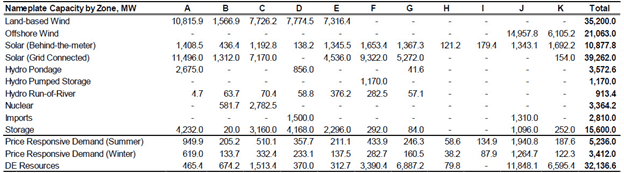
Tables 9 -12 in Climate Change Impact and Resilience Study Phase II list the nameplate capacity for zero-emission resource sectors.  I compared the Cornell Study Model nameplate capacities as calculated above in a summary table.  The Resilience Study considered two cases: one with the CLCPA mandates and one without.  The Study also compared their results with NYISO Grid in Transition study that also seeks to understand the reliability and market implications of the State’s plans to transition to clean energy sources.  That study also considered two similar cases.  The energy transition case study projections for both studies are markedly different than the Cornell Study.  For example, in Table 9 the Resilience Study projects on-shore wind capacity 68% higher, distributed solar 41% higher, utility-scale solar 88% higher, nuclear 29% higher, and energy storage 63% higher.  Of the 12 resource categories in the Resilience study only on is “close” at 11% different.

Discussion

I will briefly explain why I think there are such significant differences.  The biggest problem is the time-scale for the evaluation.  The paper states:

The demand predictions for annual electricity and space heating thermal energy within the planning horizon for New York State are shown in Fig. 2(a) in blue and orange curves, respectively. The energy demands are expressed in an annual basis, which has been applied in previous optimization works on energy system transition considering high-penetration of variable renewable energy. The spatial resolutions for both the electric and space heating thermal energy are state level.  In other words, the state-level demands as shown in Fig. 2(a) would be balanced with the energy supply in the state through optimization.

I interpret that to mean that the optimization is based on annual state-wide parameters.

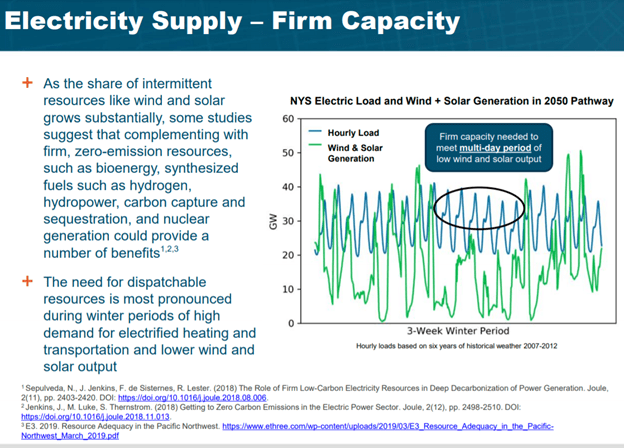
If my interpretation is correct, then the entirety of the Cornell Study Model results can be ignored.  On an annual basis the Texas electric system worked but when there was a short-lived extreme stress on load the result was massive blackouts.  All the credible work done for CLCPA implementation determine the resource requirements based on short periods because an electric system that depends upon renewable energy has to address the period with the lowest wind and solar availability not any long-term average.

The ultimate problem is that no matter how many wind turbines and solar panels there are, when the sun isn’t shining and the wind isn’t blowing no electricity is generated.  In fact, the credible studies include a special resource to address those periods.  On October 8, 2020 Kevin DePugh, Senior Manager for NYISO Reliability Planning, made a presentation  that lists the characteristics of this Dispatchable Emissions-free (DE) resource:

  • Large quantity of DE Resource generation is needed in a small number of hours;
  • DE Resource has low capacity factor (~12%) during the winter;
  • DE Resource has only a 3.7% capacity factor in the summer;
  • DE Resource is not needed at all during spring and fall;
  • Substantial quantity of DE Resource capacity is needed, the energy need is minimal;
  • DE Resource must be able to come on line quickly, and be flexible enough to meet rapid, steep ramping need;
  • On an average day, storage can meet evening peaks, but the DE Resource must generate if storage is depleted and renewable generation is low; and
  • In the Winter CLCPA scenario, the DE Resource output across the state must increase from 362 MW (1.1% of DE Resource nameplate capacity) to27,434 MW (85.4% of name plate capacity) in six hours of the most stressed day.

The Cornell Study Model did not address this problem because they optimized using annual parameters.  Omitting this problem is a fatal flaw.

I noted other issues before I stopped looking.  As noted previously the optimization model did not reproduce the 2019 resource mix.  For energy storage, “the technology specification  and economic data for Hornsdale Power Reserve Battery Energy Storage System that was installed by Tesla are used for battery storage systems in this study”.  However, the facility is making most of its money providing Frequency Control Ancillary Services and is not being used for energy storage.  I think the state-wide optimization approach smooths out all the transmission constraint issues which is a problem even in the considerably more detailed IPM system.  The optimization model projected that 25,714 MW of offshore wind capacity would be needed but the National Renewable Energy Lab (NREL) has determined that New York offshore technical potential estimate is only 21,063 MW.

Conclusion

I have no doubt that advocates for the CLCPA will point to the Yale Climate Connections report of this study as proof that New York’s climate goals are achievable.  However, even this cursory evaluation of the approach and results indicates that the claim that the goals are technologically and economically feasible are simply not credible.

Climate Leadership and Community Protection Act Lesson from the German Energiewende

The German Energiewende (“energy transition”) is often touted as an example for the Climate Leadership and Community Protection Act (CLCPA).  I agree but, as explained in a recent article Daniel Wetzel at German national daily Die Welt, the attempt to transition to green energy has shown that there are significant problems using today’s technology.

I have summarized the schedule, implementation components, and provide links to the legislation itself at CLCPA Summary Implementation Requirements.  I have written extensively in posts on implementation of the CLCPA because I  believe it will adversely affect affordability and reliability as well as create more environmental harm than good which affects my future as a New Yorker.  I have described the law in general, evaluated its feasibility, estimated costs, described supporting regulations, listed the scoping plan strategies, summarized some of the meetings and complained that its advocates constantly confuse weather and climate.  The opinions expressed in this post do not reflect the position of any of my previous employers or any other company I have been associated with, these comments are mine alone.

According to Clean Energy Wire’s guide to the Energiewende, “Germany’s experience offers valuable insights and can serve as an example on how to wean a major economy off fossil fuels, even for countries with their own unique conditions and challenges”.   However, a German Government Audit report warns that the Energiewende is causing higher costs, and that there is a real danger of electricity shortfalls.  Pierre Goslin summarizes the report in “Explosive” German Government Audit Report: “Energiewende” Has Become “A Danger to all Germany”.

Goslin reports:

The “Energiewende” (transition to green energies) has seen Germany recklessly rush into wildly fluctuating wind and solar energy without properly planning the grave impacts they would have on the power supply grid and prices.

The German auditors had already voiced harsh criticism three years earlier in another special report, whose main focus had been on the high cost of the Energiewende. The latest report now also includes “an explosive analysis” on power supply instability and the high probability of power shortfalls.

The report finds that not only have the costs spiraled out of control, but that the German federal government “does not have a sufficient view of the emerging, real dangers to the security of supply” and that “ever higher electricity prices” are to be feared in the current system.

German electricity are among the highest in the world, and there is still no end in sight for the cost spiral. One study found that another whopping 525 billon euros will be needed by 2025 to upgrade the power grid, according to Die Welt.

The development of green energies in Germany has gotten so bad that the Federal Audit Office sees the risk the Energiewende could “endanger Germany as a business location and overburden the financial sustainability of electricity-consuming companies and private households.”  “This can then ultimately jeopardize the social acceptance of the energy transition,” warned Scheller.

Die Welt characterizes the Government Audit report as “explosive” and a long overdue wake-up call. The auditors accuse the federal government of not having properly taken into account the consequences of the coal phase-out, making assumptions that seem “unrealistic or are outdated by current political and economic developments” and making overly optimistic assumptions on the future available wind and sun.

Advocates for the CLCPA believe that wind and solar provide an economic way to transition off fossil fuels.  David Wojick recently published an article that succinctly explains why that approach why one factor makes that a false assumption: the Minimum Backup Requirement (MBR).  Wojick explains that “The minimum backup requirement is how much generating capacity a system must have if it is to reliably produce the electricity we need when wind and solar don’t.”  I have written about this issue but was unable to simply describe it this well.

Michel at the Trust, yet Verify blog evaluated the potential effect of increased electricity production from intermittent energy sources in a post using a simple solar and wind capacity increase data analysis model and found that in Belgium in enormous amounts of over-building are required to cover periods with low wind and solar.  With help from Michel we did a similar analysis for New York and I found that even with unrealistic assumptions about the “best case” availability of solar and wind capacity, there are periods with significant deficits. In order to prove the extraordinary claim that solar and wind can replace existing fossil the State of New York, a similar type of analysis using actual data to estimate realistic energy production must be done. That is the only way to provide the extraordinary proof showing just how much energy storage will be required to prevent deficits.

Conclusion

The Government Audit report accuses the federal government of making assumptions that seem “unrealistic or are outdated by current political and economic developments” and making overly optimistic assumptions on the future availability of wind and sun available.  The draft plans for the CLCPA are going down that same path.  I believe the German results will also occur in New York.

Climate Leadership and Community Protection Act Off-shore Wind Resiliency

New York’s Climate Leadership and Community Protection Act (CLCPA) establishes targets for decreasing greenhouse gas emissions, increasing renewable electricity production, and improving energy efficiency. 

The CLCPA was described as the most ambitious and comprehensive climate and clean energy legislation in the country when Cuomo signed the legislation but there is one massive flaw.  The lawmakers who enacted this law presumed that the transition of the state’s energy system could be implemented by political will so did not include feasibility conditions in the targets or schedules.  This post is a short description of one aspect of the many implementation problems of this law.

I have summarized the schedule, implementation components, and provide links to the legislation itself at CLCPA Summary Implementation Requirements.  I have written extensively in posts on implementation of the CLCPA because I  believe it will adversely affect affordability and reliability as well as create more environmental harm than good which affects my future as a New Yorker.  I have described the law in general, evaluated its feasibility, estimated costs, described supporting regulations, listed the scoping plan strategies, summarized some of the meetings and complained that its advocates constantly confuse weather and climate.  The opinions expressed in this post do not reflect the position of any of my previous employers or any other company I have been associated with, these comments are mine alone.

One of the targets of the CLCPA is to develop 9,000 MW of offshore wind by 2035.  This is considered necessary because off-shore wind has a higher resource availability.  Importantly this is just the start of what is accepted as a much larger offshore wind capacity that eventually will be needed for the ultimate goal of a net-zero emissions economy in New York in 2050.  For example, the Brattle Group analysis for the NYISO, New York’s Evolution to a Zero Emission Power System, estimates that 25,000 MW of offshore wind will be needed in 2040.  This article considers resiliency of the offshore wind capacity needed for the CLCPA.

Tony Heller writing at  Real Climate Science does an amazing job digging up newspaper accounts of past weather events like this description of the “Greatest Cataclysm in American History”.   In that article he uses newspaper archives and other contemporaneous accounts to describe the extreme weather on March 27, 1913 when there was widespread flooding in Indiana and Ohio, a massive tornado hit Omaha, NE, and tornadic storms ranged east into Pennsylvania.  One can only imagine the hysterical cries of climate change impacts if this situation were to repeat itself today. 

I think that comparing the weather of the past to today is important to understand that natural variability causes most of the observed extreme weather observed.  Historical weather observations should also be used to evaluate plans for the future.  If we cannot plan for the past then we shouldn’t even try to plan for the future.  Heller recently described a 2014 report from the Swiss Reinsurance (Swiss Re) Company titled “The Big One, the East Coast’s USD 100 billion hurricane event” that is the impetus of this post.  In the report Swiss Re examines how the 1821 Norfolk and Long Island hurricane would impact the region today. 

The Swiss Re report’s introduction describes the storm:

Nearly 200 years ago, a powerful hurricane decimated the Mid-Atlantic and Northeast United States. Packing wind gusts of over 156 miles per hour, the Norfolk Long Island Hurricane of 1821 surged up the Eastern Seaboard creating chaos and wreaking havoc from the Outer Banks of North Carolina all the way up to the Boston metropolitan area. If this hurricane was measured by today’s standards, it would be a strong Category 4 storm — unlike anything the Mid-Atlantic and Northeast have recently seen or experienced.

In comparison, Hurricane Sandy, with its unique track, 1,000-mile-wide wind field, and low central pressure, pushed record-breaking storm surge into the New York and New Jersey coasts, destroying businesses, homes, and lives in a short 24-hour period. But for all the devastation and damage that Hurricane Sandy brought, its intensity at landfall, measured by 1-minute maximum sustained winds, was equivalent to a weak Category 1 hurricane. Other events in recent years (Irene, Isabel, Gloria, and Bob), while significant, weakened prior to landfall, coming onshore as either Category 1 or Category 2 hurricanes, and not the major hurricanes originally anticipated and feared.

The report states that “If the 1821 Hurricane were to happen today, it would cause 50% more damage than Sandy and potentially cause more than $100 billion in property losses stemming from storm surge and wind damage.”  I had never heard of this storm but I knew about the “Great Hurricane of 1938” which decimated Long Island and New England leaving over 700 dead.  The question is how would a hurricane similar to these storms New York’s proposed offshore wind facilities.

The New York State Energy Research and Development Authority Offshore Wind Projects site describes the current status of the program to reach the 9,000 MW target by 2035.  As of early 2021 there are five offshore wind projects in active development.  The following figure from the website shows where the projects from the first two offshore wind procurements are located.

I wondered whether a storm with the same track as the 1821 and 1938 hurricanes would affect these locations. The Swiss Re report reconstructed the storm track and wind field for the 1821 hurricane:

The New York City National Weather Service has a web page describing the Great Hurricane of 1938 that includes a wind field map developed by Dr. Isaac Ginis at the University of Rhode Island:

The answer to my question whether a storm similar to the 1821 and 1938 hurricanes would affect the five offshore wind projects is unequivocally yes.  The Forward of the Swiss Re report makes an important point regarding this threat:

It’s been two years since Hurricane Sandy reminded us that the Northeast United States is vulnerable to hurricanes, and for those still recovering from the storm’s aftermath, the trauma of the hurricane continues. Yet despite Sandy being the third largest hurricane loss on record, the majority of New York, New Jersey, and other Northeast residents did not experience how devastating a hurricane could be. For many of us Sandy is little more than a distant memory of a temporary inconvenience.

In the months following Sandy many experts told us that Hurricane Sandy was a very unusual event. It was unusual in terms of its westward storm track, its interaction with the jet stream, the high tide, and how it intermingled with the continental weather systems. They tell us that the probability of a similar storm taking the same perpendicular track as Sandy is at least one in 500 years.

Once in 500 years is misleading. Although Sandy was unusual in a meteorological sense, it wasn’t a particularly intense storm and lacked the widespread high winds and rainfall that can occur with a Northeast hurricane. It’s highly unlikely that we will see a hurricane with the same characteristics as Sandy. However it’s very likely (1 in 50 years) that we will see, and in fact, have seen, other hurricanes in the Northeast that would have caused economic damages equal to or greater than those caused by Hurricane Sandy if they were to occur today. Sandy is a harsh reminder of what greater event potentially awaits us.

Conclusion

The official story is that renewable energy like offshore wind will be more diversified and resilient than the current electrical system. Different types of fuels at existing power plants truly provide a redundant and flexible power system that can provide reliable electricity when needed.  In contrast wind and solar power which are utterly dependent upon the vagaries of weather cannot be called flexible and certainly are not dependable without additional energy storage and grid support services that markedly increase the cost.  The claim that wind and solar are less prone to massive outages is absurd given that every night with calm winds causes an outage of both of these generating resources.  

Unfortunately, resiliency in the event of extreme weather is an even bigger problem. There is no question that a hurricane with stronger winds than Sandy will go through the area where New York is developing offshore wind.  The fact that two hurricanes with winds well over 100 mph have passed over New York’s offshore wind development areas should be a major concern.  I worry that New York will invest billions in these resources, get to a point where they are necessary for reliability only to see one storm come through and knock out the resource for an extended period. 

CLCPA Power Generation Advisory Panel Comments on the Texas Energy Debacle

Since the Texas energy debacle of 2021, I have been examining how the Power Generation Advisory Panel is treating reliability in its recommendations for the implementation of the Climate Leadership and Community Protection Act (CLCPA).  I wrote several articles reviewing the Analysis Group Climate Change Impact and Resilience Study (“Resilience Study”) prepared for the New York Independent System Operator (NYISO) relative to the Texas energy debacle.  This culminated in comments submitted to the Power Generation Advisory Panel that I will summarize in this article.

I have written extensively on implementation of the CLCPA closely because I worry that its impacts on affordability, reliability and the environment affect my future as a New Yorker.  I have described the law in general, evaluated its feasibility, estimated costs, described supporting regulations, listed the scoping plan strategies, summarized some of the meetings and complained that its advocates constantly confuse weather and climate.  I described my initial impression of the Texas blackout, described the initiatives and analyses provided to the panel that were relevant and evaluated reliability in the enabling initiatives in earlier articles.  The opinions expressed in this post do not reflect the position of any of my previous employers or any other company I have been associated with, these comments are mine alone.

Background

I have summarized the schedule, implementation components, and provide links to the legislation itself at CLCPA Summary Implementation Requirements.  Section § 75-0103 in the CLCPA establishes the New York state Climate Action Council (CAC). The CAC is supposed to “prepare and approve a scoping plan outlining the recommendations for attaining the statewide greenhouse gas emissions limits” by December 31, 2021.   In order to “provide recommendations to the council on specific topics, in its preparation of the scoping plan, and interim updates to the scoping plan, and in fulfilling the council’s ongoing duties”, the CAC (§ 75-0103, 7) “shall convene advisory panels requiring special expertise and, at a minimum, shall establish advisory panels on transportation, energy intensive and trade-exposed industries, land-use and local government, energy efficiency and housing, power generation, and agriculture and forestry”.  Once the process started it became clear that another panel covering waste would be needed.  Advisory panel meetings and materials are available on New York’s Climate Act website.

I have been following the activities of the Power Generation Advisory Panel since they began work because I believe this is the most important panel.   It is the most important because electrification of as many current fossil-fueled sources as possible is necessary to meet the CLCPA targets.  Therefore, the zero-emission electric system has to provide reliable and affordable electrical energy for what I believe will be higher loads than today.  

Discussion of comments

On March 25, 2021 I submitted comments to the Power Generation Advisory Panel.  It is not clear how this panel and the others address comments submitted.  I understand that there is a share drive that contains all the comments received but I don’t think that is an adequate mechanism for the panel’s use.  This process is intense and time-consuming for all the participants and it is unfair for the members of the panel to have to sift through comments.  It would be far better for agency staff to review all the comments, categorize them, provide synopses of comment categories and highlight comments of particular interest.  Ideally, these reviews could be used to invite commenters with important issues to provide the opportunity to interact directly with the panel.  As far as I can tell the comments are treated as requirement of the law rather than a resource for developing the best recommendations.  I doubt that the majority of the panel members have read any of my comments.

At the February 12 and 22 and March 10, 2021 Power Generation Advisory Panel meetings ten “enabling” initiatives or strategy recommendations for the Climate Action Council were discussed.  The CLCPA Power Generation Advisory Panel Enabling Strategy Initiatives Summary table lists 15 different initiatives for possible recommendations.  At the time of this writing ten of the initiatives have been discussed.  I assume that the remaining initiatives will be discussed at upcoming meetings.  I reviewed these initiatives relative to the lessons I learned from the Texas energy debacle and my comments addressed my findings.

I believe that reliability and affordability should be primary drivers of the CAC scoping plan.  I think a primary shortcoming of the CLCPA is the presumption that the transition is feasible. When the law was enacted it was described as the most ambitious and comprehensive climate and clean energy legislation in the country and supporters were happy with transition schedule.  While there is political capital in being the first and “best”, the reality is that no jurisdiction has implemented anything close to the targets of the CLCPA.  It is concerning that those jurisdictions that have tried have had problems with affordability and reliability.  In that regard it is important to consider the February 2021Texas blackouts.

My over-arching concern with the draft recommended enabling initiatives is a lack of focus on reliability.  I worry that some commenting stakeholders and even some members of the panel under value reliability and would accept blackouts in the future.  My comments describe blackouts that have affected New York City and the responses that were implemented to prevent future blackouts.  I go on to describe the impacts of the Texas blackout in February 2021, reasons it occurred, and what needs to be done to prevent a re-occurrence.  As New York transitions its electric system to one dependent upon renewables all of the issues raised by that blackout need to be addressed. 

I do not believe that the 2021 Texas energy debacle was caused by the lack of wind and solar resources but the fact is that they were not available when needed most.  The situation does foreshadow the difficulty providing reliable electricity in a system that depends on renewables when the wind isn’t blowing at night.  The primary cause for the blackouts was a lack of planning manifested by an electric market that only pays for the energy produced.  As a result, there is no incentive to develop the capacity needed for rare extreme conditions so when it was needed it simply was not there.  Both Federal and Texas policy prioritized and subsidized unreliable energy sources (wind and solar) at the expense of reliable ones (natural gas, coal and nuclear) for decades and this was a contributing factor.  The problem that New York has to address to avoid a similar problem is that the coldest air of the winter and the highest demand occurs when cold air moves in behind a cold front.  This Arctic air is associated with a cold core high pressure system pushing the front.  Those high-pressure systems have very little wind and, in the winter, there is little solar energy available in the best case.

My comments described the New York reliability planning process which will have to confront this issue.  I showed that reliability risks are increasing in New York because of diversity, redundancy, flexibility, dependability, and resiliency changes in the electrical sector.  I went on to explain that the Analysis Group Climate Change Impact and Resilience Study (“Resilience Study”) and similar work by E3 for the CAC implementation process both highlight the problem that in order to meet the CLCPA emissions reduction goals a resource category that provides firm, dispatchable and zero-emissions generation is needed when wind and solar resources are low or non-existent.  Because the only proven technologies that can provide those resources are nuclear and hydro which are unlikely to provide additional significant future energy in the future, both the Analysis Group and E3 include a placeholder resource category in their projections for future electric generation. Meeting the resource needs for the identified energy deficit gap is necessary and it is a major technological challenge.

My comments argued that the Power Generation enabling initiatives should specifically address concerns derived from the Resilience Study conclusions: “The variability of meteorological conditions that govern the output from wind and solar resources presents a fundamental challenge to relying on those resources to meet electricity demand” and “Energy storage resources that are currently and expected to be available can fill part, but not all of the gap needed to maintain system reliability”.  Of course, the third concern is what can be done about the energy storage gap itself. 

I recommended that the enabling initiatives emphasize planning requirements.  It is necessary to understand how many renewable resources are available during the likely worst case, the multi-day winter wind lull, and an initiative addressing this should be included.  There are initiatives included to address energy storage resources but they should be re-framed to recognize that this technology is not mature and that there are significant implementation challenges to overcome even to meet the 2030 goal.  It cannot be over-emphasized that the only firm, dispatchable and zero-emissions technologies available today are nuclear and hydro.  The relevant initiative does not adequately address the Analysis Group points that: “There is a void that will need to be filled with technologies and/or fuels that ‐ at the scales that would be required ‐ are currently neither proven nor economical” and “There is no doubt a major amount of technological change that will happen over the next twenty years, rendering it very difficult to forecast a future resource set with reasonable confidence”.  A separate initiative should be included that spells out a planning process to meet this challenge and notes that until this technology is available and deployable the 2040 zero-emission target cannot be met without reliability consequences

Conclusion

I concluded that the lesson to be learned is that the Texas energy policy emphasis on unreliable renewable energy sources without addressing the need for firm, dispatchable and zero-emissions generation led to a catastrophic blackout.  I believe that it is incumbent upon the Power Generation advisory panel to ensure that New York’s transition to a zero-emissions electric energy grid does not result in a similar fiasco.  At this time the Power Generation Advisory Panel is not placing sufficient emphasis on the reliability issues raised by E3 and the Analysis Group that need to be addressed to prevent future blackouts.  I trace this problem back to the Cuomo administration approach for implementing the CLCPA.  David Zaruk, an EU risk and science communications specialist, and author of the Risk Monger blog recently described  the current state of policy leadership that describes the problem: 

“The world of governance has evolved in the last two decades, redefining its tools and responsibilities to focus more on administration and being functionary (and less on leadership and being visionary). I have written on how this evolution towards policy-making based on more public engagement, participation and consultation has actually led to a decline in dialogue and empowerment. What is even more disturbing is how this nanny state approach, where our authorities promise a population they will be kept 100% safe in a zero-risk biosphere, has created a docilian population completely unable and unprepared to protect themselves.”

His explanation that managing policy has become more about managing public expectations with consultations and citizen panels driving decisions describes the Advisory Panels to the Climate Action Council.  He says now we have “millennial militants preaching purpose from the policy pulpit, listening to a closed group of activists and virtue signaling sustainability ideologues in narrowly restricted consultation channels”. 

This is exactly what is happening on this panel in particular.  Facts and strategic vision were not core competences for the panel members.  The Cuomo administration chose members based more on their allegiance to the political agenda of the CLCPA than on their energy system expertise.  Because of their belief that climate change is an existential threat, their biggest concern is eliminating fossil fuel use as soon as possible.  The Cuomo administration and some panel members don’t understand or don’t want to understand that there are reliability ramifications to the shutdown of firm, dispatchable sources of electric power if the zero-emissions replacement technology is unavailable.  It is likely that will be the case in the CLCPA transition schedule.  That the rational result may be a delay in the schedule is unthinkable to them.  Of course, when the inevitable blackout occurs and people literally freeze to death in the dark, they won’t be accountable.

Climate Leadership and Community Protection Act NYISO Resilience Study and the Texas Energy Debacle – Reliability Resources Update

As part of my review of the Texas energy debacle relative to New York I assessed whether the implementation of the Climate Leadership and Community Protection Act (CLCPA) would affect reliability.  I wrote a couple of articles reviewing the Analysis Group Climate Change Impact and Resilience Study (“Resilience Study”) prepared for the New York Independent System Operator (NYISO) relative to the Texas energy debacle and compared their findings relative to the CLCPA power generation advisory panel strategy recommendations.   This is an update addressing additional recommendations that have been presented since the earlier article and a more detailed examination of the enabling initiatives components addressing reliability.

I have written extensively on implementation of the CLCPA closely because I worry that its impacts on affordability, reliability and the environment affect my future as a New Yorker.  I have described the law in general, evaluated its feasibility, estimated costs, described supporting regulations, listed the scoping plan strategies, summarized some of the meetings and complained that its advocates constantly confuse weather and climate.  The opinions expressed in this post do not reflect the position of any of my previous employers or any other company I have been associated with, these comments are mine alone.

 Generation Advisory Panel Draft Enabling Initiatives

At the February 12 and 22 and March 10, 2021 Power Generation Advisory Panel meetings ten “enabling” initiatives or strategy recommendations for the Climate Action Council were discussed.  The CLCPA Power Generation Advisory Panel Enabling Strategy Initiatives Summary table lists 15 different initiatives for possible recommendations.  At the time of this writing ten of the initiatives have been discussed.  I assume that the remaining initiatives will be discussed at upcoming meetings.

In a recent post I said I was disappointed with the initiative topics addressed by the panel.  Given that no jurisdiction anywhere has actually implemented a zero-emissions electricity generating system I believe that the emphasis of this advisory panel should be on initiatives that enable or implement zero-emissions generation and the necessary supporting infrastructure including transmission necessary to deliver the power generated when and where needed.  Affordability and reliability should also be considered.  The reason I am disappointed is that resources were squandered on four topics that are out of the scope of power generation and are being considered by other advisory panels.

I believe that the enabling initiatives should specifically address three concerns derived from these Resilience Study conclusions: “The variability of meteorological conditions that govern the output from wind and solar resources presents a fundamental challenge to relying on those resources to meet electricity demand” and “Energy storage resources that are currently and expected to be available can fill part, but not all of the gap needed to maintain system reliability”.  Of course, the third concern is what are they going to do about the missing energy resources gap that will need to be filled with technologies and/or fuels that ‐ at the scales that would be required ‐ are currently neither proven nor economic.

The focus of this post is whether the draft initiatives adequately address the reliability resource issues described in the Resilience Study.  In a previous post I explained that the Integration Analysis will incorporate the recommended initiatives in the development of the economy wide analysis of energy supply, energy demand and other aspects of the economy affected by the CLCPA.

Discussion

In this analysis I looked at all the initiative to see how many components specifically addressed reliability issues.  The Generation Advisory Panel Enabling Initiative Components that Explicity Address Reliability Issues table lists eight initiatives that have components that explicitly address reliability and categorizes which components address it.  There are 36 components and 29 address reliability in some fashion.  The key question is whether the enabling initiatives address the three concerns in the Resilience Study.

The first enabling initiative addresses reliability more than any other.   As such it is instructive to consider the notes from the February 12 meeting where this was discussed as well as the draft summaries.  I extracted the relevant notes for this initiative, annotated my comments in the linked document and will summarize the discussions here.  There are two categories of technology solutions in this enabling initiative: those required to meet the 2030 goal and those to meet the 2040 goal.

The Technology Solutions initiative has two components for the 70 by 30 goal: “focus on energy delivery, the economics of long duration and seasonal storage, siting, and identifying technology gaps” and “aggressive deployment of current renewable energy and storage technologies”.  It appears to me that these components are simply calls to build as much as possible as fast possible and worry about whether that will work, much less address whether this plan is effective, later.  I think this might lead to problems.  For example, at the 19 January 2021 Climate Action Council meeting the meeting presentation announced that New York’s 2020 renewable energy standard solicitation includes 22 new large-scale renewable energy projects including the 110 MW Rutland Center Solar One project due east of Lake Ontario in the north central part of the state.  This may not be an appropriate location if the multi-day winter period of calm is the critical worst-case period because this site is in the Lake Ontario snow belt.  As a result, it is likely that during the worst-case renewable resource availability period the panels will be covered by snow and provide no support at all for the New York electric system. To effectively address that period, solar in similar locations should be discouraged.

I do not believe the components described to meet the 2030 goal adequately address reliability.  From what I understand in the summary and notes, the panel believes that meeting the 70% reduction of GHG emissions by 2030 will not require technological breakthroughs, only accelerated deployment and investments.  I think that presumes that we are not that far away from the target, but we don’t know how far we have to go because current levels of emissions using New York’s methodology have not been released.  The key question is whether the New York inventory adjustments for methane are so large that could make this a more difficult goal to achieve than is commonly believed today.  I believe that it might be necessary to have long-duration storage in the energy mix needed to meet the 2030 goal and that means natural gas is going to be needed until long-duration energy storage can be implemented at scale and in time.  It appears that is a controversial presumption within the panel.  I am also concerned that the reality of current energy storage technology does not comport with what will be needed.  No jurisdiction has implemented energy storage at the levels likely needed so there may be unforeseen issues.  Finally, I believe we do not know enough about renewable energy resources worst case availability to determine whether present technology can provide enough power to keep the lights on.

There are four components for the achievement of the 100 by 40 goal.  The first component is “detailed, holistic, modeling within a zero-emissions world to identify needed technologies”.  Clearly, in order to meet the 2040 goals technological innovations will be required and this kind of modeling is necessary to define the problem.  Unfortunately, I don’t think most of the panel understands just how large a challenge this is.  Moreover, there is not universal understanding that replacing fossil fuel infrastructure should only be done when those innovations have produced technology that is mature enough to be available for deployment.  That takes time.  This goes back to the politically correct but technical unreality that replacing fossil fuels is only a matter of political will.  It is not clear that all the members of the panel understand the difference between a political slogan and reality.

Finally note that there were complaints about an over-emphasis on the last 5-10%.  The comment that the “conversation about the last 5-10% is a distraction” demonstrates a lack of knowledge about the reality problem.  The electric system is designed to provide reliable service under all conditions and it turns out that in order to do that the prime consideration becomes how do you handle peak load periods – the last 5-10%.  The Texas energy system did not consider the last 1% and look what happened.  I believe that not emphasizing the last 5-10% will lead to blackouts sooner and more often.

Also included in the 100 by 40 goal are two other components: “Support NYSERDA in its innovation efforts, including the development of a consortium of stakeholders to develop these solutions” and “supporting utility-scale demonstration projects of new technologies, including storage and transmission and distribution”.  Both are necessary steps in order to develop the technology needed for a reliable system.

The final component of this initiative is “during planning, emissions free resources (e.g., storage, energy efficiency, distributed renewable energy) should be prioritized where feasible when considering end uses, technology limitations, and costs. However, should a substitute for natural gas still be needed, advanced green hydrogen and possibly RNG could fill this gap in order to maintain reliability, if scalability, feasibility, and environmental impact issues can be addressed”. These technologies have been disparaged during discussions because they allegedly empower natural gas use.  That concerns me because it appears to limit future technologies.  Given the magnitude of the challenge and necessity for dispatchable emissions free resources, I think it is premature for anything to be taken out of consideration in the initial strategies.

Subsequent to the first meeting, two other topics were added to “build into Technology Solutions recommendation”.   The first was described: “As the State moves towards a zero emissions grid in 2040, flexible and dispatchable resources will be critical. Further analysis, technical development, and research is needed in order to determine the feasibility, climate impact, and health impacts of advanced fuels and nuclear.”  The second description stated that: “Under current NYS policy and regulation, upstate nuclear facilities are within the resource mix (with existing financial support) until at least 2030. The contribution of nuclear power to the 2040 resource mix and any additional policy actions needed should be evaluated prior to the cessation of the Zero Emissions Credit (ZEC) Program in 2029.”  My impression is that they both were added in response to comments received in the public input sessions included in these meetings.  I was surprised by the number of comments made by people supporting nuclear and opposed to shutting down the final unit at the Indian Point nuclear station.  I am sure that the Generation Advisory Panel was just a surprised as I was.  Obviously, if the climate crisis is an existential threat to society and to address that there is a need for a as yet unidentified new technology to provide zero-emissions dispatchable power, then shutting down 2,000 MW of generation that meets those criteria is the worst thing you can do.  However, the odds of not shutting down Indian Point are vanishingly small in the current political climate of New York.  I agree with the implication of the nuclear topic that nuclear is needed to help meet the CLCPA targets.

The first topic has a component that states that “During planning, emissions free resources (e.g., storage, energy efficiency, distributed renewable energy) should be prioritized where feasible when considering end uses, technology limitations, and costs. However, should a substitute for natural gas still be needed, advanced green hydrogen and possibly RNG could fill this gap in order to maintain reliability, if scalability, feasibility, and environmental impact issues can be addressed.”  This reinforces my impression that the issue of renewable natural gas and advanced green hydrogen as sources of dispatchable zero-emissions energy is a big concern for this panel.  It appears that the ideological and irrational fear of natural gas is spilling over to other similar fuels.  Four other components in this topic addressed the analysis and research needed to actually implement these technologies.

The second initiative is “Market Solutions”.  New York’s electricity market is de-regulated so implementation is not simply a matter of telling the state utilities to do it.  Instead, market rules have to be designed to entice companies to provide the necessary services.  With all due respect to market economists, my impression is that anticipating all the consequences, potential opportunities for market manipulation, and market signals needed is more likely to be a trial-and-error process than a success story in the first try.  The Texas electricity market is not trying to incentivize 100% zero-emissions electricity and did not successfully pull that off.

The third and fourth initiatives address energy storage. Given that the membership of the panel includes people from the energy storage industry it is not surprising that the initiative is a blueprint for the expansion of that industry.  While unquestionably necessary, this is another instance where it appears to me that these are simply calls to build as much as possible, as fast possible and worry about whether everything will out work later, much less address whether this approach is feasible and affordable.  In addition, the existing storage technology initiative presumes that current technology can be deployed at the scale needed in the time needed.  Given the infancy of the technology I think that is unlikely.

Enabling initiative 7, “Grow Renewables” follows the pattern of initiatives that call for implementation before analysis.  One component notes that most renewable energy has been installed upstate but that it needs to be available downstate as well.  It seems to me that a feasibility analysis to see if that is possible would be appropriate.  The last component states that new and upgraded transmission will be needed but the need for transmission support services is not mentioned.

Given that my main concern is reliability, Initiative 8: Reliability for the Future Grid promised to be the answer to that concern.  Unfortunately, the initiative is more for a reliability tracking system during implementation than a comprehensive plan to maintain reliability from the get go.  My over-riding concern is the lack of a comprehensive assessment of renewable resource availability for New York. Instead, it is just presumed that there is enough energy available from wind and solar resources coupled with energy storage to make it work.  The Resilience Study also makes that point but their availability analysis did not consider the joint distribution of wind and solar resources and was over a relatively short period.  Given that the New York reliability standard for a loss of load is a once in ten-year occurrence and that the last time Texas had a similar cold weather event was ten years ago, a minimum of ten years needs to be studied to ensure reliability.

Conclusion

I believe that this is the most important advisory panel because electrification of as many current fossil-fueled sources as possible is necessary to meet the CLCPA targets.  Therefore, the zero-emission electric system has to provide reliable and affordable electrical energy for what I believe will be higher loads than today.

To be clear, the 2021 Texas energy debacle was not caused by the lack of wind and solar resources but it does foreshadow the difficulty replacing them when the wind isn’t blowing at night.  The lesson to be learned is that Texas energy policy prioritized and subsidized unreliable energy sources (wind and solar) at the expense of reliable ones (natural gas, coal and nuclear) for decades but did not incorporate market mechanisms to ensure that the system could operate under conditions that had occurred in the past.  It is incumbent upon the Power Generation advisory panel to ensure that New York’s transition to a zero-emissions electric energy grid does not result in a similar fiasco.  Unfortunately, the enabling initiatives do not explicitly address the factors needed to ensure this will not be the case.

I believe that the enabling initiatives should specifically address three concerns derived from these Resilience Study conclusions: “The variability of meteorological conditions that govern the output from wind and solar resources presents a fundamental challenge to relying on those resources to meet electricity demand” and “Energy storage resources that are currently and expected to be available can fill part, but not all of the gap needed to maintain system reliability”.  Of course, the third concern is what are they going to do about the energy storage gap.  In order to understand meteorological variability it is necessary to understand how many renewable resources are available during the likely worst case, the multi-day winter wind lull and an initiative addressing this should be included.  There are initiatives included to address energy storage resources but they should be re-framed to recognize that this technology is not mature and that there are significant implementation challenges to overcome even to meet the 2030 goal.  It cannot be over-emphasized that the only firm, dispatchable and zero-emissions technologies available today are nuclear and hydro and it is unlikely that we can expect significant increased energy from them.   The relevant initiative does not adequately address the Analysis Group points that: “There is a void that will need to be filled with technologies and/or fuels that ‐ at the scales that would be required ‐ are currently neither proven nor economical” and “There is no doubt a major amount of technological change that will happen over the next twenty years, rendering it very difficult to forecast a future resource set with reasonable confidence”.  A separate initiative should be included that spells out a planning process to meet this challenge and notes that until this technology is available and deployable the 2040 zero-emission target cannot be met without reliability consequences.

I am very concerned that there appear to be members of this panel that either do not understand or do not want to understand the necessary planning needed to ensure reliability and that maintaining reliability is a prime responsibility for any recommendations to the Climate Action Council. There should be an initiative that specifically addresses that prime directive in addition to the initiative that tracks reliability.