Draft NYS Energy Plan Pathways Scenario Scam

This is part of my continuing coverage of the New York State Energy Plan.  On July 23, 2025, the Draft Energy Plan was released for comment.  This post explains how the analyses for the Draft Energy Plan are hiding the true costs to meet the Climate Act targets.

I am convinced that implementation of the New York Climate Leadership & Community Protection Act (Climate Act or CLCPA) net-zero mandates will do more harm than good if the future electric system relies only on wind, solar, and energy storage because of reliability and affordability risks.  I have followed the Climate Act since it was first proposed, submitted comments on the Climate Act implementation plan, and have written over 550 articles about New York’s net-zero transition. 

I acknowledge the use of Perplexity AI to generate summaries and references included in this document.  The opinions expressed in this article do not reflect the position of any of my previous employers or any other organization I have been associated with, these comments are mine alone. 

Net-Zero Aspirations

The Climate Leadership & Community Protection Act (Climate Act) established a New York “Net Zero” target (85% reduction in GHG emissions and 15% offset of emissions) by 2050 and has two electric sector targets: 70% of the electricity must come from renewable energy by 2030 and all electricity must be generated by “zero-emissions” resources by 2040. The Scoping Plan that outlined how to “achieve the State’s bold clean energy and climate agenda” was based on an Integration Analysis prepared by the New York State Energy Research and Development Authority (NYSERDA).  The Climate Act is not the only legislation or regulation that was promulgated to achieve reductions in greenhouse gas emissions to address climate change.  That fact has a major bearing on the NYSERDA Draft Energy Plan Pathways scenario.

Energy Plan Overview

According to the New York State Energy Plan website (Accessed 3/16/25):

The State Energy Plan is a comprehensive roadmap to build a clean, resilient, and affordable energy system for all New Yorkers. The Plan provides broad program and policy development direction to guide energy-related decision-making in the public and private sectors within New York State.

The driving factor for the Energy Plan is the net-zero ambitions of New York’s ruling political party.  This is the first update of the Energy Plan since the Climate Act was passed in 2019.  I have provided more background information and a list of previous articles on my Energy Plan page

In this iteration of New York climate policy the Pathways Analysis is equivalent to the Integration Analysis. Responsibility for implementing the Energy Plan as well as all the Climate Act programs lies with NYSERDA.  Over my multi-decade career, I have seen an ever-increasing level of political influence on NYSERDA’s research priorities and, more recently, the research results. This post explains how the Pathways Analysis scenarios are being used by NYSERDA to hide costs of the Energy Plan net-zero transition.

Costs

I recently gave my first impressions of the Draft Energy Plan released for comment at the most recent Energy Planning Board meeting.  NYSERDA President and CEO Doreen Harris is the Chairperson the Energy Planning Board.  This post focuses on this one aspect of the meeting.  After a presentation regarding the Transmission and Distribution Reliability Study she said.

You may recall during our last meeting in which we discussed the pathways modeling for this plan. And to remind you, the analysis showed that New York’s citizens and businesses will need to invest over one hundred billion dollars each year in the energy system, no matter which future path we take.

I have one immediate response.  There is a future path that would not cost over $100 billion.  NYSERDA, ever beholden to the Hochul Administration’s political plans, has prepared a comprehensive roadmap using a misleading limited assessment  As was the case with the Integration Analysis and Scoping Plan, NYSERDA is interpreting the “No action” scenario as one that includes all legacy programs in place prior to the passage of the Climate Act.  The appropriate baseline scenario is one that excludes all programs that were promulgated to reduce GHG emissions.

Legacy Programs

The Energy Plan Pathways Analysis defines the “No Action” pathway scenario as “reflecting outcomes in the absence of the Climate Act and energy policies enacted from 2019 onwards”.  The Perplexity description goes on: “It includes federal energy incentives and legacy New York State policies (i.e., those in place as of early 2025), but it explicitly excludes any state and local climate, decarbonization, or efficiency policies put in place since 2019.”

I have found that Perplexity is a very useful research tool enabling me to easily find references needed to document my articles.  However, its summaries are colored by the references it finds.  The query response concluded that “This scenario thus serves as a baseline representing a world without recent state-driven climate action”.  No, it does not.  It reflects New York State driven climate action since 2019 not a baseline without climate action. 

The Pathways analysis refers to previous actions as “legacy programs”.    When I requested a Perplexity description of the legacy program investments required no matter which future path New York takes I received the following summary (with my annotations):

Core Infrastructure Investments

According to the pathways modeling presented at the June 25, 2025 New York Energy Planning Board meeting, certain investments will be necessary across all energy scenarios through 2040. These “pathway-independent” investments represent critical infrastructure needs that New York must address regardless of the specific energy future the state ultimately pursues.

NYSERDA has not differentiated between investments necessary for greenhouse gas emission reduction aspirations and those unrelated to climate action.  The failure to differentiate means that the climate action costs are underestimated.

Baseline System-Wide Spending

The pathways analysis revealed that baseline system-wide spending of approximately $120 billion annually (in 2024 dollars) through 2040 will be required to maintain and modernize existing energy infrastructure, replace aging equipment, and purchase fuels to meet energy needs. This represents the foundational investment needed to keep New York’s energy system operational.

Note that when Harris said that investments over $100 billion were required the actual number is $120 billion.  The complication is that there are indeed energy costs that will occur whatever pathway occurs, but they are buried amongst the programs that are included to meet the targets for an 85% emission reduction by 2050, 70% of the electricity must come from renewable energy by 2030, and all electricity must be generated by “zero-emissions” resources by 2040..

Continued Investment in All Fuel Systems

A key finding from the pathways modeling is that all major fuels used in New York today will continue to meaningfully contribute to the state’s energy mix through 2040, including electricity, natural gas, and petroleum fuels. As stated in the Draft Pathways Analysis: “Continued investment in all fuel systems is necessary to assure safe and reliable energy services, in particular to meet peak day needs and to increase resilience”.

Natural Gas System Infrastructure

Despite projected declines in gas consumption across all scenarios, the natural gas system will require continued investment to ensure safe and reliable provision of service. The pathways modeling showed that while gas consumption is projected to decline, it remains a significant resource throughout the relevant period, necessitating ongoing system maintenance and upgrades.

In my opinion, investments in these legacy programs are appropriate for the “no GHG emission reduction mandates” programs.

Electricity System Expansion

The modeling demonstrated that electricity use is expected to grow substantially to power economic growth and expanded use of electric vehicles and heat pumps. This growth requires buildout of a diverse set of resources, including:

  • Wind and solar installations
  • Energy storage systems
  • Advanced nuclear facilities
  • Repowering of aging combustion power plants

Clearly every penny spent on these example buildouts is only included to meet the Climate Act mandates.  Saying anything otherwise is misinformation at best and a lie in my opinion.

Transmission and Distribution Infrastructure

Extensive transmission investments will be necessary to deliver renewable energy across the state and address new constraints appearing across the electric system. The New York Independent System Operator has identified that transmission expansion is “critical to facilitating efficient CLCPA energy target achievement” and noted that “the current New York transmission system, at both local and bulk levels, is inadequate to achieve currently required policy objectives”.

Specific transmission needs include:

  • Major public policy transmission projects already approved by NYISO
  • Local transmission upgrades (Phase 1 and Phase 2 projects approved by the PSC)
  • Infrastructure to accommodate up to 6,000 MW of offshore wind capacity into New York City

This is a mixed bag of programs specifically related to the Climate Act and other necessary infrastructure maintenance.  I have been told that there is a big push to replace aging transmission lines.  If the replacement infrastructure maintains current capacity, it is maintenance but if it is upgraded with additional circuits to collect wind and solar power, then that component is not necessary no matter which energy path we take.

Grid Reliability and Resilience Investments

The pathways analysis emphasized that investments in transmission and distribution systems must be designed to withstand climate change. This includes:

  • Upgrading aging infrastructure
  • Enhancing system reliability metrics
  • Incorporating scenario-based planning processes to address climate change impacts
  • Advanced transmission technologies deployment

These are also a mixed bag of necessary infrastructure programs and programs that would not exist were it not for GHG emission reduction aspirations.

Load Growth Accommodation

All scenarios showed significant new large loads interconnecting to the system, driving growing electricity demand across both annual loads and peaks. Early planning for abundant supply is essential to accommodate this load growth and ensure continued opportunities for economic development.

This is a complicated situation.  If the load growth is due to new manufacturing or cost-effective electrification, then this is true no action energy path cost.  If the upgrades are due to mandated home electrification and electric vehicles, then including the costs in a “no action” Pathway scenario is malfeasance.

Energy Efficiency and Weatherization

Across all pathways, households can lower their overall energy costs by making energy-saving choices such as home weatherization, efficient appliances, and fuel-efficient vehicles. Policy action to reduce up-front costs and other barriers will be necessary to make such choices more accessible.

This is even more complicated.  Energy efficiency and weatherization programs have been in place for decades.  Are they driven by net-zero fantasies or pragmatic cost effectiveness concerns?

Discussion

I believe that the NYSERDA rationale for not including a Pathways scenario that does not include any programs that are only included to address climate change is that there are laws mandating those programs.  Public Service Law Section 66-P Establishment of a Renewable Energy Program is the law that implements the Climate Act renewable energy mandates.  NYSERDA ignores the provisions for bounds on implementation in PSL 66-P. PSL 66-p(2),b states “The commission may, in designing the program, modify the obligations of jurisdictional load serving entities and/or the targets upon consideration of the factors described in this subdivision.”  Section 66-p (4) states: “The commission may temporarily suspend or modify the obligations under such program provided that the commission, after conducting a hearing as provided in section twenty of this chapter, makes a finding that the program impedes the provision of safe and adequate electric service; the program is likely to impair existing obligations and agreements; and/or that there is a significant increase in arrears or service disconnections that the commission determines is related to the program”.

The existence of those safety valve provisions and the current changes in Federal clean energy policies necessitate the inclusion of a Pathways Analysis scenario that does not include any New York or Federal emission reduction programs.  I believe that the majority of New Yorkers agree with me that we want to know the total cost, irrespective of which regulation requirement, that the Energy Plan projects will be necessary to meet the net-zero and electric system mandates of the Climate Act.  In my opinion, there is no question that those costs would be enormous and no question that that fact is being covered up by NYSERDA at the behest of the Hochul Administration.

The NYSERDA Pathways Analysis projects that energy system investments will total $120 billion per year out to 2040.  There are approximately 7.8 million households in New York State.  This equates to over $1200 per month per household.  How much of this is due to net-zero aspirations?

Conclusion

“Fooled me once, shame on you.  Fooled me twice, shame on me.”  NYSERDA is repeating the playbook of the Scoping Plan to hide the costs of Climate Act implementation.  I raised the issue in my Scoping Plan comments but there was no acknowledgement by NYSERDA.  I do not believe that the members of the Climate Action Council who voted to approve the Scoping Plan were told about the comment.  I did not reach enough people to get a scenario included that would represent no emission reduction program costs.  The result was a massive underestimate of the costs of the Climate Act.  The same approach is being used in the Energy Plan.  I believe that the only way to get this to change in the Energy Plan proceeding is for legislators to demand change.   Please contact your legislators and demand a full accounting of all the costs to achieve the Climate Act mandates.
Draft NYS Energy Plan – Need for Real Stakeholder Involvement

This is part of my continuing coverage of the New York State Energy Plan.  On July 23, 2025, the Draft Energy Plan was released for comment.  There is every indication that the Hochul Administration is just going through the motions of a stakeholder process like they did with the Scoping Plan.  This is too important to not do correctly.

I am convinced that implementation of the New York Climate Leadership & Community Protection Act (Climate Act or CLCPA) net-zero mandates will do more harm than good if the future electric system relies only on wind, solar, and energy storage because of reliability and affordability risks.  I have followed the Climate Act since it was first proposed, submitted comments on the Climate Act implementation plan, and have written over 550 articles about New York’s net-zero transition.  The opinions expressed in this article do not reflect the position of any of my previous employers or any other organization I have been associated with, these comments are mine alone.

Energy Plan Overview

According to the New York State Energy Plan website (Accessed 3/16/25):

The State Energy Plan is a comprehensive roadmap to build a clean, resilient, and affordable energy system for all New Yorkers. The Plan provides broad program and policy development direction to guide energy-related decision-making in the public and private sectors within New York State.

I have provided more background information and a list of previous articles on my Energy Plan page

Responsibility for implementing the Energy Plan as well as all the Climate Act programs lies with the New York State Energy Research & Development Authority (NYSERDA).  Over my career I have seen an ever-increasing level of political influence on NYSERDA’s research priorities and, more recently, the research results. This post describes my concerns relative to the energy plan stakeholder process.

Stakeholder Promise and Reality

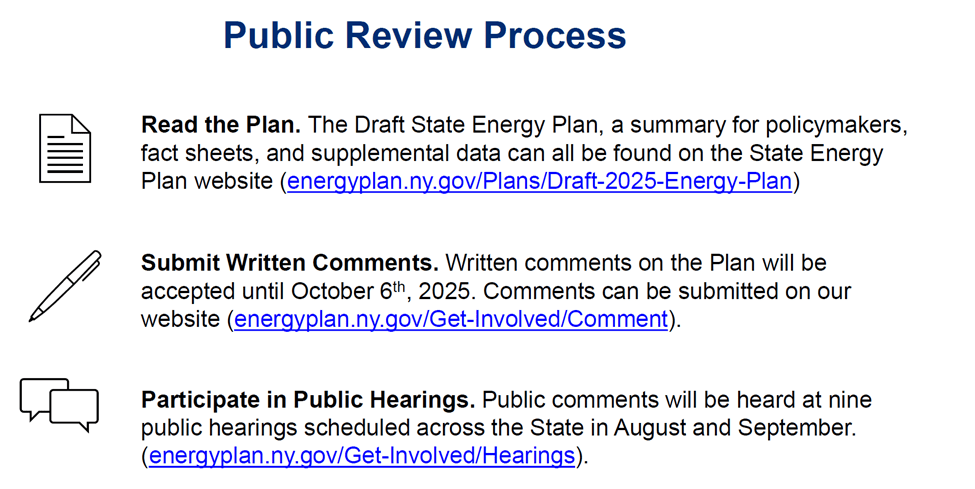
The July 23, 2025 meeting presentations mentioned public participation multiple times.  The following slide (Figure 1) described the process for Draft Energy Plan involvement.  The Draft Energy Plan website has links for submitting written comments and participation in public hearings.  However, indications are that this is just going through the motions.  The public hearings are only two hours long and speakers are limited to two minutes.  That is not nearly enough time to provide anything meaningful.

Figure 1: Public Review Process Description in July 23, 2025 Meeting Presentation.

I signed up to make a statement soon after the hearing notice was announced.  This article documents the comments I plant to provide about the public comment process.

Concern

My first post describing the Draft Energy Plan mentioned two critical requirements for a satisfactory Energy Plan.  Defining metrics for affordability, reliability, and acceptable environmental impacts should be a primary component of the Energy Plan.  A transparent and comprehensive stakeholder process is also needed for credibility.

My worries that NYSERDA treatment of public input in the Energy Plan stakeholder process will mimic the Scoping Plan process have been a consistent theme in all my articles on the Energy Plan process.  I think that NYSERDA is following the same script where the numbers were tortured to provide the desired analysis then tied up into a pretty package.  Now they will go through the motions of accepting public input but will not respond to comments submitted.  The problem is that many of the same inconsistencies and identified problems that did not get addressed in the draft Scoping Plan are present in the draft Energy Plan.  This is unacceptable.

Example 1

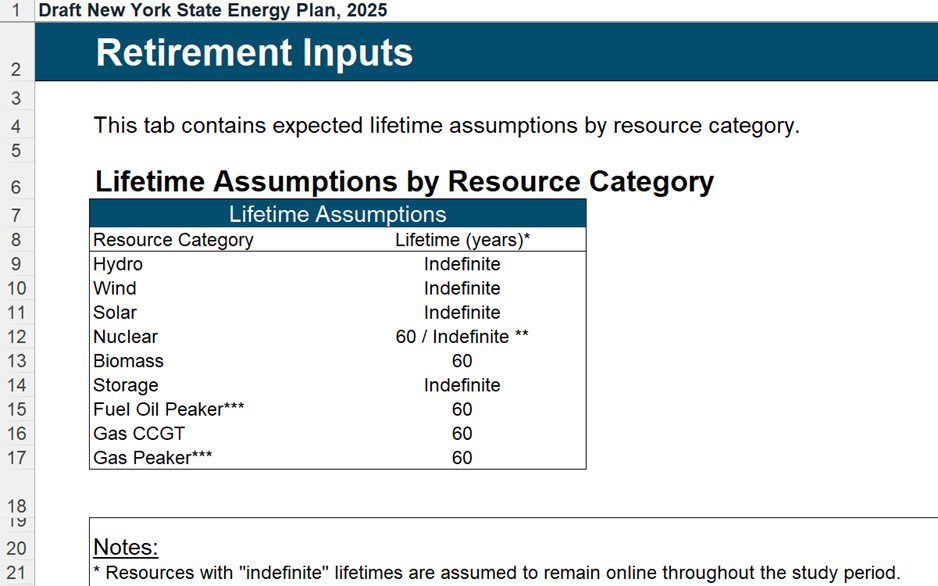
The “Retirement Input” tab in the Pathways Analysis Technical Supplement: Key Drivers and Outputs spreadsheet is shown in Figure 2.  It states that the expected lifetimes for wind, solar, and storage are indefinite.  Most of the existing wind and solar and all of the existing storage will have to be replaced by 2040.  This is an absurd assumption.

Figure 2: Retirement Inputs Table

On June 16, 2022 I submitted a Comment on Retirement Input Assumptions used in the Draft Scoping Plan.

In what appears to be an egregious attempt to reduce the published costs of wind, solar, and battery storage the Integration Analysis assumes that the expected lifetimes of those technologies is indefinite.  As a result, units are assumed to remain online throughout the study period and no costs for replacements between now and 2050 are included.  However. that is a poor assumption because it is totally unreasonable to expect that, for example, the existing land-based resources will still be in operation in 2050.

I estimated the potential impact of this assumption.  Using an indefinite retirement date for these resources underestimates the total builds needed for 2050.  For land-based wind between 3,814 MW and 4,600 MW are not included and for offshore wind between 6,200 and 6,600 MW are not included.  The amount of solar not included ranges between 22,639 MW and 19,983 MW.  Finally, for battery storage between 10,713 MW and 12,207 MW of additional resources will be need to be developed to meet the 2050 projected value. 

The Draft Energy Plan only covers the next 15 years to 2040 so these projections are not completely compatible.  Nonetheless, this is still a uncontestably incorrect assumption.  This error will cause an underestimate of the costs to comply with the Climate Act 2040 mandates.  It is a matter of credibility if it is not acknowledged.

I could go on to provide other examples of issues that I raised in the Draft Scoping Plan that are present in the Draft Energy Plan.  There is no point in bothering to document these issues if there is no commitment to respond to all comments submitted.

Example 2

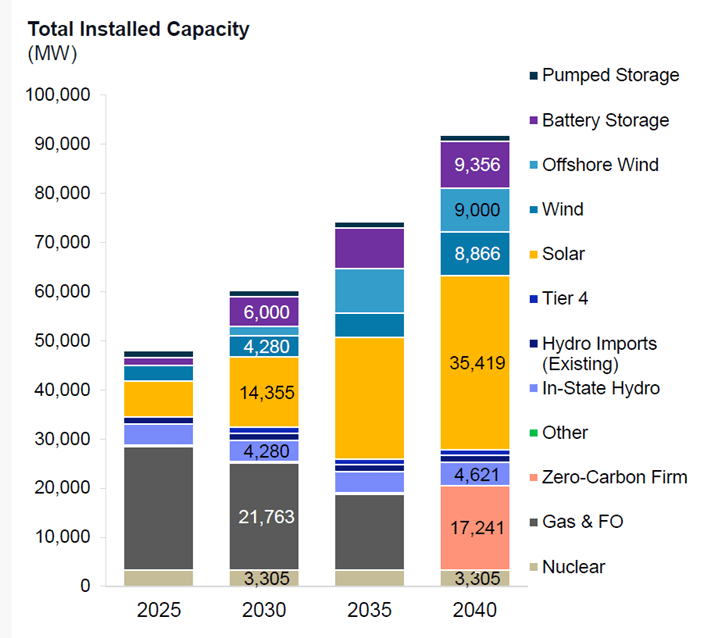
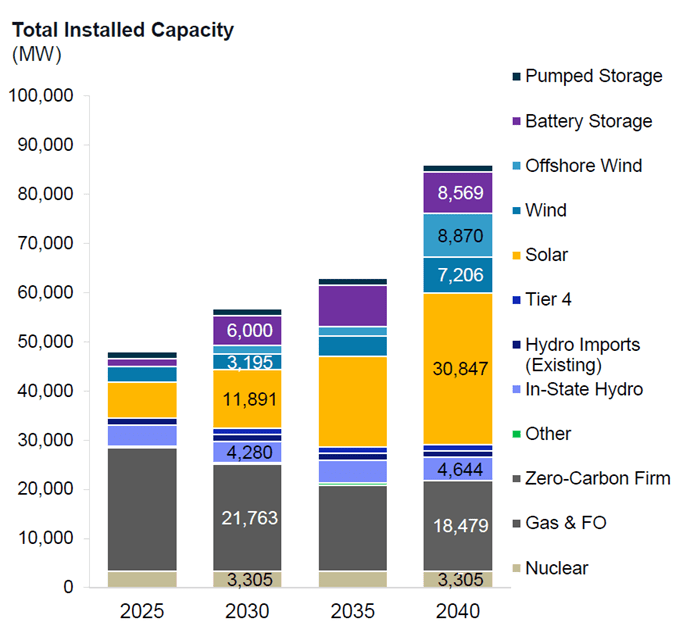
I have always been concerned about differences between the NYSERDA analyses and the work of the New York Independent System Operator (NYISO).  The NYISO mission is “Ensure power system reliability and competitive markets for NY in a clean energy future”.  As part of that responsibility NYISO performed in-depth analyses of power system data and made projections showing estimated changes as a result of the Climate Act.  There are significant differences (Table 1) between the NYISO projections of future generating resource capacity and the NYSERA sponsored analyses that have never been reconciled in an open and transparent public forum.

Table 1: Comparison of 2040 Fuel Mix Capacity (MW) Projections by NYISO and NYSERDA

I am particularly concerned about the capacity differences for the Zero-Carbon Firm or Dispatchable Emissions-Free Resource.  NYISO projects a significantly higher necessary capacity.  There are fundamental viability issues associated with DEFR and it appears that the two modeling approaches are treating the resource differently.  It is critically important that the differences get resolved.  Failure to do so goes beyond a credibility issue associated with the process.  .If this is not resolved there could be reliability consequences and the potential for catastrophic blackouts. 

There is another aspect of the differences between NYSERDA and NYISO  The NYISO analyses have never revealed their cost estimates for the transition.  That information would either provide reassurance that NYSERDA electric system transition estimates are supportable or suggest they need to be improved.

Recommendation

I believe that the stakeholder process for the Climate Act is broken because NYSERDA and other state agencies treat it as an obligation and not an opportunity.  NYSERDA claims that there was “robust public input” during the draft Scoping Plan process that “included 11 public hearings across the State and more than 35,000 written comments” that supposedly were read, summarized, and presented to the Climate Action Council.  The problem is that Agency staff screened the comments for the Climate Action Council and there is no publicly available documentation of their work.  They only presented generalities at meetings and did not summarize specific comments.  I am convinced that any comments that questioned the narrative espoused by Climate Act proponents were ignored and there is no evidence that I am wrong.

I recently found an example of how a stakeholder process should work.  The Santa Clara County Rapid Transit Development Project includes a master plan for transportation for Silicon Valley.  An interview with the founding manager notes: “Part of the plan is a four-year public stakeholder review process.  In the reviews, if the public came up with good ideas, the ideas went into the plan.  If an idea wasn’t good, we had the responsibility of explaining why” from California’s High-Speed Rail Visionary Bill Buchanan, Trains, Volume 85, No. 1, January 2025, pages 30-37.  The process also included public outreach meetings that included the opportunity to ask questions.

A robust public input process includes public outreach.  The Draft Energy Plan was announced after a series of Planning Board meetings earlier this year.  There hasn’t been any opportunity for stakeholders to ask questions about the assumptions and methodologies used.  If the State was serious about considering public input for an energy plan that affects every New Yorker, then they would hold a series of meetings to cover specific technical topics.  A stakeholder process that does not allow for interaction between stakeholders and NYSERDA staff is nearly useless.

In my opinion, NYSERDA should provide a public response to all the substantive comments made regarding the Draft Energy Plan.  A publicly available summary describing specific comments, responses to the issues raised by comments and the recommendation for resolution in the final Energy Plan should be provided to the Energy Planning Board, the Public Service Commission and the public.  If the State is to have any credibility regarding their Energy plan stakeholder process, then they must provide documentation showing that all the comments were considered and addressed.

Conclusion

My biggest Energy Plan concern is whether the Hochul Administration will use the Energy Plan process as an opportunity to consider the implications of the observed transition so far and if the advice of stakeholders in its stakeholder process will be treated as an opportunity to improve the transition.  Earl indications suggest that they are only going through the motions with no attempt to meaningfully engage with any comments inconsistent with the narrative

New York Cap and Invest Litigation

Last March environmental activists sued the State of New York because the Department of Environmental Conservation (DEC) was not promulgating the regulations for the  New York Cap and Invest (NYCI) Program on schedule.  Last Friday, an Albany County judge heard arguments from the activists and the DEC.  A report suggests that the judge “will likely rule that New York is breaking its climate law.”

I have followed the Climate Act since it was first proposed, submitted comments on the Climate Act implementation plan, and have written over 550 articles about New York’s net-zero transition.  My background is particularly suited for NYCI evaluation.  I have worked on every market-based program that affected electric generating facilities in New York including the Acid Rain Program, Regional Greenhouse Gas Initiative (RGGI), and several Nitrogen Oxide programs. I follow and write about the RGGI and New York carbon pricing initiatives. The opinions expressed in this article do not reflect the position of any of my previous employers or any other organization I have been associated with, these comments are mine alone.

Overview

The Climate Act established a New York “Net Zero” target (85% reduction in GHG emissions and 15% offset of emissions) by 2050.  The Climate Action Council (CAC) was responsible for preparing the Scoping Plan that outlined how to “achieve the State’s bold clean energy and climate agenda.”  After a year-long review, the Scoping Plan that outlines how to achieve the targets was finalized at the end of 2022.  Since then, the State has been trying to implement the Scoping Plan recommendations through regulations, proceedings, and legislation.  NYCI is but one example of that effort.

Cap-and-Invest

The CAC’s Scoping Plan recommended a market-based economywide cap-and-invest program.  NYCI is supposed to work by setting an annual cap on the amount of greenhouse gas pollution that is permitted to be emitted in New York: “The declining cap ensures annual emissions are reduced, setting the state on a trajectory to meet our greenhouse gas emission reduction requirements of 40% by 2030, and at least 85% from 1990 levels by 2050, as mandated by the Climate Act.”  Affected sources purchase permits to emit a ton (also known as allowances) and then surrender them at the end of the year to comply with the rule.  Colin Kinniburgh’s description at New York Focus describes the activist’s theory of a cap-and-invest program as a program that will kill two birds with one stone.  “It simultaneously puts a limit on the tons of pollution companies can emit — ‘cap’ — while making them pay for each ton, funding projects to help move the state away from polluting energy sources — ‘invest.'” 

As is the case with all aspects of the Climate Act, this approach is not simple and is riddled with complications that make it unlikely that it will work as advocates expect.  I have summarized my concerns on my Carbon Pricing Initiatives page.  Furthermore, the implementation timetable promulgated by politicians mandated a schedule at odds to the scope and challenge of an economy-wide market-based program.  Even if a direct charge on fossil emissions was not a politically charged issue, it is no surprise that DEC implementation is late.

NYCI Lawsuit

Colin Kinniburgh, writing at NY Focus, published a series of articles describing the background of this issue.  After Governor Hochul’s State of the State address in January he explained that Hochul promised to release NYCI regulations but back-tracked on that promise.

In March he summarized the lawsuit:

Four environmental and climate justice groups filed a lawsuit Monday in a state court, claiming that New York is “stonewalling necessary climate action in outright violation” of its legal obligations. By not releasing economy-wide emissions rules, the suit alleges, the state Department of Environmental Conservation, or DEC, is “defying the Legislature’s clear directive” and “prolonging New Yorkers’ exposure to air pollution … especially in disadvantaged communities.”

It’s the first lawsuit to charge the state with failing to enforce the core mandate of its 2019 Climate Leadership and Community Protection Act, or CLCPA: eliminating nearly all of New York’s greenhouse gas emissions by 2050. The law tasks DEC with crafting rules to get there and to reach an interim target of 40 percent emissions cuts by 2030.

The state’s deadline to release those rules was Jan. 1, 2024 — a date the agency blew past. More than a year later, New York has yet to issue even draft rules, and it’s becoming less and less clear that it intends to do so, even though, throughout last year, Governor Kathy Hochul’s administration promised that it was working on them as quickly as possible.

Kinniburgh described the hearing as follows:

Ulster County Supreme Court Justice Julian Schreibman on Friday skewered a lawyer for the state Department of Environmental Conservation (DEC) who argued that the state could not issue required regulations to cut greenhouse gases any time soon.

“It seems to me that the core of your argument is that we’re living in a time of change and uncertainty, and DEC needs to be given some leeway to accommodate that,” Schreibman said.

“That’s correct, your honor,” replied Meredith Lee-Clark, of the New York State Attorney General’s office, who was representing DEC.

“I don’t know that I’ve ever lived in a time that wasn’t one of change and uncertainty, so I don’t know how that is a governable standard,” the judge continued.

Schreibman went on to say that the most relevant cases in the record “almost compel” him to side with the plaintiffs: four climate justice groups who sued the state for violating its climate law by failing to issue regulations needed to meet it.

However, he suggested that he is unlikely to force the state to take action on the kind of timeline the plaintiffs’ lawyer suggested in the hearing — as little as 30 days to issue draft regulations and 100 days to finalize them.

I am no lawyer, but it does not seem that the DEC has much of an argument.  They are not meeting the timetable.  Whether that is a “governable standard” is another issue because there have never been a demonstration that the schedule and ambition of the Climate Act has never been shown to be feasible.  It is not clear if that issue can be addressed in this case.

NYCI Implications

In my most recent post discussing NYCI I addressed the first of the three implanting regulations for NYCI.  The regulation establishes reporting requirements necessary to determine how much affected sources will have to pay for the right to emit carbon dioxide emissions.  I made a general point for the uninitiated, that implementing a rule like others already in place elsewhere seemingly should be simple and straightforward.  The reasoning goes something like this: California has a similar program in place, so all New York needs to do is to convert their rules for use in New York.  It is not that easy.  For starters, California took upwards of ten years with a large staff to develop their rules.  NYCI implementation started in early January 2023 and DEC has many fewer staff.  Furthermore, the Climate Act has unique emissions definitions which makes simple substitution impossible. Finally, there are significant differences between the energy system nomenclature in the states.  In my opinion, DEC did a remarkable job getting something out.  Unfortunately, the proposed rule shows signs of haste and lack of understanding of the nuances of emission reporting.

The “30 days to issue draft regulations and 100 days to finalize them” timeline suggested by the plaintiffs’ lawyer is absurd.  It is inconsistent with the New York Administrative Procedure Act timing requirements for starters.  They could argue that it should be subject to an emergency rulemaking, but the implementation regulations are all complex and there is very weak rationale for this as an emergency.   

Unfortunately, there will likely be pressure now on DEC to accelerate a process that already shows signs of poor rulemaking.  Poorly designed regulations will have unintended consequences that will further weaken what I believe is a doomed policy.

Discussion

I have made this point before, but it bears repeating.  I am convinced that no GHG emission reduction cap-and-invest program like NYCI can successfully put a constraining limit on the tons of pollution companies can emit while making them pay to fund projects to help move the state away from polluting energy sources.  Danny Cullenward and David Victor’s book Making Climate Policy Work explains why.    They note that the level of expenditures needed to implement the net-zero transition vastly exceeds the “funds that can be readily appropriated from market mechanisms”. 

The indications are that NYCI regulations will be based on political considerations.  The prices for allowances will be based on what the Hochul Administration expects will be politically feasible not what is needed to fund needed reductions.  In any event, the plan for allocating the proceeds does not set a priority on funding emission reduction programs and includes several set asides to politically connected constituencies.  The politically designed reduction targets are inconsistent with the observed deployment of the control strategies.  NYCI will set a cap that will inevitably be too difficult to achieve, triggering an artificial energy shortage.  This will also exacerbate the designed increase in energy costs.  The end result will be increased costs and increased reliability risks.

Conclusion

I don’t think this lawsuit will have much of an impact on NYCI.  You cannot speed up implementation by issuing an order.  Throw in the political reluctance to speed up the process and I see minimal schedule changes.  In the meantime, the impending energy affordability crisis hopefully will trigger reconsideration of the whole transition.

This lawsuit is the first of many.  When the politicians set emission reduction targets without considering feasibility it was inevitable that they could not be achieved.  Political will is a great slogan but a poor driver for energy policy.

More Reasons to Pause Climate Act Implementation

I am very frustrated with the New York Climate Leadership & Community Protection Act (Climate Act) net zero transition because the reality is that there are so many issues coming up with the schedule and ambition of the Climate Act that it is obvious that we need to pause implementation and figure out how best to proceed.  This article describes reasons to pause implementation.

I am convinced that implementation of the Climate Act net-zero mandates will do more harm than good because the energy density of wind and solar energy is too low and the resource intermittency too variable to ever support a reliable electric system relying on those resources. I have followed the Climate Act since it was first proposed, submitted comments on the Climate Act implementation plan, and have written over 550 articles about New York’s net-zero transition.  The opinions expressed in this article do not reflect the position of any of my previous employers or any other organization I have been associated with, these comments are mine alone.

Dennis Higgins on the Grid of the Future

Were it not for my overloaded schedule I would prepare a post devoted to this submittal by Dennis Higgins in the Grid of Future Case 24-E-0165 proceeding. Higgins describes five overarching issues that must be resolved for the Climate Act transition to be successful.  The following are selected quotes from his filing.

  1. The North American Energy Reliability Corporation (NERC) lists five risks to the bulk power system. Risk #1 is a bad energy plan and risk #2 are changes made to the grid to implement a bad plan.  A ‘renewable’ based grid will need a whole new transmission structure – bigger than the current grid — which someone will have to pay for. It will need full-capacity dispatchable backup and expensive battery energy storage systems. Any wind, solar, and energy storage resources installed today will need replacement by 2050. New York may not be able to shutter significant fossil-fuel power plants but may, rather, be obliged to build more. California – two decades ahead of New York in pursuit of solar and wind — has extended the operations of three gas power plants until 2026 to maintain energy reliability and affordable rates.
  2. Academic studies as well as empirical evidence do not support claims that wind and solar will prove economical or reliable. Recent studies suggest wind may raise surface temperatures offsetting any carbon-cutting advantage in the technology.
  3. NERC warns that inverter based resources can undermine grid reliability. “Since 2016, NERC has analyzed numerous major events totaling more than 15,000 MW of unexpected generation reduction. These major events were not predicted through current planning processes. Furthermore, NERC studies were not able to replicate the system and resource behavior that occurred during the events, indicating systemic deficiencies in industry’s ability to accurately represent the performance of IBRs and study the effects of IBR on the bulk power system (BPS).”
  4. Sweden, and others, do not see intermittent resources reducing costs or adding reliability.  Sweden provides a cautionary tale of what reliance on, and accommodations for, wind power can mean. In fact, over a megawatt of dispatchable generation is necessary for every megawatt of renewable added to the grid: “a 1% percent increase in the share of fast-reacting fossil generation capacity is associated with a 0.88% percent increase in renewable”
  5. NYISO has repeatedly warned of reliability issues. “As traditional fossil-fueled generation deactivates in response to decarbonization goals and tighter emissions regulations, reliability margins on the grid are eroding. Further, the remaining fossil-fueled generation fleet, which provides many of the essential reliability services to the grid, is increasingly made up of aging resources, raising further concerns about grid reliability. Strong reliability margins enable the grid to meet peak demand, respond to sudden disturbances, and avoid outages. They also support the grid’s ability to respond to risks associated with extreme weather conditions. As these margins narrow, consumers face greater risk of outages if the resources needed for reliability are unavailable due to policy mandates or failures associated with aging equipment.

Higgins did a great job compiling these cautionary tales.  Anyone of these should be sufficient reason to pause Climate Act implementation.

Lessons from California

JohnS has compiled a comprehensive evaluation of the status of the net zero transition in California.  As he points out, if an electric system transition to one dependent upon solar and wind can work somewhere, then this is the ideal state: “The state’s abundant sunshine, clear skies, and deserts near major population centers create perfect conditions for solar power.”

Spoiler alert – it is not working.  At the current rate of emissions decline California will reach zero emissions in 145 years.  He concludes: “Without an immediate and abrupt policy shift, California is not on a path to achieving its 2045 emissions goal. It’s impossible to predict how close they will get; it all depends on how much economic pain they can endure and how many ecosystems they are willing to sacrifice.” 

He also describes a lesson for New York:

A key lesson for other regions is that solar power is a difficult path, even for a wealthy American state with sunny weather and deserts close to big cities. It will be even more difficult in other regions. For instance, New York State has a solar capacity factor of 19.5%, which means the cost of solar power there will be about 1.5 times higher than in California. And without deserts, finding locations for solar farms will be more difficult. Colder climates also have more severe heating needs. Tripling annual heating costs by switching to heat pumps will be more than a tough sell.

There is an enormous amount of relevant information in this article.  California’s transition is ahead of New York.  None of the lessons learned in California suggest the New York will be able to improve upon their efforts.  This just cannot end well.

Iberian Peninsula Blackout

Two recent posts at the Watt-Logic blog describe the blackout this spring on the Iberian peninsula  that affected Spain, Portugal, and France.  The first article looked at the physics of power grids and the general behavior of both synchronous generation (gas, hydro and nuclear) and inverter-based generation (wind, solar and batteries).   It includes a good description of some of the details of the electric system that no one who was involved with the development of the Climate Act law understood.  If they had any inkling of the complexity of the system they would not have been so quick to go for a zero-emissions electric system reliant on wind, solar, and storage.  More importantly it explains why the proposed changes are so risky.  The second post addressed what we know about the Iberian blackout. He explains that voltage control and reactive power limitations of the Spanish grid caused by over-reliance on wind and solar weakened the grid to the point where “single faulty solar inverter” caused the blackout.

This raises an important issue.  We are told that the zero-emissions future New York electric system will be more resilient.  Am I the only one who is worried that the Chinese ‘kill switches’ found in equipment at US solar firms could trigger a single solar inverter to cause a blackout?  The fact that a single inverter could cause a blackout is not a sign of a resilient system.

Lessons from Down Under

The New Zealand Energy website described how the effects of a drop off in wind production caused a “wild ride” in their electric network.  It concluded that more accurate weather forecasting is needed to prevent problems like this causing a reliability issue.  The author goes on to describe the technology needed to respond to a weather forecast warning that a drop off in production is coming:

More backup and more complex control systems are required. This is exactly what Joesph Tainter described as the diminishing returns on complexity in his book “The Collapse of Complex Societies”.

It is very easy for proponents to claim that there are solutions to the many identified problems.  They do not acknowledge the complexity challenge however.

A second article from the other side of the equator is out of Australia.  Rafe Champion explains that the issues described above have led to the situation where the jurisdictions still hell bent on a transition away from fossil fuels have not caught on to the reality that “We have already gone as far as we can go in that direction with existing storage technology. The combination of wind droughts and the lack of feasible grid-scale battery storage makes the green energy transition impossible.” He reiterates the themes of the articles described here and I must say i agree that the transition is impossible.

Conclusion
There will be an inevitable clash between reality and political aspirations. The reasons described here underline the importance of a pause to consider New York’s Climate Act implementation.

Initial Thoughts on the Draft NYS Energy Plan

This is part of my continuing coverage of the New York State Energy Plan.  After a series of Energy Planning Board meetings this year, on July 23, 2025, the Draft Energy Plan was released for comment.  While there are some indications that reality is dawning on the Hochul Administration, the meetings, the description of the document, and my brief review of the document, there are still troubling aspects of this process.

I am convinced that implementation of the New York Climate Leadership & Community Protection Act (Climate Act or CLCPA) net-zero mandates will do more harm than good if the future electric system relies only on wind, solar, and energy storage because of reliability and affordability risks.  I have followed the Climate Act since it was first proposed, submitted comments on the Climate Act implementation plan, and have written over 550 articles about New York’s net-zero transition.  The opinions expressed in this article do not reflect the position of any of my previous employers or any other organization I have been associated with, these comments are mine alone.

Energy Plan Overview

According to the New York State Energy Plan website (Accessed 3/16/25):

The State Energy Plan is a comprehensive roadmap to build a clean, resilient, and affordable energy system for all New Yorkers. The Plan provides broad program and policy development direction to guide energy-related decision-making in the public and private sectors within New York State.

Responsibility for implementing the Energy Plan as well as all the Climate Act programs lies with the New York State Energy Research & Development Authority (NYSERDA).  Over my career I have seen an ever-increasing level of political influence on the research priorities and, more recently, the research results.  If something that could embarrass the administration manages to get funded, the results get buried if they don’t fit the narrative.  This bias was blatantly obvious during the development of the Scoping Plan and it evident here too.

I have provided more background information and a list of previous articles on my Energy Plan page.  My biggest concerns are whether the Hochul Administration will use the Energy Plan process as an opportunity to consider the implications of the observed transition so far and if the advice of stakeholders in its stakeholder process will be treated as an opportunity to improve the transition or an obligation with no attempt to meaningfully engage with any comments inconsistent with the narrative

July 23, 2025 Board Meeting

The materials for the meeting include the following:

Meeting Materials

Presentations

Draft State Energy Plan

Draft Plan under review by the State Energy Planning Board:

Volume I: Summary for Policymakers [PDF]

Volume II: Topical Chapters [PDF]

Volume II: Analysis Chapters [PDF]

Transmission and Distribution Systems Reliability Study [PDF]

Data Annexes:

The Draft Energy Plan documents will be updated to remove the “under consideration” caveats.  I will post articles on details of the meeting later.

Initial Impression

Yesterday’s meeting was a vivid reminder that everything associated with the Climate Act is politically motivated.  It was a political theater from start to end.  They pretended that the Board could provide meaningful comment that might prevent the release of the draft plan but the schedule for hearings and end date for submitting comments was spelled out in all the documents.  With very few exceptions, everything was scripted including the transition between speakers.  After presentations, there were very few questions.  Questions would require going off the script.  During the discussion about whether to release the Draft Energy Plan the responses by board members were scripted too. 

The NYISO representative commented that his organization had been working with NYSERDA.  I got the impression from the commentary and some of the findings mentioned that outside experts have been involved.  While that is encouraging, it remains to be seen how the process will acknowledge and reconcile differences of opinion. 

Affordability

There were numerous references to affordability in the meeting presentation.  I asked my new best friend, Perplexity AI, how many?  I acknowledge the use of Perplexity (https://www.perplexity.ai/) to generate the following summary.

The NYS Energy Plan presentation contains numerous references to affordability, emphasizing its importance throughout. Based on a detailed review of the full presentation text, here is the count and context for the most relevant references:

  • The word “affordable” and its variants (such as “affordability”) appear at least 28 times in the presentation.
  • References span across core planning goals, specific program actions, sector recommendations, and equity discussions.

Key references by section include:

  • Planning Goals and Principles: Affordability is listed as a guiding principle, alongside reliability, equity, and environmental health (slides 75-76, 79-80).
  • Program Actions: The Energy Affordability Policy and bill discount programs for lower-income and below-median-income customers are called out specifically (slide 7, 43).
  • Sector Strategies: Explaining the goal of affordable zero-emission vehicles and affordable, reliable transit (slides 25, 27-28).
  • DAC and Equity: Additional references address minimizing costs for electric ratepayers, reducing disproportionate energy burdens (slides 29, 34, 80, 43).

Summary: The presentation repeatedly highlights affordability as a defining priority for New York’s energy transition—both as a policy goal and via specific programs, especially for low- and moderate-income and disadvantaged communities.

I am sure that the Draft Energy Plan will also emphasize affordability and reliability.  For example, the Summary for Policymakers “pending Board consideration” released  at the meeting says the Energy Plan will be “Advancing abundant, reliable, affordable, and clean energy for New York”.

This is a controversial topic for me.  Until such time that those criteria are defined, talking about affordability is nothing more than a political slogan.  I am going to comment that it is necessary to establish specific affordability, reliability, and environmental impact criteria, set up a tracking mechanism for each, and formulate a mandatory course of action when the criteria are exceeded for the Hochul Administration to have any credibility regarding these key conditions.

Going Forward

A common refrain during the discussion of the release of the Energy Plan was the importance of stakeholder involvement.  This is also a controversial topic for me.  In a matter as complex as the New York energy system, there will be differing opinions about substantive aspects of the different components of the energy system.  The only way for the development process to be credible is for stakeholder comments to be documented and the rationale for how controversies were resolved explained so that when the Energy Planning Board votes to approve it, they will have all the information.

The Climate Act implementation process was not a model to follow.  The differences of opinion between stakeholders and NYSERDA during the Scoping Plan process were not documented.  During the Energy Plan presentations, there were references when speakers implied surprise that the results to date did not comport with the expectations of the analysis performed for the Scoping Plan.  In more than one instance, they referred to something that I know was brought up and ignored during the Scoping Plan stakeholder process.  I cannot recommend strongly enough that this process should respond to all comments and reconcile any differences between NYSERDA and NYISO electric grid projections in a clear and transparent manner.

Politics

Unfortunately, my recommendations flounder on the political reality of New York.  The Democratic Party controls the New York Assembly and Senate, and the Governor is a Democrat.  The Energy Planning Board membership consists of ten agency heads, appointees of the Governor, Speaker of the Assembly, President of the Senate, and Presiding Officer of the New York State Independent System Operator (NYISO).  Of the fourteen members only two have technical energy backgrounds.   All decisions will be decided based on political considerations.  Given the fact that the politicians got us into this mess, I have little hope that they will willingly get us onto a pragmatic path based on reality.

Conclusion

I am encouraged that the Hochul Administration has finally realized that the Climate Act schedule and ambition are impossible to meet.  The presentations at this meeting are consistent with that epiphany.  It is not clear how they intend to reconcile the problems that introduces.

In my opinion, there are two critical requirements for a satisfactory Energy Plan.  Defining metrics for affordability, reliability, and acceptable environmental impacts should be a primary component of the Energy Plan.  A transparent and comprehensive stakeholder process is needed for credibility. I do not expect that my concerns will be addressed.

Energy Plan 25 June 2025 Meeting – Economywide Results 2 – July 22, 2025

This is part of my continuing coverage of the New York State Energy Plan.  Previous articles described the Pathways Analysis that is being used to project energy scenarios for the draft energy plan and the modeling scenarios used in the Pathways Analysis.  This is the second part of my description of the economywide results.

I am convinced that implementation of the New York Climate Leadership & Community Protection Act (Climate Act or CLCPA) net-zero mandates will do more harm than good if the future electric system relies only on wind, solar, and energy storage because of reliability and affordability risks.  I have followed the Climate Act since it was first proposed, submitted comments on the Climate Act implementation plan, and have written over 550 articles about New York’s net-zero transition.  The opinions expressed in this article do not reflect the position of any of my previous employers or any other organization I have been associated with, these comments are mine alone.

Energy Plan Overview

According to the New York State Energy Plan website (Accessed 3/16/25):

The State Energy Plan is a comprehensive roadmap to build a clean, resilient, and affordable energy system for all New Yorkers. The Plan provides broad program and policy development direction to guide energy-related decision-making in the public and private sectors within New York State.

I have provided more background information and a list of previous articles on my Energy Plan page.  My biggest concerns are whether the Hochul Administration will use the Energy Plan process as an opportunity to consider the implications of the observed transition so far and if the advice of stakeholders in its stakeholder process will be treated as an opportunity to improve the transition or an obligation with no attempt to meaningfully engage with any comments inconsistent with the narrative

June 25, 2025 Board Meeting

The materials for the meeting include the following:

I have included links to the locations of the video in the following descriptions.  Also note that a transcript of the presentations is included at the meeting recording video platform.  There is a nice feature for this video.  If you set auto scroll on, then you can follow the presentation transcript.  All quotes below come from that transcript.

I previously summarized this meeting’s presentations that described the analyses conducted for the State Energy Plan, the modeling approach, and described the electricity topic area. This article describes the rest of the economywide results started in the previous post.

Economywide Results

Nick Patane, Assistant Director for policy analysis at NYSERDA, presented the preliminary economywide results from the modeling analyses.  This article starts at his presentation description of the gas system findings.

Figure 1 describes the projected changes in the gas system infrastructure.  The description notes:

  • The gas system remains a significant energy delivery resource in all cases over the study period which will require continued investment for safe and reliable provision
  • In the No Action case, new construction and fuel switching from oil and electric resistance would lead to gas system expansion
  • All electric new construction and building electrification programs show potential to stem near term statewide customer growth in Current Policies and Additional Action cases, with impacts felt more fully in the later period
  • Utility Long Term Plans suggests a range of future customer counts, with significant regional variability
  • The strategic use of hybrid heating to minimize electric peaks in Net Zero B yields a larger gas network. However, each customer would need to use less gas to preserve the economywide emissions limit

Note that there is a lot of uncertainty.  The area shaded in blue covers the range of projections from the long-term plans submitted by the utilities.  The “Net Zero” scenarios include pathways designed to reach Climate Act goals and indicate the challenge of the transition.  It is all well and good to show 20% of the gas customers are converted in ten years but it is not clear how that could be achieved.  Furthermore, there is another magical, wishful thinking solution in the “Net Zero B” scenario.  This scenario is included to reduce electric load during the winter peak when electric load peaks.  However, expecting that “each customer would need to use less gas to preserve the economywide emissions limit” overall and not just during system peaks is unlikely simply because heating with natural gas is cheaper than heating with heat pumps.

Figure 1: Gas System Infrastructure

The graph of gas system consumption (Figure 2) is like the gas system customer graph.  The shapes of the lines and shaded area are similar.  The description states:

  • In combination, statewide Residential and Commercial consumption declines across the cases with improved energy efficiency and electrification
  • Utility Long Term Plans suggest a range of potential consumption scenarios, with regional variability
  • Regional variation and peak day needs could still require local gas system investment
  • The Net Zero cases see transformational consumption decline with accelerated building electrification and shell adoption

In my opinion, when NYSERDA projects a “transformational consumption decline” it is not enough to say that it can be achieved.  It is necessary to prove it.  Why will gas customers be willing to change their consumption.  What is in it for them?  In my personal experience, I looked into a heat pump but found that it could not resolve a heating problem in my home.  Furthermore, in my experience, we have never had a gas outage but have lived through two extended electric blackouts.  During the ice storm outage, we relied upon natural gas, for heating, cooking, and hot water.  That loss of resiliency is a huge advantage for natural gas.  What is in it for me and many others to convert to an all-electric home?

Figure 2: Gas system consumption

Patane described the economywide emissions graph in Figure 3.  He pointed out that “emissions are currently 9.4% below the 1990 statewide emission limit baseline, and 20% below 2005 statewide emission levels” but did not acknowledge that those changes were due to reductions in the electric and industrial sectors.  That is important because there are very few future reductions available from those sectors. 

In the future the presentation claims “Major drivers of carbon reduction across all cases include transportation electrification, device efficiency improvements, and building shell improvements”.  It is magical, wishful thinking to presume that the reductions needed can be achieved with those drivers.  Blithely stating that “NY clean energy policies lead to further carbon reduction in CP/AA including: renewables deployment, more aggressive building/transportation electrification, and improved building codes” without a feasibility analysis is misleading at best. 

Note that they admit that the  2030 40% reduction in emissions target will not be met until 2034 at best but in the core program scenarios not until 2036.  The last bullet, “While there is significant uncertainty, this progress is threatened by recent federal action but strengthened by state action such as the recent $1 billion decarbonization commitment”, is more slogan than substance. 

Figure 3: Climate Act Economywide Emissions

The presentation also included a similar emission reduction graph but used Intergovernmental Panel on Climate Change (IPCC) accounting.  As part of their irrational vilification of natural gas, the Climate Act authors included a novel emissions accounting system that makes it more difficult to achieve the Climate Act targets.  These results are consistent with everyone else.  The bullets for Figure 4, Economywide emissions – IPCC accounting state:

  • When applying the conventional format for governmental accounting, most recently reported emissions were 23% percent below the 1990 statewide emission limit baseline
  • Current Policies are within 2 MMT of 40% net reduction by 2030, Additional Action and Net Zero cases achieve 40% reduction by 2030

I am not sure why this is included unless NYSERDA is hinting that the Climate Act should be amended to use the greenhouse gas accounting system everybody else uses.  That would be logical but when this idea was floated a couple of years ago the climate activists who are the most vocal proponents of the Climate Act had a tantrum, and the idea was withdrawn.

Figure 4: Economywide emissions – IPCC accounting

The remainder of Patane’s presentation discussed takeaways. 

The near term (2030) takeaway infrastructure story description states:

  • Energy system is evolving in meaningful ways – new loads causing system growth, replacement of aging stock leading to improved efficiency, some native adoption of technologies is already underway
  • State actions are helping to accelerate this evolution – major drivers of change include:
    • Clean electricity progress, such as 6 gigawatts of distributed solar, completion of South Fork Wind, 1 gigawatt Champlain Hudson Power Express transmission line for new hydropower import along with Empire Wind 1 and Sunrise Wind under construction, and contracting for 10 gigawatts of large- scale renewable energy projects
    • Transportation initiatives
    • All electric new construction, advanced building codes, and heat pump and efficiency programs
    • $1 billion decarbonization commitment by New York State in 2025
  • Incremental progress by 2030 is muted as it will take time for effects to translate into stock transformation

Those takeaways do not mean much without a feasibility analysis that addresses costs, schedule, and uncertainty.  My concerns are exacerbated when the long term (2040) infrastructure story is presented:

Long term (2040) infrastructure Current Policies and Additional Action

•            The impacts of existing policies will be felt more fully over time. By 2040,17-24% of the residential heating stock is heat pumps, and 53-59% of the LDV stock is ZEV

•            A significant transformation of the energy system occurs in both Current Policies and Additional Action

•            By 2040, electric loads increase 23-26% to 198-202TWh and peaks increase 22-23% to 37 GW

•            Gas consumption in buildings declines 16-22% when compared to 2025, but the gas system remains a crucial energy delivery system across all cases and regional variation and peak day needs could require new gas system infrastructure

•            Final energy served by electricity increases from 19% in 2025 to 28-29% in 2040, and final energy served by direct fossil fuel consumption decreases from 78% in 2025 to 63-67% in 2040

•            A significant scale up of renewables deployment is needed to achieve 0x40, which is threatened by economic and emerging federal policy challenges

I cannot overemphasize the enormous difference between wishful thinking in the Pathways Analysis modeling and a feasibility analysis.  Is a “significant transformation” possible or is it only a figment of modeling wishful thinking?  For example, they claim that over half the vehicles in use in 2040 will be zero emissions and I predict that will be true when pigs fly.  The scope of changes to personal choice is enormous but cannot be included in the modeling. In the real world, “Economic and emerging federal policy challenges” are existential threats to the Climate Act transition.

The next set of takeaways begrudgingly acknowledges my concerns. 

Emissions Outlook: Navigating External Uncertainties

•            New York State’s existing policies are establishing a foundation for economywide emissions reductions, with notable progress in power generation, transportation, and buildings

•            However, progress has been impacted by factors including disruptions caused by the COVID-19 pandemic and subsequent inflation and supply chain disruptions and global events, such as the energy supply and price impacts resulting from the Russian invasion of Ukraine

•            In addition, evolving federal policies and tariffs introduce uncertainty into the state’s near-term emissions trajectory

However, no path forward to incorporate them was proposed. 

The final takeaways are critical.   In the long-term “Timelines to achieve a 40% reduction in emissions continue to be influenced by external shifts”.  New York cannot control those external shifts so now what.  The bullet “Under the current set of assumptions the planning scenarios will hit 40% reduction as soon as 2036” conveniently ignores the fact that the target is 2030.  The final takeaway “Achieving the long-term net-zero economywide emissions goal by 2050 will likely necessitate substantial incremental efforts beyond what existing policies currently envision.”  The feasibility of the existing policies has never been proven, and the costs have not been acknowledged. 

Discussion

After this presentation, Doreen Harris provided her thoughts.  I think responding to her claims is a good way to discuss the findings.  Her remarks included the following:

I’d say that when we think about planning, I appreciate the fact that the planning scenarios that Nick presented today factor in multiple goals in a realistic way for each sector in the energy system. And I think that’s something that’s very important for us as we are planning in the long term is that this uncertainty requires, multiple scenarios to really, ensure that we’re meeting this affordable, reliable, clean, resilient grid of the future, given that uncertainty.

This encapsulates my fundamental issue with the NYSERDA Pathways Analysis.  The modeling demonstrated how different strategies could affect the energy system.  However, modeling is not a feasibility analysis that addresses whether the grid of the future will be affordable, reliable, clean,, and resilient.  Worse the Hochul Administration has never defined acceptable affordability, reliability, and resilience.  Without defining those terms and evaluating the feasibility of meeting the criteria established, “affordable, reliable, clean, resilient grid of the future” is just a slogan.

But I think the insight into a range of possible energy pathways helps us to develop strategies that allow us to stay adaptable.  And although we will be making progress, of course, toward our policy objectives, that adaptability, I think, will be quite central, to our longer term needs.

Not hard to interpret this as meaning we are going to have to change things going forward.

And as mentioned earlier, we know we face challenges. These are challenges that the Climate Action Council did perhaps not foresee in twenty nineteen and, the subsequent years as we advanced the scoping plan. But importantly and perhaps in a dynamic way, our ability to bring new renewable generation online may continue to be affected by actions at the federal level. So this is something that may evolve as this year develops and something that is hugely, significant relative to the other issues that we’re describing.

Under her watch, NYSERDA ignored stakeholder comments that raised these challenges.  Now she acts surprised.  If this process is the same as the Scoping Plan process the result will be similar.

But also with respect to the analysis, it shows us that reliability needs may require the maintenance or repowering of natural gas generating units in the twenty thirties and beyond. And this is where I had wanted to highlight the consistency of this analysis with the power trends reports that that Rich just, mentioned earlier today, where we see a call for repowering both renewable and combustion generating units in that time frame.

The NYISO has been repeating their reliability concerns since before the Climate Act was passed.  Her staff dismissed differences in the modeling as not significant.  Now we see that the experts were right all along.

However, even so, even with these challenges, this analysis also shows us we can continue to make progress toward a clean energy economy.  So even in the scenario where we experienced significantly reduced build rates, I want to highlight the fact that renewable generation could increase seventy percent between 2025 and 2035.

There still is no recognition that building as much renewable generation as possible as quickly as possible might be a false solution. 

And while electricity use is expected to grow in part from economic development and electrification of transport and home heating, all major fuels that New York uses today, including natural gas and petroleum fuels, will continue to meaningfully contribute to our energy mix through 2040.

I am sure every environmental organization in the state are plotting how they can throw another tantrum to prevent any relaxation of the 2040 goals. The question is whether the Hochul Administration will finally become the adults in the room and say sorry.

So, in summary, this assessment demonstrates that even as we make progress, it is critically important to continue investment in all fuel systems, a diverse set of fuel systems to ensure safe and reliable provision of energy services for all New Yorkers.

All I can say is prove how your assessment will work, respond to all comments this time, and reconcile any differences between NYSERDA and NYISO electric grid projections.

Conclusion

I am encouraged that the Hochul Administration has finally realized that the Climate Act schedule and ambition are impossible to meet.  The presentations at this meeting are consistent with that epiphany. 

On the agenda for the next meeting is to discuss whether the draft energy plan will be released.  Stay tuned.

Energy Plan 25 June 2025 Meeting – Economywide Results – 1

Note: This post was updated on 7/22/25 to note that the “Limited Building Rate Scenario” projects a zero-emissions grid in 2045, five years later than the Climate Act target. 

This is part of my continuing coverage of the New York State Energy Plan.  My intent is to describe most of the sections of the June 25, 2025, meeting presentation.  As part of my attempt to reduce the size of my articles I will focus this article on a portion of the modeling results with a follow up post with the rest.  Previous articles described the Pathways Analysis that is being used to project energy scenarios for the draft energy plan and the modeling scenarios used in the Pathways Analysis.

I am convinced that implementation of the New York Climate Leadership & Community Protection Act (Climate Act or CLCPA) net-zero mandates will do more harm than good if the future electric system relies only on wind, solar, and energy storage because of reliability and affordability risks.  I have followed the Climate Act since it was first proposed, submitted comments on the Climate Act implementation plan, and have written over 550 articles about New York’s net-zero transition.  The opinions expressed in this article do not reflect the position of any of my previous employers or any other organization I have been associated with, these comments are mine alone.

Energy Plan Overview

According to the New York State Energy Plan website (Accessed 3/16/25):

The State Energy Plan is a comprehensive roadmap to build a clean, resilient, and affordable energy system for all New Yorkers. The Plan provides broad program and policy development direction to guide energy-related decision-making in the public and private sectors within New York State.

I have provided more background information and a list of previous articles on my Energy Plan page.  My biggest concerns are whether the Hochul Administration will use the Energy Plan process as an opportunity to consider the implications of the observed transition so far and if the advice of stakeholders in its stakeholder process will be treated as an opportunity to improve the transition or as an obligation with no attempt to meaningfully engage with any comments inconsistent with the narrative

June 25, 2025 Board Meeting

The materials for the meeting include the following:

I have included links to the locations of the video in the following descriptions.  Also note that a transcript of the presentations is included at the meeting recording video platform.  There is a nice feature for this video.  If you set auto scroll on, then you can follow the presentation transcript.  All quotes below come from that transcript.

I previously summarized this meeting’s presentations that described the analyses conducted for the State Energy Plan, the modeling approach, and described the electricity topic area. This article will describe the load projections and electric sector’s economywide results.

Economywide Results

Nick Patane, Assistant Director for policy analysis at NYSERDA presented the preliminary economywide results from the modeling analyses.  This modeling analysis is consistent with the Integration Analysis in the Scoping Plan and the New York Independent System Operator (NYISO) projections.  They all expect significant increases in total and peak electric loads due to electrification of buildings and transportation.  There need to be transformational changes to all sectors to meet the Climate Act goals.

Figure 1 graphs the annual load projections.  The presentation slide states:

  • Loads grow in all cases over the study period, driven especially by new large loads (+16 TWh) and to various extents vehicle electrification
  • Vehicle electrification drives significant additional load growth (+14-17 TWh) in Current Policies and Additional Action
  • Building efficiency plays an important role in offsetting building electrification load growth in Current Policies and Additional Action, underscoring the importance of these investments The Net Zero cases see the greatest load growth driven by significant additional building and industrial electrification which would require a transformational infrastructure buildout

In my previous posts I pointed out that the Pathways Analysis scenario “Current Policies” includes programs that are necessary to meet Climate Act targets.  I expect that when NYSERDA presents costs they will present them relative to current policies rather than to “no action”.  If added loads are proportional to costs, then this graph shows that approach will underestimate total consumer costs.

Figure 1: Annual Loads

Figure 2 describes the annual peak load.  The presentation slide states:

  • New large loads (+2.5 GW) and vehicle electrification to varying degrees will drive peak load growth in all cases, necessitating a system expansion
  • Vehicle electrification further increases peak growth in the Current Policies and Additional Action cases (+3.5 GW)
  • Accelerated heat pump adoption in the Net Zero cases drives further peak growth, but the effects are somewhat mitigated in Net Zero B due to the increased hybrid heating
  • No Action, Current Policies, and Additional Action remain summer peaking through 2040. Net Zero A becomes winter peaking, while Net Zero B becomes dual peaking
  • Flexible loads can play an important role in mitigating peak growth (contributing up to 1 GW in peak reductions by 2040 in Current Policies and Additional Action)

In the past NYSERDA has classified vehicle electrification as a “current policy” because it was a federal policy.  The Trump Administration has made it known that they are going to stop the electric vehicle mandates of the prior Administration, so this removes support of 3.5GW that New York is now going to have to deploy without help.  One of the magic tricks of the NYSERDA plan is using flexible loads to mitigate peak growth.  That consists of assuming that 2.5 GW new large loads will be willing to shut down operations at the whim of low wind and solar resource production.  That is not conducive to manufacturing profitability.

Figure 2: Annual Peak Loads

Figure 3 contains some eye-opening points about the additional actions needed in the electric sector to meet the Climate Act mandates.  NYSERDA mentions that the Pathways Analysis agrees with the CES Biennial Review that the 70% renewable goal cannot be met until 2033.  In a massive under statement they note that “A significant ramp up of deployment will be needed to achieve zero by 2040”.  NYSERDA again mentions a “significant buildout of a diverse set of resources” is required.  Existing hydro and nuclear must be kept online to meet the zero emissions by 2040 mandate.  In a major concession they admit that while “Many aging combustion units retire over the model period. 6 GW are repowered, and the 17 GW fleet is converted to run on Hydrogen by 2040”.  Assuming that hydrogen will be available is sufficient quantities in 2040 is magical thinking as is claiming that the combustion fleet will be smaller due to “availability of other firm resources, like storage and Tier 4 hydro imports”.  If there is such a thing as wishful and magical thinking, then this bullet exemplifies it: “Zero emission resource definition is under development and hydrogen serves as an illustrative resource for firm dispatchable power”.
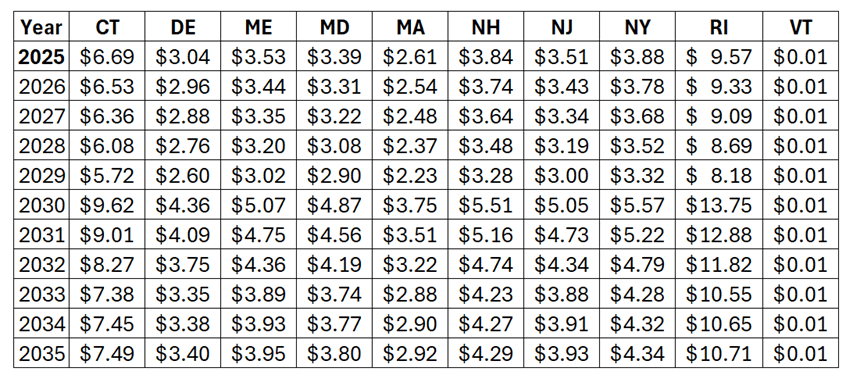
Figure 3: Electric Sector Capacity (MW) Buildout

It is notable that NYSERDA concedes, without admitting all the ramifications, that the electricity capacity buildouts in their original scenarios are wishful thinking.  I say this because there is another projection included – the “Limited Building Rate Scenario”.  Figure 4 shows the installed capacity projections for it but true to their perfect record of making things difficult for reviewers the colors in the columns for different technologies change.  If you were like me and wondered what the difference in the zero-carbon firm resources (called dispatchable emissions-free resources (DEFR) by everyone else in the state) drop from 17,241 MW to 4,644 MW.  The description notes that:

•            Deployment challenges (including federal impact on attrition and permitting) could lead to a meaningful reduction in renewable build rates

•            While there are still significant additions of renewables, this sensitivity shows a meaningful reduction in solar and wind capacity compared to the core scenario in 2040

There is no admission that among the deployment challenges was an unrealistic schedule and no implementation plan was developed.  They try to save some face by saying that they still build out solar and wind capacity, oblivious to the fact that might not be a good thing.

Environmental Justice organizations have made the peaking power plants in New York City a non-negotiable issue, insisting that all peaking power plants must be shut down as soon as possible.  Even though the presumption of egregious harm from these plants is based on selective choice of metrics, poor understanding of air quality health impacts,  and ignorance of air quality trends, pressure by this special interest constituency resulted in the Build Public Renewables Act of 2023 that mandates shutdown of New York Power Authority peaking power plants by 2030.  This modeling by NYSERDA found that reliability considerations will prevent the shutdown of all the peaking power plants:

•            Zone J repowers 2.2 GW of combustion units in 2035, and overall combustion needs in 2040 are 1.2 GW higher than the core scenario, but still lower than the start of the modeling period

•            While gas generation is 50 TWh lower than 2025, 15 TWh of natural gas generation is needed in 2040 to meet energy needs. Alternately this need could be met via:

•            ~2 GW of new nuclear and likely additional transmission,

  • RNG combustion in the power sector, or

•            Some blend of these two resource options (new nuclear and RNG)

The alternatives to the fossil plants are not likely to occur.  2 GW of new nuclear is never going to get developed in New York by 2040 and there isn’t enough renewable natural gas (RNG) to provide the necessary power.

At the end of the description of this slide, there is an admission that the existing schedule is unlikely.  Patane notes that this sensitivity scenario provides a zero-emissions grid in 2045.

Figure 4: Limited build rate sensitivity

Discussion

The results presented in this presentation admit that there are enormous challenges confronting the Hochul Administration’s implementation of the Climate Act.  It is still necessary to read between the lines and understand the implications of some statements, but the handwriting is on the wall.

The presentation concedes that New York State is not on target to meet the 2030 70% renewable goal and probably will not meet it until 2033.  The inclusion of an alternate scenario that keeps fossil-fired units in operation post 2040 is the between the lines” admission that the present strategy is not going to work as envisioned by the authors of the Climate Act. That scenario is supposed to provide a zero-emissions grid by 2045, five years late.

Unfortunately, there are unacknowledged fundamental issues.  There are references to electric system strategies that sound fine in theory but have not been shown to work in practice.  For example, the presentation states that the plan is to use flexible loads to mitigate peak growth.  Assuming that 2.5 GW new large loads will be willing to shut down operations at the whim of low wind and solar resource production is not likely viable.  That is not conducive to manufacturing profitability.

In my opinion, the biggest problem is that the wind, solar, and energy storage approach advocated in the Climate Act requires backup resources for capacity, energy, and ancillary support services not present in wind, solar, and current energy storage systems.  Nuclear power is mentioned as a solution several times but if that is the only viable backup solution, then renewables cannot be implemented without it.  But nuclear can completely replace renewables, eliminating the need for massive backup resource.  Therefore, it would be prudent to pause renewable development until feasibility is proven because nuclear generation may be the only viable path to zero emissions.

There are political ramifications.  The New York Independent System Operator (NYISO) Power Trends 2025 report “underscores the heightened uncertainty of future system conditions and key assumptions such as population and economic growth, installation of behind-the-meter renewable resources, electric vehicle adoption and charging patterns.“  Environmental organizations have responded by claiming that  NYISO’s “conclusions and messaging in Power Trends are not supported by the evidence and perpetuate the false narrative that more gas is needed or is less costly.” Reality bats last and the Pathways Framework is reflecting reality that gas is needed.  Politically however, the environmental zealots will never change their minds and concede that corrections and adjustments are necessary much less admit that the whole endeavor is fatally flawed.  Given that the Climate Act has always been about politics, how this plays out will be fascinating political theater.

Conclusion

New York is at a crossroads  The inevitability of Climate Act implementation viability being a political liability has been acknowledged even by Hochul.  The modeling analysis concedes that the schedule and ambition of the Climate Act is not achievable.  This is the perfect opportunity for politicians to stop a program that even they must realize is not working according to plan.  The Energy Plan could be used to conclude the schedule and the aspirations of the Climate Act need to be reconsidered.  The political implications to that approach are significant.

RGGI Third Program Review Consumer Cost Impacts

The Regional Greenhouse Gas Initiative (RGGI) is a market-based program to reduce CO2 emissions from electric generating units.  One aspect of RGGI is a regular review of the program status and need for adjustments.  On July 3, 2025, RGGI announced that results of the Third Program Review.  Based on my analysis of the planned revisions, the RGGI States only delayed the inevitable reckoning of the futility of this program to achieve the goal of a “zero-emissions” electric system.  When I was researching that article, I used Perplexity AI to help me figure out a way to consider RGGI’s impact on ratepayer costs that is the topic of this post.

Dealing with the RGGI regulatory and political landscapes is challenging enough that affected entities seldom see value in speaking out about fundamental issues associated with the program.  I have been involved in the RGGI program process since its inception and have no such restrictions when writing about the details of the RGGI program.  I have worked on every cap-and-trade program affecting electric generating facilities in New York including RGGI, the Acid Rain Program, and several Nitrogen Oxide programs, since the inception of those programs. I also participated in RGGI Auction 41 successfully winning allowances and holding them for several years.   The opinions expressed in this post do not reflect the position of any of my previous employers or any other organization I have been associated with, these comments are mine alone.

Background

RGGI is a market-based program to reduce greenhouse gas emissions (GHG) (Factsheet). It has been a cooperative effort among the states of Connecticut, Delaware, Maine, Maryland, Massachusetts, New Hampshire, New York, Rhode Island, and Vermont to cap and reduce CO2 emissions from the power sector since 2008.  New Jersey was in at the beginning, dropped out for years, and re-joined in 2020. Virginia joined in 2021 but has since withdrawn, and Pennsylvania has joined but is not actively participating in auctions due to on-going litigation. According to a RGGI website:

The RGGI states issue CO2 allowances that are distributed almost entirely through regional auctions, resulting in proceeds for reinvestment in strategic energy and consumer programs.

Proceeds were invested in programs including energy efficiency, clean and renewable energy, beneficial electrification, greenhouse gas abatement and climate change adaptation, and direct bill assistance. Energy efficiency continued to receive the largest share of investments.

Despite the claims about the success of RGGI, the reality is that the only thing it is good at is raising money.  Suggestions that RGGI has been responsible for the observed reductions in CO2 emissions over the life of the program ignore the importance of fuel switching and the poor performance of RGGI auction proceed investments in reducing emissions.

The RGGI States regularly review successes, impacts, and design elements of the program.  The latest review is the third iteration of the effort.  It started in February 2021 and finally was completed in June 2025, years behind schedule.

I was an active participant in the program review.  I described my initial comments in October 2023 addressing the disconnect between the results of RGGI to date relative to the expectations in the RGGI Third Program Review modeling.  Last October I submitted more comments as described here.  I also described other comments submitted to RGGI.

Third Program Review Summary

If you are interested in the revisions made to the program, please refer to my previous RGGI post.  The primary rule revisions addressed the need to reduce the cap allocations to be consistent with various RGGI State decarbonization goals.  In my opinion, the political mandates for zero electric system emissions by 2040 are infeasible.  The changes to RGGI modify the allowance allocation schedule but include a “cost containment reserve” that adds allowances at a higher cost.  The focus of this article is on the impact of the RGGI auction price on consumer costs historically and because of the Third Program Review revisions.

Bottom-Up Analysis of RGGI Impact on Consumer Costs

I used Perplexity AI to provide documentation about the effect of RGGI allowance prices on consumer costs.  I ended up submitting two questions that provide a description of RGGI Allowance Costs and Their Impact on Electricity Prices with a follow up focusing on New York specific RGGI impacts.  In both instances the AI research failed to find documentation that I could decipher well enough to develop a methodology to estimate historical cost impacts and future projected cost impacts.

The research responses explained the components that flow allowance prices into consumer costs.  There is a direct relationship between CO2 emissions for a fossil unit and the effect of RGGI allowance prices that shows up in wholesale prices.  In New York those cost adders affect the location-based market price in different control zones that makes estimating rate payer impacts difficult.  The first response  described an ISO-New England case study that provided wholesale price impacts of RGGI.  Unfortunately, my primary interest is the cost to consumers and the path from wholesale prices to retail costs is mostly opaque. 

The AI response did find references that concluded that “Current retail riders in NJ and DE range 0.40–0.50 ¢/kWh, adding $3–$5 to an average monthly bill—well below other volatility drivers such as natural-gas commodity swings or capacity-market resets.”  However, I found nothing about costs in New York.

Trying to estimate residential cost impacts of RGGI using this information would be a bottom-up analysis that starts with specific details that affect electric rates and incorporates other detailed information to project impacts.  Given that I could not find sufficient detailed information for each component of costs I gave up trying this approach.

Top-Down Approach to Estimate the Effect of RGGI on Residential Costs

Note: Table numbers refer to tables in the Addendum

For the top-down analysis, I assumed that residential rates are affected by RGGI compliance costs proportional to the total RGGI compliance cost fraction of total electric revenues.  I used Perplexity AI to find the total electricity revenues for the residential sector for each RGGI state.  The cost of RGGI compliance charged to customers equals the state-level emissions released times the allowance price for each ton emitted.  Details of the methodology used to estimate ratepayer impacts are described in the Addendum to the post.  It is included because I believe that analyses are more credible when the approach is documented.  However, most readers likely do not want to deal with those details so they are not in the main body.

I used data from multiple sources.  Emissions data came from the EPA Clean Air Markets Program Data system that documents power plant emissions from various market trading programs.  Table 1 in the Addendum lists the annual emissions by state for all units affected by the RGGI program.  For allowance prices I calculated annual averages from the quarterly allowance auction prices in the RGGI Market Monitor Auction Reports (Table 2 in the Addendum).  I used Perplexity AI to provide revenues by the residential, commercial, and industrial sectors data (Table 3).  That analysis was based on information from the US Energy Information Agency but there was only information available for three years.  The percentage of total revenue costs caused by RGGI costs is derived from that information (Table 4).  I also used Perplexity AI to provide the electricity rates for 2020, 2022 and 2023. 

At this point I had all the data necessary to determine the impact of RGGI allowance costs on residential rates for the three years with rate data.  I averaged the data from those three years.  The RGGI compliance % of total revenues equals the RGGI compliance costs divided by the total electric costs (Table 5a).   The average state residential rates (Table 5b) are from another AI search.  Table 5c lists the calculated state residential cost attributable to RGGI (¢/kWh) by multiplying the compliance percentage of the average state residential rates.  Note that these estimates are in the range of the “current retail riders in NJ and DE that range 0.40–0.50 ¢/kWh.”
   Table 5a                                                        Table 5b                                         Table 5c

I used this information to estimate the impact of RGGI compliance costs on residential rates (¢/kWh) since the start of the program (Table 6 in the Addendum).  In this analysis it is assumed that the annual residential rates in any one year are proportional to the average values listed in Table 5c.  For example, the Connecticut 2009 estimated residential rate equals the average rate (0.48) multiplied by the Table 2 annual compliance cost in 2009 ($20,108,464) divided by average compliance cost ($109,179,789).

I do not keep track of my residential rate and do not expect others do either.  Table 7 estimates the costs for a typical consumer that uses 750 kWh per month.  This is the most important RGGI impact for consumers.  The Perplexity AI response noted that “adding $3–$5 to an average monthly bill—is well below other volatility drivers such as natural-gas commodity swings or capacity-market resets.”  Note that my estimate of RGGI consumer costs was well below even those levels until 2024.  That probably accounts for why consumers have not paid much attention to RGGI.

Table 7: Monthly RGGI Residential Costs for 750 kWh per Month Electric Use

Future Projections

This cost estimation methodology can also be used to estimate future impacts to ratepayers in the RGGI states.  I described the assumptions and details of my approach in the Addendum.  Table 7 estimates future costs for a typical consumer that uses 750 kWh per month.  The monthly cost impact of RGGI peaks in 2030.  Rhode Island ratepayer would pay the most, $13.75 a month additional because of RGGI that year.  New York ratepayers could pay an additional $5.57 a month because of RGGI in 2030. 

Table 11: Future Monthly RGGI Residential Costs for 750 kWh per Month Electric Use

Caveats

The future costs and emissions will be affected by factors that I did not include.  There is a significant bank of allowances that will keep emissions higher than the allocations for some time.  The sale of banked allowances from non-compliance entities to affected sources that need allowances to operate will increase costs to consumers. 

Discussion

There are some interesting facets of the Third Program Review buried in this information.

Although this approach does not cover all the nuances of RGGI allowance prices on residential prices I am comfortable that the projections are reasonable.  The first takeaway is that residential average monthly bill impacts of RGGI are “well below other volatility drivers such as natural-gas commodity swings or capacity-market resets.” 

The Third Program Review took a long time to finalize and I think that reflects the unprecedented aspects they are confronting.  Market based programs rarely establish caps that less than the affected sources can achieve without shutting down.  This is the situation in the RGGI states going forward.  Typically, costs per ton removed increase as emissions approach zero, so this is a significant challenge for the effectiveness of this strategy for zero-target programs like New York’s Climate Leadership & Community Protection Act.

One problem with the cap and invest approach that incorporates a declining cap that goes to zero is that as the number of allowances decreases the funds available to invest in emission reductions goes down.  Table 12 illustrates how the RGGI States got around this problem for now.  It lists the allowance cap, the CCR trigger prices and CCR allowance allocations through 2037 when the policy ends.  I calculated the total allowances and potential revenues.  The RGGI States deferred the problem of declining revenues by setting the CCR Tier 2 trigger price increase the same as the allowance cap decrease. 

Table 12: Third Program Review Allowance Allocation Parameters and Expected Revenues

In theory, after 2033 the revenues should stabilize at $1.9 billion a year.  Unresolved is that this approach does not get to zero emissions – they level off at just under 23 million tons after 2040.  I would also expect that as the allowances get scarcer, that the allowance prices will go up due to demand.  There is a potential for very high allowance prices that would affect consumers.  Note, that the benefits of the auction sales occur at the time of the auction.  Sales of banked allowances only profit the holders of the banked allowances.

Finally I want to reiterate a point made in my previous article on the RGGI Third Program Review.  I am convinced that no GHG emission reduction cap-and-invest program will succeed.  Danny Cullenward and David Victor’s book Making Climate Policy Work explains why.    They note that the level of expenditures needed to implement the net-zero transition vastly exceeds the “funds that can be readily appropriated from market mechanisms”.  Even though RGGI allowance prices will increase significantly, they still will be insufficient to fund the necessary development of zero emission resources.  Based on this analysis RGGI won’t provide sufficient revenue to support zero decarbonization even if the RGGI States were not squandering revenues on non-emission reduction related programs

Conclusion

The Third Program Review Policy Update features an allowance allocation schedule that is consistent with RGGI State net-zero regulations.  That trajectory is inconsistent with wind and solar deployment history and reasonable expectations.  As a result, there eventually will be insufficient allowances available for CO2 emitting generation resources to operate. 

This analysis of consumer cost impacts has one bright side.  It does not appear that reasonably expected allowance prices will meaningfully impact consumers.  The allowance prices are too low to cause impacts.  At the same time it is clear that there aren’t enough revenues to fully fund emission reduction strategies needed to achieve zero emissions. 

The use of a CCR and addition of a second CCR will delay the inevitable reckoning and ensure that for the next ten years there will be a steady source of revenues.  Raising money is the only success story for RGGI. The question whether the investments of those revenues was well spent is a story for another time.

Addendum: Top-Down Analysis Description

The methodology used to estimate ratepayer impacts is described in the Addendum to the post.  This is included because I believe that analyses are more credible when the approach is documented. 

In this analysis it is assumed that residential rates are affected by RGGI compliance costs proportional to the total RGGI compliance cost fraction of total electric revenues.

The cost of RGGI compliance is assumed equal to the annual emissions times the annual auction allowance cost.  I used data from the EPA Clean Air Markets Program Data system that documents power plant emissions from various market trading programs.  Table 1 lists the annual emissions by state for all units affected by the RGGI program.

Table 1: RGGI Annual CO2 Emissions (tons)

The state-wide cost of RGGI compliance is the cost of allowances times the emissions.  Table 2 is based on quarterly allowance auction prices from the RGGI Market Monitor Auction Reports.  I calculated the annual numbers that are listed as an average of the quarterly values.

Table 2: Annual RGGI Compliance Costs

Table 3 lists the total state electricity revenues for the three years that Perplexity AI could provide revenues by the residential, commercial, and industrial sectors.

Table 3: RGGI State Electricity Revenues ($millions) for the Available Annual Data

Using the annual RGGI compliance costs (Table 2) and the annual electricity revenues (Table 3) produces the percentage of total revenue costs that are caused by RGGI costs in Table 4.

Table 4: RGGI Compliance Costs % of total revenues for the Available Annual Data

I also used Perplexity AI to provide the electricity rates for 2020, 2022 and 2023 (not shown).  I averaged the values from those years for the Average RGGI Compliance % of total revenues (Table 5a) and the Average State Residential Rates (Table 5b).  Table 5c lists the calculated state residential cost attributable to RGGI (¢/kWh) by multiplying the compliance percentage of the average state residential rates.

Table 5a: Average RGGI Compliance % of total revenues, Table 5b: Average State Residential Rates (¢/kWh) and Table 5c: Calculated State Residential Cost Attributable to RGGI (¢/kWh)

   Table 5a                                                        Table 5b                                         Table 5c

Table 6 estimates the impact of RGGI compliance costs on residential rates (¢/kWh).  In this analysis it is assumed that the annual residential rates in any one year are proportional to the average values listed in Table 5c.  For example, the Connecticut 2009 estimated residential rate equals the average rate (0.48) multiplied by the Table 2 annual compliance cost in 2009 ($20,108,464) divided by average compliance cost ($109,179,789).

Table 6: Annual Historical Estimated RGGI Residential Rate by State (¢/kWh)

In my opinion, the rate values are not relatable.  Table 7 estimates the costs for a typical consumer that uses 750 kWh per month.  This is the most important RGGI impact for consumers.  In my opinion, the historical costs for a typical consumer are not remarkably much higher even with the much greater allowance prices of late.

Table 7: Monthly RGGI Residential Costs for 750 kWh per Month Electric Use

This cost estimation methodology can also be used to estimate future impacts to ratepayers in the RGGI states.  The first step is to estimate annual emissions.  In my previous article about the RGGI Third Program Review I argued that the addition of two Cost Containment Reserve (CCR) tiers pushed the inevitable reckoning that future emission reductions consistent with the aggressive reduction trajectory are unlikely.  The RGGI summary of the Third Program Review includes a figure that shows the allowance allocation trajectories.  The figure compares the current regional base cap (light blue) with the updated cap trajectory (dark blue). The orange and yellow lines display the total updated regional cap if all allowances are released from the updated first and second CCR tier, respectively.

This figure compares the current regional base cap (light blue) with the updated cap trajectory (dark blue). The orange and yellow lines display the total updated regional cap if all allowances are released from the updated first and second Cost Containment Reserve tiers, respectively.

I based my future emission reduction projection on these curves.  Table 8 lists my annual projections.  I included the observed emissions from 2022 to 2024.  I assumed that in 2027, the first year of revised RGGI allowance allocation policy, the emissions would equal the policy update allocation plus CCR #1.  For 2025 and 2026, I used a linear interpolation between the average of 2022-2024 and the 2027 values.  In 2030 I assumed emissions would equal the policy update allocation plus allowances from both CCR #1 and CCR #2 as shown in Table 8.

Table 8: Projected Annual RGGI Emissions

To get the annual RGGI compliance costs it is necessary to multiply the projected emissions by the expected allowance price.  For 2025 through 2029 I assumed that the allowance price would equal the first CCR trigger.  Starting in 2030 I used the trigger price for CCR #2.  Table 9 lists the allowance prices and the compliance costs.  Note that the expected compliance costs peak in 2030 and then start to decline as the number of allowances drops.

Table 9: Projected Annual RGGI Compliance Costs

Table 10 estimates the impact of RGGI compliance costs on residential rates (¢/kWh) using the methodology described for Table 6.

Table 10: Annual Projected Future RGGI Impacts on Residential Rate by State (¢/kWh)

Table 11 estimates the costs for a typical consumer that uses 750 kWh per month.  The monthly cost impact of RGGI peaks in 2030.  Rhode Island ratepayer would pay the most,  $13.75 a month additional because of RGGI that year.  New York ratepayer could pay an additional $5.57 a month because of RGGI in 2030. 

Table 11: Future Monthly RGGI Residential Costs for 750 kWh per Month Electric Use

More Reasons to Pause Climate Act Implementation

I am very frustrated with the New York Climate Leadership & Community Protection Act (Climate Act) net zero transition because the reality is that there are so many issues coming up with the schedule and ambition of the Climate Act that it is obvious that we need to pause implementation and figure out how best to proceed.  This article describes more reasons to pause implementation.

I am convinced that implementation of the Climate Act net-zero mandates will do more harm than good because the energy density of wind and solar energy is too low and the resource intermittency too variable to ever support a reliable electric system relying on those resources. I have followed the Climate Act since it was first proposed, submitted comments on the Climate Act implementation plan, and have written over 550 articles about New York’s net-zero transition.  The opinions expressed in this article do not reflect the position of any of my previous employers or any other organization I have been associated with, these comments are mine alone.

Department of Energy Reliability Report

Isaac Orr and Mitch Rolling describe the relationship between retirements, demand growth and outages.  The U.S. Department of Energy recently released a report entitled Evaluating the Reliability and Security of the United States Electric Gridwhich concludes “the United States will experience a 100-fold increase in blackouts if coal and natural gas plants are retired amid rising demand from data centers.” 

The report evaluated multiple scenarios for power plant retirements across the country.  One scenario allows the retirement of 104,000 MW of power plant capacity that intends to retire and adds 209,000 MW of Tier 1 resources to the grid by 2030.  The Tier 1 resources are overwhelmingly wind, solar, or battery storage. It only includes 20,000 MW of new natural gas capacity expected to come online by 2030, along with 31,000 MW of additional 4-hour batteries, 124,000 MW of new solar, and 32,000 MW of incremental wind.  If the plants that have announced retirement go offline, then coal capacity will go down 72,000 MW and gas capacity almost 5,000 MW.

At the same time, the analysis expects “electricity demand for data centers to increase by 52,000 MW by 2030, representing about 6.7 percent of the current average peak demand in the United States.”  Orr and Rolling note that one of the future load projections is “projecting zero demand increases in New England or New York, resulting from data centers.”  They speculated that “it could be due to tight electricity supplies and consistently high prices in these regions.” 

They described the expected impacts on reliability.  The report found “huge blackouts throughout much of the country” if all the plants that have announced retirements are allowed to go offline.  They also noted:

In a somewhat unexpected finding, the DOE report did not find capacity shortfalls in ISO New England or New York in either of the scenarios studied. This is likely due to the fact that load growth is expected to be small in both of these areas because there is no expected data center demand growth in these regions in the DOE study.

In my opinion, the future load projections did not consider the potential load impact of new manufacturing facilities in New York, most notably the Micron chip fabrication plant.  That undoubtedly would affect capacity shortfalls.

Orr and Rolling note that this report is an indication that the Department of Energy is stopping the “childish fantasy that America can shut down its reliable coal and natural gas plants and rely on wind, solar, and battery storage to meet surging electricity demand, it’s clear the energy adults are now back in charge.”  It is also time for New York to stop its own childish fantasy that existing fossil-fired power plants can be shut down here.

Lessons from Europe – Germany

Brawl Street Journal (BSJ) explains how Germany’s energy policies are affecting neighboring jurisdictions.  The article recounts the bureaucratic morass of European Union energy policy. Teresa Ribera, the woman who “helped turn Spain into blackout country” is now the EU Commissioner in charge of competition policy.”  In that role, she “plays a powerful part in shaping Germany’s energy choices.”

Germany has figured out that wind and solar don’t work all the time.  Instead of pinning their hopes on a magical solution like New York is proposing, they are planning to deploy “21 GW of new gas-fired backup plants.”  BSJ explains the problem with this plan:

These plants would operate so rarely, their revenues wouldn’t come close to covering their fixed costs. No sane investor would finance them without some form of guaranteed support. In other words: subsidies.

And that’s where Ribera comes in. As the European Commissioner overseeing competition policy, she effectively gets to say whether Germany can subsidize these gas plants or not. Given her past as a fierce advocate for a 100% renewable grid in Spain, you can probably guess where this is going.

In its quest for clean energy the EU is pulling the plug on fossil fuel infrastructure subsidies. 

In the past, the Commission signaled it might tolerate up to 5 GW of new gas plants in Germany to help secure supply. But anything beyond that? Only if the plants are designed to eventually run on hydrogen — an option so expensive and speculative it borders on science fiction.

The result is that German coal plants will have to run longer.  I love the summation:

This creates the absurd situation that high-emission coal must run longer because support for lower-emission gas plants is being denied. It’s the kind of logic you’d expect from a socialist economy where outcomes don’t matter, only ideological purity.

This is exactly what is happening here.  We already shut down the coal plants but there are a large number of old, inefficient, and relatively high emitting gas units still in operation.  The Hochul Administration blocked plans by several plants to repower their old turbines with modern and efficient combined-cycle turbines.  The result is that high-emission units must run longer because support for lower-emission gas plants is being denied.  The most recent Energy Planning Board meeting presentations hinted at the need to repower units but there is a tortuous path between suggesting that and having some developer commit to building modern new units and getting them on line.

More Lessons from Europe – Spain

Ed Reid explains that the blackout in Spain earlier this year raises many questions about the “stability and resilience of renewable powered grids”.  He listed the following questions:

  • Can a renewable plus storage grid operate reliably and stably?
  • What is the maximum percentage of renewables consistent with reliability?
  • Is there a maximum percentage of solar generation on a reliable grid?
  • Is there a maximum percentage of wind generation on a reliable grid?
  • Does a reliable grid require inertia; and, if so, how much?
  • Is the physical location of the inertia sources on the grid important?
  • What is the relative inertia contribution of steam turbines vs. gas turbines?
  • What would be the inertia contributions of small modular nuclear generators?
  • What is the effect of modulated output on inertia contribution?
  • What effect does grid-scale storage have on inertia?
  • Can inertia be effectively provided electronically?

These are fundamental questions that proponents of the Climate Act have ignored to date.  It is time that we make sure their “solution” will work.  These must be addressed by the Energy Plan for it to have any credibility.

Media Energy Credibility

It may just be me, but it seems that the claims by clean energy zealots are becoming ever more hysterical and shrill in the face of evidence that the Trump Administration is advancing a practical, adult energy policy.  The global energy transition is faltering but the media still is claiming otherwise.  Robert Bryce describes “What The Media Still Won’t Tell You About The Energy Transition”.   

There is no energy transition. Just don’t expect the media to tell you the truth about it.

Of course, I could provide dozens, or even hundreds, of other examples of climate-focused journalists, academics from elite universities (hello, Princeton!), and policymakers making risible claims about our energy future and how the world will soon be fueled by “clean” sources like wind, solar, and batteries, with some nuclear and maybe a bit of hydropower, thrown in for good measure. As I explained two years ago in “The Anti-Industry Industry,” the “energy transition” narrative is relentlessly promoted by the NGO-corporate-industrial-climate-media complex, a multi-billion-dollar-per-year business that includes dozens of NGOs and media outlets that promote anti-hydrocarbon agendas. The World Economic Forum even maintains an “Energy Transition Index.”

He uses the latest edition of the Energy Institute’s Statistical Review of World Energy to show that the world runs on hydrocarbons.  There is no question that wind and solar capacity is growing but “in 2024, just 3% of global primary energy came from wind and solar while 87% came from hydrocarbons. The costs of the failed transition are staggering: “Since 2004, about $5.4 trillion has been spent on solar and wind, and yet they are still only providing 3% of the world’s primary energy.” 

One of the annoying arguments from the useful idiots who support the energy transition is that “Big Oil” is spending huge amounts of money to spread misinformation.  The Department of Energy report described above makes it clear that shutting down more US coal capacity would cause blackouts.  Bryce notes:

As I reported here in 2023, billionaire media baron Michael Bloomberg is giving $1 billion to anti-hydrocarbon NGOs that want to shut down the entire US coal sector. That’s only part of the billionaire’s radical climate agenda. The billionaire’s “beyond carbon” campaign aims to close all US coal plants, “cut gas plant capacity in half while blocking all new gas plants, and increase US clean energy four-fold, reaching 80 percent of total electricity generation,” by 2030.

Who is really spreading misinformation with massive funding?

The Energy Plan process currently underway appears to be acknowledging that the Climate Act transition plan’s schedule and ambition are out of reach and must be re-assessed.  That message is in direct contradiction to much of the media narrative.  The Hochul Administration is going to face backlash from the media when it bows to reality.

Conclusion

New York’s energy planners must openly address grid reliability, resource adequacy, and practical transition timelines. Until these fundamental concerns are resolved, pausing the Climate Act’s implementation is the only responsible course.