
Washington State Goes One for Three on the Pragmatic Climate Scale…Maybe

One of the things that makes my blogging obsession worthwhile is meeting people across the world in connection with my posts.  It varies from people who comment on my work in the comments section of posts to people who have corresponded directly.  The direct contacts have provided insights into their own experiences that are helpful to me.  There also are a few who write with material that I use for guest posts.  Paul Fundingsland is one of the latter who has provided information for posts about his experiences in Washington State with their net-zero plan.  This post annotates the article (Washington State Goes One for Three on the Pragmatic Climate Scale…Maybe) that I edited for him to post at Watts Up With That.

Paul describes himself as a “Free Lance writer with a two decade long obsession with all things climate change.”  Although he is a retired professor, he has no scientific or other degrees specific to these kinds of issues that can be cited as offering personal official expertise or credibility. What he does have is a two-decade-old avid, enthusiastic, obsession with all things Climate Change related. 

In this article he described three climate related initiatives that were decided in Washington recently.  Initiative 2066 was a referendum to repeal laws and regulations that discourage natural gas use and would require current natural gas customers to switch to electric heating.  Initiative 2117 was another referendum to repeal the state’s commitment to reduce greenhouse gas emissions by 95% by 2050 in the Climate Commitment Act.  Finally, the Horse Haven Wind, Solar and Battery Complex permit was approved.

Initiative 2066

I am envious that Washington State has a way for citizens to demand a referendum to put a law up for a vote of the people.  This was one of two recall referendums.

The bright spot was the successful passage of Initiative 2066 which ensures access to natural gas in homes and other buildings and repeals a state law requiring plans to transition from the use of natural gas to electricity. The final tally was 52% yes, 48% no. 

Washington is basically a one-party blue state – Kamala Harris won by a lopsided 58% of the presidential vote. Even though only a third of the residents rely on natural gas with the bulk of the populace (58%) using electricity, the “yes” vote prevailed in a surprising outcome given the political demographics.

I think there were several reasons for the outcome.  The main issue that resonated with all the gas users was the extreme cost of a switch over from gas appliances to all electric they would be expected to finance almost entirely by themselves.  Since Washingtonians have been using gas with no significant identifiable adverse effects for decades, it was hard to convince them that demonizing the use of gas was now all of a sudden, a threat to their health and wellbeing. There also may have been a fair number of the electric heat users who preferred using gas for cooking and in their fireplaces.

The “vote no” people took the main tack that using gas was a pollutant, a health hazard and would prevent the State from achieving its Climate Commitment Act goals.

It is only a matter of time until a similar law is passed in New York that forbids natural gas use because the Climate Leadership & Community Protection Act (Climate Act) mandates building emission limits that can only be met if natural gas is prohibited.  The New York Home Energy Affordable Transition Act (NY HEAT) puts some limits on natural gas use but stops short of the Washington law I think.  Fundingsland goes on to point out that litigation of the referendum result is still possible.

Despite the result there still is a maybe part of the passage of this initiative.  The “no vote campaign” intends to take this issue to the State Supreme Court. They are claiming it should be voided because it violates the State rule that an initiative should not embrace more than one subject. They have deep pockets to fight this vote of the people.  The sore losers include the Sierra Club, Statewide Poverty Action Network, Front and Centered, plus “unnamed” renewable energy groups (no surprise there).

The “yes” campaign claims the initiative was written very carefully expecting successful passage to be challenged in court. The “no” campaign started putting their challenge together months before the final vote just in case it passed.

It will be interesting to see if passage of I-2066 by the voters is brought before the State Supreme Court. Voiding the obvious majority of the people on some sort of technicality could prove problematic in coming elections by raising rational voter ire. That might give the “no” campaign second thoughts as to how this may play out in the long run if they pursue this avenue of opposition.

Initiative 2117

The referendum on the funding approach for the Washington version of the Climate Act is timely vis-à-vis New York.  The Hochul Administration is supposed to propose rules for the New York Cap-and-Invest program that will put a cost on carbon emissions.  That regulation is late, undoubtedly because of political fears that the costs are too high.  I was disappointed that a state that has seen a sharp increase in gasoline costs voted down repealing the Washington version.

On the losing side of the “one for three” pragmatic climate issues was voting down Initiative 2117 which would have essentially ended funding for the State’s Climate Commitment Act (CCA) resulting in lower gas prices at the pump. It really did not have a chance of passage once the big money came rolling in advertising against it. 

The five biggest donors against passage were all essentially billionaires. They included Steve and Connie Ballmer, Bill Gates, Microsoft (the company) and the 4-billion-dollar Nature Conservancy. Their media ads were very slick, very professional and appeared all over the TV channels at all times of the day and night but especially during the evening news, sports (football, soccer etc.). They were even on the Fox Business News channel. 

It really didn’t matter what time of day or what channel you were watching, there would be an ad to defeat this measure that would show up. The amount of money spent to defeat this measure must have been eye-popping.

The main selling point was that voting for I-2117 would cause unclean air, unclean water, worse wildfires, a dirtier environment with worse roads and transportation. Voting it down would mean cleaner air, cleaner water, better wildfire management, a cleaner environment, and even better roads and transportation. There was, of course, no mention of just how much less global warming would result from a no vote. 

One of the ads featured individuals wearing their respective professional garbs advocating voting no (doctor, fireman, construction worker, forest ranger, Tribal member, etc.) An observation was that these are the very same special interest groups who have recently been getting money from the CCA fund so of course they don’t want to see those funds go away.

One of the ads accused the promoter of this measure (and three of the other measures) of being just a greedy millionaire out for himself. Never mind the billionaires who funded the campaign against it and how or whether they might benefit somehow from it being defeated.

It was obvious the campaign for passage of I-2117 did not have the requisite funding to successfully get their message across with the necessary effective media advertising. The ads were spread too thinly between several issues. The ads were somewhat rudimentary, lacking a professional look, and they appeared sparsely. They just didn’t have the money and the focus to get their message across.

My personal opinion is that had the “yes” ads concentrated on the fact that no matter how much you were paying for a gallon of gas (whether a high price or low one) $10 would be going to the state for every 20 gallons of gas they bought. I think that would have made a much bigger impact on the voters by helping them understand just how much they were sending to the State every time they filled up.

Sadly the billionaires won this one. 

There still is hope because the costs, due to the law will only increase over time.

There is a chance this issue could be brought up for a statewide vote again at a later date, perhaps when Washington surpasses California for the cost of gas at the pump which may not be all that far off. If it is brought up again, the people behind it now know what they are up against and will have to adjust accordingly, being a lot more clever with their focus and their financing.

Horse Haven Wind, Solar, and Battery Complex

The other initiative was the approval of a massive renewable energy complex.  Nobody has proposed a single project this big in New York yet.

The other one of the three climate-related issues is our Governor’s final approval of the “Horse Haven Wind, Solar and Battery Complex” in Eastern Washington. It’s a huge complex stretching 24 scenic miles long and 8 miles wide covering 72,000 acres with 5,000 of those farmland acres surfaced with solar panels. The final proposal is to have either 172 five-hundred-foot towers or 113 six hundred seventy foot tall towers. The battery complex is yet to be determined as to size and placement.

A valiant opposition movement (here) of Benton County residences, tribal members and wildlife advocates has been so far unsuccessful in stopping this monstrosity from happening. The Energy Facility Site Evaluation Council confirmed the Governor’s approval in a 4-3 vote. There is now only one more avenue to pause or stop the building of this grotesque complex…the court system.

And that is exactly what has just happened. Benton county has filed suit against the state over this project.

One other long shot outside possibility that might stop this atrocious wind project from being built could be when the new national administration takes office in January. Indications are that the new administration intends to terminate subsidies for wind and solar projects. If that does happen, it is likely the Horse Haven Wind Farm may become unprofitable to build. 

Washington prides itself on being an enlightened, leading energy progressive state. This wind/solar/battery complex is anything but progressive. It is an exorbitantly expensive energy system at $1.7 billion (2021 estimate and counting) for the amount of intermittent power it can produce. It regressively degrades and seriously threatens the reliability of the existing electric grid by providing only non-dispatchable erratic weather dependent electricity. 

Nuclear Power

I am convinced that the wind, solar, and energy storage approach epitomized by the kind of project will do more harm than good.  I also believe that the only rational way to decarbonize the New York electric system is to deploy nuclear resources.  Fundingsland agrees as shown in the following.

A leading enlightened progressive State would be planning on installing a small modular nuclear system such as NuScale’s Voygr-12 module complex of SMRs. The NuScale SMR system was developed in Oregon and is the only one so far to receive design approval by the Nuclear Regulatory Commission. Or the State could support the expansion or duplication of Amazon and Energy Northwest’s planned Central Washington installation of X-energy’s 12 module system

Ironically, Energy Northwest is headquartered in Richland Washington. Their potential SMR site is a mere 50 miles from the planned wind farm next to the Columbia Nuclear Generating station (Washington’s only functioning nuclear plant). This gives their planned site close, easy access to the electrical grid. 

Both SMR systems can deliver dispatchable electricity under all weather conditions 24/7365. They are CO2 free and can generate approximately 924 actual nameplate MWe where as the wind system will be lucky to generate 40% of its nameplate. And that energy will be erratic and intermittent grid destabilizing energy that requires storage. Their respective footprints use only a miserly 0.06 square miles of land in contrast to the wind farm’s approximately 100 square miles. Their environmental footprint is small, scenically unobtrusive, and non-threatening to birds of prey.

Both SMR products have a passive safety system so they cannot melt down or blow up. Each one of the 12 SMRs composing either company’s modular complex are built in a factory and can be delivered by truck, rail or barge in three sections. 

There is a serious disconnect between the “Energy Magical Thinking” flowing from the Capitol in Olympia versus pragmatic, modern, non-invasive solutions available. This is especially disconcerting considering Portland Oregon (the headquarters of NuScale) is only 114 miles away from the capitol building in Olympia. 

On the Washington boarder to the east, the state of Idaho is embracing and promoting nuclear with it’s Idaho National Laboratory Frontiers Initiative. 

In their words: 

“Eight states are developing economic development plans focused on advanced nuclear energy deployment with the help from Idaho National Laboratory’s (INL) Frontiers Initiative.

Frontiers was established in 2021 to help stakeholders identify and capitalize on key economic  opportunities afforded by early adoption of advanced nuclear energy. The initiative also helps stakeholders leverage advanced nuclear to capture emerging global market opportunities in low-emission industries.

The 2024 Frontiers Initiative Impacts Report, released today, (Oct. 24) highlights the initiative’s impacts on first-mover states identified as actively pursuing advanced nuclear energy to encourage economic development.

We have strengthened our partnerships with stakeholders in first-mover states – Idaho, Utah, Wyoming and Alaska – while adding engagements where increasing interest in advanced

Nuclear energy intersects industry needs, including in Louisiana, Montana, North Dakota and South Carolina,” said Steven Aumeier, senior advisor at INL.” 

One of the advantages of publishing at Watts Up With That is that there is much wider exposure than at this blog.  As a result of the wider exposure there are more comments.  Sometimes that is not so good but more often there are valuable insights.  For example, in the comments to his article Beta Blocker provided links to several presentations and reports published in recent months concerning energy reliability in the US Northwest and described a hypothetical wind and solar expansion.  There is an enormous amount of useful information in those two comments.

Fundingsland also recommended a movie is called “Nuclear Now”.

It is by Oliver Stone and was released just last year (2023). It is an extremely thorough movie about the development of nuclear power from the very beginnings to the present day. It basically covers all the various aspects of nuclear. This includes the past massive demonstrations against its use in the 60s-70s as well as the three scary nuclear power plant accidents and why those issues mislead and continue to color the modern deployment of nuclear power.  It ends with a fairly thorough review of the modern nuclear systems, which countries are developing them (Russia, China, US) and how far along they are. And then it mostly concludes focusing a lot on SMRs.

Discussion

Fundingsland’s article argued that Washington is more talk than action.  Given that I think nuclear is the rational approach I would argue that New York should be trying to emulate Tennessee rather than California.   

transition, shamefully Washington State is not among these “first-mover states”.

If Washington was serious about being a modern enlightened energy progressive state, they also might want to look at what is happening in Tennessee. Their General Assembly created a $60 million fund (The Tennessee Nuclear Energy Fund) that has attracted four projects in the last six months headed by Orono USA, a company specializing in: “Uranium. Mining/conversion/enrichment, used nuclear fuel management and recycling, decommissioning shutdown nuclear energy facilities, federal site cleanup and closure and developing nuclear medicines to fight cancer”

Oak Ridge is determined to become “the place the nation is looking for to lead the next nuclear race”. Oak Ridge and Knoxville are now home to some 154 nuclear companies.

Oregon, Idaho and Tennessee have blown past Washington in the enlightened pragmatic electric energy transition. It leaves our state in the dustbin of yesterday’s expensive, environmentally invasive, dysfunctional grid threatening Wind/Solar/Battery energy systems. 

Fundingsland concluded

The jury is still out on whether Washington residents can hold on to their current right to use the energy of their choice for heating/cooking. And whether an out-of-date, environmentally destructive dysfunctional grid threatening Wind/Solar/Battery system gets installed against the wishes of the impacted citizens.

The state seems most focused on keeping money from it’s CCA (Climate Commitment Act) flowing from the hike in gas prices at the pump this act has caused. The state needs the money given that it was just announced it is currently around $10 billion in debt. My cynical side wonders just how much of that CCA money is going to end up being diverted towards reducing that debt rather than “fighting “Climate Change” as it was advertised to be used for. 

Washington state has many enlightened social programs to be proud of. There is a rational, pragmatic program supporting parents (both wife and husband) of newborns with a generous paid leave time so they can tend to their new child. A State sponsored long term care program has just been enacted designed for those elderly who do not have such means helping them towards the end off their days.  

But when it comes to the State’s energy policy, it’s a whole different story. “Magical Thinking” prevails forcing rationality and pragmatism to go right out through the ozone hole.

So much for Washington leading the nation with a modern, clean, reliable, environmentally friendly electrical energy transition path. It’s much more enlightening to watch what states like Idaho and Tennessee are doing to find out where the future of rational, pragmatic energy systems are going.

I expect that New York’s experience with Climate Act implementation will be the same as Washington State’s experience.  Thanks to Paul Fundingsland for sharing his experiences.  Now we just need to wake up the citizenry to stop the nonsense.

Citizen’s Budget Commission Comments on New York Cap-and-Invest

The Citizen’s Budget Commission (CBC) new brief, Improving NYS Cap-and-Invest Design: Recommendations for Ambitious, Affordable, Market-Driven Emissions Reductions (CBC Report), finds that the New York Cap-and-Invest (NYCI) pre-proposal includes “some promising design choices” but has limitations.  The report recommends that “the State overhaul its pre-proposal design and fully explain the impacts”.  Based on my experience with market-based programs I agree with many of the findings of the report but believe that the CBC has misplaced faith in the effectiveness of market-based GHG emission reduction programs.

I have followed the Climate Act since it was first proposed, submitted comments on the Climate Act implementation plan, and have written over 470 articles about New York’s net-zero transition.  I worked on every market-based program from the start that affected electric generating facilities in New York including the Acid Rain Program, Regional Greenhouse Gas Initiative (RGGI), and several Nitrogen Oxide programs. I follow and write about the RGGI and New York carbon pricing initiatives so my background is particularly suited for NYCI.   The opinions expressed in this article do not reflect the position of any of my previous employers or any other organization I have been associated with, these comments are mine alone.

Overview

The Climate Act established a New York “Net Zero” target (85% reduction in GHG emissions and 15% offset of emissions) by 2050.  It includes an interim 2030 reduction target of a 40% reduction by 2030. Two targets address the electric sector: 70% of the electricity must come from renewable energy by 2030 and all electricity must be generated by “zero-emissions” resources by 2040. The Climate Action Council (CAC) was responsible for preparing the Scoping Plan that outlined how to “achieve the State’s bold clean energy and climate agenda.” The Integration Analysis prepared by the New York State Energy Research and Development Authority (NYSERDA) and its consultants quantified the impact of the electrification strategies.  That material was used to develop the Draft Scoping Plan outline of strategies.  After a year-long review, the Scoping Plan was finalized at the end of 2022.  Since then, the State has been trying to implement the Scoping Plan recommendations through regulations, proceedings, and legislation.  NYCI is one such implementation initiative.

Cap-and-Invest

The CAC’s Scoping Plan recommended a market-based economywide cap-and-invest program.  The program works by setting an annual cap on the amount of greenhouse gas pollution that is permitted to be emitted in New York: “The declining cap ensures annual emissions are reduced, setting the state on a trajectory to meet our greenhouse gas emission reduction requirements of 40% by 2030, and at least 85% from 1990 levels by 2050, as mandated by the Climate Act.”  In addition to the declining cap, it is supposed to limit potential costs to New Yorkers, invest proceeds in programs that drive emission reductions in an equitable manner, and maintain the competitiveness of New York businesses and industries.         

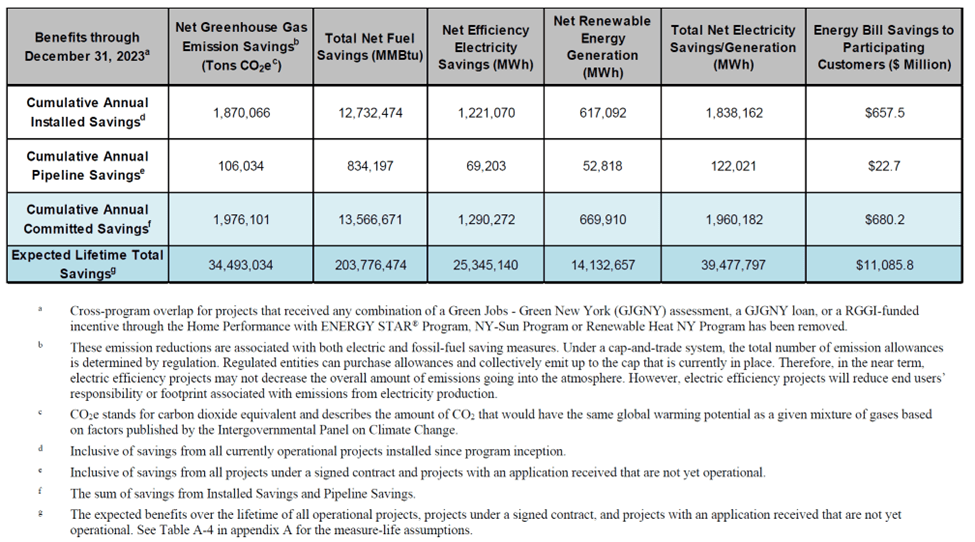
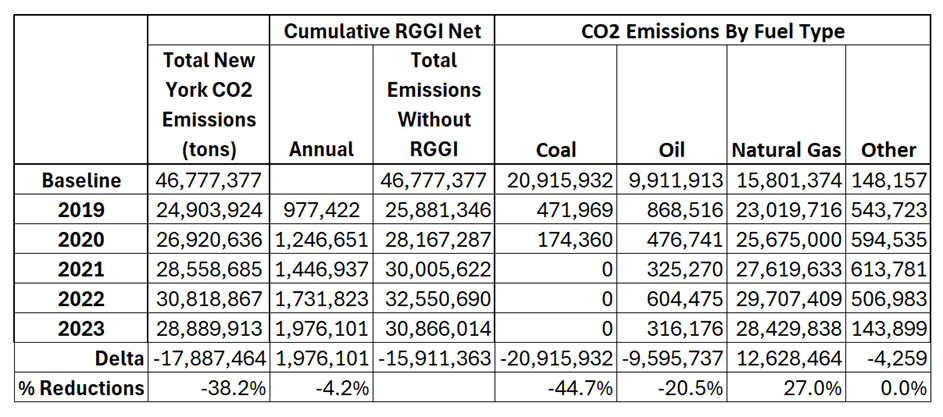
My experience with market-based emission reduction programs is from the compliance side.  I have tracked New York emissions trends for decades and used that experience to develop comments on the NYCI pre-proposal outline of issues.   My comments showed that New York’s impressive GHG emission reductions to date have come primarily from fuel switching in the electric sector.  That was spurred by lower costs of natural gas that made fuel switching from coal and oil to natural gas economic.  There are very few opportunities for similar economic reductions.  In the future, existing sources of GHG emissions must be displaced by alternative zero-emissions resources.  New York’s experience in the effectiveness of Regional Greenhouse Gas Initiative auction revenues to reduce emissions has not been encouraging.  According to Table 2 in Semi-Annual Status Report through December 31, 2022, the cumulative annual net greenhouse gas emission committed savings are 1,725,544 tons through the end of 2022.  That is 9.5% of the observed reduction of 16,196,531 tons since the three-year baseline before the start of RGGI in 2009.  The difficulty of future emission reductions and cost ineffectiveness of auction revenues will impact NYCI implementation.

There also are issues with the theory behind the NYCI approach.  A Practical Guide to the Economics of Carbon Pricing by Ross McKitrick is at odds with NYCI.  He explains that “First and foremost, carbon pricing only works in the absence of any other emission regulations”, but NYCI is in addition to the emission regulations proposed. This is particularly important because McKitrick is arguing that market-based programs should not be expected to provide reductions on an arbitrary schedule.  He goes to note “another important rule for creating a proper carbon-pricing system is to be as careful as possible in estimating the social cost of carbon”. He argues that “whatever the social cost of carbon is determined to be, the carbon price must be discounted below it by the marginal cost of public funds (MCPF) — that is, the economic cost of the government raising an additional dollar of tax, on top of what is already being raised”. NYCI does not recognize the importance of this aspect of carbon pricing.  He concludes: “There may be many reasons to recommend carbon pricing as climate policy, but if it is implemented without diligently abiding by the principles that make it work, it will not work as planned, and the harm to the Canadian economy could well outweigh the benefits created by reducing our country’s already negligible level of global CO2 emissions.”  Substitute New York economy for Canada’s and I believe this describes the likely outcome for NYCI.

Danny Cullenward and David Victor’s book Making Climate Policy Work describe an unacknowledged NYCI problem.  There are political thresholds that limit how much money can be raised by NYCI before the electorate rebels, but investments must be sufficient to fund emission reduction projects to achieve the aspirational Climate Act schedule.  They note that the level of expenditures needed to implement the net-zero transition vastly exceeds the “funds that can be readily appropriated from market mechanisms”.  That observation and the conclusion that future New York emission reductions will come primarily from the deployment of alternative technologies means that emission reduction investments should be a priority for NYCI revenues.  However, there are competing priorities for funds including investments to advance equity and climate justice, funding for programs to reduce costs for those least able to afford higher energy prices, and funding to develop the new technology necessary for the zero-emissions electric grid.

Comments on CBC Report

In this section I will address the CBC brief, Improving NYS Cap-and-Invest Design: Recommendations for Ambitious, Affordable, Market-Driven Emissions Reductions.   I have annotated the Executive Summary with my comments.  The introductory paragraphs outline the goals of the CBC Report:

The Citizens Budget Commission (CBC) has long advocated for New York State to establish an economy-wide carbon pricing system, a market-based policy to incentivize cost-effective greenhouse gas (GHG) emissions reductions. New York Cap-and-Invest (NYCI) has the potential to be such a program. However, to do so, NYCI must be well designed and implemented, or it risks shifting emissions out of state, causing unnecessary harm to the state’s economy, and/or unduly increasing New Yorkers’ cost of living.

CBC continues to strongly support New York implementing a cap-and-invest program. However, the State’s pre-proposal program design falls short by considering some questionable design choices and not presenting sufficient information to assess the range of effects, which may include significant fiscal and economic impacts on New York’s residents and businesses.

Therefore, the State should modify the proposal in rulemaking to ensure it balances emissions reductions with economic vitality, and present more comprehensive impact information. CBC identifies additional analysis that should be released prior to or along with the NYCI draft rules and recommends specific changes to the program design.

I do not think that the CBC understands the fundamental issues associated with GHG market-based emission reduction programs that I outlined above.   Their recommendations will improve the chances that NYCI will not be a failure, but I think it is a hopeless quest. I endorse their request for additional information.  The CBC Report describes two “fundamental flaws”:

First, the materials do not include estimates of the program’s full fiscal and economic impacts—how much residents and businesses will pay for the new emissions charges and how the new costs will affect jobs and economic growth. They also do not fully explain the methods and assumptions that yield the findings. Absent these, there is no way to know how well the proposed NYCI design would drive down emissions while preserving economic growth or whether it would shift emissions, residents, and/or jobs to other states.

I agree with the concern that the lack of cost estimates and documentation for methods and assumptions makes it impossible to determine whether this will work.  I am not sure whether the CBC Report authors fully understand the Cullenward and Victor argument that the funds needed to drive emissions are so large that it is unlikely the money will be sufficient and my observation that the record of past emission reductions is irrelevant going forward because fuel switching does not reduce emissions to zero.  The CBC Report implication that NYCI has a chance to force emission reductions sufficient to meet the Climate Act goals is my major issue with this report. 

The program as presented would levy a massive new charge, economically akin to a new tax—potentially reaching $12 billion annually by 2030—which will have significant impacts on consumers and the State’s economy. This new cost is in addition to costs already passed on to utility ratepayers to fund climate-related investments and Local Law 97 compliance costs that will be paid by large building owners in New York City. Excessive costs could unduly burden businesses and families and push some to leave, especially as New York State and its localities collect more taxes per person than any other state

I agree with the authors that NYCI is essentially a new tax and a large one at that.  Their concerns that NYCI is only one component of the many costs of Climate Act implementation is important and must be addressed because of the consequences they describe.

Second, since the State’s extremely ambitious 2030 emissions reduction target would drive too-costly emissions charges, the State proposes a NYCI design in which emissions reductions ultimately are uncertain. Meeting the 2030 target would have required producers to pay prohibitive costs for the right to emit, so instead of allowing the market to set the price, the State proposes to set a lower, artificially suppressed price for the right to emit GHGs, and then allow businesses to purchase emissions allowances at that lower price, beyond what the program’s emissions cap would otherwise permit, should they choose. Ultimately, this design does not let the State determine how much emissions are reduced and makes balancing environmental benefits with program affordability and economic growth harder.

In my opinion, this paragraph makes the right point but for the wrong reason.  The CBC Report subscribes to the market theory that higher prices will drive emissions down and does not recognize that there are other factors affecting the cost of allowances.  The CBC Report is appropriately concerned about the schedule.  All the market-based programs that I have followed had an initial period of high allowance prices due to the uncertainty of the program that will mask the theoretical link between market price and emission reductions.  Based on my observations I believe the practicality of emission reductions must also be considered.  Affected source emissions must be displaced by alternative sources which NYCI advocates argue will be funded by the proceeds from the NYCI auctions. This means that there is a lag between the time proceeds are collected and invested to displace existing source emissions.  I suspect that the pace of emission reductions will also result in higher prices.  Given all these reasons NYCI is including provisions to limit prices that I think are appropriate.

Importantly, without regard to NYCI, the State already has acknowledged that it will not meet 2030 renewable electricity generation goals. This sharpens the point that NYCI’s design should not be constrained by the requirement to meet current interim goals.

I agree that the schedule is problematic.  It is not clear whether CBC understands the ramifications of the NYCI allowance reduction trajectory.  The only practical compliance option for affected sources on the Climate Act schedule is to limit operations and this leads to unintended consequences.  For example, if fuel suppliers do not have sufficient allowances, they will stop selling gasoline, creating an artificial energy shortage.  NYCI’s design must not be constrained by the current interim goals.

Reducing New York’s GHG emissions is very important; it should be done wisely by carefully balancing trade-offs to avoid damaging the State’s economy and competitiveness, and ensuring emissions are actually lowered, not just relocated out of state.

I agree that NYCI should not damage the State’s economy and competitiveness.  Those tradeoffs should keep in mind that New York’s GHG emissions are less than half a percent of global emissions and global emissions have been increasing by more than a half a percent per year for a long time.  Insisting on strict adherence to an arbitrary reduction schedule that will have a minimal effect on global emissions is not in the best interests of New York.

The CBC Report makes some reasonable recommendations that I endorse.  They argue that New York should:

  • Conduct and publicly release, before or with the draft rules, a more robust assessment of NYCI’s potential fiscal and economic impacts that details:
    • The portion of the cost borne by businesses with a direct compliance obligation and how much is passed on to other businesses and households;
    • NYCI’s costs and their impacts on various types of businesses;
    • NYCI’s impact on the economy overall, specific sectors, and by location;
    • NYCI’s impacts on households, by income and geography

I agree and would expand on this to insist on documented comprehensive numbers.  The Hochul Administration has previously provided misleading numbers that compare costs relative to alleged benefits and only cover certain cost components.  New Yorkers deserve to know the costs of all components of the entire Climate Act transition including NYCI.

  • Recalibrate the 2030 emissions reduction goal to be ambitious but feasible, so New York can leverage market-driven, cost-effective emissions reductions that are balanced with economic growth; and
    • Consider switching to the conventional emissions accounting methodology;

I agree with both these recommendations.  Note that the suggestion to switch to conventional emissions accounting is necessary to link NYCI to similar programs in other jurisdictions.

  • Proceed with rulemaking only when comprehensive assessments are public and based on recalibrated targets; and
    • Periodically evaluate and adjust the program based on experience.

I agree with both these recommendations.

Furthermore, the State should present a detailed plan to use the program’s revenue—which could exceed $30 billion over the next 5 years. Ideally, this would be part of a comprehensive State plan, incorporating the other available funds that will support the transition away from carbon-emitting energy sources.

This is a good point.  There has been very little planning for the Climate Act implementation.  Given the breadth of the proposed changes to the energy system this is unacceptable.  A comprehensive proof of concept that shows that they have enough money available to make the reductions necessary is a rational approach.

However, the State should modify several parameters to improve the pre-proposal. These include:

  • Permitting banking of allowances from the start, instead of after the first compliance period;
  • Allowing limited use of rigorously verified offsets; and
  • Modifying design elements to facilitate linkage with other systems and broaden coverage.

All these recommendations are appropriate.

Lastly, to address concerns about local health impacts, the Department of Environmental Conservation could consider regulating co-pollutants separately from NYCI, rather than including firm-specific emissions caps or limitations on emissions trading, as these could have unintended effects on program compliance costs.

I agree with this too.

Conclusion

I agree with many of the findings of the CBC Report.  It is unacceptable that the Hochul Administration has not been forthcoming on the costs of Climate Act implementation.  NYCI will add an immediate direct cost to all New Yorkers, so the documentation recommendations are appropriate.  The CBC Report recognizes that the emission reduction schedule is important and that it could have ramifications relative to NYCI.  I think that they underestimate the potential for disastrous impacts.   I applaud the CBC for supporting necessary parameters for any market-based program that have somehow become debatable.  If the allowance trading, banking, and site-specific limitations up for consideration are incorporated then the program would have no link whatsoever to previous programs. 

I do have one significant difference in opinion. Unlike the CBC Report I do not think that any GHG emissions reduction market-based programs like NYCI are likely to succeed.  The differences between emission control options and the inclusion of a zero-emissions target are too different from previous market-based programs to expect that past performance is any indication of future success.

The most important finding of my work and the CBC analysis is that we agree that the Hochul Administration rollout of NYCI has been incomplete.  Given the potential cost ramifications, we think a comprehensive State plan describing expected revenues relative to projected emission reduction costs is needed to determine if this approach is feasible.

Vermont Clean Heat Standard Lessons for New York

The Climate Leadership & Community Protection Act (Climate Act) could learn quite a bit from the experiences of Vermont and their Clean Heat Standard as documented by Robert Roper at his Behind the Lines Substack.  Roper did an overview of the Clean Heat Standard and a summary of the Public Utility Commission’s (PUC) long awaited Draft Clean Heat Standard Rule Companion Status Report that provide evidence that New York’s similar initiatives will run into the same problems he identifies.

I have followed the Climate Act since it was first proposed, submitted comments on the Climate Act implementation plan, and have written over 450 articles about New York’s net-zero transition.  The opinions expressed in this article do not reflect the position of any of my previous employers or any other organization I have been associated with, these comments are mine alone.

Overview

The Climate Act established a New York “Net Zero” target (85% reduction in GHG emissions and 15% offset of emissions) by 2050.  It includes an interim 2030 reduction target of a 40% reduction by 2030. Two targets address the electric sector: 70% of the electricity must come from renewable energy by 2030 and all electricity must be generated by “zero-emissions” resources by 2040. The Climate Action Council (CAC) was responsible for preparing the Scoping Plan that outlined how to “achieve the State’s bold clean energy and climate agenda.” The Integration Analysis prepared by the New York State Energy Research and Development Authority (NYSERDA) and its consultants quantifies the impact of the electrification strategies.  That material was used to develop the Draft Scoping Plan outline of strategies.  After a year-long review, the Scoping Plan was finalized at the end of 2022.  Since then, the State has been trying to implement the Scoping Plan recommendations through regulations, proceedings, and legislation.

There are two relevant initiatives.  The CAC recommended an economywide cap-and-invest program. Plan that led to the New York Cap-and-Invest (NYCI) program that will “establish a declining cap on greenhouse gas emissions, limit potential costs to New Yorkers, invest proceeds in programs that drive emission reductions in an equitable manner, and maintain the competitiveness of New York businesses and industries.”  In the Legislature the New York Home Energy Affordable Transition Act, or NY HEAT that passed the last session but has not been signed is supposed to secure “affordable, clean energy for New York households.”

Vermont Clean Heat Standard

Roper’s overview of the Clean Heat Standard put together a “pocket guide” that describes what this law is supposed to do, how it’s supposed to work, and what it looks like it will cost to fully implement.  I recommend that you read the article for full details because Rober is a good writer that explains things well in an engaging manner.  I will quote from his article and compare to New York’s situation below.

Roper explains the origin of the Clean Heat Standard:

The Clean Heat Standard is an outgrowth of the Global Warming Solutions Act (GWSA), passed over the veto of Governor Scott in 2020. The GWSA mandated that Vermonters lower our greenhouse gas emissions to 26% below 2005 levels by 2025, 40% below 1990 levels by 2030 and 80% below 1990 levels by 2050. How we were going to do this, what it would cost, or if it were even possible the lawmakers who passed the GWSA did not know, but if we failed to meet these deadlines, they inserted a provision in the GWSA that gave literally anyone standing to sue the state at taxpayer expense.

As noted in the Overview the GHG emission reduction targets for the New York Climate Act are similar.  Like New York, the Vermont politicians assumed that the transition was only a matter of political will and that the details of how to get there would be a minor, easily resolved detail.  The Climate Act does not include the provision for lawsuits if the deadlines were not met.  Not to worry the Environmental Rights Amendment to the New York constitution will provide a similar basis for litigation.

Similar to New York’s Climate Action Council, the GWSA created a Vermont Climate Council that released their Climate Action Plan in December 2021.

This plan, released in December 2021, recommended that for the thermal sector of our economy (how we heat our homes and businesses, make hot water, and cook our food), which accounts for over 40 percent of our overall greenhouse gas emissions, that the legislature pass another law establishing a Clean Heat Standard.  The legislature did this in 2023 over Governor Scott’s veto with Act 18 — again not knowing what it would cost, how it would work, or if it were possible.

Roper describes the Clean Heat Standard:

In a nutshell, the Clean Heat Standard is a system requiring importers/sellers of heating oil, kerosene, propane, natural gas, and coal, to obtain (in most cases, especially for smaller dealers, this means buy) “credits” based on the amount of carbon released into the atmosphere when the fuels they sell are ultimately burned. According to the law, a carbon credit is defined as “a tradeable, nontangible commodity that represents the amount of greenhouse gas reduction attributable to a clean heat measure.” A “clean heat measure” is one of a dozen legally approved actions taken — by anyone — to reduce greenhouse gas emissions such as weatherizing a building or installing a heat pump.

Practically speaking, a carbon “credit” it is a financial instrument, much like a cryptocurrency, that a fuel importer/seller must obtain in order to legally sell their product(s) either by “mining” the credits themselves (performing clean heat measures) or buying them from a “Default Delivery Agent” (likely Efficiency Vermont) appointed by the state.

There are similarities to NYCI but significant differences too.  Both programs require compliance entities to obtain authorizations to emit amounts of carbon.  Affected Vermonters must earn those authorizations either themselves or buying them for someone else who performed the clean heat measures.  Affected New Yorkers buy the authorizations from the auction marketplace which is supposed to use the proceeds to fund clean heat measures.  New York’s proposed NY HEAT includes mandates to force electrification of home heating away from fossil fuels.  Both state approaches are intended to reduce emissions on a mandated trajectory consistent with their GHG targets.

In both States the nasty little detail of how many homes must be modified to achieve those goals is only now being addressed.  In Vermont “According to a taxpayer funded analysis done by The Cadmus Group for the Climate Council, in order to meet just the 2030 targets Vermonters will have to weatherize 120,000 homes, install 177,107 heat pumps, 136,558 heat pump water heaters, 14,992 advanced wood heating systems, and switch 21,086 homes to using biofuels before the end of the decade.” New York’s documentation for these numbers is buried in documents but in much less detail. In both cases the costs and where the money necessary to pay for them is unresolved.

There is a huge implementation issue for both states.  In Vermont:

How is the state even supposed to ensure and verify that all of these clean heat measures take place, calculate exactly how much greenhouse gas reduction will result from each unique measure so that each measure can be monetized into a tradable carbon credit value, assign ownership of the credits, and then establish a financial exchange where the creators of credits and the parties obligated to obtain them can buy and sell them while at the same time regulators track ownership and ensure compliance? When the legislature passed Act 18, they had no idea so handed off the task of figuring all that out to the Public Utilities Commission (PUC).

In New York, the unique Climate Act emissions accounting requirements means that the State must develop reporting and tracking mechanisms for emissions, develop an allowance system for ownership, and establish a financial exchange like Vermont.  In New York the assignment for this task was given to the Department of Environmental Conservation and the New York State Energy Research & Development Authority on a time frame years less than it took California to establish a similar program.

In my opinion based on years of experience with emissions accounting and reporting New York’s challenge is impossible on the mandated schedule but the Vermont approach is much worse.  Roper writes and I agree:

If that task sounds impossibly complicated, it is. In fact, Efficiency Vermont released a memo to the PUC on September 19, stating, “The complexity of these arrangements also give rise to concerns over the veracity of projects claiming credits and the rigor of their completion… Efficiency Vermont is unsure of the efficiency or efficacy of monetizing credits…. [and] that while compliance may ultimately be achieved after several years, the buying and selling of credits itself becomes grossly inefficient, asymmetrical, and potentially more costly for all parties.” Not an expression of confidence that this is going to work at all, let alone be cheap.

Costs

Roper writes:

Supporters of the Clean Heat Standard say we don’t know what it will cost, shouldn’t speculate, and that all indications so far are that the cost to implement the program will be minimal for consumers. This first position is misleading, and the second is demonstrably false.

As for not knowing what the Clean Heat Standard will cost, that’s only true if you’re looking for an exact price tag, which, of course, can’t be determined until the program’s rules are fully designed and approved. However, it is not difficult to get a ballpark figure with all of the data that has been collected and testimony taken over the three-plus years that this policy has been under consideration.

The excuse for not providing costs in New York’s Scoping Plan was we cannot give an exact price because of all the uncertainties.  The failure to provide a ballpark figure in New York is indicative of the likelihood that the costs are politically unacceptable.  There is no reason to believe that the New York cost experience will be markedly different than Vermont.

Roper documents how much money has been spent on implementation and concludes that “Given this level of financial and human resources engaged over this extended period of time the claim that we still don’t have enough information to know basically what the Clean Heat Standard will cost – not even a ballpark understanding – defies credulity.”  Inevitably the costs must come out, but in the meantime, here is a ballpark estimate:

According the newly released potential study done by NV5 through the Department of Public Service, the estimated incentive spending required to fund the number of clean heat measures necessary to meet the GWSA reduction mandates will cost about $3.3 billion over the first four years leading up to the 2030 target (and about $10 billion total to meet the 2050 target). To raise that much money off the sale of 200 million gallons of fossil heating fuel sold annually comes out to a just over $4 per gallon.

Roper goes on to flesh out more details of the implications of the Vermont initiative.  He describes who pays and who benefits.  Most importantly, who loses: “The biggest losers in this scheme are those who can’t transition away from heating with fossil fuels even if they want to because, for example, they can’t afford the upfront costs of doing so, can’t find the labor to do the work in a timely fashion, or their homes are logistically difficult or impossible to retrofit such as those living in mobile homes, older housing stock lacking open floor plans, or multi-unit apartment buildings.”  He closes this post to explain how this is supposed to be implemented.

PUC Clean Heat Status Report

Roper’s second post is a summary of the Public Utility Commission’s (PUC) long awaited Draft Clean Heat Standard Rule Companion Status Report.  I particularly like his description of the conclusion that the Clean Heat Standard is a dead end and recommend reading it.

As he has been writing for years the PUC concludes:

The Clean Heat Standard as currently conceived requires substantial additional costs and regulatory complexity above the funding needed to accomplish Vermont’s greenhouse gas emission reduction goals. For example, the Clean Heat Standard would require establishing a credit marketplace managed by what is likely to be a costly credit platform, the potential for fraud and market manipulation, the appointment of new or varied default delivery agents with administrative costs of their own, and the participation and regulatory engagement of hundreds of fuel dealers and other actors — e.g., companies and individuals that install clean heat measures — not currently or historically regulated by the Commission.

Our work over the past year and a half on the Clean Heat Standard demonstrates that it does not make sense for Vermont, as a lone small state, to develop a clean heat credit market and the associated clean heat credit trading system to register, sell, transfer, and trade credits. Because the Clean Heat Standard introduces these additional regulatory hurdles and costs, the Commission is considering other options to achieve Vermont’s greenhouse gas emission reduction goals for the thermal sector.

Given that the Clean Heat Standard won’t work what alternative was proposed?

[A] new thermal energy benefit charge on the sale of fuel oil, propane, and kerosene. Similar to the long-standing electric efficiency charge, the Commission would set the thermal energy benefit charge based on statutory criteria, including the need to provide sufficient funding to meet the Global Warming Solutions Act requirements.

Roper describes this as:

A straightforward carbon tax on home heating fuels. Strip away the Rube Goldberg Carbon Credit contraption, and that’s what you’re left with: a direct charge on your oil, propane, and kerosene home heating bill. And to “sufficiently fund” the number of clean heat measures necessary to meet the Global Warming Solutions Act mandates, that carbon tax will necessarily be massive. In the billions massive. Of course, per the report, “The Commission is not providing a cost estimate at this time.” Uh huh. I guess give them another eighteen months.

The NYCI approach is similar, it is nothing other than a disguised carbon tax.  In fact, given the uncertainties associated with devising a “declining cap” that appropriately accounts for all the uncertainties associated with renewable resource deployment, the necessity for new technologies to account for weather-dependent resource limitations, and the regulatory infrastructure necessary to implement the cap-and-invest auction and tracking system I believe a New York carbon tax is a better option.  However, in both Vermont and New York the political optics of another tax and one that will have to be this large, makes admitting this is simply a tax untenable. 

I love Roper’s closing comment on the fact that this has always just been a tax:

Now if lawmakers take the PUC’s recommendation to implement this direct tax/fee/surcharge, that plausible deniability (implausible really, but hey, they’ve been sticking to it, bless their hearts!) is gone. Do they have the guts — or a truly principled commitment to saving the planet — to face the voters with that proposition? It’s time to separate the true believers in catastrophic, anthropogenic climate change from the virtue signaling panderers!

Conclusion

It is not surprising how many similarities there are between the Vermont approach and that of New York even though the programs are packaged differently.  At the end of the day both states will face enormous costs, and their funding approaches are no more than disguised carbon taxes.  The only question left is which state will reach the inevitable reality wall when the citizens finally understand that politicians should not make energy policy.  The current approach in both states assures that affordability and reliability will suffer.  Roper’s work describes why this is happening in Vermont and New York will fare no differently unless changes are made soon.

Personal Comments on the Allocation of New York Cap-and-Invest Proceeds

The Scoping Plan outline of implementation options for the Climate Leadership & Community Protection Act (Climate Act) suggested a market-based program as an economy-wide strategy.  This effort is known as the New York Cap-and-Invest (NYCI) program.  Last month I published an article describing the New York State Department of Environmental Conservation (DEC) and the New York Energy Research & Development Authority (NYSERDA) “proposed framework for guiding the allocation of these funds and identification of potential areas that could receive investments.” DEC and NYSERDA also posed a series of questions seeking public feedback. This article describes the comments I submitted in response.

I have followed the Climate Act since it was first proposed, submitted comments on the Climate Act implementation plan, and have written over 450 articles about New York’s net-zero transition.  I worked on every market-based program from the start that affected electric generating facilities in New York including the Acid Rain Program, Regional Greenhouse Gas Initiative (RGGI), and several Nitrogen Oxide programs. I follow and write about the RGGI and New York carbon pricing initiatives so my background is particularly suited for tNYCI.   The opinions expressed in this article do not reflect the position of any of my previous employers or any other organization I have been associated with, these comments are mine alone.

Overview

The Climate Act established a New York “Net Zero” target (85% reduction in GHG emissions and 15% offset of emissions) by 2050.  It includes an interim 2030 reduction target of a 40% reduction by 2030. Two targets address the electric sector: 70% of the electricity must come from renewable energy by 2030 and all electricity must be generated by “zero-emissions” resources by 2040. The Climate Action Council (CAC) was responsible for preparing the Scoping Plan that outlined how to “achieve the State’s bold clean energy and climate agenda.” The Integration Analysis prepared by the New York State Energy Research and Development Authority (NYSERDA) and its consultants quantifies the impact of the electrification strategies.  That material was used to develop the Draft Scoping Plan outline of strategies.  After a year-long review, the Scoping Plan was finalized at the end of 2022.  Since then, the State has been trying to implement the Scoping Plan recommendations through regulations, proceedings, and legislation.

Cap-and-Invest

The CAC’s Scoping Plan recommended a market-based economywide cap-and-invest program.  The program works by setting an annual cap on the amount of greenhouse gas pollution that is permitted to be emitted in New York: “The declining cap ensures annual emissions are reduced, setting the state on a trajectory to meet our greenhouse gas emission reduction requirements of 40% by 2030, and at least 85% from 1990 levels by 2050, as mandated by the Climate Act.”  In addition to the declining cap, it is supposed to limit potential costs to New Yorkers, invest proceeds in programs that drive emission reductions in an equitable manner, and maintain the competitiveness of New York businesses and industries.  That is the theory, but I have doubts whether it will work and others do too.

Late last year DEC and NYSERDA released the pre-proposal outline of issues that included a long list of topics.  The Agencies said that they were “seeking and appreciate any feedback provided on these pre-proposal program leanings to inform final decisions in the State’s stakeholder-driven process to develop these programs.”  In a post describing my comments I provided additional background information and my concerns.  In late June I described my letter to the editor of the Syracuse Post Standard that argued that the delays were primarily due to staffing issues.  There has not been any substantive response to any comments submitted to date.

Comments

The request for comments asked for thoughts about how the auction proceeds should be invested.  I think that they are putting the cart before the horse because no vetted path to zero emissions has been identified.  In my comments I described the following tradeoff challenges that must be resolved if NYCI is to succeed. 

Fundamentally, there are political thresholds that limit how much money can be raised by NYCI before the electorate rebels, but investments must be sufficient to fund emission reduction projects to achieve the aspirational Climate Act schedule.  This has not been acknowledged in the NYCI implementation process.  Danny Cullenward and David Victor’s book Making Climate Policy Work describe this problem.  They note that the level of expenditures needed to implement the net-zero transition vastly exceeds the “funds that can be readily appropriated from market mechanisms”.  That observation and the conclusion that New York is going to have to fund alternative technologies means that emission reduction investments should be a priority for NYCI revenues.  However, there are competing priorities for funds including investments to advance equity and climate justice, funding for programs to reduce costs for those least able to afford higher energy prices, and funding to develop the new technology necessary for the zero-emissions electric grid.

These tradeoffs can only be resolved if there is a plan in place that is based on feasibility studies.  Unfortunately, there is nothing in place that will provide that information in a timely manner. The sources that are responsible for compliance with NYCI have very few options for on-site control so must rely on somebody else to make the investments for zero-carbon emitting resources to displace their operations for emission reductions.  The costs for those investments and market mechanisms for the required investments are unknown. In addition, it is acknowledged that to reach zero-emissions new technology must be developed and deployed.  All these issues should be addressed before NYCI implementation continues.

Proponents of the cap-and-invest approach admire the NYCI feature that “ensures annual emissions are reduced”.  However, the technological challenges of the transition must be resolved and adequate investments for the transition must be provided to achieve emission reductions.  Furthermore, the NYCI allowance cap trajectory means that resolution of those issues is further constrained.   If the displacement technologies are not deployed in a timely fashion, then the only compliance option left for the affected sources is to reduce or stop operations or cease sales of fossil fuels.  That could result in an artificial energy shortage.

Conclusion

The Climate Act and the implementation programs thus far proposed are risky.  I identified problems and tradeoffs that must be resolved before NYCI implementation continues.  While there are some hints that the ramifications of an unreasonable and unachievable energy transition are becoming so evident that they cannot be ignored, those issues should be resolved before NYCI implementation continues.  The NYCI program has a long way to go before New Yorkers can be assured that implementation will not do more harm than good.

Ultimately, any market-based program intended to reduce GHG emissions is a tax on CO2 emissions. Ron Clutz found a relevant political cartoon for a similar program in Canada that applies to NYCI.

August 2024 Update on the New York Cap-and-Invest Plan – Investment Framework

In the first two months of 2024 the New York State Department of Environmental Conservation (DEC) and the New York Energy Research & Development Authority (NYSERDA) worked on the  New York Cap-and-Invest (NYCI) Program stakeholder engagement process requesting comments on the pre-proposal outline of the regulations.  Since then, nothing much has happened until a webinar was held on August 15, 2024, where DEC and NYSERDA presented “a draft proposed framework for guiding the allocation of these funds and identification of potential areas that could receive investments.” DEC and NYSERDA also posed a series of questions seeking public feedback. The webinar presentation and recording are now available.

I have followed the Climate Leadership & Community Protection Act (Climate Act)since it was first proposed, submitted comments on the Climate Act implementation plan, and have written over 450 articles about New York’s net-zero transition. I have extensive experience with air pollution control theory, implementation, and evaluation of results having worked on every cap-and-trade program affecting electric generating facilities in New York including the Acid Rain Program, Regional Greenhouse Gas Initiative (RGGI) and several nitrogen oxide programs.  The opinions expressed in this article do not reflect the position of any of my previous employers or any other organization I have been associated with, these comments are mine alone.

Overview

The Climate Act established a New York “Net Zero” target (85% reduction in GHG emissions and 15% offset of emissions) by 2050.  It includes an interim 2030 reduction target of a 40% reduction by 2030. Two targets address the electric sector: 70% of the electricity must come from renewable energy by 2030 and all electricity has to be generated be “zero-emissions” resources by 2040. The Climate Action Council (CAC) was responsible for preparing the Scoping Plan that outlined how to “achieve the State’s bold clean energy and climate agenda.” The Integration Analysis prepared by the New York State Energy Research and Development Authority (NYSERDA) and its consultants quantifies the impact of the electrification strategies.  That material was used to develop the Draft Scoping Plan outline of strategies.  After a year-long review, the Scoping Plan was finalized at the end of 2022.  Since then, the State has been trying to implement the Scoping Plan recommendations through regulations, proceedings, and legislation.

Cap-and-Invest

The Climate Action Council’s Scoping Plan recommended a market-based economywide cap-and-invest program.  Since my last post on this subject, I have read a couple of relevant articles that provide background information on this approach.  Dr. Lars Schernikau is an energy economist who explained why an emissions market solution for CO2 is not likely to succeed.  He explained that CO2 pricing (also falsely called “carbon pricing”) is a terrible idea fit only for discarding in  The Dilemma of Pricing CO2.  Ron Klutz summarized the article with emphasis and added images.  The other article noted explained that the label  cap-and-invest is a political marketing term “to boost their appeal and reflect the growing use of funds for climate protection.”  In brief, cap-and-invest is a marketing cover for the politically toxic carbon tax.

The program recommended by the CAC works by setting an annual cap on the amount of greenhouse gas pollution that is permitted to be emitted in New York: “The declining cap ensures annual emissions are reduced, setting the state on a trajectory to meet our greenhouse gas emission reduction requirements of 40% by 2030, and at least 85% from 1990 levels by 2050, as mandated by the Climate Leadership & Community Protection Act (Climate Act).”  In addition to the declining cap, it is supposed to limit potential costs to New Yorkers, invest proceeds in programs that drive emission reductions in an equitable manner, and maintain the competitiveness of New York businesses and industries.

Late last year DEC and NYSERDA released the pre-proposal outline of issues that included a long list of topics.  The Agencies said that they were “seeking and appreciate any feedback provided on these pre-proposal program leanings to inform final decisions in the State’s stakeholder-driven process to develop these programs.”  In a post describing my comments I provided additional background information and my concerns.  In late June I described my letter to the editor of the Syracuse Post Standard that argued that the delays were primarily due to staffing issues.  In my submittals I have expressed two primary concerns.  The first is that the sources that are responsible for compliance with NYCI have very few options for on-site control so must rely on somebody else to make the investments for zero-carbon emitting resources to displace their operations.  The second concern is that the NYCI feature that “ensures annual emissions are reduced” must be integrated with the investments needed for those zero-carbon emitting resources.  If there are inadequate investments, then the only option for the affected sources is to reduce or stop operations.  If the affected source is an electric generating station, there could be reliability implications.

Public Webinar August 15, 2024

The meeting description said:

The New York State Department of Environmental Conservation (DEC) and New York State Energy Research and Development Authority (NYSERDA) are seeking public input as they develop a framework for the use of New York Cap-and-Invest (NYCI) proceeds from the Climate Investment Account. The Climate Investment Account is a critical component in supporting New York’s transition to a less carbon-intensive economy by directing NYCI auction proceeds to projects that benefit New Yorkers, prioritizing frontline disadvantaged communities that historically suffered from pollution and environmental injustice.

In the Fiscal Year 2024 State Budget, Governor Kathy Hochul laid out the structure of the Climate Action Fund for NYCI proceeds. The Climate Investment Account is one component of the fund and will be used to direct two-thirds of future NYCI proceeds. The remaining proceeds will go to an account to directly mitigate consumer costs, guided by the Climate Affordability Study, and a third account will support energy affordability for small businesses.

The agenda included the following items:

  • Climate Leadership & Community Protection Act Overview
  • Introduction to New York Cap-and-Invest (NYCI)
  • Use of Proceeds from the Climate Investment Account
  • Request for Public Input
  • Questions and Answers
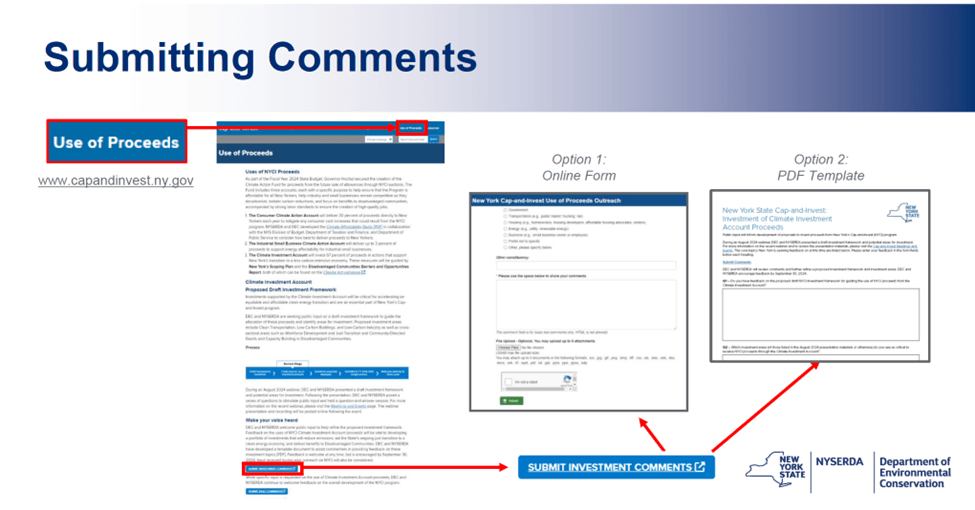
  • How to Submit Comments and Stay Involved

Nothing new was provided in the first two agenda items.  If you are interested in this background information I have linked the start of the video description for each section to the following links: overview of the Climate Act and introduction to NYCI

The focus of the webinar was on Investment of Proceeds.  Maureen Leddy, Director of the Office of Climate Change, described the investments plan.  In the first slide she explained that the proceeds from the NYCI auction are distributed to the Climate Action Fund.  The Fiscal Year 2021 Budget established this Fund and how the proceeds would be invested and then allocated.  There are three parts:

  • Consumer Climate Action Account: At least 30% of future NYCI proceeds to New Yorkers every year to mitigate consumer costs.
  • Industrial Small Business Climate Action Account: Directs 3% of future NYCI proceeds benefits to help mitigate cost.
  • Climate Investment Account: Directs two-thirds of future NYCI proceeds to support the transition to a less carbon-intensive economy

Readers should keep in mind that the ostensible purpose of the Climate Act is to address the existential threat of climate change.  To make the reductions necessary to mitigate this threat only two thirds of the proceeds are directed to the “less-carbon-intensive” economy.  The other two carveouts appease consumers and small businesses that will be impacted by the increase in energy costs caused by NYCI.

The Consumer Climate Action Account is supposed to mitigate consumer costs.  As has been the case throughout the Climate Act implementation, the Climate Affordability Study that recommends how the funds will be delivered is just a list of options with no discernible plan to implement them.  The proceeds to small businesses are nothing other than a bribe to try to appease that constituency.  The Climate Investment Account is supposed to support the necessary investments in zero-emissions resources necessary for compliance.

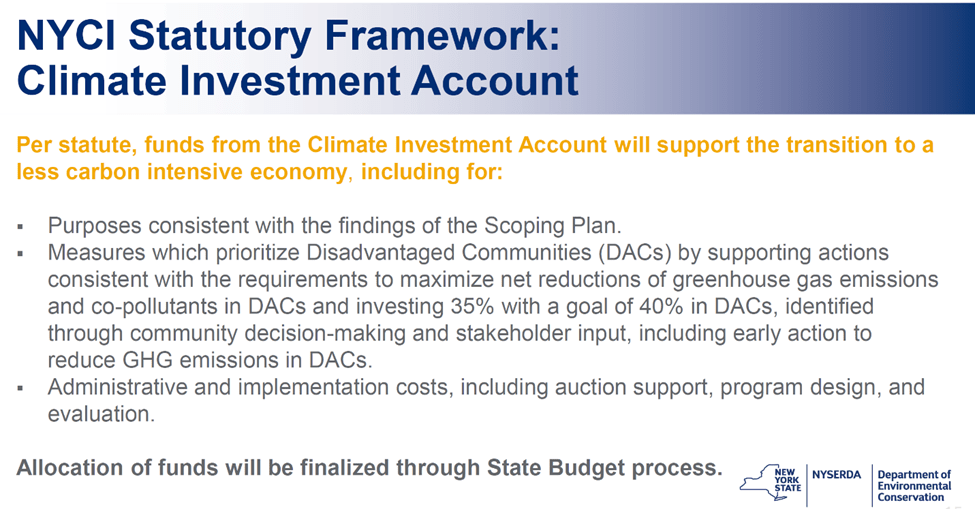
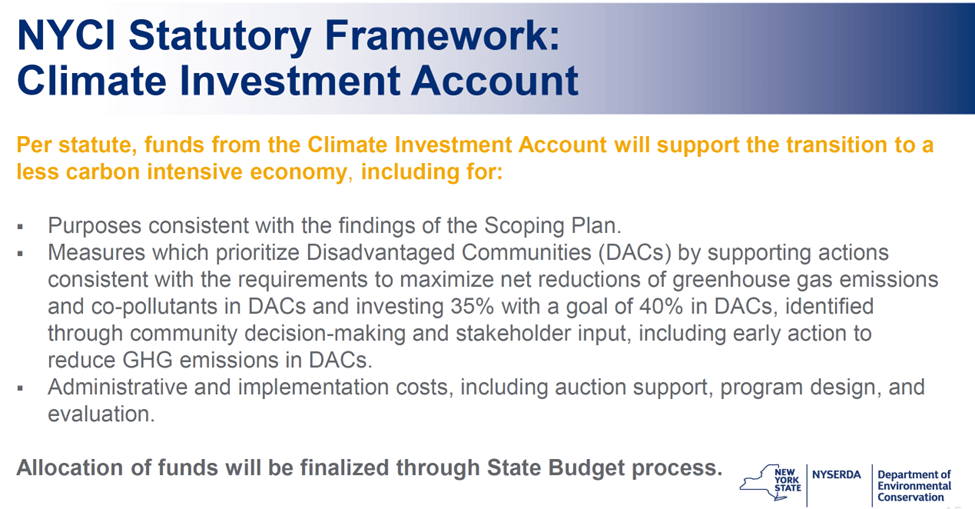
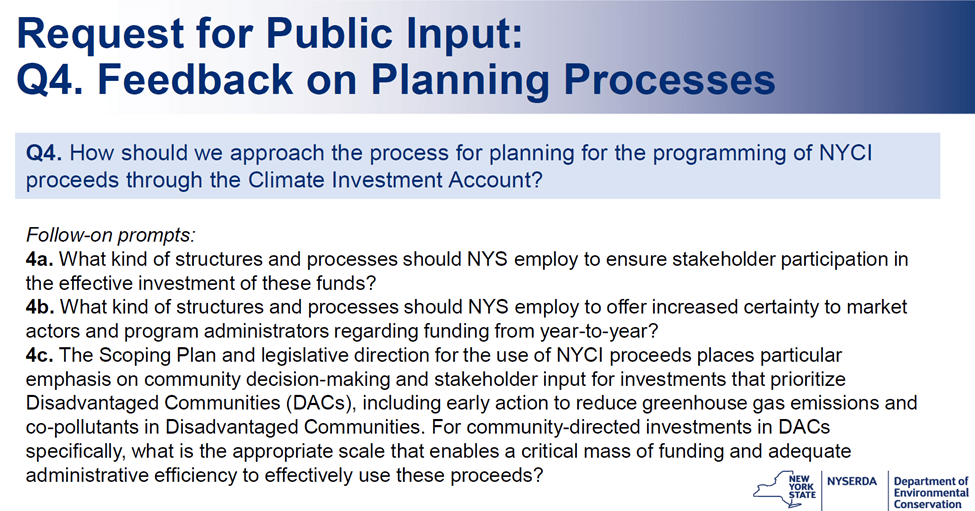
The focus of the webinar is the Climate Investment Account.  Even though 67% is supposed to support the emission reductions for the transition, the New York legislators mandated how it will be allocated further diluting the amount targeted for transition investments:

  • Purposes consistent with the findings of the Scoping Plan.
  • Measures which prioritize Disadvantaged Communities (DACs) by supporting actions consistent with the requirements to maximize net reductions of greenhouse gas emissions and co-pollutants in DACs and investing 35% with a goal of 40% in DACs, identified through community decision-making and stakeholder input, including early action to reduce GHG emissions in DACs.
  • Administrative and implementation costs, including auction support, program design, and evaluation.

These allocation requirements reduce the potential effectiveness of the investments to make emission reductions.  I find it troubling that this legislative mandate and the webinar presentation made no mention of cost-effective investments to reduce emissions.  In a recent post I evaluated the State’s investments from the Regional Greenhouse Gas Initiative.  The good news is that investments in energy efficiency were relatively effective investments.  As a result, I think the emphasis on DAC investments should be on energy efficiency improvements, but the legislative mandate states that community decision-making and stakeholder input will decide. 

The final statement that the “Allocation of funds will be finalized through the State Budget process” is important.  In my opinion, taxes must be levied by the legislature and not through a regulatory proceeding.  It may be that the process outlined here is intended to fulfill that mandate.  As we shall see, the questions posed in the webinar provide a basis for how the revenues (aka the tax) will be allocated.

The next slide outlined the timeline and is consistent with my impression that this is intended to fulfill the legislative mandate.  The presentation noted that they “laid out our process for seeking public input on the use of NYCI proceeds under the climate account.”  It went on to say that “today we’ll share a draft framework for the investment and start this comment intake to connect, collect initial public input on the use of proceeds.” 

Leddy went on to describe the comments received earlier this year.  They claimed that “As part of extensive stakeholder engagement since 2023, DEC and NYSERDA received thousands of comments about Cap and Invest implementation.”  Previously the comments focused on regulatory program design but 128 organizations and institutions “submitted comments addressing the use of proceeds, equity, and/or affordability.”  The presentation claimed that it is a good thing that 39 advocacy organizations,

37 trade associations & 3 labor unions, 35 businesses & 7 utilities, 11 governmental bodies/authorities,

3 think tanks responded with comments about the use of proceeds. 

.

The first summary slide describing the comments received listed three main themes.  The first is to “advance the deployment of decarbonization technologies in key sectors & enable emissions reductions”.  Leddy just read the slide so there was no indication of the necessity to deploy technologies so that the emission reduction trajectories can be met.  The second theme was “Support the clean energy workforce & prioritize labor protections”.  There is no question that worker training is necessary, but I have two concerns.  The first is that the necessary training does not lead to direct emission reductions, and I doubt very much that those costs were included in the Hochul Administration’s estimates of the costs and benefits, so I suspect that those projections underestimate costs.  The second point is that emphasizing labor projections is an appeal to a specific constituency not necessarily incorporating the most cost-effective reductions.  The final theme was “Prioritize affordability & lower the cost of the energy transition”. The examples are for low-income New Yorkers and business & industry.  I worry the average ratepayer will be overlooked.

One of the primary topics emphasized is climate justice as it relates to equity and affordability.  The next slide described two themes.  The first theme was the specific challenges facing disadvantaged

communities (DACs): air quality impacts, vulnerability to energy price increases, and structural and financial barriers to implementing control strategies.  I worry that addressing these concerns make take precedence over strategies that actually reduce emissions.  The climate justice aspect of the Climate Act has focused on disadvantaged communities (DACs) and, in my opinion, could be overlooking rural concerns.  For example, deployment of clean energy technologies in DACs included transportation concerns: “public transit; electric vehicles (including buses and heavy-duty vehicles); and public chargers/fast charging networks.”  All those are primarily urban concerns.

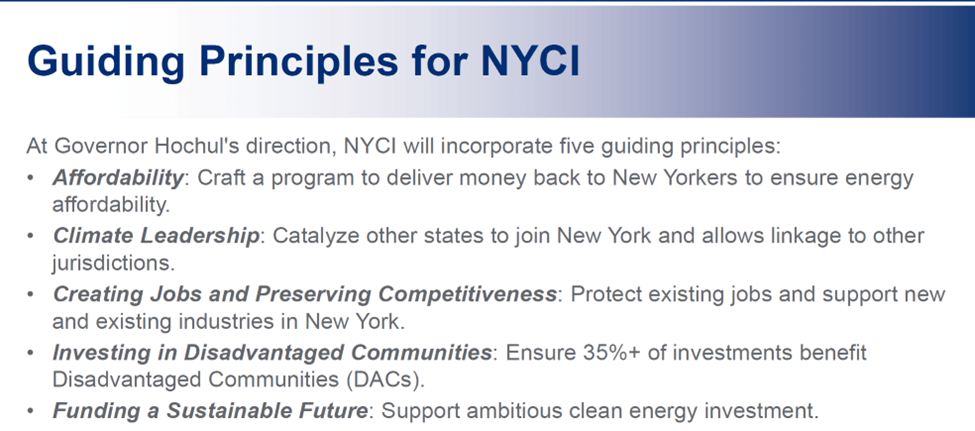
The next item on the agenda was the framework and areas for investment for the proposal.  Vanessa Olmer (?) went through the draft proposal to guide the use of NYCI proceeds.  Make no mistake that the Climate Act is all about politics and the NYCI proposed plan to use the proceeds is no exception.  The draft proposal is “designed to be consistent with the five core principles that the Governor set forth for the cap and invest program”.  My comments on the pre-proposal draft addressed these principles.  My comments noted that The Hochul Administration has never clearly admitted the expected costs of the Climate Act net-zero transition because the costs are politically toxic.  This principle is an attempt to suggest the costs are under control.  The climate leadership slogan is inconsistent with the Climate Act unique emissions accounting approach that prevents other states from joining New York or linking programs with New York.  Creating jobs is a much-repeated tenet of the Climate Act but I do not believe it is possible to create more jobs than lost due to the increased costs inherent in a net-zero transition.  While there is no question that Climate Justice investments in DACs are appropriate it is not clear that those investments will make those least able to afford higher energy prices whole when the full costs of the transition hit the economy.  The final principle is funding a sustainable future.  My comments emphasized the need for investment in zero-emissions technologies that can displace greenhouse gas emitting technologies.

The presentation went on to describe a framework for the investment of NYCI proceeds. “This framework would inform the identification of draft investment areas that NYCI proceeds will be directed toward.”  The agencies asked for public input to “refine the framework and to help identify and prioritize investment areas for the Climate Investment Account.”

As shown in the next slide the description of the proposed investment framework is linked to the guiding principles.  It is encouraging that the framework places funding for the sustainable future at the top.  Funding investments that reduce greenhouse gas emissions and sequester carbon are necessary to meet the Climate Act mandates.  Sadly, the speaker again just read the slide and failed to emphasize the link between effective emission reductions and the NYCI limits to emit.   The last framework item is to “Support policy-relevant research and program evaluation tied to emissions reducing projects”.  In this instance the presentation noted the importance to use “some NYCI proceeds to conduct policy relevant research and program evaluation tied to emission reducing projects” While this is necessary, NYSERDA has not been a good steward of the proceeds from the similar Regional Greenhouse Gas Initiative.  Considerable funding has been diverted away from the original intent of the program to fund peripherally related tasks more appropriately funded by other sources.  I fear that this will be an issue with NYCI proceeds.  Also note that buried in the administrative costs is the Cost Recovery Fee which is assessed on public authorities by New York State for an allocable share of state governmental costs attributable to the provision of services pursuant to Section 2975 of the Public Authorities Law.  This takes a percentage of the funds off the top for bureaucratic administration.

The next four slides gave examples of proposed investment areas. Think of it as a menu for special interest lobbying to get a place at the trough.

The final section of the presentation presented specific requests for public input.  The first request was related to the investment framework: in reference to the last slide shown in this summary “Do you have feedback on the proposed draft NYCI investment framework for guiding the use of NYCI proceeds from the Climate Investment Account?”  NYSERDA asked specific questions about the proposed investment areas – priorities and other potential projects that could benefit from NYCI-funded investments. 

The third question, feedback on appropriate interventions, piqued my interest.  It asked, “what interventions do you see as critical to receive investment of NYCI proceeds through the Climate Investment Account?”  It included these follow-on prompts:

  • What funding needs do you see existing today that seem appropriate for NYCI?
  • How should NYS consider costs relative to associated impacts and benefits? For example, should NYS orient investments towards lower-cost opportunities that produce faster emissions reductions or more difficult and/or expensive areas where emissions reductions might otherwise not be achieved or achieved more slowly?
  • How should NYS balance funding for mass deployment of market-ready clean energy technologies vs. innovation to address the costs, feasibility, and access barriers for emerging solutions?

My response to the first question about funding needs is simple.  The state investments must fund the deployment of emission reduction strategies that provide emission reductions consistent with the availability of NYCI permits to emit GHG emissions.  If this is not done correctly, emitters will have no choice but to shut down or limit operations with bad consequences.  It is impossible to answer the other two questions because the Scoping Plan documentation is inadequate.  There is no indication that there is a plan for investments to achieve the necessary emission reductions that I maintain should have been included in the Scoping Plan.  These are all valid questions but other than saying these tradeoffs must be considered I don’t see how anyone can respond meaningfully.

The final question is “How should we approach the process for planning for the programming of NYCI

proceeds through the Climate Investment Account?”  The follow-on prompts shown in the following slide raise an important question in my mind.  What is more important: emission reductions consistent with the Climate Act mandated schedule or appeasing the community-directed investment requests from the DACs.  Will emission reduction effectiveness be considered?

Submitting Comments

If you are interested in submitting comments, then you should check out these instructions and the following slide.  They asked for feedback preferably by September 30, 2024:

online at:www.capandinvest.ny.gov

by mail to:New York State Energy Research and Development Authority

Attn: NYCI Investment Planning

17 Columbia Circle

Albany, NY 12203-6399

Discussion

Leddy described the Consumer Climate Action Account noting it states: “At least 30% of future NYCI proceeds to New Yorkers every year to mitigate potential consumer costs.”  She says “potential” in relation to consumer costs either because the narrative is to downplay costs or because she thinks the costs are not concerning.  Either way I think it reflects the mindset of agency staff that are totally invested in the Climate Act cause.  Outside of that bubble costs are going to be an issue.

In response to questions the webinar claimed that draft rules would be out later this year and that appropriations and spending of NYCI proceeds would begin in the next fiscal year beginning April 2025.  In the stakeholder engagement process earlier this year DEC and NYSERDA claimed they would propose regulations by summer and the final rules would be in place by the end of the year.  This update suggests that the regulations will be pushed back.  Although I believe that staffing issues are part of the reason for the delays, the political underpinning of the Climate Act should not be forgotten.

The Hochul Administration is certainly cognizant of costs for environmental initiatives.  On June 7, Governor Hochul explained that she reversed the decision to proceed with the New York City congestion pricing plan because of costs. At the Energy Access and Equity Research webinar sponsored by the NYU Institute for Policy Integrity on May 13, 2024 Jonathan Binder stated that the New York Cap and Invest Program would generate proceeds of “between $6 and $12 billion per year” by 2030.  Note that the current NYCI proposal outline analyzed allowance prices starting at $23 in 2025 with 5% escalation for 2026, and an increase to $54 in 2027, escalating by 6% annually thereafter.  Note that the cost increase comes after the next gubernatorial election year.  The New York State legislature elections are coming up in November.  I am now convinced that a major reason for the NYCI regulation delays is related to those elections. 

The stakeholder process for this framework for guiding the allocation of NYCI funds and identification of potential areas that could receive investments is entirely appropriate.  It will guide the legislative process to allocate at least $6 billion per year.  Leddy said that the intention of the engagement process is to provide the Governor and the legislature to have the benefit of public input as they develop next year’s budget. 

Unfortunately, see no recognition of the challenges of funding the transition.  There also is no indication that there is a plan to consider the funding requirements of the Scoping Plan strategies with the mandated emission reduction trajectories.  Those two issues are concerning.

One of the characteristics of the proposed net-zero Climate Act transition is over-reliance on the presumption that control strategies that have worked elsewhere will work in this application.  NYCI is a prime example.  Past performance does not guarantee future success.  Given the differences between past successful programs and the one proposed I am convinced that NYCI will fail to deliver as advertised.

My other concern is that I believe that funding ambitious clean energy investments is more difficult than acknowledged.  My analysis of the Regional Greenhouse Gas Initiative proceeds shows that the investments were not cost efficient averaging $565 per ton reduced. As noted, the investments to reduce emissions are diluted by other mandates.  There is no acknowledgment that NYCI funding priorities should consider observed cost effectiveness results and be consistent with the NYCI allowance allocation reduction trajectory.

Conclusion

The NYCI process is behind schedule, and I think that is primarily because the enormous costs of the transition cannot be hidden when the regulations are proposed.  It is getting increasingly difficult to continue to hide the costs.  The New York State Comptroller Office audit of the NYSERDA and PSC  implementation efforts for the Climate Act found that: “The costs of transitioning to renewable energy are not known, nor have they been reasonably estimated”.   The Regulatory Impact Statement for the NYCI regulations must provide costs.  Delaying the release of the proposed regulations is very likely politically motivated to continue hiding the costs.

While I agree that a framework for investing the NYCI proceeds is necessary it does not appear that the proposed framework is going to prioritize funding emission reduction strategies consistent with the allowance reduction trajectories consistent with the Climate Act mandates.  That could lead to bad outcomes, but the apparent emphasis is on providing funding for favored political constituencies.  I believe that the political calculus driving NYCI implementation is perverting the effectiveness of this market-based program to the point that it will not work. 

Basis of New York Cap and Invest Health Benefits Claims

For the first two months of 2024 the New York State Department of Environmental Conservation (DEC) and the New York Energy Research & Development Authority (NYSERDA) have been working on the  New York Cap-and-Invest (NYCI) Program stakeholder engagement process.  As part of the stakeholder engagement process there was a webinar describing the Preliminary Scenario Analyses.  One thing that caught my attention was the claim that health benefits could be as much as $15.7 billion in 2035 because of NYCI implementation.

Two recent blog posts described a literature article about the development of the Linear No Threshold (LNT) model for cancer risk that is the basis of the NYCI health benefits claim. This post describes the Journal of Occupational and Environmental Hygiene paper by Edward Calabrese “Cancer risk assessment, its wretched history and what it means for public health”   and the NYCI health benefits claims.

I have followed the Climate Leadership & Community Protection Act (Climate Act)  since it was first proposed, submitted comments on the Climate Act implementation plan, and have written over 400 articles about New York’s net-zero transition. The opinions expressed in this post do not reflect the position of any of my previous employers or any other organization I have been associated with, these comments are mine alone.

Overview

The Climate Act established a New York “Net Zero” target (85% reduction in GHG emissions and 15% offset of emissions) by 2050.  It includes an interim 2030 reduction target of a 40% reduction by 2030 and a requirement that all electricity generated be “zero-emissions” by 2040. The Climate Action Council (CAC) is responsible for preparing the Scoping Plan that outlines how to “achieve the State’s bold clean energy and climate agenda.”  In brief, that plan is to electrify everything possible using zero-emissions electricity. The Integration Analysis prepared by the New York State Energy Research and Development Authority (NYSERDA) and its consultants quantifies the impact of the electrification strategies.  That material was used to develop the Draft Scoping Plan outline of strategies.  After a year-long review, the Scoping Plan was finalized at the end of 2022.  In 2023 the Scoping Plan recommendations were supposed to be implemented through regulation, PSC orders, and legislation.  Not surprisingly, the aspirational schedule of the Climate Act has proven to be more difficult to implement than planned.  NYSERDA and DEC are attempting to promulgate rules for NYCI so that the program starts in 2025 and the regulatory package will claim significant health impacts that I think are unjustified.

Linear No Threshold Model

The weekly newsletter “The Week That Was: 2024-03-23” produced by the Science and Environmental Policy Project includes a section titled “Lack of Science Integrity” that describes the Edward Calabrese “Cancer risk assessment, its wretched history and what it means for public health”   paper.  That post walks the reader through the paper with extensive quotes including the introduction:

The story about to unfold in this commentary will be disturbing but perhaps not too surprising now in contemporary society. You will be taken on a path of discovery that explores the history of cancer risk assessment for radiation and chemical carcinogens. This commentary is about a history of errors made by scientific leaders that have long remained hidden and uncorrected. The evidence shows that major biases led to deliberate misrepresentations (i.e., blatant dishonesties) of the scientific record by the very people society was supposed to trust, including multiple Nobel Prize winners. Equally troubling have been the dishonest actions of organizations, such as major advisory bodies, including the US NAS and the journal Science that have repeatedly succumbed to violations of the public trust. As disappointing and upsetting as such statements are, it is hard to believe that this historical record could get even more corrupt, but it does. It has become known that major US scientists conducting important mutation and cancer studies hid data and deliberately withheld results from the public and scientific community. Why? Because the findings didn’t fit their preconceived beliefs and would not enhance opportunities to obtain more funding for themselves and their programs. Yes, the destructive self-interest of the research community, especially governmental and university scientists, in this case, presents a prominent but long hidden dimension that unfolds in a complex journey of discovery.

Society is faced with questions over who can be trusted in today’s world: government, scientists, prestigious advisory groups, like the United States National Academy of Sciences (US NAS), and major journals like Science, Nature, The Lancet, and others. These have historically all been the entities that society has trusted for decades. The historical record presented here, therefore, involves powerful and high-profile individuals and groups that manipulated the public for personal gain and is presented in the following eight-part expose.

If you are interested, then I encourage you to read the rest of the SEPP newsletter and the article itself but the implications are not immediately obvious without background.  Originally, I thought I would use this post as the basis for describing the background of problems identified in the Calabrese paper.  However, Francis Menton wrote a post doing just what I was planning to do. 

Menton notes that:

Calabrese’s article is long (18 two-column single-space pages) and goes into detail of the names involved, the particular pieces of evidence suppressed along the way, the manipulation of members of committees to get to desired outcomes, and so forth. It has a lengthy bibliography, including references to multiple prior articles of his own where he has been piecing together and building the story of the LNT fraud for years. If you are interested in this subject, I highly recommend this article.

Menton argues that this approach is a candidate for the greatest scientific fraud of all time.  He writes:

This fraud goes by the common acronym of “LNT,” which stands for the “linear no threshold” hypothesis of causation of diseases, particularly cancer, from environmental factors. The LNT hypothesis is the basis for huge swaths of enormously costly regulation, probably the large majority of environmental regulatory cost outside the sphere of “climate.” In a March 7 article in the Journal of Occupational and Environmental Hygiene, a guy named Edward Calabrese makes the case that the LNT hypothesis has been advanced by means of intentional fraud since its inception nearly 100 years ago. The title of the article is “Cancer risk assessment, its wretched history and what it means for public health.”

He describes the basis of the approach:

The LNT hypothesis theorizes that if a chemical or phenomenon (e.g., radiation) is established as dangerous at some dosage, no matter how high, then it must also be dangerous at small dosages, no matter how tiny. That conclusion follows if the relation of dose to danger is linear, with no threshold below which the danger goes away. A tiny dose may have a tiny danger, but as long as the dose/danger relationship is linear without threshold, then there is no safe dose.

This approach was originally developed to address cancer risk from nuclear radiation exposure, but the principle is now applied in other ways.

Calabrese’s article provides a thorough history of the origins of the LNT hypothesis, and how it was advanced and promoted by the suppression of definitive contrary evidence. By the 1970s the LNT hypothesis had the backing of the National Academy of Sciences and had been adopted by the EPA as the basis for regulating hazardous chemicals and radiation. The EPA continues to use the LNT approach in its regulatory efforts today, even as evidence accumulates that it is wrong and has been based on fraud from the outset. And thus, the LNT hypothesis is the fundamental reason why nuclear power plants are so expensive and difficult to build; why no long-term solution for storage of spent nuclear fuel can be found; why EPA constantly proposes new regulations lowering allowable levels of emissions of chemical substances like mercury or PCBs; why pesticides and herbicides like glyphosate become the subject of multi-billion dollar liability disasters; and so forth.

Menton goes on to explain:

The LNT hypothesis may at first seem intuitively likely to be true. For example, it is established that large doses of radiation can induce mutations that can lead to cancer. So why then couldn’t a single item of radiation, like one alpha particle or a single gamma ray, induce the mutation that initiates the disease? But Calabrese points out that the LNT hypothesis presumes that mutations are rare, and that the body has no capacity to repair ongoing mutations. What research has revealed is that, far from being rare, mutations are extremely common; and the body has a large capacity to repair them. Thus, a small external source of mutations, like background or low-dose radiation, is easily dealt with, and if anything helps to stimulate and exercise the body’s natural repair system. Only when an external force causes very extensive mutations exceeding the body’s capacity to repair — i.e., when some threshold is crossed — does the external force increase the risk of cancer or other disease. From Calabrese, page 16:

[T]he most dominating cause of evolution is our metabolism which induces millions of mutations per day in each cell, with 99.99999% being repaired each day. If our repair systems were not so exceptionally good, life would not exist. Our metabolism produces about 200 million times more genetic damage events per cell per day than that induced by background radiation. There is no contest between the two. What this means is that our body is our biggest enemy; it also means that it is also our best friend. The body’s great repair mechanisms evolved not to prevent and repair damage from background radiation but to fix the damage that our metabolism induces each day. Thus, the body’s repair systems are designed by nature to protect our bodies against ourselves, with background radiation being a very tiny and insignificant factor.

Sadly, this approach is widely used and now provides “justification” for many environmental regulations.  Proponents calculate a relationship between health effects at two high levels then extrapolate the dose response curve to ridiculously low levels.  Even though there is a tiny effect multiplying the impact over a large population provides scary projections for things like asthma exacerbation.  Menton explains why it has become so pervasive.

So how did the LNT hypothesis gain such enormous sway, and become the basis for extensive and destructive government decision-making for decades? Calabrese points out that, by contrast to the threshold hypothesis, the LNT hypothesis has the potential to induce great fear in the public, and thus to stimulate large opportunities for funding and career advancement:

[T]he experts got the radiation and chemical mutation idea wrong from the start but they convinced many that they were correct and created debilitating fear in the population at the same time. We also learned that one of the reasons that these great scientists created such fears was to advance their careers and to get a constant flow of government grant monies.

In the next section I will show how NYSERDA and DEC have used this approach for NYCI.  Menton provides a good segue to that section:

Meanwhile, our government and its “experts” merrily go forth regulating on the basis of the LNT hypothesis, and imposing enormous costs on society for no benefit. From Calabrese’s Conclusion:

[The scientists who promoted the LNT hypothesis] were driven by ideological and self-serving professional biases that would lead to both falsifications of the research record and suppression of key scientific findings, all to establish the LNT model for hereditary and cancer risk assessment, replacing the threshold dose-response model. This troubling history has now been revealed in a long series of peer-reviewed publications by the author and summarized in a broad conversational manner in this Commentary. This troubling history remained hidden from regulatory agencies around the globe since its inception. These groups simply and uncritically accepted a flawed and corrupt history, assuming that it was accurate and reliable. Yet this path of historical ignorance led the US EPA, and other national regulatory agencies, to accept a dishonest foundation upon which to base and frame cancer risk assessment, terribly failing in their public service mission.

New York Cap and Invest Health Impacts

The purpose of this article is to show the basis for the projected health effects of NYCI. At the January 26, 2024 webinar the methodology for the health effects was described.   In brief, fuel consumption changes by sector projected by their modeling were used to estimate changes in emissions.  The changes in emissions reduce ambient air quality levels and this leads to the alleged health benefit improvements.  Because the emissions estimates cannot be broken down into detail the air quality impacts also are broad estimates.  EPA’s CO-Benefits Risk Assessment Health Impacts Screening and Mapping Tool uses the LNT approach to estimate health impacts, primarily for improvements in inhalable particulate matter that is 2.5 microns or smaller.

The projected health impacts description claims that there are substantial benefits.

The NYCI Preliminary Analysis Data Annex spreadsheet includes supplementary health effects data for the webinar presentation and  a table that estimates impacts on air quality and health.  The following table excerpts some of the health benefits projections.  Frankly, I think that all these improvements are well within normal variation so the whole exercise has little value.  Note that I expected that each of the benefits would be linearly proportional to the change in concentrations but applying the ratio of 2025 to 2030 improved concentrations to the health benefits did not match exactly.  In all cases the assumed proportional benefit was less than the benefits shown.

Despite the lack of an exact linear match, I believe the results are close enough to use them to project health benefits between the inhalable particulate concentrations in 2000 relative to 2022.  The Department of Environmental Conservation runs a network of inhalable particulate monitoring stations across the state and summarizes the results in its Ambient Air Quality Reports.  I extracted the annual average concentrations for seven widely ranged sites with the longest records.  All the stations show significant improvements in the inhalable concentrations over the period of record.  I calculated the average of these sites in 2000 11.4 micro grams per cubic meter and 2022 6.0 micro grams per cubic meter for a statewide improvement of 5.4.

New York State Annual Average Inhalable Particulate Air Quality (micro grams per cubic meter) Trend

The following table compares the observed improvement in air quality and projects health benefit improvements proportional to the change in inhalable particulates.  If there has been an observed reduction of over one million emergency room visits for asthma between 2000 and 2022 then I will believe the NYCI health benefit projections.  I have never seen anyone verify this health benefit model which should be easy to do.  I expect that the results would be inconvenient, and proponents of this methodology know this so it has never been done.

Conclusion

In every instance I have checked the Hochul Administration has overstated the benefits and understated the costs of the net-zero transition.  New York’s cap-and-invest projected health benefits are a vivid example of how NYSERDA manipulates the narrative to claim benefits that far exceed any reasonable interpretation.  I think Menton’s conclusion is an appropriate: “As of today, there is no evident retreat by EPA or other U.S. regulatory agencies from the LNT model. Fear sells, and they have no ability or incentive to self-correct.” 

Howarth’s Adverse Impact on New York Cap-and-Invest

In January 2023 I wrote an article describing Dr. Robert Howarth’s statement supporting his vote to approve the Climate Leadership and Community Protection Act (Climate Act) Scoping Plan.  Roger Pielke, Jr. recently did an interesting piece on the Biden Administration decision to halt the permitting of the continued expansion of U.S. liquified natural gas (LNG) export capacity that featured a link to Howarth and his position on methane.  It provides more evidence that a “Professor of Ecology & Environmental Biology” is unqualified to be considered an expert on methane emissions.  His misleading guidance adversely impacts the New York Cap-and-Invest program.

I have followed the Climate Act since it was first proposed, submitted comments on the Climate Act implementation plan, and have written over 400 articles about New York’s net-zero transition. The opinions expressed in this post do not reflect the position of any of my previous employers or any other organization I have been associated with, these comments are mine alone.

Overview

The Climate Act established a New York “Net Zero” target (85% reduction in GHG emissions and 15% offset of emissions) by 2050.  It includes an interim 2030 reduction target of a 40% reduction by 2030 and a requirement that all electricity generated be “zero-emissions” by 2040. The Climate Action Council (CAC) is responsible for preparing the Scoping Plan that outlines how to “achieve the State’s bold clean energy and climate agenda.”  In brief, that plan is to electrify everything possible using zero-emissions electricity. The Integration Analysis prepared by the New York State Energy Research and Development Authority (NYSERDA) and its consultants quantifies the impact of the electrification strategies.  That material was used to develop the Draft Scoping Plan outline of strategies.  After a year-long review, the Scoping Plan was finalized at the end of 2022.  In 2023 the Scoping Plan recommendations were supposed to be implemented through regulation, PSC orders, and legislation.  Not surprisingly, the aspirational schedule of the Climate Act has proven to be more difficult to implement than planned and many aspects of the transition are falling behind, and the magnitude of the necessary costs is coming into focus. 

Howarth and the Climate Act

Howarth takes pride in his role in the Climate Act.  I previously explained that the statement of Robert W. Howarth, Ph.D., the David R. Atkinson Professor of Ecology & Environmental Biology at Cornell University was very illuminating relative to the motives of the Climate Act authors.  He reiterated his claim that he played a key role in the drafting of the Climate Act, developed the methane requirements, and credited one politician for getting the Act passed:

Assembly Person Steven Englebright was hugely instrumental in the passage of the Climate Leadership & Community Protection Act that established the Climate Action Council. I thank him for his leadership on this, and particularly for his support of the progressive approach on greenhouse gas emissions that is a central part of the CLCPA. I originally proposed this to Assembly Person Englebright in 2016, and he enthusiastically endorsed and supported it through multiple versions of the bill that finally led to passage of the CLCPA in 2019. In this accounting for greenhouse gases, a major government for the first time ever fully endorsed the science demonstrating that methane emissions are a major contributor to global climate change and disruption. Further, in passing the CLCPA New York recognized that consumption of fossil fuels (and not simply geographic boundaries) is what matters in addressing the climate crisis. New York wisely banned the use of high-volume hydraulic fracturing (“fracking”) to develop shale gas in our State. But since the time of that ban, the use of fossil natural gas has risen faster in our State than any other in the Union. Methane emissions from this use of shale gas are high, but much of that occurs outside of our boundaries in the nearby states of Pennsylvania, West Virginia, and Ohio. Through the CLCPA, the citizens of New York are taking responsibility for these out-of-state emission caused by our use of fossil fuels, particularly for fossil natural gas. The way to reduce these emissions is to rapidly reduce our use of fracked shale gas.

Unfortunately, Howarth’s influence on Climate Act implementation also extended into the Climate Action Council. As a member of the Climate Action Council, Howarth was considered a subject matter expert and most members unquestioningly accepted whatever he said.  This deference to his concerns is also apparent in the Integration Analysis and Scoping Plan.  In my previous article I explained why many of his claims were not supportable.

Methane

At the time the Climate Act was written it incorporated unique emissions accounting requirements that elevate the importance of methane to Climate Act compliance.  In particular, the Climate Act specifies that the global warming potential (GWP) must be calculated over a 20-year time horizon.  The Inter-governmental Panel on Climate Change (IPCC) describing time horizons and the GWP[1] notes:

“The GWP has become the default metric for transferring emissions of different gases to a common scale; often called ‘CO2 equivalent emis­sions’ (e.g., Shine, 2009). It has usually been integrated over 20, 100 or 500 years consistent with Houghton et al. (1990). Note, however that Houghton et al. presented these time horizons as ‘candidates for discussion [that] should not be considered as having any special sig­nificance’. The GWP for a time horizon of 100 years was later adopted as a metric to implement the multi-gas approach embedded in the United Nations Framework Convention on Climate Change (UNFCCC) and made operational in the 1997 Kyoto Protocol. The choice of time horizon has a strong effect on the GWP values — and thus also on the calculated contributions of CO2 equivalent emissions by component, sector or nation. There is no scientific argument for selecting 100 years compared with other choices (Fuglestvedt et al., 2003; Shine, 2009). The choice of time horizon is a value judgement because it depends on the relative weight assigned to effects at different times.”


Howarth and others argued that it was necessary for the Climate Act to use 20-year global warming potential (GWP) values because methane is estimated to be 28 to 36 greater than carbon dioxide for a 100-year time horizon but 84-87 GWP over a 20-year period.  Because of these high potentials they assumed that meant that the effect of methane on expected warming would be significant.

I have noted that this irrational obsession with methane that is incorporated in the Climate Act is inappropriate. The fundamental flaw with the basis for vilifying methane is that it is based on selective choice of the science and ignores inconvenient aspects of radiation physics which indicate that the laboratory measurements of global warming potential do not translate to the atmosphere where it counts. 

LNG Export Terminal Pause

I originally was going to include this link in my fortnightly “Articles of Note” post but decided to elevate it into a focused post because of a reference to Howarth.  Roger Pielke, Jr did an interesting piece on the Biden Administration decision to halt the permitting of the continued expansion of U.S. liquified natural gas (LNG) export capacity.  He describes the activist rationale for the LNG export expansion halt “included in a letter to President Biden from a group of activists, including the University of Pennsylvania’s Michael Mann and Stanford’s Mark Jacobson”:

Taken together, if all U.S. projects in the permitting pipeline are approved, they could lead to 3.9 billion tons of greenhouse gas emissions annually, which is larger than the entire annual emissions of the European Union. A forthcoming study by Cornell University climate scientist Robert Howarth shows that, even in the best-case scenarios, LNG is at least 24 percent worse for the climate than coal. Increasing LNG exports will mean increased extraction of fossil fuels and climate pollution and directs us away from a renewable energy future.

[1] Reference: Myhre, G., D. Shindell, F.-M. Bréon, W. Collins, J. Fuglestvedt, J. Huang, D. Koch, J.-F. Lamarque, D. Lee, B. Mendoza, T. Nakajima, A. Robock, G. Stephens, T. Takemura and H. Zhang, 2013: Anthropogenic and Natural Radiative Forc­ing. In: Climate Change 2013: The Physical Science Basis. Contribution of Working Group I to the Fifth Assessment Report of the Intergovernmental Panel on Climate Change [Stocker, T.F., D. Qin, G.-K. Plattner, M. Tignor, S.K. Allen, J. Boschung, A. Nauels, Y. Xia, V. Bex and P.M. Midgley (eds.)]. Cambridge University Press, Cambridge, United Kingdom and New York, NY, USA.

Pielke, Jr. writes that this policy decision raises three concerns. 

  1. “The Biden Administration made a decision before producing the evidence on which such a decision is supposed to be based.
  2. The Biden Administration decision ignores the “geopolitical and security implications of the decision”.
  3. Finally, there appears to be no consideration of the economic impacts of the decision.

I recommend reading the article in its entirety.

The reason I turned this into a focused post is because Pielke, Jr. included a previously unknown to me reference regarding Howarth. His quote from the activist letter mentions a forthcoming study by Howarth which Pielke, Jr. described as follows:

The study referenced above suggesting that LNG is worse than coal in terms of greenhouse gas emissions is by Robert Howarth of Cornell University, and is both contrary to a broad scientific consensus on this issue and a lone outlier.

Of particular interest is the footnote associated with the “lone outlier” label.  Pielke, Jt. states:

The story behind the new Howarth study is for another day. I’ll just note here that in 2012 Howarth told a reporter that he was performing anti-fracking research for hire — The reporter explained: “In an interview, Howarth told me his goal was to make the anti-fracking movement mainstream and fashionable. He said he met with the Ithaca-based [Park] foundation two years ago, agreeing to produce a study challenging the conventional wisdom that shale gas is comparatively clean…Howarth hired an aggressive PR firm, the Hastings Group, to promote his politicized viewpoint.”

This is smoking gun evidence that New York’s unique characterization of methane and Climate Act policy requirements is based on the politicized and financially advantageous work of a for hire scientist. 

Discussion

On January 23, 2024, the New York State Department of Environmental Conservation (DEC) and the New York Energy Research & Development Authority (NYSERDA) hosted the first webinar of this year’s New York Cap-and-Invest (NYCI) Program stakeholder engagement process.  One of the points made in the first webinar was that under Governor Hochul’s direction, New York’s cap & invest program will incorporate these guiding principles:

  • Affordability. Craft a program to deliver money back to New Yorkers to ensure energy affordability
  • Climate Leadership: Catalyze other states to join New York, and allows linkage to other jurisdictions
  • Creating Jobs and Preserving Competitiveness: Protect existing jobs and support new and existing industries in New York
  • Investing in Disadvantaged Communities: Ensure 35%+ of investments benefit Disadvantaged Communities
  • Funding a Sustainable Future: Support ambitious clean energy investment

There are ramifications of the reliance on Howarth’s work for the first two principles: affordability and climate leadership links to other jurisdictions.

Last spring I described a Climate Act Revisions Kerfuffle when the Hochul Administration floated the suggestion to revise the emissions accounting methodology to use the Global Warming Potential over 100 years instead of 20 years because of a concern with cost.  Climate Action Council co-chairs Doreen Harris and Basil Seggos argued that:

“First and foremost, the governor is trying to maintain New York’s leadership on climate. It’s a core principle that she brought into office and we have been carrying that out for several years,” said Seggos.

But Gov. Hochul instructed both the DEC and NYSERDA to look at the affordability of Cap & Invest.

“We began running the numbers on that, based on some of the metrics being used by Washington state and some of our own, and revealed some…potentially extraordinary costs affiliated with the program,” Seggos explained. “So that’s really what this is.  It isn’t a focus necessarily on methane itself, or any particular pollutant. It is how do we implement the CLCPA in a way that doesn’t put extraordinary costs on the pockets of New Yorkers.”

The climate activist organizations went ballistic and the Administration bowed to the pressue.  Activists claimed:

“When Governor Hochul tried to sneak in a fossil-fueled methane accounting method that would gut New York State’s Climate Act during the final push of budget negotiations, New York’s climate and environmental justice movement responded swiftly and powerfully. NY Renews is proud to stand with a movement that stopped—for now—changes to New York’s progressive 20-year methane accounting method as written in law.” 

The Summary Report for the 2023 Statewide GHG Emissions Inventory  explains the effect of GWP-20 accounting and other policy requirements of the Climate Act on emissions:

When considering emission sources only within New York State and using a GWP100, CO2 is a much greater component of total emissions (Figure 3). The main difference is the CLCPA’s focus on shorter-lived methane and HFCs, which appear much larger using the 20-year GWP, although the actual mass of these emissions has not changed. The other key difference between the accounting frameworks is out-of-state emissions. Over time, New York State has imported more natural gas and has exported more waste. Methane is a major source of emissions for both the natural gas system and waste management.

In 2021 total GHG emissions were 367.87 million metric tonnes of CO2 equivalent using the Climate format (GWP-20) and to the best of my review of the data (it does not appear to match Figure 3) the GWP-100 total is 214.4 million metric tonnes of CO2 equivalent.  If the allowance costs per ton for NYCI remain the same, then costs to the state will be 72% higher using the Howarth inspired accounting.

The second Hochul principle is “climate leadership” which is described as “catalyze other states to join New York and allow linkage to other jurisdictions”.  I think it is a heavy lift to catalyze other states to join New York if most of the rest of the world is using a different accounting system, particularly when the rationale for that approach does not stand up to scrutiny.  I know that it will likely be impossible for New York to link to the California/Quebec and Washington cap-and-invest programs.  The different accounting methodology is a high hurdle and when combined with the upstream emissions accounting with the potential for double counting, it just won’t happen.

Conclusion

With all due respect to Dr. Howarth, it is appropriate to consider why a “Professor of Ecology & Environmental Biology” is qualified to be an expert on methane emissions.  Combined with the revelation that he set out to “make the anti-fracking movement mainstream and fashionable” in conjunction with the Park Foundation, the motives for his methane obsession suggest his analyses are biased to get a particular answer.  The State of New York has failed to rein him in so reconciling the inconsistencies with his pseudo-science and Hochul’s principles is a problem of their own making.  It matters to all New Yorkers because it will increase costs directly and indirectly because links to other jurisdictions could make the allowance market stronger and cheaper.

New Year’s Resolution – Methane Response

Happy New Year!

I wrote an article for Watts Up With That  that described my New Year’s resolution: I resolve that when I hear anyone say that methane is more potent than carbon dioxide because the radiative forcing produced is greater, I will say that is only true in the laboratory on a dry molecular basis.  In the atmosphere, where it counts, methane is not nearly as potent.  I had hoped to get feedback and recommendations and I was not disappointed.  This post provides the rationale for my resolution.

I have followed the Climate Leadership and Community Protection Act (Climate Act) since it was first proposed, submitted comments on the Climate Act implementation plan, and have written over 380 articles about New York’s net-zero transition. The opinions expressed in this post do not reflect the position of any of my previous employers or any other organization I have been associated with, these comments are mine alone.

Rationale

I have heard the methane scare story everywhere but my primary concern is New York.  As part of New York’s Climate Act methane is irrationally disparaged as part of the war on natural gas.  The rationale used always revolves around the potency of methane relative to CO2.  I believe that the preponderance of information shows that the argument is incorrect.  I have developed a page that consolidates reasons why methane should not be vilified and updated it based on comments made.  The following summarizes my rationale.

Clyde Spencer explained that changes to radiation effects occur on a molecule-by-molecule basis in the atmosphere in an article titled The Misguided Crusade to Reduce Anthropogenic Methane Emissions.  The Climate Act tracks emissions by weight.  In the atmosphere CO2 is more than two orders of magnitude more abundant than CH4 on a molecular basis. The Climate Act uses the global warming potential that estimates the mid-range, long-term warming potential of CH4 is 32 times that of CO2.  However, that equivalence is for equal weights of the two gases!  Using a molecular basis (parts per million-volume mole-fraction) to account for the lighter CH4 molecule reveals that the annual contribution to warming is a fraction of that claimed for CO2.  Methane emissions on a molecular basis are increasing at a rate of 0.58% of CO2 increases.   Therefore, changes in methane emissions have insignificant effects.

Several commenters pointed out that that methane and water vapor affect the same area of the spectrum of outgoing radiation thus reducing the effect of any changes in methane concentrations. .Rud Istvan explained that:

Methane is a potent GHG in the lab because the lab uses a standard dry atmosphere.  I”n the real world methane’s two main infrared absorption bands (at about 3.5 and 8 microns) are completely overlapped by two of the several broader and much stronger water vapor absorption bands, specifically those from about 2.5-4 and 6-9 microns. In a world averaging about 2% specific humidity, any methane effect is literally swamped by water vapor effect.

Cyan quantified the effect of the spectral overlap “Water vapor reduces the potency of methane by about 82 percent at 80%RH. At 46% RH (from the US Standard Atmosphere) the reduction is less, at 75%.”

Andy May’s excellent summarization of Wijngaarden and Happer’s important paper “Dependence of Earth’s Thermal Radiation on Five Most Abundant Greenhouse Gases” takes a slightly different approach.  He explains that the greenhouse effect of methane is not only related to the effect on longwave radiation itself but also the concentration in the atmosphere.  Because the atmospheric concentration of methane is so small doubling concentrations change the “outgoing forcing by less than one percent”.  In other words, doubling emissions or cutting emissions in half of methane will have no measurable effect on global warming itself. A comment by “It does not add up” pointed out that Wijngaarden and Happer also produced a separate paper concentrating specifically on methane.

Ralph B. Alexander describes another molecular consideration ignored in the Climate Act.  Each greenhouse gas affects outgoing radiation differently across the bell-shaped radiation spectrum   One of the reasons that CO2 is considered the most important greenhouse gas is that its effect coincides with the peak of the bell shape.  On the other hand, the effect of CH4 is down in the tail of the bell shape.  As a result, the potential effect of CH4 is on the order of only 20% of the effect of CO2.

The residence time of the two gases is different.  Methane only has a lifetime of about 10-12 years in the atmosphere.  The “consensus” science claim is that 80% of the anthropogenic CO2 emissions are removed within 300 years.  (Note however that there are other estimates of much shorter residence times.) This means that CO2 is accumulating in the atmosphere.  CH4 is converted to CO2 and is then counted in the monthly CO2 measurements as part of the CO2 flux.  Because methane does not accumulate the same way as CO2 it should be handled differently.  However, the Climate Act doubles down.  Climate Act authors claimed it was necessary to use 20-year global warming potential (GWP) values because methane is estimated to be 28 to 36 greater than carbon dioxide for a 100-year time horizon but 84-87 greater GWP over a 20-year period.

Conclusion

The Climate Act uses explicit language to magnify the accounting for methane emissions that make the use of natural gas more expensive.  Last spring I described legislation that was proposed and endorsed by the Hochul Administration that would have changed the accounting to be consistent with the Intergovernmental Panel on Climate Change, the Environmental Protection Agency, and most other jurisdictions.  The climate activist community went nuts and the legislation never progressed. 

The problem is that I show here that the basis for their indignation is flawed as I point out in my resolution.  Methane does not have greater impacts than carbon dioxide and should not be treated as mandated by the Climate Act.  My recent article about righteous risks noted that the activists who push the evil methane narrative are driven more by moral idealism than pragmatic concerns.  In this instance, their demand for different treatment means that the proposed New York Cap-and-Invest program cannot join other jurisdictions because the emissions accounting will be different.  New York will have to develop all the infrastructure and regulations for its program on its own.

Washington State Net-Zero Transition Update

Washington state resident Paul Fundingsland has provided information for posts describing local experience with the implementation of Washington’s version of New York’s  Climate Leadership & Community Protection Act (Climate Act).  In this update, he describes his thoughts related to a petition to repeal the Washington Climate Commitment Act.

Paul describes himself as “An Obsessive Climate Change Generalist”.   Although he is a retired professor, he says he has no scientific or other degrees specific to these kinds of issues that can be cited as offering personal official expertise or credibility. What he does have is a two decades old avid, enthusiastic, obsession with all things Climate Change related. 

I have followed the Climate Act since it was first proposed, submitted comments on the Climate Act implementation plan, and have written over 380 articles about New York’s net-zero transition.  The opinions expressed in this post do not reflect the position of any of my previous employers or any other organization I have been associated with, these opinions are mine alone.

Overview

The Climate Act established a New York “Net Zero” target (85% reduction and 15% offset of emissions) by 2050.  It includes an interim 2030 reduction target of a 40% reduction by 2030 and a requirement that all electricity generated be “zero-emissions” by 2040. The Climate Action Council (CAC) is responsible for preparing the Scoping Plan that outlines how to “achieve the State’s bold clean energy and climate agenda.”  In brief, that plan is to electrify everything possible using zero-emissions electricity. The Integration Analysis prepared by the New York State Energy Research and Development Authority (NYSERDA) and its consultants quantifies the impact of the electrification strategies.  That material was used to develop the Draft Scoping Plan.  After a year-long review, the Scoping Plan recommendations were finalized at the end of 2022.  In 2023 the Scoping Plan recommendations are supposed to be implemented through regulation, PSC orders, and legislation. 

Washington’s Climate Commitment Act appears to be even more aspirational than New York.  The Washington Department of Ecology (“Ecology”) web page explains:

The Climate Commitment Act (CCA) caps and reduces greenhouse gas (GHG) emissions from Washington’s largest emitting sources and industries, allowing businesses to find the most efficient path to lower carbon emissions. This powerful program works alongside other critical climate policies to help Washington achieve its commitment to reducing GHG emissions by 95% by 2050.

The state plans in Washington and New York aim for net-zero emissions where greenhouse gas (GHG) emissions are equal to the amount of GHG that are removed.  Washington’s emission reduction target is 95% by 2050.  New York’s target is 85% by 2050.  In addition to the target levels and dates there are differences in what GHG emissions are included, how the mass quantities are calculated, and which sectors of the economy must comply.  Nonetheless, I am sure a case can be made that Washington is more aspirational than New York. 

Both New York and Washington plan to use a cap-and-invest program as part of the net-zero transition.  These programs set an annual cap on the amount of greenhouse gas pollution that is permitted to be emitted and offer allowances to emit in an auction.  The declining cap ensures annual emissions are reduced and the proceeds of the auction are supposed to be invested in funding emission reduction programs and reducing adverse impacts of the regressive energy tax.  The Washington State Department of Ecology cap-and-invest program held their first auction in February 2023 and there was an immediate jump in energy prices.  The New York cap-and-invest program is still in the development phase.  It is supposed to be implemented in 2025 but progress has been slow.

Repeal Petition

I contacted Fundingsland for his thoughts about the petition to repeal the state’s cap-and-dividend program.  Not surprisingly the increase in costs has sparked a response.  According to the Columbian:

Advocacy organization Let’s Go Washington is gathering signatures on a petition to ask the Washington Legislature to repeal the state’s new carbon pricing system.

Conservatives are saying the new program is causing Washington to have the highest gasoline prices in the nation. Oil companies with refineries in Washington must buy carbon allowances to keep emitting carbon dioxide. They appear to be passing those costs onto customers at the gas pump.

The new carbon pricing program went into effect on Jan. 1, 2023. Washington posted the highest gas prices in the nation in June and July.

“It’s such a scam. It’s a hidden tax,” said Brian Heywood, head of Let’s Go Washington, at a Republican candidates festival in Redmond on July 29.

Heywood says Gov. Jay Inslee and Democratic lawmakers downplayed the potential impact on Washington’s carbon auctions on gas prices. Inslee and his administration predicted in 2021, when the Legislature passed the program, that gasoline prices would rise only a few pennies. “He lied to begin with,” Heywood said.

It amuses me when writers act surprised that the companies who have to pay for the allowances pass those costs on to consumers.  In my decades-long experience affected companies just treat these programs as a tax and, in order to stay in business, pass those costs along.

The Seattle Times explains that backers of the petition had to get signatures:

They submitted more than 400,000 signatures for Initiative 2117, which would repeal the climate law, they said. The initiative will require 324,516 valid signatures to make it to the ballot and the signatures must be verified by the Secretary of State’s Office.

Thoughts on the Petition

I asked Fundingsland what was going on and for his thoughts. He responded:

As far as I can tell, if there are enough (324,516) valid registered voter signatures on the repeal petition, the legislature has to either adopt it as law or put it on the ballot. The legislature isn’t about to adopt it and most probably the last thing they want to see, given what has happened to our gas prices, is to have it before the general public on the ballot. They also don’t want their proposed changes to include Quebec and California in the Climate Commitment Act to be voted on by the general public either. 

From my point of view, there is just way too much money (1.5 billion and counting) coming into the state through the CCA-Cap & Invest scheme and this repeal petition creates way too many unwanted adverse circumstances to let it get before the legislature or allowing the general public to make a determination.

The simple key to making this sticky problem go away is to find or manufacture a way to invalidate or somehow sidetrack the repeal petition keeping it from getting before the legislature.

So I’m betting on the Secretary of State’s Office creatively finding ways to prove there are not enough valid signatures or finding some other magical legal or semi-legal way of derailing the repeal petition. This makes the issue disappear, at least for the meantime. It keeps the Climate Commitment Act intact while continuing the flow of monies into the state coffers and allows for the Legislature to make changes to include Quebec and California into the scheme without a public vote.

Maybe this issue will play out somewhat like this, maybe not. I will be very surprised to see the petition end up on the 2024 ballot. If it does, that will make for a very interesting vote.

As for amending our CCA to include Quebec and California in the “Cap & Invest” (Tax & Reallocate) scheme, it looks to be our version of your RGGI.

I find the claim that making the changes to Washington’s CCA to include a foreign province and a dysfunctional US state of 30 million people that is currently facing a 68 billion dollar deficit and who lost 800,000 residents since 2020 is going to reduce prices for Washington consumers and businesses, as highly suspect.  

Not surprisingly it is all about the money.  When politicians and money mix, citizens suffer.

Other Thoughts

Paul included some other thoughts about what is going on.  He said he thought that Richard Ellenbogen’s presentation detailing his concerns with the Climate Act was “illuminating”.  Based on his work he concluded that the Climate Act was a “convoluted dysfunctional quagmire.”  The rest of his description is too good not to share. 

A few overall issues stood out to me. One is the universal extreme disconnect between politicians making decisions and creating mandates in a vacuum without regard to researching any practical expertise or input from the entities that will ultimately be tasked with implementing them nor paying attention to the kinds of problems other states or countries who are further down the line have or are running into.

The most glaring example of disconnect on the international scale would be the current defective, hypocritical neo-colonialist climate clown show of 80,000 attendees at COP 28 making it the largest emissions conference in their history. This includes our own Climate Envoy (John Kerry) making the emphatic statement at this venue that “no coal plants should be permitted anywhere in the world”. 

He’s completely disregarding what is occurring with the massive build out of coal plants on the international scene in the developing countries being led by China and India. And because these plants have a life span of 40-60 years, he seems to be totally clueless, dismissive or just plain oblivious as to how that will play out for CO2 emissions going forward.

I find Kerry’s and other’s strident and condescending efforts immoral in attempting to prevent developing countries, especially in Africa, from obtaining the necessary financing they need for their grid and other infrastructure developments, forcing them instead to use expensive, unreliable intermittent sources they are told they must use. These countries have every right to develop and use their own same affordable, reliable, secure energy sources the developed countries have been using since the 1850s.

Other disconnect issues would be the complete lack of any kind of cost/benefit research or the building of a demonstration renewable only energy project of any size to verify concept, effectiveness and cost.

And then there’s “the settled science” issue. Never mind that is not how science works. Examples are the work of AMO physicists Will Happer and William van Wijngaarden proving both mathematically and with a replicable experiment that there is no “climate crisis” or “emergency” because the atmosphere is already saturated with CO2 and a doubling will add at most 0.7 degrees C. Or Nobel laureate physicist John Clauser pointing out the IPCC’s disregarding of the primary role clouds play in affecting the temperature of the planet.

In a realistic energy world the findings of these physicists and others (Koonin, Lindzen, Hayden, Giaever to name a few) would be big, important scientific news to consider. But sadly, in the developed countries we are not living in a scientifically realistic energy news world. 

Except maybe for Norway whose premier governmental agency (Statistisk Sentralbyrå) published their own incredibly thorough research finding “the effect of man-made emissions does not appear to be strong enough to cause systematic changes in the temperature fluctuations during the last 200 years”. 

As a goodly number of astute people like yourself, Ellenbogen and numerous others have pointed out, itis becoming starkly apparent that politicians and bureaucrats pushing the sorts of rushed dysfunctional plans like Climate Act here and abroad did not and are not seeking, possessing, obtaining or understanding the technical knowledge needed for functional energy policies. Instead, they blindly push these sorts of disorderly rushed unworkable plans containing a high probability for failure which can ultimately result in some sort of major blackout catastrophe precipitating a significant loss of life. 

In the US it looks like it’s a race between CA, NY, (and maybe TX) or one of the other East Coast cities/states to set this horrid example. Abroad it looks like it’s either Germany or the UK. 

Given the current politically fanatical push to eliminate all fossil fuels from our grid despite the serious warnings from NERC and FERC that such a pathway has a very serious chance of causing a major catastrophic grid failure, I’m guessing such an event has a good chance of occurring sooner rather than later.

I’m not hoping for a significant loss of life energy grid failure but perhaps this is what it will take to snap the US out of its hysterical myopic “climate crisis” stampede towards Net Zero. Such an event could affect a reassessment towards a more measured, rational, practical, user friendly reliable energy strategy. 

Perhaps such an event could even precipitate an enlightened reappraisal of the role of atmospheric CO2 and humanity’s additions to it. 

Naw, that’s probably not going to happen (except in Norway). It’s just my overly optimistic wishful thinking side revealing itself.

Maybe a national political administrative change in the US would elicit a reassessment and create a more rational, sensible energy policy pathway going forward. 

Naw, that’s probably just more overly optimistic wishful thinking on my part.

Conclusion

I concur with everything that Paul said.  It is not a question if these aspirational virtue-signaling plans will end disastrously but when.

Citizens Budget Commission on New York Cap and Invest

On November 28, 2023, the Citizens Budget Commission released Keys to a Cap-and-Invest Design That’s Earth- and Economy-Focused (“Keys Report”) that examines the potential benefits and problems associated with the New York Cap-and-Invest Plan (NYCI).  If you want a summary of this program I recommend reading the report.

NYCI is a primary tool for the Climate Leadership & Community Protection Act (Climate Act or CLCPA) net zero transition mandate.  This report does an excellent job describing the basics of cap-and-invest programs, issues that need to be considered during NYCI implementation, and makes recommendations that I believe should be incorporated.  My comments on this report support their work and provide context that shows that their concerns are warranted. 

I have followed the Climate Act since it was first proposed, submitted comments on the Climate Act implementation plan, and have written over 380 articles about New York’s net-zero transition including a number on various New York cap-and-invest proposals.  In addition, I have been associated with every cap and trade control program affecting the electric generating sector in New York including the Regional Greenhouse Gas Initiative (RGGI) which is frequently touted as a successful prototype for NYCI.  I have written about the details of the RGGI program because very few seem to want to provide any criticisms of the program.  I think that background enables me to provide some added value to the CBC report.  The opinions expressed in this post do not reflect the position of any of my previous employers or any other organization I have been associated with, these comments are mine alone.

Overview

The Climate Act established a New York “Net Zero” target (85% reduction and 15% offset of emissions) by 2050.  It includes an interim 2030 reduction target of a 40% reduction by 2030 and a requirement that all electricity generated be “zero-emissions” by 2040. The Climate Action Council (CAC) is responsible for preparing the Scoping Plan that outlines how to “achieve the State’s bold clean energy and climate agenda.”  In brief, that plan is to electrify everything possible using zero-emissions electricity. The Integration Analysis prepared by the New York State Energy Research and Development Authority (NYSERDA) and its consultants quantifies the impact of the electrification strategies.  That material was used to develop the Draft Scoping Plan.  After a year-long review, the Scoping Plan recommendations were finalized at the end of 2022.  In 2023 the Scoping Plan recommendations are supposed to be implemented through regulation, PSC orders, and legislation.  NYCI is one of these components.

The Keys Report describes the status of NYCI:

New York is currently developing the rules and regulations for NYCI. Very few details are known; almost all programmatic details of NYCI will be determined by forthcoming regulations developed by the Department of Environmental Conservation (DEC), as directed by the CLCPA. The Final Scoping Plan (FSP) provides some insight into potential design parameters. The FSP envisioned a program that would cover all major sectoral emissions sources that can feasibly be regulated and an emissions cap designed to be consistent with CLCPA emissions limits. Furthermore, the New York State Fiscal Year 2024 Enacted Budget established three distinct accounts within a newly created special revenue fund into which any proceeds raised by NYCI would be transferred.

The Keys Report addresses key aspects of NYVI and “provides guidance on how to design and evaluate the effectiveness of NYCI by:

  • Providing context and background on the development of cap-and-invest programs;
  • Explaining major risks to cap-and-invest programs;
  • Identifying the goals that should be used to guide NYCI design choices;
  • Describing the design choices that need to be made; and
  • Recommending specific design choices and features.”

This article supplants that guidance with additional context. Note that I emphasize the issues associated with the electric sector but similar issues will occur in all sectors. I highlight their main points and provide my insights below.

The Basics of Cap-and-Invest

The overview in the Keys Report does a good job describing the fundamental aspects of market based emission reduction programs.  It notes:

The theory behind cap-and-invest is relatively simple: the State sets a cap on allowable emissions, distributes allowances—the permits that allow firms to generate a specified amount of emissions—to large-scale emitters via auction, and uses the proceeds of the auction (and penalties for non-compliance) to invest in programs to reduce emissions. Companies that can reduce their marginal emissions at a lower cost than purchasing allowances will be incentivized to do so, while emitters that cannot reduce their emissions as easily will opt to purchase allowances to cover all of their emissions.

There are three things that should be kept in mind about the theory relative to NYCI. The Keys Report states: “Companies that can reduce their marginal emissions at a lower cost than purchasing allowances will be incentivized to do so.”  In the Environmental Protection Agency trading programs for sulfur dioxide (SO2) and nitrogen oxides (NOx), the allowances are allocated for free but that does not mean that affected companies don’t have to pay anything.  A company can invest in pollution control equipment to reduce their emissions and if they believe that allowances might not be available or could be more expensive than investing in control equipment, then their compliance strategy would be to install control equipment.  If a company does not have a cost-effective control option, then they can decide to purchase allowances as their compliance strategy.  There are some caveats.  This only works if the companies that can install control equipment can create reductions beyond their compliance requirements so that they can sell to those who don’t have that option.  If the compliance obligation or emissions cap is too tight, then too few sources can over-comply and there will not be enough allowances available.  There also are technological considerations to cap limits that must be considered.

The second nuance is that in the proposed cap-and-invest program the allowances must be purchased.  There is no direct incentive to over-control and sell allowances to fund the installation of additional control equipment. You can argue that installing controls to exceed the limits will affect the market price of allowances that will incentivize over-control but that is an indirect effect.  In my opinion, that makes the business case more difficult to justify added expenses for over-control.  The requirement to purchase allowances in cap-and-invest programs adds a complication to the economics of compliance strategies.

The final and most important issue that must be kept in mind is that CO2 compliance strategies are different than SO2 and NOx.  There are no cost-effective add-on control systems for CO2 so affected sources have fewer options to comply.  It boils down to operate less or retire.  In the electric sector, that is only appropriate if an alternative source of electricity is available.  The Scoping Plan proposes to use the revenues from the cap-and-invest program to fund the infrastructure to produce “zero-emissions” generation or reduce the electric load so not as much generation is needed.  If the investments in wind and solar resources are insufficient to deploy the necessary resources, then it is impossible to shut down or reduce operations at electric facilities by limiting allowances.  If existing fossil-fired units cannot run because they don’t have allowances then there will be an artificial energy shortage and a real blackout.

Emissions Leakage and Related Adverse Economic Impacts Can Threaten Effectiveness of Cap-and-Invest Programs

The Keys Report explains the problem of leakage:

Cap-and-invest programs impose new direct or indirect costs on businesses and individuals. In response, those businesses or individuals may seek to avoid costs by looking beyond the borders of the cap-and-invest program. This is called leakage; economic activity continues elsewhere but avoids emissions reduction policies. When leakage occurs, it appears that emissions reductions have taken place, but they have simply been exported outside the borders of the program.

In my opinion, this is an insurmountable flaw to NYCI.  Because of the limited opportunity to reduce GHG emissions, New York companies will simply treat the allowance requirement as a tax and raise their prices to account for the increased cost of doing business.  If the cost of the allowances is sufficient to fund the emissions reductions, then everything I have observed indicates that the costs will be so high that economic activity will be forced to leave in order to stay competitive with jurisdictions that don’t have this tax.

As noted in my introduction I have spent a lot of time analyzing RGGI.  I do not agree with all the discussion of RGGI leakage:

Leakage can affect all emissions trading schemes to some degree, but it is a pronounced threat to the effectiveness of RGGI due to its confinement to the electricity generation sector. Given the interconnected nature of electricity grids, power generated in non-member states can replace generation in member states when their relative costs change. It is difficult to measure leakage, but clearly some occurs. For example, one analysis estimated that between 43 percent and 86 percent of emissions reductions benefits within the RGGI region were offset by increased emissions in neighboring states.

I disagree with the cited analysis that claims emission reductions benefits were largely offset by leakage.  If that were true, then there should be a substantive increase in generation imports displacing RGGI sources.  In late November RGGI released CO2 Emissions from Electricity Generation and Imports in the Regional Greenhouse Gas Initiative: 2020 Monitoring Report.  According to this report: “Annual average net imports into the nine-state RGGI region from 2018 to 2020 increased by 19.4 million MWh, or 34.7 percent, compared to the average for 2006 to 2008.”  However, import levels have not changed over the last seven reporting periods.  The report also notes that: “Changes in these data over time may point to potential CO2 emissions leakage as a result of states implementing the CO2 Budget Trading Program, or a lack thereof, but may also be the result of wholesale electricity market and fuel market dynamics unrelated to the implementation of the CO2 Budget Trading Program, or a combination of these factors.” 

Furthermore, my analysis of RGGI emissions over time directly contradicts the referenced paper and shows that the primary reason for RGGI emission reductions has been fuel switching from coal and residual oil to natural gas.  Most of the load reductions at the coal and oil plants was offset by increases from in-state natural gas production.  Consequently, I believe that while leakage may be occurring its effect on emissions is small relative to wholesale electricity market and fuel market dynamics unrelated to RGGI.

Program Goals to Guide the Design of a Successful Cap-and-Invest Program The Keys Report states that:

NYCI’s primary objective is to reduce greenhouse gas emissions by increasing costs to emit GHGs and spending the proceeds to facilitate further emissions reductions. These higher costs are spread across the economy, and the program must be designed well to prevent possible unintended adverse effects.

I agree that the program must be designed well to prevent adverse effects but think the problem is even more difficult than described because of the differences between a CO2 allowance trading program and other pollutant programs described previously.  NYCI is a blunt pollution control approach.

The report describes five critical goals should be considered when assessing the design choices and proposed NYCI program.

  • Maximize GHG emissions reduction: Cap-and-Invest is likely to be the primary regulatory vehicle for accelerating GHG emissions reduction in New York. The success of the program will largely hinge on how effectively it incentivizes the mitigation of emissions that can feasibly be reduced. However, there are practical limits to what can be achieved, especially in the near-term, due to technological constraints and the availability of low-emissions energy.

This is an excellent summation of the problem.  Unfortunately, the practical limitations may be insurmountable on the mandated schedule.

  • Minimize the financial cost to businesses and households: Regulators should consider how much the program will cost businesses and households, to avoid putting New York’s economic competitiveness and affordability at risk. Pushing to achieve overly aggressive environmental goals would result in substantial and unproductive direct financial costs. Emissions reductions should be brought on by the lowest-cost decarbonization, energy efficiency, and conservation strategies, rather than being the result of declines in economic activity or population.

I completely agree with this recommendation.  In order to implement the recommendation, the Hochul Administration should set affordability standards now and incorporate a feature to modify the auction if the standard is exceeded.

  • Prevent emissions leakage: NYCI’s environmental benefits and cost-effectiveness could be undermined if emissions leakage is not adequately limited. If the emissions reduction targets are set too aggressively, economic activity, jobs, and emissions could be pushed out of the state to neighboring regions with less stringent regulation.

I do not think that emissions leakage can be prevented in any cap-and-dividend program in a small jurisdiction if the allowance prices are high enough to reduce emissions.

  • Minimize adverse economic impacts: Beyond the direct financial costs, wider economic disruptions such as reduced employment or instability in emission-intensive industries must also be considered. The program should aim to prevent these adverse effects to ensure that the energy transition does not come at the cost of economic vitality.

I agree.  The problem is that the prevention program should lay out a plan to prevent the adverse effects which is easier said than done.

  • Maximize benefits to disadvantaged communities: Low-income households spend a greater share of their income on energy, making them more vulnerable to the costs imposed by a cap-and-invest program. At the same time, disadvantaged communities are likely to feel more of the effects of emissions. NYCI should (and is required to) minimize the burden imposed on the communities that are most sensitive to increased costs of necessities, like home heating and transportation, and maximize economic and environmental benefits within those communities.

There will be a balancing act relative to disadvantaged community funding.  In the first place NYCI necessarily will increase energy costs that will affect those least able to afford those increases the most.  Therefore, there is a moral imperative to reduce those affordability impacts as much as possible.  The tradeoff is that funding for low- and middle-income citizens is not a particularly effective way to reduce emissions.  Consequently, there might not be enough funding available to make the reductions necessary to meet the Climate Act mandated schedule.  If the allowance auctions follow the schedule and not the actual emission reduction trajectory, then there might not be enough allowances available which could lead to an artificial energy shortage that will cause blackouts.  Blackouts disproportionately impact the disadvantaged communities so the balancing act must consider this interaction.

Design Parameters

The Keys Report program identified seven program design parameters that will be critical to NYCI’s success.  I agree that these parameters are important.  However, there are aspects of these parameters that run contrary to the climate activist constituency that appear to be driving the Climate Act implementation bus.  It will be fascinating to see how the Hochul Administration resolves the differences between activist demands and the reality of a functioning cap-and-invest program.

Sectoral and Geographic Scope

NYCI will be designed to cover a range of economic sectors, and its rules will determine whether it can be expanded geographically. The geographic and sectoral scope of a cap-and-invest program significantly affects both its emissions reduction potential and imposed costs. An emissions-trading system with broad coverage will be able to tap into a wider array of emissions reduction opportunities that can be achieved at a lower cost, because the tools available to reduce emissions vary across economic sectors or across regions. Including more jurisdictions can also help to reduce the risk of emissions leakage, which arises when regulatory conditions differ among regions. Including more sectors is preferable, as it spreads the cost of emissions reduction, minimizing the financial burden on any single sector.

The reality is that there are advantages to a New York program that is included with programs in other jurisdictions.  In addition to the reasons mentioned, if New York could join the California program, then it would not be necessary to develop a reporting system, an auction system, or a compliance tracking system.   The time, effort, and expense for those three components is significant.

GHG Emissions Accounting and Linkage

New York’s CLCPA employs a unique method for GHG emissions accounting, utilizing a Global Warming Potential (GWP) over a 20-year horizon (GWP-20) and including emissions from electricity imported from other states, exported waste management services, and from biogenic sources. The GWP-20 accounting method emphasizes the short-term impacts of greenhouse gases and is particularly sensitive to gases like methane that have a higher warming potential but shorter atmospheric lifespan.

This is a significant reality slap for NYCI.  New York’s unique GHG emission reporting requirements are incompatible with other jurisdictions so we cannot take advantage of increasing the geographical scope.  I believe that it would be impossible to incorporate New York’s reporting approach into any other cap-and-invest program.  As proof note that last spring the Department of Environmental Conservation floated the idea of changing the GWP approach and the usual suspects melted down.  If this idea is suggested again, the outcry will be the same. 

Emissions Cap Setting

The level of the initial emissions cap and its trajectory over time will play a large role in shaping the price of allowances and the cost of compliance with NYCI. To incentivize investment in emissions reduction, the cap must decline over time. A steeper decline increases the rate of emissions reduction, but also likely leads to a higher price of emissions allowances in auctions and in trade, increasing the financial cost imposed on businesses complying with the program.

This is another reality tradeoff has already been addressed.  Clean energy resources need to be deployed to displace existing sources of GHG emissions.  There are a whole host of reasons that those resources may not be deployed on the schedule necessary to meet the Climate Act legal mandates.  If the emission cap reduction trajectory blindly follows the legal mandate with no provision to account for deployment delays, then there will be insufficient allowances necessary to meet energy demand.  The resulting shortfall would result in consequences more severe than the alleged problems the Climate Act is supposed to mitigate.

Allowance Allocation Method

NYCI regulations must determine how the program will allocate allowances. While that is almost certain to include an auction, it could also include various methods of free allocation. Early cap-and-invest programs, including the European Union ETS, primarily allocated allowances for free to regulated businesses. Over time this has changed; most existing emissions trading systems now utilize auctions to allocate most emissions allowances, while distributing a portion for free to alleviate leakage risk or consumer costs. The benefits of allocation by auction from the perspective of governments is obvious: cap-and-invest can generate substantial revenue. Since it began operating in 2013, California’s system has generated more than $38 billion.

I think this description addresses the issues associated with allowance allocations correctly. 

Price Stability Mechanisms

NYCI’s design can also affect the volatility of allowance prices in the market. Cap-and-invest gives the government some certainty over the level of emissions within the scope of the program, but the price of allowances will be variable. Allowance price volatility is a concern because it adds risk to the decision to invest in technologies that could reduce emissions—especially investments that have high upfront fixed costs. Extreme allowance prices on the high end raise the costs imposed on businesses and households. While businesses may be primarily concerned with high allowance prices, sudden price swings may discourage them from making investments if they expect the cost of compliance in the long-run to change. An excessively low allowance price indicates that the supply of allowances (the emissions cap) may closely mirror, or exceed, market demand for allowances, meaning there’s a weak incentive to invest in emissions reduction. Mechanisms to rein in excessive auction volatility and price extremes can mitigate these risks.

Price stability is important and this description accurately points out why.  However, controversy is inevitable for this mechanism. It appears that NYCI is being modeled after the California cap-and-trade program with many of the same features mentioned for potential inclusion.  California incorporates automatic allowance adjustments to address cost volatility that may be incompatible with the Climate Act and are certainly at odds with an allowance distribution that meets the Climate Act schedule.  The article CA Carbon Cap it not really a cap explains:

You see, the so-called emissions “cap” in the program automatically adjusts so that it is actually very unlikely to set a hard limit on emissions. If the state’s greenhouse gas (GHG) emissions are lower than the emissions cap, the program puts a floor on the price of the tradable emissions allowances, essentially shrinking the cap to soak up extra allowances at the floor price. And if emissions are high, it automatically expands the cap by selling all allowances demanded at a pre-determined ceiling price.

Also see The Limits of Carbon Trading Limits that argues that the cap is elastic for good reasons:

California’s CO2 market has the most sophisticated, and arguably most successful, system of emissions price-collars of any cap-and-trade market. The price-collars are designed to regulate the CO2 price so that it doesn’t reach economically – or politically – unacceptable extremes by making the cap elastic. If the price is too low, the system automatically withholds additional CO2 allowances to tighten supply. If the price is too high, it supplies more of them. This means, as Severin Borenstein and I have laid out in the past, that California’s CO2 “cap” is more accurately thought of as a progressive carbon tax, where the price of CO2 goes up at higher levels of statewide CO2 emissions.

I think these features may be incompatible with the Climate Act law if the Climate Action Council interpretation is followed.

Emitter Compliance Flexibility

Providing emitters with various ways to achieve compliance can improve the overall cost-effectiveness of NYCI without compromising its objective of emissions reduction. Allowance trading, carbon offsets and allowance banking can help to lower compliance costs and enhance the efficiency of the program. These flexibility mechanisms allow the artificial market created by the cap-and-invest program to emulate real market behavior. This can help to ensure that sudden changes in the market don’t lead to extreme price volatility, making the program more predictable and manageable for participating businesses. This adaptability has been key to the success of existing emissions trading systems.

This is another inevitable reality confrontation.  These are absolutely necessary components of any cap-and-invest program but they are opposed by New York’s climate activist constituency.  It is unclear how the Hochul Administration can continue to cater to those folks when they demand to remove the tools that make market trading programs work. 

One of the demands by this constituency is to forbid the use of offsets as noted in the Keys Report description.  I think this is flawed.  The Climate Act is net-zero which is defined as an 85% reduction in GHG emissions with the remaining 15% of emissions counterbalanced by offsetting emissions.  I guess they want to limit offsets to particular sectors, but the following description explains all the benefits that prohibiting offsets will prevent:

Carbon offsets can also be a valuable flexibility tool in a cap-and-invest program. Offsets allow regulated entities to meet a portion of their compliance obligation by investing in or purchasing emission-reduction credits from projects outside of the capped sectors. These might include forestry projects or agricultural practices that sequester carbon, or methane capture from landfills. If the agriculture and waste sectors are not required to comply with NYCI, creating a secondary market for offsets could incentivize these sectors to improve their efficiency. Offsets can provide an affordable alternative for compliance, but they have been the subject of frequent scrutiny due to concerns that the emission benefits they generate would have occurred regardless of investment in the credited activity.40 Research on offsets does indicate establishing equivalency of offset projects to more direct emissions reduction is a challenge. Despite their imperfection, offsets can provide a real value, especially in the near term when strategies to reduce emissions are more limited. The CLCPA addresses these concerns by requiring that DEC verify that any emissions offsets used to comply with environmental regulation are, “real, additional, verifiable, enforceable, and permanent.”

Tradeoffs from Limiting Flexibility

The possibility of including a trading mechanism in NYCI, rather than setting facility-specific caps in the program, has drawn scrutiny. This is largely out of concerns that polluters in or near Disadvantaged Communities (DAC) would be able to continue polluting, and instead simply buy allowances and maintain their current emissions levels. Historically, these communities have often been disproportionately exposed to air and water pollution, giving reasonable rise to this concern.

Another reality is that allowance market programs are trading programs.  The idea that there should be limits on trading is inimical to the very concept of a trading program.  This is a GHG emissions trading program that is appropriate to use for pollutants that influence global warming. The location within New York State for the GHG emissions does not matter.  In order to curry favor with more political constituencies, the Climate Act includes provisions to address disadvantaged communities.  This includes the idea from members of the Climate Action Council who had no trading program experience to somehow include site-specific limits on trading.  I personally see no practical way to implement such a scheme.  As noted below there are other regulations in place that ensure that all regions in the state meet air and water quality standards that protect health and welfare so the idea that GHG emissions trading should also address local effects is counter-productive and unnecessary.

Revenue Management and Use

Ensuring the transparent, accountable, and efficient use of the revenue generated is critical to the success and legitimacy of a cap-and-invest system. If auction prices are similar to those in the state-level cap-and-invest systems in California and Washington, NYCI could generate billions of dollars annually.

I have no doubt that NYCI will generate billions of dollars.  Unfortunately, New York’s record of RGGI investment proceeds has been dismal. According to the New York State Regional Greenhouse Gas

Initiative-Funded Programs report, since the inception of the program, total investments from New York’s RGGI auction proceeds programs is $825 million and the claimed savings are 1,731,823 tons of CO2e with a calculated cost per ton reduced of $476/ton.  At that rate, investments to provide the reductions necessary will be unaffordable.

Monitoring, Evaluation, and Modification

All existing GHG emissions trading systems began operating in the last two decades, and significant changes have been made to all of their structures since being implemented. While evidence supports many of the design parameters discussed in previous sections, it is limited by the short time these policies have been in operation and the unique environmental and economic characteristics within each region. It is crucial that robust monitoring and evaluation mechanisms be incorporated with cap-and-invest to assess the program’s performance over time and inform any adjustments to the program as necessary.

I agree with these comments.

Recommendations

The Keys Report includes recommended cap-and-invest design features.  The following paragraph sums up the issues I believe must be addressed.

While the Cap-and-Invest program proposed by the State could reduce emissions more cost-effectively than other regulatory approaches, its success will depend greatly on its design. Efforts to make the program more stringent by limiting trading of allowances, or imposing source-specific emissions limits, while well intentioned, would ultimately increase the costs imposed on New Yorkers and may exacerbate emissions leakage and economic competitiveness risks.

It is important to also recognize NYCI would not exist in a vacuum. NYCI is a central component of New York’s efforts to reduce emissions, but alone, is unlikely to ensure CLCPA goals are met. If additional regulations are pursued that include facility-specific limits or energy standards, the interaction with cap-and-invest could render it less cost-effective. Traditional regulatory standards could require some firms to reduce their emissions beyond what they otherwise would have under only cap-and-invest. This would reduce demand in the allowance market, pushing down prices and undermining the incentive for businesses only covered by cap-and-invest to reduce their emissions. Facility-specific regulations may still be appropriate if there are local health impacts or other negative externalities not adequately covered by the emissions market.

I want to make one point about the final sentence.  The Climate Action Council health impact arguments ignore the fact that there already are regulations in place to address local impacts.  Every facility in New York has had to prove that its emissions do not cause exceedances of the National Ambient Air Quality Standards.  This condition is ignored in these arguments.  The Department of Environmental Conservation is developing regulations and guidance to deal with these concerns and this has to be considered as NYCI is implemented.

The CBC recommends the State follow these approaches when designing the Cap-and-Invest program:

  1. Allow and pursue linkage with other emissions trading programs. While a national cap-and-invest program that covers all economy-wide emissions is optimal, broadening the scope of Cap-and-Invest beyond the boundaries of New York, by linking with other programs, would enhance the program’s cost-effectiveness by providing a larger pool of emissions reduction opportunities. The State should ensure that NYCI regulations are designed to be consistent with emissions trading systems in other states to enable future linkage.

I agree with this recommendation.

  • Keep sectoral coverage as broad as possible. NYCI should cover emissions from as many sectors as is feasible. Exceptions should only be made if inclusion is exceedingly difficult or expensive to administer. Excluding certain sectors could shift the entire burden of reducing economy-wide emissions onto sectors with a compliance obligation. Sectors that face a greater emissions leakage risk could instead be given a share of allowances for free to alleviate this risk, but they should still have an obligation to comply with the program.

I agree with this recommendation.

  • Maintain flexibility in compliance through trading, banking, and verifiable offsets. An efficient Cap-and-Invest program should provide businesses with multiple options for compliance to accommodate the differences in their conditions. Trading should not be restricted; limiting this critical component of cap-and-invest would add uncertainty to the market, and potentially drive up the price of allowances without increasing the environmental benefits of the program. Permitting banking of allowances can encourage early emission reductions and help companies smooth out their compliance costs over time. Allowing the use of verifiable offsets to meet a portion of firms’ compliance obligation can reduce the cost of compliance and incentivize emissions reduction in non-regulated sectors.

I agree with this recommendation,  If these are not accepted, this is no longer a market trading program and none of the observed benefits of previous successful programs should be expected.

  • Allocate revenue on budget, but free from capture. Revenues generated through NYCI should be included and appropriated within the State’s regular budget process, as other taxes and fees are within the financial plan, to promote transparency and accountability and ensure that funds are not spent wastefully. Furthermore, this revenue should be allocated to costs related to administering and evaluating the program, and investments that further the goals of the program, such as energy efficiency programs, development of low-carbon energy infrastructure, and incentives for the adoption of clean technologies. These investments can accelerate the transition towards a low-carbon economy, reduce the burden of compliance costs, and deliver additional environmental and economic benefits. The revenue generated by NYCI should be free from capture and diversion to short-sighted spending endeavors and unrelated political priorities.

I also agree with this recommendation.  I did not mention that New York has diverted the RGGI allowance proceeds in the past.  In addition, to the overt diversion to the general fund, the Agencies continue to use RGGI revenue as a slush fund to cover costs more appropriately covered by other programs.  Importantly this means less money for the stated purpose of the program.

  • Regularly monitor, publicly report, and evaluate program data and modify the program based on evidence. Effective monitoring and evaluation are key to the success of the Cap-and-Invest program. Regularly reporting on the program outcomes, including emissions reduction progress, the functioning of the allowance auction and secondary market, and the use of auction revenues, can ensure transparency, accountability, and inform adjustments to improve NYCI. Data collected from auctions and programs receiving revenue should be publicized to allow for adequate public scrutiny.

I agree with this recommendation.

  • Align the program with other regulations implemented in accordance with the CLCPA. Any additional climate policies that may be pursued to meet CLCPA goals should be considered holistically when designing Cap-and-Invest to minimize overlapping regulatory costs and improve overall policy effectiveness. This approach can help ensure that the program complements rather than conflicts with, or inappropriately compounds the costs of, other measures.

I think this recommendation makes sense.

  • Finalize clear and comprehensive rules and give adequate time for businesses to prepare. Predictability and certainty are necessary for businesses to plan their compliance and emissions reduction investments. Finalizing clear and comprehensive rules in a timely manner can reduce uncertainty and facilitate a smooth transition for the carbon market. The State should finalize regulations well in advance of the first compliance period.

This is a common sense recommendation but I fear the desire to get something up and running as soon as possible will mean that implementation will be rushed.

Conclusion

The Keys Report is an excellent summation of NYCI and I recommend reading the original document.  I know how much work went into this report because have tried to describe the issues covered in this report myself. I find it encouraging that a non-partisan organization with no preconceived notions on the benefits and risks of the cap-and-invest programs is in close agreement with my concerns.  My comments on this report support their work and provide context that shows that their concerns are warranted.  If anything, their concerns are understated. However, because there are significant differences between their recommendations and the Hochul Administration narrative I am not optimistic that their recommendations will be considered and implemented.

Personally, I think NYCI is not going to work as its supporters think. I agree with Danny Cullenward and David Victor’s book Making Climate Policy Work  that the politics of creating and maintaining market-based policies for GHG emissions “render them ineffective nearly everywhere they have been applied”.  I have no reason to believe that NYCI will be any different even if all the recommendations suggested by the Keys Report are implemented.  Because I think that political considerations will preclude those recommendations, I think that NYCI will cause a dramatic increase in New York energy costs, fritter the revenues away on politically convenient projects, and fail to support renewable energy resource development sufficient to meet the mandated goals of the Climate Act.  I expect no good outcomes.