Washington State Hints At New York Climate Act Future

Paul Fundingsland has been sending me his thoughts on the implementation of Washington State’s experiences with their cap-and-invest scheme.  His latest correspondence points to a local news article that confirms our suspicions that companies will simply pass additional costs on to their consumers. Furthermore, the companies will not be allowed to clearly explain why the costs are going up.

Paul describes himself as “An Obsessive Climate Change Generalist”.   Although he is a retired professor, he say he has no scientific or other degrees specific to these kinds of issues that can be cited as offering personal official expertise or credibility. What he does have is a two decades old avid, enthusiastic, obsession with all things Climate Change related. 

New York Climate Leadership and Community Protection Act  

The Climate Leadership & Community Protection Act (Climate Act) established a New York “Net Zero” target (85% reduction and 15% offset of emissions) by 2050.  It includes an interim 2030 reduction target of a 40% reduction by 2030 and a requirement that all electricity generated be “zero-emissions” by 2040. The Climate Action Council is responsible for preparing the Scoping Plan that outlines how to “achieve the State’s bold clean energy and climate agenda.”  In brief, that plan is to electrify everything possible using zero-emissions electricity. The Integration Analysis prepared by the New York State Energy Research and Development Authority (NYSERDA) and its consultants quantifies the impact of the electrification strategies.  That material was used to develop the Draft Scoping Plan.  After a year-long review, the Scoping Plan recommendations were finalized at the end of 2022.  In 2023 the Scoping Plan recommendations are supposed to be implemented through regulation and legislation.  New York’s cap-and-invest program is supposed to address one of those recommendations.

The New York State Department of Environmental Conservation (DEC) has developed an official website for cap and invest.  It states:

An economywide Cap-and-Invest Program will establish a declining cap on greenhouse gas emissions, limit potential costs to New Yorkers, invest proceeds in programs that drive emission reductions in an equitable manner, and maintain the competitiveness of New York businesses and industries. Cap-and-Invest will ensure the state meets the greenhouse gas emission reduction requirements set forth in the Climate Leadership and Community Protection Act (Climate Act).

Washington Climate Commitment Act

Washington’s Climate Commitment Act appears to be even more aspirational than California or New York.  The Washington Department of Ecology (“Ecology”) web page explains:

The Climate Commitment Act (CCA) caps and reduces greenhouse gas (GHG) emissions from Washington’s largest emitting sources and industries, allowing businesses to find the most efficient path to lower carbon emissions. This powerful program works alongside other critical climate policies to help Washington achieve its commitment to reducing GHG emissions by 95% by 2050.

The state plans in Washington, California, and New York all aim for net-zero emissions where greenhouse gas (GHG) emissions are equal to the amount of GHG that are removed.  Washington’s emission reduction target is 95% by 2050.  California is shooting for 85% by 2045 while New York’s target is 85% by 2050 but covers the whole economy.  In addition to the target levels and dates there are differences in what GHG emissions are included, how the mass quantities are calculated, and which sectors of the economy must comply.  Nonetheless, I am sure a case can be made that Washington is the most aspirational.

According to the Washington State Department of Ecology description of their cap-and-invest program:

In 2021, the Washington Legislature passed the Climate Commitment Act (or CCA) which establishes a comprehensive, market-based program to reduce carbon pollution and achieve the greenhouse gas limits set in state law. The program started on Jan. 1, 2023, and the first emissions allowance auction was held on Feb. 28.

Businesses covered by the program must obtain allowances equal to their emissions and submit them to Ecology according to a staggered four-year compliance schedule. The first compliance deadline is Nov. 1, 2024, at which time businesses need to have allowances to cover just 30% of their 2023 emissions.

Washington State Implementation

I published several articles (Washington State Gasoline Prices Are a Precursor to New York’s Future, Do Washington State Residents Know Why Their Gasoline Prices Are So High Now?, and Washington State Gasoline Prices and Public Perceptions) about the experiences of Washington State as they implement their cap-and-invest program because I think it is likely that New York’s experiences will be similar.   I posted material by Paul based on his  “bit of research with some comments, thoughts and a more or less rough idea of what seems to be going on in the Washington State cap-and-invest scheme” that addressed the impact of their cap-and-invest scheme on gasoline prices.  Subsequently he wrote up more research results in a second article.  He concluded:

At the end of the day, the goal of any meaningful, measurable reduction of CO2 emissions or theoretical effective pathway to stop “climate change” looks to become a glazed over afterthought in this quagmire of a Washington State bureaucratic money-making machine. 

With this scheme, Washington State Government now joins the lucrative profit side of the climate industrial complex at the expense of its constituents while giving a completely different connotation to the term “Net Zero”.

In this post Fundingsland provides another update. I provide his thoughts with my commentary below.

Cap and Hidden Tax

Earlier this year I described the book Making Climate Policy Work that shows how the politics of creating and maintaining market-based policies render them ineffective nearly everywhere they have been applied.  Despite these warning signs these programs are much in favor.  Washington’s program began this year and the cost signals are showing up.  Fundingsland writes:

Here is a local news update example on how Washington’s “Cap & Invest” (Tax & Reallocate) scheme is currently functioning. Natural Gas company Puget Sound Energy (PSE) just announced a 3% rate price hike due to their mandated “Cap & Invest” auction allowance costs. 

Just as surmised, the companies required to participate in the auction allowances are simply passing these costs to their bottom line along to their customers. In essence, the State taxes the company and the company taxes its customers. 

I believe that New York utilities asked the Public Service Commission to include cost details for state mandated programs.  Not surprisingly that request was denied.  The same thing is playing out in Washington.  Fundingsland explains what is happening and the ramifications:

What makes this particular example more disgusting than usual is the fact that PSE wanted to simply include a line item on the customer’s bill identifying this cost but the Washington Utilities and Transportation Commission (UTC) actually made it illegal to do so claiming that would make for a “lengthy confusing” bill. 

I just looked at my latest PSE bill. It has only three line items for charges: Electric Charges, Natural Gas Charges and Total Charges. There is plenty of room for one more line item called “Cap & Invest” charges. 

There are rightful allegations that preventing PSE from including this one line item is deceptive, dishonest, lacks transparency, and smacks of censorship while giving the perception that PSE is just raising the prices to gouge their customers to make more money. 

Contradictorily UTC requires PSE to include in their bills extra line item charges and credits beneficial to some of their customers such as “carbon reduction credits”, whatever those are.

In other words, UTC would have us believe adding one factual consumer financially detrimental line item to the bill would make it lengthy and confusing but adding beneficial line items for some consumers to the same bill would not. This reeks of deliberately deceptive, opaque practices.

Paragraph 19 under “Discussion and Decision” from DOCKET UG-230470 Order 01

“Second, we agree with Public Counsel that PSE should not include the proposed “carbon reduction charge” as a line item on customer bills. Public Counsel correctly observes that including all program charges on customer bills would quickly result in lengthy and confusing bills. Additionally, only those charges or credits that inure to the benefit of customers should be included as line items on customer bills. For that reason, we require the Company to include the “carbon reduction credit on customer bills, which will also signal an economic incentive for consumers to reduce their own carbon emissions.”

There is plenty of room on the PSE bill for all the line items deemed necessary to give customers a fair, comprehensive, transparent understanding of what all the charges and credits are. I’m sure any number of PSE employees or their junior high school aged kids possess the necessary skills to successfully modify the look of their one page bill in less than an hour including all the pertinent line items making it factual, legible, understandable and transparent.

New York State has prevented transparent pricing for previous government mandates.  They are unlikely to start clearly admitting the costs for the New York Cap-and-Invest boondoggle now.  The similarities to Washington are clear.  Paul writes:

It’s fairly obvious that UTC is aggressively censoring the fact that the “Cap & Invest” scheme is costing Washington State PSE customers money. 

This fits right in with our Governor’s claim that the recent jump in Washington State gasoline prices has nothing to do with the “Cap & Invest” scheme. Rather it is just big oil gouging the public. In fact these companies are just pragmatically passing along the business costs of their state mandated financial participation in “auction allowance purchases” to their customers just like PSE is doing. 

PSE is only one company among the multitude in Washington State that has been forced to purchase “emission allowances”. There are most many more stories involving these companies simply making the most logically, sensible, efficient business adjustment when they are confronted with additional mandated costs to their bottom line: just pass their added costs on to their consumers. 

Fundingsland concludes:

It just got more expensive to live in Washington State. And based on how this “Cap & Invest” scheme is actually playing out in the real world, it looks like this scheme will continue to make it more expensive with each passing year.

The original idea that this scheme would significantly reduce CO2 emissions is turning out to be just another way for the State Government to extract considerable monies from the general public, sweeping those monies into their coffers by washing it through companies who have been forced to buy emission allowances and are merely passing along their state mandated costs while rendering an imperceptible if any reduction of emissions.

Discussion

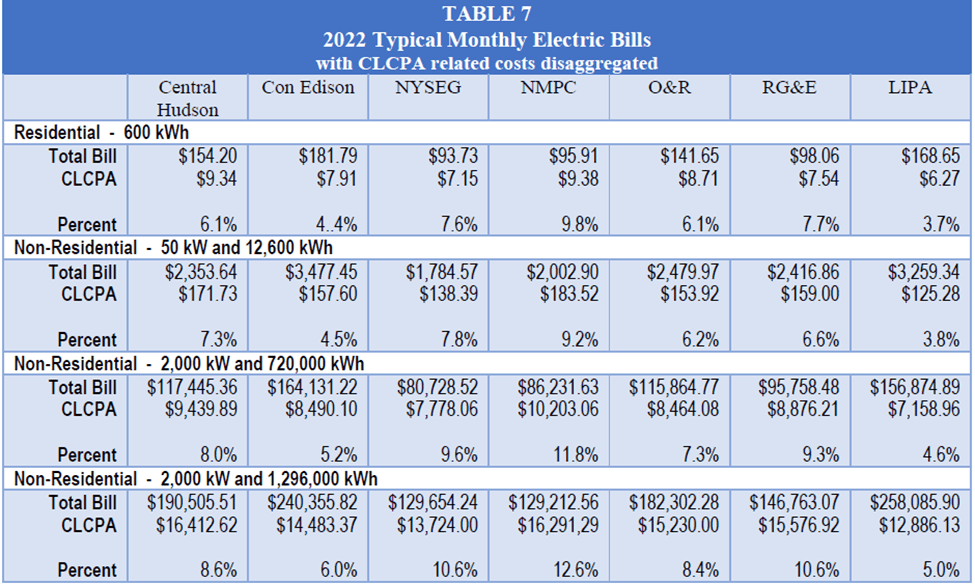
The Climate Act requires the Public Service Commission (PSC) to provide a summary of the implementation status.  In July the first annual informational report was published but there hasn’t been a lot of coverage.  This report notes that Climate Act costs that have been authorized and were in the 2022 residential bills total $1.2 billion.  The Report notes that in 2022 the costs already associated with the Climate Act increased the Upstate residential monthly electric bills 7.6% or $7.15 per month for NYSE&G customers; 7.7% or $7.54 for RG&E customers; and 9.8% or $9.38 for Niagara Mohawk customers.   The report does not attempt to project future ratepayer costs of the authorized Climate Act funding to date that total another $43.8 billion so this is just the start of expected costs.    There is no comparison between the transparency that putting this specific information on ratepayer bills relative to burying it in an obscure PSC proceeding.  This approach also reeks of deliberately deceptive, opaque practice.

I have not been able to keep up with all the cost increase news associated with the net zero transition.  The New York Post notes that “In a fresh sign that New York’s state climate agenda is pure fantasy, contractors key to making good on a major piece of the so-called plan just filed to charge 54% more to build their offshore wind farms. “  I have heard that other projects are also saying that inflation and supply chain issues means that they too need more money.  These are all costs that show up in ratepayer bills as part of the delivery component.  The cap-and-invest costs will show up in the supply component and we have no idea how much that will be.  The only thing that I am sure of is that the Hochul Administration will go to great lengths to hide the cause of the inevitable increased costs and blame the innocent just like Washington State regulators are doing.

Conclusion

I am grateful to Fundingsland for his research and commentary on the rollout of the Washington State cap-and-invest program.  Everything that is happening there will very likely happen here.  He notes that “It just got more expensive to live in Washington State”.  That is the inevitable outcome in New York too.

New York Cap-and-Invest Update and Another Conundrum

One of the planned implementation components of the Climate Leadership & Community Protection Act (Climate Act) is a cap-and-invest program that sets a price on Greenhouse Gas (GHG) emissions.  The first round of stakeholder comments were due in early July and this post provides an update on the process. There also is another upcoming advocacy dogma and reliability conundrum that must be addressed.  I recently noted that the retirement of peaking power plants is considered non-negotiable by environmental justice advocates but those facilities are needed for electric system reliability.  The same advocates are demanding removal of certain components that are in every emissions trading program variation, such as the New York cap-and-invest, that must be included or the claimed affordability and cost-effectiveness benefits will not be produced.

I have been following the Climate Act since it was first proposed. I submitted comments on the Climate Act implementation plan and have written over 350 articles about New York’s net-zero transition.  I have extensive experience with air pollution control theory, implementation, and evaluation having worked on every cap-and-trade program affecting electric generating facilities in New York including the Acid Rain Program, Regional Greenhouse Gas Initiative, and several Nitrogen Oxide programs since the inception of those programs. I follow and write about the RGGI cap and invest CO2 pollution control program so my background is particularly suited for the cap-and-invest plan.   I have devoted a lot of time to the Climate Act because I believe the ambitions for a zero-emissions economy embodied in the Climate Act outstrip available renewable technology such that the net-zero transition will do more harm than good.  The opinions expressed in this post do not reflect the position of any of my previous employers or any other company I have been associated with, these comments are mine alone.

Climate Act Background

The Climate Act established a New York “Net Zero” target (85% reduction and 15% offset of emissions) by 2050 and an interim 2030 target of a 40% reduction by 2030. The Climate Action Council is responsible for preparing the Scoping Plan that outlines how to “achieve the State’s bold clean energy and climate agenda.”  In brief, that plan is to electrify everything possible and power the electric grid with zero-emissions generating resources by 2040.  The Integration Analysis prepared by the New York State Energy Research and Development Authority (NYSERDA) and its consultants quantifies the impact of the electrification strategies.  That material was used to write a Draft Scoping Plan.  After a year-long review the Scoping Plan recommendations were finalized at the end of 2022.  In 2023 the Scoping Plan recommendations are supposed to be implemented through regulation and legislation.  The cap and invest initiative is one of those recommendations.

The New York State Department of Environmental Conservation (DEC) and NYSERDA have developed an official website for cap and invest.  It states:

An economywide Cap-and-Invest Program will establish a declining cap on greenhouse gas emissions, limit potential costs to New Yorkers, invest proceeds in programs that drive emission reductions in an equitable manner, and maintain the competitiveness of New York businesses and industries. Cap-and-Invest will ensure the state meets the greenhouse gas emission reduction requirements set forth in the Climate Leadership and Community Protection Act (Climate Act).

I have written other articles that provide background on NYCI.  I recently posted a Commentary overview for the New York Cap & Invest (NYCI) program that was written for a non-technical audience. In late March I summarized my previous articles on the New York cap and invest proposal in a post designed to brief politicians about the proposal if you want more technical information.  There also is a page that describes all my carbon pricing initiatives articles that includes a section listing articles about the New York Cap and Invest (NYCI) proceeding.

NYCI Status

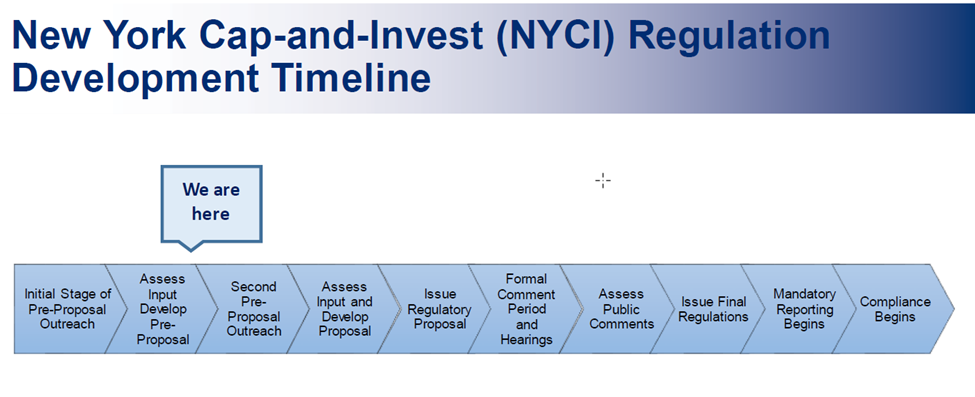
Recently there was an update on the status of the NYCI process at the Equity & Climate Justice Roundtable (Equity and Climate Justice Roundtable Presentation [PDF] and Session Recording).  Jonathan Binder showed the regulation development timeline that shows that DEC is near the end of the “assess input and develop pre-proposal phase” shown in the slide below.  I think there are two takeaways from this update. To date DEC has not given any indication of any particulars regarding implementation and there will be an opportunity to provide comments on the preproposal details.  This is important because once the official regulatory proposal is released the agencies can no longer discuss the contents.  The other point is that this timeline confirms that there is no way this program is going to be issued this year.  Binder said the goal is to have revenue coming in during 2025.

In June DEC hosted a series of webinars designed to spur discussion and get input on specific questions.  The comments received are available and now DEC is assessing the input.  After giving an overview of the general plans Binder described what they have heard in the comments.  His presentation listed the following points that they have been hearing from environmental justice, climate justice, and equity-related shareholders.  Note that there was no substantive discussion of the following in the presentation:

  • Prohibit or limit emissions trading solutions
  • Set caps with timetables
  • Minimize cost, emissions, and other impacts on DACs
  • Ensure adequate investments
  • Ensure emission reductions are verifiable & enforceable
  • Track GHG and co-pollutant emissions from all sources
  • Provide transparent demonstration of emissions and investments
  • Ensure Disadvantaged Community representation in oversight and program review
  • Consider burdens and job impacts on businesses located in or near DACs

In addition. he noted that stakeholders had proposed the following recommended steps:

  1. Identify stakeholder groups
  2. Establish robust communication
  3. Implement target programs based on stakeholder feedback
  4. Track and measure progress
  5. Conduct regular reviews

The primary point I want to make in this post is that there are tradeoffs that I do not think the environmental justice, climate justice, and equity-related shareholders understand.  Binder mentioned that stakeholder expectation setting is important but the rhetoric of these stakeholders is at odds with that goal.  Binder emphasized that DEC is trying to prioritize disadvantaged community (DAC) concerns saying that they need to “ensure emission reductions are prioritized in DACs while also:

  •            Raising revenue to adequately fund investments into DACs,
  •            Keeping high quality jobs and businesses available within DACs, and
  •            Decreasing energy burden and maintaining reliability.

He went on to summarize a few of the specific regulatory provisions and options being considered.  He said the following are under consideration:

  • Prohibit DAC sources from purchasing allowances from outside of the DAC.
    • Set source specific caps on DAC sources (declining caps)
    • Require DAC sources to surrender allowances at some multiple of GHG emissions rather than 1:1

He did note that there have been requests to prohibit allowance trading but that DEC expects that  there will be some allowance trading.  Allowance trading is a key to ensure “overall affordability and cost effectiveness of the program”.

Emissions Market Program Overview

Earlier this year I published an overview of cap-and-invest programs and the proposed New York program.  I concluded that New York policy makers have glommed on to Cap and Invest because they think it is a solution that will easily provide revenues  and compliance certainty.  Unfortunately, that presumption is based on poor understanding of market-based emissions programs.  The reality is that successful programs used emissions reduction strategies that are not available in the quantity or quality necessary for New York to meet its emission targets.

The deference being given to environmental justice, climate justice, and equity-related shareholders further endangers any hopes that the program will work. The proposed New York Cap-and-Invest policy is a type of an emission trading pollution control program.  EPA explains that:

Emissions trading programs have two key components: a limit (or cap) on pollution, and tradable allowances equal to the limit that authorize allowance holders to emit a specific quantity (e.g., one ton) of the pollutant. This limit ensures that the environmental goal is met and the tradable allowances provide flexibility for individual emissions sources to set their own compliance path. Because allowances can be bought and sold in an allowance market, these programs are often referred to as “market-based”.

Points Heard

In this section I will address the environmental justice, climate justice, and equity-related shareholders points that DEC has been hearing

At the top of the list was  “prohibit or limit emissions trading solutions”.  Binder did note that DEC expects that there will be some allowance trading.  EPA notes that this is a key component of any market-based program.  Binder admitted that allowance trading is a key to ensure “overall affordability and cost effectiveness of the program”.  Obviously if there is no trading then this cannot be called a cap-and-invest program and it won’t work as expected.

The suggestion that there will be “some” trading necessarily means that there will be “some” limitations.  One slide notes that the following are under consideration:

  • Prohibit DAC sources from purchasing allowances from outside of the DAC.
  • Set source specific caps on DAC sources (declining caps)
  • Require DAC sources to surrender allowances at some multiple of GHG emissions rather than 1:1

It is one thing to consider these options but it is an entirely different thing to implement any of them.  For starters note that there are several thousand DACs.   In order to prohibit DAC sources from purchasing allowances from outside of the DAC it would be necessary to label the ownership of each allowance which is unprecedented.  Setting source specific caps on DAC sources is another can of worms; what basis for each cap would be used and would there be different caps for different sectors within the DAC.  A requirement that DAC sources would have to surrender allowances at some multiple of GHG emissions rather than 1:1 sounds simple enough but the unintended consequences on the market would be immense.  In my opinion implementing something to address these options would necessitate an independent market for each DAC.  That way you could limit trading from outside the DAC, set source specific caps, and structure the market to address the multiple surrender concept.   However, given that there are several thousand DACs this clearly is not workable.

There are unappreciated problems associated with setting caps with timetables.  I have previously written about setting caps that do not account for potential strategies for making the reductions.  In other programs such as the EPA Cross State Air Pollution Rule (CSAPR) the cap was set based on historical emissions, existing control technology, and potential improvements or additions for all the sources in the CSAPR-affected states.  The CSAPR cap was determined using this control technology evaluation to set a feasible limit.  The NYCI will be a binding cap set by the Climate Act mandates that did not include any such feasibility evaluation.  GHG emissions are closely associated with energy use so a NYCI binding cap essentially limits energy use.

Another of the recommendations heard was to “minimize cost, emissions, and other impacts on DACs”.  I think this is a general goal that should apply  to the entire state.  The tradeoff between trying to address past injustices while meeting these goals will be challenging. 

The “ensure adequate investments” recommendations is important.  In order to address it the first thing needed is to define what to fund.  Presumably, the priority is providing the funds necessary to implement the control strategies necessary to make the emission reductions.  The Hochul Administration must provide an estimate of how much these investments will cost in order determine how much money must be raised by the Cap-and-Invest program.  If the investments are insufficient then the energy system will fail to meet the cap limits.  Also needed is a feasibility analysis for the transition schedule that considers supply chain and trained labor constraints.  Even if the money is available, it may not be possible to build it fast enough to meet the arbitrary CLCPA schedule.

There are several recommendations that are all characterized by a lack of understanding of what regulatory requirements are already in place.  The “ensure emission reductions are verifiable & enforceable”; “track GHG and co-pollutant emissions from all sources”; and “provide transparent demonstration of emissions and investments” all fall into this category.  There are regulations in place such that affected sources report GHG and co-pollutant emissions that are verifiable and enforceable and in the case of power plant emissions the CO2 data are completely transparent.  The whole economy requirements of the Climate Act mean that additional reporting will be necessary.  I agree that transparency for emissions and investments is important and have recommended that in my comments.

I do not disagree that the program should “ensure Disadvantaged Community representation in oversight and program review”.  Unfortunately, from what I have observed to date, environmental justice, climate justice, and equity-related shareholders believe this means that they get to set the policies.  They should have a voice but their unconditional demands have no place in the development of a pragmatic program.  Simply put there are tradeoffs that must be incorporated in a rational program.

The Bider presentation emphasized the need to “ensure emission reductions are prioritized in DACs while also: “keeping high quality jobs and businesses available within DACs, and “decreasing energy burden and maintaining reliability”.  These are related to the last recommendation, “consider burdens and job impacts on businesses located in or near DACs”.  These statements exemplify my concern about tradeoffs.   All of the proposed trading limitations mentioned above necessarily impact businesses located in or near DACs and would increase the costs to do business relative to the costs of businesses outside of DACs.  How can those affected businesses keep high quality jobs and stay in business when confronted with extra costs inherent in the allowance limitations?

There is another aspect of the emphasis on emissions within DACs that is apparently not recognized by the environmental justice, climate justice, and equity-related shareholders.  While emissions are related to the air quality impacts in a particular location, there are other factors that affect impacts.  Air quality is determined by the transport and diffusion of emissions.  At any one time, the wind direction determines which areas are impacted while the state of the atmosphere (stable or otherwise) and the characteristics of the emissions (height of release, type of release (stack or over an area), and temperature of the effluent determines how much of an impact is observed.  Importantly, there are laws in place that ensure that all sources consider these factors when proving compliance with the National Ambient Air Quality Standards.  It is unclear how these stakeholders can be placated in this regard.

Discussion

I do not think that NYCI is going to live up to the expectations of its proponents.   This program is supposed to provide funding for Climate Act implementation and ensure compliance with the Climate Act emission targets.  Earlier this year I described the book Making Climate Policy Work that shows how the politics of creating and maintaining market-based policies render them ineffective nearly everywhere they have been applied.  I think that proponents of NYCI should read that book to understand what needs to be done to make the proposed program work.

In my earlier post I noted that I agreed with the authors that the results of RGGI and other programs suggest that the NYCI will generate revenues.  However, we also agree that the amount of money needed for decarbonization is likely more than New Yorkers will accept.  The problem confronting the Administration is that in order to make the emission reductions needed they have to invest between $15.5 and $46.4 billion per year.  I don’t think that range is politically palatable.

The use of Cap and Invest as a compliance mechanism is more of a problem.  The Hochul Administration has not acknowledged or figured out that the emission reduction ambition of their Climate Act targets is inconsistent with technology reality.  Because GHG emissions are equivalent to energy use, limiting GHG emissions before there are technological solutions that provide zero-emissions energy means that compliance will only be possible by restricting energy use.  Unless a miracle occurs in 2030 when there are insufficient allowances someone must choose who gets to operate.

When the concerns of the environmental justice, climate justice, and equity-related shareholders are layered on top of these design flaws, the challenge to make a workable cap-and-invest program is increased.  I fear that the louder voices among these stakeholders will demand that their concerns be incorporated.  If that happens then I am sure that the program will fail.  Allowance costs will soar and those costs will get passed on to consumers disproportionally affecting the DACs.  If the insane idea to limit allowances within specific DACs is implemented then an artificial energy shortage within DACs is possible.

Conclusion

The New York cap-and-invest program is slowly coming together.  Implementation of something this complicated takes time (California took several years to set up their program) and must be developed by people with technical expertise.  Unfortunately, as was the case with the Scoping Plan development, the State’s approach is to excessively defer to ideologues with little relevant background experience. 

Consider this example from the Scoping Plan.  The Scoping Plan electric system recommendations rely on the ideological belief that existing technology is sufficient for the transition.  The Hochul Administration allowed a few ideologues to push that narrative despite conflicting information in the Integration Analysis and arguments from the New York Independent System Operator to the contrary.  The New York State Public Service Commission (PSC) recently initiated an “Order initiating a process regarding the zero-emissions target” that will “identify innovative technologies to ensure reliability of a zero-emissions electric grid” that recognizes a new technology that can be dispatched without generating emissions is necessary if the state is to not go nuclear.  Failing to acknowledge this requirement means that there is no “Plan B” if this new resource cannot be developed and deployed as needed to maintain the Climate Act schedule.

The Hochul Administration appears to be doing it again in the cap-and-invest process.  Presuming that past performance of emissions trading programs would be indicative of future reduction success and establishing an arbitrary emissions target that is incompatible with realistic emission reduction trajectories has established a very difficult challenge.  Addressing ideological concerns about emissions trading programs and trying to incorporate social justice concerns makes the challenge that much more difficult.  The environmental justice, climate justice, and equity-related shareholders are demanding removal of certain components that are in every emissions trading program and that were essential to past success.  Deferring to ideology rather than historical precedent can only end in failure.

Guest Post: Washington State Cap and Invest Update

Last month I published several articles about the experiences of Washington State as they implement their cap-and-invest program because I think it is likely that New York’s experiences will be similar.  In one I elevated a comment from Washington resident Paul Fundingsland into a post.  He recently did “a bit of research with some comments, thoughts and a more or less rough idea of what seems to be going on in the Washington State cap-and-invest scheme” that I have converted into a guest post.

Paul describes himself as “An Obsessive Climate Change Generalist”.   Although he is a retired professor, he say he has no scientific or other degrees specific to these kinds of issues that can be cited as offering personal official expertise or credibility. What he does have is a two decades old avid, enthusiastic, obsession with all things Climate Change related. 

Last month I published Washington State Gasoline Prices Are a Precursor to New York’s Future, which was a variation of an article published at Watts Up With That – Do Washington State Residents Know Why Their Gasoline Prices Are So High Now?.  I also published Washington State Gasoline Prices and Public Perceptions that consolidated responses from Washington residents in the comments from the Watts Up With That article.  The last article, Feedback from Washington State on Gas Prices was from Paul Fundingsland.  All the articles addressed recent reports that gasoline prices in the State of Washington are now higher than California. 

In this post Fundingsland provides an update after doing a bit of research.  I provide his thoughts with my commentary below.

Initial Thoughts

The focus of my articles was the increase in gasoline prices.  Not surprisingly that has become a hot topic in Washington.  Paul explains:

Pushback on the rise in gas prices associated with the “Cap-and-Invest” scheme (hereafter referred to as “Tax-and-Reallocate” because that is essentially how it works) has caused our Governor to publicly blame the oil companies for price gouging apparently thinking they should absorb the loss of revenue and not pass their state mandated added costs for doing business on to their customers. Apparently he thought these companies should unrealistically absorb the loss of revenue and not pass their state mandated added costs for doing business on to their customers.

The idea that the costs of the program should not be passed on is also present in New York.  When the prices necessarily go up it is a shock to many.  Why I do not know.   It is obvious that the tax-and-reallocate scheme is dealing with a lot of money and not working as planned. 

One of our state legislators claims Washington State is now making more money from the sale of a gallon of gas or diesel than the oil companies.  Our Department of Ecology (which is running this scheme) scrubbed the website original language indicating this scheme would have a minimal effect on gas prices.  The Washington Policy Center claims the proposed climate funding budget is spending 56% of the initial $306 million on expanding government. No real surprise there.

I have concluded that the underlying motive of most of the proponents of these schemes is money.  Legislator Reuven Carlyle was a sponsor of the cap-and-reallocate law and provides an example.

Carlyle who chaired the Washington State Senate Environment, Energy & Technology Committee and was a member of the Ways and Means Committee, lead the charge in the Senate for passage of the Climate Commitment Act, Clean Energy Transformation Act, Clean Fuel Standard, hydrofluorocarbon standards, building standards and much more.  He left the legislature this year to cash in on his legislative work founding a startup called Earth Finance to “help businesses hit climate goals” based on his legislative accomplishments.

Program Evolution

Fundingsland’s experience with the researching the program is similar to mine:

A cursory review of how this “tax-and-reallocate” scheme is evolving in Washington and what kinds of claims and actual emissions reductions result going forward reveals a quagmire of incredibly convoluted intertwined moving parts. Trying to unravel the threads is proving to be very difficult and quite frustrating. 

He notes that descriptive information is not available.  That is a common trait in cap-and-invest programs in my experience:

For example under the Department of Ecology one can find a list of the companies who participated in the 2nd auction under “Washington Cap-and-Invest Program Auction #2 May 2023 Summary Report” but no data on how many allowances each company bought or what their total costs were. Interestingly, high profile Washington businesses missing from this list include Boeing, Microsoft, Amazon and Starbucks to name a few.

As to how the monies received from the program are going to be distributed, as of the moment one can find only broad generalized categories with aspirations as to how they will be applied subject to future legislative decision making.  For example: “these proceeds will be used to increase climate resiliency, fund alternative-transportation grant programs, and help Washington transition to a low-carbon economy” (my bold).

“Cap-and-Invest Auction Proceeds, consists of these generalized categories with percentages and sub accounts filled with somewhat more specific wish lists of where and how the monies are supposed to be spent. Under “Auction Public Proceeds Report” there is only broad information as to how much money was received.

Nowhere is there documentation of how much CO2 has been or is projected to be reduced by this plan in comparison with past years or how much less warming this plan has resulted in or is projected to result in.

Unfortunately, the problems he described are also present in New York’s implementation of the Climate Leadership & Community Protection Act (Climate Act).  The Public Service Commission just published a summary of the implementation status of the Climate Act and the lack of specificity noted here is present in that report.

Washington Emissions

Paul notes that he is “somewhat new at sorting through government bureaucratic documents”.  He caveats the following as what “might be better viewed as a rough approximation, subject to revision once more detailed and specific information is obtained.”  He does think the following is approximately correct.

According to the Washington State Department of Ecology, the 2019 breakdown of Washington State greenhouse gas emissions is: Residential, Commercial, Industrial heating 25%, Transportation 39%, Electricity 21%, Other 14%. 

Electrical power is 64.6% hydro supplied by eight hydro plants owned and operated by the Federal Government. Natural gas is currently at 14.4%, nuclear at 7.8%, wind 8.7%, coal at 2.9%, biomass at 1.3% and a small contribution of solar.

Washington’s natural gas utilities and electric utilities receive a determined (revisable) amount of their required emissions allowances for free. Washington’s only coal fired plant’s emissions are grandfathered in as it will be fully decommissioned in 2024. 

So, unlike the lower emissions resulting from a coal to natural gas switch as fortuitously happened during the initial years of the east coast RGGI scheme, there is not a lot of low hanging CO2 emissions fruit to begin with to harvest or claim as a success from the electricity sector in Washington. And with the free emissions allowances the emissions reduction pool from this sector is even further diluted. 

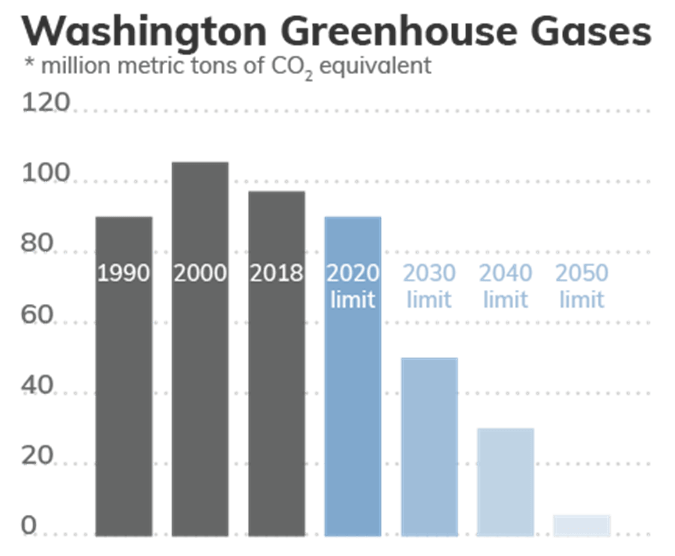
When I skimmed through the Washington regulations one of the things that jumped out to me was the following figure.  The 2030 limit is a 45% reduction below 1990 levels.  The chart indicates that 2020 emissions were equal to or slightly more than the 1990 emissions.  A 45% reduction in ten years seems ambitious.  Based on the information from Fundingsland, I cannot imagine this target will be achieved.

In addition, the “tax-and-reallocate scheme” contains all sorts of other emissions exemptions. One classification is termed “EITEs” consisting of over 40 facilities and businesses that qualify as Emissions-Intensive, Trade-Exposed industries even though they qualify for mandated participation in emission allowance auctions. 

There are also ”tax-and-reallocate-offsets” being run thru what is designated as an Offset Project Registry that looks to be a California based company called Climate Action Reserve

That leaves the bulk of the emissions reductions to be garnered from the other three sectors (transportation, residential-industrial-commercial heating, and “other”). At this time, it is difficult to determine how the actual 25% breakdown within the residential-industrial-commercial heating sector works. For instance, residential energy use has been reported as being 60% electric. 

I have long argued that a basic flaw in the New York net-zero transition plan is that there was no feasibility analysis.  Given this information about Washington I think New York is comparatively better off.  Both states need to document how they plan to get where they want to go but the reduction trajectory for New York is lower than Washington.

New York is starting to come to grips with similar sector target issues.  If the cap-and-reallocate scheme is supposed to provide significant funds for implementation but there are a limited number of affected sectors, then the price impacts on those sectors is going to be magnified.  That is exactly what happened in Washington.   It is not price gouging when that happens, it is simply supply and demand.

Assuming the industrial-commercial may be mostly gas, the amount of emissions by individual businesses will be affected by whether they are in the EITEs classification or not, whether they have “offsets” and how many tons of CO2 they emit (250,000 tons being the “trigger” amount for mandatory participation in the tax-and-reallocate emissions auctions). So the number of emissions reduction areas possible in this sector are rather “squishy” and difficult to determine. They most probably will land on the low side of 25%.

The political origins of these rules should not be overlooked.  The Progressive backers of both plans cater to the labor union constituencies so both New York and Washington carve out EITE exemptions.  Because the net-zero transition plans will necessarily increase the cost of energy I expect that the inevitable result is that the increase will make industries in both states uneconomic relative to other locations whatever the intent of these efforts.

The “other” classification of this sector consists of: agriculture (manure, fertilizer, livestock digestion), industrial processes (aluminum, cement), waste management (landfills, waste water treatment), and natural gas distribution. Of these, waste management and natural gas distribution are negligible. 

Agriculture represents a very difficult to find pathway toward lowering emissions without adversely affecting the food supply. That leaves cement and aluminum production which are essential to modern society, are both part of the EITEs exemption legislation and have, as of yet, no known practical, workable, scaleable emission free alternatives.

So the residential-industrial-commercial-heat and “other” sectors also look not to bear much in the way of emissions reductions for various mitigating reasons.

Again, the political calculus affects the treatment of these sectors.  I think the decisions are based more on what they think they can get away with than a pragmatic emission reduction plan.

 At 39%, transportation is the largest emissions sector. It has been reported that in the latest emissions allowances auction held last May, energy and utilities purchased the bulk of the allowances. With utilities (probably the gas plants) garnering a certain amount of unspecified free allowances from the State, that leaves the energy companies supporting transportation to shoulder the bulk of the latest allowance purchases. 

There are five refineries located in our state that serve Washington, Oregon and to a small degree California. Their products include on-road gasoline and diesel,  marine fuel, jet fuel and aviation gasoline, railroad fuel, and natural gas used in transportation. However, there are some big allowance exemptions that cover fuels involving watercraft (shipping, cruise ships, navy etc.), agricultural, aviation and exported fuels.

Personal car and truck fuels in Washington have no exemptions and make up over half of the total fossil fuel emissions in this category. With the energy companies probably buying the bulk of emission auction allowances, and with all the exemptions in the other fuel use areas, it’s not a stretch to see why the costs of the allowances were passed along to the personal car and truck consumers causing the rather massive jump in gas prices at the pump.

Overall, a good guess is the Legislature will be more than satisfied for some time with the amount of monies coming in that can be used to fund the expansion of the State bureaucracy and all their manufactured future wondrous climate mitigating projects to help save the world from future computer modeled bad weather. So they will feel they are basically doing their job. It’s doubtful they will want to cause gas prices to accelerate much more in the near future for fear of garnering the wrath of the electorate.

Often the simplest answer is correct. Fundingsland makes a good argument that this is just the start of the cost impacts to transportation in Washington.  The mix of sector reductions in New York is different but not enough that fuel prices won’t spike when the New York auctions begin.  I agree that the revenue target is entirely a political decision.

If and when a transparent “project report” comes out, it will no doubt tout all the money received (the easy headline grabbing part), be filled with all the virtuous climate change related project accomplishments the monies were or are going to be used for (the hyped glossy political part), with the actual emissions reduction data either completely missing, obscured, massaged, tortured, or glossed over and probably relegated to some vague or indeterminant area of the document with accompanying convoluted language (the important forgotten and reason for the scheme in the first place part).

Based on current Ecology Department documents available and reports from various sources, this already seems to be the case.

New York’s participation in the Regional Greenhouse Gas Initiative (RGGI) portends what will happen in Washington and his description is apt.  I have been evaluating the RGGI reports for years and can confirm that the wording and information provided is designed to claim unqualified success.  Digging into the numbers shows a much different story.

Questions

Fundingsland lists the following bottom-line questions.

*How much did each “qualified” company pay for the allowances? 

*What were the financial consequences to the constituents of these added costs to the companies? 

*Which areas and projects did the monies actually go to and how much did each receive? 

*What was the overall cost per ton of CO2 reductions (total allowance participant proceeds versus total reduction in CO2 tons). 

And the four most important questions: 

*How much reduction in emissions compared to recent years has resulted from this scheme? 

*How much less global warming has been projected to occur by these emission reduction results? 

*How much is this scheme going to cost the residents to completion or are the costs never ending? 

*What metric has been identified that will be used to indicate this program is no longer needed because it has done it’s job?

I agree with his take on responses to the questions:

It will be surprising if any of these kinds of questions are going to be addressed. It is looking more and more like just another never ending, forever growing government bureaucratic convoluted way to extract more funds from their constituents for some worthwhile, some okay, and some questionable projects that may or may not have a quantifiable bearing on reducing CO2 emissions.

Summation

Fundingsland summarizes the likely results of the program:

It’s going to be extremely difficult and may not even be possible for Washington State to be able to claim any meaningful or significant emission reductions based on this tax-and-reallocate scheme given the state’s overall energy use configuration combined with all the various emission allowance exemptions. 

In fact, there is a very high probability there will be next to zero emission reductions and perhaps even an increase.

The easiest and most efficient way for the 54 companies/businesses listed under the auction #2 May 2023 summery report that have been forced to participate (“qualify” in bureaucratic terminology) in the allowance auctions or face a $10,000 per day fine, is for them to just purchase the allowances, add it to their cost of doing business and pass the increase along to their customers. So in effect they won’t be reducing their emissions at all. And all will be adding their additional State forced costs for doing business on to their customers.

This the ultimate flaw in the cap-and-reallocate plan.  The costs to implement emission reductions are greater than the costs of allowances.  Moreover, emission reductions may only be possible by displacing fuels.  The transportation fuel providers have limited means to reduce their emissions so the sector reductions will come primarily from the introduction of electric vehicles.  In the meantime, the fuel providers will simply pass the costs along and if the allowance cap limits the availability of allowances too much then they will stop selling fuel or pass the $10,000 per day fine along to their customers.  

Fundingsland concludes:

At the end of the day, the goal of any meaningful, measurable reduction of CO2 emissions or theoretical effective pathway to stop “climate change” looks to become a glazed over afterthought in this quagmire of a Washington State bureaucratic money-making machine. 

With this scheme, Washington State Government now joins the lucrative profit side of the climate industrial complex at the expense of its constituents while giving a completely different connotation to the term “Net Zero”.

Conclusion

I think New York’s plan for an economy-wide cap-and-invest program will be a similar disaster.  Earlier this year I described the book Making Climate Policy Work.  I focused on their discussion about RGGI and the implications for New York’s cap-and-invest program.  I noted that I agreed with the authors that these programs generate revenues.  However, we also agree that the amount of money needed for decarbonization is likely more than any such market can bear.   I highly recommend this book to anyone interested in potential issues with these programs.

Fundingsland picked up on the affordability issues but did not address the compliance implications.  Advocates for cap-and-invest tout the claim that as the allowance cap declines, compliance with the program targets is assured.  Proponents have not acknowledged or figured out that the emission reduction ambition of the reduction targets is inconsistent with technology reality.  Because GHG emissions are equivalent to energy use, limiting GHG emissions before there are technological solutions that provide zero-emissions energy means that compliance will only be possible by restricting energy use.  I don’t think that New York can meet its emission reduction targets but compared to Washington’s emission inventory and targets New York has a much better chance.  Washington plans to rely primarily on the transportation and building sectors for its reductions and needs to make sharper cuts.  I see no scenario where that will end well.

In conclusion, I believe Fundingsland did a good job describing the issues associated with cap-and-invest in Washington.  New York’s program will have the same issues.  It will be interesting to see how these state programs work out and which one will be the bigger flop.

NY Cap-and-Invest Reference Case vs PSC First Annual Informational Report

Two proceedings are dancing around the issue of affordability associated with the Climate Leadership & Community Protection Act (Climate Act or CLCPA) emission reduction mandates.  The New York State Department of Public Service First Annual Informational Report on Overall Implementation of the Climate Leadership and Community Protection Act includes cost estimates for existing programs. The New York State Department of Environmental Conservation (DEC) and New York State Energy Research & Development Authority (NYSERDA) are implementing the New York Cap-and-Invest (NYCI) proposed by Governor Hochul which is a market-based program to raise revenues for the strategies necessary to meet the mandates.  This post compares the costs associated with programs considered in the two proceedings.

I have been following the Climate Act since it was first proposed, submitted comments on the Climate Act implementation plan, and have written over 300 articles about New York’s net-zero transition.  I have devoted a lot of time to the Climate Act because I believe the ambitions for a zero-emissions economy embodied in the Climate Act outstrip available renewable technology such that the net-zero transition will do more harm than good.  The opinions expressed in this post do not reflect the position of any of my previous employers or any other company I have been associated with, these comments are mine alone.

Climate Act Background

The Climate Act established a New York “Net Zero” target (85% reduction and 15% offset of emissions) by 2050 and an interim 2030 reduction target of a 40% reduction by 2030. The Climate Action Council is responsible for preparing the Scoping Plan that outlines how to “achieve the State’s bold clean energy and climate agenda.”  In brief, that plan is to electrify everything possible and power the electric grid with zero-emissions generating resources.  The Integration Analysis prepared by the New York State Energy Research and Development Authority (NYSERDA) and its consultants quantifies the impact of the electrification strategies.  That material was used to write a Draft Scoping Plan.  After a year-long review the Scoping Plan recommendations were finalized at the end of 2022.  In 2023 the Scoping Plan recommendations are supposed to be implemented through regulation and legislation. 

Cap-and-Invest Background

According to the Cap-and-Invest Analysis Inputs and Methods webinar (Inputs and Methods Webinar Presentation and View Session Recording) on June 20, 2023, the New York State Department of Environmental Conservation (DEC) and the New York State Energy Research & Development Authority (NYSE$RDA) are developing the New York State Cap-and-Invest (NYCI) Program to meet the greenhouse gas emission limits and equity requirements of the Climate Act.

The NYCI feedback webinars all included the following slide that describes the program.  Setting a cap is supposed to provide compliance certainty and the revenues generated “will minimize potential consumer costs while supporting critical investments” in the control strategies necessary to meet the Climate Act targets.

NYCI Policy Modeling

The Analysis Inputs and Methods webinar mentioned above described the modeling analyses planned to support the development of the program: “This analytics study will assess potential market outcomes and impact from the proposed New York Cap-and-Invest (NYCI) program.” 

In order to evaluate the effects of different policy options, the Hochul Administration has proposed policy modeling.  This kind of modeling analysis forecasts future conditions for a baseline or “business-as-usual” case, makes projections for different policy options, and then the results are compared relative to the business-as-usual case. I disagree with the presumptions in the proposed modeling associated with which programs should be included.

The Scoping Plan modeling used a reference case that included “already implemented” programs and the NYCI Cap-and-Invest Analysis Inputs and Methods webinar proposed to use the same framework.  Starting with the reference case developed for the Scoping Plan, the NYCI modeling proposed to add policies enacted since then.  This reference case approach is misleading because it under estimates the total cost to meet the Climate Act emission reduction mandates.

I maintain that it is more appropriate to compare the policy cases to a base case that excludes all programs intended to reduce GHG emissions.  NYCI revenues are supposed to “minimize potential consumer costs while supporting critical investments”.  I believe that statement argues that NYCI proceeds are intended to fund all the control programs necessary to meet the Climate Act mandates and not exclude programs that were already implemented.

PSC Informational Report

On July 20, 2023 the first annual informational report (“Informational Report”) on the implementation of the Climate Act was released.  According to the press release:

The Climate Act’s directives require the Commission to build upon its existing efforts to combat climate change through the deployment of clean energy resources and energy storage technologies, energy efficiency and building electrification measures, and electric vehicle charging infrastructure. In recognition of the scale of change and significant work that will be necessary to meet the Climate Act’s aggressive targets, the Commission directed DPS staff to assess the progress made in line with its directives under the Climate Act and to provide guidance, as appropriate, on how to timely meet the requirements of the Climate Act.

The Department of Public Service presentation on the Informational Report notes in the following conclusion slide that “ the estimates of total funding authorized by the Commission to date for various clean energy programs in some instances reflect actions that pre-date the enactment of the Climate Act.”  This is the only reference to “already implemented” programs.  The conclusion states that the information presented “represents  direct effects of CLCPA implementation only, and only the portion of direct effects of programs over which the Commission has oversight authority.”  I interpret that to mean that they are not concerned with which program implements the necessary control strategies but only the results of all the programs relative to the Climate Act mandates. 

The Informational Report also notes that “It is difficult to pull out exactly what costs we would have otherwise incurred for infrastructure investment vs. the cost of CLCPA.”  This is the reason a base case is necessary.  You need some estimate of investments that would have occurred were it not for the policy.  In my opinion if they were worried about the difference between pre-CLPA investment costs vs. CLCPA-mandated investments they would have mentioned it here.   Because the Investment Report does not distinguish between costs for programs that pre-date the Climate Act and programs that are mandated by the Climate Act itself, I conclude that the NYCI modeling analyses should follow that precedent and not include “already implemented” control strategy programs.

Implementation Report Costs

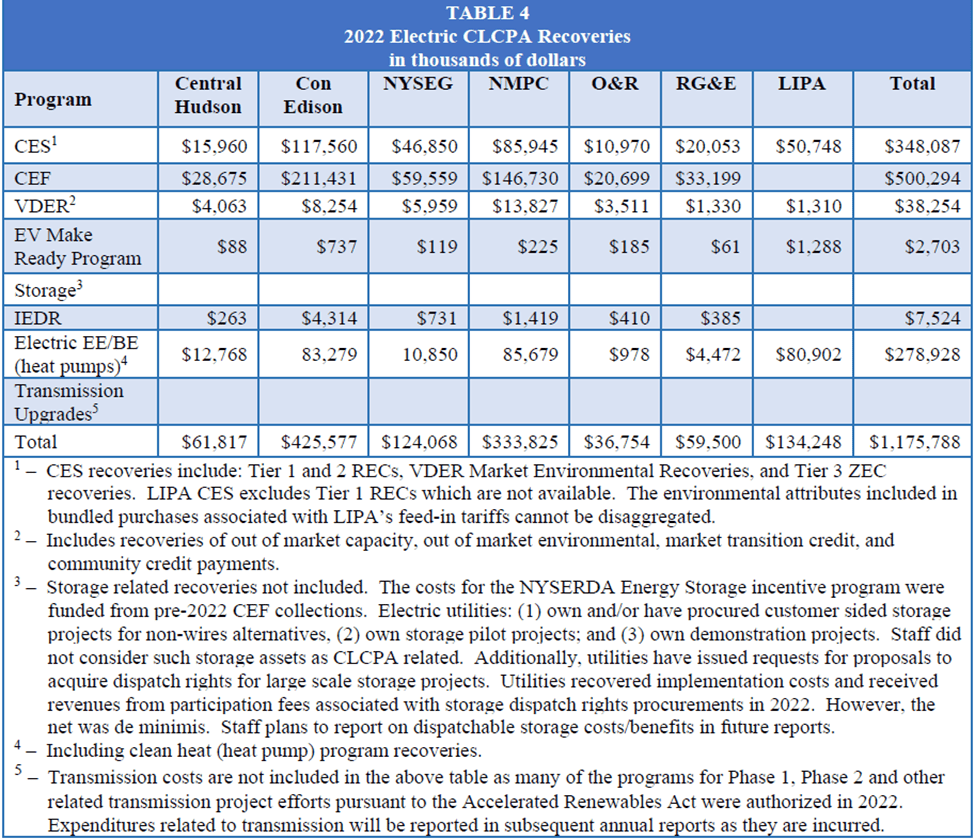
I converted the tables in the Implementation Report to a spreadsheet so that I could combine the data from multiple tables.  Three tables are of particular interest: Table 4: 2022 Electric CLCPA Recoveries, Table 7: 2022 Typical Monthly Electric Bills with CLCPA related costs disaggregated, and Table 8: Authorized Funding to Date.

Table 4: 2022 Electric CLCPA Recoveries summarizes costs recovered in 2022 by utilities for electric programs.  The costs recoveries include: CES (electric only), CEF (electric only), certain VDER (electric only), Electric Vehicle Make Ready Program (electric only), Clean Heat programs (electric only), Integrated Energy Data Resource (electric only), and Utility Energy Efficiency programs (electric and gas). The table states that $1,175,788,000 in Climate Act costs were recovered in 2022.

Table 7: 2022 Typical Monthly Electric Bills with CLCPA related costs disaggregated is the first admission by the Hochul Administration of potential costs of the Climate Act to ratepayers.  The basis for the

typical electric delivery and supply bills for 2022 was provided for the following customer types:

A.           Residential customers (600 kWh per month),

B.           Non-residential customers (50 kW & 12,600 kWh per month),

C.           Non-residential customers (2,000 kW & 720,000 kWh per month), and

D.           Non-residential high load factor customers (2,000 kW & 1,296,000 kWh per month).

PSC Staff requested the utilities disaggregate the cost components reported in Table 2 (electric) to determine CLCPA related impacts on customers.  Climate Act costs added between 9.8% and 3.7% to residential monthly electric bills in 2022.

Table 8: Authorized Funding to Date “gives a sense” of expenditures that will ultimately be recovered in rates. The Implementation Report explains:

This annual report is a review of actual costs incurred by ratepayers to date in support of various programs and projects to implement the CLCPA and does not fully capture potential future expenditures, including estimated costs already authorized by the Commission but not yet recovered in rates. To complement this overview of cost recoveries incurred to date, we also present below a table of the various programs and the total amount of estimated costs associated with each authorized by the Commission to date. Table 8 gives a sense of expenditures that ratepayers could ultimately see recovered in rates. These values are conservative and reflect both past and prospective estimated costs.

It is important to note that the Commission authorized some of the estimated costs in Table 8 prior to CLCPA enactment and that the cost associated with these authorized programs will be recovered over several years to come, based on the implementation schedules for these projects or programs and will mitigate the cost impacts to ratepayers year over year. These estimated costs represent either total program budget, estimated total cost for the program over its duration, or costs incurred to date in support of the program. Additionally, these initiatives will result in a variety of other changes that will impact how much consumers pay for energy. A number of these would put downward pressure on costs, including benefits in the form of reduced energy usage and therefore reduced energy bills to consumers. The Department has also previously described market price effects that are a result of these investments. When load is reduced or more low-cost generation is added, it would be anticipated that energy prices would fall because the market would rely less on higher cost generators. In addition, investments in transmission infrastructure not only unbottle renewable energy but also yield production cost savings and reliability benefits.

In sum, the total estimated costs associated with these programs or projects should not be considered as entirely incremental costs to what ratepayers would otherwise pay. Subsequent annual reports may include additional information about costs recovered relative to the funding previously authorized by the Commission in these programs, including funds already expended in support of these programs.

The takeaway message from Table 8 is that the authorized funding to date of program costs that will eventually make their way to ratepayer bills totals $43.756 billion.  Note that the spreadsheet version of this table details the footnote costs.

The following table (Summary tab in the spreadsheet) combines Table 4: 2022 Electric CLCPA Recoveries and Table 8: Authorized Funding to Date.  This represents my best estimates of where the cost categories coincide but it represents my opinion only.  Given all the caveats in the preceding description I don’t think anyone has a definitive handle on these numbers.  The thing that jumps out is the difference between the relatively paltry $1.176 billion in estimated Climate Act costs collected in 2022 relative to the $43.756 billion in authorized funding.  Table 4 data is for one year and Table 8 data is over multiple years. The caveats in the previous quotation should be kept in mind.

Buried in a footnote is an admission that these are not all the costs authorized.  Footnote 7 in Table 8 states:

Not included in this table is the Propel NY transmission project, selected by the NYISO Board in June 2023 in response to the Commission’s declaration of a public policy transmission need (PPTN) to support injections of offshore wind energy to the Long Island system by 2030 at an estimated cost of $3.36 billion. Since the Commission did not directly approve this project, the estimated cost is not captured in the table above.

The bottom line is that this is just the start of the costs.  The Propel transmission project is one example.  I described this project and its costs earlier this year.  I noted that the costs associated with this project are for 3,000 MW of offshore wind.  The Climate Act goal is for 9,000 MW and the Scoping Plan Integration Analysis projects that 12,675 MW of offshore wind will be needed by 2040 in the Strategic Use of Low-Carbon Fuels mitigation scenario.  If the transmission costs are proportional that would mean that transmission costs will be three to four times higher than the $3.36 billion listed for the program that is not included.  I am sure that there are many more examples of programs that will be needed to satisfy the regulated utility obligations for Climate Act emission reduction mandates.

NYCI Reference Case Scenario

The proposed modeling methodology for NYCI proposes to follow the same policy modeling approach as the Scoping Plan where a business-as-usual baseline is not used as the comparison standard for the policy scenarios.  Instead, they propose to use the Scoping Plan Reference Case described as “Business as usual plus implemented policies” that includes the following:

  • Growth in housing units, population, commercial square footage, and GDP
  • Federal appliance standards
  • Economic fuel switching
  • New York State bioheat mandate
  • Estimate of New Efficiency, New York Energy Efficiency achieved by funded programs: HCR+NYPA, DPS (IOUs), LIPA, NYSERDA CEF (assumes market transformation maintains level of efficiency and electrification post-2025)
  • Funded building electrification (4% HP stock share by 2030)
  • Corporate Average Fuel Economy (CAFE) standards
  • Zero-emission vehicle mandate (8% LDV ZEV stock share by 2030)
  • Clean Energy Standard (70×30), including technology carveouts: (6 GW of behind-the-meter solar by 2025, 3 GW of battery storage by 2030, 9 GW of offshore wind by 2035, 1.25 GW of Tier 4 renewables by 2030)

Business-as-usual in my opinion should only include: growth in housing units, population, commercial square footage, and GDP; Federal appliance standards; and economic fuel switching.  All the other programs only exist as part of electrification strategies to reduce GHG emissions.

The Analysis Inputs and Methods webinar presentation stated that the Scoping Plan’s Reference Case will be updated with policies adopted since the original modeling was completed. The webinar asked for input on which policies to include from the following list:

  • NYC Local Laws
  • Statewide new construction codes
  • IRA Incentives
  • Advanced Clean Cars II/Advanced Clean Trucks
  • 100% sales MHDVs by 2045
  • 100% ZEV school buses by 2035, 100% transit buses by 2040
  • IRA Methane Charge
  • EPA Supplemental Rule
  • NYS Part 203
  • AIM Act (EPA Technology Transitions)

All of these programs also exist solely to reduce GHG emissions.  In order to determine the cost to meet the Climate Act targets they should be included as part of the policy case and not the business-as-usual case.

It can be argued that every line item in Table 8 could be considered part of the proposed Reference Case because some component of each category started before the Climate Act was enacted.  Recall that the Informational Report did not try to differentiate between pre-Climate Act and post-Climate Act programs so there are portions of the programs listed that will likely not be considered appropriate for the reference case.  However, using this definition most of these costs will be in the reference case and I would bet that the rationale and costs will not be documented well enough to determine which specific control programs are included.

One other way to differentiate between pre-Climate Act and post-Climate Act enactment is by the case number.  The first two digits are the year the proceeding began.  In my summary table there is only one case number 20 or higher.  Strategic Use of Energy Related Data (Case 20-M-0082) has $72 million funding authorized to date.  Using this approach, the proposed Reference Case would include $43.684 billion program costs as opposed to the $43.756 billion of total authorized costs.  I believe that they can pick and choose programs to include or exclude based on this reference case approach to satisfy the political motivations of the Hochul Administration.

Discussion

The Scoping Plan has been described as “a true masterpiece in how to hide what is important under an avalanche of words designed to make people never want to read it”.  The quantitative documentation supporting the document hides relevant information even better.  The single number that most New Yorkers want to know is how much will this cost.  The Scoping Plan cost numbers did not answer that question.

I addressed the Scoping Plan cost and benefit numbers in my Draft Scoping Plan comments and the verbal comments I presented at the Syracuse public hearing.  The issues I raised and summarized in this post have never been addressed.  In that post I compared the Scoping Plan cost presentation to a shell game.  A shell game is defined as “A fraud or deception perpetrated by shifting conspicuous things to hide something else.”  In the Scoping Plan shell game, the authors argue that energy costs in New York are needed to maintain business as usual infrastructure even without decarbonization policies but then include decarbonization costs for “already implemented” programs in the Reference Case baseline contrary to standard operating procedure for this kind of modeling.  Shifting legitimate decarbonization costs to the Reference Case because they are already implemented without adequate documentation fits the shifting condition of the shell game deception definition perfectly. 

Anyone who has not spent much time following the Climate Act implementation process might ask why was this done for the Scoping Plan analysis and why is it being proposed for the NYCI modeling analysis.  One of the justifications for the Scoping Plan was that the “costs of inaction are more than the costs of action”.  Shifting implementation costs away from the Climate Act program reduced the costs of actions to the point that they could make that claim.

Why are they doing it again?  One of the great unknowns in the NYCI implementation process is the revenue target.  The rational approach would be to calculate expected total costs, revenues from Federal programs, revenues from utility ratepayers, and personal and business investments for required infrastructure then calculate the difference between costs and those revenues as the amount necessary for the cap-and-invest revenues.  Each of those values is a politically sensitive number that will likely cause public outcry because it is going to be large.  If the NYCI revenue target does not include all the costs necessary to meet the Climate Act targets because those costs are covered elsewhere, then the NYCI modeling can show that the program is “affordable” and will not be a major burden.  Given that this strategy worked for the Scoping Plan “costs of inaction are less then the costs of action” scam I believe they are sticking with a proven strategy.

Conclusion

This past week there were signs of discontent with the potential costs of the Climate Act on utility ratepayer assessments.  Utility bills in New York City will go up significantly next month when Consolidated Edison of New York’s new rate case assessments become effective. Con Ed admitted that renewable energy investments contributed to the cost increases.  “Our customers demand safe and reliable service and increasingly renewable energy. This investment from customers is going to allow us to redesign and rebuild the grid, to move it towards electrification,” Con Ed media relations director Jamie McShane told Fox News Digital.

Comparison of the two state initiatives indicate that these costs are going to get much worse.  The PSC Implementation Report states “The magnitude of change the CLCPA requires is significant and will present challenges related to the need to preserve the resiliency and reliability of the energy systems, and cost mitigation to preserve energy affordability”.  The NYCI modeling assessment proposes to use an inappropriate modeling scenario that hides the true costs of implementation.  I have little doubt that the Hochul Administration analysis team has already determined that this approach is necessary to provide a politically correct NYCI revenue target.

At this point all anyone can do is to ask for a full accounting of the costs and expected emission reductions for all the control strategies necessary to meet the net-zero Climate Act mandate.  This information was not provided in the Scoping Plan but is a prerequisite for the proposed NYCI program.

Finally, note that the costs addressed in the PSC proceeding are ratepayer costs for energy.  The overall strategy for de-carbonization is to electrify everything possible.  The costs for each homeowner to replace their furnace, stove, and hot water heater with an electrical replacement is not included.  There also will be homeowner costs associated with electric vehicles to say nothing of the cost of electric vehicle itself. When everything is added up the costs will be enormous.  I do not think that customer demand for renewable energy is as strong as the desire for affordable energy.  It is past time for the Hochul Administration to supply a full accounting of potential costs to residents and businesses so that people will be able to decide for themselves how much they want to pay.

Goals for PSC Annual Informational Report and NYCI Reference Case

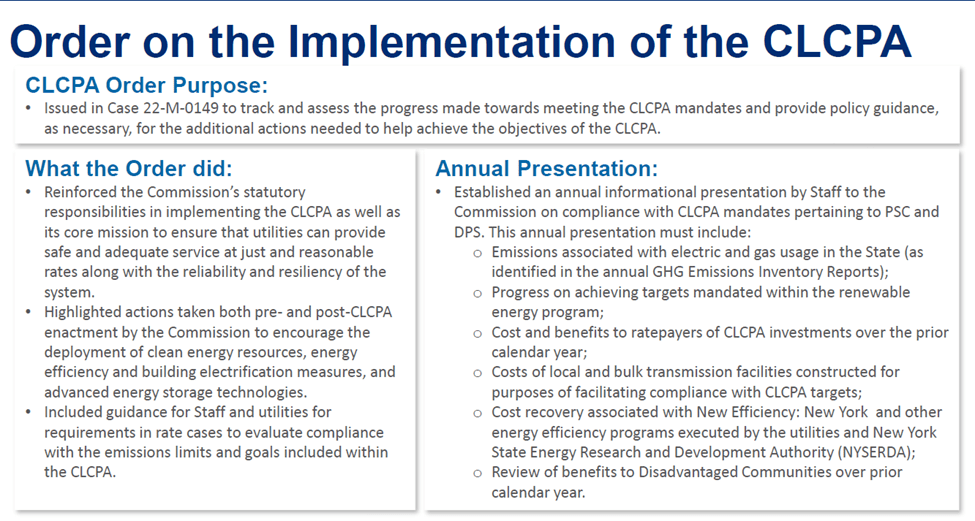
The goals for two proceedings associated with the Climate Leadership & Community Protection Act (Climate Act) are not clear.  The Public Service Commission (PSC) Order on Implementation of the Climate Act  (Case 22-M-0149) is supposed to “both track and assess the advancements made towards meeting the CLCPA mandates and provide policy guidance, as necessary, for the additional actions needed to help achieve the objectives of the Climate Act”. The New York State Department of Environmental Conservation (DEC) and New York State Energy Research & Development Authority (NYSERDA) are implementing the New York Cap-and-Invest (NYCI) proposed by Governor Hochul which is a market-based program to raise revenues for the strategies necessary to meet the mandates of the Climate Act.  The question for both programs is whether their goal is to address the Climate Act itself or the entirety of the effort needed to make the transition targets mandated by the Climate Act.

I have been following the Climate Act since it was first proposed, submitted comments on the Climate Act implementation plan, and have written over 300 articles about New York’s net-zero transition.  I have devoted a lot of time to the Climate Act because I believe the ambitions for a zero-emissions economy embodied in the Climate Act outstrip available renewable technology such that the net-zero transition will do more harm than good.  The opinions expressed in this post do not reflect the position of any of my previous employers or any other company I have been associated with, these comments are mine alone.

Climate Act Background

The Climate Act established a New York “Net Zero” target (85% reduction and 15% offset of emissions) by 2050 and an interim 2030 reduction target of a 40% reduction by 2030. The Climate Action Council is responsible for preparing the Scoping Plan that outlines how to “achieve the State’s bold clean energy and climate agenda.”  In brief, that plan is to electrify everything possible and power the electric grid with zero-emissions generating resources.  The Integration Analysis prepared by the New York State Energy Research and Development Authority (NYSERDA) and its consultants quantifies the impact of the electrification strategies.  That material was used to write a Draft Scoping Plan.  After a year-long review the Scoping Plan recommendations were finalized at the end of 2022.  In 2023 the Scoping Plan recommendations are supposed to be implemented through regulation and legislation.  This post addresses a couple of implementation components.

PSC Order on Implementation of the Climate Act

The order implementing this proceeding explains that:

The changes contemplated by the CLCPA are expected to profoundly transform the State’s regulatory landscape and impact every sector of the economy. The Public Service Commission (Commission) will play a critical role in these efforts as it continues to implement a variety of clean energy initiatives, including those related to the deployment of renewable energy resources to support the State’s transition to a zero emissions electric grid, energy efficiency, building electrification, and zero emission transportation.

The Commission has already begun to implement the many objectives of the CLCPA through a number of existing proceedings. To date, the Commission has authorized the offshore wind solicitations necessary to achieve the CLCPA goal of procuring nine gigawatts (GW), funded programs to support the electrification of buildings’ heating load and the transportation industry, supported both large scale and distributed clean energy project development, funded programs to reduce natural gas and electricity usage in the State, and instituted a coordinated planning process to evaluate local transmission and distribution system needs to support the State’s full transition to renewable generation.

The Commission has quickly taken action related to items within its jurisdiction to help put the State on a path to meet the aggressive CLCPA targets. However, in consideration of the scope of the CLCPA and the extensive work necessary to achieve its mandates, continuous monitoring of the progress made will be crucial to ensure the State remains on track to achieve these objectives. In addition, there are existing policies that will need to be reviewed, and new policies that will need to be developed, to further the enablement of the CLCPA. This proceeding will be the forum for such policy development. By this Order, the Commission institutes this new proceeding to both track and assess the advancements made towards meeting the CLCPA mandates and provide policy guidance, as necessary, for the additional actions needed to help achieve the objectives of the CLCPA.

On July 20, 2023 the first annual informational report for this proceeding was released.  The Power Point presentation summarizing the results includes the following slide describing the purpose, requirements, and goals for the annual report.  It explains that the PSC has statutory responsibilities in implementing the Climate Act that must be consistent with its “core mission to ensure that utilities can provide safe and adequate service at just and reasonable rates along with the reliability and resiliency of the system.”  My interpretation is that the PSC is required to address all actions, both pre-and post-Climate Act enactment by the Commission to achieve the mandates of the Act.

  The report describes the information provided:

The cost recoveries, benefits, and other information reported here are mainly focused on the direct effects of CLCPA implementation. Notably, the estimates of total funding authorized by the Commission to date for various clean energy programs in some instances reflect actions that pre-date the enactment of the CLCPA. With respect to both pre- and post-CLCPA measures, this report focuses only the portion of those direct effects arising from programs over which the Commission has oversight authority and does not account for programs implemented by other state agencies that are funded from other sources (e.g., Regional Greenhouse Gas Initiative (RGGI) funding). Examples of effects not captured here include property tax revenues to localities from newly developed renewable generation facilities, workforce development and job growth, and local air quality impacts, among others. It should also be noted that the benefits and costs of the measures discussed in this report do not accrue uniformly across stakeholders, and in some cases one stakeholder’s benefit is another’s cost. As such, this report generally describes a subset of benefits and costs related to the CLCPA and does so from the perspective of New York as a whole by using the Societal Cost Test. In instances where this report adopts a different perspective, it indicates what that perspective is. For those benefits that are difficult to quantify, this report includes qualitative descriptions of the nature, extent, and incidence of the benefit.

The issue I want to raise in this post relates to this description and the PSC core mission “to ensure that utilities can provide safe and adequate service at just and reasonable rates along with the reliability and resiliency of the system.”  In particular, consideration of just and reasonable rates needs to consider the effect of other programs that directly impact rates.  Although the Commission has no oversight authority for programs like RGGI and NYCI, the costs associated with those programs are passed through to ratepayers.  Therefore, I believe that this report should include those costs and any other programs that directly affect ratepayer costs in its assessment.

New York Cap-and-Invest

In June 2023, DEC and NYSERDA hosted a series of webinars addressing NYCI implementation.  The Cap-and-Invest Analysis Inputs and Methods webinar (Inputs and Methods Webinar Presentation and View Session Recording) on June 20, 2023 described proposed policy modeling.  In order to evaluate the effects of different policy options, this kind of modeling analysis forecasts future conditions for a baseline or “business-as-usual” case, makes projections for different policy options, and then the results are compared relative to the baseline case.

The proposed modeling approach uses a unique approach.  The Scoping Plan modeling used a reference case that included “already implemented” programs instead of the usual practice of a “business-as-usual” base case. The NYCI Cap-and-Invest Analysis Inputs and Methods webinar proposed to use the same framework.  Starting with the reference case developed for the Scoping Plan, the NYCI modeling proposal will add policies enacted since then. 

It is more appropriate to compare the policy cases to a base case that excludes all programs intended to reduce GHG emissions.  Putting the pre-Climate Act programs and costs in the reference case means that the cost forecasts will not include all the measures necessary to meet the Climate Act mandates.  One of the goals of NYCI is to “minimize potential consumer costs while supporting critical investments” but the proposed approach will only consider a subset of the total costs necessary to meet the Climate Act mandates.

Discussion

The question for both proceedings is whether the goal is to consider all the costs and benefits of the Climate Act or some sub-set.  The Hochul Administration has never released its estimate of the total costs to meet any of the Climate Act targets.  Instead of providing the cost and benefit components themselves only net numbers are provided to support the misleading and inaccurate party line statement that the costs of inaction are more than the costs of action.  In order to make that statement the Administration used the reference case approach that hides the total implementation costs.

There are implications for these two proceedings.  In order to provide the total costs, both should cover as many programs as possible.  The PSC has statutory limits on its Climate Act Implementation analysis that precludes many aspects of the transition but I believe that they should incorporate the costs of Climate Act-related expenditures that get incorporated into ratepayer assessments even if they are not in a rate case proceeding.  There was one relevant item not addressed in the PSC Climate Act Implementation Report.  New York Public Service Law  § 66-p. “Establishment of a renewable energy program” has safety valve conditions for affordability and reliability that are directly related to the PSC core mission “to ensure that utilities can provide safe and adequate service at just and reasonable rates along with the reliability and resiliency of the system.”  § 66-p (4) states: “The commission may temporarily suspend or modify the obligations under such program provided that the commission, after conducting a hearing as provided in section twenty of this chapter, makes a finding that the program impedes the provision of safe and adequate electric service; the program is likely to impair existing obligations and agreements; and/or that there is a significant increase in arrears or service disconnections that the commission determines is related to the program”.   I think that this mandate calls for including ratepayer costs that are not related to a rate case proceeding.

With respect to NYCI the question is what is the expectation for the revenues.  The revenues needed to make the necessary changes to the energy system are not related to the legislation or regulation that drives the initiative.  Therefore, the proposed modeling should evaluate the policy scenarios against a business-as-usual base case that excludes any program that exists to reduce GHG emissions.  Furthermore, the proposed approach will not be able to provide an estimate of necessary revenues to meet the Climate Act mandates because it excludes already implemented policies and their associated costs.

Conclusion

The goals for these two programs should be clarified.  I believe that I am not the only resident of New York that wants to know the all-in costs necessary to meet the Climate Act mandates.  In order to provide those numbers both proceedings should address as many program costs as possible for the effort needed to make the transition targets mandated by the Climate Act.

I intend to evaluate the reported costs in the PSC Climate Act Implementation Analysis relative to the NYCI modeling proposal included programs.  At this point I can only say the NYCI approach will be mis-leading for the revenue needs of the Climate Act transition costs but cannot estimate the magnitude of the error.  Arbitrarily eliminating some costs is nothing more than a politically expedient ploy to downplay the total costs of the Climate Act.

Personal Comments on New York Cap and Invest Webinar Series

In June 2023, the New York State Department of Environmental Conservation (DEC) and New York State Energy Research & Development Authority hosted a series of webinars addressing Governor Hochul announced plan to use a market-based program to raise funds for the Climate Leadership & Community Protection Act (Climate Act).  The webinars posed a number of questions for stakeholder comment.  This post describes my comments.

I submitted personal comments on the Climate Act implementation plan and have written over 320 articles about New York’s net-zero transition because I believe the ambitions for a zero-emissions economy embodied in the Climate Act outstrip available renewable technology such that the net-zero transition will do more harm than good.  I also follow and write about the Regional Greenhouse Gas Initiative (RGGI) market-based CO2 pollution control program for electric generating units in the NE United States.   Over the last three decades I have had extensive experience with air pollution control theory, implementation, and evaluation having worked on every cap-and-trade program affecting electric generating facilities in New York including the Acid Rain Program, RGGI, and several Nitrogen Oxide programs. The opinions expressed in this post do not reflect the position of any of my previous employers or any other company I have been associated with, these comments are mine alone.

Climate Act Background

The Climate Act established a New York “Net Zero” target (85% reduction and 15% offset of emissions from a 1990 baseline) by 2050 and an interim 2030 target of a 40% reduction by 2030. The Climate Action Council is responsible for preparing the Scoping Plan that outlines how to “achieve the State’s bold clean energy and climate agenda.”  In brief, that plan is to electrify everything possible and power the electric grid with zero-emissions generating resources by 2040.  The Integration Analysis prepared by the New York State Energy Research and Development Authority (NYSERDA) and its consultants quantifies the impact of the electrification strategies.  That material was used to write a Draft Scoping Plan.  After a year-long review the Scoping Plan recommendations were finalized at the end of 2022.  In 2023 the Scoping Plan recommendations are supposed to be implemented through regulation and legislation.  One of these initiatives is the cap and invest program.

According to the New York Cap and Invest (NYCI) website:

An economywide Cap-and-Invest Program will establish a declining cap on greenhouse gas emissions, limit potential costs to New Yorkers, invest proceeds in programs that drive emission reductions in an equitable manner, and maintain the competitiveness of New York businesses and industries. Cap-and-Invest will ensure the state meets the greenhouse gas emission reduction requirements set forth in the Climate Leadership and Community Protection Act (Climate Act).

NYCI Webinars

In June 2023 a series of webinars  was hosted by DEC and NYSERDA “to gather feedback on the program as we develop regulations to implement the Cap-and-Invest Program.”  They asked for responses to questions posed (compiled here) during the webinars by July 1.  However, that is not a hard deadline and they still are accepting comments.  I submitted comments that addressed the major topics but did not attempt to respond to individual questions. 

In a departure from the public comment process for the Draft Scoping Plan the invitation to provide comments on the development of the regulations is much more structured. DEC and NYSERDA developed a template document [PDF] to “assist commenters in providing feedback on these topics”.   Actually, this approach is being used to categorize responses from the public to assist the agencies documenting the comments received.  The comments go to a third-party vendor, Comment Management.  In my opinion, the submittal methodology also includes extensive requests for location, constituencies, and interests which I worry could be used to prioritize attention to the comments.  For example, in response to the question: Which of the following constituencies do you most closely identify with, the first three options are:  Environmental justice or underserved communities, Labor unions/union training centers and Environment or conservation advocates.  Consumer advocacy is not even mentioned and the three categories correspond to political constituencies that are a key demographic to Governor Hochul.  It is disappointing that there aren’t any questions related to experience and background.  As a result, I fear that even though the approach is different, the Hochul Administration is again merely going through the motions for public comment.  The answer is in the back of the book and no comments that run contrary to the pre-conceived notion of the Administration will be considered seriously.

I think this is a mistake.  The industry people I work with in the electric generating sector have more experience with emission marketing programs than anyone at the state agencies.  I know my colleagues had hoped that we could have some frank discussions about our experiences and concerns.  That has not happened and our requests for meetings have been ignored.  As part of the implementation and program review for the Regional Greenhouse Gas Initiative a series of technical meetings were held that I believe led to a better product.  There is no sign that similar meetings are planned.  Personally, given what appears to be happening, there is very little incentive to provide detailed and referenced comments because I think they will simply be counting responses to specific questions by constituency and not by quality of the comments themselves. 

The following sections summarize my comments at a high level.  I submitted overarching comments and will follow up with more detail on my arguments in later posts.  This summary does not address my technical comments on the analysis inputs and methods.

NYCI Goals

I submitted overarching comments because I think that the Hochul Administration is not paying sufficient attention to what made previous emissions marketing programs work.  As a result, they are rushing ahead with implementation without considering fundamental issues.

The NYCI implementation plan is to “Advance an economywide Cap-and-Invest Program that establishes a declining cap on greenhouse gas emissions, limits potential costs to economically vulnerable New Yorkers, invests proceeds in programs that drive emission reductions in an equitable manner, and maintains the competitiveness of New York industries.”  These are political talking points and there will be significant consequences if the dynamics between these stated goals are not resolved.  In order to fund the control strategies necessary to reduce emissions on the schedule required by the Climate Act investments will be required.  The Hochul Administration has not admitted how much money will be needed but I believe that it is so large that the likely cost to “economically vulnerable New Yorkers” is incompatible with the idea that they will not be adversely impacted.  However, the Administration could pick a revenue target that is politically palatable but insufficient to fund the reductions needed.  If the emphasis is on equity rather than effective reductions then it is also possible that insufficient reductions will occur and the targets will not be met.  They can include all the politically correct language they want but in order to reduce the emissions necessary to meet the targets, then the costs will make New York industries uncompetitive with jurisdictions that do not have those requirements. There is no indication that tradeoffs between these goals are even being considered. 

There also is a scheduling problem.  Implementation of this sophisticated and complicated economy-wide program is handicapped by the aspirational legislative schedule constraints.  I understand that it took California five years with many more staff dedicated to the effort to implement their program.  New York is supposed to get this program in place by the end of the year and that is simply absurd.

If the influential book Making Climate Policy Work  had been considered by the Climate Action Council or Governor’s Office I believe that there would have been substantive changes to the plan.  Authors Danny Cullenward and David Victor show how the politics of creating and maintaining market-based policies render them ineffective nearly everywhere they have been applied.  They recognize the enormity of the challenge to transform industry and energy use on the scale necessary for deep decarbonization.  They write that the “requirements for profound industrial change are difficult to initiate, sustain, and run to completion.”  Because this is hard, they call for “realism about solutions.” 

I evaluated the Making Climate Policy Work analysis of RGGI.  I agree with the authors that the results of RGGI and other programs suggest that programs like the NYCI proposal will generate revenues.  However, we also agree that the amount of money needed for decarbonization is likely more than any such market can bear.  The problem confronting the Administration is that in order to make the emission reductions needed I estimate they have to invest between $15.5 and $46.4 billion per year.  The first fundamental issue that NYCI implementation must address is the revenue target relative to what is needed for investments to meet the Climate Leadership & Community Protection Act (Climate Act) 2030 GHG emission reduction target.  Without that information it is impossible to plan to implement the control strategies necessary to decarbonize New York.

The use of NYCI as a compliance mechanism is another problem.  The NYCI webinars have not acknowledged or figured out that the emission reduction ambition of the Climate Act targets is inconsistent with technological reality of the Climate Act schedule.  Because GHG emissions are equivalent to energy use, limiting GHG emissions before there are technological solutions that provide zero-emissions energy means that compliance will only be possible by restricting energy use.  It is essential that compliance enforcement consider this problem.  The second fundamental issue that NYCI implementation must address is a feasibility analysis whether there will be sufficient reductions to avoid limits on power plant operations, gasoline availability, and natural gas for residential use for the 2030 Climate Act 40% GHG emission reduction target.  

My comments also argued that there is no excuse to not consider changes to the schedule.  While the NYCI webinars have not acknowledged that there are relevant conditions relative to meeting the Climate Act targets, New York Public Service Law  § 66-p. “Establishment of a renewable energy program” has safety valve conditions for affordability and reliability that are directly related to the two issues described above.   § 66-p (4) states: “The commission may temporarily suspend or modify the obligations under such program provided that the commission, after conducting a hearing as provided in section twenty of this chapter, makes a finding that the program impedes the provision of safe and adequate electric service; the program is likely to impair existing obligations and agreements; and/or that there is a significant increase in arrears or service disconnections that the commission determines is related to the program”. 

Applicability and Thresholds

The webinars requested comments related to affected sources and what emissions thresholds sources should be covered by the regulations, who must report emissions and which entities must obtain and surrender allowances equal to their GHG emissions.  I made the point that regulatory obligations should be based on the potential for realistic and meaningful emission reductions.  For example, there is no realistic opportunity to replace aviation fuel for long-distance flights so the only option to reduce emissions is restricting flights.  I suggested excluding those emissions.  To their credit, the webinars did broach the subject of excluding various sectors.   The whole-economy target mandate of the Climate Act is inconsistent with the reality that there are limited financial resources such that it might be appropriate to phase in allowance obligations for sources based on the relative magnitude of emissions and the cost per ton reduced.

Allowance Allocations

The webinars asked how allowances should be allocated.  I commented that the Regional Greenhouse Gas Initiative (RGGI) provided most of the allowances through an auction system and concluded that because this aspect of RGGI works the NYCI proposal should be consistent with this aspect and any variations or exceptions to the RGGI allocation process should be avoided.

The webinars also asked for recommendations for rules in market and trading of allowances.  I am particularly concerned about comments made by environmental justice activists and environmental advocates on this topic. This economy-wide strategy is supposed to be a market-based program but the suggestions that limitations on trading and site-specific constraints in the Climate Action Council recommendations are incompatible with a market-based program. To on one hand claim the benefits of existing cap-and-invest programs but on the other hand to exclude the components that provided those benefits is a mistake.

The first component is trading.  The ability for market participants to buy, sell, or trade allowances is a prerequisite.  The RGGI Secondary Market Reports (e.g., Q1 2023) explain how the trading of physical allowances and financial derivatives, such as futures, forward, and option contracts, enable affected sources to manage risks and reduce costs to their customers.  If there is no trading then this is not an emissions market program,  it is simply a tax.

My second concern are the requests for site-specific constraints.  A prerequisite for a trading program is that it is designed to control pollutants that have regional or global impacts not local impacts.  The Climate Action Council and Climate Act emphasis on environmental justice in disadvantaged communities has raised the idea that NYCI can also be used to address local impacts.  In the first place there is no obvious way to limit allowance use for a particular area.  Allowances are not labelled for specific areas.   Excess allowance surrender proposals ignore the fact that air quality impacts are not solely based on emissions but also local transport and diffusion.  The poster child for this particular problem is a peaker power plant, but I have shown that the alleged peaker power plant problems are based on selective choice of metrics, poor understanding of air quality health impacts,  and ignorance of air quality trends. Power plants are not the only sources affecting dis-advantaged communities and it is not clear how, for example, transportation sector allowance requirements could be traced to any location.  I stated that there should be no site-specific constraints on allowances in NYCI.

This issue is most concerning in the context of the apparent approach for stakeholder comments.  I am convinced that there will be many comments from environmental justice activists and environmental advocates demanding limits on trading and requiring site-specific allowance constraints.  However strong the emotional attachment to those demands, the fact is that those constraints are incompatible with an emissions trading system.  If ten people argue the facts and thousands argue the emotions, it is likely that the Hochul Administration will simply use the numbers to establish the policy.

Program Ambition

The webinars requested input on the cap and the allowance budget for how many allowances will be available year-by-year to reach the Climate Act GHG limits. As noted in my discussion of the goals, I commented that NYCI implementation must should include a feasibility analysis to inform the allowance cap ambitions.    I also suggested that NYCI follow the approach used by RGGI wherever possible because that system has worked.  I made the point that the California Air Resources Board 2022 Scoping Plan for Achieving Carbon Neutrality (2022 Scoping Plan) that “lays out a path to achieve targets for carbon neutrality and reduce included an Uncertainty Analysis that addressed the feasibility issues I believe should be considered.

My primary interest is the electric energy system.  Because of its importance, I recommended that DEC and NYSERDA convene a panel to review electric grid reliability that includes the New York State Independent System Operator, New York State Reliability Council, Public Service Commission, and representatives from the generation and transmission industry.

Program Stability Mechanisms

The webinars asked for comments on automatic and planned program adjustments to moderate costs and sustain program ambition if emissions are higher or lower than anticipated.  RGGI has developed program adjustments and I recommended that similar adjustments be included in NYCI.

Compliance, Enforcement and Penalties

The webinars also asked for comments on compliance periods and types of enforcement mechanisms.  I suggested using a three-year compliance period because it addresses inter-annual variability.

There is an important consideration related to compliance mechanisms.  My analysis of the current state of emissions relative to the 2030 Climate Act goals leads me to believe that compliance with the arbitrary schedule is impossible.   The ultimate compliance strategy for any GHG emission limitation program is stop using fossil fuels.  If there is no replacement energy available that means that compliance will lead to an artificial energy shortage unless there is a safety valve or affected sources pay a penalty. 

If no safety valve is included then in order to prevent artificial energy shortages, the other option is for affected sources to pay penalties.  I recommended a penalty of two times the average cost of allowances over the compliance period.  That provides an incentive to meet the Climate Act target as opposed to creating an artificial energy shortage.  I said that any allowance surrender options will only exacerbate the allowance shortage so they should not be included.

Use of Proceeds

As noted in the first section, there is an unacknowledged dynamic between the use of proceeds for political goals and funding the control strategies necessary to make the required reductions.  The New York Independent System Operator has stated that the Climate Act net-zero transition is “driving the need for unprecedented levels of investment in new generation to achieve decarbonization and maintain system reliability”.  The first step for determining the use of the auction proceeds should be to provide an estimate of how much these investments will cost in order determine how much money must be raised by the Cap-and-Invest program.  If the investments are insufficient then the energy system will fail to meet the cap limits. 

Dedicating auction proceeds to the limiting potential costs to New Yorkers is a politically expedient goal.  However not only does it divert funding needed to reduce GHG emissions it also perversely discourages emissions reductions.  Higher energy costs are supposed to make changes to behavior that reduce emissions but rebates do not encourage those changes.

The Climate Act focus on environmental justice in disadvantaged communities’ mandates at least 35% of the proceeds be dedicated to those areas.  While this is entirely appropriate because the inevitable increased costs of the energy transition will have regressive impacts, it is also necessary to prioritize the investments to provide emission reductions.  Energy conservation and energy efficiency investments that reduce energy burdens for low- and middle- income citizens should be the priority for the disadvantaged  community revenues.

Emission reductions must be a priority or the oft-touted compliance certainty feature could cause artificial energy shortages

Conclusion

The allure of a source of revenues and compliance certainty using climate policies that apparently have worked in the past led the Council and Governor to put the cart before the horse.  The Cap-and-Invest Program recommended by the Climate Action Council’s final Scoping Plan and proposed in Governor Kathy Hochul’s 2023 State of the State Address and Executive Budget has not paid adequate attention to what made previous policies work and whether there are significant differences between the Climate Act requirements and previous policy goals in those other programs that might impact NYCI.  If the tradeoffs are not resolved then this program will do more harm than good.

RGGI Investment Report Lessons for Cap and Invest Programs

This article was cross-posted at Watts Up With That

Cap-and-invest emission reduction programs are supposed to effectively reduce emissions and generate revenues.  The Regional Greenhouse Gas Initiative (RGGI) is an electric sector cap-and-invest program in the NE United States that can provide insight into the potential of these programs.  This post reviews the latest RGGI annual Investments of Proceeds report to determine how well the investments are producing emission reductions and the lessons that should be kept in mind from the observed results.

I have been following the Climate Leadership & Community Protection Act (Climate Act) since it was first proposed. I submitted comments on the Climate Act implementation plan and have written over 300 articles about New York’s net-zero transition.  I also have been involved in the RGGI program process since its inception.  I blog about the details of the RGGI program because very few seem to want to provide any criticisms of the program. The opinions expressed in this post do not reflect the position of any of my previous employers or any other company I have been associated with, these comments are mine alone.

Background

RGGI is a market-based program to reduce greenhouse gas emissions. According to RGGI:

The Regional Greenhouse Gas Initiative (RGGI) is a cooperative effort among the states of Connecticut, Delaware, Maine, Maryland, Massachusetts, New Hampshire, New Jersey, New York, Pennsylvania, Rhode Island, Vermont, and Virginia to cap and reduce power sector CO2 emissions. 

RGGI is composed of individual CO2 Budget Trading Programs in each participating state. Through independent regulations, based on the RGGI Model Rule, each state’s CO2 Budget Trading Program limits emissions of CO2 from electric power plants, issues CO2 allowances and establishes participation in regional CO2 allowance auctions.

RGGI Proceeds Investment Report

The 2021 investment proceeds report was released on June 27, 2023.  According to the press release:

The participating states of the Regional Greenhouse Gas Initiative (RGGI) today released a report tracking the investment of proceeds generated from RGGI’s regional CO2 allowance auctions. The report tracks investments of RGGI proceeds in 2021, providing state-specific success stories and program highlights. The RGGI states have individual discretion over how to invest proceeds according to state-specific goals. Accordingly, states direct funds to a wide variety of programs, touching all aspects of the energy sector.

In 2021, $374 million in RGGI proceeds were invested in programs including energy efficiency, clean and renewable energy, beneficial electrification, greenhouse gas abatement, and direct bill assistance. Over their lifetime, these 2021 investments are projected to provide participating households and businesses with $1.2 billion in energy bill savings and avoid the emission of 4.4 million short tons of CO2.

I reviewed the report on my blog.  I did not submit that review for publication here because there was nothing notably different in the annual claims that RGGI successfully provides substantive emission reductions.  The avowed purpose of the program is to reduce CO2 from the electric generating sector to alleviate impacts of climate change and the report provides data to support its “success”.  However, the report does not directly provide the information necessary to determine annual emission reductions that can be used to compare with emission targets.  New York, for example, has targets based on 2030 emissions relative to a 1990 baseline.  Lifetime emission reductions are irrelevant to evaluate the status of that metric.

The press release and report claim 4.4 million short tons of avoided lifetime CO2 emissions.  However, the sum of the annual CO2 emissions reductions is only 235,229 short tons.  I found that since the beginning of the RGGI program RGGI funded control programs have been responsible for 6.7% of the observed reductions.  When the sum of the RGGI investments is divided by the sum of the annual emission reductions the CO2 emission reduction efficiency is $927 per ton of CO2 reduced.  I concluded that although RGGI has been effective raising revenues, it is not an effective CO2 emission reduction program.

New York is planning its version of cap-and-invest and when I started an evaluation of the different investments made, I wanted to make the point that some investments are more appropriate than others because of cost-effectiveness differences.  During the analysis I realized that there were lessons to be learned that are relevant to all these programs so I submitted this article for publication here.

RGGI Investment Summary

The 2021 investment proceeds report (“Investment Report”) breaks down the investments into five major categories.  I summarized the claimed benefits of the RGGI investments in Table 1.  The Investment Report only lists the percentage of revenues for each category so I calculated the investments per category by multiplying the total revenues by each percentage share.

In the following sections I discuss the results for each sector. 

Energy efficiency

The Investment Report states:

Energy efficiency remains the largest portion of 2021 RGGI investments, at 51%. Over the lifetime of the installed measures, 2021 RGGI investments in energy efficiency are projected to save participants over $417 million on energy bills, providing benefits to more than 34,000 participating households and 570 participating businesses. They are also projected to avoid the release of 2.3 million short tons of CO2 (see Table 2).

The Investment Report explains how the investments are used:

Energy efficiency improvements can be achieved cost-effectively by upgrading appliances and lighting, weatherizing and insulating buildings, upgrading HVAC at offices, and improving industrial processes. For example, occupancy sensors automatically turn lights off when a room or building is not in use, saving significant amounts of energy. These programs allow consumers and businesses to take full advantage of modern appliances, heating, and cooling, increasing the comfort of homes, offices, and businesses while using less energy and saving on their energy bills.

Proponents of green energy investments always talk up the jobs created.  Table 1 notes that $191 million was invested in energy efficiency projects and the following text claims that the projects created 427 direct job-years.  Dividing the total revenues by the job-years yields that each job year cost $446,698.

Energy efficiency also creates jobs. Programs such as home retrofits directly spur employment gains in housing and construction, with 2021 RGGI investments projected to create an estimated additional 427 direct job-years across participating states. Lower energy costs also create numerous benefits across the economy, allowing businesses to expand and families to save and invest in other priorities.

The Investment Report goes on to extol the virtues of energy efficiency program benefits and claims that RGGI states have made the “region a leader in this field.”  Not mentioned is that energy efficiency is not a very effective annual CO2 emission reduction tool.  On an annual basis these investments reduced CO2 emissions by 114,547 tons and at a total cost of $191 million that means the reductions cost $1,665 per ton.  New York must reduce its building sector emissions about 25 million tons by 2030.  If energy efficiency were the only reduction strategy used the cost would be over $41 billion.

Clean and renewable energy

The Investment Report notes:

Clean and renewable energy represents 4% of 2021 RGGI investments in the region. Over the lifetime of the projects installed in 2021, these investments are projected to offset $604 million in energy expenses. They are also projected to avoid the release of nearly 1.8 million short tons of CO2 emissions (see Table 3).

Frankly I did not find the explanation in the Investment Report very useful describing what the projects cover:

Clean energy systems require labor to install, which creates jobs and boosts local economic activity. Energy expenditures that might otherwise flow to out-of-state fossil fuel resources stay within the region. As with energy efficiency, “behind-the-meter” programs also contribute to lowering wholesale electricity prices by lowering the demand for electricity at the wholesale level. As demand for electricity decreases, the most expensive power plants run less often, driving long-term prices down for all consumers. Households and businesses both with and without clean energy systems save money on bills.

Updated 7/3/2023 at 8:40 AM

I originally said:

Based on a skim of the state-by-state descriptions, I think clean energy projects refer to building electrification projects like installing heat pumps.  However, the description of beneficial electrification explicitly refers to heat pump installations so I am not sure.   

A comment by Nick Stokes on the Watts Up With That article cleared up my confusion:

“Based on a skim of the state-by-state descriptions, I think clean energy projects refer to building electrification projects like installing heat pumps. However, the description of beneficial electrification explicitly refers to heat pump installations so I am not sure.”

No, if you look down a bit further they clearly mean renewable generation:

“While RGGI investments are just a small part of widespread clean and renewable energy investments in the region, together these actions are having a measurable impact on the energy mix. Since 2008, RGGI states have increased their non-hydro renewable generation by 103%. In 2021 the RGGI states derived 60% of total generation from clean or renewable sources.“

The money they spent was only a small fraction of total investment. Goodness knows how they converted that to an annual saving.

I also corrected the following paragraph:

On an annual basis these investments reduced CO2 emissions by 94,822 tons and at a total cost of $15 million that means the reductions cost $158 per ton.  New York must reduce its electric sector emissions about 18 million tons by 2030.  If simple replacement of power capacity were the only conversion consideration, the cost to transition would be $2.8 billion.  Unfortunately using averages has problems so this is a massive under-estimate.

Beneficial electrification

The Investment Report describes Beneficial Electrification thusly:

Beneficial electrification refers to programs that reduce carbon emissions by displacing direct fossil fuel use with electric power. In contrast to energy efficiency programs, which reduce electricity or fuels usage, beneficial electrification programs can increase MWh consumption, but result in a net reduction in carbon emissions. Examples include programs that promote the use of electric vehicles, reducing oil consumption, or the installation of electric heat pumps, reducing heating fuel and natural gas consumption.

Beneficial electrification represents 13% of 2021 RGGI investments in the region. Over their lifetime, the investments in beneficial electrification made in 2021 are expected to avoid 369,000 short tons of CO2 emissions and result in $164 million in customer bill savings. Beneficial electrification investments will yield even greater emissions reduction benefits over time, as renewables take up a larger portion of the electric grid composition. Investments in beneficial electrification programs, and the resulting bill savings, also lead to job creation and spur local economic activity.

On an annual basis these investments reduced CO2 emissions by 25,270 tons and at a total cost of $49 million that means the reductions cost $1,924 per ton.  New York must reduce its building sector emissions about 25 million tons by 2030.  If beneficial electrification of buildings was the only reduction strategy used the cost would be $48 billion. 

There is a problem with the projects listed relative to the intent of the program.  The description of the program states: “The Regional Greenhouse Gas Initiative (RGGI) is a cooperative, market-based effort among the states of Connecticut, Delaware, Maine, Maryland, Massachusetts, New Hampshire, New Jersey, New York, Pennsylvania, Rhode Island, Vermont, and Virginia to cap and reduce CO2 emissions from the power sector”, my emphasis added.  All of the examples listed, “programs that promote the use of electric vehicles, reducing oil consumption, or the installation of electric heat pumps, reducing heating fuel and natural gas consumption” increase electric load.  Most RGGI states have exhausted switching to lower carbon-content fuels that have provided most of the observed reductions to date.  Future reductions in the electric sector will rely on the displacement of fossil fuel generation with added zero-emissions sources, primarily wind and solar.  Funding programs that increase load works against that requirement. 

Greenhouse gas abatement and climate change adaptation

The Investment Report states:

Greenhouse gas (GHG) abatement and climate change adaption (CCA) is a broad category encompassing other ways of reducing greenhouse gases, apart from energy efficiency and clean and renewable energy, as well as projects that focus on preparing for and addressing the impacts of climate change on local communities. Approximately 11% of 2021 RGGI investments supported GHG abatement and CCA programs. Over their lifetime, the investments made in 2021 are expected to avoid the release of over 10,000 short tons of CO2 (see Table 5).

Programs in the GHG abatement and CCA category may vary significantly and may drive GHG emission reductions in multiple sectors. For example, technology, research, and development programs are tracked as GHG abatement and CCA, as they may lead to advancements resulting in the reduction of greenhouse gases. Climate change policy research, coastal resilience, and flood preparedness programs are also tracked as GHG abatement and CCA.

GHG abatement and CCA programs vary in the types of benefits they provide. Some projects reduce electricity and fossil fuel use as part of their efforts to reduce overall emissions, generating economic benefits similar to those realized through energy efficiency and clean and renewable energy programs. Other projects may not return immediately trackable benefits within the scope of this report, but still provide important long-term benefits in climate preparedness and mitigation.

On an annual basis these investments reduced CO2 emissions by 659 tons and at a total cost of $41 million that means the reductions cost $62,468 per ton.  However appropriate these programs are for responses to alleged climate change impacts, the programs are not helping reduce emissions at electric generating sources meaningfully. 

Direct bill assistance

The Invest Report describes this sector:

Direct bill assistance returns money to consumers as a rebate on their energy bills. Approximately 13% of 2021 RGGI investments have funded direct bill assistance. RGGI investments in direct bill assistance in 2021 returned $30 million in bill savings to energy consumers in over 81,000 households and 38,000 businesses (see Table 6)

These programs provide rate relief to electricity consumers in the RGGI region. Some programs provide assistance specifically to low-income families, while other programs provide small on-bill credits to all consumers.

Direct bill assistance typically appears as a credit on a consumer’s electricity bill. Direct bill assistance programs support economic activity by providing funds directly to consumers, who can then spend those funds on other priorities. Unlike energy efficiency or clean energy programs (which generate benefits for the lifetime of the installed measures), direct bill assistance programs provide benefits only for the length of the bill-assistance program. Direct bill assistance programs also do not reduce or affect wholesale electricity prices.

This category accounts for 13% ($49 million) of the $374 million total revenues that were invested in 2021.  Obviously, there were no CO2 emission reductions associated with this category. There is no question that an increase in energy costs is very regressive so assisting those least able to afford higher energy costs is appropriate.  On the other hand, if the intent of a price on carbon is to change behavior, then providing rebates reduces that incentive.

Administrative costs and the costs to support RGGI, Inc. add another $26 million to the funds that do not provide any CO2 emission reductions.

Overall, the RGGI states invested $374 million of the auction revenues in 2021.  The goal of RGGI is to reduce electric sector emissions on an annual basis.  The avoided CO2 on an annual basis totaled 235,298 tons at a rate of $1,589 per ton reduced. 

Discussion

Politicians and climate activists have embraced cap-and-invest emission reduction programs as an effective solution to GHG emission reduction goals.  The allure of a source of revenues and compliance certainty using climate policies that apparently have worked in the past is strong.  The problem is these folks have not paid adequate attention to what made previous policies work and whether there are significant differences between their plans and existing programs.

In that regard there are lessons to be learned from the RGGI Investment Report for all cap-and-invest programs.   RGGI effectively raised revenues.  Chart 5: RGGI Investments as a Subset of Total Proceeds in the Investment Report shown below notes that through the end of 2021 the RGGI states raised $4.7 billion dollars.  However, there is a lesson to be learned.  The chart also reveals there is a problem with that much money and politicians.  In 2021, none of the RGGI states diverted money to the general fund but that has occurred in the past to the tune of 6% of the revenues collected.  The $282.5 million that went to general funds was political expediency pure and simple.  Just because there was no longer a line item does not mean that the practice no longer occurs.  At least in New York, agencies are using RGGI funds as a slush fund to cover administrative costs that should be covered elsewhere.

There is an unacknowledged dynamic lesson to be learned.  The rationale for this kind of pollution control program is to reduce emissions.  GHG emission reductions require investments because the reality is that most control options are not cost-effective by themselves.  However, the success of these programs in raising money has attracted all sorts of interest beyond pollution control.   While there are inappropriate uses for this money there are also proper uses like direct bill assistance.  The problem is that there is so much pressure for the revenues raised that I believe it is likely that there will be insufficient money available to fund the necessary emission reductions.  Furthermore, environmental justices is a prominent feature of recent cap-and-invest programs included to “benefit those communities that bear the most environmental burdens”.  This will put even more pressure on using auction revenues for purposes that do not directly reduce emissions.

One of the features of cap-and-invest programs is that they offer compliance certainty with emission targets.  The unrecognized problem is that previous programs included feasibility analyses to set the caps.  For example, EPA’s latest multi-state emission trading programs evaluated the existing control equipment at each electric generating station in most of the country and established its cap based on that analysis.  GHG emission targets established by legislation did not include unbiased feasibility analyses and relied on political aspirations. 

This has not been a problem in the RGGI program yet.  The aspirations for emission reductions were low when the program started in 2009.  To date the emission permits or allowances have been comfortably in excess of the cap on emissions but that is no longer the case.  So far, the poor performance of RGGI auction proceeds reducing CO2 has not been an issue.  In the future, however, reductions from RGGI investments must be improved to meet proposed program goals.   

I evaluated the influential book Making Climate Policy Work  analysis of RGGI.  Authors Danny Cullenward and David Victor show how the politics of creating and maintaining market-based policies render them ineffective nearly everywhere they have been applied.  They recognize the enormity of the challenge to transform industry and energy use on the scale necessary for deep decarbonization.  They write that the “requirements for profound industrial change are difficult to initiate, sustain, and run to completion.”  Because this is hard, they call for “realism about solutions.”  Their book includes an evaluation of RGGI.  I agree with the authors that the results of RGGI and other programs suggest that programs like the NYCI proposal will generate revenues.  However, we also agree that the amount of money needed for decarbonization is likely more than any such market can bear. 

In the future, the diversion of funds away from emission reduction efforts and the amount of money needed means that the compliance certainty feature could cause a big problem.  Fossil fuels and GHG emissions are closely linked to energy use.  The ultimate compliance strategy for any GHG emission limitation program is stop using fossil fuels.  If there is no replacement energy available that means that compliance will lead to an artificial energy shortage unless there is a safety valve or affected sources pay a penalty.  My concern is that the pressure to spend money on programs that do not reduce emissions could result in insufficient money to make the necessary reductions.

Conclusion

The lessons of RGGI should be concerning for all cap-and-invest programs.  The benefits of RGGI are not as successful as alleged and I believe that other cap-and-invest programs will have similar results.  Jobs created is touted as a benefit but they are expensive.  Politicians and money must be watched closely or the money will be diverted to unintended uses.  Although CO2 emissions in the RGGI region are down around 50% since the start of the program, RGGI funded control programs have only been responsible for 6.7% of the observed reductions.  When the sum of the RGGI investments is divided by the sum of the annual emission reductions the CO2 emission reduction efficiency is $927 per ton of CO2 reduced.  That value is far in excess of the social cost of carbon societal benefits.

I started this analysis because I thought it would identify RGGI investment programs that have effectively reduced GHG emissions.  There aren’t any.  The latest Investment Report only identifies a single category with a control effectiveness under a thousand dollars and that one is in excess of all Social Cost of Carbon costs.  Those who claim that cap-and-invest programs are an effective solution are not considering all the results of RGGI. 

Feedback from Washington State on Gas Prices Increases Due to Cap and Invest 

Last week I published Washington State Gasoline Prices Are a Precursor to New York’s Future, which was a variation of an article published at Watts Up With That – Do Washington State Residents Know Why Their Gasoline Prices Are So High Now?.  I also published Washington State Gasoline Prices and Public Perceptions that consolidated responses from Washington residents in the comments from the Watts Up With That article.  All the articles addressed recent reports that gasoline prices in the State of Washington are now higher than California.  The posts show that there is an obvious link between Washington’s new cap and invest program and gasoline prices.  This post elevates a comment on my original article from Paul Fundingsland who offered his take.

Paul describes himself as “An Obsessive Climate Change Generalist”.   Although he is a retired professor, he say he has no scientific or other degrees specific to these kinds of issues that can be cited as offering personal official expertise or credibility. What he does have is a two decades old avid, enthusiastic, obsession with all things Climate Change related. 

His lightly edited comment follows.

Fundingsland Comment

In order to see why our gas prices are so high there are a few background issues that may help explain. First, Washington has no income tax other than the just instituted tax on Capital Gains over $250,000. So, the two main ways the Washington government uses to tax the populous is with a hefty gas tax, (the third highest in the nation) and a more than hefty liquor tax combined with the general state sales tax and other state taxes on marijuana etc.

Second, Washington State is basically a one-party state, much like California. So, the usual checks and balances with a two party system are very difficult to come by. Third, the current head of our one-party state, Governor Inslee, is an avowed climate change alarmist having even attempted to run for president on that issue in the last national election.

Our Governor actually thinks the world is watching what Washington state is doing to lower CO2 and that we will set the example for the rest of the world to follow. So, he exhibits obvious signs of delusion. Neither he nor basically anyone else of note in our legislative system has any idea what is going on in the rest of the world regarding energy, especially in the undeveloped world including China & India.

Our legislature is living in a national and international energy ignorant “bubble” and being led by a likable but oblivious energy ignorant crusading climate change alarmist. This is not a desirable circumstance for rational energy policy making decisions.

The legislature was bright enough to realize they couldn’t get a straight forward transparent “climate” tax passed to deal with real and projected environmental issues. Instead under the guises of combating climate change, the legislature came up with “Tax and Invest”. Hey, maybe that qualifies us to get some of that 350 billion “Inflation Reduction Act” federal money.

The Washington legislature connived up this ridiculous convoluted regressive tax scam pretending that it is going to help show the world how to reduce CO2 thus saving the planet from computer modeled future bad weather Armageddon. Never mind that this kind of tax is designed to place a specifically heavier financial load on the middle, lower and fixed income classes.

In the real world this “Tax and Invest” scam is nothing more than a regressive tax and redistribution scheme of the taxed monies supposedly for environmental benefits. Although many of these environmental projects are certainly worthy of mitigating, taxing the CO 2 emitters who then tax us after running it through who knows how many levels of paid government bureaucrats to get whatever funds are left for environmental mitigation is definitely a torturous and wasteful way of attempting to achieve fruitful goals.

At the end of the day, the CO2 emitters get to keep on emitting. It just costs them more. So of course, they just pass along the costs to us. In this case at the gas pump. “Climate Change” is thus being utilized in Washington State in a covert way to extract more “tax” money from the state populace.

And if that isn’t bad enough, the state has a sordid record of keeping its word on where even issue specific referendum voted on and “earmarked” money will be spent, let alone legislated monies. The taxed monies have an embarrassing history of disappearing from their original approved referendum or legislated intention and finding their way into the general fund.

On a state level, now the folks who pushed the “tax and Invest” scheme are saying they didn’t think or weren’t advised the gas price would go up that much. Maybe a nickel or so. Obviously, these clowns did not have a clue how this was going to work. But gee, are they ever happy about all that money they got rolling in at the constituent’s expense. As a senior citizen on a fixed income, I’m not happy about that. Some of that “tax & invest” is my money.

The Washington State “tax and Invest” scheme is a convoluted regressive tax hurting those in the middle, fixed, and lower income brackets the most. It will have zero effect on stopping the climate from changing. It’s a state tax shell game preying on the less affluent.

It’s safe to assume there is not a single legislator or bureaucrat from the Governor on down in the state of Washington who can tell you how much less warming this ridiculous, expensive counterproductive scheme will achieve.

Comments

This does not portend well for New York.  The positive thing relative to Washington is that our Governor Hochul is not an “avowed climate change alarmist”  She is just going with the flow of the Progressive climate change alarmists and grifters in the Legislature.  New York taxes everything that moves so that is a difference with Washington.  The root of the problem is that New York is also a one-party state without checks and balances just like Washington.

I worry because just about everything else described here is similar New York.  Both states think they can lead by example for the rest of the world to follow without a thought that if their poorly designed transition plans fail that they will set an example for the rest of the world that they did not intend.  Both states are scamming their citizens with a regressive tax masquerading as something else. 

I want to highlight one point Fundingsland made: “At the end of the day, the CO2 emitters get to keep on emitting. It just costs them more.”  In my opinion that is exactly what has happened with the Regional Greenhouse Gas Initiative electric utility cap-and-invest program. The affected sources treat the added cost just like a tax.  In order to displace fossil-fired electric generators it is necessary to build zero-emissions generating resources.  The point is that affected generators are not developing those alternative resources to replace their units.  That is not their business model so someone else will have to build those resources.  I suspect that this will also be the case for all affected sources in the New York program.

The crony capitalists who are building the replacement resources will only do so if the money is right   The unaddressed dynamic is the cost necessary to attract those investments relative to what the public will accept.  Authors Danny Cullenward and David Victor explain in Making Climate Policy Work  that the ultimate costs for the net-zero transition are likely higher than the public will accept so smokescreen programs like the Washington and New York cap-and-invest scams are used to delay the inevitable reckoning.

I hope that New Yorkers can be educated to understand what is coming.  The Hochul administration will come up with models and analyses that will claim, just like Washington did, that the costs for implementation will be minimal.  The real costs will be much higher, just like Washington is finding out and just like the experience of every other jurisdiction that has tried to use wind and solar to replace fossil-fired generation.  If New Yorkers are told what is coming and why, then it might be possible to hold the politicians pushing this nonsense accountable.

My thanks to Paul for providing such an exhaustive and illustrative response to my request for feedback from Washington State residents. 

Washington State Gasoline Prices and Public Perceptions

I published Washington State Gasoline Prices Are a Precursor to New York’s Future a couple of days ago that was a variation of an article published at Watts Up With That – Do Washington State Residents Know Why Their Gasoline Prices Are So High Now?.  The Watts Up With That article asked for feedback from Washington residents about the cost impacts of this cap-and-invest program policy.

Recent reports note that gasoline prices in the State of Washington are now higher than California.  This is also the first year of Washington’s cap-and-invest program  a “comprehensive, market-based program to reduce carbon pollution and achieve the greenhouse gas limits” set in the Climate Commitment Act.  The posts show that there is an obvious link between Washington’s new cap and trade program and gasoline prices.  This article discusses the comments on the Watts Up With That article.

I have been following the Climate Leadership & Community Protection Act (Climate Act) since it was first proposed. I submitted comments on the Climate Act implementation plan and have written over 300 articles about New York’s net-zero transition.  I have extensive experience with air pollution control theory, implementation, and evaluation having worked on every cap-and-trade program affecting electric generating facilities in New York including the Acid Rain Program, RGGI, and several Nitrogen Oxide programs since the inception of those programs. I follow and write about the RGGI cap and invest CO2 pollution control program so my background is particularly suited for this proposal.   I have devoted a lot of time to the Climate Act because I believe the ambitions for a zero-emissions economy embodied in the Climate Act outstrip available renewable technology such that the net-zero transition will do more harm than good.  The opinions expressed in this post do not reflect the position of any of my previous employers or any other company I have been associated with, these comments are mine alone.

Background

I refer readers to either previous article Washington State Gasoline Prices Are a Precursor to New York’s Future or Do Washington State Residents Know Why Their Gasoline Prices Are So High Now? for background information on the New York and Washington cap-and-invest programs. 

The articles explained that “The average cost of regular gasoline in Washington state has jumped by 32 cents over the past month to $4.93 a gallon, according to AAA” according to an article

California is no longer America’s most expensive state for gas.  Another article says that some experts connected the dots to the new legislation.  In my opinion, the key point is that the cost of Washington gasoline has risen more relative to the price increases elsewhere so that now Washington has the highest prices in the nation.  The first two auctions for the Washington cap-and-invest program sold 14,770,222 allowances and raised $780,829,117 averaging $52.87 per allowance.  According to the US Energy Information Administration 17.86 lbs of CO2 are emitted per gallon of finished motor gasoline which means that 112 gallons burned equals one ton.  That works out to $0.47 a gallon needed to cover the cost of allowances necessary to purchase the allowances and that is a unique Washington cost adder. 

I concluded that there is a clear link between the pass-through cost that gasoline suppliers must pay and the fact that Washington State gasoline prices have increased more than other states.  One of the reasons for my obsession following similar policies in New York is that observed significant cost increases with little real benefits should engender a political response.  If it can be shown that there are real and significant costs as opposed to the “no real impact” claims made by net-zero proponents the politicians who supported these policies should be held accountable.  The question is whether the residents of Washington have figured out that their gasoline prices are so high because of the politicians who promulgated this policy.  I closed that I would appreciate any feedback from Washington residents about the cost impacts of this cap-and-invest program policy.

Comments

The article was published in the middle of the night in the USA so the first comments were from Great Britain where it was pointed out that the Washington costs of gasoline were a fraction of the costs there. 

Ron Long and ToldYouSo  brought up the overarching issue.  Washington and New York emissions are so low relative to global emissions that nothing they will do will have any chance of affecting climate change even if there is a relationship between GHG emissions and global warming.

Alex Long submitted the first comment relative to accountability.  He argued that abortion is an overriding issue for many democrats. 

The point of this is simple: It does not matter how high gasoline will cost, it does not matter how bad crime gets, it does not matter if people’s rights are taken away because of a virus — the democrat can safely get re-elected only because they support abortion. A politician’s only concern is to get elected or re-elected. The democrats know a significant number of people will blindly vote for them because abortion. Thus, all the democrats have to do is keep abortion legal and they will safely win the election. That was the lesson I learned in 2022.

Accountability Comments

Steve Oregon said that Washington residents are clueless about the politician’s gas price hike.  He went on:

An associate of mine owns a major gas station in southern Washington and raises the issue with his customers often. The have no idea their legislature and governor raised the price of gas as the did.


ALL of the Washington media parrots the politicians with NEVER any additional clarification or truth provided.


The short of it is Washington State is a thoroughly Democrat cesspool of public deceit and dysfunction.

Jebstang66 pointed out that Washington’s hydro power is a tremendous and clean asset.  He described Washington politics.

The State is run by extreme Leftist politicians who have the majority in every important place in government here including the WA State Supreme Court. So they pass draconian climate laws without viable opposition. Cap and trade along with “The Clean Energy Transformation Act (CETA) in 2019 which requires that all utilities eliminate coal by 2025 and provide carbon neutral electricity by 2030. Many stakeholders, utility officials and industry leaders warned that losing baseload sources like coal would increase the probability of brownouts and blackouts if demand increased, a likely occurrence in the next ten years.”  It is tax scheme to increase the size and control of State Government. The media here controls the narrative so most people are misinformed.

A comment from kvt1100 described the cost difference between Washington and Oregon:

I live in Eastern WA and gas here today is $4.75/gallon and 30 miles south in Oregon it is $4.35/gallon. Last year the prices in Oregon and Washington were near equal. WA is abusing its constituents by taxing us to pay for our Governor’s pet environmental projects. None of which will amount to any meaningful decrease in wicked CO2. Neighbors and family members are unaware of the price gouging by our governor.

Waforests summarized the situation well:

I am *extremely* aware of what’s causing the price hike (in part because i pay attention; I also follow the WPC’s analysis).

This is a perfect example of politicians not understanding the policies they put in place. Inslee said it would simply be an increase of “pennies” (unless he meant 50 of them).

And it doesn’t even *do* anything: it doesn’t help the planet in a meaningful way, and it just hurts poor and rural folk the most.

John Hultquist described the situation in Washington and raised the point that this will disproportionately hit the poor:

 Without looking stuff up:
A Washington State initiative was passed a few years ago to raise taxes by about 25¢/gallon for each of two years. Roads and bridges were in need of repair and cost of labor and materials were increasing. Work around the State is noticeable. That is good.


Washington has no internal sources of petroleum. Imports have come from Alaska and B.C. to the Cherry Point Refinery. Also, gasoline reaches central WA at Moses Lake via the 531 mile Yellowstone Pipeline from Billings, MT. From Moses Lake, it is delivered by truck to farther destinations, such as where I live 71 miles west. All not so good.


I do not think most people in Washington State are aware of the cap-and-invest program. The State is about 60% Democrat affiliated and the elites from the Inslee administration on down are pleased with themselves. Summarizing: WA is leading in the green movement to save the Planet.
If the poor suffer – we don’t give a schist.Dreadful.

There were a couple succinct responses.  I liked Janice Moore’s response to the question whether residents are aware of the problem and the reason: “Yes, some of us do. Answer: Democrats.” 

Alexei stated: “The “cap & invest” program is clearly a carbon tax and promoted by our departing governor Inslee but I doubt it will be met with much resistance by the credulous climate electorate here that have kept him in office for so long.”

Beta Blocker gave a detailed response:

I live in a rural area of the southeastern corner of the state in a place which is a wide spot in the road you would miss altogether if you didn’t already know it was there.

Concerns are being raised inside the local public utility districts, and among knowledgeable people familiar with energy issues in the US Northwest, that the coal plants which serve the region are being closed faster than they are being replaced.

A decade ago, the plan was to replace those coal plants with gas-fired power plants. Ten years later, new-build gas-fired power generation is completely off the table as an alternative to coal.

Nuclear hasn’t been formally rejected in Washington State, but the hard reality is that new-build nuclear couldn’t be delivered in a time-frame which would make any real difference to the emerging situation.

This trend towards closing coal-fired plants without replacement by equivalent generation is certain to continue and is even likely to accelerate as the Biden Administration and the EPA put more pressure on the region’s politicians and on the power utilities to reduce their carbon emissions in accordance with the EPA’s new emission rules.

The Western Electricity Coordination Council and the Northwest Power and Conservation Council are both downplaying the risks of electricity shortages in the US west and in the US northwest.

Inside the power planning models, megawatt-hours saved through energy conservation measures are being employed as fully equivalent to megawatt-hours generated and consumed. This is the means by which the risk of blackouts is being pencil-whipped away.

The bottom line is that the risk of blackouts occurring in the US Northwest is increasing rapidly. One independent risk analysis cited in a recent behind-the-paywall article in ANS Nuclear News sees our blackout risk increasing from 5% today in the year 2023 to greater than 25% after 2025.

Just like it is in California and in New York State, there isn’t one person in a hundred living in the US Northwest who has a clue about what is now happening with the reliability of our electricity supply.

Finally, Major Meteor describes the ultimate response to this kind of program:

The impact this is having on Washington residents is that some of them are moving to states that have common sense. So moving to Tennessee I figure my cost of living is easily $5K to $6K less with about $500 per year of that being gas taxes and I don’t even drive much. So if I am handing them $6K per year, I just want to know what they do with that extra money. Doesn’t look like society or my family benefits from the extra burden at all. I’m out.

Conclusion

Unfortunately, these responses are completely consistent with my experiences in New York.  Very few people know about these programs and the potential ramifications.  I am disappointed that even when Washington residents are confronted with inarguable proof that the programs are leading to significant cost increases that many of those affected still have not caught on.

I think the problem is that this issue and the programs to address it are just background noise.  Every day there is another story claiming it is climate change is here now and once in a while there is a political statement bragging about doing something.  When the time comes to vote, other issues are more important and the Progressives still get elected.  The point is that they did not get elected to pursue the cockamamie climate change control programs even if they think that they did.  How about a referendum to ask the people whether they want to proceed down this path?

Letters to the Albany Times Union – Alter Climate Plan and Flaws in Cap and Invest

I have been trying for a long time to get a letter to the editor published in the Albany Times Union.  In early June they finally published my summary of flaws on the New York Cap-and-Invest Program.  Dennis Higgins had another letter published describing issues raised by the New York Independent System Operator (NYISO) Power Trends report.  This post provides both letters.

I published a guest post by Dennis Higgins on the importance of nuclear energy to a sustainable future in May.  He spent most of his career at SUNY Oneonta, teaching Mathematics and Computer Science.  He has been involved in environmental and energy issues for a decade or more. Although he did work extensively with the ‘Big Greens’ in efforts to stop gas infrastructure, his views on what needs to happen, and his  opinions of Big Green advocacy, have served to separate them.

I have been following the Climate Leadership & Community Protection Act (Climate Act) since it was first proposed. I submitted comments on the Climate Act implementation plan and have written over 300 articles about New York’s net-zero transition.  I have devoted a lot of time to the Climate Act because I believe the ambitions for a zero-emissions economy embodied in the Climate Act outstrip available renewable technology such that the net-zero transition will do more harm than good.  The opinions expressed in my letter to the editor do not reflect the position of any of my previous employers or any other company I have been associated with, those comments are mine alone.

Our letters follow.

State needs to alter ‘dumb’ climate plan

Dennis Higgins, Otego

The Climate Action Council released the state’s energy scoping plan last year. The state continues to ignore criticism that its scheme, cooked up out of slogans, utterly disconnected from reality, will fail. The grid operator, New York Independent System Operator, just released its 2023 Power Trends report, which slams the plan. Will state leaders listen?

The state plan requires tripling energy imports and exports. New York hopes to sell — rather than dump — excess solar midsummer but wants neighbors to provide us with energy the rest of the time. What if there’s none to be had? The report states: “These reduced margins potentially limit the ability to import electricity from neighboring regions, putting greater importance on available supply and transmission within New York.”

NYISO indicates that the proposed solar and wind buildout will cause dangerous reliability issues. NYISO is constrained by federal tariffs to ensure that outages don’t happen. The report states: “Increasing levels of intermittent generation combined with increasing demand in response to electrification are expected to result in at least 17,000 MW of existing fossil-fueled generating capacity, which must be retained to continue to reliably serve forecasted ‘peak’ demand days in 2030.”

NYISO says that, with Indian Point’s closure, fossil fuels now provide half the state’s electricity. Since 2019, emissions have increased by tens of millions of tons yearly. If, in 2030, fossil fuels still provide 40 percent to 50 percent of our electricity, state leaders may realize that the 70 percent-renewable goal failed.

Texas and California show how critical it is to have sufficient grid capacity. France and Sweden decarbonized with nuclear power in 10-15 years. Canada, Britain and Japan will build emission-free nuclear. Perhaps New York will revise its dumb plan. 

Flaws In New York’s Cap-and-Invest Proposal

Roger Caiazza, Liverpool

The Hochul Administration has started its process to develop an economywide Cap-and-Invest Program that will “establish a declining cap on greenhouse gas emissions, limit potential costs to New Yorkers, invest proceeds in programs that drive emission reductions in an equitable manner, and maintain the competitiveness of New York businesses and industries.” 

There is an unrecognized dynamic between the stated goals.  The New York Independent System Operator has stated that the CLCPA net-zero transition is “driving the need for unprecedented levels of investment in new generation to achieve decarbonization and maintain system reliability”.

The Administration must provide an estimate of how much these investments will cost in order determine how much money must be raised by the Cap-and-Invest program.  If the investments are insufficient then the energy system will fail to meet the cap limits.  Also needed is a feasibility analysis for the transition schedule that considers supply chain and trained labor constraints.  Even if the money is available, it may not be possible to build it fast enough to meet the arbitrary CLCPA schedule.

The Cap-and-Invest program is described as a simple solution that will address the Administration’s goals.  The ultimate compliance strategy for the program is stop using fossil fuels.  If there is no replacement energy available that means that compliance will lead to an artificial energy shortage.  H.L. Mencken noted that “For every complex problem there is an answer that is clear, simple, and wrong.”

Discussion

Higgins agrees with my opinion that the Power Trends report raises serious issues about reliability.  It is notable that he brought up issues I did not address in my article about the report.  We are in complete agreement New York’s Climate Act Scoping Plan is a dumb plan and that the NYISO Power Trends supports our position.