
Paul describes himself as “An Obsessive Climate Change Generalist”. Although he is a retired professor, he say he has no scientific or other degrees specific to these kinds of issues that can be cited as offering personal official expertise or credibility. What he does have is a two decades old avid, enthusiastic, obsession with all things Climate Change related.
His lightly edited comment follows.
Fundingsland Comment
In order to see why our gas prices are so high there are a few background issues that may help explain. First, Washington has no income tax other than the just instituted tax on Capital Gains over $250,000. So, the two main ways the Washington government uses to tax the populous is with a hefty gas tax, (the third highest in the nation) and a more than hefty liquor tax combined with the general state sales tax and other state taxes on marijuana etc.
Second, Washington State is basically a one-party state, much like California. So, the usual checks and balances with a two party system are very difficult to come by. Third, the current head of our one-party state, Governor Inslee, is an avowed climate change alarmist having even attempted to run for president on that issue in the last national election.
Our Governor actually thinks the world is watching what Washington state is doing to lower CO2 and that we will set the example for the rest of the world to follow. So, he exhibits obvious signs of delusion. Neither he nor basically anyone else of note in our legislative system has any idea what is going on in the rest of the world regarding energy, especially in the undeveloped world including China & India.
Our legislature is living in a national and international energy ignorant “bubble” and being led by a likable but oblivious energy ignorant crusading climate change alarmist. This is not a desirable circumstance for rational energy policy making decisions.
The legislature was bright enough to realize they couldn’t get a straight forward transparent “climate” tax passed to deal with real and projected environmental issues. Instead under the guises of combating climate change, the legislature came up with “Tax and Invest”. Hey, maybe that qualifies us to get some of that 350 billion “Inflation Reduction Act” federal money.
The Washington legislature connived up this ridiculous convoluted regressive tax scam pretending that it is going to help show the world how to reduce CO2 thus saving the planet from computer modeled future bad weather Armageddon. Never mind that this kind of tax is designed to place a specifically heavier financial load on the middle, lower and fixed income classes.
In the real world this “Tax and Invest” scam is nothing more than a regressive tax and redistribution scheme of the taxed monies supposedly for environmental benefits. Although many of these environmental projects are certainly worthy of mitigating, taxing the CO 2 emitters who then tax us after running it through who knows how many levels of paid government bureaucrats to get whatever funds are left for environmental mitigation is definitely a torturous and wasteful way of attempting to achieve fruitful goals.
At the end of the day, the CO2 emitters get to keep on emitting. It just costs them more. So of course, they just pass along the costs to us. In this case at the gas pump. “Climate Change” is thus being utilized in Washington State in a covert way to extract more “tax” money from the state populace.
And if that isn’t bad enough, the state has a sordid record of keeping its word on where even issue specific referendum voted on and “earmarked” money will be spent, let alone legislated monies. The taxed monies have an embarrassing history of disappearing from their original approved referendum or legislated intention and finding their way into the general fund.
On a state level, now the folks who pushed the “tax and Invest” scheme are saying they didn’t think or weren’t advised the gas price would go up that much. Maybe a nickel or so. Obviously, these clowns did not have a clue how this was going to work. But gee, are they ever happy about all that money they got rolling in at the constituent’s expense. As a senior citizen on a fixed income, I’m not happy about that. Some of that “tax & invest” is my money.
The Washington State “tax and Invest” scheme is a convoluted regressive tax hurting those in the middle, fixed, and lower income brackets the most. It will have zero effect on stopping the climate from changing. It’s a state tax shell game preying on the less affluent.
It’s safe to assume there is not a single legislator or bureaucrat from the Governor on down in the state of Washington who can tell you how much less warming this ridiculous, expensive counterproductive scheme will achieve.
Comments
This does not portend well for New York. The positive thing relative to Washington is that our Governor Hochul is not an “avowed climate change alarmist” She is just going with the flow of the Progressive climate change alarmists and grifters in the Legislature. New York taxes everything that moves so that is a difference with Washington. The root of the problem is that New York is also a one-party state without checks and balances just like Washington.
I worry because just about everything else described here is similar New York. Both states think they can lead by example for the rest of the world to follow without a thought that if their poorly designed transition plans fail that they will set an example for the rest of the world that they did not intend. Both states are scamming their citizens with a regressive tax masquerading as something else.
I want to highlight one point Fundingsland made: “At the end of the day, the CO2 emitters get to keep on emitting. It just costs them more.” In my opinion that is exactly what has happened with the Regional Greenhouse Gas Initiative electric utility cap-and-invest program. The affected sources treat the added cost just like a tax. In order to displace fossil-fired electric generators it is necessary to build zero-emissions generating resources. The point is that affected generators are not developing those alternative resources to replace their units. That is not their business model so someone else will have to build those resources. I suspect that this will also be the case for all affected sources in the New York program.
The crony capitalists who are building the replacement resources will only do so if the money is right The unaddressed dynamic is the cost necessary to attract those investments relative to what the public will accept. Authors Danny Cullenward and David Victor explain in Making Climate Policy Work that the ultimate costs for the net-zero transition are likely higher than the public will accept so smokescreen programs like the Washington and New York cap-and-invest scams are used to delay the inevitable reckoning.
I hope that New Yorkers can be educated to understand what is coming. The Hochul administration will come up with models and analyses that will claim, just like Washington did, that the costs for implementation will be minimal. The real costs will be much higher, just like Washington is finding out and just like the experience of every other jurisdiction that has tried to use wind and solar to replace fossil-fired generation. If New Yorkers are told what is coming and why, then it might be possible to hold the politicians pushing this nonsense accountable.
My thanks to Paul for providing such an exhaustive and illustrative response to my request for feedback from Washington State residents.
Recent reports note that gasoline prices in the State of Washington are now higher than California. This is also the first year of Washington’s cap-and-invest program a “comprehensive, market-based program to reduce carbon pollution and achieve the greenhouse gas limits” set in the Climate Commitment Act. The posts show that there is an obvious link between Washington’s new cap and trade program and gasoline prices. This article discusses the comments on the Watts Up With That article.
I have been following the Climate Leadership & Community Protection Act (Climate Act) since it was first proposed. I submitted comments on the Climate Act implementation plan and have written over 300 articles about New York’s net-zero transition. I have extensive experience with air pollution control theory, implementation, and evaluation having worked on every cap-and-trade program affecting electric generating facilities in New York including the Acid Rain Program, RGGI, and several Nitrogen Oxide programs since the inception of those programs. I follow and write about the RGGI cap and invest CO2 pollution control program so my background is particularly suited for this proposal. I have devoted a lot of time to the Climate Act because I believe the ambitions for a zero-emissions economy embodied in the Climate Act outstrip available renewable technology such that the net-zero transition will do more harm than good. The opinions expressed in this post do not reflect the position of any of my previous employers or any other company I have been associated with, these comments are mine alone.
California is no longer America’s most expensive state for gas. Another article says that some experts connected the dots to the new legislation. In my opinion, the key point is that the cost of Washington gasoline has risen more relative to the price increases elsewhere so that now Washington has the highest prices in the nation. The first two auctions for the Washington cap-and-invest program sold 14,770,222 allowances and raised $780,829,117 averaging $52.87 per allowance. According to the US Energy Information Administration 17.86 lbs of CO2 are emitted per gallon of finished motor gasoline which means that 112 gallons burned equals one ton. That works out to $0.47 a gallon needed to cover the cost of allowances necessary to purchase the allowances and that is a unique Washington cost adder.
I concluded that there is a clear link between the pass-through cost that gasoline suppliers must pay and the fact that Washington State gasoline prices have increased more than other states. One of the reasons for my obsession following similar policies in New York is that observed significant cost increases with little real benefits should engender a political response. If it can be shown that there are real and significant costs as opposed to the “no real impact” claims made by net-zero proponents the politicians who supported these policies should be held accountable. The question is whether the residents of Washington have figured out that their gasoline prices are so high because of the politicians who promulgated this policy. I closed that I would appreciate any feedback from Washington residents about the cost impacts of this cap-and-invest program policy.
Comments
The article was published in the middle of the night in the USA so the first comments were from Great Britain where it was pointed out that the Washington costs of gasoline were a fraction of the costs there.
Ron Long and ToldYouSo brought up the overarching issue. Washington and New York emissions are so low relative to global emissions that nothing they will do will have any chance of affecting climate change even if there is a relationship between GHG emissions and global warming.
Alex Long submitted the first comment relative to accountability. He argued that abortion is an overriding issue for many democrats.
The point of this is simple: It does not matter how high gasoline will cost, it does not matter how bad crime gets, it does not matter if people’s rights are taken away because of a virus — the democrat can safely get re-elected only because they support abortion. A politician’s only concern is to get elected or re-elected. The democrats know a significant number of people will blindly vote for them because abortion. Thus, all the democrats have to do is keep abortion legal and they will safely win the election. That was the lesson I learned in 2022.
Accountability Comments
Steve Oregon said that Washington residents are clueless about the politician’s gas price hike. He went on:
An associate of mine owns a major gas station in southern Washington and raises the issue with his customers often. The have no idea their legislature and governor raised the price of gas as the did.
ALL of the Washington media parrots the politicians with NEVER any additional clarification or truth provided.
The short of it is Washington State is a thoroughly Democrat cesspool of public deceit and dysfunction.
Jebstang66 pointed out that Washington’s hydro power is a tremendous and clean asset. He described Washington politics.
The State is run by extreme Leftist politicians who have the majority in every important place in government here including the WA State Supreme Court. So they pass draconian climate laws without viable opposition. Cap and trade along with “The Clean Energy Transformation Act (CETA) in 2019 which requires that all utilities eliminate coal by 2025 and provide carbon neutral electricity by 2030. Many stakeholders, utility officials and industry leaders warned that losing baseload sources like coal would increase the probability of brownouts and blackouts if demand increased, a likely occurrence in the next ten years.” It is tax scheme to increase the size and control of State Government. The media here controls the narrative so most people are misinformed.
A comment from kvt1100 described the cost difference between Washington and Oregon:
I live in Eastern WA and gas here today is $4.75/gallon and 30 miles south in Oregon it is $4.35/gallon. Last year the prices in Oregon and Washington were near equal. WA is abusing its constituents by taxing us to pay for our Governor’s pet environmental projects. None of which will amount to any meaningful decrease in wicked CO2. Neighbors and family members are unaware of the price gouging by our governor.
I am *extremely* aware of what’s causing the price hike (in part because i pay attention; I also follow the WPC’s analysis).
This is a perfect example of politicians not understanding the policies they put in place. Inslee said it would simply be an increase of “pennies” (unless he meant 50 of them).
And it doesn’t even *do* anything: it doesn’t help the planet in a meaningful way, and it just hurts poor and rural folk the most.
John Hultquist described the situation in Washington and raised the point that this will disproportionately hit the poor:
Without looking stuff up: A Washington State initiative was passed a few years ago to raise taxes by about 25¢/gallon for each of two years. Roads and bridges were in need of repair and cost of labor and materials were increasing. Work around the State is noticeable. That is good.
Washington has no internal sources of petroleum. Imports have come from Alaska and B.C. to the Cherry Point Refinery. Also, gasoline reaches central WA at Moses Lake via the 531 mile Yellowstone Pipeline from Billings, MT. From Moses Lake, it is delivered by truck to farther destinations, such as where I live 71 miles west. All not so good.
I do not think most people in Washington State are aware of the cap-and-invest program. The State is about 60% Democrat affiliated and the elites from the Inslee administration on down are pleased with themselves. Summarizing: WA is leading in the green movement to save the Planet. If the poor suffer – we don’t give a schist.Dreadful.
There were a couple succinct responses. I liked Janice Moore’s response to the question whether residents are aware of the problem and the reason: “Yes, some of us do. Answer: Democrats.”
Alexei stated: “The “cap & invest” program is clearly a carbon tax and promoted by our departing governor Inslee but I doubt it will be met with much resistance by the credulous climate electorate here that have kept him in office for so long.”
I live in a rural area of the southeastern corner of the state in a place which is a wide spot in the road you would miss altogether if you didn’t already know it was there.
Concerns are being raised inside the local public utility districts, and among knowledgeable people familiar with energy issues in the US Northwest, that the coal plants which serve the region are being closed faster than they are being replaced.
A decade ago, the plan was to replace those coal plants with gas-fired power plants. Ten years later, new-build gas-fired power generation is completely off the table as an alternative to coal.
Nuclear hasn’t been formally rejected in Washington State, but the hard reality is that new-build nuclear couldn’t be delivered in a time-frame which would make any real difference to the emerging situation.
This trend towards closing coal-fired plants without replacement by equivalent generation is certain to continue and is even likely to accelerate as the Biden Administration and the EPA put more pressure on the region’s politicians and on the power utilities to reduce their carbon emissions in accordance with the EPA’s new emission rules.
The Western Electricity Coordination Council and the Northwest Power and Conservation Council are both downplaying the risks of electricity shortages in the US west and in the US northwest.
Inside the power planning models, megawatt-hours saved through energy conservation measures are being employed as fully equivalent to megawatt-hours generated and consumed. This is the means by which the risk of blackouts is being pencil-whipped away.
The bottom line is that the risk of blackouts occurring in the US Northwest is increasing rapidly. One independent risk analysis cited in a recent behind-the-paywall article in ANS Nuclear News sees our blackout risk increasing from 5% today in the year 2023 to greater than 25% after 2025.
Just like it is in California and in New York State, there isn’t one person in a hundred living in the US Northwest who has a clue about what is now happening with the reliability of our electricity supply.
Finally, Major Meteor describes the ultimate response to this kind of program:
The impact this is having on Washington residents is that some of them are moving to states that have common sense. So moving to Tennessee I figure my cost of living is easily $5K to $6K less with about $500 per year of that being gas taxes and I don’t even drive much. So if I am handing them $6K per year, I just want to know what they do with that extra money. Doesn’t look like society or my family benefits from the extra burden at all. I’m out.
Conclusion
Unfortunately, these responses are completely consistent with my experiences in New York. Very few people know about these programs and the potential ramifications. I am disappointed that even when Washington residents are confronted with inarguable proof that the programs are leading to significant cost increases that many of those affected still have not caught on.
I think the problem is that this issue and the programs to address it are just background noise. Every day there is another story claiming it is climate change is here now and once in a while there is a political statement bragging about doing something. When the time comes to vote, other issues are more important and the Progressives still get elected. The point is that they did not get elected to pursue the cockamamie climate change control programs even if they think that they did. How about a referendum to ask the people whether they want to proceed down this path?
I have been trying for a long time to get a letter to the editor published in the Albany Times Union. In early June they finally published my summary of flaws on the New York Cap-and-Invest Program. Dennis Higgins had another letter published describing issues raised by the New York Independent System Operator (NYISO) Power Trends report. This post provides both letters.
I published a guest post by Dennis Higgins on the importance of nuclear energy to a sustainable future in May. He spent most of his career at SUNY Oneonta, teaching Mathematics and Computer Science. He has been involved in environmental and energy issues for a decade or more. Although he did work extensively with the ‘Big Greens’ in efforts to stop gas infrastructure, his views on what needs to happen, and his opinions of Big Green advocacy, have served to separate them.
I have been following the Climate Leadership & Community Protection Act (Climate Act) since it was first proposed. I submitted comments on the Climate Act implementation plan and have written over 300 articles about New York’s net-zero transition. I have devoted a lot of time to the Climate Act because I believe the ambitions for a zero-emissions economy embodied in the Climate Act outstrip available renewable technology such that the net-zero transition will do more harm than good. The opinions expressed in my letter to the editor do not reflect the position of any of my previous employers or any other company I have been associated with, those comments are mine alone.
The Climate Action Council released the state’s energy scoping plan last year. The state continues to ignore criticism that its scheme, cooked up out of slogans, utterly disconnected from reality, will fail. The grid operator, New York Independent System Operator, just released its 2023 Power Trends report, which slams the plan. Will state leaders listen?
The state plan requires tripling energy imports and exports. New York hopes to sell — rather than dump — excess solar midsummer but wants neighbors to provide us with energy the rest of the time. What if there’s none to be had? The report states: “These reduced margins potentially limit the ability to import electricity from neighboring regions, putting greater importance on available supply and transmission within New York.”
NYISO indicates that the proposed solar and wind buildout will cause dangerous reliability issues. NYISO is constrained by federal tariffs to ensure that outages don’t happen. The report states: “Increasing levels of intermittent generation combined with increasing demand in response to electrification are expected to result in at least 17,000 MW of existing fossil-fueled generating capacity, which must be retained to continue to reliably serve forecasted ‘peak’ demand days in 2030.”
NYISO says that, with Indian Point’s closure, fossil fuels now provide half the state’s electricity. Since 2019, emissions have increased by tens of millions of tons yearly. If, in 2030, fossil fuels still provide 40 percent to 50 percent of our electricity, state leaders may realize that the 70 percent-renewable goal failed.
Texas and California show how critical it is to have sufficient grid capacity. France and Sweden decarbonized with nuclear power in 10-15 years. Canada, Britain and Japan will build emission-free nuclear. Perhaps New York will revise its dumb plan.
The Hochul Administration has started its process to develop an economywide Cap-and-Invest Program that will “establish a declining cap on greenhouse gas emissions, limit potential costs to New Yorkers, invest proceeds in programs that drive emission reductions in an equitable manner, and maintain the competitiveness of New York businesses and industries.”
There is an unrecognized dynamic between the stated goals. The New York Independent System Operator has stated that the CLCPA net-zero transition is “driving the need for unprecedented levels of investment in new generation to achieve decarbonization and maintain system reliability”.
The Administration must provide an estimate of how much these investments will cost in order determine how much money must be raised by the Cap-and-Invest program. If the investments are insufficient then the energy system will fail to meet the cap limits. Also needed is a feasibility analysis for the transition schedule that considers supply chain and trained labor constraints. Even if the money is available, it may not be possible to build it fast enough to meet the arbitrary CLCPA schedule.
The Cap-and-Invest program is described as a simple solution that will address the Administration’s goals. The ultimate compliance strategy for the program is stop using fossil fuels. If there is no replacement energy available that means that compliance will lead to an artificial energy shortage. H.L. Mencken noted that “For every complex problem there is an answer that is clear, simple, and wrong.”
Discussion
Higgins agrees with my opinion that the Power Trends report raises serious issues about reliability. It is notable that he brought up issues I did not address in my article about the report. We are in complete agreement New York’s Climate Act Scoping Plan is a dumb plan and that the NYISO Power Trends supports our position.
Recent reports note that gasoline prices in the State of Washington are now higher than California. This is also the first year of Washington’s cap-and-invest program a “comprehensive, market-based program to reduce carbon pollution and achieve the greenhouse gas limits” set in the Climate Commitment Act. This post shows that there is an obvious link between Washington’s new cap and trade program and gasoline prices.
I have been following the Climate Leadership & Community Protection Act (Climate Act) since it was first proposed. I submitted comments on the Climate Act implementation plan and have written over 300 articles about New York’s net-zero transition. I have extensive experience with air pollution control theory, implementation, and evaluation having worked on every cap-and-trade program affecting electric generating facilities in New York including the Acid Rain Program, RGGI, and several Nitrogen Oxide programs since the inception of those programs. I follow and write about the RGGI cap and invest CO2 pollution control program so my background is particularly suited for this proposal. I have devoted a lot of time to the Climate Act because I believe the ambitions for a zero-emissions economy embodied in the Climate Act outstrip available renewable technology such that the net-zero transition will do more harm than good. The opinions expressed in this post do not reflect the position of any of my previous employers or any other company I have been associated with, these comments are mine alone.
Climate Act Background
The Climate Act established a New York “Net Zero” target (85% reduction and 15% offset of emissions) by 2050 and an interim 2030 target of a 40% reduction by 2030. The Climate Action Council is responsible for preparing the Scoping Plan that outlines how to “achieve the State’s bold clean energy and climate agenda.” In brief, that plan is to electrify everything possible and power the electric grid with zero-emissions generating resources by 2040. The Integration Analysis prepared by the New York State Energy Research and Development Authority (NYSERDA) and its consultants quantifies the impact of the electrification strategies. That material was used to write a Draft Scoping Plan. After a year-long review the Scoping Plan recommendations were finalized at the end of 2022. In 2023 the Scoping Plan recommendations are supposed to be implemented through regulation and legislation.
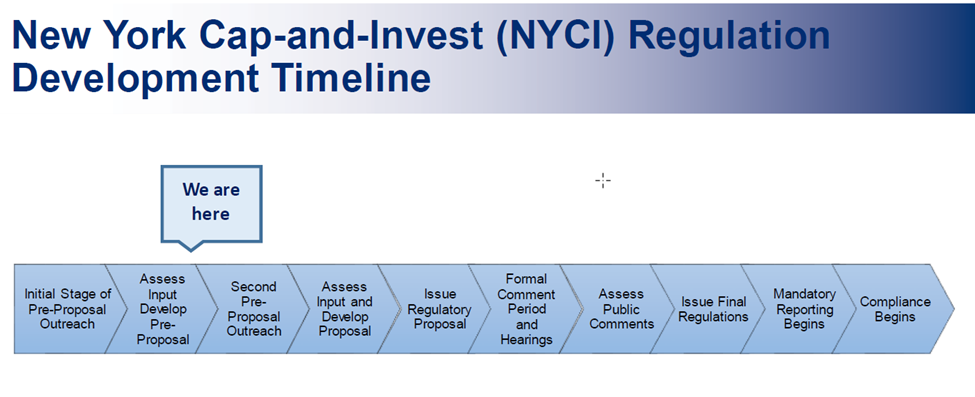
The New York Cap and Invest program is one of the Scoping Plan recommendations. The New York State Department of Environmental Conservation (DEC) and New York State Energy Research and Development Authority (NYSERDA) are hosting webinars designed “to inform the public and encourage written feedback during the initial phase of outreach” for New York’s proposed cap and invest program.
An economywide Cap-and-Invest Program will establish a declining cap on greenhouse gas emissions, limit potential costs to New Yorkers, invest proceeds in programs that drive emission reductions in an equitable manner, and maintain the competitiveness of New York businesses and industries. Cap-and-Invest will ensure the state meets the greenhouse gas emission reduction requirements set forth in the Climate Leadership and Community Protection Act (Climate Act).
I have written other articles that provide background on the New York Cap-and-Invest program (NYCI). I recently posted a Commentary overview for the New York Cap & Invest (NYCI) program that was written for a non-technical audience. In late March I summarized my previous articles on the New York cap and invest proposal in a post designed to brief politicians about the proposal if you want more technical information. There also is a page that describes all my carbon pricing initiatives articles that includes a section listing articles about the New York Cap and Invest (NYCI) proceeding.
Washington Climate Commitment Act
Although a bit late to the party for addressing the threat of climate change, Washington’s Climate Commitment Act appears to be even more aspirational than California and New York. The Washington Department of Ecology (“Ecology”) web page explains:
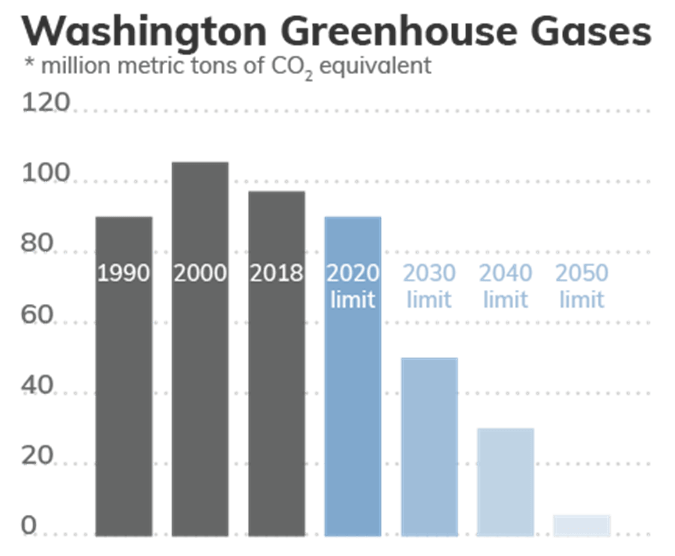
The Climate Commitment Act (CCA) caps and reduces greenhouse gas (GHG) emissions from Washington’s largest emitting sources and industries, allowing businesses to find the most efficient path to lower carbon emissions. This powerful program works alongside other critical climate policies to help Washington achieve its commitment to reducing GHG emissions by 95% by 2050.
The state plans in Washington, California, and New York all aim for net-zero emissions where greenhouse gas (GHG) emissions are equal to the amount of GHG that are removed. Washington’s emission reduction target is 95% by 2050. California is shooting for 85% by 2045 while New York’s target is 85% by 2050. In addition to the target levels and dates there are differences in what GHG emissions are included, how the mass quantities are calculated, and which sectors of the economy must comply. Nonetheless, I am sure a case can be made that Washington is the most aspirational.
A key component of the strategy of all three states is an emissions market program variation called cap-and-invest. According to NYSERDA the permits to emit a ton of pollution (the allowance) are distributed freely in a cap and trade program but in a cap-and-invest program the allowances are sold at auction and the proceeds are invested to enable the reductions required. A more cynical description of the difference would say that cap and trade programs are market-based systems that encourage the free market to find the least cost approach to meet the limits while cap-and-invest programs are disguised carbon taxes.
Cap-and-invest Analytics
My primary interest at the moment is the New York State cap-and-invest program initiative. As part of the stakeholder outreach process, on June 20, 2023 a webinar (presentation slide deck and session recording) on the program’s analysis inputs and methods that will “assess potential market outcomes and impact from the proposed New York Cap-and-Invest (NYCI) program”. What caught my attention was a comment that the McKinsey Vivid Economics team would model the cap-and-invest auction and that they had done similar analytic projects for the State of Washington (Video at 13:42).
According to a Ecology web site the Vivid Economics report shows “new climate change initiatives deliver significant benefits at minimal costs.” I have never been impressed with most economic analyses of emissions trading program. John von Neumann famously said “With four parameters I can fit an elephant, and with five I can make him wiggle his trunk.” I am skeptical about the value of global climate models because so many parameters are needed to simulate different physical processes in the atmosphere but at least there are physical relationships involved. Analytical models of cap-and-invest programs parameterize just about everything including human behavior. I have no confidence in their results. During the webinar I asked whether the Vivid Economics model had been verified. Not surprisingly there was no answer.
The Ecology web site report specifically addressed gasoline price projections based on economic modeling:
Economic report shows little impact on gas prices
Washington’s new Clean Fuel Standard will mean less than a 1-cent per gallon difference in the price consumers pay at the gas pump in 2023, according to estimates in a third-party economic analysis. Prices could rise up to 2-cents in 2024, and 4-cents in 2025, the report shows.
Ecology commissioned Berkeley Research Group to evaluate the Clean Fuel Standard’s impact on the retail cost of gas and diesel fuels, and the electricity for electric vehicles. Berkeley is an independent, globally-recognized consultant with a long track record of providing high-quality reports across a wide range of markets and industries.
Research shows regulations like the Clean Fuel Standard play a minor role in gas prices compared to the shifts in the U.S. economy and disruptions to crude oil supply and demand caused by global events, such as the pandemic and Russia’s invasion of Ukraine.
Legislators passed the Clean Fuel Standard in 2021. It will take effect in 2023. It requires fuel suppliers to gradually reduce the “carbon intensity” of transportation fuels 20% by 2038, enough to cut Washington’s statewide greenhouse gas emissions by 4.3 million metric tons per year. Transportation is the largest source of greenhouse gas emissions in Washington, accounting for 45% of total emissions.
The analysis shows price impacts vary over the next 12 years, and then drop to nearly zero as the number of electric cars increase and there’s a shift to cleaner energy.
Clearly the reasons for gasoline price volatility are always complicated. Another article explains:
What is causing the spike is a matter of intense debate. Some point to the state’s new “cap and invest” emissions program, which was implemented in January. The program sets a limit — or cap — on overall carbon emissions in the state and requires businesses (including fuel suppliers) to obtain allowances equal to their covered greenhouse gas emissions. These allowances can be obtained through quarterly auctions hosted by the Washington State Department of Ecology. They can also be bought and sold on a secondary market, similar to a stock or bond.
According to Todd Myers with the Washington Policy Center, this program means drivers will pay more at the pump. “The way fuel suppliers in California and Washington have done it is that they have simply, rather than try to speculate what the future prices will be, incorporated the cost of the allowances immediately into gas prices,” Myers told KIRO Newsradio. “So, what you see is, the gas price almost immediately reflects what those prices are.”
But Luke Martland, Climate Commitment Act Implementation Manager with the state Department of Ecology, claimed it’s not that simple. “What determines what we pay at the pump in Washington is supply and demand: The war in Ukraine, what Saudi Arabia may do, how much profit oil companies take from the sales. It’s a whole bunch of factors — and cap and invest might be one of those factors. But to say there’s a direct connection is simply not accurate.”
Patrick DeHaan, Head of Petroleum Analysis for GasBuddy, said the link between the cap-and-trade program and gas price increases is clear.
In my opinion, the key point is that the cost of Washington gasoline has risen more relative to the price increases elsewhere so that now Washington has the highest prices in the nation. The first two auctions for the Washington cap-and-invest program sold 14,770,222 allowances and raised $780,829,117 averaging $52.87 per allowance. According to the US Energy Information Administration 17.86 lbs of CO2 are emitted per gallon of finished motor gasoline which means that 112 gallons burned equals one ton. That works out to $0.47 a gallon needed to cover the cost of allowances necessary to purchase the allowances and that is a unique Washington cost adder. I agree with DeHaan – the link is clear.
Ramifications
There is a clear link between the pass-through cost that gasoline suppliers must pay and the fact that Washington State gasoline prices have increased more than other states. One of the reasons for my obsession following similar policies in New York is that observed significant cost increases with little real benefits should engender a political response. If it can be shown that there are real and significant costs as opposed to the “no real impact” claims made by net-zero proponents the politicians who supported these policies should be held accountable. The question is whether the residents of Washington have figured out that their gasoline prices are so high because of the politicians who promulgated this policy.
I cannot over-emphasize my belief that similar cost increases are coming to New York as a result of the NYCI proposal. Although the Hochul Administration professes the desire to make the program affordable the inescapable fact is that there have been significant cost increases where ever a jurisdiction has tried to eliminate GHG emissions. In addition, there is a complicating consideration inasmuch as higher costs are necessary/ The New York Independent System Operator has stated that the Climate Leadership & Community Protection Act (Climate Act) net-zero transition is “driving the need for unprecedented levels of investment in new generation to achieve decarbonization and maintain system reliability”. The analytical modeling must consider the balance between affordability and investing in Disadvantaged Communities principles against the investments needed. If the investments are insufficient then the energy system will fail to meet the cap limits. The modeling also must address the feasibility of the transition schedule that considers permitting delays, supply chain issues and trained labor constraints. Even if the money is available, it may not be possible to build it fast enough to meet the arbitrary Climate Act schedule and the modeling must reflect that possibility.
I conclude that in order to generate the revenues necessary to meet the Climate Act emission reduction targets that significantly higher energy prices will be required just like we are observing in Washington. When those cost increases become evident I hope that the politicians who supported the Climate Act are held accountable for the costs and limited benefits.
To her credit Susan Arbetter, the host of Spectrum News Capital Tonight program, has tried to expose viewers to issues related to the Climate Leadership & Community Protection Act (Climate Act). Recently she interviewed Rich Dewey CEO of the New York Independent System Operator (NYISO) about the recent release of the annual NYISO Power Trends report and its findings relative to Climate Act implementation. Both Arbetter and Dewey have roles to play in the Albany political scene that require them to be diplomatic and politically correct. As a result, the severity of the problems mentioned was not made clear.
I have been following the Climate Act since it was first proposed. I submitted comments on the Climate Act implementation plan and have written over 300 articles about New York’s net-zero transition. I have extensive experience with air pollution control theory, implementation, and evaluation having worked on every cap-and-trade program affecting electric generating facilities in New York including the Acid Rain Program, RGGI, and several Nitrogen Oxide programs since the inception of those programs. I follow and write about the RGGI cap and invest CO2 pollution control program so my background is particularly suited for the New York Cap and Invest proposal to provide compliance certainty for the Climate Act schedule that has unacknowledged risks associated with the Power Trends report. I have devoted a lot of time to the Climate Act because I believe the ambitions for a zero-emissions economy embodied in the Climate Act outstrip available renewable technology such that the net-zero transition will do more harm than good. The opinions expressed in this post do not reflect the position of any of my previous employers or any other company I have been associated with, these comments are mine alone.
Climate Act Background
The Climate Act established a New York “Net Zero” target (85% reduction and 15% offset of emissions) by 2050 and an interim 2030 target of a 40% reduction by 2030. The Climate Action Council is responsible for preparing the Scoping Plan that outlines how to “achieve the State’s bold clean energy and climate agenda.” In brief, that plan is to electrify everything possible and power the electric grid with zero-emissions generating resources by 2040. The Integration Analysis prepared by the New York State Energy Research and Development Authority (NYSERDA) and its consultants quantifies the impact of the electrification strategies. That material was used to write a Draft Scoping Plan. After a year-long review the Scoping Plan recommendations were finalized at the end of 2022. In 2023 the Scoping Plan recommendations are supposed to be implemented through regulation and legislation. The New York Cap and Invest (NYCI) initiative is one of those recommendations.
According to the NYCI overview webinar documentation, NYCI will “establish a declining cap on greenhouse gas emissions, limit potential costs to New Yorkers, invest proceeds in programs that drive emission reductions in an equitable manner, and maintain the competitiveness of New York businesses and industries.” There is an unrecognized dynamic between the goals of a declining cap and the need to limit potential costs. One touted feature of NYCI is that the declining cap provides compliance certainty so that the Climate Act targets (e.g., 40% reduction in GHG emissions by 2030) will be met. There is no question that there will be massive costs associated with the transition to zero emissions across the economy, but NYCI is supposed to limit potential costs. If the investments necessary to deploy zero emissions resources are insufficient then the energy system will fail to meet the cap limits. Even if the money is available, it may not be possible to build it fast enough to meet the arbitrary CLCPA schedule. My biggest concern is that the ultimate compliance strategy for the NYCI program is stop using fossil fuels even if replacement energy sources are not available. In that case, that means that compliance certainty will lead to an artificial energy shortage.
Interview with Dewey
Arbetter’s interview with Dewey is a good overview of the issues facing the NYISO. That organization has a mission to “Ensure power system reliability and competitive markets for New York in a clean energy future”. Arbetter explained that “Decarbonizing New York while at the same time ensuring the seamless functioning of the state’s electric grid takes a delicate balance”. The description of the interview states:
If fossil fuels are eliminated before enough renewable energy comes on-line, that balance will be disrupted.
The New York Independent System Operator (NYISO), the state’s nonprofit electric grid operator, in part, oversees that balance. Each year, NYISO publishes a report called Power Trends.
This year, the report warns the state is facing “declining reliability margins.”
While the grid operator is “fully committed” to New York state’s aggressive decarbonization goals under the Climate Leadership and Community Protection Act (CLCPA), NYISO President and CEO Rich Dewey told Capital Tonight that they must consider reliability first.
“Reliability is the top job,” he said. “When you’re managing the power grid, you’ve got to make sure that you’ve always got adequate supply to balance that demand.”
Currently, according to Dewey, there’s a “tremendous” buildout of new supply, which is largely renewable. But hooking up those new plants to the grid – a process call interconnectivity — is taking a lot of time.
Meanwhile, older legacy fossil fuel plants are being shut down. NYISO is responsible for the due diligence and research that go into interconnectivity.
According to Dewey, there are efforts underway to make that process more efficient.
“It’s a gigantic priority for me and for our organization,” Dewey said. “The challenge really arises from the fact that the new solar and wind resources are being built and interconnected at points on the grid where there does not exist already a generating plant.”
During the interview itself Dewey explained that NYISO reliability concerns about the transition to zero-emissions intermittent resources must be coordinated with retirements of existing fossil-fired resources. It is necessary to develop wind and solar and get the power from those resources to where it is needed before the existing resources can be retired or problems will ensue. It is often unrecognized that connecting the new resources to the grid is not a trivial task and Dewey explained they are working on the need for more support in this regard. The transition is also complicated by the fact that the decarbonization strategy for other sectors is electrification which will necessarily increase demand.
Power Trends 2023
The annual Power Trends report describes recent history and trends on the electric system. NYISO has prepared a key takeaways fact sheet in addition to the Power Trends 2023 report itself. The following graphic summarizes the key messages.
I will address each of these takeaways in the rest of this section.
The first takeaway “Public Policies are driving rapid change in the electric system in the state, impacting how electricity is produced, transmitted, and consumed” states the obvious that the Climate Act mandate to completely transform the energy system of the state affects everything in the electric system.
The second takeaway address’s reliability margins which are shrinking because fossil-fired generators are retiring at a faster pace than new renewable supply is entering service. What are they talking about? The Installed Reserve Margin (IRM) is “the minimum level of capacity, beyond the forecasted peak demand, which utilities and other energy providers must procure to serve consumers”. Power Trends notes “The IRM for the 2023-2024 capability year is 20.0% of the forecasted New York Control Area peak load, an increase from 19.6% last year. Based on a projected summer 2023 peak demand of 32,048 MW and the IRM, the total installed capacity requirement for the upcoming summer capability period is 38,458 MW”.
There is a significant underlying issue with this metric. In order to determine resource adequacy for the IRM, NYISO has a process that has been developed and refined over decades. Over the years this work has determined just how much extra power capacity is necessary to cover the unexpected loss of operating capacity at any one time. Importantly, a fundamental presumption based on observations in the NYISO analyses is that conventional generating resources operate independently. One of the biggest issues with a generating system dependent upon wind and solar resources is that there is a very high correlation between wind and solar output across the state. At night every solar resource provides zero energy. The primary cause for low wind energy output is a high-pressure system which is typically larger than New York. That means that the output for all the wind facilities in New York are highly correlated now and even when offshore wind comes on line this will continue. NYISO and the New York State Reliability Council are just coming to grips with this problem and how future resource adequacy analyses will have to be modified to refine the IRM standard. Finally, note that this problem is exacerbated by the fact that the hottest and coldest periods in New York associated with the highest electrical loads correlate very well with high pressure systems with light winds. In the winter when the solar resource is low because days are shorter and irradiance lower this problem is even more difficult.
The reliability margin takeaway discussion also raises implementation schedule concerns: “The potential for delays in construction of new supply and transmission, higher than forecasted demand, and extreme weather could threaten reliability and resilience of the grid.” This is one of my primary concerns with NYCI. Even if the technologies needed actually work, they might not be deployed fast enough to meet the NYCI cap limits.
The next takeaway addresses the issue of interconnection. It notes that “The NYISO’s interconnection process balances developer needs with grid reliability”. There is a lot of pressure on the NYISO to approve facility interconnection requests by those who will bear no responsibility if the rush to approve creates unanticipated issues. This is complicated. A reliable electric power system is very complex and must operate within narrow parameters while balancing loads and resources and supporting synchronism. New York’s conventional rotating machinery such as oil, nuclear, and gas plants as well as hydro generation provide a lot of synchronous support to the system. This includes reactive power (vars), inertia, regulation of the system frequency and the capability to ramping up and down as the load varies. Wind and solar resources are asynchronous and cannot provide this necessary grid ancillary support. The New York State Reliability Council (NYSRC) has proposed a new reliability rule for large asynchronous resources that is necessary but will likely add unavoidable delays to the interconnection process.
The Climate Action Council has the responsibility to develop the Scoping Plan to implement the Climate Act. Unfortunately, the members were chosen more for ideology than technical expertise and one of the primary ideological beliefs of many on the Council was that existing technology is sufficient for the transformation of the electric sector. The next takeaway argues otherwise: “To achieve the mandates of the CLCPA, new emission-free supply with the necessary reliability services will be needed to replace the capabilities of today’s generation.” Note that this position is supported by the Integration Analysis, the NYSRC, and even the Public Service Commission (PSC) that recently convened a proceeding to address this particular issue. The Council’s misunderstanding of this requirement could have serious consequences.
This new resource is an instance where the NYISO must placate the supporters of the Climate Act by downplaying the difficulty of developing this resource. The Power Trend takeaway states: “Such new supply is not yet available on a commercial scale” but they have not publicly come out bluntly and said how difficult this might be. In my draft scoping plan comments I argued there is a real concern because any resource that is emission-free and provides necessary reliability services must overcome the Second Law of Thermodynamics. Any energy storage system must lose energy as it is stored and then again as it comes out of storage. This limits the viability of every storage system touted for this resource.
The final takeaway addresses the wholesale electricity market. The NYISO is a creation of the deregulated electric system and its market. It is not surprising that the NYISO touts their critical role in the transition in this regard. However, in my opinion, the market adds a layer of complexity. It is not enough to just determine what resources are necessary to keep the lights on but it is also necessary to develop a market incentive to provide that resource. What happens if the PSC proceeding recommends an emissions free resource that provides the grid support needed but nobody wants to risk the money for a resource that is needed for a limited period during critical demand peaks?
Peaking Power Plants
There were other press reports describing Power Trends. Reuters emphasized the “balanced and carefully planned transition” theme. New York Focus chose to point out that the report indicates that “Air-polluting “peaker” plants were a top priority for closure in New York’s green transition. But the state isn’t building clean energy fast enough to replace them on time.” Arbetter also raised the “peaker” power plant issue. Dewey said there are “dirty” units that reside in “underprivileged communities” and Arbetter said they cause “lots of pollution and environmental racism”.
This is a complicated problem that has become embroiled in emotional arguments. There are some old power plants that are only used to provide power during the highest load demand periods. They are old, relatively dirty, and many are located in low- and middle-income disadvantaged communities in New York City so have become the poster child of disproportionate impacts on over-burdened communities. No politically correct organization dares raise any objections to the argument that this is a problem. On the other hand, I not only have subject matter expertise but also have no voice. I have shown that the alleged peaker power plant problems are based on selective choice of metrics, poor understanding of air quality health impacts, and ignorance of air quality trends. In other words they are not as much of a problem as environmental advocates claim.
This is a particular problem for the NYISO. The new resource that must be developed is needed for this particular problem. These are the facilities that Dewey wants to be kept available in New York City until a viable alternative is provided. Someone with a voice is going to have to come out and say that until we have alternatives that will work, have lower risks to the communities where they reside, and are affordable, some peaker power plants may have to remain available. Whether or not they ever point out that the arguments used to vilify the facilities don’t hold water is another matter.
Conclusion
I agree completely with the following. The New York Focus article quotes C. Lindsay Anderson, an energy specialist at Cornell University’s school of engineering, who said it’s hard to avoid such gaps in an energy transition with so many moving parts.
“Everything has to move sort of in sync to make the plan work,” Anderson said. “Taking [peakers] offline is an important signal that we’re making progress. But with many other pieces of the plan having been delayed, it’s not surprising that we may need to delay this a little bit to let the other pieces catch up.”
The necessity to toe the line of political correctness in the Capital District prevented Dewey from explicitly connecting some of the Power Trends takeaways and the Climate Act implementation process. For example, the concern about timing and suggestions that delays are inevitable directly impacts the NYCI emission caps. The caps are based on the arbitrary Climate Act deadlines that were not chosen based on any kind of a feasibility analysis. To my knowledge, NYISO has not been asked to provide their best estimate of the timing of the wind and solar resources necessary to displace the existing resources required to meet the Climate Act mandates. Their resource adequacy modeling and other work is the only credible way to determine if the schedule is reasonable and would likely show the current schedule is not viable. Because GHG emissions are primarily associated with energy use meeting the unrealistic NYCI emission caps means the only compliance strategy is to create an artificial energy shortage.
New York GHG emissions are less than one half of one percent of global emissions and global emissions have been increasing on average by more than one half of one percent per year since 1990. While this may not be a reason to not do something about climate change, it certainly suggests that adjustments to the arbitrary Climate Act schedule are justified. The Power Trends report certainly implies that adjustments to the schedules appear to be necessary.
The New York State Department of Environmental Conservation (DEC) and New York State Energy Research and Development Authority (NYSERDA) are hosting webinars designed “to inform the public and encourage written feedback during the initial phase of outreach” for New York’s proposed cap and invest program. When I get around to submitting my feedback one of my major themes will be the need to do a feasibility analysis to ensure that the resources necessary to enable the reductions required to meet the net-zero transition can be deployed as necessary. This post addresses this concern.
I have been following the Climate Leadership & Community Protection Act (Climate Act) since it was first proposed. I submitted comments on the Climate Act implementation plan and have written over 300 articles about New York’s net-zero transition. I have extensive experience with air pollution control theory, implementation, and evaluation having worked on every cap-and-trade program affecting electric generating facilities in New York including the Acid Rain Program, RGGI, and several Nitrogen Oxide programs since the inception of those programs. I follow and write about the RGGI cap and invest CO2 pollution control program so my background is particularly suited for this proposal. I have devoted a lot of time to the Climate Act because I believe the ambitions for a zero-emissions economy embodied in the Climate Act outstrip available renewable technology such that the net-zero transition will do more harm than good. The opinions expressed in this post do not reflect the position of any of my previous employers or any other company I have been associated with, these comments are mine alone.
Climate Act Background
The Climate Act established a New York “Net Zero” target (85% reduction and 15% offset of emissions) by 2050 and an interim 2030 target of a 40% reduction by 2030. The Climate Action Council is responsible for preparing the Scoping Plan that outlines how to “achieve the State’s bold clean energy and climate agenda.” In brief, that plan is to electrify everything possible and power the electric grid with zero-emissions generating resources by 2040. The Integration Analysis prepared by the New York State Energy Research and Development Authority (NYSERDA) and its consultants quantifies the impact of the electrification strategies. That material was used to write a Draft Scoping Plan. After a year-long review the Scoping Plan recommendations were finalized at the end of 2022. In 2023 the Scoping Plan recommendations are supposed to be implemented through regulation and legislation. The cap and invest initiative is one of those recommendations.
An economywide Cap-and-Invest Program will establish a declining cap on greenhouse gas emissions, limit potential costs to New Yorkers, invest proceeds in programs that drive emission reductions in an equitable manner, and maintain the competitiveness of New York businesses and industries. Cap-and-Invest will ensure the state meets the greenhouse gas emission reduction requirements set forth in the Climate Leadership and Community Protection Act (Climate Act).
I have written other articles that provide background on NYCI. I recently posted a Commentary overview for the New York Cap & Invest (NYCI) program that was written for a non-technical audience. In late March I summarized my previous articles on the New York cap and invest proposal in a post designed to brief politicians about the proposal if you want more technical information. There also is a page that describes all my carbon pricing initiatives articles that includes a section listing articles about the New York Cap and Invest (NYCI) proceeding.
The Need for a Safety Valve
The NYCI implementation plan is to “Advance an economywide Cap-and-Invest Program that establishes a declining cap on greenhouse gas emissions, limits potential costs to economically vulnerable New Yorkers, invests proceeds in programs that drive emission reductions in an equitable manner, and maintains the competitiveness of New York industries.” In my opinion, the State has not considered that there will be significant consequences if the dynamics between these stated goals are not resolved. There is no indication that tradeoffs between these goals are even being considered. Furthermore, implementation of this sophisticated and complicated economy-wide program is handicapped by the aspirational legislative constraints on timing and targets.
If the influential book Making Climate Policy Work had been considered by the Climate Action Council or Governor’s Office I believe that there would be substantive changes to the plan. Authors Danny Cullenward and David Victor explain how the politics of creating and maintaining market-based policies render them ineffective nearly everywhere they have been applied. They recognize the enormity of the challenge to transform industry and energy use on the scale necessary for deep decarbonization. They write that the “requirements for profound industrial change are difficult to initiate, sustain, and run to completion.” Because this is hard, they call for “realism about solutions.”
NYCI proponents point to the “success” of the Regional Greenhouse Gas Initiative (RGGI) and presume that their proposed program will work as well. I evaluated the Making Climate Policy Work analysis of RGGI. I agree with the authors that the results of RGGI and other programs suggest that programs like the NYCI proposal will generate revenues. However, we also agree that the amount of money needed for decarbonization is likely more than any such market can bear. The problem confronting the Administration is that in order to make the emission reductions needed I estimate they have to invest between $15.5 and $46.4 billion per year. The first issue that NYCI implementation must address is the revenue target relative to what is needed for investments to meet the Climate Act 2030 GHG emission reduction target.
The use of NYCI as a compliance mechanism is also a problem. The NYCI webinars have not acknowledged or figured out that the emission reduction ambition of the Climate Act targets is inconsistent with the technological reality of the Climate Act schedule. Because GHG emissions are equivalent to energy use, limiting GHG emissions before there are technological solutions that provide sufficient zero-emissions energy means that compliance will only be possible by restricting energy use. The second issue that NYCI implementation must address is a feasibility analysis whether there will be sufficient allowances to avoid limits on power plant operations, gasoline availability, and natural gas for residential use for the 2030 Climate Act 40% GHG emission reduction target. This issue is the focus of this post.
There is no excuse to not include a safety valve that could make changes to the schedule based on the results of a feasibility analysis. The NYCI webinars have not acknowledged that there are conditions relative to meeting the Climate Act targets, but there is one available. New York Public Service Law § 66-p. “Establishment of a renewable energy program” has safety valve conditions for affordability and reliability that are directly related to the two issues described above. § 66-p (4) states: “The commission may temporarily suspend or modify the obligations under such program provided that the commission, after conducting a hearing as provided in section twenty of this chapter, makes a finding that the program impedes the provision of safe and adequate electric service; the program is likely to impair existing obligations and agreements; and/or that there is a significant increase in arrears or service disconnections that the commission determines is related to the program”. If the feasibility analysis finds that reliability or affordability issues are likely due to implementation issues, then this could be used to modify the schedule.
California Uncertainty Analysis
One of the principles of NYCI is Climate Leadership which is defined as: “Catalyze other states to join New York, and allows linkage to other jurisdictions”. In order to link to other jurisdictions, it is necessary to be consistent with their cap and invest programs. The California Air Resources Board (CARB) has a GHG emissions cap-and-trade program that has been in place since 2019. Even though the Climate Act differs from the California plan because the Climate Act requires that all GHG emissions must be accounted for rather offering some exemptions, I am disappointed that there does not seem to be much sign that New York is considering using the methodological approaches used by California.
Last year CARB prepared a 2022 Scoping Plan for Achieving Carbon Neutrality (2022 Scoping Plan) that “lays out a path to achieve targets for carbon neutrality and reduce anthropogenic greenhouse gas (GHG) emissions by 85 percent below 1990 levels no later than 2045, as directed by Assembly Bill 1279.” This is one example where New York’s efforts could be informed by the California process and it addresses my feasibility concern. The California Air Resources Board 2022 Scoping Plan issued in November 2022 included a 2030 Uncertainty Analysis. The report explains that the implementation effort requires additional efforts beyond those already in place but notes:
There is also uncertainty that the current mix of policies (regulations, incentives, and carbon pricing) will be sufficient to achieve California’s 2030 target, at least 40% below 1990 greenhouse gas (GHG) emissions. Uncertainty is an inherent part of emissions forecasting and modeling – there is no model capable of predicting the future with perfect accuracy. As the on-going global COVID-19 pandemic and recovery has demonstrated, unexpected events can dramatically impact human welfare, economic activity, and GHG emissions.
In this analysis, we identify the drivers of uncertainty and analyze the potential impact of implementation delays on GHG emissions in 2030. That is, what if delayed implementation of actions as defined in the Scoping Plan Reference Scenario fail to achieve anticipated GHG reductions by 2030? This uncertainty analysis focuses on progress in achieving the 2030 target of at least 40% below 1990 levels by 2030 and does not include an assessment of the uncertainty faced in implementing the Scoping Plan scenario for achieving carbon neutrality by 2045.
We construct two scenarios that capture the largest emissions impact in 2030 from delays in implementation under the Scoping Plan Reference Scenario: delayed renewable capacity and delayed transportation electrification. We quantify the magnitude of the emissions impact under these two scenarios, highlighting the importance of these two actions in achieving the reductions outlined in the Scoping Plan Reference Scenario to hit California’s 2030 climate target.
This is exactly what I believe is necessary for NYCI. The report notes that:
The main drivers of future GHG emissions – technology costs, energy prices, macroeconomic conditions, and policy implementation – are not known with perfect certainty. Modelers make informed assumptions about these drivers and estimate a range of GHG emissions based on historic, current, and potential future trends.
Unanticipated changes in these variables impact GHG emissions, however they are largely outside the control of policy makers. In just the past few years, we have seen global geopolitical and macroeconomic events dramatically alter energy prices, technology costs, and GHG emissions in California. The impacts of these events are still being felt and will continue to impact California’s economy and emissions – but are largely outside the control of the State.
The uncertainty analysis considered two scenarios: one for delayed renewable development and another for delayed transportation electrification. The delayed renewable capacity scenario description notes:
In the Scoping Plan Reference Scenario, California has a 38 MMT GHG constraint in the power sector and achieves a 60% Renewable Portfolio Standard (RPS) by 2030 as required in SB 100. Under the delayed renewable capacity scenario, we construct an emissions trajectory from 2022 to 2030 under a 5-year delay in renewable capacity including infrastructure for existing renewable facilities as well as delays in permitting and construction for new renewable generation and transmission.
The delayed transportation electrification scenario description explains:
In the transportation sector, there are two assumptions driving emissions in 2030 in the Scoping Plan Reference Scenario- per-capita vehicle miles travelled (VMT) are reduced 4% below 2019 levels by 2045 and 40% of light-duty vehicle (LDV) sales are zero emission vehicles (ZEV) by 2030 (with minimal medium-duty and heavy-duty vehicle decarbonization) aligned with California Institute for Transportation Studies (ITS) BAU scenario. In California, per-capita VMT increased from 2017 to 2019. Therefore, the assumption that VMT decreases, even marginally, without additional action is a risk to achieving the 2030 emissions under the Scoping Plan Reference Scenario. However, the overall emissions impact in 2030 of failing to achieve the 4% per capita VMT reduction is relatively small under the Scoping Plan Reference Scenario as compared to the emissions impact of near-term transportation electrification.
The analysis concludes:
California’s path to carbon neutrality by 2045 is predicated on achieving the emission reductions outlined in the Scoping Plan Reference Scenario. We find that delaying renewable capacity by 5 years will increase California emissions by 8% in 2030 while delaying vehicle electrification will increase emissions by 6% in 2030. While the magnitude of these values may seem small, the risks are high. 2030 is just over seven years away and the gap to achieving the sector targets in the Scoping Plan Reference Scenario are large.
These emission reductions outlined in the Scoping Plan Reference Scenario are not guaranteed and while some of the risk and uncertainty is global and largely exogenous, there are risks associated with implementation. These risks can potentially be reduced or eliminated with targeted policy interventions. While in this analysis we have highlighted the impact of delayed renewable capacity and transportation electrification, there are uncertainties in each implementation assumption across California’s economic sectors. The magnitude of the emissions impact will vary as will any potential policy or regulatory intervention.
This analysis has focused on the risks associated with California achieving the GHG emissions outlined in the Scoping Plan Reference Scenario. Any increase in emissions on the pathway to 2030 will impact California’s ability to achieve carbon neutrality by 2045. In addition, the technologies and fuels needed to achieve carbon neutrality will also face significant uncertainties in the future. While outside the scope of this analysis, the same implementation risks discussed in relation to renewable capacity may be relevant to emerging technologies like carbon dioxide removal or carbon capture and renewable hydrogen production.
Discussion
The California analysis found that delays in renewable energy deployment would increase emissions 8% (~ 28 million metric tons) and vehicle electrification would increase emissions by 6% (~21 million metric tons). These are significant emission increases. If there are similar issues relative to the New York implementation plans, then it would threaten the compliance with the cap.
The NYCI implementation plan includes a goal for a declining cap on greenhouse gas emissions that provides compliance certainty. In my opinion, the State has not considered that there will be significant consequences related to the use of NYCI as a compliance mechanism if the deployment of zero-emissions resources necessary to make the reductions is delayed. The Hochul Administration has not acknowledged or figured out that the emission reduction ambition of their Climate Act targets is inconsistent with technology reality. Because GHG emissions are equivalent to energy use, limiting GHG emissions before there are technological solutions that provide zero-emissions energy means that compliance will only be possible by restricting energy use.
I do not understand why Climate Act proponents don’t acknowledge that restrictions on energy use because there are insufficient allowances available would catastrophically impact their ambitions. It is indisputable that New York GHG emissions are less than one half of one percent of global emissions and global emissions have been increasing on average by more than one half of one percent per year since 1990. I would not want to argue to the public that they cannot have gasoline for their cars or fossil fuels for their homes because the allowances ran out attempting to reduce New York emissions a fraction of the total when the total emissions are globally irrelevant. It is not necessarily inappropriate to do something but disallowing changes to the schedule based on feasibility or the reality that emissions are greater than the aspirational targets leading to artificial energy shortages will surely cause massive pushback by most New Yorkers.
Conclusion
The allure of a source of revenues and compliance certainty using climate policies that apparently have worked in the past led the Council and Governor to put the cart before the horse with their NYCI recommendations. The Cap-and-Invest Program recommended by the Climate Action Council’s final Scoping Plan and proposed in Governor Kathy Hochul’s 2023 State of the State Address and Executive Budget has not paid adequate attention to what made previous policies work and whether there are significant differences between the Climate Act requirements and previous policy goals in those other programs that might impact NYCI. There are provisions for a safety valve that enable adjustments to the schedule. The recent announcements that there are delays in the offshore wind projects suggests that there are potential issues. Failing to plan and incorporate a feasibility analysis to determine the reasonableness of the deployment of wind and solar resources necessary to meet the targets relative to the Climate Act schedule will likely lead to serious problems in the future.
On June 1, 2023 the Department of Environmental Conservation (DEC) and New York State Energy Research and Development Authority (NYSERDA) hosted the first webinar in a series “to inform the public and encourage written feedback during the initial phase of outreach” for New York’s proposed cap and invest program. At the time of this writing the only documentation available for the webinar are the slides so this article only addresses one question. Where does the state stand relative to the 2030 transition target of a 40% reduction of GHG emissions from the 1990 baseline.
I have been following the Climate Leadership & Community Protection Act (Climate Act) since it was first proposed. I submitted comments on the Climate Act implementation plan and have written over 300 articles about New York’s net-zero transition because I believe the ambitions for a zero-emissions economy embodied in the Climate Act outstrip available renewable technology such that the net-zero transition will do more harm than good. The opinions expressed in this post do not reflect the position of any of my previous employers or any other company I have been associated with, these comments are mine alone.
Climate Act Background
The Climate Act established a New York “Net Zero” target (85% reduction and 15% offset of emissions) by 2050 and an interim 2030 target of a 40% reduction by 2030. The Climate Action Council is responsible for preparing the Scoping Plan that outlines how to “achieve the State’s bold clean energy and climate agenda.” In brief, that plan is to electrify everything possible and power the electric grid with zero-emissions generating resources by 2040. The Integration Analysis prepared by the New York State Energy Research and Development Authority (NYSERDA) and its consultants quantifies the impact of the electrification strategies. That material was used to write a Draft Scoping Plan. After a year-long review the Scoping Plan recommendations were finalized at the end of 2022. In 2023 the Scoping Plan recommendations are supposed to be implemented through regulation and legislation. The cap and invest initiative is one of those recommendations.
An economywide Cap-and-Invest Program will establish a declining cap on greenhouse gas emissions, limit potential costs to New Yorkers, invest proceeds in programs that drive emission reductions in an equitable manner, and maintain the competitiveness of New York businesses and industries. Cap-and-Invest will ensure the state meets the greenhouse gas emission reduction requirements set forth in the Climate Leadership and Community Protection Act (Climate Act).
I recently posted my All Otsego Commentary overview on cap and invest published in early May that was written for a non-technical audience. In late March I summarized my previous articles on the New York cap and invest proposal in a post designed to brief politicians about the proposal if you want more technical information. There also is a page that describes all my carbon pricing initiatives articles that includes a section about the New York Cap and Invest (NYCI) proceeding.
NYS GHG Emissions
One of the fundamental issues relative to NYCI is the status of New York State GHG emissions. The DEC is required to prepare an annual report for statewide greenhouse gas emissions, pursuant to Section 75-0105 of the Environmental Conservation Law. The DEC website described the report issued at the end of 2022:
This current report covers the years 1990 through 2020. The emission information will also be made available for download from Open Data NY (leaves DEC website).
The 2022 report includes the results of analyses that are described in more detail in supplemental reports available through the New York State Energy Research and Development Authority (NYSERDA) Greenhouse Gas Emissions Studies (leaves DEC website).
According to the Environmental Protection Agency, one of the necessary components for an effectively designed emissions trading program is “accountability for reducing, tracking and reporting emissions”. While on the face of it the DEC annual GHG emissions report might seem to fulfill that condition, it does not. The DEC annual report takes two years to develop so it is unusable for the proposed program. The data provided are not detailed enough to breakdown emissions by potential NYCI sectors. Finally, there are insufficient supporting data to document the accuracy of the reported emissions.
The impetus for this article is slide 7, GHG Emissions Reduction Requirements, in the presentation. The slide includes two figures: current emissions by sector and New York State GHG emissions. My concern is the numbers used for the figures.
The New York State GHG emissions figure includes three numbers from Part 496 the statewide GHG emission limits for the Climate Act. In 2030 the statewide greenhouse gas emission limit (in million metric tons of carbon dioxide equivalent or MMT CO2e) is 245.87 and in 2050 it is 61.47. Those limits are 60% and 15% respectively of the 1990 baseline emissions which works out to 410 MMT CO2e. The 2019 emissions (376.18 MMT CO2e are from the 2022 GHG emissions inventory. Note that the State uses 2019 instead of 2020 for trends analysis because 2020 values are anomalous due to the pandemic shutdowns.
My concern is that the numbers used to derive the graph “Current estimated GHG emissions by sector are not publicly available. The DEC annual report does not break out emissions from the different sectors by the categories shown. For example, for the buildings sector there is no table that lists space heating, water heating, other, and cooking sub-category emissions. The emission information available from Open Data NY does not include those categories either. The DEC 2022 report references supplemental reports available through the NYSERDA Greenhouse Gas Emissions Studies website. There are no relevant references to emissions from those categories in those reports.
Emissions Reporting
I have been dealing with emissions reporting for cap-and-trade programs for three decades starting with the Acid Rain Program in the early 1990’s. The Environmental Protection Agency standard for the accountability for tracking and reporting emissions is very high. Developing the infrastructure to record, report, and comply with their standards took enormous effort but the data are completely transparent and verifiable to national standards. Note, however, that this high level is only possible because the emissions are measured directly. That approach is not possible for many sectors covered by the Climate Act but it does not mean that there should not be accountability for the emissions.
Instead of directly measuring the pollution emissions at the source, many sectors must rely on emission factors. EPA describes emissions factors as follows:
An emissions factor is a representative value that attempts to relate the quantity of a pollutant released to the atmosphere with an activity associated with the release of that pollutant. These factors are usually expressed as the weight of pollutant divided by a unit weight, volume, distance, or duration of the activity emitting the pollutant (e.g., kilograms of particulate emitted per megagram of coal burned). Such factors facilitate estimation of emissions from various sources of air pollution. In most cases, these factors are simply averages of all available data of acceptable quality, and are generally assumed to be representative of long-term averages for all facilities in the source category (i.e., a population average).
In order to calculate emissions using an emission factor the following equation is used:
E = A x EF x (1-ER/100)
where:
E = emissions;
A = activity rate;
EF = emission factor, and
ER =overall emission reduction efficiency, %
In order for the NYCI emissions to be accountable, all four of those values should be documented and available to the public. Unfortunately, the state has net even provided the data used to generate the graphics used much less this supporting information.
There is another important difference between the emissions reported based on direct measurements at the source and emissions derived from emission factors. The measured values cannot change but if there are refinements to the emission factors or activity rate measurements the values can change. For example, the 2022 Sectoral Report 1: Energy report has a chapter entitled Planned Improvements that lists known issues where improved estimates are desired. In my opinion, there are numerous examples where the DEC emission factors used are questionable and I expect that affected sources will likely make the investments to improve the emission factors for more realistic emission estimates. There have already been changes such that the Part 496 1990 baseline value of 410 MMT is different than the 2022 GHG emission inventory estimated 1990 emissions of 404.26 MMT.
Where Do We Stand?
In the absence of data from the DEC and NYSERDA that can be used to determine where the sectors stand relative to the 2030 Climate Act targets, I used the Data NY and the Statewide GHG Emissions dataset available there to breakdown the differences between the 1990 baseline and the 2019 and 2020 emissions for various sub-sectors and fuels. The caveat is that these are only estimates and not the official sub-sector emissions. The following tables present data by the agriculture, buildings, electricity, industry, transportation, and waste economic sectors.
The first table summarizes the emissions using the New York State global warming potential accounting approach for 20 years and the Intergovernmental Panel on Climate Change accounting for 100 years for each of the sectors and the overall totals. It is not clear exactly which components of each sector will be subject to NYCI obligations but the totals suggest that the aspirational goals will be a challenge to meet. The agriculture, buildings, transportation, and waste sectors all need to reduce emissions over 40% between 2019 and 2030. While the electricity sector seems to be in good shape relative to the target the 2019 data does not reflect the shutdown of 2,000 MW of zero-emissions nuclear generation at Indian Point which raised the sector emissions by over 20%.
Statewide Greenhouse Gas Emissions (MMT) by Sector Relative to 2030 Target
The following tables list data for unique combinations within each sector for the category, and sub-category labels For example, within the agriculture economic sector there were two categories: livestock and soil management. Within those categories there were five additional sub-categories. I listed data for the entire agriculture sector in the first row of the table. The baseline 1990 emissions were 15.3 million metric tons CO2e using the global warming potential 20 year approach. The 2030 limit is 9.2 MMT CO2e 20yr. In 2019 the emissions were 21.3 MMT CO2e 20yr which represents a 6.0 MMT CO2e 20yr 39%) increase from the 1990 baseline. In order to get to the 2030 limit a reduction of 12.1 MMT CO2e 20yr -57% is needed. Note that DEC has mentioned that due to the pandemic that 2020 is not a representative year so I only show 2019 data. . Within the agriculture sector I list the livestock 1990 emissions (13.6 MMT CO2e 20yr) and the soil management 1990 emissions (1.7 MMT CO2e 20yr). Note that the sum of these categories equals the total of the sector. The data for the sub-categories is also presented. In the agriculture sector I believe some of the categories will be exempt. Nonetheless it is obvious that there is a long way to go to meet the 2030 target.
Agriculture SectorGHG Emissions Trends Relative to 2030 Target
The buildings sector has the largest emissions of any sector. Note that the Climate Act mandates that emissions from upstream sources as well as direct emissions. This places an emphasis on eliminating the use of fossil fuels because New York sources have no way to reduce emissions from upstream sources other than to stop importing the fuel. I doubt very much that the proposed goals can be met by displacing the use of fossil fuels with electrification. The compliance certainty feature associated with the cap means that the ultimate compliance strategy will be to limit fossil fuel use even if the replacement electrification technologies are not available.
Building Sector GHG Emissions Trends Relative to 2030 Target
The inherent biases in the Climate Act GHG emissions accounting approach is evident in the electricity sector trends. Note that in 2019 the New York accounting claims that direct GHG emissions are only slightly more than the upstream imported fossil fuel emissions. Those numbers are not credible and I predict that there will be concerted efforts to refine the emission factors used to generate them.
Electricity SectorGHG Emissions Trends Relative to 2030 Target
The industry sector also appears to be relatively close to the 2030 target. However, it is not clear if this is due to decarbonization efforts or New York’s de-industrialization since 1990. More importantly is the question whether the 10% overall reduction necessary to get to the 2030 target is feasible for the remaining industrial operations.
Industry SectorGHG Emissions Trends Relative to 2030 Target
It is not clear how the Hochul Administration plans to decarbonize the transportation sector to the extent necessary in the next seven years. Transportation emissions went up 10% from 1990 to 2019 and need to decrease 49% by 2030. According to the webinar “Large-scale GHG emitters and distributors of heating and transportation fuels will be required to purchase allowances for the emissions associated with their activities”. For the transportation sector that means when the allowances for transportation fuels run out, suppliers will not provide gasoline and diesel fuel to the retailers. The resulting fuel shortage will be entirely due to the non-existent feasibility planning by the state.
Transportation SectorGHG Emissions Trends Relative to 2030 Target
I am glad I am not associated with the waste sector. It is my impression that there are very few options available for solid waste management. So what did the Scoping Plan suggest. Increased recycling and waste minimization to reduce the waste stream. In this case the only option I can think of when the allowances run out is to stop accepting waste.
Waste SectorGHG Emissions Trends Relative to 2030 Target
Conclusion
There are many questions about the NYCI proposal that must be addressed this year. Frankly I think the Hochul Administration is going down the wrong path in its implementation plan because they are already mired in details but have not addressed fundamental issues.
Before proceeding it is necessary to determine what has to be done to meet the 2030 target and whether it is feasible to make the reductions on the required schedule. If it is feasible that is one thing but given these numbers that appears to be a high hurdle. The compliance certainty “feature” of NYCI is great as long as the targets are achievable but if they are not met, then the draconian compliance alternatives are going to cause a backlash of monumental proportions.
The other thing that should be done before proceeding any further is to determine the costs of the technologies necessary to achieve the goals using the compliance strategies in the feasibility analysis. Even if the technologies are deemed feasible, if investments are insufficient to deploy the technologies as needed then the targets won’t be met. If it turns out that the revenues necessary for successful investments are politically unpalatable, then it is time to reconsider the implementation plan.
I am not optimistic that this could possibly end well. Watch this space for more information as this unfolds.
On May 19, 2023 the Department of Environmental Conservation (DEC) and New York State Energy Research and Development Authority (NYSERDA) announced that they are hosting a pre-proposal webinar series to provide the public an opportunity to learn about the rulemakings under development for the Cap-and-Invest Program in New York State. This post is an overview of the initiative and the webinar series.
I have been following the Climate Leadership & Community Protection Act (Climate Act) since it was first proposed. I submitted comments on the Climate Act implementation plan and have written over 300 articles about New York’s net-zero transition because I believe the ambitions for a zero-emissions economy embodied in the Climate Act outstrip available renewable technology such that the net-zero transition will do more harm than good. The opinions expressed in this post do not reflect the position of any of my previous employers or any other company I have been associated with, these comments are mine alone.
Climate Act Background
The Climate Act established a New York “Net Zero” target (85% reduction and 15% offset of emissions) by 2050 and an interim 2030 target of a 40% reduction by 2030. The Climate Action Council is responsible for preparing the Scoping Plan that outlines how to “achieve the State’s bold clean energy and climate agenda.” In brief, that plan is to electrify everything possible and power the electric grid with zero-emissions generating resources by 2040. The Integration Analysis prepared by the New York State Energy Research and Development Authority (NYSERDA) and its consultants quantifies the impact of the electrification strategies. That material was used to write a Draft Scoping Plan. After a year-long review the Scoping Plan recommendations were finalized at the end of 2022. In 2023 the Scoping Plan recommendations are supposed to be implemented through regulation and legislation. The cap and invest initiative is one of those recommendations.
I recently posted my All Otsego Commentary overview on cap and invest that was published in early May that was written for a non-technical audience. In late March I summarized my previous articles on the New York cap and invest proposal in a post designed to brief politicians about the proposal if you want more technical information. There also is a page that describes all my carbon pricing initiatives articles that includes a section about the New York Cap and Invest (NYIC, Their acronym not mine) proceeding.
An economywide Cap-and-Invest Program will establish a declining cap on greenhouse gas emissions, limit potential costs to New Yorkers, invest proceeds in programs that drive emission reductions in an equitable manner, and maintain the competitiveness of New York businesses and industries. Cap-and-Invest will ensure the state meets the greenhouse gas emission reduction requirements set forth in the Climate Leadership and Community Protection Act (Climate Act).
This is the first set in a series of webinars to inform the public and encourage written feedback during the initial phase of outreach. Additional information will be provided as it becomes available at www.capandinvest.ny.gov. If you wish to continue receiving updates on the development of the Cap-and-Invest Program, please join the Climate Act mailing list athttps://climate.ny.gov/email-list/.
Below is the full list of scheduled webinars for this first round. For more information on how to join the webinars, please visit www.capandinvest.ny.gov/meetings-and-events.
June 1, 1 to 3 p.m. – Cap-and-Invest Overview
June 6, 11 a.m. to 1 p.m. – Natural Gas focused webinar
June 8, 1 to 3 p.m. – Liquid Fuels focused webinar
June 13, 11 a.m. to 1 p.m. – Energy Intensive and Trade Exposed Industries focused webinar
June 15, 1 to 3 p.m. – Waste focused webinar
June 20, 11 a.m. to 1 p.m. – Cap-and-Invest Analysis Inputs and Methods
June 22, 1 to 3 p.m. – Electricity focused webinar
As New York begins drafting regulations, we are considering California’s existing economywide programs, as well as those operating in Quebec and Washington State. This webinar series will provide the public with a series of questions on topics that DEC and NYSERDA are seeking input. DEC and NYSERDA are interested in hearing what elements of other jurisdictions’ regulations would work well in New York, and what improvements or changes may best serve New York.
For more information, including instructions on how to provide comment, please visit www.capandinvest.ny.gov.
Stakeholder Process
The ostensible purpose of the webinars and workshops is to enable DEC and NYSERDA to gather feedback on the program as they “develop regulations to implement the Cap-and-Invest Program”. There are three program design elements:
It appears to me that the State is worried that there will be an overwhelming response to the request for comments. The request for comments includes specific questions for each of the design elements that should enable them to categorize the comments. The description notes:
DEC and NYSERDA have developed a template document [PDF] to assist commenters in providing feedback on these topics.
DEC and NYSERDA will review comments and further develop pre-proposal materials to define New York’s program. Notices will be sent to the distribution list when the second round of pre-proposal materials are posted. To inform the development of the pre-proposal, DEC and NYSERDA request first round feedback no later than July 1, 2023.
The template document requests comments for the following topics:
Applicability and Thresholds – Defines which sources and at what emissions thresholds sources are covered by the regulations, who must report emissions, and who must obtain and surrender allowances equal to their GHG emissions. Establishes obligated and non-obligated sources.
Allowance Allocation – Defines how allowances are made available: auctions, set asides and free allocations.
Auction Rules – Defines structure and mechanics of allowance auctions
Market Rules – Defines rules for participation in market and trading of allowances.
Program Ambition – Defines the cap and the allowance budget for how many allowances will be available year by year to reach the Climate Act greenhouse gas limits.
Program Stability Mechanisms – Defines the automatic and planned program adjustments to moderate costs and sustain program ambition if emissions are higher or lower than anticipated.
Compliance, Enforcement and Penalties – Defines compliance periods and types of enforcement mechanisms.
Reporting and Verification – Defines what sources must report, when reporting will begin and how often, how reporting should be verified, and how to leverage existing reporting programs.
Use of Proceeds – Defines the process for how auction proceeds are invested.
Other – You can submit questions or letters or any comments that didn’t fit into the above in this box
Processing Comments
In order to handle the expected volume of comments they are trying something I have never seen before. The comments go to a third party vendor, Comment Management:
Our software suite is an enterprise level web-based application that assists you throughout the entire Comment Management and Response process of Public Involvement projects. Our Public Involvement application offers unsurpassed value, saving you a tremendous amount of time. It’s inexpensive, and you get unlimited user accounts, comments, and disk space! Our application was built from the ground-up using enterprise level software, servers, and security.
Here at CommentManagement.com, we specialize in aiding companies and government organizations efficiently manage the comment and response process in public involvement projects, being the integral piece of the public participation puzzle. We pride ourselves on being the bridge between the client, and their desired target audience. No matter how small or large your project may be, we’re up to the task!
TURNING COMMENTS INTO INFORMATION
At CommentManagement.com, our application contains features designed to bring consistency, integrity, and enjoyment to the online comment and response management process. This digital public involvement process helps discover issues raised by the public and turns this data into usable information that can then be used to make better decisions, improve processes, and improve quality.
INTUITIVE & ROBUST
Easy to use, yet extremely powerful! Its integrated work flow ensures items are allocated, processed, reviewed, and finalized. This allows your team to focus their time on what’s important, and not on the minutia of tracking items throughout the life cycle of the project.
CONVENIENT & INEXPENSIVE
No need for servers or IT staff! You only need a computer with internet access and CommentManagement.com. And since it’s 100% web-based, your team can be geographically dispersed and still operate like a team. Our application is available 24 hours a day, 7 days a week, 365 days of the year whether you’re at home, work, or on the road.
The SUBMIT COMMENTS link goes to a comment form that includes extensive descriptive information:
If commenting on behalf of a group:
* Are you commenting on behalf of a group (any kind of organization, company, association, union, tribe, etc.)?
Please share the name of the group
What is your title or role within the group?
* What geographical area does the group represent?
National
Regional (e.g., Mid-Atlantic)
New York State
New York Region (e.g., the Hudson Valley)
County, Town, Municipality in New York
Community in New York (eg, neighborhood assoc., classroom, congregation)
Not applicable
Other, please specify below:
Other Geographic Area:
* Which of the following interests (if any) does the group represent?
Environmental justice or underserved communities
Labor unions/union training centers
Consumers
Transportation (e.g., biking, public transit)
Environment or conservation
Public health
Education
Agriculture
Rural areas
Energy
Housing or smart growth (e.g., land use, community boards)
Economic development (e.g., Regional Economic Development Councils, or other community-based economic development)
Local government
Tribal government
Regional government
Not applicable
Other, please specify below:
Other Interests:
* Which of the following commercial interests (if any) does the group represent?
Petroleum fuel producers, distributors, and trade associations (includes transportation and heating fuels)
Industrial process facility owners within emissions-intensive industries (such as cement, aluminum, and steel)
Waste operations (including municipal and private landfills, incinerators, and wastewater treatment facilities)
Utilities (includes non-utility electricity power producers and importers)
Carbon market traders
Automakers and dealers
Alternative fuel providers
Clean energy investment or development
Infrastructure development
Transportation (e.g., freight carriers)
Not applicable
Other, please specify below:
Other Commercial Interests:
* Where is your place of residence?
Western New York
Finger Lakes
Southern Tier
Central New York
North County
Mohawk Valley
Capital District
Hudson Valley
New York City
Long Island
Outside New York State
Prefer not to specify
Other, please specify below:
Other Place of Residence:
*Which of the following constituencies do you most closely identify with?
Environmental justice or underserved communities
Labor unions/union training centers
Environment or conservation advocates
Public health professionals
Education (teachers, professors, etc.)
Agricultural workers and farmers
Transportation professionals (e.g., public transit, truckers, rail workers, etc.)
Energy (utility/renewable energy workers, etc.)
Government staff or elected official
Economic development (e.g., Regional Economic Development Councils, other community-based economic developers, etc.
Smart growth (e.g., land use planners, community boards)
*Does your comment provide feedback on any of the following themes?
Applicability & Thresholds: Which sources are covered by the regulations, and at what emissions thresholds.
Allowance Allocation: How allowances are made available.
Auction Rules: The structure and mechanics of allowance auctions
Market Rules: The rules for market participation, and the trading of allowances
Ambition: The economywide emissions cap, and allowance budget.
Program Stability: The automatic and planned program adjustments to moderate costs and sustain program ambition if emissions are higher or lower than anticipated.
Compliance, Enforcement and Penalties: Compliance periods and types of enforcement mechanisms.
Reporting and Verification: The start and frequency of reporting, how reporting should be verified, and how to leverage existing reporting programs.
Use of Proceeds: The process for how auction proceeds are invested.
N/A: Not Applicable
If not commenting on behalf of a group:
Where is your place of residence?
Western New York
Finger Lakes
Southern Tier
Central New York
North County
Mohawk Valley
Capital District
Hudson Valley
New York City
Long Island
Outside New York State
Prefer not to specify
Other, please specify below:
Other Place of Residence:
Which of the following constituencies do you most closely identify with?
Environmental justice or underserved communities
Labor unions/union training centers
Environment or conservation advocates
Public health professionals
Education (teachers, professors, etc.)
Agricultural workers and farmers
Transportation professionals (e.g., public transit, truckers, rail workers, etc.)
Energy (utility/renewable energy workers, etc.)
Government staff or elected official
Economic development (e.g., Regional Economic Development Councils, other community-based economic developers, etc.
Smart growth (e.g., land use planners, community boards)
Does your comment provide feedback on any of the following themes?
Applicability & Thresholds: Which sources are covered by the regulations, and at what emissions thresholds.
Allowance Allocation: How allowances are made available.
Auction Rules: The structure and mechanics of allowance auctions
Market Rules: The rules for market participation, and the trading of allowances
Ambition: The economywide emissions cap, and allowance budget.
Program Stability: The automatic and planned program adjustments to moderate costs and sustain program ambition if emissions are higher or lower than anticipated.
Compliance, Enforcement and Penalties: Compliance periods and types of enforcement mechanisms.
Reporting and Verification: The start and frequency of reporting, how reporting should be verified, and how to leverage existing reporting programs.
Use of Proceeds: The process for how auction proceeds are invested.
N/A: Not Applicable
Note that items with an asterix are required fields.
Discussion
I wonder how this information will be used. Cynically I suspect that some comments will be favored over others based on the constituency identified. As far as I am concerned this is exactly what happened with the comments submitted on the Draft Scoping Plan so now the Hochul Administration’s appeasement of favored constituencies is made easier.
In my opinion, the public comment process associated with the Draft Scoping Plan was only used to fulfill a legislative mandate. As far as the Hochul Administration was concerned the only thing that mattered was the number of comments supporting their narrative. In that regard form letters constituted most of the comments received. I am no expert on this kind of thing but I wonder how the organizations that set up systems to generate and submit form letter comments will deal with this system.
It is not clear to me whether this public stakeholder process will be another obligation or a sincere attempt to garner information from subject matter experts. The quality of comments should be a consideration. If the comment is simply a statement without justification or documentation supporting the position of the comment then it should be treated differently than a quality comment statement that does provide supporting information. It was very disappointing to me that there was never any response to the technical issues I raised and questions I posed in my draft scoping plan comments that did include documentation and analysis.
There is another aspect to this that is unclear. There are some topics that are so complicated that dialogue via written comments is ineffective. NYIC has many different topics and each one I have looked at in any detail has turned out to be more complicated than I initially thought. In order to reconcile issues raised by subject matter experts there must be a dialogue. I haven’t seen any indication that those meetings are being considered.
Conclusion
I have dealt with every emissions marketing control program that affected New York electric generating units over my career. In addition, I took the time to do research and prepared analyses of the effectiveness of those programs with an emphasis on the Regional Greenhouse Gas Initiative. There is a gap between the theory of these programs and how they are treated by affected entities that needs to be considered during this implementation. I am not confident that my comments and those of my colleagues with similar experience will be heard and considered.
Darla Youngs from the All Otsego website asked me to prepare a guest column on the Hochul Administration’s plan to implement the Climate Leadership & Community Protection Act (Climate Act). I prepared a commentary that I thought would be too long and too technical on the market-based pollution control program called ‘’cap and invest”. This post presents the commentary after my introductory boilerplate.
I have been following the Climate Act since it was first proposed. I submitted comments on the Climate Act implementation plan and have written over 300 articles about New York’s net-zero transition because I believe the ambitions for a zero-emissions economy embodied in the Climate Act outstrip available renewable technology such that the net-zero transition will do more harm than good. The opinions expressed in this post do not reflect the position of any of my previous employers or any other company I have been associated with, these comments are mine alone.
Climate Act Background
The Climate Act established a New York “Net Zero” target (85% reduction and 15% offset of emissions) by 2050 and an interim 2030 target of a 40% reduction by 2030. The Climate Action Council is responsible for preparing the Scoping Plan that outlines how to “achieve the State’s bold clean energy and climate agenda.” In brief, that plan is to electrify everything possible and power the electric gride with zero-emissions generating resources by 2040. The Integration Analysis prepared by the New York State Energy Research and Development Authority (NYSERDA) and its consultants quantifies the impact of the electrification strategies. That material was used to write a Draft Scoping Plan. After a year-long review the Scoping Plan recommendations were finalized at the end of 2022. In 2023 the Scoping Plan recommendations are supposed to be implemented through regulation and legislation.
The impetus for the program is a recommendation in the Final Scoping Plan. The following is the commentary that tries to cover the basics of this complicated proposal for a general audience. In late March I summarized my previous articles on the New York cap and invest proposal in a post designed to brief politicians about the proposal if you want more technical information. I really appreciate the opportunity to educate the All Otsego readers on this topic that will affect all New Yorkers.
As part of the Hochul Administration’s plan to implement the Climate Leadership & Community Protection Act (Climate Act), a market-based pollution control program called ‘’cap and invest” was proposed earlier this year in legislation associated with the budget. It was not included in the final budget bill but it will be considered later this year. This is an overview of this complicated proposal that has affordability and energy use implications.
The Climate Act Scoping Plan identified the need for a “comprehensive policy that supports the achievement of the requirements and goals of the Climate Act, including ensuring that the Climate Act’s emission limits are met.” It claimed that the policy would “support clean technology market development and send a consistent market signal across all economic sectors that yields the necessary emission reductions as individuals and businesses make decisions that reduce their emissions” and provide an additional source of funding. The authors of the Scoping Plan based these statements on the success of similar programs but did not account for the differences between their proposal and previous programs.
The cap and invest proposal is a variation of a pollution control program called cap and trade. In theory, placing a limit on pollutant emissions that declines over time will incentivize companies to invest in clean alternatives that efficiently meet the targets. These programs establish a cap, or limit, on total emissions. For each ton in the cap an allowance is issued. The only difference between these two programs is how the allowances are allocated. The Hochul Administration proposes to auction the allowances and invest the proceeds but, in a cap-and-trade program, the allowances are allocated for free. The intent is to reduce the total allowed emissions over time consistent with the mandates of the Climate Act and raise money to invest in further reductions.
The Environmental Protection Agency administers cap and trade programs for sulfur dioxide (SO2) and nitrogen oxides (NOx) that have reduced electric sector emissions faster, deeper, and at costs less than originally predicted. In the EPA programs, affected sources that can make efficient reductions can sell excess allocated allowances to facilities that do not have effective options available such that total emissions meet the cap. Also note that EPA emission caps were based on the feasibility of expected reductions from addition of pollution control equipment and a schedule based on realistic construction times.
However, there are significant differences between those pollutants and greenhouse gas pollutants that affect the design of the proposed cap and invest program. The most important difference is that both SO2 and NOx can be controlled by adding pollution control equipment or fuel switching. Fuel switching to a lower emitting fuel is also an option for carbon dioxide (CO2) emissions but there are no cost-effective control equipment options. Consequentially, CO2 emissions are primarily reduced by substitution of alternative zero-emissions resources. For example, in the electric sector replacing fossil-fired units with wind and solar resources. The ultimate compliance approach if there are insufficient allowances available is to limit operations.
New York State is already in a cap and invest program with an auction for CO2 emissions from the electric generating sector. Although significant revenues have been raised, emission reductions due to the program have been small. Since the Regional Greenhouse Gas Initiative started in 2009, emissions in nine participating states in the Northeast have gone down about 50 percent, but the primary reason was fuel switching from coal and residual oil to natural gas enabled by reduced cost of natural gas due to fracking. Emissions due to the investments from the auction proceeds have only been responsible for around 15 percent of the total observed reductions.
The Hochul Administration has not addressed the differences between existing market-based programs and the proposed cap and invest program. Although RGGI has provided revenues, the poor emission reduction performance has been ignored despite the need for more stringent reductions on a tighter schedule to meet the arbitrary Climate Act limits. The Hochul Administration has not done a feasibility analysis to determine how fast the wind and solar resources must be deployed to displace existing electric generation to make the mandated emission reductions. Worse yet, the Climate Act requires emission reductions across the entire economy and the primary strategy for other sectors is electrification, so electric load is likely to increase in the future.
In late March, the Hochul Administration proposed a modification to the Climate Act to change the emissions accounting methodology to reduce the expected costs of the cap and invest program. New York climate activists claimed that the change would eviscerate the Climate Act and convinced the Hochul Administration to delay discussion of the cap and invest proposal. This cost issue will have to be resolved in the upcoming debate.
In addition, the Hochul Administration has proposed a rebate to consumers that will alleviate consumer costs. This raises a couple of issues. The market-based control program intends to raise costs to influence energy choices, so if all the costs are offset there will not be any incentive to reduce consumer emissions by changing behavior. The other issue is that the auction proceeds are supposed to be invested to reduce emissions. If insufficient investments are made to renewable resources, then deployment of zero-emission resources to offset emissions from fossil generating units will not occur.
The final issue related to the cap and invest proposal is that it provides compliance certainty. The plan is to match the allowance cap with the Climate Act emission reduction mandates. As noted previously, there are limited options available to reduce CO2 emissions. The primary strategy will be developing zero-emissions resources that can displace emissions from existing sources. That implementation is subject to delays due to supply chain issues, permitting delays, and costs as well as other reasons that the state’s transition plan has ignored. Once all the other compliance alternatives are exhausted, the only remaining option is to reduce the availability of fossil fuel and its use.
The cap and invest proposal is a well-meaning but dangerous plan. It necessarily will increase the cost of energy in the state. If the costs are set such that the investments will produce the necessary emission reductions to meet the Climate Act targets, it is likely that the costs will be politically toxic. If the investments do not effectively produce emission reductions, then the compliance certainty feature will necessarily result in artificial energy shortage. Given that this is a disguised tax, it probably is better to just establish a tax so that the compliance certainty does not arbitrarily limit fossil fuel use to produce electricity, heat our homes, or drive our cars.
New York’s strange political process includes an annual legislative self-made crisis related to the budget which is just coming to a conclusion. This year the initial budget bills from the Governor, Senate and Assembly included significant policy aspects related to the Climate Leadership & Community Protection Act (Climate Act) that did not get included in the final budget bill but there are still some less impactful legislative proposals in the final draft I have seen. This post addresses the allocations for the proposed cap and invest program.
I have been following the Climate Act since it was first proposed. I submitted comments on the Climate Act implementation plan and have written over 300 articles about New York’s net-zero transition because I believe the ambitions for a zero-emissions economy embodied in the Climate Act outstrip available renewable technology such that the net-zero transition will do more harm than good. The opinions expressed in this post do not reflect the position of any of my previous employers or any other company I have been associated with, these comments are mine alone.
Climate Act Background
The Climate Leadership & Community Protection Act (Climate Act) established a New York “Net Zero” target (85% reduction and 15% offset of emissions) by 2050 and an interim 2030 target of a 40% reduction by 2030. The Climate Action Council is responsible for preparing the Scoping Plan that outlines how to “achieve the State’s bold clean energy and climate agenda.” In brief, that plan is to electrify everything possible and power the electric gride with zero-emissions generating resources by 2040. The Integration Analysis prepared by the New York State Energy Research and Development Authority (NYSERDA) and its consultants quantifies the impact of the electrification strategies. That material was used to write a Draft Scoping Plan. After a year-long review the Scoping Plan recommendations were finalized at the end of 2022. In 2023 the Scoping Plan recommendations are supposed to be implemented through regulation and legislation.
Cap and Invest Overview
As part of the Hochul Administration’s plan to implement the Climate Leadership & Community Protection Act (Climate Act), a market-based pollution control program called ‘’cap and invest” was proposed earlier this year in legislation associated with the budget. The Assembly budget bill does not include any cap and invest provisions other than mandates for the use of the revenues collected. This overview gives context for those provisions.
The Climate Act Scoping Plan identified the need for a “comprehensive policy that supports the achievement of the requirements and goals of the Climate Act, including ensuring that the Climate Act’s emission limits are met.” It claimed that the policy would “support clean technology market development and send a consistent market signal across all economic sectors that yields the necessary emission reductions as individuals and businesses make decisions that reduce their emissions” and provide an additional source of funding. The authors of the Scoping Plan based these statements on the success of similar programs but did not account for the differences between their proposal and previous programs. The Assembly budget bill Part TT proposal is similarly flawed.
The cap and invest proposal is a variation of a pollution control program called cap and trade. In theory, placing a limit on pollutant emissions that declines over time will incentivize companies to invest in clean alternatives that efficiently meet the targets. These programs establish a cap, or limit, on total emissions. For each ton in the cap an allowance is issued. The only difference between these two programs is how the allowances are allocated. The Hochul Administration proposes to auction the allowances and invest the proceeds but, in a cap-and-trade program, the allowances are allocated for free. The intent is to reduce the total allowed emissions over time consistent with the mandates of the Climate Act and raise money to invest in further reductions.
The Environmental Protection Agency administers cap and trade programs for sulfur dioxide (SO2) and nitrogen oxides (NOx) that have reduced electric sector emissions faster, deeper, and at costs less than originally predicted. In the EPA programs, affected sources that can make efficient reductions can sell excess allocated allowances to facilities that do not have effective options available such that total emissions meet the cap. Also note that EPA emission caps were based on the feasibility of expected reductions from addition of pollution control equipment and a schedule based on realistic construction times.
However, there are significant differences between those pollutants and greenhouse gas pollutants that affect the design of the proposed cap and invest program. The most important difference is that both SO2 and NOx can be controlled by adding pollution control equipment or fuel switching. Fuel switching to a lower emitting fuel is also an option for carbon dioxide (CO2) emissions but there are no cost-effective control equipment options. Consequentially, CO2 emissions are primarily reduced by substitution of alternative zero-emissions resources. For example, in the electric sector replacing fossil-fired units with wind and solar resources. The ultimate compliance approach if there are insufficient allowances available is to limit operations.
New York State is already in a cap and invest program with an auction for CO2 emissions from the electric generating sector. Although significant revenues have been raised, emission reductions due to the program have been small. Since the Regional Greenhouse Gas Initiative started in 2009, emissions in nine participating states in the Northeast have gone down about 50 percent, but the primary reason was fuel switching from coal and residual oil to natural gas enabled by reduced cost of natural gas due to fracking. Emissions due to the investments from the auction proceeds have only been responsible for around 15 percent of the total observed reductions.
The Hochul Administration has not addressed the differences between existing market-based programs and the proposed cap and invest program. Although RGGI has provided revenues, the poor emission reduction performance has been ignored despite the need for more stringent reductions on a tighter schedule to meet the arbitrary Climate Act limits. The Hochul Administration has not done a feasibility analysis to determine how fast the wind and solar resources must be deployed to displace existing electric generation to make the mandated emission reductions. Worse yet, the Climate Act requires emission reductions across the entire economy and the primary strategy for other sectors is electrification, so electric load is likely to increase in the future.
In late March, the Hochul Administration proposed a modification to the Climate Act to change the emissions accounting methodology to reduce the expected costs of the cap and invest program. New York climate activists claimed that the change would eviscerate the Climate Act and convinced the Hochul Administration to delay discussion of this aspect of the cap and invest proposal. This cost issue will have to be resolved in the upcoming debate over the cap and invest program.
In addition, the Hochul Administration has proposed a rebate to consumers that will alleviate consumer costs and this is included in the final budget bill. This raises a couple of issues. The market-based control program intends to raise costs to influence energy choices, so if all the costs are offset there will not be any incentive to reduce consumer emissions by changing behavior. The other issue is that the auction proceeds are supposed to be invested to reduce emissions. If insufficient investments are made to renewable resources, then deployment of zero-emission resources to offset emissions from fossil generating units will not occur.
The final issue related to the cap and invest proposal is that it provides compliance certainty but you have to be careful what you wish for. The plan is to match the allowance cap with the Climate Act emission reduction mandates. As noted previously, there are limited options available to reduce CO2 emissions. The primary strategy will be developing zero-emissions resources that can displace emissions from existing sources. That implementation is subject to delays due to supply chain issues, permitting delays, and costs as well as other reasons that the state’s transition plan has ignored. Once all the other compliance alternatives are exhausted, the only remaining option is to reduce the availability of fossil fuel and its use. Worst case could mean no fuel for transportation, electricity generation or home heating if the allowances run out.
Part TT in Assembly Budget Bill
The primary purpose of this post is to address Part TT of the Assembly budget bill. The legislation proposes to amend Section 1854 of the Public Authorities Law by adding three new subdivisions 24, 25 and 26. I will only address the new § 99-qq. New York Climate Action Fund. Proceeds from the cap-and-invest auction are intended to go to the Climate Action Fund and the legislation mandates that the revenues must not be reallocated at the whim of the Administration. It requires the comptroller to setup the “following separate and distinct accounts”:
Consumer Climate Action Account;
Industrial Small Business Climate Action Account; and
Climate Investment Account.
The accounts have mandated allocations and purposes. The Consumer Climate Action Account is allocated 30% of the revenues collected and the money “shall be expended for the purposes of providing benefits to help reduce potential increased costs of various goods and services to consumers in the state.” The Industrial Small Business Climate Action Account is allocated no more than 3% for “the purposes of providing benefits to help reduce potential increased costs of various goods and services to industrial small businesses incorporated, formed or organized, and doing business in the state of New York.” The Climate Investment Account is allocated the remaining 67% for the purposes of assisting the state in transitioning to a less carbon intensive economy.
The Climate Investment Account has three components. The first component covers “purposes which are consistent with the general findings of the scoping plan prepared pursuant to section 75-0103 of the environmental conservation law” I presume that means investments in recommended strategies to reduce GHG emissions. The second component covers “administrative and implementation costs, auction design and support costs, program design, evaluation, and other associated costs”. The third component includes “measures which prioritize disadvantaged communities by supporting actions consistent with the requirements of paragraph d of subdivision three of section 75-0109 and of section 75-0117 of the environmental conservation law, identified through community decision-making and stakeholder input, including early action to reduce greenhouse gas emissions in disadvantaged communities.” Section 75-0117 states:
State agencies, authorities and entities, in consultation with the environmental justice working group and the climate action council, shall, to the extent practicable, invest or direct available and relevant programmatic resources in a manner designed to achieve a goal for disadvantaged communities to receive forty percent of overall benefits of spending on clean energy and energy efficiency programs, projects or investments in the areas of housing, workforce development, pollution reduction, low income energy assistance, energy, transportation and economic development, provided however, that disadvantaged communities shall receive no less than thirty-five percent of the overall benefits of spending on clean energy and energy efficiency programs, projects or investments and provided further that this section shall not alter funds already contracted or committed as of the effective date of this section.
Funding Allocations
I am particularly concerned with the funding allocations. Ultimately the cap and invest program is supposed to invest funds received in the recommended strategies to achieve the net-zero transition. The Climate Action Council’s Scoping Plan presumes that investors will make fund all the infrastructure necessary to reduce GHG emissions consistent with the Climate Act targets. However, unless subsidies are available, I do not think there will be sufficient private investment to develop all the necessary infrastructure. This legislation does not recognize this challenge.
The following table breaks down the allocations. The Consumer Climate Action Account is a gimmick. The state proposes to quietly take money on one hand and then turn around and loudly give some of it back on the other hand. Who gets what and has anyone bothered to figure out if the giveback makes anyone whole for the costs? The Industrial Small Business Climate Action Account is intended to appease the companies that will inevitably end up paying more to be less competitive. The Climate Act is supposed to rectify climate and environmental justice inequities and the offered solution is a 40% investment in affected communities. In the following table I assumed that the 40% would come out of the climate investment account. New York is already in the Regional Greenhouse Gas Initiative (RGGI) cap and invest program. In Fiscal Year 22-23, the RGGI operating plan costs for program administration, state cost recovery and the pro rata costs to RGGI Inc for things like auction services and market monitoring comprised 10.9% of the total expenses. I assumed those costs only relate to the Climate Investment Account. That leaves 49.1% for this account. Those are the Climate Investment Account revenues that can be invested in the infrastructure necessary to subsidize the infrastructure requirements for the net-zero transition.
Discussion
I support the intent of the proposed legislation to prevent using the revenues raised in the cap and invest auction for purposes other than its intended use. In the past, RGGI revenues have been overtly transferred to balance the budget and, as far as I am concerned, RGGI revenues are still used to cover inappropriate costs. However, the proposed legislation still undermines the GHG emission reduction potential of the cap and invest program.
In the previous table I broke down the allocations in the Climate Investment Account relative to the total revenues generated. When you apportion the 67% allocation to the Climate Investment Account between the three categories it does not appear that the authors of the legislation have accounted for the challenge of implementing the infrastructure necessary to make the reductions necessary. The administrative component will account for 7.3% of the total revenues. The investments in the disadvantaged communities are necessary to protect those least able to afford the inevitable increased cost of energy. However, the results from the NY RGGI funding status report indicate that energy efficiency, energy conservation, and other indirect emission reduction strategies are not very cost effective so despite revenues of 26.8% of the total I do not expect significant reductions. Most importantly, only 32.9% of the auction revenues will be available to subsidize the emission reduction strategies necessary to displace the use of fossil fuels and reduce GHG emissions.
The Hochul Administration and authors of this legislation apparently do not recognize the RGGI investment results that show that emissions due to the investments from the auction proceeds have only been responsible for around 15 percent of the total observed reductions. This is a challenge that should be a priority for investment planning. The allocation of less than a third of the total revenues shows that they don’t get it.
In addition, the Consumer Client Action account is intended to provide a rebate that will alleviate consumer costs. However, the market-based control program intends to raise costs to influence energy choices, so if all the costs are offset there will not be any incentive to reduce consumer emissions by changing behavior.
My biggest concern is the lack of recognition that the auction proceeds must be invested to reduce emissions. If insufficient investments are made to renewable resources development, then deployment of zero-emission resources to offset emissions from fossil generating units will not occur. The Scoping Plan and Integration Analysis provide no details for the total expected costs so we don’t know how much money has to be raised. The Hochul Administration has not detailed what assets are supposed to fund those costs nor provided a timeline for developing resources needed to meet the Climate Act emission reduction mandates.
Conclusion
The cap and invest proposal is a well-meaning but dangerous plan. It will increase the cost of energy in the state. If the costs are set such that the investments will produce the necessary emission reductions to meet the Climate Act targets, it is likely that the costs will be politically toxic. If the investments do not effectively produce emission reductions, then the compliance certainty feature will necessarily result in artificial energy shortage. Given all the uncertainties it is probably best to not pass any implementing legislation until there is time to discuss policy implications.