
Niagara Mohawk Rate Case Ignores Opportunity to Pause Climate Act

I recently used New York utility accounts in arrears and service disconnections information in New York Open Data  to develop a spreadsheet that lists the residential collection data submitted by New York’s ten largest distribution utility companies.  Since then, I have been evaluating the ongoing Niagara Mohawk Power Corporation (NMPC) dba National Grid rate case.  In this article I evaluated the NMPC New York Open Data and found that there are grounds to reduce costs in the rate case because the increase in overdue accounts has increased significantly since the Climate Leadership & Community Protection Act (Climate Act) was introduced.

 I am convinced that implementation of the New York Climate Act net-zero mandates will do more harm than good if the future electric system relies only on wind, solar, and energy storage because of reliability and affordability risks.  I have followed the Climate Act since it was first proposed, submitted comments on the Climate Act implementation plan, and have written over 500 articles about New York’s net-zero transition.  The opinions expressed in this article do not reflect the position of any of my previous employers or any other organization I have been associated with, these comments are mine alone.

Overview

The Climate Act established a New York “Net Zero” target (85% reduction in GHG emissions and 15% offset of emissions) by 2050.  It includes a requirement to make the electric grid zero-emissions by 2040. The Climate Action Council (CAC) was responsible for preparing the Scoping Plan that outlined how to “achieve the State’s bold clean energy and climate agenda.”  After a year-long review, the Scoping Plan was finalized at the end of 2022.  Since then, the State has been trying to implement the Scoping Plan recommendations through regulations, proceedings, and legislation.  However, the Hochul Administration has never acknowledged that there are safety valve provisions in the Act.

Safety Valve

New York Public Service Law  § 66-p (4). “Establishment of a renewable energy program” includes safety valve conditions for affordability and reliability that are being ignored.  Section 66-p (4) states: “The commission may temporarily suspend or modify the obligations under such program provided that the commission, after conducting a hearing as provided in section twenty of this chapter, makes a finding that the program impedes the provision of safe and adequate electric service; the program is likely to impair existing obligations and agreements; and/or that there is a significant increase in arrears or service disconnections that the commission determines is related to the program”.  The problem is that the Hochul Administration’s Climate Action Council failed to establish specific criteria for these safety valves, set up a system to track the status, or consider the need for a hearing.

Niagara Mohawk Power Corporation dba National Grid Rate Case

The current NMPC rate case will raise typical household rates 20% more for electricity and 27% more for natural gas two years after the new rates start phasing in.  There are many Climate Act related initiatives buried in the request. My previous article showed that Climate Act costs made up as much as 38% of the total residential utility customer costs in 2022. 

The rate request filing states that the NMPC is focused on three priorities: delivery of “safe, reliable energy service to its more than two million customers”; enabling customers to “affordably meet their energy needs while improving the NMPC’s customer service”; and supporting the goals of the Climate Act.  I think those priorities are inconsistent because of all my concerns related to the Climate Act impacts on reliability and affordability.  I maintain that there is a safety valve in New York Public Service Law § 66-p (4) that if considered could be used to pause additional Climate Act costs.  This post evaluates the number of customers in arrears to determine if there has been a significant increase. 

Residential Collection Data

Utilities file a monthly report in the PSC Case 91-M-0744 docket that documents their arrears and service terminations.  There is a data set in New York Open Data that provides data that can be used to determine the number of residential customers in arrears.  The “Quarterly snapshot of residential collection dataset” contains this information.

This dataset provides a quarterly snapshot of residential bill collection activity for New York State’s ten largest electric and gas distribution utility companies regulated by the Public Service Commission. Included in this dataset are each utility’s total number of residential customers, residential customers with arrears (overdue bills) greater than 60 days, residential final service termination notices issued, residential accounts terminated (service shut off for nonpayment), active residential deferred payment agreements and the number of uncollectible residential accounts. Also included are the corresponding utility sales figures for each metric above, showing the dollar figure represented.

NMPC Residential Customer Summary

Table 1 lists the annual fourth quarter data for the sum of the Quarterly Snapshot NMPC category for the total number of residential customers, residential customers with arrears (overdue bills) greater than 60 days, and the percentage of residential customers with overdue bills relative to the total number of customers.  Between 2019 the last year before the Climate Act was implemented and the most recent year there were 202,538 customers with arrears greater than 60 days, and at the end of 2024 there were 234,694 customers in arrears which is an increase of 32,156 or 16% increase.  The final termination notices and number of service disconnections (not shown) are not good estimates of the effect of the Climate Act because other mandates have affected the data, e.g., service disconnections were suspended during COVID.

Table 1: Niagara Mohawk Power Corporation dba National Grid Summary Snapshot Fourth Quarter of Residential Collection Data

The Public Safety Law section 66-p (4) criteria for consideration of suspension or modification is a “significant increase in arrears or service disconnections that the commission determines is related to the program”.  The standard deviation of the number of customers in arrears from 2010 to 2019 is 12,350. Because the observed difference, 32,156, is greater than two times the standard deviation the increase is statistically “significant”. 

Climate Act Costs

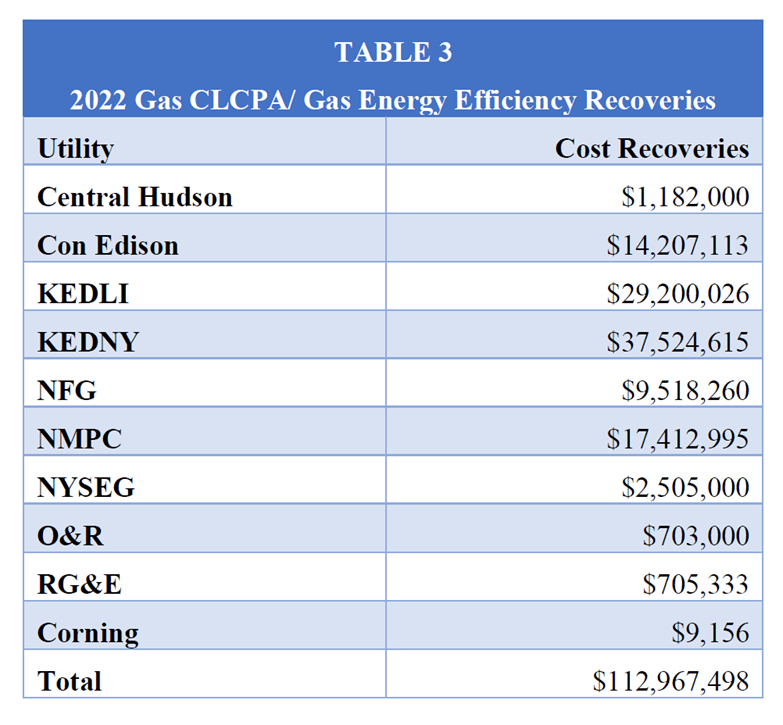
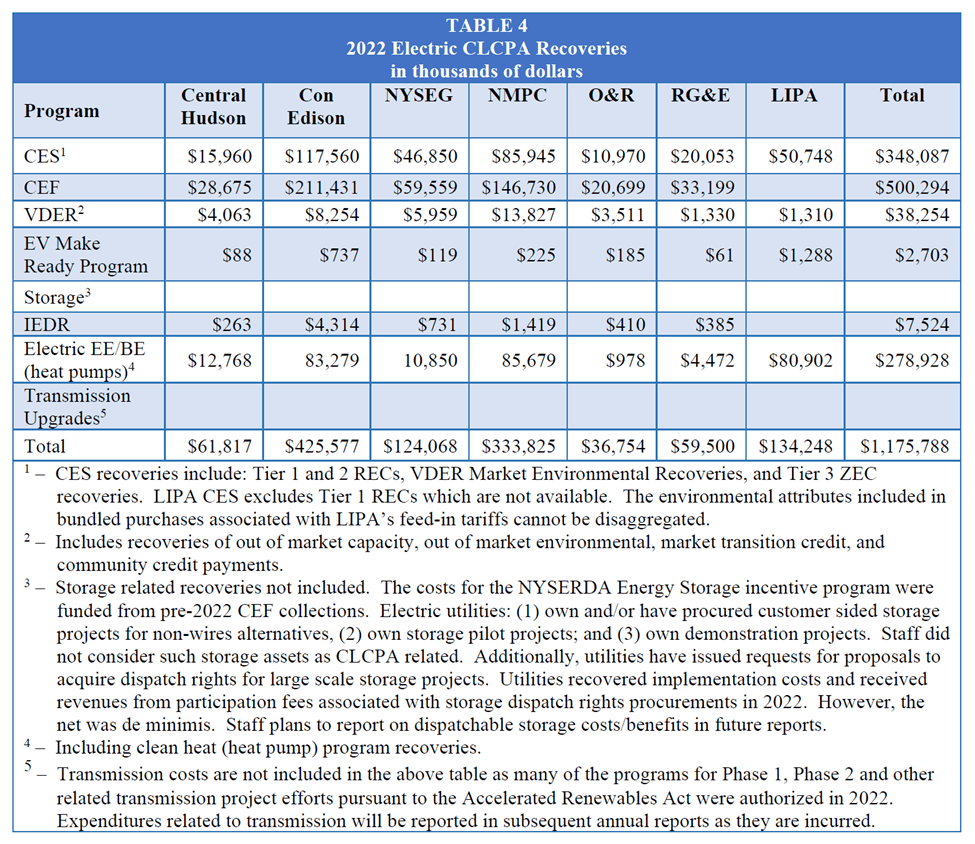
The number of people in arrears has been increasing since 2010 and the change since the start of the Climate Act is “significant”.  However, it is not clear how much of the change can be ascribed to the Climate Act.  On May 12, 2022, the Commission issued an “Order on Implementation of the Climate Leadership and Community Protection Act” for Case 22-M-0149 that directs DPS Staff to present information on Climate Act costs annually.  On July 20, 2023, DPS Staff published the first report (Information Report) in compliance with the Commission’s Order.  The costs recovered in 2022 by the utilities associated with Climate Act costs were described in the following Information Report tables:

2022 Climate Act Costs as a Function of Sales

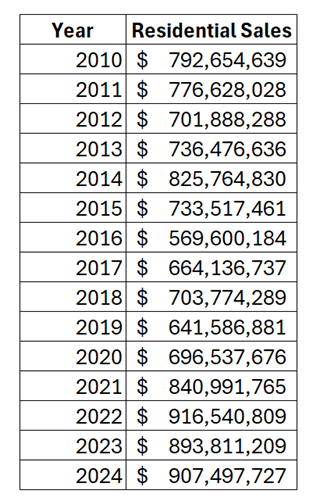
   There is insufficient information to ascribe the NMPC Climate Act costs associated with the significant increase in arrears observed.  However, it is instructive to calculate the percentage of Information Report NMPC Climate Act costs relative to the annual NMPC residential customer sales.  Table 2 lists the sum of the annual “Quarterly snapshot of residential collection dataset” residential sales NMPC.

Table 2: NMPC Annual Utility Residential Customer Sales 

The Climate Act cost recoveries for NMPC are listed in Information Report Tables 3 and 4 included above.  The sum of the 2022 Climate Act costs is $352,237,995.  The Climate Act costs are 38% of the 2022 residential customer sales.  This indicates that a significant share of increased costs that drove the number of customers in arrears to increase was related to the Climate Act implementation.

Discussion

There are so many issues coming up with the schedule and ambition of the Climate Act that it is obvious that we need to pause implementation and figure out how best to proceed.  In addition is now clear that there will be significant cost increases.

My focus has been on the electrical system but don’t forget that there have been and there will be more costs associated with other reducing emissions in other sectors.  After the PSC released its first annual informational report on the implementation of the Climate Act, I noted that 2022 the costs already associated with the Climate Act increased the NMPC residential customer monthly electric bills 9.8% or $9.38 per month.  I recently described an Empire Center poll that asked questions about the Climate Act.  The poll found that only 50% of the respondents willing to pay more than $10 a month for Climate Costs.  I do not think there is any question that half of the poll respondents were paying more for Climate Act implementation than they are willing to pay in 2022. 

The DPS should formally determine the amount of residential customer sales that are related to the Climate Act and affect the number of customers in arrears as part of future annual informational reports mandated by the “Order on Implementation of the Climate Leadership and Community Protection Act” for Case 22-M-0149.

This initial assessment of the Public Safety Law section 66-p (4) criteria for consideration of suspension or modification of the Climate Act related to overdue customers or customers in arrears meets the criterion for a significant change.  The standard deviation of the number of customers in arrears for ten years before the Climate Act was implemented is 12,350. Because the observed difference between the 2019 and the most recent year, 32,156, is greater than two times the standard deviation the increase is statistically “significant”.  Admittedly this is not a robust statistic because of the limited data available.  The onus to develop a better metric and transparently track it is on the PSC.

Conclusion

An initial assessment of the change in the number of customers in arrears since the start of the Climate Act indicates that there has been a statistically significant change.  This should trigger the PSC to conduct a hearing required by New York Public Service Law Section 66-p(4).  There has been no acknowledgement of the requirement, much less any recognition that such a hearing is warranted. 

Inevitably reality is going to catch up with the political aspirations of the Climate Act.  It is very frustrating that there is a mechanism in place to protect New Yorkers, but it has been ignored so far.  The time has come for that to change.

The double-digit rate increases in the NMPC rate case could be pared down substantially if funding for the CLCPA goals was paused until there is a hearing to see if the CLCPA needs to be temporarily suspended or modified per Public Service Law Section 66-p(4).  When other reasons to pause are considered, there are reasons to believe that continued Climate Act funding for renewable energy development projects may be better spent on alternative resources.

Niagara Mohawk Residential Utility Sales and Climate Act Recoveries

My previous post combined 2022 residential annual residential customer sales and the cost recoveries for Climate Leadership & Community Protection Act (Climate Act) related initiatives in 2022 to estimate the fraction of sales dedicated to Climate Act initiatives.  The fraction of Climate Act costs was as much as 22% of the total residential utility customer costs in 2022.  I live in the Niagara Mohawk Power Corporation (NMPC) service territory, so I applied the same methodology for NMPC.

I am convinced that implementation of the New York Climate Act net-zero mandates will do more harm than good if the future electric system relies only on wind, solar, and energy storage because of reliability and affordability risks.  I have followed the Climate Act since it was first proposed, submitted comments on the Climate Act implementation plan, and have written over 500 articles about New York’s net-zero transition.  The opinions expressed in this article do not reflect the position of any of my previous employers or any other organization I have been associated with, these comments are mine alone.

Overview

The Climate Act established a New York “Net Zero” target (85% reduction in GHG emissions and 15% offset of emissions) by 2050.  It includes an interim reduction target of a 40% GHG reduction by 2030. The Climate Action Council (CAC) was responsible for preparing the Scoping Plan that outlined how to “achieve the State’s bold clean energy and climate agenda.”  After a year-long review, the Scoping Plan was finalized at the end of 2022.  Since then, the State has been trying to implement the Scoping Plan recommendations through regulations, proceedings, and legislation.  However, the Hochul Administration has never fully accounted for the ratepayer impact of the transition apparently because the impacts are so high.

Residential Collection Data

In a recent article I described a source of data that includes the total dollar amount of residential customer sales.   The New York Open Data website contains the Quarterly snapshot of residential collection data file.  According to the general description: “This dataset provides a quarterly snapshot of residential bill collection activity for New York State’s ten largest electric and gas distribution utility companies regulated by the Public Service Commission. “

Table 1 lists the annual sum of the quarterly residential customer sales for Niagara Mohawk.

Table 1:  Annual Residential Customer Sales

Climate Act Cost Recoveries

In July 2023 the Public Service Commission (PSC) released its first annual informational report on the implementation of the Climate Act.  In August 2023 I noted that the informational Report explained that Climate Act costs that have been authorized and were in the 2022 residential bills total $1.2 billion.  The Report notes that in 2022 the costs already associated with the Climate Act increased the Upstate residential monthly electric bills 9.8% or $9.38 per month for Niagara Mohawk customers.  

The Informational Report included a summary of cost recoveries for 2022:

For purposes of estimating the cost recoveries of CLCPA related initiatives in 2022, Staff issued information requests to each of the utilities. Specifically, Staff requested the utilities provide 2022 cost recoveries for: CES (electric only), CEF (electric only), certain VDER (electric only), Electric Vehicle Make Ready Program (electric only), Clean Heat programs (electric only), Integrated Energy Data Resource (electric only), and Utility Energy Efficiency programs (electric and gas).

The cost recovered in 2022 by the utilities associated with these gas and electric programs described above are detailed in the following tables.

Climate Act Costs and Residential Customer Sales

I combined the information from the two sources for NMPC.  The total residential sales in 2022 were $917 million.  The combined Climate Act costs for NMPC  $351 million.  The Climate Act cost share of the total sales is 38% using these two data sets. 

I have limited experience with these data sets, so I have reservations about the precision of the estimate.  The number is probably an upper bound because the total costs should be spread over all the residential customers of the state as well as the commercial and industrial customers. In 2021 residential natural gas and electricity sales were 80% of the total residential, commercial and industrial sales.  If the Climate Act costs are apportioned evenly that would reduce the Climate Act percentage of residential bills down to 31%. 

Discussion

It is notable that I had to rely on data from 2022 despite the mandate annual status updates that include costs.   On April 14, 2025, I published an article describing a letter I sent to Public Service Commission Chairman Rory Christian regarding the requirement for annual informational reports.  In March, Michael B. Mager Counsel to Multiple Intervenors  sent a letter to Chairman Christian noting that the annual report was late.  Soon thereafter Jessica Waldorf, Chief of Staff and Director of Policy Implementation for the Department of Public Service (DPS) posted a response letter.  My letter explained that I agreed with the comments submitted by Multiple Intevenors and was disappointed that the DPS response did not commit to a schedule for the next update of the annual informational report.  The point is that the data in the Informational Reports are political dynamite. The estimate that the Climate Act costs are responsible for up to 22% of the cost recoveries in 2022 is just the beginning.  The Hochul Administration has every reason to delay the release of update informatoin as long as possible because the Climate Act costs are going to be higher.    

The estimated fraction of costs attributable to the Climate Act is only for one component of the costs of the Climate Act net-zero transition.  These costs don’t include costs to electrify homes, personal transportation, and the hidden costs for things like upgrading electrical service to be able to electrify everything.  Also, it does not include societal costs like the need to electrify school buses and pay for less impactful refrigerants used by grocery stores.  The list of hidden costs goes on and on.

I recently described an Empire Center poll that asked questions about the Climate Act.  The poll found that only 50% of the respondents willing to pay more than $10 a month for Climate Costs.  Recall that the Informational Report found that in 2022 the costs already associated with the Climate Act increased the Upstate residential monthly electric bills 9.8% or $9.38 per month for Niagara Mohawk customers.  I do not think there is any question that half of the poll respondents are paying more than they are willing to pay. 

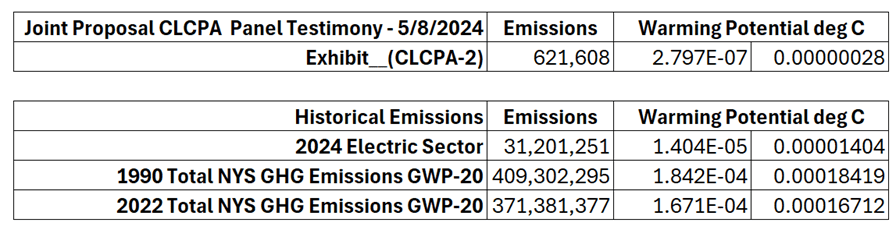
These data also raise the question of what the point is.   New York GHG emissions are less than one half of one percent of global emissions and global emissions have been increasing on average by more than one half of one percent per year since 1990.  Furthermore, New York’s impact on global warming is unmeasurable.  Table 2 projects the amount of global warming “savings” for the 1990 and 2022 historical emissions.  The calculations are based on a Perplexity AI query “What is the expected change in global warming per ton of CO2 reduced”.  If total New York GHG emissions from the baseline in 1990 or the most recent year (2022) available were to go to zero, the projected change in global warming is too small to measure.

Table 2: Potential Warming Savings for Historical Emissions

Conclusion

The costs to implement the Climate Act for NMPC residents were a little less than two fifths of monthly residential sales in 2022.  I have no doubt that the costs that will be in the 2023 Informational report will increase that fraction.  Sooner or later the public is going to catch wind of these unsustainable costs and I intend to write some letters to the editor using this information.  Given that the investments will not meaningfully affect global emissions or global warming I cannot imagine that NMPC ratepayers will be willing to continue this madness.  I hope that politicians are starting to question whether they want to be associated with this.

Residential Utility Sales and Climate Act Cost Recovery Implications

This post combines 2022 residential annual residential customer sales and the cost recoveries for Climate Leadership & Community Protection Act (Climate Act) related initiatives in 2022 to estimate the fraction of sales dedicated to Climate Act initiatives.  The fraction of Climate Act costs was as much as 22% of the total residential utility customer costs in 2022.

I am convinced that implementation of the New York Climate Act net-zero mandates will do more harm than good if the future electric system relies only on wind, solar, and energy storage because of reliability and affordability risks.  I have followed the Climate Act since it was first proposed, submitted comments on the Climate Act implementation plan, and have written over 500 articles about New York’s net-zero transition.  The opinions expressed in this article do not reflect the position of any of my previous employers or any other organization I have been associated with, these comments are mine alone.

Overview

The Climate Act established a New York “Net Zero” target (85% reduction in GHG emissions and 15% offset of emissions) by 2050.  It includes an interim reduction target of a 40% GHG reduction by 2030. The Climate Action Council (CAC) was responsible for preparing the Scoping Plan that outlined how to “achieve the State’s bold clean energy and climate agenda.”  After a year-long review, the Scoping Plan was finalized at the end of 2022.  Since then, the State has been trying to implement the Scoping Plan recommendations through regulations, proceedings, and legislation.  However, the Hochul Administration has never fully accounted for the ratepayer impact of the transition apparently because the impacts are so high.

Residential Collection Data

In a recent article I described a source of data that includes the total dollar amount of residential customer sales.   The New York Open Data website contains the Quarterly snapshot of residential collection data file.  According to the general description: “This dataset provides a quarterly snapshot of residential bill collection activity for New York State’s ten largest electric and gas distribution utility companies regulated by the Public Service Commission. “

Table 1 lists the annual sum of the quarterly residential customer sales for the ten utilities in the Quarterly snapshot of residential collection data file.  The ten utilities are: Consolidated Edison, Orange & Rockland, Public Service Electric & Gas, Central Hudson, National Grid – LI, National Grid – Upstate, National Grid New York, New York State Electric & Gas, Rochester Electric & Gas, and National Fuel Gas.

Table 1:  Annual Residential Customer Sales

Climate Act Cost Recoveries

In July 2023 the Public Service Commission (PSC) released its first annual informational report on the implementation of the Climate Act.  In August 2023 I noted that the informational Report explained that Climate Act costs that have been authorized and were in the 2022 residential bills total $1.2 billion.  The Report notes that in 2022 the costs already associated with the Climate Act increased the Upstate residential monthly electric bills 7.6% or $7.15 per month for NYSE&G customers; 7.7% or $7.54 for RG&E customers; and 9.8% or $9.38 for Niagara Mohawk customers.  

I followed up with another article that documented post hearing comments related to the NYSEG electric rate case 22-E-0317, RGE electric rate case 22-E-0319, the NYSEG gas rate case 22-G-0318, and the RGE gas rate case 22-G-0320 that address Climate Act costs.  I concluded that Climate Act costs are a major factor in this extraordinarily large rate case request. This is an issue in this instance and every future rate case for every New York utility is going to have similarly large costs.

The Informational Report included a summary of cost recoveries for 2022:

For purposes of estimating the cost recoveries of CLCPA related initiatives in 2022, Staff issued information requests to each of the utilities. Specifically, Staff requested the utilities provide 2022 cost recoveries for: CES (electric only), CEF (electric only), certain VDER (electric only), Electric Vehicle Make Ready Program (electric only), Clean Heat programs (electric only), Integrated Energy Data Resource (electric only), and Utility Energy Efficiency programs (electric and gas).

The cost recovered in 2022 by the utilities associated with these gas and electric programs described above are detailed in the following tables.

Climate Act Costs and Residential Customer Sales

I combined the information from the two sources. The total residential sales in 2022 were $5,867 billion.  The Climate Act costs for the gas (excluding Corning) and electric utilities were $1,289 billion.  The Climate Act cost share of the total sales is 22% using these two data sets. 

I have limited experience with these data sets, so I have reservations about the precision of the estimate.  The 22% number is probably an upper bound because the total costs should be spread over all the residential customers of the state as well as the commercial and industrial customers. In 2021 residential natural gas and electricity sales were 80% of the total residential, commercial and industrial sales.  If the Climate Act costs are apportioned evenly that would reduce the Climate Act percentage of residential bills down to 18%.  I understand that municipal utilities are not treated the same so that affects the percentage estimate too.

Discussion

It is notable that I had to rely on data from 2022 despite the mandate annual status updates that include costs.   On April 14, 2025, I published an article describing a letter I sent to Public Service Commission Chairman Rory Christian regarding the requirement for annual informational reports.  In March, Michael B. Mager Counsel to Multiple Intervenors  sent a letter to Chairman Christian noting that the annual report was late.  Soon thereafter Jessica Waldorf, Chief of Staff and Director of Policy Implementation for the Department of Public Service (DPS) posted a response letter.  My letter explained that I agreed with the comments submitted by Multiple Intevenors and was disappointed that the DPS response did not commit to a schedule for the next update of the annual informational report.  The point is that the data in the Informational Reports are political dynamite. The estimate that the Climate Act costs are responsible for up to 22% of the cost recoveries in 2022 is just the beginning.  The Hochul Administration has every reason to delay the release of update informatoin as long as possible because the Climate Act costs are going to be higher.    

The estimated fraction of costs attributable to the Climate Act in only for one component of the costs of the Climate Act net-zero transition.  These costs don’t include costs to electrify homes, personal transportation, and the hidden costs for things like upgrading electrical service to be able to electrify everything.  Also it does not include societal costs like the need to electrify school buses and pay for less impactful refrigerants used by grocery stores.  The list of hidden costs goes on and on.

I recently described an Empire Center poll that asked questions about the Climate Act.  I noted that one third of the respondents are not willing to pay anything on their monthly energy bill for cleaner energy.  Another 28% are only willing to pay up to $20 a month for cleaner energy while another 20% would pay up to $40 a month.  Nineteen percent are willing to pay up to $200 a month but only 3% are willing to pay more than $200 per month.  Given all the necessary costs I believe that $200 per month is not nearly enough for the transition.

These data also raise the question of what the point is.   New York GHG emissions are less than one half of one percent of global emissions and global emissions have been increasing on average by more than one half of one percent per year since 1990.  Furthermore, New York’s impact on global warming is unmeasurable.  Table 2 projects the amount of global warming “savings” for the 1990 and 2022 historical emissions.  The calculations are based on a Perplexity AI query “What is the expected change in global warming per ton of CO2 reduced”.  If total New York GHG emissions from the baseline in 1990 or the most recent year (2022) available were to go to zero, the projected change in global warming is too small to measure.

Table 2: Potential Warming Savings for Historical Emissions

Conclusion

The costs to implement the Climate Act were about one fifth of the monthly bills in 2022.  I have no doubt that the costs that will be in the 2023 Informational report will increase that fraction.  Sooner or later the public is going to catch wind of these unsustainable costs.  Given that the investments will not meaningfully affect global emissions or global warming I cannot imagine that the voters will be willing to continue this madness.  The reckoning cannot come soon enough.

New York Residential Utility Accounts in Arrears

Thanks to Tim Knauss I found information on New York utility accounts in arrears and service disconnections on New York Open Data.  These data enabled me to develop a spreadsheet that lists the residential collection data submitted by New York’s ten largest distribution utility companies and enabled me to prepare the data summary shown here. 

This information is particularly relevant to the Climate Leadership & Community Protection Act (Climate Act) because there is a safety valve provision that enables the Public Service Commission to “temporarily suspend or modify the obligations” of the Climate Act if, among other things, implementation causes a “significant increase in arrears or service disconnections” related to the program.  Before looking at the results please think about what you think is a reasonable percentage of customers in arrears, that is to say those who have not paid their bills for 60 days or more.

I am convinced that implementation of the New York Climate Act net-zero mandates will do more harm than good if the future electric system relies only on wind, solar, and energy storage because of reliability and affordability risks.  I have followed the Climate Act since it was first proposed, submitted comments on the Climate Act implementation plan, and have written over 500 articles about New York’s net-zero transition.  The opinions expressed in this article do not reflect the position of any of my previous employers or any other organization I have been associated with, these comments are mine alone.

Overview

The Climate Act established a New York “Net Zero” target (85% reduction in GHG emissions and 15% offset of emissions) by 2050.  It includes an interim reduction target of a 40% GHG reduction by 2030. The Climate Action Council (CAC) was responsible for preparing the Scoping Plan that outlined how to “achieve the State’s bold clean energy and climate agenda.”  After a year-long review, the Scoping Plan was finalized at the end of 2022.  Since then, the State has been trying to implement the Scoping Plan recommendations through regulations, proceedings, and legislation.  However, in the rush to meet Climate Act mandates fundamental consumer protections are being ignored.

Safety Valve

New York Public Service Law § 66-p (4) “Establishment of a renewable energy program” includes feasibility safety valve conditions for affordability and reliability that have not been addressed in the Hochul Administration implementation of the Climate Act.   Section 66-p (4) states: “The commission may temporarily suspend or modify the obligations under such program provided that the commission, after conducting a hearing as provided in section twenty of this chapter, makes a finding that the program impedes the provision of safe and adequate electric service; the program is likely to impair existing obligations and agreements; and/or that there is a significant increase in arrears or service disconnections that the commission determines is related to the program”.

For the most part this provision of the Public Safey Law has been ignored.  In my opinion it is incumbent upon the Hochul Administration to define specific criteria for each provision and establish a tracking system established to determine if suspension or modification of CLCPA obligations is appropriate.  Until I found the Quarterly snapshot of residential collection data submitted I was unaware that the arrears and service disconnection data were available.

Residential Collection Data

New York State agencies love web-based dashboards because I think that they can be used to control the message.  Consider the Climate Act Data Dashboard.  There are options to look at the data for categories showing progress to date, but the data downloads are no more than the numbers shown in the splashy home pages.  Not surprisingly there is nothing related to the safety valve conditions in Section 66-p (4).

There is an alternative source of data.  New York Open Data was established to “promote transparency, improve government performance, and enhance citizen engagement”.  It is a massive database that provides useful information if you can penetrate the clumsy interface to find what you want.  Even then the data are just files of numbers with marginal documentation and typically require processing to get anything useful. 

In a recent article on the National Grid rate case Tim Knauss mentioned that “More than 210,000 Upstate households are at least 60 days late paying National Grid, owing more than $323 million combined.”   When I contacted him about the source of that information he graciously explained that the utilities file a monthly report in the PSC Case 91-M-0744 docket that details their arrears and service terminations.  Unfortunately, for an overview of the status those submittals are not that useful.

I decided to check New York Open Data for these data.  Nothing was obvious but when I figured out how to do a search and used some of the descriptive terms in the 91-M-0744 documents if found the Quarterly snapshot of residential collection data file.  According to their general description:

This dataset provides a quarterly snapshot of residential bill collection activity for New York State’s ten largest electric and gas distribution utility companies regulated by the Public Service Commission. Included in this dataset are each utility’s total number of residential customers, residential customers with arrears (overdue bills) greater than 60 days, residential final service termination notices issued, residential accounts terminated (service shut off for nonpayment), active residential deferred payment agreements and the number of uncollectible residential accounts. Also included are the corresponding utility sales figures for each metric above, showing the dollar figure represented.

The following Data Dictionary table lists the specific parameters available by utility for each quarter starting with the first quarter of 2010.  Processing this kind of data set is something I have been doing for years so I was quickly able to get a data summary together.  I doubt that many members of the public have that skill set so it is transparently available in name only.

New York Residential Customer Summary

Table 1 lists the annual fourth quarter sum of all ten utilities data for the total number of residential customers, residential customers with arrears (overdue bills) greater than 60 days, residential final service termination notices issued, residential accounts terminated (service shut off for nonpayment), and active residential deferred payment agreements.  Of note is that the percentage of residential customers with overdue bills has been between 13.6% and 14.2% the last three years.

Table 1:  Annual Summary of Number of Customers and Bill Paying Status

New York Residential Customer Sales Summary

Table 2 lists the annual fourth quarter sum of all ten utilities data for the total sales by residential customers, residential customers with arrears (overdue bills) greater than 60 days, residential final service termination notices issued, residential accounts terminated (service shut off for nonpayment), and active residential deferred payment agreements.  The highlight of this table is that the total amount of money that has accumulated since the utilities started this program is $1.86 billion which is more than the utilities collect annually.

Table 2: Annual Summary of Number of Customers and Bill Paying Status

Observations Discussion

Now that you have seen the results, how did your idea of a reasonable percentage of customers in arrears compare to the observed 13.7% at the end of 2024.  I think anything over 10% is problematic.  In my opinion the observed data indicate a utility system that is currently too expensive. 

The number of people in arrears has been increasing since 2010.  The number of termination notices issued varies quite a bit, undoubtedly in response to programs to prevent shutoffs. Fortunately, the actual number of shutoffs is relatively small because that should be a last resort.  Unfortunately, the cost of these benefits must fall to an increasingly smaller fraction of the rest of the customers.

The sales figures are extraordinary.  New York residential customers are paying $1.81 billion a year for utility service.  The total amount of money that has accumulated by accounts in arrears since the utilities started reporting these data is $1.86 billion.  I don’t think that the accumulated value accurately reflects the magnitude of the problem.  Last year the sales associated with accounts that were sent final termination notices was $378 million or 20.9% of the total revenues.  Surely that reflects the fact that many residential customers are having trouble paying their bills.

Significance

My primary incentive to analyze these data was to compare them to the Public Safety Law section 66-p (4) criteria for a “significant increase in arrears or service disconnections that the commission determines is related to the program”.  There is no breakout of Climate Act costs that contribute to those attributes.  We can only estimate whether the NY Open “Quarterly snapshot of residential collection” total data shows a significant increase.

In this case defining significance will entail many value judgements.  For example, what is a “significant” increase in arrears?  Before the Climate Act was passed in 2019 there were 1,046,219 customers with arrears greater than 60 days, and at the end of 2024 there were 1,383,480 customers in arrears which is a 32.4% increase.  The percentage increase for the percentage of customers in arrears was 31.3%.  In my opinion that is a significant increase.

There is a limited amount of data to use for a statistical evaluation of significance.  Nonetheless, we can use the data we have.   In simplistic terms, if a change exceeds two times the standard deviation of the observed data, we can hypothesize that it is significantly different.

Table 3 is a subset of Table 1 that lists the annual fourth quarter sum of all ten utilities data for the total number of residential customers, residential customers with arrears (overdue bills) greater than 60 days, and the percentage of residential customers with overdue bills relative to the total number of customers.  Between 2019 the last year before the CLCPA was implemented and 2024, there were 1.046,219 customers with arrears greater than 60 days, and at the end of 2024 there were 1,383,480 customers in arrears which is an increase of 337,261 or 32.4% increase.  The percentage increase for the percentage of customers in arrears was 31.3%.

The standard deviation of the number of customers in arrears from 2010 to 2019 is 39,175 and the percent in arrears standard deviation is 0.6%. The observed increases are greater than two times the observed standard deviations.  Keep in mind that a standard deviation based on ten observations is anything but robust so this indicative but not conclusive that there is a “significant” increase in arrears.

Table 3: Annual Customers in Arrears

There are other aspects of the calculation of significance for Public Service Law Section 66-p(4).  Other value judgements for significance include the following.  What costs are related to the Climate Act?  Should the costs include programs implemented before the Climate Act but that are necessary to achieve the Climate Act goals.  Should the evaluation consider the effect of programs designed to lower costs, programs that give residents an active payment plan and prevent service disconnections that all affect the totals?  Should “significance” be defined relative to the value of the emission reductions for the programs in absolute terms or relative to global emissions?

All these have been valid questions since the Climate Act was passed in 2019.  The Climate Action Council should have addressed this but dropped the ball.  Given that there are so many issues coming up with the schedule and ambition of the Climate Act that it is obvious that we need to pause implementation and figure out how best to proceed.  Defining the safety valve criteria and developing a tracking system for a transparent status report should be part of the implementation reassessment.

Conclusion

This analysis found a useful source of residential customer data.  The New York Open Data was established to “promote transparency, improve government performance, and enhance citizen engagement”.  Unfortunately, accessing the data file is not straightforward unless you have experience with this kind of data.

The observed differences between the number of residential customers in arrears before the Climate Act was enacted and the end of 2024 are greater than two times the standard deviations.  It can be argued that this means  the increase is “significant”.  Therefore, it would be appropriate for the Public Service Commission to conduct a hearing to determine if it would be appropriate to temporarily suspend or modify the obligations of the Climate Act per Public Safety Law Section 66-p(4).

I think this should be resolved quickly.  Given that there are so many issues coming up with the schedule and ambition of the Climate Act it is obvious that we need to pause implementation and figure out how best to proceed.  Clearly defining the safety valve criteria and developing a tracking system for a transparent status report should be part of the implementation reassessment.

New York Creatively Hides the Costs of the Climate Act

On April 23, 2025 Governor Hochul announced that  State University of  New York (SUNY) Oneonta will be the first school in the SUNY system to purchase Tier 1 Renewable Energy Certificates (REC) from the New York State Energy Research and Development Authority’s (NYSERDA) voluntary sales program.  This post interprets the meaning of this announcement.

I am convinced that implementation of the Climate Act net-zero mandates will do more harm than good because the proposed green energy programs are crimes against physics.  The energy density of wind and solar energy is too low and the resource intermittency too variable to ever support a reliable electric system relying on those resources. I have followed the Climate Act since it was first proposed, submitted comments on the Climate Act implementation plan, and have written over 500 articles about New York’s net-zero transition.  The opinions expressed in this article do not reflect the position of any of my previous employers or any other organization I have been associated with, these comments are mine alone.

Overview

The Climate Act established a New York “Net Zero” target (85% reduction in GHG emissions and 15% offset of emissions) by 2050.  It includes an interim reduction target of a 40% GHG reduction by 2030. The Climate Action Council (CAC) was responsible for preparing the Scoping Plan that outlined how to “achieve the State’s bold clean energy and climate agenda.”  After a year-long review, the Scoping Plan was finalized at the end of 2022.  Since then, the State has been trying to implement the Scoping Plan recommendations through regulations, proceedings, and legislation.  At the same time, the Hochul Administration has delayed reporting mandates in the Climate Act that must document costs and progress. New Yorkers do not know where we stand,

Renewable Energy Credits

According to the Governor’s April 23, 2025 press release, SUNY Oneonta will be the first school in the SUNY system to purchase Tier 1 REC.  The press release notes that the REC purchase will enable SUNY Oneonta to “claim 1,000 MWhs of new, local renewable energy in 2025” which will provide “enough locally-sourced clean energy to fully power four, 200-bed residence halls on the SUNY Oneonta campus.” 

Renewable Energy Credits (REC) are defined:

A REC is a certificate, created by a tracking system, such as the New York Generation Attribute Tracking System (NYGATS), that represents the attributes of one megawatt hour of electricity generated from a renewable source like solar or wind.  These RECs, or certificates, are needed to substantiate environmental claims related to energy use, such as for compliance with a State-mandated renewable compliance program, or for “voluntary” claims such as a climate action pledge.  

REC are purchased by a range of entities “to comply with state mandates and to voluntarily support renewable energy development.”  The buyers include utilities who are obligated to purchase them, government entities like New York City with commitments to use 100% renewable energy, and private organizations who “voluntarily purchase RECs to meet internal sustainability targets, claim environmental benefits, and demonstrate climate leadership.”

SUNY Oneonta

I imagine that the rationale for the purchase is the sustainability core value in the SUNY Oneonta mission statement.  This core value declares that sustainability means “stewarding resources to foster a just community in ecological balance.”   This phrase is nothing more than trendy moral posturing that checks the box so that SUNY Oneonta can claim the high ground for environmental protection.

The mission statement is accompanied by this:

Together with the mission, these values now guide SUNY Oneonta’s pursuit of a clear vision:

to become the exemplar residential community, providing relevant educational experiences in and outside of the classroom.

SUNY Oneonta will challenge the status quo, test assumptions, and ask difficult questions about relevancy and impact. The university must understand the needs of today’s learners and tomorrow’s. Our campus and all of the opportunities it can offer should revolve around students and evolve with them. As they trust us to guide them to their goals, we entrust them with the future and the hope of a more just, humane and happier world.

I received my B.S. in meteorology in 1974 at SUNY Oneonta, went on to get a M.S. in meteorology, and started my air pollution meteorologist career in 1976.  Half a century of experience has taught me that stewarding resources must include pragmatic tradeoffs between ambition, risks, benefits, and costs.  The REC program is part of New York’s Climate Leadership and Community Protection Act (Climate Act). 

That law epitomizes dogmatic policy driven by emotion and not reason.  There is no consideration of any tradeoffs.  The status quo in New York is that there is an existential climate crisis that can be solved by eliminating the use of fossil fuels.  Somehow, I doubt that SUNY Oneonta has any interest in challenging that paradigm, testing the assumptions that a net-zero transition is possible, or considering the difficult tradeoffs that are inherent in the proposed transition away from fossil fuels.

Furthermore, New York GHG emissions are less than one half of one percent of global emissions and global emissions have been increasing on average by more than one half of one percent per year since 1990.  New York cannot solve global warming by itself and the third-world economies that are developing abundant, economical energy using fossil generation to improve their lives.  The tradeoff between equitable distribution of energy resources relative to speculative climate change benefits is something that SUNY Oneonta students should consider for the goal of a “more just, humane and happier world.”

Another Shell Game

A shell game is defined as “A fraud or deception perpetrated by shifting conspicuous things to hide something else.”  In my opinion the Scoping plan employed  shell game tactics to claim that the Climate Act “costs of inaction are more than the costs of action”.  The Administration knows how much the Climate Act will cost and is surely aware that public support for green energy initiatives to combat climate change dissipates quickly if the costs are substantial.  I believe that affordability is the fundamental reason that the release of required reports on the implementation of the Climate Act have been delayed.

From that perspective the State University voluntary purchase of REC from NYSERDA looks suspicious. If all the SUNY institutions follow suit and purchase REC there will be a dependable funding steam for more NYSERDA renewable development.  On the other hand, the primary goal of SUNY is education and not the societal goal of emission reduction, so I do not favor colleges squandering money on support of renewable energy development.  I conclude that this is simply an inter-agency transfer of funds prompted by a decision to obscure costs and postpone the inevitable political reckoning when the extraordinary transition costs can no longer be hidden. 

Fully Powering Nonsense

The press release continues the charade that renewable energy can “fully power” anything.  The fact is that Hochul’s Administration has not shown that the technology necessary to resolve renewable intermittency is available, much less affordable.  Without that backup technology, four, 200-bed residence halls on campus will only have electricity when the wind is blowing or the sun is shining.  This is an example of selective use of metrics and descriptions that falsely gives the impression that the changeover to green energy is simple.

Conclusion

Renewable Energy Credits exist to subsidize green energy development.  As a compliance tool they have value.  However, one of the stated values of REC voluntary purchases is that they can be used to “demonstrate climate leadership”.  That epitomizes virtue-signaling which I believe has little value as part of the education of SUNY Oneonta students. 

Ultimately the SUNY Oneonta purchase of REC has another goal. It hides the cost to consumers by transferring money from one state account to another.  A college education is expensive enough today without foisting students and parents with hidden costs that do not provide tangible benefit to their education.

Are New Yorkers Willing to Pay for the Climate Act?

Last December the Empire Center did a poll that asked questions about the Climate Leadership & Community Protection Act (Climate Act).  I missed it at the time, but the results are striking. This post describes the results and takes a deeper look at the willingness to pay question. 

I am convinced that implementation of the Climate Act net-zero mandates will do more harm than good because the proposed green energy programs are crimes against physics.  The energy density of wind and solar energy is too low and the resource intermittency too variable to ever support a reliable electric system relying on those resources. If this reality is not acknowledged soon and these policies paused, then the enormous costs of this futile gesture to control the climate will bankrupt the state. 

I have followed the Climate Act since it was first proposed, submitted comments on the Climate Act implementation plan, and have written over 500 articles about New York’s net-zero transition.  The opinions expressed in this article do not reflect the position of any of my previous employers or any other organization I have been associated with, these comments are mine alone.

Overview

The Climate Act established a New York “Net Zero” target (85% reduction in GHG emissions and 15% offset of emissions) by 2050.  It includes an interim reduction target of a 40% GHG reduction by 2030. The Climate Action Council (CAC) was responsible for preparing the Scoping Plan that outlined how to “achieve the State’s bold clean energy and climate agenda.”  After a year-long review, the Scoping Plan was finalized at the end of 2022.  Since then, the State has been trying to implement the Scoping Plan recommendations through regulations, proceedings, and legislation. 

Poll Overview

The Empire Center, based in Albany, is an independent, not-for-profit, non-partisan think tank dedicated to promoting policies that can make New York a better place to live, work and raise a family.  In the interests of full disclosure, I am an adjunct fellow of the Empire Center. 

They sponsored a survey late last year. The Empire Center announcement of the survey says it canvassed 1,021 New York registered voters (margin of error: 3 percent) and was conducted by Morning Consult in mid-December 2024. The toplines and crosstabs can be viewed here.  For survey neophytes like me the topline lists the questions and the overall results.  Crosstabs breakdown the responses by the characteristics of the people polled.  There were 38 questions in the survey and 16 questions about the demographics of the respondents.  The crosstabs provides the breakdown of questions by the demographic categories.

Questions about the Climate Act were in the minority.  Most of the questions were related to the value of taxes paid – “New Yorkers by a margin of more than two-to-one said they aren’t getting their money’s worth from taxes they pay in the state”.  Other questions addressed the education system

There were six questions about the Climate Act.  I will address the first two questions in this article but will only list the others below.

Climate Act Awareness

Knowing what I understand about this law it is frustrating that there is so little pushback associated with it.  The only reason I could think of is that the majority of New Yorkers are unaware of it.  The question “How familiar are you, if at all, with the provisions of the Climate Leadership and Community Protection Act (also known as CLCPA or the Climate Act) that was signed into law in New York in 2019?” confirms my suspicion.

The survey found that 45% of the people polled had never heard of it and another 24% had heard of it, but didn’t know what it is.  In my opinion, if they only have a general sense what it is (another 19%) then they are probably unaware of how much it will cost.  That means 88% of the people polled do not know what is coming in enough detail to understand its impacts on affordability, personal choice, reliability, and environmental impacts.

I believe that the biggest trigger for demands to pause this will be the costs so let’s talk about those results.

Willingness to Pay

I have never seen any poll regarding a willingness to pay that did not find most people are unwilling to pay very much.  This is proof of Roger Pielke’s Iron Law of Climate “While people are often willing to pay some price for achieving climate objectives, that willingness has its limits.”

This poll is no different.  One third of the respondents are not willing to anything on their monthly energy bill for cleaner energy.  Another 28% are only willing to pay up to $20 a month for cleaner energy while another 20% would pay up to $40 a month.  Nineteen percent are willing to pay up to $200 a month but only 3% are willing to pay more than $200 per month. Another 7% did not know or had no opinion.

I recently submitted comments about affordability in Proceeding 22-M-0149 “Assessing Implementation of and Compliance with the Requirements and Targets of the Climate Leadership and Community Protection Act”.  On March 26, 2025, Jessica Waldorf, Chief of Staff and Director of Policy Implementation for the Department of Public Service (DPS) posted a letter responding to a letter from Michael B. Mager Counsel to Multiple Intervenors that had been submitted earlier in March to Chair of the Public Service Commission Rory Christian regarding the affordability standard.  The Mager letter from the Multiple Intervenors pointed out that the DPS and New York State Energy Research & Development Authority (NYSEDA) were supposed to provide an annual report describing Climate Act implementation costs.  No report was produced in 2024 and the letter asked when the next report would be provided.  Waldorf’s response made no commitment.  Given the politicization of all New York agencies and the willingness to pay results I don’t think that it is surprising that the Hochul Administration is stonewalling those estimates because I am sure that they will probably exceed $200 a month.

National Grid Long-Term Gas Plan

In a recent post I described the comments I submitted on Case 24-G-0248 Review of the Long-Term Gas System Plan for National Grid.  That plan describes how the three National Grid operating companies intend to transition away from natural gas out to 2050. 

I was frankly surprised with the costs for just this component of Climate At transition plan.  The scenarios include a reference case, CEV or “clean energy vision”, and AE or “accelerated electrification”.  The difference between the reference case and the CEV scenario represents the minimum cost of the Climate Act.  The following tables are from the Long-Term Gas System Plan document.

The 2030 average monthly increase for National Grid customers in the former Niagara Mohawk service territory ranges from a 50% increase to a 96% increase.  The Climate Act cost by 2030 is $57 additional per month.

Table 12-11: Niagara Mohawk Bill Impacts by Scenario

The 2030 average monthly increase for National Grid customers in the former Brooklyn Union Gas service territory ranges from a 65% increase to a 148% increase.  The Climate Act cost by 2030 is $43 additional per month.

Table 12-12: Brooklyn Union Gas Company Bill Impacts by Scenario

The 2030 average monthly increase for National Grid customers in the former Key Span service territory on Long Island ranges from a 41% increase to a 90% increase.  The Climate Act cost by 2030 is $44 additional per month.

Table 12-13: KeySpan Gas (LILCO) Bill Impacts by Scenario

Willingness to Pay for National Grid Long-Term Gas Plan

In the National Grid Long-Term Gas Plan, the expected increase in price to implement the “clean energy vision” exceeds $40 per month for all three service companies.  Table 1 lists the willingness to pay $40 per month for selected demographics of the survey participants.  Note that 71% of respondents when polled said that they were unwilling to pay more than $40 per month.  I am not going to discuss the demographic breakdowns but present them for your edification.

Table 1: Empire Center Willingness to Pay for Increased Energy Costs Relative to National Grid Expected Gas System Transition Costs of at least $40 per Month Additional by 2030

Discussion

The electric and gas utilities must invest in programs that will implement the Climate Act mandates and those costs are starting to show up in their rate case proceedings.  The National Grid long-term plan to transition the gas system out of existence which is necessary to comply with the Climate Act is but one example.  The expected cost increase by 2030 to fulfill the clean energy vision is more than $40 per month.  Only 22% of the people polled were willing to pay that much.

That is only one cost component for New Yorkers.  Electric bills will need to increase by at least the same amount to pay for the infrastructure necessary to electrifying everything.  The New York Cap-and-Invest program is nothing more than a tax on carbon that will necessarily increase the cost of gasoline and heating fuels.  To electrify homes and transportation individual investments will be necessary.  I believe that when people finally figure out that there is law in place that will markedly increase their energy costs that there will be a reckoning.  I also believe that the Hochul Administration is fully aware of the ramifications of Climate Act costs on the next election.  Consequently, they are slow walking the mandates to provide cost information.

In the meantime, the politicians will be more than willing to let the utilities take the heat for the inevitable major cost increases.  No doubt they will simultaneously forbid the utilities to explicitly break out the Climate Act costs in their bills and demand that they lower their rate case proposals.

Conclusion

Any way you look at the willingness to pay question response, the Empire Center survey confirms Roger Pielke Jr’s Iron Law of Climate.  People polled are not willing to pay much for the net-zero aspirations of the Climate Act if 50% are unwilling to pay more than $10 per month for cleaner energy.  It is troubling that 88% of the New Yorkers polled had no more than a general sense of the Climate Act and many had never heard of it.  This is setting up a reckoning for all the politicians that foisted the Climate Act on New Yorkers.  It is inevitable that the politicians will reconsider and give up on it or be voted out for utter stupidity.  The only question is whether political reality will occur before the electric and gas system is destroyed and costs bankrupts the state.

Grifters Follow the Money

A recent letter to the editor of the Syracuse Post Standard Focus on economic benefits of NY’s renewable energy projects is the subject of this post.  I am very frustrated with the New York Climate Leadership & Community Protection Act (Climate Act) net zero transition because claims made by the supporters are so misleading that it beggars my mind that editors publish the letters.  The reality is that there are so many issues coming up with the schedule and ambition of the Climate Act that it is obvious that we need to pause implementation and figure out how best to proceed.

I am convinced that implementation of the Climate Act net-zero mandates will do more harm than good if the future electric system relies only on wind, solar, and energy storage because of reliability and affordability risks.  I have followed the Climate Act since it was first proposed, submitted comments on the Climate Act implementation plan, and have written over 500 articles about New York’s net-zero transition.  The opinions expressed in this article do not reflect the position of any of my previous employers or any other organization I have been associated with, these comments are mine alone.

Overview

The Climate Act established a New York “Net Zero” target (85% reduction in GHG emissions and 15% offset of emissions) by 2050.  It includes an interim reduction target of a 40% GHG reduction by 2030. The Climate Action Council (CAC) was responsible for preparing the Scoping Plan that outlined how to “achieve the State’s bold clean energy and climate agenda.”  After a year-long review, the Scoping Plan was finalized at the end of 2022.  Since then, the State has been trying to implement the Scoping Plan recommendations through regulations, proceedings, and legislation. 

Letter to the Editor

The following letter was written by Marguerite Wells from Ithaca, NY. 

Keeping an open mind is one of the hardest things to do. With a constant stream of social media, information and communication, we can develop opinions and stances that are very hard to change.

When I first entered New York’s renewable energy conversation as a farmer in Central New York, my focus was on protecting air and water quality and not relying on foreign sources for our energy. While these goals are admirable, it was harder to answer the more personal questions, “How does this help me, my farm, and my family?” I wasn’t the only one asking that question.

When you hear of a solar or wind farm being proposed near you, it’s fair to ask, “How will this help me?”

While these projects will contribute to our statewide energy transition, those who most stand to benefit are the towns and landowners who host these projects.

It isn’t just about climate goals. It is about the deli down the street getting more customers during and after construction. It is about towns receiving funds to fix the roads, or build a new park. It is about our children’s public school receiving millions from tax agreements from these private companies. Projects such as Morris Ridge Solar, New York’s largest solar farm, will pay $1.6 million in direct community payments each year, according to public data. This is an example of how these types of investments bring real, tangible benefits to local communities.

As a farmer, I was also drawn to the fact that these projects help preserve agricultural land. Rather than being permanently lost to real estate development, developing wind and solar can offer a lifeline to our family farms, providing them with new revenue, and helping keep farmland in the family for future generations.

Skepticism is good. Questions are good. Preconceived notions that don’t allow you to hear the facts are not.

Whether you’re a farmer, a town official, an everyday citizen or a skeptic, I invite you to continue this conversation. Join us at the 21st Annual Symposium on Energy on April 4 at the SUNY College of Environmental Science and Forestry in Syracuse. Learn more at energy21symposium.org.

Marguerite Wells

Ithaca

Comments

Faced with incessant media messaging that the green energy transition is necessary and will save the planet keeping an open mind is indeed difficult.  Here is one aspect of the issue not pursued by the mass media. Robert Bryce describes the IRA lobbying frenzy currently underway in Washington:

The late economist Milton Friedman famously declared that “nothing is so permanent as a temporary government program.”

Friedman’s line comes to mind because a lobbying frenzy is underway in Washington, DC. Some of the city’s most powerful special interests are working to prevent a repeal or reduction of the lavish energy-related tax credits in the Inflation Reduction Act. No lobby group is working harder than the American Clean Power Association.

Why is the ACPA pushing so hard? The answer is simple: Its members have collected tens of billions of dollars in federal subsidies, loans, and loan guarantees over the past few years to install solar energy, wind energy, batteries, and other forms of alt-energy, and they don’t want that geyser of federal money to stop.

In the face of mounting evidence that the Climate Act net-zero transition is not going according to plan and should be paused for a re-assessment, New York’s green energy special interests are also pushing hard.  This letter is an example.

When I read the letter, my impression was that the author was a farmer who was only interested in the renewable energy conversation.  Her name was somewhat familiar, but it was not until I read an announcement for the New Yorkers for Clean Power April Renewables Supporters Speaker Series agenda for “Insights on Onshore Wind” that I made the connection.  The announcement said that Marguerite Wellswas an expert in onshore wind energy development and policy and she is the Executive Director at the Alliance for Clean Energy New York (ACE NY).  ACE NY mission is “to promote the use of clean, renewable electricity technologies and energy efficiency in New York state, in order to increase energy diversity and security, boost economic development, improve public health, and reduce air pollution.” My first observation is that readers deserve to know that Wells is not just a farmer but has more than a passing personal interest in the renewable energy transition.

Her association with ACE NY biases the letter contents.  Advocates like Wells invariably repeat the talking point that green energy will protect air and water quality while decreasing reliance on foreign sources for our energy. Russ Schussler compiled a document that addresses many green energy talking points.  He explains that claiming that green energy is environmentally neutral ignores the adverse impacts of renewable energy development. New York has not updated the environmental assessment of the cumulative impacts for the projected onshore wind, offshore wind, solar, and energy storage resources projected by the State in the Scoping Plan completed at the end of 2022.  The Final Supplemental Generic Environmental Impact Statement (SGEIS) on the proposed Climate Leadership and Community Protection Act was accepted in September 2020.  Since then, the projections for renewable resources have increased.  The Scoping Plan projects 830 additional 3 MW onshore wind turbines, 439 additional 18 MW offshore wind turbines, and over 100 million 350-watt solar panels compared to the SGEIS. There also were no projections for energy storage or Dispatchable Emissions-Free Resources that the Scoping Plan has determined are necessary for a zero-emissions electric generating system.  The Scoping Plan considered life-cycle impacts of fossil fuels but ignored the adverse impacts related to their operation and disposal of wind and solar components.  Recycling is challenging to impossible for the large structural components and also the scarce resources needed for energy conversion.

Another point that this letter ignores is the magnitude of the resources necessary and the resulting sprawl across New York.  The New York State Office of Renewable Energy Siting and Electric Transmission (ORES) and the Department of Public Service (DPS) have a new interactive map of solar and wind project siting status.  Here are the total capacity and the land covered by existing renewable energy sprawl.

The Scoping Plan’s Integration Analysis (IA) included three scenarios that projected future resources necessary (Strategic Use of Low-Carbon Fuels, Accelerated Transition from Combustion, and Beyond 85% Reduction) and the New York Independent System Operator made two projections too.  The number of acres required for those resources shown below is staggering.

According to Wells the development of wind and solar resources “bring real, tangible benefits to local communities” and help preserve agricultural land.  Wells mentions that the Morris Ridge Solar will pay $1.6 million in direct community payments each year and notes that rental payments “can offer a lifeline to our family farms, providing them with new revenue”.  One of the unintended consequences of extensive solar development is that it affects the viability of farmers that must rent land for their operations.  An agronomist and environmental planner in western New York explained that the problem is that farmers are now competing with solar developers who are paid direct and indirect subsidies that enable them to offer land owners up to ten times the current agricultural annual lease rates.   This raises the concern that farmers will not have enough available farmland to support the investment they have made in facilities, livestock, or equipment.  Furthermore, claims that these projects will support the agricultural economy overall is simply wrong.  It will reduce farm jobs when farmers rent their land rather than farm so economic activity may be improved during construction but once the facility is operational there are very few economic benefits to essential local businesses.

Wells claims that wind and solar development will “help preserve agricultural land”.  She does not mention that the New York state utility-scale solar siting program does not ensure responsible solar siting that protects agricultural land.  I have documented some of the issues with solar siting.  For example, the Department of Agriculture and Markets (“Department”) has a solar project siting goal “to limit the conversion of agricultural areas within the Project Areas, to no more than 10% of soils classified by the Department’s NYS Agricultural Land Classification soil groups 1-4, generally Prime Farmland soils, which represent the State’s most productive farmland.”  Undoubtedly due to lobbying pressure, the Department has submitted comments raising the issue when solar projects apply for permits but no application has been modified when the limit is exceeded.  The Morris Ridge Solar project is the biggest project in the state, and they did not convert any prime farmland so it can be done.  The Prime Farmland Scorecard at my solar issues page lists 35 solar projects and only 12 meet the Department goal and the average over all projects is 18%.  The total prime farmland converted to solar factories is 10,952 acres.

In her closing arguments she says that skepticism and questions are good, but “preconceived notions that don’t allow you to hear the facts are not.”  This leads up to an invitation to “continue this conversation at the 21st Annual Symposium on Energy in the 21st Century on April 4 at the SUNY College of Environmental Science and Forestry in Syracuse. This annual gathering of the grifters of the green energy scam is an example of the many ways that green energy can pay out.  I am familiar with examples of symposiums on issues of the day that provided the organizer with enough money to forgo full-time work.  I have little doubts that this symposium is any different.

Worse these purveyors of doom and gloom who claim it can be solved with their green energy solutions are a real danger to society.  Bryce provides two relevant reasons related to the Federal programs that are also applicable to New York:

First and foremost, the ITC and PTC are, to use the title of Meredith Angwin’s excellent 2020 book, shorting the grid. The massive subsidies for weather-dependent forms of generation are distorting electricity markets and contributing to the premature closure of the thermal plants needed to assure the affordability, reliability, and resilience of our electric grid.

Second, these subsidies are fueling the landscape-wrecking, bird-and-bat killing, property-value-destroying energy sprawl that comes with the expansion of Big Solar and Big Wind. They are also fueling the insane expansion of offshore wind energy into the known habitat of the critically endangered North Atlantic Right Whale and other marine mammals.

Conclusion

The Scoping Plan and all the proposed green energy programs are crimes against physics.  The energy density of wind and solar energy is too low and the resource intermittency too variable so that no electric system relying on those resources for most of its energy can ever hope to provide reliable electricity.  If this reality is not acknowledged soon and these policies paused, then the enormous costs of this futile gesture to control the climate will bankrupt the state. 

Despite all the evidence that this can never work, the Hochul Administration continues to push the Climate Act, supporters like Wells continue to get misleading opinions published, and people flock to meetings to congratulate each other on their virtuous plans.  I believe that ultimately the reason for the continuing support is the money.  For every advocate motivated to save the planet for selfless reasons, there is someone whose primary motivation is cashing in on the scam.