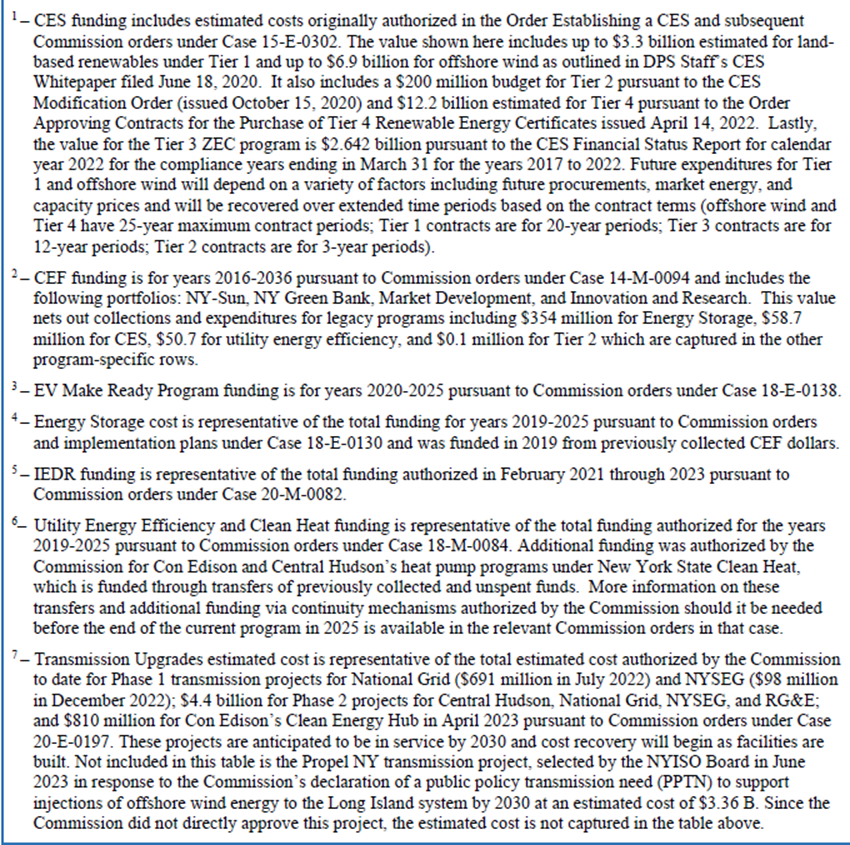
Climate Act Cost Tracking and EV Supply Equipment Example

The expected costs associated with the  Climate Leadership & Community Protection Act (Climate Act) are poorly documented.  There are very few instances where the Hochul Administration provides specific estimates of ratepayer costs. As I run across reports that include costs, I will update my scorecard of residential ratepayer costs.   This article reviews the Department of Public Service Staff Electric Vehicle Make-Ready Program Midpoint Review and Recommendations Whitepaper (Make Ready report)which provide recommendations for modification to the Make-Ready Program that subsidizes electric vehicle supply equipment and infrastructure.

Everyone wants to do right by the environment to the extent that they can afford to and not be unduly burdened by the effects of environmental policies.  I submitted comments on the Climate Act implementation plan and have written over 300 articles about New York’s net-zero transition because I believe the ambitions for a zero-emissions economy embodied in the Climate Act outstrip available renewable technology such that the net-zero transition will do more harm than good.  Every indication is that the costs will be astronomical as well.  The opinions expressed in this post do not reflect the position of any of my previous employers or any other company I have been associated with, these comments are mine alone.

Background

The implementation plan for New York’s Climate Act “Net Zero” target (85% reduction and 15% offset of emissions) by 2050 is underway.  At the end of 2022 the Climate Action Council completed a Scoping Plan that makes recommends strategies to meet the targets.   The Hochul Administration is developing regulations and proposing legislation to respond to those recommendations in 2023.

Unfortunately, the Scoping Plan is just a conglomeration of control strategies that are projected to provide the emission reductions required.  The inadequate documentation does not demonstrate the feasibility of the recommended strategies.  Furthermore the costs of the program and potential costs to individual New Yorkers are hidden in a shell game con for hiding the true costs.  In the Scoping Plan costs are compared to a Reference Case that includes already “incremented programs”.  As a result, the costs that are presented do not include all the costs of the net-zero transition.  There has been no attempt to provide the expected ratepayer cost increases.

Climate Act Cost Scorecards

Given the lack of cost information I am starting to keep track of the observed costs of the Climate Act.  My initial thought was that I would try to account for all the documented costs to a typical residential customer in a single scorecard.  However, the effort involved trying to consolidate disparate cost estimates into this parameter is beyond my capabilities so I am going to track costs in several ways.

I naively thought that all the Department of Public Service rate cases associated with Climate Act related decisions would include typical residential customer information.  However, I have found that is the exception rather than the rule.  I have set up one scorecard for those rate case decisions that provide these data.

In order to simplify interpretation of the cost numbers provided I am going to use four other scorecards.  One way to hide Climate Act costs is with subsidies.  I am going to track direct subsidies and indirect subsidies in separate scorecards.  I have a scorecard that tracks increased costs for various components of the Climate Act transition plan.  Finally, I have a scorecard that tracks the differences between cost estimates in the Integration Analysis with what has been observed.

The format of each scorecard is similar.  The specific program or component is listed along with the costs for the specific reference.  I try to make an estimate of the total costs.  For example, the residential rate cost increases necessary to support 3.5 GW of renewable energy transmission are listed but I also extrapolated the costs for an additional 6.9 GW target in the Scoping Plan.  Each entry also includes a reference that provides more details for the costs.

The following section documents one example.

Electric Vehicle Supply Equipment and Infrastructure – Direct Subsidies

This is an example of a direct subsidy.  I tried and eventually gave up trying to convert these costs to residential cost impacts.  Marie French wrote an article published in Politico’s Weekly NY and NJ Energy newsletter that described the 18-E-0138 proceeding and the mid-point review:

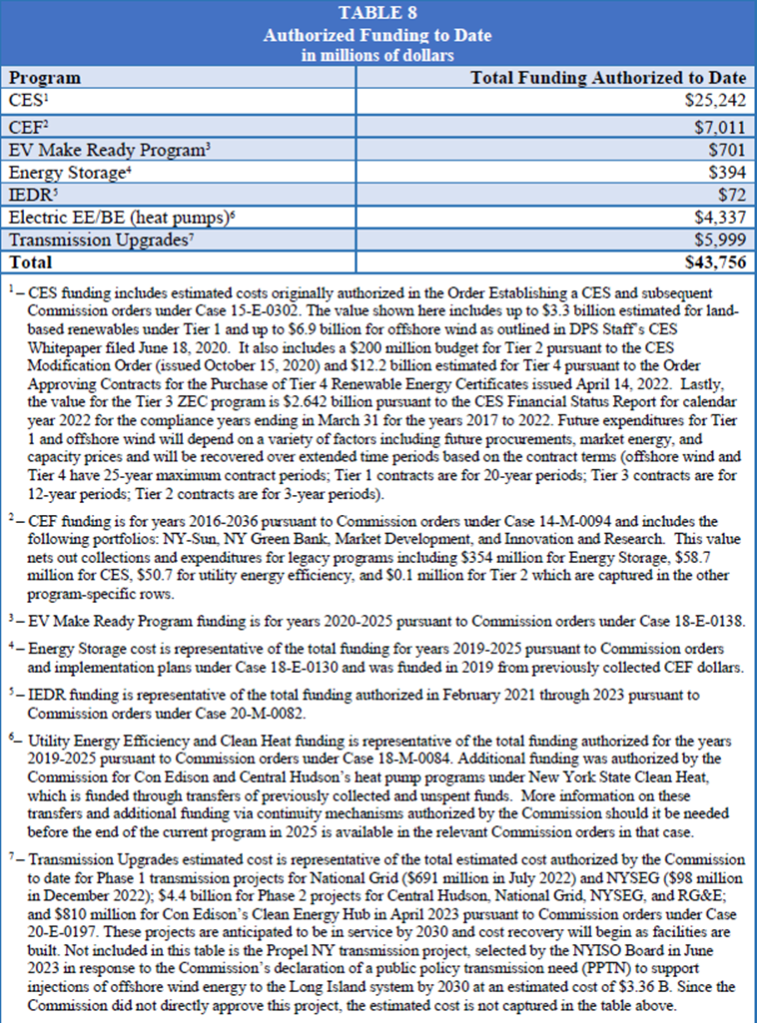
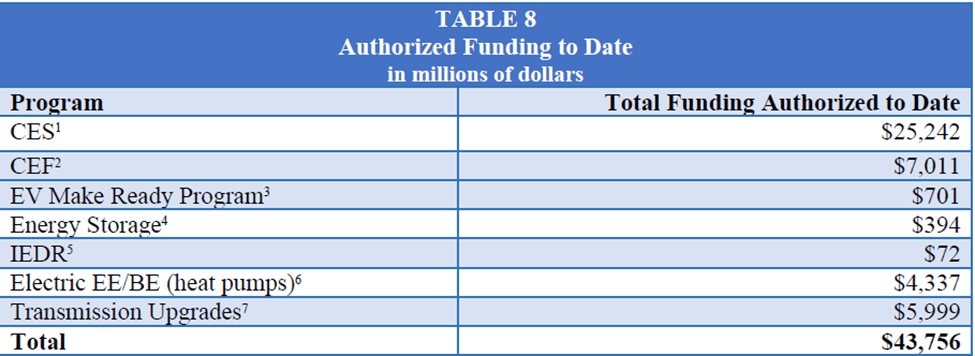
MORE EV CHARGER SUBSIDIES FLOATED: The New York Department of Public Service staff wants to boost a ratepayer-funded program to support electric vehicle charging infrastructure from $701 million to $1.1 billion. A mid-point review of the “make ready” program, which the Public Service Commission approved in July 2020, found uneven progress in different utility territories to achieve the public charger goals of the program. Overall, only 630 fast charger plugs of a targeted 1,500 and only 12,475 of a targeted more than 53,000 Level 2 chargers by 2025 have been completed or committed.

While Con Edison is about halfway to its fast charger and Level 2 charger targets, National Grid is only 16 percent of the way to its Level 2 goal and 44 percent of the way to its fast charger target. Central Hudson is 1 fast charger shy of its program goal but has only hit 16 percent for its Level 2 target. NYSEG/RG&E are far behind.

DPS staff concludes that the incentives in the make ready program are insufficient and proposes boosting the available subsidies. New targets for the number of plugs are also proposed, including a new sub-category for chargers at apartment buildings. The new targets increase the number of public fast chargers to about 6,300 and reduce the number of level 2 chargers to about 43,000. A new $25 million micro-mobility program for disadvantaged communities is also proposed and the staff supports increasing a medium- and heavy-duty vehicle electrification pilot by $30 million to $54 million.

Electric Vehicle Supply Equipment and Infrastructure – Cost Documentation

The Make Ready report lists costs that I put in two of my scorecards.  The numbers provided conflict with the Integration Analysis cost estimates:

The Make-Ready Order determined per-plug average costs for L2 chargers to be $11,298 within Con Edison’s service territory, and $6,000 for all other utilities’ territories. The per-plug average costs for DCFCs was determined to be $100,109 in Con Edison’s service territory, and $55,000 for all other utilities’ territories.

The integration analysis that provides the quantitative support to the Scoping Plan lists charger costs in Electric Vehicle Supply Equipment: Per-Vehicle Costs ($2020) table Light Duty Vehicle Battery Electric EVSE category for 2022 $2,716 per charger.  It appears that the Make Ready Report estimate of the cheaper residential charging system is four times higher than the Integration Analysis.

The Make Ready program is a direct ratepayer-funded program subsidy but no specific ratepayer costs are described.  The announced subsidies are $1.1 billion through 2025.  I estimate that the subsidy will increase to $1.3 billion by 2030

Discussion

There is an important aspect of the Make Ready example.  The Hochul Administration cost narrative is that the costs of inaction of outweigh the costs of action but that statement has an important caveat.  It is misleading because it only includes the costs of the Scoping Plan components and does not include the costs of “already implemented” programs.  The already implemented programs include the following:

  • Growth in housing units, population, commercial square footage, and GDP
  • Federal appliance standards
  • Economic fuel switching
  • New York State bioheat mandate
  • Estimate of New Efficiency, New York Energy Efficiency achieved by funded programs: HCR+NYPA, DPS (IOUs), LIPA, NYSERDA CEF (assumes market transformation maintains level of efficiency and electrification post-2025)
  • Funded building electrification (4% HP stock share by 2030)
  • Corporate Average Fuel Economy (CAFE) standards
  • Zero-emission vehicle mandate (8% LDV ZEV stock share by 2030)
  • Clean Energy Standard (70×30), including technology carveouts: (6 GW of behind-the-meter solar by 2025, 3 GW of battery storage by 2030, 9 GW of offshore wind by 2035, 1.25 GW of Tier 4 renewables by 2030)

I assume that the Make Ready costs are part of the zero-emissions vehicle mandate.  As a result, the $1.3 billion just to support public electric vehicle charging infrastructure is not included in the cost claim narrative.  I suspect that detailed analysis of all the costs necessary to for just zero-emissions vehicles would exceed the alleged net benefits of between $115 and $130 billion.

Conclusion

Although trying to keep track of the hidden costs of the Climate Act is likely a Sisyphean task, I am going to give it a shot.  At least until I can document that the admitted costs of the Scoping Plan are biased low and incomplete anyway. Any reader contributions are welcome!

Climate Act Transition Plan Pitfalls – Other Voices

A couple of recent articles caught my attention as very good summaries of the challenges of the Climate Leadership & Community Protection Act (Climate Act) transition plan to achieve net zero by 2050.  I provide summaries with extensive quotes but I recommend readers take the time to go to the original articles and read the whole thing.

I have been following the Climate Act since it was first proposed. I submitted comments on the Climate Act implementation plan and written over 300 articles about New York’s net-zero transition because I believe the ambitions for a zero-emissions economy embodied in the Climate Act outstrip available renewable technology such that the net-zero transition will do more harm than good.  The opinions expressed in this post do not reflect the position of any of my previous employers or any other company I have been associated with, these comments are mine alone.

Climate Act Background

The Climate Act established a New York “Net Zero” target (85% reduction and 15% offset of emissions) by 2050. The Climate Action Council is responsible for preparing the Scoping Plan that outlines how to “achieve the State’s bold clean energy and climate agenda.”  In brief, that plan is to electrify everything possible and power the electric gride with zero-emissions generating resources by 2040.  The Integration Analysis prepared by the New York State Energy Research and Development Authority (NYSERDA) and its consultants quantifies the impact of the electrification strategies.  That material was used to write a Draft Scoping Plan.  After a year-long review the Scoping Plan recommendations were finalized at the end of 2022.  In 2023 the Scoping Plan recommendations are supposed to be implemented through regulation and legislation.

The New York official Climate Act webpage describes the Scoping Plan as the “framework for how New York will reduce greenhouse gas emissions and achieve net-zero emissions, increase renewable energy use, and ensure all communities equitably benefit in the clean energy transition”. It has also been aptly described as “a true masterpiece in how to hide what is important under an avalanche of words designed to make people never want to read it”.  Importantly, the basis of the document, the Integration Analysis, does not provide enough detail to determine if the conglomeration of control strategies that they have cobbled together will actually work together as proposed in general, and, in particular, on the arbitrary schedule mandated by the Climate Act.

New York GHG emissions are less than one half of one percent of global emissions and global emissions have been increasing on average by more than one half of one percent per year since 1990.  This does not mean that New York State should not do something, but it certainly eviscerates any claims that we do not have time to fully evaluate what has been recommended in the Scoping Plan framework.

Francis Menton writing at the Manhattan Contrarian and Arnold Wallenstein writing at Utility Dive both argue that there are fundamental flaws in the transition plan that will add costs and reduce reliability.  However, in the land of Albany politics the disconnect between aspirations and reality is not apparent. 

Samar Khurshid writing at the Gotham Gazette wrote a good overview of the current status of the 2023 implementation push entitled Major Climate and Energy Policies Being Decided in Albany State Budget Negotiations.  He quoted Senator Pete Harckham, a Westchester Democrat who chairs the Senate’s Committee on Environmental Conservation, as saying:

“Consumers are eventually going to be paying less on their utility bills, because energy will be less expensive,” he added. “We’ll lower our health care costs and we’ll be creating 130,000 high-paying union jobs. So there are a lot of upsides to this as we go forward.”

The idea that utility bills will go down is so incredibly out of touch that I can only attribute that belief as religious dogma.  The only way someone can believe that is if they do not understand the difference between power and energy.  In brief, you pay for energy so the comparison metric should be energy produced by wind and solar.  It does not matter if wind and solar provide cheaper power than a fossil plant.   Because those resources are intermittent it is necessary to backup them up when the wind is not blowing and the sun is not shining.  When the costs to provide reliable energy are included New York will find, just like every other jurisdiction that has attempted this transition, that the costs are enormous.  Enough from me the rest of the post summarizes the opinions of two others who share my view.

Menton on the Climate Act Transition Plan

Francis Menton is a retired attorney and author of the Manhattan Contrarian blog where over the he has published well over 1000 articles on issues of public policy.  Close to one-third of the posts at Manhattan Contrarian deal with the subject of climate change broadly defined, including such topics as the application of the formal scientific method to what passes for climate “science” in today’s academia, and evaluation of the potential costs and practical difficulties of attempting to replace our current energy systems with intermittent wind and solar electricity generation.  He is a board member and current President of the American Friends of the Global Warming Policy Foundation. 

In his article, New York Goes Full Central Planning For The Electricity Sector, Menton writes that the only option considered in the Climate Act transition is full speed ahead. There hasn’t been a feasibility study or consideration of a demonstration project so there is no clue whether this will work or not.  In his article he reviews a document that supposedly gives more detail as to how New York is going to accomplish the net zero transition.

In January 2022 electric utility Con Edison issued “An Integrated View of Our Energy System through 2050.”  He writes:

Let me start with a few thoughts on the Con Edison Report. It is lots of verbiage and plenty of charts and graphs. And it is more or less exactly what you would expect if you think for say, one minute, about what position Con Edison might take. As a deeply regulated entity, they are completely required to affirm the directives and applaud the wisdom of their government overlords. But more than that, they are clearly salivating over the prospect of getting to make billions of dollars of new investments, all of which will earn a guaranteed, regulated rate of return for their investors — and if we are really, really lucky, the end result will be that we get the exact same electricity for much higher cost. If we aren’t so lucky, we will get much less reliable electricity for the much higher cost. The cost factor is played down throughout the Report, and we never get any meaningful quantification.

But all the verbiage and charts and graphs mainly have the purpose of obscuring the fact that Con Ed does not take responsibility for making sure that there is enough electricity availability to supply customer demand on the grid. That’s somebody else’s job.

To set the tone, here is a quote from page 1:

[W]e are committed to being the next-generation, clean energy company that our customers deserve and expect. We will play a critical role in delivering on the ambitious climate and clean energy goals set by New York State and New York City, including reaching net-zero greenhouse gas (GHG) emissions by 2050. In addition, the need for safe, reliable, and secure energy infrastructure remains paramount.

OK, where in there did you say that you take responsibility for there being enough electricity to meet demand?

Cost barely gets mentioned in the introductory section. It finally turns up in the last paragraph.

Here’s how they spin it:

We recognize this transition to a net-zero GHG emissions energy system will require significant investment. We seek to make investments that achieve the goals of this transition as cost- effectively as possible, which necessitates growing our electric system while maintaining our gas and steam systems to achieve clean energy goals.

In other words, whoo-boy is there a lot of money for us to make here!

He goes on to discuss that Con Ed does not take responsibility to build the things necessary they only offer support for “interconnection” and “balance.”  Then he addresses energy storage and note that Con Ed does not make the proper delineation between power and energy.

And how about the trillions of dollars worth of energy storage that will be needed when the sun doesn’t shine and the wind doesn’t blow? See if you can decode this word salad:

“We have developed plans to build the necessary electric transmission and distribution infrastructure by 2050 to . . . [d]evelop and facilitate up to 12.6 GW of energy storage through direct utility investments and customer programs at customer and utility scales.”

Where even to start? “12.6 GW” of storage? They don’t even know the correct units to discuss this issue. If these are four-hour duration lithium ion batteries (unspecified, but what else could they be talking about?), that will give you 50.4 GWh of storage — enough to cover New York State for a couple of hours at most of low sun and wind. Competent calculations indicate a storage requirement of more like 20 to 30 days of storage to deal with the seasonality of the sun and wind. So this is at best a small fraction of one percent of what will be needed to back up the solar/wind grid of the future.

But what does Con Ed care? They’re not actually saying here that they are taking responsibility for making the new system work, let alone even providing the batteries themselves. They’re only saying that they have “developed plans” to “facilitate” the storage, which could occur either through “utility investments” or “customer programs.” In other words, I guess, hey sucker, use your electric car battery to power the house when the grid goes down.

Arnold Wallenstein on the Climate Act Transition Plan

Arnold R. Wallenstein is a Boston-based attorney who represents independent power producers in New York and other states and is the principal member of the EnergyLawGroup.org. Wallenstein explains in New York’s plan for transforming its electricity generation will reduce reliability at extreme cost that there are obstacles to meeting the ambitious schedule of the Climate Act net-zero transition.  He explains why he thinks the transition plan is doomed to failure:

The Climate Action Council projects current electric load in New York to triple by 2040 due to the electrification of transportation and 100% building electrification. By 2040, when all electricity generation must be zero emissions, NYISO, the independent New York grid operator, states that at least 95 GW of new generation must be developed to make up for generation plant retirements and increased electrical demand. This goal is unrealistic and unachievable because the state only added 12.9 GW over the last 23 years, and it is highly unlikely that 95 GW of new generation capacity will be added in 17 years due to state permitting and grid interconnection delays.

The Climate Action Council’s final Scoping Plan also reveals that New York will need 15 GW to 45 GW of new “zero emission dispatchable electric generation” by 2040 to meet increased electric demand and maintain electric system reliability. This is emission-free electric generation that can be dispatched, i.e., turned on, by NYISO at night or stormy conditions when there is no solar radiation or during calm wind conditions. But the Scoping Plan also admits that this 15 GW – 45 GW target “cannot be currently met” with existing technologies.

This dire prediction is confirmed by NYISO, which has issued reports stating that the New York grid may experience as much as a 10% deficiency, and possibly more,  in generation capacity by 2040, and will require 32 GW of new zero-emission dispatchable generation by 2040 — which would almost double the current New York grid’s 37 GW generation capacity. NYISO also warns that such zero-emission dispatchable generation technologies “are not commercially available.” Electricity shortages will occur if these new emission-free generation plants do not materialize in time as hoped for by the state. Hope is not an action plan to solve electric reliability deficits. 

Electric power deficiency is already starting to occur. A report just issued on April 14 by NYISO points out that New York City and the Lower Hudson Valley may have electric reliability problems and generation shortages starting in 2025 due to generation plant retirements caused by the New York Department of Environmental Conservation shutdown of NOx producing peaker plants and if there are extreme weather events, worsening through 2032, where there may a 600 MW generation deficiency in New York City and environs.

The Climate Action Council’s climate plan — if fully implemented by the state as is currently being debated in the legislature — risks placing New York in an electricity shortage that could result in blackouts and brownouts. The New York grid operator pointed out that if existing gas-fired electric generation is shut before new resources come on line, there is a risk that NYISO will not be able to provide a reliable electric system. 

NYISO also said fossil fuel generators — natural gas and oil-fired — will be needed to maintain reliability until non-emitting dispatchable resources can effectively replace the fossil-fired generation plants to provide grid reliability as a back up to intermittent, weather-dependent renewable energy resources. NYISO also predicts than in 2040 when fossil-fueled generators are shut down by state’s climate law, zero-emissions dispatchable generation, which doesn’t yet exist, will still be required to supply 10% or more of New York’s electricity, depending on how many megawatts of new renewable and “dispatchable” emission-free generation is actually operational by 2040. 

These warnings of future electric deficiencies are echoed by the New York State Electric Reliability Council and the North American Electric Reliability Corp., the entities tasked with monitoring electric reliability in New York as well as the U.S.

Blackouts during cold winter months can cost lives. When Texas experienced an unprecedented freeze in 2021 between 246 (direct) and 700 (indirect) people died because of power outages. Similarly, many people died in Buffalo’s Christmas 2022 blizzard. That cannot be allowed to happen in New York because of a poorly designed climate plan.

If that wasn’t enough, the cost to implement New York’s climate plan may be stratospheric: authoritative commentators, including the Empire Center for Public Policy, have suggested New York taxpayers and ratepayers will pay $340 billion to $500 billion to transition the New York electric system to primarily relying on solar and wind power supplemented by battery storage.

But no overall cost analysis was provided by the State’s Climate Action Council.

Gavin Donohue, CEO of the Independent Power Producers of New York, refused to vote for the climate plan, and said it would take pure “magic” to make the plan work.

And how much will this costly plan contribute to reduction of greenhouse gases: only 0.4% of global GHG emissions according to recent commentators.

A reliable supply of electricity that can be generated at all times during cold nights and low wind conditions is absolutely essential to our modern economy and our standard of living. The state’s climate plan’s proposed radical changes to the New York electricity generation sector should not be fully implemented by the state until it can guarantee that there will be adequate generation at all times. This means keeping in service some natural gas-fired generation which can quickly ramp up when solar and wind plants are not operating. NYISO warns that with even with increased renewable energy generation by 2040, “at least 17,000 MW of existing fossil generation must be retained to reliably serve forecasted demand.”

Conclusion

The difference between these articles that clearly are based in reality and Harckham’s statement that  “Consumers are eventually going to be paying less on their utility bills, because energy will be less expensive” could not be starker.  The innumeracy of anyone who thinks that intermittent wind and solar power can ever be cheaper is astounding because the numbers are so straight-forward.  It must be that they simply don’t want to hear anything that runs contrary to their cherished narrative.  At what point will they concede the risks of this insane policy.

Both authors echo my concerns about the lack of adequate feasibility planning to maintain current reliability standards and the absence of a complete accounting of the costs.  This blog is dedicated to the idea that environmental regulation should concentrate on tradeoffs and consideration of all the impacts.  Both authors argue that this pragmatic approach is not a characteristic of the Climate Act transition.  I agree with Wallenstein that “the New York Climate Action Council’s climate plan, if carried out as intended, will probably not be able to supply New York state with a reliable supply of electricity. And it will cost New York taxpayers and utility customers (i.e., everyone) hundreds of billions of dollars to create a less reliable electric system than New York now enjoys.”

Climate Act Electric Vehicle Charging

On April 13 the New York Department of Environmental Conservation (DEC) announced that “the Municipal Zero-Emission Vehicle (ZEV) Infrastructure Grant Program has awarded over $8.3 million in funding to 70 municipalities to install electric vehicle charging stations for public use.”  This post looks at the cost details included in this component of the Climate Leadership & Community Protection Act (Climate Act) net zero transition plan. 

I have been following the Climate Act since it was first proposed. I submitted comments on the Climate Act implementation plan and written over 300 articles about New York’s net-zero transition because I believe the ambitions for a zero-emissions economy embodied in the Climate Act outstrip available renewable technology such that the net-zero transition will do more harm than good.  The opinions expressed in this post do not reflect the position of any of my previous employers or any other company I have been associated with, these comments are mine alone.

Climate Act Background

The Climate Act established a New York “Net Zero” target (85% reduction and 15% offset of emissions) by 2050 and an interim 2030 target of a 40% reduction by 2030. The Climate Action Council is responsible for preparing the Scoping Plan that outlines how to “achieve the State’s bold clean energy and climate agenda.”  In brief, that plan is to electrify everything possible and power the electric gride with zero-emissions generating resources by 2040.  The Integration Analysis prepared by the New York State Energy Research and Development Authority (NYSERDA) and its consultants quantifies the impact of the electrification strategies.  That material was used to write a Draft Scoping Plan.  After a year-long review the Scoping Plan recommendations were finalized at the end of 2022.  In 2023 the Scoping Plan recommendations are supposed to be implemented through regulation and legislation.

Municipal ZEV Infrastructure Grant Program

According to the program fact sheet grants are available to municipalities for the purchase and installation of electric vehicle supply equipment or hydrogen fuel cell filling station components available primarily for public use.  There is a match of 0 to 20 percent of the total project cost requirement based, in part, on the median household income of the municipality.

The DEC announcement for the program awards said:

The Department of Environmental Conservation (DEC) Municipal Zero-Emission Vehicle (ZEV) Infrastructure Grant Program has awarded over $8.3 million in funding to 70 municipalities to install electric vehicle charging stations for public use. The transportation sector is the second-largest source of greenhouse gas emissions in New York, and these electric vehicle charging stations will help the state achieve the greenhouse gas emission reduction requirements under the Climate Leadership and Community Protection Act (Climate Act) and provide more opportunities across the state for electric vehicle drivers to charge.

The 2022 round of the ZEV Infrastructure Grant Program made 131 awards to 70 municipalities totaling $8.38 million toward the installation of 454 Level 2 charging ports and 28 direct current fast charger pedestals throughout New York State, the largest award amount since the program began. More than 42 percent of the grant funding was awarded for projects located in disadvantaged communities based on the draft criteria. The Climate Justice Working Group recently finalized criteria for disadvantaged communities that will ensure 35 percent, with a goal of 40 percent, of overall benefits of spending on clean energy and energy efficiency programs – one of several ways the Climate Act prioritizes climate justice.

See the press release for a list of all 2022 ZEV Infrastructure Grant awardees. 

ZEV infrastructure grants are available to cities, towns, villages, and counties across New York under the DEC Municipal ZEV Program. The program also offers rebates for zero-emission fleet vehicles. The 2022 rebate awards for municipal zero-emission fleet vehicles were announced in December. Since its inception in 2016, the Municipal ZEV Program has awarded more than $16 million in rebates and grants (including this round) towards the purchase of 114 plug-in hybrid vehicles and 182 all-electric vehicles, 1,076 Level 2 charging ports, 44 fast charge pedestals, and three hydrogen fuel cell filling nozzles.

View the full list of all 2022 Municipal Zero-Emission Program award recipients (PDF).

More information about the DEC Municipal ZEV Infrastructure Grant Program, as well as Municipal ZEV Rebates, is available on DEC’s website.

This grant program is part of the Final Scoping Plan Chapter 11 – Transportation transition strategy.  The following component describes what is proposed:

Invest in and remove barriers for ZEV charging and fueling infrastructure: To support the level of ZEV adoption anticipated by 2030, New York must quickly increase the number of EV charging stations and hydrogen filling stations in the State. New York should fund rebates or investment in EV charging stations and hydrogen filling stations, either directly through programs run by NYSERDA and/or NYPA or through market-based mechanisms like the clean transportation standard discussed below that would generate resources for ZEV infrastructure. All focus on investments in Disadvantaged Communities, programs in this area should focus on charging at multi-unit dwellings, on-street charging, and convenient urban fast charging, especially in areas with less access to home charging. Strategies should also prioritize fast charging along travel corridors, especially in rural areas, and support market segments that have been slow to attract private investment, including hydrogen fueling stations for appropriate applications. Through the National Electric Vehicle Infrastructure formula program, DOT will identify opportunities to support the creation of a safe, reliable, convenient, and equitable EV fast charging infrastructure network to allow EV drivers to reach interstate, regional, and long-distance destinations. DOS should incorporate EV charging into building codes to ensure new construction is EV-ready.

Program Numbers

I copied the data provided in the press release list of awardees and put the data into a table.  The grants total $8.4 million and fund 462 level 2 chargers and 29 DCFC pedestals (“fast chargers”).  The level 2 charger costs averaged $10,713 and ranged from $41,090 to $3,326.  I think that reflects an economy of scale when a whole bank of chargers is installed.  The DCFC chargers averaged $125,715 and ranged from $250,000 to $40,316.  In the following I extrapolate these cost estimates to the total needed for the total net-zero transition.

In the strategy quoted above it states that “All focus on investments in Disadvantaged Communities, programs in this area should focus on charging at multi-unit dwellings, on-street charging, and convenient urban fast charging, especially in areas with less access to home charging.”  What does providing LMI car owners in Disadvantaged Communities entail?  I assume that it means Level 2 charging systems must be provided despite the suggestion that convenient fast charging is a focus.  According to Kelley Blue Book EV charging stations: everything you need to know:

“In broad terms, Level 2 charging stations charge at about 6 kilowatts (kW) or a little higher and can add about 20 miles of range in an hour of charging at home or using a public charging station. DC fast chargers use high-voltage direct current to charge at 50 kW and up to 350 kW if the car can accept that rate. It’s not uncommon for EVs to gain 80% charge in about 30 minutes or less during quick charging.”

Not surprisingly there is insufficient detail in the Integration Analysis to determine how many Level 2 chargers are needed to fulfill this Scoping Plan target.  I found that in the Open NY list of disadvantaged communities that the population distribution was 6,993,023 residents (36%) in disadvantaged communities and 12,579,296 in the other communities.  According to the Integration Analysis there are 10,215,644 light duty vehicles in 2022.  I assumed that the proportion of vehicles owned by residents in disadvantaged communities equals the total number of vehicles times 36% multiplied by an arbitrary 20% representing number of residents owning a vehicle to come up with an estimate of disadvantaged community vehicles: 729,993.  I furthered assumed that one third of those vehicles will need a public charging station because they won’t have access to a private charger so 243,307 Level 2 chargers will be needed.  At the average cost in the Municipal ZEV Infrastructure Grant Program awards, $2,607 million would be needed and even at the minimum cost $809 million would be needed just for Level 2 chargers. 

I also made an estimate of the number of chargers needed throughout the state.  The integration analysis lists the number of housing units for nine categories.  I assumed the number of light duty vehicles (LDVs) per unit and calculated how many LDVs for each category. 

In the next step I estimated the percentage of vehicles that would be charged at public charging stations for each residential category.  For example, I assumed that no 1-unit detached homes would charge their electric vehicle at a public station but that 90% of the vehicles in high rise multi-family units would.  I also estimated the percentage of level 2 chargers and DCFC chargers by housing unit type.  The result was the number of level 2 and DCFC chargers that would be needed for residential public charging.

The number of charges was multiplied by the average and minimum cost for the Level 2 and DCFC systems to get a range of expected costs for public chargers based on the results of this announcement.  I estimate that between $8.4 billion and $26.6 billion would be needed for residential public charging systems.  Note that this does not include public charging systems for the traveling public or office parking lots.

The Hochul Administration narrative is that the costs of inaction for the net zero Climate Act transition outweigh the costs of action but that statement is misleading unless the caveat that the costs in the Scoping Plan do not include the costs “already implemented” programs like the Municipal ZEV Infrastructure Grant Program.  As far as I can tell the Integration Analysis did include the benefits of already implemented programs.  In other words, the Administration claim does not include all the costs to transition to net-zero.  According to the final scoping plan the societal benefits of the Climate Act net zero transition plan are greater than the costs by between $115 and $130 billion.  Properly including this Grant Program as a necessary cost to get to meet the Climate Act mandates reduces the alleged benefits to between $89 and $122 billion.  I believe that when all the other costs to electrify the transportation sector are included, the real costs will exceed the societal benefits.

Conclusion

Every component of the Climate Act that I have evaluated has turned out to be more complicated, the ease of transition more uncertain, and the costs greater than admitted in the Scoping Plan.  In this example, the Scoping Plan does not differentiate or address the differences between home charging and the more complicated public charging requirements.  The Scoping Plan suggests that implementation should “focus on charging at multi-unit dwellings, on-street charging, and convenient urban fast charging, especially in areas with less access to home charging” but does not acknowledge the uncertainties associated with finding the room for those assets.  Finally, the Integration Analysis lists the cost for Light Duty Vehicle Battery Electric Vehicle Supply Equipment: Per-Vehicle Cost as $2,826 in 2022, but the minimum cost in the 2022 awards was $3,326 and the average cost was $10,713. 

Given the complications, uncertainties and higher costs there is no way the Hochul Administration net-zero transition is going to work as glibly promised.  For all the talk about inspiring other jurisdictions to follow New York’s lead and commit to the same GHG emission reductions targets the possibility that rushing ahead without addressing feasibility issues might end in a debacle that sets their cause back has been ignored.  The Climate Act’s appeal to emotion and values rather than a rational energy policy is not going to end well for the state or their cause.

Offshore Wind Transmission Cost Subsidies

The expected costs associated with the  Climate Leadership & Community Protection Act (Climate Act) for the net zero transition plan are poorly documented.  This article describes costs associated with offshore wind transmission requirements as part of my on-going effort to consolidate cost estimates in one place.

Update 22 June 2023: NYISO chose Propel Alternate Solution 5 at $3.28 billion.

My original plan to track Climate Act costs was to provide expected additional costs to ratepayers for various implementation programs.  That information is not provided or is hidden so well that I could not find it for most programs.  In order to address other cost considerations, I am tracking costs in different categories: Typical Residential Customer Costs, Direct Climate Act Subsidies, Indirect Climate Act Subsidies, Climate Act Cost Overruns, and Climate Act Integration Analysis Assumed Costs and Updated Costs Differences. This article describes the cost to export power generated by offshore wind facilities from Long Island to the rest of the State which is an indirect cost subsidy that will be paid for by all New Yorkers.

Everyone wants to do right by the environment to the extent that they can afford to and not be unduly burdened by the effects of environmental policies.  I submitted comments on the Climate Act implementation plan and have written over 300 articles about New York’s net-zero transition because I believe the ambitions for a zero-emissions economy embodied in the Climate Act outstrip available renewable technology such that the net-zero transition will do more harm than good.  Every indication is that the costs will be astronomical as well.  The opinions expressed in this post do not reflect the position of any of my previous employers or any other company I have been associated with, these comments are mine alone.

Background

The implementation plan for New York’s Climate Act “Net Zero” target (85% reduction and 15% offset of emissions) by 2050 is underway.  At the end of 2022 the Climate Action Council completed a Scoping Plan that recommends strategies to meet the targets.   The Hochul Administration is developing regulations and proposing legislation to respond to those recommendations in 2023.

Unfortunately, the Scoping Plan is just a conglomeration of control strategies that are projected to provide the emission reductions required.  The inadequate analysis and documentation do not demonstrate the feasibility of the recommended strategies.  Furthermore the costs of the program and potential costs to individual New Yorkers are hidden in a shell game con for hiding the true costs.  In the Scoping Plan, costs are compared to a Reference Case that includes already “incremented programs”.  As a result, the costs that are presented do not include all the costs of the net-zero transition. 

Long Island Offshore Wind

The Department of Public Service has an Order for Public Policy Transmission Need (PPTN) (Case 20-E-0497) regarding Climate Act requirements related to offshore wind that drive the need to expand the number of transmission facilities between Long Island and the rest of the State.  Climate Act goals include the development of 9,000 MW of offshore wind generation by 2035, with perhaps 6,000 MW connected into New York City. The Public Service Commission has concluded that offshore wind generation connected to Long Island is identified as “high” risk and would be curtailed unless something is done. Transmission expansion that increases the transfer capability from Long Island to the rest of New York is expected to significantly reduce the potential for offshore wind curtailment.

The New York Independent System Operator (NYISO) Electric System Planning Working Group  (March 24, 2023 and April 3, 2023) is addressing independent cost estimates developed by NYISO’s consultant for proposed projects to address this issue.  This is all preliminary work so the cost estimates are subject to change but they give an idea of what is needed to get the offshore wind generated to where it is needed.  The cost estimates considered required material and labor cost by equipment, engineering and design work, permitting, site acquisition, procurement and construction work, and commissioning.  The analysis found that the primary cost drivers were terrestrial and submarine cable length, HVDC converter systems and PARs, and the scope of the project (i.e., number/size of transmission facilities). 

Cost estimates for sixteen projects were evaluated as shown in the following table.    The average total cost estimate was $7.1 billion, the maximum was $16.9 billion and the minimum was $2.1 billion.

The draft NYISO Long Island Public Policy Transmission Need (PPTN) report predicts that the transmission upgrades will provide savings to the system:

The Long Island PPTN project simulations all show improvements in the export capability of Long Island by adding tie lines between Long Island and the lower Hudson Valley. This added transfer capacity and upgrades to the internal Long Island system reduce the amount of curtailment from offshore wind resources. The energy produced through reduced curtailment of offshore wind resources can then be used to offset more expensive generation to meet New York’s energy demand and, therefore, produce a production cost savings. Production cost savings are also created by offsetting high-cost energy imports from neighboring regions with lower cost New York-based generation that was previously inaccessible due to transmission congestion.

In general, all of the proposed projects produce savings by unbottling offshore wind resources in Long Island and reducing the amount of imports from neighboring regions. The figure below shows the estimated production cost savings for each project over a 20-year period in 2022 real million dollars.

The baseline scenario estimated 20-year production cost savings (2022 $M) average $99 million, the maximum is $110 million, and the minimum is $39 million.  The policy case scenario savings average $347 million, the maximum is $458 million, and the minimum is $291 million.  (I don’t have the costs for the Policy + B-VS scenario so I do not discuss that scenario.)  The difference between the total estimated cost and the production cost savings is the amount that must be subsidized indirectly to the ratepayers.  The annual subsidies over 20 years range from $823 million to $90 million and average $339 million.

I am not impressed.  Without this connection upgrade as much as 92% of the 3000 MW of off-shore wind which costs $15 billion would not be deliverable.  However, it comes at an annual average subsidy of $339 million.

Discussion

Unfortunately, the indirect subsidy costs described are not the only costs.  These costs are only for the new transmission and do not include additional costs associated with the impacts on the existing transmission and distribution systems on Long Island.  In addition, this is the cost associated with 3,000 MW of offshore wind.  The Climate Act goal is for 9,000 MW and the Scoping Plan Integration Analysis projects that 12,675 MW of offshore wind will be needed by 2040 in the Strategic Use of Low-Carbon Fuels mitigation scenario.  If the transmission costs are proportional that would mean that this indirect subsidy alone would be at least $1,356 million a year for the Integration Analysis.

There are a couple of other things to keep in mind.  The Integration Analysis cost documentation is inadequate so I cannot be sure but I am confident that none of these costs were included in the Integration Analysis.  This further weakens any claim that the net zero transition will provide cost-effective emission reductions.  The other thing is that the only cost number associated with the cap and invest program proposed by the Hochul Administration is for a universal Climate Action Rebate that is “expected to drive more than $1 billion in annual cap-and-invest proceeds to New Yorkers.”   In other words, the State will make a big deal about giving New Yorkers a rebate at the same time there will be indirect cost subsidies that are approximately the same.  This is yet another example of shell game scams with the Climate Act costs.

Conclusion

There are two reasons that the Hochul Administration has not provided comprehensive cost estimates.  The first is that they don’t know the all-in costs because those numbers can only be developed on the basis of detailed analyses like this proceeding.  The second is that they don’t want to know and they certainly don’t want the voters to know the mind-numbing costs.  

This example of one aspect of the transition plan shows that the capital costs for getting the offshore wind to where it can be used most effectively are enormous, and the savings are miniscule which means enormous subsidies to be paid for by all New Yorkers.  New York GHG emissions are less than one half of one percent of global emissions and global emissions have been increasing on average by more than one half of one percent per year since 1990.  This does not necessarily mean that we should not do something, but it does mean that we have time do something that we can afford.  Until such time that detailed analyses like the kind of analysis described here are completed this process should be paused.

Climate Act and the Broken Window Fallacy

One recurring narrative by proponents of the Climate Leadership & Community Protection Act (Climate Act) is that it will create significant economic activity.  However, it has always seemed counter-intuitive to me that all this economic activity requires subsidies but I have not been able to make that point well enough for an article.  A recent post at Climate Discussion Nexus does an excellent job refuting that narrative and I reprint it in its entirety here.

Everyone wants to do right by the environment to the extent that they can afford to and not be unduly burdened by the effects of environmental policies.  I submitted comments on the Climate Act implementation plan and have written over 290 articles about New York’s net-zero transition because I believe the ambitions for a zero-emissions economy embodied in the Climate Act outstrip available renewable technology such that the net-zero transition will do more harm than good.  Every indication is that the costs will be astronomical as well.  The opinions expressed in this post do not reflect the position of any of my previous employers or any other company I have been associated with, these comments are mine alone.

Background

The Climate Act Growing Economic Opportunities webpage extolls the value of the Climate Act and jobs.

Our actions and investments are creating new economic activity right here in New York. The clean energy industry is growing before our eyes and the number of clean energy jobs in New York State reached a record level of 165,000 workers at the end of 2021. These jobs have helped lead New York’s COVID-19 economic recovery, the clean industry showing a faster recovery than other sectors. This recent growth is part of a larger trend in the State, with clean energy employment growing 17 percent since 2015 and continued growth on the horizon.

In partnership with businesses, schools, labor and trade organizations, we are supporting the creation of a clean energy workforce pipeline and providing new training opportunities for workers of all experience levels. These opportunities include programs designed to enhance skills in clean heating, energy efficiency, renewables, and other clean technology sectors. Our programs also assist businesses with recruiting, hiring, and onboarding costs for new employees. These efforts prioritize training programs for the state’s most underserved populations – low-income individuals, veterans, disabled workers, single parents, and the formerly incarcerated – and will also help integrate displaced workers into this new promising industry.

That means long-term economic opportunities for all New Yorkers.

I have looked at the New York Clean Energy Industry Report and found that the state’s clean job estimate claims are misleading and inaccurate.  However, I have not described the basic fallacy.  These jobs only occur because the entire existing energy system will be destroyed.  The Climate Discussion Nexus article explains this problem very well.  The following section presents the entire article.

 Stop them if you’ve heard it before

“Stop!” shouts Terry Corcoran in the Financial Post, saying all the “green economy” hype basically repeats the “Broken Window Fallacy” Frederic Bastiat smashed in his 1850 essay that inspired Henry Hazlitt’s 1944 Economics In One Lesson which is one more lesson than the “parade of corporate and political heavyweights, such as U.S. climate czar John Kerry” have had. As Corcoran writes, “In the parable, a boy smashes the window in a town shop, creating an expense and loss for the shopkeeper.

But a bystander observes that there is an economic benefit to smashing windows: Glassmakers get more business, a conclusion glibly summarized in one commentary: ‘It’s a good thing to break windows — money gets circulated and the industry thrives.’” And so, Corcoran laments, this nonsense is even more prevalent in 2023 than in 1850 because now there actually are formal programs to go about breaking glass on a massive scale to enhance prosperity: “as governments in the Western world attempt to smash the windows of the energy system and replace it with an all-new net-zero energy regime.” And chortle about the opportunities they’re creating for glass-makers, freight carriers, window-installers, painters, and who knows what all? For instance Canary Media burbling “Chart: US climate law to spur thousands of new jobs in every state”.

They don’t. As Corcoran growls, “The broken window fallacy in such thinking, if I can presume to condense Bastiat, is that the real cost of breaking windows is ignored.”

In some sense the Canary claim that “Each U.S. state could gain between 2,000 and 140,000 clean energy jobs by 2030 thanks to investments spurred by the Inflation Reduction Act, according to a new analysis by the think tank RMI” is a no-brainer. But we don’t mean it in a good way. They say that:

“RMI analyzed the amount of money that could be invested in the 48 contiguous U.S. states as consumers, manufacturers and other businesses take advantage of tax credits and rebates provided by the climate law.”

But quite apart from the fatuity of trying to figure out how much “could be invested” in the United States’ incredibly complex $23 trillion economy, if something is only profitable with subsidies it is another way of saying it is not profitable, which means it is worth less than it cost to make so this “investment” destroys wealth rather than creating it. Thus for David Wallace-Wells to snicker in the New York Times that “G.O.P. elites are simply lagging behind their states” because the Inflation Reduction Act offers subsidies so huge even Republicans will take the money is not proof that the climate zealots have won the debate or that they are boosting prosperity, just that far too few commentators understand the very basic economic point that you have to subtract the subsidy from the nominal profit to see if the thing actually benefited society.

Heck no, he says. Rather:

“The Inflation Reduction Act is a spigot of spending designed to produce a decarbonization boom — indeed, while it is often described as a $370 billion piece of legislation, that analysis seems likely to significantly underestimate the ultimate size of its tax incentives, which could stretch much closer to $1 trillion with rapid renewable development.”

To borrow from Adam Smith, since we’re taking a trip to the land of economic fundamentals, for a trillion dollars you could support a wine industry in Wales. But the net cost would be huge.

It may seem futile to seek to refine economic theory in the face of such persistent obtuseness. Including Clean Prosperity’s:

“The government could also look at strategic financial support for industries where Canada can compete globally and generate significant economic benefits, good jobs, and manufacturing value added. We point to direct air capture, sustainable aviation fuel, and the electric-vehicle value chain.”

Ooooh. Strategic. Sure beats the other kind of financial support where you hurl money out windows and hope it hits voters. But if “Canada” can compete globally, and we didn’t even know it was a company, then why in the name of all handouts does something that generates significant economic benefits and add value require a subsidy?

Having thus harrumphed we need to stress that Bastiat’s metaphor goes even deeper than Adam Smith’s pointed observation that those who clamour for government support in the national interest are by no means such fools as those who believe them. It actually is true that, once the window is broken, the process of making a new one in the marketplace is socially beneficial because it plugs the ugly gap in the store front, protecting the merchandise and sheltering customers and staff from inclement weather, something we already knew was worth the expense because the shop keeper previously incurred it to install the former window.

So yes, once the window has been broken, replacing it is economically rational including for the shopkeeper. But the cost incurred a second time, to replace the broken window, merely restores what was previously there, so the shopkeeper ends up poorer by the cost of replacing the window than they were before it was broken. So if something flattened all our power plants, we’d be better off after we replaced them (if we replaced them with something that worked) than if we didn’t. But we would be worse off than we were before they got flattened.

The whole Green New Deal, Just Transition, Energiewende and all its ignorant destructive cousins around the world miss this key insight. They are not proposals to make us better off, they are proposals to vandalise the economy then incur costs repairing it. They include the vandalism as a feature not a bug, and hope to get us back to where we were (though as we’ve made clear elsewhere we have grave doubts about the enormous engineering obstacles to generating enough power with wind and solar let alone distributing it) with the entire cost of the replacement a net loss.

If proponents of the “energy transition” understood this point, and insisted that it was actually beneficial to smash the old window anyway because it refracted light in such a way that it would necessarily set the shop on firea much better way we could engage them in rational discussion. But as long as they babble that it’s all gain, that “It’s a good thing to blow up power plants” it is not possible to talk sense with them, just at them.

They do babble it, in forum after forum. For instance The Economist with its headline “Saving the rainforests would be a bargain/ Far more money is needed to make conservation more profitable than slash and burn”. Um no. If it’s a “bargain”, it requires less money than other deals on the table.

The people at The Economist are not quite the economic illiterates their like-minded fellows at most other publications seem to be. They actually claim that:

“Profits from chopping down rainforests are surprisingly meagre. The land is not particularly fertile. A freshly cleared hectare of the Amazon fetches an average price of only around $1,200. By contrast, the social costs of clearing it are immense. Some 500 tonnes of carbon dioxide are pumped into the atmosphere. By a conservative estimate, that does $25,000 of harm by accelerating climate change.”

So they are making a version of the argument that the existing window, while seeming to provide shelter, entice customers and so on, actually is going to ignite the merchandise and the occupants. It’s just that their $25,000 number is highly suspicious despite bearing the PR-friendly label “conservative”. Others are not even that lucid.

In something called The Liberal Patriot, another in a long weary line of attempts to make modern progressive thought rational and palatable to normal people, Brian Katulis writes that what really concerns normal people is economic security. Thus, he notes:

“During his first two years in office, President Joe Biden introduced three pieces of legislation totaling at least $2 trillion of public investments in high-tech and clean energy aimed at re-making America’s economy…. it will require a strong focus on implementation and clear arguments for how these measures are making the lives of working-class Americans better. Advancing a clear argument on this front will be make-or-break for Biden’s re-election chances.”

He then takes a fairly level-headed look at the implementation challenges and the risks of the mercantilist “Buy American” provisions of the IRA. But when he gets off onto “a public communications strategy that convinces the American public about the value of these investments and how they are improving their lives in tangible ways” he misses the point. Scrapping America’s energy infrastructure then spending trillions to get back to the same level of production will leave the nation as a whole poorer.

Katulis says “The story is simple. No place in America will be left behind.” But the simple story is that Bastiat had it right. If you break every window in America then replace them all, the nation will be better off with fixed windows than with broken ones. But it cannot be better off than before the windows were broken because fixing them all only restores the benefits of having the original windows, but all the labour and raw material required to replace them is gone for good.

As for the guff about job creation, as Hazlitt said, if you want to make work ban trucks and require goods to be transported on people’s backs, and ban power tools and force them to dig with hand shovels. They will be poorer not despite there being more work, but because it now takes more work to get anything. It is incredible that such things must be explained again in 2023. But if we have forgotten Bastiat and Smith, there is nothing we have not forgotten.

Conclusion

I agree with everything in this article, but I do want to emphasize one point.  The Climate Act is an ignorant cousin in the Green New Deal, Just Transition, Energiewende family and they all not only want to destroy the existing energy system but they don’t have a replacement that has any chance of working.  The advocates who claim all these new jobs will occur should also, for example, include the costs to repair broken water pipes when the power goes out in the winter when there is no wind. 

Climate Act Hidden Costs for Upstate New York

I know that there are enormous hidden costs to the Climate Leadership and Community Protection Act  (Climate Act).  A friend sent information that lifts the veil of secrecy enough to get an idea how much money is involved and the impacts to Upstate New York

This is another article about the Climate Act implementation plan that I have written because I believe the ambitions for a zero-emissions economy embodied in the Climate Act outstrip available renewable technology such that the net-zero transition will do more harm than good.  Moreover, the costs will be enormous and hurt those least able to afford increased costs the most.  The opinions expressed in this post do not reflect the position of any of my previous employers or any other company I have been associated with, these comments are mine alone.

Transmission Upgrades

North American Wind Power gleefully reported that the “The New York State Public Service Commission has authorized a large number of upstate transmission system upgrades that are designed to alleviate bottlenecks in the grid and allow a higher penetration of renewable energy.”

The article noted:

In its decision, the commission approved requests from Central Hudson Gas & Electric, New York State Electric & Gas, National Grid and Rochester Gas and Electric to develop a total of 62 local transmission upgrades that will reduce congestion in the Capital Region, the southwest and northern region of the state.

“New York is making significant upgrades and additions to the state’s existing transmission and distribution systems to integrate new large-scale renewable energy projects into the state’s energy supply, and we must ensure that these investments are smart and cost-effective,” says commission Chair Rory M. Christian. “The commission recognizes the need to address congestion in certain parts of the state where renewable energy is already bottled and where additional generation projects are in development or likely to be developed in the future.”

In total, the projects will clear the way for 3.5 GW of capacity for clean energy – enough for more than 2.8 million average-sized homes.

“In order to keep moving towards our clean energy goals, New York needed grid investments in these three locations,” comments Anne Reynolds, executive director of the Alliance for Clean Energy New York. “This will allow electricity generating projects to deliver the clean power they make and will facilitate additional renewable energy projects coming online.”

The projects, which will cost an estimated $4.4 billion, include upgrades to existing transmission lines, upgrades to existing substations and the construction of three new substations. The utilities plan to complete the projects between 2024 and 2030.

Upstate Reality

It is not unexpected that the renewable energy crony capitalists are happy to have these projects funded,  For ratepayers it is just the tip of iceberg.   The transmission upgrade projects will cost $4.4 billion to support 3.5 GW of renewable energy or $1.26 billion per GW. An additional 2.8 GW is expected by 2025 and another 4.1 GW by 2030 according to Scenario 2 of the Scoping Plan.  The ratepayers will be on the hook for a total of $13.05 billion through 2030.

The New York Public Services Commission Case for this decision is 20-E-0197.  The order approving the transmission upgrades is available for download here.  According to the order there is a pressing need for transmission upgrades in three areas of Upstate New York:

The Commission found these areas to be characterized by “the presence of existing renewable generation that is already experiencing curtailments and a strong level of developer interest that exceeds the capability of the local transmission system. ”The Phase 2 Order identified these areas as Hornell and South Perry (NYSEG/RG&E), the Watertown/Oswego/Porter subzone (National Grid), and an area of southeastern New York consisting of facilities owned by NYSEG, National Grid, and Central Hudson. The same locations –referred to in the Phase 2 Order and here as the Areas of Concern (AOC)–are also identified by the New York Independent System Operator, Inc.

In other words, the renewable developers are unable to build as much wind and solar as they want because there are transmission constraints getting it out of those areas.  Because New York City cannot ever hope to install enough wind and solar generating capacity within the City the primary destination of this power is New York City.  However, the Public Service Commission is saying that it is the responsibility of the upstate utilities and their ratepayers to subsidize the renewable developers who want to build in those areas and sell downstate.

The specific impacts are described starting at page 39:

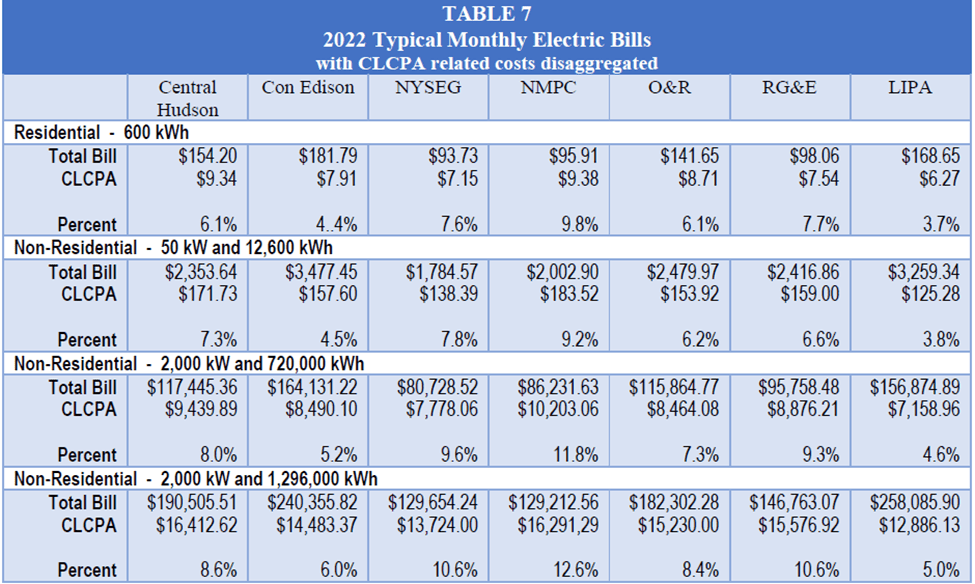
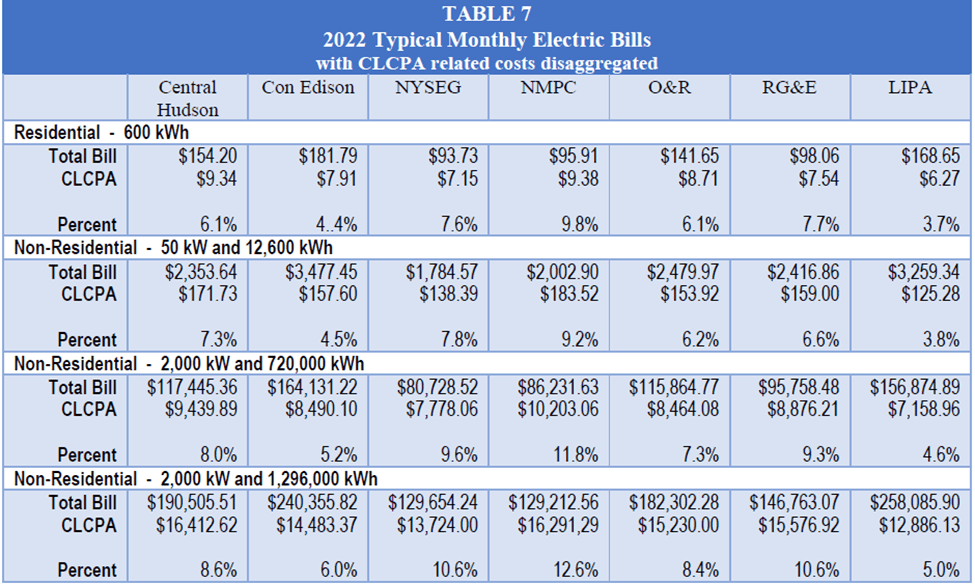
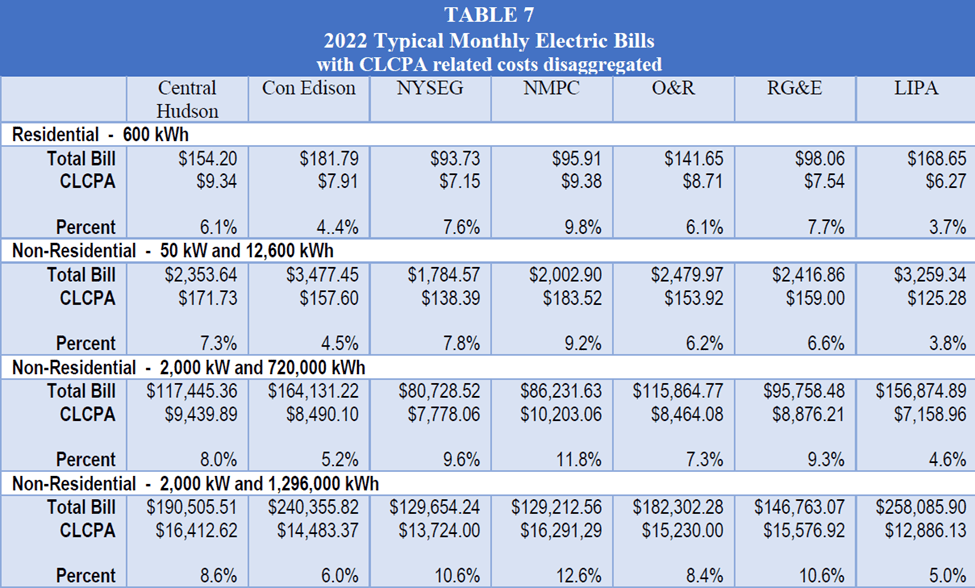
Table 6 below shows the estimated impacts, in dollars annually, of the AOC Projects for typical customers assuming the above noted energy price increase estimates. Table 7 below shows the estimated ratepayer impact, as a percentage, of the dollar increases depicted in Table 6 above for each of the major electric utilities. The percentage increases shown in Table 7 are based on 2021 typical total bills, with the exception of NYSEG and RG&E Industrial High Load Factor (HLF) customers, which is based on 2019 data – the most recent data available for these utilities.

Conclusion

The numbers are clear.  Upstate bills will rise much more than the bills for Con Ed ratepayers in New York City. The bill impacts are nearly double for most of the Upstate ratepayers.  It hardly seems equitable that rural New Yorkers have to bear the brunt of the impacts of the massive renewable development necessary for New York State’s Climate Act but also have to disproportionately pay for the privilege of having it in their backyards.

Empire Center Ten Reasons Climate Act May Cost More Than It Is Worth

James Hanley from the Empire Center published Ten Reasons the Climate Leadership and Community Protection Act May Cost More than It’s Worth (“Ten Reasons”) that explains why massive political promises like the Climate Leadership & Community Protection Act (Climate Act) often cost more than they’re worth, wasting taxpayers’ money.  While I agree with his ten reasons, this post explains why the costs are even worse than he describes.

I submitted comments on the Climate Act implementation plan and have written over 275 articles about New York’s net-zero transition because I believe the ambitions for a zero-emissions economy embodied in the Climate Act outstrip available renewable technology such that the net-zero transition will do more harm than good.  The opinions expressed in this post do not reflect the position of any of my previous employers or any other company I have been associated with, these comments are mine alone.

Background

The Climate Act established a “Net Zero” target (85% reduction and 15% offset of emissions) by 2050. The Climate Action Council is responsible for the Scoping Plan that outlines how to “achieve the State’s bold clean energy and climate agenda.”  In brief, that plan is to electrify everything possible and power the electric gride with zero-emissions generating resources by 2040.  The Integration Analysis prepared by the New York State Energy Research and Development Authority (NYSERDA) and its consultants quantifies the impact of the electrification strategies.  That material was used to write a Draft Scoping Plan that was revised in 2022 and the Final Scoping Plan  was approved on  December 19, 2022.  In 2023 the plan is to develop regulations and legislation to implement the Scoping Plan recommendations.

In the following section I reproduce Hanley’s post with my bold italicized comments.

Ten Reasons

Over budget, over time, over and over – that’s the iron law of megaprojects.  

Megaprojects are transformational, multi-billion-dollar, multi-year projects involving numerous public and private stakeholders. 90 percent come in over budget, often two, three or even more times over, and they often underdeliver on the promised benefits.  

In short, despite political promises to the contrary, they often cost more than they’re worth, wasting taxpayers’ money. 

Some notable examples of megaproject cost overruns include California’s high speed rail (years behind schedule and at least three times over budget), Boston’s Big Dig (completed five years late and more than five times over budget) and New York’s own Long Island Railroad East Side Access (12 years behind schedule and – with a budget that’s grown from $3.5 billion to between $11 and $15 billion – three to four times over budget). And that’s not New York’s only over-budget transit project

Those are all small potatoes compared to New York’s Climate Leadership and Community Protection Act (CLCPA). The overall benefit-cost analysis for the CLCPA predicts a cost of $280-$340 billion – around 20 times the cost of the East Side Access project – to radically transform New York to a net-zero greenhouse gas emissions economy. The benefit is supposed to be $420-$430 billion, for a net gain of $80-$150 billion.  

The Scoping Plan benefit-cost analysis is a shell game disguising misleading and inaccurate information.  In short, the $280-$340 billion costs only represent the costs of the Climate Act itself and not the total costs to meet the net-zero by 2050 target.  The Scoping Plan costs specifically exclude the costs of “Already Implemented” programs including the following:

  • Growth in housing units, population, commercial square footage, and GDP
  • Federal appliance standards
  • Economic fuel switching
  • New York State bioheat mandate
  • Estimate of New Efficiency, New York Energy Efficiency achieved by funded programs: HCR+NYPA, DPS (IOUs), LIPA, NYSERDA CEF (assumes market transformation maintains level of efficiency and electrification post-2025)
  • Funded building electrification (4% HP stock share by 2030)
  • Corporate Average Fuel Economy (CAFE) standards
  • Zero-emission vehicle mandate (8% LDV ZEV stock share by 2030)
  • Clean Energy Standard (70×30), including technology carveouts: (6 GW of behind-the-meter solar by 2025, 3 GW of battery storage by 2030, 9 GW of offshore wind by 2035, 1.25 GW of Tier 4 renewables by 2030)

The Scoping Plan documentation is not sufficiently detailed to determine the expected costs of these programs or to determine if the benefits calculations included the benefits of the emission reductions from these programs.  I have not doubt, however, that if these costs are included that the total would be greater than the benefits and I suspect very strongly that the benefits from these programs were included even if the costs were not. The shell game definition: “A fraud or deception perpetrated by shifting conspicuous things to hide something else”  is certainly an apt description of the Scoping Plan benefit-cost analysis.

That’s a good deal, if it really works out that way. Unfortunately, based on the history of megaprojects, it’s unlikely to provide so much benefit.  

Based on my evaluation it is not a good deal from the get go.  All of Hanley’s discussion of megaprojects below is in addition to the inaccurate starting point.

If we take the lower end cost estimate and assume the policy only costs half again as much – which would make it a rare megaproject success story – the cost would rise to $420 billion, exactly wiping out the lower end estimate of the gains.  

If it came in at twice the low-end cost estimate – which is common for such big and complex programs – it would cost $560 billion, resulting in a net loss of at least $220 billion. Three times over budget would mean a net loss of at least $410 billion – closing in on half a trillion dollars wasted. 

And if the benefits are less than predicted – which is also common – the outcome gets even worse. 

The issue is not that there aren’t any benefits. At least some of the claimed benefits are real. But just like buying a car or a meal, it’s possible to overpay for what we’re getting.  

Part of the general reason for the predictable cost overruns is that these projects tend to be exceptionally complex and innovative, novel ideas which nobody really knows how to execute well due to lack of experience. New York’s CLCPA-supporting politicians and advocates love to boast about the CLCPA being a nation-leading policy, which is to say it’s something nobody has experience doing. 

Another reason – known both from research and from the mouth of a famous politician – is that advocates sometimes intentionally mislead the public about the costs and benefits of megaprojects. Perhaps no CLCPA supporters are consciously lying about its costs, but it seems evident that it would be uncomfortable for them to dig deeply into the issue of megaproject cost, and whatever doubts they may have they are not voicing them.  

Ultimately the Climate Act is a political initiative designed to appeal to specific constituencies within the state.  In that context the Scoping Plan itself is just a tool to cater to those constituencies.  Authors of the Scoping Plan may not have lied but they did intentionally mislead the public as I have explained in posts and comments.  The response to comments submitted did not address any of the issues I raised.

But we shouldn’t look at the CLCPA as just a single megaproject. It’s actually a large group of them. Among the projects within the CLCPA that are, or may ultimately scale up to the size of, megaprojects are:  

  1. The build-out of electric vehicle charging infrastructure; 
  2. Transitioning the state’s school buses to all electric; 
  3. Transitioning the state’s public transit buses to all-electric; 
  4. Promotion of smart-growth for mobility-oriented (biking and walking) development. 
  5. Electrifying 85 percent of residential/commercial space by 2050; 
  6. Achieving 70 percent renewable electricity by 2030; 
  7. Developing 6 megawatts of battery storage; 
  8. Building 9,000–18,000 megawatts of offshore wind; 
  9. Building the grid for renewable energy transmission; 
  10. The overall agricultural and forestry portion of the CLCPA Scoping Plan
  11. Achieving dramatic reductions in the amount of solid waste being produced and disposed of; 
  12. Decarbonizing the statewide natural gas distribution system. 


That comes to at least 12 distinct policy areas within the CLCPA that are each likely to be multi-billion dollar projects on their own. Depending on how one analyzes the Act and its Scoping Plan, this may be an incomplete list. 

Keep in mind the “already implemented program” costs in the $280-$340 billion costs of the Scoping Plan.  Those programs at least include: The build-out of electric vehicle charging infrastructure; transitioning the state’s school buses to all electric; transitioning the state’s public transit buses to all-electric; developing 3 MW of the 6MW of battery storage; and building 9,000 MW of the 18,000 MW of offshore wind.

This means at least 12 opportunities for mega-failure in the CLCPA. And with 90 percent of megaprojects coming in over budget, we should expect at least 10 or 11 of these to experience substantial cost overruns. 

But saying that megaprojects tend to come in over budget and short on benefits is not enough. It’s fair to ask why this particular set of megaprojects that collectively make up the CLCPA are likely to do so. So, in addition to the sheer innovative complexity of the CLCPA’s bid to transition New York to a net zero economy, here are 10 reasons why the Climate Act’s costs may be understated, and its benefits overstated. 

  1. Inflation Bites   
    Projects that take multiple years to complete face the risk of inflation. When the CLCPA’s benefit-cost analysis was conducted, the analysts could not have anticipated that inflation would surge, pushing up the cost of materials and labor. Particularly hard hit so far have been offshore wind projects. 

    Inflation has moderated somewhat lately, but on-going large federal deficits could cause it to remain at higher levels than anticipated.
  1. Cap-and-Invest May Cause Business Flight
    Policies that cap emissions of particular chemicals, then reduce those caps over time and allow trading of emissions allowances, can be the most cost-effective way of reducing emissions when done at the national or multi-national level. Even if businesses move their operations to another country, a tariff on their emissions can be levied to either make businesses pay for those emissions or incentivize firms to reduce them.

    But cap-and-invest is ill-suited to the state level. First, it is easier for businesses to move out of state – or refuse to move into the state – than to move out of country. It is likely that other states competing for business investment will use the Empire State’s emissions cap as a way to leverage firms to look to their states for investment rather than to New York.

    This means a state-level cap-and-invest scheme is likely to diminish business investment, reducing the state’s economic growth and therefore tax revenues.

    Second, a state cannot enact an emissions tariff because it would violate the U.S. Constitution’s interstate commerce clause, so there is no cudgel to force emissions reductions on businesses that move operations out of state.  This means less overall reduction in greenhouse gas emissions because those emissions just occur elsewhere.

    This emissions “leakage,” and loss of tax revenue, can also occur if GHG-emitting in-state businesses become less competitive due to compliance costs and lose market share to out-of-state competitors.

    This kind of leakage has long plagued California’s cap-and-trade program. In New York’s case, because a majority of the CLCPA’s claimed benefits come from greenhouse gas reductions, it means a potentially very large reduction in the benefits of the policy.

    To minimize business flight and emissions leakage, the Climate Action Council proposes giving away emissions allowances to emissions-intensive and trade-exposed businesses – those that are most likely to find it more cost-effective to leave than to buy emissions allowances. But this may only be a temporary reprieve for these industries, as the number of emissions allowances is required to decline over time, and some businesses may never find it more cost-effective to reduce their emissions than to move operations out of state.

    Giving away emissions allowances also means the state will take in less revenue from auctions of emissions permits, having given away many for free, and so will have less money to invest in CLCPA policies, further reducing the law’s benefits.
  1. Union Job Requirements Drive Up Costs
    The Climate Action Council’s Scoping Plan – the roadmap for Climate Act implementation – calls for the use of union labor and project-labor agreements. But jobs go on the cost side of the ledger rather than the benefits side, so anything that increases the cost of labor increases the overall cost of the policy.

    How much this will drive up the total cost of the Climate Act has not been analyzed, but past reporting by the Empire Center shows that prevailing wage requirements can add 13 to 25 percent to project costs. And it’s not as though there aren’t New Yorkers willing to give the public a better deal – around two-thirds of workers in New York’s construction sector are non-unionized, but they will be locked out of CLCPA projects.
  2. Overbuilding of Renewable Energy and Building Energy Backup Is Costly
    The most undeniable truth about wind and solar power is that they are unreliable – the wind can fail, the sky can become clouded or night can fall, just when you need the electricity most. According to the New York Independent System Operator, New York must develop 15-45 GW of dispatchable zero-emission electricity generation resources. That’s in comparison to a total of roughly 40 gigawatts of total installed capacity today, and it must be in addition to any new wind and solar power developments.

    At a minimum, this means we have to overbuild solar and wind resources in the hopes that somewhere in the state the wind will be blowing and the sun shining. But because New York is too geographically small to ensure that the wind is always blowing, or the sun always shining, somewhere in the state, New York will also need to build backup energy sources.

    What these greenhouse gas emission-free resources will be – and how much they will cost – is currently unknown, because none are yet commercially available or competitively priced. Hydrogen is a possibility, but the cost will have to fall dramatically and quickly to keep backup power affordable.

    Batteries are also intended to be part of the backup system, although they are only good for meeting peak demand for a few hours. They are currently very expensive, even though – like all technologies – the learning curve continues to push down their price. However, materials costs for batteries may remain high for years, because demand is growing rapidly while supply chains are hindered both by political opposition to minerals mining and geopolitical constraints on mining and refining.
  3. The Cost of Redeveloping the Grid Is Unpredictable
    New York currently has, in effect, two largely – although not completely – separate power grids. One is upstate and draws heavily on hydroelectric and nuclear power. The other is mostly downstate and based on natural gas and dual-fuel power plants. Both are based on controllable and dispatchable forms of electricity production.

    To eliminate fossil fuel electricity generation and rely much more heavily on variable, uncontrollable, sources like wind and solar, New York must expand its transmission grid to move electricity from where it will be produced – primarily upstate and off-shore – to where it is needed. But this grid will have to be built so that energy can be delivered from whichever sources happen to be producing at a given time, which means more miles of high voltage transmission lines than ever before.

    Experts can make a first-pass estimate of the cost of building out all this new transmission, but the complexity of working through multiple political jurisdictions and satisfying numerous stakeholders is one of the leading causes of megaproject cost overruns. Few people want high-voltage transmission lines near their homes, and merely fighting the political battles to site these lines across numerous municipalities and counties could drive up the end cost significantly.

There is another aspect of the transmission system that the Scoping Plan glossed over.  Because wind and solar resources are inverter-based they do not provide ancillary services necessary to keep the transmission system stable.  As far as I can tell this issue was not addressed by the Scoping Plan and that means there are unaddressed technological and cost issues.

  1. The Jones Act Increases Offshore Windpower Costs
    The Jones Act is a law requiring ships moving cargo between U.S. ports to be U.S. built, owned, crewed, and flagged. There are no Jones Act compliant off-shore wind turbine building vessels in the U.S., although at least one is under construction (at an inflated cost because it has to be U.S. built). Because of the Jones Act, the available ships have to operate out of Canada or rely on the more expensive and dangerous process of having Jones Act compliant “feeder barges” bring materials out to the work site.
  2. The True Social Cost of Carbon Is Unknown
    Most of the benefit of the Climate Act doesn’t go to New Yorkers but is a world-wide benefit from the reduction of CO2 emissions. To estimate this benefit, a social cost per ton of CO2 has to be estimated. New York’s Department of Environmental Conservation (DEC) set the cost at $124 per ton for 2022, rising each year.

    But nobody truly knows the social cost of CO2. The number varies wildly between different models used to estimate it. The Biden administration has tentatively set the social cost of CO2 at $51 per ton, while it works to develop a new official estimate. Even if their estimate comes in higher than the tentative setting, it may be considerably lower than what the DEC estimates.

    Even the DEC’s own estimates diverge dependent on the discount rate used, and they chose to use only low discount rates that mathematically increase the social cost of CO2 emissions. There is no expert agreement on what discount rate should be used, and if a higher discount rate was used the social cost of CO2 would be much lower, and therefore the benefit from eliminating it would be much lower.

    While it’s not impossible that the DEC has underestimated the social cost of carbon – which would make the benefits of the CLCPA even larger than estimated – it’s at least as, if not more, likely that they’ve overestimated the social cost for political reasons, meaning the benefits could be far lower than predicted.

The primary driver of the benefits is the social cost of carbon and Hanley’s description of these issues is spot on.  There are other issues associated with social cost of carbon that I discussed in my Draft Scoping Plan comments.  The biggest inaccuracy is that it is inappropriate to claim social cost of carbon benefits of an annual reduction of a ton of greenhouse gas over any lifetime or to compare it with avoided emissions. The Value of Carbon guidance incorrectly calculates benefits by applying the value of an emission reduction multiple times.  Using that trick and the other manipulations results in New York societal benefits more than 21 times higher than benefits using everybody else’s methodology. When just the over-counting error is corrected, the total societal benefits range between negative $74.5 billion and negative $49.5 billion. 

  1. Some Alleged Benefits Are Dubious
    Not all of the claimed benefits in the benefit-cost analysis pass the sniff test. The most dubious of these is the assumption that indoor trip-and-fall hazards will be mitigated while weatherizing homes, producing almost $2 billion in health improvements. But there is no inherent connection between weatherization – replacing old windows adding insulation, sealing drafts – and removing interior trip hazards. It could happen, but to say it will is purely speculative.

    Another dubious assumption is that people will walk and bike significantly more, creating a claimed $40 billion health benefit – nearly 10 percent of all estimated benefits. But this requires major reconstruction of cities and reduced suburbanization, all in less than three decades. If that doesn’t happen and people fail to change their behavior, this benefit will be drastically reduced at best, and quite possibly come in at close to zero.

My comments on Scoping Plan benefit claims agreed with these dubious claims and also noted that the if the claims related to air quality improvements were accurate then we should be able to observe improvements due to the sixteen times greater observed air quality improvements than the projected improvements due to the Climate Act.  Until their projections are verified, I do not accept their projections.

  1. Subsidies Will Need to Increase, Creating Deadweight Economic Losses
    The Scoping Plan proposes transitioning most homes to heat pumps. Currently the only subsidies are $5,000 for geothermal systems, which is too small an amount to enable moderate- to low-income homeowners to afford them. To accomplish this goal, subsidies will have to increase substantially. Most likely this subsidy will be paid for by increases in utility rates, a de facto tax increase on ratepayers.

    But both taxes and subsidies create deadweight economic losses, increasing the cost of the policy in ways that were probably not accounted for in the benefit-cost model.

    The loss caused by the subsidy will be at least partially offset by the positive externality of reduced carbon emissions, but how much so is challenging to determine (in part because we don’t know the social cost of CO2). Ultimately, the size of these deadweight costs is unknown – and may remain so – but they are real and potentially significant.
  2. There Is No Focused Benefit-Cost Analysis of Individual Projects
    The benefit-cost analysis is a global analysis of the whole Climate Act, produced before the consultants even knew what specific policies would be proposed. None of the individual policies proposed have received a focused benefit-cost analysis.

    Even getting those right might be challenging, given that so many of these individual projects are megaprojects all on their own. But by focusing on specific policies, there is at least a better chance of achieving accuracy.

    An example of a missed opportunity is the requirement that all school districts shift to electric school buses. This will cost at least $8 – $15 billion – a broad estimate that needs to be narrowed down – but the value of the benefits is unknown. While benefits such as reductions in air pollution and improvements in student health are real, we have no dollar amount estimate of them.

    We do know that much of the benefit could be gained less expensively by shifting to clean fuel vehicles or buying newer – cleaner burning – diesel buses. Which of these approaches would provide the best benefit to cost ratio, making for the best use of taxpayer dollars? We don’t know because no analysis was conducted before creating the policy. 

Conclusion  

Perhaps not all these problems will come to pass. Inflation could moderate and remain low. Business flight and avoidance of New York due to cap-and-invest might be reduced if other states join a regional plan. Supply chain challenges for battery materials might be overcome. But others are sure to play a role, such as unionization of green jobs, the effect of the Jones Act, and the deadweight economic loss from subsidies and taxation. In addition, there could be other issues not addressed here that could cause CLCPA costs to increase. This is not intended to be a complete list.  

For these reasons, as well as the dismal history of such gigantic public ventures, it’s virtually certain that at least some, if not most, of the individual megaprojects within the CLCPA will be over budget. By how much is anyone’s guess, but it takes an unwarranted leap of faith to be confident that this time will be different. And as noted above, all it would take is for the cumulative effect of budget overruns to push the CLCPA’s cost up by half – a far better performance than most megaprojects – to completely wipe out any gains.

When the fact that the Scoping Plan costs do not include the “already implemented” programs are considered this analysis is overly optimistic.  Even without considering all the problems described in this analysis the total costs of all the programs necessart to meet the net-zero by 2050 target are greater than the alleged and impossibly optimistic benefits cited in the Scoping Plan.  Any claims that the costs of inaction are greater than the costs of inaction by proponents of the Climate Act are simply wrong.

New York Annual Climate Act Investment Requirements

I recently described my initial impression of the New York cap and invest program  and noted that it was not clear what the target revenue cap would be.  This post looks at some alternative revenue projections.

I submitted comments on the Climate Act implementation plan and have written over 270 articles about New York’s net-zero transition because I believe the ambitions for a zero-emissions economy embodied in the Climate Act outstrip available renewable technology such that the net-zero transition will do more harm than good.  I also follow and write about the Regional Greenhouse Gas Initiative (RGGI) market-based CO2 pollution control program for electric generating units in the NE United States.    I have extensive experience with air pollution control theory, implementation, and evaluation having worked on every cap-and-trade program affecting electric generating facilities in New York including the Acid Rain Program, RGGI, and several Nitrogen Oxide programs. The opinions expressed in this post do not reflect the position of any of my previous employers or any other company I have been associated with, these comments are mine alone.

Climate Act Background

The Climate Act established a “Net Zero” target (85% reduction and 15% offset of emissions) by 2050. The Climate Action Council is responsible for the Scoping Plan that outlines how to “achieve the State’s bold clean energy and climate agenda.”  In brief, that plan is to electrify everything possible and power the electric gride with zero-emissions generating resources by 2040.  The Integration Analysis prepared by the New York State Energy Research and Development Authority (NYSERDA) and its consultants quantifies the impact of the electrification strategies.  That material was used to write a Draft Scoping Plan that was revised in 2022 and the Final Scoping Plan  was approved on  December 19, 2022.  Unfortunately, the revisions only addressed the language of the draft plan and not the substance of the numbers used from the Integration Analysis.

Investment Projection

My initial impression of the New York cap and invest program post calculated a revenue projection for the proposed cap and invest program.  From 2025 to 2030 I estimate that emissions will have to go down 14.76 million tons per year to meet the 2030 GHG emissions target.  New York’s investments in the Regional Greenhouse Gas Initiative yield an expected cost per ton reduced of $537 for a total of $7.9 billion.  Governor Hochul proposed “legislation to create a universal Climate Action Rebate that, subject to a stakeholder and rulemaking process, is expected to drive more than $1 billion in annual cap-and-invest proceeds to New Yorkers”.  If the $1 billion is added then the total revenues would be $9 billion per year.

Scoping Plan Cost Projection

The primary documentation for the numbers presented in the Scoping Plan is the Tech Supplement Annex 2. Key Drivers Outputs spreadsheet. The Scoping Plan has been described as a “true masterpiece in how to hide what is important under an avalanche of words designed to make people never want to read it.”  The spreadsheet is worse.  Not only is the information provided buried in a massive spreadsheet but the authors of the Integration Analysis presented misleading, inaccurate, and biased data to support the narrative that the costs of inaction are more than the costs of action. I have extracted the relevant tabs from the massive reference spreadsheet into my analysis spreadsheet to address the first concern.

The data in the Integration Analysis that is used in the Scoping Plan is misleading.  On one hand as many numbers are possible are only provided relative to a Reference Case instead of a status quo or business-as-usual case that represents the full costs of the control strategies necessary to meet the net-zero by 2050 Climate Act goal.  I maintain that the true cost of New York’s net-zero transition by 2050 should include all costs associated with all programs designed to reduce GHG emissions.  The authors of the Integration Analysis and Scoping Plan excluded decarbonization costs that I believe should be included and provided insufficient documentation to enable anyone to determine what is in or out of the Reference Case.  For example, consider the supporting data for Figure 48 (Fig 48 tab in my spreadsheet). 

Note the transportation investments in the Reference Case total $1.056 trillion but that the cost for the Low-Carbon Fuels scenario is only $3.4 billion more.  That means most of the costs associated with capital and operating expenses for light-duty vehicles, medium- and heavy-duty vehicles, and buses as well as charging infrastructure costs are buried in the Reference Case because these costs are a lot more than $3.4 billion.

The cost data in the Integration Analysis that is used in the Scoping Plan is inaccurate.  For example, in the calculations for the new wind, solar, and energy storage resources needed to replace existing fossil-fired resources it is assumed that none of the existing or newly developed resources reach their effective life expectancy.  Wind, solar, and energy storage resources all have expected lifetime less than 25 years and it is more than 25 years to 2050 so this inaccurately underestimates the cost of electric generation.

The data in the Integration Analysis that is used in the Scoping Plan is biased.  Wind and solar resources are intermittent so the assumption of the amount of energy produced affects the projected capacity of resources needed.  Without exception the future amount of energy from wind and solar resources is biased high relative to the New York Independent System Operator projections.  As a result, the costs projected are unreasonably low.  Based on my evaluation the Integration Analysis biased every choice to make the zero-emissions replacement resources cheaper.

I emphasize that the annual revenue numbers that I believe should be clearly listed in the Integration Analysis and Scoping Plan are not provided so I can only make an estimate.  Given all the limitations described above, the revenue values in the final row in the Figure 48 table shown above should be used cautiously.  The annual expenditure values listed are the difference between the mitigation scenarios and the Reference Case divided by the number of investment years (27) from 2024 to 2050.  The values range between $10 and $11 billion.

Other Cost Projections

I have heard other numbers tossed around so I did a bit of research to find other values.

In testimony regarding the environmental provisions of Governor Cuomo’s Executive Budget Proposal for SFY 2020-2021, Peter Iwanowicz, Executive Director, Environmental Advocates of NY, January 27, 2020 stated:

The costs of inaction are enormous. Based on the widely accepted social cost of carbon pollution of $50 per ton, New York has $10.2 billion dollars in costs per year attributed to the pollution we emit that is fueling climate change. This is a staggering blow to our health, our environment, our communities, and our economy.

Back calculating this projection assumes 204 million tons which is about the total CO2 emissions for 2017.  The problem is that social cost of carbon parameter can only be applied once because it represents all the impacts from the time of the reduction to 2300.  Counting them more than once is the same as claiming that because I lost ten pounds five years ago that I lost 50 pounds.

New York Lawyers for the Public Interest Nov. 8 Elections show that New Yorkers Overwhelming Support Climate Funding:

The Bond Act is a good start—but it’s not enough. It’s been three years since New York passed our landmark climate law, the Climate Leadership and Community Protection Act (CLCPA), and we’re far from achieving the law’s mandate of largely decarbonizing the state economy by 2040. The state’s own analysis shows that we’ll need to invest roughly $15 billion a year by 2030, and $45 billion a year by 2050.

The Integration Analysis does include annual projections for net direct costs of between $10.4 and $12.2 billion for 2030 and between $41.0 and $41.3 billion in 2050.

New York Renews: Climate Coalition launches campaign for state action

Among NY Renews’ key goals for the upcoming legislative session is the creation of a $10 billion Climate and Community Protection Fund, modeled after the state’s Environmental Protection Fund. It’s an amount in line with the Climate Action Council’s estimates of what meeting the goals in the climate plan will cost: $10 to 15 billion a year, whether the costs are paid by the state, the federal government, industry, ordinary New Yorkers, or a mix of all of the above.

There are enough options for guessing what the Council estimates as costs that these numbers are consistent.

I found a couple of independent estimates of the total costs to meet the net-zero target by 2050: An article by Ken Gregory critiques a report  by Thomas Tanton “Cost of Electrification: A State-by-State Analysis and Results”.  In Tanton’s analysis the estimated total installed cost (overnight) is approximately for New York is $1.465 trillion or $54.3 billion per year.  Gregory’s total national capital cost of electrification is $433 trillion and New York’s proportional share based on Tanton is $22.2 trillion.  Overbuilding solar and wind by 21% reduces New York overall costs to $18.2 trillion.  Allowing fossil fuels with carbon capture and storage to provide 50% of the electricity demand reduces New York’s estimated costs to $1.2 trillion or $44.4 billion per year.

Conclusion

The New York Senate held a public hearing to examine legislative and budgetary actions necessary to implement the Climate Act Scoping Plan on January 19, 2023.  One of the primary concerns of the legislative and budgetary actions has to be how much money is required.  I modified the draft of this post to submit as a comment.  The main point I wanted to make is that it is very important that the Legislature understand that the numbers presented in the Scoping Plan are inappropriate for any future legislative actions.  Those actions must be based on the total costs of implementation and not just the costs relative to a Reference Case.  Beyond that I offered no substantive recommendation for revenues needed because of the inadequate documentation in the Scoping Plan.

I determined the emissions reduction trajectory needed to meet the 2040 GHG emissions target, calculated the control cost per ton removed based on the RGGI auction proceed investments, and found that a total of $7.9 billion per year is needed.  That is the low-end cost of the projections.  At the upper end three projections exceed $45 billion a year.  All these estimates will impose extraordinary cost burdens on New Yorkers.  No one in the Hochul Administration has owned up to these costs.  When will this news become public knowledge?

Finally, all the cost per ton reduced estimates in these projections exceed the New York State Value of Carbon guidance.  The Frequently Asked Questions guidance states:

The term value of carbon is any representation of monetary cost applied to a unit of greenhouse gas emissions, expressed in terms of the net cost of societal damages (i.e., the “social cost of carbon”), marginal greenhouse gas abatement cost, or using another approach. DEC recommends that State agencies use a damages-based value of carbon for cost-benefit analysis, for describing societal benefits, and evaluating other types of decisions, such as state procurement, contracts, grants, or permitting.

This means that all these projected costs exceed the cost-benefit analysis for describing societal benefits.  New York’s greenhouse emissions are less than one half of one percent of global emissions and global emissions have been increasing by more than one half of one percent per year.  The facts that the expected investments exceed the societal benefits values and that all New York emission reductions will be replaced by emissions from elsewhere in a year does not mean that we should not do something, but it does mean we should take the time to do it right. 

New York Energy Storage Roadmap – Cost Projections

On December 28, 2022, the New York State Energy Research & Development Authority (NYSERDA) and the New York State Department of Public Service (DPS) filed New York’s 6 GW Energy Storage Roadmap to the Public Service Commission (PSC) for consideration.  This post gives an overview of the roadmap and an initial assessment of the cost assessment methodology.

Everyone wants to do right by the environment to the extent that they can afford to and not be unduly burdened by the effects of environmental policies.  I submitted comments on the Climate Act implementation plan and have written over 250 articles about New York’s net-zero transition because I believe the ambitions for a zero-emissions economy embodied in the Climate Act outstrip available renewable technology such that the net-zero transition will do more harm than good.  The opinions expressed in this post do not reflect the position of any of my previous employers or any other company I have been associated with, these comments are mine alone.

New York Energy Storage Plan

The NYSERDA Energy Storage in New York web page gives an overview of New York’s plan:

In 2019, New York passed the nation-leading Climate Leadership and Community Protection Act (Climate Act), which codified some of the most aggressive energy and climate goals in the country.

  • 6,000 MW of Solar by 2025
  • 70% Renewable Energy by 2030
  • 9,000 MW of Offshore Wind by 2035
  • 100% Carbon-free Electricity by 2040
  • 85% Reduction in GHG Emissions from 1990 levels by 2050
  • 3,000 MW of Energy Storage by 2030, further increased to 6,000 MW of Energy Storage by 2030 by Governor Kathy Hochul

Energy storage will play a crucial role in meeting our State’s ambitious goals. Storage will help to integrate clean energy into the grid, reduce costs associated with meeting peak electric demands, and increase efficiency. Additionally, energy storage can stabilize supply during peak electric usage and help keep critical systems online during an outage.

The Roadmap proposes a comprehensive set of recommendations to expand New York’s energy storage programs to cost-effectively unlock the rapid growth of renewable energy across the State and bolster grid reliability and customer resilience. If approved, the Roadmap will support a buildout of storage deployments estimated to reduce projected future statewide electric system costs by nearly $2 billion, in addition to further benefits in the form of improved public health as a result of reduced exposure to harmful fossil fuel pollutants.

The Roadmap proposes the implementation of NYSERDA-led programs towards procuring an additional 4.7 GW of new storage projects across the bulk (large-scale), retail (community, commercial and industrial), and residential energy storage sectors in New York State. These future procurements, combined with the existing energy storage already under contract with the State and moving towards commercial operation, will allow the State to achieve the 6 GW goal by 2030.

Keep in mind that New York’s net-zero by 2050 plan is and always has been a political initiative developed by a small group and foisted upon the state by the emotion-driven innumerates of the New York Legislature.  Accordingly, the release of the Energy Storage roadmap warranted a press release from the Governor:

Governor Kathy Hochul today announced a new framework for the State to achieve a nation-leading six gigawatts of energy storage by 2030, which represents at least 20 percent of the peak electricity load of New York State. The roadmap, submitted by the New York State Energy Research and Development Authority and the New York State Department of Public Service to the Public Service Commission for consideration, proposes a comprehensive set of recommendations to expand New York’s energy storage programs to cost-effectively unlock the rapid growth of renewable energy across the state and bolster grid reliability and customer resilience. If approved, the roadmap will support a buildout of storage deployments estimated to reduce projected future statewide electric system costs by nearly $2 billion, in addition to further benefits in the form of improved public health because of reduced exposure to harmful fossil fuel pollutants. Today’s announcement supports the Climate Leadership and Community Protection Act goals to generate 70 percent of the state’s electricity from renewable sources by 2030 and 100 percent zero-emission electricity by 2040.

One phrase in this paragraph is the reason I wrote this post. It says “the roadmap will support a buildout of storage deployments estimated to reduce projected future statewide electric system costs by nearly $2 billion”.  I will show that what it really means is that we think we can claim that the costs will be nearly $2 billion dollars less than the astronomical total cost that we don’t admit to the public because it won’t reflect well on the narrative of the state’s Climate Act.

Chapter 3: Role of Storage Targets

New York’s 6 GW Energy Storage Roadmap (Roadmap) explains that “energy storage has the potential to play a critical role in supporting a deeply decarbonized New York electricity grid, through its ability to integrate large quantities of variable renewable energy and provide reliable capacity to meet growing peak demand”.  

The document describes the role of energy storage.  Note that the emphasis is on short-term storage for intra-day requirements for the 6 GW by 2030 target.

Figure 5 illustrates the role of energy storage in shifting generation to meet load, based on Roadmap analysis of the New York electricity system under portfolios consistent with the Climate Act. On days with excess solar, the modeled battery storage system charges from excess solar power concentrated in the middle of the day. Battery storage then helps the system to maintain reliability in events when load is high, and overnight when wind generation is low. Alternately, on low renewable output days, storage can charge from other resources, including imports, and reduce the need for more expensive firm resources.

Figure 5. Energy Value: Storage Dispatch in Modeled Analysis of the New York Electric System in 2040

The Roadmap document claims that it is appropriate to increase the energy storage deployment target of 3 GW by 2030 to 6 GW.  It states:

The analysis performed for this Roadmap (see Section A.1 in Appendix A) estimates that deployment of 6 GW of storage by 2030 will yield an estimated $1.94 billion (net present value) in net societal benefits to New York, due to increased delivery of renewable energy and reduced reliance on other more expensive firm capacity resources. These benefits reflect the value of avoided electricity system expenditures. Further societal benefits, not quantified here, would include improved air quality in communities impacted by fossil generation.

Furthermore, the analysis highlights the opportunity to leverage federal incentives to build out most of the expected 2040 storage deployments earlier, given that these credits could phase down as early as 2032. This Roadmap analysis finds that nearly all the 12 GW of storage chosen in the modeling is deployed by 2035, to meet system needs and maximize cost-effectiveness by capturing the federal Investment Tax Credit. Figure 6 illustrates these analytical findings, indicating that the projected 2040 quantity of 12 GW could be fully deployed as early as 2035 in order to maximize this opportunity. This context underscores the importance of an increased 2030 target of 6 GW in order to position New York to pursue such an accelerated opportunity.

Figure 6. Statewide Battery Storage Capacity Targets and Storage Deployment to Meet System Needs

Appendix A Storage Capacity Expansion Analysis

Appendix A documents the analysis conducted for the Roadmap.  It turns out that the analysis is basically the 2022 updated Integration Analysis for the revisions to the Scoping Plan.  The Appendix summarizes the approach but often refers to the Appendix G Scoping Plan documentation for specifics.  My experience with that reference information is that it is not nearly as comprehensive as implied by this document.

NYSERDA relies on Energy and Environmental Economics (E3) for the modeling analyses that provide the basis for the Roadmap.  E3 has a capacity expansion model, RESOLVE, and loss of load probability model, RECAP.  RESOLVE “optimizes long-term generation and transmission investments subject to reliability, technical, and policy constraints.”  RECAP performs “loss-of-load probability simulations to determine the reliability of resource portfolios and the contribution from each resource within it.”   The models “develop least-cost electricity generation portfolios that achieved New York’s Climate Act goals with the new 6 GW storage by 2030 target and meet New York’s long term energy needs.”  However, note that these models simplify the New York generating system so they do not do as good a job projecting the future system as the New York Independent System Operator (NYISO) models.

The E3 modeling for the Integration Analysis was used to estimate loads and costs starting in 2020.  That means that it is possible to check the model predictions against observations.  The Roadmap states: “Current costs are about 10% higher than those assumed in the 2018 Storage Roadmap and about 40% higher than that assumed in the 2021 Integration Analysis”.  In my opinion a 40% difference in cost over a few years does not lend any credibility to costs out to 2050.

The Roadmap notes reasons for the energy storage cost projection differences:

Over the past year, supply chain constraints, material price increases, and increased competition for battery cells have driven up the cost of energy storage technologies, particularly lithium-ion batteries. Many of the drivers of cost increases are expected to persist until at least 2025. These cost increases may impact the cost of any new programs designed to procure storage to be installed by 2030. In addition to cost increases, difficulties in the timely completion of interconnection processes, high interconnection costs, and downward pressure on capacity revenue create a challenging environment through the development and operational lifecycle of a storage project. Financial support will therefore be crucial for the state to achieve the 3 GW and 6 GW deployment goals.

One of my major concerns with the Scoping Plan projections was the overly optimistic projections of energy cost reductions which I believe were used to claim lower costs of the net-zero transition.  Despite the failure to project current costs in the 2021 Integration Analysis, the Roadmap doubles down saying that “Cost declines are assumed to begin in 2025 as manufacturing capacity expands, and benefits of scale and innovation are realized”.  The document does not explain why the concerns noted above are going to turn around so quickly or, for that matter, why given global competition for the same rare earth metals necessary for the energy storage won’t see those conditions persist for many years.

Appendix B: Storage Program Cost Analysis

This Appendix “summarizes the inputs, assumptions, and analysis methodology underpinning the estimates of incremental program costs associated with achieving the proposed 2030 target of 6 GW of short-duration storage”.   The Roadmap states:

The total cost of these proposed procurement programs is estimated at between $1.0 billion and $1.7 billion. This equates to an estimated increase in customer electric bills of 0.32% – 0.54% (or $0.34 – $0.58 per month for the average residential customer) on average across New York for the 22-year period during which these programs would make payments to awarded projects. The range of these projections reflects future uncertainties, most notably those associated with energy and capacity prices.

The way this is written it suggests that the energy storage costs will be manageable because it will only be at most $0.58 per month.  However, Appendix B states:

For the proposed bulk storage procurement program, program costs are calculated as the incremental revenue, on top of revenue that storage assets can realize through commercial operation in the existing energy markets, that would allow such assets to reach their cost of capital. This methodology is broadly consistent with that applied to cost studies under the Clean Energy Standard.66 Key assumptions and inputs include the costs of storage projects, the estimates of market revenue available to them, available federal incentives and the cost of capital.

This approach is disingenuous at best.  They are not providing all the program costs only the costs above what they think an energy storage owner will have above the expected “incremental” revenue.  That incremental revenue has to be paid by someone and that someone is the ratepayers of the state.  As I understand it the “incremental revenues” are composed of at least the subsidies that are being proposed for energy storage that are like renewable energy credits.  Those subsidies are not paid for in the NYISO’s wholesale energy market but are buried in utility rate cases.  Moreover, it is not clear if the Roadmap includes energy storage specific wholesale energy market payments as other “incremental” revenue.  In any event, the insinuation that the energy storage cost is only going to be “between $1.0 billion and $1.7 billion” is clearly misleading and inaccurate.

Conclusion

There is a lot to unpack in the Roadmap and I will follow up with future posts.  Even at first glance there are issues.  Not only does the study rely on the poorly documented Integration Analysis as its basis but it also replicates its shell game con for hiding the true costs.  In the Scoping Plan costs are compared to a Reference Case that includes already “incremented programs” and in this Roadmap costs are presented relative to “incremental revenues”.  In both instances the result is a deceptive cost estimate that does not include all the costs for the citizens of New York.

It gets worse.  The continued increase in subsidized resources in the NYISO’s wholesale energy market will on average suppress market prices which will result in the need for larger subsidies to make renewable developments viable.  Gresham’s Law of Green Energy is named after Sir Thomas Gresham, a 16th-century British financier who observed that “bad money drives out the good.”. In this context  subsidized renewable resources will drive out competitive generators, lead to higher electric prices, reduce economic growth, and likely lead to the need to subsidize competitive generators who provide critical resources but are no longer viable.  Finally, keep in mind that almost all project development costs are funded through NYSERDA non-recourse loans. In open capital markets that is the most expensive money there is to finance. 

The Roadmap claims “the roadmap will support a buildout of storage deployments estimated to reduce projected future statewide electric system costs by nearly $2 billion”.  The only reductions are relative to very high projected costs.  It appears that the Hochul Administration goal is hide the expenditure of hundreds of billions of dollars under hundreds of programs and subsidies making it intentionally impossible to capture the total costs to consumers.  The true “Total Cost” of the Climate Act will be hidden forever from the public by design. 

Climate Act Scoping Plan Costs Shell Game

In the past twelve months I have spent an inordinate amount of time evaluating the Climate Leadership and Community Protection Act (Climate Act) and the Scoping Plan implementation plan framework to meet the ambitious net-zero goal by 2050.  Climate Action Council Co-Chair Harris recently made the claim that delaying climate action will cost New Yorkers more than acting now.  However, that statement is misleading and inaccurate.  This post shows that the claim is no more than a shell game gimmick.

Everyone wants to do right by the environment to the extent that they can afford to and not be unduly burdened by the effects of environmental policies.  I submitted comments on the Climate Act implementation plan and have written over 250 articles about New York’s net-zero transition because I believe the ambitions for a zero-emissions economy embodied in the Climate Act outstrip available renewable technology such that the net-zero transition will do more harm than good.  The opinions expressed in this post do not reflect the position of any of my previous employers or any other company I have been associated with, these comments are mine alone.

Climate Act Background

The Climate Act establishes a “Net Zero” target (85% reduction and 15% offset of emissions) by 2050. The Climate Action Council is responsible for preparing the Scoping Plan that will outline how to “achieve the State’s bold clean energy and climate agenda.”  The Integration Analysis prepared by the New York State Energy Research and Development Authority (NYSERDA) and its consultants quantifies the impact of the strategies.  That material was used to write a Draft Scoping Plan that was released for public comment at the end of 2021. The final Scoping Plan was approved by the Climate Action Council on December 19, 2022 and the Integration Analysis documentation was recently updated.

Documentation Shell Games

The Scoping Plan has been described as “a true masterpiece in how to hide what is important under an avalanche of words designed to make people never want to read it”. The Implementation Analysis quantitative assessment goes further.  It does not even pretend to clearly include what is important to evaluate the numbers that are used in the Scoping Plan.  There is no concise documentation that includes the costs, expected emission reductions and assumptions used for the control strategies included in the Integration Analysis documentation.  Instead, these is a massive spreadsheet with key drivers and input assumptions for all aspects of the transition.  The public is left to try to decipher what is included in each control strategy, figure out how the information was used, and then calculate what the results are for all control strategies.

The first shell game gimmick picks and chooses what control strategies are included in the costs of de-carbonization.  In order to evaluate the effects of different policy options, The Integration Analysis model projects future conditions for a baseline case.  The evaluation analysis makes projections for different policy options, and then the results are compared relative to the baseline.  Standard operating procedure for this kind of modeling is to use a business-as-usual or status quo case for the baseline.  Appendix G Section 3.4: Benefits and Costs argues that the costs of the control strategies should be considered relative to status quo or business as usual costs:

When viewed from a systems expenditure perspective (Figure 48), the NPV of net direct costs for Scenarios 2, 3, and 4 are moderate, roughly 11% as a share of the NPV of reference case system expenditures ($2.7 trillion). Because significant infrastructure investment will be needed to maintain business as usual infrastructure within the state irrespective of further climate policy, redirecting investment away from status quo energy expenditures and toward decarbonization is key to realizing the aims of the Climate Act.

Figure 51 from Appendix G is the documentation for the claim that the cost of inaction exceeds the cost of action by more than $115 billion.  In my Draft Scoping Plan comments I argued that the figure is mis-leading because it presents the numbers relative to a Reference Case rather than a business-as-usual or status quo case that represents a future without decarbonization programs.  I maintain that the true cost of New York’s net-zero transition by 2050 should include all costs associated with all programs designed to reduce GHG emissions.  The authors of the Integration Analysis and Scoping Plan excluded decarbonization costs that I believe should be included and provided insufficient documentation to enable anyone to determine what is in or out of the Reference Case. 

In the Scoping Plan shell game, the first thing to watch is the claim that “significant infrastructure investment will be needed to maintain business as usual infrastructure within the state irrespective of further climate policy, redirecting investment away from status quo energy expenditures and toward decarbonization is key to realizing the aims of the Climate Act” but at the same time including decarbonization costs for “already implemented” programs in the Reference Case.  If a reader loses track of this shell, it is easy to assume that the costs presented are relative to a business-as-usual or status quo modeling scenario per standard procedures.  Instead, the State compares mitigation scenario costs to a Reference Case that includes “already implemented” decarbonization costs.

There is another shell to watch.  In my review of the Draft Integration Analysis supplement, I ended up searching the document for the phrase “reference case” to try to determine what “already implemented” decarbonization programs were included in the Reference Case.  The following figure reproduces the page with the documentation on page 12 in Appendix G Integration Analysis Technical Supplement Section I. The documentation is buried in the footnote for the circled reference for the blank caption to Figure 4. 

Given its importance to the cost/benefit claim, my Draft Scoping Plan comment noted that this reference case caveat should be clearly described in the text rather than in a footnote.  What I missed in the draft was a reference to explanatory text in section 5.3 of the document.  However, that text was not included in the draft document! The appropriate text is in the recently released Appendix G section 5.3: Scenario Assumptions chapter and lists the “already implemented” programs.  It states:

The integration analysis evaluated a business-as-usual future (Reference Case) a representation of recommendations from CAC Advisory Panels (Scenario 1), and three scenarios designed to meet or exceed GHG limits and carbon neutrality (Scenarios 2 through 4). Scenarios 2, 3, and 4 all carry forward foundational themes based on findings from Advisory Panels and supporting analysis but represent distinct worldviews. A detailed compilation of scenario assumptions can be found in Annex 2.

For the record Annex 2 refers to a  massive spreadsheet that is certainly detailed but most certainly does not provide an easily accessible compilation of scenario assumptions.  In particular, the documentation does not provide explicit information to determine what costs are specifically included in the Reference Case relative to the other scenarios.

The Reference Case described as “Business as usual plus implemented policies” includes the following:

  • Growth in housing units, population, commercial square footage, and GDP
  • Federal appliance standards
  • Economic fuel switching
  • New York State bioheat mandate
  • Estimate of New Efficiency, New York Energy Efficiency achieved by funded programs: HCR+NYPA, DPS (IOUs), LIPA, NYSERDA CEF (assumes market transformation maintains level of efficiency and electrification post-2025)
  • Funded building electrification (4% HP stock share by 2030)
  • Corporate Average Fuel Economy (CAFE) standards
  • Zero-emission vehicle mandate (8% LDV ZEV stock share by 2030)
  • Clean Energy Standard (70×30), including technology carveouts: (6 GW of behind-the-meter solar by 2025, 3 GW of battery storage by 2030, 9 GW of offshore wind by 2035, 1.25 GW of Tier 4 renewables by 2030)

Figure 47 shows the total net present value (NPV) of direct costs relative to the Reference Case over the period 2020-2050.  However, these bar charts provide little information.

It is more useful to look at a table of the values to try to understand how the Reference Case costs differ from the mitigation scenarios.  That information is available in the IA-Tech-Supplement-Annex-2-Key-Drivers-Outputs-2022 spreadsheet.   One thing that jumps out is the $3.45 billion difference for the Transportation Investment between the Reference Cased and the Low-Carbon Fuels Scenario.  There are only two decarbonization programs included in the Reference Case: Corporate Average Fuel Economy (CAFE) standards and Zero-emission vehicle mandate (8% LDV ZEV stock share by 2030).   In my opinion that $3.45 billion difference either indicates that most of the EV electrification costs are improperly included in the Reference Case or that the cost estimates are suspect.

I found that both issues contribute to the small difference between the Reference Case and the Low-Carbon Fuels scenario.  According to the Scoping Plan the costs to replace light-duty vehicles, trucks, and buses with electric alternatives, provide the charging infrastructure to support those vehicles, and upgrade public transit services is only $3.45 billion over 30 years.  For the most part the only reason for those expenses is decarbonization and whether it is explicitly part of the Climate Act or not, those costs should be included in the costs of the Climate Act.  They have to be hundreds of billions of dollars. I have no doubts that proper accounting would reduce or reverse the alleged favorable benefit-cost ratio if just this is correctly attributed.

I believe that the cost estimates are also suspect.  My Draft Scoping Plan Comment on Electric Vehiclesanalyzed the Integration Analysis spreadsheet documentation.  The Integration Analysis presumes that the device costs for zero-emissions charging technology and the vehicles themselves decrease significantly over time.  Home EV chargers and battery electric vehicles both are claimed to go down 18% between 2020 and 2030 alone.  The following graph of electric vehicle costs shows that the costs for battery electric and hydrogen fuel cell vehicles that are the proposed solution go down over time.   The costs for gas, diesel, and Plug-in Hybrid Electric vehicles are all identical and stay pretty constant.  Given that PHEV also use batteries, why wouldn’t that technology cost decrease similar to the full battery EV.  The overall cost decreases in the preferred technologies are so large that the total costs for the zero-emissions vehicles adoption is cheaper than using existing technology.  My comments noted that I cannot accept this optimistic assessment of future cost reductions without documentation that addresses at least the potential for battery supply chain issues.  The Climate Action Council “acknowledged” my comment by providing a link but never addressed the issues that I raised.

Conclusion

A shell game is defined as “A fraud or deception perpetrated by shifting conspicuous things to hide something else.”  In the Scoping Plan shell game, the authors argue that energy costs in New York are needed to maintain business as usual infrastructure even without decarbonization policies but then include decarbonization costs for “already implemented” programs in the Reference Case baseline contrary to standard operating procedure to use a status quo baseline for this kind of modeling.  The documentation for Reference Case assumptions was missing in the draft documents. Shifting legitimate decarbonization costs to the Reference Case because they are already implemented and hiding the documentation fits the shifting condition of the shell game deception definition perfectly. 

The deceptions of the Scoping Plan are furthered by ignoring stakeholder input that ran contrary to their narrative.  Climate Action Council Co-Chair Harris recently claimed that the stakeholder “comments, letters, and engagement have absolutely impacted this process and the plan it has produced for the better.”  I see no evidence that the Climate Action Council addressed my Integration Analysis comments on the benefits and costs evaluation or any other stakeholder comments associated with quantitative Integration Analysis issues.