
Capital Tonight – Seggos on the Climate Transition

To her credit Susan Arbetter, the host of Spectrum News Capital Tonight program, has tried to expose viewers to issues related to the Climate Leadership & Community Protection Act (Climate Act).  Unfortunately, she allows speakers from the Hochul Administration to constantly conflate extreme weather with climate change and misleadingly claim that the costs of inaction are more than the costs of action.  In this post I comment on her February 12 interview with Basil Seggos on the climate transition.

I have followed the Climate Act since it was first proposed, submitted comments on the Climate Act implementation plan, and have written over 400 articles about New York’s net-zero transition. The opinions expressed in this post do not reflect the position of any of my previous employers or any other organization I have been associated with, these comments are mine alone.

Overview

The Climate Act established a New York “Net Zero” target (85% reduction in GHG emissions and 15% offset of emissions) by 2050.  It includes an interim 2030 reduction target of a 40% reduction by 2030 and a requirement that all electricity generated be “zero-emissions” by 2040. The Climate Action Council (CAC) is responsible for preparing the Scoping Plan that outlines how to “achieve the State’s bold clean energy and climate agenda.”  In brief, that plan is to electrify everything possible using zero-emissions electricity. The Integration Analysis prepared by the New York State Energy Research and Development Authority (NYSERDA) and its consultants quantifies the impact of the electrification strategies.  That material was used to develop the Draft Scoping Plan outline of strategies.  After a year-long review, the Scoping Plan was finalized at the end of 2022.  In 2023 the Scoping Plan recommendations were supposed to be implemented through regulation, PSC orders, and legislation.  Not surprisingly, the aspirational schedule of the Climate Act has proven to be more difficult to implement than planned and many aspects of the transition are falling behind.  In addition, the magnitude of the necessary costs is coming into focus despite efforts to hide them.  A political reckoning is inevitable in my opinion.

Seggos Interview: Climate transition will be ‘the toughest thing we ever do’

The video of the interview is available but I am going to concentrate on two paragraphs from the cover story on the Capital Tonight webpage:

The cost of the doing nothing on climate will far outweigh the cost of a climate transition for New York, according to state Department of Environmental Conservation (DEC) Commissioner Basil Seggos, who addressed concerns on Capital Tonight. 

“I just want to make sure viewers are clear. People are already paying for the impacts of climate change. That is a certainty. We spent $36 billion to recover from Superstorm Sandy,” Seggos said. “We see a $55 billion bill, potentially, if we don’t do the right things in New York, just on adaptation over the next 10 years.”

The political slogan “the cost of the doing nothing on climate will far outweigh the cost of a climate transition” is repeated as often as possible by representatives of the Hochul Administration.  It is a deeply flawed argument for multiple reasons. 

It is misleading because it refers to the costs in the Scoping Plan that do not include the costs of “already implemented” programs that exist solely to reduce GHG emissions.  In other words, it does not include all the costs to reach net zero Climate Act targets only the costs of programs started after the Climate Act itself. The two biggest programs not included in the cost side of the slogan are the Zero-emission vehicle mandate (8% LDV ZEV stock share by 2030) and the Clean Energy Standard (70×30), including technology carveouts: (6 GW of behind-the-meter solar by 2025, 3 GW of battery storage by 2030, 9 GW of offshore wind by 2035, 1.25 GW of Tier 4 renewables by 2030).  These programs, among others, are listed in Section 5.3: Scenario Assumptions in New York State Climate Action Council Scoping Plan Appendix G: Integration Analysis Technical Supplement Section I page 130.

The ”cost of doing nothing” does not include benefits of GHG emission reductions.  The basis for the benefits are described in the  Scoping Plan Costs and Benefits white paper documents.  The actual numbers in that document have been updated since its release.  The Plan describes health benefits due to improvements in air quality but observed improvements in recent years are 16 times greater than those projected for the Climate Act.  If the State can show that the health benefits projected have been observed comparable to those observed then these benefits are supportable but there has never been any attempt to validate the estimates. 

The benefits include a couple of tenuous estimates.  The first is for “active transportation”. The active transportation health theory claims that as people are forced out of their personal vehicles some will switch to walking and biking.  Those activities are healthier so there is a benefit.  The increased active transportation benefit of $39.5 billion is based on a first-order approximation based on state-wide numbers but the benefits will likely only occur in certain areas.  As a result, the benefit estimate is far too high.  The second is for energy efficiency interventions benefits in low- and middle-income homes.  The majority of the health benefits claimed are the result of “non-energy interventions”.  The Climate Act intends to transform the energy sector so it is disingenuous to claim health benefits not directly related to energy efficiency programs themselves.  Of the $8.7 billion in benefits claimed $3 billion is due to reduction in asthma-related incidents resulting from better ventilation not directly due to energy efficiency.  The $2.4 billion in benefits from reduced trip or fall injuries and reduced carbon monoxide poisoning benefits are non-energy interventions and should not be claimed as benefits for GHG emission reduction programs. 

The final reason that the slogan is flawed is the biggest.  There are issues with the benefits for the societal avoided cost of GHG emissions known as the social cost of carbon or value of carbon.  The values used are determined by a wide range of value judgements and economic projections.  The Climate Act manipulates emissions to increase benefits and uses a lower discount rate than current Federal guidance resulting in societal benefits of GHG emission reductions that are 4.5 times higher for 1990 emissions and 5.4 times higher for 2019 emissions than other jurisdictions.  The largest manipulation of these benefits is caused by incorrect guidance for calculating benefits.  In particular, the benefits of reductions are counted multiple times.  If only that error is corrected the total benefits do not outweigh the projected costs.

Another Climate Act narrative tactic is to claim that people are already paying for the impacts of climate change.  Seggos said “We spent $36 billion to recover from Superstorm Sandy” implying that climate change was responsible for those costs.  The difference between weather and climate is constantly misunderstood by Climate Act proponents that make this simplistic argument. 

According to the National Oceanic and Atmospheric Administration’s National Ocean Service “Weather reflects short-term conditions of the atmosphere while climate is the average daily weather for an extended period of time at a certain location.”  The referenced article goes on to explain “Climate is what you expect, weather is what you get.”  Seggos consistently claims that extreme weather is proof of climate change but the interview showed he has no meteorological expertise whatsoever.  More than once when described implementation challenges he stated that the state is facing trade winds but the appropriate term is head winds.

If, in fact, Superstorm Sandy was connected to climate change then the weather over extended periods of time should show increased hurricane activity and there should be a trend in disaster losses.  Roger A. Pielke, Jr, specializes in tracking these parameters so I checked his work.

He posted information in June 2022 on hurricane trends on Atlantic hurricane activity.  He noted that:

1. The Intergovernmental Panel on Climate Change, in its latest report, concluded that there remains “no consensus” on the relative role of human influences on Atlantic hurricane activity.

Here is what the IPCC says exactly:

“[T]here is still no consensus on the relative magnitude of human and natural influences on past changes in Atlantic hurricane activity, and particularly on which factor has dominated the observed increase (Ting et al., 2015) and it remains uncertain whether past changes in Atlantic TC activity are outside the range of natural variability.”

One reason for the inability to unambiguously attribute causality to Atlantic hurricane activity is the large interannual and interdecadal variability. 

Pielke, Jr. argues that in order to assess disaster loss trends ”it is necessary to normalize disaster losses by taking into account changes in exposure and vulnerability.”  He explains that:

The UN Sendai Framework recommends looking at disaster losses as a proportion of GDP as a method of normalization.

Since 1990, the toll of disasters as a proportion of the global economy has gone down from about 0.25% of GDP to less than 0.20%. That is good news and indicates progress with respect to the goals of the Sendai Framework.

Some quick questions and answers.

  • Can we conclude from this data that climate change is making disasters more frequent or costly? No
  • Can we conclude from this trend that climate change signals are not detectable in trends in various extreme events? No
  • What can we say about climate change by looking at this graph? Nothing
  • What about those journalists and campaigners who claim that economic losses from disasters indicate the detection and attribution of trends in extreme weather? They are wrong
  • How would we know if disasters are becoming more costly due to climate change? Follow this methodology

Needless to say the Scoping Plan ignored these recommendations and observations when it justified the Climate Act.  It is also obvious that these inconvenient results are routinely ignored by apologists for the Climate Act.

There is one final aspect of the slogan “the cost of the doing nothing on climate will far outweigh the cost of a climate transition” that needs to be considered.  The implication is that New York’s investments for the climate transition will make a difference.  I recently updated my post Climate Act Emission Reductions in Context that documented how New York GHG relate to global emission increases.  I found CO2 and GHG emissions data for the world’s countries and consolidated the data in a spreadsheet.  There is interannual variation, but the five-year annual average has always been greater than 0.79% until the COVID year of 2020.  The Statewide GHG emissions inventory came out in December but the comparable GWP-100 data that I used from Open Data NY through 2021 are not available.  This analysis relies on last year’s data.  New York’s share of global GHG emissions is 0.42% in 2019 so this means that global annual increases in GHG emissions are greater than New York’s total contribution to global emissions.  Our actions will have no effects on the next superstorm because the increase in annual global emissions are greater than our total emissions. Implying other wise is disingenuous.

With all due respect to Commissioner Seggos, his cost benefit rationale for the Climate Act transition or his claim that climate change is affecting costs now do not stand up to scrutiny. Consider that the largest benefit claimed is based on counting benefits multiple times.  If I managed to lose five pounds and keep it off for five years I cannot claim that I lost 25 pounds but that is what the basis for the slogan is doing. The IPCC science directly contradicts the insinuation that hurricane trends are outside the range of normal variability.

Conclusion

Seggos claimed that the climate transition will be ‘the toughest thing we ever do’. I think it might be the worst thing we ever do.   The Climate Act transition plan is poorly documented, results are obfuscated, and there are no transparent cost estimates.  As a result, I do not believe that the Hochul Administration has made a persuasive case that the transition is feasible with regards to affordability and reliability.  I am disappointed that the media does not call them out on this.

Howarth’s Adverse Impact on New York Cap-and-Invest

In January 2023 I wrote an article describing Dr. Robert Howarth’s statement supporting his vote to approve the Climate Leadership and Community Protection Act (Climate Act) Scoping Plan.  Roger Pielke, Jr. recently did an interesting piece on the Biden Administration decision to halt the permitting of the continued expansion of U.S. liquified natural gas (LNG) export capacity that featured a link to Howarth and his position on methane.  It provides more evidence that a “Professor of Ecology & Environmental Biology” is unqualified to be considered an expert on methane emissions.  His misleading guidance adversely impacts the New York Cap-and-Invest program.

I have followed the Climate Act since it was first proposed, submitted comments on the Climate Act implementation plan, and have written over 400 articles about New York’s net-zero transition. The opinions expressed in this post do not reflect the position of any of my previous employers or any other organization I have been associated with, these comments are mine alone.

Overview

The Climate Act established a New York “Net Zero” target (85% reduction in GHG emissions and 15% offset of emissions) by 2050.  It includes an interim 2030 reduction target of a 40% reduction by 2030 and a requirement that all electricity generated be “zero-emissions” by 2040. The Climate Action Council (CAC) is responsible for preparing the Scoping Plan that outlines how to “achieve the State’s bold clean energy and climate agenda.”  In brief, that plan is to electrify everything possible using zero-emissions electricity. The Integration Analysis prepared by the New York State Energy Research and Development Authority (NYSERDA) and its consultants quantifies the impact of the electrification strategies.  That material was used to develop the Draft Scoping Plan outline of strategies.  After a year-long review, the Scoping Plan was finalized at the end of 2022.  In 2023 the Scoping Plan recommendations were supposed to be implemented through regulation, PSC orders, and legislation.  Not surprisingly, the aspirational schedule of the Climate Act has proven to be more difficult to implement than planned and many aspects of the transition are falling behind, and the magnitude of the necessary costs is coming into focus. 

Howarth and the Climate Act

Howarth takes pride in his role in the Climate Act.  I previously explained that the statement of Robert W. Howarth, Ph.D., the David R. Atkinson Professor of Ecology & Environmental Biology at Cornell University was very illuminating relative to the motives of the Climate Act authors.  He reiterated his claim that he played a key role in the drafting of the Climate Act, developed the methane requirements, and credited one politician for getting the Act passed:

Assembly Person Steven Englebright was hugely instrumental in the passage of the Climate Leadership & Community Protection Act that established the Climate Action Council. I thank him for his leadership on this, and particularly for his support of the progressive approach on greenhouse gas emissions that is a central part of the CLCPA. I originally proposed this to Assembly Person Englebright in 2016, and he enthusiastically endorsed and supported it through multiple versions of the bill that finally led to passage of the CLCPA in 2019. In this accounting for greenhouse gases, a major government for the first time ever fully endorsed the science demonstrating that methane emissions are a major contributor to global climate change and disruption. Further, in passing the CLCPA New York recognized that consumption of fossil fuels (and not simply geographic boundaries) is what matters in addressing the climate crisis. New York wisely banned the use of high-volume hydraulic fracturing (“fracking”) to develop shale gas in our State. But since the time of that ban, the use of fossil natural gas has risen faster in our State than any other in the Union. Methane emissions from this use of shale gas are high, but much of that occurs outside of our boundaries in the nearby states of Pennsylvania, West Virginia, and Ohio. Through the CLCPA, the citizens of New York are taking responsibility for these out-of-state emission caused by our use of fossil fuels, particularly for fossil natural gas. The way to reduce these emissions is to rapidly reduce our use of fracked shale gas.

Unfortunately, Howarth’s influence on Climate Act implementation also extended into the Climate Action Council. As a member of the Climate Action Council, Howarth was considered a subject matter expert and most members unquestioningly accepted whatever he said.  This deference to his concerns is also apparent in the Integration Analysis and Scoping Plan.  In my previous article I explained why many of his claims were not supportable.

Methane

At the time the Climate Act was written it incorporated unique emissions accounting requirements that elevate the importance of methane to Climate Act compliance.  In particular, the Climate Act specifies that the global warming potential (GWP) must be calculated over a 20-year time horizon.  The Inter-governmental Panel on Climate Change (IPCC) describing time horizons and the GWP[1] notes:

“The GWP has become the default metric for transferring emissions of different gases to a common scale; often called ‘CO2 equivalent emis­sions’ (e.g., Shine, 2009). It has usually been integrated over 20, 100 or 500 years consistent with Houghton et al. (1990). Note, however that Houghton et al. presented these time horizons as ‘candidates for discussion [that] should not be considered as having any special sig­nificance’. The GWP for a time horizon of 100 years was later adopted as a metric to implement the multi-gas approach embedded in the United Nations Framework Convention on Climate Change (UNFCCC) and made operational in the 1997 Kyoto Protocol. The choice of time horizon has a strong effect on the GWP values — and thus also on the calculated contributions of CO2 equivalent emissions by component, sector or nation. There is no scientific argument for selecting 100 years compared with other choices (Fuglestvedt et al., 2003; Shine, 2009). The choice of time horizon is a value judgement because it depends on the relative weight assigned to effects at different times.”


Howarth and others argued that it was necessary for the Climate Act to use 20-year global warming potential (GWP) values because methane is estimated to be 28 to 36 greater than carbon dioxide for a 100-year time horizon but 84-87 GWP over a 20-year period.  Because of these high potentials they assumed that meant that the effect of methane on expected warming would be significant.

I have noted that this irrational obsession with methane that is incorporated in the Climate Act is inappropriate. The fundamental flaw with the basis for vilifying methane is that it is based on selective choice of the science and ignores inconvenient aspects of radiation physics which indicate that the laboratory measurements of global warming potential do not translate to the atmosphere where it counts. 

LNG Export Terminal Pause

I originally was going to include this link in my fortnightly “Articles of Note” post but decided to elevate it into a focused post because of a reference to Howarth.  Roger Pielke, Jr did an interesting piece on the Biden Administration decision to halt the permitting of the continued expansion of U.S. liquified natural gas (LNG) export capacity.  He describes the activist rationale for the LNG export expansion halt “included in a letter to President Biden from a group of activists, including the University of Pennsylvania’s Michael Mann and Stanford’s Mark Jacobson”:

Taken together, if all U.S. projects in the permitting pipeline are approved, they could lead to 3.9 billion tons of greenhouse gas emissions annually, which is larger than the entire annual emissions of the European Union. A forthcoming study by Cornell University climate scientist Robert Howarth shows that, even in the best-case scenarios, LNG is at least 24 percent worse for the climate than coal. Increasing LNG exports will mean increased extraction of fossil fuels and climate pollution and directs us away from a renewable energy future.

[1] Reference: Myhre, G., D. Shindell, F.-M. Bréon, W. Collins, J. Fuglestvedt, J. Huang, D. Koch, J.-F. Lamarque, D. Lee, B. Mendoza, T. Nakajima, A. Robock, G. Stephens, T. Takemura and H. Zhang, 2013: Anthropogenic and Natural Radiative Forc­ing. In: Climate Change 2013: The Physical Science Basis. Contribution of Working Group I to the Fifth Assessment Report of the Intergovernmental Panel on Climate Change [Stocker, T.F., D. Qin, G.-K. Plattner, M. Tignor, S.K. Allen, J. Boschung, A. Nauels, Y. Xia, V. Bex and P.M. Midgley (eds.)]. Cambridge University Press, Cambridge, United Kingdom and New York, NY, USA.

Pielke, Jr. writes that this policy decision raises three concerns. 

  1. “The Biden Administration made a decision before producing the evidence on which such a decision is supposed to be based.
  2. The Biden Administration decision ignores the “geopolitical and security implications of the decision”.
  3. Finally, there appears to be no consideration of the economic impacts of the decision.

I recommend reading the article in its entirety.

The reason I turned this into a focused post is because Pielke, Jr. included a previously unknown to me reference regarding Howarth. His quote from the activist letter mentions a forthcoming study by Howarth which Pielke, Jr. described as follows:

The study referenced above suggesting that LNG is worse than coal in terms of greenhouse gas emissions is by Robert Howarth of Cornell University, and is both contrary to a broad scientific consensus on this issue and a lone outlier.

Of particular interest is the footnote associated with the “lone outlier” label.  Pielke, Jt. states:

The story behind the new Howarth study is for another day. I’ll just note here that in 2012 Howarth told a reporter that he was performing anti-fracking research for hire — The reporter explained: “In an interview, Howarth told me his goal was to make the anti-fracking movement mainstream and fashionable. He said he met with the Ithaca-based [Park] foundation two years ago, agreeing to produce a study challenging the conventional wisdom that shale gas is comparatively clean…Howarth hired an aggressive PR firm, the Hastings Group, to promote his politicized viewpoint.”

This is smoking gun evidence that New York’s unique characterization of methane and Climate Act policy requirements is based on the politicized and financially advantageous work of a for hire scientist. 

Discussion

On January 23, 2024, the New York State Department of Environmental Conservation (DEC) and the New York Energy Research & Development Authority (NYSERDA) hosted the first webinar of this year’s New York Cap-and-Invest (NYCI) Program stakeholder engagement process.  One of the points made in the first webinar was that under Governor Hochul’s direction, New York’s cap & invest program will incorporate these guiding principles:

  • Affordability. Craft a program to deliver money back to New Yorkers to ensure energy affordability
  • Climate Leadership: Catalyze other states to join New York, and allows linkage to other jurisdictions
  • Creating Jobs and Preserving Competitiveness: Protect existing jobs and support new and existing industries in New York
  • Investing in Disadvantaged Communities: Ensure 35%+ of investments benefit Disadvantaged Communities
  • Funding a Sustainable Future: Support ambitious clean energy investment

There are ramifications of the reliance on Howarth’s work for the first two principles: affordability and climate leadership links to other jurisdictions.

Last spring I described a Climate Act Revisions Kerfuffle when the Hochul Administration floated the suggestion to revise the emissions accounting methodology to use the Global Warming Potential over 100 years instead of 20 years because of a concern with cost.  Climate Action Council co-chairs Doreen Harris and Basil Seggos argued that:

“First and foremost, the governor is trying to maintain New York’s leadership on climate. It’s a core principle that she brought into office and we have been carrying that out for several years,” said Seggos.

But Gov. Hochul instructed both the DEC and NYSERDA to look at the affordability of Cap & Invest.

“We began running the numbers on that, based on some of the metrics being used by Washington state and some of our own, and revealed some…potentially extraordinary costs affiliated with the program,” Seggos explained. “So that’s really what this is.  It isn’t a focus necessarily on methane itself, or any particular pollutant. It is how do we implement the CLCPA in a way that doesn’t put extraordinary costs on the pockets of New Yorkers.”

The climate activist organizations went ballistic and the Administration bowed to the pressue.  Activists claimed:

“When Governor Hochul tried to sneak in a fossil-fueled methane accounting method that would gut New York State’s Climate Act during the final push of budget negotiations, New York’s climate and environmental justice movement responded swiftly and powerfully. NY Renews is proud to stand with a movement that stopped—for now—changes to New York’s progressive 20-year methane accounting method as written in law.” 

The Summary Report for the 2023 Statewide GHG Emissions Inventory  explains the effect of GWP-20 accounting and other policy requirements of the Climate Act on emissions:

When considering emission sources only within New York State and using a GWP100, CO2 is a much greater component of total emissions (Figure 3). The main difference is the CLCPA’s focus on shorter-lived methane and HFCs, which appear much larger using the 20-year GWP, although the actual mass of these emissions has not changed. The other key difference between the accounting frameworks is out-of-state emissions. Over time, New York State has imported more natural gas and has exported more waste. Methane is a major source of emissions for both the natural gas system and waste management.

In 2021 total GHG emissions were 367.87 million metric tonnes of CO2 equivalent using the Climate format (GWP-20) and to the best of my review of the data (it does not appear to match Figure 3) the GWP-100 total is 214.4 million metric tonnes of CO2 equivalent.  If the allowance costs per ton for NYCI remain the same, then costs to the state will be 72% higher using the Howarth inspired accounting.

The second Hochul principle is “climate leadership” which is described as “catalyze other states to join New York and allow linkage to other jurisdictions”.  I think it is a heavy lift to catalyze other states to join New York if most of the rest of the world is using a different accounting system, particularly when the rationale for that approach does not stand up to scrutiny.  I know that it will likely be impossible for New York to link to the California/Quebec and Washington cap-and-invest programs.  The different accounting methodology is a high hurdle and when combined with the upstream emissions accounting with the potential for double counting, it just won’t happen.

Conclusion

With all due respect to Dr. Howarth, it is appropriate to consider why a “Professor of Ecology & Environmental Biology” is qualified to be an expert on methane emissions.  Combined with the revelation that he set out to “make the anti-fracking movement mainstream and fashionable” in conjunction with the Park Foundation, the motives for his methane obsession suggest his analyses are biased to get a particular answer.  The State of New York has failed to rein him in so reconciling the inconsistencies with his pseudo-science and Hochul’s principles is a problem of their own making.  It matters to all New Yorkers because it will increase costs directly and indirectly because links to other jurisdictions could make the allowance market stronger and cheaper.

NYCI Webinar Preliminary Scenario Analyses – Cost Projections

On January 26, 2024 the New York State Department of Environmental Conservation (DEC) and the New York Energy Research & Development Authority (NYSERDA) hosted the third  webinar (slides and recording) of this year’s New York Cap-and-Invest (NYCI) Program stakeholder engagement process.  I described the first webinar “The Role of Cap and Invest” in an earlier post.  This post presents my initial impressions of the third webinar of the series, “Preliminary Scenario Analyses”, with particular emphasis on the projected costs.

I have followed the Climate Leadership & Community Protection Act (Climate Act)  since it was first proposed, submitted comments on the Climate Act implementation plan, and have written over 380 articles about New York’s net-zero transition. The opinions expressed in this post do not reflect the position of any of my previous employers or any other organization I have been associated with, these comments are mine alone.

Overview

The Climate Act established a New York “Net Zero” target (85% reduction in GHG emissions and 15% offset of emissions) by 2050.  It includes an interim 2030 reduction target of a 40% reduction by 2030 and a requirement that all electricity generated be “zero-emissions” by 2040. The Climate Action Council (CAC) is responsible for preparing the Scoping Plan that outlines how to “achieve the State’s bold clean energy and climate agenda.”  In brief, that plan is to electrify everything possible using zero-emissions electricity. The Integration Analysis prepared by the New York State Energy Research and Development Authority (NYSERDA) and its consultants quantifies the impact of the electrification strategies.  That material was used to develop the Draft Scoping Plan outline of strategies.  After a year-long review, the Scoping Plan was finalized at the end of 2022.  In 2023 the Scoping Plan recommendations were supposed to be implemented through regulation, PSC orders, and legislation.  Not surprisingly, the aspirational schedule of the Climate Act has proven to be more difficult to implement than planned.  Many aspects of the transition are falling behind, and the magnitude of the necessary costs is coming into focus.  When political fantasies meet reality, reality always wins.

Cap-and-Invest

The Climate Action Council’s Scoping Plan recommended a market-based economywide cap-and-invest program.  The program works by setting an annual cap on the amount of greenhouse gas pollution that is permitted to be emitted in New York: “The declining cap ensures annual emissions are reduced, setting the state on a trajectory to meet our greenhouse gas emission reduction requirements of 40% by 2030, and at least 85% from 1990 levels by 2050, as mandated by the Climate Leadership & Community Protection Act (Climate Act).”  In addition to the declining cap, it is supposed to limit potential costs to New Yorkers, invest proceeds in programs that drive emission reductions in an equitable manner, and maintain the competitiveness of New York businesses and industries. The stakeholder engagement process will refine the proposal over the next several months, DEC will and NYSERDA will propose regulations by summer, and the final rules are supposed to be in place by the end of the year.

The reality is different particularly because the proposal changes components that have worked in other jurisdictions and environmental activists want to remove certain components that have made similar programs work in the past.  The proposed regulations keep many of the necessary features but still make changes that threaten viability.  Further background information is available at my carbon pricing initiative page.

Preliminary Scenario Analysis Webinar

The slides and recording for the webinar are available.  Note that in the following text there are links to sections of the webinar recording corresponding to specific topics. 

The entire webinar was scripted.  Each presenter read their remarks and it even appeared that the responses to questions were vetted.  Vlad  Gutman-Britten (NYSERDA) read the script that gave an overview of the webinar outline. The goal of this webinar was to describe the preliminary scenario analysis that projects how the NYCI allowance market will operate, present expected costs to households, and describe potential benefits of associated emission reductions.  I focus on the costs to households in this post.

NYCI Modeling

The preliminary scenarios analysis relies on econometric models.  The presentation was pretty vague on exactly which models were used and who did the work.  It appears that it relies heavily on the analyses done for the Scoping Plan.  If that is true then note that there was no suggestion that those analyses had been updated since they were done in 2022.

To give context for the cost results I briefly describe the modeling.  The analyses must project allowance supply and demand.  Gutman-Britten described the following slide that gives an overview of the analysis approach. 

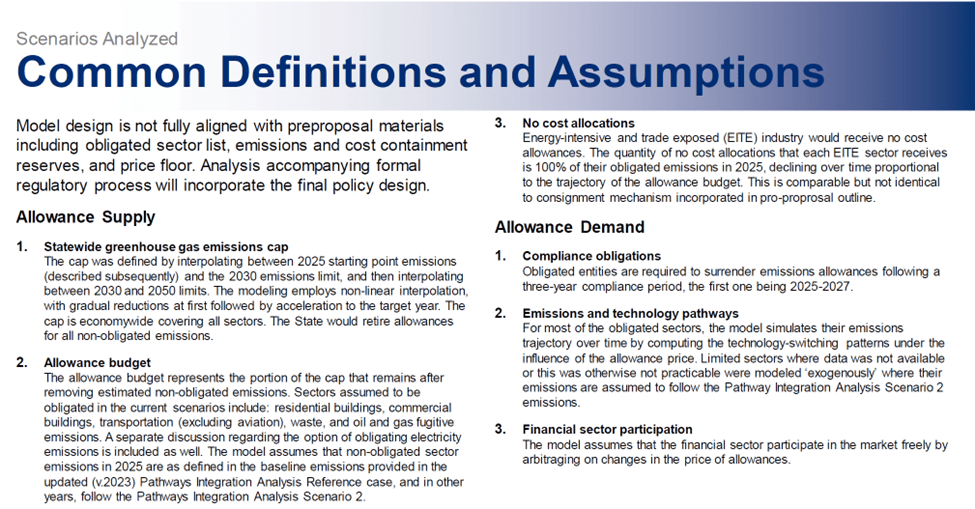
Allowance supply is based on the statewide greenhouse gas emissions cap:

The cap was defined by interpolating between 2025 starting point emissions (described subsequently) and the 2030 emissions limit, and then interpolating between 2030 and 2050 limits. The modeling employs non-linear interpolation, with gradual reductions at first followed by acceleration to the target year. The cap is economywide covering all sectors. The State would retire allowances for all non-obligated emissions.

In general, the allowance budget represents the allowable number of tons for each year of the emissions cap.  However, the NYCI proposal treats different sectors of the economy differently to address distinctions between the sectors.  To appease particular political constituencies, specific exemptions to all or part of sector  allowance requirements have been incorporated into the proposed plan. 

The modeling analysis balances the cap with expected emissions to estimate allowance demand for each sector.  All the obligated entities will be required to “surrender emissions allowances following a three-year compliance period, the first one being 2025-2027.”  For each ton emitted they must submit one allowance.  The modeling estimates the expected emissions based on “technology pathways”.  I think this technological jargon hides the fact that feasibility is not incorporated into these modeling results. 

The final aspect of this modeling is financial sector participation: “The model assumes that “the financial sector participates in the market freely by arbitraging on changes in the price of allowances.”  This is an aspect of the modeling where I think theory is not fully aligned with what actually happens in a market-based pollution control program.

The point I wanted to make in this summary of the modeling is that all these projections are subject to enormous uncertainty.  There are many aspects of each energy sector transition that are subject to interpretation and the biases of the modelers.  As a result, it is easy to get results that coincide with the pre-determined outcomes consistent with the political narrative.

At this time, the modeling analyses for the auction project that 2030 total revenue is “estimated to be between $6 and $12 billion per year ($4-8 billion available for investments).”  Sparse details for this calculation were provided and I was not able to reproduce those numbers.

Household Costs

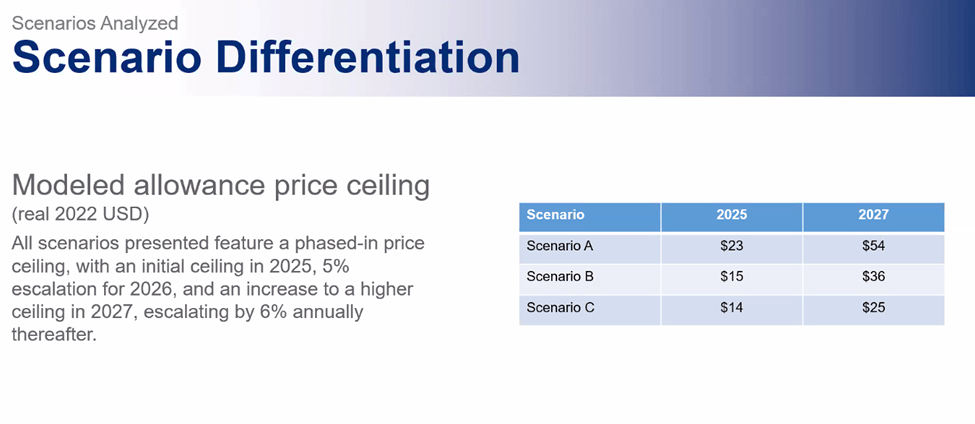
The projected costs from the modeling analysis are included for three scenarios described by Gutman-Britten in the following slide.  The analysis modeled three different price ceiling trajectories. The price ceiling value represents the allowance price that triggers a safety valve that would make additional allowances available “for buyers until demand is fully met limited to actual emissions.”  The scenarios “follow similar paths but have different price levels for each one.”  No explanation was provided justifying the initial price ceiling for each scenario or the timing of the jump step in allowance prices in 2027. 

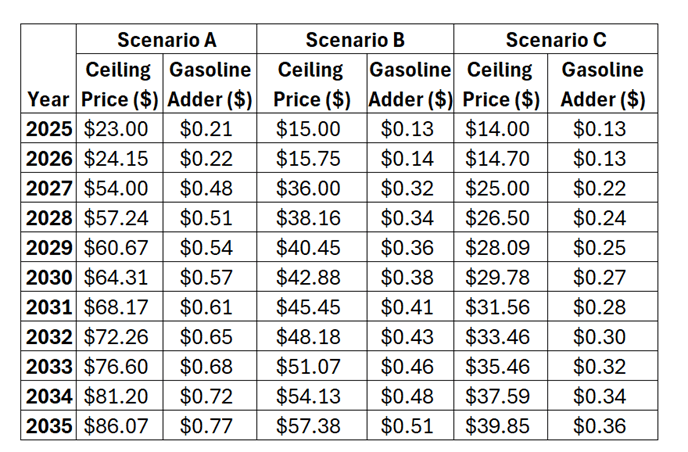
I have always maintained that the primary concern of the general public is Climate Act costs.  This presentation does not provide comprehensive cost estimates.  In the following table I list the ceiling prices by year for the different scenarios and the corresponding gasoline cost adder as an example of potential costs.   According to the US Energy Information Administration, 17.86 lbs of CO2 are emitted per gallon of finished motor gasoline which means that 112 gallons burned equals one ton. 

At first glance the 2025 gasoline price adder is not that large.  However, the market price for allowances has always been noticeably higher at the start of all allowance trading programs.  The uncertainty of a new program lead to higher prices that typically fall back as the program matures.  I think the actual price adder at the start of the program will be higher.  The other notable feature is the step change increase in 2027.  The values listed in 2027 are comparable to the California/Quebec and Washington program allowance prices so I think those prices are more reasonable for eventual New York prices.  I suspect there is a connection between the proposed low ceiling prices through 2026 and the 2026 gubernatorial election year that explains the timing of the step change in 2027.

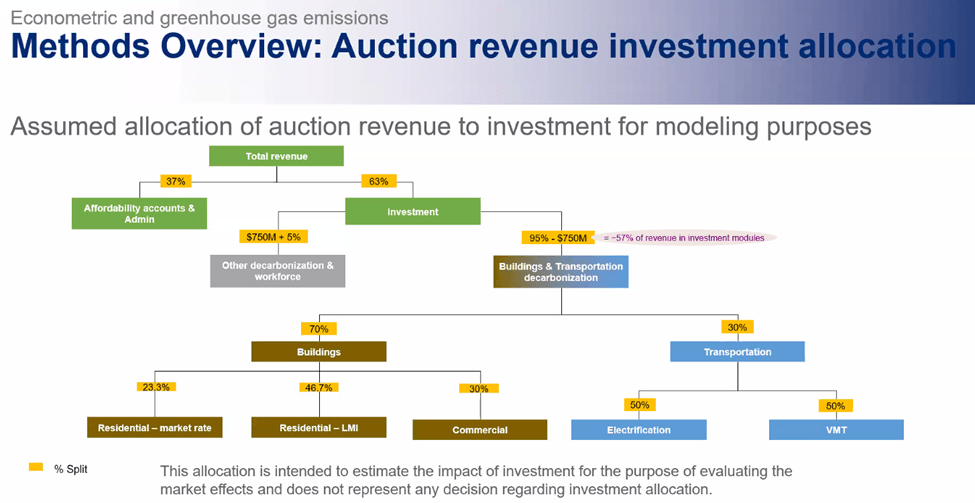
Last year legislation mandated that funds be allocated to the Consumer Climate Action Account (CCAA) as part of the overarching investment framework established for NYCI.  As noted in the following slide and explained by Guttman-Britten the first 37% of revenue generated by NYCI auctions is “set aside for the affordability accounts, the Consumer Climate Action Account, the industrial small business climate action account and administrative expenses.”  The Consumer Climate Action Account itself is supposed to get 30% of the revenues.  Recall that 2030 total revenue is “estimated to be between $6 and $12 billion per year” so the Consumer Climate Action Account should get between $3.3 and $1.5 billion in 2030.

In the summary of the modeling overview Gutman-Britten read the script claiming that NYCI has the ability to effectively manage total costs:

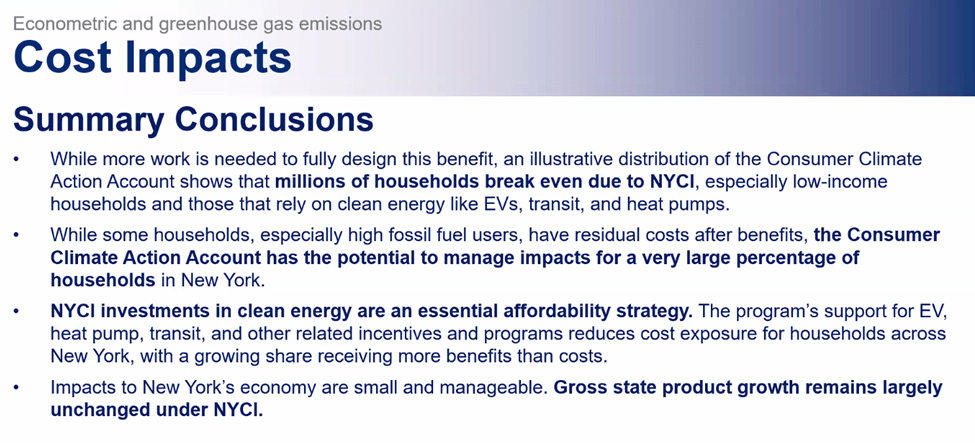
  • Initial analysis shows that millions of households would break even after NYCI, especially lower income and low energy use households.
  • Although some households, especially high fossil fuel users, are likely to have residual costs after benefits, total cost impacts may be managed for a very large percentage of households.
  • In addition to driving emission reductions, NYCI investments are an essential affordability strategy. The program’s support for EV, heat pump, transit, and other related incentives and programs reduces cost exposure for households across New York, with a growing share receiving more benefits than costs.

The analysis relies on the 30% of revenues allocated to the CCAA to offset much of the cost.  Insufficient detail was provided in the webinar to evaluate those claims and if the past is any guide there will never be sufficient documentation to verify them.  In my opinion this modeling was designed to get specific answers consistent with the Hochul Administration narrative.

Household Impacts

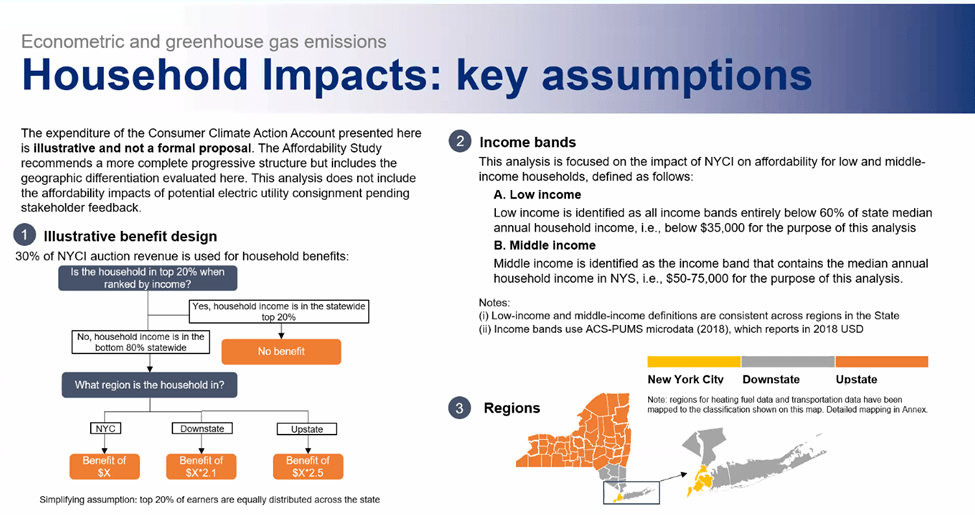
James Wilcox read the script for the Household Impacts discussion. His presentation emphasized the point that these estimates were illustrative examples and not a formal proposal.  The following slide is an overview and makes the point that these results are “focused on the impact of NYCI on affordability for low and middle- income households”.  Those households are defined as follows:

  • Low income is identified as all income bands entirely below 60% of state median annual household income, i.e., below $35,000 for the purpose of this analysis.
  • Middle income is identified as the income band that contains the median annual household income in NYS, i.e., $50-75,000 for the purpose of this analysis.

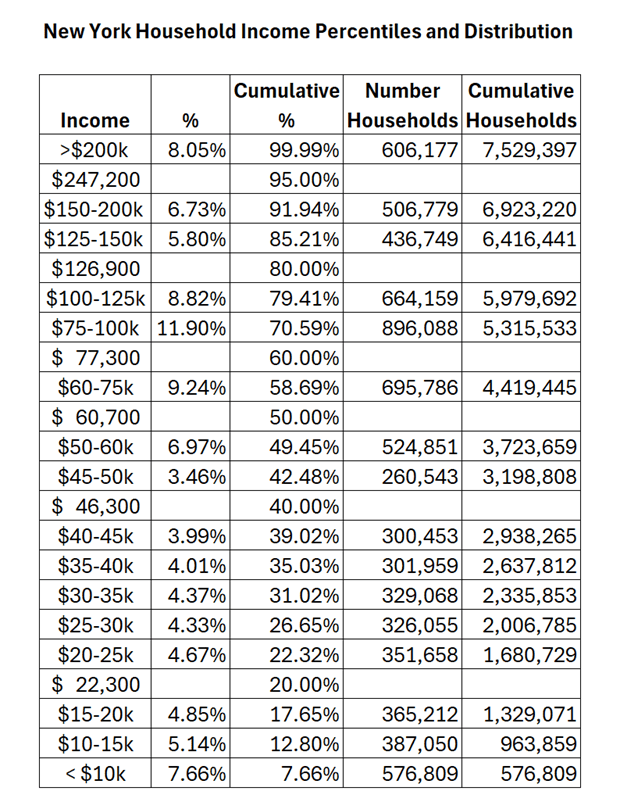
The illustrative benefit design flow chart from the key assumptions slide deserves more discussion especially because if you are like me these numbers have no context.  I found an overview of New York household income at Statistical Atlas that included two graphs.  I combined data from the income percentiles and webinar income distribution graphs in the following table.  The webinar assumes that there will be no benefit for households in the top 20% which according to the table corresponds to an income exceeding $126,900.  There are six million households under that threshold which means that 1.5 million households in the top 20% of income will get no benefit.  Low-income households are those below $35,000 and there are 2.3 million households in that category.  There are 2.1 million households above $35,000 but below $75,000.  Middle income is identified as the income band that contains the median annual household income in NYS, i.e., $50-75,000 for the purpose of the NYCI analysis.  That leaves 1.6 million households with income between $75,000 and $126,900.  No information for expected benefits was provided for this last category.  Left unsaid was how the CCAA funds are distributed across these categories.

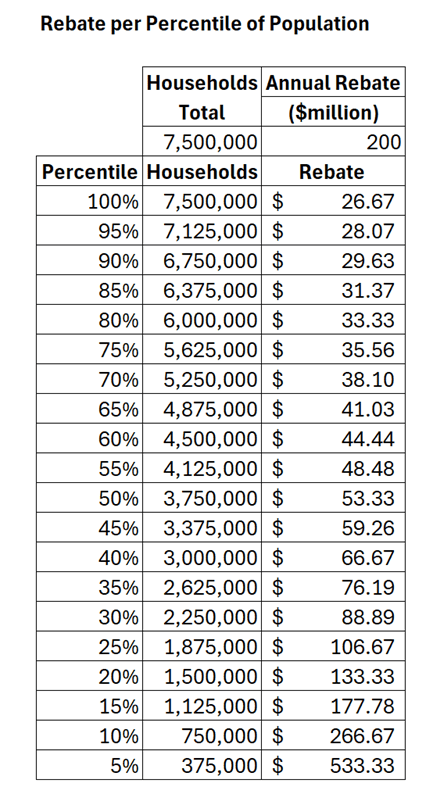
I have not been able to find a reference for the expected CCAA monthly distribution.  The household numbers can be used to guess at the distribution. Previously I noted that the CCAA should get between $3.3 and $1.5 billion in 2030. According to this table about six million households are eligible for a CCAA distribution so if every eligible household gets the same share, then the monthly distributions will range between $45 and $21 per month.

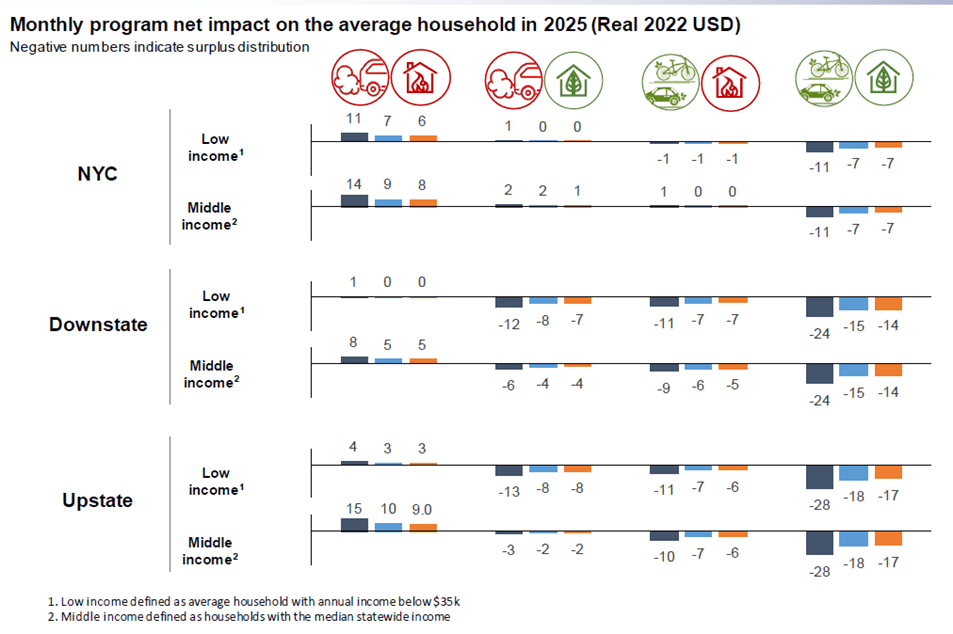
The script for the household impacts by type, location, and income slide described the monthly program net impacts for the first year of the program.  The title “monthly program net impact” says that the values are netted out from something, but it is not clear what. It is likely that these are net relative to the costs less the CCAA benefit. It is also possible that the values are relative to the Reference Case.  However, the Reference Case includes the costs of New York City Local Law 97 and the advanced clean car rule among other things. It is not clear how those could be separated out in the analysis.  The net impact costs table is excerpted below.

This is a busy slide that describes the monthly net cost impacts.  The rows list the regions (NYC, Downstate, and Upstate) including the low- and middle-income household categories.  There are four categories of columns.  The first column covers households that use gasoline vehicles and heat with fossil fuels.  The second column covers households that use gasoline vehicles but use “green” electric heating.  One of the unexplained details is whether using electricity for heating was limited to heat pumps or includes resistance heating.  The third column is households that do not use gasoline vehicles but use fossil heating.  Another detail is whether hybrid vehicles that are not zero-emissions vehicles are considered green.  The fourth column is for the small number of households that do not use gasoline vehicles or fossil heat.  Within each of those four columns the results for the three allowance scenarios are shown.

The script explanation for the first column stated that:

Depending on the household income level and the part of the state, the cost may range. From as little as $12 a year to up to $180 with net impacts lower under Upstate scenarios B and C.

Infuriatingly, the script description describes annual benefits, but the graph lists monthly values.  For example, the Scenario A monthly net cost impact ranges from $1 per month ($12 a year) for Downstate, Low Income to $15 per month ($180 per month) for Upstate, Middle Income. Inconsistent nomenclature makes it difficult to figure out exactly what is proposed.

The script narrative is that as people transition away from fossil fuels people will be financially better off. In the rightmost column for both green alternatives the Scenario A monthly benefits range from $11 to $28 per month or $132 to $336 per year.  Presumably this represents an incentive to convert but it is left unsaid whether converting to an EV and a heat pump will cost less than this program benefit.

The script for this concludes that “It’s essential to remember that NYCI investments will be designed to move state households from the right column to the left column.”  This appears to be a mis-statement because the left column is all fossil and the right column is all “zero-emissions” so the goal should be opposite direction.  The narrative also argues that revenues raised will provide support for households to electrify their homes and cars and the CCAA rebates will be an additional incentive. 

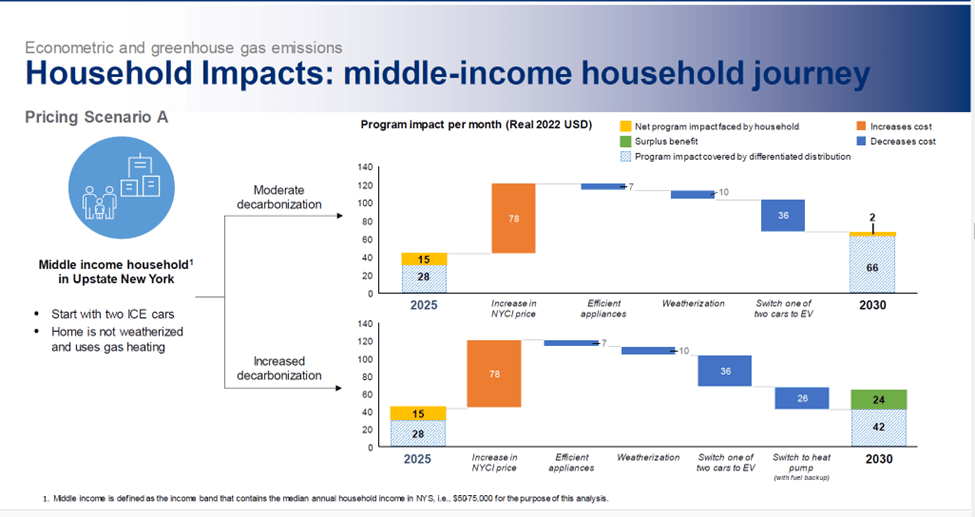
Wilcox provides a couple of more slides that break out the household impacts.  The following is the second slide that describes the Upstate “middle-income household journey” to decarbonized nirvana as envisioned by this modeling.  For a household with two internal combustion vehicles and a home that is not weatherized and uses gas heating the slide describes two decarbonization scenarios: moderate and increased decarbonization.  The graphs list the NYCI program impact per month (Real $ 2022) for the net program impact faced by household; increases cost due to NYCI; the surplus benefit; decreased cost for efficient appliances, weatherization, switching one of two cars to an electric vehicle and switching to a heat pump; and program impact covered by differentiated distribution.

I cannot say that I can fully explain these household impacts values.  The script states:

This household sees an initial net cost. The consumer climate action account offsets approximately two thirds of the total NYCI impact.

The increase in NYCI price is $78 which I assume is the total NYCI impact.  The sum of the net program impact faced by household ($15) and program impact covered by differentiated distribution ($28) is $43 and that is about two thirds of the total NYCI impact.  But the graph states that the net program impact is $15. I cannot figure out what the program impact covered by differentiated distribution represents.  Recall that if every eligible household gets the same share the monthly distributions will range between $45 and $21 per month in 2030 but the 2025 estimated revenues were not provided. 

The graphic and the script describe the household journey:

However, under a moderate decarbonization journey where this household installs efficient appliances, weatherizes their home, and switches one of the 2 cars to an EV.

They nearly break even. Facing a small net cost of $2 after receiving an illustrative consumer climate action account benefit.

The graphic claims that efficient appliances save $7 a month, weatherizing the home saves $10, and switching one of the 2 cars to an EV saves $36 for a total of $53 in savings per month.  In 2030 the sum of the net program impact faced by household ($2) and program impact covered by differentiated distribution ($66) is $68. In this instance the differentiated distribution is described as the “illustrative consumer climate action account benefit” but that estimate is at odds with my calculated CCAA benefits of around $45 per month.  This is another inconsistency that I cannot explain.

The script goes on to say:

Again, in addition to NYCI offering direct support for energy affordability, program revenue can be used to reduce the cost to households of investments like residential heat pumps and EVs.

This is an addition, and this applies to both slides to support from federal programs to the Inflation Reduction Act.

While others will see some costs that the consumer climate action count helps to manage. However, taking even moderate steps to decarbonize by 2030 leads to surplus benefits in nearly every region and income level analyzed, while taking increased measures leads to significant surplus benefits across all regions and income levels analyzed.

I have not been able to reproduce these claims.  Note that the claim that there are “surplus benefits in nearly every region and income level analyzed” ignores the fact that the 1.6 million households with incomes lower than the no-benefit threshold and above the middle-income $75K threshold are not addressed in their presentation of results.

Wilcox summarized the cost impact results in the following slide.  The script says that this “illustrative distribution of the Consumer Climate Action Account shows that millions of households break even due to NYCI, especially low-income households and those that rely on clean energy like EVs, transit, and heat pumps.”  These are average values.  The distribution of impacts that would describe costs for those households that do not have the option for EVs, transit, and heat pumps is not available.  The summary claims that the “Consumer Climate Action Account has the potential to manage impacts for a very large percentage of households in New York” but does not quantify that percentage.  The modeling analysis notes that the building and transportation sector modeling was custom built.  Optimistic implementation assumptions can easily be used to torture the data into the result desired.  Without complete documentation I do not think that the results are credible, so I am reserving judgement on these claims.

Discussion

I have always maintained that the primary concern of the general public is Climate Act costs.  As far as I can tell the Hochul Administration deliberately hid those costs in the Scoping Plan and that politically motivated approach is apparent in this webinar. 

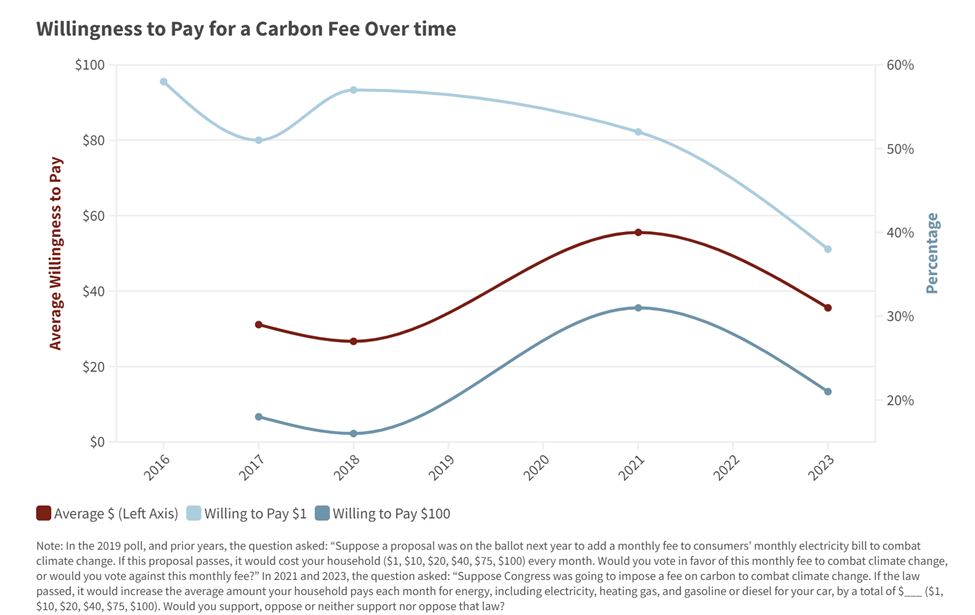
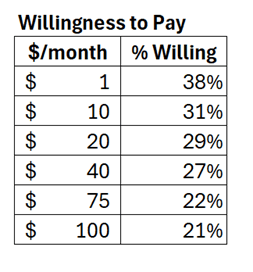
The Energy Policy Institute at the University of Chicago did a poll in early 2023 poll with “the Associated Press–NORC Center for Public Affairs Research” explored Americans’ attitudes on climate change, their views on key climate and energy policies, and how they feel about electric vehicles and the policies to encourage them.  The following chart from that report shows that 38% would be willing to pay an additional $1 a month for a fee to combat change and only 21% would be willing to pay $100 a month. 

This webinar talked about a single component of the total cost of the net-zero transition.  When NYCI starts auctioning allowances the price of energy is guaranteed to go up.  The Upstate “middle-income household journey” states that households in that category will pay at least $73 a month before the rebates are applied.  The rebates are subject to the whim of Albany politicians, so the rebate amounts are not guaranteed.  In addition, the electric bill supply costs are not included in these modeled costs.  I recently discussed the Central Hudson revisions to its double-digit gas and electric delivery rate increases. The public outcry has been intense and the costs described here are in addition to the rate case costs. There is insufficient documentation available to determine exactly what costs were included in the heat pump and electric vehicle examples given.

The Energy Policy Institute poll described above found that less than a third of respondents were willing to pay even $10 a month.  The willingness to pay at other levels in the poll shows that less than a third are willing to pay as little as $10 a month for a carbon fee.  Little wonder that the true costs are a closely guarded secret.

The Climate Action Council’s Scoping Plan has been described as a  “true masterpiece in how to hide what is important under an avalanche of words designed to make people never want to read it.”  Similarly, the modeling analysis portrayal in this webinar uses an avalanche of technical jargon and impressive sounding phrases to suggest credibility and discourage questions.  In reality, all the modeling relies on guessing how society will react to incentives and regulations using parameters that can lead to wildly different results depending upon the biases of the model developer.  John von Neumann allegedly summed up the problem with parameters stating that “With four parameters I can fit an elephant, and with five I can make him wiggle his trunk”[1].  In other words, he could develop a mathematical model that described an elephant simply by fudging the parameters.  In this instance the model parameters produce the politically correct result that people will, for example, switch to electric vehicles in response to the incentives but don’t account for the many people who have weighed the pros and cons of an electric vehicle and decided never.

Conclusion

“A goal without a plan is just a wish.”, Antoine de St. Exupery.  The Scoping Plan should properly be called the Scoping Goals because there is no plan.  There has been no accountability for proving that the control strategies proposed are feasible on the schedule mandated by the Climate Act and that the costs of all the components of the energy system that must be changed to achieve the net-zero transition will maintain current standards of affordability.  It is just wishing.


[1] Attributed to von Neumann by Enrico Fermi, as quoted by Freeman Dyson in “A meeting with Enrico Fermi” in Nature 427 (22 January 2004) p. 297

Dutchess County Comments on the Central Hudson Climate Act Implementation Plan

One of my readers sent me some documents related to the implementation of New York’s Climate Leadership & Community Protection Act (Climate Act) from the Central Hudson rate case, CASE 23-E-0418.  I asked if I could credit him for providing the material for this post but he prefers to be anonymous: “I don’t need the re-education task force tracking me down.”  This post highlights some commonsense issues related to the effects of Climate Act implementation on a utility rate case.

I have followed the Climate Act since it was first proposed, submitted comments on the Climate Act implementation plan, and have written over 380 articles about New York’s net-zero transition. The opinions expressed in this post do not reflect the position of any of my previous employers or any other organization I have been associated with, these comments are mine alone.

Overview

The Climate Act established a New York “Net Zero” target (85% reduction in GHG emissions and 15% offset of emissions) by 2050.  It includes an interim 2030 reduction target of a 40% reduction by 2030 and a requirement that all electricity generated be “zero-emissions” by 2040. The Climate Action Council (CAC) is responsible for preparing the Scoping Plan that outlines how to “achieve the State’s bold clean energy and climate agenda.”  In brief, that plan is to electrify everything possible using zero-emissions electricity. The Integration Analysis prepared by the New York State Energy Research and Development Authority (NYSERDA) and its consultants quantifies the impact of the electrification strategies.  That material was used to develop the Draft Scoping Plan outline of strategies.  After a year-long review, the Scoping Plan was finalized at the end of 2022.  In 2023 the Scoping Plan recommendations were supposed to be implemented through regulation, PSC orders, and legislation.  Not surprisingly, the aspirational schedule of the Climate Act has proven to be more difficult to implement than planned and many aspects of the transition are falling behind, and the magnitude of the necessary costs is coming into focus.  When political fantasies meet reality, reality always wins.

Central Hudson Rate Case

Central Hudson Gas & Electric Corporation (Central Hudson) is a “regulated transmission and distribution utility serving approximately 315,000 electric customers and 90,000 natural gas customers in a defined service territory of New York State’s Mid-Hudson River Valley”.  On July 31, 2023 Central Hudson submitted revisions to its electric and gas rates (“Rate Case”).  It includes double-digit gas and electric delivery rate increases and the public outcry has been intense.  In this post I highlight some of the issues that affect costs that are imposed by the Climate Act.

There is a dynamic at work for all New York corporations relative to the Climate Act.  All companies know it is going to cost a lot of money, threaten reliability and will not make much of a difference to global warming.  However, not unlike the Star Trek line used by “the Borg in the series, who assimilate various cultures into their own and warn the encountered species, that ‘resistance is futile’”, companies have few options opposing the Climate Act.  If they publicly oppose the Climate Act well organized environmental organizations will claim that they are against solving the existential threat of climate change.  Recent administrations in New York have an outsized and weaponized influence on regulatory actions.  As a result, criticizing a political policy will adversely affect doing business with state agencies and very likely impact the outcome of rate cases.  There are no upsides to opposition in my opinion.

Central Hudson has done about as much as they could to educate their customers.  Their Energy in Transition webpage addressed the question: “How quickly can we transition to an energy system that protects the environment without compromising highly consistent and reliable service at a reasonable cost?”.  It describes the Climate Act, outlines Central Hudson’s position, and includes examples of what people are saying about the risks of the net-zero transition.  Also included are videos on implementation of the Climate Act and New York Independent System Operator (NYISO) videos that help New Yorkers understand the important changes and challenges ahead.  All this is accompanied by the following:

Residents and businesses should be aware of the changes that are coming and help shape the transition by contacting your state legislator or contacting the Governor’s office if you have thoughts about how these changes may affect you.

On the other hand, the balance between trying to appease politicians and providing customers with electric and gas service upon demand at a reasonable price is a challenge.  The primary point in the comments described below is that Central Hudson went too far trying to appease the State at the expense of its customers.

Climate Leadership and Sustainability Panel

In the initial submittal Central Hudson included the Direct Testimony of its Climate Leadership and Sustainability Panel (CLSP) along with exhibits.  The stated purpose of the Panel’s testimony in the Rate Case says:

Central Hudson has made substantial efforts and investments to facilitate and support New York State’s decarbonization and environmental justice objectives as established within New York State’s Climate Leadership and Community Protection Act (“CLCPA”). The Panel will first outline the requirements of the CLCPA itself, as well as the outcomes of the Company’s facilitation and support of the CLCPA goals. The Panel will explain the need for a deferral mechanism for costs that are incurred in support of CLCPA compliance. The Panel will also present the Company’s completed, ongoing, and planned activities that are consistent with the CLCPA, including the Company’s Sustainability Strategy and Efforts; Climate-Driven Planning, Studies, and Reporting; Gas Initiatives; Electric Vehicle (“EV”) Make Ready Programs (“MRP”), Supplemental EV programs; Electrification of Central Hudson’s fleet; and the Company’s Onsite Solar Proposal. The Panel will explicitly identify the Company’s proposed CLCPA-aligned initiatives and associated recovery mechanisms within this proceeding.

Rate Cases and the Climate Act

This post highlights the Direct Testimony of Allan R. Page on behalf of Dutchess County New York:  “The primary purpose of his  testimony is to “express the concerns of Dutchess County as the concerns relate to how climate is being addressed in these rate cases.”  He founded A. Page & Associates after a 32-year career with Central Hudson.  His testimony focused on Central Hudson’s proposed expenditures to meet the requirements of the Climate Act.

In the testimony, Dutchess County gave reasons why “Central Hudson should not pursue any emissions reduction initiatives beyond what is required by state regulation” as proposed by its Climate Leadership and Sustainability Panel. The testimony expressed “concern about the overall cost of achieving state clean energy policy objectives and the impact such costs will have on customers”, stated that “emissions reduction efforts within New York State will have little impact on the global climate and that New Yorkers, including those residing in disadvantaged communities (“DACs”), may not directly benefit. For these reasons”.

I address three of the Dutchess County concerns raised: the costs and customer benefits of clean energy investments, funding for the supplemental electric vehicle programs; and the company’s onsite solar proposal.  The Direct Testimony of Allan R. Page (“Dutchess County Testimony”) and the Rebuttal Testimony of the Climate Leadership and Sustainability Panel (“Rebuttal Testimony”) documents in the Public Service Commission docket for the Central Hudson rate case proceeding were used for the following.

Clean Energy Investments

The Dutchess County Testimony describes Panel proposals that will increase costs with minimal benefits to customers.  For example, it notes that Central Hudson’s is “taking ‘significant steps’ ‘to enhance corporate focus on sustainability and incorporate climate change considerations into its operations’ while building upon ‘understanding stakeholder interests” but points that the focus “does not

come free of change” nor does it provide tangible benefits to its customers.

The Rebuttal Testimony comment summarizes the Dutchess County concerns with clean energy investments:

The Panel acknowledges Dutchess County’s concerns regarding the overall cost of achieving the CLCPA emissions reduction and clean energy goals. The future costs, as well as responsibility for those costs, are not fully understood at this time. The Company supports a balance, one where safety, reliability, and just and reasonable rates are core elements of the Company’s utility planning and operations, while the incorporation of clean energy initiatives provides support for the achievement of New York’s CLCPA targets. As Dutchess County indicates in its testimony, “Through PSC regulation and orders, balance is defined.” The Company’s clean energy investments are consistent with those included in recent Public Service Commission (“PSC” or “Commission”) orders approving utility rate plans.

The statement that “future costs, as well as responsibility for those costs, are not fully understood at this time” is absolutely true.  To the defense of Central Hudson, the Scoping Plan is no more than an outline of control strategies with incomplete cost documentation.  There has never been a feasibility analysis to determine how the strategies might work and how the costs might be assigned.  Dutchess County Testimony correctly points out that the ratepayers will be the losers as a result.

The Rebuttal Testimony responds to an estimate of total costs where they claim “Dutchess County’s testimony is inconsistent with a Company interrogatory response relating to the cost of carbon reduction”:

Dutchess County seems to have inadvertently mixed and matched parts of the Company’s response. First, the net present value of $300 billion was identified in the response as a modeling estimate in the January 2022 Climate Action Council Scoping Plan, noting that the predicted costs through 2050 that underlay that net present value calculation ranged from $594 billion to $627 billion, in 2020 dollars.

Second, our response also stated that these costs are relative to (i.e., net of) the Climate Action Council Scoping Plan Reference Case costs of $4.269 trillion, in 2020 dollars, through 2050 but we did not describe what the Reference Case includes. Absent clear definitions in the Scoping Plan documentation, we do know with certainty what comprises the Reference Case. As a result, Central Hudson neither stated nor implied that the costs in New York related to the reduction of carbon are around $4.6 trillion.

Both testimonies miss a complicating factor in the interpretation of the Reference Case results.  Contrary to usual practice the Scoping Plan baseline was a case that included “already implemented” programs.  In other words, there are some programs incorporated into the Reference Case that only exist to reduce GHG emissions.  As a result, I agree it is impossible for anyone to determine the total Climate Act costs.  Again Central Hudson ratepayers are the losers.

Supplemental Electric Vehicle Programs

Dutchess County recommended the removal of funding for the Company’s Supplemental Electric Vehicle (“EV”) Programs.  The Dutchess County Testimonial stated:

Fifth on the list of Panel proposals, deals with electrifying the Central Hudson fleet of vehicles. Certainly, as vehicles are retired and a competitive EV market exists for the replacement of similar in-kind vehicles, EV’s should be purchased. However, to prematurely replace existing functional vehicles to advance climate goals in other market sectors unfairly burdens electric customers with addressing the emission needs of other sectors of the New York State economy. The transportation sector should be pulling its fair share to address climate change. The Panel’s position that it desires to lead by example is misplaced. The example that customers desire most from Central Hudson is a high quality, reliable energy product at the lowest reasonable price.

In a victory for commonsense Central Hudson agreed to remove these programs from this proceeding.  The company and the PSC Staff agreed that sufficient funding was available within its authorized EV Make-Ready programs to conduct the additionally proposed activities.

Central Hudson Onsite Solar Proposal

The CLSP proposed the installation of solar arrays on Central Hudson offices in Catskill, Kingston. Eltings Corners, and Poughkeepsie. Dutchess County Testimony note that “Justification for the installations is that Central Hudson desires to be a “role model and leader in promoting local and carbon-free technologies.”  Some quotes from the arguments:

Central Hudson customers have been exposed to significant amounts of leadership distribution in the State of New York. If there is one area in New York State where the State can claim a significant amount of leadership distribution it is in the area addressing climate change. Electric customers are or will be on the hook for contributing billions of dollars of personal fonds to meet the State’s leadership initiatives.

……

From the current day to 2050 the State measures success through partnerships, outreach and education. and workforce and economic development. implementing the Plan produces no measurements of electric or natural gas customer cost savings, or reducing climate change threats, or reducing carbon in the atmosphere in Dutchess County.

……

To reiterate. Central Hudson’s desire to “support the state’s ambitious solar generation goals” increasing customer costs to Dutchess County customers. in order to promote partnerships, education, and development, provides no tangible Dutchess County customer benefits.

The Rebuttal Testimony responds to the question whether Central Hudson agrees with Dutchess County’s characterization of the Company’s Onsite Solar proposal as increasing customer costs without providing tangible benefits?

No.  The Onsite Solar proposal benefits customers in that it contributes to CLCPA emissions reductions targets and by setting an example, the project could encourage customers to participate in distributed generation projects, which lower their energy costs.

They did not respond to the reasons provided in the Dutchess County Testimony.  Probably because there is no reasonable response.  In my opinion, this Central Hudson program is transparent pandering to the State’s narrative. 

It is also possible that the company has looked at the long-term and thinks an energy future where everything is electrified might be good business.  That is disappointing because I believe there are plenty of technical people at the company that know that the Climate Act net-zero transition plan is impossible on the mandated schedule and very unlikely in any event.  There are too many untested components necessary for reliability and too many upgrades to infrastructure to keep it affordable.

Conclusion

I believe that low cost and reliability are overarching concerns for electric and gas ratepayers.  The Hochul Administration has been hiding the total costs of the transition throughout the process.  The other missing piece is an energy plan feasibility study that would enable Central Hudson to determine what aspects of the transition they will be expected to implement.  This uncertainty and the desire to placate the political aspirations of the Administration to improve the chances for a favorable rate case outcome ultimately impacts ratepayers negatively.  The double-digit rate increases for this Central Hudson rate case will become the norm until New Yorke voters demand the politicians back off.

There are many good points in the Dutchess County Testimony relevant to the Climate Act net-zero transition.  The following example sums up the problem:

The purpose of Dutchess County government is to serve the citizens of the County and to fulfill its fiduciary responsibilities to provide a safe clean environment promoting fulfilling life styles. In commenting on the Draft Scoping Plan, the County points out the economic pain being imposed on individuals and businesses and the extreme societal risk created by replacement of reliable, secure energy infrastructure with intermittent renewables. While affirming its support for solar and wind power the County notes that the feasibility of meeting arbitrary timing mandates is slim to none but in the process of attempting to meet those mandates the State will require that residents help fund trillions of dollars of unproven energy systems. CO2 emissions are a world-wide phenomenon and for all the pain, sacrifice, and cost the State’s contribution to the reduction in world wide emissions is miniscule. The transition required under the Plan for transportation, buildings, residences, is massive and to avoid catastrophic New York State economy collapse a modified plan is imperative.

Climate Act DEFR Cost Estimate

My previous post summarized the presentation given by Zachary Smith from the New York Independent System Operator (NYISO) describing Dispatchable Emissions-Free Resources (DEFR).  All credible projections for the generating resources needed for the zero emissions target in New York’s Climate Leadership & Community Protection Act (Climate Act) include this  new category of generating resources called Dispatchable Emissions-Free Resources (DEFR).  It is necessary to keep the lights on during periods of extended low wind and solar resource availability.  This post uses the cost projections for recently awarded United Kingdom contracts for commercial scale green hydrogen production projects to estimate how much Climate Act DEFR might cost.

I have followed the Climate Act since it was first proposed, submitted comments on the Climate Act implementation plan, and have written over 380 articles about New York’s net-zero transition. The opinions expressed in this post do not reflect the position of any of my previous employers or any other organization I have been associated with, these comments are mine alone.

Overview

The Climate Act established a New York “Net Zero” target (85% reduction in GHG emissions and 15% offset of emissions) by 2050.  It includes an interim 2030 reduction target of a 40% reduction by 2030 and a requirement that all electricity generated be “zero-emissions” by 2040. The Climate Action Council (CAC) is responsible for preparing the Scoping Plan that outlines how to “achieve the State’s bold clean energy and climate agenda.”  In brief, that plan is to electrify everything possible using zero-emissions electricity. The Integration Analysis prepared by the New York State Energy Research and Development Authority (NYSERDA) and its consultants quantifies the impact of the electrification strategies.  That material was used to develop the Draft Scoping Plan outline of strategies.  After a year-long review, the Scoping Plan was finalized at the end of 2022.  In 2023 the Scoping Plan recommendations were supposed to be implemented through regulation, PSC orders, and legislation.  Not surprisingly, the aspirational schedule of the Climate Act has proven to be more difficult to implement than planned and many aspects of the transition are falling behind.  DEFR is a particularly challenging problem.  When political fantasies meet reality, reality always wins.

New York Net-Zero Transition DEFR

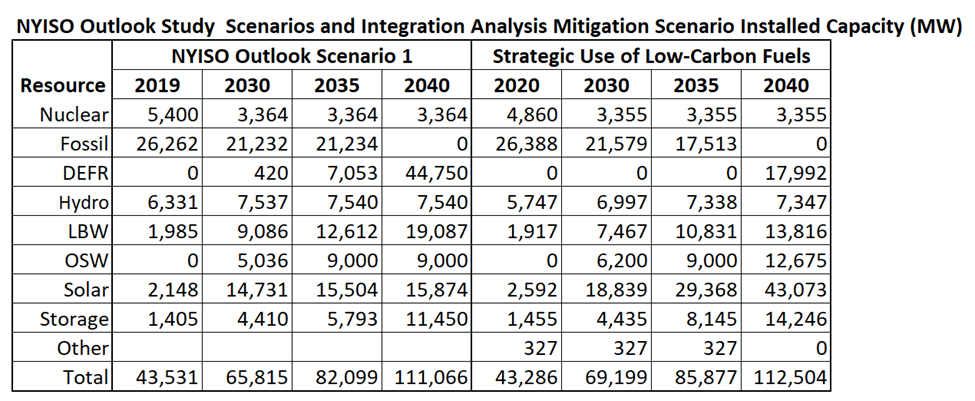
The presentation given by Zachary Smith summarized in my recent post gave an overview of the DEFR issue.  I am not going to repeat the descriptive information again.  For the purposes of this article, the Integration Analysis identified the need for a generating resource that could be dispatched as needed and did not have any emissions.  The placeholder technology listed in the Integration Analysis was green hydrogen.  The following table lists the projected capacity for DEFR in the NYISO the 2021-2040 System & Resource Outlook and the Integration Analysis. Note that the Resource Outlook  projecta that 44,750 MW of DEFR will be needed by 2040, that the Integration Analysis Strategic Use of Low-Carbon Fuels scenario projects 17,992 MW by 2040, and that in 2019 the fossil fuel generation in the state was 26,262 MW.

The energy production projected for DEFR from the NYISO Resource Outlook and the Integration Analysis are shown in the following table.  The largest difference between the two projections is that NYISO projects that DEFR will generate ten times more energy.  It turns out that NYISO has DEFR generating 14% of the total energy in 2040 but Integration Analysis projects only 1%.  I am very disappointed that the Hochul Administration has not reconciled the two projections.

Green Hydrogen Production

Proponents of zero emissions energy sources tout the use of “green” hydrogen.  This is hydrogen that is produced using renewable energy rather than other fossil fuels or other sources.  It is recognized that over-building wind and solar is a necessary part of an electric system that relies on these intermittent sources of power.  One of the purported benefits of green hydrogen is that when the wind and solar availability is higher than the system load instead of curtailing excess wind and solar power that it could be used to power electrolyzers to create hydrogen.  That is the theory, but the reality is that no one is producing hydrogen at commercial-scale yet.

Paul Homewood writing at the Not a Lot of People Know That blog described the recent announcement that the United Kingdom’s Department of Energy Security & Net Zero awarded contracts for green hydrogen projects.  The announcement states:

Following the launch of the first hydrogen allocation round (HAR1) in July 2022, we have selected the successful projects to be offered contracts. We are pleased to announce 11 successful projects, totaling 125MW capacity.

HAR1 puts the UK in a leading position internationally: this represents the largest number of commercial scale green hydrogen production projects announced at once anywhere in Europe. This round will provide over £2 billion of revenue support from the Hydrogen Production Business Model, which will start to be paid once projects become operational. Over £90 million from the Net Zero Hydrogen Fund has been allocated to support the construction of these projects.

We have conducted a robust allocation process to ensure only deliverable projects that represent value for money are awarded contracts. The 11 projects have been agreed at a weighted average [footnote 1] strike price of £241/MWh (£175/MWh in 2012 prices). This compares well to the strike prices of other nascent technologies such as floating offshore wind and tidal stream.

The thing that caught my eye in Homewood’s article was that there were cost numbers: “The 11 projects have been agreed at a weighted average strike price of £241/MWh”.    In renewable energy contracts the government agrees to a “strike price” per megawatt-hour that the renewable energy developer will receive for its delivery of electric energy produced by the renewable energy source.  In this case electric energy from the green hydrogen source.  The previous table lists the DEFR electric energy expected so as a first cut estimate I simply multiplied the expected MWh by the strike price.  The following table shows that green hydrogen production could cost between $10.4 billion and $1.1 billion per year by 2040.  This is the annual cost and does not include any construction subsidies.

Discussion

This just represents the start of the costs for the green hydrogen DEFR support.  Making it is just part of the process.  It has to be stored, transported to where it will be used, and, if the zealots on the Climate Action Council have their way, used in fuel cells.  Each of those components adds costs.  Homewood points out two other issues: 

What is interesting is that the strike prices will be tied to changes in the market price of gas: “The subsidy will vary relative to changes in the reference (natural gas) price”.

The schemes all appear to be electrolyzers, and they all claim that only renewable electricity will be used, an absurd assumption! None of them say what they will do when there is not enough wind and solar power to meet demand – will they idle their plants, or will they carry on as usual taking whatever power the grid can supply?

That is not all.  One of the things I have wondered about is process efficiency.  When making anything the most efficient thing to do is to get the process up and running efficiently and just let it go.  Depending on variable wind and solar makes that a challenge.  Is New York’s plan going to include its own energy storage to make the process work well?   I see no realistic scenario where this will work.

Conclusion

The Climate Action Council did not fully acknowledge the necessity or the challenge of the DEFR technology.  The Department of Public Service Proceeding 15-E-0302 is intended to “identify technologies that can close the gap between the capabilities of existing renewable energy technologies and future system reliability needs, and more broadly identify the actions needed to pursue attainment of the Zero Emission by 2040 Target” directly contradicts the Council’s position.   This post suggests that the placeholder DEFR option of green hydrogen could adversely affect affordability even if viable DEFR technologies can be identified.

Implicit Renewable Energy Subsidies

There are two fundamental drivers for New York’s Climate Leadership & Community Protection Act (Climate Act – the presumption that there is an existential threat from climate change and that the transition away from greenhouse gas (GHG) emitting energy sources requires no new technology and will be cheaper because the wind and sun energy is free.  I disagree with both positions.  This article addresses the cost fallacy based on a new analysis at the Cato Institute.

I have followed the Climate Act since it was first proposed, submitted comments on the Climate Act implementation plan, and have written over 380 articles about New York’s net-zero transition. The opinions expressed in this post do not reflect the position of any of my previous employers or any other organization I have been associated with, these comments are mine alone.

Overview

The Climate Act established a New York “Net Zero” target (85% reduction in GHG emissions and 15% offset of emissions) by 2050.  It includes an interim 2030 reduction target of a 40% reduction by 2030 and a requirement that all electricity generated be “zero-emissions” by 2040. The Climate Action Council (CAC) is responsible for preparing the Scoping Plan that outlines how to “achieve the State’s bold clean energy and climate agenda.”  In brief, that plan is to electrify everything possible using zero-emissions electricity. The Integration Analysis prepared by the New York State Energy Research and Development Authority (NYSERDA) and its consultants quantifies the impact of the electrification strategies.  That material was used to develop the Draft Scoping Plan outline of strategies.  After a year-long review, the Scoping Plan was finalized at the end of 2022.  In 2023 the Scoping Plan recommendations were supposed to be implemented through regulation, PSC orders, and legislation.  Not surprisingly, the aspirational schedule of the Climate Act has proven to be more difficult to implement than planned and many aspects of the transition are falling behind.  When political fantasies meet reality, reality always wins.

Cato Report

Travis Fisher described the high cost of offshore wind policy.  He argues that eventually political support for offshore wind will have to confront the costs:  “Recent polling suggests that just 38 percent of Americans are willing to increase their energy costs by $1 per month to address climate change.”  He goes on to show that offshore wind will cost much more.

He makes a compelling case that “offshore wind mandates are bad public policy because they simply cost too much and would not be economically viable without taxpayer support”.  He also points out that there are significant environmental impacts.  He explained that the political targets are coming to grips with these issues:

In contrast to the ease and simplicity of issuing aspirational offshore wind plans, policymakers are now confronting the reality that offshore wind faces many obstacles. The second half of 2023 brought story after story of canceled or renegotiated contracts for offshore wind. BP and Equinor canceled their contract with the state of New York; Ørsted canceled two large projects in New Jersey; and developers in Massachusetts canceled four projects totaling 2,400 MW of offshore wind.

Unfortunately, the politicians have not adjusted their policies:

With such high electricity prices, one might expect political leaders to attempt to reduce the burden of the energy costs their constituents pay. Instead, policymakers in these states have insisted on mandating offshore wind, which will invariably increase electricity rates and impose a higher federal spending and tax burden on the country. There are several ways of looking at the cost of electricity from specific resources, such as wind off the East Coast of the United States. Unfortunately, offshore wind is expensive by every measure.

The reason for this post is Fisher’s explanation of different ways of looking at the cost of electricity.

One way to subsidize offshore wind is through Power Purchase Agreements (PPAs) and Levelized Revenue of Energy (LROE).  Fisher explains:

PPA prices are a generous way to examine the cost of offshore wind. They are the price paid by the offtakers of the energy from offshore wind projects—PPAs do not explicitly show the full cost paid by retail electricity consumers and taxpayers. These contract prices are usually expressed in wholesale units of dollars per megawatt‐​hour ($/​MWh).

As one example, the Vineyard Wind project off the coast of Massachusetts has a levelized PPA price of about $98/​MWh (escalating from a lower base price to a higher final price at the end of a twenty‐​year contract). As the National Renewable Energy Laboratory explained in 2019:

“This LROE estimate for the first commercial‐​scale offshore wind project in the United States appears to be within the range of LROE estimated for offshore wind projects recently tendered in Northern Europe with a start of commercial operation by the early 2020s. This suggests that the expected cost and risk premium for the initial set of US offshore wind projects might be less pronounced than anticipated by many industry observers and analysts.”

Other operational projects, like the South Fork project in New York, don’t advertise the PPA price but have stated that “the power from South Fork Wind … will cost the average ratepayer between $1.39 and $1.54 per month when it starts operating.” (Recall that fewer than 40 percent of Americans are willing to spend $1 monthly to address climate change.)

In short, PPA prices tend to put the cost of offshore wind projects in the best light.

The State of New York has not admitted that even these best-case costs “do not compare well to clearing prices in wholesale markets”.  Comparison to current prices shows that the PPA costs are much higher.

The second way to look at the cost of electricity is through the Levelized Cost of Energy (LCOE).  Fisher describes the parameter:

LCOE is a common measure of the cost of electricity from a given class of resources. LCOE boils down construction and operating costs into a single cost estimate (in dollars), divided by the energy output of the plant over its lifetime (in watt‐​hours). Hence the familiar unit of dollars per megawatt‐​hour. LCOE is a straightforward way to get a sense of the levelized (or averaged‐​out) cost of a standalone power plant.

According to recent LCOE estimates from EIA, the unsubsidized cost of offshore wind exceeds $120/​MWh and is among the most expensive generation resources. The consulting firm Lazard also publishes LCOE estimates that have become common reference points. In the latest Lazard research, the LCOE for offshore wind ranged between $72/​MWh and $140/​MWh.

Fisher notes that if the LCOE parameter is used then “offshore wind compares favorably to the highest‐​cost natural gas generators ($115–221/MWh) but not to the lowest‐​cost renewables ($24–75/MWh for onshore wind and $24–96/MWh for utility‐​scale solar photovoltaics [PV]).”  However, this parameter only considers the cost of the generating capacity.

Fisher explains that the there is a third way to look at the cost of electricity: the Full Cost of Electricity (FCOE) and Levelized Full System Cost of Electricity (LFSCOE).  He notes that:

Recently, scholars have expanded the LCOE model to include spillover costs that are borne by other generators on the system. To remedy the analytical shortcomings of LCOE, the FCOE approach zooms out and considers the all‐​in cost of the entire electricity system. This is the appropriate measure to use when judging society‐​wide costs because the full system costs are ultimately borne by retail ratepayers (and by taxpayers when subsidies are involved, as they are today).

The most important element of FCOE that is missing from LCOE is the cost to the rest of the system of intermittent output. Intermittent or “non‐​dispatchable” generation always requires backup and balancing help from controllable or “dispatchable” resources to satisfy total electricity demand; however, the cost of making other resources fluctuate their output to accommodate intermittent generation—by backing down in times of high intermittent production and ramping up in times of low intermittent production—is not captured in LCOE estimates.

A group of authors who favor using the FCOE of solar PV and onshore wind said, “LCOE is inadequate to compare intermittent forms of energy generation with dispatchable ones and when making decisions at a country or society level.”

Fisher quotes a description of the (LFSCOE):

The LFSCOE are defined as the costs of providing electricity by a given generation technology, assuming that a particular market has to be supplied solely by this source of electricity plus storage. Methodologically, the LFSCOE for intermittent or baseload technologies are the opposite extreme of the LCOE. While the latter implicitly assume that a respective source has no obligation to balance the market and meet the demand (and thus demand patterns and intermittency can be ignored), LFSCOE assume that this source has maximal balancing and supply obligations.

For our purposes what does that mean for costs?  Fisher explains

Under the LFSCOE assumptions, the cost of onshore wind in Texas is approximately seven times higher than its LCOE (an LFSCOE of $291/​MWh compared to an LCOE of $40/​MWh). The details of applying an LFSCOE to offshore wind would only be slightly different from applying it to onshore wind. Specifically, offshore wind has a slightly higher capacity factor than onshore wind (about 43 percent versus 34 percent in 2018, according to the International Renewable Energy Agency’s 2019 “Future of Wind” report). However, offshore wind is still an intermittent resource, meaning its LFSCOE is higher than its LCOE.

Conclusion

While the focus of this analysis was on offshore wind the differences between the three ways of looking at electricity costs is applicable to onshore wind and solar too.  The FCOE and LFSCOE methods of calculating electricity costs are much better approaches for estimating the total costs. When using those parameters the costs of renewables are much more expensive than current electricity prices.  In addition, those parameters do not incorporate the cost of the dispatchable emission-free resource that credible New York analyses project are necessary for an electric system that eliminates fossil-fired generation. 

Proponents of the net-zero transition disparage fossil fuel subsidies but the explicit and implicit subsidies for wind and solar far exceed them.  The Levelized Full System Costs of Electricity calculates the implicit subsidies necessary to integrate wind and solar into the electric system.  Fisher concludes:

Policymakers need to understand the full costs of their actions and come back to the shore. The American people simply don’t want to pay more for energy—not in their electricity bills and not in their tax bills.

Climate Act Misinformation: Cost Effectiveness Value of Societal Effects

Today I found a perfect example of Hochul Administration misinformation.  The New York State Energy Research & Development Authority (NYSEDA) Tier 4 renewable energy solicitation prepared Appendix C Cost Analysis document to support the petition by developers of four proposed offshore wind projects and 86 land-based renewable projects.   The claims made for the societal benefits of greenhouse gas emission reductions that are used to claim that various components of the net-zero transition mandated by the New York Climate Leadership & Community Protection Act (Climate Act) have greater benefits than costs are based on inaccurate methods.  This post explains the problem with the methodology used by New York State.

I have followed the Climate Act since it was first proposed, submitted comments on the Climate Act implementation plan, and have written over 350 articles about New York’s net-zero transition.  I have devoted a lot of time to the Climate Act because I believe the ambitions for a zero-emissions economy embodied in the Climate Act outstrip available renewable technology such that the net-zero transition will do more harm than good by increasing costs unacceptably, threatening electric system reliability, and causing significant unintended environmental impacts.  The opinions expressed in this post do not reflect the position of any of my previous employers or any other organization I have been associated with, these comments are mine alone.

Overview

The Climate Act established a New York “Net Zero” target (85% reduction and 15% offset of emissions) by 2050.  It includes an interim 2030 reduction target of a 40% reduction by 2030 and a requirement that all electricity generated be “zero-emissions” by 2040. The Climate Action Council (CAC) is responsible for preparing the Scoping Plan that outlines how to “achieve the State’s bold clean energy and climate agenda.”  In brief, that plan is to electrify everything possible using zero-emissions electricity. The Integration Analysis prepared by the New York State Energy Research and Development Authority (NYSERDA) and its consultants quantifies the impact of the electrification strategies.  That material was used to develop the Draft Scoping Plan.  After a year-long review, the Scoping Plan recommendations were finalized at the end of 2022.  In 2023 the Scoping Plan recommendations are supposed to be implemented through regulation and legislation. 

Obviously, it is important to consider whether the costs that will be incurred for the net-zero transition are lower than the benefits.  The Hochul Administration narrative claims that the costs of inaction for the net zero Climate Act transition outweigh the costs of action. I have been arguing for years that the statement is nothing more than a slogan and it is misleading because it does not include all the costs of the transition.  My analyses of costs found that there are several necessary program costs not included by the Administration. The benefits claimed are the focus of this post.  The analysis of the benefits that I submitted as a comment to the Scoping Plan shows that they over-estimated the benefits in several ways and incorrectly calculated the benefits.  The Climate Action Council never responded to my comments.  This post will summarize my comments and show the effect of the flawed methodology on the cost-effectiveness analyses in the Appendix C Cost Analysis document.

Societal Benefits

The NYSEDA Tier 4 renewable energy solicitation (“Tier 4 Solicitation”) awarded contracts for two transmission projects.  Clean Path New York (CPNY) and the Champlain Hudson Power Express (CHPE) The projects are:

Expected to deliver 18 million megawatt-hours of clean energy per year to New York City, or more than a third of the City’s annual consumption. During their construction and operation, the projects are expected to generate close to $6 billion in overall net societal benefits statewide, inclusive of greenhouse gas reductions and air quality improvements, and over $8 billion in economic development, including investments in disadvantaged communities.

I am only going to address the societal benefits of greenhouse gas reductions in this article.  For a complete discussion of societal benefits used to justify the Scoping Plan and these projects, I refer you to my Scoping Plan Benefits Comments.  I summarize  some of the details I provided for the greenhouse gas reduction benefits discussion below.

The largest benefits claimed for the Scoping Plan and the Tier 4 Solicitation are related to avoided societal costs from GHG emissions.  These benefits are calculated using the Social Cost of Carbon (SCC) or Value of Carbon.  This is a measure of the avoided costs for estimated global warming impacts out to the year 2300 resulting from a reduction of one ton of today’s emissions.  Models are used to project the benefits of reducing GHG emissions on future global warming impacts including those on agriculture, energy, and forestry, as well as sea-level rises, water resources, storms, biodiversity, cardiovascular and respiratory diseases, and vector-borne diseases (like malaria), and diarrhea. 

Richard Tol describes the value of greenhouse gas emission reductions thusly: “In sum, the causal chain from carbon dioxide emission to social cost of carbon is long, complex, and contingent on human decisions that are at least partly unrelated to climate policy. The social cost of carbon is, at least in part, also the social cost of underinvestment in infectious disease, the social cost of institutional failure in coastal countries, and so on.”  Clearly, the Social Cost of Carbon price is subject to value judgements. It is strongly affected by the choice of impacts included and by the assumptions made for the discount rate.  New York’s choices all maximize the value used.      

Flawed Methodology

The methodology used by New York agencies to calculate societal benefits relies on the New York Department of Environmental Conservation Value of Avoided Carbon GuidanceThe Guidance includes a recommendation how to estimate emission reduction benefits.  In the section entitled “Estimating the emission reduction benefits of a plan or goal” an example is included that states:

The net present value of the plan is equal to the cumulative benefit of the emission reductions that happened each year (adjusted for the discount rate). In other words, the value of carbon is applied to each year, based on the reduction from the no action case, 100,000 tons in this case. The Appendix provides the value of carbon for each year. For example, the social cost of carbon dioxide in 2021 at a 2% discount rate is $127 per metric ton. The value of the reductions in 2021 are equal to $127 times 5,000 metric tons, or $635,000; in 2022 $129 times 10,000 tons, etc. This calculation would be carried out for each year and for each discount rate of interest.

I believe that the guidance approach is wrong because it applies the social cost multiple times for each ton reduced.  It is inappropriate to claim the cumulative benefits of an annual reduction of a ton of greenhouse gas over any lifetime or to compare it with avoided emissions. The value of carbon for an emission reduction is based on all the damage that occur from the year that ton of carbon is reduced out to 2300.  Clearly, using cumulative values for this parameter is incorrect because it counts those values over and over.  I contacted social cost of carbon expert Dr. Richard Tol about my interpretation of the use of lifetime savings and he confirmed that “The SCC should not be compared to life-time savings or life-time costs (unless the project life is one year)”. 

For the record I have made this argument in several different proceedings and with one exception my comments have been ignored.  I pushed for an explanation long enough for the comment that I submitted on the Value of Avoided Carbon Guidance that I did get a response.  There wasn’t any explanation why Dr. Tol and I were wrong.  The reason was “We ultimately decided to stay with the recommendation of applying the Value of Carbon as described in the guidance as that is consistent with how it is applied in benefit-cost analyses at the state and federal level.”

Impact on Claimed Benefits

Appendix C to the Tier 4 Petition describes how the societal benefits were calculated.  It states: “net carbon value provided by the Project is quantified as the difference in carbon emissions between the scenarios with and without Tier 4 on an annual basis, multiplied by respective the social cost of carbon (SCC) per ton of carbon emissions”.  In other words, they used models to project the GHG emissions with and without the Tier 4 projects and then multiplied the difference in emissions by the SCC value.  To their credit they do make a conservative assumption: “Both scenarios are set up in the analysis to achieve New York’s goal of 100% carbon-free generation by 2040, so by 2040 the difference in carbon emissions between the two scenarios reduces to zero.”

Using this methodology, the Public Service Commission Order Approving Contracts for Purchase of Tier 4 RECs claims that:

NYSERDA and Staff estimate that the combination of the CPNY and HQUS projects would provide a societal benefit of between $2.3 and $5.8 billion, using a net present value based on 2021 dollars.

There is no documentation that lists the annual emission reduction projections used and which SCC values were used so I cannot reproduce their estimates.  I made an estimate of the societal benefits of these two Tier 4 transmission projects.  The NYSEDA Tier 4 renewable energy solicitation claims that the projects will “deliver 18 million megawatt-hours of clean energy” per year.   Assuming this energy displaces electric generating units that in 2022 emitted CO2 at a rate of 0.51 tons per MWH, I calculate an emission reduction of 8.35 million metric tons.  Using the 2030 value of carbon at a 3% discount rate the societal benefit is $0.53 billion which is an order of magnitude less than the higher societal benefit claimed.

Conclusion

This post re-iterates a point that I have been making for years.  The Hochul Administration has contrived higher estimates for societal greenhouse gas emission benefits to the point where their valuation is much higher than other jurisdictions.  This manipulation has not been sufficient to “prove” that societal benefits were greater than the costs for various Climate Act transition programs.  To maximize benefits, the State inappropriately applies the Social Cost of Carbon to multiple years rather than once.  This is akin to saying that because I lost five pounds ten years ago I can claim that I lost 50 pounds.  The advocates of the Climate Act transition are the first to claim that they “follow the science” but the reality is that the biased analyses, selective choice of assumptions, and dodgy calculation methods represent misinformation of the highest order.

America’s Largest-Ever Investment in Renewable Energy

On October 24, 2023, Governor Kathy Hochul announced “the largest state investment in renewable energy in United States history” including three offshore wind and 22 land-based renewable energy projects “totaling 6.4 gigawatts of clean energy, enough to power 2.6 million New York homes and deliver approximately 12 percent of New York’s electricity needs once completed.” These projections are needed to implement the New York Climate Leadership & Community Protection Act (Climate Act).  This post looks behind the hype and what it really means.

I have followed the Climate Act since it was first proposed, submitted comments on the Climate Act implementation plan, and have written over 350 articles about New York’s net-zero transition.  I have devoted a lot of time to the Climate Act because I believe the ambitions for a zero-emissions economy embodied in the Climate Act outstrip available renewable technology such that the net-zero transition will do more harm than good by increasing costs unacceptably, threatening electric system reliability, and causing significant unintended environmental impacts.  The opinions expressed in this post do not reflect the position of any of my previous employers or any other organization I have been associated with, these comments are mine alone.

Overview

The Climate Act established a New York “Net Zero” target (85% reduction and 15% offset of emissions) by 2050.  It includes an interim 2030 reduction target of a 40% reduction by 2030 and a requirement that all electricity generated be “zero-emissions” by 2040. The Climate Action Council (CAC) is responsible for preparing the Scoping Plan that outlines how to “achieve the State’s bold clean energy and climate agenda.”  In brief, that plan is to electrify everything possible using zero-emissions electricity. The Integration Analysis prepared by the New York State Energy Research and Development Authority (NYSERDA) and its consultants quantifies the impact of the electrification strategies.  That material was used to develop the Draft Scoping Plan.  After a year-long review, the Scoping Plan recommendations were finalized at the end of 2022.  In 2023 the Scoping Plan recommendations are supposed to be implemented through regulation and legislation.  In addition, New York must contract with developers to provide the enormous wind and solar resources necessary for a zero-emission grid.

If it’s failing, double down

One of the rules Irina Slav  argues that the net-zero transition leadership climate crusaders follow is  “If it’s failing, double down”.  New York’s transition has not reached the point where we have performance data that shows that renewables cannot deliver the promises of Climate Act advocates.  However, Hochul’s announcement for more new contracted projects when existing projects under development have begged for renegotiation  is a perfect example of this rule.

In mid-October the Public Service Commission denied requests by European energy firms Orsted, Equinor, BP and other renewable developers to charge customers billions of dollars more under future power sale contracts for four offshore wind and 86 land-based renewable projects.  “These projects must be financially sustainable to proceed,” Molly Morris, president of Equinor Renewables Americas, told Reuters, noting Equinor and BP will “assess the impact of the state’s decision on these projects.”   Soon thereafter Governor Hochul announced a “10-Point Action Plan to Expand the Renewable Energy Industry and Support High-Quality Clean Jobs in New York State”.  A couple of weeks later New York State Energy Research & Development Authority (NYSERDA)  described  what was included in the doubling down “largest-ever investment in renewable energy”.  According to the announcement, “Three offshore wind and 22 land-based renewable energy projects totaling 6.4 gigawatts will power 2.6 million New York homes and deliver 12% of New York’s electricity needs in 2030”.  This post unpacks these claims and looks at the projects themselves.

Offshore Wind Projects

The NYSERDA offshore wind project page describes the results of NYSERDA’s third competitive offshore wind solicitation:

NYSERDA provisionally awarded three projects totaling 4,032 MW, enough to power 2 million homes: Attentive Energy One (developed by TotalEnergies, Rise Light & Power, and Corio Generation), Community Offshore Wind (developed by RWE Offshore Renewables and National Grid Ventures), and Excelsior Wind (developed by Vineyard Offshore).

There is no question that this project award is a key component of the net-zero transition.  One of the legal mandates of the Climate Act is 9,000 MW of offshore wind by 2035.  The Scoping Plan Integration Analysis projects offshore wind capacity of 6,200 MW by 2030 and 9,000 MW by 2035. The capacity in these projects is 45% of the mandate.  NYSERDA claims these projects are supposed to provide about ten percent of New York’s electricity load, but I estimate that the energy produced is closer to 9% in 2030.

The Solicitation Awards Fact Sheet explains that the combined portfolio of projects is expected to:

  • Generate enough renewable, locally-produced energy to power more than 2 million homes, or approximately 10 percent of New York’s electricity load.
  • Deliver $3.4 billion in commitments to Disadvantaged Communities, in alignment with New York’s Climate Act goals.
  • Contribute more than $85 million to support wildlife and fisheries research, mitigation, and enhancement.
  • Deliver over $100 million to training New York’s workforce to build and service offshore wind projects.
  • Commit nearly $300 million to Minority and Women Owned Business Enterprises (MWBEs) and Service-Disabled Veteran Owned Businesses (SDVOBs).
  • Reduce greenhouse gas emissions by 7 million metric tons annually, the equivalent of taking over 1.6 million cars off the road every year.
  • Provide billions of dollars in public health benefits resulting from reduced exposure to harmful pollutants—including fewer episodes of illness and premature death, fewer days of school or work missed, less disruption of business, and lower health care costs.
  • Commit to purchase more than $500 million in U.S. iron and steel and to include Project Labor Agreements, labor peace agreements, and prevailing wages.

The expectations for these projects cover a wide range of benefits to favored constituencies.  The Climate Act mandates that at least 35% of the investments support Disadvantaged Communities but just how that is calculated is unresolved.  I worry that funding the transition is going to be expensive enough without diluting the efficiency with this type of mandate.  I wish I could say that the $85 million to support wildlife and fisheries research will cover the costs to monitor the effect of construction on whales but I am not optimistic that will be the case.  There is no question that the trades workforce has to be expanded for all the construction projects, but I am not sure throwing money at it is going to create incentives for people to choose those careers.  The money towards specific businesses is transparent pandering to a political constituency and increases the difficulties of the transition. NYSERDA claims 7 million metric tons of reductions per year, but I estimate 3.9 million metric tons.  The claim for billions of public health benefits does not stand up to scrutiny.  The final $500 million commitment is another transparent appeal to a political constituency, this time organized labor.

The NYSERDA 2022 solicitation page provides information about costs to New Yorkers:

All three projects are anticipated to enter commercial operation by 2030. The average bill impact for customers over the life of the projects will be approximately 2.73 percent, or about $2.93 per month. The weighted average strike price of the awarded offshore wind projects over the life of the contracts is $96.72 per megawatt hour in 2023 (real) dollars, which equates to a nominal weighted average strike price of $145.07 per megawatt hour. The strike prices comprising the weighted average cited above are subject to certain adjustments in accordance with the terms of the awarded contracts, including, in some cases, adjustments based on certain price indices, interconnection costs and/or receipt of qualifying federal support.

The $2.93 for these offshore wind resources needed for the net-zero transition does not tell the whole cost impact story.  The Hochul Administration has not owned up to the costs for all the other offshore projects, or the costs for the onshore wind resources, solar energy resources, the energy storage resources, and the dispatchable emissions-free resources that make up the supply component of future electric bills.  Nor have they explained the cost impacts on the delivery component costs of future electric bills that will be needed to pay for the transmission and distribution electric system upgrades needed to get the renewable energy where it is needed. 

The offshore wind industry is new and requires development of infrastructure and supply chain support.  The announcement also includes this: 

Delivering on Governor Hochul’s commitment to make New York State a hub for the U.S. offshore wind supply chain, this procurement includes continued support for offshore wind turbine manufacturing, which leverages over $2 in privately committed capital for every $1 of New York public funding.

NYSERDA is also awarding $300 million in state investment to enable the development of two supply chain facilities including nacelle manufacturing and assembly by GE Vernova, along with blade manufacturing developed by LM Wind Power Blades USA, both planned for New York’s Capital Region. This investment has the capacity to supply almost one-third of the total regional demand for offshore wind by 2035, which will unlock $968 million in public and private funding, create 1,700 direct and indirect jobs backed by prevailing wage and project labor agreements, and result in over $3 billion in direct spending in the State. Additionally, these projects also align with available federal tax credits, enabling future savings to New York’s ratepayers.

This is another buried cost of the Climate Act transition.  They brag that they are leveraging over $2 in privately committed capital for every $1 of New York public funding.  I see that as a 33% subsidy.  The rest of the discussion is another example of political pandering.

New York’s Land-Based Renewable Energy Procurement

The NYSERDA announcement also described other projects included in the procurement:

In addition, New York also announced its latest round of conditional land-based large-scale renewable awards, which are comprised of 14 new solar projects, six wind repowering projects, one new wind project, and one return-to-service hydroelectric project, totaling a combined 2,410 megawatts – enough new renewable generation to power over 560,000 New York homes annually for at least 20 years. These projects are expected to spur over $4 billion in direct investments and create over 4,100 good-paying short- and long-term jobs across New York State.

As shown in the following table there are four sets of projects in the procurement.  There are 14 solar projects totaling 1,495 MW, six wind project repowering projects totaling 612 MW, a new 298 MW wind project, and a 5 MW hydropower project.

The Large-scale Renewables 2022 Renewable Energy Standard Solicitation summary states:

NYSERDA awarded 22 large-scale renewable energy projects from the 2022 Renewable Energy Standard solicitation. The awarded projects are located throughout New York, including one paired with a utility-scale energy storage facility. Planned to be operational by 2028, these projects are expected to spur over $4 billion of direct investment and will create more than 4,100 short- and long-term jobs in development, construction, and operations and maintenance. Payments under these awards will not commence until projects have begun commercial operation after having obtained all required permits and local approvals.

The description of these projects leaves out some relevant points.  These awards do not guarantee the projects will be built because not all the projects have completed applications and given the volatility of the supply chains and inflation the developers may decide not to proceed if they think they cannot make money.  All these are intermittent sources and require energy storage to guarantee that the energy can be used when it is needed.  Of the total of 2,410 MW proposed the only energy storage facility included is only for 20 MW capacity and I could not find out how much energy (MW-hours) were planned.  Somebody else is going to have to subsidize these projects for the energy storage necessary to keep the lights on.  The description talks about the direct investments and job creation but neglects to point out that the largest solar project is not in New York State so the job creation does not accrue to New York.

The Solicitation summary goes on to claim:

As these projects proceed, NYSERDA will continue to work with their developers, other State agencies, and stakeholders to preserve and protect New York’s valuable agricultural and environmental resources as part of the project development process. Once operational, these projects will add 2,410 megawatts of new renewable capacity and are expected to generate enough clean energy to power more than 560,000 homes each year and reduce carbon emissions by more than 2 million metric tons annually, the equivalent to taking over 440,000 cars off the road every year.

The claim that NYSERDA will work with the developers to “preserve and protect New York’s valuable agricultural and environmental resources as part of the project development process is a hollow gesture.  As I have said many times there is no implementation plan that formally protects those resources and until a plan that explicitly protects farmland and cumulative environmental resources is implemented this is all just talk.  My estimate of the carbon dioxide reduction is consistent with the 2 million metric ton projection.  Finally, note that these projects will provide 3.1% of the expected load in 2030.

Finally, the cost impacts are described:

The average bill impact for customers over the life of the projects will be approximately 0.31 percent, or about $0.32 per month. The weighted average strike price of the awarded projects over the life of the contracts is $60.93 per megawatt hour in 2023 (real) dollars, which equates to a nominal weighted average strike price of $80.96 per megawatt hour. The strike prices comprising the weighted averages cited above are subject to certain adjustments in accordance with the terms of the awarded contracts based on certain price indices

There is a ramification of the six wind repowering projects that affect 612 MW of capacity.  All six projects came online in 2008.  I found a description that said:

Operational since 2009, Altona Wind is a project to which AES is excited to bring new life. The repowering of the wind park will incorporate significant component and control systems replacement with design improvements, resulting in greater energy production and improved energy reliability and availability. Repowering will ensure continued, significant economic benefits to the local community via HCA (Host Community Agreements) and PILOT (Payments in Lieu of Taxes) agreements.

This is notable because the Integration Analysis did not retire any of the existing wind resources in its projections.  It appears that the total costs out to 2050 should include repowering costs every 15 to 20 years.  The failure to incorporate that nuance means that the cost projections that NYSERDA claims show that benefits outweigh the costs are biased low.

Conclusion

The political theater associated with the “largest state investment in renewable energy in United States history” hides real problems. My experience with every aspect of the Climate Act is that detailed examination uncovers more uncertainty related to reliability.  A key consideration renewable resources is energy storage but only one of the 22 projects included any energy storage (20 MW of storage to 2,410 MW of generating capacity with no estimate of energy ,MWh, storage capability). There is no feasibility analysis that demonstrates that the current approach will work.  Instead, the only plan appears to be contract for as many resources as possible and hope it all works.  Coupled with the aspects of the transition plan that are designed to appeal to particular political constituencies regardless of their effectiveness relative to the transition, this approach is doomed.

My other concern is costs.  To their credit the announcements did include an expected cost to consumers totaling $3.25 per month for 12% of the energy needs in 2030. Assuming the costs for the remaining energy needs are the same, the increase in costs jumps to over $27 per month just for energy supply.  The Hochul Administration has never provided all the costs to consumers for the Climate Act or provided details of the costs and expected emission reductions associated with the Scoping Plan control strategies.  I have found that the Integration Analysis used to develop the Scoping Plan assumed that renewable development costs would decrease over time.  Recent events have shown that is not happening.  In addition, the fact that a renewable developer has a contract to repower wind turbines demonstrates that the Integration Analysis presumption that replacements out to 2050 were not needed is wrong.  Therefore, the costs will be much higher than claimed.

Despite the lack of a feasibility analysis and the flawed cost estimates the Hochul Administration is racing ahead doubling down that someday the reliability issues will be resolved and the costs will fall.  I think the New York electric system is headed to a reliability and affordability crisis.

New York Ten Point Plan Contract Renegotiation

On October 6, 2023 the New York State Public Service Commission (PSC) turned down the request by renewable energy developers to renegotiate their contracts and there was a fleeting hope that New York State was coming to grips that there was a realization that the costs associated with the Climate Leadership & Community Protection Act (Climate Act) net zero transition could be prohibitive.  However, that hope was tempered on October 12, 2023 when Governor Hochul announced “the release of a new 10-Point Action Plan to expand and support the growing large-scale renewable energy industry in New York.”  On November 16, 2023, Hochul announced that the contracts for offshore wind and land-based renewable energy projects would be re-opened for adjustments on an expedited basis and any hope that affordability would actually be a consideration evaporated.  This post explains my concerns.

I have followed the Climate Act since it was first proposed, submitted comments on the Climate Act implementation plan, and have written over 350 articles about New York’s net-zero transition.  I have devoted a lot of time to the Climate Act because I believe the ambitions for a zero-emissions economy embodied in the Climate Act outstrip available renewable technology such that the net-zero transition will do more harm than good by increasing costs unacceptably, threatening electric system reliability, and causing significant unintended environmental impacts.  The opinions expressed in this post do not reflect the position of any of my previous employers or any other organization I have been associated with, these comments are mine alone.

Overview

The Climate Act established a New York “Net Zero” target (85% reduction and 15% offset of emissions) by 2050.  It includes an interim 2030 reduction target of a 40% reduction by 2030 and a requirement that all electricity generated be “zero-emissions” by 2040. The Climate Action Council (CAC) is responsible for preparing the Scoping Plan that outlines how to “achieve the State’s bold clean energy and climate agenda.”  In brief, that plan is to electrify everything possible using zero-emissions electricity. The Integration Analysis prepared by the New York State Energy Research and Development Authority (NYSERDA) and its consultants quantifies the impact of the electrification strategies.  That material was used to develop the Draft Scoping Plan.  After a year-long review, the Scoping Plan recommendations were finalized at the end of 2022.  In 2023 the Scoping Plan recommendations are supposed to be implemented through regulation, PSC orders, and legislation.  The comments described follow a recent decision by the PSC to deny petitions seeking to amend contracts with renewable energy projects. 

My major concern with this issue is the impact on consumer prices.  Consumer electric prices are too complicated to fully explain here but there are two things to keep in mind.  In New York electric bills are separated into two components: ““supply” and “delivery”.  When the renewable energy costs are increased it will affect the supply component of utility bills.  The New York Independent System Operator (NYSISO) explains that “Household electricity bills include supply, transmission, distribution, and other charges approved by New York State. ‘Supply’ charges in a typical retail electric consumer bill reflect procurement costs that vary by utility and are influenced by the wholesale cost of producing electricity.”  The wholesale price is made up of multiple components and electricity costs will be directly affected by the renegotiation of renewable energy contracts but note that this price varies by region.  According to the Potomac Economics 2022 State of the Market Report for the New York ISO Markets, the average wholesale all-in price in 2022 averaged ~$70/MWh in Western and Central New York, ~$55/MWh in Northern New York, ~$110/MWh in the Capital region, ~$105/MWh in the Lower Hudson Valley and New York City, and ~$125/MWh on Long Island.

Request for Renewable Energy Contract Renegotiation

In June 2023 a group of offshore wind developers and a state renewable energy trade association sought to renegotiate their contracts requesting billions of dollars in additional funding from consumers for four proposed offshore wind projects and 86 land-based renewable projects. The developers claimed that “unexpected and unforeseeable rise in inflation and supply chain costs and constraints associated with, among other things, the COVID-19 pandemic and the Russian invasion of Ukraine.”  They also stated that the increased costs have eroded internal rates of return and have therefore caused many in-development projects with NYSERDA awards to no longer be economically viable under existing contract pricing terms.

On October 12, 2023 the Public Service Commission (PSC) turned down the request to address the cost issues explaining that they “opted to preserve the robust competitive bidding process that provides critically needed renewable energy resources to New York in the fairest and most cost-effective manner that protects consumers.”  Times Union writer Rick Karlin summarized:

At issue was a request in June by ACE NY, as well as Empire Offshore Wind LLC, Beacon Wind LLC, and Sunrise Wind LLC, which are putting up the offshore wind tower farms.

All told, the request, which was in the form of a filing before the PSC, represented four offshore wind projects totaling 4.2 gigawatts of power, five land-based wind farms worth 7.5 gigawatts and 81 large solar arrays.

All of these projects are underway but not completed. They have already been selected and are under contract with the New York State Energy Research and Development Authority, or NYSERDA, to help New York transition to a clean power grid, as called for in the Climate Leadership and Community Protection Act, approved by the state Legislature and signed into law in 2019.

  • Developer response to the PSC decision suggested that “a number of planned projects will now be canceled, and their developers will try to rebid for a higher price at a later date — which will lead to delays in ushering in an era of green energy in New York”. Karlin also quotes Fred Zalcman, director of the New York Offshore Wind Alliance: “Today’s PSC decision denying relief to the portfolio of contracted offshore wind projects puts these projects in serious jeopardy.”

In my opinion, New York ratepayers dodged a bullet when these requests were turned down.  The Supplemental Comments of Multiple Intervenors and the Municipal Electric Utilities Association of New York State on the developer request for renegotiation found that “Using the changes in strike price presented in NYSERDA’s comments together with public information available in the OSW Petitioners’ respective OREC Agreements, it now appears that the OSW Petitioners collectively are requesting an additional $37.7 billion of customer funding above and beyond the value of their existing contracts (and excluding the relief requested in the petitions filed by ACENY, Clean Path NY, and CHPE)”. I excerpted estimates from Table 1. Estimated Cost Impact of Offshore Wind Petitions below.

Table 1. Estimated Cost Impact of Offshore Wind Petitions Excerpt

 OriginalAdjustedTotal
 Strike PriceStrike PriceIncremental
 ($/MWh)($/MWh)Cost ($)
Empire Wind 1$118.38$159.64$6,195,189,000
Empire Wind 2$107.50$177.84$13,382,065,422
Beacon Wind$118.00$190.82$14,461,855,386
Sunrise Wind$110.37$139.99$3,600,148,090

Note that the PSC decision to reject the requests was based on concerns related to the competitive bidding process and not the expected $37.7 billion increase in costs described here.

October Announcement

On October 24, 2023, Governor Hochul announced the results of NYSERDA’s third competitive renewable energy solicitation:

The conditional awards include three offshore wind and 22 land-based renewable energy projects totaling 6.4 gigawatts of clean energy, enough to power 2.6 million New York homes and deliver approximately 12 percent of New York’s electricity needs once completed. When coupled with two marquee offshore wind blade and nacelle manufacturing facilities, this portfolio of newly announced projects is expected to create approximately 8,300 family-sustaining jobs and spur $20 billion in economic development investments statewide, including developer-committed investments to support disadvantaged communities.  

For the offshore wind resources, NYSERDA provisionally awarded three projects totaling 4,032 MW, enough to power 2 million homes: Attentive Energy One (developed by Total Energies, Rise Light & Power, and Corio Generation), Community Offshore Wind (developed by RWE Offshore Renewables and National Grid Ventures), and Excelsior Wind (developed by Vineyard Offshore).  I found the following description of the expected bill impacts:

All three projects are anticipated to enter commercial operation by 2030. The average bill impact for customers over the life of the projects will be approximately 2.73 percent, or about $2.93 per month. The weighted average strike price of the awarded offshore wind projects over the life of the contracts is $96.72 per megawatt hour in 2023 (real) dollars, which equates to a nominal weighted average strike price of $145.07 per megawatt hour. The strike prices comprising the weighted average cited above are subject to certain adjustments in accordance with the terms of the awarded contracts, including, in some cases, adjustments based on certain price indices, interconnection costs and/or receipt of qualifying federal support.

Ten Point Plan

Within a week of the PSC decision to reject contract renegotiation, the Hochul Administration responded with a 10-Point Renewable Energy Action Plan to “expand the renewable energy industry and support high-quality jobs clean jobs in New York State”.  It included two actions directly related to the potential that these renewable projects could get cancelled.  The first action said that the New York State Research & Development Authority (NYSERDA) will “address the directives issued in the October 2023 Public Service Commission (PSC) Order and will assess the impacts on its large-scale renewables contracted portfolio in an expedited manner.”  The second action announced that:

NYSERDA will launch an accelerated renewable energy procurement process for both offshore and onshore renewable energy projects, aiming to backfill any contracted projects which are terminated. The process will be guided by core principles, including prioritizing competition, simplifying bid requirements, incorporating inflation indexing, applying critical labor protections, and collaborating with industry to optimize the accelerated procurement timing, all while coordinating with ongoing transmission planning initiatives.

Consistent with the ten point plan announcement, on November 16, 2023 Governor Kathy Hochul announced that “expedited offshore wind and land-based renewable energy solicitations as part of New York’s 10-Point Action Plan to bolster its growing large-scale renewable industry.”   The new requests for proposals will be released on November 30, 2023, with bids due in January 2024. The new solicitation will be open to all bidders, including those with existing contracts. This would allow the companies to re-offer their planned projects at higher prices and exit their old contracts. In my opinion, I believe every developer will go back out seeking a contract that increases their payouts so we may not have dodged the bullet.

United Kingdom Offshore Wind

In the United Kingdom there is annual auction for companies hoping to build big offshore windfarms which awards contracts to generate renewable electricity for 15 years at a set price.  The starting price for this year’s auction was set at £44 per MWh ($54.81 per MWh) but no one submitted bids.  According to the Guardian:

The companies had warned ministers repeatedly that the auction price was set too low for offshore windfarms to take part after costs in the sector soared by about 40% because of inflation across their supply chains.

The UK Government recently increased the strike price for the next auction to £73 per MWh ($90.93), up 66%.  Energy Security Secretary Claire Coutinho said: 

The UK is home to the world’s five largest offshore wind farms projects.  Today we have started the process of our latest Contracts for Difference auction for renewables, opening in March next year.  We recognise that there have been global challenges in this sector and our new annual auction allows us to reflect this.  This is a vital part of our plan to have enough homegrown clean energy, bringing bills down for families and strengthening our energy independence.

I think there are two points to consider from this The first is that there is no assurance that the 67% increase is enough to get developers to bid. The second is that New York developers are under the same pressures so the projected offshore wind cost decreases included in the Climate Action Plan are unlikely.

Discussion

I recognize that the Climate Act mandates the net-zero transition, but I do not believe that means that the transition is unconditional.  I am very disappointed that the Hochul Administration has not made the expected net-zero transition costs transparent and established affordability thresholds.  In the absence of that guidance, the PSC should define their expectations for rates that are just and reasonable.  The PSC Order Denying Petitions Seeking to Amend Contracts with Renewable Energy Projects suggested that there are affordability conditions that must be considered.  On page 39 of this order, it states:

We recognize that PSL §66-p(2) adds the pursuit of the 70 by 2030 and Zero Emissions by 2040 Targets to the Commission’s obligations but do not read the provisions of the more recent statute as superseding the Commission’s longstanding mandate to ensure that rates are just and reasonable. There is no indication in the statutory language or history that the legislature intended such a result, which could have the undesirable effect of driving ratepayer costs so high as to put the entire program at risk. To the contrary, the legislature provided the Commission with significant discretion under PSL §66-p(2) regarding how to establish the program to implement the 70 by 2030 and Zero Emissions by 2040 Targets by authorizing the Commission to “address impacts of the program on safe and adequate electric service in the state under reasonably foreseeable conditions,” as well as to “modify the obligations of jurisdictional load serving entities and/or the targets” based on consideration of such factors.

In addition, I believe that another provision of New York Public Service Law  § 66-p. “Establishment of a renewable energy program” includes safety valve conditions.  Section §66-p (4) states “The commission may temporarily suspend or modify the obligations under such program provided that the commission, after conducting a hearing as provided in section twenty of this chapter, makes a finding that the program impedes the provision of safe and adequate electric service; the program is likely to impair existing obligations and agreements; and/or that there is a significant increase in arrears or service disconnections that the commission determines is related to the program”.  The reference to a significant increase in arrears or service disconnections clearly is an implied affordability requirement.

Conclusion

The most recent information on the cost of offshore wind raises legitimate cost concerns.  Offshore wind is expected to provide 9% of the generating capacity and 14% of the electric energy produced by 2030 but at what cost?  The average bill impact for the recently announced offshore wind projects is $2.93 per month.  I project that when the original four offshore wind projects get new contracts it will add another $3.60 to consumer bills.  The $6.53 for the offshore wind resources needed for the net-zero transition does not include the costs for the onshore wind resources, solar energy resources, the energy storage resources, and the dispatchable emissions-free resources that make up the supply component of future electric bills.  It also does not include the delivery component costs of future electric bills that will be needed to pay for the transmission and distribution electric system upgrades.  The Propel NY transmission line recently approved to get 3,000 MW of offshore wind into the New York grid is expected to cost $3.28 billion.  That is just the start of those costs. In addition, consumers will be expected to pay to electrify their home heating, cooking, and hot water systems and purchase electric vehicles. 

Governor Hochul recently said. “We remain committed in powering our state with affordable, zero-emission and reliable electricity.”  Her Administration has yet to document the expected costs of the net-zero transition to consumers or detail the total expected costs.  In order for New Yorkers to test her commitment for affordable electricity, I think it is well past time that the numbers are provided so that we can decide whether the costs are in fact affordable ourselves.  I have no doubt that her idea of “affordable” and mine are not the same.

My fleeting hope that the Hochul Administration had realized that the costs of the net-zero transition are going to be unsustainable when the PSC refused to renegotiate renewable energy contracts has been dashed.  Last week’s announcement that the contracts would be re-opened so that the contact costs can be revised guarantees that the costs will be increased substantially.

New York Energy Burden Definition

I worry that the implementation of New York’s Climate Leadership & Community Protection Act (Climate Act) is going to increase the cost of energy to those least able to afford it.  New York State does not have a clearly defined affordability threshold for the Climate Act nor does it track energy burden metrics.  The only metric referenced in the Climate Act Scoping Plan is a Public Service Commission target energy burden set at or below 6 percent of household income for all low-income households in New York State.  This post addresses that metric.

I have followed the Climate Act since it was first proposed, submitted comments on the Climate Act implementation plan, and have written over 350 articles about New York’s net-zero transition.  I have devoted a lot of time to the Climate Act because I believe the ambitions for a zero-emissions economy embodied in the Climate Act outstrip available renewable technology such that the net-zero transition will do more harm than good by increasing costs unacceptably, threatening electric system reliability, and causing significant unintended environmental impacts.  The opinions expressed in this post do not reflect the position of any of my previous employers or any other organization I have been associated with, these comments are mine alone.

Climate Act Background

The Climate Act established a New York “Net Zero” target (85% reduction and 15% offset of emissions) by 2050.  It includes an interim 2030 reduction target of a 40% reduction by 2030 and a requirement that all electricity generated be “zero-emissions” by 2040. The Climate Action Council is responsible for preparing the Scoping Plan that outlines how to “achieve the State’s bold clean energy and climate agenda.”  In brief, that plan is to electrify everything possible using zero-emissions electricity. The Integration Analysis prepared by the New York State Energy Research and Development Authority (NYSERDA) and its consultants quantifies the impact of the electrification strategies.  That material was used to develop the Draft Scoping Plan.  After a year-long review, the Scoping Plan recommendations were finalized at the end of 2022.  In 2023 the Scoping Plan recommendations are supposed to be implemented through regulation and legislation. 

Renewable Energy Program Affordability Concerns

Proponents of the Climate Act don’t acknowledge that there is a affordability safety valve.  New York Public Service Law  § 66-p (4). “Establishment of a renewable energy program” includes constraints for affordability and reliability that could be used to limit the damage of Climate Act implementation.  § 66-p (4) states: “The commission may temporarily suspend or modify the obligations under such program provided that the commission, after conducting a hearing as provided in section twenty of this chapter, makes a finding that the program impedes the provision of safe and adequate electric service; the program is likely to impair existing obligations and agreements; and/or that there is a significant increase in arrears or service disconnections that the commission determines is related to the program”. 

There are affordability considerations regarding the constraint “significant increase in arrears or service disconnections”.  I believe that the Hochul Administration’s Climate Action Council should define what that means.  For example, Addressing Energy Poverty in the US offers possible criteria:

According to the U.S. Department of Energy, the average energy burden for low-income households is 8.6%. That is three times higher than for non-low income households, which is about 3%.  And according to the Kleinman Center for Energy Policy at University of Pennsylvania, more than one-third of US households are experiencing “energy poverty,” having difficulty affording the energy they need to keep the lights on and heat and cool their home. 

I think that New York should define its energy poverty targets and track them.  Once the standard is defined, the status of the standard in New York should be monitored and made publicly available, and a threshold for acceptability established.  For example, if the New York state low-income standard is 8.6% and the baseline energy burden level is 9%, then if the average energy burden increases to 10% provisions to temporarily suspend or modify the obligations should be triggered. 

In order to implement my recommendation, the first task would be to establish the energy burden standard.  As far as I can determine there is only one existing candidate.  The Public Service Commission has a target energy burden set at or below 6 percent of household income for all low-income households in New York State.  Reviewing it raises questions about its suitability for this purpose.

Order Adopting Low Income Program Modifications and Directing Utility Filings

The six percent target was included as part of Public Service Commission (PSC) Case Number: 14-M-0565, the Proceeding on Motion of the Commission to Examine Programs to Address Energy Affordability for Low Income Utility Customers.  According to the PSC: “The primary purposes of the proceeding are to standardize utility low-income programs to reflect best practices where appropriate, streamline the regulatory process, and ensure consistency with the Commission’s statutory and policy objectives.”  On May 20, 2016 the Order Adopting Low Income Program Modifications and Directing Utility Findings adopted “a policy that an energy burden at or below 6% of household income shall be the target level for all 2.3 million low income households in New York.” 

The order notes that:

There is no universal measure of energy affordability; however, a widely accepted principle is that total shelter costs should not exceed 30% of income. For example, this percentage is often used by lenders to determine affordability of mortgage payments. It is further reasonable to expect that utility costs should not exceed 20% of shelter costs, leading to the conclusion that an affordable energy burden should be at or below 6% of household income (20% x 30% = 6%). A 6% energy burden is the target energy burden used for affordability programs in several states (e.g., New Jersey and Ohio), and thus appears to be reasonable. It also corresponds to what U.S. Energy Information Administration data reflects is the upper end of middle- and upper-income customer household energy burdens (generally in the range of 1 to 5%). The Commission therefore adopts a policy that an energy burden at or below 6% of household income shall be the target level for all low-income customers.  The policy applies to customers who heat with electricity or natural gas. 

The energy burden statistics cited in the Staff Report suggest a significant energy divide exists for low-income households. About 2.3 million households are at or below 200% of FPL, with an energy affordability “gap,” i.e., an average annual energy burden above the 6% level.  Approximately 1.4 million of these households receive a HEAP benefit; however, for the 2013-2014 program year, only about 316,000 of those households received a benefit for utility service.

The Order notes that reducing this energy burden will be a challenge:

Closing such a wide gap for 2.3 million low-income households is a non-trivial pursuit, and will require a comprehensive effort that involves all of the tools at the state’s disposal, including, but not limited to, utility ratepayer-funded programs. A central role in achieving energy affordability for low income customers is played by the financial assistance programs administered by the Office of Temporary and Disability Assistance (OTDA), including the Home Energy Assistance Program (HEAP). Another important role is played by low income energy efficiency programs such as the Weatherization Assistance Program administered by New York State Homes and Community Renewal (HCR) and the ratepayer–funded EmPower-NY program administered by the New York State Energy Research and Development Authority (NYSERDA). Utility ratepayer funded programs also include the rate discount programs under discussion here, as well as investments designed to create opportunities for low income households to benefit from the cost savings offered by Distributed Energy Resources.

The Order goes on to offer suggestions to close the gap.  It argues that a holistic approach among many state agencies is needed.  For that to work there must be better coordination “among the various governmental and private agencies” that address this issue.  The Order suggests that “achieving an optimal design will require building new partnerships and new mechanisms for identifying and enrolling eligible households”. 

The most tangible aspect of the Order to address the energy burden problem was to establish low-income bill discount programs for each of the major electric and gas utilities. This included standardization of utility energy affordability programs statewide to “reflect best practices where appropriate, streamlining of rate cases, and greater consistency between the programs and the Commission’s statutory and policy objectives.” 

On Augst 13, 2021 a press release describing the expansion of the low-income affordability program noted:

To reach the target of no more than a 6 percent energy burden for low-income New Yorkers, it would be necessary to coordinate and leverage all available resources at the State’s disposal, including multiple sources of financial assistance to lower customers’ bills, energy efficiency measures to reduce usage, and access to clean energy sources to lower the cost of the energy itself. As part of the Commission’s decision, Commission staff will work closely with other entities, including OTDA and the utilities, to ensure that low-income customers receive the assistance they need.

The utility companies submit quarterly reports documenting the number of low-income customers receiving discounts and the amount of money distributed.  However, I have been unable to find any documentation describing how many customers meet the 6% energy burden criteria, much less any information on how those numbers are changing.  The biggest problem with this energy burden program is that it only applies to electric and gas utility customers.  Citizens who heat with fuel oil, propane, or wood are not covered.

Sc=oping Plan Energy Burden

The only reference in the Scoping Plan to the PSC low-income energy burden target of 6% was in Appendix A, the Enabling Initiative #7 slide in the Power Generation Advisory Panel Considerations.  The relevant sentence states a potential barrier to success is “The State’s ability to project how much financial support will be adequate while assuring that low-income customers will not surpass the 6% energy burden during the transition to electrification”.   As noted previously, this ignores citizens who do not heat with electricity or natural gas.

I am aware of only one other suggestion for an affordability metric.  In the 2021-2022 legislative session there was a proposal that included a requirement for state agencies to identify policies to ensure affordable housing and affordable electricity using an “affordability of electricity” metric that was defined as “electricity  does not cost more than six percent of a residential customer’s  income.” 

I don’t think either is the appropriate metric for the Climate Act transition.  The legislative proposal only addresses electricity and the PSC energy burden target only addresses only utility bills.  This fails to address the concerns of citizens who heat their homes with fuels not provided by a utility such as heating oil or propane.  The Climate Action Council has proposed a cap-and-invest program that will put a price on gasoline and diesel fuels.  Those should also be considered part of the energy burden.

Reality Disconnect

The Order Adopting Low Income Program Modifications narrative on the clean energy transition is inconsistent with the experience of every jurisdiction that has tried to replace existing sources of electrical generation with wind, solar, and storage. The total costs to integrate intermittent and diffuse wind and solar inevitably increase costs.  The argument in the Order claims:

In addition, the best solution for all customers, including low income, lies in facilitating opportunities to invest in clean energy and the means to reduce energy costs. Greater access and support for low income and underserved communities to Distributed Energy Resources is the best way to narrow the affordability gap that needs to be filled with direct financial assistance for customers with low incomes. Greater access to advanced energy management products to increase efficiency for low-income customers will empower those for whom these savings may have the greatest value, as well as allowing the most disadvantaged customers more choice in how they manage and consume energy.

There are two aspects to the claim that clean energy will reduce energy costs that are problems.  The first problem is the cost of new generating capacity in general.  The New York State Energy Research & Development Authority recently announced that investments in three offshore wind and 22 land-based renewable energy projects totaling 6.4 gigawatts.  For the offshore wind projects “the average bill impact for customers over the life of the projects will be approximately 2.73 percent, or about $2.93 per month.”  For the other projects the average bill impact for customers over the life of the projects will be approximately 0.31 percent, or about $0.32 per month.  If future projects somehow stay at the same price despite the costs of inflation, supply chain issues, and all the other reasons that developers for existing projects recently argued when calling for renegotiation of their project contracts, then the average monthly bill impacts will be $16.40 per month for the projected offshore wind, onshore wind, and solar capacity needed in 2030.  That is just the cost of additional generating capacity and does not include the energy storage needed to address intermittency or transmission upgrades needed to address diffusivity.   The Order’s claim that clean energy will reduce energy costs is unsupportable.

The second problem is that those additional costs necessitate changes to low-income customer support.  In order to maintain the same relative level of energy burden more money will be required for these higher costs.  Furthermore, the higher costs will mean more people will qualify for energy burden support.  That additional money must be covered by the remaining ratepayers, driving their costs higher, and increasing the number of people that quality for energy burden support.  At some point this spiral of costs will become unsustainable.

Conclusion

Increased energy costs are regressive taxes and impact those least able to afford them the most.  I believe that the net-zero transition will inevitably increase energy costs.  Surely there is a point when the costs are unaffordable overall or the impacts to low-income ratepayers are unacceptable. 

I believe it is necessary to establish a energy burden standard. The first step to address this problem is to develop a transparent metric for energy burden.  The Public Service Commission target energy burden of 6 percent of household income only applies to utility costs.  A metric that considers all energy costs including transportation has to be developed.  The second step would be to establish energy burden acceptability criteria that could be used to comply with the New York Public Service Law  § 66-p (4) affordability considerations associate with the constraint “significant increase in arrears or service disconnections”.  Finally, a transparent and readily available tracking system needs to be established.

Clearly there is a reluctance by any of the politicians supporting the clean energy transition to be accountable for costs.  There is an existing energy burden metric but the status of ratepayers relative to the 6 percent metric is not documented.  It is almost as if the State does not want us to know where we stand.  As such, the possibility of properly tracking energy poverty is unlikely.  I think that is to the great shame of the proponents of the clean energy transition.