
Ellenbogen: Another Reason to Pause the Climate Act – Electric Trucks

Manhattan Contrarian Francis Menton’s recent article on electric truck deployment prompted Rich Ellenbogen to write an email to his distribution list that deserves a wider distribution.  I have collaborated with both gentlemen because we all agree that the Climate Leadership and Community Protection Act (Climate Act) net-zero transition mandates are bound to fail simply because the ambition is too great.  Nowhere is this more evident than the magical thinking associated with heavy-duty trucks.

Ellenbogen is the President [BIO] Allied Converters and frequently copies me on emails that address various issues associated with the Climate Act. I have published other articles by Ellenbogen including a description of his keynote address to the Business Council of New York 2023 Renewable Energy Conference Energy titled: “Energy on Demand as the Life Blood of Business and Entrepreneurship in the State -video here:  Why NY State Must Rethink Its Energy Plan and Ten Suggestions to Help Fix the Problems” and another video presentation he developed describing problems with Climate Act implementation.   He comes to the table as an engineer who truly cares about the environment but has practical experience that forces him to conclude that New York’s plans simply will not work.

Menton on Electric Trucks

Menton’s article makes the point that so far the impossible mandates of the Climate Act have all been so far in the future that reality has not been evident.  He points out that:

In 2021 Governor Hochul sought to do the Climate Act one better by adopting a regulation called the Advanced Clean Truck Rule. This Rule requires a certain percentage of heavy duty trucks sold in New York to be “zero emissions,” i.e., all-electric. It so happens that New York copied this Rule and its percentages from California. For the 2025 model year, now under way, the relevant percentage is 7%.

He continues:

All-electric heavy duty trucks? Did anyone think this one through? Clearly not. The New York Post today reports that two upstate legislators of the Democratic Party have now introduced legislation to postpone the electric heavy-duty truck mandate until 2027. The legislators are Jeremy Coney Cooney of Rochester and Donna Lupardo of Binghamton. The two call the mandate “nearly impossible for the trucking industry to comply with.” Here is one among several noted problems: “The legislators noted that an average diesel truck can be refilled in about 10 minutes and can drive for about 2,000 miles. By comparison, an electric, zero-emission heavy-duty truck takes approximately 10 hours to charge and can run for about 500 miles. . . . “Battery charging times are . . . a challenge and will remain so until new technology emerges and is commercialized,” [Lupardo] said.

Menton argues that there is no way that these issues can be resolved in a couple of years.  There is no way the battery challenges s are going to be resolved that soon.  Throw in lack of charging infrastructure and costs (a fully-electric heavy-duty truck can be as much as triple that of a diesel competitor with comparable load capacity) and this is clearly unworkable.  He also describes the difficulties trying to enforce a mandate on electric vehicle sales quotas.  Despite the wails and gnashing of the teeth of the environmental advocates, Menton concludes that reality will win and this mandate will have to eventually be rescinded.  I recommend the entire article for additional facts and context.

Ellenbogen Trucking Challenges

The following is Ellenbogen’s lightly edited email.

The electric truck situation is even more complex than Francis mentions and more unworkable.    It’s more than the fact that the truck would cost three times as much as the Post clip said.   Physics and energy math are getting in their way again.  The truck would be so heavy that it couldn’t carry nearly the same amount of freight.  It is apparent that whoever wrote the truck rules knew nothing about EV’s, long haul trucking, or Federal highway rules.  They just didn’t like diesel fuel so they said, “Let’s make them electric” without thinking about what that would entail.  Also, the following statement about comparable load capacity defies physics: “On the cost front, it the Post reports that the price of a fully-electric heavy-duty truck can be as much as triple that of a diesel competitor with comparable load capacity.”

We load large trucks several times per week at my factory and we must be very conscious of Gross Vehicle Weight.  In the US, for an 18-wheeler with 5 axles, that is 80,000 pounds max or about 16,000 pounds per axle.  Of those 80,000 pounds, about 35,000 pounds is the tractor and trailer including about 4000 pounds of fuel when fully loaded.  We can safely load a truck with about 43,500 pounds of freight and stay below the weight limit without worrying about the fuel weight. We also must be careful to balance the load so that the weight is evenly distributed.  If a trucker hits a weigh scale and there is too much weight on one axle or if the truck is overweight, they will be subject to fines in the thousands of dollars.

My Tesla X weighs 5400 pounds and can travel about 300 miles with a 100 KWh battery.  A 100 KWh battery can weigh about 675 Kg or about 1500 pounds.   If 1500 pounds of Lithium batteries can store enough energy to move 5400 pounds for 300 miles and energy used is proportional to distance and mass, then assuming the same velocity it would take almost fifteen times as much storage to move 80,000 pounds 300 miles, or about 22,500 pounds of batteries, 18,500 pounds more than the weight of the diesel fuel.

If we subtract 18,500 pounds from the 43,500 pounds of freight to meet Federal Highway Laws, no truck could carry more than 25,000 pounds of freight for 300 miles at a time so it would need almost two EV truck trips for one diesel truck trip.  As diesel engines are about 43% energy efficient and EV’s are about 75% energy efficient, it would take 15% more energy to move the same amount of freight using an EV than with a diesel truck.  It would also take two times as much labor to just move the freight within a very small radius.   We ship truckloads across the country, and they will get there in three or four days.  Hours of Service regulations require them to drive no more than 11 hours within a 14-hour window. They must take a mandatory 30-minute break after eight hours of driving.  The EV truck couldn’t even make a round trip to Syracuse from my factory just north of New York City without stopping for charging.  Diesel truck operations are limited by Federal regulations whereas electric trucks can only drive 4 – 5 hours before charging.  As a result, about 4 hours of the 14 hours would be lost charging and the truck would lose at least 60 miles of range per day, or about 10% best case.  Also, to charge a 1500 KWh battery pack in four hours would require the capacity of four to five Tesla chargers.

An enormous amount of the energy would be expended just moving the batteries, not the freight.  It will use about 15% more energy per pound of freight, which is absolutely not “green” and it will use at least six times the amount of labor if you figure in charging stops.  If you figure in generation losses if the energy is fossil fuel based, then you can at least double the energy use of the electric truck and the 15% becomes 100% more energy per pound of freight.

UPS has ordered several electric trucks but they aren’t doing long hauling with those and their freight is less dense so they might be able to stay below the 25,000 pound limit so it may work for them.  For large, long-haul trucks, it will be logistically impossible.  Sea containers can weigh 44,000 pounds.   There isn’t a physical way to build an electric truck that could legally haul them to or from a pier.

We’re shipping 80,000 pounds of freight to Philadelphia next Tuesday on two trucks.  The total fright cost is about $1800 or about 2.25 cents per pound.  With electric trucks, the freight costs would be substantially higher.  Just the fact that it would take twice the number of loads to move the same amount of freight would double the price but then you must figure in that the truck owner is amortizing three times the cost of the equipment and lost labor during charging, so the cost would likely triple or more.

Almost everything moves by a long-haul truck.  If you want to see inflation, add that to the cost of every delivery if you could even find enough truck drivers to logistically drive all the extra loads that would be required.  The entire idea is unworkable. It sounds like another not well thought out “only a matter of political will plan” from New York State and California.

Caiazza Conclusion

Menton and Ellenbogen describe insurmountable issues with the heavy-duty truck mandates.  There is no way that the Climate Act heavy duty truck mandates can be achieved on schedule and probably not ever.  This is another reason to pause the Climate Act implementation and rethink the ambition and schedule of all the mandates.  Until the feasibility of each requirement has been proven it is utter folly to throw more money at these magical dreams.
Climate Act Electric Vehicle Charging

On April 13 the New York Department of Environmental Conservation (DEC) announced that “the Municipal Zero-Emission Vehicle (ZEV) Infrastructure Grant Program has awarded over $8.3 million in funding to 70 municipalities to install electric vehicle charging stations for public use.”  This post looks at the cost details included in this component of the Climate Leadership & Community Protection Act (Climate Act) net zero transition plan. 

I have been following the Climate Act since it was first proposed. I submitted comments on the Climate Act implementation plan and written over 300 articles about New York’s net-zero transition because I believe the ambitions for a zero-emissions economy embodied in the Climate Act outstrip available renewable technology such that the net-zero transition will do more harm than good.  The opinions expressed in this post do not reflect the position of any of my previous employers or any other company I have been associated with, these comments are mine alone.

Climate Act Background

The Climate Act established a New York “Net Zero” target (85% reduction and 15% offset of emissions) by 2050 and an interim 2030 target of a 40% reduction by 2030. The Climate Action Council is responsible for preparing the Scoping Plan that outlines how to “achieve the State’s bold clean energy and climate agenda.”  In brief, that plan is to electrify everything possible and power the electric gride with zero-emissions generating resources by 2040.  The Integration Analysis prepared by the New York State Energy Research and Development Authority (NYSERDA) and its consultants quantifies the impact of the electrification strategies.  That material was used to write a Draft Scoping Plan.  After a year-long review the Scoping Plan recommendations were finalized at the end of 2022.  In 2023 the Scoping Plan recommendations are supposed to be implemented through regulation and legislation.

Municipal ZEV Infrastructure Grant Program

According to the program fact sheet grants are available to municipalities for the purchase and installation of electric vehicle supply equipment or hydrogen fuel cell filling station components available primarily for public use.  There is a match of 0 to 20 percent of the total project cost requirement based, in part, on the median household income of the municipality.

The DEC announcement for the program awards said:

The Department of Environmental Conservation (DEC) Municipal Zero-Emission Vehicle (ZEV) Infrastructure Grant Program has awarded over $8.3 million in funding to 70 municipalities to install electric vehicle charging stations for public use. The transportation sector is the second-largest source of greenhouse gas emissions in New York, and these electric vehicle charging stations will help the state achieve the greenhouse gas emission reduction requirements under the Climate Leadership and Community Protection Act (Climate Act) and provide more opportunities across the state for electric vehicle drivers to charge.

The 2022 round of the ZEV Infrastructure Grant Program made 131 awards to 70 municipalities totaling $8.38 million toward the installation of 454 Level 2 charging ports and 28 direct current fast charger pedestals throughout New York State, the largest award amount since the program began. More than 42 percent of the grant funding was awarded for projects located in disadvantaged communities based on the draft criteria. The Climate Justice Working Group recently finalized criteria for disadvantaged communities that will ensure 35 percent, with a goal of 40 percent, of overall benefits of spending on clean energy and energy efficiency programs – one of several ways the Climate Act prioritizes climate justice.

See the press release for a list of all 2022 ZEV Infrastructure Grant awardees. 

ZEV infrastructure grants are available to cities, towns, villages, and counties across New York under the DEC Municipal ZEV Program. The program also offers rebates for zero-emission fleet vehicles. The 2022 rebate awards for municipal zero-emission fleet vehicles were announced in December. Since its inception in 2016, the Municipal ZEV Program has awarded more than $16 million in rebates and grants (including this round) towards the purchase of 114 plug-in hybrid vehicles and 182 all-electric vehicles, 1,076 Level 2 charging ports, 44 fast charge pedestals, and three hydrogen fuel cell filling nozzles.

View the full list of all 2022 Municipal Zero-Emission Program award recipients (PDF).

More information about the DEC Municipal ZEV Infrastructure Grant Program, as well as Municipal ZEV Rebates, is available on DEC’s website.

This grant program is part of the Final Scoping Plan Chapter 11 – Transportation transition strategy.  The following component describes what is proposed:

Invest in and remove barriers for ZEV charging and fueling infrastructure: To support the level of ZEV adoption anticipated by 2030, New York must quickly increase the number of EV charging stations and hydrogen filling stations in the State. New York should fund rebates or investment in EV charging stations and hydrogen filling stations, either directly through programs run by NYSERDA and/or NYPA or through market-based mechanisms like the clean transportation standard discussed below that would generate resources for ZEV infrastructure. All focus on investments in Disadvantaged Communities, programs in this area should focus on charging at multi-unit dwellings, on-street charging, and convenient urban fast charging, especially in areas with less access to home charging. Strategies should also prioritize fast charging along travel corridors, especially in rural areas, and support market segments that have been slow to attract private investment, including hydrogen fueling stations for appropriate applications. Through the National Electric Vehicle Infrastructure formula program, DOT will identify opportunities to support the creation of a safe, reliable, convenient, and equitable EV fast charging infrastructure network to allow EV drivers to reach interstate, regional, and long-distance destinations. DOS should incorporate EV charging into building codes to ensure new construction is EV-ready.

Program Numbers

I copied the data provided in the press release list of awardees and put the data into a table.  The grants total $8.4 million and fund 462 level 2 chargers and 29 DCFC pedestals (“fast chargers”).  The level 2 charger costs averaged $10,713 and ranged from $41,090 to $3,326.  I think that reflects an economy of scale when a whole bank of chargers is installed.  The DCFC chargers averaged $125,715 and ranged from $250,000 to $40,316.  In the following I extrapolate these cost estimates to the total needed for the total net-zero transition.

In the strategy quoted above it states that “All focus on investments in Disadvantaged Communities, programs in this area should focus on charging at multi-unit dwellings, on-street charging, and convenient urban fast charging, especially in areas with less access to home charging.”  What does providing LMI car owners in Disadvantaged Communities entail?  I assume that it means Level 2 charging systems must be provided despite the suggestion that convenient fast charging is a focus.  According to Kelley Blue Book EV charging stations: everything you need to know:

“In broad terms, Level 2 charging stations charge at about 6 kilowatts (kW) or a little higher and can add about 20 miles of range in an hour of charging at home or using a public charging station. DC fast chargers use high-voltage direct current to charge at 50 kW and up to 350 kW if the car can accept that rate. It’s not uncommon for EVs to gain 80% charge in about 30 minutes or less during quick charging.”

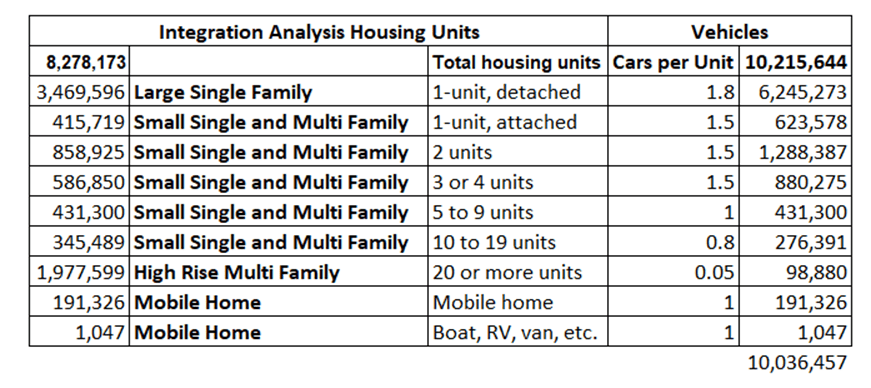
Not surprisingly there is insufficient detail in the Integration Analysis to determine how many Level 2 chargers are needed to fulfill this Scoping Plan target.  I found that in the Open NY list of disadvantaged communities that the population distribution was 6,993,023 residents (36%) in disadvantaged communities and 12,579,296 in the other communities.  According to the Integration Analysis there are 10,215,644 light duty vehicles in 2022.  I assumed that the proportion of vehicles owned by residents in disadvantaged communities equals the total number of vehicles times 36% multiplied by an arbitrary 20% representing number of residents owning a vehicle to come up with an estimate of disadvantaged community vehicles: 729,993.  I furthered assumed that one third of those vehicles will need a public charging station because they won’t have access to a private charger so 243,307 Level 2 chargers will be needed.  At the average cost in the Municipal ZEV Infrastructure Grant Program awards, $2,607 million would be needed and even at the minimum cost $809 million would be needed just for Level 2 chargers. 

I also made an estimate of the number of chargers needed throughout the state.  The integration analysis lists the number of housing units for nine categories.  I assumed the number of light duty vehicles (LDVs) per unit and calculated how many LDVs for each category. 

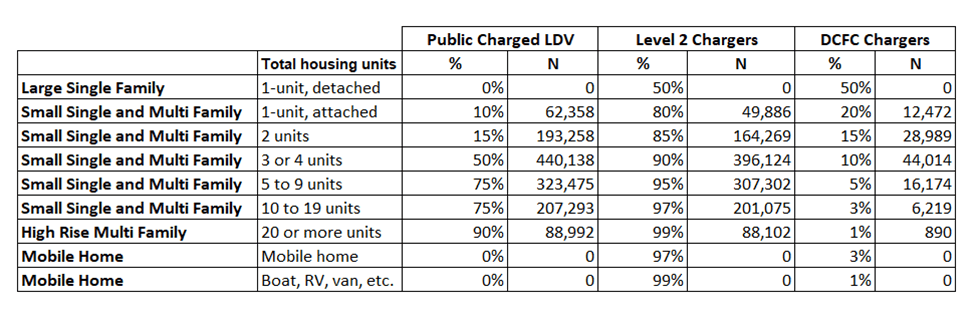
In the next step I estimated the percentage of vehicles that would be charged at public charging stations for each residential category.  For example, I assumed that no 1-unit detached homes would charge their electric vehicle at a public station but that 90% of the vehicles in high rise multi-family units would.  I also estimated the percentage of level 2 chargers and DCFC chargers by housing unit type.  The result was the number of level 2 and DCFC chargers that would be needed for residential public charging.

The number of charges was multiplied by the average and minimum cost for the Level 2 and DCFC systems to get a range of expected costs for public chargers based on the results of this announcement.  I estimate that between $8.4 billion and $26.6 billion would be needed for residential public charging systems.  Note that this does not include public charging systems for the traveling public or office parking lots.

The Hochul Administration narrative is that the costs of inaction for the net zero Climate Act transition outweigh the costs of action but that statement is misleading unless the caveat that the costs in the Scoping Plan do not include the costs “already implemented” programs like the Municipal ZEV Infrastructure Grant Program.  As far as I can tell the Integration Analysis did include the benefits of already implemented programs.  In other words, the Administration claim does not include all the costs to transition to net-zero.  According to the final scoping plan the societal benefits of the Climate Act net zero transition plan are greater than the costs by between $115 and $130 billion.  Properly including this Grant Program as a necessary cost to get to meet the Climate Act mandates reduces the alleged benefits to between $89 and $122 billion.  I believe that when all the other costs to electrify the transportation sector are included, the real costs will exceed the societal benefits.

Conclusion

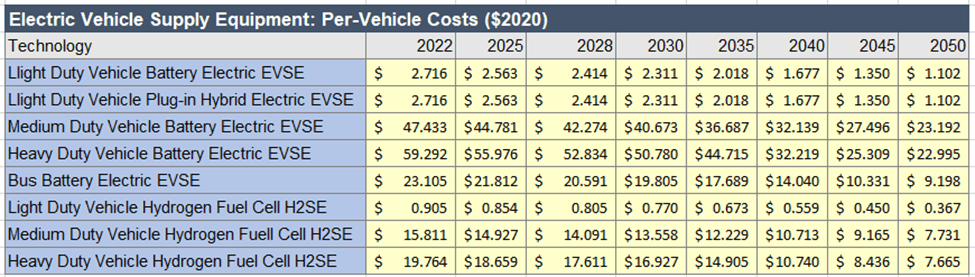
Every component of the Climate Act that I have evaluated has turned out to be more complicated, the ease of transition more uncertain, and the costs greater than admitted in the Scoping Plan.  In this example, the Scoping Plan does not differentiate or address the differences between home charging and the more complicated public charging requirements.  The Scoping Plan suggests that implementation should “focus on charging at multi-unit dwellings, on-street charging, and convenient urban fast charging, especially in areas with less access to home charging” but does not acknowledge the uncertainties associated with finding the room for those assets.  Finally, the Integration Analysis lists the cost for Light Duty Vehicle Battery Electric Vehicle Supply Equipment: Per-Vehicle Cost as $2,826 in 2022, but the minimum cost in the 2022 awards was $3,326 and the average cost was $10,713. 

Given the complications, uncertainties and higher costs there is no way the Hochul Administration net-zero transition is going to work as glibly promised.  For all the talk about inspiring other jurisdictions to follow New York’s lead and commit to the same GHG emission reductions targets the possibility that rushing ahead without addressing feasibility issues might end in a debacle that sets their cause back has been ignored.  The Climate Act’s appeal to emotion and values rather than a rational energy policy is not going to end well for the state or their cause.

No Electric Car for Me Guest Post

Guest post by Mark Stevens

This is a guest post by Mark Stevens, a regular reader at this blog.  Mark is a retired science and technology teacher.  When he sent an email with this I asked if I could post it and he agreed.

Cut Greenhouse gasses!  Save The Planet!  A better vehicle!  Really?

 I didn’t know EVs (electric vehicles) are about 1000 lbs. heavier than their petroleum equivalents and therefore have higher brake wear (increased particulates), tire wear (increased nano particles), and require more charging energy.

 I didn’t know EVs’ batteries lose power in the cold and reduce their range, and the batteries need replacing after several years approaching half the cost of the vehicle.

I didn’t know the rare elements needed in EVs like lithium, cobalt, copper, nickel are mined in third world countries where child slave labor is used to mine the metals and the metals obtained are refined resulting in mass poisoning of the land and water and massive greenhouse gas emissions are emitted in  the refining.

 I didn’t know the grid doesn’t have the capacity to charge EVs on a massive scale which will lead to rolling blackouts like California, North Carolina and Texas when many families are charging at the same time.

 I didn’t know that electricity providers will boost rates significantly higher to charge EVs at home resulting in  cost-of-operation higher than a gasoline car.

I didn’t know the total greenhouse gas emissions in EV cars from obtaining rare earths to fabrication to end-of-life disposal is greater than that of conventional cars.

I didn’t know that if EVs were really viable they wouldn’t need thousands of dollars of taxpayer subsidies.

I didn’t know EV batteries can suddenly explode in an unstoppable fire that emits toxic gasses.  This results in ordinances requiring EVs to NOT park in garages.

I didn’t know the EVs’ components are not easily recyclable and end-of-life disposition is a major problem for landfills, recyclers and incinerators.

I didn’t know Connecticut’s fleet of electric busses were withdrawn due to several catastrophic fires.

I didn’t know a home charger costs thousands of dollars.

I didn’t know a 500 mile trip would require hours of recharging on the way.

I didn’t know I would have to detour and spend time finding a street charger.

I didn’t know low and middle-income Americans will find using and affording a new or used  electric car will be unaffordable.

I didn’t know the tax on your gasoline to keep our roads maintained will soon be replaced by a special tax on your electric vehicle registration as make-up.

 I’ll stay with my gasoline-powered car.

Green Car Journal Perspective:  What Happened to Bridge Technology?

Late last year the editor of the Green Car Journal contacted me after he came across my Pragmatic Environmental Principles while doing research on pragmatic environmentalism.  He said that he realized we share similar ideas and asked if I would like to share my perspective on GreenCarJournal.com.  This post provides documentation for my perspective.

Everyone wants to do right by the environment to the extent that they can afford to and not be unduly burdened by the effects of environmental policies.  Pragmatic environmentalism is necessary to balance environmental impacts and public policy. This means that evidence-based environmental risks and benefits (both environmental and otherwise) of issues need to be considered. The opinions expressed in this post do not reflect the position of any of my previous employers or any other company I have been associated with, these comments are mine alone.

What Happened to Bridge Technology?

This section provides context and documentation to the quoted sections in the article. 

I usurped the concept of a bridge fuel to describe the need of technology that provides demonstrable air quality and CO2 reductions while a “zero-emissions” technology is developed.

Not so long ago, it was generally accepted that plug-in hybrid electric vehicles (PHEVs) and compressed natural gas (CNG) vehicles could be used as bridge technologies until ‘zero-emissions’ vehicles could perform like existing vehicles, at similar cost.  Unfortunately, politics in New York and elsewhere demand net-zero by 2050 with policies that preclude their use. 

I have spent a lot of time the last three years evaluating New York’s net-zero by 2050 target mandated by the Climate Leadership and Community Protection Act (Climate Act) from a pragmatic point of view. Pragmatic environmentalism is all about balancing the risks and benefits of both sides of issues. Most troubling in the quest for net zero is the lack of consideration for tradeoffs.          

I recently wrote that the Climate Act and the transition plan embodied in the Draft Scoping Plan is full of examples where the perceived risks of fossil fuels are comprehensively addressed but none of the risks of the proposed alternatives are addressed.  The most glaring Climate Act example is the requirement that the full life cycle and upstream emissions associated with fossil fuels must be considered.  The same consideration of the life-cycle issues with battery electric or hydrogen fuel-cell vehicles is not considered. 

In New York the mandated technology is ‘zero-emissions,’ either battery electric or hydrogen fuel cells.  PHEV and CNG vehicles have direct emissions and so will be banned.  The Climate Act fossil fuel accounting requirements inflate the global warming effects as compared to all other jurisdictions and mandate that upstream and life-cycle emissions also be considered.  On the other hand, the life-cycle emissions and impacts of the ‘zero-emissions’ technologies are ignored.

I submitted Climate Act Draft Scoping Plan comments on the electric vehicle transition schedule.  The analysis presumes an unprecedented adoption rate for light-duty electric vehicles. The biggest problem in the analysis is that the device costs for zero-emissions charging technology and the vehicles themselves is presumed to decrease significantly over time.  Home EV chargers and battery electric vehicles both are claimed to go down 18% between 2020 and 2030.  The overall cost decreases are so large that the total costs for the zero-emissions vehicles adoption is cheaper than using existing technology which I believe is a major reason that they think the transition will be so fast to a technology that is so inconvenient.

The Climate Act’s net-zero by 2050 transition is extraordinarily ambitious. The Scoping Plan that outlines the framework to implement this transition projects that in order to meet the net-zero schedule, over 30 percent of all light-duty vehicles sold will either be battery-electric vehicles (BEVs) or hydrogen fuel cell vehicles (HFCVs) in 2025, and 100 percent by 2035. For medium- and heavy-duty truck sales, the Scoping Plan projects that at least 10 percent sold will either be BEVs or FCEVs in 2025, and 64 percent by 2035.

It’s wishful thinking to presume that large percentages of people will choose BEVs and HFCVs, forgoing the flexibility of a personal car that has much greater range in all seasons, can be refueled quickly on long trips, and does not require expensive charging equipment at home.  PHEV technology eliminates range anxiety, refueling, and home equipment concerns. It also reduces fuel use and air pollution emissions significantly and uses a smaller battery pack than a BEV, which reduces the environmental impacts of rare earth mineral supplies and disposal that the Climate Act ignores.

There are two options in the Climate Act Scoping Plan for personal transportation: hydrogen fuel cells and battery electric vehicles.  Hydrogen fuel cell vehicles have two overcome two technological hurdles: the fuel cells themselves and providing the hydrogen necessary as fuel.  I have never bothered to research the feasibility of fuel cells because I think that a hydrogen economy is a fantasy.  There so many obvious issues with battery electric vehicles that just thinking that the State presumes that they can all be overcome because they say so, makes me ill.

When all the physical, cost, and logistical issues associated with hydrogen use are considered, it will not play a major role in the future. BEV technology doesn’t appeal to a majority of car owners because of nuisance constraints, but the technology could work. The same cannot be said for battery electric heavy-duty vehicles since range, refueling, and charging infrastructure constraints are deal breakers that prevent heavy-duty trucks from meeting the 2050 net-zero target. 

While there is no question that reduced levels of air pollution have benefits, I believe that there are thresholds to those impacts where further reductions have little beneficial value.  Nonetheless, air quality health benefits are touted as one of the primary benefits of the net-zero transition, especially related to disadvantaged communities.    One example of those impacts is related to the Hunts Point Food Distribution Center in South Bronx, New York that is the largest food distribution center in the country.  Diesel exhaust emissions are primarily inhalable particulates that are targeted as a primary air pollution health factor so eliminating diesel truck emissions is an activist priority.  Compressed natural gas trucks greatly reduce particulate emissions and lower the pollutants that create ozone.  However, instead of advocating for the CNG technology that has proven to work in heavy duty trucks, the activists want to use zero-emissions technology that might work sometime in the future.

There are serious inhalable particulate air pollution issues associated with diesel truck emissions at freight terminals in New York City. The Scoping Plan claims that replacing these trucks with zero-emission alternatives provides significant benefits. However, the plan’s zero-emissions aspirations ignore technological tradeoffs and the reality that CNG heavy-duty trucks are a viable alternative that would markedly reduce inhalable particulate emissions.  The problem with CNG is not technology since we know it works, but a problem with the development of fueling infrastructure and vehicle fleet turnover. It is not pragmatic to insist that heavy-duty trucks use unproven battery electric technology over other alternatives that can markedly reduce the air quality issues. 

The pragmatic response is obvious.

The use of PHEV and CNG vehicles for personal and freight transport offers the opportunity for significant air quality benefits, at a cheaper societal cost, with less impacts on personal choice, and sooner than the ‘zero-emissions’ alternatives. Failing to consider those benefits while insisting upon a riskier technological approach is not good social policy. Someday, there may be a better alternative, but in the meantime bridge technologies that provide most of the benefits are the more appropriate policy approach.

Conclusion

In the transportation sector, there are two choices: technology that gets significant emission reductions with the associated benefits, at a lower cost, has fewer implementation downsides, and has proven results or technology that has limitations in every respect but has “zero-emissions” if it can be deployed someday.  From a pragmatic standpoint the rational approach is use what makes an improvement, continue research and development for “zero-emissions” technology, and deploy that only when we know it will work as advertised.  Unfortunately, that option has been pulled off the table.  A friend describes the situation well: these morons are apparently fully at ease with the equivalent of jumping out of a perfectly good airplane without an upgraded parachute assuming that an even better parachute will be developed, proven technically and economically feasible and delivered to the imbecile that jumped out of the airplane in time to provide a soft landing.

New York Zero Emission Vehicle Mandate

The Climate Leadership and Community Protection Act (Climate Act) has a legal mandate for New York State greenhouse gas emissions to meet the ambitious net-zero goal by 2050.  On September 29, 2022 Governor Hochul directed the New York Department of Environmental Conservation to take major regulatory action that will require all new passenger cars, pickup trucks, and SUVs sold in New York State to be zero emissions by 2035.  As has been the case with all of the Administration’s global warming regulatory initiatives the pronouncement is not supported by any documentation.

Everyone wants to do right by the environment to the extent that they can afford to and not be unduly burdened by the effects of environmental policies.  I submitted comments on the Climate Act implementation plan and have written extensively on New York’s net-zero transition because I believe the ambitions for a zero-emissions economy embodied in the Climate Act outstrip available renewable technology such that this supposed cure will be worse than the disease.  The opinions expressed in this post do not reflect the position of any of my previous employers or any other company I have been associated with, these comments are mine alone.

Climate Act Background

The Climate Act establishes a “Net Zero” target (85% reduction and 15% offset of emissions) by 2050. The Climate Action Council is responsible for preparing the Scoping Plan that will “achieve the State’s bold clean energy and climate agenda”.  They were assisted by Advisory Panels who developed and presented strategies to the meet the goals to the Council.  Those strategies were used to develop the integration analysis prepared by the New York State Energy Research and Development Authority (NYSERDA) and its consultants that tried to quantify the impact of the strategies.  That material was used to write a Draft Scoping Plan that was released for public comment at the end of 2021. The Climate Action Council states that it will revise the Draft Scoping Plan based on comments and other expert input in 2022 with the goal to finalize the Scoping Plan by the end of the year.

In 2019 greenhouse gas (GHG) emissions from the transportation sector accounted for 28.2% of total GHG emissions so it is necessary to reduce transportation sector emissions to meet the Climate Act targets.  However, I explained in my comments that the Draft Scoping Plan did a poor job evaluating how a zero-emissions mandate would be implemented and an even worse job projecting the potential costs.  I will highlight some of the points made in my comments and also put this new mandate in context.

Hochul’s Announcement

The following is a substantial portion of the press release announcing the mandate:

Governor Kathy Hochul today commemorated National Drive Electric Week by directing the State Department of Environmental Conservation to take major regulatory action that will require all new passenger cars, pickup trucks, and SUVs sold in New York State to be zero emissions by 2035. This is a crucial regulatory step to achieving significant greenhouse gas emission reductions from the transportation sector and is complemented by new and ongoing investments also announced today, including electric vehicle infrastructure progress, zero-emission vehicle incentives, and ensuring New York’s communities benefit from historic federal climate change investments.

“New York is a national climate leader and an economic powerhouse, and we’re using our strength to help spur innovation and implementation of zero-emission vehicles on a grand scale,” Governor Hochul said. “With sustained state and federal investments, our actions are incentivizing New Yorkers, local governments, and businesses to make the transition to electric vehicles. We’re driving New York’s transition to clean transportation forward, and today’s announcement will benefit our climate and the health of our communities for generations to come.”

Proposing draft State regulations is a crucial step to further electrify the transportation sector and help New York achieve its climate requirement of reducing greenhouse gases 85 percent by 2050, while also reducing air pollution, particularly in disadvantaged communities. The State Department of Environmental Conservation (DEC) is expediting this regulatory process to implement legislation Governor Hochul signed last year and turn those goals into progress in fully transitioning to new zero-emission cars and trucks. California’s action finalizing the Advanced Clean Cars II regulation last month unlocked New York’s ability to adopt the same regulation.

The regulation will build upon existing regulations enacted in New York in 2012 by requiring all new sales of passenger cars, pickup trucks, and SUVs to be zero-emission by 2035. It would require an increasing percentage of new light-duty vehicle sales to be zero-emission vehicles (ZEV) starting with 35 percent of sales in model year 2026, 68 percent of sales by 2030, and 100 percent of sales by 2035. New pollutant standards for model year 2026 through model year 2034 passenger cars, light-duty trucks, and medium-duty vehicles with internal combustion engines would also be required. The regulation provides manufacturers with flexibility in meeting the emission requirements and achieving a successful transition to cleaner vehicles.

Adoption of Advanced Clean Cars II is included among the recommendations in the Climate Action Council’s Draft Scoping Plan and will be instrumental in achieving the greenhouse gas emissions reductions required in the Climate Leadership and Community Protection Act. In addition, reducing emissions will provide significant air quality benefits to many of New York’s disadvantaged communities, predominantly home to low-income Black, Indigenous, and People of Color, and often adjacent to transit routes with heavy vehicle traffic. The regulation will help address disproportionate risks and health and pollution burdens affecting these communities.

Department of Environmental Conservation Commissioner and Climate Action Council Co-Chair Basil Seggos said, “Governor Hochul is demonstrating her sustained commitment to the successful implementation of the Climate Act and ensuring all New Yorkers benefit from the State’s actions to address climate change. DEC will continue to work under her direction to rapidly issue this regulation and reach another milestone in the transition from fossil fuels so that more people, businesses, and governments will have the ZEV options to meet their needs and help improve the health of their communities.”

The directed regulatory action announced today builds on New York’s ongoing efforts to reduce emissions of greenhouse gases, including the adoption of the Advanced Clean Trucks regulation in December 2021. That regulation will drive an increase in the number of medium- and heavy-duty ZEV models available as purchase options for vehicle purchasers and fleets. In addition, several transit agencies including the Niagara Frontier Transportation Authority, the Rochester-Genesee Regional Transportation Authority, and the Metropolitan Transit Authority are leading by example with second wave deployments of electric buses. DEC, New York State Energy Research and Development Authority (NYSERDA), New York Power Authority (NYPA), and DOT (Department of Transportation) are assisting these authorities with these efforts.

Draft Scoping Plan Transportation Comments

I submitted a couple of comments on electric vehicles.  The emphasis in the first comment was my finding that the Integration Analysis is simply making assumptions about future zero-emissions transportation implementation strategies without providing adequate referenced documentation.  I provided numerous recommendations for additional documentation in these comments so that New Yorkers can understand what will be expected and how much it will cost.

As far as I can tell, the electric vehicle costs are based entirely on new vehicle sales. There is no acknowledgement that the used car market will likely change because of the cost of battery replacement.  Sellers will likely get less relative to new cars in the battery electric vehicle market.  Buyers may get a relative deal but will lose in the end when the batteries have to be replaced.  This is a particular concern for low and middle-income citizens who cannot afford new vehicles.

There is no bigger disconnect between the zero-emission vehicle (ZEV) proposed strategy and reality than the ZEV charging infrastructure requirements.  The biggest problem is that millions of cars will have to rely on chargers that cannot be dedicated for the owner’s personal use because the owners park on the street or in a parking lot.  In order to provide a credible ZEV strategy, the final Scoping Plan has to describe a plan how this could possibly work.  It is not enough to simply say it will work.

I also submitted a comment addressing electric vehicle costs.  the Integration Analysis vehicle cost projections rely on a single vehicle type for light-duty vehicles.  As a result, the projections are not particularly useful for many vehicle owners.  In order to accurately project the costs for this mandate the types of vehicles used has to be updated. 

Discussion

There is a paragraph in the press release that needs to be addressed:

The regulation will build upon existing regulations enacted in New York in 2012 by requiring all new sales of passenger cars, pickup trucks, and SUVs to be zero-emission by 2035. It would require an increasing percentage of new light-duty vehicle sales to be zero-emission vehicles (ZEV) starting with 35 percent of sales in model year 2026, 68 percent of sales by 2030, and 100 percent of sales by 2035. New pollutant standards for model year 2026 through model year 2034 passenger cars, light-duty trucks, and medium-duty vehicles with internal combustion engines would also be required. The regulation provides manufacturers with flexibility in meeting the emission requirements and achieving a successful transition to cleaner vehicles.

In 2026 the State will require 35% of all new vehicle sales to be zero-emission vehicles.  As of May 1, 2022 there were a little over 62,000 electric cars registered in New York out of the over 11 million vehicles registered.  The Integration Analysis projections for battery electric vehicles in 2026 range from 7.8% in the reference case to 24.3% in the most optimistic mitigation scenarios.  One of my criticisms of the Draft Scoping Plan is that the increase in projected sales is not supported by any recommendations for implementation. 

I have documented many electric vehicles issues but it is by no means an exhaustive list of the reasons I will never purchase an electric vehicle.  The State apparently believes that all that is necessary is a proclamation and all the reservations of all the people who are perfectly happy with internal combustion engines will be overcome.

Hochul’s proclamation fails to address the low and middle-income consumer concerns expressed by Robert Bryce in testimony before the House Select Committee on the Climate Crisis:

EVs … impose … societal costs that are likely to exacerbate inequality and lead to more energy poverty,” Bryce continued. “Those costs include taxpayer-funded subsidies given to EV buyers, publicly funded charging stations, and the grid upgrades that will be needed to support the electrification of light and heavy-duty vehicles. Those costs will impose a significant cost burden on low and middle-income consumers, even though those consumers are unlikely to purchase EVs.

Bryce also raised other issues in his testimony that are ignored in the grandstanding announcement:  

Electrifying parts of our transportation system may result in incremental reductions in greenhouse gas emissions, but a look at history, as well as an analysis of the supply-chain issues involved in manufacturing EVs, the resource intensity of batteries, and the increasingly fragile state of our electric grid – which is being destabilized by bad policy at the state and national levels – shows that a headlong drive to convert our transportation systems to run on ‘green’ electricity could cost taxpayers untold billions of dollars, increase greenhouse gas emissions, be bad for societal resilience, make the U.S. more dependent on commodity markets dominated by China, make us less able to respond to extreme weather events or attacks on our infrastructure, and impose regressive taxes on low and middle-income Americans in the form of higher electricity prices.

Finally, the ultimate rationale for this inane policy is to do something about climate change.  The reality is that New York emissions are inconsequential so this is nothing more than politically expedient climate virtue signaling.  New York’s GHG emissions are less than one half a percent of total global emissions and, on average, global GHG emissions have been increasing by more than one half a percent per year.  Anything we do will be wiped out be emissions elsewhere in a year.  Furthermore, the State has never published an estimate of the effect of New York emission reductions on global warming itself.  I estimate that the change to global warming from eliminating New York GHG emissions is only 0.01°C by the year 2100 which is too small to be measured much less have an effect on any of the purported damages of greenhouse gas emissions. 

Conclusion

In the press release Hochul claimed that “New York is a national climate leader and an economic powerhouse, and we’re using our strength to help spur innovation and implementation of zero-emission vehicles on a grand scale”.  The State’s obsession with being a climate leader is pointless.  Worse there is no recognition that the pursuit of zero emissions has unintended consequences and will likely cause more harm than good.  The lack of a public discussion of pragmatic considerations for the net-zero transition will ultimately seriously affect New York.

Capital Tonight Electric Vehicles

Here is the link to the interview.

The Climate Leadership and Community Protection Act (Climate Act) has a legal mandate for New York State greenhouse gas emissions to meet the ambitious net-zero goal by 2050.  I was interviewed for a segment on the electric vehicle component of the Climate Act on Spectrum Cable’s Capital Tonight program hosted by Susan Arbetter.  This post provides documentation for the information I provided in the interview and expands on some comments that could not be covered completely.

Everyone wants to do right by the environment to the extent that they can afford to and not be unduly burdened by the effects of environmental policies.  This blog emphasizes that pragmatic environmentalism is all about balancing the risks and benefits of both sides of policy issues.  The opinions expressed in this post do not reflect the position of any of my previous employers or any other company I have been associated with, these comments are mine alone.

Climate Act Background

The Climate Leadership and Community Protection Act (Climate Act) is New York’s response to climate change.  The Climate Action Council is responsible for preparing the Draft Scoping Plan that defines how to “achieve the State’s bold clean energy and climate agenda”.  They were assisted by Advisory Panels who developed and presented strategies to the meet the goals to the Council.  Those strategies were used to develop the Integration Analysis prepared by the New York State Energy Research and Development Authority (NYSERDA) and its consultants that quantified the impact of the strategies.  That analysis was used to develop the Draft Scoping Plan that was released for public comment on December 30, 2021.  The deadline for submitting comments is July 1, 2022

Climate Act Transportation Sector Strategies

The Climate Action Council strategies to achieve net-zero are described in the Draft Scoping Plan document.  The overall plan to reduce greenhouse gas (GHG) emissions is to electrify as much as possible and produce the electricity using mostly wind and solar generation.  Electrification is also a key component of the transportation sector strategy.  Chapter 11 explains that the reductions in the transportation sector are important because the transportation sector emits 27% of the total GHG emissions, second only to buildings. 

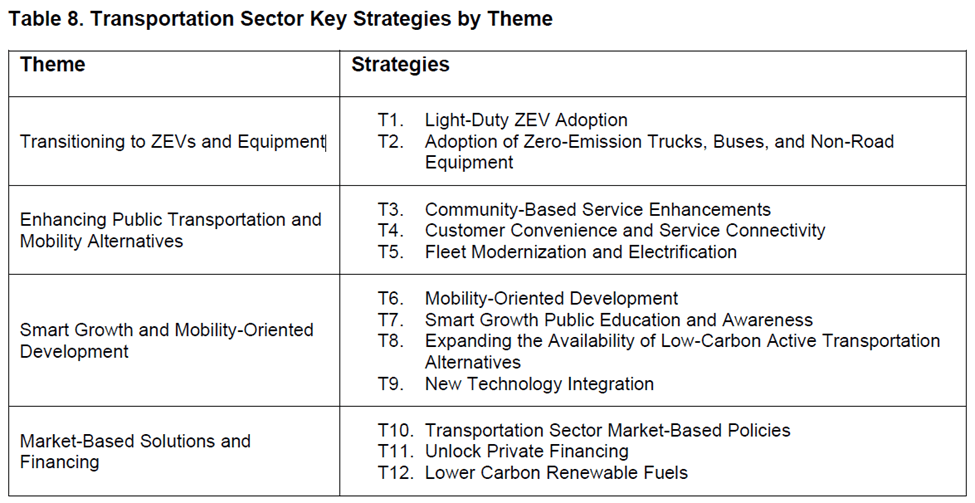
According to Table 8 from the Plan, there are four themes to the transportation sector emission reduction plan.  The first, transitioning to ZEVs and equipment, was the focus of the interview.  Both the enhancing public transportation and mobility alternatives and smart growth and mobility-oriented development themes aim to lower emissions by reducing the use of personal vehicles.  The last theme, market-based solutions and financing, addresses paying for the strategies.  The interview discussed personal vehicles so I am going to focus on light-duty vehicles.

The transportation sector theme transitioning to ZEVs and equipment has two strategies.  The first, Light-Duty ZEV Adoption, proposes to transition light duty vehicles to battery electric or hydrogen fuel cell power.  Note that because hybrid vehicles still use some fossil fuel, they are not acceptable.  The second theme, Adoption of Zero-Emission Trucks, Buses, and Non-Road Equipment, is very similar to the light-duty vehicle strategy except for different kinds of vehicles.

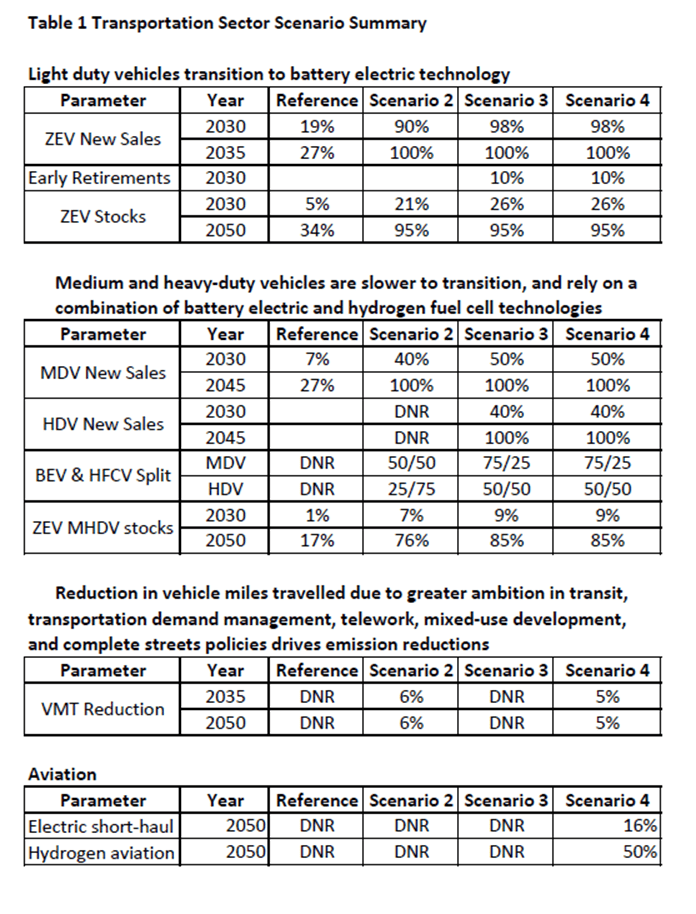
The Integration Analysis developed three scenarios for meeting the Climate Act targets.  I recently did a post summarizing the differences between those scenarios and the reference or business-as-usual case for the transportation sector.  I based my analysis on the Annex 2: Key Drivers and Outputs Spreadsheet.  The spreadsheet Tab: Scenario Definitions lists specific programs in the Reference Case which I summarized in  Table 1.

The first question addressed in the interview is when is this supposed to happen.  There is legislation in place that mandates that all new vehicles sold in 2035 must be zero-emissions vehicles (ZEVs).  At this time only 5% of vehicles sold are zero-emissions.  The expected transition over time varies between the three mitigation scenarios but note that in 2030 the Integration Analysis projects that over 90% of the vehicles sold will be ZEVs.  The sales transition to ZEVs is expected to occur naturally.  In other words, the expectation is that enough people will be willing to purchase ZEVs that this won’t need to be regulated before 2035.  However, note that the mitigation scenarios expect that in 2025, 33% of all vehicles sold will be ZEVs.  Also note that two of the mitigation scenarios propose to accelerate the adoption of ZEVs and reduce emissions faster by mandating early retirements in 2030.  I believe that it is overly optimistic to expect that one of every three cars will be a ZEV in three years so it is possible that if not enough people are willing to shift to ZEVs that New York may believe it is necessary to eventually add early retirement regulations.

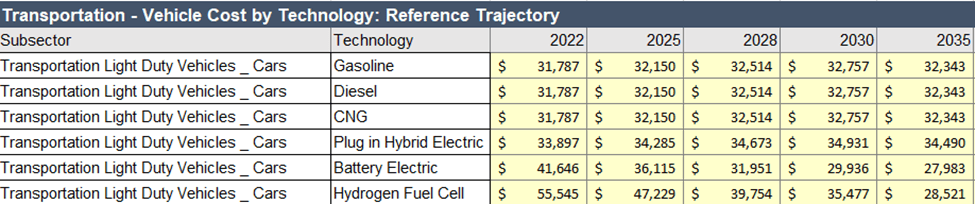
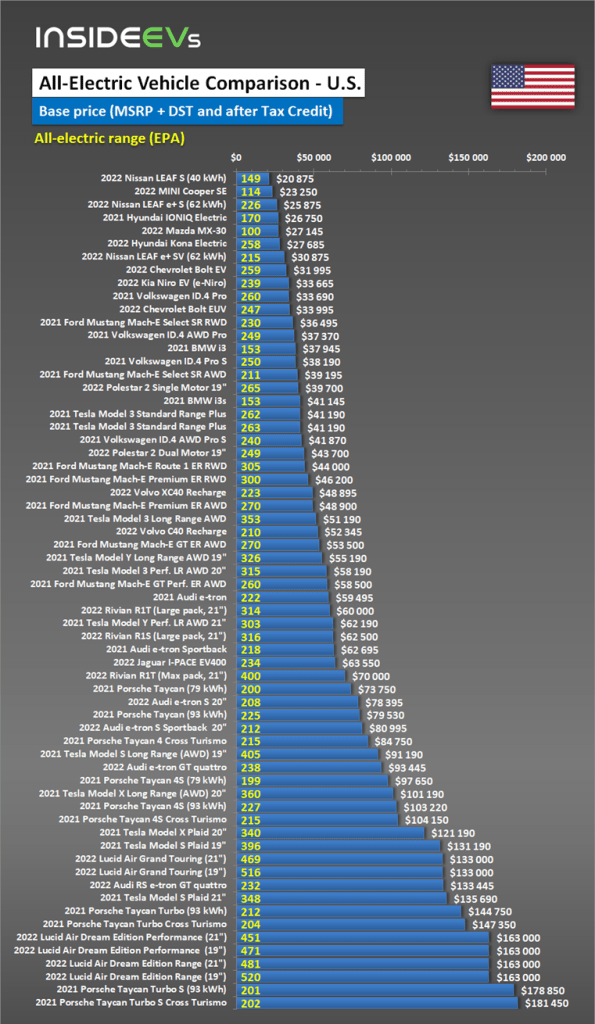
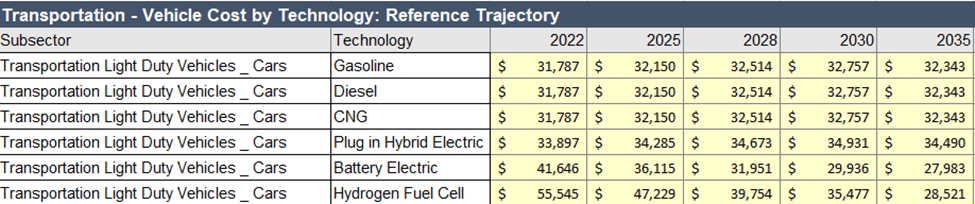
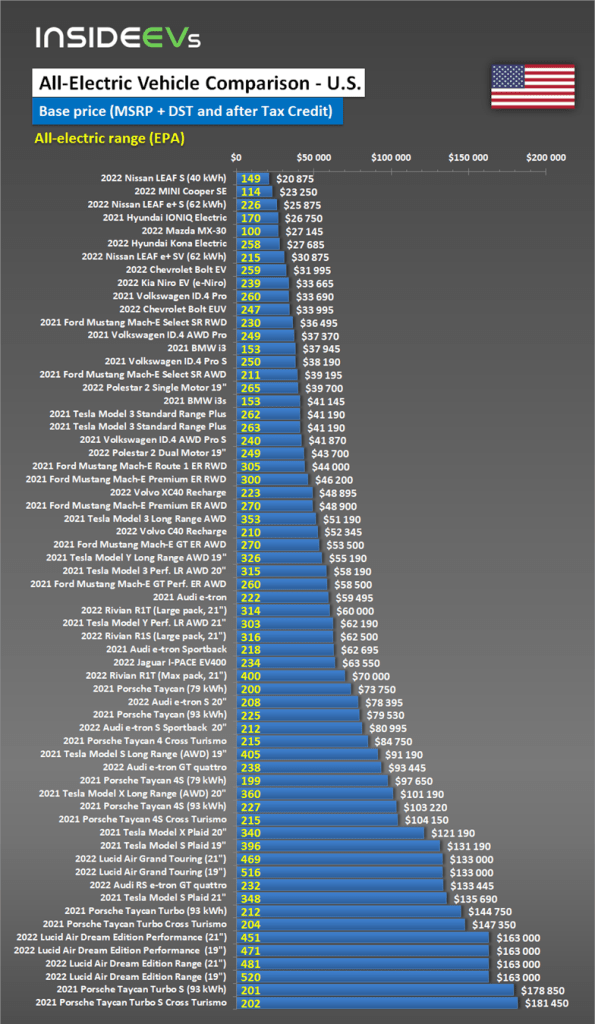
Another question addressed in the interview was how much will this cost.  I explained that the Integration Analysis documentation in the Scoping Plan says that in 2022 diesel/gas vehicle cost is $31,787 and battery electric vehicle cost is $41,646. Note that the Draft Plan projects that battery electric vehicles will be cheaper than gas/diesel by 2028: diesel/gas cost is $32,514 and battery electric is $31,951.  That is an optimistic ~5% per year decrease in costs.  The following table from Inside EVs lists the costs of battery electric vehicles on September 18 2022.  There are 63 car models listed and there are only 13 models less than the Integration Analysis estimate.

https://insideevs.com/news/534027/electric-car-prices-us-20210918/

There is another important vehicle cost issue.  I think there is an omission in the Draft Scoping Plan because they only talk about new car sales.  There is no discussion how the used car market will change.  Because batteries will have to be replaced in used cars and they are a major expense I think that will have a significant impact on the used car market.

Another component cost of electric vehicles is charger costs.  As shown in the Integration Analysis table below the 2022 cost for a light-duty vehicle is $2,176 and in 2035 the analysis expects costs to go down to $2,018.  There is a lack of detail about charger types.  I found a reference that describes two types of home chargers: Level 1 chargers that with a cost to install of $1800 can recover 4 to 5 miles of range per hour and Level 2 chargers costing $2200 that recover 25 to 30 miles of range per hour.  I assume that the Integration Analysis cost estimat is for Level 2 chargers that can fully charge vehicles overnight.   However, we also need to consider the costs for fast Level 3 chargers as part of overall costs even though they are not suitable for home use.  They are much more expensive $50,000+ but can recover 100 miles of range per hour.  Anytime an owner is on a long trip they are going to either need to find one of these chargers or interrupt their trip for an extended duration stop.  In my opinion, charging limitations would effectively preclude New Yorkers from driving south for spring break.

There is another massive omission in the Draft Scoping Plan relative to chargers. What about renters and people who park on the street?  Who is going to pick up the tab for all those chargers?  Chargers could be assigned in parking lots but on the street that would be problematic.  In both instances snow removal becomes an issue too.

In my opinion personal choice limitations are the biggest concern of the electric vehicle transition.  ZEVs have range limitations and I personally want the ability to travel long distances without range anxiety.  There is a safety issue buried in the necessity for longer fueling times.  In order to match the 2000 cars that a typical filling station can service in a busy 12 hours, a future station would require 600 Level 3 chargers at an estimated cost of $24 million and a supply of 30 megawatts of power from the grid.  Imagine the chaos if an evacuation was needed, everyone was driving a ZEV, and this limitation over-whelmed the capacity of available charging systems.

Discussion

There was insufficient time to fully address a couple of other issues.  Past transformative energy transitions occurred because the perception of the new technology was that it was better because it improved personal choice and opportunities as well as offering clear cost savings up front and over the lifetime of the vehicle.  This transition is different.  We are being forced to use technology that limits our ability to travel when and where we want and it costs more than what we are paying today.  The benefits are for a problem that New York cannot solve on its own and alleged impacts that we cannot question.  In my opinion that is a pretty hard pill to take.

We did not get a chance to talk about why aren’t hybrids good enough.  In brief, the Climate Act mandates zero-emissions and hybrids use fossil fuels.  The reality is that New York’s GHG emissions are so small relative to global emissions that there will not be any effect on the state’s climate and global climate change impacts to New York.  Global emissions have annually increased by more than one half of one percent per year and New York’s total share of global emissions is less than one half of one percent.  In other words, whatever New York does to reduce emissions will be supplanted by global emissions increases in a year.  If New York allowed hybrids as a control option even if it meant some emissions costs would be lower and many of the personal choice limitations would be addressed.

Conclusion

Ms. Arbetter and I agree that many people are unaware of the implications of the Climate Act.  She asked me to describe what the Draft Scoping Plan has to say about zero emission vehicles because that is one of the components that has the most impacts to New Yorkers.  I tried to describe what is included and what is not included in the Plan to help spread the word.

We both agree that New Yorkers should take the opportunity to provide comments so that the Climate Action Council gets engagement from as many people as possible.  I hope that readers will follow up and submit comments.  While you could try to wade through the Draft Scoping Plan itself, the document has been described as follows:

The plan is a true masterpiece in how to hide what is important under an avalanche of words designed to make people never want to read it. Here’s an example: “Regardless, any transition must be carefully planned, detailed, and clearly communicated to ensure that expectations are aligned across stakeholders.”

Instead of reading the document I suggest spending some time reading about issues and research things that are of particular interest to you at the Climate Act website and my Citizens Guide.  Once you have your thoughts together go to the comment website and submit your comment.   For your information I have summarized all my comments here. One final note, I submitted comments based on the interview discussion that are described here.

New York State Electric School Buses

I have argued repeatedly on this blog that the proponents of New York’s Climate Leadership and Community Protection Act (Climate Act) need to listen to the experts.  Recently Governor Hochul announced that New York would be the first state to set an electric school bus requirement.  This article describes an interview with a bus electrification expert about this plan.

Everyone wants to do right by the environment to the extent that they can afford to and not be unduly burdened by the effects of environmental policies.  I have written extensively on implementation of New York’s response to climate change risk because I believe the ambitions for a zero-emissions economy embodied in the Climate Act outstrip available renewable technology such that it will adversely affect reliability, impact affordability, risk safety, affect lifestyles, and will have worse impacts on the environment than the purported effects of climate change in New York.  New York’s Greenhouse Gas (GHG) emissions are less than one half one percent of global emissions and since 1990 global GHG emissions have increased by more than one half a percent per year.  Moreover, the reductions cannot measurably affect global warming when implemented.   The opinions expressed in this post do not reflect the position of any of my previous employers or any other company I have been associated with, these comments are mine alone.

Climate Act Background

The Climate Act establishes a “Net Zero” target by 2050. The Climate Action Council is responsible for preparing the Scoping Plan that will “achieve the State’s bold clean energy and climate agenda”.  They were assisted by Advisory Panels who developed and presented strategies to the meet the goals to the Council.  Those strategies were used to develop the integration analysis prepared by the New York State Energy Research and Development Authority (NYSERDA) and its consultants that quantified the impact of the strategies.  That analysis was used to develop the Draft Scoping Plan that was released for public comment on December 30, 2021. According to the Plan the transportation sector is responsible for 27% of current greenhouse gas emissions so strategies to electrify the sector are planned.

Zero-Emission School Buses

On April 9, 2022 New York Governor Hochul announced fiscal year 2023 investments in clean energy infrastructure, climate resiliency and preservation that New York will become the first state in the nation to set an electric school bus requirement.  According to the press release:

In order to improve air quality for school-age New Yorkers, the State Budget requires that all new school bus purchases be zero-emissions by 2027 and all school buses on the road be zero-emissions by 2035. The State Budget will provide $500 million through the Environmental Bond Act to support school districts in purchases of zero-emission buses and related charging infrastructure including charging stations. Additionally, the State Budget authorizes school districts to lease or finance zero-emission buses for 12 years, more than double the current five-year limitation for diesel buses, in order to help districts meet this goal, and ensures Transportation Aid is provided on zero-emission buses and related charging infrastructure. 

While doing research for this article I found a series of webinars on electric school buses put together by the Center for Transportation and the Environment (CTE).  They are a “member-supported 501(c)(3) nonprofit organization that develops, promotes, and implements advanced transportation technologies, vehicles, and fuels that reduce environmental pollution and fossil fuel dependency”.  “In partnership with the U.S. Departments of Defense, Energy, Interior, and Transportation, the U.S. Armed Services, and NASA, among many others”, CTE and its 89 member companies work together to improve transportation technologies and fuels while reducing their environmental impacts.  Despite the fact that CTE’s primary interest is foisting their “zero-emission” transportation vision on us all, the webinars (Bus Technology,  Charging Infrastructure, and Program Funding) are a useful overview of the technology needed for zero-emissions school buses.

What Do the Experts Say?

Jeff Sweet is an engineer at the Niagara Frontier Transportation Authority (NFTA).  His last task before retirement is to get the first electric buses and charging infrastructure operational for NFTA.  He has a lot of experience making buses work for their customers and, importantly, working with Metro Rail light rail vehicles in the NFTA.  Over the past couple of years, NFTA has begun the process to add battery-electric buses (BEB) to their fleet.  We recently talked about the challenges of bus electrification using the CTE webinar slides as a guide. 

NFTA took the position that converting the 323 buses currently in operation to battery electric vehicles should not lower the bar.  The BEBs need to achieve diesel bus efficiencies and standards of performance. The more I think about that approach the more I approve.  Why should we have to accept lower performance standards especially given that New York’s GHG emissions are lower than the average annual increase in global emissions over the last 30 years.

The first webinar includes a slide that explains why electric school buses are being considered now:

  • Zero criteria emissions around vulnerable populations
  • Quiet operation
  • Lower Greenhouse Gas emissions
  • Funding availability
  • Lower fuel and maintenance costs
  • Vehicle availability

There are issues with each of these points.  Zero emissions at the point of release ignores the environmental impacts of the materials needed for battery technology.  Most of the time quiet operation is an advantage but it also means pedestrians might not hear them coming.  The difference in GHG emissions when total life cycle emissions are compared is pretty small.  Current funding availability only works when someone, somewhere else is paying the bill.  The last two claims, lower costs and availability, are frequently pointed out by advocates.  Sweet explained that electric buses don’t have transmissions so that reduces maintenance.  However, he noted that the lower day-to-day maintenance costs advantage can disappear when it comes time for battery replacement.  Ultimately, when everything is considered, these advantages are not as big as they appear at first glance.

The bus technology CTE presentation includes a good overview description of electric vehicle batteries.  A couple of good points were made.  In a series of slides the limitations of the nameplate capacity were discussed.  It turns out that buses won’t move unless they have more than 5% charge, below 10% they have derated performance and that charging them over 90% reduces longevity.  In other words, actual battery capacity is down 20% from the get go.  In addition, there are many factors that cause batteries to age that also reduce performance.  Among the factors are age since production; charging rates and number of cycles; discharging rates and number of cycles; high temperatures; cyclic depth of discharge; sitting at high state of charge; and sitting at low state of charge.

Sweet explained that those battery considerations are not the only things that school districts will have to plan for when they switch to electric buses.  The specifications for buses must consider the duty cycle. It is not just range but also the bus route terrain.  If the buses have routes with many hills that will affect battery use.  Specifications must also consider how they will be used: how many stops, location and terrain are factors.  Based on his experience NFTA is planning to use traction motors like the ones used in their trolley buses.

In order for this all to work the school districts must have specifications for the life and usage of their buses to have the batteries meet the duty cycle.  Financing is another practical consideration.  Sweet explained that given their high rate of use when a bus is leased there is no residual value of the bus at the end of the lease.  On the other hand, car leases can have lower rates because the cars have residual value and can be sold at lease end.  Ultimately, he thinks the leases will be a financing scheme for batteries.

The issue of charging is an important consideration for school districts. There are different kinds of chargers and there is a premium cost for faster charging.  There also different types of charging connections.  Cables are cheaper but pantograph chargers are more flexible.  In addition, the power requirements must be considered.  We agreed that most school district bus garages would need to upgrade their electric service to a higher capacity.  For a large district getting sufficient power could mean upgrades not only to the service to the bus garage but the serving utility might also have to make changes to the electric distribution system. 

New York State School Buses

My primary concern is how school bus electrification will affect New York’s Climate Act implementation.  In the second CTE set of slides there is a presentation titled “White Plains Electric School Bus Vehicle to Grid (V2G) Project” that describes a pilot study with Consolidated Edison.  The utility’s main concern is charging equipment.  The presentation notes that it needs to meet bus needs, funding constraints, and “charge management platform compatibility”.  It goes on to explain that school buses will use a mix of AC and DC charging:

  • AC, Level 2 (most, but not all school buses) Slower charging, up to 22kW, cheaper, smaller
  • DC, Level 3 (becoming more common) Fast charging, 50-60kW typ., expensive, big, better vehicle to grid

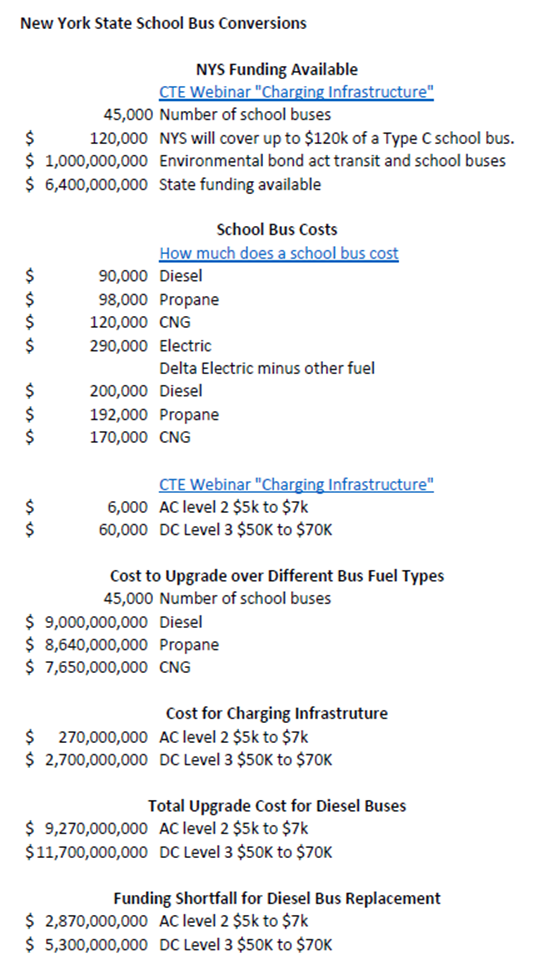
My ultimate concern is how much money will be needed and how much is available.  The presentation states that in New York State the plan is to cover up to $120K of the cost of a Type C school bus.  A commentary advocating for more funding claims that there are 45,000 school buses in New York and that the Senate budget plan proposes $1 billion for school and transit bus electrification.  The following table combines that information with the costs for school buses and the costs for charging infrastructure to estimate how much money will be needed.  Depending on the types of chargers used there will be a funding shortfall of between $3 and $5 billion to replace 45,000 diesel school buses.

Conclusion

The costs of electric buses are significantly higher than diesel buses and there is insufficient money available to cover those higher costs.  As a result, the electric bus conversion is an unfunded mandate to New York schools of at least $3 billion.  Furthermore, Sweet’s impression is that the manufacturers and many of the consultants don’t have the practical experience necessary to keep school districts from avoiding potential pitfalls that will further increase costs.  Consequently, it is likely that this is another virtue signaling “great” idea that will end up doing more harm than good.