
California Tipping Point

A slightly different version of this post appeared at Watts Up With That.  If this topic interests you I suggest that you check out the comments there too.

I recently posted an article describing how the Breakthrough Journal article by Jennifer Hernandez and Lauren Teixeira entitled Time to reset California’s climate leadership was relevant to New York State Climate Leadership & Community Protection Act (Climate Act) implementation.  I agree with the authors that both states need to reevaluate their climate policies until the states can cut “emissions while assuring that home ownership, an affordable cost of living, and good jobs are available to all.”  This post highlights a remarkable description of what is needed to reduce transportation sector emissions on the way to climate nirvana. 

I am convinced that implementation of the New York Climate Act net-zero mandates will do more harm than good if the future electric system relies only on wind, solar, and energy storage because of reliability and affordability risks.  I have followed the Climate Act since it was first proposed, submitted comments on the Climate Act implementation plan, and have written over 490 articles about New York’s net-zero transition.  The opinions expressed in this article do not reflect the position of any of my previous employers or any other organization I have been associated with, these comments are mine alone.

Overview

The Climate Leadership & Community Protection Act (Climate Act) established a New York “Net Zero” target (85% reduction in GHG emissions and 15% offset of emissions) by 2050.  It includes an interim 2030 reduction target of a 40% GHG reduction by 2030. Two targets address the electric sector: 70% of the electricity must come from renewable energy by 2030 and all electricity must be generated by “zero-emissions” resources by 2040.  Since the completion of the Scoping Plan at the end of 2022 New York has been trying to implement the Scoping Plan recommendations through regulations, proceedings, and legislation. 

California Climate Leadership

California was the first in the nation legislate a “solution” to climate change with its AB32 Global Warming Solutions Act of 2006.  After fourteen years the inevitable effects of reality are getting the attention of the politicians that supported the law.  Hernandez and Teixeira’s introductory paragraph explains that:

Faced with the election of Donald Trump to a second term, soaring inequality, and a decline in support from the state’s non-white majority, California’s Democratic leaders have begun asking hard questions about the state’s vaunted climate policies. California’s Democratic Assembly leader Richard Rivas opened the new Legislative session signalling a strong focus on meeting voter concerns about housing and the state’s extraordinarily high cost of living, specifically calling out the state’s climate policies: “California has always led the way on climate. And we will continue to lead on climate,” he told his Assembly colleagues. “But not on the backs of poor and working people, not with taxes or fees for programs that don’t work, and not by blocking housing and critical infrastructure projects. It’s why we must be outcome driven. We can’t blindly defend the institutions contributing to these issues.”

Hernandez and Teixeira compared several metrics for California, Florida, Texas, and the United States to determine how successful California’s claim to lead the way on climate has been. They explained that:

California’s claims to eco-superiority long predate the passage of AB32, the 2006 law that committed the state to ambitious climate targets and established a cap-and-trade system by which to achieve them. Even before this landmark bill, the state’s per capita carbon emissions were far lower than the national average.

The authors show that a primary reason for California’s low per capita emissions was because their electric sector emissions were low to start.  Texas and Florida reduced their electric sector emissions without climate policies because generating units “transitioned from coal to natural gas for largely economic reasons”.  California’s climate policies limit future generation technologies to solar, wind, and battery storage.  The unanticipated costs associated with deploying those technologies has made California electricity prices second only to Hawaii. 

In my previous article I compared California to New York.  New York observed emission reductions also occurred because of natural gas fuel switching.  The deployment costs for wind, solar, and energy storage are starting to become obvious and will force rates up to compete with California and Hawaii as the most expensive.  Another similarity is that both California and New York are going to have to find emission reductions from other sectors going forward.  The sector with the most emissions in California is transportation and, because of the climate difference, the building sector has the highest emissions in New York.  Transportation emissions are only slightly lower.  This article highlights the description by Hernandez and Teixeira of what emissions reduction strategies are planned for the California transportation sector to meet their climate goals.

Transportation Sector Strategies

Hernandez and Teixeira raised an issue that has been acknowledged by New York agencies but very few understand the implications.  Future emission reductions won’t come from the electric sector because the incremental benefits are small:

The rooftop solar and other signature California climate policy choices, despite their rising cost, increasingly brought diminishing returns, as much of the easy emissions reductions had already been realized, thanks to lower baseline electricity consumption and early adoption of natural gas. Carbon emission reductions from expensive new renewable energy additions were never going to be large. The state therefore increasingly prioritized aggressively reducing emissions from the transportation sector—the state’s largest source of emissions.

In New York the building sector is the largest source of emissions because of our climate.  Nonetheless the Climate Act targets are so extreme that New York and any other jurisdiction that wants to go to net zero must eventually pursue the same aggressive transportation sector reduction strategies espoused by California:

Compared to places like Texas and Florida, California’s emissions reductions since 2006 have come disproportionately from the transportation sector, not the electricity sector. Low carbon fuel requirements, new regulations on refineries, and electric vehicle mandates, have collectively increased the cost of driving substantially. California routinely now has the second highest gas costs in the country second only to Hawaii, which must import all of its gasoline by ship. The state has mandated the phase-out of internal combustion engines in vehicles by 2035 and its gasoline prices now seems poised to surpass even Hawaii: a few days after the election, the California Air Resources Board (CARB) voted to further tighten the Low Carbon Fuel Standard, a measure that is expected to further increase gas prices by up to 85 cents per gallon.

I find it hard to believe that Californians are going to passively accept those massive increases in gasoline costs.  But that is not all.

Even more ambitiously, California’s climate regulators have demanded that even after California converts to electric vehicles, local governments and regional planning agencies should reduce automobile use by 30%—a reduction in “vehicle miles travelled” that would be 2.5 times greater than the decline in miles driven during the depths of the Covid pandemic lockdown. To achieve this objective, CARB recommends and provides funding for local governments to eliminate traffic lanes through so-called “road diets,” intended to increase drive times and traffic congestion and incentivize use of public transit, even as massive investments in public transit have failed to reverse ridership declines that began pre-COVID and have caused massive transit system operating deficits.

Discussion

The mother of all reality slaps is coming to the regulators that think that road diets will be accepted by citizens.  Public transit is fine in concept, but the reality is that our society is now dependent upon personal transportation for most of the country. One hundred years ago there was an extensive network of trolley and interurban railroads in every city and the cities were compact enough that this transit option was viable.  By viable I mean that people could get from where they lived to where they worked using transit in a reasonable amount of time.  However, one hundred years ago those trolley systems started to go out of business because relying on public transit is inconvenient.  Most of those systems are gone now.   Even when replaced by bus systems, the fact is that public transit takes more time and using it forces you into a schedule.  Over the last 100 years development has spread out and the ability for public transit to get many people from where they live to where they work is limited to major cities.  This makes personal transportation demand inelastic.  Only fools think that road diets are going to incentivize the use of public transit.  This affects the emission reduction goals because the reductions in transportation sector emissions envisioned are never going to happen.

Conclusion

I hope that frequent visitors to my blog are aware of the difficulties associated with the net-zero transition plans imposed by reality.  When you are aware of the physical challenges the inevitable impacts on personal choice and quality of life of the transition policies become evident.  Unfortunately, most people are unaware of what is coming at them.

The public is faced with incessant propaganda that there is an existential climate crisis that is evident in every extreme weather event.  All they hear is the lie that fixing the weather is only the simple matter of stopping the use of fossil fuels which will be cheaper, more resilient, more secure, and improve the quality of life. 

California fossil fuel transition plans include policies “intended to increase drive times and traffic congestion and incentivize use of public transit”.  Eventually that will seep into the consciousness of the public.  I cannot imagine a scenario where this will not create massive blowback.  Will the charade end in California when the wind and solar system causes a massive blackout or when Californians are required to pay 85 cents more per gallon, or they are required to give up personal transportation options?  Hopefully California will hit the green transition wall soon enough and hard enough that New York policies will change before the impacts seen there inevitably arrive here.

New York Response to Part 490 Sea-Level Rise Amendment Comments

I submitted comments last April on the Department of Environmental Conservation (DEC) proposed Amendment to Part 490 Projected Sea-Level Rise (Amendment).  DEC stated that: “The goal of the proposed amendments is to provide up-to-date science-based projections of future sea level rise.”  This article responds to the replies to the comments I submitted.

This is one component of the Climate Leadership & Community Protection Act (Climate Act) mandate to do something about the “existential threat” of climate change.  I am convinced that implementation of the New York Climate Act net-zero mandates will do more harm than good if the future electric system relies only on wind, solar, and energy storage because of reliability and affordability risks.  I have followed the Climate Act since it was first proposed, submitted comments on the Climate Act implementation plan, and have written over 480 articles about New York’s net-zero transition.  The opinions expressed in this article do not reflect the position of any of my previous employers or any other organization I have been associated with, these comments are mine alone.

Part 490 Projected Sea-Level Rise

DEC’s Climate Change Regulatory Revisions webpage describes the Amendment to the regulation:

On September 22, 2014, the Community Risk and Resiliency Act was signed into law — Chapter 355 of the Laws of 2014 (CRRA). CRRA is intended to ensure that decisions regarding certain State permits and expenditures consider climate risk, including sea-level rise. Among other things, CRRA requires the Department of Environmental Conservation (Department) to adopt regulations establishing science-based State sea-level rise projections. Therefore, the Department proposed a new 6 NYCRR Part 490, Projected Sea-Level Rise (Part 490). Part 490 establishes projections of sea-level rise in three specified geographic regions over various time intervals, but does not impose any requirements on any entity. An amended Part 490 was adopted in September 2024 with no revisions to the draft released for public comment in January 2024.

While DEC loses no opportunity to say that this regulation imposes no requirements on any entities, I believe there are implicit requirements. 

Last April I was prompted to respond to the proposed Amendment by some articles that were published early in 2024.  Kip Hansen wrote a post entitled New York State Sea Level Rise:  Fantasy as Law.   A few days later Anthony Watts responded to a New York Post article by Carl Campanile with the headline: Sea levels around NYC could surge up to 13 inches in 2030s due to climate change: state study. I prepared comments which I summarized in a post.  In September 2024 DEC adopted the Amendment.  Surprising no one, their Assessment of Public Comments blew off all the concerns expressed.  

Part 490 Projected Sea-Level Rise

Kip Hansen summarized New York sea level rise history and the DEC projections in detail in his post.  What you need to know here is that New York City’s sea level has been increasing 3 mm per year over 167 years.  Enough of that observed increase is caused by local subsidence so that the remainder is “very close to the standardly cited Global Sea Level Rise figure for the 20th Century of 1.7 or 1.8 mm/yr.  (opinions vary – see NOAA here.)”   Kip explains that the projected increases included in the Amendment” have not been seen in the decade since the 2014 update report and, based on the historical record, are extremely unlikely to be seen in the near future.” He points out that “all the projections, in the Amendment, in the NYSERDA 2014 report and in the NYS Climate Assessment require doubling and tripling of long-term sea-level rise rates in New York City.”

RCP8.5 Comments

Kip, Anthony, and I agree that the projections are flawed because the methodology estimates an unrealistically high projected sea-level dependent upon an impossible climate model scenario.  Depending upon which version of the Intergovernmental Panel on Climate Change report being used the modeling scenarios are known either as a Representative Concentration Pathway (RCP) or Shared Socio-economic Pathways (SSP).  The RCP-8.5 scenario has been debunked by many as Anthony reported here and here.  My comments focused on the misuse of RCP-8.5 using some of those references and adding others. 

The Amendment revises the projections of future sea-level rise required by New York regulations. 

I raised the RCP-8.5 concerns in the pre-proposal draft of the amendment.  The Regulatory Impact Statement (RIS) uses the label SSP5-8.5 for this scenario and admits that those emission scenarios are implausible:

The Department acknowledges that current GHG emissions policies would result in actual emissions lower than projected by SSP5-8.5. Thus, the inclusion of higher projections of sea level rise, especially those based on SSP5-8.5, could lead to consideration of conditions that are unlikely to occur, at least in the more immediate future.

So how did DEC justify the continued use of SSP5-8.5?  The RIS goes to considerable lengths to justify its use with statements like the following: “Unfortunately, current literature does not provide a basis for assessment of the emissions levels at which ice shelf and marine ice cliff instability, important factors in sea level rise in high emissions scenarios, such as SSP5-8.5, become significant.” 

Response to RCP8.5 Comments

DEC is required to respond to submitted comments.  The Assessment of Public Comments document addressed my arguments in their response to Comment 6.  They summarized my concerns saying that “SSP5-8.5 is not plausible, and model outputs based on this SSP, including the rapid ice melt scenario, should not be included in the projections.”   The reply stated:

Response to Comment 6: DEC has described its rationale for including SSP5-8.5 model outputs in its projections, including the rapid ice melt scenario, in the RIS. To summarize here, the emission-reduction gap noted above, uncertainties in the causal chain to sea level heights, including ice cliff and ice shelf stability, and reports of accelerating Antarctic and Greenland ice loss reduce confidence that SLR will be limited to the levels projected by SSP2-4.5 models.  The CIA methodology report (p. 21) provides additional rationale for including projections based on SSP5-8.5:

• Continuity with previous New York State projections, which were based on representative concentration pathways with the same end-of-century radiative forcing.

• Stakeholder interest in these projections, based on CIA Needs Assessment.

• Value of identifying a broad range of plausible outcomes.

• Current climate impact models’ underestimation of plausible outcomes when driven by only moderate GHG forcing.

DEC maintains that inclusion of high, albeit unlikely, projections to enable consideration of the consequences of low-probability but high-consequence events to be the more prudent alternative to limiting projections to those based on SSP2-4.5.

The crux of my disagreement is the value of incorporating what is essentially an impossible scenario.  All the reasons cited attempt to justify what is essentially an executive decision to perpetuate the narrative that there is an existential threat of climate change exemplified, in this case, by extraordinary sea-level rise projections. 

It is telling that the response claims that the extreme projections are included because of “Stakeholder interest in these projections, based on CIA Needs Assessment.”  New York State agencies love to claim that they have a robust stakeholder process.  However, the stakeholder process operates with a loaded deck.  The New York Research & Development Authority (NYSEDA) CIA Needs Assessment Steering Committee is a relevant example.  The report states “The assessment has been guided by a Steering Committee of climate scientists, assessment experts, and representatives from nonprofit organizations and state and municipal government agencies.”  I am very critical of the review process because I know that there is immense pressure to adhere to the narrative within NYSERDA and I am sure no one skeptical of the extreme impact narrative was allowed anywhere near the Steering Committee. In addition, technical analyses performed for NYSERDA will not be funded in the future if the answers do not support the narrative.

Another reason given for using the impossible scenario is the “value of identifying broad outcomes”.  In this instance I think the value is primarily for the “scare the bejesus out of the populace” narrative needed to perpetuate the story that New York politicians are here to save the planet even in the face of increasingly obvious enormous costs, threats to reliability, and inevitable reduction in personal choice.  This will only stop when there is a change in the political balance of New York.

Amendment Mandate

I also submitted comments on the use of the projections.  

The Assessment of Public Comments document summarized my concern about how the projections will be used in Comment 7: “Although Part 490 may not directly create a mandate on local governments, many permits must consider the SLR climate hazard, which is a clear mandate affecting all governmental agencies.”  The response stated:

Commenter is correct that the Community Risk and Resiliency Act (CRRA) requires that applicants for all permits regulated pursuant to the Uniform Procedures Act (UPA) demonstrate consideration of climate change, including SLR. However, local governments are not required to incorporate the State’s climate change projections, including projected SLR, into local decision making. Local governments may be required to incorporate projected SLR into siting and design for projects for which a UPA permit is required. However, the manner in which projected SLR must be incorporated is described in program-specific regulations, policies, guidance and permit conditions.

This response basically abdicated their responsibilities with a “well it really doesn’t matter” claim.  I don’t think that local governments have the time or the expertise to address sea level rise with their own approach.  Part 496 will be approach used to define sea level rise in most cases.

DEC responded to my comment about where the extremely high projection will be used in Comment 9:  “The proposed amendments would require that all projects along the tidal shoreline must protect against 114 inches of SLR.”

Comment is not accurate. SLR of 114 inches is the proposed end-of-century projection under the rapid ice melt scenario. However, as stated in the RIS, DEC does not intend to require consideration of the rapid ice melt scenario in its permitting. The State Flood Risk Management Guidance (SFRMG) recommends consideration of the medium SLR projection (36 inches by 2100) over the expected service life of the project for non-critical projects and recommends use of the high projection (65 inches by 2100) over the expected service life of the project only for critical projects. Lower projections would be applicable according to the expected service life of the project.

The DEC responses focused on the rapid ice melt scenario, but the intent of my comments was that all the scenario results were way too high because they use RCP-8.5.  At the observed rate over the last 167 the likely total sea-level rise by 2100 is only 9 inches which is four times higher than the medium SLR projections and over seven times higher than the high SLR projections they recommend.  This must have an impact on costs.  DEC responded to my recommendation that the RIS should include an accounting of costs associated with the different SLR projections in Comment 10:

No reasonable accounting of costs associated with these projections can be provided due to uncertainty regarding the number and types of projects that might be affected. Although municipalities could incorporate the proposed projections into local planning and zoning, CRRA does not require them to do so. Thus, most residential projects would not be directly affected by these projections. Rather, these projections are most applicable to projects under the Department’s regulatory purview, which are more likely to be unique in their siting and design considerations and warrant consideration of costs and benefits on a case-by-case basis. Further, as discussed in the revised RIS, the differences between the scenario recommended by the commenter as the basis of projections and the approach selected by the Department are relatively small and represent a reasonable additional element of safety to account for uncertainty and the gap between GHG emission reduction commitments and implementation for the projections that are most likely to be used in regulatory contexts.

I have two problems with this response.  Refusing to include costs because it would be hard simply avoids responsibility.  Secondly, I do not think that projections that are four to seven times higher than the observed trend are “relatively small”.  I think this response represents a different interpretation of the intent of my comments that the modeling approach used by DEC over-estimates the possible sea-level rise compared to the observed trend.  The changes in the observed trend necessary for the models to be reasonably accurate are so great that the trend would have to exhibit marked acceleration today.  It is not happening.

My cost concerns were summarized in Comment 11: “The RIS is flawed because it does not weigh data against benefits and consequences for the intended application, i.e., developments with near-term life expectancies. All the other steps for appropriately addressing risk are hindered by not considering the applicability of the time frame. Ultimately the precautionary principle is applied without any other considerations.”  DEC responded:

The comment is incorrect in that it implies that projections of SLR far into the future, beyond the life expectancy of the project, must be incorporated into siting and design of the project. In fact, every one of the flood risk management guidelines for tidal areas included in the SFRMG includes consideration of the “sea-level rise projection over the expected service life of the structure.”

This might be another instance where DEC and I are talking past each other.  I tried to argue that the probability of problems with sea-level rise that their projections imply is very low compared to a reasonable expectation of the life expectancy of the project.  The observed sea-level rise expectation in 2100 will likely not occur until 2300 which is far beyond any reasonable expectation for life expectancy planning.

Conclusion

This process is an indictment of New York State’s regulatory mandates for stakeholder participation.  State agencies treat the stakeholder process as an obligation and not as an opportunity to improve their programs.  In this instance the lack of pre-proposal comments from the affected jurisdictions should have prompted more outreach.  The response to comments suggests that the extreme projections that prompted the New York Post article mentioned in the introduction will not necessarily affect SFRMG planning as much as I fear.  The question is whether the affected jurisdictions know that or not.  There are some instances where my comments and their responses could have led to further discussions if there was genuine interest in improving either the regulation or their description of why they are doing what they propose. 

Surprising no one, their Assessment of Public Comments blew off our concerns.  There is no reasonable defense for using RCP-8.5.  As long as New York State continues to claim they follow the science but ignore it when it is inconvenient, the more likely the rush to the bottom will become a death spiral. 

New York NYSERDA RGGI Funding Status Report Status Through 2023

In response to claims by New York State officials that the Regional Greenhouse Gas Initiative (RGGI) has been instrumental in reducing electric generating unit emissions I have evaluated the latest New York State Energy Research & Development Authority (NYSERDA) funding status report.  This article addresses the observed CO2 emissions reductions relative to the claimed CO2 emission reductions in the NYSERDA reports. There are ramifications of the emission reduction claims and NYSERDA program investments affecting compliance mandate requirements for RGGI that will be addressed in a subsequent article.

Background

I have been involved in the RGGI program process since its inception.  I blog about the details of the RGGI program because very few seem to want to provide any criticisms of the program.   I submitted comments on the Climate Act implementation plan and have written over 480 articles about New York’s net-zero transition because I believe the ambitions for a zero-emissions economy embodied in the Climate Act outstrip available renewable technology such that the net-zero transition will do more harm than good because of impacts on reliability, affordability, and environmental impacts.  The opinions expressed in this post do not reflect the position of any of my previous employers or any other organization I have been associated with, these comments are mine alone.

RGGI is a market-based program to reduce greenhouse gas emissions (GHG) (Factsheet). It has been a cooperative effort among the states of Connecticut, Delaware, Maine, Maryland, Massachusetts, New Hampshire, New York, Rhode Island, and Vermont to cap and reduce CO2 emissions from the power sector since 2008.  New Jersey was in at the beginning, dropped out for years, and re-joined in 2020. Virginia joined in 2021 but has since withdrawn, and Pennsylvania has joined but is not actively participating in auctions due to on-going litigation. According to a RGGI website:

The RGGI states issue CO2 allowances that are distributed almost entirely through regional auctions, resulting in proceeds for reinvestment in strategic energy and consumer programs.

Proceeds were invested in programs including energy efficiency, clean and renewable energy, beneficial electrification, greenhouse gas abatement and climate change adaptation, and direct bill assistance. Energy efficiency continued to receive the largest share of investments.

I have written multiple articles that argue that RGGI advocates mis-lead the public when they imply that RGGI programs were the driving force behind the observed 50% reduction in power sector CO2 emissions since 2000.  I did an article on CO2 emissions based on the funding status reports in December 2022.  This article updates the information through 2023.

New York Power Sector CO2 Emissions

The first step in evaluating the effect of RGGI on CO2 emissions is to determine the observed trend of New York electric utility emissions.  EPA’s Clean Air Markets Division maintains a database of all the emissions data collected by every power plant in the United States since the mid-1990’s.  I used that data for this analysis. 

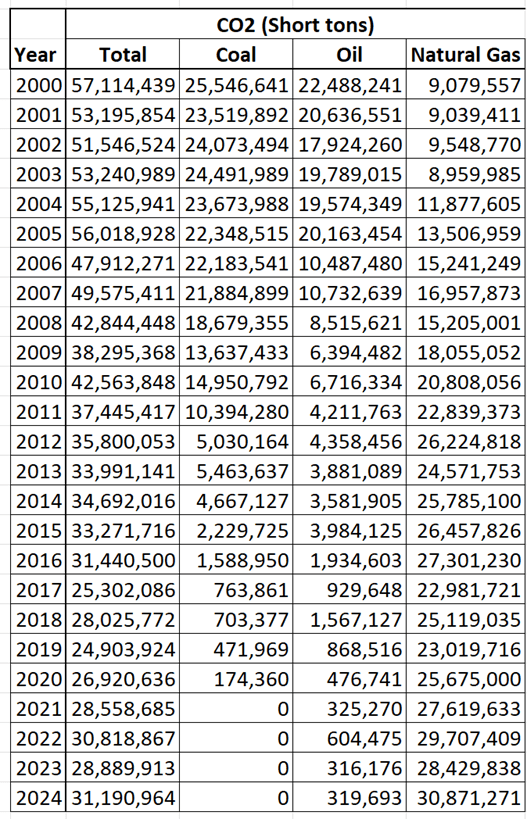
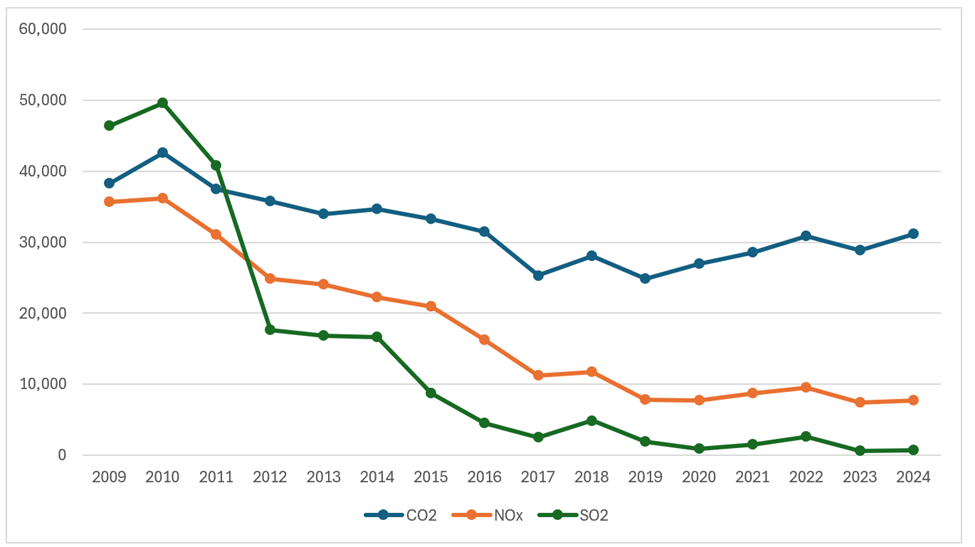
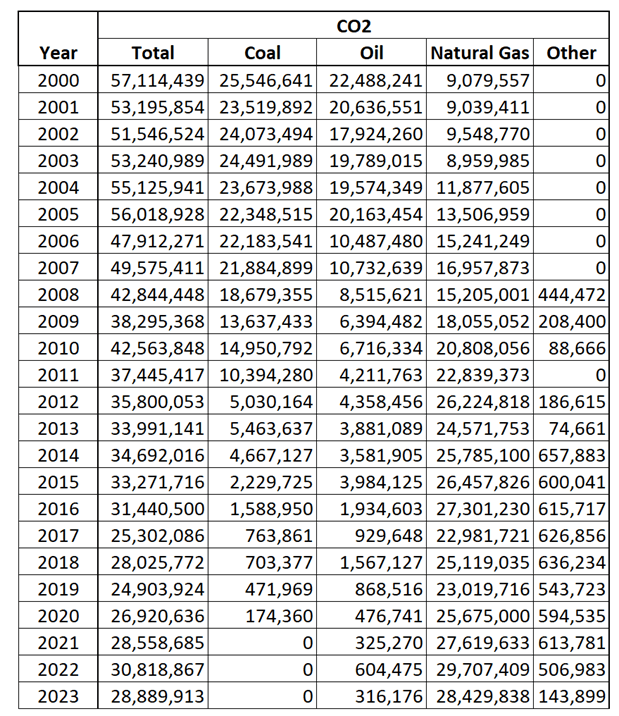
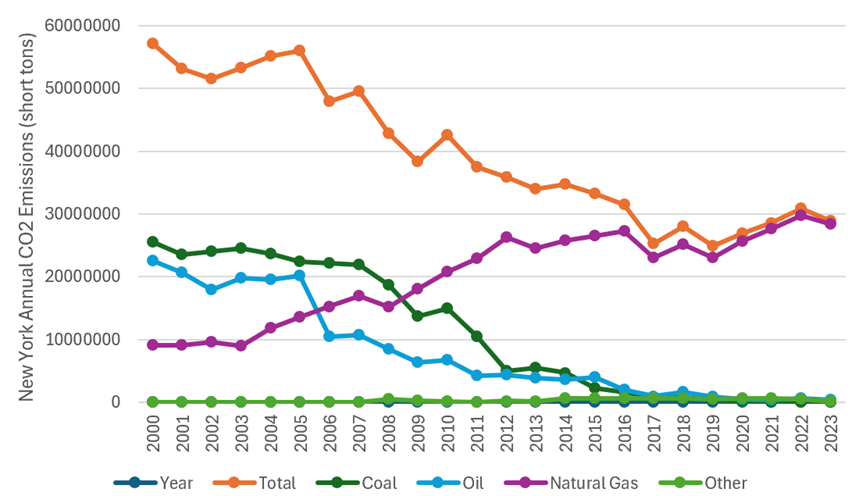
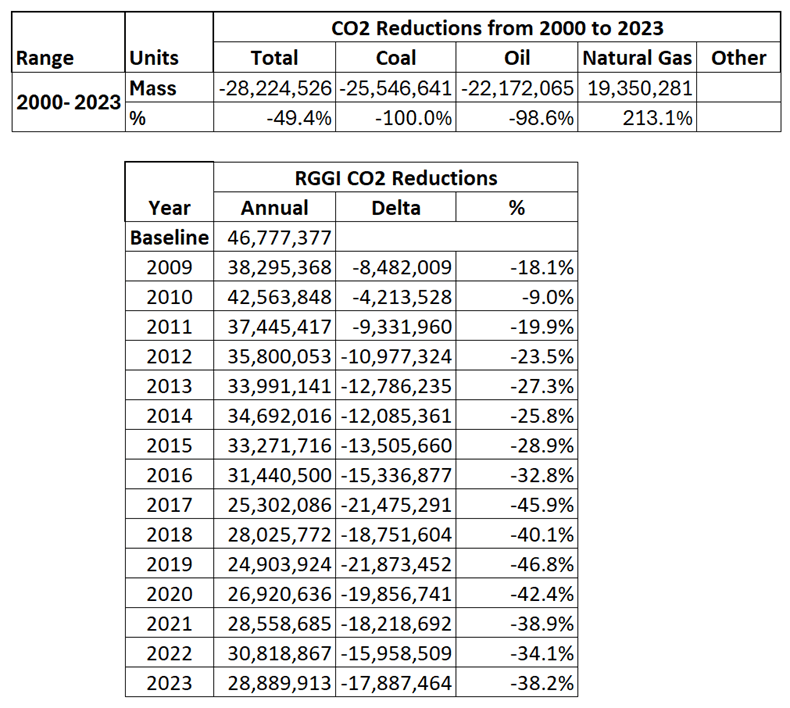
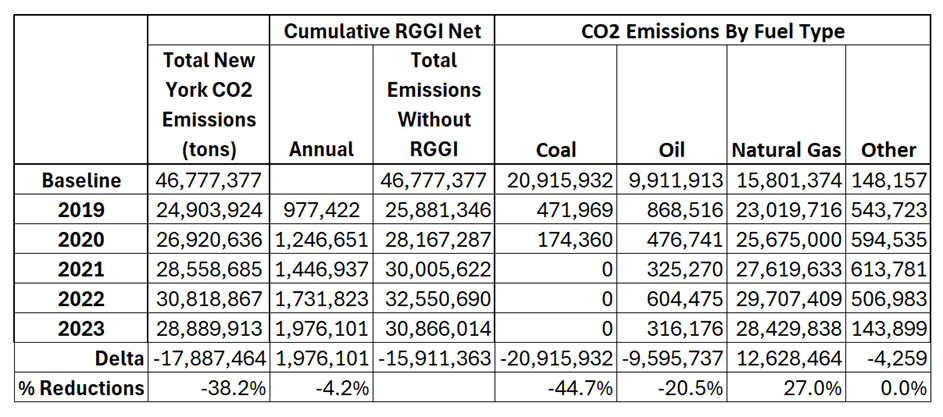
The EPA database includes information such as the primary fuel type of each generating unit. Table 1 lists the total annual CO2 data from all New York units that are required to report to EPA for any air pollution control program by fuel type.  In 2000, New York EGU emissions were 57,114,439 tons and in 2023 they were 28,889,913 tons, a decrease of 49%.  Figure 1 plots these data.  Table 2 lists the reductions in New York since the start of RGGI.  I calculated a pre-RGGI baseline by averaging annual data from 2006-2008.  In NYS 2023 CO2 emissions are 38% lower than baseline emissions.  Note that the reduction percentage peaked in 2019 before Indian Point shut down and emissions increased.  The most important feature of these tables is that coal and oil emission reductions are the primary drivers of the total emission reductions.  Natural gas has increased to cover the generation from those fuels but because it has lower CO2 emission rates the New York emissions have gone down.

Table 1: New York Clean Air Markets Division Emissions Data for All Regulatory Programs

Figure 1: New York State Emissions by Fuel Type

Table 2: New York State Emission Reductions

NYSERDA RGGI Funding Status Reports

The latest New York RGGI funding report prepared by the New York State Energy Research & Development Authority (NYSERDA) is the Semi-Annual Status Report through December 2023.  It states that:

This report is prepared pursuant to the State’s RGGI Investment Plan (2022 Operating Plan) and provides an update on the progress of programs through the quarter ending December 31, 2023. It contains an accounting of program spending; an estimate of program benefits; and a summary description of program activities, implementation, and evaluation. An amendment providing updated program descriptions and funding levels for the 2022 version of the Operating Plan was approved by NYSERDA’s Board in January 2023.

The State invests RGGI proceeds to support comprehensive strategies that best achieve the RGGI CO2 emission reduction goals. These strategies aim to reduce global climate change and pollution through energy efficiency, renewable energy, and carbon abatement technology.

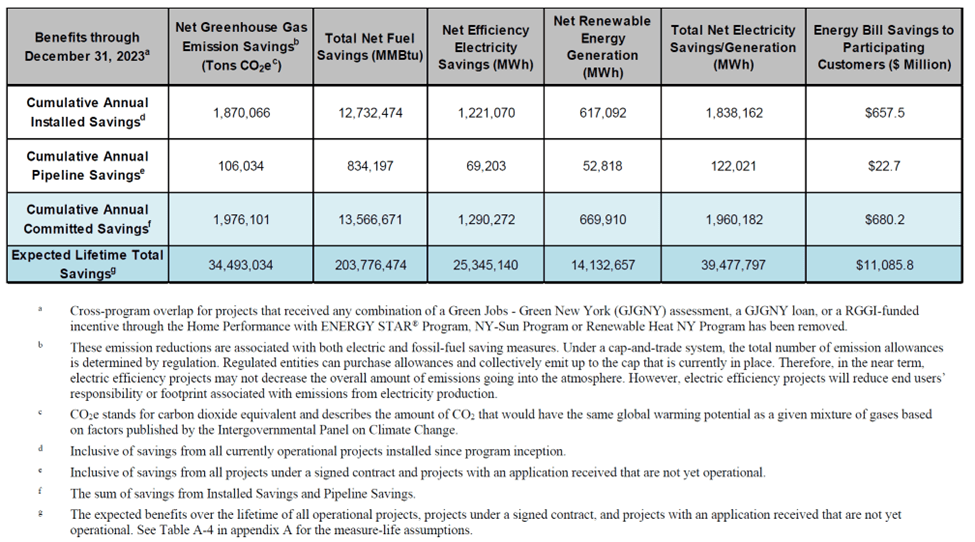
Table 3 from Table 1 in the latest the Semi-Annual Status Report summarizes the effectiveness of the NYSERDA investments and lists expected cumulative portfolio benefits including emissions savings.  This report notes that NYSERDA “begins tracking program benefits once project installation is complete and provides estimated benefits for projects under contract that are not yet operational (pipeline benefits).”  There is an important distinction between the cumulative annual committed savings and the expected lifetime total benefits.  For the purposes of this analysis, I did not use “lifetime” savings data because I am trying to compare the RGGI program benefits emission savings reductions to the RGGI compliance metric of an annual emission cap.  Lifetime reductions are clearly irrelevant to that metric.  Similarly, the Climate Act emission reduction metrics are annual emissions relative to a 1990 baseline so expected lifetime benefits are immaterial.

Table 3. Summary of Expected Cumulative Portfolio Benefits through December 31, 2023

Comparison of NYSERDA Cumulative Emissions Savings to Observed Emission Reductions

Table 4 presents the relevant data to compare the observed reductions and NYSERDA RGGI investment emission savings.  I list the last five years of data starting in 2019 when the emissions went up because of the closure of Indian Point but the decreases since the 2006-2008 average baseline are listed.  The emissions savings listed are cumulative annual emissions.  If the RGGI investments were not made then the total emissions would be higher by the amount of the savings.  The total cumulative annual emission savings through the end of 2023 is only 1,976,101 tons and that represents a reduction of 4.2% from the pre-RGGI baseline.  Emission reductions by fuel type clearly show that fuel switching is the primary cause of reductions.

Table 4: NY Electric Generating Unit Emissions, NYSERDA GHG Emission Savings from RGGI Investments, and Emissions by Fuel Type

Discussion

Whenever there is a public meeting about RGGI, the overview presenters state that there has been a large reduction in electric sector emissions.  For example, at the NYSERDA RGGI Stakeholder meeting on 5 December 2024, Jon Binder from the New York Department of Environmental Conservation said:

Together, we have cut New York’s power sector emissions of carbon dioxide by more than 50 %. And we’ve done this by establishing regulations that set limits on pollution while also making investments through this operating plan process in parallel with so many other critical policies at the state level and commitments to implement the Climate Leadership and Community Protection Act.

EPA emission data and NYSERDA documentation on the results of the investments funded by RGGI auction proceeds contradict this narrative that RGGI has substantially reduced emissions. This article shows that the primary reason for the observed 38% reduction from the start of RGGI is fuel switching and retirements caused by low natural gas prices.  Since the start of the RGGI program I estimate that emissions from RGGI sources in New York would have been only 4.2% higher if the NYSERDA program investments did not occur.

On December 18, 2024, the Assembly Committee on Energy held a public hearing on New York State Energy Research & Development Authority (NYSERDA) spending and program review.  John Howard, a seasoned Albany hand who retired from his post on the Public Service Commission earlier this year gave a statement.  He opened his remarks noting that “the subject of today’s hearing is the fiscal and operational oversight of NYSERDA” and went on to explain that NYSERDA is now exclusively responsible for procuring vast amounts of renewable energy consistent with the Climate Act mandates but there is no oversight of the contracts.  The RGGI investments are one example of the programs managed by NYSERDA.  I will follow this post with another article describing the unacknowledged implications of these numbers.

Conclusion

Implementing the net-zero transition mandated by the Climate Leadership & Community Protection Act is a massive challenge consisting of many moving parts.  The RGGI program is touted as a successful model for proposed components of the transition.  However, upon close review the narrative that RGGI Auction proceed investments have substantially contributed to the observed emission reductions is not true.

Keith Schue: New York Needs Nuclear

Keith Schue alerted me to his piece for the Empire Report titled New York Needs Nuclear, a Balanced Approach to Clean Energy.  I am always happy to publish pragmatic discussions of New York energy policy so I am re-publishing his article in this post.

Keith Schue is an electrical engineer and technical adviser on energy policy. Schue has been engaged in New York energy policy since 2010 and currently volunteers as a technical advisor for several organizations, including New York Energy & Climate Advocates. Before moving to New York, he was employed with the Florida chapter of The Nature Conservancy.  He recently co-authored a commentary in the Albany Times Union with climate scientist James Hansen, making a persuasive case for using nuclear in the future. 

Overview

The Climate Leadership & Community Protection Act (Climate Act) established a New York “Net Zero” target (85% reduction in GHG emissions and 15% offset of emissions) by 2050.  It includes an interim 2030 GHG reduction target of 40%. Two targets address the electric sector: 70% of the electricity must come from renewable energy by 2030 and a requirement that all electricity generated be “zero-emissions” resources by 2040. The Climate Action Council (CAC) was responsible for preparing the Scoping Plan that outlined how to “achieve the State’s bold clean energy and climate agenda.” The Integration Analysis prepared by the New York State Energy Research and Development Authority (NYSERDA) and its consultants quantifies the impact of the electrification strategies.  That material was used to develop the Draft Scoping Plan outline of strategies.  After a year-long review, the Scoping Plan was finalized at the end of 2022.  Since then, the State has been trying to implement the Scoping Plan recommendations through regulations, proceedings, and legislation. 

I recently published Schue’s summary of draft documents that covered three of these implementation initiatives.  In this article he references the New York Power Authority (NYPA) Draft Renewables Plan.  He noted that the Build Public Renewables Act adopted last year now forces NYPA to try installing solar, wind, and batteries even faster than the private sector is already doing with subsidies.  He suggested that comments on the NYPA renewables plan should say:

Achieving carbon-free electricity requires firm reliable power. Therefore, throwing more public money and resources at intermittent generation not only jeopardizes reliability and affordability, but also ensures that NY will remain dependent on fossil fuels. Instead of focusing on solar panels and wind turbines that the private sector can install on its own, NYPA should do what it has historically done best by working on reliable public projects for the common good, like nuclear energy, hydropower, and utility infrastructure.

In the following section I present Schue’s article that first appeared in Empire Report in its entirety.

New York Needs Nuclear, a Balanced Approach to Clean Energy

Global warming is real, as is the urgency for action to address it. However, New York will only make good on its promise of tackling the climate crisis if it pursues solutions that work in the real world.

Unfortunately, the strategic plan recently drafted by the New York Power Authority (NYPA) falls short of what’s needed—not because it fails to install enough solar panels, wind turbines and batteries, but because that is all it proposes to do.

For decades, NYPA has spearheaded vital energy projects that serve the public good. From the construction of large hydroelectric plants to positioning New York as a leader in nuclear power, the authority has consistently delivered electricity that is reliable, clean, and affordable to communities and business upstate. Indeed, NYPA is the reason why New Yorks’ upstate grid is already 90% carbon-free.

Yet, instead of building upon that impressive legacy, the plan currently proposed threatens grid stability by marginalizing firm resources and focusing on those that are fragile, intermittent, and incredibly land-intensive. It is an approach that jeopardizes greenhouse gas reduction, perpetuating dependence on fossil fuels while making electricity less reliable and more expensive.

It is also an approach that reflects outdated politics of the past.

Today, there is overwhelming consensus among engineers, industry leaders, the business community, and labor unions that a diverse mix of resources—including advanced nuclear power—will be essential to decarbonize while providing ample energy for a growing economy and workforce. Even Governor Hochul emphasized this reality at her recent Future Energy Economy Summit in Syracuse. Micron’s semiconductor manufacturing operations alone are expected to surpass the electricity demand of Vermont and New Hampshire combined. However, in addition to accommodating unprecedented growth, a zero-emission grid must be robust. Dispatchable Emission-Free Resources (DEFRs) capable of serving demand when renewables cannot are essential.  Moreover, DEFRs that operate a lot more than 2% of the time will be needed in the real world to avoid retaining large amounts of fossil fuel capacity. Batteries and hydrogen simply won’t suffice.

Rather than focusing on sprawling intermittent sources that cannot go the distance, the state should pursue compact solutions that will. NYPA should leverage its technical and financial expertise to support the Governor’s vision of integrating flexible advanced nuclear into New York’s grid. There are communities eager to embrace it. Where possible, responsible hydropower expansion can also be explored, like collaborating with the Green Island Power Authority to increase generation capacity on the Hudson River. Infrastructure improvements should be pursued as well, but in a manner that respects communities.

One thing is certain: New York’s energy strategy must change. Communities are under attack from the Office of Renewable Energy Siting, businesses are questioning whether they can survive in the state, industry is asking whether there will be energy to expand, and skilled labor is wondering if the only jobs left for them will be unpacking solar panels from China.

A successful strategy will require compromise. With a balanced expansion of solar, wind, and firm nuclear power, the state can meet its energy goals. However, NYPA’s leadership in needed more than ever to forge pragmatic solutions that work. The future of New York hinges on its ability to adapt and champion a diverse, reliable, and sustainable energy portfolio. NYPA should be a guiding force in that critical transition.

Commentary

I was happy to re-publish Keith’s article because I agree with him that nuclear power is necessary and that NYPA should be considering it along with solar and wind in the Draft Renewables Plan.  I have one minor point of emphasis difference because I think balanced expansion with wind and solar development is a dead end.  I have come to the conclusion that reliance on those resources will do more harm than good because of reliability and affordability risks.  Importantly, consider that the State agencies responsible for a reliable energy system agree that a wind, solar, and energy storage system needs a new dispatchable emissions free resource (DEFR) to account for low resource availability during periods of extended light wind and cloudiness.  At some point, New York must do a feasibility analysis to determine which DEFR technologies should be used in New York.  I believe that analysis will find that the only viable candidate for DEFR is nuclear power.  That means that a wind and solar energy system must include nuclear power as the DEFR backup technology.  However, economics suggest nuclear resources should be used as much as possible instead of as a backup. Using nuclear as the backbone of the electric system eliminates the need for the massive wind, solar and energy development proposed and addresses my concerns about reliability and affordability.

Does New York Need a Climate Act Feasibility Analysis

On September 9, 2024 the Hochul Administration initiated the development of the State Energy Plan announcing the release of a draft scope of the plan.  On November 15 New Yorkers for Clean Power (NYCP) sponsored a webinar titled “Get Charged Up for the New York Energy Plan” that was intended to brief their supporters about the Energy Plan.  This article will be the first of two posts addressing this webinar. I have a tendency to write comprehensive posts that are too long for my readers so I am going to break this story up.

I am convinced that implementation of the New York Climate Leadership & Community Protection Act (Climate Act) net-zero mandates will do more harm than good if the electric system transition relies on wind, solar, and energy storage.  I have followed the Climate Act since it was first proposed, submitted comments on the Climate Act implementation plan, and have written over 470 articles about New York’s net-zero transition.  The opinions expressed in this article do not reflect the position of any of my previous employers or any other organization I have been associated with, these comments are mine alone.

Overview

The Climate Act established a New York “Net Zero” target (85% reduction in GHG emissions and 15% offset of emissions) by 2050.  It includes an interim 2030 reduction target of a 40% GHG reduction by 2030. Two targets address the electric sector: 70% of the electricity must come from renewable energy by 2030 and all electricity must be generated by “zero-emissions” resources by 2040. The Climate Action Council (CAC) was responsible for preparing the Scoping Plan that outlined how to “achieve the State’s bold clean energy and climate agenda.” The Integration Analysis prepared by the New York State Energy Research and Development Authority (NYSERDA) and its consultants quantified the impact of the electrification strategies.  That material was used to develop the Draft Scoping Plan outline of strategies.  After a year-long review, the Scoping Plan was finalized at the end of 2022.  Since then, the State has been trying to implement the Scoping Plan recommendations through regulations, proceedings, and legislation. 

Although related, the Energy Plan should not be confused with the Scoping Plan.  Every several years the New York Energy Planning Board is required to update its overall energy plan for the state. The process begins with an initial document that identifies a “scope” of work–meaning the set of things to be evaluated in the plan with a defined planning horizon of 2040. This makes the Climate Act’s 2040 goal of carbon-free electricity particularly relevant. Unlike the 70% renewable goal which only applies in 2030, the 2040 goal does not mandate an arbitrary quota of “renewables”. Instead, it simply mandates carbon-free electricity, which can include nuclear power. 

Key Action Items from the Webinar

The description of the New Yorkers for Clean Power webinar titled “Get Charged Up for the New York Energy Plan” stated:

Thank you for joining us for the “Get Charged Up for the New York State Energy Plan” Teach-In on November 15th. We are electrified by the demonstrated interest and information shared to support New York’s climate goals through the development of an ambitious and equitable State Energy Plan. To recap, our featured speakers were:

  • Janet Joseph, Principal, JLJ Sustainability Solutions (Former VP of Strategy and Market Development, NYSERDA
  • Dr. Robert Howarth, Member, New York’s Climate Action Council, and David R. Atkinson Professor of Ecology and Environmental Biology at Cornell University
  • Christopher Casey, Utility Regulatory Director for New York Climate and Energy, Natural Resources Defense Council (NRDC)

We’re excited to share the recording and slideshow from the event: Here is the recording of the event and check out the Presenters’ slides here.

Key Takeaways from the Event

  • Energy Plan is foundational to achieving New York’s climate and energy goals, aligning policies with the CLCPA.
  • Engagement from advocates, community members and developers is critical for ensuring equitable and actionable outcomes
  • Challenges like building decarbonization and system reliability require innovative solutions and statutory changes.

I am going to address the presentations of Janet Joseph and Robert Howarth in a later post.  I disagree with their comments that downplay my concern that transitioning the New York electric grid to one that relies primarily on wind, solar, and energy storage will adversely affect reliability and affordability.  This post is going to describe Dr. Howarth’s response to my specific question about the need for a feasibility analysis.   

Feasibility Analysis Background

Dr. Howarth is venerated by New York environmental advocates but I think their faith is misplaced.  His Introduction at the webinar extolled his role in vilifying methane’s alleged importance as a greenhouse gas.  I think that obsession is irrational.  The hostess also lauded his work supporting a Biden Administration pause on applications for LNG export terminals.  However his analysis was “riddled with errors” and he eventually retracted some of the more extreme claims that received media attention.

Howarth claims that he played a key role in the drafting of the Climate Act and his statement  at the meeting where the Scopng Plan was approved claims that no new technology is needed:

I further wish to acknowledge the incredible role that Prof. Mark Jacobson of Stanford has played in moving the entire world towards a carbon-free future, including New York State. A decade ago, Jacobson, I and others laid out a specific plan for New York (Jacobson et al. 2013). In that peer-reviewed analysis, we demonstrated that our State could rapidly move away from fossil fuels and instead be fueled completely by the power of the wind, the sun, and hydro. We further demonstrated that it could be done completely with technologies available at that time (a decade ago), that it could be cost effective, that it would be hugely beneficial for public health and energy security, and that it would stimulate a large increase in well-paying jobs. I have seen nothing in the past decade that would dissuade me from pushing for the same path forward. The economic arguments have only grown stronger, the climate crisis more severe. The fundamental arguments remain the same.

As I will show in this article, I think his claim that the transition can be implemented using wind, sun, and hydro using existing technologies is wrong.        

Do We Need a Feasibility Analysis?

I thought it would be appropriate to give Howarth the opportunity to recant his feasibility claim so I submitted the following question:

On November 4, 2024, the New York Department of Public Service (DPS) staff proposal concerning definitions for key terms notes that “Pursuing the 2040 target will require the deployment of novel technologies and their integration into a changing grid”.  Should there be a feasibility analysis in the energy plan to address their concern about the new technologies?

In his response, Howarth admitted that he was not familiar with the particular reference to the DPS proceeding that is implanting the Climate Act mandates.  Then he answered (my lightly edited transcription of his responses):

I can give you the perspective of three years of discussion on the CAC.  That it is we firmly stated that the goals can be met with existing technologies. We don’t need novel technologies.

One of my unresolved questions relative to Howarth’s position and the Scoping Plan is that he voted to support the Scoping Plan.  However, the Scoping Plan explicitly contradicts his statement that technologies available in 2013 were sufficient for the transition away from fossil fuels.  In particular, the Final Scoping Plan Appendix G, Section I page 49 states (my highlight included):

During a week with persistently low solar and wind generation, additional firm zero-carbon resources, beyond the contributions of existing nuclear, imports, and hydro, are needed to avoid a significant shortfall; Figure 34 demonstrates the system needs during this type of week. During the first day of this week, most of the short-duration battery storage is quickly depleted, and there are still several days in which wind and solar are not sufficient to meet demand. A zero-carbon firm resource becomes essential to maintaining system reliability during such instances. In the modeled pathways, the need for a firm zero-carbon resource is met with hydrogen-based resources; ultimately, this system need could be met by a number of different emerging technologies.

In addition to the Scoping Plan statement that a zero-carbon firm resource is needed, the organizations responsible for New York State electric system reliability agree.  The New York Independent System Operator (NYISO) 2023-2042 System & Resource Outlook, and Power Trends 2024 analyses and the New York Department of Public Service (DPS) Proceeding 15-E-0302 Technical Conference determined that DEFR was needed.  Independent analyses by the Cornell Biology and Environmental Engineering, Richard Ellenbogen, and Nuclear New York also found that it was needed.  For example, a very readable description of the DEFR problem by Tim Knauss describing the work done by Cornell’s Biology and Environmental Engineering Anderson Lab found that “Just 15 years from now, the electric grid will need about 40 gigawatts of new generating capacity that can be activated regardless of wind speeds, cloud cover or other weather conditions”.

While this is not directly applicable to the DEFR requirement I want to highlight the following Howarth quote:

Now having said that.  There are a lot of details to work out, energy storage is going to be critical.  Lisa made the point that ground source heat pumps and thermal networks are better than air source heat pumps.  They are hugely more effective in the peak time in January.  If we go that route we don’t need as much electrical capacity overall. I would add that thermal storage is cheaper than electrical storage for energy.  Particularly if you have a thermal network because you can store heat that can provide a community with heat for weeks to months to even on an annual basis.  There is a community in Saskatchewan I believe where they store heat six months at a time which is very cheap compared to other things

I believe Howarth’s thermal network reference is to Calgary’s Drake Landing solar heating community.   There is only one problem. The system established in 2006 is failing and will be decommissioned less than 20 years after it was built.  In my opinion, the New York Energy Plan must include a critique of the Drake Landing experiment and the implications for New York thermal networks. This is another feasibility analysis that I think is necessary.

Howarth went on to double down on his position that no new technologies are needed:

We don’t need new technologies to meet the goals of our climate law.  Mark Jacobson from Stanford, who I think is the most brilliant engineer I know.  He and I and others wrote a plan back in 2013, more than ten years ago, laying out specifically how to make the state of New York fossil fuel free on a realistic time frame.  We made the case then, more than ten years ago, that we did not need new technologies, and it was cost-effective then.  It is even more so now. The whole idea of waiting for the next new technology is an excuse for inaction.  We don’t need to wait.

I have assembled a page that describes the analyses that contradict the Jacobson and Howarth work and includes a critique of their results.  To adequately characterize the New York electric system, it is necessary to simulate the details of the New York electric transmission system.  Not surprisingly, of the 11 New York Control Areas the New York City area requires the most energy.  That fact coupled with geographical constraints because New York City is basically a load pocket means that transmission details are important.  To characterize wind and solar it is necessary to evaluate meteorological conditions to generate estimates of wind and solar resource production.  When that is coupled with projections of future load, the sophisticated analyses all conclude that the new dispatchable emissions-free resource is needed because simply adding much more short-term storage will not work.  In my opinion, academic studies like Jacobson and Howarth short-change transmission constraints and/or weather variability leading to false solutions and conclusions.

Advocates for the Scoping Plan energy approach demand action now because the law mandates renewables.  Invariably they overlook New York Public Service Law  § 66-p (4). “Establishment of a renewable energy program” that includes safety valve conditions for affordability and reliability that are directly related to the zero emissions resource.   § 66-p (4) states: “The commission may temporarily suspend or modify the obligations under such program provided that the commission, after conducting a hearing as provided in section twenty of this chapter, makes a finding that the program impedes the provision of safe and adequate electric service; the program is likely to impair existing obligations and agreements; and/or that there is a significant increase in arrears or service disconnections that the commission determines is related to the program”. 

Conclusion

The Climate Action Council should have established criteria for the three § 66-p (4) requirements so that there is a clear test to suspend or modify obligations.  New York State law has restrictions that protect citizens from irrational adherence to a dangerous energy future and I believe that a feasibility analysis for the new DEFR technology should be part of the evaluation for this mandate.

In my opinion, the most promising DEFR backup technology is nuclear generation because it is the only candidate resource that is technologically ready, can be expanded as needed and does not suffer from limitations of the Second Law of Thermodynamics. If the only viable DEFR solution is nuclear, then renewables cannot be implemented without it.  But nuclear can replace renewables, eliminating the need for a massive DEFR backup resource.  Therefore, it would be prudent to pause renewable development until DEFR feasibility is proven because nuclear generation may be the only viable path to zero emissions.

Jonah Messinger summarizes my worry that New York has placed undeserved reliance on the work of Robert Howarth:

That an activist scholar with a history of contested and critiqued claims could influence the Biden administration with such an obviously erroneous study is more than concerning. It demonstrates how faulty science in the name of climate can derail important policy debates, and make the global energy transition far harder.

I am sure that none of the advocates who venerate his work will ever be convinced that his work is fatally flawed.  However, it is time that the energy experts in the state step up and confront public officials with the reality that the Climate Act schedule and mandates are only possible with a new technology.  Evaluating the potential technologies and determining if they can be feasibly implemented affordably and without risking reliability standards is an obvious approach.

DEFR Concerns Update

I am convinced that implementation of the New York Climate Leadership & Community Protection Act (Climate Act) net-zero mandates will do more harm than good if the electric system transition relies on wind, solar, and energy storage.  My primary reliability concern is the challenge of providing electric energy during periods of extended low wind and solar resource availability.  Experts, including those that are responsible for electric system reliability, agree that a new category of generating resources called Dispatchable Emissions-Free Resources (DEFR) is necessary during those periods.  This article summarizes a very readable description of the DEFR problem by Tim Knauss who describes the work done by Cornell’s Anderson Lab headed by Dr. Lindsay Anderson.

I have followed the Climate Act since it was first proposed, submitted comments on the Climate Act implementation plan, and have written over 470 articles about New York’s net-zero transition.  The opinions expressed in this article do not reflect the position of any of my previous employers or any other organization I have been associated with, these comments are mine alone.

Takeaway Message – If you don’t have time to read the whole thing

This post summarizes a readable description of DEFR in an article by Tim Knauss.  He described the work of Dr. Lindsay Anderson regarding the necessary DEFR component of the proposed transition of the electric system to zero emissions.  The article explains how Anderson’s team calculates the gap between future wind, solar, and energy storage generating resources needed and projected electric load during periods of low renewable resource availability.  I believe that the work of the Anderson Lab provides support to my contention that renewable development should be paused.  A renewable-based electric system needs DEFR, the most likely DEFR solution is nuclear, but if you have zero emissions nuclear then you don’t need renewables.  That makes renewables a dead-end approach.

Overview

The Climate Act established a New York “Net Zero” target (85% reduction in GHG emissions and 15% offset of emissions) by 2050.  It includes an interim 2030 reduction target of a 40% GHG reduction by 2030. Two targets address the electric sector: 70% of the electricity must come from renewable energy by 2030 and all electricity must be generated by “zero-emissions” resources by 2040. The Climate Action Council (CAC) was responsible for preparing the Scoping Plan that outlined how to “achieve the State’s bold clean energy and climate agenda.” The Integration Analysis prepared by the New York State Energy Research and Development Authority (NYSERDA) and its consultants quantified the impact of the electrification strategies.  That material was used to develop the Draft Scoping Plan outline of strategies.  After a year-long review, the Scoping Plan was finalized at the end of 2022.  Since then, the State has been trying to implement the Scoping Plan recommendations through regulations, proceedings, and legislation.  New York Department of Public Service (DPS) Proceeding 15-E-0302 addresses DEFR but there is no schedule for resolving the future plans for DEFR in New York.

Because of its importance to the feasibility of the Climate Act, the subject of DEFR rates its own Pragmatic Environmentalist of New York page.  I described the page contents last July in an article that summarized six analyses describing the need for DEFR: the Integration Analysis, New York Department of Public Service (DPS) Proceeding 15-E-0302 Technical Conference, NYISO Resource Outlook, Richard Ellenbogen, Cornell Biology and Environmental Engineering Lindsay Lab, and Nuclear New York.  I have updated the page with references to the Tim Knauss article on Cornell Professor Anderson’s work.

Syracuse Post Standard “Mind-Boggling Gap”

On November 19 the article There’s a mind-boggling gap in NY’s plan for a clean electric grid. ‘We are so far behind’ by Tim Knauss was published on the Syracuse dot com website. It is not clear to me whether the official link is accessible by non-subscribers so I have posted a version here and reproduce some of it with some annotations below.

Knauss poses the critical question: “What technology will grid operators turn to when solar and wind fall short?”.  He notes:

Maybe it will be advanced nuclear reactors. Or hydrogen-burning power plants. Nobody knows for sure. Operators will need some emission-free power source they can turn on and off at will.

At Cornell University, Professor Lindsay Anderson and fellow researchers have been studying this problem. Given the specific layout of New York’s electric grid, they asked, how much of this new power source would be needed in addition to all the solar and wind?

A staggering amount, it turns out.

Just 15 years from now, the electric grid will need about 40 gigawatts of new generating capacity that can be activated regardless of wind speeds, cloud cover or other weather conditions, according to Anderson’s research.

How much is that? It’s roughly equal to the total capacity of all of New York’s current power plants – nuclear, natural gas, hydro, wind, all of it.

You read that right. To back up the massive quantities of solar and wind power that will provide most of our future electricity, the state power grid will need some new, mystery resource equal in size to the entire generating fleet of today.

The need for new, mystery DEFR, the potential quantity required, and the technological challenges for the resource are issues well known by those who understand the electric system.  However, there is a loud and passionate segment of society who disagree that anything new is needed and reject the scale of the projected resource need.  Anderson and Knauss understand that this is a touchy subject.  Knauss writes:

Anderson knows that’s not easy to hear.

“That’s the thing, right?’’ she said. “Where people are going to start to worry is (to) say, ‘Okay, wait, so you’re telling us that we’re going to spend all this money building out all this wind and solar and batteries — AND we have to put in 40 gigawatts of this?”

But there will have to be a backup.

Knauss describes the analysis work done to generate the “mind-boggling” projections.

Anderson chairs Cornell’s department of biological and environmental engineering. She has a PhD in applied math and a master’s degree in engineering.  For the past decade, she has worked with a shifting assortment of doctoral candidates and other graduate students in her eponymous Anderson Lab, housed in a large room full of cubicles and computers. They examine issues related to the growing importance of renewable energy.

The Anderson Lab is looking at the physics of how all that will work. To do so, they built an elaborately detailed computer model – a “digital twin’’ — of New York’s electric grid.

That level of detail sets their work apart. Many of the studies that look at phasing in renewable energy pretend that the electric grid is a single pool of electrons that flow from point to point without constraint. It‘s known as the “copper plate’’ assumption.

In reality, the New York electric grid is a complex, lopsided network that has been stitched together piece by piece over a century. There are limits on how much electric current can move from one area to another.

The six analyses that are described on my DEFR page all handle the electric system in similar fashions and all unequivocally conclude DEFR is needed.  The reference to studies that use the “copper plate” assumption refers to the analysis that was used by the politicians who authored the Climate Act.  It is the basis of the Climate Act presumption that implementation was simply a matter of political will because no new technology would be required.  New York’s electric grid experts disagree.  This contradiction needs to be resolved.

The Knauss article goes on to describe DEFR:

carbon-free generating plant that can be turned on and off as needed. It’s pronounced DEE-fur.

Today, dispatchable power is provided mostly by natural gas power plants. Energy planners hope to replace them with something that does not produce greenhouse gases. Nobody knows what that will be.

“They’ve come up with a name for something that they don’t know what it is, but their modeling shows that they need something. It kind of seems like dark matter in the universe,’’ said environmentalist Tim Judson, executive director of the Nuclear Information and Referral Service.

When the state’s Climate Action Council issued their December 2022 report on how the state will eliminate greenhouse gases from the grid by 2040, they estimated a need for 18 to 23 gigawatts of DEFRs. Anderson’s study concluded that the estimate should be roughly doubled, to 37 to 40 GW.  In its most recent forecast, the NYSIO estimated a need for at least 20 GW of DEFRs, and as much as 40 GW, by the year 2040.

Knauss explains that Anderson is concerned about the need for DEFR and the quantity required as well as the ramifications of this new resource:

The need stems from two main vulnerabilities, Anderson said.

First, there will be lulls when the wind dies down for days on end and the skies cloud over, resulting in power shortages that exceed the current ability of batteries to compensate. Second, there will be periods when the state has plenty of renewable energy but not enough transmission capacity to get it where it’s needed.

There would even be times when Upstate produced too much renewable energy, which must be disconnected to keep from overloading the grid, even as blackouts rolled across Downstate due to bottled up transmission lines.

Most of those problems are likely to occur in the coldest part of winter and the hottest part of summer, when demand for electricity will surge to peak levels. And the region most vulnerable to blackouts would be Downstate, where communities with massive electricity needs sit at the end of transmission lines from Upstate that are often overloaded.

These issues raise a concern of mine.  I maintain that there are unacknowledged challenges associated with weather variability risks associated with planning for the DEFR resources needed.  The first challenge is calculating the resources needed which requires analysis of meteorological data to estimate resource availability and expected loads.  I believe no one has done a comprehensive enough analysis because they haven’t used the longest period of data available, and they have not included adjacent regional transmission operator areas.  The second challenge is more concerning to me.  The evaluation of the meteorological data develops a probabilistic estimate of the resources needed that are analogous to the one in a hundred-year flooding parameter.  The problem is that we often see a flood exceeding the one in hundred probabilities.  It is inevitable that the weather conditions that caused the worst-case resource drought planning scenario will also be exceeded.  When that happens there will not be enough electric energy available, blackouts are likely, and the consequences of blackouts on a society that decarbonized by using electricity will be catastrophic. 

There is another issue relative to the aspirational Climate Act mandate to go to “zero emissions” by 2040.  We need DEFR but the technology is not available.  Knauss describes potential DEFR technologies:

Some experts propose converting power plants to burn hydrogen rather than natural gas. Or hydrogen could be used in fuel cells, which rely on chemical reactions rather than combustion to make electricity.

Others promote the idea of sequestering the carbon emissions from gas plants underground. Or burning “renewable” methane recovered from landfills and other sources.

Recently, New York officials have expressed interest in small advanced nuclear plants, which are under development by various companies. State energy planners are developing a “roadmap’’ that should be released early next year detailing how new nuclear technology might be encouraged.

None of the possible technologies is ready for commercial application. Which will emerge?

“That’s the million-dollar question,’’ said Lanahan Kevin Lanahan, a spokesman for NYISO, the grid operator.

The article goes on to note a difference of opinion regarding DEFR deployment.  On one side is the electric industry who are obligated to provide reliable electricity.

New York is long overdue to identify DEFR technologies and to support their development, said Gavin Donohue, executive director of the Independent Power Producers of New York, a trade group representing power plant owners.  IPPNY formally asked the Public Service Commission three years ago to decide what it will accept as “zero-emission’’ generating plants. The PSC is still mulling that over in a regulatory proceeding.  “The timely development of fully dispatchable zero emitting resources is crucial to maintain reliability as the economy electrifies and reliance on intermittent renewable and duration limited resources increases,’’ the group wrote.

On the other side are the special interests who have no accountability.

But some environmentalists argue against a rush to develop DEFRs, saying it could distract from building wind and solar resources and could lead state officials to hastily subsidize unproven technology such as hydrogen combustion.

Following a technical presentation to the state Public Service Commission last year by Anderson and a NYISO planning director, representatives from Sierra Club and Earthjustice submitted rebuttal comments claiming that NYISO’s forecast of the need for DEFRs was “alarmist.” (The forecast presented by NYISO that day was about 25% lower than the Anderson Lab’s estimate.)

The critics said the state should focus on proven techniques such as importing power from out of state, improving transmission, and encouraging demand response programs under which customers cut their power consumption during peak periods.  “Rushing to deploy expensive and untested DEFRs risks committing New York to flawed technologies, as it is unclear at the present time which technologies will emerge as commercially scalable and cost effective,’’ they wrote.

I responded to some of the referenced rebuttal comments because I think their analyses are naïve.  In the first place, their analytical methodologies are not as sophisticated as the Anderson Lab.  Secondly, they don’t acknowledge the correlation of wind energy across New York so their estimates of the magnitude of the problem are flawed.  Knauss mentions the critics “solutions”.

It’s a complicated issue, in part because there are strategies other than adding power plants to help reduce demand for electricity during peak periods.  Improvements in meter technology, for example, will enable residential customers to respond during power shortages by reducing their demand, as some commercial and industrial customers do already. Likewise, grid operators could one day draw power from electric vehicle batteries during peak periods.

This line of reasoning is naïve because it ignores the fact that DEFR is needed when the electric system energy requirements are highest.  The conditions that cause light winds and low wind power output also cause extreme temperatures which lead to peak electrical loads.  Those are the conditions when residential customers are not going to want to reduce power consumption.  They will want to keep their homes warm! 

The article goes on to discuss practical alternatives to the “mind-boggling” gap and the aspirational Climate Act schedule.  Dr.  Anderson suggested looking at slightly less stringent emission limits at least as a bridge until a DEFR solution is found.

Knauss also points out that the Anderson Lab work makes the optimistic assumption that all the wind and solar projected by the Hochul Administration actually gets built on schedule.

In reality, siting battles and other issues have stalled many large wind and solar projects for years. And as inflation drives up the capital costs of renewable energy, Gov. Kathy Hochul is under mounting pressure from business and consumer groups to keep the cost of the energy transition under control.

Because of those barriers, there is a vast gap between New York’s renewable energy capacity today and what would be needed to retire all the fossil fuel plants. Developers would have to build about 10 times the wind and solar power that exists now.

“It’s a huge problem, and we are so far behind,’’ Anderson said.

Conclusion

I think that the Knauss article does a great job explaining the intricacies of the DEFR issue and the work of the Anderson Lab.  I believe they appropriately describe the challenges of DEFR.  However, the article does not address the policy implications of DEFR.

The Hochul Administration has finally started its update of the NY Energy Plan.  The draft scope of the plan considers an electric system that relies on wind and solar generation consistent with the Climate Act Scoping Plan.  No jurisdiction anywhere has successfully developed such a system.  The State agencies responsible for a reliable electric system agree with Professor Anderson that a wind, solar, and energy storage system requires DEFR.  I believe that it is prudent to fund a demonstration project to prove that such an electric system will work.  At the very least, the energy plan must provide a comprehensive renewable feasibility analysis to determine whether such a system will maintain affordability and reliability standards.

The most likely DEFR backup technology is nuclear generation because it is the only candidate resource that is technologically ready.  Nuclear power has a proven record for resilient electric production, development would not require changes to support the transmission system and buildout the system, it is not limited by weather extremes, it has lower environmental impacts, and when life cycle and backup costs are considered is likely cheaper.   Its use as backbone energy would eliminate the need for wind, solar, energy storage, and new DEFR deployment to meet Climate Act zero-emissions mandates. 

Sierra Club and Earthjustice argue that DEFR is a distraction to their preference for wind and solar development.  I believe that the work of the Anderson Lab provides support to my contention that renewable development should be paused because that development cannot work until DEFR is proven feasible.  If the DEFR solution is nuclear then renewables are a dead-end approach.

The Math Behind New York City’s Local Law 97 Does Not Add Up

This article was originally posted at Watts Up With That

New York City Local Law 97 (LL97) mandates that “most buildings over 25,000 square feet are required to meet new energy efficiency and greenhouse gas emissions limits as of 2024, with stricter limits coming into effect in 2030.”  Rich Ellenbogen explains that the numbers underpinning Local Law 97 underestimate electric grid emissions by between 39% and 47% and uses incorrect emissions numbers to calculate the penalties and as a basis for electric grid efficiency.

Ellenbogen is the President [BIO] Allied Converters and frequently copies me on emails that address various issues associated with the Climate Leadership and Community Protection Act (Climate Act). I have published other articles by Ellenbogen including a description of his keynote address to the Business Council of New York 2023 Renewable Energy Conference Energy titled: “Energy on Demand as the Life Blood of Business and Entrepreneurship in the State -video here:  Why NY State Must Rethink Its Energy Plan and Ten Suggestions to Help Fix the Problems” and another video presentation he developed describing problems with Climate Act implementation.   He comes to the table as an engineer who truly cares about the environment and as an early adopter of renewable technologies going back to the 1990’s at both his home and business two decades ago.

Local Law 97

The goal of LL97 is to reduce the emissions produced by the city’s largest buildings 40 percent by 2030 and net zero by 2050.  Like New York’s Climate Leadership and Community Protection Act (Climate Act) this is political theater without regard to practicality.  Last July I published an article here that described an evaluation by Ellenbogen, Francis Menton, and myself that the supporting documentation for LL97 falls far short of what is needed to provide New York City (NYC) residents in affected buildings with any assurance that the LL97 mandates can be met at the same time the Climate Act is transforming the electric energy system with massive deployments of wind, solar, and energy storage and unproven generating resources.  This means extraordinary risks for keeping the heat on in the winter in NYC.  Ellenbogen documents specific instances where their numbers are wrong in this post.

Problems

In this section I am going to document Ellenbogen’s criticisms re-formatted from an email to a blog post.

LL97 uses false metrics to calculate carbon emissions.  Contrary to what they claim, it increases the amount of energy required to run a building.   The city’s electricity is 91% fossil fuel generated.  For the foreseeable future, all electric heat will operate from the least efficient fossil fuel plants operating with about a 33% efficiency.   After about a 7% line loss, that is 30% efficient delivered to the building.   Some of the remote generation will be oil fired with a 50% higher GHG footprint than natural gas and higher NOx, SOx, and PM2.5 emissions.   Even if the heat pumps are 280% efficient, that leaves a holistic efficiency of 84%, which is at least 5% – 10% lower than just installing a new high efficiency onsite gas combustion that will operate with a net efficiency of between 90% – 95%.  Do they think that remote carbon emissions away from NYC buildings won’t affect climate change?  

The numbers underpinning Local Law 97 are underestimating electric grid emissions by between 39% and 47%.  By making the electric utility system look “greener” they are providing a false basis for the entire law.

If you look at the image below, taken from page 36 (link), you will see in clause 1 that they are using 0.000288962 tCO2e per KWh (metric tons/Kwh).  Note that the document at the link cannot be downloaded which makes it very difficult for people to challenge the contents.  That value equals 0.288962 tCO2e per Megawatt Hour (MWh) which can be converted (0.288962 x 2203 pounds per metric ton) to 636.5 pounds per MWh that is used as the basis for utility system emissions in LL97.

Source: §28-320.3.1.1 Greenhouse gas coefficient of energy consumption

However, if you look at the table below from the US EPA, highlighted in yellow are the actual emissions that are between 886.6 pounds per MWH and 973 pounds per MWh in NY City and Westchester. So the actual utility emissions are between 39% and 47% higher than what the city is using to calculate their policy values and the associated penalties.

Source: EPA Summary Data: eGRID 2022 Summary Tables, abbreviated Table 1

The numbers used for future emissions are also a problem.  The 636.5 pounds per MWh used in the LL97 document drops to 319 pounds/MWh in 2030 – 2034  (converted from 0.000145 value listed in the excerpt below) which is half of the 2024 value.  There is no explanation of how they expect to achieve that when it is common knowledge that all of the renewable installation numbers are being pushed back.  They are starting from numbers that err in their favor by over 40% and it just gets worse from there.

Source: 1 RCNY §103-14, CHAPTER 100 Subchapter C Maintenance of Building, page 12.

The numbers used to calculate the district steam emissions relative to the gas emissions in the document are just as big of a fantasy.  New York City has an extensive steam system with over 100 miles of pipe that bring steam from central plants to buildings in Manhattan. The unacknowledged problem in LL97 is that there are extensive energy losses in the steam system. Because of the age and size of the system they are dumping the hot water at the end of the loop, the pipes leak (as exemplified by the iconic steam puffs coming out of manholes), and they have miles of high temperature steam lines dissipating energy before it ever gets delivered so there are significant losses.  Nevertheless, LL97 calculations claim district steam with a 15% lower GHG footprint than 90% – 95% efficient on-site gas combustion.  LL97 uses the following assumptions for building emissions  taken from §28-320.3.1.1 Greenhouse gas coefficient of energy consumption  page 36:

2) Gas      0.00005311 tCO2e per KWh or 399 lb. CO2e per MWh

5) Steam   0.00004493 tCO2e per KWh or 338 lb. CO2e per MWh

They are doing everything in their power to make gas look bad.

Source: §28-320.3.1.1 Greenhouse gas coefficient of energy consumption

Even more comical is the clause in section 28-320.6.3 which is also copied below regarding false statements which is meant to pertain to buildings misreporting their emissions.   What they are saying is that it is okay for the city to outright lie on their policies but they will fine you up to $500,000 and put you in jail for 30 days if you do it.

Source: §28-320.3.1.1 Greenhouse gas coefficient of energy consumption

Conclusion

On occasion Rich and I talk to each other when we discover something so absurd that it beggars the imagination.  When Rich dug into the numbers and discovered these results we talked.  Basically, whoever wrote this document is just pulling numbers out of thin air.  It is a total fabrication. When you can easily find such flagrant errors in major parts of the document, nothing that is contained in it can be trusted.  Everything has been skewed to justify someone’s worldview and policy desires. 

Because of these false numbers, buildings in NY City are going be saddled with technologies that don’t produce emission savings and will simultaneously result in far higher operating costs, besides having huge upfront capital installation costs.  It provides further rationale why I believe that facilities affected by  LL97 should not even try to meet the law.

For those of us who have been analyzing this and understand the numbers, it has been apparent for years that the entire policies, both in LL97 and the Climate Leadership & Community Protection Act were fabrications.  These numbers just prove it.

My Comments on Draft Blueprint for Consideration of Advanced Nuclear Technologies

On September 4-5, 2024, the Hochul Administration hosted a Future Energy Summit.  After the Summit the State released the draft Advanced Nuclear Technologies Blueprint (Draft Blueprint). This post describes my submittal that explained why I supported the comments presented on behalf of Nuclear New York, New York Energy and Climate Advocates, and Mothers for Nuclear (“NNY comments”).

I have followed the Climate Act since it was first proposed, submitted comments on the Climate Act implementation plan, and have written over 470 articles about New York’s net-zero transition.  The opinions expressed in this article do not reflect the position of any of my previous employers or any other organization I have been associated with, these comments are mine alone.

Overview

The Climate Act established a New York “Net Zero” target (85% reduction in GHG emissions and 15% offset of emissions) by 2050.  It includes an interim 2030 reduction target of a 40% GHG reduction by 2030. Two targets address the electric sector: 70% of the electricity must come from renewable energy by 2030 and all electricity must be generated by “zero-emissions” resources by 2040. The Climate Action Council (CAC) was responsible for preparing the Scoping Plan that outlined how to “achieve the State’s bold clean energy and climate agenda.” The Integration Analysis prepared by the New York State Energy Research and Development Authority (NYSERDA) and its consultants quantified the impact of the electrification strategies.  That material was used to develop the Draft Scoping Plan outline of strategies.  After a year-long review, the Scoping Plan was finalized at the end of 2022.  Since then, the State has been trying to implement the Scoping Plan recommendations through regulations, proceedings, and legislation.  The Draft Blueprint is one of the implementation initiatives.

Future Energy Summit

This Summit kicked off the release of the Draft Blueprint.  My thinking about the rationale for the Summit has evolved.  The announcement for the summit said it will “gather feedback on strategies to accelerate renewable energy deployment and explore the potential role of next generation clean energy technologies”.  Initially I thought it was in response to recent reports that reassessment was necessary because of the challenges of a net-zero grid that relies on wind and solar.  I continued to believe that until the Summit even though nuclear technology was emphasized.  My initial impression of the Summit was that the Hochul Administration still has few doubts that a zero-carbon electric grid that relies on wind and solar will work.  I also described the pushback by anti-nuclear activists against the Summit focus on the potential for nuclear power.  I am now convinced that the Hochul Administration is attempting to gauge public opinion on the nuclear option.  The response to the draft Advanced Nuclear Technologies Blueprint will ultimately decide how the Administration proceeds.

My Comments

The announcement requesting comments for the Draft Blueprint said that they wanted to “solicit industry feedback”.  I do not have a background in nuclear technology, so my submittal referenced the comments submitted on behalf of Nuclear New York (NNY), New York Energy and Climate Advocates, and Mothers for Nuclear (NNY comments) that addressed technical issues.  New York Energy and Climate Advocates also submitted a letter with shorter comments.

My comments explained why I supported the NNY comments. Their comments make a persuasive case for the use of advanced nuclear energy in New York’s future.  They clearly document why nuclear has advantages over the proposed wind, solar, and energy storage approach espoused in the Climate Leadership & Community Protection Act Scoping Plan.  The NNY technical comments strengthen the quality of the Draft Blueprint.  Finally, I think the NNY comments addressed the questions posed in the Draft Blueprint very well.

The remainder of my comments support the main point of the NNY comments that nuclear power should be the backbone of the zero-emissions electric grid.  I am an air pollution meteorologist with decades of experience in the electric sector.  I support nuclear power because it addresses an intractable problem with an electric system that relies on wind and solar – weather variability.

There are several proceedings related to the Climate Act implementation that do not acknowledge that the fundamental premise of the authors of the law is fatally flawed.  The authors believed that New York could “rapidly move away from fossil fuels and instead be fueled completely by the power of the wind, the sun, and hydro.” They also believed that “it could be done completely with technologies available at that time (a decade ago) and that it could be cost effective”.  This formed the basis for their belief that implementation of the Climate Act was only a matter of political will.

My comments argue that reality is different, and the time has come to acknowledge that fact.  The Scoping Plan, NYSERDA’s Integration Analysis, New York Independent System Operator (NYISO), and the New York Department of Public Service all have noted that a new category of generating resources called Dispatchable Emissions-Free Resources (DEFR) is necessary to keep the lights on during periods of extended low wind and solar resource availability. 

It is inarguable that DEFR is needed for the future wind, solar, and energy storage dependent electric system.  I believe nuclear power is the only viable DEFR that must be employed if New York is going to proceed without compromising resource adequacy, reliability standards, and affordability for two reasons: technological availability and weather variability risks.  My comments emphasized the value of resolving the problem of weather variability risks.

Technological Availability

The first reason is that DEFR is necessary and using nuclear power for DEFR is the only proven  technology option that can be expanded.  The NNY comments point out that “the availability of fission-based advanced nuclear reactors is a matter of “commercial” readiness, not “technological” readiness.”  All the other candidate technologies that can be expanded as needed are not technologically ready.  Hydrogen was proposed as the placeholder DEFR technology but there are so many physical limitations that I think any feasibility analysis is going to show that relying on hydrogen will never work.  The same problems exist with long-duration storage.

There is one caveat on the use of advanced nuclear for DEFR support.  Resource projections estimate that the DEFR technologies will not run much which makes for a difficult business viability situation for any technology  The NNY comments explain why this calls for a shift in plans:

A more effective system-level architecture will make use of high-capacity-factor “firm” generation like nuclear power not simply as backup, but as part of the backbone of a reliable system serving a sizable portion of total energy demand in a baseload or load-following configuration. Such an arrangement reduces the total amount of generation capacity and support infrastructure needed, thereby reducing land impacts and system-level costs that are ultimately borne by ratepayers and taxpayers. Indeed, this is how upstate New York, which relies largely on baseload hydropower and nuclear, has already achieved a 90% decarbonized grid while maintaining reliable and affordable electricity.

This is an obvious solution, and it addresses my concerns about weather variability.

Weather Variability Risks

The second reason I support the use of advanced nuclear is that there is a huge unacknowledged risk related to an electric system that relies on weather-dependent resources.  All the analyses that showed the need for DEFR determined that there are extended periods with persistently low solar and wind generation that required additional firm zero-carbon resources beyond the contributions of expected zero-emissions resources.  I believe that characterizing these extended periods introduces an unacceptable risk for future electric resource planning.

I am planning to raise this issue as a problem in my responses to several draft documents and the New York Department of Public Service (DPS) staff proposal concerning definitions for key terms (Staff Proposal) in Public Service Law §66-p.  I provided an exhaustive explanation of my concerns in a recent article describing my impression of the Staff Proposal so I will only summarize the concerns here.

I think that the characterization of the gap between renewable resource generation projections and expected load should be based on analysis of historical meteorological data.  Observed meteorological data can be sed to generate the necessary information to estimate wind and solar resource production across New York and elsewhere.  In New York this type of analysis has generated estimates of onshore, offshore, wind, and solar production for a 22-year period for the New York control area.  There is a technique that has been applied elsewhere that enables a similar type of analysis back to 1950.  I believe that the State must invest in a comprehensive analysis of this data for as long a period as possible and for a region that encompasses adjoining electric control areas.

An unresolved problem is what reliability criteria should be used to determine resources necessary for these lulls. If the resource planning process does not provide sufficient backup resources to provide capacity for a peak load period, then reliability issues are inevitable.  Two factors exacerbate the severity of this problem and the importance of the reliability criteria to prevent reliability issues:

  1. The periods of highest load are associated with the hottest and coldest times of the year and frequently correspond to the periods of lowest wind resource availability. 
  2. The decarbonization strategy is to electrify everything possible so the impacts of a peak load blackout during the coldest and hottest periods will be greater.

Today’s resource planning concentrates on one-in-ten-year loss of load reliability criteria.  This period is acceptable because observations of existing generating resources over many years show that unplanned outages do not happen at the same time.  As a result, there is not much variability between ten-year periods.  However, wind and solar resources are strongly correlated.  When the wind is light at one location it is likely that many more locations have light winds.  The most recent New York Independent System Operator (NYISO) analysis found a continuous 36-hour period when 90% of the offshore wind, land-based wind and utility solar resources were unavailable for a 22-year period of record.  My concern is that if the reliability analysis had only evaluated ten years of data, they would have missed the 22-year period described.  If the reliability analysis uses the period of record back to 1950, I am confident that a more severe resource lull would be discovered. 

There are three issues.  Firstly, resource planning for the gap is necessary to ensure adequate resources are available to cover the gap.  Secondly, weather variability means that whatever period of analysis is used there always is a chance that a more severe resource drought will occur.  Finally, the DEFR projected need is large and expensive.  The unaddressed issue is the tradeoff between the planning horizon and the resources needed.  I cannot imagine a business case for the deployment of resources to address for a resource that is needed for a reliability event greater than the expected lifetime of the resource.  Consequently, there will be pressure to choose a less restrictive reliability standard even though that means that when the conditions that cause the worst-case lull inevitably occur there will be major problems.

This risk goes away if nuclear resources are used as the backbone of the future electric system.  Given the magnitude of the potential problems when renewable resources are unable to provide reliable power for the extreme weather case, this is a major reason to rely on nuclear power for a zero-emissions electric grid.  The Staff Proposal presumes that an electric system reliant on wind, solar, and energy storage will somehow work and ignore the reliability risk described here.  My comments argued that DPS staff should address this feasibility issue as soon as possible.

Conclusion

I support the NNY comments because there are fundamental reliability risks of a wind, solar, and energy storage dependent electrical system that can be eliminated by making nuclear the primary source of electrical power.  If New York wants to decarbonize without compromising resource adequacy, reliability standards, and affordability then the only feasible solution is to rely on advanced nuclear power as the primary provider of firm generation capacity and this should be reflected in the Draft Blueprint.  At some point the electric energy experts responsible for the system must tell the politicians that the arbitrary schedule and unproven technologies of a wind, solar, and energy storage zero-emissions approach are too big a risk to reliability to continue down that path.  The Blueprint document should make that case.