New York Heat Pump Transition

For over three years one of my particular concerns associated with the New York State Climate Leadership & Community Protection Act (Climate Act) net zero transition is residential electrification with an emphasis on home heating.  I have been meaning to do an update on this topic but have had other priorities.  Empire Center fellow James Hanley has prepared a new study that provides a great update: Cold Reality: The Cost and Challenge of Compulsory Home Electrification in New York (“Cold Reality”).  This post summarizes the study and my impressions of the analysis.

I have followed the Climate Act since it was first proposed, submitted comments on the Climate Act implementation plan, and have written over 350 articles about New York’s net-zero transition.  I have devoted a lot of time to the Climate Act because I believe the ambitions for a zero-emissions economy embodied in the Climate Act outstrip available renewable technology such that the net-zero transition will do more harm than good by increasing costs unacceptably, threatening electric system reliability, and causing significant cumulative environmental impacts.  The opinions expressed in this post do not reflect the position of any of my previous employers or any other organization I have been associated with, these comments are mine alone.

Climate Act Background

The Climate Act established a New York “Net Zero” target (85% reduction and 15% offset of emissions) by 2050.  It includes an interim 2030 reduction target of a 40% reduction by 2030 and a requirement that all electricity generated be “zero-emissions” by 2040. The Climate Action Council is responsible for preparing the Scoping Plan that outlines how to “achieve the State’s bold clean energy and climate agenda.”  In brief, that plan is to electrify everything possible using zero-emissions electricity. The Integration Analysis prepared by the New York State Energy Research and Development Authority (NYSERDA) and its consultants quantifies the impact of the electrification strategies.  That material was used to develop the Draft Scoping Plan.  After a year-long review, the Scoping Plan recommendations were finalized at the end of 2022.  In 2023 the Scoping Plan recommendations are supposed to be implemented through regulation, utility rate cases, and legislation. 

I have written extensively about residential home heating strategies in the Scoping Plan. In Climate Act Draft Scoping Plan Building Sector Scenarios I compared the Draft Scoping Plan residential heating scenarios and concluded a feasibility study is needed to determine whether any of the recommendations can be implemented.  I submitted comments on the costs of residential heating electrification in the Draft Scoping Plan.  My comments showed that the Plan did not provide sufficient information to assess the potential costs of the electrification strategies proposed.  One of the key factors affecting cost and feasibility is the need to upgrade the building shell to ensure comfort during the coldest weather when using heat pumps.  I also did a post that documented the results of my home energy audit that consolidated all my concerns with heat pumps.  If you are interested in more home heating background information, an article describing my interview with Susan Arbetter at Capital Tonight gave an overview of heat pump technology and described building shells.  Like every other aspect of the Climate Act transition heating electrification is more complex and costly than the Scoping Plan admits.

NY’s Electric-Heat Push Faces Cold Reality

James Hanley’s Cold Reality is described as follows:

New York’s plan to steer homeowners and landlords toward electric heat could backfire due to high costs and practical concerns, according to a new study from the Empire Center for Public Policy.  

In Cold Reality: The Cost and Challenge of Compulsory Home Electrification in New York, Empire Center fellow James Hanley looks at the state’s plan to prohibit homeowners from replacing gas and oil furnaces after 2029 and for them to instead install heat pumps. Homeowners, he explains, face both higher equipment costs and potentially high weatherization costs to accommodate heat pumps, which can operate at lower monthly costs but require better insulation. 

Even with extensive state and federal subsidies, Hanley warns, the upfront price-tag of heat pumps and weatherization will likely push homeowners to instead buy low-cost but energy-hungry electric furnaces that will put considerably greater stress on the electric grid—making the state’s overall electrification goals harder to reach. 

“This is the fundamental problem at the heart of New York’s command-and-control attempt to restructure its economy to make what amount to barely detectable reductions in global emissions,” said Hanley. “Albany can ban things, but it can’t control how people replace them.”  

Hanley notes that the impact of this policy will be felt most in rural New York, where the median household income of owner-occupied homes is the lowest, and points out that the state could instead reduce emissions by setting clean fuel standards that encourage the use of biofuels. 

Annotated Executive Summary

I n this section I quote the Executive Summary and offer my comments.

The Scoping Plan recommends that the State pass legislation that prohibits fuel-fired home heating but has not addressed all the consequences:

In 2030, New York may begin a policy of forcing New York families to use electricity for home heating instead of fuels like heating oil, propane and natural gas. Homeowners whose furnaces fail in midwinter will face a choice between spending tens of thousands of dollars on heat pumps while waiting for weeks or more to have their homes weatherized or buying inexpensive but energy-hungry electric furnaces. Their choices have significant implications for household budgets, utility companies providing electricity, and policymakers who need to ensure a sufficient amount of electricity production to meet the public’s needs.

Hanley does a good job explaining some of the nuances to the electrification that are not addressed in the Scoping Plan.  For example, he points out that if a furnace breaks down in the winter, that there are limited options for replacement.  You might be able put in a replacement heat pump quickly but the insulation and weatherization required to make heat pumps work in the coldest weather take longer to install. 

The Climate Act is a political construct.  The goals set were never evaluated with respect to feasibility.  The Climate Action Council did not address the consequences of the schedule proposed:

New York’s 2019 Climate Leadership and Community Protection Act (CLCPA) calls for reducing statewide greenhouse gas emissions by 85 percent by 2050 (from a 1990 baseline). The Climate Action Council has proposed meeting that goal in part by electrifying 85 percent of the state’s buildings. But it also has recommended a prohibition on the replacement of fuel-burning furnaces as of 2030, which would push the mandate closer to 100 percent electrification as units reach their normal end of life.

Hanley breaks down residential building energy production:

Over six million residential units in New York use fuels for heating, with over five million also using them for hot-water heating, and over four million using them for cooking. While most of those homes use natural gas, more than 1.7 million New Yorkers use propane, heating oil or kerosene1 for heat, with over a million using those fuels for hot water as well.

The Scoping Plan did not address these differences.  There are reasons that each fuel is being used and there are ramifications that may make a one size fits all electrification mandate problematic.  The analysis addresses some of the complications of the electrification mandate.  While the Scoping Plan admits that there should be exceptions to the mandate, it is not clear how those would be incorporated.  As Hanley points out, heat pumps have issues:

The state’s compulsory electrification program— forcing consumers to replace end-of-life fuel-fired appliances with electric appliances—recommends that building owners, including homeowners, install heat pumps. Because heat pumps do not warm the air as much as fuel-fired furnaces, heat pump installation involves additional costs for home weatherization. In cold climate regions, air-source heat pump users may also need to pay for a supplemental heat source, and due to the risk of power outages, risk-averse electric heat users may also need to purchase backup power generators.

Cold Reality does a good job in the report explaining how the plan will disproportionately affect the rural poor.  He describes other issues as well:

The costs of heat pump installation and building shell weatherization are high and will place a substantial economic burden on many homeowners, even with state and federal subsidies, as shown by the following numbers:

  • The cost of installing a heat pump and weatherizing a home: $14,600 – $46,200;
  • Heat pump and weatherization’s share of the median household income of owner-occupied homes in lower-income counties: 20 percent to 70 percent; and
  • How long it will take homeowners to recover costs through energy savings: 8 years to 19 years.

The Climate Act Scoping Plan emphasizes the climate justice aspect of implementation by focusing on Disadvantaged Communities.  I worry that emphasis will overlook the rural poor who will be disproportionately impacted by the electrification of heating costs described because rural poor may not be in a Disadvantaged Community.  If there is no hope that the electrification costs can be recovered by energy savings, then this is a serious problem.  Hanley points out that there are ramifications on the implementation strategy too:

State policy will likely drive homeowners to instead buy more energy-intensive electric resistance furnaces that have lower upfront costs but cost more to operate. Even with higher annual energy costs, it will take 18 to 60 years for total costs to equal the cost of a heat pump installation plus home weatherization.

I agree that the consequences of this choice have enormous implications:

Widespread adoption of electric resistance furnaces would further increase electricity demand, challenging utilities as they rebuild the state’s electric grid to deliver higher electric loads and policymakers as they struggle to close a sizable future gap in winter electricity production.

Whether homeowners choose heat pumps or electric resistance heaters, the future of oil and propane distribution firms appears dire. Based on their respective expected operational lives, propane furnaces may be eliminated between 2047 and 2050, while oil furnaces would be eliminated between 2056 and 2063.

One point not mentioned by Hanley is that propane is used more often for mobile homes.  Those residences cannot be insulated enough to enable the use of heat pumps so I expect that this would be another long-term use of propane in addition to those he describes:

Because there are a variety of out-of-home uses of propane, the propane industry will not completely disappear in New York, although it will dwindle and need to consolidate. With fewer alternative uses for heating oil, the heating oil delivery industry may be eliminated entirely.

Hanley correctly points out that the expected reductions in greenhouse gas emissions are inconsequential relative to global emissions.  However his description does not mention that the increase of global greenhouse gas emissions elsewhere means that the reductions will be supplanted by those increases in a matter of days:

The global effect of the costly compulsory electrification will be a reduction in greenhouse gas emissions of less than 5/100 of one percent. In choosing this approach, New York has closed the door on a more affordable means of reducing greenhouse gas emissions, clean fuel standards that promote biodiesel and renewable propane.

In that context, it is insane to not consider the affordable alternatives he describes.

Discussion

Cold Reality does an excellent job explaining issues associated with heat pumps in New York.  I want to make the point that Hanley addressed the major problems but could not address all the issues.  There are other problems that don’t have as much of an impact and are down in the weeds so far that trying to include them would detract from the report.

My post that documented the results of my home energy audit with a knowledgeable and experienced auditor raised some of the other issues.  I do not dispute that heat pump technology can work in New York State.  However, it is not simply a matter of swapping out a fossil-fired furnace for a heat pump because it is not just the furnace that has to be replaced.  Hanley explained that because the temperature of the air from a heat pump is lower than a fuel-fired furnace, the building shell needs to be upgraded to improve insulation and reduce air infiltration.  He did not point out that it may be necessary to change the duct work because a greater volume of air is needed to provide the necessary heat and that a heat exchanger might have to be added too.  Hanley described the trained tradesmen problem but I think it is not just a matter of installation workers it is also a matter of designers.  There simply will not be enough trained and experienced auditor/designers available because of the learning curve.  As a result, I fear many heat pump systems will not be designed properly.  That will exacerbate the load problems described in Cold Reality because the solution will be to add space heaters to stay warm.

Conclusion

There are many components of the Climate Act transition but very few will have as big an impact on individuals as the home heating electrification mandate.  Hanley’s Cold Reality is a great overview of the problems associated with the heat pump “solution” that have not been addressed by the Hochul Administration. He offers a solution to reduce impacts that I think makes sense.

In my opinion, however, there are even more problems than the problems Hanley describes in his conclusion:

New York’s proposed program of compulsory electrification could impose enormous costs on homeowners while making nearly unmeasurable gains in reducing global greenhouse gas emissions. As of 2030, homeowners will be faced with the choice of committing up to 70 percent of their annual incomes toward the purchase of heat pumps and upgrading their home’s shells or buying electric resistance heaters at just 3 percent to 10 percent of that cost.

The low rate of electric heating in many of the state’s more rural and lower-income counties means much of the choice will fall on homeowners who can least afford it.

And those who have unexpected equipment failures in midwinter may not be able to arrange contractors for their necessary shell upgrades in time to ensure comfort for the remainder of the season.

While the state’s Climate Action Council recommends heat pumps because they use less energy, the cost advantage of electric resistance heaters could lead to large numbers of homeowners choosing them.  This would increase the energy demands of the state beyond what has been predicted, challenging utilities as they rebuild the grid to deliver higher electric loads and challenging policymakers to close a predicted, and potentially growing, shortfall in future wintertime electricity production.

Upstate New York Smart Meters

I live in the Upstate New York National Grid service territory and recently received a notice that Smart Meters are coming.  Because I am aware of issues associated with this technology, I decided to research what this is all about.  My particular concern is that it could enable involuntary demand response capabilities associated with the New York State’s Climate Leadership & Community Protection Act (Climate Act) net zero transition.

Cutting to the chase: I have decided to let them install the smart meter in my home.  The costs to opt-out of them is greater than the risks that they will be used to potentially control my energy use someday in the future. 

I have followed the Climate Act since it was first proposed, submitted comments on the Climate Act implementation plan, and have written over 350 articles about New York’s net-zero transition.  I have devoted a lot of time to the Climate Act because I believe the ambitions for a zero-emissions economy embodied in the Climate Act outstrip available renewable technology such that the net-zero transition will do more harm than good by increasing costs unacceptably, threatening electric system reliability, and causing significant cumulative environmental impacts.  The opinions expressed in this post do not reflect the position of any of my previous employers or any other organization I have been associated with, these comments are mine alone.

Climate Act Background

The Climate Act established a New York “Net Zero” target (85% reduction and 15% offset of emissions) by 2050.  It includes an interim 2030 reduction target of a 40% reduction by 2030 and a requirement that all electricity generated be “zero-emissions” by 2040. The Climate Action Council is responsible for preparing the Scoping Plan that outlines how to “achieve the State’s bold clean energy and climate agenda.”  In brief, that plan is to electrify everything possible using zero-emissions electricity. The Integration Analysis prepared by the New York State Energy Research and Development Authority (NYSERDA) and its consultants quantifies the impact of the electrification strategies.  That material was used to develop the Draft Scoping Plan.  After a year-long review, the Scoping Plan recommendations were finalized at the end of 2022.  In 2023 the Scoping Plan recommendations are supposed to be implemented through regulation, utility rate cases, and legislation. 

The Scoping Plan is more of a list of potential strategies than an implementation plan because it does not provide a blueprint of the steps needed to implement the strategies proposed to meet the reduction targets.  The building sector currently has the highest Greenhouse Gas (GHG) emissions.  The strategies proposed to reduce greenhouse gas emissions include electrification, energy efficiency, energy conservation, and demand response shifts.  According to the Department of Energy: “Demand response provides an opportunity for consumers to play a significant role in the operation of the electric grid by reducing or shifting their electricity usage during peak periods in response to time-based rates or other forms of financial incentives”.   The Scoping Plan suggests using this as a resource option for balancing supply and demand.  I have no problem with voluntary demand response programs but given the challenge of balancing supply and demand when electric generation is weather-dependent, I worry that these programs could get to the point that the utility can control my energy use without my permission.

What is Happening? 

National Grid’s Upstate New York Rate Case Settlement Agreement (Cases 20-E-0380 and 20-G-381) included rate increases that “reflect incremental IT-related capital investments” for Advanced Metering Infrastructure (AMI).  The discussion in the Order Authorizing Implementation of Advanced Metering Infrastructure With Modifications that was issued on November 20, 2020 describes the rationale for AMI, aka smart meters (modified to label acronyms):

With Advanced Metering Infrastructure (AMI), National Grid can improve its response to power outages, as the Company will have more accurate and granular information regarding the voltage and current status of customers’ services. AMI can empower customers by providing them with information about their energy usage and allowing them to take action to manage their electric and gas costs. The AMI meter and communication system can be used to enhance the safety of the electric and gas system by allowing National Grid to remotely monitor facilities and receive alerts when abnormal conditions are detected. Moreover, AMI is an important and valuable contribution to enabling the Company to assume the role of the Distributed System Platform (DSP), to increasing use of Distributed Energy Resources (DERs) to support system operation, to increasing the use of measures such as Volt-Var Optimization (VVO) to reduce energy use and emissions, and to facilitating customer access to products and services provided by third-parties.

The first major benefit category is Avoided Operation and Maintenance (O&M) Costs, estimated at $188 million. This includes operational savings from remote customer connects and disconnects, better storm response with the integration of Outage Management Systems (OMS) and AMI, reduced meter reading costs, and reduced meter investigation costs.

The second major benefit category is Avoided Program Costs, estimated at $354 million. This includes avoided costs of replacing automated meter reading (AMR) meters, avoiding additional sensors to support the DSP, and metering for customers eligible for Value of Distributed Energy Resources (VDER) according to the Company’s tariff.


The third major benefit category is Customer Benefits, estimated at $251 million for the time varying pricing (TVP) rate opt-out scenario and $165 million for the TVP rate opt-in scenario. This includes reduced energy from Volt-Var Optimization (VVO); customer response to granular energy usage information communicated via the Company’s website and through high-usage alerts, and to the TVP rate; and reduced demand costs for customers who charge electric vehicles during off-peak periods.

Proponents of the electric grid transition away from centralized power plants burning fossil fuels argue that it is more efficient to use on-site energy production using wind and solar.  The idea to use Distributed Energy Resources (DER) in the electric system has been around for a while but so far, the generators primarily use fossil fuels.  In the future, the theory says DER and the Distributed System Platform (DSP) described will accommodate intermittent wind and solar resources in the so-called “smart grid”.  Volt/VAR optimization (VVO) is another aspect of the smart grid.  It is a process of optimally managing voltage levels and reactive power to achieve more efficient gird operation by reducing system losses, peak demand, or energy consumption or a combination of the three.

National Grid Voluntary Peak Demand Program

Upstate New York National Grid has voluntary programs for energy consumption incentives on high energy demand days in place today.  These programs control the thermostats at participant homes rather than controlling the meter for the house.  The Connected Solutions program description notes that:

Energy use peaks during certain seasons, especially on the hottest and coldest days of the year.  When you cool your home or small business using electricity during summer or keep it warm using natural gas in winter, Connected Solutions will reward you for using less energy during those peak times. 

When you use less energy on peak demand days you help manage the cost of energy, protect the environment and infrastructure, and you help our communities stay safe and comfortable.

In Upstate New York there are programs for the summer and winter.  The summer description states:

On hot summer days, when the grid is stressed, it is important to conserve energy. Reducing energy at these times reduces energy costs and decreases pollution.

National Grid has made it easy for you to conserve energy at these peak times. After you enroll your qualified thermostat, National Grid will automatically send a signal to your thermostat to precool your home or small business before the peak event and increase your thermostat setting during the peak event.

Here is some information on when peak events may occur:

  • May-September
  • Non-holidays
  • There are typically 10 – 15 peak events every summer.

The winter description states:

On extremely cold days, when the demand for natural gas is at its highest in Upstate New York, it is important to conserve energy. Reducing your natural gas use at these times reduces energy costs. By shifting your energy use for a couple of hours during peak demand days you can help lower the stress on our system, save money and ensure our communities are safe and comfortable.

Connected Solutions Gas has made it easy for you to conserve energy during these times and will reward you for your participation. After you enroll a qualified, wi-fi enabled thermostat connected to your boiler or furnace, we will automatically send it a signal to preheat your home or small business before the peak event times and then temporarily decrease the temperature by a couple of degrees for the duration of the event. After the event has passed, your thermostat will automatically go back to your preferred temperature.

Here is some information on when peak events may occur:

  • November-March on days when temperatures drop well below average
  • 6 a.m. to 10 a.m. or 4 p.m. to 8 p.m.
  • There are typically 2 – 5 peak events every winter.

It is possible to opt out of a peak event anytime by changing your thermostat setting for both programs.  However, if you opt out of peak events National Grid may unenroll participants from the program for the following year.

National Grid Smart Meters

Against this backdrop I was interested when National Grid recently sent a bill insert, Smart meters are coming soon, that describes what is coming.  The information provided states:

  • MORE CUSTOMER CONTROL: continuous, secure access to your energy data—for more insight into your energy efficiency and usage decisions.  
  • FASTER, NEAR REAL-TIME ENERGY READINGS: available within minutes, through your My Account portal.
  • FASTER RESPONSE: enhanced outage monitoring and storm response.
  • AND MORE FEATURES — still to come

It’s all part of our ongoing commitment to empower customers—while working to build a more reliable, robust and climate-friendly energy grid for the future. Learn about your new smart meter at ngrid.com/smartmeter.

This webpage describes the rollout:

Like any aging appliance, your existing utility meter will need to be replaced soon. We are in the process of replacing current meters with smart meters in many of the regions we serve.

These smart meters incorporate proven, sophisticated technology which will improve service and reliability, while also giving you more control over your energy usage, faster, near real-time energy readings and an overall faster response. Smart meters are part of our ongoing commitment to empower our customers while working to build a more reliable, robust, and climate-friendly energy grid for the future.

One of the things that really isn’t explained clearly is that the smart meters will be installed unless the customer opts out.  There is a link to opt-out of a smart meter buried in the National Grid web page.  However, there are fees if a customer chooses to opt-out.  The enrollment fee is $44.63 for an electric customer, $61.19 for a gas customer or $89.03 for both.  The monthly fee for manual meter reads is $11.64 for electric or gas customers or $17.71 for both.

Concerns

If the only purpose of the smart meters was to automatically read my meters I would not be concerned.  However, I know that the challenge to reduce building sector emissions is so great that I worry that I will be involuntarily affected by the smart meters.

The description of smart meters claims that the smart meters will determine whether an outage is caused by the system or something within a home.  If it is a system outage, then National Grid will be informed quickly. 

The meters will provide hourly usage data.  I think it is inevitable that utility bills will be based on the time of the day rates with higher prices during peak demand times.  I can choose to save money by running my appliances when rates are lower.  As long as I get to choose when I can run my appliances, I can begrudgingly live with that.

It is not clear to me how the planned smart meters installations affect the Distributed System Platform and the Volt/VAR optimization benefits described above.  I do not know if my smart meter will be used to involuntarily control my energy consumption.  All the information provided so far indicates that there is no plan to do that yet.

However, I wondered whether the proposed smart meters had the capability to do that in the future.  I thought I would try to find out if that was the case.  I called National Grid and asked if the meters being installed could be used for involuntary demand response now or could be upgraded to do that later.  Once I got through to a human I was told “I don’t think so”.  I asked if I could talk to the folks doing the installations.  It turns out that National Grid has partnered with Utility Partners of America to do the installations. 

I ended up submitting the question to Utility Partners of America.  I asked “Can National Grid control my energy usage with this new smart meter?”  I received the following response: 

No, the smart meter will not give National Grid access to control your energy usage. We collect the same usage data we have always collected through existing meters just in more frequent intervals. However, National Grid does have Demand Response programs available for customers and while participation in those programs is voluntary, signed consent is required by the customer.

Conclusion

In brief, National Grid is installing smart meters to eliminate manual meter reading and automate outage reporting.  It will also provide more detailed energy use information that will enable them to start time varying pricing which will mean higher costs if you want to run appliances at peak energy use times.  There are other alleged technical advantages associated with the Climate Act transition plan.

My major concern was that they could involuntarily control my energy use.  I accept that this is not part of the current plan.  Everyone denies this could be possible with these meters.  However, I remain unconvinced that someday down the road, that such a program could be implemented. 

I have decided to let them install the smart meter in my home.  The costs to opt-out of them is greater than the risks that they will be used to potentially control my energy use someday in the future. 

Enough Land  How will solar development affect upstate New York agriculture?

I have been writing about the Climate Leadership & Community Protection Act (Climate Act) for over four years and one of my primary concerns is the effect of solar developments on New York agriculture.  Kris Martin sent me the Enough Land:  How will solar development affect upstate New York agriculture? white paper (“White Paper”) on agricultural land use and solar buildout in Upstate NY that she just completed. It is a well-researched analysis that looks at how much solar capacity we need to meet Climate Act goals and how much farmland that will require..  Kris has kindly offered to let me provide it to my readers.

I have followed the Climate Act since it was first proposed, submitted comments on the Climate Act implementation plan, and have written over 350 articles about New York’s net-zero transition.  I have frequently written about issues related to solar development and Upstate agriculture. I have devoted a lot of time to the Climate Act because I believe the ambitions for a zero-emissions economy embodied in the Climate Act outstrip available renewable technology such that the net-zero transition will do more harm than good by increasing costs unacceptably, threatening electric system reliability, causing significant unintended environmental impacts, and adversely affecting the way of life in rural New York.  The opinions expressed in this post do not reflect the position of any of my previous employers or any other organization I have been associated with, these comments are mine alone.

Climate Act Background

The Climate Act established a New York “Net Zero” target (85% reduction and 15% offset of emissions) by 2050.  It includes an interim 2030 reduction target of a 40% reduction by 2030 and a requirement that all electricity generated be “zero-emissions” by 2040. The Climate Action Council is responsible for preparing the Scoping Plan that outlines how to “achieve the State’s bold clean energy and climate agenda.”  In brief, that plan is to electrify everything possible using zero-emissions electricity. The Integration Analysis prepared by the New York State Energy Research and Development Authority (NYSERDA) and its consultants quantifies the impact of the electrification strategies.  That material was used to develop the Draft Scoping Plan.  After a year-long review, the Scoping Plan recommendations were finalized at the end of 2022.  In 2023 the Scoping Plan recommendations are supposed to be implemented through regulation and legislation. 

Kris Martin

Kris sent me the following biographical information:

I grew up in a western NY farming community with three colleges; I’ve had a lifelong interest in agriculture and technology. I earned a BA from SUNY Empire State College and an MS in technical communication from Rensselaer Polytechnic Institute.  After graduating, I worked as a software engineer and technical writer at IBM Research receiving national and international awards for my writing. Upon retiring, I moved back to western NY. 

The preface describes the impetus for the white paper.  She had heard the argument that the solar buildout for New York would only require 1% of the state’s farmland.  She did a quick analysis and realized that a more realistic estimate was needed.  She explains:

Maybe I could come up with more realistic estimates. Supporters of large-scale solar and those who opposed it needed some real numbers. I could produce them in a couple of weekends. That was over three years ago.

I can certainly sympathize with that time estimate.  In my experience, nothing associated with any component of the Climate Act is as simple as it first appears.  As a result, any analysis and documentation takes much longer than I originally thought.  That is especially true if you want to document exactly what you found so that the analysis is credible.  The description of the document includes this disclaimer: “This document is neither a statistical analysis nor an academic work; it should not be used as a formal reference.”  It may not be a peer-reviewed work but it is referenced well, the calculations documented, and the conclusions are supported by the work.  It is citizen-science at its finest and I would have no qualms quoting it in my work.

Enough Land

Martin describes the document:

Many upstate New York residents object to solar development on farmland, arguing that we should prioritize food production over energy generation. Others dismiss these concerns as unnecessary. This paper uses government and industry data—along with stated assumptions—to estimate how much agricultural land New York State’s expected level of solar buildout will require. The assessment also places solar land use in the larger context of the state’s farmland losses.

The chapters that follow address these overall questions:

  • Why do we need to site solar facilities on farmland?
  • How much solar capacity will the state need by 2050?
  • How much farmland will this require?
  • How much agricultural land do we have?
  • What effects does solar buildout have on agriculture?

Appendices provide more information on related topics.

She explains that the questions addressed in the white paper are simple: how much solar energy do we need, and how much farmland will it re-quire and what do these amounts mean for upstate agriculture?

Results

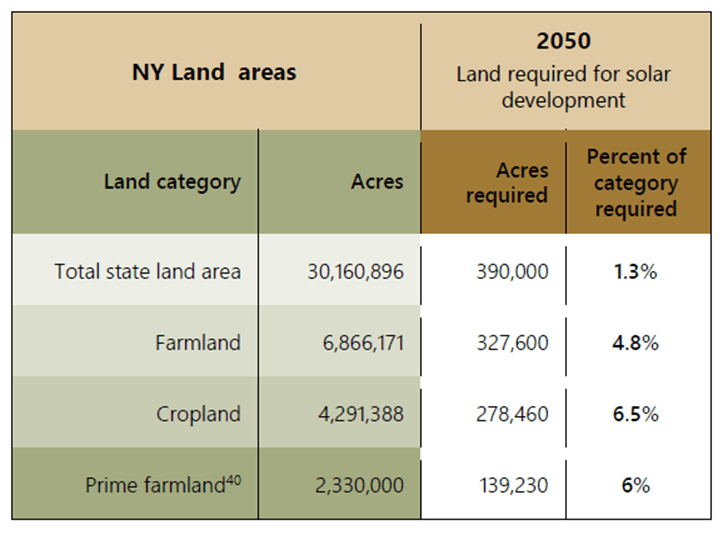
Cutting to the chase, Martin compares the acreage of New York State farmland as of 2017 and the acreage required by 2040 and 2050 for solar development in the following table.  She explains:

The claim that solar development will require only 1% of New York State’s land is roughly correct. On the other hand, solar buildout will require more than 1% of the state’s farmland.

Note that these numbers reflect acreage on the facility site; they do not include land used for mitigation or land taken out of production around facilities because it is less accessible or abandoned for other reasons.

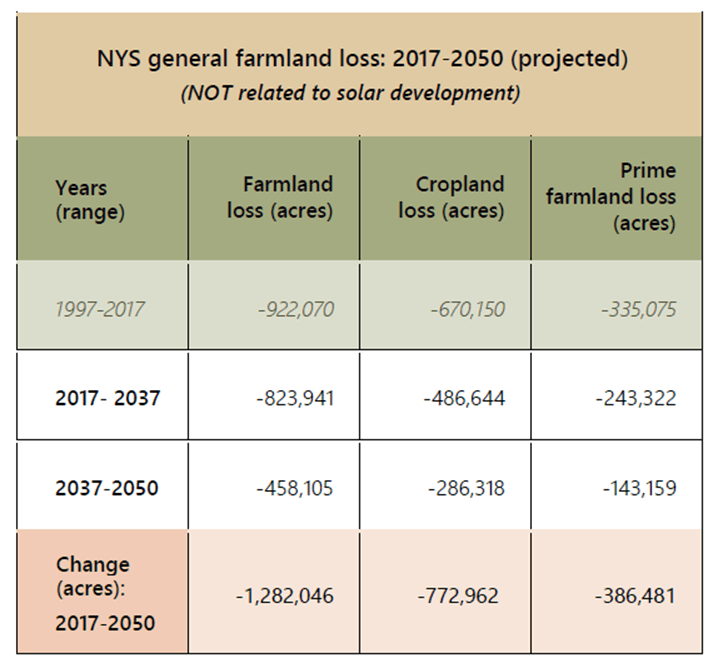
I like the White Paper because it provides context for everything covered.  Estimating the amount of land is dependent upon area per solar panel installation and how much capacity is required for the Climate Act.  Those topics are covered in sufficient detail that it is clear why the numbers used were chosen.  This extends to the results.  There is a chapter that “considers the loss of farmland that has been occurring over the last century and speculates on the reasons for farmland conversion over that period.”  The White Paper provides a projection of expected additional farmland and cropland losses by 2050 not related to solar development.  While there are inconsistencies in the data used such that there is “missing” land, the results are troubling.

The section “How Much Land” assesses cumulative farmland losses from both solar and non-solar causes and puts the estimates in context.  Martin addresses the question whether this is a little or a lot but finds that more context is needed.  She explains: “Let us consider some of the factors relating to our current and future land use, and their relationship to solar development.” 

  • The explanation takes up an entire chapter.  The chapter looks at the following issues:
  • Climate change and agriculture
  • Farmland values in New York and other states
  • Farming and farmers
  • Concentrations of solar development, with examples
  • Agrivoltaic solutions

I really liked this chapter because it frames the issues very well.  My goal as a pragmatic environmentalist is to try to provide the information that I think should be considered when decisions are made.  Invariably there are tradeoffs and the decisions made will reflect value judgements.  This chapter provides the information and avoids making conclusions about which tradeoffs are appropriate. 

One aspect of solar development that I had not considered previously is the effect of co-locating solar developments in the same area.  When several grid-scale solar projects are concentrated in one agricultural area there are adverse impacts to the remaining farmers.  I have long contended that the State has failed to provide a cumulative environmental impact assessment for the currently projected amount of solar and wind development.  The Final Supplemental Generic Environmental Impact Statement (SGEIS) for the Climate Leadership and Community Protection Act was released on September 17, 2020 and only included 13,200 MW of utility-scale solar.  This analysis assumes that utility-scale solar will be on the order of 45,000 MW or over three times what the State analyzed.

Discussion

After three years of extensive work Kris Martin has assembled a great resource on solar development and its potential impacts on New York agriculture.  She confronts the tradeoffs:

Ultimately, we may be facing a conflict between the rights of landowners to use farmland for any legal purpose and our collective need for farmland as a vital resource. Because most of us do respect the long hours, hard work, and inherent risks that farmers take, we naturally sympathize with their decisions to take farmland out of production or change the focus of their operations by leasing or selling land for solar development.

Farming is not an altogether benevolent activity. It can reduce biological diversity, introduce harmful chemicals into the environment, and consume massive subsidies that fail to improve life for many farmers or increase the production of affordable, healthy food and other agricultural products.

Do we have enough farmland for solar buildout on the scale required to meet Climate Act goals? Keep in mind that the Climate Act is a law, not simple policy. Its success depends on our having more farmland than we need in order to produce food, fiber, and fuel.

The answer to this question may be somewhat subjective. We may not even know the answers until it is too late to do much about the issue.

She includes recommendations for state policymakers, solar developers, community leaders, other individuals, and host farmers.

Conclusion

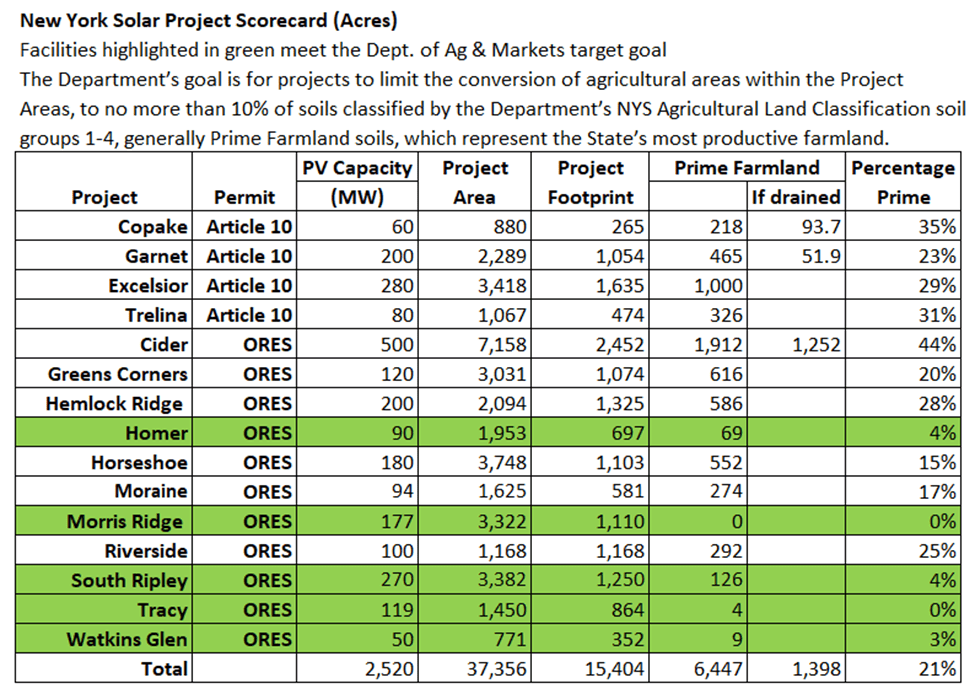
My takeaway from the White Paper is that it provides the context that the Hochul Administration should have provided for solar development.  The fact is that there still is no utility-scale solar development plan for the Climate Act.  There is no mandate to follow the Department of Agriculture & Markets targets for conversion of agricultural lands or explanation why meeting the targets should not be mandated.  The Scoping Plan estimates for solar capacity availability assume that tracking solar panels are used but the that is not mandated so fixed panel systems are being installed.  That means even more land will be taken up by industrial solar development.  Finally, there is no mandate for agrivoltaics.  This White Paper shows what should have been done. 

I agree with Martin’s conclusion:

We cannot afford to make bad decisions about farmland or energy production. Today’s priorities may become tomorrow’s regrets. The conflicts identified here will require all our efforts, open-mindedness, and thoughtful engagement to negotiate.

New York Zero Emissions Proceeding: Richard Ellenbogen Comments

The New York State Public Service Commission (PSC) recently initiated an “Order initiating a process regarding the zero-emissions target” that will “identify innovative technologies to ensure reliability of a zero-emissions electric grid”.  Implementation of the Climate Leadership & Community Protection Act (Climate Act) started soon after the law was passed at the end of 2019.  It was recognized early that “as renewable resources and storage facilities are added to the State’s energy supply, additional clean-energy resources capable of responding to fluctuating conditions might be needed to maintain the reliability of the electric grid”.  I recently summarized the proceeding and my comments.  This post summarizes the comments by Richard Ellenbogen that I think describe the overarching problems of the Climate Act.

I have been following the Climate Act since it was first proposed. I submitted comments on the Climate Act implementation plan and have written over 300 articles about New York’s net-zero transition.  I have extensive experience with meteorological aspects of electric generation because I have worked in the sector as a meteorologist for over four decades.  I have devoted a lot of time to the Climate Act and the issues raised in this proceeding because I believe the ambitions for a zero-emissions economy embodied in the Climate Act outstrip available renewable technology such that the net-zero transition will do more harm than good.  I represent the Environmental Energy Alliance of New York on the New York State Reliability Council Extreme Weather Working Group.  The opinions expressed in this article do not reflect the position of the Alliance, the Reliability Council, the Extreme Weather Working Group, any of my previous employers or any other company I have been associated with, these comments are mine alone.

Climate Act Background

The Climate Act established a New York “Net Zero” target (85% reduction and 15% offset of emissions) by 2050 and an interim 2030 target of a 40% reduction by 2030. The Climate Action Council is responsible for preparing the Scoping Plan that outlines how to “achieve the State’s bold clean energy and climate agenda.”  In brief, that plan is to electrify everything possible and power the electric grid with zero-emissions generating resources by 2040.  The Integration Analysis prepared by the New York State Energy Research and Development Authority (NYSERDA) and its consultants quantifies the impact of the electrification strategies.  That material was used to write a Draft Scoping Plan.  After a year-long review the Scoping Plan recommendations were finalized at the end of 2022.  In 2023 the Scoping Plan recommendations are supposed to be implemented through regulation and legislation.  The zero emissions analysis is part of that effort.

Ellenbogen Background

I have published other articles by Ellenbogen because he truly cares about the environment and the environmental performance record of his business shows that he knows how to protect the environment while running a business.   At the Business Council of New York 2023 Renewable Energy Conference Energy he [BIO] gave the keynote address (presentation and video) –  Why NY State Must Rethink Its Energy Plan and Ten Suggestions to Help Fix the Problems.”  which I summarized here.  His comment submittal includes more background information.

Comments

Ellenbogen’s comments are available on the DPS DMM website.  Many of the points in the Business Council keynote presentation were incorporated into his comments.

His introduction notes:

While Mr. Ellenbogen is in favor of the decarbonization identified in the CLCPA, the way that the policy is structured cannot possibly work and it is going to cost the state hundreds of billions of dollars, while not reducing atmospheric carbon, and worse yet, it precludes methods of reducing carbon emissions that actually will work much more rapidly based upon the physics of how utility systems actually operate.

Issues Raised in the Comments

He goes on to describe five issues related to Climate Act bet-zero transition:

  1. There is a lack of available energy to support the Plan
  2. Costs to implement the Plan will far exceed other, better solutions

These costs accrue based upon shortages of materials and skilled labor, high energy storage costs, and a lack of financial adequacy

  1. Atmospheric Carbon Levels will rise far above what could be achieved using other alternatives
  2. Planned timing mandates are unachievable
  3. There are major non sequitur issues contained within the CLCPA


He argues that the Scoping Plan does not accurately estimate the energy available from wind and solar and how much energy will be needed when the electrification proposed is in place.  His analyses, indicate that “even if all of the renewables specified in the CLCPA are installed, the state will still be over 100,000 GWh short of what is needed and there will be hundreds of hours of rolling blackouts annually.”   He also notes that renewable facility installation rate is falling behind the Scoping Plan schedule.

Ellenbogen has hands-on experience designing, building and operating a low-carbon energy system for his business.  Based on that background he believes “project costs will far exceed other, better solutions, based upon a shortage of materials, labor, and capital needed to complete Plan implementation”.  This is based on energy storage requirements, transmission upgrades, and the materials and labor needed to resolve those needs.

He points out that GHG emissions will not decrease as quickly as projected because the renewable energy/ carbon free energy resources won’t be available in time.  When other sectors of the economy are electrified that means that the additional loads will be supported by fossil fuel generation.  He points out that the demands for no new fossil fuel infrastructure means that old power plants will be kept on line longer.  He argues that building new, more efficient power plants for the decades long transition is the better solution.

The reason for this proceeding is that there is only one zero-emissions resource that fulfills most of the electric system requirements and nuclear is politically toxic.  In addition, it is unlikely that even if nuclear power were embraced it would be unlikely that the targets of the Climate Act could be met.  His discussion of schedule issues also raise a problem associated with the proposed dispatchable emissions-free resource (DEFR) included in the Scoping Plan.  As envisioned there, these resources will only be used 3% of the time:

That doesn’t work in the real world. Most generating technologies don’t lend themselves well to being dormant 97% of the time. Additionally, based upon the math, the 3% is an extremely low estimate. It would be far more cost effective to build more nuclear generation and fewer renewables. That would remove the intermittency issue and the storage cost issue documented earlier.

Finally, Ellenbogen explains that the conclusions of the Climate Act are based on fantasy.   He notes that the projected solar annual energy production from the listed capacity requires an annual capacity factor of 22% but that the state has a solar capacity factor of 13% when the arrays are new.  As a result, the calculated solar output is overestimated by 72% or 51,000 GWh. Using the correct solar capacity factor results in only 70,768 GWh of solar output in 2050, 51,000 GWh less. Combined with his estimate that the amount of energy needed is going to be 120,000 GWh more than the 2050 Scoping Plan projections is the reason he believes “that we can expect hundreds of hours of rolling blackouts every year if the Climate Act is executed as planned. “

Viable Alternatives in the Comments

Ellenbogen argues that natural gas-fired combined cycle power plants are a viable alternative during the transition.  They can be built relatively quickly and would replace the old more inefficient power plants that have to be kept on-line in the absence of adequate resources.  He makes a persuasive case that the huge electricity load of the proposed Micron chip fabrication plant north of Syracuse should include a combined cycle co-generation plant that would provide both electricity and heat for the facility.  He explains:

With regard to Micron Technologies, one could be built on-site that would eliminate 350 GWh of line loss while also providing Micron easy access to high temperature thermal energy. The Energy on Demand aspect of the generating plants also eliminates the need for trillions of dollars of battery storage. It is not a perfect solution, but it is a far better solution than “ideal” solutions that can’t be executed because of the previously documented issues. As hydrogen technologies are perfected and a sufficient supply of hydrogen is developed, hydrogen injection technologies can help to further reduce the GHG emissions of the plants.

Overview Conclusion

He concludes:

The prior analysis is based upon facts, math, and physics, not opinions or wishful thinking.. The issues don’t require an understanding of calculus. They just require an open mind and a knowledge of arithmetic. People can’t only say, “Follow the science” when it tells them what they want to hear. Any engineer knows that science, math, and reality can screw up the best plans.

Einstein defined “Insanity” as repeating the same thing over and over again and expecting different results. Why is NY State repeating Germany’s failed renewable experiment that hasn’t worked in 33 years and expecting it to work in seven years or seventeen years. The results in NY State are going to be just as bad as they have been in Germany. However, time is now an issue and significant GHG reductions need to be achieved quickly. The CLCPA in New York State will not be any more successful than Germany policy has been in their efforts to combat climate change.

NY State is currently in the CLCPA, mandating a non-functional utility system which will be plagued by greater fossil fuel use, higher carbon emissions, energy failures, and stability issues that will result in deaths, and a mass exodus of people and businesses that will destroy the tax base and with it, the state economy.

Response to Questions

The zero-emissions proceeding request for comments included 14 questions.  He did not respond to specific questions  Instead, I quote his response “Regarding Answers to Some of the 14 Questions”:

“How should zero be defined?” Zero is zero. If they meant otherwise, they should have used the word “low”. Carbon offset projects still have to be distinguished from true zero emission technologies such as solar, wind, and nuclear. If the state wants to offer credits to a process that offsets carbon for accounting purposes, that’s fine but don’t call it zero. It should be in a separate “offset” category.

Regarding Carbon Capture, many of the technologies cool the exhaust to separate the CO2 as a liquid and either use it in other materials or pump it underground in a deep well to sequester it. While that will greatly reduce atmospheric CO2, it will greatly increase energy use. That energy has to be accounted for. Where is it going to come from?

Regarding “Green Hydrogen”, hydrogen electrolysis should not qualify. There is going to be an enormous shortage of electrical energy to support the utility system, even if all of the renewables are magically installed. A recent study done in Australia found that if all of their current proposals to produce green hydrogen by electrolysis were implemented, the total energy required would exceed all of Australia’s generating capacity. The math will be no different in NY State. A better solution would be to generate hydrogen by investing in a thermo-chemical process using the waste heat of the nuclear plants to power or by using the NYSERDA Biomass Power Guide qualifying waste to energy plants to generate the hydrogen.

Pragmatic Environmentalist Conclusion

I highly recommend reading his comments.  Ellenbogen offers alternatives that would be cheaper, will reduce GHG emissions in the short term, and are technologies that will actually “work much more rapidly based upon the physics of how utility systems actually operate.”  Alas he argues that going to zero is not appropriate.  The ideologues on the Climate Action Council who shaped the Scoping Plan demand perfection but do not seem to comprehend that the real world makes that impossible.

I don’t think the ideologues understand the risk to their goals.  The proposed Scoping Plan cannot work as written and will cost enormous amounts of money.  There is no indication that proponents understand the risks to reliable energy inherent in the Scoping Plan and that poor energy policy will cause greater health and economic damage than climate change.  When these problems get to the point that they cannot be denied, I believe it is likely that public backlash will be so strong that there will be no appetite for any of the idealistic dogma in the Scoping Plan energy policy.  Moreover, even the alternatives proposed by Ellenbogen will be off the table for future energy policy. 

Micron Chip Plant Impact Update

A recent report by the Syracuse Post Standard described the most recent environmental impact assessment for the Micron Technology’s planned semiconductor plant.  Last month I described the keynote address for the Business Council of New York 2023 Renewable Energy Conference Energy by Richard Ellenbogen.   I contacted Ellenbogen to let him know that the original projection of for energy use that would be the same as the state of Vermont has been expanded to the same as Vermont and New Hampshire.  This post describes Ellenbogen’s reaction to that news.

Ellenbogen is President [BIO] of Allied Converters and frequently copies me on emails that address various issues associated with New York’s Climate Leadership and Community Protection Act (CLCPA).  I have published other articles by Ellenbogen because he truly cares about the environment and the environmental performance record of his business shows that he is walking the walk.   When he sent a copy of the presentation I asked if I could it post after the conference.

Why NY State Must Rethink Its Energy Plan

Ellenbogen’s keynote address was titled “Why NY State Must Rethink Its Energy Plan and Ten Suggestions to Help Fix the Problems.”  My post on the presentation  summarized the power point presentation for his keynote address.

One of his suggestions concerned the Micron plant:

Allow Micron Technologies to build a combined cycle plant the size of Cricket Valley Energy Center on their property. The Micron facility will use more energy than the state of Vermont. With generation on-site, the thermal energy could be used at the plant and the 350 GWh of annual line loss will be eliminated. Instead of making them look “green” on paper by buying carbon credits, let them be green in reality with high efficiency generation and have lower energy costs to make them more competitive and able to recoup the $5 billion rebate without faking it. That will eliminate the increase in statewide energy use related to the facility.

Micron Environmental Impact

Glen Coin and Tim Knauss provided an update (subscribers only unfortunately) on the environmental impacts of the facility.  Their article included the following statements:

The new estimates of water and energy use are for entire the complex when finished 20 years from now. The company plans to build the four fabrication plants, or fabs, sequentially: Construction of fab 1 starting in November 2024, and work on the fourth fab completed by 2043.

When the Clay complex is complete in 2043, it would use more water and more electricity than all of the company’s factories and offices in use today. The Clay complex will consume 16 billion kilowatt-hours of electricity per year; according to the 2023 sustainability report, all of the company’s fabs now use a combined 11 billion kilowatt hours

Sixteen billion kilowatt-hours per year is enough for more than 2 million average households.

The Micron fab would use about the same amount of electricity as Vermont and New Hampshire combined, according to data from the U.S. Energy Information Administration.

Ellenbogen Update

Ellenbogen prepared the following update after I sent him the article:

I have been using the Micron facility as an example of how the CLCPA is actually going to increase NY State’s carbon footprint because transmitting all of that energy to the Micron site, as much as is used by the state of Vermont,  over long distances was going to result in an amount of lost energy on the wires that could operate 1-3/4 Cornell Universities.  One of my readers sent me an update of energy use because now it is projected that the Clay complex will consume 16 billion kilowatt-hours of electricity per year, as much as Vermont and New Hampshire combined, or 16,000 Gigawatt Hours annually (16 Tera-watt hours).  That is double the original projections and the idea that this could be supported with renewable generation is laughable.  16,000 GWh is an 11%  increase in NY State electric usage just related to the one facility.  The line loss will also double to consume the output of about  a 100 megawatt fossil fuel plant under continuous operation.

To put the Micron facility’s usage into perspective, in its last full year of operation the 2 Gigawatt Indian Point nuclear plant generated 16.3 Tera-watt hours so the Micron facility will need to be supported by a 2 Gigawatt fossil fuel or nuclear plant on site or  2.1 Gigawatts of generation off site, 5% more.  NY State’s policy makes absolutely no sense.  To run the Micron facility would require using about 4 GW of the projected 9 GW of offshore wind to support the plant or 16 GW of solar arrays covering 128,000 acres (80 acres per 10 MW)  or 200 Square miles.  NY State has 7 million acres of farmland so solar arrays to support the Micron facility  would use almost 2% of the farmland in the state and would also require an enormous amount of battery storage, the cost of which would greatly exceed the cost of a nuclear plant on site.  A combined cycle generating plant on site would be about 75% less than the cost of the nuclear plant.  Both the combined cycle gas plant and the nuclear plant on-site offer the option of recovering the waste heat and using it in the plant to make Micron even more energy efficient.  With regard to the solar and wind, NY State is having major difficulties getting all of their renewable projects finished because of cost issues and interconnection issues, let alone adding this gigantic lead weight to the Camel’s back.

The politicians can say whatever they want about the wonders of the CLCPA but the mathematical analysis of the project says that the CLCPA and the mandate for Micron to buy Carbon credits is going to raise NY State’s carbon footprint substantially while also raising Micron’s costs.  It’s a Lose-Lose proposition for everyone.

That’s what happens when you outsource utility planning to Climate Scientists and environmental activists that have no understanding of what they are doing, which is what NY State has done.

Conclusion

I agree with Ellenbogen’s points.  The obvious approach for the energy needed by Micron would be co-generation.  As much as I would like to say that this should be provided by nuclear, I agree with him that costs and implementation time preclude that option now so a combined cycle natural gas-fired plant is the pragmatic choice.  Either option produces waste heat that can be used at the facility which increases the energy efficiency.  As he says the expectation that renewables can provide the necessary power on top of the existing load needs is laughable.  Importantly, a facility like this must have uninterruptible power and providing that from wind and solar is an extreme challenge. Finally, I want to close with one of Ellenbogen’s points from his presentation: “When fantasies meet reality, reality always wins.”  The Climate Act renewable plans are fantasy and the inevitable clash with reality is going to be interesting to watch.

NYISO Short-Term Assessment of Reliability July 2023

On July 14, 2023 the New York Independent System Operator (NYISO) released its quarterly assessment of reliability of the bulk electric system.  The analysis found a deficit in reliability margins for the New York City area beginning in summer 2025. As a result, something must be done or there will be unacceptable risks to reliability that could cause power outages.  Unfortunately, it is difficult to understand the reasons for this finding because of the complexity of the subject.  This post includes a detailed explanation of the report and its implications.  If you want a good non-technical summary, then I recommend James Hanley’s post Get Ready for the New York City Blackout of 2025.

I have been following the Climate Leadership & Community Protection Act (Climate Act) since it was first proposed.  I submitted comments on the Climate Act implementation plan and have written over 300 articles about New York’s net-zero transition.  I have devoted a lot of time to the Climate Act and New York’s energy planning because I believe the ambitions for a zero-emissions economy embodied in the Climate Act outstrip available renewable technology such that the net-zero transition will do more harm than good.  Unfortunately, trying to explain the risks and issues associated with the transition is difficult because of the complexity of the problems and the fact that expert reports are dense and filled with jargon.  The opinions expressed in this article do not reflect the position any of my previous employers or any other company I have been associated with, these comments are mine alone.

Resource Adequacy Assessments

The NYISO is responsible power system reliability and competitive markets for New York.  As part of that mission NYISO determines whether generating resources and the transmission system can adequately meet expected load.  They describe the resource adequacy analyses as follows:

Resource adequacy is the ability of the electric system to supply the aggregate electrical demand and energy requirements of the firm load at all times, considering scheduled and reasonably expected unscheduled outages of system elements. The NYISO performs resource adequacy assessments on a probabilistic basis to capture the random nature of system element outages. If a system has sufficient transmission and generation, the probability of an unplanned disconnection of firm load is equal to or less than the system’s standard, which is expressed as a loss of load expectation (LOLE). Consistent with the Northeast Power Coordinating Council and New York State Reliability Council criterion, the New York State bulk power system is planned to meet an LOLE that, at any given point in time, is less than or equal to an involuntary firm load disconnection that is not more frequent than once in every 10 years, or 0.1 event days per year.

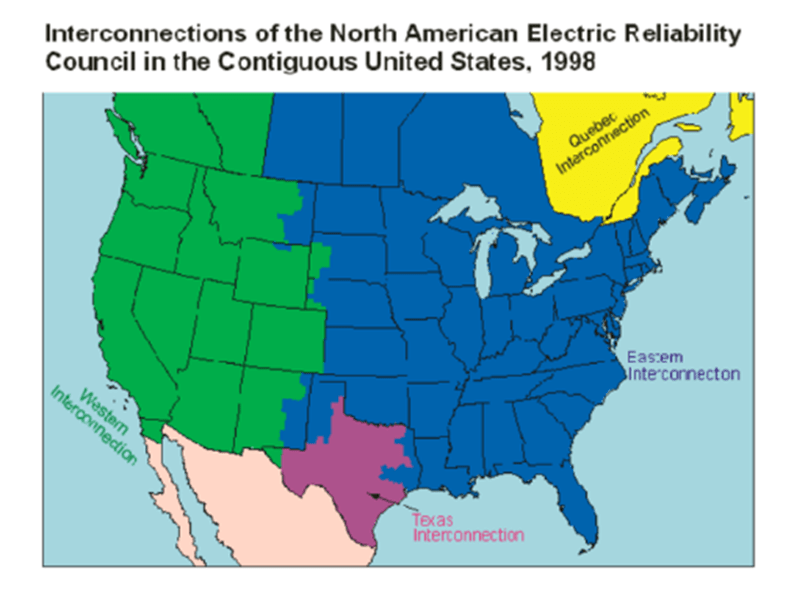
So what does that mean?  The first point is that the electric system is very complicated.  I summarized my skepticism of the net-zero transition earlier this year in an article that included an overview of the electric system.   Incredibly all the fossil, hydro, and nuclear generating stations in the Eastern Interconnection shown below work together.  In order to provide electricity, the generating turbines are synchronized to turn at 1800 revolutions per minute.  Operators keeps the voltages as constant as possible in the entire area but rely on those turbines to provide inertia as well as voltage control and that can be dispatched as necessary to match load.  The NYISO operates the New York State control area within the Interconnection.  In addition to the day-to-day operation, they plan for resource adequacy to ensure that the operators have generating resources available so that they can constantly match load. 

The NYISO resource adequacy assessments rely on decades of observed characteristics of generating resources, the transmission system, and system load to develop the likelihood  of system element outages. If a system has sufficient transmission and generation, then when a problem occurs (say lightning hits a transmission line) the system can respond without an extended outage.  The NYISO has a well-established process to identify reliability needs. The analyses consider how the system can react to various combinations of issues based on historical observations of the existing system to determine the loss of load expectation (LOLE). The organizations overseeing New York reliability,  the Northeast Power Coordinating Council and New York State Reliability Council, mandate that the New York State bulk power system is planned to meet the LOLE standard that any involuntary firm load disconnection  is not more frequent than once in every 10 years, or 0.1 event days per year.

Annotated Executive Summary

This section quotes the Executive Summary in the report and explains the contents.  As part of an on-going reliability assessment process the NYISO analyzes any expected changes to the generation and transmission system:

This report sets forth the 2023 Quarter 2 Short-Term Assessment of Reliability (“STAR”) findings for the five-year study period of April 15, 2023, through April 15, 2028, considering forecasts of peak power demand, planned upgrades to the transmission system, and changes to the generation mix over the next five years.

The analysis finds that there are issues associated with peaking power plants in New York City.  I have been involved with this problem and these facilities since 2000.  This topic has been the subject of multiple articles on this blog and I have summarized my articles as on overview that I can reference when the issue resurfaces.  The Executive Summary notes: 

This assessment finds a reliability need beginning in summer 2025 within New York City primarily driven by a combination of forecasted increases in peak demand and the assumed unavailability of certain generation in New York City affected by the “Peaker Rule.”  In 2019, the New York State Department of Environmental Conservation adopted a regulation to limit nitrogen oxides (NOx) emissions from simple-cycle combustion turbines, referred to as the “Peaker Rule” (https://www.dec.ny.gov/regulations/116131.html)  

The Peaker Rule culminated a decade-long process whereby the New York State Department of Environmental Conservation (DEC) instituted a framework to retire or control the “peakers”.  The DEC, NYISO, facility owners and Consolidate Edison, the load serving entity for New York City, all worked together to ensure that the retirement would not endanger reliability.  This latest analysis suggests that there are still issues to be resolved:

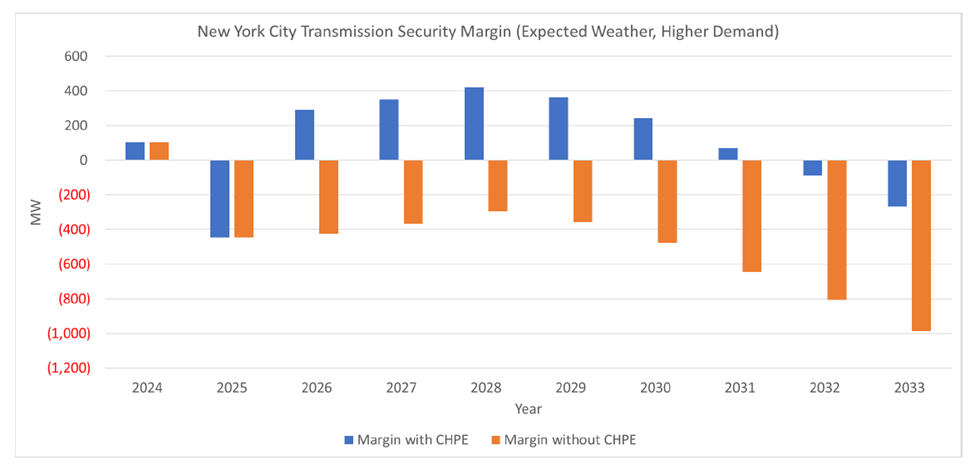
Combustion turbines known as “peakers” typically operate to maintain bulk power system reliability during the most stressful operating conditions, such as periods of peak electricity demand. As of May 1, 2023, 1,027 MW of affected peakers have deactivated or limited their operation. An additional 590 MW of peakers are expected to become unavailable beginning May 1, 2025, all of which are in New York City.   With the additional peakers unavailable, the bulk power transmission system will not be able to securely and reliably serve the forecasted demand in New York City (Zone J). Specifically, the New York City zone is deficient by as much as 446 MW for a duration of nine hours on the peak day during expected weather conditions when accounting for forecasted economic growth and policy-driven increases in demand.

The following paragraph explains that the reliability need is expected because the latest projections of generation, load, and transmission availability have changed over time:

The reliability need is based on a deficient transmission security margin that accounts for expected generator availability, transmission limitations, and updated demand forecasts using data published in the 2023 Load & Capacity Data Report (“Gold Book”). The transmission security margin represents the balance between demand for electricity and the power supply available from generation and transmission to serve that demand. This assessment recognizes that there is uncertainty in the demand forecast due to uncertainties in key assumptions including population and economic growth, the proliferation of energy efficiency, the installation of behind-the-meter renewable energy resources, and electric vehicle adoption and charging patterns. These risks are accounted for in the transmission security margin calculations by incorporating the lower and higher bounds as a range of forecasted conditions during expected weather, specified in the Gold Book as the policy scenario forecasts. The lower and higher demand policy scenario forecasts reflect achievement of policy targets through alternative pathways and assume the same weather factors as the baseline demand forecast.

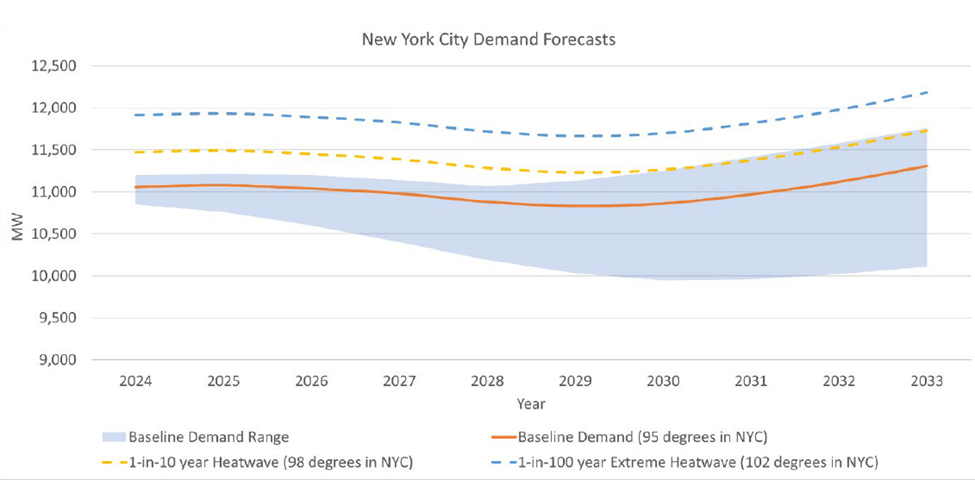
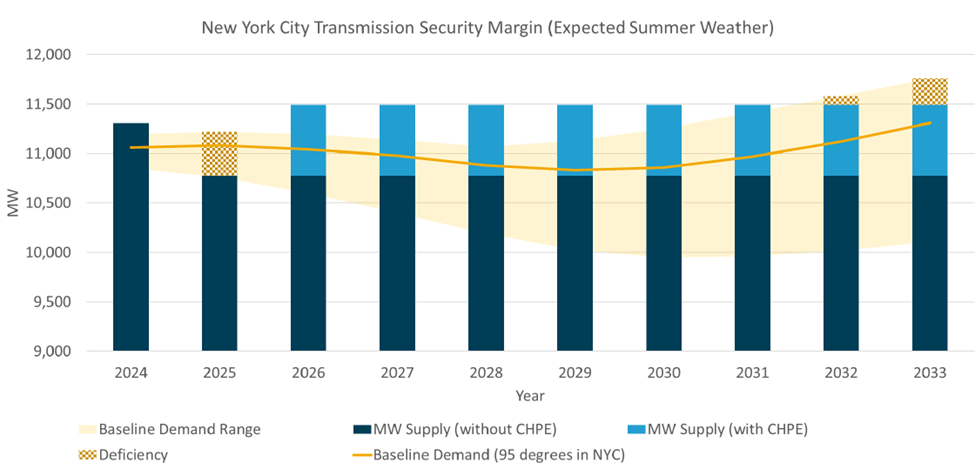
The Gold Book is the standard for electric data in New York. The following figure shows the range of the demand forecasts for New York City.  I want to point out one thing.  The emphasis is on providing generation for the peak load.  This is a significantly more difficult problem than estimating the generation necessary for an average year.  There are more short-term constraints that could affect generation and load that can be ignored on average.  

I have some experience with the resource modeling projections and cannot over-emphasize the complexity of all the factors incorporated in the models.  Unfortunately, there is a lot of uncertainty associated with projecting all those factors.  That is why the NYISO is constantly re-evaluating the model inputs and projections.  In addition, they are always looking to refine the model itself.  Based on their latest estimates:

Under the baseline forecast for coincident summer peak demand, the New York City transmission security margin would be deficient by 306 MW in 2025 for a duration of 7 hours. However, accounting for uncertainties in key demand forecast assumptions, the higher bound of expected demand under baseline weather conditions (95 degrees Fahrenheit) in 2025 results in a deficiency of 446 MW over 9 hours. The deficiency would be significantly greater if New York City experiences a heatwave (98 degrees Fahrenheit) or an extreme heatwave (102 degrees Fahrenheit).

The NYISO is banking on one project to address this problem after 2025.

Overall, the New York City transmission security margin is expected to improve in 2026 if the Champlain Hudson Power Express (CHPE) connection from Hydro Quebec to New York City enters service on schedule in spring 2026, but the margin gradually erodes through time thereafter as expected demand for electricity grows. Beyond 2025, the forecasted reliability margins within New York City may not be sufficient if (i) the CHPE project experiences a significant delay, (ii) additional power plants become unavailable, or (iii) demand significantly exceeds current forecasts. Without the CHPE project in service or other offsetting changes or solutions, the reliability margins continue to be deficient for the ten-year planning horizon. In addition, while CHPE is expected to contribute to reliability in the summer, the facility is not expected to provide any capacity in the winter.

I am uncomfortable that there is this much reliance on a single project to address the problems identified.  I discussed the start of construction late last year for the Champlain Hudson Power Express (CHPE) project.  It is a 339-mile underground transmission line capable of bringing 1,250 MW from the Province of Quebec to Astoria Queens in New York City.  I explained that I was worried about the schedule and costs of the project.  The NYISO Resource Adequacy analyses must necessarily rely on the developer’s prediction for completion.  Richard Ellenbogen and I share the timeliness concern.  Richard noted that the project was proposed in 2011 and the PSC authorized it on 4/18/13.  It has been 11.5 years since it was proposed, 9.5 years since it was authorized, and construction started a year after the funding contract was signed.  In addition, it has recently come out that landowners on sections of the right-of-way that are on land have just been informed that they will be impacted.  The likelihood of additional delays seems high.  Given that other renewable projects are being re-evaluated because of price increases due to inflation and increased cost of materials it seems that this project will also have the same problems.  Given its importance to New York City reliability, I cannot conceive of any scenario in which the State will not grant any cost overruns requested by the developers. This project is already expensive equating to an estimated increase in customer electric bills of 2.1 – 4.1% (or $2.08 – $4.08 per month for the average residential customer.  I am confident that at the end of the day the final costs will be much higher.

The STAR quarterly report did not limit its analysis to just New York City.

In addition to New York City, this assessment also evaluated the transmission security margins for the statewide system as well as Lower Hudson Valley and Long Island localities. For these localities, the planned Bulk Power Transmission Facilities (“BPTF”) through the study period are within applicable reliability criteria based on the baseline summer coincident peak demand forecast with expected weather and with the planned projects meeting their proposed in-service dates. The NYISO assessed the resource adequacy of the overall system and found no resource adequacy reliability needs.

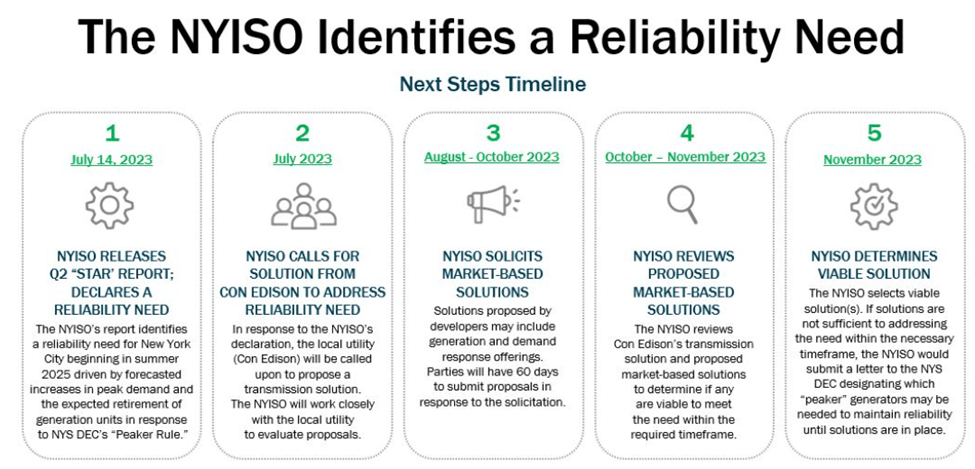
The NYISO is a product of the de-regulated New York electric system.  As such they are ardent supporters of “market” solutions.  This adds a layer of uncertainty because NYISO must develop some sort of incentive for a developer to provide the necessary resources.  If it was an attractive investment, then I would expect that someone would already be developing the necessary resources.  In addition, Con Ed must also determine if local transmission upgrades can resolve the problem.

The short-term need observed in 2025 is a Near-Term Reliability Need. As a result, solutions will be solicited, evaluated, and addressed in accordance with the NYISO Short-Term Reliability Process. The need arises within the Con Edison Transmission District; therefore, Con Edison is the Responsible Transmission Owner for developing a regulated solution.(Reference NYISO’s Open Access Transmission Tariff Section 38.3.6)

The report identifies another particular issue that illustrates why regular STAR analyses are required and why this issue is coming up now.  Although all the affected parties may know that there will be changes to the system and have reasonable expectations what they will be, the NYISO cannot officially act until certain filings are made.

Central Hudson identified transmission security issues in its transmission district on its non-BPTF system. These are primarily driven by the assumed unavailability of certain generation in its district affected by the Peaker Rule. Given that those generators have not yet provided complete Generator Deactivation Notices to the NYISO, the local non-BPTF criteria violations identified by Central Hudson are being provided for information but were not assessed to identify possible Generator Deactivation Reliability Needs at this time.

The report also describes an upcoming issue that will be considered officially in a subsequent report. The “informational scenario” considers interconnecting large loads:  the Micron New York semiconductor manufacturing (530 MW in 2030), the Air Products and Chemicals (Q#1446), and other load changes that increase load another 694 MW.

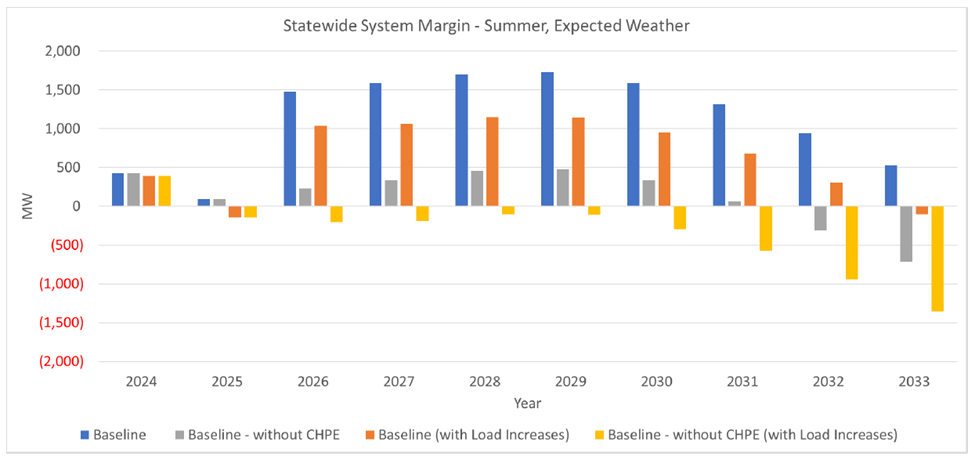
As an informational scenario, this STAR includes an evaluation of the impact of additional large load interconnection projects primarily in western and central New York. The anticipated increases to the demand forecast due to these large loads in 2025 is 764 MW which results in a corresponding reduction to the available margin, such that in 2025 the statewide system margin is projected to be deficient of 145MW. By 2033, additional large loads increase the demand by 1,224 MW which results in a corresponding deficient margin of 104 MW. If CHPE does not begin operation, the state wide system margin is projected to be deficient for all years 2025 through 2033 when considering the additional large loads. The 2023 Quarter 3 STAR will include these load projects and the associated system margin impacts. The solution to the New York City reliability need identified in this STAR may also address the state wide system margin concern.

The Executive Summary summarizes their approach:

The wholesale electricity markets administered by the NYISO are an important tool to help mitigate these risks. The markets are designed, and continue to evolve and adapt, to send appropriate price signals for new market entry and the retention of resources that assist in maintaining reliability. The potential risks and resource needs identified in the NYISO’s analyses may be resolved by new capacity resources coming into service, construction of additional transmission facilities, and/or increased energy efficiency and integration of demand-side resources. The NYISO is tracking the progression of many projects that may contribute to grid reliability, including numerous offshore wind facilities that have not yet met the inclusion rules for reliability assessments. The NYISO will continue to monitor these resources and other developments to determine whether changing system resources and conditions could impact the reliability of the New York bulk electric grid.

Note that there are three ways the problem identified can be resolved: building new capacity resources, construction of additional transmission facilities, and/or reducing load expectations with increased energy efficiency and integration of demand-side resources.  Even if the Hochul Administration came to its senses and decided to facilitate the construction of dependable generating capacity, that is to say, fossil-fired generators, there is no way that any generating resource to support reliability could get built in this timeframe.  My rule of thumb for just getting permits in New York City is a minimum of three years.  The summer of 2025 is only two years away.  Of course, the possibility of any new fossil infrastructure is very unlikely anyway.  Designing, permitting, and building additional transmission facilities may not take quite as long but I cannot imagine this solution could be available in two years.  There already are great expectations for reducing load so I cannot imagine any scenario that could reduce additional load on the order necessary to meet the identified load shortfall.

The final paragraph in the Executive Summary describes the specific filings that will trigger further STAR revisions.

As generators that are subject to the DEC’s Peaker Rule submit their Generator Deactivation Notices, the NYISO and the responsible Transmission Owners will continue to evaluate in future STARs whether Generator Deactivation Reliability Needs arise from the deactivation of Initiating Generators. (Reference NYISO’s Open Access Transmission Tariff Section 38.1 state that an “Initiating Generator” is “a Generator with a nameplate rating that exceeds 1 MW that submits a Generator Deactivation Notice for purposes of becoming Retire or entering into a Mothball Outage or that has entered into an Installed Capacity (ICAP) Ineligible Forced Outage pursuant to Section 5.18.2.1 of the ISO Services Tariff which action is being evaluated by the ISO in accordance with its Short-Term Reliability Process requirements in this Section 38 of the ISO Open Access Transmission Tariff.

Discussion

The Findings section expands the description of the problem found.  Without changes to existing load pattern the summer peak load demand in New York City would be “deficient by 306 MW in 2025 for a duration of 7 hours”.  There are uncertainties in the load demand forecasts.  Assuming the upper bound of “demand under baseline weather conditions (95 degrees Fahrenheit) in 2025 results in a deficiency of 446 MW over 9 hours.” If the weather is hotter or lasts for an extended period the “deficiency would be significantly greater.” This exemplifies the tradeoffs the NYISO and NYSRC must make when assessing resource adequacy and reliability standards.  If the deficiency is “significantly greater” then it will be impossible to manage the load without rolling blackouts.

The NYISO writes: “The deficient margin is primarily due to the increased demand forecasts within New York City combined with the planned unavailability of simple-cycle combustion turbines to comply with the DEC’s Peaker Rule in 2025”.   Apparently, it is not politically correct to point out that Hochul Administration’s policy that finalized the shutdown of 2,000 MW of nuclear power and the disapproval of a plan to build a 1,040 MW, eventually reduced to 437 MW, combined cycle facility exacerbated this problem and that if those resources were available there would not be a problem.

As it stands now, I expect that the solution will be an extension of the operating permits for the peaking turbines because there is no other viable solution to maintain reliability.

The NYISO describes the process and explains how it will be resolved in the following figure.  They have identified the reliability need.  They will ask Consolidated Edison if the problem can be resolved with transmission system revisions in Step 2.  At the same time in Step 3, NYISO will solicit  market-based solutions from other developers.  In the next step NYISO reviews the proposed solutions “to determine if they are viable and sufficient to address the identified need.”  The NYISO description of the last step notes:

Timing is an essential component of the NYISO’s evaluation. If proposed solutions are not viable or sufficient to meet the identified reliability need, interim solutions must be in place to keep the grid reliable. One potential outcome could include relying on generators that are subject to the DEC’s Peaker Rule to remain in operation until a permanent solution is in place. The DEC’s Peaker Rule anticipated this scenario when it authorized the NYISO to designate certain units to remain in operation beyond 2025 on an as-needed basis for reliability. Based on findings from its Short-Term Reliability Process, the NYISO may designate certain units, in sufficient quantity, to remain in operation for an additional two years (until May 1, 2027) with the potential of an additional two-year extension (to May 1, 2029) if a permanent solution that is needed to maintain reliability has been selected but is not yet online. The NYISO would only temporarily retain peakers as a last-step approach if it does not expect solutions to be in place when the identified reliability need is expected in 2025.

Reaction

Utility Dive described the report.  Their article quotes Zach Smith, vice president of system and resource planning for the NYISO as saying the assessment “reflects the extraordinary challenges of the grid in transition.”  It also notes that the report acknowledges “uncertainty” in the demand forecast surrounding assumptions including population and economic growth, the proliferation of energy efficiency, the installation of behind-the-meter renewable energy resources, and EV adoption and charging patterns.

The reaction of parties in New York State was predictable.  Marie French writing at Politico solicited comments from the Hochul Administration:

“To be clear: The reliability of our grid is not in question,” Hochul spokesperson Katy Zielinski said in a statement. “We are committed to ensuring New Yorkers have a reliable and affordable power supply — and we can do this while accomplishing our nation-leading climate goals. Governor Hochul remains fully committed to rapidly decreasing emissions and setting an example for how clean energy and reliability can go hand-in-hand.”

French said that Zielinski cited the planned Canadian hydropower line, the Clean Path line and offshore wind projects as ways to bring more renewables into New York City.   There is a fundamental issue with these projects because they all rely heavily on distant  transmission that is overly vulnerable to outages  One of the New York City blackouts occurred because a transmission line into the city went down and in-city generation could not be brought up fast enough to react to the loss of energy supply.  There are specific reliability rules in place that mandate a minimum capability of in-city generation when storms threaten transmission lines into the City.  I am not sure how this will be addressed in the future.  The Canadian hydropower line may not be affected by storms but still could go down unexpectedly for other reasons.  The Clean Path project is “is comprised of more than 20 renewable energy generation projects and an approximate 175-mile, underground transmission line.  I am guessing that the argument is that an underground line can provide power that is not subject to storm outages so is exempt from the transmission line reliability rule.   However, even if they are much less likely to go out, when they do have problems fixing them is much more difficult.  Counting on offshore wind as a viable replacement in the City is very risky unless it is coupled with sufficient energy storage to cover the energy needs for an entire heat wave because the meteorological conditions that cause extreme heat are associated with high-pressure systems that also have light winds.

The Peak Coalition has been the primary mover for peaking power plant environmental justice.  French mentioned their statement that notes:

PEAK Coalition is gravely concerned with the impact that the reliability deficit estimated in the Short-Term Assessment of Reliability (STAR) report for Q2 of 2023 released by the New York Independent Systems Operator (NYISO) will have on communities that live near power plants. We encourage all stakeholders involved in the energy planning process to take concrete action to prevent delaying the closure of fossil fuel peaker plants in 2025 and beyond.  These plants harm the communities that surround them every hour that they operate. PEAK refuses to accept a scenario in which environmental justice communities must suffer further harm to guarantee further profligate summertime energy consumption in commercial buildings and wealthy communities.

I have evaluated the EJ claims.  The PEAK coalition has stated that “Fossil peaker plants in New York City are perhaps the most egregious energy-related example of what environmental injustice means today.”  The influence of this position on current New York State environmental policy has led to this issue finding its way into multiple environmental initiatives. However, the presumption of egregious harm is based on selective choice of metrics, poor understanding of air quality health impacts,  and ignorance of air quality trends.  

As noted previously the NYISO is invested in market solutions. French also got a statement from the NYISO that is completely consistent with that approach:

“We’ve identified the reliability need, so we’re confident that’s present for summer 2025,” said NYISO spokesman Kevin Lanahan. “We’re also confident that we can solve the reliability [need]. That’s the nature of our planning process, to identify those issues with enough time to solve the problems so we’re confident we can find the solution and keep the system reliable.”

French also got a statement from Gavin Donohue at the Independent Power Producers:

“The pace of play is not keeping up with pace of promises, and this report makes that clear,” said Independent Power Producers of New York president and CEO Gavin Donohue, who represents the state’s existing nuclear, renewable and predominantly fossil fuel power plants. “This report should draw attention from state officials in shaping realistic public policies. I encourage the NYISO to identify solutions that are market-based so we can set ourselves on the pathway to a cleaner energy future, while maintaining the reliability of our grid at affordable rates.”

James Hanley from the Empire Center summarizes the implications well.  He concludes:

The mistake New York has made is not its goal to eventually reduce NOx emissions but its rush to shut down the peakers — and Indian Point — before developing reliable replacement sources of power. Notably, the Department of Environmental Conservation rejected proposals by NRG Energy to update nearly 1,000 megawatts of electricity production in the city to newer, cleaner-burning, and NOx-standard compliant combined-cycle power plants, claiming that NRG “failed to demonstrate the need or justification for the proposed project.”

This “shutdown first, replace later” model was a major cause of rolling blackouts on the West Coast, but New York authorities didn’t bother to learn from California’s experience. Simple common sense would indicate that the wise approach would be to find assured sources of reliable and dispatchable electricity production before taking critical power plants offline. Sadly, common sense was the first victim of New York energy policy. Even more sadly, it won’t be the last.

Conclusion

Despite assurances from Hochul spokesperson Katy Zielinski, the reliability of the New York City grid is in question. The plans rely on resources that are new to New York and that increases uncertainty.  Presuming that proposed projects will replace operational facilities on the schedule proposed is very risky. 

There is another dynamic here that will be interesting to watch.  Peaker power plants are a primary scapegoat for the New York City EJ community.  The PEAK Coalition has already gone on record stating that “If NYISO is forced to issue reliability-must-run orders, New Yorkers will know that electric utilities and state governments willingly failed to act to protect communities most impacted by fossil fuel emissions and climate change”.  The electric utilities and state government have failed to explain the potential impacts to the disadvantaged communities if fossil-fired peaking units are not replaced with proven technology.  The risks to those communities imposed by the presence of such resources are not nearly as large as the risks to those communities from blackouts.  Keeping the lights on is the better social choice.

Thanks to Russell Schussler for review and helpful comments.  Any technical errors are mine.

ACE NY Agrivoltaics Support

In order to implement the Climate Leadership & Community Protection Act (Climate Act) New York must support “unprecedented levels of investment in new generation”.  This post addresses the duplicity of the members of the Alliance for Clean Energy New York (ACE NY) who have organized a campaign to send letters supporting agrivoltaics to the legislators at the same time they are covering swaths of prime farmland with solar panels.

I have been following the Climate Act since it was first proposed. I submitted comments on the Climate Act implementation plan and have written over 300 articles about New York’s net-zero transition because I believe the ambitions for a zero-emissions economy embodied in the Climate Act outstrip available renewable technology such that the net-zero transition will do more harm than good.  The opinions expressed in this post do not reflect the position of any of my previous employers or any other company I have been associated with, these comments are mine alone.

Climate Act Background

The Climate Act established a New York “Net Zero” target (85% reduction and 15% offset of emissions) by 2050 and an interim 2030 target of a 40% reduction by 2030. The Climate Action Council is responsible for preparing the Scoping Plan that outlines how to “achieve the State’s bold clean energy and climate agenda.”  In brief, that plan is to electrify everything possible and power the electric grid with zero-emissions generating resources by 2040.  The Integration Analysis prepared by the New York State Energy Research and Development Authority (NYSERDA) and its consultants quantifies the impact of the electrification strategies.  That material was used to write a Draft Scoping Plan.  After a year-long review the Scoping Plan recommendations were finalized at the end of 2022.  In 2023 the Scoping Plan recommendations are supposed to be implemented through regulation and legislation.

One of the more serious problems with the Hochul Administration net-zero transition is that there is no implementation plan.  The “unprecedented levels of investment in new generation” includes between 14,731 MW (New York State Independent System Operator 2021-2040 System & Resource Outlook) and 18,852 MW (Integration Analysis) of solar development by 2030.  One example of the lack of a plan is that the Integration Analysis projection presumes that the utility-scale solar development will use tracking solar panels with a capacity factor of 20%.  However, most permitted New York solar developments are using fixed solar panels with lower capacity factors because there is no mandate that they use the more expensive technology.  That means that the projection of 18,852 MW is low.  I believe a proper implementation plan would include limitations to protect prime farmland from solar development.

ACE NY

The Alliance for Clean Energy New York (ACE

NY) mission is to “promote the use of clean, renewable electricity technologies and energy efficiency in New York State, in order to increase energy diversity and security, boost economic development, improve public health, and reduce air pollution”.   ACE NY members are “a mix of private companies and non-profit organizations”.  It is a well-connected lobbying organization for the crony capitalist grifters who are building the renewables required by the Climate Act.  Of the 16 organizations on the Board of Directors, six are non-governmental organizations (two based in New York) and of the remaining ten companies only one (Sealed, an insulation and HVAC company that partners with New York utilities) is a New York based company.  The rest are out of state developers who will bear no repercussions when the affordability and reliability of the New York electric system tanks.

The ACE NY 2023 priorities for large-scale, grid-connected renewables defines their agenda.  It includes the following:

  • Continued NYSERDA competitive procurement program, on schedule, under the Clean Energy Standard, to contract for renewable energy at a pace that will achieve 70% renewable electricity by 2030, with a fair and transparent evaluation process for bids, reasonable contract requirements, and contract amendments when necessary.
  • Solid progress on transmission, including Public Service Commission (PSC) approval of local and bulk transmission system upgrades, designation of a public policy transmission need (PPTN) upstate, New York Power Authority contributions to transmission upgrades, selection of a transmission solution for the Long Island Offshore Wind Export PPTN, and decision-making around other transmission needs to enable offshore wind development.
  • For offshore wind project development, the announcement of one or more new contracts, paired with state port and supply chain investments, and the issuance of a 2023 offshore wind solicitation.
  • An efficient and timely interconnection process at the NYISO, including a Class Year that takes one year and significant reforms and improvements to the process.
  • NYISO rules that are fair and favorable for renewables, such as capacity market rules that don’t disadvantage renewable energy or storage.
  • Efficient permitting, as evidenced by steady progress by the Office of Renewable Energy Siting. Our goal is to allow responsible developers to move steadily and predictably through the process in a timely manner, so that there is a healthy pipeline of diverse projects. Also, improvements to the species impact mitigation process.
  • The continued ability of solar developers to lease land from farmers to host the solar projects NY needs to achieve its clean energy and climate goals, plus advancement of co-located solar and agriculture to demonstrate emerging approaches to both.
  • A significant cohort of wind and solar projects successfully reaching the construction phase during 2023 and becoming operational.
  • For offshore wind planning, the establishment of a goal of 15 GW of offshore wind by 2040 and 20 GW by 2050, plus the issuance of an Offshore Wind Power Master Plan 2.0 that includes a roadmap for offshore wind power development in the deep ocean.
  • Standardized and fair taxation of wind and solar projects at the local level, and elimination of unfair renewable energy bans and moratoria at the local level.
  • A successful competitive Tier 2 program to support renewable resources built before 2015, or another means of support for these projects, plus rules that enable and encourage renewables repowering.
  • Reasonable requirements for decommissioning projects and avoidance of end-of-life disposal requirements that vary from town-to-town. Support for the development of solar panel recycling facilities in New York.
  • New York state pursuit of an economy-wide carbon cap-and-invest policy. 

This list of priorities boils down to build as much as possible as fast possible with as few restrictions as we can get away with.  “Efficient” permitting is a euphemism for let us do whatever we want with as few restrictions as possible.  There is a mention of improvements to “species impact mitigation process”.  In other words, some member’s project got slowed down because the rules that have applied to electric generation development to protect the environment and wildlife prior to the Climate Act have not been changed fast enough.  There is another priority to eliminate “unfair renewable energy bans and moratoria on the local level”.  That translates to the State has not over turned home rule enough to suit us.

ACE NY Agrivoltaics Letter to Legislators

The ACE NY website has a section “Support Agrivoltaics in New York State” that provides a way to send a form letter to legislators supporting agrivoltaics:

As New Yorkers, we believe that solar energy and farming can exist alongside one another, and each industry can help to bolster the other in meaningful ways while also supporting individual farmers and their communities.  

The benefits of agrivoltaics are abundant. They include: 

  • A new, stable income source for farmers, to keep NY farmers in farming;
  • Protection and conservation of soil with a reversable use of land;
  • New tax revenue for communities that host solar projects; and
  • Opportunities to host solar projects and produce more clean electricity;

SEND A LETTER TO YOUR LEGISLATORS SUPPORTING AGRIVOLTAICS
 

Please let your legislators know you support agrivoltaics in New York state. New York farmers should be able to host solar installations, if they choose to, and get income to help their farms.

For starters note that the description “as New Yorkers” does not apply to any of the development companies on the Board of Directors so take their beliefs with a grain of salt.  None of them will be affected when New York farming is adversely affected.  The stable income applies to the farmers who no longer want to farm.  It will raise prices for those who choose to continue to farm.  One of the stories perpetuated by the developers is that the solar developments are only temporary.  The reality is that we will continue to need the solar power so it beggars the mind why one can argue that these facilities won’t be re-developed with new panels when the developments reach the end of their useful life.  The next section discusses the status of New York solar development and belies the claims that ACE NY members care about New York agriculture.

New York Solar Development

I have written multiple articles about solar development and impacts to the agricultural sector in New York.  In my opinion the State should provide a plan for responsible siting for all solar facilities. There is a policy option roadmap for the proposed 10 GW of distributed solar development.  However, there is not an equivalent set of policies for utility-scale solar development.   Given the magnitude of the potential impacts to prime farmland I submitted a comment to the Climate Action Council recommending that they impose a moratorium on the development of utility-scale solar projects until permitting requirements have been established for responsible solar siting and protection of prime farmlands. Not surprisingly there has never been any response.

I described a workshop “What’s the Deal with Renewable Energy & Agriculture?” co-hosted by New Yorkers for Clean Power (NYCP) and Alliance for Clean Energy NY (ACENY) that discussed the compatibility of solar energy development and agriculture in New York State late last year.  In my opinion, all the speakers were advocating responsible solar development that minimizes the use of the best agricultural farmland soils.  Whatever your position is with respect to the industrial solar development that to me is a key requirement.  If a project meets all the New York State Department of Agriculture and Markets (Ag and Markets) guidelines and the Office of Renewable Energy Siting requirements then, given the current state law mandating massive buildouts of solar energy, the application should be approved.  The problem is that many of the recently permitted solar facilities do not meet that criterion.

In particulate, I think it is very unfortunate that Department of Agriculture and Markets guidelines to protect prime farmland are ignored.  The guidelines have been described in prepared testimony by Michael Saviola from the Department of Agriculture and Markets that I believe represent best practices and should be mandatory.  In particular, “The Department’s goal is for projects to limit the conversion of agricultural areas within the Project Areas, to no more than 10% of soils classified by the Department’s NYS Agricultural Land Classification mineral soil groups 1-4, generally Prime Farmland soils, which represent the State’s most productive farmland.”   I think this is a reasonable goal and one that should be a mandatory requirement for all projects.

I have started tracking the loss of prime farmland and the ramifications of not enforcing those guidelines.  The following table lists approved solar projects and my estimates of the loss of prime farmland.  Of the 15 recently approved projects listed only five meet the farmland conversion guidelines of the Department of Agriculture and Markets as of May 21, 2023.

Discussion

As noted previously there is no implementation plan.  On December 12, 2022 Governor Hochul announced that “a special working group of state agencies and agricultural community stakeholders will collaborate to support New York farmers and help boost the agricultural industry” that could be a start. The press release stated that “This working group will be critical to tackling several challenges within New York’s agricultural industry, and my administration will continue to work with farmers to address their needs and reimagine farming in our state.”  Searching for any follow up to the announcement five months later yielded no results.  While the Hochul Administration fiddles time away the loss of prime farmland continues.

Conclusion

The New York Office of Renewable Energy Siting (ORES) approved Hecate Energy’s permit for the 500-megawatt (MW) Cider Solar Farm on July 25, 2022.  My article on the project explained that the Cider Solar Farm will be a 500-megawatt photovoltaic solar facility capable of supplying 920,000 MWh (21% capacity factor) located in the towns of Elba and East Oakfield, Genesee County, NY.  Right in line with the ACE NY 2023 priorities, ORES over-ruled the Towns of Elba and Oakfield zoning ordinances that were “unreasonably burdensome” for the developer.  The 4,650 acre Project Site is 41% Prime Farmland (1,912 acres) and another 27% (1,252 acres) would be Prime Farmland if drained.  Until such time that the state develops responsible solar siting mandates that protect prime farmland consistent with the Department of Agriculture and Markets solar siting guidelines projects like this that removes 3,163 acres of prime farmland (68% of the project site!) from production will continue to be built. 

The ACE NY letter writing campaign in support of agrivoltaics suggests that ACE NY members care about the New York agricultural sector.  In reality, it is a public relations gesture.  If ACE NY members truly cared about New York farmers then they should be developing projects that meet the Department of Agriculture and Markets solar siting guidelines and incorporating agrivoltaics in their projects.  As noted, the guidelines can be met but most projects don’t bother to meet them.  Agrivoltaics have been mentioned in some of the permit applications that I have read but it is usually an afterthought or promise to consider it in the future.  I have never seen it included as a permit condition commitment.

Guest Post: More Hidden Costs – Gas Stove Replacements

Richard Ellenbogen frequently copies me on emails that address various issues associated with New York’s Climate Leadership and Community Protection Act (Climate Act).  I asked his permission to present his analysis describing the incorrect and hidden costs associated with installing induction ranges for residential cooking.

I have published other articles by Ellenbogen because he truly cares about the environment and the environmental performance record of his business shows that he is walking the walk.   Ellenbogen is the President of Allied Converters  that manufactures food packaging.  His facility is about 55,000 square feet and does a lot of manufacturing with heat to seal the bags, all electrically driven.  The facility has solar panels and uses co-generation.  He explains:

In 2008, the average energy cost per square foot for a commercial facility in  Westchester was $1.80.  We were at 33% of that 12 years later and even with the increases, we are at 62% of that 14 years later.  That has been done while having a carbon footprint 30% – 40% lower than the utility system.  The $1.80 per foot  also included commercial office space and our operation is far more energy intensive than an office.  We use energy extremely efficiently and as a result, our bills are much lower than everyone else. 

Induction Cooktops

The impetus for his analysis was an article was in the NY Times entitled How to Buy the Best Induction Cooktop.   Richard’s evaluation addresses the costs in detail.  The following is his text.

Nowhere does it mention the hidden costs of conversion and with one exception, the cooktops all over $1000 before tax.  Also, those are just cooktops with no oven.  Complete cooktops  and ovens can cost $2500 or more.  You have to click on one of the links in the article to find  information about the conversion costs and the link does not go into great detail about those costs.  It just says that you will have to call an electrician.

The apartment building where my daughter lives in New York City was built in 2003, so it is a new building by City standards.  As a reference, I just replaced the gas stove in her apartment last week.  It cost $1150 including tax, delivery, and installation.  It also included an oven.  A gas detector is available from Amazon for about $25 for anyone concerned about methane emissions.

Below are two photos of her breaker panel.  An induction range needs a 2 pole 50 amp circuit breaker.  As you can see from the photos, the capacity of the panel is 125 amps but it is already fully populated with 2 air conditioners and other appliances on the panel.  While breakers could be rearranged to fit a breaker for the induction range, the panel would be operating at or above its capacity.  There is no extra capacity on the panel to support the induction range.  Installation would require new, higher capacity lines from the basement of the building plus a new breaker panel with a capacity of about 200 amps.

That also doesn’t explain where the manpower will come from to install all of these cook tops/induction ranges when there is a shortage of electricians.

You can add about $2000 for the new breaker panel and the new circuit for the stove, plus painting and patching to fix the holes that the electrician will leave behind.  You can also add $300 – $400 for new pots that will work with your range.  Running a new service from the basement to support the larger panel would add an additional $2000 – $4000 per apartment that would have to be covered by the building management and would end up reflected in higher common charges.  This is all to replace a device that is used about 2 hours per day.  In older buildings, the costs would likely be higher.  It doesn’t take long to reach $8000 in costs, or about eight times what just replacing the gas range would cost using far less labor.

At least 60% of the state lives in even older housing stock that would have similar issues.  Con Ed is having difficulty just supporting air conditioning in many older buildings because their electrical services date to the 1940’s – 1950’s or earlier and the electrical services weren’t sized for that, let alone adding hundreds of induction ranges to these buildings.

There are so many other issues of a far larger magnitude that need to be dealt with prior to incurring the expenses of building electrification that will yield relatively little, if any, improvement in GHG emissions.

However, the media doesn’t want to delve deeply into the downsides for fear of angering their readers.  It’s far easier to paint a rosy picture of induction ranges saving the world and keeping Greenland from melting.

And for those that say that gas stoves cause childhood asthma, there is a slide from my upcoming PowerPoint copied below.

Old gas stoves should be replaced, but we don’t need to spend an extra  $72 billion doing it.

Closing Remarks

This is another very good evaluation by Ellenbogen.  His analysis addresses a topic that I did not evaluate but it reinforces my disappointment that the Scoping Plan did not offer adequate documentation to verify their prediction.  Every check on the Integration Analysis numbers that form the basis of the Scoping Plan shows that problems.  I found no suggestion that the wiring issues raised by Ellenbogen have been included in the Scoping Plan.  Comparison of their unit costs of cooking equipment with what is on the market today shows huge differences.  The exclusion of ovens from the cooking costs is biases the estimates low. 

I did have one concern about the analysis and after discussion with him there is another overlooked issue.   I checked the Integration Analysis input assumptions spreadsheet to check Ellenbogen’s estimate of total costs using the data in the following table. 

I multiplied the number of cooking appliances by the documented unit costs and found that the cost to convert all fossil-fired cooking appliances to induction stoves using the 2023 unit cost is $1.9 billion and increases to $3.2 billion if electric resistance stoves have to be converted too.  The Integration Analysis unit costs are bogus because they don’t include ovens and are laughably low compared to today’s prices.  Assuming more realistic $2500 for a induction cooktop and oven, $735 for electric resistance, and $1,175 for natural gas range and oven, the cost difference to replace the gas and LPG equipment with the induction alternative is $6.1 billion and increases to $12 billion if the electric resistance stoves have to be converted too.  That does not address the hidden cost of the electric service upgrades.  Ellenbogen estimates that cost is around $8,000.  I think that is high overall so I assumed that all the natural gas and LPG homes would have to get upgraded electric service for the cooking equipment at $4,000.  That kicks the total conversion costs to $23.8 billion.  If the electric resistance stoves have to get upgraded to more efficient induction equipment and no electric service upgrades are required that brings the total to $29.7 billion.  That is less than his estimate but still a huge number compared to any estimate using the Integration Analysis. 

Residential Cooking Stocks and Costs in Integration Analysis

IA-Tech-Supplement-Annex-1-Input-Assumptions Tabs Bldg_Res Stock and Bldg_Res Device Cost

I sent my version of this analysis to Ellenbogen for review and comment.  I was particularly interested in his thoughts about my numbers.  He responded that he had talked to his electrical contractor about the prices.  The contractor confirmed that these cost prices are valid for Westchester County and Long Island but are low for New York City.  Ellenbogen made the point to me that addressing the cost differential is necessary because New York City is 42% of the population of the state and Westchester and Long Island add another 23%.  Our work shows that in order to credibly calculate the electric service upgrades necessary for induction cooktops the Integration Analysis should have determined what was necessary for the three categories of residential housing (single family, small multi-family, and large multi-family) and included regional variations in labor costs across the state. 

Incredibly there is no sign that electric upgrade costs were included at all.  I believe that the Scoping Plan residential cooking costs that incorporate the necessary electric service upgrades are short between $30 and $72 billion.  That is a significant fraction of the alleged benefits of between $115 and $130 billion.

New York Sea-Level Rise Projection Methodology Update

This article describes my response to the New York State Department of Environmental Conservation (DEC) request for comment on its proposed method for development of updated projections of sea level rise along New York State’s tidal coast.  The proposed methodology is consistent with the one-sided science in the Climate Leadership & Community Protection Act (Climate Act).  In this case, however, DEC will actually respond to the comments received.

When DEC adopted the Projected Sea-level Rise regulation in February 2017 I was still working and had not started this blog but I did review the initial projections for sea-level rise. So this is a follow up to my earlier work.  I have been following the Climate Act since it was first proposed. I submitted comments on the Climate Act implementation plan and have written over 300 articles about New York’s net-zero transition because I believe the ambitions for a zero-emissions economy embodied in the Climate Act outstrip available renewable technology such that the net-zero transition will do more harm than good.  The opinions expressed in this post do not reflect the position of any of my previous employers or any other company I have been associated with, these comments are mine alone.

Background

The “Request for Pre-Proposal Comment” document included a background description of the proceeding:

On September 22, 2014, Governor Andrew Cuomo signed into law the Community Risk and Resiliency Act, Chapter 355 of the Laws of 2014 (CRRA). CRRA is intended to ensure that decisions regarding permits regulated by the Uniform Procedures Act and certain expenditures and facility-siting regulations consider future physical risk due to climate change, including sea level rise. Among other things, CRRA amended the New York State Environmental Conservation Law (ECL) to require DEC to adopt regulations establishing science-based State sea level rise projections and to update those projections at least every five years (ECL § 3- 0319). Pursuant to this requirement, DEC adopted 6 NYCRR Part 490, Projected Sea-level Rise1 in February 2017 and is now seeking comment related to the required update.

The announcement for the pre-proposal request for comments stated:

Pursuant to the Community Risk and Resiliency Act, the New York State Department of Environmental Conservation (DEC) is preparing to update the official New York State sea level rise projections as codified in 6 NYCRR Part 490, Projected Sea-level Rise. DEC requests pre-proposal comment on its method for development of updated projections of sea level rise in New York State’s tidal waters. Pre-proposal comments should focus on the method DEC has proposed for development of projections and the resulting projections, and not on application of those projections in regulatory, planning, funding or other decision-making processes. DEC will consider all comments received on its proposed methodology and projections in preparing its final proposed projections for the update to Part 490.

The Climate Act established a New York “Net Zero” target (85% reduction and 15% offset of emissions) by 2050 and an interim 2030 target of a 40% reduction by 2030. The Climate Action Council is responsible for preparing the Scoping Plan that outlines how to “achieve the State’s bold clean energy and climate agenda.”  In brief, that plan is to electrify everything possible and power the electric gride with zero-emissions generating resources by 2040.  The Integration Analysis prepared by the New York State Energy Research and Development Authority (NYSERDA) and its consultants quantifies the impact of the electrification strategies.  That material was used to write a Draft Scoping Plan.  After a year-long review the Scoping Plan recommendations were finalized at the end of 2022 but there was no compilation of responses to comments received.  In 2023 the Scoping Plan recommendations are supposed to be implemented through regulation and legislation.  Note that there is no explicit link between the Climate Act and the projections for sea-level rise in Part 490.  However, I was struck by the overt bias towards extreme values in the proposed methodology that is entirely consistent with the rationale of the Climate Act.

Proposed Methodology Comments

The “Request for Pre-Proposal Comment” document described the proposed methodology to project future sea-level rise:

In its Part 490 update, to ensure consistency in its regulatory and other programs, DEC intends to maintain the projection format used in the original Part 490 regulation. That is, the express terms will provide low, low-medium, medium, high-medium and high projections for three tidal regions of the State, as defined in the original regulation. However, the 2020s projections will be replaced by projections for the 2030s. Projections for the 2050s, 2080s and 2100 will be included, as in the original regulation. As discussed below, DEC proposes to include projections for the year 2150 in the updated regulation and to include a very high projection that reflects a potential low-probability, high-consequence rapid ice melt (RIM) scenario.

I refer readers to the “Request for Pre-Proposal Comment” document for a full description of the proposed methodology.  My comments addressed two aspects of the proposal: how well did the earlier projections do compared to observed sea-level rise since 2017 and whether the choice of the sea-level rise scenarios covers the full range of the possible projections of sea-level rise.

My background includes extensive air quality model development and model verification experience.  As a result, I strongly believe that model predictions should be compared to observations whenever possible.  In this case, the Battery sea-level rise monitoring site, which has the longest record in New York State, can be compared to the previous projections .  According to the documentation:

The mean sea level (MSL) trend at The Battery, NY, USA is +2.91 mm/year with a 95% confidence interval of ±0.08 mm/year, based on monthly mean sea level data from 1856 to 2023. That is equivalent to a change of 0.95 feet in 100 years. (R‑squared = 0.839)

Figure 1 from SeaLevel.info lists the monthly data and the calculated trend. 

Figure 1: Mean Sea Level at The Battery, NY, USA  (NOAA 8518750, 960-121, PSMSL 12)

I compared the observed data with the DEC Part 490 Table 2 projections from 2017 and the proposed projections for this update.  I downloaded the seasonally-adjusted monthly MSL data from NOAA in CSV format and calculated five-year average MSL and trend values.  Figure 2 plots those values and the Part 490 Table 2 2025 projections from the 2017 regulation and the 2035 Projections in the proposed methodology.  The low projection made in 2017 for the 2020’s is comparable to the last 5-year average observed data but it appears that the trend will still be lower than the projection.  None of the other projections or the 2035 projections using the proposed methodology are credible relative to the observed sea-level rise. 

Figure 2: Observed 5-Year Average Battery Sea-Level Rise and Part 490 Table 2 2025 Projections from 2017 and 2035 Projections in the Proposed Methodology

My understanding of the goal is that DEC wants to ensure that the sea-level projections cover the full range of possible futures that planners should consider.  In that case, then it is obvious that a projection based on extrapolation of the existing trend should be included.   It is easy to do that for the Battery location and the Montauk site also has historical data that can be used.  If the goal is to address flooding in the upper reaches of the Hudson River, for example in Albany/Troy, it gets more complicated.  In that case, rainfall flooding (as in 1984) should be included.  Albany tidal influences are regulated by the Sea Level at the Battery and rainfall flooding is not considered in sea level rise estimates.

My comments also addressed my model verification background concerns.  I pointed out that there is another aspect of the comparison between the projected sea-level rises in the current Part 490 and the observed sea-level rise show in Figure 2.  Weather forecasting skill evaluations use two naïve forecasts: persistence and climatology.  If a forecaster does consistently make a maximum temperature forecast for tomorrow that is better than simply assuming tomorrow’s maximum temperature equals todays and the average climatological temperature, then the forecaster has no skill.  The difference between the observed sea-level rise and the projections does not suggest a skillful forecast using the previous methodology.  The projections for the proposed methodology suggest an even greater sea-level rise than the previous methodology so I think they are even less likely to be skillful.

My comments also addressed DEC’s choice of three of the seven sea-level rise scenarios from IPCC AR 6 projections that are readily available.  According to the “Request for Pre-Proposal Comment” document:

To provide for consideration of a range of possible futures, including potential for low-probability, high-consequence sea level rise scenarios associated with rapid melt of land-based ice, DEC proposes adoption of projections based on a blending of projections associated with three illustrative scenarios:

  • SSP2-4.5 – consistent with Paris Agreement Nationally Determined Contributions
  • SSP5-8.5 – medium confidence – additional amplifying feedback mechanisms
  • SSP5-8.5 – low confidence – includes some rapid ice melt

It is disappointing that DEC proposes to use two illustrative scenarios that rely on the widely debunked SSP5-8.5 emission scenarios.  I referenced a recent “primer” by Roger Pielke, Jr. that describes the out-of-date scenarios of the IPCC.  He explains why the scenario is “obviously, undeniably implausible”:

All of RCP8.5, SSP5-8.5 and SSP3-7.0 assume that the world is going to massively increase consumption of coal in the future. The scenarios project that we will replace natural gas with coal, we will replace nuclear with coal, we will replace wind and solar, we will even chose to abandon gasoline for cars and use coal-to-liquid as fuel. If that sound ridiculous — it is!

My comments recommend that at least one of the SSP-8.5 scenarios be replaced with SSP2-3.4 which Pielke suggests represents a “central scenario based off of current trends and near-term projections”.  I argued that failure to include a plausible emissions scenario means that the Part 490 projections do not represent the full range of projected sea-level scenarios.

Discussion

As noted by DEC the CRRA amended the New York State Environmental Conservation Law (ECL) to require DEC to adopt regulations establishing science-based State sea level rise.  My comments noted that I am disappointed with the overt apocalypse bias in the Part 490 projection methodology proposed and used in the previous assessment.  In both cases, DEC has chosen to hype the worst-case (“low probability, high consequence) projections by selectively choosing the scenarios that further the narrative of an existential climate crisis.  I don’t think science-based regulatory proceedings should selectively choose scenarios to bias results.  It is inappropriate on one hand to invoke the IPCC “science” as the ultimate rationale for the projections, but then invoke “expert judgement” to maximize the projections by claiming that IPCC did not provide sufficient rigor.  I believe the result is a set of projections that do not provide representative sea-level rise projections for planning purposes.

Conclusion

The proposed methodology guarantees that Part 490 projections of sea-level rise for New York State’s tidal coast will over-estimate potential planning requirements.  The proposed methodology provides biased estimates of sea-level rise through the selective choice of IPCC sea-level rise scenarios that are based on an unlikely emissions future.  I recommended in my comments that the projections include one that extrapolates the observed trend of sea-level rise and one of the IPCC SSP-8.5 emission scenarios be replaced with the SSP2-3.4 emission scenario.

It will be interesting to see how DEC responds to the suggestion to include reasonable lower bound estimates of sea-level rise.  Although DEC typically responds the responses can simply be thank you for your thoughts.  That acknowledgement is more than I received for any of the extensive comments I submitted on the Climate Act Scoping Plan so at least I will know that someone read them.

One final note, this is the start of this proceeding.  It will be interesting to see how they address the application of the projections in regulatory, planning, funding or other decision-making processes.  At that time I expect more parties to participate in the process.  Stay tuned.

NYS Climate Act Town Hall in Poughkeepsie on May 18 2023

Betsy Cashen wrote to let me know that her local group (website is neighbors2neighbors.net) has planned an educational event in Poughkeepsie, NY on Thursday, May 18th, 2023 from 7-9pm.  She asked me to share the meeting notice with anyone in the area who may be interested in learning more about the Climate Act.

Organizers

The group organizing the meeting represents Columbia County residents who want to create a resilient community by informing our neighbors and asking questions.  Some of the questions of concern:

  • Why the sudden push to ban the appliances we use to cook and heat our homes?
  • How feasible and reliable is it to heat our homes with expensive and vulnerable electricity made with fossil fuels?
  • Why blanket our best farmland with solar panels?
  • Why is New York State overriding home rule?
  • Why insist there is consensus when there isn’t?
  • Why does the State insist there is only one answer to a problem?

My impression is that they are trying to reach out to the Climate Smart Communities (CSC) program supports  I described that program earlier this year.  It is supposed to help local governments take action to reduce greenhouse gas emissions and adapt to a changing climate. The questions raised point out that the ‘Climate Smart’ slogan is great marketing but doesn’t seem all that smart. 

Meeting Announcement

This is a follow up to a meeting held on February 16, 2023 (video here).  There will be three speakers: James Hanley, Sara Traberman, and Bobbie Ann Cox, followed by Q&A. Key points that will be covered by the speakers and why it’s important for all stakeholders– local & county officials, Climate Smart task force members, and the general public- to attend:

  • The NYS Climate Act and CAC Scoping Plan is a “Lose-Lose” for upstate towns and counties
  • The “all electric” mandates are infeasible and present a health and safety danger to all New Yorkers
  • Permitting process for solar and wind farm developers renders local laws, codes, and master plans irrelevant and inconsequential
  • Part N in the 2023 NYS Budget provides an 80% property tax break to solar/wind developers leaving towns and counties to make up the revenue shortfall
  • Proper environmental impact reviews are not conducted and represent significant danger to habitats, waterways, farmland
  • No decommissioning or recycling plan or process for solar panels or EV batteries at end of useful life
  • Who pays for the hazardous waste disposal of solar panels and EV batteries?
  • The CAC Scoping Plan feigns to have included input from an advisory committee representing local and county governance; however, the committee did not include anyone currently holding a public office.
  • Local elected officials and their constituents must have a say in how solar and wind projects will be implemented in their towns and counties.  Join us to learn more and ask questions at the Climate Act Town Hall on Thursday, May 18th, 2023 7-9pm at Faith Assembly of God, 25 Golf Club Lane, Poughkeepsie.

Speakers: Dr. James Hanley, Empire Center for Public Policy – empirecenter.org

Sensible Solar for Rural New York – sensiblesolarny.org

Bobbie Anne Cox, Esq. Uniting NYS – unitingnys.com

The meeting will be held on Thursday, May 18th, 2023, from 7-9pm, at Faith Assembly of God,

25 Golf Club Lane, Poughkeepsie, NY

The flyer announcement notes:

When the Climate Leadership and Community Protection Act (CLCPA–aka The Climate Act) passed in 2019, few New Yorkers even knew what happened. Albany legislators set extreme, unrealistic targets for carbon reductions without specifying how those goals would be accomplished. That would be left to an appointed Climate Action Council (CAC). In December 2022, the CAC submitted its final plan to the Governor and legislature for implementation. Plans to force people to convert to electric homes, water heaters, cars, stoves, and buildings or face substantial surcharges and carbon taxes will backfire. We can’t afford tens of thousands of dollars in new costs! Nor do we want the electric grid to become even more unreliable, or see electric rates soar. The details of the CLCPA/Climate Act raise huge concerns, and you owe it to yourself to learn more, and make your voice heard!

What we don’t know can hurt us.

Comment

If I were not 3.5 hours away from the meeting I would attend.  I encourage readers to pass this on to anyone in the mid-Hudson Valley because I agree with their concerns.  Most New Yorkers are still unaware of the magnitude of the changes and costs required to implement the mandated transition to net-zero by 2050.  I have been following the Climate Act since it was first proposed and have written over 300 articles about it.  I am convinced that the Hochul Administration does not understand the magnitude of the changes, the risks to reliability, the impacts on affordability, and the environmental impacts of the wind and solar resources that they propose to use.  The Scoping Plan is a list of control strategies but there hasn’t been a feasibility analysis to prove that it will work.  Worse, there is no implementation plan.  There are virtually no limitations on the deployment of utility-scale solar and as a result I estimate that over 6,000 acres of prime farmland will be covered by solar panels by projects approved to date.  Unless the Hochul Administration gets its act together this will continue unabated.