Prioritizing Justice in New York State Climate Policy

This article was also published at Watts Up With That

In September Resources for the Future released Prioritizing Justice in New York State Climate Policy: Cleaner Air for Disadvantaged Communities which is described as an investigation of local air quality impacts on disadvantaged communities from implementation of the New York Climate Leadership & Community Protection Act (Climate Act).  I submitted it to the wider audience at Watts Up With That because the topic is relevant for other jurisdictions as well as New York for two reasons.    Firstly, environmental justice is a component of the Climate Act and many other current GHG emissions reduction initiatives, and this document explains the rationale behind its inclusion. Secondly, it is a disturbing example of the machinations and cherry picking associated with the scientific justification of the demands of environmental justice advocates.

I have followed the Climate Act since it was first proposed, submitted comments on the Climate Act implementation plan, and have written over 350 articles about New York’s net-zero transition.  I have devoted a lot of time to the Climate Act because I believe the ambitions for a zero-emissions economy embodied in the Climate Act outstrip available renewable technology such that the net-zero transition will do more harm than good by increasing costs unacceptably, threatening electric system reliability, and causing significant unintended environmental impacts.  The opinions expressed in this post do not reflect the position of any of my previous employers or any other organization I have been associated with, these comments are mine alone.

Overview

The Climate Act established a New York “Net Zero” target (85% reduction and 15% offset of emissions) by 2050.  It includes an interim 2030 reduction target of a 40% reduction by 2030 and a requirement that all electricity generated be “zero-emissions” by 2040. The Climate Action Council (CAC) is responsible for preparing the Scoping Plan that outlines how to “achieve the State’s bold clean energy and climate agenda.”  In brief, that plan is to electrify everything possible using zero-emissions electricity. The Integration Analysis prepared by the New York State Energy Research and Development Authority (NYSERDA) and its consultants quantifies the impact of the electrification strategies.  That material was used to develop the Draft Scoping Plan.  After a year-long review, the Scoping Plan recommendations were finalized at the end of 2022.  In 2023 the Scoping Plan recommendations are supposed to be implemented through regulation and legislation.  Environmental Justice advocates are providing input to the development of the regulations and legislation.

The report was prepared by Resources for the Future (RFF).  They are an independent, nonprofit research institution in Washington, DC.  The mission for Resources for the Future is to “improve environmental, energy, and natural resource decisions through impartial economic research and policy engagement.”  They claim to be committed to being the “most widely trusted source of research insights and policy solutions leading to a healthy environment and a thriving economy.”  RFF is a 501(c) non-profit organization and has to file a Form 990 Return of Organization Exempt fFrom Income Tax report.  According to the 2021 report, they employed 98 people, had a total revenue of $13 million, had a payroll of  $10.7 million, and had fundraising expenses totaling $1.2 million in fiscal year 2021.

The publication announcement for the report says:

Our country and New York State (NYS) in particular are striving to meet the interrelated challenges of decarbonization and environmental justice. Historically unjust systems and policies have led to a disproportional air pollution burden on low-income communities and communities of color. As a result, the federal and NYS governments have resolved to meet their climate goals while improving air quality conditions in disadvantaged communities.

Bringing together leading environmental justice advocates, economic researchers, public health scientists, and air quality modelers, Resources for the Future (RFF) and the New York City Environmental Justice Alliance (NYC-EJA) along with researchers at Yale, UC Davis, and Northeastern University have partnered to investigate local air quality impacts on disadvantaged communities from implementation of the NY Climate Leadership and Community Protection Act (CLCPA). Specifically, we compare two sets of policies, both in line with the statutory requirements of the law but differing in their ambition and the degree to which they focus on aiding disadvantaged communities, with a business-as-usual (control) case in 2030. One policy case (inspired by recommendations of the Climate Action Council, CAC) models what the New York State government may implement, which includes policies discussed in other jurisdictions and proposed by New York policymakers. The other case (representing what many stakeholders recommend) was crafted by a team led by NYC-EJA and included many environmental and climate justice advocates in New York, who prioritized community protection and directing benefits to marginalized communities. We modeled the impact of policies on the electric power, on-road transportation, ports, and residential building sectors; the effects these policies have on emissions of direct fine particulate matter (PM2.5) and its precursors nitrogen oxides, sulfur dioxide, and volatile organic compounds (NOx, SO2, and VOCs); and the resulting PM2.5 concentrations experienced by disadvantaged communities and nondisadvantaged communities alike.

Environmental Justice

In the last few years environmental justice considerations have been incorporated into many proposed environmental policies.  Addressing the alleged existential threat of climate change is embroiled in politics and proponents for political net-zero transition legislation incorporate components designed to appeal to specific constituencies.  For example, every press release associated with the Climate Act touts all the well-paying jobs created to appeal to trade unions.  New York’s Climate Act included the environmental justice component to cater to its advocacy constituency.  The Section 1 introduction to the report explains:

One of the most prominent examples of justice-oriented climate policy is New York State’s recent climate law, the Climate Leadership and Community Protection Act (CLCPA). As the state moves to implement this groundbreaking law, rigorous research and analysis are needed to shed light on policy design options that can achieve the dual goals of cutting GHG emissions and improving air quality and other public health outcomes for “disadvantaged communities,” as defined by the state. This requirement is the motivation for this study.

The Introduction to the report lays out the environmental justice problem:

As a result of historically unjust systems and policies, the neighborhoods where low-income communities and communities of color live, work, learn, and play are often sites for or affected by polluting infrastructure, vehicle congestion, and other environmental hazards. Racist systems and policies along with economic discrimination continue to diminish the health and quality of life of communities of color and low-income communities and make them more at risk to other hazards like climate change (Peña-Parr 2020; Donaghy et al. 2023). As fossil fuel consumption and pollution have increased exponentially over the past century, not only has the climate change outlook worsened, but vulnerable communities have also disproportionally suffered injury, disease, death, displacement, and loss of property because of these same trends (Resnik 2022).

I do not dispute that disadvantaged communities have suffered historically disproportionate impacts of environmental pollution.  I agree that something should be done about it, but I worry that the only thing that will placate the most vocal of the environmental justice advocates is zero impacts without any consideration of tradeoffs.  The last sentence exemplifies my concern.  Conflating fossil fuel consumption and pollution increases with vulnerable community impacts ignores all the health and quality of life improvements that accompanied the increased use of fossil fuels over the last century.  There is no acknowledgement of the tremendous improvements in environmental quality over the last 50 years nor are there any reservations that the “zero-emissions” solutions bandied about simply move the emissions elsewhere and that those impacts could be much worse than the impacts described in this report.  Unfortunately, I think this is normal for environmental justice advocacy so similar arguments will eventually influence environmental policy elsewhere.

New York Climate Policy and Environmental Justice Landscape

Section 2 of the document notes that the Climate Act “explicitly sets goals for environmental and climate justice— addressing the disinvestment and disproportionate environmental burdens that communities of color and low-income communities have experienced.” The preamble to the Act states that “actions undertaken by New York State to mitigate GHG emissions should prioritize the safety and health of disadvantaged communities, control potential regressive impacts of future climate change mitigation and adaptation policies on these communities and prioritize the allocation of public investments in these areas.”

Importantly the Climate Act requires reductions in greenhouse gas emissions (GHG) but also refers to  co-pollutants.  It specifically directs the New York State Department of Environmental Conservation (DEC) to “ensure that activities undertaken to comply with the regulations do not result in a net increase in co-pollutant emissions or otherwise disproportionately burden disadvantaged communities”.  Advocates claim that this requires state regulations to prioritize air quality in disadvantaged communities.  Environmental burdens are not supposed to be shifted from wealthier communities to lower-income, minority communities. The Act also established the Climate Justice Working Group (CJWG) that was tasked with establishing criteria for identifying disadvantaged communities and representing environmental justice priorities throughout the various stages of CLCPA implementation. Finally, there is a stipulation that 35 to 40 percent of the benefits and investments go to disadvantaged communities.

The EJ sub-section notes:

Historically, low-income communities and communities of color have been systematically disinvested from, with racist policies and practices such as redlining used to value certain neighborhoods and residents above others (Hoffman et al. 2020). These policies and systems have caused wealth and resource gaps that endure to this day, investing in quality-of-life improvements in wealthier areas while pushing polluting industries into lower-income communities (Hoffman et al. 2020; Nardone et al. 2020; Schell et al. 2020).  We see these disparities reflected in the location of power plants, transportation depots, and city parks. The impacts of this unequal investment are clear in public health data, with environmentally driven poor health outcomes like asthma most prevalent in EJ communities (New York City Department of Health and Mental Hygiene 2020).

I have concerns with this summary.  On the face of it, it appears that the solution for these policies is to shut down the power plants and transportation depots and replace them with parks.  Needless to say, space is at a tremendous premium in New York City.  It is easy to say shut down the power plants and transportation depots, but they serve critical support functions.  There are no viable replacement technologies available that do not require space so it is not clear how this can be accomplished to comply with this.

The primary analysis in this report is related to air quality health outcomes with an emphasis on asthma and other respiratory problems.  The presumption is that the poor health outcomes are driven by outdoor environmental burdens.  However, there are so many confounding factors associated with asthma and respiratory illnesses (e.g. smoking) that this is a weak presumption.  Nonetheless, EJ stakeholders are demanding that the climate change solutions be done in “a way that centers racial and economic justice, addressing this history of abuse” and are focusing on air pollution.

RFF Research

The RFF research “seeks to inform” the policies that phase out behaviors and technologies that generate GHG emissions.  Their analysis analyzed the GHG and air pollution impacts of three policy cases:

  1. A business-as-usual (BAU) case, meant to represent what would happen to emissions and air quality without the actions contemplated in the two policy cases;
  2. The stakeholder policy case (SPC), meant to reflect EJ policy priorities; and
  3. The Climate Action Council-inspired policy case (CPC), meant to reflect a plausible set of policies coming out of the state’s scoping plan process, which defines the policy goals and tools that ought to be used to meet the legal requirements of the Climate Act.

The RFF analysis evaluates policy outcome differences between disadvantaged communities and non disadvantaged communities.  They calculated a metric they call the climate health and vulnerability index and compare that to a map of EJ impacts.  The primary air quality metric used is Particulate Matter with diameters that are 2.5 microns or smaller (PM2.5) also known as inhalable particulates.

 RFF summarizes the approach: “Using this EJ screen and map, we track the effects of changing PM2.5 concentrations on disadvantaged and other communities.”  They go on to claim:

Several characteristics of our research set it apart from other research efforts. Our contribution to examining the outcomes of decarbonization policies on EJ communities at a state level is unique. Additionally, we use a combination of behavioral models and one of the most sophisticated air quality models to assess and trace the consequences of the two policy cases for disadvantaged communities (DACs) and non-DACs. Further, mapping these results visually at the 4km2 scale gives readers an unprecedented ability to assess and understand the geographic distribution of results.

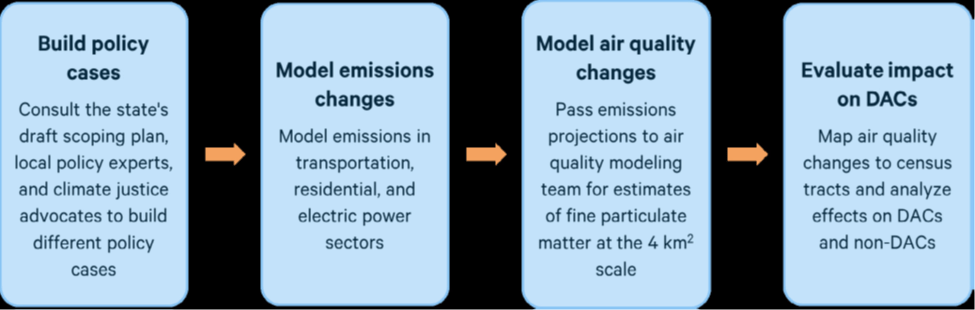
Figure 1 from the document outlines the evaluation process.  I noted that this document is a disturbing example of the machinations and malfeasance associated with the scientific justification for the environmental justice impacts advocates are using to justify their demands.  Each one of these components has flaws that make the results questionable at best.
Policy Cases

My primary concern with machinations is related to the assumptions and biases of the modelers used to differentiate between the policy cases described before.  Each of the policy cases includes numerous control strategy policies.  The report notes:

Not all these policies are explicitly mentioned in the scoping plan. Our modeling work is based on behavioral responses to economic policies, so we had to add detail and specificity to policies where none existed. The CAC-Inspired Policy Case represents one reasonable interpretation of how the priorities in the scoping plan may be executed. The details were established using a mix of New York policy proposals, examples from other state and federal climate policy proposals, and feedback from New York policy experts.

There are concerns with this description because there are so many opportunities to tailor the results to the desired outcome.  The modeling is based on “behavioral responses” which boils down to someone saying, for example, there is a fuel price increase that will make public transit attractive to commuters.  The choice of that price point and the number of affected commuters is pure speculation. Even the choice of policies makes a difference and adding policies not explicitly addressed in the scoping plan is problematic.  The scoping plan policies were developed over a couple of years, so it is unlikely that the scooping plan missed any viable options.  Finally, the stakeholder policy case includes policies that appeal to the advocates but have little connection to reality.  For example, “more ambitious ZEV goals for 2030 in the medium and heavy-duty vehicle sector” sound nice but converting trucks is so difficult that doing it faster is unlikely.

Model Emission Changes

The RFF analysis addressed the emissions projections with three analyses.  The report describes the: Economic Modeling Results, which describes estimated changes in energy demand and technology adoption across our modeled sectors; Greenhouse Gas, PM2.5, and Precursor Emissions Results, which describes estimated emissions changes in our modeled sectors; and Location of Emissions Changes, which describes the location of estimated changes in PM2.5 emissions.  If projected emissions are wrong. then the air quality impacts cannot be correct.  Developing an inventory of emissions for the modeling domain is an enormous effort and there are many opportunities to tailor results to a desired outcome.

The economic modeling results illustrate how behavior presumptions affect the results:

Compared with the BAU, the policy cases also increase the average fuel economy of on-road vehicles by about 15 percent.  The largest difference between the policy cases is in fuel consumption, which is driven by the different prices on carbon emissions. Fuel consumption is about 6 percent lower in the CPC and 12 percent lower in the SPC compared with the BAU. The SPC reduces fuel consumption more than the CPC because of its higher carbon price.

This another example of model assumption bias affecting the results.  The elasticity of fuel consumption relative to higher carbon price is certainly open to a wide range of interpretations. 

Another opportunity for biased reasoning comes when emission rates are chosen for GHG emissions.  The report addresses carbon dioxide and methane GHG emissions not only within the state but also upstream.  The document states “This methane leakage rate for natural gas implies that approximately 2.4 percent of natural gas leaks.”  That quote references a study from 2013, and then claims that the number has stood up well considering other (more recent) reports.  That number is typically of emissions reported by the Environmental Defense Fund from research they did in the Permian Basin, which is the leakiest of all the basins because the main output of the wells is liquid, and the gas is just an annoying byproduct that gets (poorly) flared.  The Appalachian shales like the Utica and the Marcellus have much lower leakage rates, and the National Energy Technology Lab (NETL) estimates that 88% of the natural gas burned in the Northeast U.S, comes from those two shale plays.  NETL shows Appalachian leak rates for the entire value chain at about 0.5%.  Furthermore, ONE Future companies collect and report data that shows that total value chain numbers are also less than 0.5%.  This means that RFF air quality projections associated with methane are 3.8 times higher than projections using the appropriate values for New York.

To its credit, the report emphasizes the difference between emissions and air quality impacts.  EJ advocates frequently overlook the distinction.  The report explains:

To get at this geography of pollution (and related disparities in pollution exposure), we begin by studying where emissions occur—emissions from burning fossil fuels (and some waste and biomass) to generate electricity, heat homes, and power heavy trucks and passenger vehicles on New York roads. Identifying the location of emissions is a prerequisite for determining where pollution ultimately settles (after being mixed and morphed in the atmosphere), which is how we determine the geography of air quality and associated public health implications, discussed below. It is important for the reader to make a clear distinction between emissions and air quality—a distinction we will continue to discuss.

Model Air Quality

Even though the report appropriately describes the difference between emissions and air quality impacts, I have problems with the analysis. The purpose of the analysis is to determine impacts to disadvantaged communities, but the spatial scale used for the inventory and modeling analysis is too coarse to accurately represent what is happening at the neighborhood level.  The report admits that this is a problem:

We also acknowledge that important boundaries to our research may influence the interpretation of the results. For example, our air quality modeling is at a 4km2 grid resolution, which in some cases is larger than a DAC boundary. We use one of the most advanced air quality models for our estimates, which incorporates detailed representations of atmospheric science and chemical processes. We have selected a spatial resolution that preserves the accuracy of that model. To aid in the interpretation of our work, we describe the limitations and caveat for our analysis in Appendix G, including a small error in the transportation emissions used as an input in the air quality model.

The authors can brag all they want about the capabilities of the model and its detailed representation, but the fact is that it is not suited to projecting what is happening on a neighborhood level.  The model they use predicts regional air quality impacts at a 32 km2 grid cell resolution, they interpolated those observations down to a 4km2 grid, and claim to be able to reasonably predict down to a disadvantaged community neighborhood.  Also note that they are only predicting annual averages.  For the reasons mentioned and many others, I do not accept that this only affects interpretation of the results.  Based on decades of air quality modeling experience I think the analysis uses an invalid methodology so I am not even going to present the results.

Discussion

Here is the thing, the report admits as much.  Appendix G. Research Limitations and Caveats in the report admits that there are limitations to the analysis.  It notes that “When modeling community exposure to air pollution, it is ideal to have the most geographically granular analysis possible, given that actual pollution exposure may vary at a level as granular as a city block.  Nonetheless, they present results.

The level of effort necessary to accurately estimate representative air quality burdens in disadvantaged community neighborhoods is immense.  The air quality model used by RFF is appropriate for regional analyses but that is just one component of localized air quality burdens.  At the neighborhood level, emissions and air quality impacts must be broken down to small spatial and temporal scales.  When predicting emissions at the community level details that cannot be incorporated into regional models for particulates must be included. For example, on a regional level the emissions from a char-grilling restaurant do not matter but in the neighborhood they might.  Because of the justified importance of this issue this is an area of active research.  I am confident that there will be surprises coming for the advocacy community when improved source attribution results are incorporated into policy making.  Spoiler alert – it is not the peaking power plants so vilified by the advocates.  Unless the problem sources are correctly identified, the problem cannot be solved.

Conclusion

I published this here because it foreshadows what I believe will be used to justify EJ demands elsewhere.  The RFF report explains the rationale behind the inclusion of EJ considerations. While I acknowledge that it is appropriate to minimize impacts to disadvantaged communities that have disproportionate impacts, I suspect that resolution is going to be more about emotional arguments than air quality impact science.  As a result, trying to get any new source permitted or renewing existing source permits is going to be more difficult.

I also wanted to highlight the machinations needed to justify the proposed responses.  I described a few of the issues with the modeling approach used but could have provided many more.  RFF all but admits that their modeling approach is inappropriate, but the caveats will not be mentioned when the results are used by the EJ advocate audience.  In addition, there is an inordinate opportunity for modeling assumptions to tailor the results to the preconceived answer desired including cherry picking input references.  As a result, I think the results have no value and did not describe them.  Nevertheless, this report will be referenced and used as justification for onerous permit requirements for any facility that might affect EJ communities.
Climate Leadership and Community Protection Act Zero Risk Motivations

The last several years I have spent an inordinate amount of time evaluating the Climate Leadership and Community Protection Act (Climate Act) and its legal mandate for New York State greenhouse gas emissions to meet the ambitious net-zero goal by 2050.  As the implementation outline for the transition to a net-zero evolves I have been struck by the number of people involved with the transition that insist on reducing their perceived priority risks to zero.  That is the antithesis of a pragmatic approach and I have tried to understand where those folks are coming from.  This post describes some recent articles at the Risk Monger blog that address the motivations of those who want zero risks.

Everyone wants to do right by the environment to the extent that they can afford to and not be unduly burdened by the effects of environmental policies.  I submitted comments on the Climate Act implementation plan and have written over 250 articles about New York’s net-zero transition because I believe the ambitions for a zero-emissions economy embodied in the Climate Act outstrip available renewable technology such that the net-zero transition will do more harm than good.  The opinions expressed in this post do not reflect the position of any of my previous employers or any other company I have been associated with, these comments are mine alone.

Climate Act Background and Risk Management

The Climate Act establishes a “Net Zero” target (85% reduction and 15% offset of emissions) by 2050. The Climate Action Council is responsible for preparing the Scoping Plan that will “achieve the State’s bold clean energy and climate agenda”.  The Integration Analysis prepared by the New York State Energy Research and Development Authority (NYSERDA) and its consultants quantifies the impact of the strategies.  That material was used to write a Draft Scoping Plan that was released for public comment at the end of 2021. The Climate Action Council states that it will finalize the Scoping Plan by the end of the year.  Climate Action Council meetings have included discussions about revisions to the Draft Scoping Plan that emphasize the need for zero risk that is the opposite of a pragmatic approach to the risks of climate change.

I addressed risk management for the Climate Act in August 2020.  That article and this one relies on work done the Risk Monger, a blog “meant to challenge simplistic solutions to hard problems on environmental-health risks”. The author of the blog, David Zaruk, is an EU risk and science communications specialist since 2000, active in European Union (EU) policy events and science in society questions of the use of the Precautionary Principle. He is a professor at Odisee University College where he lectures on Communications, Marketing, EU Lobbying and Public Relations. In my opinion, he clearly explains the complexities of risk management and I recommend his work highly. 

Zero Risk Motivations

Zaruk has argued that the Precautionary Principle, a strategy to cope with possible risks where scientific understanding is incomplete, has led many to rely on the idea that to be safe we have to eliminate all risks as a precaution.  Zaruk explains that the problem is that policy-makers and politicians have confused this uncertainty management tool with risk management.  In the August 2020 article I described his analysis and conclusion of the failures of risk management of the COVID-19 response.  While fascinating on its own, it also provides a cautionary tale relative to New York’s energy policy and implementation of the Climate Act. 

This article describes some of his recent work and its relevance to the Climate Act implementation process.  Over the last couple of months, he has published four relevant articles that I will summarize below:

THE Science, THE Environment, THE Climate… Abusing the “The” in Risk Issues

This article makes the point that the definite article has been “abused by activists needing definite truths to win policy debates on complex problems.” When someone describes, for example, “The” science they are claiming certainty on issues that are anything but certain. Zaruck writes:

Improperly using “the” in front of an abstract noun is part of a game to claim authority, isolate dissenters, simplify an issue and close dialogue. In declaring: “This is the science on XYZ” an activist is attempting to own the issue and shut down any discussion or analysis. In a policy framework where there may be uncertainty or grey areas, imposing a “the” provides a wedge between others’ false opinions and “the” truth. It is staking a claim to colonise a debate. Interestingly, it cannot be applied to issues that don’t allow for simplification or are too broad and complex. We do not speak of “the” food or “the” health without qualifications.

In reality, science is a continuous process where hypotheses are constantly challenged and confirmed.  Zaruk notes that it refers to “a process – a method – not some body of truth”.  When Climate Act proponents invoke “the” science, they are referring to is a consensus view.  Zaruk notes that arguing consensus is “a politicized pronouncement of the state of scientific research” and points out that “A consensus abhors sceptics (ostracizing them as deniers)”.  In reality a scientist must always be skeptical.

Zaruk addresses the definite article related to the environment:

When it is used with a definite article, it implies that the environment is a place … perhaps where biodiversity is being “stored”.  Is it in some location, outside of urban areas, in “nature”? But nature is a proper noun (personified in Mother Nature). As a construct, “the” environment appears to be in peril since we are being told how we can save it by polluting less, using natural products, having fewer children… Saving “the” environment means we all get to go to some Shangri-La, living longer and more harmoniously with nature. With simple views comes simplistic polarisation: natural = good (part of “the” environment); synthetic = bad (part of man).

Oversimplifying humankind in the world relative to nature turns issues into a simple dichotomy. Good vs. bad. safe or unsafe, or us-vs-them. He notes that: “For them, industry, corporations, conventional farmers… are against the environment and they are for it.”  In reality, however the environment is everywhere and affects everything in a complex, unpredictable manner. He explains that activists are playing a divide and conquer approach for their own interests.  He notes that:

Worse, hard-core activists have separated the environment from humanity and potentially beneficial technological solutions. In other words, the only way to “save” the environment is to keep humans away from “it”, to stop doing what we have been doing and let it heal itself (see Charles Mann’s The Wizard and the Prophet). These misanthropes welcome any environmental events as fuel for their hatred but their anti-technology solutions are simply “failure by design”.

He also addresses the climate consensus:

But what is a consensus and what does it mean? Formally, a consensus is anything above 50% but that lacks political impact. 100% agreement is impossible but as close to 100% is desirable. Certain scientific facts are rarely disputed and widely accepted (Newton’s laws are not considered theories, certain human limitations are self-evident…) but it is not so much whether a position has been tested and retested, but that the scientific method is a mindset: Always be prepared to question and re-evaluate. By arguing for a consensus – “the” science – the scientific method is being suppressed by some political interest.

If we spoke outside of the definite article – not of “the” science, “the” environment or “the” climate but of scientific issues on environmental concerns and climate evolutions, such transcendence would not be possible. Our discourse would shift from the dogmatic beliefs to pragmatic solutions and ridiculous conclusions would be rightfully challenged. This is not something that activists would want and we have not taken much notice of their linguistic deception.

Zaruk concludes:

I suppose what gets to me the most about these manipulative ideologues making claims on behalf of “the” truth (on subject matters which most science-minded people are struggling to find pragmatic solutions to complex problems) is their sanctimonious moral elitism. That their righteous condemnations were built on an illegitimate consensus, arbitrary divisions, linguistic deceptions and simplification just adds to their hypocrisy. They are pompous zealots cloaked and choked in their own false piety and any respect or trust they will have manufactured from their manipulative wordplay will be short-lived.

The Industry Complex (Part 1): The Tobacconisation of Industry

This essay is the first chapter of his analysis of the vilification of industry by activists that don’t want to weigh the benefits, risks, and costs of alternatives.  He notes that in Europe industry lobbyists are just going through the motions and have given up on the policy process.  This is also evident in New York.  All of the electric generating companies and delivery companies know that there are major challenges associated with the net-zero transition but have not stood up and publicly rebuked the current plans.  The New York Independent System Operator and the New York State Reliability Council have carefully fashioned their comments and reports to not offend the Hochul Administration’s pursuit of what the experts know very likely won’t work on the schedule proposed. 

Zaruk explains that the tactic of not strongly engaging in the policy process will only work for so long before it is too late to salvage their business.  The electric utility companies are going along with all the risks hoping someone will speak up and demand accountability.  For their part they continue their public sustainability campaigns supporting doing something about climate change and keep their concerns about the transition buried in industry comments that no one reads and the Climate Action Council ignores.  The ultimate question is will be anyone be willing to be the bad guy?

This essay explains how the policy process that has been corrupted by activists demonizing industry will eventually cause problems. Zaruk notes that corporations “do not consider the ramifications – that the constant media assault, reputation, and trust destruction and political denormalization of industry are an existential threat.”  In New York the utility companies publicize their sustainability programs and their own net-zero plans and seem to think that the public will embrace their actions and not treat them like Big Tobacco pariahs.  Unfortunately, Zaruk argues that is not the case.

In Europe Zaruk points that that:

The last decade has seen a rather audacious move by activist NGOs (and some policymakers particularly in Brussels) to ostracise most industries from the public policy dialogue process, create public revulsion and denormalise companies as stakeholders and social actors. This proved to be a successful strategy during the war on tobacco and many of their campaign tools are now simply being copy-pasted to other industries. Some, particularly in the financial industry, have bought into the activist campaigns and are courting public favour by considering a degrowth strategy or a capitalism reset. But can such a beast seriously hide its stripes?

This is exactly what has happened with the Climate Action Council.  Of the 22 members on the Council only two represent industry interests and their input is constantly disparaged.  More importantly, the Hochul Administration has ignored industry expert concerns about all the technical challenges of the net-zero transition.  The Scoping Plan drafts may refer to reliability a lot but there hasn’t been any suggestion that reliability concerns might slow the schedule.

Zaruk describes the concept of industry vilification:

I came across the word “tobacconisation” while reading an American activist conference report, Establishing Accountability for Climate Change Damages: Lessons from Tobacco Control, masterminded by Naomi Oreskes, the Union for Concerned Scientists and the Climate Accountability Institute in 2012 in La Jolla, California. This meeting of lawyers, activists and scientists argued that the tobacco industry lobby did not capitulate in the Tobacco Master Settlement Agreement because of the science, regulatory restrictions or public outrage. They gave in because of the insurmountable financial costs of endless waves of tort litigation that threatened to wipe out the industry. So the La Jolla Plaintiff Playbook was to take that same strategy and apply it to the petroleum industry – to destroy public trust and then litigate the hell out of oil companies for damages due to climate change until they either go bankrupt or change their business model.

Zaruk describes three key activist tobacconisation strategies being applied against most industries.  The first is adversarial regulation.  This is a strategy where regulatory scientists effect change not through the democratic policy process but through the courts. With respect to the Climate Act at least the legislation was passed by the state legislature, albeit it was written by activists and I doubt that very few supporters understood the risks, costs, and challenges. 

The second strategy is to limit communications and ban advertising.  Activists have a key role in this playbook to raise public outrage against targeted companies.  With respect to the Climate Act, they are aided by a compliant media that parrots the main talking points without any challenges.  If anyone dares to suggest anything that does not hew to the narrative then the activists demean those remarks and smear the speaker.  Zaruk explains that “they need to ostracise the company or industry and exclude them from any role as a societal actor.”

The final strategy is public outrage trumps bad science.  Zaruk describes it as follows:

Public outrage against Big Tobacco meant that poor science (on the health risks of second-hand smoke or vaping) could be glanced over with little scrutiny in the policy process. People were fed up with the industry and just wanted to believe the research claims were accurate.

Opportunistic public officials wanting to play to the loud activist mobs need simply reach for the precautionary safety pin to gain favour without any risk of data or evidence interfering with this strategy. For policymakers, it is a no-brainer to play the precaution card (demanding that the substance is proven with certainty to be 100% safe prior to acting) rather than lock horns with angry activist groups with friends in the media.

Zaruk describes three approaches to fight the zero-risk mentality.  He suggests: “demand a White Paper articulating a rational strategy on the use of the precautionary principle within a clear risk management process.”  His primary concern is the EU policies but New York is following the same approach.  He states that “the hazard-based policy approach has to branded for what it is: irrational.”

His second approach is to call out the non-governmental organizations (NGOs) that drive much of this policy.  They “break rules, act without respect for moral principles (unlike industry, very few NGOs have an ethical code of conduct that guides their behaviour) and ignore evidence and data in their campaigns.”  This is problematic with respect to the Climate Act because there are members of the Climate Action Council and the advisory panels who are from prominent climate activist NGOs.

Finally, he points out that the rules of engagement need to apply to all. There is evidence that the NGOs actively supporting the Climate Act have had access to material not available to all.  In no small part that is probably because some Council members are from these NGOs.  The end result is that the regulatory process has become biased.

The Industry Complex (Part 2): The Hate Industry

Zaruk’s second essay on the industry complex describes the business of demonizing industry.  He says:

The last two decades of relentless anti-industry attacks in the media, cinema and policy arenas have taught industry actors to be quiet in public, but they should not be ashamed of what their innovations and technologies have brought to humanity. We are living longer with a better quality of life, direct access to better food while feeding a growing global population, enjoying amazing personal communications devices, travelling faster and safer and accessing information in seconds. But all we hear about industry in the public sphere is resentment and animosity. This is the “Industry Complex.”

Zaruk describes one of the ironies of the professional hatred of industry.  He notes that:

Most of the people throwing brown beans at artwork or spray painting corporate offices are from a privileged class that have never experienced want. The tragic consequence of such “altruistic” zealot demonstrations is that the victims from the policy decisions they are forcing through are the most vulnerable in society, and will never be heard.

In New York primary funding for the ideological war on natural gas comes from trust funds controlled by the ultra-rich who have never experienced work.  I think one of the problems with the privileged and ultra-rich classes is that they have very little experience dealing with real-world problems associated with making things work.  For example, people who have not done much gardening may want to ban pesticides but they haven’t had a bug infestation wipe out a crop.  They have no experience with the fact that reality bats last.

Zaruk points out that the definition of industry has expanded beyond manufacturing.  In particular:

 “Industry” is now an umbrella term referring to any capitalist venture that may involve risk, inequity, and unequal access to markets. This definition makes targets because of shared social justice tenets of anyone associated taking risks. All perceived problems are blamed on “industry” all the while ignoring all the benefits derived from their activities.  The vilification of fossil fuels is a perfect example.  Despite the fact that all metrics show improvements in all quality-of-life metrics with increased use of fossil fuels, their continued use is attacked.

Zaruk gives an example of violence in France related to farming practices and states:

We can’t simply brush these people off as confused and frightened Luddites. Opportunistic activists have twisted reality, converting fear and uncertainty into a dangerously powerful political force. As one commentator on BFM decried: “This is the collapse of rationality “. Not only do they believe their hateful bullshit, they are relentlessly spreading it with a missionary zeal via an unaccountable social media propaganda tool (while the rest of us remain tolerant or uninformed).

This is entirely apropos of the ideologues pushing the net-zero transition in New York.  They can say just about anything and get away with it.  Activist organizations claim that the public is in favor of net-zero but the question is whether that support is limited to a loud minority of activist ideologues? Will the majority be heard when they lose their jobs while their energy and food costs go through the roof?  I have always thought that would be inevitable conclusion but as long as people only listen to what they want to, then they will likely not speak up or place blame incorrectly.

Zaruk explains that many irrational policy decisions are justified by activist anti-industry objectives.  For example, consider the European decisions to shut nuclear reactors even though there is an energy crisis looming.  Zaruk notes that:

In the face of an energy crisis, ecologists are holding firm in Germany and Belgium against keeping some nuclear reactors from being decommissioned arguing that such a move would be supporting big business. Greenpeace claimed shutting down these reactors would give energy production back to the people. Renewables like wind and solar have the image of small, locally produced energy (from nature), enjoying a virtuous halo that belies the big companies making these technologies or managing the big wind parks and solar farms.

I believe that Zaruk’s conclusions of the European solution is consistent with what is happening in New York relative to the net-zero transition.  He notes:

These decisions are not based on issues of cost, efficiency, and benefits, but only on an ideology built on the hatred of industry. Thus, the pro-renewables and pro-organic policies dominating the European Commission Green Deal strategy are not based on facts or research but ideology. They are, in a word, irrational.

The Industry Complex (Part 3): A Return to Realpolitik

In this essay Zaruk argues that it is time for regulators to “start doing their job: making the hard decisions and managing risks rather than promising a world of zero risk to a public that has come to expect simple solutions to complex problems.”  He argues that it is time for a return to Realpolitik: “making the best choices from a finite list of options and circumstances rather than continuing the current approach of false promises that someone else will have to pay for”.

Zaruk explains the concept of Realpolitik:

It is not a new concept. The term “Realpolitik” was in use several decades before Bismarck (commonly referred to as the father of Realpolitik). It was developed by Ludwig von Rochau who tried to introduce Enlightened, liberal ideas, post 1848, into a political world that was embedded in less rational cultural, nationalistic and religious power dynamics (much like the green dogma pushing many Western political spheres today). Realpolitik is often best understood by what it is not: it refers to decisions not made solely on issues of ideology and morality. In other words, Realpolitik refers to pragmatic decisions based on best possible outcomes and compromises (something done when leaders have to face unpleasant realities). Ideologues can easily ignore scientific facts when imposing their power but Realpolitikers will follow the best available science while appealing to reason.

He explains that in Europe as in New York, politicians shutdown nuclear facilities to placate the loud, activist minority but did not consider “pragmatic alternatives or a rational transition plan.” He said “a Realpolitiker would not have shut down the nuclear power stations until the energy transition was safely achieved.”  It gets worse in New York because the Department of Environmental Conservation is proposing regulations that require existing fossil-fired generating plants to consider compliance with the Climate Act as part of their operating permit extensions.  It is possible that they could shut down those facilities before alternatives consistent with the Climate Act are operating.

Zaruk argues that “we should aim for safer rather than safe.”  He points out:

Safer is something risk managers in industry measure and continually strive for while safe is an emotional ideal that cannot be measured or, for that matter, reached. We will never have safe, but we can always strive for safer. This is where a more pragmatic, Realpolitik approach would be more successful than any arbitrary risk aversion.

Realpolitik accepts that a perfect world is a pipe dream. Freed from the shackles of seeking the totally safe, they get to work on risk management, reducing exposures to as low as reasonably possible (achievable) and making the world (products, substances, systems…) better – safer. They seek a world with lower risks for more people, not zero risks for all people. We need to turn away from the fundamentalist activist mindset and adopt a more industrial, scientific approach (as seen in product stewardship): of continuous improvement, constant iteration, and technological refinement.

Conclusion

Zaruk provided a good summary of his work and if you replace Brussels with Albany, it is apropos to New York:

It is patently clear industry actors in Brussels cannot continue to do what they have been doing. Brussels has far too many activists with special interests solely dedicated to seeing industry and capitalism fail. They have money, passion and limited ethical constraints as they execute their objectives with missionary zeal. This series on the Industry Complex has tried to show how anti-industry militants have worked to destroy trust in all industries (excluding them from the policy process and equating the word “industry” with some immoral interpretation of lobbying) and using the same tactics that worked with the decline of the tobacco industry. Using the emerging communications tools to create an atmosphere of fear and hate, these activists have successfully generated a narrative that the only solution to our problems is to remove industry, their innovations and their technologies. And their solutions are getting even more extreme (with, for example, 6000 environmental militants recently attacking an irrigation pond project on a farm in France for being too “industrial”). Policymakers, perceiving these loud voices as representative, have adopted the path of virtue politics rather than Realpolitik (of policy by aspiration and ideology rather than practical solutions relying on the best available evidence).

The Climate Act and the transition plan embodied in the Draft Scoping Plan is full of examples where the perceived risks of fossil fuels are comprehensively addressed but none of the risks of the proposed alternatives are addressed.  The most glaring Climate Act example is the requirement that the full life cycle and upstream emissions associated with fossil fuels must be considered to eliminate those risks.  Those considerations are not applied to wind, solar, and battery technologies.  The benefits of the current energy system are ignored and the risks of the net-zero future system minimized.  This approach will not work out in the best interests of New York.

Ithaca Public Housing Climate Act Investment

The Climate Leadership and Community Protection Act (Climate Act) includes a commitment for environmental justice goals.  As part of that effort the Climate Act created the Climate Justice Working Group (CJWG) who has been tasked to help decide what that commitment entails.  This article describes one project that I believe will be considered part of the environmental justice financial investments.

The Climate Act establishes a “Net Zero” target (85% reduction and 15% offset of emissions) by 2050.  I have written extensively on implementation of the Climate Act.  Everyone wants to do right by the environment to the extent that efforts will make a positive impact at an affordable level.  Based on my analysis of the Climate Act I don’t think that will be the case.  I believe that the ambitions for a zero-emissions economy outstrip available renewable technology such that the transition to an electric system relying on wind and solar will do more harm than good.  The opinions expressed in this post do not reflect the position of any of my previous employers or any other company I have been associated with, these comments are mine alone.

Climate Act Background

The Climate Act is “Working to ensure all New Yorkers are represented in the State’s transition to a cleaner energy future and benefit from investments and opportunities provided by this historic transition”.  In other words, they are addressing environmental justice.  According to EPA: “Environmental justice is the fair treatment and meaningful involvement of all people regardless of race, color, national origin, or income, with respect to the development, implementation, and enforcement of environmental laws, regulations, and policies.”

One key part of that commitment is investment in disadvantaged communities.  According to the Climate Justice Working Group (CJWG) webpage:

The Climate Act requires the state to invest or direct resources in a manner designed to ensure that disadvantaged communities to receive at least 35 percent, with the goal of 40 percent, of overall benefits of spending on: clean energy and energy efficiency programs and projects or investments in the areas of housing, workforce development, pollution reduction, low-income energy assistance, energy, transportation, and economic development

As I noted in a recent post on my CJWG disadvantaged community criteria comments, the distribution of those investments is sure to be contentious.  I believe that the State is going to invest money in public housing for low- and middle-income housing as part of those investments.  There are two concerns: is this what the CJWG thinks is appropriate and is this a good investment for society as a whole?

Ithaca Public Housing Rehabilitation

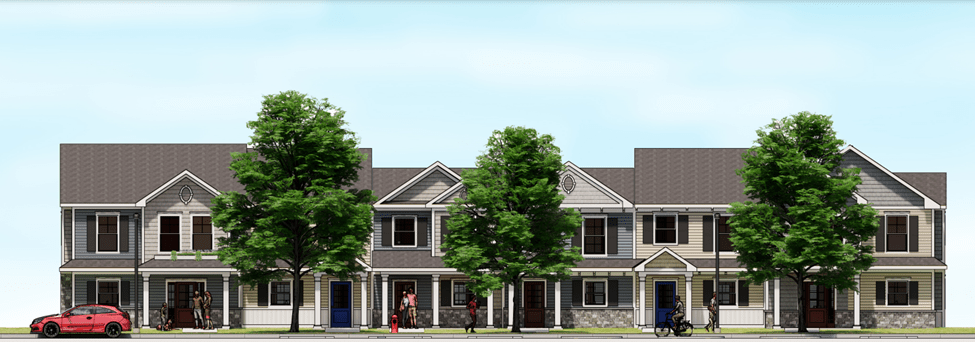
In what I believe is a prototype for public housing investments, on August 5, 2022 Governor Kathy Hochul announced a $75 million project to upgrade and preserve two outdated Ithaca Housing Authority properties with a total of 36 apartments and to replace another obsolete Authority property with 82 new affordable apartments. The 118-unit Ithaca Housing Authority Redevelopment is designed to be all-electric and was awarded funding through the Clean Energy Initiative program for multifamily buildings. A rendering of the project is shown below.

According to the press release:

Governor Hochul: “My administration is steadfast in our commitment to preserving and creating affordable housing that is sustainable, high-quality, and comfortable,” Governor Hochul said. “Today’s $75 million investment will help strengthen communities and provide new opportunities for Ithaca residents. We will continue to upgrade and modernize New York’s supply of public housing in the Southern Tier to provide a more stable and equitable future for the next generation.”

The Ithaca Housing Authority Redevelopment complements Governor Hochul’s sweeping plans to make housing more affordable, equitable, and stable. In the 2022-23 State Budget, the Governor introduced and successfully secured a new $25 billion, five-year, comprehensive housing plan that will increase housing supply by creating or preserving 100,000 affordable homes across New York including 10,000 with support services for vulnerable populations, plus the electrification of an additional 50,000 homes.

The first component of the Ithaca Housing project will be redevelopment at Overlook Terrace and Southview Gardens.  The plan will renovate two buildings with 46 apartments, a community building, and a building for laundry and mechanical equipment. Major capital improvements will include the replacement of water heaters and furnaces to an all-electric option; upgraded laundry facilities; the replacement of entry doors, vinyl and aluminum siding, soffits and trim, windows, and roofs.; and site landscaping. 

The other component is a complete rebuild of 70 apartments at The Northside Developments.  The new affordable development will have 17 residential buildings with a total of 82 apartments – 12 more than the original thanks to a reconfiguration that adds much-needed one-bedroom apartments. The new development will include a one-story community building with a kitchen, office spaces, and a laundry room.

The press release notes that:

In total, there will be 20 one-bedroom units, 34 two-bedroom units, 40 three-bedroom units, 22 four-bedroom units, and two five-bedroom units. All of the apartments will be for households earning at or below 80 percent of the Area Median Income.

The press release also describes the funding sources:

State funding for the $75 million Ithaca Housing Authority Redevelopment includes $10.6 million in permanent tax-exempt bonds, Federal Low Income Housing Tax Credits that will generate $29.7 million in equity, and $18.8 million in subsidy from New York State Homes and Community Renewal. The development was awarded $1.4 million from the Clean Energy Initiative. Other funding sources include $9.3 million from the Ithaca Housing Authority, $300,000 from Tompkins County Community Housing Fund, and nearly $91,000 from Ithaca Urban Renewal.

Finally, the press release says:

The Clean Energy Initiative developed by New York State Homes and Community Renewal and the New York State Energy Research and Development Authority to create more than 1,500 energy-efficient, all-electric or electric-ready, climate-friendly affordable homes in existing multifamily buildings across the state.

What about the Numbers?

I have added an addendum with quotes included in the press release.  To hear those people this is the greatest thing ever.  For example, New York State Energy Research and Development Authority President and CEO Doreen M. Harris said, “NYSERDA is pleased to see construction commence on the Ithaca Housing Authority redevelopment project, which demonstrates that clean, resilient and affordable housing can be accessible to all New Yorkers”.  The pragmatic approach is to look into the numbers to see if this is likely.

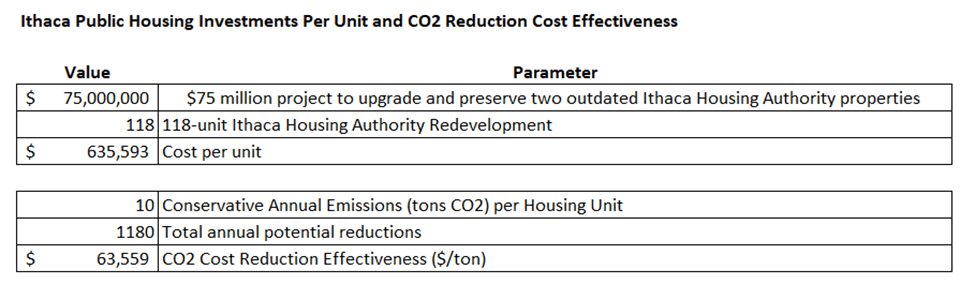
According to the press release this is a $75 million project to upgrade and preserve outdated Ithaca Housing Authority properties that will renovate or rebuild a total of 118 housing units.  That works out to $635,593 per unit. The two components of the project both include a community building that also has mechanical equipment but however you calculate the cost per housing unit it is extremely high.  According to the Ithaca Journal the typical cost of a home in Ithaca’s county in June 2022 was $357,450 and the cost of these units is well above that value.

 The Press Release notes that:

All three properties will be highly energy-efficient and have an all-electric building design pursuant to the New York’s nation-leading Climate Leadership and Community Protection Act to curb building emissions. Additional energy efficiency measures will include heat-reflective roofing systems with tapered insulation, ENERGY STAR rated appliances, energy-efficient lighting and low-flow plumbing fixtures for a projected 15 percent in total energy savings.

The Draft Scoping Plan for the Climate Act does not provide detailed enough data to determine an estimate of the typical residential greenhouse gas emissions per year.  The New York State Energy Research and Development Authority Patterns and Trends document gives estimates of total household energy for different fuels.  I used Energy Information Administration carbon dioxide emission coefficients by fuel and found that the highest estimated emissions for the New York are for homes using fuel oil.  As a conservative surrogate for the largest potential impact that these projects could possibly have, I used that estimate of 10 tons per year.  If we assume that the existing housing units are responsible for ten tons of GHG emissions per year and that the project will eliminate all the emissions that means that the annual reduction of GHG emissions is 1,180 tons.  The resulting cost per ton of CO2 removed is $63,559.

Discussion

This article addressed two concerns: is this what the CJWG thinks is appropriate and is this a good investment for society as a whole?  I believe that this project is an appropriate environmental justice investment because “All of the apartments will be for households earning at or below 80 percent of the Area Median Income”.   As far as I can tell however, only Southview Gardens is in a draft Disadvantaged Community so it remains to be seen of all or only part of this investment is of the “least 35 percent, with the goal of 40 percent” investment target.

I have two relevant concerns about the Climate Act transition to net-zero.  The first is affordability and the second is feasibility.  The press release quotes Doreen M. Harris as saying “NYSERDA is pleased to see construction commence on the Ithaca Housing Authority redevelopment project, which demonstrates that clean, resilient and affordable housing can be accessible to all New Yorkers”.  The numbers are worrisome relative to the claim that this project will demonstrate that affordable housing that meets the standards for the Climate Act is viable.  Seriously, given that there are probably at least one million housing units similar to these, can New York afford to upgrade public housing to those standards at a cost over $600,000 per unit or over $600 billion in total? 

As noted above the typical cost of a home in Ithaca’s county in June 2022 was $357,450.  It is notable that there is such a big difference in cost relative to the redevelopment costs.  Without a lot of work, it is not possible to break down the cost estimates to see how much of the projected costs are due to the energy transition enhancements. If those costs are a significant driver in the difference, then it is appropriate to ask whether this is an appropriate environmental justice investment.  In my opinion, it is more appropriate to address environmental justice concerns for impacted communities today than it is to make investments that are futile unless all jurisdictions in the world also make similar commitments.  Given that there is a limited amount of money available, then providing more upgraded housing is a better investment than limiting the housing upgrades because of the increased costs of the net-zero transition.

Conclusion

It will be interesting to see how this plays out.  The Ithaca Housing Authority projects meet all the criteria for appropriate environmental justice investments except that most of the housing affected is outside of a Draft Disadvantaged Community.  Will the CJWG recommend that all or only part of the funding be included in the 35% target and what will the State say?

The numbers are not encouraging from an affordability standpoint.  If this is any indication of the potential costs for environmental justice investments then there will be problems.  In addition to the magnitude of the per housing unit cost, the cost reduction efficiency is an issue.  According to the Integration Analysis in 2020 the building sector emitted 105 million metric tons of carbon dioxide equivalent.  Until such time that the cost per ton reduced for the building sector is brought down three orders of magnitude ($63 instead of $63,000 per ton reduced), I cannot imagine that the emissions reductions are affordable.

Addendum for Press Release Quotes:

Homes and Community Renewal Commissioner RuthAnne Visnauskas said, “This $75 million investment in the Ithaca Housing Authority speaks to our commitment to upgrading and protecting our existing affordable housing assets. The redesign of these apartments will yield modern and highly energy-efficient homes for 118 households and will preserve affordability and extend the useful life of these buildings for decades to come. Governor Hochul’s bold and forward-looking housing agenda is ensuring a brighter and more secure future for public housing residents in Ithaca and across the entire state.”

New York State Energy Research and Development Authority President and CEO Doreen M. Harris said, “NYSERDA is pleased to see construction commence on the Ithaca Housing Authority redevelopment project, which demonstrates that clean, resilient and affordable housing can be accessible to all New Yorkers. Through the Clean Energy Initiative, we are working with our sister agency, New York State Homes and Community Renewal, to make strategic investments in multifamily buildings like those being developed through this project, that reduce greenhouse-gas emissions and provide healthier, comfortable and resilient living spaces.”

Senator Chuck Schumer said, “Every New Yorker deserves access to safe affordable housing, but historic underinvestment has created a housing crisis in places like Ithaca. I am proud that the federal Low-Income Housing Tax Credit that I have fought hard to protect and expand has supplied the millions needed to make these new affordable homes a reality. Housing is a human right and I will keep fighting to get every dollar of federal support needed to help lay the foundation in Ithaca for a brighter, ‘gorges’, and more equitable future for all residents.”

State Senator Tom O’Mara said, “State investments in safe and affordable housing continue to strengthen the fabric of neighborhoods and the quality of life for tenants and residents in the city of Ithaca and communities across this region and state.  It’s an important commitment that will deliver critical short- and long-term benefits.”

Assemblymember Anna Kelles said, “I am encouraged to see this project move forward at a moment when rising rents, increased home prices, and lack of supply have exacerbated the housing and affordability crisis. We must continue to create affordable and safe housing for low- and middle-income families. This project addresses this need by rehabilitating 36 units, and fully replacing 70 units that were outdated and potentially unsafe with 82 new, safe, and sustainable units. This 118 unit project will add 12 new units, including one and two bedroom units which are currently in acute deficit in Ithaca and all units will be rented at 80% area median income (AMI). Hopefully this is just one more step in a long needed road of adding to our affordable housing stock. I also applaud the project’s sustainability goals with all of the units in this housing project constructed all-electric with air source heat pumps providing heating and cooling, in line with the city of Ithaca and Tompkins County aggressive climate goals.” 

Acting Ithaca Mayor Laura Lewis said, “The city of Ithaca is pleased to have the support of so many partner agencies in the redevelopment of critically needed low-income housing. Substantial renovations of Overlook Terrace and Southview Garden and, at Northside Apartments the complete replacement of outdated buildings that were first constructed decades ago, will provide families with high quality and environmentally efficient homes. This investment in our community will benefit generations of Ithacans.”

Tompkins County Legislature Chairwoman Shawna M. Black said, “This project is an excellent example of re-invigorating our affordable housing options in Tompkins County. We’re proud of what Ithaca Housing Authority offers to our community and that these projects will be energy efficient and align with New York State’s Climate Leadership and Community Protection Act. Thank you to New York State, Ithaca Housing Authority, and our Tompkins County Community Housing Fund for contributing to these developments. I can’t wait to see construction begin and to get people back into their homes.”

3d Development Group President Bruce Levine said, “Our focus was on the needs of the existing tenants, future tenants, the community at large, and the global need for improved energy sustainability and reducing fossil fuel emissions. This project was made possible by the support received from the state, federal and local government agencies. Because everyone got on board and believed in the goals and initiative, the final result will transform the Ithaca Northside neighborhood for decades to come.”

Ithaca Housing Authority Executive Director Brenda Westfall said, “Our vision and end goal is to provide quality affordable housing for our current and future tenants while ensuring that the properties are energy efficient and meet energy sustainability goals for decades to come. As a lifelong resident of the city of Ithaca, it is extremely rewarding to witness the commitment and support that many different agencies brought forth in bringing our vision to life. This project will both improve and preserve the quantity and quality of affordable housing we are able to provide while complimenting the landscape of the neighborhoods in which the properties are located.”

Climate Justice Working Group Low Income Affordability Data

The Climate Leadership and Community Protection Act (Climate Act) includes a commitment for environmental justice goals.  I recently described the comments I submitted on the  Climate Justice Working Group (CJWG) draft criteria to determine which communities should be targeted for benefits from Climate Act investments associated with these environmental justice goals.  This post describes the energy affordability indicator.

The Climate Act establishes a “Net Zero” target (85% reduction and 15% offset of emissions) by 2050.  I have written extensively on implementation of the Climate Act.  Everyone wants to do right by the environment to the extent that efforts will make a positive impact at an affordable level.  Based on my analysis of the Climate Act I don’t think that will be the case.  I believe that the ambitions for a zero-emissions economy outstrip available renewable technology such that the transition to an electric system relying on wind and solar will do more harm than good.  The opinions expressed in this post do not reflect the position of any of my previous employers or any other company I have been associated with, these comments are mine alone.

Climate Act Background

The Climate Action Council is responsible for preparing the Scoping Plan that will “achieve the State’s bold clean energy and climate agenda” in the Climate Act.  They were assisted by Advisory Panels who developed and presented strategies to the meet the goals to the Council.  Those strategies were used to develop the integration analysis prepared by the New York State Energy Research and Development Authority (NYSERDA) and its consultants that quantified the impact of the strategies.  That material was used to write Draft Scoping Plan that was released for public comment at the end of 2021. The Climate Action Council will revise the Draft Scoping Plan based on comments and other expert input in 2022 with the goal to finalize the Scoping Plan by the end of the year.

The article describing my comments covered the background of the CJWG process to develop criteria to identify Disadvantaged Communities and mentioned that there is a fact sheet on the process.  For the purposes of this article, the focus is on one of the 45 indicators – “energy affordability”.  In the comments I submitted on the process I made a recommendation to address the affordability concern.  In particular I explained that I believe that energy poverty is the issue that I think will most likely occur and will adversely affect the low- and middle- income people in Disadvantaged Communities and across the state.  I noted that I was concerned that the emphasis on communities would result in those citizens who suffer from energy poverty but don’t happen to live in a Disadvantaged Community getting left behind. I recommended that the weighting for energy poverty should be increased to address this concern.  In this analysis I reviewed the data used for the energy affordability indicator to try to quantify the effect of the CJWG approach.

CJWG Energy Affordability

The Technical Documentation for the Disadvantaged Community Criteria document includes the following description of the Energy Affordability Indicator:

Metric Definition: Average energy costs as percentage of income

Data Source: DOE Low-Income Energy Affordability Data (LEAD) Tool (U.S. Census Bureau’s American Community Survey 2018 Public Use Microdata Samples)

Calculation Method: DOE used census energy expenditure data, housing unit type data, household income data, and number of people in the household, to model the average energy burden by tract.

Rationale for Inclusion: Energy affordability or energy burden is an indicator that is highly actionable and addressable by the Climate Act. The NY REV Energy Affordability Policy intends to limit energy costs to no more than 6% of income as per the 2016 order from the PSC, which plans for bill assistance, energy efficiency, and access to clean energy resources to decrease low-income energy costs.

High energy burden leads to stress, depression, hot or cold home temperatures, and associated health risks including asthma. This metric is also a proxy for type and age of home, which could impact how expensive it is to heat or cool due to materials or inefficiencies.

Potential Limitations and Future Improvements: The US DOE’s estimation approach does have some margin of error that they are looking to improve upon by using more measured values in future iterations.

References:

https://www.energy.gov/eere/slsc/maps/lead-tool

Ma, Ookie, Krystal Laymon, Megan Day, Ricardo Oliveira, Jon Weers, and Aaron Vimont. 2019. Low-Income Energy Affordability Data (LEAD) Tool Methodology. Golden, CO: National Renewable Energy Laboratory. NREL/TP-6A20-74249. https://www.nrel.gov/docs/fy19osti/74249.pdf.

2021 ORDER ADOPTING ENERGY AFFORDABILITY POLICY MODIFICATIONS AND DIRECTING UTILITY FILINGS: https://documents.dps.ny.gov/public/Common/ViewDoc.aspx?DocRefId={1CFD4CE2-AB87-4A8C-B56B-F123366B1520}

2021 Staff Report On New York State Energy Affordability Policy https://documents.dps.ny.gov/public/Common/ViewDoc.aspx?DocRefId={C3F867FC-27B0-49FB-AD29-7EED80C8F69E}

Energy Affordability Data

The CJWG DAC criteria documentation noted that “The NY REV Energy Affordability Policy intends to limit energy costs to no more than 6% of income as per the 2016 order from the PSC, which plans for bill assistance, energy efficiency, and access to clean energy resources to decrease low-income energy costs.”  I have not been able to find any documentation that explains where New York stands relative to this goal.  In my opinion, someone, somewhere should summarize the number of people who are paying more than 6% of their income on energy costs.  I thought that the data used for this metric might be able to shed some light on this metric as well as address my specific concerns about the CJWG criteria for Disadvantaged Communities.

The Low-Income Energy Affordability Data (LEAD) Tool was developed by the Better Building’s Clean Energy for Low Income Communities Accelerator (CELICA) to help state and local partners understand housing and energy characteristics for the low- and moderate-income (LMI) communities they serve. The tool provides data, maps, and graphs.  Data for the LEAD Tool comes from the U.S. Census Bureau’s American Community Survey 2018 Public Use Microdata Samples. The energy data is for housing only.

In order to use LEAD the first step is to select an Income Model from the following options:

  • Area Median Income (AMI) – The Area Median Income is the midpoint of a region’s income distribution – half of families in a region earn more than the median and half earn less than the median.
  • Federal Poverty Level (FPL) – The Federal Poverty Level is a measure of income used by the U.S. government to determine who is eligible for subsidies, programs, and benefits.
  • State Median Income (SMI) – The State Median Income is the midpoint of a region’s income distribution – half of families in a region earn more than the median and half earn less than the median.

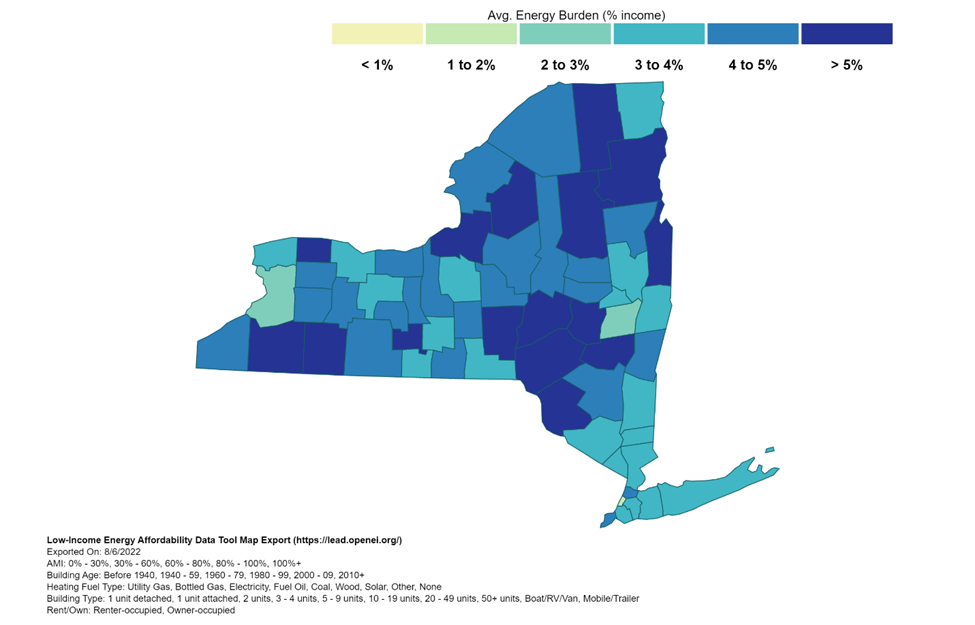
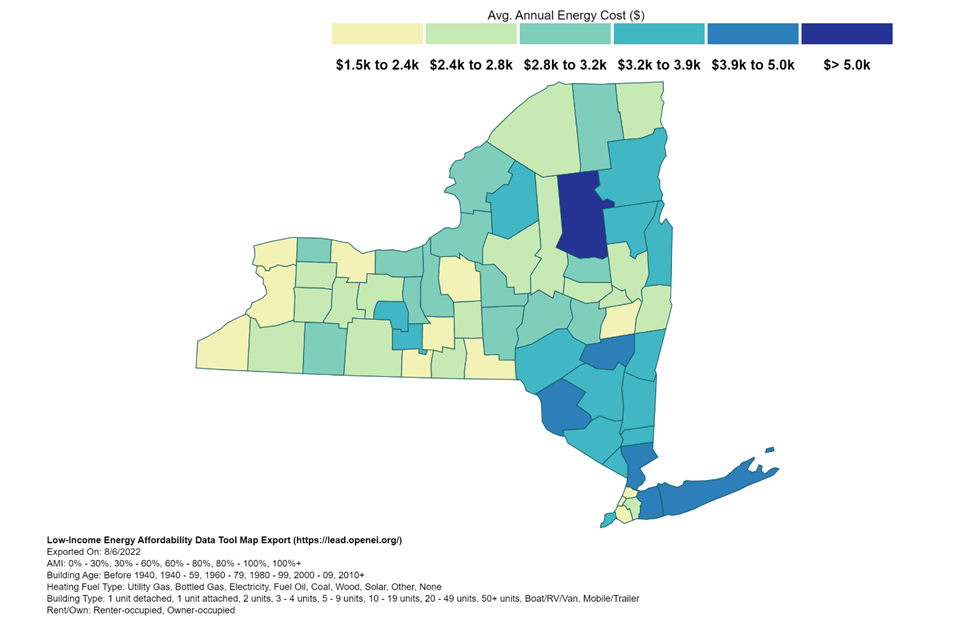
The following figures show the annual energy burden and energy cost as a function of the AML.  I compared the output for the different income models and found that there was no significant difference in the results for the New York counties output.  The model generates New York State’s County, city and census tract data for average energy burden, average annual energy cost, and housing counts.

LEAD Tool New York Map Average Energy Burden (% income) using Area Median Income

LEAD Tool New York Map Average Annual Energy Cost ($) using Area Median Income

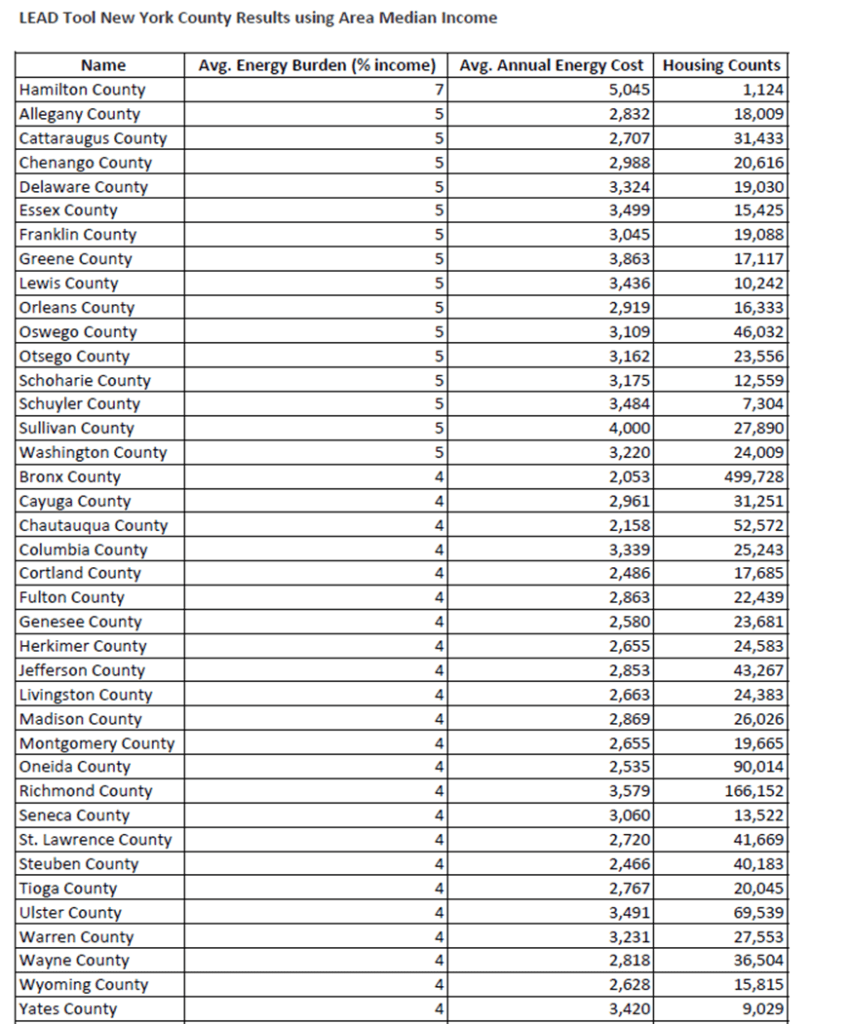
The county specific results for the whole state are available here and the results for those counties that have an average energy burden of 4% or greater are listed below.

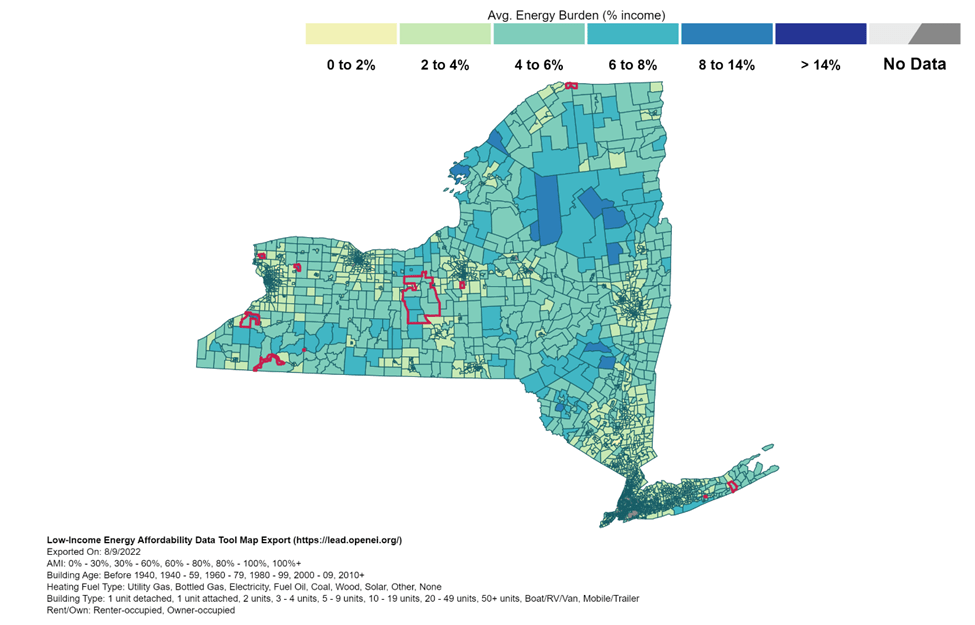
The CJWG DAC criteria are based on census tract data.  The census tract map is shown below and specific results for the whole state are available here.   The map shows that there are many areas of the state that exceed the 6% target, albeit the average energy burden per census tract does not tell us how many people actually have energy burdens that exceed the target.  Note that many of the census tracts in the Adirondack and Catskill Parks exceed the 6% threshold.

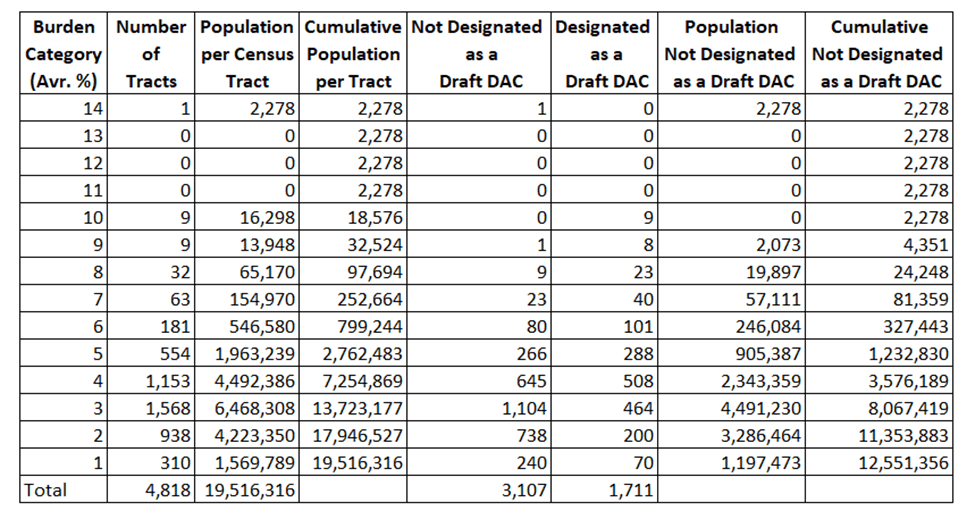
The breakdown of the average energy burden by census tract table below provides more information.  There are 4,818 census tracts in the LEAD Tool output that have average energy burden estimates.  (There is not an exact one for one matchup between the census tracts available in the LEAD Tool and the CJWG DAC Criteria technical support documentation but the differences are small and I believe that they are inconsequential.)  The distribution of the average energy burden shows that most census tracts have a burden less than the 6% target.  Note, however, that the even if the average burden for a tract is in the 1% category there still will be some people that could have an energy burden greater than 6%.  The cumulative population for the energy burden categories six and greater is nearly 800,000 people.  The distribution of the census tracts that are designated as Draft Disadvantaged Communities show that the energy affordability criterion is not a prime driver of DAC classification.  For census tracts with energy affordability classifications greater than or equal to six, over 114 (38%) of the tracts are not designated as draft DAC and the population in those census tracts is 327,443. 

Average Energy Burden by Census Tract Population Distribution

If the technical support documentation had included the calculation formula, I could have analyzed the possible reasons why some census tracts were designated and why other similar tracts were not.  This would be particularly interesting relative to the New York City vs. the rest of the state classifications.

Conclusion

I was hopeful that the LEAD Tool used to generate the CJWG energy affordability indicator would provide enough information to calculate the status of the state relative to the NY REV Energy Affordability Policy target of 6%.   Disappointingly the LEAD Tool does not provide the number of individuals so I was unable to calculate the status of the State relative to this metric.

In my comments on the Draft Disadvantaged Community Criteria, I argued that energy affordability should be an environmental justice priority in the future because I expect that energy costs will go up in the future which will affect low- and middle-income residents disproportionally.  I recommended that the weighting scheme be changed to put more of an emphasis on that criterion.  These results estimate the potential number of people adversely affected because they are excluded from a disadvantaged community. Using a first-order approximation of the distribution of energy affordability relative to the mean I guess that upwards of a million people could be in energy poverty outside of the disadvantaged communities.  As far as I can tell those individuals are more likely to reside in rural areas.

Climate Justice Working Group Disadvantaged Community Criteria

The Climate Leadership and Community Protection Act (Climate Act) includes a commitment for environmental justice goals.  As part of that effort the Climate Act created the Climate Justice Working Group (CJWG) who has developed a set of draft criteria to determine which communities should be targeted for benefits from Climate Act investments.  This post describes the comments I submitted on these criteria.

The Climate Act establishes a “Net Zero” target (85% reduction and 15% offset of emissions) by 2050.  I have written extensively on implementation of the Climate Act.  Everyone wants to do right by the environment to the extent that efforts will make a positive impact at an affordable level.  Based on my analysis of the Climate Act I don’t think that will be the case.  I believe that the ambitions for a zero-emissions economy outstrip available renewable technology such that the transition to an electric system relying on wind and solar will do more harm than good.  The opinions expressed in this post do not reflect the position of any of my previous employers or any other company I have been associated with, these comments are mine alone.

Climate Act Background

The Climate Action Council is responsible for preparing the Scoping Plan that will “achieve the State’s bold clean energy and climate agenda” in the Climate Act.  They were assisted by Advisory Panels who developed and presented strategies to the meet the goals to the Council.  Those strategies were used to develop the integration analysis prepared by the New York State Energy Research and Development Authority (NYSERDA) and its consultants that quantified the impact of the strategies.  That material was used to write Draft Scoping Plan that was released for public comment at the end of 2021. The Climate Action Council will revise the Draft Scoping Plan based on comments and other expert input in 2022 with the goal to finalize the Scoping Plan by the end of the year.

The Climate Act is “Working to ensure all New Yorkers are represented in the State’s transition to a cleaner energy future and benefit from investments and opportunities provided by this historic transition”.  In other words, they are addressing environmental justice.  According to EPA: “Environmental justice is the fair treatment and meaningful involvement of all people regardless of race, color, national origin, or income, with respect to the development, implementation, and enforcement of environmental laws, regulations, and policies.”

According to the relevant Climate Act webpage:

New York State is undertaking the most ambitious effort in the U.S. to meet the challenge of climate change. New York’s Climate Act recognizes that climate change doesn’t affect all communities equally. The Climate Act charged the Climate Justice Working Group (CJWG) with the development of criteria to identify disadvantaged communities to ensure that frontline and otherwise underserved communities benefit from the state’s historic transition to cleaner, greener sources of energy, reduced pollution and cleaner air, and economic opportunities.

The Climate Act requires the state to invest or direct resources in a manner designed to ensure that disadvantaged communities to receive at least 35 percent, with the goal of 40 percent, of overall benefits of spending on:

  • Clean energy and energy efficiency programs
  • Projects or investments in the areas of housing, workforce development, pollution reduction, low-income energy assistance, energy, transportation, and economic development  

In order to implement these goals:

The Climate Act created the Climate Justice Working Group (CJWG) which is comprised of representatives from Environmental Justice communities statewide, including three members from New York City communities, three members from rural communities, and three members from urban communities in upstate New York, as well as representatives from the State Departments of Environmental Conservation, Health, Labor, and NYSERDA.

The Climate Justice Working Group has an important advisory role in the Climate Action Council process, providing strategic advice for incorporating the needs of disadvantaged communities in the Scoping Plan. The Working Group will consult with the Environmental Justice Advisory Group and ensure that while we move the state toward a carbon neutral economy, all New Yorkers will reap the economic and environmental benefits of our nation-leading transition.

Disadvantaged Community Criteria

There is a fact sheet that provides an overview of the plan to ensure that Disadvantaged Communities “directly benefit from the State’s historic transition to cleaner, greener sources of energy, reduced pollution and cleaner air, and economic opportunities.”  In brief the criteria are based on 45 indicators (e.g. energy poverty or income levels) grouped into seven categories:  

  • Potential pollution exposures
  • Land use associated with historical discrimination or disinvestment
  • Potential climate change risks
  • Income, education, and employment
  • Race, ethnicity, and language
  • Health outcomes and sensitivities
  • Housing, energy, and communications

A scoring system was devised using these indicators to score census tracts throughout New York.  The tracts were ranked and 35% of the tracts were designated as “disadvantaged communities”.  The CJWG released the draft disadvantaged communities criteria for public comment earlier this year, in addition to an interactive map and a list of disadvantaged communities statewide. A public comment period was set up to solicit feedback.  Apparently, the State was concerned about the lack of public involvement so the public comment was extended.

Summary of My Comments

My biggest concern is that I believe that this process over-emphasizes communities and that those people who individually meet the draft Disadvantaged Community (DAC) criteria but happen to live in a community that as a whole does not meet those criteria will be victimized by that accident of geography. This concern might not be an issue because there was some language that suggested that it was being addressed.  However, with the emphasis on communities and what I think the immense need for investments to protect those least able to absorb the inevitable energy price increases I believe it is likely that some people who need support won’t be able to get it.

I explained in my comments that I do not disagree that extreme weather impacts are exacerbated by burdens, vulnerabilities, and stressors that differ across individuals and communities statewide such that an emphasis on environmental justice is appropriate.  However, I believe that the cost impacts of the ill-conceived emphasis on wind and solar generating resources will have a larger negative impact on disadvantaged communities and individuals than extreme weather.  The fact is that development of wind and solar resources have caused energy costs to sky rocket in every other jurisdiction where similar efforts have been attempted. My comments listed four different articles on the day I wrote up my comments that described cost issues in Europe that support my concern.

Unfortunately, the CJWG has bought into the renewable energy approach despite the fact that low- and middle- income residents of the state will be hurt more by the regressive increase in energy costs than the alleged future impacts of climate change.  I suggested that an immediate priority of the CJWG should be a demand for the Climate Action Council to develop a feasibility analysis that includes cost projections for rate-payers and explanations of what will be required for the plans outlined in the Draft Scoping Plan.

I also made a recommendation to address the affordability concern.  In particular I suggested that the Criteria weighting scheme be adjusted to emphasize unintended policy vulnerabilities.  I argued that the housing, mobility, and communications factor indicators should be rated higher so that the communities where energy poverty is an issue will be addressed better.  According to the technical documentation “The NY REV Energy Affordability Policy intends to limit energy costs to no more than 6% of income as per the 2016 order from the PSC.” I have been unable to find any documentation that lists the current status of the state for this parameter but I think this is important because I think it is the parameter that is most likely to be negatively affected by the net-zero transition.

I also commented about the documentation.  Consistent with the Draft Scoping Plan the documentation provided was incomplete.  For example, they provided a spreadsheet with the indicators but did not provide the equations to calculate the numbers.  If they had provided the calculation formulas in another version, then I could have checked the weighting methodology for different approaches.  They also did not include a list of the indicators that they rejected even though there was sufficient information for use in the analysis.  If there was an indicator for wood burning then I would argue that it should be included because wood smoke’s health impacts are as large as any of the indicators used and are likely an issue in rural areas.

This analysis is pretty complicated and I think the approach used is good enough.  I might have suggested a couple of tweaks but there wasn’t anything that I thought would make a material difference.   

Conclusion

I don’t think that the Climate Action Council is planning to make any meaningful changes to the Draft Scoping Pan.  I think there is even less of a chance that the CJWG would modify their criteria based on public input.  Nonetheless I made the point that their plan should take into account the inevitable increase in energy costs that is a feature not a flaw in net-zero transition plans.  If they were really concerned about the impacts of the Climate Act then the CJWG should demand that the NY REV Energy Affordability Policy include a hard stop to Climate Act implementation if the percentage of households where energy costs are more than 6% of income increases by say 5%.

My impression of this CJWG effort is that members have been trying more to grab as large as much of the pie of Climate Act investment funding than actually trying to minimize the impacts of this effort on those least able to afford higher energy prices.  I really worry that the rural poor are going to be short-changed as a result of the Climate Act.  This approach does not protect them well enough.