
New York State Electric Sector Emissions Trends

This is my annual update of electric utility sector emission trends in New York State.  The data presented are derived from the Environmental Protection Agency Clean Air Markets Division database.

I am convinced that implementation of the New York Climate Leadership & Community Protection Act (Climate Act) net-zero mandates will do more harm than good if the future electric system relies only on wind, solar, and energy storage because of reliability and affordability risks.  I have followed the Climate Act since it was first proposed, submitted comments on the Climate Act implementation plan, and have written over 500 articles about New York’s net-zero transition.  The opinions expressed in this article do not reflect the position of any of my previous employers or any other organization I have been associated with, these comments are mine alone.

Overview

The Climate Act established a New York “Net Zero” target (85% reduction in GHG emissions and 15% offset of emissions) by 2050.  It includes two electric sector targets: 70% of the electricity must come from renewable energy by 2030 and all electricity must be generated by “zero-emissions” resources by 2040. The Climate Action Council (CAC) was responsible for preparing the Scoping Plan that outlined how to “achieve the State’s bold clean energy and climate agenda.” The Scoping Plan was finalized at the end of 2022.  Since then, the State has been trying to implement the Scoping Plan recommendations through regulations, proceedings, and legislation.  Not surprisingly, the aspirational schedule of the Climate Act has proven to be more difficult to implement than planned.  This article shows that electric sector emissions increased in 2024 relative to 2023.

Electric Generating Unit Emission Trends

Electric generating units report emissions to the Environmental Protection Agency Clean Air Markets Division as part of the compliance requirements for the Acid Raiin Program and other market-based programs that require accurate and complete emissions data.  The 2024 emissions data submittal deadline was January 31, and I downloaded the data on 2/3/2025. 

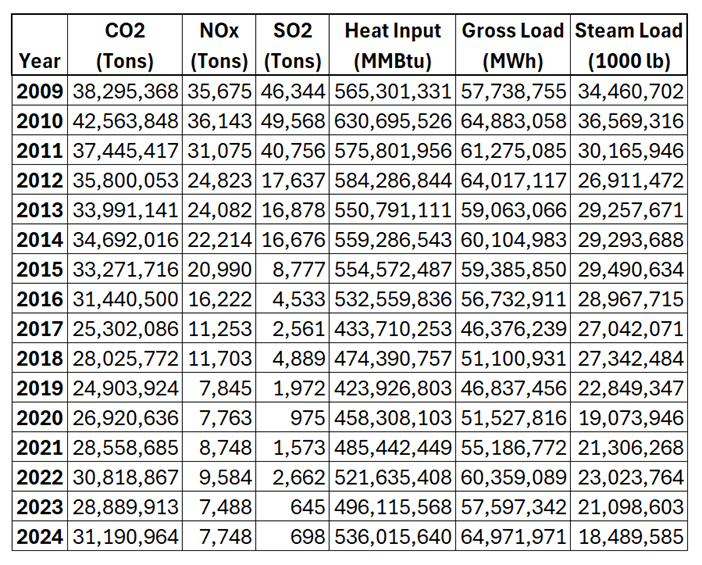
The following table lists emissions and operating data since 2009 when the Regional Greenhouse Gas Initiative started.  Emissions of CO2, SO2, and NOx are down dramatically over this period. 

Table 1: New York State Emissions and Operating Parameter Trends

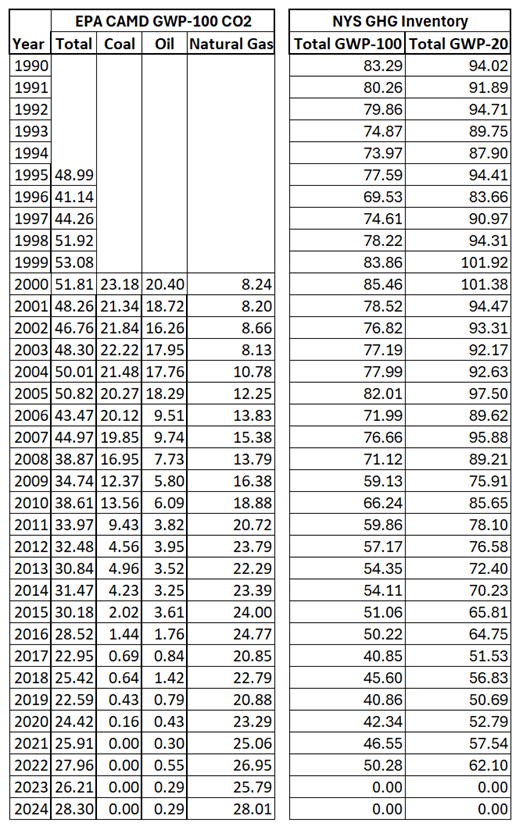
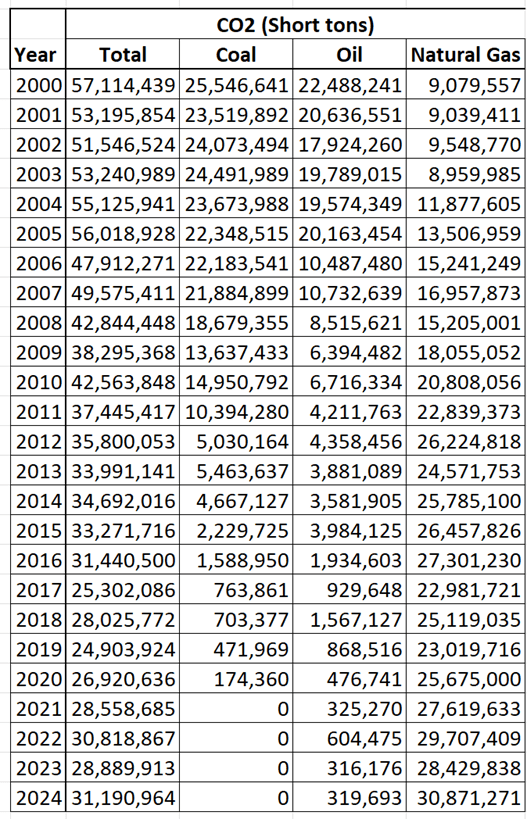
Table 2 lists CO2 emissions by fuel type since 2000.  It shows the impact of fuel switching.  The primary reason for the observed fuel switching is that the fracking revolution made the cost of natural gas so cheap relative to other fuels that every facility that could convert to natural gas did so.  New York banned the use of coal in 2021 which forced the retirement of the remaining coal plants.  The state still has some facilities that primarily burn residual oil but those run infrequently.  The takeaway message is that the fuel switching options are no longer available so future reductions will only come as zero-emissions resources displace facilities burning fossil fuels.

Table 2: New York State CO2 Emissions by Fuel Type

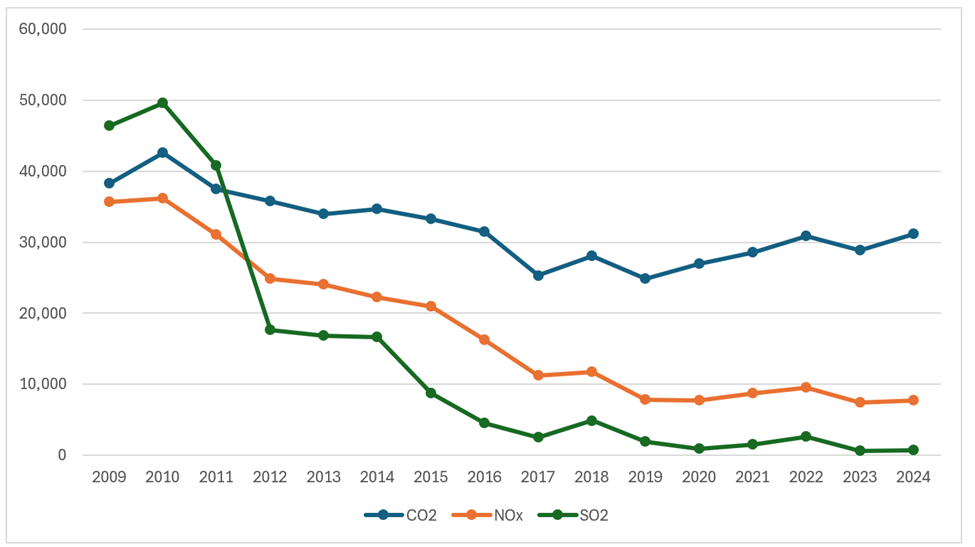
The following graph illustrates emission trends.  Note that I divided the CO2 emissions by 1,000 so that all the parameters would show up on the same plot.  The impact of the closure of the Indian Point nuclear facility starting in 2020 is clearly shown.  CO2 levels in 2024 were nearly as high as the 2016 levels.    Inter-annual variability is primarily due to weather variations but the primary reason for the higher CO2 emissions is the closure of Indian Point.

Figure 1: NYS Emission Trends – SO2 (tons), NOx (tons) & CO2 (1000 tons)

New York State GHG Emission Trends

The Climate Act requires the Department of Environmental Conservation to issue an annual report on statewide greenhouse gas emissions.   The current report covers the years 1990 through 2022 and was posted late last year. Inexplicably, the emission data are unavailable.  When it is available for download from Open Data NY I will update this summary to include GHG emission trends.

Discussion

New York has significantly reduced pollution emissions from the electric sector.  However, the reductions were due to fuel switching to natural gas.  There are two implications.  There are no more significant opportunities to reduce emissions via fuel switching.  That means New York State must provide the emission reductions by investments in zero-emissions technology that can displace existing generation.  New York’s policy decisions for emission reductions have been poor to date.  The natural gas fuel switching was driven by the economics of fracking natural gas which drove prices down elsewhere but not in New York because fracking is prohibited. The other emissions policy error was the closure of Indian Point.  According to the 2024 data, that decision set back emissions progress by years. 

Conclusion

When you look at the numbers shown in this post, the enormity of the emissions reduction challenge is clear. The Climate Act has been in place for five years.  The crash program to replace fossil fuels with wind and solar has shown no sign of emission reduction success.

Climate Whiplash and California Wildfires

The difference between weather and climate is constantly mistaken by Climate Leadership & Community Protection Act (Climate Act) advocates and has been the subject of articles at this blog.  Recently Southern California wildfires have been blamed on climate change.  Patrick Brown addressed the question how much did “Climate Whiplash” impact the Los Angeles fires.  His excellent analysis raises issues that I want to highlight.

I have been a practicing meteorologist for nearly 50 years, was a Certified Consulting Meteorologist, and have B.S. and M.S. degrees in meteorology.  My particular expertise is air pollution meteorology in the electric utility sector with a focus on meteorological and pollution measurements.  The opinions expressed in this post do not reflect the position of any of my previous employers or any other organization I have been associated with, these comments are mine alone.

Weather vs. Climate

The Climate Act legislation and the implementation meetings confuse weather and climate.  According to the National Oceanic and Atmospheric Administration’s National Ocean Service “Weather reflects short-term conditions of the atmosphere while climate is the average daily weather for an extended period of time at a certain location.”  The referenced article goes on to explain “Climate is what you expect, weather is what you get.” 

Hydroclimate Volatility

Patrick Brown described the Swain et al. (2025): Hydroclimate Volatility on a Warming Earth Nature review paper. He quoted the first line of the UCLA Press Release for the paper: “Los Angeles is burning, and accelerating hydroclimate whiplash is the key climate connection.”  He then stated: “Thanks in no small part to the huge journalistic audience that lead author Dr. Daniel Swain commands, the “climate whiplash” vernacular was immediately adopted in international headlines covering the recent Los Angeles fires.”  This is a classic example of an extreme weather event that is linked to climate change by organizations and individuals that have a vested interest in advancing the threat of climate change.

Brown noted that: “the paper has demonstrated incredible reach and is in the 99.99th percentile in terms of online attention for all research (not just climate research) of a similar age.”  However he echoes my concern: “But as is the case for so much high-profile climate science, there is a large gap between the impression conveyed by the coverage and the impression left from the observational data.”

Climate Whiplash

I have never heard of the concept of climate whiplash before this story broke.  Brown explains:

Dangerous, intense wildfires require dry vegetation. The idea behind the climate whiplash connection to the Los Angeles fires is that very wet winters in Southern California in 2022-2023 and 2023-2024 enabled a great deal of vegetation growth but that the very dry beginning of the 2024-2025 winter allowed that vegetation to dry out, resulting in a landscape primed for uncontrollable wildfires. Swain explains the mechanism in interviews with Adam Conover and Neil deGrasse Tyson.

In order for this to be a climate change problem, we need to know whether these events are increasing.  Brown noted that:

The idea being conveyed is that these climate whiplash events are dramatically increasing not just in Southern California, but globally.  “Every fraction of a degree of warming speeds the growing destructive power of the transitions” Swain said.

Brown described background for this concept:

Taking a step back, the fundamental theory undergirding changing “hydroclimate” (think water cycle where we are considering not just how precipitation provides moisture but also how evaporation takes moisture) whiplash is nothing new. It is a basic fact of atmospheric physics that a warmer atmosphere can “hold” more water vapor (about 7% more per °C of warming). This warming influence on the water cycle has been discussed in detail since at least the 1980s (e.g., Manabe, & Wetherald, 1986)). At first, most research discussed a general intensification of the water cycle, typically emphasizing that already dry areas would get drier and already wet areas would get wetter as the globe warmed. However, by the mid-2000s, studies like Trenberth et al. (2003), Chou & Neelin (2004), Meehl et al. (2005), and Held & Soden (2006) began pointing out that the same physics (warmer atmosphere holds more moisture) can drive larger variability in the same place—heavier rain events juxtaposed with prolonged and/or more intense dry spells.

These concepts are taught regularly as a part of Climate Change 101 classes, including my own, and they are accepted as consensus climate science, articulated with “high confidence” in the IPCC’s most recent assessment report:

“A warmer climate increases moisture transport into weather systems, which, on average, makes wet seasons and events wetter (high confidence)”

“Warming over land drives an increase in atmospheric evaporative demand and the severity of droughts (high confidence).”

The reason I wanted to highlight Brown’s analysis of this paper is because he highlights a key complication for the general public’s understanding of climate change.  It is accepted that a warmer climate increases moisture in the atmosphere and drought severity.  The implications of those mechanisms are important with respect to GHG emission reduction policies.  The question is so what? What is the magnitude of the change, what impacts might result from these mechanisms, and do we expect that changes in global temperatures due to GHG emissions will result in significant impacts from these mechanisms are all questions that should be addressed.

I fully endorse Brown’s explanation:

However, I like to point out that it is useful to break down lines of evidence in climate science into categories of

  1. Historical observations/trends
  2. Fundamental theory
  3. Mathematical modeling

I know from teaching the “wet gets wetter, dry gets drier” concept that the evidence for increased variability in the same location is much stronger in the theory and modeling categories than it is in observations. This is important because observations should take precedence over the other two. Focusing on observations tells us a lot about how big of an effect we’re talking about (i.e., do we see major trends emerge through the noise of the observation system and natural variability?). Furthermore, a fundamental point of doing science is to explain observations. The canonical order of operations is that first you observe some phenomenon, and then you use the tools of theory and modeling to make sense of it.

I cannot over-emphasize the point that observations should take precedence over theory or modeling.

Observations

Brown goes on to evaluate observations of the whiplash where increased precipitation enabled a great deal of vegetation growth followed by a period of decreased precipitation that allowed that vegetation to dry out, “resulting in a landscape primed for uncontrollable wildfires”.  I am only going to summarize two of the results.

Brown evaluated observations of year-to-year water cycle variability following the methodology of the Swain et al. (2025) paper. Note that he only evaluated the effect over land because it has no effect on wildfires if it occurs over the ocean.  He did not find any compelling evidence for an increase in these events in California.  The results for global land were described:

So, over all global land, at the timescale that is most relevant to the Los Angeles fires (annual), in the premiere observational dataset (ERA5), using Swain et al. (2025)’s own data, we have seen a long-term decrease in whiplash frequency (this, by the way, is acknowledged in passing in the text of Swain et al. (2025) on page 37).

Let’s pause for a second to recall the first line of the UCLA press release (“Los Angeles is burning, and accelerating hydroclimate whiplash is the key climate connection.”) and the global news coverage it generated. Would any reader of this coverage have any idea about the incredibly important caveats above? Not that I can tell.

In the next section Brown discussed the magnitude of changes in annual water cycle variability.  He stated that:

Now, to be fair, Swain et al. (2025) purport to show evidence of increasing whiplash frequency at multiple timescales, spatial extents (over the ocean, for example), and in other datasets.

However, highlighting changes in arbitrarily-defined “event” frequency without reporting changes in “event” magnitude is misleading, and it goes against one of the core recommendations of the National Academies of Sciences 2016 report on Attribution of Extreme Weather Events in the Context of Climate Change. As Ted Shepherd recently put it in his presentation to the committee responsible for the next such report: “Frequency is the more impressive number, but magnitude is perhaps the more physically interpretable number.”

Brown’s analysis of the magnitude of the changes found: “1 we see no long-term increase in water cycle variability at the location and timescale relevant to the Los Angeles fires.”

Patrick Brown Summary

Brown’s summary is important.  He notes that the choice of analysis data used affects the conclusion:

While “climate whiplash events” may be increasing in frequency under most of the very specific, selected definitions used and datasets investigated in Swain et al. (2025), the general idea that annual precipitation (or more generally, the water cycle, which includes evaporation) is becoming dramatically more variable is not supported when a broader set of datasets and definitions are used.

Brown worries that this analysis and the publicity it received is a problem:

Would a reader of Swain et al. (2025), or especially its coverage, have any idea about the weakness of its broader conclusions or the lack of robustness of its results to different definitions and datasets? Almost certainly not, and I contend that this is a major problem for public understanding and trust in climate science.

One of my over-arching issues with the existential threat narrative is that the accepted science is distorted with respect to reality of natural variability.  Brown explains:

Why don’t we see a robust increase in water cycle variability given the strong theory underpinning “wet gets wetter, dry gets drier”? For one thing, the theoretical size of the effect is known to be quite small relative to natural, unforced variability, making it inherently difficult to detect. For example, we see in Figure 7 above that year-to-year rainfall in Los Angeles naturally varies by as much as 300%, yet the signal we are looking for is one to two orders of magnitude less than this. It is also apparently the case that observational uncertainty is larger than the signal (or there would not be such disagreement between datasets). Physically, perhaps increasing mean precipitation is offsetting the increase in calculated evaporation in the SPEI index, reducing its variability. Maybe reduced temperature variability (via arctic amplification) is reducing calculated evaporation variability.

I agree with Brown’s concluding remark:

My main discomfort with Swain et al. (2025) and its rollout is that it appears that the primary goal was to create and disseminate the “climate whiplash” meme rather than conduct a truly rigorous evaluation of the evidence, including countervailing evidence. Ultimately, this makes the research a much larger advance in marketing than an advance in science.

Conclusion

Patrick Brown does an excellent job eviscerating the climate whiplash headlined stories based on Swain et al. (2025)’s recent paper.  It is frustrating that biased analyses that confirm pre-conceived get so much attention.  It will require many evaluations like Brown’s to address the misinformation.

There is another important point.  There is no question that adding greenhouse gases to the atmosphere will result in warming and that the warming will result in “wet gets wetter, dry gets drier”.  However, Brown shows that the magnitude of these effects is important and that checks based on historical observations indicate that those effects are about the same as natural variability.  Whenever I have evaluated similar claims, I found the same result.  Claims that climate change impacts are observable now are not supported by historical observations.

Climate Leadership & Community Protection Act Mal-Information

I recently evaluated the New York Affordable Energy Future proposal for revenues generated by the New York Cap-and-Invest (NYCI) program.    Their report includes a perfect example of New York State Energy Research & Development Authority (NYSERDA) mal-information created by NYSERDA’s intentional misrepresentation of their cost estimates for the Climate Leadership & Community Protection Act (Climate Act) implementation plan. 

I am convinced that implementation of the New York Climate Act net-zero mandates will do more harm than good if the future electric system relies only on wind, solar, and energy storage because of reliability and affordability risks.  I have followed the Climate Act since it was first proposed, submitted comments on the Climate Act implementation plan, and have written over 490 articles about New York’s net-zero transition.  The opinions expressed in this article do not reflect the position of any of my previous employers or any other organization I have been associated with, these comments are mine alone.

Overview

The Climate Act established a New York “Net Zero” target (85% reduction in GHG emissions and 15% offset of emissions) by 2050.  It includes an interim 2030 reduction target of a 40% GHG reduction by 2030.  The Climate Action Council (CAC) was responsible for preparing the Scoping Plan that outlined how to “achieve the State’s bold clean energy and climate agenda.” The Integration Analysis prepared by the New York State Energy Research and Development Authority (NYSERDA) and its consultants quantified the impact of the electrification strategies.  After a year-long review, the Scoping Plan was finalized at the end of 2022. 

NYSERDA claims that there was “robust public input” during the draft Scoping Plan process that “included 11 public hearings across the State and more than 35,000 written comments” that supposedly were read, summarized, and presented to the CAC.  However, the summary was a slide presentation.   The public comment period for the Draft Scoping Plan closed on July 1, 2022.  The CAC reviewed the feedback received from stakeholders over a series of five meetings from August 23, 2022 to October 25, 2022.  The presentations for all CAC meetings are posted and all public comments received by the CAC are available. However, NYSERDA did not summarize the comments or provide a response to them.

False Information

There is a bigger problem with the Scoping Plan implementation process than the lack of documentation.  The Hochul Administration and NYSERDA are guilty of peddling false information.  Media Defence defines three false information terms:

  • Disinformation: Disinformation is information that is false, and the person who is disseminating it knows it is false. “It is a deliberate, intentional lie, and points to people being actively disinformed by malicious actors”.
  • Misinformation: Misinformation is information that is false, but the person who is disseminating it believes that it is true.
  • Mal-information: Mal-information is information that is based on reality, but it is used to inflict harm on a person, organization or country.

I am not going to assign motives to the agencies and staff responsible for the Scoping Plan component of Climate Act implementation, so I am not going to accuse anyone of disinformation.  However, there are examples of misinformation and mal-information on the record in the Scoping Plan process.

Misinformation

At the May 26, 2022 Climate Action Council meeting the topic of misinformation came up as I documented here.  CAC Co-Chair Basil Seggos discussed his thoughts starting at 19:50 of the recording and brought up the subject of public engagement.  He admitted that when they got out into public that they gained a better appreciation of the scale of the challenge.  He said it was tough to communicate the challenges but when on to say there is lots of “misinformation and misunderstanding but also lots of excitement and support”. 

One topic for misinformation according to CAC member comments was concerns about the reliability of an electric system that relies on wind and solar.  Paul Shepson (starting at 23:39 of the recording said:

Mis-representation I see as on-going.  One of you mentioned the word reliability.  I think the word reliability is very intentionally presented as a way of expressing the improper idea that renewable energy will not be reliable.  I don’t accept that will be the case.  In fact, it cannot be the case for the CLCPA that installation of renewable energy, the conversion to renewable energy, will be unreliable.  It cannot be.

Robert Howarth, starting at 32:52 of the recording) picked up on the same issue.  He said that fear and confusion is based on misinformation, but we have information to counter that and help ease the fears.  He stated that he thought reliability is one of those issues: “Clearly one can run a 100% renewable grid with reliability”, although he did admit it had to be done carefully. 

Since then, the claims that the conversion to renewable energy had no reliability challenges that could not be overcome with existing technology have been shown to be false.  The CAC members who dismissed anyone who disagreed as purveyors of misinformation were clearly wrong.  I have documented that experts, including those that are responsible for electric system reliability, agree that a new category of generating resources called Dispatchable Emissions-Free Resources (DEFR) is necessary during extended periods of low wind and solar resource availability.  The fact that this requirement was included in the Integration Analysis and Co-Chair Seggos did not call out the CAC members who claimed that no new technologies would be needed and allowed them to enter those statements in the record is clear misinformation.

Mal-Information

The authors of the New York Affordable Energy Future proposal were tricked by mal-information in the Scoping Plan.  The report notes that “NYSERDA has estimated that decarbonizing the state will cost $11 billion in 2030, counting both private and public spending.  That statement was document with the following reference: “According to p. 131 of the NY Climate Action Scoping Plan (NYS Climate Action Council 2022).”  The Scoping Plan states “In 2030, annual net direct costs relative to the Reference Case are around $11 billion per year, approximately 0.5% of GSP; in 2050, costs increase to $41 billion per year, or 1.3% of GSP. 

Lest you think this is an isolated reference, Governor Hochul’s executive budget described in the FY2026 NYS Executive Budget Book included the following paragraph:

From the beginning of her administration, Governor Hochul has made it clear that responding to climate change remains a top priority for New York State. Acknowledging that the cost of inaction greatly outweighs the cost of any actions we can take together, New York will continue to pursue an aggressive agenda in transitioning to a sustainable green energy economy, in a way that is both environmentally effective and economically affordable for all New Yorkers.

Unfortunately, the statement is deliberately misleading.  The Hochul Administration wanted to be able to say that implementing the Climate Act would be beneficial.  NYSERDA provided support for the sound bite “The costs of inaction are more than the costs of action” that has been the mantra of the Administration.  However, that statement is misleading and inaccurate as I documented in my verbal comments and in my written comments on the Draft Scoping Plan.  I described the machinations based on reality used to mislead and harm New York as a shell game in a summary post.

The reason that this claim is a shell game is that the cost estimate everyone wants to know is how much it is going to cost to achieve the New York “Net Zero” target (85% reduction in GHG emissions and 15% offset of emissions) by 2050 and all the other targets in the Climate Act. The “New York Affordable Energy Future” authors said “NYSERDA has estimated that decarbonizing the state will cost $11 billion in 2030, counting both private and public spending” I believe that they presumed that number included all the costs of all the decarbonization programs needed to achieve the Climate Act targets.

The NYSERDA gimmick used to support the narrative picks and chooses what control strategies are included in the costs of de-carbonization.  To evaluate the effects of different policy options, this kind of modeling projects future conditions for a baseline case.  The evaluation analysis makes projections for different policy options, and then the results are compared relative to the baseline.  The standard operating procedure is to use a business-as-usual or status quo case for the baseline. 

NYSERDA did not do that.  In my review of the Draft Integration Analysis supplement, I showed that NYSERDA conjured up a Reference Case to fulfill their imperative to “prove” Climate Act benefits.  Instead of a typical baseline case, the Reference Case used in the scenario excluded programs that are needed to meet the Climate Act targets but were implemented before the Climate Act was passed.  I think it is troubling that this approach was hidden.  I identified the problem only after I searched the Scoping Plan documents for the phrase “reference case” to try to determine what “already implemented” decarbonization programs were included in the Reference Case.  The following figure reproduces the page with the documentation on page 12 in Appendix G Integration Analysis Technical Supplement Section I. The documentation is buried in the footnote for the circled reference for the blank caption to Figure 4. 

Given its importance to the cost/benefit claim, my Draft Scoping Plan comment noted that this reference case caveat should have been clearly described in the text rather than in a footnote.  The Final Scoping Plan document included explanatory text in section 5.3 of the document.  However, that text was not even included in the draft document!  

The appropriate descriptive text is in the final Appendix G section 5.3: Scenario Assumptions chapter and lists the “already implemented” programs.  It states:

The integration analysis evaluated a business-as-usual future (Reference Case) a representation of recommendations from CAC Advisory Panels (Scenario 1), and three scenarios designed to meet or exceed GHG limits and carbon neutrality (Scenarios 2 through 4). Scenarios 2, 3, and 4 all carry forward foundational themes based on findings from Advisory Panels and supporting analysis but represent distinct worldviews. A detailed compilation of scenario assumptions can be found in Annex 2.

For the record Annex 2 refers to a massive spreadsheet that is certainly detailed but most certainly does not provide an easily accessible compilation of scenario assumptions.  In particular, the documentation does not provide explicit information to determine what costs are specifically included in the Reference Case relative to the other scenarios.

The Reference Case described as “Business as usual plus implemented policies” includes the following:

  • Growth in housing units, population, commercial square footage, and GDP
  • Federal appliance standards
  • Economic fuel switching
  • New York State bioheat mandate
  • Estimate of New Efficiency, New York Energy Efficiency achieved by funded programs: HCR+NYPA, DPS (IOUs), LIPA, NYSERDA CEF (assumes market transformation maintains level of efficiency and electrification post-2025)
  • Funded building electrification (4% HP stock share by 2030)
  • Corporate Average Fuel Economy (CAFE) standards
  • Zero-emission vehicle mandate (8% LDV ZEV stock share by 2030)
  • Clean Energy Standard (70×30), including technology carveouts: (6 GW of behind-the-meter solar by 2025, 3 GW of battery storage by 2030, 9 GW of offshore wind by 2035, 1.25 GW of Tier 4 renewables by 2030)

Mal-information is information that is based on reality, but it is used to make misleading statements that improperly convey a false narrative.  In this case, the uncommon definition of the base case used for the implementation cost modeling led most New Yorkers to believe that annual net direct costs to achieve the Climate Act targets were around $11 billion per year.  The Scoping Plan mentions that those costs are “relative to the Reference Case” but the draft Scoping Plan did not document what programs were included in the Reference Case.  This is why I believe that the “costs of inaction and more than the costs of action” narrative is mal-information. 

Discussion

This post was prompted by my realization that the authors of the New York Affordable Energy Future report were misled by NYSERDA mal-information related to the expected annual net direct costs needed to achieve the Climate Act mandated targets.  When I did some background research I found Media Defence definitons of three false information terms and realized that NYSERRDA was guilty of two out of three.

NYSERDA is guilty of misinformation because the Scoping Plan was approved because information fundamental to the implementation schedule was known to be false.  The only way to justify the Climate Act schedule is to believe that no new technology is needed so the only constraint is deployment.  CAC member Dr. Robert Howarth is the primary source of that presumption, and I am sure he believes that no new technology is needed.  However, the Integration Analysis recognized that during extended periods of low wind and solar resource availability that a new DEFR technology is needed.  The leadership of the CAC should have addressed this fundamental issue.  That they didn’t was likely because acknowledging the problem is tantamount to admitting that the Climate Act law was deeply flawed. 

NYSERDA and Governor Hochul are guilty of peddling mal-information.  Their oft-repeated sound bite that the “costs of inaction are more than the costs of inaction” is based on reality but mis-leads and harms New Yorkers because it does not include all the costs necessary to meet the Climate Act mandates.  No one cares which regulation, or law mandates a specific portion of the total costs necessary to meet the goals.  The total costs are all we care about.

NYSERDA claims that there was “robust public input” during the draft Scoping Plan process that “included 11 public hearings across the State and more than 35,000 written comments” that supposedly were read, summarized, and presented to the CAC.  The problem is that NYSERDA and DEC staff screened the comments and only presented generalities and not specific comments that questioned any of the narrative that the Administration wanted pushed. I specifically addressed this issue in my verbal and written comments but have never seen any evidence that anyone on the

I recently found an example of how a stakeholder process should work.  The Santa Clara County Rapid Transit Development Project includes a master plan for transportation for Silicon Valley.  An interview with the founding manager notes: “Part of the plan is a four-year public stakeholder review process.  In the reviews, if the public came up with good ideas, the ideas went into the plan.  If an idea wasn’t good, we had the responsibility of explaining why.”[1] 

That commitment to responding to comments is sorely needed in New York.  In my opinion, the CAC should have been informed about this issue.  A summary describing what I claimed, their response to my concern, and a recommendation for the CAC is necessary to assure public confidence in Climate Act implementation.  If NYSERDA is to have any credibility regarding their stakeholder process, then they must provide better documentation showing that all the comments were considered and addressed.

Conclusion

The Hochul Administration has been the first to pitch a fit and throw around the misinformation label when anyone says something contrary to their narrative.  They are not only guilty of pushing misinformation but worse, they spout egregious mal-information whenever they claim the costs of inaction are more than the costs of action.


[1] “California’s High-Speed Rail Visionary” Bill Buchanan, Trains, Volume 85, No. 1, January 2025, pages 30-37.

Madison County Wind Farm Retirement

Postscript: On September 17, 2025 the wind turbine towers were imploded thus ending the life of the first New York wind farm.

In June 2024 I published Madison County Wind Farm – Theory vs. Results comparing the performance of the first New  York industrial wind facility with an old New York State Energy Research and Development Authority (NYSERDA) report projecting performance.  On January 14, 2025 the New York Independent System Operator (NYISO) posted a Completed Generator Deactivation Notice for the facility. 

I have followed the Climate Leadership & Community Protection Act (Climate Act)since it was first proposed, submitted comments on the Climate Act implementation plan, and have written over 490 articles about New York’s net-zero transition.  The opinions expressed in this article do not reflect the position of any of my previous employers or any other company I have been associated with, these comments are mine alone.

Overview

The Climate Act established a New York “Net Zero” target (85% reduction in GHG emissions and 15% offset of emissions) by 2050.  It includes an interim 2030 reduction target of a 40% GHG reduction by 2030.  The Climate Action Council (CAC) was responsible for preparing the Scoping Plan that outlined how to “achieve the State’s bold clean energy and climate agenda.”  The Integration Analysis prepared by NYSERDA and its consultants quantified the impact of the electrification strategies. The Scoping Plan was finalized at the end of 2022.

Madison Wind Farm

According to its Wikipedia page:

The Madison Wind Farm is a power generation plant located in the town of Madison, New York. Constructed in 1999-2000, it was the first wind farm completed in New York state and the first merchant wind farm in the country. The power plant consists of seven Vestas V66-1.65 MW wind turbines, generating enough energy to power up to 10,000 homes. The Vestas V66-1.65 MW wind turbines have a hub height of 67m and a 66m rotor diameter totally 100m to the top of the rotor.

It is now owned by EDP renewables.  There have been maintenance issues and last year I mentioned talk about decommissioning the project.  On January 14, 2025 NYISO posted a Completed Generator Deactivation Notice for the facility.  The notice said that the Nameplate capacity was 11.6 MW.  The notice stated that “The submitting entity has proposed to deactivate the Generator on May 1, 2025. The desired Retirement date is less than 365 days after the completed Notice was submitted.”

NYSERDA sponsored an assessment of the facility that was published in December 2003.  The Madison Windpower Project Final Report was prepared for NYSERDA by AWS Scientific, Inc.  The Abstract for the report stated that:

This report covers the development and operation of the Madison Windpower Project in Madison County, New York developed by PG&E Generating. The project began commercial operation in October 2000 and consists of seven Vestas V66-1.65 MW OptiSlip® wind turbines for a total capacity of 11.55 MW. Long­ term wind resource estimates predicted an annual hub-height average wind speed of 7.3 m/s. The net annual plant energy production was predicted to be 23,621 MWh, which would produce a capacity factor of 23.3%. The wind turbines were dispatched and controlled from the PG&E Pittsfield operations center, which was also responsible for substation maintenance. Vestas took charge of inspection, adjustment, and repair of the turbines (both scheduled and unscheduled) and established an operations and maintenance facility in the Madison area. The wind plant produced a total of 61,379 MWh of electricity for three years for an annual average of 20,460 MWh and an overall capacity factor of 21%. The capacity factor is lower than the expected value of 23.3% primarily due to lower than predicted wind speeds and turbine and grid outages.

Observed Operations

The New York Independent System Operator (NYISO) prepares a report describing load and capacity data for all New York generating units that participate in the electric market.  Universally known as the “Gold Book” it is the best reference for New York electric generation data. The 2024 Load & Capacity Data Report presents observed load and capacity data for 2023. The 2024 data are not available.  To prepare this summary of Madison Wind Farm operations I relied on a compilation of observed data from Gold Book reports back to 2006.

The following table lists the observed net energy (GWh) and capacity factors from 2006 to 2023, and the projections made in 2003 by AWS.  In that analysis the observed capacity factor was 21% in the first three years.  Since then, only one year achieved that level and in the last three years the capacity factor was less than 14%.  AWS projected that the energy production would be 23.6 GWh per year.  The last column in the table lists the observed minus projected annual deficit.

Table 1: Madison Wind Farm Performance Based on NYISO “Gold Book” Load & Capacity Data Report Table III-1 Including AWS 2003 Projections

Discussion

As the first industrial wind facility Madison Wind Farm performance was evaluated in the AWS project.  The report claims that it was a successful demonstration of large-scale wind development.  I agree that it provides power, and the information learned from it has been used to integrate other projects.  However, I have concerns about the poor availability and decreasing capacity factors.

In my previous article I noted that over-optimism is a characteristic of NYSERDA.  The NYSERDA Integration Analysis projected a state-wide wind capacity factor of 29% in 2020 increasing to 34% in 2030.  The Gold Book statewide capacity factor in 2020 was 23.9%.  The Integration Analysis projected land-based wind in 2030 would generate 5,043 GWh but using that capacity factor he actual production was only 4,162 GWh, 18% lower than they projected.  In addition, the Integration Analysis did not acknowledge that as wind systems age their performance drops.

In comments I submitted regarding the Draft Scoping Plan, I noted that the Integration Analysis assumes that the expected lifetimes of the wind facilities is indefinite.  As a result, units were assumed to remain online throughout the study period and no costs for replacements between now and 2050 were included.  This generator deactivation notice blows that assumption out of the water.

NYSERDA’s Integration Analysis quantified the generating resources that will be needed to meet the Climate Act mandates.  However, comparison of observed and projected energy production shows that they have overestimated energy production which means that more wind capacity will have to be developed and that the costs will necessarily be higher than they projected.  Now we have confirmation that the retirement of wind resources will occur which adds another layer of overestimated wind energy projection. 

There has not been any reconciliation between Integration Analysis projections and observations to refine projections.  This is in keeping with their complete lack of response to technical issues raised in comments on the Scoping Plan. 

Conclusion

The performance of the first wind farm in New York is considerably less than projected and now it is retiring after less than 25 years of operation.  The Madison Windpower Project Final Report found that the capacity factor 21% the first three years which was lower than the projected value of 23.3%.  Performance degraded over the period of record and was only 12% in 2023.  Over 18 years the facility produced 93.2 GWh less than projected.  This is another indication that the Scoping Plan projections for future wind operations were overly optimistic and means that the Scoping Plan costs for the net zero transition are too low.

This is just one more example of the flaws hidden behind a veneer of political slogans that claim all is well with the Climate Act.  Eventually it will become obvious that the Hochul Administration electric system “plan” is incompatible with reality.  It is past time to pause implementation and address the many issues that have been identified with the Scoping Plan.

Comments on DPS Definitions for Establishment of a Renewable Energy Program

On November 4, 2024, the Department of Public Service (DPS) staff proposed definitions for two key components of the 2040 target.   This post describes some of the comments submitted on the draft.  It is necessary to read between the lines of the electric industry comments to appreciate their concerns about the future electric system.

I am convinced that implementation of the New York Climate Leadership & Community Protection Act (Climate Act) net-zero mandates will do more harm than good if the future electric system relies only on wind, solar, and energy storage because of reliability and affordability risks.  I have followed the Climate Act since it was first proposed, submitted comments on the Climate Act implementation plan, and have written over 500 articles about New York’s net-zero transition.  The opinions expressed in this article do not reflect the position of any of my previous employers or any other organization I have been associated with, these comments are mine alone.

Summary – if you don’t have over ten minutes to read the whole thing

The Climate Act has a target that all electricity must be generated by “zero-emissions” resources by 2040. DPS staff proposed a definition of “zero-emissions” in November 2024 nearly five years after the law was promulgated.  It is increasingly obvious that the Scoping Plan is inadequate for the task of implementing a “zero emissions” electric system. Both the electric grid operator and a consortium of electric utilities provided comments on the proposed definition that emphasized the need for a comprehensive plan that prioritizes electric reliability.  Environmental advocacy organization comments underestimate the reliability challenges and recommend changes that would hinder development of a reliable grid.  I believe that the Hochul Administration is at a crossroads, and it is not clear that they will change direction to a rational approach based on reality or continue the present path of ideological purity.

Overview

The Climate Act established a New York “Net Zero” target (85% reduction in GHG emissions and 15% offset of emissions) by 2050.  Two targets address the electric sector: 70% of the electricity must come from renewable energy by 2030 and all electricity must be generated by “zero-emissions” resources by 2040. The Climate Action Council (CAC) was responsible for preparing the Scoping Plan that outlined how to “achieve the State’s bold clean energy and climate agenda.” The Scoping Plan was finalized at the end of 2022.  Since then, the State has been trying to implement the Scoping Plan recommendations through regulations, proceedings, and legislation. 

I believe that the biggest shortcoming of the Hochul Administration’s implementation of the Climate Act is the lack of a plan.  For example, to implement a transition to meet the mandate that all electricity must be generated by “zero-emissions” resources by 2040 it is first necessary to define “zero emissions”.  Amazingly, draft definitions were not proposed for over four years.  On November 4, 2024, the DPS staff proposal concerning definitions for key terms (Staff Proposal) in Public Service Law §66-p that finally defined “zero emissions”.  The Introduction of the Staff Proposal explains:

In this proposal, the Department of Public Service Staff (Staff) suggests interpretations of key terms in the provisions of the Climate Leadership and Community Protection Act (Climate Act), codified in Section 66-p of the Public Service Law (PSL), which directs the Public Service Commission (Commission) to establish a renewable energy program and design it to achieve particular targets. At issue in this proposal is the language of PSL §66-p(2)(b), which directs the Commission to establish a program pursuant to which, by the year 2040, the “statewide electrical demand system will be zero emissions.” Of particular note, neither of the terms “statewide electrical demand system” nor “zero emissions” are expressly defined in the Climate Act or in the PSL. This lack of statutory definition requires the Commission’s interpretation of these terms to ensure proper regulatory implementation.

This post describes some of the comments submitted on these definitions.

New York Independent System Operator (NYISO)

NYISO runs the electricity market and is “dedicated to planning a reliable grid of the future, leveraging open and fair electricity markets, and informing policymakers and stakeholders.”  They submitted their comments on January 21, 2025.  The NYISO frustrates me because they pull their punches when they file comments.  Rich Ellenbogen shares my frustration and sent me an email describing their filing that exemplifies my concern.  He wrote: “The NYISO is screaming between the lines of their filing again.  The filing is attached and addresses electricity reliability margins across the state”.  He commented on three of their comments.

NYISO comment on Page 4:

To achieve the zero-emission standard, significant quantities of new resources, which satisfy the zero-emission definition, and provide the necessary energy and reliability attributes, will be required to support a reliable electric system. Development, permitting, siting, and interconnection of existing and emerging zero-emission electricity supply will require significant capitalization over a relatively short period of time.

Ellenbogen Response:

Regarding the above statement, financing, siting, permitting, and interconnection will do nothing if the technologies don’t exist at scale to implement the plan.  At present, the necessary technologies don’t exist at scale or don’t exist at all, with the exception of nuclear which is a four-letter word in NY State.  You can’t buy and install Dispatchable Emission Free Resources (DEFR’s) that aren’t available and sufficient nuclear generation won’t exist at scale until well after the CLCPA mandated dates even if planning was started today.

NYISO comment on Page 5:

Overly restrictive compliance obligations could prevent emitting generators from operating to support system reliability or serving consumer demand and potentially force generators to retire before suitable replacement resources are available. Insufficient availability of electric generation could adversely impact public health, welfare, and safety.

NYISO comment on Page 6:

Electric system reliability margins are already close to minimum reliability requirements in certain areas across New York and are tightening. If these margins are totally depleted, the reliability of the grid would be at an unacceptable risk and power outages could disrupt normal life or negatively impact public health, welfare, and safety.  The NYISO’s 2024 Reliability Needs Assessment (“RNA”) identifies a reliability need beginning in summer 2033 within New York City, primarily driven by a combination of forecasted increases in peak demand, limited additional supply, the assumed retirement of the NYPA small gas plants based on state legislation, and assumed unavailability of generators impacted by the DEC Peaker Rule.

Ellenbogen Response:

A translation for the two statements above, simply put is: “If you don’t let us run the existing generation that we have and force us to shut them down to meet your standards of ideological purity, you won’t have any lights or electricity for anything else.  We are already running on fumes, and it is going to get worse.”

Why the NYISO can’t just come out and say what they mean without such subtlety is a disservice to the people of NY State.  No one wants to say outright how ridiculously bad the state energy policy is so everyone keeps beating around the bush and in the interim, the state is like a runaway train headed towards a collapsed bridge. 

The utilities aren’t doing a service for their ratepayers or themselves either.  I understand that they don’t want to run afoul of the state government and lose their certification, but they are the ones that are going to be turned into piñatas when this goes bad, which is inevitable.  It’s not a matter of if, just when.  Are people actually going to have to die before someone comes out directly and acknowledges how bad this energy policy is?

Joint Utilities

An ad hoc group of utilities also submitted comments.  The Joint Utilities are Central Hudson Gas & Electric Corporation, Consolidated Edison Company of New York, Inc. Niagara Mohawk Power Corporation d/b/a National Grid, New York State Electric & Gas Corporation, Orange and Rockland Utilities, Inc., and Rochester Gas and Electric Corporation. As Ellenbogen noted these companies face existential threats if they speak out too strongly in the politically charged New York environment because there are proposals to take them over and have the State operate them.  Even if the politicians don’t shut them down, the Hochul Administration certainly can punish the companies when their rate cases are decided.  Nonetheless, I agree that they are doing a disservice to their customers by not speaking out. Their comments on this proceeding are a step forward because they made recommendations that imply there are problems.

I was encouraged by the following statement because it aligns with my argument that there is no plan in place to implement the Climate Act:

The reliability of electricity in the state is of primary importance to the Joint Utilities. For the reasons set forth below, the Joint Utilities request that the Commission direct Staff to collaborate with the NYISO and the Joint Utilities to develop a comprehensive plan to achieve zero emissions generation to meet New York State’s demand by 2040 in a manner that ensures reliability of the electric system throughout the clean energy transition to a zero emissions electric system. This plan should address current supply and demand trends within the power sector. If the cessation of greenhouse gas-emitting generation post-2040 creates a large gap between supply and demand, the plan should also include strategies of how best to retain, manage and retire generation to maintain system reliability and resource adequacy.

It is important to read between the lines of this paragraph:

Clear guidance and decisive action are essential to advancing our state’s zero-emission targets while ensuring resource adequacy and affordability are not compromised. There are fewer than five years before the first target takes effect and only fifteen years to achieve zero emissions by 2040, so it is crucial to act promptly. From an electric planning, permitting, and construction perspective, the feasibility of this timeline will be significantly challenging.

My interpretation is that they are saying there isn’t clear guidance and decisive recommendations for action that ensure resource adequacy and affordability are not compromised.  I wholeheartedly agree. They also point out time is getting short to meet the electric sector targets.  When regulated companies with significant exposure to political retribution say “significantly challenging” they are really saying this won’t work!  The Joint Utility comments go on:

The Joint Utilities recommend that the Commission direct Staff to develop a clear roadmap that addresses future system needs, potential gaps in supply and demand and clear methodologies to characterize those gaps, clean energy technology readiness, sufficient access to generation to the extent gaps are identified, and resource attributes necessary for the reliable operation of New York’s electric system amid ongoing growth in intermittent renewable supply and electric demand.

I have been taught that failing to plan is planning to fail.  This comment is a clear indictment of the Scoping Plan and the transition implementation to date because it says that there is no comprehensive plan that addresses these concerns.  I endorse the Joint Utility recommendation that:

Given the potential for New York’s clean energy resources to fall short of demand, or suffer from delayed entry for various reasons, and the challenges associated with the commercial availability and maturity of new energy technologies, the Commission should require Staff to develop a plan for the development of incremental renewables, the retirement of non-compliant resources, and methodologies to address gaps between existing resources and the reliability needs of the system, while also ensuring that reliability and resource adequacy do not suffer.  Staff should also consider the development status and lead time of new and existing technologies from research and development to their commercial deployment. It is imperative to address these issues, set expectations and identify needs for the journey towards the 2040 zero emissions target.

The missing point is an explicit statement explaining if the Commission does not follow these recommendations, then there will be blackouts.  There is one other comment I want to highlight:

Lastly, the Coordinated Grid Planning Process (“CGPP”) confirms the conclusion of the NYISO and academic research that there is a large gap between supply and demand and “there is no consensus among CGPP participants about the technologies that could be deployed to meet the estimated 17GW need.” These factors are concerning, and it is imperative to incorporate these realities into the roadmap assumptions. While transitioning to a clean energy system, it is also imperative to ensure adequate generating resources are retained and available, regardless of technology, which is permissible because the Clean Energy Standard does not require the retirement of existing generators.

The large gap between supply and demand is referring to the dispatchable emissions-free resource (DEFR) issue that I discuss whenever I suggest a feasibility study is needed before any more money and effort is invested in what could be a false technology solution.  Note that the last sentence emphasizes that existing facilities should not be shut down prematurely. 

Environmental Advocacy Comments

Earthjustice, Sierra Club, the Alliance for Clean Energy New York, NY Renews, and Fossil Free Tompkins also filed comments.  I think that these organizations underestimate the challenge of meeting the large gap between supply and demand.  They submitted comments in June arguing that the December 2023 technical conference presentations had overestimated the magnitude of the gap.  In July I filed a comment  explaining that if anything, projections of the severity of the gap have been under-estimated because winds across large areas are correlated . Earthjustice and Sierra Club responded arguing among other things that “There is no reason to believe that wind speeds offshore of New York City, Long Island, and the Massachusetts Cape will be significantly correlated with land-based wind resources located in Upstate New York.”  I dropped the ball and have not responded to that documenting the results of an analysis released after their comments were filed that shows that New York onshore and offshore winds do correlate. 

I did publish an article describing a New York wind lull last September that shows that land-based wind resources do correlate with New York’s South Fork offshore wind project.  New York presently has 2,454 MW of wind capacity.  I analyzed a 192- hour period from 12 September 2024 hour 0000 to 19 September 2024 hour 2300. I found that the minimum wind capacity occurred on 13 September at hour 12 when a total of 0.2 MW of wind power was generated.  There were 96 hours representing half the period when the capacity of all the wind generation in New York was less than 5%.  All but one of the hours had a capacity factor of less than 20%.  Even the best was unimpressive.  The maximum wind capacity occurred on 19 September at hour 21 when 502 MW of wind power was generated, only 20.5% of the total capacity.  Because South Fork was in operation and included in the total, it is reasonable to assume that for at least 96 hours the wind speeds offshore were significantly correlated with New York land-based wind. 

The emphasis in the environmental organization comments on the zero-emission definition was ideological support of the strictest interpretation of “zero”.  They disagreed with pragmatic Department of Public Service recommendations and suggested that: “the Public Service Commission adopt a plain meaning interpretation of “emissions” that includes both greenhouse and non-greenhouse gases and interpret the “statewide electrical demand system” to include behind-the-meter resources that participate indirectly in jurisdictional markets.  Their suggestions make what I think is already impossible challenge even more difficult and expensive.

Conclusion

This post notes that both the NYISO and the Joint Utilities’ comments on the zero-emission definitions suggest that there will be consequences if there is no plan and recommend a re-assessment of the schedule.  I agree completely.

The environmental organizations who commented reiterated their ideological position that zero emissions of all pollutants is required and must occur as fast as possible to maintain the Climate Act schedule.  Those comments disregard all the indications that it is impossible,

The Trump Administration’s recent announcements, last summer’s acknowledgment that the 2030 electric sector goal would not be met, and the increasingly desperate comments by New York’s electric sector are all warnings to the Hochul Administration.  It seems to me that a pause to re-assess what can be done without endangering affordability and reliability could be proposed because of all the factors beyond New York’s control.

Ellenbogen asked whether people are going to have to die before someone comes out directly and acknowledges how bad this energy policy is.  I wish I was optimistic that this will not be the case but there is no evidence yet that the leadership of New York is willing to back off their ideological soapbox and admit the current Climate Act energy policy cannot work despite a plethora of evidence.

Governor Hochul Executive Budget Climate Funding

Recently I described the status of the New York Cap-and-Invest Program (NYCI) and reactions to the decision to delay its implementation.  In the 2025 State of the State address Governor Kathy Hochul announced a $1 billion climate investment.  This post describes the references to climate in the FY2026 NYS Executive Budget Book that described Hochul’s budget for the next fiscal year.

I am convinced that implementation of the New York Climate Leadership & Community Protection Act (Climate Act) net-zero mandates will do more harm than good if the future electric system relies only on wind, solar, and energy storage because of reliability and affordability risks.  I have followed the Climate Act since it was first proposed, submitted comments on the Climate Act implementation plan, and have written over 490 articles about New York’s net-zero transition.  The opinions expressed in this article do not reflect the position of any of my previous employers or any other organization I have been associated with, these comments are mine alone.

Overview

The Climate Act established a New York “Net Zero” target (85% reduction in GHG emissions and 15% offset of emissions) by 2050.  It includes an interim 2030 reduction target of a 40% GHG reduction by 2030. The Climate Action Council (CAC) responsible for preparing the Scoping Plan to “achieve the State’s bold clean energy and climate agenda” recommended a market-based economywide cap-and-invest program. 

The program is supposed to work by setting an annual cap on the amount of greenhouse gas pollution that is permitted to be emitted in New York: “The declining cap ensures annual emissions are reduced, setting the state on a trajectory to meet our greenhouse gas emission reduction requirements of 40% by 2030, and at least 85% from 1990 levels by 2050, as mandated by the Climate Act.”  The prevailing perception of NYCI is exemplified by Colin Kinniburgh’s description in his recent article in New York Focus.  He describes the theory of a cap-and-invest program as a program that will kill two birds with one stone.  “It simultaneously puts a limit on the tons of pollution companies can emit — ‘cap’ — while making them pay for each ton, funding projects to help move the state away from polluting energy sources — ‘invest.'” I described questions about NYCI that I believe need to be resolved here.

Stopgap Climate Funding

According to a Perplexity AI search: Governor Hochul announced a $1 billion climate investment as part of her 2025 State of the State address. This investment, described as the single largest climate investment in New York’s history, aims to address the climate crisis and achieve a more sustainable and affordable future for the state.  The $1 billion funding package includes:

  • Retrofitting homes and incentivizing heat pump installations
  • Building sustainable energy networks, including thermal energy upgrades at SUNY campuses
  • Expanding green transportation options
  • Supporting businesses in their decarbonization efforts

I concluded in the previous articles about NYCI that the costs were incompatible with the political narrative that Governor Hochul is concerned about affordability.  At the Energy Access and Equity Research webinar sponsored by the NYU Institute for Policy Integrity on May 13, 2024 Jonathan Binder stated that the New York Cap and Invest Program would generate proceeds of “between $6 and $12 billion per year” by 2030.  That certainly would have increased costs for New Yorkers but it also was a primary source of revenue for the emission reduction strategies necessary to meet Climate Act targets.

Colin Kinniburgh’s description in a recent article in  New York Focus described the last-minute decision to delay NYCI implementation.  Kinniburgh described the reaction of the environmental justice community:

It is not clear where that funding would come from — whether it would be new or “cannibalizing other existing funding sources,” in the words of Stephan Edel, executive director of the climate justice coalition NY Renews.

Even if it is entirely new funding, $1 billion would be considerably less than the $3 billion or more the state had expected to raise in the first year of the cap and invest program.

“We don’t want a band-aid solution here,” Courtin said. “We need a long-term, sustainable funding solution.”

He noted that Hochul explained that more data was necessary to design the program well.  “I’m not walking back on all of our commitments… I’m not letting these projects go unfunded,” Hochul said, referring to the stopgap $1 billion in climate funding she announced on Tuesday. 

Fiscal Year 2026 Executive Budget

The press release for Governor Hochul’s executive budget was captioned “More money in your pocket”.  There are specific recommendations in the FY2026 NYS Executive Budget Book (Budget Book) for programs including the $1 billion in climate funding.  Given the dynamic between Hochul and the environmental organizations upset at the pause in NYCI I searched the Budget Book for the work climate to see how she planned to appease them.  The complete search is at the end of this article.  Here are some highlights.

The Hochul Administration continues to invoke the existential threat of climate change as a driver for budget planning.  They do not understand the difference between weather and climate.  They attribute every extreme weather event to climate change with the implication that reducing emissions will alleviate those weather conditions.  Climate change was listed as a financial risk in several places.  

The Budget Book also claims that New York is “leading the nation:

From the beginning of her administration, Governor Hochul has made it clear that responding to climate change remains a top priority for New York State. Acknowledging that the cost of inaction greatly outweighs the cost of any actions we can take together, New York will continue to pursue an aggressive agenda in transitioning to a sustainable green energy economy, in a way that is both environmentally effective and economically affordable for all New Yorkers.

The slogan that the costs of inaction are greater than the costs of action has been the mantra of the Administration regarding costs.  However, that statement is misleading and inaccurate as I documented in my verbal comments and in my written comments on the Draft Scoping Plan.  I described the machinations based on reality used to mislead and harm New York as a shell game in a summary post. 

In brief, one reason that this claim is a shell game is that the cost estimate everyone wants to know is how much it is going to cost to achieve all the New York “Net Zero” targets (85% reduction in GHG emissions and 15% offset of emissions) by 2050 and all the other mandates in the Climate Act.  The Scoping Plan cost estimates only include a subset of the total costs by excluding costs of programs that are needed to meet the Climate Act targets but were implemented before the Climate Act was passed.  The argument is that the “already implemented” projects were not mandated by the Climate Act itself so they are not included.

This is a political document, so it is not surprising that the Budget Book bragged that:

Governor Hochul is directing New York to embark on the single-largest climate investment in the history of the state budget, directing over $1 billion in new funding towards achieving a more sustainable future. This landmark investment will generate new jobs, help reduce household energy bills, and cut down on harmful pollution and its impacts on our families.

What is missing is the specifics about the expenditures.  The $1 billion is intended to “reduce the State’s carbon emissions by building out thermal energy networks at SUNY campuses, making clean energy investments in State-owned buildings, retrofitting homes and incentivizing the installation of heat pumps, expanding green transportation options across the State, and supporting businesses of all sizes in their decarbonization journey.”

I asked Perplexity AI how many buildings does New York State own.  The response said it was not possible to provide an exact number but noted that the Office of General Services manages 22 state office facilities.  A quick check indicates that the NYSERDA office building is not listed so I believe that the buildings used by the various state authorities are not included. There are 64 SUNY campuses.  I went to school at one and it had a thermal energy system.  I suspect that is the rule and not the exception.  Presumably the plan is to convert all those systems to zero carbon emissions.  In round numbers there are 100 buildings and campuses operated by New York State.  I would not be surprised if the average price to convert is at least $10 million.  To convert them all would cost a billion dollars.

The bottom line is that the one billion dollars is just a fraction of the amount needed to reduce carbon emissions as needed to meet the Climate Act targets.

Discussion

The Climate Act requires the State to invest or direct resources in a manner designed to ensure that disadvantaged communities receive at least 35 percent, with the goal of at least 40 percent, of overall benefits of spending.  Last year’s NYCI proposal included carveouts from the proceeds for this mandate. 

Hochul is being pilloried for delaying implementation of NYCI and the distribution of these funds.  The Climate Justice Working Group has” had an important advisory role in the Climate Action Council process, providing strategic advice for incorporating the needs of disadvantaged communities in the Scoping Plan.”  That process is in disarray.  I have been told that there was a working group meeting recently but could not find any announcement for the meeting or other descriptive documentation.  I also found out that three prominent members of the Working Group resigned because Governor Hochul was not moving ahead fast enough.

Against that backdrop Hochul’s announcement of the $1 billion, the single-largest climate investment in the history of the state budget, appears to be a bid to maintain her credibility with the environmental justice political constituency.  In my opinion, this demographic will never be happy.  The leaders of the movement require a problem for their business model to succeed.  They never can admit that the problem is solved or even progressing satisfactorily because then the reason for their organization to exist disappears.  Keep in mind that a common recommendation in all the funding proposals is for local control of how the proceeds will be invested and who better to provide that expertise than the members of the Climate Justice Working Group.

Conclusion

Reality bats last.  The reality that the Climate Act transition has affordability and reliability issues can no longer be ignored by Progressive Democrats.  I believe that they are insurmountable issues, but it is now apparent that even Governor Hochul has recognized that costs are an issue.  The slogan that the costs of inaction are more than the costs of action does not resonate as it becomes obvious that the costs to New Yorkers are real and significant.  When the public figures out that the benefits are biased and mostly imaginary, the illusion will be completely shattered.  Hochul’s re-election campaign is coming to grips with the reality that voters are not going to be mollified by any political slogan.  Stay tuned.

Addendum – Budget Book references to Climate

FY2026 NYS Executive Budget Book

In the Financial Plan Review on Page 16:

At the same time, uncertainty looms. Risk as varied as policies and plans of the new Federal administration, the potential for a slowdown in economic growth, geopolitical risks, the ongoing implications of climate change, and sustained trends of rising enrollment and costs in public health insurance programs all present the potential for fiscal challenges in the future.

In the discussion of Reserves and Risks on Page 24:

The Financial Plan faces ongoing economic risks, including: slowing economic growth; continued price inflation; geopolitical uncertainties; immigration policy; climate change and natural disasters; programmatic cost pressures; uncertainty about the fiscal conditions of outside entities relying on State assistance; risks due to the State’s dependence on Federal funding and approvals; and possible policy changes under the new Federal administration.

In the discussion of Climate Change Adaptation and Mitigation on Page 31:

The Executive Budget includes funding to protect our environment and make our future more sustainable; supporting New York’s ability to adapt to everchanging climate effects and mitigate damage from extreme weather events, including: 

  • $1 billion to reduce the State’s carbon emissions by building out thermal energy networks at SUNY campuses, making clean energy investments in State-owned buildings, retrofitting homes and incentivizing the installation of heat pumps, expanding green transportation options across the State, and supporting businesses of all sizes in their decarbonization journey;
  • $78 million for coastal resiliency projects;
  • $30 million increase in Green Resiliency Grants to support flood control infrastructure projects;
  • $50 million to support sustainability in New York’s dairy industry, and
  • $50 million to bolster the Resilient and Ready program, which will support low and moderate income homeowners with resiliency improvements and assist with repairs in the event of a catastrophic event.

In the discussion of Federal Infrastructure, Energy and Manufacturing Investments Page 44:

Federal investments included in the Inflation Reduction Act (IRA) are providing funding to address the climate crisis, lower utility costs, and lower emissions.

The next four references were in the section titled “Environment, Energy, and Agriculture”.

Page 60:

New York State’s environmental, energy and agriculture agencies are on the front lines of the ongoing fight against climate change; are tasked with conserving and protecting precious natural resources; promoting New York State as a natural destination for tourism and recreation; ensuring the integrity of freshwater resources; and supporting the kind of agricultural development that is critical to New York State’s robust farming industry.

Page 60:

Leading the Nation

From the beginning of her administration, Governor Hochul has made it clear that responding to climate change remains a top priority for New York State. Acknowledging that the cost of inaction greatly outweighs the cost of any actions we can take together, New York will continue to pursue an aggressive agenda in transitioning to a sustainable green energy economy, in a way that is both environmentally effective and economically affordable for all New Yorkers.

Page 61:

Proposed FY 2026 Budget Actions

In addition to announcing critical new programs and advancing new investments related to climate change, Governor Hochul’s proposed budget will provide the funding New York needs to preserve, protect, and enhance our natural resources, expand our outdoor recreation opportunities, and drive economic growth through sustainable agriculture and eco-tourism. Highlights of the FY 2026 Executive Budget include:

Historic Climate Investment.

Governor Hochul is directing New York to embark on the single-largest +climate investment in the history of the state budget, directing over $1 billion in new funding towards achieving a more sustainable future. This landmark investment will generate new jobs, help reduce household energy bills, and cut down on harmful pollution and its impacts on our families.

Decarbonizing State Government.

An additional $50 million is included to support New York’s ongoing efforts to reduce its own carbon footprint. This continued investment will accelerate State facilities’ decarbonization efforts and provide resources to initiate procurement practices that prioritize sustainable and climate-resilient design initiatives.

Environmental Protection Fund.

$400 million for the Environmental Protection Fund (EPF) is again provided to support critical projects that work to mitigate the effects of climate change, improve agricultural resources, protect our water sources, advance conservation efforts, and provide recreational opportunities.

In the section Supporting the NY State of Health on Page 76:

Expand Access to Air Conditioning Units.

The escalating threat of climate change poses significant risks to public health. Climate-induced health risks, such as extreme heat, can both exacerbate existing health conditions and contribute to new health issues. The Budget adds to a FY 2025 Enacted Budget action which provided air conditioning units for Essential Plan enrollees with persistent asthma by expanding eligibility for additional conditions exacerbated by heat such as diabetes, cardiovascular disease, heart disease and hypertension.

Response to New York Cap-and-Invest Delay

Recently I described the status of the New York Cap-and-Invest Program (NYCI).  It was widely accepted that Governor Hochul’s State of the State address would say that NYCI implementation would be a priority and that a schedule for the first auctions would be announced.  However, the only mention of NYCI noted that in the coming months the Department of Environmental Conservation (DEC) and the New York State Energy Research and Development Authority (NYSERDA) will take steps forward on developing the cap-and-invest program by proposing new reporting regulations to gather information on emissions sources.   Nothing was said about implementing an auction.  This post describes reactions to this unexpected development.

I am convinced that implementation of the New York Climate Leadership & Community Protection Act (Climate Act) net-zero mandates will do more harm than good if the future electric system relies only on wind, solar, and energy storage because of reliability and affordability risks.  I have followed the Climate Act since it was first proposed, submitted comments on the Climate Act implementation plan, and have written over 490 articles about New York’s net-zero transition.  The opinions expressed in this article do not reflect the position of any of my previous employers or any other organization I have been associated with, these comments are mine alone.

Overview

The Climate Act established a New York “Net Zero” target (85% reduction in GHG emissions and 15% offset of emissions) by 2050.  It includes an interim 2030 reduction target of a 40% GHG reduction by 2030. The Climate Action Council (CAC) responsible for preparing the Scoping Plan to “achieve the State’s bold clean energy and climate agenda” recommended a market-based economywide cap-and-invest program. 

The program is supposed to work by setting an annual cap on the amount of greenhouse gas pollution that is permitted to be emitted in New York: “The declining cap ensures annual emissions are reduced, setting the state on a trajectory to meet our greenhouse gas emission reduction requirements of 40% by 2030, and at least 85% from 1990 levels by 2050, as mandated by the Climate Act.”  The prevailing perception of NYCI is exemplified by Colin Kinniburgh’s description in his recent article in New York Focus.  He describes the theory of a cap-and-invest program as a program that will kill two birds with one stone.  “It simultaneously puts a limit on the tons of pollution companies can emit — ‘cap’ — while making them pay for each ton, funding projects to help move the state away from polluting energy sources — ‘invest.'” I described questions about NYCI that I believe need to be resolved here.

Kinniburgh also described the last-minute decision to pull any mention of timing about NYCI from the State of the State briefing book.  In the remainder of this post, I will describe the response to the delay by politicians and environmental advocates.

Political Reaction

Kate Lisa described the reaction of New York lawmakers on Spectrum News.  After describing the program, she explained that late last year Hochul’s office “floated a draft plan with varying funding levels to stakeholders, who anticipated a proposal in the upcoming executive budget.”  Lisa believes:

The delay of the program means the system will not be in place to generate revenue for the state’s green energy mandates until at least 2027 and increases the chances lawmakers will have to rollback its ambitious emission reduction mandates set under its climate law.

Her interview with Sen. Kevin Parker, a Democrat from Brooklyn included the following quotes:

“They haven’t talked to anybody. They haven’t had hearings, they don’t know what the community thinks, (and) they haven’t talked to the Legislature with their ideas about it.”  Lisa stated that “The senator said Hochul, and her team failed to tell policymakers about their new hesitancy to impose cap and trade after codifying language in the 2023-24 budget to create a fund to impose the program this year.”   She quoted Parker: “They said: ‘We’ve got it, we’ll come out with rules,’ and now, they said they’re not ready”.

Lisa noted that:

Hochul on Wednesday defended her decision to delay the program’s rollout and said the state needs more pollution data to get the program right. She insisted that her support for New York’s climate mandates have not faltered.

“This simply says we can study here, we’ll get the right information, we’ll get it right,” Hochul told reporters. “But I’m not letting these projects go unfunded. I think that’s an important distinction to make here.”

As I noted in my first article about NYCI in the State of the State address, funding is the key issue.  Lisa quoted Senate Environmental Conservation Committee chair Pete Harckham who said:

What was disappointing was that there was no mention of climate change, the environment, or specifically cap and invest pertaining to climate change.  Let’s hope the approach to climate policy is not changing.  It’s greatly disappointing, but more importantly, it’s a missed opportunity to address climate change and a missed opportunity to address affordability in utility rates.

Lisa noted that “Other top Democrats stand ready to fight back this budget cycle — arguing the policy is critical to bridge the state’s affordability gap that Hochul focused on in her speech.” She noted that Hochul has proposed that the NYCI fee on polluters would “fund rebates for consumers to drive down utility costs.”

Senate Finance Committee chair Liz Krueger expressed her extreme disappointment in a statement that claimed Hochul is “choosing not to save ratepayers billions of dollars every year through NY HEAT or provide low- and middle-income New Yorkers the immediate affordability benefits of cap and invest.”

I am no economist, but politicians are innumerate.  The initiatives to reduce emissions are going to cost money.  The only way that NYCI will address affordability in utility rates is if the money comes from somewhere else.  The more complicated the scheme to fund the initiatives the more likely that the transactional costs will increase overall costs.  NYCI is supposed to fund emission reduction programs, so the proposed rebates decrease the funding available for reductions.  Another problem with rebates is that a fundamental precept for market-based programs is that increasing costs incentivizes people to change behaviors that can reduce emissions.  Rebates ruin that incentive.  Another nonsensical idea pushed by Democratic leadership is the idea that fees on polluters will not get passed on to consumers.

Kate Lisa also recognized that critics worry that the cap-and-invest system would increase gas prices and costs of natural gas and other utilities. “The speed in which they’re moving forward is really unworkable, not feasible and very, very costly,” said Assemblyman Phil Palmesano, the ranking Republican on the Energy Committee. “It’s a radical energy climate agenda that’s really going to be borne by ratepayers and businesses.”

Environmental Advocate Reactions

It is no surprise that environmental advocates are concerned.  The Environmental Defense Fund (EDF) voiced disappointment with the delay in implementing the cap-and-invest program. Kate Courtin, Senior Manager of State Climate Policy & Strategy at EDF, criticized the decision, stating, “By continuing to kick cap-and-invest down the road, Governor Hochul is delaying the benefits that New Yorkers want — cleaner air, lower energy bills and more resilient communities.” The Nature Conservancy in New York released a statement from Jessica Ottney Mahar, policy and strategy director, that included the following:

Unfortunately, in a concerning setback for climate action, Governor Hochul is delaying the implementation of a Cap and Invest Program that would reduce the air pollution that causes global warming. Rather than advancing draft regulations this month, as had been widely discussed, the Governor’s address states that partial program details will be released sometime this year, and then proposes a one-time infrastructure investment of $1 billion. This is insufficient. Policy change is needed to reduce carbon pollution and generate ongoing revenue that can be used to invest in cleaner energy, buildings, transportation and cost reduction programs for New Yorkers. A Cap and Invest program is necessary for the State to meet the goals of the Climate Leadership and Community Protection Act. At a time when our state and our nation face unprecedented impacts from climate change—from flooding to wildfires to droughts—as well as new uncertainty regarding climate policy at the federal level, there is no time to waste. We must address the climate emergency now, and New York must lead the way. The Nature Conservancy urges Governor Hochul to implement a strong Cap and Invest Program this year.

Kinniburgh quoted Patrick McClellan, policy director of the New York League of Conservation Voters, who was dismayed to learn of the change: “There’s really no reason why that rule couldn’t be done this year,” he told New York Focus by text. “If the Governor is unwilling to set a deadline even for that then I think it’s a total capitulation on her part.”

In her Spectrum News segment Kate Lisa referenced lawmakers and environmental advocates who argue the continuing costs of climate change are higher than waiting to address it.” I cannot let that statement go unchallenged.  The idea that the costs of Climate Act inaction are greater than the costs of action is a political sound bite that is is misleading and inaccurate as I documented in my verbal comments and written comments on the Draft Scoping Plan.  I summarized the machinations used to mislead New Yorkers as a shell game in a summary post.

One of the talking points of environmental advocates is the concern that delaying NYCI could impact the strict timeline of the state’s other climate mandates.  Lisa quoted New York League of Conservation Voters President Julie Tighe:

The longer we wait, the harder it will be to meet those targets and generally speaking, the more expensive it will get. Most infrastructure projects don’t get cheaper over time, they get more expensive, so trying to move things along sooner rather than later also provides a longer time frame over which to help get those reductions.

I agree with Tighe that the longer we wait the more expensive infrastructure will get.  However, that is not the position taken in the Scoping Plan.  For example, the Integration Analysis device costs for zero-emissions charging technology and the vehicles themselves is presumed to decrease significantly over time. Home EV chargers and battery electric vehicles both are claimed to go down 18% between 2020 and 2030. Of course, this optimistic scenario is not panning out. 

Conclusion

Democratic legislators and environmental advocates subscribe to the NYCI premise that it would be an effective policy that would provide funding and ensure compliance because of their naïve belief that existing market-based programs worked.  Past results are no guarantee of future success, especially when past results are not triumphs. My evaluation of the Regional Greenhouse Gas Initiative (RGGI) program results show that cap-and-invest programs can raise money but have not shown success in reducing emissions.  That analysis also showed that New York investments in programs are not cost-effective relative to the state’s value of carbon.  Unfortunately, that is not the reason that Hochul is delaying implementation.  It is all about the money.

It is not just NYCI.  The optimistic projections of environmental advocates and the Progressive Democrats who whole-heartedly support the Climate Act are at odds with reality.  When all the transition costs are tallied, massive increases will be found whatever word games and numerical tricks are employed to claim otherwise.  I believe it would be prudent to re-assess the Scoping Plan cost estimates to determine if New York can afford to implement the Climate Act in general and NYCI in particular.

Implications of the Moss Landing Battery Plant Fire

Note – This post was updated with revised cost numbers on January 17 at 8:00 PM EST

According to the Mercury News “Flames and smoke in the community of Moss Landing and the Elkhorn Slough area in northern Monterey County largely were just smoldering late Friday morning following a major fire at a battery storage plant that brought evacuations.”  I think it is appropriate to consider the implications of this fire on their proposal by the PEAK Coalition who is dedicated to the shutdown of New York City peaking power plants.  In their report from last year,  Accelerate Now! The Fossil Fuel End Game 2.0 they described their plan to address harmful and racially disproportionate health impacts of the city’s peaker plants by replacing them with renewable energy and energy storage solutions. 

I am convinced that implementation of the New York Climate Act net-zero mandates will do more harm than good if the future electric system relies only on wind, solar, and energy storage because of reliability and affordability risks.  I have followed the Climate Act since it was first proposed, submitted comments on the Climate Act implementation plan, and have written over 490 articles about New York’s net-zero transition.  The opinions expressed in this article do not reflect the position of any of my previous employers or any other organization I have been associated with, these comments are mine alone.

Overview

The PEAK coalition has stated that “Fossil peaker plants in New York City are perhaps the most egregious energy-related example of what environmental injustice means today.”  The influence of this position on current New York State environmental policy has led to this issue finding its way into multiple environmental initiatives. I have prepared a summary of this issue that explains why the presumption of egregious harm is based on selective choice of metrics, poor understanding of air quality health impacts,  and ignorance of air quality trends.  The page documents my concerns based on my background in air pollution control theory, implementation, and evaluation over my 45+ year career as an air pollution meteorologist and extensive personal experience with peaking power plants and their role during high energy demand days.

Peak Coalition and Battery Storage

The Accelerate Now! The Fossil Fuel End Game 2.0 report concludes that “The pace of renewable energy, energy storage, and transmission development must increase.”  The following energy storage recommendations were made:

  • The most immediate and pressing step is to address the short-term reliability challenges that led NYISO to issue reliability must-run scenarios for the Gowanus and Narrows peaker plants. Governor Hochul must direct key decision-makers to fund and develop transmission and energy storage assets before May 2025 in order to minimize or eliminate the use of these peaker plants.
  • NYPA must be held accountable for the linked mandate to phase out their peaker plants in New York City and Long Island by accelerating the process of issuing, evaluating, awarding, and developing battery storage projects at the sites.
  • NYSERDA can and must develop new large-scale and community-led renewable energy and energy storage projects in an expedient manner and prioritize applications that will transition fossil fuel operations or develop distributed energy resources capacity.
  • Local leaders can play a significant role in educating the public on issues such as developing responsible solutions to address safety concerns without overburdening renewable energy and battery storage development due to misinformation.

Also note that the Peak Coalition emphasizes equity for the transition from traditional power plants for neighboring communities.  The report notes that the “phaseout of fossil fuel peaker plants creates new opportunities for communities to take back control over their future.”  This includes a demand to “allow community governance in renewable energy and battery storage”. 

The Peak Coalition webinar entitled Replacing NYC’s Peaker Plants with Clean Alternatives: Progress, Barriers, and Pathways Forward on February 6, 2024, also discussed battery storage.  Victor Davila, Community Organizer, THE POINT CDC included the following slide in his presentation that demands that battery storage replace peaking power plants.

Megan Carr, Skadden Fellow – Environmental Justice Program, New York Lawyers for the Public Interest talked about regulatory barriers including those for battery storage.  She illustrated her comments with the following slide.

 Regarding battery storage she said:

I want to talk about regulatory barriers.  There are real challenges to developing battery storage in New York City.  The city has additional codes and safety standards beyond the state standards when it comes to siting battery storage.  FDNY has a site-specific approval process for every potential energy development.  There are set back and clearance requirements that limit the possibility of rooftop solar across the city.  There are fire code regulations that continue to prevent lithium-ion batteries from being installed indoors and the second use of lithium-ion batteries is banned in New York City.  These limitations stem from real safety concerns.  We’ve all been horrified by the deadly e-bike fires that we’ve read about in the news.  To increase energy storage development in New York City without sacrificing safety we need greater education for the public and policymakers alike that looks at the nuance between different types of battery storage and does not just fear monger in the public about the risk of storage. 

The literal poster child for the Peak Coalition proposal is the Rise Light & Power Renewable Ravenswood initiative, a plan to transition Ravenswood Generating Station (shown below) into a clean energy hub. The plan involves the replacement of Ravenwood’s remaining peaking capacity with a mix of offshore wind, upstate renewables, district heating, and large-scale battery storage.

Not so Fast

A couple of years ago I put together a substantive post that discussed battery energy storage system (BESS) concerns.  I concluded that these systems must overcome space constraint issues and are not proven technology.  When a leading expert on batteries says: “Everybody has to be educated how to use these batteries safely”, I think the best course of action is to follow his advice.  It is not appropriate to make the residents of the disadvantaged communities near a BESS become unwilling lab rats to test whether a technology that can generate toxic gases, fires, and explosions is appropriate in an urban setting.  I am sure Ms. Carr believes that my article is “fear mongering the public about the risk of storage”.

Reality is confirming my concerns.

The Vistra Moss Landing Energy Storage Facility is the largest lithium battery energy storage system in the world, located in Moss Landing, California. It has a total capacity of 750 MW and 3,000 MWh, providing critical support to California’s electricity grid.  On January 16, 2025 a fire was reported at the facility shortly after 3 PM.  Mercury News reported that:

Fire Chief Joel Mendoza of the North County Fire Protection said at a Friday morning press conference said the fire had died down significantly by 8:30 a.m., down from its peak about 12 hours earlier.  The evacuations remained in place at 11 a.m. for about 1,200 residents

I understand that fire was in the 300-megawatt Phase I energy storage facility and reports indicated that 75% of the facility had burned.  The nearby Tesla storage facility was unharmed.

This is the third fire at the facility in the last three years.  They evacuated 8 square miles and closed a major highway.  What would happen in New York City if there was a fire at the poster child storage facility.

New York City Battery Storage Fire Impacts

Richard Ellenbogen saved me from having to figure out the impacts.  The following text in italics is from his email on the fire.

The Moss Landing Battery Plant fire is burning at a temperature of between 2500 – 5000 degrees Fahrenheit.   From reports, the fire encompasses 40% of the 300 MW facility.  At about 4 MW fitting in a 40 foot sea container sized package, there are about 30 sea container sized units on fire.  The first responders won’t be able to get close enough to the fire to fight it, a lot of the water sprayed on it would likely turn to steam before it hit the batteries, and Lithium battery fires turn water that does come into contact with them into hydrogen and oxygen.  Explosive fuel, an oxidizer, and a heat source aren’t a great combination.  At $400 per Kilowatt, $400,000 per Megawatt, that is $48 million in damage for the 120 Megawatts that are burning, not counting clean up costs and please explain to me how the technology can qualify as zero emission.

RC comment: Later reports said 75% of the 300 MW facility burned making it $90 million in damages.  The $400 per Kilowatt, $400,000 per Megawatt, that is $48 million numbers were updated to $400 per  KWh, $1600 per Kilowatt-hr or $1.6 million per megawatt – hr for four hour storage.  The costs are four times higher or $360 million.

Not to mention that any water sprayed on it would carry heavy metals and other toxins into the ground or into Monterey Bay. 

Besides the ridiculous cost of the storage and the short lifespan, this has been one of my arguments against these facilities for years.

At Moss Landing, there are 7676 acres under evacuation with only 1214 people living there.  At 640 acres per square mile, that is 12 square miles.  It is a circle with a radius of about two miles, much of which is over the Pacific Ocean.

RC comment:  Rich recalculated the radius to be 2.6 miles instead of 2 miles so even more of Manhattan would be in the danger zone.

RC Comment: Richard evaluated the impacts of a similar fire and evacuation recommendation for the poster child Ravenswood facility.

They are building a similar sized storage facility using the same technology at the location of the old Ravenswood Power Plant in Queens.  There is nothing that can be done to make it any safer than the Moss Landing Plant except the population in the evacuation area would be nearly one million.  The Ravenswood location is the Red Stick Pin on Vernon Blvd. across the East River from Roosevelt Island shown below. 

The average population density of NY City is 30,000 people per square mile.  It is the most densely populated city in the United States, except that figure also includes less densely populated areas in the outer boroughs.  The average population density of Manhattan is 73,000 people per square mile and a 12 Square mile evacuation zone would cover some of the most densely populated areas of Queens, Brooklyn, and Manhattan.  The evacuation zone would cover most of the map shown.   Two miles from Ravenswood extends to the West Side of Central Park due west, southwest to the Empire State building on 33rd Street and 5th Avenue, all of the East side of Manhattan above 30th Street up to 106th Street, and Queens and Brooklyn from the RFK Bridge down to Greenpoint.  That is the entire area circled by Routes 278 and 495.  Those are the Brooklyn Queens Expressway and the Long Island Expressway, roads that are notorious for being parking lots on a normal day. 

What would happen during a mass evacuation because of a battery fire that could also potentially impact the utility system and mass transit in a worst-case scenario, eliminating subways as a viable means of egress?  Grand Central Station would also fall within a 2 mile radius evacuation zone so would Metro North trains be able to operate?  What contamination would enter the East River during a similar fire at Ravenswood?  How many people would die in an evacuation like that from heart attacks, being crushed in a crowd or run over by vehicles, and how many other types of accidents that could occur in an evacuation of that size?  A 2 mile evacuation zone would also include all of the hospitals between  60th Street and 70th Street near the East River including Sloan Kettering and Weill- Cornell, and also NYU Langone Medical Center on 34th Street and the East River.  How will those facilities be evacuated?

Conclusion

The Peak Coalition demands that regulators “allow community governance in renewable energy and battery storage”.  I worry that addressing this constraint distracts from the complex issues involved with peaking power plant needs and fire safety mandates.

When Ms. Carr talked about the Fire Department of New York response to energy storage permitting her voice suggested that she did not agree with their requirements.   Even though she acknowledged that their “limitations stem from real safety concerns” she said: “To increase energy storage development in New York City without sacrificing safety we need greater education for the public and policymakers alike that looks at the nuance between different types of battery storage and does not just fear monger in the public about the risk of storage.”  These fires have implications for this recommendation.

The Peak Coalition has a very narrow focus that is based almost entirely on emotion.  Most importantly, they have no accountability when they disparage the agencies and organizations that are responsible for environmental protection, electric system reliability, and in this case fire hazards.  In my previous article I concluded that we should follow the advice of experts who say: “Everybody has to be educated how to use these batteries safely”.  Given the experience of Moss Landing, I think it is fair to ask if they can be operated safely and that it would be prudent to delay implementation until that can be shown. 

The alleged impacts of peaking power plants pale in comparison to the disastrous impacts of a battery energy storage fire.  That risk must be considered as the energy transition implementation plan is rolled out.  Crossing fingers and hoping that a fire will not happen is a prescription for disaster.

New York Cap-and-Invest State of the State Update

Recently I posed some questions that I think need to be resolved associated with the New York Cap-and-Invest Program (NYCI) because I believed that Governor Hochul would announce the next steps associated with the implementation of this program when she presented the 2025 State of the State.  I was completely wrong.  The policy initiatives in the 2025 State of the State book only included this reference to NYCI: “Over the coming months, the Department of Environmental Conservation (DEC) and the New York State Energy Research and Development Authority (NYSERDA) will take steps forward on developing the cap-and-invest program, proposing new reporting regulations to gather information on emissions sources, while creating more space and time for public transparency and a robust investment planning process.”  This post describes the official announcements and schedule impacts.  I will follow up with another post describing reactions later.

I am convinced that implementation of the New York Climate Leadership & Community Protection Act (Climate Act) net-zero mandates will do more harm than good if the future electric system relies only on wind, solar, and energy storage because of reliability and affordability risks.  I have followed the Climate Act since it was first proposed, submitted comments on the Climate Act implementation plan, and have written over 490 articles about New York’s net-zero transition.  The opinions expressed in this article do not reflect the position of any of my previous employers or any other organization I have been associated with, these comments are mine alone.

Overview

The Climate Act established a New York “Net Zero” target (85% reduction in GHG emissions and 15% offset of emissions) by 2050.  It includes an interim 2030 reduction target of a 40% GHG reduction by 2030. Two targets address the electric sector: 70% of the electricity must come from renewable energy by 2030 and all electricity must be generated by “zero-emissions” resources by 2040. The Climate Action Council (CAC) responsible for preparing the Scoping Plan to “achieve the State’s bold clean energy and climate agenda” recommended a market-based economywide cap-and-invest program. 

The program works by setting an annual cap on the amount of greenhouse gas pollution that is permitted to be emitted in New York: “The declining cap ensures annual emissions are reduced, setting the state on a trajectory to meet our greenhouse gas emission reduction requirements of 40% by 2030, and at least 85% from 1990 levels by 2050, as mandated by the Climate Act.”  In addition to the declining cap, it is supposed to limit potential costs to New Yorkers, invest proceeds in programs that drive emission reductions in an equitable manner, and maintain the competitiveness of New York businesses and industries.  

I have looked for the original schedule for NYCI implementation but could not find anything to document my recollection that the program was planned to be in place and operating so that auction revenues would start in 2025.  There is no doubt that the announcement that the program is taking steps forward on developing the cap-and-invest program “over the coming months” admits that the program is being delayed.  Let’s take a look at the information available and possible reasons for the delay.

NYCI Schedule

The State of the State Book and the NYSERDA State of the State Announcement provided nothing concrete about the schedule.  The only reference to time was “over the coming months”. 

The Nature Conservancy in New York released a statement from Jessica Ottney Mahar, policy and strategy director that is likely to be the most accurate timeline because her husband is the acting Commissioner of the Department of Environmental Conservation.  Her statement included the following:

Unfortunately, in a concerning setback for climate action, Governor Hochul is delaying the implementation of a Cap and Invest Program that would reduce the air pollution that causes global warming. Rather than advancing draft regulations this month, as had been widely discussed, the Governor’s address states that partial program details will be released sometime this year”.

Discussion

Obviously, the Hochul Administration is stalling the progress of NYCI.  Not surprisingly, advocates are “concerned” but the fact is that the aspirational Climate Act schedule is at odds with reality as developments last summer showed. 

Administration descriptions of the 2025 State of the State said; “It includes more than 200 initiatives that will put money back in people’s pockets, keep New Yorkers safe, and ensure the future of New York is a place where all families can thrive.”  The reality is that NYCI will be expensive and at odds with the affordability theme of the State of the State.  At the Energy Access and Equity Research webinar sponsored by the NYU Institute for Policy Integrity on May 13, 2024 Jonathan Binder stated that the New York Cap and Invest Program would generate proceeds of “between $6 and $12 billion per year” by 2030.  In my opinion, costs are primary driver for the delay.

Last September I wrote an article that discussed several reports that should also have influenced the decision to slow down NYCI implementation.  On July 16, 2024 the New York State Comptroller Office released an audit of the NYSERDA and Public Service Commission (PSC) of their implementation efforts for the Climate Act titled Climate Act Goals – Planning, Procurements, and Progress Tracking.  The key finding summary states: “While PSC and NYSERDA have taken considerable steps to plan for the transition to renewable energy in accordance with the Climate Act and Clean Energy Standard, their plans did not comprise all essential components, including assessing risks to meeting goals and projecting costs.”  It recommended:

  • Begin the required comprehensive review of the Climate Act, including assessment of progress toward the goals, distribution of systems by load and size, and annual funding commitments and expenditures.
  • Conduct a detailed analysis of cost estimates to transition to renewable energy sources and meet Climate Act goals. Periodically update and report the results of the analysis to the public.
  • Assess the extent to which ratepayers can reasonably assume the responsibility for covering Climate Act implementation costs. Identify potential alternative funding sources

The Climate Act requires the Public Service Commission (PSC) issue a biennial review for notice and comment that considers “(a) progress in meeting the overall targets for deployment of renewable energy systems and zero emission sources, including factors that will or are likely to frustrate progress toward the targets; (b) distribution of systems by size and load zone; and (c) annual funding commitments and expenditures.”  The draft Clean Energy Standard Biennial Review Report released on July 1, 2024 fulfills this requirement.  Key findings from the report include:

  • New York is likely to miss its 2030 target of achieving 70% renewable electricity.
  • The state is projected to reach this goal by 2033 instead.
  • There is a significant gap of 42,145 GWh or 37% towards meeting the 70% renewable energy goal by 2030

The Final report was due by the end of 2024, but Department of Public Service staff recently announced that publication would be delayed.

The Scoping Plan is an outline of possible strategies that could reduce emissions consistent with the Climate Act mandates.  The State Energy Plan is a comprehensive roadmap to build a clean, resilient, and affordable energy system for all New Yorkers.  That process started last fall with the release of a draft scope of the plan.  The energy plan required analyses have not been updated since 2015.  Section 6-104, State Energy Plan (2) (b) says the state energy plan shall include:

(b) Identification and assessment of the costs, risks, benefits, uncertainties and market potential of energy supply source alternatives, including demand-reducing measures, renewable energy resources of electric generation, distributed generation technologies, cogeneration technologies, biofuels and other methods and technologies reasonably available for satisfying energy supply requirements which are not reasonably certain to be met by the energy supply sources identified in paragraph (a) of this subdivision, provided that such analysis shall include the factors identified in paragraph (d) of this subdivision.

The expectation is that the final Energy Plan scope will be completed in early 2025 and the document will be released for public review in the summer of 2025.  I do not see any way that the Plan will be completed before the end of 2025.

In summary, there are several on-going initiatives that are going to put costs and schedule issues out in the open.  In my opinion, they all should be completed before implementation proceeds.  The Comptroller report emphasized the need for transparent costs.  The Biennial Review is supposed to address those costs albeit I am sure that the Hochul Administration does not want to provide those numbers in the detail that the Comptroller requested.  The Energy Plan also must fulfill a cost documentation mandate and will address issues glossed over in the Scoping Plan or made obsolete by industry and financial changes since the publication of the Scoping Plan.  A major unresolved issue is how to pay for these expected costs.

Conclusion

There are clear reasons for delaying implementation of NYCI.  I have commented numerous times on what I think is the biggest issue associated with the aforementioned initiatives – the obvious need for a feasibility analysis to determine a viable decarbonization strategy for New York.  The Scoping Plan and the organizations responsible for New York State electric system reliability agree that a new technology is needed to support the proposed wind, solar, and energy storage electric energy system envisioned by the Climate Act during extended periods of low resource availability.  It is ridiculous to proceed full speed down an implementation path without knowing if the necessary technology is available to maintain current standards of system reliability.

The other viability constraint is cost.  I believe that it is becoming evident even to the true believers in the Hochul Administration that the costs are so large that they are a political liability.   I believe that costs are the likely reason that the Hochul Administration is delaying NYCI implementation.

I believe that the NYCI reporting regulations will be enacted in 2025.  Based on my extensive reporting experience I think it would be appropriate to give the affected sources time to implement the reporting infrastructure necessary to comply with the new regulations.  I also believe that the Hochul re-election plan will avoid having the auction start in the 2026 election year because this billions a year tax is inimical to claiming to be concerned about affordability.

New York Affordable Energy Future

Politico’s Marie French recently reported that “Two reports backed by environmental advocates found distributing money raised from a cap-and-trade program would leave households better off.”  New York’s Affordable Energy Future included recommendations for allocating the revenues from the New York Cap-and-Invest program.  I did not address the primary claim but did calculate the expected emission reductions from the investments in the proposed allocations to the reductions needed to meet the Climate Leadership & Community Protection Act (Climate Act) 2030 and 2050 targets.  

I have been involved in the RGGI program process since it was first proposed prior to 2008.  I follow and write about the details of the RGGI program because the results of that program need to be considered for Climate Act implementation.   The opinions expressed in these comments do not reflect the position of any of my previous employers or any other organization I have been associated with, these comments are mine alone.

Overview

The Climate Act established a New York “Net Zero” target (85% reduction in GHG emissions and 15% offset of emissions) by 2050.  It includes an interim 2030 reduction target of a 40% GHG reduction by 2030.  The Climate Action Council (CAC) was responsible for preparing the Scoping Plan that outlined how to “achieve the State’s bold clean energy and climate agenda.”  The Scoping Plan was finalized at the end of 2022 and included a recommendation for a market-based economywide cap-and-invest program. 

In response to that recommendation, the New York State Department of Environmental Conservation (DEC) and New York State Energy Research & Development Authority (NYSEDA) have been preparing implementation regulations for the New York Cap-and-Invest (NYCI) program.    The program works by setting an annual cap on the amount of greenhouse gas pollution that is permitted to be emitted in New York: “The declining cap ensures annual emissions are reduced, setting the state on a trajectory to meet our greenhouse gas emission reduction requirements of 40% by 2030, and at least 85% from 1990 levels by 2050, as mandated by the Climate Act.”  In addition to the declining cap, it is supposed to limit potential costs to New Yorkers, invest proceeds in programs that drive emission reductions in an equitable manner, and maintain the competitiveness of New York businesses and industries.  I recently summarized some of my concerns with the proposed program.

My decades long experience with market-based pollution control programs has always been from the compliance side.   Starting with the Acid Rain Program in 1990 I spent 20 years tracking electric generating station emissions, submitting emissions data to EPA, and working internally to assure that the compliance obligations of the company were assured before I retired.  Over that period, DEC and EPA modified the regulations setting the caps on emissions.  I was responsible for evaluating whether the company could meet the new caps.  When EPA set new limits, the new standard was based on an evaluation of what the generating units could do, arguments revolved around whether their assessment was appropriate for individual units, and whether their schedule for implementing the new limits was achievable.  The Climate Act mandates were arbitrary with no regard to feasibility of limits or timing.

One of the concerning elements of NYCI is the near total disregard for the compliance obligations of affected sources.  Last month I evaluated the performance of RGGI relative to compliance obligations in a series of three articles.  In the first article I evaluated Environmental Protection Agency (EPA) emission data and NYSERDA documentation and found that the investments funded by RGGI auction proceeds would have been only 4.2% higher if the NYSERDA program investments did not occur.  In the second article I showed that the cost per ton reduced from the NYSERDA RGGI operating plan investments was $582 per ton of CO2. The final article described the program allocations in the NYSERDA  2025 Draft RGGI Operating Plan Amendment.  I showed that the observed  49% emission reduction since 1990 were primarily due to fuel switching and there are no more fuel switching opportunities available. These analyses also generated a cost per ton of CO2 removed for different NYSDERDA programs that was used in the following analysis.

New York Affordable Energy Future

One of the reports described by Marie French “was produced by Switchbox and paid for by WE ACT for Environmental Justice, Environmental Defense Fund, and Earthjustice”.  The recommended citation is

Smith, Alex, Rina Palta, Max Shron, and Juan-Pablo Velez. 2025. “New York’s Affordable Energy Future.” Switchbox. January 13, 2025.  I will refer to the report as Smith et al., 2025.  I asked Marie about Switchbox and she explained that it was “set up basically to do research for environmental groups in NY/other parts of the country. The project is described by Earthjustice here

This kind of report bothers me because it is grey literature.  One description of grey literature emphasizes the point that it is not subject to peer review but another claims that “it may be the best source of information on policies and programs”.  My problem with grey literature performed at the behest of environmental advocacy organizations is that those organizations promote the results without acknowledging the biases.  Incredibly, these reports have impacted New York policy.  Policy makers cite these works without critical appraisal of the analyses and citations used. The biggest problem is when policy makers neglect to account for potential publication bias when including grey literature in their decision-making process.  Of course, I must admit that all of my work is grey literature.  The reason that my articles are so long is because I provide the background and data necessary for my readers to assess my results and conclusions.  I included this discussion because this report is unique as it is only available on-line at the Switchbox website.  That makes assessment of their analysis and data more difficult which I think is the point of that approach.

Program Allocations

French notes that this report focuses on how the revenue from “cap and invest” should be spent and how households could benefit from electrifying their homes.  Two revenue scenarios corresponding to the range of expected proceeds proposed by NYSERDA and DEC were analyzed:

  • Scenario A would set a $24 per-unit ceiling on allowances in 2025, rising to $26 in 2026, $58 in 2027, and by 6% annually thereafter.
  • Scenario C would set a $14 per-unit ceiling on allowances in 2025, rising to $15 in 2026, $27 in 2027, and by 6% annually thereafter.

Smith et al., 2025 state that:

In 2030, the state would collect $6 billion in NYCI revenue under scenario C, and $13 billion under scenario A.

These sums would cover 54 – 115% of NYSERDA’s 2030 cost estimate and are equivalent to 3 – 5% of New York State’s $237 billion 2025 budget.

Their proposed funding scenario allocates resources to seven categories (Table 1).  In the revenue projections examined by the report, NYCI would raise a total of between $61 – $126 billion over the first 11 years of the program. 

Table 1: Funding by program under proposed spending program with 11-year total revenues

The NYSERDA RGGI Funded Program Status reports provide estimates of the effectiveness of the programs that NYSERDA manages using RGGI proceeds.  Table 2 uses data from NYSERDA’s Table 2. Summary of Expected Cumulative Annual Program Benefits through December 31, 2023 in the most recent status report.  The costs and emission savings columns in Table 2 are directly from the NYSERDA report.  I assigned different NYSERDA programs to the proposed programs in Smith et al., 2025 in the remaining columns. For example, the NYSERDA Charge New York programs support infrastructure deployment for electric vehicles.  I summed up all the relevant costs and benefits and calculated a cost effectiveness for each category by dividing the total costs by the expected emission savings:

  • Transportation: $917 per ton of CO2e removed
  • Commercial Decarbonization: $446 per ton of CO2e removed
  • Residential Decarbonization: $457 per ton of CO2e removed
  • Place-based Investments: $239 per ton of CO2e removed

Table 2: Summary of Expected Cumulative Annualized Program Benefits through 31 December 2023 Categorized by Smith et al, 2025 NYCI Proposed Programs

Combining these data, it is possible to determine how effective the proposed allocations will be for providing the emission reductions necessary to meet the Climate Act goals.  The expected reductions in each for each program equal the funds available divided the cost per ton expected.  The question is whether the investments will achieve compliance.   The Scoping Plan did not provide a schedule for emission reductions expected for their reduction strategies, so we must do our own estimate.  In 2022, the total GHG emissions for New York equaled 371.08 million tons.  In 2030 GHG emissions must meet a 40% reduction of 1990 emissions or 294.07 million tons.  To get to that level emissions must go down 9.6 million tons per year.  For Scenario A we expect to reduce emissions 119.63 million tons and there is a surplus of 13.75 million tons over the 11 year period total to reach the 2030 target.  However, Scenario C does not meet the target and the 2050 target will not be met for either scenario.

Table 3: Funding by program , expected cost efficiency and projected 11-year reductions

Discussion

While most advocates do not acknowledge that cap-and-invest programs probably will not guarantee compliance with the emission reduction goals, this report did.  One of the features of the proposed program is a price ceiling on the allowance cost that will limit the impact on consumers.  Smith et al., 2025 note that “This is why economists often describe a price ceiling as converting cap-and-trade into a carbon tax at that price point.”  In my opinion NYCI is simply a re-branded carbon tax.  The authors’ described price ceilings:

However, they have the effect of weakening the cap: if the auction price ended up being higher than the price ceiling for a given year, the state would sell unlimited allowances at the ceiling price, resulting in more allowances sold than the cap would otherwise allow.

Price ceilings therefore sacrifice the state’s ability to control the level of climate pollution in exchange for the ability to control the price of climate pollution. A declining cap would thus be unable to single-handedly decarbonize New York by 2050, and Cap-and-Invest would need to be paired with complementary policies.

There is a reference to the last sentence that states “As documented in the book Making Climate Policy Work (Cullenward and Victor 2020), this is true of all real-world cap-and-trade systems.”  In a recent article I made the same point that Cullenward and Victor believe that the level of expenditures needed to implement the net-zero transition vastly exceeds the “funds that can be readily appropriated from market mechanisms”.  The numbers derived from the New York RGGI experience corroborates that conclusion. 

I worry that there are limited emission reduction options for the compliance entities.  There are no add-on controls that can achieve zero emissions for any sector.  The only strategy is to convert to a different source of energy which takes time because some components are out of the control of the entity that is responsible for compliance.  For example, fuel suppliers are responsible for transportation sector compliance, but the strategy is to convert to zero-emission vehicles.  They have no control over that.  As noted previously, the Climate Act schedule was determined by politicians.  I have long argued that New York needs to do a feasibility study to confirm that the Scoping Plan emission reduction strategies themselves and the arbitrary schedule of the Climate Act are possible. 

The problem with NYCI is that it establishes a compliance schedule.  If the schedule or the reduction technologies are not feasible, then there will be compliance implications.  Organizations are unwilling to knowingly violate compliance requirements because the programs are designed to severely penalize non-compliance.  The only remaining option for the fuel suppliers to ensure compliance is to simply stop selling fuel.  I do not think that the resulting artificial energy shortage will be received well by anyone.

I did not address any aspects of the Smith et al., 2025 analysis other than the compliance obligation aspect.  This analysis shows the investments from the NYCI program cannot achieve the annual emission reduction rate necessary to meet the 2050 goal but for the highest revenue scenario the rate could be achieved.  This does not mean that NYCI investments will ensure that the 2030 goal can be met.  The program hasn’t even been proposed.  There won’t be any revenues available until 2026 and the programs need to be proposed, contracts let, and deployment started before there will be any emission reductions. Frankly, I doubt that there will be any meaningful emission reduction from NYCI investments by 2030.  This finding emphasizes the need for a pause in implementation until the funding requirements for meaningful reductions are identified.

I expect to follow up with another post on this report later to address the main claim that the higher revenue scenario would “reduce household costs”.

Conclusion

The Smith et al., 2025 analysis proposes an allocation scheme for NYCI revenues.  I did not address the specifics of their proposal.  My interest was the acknowledgement of the Cullenward and Victor work that persuasively argues that the level of expenditures needed to implement the net-zero transition vastly exceeds the “funds that can be readily appropriated from market mechanisms”.  The performance of NYSERDA investment of RGGI proceeds confirms that argument. 

The biggest question is the appetite of New Yorkers to accept a $13 billion-dollar annual carbon tax whatever the investment benefits claimed.  Governor Hochul will be running for re-election in 2026 so I believe the political machinations regarding costs will be the over-riding factor in the choice of the allowance ceiling price and the costs to consumers.  Unacknowledged by most are the compliance obligations that could have massive unintended consequences.  Stay tuned.