New York Budget Articles

I have never closely followed New York State’s budgeting process before because I never felt connected to Albany politics, and it seemed so complicated.  My obsession with the unfolding disaster of the Climate Leadership and Community Protection Act (Climate Act) net-zero transition has prompted me to take an interest in the process.  The latest New York Focus Newsletter describes budget articles that include an overview of the process and discussion of funding proposals with one article focused on funding for the ambitious climate goals.  I recommend all the stories to New York readers.

I am convinced that implementation of the New York Climate Act net-zero mandates will do more harm than good if the future electric system relies only on wind, solar, and energy storage because of reliability and affordability risks.  I have followed the Climate Act since it was first proposed, submitted comments on the Climate Act implementation plan, and have written over 500 articles about New York’s net-zero transition.  The opinions expressed in this article do not reflect the position of any of my previous employers or any other organization I have been associated with, these comments are mine alone.

Budget Overview

Sam Mellins answers questions about the state’s notoriously opaque budget process.  His article addresses the following questions:

  • What is the state budget?  It is likely to allocate over $250 billion with “biggest shares going to healthcare and education.  He makes the critical point that the budgeting legislation is also used to “enact laws that don’t involve spending money.”  Guess how the Climate Act was passed.
  • Where does the money come from?  Most of the money allocated in the budget comes from the taxes that New Yorkers pay to the state government. But a sizable portion is cash that the federal government gives New York to provide services “ranging from highways and transit to health insurance for low-income residents.”
  • What are the major steps in the budget process?  This description summarizes the process that is used to pass the budget.
  • Who are the key players?  I was aware that the budget negotiations boiled down to a few individuals. Mellins explains that “Three key parties dominate the process: the governor, the Senate majority leader, and the Assembly speaker.”
  • How does our process compare to other states?  This is a must-read section: “In a 2015 analysis by the Center for Public Integrity, New York ranked dead last among all states for accountability and transparency in its budget process.”  Not surprisingly the politicians ignore State Constitution requirements and push things through at the last minute.
  • Is the entire budget up for negotiation?   Mellins explains that most of the budget is more or less on autopilot so only “optional” items cause debate.
  • How does the public get involved?  Mellins notes that the budget process is always accompanied by a flurry of lobbying, activism, and advocacy and that “Any New Yorker can submit written testimony during budget hearings.” 

Funding the Green Transition

Colin Kinniburgh describes how the Senate, Assembly and Governor stand on funding Climate Act implementation.  As this is my primary focus, I will quote his article in its entirety with my annotated comments.  He introduces the article with this: ” If Albany is planning to rally against the Trump administration’s attack on its climate plans, it’s not showing in the budget.”

The New York Cap and Invest program is of special interest to me.  Establishing any cost on carbon like this program is no more than a hidden and regressive tax.  The slow pace of implementation may be the result of dawning realization that the costs involved may be politically inimical to its political supporters.  Kinniburgh describes the status:

In New York, the governor sets the budget agenda. That’s particularly clear on climate this year. Breaking two years of promises, Governor Kathy Hochul in January dropped the climate funding program known as “cap and invest” from her 2025 agenda. Her agencies have been writing the rules to structure the carbon pricing program, but the legislature would likely have needed to approve spending the resulting revenue — about $3 billion a year and growing — setting up what could have been a major budget fight.

Hochul effectively brushed that plan off the table, and the legislature isn’t making any big moves to bring it back.

The reality is that this is a major undertaking but despite the challenge the Department of Environmental Conservation managed to get draft rules put together.  The reason that they have not been released is solely due to politics and the inevitable need to show the costs.  No amount of gilding the pig with slogans will be able to hide the costs.  But funds are still needed if the Climate Act transition is to proceed.

In the place of the permanent program, Hochul offered a one-time, $1 billion budget line to fund a variety of climate initiatives over the next five years. The Senate and Assembly have both accepted that amount, though they want more guardrails on how it’s spent. Hochul’s proposal lists a few broad areas she wants to fund, like renewables and building retrofits, but gives little further detail.

The Senate wants to give legislative leaders a chance to review the governor’s spending plan. The Assembly has gone further, divvying the $1 billion between seven programs advancing building decarbonization and electric vehicles, particularly school buses and charging infrastructure.

“The governor and Senate have a slush fund, the Assembly makes clear allocations,” said Liz Moran, Northeast policy advocate at Earthjustice, in a text message.

In this political process the missing piece by the Governor and the legislators is the reality that they don’t have the expertise to set energy policy funding priorities.  Selective listening to supposed authoritative sources all the while ignoring the experts who have the responsibility to keep the lights on, choosing winners and losers based on lobbyist effectiveness, and setting priorities based on the whims of favored constituencies is sure to result in poor policy.

The Senate also includes a nod to cap and invest in its budget resolution, urging the governor to “immediately issue all draft regulations necessary” to implement the program. (Hochul has said her agencies need more time to complete the rules, but internal emails reported by Politico show that they were ready to go before she abruptly hit the brakes in January.) There’s little chance that the message will revive cap and invest in this year’s budget, but it adds to a growing chorus. (Green groups’ call to release the regulations may soon be backed up by a lawsuit, according to Michael Gerrard, director of the Sabin Center for Climate Change Law at Columbia University.)

This paragraph scares me.  The only thing that could foul up the proposed cap-and-invest program more than the provisions inserted in the draft regulations to comport with the Climate Act would be for politicians to get involved with implementation details.  Well maybe it would be worse if some judge decides how to do the implementation.  Kinniburgh goes on to describe other “big-ticket climate items.”

The NY HEAT Act, a top priority for green groups, once again faces an uphill battle. For the third year running, the Senate has included the bill — which would allow the state to gradually transition homes off fossil fuels — in its budget proposal. But the chamber is alone in doing so. Last year, Hochul included a version of the bill in her budget, but the Assembly blocked it in final negotiations.

There’s no sign in its budget proposal that the Assembly is warming to the HEAT Act this year. Two assembly members told New York Focus that its omission reflected the chamber’s longstanding — and inconsistently held — position that policy does not belong in the budget, but they expected it to be on the table in final talks.

I could not agree more with the admonition that policy does not belong in the budget.  What is absolutely necessary for the climate budgeting strategy is a clear, transparent, and well documented description of the costs, emission reductions, realistic implementation schedules, and expected revenue streams for the strategies proposed to meet the Climate Act mandates.  The time for only providing the slogan that the cost of inaction is more than the cost of action has long since passed.  New Yorkers deserve the details.  The total costs to implement the NY Heat Act is a prime example of this need.

There is one new climate item that the legislature has aligned on: solar tax credits. The current $5,000 credit for homeowners who install solar power took effect in 2006 and has not been updated since. The Assembly and Senate want to increase the maximum credit to $10,000 and make it easier for co-op and low-income residents to receive it.

The tweak would give a further boost to small-scale solar, the only area where New York has outpaced its climate targets. The state closed out last year with 6.6 gigawatts of rooftop and community solar, beating its 2025 goal. But research has found that the subsidies fueling that growth go disproportionately to high-income homeowners. This year’s budget legislation, with newfound support from the Assembly, aims to shift the balance.

This is a perfect example of political ambition outrunning reality.  It is accepted by all credible sources that to support a reliable New York State electric grid that depends primarily upon wind, solar, and short-term storage resources that a new dispatchable and emissions-free resource (DEFR) must be deployed.  In my opinion, the most promising DEFR technology is nuclear generation because it is the only candidate resource that is technologically ready, can be expanded as needed, and does not suffer from limitations of the Second Law of Thermodynamics. If the only viable DEFR solution is nuclear, then renewables cannot be implemented without it.  But nuclear power runs best as baseload generation so it can replace renewables, eliminating the need for a massive DEFR backup resource.  Therefore, it would be prudent to pause all actions that encourage further renewable development until DEFR feasibility is proven because nuclear generation may be the only viable path to zero emissions.

Kinniburgh concludes:

Solar boost aside, the Senate and Assembly’s proposals leave climate issues largely where Hochul did: in the margins of budget talks. Almost six years after New York passed a climate law promising to shift its economy away from fossil fuels, the state has committed no consistent funding to do so, and it looks like this year’s budget will not change that.

I would only add that six years after the law passed the Hochul Administration has still not opened the books on the expected costs.  In these budget debates those costs are absolutely necessary.

Other Articles

The newsletter included links to other articles about the budget.  There is one about budget showdown hot topics including millionaire tax hikes and inflation rebate checks. Another article dives into the proposal for a “middle-class” tax cut.  The legislature has proposed more money for child care than proposed by the Governor.  Another item raised by the legislature are changes to the school funding formula.  The legislature has proposed a boost to nonprofits and safety net programs serving New York’s neediest.  After the recent prison strikes actions on prisons and public safety policies will be debated.

Conclusion

As a New Yorker I am not sure what is the biggest embarrassment.  Is it a plan to completely transform the economy to eliminate fossil fuels without doing a feasibility analysis before implementing it?  Or is it the annual budget process back-room shenanigans described in these New York Focus articles.  The only thing I am sure of is that the impacts of both are not in the best interests of New York.

Ellenbogen: Another Reason to Pause the Climate Act – Electric Trucks

Manhattan Contrarian Francis Menton’s recent article on electric truck deployment prompted Rich Ellenbogen to write an email to his distribution list that deserves a wider distribution.  I have collaborated with both gentlemen because we all agree that the Climate Leadership and Community Protection Act (Climate Act) net-zero transition mandates are bound to fail simply because the ambition is too great.  Nowhere is this more evident than the magical thinking associated with heavy-duty trucks.

Ellenbogen is the President [BIO] Allied Converters and frequently copies me on emails that address various issues associated with the Climate Act. I have published other articles by Ellenbogen including a description of his keynote address to the Business Council of New York 2023 Renewable Energy Conference Energy titled: “Energy on Demand as the Life Blood of Business and Entrepreneurship in the State -video here:  Why NY State Must Rethink Its Energy Plan and Ten Suggestions to Help Fix the Problems” and another video presentation he developed describing problems with Climate Act implementation.   He comes to the table as an engineer who truly cares about the environment but has practical experience that forces him to conclude that New York’s plans simply will not work.

Menton on Electric Trucks

Menton’s article makes the point that so far the impossible mandates of the Climate Act have all been so far in the future that reality has not been evident.  He points out that:

In 2021 Governor Hochul sought to do the Climate Act one better by adopting a regulation called the Advanced Clean Truck Rule. This Rule requires a certain percentage of heavy duty trucks sold in New York to be “zero emissions,” i.e., all-electric. It so happens that New York copied this Rule and its percentages from California. For the 2025 model year, now under way, the relevant percentage is 7%.

He continues:

All-electric heavy duty trucks? Did anyone think this one through? Clearly not. The New York Post today reports that two upstate legislators of the Democratic Party have now introduced legislation to postpone the electric heavy-duty truck mandate until 2027. The legislators are Jeremy Coney Cooney of Rochester and Donna Lupardo of Binghamton. The two call the mandate “nearly impossible for the trucking industry to comply with.” Here is one among several noted problems: “The legislators noted that an average diesel truck can be refilled in about 10 minutes and can drive for about 2,000 miles. By comparison, an electric, zero-emission heavy-duty truck takes approximately 10 hours to charge and can run for about 500 miles. . . . “Battery charging times are . . . a challenge and will remain so until new technology emerges and is commercialized,” [Lupardo] said.

Menton argues that there is no way that these issues can be resolved in a couple of years.  There is no way the battery challenges s are going to be resolved that soon.  Throw in lack of charging infrastructure and costs (a fully-electric heavy-duty truck can be as much as triple that of a diesel competitor with comparable load capacity) and this is clearly unworkable.  He also describes the difficulties trying to enforce a mandate on electric vehicle sales quotas.  Despite the wails and gnashing of the teeth of the environmental advocates, Menton concludes that reality will win and this mandate will have to eventually be rescinded.  I recommend the entire article for additional facts and context.

Ellenbogen Trucking Challenges

The following is Ellenbogen’s lightly edited email.

The electric truck situation is even more complex than Francis mentions and more unworkable.    It’s more than the fact that the truck would cost three times as much as the Post clip said.   Physics and energy math are getting in their way again.  The truck would be so heavy that it couldn’t carry nearly the same amount of freight.  It is apparent that whoever wrote the truck rules knew nothing about EV’s, long haul trucking, or Federal highway rules.  They just didn’t like diesel fuel so they said, “Let’s make them electric” without thinking about what that would entail.  Also, the following statement about comparable load capacity defies physics: “On the cost front, it the Post reports that the price of a fully-electric heavy-duty truck can be as much as triple that of a diesel competitor with comparable load capacity.”

We load large trucks several times per week at my factory and we must be very conscious of Gross Vehicle Weight.  In the US, for an 18-wheeler with 5 axles, that is 80,000 pounds max or about 16,000 pounds per axle.  Of those 80,000 pounds, about 35,000 pounds is the tractor and trailer including about 4000 pounds of fuel when fully loaded.  We can safely load a truck with about 43,500 pounds of freight and stay below the weight limit without worrying about the fuel weight. We also must be careful to balance the load so that the weight is evenly distributed.  If a trucker hits a weigh scale and there is too much weight on one axle or if the truck is overweight, they will be subject to fines in the thousands of dollars.

My Tesla X weighs 5400 pounds and can travel about 300 miles with a 100 KWh battery.  A 100 KWh battery can weigh about 675 Kg or about 1500 pounds.   If 1500 pounds of Lithium batteries can store enough energy to move 5400 pounds for 300 miles and energy used is proportional to distance and mass, then assuming the same velocity it would take almost fifteen times as much storage to move 80,000 pounds 300 miles, or about 22,500 pounds of batteries, 18,500 pounds more than the weight of the diesel fuel.

If we subtract 18,500 pounds from the 43,500 pounds of freight to meet Federal Highway Laws, no truck could carry more than 25,000 pounds of freight for 300 miles at a time so it would need almost two EV truck trips for one diesel truck trip.  As diesel engines are about 43% energy efficient and EV’s are about 75% energy efficient, it would take 15% more energy to move the same amount of freight using an EV than with a diesel truck.  It would also take two times as much labor to just move the freight within a very small radius.   We ship truckloads across the country, and they will get there in three or four days.  Hours of Service regulations require them to drive no more than 11 hours within a 14-hour window. They must take a mandatory 30-minute break after eight hours of driving.  The EV truck couldn’t even make a round trip to Syracuse from my factory just north of New York City without stopping for charging.  Diesel truck operations are limited by Federal regulations whereas electric trucks can only drive 4 – 5 hours before charging.  As a result, about 4 hours of the 14 hours would be lost charging and the truck would lose at least 60 miles of range per day, or about 10% best case.  Also, to charge a 1500 KWh battery pack in four hours would require the capacity of four to five Tesla chargers.

An enormous amount of the energy would be expended just moving the batteries, not the freight.  It will use about 15% more energy per pound of freight, which is absolutely not “green” and it will use at least six times the amount of labor if you figure in charging stops.  If you figure in generation losses if the energy is fossil fuel based, then you can at least double the energy use of the electric truck and the 15% becomes 100% more energy per pound of freight.

UPS has ordered several electric trucks but they aren’t doing long hauling with those and their freight is less dense so they might be able to stay below the 25,000 pound limit so it may work for them.  For large, long-haul trucks, it will be logistically impossible.  Sea containers can weigh 44,000 pounds.   There isn’t a physical way to build an electric truck that could legally haul them to or from a pier.

We’re shipping 80,000 pounds of freight to Philadelphia next Tuesday on two trucks.  The total fright cost is about $1800 or about 2.25 cents per pound.  With electric trucks, the freight costs would be substantially higher.  Just the fact that it would take twice the number of loads to move the same amount of freight would double the price but then you must figure in that the truck owner is amortizing three times the cost of the equipment and lost labor during charging, so the cost would likely triple or more.

Almost everything moves by a long-haul truck.  If you want to see inflation, add that to the cost of every delivery if you could even find enough truck drivers to logistically drive all the extra loads that would be required.  The entire idea is unworkable. It sounds like another not well thought out “only a matter of political will plan” from New York State and California.

Caiazza Conclusion

Menton and Ellenbogen describe insurmountable issues with the heavy-duty truck mandates.  There is no way that the Climate Act heavy duty truck mandates can be achieved on schedule and probably not ever.  This is another reason to pause the Climate Act implementation and rethink the ambition and schedule of all the mandates.  Until the feasibility of each requirement has been proven it is utter folly to throw more money at these magical dreams.

Renewables are Cheaper Because of Fuel Volatility

I have run into a couple of instances where New York Climate Leadership & Community Protection Act (Climate Act) proponents have claimed that renewable energy development can reduce costs.  This article responds to the argument that reduced fuel price volatility will make renewables cheaper.

I am convinced that implementation of the New York Climate Act net-zero mandates will do more harm than good if the future electric system relies only on wind, solar, and energy storage because of reliability and affordability risks.  I have followed the Climate Act since it was first proposed, submitted comments on the Climate Act implementation plan, and have written over 500 articles about New York’s net-zero transition.  The opinions expressed in this article do not reflect the position of any of my previous employers or any other organization I have been associated with, these comments are mine alone.

Renewable Energy Can Reduce Costs

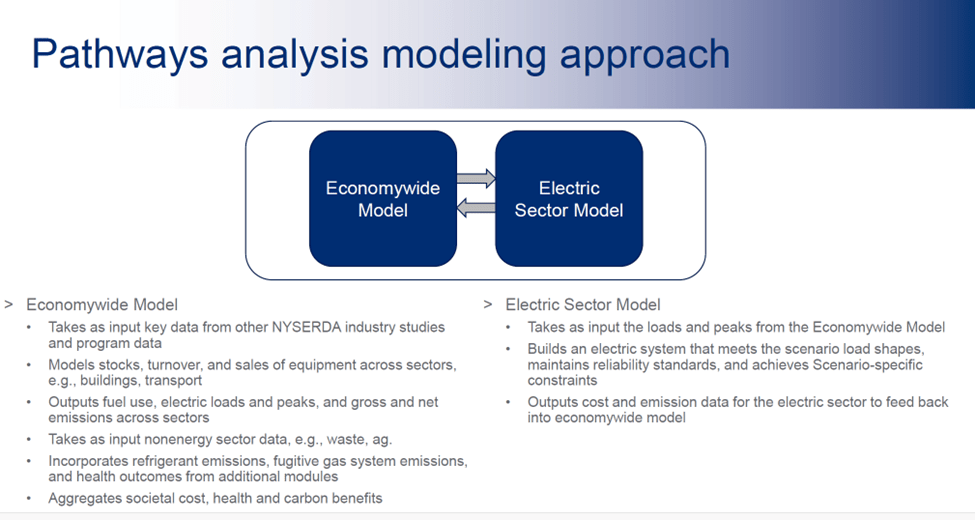
I am disappointed that the renewable energy can reduce costs claim has made it into the New York State Energy Plan process.  The Energy Plan is “a comprehensive roadmap to build a clean, resilient, and affordable energy system for all New Yorkers”.  When the Energy Planning Board met on March 3, 2025 to adopt the scope for the state energy plan the claim was mentioned.  One item on the agenda was a discussion of the “planned approach for techno-economic pathways analysis”.  This is the analysis work whereby the state agencies and their consultants will “prove” the pre-conceived notion that the Climate Act net-zero transition concocted by politicians will work. 

The presentation by Jeff Freedman from the Atmospheric Sciences Research Center, University at Albany, Albany, New York included the following slide that makes the claim that renewable energy can reduce costs. One characteristic of the New York State Energy Research & Development Authority (NYSERDA) documentation for the implementation plan is inadequate documentation, so it is not surprising that the justification for the claim is not readily available.

Table 6-1 was in New York State Climate Impacts Assessment Chapter 06: Energy.  That chapter does not address renewable energy costs specifically.  I searched for references for costs in the chapter and found only one relevant reference on page 370:

Energy costs: Fossil fuel prices are increasingly volatile, largely because they are traded on global markets. In contrast, a power sector composed of large volumes of renewable resources that have no fuel costs could lead to less volatile energy bills due to the elimination of this driver of variability in energy costs. The presence of distributed resources amplifies this effect. Whether the costs of a clean power sector are lower than, comparable to, or higher than the status quo, they will be more predictable and less likely to create indirect costs that arise from unexpected price changes.

I am aware of one other instance where this rationale was mentioned.  The December 18, 2024 New York Assembly Committee on Energy public hearing enabled legislators to question NYSERDA and the New York State Department of Public Service (DPS) staff about Climate Act progress. When Jessica Waldorf, Chief of Staff & Director of Policy Implementation, DPS was asked what impact Climate Act GHG emission reductions would have given that New York emissions are smaller than the observed annual increases in global GHG emissions. Waldorf said that there are other reasons “to build renewable energy resources in New York that are not just related to emissions.”  She gave two reasons: energy security and price volatility. 

The other thing I would say about energy security is price volatility.  Customers are beholden to the whims of the fossil fuel industry and the up and down markets that we see from fossil fuels.  Localizing our energy production and renewables allows us for price stability.  That is definitely a benefit of building resources here. 

The presumption in this article is that the basis of these claims that renewable energy will be cheaper and less volatile is that a renewable energy dependent electric system will have less unstable fuel costs resulting in cheaper and more secure energy.  This in turn is based on two presumptions: fuel prices are volatile because of global markets and renewables would eliminate this cost driver.

Fuel Volatility

The US Energy Information Administration (EIA) noted in June 2024 that fossil fuel price volatility has shown significant changes over time, with recent years experiencing particularly high levels of volatility: “In 2022, natural gas price volatility reached extreme levels, with historical volatility peaking at 171% in February 2022, the highest since at least 1994.”  Note that EIA is only discussing natural gas volatility which has become a much larger electric generating fuel source in recent years.  In my opinion, the increasing reliance on a single fuel could be the fundamental reason for the observed increase in volatility.

In any case, the New York agency global market argument picks just one driver for fuel price volatility.  The EIA  gave other reasons for natural gas variability in August 2022:

Increased uncertainty about market conditions that affect natural gas supply and demand can result in high price volatility. Events that have contributed to changing market conditions include:

  • Production freeze-offs
  • Storms
  • Unplanned pipeline maintenance and outages
  • Significant departures from normal weather
  • Changes in inventory levels
  • Availability of substitute fuels
  • Changes in imports or exports
  • Other sudden changes in demand

U.S. natural gas prices are typically more volatile during the first quarter of a year because of the fluctuating demand for natural gas for space heating as weather changes. Factors that contributed to heightened volatility in the first three months of this year include:

Of the eight events that contribute to changing market conditions and fuel volatility is the only one is related to global market conditions.

Jurisdictional Proof

When I get around to submitting a comment on the weakness of this argument, I intend to demand that the proponents of the Climate Act offer an example of a jurisdiction where the electric system has become reliant on wind and solar renewable generation and consumer costs have gone down because the fuel volatility has decreased.  To my knowledge, all jurisdictions have seen consumer cost increases. 

I used Perplexity AI to research electric energy prices as a function of wind and solar deployment.  My experience showed the weaknesses of AI research.  The response to the question whether consumers in any jurisdiction have seen decreased costs when transitioning their electric system to rely on wind and solar claimed that it was true.  The response said: “This trend is driven by the rapidly declining costs of renewable energy technologies and their increasing cost-competitiveness compared to conventional fossil fuel sources.”  The reference cited was from Ember-Energy “a global energy think tank that accelerates the clean energy transition with data and policy” that can hardly be considered an unbiased source.  The response also does not address consumer rate costs.  It makes the mistaken claim that the cost of developing renewable technologies has little relation to the delivered cost of electricity to consumers. In the real world, the cost of storage to address intermittency, the cost of additional transmission support to address diffuse wind and solar, and the cost to provide the ancillary transmission support services not available from wind and solar, make renewables much more expensive than fossil fuels.   I was unable to frame a question that provided an answer that acknowledged that the costs necessary to provide consumers with reliable power made delivered renewable energy more expensive.

German Experience

However, if the claim is true then proponents should be able to point to jurisdictions where wind, solar, and energy storage have make electric prices cheaper.  The best example of the claim that renewable energy is cheaper because it reduces fuel volatility should be Germany.  Oil, coal and gas prices spiked in the immediate aftermath of Russia’s invasion of Ukraine and have been volatile ever since. Germany’s Energiewende is the country’s planned transition to a low-carbon, nuclear-free economy and is often cited as an example of what New York should do. Enerdata reports that “According to the German Federal Network Agency, the installed renewable power capacity in Germany increased by nearly 20 GW (+12%) to nearly 190 GW in 2024.” If the proponent’s claim is true then prices should be trending down.  However, since 2000, electricity prices for German households have risen by 116%, from 13.94 to 30.43 cents per kilowatt-hour in 2019 .  As of April 1, 2024, households with basic supplier contracts were paying around 46 cents per kilowatt-hour, making it “the most expensive option compared to other providers or special contracts” .

Another way to look at the claim is to compare electricity prices within the European Union.  I highly recommend  the Nemeth Report for its coverage of European energy issues. The post EU Action Plan for Affordable Energy  includes just such a comparison.  It quotes Ursula von der Leyen, President of the European Commission, as saying: “We’re driving energy prices down and competitiveness up. We have already significantly reduced energy prices in Europe by doubling down on renewables. “

However, the data in the following figure do not support her claim. 

The analysis states that:

Note that the household price average shows a large difference between EU countries that use coal, nuclear, and gas vs those that have focused on wind and solar. For example, as shown in the chart above, according to Statista, using 2023 data, Hungary’s electricity price was 9.68 Eurocents/kwh (50% of their electricity is from nuclear, 38% coal & gas) and Bulgaria which relies mostly on coal and nuclear was around 11 Eurocents/kwh, whereas Germany, which has “doubled down on renewables” (and closed down its nuclear), was the highest at 44.97 Eurocents/kwh and Denmark which has a small population and a whole lot of windmills was at 39.44 Eurocents/kwh! 

Data sources and the year of the data matters. Eurostat uses numbers from the first quarter of 2024 which reorder some of the countries but the overall argument, that countries that “doubled down on renewables” and made other poor choices of shutting down nuclear power plants and/or coal experienced higher prices, remains supported. 

Discussion

Roger Pielke, Jr recently posted an article about the politicization of expertise that is relevant here.  He argues that society needs to depend on the expertise of specialists in many fields – “Nobody knows enough to run the government”.  As a result, society needs all of us.  He explains that “We do not have to agree on everything, but we do have to work together”.  Then he points out that “In recent years, credential expertise—like many things—has become pathologically politicized.”         

Such is the case shown by the politicization of the Climate Act implementation led by NYSERDA.   Consider, for example, the presentation by Jeff Freedman to the Planning Board.  It is concerning on a couple of levels.  In the first place, the Planning Board is composed of agency heads and political appointees who for the most part do not have background and experience in the energy sector.  Freedman was presented as an expert from the energy sector whose claim that “renewable energy can reduce costs” was probably taken as the gospel.  However, his main research focus is on “renewable energy and atmospheric boundary layer (ABL) processes” so his bias is towards renewable energy virtues and he has no energy sector experience that qualifies him to make such a statement.  He was a spokesman because of his adherence to the narrative.

In the second place, the presentations at the meeting suggest that NYSERDA will follow the Scoping Plan approach in the stakeholder process for the Energy Plan.  The primary purpose of the meeting was to approve the final scope of the Energy Plan.  As was the case with the Climate Act Scoping Plan the NYSERDA response to stakeholder comments is to document the number of comments received by category and provide general descriptions of key themes and “responsive Scope revisions”.  My problem with this is that if anyone provides specific comments or raises specific issues with claims, there is no documentation that the submittal was addressed, and nothing included to respond to the issue raised.  For example, the claim that renewable energy can reduce costs was undocumented in Freedman’s presentation.  I have no doubts that NYSERDA will continue the charade that renewable energy can reduce costs and that costs of inaction are worse than the costs of action.  They have never responded to related issues raised and will continue to do so as long as they can get away with it.  In my opinion this is another instance of pathologically politicized expertise by NYSERDA because they are so arrogant that they don’t see any need to respond to stakeholder comments.

Conclusion

The biggest threat to Climate Act progress is the inevitable extraordinary cost of implementation.  The Hochul Administration has ducked the issue since the Climate Act was passed.  They can only hide reality for so long.  The question is whether the issues associated with the net-zero transition will be addressed before New York’s economy is severely compromised.

In the meantime, if you ever hear anyone say renewable energy can reduce costs, please ask them why German electric prices are so high or to cite an example of any jurisdiction that is transitioning their electric system that has reduced ratepayer bill costs when using the Climate Act strategy to rely wind, solar, and energy storage resources.

Peer Review and Costs of Building Electrification for Commercial Users 

This is an article primarily by Richard Ellenbogen that estimates projected annual operating costs and emission reductions for New York commercial facilities when the new building codes are implemented.  It is also an example of how peer review should be done.

I am convinced that implementation of the New York Climate Act net-zero mandates will do more harm than good if the future electric system relies only on wind, solar, and energy storage because of reliability and affordability risks.  I have followed the Climate Act since it was first proposed, submitted comments on the Climate Act implementation plan, and have written over 500 articles about New York’s net-zero transition.  The opinions expressed in this article do not reflect the position of any of my previous employers or any other organization I have been associated with, these comments are mine alone.

Ellenbogen is the President [BIO] of Allied Converters and frequently copies me on emails that address various issues associated with the New York Climate Leadership and Community Protection Act (Climate Act). I have published other articles by Ellenbogen including a description of his keynote address to the Business Council of New York 2023 Renewable Energy Conference Energy titled: “Energy on Demand as the Life Blood of Business and Entrepreneurship in the State -video here:  Why NY State Must Rethink Its Energy Plan and Ten Suggestions to Help Fix the Problems”. He comes to the table as an engineer who truly cares about the environment and as an early adopter of renewable technologies at both his home and business two decades ago.

Heat Pump Hype

I am a long-time critic of the New York State Energy Research & Development Authority’s (NYDSERDA) biased promotion of all green energy technologies.  Their description of cold climate heat pumps is a good example: “Today’s cold-climate heat pumps are a smarter, more efficient option to keep your home comfortable all year long. These all-in-one heating and air conditioning systems are environmentally friendly, extremely efficient, and affordable to operate.”  In another example, they breathlessly exclaim that heat pumps outsell gas furnaces for the second straight year.  This claim uses national figures and could be solely the result of new building sales that are much stronger in southern states where heat pumps are a cost-effective choice.  Ellenbogen addresses the affordability claims below.

Ellenbogen Heat Pump Experience

Ellenbogen installed geothermal heat pumps when his house was completed in 2004.  He has 21 years of experience with them and has maintained a database of the performance and costs.  His monitoring system includes temperature sensors on the inputs and the outputs of the wells and water flow.  Because he uses a geothermal system, he can rely on it even during the coldest periods when air source heat pumps cannot extract enough energy from the air to keep the house warm.  Furthermore, his system uses deeper wells than are currently allowed by law that were legal when the system was developed.  They are also open loop which greatly increases their efficiency but that is also no longer allowed. In his configuration, his heat pumps can pull 7 tons of heat transfer per well where current geothermal wells are limited to about 2.5 tons per well.  As a result, his system can achieve a Coefficient of Performance (COP) of about 5.5 whereas current Geo-thermal systems can achieve a COP of about 3.5 with the restrictions on well depth and having to be closed loop.  During long periods of cold temperatures that force the heat pumps to run for extended periods, the well temperatures can drop and the efficiency of the system decreases so it will use more energy.

One of the things I admire as a techno-weenie is Ellenbogen’s quantitative nature.  He built his house “as a science project to satisfy his intellectual curiosity” and it has yielded an enormous amount of data. When the Indian Point nuclear station was operating, he ran a calculation and found his geo-thermal system was about 7% more carbon free than his 95% efficient modulating gas boilers that were originally installed as a backup in case of a power failure.  After New York politicians shut down Indian Point the carbon emissions of local electricity increased and the GHG emissions advantage vanished.  Given his concerns about GHG emissions he decided to figure out a cost and energy comparison.  He turned the heat pumps off this winter and used the duplicate gas system to compare with multiple years of data with the heat pumps operating.

The results are notable.  His gas bill went up less than the electric bill went down and this is for an electric system with an efficiency 57% higher than what can be built now during a colder winter.  The electric bill was about $8600 lower than it would have been with the heat pumps operating.  The gas bill only went up by $6057 for a net savings of $2543 using the natural gas heating and the current winter has been 120 degree days colder than last year.  That figure has been adjusted for the higher electricity prices this year.   Note that the heating system is well designed with 14,500 square feet of high mass radiant floors that use 100-degree water in the system and 18 separate zones which makes it even more efficient.  The large scale of the system removes measurement aberrations that might occur with a smaller system.

To compare the costs of heating with electricity and natural gas it is appropriate to compare the cost to generate the same amount of heat.  Table 1 lists the cost for the delivery of one therm (heat energy equal to 100,000 British thermal units) between a 95% efficient boiler and electric heat at relationship different Coefficient of Performance efficiency values.  A COP of 1 is inefficient.  A highly efficient ground source heat pump has a COP of 3.5.  Even an efficient ground source heat pump is 16% more expensive ($2.85 for one therm compared to $2.45 for a 95% efficient gas system in the Downstate New York area which covers 60% of the state’s population.  Also note that air source heat pumps on a very cold day can reach COP’s of 1 – 1.5 and easily go below 2.  As a result, they can be two to three times as expensive to operate.

Commercial Facility Projection

New York State legislators passed a prohibition on the installation of fossil fuel equipment and building systems starting in 2026 for small buildings and 2029 for larger ones. The prohibition starts in 2026 for new buildings up to 7 stories tall, except for commercial and industrial buildings larger than 100,000 square feet. There are exemptions for certain types of buildings including emergency backup power systems, manufacturing facilities, commercial food establishments, laboratories, hospitals and medical facilities, critical infrastructure (e.g., water treatment plants), agricultural buildings, crematoriums.

Ellenbogen applied the numbers derived from his house experiment to his business and extrapolated them to the 55,000 square foot factory which would fall under the less than 100,000 square foot rule for new construction after 2026.  Admittedly, there is no law currently in place that would require a developer who wanted to replicate Ellenbogen’s manufacturing facility because of the exemptions.  Eventually, however, the net-zero mandates will require all electric construction of all new facilities and for the replacement of existing equipment before the end of useful life.  Therefore, it is a relevant example of Climate Leadership and Community Protection Act (Climate Act). costs.

Ellenbogen’s home has a backup gas boiler heating system and his manufacturing plant has a combined heat and power system.  In 2002 he installed the first microturbine-based Combined Heat and Power (CHP) system in the Con Ed service area.  This approach generates electricity by burning natural gas.  Waste heat is recovered “to heat the building in the winter, or to be sent to absorption chillers to cool the building in the summer.”  This approach allows him to recover 70 to 75 percent of the energy content of the fuel and augments a solar array on the roof.

By doing a thermal analysis of his home’s gas usage he was able to determine what would be needed to heat the factory.  The end result is that removing gas from his manufacturing facility would raise energy bills to about $147,000, more than doubling them,  and raise his carbon footprint by about 15%.  The key takeaway is that even using the most efficient electric heating/cooling system available, it still means that this gas ban policy will cost businesses in NY state enormously while raising carbon emissions.  When and if the Downstate New York electric system reaches zero GHG emissions the carbon emissions will be reduced.

Environmental Impacts

Ellenbogen calculated that because the Downstate electric system is CO2 rate is 950 pounds per MWh according to 2022 EPA data, that the CO2 emissions from using the CHP system are actually less than if heat pumps were used.  He also pointed out he has replaced three compressors in his home’s ground source system over the past 21 years and each time the failure resulted in a full loss of refrigerant.  He said that it is not preventable and that you only find out when the unit gives a fault code with no early warning.

Discussion

This post is based on three emails from Ellenbogen.  I did not include all the calculation details he provided in the originals but will provide them if requested.  The reason for the three versions is that the details provided enabled a reader to point out an issue that he corrected.  Ellenbogen noted that:

Those damned Laws of Thermodynamics are getting in the way again, but this may be a teaching moment to show what a real peer review looks like and that we have to acknowledge errors to make sure that the best information is in the public space.  It also is a clear example of how we can’t escape those Laws in our calculations.  Miscalculations introduce errors and a failure to account for the Laws of Thermodynamics entirely when setting energy policy introduces huge errors.

This raises an issue with the implementation of the Climate Act.  The agencies responsible for the implementation plans have not provided adequate documentation to enable detailed review of the plan.  Even if it is possible to make a detailed comment on an obvious issue, there hasn’t been any acknowledgement of any problem, much less evidence of a revision to the plans.  The appropriate peer review process exemplified by Ellenbogen’s analysis is not a feature of the Climate Act stakeholder process.  As a result, Ellenbogen notes “errors are apparent across the entire spectrum of NY State’s Energy plan.”

Ellenbogen summarized his peer review concerns in this regard.

While I hate to beat on academia, it has a great deal of responsibility for NY State’s energy mess.  A certain University Professor that sat on the Climate Action Council still refuses to acknowledge that all of the technologies for this transition do not exist despite a Public Service Commission conference determining that fact in 2023.   Unfortunately, people in the legislature and certain environmental groups have adopted those ideas despite there being known large deficiencies in those theories as it applies to putting them into practice.  Untested theories that can’t be put into practice in the “Real World” are dangerous for society.  State residents shouldn’t be turned into a science project and that is what is happening. 

I received the following response to my email from a retired professor that now works in industry.  I have redacted portions to keep them anonymous.  While on average, the refrigerant replacement is every 20 years as there are three heat pumps, their observations are profound and are critical to understanding a huge issue now facing the NY State.  It follows in italics.

This is the most sobering analysis of a heating system I have ever read. I constantly hear about the miracles of heat pumps, but the carbon footprint is never honestly presented. Plus the replacement of freon every 7 years is never included. Thanks for providing a clear analysis of a day in the life of a NY business and resident.

I’m still enjoying life in XXXXXXXX, and in no longer being a professor. Academia lives in a bubble, and you can’t see that until you leave. Professors need to do a real sabbatical leave in industry and be forced to solve real problems, not problems they dream up. It’s tough out here! I thought I knew something about XXXXXX  after XX  years as an academic doing research, but XX years at XXXXXXX  has shown me I have much to learn. It is stimulating, I’m glad to be here. They need to have a similar experience.

Regarding the statement above, one of the reasons that the carbon footprints of heat pumps is never honestly mentioned is that the loudest voices in the space are the people selling them and other people don’t have enough experience to question the results.  I’ve been using them for 21 years.  My house was built as a science project to satisfy my intellectual curiosity.  It has yielded an enormous amount of data, some of which has been used by the state.

One of the major issues that I have with NY State policy is that many of the people that are hired to do the energy analyses for the government actually work for the manufacturers or other interested parties.  The reports read more like advertisements paid for by the NY State taxpayers than a sound scientific document.  I dealt with that in a 2020 paper on the Lansing Gas moratorium.  The company hired to do the Tompkins County energy analysis sold heat pumps and the resulting report reflected that and had a huge error in its results.  The paper is very relevant to the building electrification discussion.

Regarding the professor’s comments, when someone is forced to deal with the consequences of their decisions as occurs in industry, it greatly changes their perspective.  There are no negative consequences for someone theorizing about policy on a University Campus and that is okay because it can move society forward.  However, if they don’t really test those ideas before pushing them into society as a gospel, there will be huge problems and that is what we are now seeing in NY State.

Conclusion

The ramifications of New York’s Climate Act on business development are becoming evident.  In 2026, certain new buildings in New York will no longer be able to install fossil fuel equipment and building systems.  Richard Ellenbogen has performed a “science project” that proves that New York’s net-zero transition electrification plans for heating will be more expensive than using natural gas.  It is also notable that the experiment was best on a geothermal heat pump system that is more efficient than legally possible today.  Adding to the already large energy costs in New York is not a good way to attract and maintain manufacturing in the state. 

This exercise also shows the importance of robust peer review.  Ellenbogen’s first draft contained an error that was identified because he showed his work.  He acknowledged the problem and corrected his analysis.  New York’s Climate Act stakeholder process does not document analyses well enough for considered review and the Hochul Administration does not acknowledge any comments that do not comport with their narrative.  As a result, the broken stakeholder process in New York will likely ignore Ellenbogen’s real-world results. 

New York State 2024 GHG Emissions Inventory

This post describes the latest New York State (NYS) GHG emission inventory report that provides data through 2022.   The Climate Leadership & Community Protection Act (Climate Act) includes a target for a 40% reduction of greenhouse gas (GHG) emissions from 1990 levels by 2030 and the inventory has some implications relative to that target. 

I am convinced that implementation of the New York Climate Act net-zero mandates will do more harm than good if the future electric system relies only on wind, solar, and energy storage because of reliability and affordability risks.  I have followed the Climate Act since it was first proposed, submitted comments on the Climate Act implementation plan, and have written over 500 articles about New York’s net-zero transition.  The opinions expressed in this article do not reflect the position of any of my previous employers or any other organization I have been associated with, these comments are mine alone.

Overview

The Climate Act established a New York “Net Zero” target (85% reduction in GHG emissions and 15% offset of emissions) by 2050.  In addition to the 2030 GHG emission target, the electric sector is required to be 70% renewable. The Climate Action Council (CAC) was responsible for preparing the Scoping Plan that outlined how to “achieve the State’s bold clean energy and climate agenda.” The Scoping Plan was finalized at the end of 2022.  Since then, the State has been trying to implement the Scoping Plan recommendations through regulations, proceedings, and legislation. 

NYS GHG Emissions

At the end of 2024 the New York State Department of Environmental Conservation (DEC) released the 2024 statewide GHG emissions report (2024 GHG Report).  DEC is required by the Climate Act to follow unique inventory requirements.  I published an overview post of this greenhouse gas (GHG) inventory that described things that maximize emissions in an apparent attempt to make GHG emissions as large as possible.

Climate Act emissions accounting includes upstream emissions and is biased against methane.  Obviously if upstream emissions are included then the total increases but at the same time it makes the inventory incompatible with everybody else’s inventory.  There are two methane effects.  Global warming potential (GWP) weighs the radiative forcing of a gas against that of carbon dioxide over a specified time frame so that it is possible to compare the effects of different gases.  The values used by New York compare the effect on a molecular basis not on the basis of the gases in the atmosphere, so the numbers are biased.  Almost all jurisdictions use a 100-year GWP time horizon, but the Climate Act mandates the use of the 20-year GWP which increases carbon dioxide equivalent values. 

The 2024 GHG Report includes the following documents:

To calculate all the emissions in New York and estimate the upstream emissions it takes DEC, the New York State Energy Research & Development Authority (NYSERDA) and consultants two years to produce the reports.  This article compares NYS GHG inventory electric sector emissions with EPA emissions and GHG emissions through 2022 relative to the 2030 40% reduction target.

Electric Generating Unit Emission Trends

Last month I summarized New York electric sector emissions trends.  Electric generating units report emissions to the Environmental Protection Agency Clean Air Markets Division as part of the compliance requirements for the Acid Rain Program and other market-based programs that require accurate and complete emissions data.  Table 1 lists the EPA CO2 emissions by fuel type for the available years and the total electricity sector GHG emissions from the NYS GHG Inventory.

Table 1: EPA and NYS Electric Sector Emissions

The EPA electric sector emissions are significantly less than the NYS GHG inventory.  There are three primary reasons: the inclusion of upstream emissions, imported electricity emissions, and including three other greenhouse gases: methane (CH4), nitrous oxide N2O, and sulfur hexafluoride (SF6).  Note that the choice of the GWP-20 rather than GWP-100 increases the final numbers further.

2022 GHG Emissions

Table ES.2 in the Summary Report presents emissions for different sectors.  Electric generation emissions are listed as electric power fuel combustion, imported electricity, and as part of imported fossil fuels.  In 2022, GHG gas emissions from electric power fuel combustion totaled 27.79 million metric tons of carbon dioxide equivalent (mmt CO2e) using a 20-year global warming potential.  Imported electricity totaled 8.71 mmt CO2e.  Fuel combustion and imported electricity emissions were primarily CO2.  The Table ES.2 imported fossil fuel value shown covers all fossil fuel used in other sectors. 

NYS GHG Emissions Data

There is one notable feature of the GHG inventory.  DEC and NYSERDA previously conducted an analysis of statewide emissions in 1990 to establish a baseline for the “Statewide GHG Emission Limits” established by ECL 75-0107 and reflected in 6 NYCRR Part 496. It is important to understand that GHG emission inventories are not based completely on measured emissions.  The EPA CAMD data are based on direct measurements but all the other estimates are derived using emission factors and estimates of activities such as fuel use or vehicle miles traveled.  The last four emission inventories all have estimated a different 1990 value than the regulatory limit in Part 496.  The report notes “The 6 NYCRR Part 496 regulation may be revised at a later date using updated information. For your information, I have compiled all four tables explaining the differences between the estimate of gross statewide emissions in 1990 from the 6 NYCRR Part 496 rulemaking and in this report.

Trends in Sectors

The 2022 GHG Inventory includes four  sectoral reports for energy, industrial processes and product use, agriculture, forestry and land use, and waste.  The Summary Report describes the observed trends:

 In Figure ES.2, emissions are organized into the sectors described in the IPCC approach (IPCC 2006). The Energy sector encompasses emissions associated with the energy system, including electricity, transportation, and building/industrial heating. The Industrial Process and Product Use (or IPPU) sector covers emissions associated with manufacturing and manufactured products. The Waste sector encompasses any activities to manage human-generated wastes. Finally, the Agriculture, Forest, and Other Land Use (or AFOLU) sector encompasses emissions from the management of lands and livestock as well as net emission removals from land management and the long-term storage of carbon in durable goods.

The Energy sector represents the majority of emissions (76%, 2018-2022), but energy emissions in 2022 were 17.7% lower than in 1990 (Figure ES.2). The overall reduction in energy emissions was offset by increases in all other sectors and by a 1.7% decline in net emission removals. The largest increases occurred in IPPU due to the increasing use of hydrofluorocarbons (4.66mmt CO2e) and in AFOLU resulting from changes in agricultural practices (2.37mmt CO2e). Waste sector emissions declined by 4.36mmt COze over the period, primarily due to implementation of landfill gas capture systems.

Discussion

The implications of the GHG inventory are important.  The Climate Act includes a target for a 40% reduction of greenhouse gas (GHG) emissions from 1990 levels by 2030.  The NYS Part 496 1990 baseline emissions were 404.26 million metric ton (mmt) CO2e.  The total 2022 NYS emissions were 371.38 mmt CO2e which is only a 9% or 37.9 mmt CO2e reduction from the baseline.  The 2030 limit is 245.9 mmt CO2e which will require a further 34% or 163.4 mmt CO2e reduction. 

It is beyond the scope of the GHG inventory to provide any commentary regarding the achievability of meeting the 2030 target, but it is clear that, absent a miracle, the targets will not be met.  It is time for the Hochul Administration to acknowledge that the 2030 targets cannot be achieved.  The Climate Act requires that the Public Service Commission (PSC) issue a biennial review for notice and comment that considers “(a) progress in meeting the overall targets for deployment of renewable energy systems and zero emission sources, including factors that will or are likely to frustrate progress toward the targets; (b) distribution of systems by size and load zone; and (c) annual funding commitments and expenditures.”  The draft Clean Energy Standard Biennial Review Report released on July 1, 2024 will fulfill this requirement.  The final report was due at the end of 2024 but was delayed on December 17, 2024.  The draft document compared the renewable energy deployment progress relative to the Climate Act goal to obtain 70% of New York’s electricity from renewable sources by 2030.  It projects that the 70% by 2030 goal will not be achieved until 2033 when historic renewable resource deployments are considered.  The report did not address the 40% reduction of GHG emissions by 2030 target.

The Climate Act has always been a political ploy to gain favor with certain constituencies and has had little basis with reality.  Nowhere is the missing link to reality starker than regarding the implementation of emission reduction programs.  The green narrative is that the transition away from fossil fuels will be economic, simple, and only a matter of political will.  The reality is completely the opposite.  The fact is that to reduce GHG emissions to zero as mandated means that existing energy use of fossil fuels requires replacement of existing infrastructure, development of additional supporting infrastructure, and development of new implementation resources (supply chains and trained trades people).  To compound the challenge the Climate Act schedule was not developed on the basis of a rational plan.  Instead, the politicians arbitrarily chose the deadlines.  We are now seeing the results of this boondoggle and the ramifications are unclear.

Conclusion

The 2024 GHG emission inventory reports should be a wake-up call regarding Climate Act implementation.  It is clear that the 2030 GHG emission reduction target cannot be met.  In addition, the transition of the electric generating system requires a new technology to ensure reliability and the Hochul Administration has not yet responded to last summer’s Comptroller report that found that: “While PSC and NYSERDA have taken considerable steps to plan for the transition to renewable energy in accordance with the Climate Act and Clean Energy Standard, their plans did not comprise all essential components, including assessing risks to meeting goals and projecting costs.”  It is obvious that that New York State should pause implementation of the Climate Act and address the myriad issues uncovered to date.

Unraveling the Narrative Supporting a Green Energy Transition

I recently wrote an article about wind intermittency that created quite a few comments for the version that was published at Watts Up With That.  The commenters were more loud than correct and I found myself wishing that I could reference a document that addressed Green Energy advocacy talking points.  Russ Schussler, aka Planning Engineer, has provided just such a document

I am convinced that implementation of the Climate Leadership & Community Protection Act (Climate Act) net-zero mandates will do more harm than good if the future electric system relies only on wind, solar, and energy storage because of reliability and affordability risks.  I have followed the Climate Act since it was first proposed, submitted comments on the Climate Act implementation plan, and have written over 500 articles about New York’s net-zero transition.  The opinions expressed in this post do not reflect the position of any of my previous employers or any other organization I have been associated with, these comments are mine alone.

Overview

The Climate Act established a New York “Net Zero” target (85% reduction in GHG emissions and 15% offset of emissions) by 2050.  Two targets address the electric sector: 70% of the electricity must come from renewable energy by 2030 and all electricity must be generated by “zero-emissions” resources by 2040. The Climate Action Council (CAC) was responsible for preparing the Scoping Plan that outlined how to “achieve the State’s bold clean energy and climate agenda.” The Scoping Plan was finalized at the end of 2022.  The Climate Act green energy transition outlined in the Scoping Plan is starting to unravel as the politician’s aspirational fantasies meet reality.

Before he retired Russ Schussler was a long-time electric utility planning engineer.  Starting in 2014 he wrote 45 articles at the Climate Etc. blog on a wide variety of topics related to the net-zero transition that is the basis of the Climate Act. He recently published a prequel to this article that discussed the narrative around the green energy transition.  He concluded that “Expectations from the green energy narrative and real-world results are not consistent and this gulf will continue to widen as long as policy makers continue to reflexively buy into the green energy narrative.”

Schussler describes his article:

The purpose of this article is to summarize and debunk many of the issues in the narrative surrounding the proposed green energy transition.   The issues are so numerous that this piece is both too long and too short. A full unraveling deserves a book or series of books. This posting however challenges the narrative through summary comments with links to previous posts and articles which can be read for a more detailed explanation or greater depth. 

Unraveling the Narrative Supporting a Green Energy Transition

In my opinion, the typical green energy transition plan is to primarily deploy wind, solar, and energy storage to replace fossil-fired sources of electric energy. Other sources are included as “green” and clean but mostly as an afterthought.  The green energy transition narrative can be summarized as GHG emissions can be reduced to some aggressive net-zero goal simply by deploying existing technology, will be cheaper because there are no fuel costs, and will not affect the reliability of the electric grid.  Schussler notes that the components of this narrative are appealing and dangerous:

This narrative is compelling to many consumers and major policy makers. Unqualified acceptance of this powerful narrative makes it clear we should all be behind the movement to increase wind and solar generation along with other efforts to expand renewable resources.  Most all of the above statements making up the narrative are “somewhat” true. Unfortunately, the collective narrative as frequently adopted is at odds with the economics and physical realities of providing electric power and supporting civilization. 

How did a “false” narrative become so widely accepted despite dismal real-world results?  A previous posting discussed, “How the Green Energy Narrative Confuses Things” through misleading language (#44). Additionally,  tribal loyalties enable distortions and suppress more realistic assessments (#18, #10,#22, #42, & #39). While others should chime in on the social psychology supporting this movement, astute observers can’t miss the power of fear-based narratives, groupthink, demonization of dissenters and misplaced altruism (#39, #18,& #10).  Incentives and their impact on key actors play a major role (#38 & #29). The media overblowing trivialities and focusing on continually emerging “good news” helps cement undeserved optimism.   Finally, it should be noted that the electric grid has been very robust. In the short run you can make a lot of “bad decisions” before negative consequences emerge to challenge the narrative.

Narrative Statements

Schussler lists 19 component statements of the green energy narrative that are “widely believed, embraced and supported by various experts, a large part of the public and far too many policy makers”.  The article provides a response to each statement that is supported by references to 45 articles he has written since 2014.   This is an excellent resource that can be used to refute the usual suspects when they make narrative claims.  The following topics are included:

  1. Renewable Energy can meet the electric demand of the United States and World
  2. Renewable Energy is economic
  3. Renewable Energy sources can provide reliable electric service to consumers and support the grid
  4. Renewable energy sources are inexhaustible and widely available
  5. Clean Energy resources don’t produce carbon and are environmentally neutral
  6. Renewable Energy Costs are decreasing over time 
  7. It will become easier to add renewables as we become more familiar with the technologies
  8. The intermittency problems associated with wind and solar can be addressed through batteries.
  9. Inverter based generation from wind, solar and batteries can be made to perform like conventional rotating generator technology  
  10. Battery improvements will enable the green transition
  11. We are at a tipping point for renewables
  12. Wind, Solar, and Battery technologies collectively contribute to a cleaner environment, economic growth, energy security, and a sustainable future
  13. The world is facing severe consequences from increased CO2 emissions.
  14. There will be an inevitable and necessary transition to clean economic renewables
  15. Green Energy will allow independence from world energy markets
  16. The clean grid will facilitate clean buses, trucks, tanks, planes
  17. The third world will bypass fossil fuels and promote global equity
  18. Replacing fossil fuels with green energy will have huge health benefits
  19. It’s all about Urgency and Action

He acknowledges that it may be argued that the responses are short and lack detailed substantial evidence. He responds:

While there is quite a bit out there that can be referenced, it should be pointed out that the arguments supporting a green transition are asserted without with much serious reasoning and far flimsier support than provided here.  That which is easily asserted without foundation should not require overly demanding refutations. Clearly when and if more detailed claims supporting a green energy transition are made, they can be answered with more detailed rebuttals.

I particularly endorse his description of the academics whose work plays an out-sized role in the Climate Act:

Academics are a key part of the problem of a sustained false narrative. Much of the “evidence” out there comes from small studies of single variables with academic models which are stretched far behind what was analyzed.  Additionally, expert opinions come from many “experts” who “preach” far outside their fields of expertise and training. There are rewards in academia for furthering optimism on the green transition.  There are not so many incentives for nay-sayers.  Academics who understand the problems and would offer caution, generally do not have the reach of those who promote optimism by clouding the facts.  The many half-truths presented from different sources cannot be summed up to imply a credible narrative, even though many have the impression this makes a strong case.  #44

Necessary Energy Transition Narrative Truths

Another section of the article lists and references truths that need to be part of energy transition narrative.  These truths include:

  1. Adequately addressing the energy future requires we understand the true costs and benefits of ALL available and potentially available technologies. #1 & #3
  2. Large grids are dependent upon and run on rotating machines. #3#7#11#26 & #12
  3. No grids run on asynchronous generation only (or majority asynchronous) without significant backup.  Asynchronous wind, solar and batteries without rotating backup resources are not feasible power supply elements for large power systems.
  4. Hydro, biomass and geothermal are fine for grid support, but are problematic and/or not available in many areas.
  5. Wind and solar face major challenges in achieving significant penetration levels and have many underdiscussed issues. 
  6. Costs of Wind and solar resources are often hidden and assigned to others. #5#6, & #31
  7. If Nuclear is the right direction, current efforts at wind and solar are misguided. Nuclear plants run best full out with low incremental cost.   Displacing nuclear power with intermittent wind and solar makes little to no sense.
  8. It’s possible to subsidize a few things that have small costs to support development of green resources, but small costs multiplied by orders of magnitude are crushing. #6
  9. Utility costs are regressive, dis-proportionally hitting those less well-off and least able to afford rising costs. These costs are more regressive than taxation schemes. #5 #6, & #31
  10. If we must cut carbon emissions without nuclear and hydro, drastically changing civilization is an option that needs to be on the table, openly and frequently discussed and given full considered.
  11. Energy markets are not working well.  Perhaps I am wrong, but experience tells us markets uncharacteristically are not working well for energy and energy services. #45
  12. Credible plans for any electric energy future, let alone a major transition, will need to integrate studies of both supply and deliverability while balancing economics, costs and public responsibility. No conclusions about what may be worthwhile is possible without such considerations. #16 & #39

Other Topics

Schussler describes other topics that need to be considered:

  1. Givern that India and China emissions are greater than US emissions what role should we play in the proposed transition?
  2. What about developing countries in the Third World?
  3. Can effective regulation, as opposed to current regulatory practices revive nuclear construction significantly?
  4. Energy density problem (EROEI) – Can solar and wind provide enough energy to be self-perpetuating considering full lifetime needs?
  5. Grid and energy prices are globally critical to healthy economies and a reasonable quality of life.
  6. How do we incentivize policy makers to prioritize long term goals versus what’s expedient the next few years. #38 & #1

The last section of text addresses the question – when will reality force a re-assessment of the myths of the green energy narrative.  I will address that section in another post.

Discussion

My experiences writing this blog parallel Schussler’s.  As a result, he provides insights that I empathize with.  For example:

Clearly there are many discontinuities between theory and what is observed in the real world with regards to the potential for wind, solar and batteries.  Milton Friedman said, “One of the great mistakes is to judge policies and programs by their intentions rather than their results.” I’d add, “What happens in the field should be more convincing what you calculated on paper”

I have long advocated for a demonstration project and was encouraged that Schussler agrees:

The case for an energy transition based on wind, solar and batteries is grossly incomplete and stands against evidence and reason.  The green narratives sub-propositions in isolation contain some truths, but they are extended in misleading ways.   A collection of 200, 800, or ten million studies showing that isolated challenges around renewable resources can be addressed cannot make a case for reliable, affordable deliverable energy.  When the resources are ready, proponents can make a case by operating a small system without connection to conventional generation that experiences  varied load conditions and real-world challenges.  When a case for large scale penetration of wind, solar, and batteries has been made with adequate considerations of costs, reliability and deliverability, it can then be reviewed and challenged with detail.

I want to emphasize an important point about Schussler’s work.  It is from an expert whose career was dedicated to electric resource planning.  The following paragraph is advice that New York politicians that think they know best for energy policy should take to heart:

Planning must balance economics, reliability and environmental responsibility using  real workable technology which conforms with the physics of the grid and meets the needs of society (#15,#16#25#23 & #32).  Electric supply and the grid are too important to base policies upon poor narratives and incomplete understandings. Hope for future improvements must be based on realistic expectations.  Going a short way down the “green” path is easy.  Adding a bit more “renewables: isn’t that expensive and the gird is plenty robust for incremental hits.  For most involved, it’s easier to go with that flow than to stand up for long-term concerns.  But we are getting closer to the cliff as costs continue to increase and reliability problems become more prevalent. 

Conclusion

I think it is frightening that someone whose expertise I admire is worried about the scope of the problem and the possible ramifications.  Schussler concludes:

Policy makers need to consider a fuller and more complete array of truths around renewables and the grid. Rigorous considerations of many complex and interlinking issues between generation and transmission are needed to build and support modern grids. No-one, even those with a lifetime in the business, fully understands everything involved. Experience and incremental changes have served the development and operation of the grid well.  Many outside “experts”,  have next to no real knowledge of the complexities involved and propose dramatic changes. Without serious and time-consuming efforts from policy makers, real grid experts can’t compete with proposals that are basically founded upon tee-shirt slogans.  Spending money, altering systems, and hoping for the best based on the green narrative alone is a recipe for disaster. 

Net Zero Cure is Worse Than the Disease

David Turver supports my belief that New York’s Climate Leadership & Community Protection Act (Climate Act) is not in the best interests of New Yorkers.  The basis of his arguments is the unfolding disaster in Great Britain.  His post includes a video of a talk on the topic, copy of the slides, and the argument summary described below.

I am convinced that implementation of the Climate Act net-zero mandates will do more harm than good if the future electric system relies only on wind, solar, and energy storage because of reliability and affordability risks.  I have followed the Climate Act since it was first proposed, submitted comments on the Climate Act implementation plan, and have written over 500 articles about New York’s net-zero transition.  The opinions expressed in this post do not reflect the position of any of my previous employers or any other organization I have been associated with, these comments are mine alone.

Overview

The Climate Act established a New York “Net Zero” target (85% reduction in GHG emissions and 15% offset of emissions) by 2050.  It includes an interim reduction target of a 40% GHG reduction by 2030. The Climate Action Council (CAC) was responsible for preparing the Scoping Plan that outlined how to “achieve the State’s bold clean energy and climate agenda.” The Scoping Plan was finalized at the end of 2022.  Since then, the State has been trying to implement the Scoping Plan recommendations through regulations, proceedings, and legislation. 

Net Zero Cure is Worse Than the Disease

Turver introduces his arguments by noting that climate change impacts are exaggerated:

Although people like Antonio Guterres have made the foolish claim we have entered the era of global boiling, we have to acknowledge that the world has warmed a bit since pre-industrial times. The alarmist response to this is Net Zero which is an example of a so-called mitigation strategy that calls for everyone to reduce their emissions of carbon dioxide to save the planet.

Earlier this year I quoted Richard Lindzen’s description of the made-up rationale: “In this complex multifactor system, what is the likelihood of the climate (which, itself, consists in many variables and not just globally averaged temperature anomaly) is controlled by this 2% perturbation in a single variable? Believing this is pretty close to believing in magic.” 

The following paragraph eviscerates the entire rationale of the Climate Act.  Turver explains that the mitigation can never work:

The trouble with this approach is that it can only work if two conditions are met. First, mitigation can only work if CO2 is the only climate control knob. But we know this to be wrong, because the IPCC’s first report showed marked temperature fluctuations over thousand-, ten thousand- and million-year timescales when CO2 levels in the atmosphere were pretty constant. Second, mitigation can only work if everyone else follows the same strategy. But we know that global emissions of greenhouse gases are rising sharply even though ours have fallen into insignificance. Global consumption of coal, oil and gas are at record levels. Neither condition is met, so the UK’s Net Zero mitigation strategy can never work.

Turver is as frustrated as I am about the impact of net zero policies like the Climate Act:

Nevertheless, this has not stopped politicians and policymakers rushing headlong into Net Zero policies that have resulted in the UK having the most expensive industrial electricity costs in the IEA, some 4X those of the US and 2.6X Korean prices. This is leading to energy austerity with UK primary energy consumption down 23% since 1990 while global energy consumption is up 72% over the same period. Our National Energy System Operator, NESO wants to double down on energy austerity and halve our energy consumption per capita from 2023 levels by 2050.

High energy prices coupled with energy austerity have led to economic stagnation. There is a strong correlation between reduced energy use and slow growth, with the EU27 and US growing faster than the UK because they have had smaller cuts to energy use. Korea, India China and the rest of the world are using much more energy and their economies are powering ahead.

I do not see any scenario where these impacts will not occur in New York.

The rationale for the Climate Act is that we have a problem, that it can be solved by reducing greenhouse gas emissions, and that there is an easy way to reduce emissions.  Turver describes the myths created to promote renewables:

Despite the obvious economic and social costs of Net Zero, a series of myths have been created to support the renewables agenda. They claim renewables are cheap, but we pay £11bn/yr in renewables subsidies, £2.5bn for grid balancing and a further £1bn for the capacity market. National Grid have announced £112bn in spending on grid expansion by 2035 which will also find its way on to our bills. Moreover, the cost of renewables is rising and projects like Norfolk Boreas and Hornsea Project Four have been cancelled because the developers cannot make money at the prices they agreed. Ed Miliband wants to spend £260-290bn by 2030 on his Clean Power plan to save only around £7bn/yr of the money we spend on gas-fired generation.

Turver explains that the ideologues pursuing these policies think that it will improve the economy:

The second myth is that Net Zero will create jobs and growth. But the truth is expensive energy costs are destroying high-productivity industries like chemicals, petrochemicals, ceramics and steel that are growing more slowly than the rest of the economy or outright shrinking. Instead we are growing less energy intensive low-productivity sectors that are damaging productivity and growth for the whole economy. Green energy jobs are destroying real jobs and cost around £250K/yr per job.

Turver describes another myth that has been used in New York:

The third myth is that renewables increase energy security. But intermittent sources like wind and solar can never deliver security because we cannot control the weather. As a result we came close to blackouts last month as NESO suffered a margin call. We cannot rely upon interconnectors either, because the Norwegian Government fell because of the impact interconnectors are having on their electricity prices.

The Climate Act mandates that all environmental impacts of fossil fuels be considered but pointedly ignores any consideration of wind and solar development impacts.  Turver notes that this is a common flaw:

Finally, it is claimed that wind and solar renewables are green and kind to the environment. But both have very high mineral intensity, meaning massive mines will be scarring the landscape to produce the copper, silver, cobalt and rare earth metals required. They also take up a lot of land, land that would be better utilised to grow food.

The Climate Act does include a requirement to consider adaptation.  Turver explains that adaptation is a superior strategy:

By contrast, adaptation is a far superior strategy. Deaths from natural disasters and weather events have fallen more than 10-fold over the past century as we have used cheap, abundant energy to tame nature. Global life expectancy has doubled since 1850 and cereal yields are up three times since 1961. These remarkable achievements have come despite, some might argue because of, the rise in temperatures and global CO2 levels.

In my opinion, New York short changes this strategy because at its root the Climate Act is a political tool.  Politicians passed the law to cater to specific constituencies but the opportunities to make money via adaptation are small. Given that there are no organized rallies organized by politically connected constituencies at the Capitol lobbying for adaptation policies this strategy is not a priority.

Turver concludes that nuclear power is the answer:

Turning now to the answer. For humanity to thrive, we need cheap, abundant and reliable energy. This will give us the surplus energy that we need to continue to adapt by building flood defences, improving irrigation developing new crop varieties and so on. Adaptation has the big advantage is that it works regardless of the cause of global warming or climate change. The only technology that is proven to work at scale is nuclear power. This will take time, so we need gas as a transition technology. Nuclear power has the added advantage of being energy dense, reliable and requires very little mining so has the smallest overall environmental footprint. We need nuclear power everywhere all at once.

I agree that developing nuclear power is a better choice.  His pragmatic approach to use natural gas as a bridge fuel used to be the accepted path forward.  The vilification of natural gas is based almost entirely upon emotion and precludes a strategy that has proven success.

Conclusion

Philosopher George Santayana, originally stated, “Those who cannot remember the past are condemned to repeat it”.  In this instance New York is ignoring what is currently happening with respect to the net-zero transition in Great Britain.  The consequences will be the same.  Turver concludes:

Net Zero is ineffective in achieving its primary goal and can never stop the weather changing. The impact of Net Zero policies is devastating for the economy and high productivity, energy intensive industries in particular. Renewables are not kind to the environment and the lies being told to promote them are untenable. The Net Zero cure is worse than the climate change disease.

Governor Hochul and Climate Act Affordability Part 2

I have argued that Climate Leadership & Community Protection Act (Climate Act) affordability would become a political issue.  I also argued that when Governor Hochul assigns Climate Act responsibilities to the New York Power Authority (NYPA)and then says “Too many New Yorkers are already falling behind on their energy bills and I will do everything in my power to reign in these astronomical costs” when NYPA proposed raising rates to cover those costs it is hypocritical.  This post looks at utility rate impacts.  Those costs are already increasing dramatically.

I am convinced that implementation of the New York Climate Act net-zero mandates will do more harm than good if the future electric system relies only on wind, solar, and energy storage because of reliability and affordability risks.  I have followed the Climate Act since it was first proposed, submitted comments on the Climate Act implementation plan, and have written over 500 articles about New York’s net-zero transition.  The opinions expressed in this article do not reflect the position of any of my previous employers or any other organization I have been associated with, these comments are mine alone.

Overview

The Climate Act established a New York “Net Zero” target (85% reduction in GHG emissions and 15% offset of emissions) by 2050.  It includes two 2030 targets: an interim emissions reduction target of a 40% GHG reduction by 2030 and a mandate that 70% of the electricity must come from renewable energy by 2030. The Climate Action Council (CAC) was responsible for preparing the Scoping Plan that outlined how to “achieve the State’s bold clean energy and climate agenda.”  After a year-long review, the Scoping Plan was finalized at the end of 2022.  Since then, the State has been trying to implement the Scoping Plan recommendations through regulations, proceedings, and legislation. 

Personal Experience

This post was prompted by an email from a friend who sent along screen shots of his most recent and last year’s electric supply bills from New York State Electric & Gas (NYSE&G).

NYSE&G current bill screen shot:

NYSE&G electric bill from a year ago:

I looked up my electric bills.  Here are screenshots of current Niagara Mohawk Power Corporation, dba– National Grid electric rates

Here is a screenshot of the same information from a year ago:

I compared the cost increases in Table 1.  NYSE&G electric supply rates have increased sharply.  National Grid went up but not nearly as much. 

Table 1: New York Electric Supply Rate Increases Examples

New York State Electric Utility Rate Cases

The differences between the two utility rates in Table 1 is striking.  Particularly because the service territories overlap so much (Figure 1).

Figure 1: NYS Electric Utility Service Territories

I suspected that the differences at this time are due to the status of New York State electric utility rate cases.  NYSE&G has recently settled their rate case whereas National Grid is in a pending case.  National Grid rates will go up as soon as a new rate case is settled and the only question is how much.  I checked the Public Service Commission (PSC) Pending and Recent Electric Rate Cases web pages and found the following information.

Niagara Mohawk Power Corporation dba National Grid:

NMPC is requesting an increase in annual electric revenues of approximately $525 million (20 percent increase in delivery revenues or 11 percent in total revenues) for the rate year ending March 31, 2026. NMPC estimates that the requested increase in delivery revenues will result in a monthly bill increase of $18.92 (23.4 percent increase in delivery bill or 15.3 percent increase in total bill) for a typical residential customer using 625 kilowatt-hours (kWh).

For the record here is information on other rate cases listed at the PSC website.

Central Hudson:

Central Hudson Gas and Electric Corporation is requesting an increase in annual electric delivery revenues of approximately $47.2 million (8.8 percent increase in base delivery revenues, or 4.6 percent increase in total system revenues), compared to the revenues approved by the Commission for the Company’s current Rate Year. The requested increase in electric delivery revenues results in a monthly bill increase of $9.19 (8.6 percent increase on the delivery bill, or 5.3 percent increase on the total bill) for an average residential customer using 630 kilowatt-hour per month.

Consolidated Edison:

Con Edison is requesting an increase in annual electric delivery revenues of approximately $1,612 million (an 18.0 percent increase in base delivery revenues, or an 11.4 percent increase in total revenues). The requested increase in delivery revenues results in an average residential monthly delivery bill increase of $26.60 (a 19.1 percent increase on the delivery bill, or a 13.4 percent increase on the total bill) for a 600 kilowatt-hour/month customer. 

The primary drivers of the requested electric increase are local property taxes (which account for an overall electric bill increase of 3.1 percent), new infrastructure investment (2.6 percent) and operating expenses (2.6 percent). Con Edison purports that its filing will help accommodate demand growth, especially with clean energy options and substation investments, while maintaining reliability with investments in feeder replacements. The Company is also enhancing its system resiliency for more frequent and severe storms, as well as warmer temperatures.

In addition, the Company’s filing purportedly includes a focus on improving customer outreach and accessibility, enhancing customer support and the customer experience, and promoting energy efficient programs. The Company plans to expand outreach efforts to enroll eligible customers in the Energy Affordability Program.

I also did a Perplexity AI search asking the question: What is the status of New York State electric utility rate cases.  The results noted that “as of February 17, 2025, there are no pending or recent electric rate cases for New York State Electric & Gas (NYSEG). However, there are some notable developments in the New York electric utility landscape”.  The response stated:

Con Edison’s proposed rate hike: Governor Hochul has directed the state agency to reject Con Edison’s proposed rate increase, which would have raised electricity rates by 11.4% in 2026.

Orange & Rockland Utilities: There is a pending case (Case 24-E-0060) for Orange and Rockland Utilities, Inc. The company is requesting a 7.3% increase in electric delivery revenues for the rate year ending December 31, 2025.

National Grid: The company filed a request in May 2024 for new electric and gas rates in upstate New York, proposing to reset prices beginning in Spring 2025.

Previous rate increases: Con Edison has already implemented rate increases of 9% in 2023, 4% in 2024, and 1.4% in January 2025.

Discussion

The Perplexity AI response also noted that “It’s worth noting that Governor Hochul has also directed the Department of Public Service to conduct a statewide audit of utility company salaries and compensation, which may impact future rate cases.”   The referenced article notes that Governor Hochul “pushed back against proposed rate hikes from Con Edison, directing the state’s Department of Public Service to reject the company’s request for approval.”  I believe that there should be a line on bills that documents the Climate Act costs.  That transparency could be politically damaging so that will never happen.

I am also concerned about the Public Service Commission.  Given that all the Commissioners are partisan political appointees when she directs them to reject the rate case, that is what will happen.  Furthermore, most of the board has ties to green energy.  This will certainly lead to biased outcomes that I think will not be in the best interests of New York.

I asked Perplexity AI another question – Are the commissioners of the New York Public Service Commission partisan appointees of the governor. It responded that was true.  The response was based primarily upon New York Public Service Law Section 4 and stated that:

The governor appoints the commissioners with the advice and consent of the New York State Senate.

However, there are restrictions on partisan composition:

  • The commission consists of up to seven members.
  • No more than three commissioners may be members of the same political party if there are five commissioners.
  • If the number of commissioners is increased to seven, no more than four may be from the same political party.

These rules ensure some level of bipartisan representation on the commission, despite the commissioners being appointed by the governor. The commissioners serve six-year terms on a full-time basis.

However, the current composition is anything but bipartisan.  Technically there are only three Democrats and one Republican but four members have direct experience with green energy non-governmental organizations.  The Public Service Commission website for the Commissioners lists the backgrounds of the seven members. 

  • Rory M. Christian, Chair of the Commission – Chairs of New York agencies are chosen for political allegiance to the party of the Governor so I count him as a Democrat.  He also was the Director of New York Clean Energy at Environmental Defense Fund.
  • James S. Alesi – Held an office as a Republican.
  • David J. Valesky – Held an office as a Democrat.
  • John B. Maggiore – Worked in Democrat administrations.             
  • Uchenna S. Bright – Has not held political office but worked with environmental non-governmental organizations include the Natural Resources Defense Council (NRDC).
  • Denise M. Sheehan has not held political office but has “30 years of experience in government and non-profit sectors” and currently serves as Senior Advisor to the New York Battery and Energy Storage Technology Consortium (NY-BEST).
  • Radina R. Valova has not held political office.  Served as Vice President of the Regulatory Program at the Interstate Renewable Energy Council (IREC), a national non-profit organization that builds the foundation for clean energy and energy efficiency.  Prior to joining IREC, Ms. Valova served as Senior Staff Attorney and Regulatory Affairs Manager for the Pace Energy and Climate Center in White Plains.

I make that one Republican, three Democrats, and three that could conceivably be called non-partisan but certainly could also be called environmentalists.  As a result, I think the makeup of these Commissioners will acquiesce to anything the Governor wants.  At the top of that list is the Climate Act green energy narrative that transitioning away from fossil fuels to “free” solar and wind will lower prices.  If that does not happen it must be because of the greedy utility companies.

There is only one problem with that approach – reality.  In the real world, providing reliable wind and solar energy is expensive.  The utility companies will be on the hook to provide the distribution and transmission system upgrades necessary to get the diffuse solar and wind power from where it is generated to where it is needed.  The utility companies have also been told to develop infrastructure for electric vehicle charging. If Hochul’s grandstanding disapproval of rate cases continues, then how are those necessary components of the net-zero transition going to get built?

Conclusion

Hochul was quoted as saying “Too many New Yorkers are already falling behind on their energy bills and I will do everything in my power to reign in these astronomical costs.”  I can’t believe that the Hochul Administration does not understand that the transition will cost enormous amounts of money and is a major reason for those “astronomical” costs.    In my opinion, the political solution is to stop the transition and blame someone else.  I expect that the Trump Administration’s slow down of offshore wind, cancellation of electric vehicle mandates, and the cut back on components of the Inflation Reduction Act will provide the political cover for Hochul to say we tried but evil Trump makes it impossible.   Stay tuned to the political theater as this unfolds.

Governor Hochul and Climate Act Affordability

I have argued that Climate Leadership & Community Protection Act (Climate Act) affordability would become a political issue soon.  My previous article concluded that there is no way to simultaneously achieve the Climate Act emission reduction goals and maintain affordability such that it will not be a campaign issue for Governor Hochul 2026 re-election campaign.  This article follows that up with the ramifications of this news “The New York Power Authority (NYPA) backed down from a significant rate increase proposed for hydropower after facing bipartisan backlash, but it was an order from Gov. Kathy Hochul herself that ultimately doomed the plan.”

I am convinced that implementation of the New York Climate Act net-zero mandates will do more harm than good if the future electric system relies only on wind, solar, and energy storage because of reliability and affordability risks.  I have followed the Climate Act since it was first proposed, submitted comments on the Climate Act implementation plan, and have written over 500 articles about New York’s net-zero transition.  The opinions expressed in this article do not reflect the position of any of my previous employers or any other organization I have been associated with, these comments are mine alone.

Overview

The Climate Act established a New York “Net Zero” target (85% reduction in GHG emissions and 15% offset of emissions) by 2050.  It includes two 2030 targets: an interim emissions reduction target of a 40% GHG reduction by 2030 and a mandate that 70% of the electricity must come from renewable energy by 2030. The Climate Action Council (CAC) was responsible for preparing the Scoping Plan that outlined how to “achieve the State’s bold clean energy and climate agenda.”  After a year-long review, the Scoping Plan was finalized at the end of 2022.  Since then, the State has been trying to implement the Scoping Plan recommendations through regulations, proceedings, and legislation. 

NYPA Rate Hike 

According to the Governor’s press release:

Governor Kathy Hochul today announced that she is demanding the New York Power Authority suspend its proposed electric rate hike, protecting consumers from sky-high utility costs that are making New York State less affordable.

“Today, I’m calling for an end to the Power Authority’s unacceptable proposal to raise electric rates on its customers statewide,” Governor Hochul said. “Too many New Yorkers are already falling behind on their energy bills and I will do everything in my power to reign in these astronomical costs. While I recognize the Power Authority’s critical importance in providing invaluable, clean, baseload power from its large hydroelectric power plants Upstate, I expect NYPA to go back to the drawing board, shelve this existing proposal, and figure out a better way forward.”

Spectrum News provided background on the news:

The New York Power Authority backed down from a significant rate increase proposed for hydropower after facing bipartisan backlash, but it was an order from Gov. Kathy Hochul herself that ultimately doomed the plan.

The increase, which was in the midst of a lengthy implementation process, would have sent hydropower rates from $12.88/MWh to $33.05 over the next four years before settling back to a rate of $24.26 by 2029.

Republican lawmakers in Western New York pushed back on the proposal.

Sen. George Borrello told Spectrum News 1 he is thankful that NYPA called the rate hike off.

“As a business owner in New York state, this is one of he few things that is actually a positive when doing business in New York, the ability to get low cost power,” Borrello said.

Spectrum News noted that:

“At Governor Hochul’s request, NYPA will move to withdraw the 2025 proposed rate increase. We understand that New Yorkers are struggling right now, and we intend to make every effort to collaborate with our customers and stakeholders to find a way forward,” NYPA told Spectrum News 1 in a statement

NYPA had said the increases were necessary to keep pace with maintenance and operational costs.

I question the claim that the costs were primarily related to maintenance and operational costs.  I am not alone.  Spectrum News said that:

Borrello and others have blamed both instances on the state’s drive toward clean energy to meet its climate goals.

“It’s all directly related to the [Climate Leadership and Community Protection Act] then you add to it the reliability, the fact that we’ve shut down reliable forms of energy like Indian Point which supplies 20% of New York City’s power,” Borrello said.

Not surprisingly Hochul has pushed back on that premise.  When discussing the large proposed Con Ed hike, she said: “It is a factor, but to increase rates to this percentage is not supported by that.”

New NYPA Climate Act Responsibilities

In the magical world of political cost accounting, adding responsibilities to state agencies is free. In the last year Governor Hochul has placed significant mandates on NYPA related to the Climate Act.   According to the NYPA Strategic Renewables Plan dated January 28, 2025:

The 2023-24 State Budget authorized the most significant expansion of NYPA’s authority under the Power Authority Act in a generation. This expanded authority builds on the day-to-day work of NYPA staff to supply the state with reliable electricity, expand New York’s transmission system, and provide clean, affordable power and innovative energy services to our customers.

The enactment included four new areas of responsibility for NYPA, one of which expanded our authority to develop, own, and operate renewable energy generation projects to help meet the state’s clean energy goals. The expanded authority directed NYPA– beginning in 2025 and biennially thereafter– to develop and publish a renewable energy generation strategic plan that identifies our renewable energy generating priorities for the next two years. In addition, NYPA is directed to update the plan annually and may update the plan more often than annually if needed.

Beyond directing NYPA to build renewables, the budget enactment contained several other mandates:

  • NYPA will work with the New York State Public Service Commission (PSC) to establish the REACH program to provide renewable energy bill credits to low- or moderate-income New Yorkers in disadvantaged communities;
  • NYPA will invest up to $25 million annually in workforce training in collaboration with the New York State Department of Labor (DOL);
  • NYPA will cease fossil fuel generation at its small natural gas power plants by the end of 2030, so long as electric system reliability and environmental conditions allow.

In addition, NYPA will lead the Decarbonization Leadership Program, which calls for the development of energy and emissions profiles for state government’s largest carbon-emitting facilities and decarbonization action plans that will guide state agencies on facility improvements that will reduce carbon emissions.

If I was a betting man, I would wager that the costs of these efforts are a significant chunk of the revenues raised by increasing hydropower rates from $12.88/MWh to $33.05 over the next four years before settling back to a rate of $24.26 by 2029. 

Time for a Cost Reckoning

It is time for the Hochul Administration to acknowledge the total costs of all the programs associated with Climate Act implementation.  The Climate Act requires that the Public Service Commission (PSC) issue a biennial review for notice and comment that considers “(a) progress in meeting the overall targets for deployment of renewable energy systems and zero emission sources, including factors that will or are likely to frustrate progress toward the targets; (b) distribution of systems by size and load zone; and (c) annual funding commitments and expenditures.”  The draft Clean Energy Standard Biennial Review Report released on July 1, 2024 will fulfill this requirement.  The final report was due at the end of 2024 but was delayed on December 17, 2024.

On December 18, 2024, the New York Assembly Committee on Energy held a public hearing where the status of the Biennial Report was discussed.  At 28:01 of the video, Jessica Waldorf, Chief of Staff & Director of Policy Implementation, New York State Department of Public Service (DPS) explained the decision to delay:

The decision to pull the report yesterday was really based on the fact that we did a major review of the main program that would have otherwise been included in that report – the Clean Energy Standard that governs all the renewable energy programs.  That report is currently under consideration by the Commission.  Rather than do things piece meal we’re going to release the next version of the CLCPA annual report once the commission has acted on that CES biennial review.  We will include one comprehensive review report that will look back two years and also respond to other stakeholder feedback that we’ve received in response to the issuance of the first report.

My interpretation of this statement is that there is no commitment when the costs report is coming out.  If they could get away with delaying the report, they would wait until after the 2026 election.  More troubling was her comment about NYSERDA spending increases:

It also can’t be attributed to just the Climate Act.  Many of the initiatives go back several years all the way to 1996 when we started authorizing funds for things like energy efficiency investments and so a lot of programs and initiatives preceded the Climate Act. 

My concern is that this suggests that the DPS is going to hide the total costs of all the programs needed to achieve Climate Act mandates when the biennial report cost estimates are released.  The emphasis on the Clean Energy Standard when describing the review suggests that they will try to list only the costs of that component of New York’s energy plan net-zero transition. If the costs of programs and initiatives like the Clean Energy Standard, that preceded the Climate Act are not included, then Hochul can claim lower costs but New Yorkers are still on the hook for all the costs.   I recently described this as mal-information because while the costs listed are based on reality it is misleading and harms New Yorkers because it improperly excludes necessary costs to achieve all the goals of the energy transition.  New Yorkers deserve to know all the costs associated with Climate Act implementation.

Discussion

The costs of green energy policies has become an issue elsewhere as well.  Gordon Tomb of the Commonwealth Foundation recently explained that

Last October, electric grid operator PJM Interconnection received a joint letter from five Democrat governors—Pennsylvania’s Josh Shapiro, Illinois’ JB Pritzker, New Jersey’s Phil Murphy, Maryland’s Wes Moore, and Delaware’s John Carney. According to them, PJM, which supplies electricity to 13 states and the District of Columbia, has gouged customers with its annual capacity auctions

Just like Hochul rather than take accountability for destructive policies that produced the higher costs these Democrat governors are playing the blame game.  Tomb concludes:

It is time for policymakers to face the economic and physical realities of energy production. Their misguided efforts to reduce carbon emissions—from cap-and-trade schemes to government mandates favoring solar and wind—have proved costly to consumers and damaging to the reliability of power systems.

This perfectly exemplifies Progressive New York Democrats led by the Governor Hochul.  Their Climate Act fantasies are going to cost enormous amounts of money and risks to reliability have been largely ignored by them.  So far, the Hochul Administration has not fulfilled the mandate to document the “annual funding commitments and expenditures” and I suspect that they when they finally provide numbers they will continue the mal-information coverup used to minimize Scoping Plan costs y excluding costs not associated with the Climate Act itself.

There is another missing piece in the cost assessments.  The cost projections in the Scoping Plan are approaching several years old now.  It is time that those numbers were updated.  To do it right, clear documentation for all the energy use and emission reduction strategies proposed that includes assumptions, expected costs, and projected emission reductions is necessary.

Conclusion

Hochul was quoted as saying “Too many New Yorkers are already falling behind on their energy bills and I will do everything in my power to reign in these astronomical costs.”  It is inconceivable that her Administration does not understand that these new NYPA responsibilities will cost a lot of money.  That makes her actions hypocritical.  She was indignant that the companies and NYPA would hike rates when people are struggling but conveniently overlooks all the costs for renewables and other Climate Act mandates that are buried in the rate cases. It is time for transparency.  There should be a line on consumer bills that documents Climate Act costs.

New York Cap and Invest Status

New York’s Climate Leadership & Community Protection Act (Climate Act) is stalled.  This article updates the current status of NYCI implementation based on a analysis of a comprehensive overview by Samanth Maldonado titled “Green Lawmakers Pressure Hochul to Speed up Action on Climate Act”.

I am convinced that implementation of the New York Climate Act net-zero mandates will do more harm than good if the future electric system relies only on wind, solar, and energy storage because of reliability and affordability risks.  I have followed the Climate Act since it was first proposed, submitted comments on the Climate Act implementation plan, and have written over 500 articles about New York’s net-zero transition.  The opinions expressed in this article do not reflect the position of any of my previous employers or any other organization I have been associated with, these comments are mine alone.

Overview

The Climate Act established a New York “Net Zero” target (85% reduction in GHG emissions and 15% offset of emissions) by 2050.  It includes two 2030 targets: an interim emissions reduction target of a 40% GHG reduction by 2030 and a mandate that 70% of the electricity must come from renewable energy by 2030. The Climate Action Council (CAC) was responsible for preparing the Scoping Plan that outlined how to “achieve the State’s bold clean energy and climate agenda.”  After a year-long review, the Scoping Plan was finalized at the end of 2022.  Since then, the State has been trying to implement the Scoping Plan recommendations through regulations, proceedings, and legislation. 

The New York Cap-and-Invest Program (NYCI) is a key component of Climate Act implementation.  Before the 2025 State of the State was released, I believed that Governor Hochul would announce the next steps associated with the implementation of NYCI. However, the only mention of NYCI in the speech and in the FY2026 NYS Executive Budget Book noted that in the coming months the Department of Environmental Conservation (DEC) and the New York State Energy Research and Development Authority (NYSERDA) will take steps forward on developing the cap-and-invest program by proposing new reporting regulations to gather information on emissions sources.  Not surprisingly, Climate Act proponents were outraged. 

Samanth Maldonado’s article Green Lawmakers Pressure Hochul to Speed up Action on Climate Act is a useful summary of the status of NYCI.  I also realized while reading it that some arguments by people she interviewed deserved a response.

Status

Clearly Governor Hochul is having second thoughts about the Climate Act relative to her re-election ambitions in 2026.  Maldonado summarized the political considerations:

But Hochul has had other priorities and expressed a willingness to “rethink” where climate fits into her agenda. Her current main theme is “Making New York State More Affordable,” and the governor has been sensitive to anything that might hit New Yorkers’ wallets. That includes measures that would advance aspects of the climate law — but could also raise household costs.

“It was a different time,” Hochul said in July, noting that the climate law passed under her predecessor, Andrew Cuomo, adding “I can’t be caught in the past of 2019 into 2024 and 2025 and make decisions based on that, because a lot has changed.” 

She called the climate goals “something I would love to meet but also the costs have gone up so much, I now have to step back and say, “What is the cost on the typical New York family?’ just like I did with congestion pricing.”

Maldonado is clearly a believer in the rationale for the Climate, but she acknowledges that things have changed since it was passed:

That law, enacted in 2019, requires the state to drive down planet-warming emissions and shift away from fossil fuels, touching on nearly every sector of the economy and costing a projected $300 billion.  Nearly six years later, the goals at the heart of the CLCPA remain aligned with what climate scientists agree is urgent and necessary to mitigate and adapt to the impacts of a warming globe, but the political and economic environment have changed. Notably, federal funds supporting New York’s progress may disappear thanks to Trump’s federal funding freeze. 

For the record, the $300 billion dollar figure is Hochul mal-information because that figure only includes an unspecified fraction of the total costs and the projection cost methodologies consistently biased the expected costs low.  As to her deference given to Climate Scientists™ Dr. Matthew Wielicki explains that many ignore long-standing scientific norms to push alarmist narratives.

The implementation problems highlighted by Maldonado can be traced back to the fact that there is no plan that includes a feasibility assessment.  She notes that “an advisory group led by state officials came up with a blueprint to achieve the CLCPA, it did not create a spending plan, nor did it prescribe which actions to take first”.  This is because the CAC Advisory Group was made up of individuals chosen by ideology not technical expertise and limited discussion on issues outside of the narrative.  The Hochul Administration has yet to acknowledge that there is a reliability crisis brewing.  The lack of a plan is evident to others too.    

Andrew Rein, president of the Citizens Budget Commission, said that lack of planning and prioritization means it’s hard to know what the most cost-effective emissions reduction strategies or resiliency investments might be.

“We’ve got to pick and choose what we’re going to spend,” Rein said, referring to the state. “People are advocating for positions and keep debating, which makes it hard to be flexible with circumstances and facts as they change. That’s where I think New Yorkers have to come together and say, ‘We have to balance affordability, the economy and environmental needs. What can we do together?’”

I believe that it is time to pause the implementation process be paused until the issues raised bb Rein are addressed, certain technical issues considered, and proposed emission reduction strategies are defined.

Political Climate

In my opinion, the Climate Act has always been more about catering to political constituencies than reducing greenhouse gas emissions.  The failure to launch NYCI is undoubtedly due to political policy discussions. Maldonado points out:

Hochul’s recent announcement indicated the first cap-and-invest rules, related to emissions reporting, would come out by the end of this year. That means the cap-and-invest program wouldn’t likely take effect until late 2026 or sometime in 2027 — after the next election for governor. 

She also notes that:

New York is falling behind on two key requirements of the Climate Act: sourcing 70% of its electricity from renewables like solar and wind by 2030, and reducing planet-warming greenhouse gas emissions 40% below 1990 levels by 2030 (and 85% by 2050). New York is about three years behind the first target and has so far reduced emissions about 9% below 1990 levels, according to the latest data available.

The clean energy advocates also believe that NYCI’s delay is driven by politics:

Hochul’s slow-walking the cap-and-invest program is “110%” tied to her concerns around her reelection prospects, said John Raskin, president of the Spring Street Climate Fund and a political strategist.  “It’s reasonable she wants to take care of people’s immediate needs, but she’s not doing herself any political favors by rejecting or stepping away from climate action,” Raskin said. “If she wants to improve her poll numbers and for people to see her as a leader, she should move forward on climate action while communicating how it helps to meet people’s needs.”

Of course, there are very few people in the state that have a bigger stake in the Climate Act proceeding quickly than Raskin.  The Spring Street Climate Fund “supports high-impact policy campaigns that can make New York a model state for climate progress. We identify opportunities to win scalable climate solutions and invest in the grassroots climate campaigns that can succeed.”  There is nothing in their business model that addresses affordability, reliability, or environmental impacts that affect New Yorkers.

Raskin is not the only one with a vested interest.  Michael Gerrard is the founder and director of the Sabin Center for Climate Change Law at Columbia University.  The Sabin Center would not exist if there were not a problem.  Maldonado quotes a thinly veiled threat from him:

“I think Gov. Hochul was exceeding her authority much as she did when pausing congestion pricing, and DEC has a legal obligation to issue the regulations,” Gerrard said. “Cap and invest would generate revenues that could be used to build more renewable energy and more energy efficiency — things that the federal government is pulling back on.”

Gerrard spearheaded a lawsuit against Hochul’s congestion pricing pause, and now suggests legal action to challenge the cap-and-invest program delay could be on the horizon.

Advocates for NYCI presume that it would be an effective policy that would provide funding and ensure compliance because existing programs worked.  However, I have shown that results from the Regional Greenhouse Gas Initiative show that cap-and-invest programs can raise money but have not shown success in reducing emissions.  My biggest concern is that the draft NYCI documents have not acknowledged these results.  Past results are no guarantee of future success, especially when past results did not produce the results that advocates claim.

The disconnect between reality and New York Progressive politician’s understanding of the energy system and the effects of climate change is even worse.  Moldonado quotes Sen. Pete Harckham (D-Hudson Valley), chair of the Senate Committee on Environmental Conservation:

Harckham countered criticism of the Climate Act by pointing out that climate change impacts have only worsened since the law was enacted. Some investments could save money down the road, he added, a point NYSERDA staff made during public hearings about the CLCPA in years past.

“We need to be redoubling our efforts,” he told THE CITY. “Clean energy is cheaper than fossil fuel energy. I reject the equivalency that this is more expensive. In the long run, this is going to be much less expensive.”

The price on carbon through a cap-and-invest program could increase fuel costs for New Yorkers, including low- and middle-income households, in the short term, but rebates kicking in could result in net savings, according to a state analysisTwo reports issued by environmental groups in January showed how a cap-and-invest program could benefit low-income New Yorkers, depending on its design.

“We are literally showing you research and making a case that we are helping the exact New Yorkers that you say you want to from an affordability angle,” said New York City Environmental Justice Alliance Deputy Director Eunice Ko, who worked on one of the reports. “This is just one tool. We’re not saying it should be the only tool, but we need things like this, absent federal support and federal funding.”

I already explained that the State’s cost numbers are bogus.  The idea that green energy is cheaper than fossil fuel energy is wrong.  The idea that rebates could result in net savings is a favorite talking point but ignores implementation concerns.  People who are having trouble paying for energy now do not have extra money available and will have difficulty waiting for the rebates to get to them.  The claims that NYCI could benefit low-income New Yorkers are a stretch and ignore the fact that some of the money generated by NYCI must be spent to reduce emissions. 

Conclusion

I agree with those who argue that NYCI deployment has been stalled due to political reasons.  I do not agree that is necessarily a bad thing.  While I have no hope that there will be an epiphany within the Hochul Administration that expectations for NYCI must be tempered by reality.  It cannot support funding commitments to dis-advantaged communities, provide enough rebates to make low-income citizens whole, and fund emission reduction programs.  Funding should be guided by the experience gained with the similar RGGI program and the necessity to support emission reductions must be acknowledged.

The reality is that there is no way to simultaneously achieve the Climate Act emission reduction goals and maintain affordability such that it will not be a campaign issue for Hochul.  How she tries to resolve the irreconcilable will be fascinating to watch in the coming months.  Going forward or stalling for time she cannot win.