
DEFR Concerns Update

I am convinced that implementation of the New York Climate Leadership & Community Protection Act (Climate Act) net-zero mandates will do more harm than good if the electric system transition relies on wind, solar, and energy storage.  My primary reliability concern is the challenge of providing electric energy during periods of extended low wind and solar resource availability.  Experts, including those that are responsible for electric system reliability, agree that a new category of generating resources called Dispatchable Emissions-Free Resources (DEFR) is necessary during those periods.  This article summarizes a very readable description of the DEFR problem by Tim Knauss who describes the work done by Cornell’s Anderson Lab headed by Dr. Lindsay Anderson.

I have followed the Climate Act since it was first proposed, submitted comments on the Climate Act implementation plan, and have written over 470 articles about New York’s net-zero transition.  The opinions expressed in this article do not reflect the position of any of my previous employers or any other organization I have been associated with, these comments are mine alone.

Takeaway Message – If you don’t have time to read the whole thing

This post summarizes a readable description of DEFR in an article by Tim Knauss.  He described the work of Dr. Lindsay Anderson regarding the necessary DEFR component of the proposed transition of the electric system to zero emissions.  The article explains how Anderson’s team calculates the gap between future wind, solar, and energy storage generating resources needed and projected electric load during periods of low renewable resource availability.  I believe that the work of the Anderson Lab provides support to my contention that renewable development should be paused.  A renewable-based electric system needs DEFR, the most likely DEFR solution is nuclear, but if you have zero emissions nuclear then you don’t need renewables.  That makes renewables a dead-end approach.

Overview

The Climate Act established a New York “Net Zero” target (85% reduction in GHG emissions and 15% offset of emissions) by 2050.  It includes an interim 2030 reduction target of a 40% GHG reduction by 2030. Two targets address the electric sector: 70% of the electricity must come from renewable energy by 2030 and all electricity must be generated by “zero-emissions” resources by 2040. The Climate Action Council (CAC) was responsible for preparing the Scoping Plan that outlined how to “achieve the State’s bold clean energy and climate agenda.” The Integration Analysis prepared by the New York State Energy Research and Development Authority (NYSERDA) and its consultants quantified the impact of the electrification strategies.  That material was used to develop the Draft Scoping Plan outline of strategies.  After a year-long review, the Scoping Plan was finalized at the end of 2022.  Since then, the State has been trying to implement the Scoping Plan recommendations through regulations, proceedings, and legislation.  New York Department of Public Service (DPS) Proceeding 15-E-0302 addresses DEFR but there is no schedule for resolving the future plans for DEFR in New York.

Because of its importance to the feasibility of the Climate Act, the subject of DEFR rates its own Pragmatic Environmentalist of New York page.  I described the page contents last July in an article that summarized six analyses describing the need for DEFR: the Integration Analysis, New York Department of Public Service (DPS) Proceeding 15-E-0302 Technical Conference, NYISO Resource Outlook, Richard Ellenbogen, Cornell Biology and Environmental Engineering Lindsay Lab, and Nuclear New York.  I have updated the page with references to the Tim Knauss article on Cornell Professor Anderson’s work.

Syracuse Post Standard “Mind-Boggling Gap”

On November 19 the article There’s a mind-boggling gap in NY’s plan for a clean electric grid. ‘We are so far behind’ by Tim Knauss was published on the Syracuse dot com website. It is not clear to me whether the official link is accessible by non-subscribers so I have posted a version here and reproduce some of it with some annotations below.

Knauss poses the critical question: “What technology will grid operators turn to when solar and wind fall short?”.  He notes:

Maybe it will be advanced nuclear reactors. Or hydrogen-burning power plants. Nobody knows for sure. Operators will need some emission-free power source they can turn on and off at will.

At Cornell University, Professor Lindsay Anderson and fellow researchers have been studying this problem. Given the specific layout of New York’s electric grid, they asked, how much of this new power source would be needed in addition to all the solar and wind?

A staggering amount, it turns out.

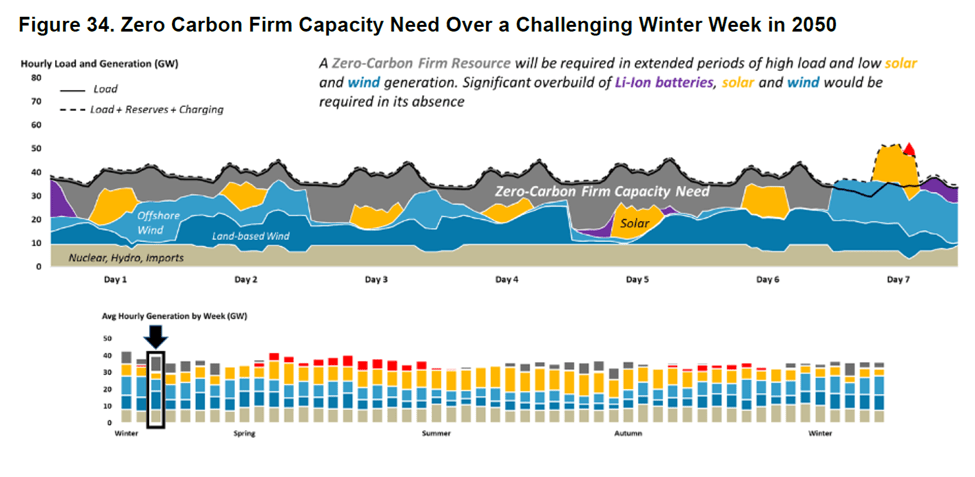
Just 15 years from now, the electric grid will need about 40 gigawatts of new generating capacity that can be activated regardless of wind speeds, cloud cover or other weather conditions, according to Anderson’s research.

How much is that? It’s roughly equal to the total capacity of all of New York’s current power plants – nuclear, natural gas, hydro, wind, all of it.

You read that right. To back up the massive quantities of solar and wind power that will provide most of our future electricity, the state power grid will need some new, mystery resource equal in size to the entire generating fleet of today.

The need for new, mystery DEFR, the potential quantity required, and the technological challenges for the resource are issues well known by those who understand the electric system.  However, there is a loud and passionate segment of society who disagree that anything new is needed and reject the scale of the projected resource need.  Anderson and Knauss understand that this is a touchy subject.  Knauss writes:

Anderson knows that’s not easy to hear.

“That’s the thing, right?’’ she said. “Where people are going to start to worry is (to) say, ‘Okay, wait, so you’re telling us that we’re going to spend all this money building out all this wind and solar and batteries — AND we have to put in 40 gigawatts of this?”

But there will have to be a backup.

Knauss describes the analysis work done to generate the “mind-boggling” projections.

Anderson chairs Cornell’s department of biological and environmental engineering. She has a PhD in applied math and a master’s degree in engineering.  For the past decade, she has worked with a shifting assortment of doctoral candidates and other graduate students in her eponymous Anderson Lab, housed in a large room full of cubicles and computers. They examine issues related to the growing importance of renewable energy.

The Anderson Lab is looking at the physics of how all that will work. To do so, they built an elaborately detailed computer model – a “digital twin’’ — of New York’s electric grid.

That level of detail sets their work apart. Many of the studies that look at phasing in renewable energy pretend that the electric grid is a single pool of electrons that flow from point to point without constraint. It‘s known as the “copper plate’’ assumption.

In reality, the New York electric grid is a complex, lopsided network that has been stitched together piece by piece over a century. There are limits on how much electric current can move from one area to another.

The six analyses that are described on my DEFR page all handle the electric system in similar fashions and all unequivocally conclude DEFR is needed.  The reference to studies that use the “copper plate” assumption refers to the analysis that was used by the politicians who authored the Climate Act.  It is the basis of the Climate Act presumption that implementation was simply a matter of political will because no new technology would be required.  New York’s electric grid experts disagree.  This contradiction needs to be resolved.

The Knauss article goes on to describe DEFR:

carbon-free generating plant that can be turned on and off as needed. It’s pronounced DEE-fur.

Today, dispatchable power is provided mostly by natural gas power plants. Energy planners hope to replace them with something that does not produce greenhouse gases. Nobody knows what that will be.

“They’ve come up with a name for something that they don’t know what it is, but their modeling shows that they need something. It kind of seems like dark matter in the universe,’’ said environmentalist Tim Judson, executive director of the Nuclear Information and Referral Service.

When the state’s Climate Action Council issued their December 2022 report on how the state will eliminate greenhouse gases from the grid by 2040, they estimated a need for 18 to 23 gigawatts of DEFRs. Anderson’s study concluded that the estimate should be roughly doubled, to 37 to 40 GW.  In its most recent forecast, the NYSIO estimated a need for at least 20 GW of DEFRs, and as much as 40 GW, by the year 2040.

Knauss explains that Anderson is concerned about the need for DEFR and the quantity required as well as the ramifications of this new resource:

The need stems from two main vulnerabilities, Anderson said.

First, there will be lulls when the wind dies down for days on end and the skies cloud over, resulting in power shortages that exceed the current ability of batteries to compensate. Second, there will be periods when the state has plenty of renewable energy but not enough transmission capacity to get it where it’s needed.

There would even be times when Upstate produced too much renewable energy, which must be disconnected to keep from overloading the grid, even as blackouts rolled across Downstate due to bottled up transmission lines.

Most of those problems are likely to occur in the coldest part of winter and the hottest part of summer, when demand for electricity will surge to peak levels. And the region most vulnerable to blackouts would be Downstate, where communities with massive electricity needs sit at the end of transmission lines from Upstate that are often overloaded.

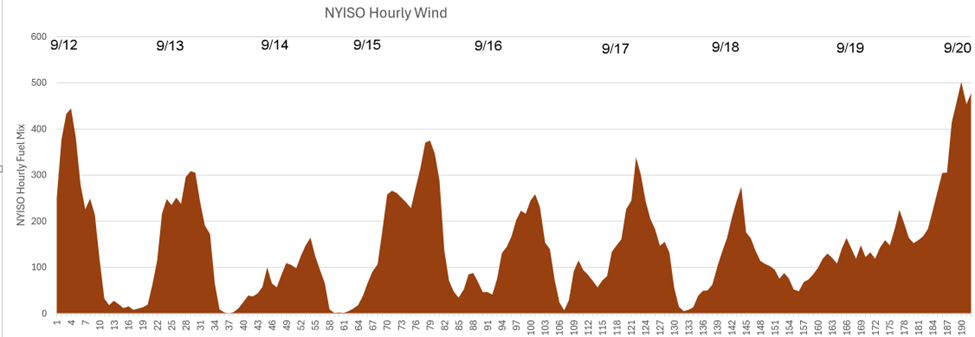
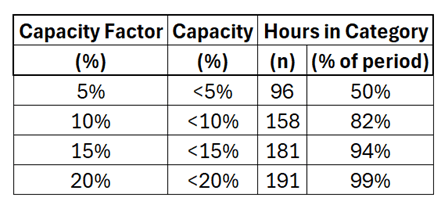
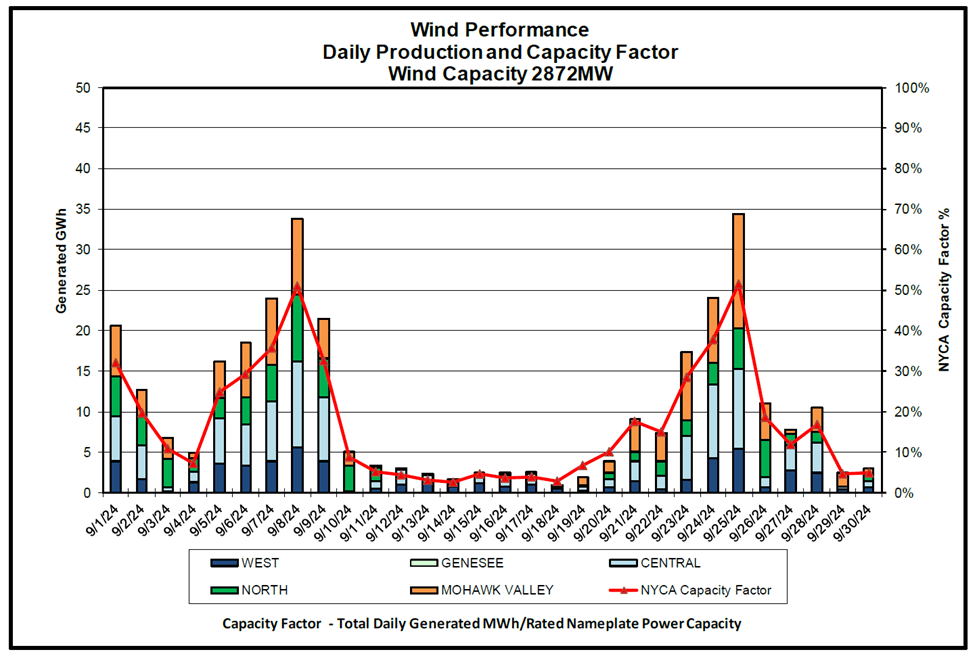
These issues raise a concern of mine.  I maintain that there are unacknowledged challenges associated with weather variability risks associated with planning for the DEFR resources needed.  The first challenge is calculating the resources needed which requires analysis of meteorological data to estimate resource availability and expected loads.  I believe no one has done a comprehensive enough analysis because they haven’t used the longest period of data available, and they have not included adjacent regional transmission operator areas.  The second challenge is more concerning to me.  The evaluation of the meteorological data develops a probabilistic estimate of the resources needed that are analogous to the one in a hundred-year flooding parameter.  The problem is that we often see a flood exceeding the one in hundred probabilities.  It is inevitable that the weather conditions that caused the worst-case resource drought planning scenario will also be exceeded.  When that happens there will not be enough electric energy available, blackouts are likely, and the consequences of blackouts on a society that decarbonized by using electricity will be catastrophic. 

There is another issue relative to the aspirational Climate Act mandate to go to “zero emissions” by 2040.  We need DEFR but the technology is not available.  Knauss describes potential DEFR technologies:

Some experts propose converting power plants to burn hydrogen rather than natural gas. Or hydrogen could be used in fuel cells, which rely on chemical reactions rather than combustion to make electricity.

Others promote the idea of sequestering the carbon emissions from gas plants underground. Or burning “renewable” methane recovered from landfills and other sources.

Recently, New York officials have expressed interest in small advanced nuclear plants, which are under development by various companies. State energy planners are developing a “roadmap’’ that should be released early next year detailing how new nuclear technology might be encouraged.

None of the possible technologies is ready for commercial application. Which will emerge?

“That’s the million-dollar question,’’ said Lanahan Kevin Lanahan, a spokesman for NYISO, the grid operator.

The article goes on to note a difference of opinion regarding DEFR deployment.  On one side is the electric industry who are obligated to provide reliable electricity.

New York is long overdue to identify DEFR technologies and to support their development, said Gavin Donohue, executive director of the Independent Power Producers of New York, a trade group representing power plant owners.  IPPNY formally asked the Public Service Commission three years ago to decide what it will accept as “zero-emission’’ generating plants. The PSC is still mulling that over in a regulatory proceeding.  “The timely development of fully dispatchable zero emitting resources is crucial to maintain reliability as the economy electrifies and reliance on intermittent renewable and duration limited resources increases,’’ the group wrote.

On the other side are the special interests who have no accountability.

But some environmentalists argue against a rush to develop DEFRs, saying it could distract from building wind and solar resources and could lead state officials to hastily subsidize unproven technology such as hydrogen combustion.

Following a technical presentation to the state Public Service Commission last year by Anderson and a NYISO planning director, representatives from Sierra Club and Earthjustice submitted rebuttal comments claiming that NYISO’s forecast of the need for DEFRs was “alarmist.” (The forecast presented by NYISO that day was about 25% lower than the Anderson Lab’s estimate.)

The critics said the state should focus on proven techniques such as importing power from out of state, improving transmission, and encouraging demand response programs under which customers cut their power consumption during peak periods.  “Rushing to deploy expensive and untested DEFRs risks committing New York to flawed technologies, as it is unclear at the present time which technologies will emerge as commercially scalable and cost effective,’’ they wrote.

I responded to some of the referenced rebuttal comments because I think their analyses are naïve.  In the first place, their analytical methodologies are not as sophisticated as the Anderson Lab.  Secondly, they don’t acknowledge the correlation of wind energy across New York so their estimates of the magnitude of the problem are flawed.  Knauss mentions the critics “solutions”.

It’s a complicated issue, in part because there are strategies other than adding power plants to help reduce demand for electricity during peak periods.  Improvements in meter technology, for example, will enable residential customers to respond during power shortages by reducing their demand, as some commercial and industrial customers do already. Likewise, grid operators could one day draw power from electric vehicle batteries during peak periods.

This line of reasoning is naïve because it ignores the fact that DEFR is needed when the electric system energy requirements are highest.  The conditions that cause light winds and low wind power output also cause extreme temperatures which lead to peak electrical loads.  Those are the conditions when residential customers are not going to want to reduce power consumption.  They will want to keep their homes warm! 

The article goes on to discuss practical alternatives to the “mind-boggling” gap and the aspirational Climate Act schedule.  Dr.  Anderson suggested looking at slightly less stringent emission limits at least as a bridge until a DEFR solution is found.

Knauss also points out that the Anderson Lab work makes the optimistic assumption that all the wind and solar projected by the Hochul Administration actually gets built on schedule.

In reality, siting battles and other issues have stalled many large wind and solar projects for years. And as inflation drives up the capital costs of renewable energy, Gov. Kathy Hochul is under mounting pressure from business and consumer groups to keep the cost of the energy transition under control.

Because of those barriers, there is a vast gap between New York’s renewable energy capacity today and what would be needed to retire all the fossil fuel plants. Developers would have to build about 10 times the wind and solar power that exists now.

“It’s a huge problem, and we are so far behind,’’ Anderson said.

Conclusion

I think that the Knauss article does a great job explaining the intricacies of the DEFR issue and the work of the Anderson Lab.  I believe they appropriately describe the challenges of DEFR.  However, the article does not address the policy implications of DEFR.

The Hochul Administration has finally started its update of the NY Energy Plan.  The draft scope of the plan considers an electric system that relies on wind and solar generation consistent with the Climate Act Scoping Plan.  No jurisdiction anywhere has successfully developed such a system.  The State agencies responsible for a reliable electric system agree with Professor Anderson that a wind, solar, and energy storage system requires DEFR.  I believe that it is prudent to fund a demonstration project to prove that such an electric system will work.  At the very least, the energy plan must provide a comprehensive renewable feasibility analysis to determine whether such a system will maintain affordability and reliability standards.

The most likely DEFR backup technology is nuclear generation because it is the only candidate resource that is technologically ready.  Nuclear power has a proven record for resilient electric production, development would not require changes to support the transmission system and buildout the system, it is not limited by weather extremes, it has lower environmental impacts, and when life cycle and backup costs are considered is likely cheaper.   Its use as backbone energy would eliminate the need for wind, solar, energy storage, and new DEFR deployment to meet Climate Act zero-emissions mandates. 

Sierra Club and Earthjustice argue that DEFR is a distraction to their preference for wind and solar development.  I believe that the work of the Anderson Lab provides support to my contention that renewable development should be paused because that development cannot work until DEFR is proven feasible.  If the DEFR solution is nuclear then renewables are a dead-end approach.

The Math Behind New York City’s Local Law 97 Does Not Add Up

This article was originally posted at Watts Up With That

New York City Local Law 97 (LL97) mandates that “most buildings over 25,000 square feet are required to meet new energy efficiency and greenhouse gas emissions limits as of 2024, with stricter limits coming into effect in 2030.”  Rich Ellenbogen explains that the numbers underpinning Local Law 97 underestimate electric grid emissions by between 39% and 47% and uses incorrect emissions numbers to calculate the penalties and as a basis for electric grid efficiency.

Ellenbogen is the President [BIO] Allied Converters and frequently copies me on emails that address various issues associated with the Climate Leadership and Community Protection Act (Climate Act). I have published other articles by Ellenbogen including a description of his keynote address to the Business Council of New York 2023 Renewable Energy Conference Energy titled: “Energy on Demand as the Life Blood of Business and Entrepreneurship in the State -video here:  Why NY State Must Rethink Its Energy Plan and Ten Suggestions to Help Fix the Problems” and another video presentation he developed describing problems with Climate Act implementation.   He comes to the table as an engineer who truly cares about the environment and as an early adopter of renewable technologies going back to the 1990’s at both his home and business two decades ago.

Local Law 97

The goal of LL97 is to reduce the emissions produced by the city’s largest buildings 40 percent by 2030 and net zero by 2050.  Like New York’s Climate Leadership and Community Protection Act (Climate Act) this is political theater without regard to practicality.  Last July I published an article here that described an evaluation by Ellenbogen, Francis Menton, and myself that the supporting documentation for LL97 falls far short of what is needed to provide New York City (NYC) residents in affected buildings with any assurance that the LL97 mandates can be met at the same time the Climate Act is transforming the electric energy system with massive deployments of wind, solar, and energy storage and unproven generating resources.  This means extraordinary risks for keeping the heat on in the winter in NYC.  Ellenbogen documents specific instances where their numbers are wrong in this post.

Problems

In this section I am going to document Ellenbogen’s criticisms re-formatted from an email to a blog post.

LL97 uses false metrics to calculate carbon emissions.  Contrary to what they claim, it increases the amount of energy required to run a building.   The city’s electricity is 91% fossil fuel generated.  For the foreseeable future, all electric heat will operate from the least efficient fossil fuel plants operating with about a 33% efficiency.   After about a 7% line loss, that is 30% efficient delivered to the building.   Some of the remote generation will be oil fired with a 50% higher GHG footprint than natural gas and higher NOx, SOx, and PM2.5 emissions.   Even if the heat pumps are 280% efficient, that leaves a holistic efficiency of 84%, which is at least 5% – 10% lower than just installing a new high efficiency onsite gas combustion that will operate with a net efficiency of between 90% – 95%.  Do they think that remote carbon emissions away from NYC buildings won’t affect climate change?  

The numbers underpinning Local Law 97 are underestimating electric grid emissions by between 39% and 47%.  By making the electric utility system look “greener” they are providing a false basis for the entire law.

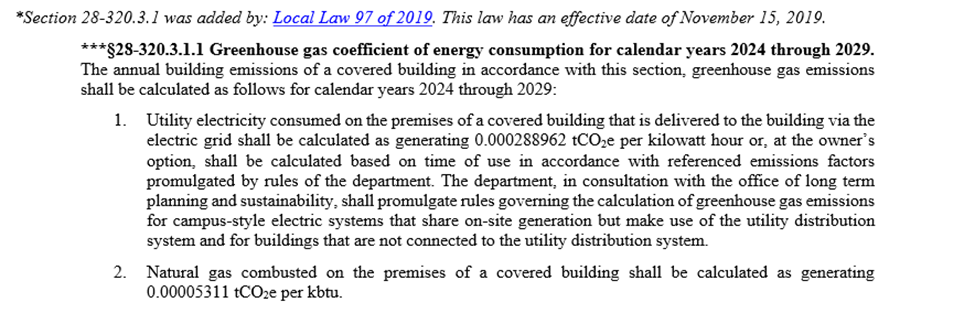
If you look at the image below, taken from page 36 (link), you will see in clause 1 that they are using 0.000288962 tCO2e per KWh (metric tons/Kwh).  Note that the document at the link cannot be downloaded which makes it very difficult for people to challenge the contents.  That value equals 0.288962 tCO2e per Megawatt Hour (MWh) which can be converted (0.288962 x 2203 pounds per metric ton) to 636.5 pounds per MWh that is used as the basis for utility system emissions in LL97.

Source: §28-320.3.1.1 Greenhouse gas coefficient of energy consumption

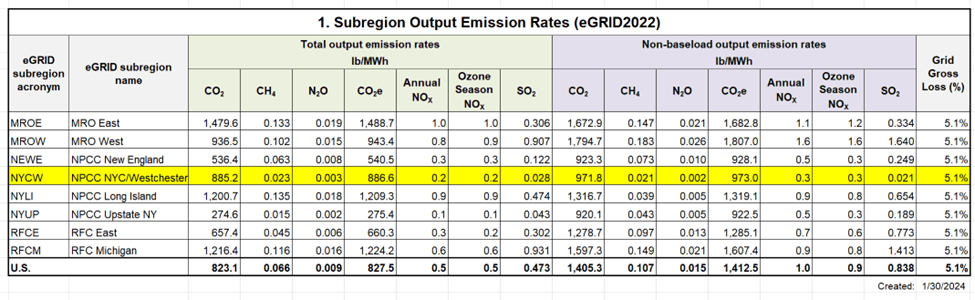
However, if you look at the table below from the US EPA, highlighted in yellow are the actual emissions that are between 886.6 pounds per MWH and 973 pounds per MWh in NY City and Westchester. So the actual utility emissions are between 39% and 47% higher than what the city is using to calculate their policy values and the associated penalties.

Source: EPA Summary Data: eGRID 2022 Summary Tables, abbreviated Table 1

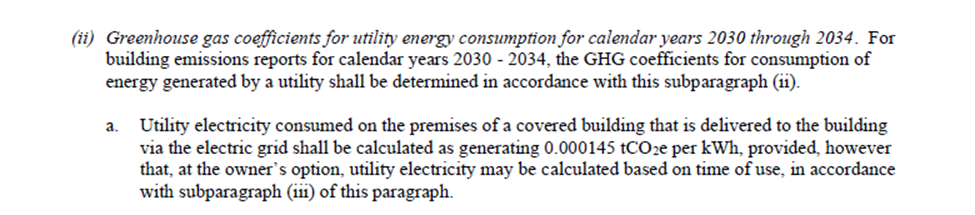
The numbers used for future emissions are also a problem.  The 636.5 pounds per MWh used in the LL97 document drops to 319 pounds/MWh in 2030 – 2034  (converted from 0.000145 value listed in the excerpt below) which is half of the 2024 value.  There is no explanation of how they expect to achieve that when it is common knowledge that all of the renewable installation numbers are being pushed back.  They are starting from numbers that err in their favor by over 40% and it just gets worse from there.

Source: 1 RCNY §103-14, CHAPTER 100 Subchapter C Maintenance of Building, page 12.

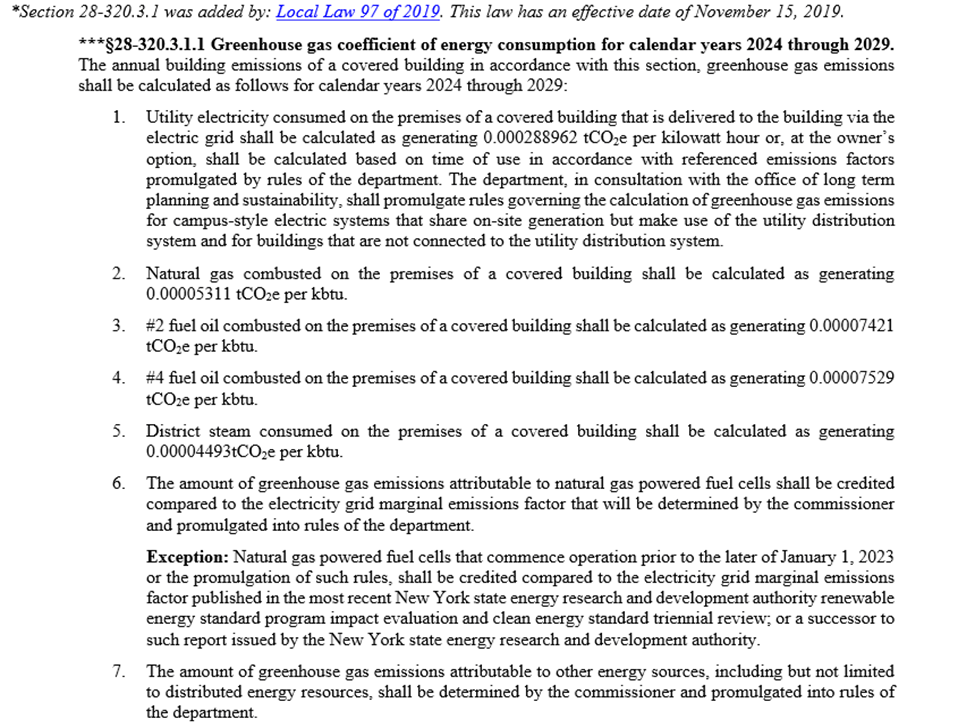
The numbers used to calculate the district steam emissions relative to the gas emissions in the document are just as big of a fantasy.  New York City has an extensive steam system with over 100 miles of pipe that bring steam from central plants to buildings in Manhattan. The unacknowledged problem in LL97 is that there are extensive energy losses in the steam system. Because of the age and size of the system they are dumping the hot water at the end of the loop, the pipes leak (as exemplified by the iconic steam puffs coming out of manholes), and they have miles of high temperature steam lines dissipating energy before it ever gets delivered so there are significant losses.  Nevertheless, LL97 calculations claim district steam with a 15% lower GHG footprint than 90% – 95% efficient on-site gas combustion.  LL97 uses the following assumptions for building emissions  taken from §28-320.3.1.1 Greenhouse gas coefficient of energy consumption  page 36:

2) Gas      0.00005311 tCO2e per KWh or 399 lb. CO2e per MWh

5) Steam   0.00004493 tCO2e per KWh or 338 lb. CO2e per MWh

They are doing everything in their power to make gas look bad.

Source: §28-320.3.1.1 Greenhouse gas coefficient of energy consumption

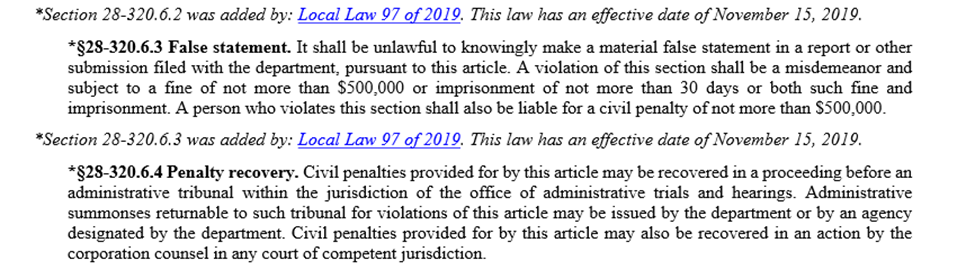
Even more comical is the clause in section 28-320.6.3 which is also copied below regarding false statements which is meant to pertain to buildings misreporting their emissions.   What they are saying is that it is okay for the city to outright lie on their policies but they will fine you up to $500,000 and put you in jail for 30 days if you do it.

Source: §28-320.3.1.1 Greenhouse gas coefficient of energy consumption

Conclusion

On occasion Rich and I talk to each other when we discover something so absurd that it beggars the imagination.  When Rich dug into the numbers and discovered these results we talked.  Basically, whoever wrote this document is just pulling numbers out of thin air.  It is a total fabrication. When you can easily find such flagrant errors in major parts of the document, nothing that is contained in it can be trusted.  Everything has been skewed to justify someone’s worldview and policy desires. 

Because of these false numbers, buildings in NY City are going be saddled with technologies that don’t produce emission savings and will simultaneously result in far higher operating costs, besides having huge upfront capital installation costs.  It provides further rationale why I believe that facilities affected by  LL97 should not even try to meet the law.

For those of us who have been analyzing this and understand the numbers, it has been apparent for years that the entire policies, both in LL97 and the Climate Leadership & Community Protection Act were fabrications.  These numbers just prove it.

Renewable Transition Raw Materials Challenge

This article was also published at Watts Up With That.

The Bulletin of the Geological Survey of Finland “publishes the results of scientific research that is thematically or geographically connected to Finnish or Fennoscandian geology.”  Bulletin 416 Special Issue publishes two articles by Simon P. Michaux should be a warning to proponents of New York State’s Climate Leadership & Community Protection Act (Climate Act). 

I have followed the New York Climate Leadership & Community Protection Act (Climate Act) since it was first proposed, submitted comments on the Climate Act implementation plan, and have written over 470 articles about New York’s net-zero transition.  The opinions expressed in this article do not reflect the position of any of my previous employers or any other organization I have been associated with, these comments are mine alone.

Note: This is a long technical post.  The takeaway message is this analysis of the metals required to transition away from fossil fuels compared to the capacity to mine those metals suggests that available metals are “manifestly inadequate for meeting projected demand”. Metals availability has not been addressed by the Climate Act implementation plan.

Estimating Metals Needed to Replace Fossil Fuels

The Preface to the Bulletin explains the purpose of the report:

The two contributions published in this Special Issue of the Bulletin of the Geological Survey of Finland highlight that a successful transition to renewable energy requires a comprehensive raw materials strategy that considers both the upstream metal demands and the downstream infrastructure needs. In technological and innovation space, exploring alternative battery chemistries, improving recycling rates, and developing more resource-efficient technologies will be crucial to mitigating the strain imposed on metal supply chains.

The earlier work of the sole author of these two papers has been widely quoted, debated, and criticized in the media and amongst policy makers and academic audiences in the past few years. The premises, process, and conclusions of these studies have questioned the validity of some of the basic assumptions underlying the current energy and natural resource policy, but have still, largely mistakenly, been taken as a statement in favor of the status quo. On the contrary, these contributions are intended as the beginning of a discourse and attempt to bring alternative, often overlooked, views into the discussion about the basic assumptions underlying the material requirements of the energy transition. Out of necessity, they make simplifications in recognizing and mapping out the scale of some key challenges in the raw materials sector that need to be overcome if the energy transition is to be realized. Calculations and estimations need to be refined and, naturally, in addition to raw materials production and the material transition, other crucial aspects such as technology and infrastructure development, workforce requirements, land use changes, and societal impacts, among others, also need to be considered.

Nevertheless, the challenges related to the complex and interconnected nature of the problem should not be taken as a cause to halt the development and innovation needed to overcome it. Further research, policy interventions, and international collaboration are all essential in securing sustainable supply chains, promoting responsible sourcing practices, and ensuring a just and equitable green and digital transition for everyone.

Scope of the Replacement System

The reference to the first article is:

Michaux, S. P. 2024. Scope of the replacement system to globally phase out fossil fuels. Geological Survey of Finland, Bulletin 416, 5–172, 50 figures, 51 tables and 10 annexes.

The Abstract states:

The task to phase out fossil fuels is now at hand. Most studies and publications to date focus on why fossil fuels should be phased out. This study presents the physical requirements in terms of required non-fossil fuel industrial capacity, to completely phase out fossil fuels, and maintain the existing industrial ecosystem. The existing industrial ecosystem dependency on fossil fuels was mapped by fuel (oil, gas, and coal) and by industrial application. Data were collected globally for fossil fuel consumption, physical activity, and industrial actions for the year 2018.

The estimated sum total of extra annual capacity of non-fossil fuel power generation to phase out fossil fuels completely, and maintain the existing industrial ecosystem, at a global scale is 48,939.8 TWh.

A discussion on the needed size of the stationary power storage buffer to manage intermittent energy supply from wind and solar was conducted. Pumped hydro, hydrogen, biofuels and ammonia were all examined as options in this paper. This study uses four stationary power buffer capacities: 6 hours, 48 hours + 10%, 28 days and 12 weeks. This power buffer is assumed to be supplied through the use of large battery banks (in line with strategic policy expectations).

An estimate is presented for the total quantity of metals required to manufacture a single generation of renewable technology units (EV’s, solar panels, wind turbines, etc.) sufficient to replace energy technologies based on combustion of fossil fuels. This estimate was derived by assembling the number of units needed against the estimated metal content for individual battery chemistries, wind turbines, solar panels, and electric vehicles. The majority of the metals needed were to resource the construction of stationary power storage to act as a buffer for wind and solar power generation.

It was shown that both 2019 global mine production, 2022 global reserve estimates, 2022 mineral resources, and estimates of undersea resources, were manifestly inadequate for meeting projected demand for copper, lithium, nickel, cobalt, graphite, and vanadium.

The analysis takes a bottom-up approach to determine what is needed for global fossil fuel replacement.  For example, Michaux estimates how many vehicles were used for transport by class and the miles traveled to estimate how much fossil fuel was used and the energy needed for replacement.  He proposes non-fossil fuel technology as replacements.  The work estimates “the quantity of electrical energy required to charge the batteries of a complete EV system” and “the quantity of electrical energy to manufacture the required hydrogen for a complete H2 Cell system” as an alternative. Estimates for “electrical energy generation, building heating with gas and steel manufacture with coal” were also determined.  The analysis found that:

The estimated sum total of extra annual capacity of non-fossil fuel power generation to phase out fossil fuels completely, and maintain the existing industrial ecosystem, at a global scale is 48,939.8 TWh. This builds upon an existing 9,528.7 TWh of non-fossil fuel electrical energy generation annual capacity. If a non-fossil fuel energy mix was used (based on an IEA prediction for 2050, IRENA 2022) was assumed, then this translates into an extra 796,709 new non-fossil fuel power plants will need to be constructed and commissioned. A discussion on the needed size of the stationary power storage buffer to manage intermittent energy supply from wind and solar was conducted. Four calculations of the size of the power buffer were done (6 hours, 48 hours, 28 days and 12 weeks). Pumped hydro, hydrogen, biofuels, battery banks and ammonia were all examined as options in this paper.

Given that Michaux is trying to estimate global energy use it is understandable that there are many simplifying assumptions.  For the intended purpose I do not think any of my observations would change the general results, i.e., I believe the estimates are close enough for results that are the right order of magnitude. My primary interest is the electric sector.  Section 14: Performance of existing fleet of electricity generation power stations estimates the availability and power production in Table 36.  In Table 38 the assumptions and estimated number of power stations needed to replace fossil-fired power stations are listed.  In the following table I combined data from both tables.

I have a few observations about these results.  Michaux had to estimate the energy split between the power systems. Solar thermal is included, which I think is a niche system suitable only for deserts.   Back calculating from the total energy requirement, he estimated the energy needed for each generation type.  The average installed plant capacity was from a reference and used to estimate the power produced by an average plant of each type.  The availability across the year parameter is close enough to capacity factor that they are interchangeable. I think nuclear availability is low. I am sure that wind and solar advocates would argue that the availabilities used are also low.  The result is a conservative estimate of the number of new power plants needed.

I did not see a distinction between onshore and offshore wind in this article, but the second article described below states:

This study projects that 1.3 million wind turbines (each one assumed to be a 6.6 MW (Megawatt capacity) will need to be operational as part of the task to completely phase out fossil fuels. Onshore units will account for 70% of this number, corresponding to 910,000 wind turbines. Offshore units will account for 30%, requiring 390,429 wind turbines.

In my opinion it would have been better to split onshore and offshore wind into two categories because the availabilities will differ.

The analysis also calculates the size of the power buffer needed to back up the predicted generation resources which is a particular interest of mine.  I will postpone a discussion of that for another post.  For the purposes of this article note that the report includes an exhaustive analysis of energy storage requirements and potential technologies to provide the necessary storage.

The first article estimates the energy necessary for the transition which was used in the second article to determine the materials resources needed for the transition.  The article notes that a massive number of new facilities will be required and that a “large wind and solar power systems would need to be internally self-sufficient and need a buffer for stable operation”.  Despite the caveat that the author did not intend to support the status quo reality intervenes.  Michaux notes: “If there are technical issues in storing the needed quantity of power for the needed time period, then it is concluded that wind and solar power generation systems are not practical as the primary energy source for the next industrial era after fossil fuel based technology.”

Quantity of Metals Required

The second article was referenced: 

Michaux, S. P. 2024. Quantity of metals required to manufacture one generation of renewable technology units to phase out fossil fuel. Geological Survey of Finland, Bulletin 416, 173–293, 38 figures, 60 tables and 2 annexes.

The abstract states:

An estimate is presented for the total quantity of raw materials required to manufacture a single generation of renewable technology units (solar panels, wind turbines, etc.) sufficient to replace energy technologies based on combustion of fossil fuels. This estimate was derived by assembling the number of units needed against the estimated metal con- tent for individual battery chemistries, wind turbines, solar panels, and electric vehicles. The majority of the metals needed were to resource the construction of stationary power storage to act as a buffer for wind and solar power generation.

This study uses four stationary power buffer capacities as modelled in a previous study: 6 hours, 48 hours + 10%, 28 days and 12 weeks. This power buffer is assumed to be supplied through the use of large battery banks (in line with strategic policy expectations). Metal quantities were calculated for all four capacities and compared with mining production, mineral reserves, mineral resources, and known under sea resources. It was also assessed whether recycling could deliver this metal quantity by comparing calculations against the sum total mined metal between 1990 and 2023. The quantity of metal mined over the last 34 years was inadequate, which means recycling cannot deliver the needed capacity, and the mining of minerals would have to be the primary source of metals for at least the first generation of non-fossil fuel technology. If a metal has not yet been mined, then that metal cannot be recycled.

There are two highlights in the following: the quantity of metals available is “manifestly inadequate” and technological scaling up issues mean wind and solar “may not be viable as the primary energy source” for the transition:

It was shown that both 2019 global mine production, 2022 global reserve estimates, 2022 mineral resources, and estimates of undersea resources, were manifestly inadequate for meeting projected demand for copper, lithium, nickel, cobalt, graphite, and vanadium. Comprehensive analysis of these calculations suggest that lithium-ion battery chemistry (on its own) is not a viable option for upscaling to meet anticipated global market demand. This then implies that battery banks would not be viable as a power buffer for wind and solar in the quantities needed. As previous work had shown that pumped hydro storage and hydrogen storage face logistical issues in scale up, the belief of strategic policy makers was that battery banks were the solution. As all of these technologies face scale up issues, wind and solar may not be viable as the primary energy source to support the next generation of industrialization.

Consequently, the development of alternative battery chemistries is recommended. The calculated shortfall in copper and nickel production was also of concern, as both metals are vital to the existing economy and there is no known viable substitute or alternative for either commodity. Another alternative would be to develop an entirely new form of electrical power generation that did not need such heavy resource supply in construction or operation.

The calculations in the first article provided the number of generating resources needed provided.  This article determined how many metals would be required for each resource based on those numbers.  For anyone wanting to evaluate material requirements for wind, solar, and battery equipment the analysis provides a lot of documentation.  Also note that Michaux included metals needed for doubling the current nuclear energy capacity, additional hydropower, and more geothermal.

In an analogous process Michaux calculated the number of zero-emission “technology units” needed to replace fossil fuels in industry and transportation.  Electric vehicles are an example of a technology unit.  Fuel cell vehicles are also included.  Table 49 from the article is the sum of all metal from all parts of this study into one quantity by metal (split into the four different power buffer storage capacities).

Source: Published in Geological Survey of Finland Bulletin 416

Conclusion

This is an ambitious analysis that covers the entire global energy system.  As such there are bound to be oversights and limitations as well as interpretative assumptions that could be issues.  In my opinion, however, the approach and assumptions are reasonable and should give a reasonable estimate of the metals needed.  The mass of metals available is another challenge but I think there is better historical data available.  Comparing the metals needed to the metals available leads to the inescapable conclusion that the dreams of replacing fossil fuels will be unable to overcome reality. The Climate Act implementation plan must evaluate the implications of this analysis before we continue down the current path.

My Comments on Draft Blueprint for Consideration of Advanced Nuclear Technologies

On September 4-5, 2024, the Hochul Administration hosted a Future Energy Summit.  After the Summit the State released the draft Advanced Nuclear Technologies Blueprint (Draft Blueprint). This post describes my submittal that explained why I supported the comments presented on behalf of Nuclear New York, New York Energy and Climate Advocates, and Mothers for Nuclear (“NNY comments”).

I have followed the Climate Act since it was first proposed, submitted comments on the Climate Act implementation plan, and have written over 470 articles about New York’s net-zero transition.  The opinions expressed in this article do not reflect the position of any of my previous employers or any other organization I have been associated with, these comments are mine alone.

Overview

The Climate Act established a New York “Net Zero” target (85% reduction in GHG emissions and 15% offset of emissions) by 2050.  It includes an interim 2030 reduction target of a 40% GHG reduction by 2030. Two targets address the electric sector: 70% of the electricity must come from renewable energy by 2030 and all electricity must be generated by “zero-emissions” resources by 2040. The Climate Action Council (CAC) was responsible for preparing the Scoping Plan that outlined how to “achieve the State’s bold clean energy and climate agenda.” The Integration Analysis prepared by the New York State Energy Research and Development Authority (NYSERDA) and its consultants quantified the impact of the electrification strategies.  That material was used to develop the Draft Scoping Plan outline of strategies.  After a year-long review, the Scoping Plan was finalized at the end of 2022.  Since then, the State has been trying to implement the Scoping Plan recommendations through regulations, proceedings, and legislation.  The Draft Blueprint is one of the implementation initiatives.

Future Energy Summit

This Summit kicked off the release of the Draft Blueprint.  My thinking about the rationale for the Summit has evolved.  The announcement for the summit said it will “gather feedback on strategies to accelerate renewable energy deployment and explore the potential role of next generation clean energy technologies”.  Initially I thought it was in response to recent reports that reassessment was necessary because of the challenges of a net-zero grid that relies on wind and solar.  I continued to believe that until the Summit even though nuclear technology was emphasized.  My initial impression of the Summit was that the Hochul Administration still has few doubts that a zero-carbon electric grid that relies on wind and solar will work.  I also described the pushback by anti-nuclear activists against the Summit focus on the potential for nuclear power.  I am now convinced that the Hochul Administration is attempting to gauge public opinion on the nuclear option.  The response to the draft Advanced Nuclear Technologies Blueprint will ultimately decide how the Administration proceeds.

My Comments

The announcement requesting comments for the Draft Blueprint said that they wanted to “solicit industry feedback”.  I do not have a background in nuclear technology, so my submittal referenced the comments submitted on behalf of Nuclear New York (NNY), New York Energy and Climate Advocates, and Mothers for Nuclear (NNY comments) that addressed technical issues.  New York Energy and Climate Advocates also submitted a letter with shorter comments.

My comments explained why I supported the NNY comments. Their comments make a persuasive case for the use of advanced nuclear energy in New York’s future.  They clearly document why nuclear has advantages over the proposed wind, solar, and energy storage approach espoused in the Climate Leadership & Community Protection Act Scoping Plan.  The NNY technical comments strengthen the quality of the Draft Blueprint.  Finally, I think the NNY comments addressed the questions posed in the Draft Blueprint very well.

The remainder of my comments support the main point of the NNY comments that nuclear power should be the backbone of the zero-emissions electric grid.  I am an air pollution meteorologist with decades of experience in the electric sector.  I support nuclear power because it addresses an intractable problem with an electric system that relies on wind and solar – weather variability.

There are several proceedings related to the Climate Act implementation that do not acknowledge that the fundamental premise of the authors of the law is fatally flawed.  The authors believed that New York could “rapidly move away from fossil fuels and instead be fueled completely by the power of the wind, the sun, and hydro.” They also believed that “it could be done completely with technologies available at that time (a decade ago) and that it could be cost effective”.  This formed the basis for their belief that implementation of the Climate Act was only a matter of political will.

My comments argue that reality is different, and the time has come to acknowledge that fact.  The Scoping Plan, NYSERDA’s Integration Analysis, New York Independent System Operator (NYISO), and the New York Department of Public Service all have noted that a new category of generating resources called Dispatchable Emissions-Free Resources (DEFR) is necessary to keep the lights on during periods of extended low wind and solar resource availability. 

It is inarguable that DEFR is needed for the future wind, solar, and energy storage dependent electric system.  I believe nuclear power is the only viable DEFR that must be employed if New York is going to proceed without compromising resource adequacy, reliability standards, and affordability for two reasons: technological availability and weather variability risks.  My comments emphasized the value of resolving the problem of weather variability risks.

Technological Availability

The first reason is that DEFR is necessary and using nuclear power for DEFR is the only proven  technology option that can be expanded.  The NNY comments point out that “the availability of fission-based advanced nuclear reactors is a matter of “commercial” readiness, not “technological” readiness.”  All the other candidate technologies that can be expanded as needed are not technologically ready.  Hydrogen was proposed as the placeholder DEFR technology but there are so many physical limitations that I think any feasibility analysis is going to show that relying on hydrogen will never work.  The same problems exist with long-duration storage.

There is one caveat on the use of advanced nuclear for DEFR support.  Resource projections estimate that the DEFR technologies will not run much which makes for a difficult business viability situation for any technology  The NNY comments explain why this calls for a shift in plans:

A more effective system-level architecture will make use of high-capacity-factor “firm” generation like nuclear power not simply as backup, but as part of the backbone of a reliable system serving a sizable portion of total energy demand in a baseload or load-following configuration. Such an arrangement reduces the total amount of generation capacity and support infrastructure needed, thereby reducing land impacts and system-level costs that are ultimately borne by ratepayers and taxpayers. Indeed, this is how upstate New York, which relies largely on baseload hydropower and nuclear, has already achieved a 90% decarbonized grid while maintaining reliable and affordable electricity.

This is an obvious solution, and it addresses my concerns about weather variability.

Weather Variability Risks

The second reason I support the use of advanced nuclear is that there is a huge unacknowledged risk related to an electric system that relies on weather-dependent resources.  All the analyses that showed the need for DEFR determined that there are extended periods with persistently low solar and wind generation that required additional firm zero-carbon resources beyond the contributions of expected zero-emissions resources.  I believe that characterizing these extended periods introduces an unacceptable risk for future electric resource planning.

I am planning to raise this issue as a problem in my responses to several draft documents and the New York Department of Public Service (DPS) staff proposal concerning definitions for key terms (Staff Proposal) in Public Service Law §66-p.  I provided an exhaustive explanation of my concerns in a recent article describing my impression of the Staff Proposal so I will only summarize the concerns here.

I think that the characterization of the gap between renewable resource generation projections and expected load should be based on analysis of historical meteorological data.  Observed meteorological data can be sed to generate the necessary information to estimate wind and solar resource production across New York and elsewhere.  In New York this type of analysis has generated estimates of onshore, offshore, wind, and solar production for a 22-year period for the New York control area.  There is a technique that has been applied elsewhere that enables a similar type of analysis back to 1950.  I believe that the State must invest in a comprehensive analysis of this data for as long a period as possible and for a region that encompasses adjoining electric control areas.

An unresolved problem is what reliability criteria should be used to determine resources necessary for these lulls. If the resource planning process does not provide sufficient backup resources to provide capacity for a peak load period, then reliability issues are inevitable.  Two factors exacerbate the severity of this problem and the importance of the reliability criteria to prevent reliability issues:

  1. The periods of highest load are associated with the hottest and coldest times of the year and frequently correspond to the periods of lowest wind resource availability. 
  2. The decarbonization strategy is to electrify everything possible so the impacts of a peak load blackout during the coldest and hottest periods will be greater.

Today’s resource planning concentrates on one-in-ten-year loss of load reliability criteria.  This period is acceptable because observations of existing generating resources over many years show that unplanned outages do not happen at the same time.  As a result, there is not much variability between ten-year periods.  However, wind and solar resources are strongly correlated.  When the wind is light at one location it is likely that many more locations have light winds.  The most recent New York Independent System Operator (NYISO) analysis found a continuous 36-hour period when 90% of the offshore wind, land-based wind and utility solar resources were unavailable for a 22-year period of record.  My concern is that if the reliability analysis had only evaluated ten years of data, they would have missed the 22-year period described.  If the reliability analysis uses the period of record back to 1950, I am confident that a more severe resource lull would be discovered. 

There are three issues.  Firstly, resource planning for the gap is necessary to ensure adequate resources are available to cover the gap.  Secondly, weather variability means that whatever period of analysis is used there always is a chance that a more severe resource drought will occur.  Finally, the DEFR projected need is large and expensive.  The unaddressed issue is the tradeoff between the planning horizon and the resources needed.  I cannot imagine a business case for the deployment of resources to address for a resource that is needed for a reliability event greater than the expected lifetime of the resource.  Consequently, there will be pressure to choose a less restrictive reliability standard even though that means that when the conditions that cause the worst-case lull inevitably occur there will be major problems.

This risk goes away if nuclear resources are used as the backbone of the future electric system.  Given the magnitude of the potential problems when renewable resources are unable to provide reliable power for the extreme weather case, this is a major reason to rely on nuclear power for a zero-emissions electric grid.  The Staff Proposal presumes that an electric system reliant on wind, solar, and energy storage will somehow work and ignore the reliability risk described here.  My comments argued that DPS staff should address this feasibility issue as soon as possible.

Conclusion

I support the NNY comments because there are fundamental reliability risks of a wind, solar, and energy storage dependent electrical system that can be eliminated by making nuclear the primary source of electrical power.  If New York wants to decarbonize without compromising resource adequacy, reliability standards, and affordability then the only feasible solution is to rely on advanced nuclear power as the primary provider of firm generation capacity and this should be reflected in the Draft Blueprint.  At some point the electric energy experts responsible for the system must tell the politicians that the arbitrary schedule and unproven technologies of a wind, solar, and energy storage zero-emissions approach are too big a risk to reliability to continue down that path.  The Blueprint document should make that case.

DPS Reviewing Progress Towards Achieving the 2040 Target

This is a lengthy post. If you want a condensed version I recommend the article published at Energy Security and Freedom blog by Tom Shepstone.

On November 4, 2024, the New York Department of Public Service (DPS) staff proposal concerning definitions for key terms (Staff Proposal) in Public Service Law §66-p was released. I described my impression of the draft definitions earlier.  The DPS Staff Proposal also included a section titled “Reviewing Progress Towards Achieving the 2040 Target” that is the subject of this post.    

I have followed the Climate Leadership & Community Protection Act (Climate Act) since it was first proposed, submitted comments on the Climate Act implementation plan, and have written over 470 articles about New York’s net-zero transition.  The opinions expressed in this article do not reflect the position of any of my previous employers or any other organization I have been associated with, these comments are mine alone.

Overview

The Climate Act established a New York “Net Zero” target (85% reduction in GHG emissions and 15% offset of emissions) by 2050.  It includes an interim 2030 reduction target of a 40% GHG reduction by 2030. Two targets address the electric sector: 70% of the electricity must come from renewable energy by 2030 and all electricity must be generated by “zero-emissions” resources by 2040. The Climate Action Council (CAC) was responsible for preparing the Scoping Plan that outlined how to “achieve the State’s bold clean energy and climate agenda.” The Integration Analysis prepared by the New York State Energy Research and Development Authority (NYSERDA) and its consultants quantified the impact of the electrification strategies.  That material was used to develop the Draft Scoping Plan outline of strategies.  After a year-long review, the Scoping Plan was finalized at the end of 2022.  Since then, the State has been trying to implement the Scoping Plan recommendations through regulations, proceedings, and legislation.  The DPS Proceeding on “Motion of the Commission to Implement a Large-Scale Renewable Program and a Clean Energy Standard” case number 15-E-0302 is the primary implementation proceeding.  The Staff Proposal was posted as part of that proceeding.

Background

On November 4, 2024, the DPS staff proposal concerning definitions for key terms (Staff Proposal) in Public Service Law §66-p was released.  I described the definitions earlier.  This post coves the provision to review progress. The Introduction of the Staff Proposal explains:

The primary purpose of this proposal is to clarify what is encompassed within the term “statewide electrical demand system” and articulate broad criteria for compliance with a “zero emissions” standard. In addition to proposing definitions – and in light of the proposed definitions’ implications – Staff also recommends that the Commission direct Staff to develop a review process consistent with the provisions of PSL §66-p that tracks progress toward the power sector energy transition targets.

Reviewing Progress Towards Achieving the 2040 Target

The Staff Proposal acknowledges my fundamental concern that there is no real plan for implementation.  The Scoping Plan is an outline of strategies that NYSERDA’s Integration Analysis claims will reduce emissions consistent with the Climate Act mandates but there never has been a feasibility analysis of the strategies.  DPS Staff “believes that it is timely to interpret provisions of PSL §66-p that authorize the Commission to consider impacts of the zero emissions by 2040 target on safe, reliable, and affordable electric service in the state.”  Unfortunately, the Staff Proposal focused on timeliness and short-changed discussion of safe, reliable, and affordable electric service.

The Hochul Administration and all the state agencies involved with the Climate Act transition have ignored the fact that no jurisdiction has demonstrated that an electric system relying on wind, solar, and energy storage is viable.  Francis Menton, Rich Ellenbogen and I have argued that a demonstration project that proves that the proposed transition will work is necessary before implementation proceeds.  This is a fundamental safety, reliability, and affordability constraint that is not addressed in the Staff Proposal.  At the very least, I believe a feasibility analysis should be the next step.

The Staff Proposal addresses the timeliness of the wind, solar, and energy storage deployment but just assumes that an electric system reliant on wind, solar, and energy storage will somehow work:

Pursuing the 2040 target will require the deployment of novel technologies and their integration into a changing grid. Further, as recent experiences with pandemic, supply chain disruptions, inflation, changes to interest rates, the effects of federal policy on domestic manufacturing, and revised expectations about load growth have made plain, progress toward the target will be heavily contingent on pressures beyond New York State’s control. Staff believes the 2040 target must be interpreted and implemented without compromising resource adequacy, reliability standards, and affordability.

I am concerned with the novel technologies mentioned in this paragraph.  The Staff Proposal mentions the December 2023 technical conference hosted by DPS Staff and NYSERDA discussion of potential technologies.  The New York Independent System Operator 2023-2042 System & Resource Outlook (“Outlook”)  Overview in Appendix F – Dispatchable Emission-Free Resources evaluates three Dispatchable Emissions-Free Resource (DEFR) options that they believe represent the most likely viable approach but concede that there still are concerns even with these:

While DEFRs represent a broad range of potential options for future supply resources, two technology pathways being discussed as potential options for commercialization are: 1) utilization of low- or zero-carbon intensity hydrogen (typically generated by electrolysis derived from renewable generation) in new or retrofit combustion turbine or fuel cell applications or 2) advanced small modular nuclear reactors, which are currently seeking approval from the relevant regulatory bodies to design and operate these resources.  Currently, both technologies have shown limited commercial viability on the proof of concept. Even assuming that they are commercially viable, there remains significant work in the implementation and logistics that must be overcome to economically justify transitioning the dispatchable fleet to some combination of new technologies in the next 15 years. Long-duration energy storage could potentially serve in the role of the modeled DEFRs in the Outlook. In many respects, long-duration energy storage closely mimics various hydrogen production and conversion pathways. Long-duration energy storage adds to load in many hours, similar to electrolysis production of hydrogen. However, a notable difference is that electrolysis production of hydrogen has a lower round-trip efficiency when injecting energy into the system compared to other long duration energy storage technologies under development.

Given that none of these technologies are likely to be available consistent with the needs for the Climate Act schedule, it is understandable that the schedule is a concern.  Nonetheless, I am very frustrated that DPS Staff are only paying lip service to resource adequacy, reliability standards, and affordability because there are unaddressed reasons that the wind, solar, and energy storage approach may never work with those constraints.  First and foremost, the only one of the three DEFR technologies described that has no technology issues is nuclear.  There are commercial readiness issues, but the technology has a proven track record.  On the other hand, there are physical limitations that may prevent hydrogen technology or long-duration storage from ever working.  Because a DEFR technology is needed, it is likely that the DEFR solution will be nuclear.  An assessment of resource adequacy, reliability standards, and affordability impacts of a system using nuclear power would likely find that relying on nuclear instead of weather dependent renewables is a better approach.  Compared to wind and solar, nuclear generation produces synchronous power that requires no additional ancillary service support, has a much lower areal footprint, and fewer life-cycle environmental impacts.

Weather Variability Risk

There is another huge advantage of an electric system relying on nuclear power.  The unacknowledged resource variability risks of the wind, solar, and energy storage electric system proposed would be eliminated.  I believe that there is an enormous risk associated with the specification of just how much DEFR is necessary so bear with me as I describe my concern. The Staff Proposal states that:

Comments filed since the December 2023 technical conference have highlighted the importance and analytical challenges of estimating the size of a potential reliability gap. Staff does not endorse a specific estimate of the potential 2040 gap, but it does take the view that the trends on the supply and demand sides of New York State power sector’s make likely a gap that would require at least 10 to 20 GW of clean firm generating capacity to fill. This view is informed in part by the draft analysis, recently published by Staff and NYSERDA, of recent global disruptions and other factors’ delaying effects on large-scale renewables deployment in New York. As for new technologies that could be deployed in the coming years to help New York hit the 2040 target, panelists at the December 2023 technical conference described how several show promise, but panelists and commenters also noted diverse factors that make deployment at the locations and scale required uncertain.

In my opinion, DPS Staff and NYSERDA have not yet to come to grips with the analytical challenges of estimating the size of the potential reliability gap.  I described analyses of the gap in comments submitted on July 3, 2024 in response to comments submitted by Sierra Club and Earthjustice dated June 14, 2024 in the Case No. 15-E-0302 docket.  I explained that all renewable resource projection analyses should use historical meteorological data to provide the basis for projections of future load and estimates of electric resource availability based on projected deployment of wind, solar, energy storage, and other technologies needed to supply the expected load.  Hourly meteorological data across the state produced using current weather forecast modeling techniques yield hourly demand forecasts and wind and solar energy output profiles for the periods being studied.  I believe that the State must invest in a comprehensive analysis of these data for as long a period as possible.

There has been some analysis that shows the extent of the problem.  The NYISO is working with its consultant DNV to assess New York onshore wind, offshore wind, and solar resource availability.  Their analysis uses a 23-year historical meteorological database for the New York State renewable resource areas. Similar analyses are underway in other regional transmission operator regions.  It has also been recognized that larger areas need to be treated similarly.  The Electric Power Research Institute has a Low-Carbon Resources Initiative that has been evaluating resources across the North America.

All these analyses find there are frequent and extensive periods of low renewable resource availability.  For example, the New York State Reliability Council Extreme Weather Working Group (EWWG) analyzed the high resolution NY offshore wind data provided by NYISO and its consultant DNV for offshore wind resources.  The summary of the report stated:

The magnitude, duration, and widespread geographic impacts identified by this preliminary analysis are quite significant and will be compounded by load growth from electrification. This highlights the importance of reliability considerations associated with offshore wind and wind lulls be accounted for in upcoming reliability assessments, retirement studies, and system adequacy reviews to ensure sufficiency of system design to handle the large offshore wind volume expected to become operational in the next five to ten years.

That analysis used a 21-year database.  I think the DPS staff proposal used a shorter weather analysis database that results in the CGPP estimate being “substantially below the 20-40+ GW range estimate published by NYISO in its 2023-2042 System and Resource Outlook”.  The period of record makes a big difference.  I found that in a similar type of analysis, the Independent System Operator of New England (ISO-NE) Operational Impact of Extreme Weather Events, used a database covering 1950 to 2021 to analyze gap impacts.  The analysis found that if the resource adequacy planning for New England had only looked at the last ten years instead of the period of record that they would have underestimated the resources necessary by 5.1% because there was a longer renewable resource drought outside of the last ten years.

Even if the State uses a longer data period there is a major reliability risk that has not been acknowledged.  Current resource assessments are based on observations of existing generating resources over many years that show that unplanned outages do not happen at the same time.  There is no reason to expect, for example, that all the nuclear plants will be forced offline at the same time.  This characteristic enables the resource planners to conservatively determine how much generating capacity is necessary to meet the probability of losing load not more than once in ten years loss of load expectation (LOLE) reliability criterion.  Importantly, I believe that the lack of correlation also means that the capacity needed above firm system load would not change substantially if the LOLE planning horizon was shifted to a longer period.

Variations in weather affecting wind and solar resource availability will require changes to electric resource planning.  Everyone has heard of a hundred-year flood which is the parameter used for watershed planning.  This is the one in a hundred probability that the water level in a river or lake will exceed a certain level in a given year.  Similar probability estimates of low wind and solar resource availability must be developed and incorporated into electric resource planning.

Electric resource planning is complicated by the observation that the meteorological conditions that cause low wind and solar resource availability are so large that they can affect all of New York and adjacent areas at the same time.  This means that wind and solar outages will be widespread, affecting many facilities at the same time.  The unacknowledged issue is that the design of an affordable and practical system to meet the worst-case weather induced lull will always involve a tradeoff between practicality and affordability versus the probabilistic estimate of the worst-case lull.   

An unresolved problem is what approach is acceptable for addressing these lulls.  If the resource planning process does not provide sufficient backup resources to provide capacity for a peak load period, then reliability issues are inevitable.  Two factors exacerbate the severity of this problem and the importance of the reliability criteria:

  1. Periods of highest load are associated with the hottest and coldest times of the year and frequently correspond to the periods of lowest wind resource availability. 
  2. The decarbonization strategy is to electrify everything possible so the impacts of a peak load blackout during the coldest and hottest periods will be greater.

I think that the reliability planning process should use as much historical data as possible to define the worst case.  Consider the ISO-NE analysis where it was found that the most recent 10-year planning lookback period consistent with current LOLE evaluations would plan for a system risk of 8,714 MW.  If the planning horizon covered the period back to 1950, a worst-case situation in 1961 would be considered and an additional 446 MW would be required to meet system risk. 

The unaddressed issue is the tradeoff between the planning horizon and the resources needed.  I cannot imagine a business case for the deployment of 446 MW electric system resources that will only be needed once in 63 years.  For one thing, the life expectancy of these technologies is much less than 63 years.  Even over a shorter horizon such as the last ten years, how will a required facility be able to stay solvent when it runs so rarely?  Any reliability mandate that requires consideration of the worst-case lull over an extended period of record like this example is going to be expensive.  Consequently, there will be pressure to choose a less restrictive reliability standard even though that means that when the conditions that cause the worst-case lull inevitably occur there will be major problems.

This risk goes away if nuclear resources are used as the backbone of the future electric system.  Given the magnitude of the potential problems when renewable resources are unable to provide reliable power for the extreme weather case, this is a major reason to rely on nuclear power for a zero-emissions electric grid.  The Staff Proposal presumes that an electric system reliant on wind, solar, and energy storage will somehow work and ignores the reliability risk described here.  DPS staff should address this feasibility issue as soon as possible.

Ambiguities in PSL §66-p(2)

I have long argued that implementation of the Climate Act has ignored the safety valve provisions in §66-p (4).  That section of the law states: “The commission may temporarily suspend or modify the obligations under such program provided that the commission, after conducting a hearing as provided in section twenty of this chapter, makes a finding that the program impedes the provision of safe and adequate electric service; the program is likely to impair existing obligations and agreements; and/or that there is a significant increase in arrears or service disconnections that the commission determines is related to the program.”  I believe that the zero emissions resource could be a primary driver of concerns related to the reliability and affordability provisions of § 66-p (4) so it is incumbent upon DPS to address these considerations quickly.  The criteria used to define “safe and adequate electric service” and “significant increase in arrears or service disconnections” must be established to meet this provision. 

It is encouraging that DPS Staff recognize that the definition of some of these terms is appropriate.  The Staff Proposal states:

Staff finds that the Commission’s authority under PSL §66-p(2) to design a program to achieve the 2040 target is ambiguous in several respects. In particular, Staff believes that clarification is needed to determine how and when the Commission should “consider and where applicable formulate the program to address impacts of the program on safe and adequate electric service in the state under reasonably foreseeable conditions,” as called for by the legislature.  While this proposal does not examine this issue, Staff finds that continued proactive evaluation and comparative analysis of potential technologies will play a beneficial role in informing the implementation of PSL §66-p(2).

I agree that the Commission should address impacts of the program on safe and adequate electric service.  It is recognition of the need to address the safety valve provisions.  However, acknowledging that there is an issue and claiming that “continued proactive evaluation and comparative analysis of potential technologies will play a beneficial role” fails to adequately address this issue.  The bottom line is that making progress is a moot point when there are no criteria for checking progress relative to safe and adequate service.  New York could be headed down a policy path that does not provide safe and adequate service, but we cannot make that judgement without established criteria.  The Commission should have addressed the concerns raised by the legislature long ago and further delays are unconscionable.

Conclusion

The implementation planning for the zero-emission electric grid of 2040 is inadequate to protect the mandated provisions for “safe and adequate” electric service.  The Commission acknowledges that a new dispatchable and emissions free resource is needed for the projected gap between wind, solar, and energy storage resource production and expected load during periods of extended low renewable resource availability.  However, the Commission has not done a comprehensive analysis to determine the magnitude and duration of the expected gap or the feasibility of potential gap backup resources. 

Staff also recommends that “the Commission direct Staff to develop a review process consistent with the provisions of PSL §66-p that tracks progress toward the power sector energy transition targets. While the Staff Proposal acknowledges that the acceptability criteria for safe and adequate electric service resources must be defined, it does not fully address this issue. These are fundamental planning requirements that remain unresolved 22 months after the completion of the Scoping Plan.  This should be a priority.

I am convinced that the proposed wind, solar, and energy storage approach will not be able to meet any reasonable acceptability criteria.  The longer the delay in developing the criteria and comparing them to the wind, solar, and energy storage strategy, the more investments will be made in an approach that has never worked in any jurisdiction.  There is no reason to expect it to work in New York.  The Hochul Administration must prove it is possible with a feasibility study or better a demonstration project before continuing with this approach.

The Commission acknowledges that a new DEFR technology is needed to provide backup to wind and solar resources during extended periods of low availability.  I believe that nuclear power is the only viable DEFR technology.  However, using nuclear only as backup to wind and solar is inefficient and not cost effective.  Given the inherent advantages of nuclear over wind and solar the obvious conclusion is that we should stop supporting wind and solar and embrace nuclear as the future backbone of the grid.

DPS Definitions for Establishment of a Renewable Energy Program

I believe that the biggest shortcoming of the Hochul Administration’s implementation of the Climate Leadership & Community Protection Act (Climate Act) is the lack of a plan.  For example, in order to implement a transition to meet the mandate that all electricity must be generated by “zero-emissions” resources by 2040 it is necessary to define “zero emissions”.  On November 4, 2024, the Department of Public Service (DPS) staff finally proposed definitions for two key components of the 2040 target.   This post describes my impressions of the definitions.

I have followed the Climate Act since it was first proposed, submitted comments on the Climate Act implementation plan, and have written over 470 articles about New York’s net-zero transition.  The opinions expressed in this article do not reflect the position of any of my previous employers or any other organization I have been associated with, these comments are mine alone.

Overview

The Climate Act established a New York “Net Zero” target (85% reduction in GHG emissions and 15% offset of emissions) by 2050.  It includes an interim 2030 reduction target of a 40% GHG reduction by 2030. Two targets address the electric sector: 70% of the electricity must come from renewable energy by 2030 and all electricity must be generated by “zero-emissions” resources by 2040. The Climate Action Council (CAC) was responsible for preparing the Scoping Plan that outlined how to “achieve the State’s bold clean energy and climate agenda.” The Integration Analysis prepared by the New York State Energy Research and Development Authority (NYSERDA) and its consultants quantified the impact of the electrification strategies.  That material was used to develop the Draft Scoping Plan outline of strategies.  After a year-long review, the Scoping Plan was finalized at the end of 2022.  Since then, the State has been trying to implement the Scoping Plan recommendations through regulations, proceedings, and legislation.  The DPS Proceeding on “Motion of the Commission to Implement a Large-Scale Renewable Program and a Clean Energy Standard” case number 15-E-0302 is the primary implementation proceeding.

Background

On November 4, 2024, the DPS staff proposal concerning definitions for key terms (Staff Proposal) in Public Service Law §66-p.  The Introduction of the Staff Proposal explains:

In this proposal, the Department of Public Service Staff (Staff) suggests interpretations of key terms in the provisions of the Climate Leadership and Community Protection Act (Climate Act), codified in Section 66-p of the Public Service Law (PSL), which directs the Public Service Commission (Commission) to establish a renewable energy program and design it to achieve particular targets. At issue in this proposal is the language of PSL §66-p(2)(b), which directs the Commission to establish a program pursuant to which, by the year 2040, the “statewide electrical demand system will be zero emissions.” Of particular note, neither of the terms “statewide electrical demand system” nor “zero emissions” are expressly defined in the Climate Act or in the PSL. This lack of statutory definition requires the Commission’s interpretation of these terms to ensure proper regulatory implementation.

The last sentence understates the obvious – it is impossible to implement a plan if we don’t define these terms.  I have highlighted the two terms in the law that are the focus of the definitions, § 66-p, 2:

No later than June thirtieth, two thousand twenty-one, the commission shall establish a program to require that: (a) a minimum of seventy percent of the state wide electric generation secured by jurisdictional load serving entities to meet the electrical energy requirements of all end-use customers in New York state in two thousand thirty shall be generated by renewable energy systems; and (b) that by the year two thousand forty (collectively, the “targets”) the statewide electrical demand system will be zero emissions. In establishing such program, the commission shall consider and where applicable formulate the program to address impacts of the program on safe and adequate electric service in the state under reasonably foreseeable conditions.  The commission may, in designing the program, modify the obligations of jurisdictional load serving entities and/or the targets upon consideration of the factors described in this subdivision.

Note that the program to implement these mandates has already been established so these definitions have not been addressed thus far.  Also note that there is specific language mandating consideration of the implementation program impacts on “safe and adequate electric service”.  On one hand, they have been working on the implementing programs without defining these key terms and on the other hand, they have a mandate to make sure it works.  I do not think they can protect reliability without a plan that addresses definitions of these terms.

Statewide Electrical Demand System

One of the key definitions describes the statewide electrical demand system.  This is an esoteric concern that is less relevant in my opinion because it is basically just concerns emissions accounting.  The definition problem is that the electricity used in the state comes from sources within the state and imported from other states.  DPS has a good handle on the characteristics of power generated within New York but there is much less information for imported power.  The document does a good job explaining the limitations for New York to impose restrictions on imported electricity based on source type.  DPS Staff basically recommended tracking the emissions and accounting for the different source types. 

There are related concerns with facilities and process emissions.  This boils down to accounting for emissions in specific situations such as those related to co-generation facilities that provide both process energy and generate electricity for on-site use. The Staff Proposal concludes “In sum, Staff reads the legislature’s use of “system” as reflective of an intent to not encompass every power-generating resource in the state, but only those that participate in the operation of the statewide electric grid and do so in a routinized or systematic way.”

In my career I spent a lot of time preparing emission compliance reports.  The accounting issues related to the these definitions make me very glad I will not have to address these problems now that I am retired.

Zero Emissions

The more important definition is for “zero emissions”.  The Staff Proposal states:

The Commission’s interpretation of this term will lay the foundation for decisions about planning, investments, and more in the run-up to 2040. That interpretation must address several issues: whether non-greenhouse gas emissions count; which aspects of a resource’s emissions profile to count; whether and how to count emissions from fuel production processes that arguably occur outside the power sector; whether the emissions attributed to a resource should be counted on a gross basis or on a net basis that recognizes the potential for use of particular feedstocks to reduce or wholly avoid emissions that would occur otherwise; how “zero” should be applied as a threshold; and the significance of the Climate Act’s categorization of a fuel cell that does not consume fossil fuels as a “renewable” resource.

Some of these issues are more important than others.  One of the topics during CAC meetings related to whether non-greenhouse gas emissions count.  Members of the Council who were appointed by Democrats ideologically favored the strict interpretation that zero emissions meant no pollutant emissions whatsoever.  Practically speaking the issue was related to the use of hydrogen which is the recommended zero-emissions fuel technology for hard to convert sectors and the place holder for the new Dispatchable Emissions-Free Resource (DEFR) that the Integration Analysis argues is necessary.  Everyone agrees that compliant hydrogen cannot be produced with fossil fuels, but the question was whether the hydrogen had to be used in fuel cells so that the only emission was water or whether it could be burned to produce energy.

I am sure that the ideologues are having fits over the proposed definition:

Staff recommends that the Commission interpret “zero emissions” to refer to greenhouse gases only and not to emissions of other air pollutants. Several points argue in favor of this interpretation. In New York, “unless a contrary intent is clear, lawmakers employ words as they are commonly or ordinarily employed.” Some commenters argue that no ordinary usage of “zero emissions” can be read to exclude particular pollutants, because ordinary usage would specify which are at issue if the intent was to include only some. But, in this instance, at least three aspects of the Climate Act reflect a contrary intent on the part of the legislature. Those are: (1) the Climate Act’s legislative findings; (2) several of its definitions; and (3) its references to “co-pollutants.” As other commenters note, these point to the same conclusion, namely that the legislature’s primary focus in the Climate Act is on the regulation of greenhouse gas emissions, and that it refers to co-pollutants for specific and discrete purposes that complement the regulation of greenhouse gases.

In my opinion this is a pragmatic decision so I support it.  It will be hard enough and expensive enough to produce hydrogen for the uses proposed without adding to the challenge by insisting that it be used in fuel cells.  While fuel cells are a proven technology for limited applications, trying to deploy them on the scale necessary in this instance would be a problem.

I am not particularly concerned with the other zero emissions issues. 

Conclusion

There are two Climate Act electric sector targets: 70% of the electricity must come from renewable energy by 2030 and all electricity must be generated by “zero-emissions” resources by 2040. The DPS has finally defined two terms relevant to those targets in Public Service Law §66-p: statewide electrical demand system and zero emissions. The law mandated that a program be established by 6/30/2021 to meet the targets.  The fact that the terms crucial to the development of an implementation plan were defined 28 months after the program was supposed to be established epitomizes the lack of planning throughout the Hochul Administration’s implementation of the Climate Act.

The definitions themselves are not of particular interest to the public.  The “statewide electrical demand system” definition is an esoteric concern related to emissions accounting.  The practical consequence of the “zero emissions” definition is the pragmatic decision to accept some emissions rather than demanding no emissions for “zero emissions” technologies.  The best example is that this enables the use of technologies that burn hydrogen and emit nitrogen oxides instead of fuel cells that only emit water.

The DPS staff proposal also included a section titled “Reviewing Progress Towards Achieving the 2040 Target” that will be the subject of a future post.  The bottom line for this DPS report is that making progress is a moot point when there is no overall plan.  New York could be headed towards a policy dead-end that could be prevented if a study assessing whether the Scoping Plan outline of strategies is feasible was conducted first.  Given that no jurisdiction anywhere has developed an electric system reliant on wind, solar, and energy storage, a demonstration project would be best.

Citizen’s Budget Commission Comments on New York Cap-and-Invest

The Citizen’s Budget Commission (CBC) new brief, Improving NYS Cap-and-Invest Design: Recommendations for Ambitious, Affordable, Market-Driven Emissions Reductions (CBC Report), finds that the New York Cap-and-Invest (NYCI) pre-proposal includes “some promising design choices” but has limitations.  The report recommends that “the State overhaul its pre-proposal design and fully explain the impacts”.  Based on my experience with market-based programs I agree with many of the findings of the report but believe that the CBC has misplaced faith in the effectiveness of market-based GHG emission reduction programs.

I have followed the Climate Act since it was first proposed, submitted comments on the Climate Act implementation plan, and have written over 470 articles about New York’s net-zero transition.  I worked on every market-based program from the start that affected electric generating facilities in New York including the Acid Rain Program, Regional Greenhouse Gas Initiative (RGGI), and several Nitrogen Oxide programs. I follow and write about the RGGI and New York carbon pricing initiatives so my background is particularly suited for NYCI.   The opinions expressed in this article do not reflect the position of any of my previous employers or any other organization I have been associated with, these comments are mine alone.

Overview

The Climate Act established a New York “Net Zero” target (85% reduction in GHG emissions and 15% offset of emissions) by 2050.  It includes an interim 2030 reduction target of a 40% reduction by 2030. Two targets address the electric sector: 70% of the electricity must come from renewable energy by 2030 and all electricity must be generated by “zero-emissions” resources by 2040. The Climate Action Council (CAC) was responsible for preparing the Scoping Plan that outlined how to “achieve the State’s bold clean energy and climate agenda.” The Integration Analysis prepared by the New York State Energy Research and Development Authority (NYSERDA) and its consultants quantified the impact of the electrification strategies.  That material was used to develop the Draft Scoping Plan outline of strategies.  After a year-long review, the Scoping Plan was finalized at the end of 2022.  Since then, the State has been trying to implement the Scoping Plan recommendations through regulations, proceedings, and legislation.  NYCI is one such implementation initiative.

Cap-and-Invest

The CAC’s Scoping Plan recommended a market-based economywide cap-and-invest program.  The program works by setting an annual cap on the amount of greenhouse gas pollution that is permitted to be emitted in New York: “The declining cap ensures annual emissions are reduced, setting the state on a trajectory to meet our greenhouse gas emission reduction requirements of 40% by 2030, and at least 85% from 1990 levels by 2050, as mandated by the Climate Act.”  In addition to the declining cap, it is supposed to limit potential costs to New Yorkers, invest proceeds in programs that drive emission reductions in an equitable manner, and maintain the competitiveness of New York businesses and industries.         

My experience with market-based emission reduction programs is from the compliance side.  I have tracked New York emissions trends for decades and used that experience to develop comments on the NYCI pre-proposal outline of issues.   My comments showed that New York’s impressive GHG emission reductions to date have come primarily from fuel switching in the electric sector.  That was spurred by lower costs of natural gas that made fuel switching from coal and oil to natural gas economic.  There are very few opportunities for similar economic reductions.  In the future, existing sources of GHG emissions must be displaced by alternative zero-emissions resources.  New York’s experience in the effectiveness of Regional Greenhouse Gas Initiative auction revenues to reduce emissions has not been encouraging.  According to Table 2 in Semi-Annual Status Report through December 31, 2022, the cumulative annual net greenhouse gas emission committed savings are 1,725,544 tons through the end of 2022.  That is 9.5% of the observed reduction of 16,196,531 tons since the three-year baseline before the start of RGGI in 2009.  The difficulty of future emission reductions and cost ineffectiveness of auction revenues will impact NYCI implementation.

There also are issues with the theory behind the NYCI approach.  A Practical Guide to the Economics of Carbon Pricing by Ross McKitrick is at odds with NYCI.  He explains that “First and foremost, carbon pricing only works in the absence of any other emission regulations”, but NYCI is in addition to the emission regulations proposed. This is particularly important because McKitrick is arguing that market-based programs should not be expected to provide reductions on an arbitrary schedule.  He goes to note “another important rule for creating a proper carbon-pricing system is to be as careful as possible in estimating the social cost of carbon”. He argues that “whatever the social cost of carbon is determined to be, the carbon price must be discounted below it by the marginal cost of public funds (MCPF) — that is, the economic cost of the government raising an additional dollar of tax, on top of what is already being raised”. NYCI does not recognize the importance of this aspect of carbon pricing.  He concludes: “There may be many reasons to recommend carbon pricing as climate policy, but if it is implemented without diligently abiding by the principles that make it work, it will not work as planned, and the harm to the Canadian economy could well outweigh the benefits created by reducing our country’s already negligible level of global CO2 emissions.”  Substitute New York economy for Canada’s and I believe this describes the likely outcome for NYCI.

Danny Cullenward and David Victor’s book Making Climate Policy Work describe an unacknowledged NYCI problem.  There are political thresholds that limit how much money can be raised by NYCI before the electorate rebels, but investments must be sufficient to fund emission reduction projects to achieve the aspirational Climate Act schedule.  They note that the level of expenditures needed to implement the net-zero transition vastly exceeds the “funds that can be readily appropriated from market mechanisms”.  That observation and the conclusion that future New York emission reductions will come primarily from the deployment of alternative technologies means that emission reduction investments should be a priority for NYCI revenues.  However, there are competing priorities for funds including investments to advance equity and climate justice, funding for programs to reduce costs for those least able to afford higher energy prices, and funding to develop the new technology necessary for the zero-emissions electric grid.

Comments on CBC Report

In this section I will address the CBC brief, Improving NYS Cap-and-Invest Design: Recommendations for Ambitious, Affordable, Market-Driven Emissions Reductions.   I have annotated the Executive Summary with my comments.  The introductory paragraphs outline the goals of the CBC Report:

The Citizens Budget Commission (CBC) has long advocated for New York State to establish an economy-wide carbon pricing system, a market-based policy to incentivize cost-effective greenhouse gas (GHG) emissions reductions. New York Cap-and-Invest (NYCI) has the potential to be such a program. However, to do so, NYCI must be well designed and implemented, or it risks shifting emissions out of state, causing unnecessary harm to the state’s economy, and/or unduly increasing New Yorkers’ cost of living.

CBC continues to strongly support New York implementing a cap-and-invest program. However, the State’s pre-proposal program design falls short by considering some questionable design choices and not presenting sufficient information to assess the range of effects, which may include significant fiscal and economic impacts on New York’s residents and businesses.

Therefore, the State should modify the proposal in rulemaking to ensure it balances emissions reductions with economic vitality, and present more comprehensive impact information. CBC identifies additional analysis that should be released prior to or along with the NYCI draft rules and recommends specific changes to the program design.

I do not think that the CBC understands the fundamental issues associated with GHG market-based emission reduction programs that I outlined above.   Their recommendations will improve the chances that NYCI will not be a failure, but I think it is a hopeless quest. I endorse their request for additional information.  The CBC Report describes two “fundamental flaws”:

First, the materials do not include estimates of the program’s full fiscal and economic impacts—how much residents and businesses will pay for the new emissions charges and how the new costs will affect jobs and economic growth. They also do not fully explain the methods and assumptions that yield the findings. Absent these, there is no way to know how well the proposed NYCI design would drive down emissions while preserving economic growth or whether it would shift emissions, residents, and/or jobs to other states.

I agree with the concern that the lack of cost estimates and documentation for methods and assumptions makes it impossible to determine whether this will work.  I am not sure whether the CBC Report authors fully understand the Cullenward and Victor argument that the funds needed to drive emissions are so large that it is unlikely the money will be sufficient and my observation that the record of past emission reductions is irrelevant going forward because fuel switching does not reduce emissions to zero.  The CBC Report implication that NYCI has a chance to force emission reductions sufficient to meet the Climate Act goals is my major issue with this report. 

The program as presented would levy a massive new charge, economically akin to a new tax—potentially reaching $12 billion annually by 2030—which will have significant impacts on consumers and the State’s economy. This new cost is in addition to costs already passed on to utility ratepayers to fund climate-related investments and Local Law 97 compliance costs that will be paid by large building owners in New York City. Excessive costs could unduly burden businesses and families and push some to leave, especially as New York State and its localities collect more taxes per person than any other state

I agree with the authors that NYCI is essentially a new tax and a large one at that.  Their concerns that NYCI is only one component of the many costs of Climate Act implementation is important and must be addressed because of the consequences they describe.

Second, since the State’s extremely ambitious 2030 emissions reduction target would drive too-costly emissions charges, the State proposes a NYCI design in which emissions reductions ultimately are uncertain. Meeting the 2030 target would have required producers to pay prohibitive costs for the right to emit, so instead of allowing the market to set the price, the State proposes to set a lower, artificially suppressed price for the right to emit GHGs, and then allow businesses to purchase emissions allowances at that lower price, beyond what the program’s emissions cap would otherwise permit, should they choose. Ultimately, this design does not let the State determine how much emissions are reduced and makes balancing environmental benefits with program affordability and economic growth harder.

In my opinion, this paragraph makes the right point but for the wrong reason.  The CBC Report subscribes to the market theory that higher prices will drive emissions down and does not recognize that there are other factors affecting the cost of allowances.  The CBC Report is appropriately concerned about the schedule.  All the market-based programs that I have followed had an initial period of high allowance prices due to the uncertainty of the program that will mask the theoretical link between market price and emission reductions.  Based on my observations I believe the practicality of emission reductions must also be considered.  Affected source emissions must be displaced by alternative sources which NYCI advocates argue will be funded by the proceeds from the NYCI auctions. This means that there is a lag between the time proceeds are collected and invested to displace existing source emissions.  I suspect that the pace of emission reductions will also result in higher prices.  Given all these reasons NYCI is including provisions to limit prices that I think are appropriate.

Importantly, without regard to NYCI, the State already has acknowledged that it will not meet 2030 renewable electricity generation goals. This sharpens the point that NYCI’s design should not be constrained by the requirement to meet current interim goals.

I agree that the schedule is problematic.  It is not clear whether CBC understands the ramifications of the NYCI allowance reduction trajectory.  The only practical compliance option for affected sources on the Climate Act schedule is to limit operations and this leads to unintended consequences.  For example, if fuel suppliers do not have sufficient allowances, they will stop selling gasoline, creating an artificial energy shortage.  NYCI’s design must not be constrained by the current interim goals.

Reducing New York’s GHG emissions is very important; it should be done wisely by carefully balancing trade-offs to avoid damaging the State’s economy and competitiveness, and ensuring emissions are actually lowered, not just relocated out of state.

I agree that NYCI should not damage the State’s economy and competitiveness.  Those tradeoffs should keep in mind that New York’s GHG emissions are less than half a percent of global emissions and global emissions have been increasing by more than a half a percent per year for a long time.  Insisting on strict adherence to an arbitrary reduction schedule that will have a minimal effect on global emissions is not in the best interests of New York.

The CBC Report makes some reasonable recommendations that I endorse.  They argue that New York should:

  • Conduct and publicly release, before or with the draft rules, a more robust assessment of NYCI’s potential fiscal and economic impacts that details:
    • The portion of the cost borne by businesses with a direct compliance obligation and how much is passed on to other businesses and households;
    • NYCI’s costs and their impacts on various types of businesses;
    • NYCI’s impact on the economy overall, specific sectors, and by location;
    • NYCI’s impacts on households, by income and geography

I agree and would expand on this to insist on documented comprehensive numbers.  The Hochul Administration has previously provided misleading numbers that compare costs relative to alleged benefits and only cover certain cost components.  New Yorkers deserve to know the costs of all components of the entire Climate Act transition including NYCI.

  • Recalibrate the 2030 emissions reduction goal to be ambitious but feasible, so New York can leverage market-driven, cost-effective emissions reductions that are balanced with economic growth; and
    • Consider switching to the conventional emissions accounting methodology;

I agree with both these recommendations.  Note that the suggestion to switch to conventional emissions accounting is necessary to link NYCI to similar programs in other jurisdictions.

  • Proceed with rulemaking only when comprehensive assessments are public and based on recalibrated targets; and
    • Periodically evaluate and adjust the program based on experience.

I agree with both these recommendations.

Furthermore, the State should present a detailed plan to use the program’s revenue—which could exceed $30 billion over the next 5 years. Ideally, this would be part of a comprehensive State plan, incorporating the other available funds that will support the transition away from carbon-emitting energy sources.

This is a good point.  There has been very little planning for the Climate Act implementation.  Given the breadth of the proposed changes to the energy system this is unacceptable.  A comprehensive proof of concept that shows that they have enough money available to make the reductions necessary is a rational approach.

However, the State should modify several parameters to improve the pre-proposal. These include:

  • Permitting banking of allowances from the start, instead of after the first compliance period;
  • Allowing limited use of rigorously verified offsets; and
  • Modifying design elements to facilitate linkage with other systems and broaden coverage.

All these recommendations are appropriate.

Lastly, to address concerns about local health impacts, the Department of Environmental Conservation could consider regulating co-pollutants separately from NYCI, rather than including firm-specific emissions caps or limitations on emissions trading, as these could have unintended effects on program compliance costs.

I agree with this too.

Conclusion

I agree with many of the findings of the CBC Report.  It is unacceptable that the Hochul Administration has not been forthcoming on the costs of Climate Act implementation.  NYCI will add an immediate direct cost to all New Yorkers, so the documentation recommendations are appropriate.  The CBC Report recognizes that the emission reduction schedule is important and that it could have ramifications relative to NYCI.  I think that they underestimate the potential for disastrous impacts.   I applaud the CBC for supporting necessary parameters for any market-based program that have somehow become debatable.  If the allowance trading, banking, and site-specific limitations up for consideration are incorporated then the program would have no link whatsoever to previous programs. 

I do have one significant difference in opinion. Unlike the CBC Report I do not think that any GHG emissions reduction market-based programs like NYCI are likely to succeed.  The differences between emission control options and the inclusion of a zero-emissions target are too different from previous market-based programs to expect that past performance is any indication of future success.

The most important finding of my work and the CBC analysis is that we agree that the Hochul Administration rollout of NYCI has been incomplete.  Given the potential cost ramifications, we think a comprehensive State plan describing expected revenues relative to projected emission reduction costs is needed to determine if this approach is feasible.

Offshore Wind Cumulative Environmental Impacts

On October 26, 2024, Charles Rotter mentioned the availability of the Bureau of Ocean Energy Management (BOEM) final Programmatic Environmental Impact Statement (PEIS) for the offshore wind development in the New York Bight.  I have long complained that New York State has failed to consider the cumulative environmental impacts of New York’s offshore wind plans, so I reviewed the PEIS to see whehter BOEM addressed the problem.

I have followed the Climate Leadership & Community Protection Act (Climate Act)since it was first proposed, submitted comments on the Climate Act implementation plan, and have written over 450 articles about New York’s net-zero transition. The opinions expressed in this article do not reflect the position of any of my previous employers or any other organization I have been associated with, these comments are mine alone.

Overview and Background

The Climate Act established a New York “Net Zero” target (85% reduction in GHG emissions and 15% offset of emissions) by 2050.  It includes an interim 2030 reduction target of a 40% reduction by 2030. Two targets address the electric sector: 70% of the electricity must come from renewable energy by 2030 and all electricity must be generated by “zero-emissions” resources by 2040. The Climate Action Council (CAC) was responsible for preparing the Scoping Plan that outlined how to “achieve the State’s bold clean energy and climate agenda.” The Integration Analysis prepared by the New York State Energy Research and Development Authority (NYSERDA) and its consultants quantifies the impact of the electrification strategies.  That material was used to develop the Draft Scoping Plan outline of strategies.  After a year-long review, the Scoping Plan was finalized at the end of 2022.  Since then, the State has been trying to implement the Scoping Plan recommendations through regulations, proceedings, and legislation. 

The Integration Analysis Technical Supplement Appendix G Annex 2: Key Drivers and Outputs spreadsheet describes the projected resources necessary to implement the Climate Act targets.  The projections dated September 21, 2022, estimate that in 2030 New York State offshore wind will comprise 8.0% of the capacity (6,200 MW) and 15.3% of the energy production (GWh) and the percentages will increase to 12.0% of the capacity (13,484 MW) and 22.2% of the energy production in 2040.  Clearly the Scoping Plan is counting on offshore wind to be a major contributor to the future electric system.

In my Draft Scoping Plan comments I noted that on September 17, 2020 the Final Supplemental Generic Environmental Impact Statement (SGEIS) for the Climate Leadership and Community Protection Act was released.  It covered the “environmental impacts of the offshore wind and distributed solar procurement goals, and the estimate of utility-scale solar capacity required to meet the meet the 70 by 30 goal” based on the resources estimated necessary at that time.  The expected total offshore wind capacity considered was 9,000 MW.  This is much less than the Integration Analysis 2050 expected capacity of 16,905 MW.

New York Bight Offshore Wind Projections

Unfortunately, the scope of this document is limited and does not address cumulative impacts from all the projects expected.  The Executive Summary states:

This Final Programmatic Environmental Impact Statement (PEIS) assesses the potential biological, socioeconomic, physical, and cultural impacts that could result from development activities for six commercial wind energy leases in an area offshore New Jersey and New York known as the New York Bight (NY Bight), as well as the change in those impacts with avoidance, minimization, mitigation, and monitoring (AMMM) measures.

In PEIS Appendix D: Planned Activities Scenario there is a table that describes offshore wind project construction schedules.  It lists the number of foundations expected from Massachusetts to Delaware which is the same thing as estimating the number of turbines.  document describes the ongoing and planned activities that could occur in the New York Bight.  Table D-2 shows that 795 wind turbine foundations are expected by the end of 2026 for existing and ongoing projects.  Planned projects along the mid-Atlantic coast bring the total to 3,630 wind turbines by the end of 2029.  However, the PEIS only considers the 1,125 foundations/wind turbines in the New York Bight.

The Executive Summary explains that:

The PEIS assesses the potential biological, socioeconomic, physical, and cultural impacts that could result from development activities for six commercial wind energy leases in an area offshore New Jersey and New York known as the New York Bight (NY Bight), as well as the change in those impacts with avoidance, minimization, mitigation, and monitoring (AMMM) measures. The six commercial leases analyzed in this Final PEIS are OCS-A 0537, 0538, 0539, 0541, 0542, and 0544 (hereafter referred to as the NY Bight leases or NY Bight lease areas), totaling over 488,000 acres (197,486 hectares) (Figure ES-1), which were issued by the Bureau of Ocean Energy Management (BOEM) on May 1, 2022.

I conclude that the PEIS does not address the cumulative impacts of all future potential offshore wind development.

Goal of PEIS

It turns out that the PEIS was not intended to address cumulative impacts.  The Executive Summary describes the goals of the analysis:

BOEM has prepared this Final PEIS to (1) identify and analyze AMMM measures that could avoid, minimize, mitigate, and monitor impacts on resources in the six NY Bight lease areas and (2) focus future project-specific environmental analyses. This Final PEIS evaluates the potential impacts from anticipated wind energy development within the NY Bight lease areas to inform BOEM in identifying AMMM measures that BOEM may require as conditions of approval for activities proposed by lessees in Construction and Operation Plans (COPs). This Final PEIS will also facilitate the timely review of COPs submitted for the NY Bight lease areas by focusing the project-specific environmental analysis on project impacts not considered in the PEIS or those impacts that warrant further consideration. The project-specific analyses will occur after this PEIS is issued and may tier from or incorporate by reference this PEIS and could also incorporate revised, additional, or different AMMM measures as needed. This PEIS does not, by itself, impose any mitigation measures on future COPs, and instead depends on subsequent COP-specific environmental analysis. This PEIS is therefore not the consummation of the agency’s decision-making for these measures as applied to specific COPs.

The Executive Summary explains that the document describes expected issues and potential impacts to identify the AMMM measures that can mitigate impacts when the COPs are proposed.  BPEM chose this subset of projects because they are close to each other and their expected development times are similar.  They indicate that this will enable them to focus on site-specific issues for future project applications.  It describes four objectives:

  • Analyzing potential impacts if development is authorized in the six NY Bight lease areas.
  • Analyzing AMMM measures for the six NY Bight lease areas.
  • Analyzing focused, regional cumulative effects.
  • Tiering of project-specific environmental analyses.

Impacts Summary

Table ES-2 summarizes and compares impacts among alternatives that includes an assessment of cumulative impacts for different alternatives.  The following excerpt from the table lists the impacts to marine mammals.  Note that the impacts to North Atlantic Right Whales (NARW) all suggest that major impacts are possible for all the alternatives in the New York Bight.  The PEIS only considers about a third of the wind turbines expected by 2030.

North Atlantic Right Whale

Last spring Bud’s Offshore Energy (BOE) “Energy Production, Safety, Pollution Prevention, and More” website reviewed the Bureau of Ocean Energy Management and National Oceanic and Atmospheric Administration Fisheries North Atlantic Right Whale and Offshore Wind Strategy.  His key takeaways:

The document effectively summarizes the dire state of the North Atlantic Right Whale.

  • The BOEM/NOAA strategy is to monitor and further assess the impacts.
  • The need for mitigation will be determined through collaborative processes.
  • This industry-friendly strategy contrasts sharply with the restrictive operating requirements proposed for the more speculative Rice’s whale expanded area in the Gulf of Mexico.

He describes the status of the Right Whales:

NARW status (pages 7-14):

  • Roughly 237 NARWs have died since the population peaked at 481 in 2011, exceeding the potential biological removal (PBR) level on average by more than 40 times for the past 5 years (Pace III et al. 2021).
  • Human-caused mortality is so high that no adult NARW has been confirmed to have died from natural causes in several decades (Hayes et al. 2023).
  • Most NARWs have a low probability of surviving past 40 years even though the NARW can live up to a century.
  • There were no first-time mothers in 2022.
  • About 42% of the population is known to be in reduced health (Hamilton et al. 2021)
  • A NASEM study confirmed that offshore wind has the potential to alter local and regional hydrodynamics
  • “Effects to NARWs could result from stressors generated from a single project; there is potential for these effects to be compounded by exposure to multiple projects.” (p. 14)

The following map shows where the whales are expected in March.  Note that the migration route will run the gauntlet of all the wind turbine facilities expected.

Conclusion

The PEIS scope was only intended to address Construction and Operation Plans for the New York Bight.  Given that BOEM expects a total of 3,630 wind turbine foundations by 20230 and only 1,125 are expected in the New York Bight, it is notable that the PEIS acknowledged that major impacts from offshore wind development to the NARW are possible for all alternatives.

It is unfortunate that the cumulative impacts of all the wind turbines to the critically endangered NARW are being ignored.  I cannot imagine any scenario where a species this stressed will survive when thousands of massive wind turbines are built across the migration routes. 

Navigating the physical realities of the energy transition

This post was also published at Watts Up With That

A recent McKinsey Global Institute report The hard stuff: Navigating the physical realities of the energy transition (McKinsey Report) describes the challenges of the energy transition transformation for those who want a decarbonized society.  This post describes my review of the description of the power sector with respect to my primary concerns for the New York Climate Leadership & Community Leadership Act transition of the electric grid to zero-emissions by 2040.  Those concerns are the need for a dispatchable emissions-free resource (DEFR) and the enormous risk associated with determining how much DEFR must be deployed to prevent blackouts in electric grids that depend on variable renewable energy resources, .i.e., wind and solar.

I have followed the Climate Leadership & Community Protection Act (Climate Act)since it was first proposed, submitted comments on the Climate Act implementation plan, and have written over 450 articles about New York’s net-zero transition. The opinions expressed in this article do not reflect the position of any of my previous employers or any other organization I have been associated with, these comments are mine alone.

The McKinsey Report describes the realities of the global clean energy transition that proponents claim is necessary to address the existential threat of climate change.  I think the authors did a good job explaining many of the complicated issues associated with the energy transition.  The scope of the report is enormous because they are trying to cover the entire global energy system:

The energy system consists of the production, conversion, delivery, and consumption of energy resources across sectors as both fuels and feedstocks (that is, inputs for the production of different materials).  The system is a massive, interlocking physical entity that has been optimized over centuries. It has served billions of people—if not yet all of humanity—well. But in an era in which countries and companies around the world are aspiring to address climate change, the high emissions resulting from the current energy system are now firmly in focus. The world has duly embarked on a huge transformation, centered on switching from the high-emissions assets and processes on which the system is largely based to new low-emissions solutions.

The summary describes the key points in the report:

  • The energy transition is in its early stages, with about 10 percent of required deployment of low-emissions technologies by 2050 achieved in most areas. Optimized over centuries, today’s energy system has many advantages, but the production and consumption of energy account for more than 85 percent of global carbon dioxide (CO2) emissions. Creating a low-emissions system, even while expanding energy access globally, would require deploying millions of new assets. Progress has occurred in some areas, but thus far has largely been in less difficult use cases.
  • Twenty-five interlinked physical challenges would need to be tackled to advance the transition. They involve developing and deploying new low-emissions technologies, and entirely new supply chains and infrastructure to support them.
  • About half of energy-related CO2 emissions reduction depends on addressing the most demanding physical challenges. Examples are managing power systems with a large share of variable renewables, addressing range and payload challenges in electric trucks, finding alternative heat sources and feedstocks for producing industrial materials, and deploying hydrogen and carbon capture in these and other use cases.
  • The most demanding challenges share three features. First, some use cases lack established low-emissions technologies that can deliver the same performance as high-emissions ones.  Second, the most demanding challenges depend on addressing other difficult ones, calling for a systemic approach. Finally, the sheer scale of the deployment required is tough given constraints and the lack of a track record.
  • Understanding these physical challenges can enable CEOs and policy makers to navigate a successful transition. They can determine where to play offense to capture viable opportunities today, where to anticipate and address bottlenecks, and how best to tackle the most demanding challenges through a blend of innovation and system reconfiguration.

I am only going to consider the power sector and not the other six end-use sectors discussed.  Twenty-five physical challenges are described for these sectors.  Each of the challenges is described relative to the difficulty of the challenge.  This review focuses on the power sector energy transition physical challenges that are shown in the following figure.

Exhibit E1: McKinsey Global Institute The hard stuff: Navigating the physical realities of the energy transition

The description of the power sector physical challenges explains:

Addressing physical challenges in power is fundamental to the entire transition because abating emissions in the huge energy-consuming sectors—mobility, industry, and buildings—requires sweeping electrification under typical decarbonization scenarios. Two difficult challenges arise: managing the variability of renewables such as solar and wind, as they grow their share of total generation; and doing so specifically for emerging power systems that need to grow, often more rapidly and by more than advanced power systems. These two are classified as Level 3 because addressing variability challenges would require the use of novel technologies that have not yet been deployed commercially and face other substantial barriers. Four other challenges, classified as Level 2, relate to constraints on scaling more established technologies, inputs, and infrastructure, where accelerated progress would be needed for the transition.

Quality Review Concerns

The two review concerns for a power sector depend upon weather-dependent resources that I think must be addressed in any assessment of the quality of the report are the need for a new resource to address long-term wind and solar deficits and the challenge of specifying how much of those resources is needed.

In my opinion, all credible analyses of future electric energy systems depending upon wind and solar must acknowledge the need for a new resource to backup up weather dependent resources that New York has named DEFR.  Francis Menton explains that this creates a likely impossible challenge: 

The reason is that the intermittency of wind and solar generators means that they require full back-up from some other source. But the back-up source will by hypothesis be woefully underused and idle most of the time so long as most of the electricity comes from wind and sun. No back-up source can possibly be economical under these conditions, and therefore nobody will develop and deploy such a source.

There is another aspect of DEFRs that needs to be considered.  Menton also did a post on September 28, 2023 that covered a Report then just out from Britain’s Royal Society dealing with issues of long-term energy storage to back up wind and solar generators that concisely describes my other quality concern.  He explains that the Royal Society had collected weather data for Britain for some 37 years and documented that “there are worst-case wind and sun “droughts,” comparable to rain droughts, that may occur only once every 20 years or more.” 

The Royal Society: Large-scale electricity storage, Issued: September 2023 DES6851_1, ISBN: 978-1-78252-666-7

To be a credible analysis of future power sector projected needs, ten both of these concerns need to be considered.  If they are not included, then the complexity will be underestimated and the magnitude of resources required overlooked.

McKinsey Report Analysis of Concerns

For the power sector the McKinsey report addressed six challenges.  I will describe the relevant challenges and mention the challenges that affect the global system but not the New York power sector.

Challenge 1: Managing renewables variability (Level 3):

With the energy transition, Variable Renewable Energy (VRE) sources, such as solar and wind, would be required to grow and reach a relatively high share of total generation. As this happens, the output of power systems would become progressively more variable, exceeding demand on some days but falling substantially short on others. Consider Germany. VRE could potentially account for 90 percent of all power generation by 2050, in the McKinsey 2023 Achieved Commitments scenario. Nonetheless, there could still be about 75 days a year when VRE generation would be insufficient to meet a large share of demand (meaning that at least one-quarter of demand would have to be met by other sources) (Exhibit 6). VRE-heavy power systems would therefore require much more supply-side flexibility. This could come from storage (both power and heat), backup generation capacity (including thermal generation like gas power and beyond), and interconnections. Such flexibility solutions may need to scale by as much as two to seven times faster than overall power demand globally in the next three decades.  However, these forms of flexibility in turn face significant barriers relating, for example, to critical inputs (for some forms of energy storage) and other factors such as market design mechanisms (for backup generation). Most critically, some of the technologies that would be crucial for providing flexibility to the power system over the course of seasons, including novel long-duration energy storage (LDES) and hydrogen-based generation, would need to scale hundreds of times by 2050 from a negligible base today.

The Challenge 1 description emphasizes the need for supply-side flexibility.  Exhibit 6 notes that at least one quarter of the days will require backup resources to resolve VRE intermittency explaining that “novel long-duration energy storage (LDES) and hydrogen-based generation” is needed “over the course of seasons”.  The example resources can be used for DEFR but it does not address my second concern, the worst-case wind and sun drought.  This study appears to only consider average conditions, which is a common flaw in academic assessments.  For electric system resource planners, the emphasis on reliability for all periods mandates that the analysis addresses extreme conditions.    As a result, the magnitude of DEFR support necessary to keep the lights on at all times is underestimated in this analysis.

The second challenge, “scaling emerging power systems”, is also rated as Level 3. The description notes that “Many countries, especially those that are lower-income, need faster and more significant growth in their power systems to increase access to electricity.”  This is not an issue for New York. 

The description of Challenge 3: Flexing power demand (Level 2) notes thatAlongside supply-side flexibility, there may be more opportunity for demand-side flexibility in power as the world electrifies” and does not address either concern. The McKinsey Report claims that this kind of flexibility could provide as much as 25 percent of the total amount needed to accommodate VRE in 2050, in the IEA’s Net Zero scenario.  However, it exposes a weakness in studies that use averages.  Industry planners do not rely on demand-side flexibility because in the worst-case scenarios the capability of those resources is much lower and can be essentially worthless.  This means that studies that only look at averages miss the point that to keep the lights on demand-side resources may not displace as many supply-side resources during the worst-case scenario as they project.  In my opinion, the value of any resource that does not provide firm energy during the worst-case scenario should be downrated.

Challenge 4, “securing land for renewables” is rated as Level 2.  This is a problem for any jurisdiction that tries to rely on VRE because wind and solar resources are diffuse.  This challenge does not address either of my concerns.

Challenge 5: Connecting through grid expansion (Level 2):

With the growth of the power system and the addition of more geographically dispersed energy sources such as VRE, grids would need to become larger and more distributed, interconnected, and resilient. They may need to more than double in size by 2050, growing 40 to 50 percent faster than they are currently. However, lead times for the permitting and construction of transmission lines are long, especially in mature markets such as the EU and the United States, where they have tended to be between five and 15 years. Among other initiatives, accelerating permitting with new streamlined processes could facilitate the expansion of grids.

This challenge does not address either of my concerns.

Challenge 6: Navigating nuclear and other clean firm energy (Level 2):

Increased deployment of clean firm power, such as nuclear, geothermal, and low-emissions thermal plants (for example, hydrogen, biogas, and natural gas with CCUS), could reduce the challenges of variability, land use, and grid expansion. Nuclear is an example of a clean firm technology that is mature and gaining momentum. At COP28, for example, a group of economies announced commitments to triple nuclear capacity by 2050.  Nonetheless, increasing the deployment of nuclear requires managing complex engineering, supply chain, skills, and siting issues as well as safety considerations. In combination, these issues could result in long lead times, frequent delays, and cost overruns. Addressing these would require, for instance, standardizing the design of nuclear plants and building multiple plants using the same designs to leverage shared learning, training workforces in the skills they need, and developing necessary supply chains.

These issues affect the deployment of DEFR but do not address my concerns directly.

Discussion

Although there is useful information in this report, it fails to address my concerns about the need for a new resource to address the specific problem of worst-case wind and solar “droughts” and the related problem of defining just how much of the new resources will be needed to prevent blackouts for the worst of the worst-case periods.

I think the main problem can be traced to the use of averages rather than worst-case conditions for evaluation of resource requirements.  I searched the document for the terms “worst” and “extreme”.  The term “worst” did not appear.  The term “extreme” did show up relative to battery electric vehicle use and heat pumps.  The McKinsey Report noted that special considerations were needed for the worst-case extremes for those applications.  Unfortunately, the authors did not extend that consideration to the power sector.

There is one other consideration unmentioned in the power sector challenges.  Wind and solar resources do not provide the ancillary services necessary to support the transmission system.  The McKinsey Report did note that transmission requirements would be a challenge but overlooked this aspect.

Conclusion

The report concludes that:

The path of the energy transition will not be straightforward, and stark trade-offs and consequences lie ahead. Taking time for the transition to play out, as in many physical transformations of the past, could allow for the physical realities of the transformation to be confronted more gradually with time to innovate and scale new low-emissions technologies, address bottlenecks, and reconfigure the system. While this may make navigating the physical challenges easier, such a path would almost certainly involve compromising on the climate goals that countries and companies across the world have agreed to, with consequences for rising physical risks. However, driving the transition forward without confronting physical realities would most likely compromise the performance of the energy system—and as a result challenge energy access, growth, prosperity, and support for the transition itself.

Alternatively, stakeholders could confront difficult physical challenges head-on—in fact, they could use an understanding of physical realities to guide the way forward to an affordable, reliable, competitive path to net zero. While many open questions remain on what precise path would enable the physical challenges to be addressed, this analysis sheds light on some crucial ingredients that would have to be present in a successful energy transition.

The power sector analysis appears to use averages to project future needs.  As a result, it fails to address my concerns about the need for DEFR and the related risk that improper assessment of the amount of DEFR needed threatens the reliability of the electric system.  The ultimate concern is that the conditions associated with extreme wind and solar droughts are also associated with extreme hot and cold weather when the electrified society will be most vulnerable if there is a blackout.  The report sheds some light on crucial ingredients but overlooks a potential fatal flaw.

Clearly there is no question in the minds of the authors that the transformation to net-zero is necessary. The conclusion talks about trade-offs and consequences but does not acknowledge that there may not be an “affordable, reliable, competitive path to net zero” using VRE.   Given the vulnerability risk, I remain convinced that the VRE transition will do more harm than good in New York and elsewhere.  I think the nuclear option is the only path forward for those who want to decarbonize.

Draft NY Documents Requiring Public Comment

Keith Schue sent me an email with the following information that I believe would be of interest to readers here.  New York State agencies have recently announced several draft documents that are out for public comment. It is confusing.  When Keith sent this clarifying information, I asked for permission to send it out as a post and he graciously gave me permission.

Keith Schue is an electrical engineer and technical adviser on energy policy. Keith advocates for nuclear power.  He recently co-authored a commentary in the Albany Times Union with climate scientist James Hansen, making a persuasive case for using nuclear in the future. 

Overview

The Climate Leadership & Community Protection Act (Climate Act) established a New York “Net Zero” target (85% reduction in GHG emissions and 15% offset of emissions) by 2050.  It includes an interim 2030 GHG reduction target of 40%. Two targets address the electric sector: 70% of the electricity must come from renewable energy by 2030 and a requirement that all electricity generated be “zero-emissions” resources by 2040. The Climate Action Council (CAC) was responsible for preparing the Scoping Plan that outlined how to “achieve the State’s bold clean energy and climate agenda.” The Integration Analysis prepared by the New York State Energy Research and Development Authority (NYSERDA) and its consultants quantifies the impact of the electrification strategies.  That material was used to develop the Draft Scoping Plan outline of strategies.  After a year-long review, the Scoping Plan was finalized at the end of 2022.  Since then, the State has been trying to implement the Scoping Plan recommendations through regulations, proceedings, and legislation.

Keith describes three related documents and opportunities for public comments in the following sections.  I have made some minor edits and added a few links.  He describes each document and includes a suggestion for a possible comment.

Draft Blueprint for Consideration of Advanced Nuclear Technology

A number of states throughout the country are encouraging the development of advanced next generation nuclear reactors to meet our growing energy needs, remain economically competitive, significantly reduce greenhouse gas emissions, conserve farmland, and protect nature. During last month’s Future Energy Summit in Syracuse, Governor Hochul announced that New York ought to consider advanced nuclear power, too. However, several misguided “environmental” groups who either don’t understand energy or don’t care about those things have launched a misinformation campaign involving form-letters to the governor and NYSERDA intended to create the appearance that New Yorkers oppose nuclear power.  They would rather see the state pursue an unproven, inefficient, ecologically-destructive energy strategy dominated by massive amounts of solar, wind, and batteries.

The due date for comments is Nov 8th.  A useful comment would be to say that if New York is serious about addressing climate change, providing ample reliable electricity essential for a growing economy, and protecting the integrity of rural land and nature, then it needs to join the 21st century by investing in dependable, compact carbon-free nuclear power. 

Click here to read the draft Blueprint: Read Draft Blueprint

Click here to comment on the draft Blueprint: Comment on Draft Blueprint

Draft Scope of NYS Energy Plan 

Although related, this should not be confused with the Climate Action Council’s Scoping Plan for implementation of the CLCPA that was adopted in Dec 2022.  Every several years the New York Energy Planning Board is required to update its overall energy plan for the state. The process begins with an initial document that identifies a “scope” of work–meaning the set of things to be evaluated in the plan. That draft “scope” was released last month for public comment with a defined planning horizon of 2040. This makes the CLCPA’s 2040 goal of carbon-free electricity particularly relevant. Unlike the CLCPA’s 70% renewable goal which only applies in 2030, the 2040 goal does not mandate an arbitrary quota of “renewables”. Instead, it simply mandates carbon-free electricity, which can include nuclear power. 

The due date for comments is Nov 25th.  An important comment would be to say that if New York is serious about achieving carbon-free electricity as electricity demand doubles, it needs to invest in reliable and resilient nuclear power that is made in America, instead of focusing predominantly on wasteful, fragile, intermittent, and ecologically-harmful sources of energy made mostly in China.


Click here to read the draft Scope: Read Draft Scope

Click here to comment on the draft Scope: Comment on Draft Scope

Draft NYPA Renewables Strategic Plan

Historically, the New York Power Authority (NYPA) has been a well-run public entity that has provided NY residents and business with reliable, affordable electricity by building and operating large hydropower plants and various electric infrastructure projects. In the past, NYPA even helped to develop nuclear power. However, the Build Public Renewables Act adopted last year now forces NYPA to try installing solar, wind, and batteries even faster than the private sector is already doing with subsidies. NYPA’s draft plan appears to leverage its good credit to help rescue or expedite about 31 private-sector large-scale solar/wind/battery projects. It would also build about 9 such projects itself.

The due date for comments is around Dec 8th.  A useful comment would be to say that achieving carbon-free electricity requires firm reliable power. Therefore, throwing more public money and resources at intermittent generation not only jeopardizes reliability and affordability, but also ensures that NY will remain dependent on fossil fuels. Instead of focusing on solar panels and wind turbines that the private sector can install on its own, NYPA should do what it has historically done best by working on reliable public projects for the common good, like nuclear energy, hydropower, and utility infrastructure.

Click here to read the draft NYPA Renewables Plan: Read Draft NYPA Renewables Plan
Click here to comment on the draft NYPA Renewables Plan and see the schedule of Public Hearings: https://www.nypa.gov/renewables

Conclusion

Keith’s overview is apropos and I agree with him.  I am on vacation so publishing someone else’s work is an easy way to keep the hits to the blog coming.  All of these documents and issues are of interest to me, and I intend to comment.  The bottom line is that if New York really wants to decarbonize, then nuclear must be part of the future energy mix or it will be impossible to achieve the aspirational targets.