New York Response to Part 490 Sea-Level Rise Amendment Comments

I submitted comments last April on the Department of Environmental Conservation (DEC) proposed Amendment to Part 490 Projected Sea-Level Rise (Amendment).  DEC stated that: “The goal of the proposed amendments is to provide up-to-date science-based projections of future sea level rise.”  This article responds to the replies to the comments I submitted.

This is one component of the Climate Leadership & Community Protection Act (Climate Act) mandate to do something about the “existential threat” of climate change.  I am convinced that implementation of the New York Climate Act net-zero mandates will do more harm than good if the future electric system relies only on wind, solar, and energy storage because of reliability and affordability risks.  I have followed the Climate Act since it was first proposed, submitted comments on the Climate Act implementation plan, and have written over 480 articles about New York’s net-zero transition.  The opinions expressed in this article do not reflect the position of any of my previous employers or any other organization I have been associated with, these comments are mine alone.

Part 490 Projected Sea-Level Rise

DEC’s Climate Change Regulatory Revisions webpage describes the Amendment to the regulation:

On September 22, 2014, the Community Risk and Resiliency Act was signed into law — Chapter 355 of the Laws of 2014 (CRRA). CRRA is intended to ensure that decisions regarding certain State permits and expenditures consider climate risk, including sea-level rise. Among other things, CRRA requires the Department of Environmental Conservation (Department) to adopt regulations establishing science-based State sea-level rise projections. Therefore, the Department proposed a new 6 NYCRR Part 490, Projected Sea-Level Rise (Part 490). Part 490 establishes projections of sea-level rise in three specified geographic regions over various time intervals, but does not impose any requirements on any entity. An amended Part 490 was adopted in September 2024 with no revisions to the draft released for public comment in January 2024.

While DEC loses no opportunity to say that this regulation imposes no requirements on any entities, I believe there are implicit requirements. 

Last April I was prompted to respond to the proposed Amendment by some articles that were published early in 2024.  Kip Hansen wrote a post entitled New York State Sea Level Rise:  Fantasy as Law.   A few days later Anthony Watts responded to a New York Post article by Carl Campanile with the headline: Sea levels around NYC could surge up to 13 inches in 2030s due to climate change: state study. I prepared comments which I summarized in a post.  In September 2024 DEC adopted the Amendment.  Surprising no one, their Assessment of Public Comments blew off all the concerns expressed.  

Part 490 Projected Sea-Level Rise

Kip Hansen summarized New York sea level rise history and the DEC projections in detail in his post.  What you need to know here is that New York City’s sea level has been increasing 3 mm per year over 167 years.  Enough of that observed increase is caused by local subsidence so that the remainder is “very close to the standardly cited Global Sea Level Rise figure for the 20th Century of 1.7 or 1.8 mm/yr.  (opinions vary – see NOAA here.)”   Kip explains that the projected increases included in the Amendment” have not been seen in the decade since the 2014 update report and, based on the historical record, are extremely unlikely to be seen in the near future.” He points out that “all the projections, in the Amendment, in the NYSERDA 2014 report and in the NYS Climate Assessment require doubling and tripling of long-term sea-level rise rates in New York City.”

RCP8.5 Comments

Kip, Anthony, and I agree that the projections are flawed because the methodology estimates an unrealistically high projected sea-level dependent upon an impossible climate model scenario.  Depending upon which version of the Intergovernmental Panel on Climate Change report being used the modeling scenarios are known either as a Representative Concentration Pathway (RCP) or Shared Socio-economic Pathways (SSP).  The RCP-8.5 scenario has been debunked by many as Anthony reported here and here.  My comments focused on the misuse of RCP-8.5 using some of those references and adding others. 

The Amendment revises the projections of future sea-level rise required by New York regulations. 

I raised the RCP-8.5 concerns in the pre-proposal draft of the amendment.  The Regulatory Impact Statement (RIS) uses the label SSP5-8.5 for this scenario and admits that those emission scenarios are implausible:

The Department acknowledges that current GHG emissions policies would result in actual emissions lower than projected by SSP5-8.5. Thus, the inclusion of higher projections of sea level rise, especially those based on SSP5-8.5, could lead to consideration of conditions that are unlikely to occur, at least in the more immediate future.

So how did DEC justify the continued use of SSP5-8.5?  The RIS goes to considerable lengths to justify its use with statements like the following: “Unfortunately, current literature does not provide a basis for assessment of the emissions levels at which ice shelf and marine ice cliff instability, important factors in sea level rise in high emissions scenarios, such as SSP5-8.5, become significant.” 

Response to RCP8.5 Comments

DEC is required to respond to submitted comments.  The Assessment of Public Comments document addressed my arguments in their response to Comment 6.  They summarized my concerns saying that “SSP5-8.5 is not plausible, and model outputs based on this SSP, including the rapid ice melt scenario, should not be included in the projections.”   The reply stated:

Response to Comment 6: DEC has described its rationale for including SSP5-8.5 model outputs in its projections, including the rapid ice melt scenario, in the RIS. To summarize here, the emission-reduction gap noted above, uncertainties in the causal chain to sea level heights, including ice cliff and ice shelf stability, and reports of accelerating Antarctic and Greenland ice loss reduce confidence that SLR will be limited to the levels projected by SSP2-4.5 models.  The CIA methodology report (p. 21) provides additional rationale for including projections based on SSP5-8.5:

• Continuity with previous New York State projections, which were based on representative concentration pathways with the same end-of-century radiative forcing.

• Stakeholder interest in these projections, based on CIA Needs Assessment.

• Value of identifying a broad range of plausible outcomes.

• Current climate impact models’ underestimation of plausible outcomes when driven by only moderate GHG forcing.

DEC maintains that inclusion of high, albeit unlikely, projections to enable consideration of the consequences of low-probability but high-consequence events to be the more prudent alternative to limiting projections to those based on SSP2-4.5.

The crux of my disagreement is the value of incorporating what is essentially an impossible scenario.  All the reasons cited attempt to justify what is essentially an executive decision to perpetuate the narrative that there is an existential threat of climate change exemplified, in this case, by extraordinary sea-level rise projections. 

It is telling that the response claims that the extreme projections are included because of “Stakeholder interest in these projections, based on CIA Needs Assessment.”  New York State agencies love to claim that they have a robust stakeholder process.  However, the stakeholder process operates with a loaded deck.  The New York Research & Development Authority (NYSEDA) CIA Needs Assessment Steering Committee is a relevant example.  The report states “The assessment has been guided by a Steering Committee of climate scientists, assessment experts, and representatives from nonprofit organizations and state and municipal government agencies.”  I am very critical of the review process because I know that there is immense pressure to adhere to the narrative within NYSERDA and I am sure no one skeptical of the extreme impact narrative was allowed anywhere near the Steering Committee. In addition, technical analyses performed for NYSERDA will not be funded in the future if the answers do not support the narrative.

Another reason given for using the impossible scenario is the “value of identifying broad outcomes”.  In this instance I think the value is primarily for the “scare the bejesus out of the populace” narrative needed to perpetuate the story that New York politicians are here to save the planet even in the face of increasingly obvious enormous costs, threats to reliability, and inevitable reduction in personal choice.  This will only stop when there is a change in the political balance of New York.

Amendment Mandate

I also submitted comments on the use of the projections.  

The Assessment of Public Comments document summarized my concern about how the projections will be used in Comment 7: “Although Part 490 may not directly create a mandate on local governments, many permits must consider the SLR climate hazard, which is a clear mandate affecting all governmental agencies.”  The response stated:

Commenter is correct that the Community Risk and Resiliency Act (CRRA) requires that applicants for all permits regulated pursuant to the Uniform Procedures Act (UPA) demonstrate consideration of climate change, including SLR. However, local governments are not required to incorporate the State’s climate change projections, including projected SLR, into local decision making. Local governments may be required to incorporate projected SLR into siting and design for projects for which a UPA permit is required. However, the manner in which projected SLR must be incorporated is described in program-specific regulations, policies, guidance and permit conditions.

This response basically abdicated their responsibilities with a “well it really doesn’t matter” claim.  I don’t think that local governments have the time or the expertise to address sea level rise with their own approach.  Part 496 will be approach used to define sea level rise in most cases.

DEC responded to my comment about where the extremely high projection will be used in Comment 9:  “The proposed amendments would require that all projects along the tidal shoreline must protect against 114 inches of SLR.”

Comment is not accurate. SLR of 114 inches is the proposed end-of-century projection under the rapid ice melt scenario. However, as stated in the RIS, DEC does not intend to require consideration of the rapid ice melt scenario in its permitting. The State Flood Risk Management Guidance (SFRMG) recommends consideration of the medium SLR projection (36 inches by 2100) over the expected service life of the project for non-critical projects and recommends use of the high projection (65 inches by 2100) over the expected service life of the project only for critical projects. Lower projections would be applicable according to the expected service life of the project.

The DEC responses focused on the rapid ice melt scenario, but the intent of my comments was that all the scenario results were way too high because they use RCP-8.5.  At the observed rate over the last 167 the likely total sea-level rise by 2100 is only 9 inches which is four times higher than the medium SLR projections and over seven times higher than the high SLR projections they recommend.  This must have an impact on costs.  DEC responded to my recommendation that the RIS should include an accounting of costs associated with the different SLR projections in Comment 10:

No reasonable accounting of costs associated with these projections can be provided due to uncertainty regarding the number and types of projects that might be affected. Although municipalities could incorporate the proposed projections into local planning and zoning, CRRA does not require them to do so. Thus, most residential projects would not be directly affected by these projections. Rather, these projections are most applicable to projects under the Department’s regulatory purview, which are more likely to be unique in their siting and design considerations and warrant consideration of costs and benefits on a case-by-case basis. Further, as discussed in the revised RIS, the differences between the scenario recommended by the commenter as the basis of projections and the approach selected by the Department are relatively small and represent a reasonable additional element of safety to account for uncertainty and the gap between GHG emission reduction commitments and implementation for the projections that are most likely to be used in regulatory contexts.

I have two problems with this response.  Refusing to include costs because it would be hard simply avoids responsibility.  Secondly, I do not think that projections that are four to seven times higher than the observed trend are “relatively small”.  I think this response represents a different interpretation of the intent of my comments that the modeling approach used by DEC over-estimates the possible sea-level rise compared to the observed trend.  The changes in the observed trend necessary for the models to be reasonably accurate are so great that the trend would have to exhibit marked acceleration today.  It is not happening.

My cost concerns were summarized in Comment 11: “The RIS is flawed because it does not weigh data against benefits and consequences for the intended application, i.e., developments with near-term life expectancies. All the other steps for appropriately addressing risk are hindered by not considering the applicability of the time frame. Ultimately the precautionary principle is applied without any other considerations.”  DEC responded:

The comment is incorrect in that it implies that projections of SLR far into the future, beyond the life expectancy of the project, must be incorporated into siting and design of the project. In fact, every one of the flood risk management guidelines for tidal areas included in the SFRMG includes consideration of the “sea-level rise projection over the expected service life of the structure.”

This might be another instance where DEC and I are talking past each other.  I tried to argue that the probability of problems with sea-level rise that their projections imply is very low compared to a reasonable expectation of the life expectancy of the project.  The observed sea-level rise expectation in 2100 will likely not occur until 2300 which is far beyond any reasonable expectation for life expectancy planning.

Conclusion

This process is an indictment of New York State’s regulatory mandates for stakeholder participation.  State agencies treat the stakeholder process as an obligation and not as an opportunity to improve their programs.  In this instance the lack of pre-proposal comments from the affected jurisdictions should have prompted more outreach.  The response to comments suggests that the extreme projections that prompted the New York Post article mentioned in the introduction will not necessarily affect SFRMG planning as much as I fear.  The question is whether the affected jurisdictions know that or not.  There are some instances where my comments and their responses could have led to further discussions if there was genuine interest in improving either the regulation or their description of why they are doing what they propose. 

Surprising no one, their Assessment of Public Comments blew off our concerns.  There is no reasonable defense for using RCP-8.5.  As long as New York State continues to claim they follow the science but ignore it when it is inconvenient, the more likely the rush to the bottom will become a death spiral. 
New York State June 2024 Heat Wave Implications for the Grid

Before last week’s heat wave started my article, Get Out the Popcorn – NYS Heat Wave Might Affect the Grid,  about the potential impact on the New York State grid was published at Watts Up With That.  This post summarizes the implications of the heat wave on the grid.

I have followed the Climate Leadership & Community Protection Act (Climate Act)since it was first proposed, submitted comments on the Climate Act implementation plan, and have written over 400 articles about New York’s net-zero transition.  The opinions expressed in this article do not reflect the position of any of my previous employers or any other company I have been associated with, these comments are mine alone.

Power Trends

The New York Independent System Operator (NYISO) recently issued its Power Trends 2024

report which is billed as their “annual analysis of factors influencing New York State’s power grid and wholesale electricity Markets”. In the WUWT post I focused on the NYISO Summer 2024 Reliability Outlook chapter. I highlighted the particular concern for heat waves in the following:

For summer 2024, the NYISO expects 34,913 MW of resources available to meet 31,541 MW of forecasted demand under normal conditions. Under extreme summer weather conditions, however, forecasted reliability margins could potentially be deficient without reliance on emergency operating procedures. For example, if the state experiences a heatwave with an average daily temperature of 95 degrees lasting three or more days, demand is forecasted to rise to 33,301 MW, while predicted supply levels are reduced to 34,502 MW. When accounting for the required 2,620 MW of operating reserves that must be maintained, this scenario results in a forecasted reliability margin of -1,419 MW. That reliability margin declines further to -3,093 MW under an extreme heatwave with an average daily temperature of 98 degrees. Under these more extreme summer weather conditions, the NYISO forecasts an available supply of 34,317 MW to meet the required 2,620 MW of operating reserve requirements, plus a forecasted demand of 34,790 MW.

The intent of the article was to alert readers that the extreme summer weather conditions highlighted by NYISO could occur with the heat wave.

Observations

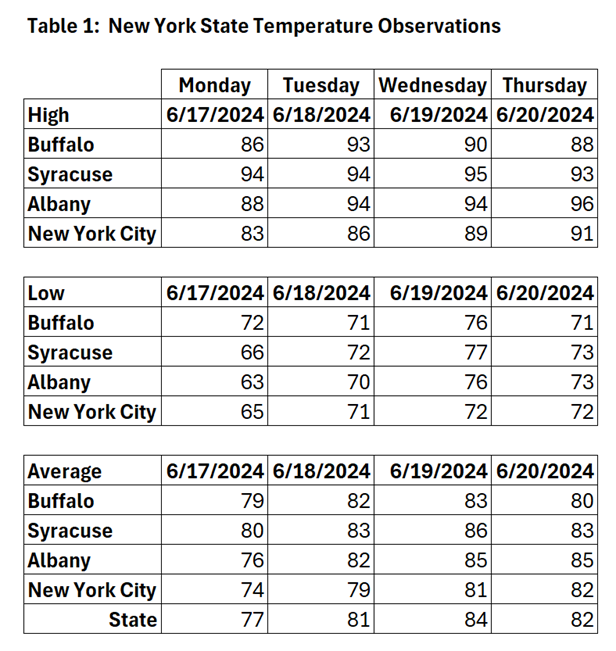
In brief, the June 2024 heatwave came nowhere near the potential deficit criteria.  Table 1 shows that the average daily temperature did not exceed 84o F over the last four days.  This was not a real stress test for the New York State electric grid.

NYISO Fuel Mix

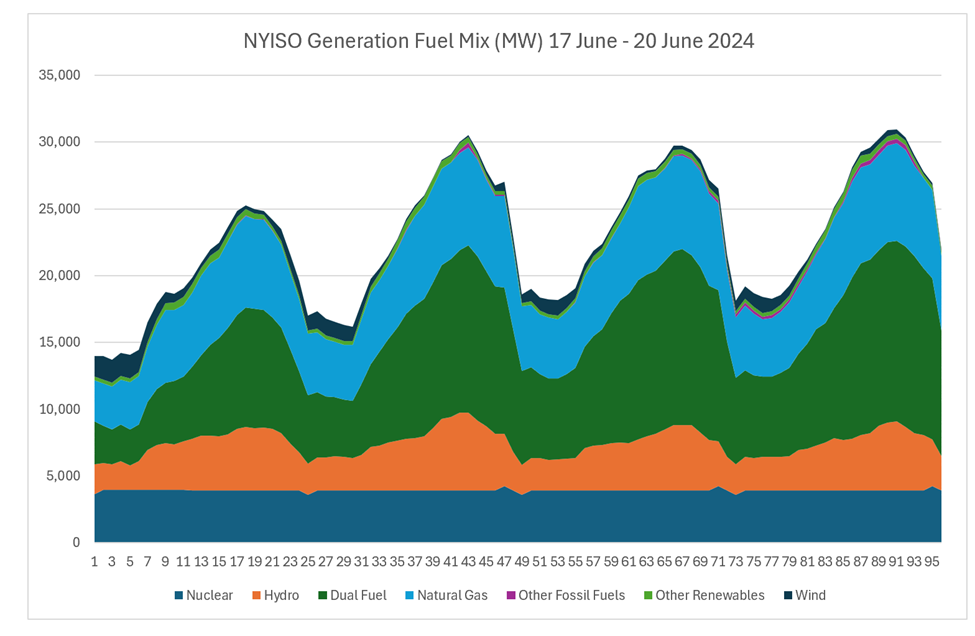
Even though the heat wave did not push the New York grid the fuel-mix load data from the NYISO Real-Time Dashboard provides some interesting information. I have compiled the data for 17-21 June here.  The following graph shows the hourly fuel type generation throughout the period.  The generator types include “Hydro” that includes pumped storage hydro; “Wind”, land-based wind; “Other Renewables” that covers solar energy, energy storage resources, methane, refuse, or wood; “Other Fossil Fuels” is oil; “Nuclear”; “Natural Gas”; and “Dual Fuel” which are units that burn both natural gas and oil.

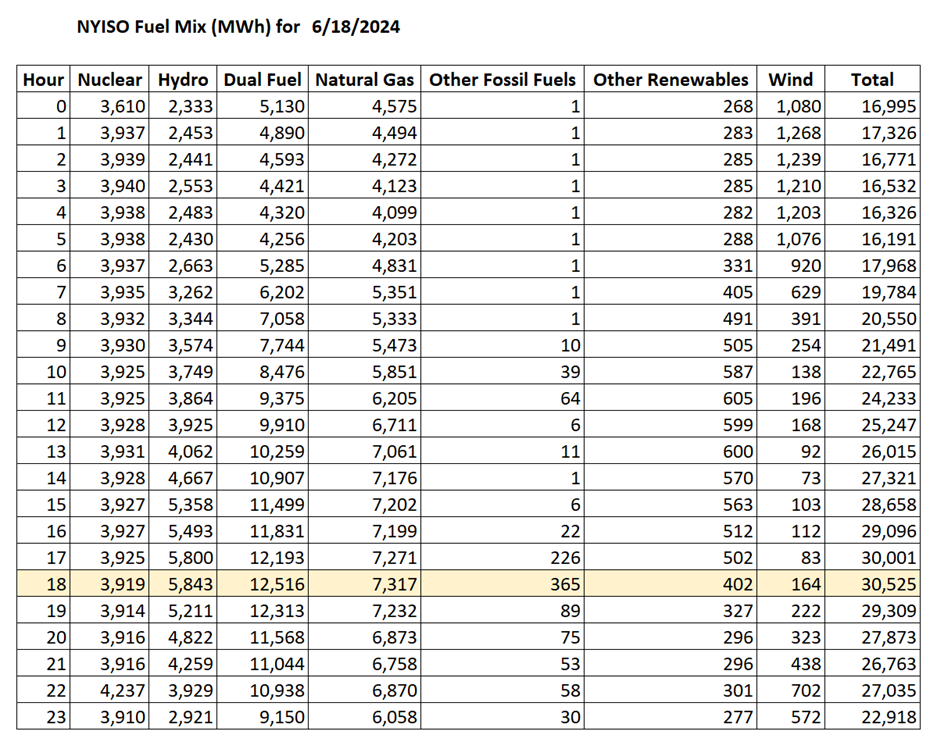
The NYISO Summer 2024 Reliability Outlook expects 34,913 MW of resources available to meet 31,541 MW of forecasted demand under normal conditions.  During this period, the maximum hourly generation was 30,525 MW at hour 18 on June 18.  There are important considerations relative to the fuel mix at that time.

The following table lists the fuel mix for generating facilities in New York for June 18.  NYISO does not track behind-the-meter solar that reduces the load that NYISO must provide.  Note that nuclear is constant throughout the day and hydro, dual-fuel, and natural gas increases to match the load peak.

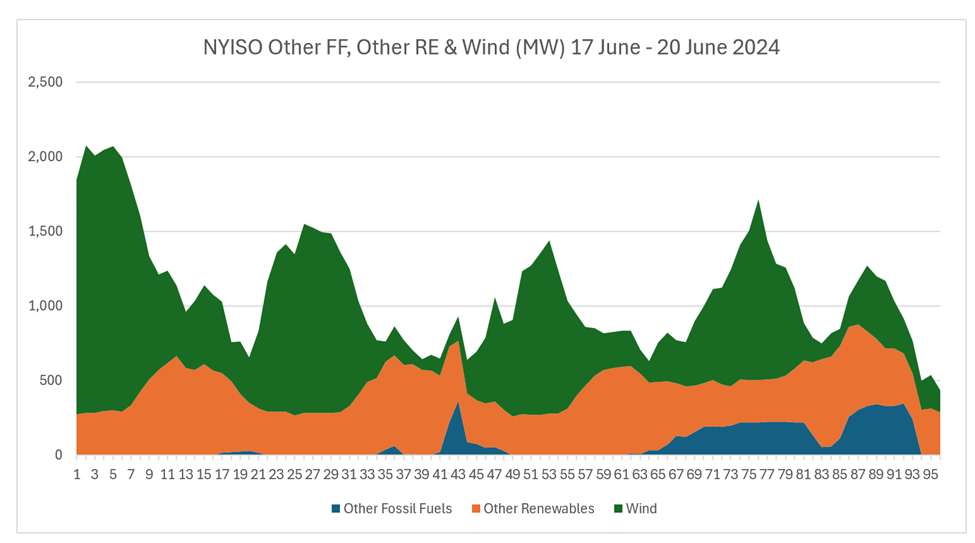
The remaining three categories are of particular interest.  The following graph only includes these three categories because they are small relative to the other fuel types.

In the “Other Renewables” categories the Gold Book lists the following capabilities at the end of 2023:  utility-scale solar energy 254 MW, energy storage resources 20 MW, methane 104 MW, refuse 239 MW, and wood 56 MW for a total of 653 MW.  The graph suggests that solar was providing its peak load during each day.  The methane, refuse, and wood generators are dispatched so that they reduce load at night to a little under 300 MW. 

One of the notable features during this period was that the wind resource consistently was lowest during the daily peak load.  Despite this result New York is continuing to double down on renewable development.  On June 20 the New York State Energy Research & Development Authority announced:

Governor Hochul today announced a new NYSERDA large-scale renewable energy solicitation to deliver clean electricity to New Yorkers. Building on New York’s 10-Point Action Plan , this solicitation seeks proposals for the development of new large-scale land-based renewable energy projects which are expected to spur billions in clean energy investments and create thousands of family-sustaining jobs in the State’s green economy. 

Given that when needed most during the peak load observed here that all the New York land-based wind went to very low levels this solicitation will not solve this problem.  Higher wind capacity with zero wind resource yields zero electricity.

There is another notable feature of the observed wind resources.  The peak winds occurred in the early morning hours which are the lowest load periods.  I believe this is a feature of the nocturnal wind pattern.  Low-level winds affecting wind turbines increase with height as the effect of surface roughness and atmospheric mixing are reduced.  At night the solar surface heating stops and the level of reduced wind speed contracts.  This causes the wind speeds to increase and wind energy resources to improve.  It also is another load balancing issue that must be addressed for an electric grid that depends on wind power generation.

The last of these three categories illustrates another related issue.  The category “Other Fossil Fuels” provides generation for units that are exclusively oil-firing.  In New York there are two types of these units – residual oil-fired steam boilers and simple-cycle peaking turbines.  All the oil-fired boilers must remain at minimum loads higher than the lowest hourly values listed above to be able to ramp up for the diurnal peak.  Therefore, the generation came from simple-cycle peaking turbines.  As I have previously explained, New York City peaking turbines are vilified as “the most egregious energy-related example of what environmental injustice means today.”  However, the presumption of egregious harm is based on selective choice of metrics, poor understanding of air quality health impacts,  and ignorance of air quality trends. I wish I could say that there is no chance that these units will not be shutdown sooner than necessary to mollify Environmental Justice activists who demand it, but I am unconvinced.

Discussion

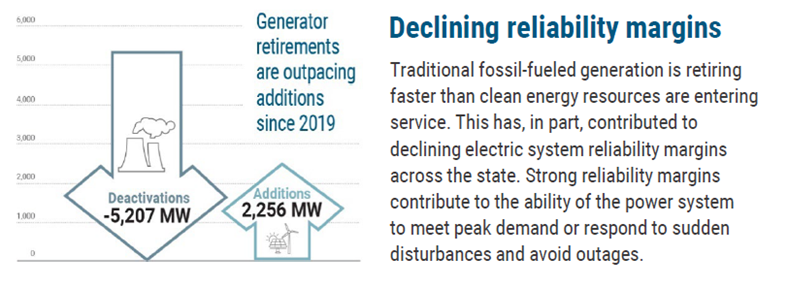
I am not optimistic that New York State energy policy will be up to the task addressing the future system resources challenge for a zero-emissions electric grid.  One of the issues highlighted by the NYISO Power Trends report is illustrated in the following figure from the Power Trends Fact Sheet.

Overall, the capacity reduction from generator retirements relative to additions is 57%.  However, if you compare the energy capability of the deactivated generators, especially the 2,000 MW of nuclear power retired, with the addition of primarily solar and wind capacity the energy available to the system is even less.

One other recent development is relevant.  The owners of the Danskammer power plant north of New York City have had an application to repower and replace the existing Danskammer generating station with the Danskammer Energy Center, a new state-of-the art, efficient natural gas-fired combined cycle generating unit.  Unfortunately, like a couple of other proposals to replace old fossil generating units with much cleaner and modern units, the New York State Department of Environmental Conservation has denied the permits to construct basically because there are Climate Leadership & Community Protection Act mandates coming.  The fact that there is no feasibility analysis that proves that those mandates can be achieved was ignored.  After years of court battles the developers gave up and withdrew their application this week.  As a result, the electric system will continue to rely on aging and dirtier fossil generation for however long it takes for the State to figure out that existing technology is incapable of replacing fossil fired peaking power plants needed to keep the lights on.

Conclusion

The latest heat wave in New York State did not exceed the criteria determined by the NYISO for potential problems.  Nonetheless, the facts that wind resources were a fraction of potential capacity during the peak hours and the grid relied on peaking power plants that environmental activists demand be shut down as soon as possible suggest that the potential problem is not going to go away anytime soon.  Stay tuned.

GAO Information on Peaking Power Plants

Note: This is a version with NY specific information of a post that appeared at Watts Up With That. Tom Shepstone at the Energy Security and Freedom Substack summarized this detailed post.

Environmental Justice (EJ) advocates like the PEAK coalition argue that “Fossil peaker plants in New York City are perhaps the most egregious energy-related example of what environmental injustice means today.”   This post critiques a recent General Accounting Office (GAO) report on “Information from Peak Demand Power Plants” that was prepared in response to a question about pollution from these facilities by some congressional representatives.

This topic is a particular concern of mine because issues associated with peaking power plants have been one of my responsibilities since 2000.  Initially, my concerns were associated with developing an emissions tracking system to ensure compliance with air quality requirements for peaking plants.  Later I participated in the regulatory process to develop regulations to reduce their emissions but also keep the lights on, keep the costs down, and achieve improved air quality. It took many years but New York State developed a rule that fulfilled those requirements.  I doubt that I am the only one who participated in that process who was taken aback when environmental advocacy groups started campaigning against the power plants covered by the regulations put in place to address the peaking power plant pollution.


Further information on peaking power plants is available on a page that documents my concerns based on my extensive experience with air pollution control theory, implementation, and evaluation over my 45+ year career. The opinions expressed in this post do not reflect the position of any of my previous employers or any other organization I have been associated with, these comments are mine alone.

Introduction

The GAO website summary for the report explains why they did the study:

Environmental advocacy groups, and some congressional leaders have expressed concerns that peakers may be less efficient than non-peakers, meaning peakers may expend more energy that is not converted into electricity than other types of plants. Further, due to the nature of their operations, peakers may also negatively affect the air quality in communities around the plants, which may be historically disadvantaged or disproportionately low-income.

GAO was asked to examine pollution from peakers across the nation. This report provides information on the number and location of peakers in the U.S., their proximity to historically disadvantaged or disproportionately low-income communities, to what extent they emit pollutants and how these pollutants affect the health of people exposed, and alternatives for replacing them. To perform this work, GAO analyzed data from EPA, the U.S. Department of Energy, and other sources, reviewed relevant literature, and interviewed federal officials and stakeholders from 19 state, industry, and nongovernmental organizations representing a diversity of perspectives about peakers.

I am unimpressed with this report.  It is not clear to me whether the political implications of this topic or the naivete of the authors was the reason for the poor quality.  Whatever the reason, the report confirmed the biased concerns of environmental advocacy groups without addressing the fundamental problematic issues associated with peaking power.  It is especially galling that the report ignored air quality protections already in place.

Peaking Power Problem

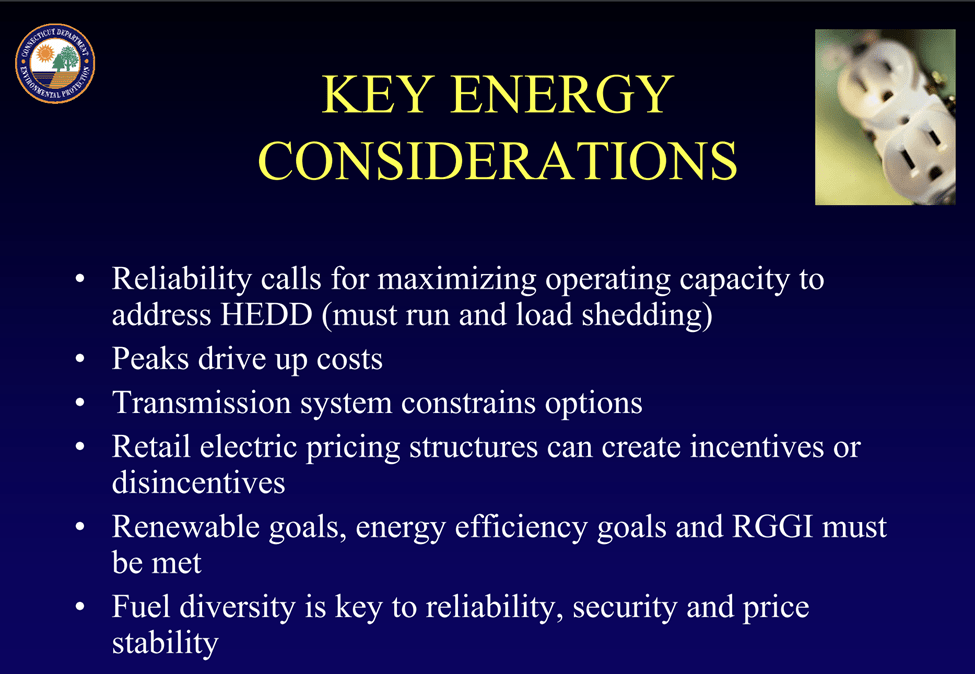
I think the GAO report missed the opportunity to highlight the implications of peak power demand and how it could and should be addressed.  An Ozone Transport Commission presentation of issues associated with High Energy Demand Days (HEDD) from 2006 describes the tradeoffs.  Air quality and energy planning both prioritize energy demand peaks because the highest electric demand and worst air quality tend to coincide.  This is because the meteorological conditions that cause peak loads also exacerbate the air quality impacts of the increased emissions needed to match peak loads.  Reliably meeting the peaks results in using the dirtiest and most expensive units.  The key energy considerations slide describes the issues.

The GAO report overlooked this aspect of the peaking power plant issue.  Instead, when they explained why this issue matters, they only talked about daily peaks.  I think that devalues the criticality of the peak issue.  The real problem is that peak loads occur when customers need power the most.  If it is unavailable, then immediate acute safety and health problems occur. While the daily peak is a problem it is far less impactful than the annual peak load.

GAO Report

The GAO report determined how many peakers are in the country and where they are located.  This discussion failed to discuss another impactful nuance.  The GAO analysis determined the number of peaking power plants as a function of how much power plants ran in 2021:

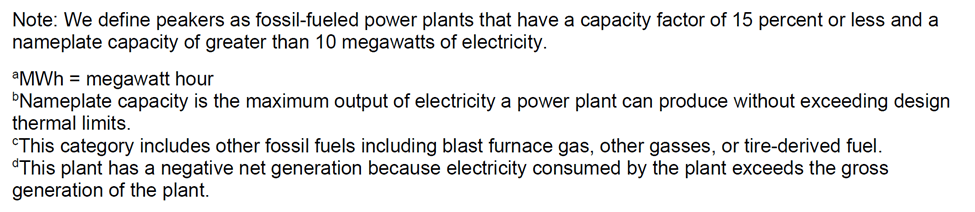
For the purpose of our report, we generally define peakers as plants that use fossil fuels, including natural gas, coal, and oil; have a capacity factor (the percent of energy produced over a certain time frame, out of what could have been produced at continuous full power operation) of 15 percent or less; and have a nameplate capacity (the designed full-load sustained output of a facility) of greater than 10 megawatts (MW) of electricity.

This is a similar methodology to that used by Physicians, Scientists, and Engineers (PSE) for Healthy Energy in their report Opportunities for Replacing Peaker Plants with Energy Storage in New York State.  There is an unrecognized shortcoming to the approach.  The GAO report states that “Peakers are used to supplement other types of power plants, such as baseload plants, which run consistently throughout the day and night, and intermediate plants, which run mostly during the day and less at night”.  There is a difference between power plants designed to meet peaking applications and many facilities that now operate as intermediate or peaking units.  For example, around 1970 Consolidated Edison of New York needed peaking capacity within New York City that would only run infrequently but also needed to startup quickly.  They responded by building a fleet of around 100 simple-cycle natural gas turbines that were the cheapest capacity available.  Today many of the units that meet the GAO definition were originally designed as base-load units and cannot start up quickly.  I used to work at the Oswego Harbor generating station that had two 850 MW oil-fired units and took over a day to startup.  The units have met the capacity factor criteria for peaking units for years, but they were not designed to operate that way. 

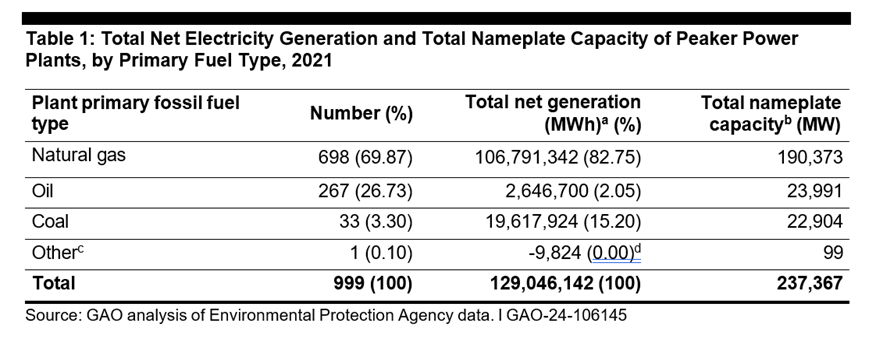
The GAO report includes a map of plant locations but there is no capability to identify the plants on the map. If you are interested in specific facilities, the EPA Power Plants and Neighboring Communities website presents that information.  The GAO summary lists 999 peaking power plants in the following table.  The overall capacity factor of these plants is 6%. 

The GAO analysis determined how closely peakers are located to historically disadvantaged and low- income communities.  This analysis, the Physicians, Scientists, and Engineers, and even the draft New York regulations to address these facilities all use distance between the disadvantaged communities and the power plant as the metric of concern.  The GAO claims that “For example, based on our model and main definition of a peaker, a community that is 71 percent historically disadvantaged is expected to be 9 percent closer to the nearest peaker than the average community, which is 40 percent historically disadvantaged.” 

I do not think this is an unexpected result, but I also think it is meaningless.  The air quality impacts of any facility do not depend entirely upon distance between the source and a receptor location.  The stack characteristics (gas temperature, height of the stack, and stack exit dimensions) as week as meteorological conditions (wind direction, wind speed, and atmospheric stability) all affect air quality impacts.  The Con Ed turbines had exit ducts that released the pollutants that were less than 100 feet and the location of maximum downwind impact was relatively close.  On the other hand, the Oswego plant had 700’ stacks and the location of maximum downwind impact was quite a way from the plant.

The GAO report addressed the impact of emissions and the resulting health impacts: “When operating, peakers emit similar types of pollutants to other power plants that also use fossil fuels, and these pollutants are associated with various negative health effects, according to existing literature.”  The impacts section notes:

Compared to non-peakers, peakers emitted more pollutants—such as nitrogen oxides and sulfur dioxide—per unit of electricity generated, but fewer total annual pollutants in 2021, according to our analysis of EPA data (see table 2). In other words, peakers emit less in total because there are fewer peakers and they operate less frequently overall than non-peakers. However, when they do operate, they emit more pollution per unit of electricity produced. For example, the median sulfur dioxide emission rate for natural gas fueled peakers was 1.6 times more per unit of electricity generated than the median emission rate for non-peakers.

This language parrots the talking points of EJ advocates but is much ado about nothing.  It is obvious that fewer peakers that run less would have lower emissions than more numerous non-peakers that run more.  Advocates harp on the fact that emission rates are higher for peakers than non-peakers.  Highlighting the finding that “natural gas fueled peakers was 1.6 times more per unit of electricity generated than the median emission rate for non-peakers” is a naïve point because 0.008 versus 0.005 lb SO2 per MWhr is negligible for air quality impacts.  Moreover, I think there is an error in the methodology because the sulfur content in fuel determines the emissions not how it is burned, so there should be no difference in the rates.

Another issue I have with this analysis and other similar analyses is that they don’t recognize that the primary air quality issue with peaking power plants is ozone.  These units operate when energy demand is highest in the summer and those periods are typically hazy, hot, and humid.  Those conditions are conducive to the highest ozone levels (some of the haze) and there has been immense pressure to reduce their emissions to reduce ozone levels.  Ozone is a secondary pollutant produced in a photo-chemical reaction from nitrogen oxides and volatile organic compounds.  The conversion to ozone takes time and means that by the time it occurs the emissions from a power plant in a disadvantaged community have moved downwind.  For example, the location of highest downwind conditions for emissions from New York City is in Connecticut, far beyond neighboring disadvantaged communities.  Moreover the reality is that nitrogen oxides scavenge ozone so that the peaking power plants actually reduce ozone concentrations close to the facility.

I have been involved with air quality issues since I started working in 1976.  The fundamental presumption has always been that the National Ambient Air Quality Standards (NAAQS) is the health metric used to determine health impacts.  EPA explains:

The Clean Air Act, which was last amended in 1990, requires EPA to set National Ambient Air Quality Standards (40 CFR part 50) for six principal pollutants (“criteria” air pollutants) which can be harmful to public health and the environment. The Clean Air Act identifies two types of national ambient air quality standards. Primary standards provide public health protection, including protecting the health of “sensitive” populations such as asthmatics, children, and the elderly. Secondary standards provide public welfare protection, including protection against decreased visibility and damage to animals, crops, vegetation, and buildings.

As an air pollution meteorologist one of my jobs was to run air quality models to determine the air quality impacts of existing and proposed facilities.  The primary consideration was whether the modeling proved that the projected impacts were less than the NAAQS.  The basis of my work was that when I showed compliance with those standards, I proved that we were protecting the health of “sensitive” populations such as asthmatics, children, and the elderly.  Regulatory agencies are required to ensure that any facility that cannot show compliance with the NAAQS must to modify its permitted operations or it cannot be allowed to operate. 

The GAO report does not mention the NAAQS protections.  Instead, the analysts follow the lead of EJ activists and claim that there are health effects from peaking power plants.  The health effects section states: “Multiple pollutants that are emitted from peakers and other plants are associated with various negative health effects for the people exposed, according to federal agency reports we reviewed”.  What they reviewed were the EPA Integrated Science Assessments:

EPA’s Integrated Science Assessments integrate information on criteria pollutant exposures and health effects from controlled human exposure, epidemiologic, and toxicological studies to form conclusions about the causal nature of relationships between exposure and health effects. For more information, see the EPA Preamble for Integrated Science Assessments at Preamble To The Integrated Science Assessments (ISA) | ISA: Integrated Science Assessments | Environmental Assessment | US EPA (accessed 8/30/2023). 

The presumption in the report is that any level of pollution is bad: “For instance, short-term exposure to sulfur dioxide—the indicator for sulfur oxides used in EPA’s assessments—can lead to negative respiratory effects, such as decreased lung function, cough, chest tightness, and throat irritation.”  The GAO report summarizes health effects from short-term exposures.  All this is nice but it ignores the NAAQS process to determine acceptable ambient air quality levels.

The EJ activists pushing the negative impacts of the peaking power plants presume that there are alternatives.  The GAO report looked at some available alternatives that could potentially replace fossil-fueled peakers at the same high-level used throughout the analysis.  The report claims that “alternatives such as battery storage systems could potentially replace fossil-fueled peakers, according to studies we reviewed and stakeholders we interviewed”.   The report lists battery storage, pumped-hydro storage, thermal energy storage, and notes that renewable energy systems (e.g., wind and solar) may be paired with energy storage.  It claims that “adding roof-top solar and battery storage to houses could reduce the demand for peakers in adjacent areas.”  It includes two other possibilities:

Transmission and distribution infrastructure improvements: Upgrades or expansions to increase the capacity of current infrastructure that transmits and distributes electricity.  These upgrades or expansions may help enable existing underutilized plants to meet peak demand.

Efforts to decrease consumers’ use of power during peak times: Efforts to incentivize consumers to reduce or shift electricity use during times of peak use to off-peak times.

To its credit the report does address the “potential challenges of replacing peakers” including cost, reliability, and location.  In my opinion, the responses downplayed those challenges.

The report notes that “some alternatives may have higher capital and operating costs compared to current fossil-fueled peakers”:

Replacing peakers, some of which have already paid off their capital costs, will likely lead to additional up-front or operating costs compared to keeping the existing peakers. Further, the U.S. Energy Information Administration (EIA) reported that solar and wind plants had higher average construction costs compared to natural gas-fired plants in 2023.

It is remarkable that this Federal report documented that construction costs of solar and wind are greater than natural gas plants but there is a missing nuance.  While I am not an economist, I still question what kind of business model could justify developing a new resource that will operate as a peaking facility running less than 15 percent of the time.  Surely the facility will have to charge very high rates when it does operate.

Appropriately the report notes that “current alternatives may not be able to provide the same reliability of current fossil-fueled peakers”:

Similarly, some alternatives may create reliability challenges. For the grid to be reliable, the energy resources in an area need to be able to supply power to meet peak demand for as long as it lasts, according to U.S. Department of Energy (DOE) officials. Some battery storage systems provide up to 4 hours of output, but peak demand may be longer in some areas. In contrast, a fossil-fueled peaker is only limited by fuel availability—a natural gas-fueled peaker could keep operating so long as natural gas is available.

This is an important point universally ignored by the activists that want to shut down peaking power plants now.  The other nuance is that the overly broad definition of a peaking power plant covers facilities that provide different services than just peaking support.  The 1700 MW at Oswego Harbor are within ten miles of three nuclear units.  Nuclear units are required to shutdown when the grid goes down and in the 2003 blackout Oswego Harbor came on line to replace those units until the grid stabilized.

The GAO report also noted that “alternatives may not be able to be installed because of space and location concerns”:

Some alternatives may also run into space constraints or location concerns. For example, a densely populated urban community likely would not have sufficient space for a large renewable energy system paired with battery storage to help meet peak electricity demand.

I agree with this point, but it could have been expanded.  Location matters within the grid.  The transmission system is designed based on the location of the generating resources.  The requirement that energy must be available at the location of the New York City peaking power plants is not acknowledged by the EJ activists, but it is a critical reliability constraint.

Most disappointing to me is that the report does not acknowledge the following challenges to the end of the main report.  I believe that at least a hint of the following information should have been right up front:

In general, recognizing these challenges, some officials with whom we spoke identified trends that may lead to the continued use of fossil-fueled peakers. According to DOE officials, some U.S. peakers may not be able to be replaced with existing alternatives within cost, reliability, and location constraints.

Combinations of electricity generation and storage technologies, transmission and distribution improvements, and efforts to decrease consumer’s use of power during peak times may be too costly for consumers in some areas to provide an adequate level of grid reliability. Further, officials at two utilities noted that due to increased use of intermittent renewable resources on the grid (e.g., wind and solar power), the continued use of peakers to meet electricity demand may be necessary to maintain grid reliability. For example, the availability of sunlight for a solar installation may not match with peak demand in the evening when the sun goes down. Therefore, additional supplemental energy resources would be needed to fill the gaps and meet demand.

It gets worse.  Buried in the technical appendix the last sentence in the last paragraph before the end notes is the caveat that there is no basis for concern (my highlight):

Limitations. We took several steps to assess the validity and sensitivity of our models, but certain limitations remain. Importantly, our measure of distance does not include other aspects—such as stack height, wind speed, or wind direction— that play important roles in the dispersion of pollutants and potential populations exposure. In addition, although we include some variables to control for factors that could influence the findings, it is possible that other controls might be important and were not accounted for in our model. Inclusion of a state fixed- effect partially addresses this by controlling for factors that vary by state. Still, our findings of associations between distance to peakers and historically disadvantaged racial and ethnic communities does not imply any causal relationships.

NY Peaker Rule

The New York Independent System Operator (NYISO) 2020 Reliability Needs Assessment includes a detailed summary of the New York Department of Environmental Conservation (DEC) “Peaker Rule”: Ozone Season Oxides of Nitrogen (NOx) Emission Limits for Simple Cycle and Regenerative Combustion Turbines.  This rule exemplifies how these units should be regulated to reduce emissions while maintaining reliability standards.   

After years of discussion DEC issued requirements to reduce emissions of ozone-forming pollutants from

peaking generation units in late 2019.  The rule was implemented as part of the state’s attainment planning requirements to achieve the ozone NAAQS.  The focus of the rule was on units designed to provide peaking power, the combustion turbines known as “peakers”.  NYISO explained that:

That peakers typically operate to maintain bulk power system reliability during the most stressful operating conditions, such as periods of peak electricity demand. In addition, these units are often called upon at any time, seven days a week and 24 hours a day, to be able to respond to contingencies or other near real time changes on the electric system. By being available on call, the peakers provide value to system reliability even when not actually generating power. 

Many of these units also maintain transmission security by supplying energy within certain areas of New York City and Long Island — known as load pockets. Load pockets represent transmission-constrained geographic areas where electrical demand can only be served by local generators due to transmission limitations during certain operational conditions.

The Peaker Rule phased in compliance for approximately 3,300 MW of simple-cycle turbines located mainly in the lower Hudson Valley, New York City and Long Island. The owners of the units were required to submit compliance plans to the DEC in March 2020 to either install pollution control equipment or retire the units over a phase in period.  The NYISO resource adequacy planning process determined whether unit retirements would adversely affect reliability.   The NYISO Reliability Needs Assessment indicated that “approximately 1,800 MW of nameplate capacity (approximately 1,500 MW of net operating capability) are proposed to ultimately be unavailable during the summer to comply with the emissions requirements “.

One of the important features of the rules is a provision to allow an affected generator to continue to operate up to two years, with a possible further two-year extension, after the compliance deadline if the generator is designated by the NYISO or the local transmission owner as needed to resolve a reliability need until a permanent solution is in place.  Earlier this year this provision was involved for a couple of facilities.

I think this is the appropriate way to deal with these facilities.  Keep in mind that if these facilities had been shown to contribute directly to a local non-attainment issue modifications to their permits would have been required in a different process.

Lastly, in my opinion, this rule and the New York City peaking power plant replacement issue is an artifact of New York electric system deregulation.  Prior to deregulation, when DEC identified the problem the utilities owning the peakers would have proposed either installing control equipment or replacing the units themselves with modern clean and more efficient turbines.  The Department of Public Service would have reviewed the proposal with the DEC and eventually an approved rate case would include the proposed solution.  In the de-regulated market the owners of the facilities considered those options and in at least a couple of cases developed permits to install replacements.  However, market considerations led to the decision by the owners to go ahead with the replacements.  Without de-regulation there is no question in my mind that all of the old peaking turbines would have been replaced before 2010.  Unfortunately, it also appears that the EJ activists would still have made this an issue.

Discussion

The GAO was asked to respond to a question about pollution from peaking power plants by some congressional representatives.  The response is a disappointment.  The report summary found that:

  • Historically disadvantaged racial or ethnic communities tend to be closer to peakers.
  • Fossil-fueled peakers are primarily fueled by natural gas and emit air pollutants associated with various negative health effects, including on respiratory, cardiovascular, and nervous systems.
  • Alternatives are available that could potentially replace or provide similar services as peakers, but we identified challenges for their use related to costs, reliability, space, and location.

I do not dispute that disadvantaged racial or ethnic communities tend to be closer to peakers but the fact the “findings of associations between distance to peakers and historically disadvantaged racial and ethnic communities does not imply any causal relationships” indicates that the basis for the concerns is weak.  If the GAO report had evaluated the status of the communities of concern relative to the NAAQS or at least mentioned that there are standards designed to protect those communities, it would have been obvious that this is a non-problem conjured up by activists.

The second finding is another lost opportunity to inject reality into the conversation.  Obviously, fossil-fueled peakers emit air pollutants and they can be “associated with various negative health effects, including on respiratory, cardiovascular, and nervous systems.”  The complete disregard of the NAAQS protections in place unnecessarily scares the residents in the communities of concern. In addition, regarding emissions in isolation, focusing only on the negatives and disregarding any benefits creates an unnecessarily pessimistic outlook, hinders growth, and could lead to unintended consequences.

The final summary point begrudgingly admits that there are “costs, reliability, space, and location challenges” for replacements to peaking power plants.  The GAO report should have emphasized these challenges in my opinion.  The reality is that in order to deal with peaking power plants and the net-zero ambitions we do not have the generating or transmission technologies needed. 

Conclusion

The GAO report fails to adequately address the challenges ignored by the congressional representatives who asked for the report and the EJ activists who have conjured this up as an issue.  In doing so they did a real disservice to society.  The reality is that we need peaking units and the public is protected from direct harm from these units by the NAAQS. 

It is troubling that the report does explain why the concerns are unwarranted, but the presentation hides them.  It is only possible through a complete reading of the entire report to discover contrary evidence eviscerating this as an issue. 

The bigger picture problem is the potential threat that political and activist pressure will force premature retirement of peaking power plants with a marked increase in potential reliability risks.  A blackout will have real ramifications as opposed to the over-hyped risks claimed.  I believe that if this report had emphasized the issues instead of burying them that the possibility of a rash premature retirement initiative would have been much reduced.

Graduation Speech Essay You Need to Hear has Climate Response Implications

I think this marvelous Robert Parham essay deserves wide distribution.  It addresses the mis-placed pessimism of students in colleges today.  Parham is an assistant professor at the University of Virginia’s McIntire School of Commerce. Witnessing firsthand the growing distress among college students, Parham originally published his essay “To the Class of 2024: You Are All Diseased,” in The Free Press.  This post addresses the parallels between his college concerns and the environmental movement.

The opinions expressed in this post do not reflect the position of any of my previous employers or any other organization I have been associated with, these comments are mine alone.

To the Class of 2024

I recommend reading the essay but will summarize it here.  The introduction states:

If you are graduating from college this year, I suspect you’re not too familiar with George Carlin. So before you become inflamed about the (intentionally) harsh title, let me tell you I plagiarized it from Carlin, who was one of the best American comedians of the last 100 years. His show You Are All Diseased is available on YouTube, and it is so good that I was willing to start by alienating you a bit just to plug it here. You’re welcome. It is especially recommended if you’re in any kind of altered state of mind.

Speaking of states of mind: I’m worried about yours.

Rates of anxiety, depression, and suicide among people your age in the U.S. are skyrocketing. I myself lost a student to suicide a few years ago—an experience I wish on no one. I’m here to tell you that I think it’s partly our (your professors’) fault. We, along with others, have been feeding you a distorted view of the world and your place in it, and I think this has caused a considerable part of the existential angst you all feel.

But I’m not just aiming to point fingers.

I want to lay a vision of the present and future, which I genuinely believe and yet know many of you don’t share. After all, exposing you to unfashionable ideas is a core part of a healthy education. My deeper hope in doing so is to start a conversation on changing this sad state of affairs and to get you on your way to a happy and healthy life. Isn’t that what commencements are all about?

The thrust of the article is that today’s college students are deeply pessimistic about the future despite, as he argues, the fact that human beings have never had it so good. 

Based on every objective measure of well-being—safety, health, wealth—if you are a college student in America today you are better off and wealthier than the king of England was 300 years ago. You have better access to education, entertainment, leisure, and healthcare. You have cleaner water and more abundant food. You have a significantly safer and longer life. And you have access to all of the world’s knowledge, including this piece, in the palm of your hand.

Then he states: “Which then raises the question: Why? Why is it that “everything is amazing and nobody is happy”? He explains that the reason why we don’t think of ourselves as better off than the King of England:

We economists call this phenomenon “relative wealth concerns” or “keeping up with the Joneses.” These are just fancy terms to describe a simple psychological fact: we are constantly busy comparing ourselves to our peer group, and feel bad when we fall short in that comparison.

He goes on to describe our peer group:

“Peer group” is an essential term in the previous sentence. No one cares that they’re enormously better off than their grandparents; they just care that they’re worse off than Jeff Bezos or Elon Musk. You don’t feel wealthy, despite the fact the median human lives on the equivalent of $5,000 per year. Yes, you read that right. Imagine if you lived in the U.S., but only spent $5K a year at current U.S. prices, and you’ve imagined the life of the median human today. Your “peer group” isn’t humanity; it’s social media influencers and billionaires, and you are deeply unsatisfied when comparing your lives to theirs.

You live in the wealthiest country in the history of the world, yet you feel economic anxiety. The late Charlie Munger summarized it succinctly: “The world is not driven by greed. It’s driven by envy.” And in this era of instantaneous communication networks and social media, envy has been put into hyperdrive.

Professor Parham is not a fan of the emphasis on equity or fairness.  He argues that envy is no longer a deadly sin, it has become the fairness virtue.  He points out fairness issues for American college graduates relative to the rest of the world:

The world is unfair. Deeply so. It’s just that you’re the lucky ones. You won the birth lottery.

In a truly fair world, any dollar you make or spend above $5,000 a year would instead be given to someone else. Maybe a poor Kenyan, or Bangladeshi, or Indian. But that’s not the kind of fairness and equity anyone talking about “fairness” and “equity” around you seeks.

You’ve been lied to. You’ve been told, by the media, social networks, and not least your professors, that this fantastic world we live in is evil. Not only that, you’ve been told it’s your fault. You’re too racist, too greedy, too white, too privileged, not sufficiently attuned to the plight of the marginalized. It is not enough to be non-racist, they say, you must be anti-racist. Anything less than that, and you’re complicit in evil. Some of you are better by default due to some accidents of birth; some of you are worse. Small wonder you feel suffocated, anxious, and depressed.

Any human, weighed down with this responsibility and guilt, would be just as down. The cognitive dissonance of being told colonialism is evil, American slavery is uniquely evil, that wealth and the markets that enable it are evil, while going to school at a top-tier U.S. institution built on “Monocan land” using slave labor would incapacitate anyone.

He includes an informative description of the concept of money and how that creates a transaction where both parties become better off because of it.  As society has evolved away from one-on-one transactions between people, now the transactions are between people and corporations.  People earn money and can purchase what they need and want.  He explains that when that happens: “We’re better off, the company we bought things from is better off, its employees and suppliers are better off, and so are their employees and suppliers. But in colleges today capitalism is frequently described as evil:

Without fail, at the end of the class a few students tell me that the content of the course was diametrically opposed to what they had been taught so far. Prior, they had class discussions about the exploitative nature of the market system and its inherent unfairness; the evil and greed of corporations; and the fight of exploited workers against oppressive capitalists.

In response he states:

I point out to them that these paradigms imply a zero-sum world in which wealth can only be created by taking it from others, whereas they live in the positive-sum world of markets, in which wealth is created by exchange. Markets have deposited a magic wand in their hands, which allows them to freeze moments in time, observe what is currently happening in foreign lands, and conjure loved ones for a face-to-face conversation out of thin air. Kings would have given half their kingdom for such a wand, but now anyone can have it for the low, low price of $69.99 per month. Or about five hours of student work. This is how we got wealthy.

He goes on to say:

My students arrive at my class steeped in zero-sum ideas, in which one person’s gain must be another person’s loss, and the only way to get a thing is by “oppressing” it from someone else. Then, they are shocked to hear heretical ideas about a world in which wealth is created, not stolen, and human interactions can be win-win and make all of us immensely well-off. The dissonance is severe, and they’re unsure how to deal with all the shame and guilt accumulated by years of accused “oppression.”

I hence want to close by telling you, the class of 2024: it’s not your fault. You are not evil. Being white / black / privileged / downtrodden / well-educated / illiterate / wealthy / poor / healthy / sickly / cisgendered / non-conforming does not make you bad (or good, for that matter). The sins of your forefathers are not your own. You did nothing wrong by being born. Yes, aiming to improve the state of human affairs is noble, but choosing instead to study, play games, and make out with the cute person you have your eye on does not make you bad. It makes you a normal, healthy human being. And no one seems to bother to tell you that. So there, I said it. You are not subject to the “original sin.” Go forth and have a happy and healthy life. There is still (much) room for progress, but things are currently better than they’ve ever been, and improving fast.

Or as Carlin put it, in his direct way: “Life gets really simple once you cut out all the bullshit they teach you in school.”

Environmental justice Parallels

I believe the environmental parallel is related to the “zero-sum idea”.  The common perception is that emissions from a power plant or a factory are exploitive and come at the expense of harm to others, especially environmental justice communities. The concept that, within limits, emissions have positive-sum benefits is ignored.

No where is this dissonance more pronounced than the environmental justice movement.   The EPA defines environmental justice:

“Environmental justice” means the just treatment and meaningful involvement of all people, regardless of income, race, color, national origin, Tribal affiliation, or disability, in agency decision-making and other Federal activities that affect human health and the environment so that people:

  • are fully protected from disproportionate and adverse human health and environmental effects (including risks) and hazards, including those related to climate change, the cumulative impacts of environmental and other burdens, and the legacy of racism or other structural or systemic barriers; and
  • have equitable access to a healthy, sustainable, and resilient environment in which to live, play, work, learn, grow, worship, and engage in cultural and subsistence practices

The difference between zero-sum and positive-sum environmental approach is in the definition of “disproportionate and adverse human health and environmental effects”.  The environmental justice position I hear most often is a demand for no health and environmental effects.

In that regard I think my career is an instructive positive-sum example.  When I completed my master’s degree in 1976 the United States Environmental Protection Agency (EPA) was only six years old and corporate America was just coming to grips with environmental management.  I worked for five years for three different consulting companies that did contract work for EPA.  In 1981 I started to work for Niagara Mohawk Power Corporation a vertically integrated electric utility.  The environmental progress since I started working in the New York electric generating business has been astounding but is ignored by environmental justice activists.

One of my responsibilities at Niagara Mohawk was to prepare and submit emissions data to regulatory agencies.  I recently found annual emissions data back to 1984.  One of our facilities was the coal-fired Dunkirk Generating Station in Western NY.  The facility had two 100 MW units and two newer 200 MW units.  In 1984 the facility emitted 54,709 tons of SO2 at a rate of 3.26 lb per mmBtu and 10.020 tons of NOx at a rate of 0.598 lb per mmBtu.  Over my time supporting the station, they installed controls for SO2, NOx, particulates, and mercury.   In my last year with responsibilities for reporting at the station (2010) the facility emitted 7,380 tons of SO2 at a rate of 0.505 lb per mmBtu and 2,342 tons of NOx at a rate of 0.160 lb per mmBtu.  Since then, the facility has been shut down.  In 2023, the total electric generating sector emissions in the entire state of New York were 645 tons of SO2 at a rate of 0.003 lb per mmBtu and 7,488 tons of NOx at a rate of 0.030 lb per mmBtu.  That is astounding progress.

Despite this tremendous reduction, environmental justice activists carry on about the egregious harm caused by power plants and claim numerous health effects from existing sources.  However, if their health effect claims were true then there should be enormous observable improvements from the improvements made since 1984.  I have not seen any such analysis. The other counter narrative is that the reason for the improvement is that natural gas became the cheapest fuel source and that occurred because of the fracking revolution that the environmental justice activists love to hate.

Discussion

My takeaway from Parham’s speech is that things are much better than portrayed by many academics.  “There is still (much) room for progress, but things are currently better than they’ve ever been, and improving fast.”  That sentence sums up the status of the environment in the US.  There are environmental issues that still need to be addressed.  However, the health of the environment has never been better in this country.  There has been tremendous improvement over the last 40 years.

My concern is that as is the case with the academic focus on pessimism there are those who ignore environmental improvements and focus on current much smaller environmental risks all the while ignoring the benefits of a reliable electric system.  The New York City peaking power plant issue is a prime example.  Even though direct emissions from those plants comply with all existing environmental regulations, activists claim that they are the “most egregious energy-related example of what environmental injustice means today.”   The activists paid a consultant to give them that answer and have been promoting the issue ever since.  However, the presumption of egregious harm is based on selective choice of metrics, poor understanding of air quality health impacts, and ignorance of air quality trends.  In fact, analyses for the New York Cap-and-Invest have shown that was that the inhalable particulate emissions claimed as a particular problem are primarily from other sources.

Nonetheless, environmental justice activists are demanding that those facilities shut down.  This is a problem because we do not have a zero-emissions technology that can replace them and maintain the same levels of reliability.  If they are shut down too soon then blackouts are inevitable that will cause real impacts rather than the conjured impacts used to argue for the shutdowns.  Their efforts would be better served by promoting inhalable particulate emission reductions from diesel trucks.  Environmental justice advocates are arguing that would be appropriate but imagine that a zero-emissions solution is necessary.  There could be a tremendous improvement using existing technology that only needs development of infrastructure but compressed natural gas has emissions and the natural gas used would be fracked so this practical solution is ignored.

Conclusion

Parham’s essay stands on its own as a great message for today.  The difference between a zero-sum society in which wealth can only be created by taking it from others, and a positive-sum society in which wealth is created by exchange is being improperly ignored.  Worse academics are promoting the zero-sum concept to the detriment of their students.

In my opinion, I think there are zero-sum versus positive-sum environmental parallels.  The United States has developed a comprehensive set of environmental standards and there have been unquestioned overall environmental quality improvements over the last several decades.  The sum of benefits and costs are positive.  Regarding emissions in isolation, focusing only on the negatives and disregarding any benefits is an approach like the zero-sum concept of wealth. It creates an unnecessarily pessimistic outlook, hinders growth, and could lead to unintended consequences.

Righteous Risks and the Climate Act

I recently wrote about the reality disconnect between climate activists and the need for new technology to meet the net-zero ambitions of New York’s Climate Leadership & Community Protection Act (Climate Act).  I mentioned a few possible reasons why climate advocates ignore anything that does not fit their narrative that climate change is an existential threat and the energy transition away from fossil fuels will be painless, save money, and solve the threat of climate change.  David Zaruk, writing at the Risk Monger blog, has started a series of articles that offers great insight into an overarching motive for supporters of the Climate Act.   This post describes his introduction with Climate Act examples.

I have followed the Climate Act since it was first proposed, submitted comments on the Climate Act implementation plan, and have written over 380 articles about New York’s net-zero transition. The opinions expressed in this post do not reflect the position of any of my previous employers or any other organization I have been associated with, these comments are mine alone.

Overview

The Climate Act established a New York “Net Zero” target (85% reduction in GHG emissions and 15% offset of emissions) by 2050.  It includes an interim 2030 reduction target of a 40% reduction by 2030 and a requirement that all electricity generated be “zero-emissions” by 2040. The Climate Action Council (CAC) is responsible for preparing the Scoping Plan that outlines how to “achieve the State’s bold clean energy and climate agenda.”  In brief, that plan is to electrify everything possible using zero-emissions electricity. The Integration Analysis prepared by the New York State Energy Research and Development Authority (NYSERDA) and its consultants quantifies the impact of the electrification strategies.  That material was used to develop the Draft Scoping Plan outline of strategies.  After a year-long review, the Scoping Plan was finalized at the end of 2022.  In 2023 the Scoping Plan recommendations are supposed to be implemented through regulation, PSC orders, and legislation. 

David Zaruk writes at the Risk Monger, a blog “meant to challenge simplistic solutions to hard problems on environmental-health risks”. He is an EU risk and science communications specialist since 2000, active in European Union (EU) policy events and science in society questions of the use of the Precautionary Principle. He is a professor at Odisee University College where he lectures on Communications, Marketing, EU Lobbying and Public Relations. In my opinion, he clearly explains the complexities of risk management and I recommend his work highly. 

I recently described the reality disconnect between climate activists and the need for new technology to meet the net-zero ambitions of the Climate Act.  I wondered what would it take for them to change their minds given that their belief that no new technology is only possible if you don’t read the Integration Analysis details, you believe that the New York Independent System Operator (NYISO) is a shill for fossil fuel interests, so their reports are biased, and think that the New York Public Service Commission does not understand the electric system. Instead, they believe a couple of academics. I postulated that when the problems described by NYISO cause a blackout that the activists would get it.  Zaruk’s description of righteous risks suggests that facts do not matter when the cause is morally and emotionally justified.

Righteous Risks

Zaruk describes these risks as follows in his introductory post:

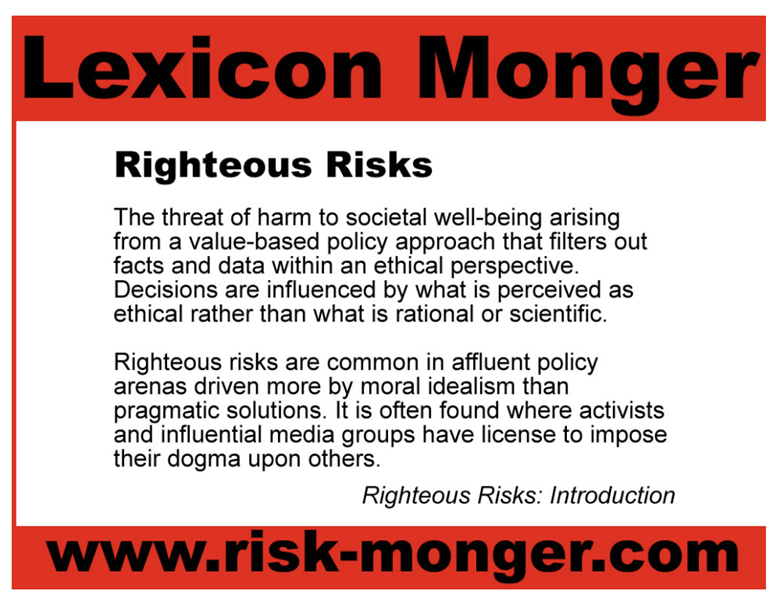
A righteous risk is a threat of harm to societal well-being that arises when decisions are based solely on widely-shared moral perceptions, social virtues and ethical ideals. This value-based policy approach does not consider facts or data in a consistent manner with certain actors, reinforced by social media tribes, imposing their ideals upon others. Righteous zealots (particularly environmental activists, naturopaths and food puritans) are more intensively forcing their moral dogma upon the policy process. Such value-based regulations are righteous risks that have become a growing threat to entrepreneurs and researchers whose innovations may challenge their traditional ethical norms. In attacking agricultural practices, food choices, energy use, nicotine alternatives and transportation choices, when the righteous feel they have virtue on their side, their reasoning and decision-making become hazardous to others.

He writes that this series will “look at case studies where righteous risks were (or were not) managed, the consequences and the lessons learnt.”  I strongly recommend reading the post in its entirety.  In the meantime, I will provide some examples of these risks that are evident in New York.

The Virtue of Environmentalism

The introductory post expands on his description of righteous risks.  He explains the peril of “making decisions solely on some ethical dogma, an unwavering virtuous self-appreciation or a fear of some stakeholder moral condemnation” is that policies lead to “irrational regulations that do little but harm.”  He writes:

The values that guide decision-makers, or the widely expressed social values that decision-makers feel they need to reflect, do not take into account the complexities of policymaking or the compromises that must be made. Politics is a pragmatic profession, but today we seem to have lost the art of Realpolitik, replaced by a “governance by moral aspiration” approach.

Zaruk is primarily concerned with policies within the European Union.  He describes how the Green Deal for the climate has recently been a primary driver of policies to transition to zero emissions:

The word “transition” started to be repeated in any official EU Green Deal speech. When we make a transition, we turn away from the bad and toward the good. The need for an energy transition, mobility transition or a food system transition became synonymous with fighting climate change. But this “transition towards…” strategy, as a righteous crusade, became curious as the Green Deal strategies were presented as virtuous solutions. Renewables, organic food, EVs, non-synthetic chemicals … were promoted within a moral framework, under the virtue of sustainability. Whoever would suggest advancing innovations in carbon capture and storage of fossil fuel emissions instead of more subsidies for renewables had crossed over to the dark side and would soon be ostracised by the community of influencers. When you speak in terms of good v evil in the moral imperative to stop climate change (to right the evils of past generations of unenlightened polluters), the Green Deal becomes a mission of the noble and the virtuous.

The Climate Act is a prime example of environmental virtuism.   One of the impacts touted on the Climate Act webpage is “Protecting our environment”: 

Fresh mountain air. Crystal clear waters. Your favorite tree in the neighborhood. It’s hard to describe the feeling of experiencing these natural resources. It’s even harder to picture a New York without them.

That is why we are making environmentally friendly choices, such as new options for waste management and clean energy, more accessible to all New Yorkers. That is why we are carefully monitoring the preservation of our forests and wetlands.  That is why we are making sure our renewable energy projects have a minimal impact on our cherished natural resources.

We are rising to the occasion to protect our environment — for today and tomorrow. Because we don’t want that feeling of catching a fish, skiing through fresh powdered snow, or simply enjoying a walk in the park to ever go away.

Clearly, anyone who objects to these plans is evil.  I maintain that every aspect of the Climate Act is more complicated than it appears at first glance, and it has been my experience that looking into issues exposes problems with the State’s narrative.  For example, the claim that “our renewable energy projects have minimal impact” ignores the fact that there are no constraints on utility-scale solar development to mandate that tracking solar panels be used consistent with the Scoping Plan, that the prime farmland protections in Department of Agriculture and Markets guidelines are followed, and that responsible solar siting agrivoltaics are required.  Meanwhile, I estimate that permitted projects have covered 8,365 acres of New York’s most productive farmland.

A Redefinition of Leadership

His introductory article argues that this “injection of ethical rectitude into policy strategies is redefining Western leadership.”  His description that “Policies are cloaked in values and expressed with hyperbole and categorically” sums up New York’s net-zero transition ambitions.  The problem is that zero is impossible and leaders are unwilling to admit that and “make decisions based on prescribed values rather than insight or intelligence.”

This righteous risk is front and center in the Hochul Administration’s rollout of every aspect of Climate Act transition.  For example, the most recent press release on the Climate Act webpage describes  additional funding for disadvantagedl communities:

Governor Kathy Hochul today announced $25 million in additional funding is now available under the State’s Clean Energy Communities Program for local municipalities to drive high-impact clean energy actions and reduce greenhouse gas emissions. The program, which recognizes local clean energy leadership and provides implementation grants, helps reduce municipal energy use, lower costs, and offers additional support for projects located in disadvantaged communities. This announcement supports the State’s Climate Leadership and Community Protection Act goal to reduce greenhouse gas emissions 85 percent by 2050.

“Advancing our climate and clean energy goals is a top priority as we experience the increasingly damaging impacts of climate change and extreme weather,” Governor Hochul said. “This initiative provides critical support to municipalities leading by example with investments in cleaner, more efficient solutions that lower energy costs while ensuring a clear path to building community-wide resiliency and a more inclusive green economy for everyone, especially for those historically underserved.”

Outrage Optics

Zaruk also describes a driver of policy that I see constantly in New York.  Politicians have always developed policy based on optics and today it is fashionable to use policy development in a process of engagement, stakeholder dialogue, and participation. He coins the term outrage optics to describe the ideologues whose moral outrage is a primary driver during the stakeholder engagement process.  This is inflamed because “social media has brought high-volume ethical disgust into the policy optics game with very little tolerance for compromise.”  He points out that to develop rational policies:

Leaders need to harden up. Just because some former Reuters journalist in Kansas calls a regulator names for standing by the scientific evidence on, say, glyphosate, does not mean he or she should abandon basic facts and science to be better judged by this little storm in a teacup.

The Climate Act includes a commitment to address equity  for “communities within New York that have been historically overburdened by environmental pollution”.  Ensuring equity and inclusion in our climate actions means “New York will ensure that all communities, but especially populations within disadvantaged communities (opens in new window), will benefit from the State’s investments and opportunities, including reducing pollution and creating new jobs and economic opportunities.”  One of the prime examples of this environmental burden is peaking power plants.  Outrage optics drives the environmental justice advocate claims that these power plants drive health impacts in adjoining neighborhoods.  However, I have shown that claims that peaking power plants are a source of egregious harm to disadvantaged communities is based on selective choice of metrics, poor understanding of air quality health impacts,  unsubstantiated health impact analysis, and ignorance of air quality trends. 

The following description is entirely apropos to New York’s Climate Act proponents:

The zealot influencer is the most dangerous lobbyist in the field, excelling at generating outrage optics within a small tribe of loud activists. They use a sociopathic preacher zeal to push policymakers into a moral quagmire. Support this legislation and you are supporting industry, wilfully spreading cancer on innocent children and destroying the environment. The argument is not about evidence or scientific advice, but on whether you, as a leader, are a good person. Outrage optics campaigns work on the idea that people will forget a policy choice in weeks but will never forget an irresponsible leader in the pocket of evil industry. When this emotional quagmire is too difficult and the moral outrage too insufferable, the precautionary principle is introduced as a mea culpa.

New York’s perfect example of a zealot influencer is Raya Salter.  She is the founder of Energy Justice Law & Policy Center and is a member of the Climate Action Council.   In an article I wrote about the tradeoffs between reliability and peaking power plants I noted that she never misses an opportunity to emphasize her belief that these facilities are a root cause of air quality health impacts in New York City disadvantaged communities.  In a recent Equity and Climate Justice Roundtable session, she argued that the New York Cap-and-Invest program should make shutting down the peaking units a priority.  She believes that equity is only achieved when fossil plant emissions are zero saying that “Anything less than shutting down power plants is a distraction from the goals of the Climate Act”.  However, she also says getting to zero must be done “in a way that prioritizes emissions and co-pollutant reductions in front line communities and does not disproportionately burden disadvantaged communities”. 

Developing a Righteous Risk Management Strategy

The final section of the introductory post offers some thoughts on developing a righteous risk management strategy:

Is it wrong to be critical of stronger moral values guiding public officials? Not at all. But when all policies are driven merely by ethical values and unbending zealots; when activists frame every policy debate in simplistic, good vs evil poles; when policymakers are inconsistent in their regulatory implementations according to perceived normative interests; and when the public is persuaded to consider capitalism, innovation and entrepreneurship as moral deficiencies; then righteous risks become a threat to rational policies, democracies and the public. I’m afraid that’s where we are today but it is where we go tomorrow that interests me.

All of these policy drivers are evident in the Climate Act implementation process.

Conclusion

I encourage readers to check out the introduction and Part 2.  I did not discuss all the points made and there are many more excellent concerns described.  The arguments are entirely relevant for New York’s Climate Act transition and Zaruk’s provides good examples of the risks of this approach.

I concur with Zaruk’s argument that righteous risks are becoming a threat to rational policies, democracies and the public good.   Tradeoffs between Climate Act absolutism, i.e., demanding nothing less than zero, and the extra costs, reliability risks, and unintended environmental impacts are not even on the table for discussion. Given that  New York GHG emissions are less than one half of one percent of global emissions and global emissions have been increasing on average by more than one half of one percent per year since 1990 it is clear that New York’s Climate Act cannot affect climate change.  I think that there is no rational reason not to discuss pragmatic solutions.  I am not saying that New York should not do something, but clearly, we have time to make sure that the actions taken do not do more harm than good.  Arguing otherwise is not in the best interests of New York.

Energy Density and Micron

In 2022, Micron announced its plans to build the largest semiconductor fabrication facility in the history of the United States. Micron intends to invest up to $100 billion over the next 20-plus years to construct a new chip fab plant in Clay, New York.   A recent letter to the Editor of the Syracuse Post-Standard posed the questions: I wonder why the citizens of our state must be the sole providers of electricity to Micron? Shouldn’t Micron at least share in producing electrical power?  The author went on to make recommendations that are inconsistent with the energy density of wind and solar that relate to the viability of the venture.  This post documents the response I submitted to that letter.

I am following developments at Micron because the facility is going to be built within five miles of my home.  I also follow the Climate Leadership & Community Protection Act (Climate Act) because of its impacts on New York. The letter relates to both interests.  The opinions expressed in this post do not reflect the position of any of my previous employers or any other organization I have been associated with, these comments are mine alone.

Overview

The Climate Act established a New York “Net Zero” target (85% reduction and 15% offset of emissions) by 2050.  It includes an interim 2030 reduction target of a 40% reduction by 2030 and a requirement that all electricity generated be “zero-emissions” by 2040. The Climate Action Council (CAC) is responsible for preparing the Scoping Plan that outlines how to “achieve the State’s bold clean energy and climate agenda.”  In brief, that plan is to electrify everything possible using zero-emissions electricity. The Integration Analysis prepared by the New York State Energy Research and Development Authority (NYSERDA) and its consultants quantifies the impact of the electrification strategies.  That material was used to develop the Draft Scoping Plan.  After a year-long review, the Scoping Plan recommendations were finalized at the end of 2022.  In 2023 the Scoping Plan recommendations are supposed to be implemented through regulation, PSC orders, and legislation.  Environmental permitting is part of these implementation concerns.

Micron Chip Fab Faciliity

The description in the Environmental Assessment Form states:

Micron intends to invest approximately $100 billion over the next 20 years to build a leading-edge semiconductor manufacturing campus in the Town of Clay on the approximately 1,400-acre White Pine Commerce Park. Micron intends to acquire the White Pine Commerce Park from the Onondaga County Industrial Development Agency (OCIDA) and construct a campus for four (4) memory fabrication plants (also known as Fabs) on the site. Each Fab, and their related facilities, would take approximately three to five years to construct. Interior fit-out of each Fab would continue after the building is complete, resulting in continuous site activity over approximately 20 years. It is anticipated that the first two (2) Fabs would be complete within approximately 10 years, and the second two (2) Fabs would be complete approximately 10 years thereafter. Skilled trade labor will be employed throughout the 20-year period. Each Fab would occupy approximately 1.2 million square feet (sf) of land and contain approx. 600,000 sf of cleanroom space, 290,000 sf of clean room support space, and 250,000 sf of administrative space. Each set of two fabs would be supported by approx. 360,000 sf of central utility buildings, 200,000 sf of warehouse space, and 200,000 sf of product testing space housed in separate buildings.

Micron should share in producing power for its chip fab letter

Scott Love from Jamesville, NY sent a letter to the editor proposing several actions for the power needs of the facility.

After reading the article “Leaders: Grid must grow for Micron, others” in the Dec. 3, 2023, Business section of The Post-Standard, I wonder why the citizens of our state must be the sole providers of electricity to Micron? Shouldn’t Micron at least share in producing electrical power? The acreage covered by the Micron facility roofs should be used for producing solar power. In addition, hydro generators should be considered for the almost 40 miles of pipeline to and from Lake Ontario. On-site wind power should also be considered.

If Micron is to be considered a leader to the future of our community, then it is time for them to be forward-thinking in their planning.

There are several points raised that are ripe for comment in this letter.  The paper published the following in response:

Scott Love recently suggested that Micron should share the responsibility to provide the electricity necessary for the facility.  I agree with the idea but not his suggested approach. 

He suggested that the facility use rooftop solar, think about on-site wind power, and consider hydro in the pipeline from Lake Ontario. That won’t work.  The energy density of solar and wind is low.  Even if the entire Micron footprint of 1,400 acres was covered with solar panels, panels would provide less than 1% of the power needs.  Wind requires even more space so would provide less of the energy needed.  Lake Ontario is lower than the Micron site so the water must be pumped up to the facility.

I believe a co-generation facility using natural gas or nuclear power is appropriate.  For starters, it would eliminate the need for energy storage when the wind is not blowing or sun not shining.  On-site generation makes sense because it reduces line loss and waste heat produced can be used for heating and manufacturing processes.  Small modular nuclear reactors are not yet commercially available, but the facility could be designed to use that technology in the future.  In the meantime, a combined-cycle gas turbine facility could be built.  Carbon dioxide could be minimized by using it in on-site greenhouses that convert it to food.

If Micron is going to be a part of our community, it is time for everyone to be forward thinking and pragmatic about how best to make them competitive.

The remainder of this article summarizes the overall issue of Micron energy requirements and specific concerns with the letter.

Micron Energy Use

In August I prepared an article that described the reaction of Richard Ellenbogen to the massive amount of energy needed by the facility. I correspond with him regularly because he has spent a lot of time evaluating the Climate Act net-zero transition.  I recently described his comprehensive   presentation on the transition.  When I let him know that the original projection for energy use that would be the same as the state of Vermont has been expanded to be the same as Vermont and New Hampshire he responded with the following:

I have been using the Micron facility as an example of how the Climate Act is actually going to increase NY State’s carbon footprint because transmitting all of that energy to the Micron site, as much as is used by the state of Vermont, over long distances was going to result in an amount of lost energy on the wires that could operate 1-3/4 Cornell Universities.  One of my readers sent me an update of energy use because now it is projected that the Clay complex will consume 16 billion kilowatt-hours of electricity per year, as much as Vermont and New Hampshire combined, or 16,000 Gigawatt Hours annually (16 Tera-watt hours).  That is double the original projections and the idea that this could be supported with renewable generation is laughable.  16,000 GWh is an 11%  increase in NY State electric usage just related to the one facility.  The line loss will also double to consume the output of about  a 100 megawatt fossil fuel plant under continuous operation.

To put the Micron facility’s usage into perspective, in its last full year of operation the 2 Gigawatt Indian Point nuclear plant generated 16.3 Tera-watt hours so the Micron facility will need to be supported by a 2 Gigawatt fossil fuel or nuclear plant on site or  2.1 Gigawatts of generation off site, 5% more.  NY State’s policy makes absolutely no sense.  To run the Micron facility would require using about 4 GW of the projected 9 GW of offshore wind to support the plant or 16 GW of solar arrays covering 128,000 acres (80 acres per 10 MW)  or 200 Square miles.  NY State has 7 million acres of farmland so solar arrays to support the Micron facility  would use almost 2% of the farmland in the state and would also require an enormous amount of battery storage, the cost of which would greatly exceed the cost of a nuclear plant on site.  A combined cycle generating plant on site would be about 75% less than the cost of the nuclear plant.  Both the combined cycle gas plant and the nuclear plant on-site offer the option of recovering the waste heat and using it in the plant to make Micron even more energy efficient.  With regard to the solar and wind, NY State is having major difficulties getting all of their renewable projects finished because of cost issues and interconnection issues, let alone adding this gigantic lead weight to the Camel’s back.

Micron Sustainability

The fact sheet for the proposed plan describes sustainability initiatives planned:

  • Achieve 100% water reuse, recycling and restoration.
  • Use 100% renewable electricity at the new facility.
  • Use green infrastructure and sustainable building attributes for the construction of the new fab to attain Leadership in Energy and Environmental Design (LEED) Gold status.
  • Mitigate and control greenhouse gas emissions (GHG) for the new facility.
  • Incorporate energy efficiency measures.
  • Utilize green hydrogen – hydrogen formed through electrolysis powered by renewable electricity, without GHG emissions – to the extent feasible to displace/replace natural gas and gray hydrogen consumption.
  • Adopt measures to reduce and avoid waste generation and achieve zero hazardous waste to landfill.

I have been asked whether I think this facility will ever get built out as proposed.  While I hope that it works out my skepticism increases in direct proportion to the number of commitments to politically correct narratives.  This sustainability fact sheet is worrisome in that regard. The viability of this facility hinges on its ability to provide cost-competitive chips that require an energy intensive process.  The Climate Act is going to raise energy prices and affect that metric.  Consider those pledges relative to competitive viability.

This chip fab plant will use enormous amounts of water.  Last summer it was disclosed that the environmental assessment expected that when the plant is fully fitted out that 40 million gallons of water per day would be needed.  This would require a new 54” pipeline from Lake Ontario to the facility.  It is not clear how that is consistent with the 100% water reuse, recycling, and restoration pledge unless the presumption that discharging to the Oneida River that ends up in Lake Ontario where it comes back to the plan is the 100% recycling mechanism.  For my part I am fine with that.

The 100% renewable electricity pledge is a competitiveness problem, however.  Ellenbogen’s response shown above addresses many of the issues.  In his recent presentation he pointed out that as part of the commitment NYPA has committed to allocating 140 MW of hydro generation to Micron.  The problem with that is that it does not represent new hydro.  That is just re-labelling the “zero-emissions” attribute from somebody else to Micron for that power.   

I have reservations about the remaining pledges. Ultimately, pledging to meet virtue signaling sustainability goals could increase energy costs which I worry could affect the viability of the facility.  I have to believe that behind the scenes Micron and the State are going to have to address the tradeoffs of added costs for these pledges.

The pledge to use green hydrogen formed through electrolysis powered by renewable electricity, without GHG emissions caters directly to the Climate Action Council.  This one could have major financial effects.  Note that the caveat “to the extent feasible to displace/replace natural gas and gray hydrogen consumption”, is the only instance in their sustainability fact sheet where there is any hint that these aspirational goals may not be feasible.

The pledge to use green infrastructure and sustainable building attributes for the construction of the new fab to attain Leadership in Energy and Environmental Design (LEED) Gold status is pandering s well.  As long as these efforts reduce energy consumption this virtue signal will not impact the competitiveness of the facility.

Offering to mitigate and control greenhouse gas emissions (GHG) for the new facility is fine but there are regulations that are going to require than anyway.

Incorporating energy efficiency measures is another pledge. As long as these efforts reduce energy consumption that will reduce costs and is common sense approach to adding to viability.

The final pledge to “adopt measures to reduce and avoid waste generation and achieve zero hazardous waste to landfill” probably makes sense financially and adds viability value.

Documentation for my Letter

Love proposed that the facility use rooftop solar, think about on-site wind power, and consider hydro in the pipeline from Lake Ontario. He does not understand the scale of energy required or the concept of energy density.  The energy density of solar and wind is low.  Using the aforementioned analysis by Ellenbogen I calculated that even if the entire Micron footprint of 1,400 acres was covered with solar panels, they would provide less than 1% of the power needs because it takes a lot of space to gather energy from the sun.  It might be counter intuitive but Ellenbogen and I both found references from federal agencies that said wind facilities require even more space to generate the same amount of energy.  Due to space considerations, I could not point out that solar and wind resources at the facility site are unlikely to be particularly strong relative to other sites in New York because the site is in the lake-effect cloud belt and the area is flat.  I expect that the facility footprint would likely produce even less of the energy needs than projected using state averages.  Another point I could not make is that on-site production would need to provide energy storage to be useful.

The proposal to put hydro in the pipeline from Lake Ontario is laughable.  Lake Ontario is lower than the Micron site so the water must be pumped up to the facility.  That approach is an example of a perpetual motion machine.  Ellenbogen also pointed out that even if it was downhill, do they really think that a 54″ diameter water pipe could put a dent in the energy needed?  Micron’s 16.2 TWh will use the equivalent to 60% of all of the Hydro in the state or 26.8 TWh.  Micron is supposed to use 10 million gallons per day after recycling with a 54″ pipe.  That corresponds to 7000 gallons per minute.  The Robert Moses / Lewiston Pumping Station uses 750,000 gallons per second or 45 million gallons per minute.  That would be 6500 times as much.

Ellenbogen and I independently decided that co-generation would be the most appropriate on-site energy source.  We believe a co-generation facility using natural gas or nuclear power is appropriate.  The Ellenbogen presentation proposed allowing Micron Technologies to build a 2 GW combined cycle plant on their property.  He points out that with generation on-site, the thermal energy could be used at the plant and the 500 GWh of annual line loss will be eliminated.

There are two choices for generation.  Small modular nuclear reactors are not yet commercially available, but the facility could be designed to use that technology in the future.  In the meantime, a combined-cycle gas turbine facility could be built.  The downside of a natural gas co-generation plant is that it will emit CO2.  One of the unresolved Climate Action Council questions is whether such a gas-fired turbine that includes carbon capture and sequestration would be allowed.  According to the zealots, there still would be emissions and the law says zero emissions. Ellenbogen suggested using greenhouses to reduce CO2 emissions.  Using the CO2 in them to enhance growth captures carbon in the plants and waste heat from turbines to warm them would tick off the locally sourced produce target and I am sure creative accounting comparing local produce to the produce shipped from overseas could claim GHG emission reductions. .

Conclusion

The development of Micron within the Climate Act framework will be a good test of pragmatic environmentalism.  The tradeoff between Climate Act absolutism, i.e., demanding nothing less than zero, with the extra costs associated with that approach versus the need to keep the Micron facility in New York competitive with the global chip market is an important substantive issue.  However, much of the Climate Act is style over substance.  The press releases to date talk a stylish game about being green but the approach to making them look “green” is a simply shuffling attributes from existing sources.  Ellenbogen and I believe that we should let them be green in reality with high efficiency generation that lowers energy costs to make them more competitive without faking it.  For all the talk of jobs associated with the energy transition if the energy transition makes the Micron facility unable to compete on the world market then there will be an enormous hit on jobs.

Energy density is the reason that on-site wind and solar generation would only be virtue signaling.  The area simply cannot generate enough electricity to be meaningful.  I have no doubt that environmental activists will be upset that I recommend energy dense natural gas or nuclear cogeneration that could be installed on the footprint.  However, if Micron is going to be a part of our community, it is time for everyone to be forward thinking and pragmatic about how best to make them competitive.

Re-building Interstate I-81 in Syracuse, NY

The US edition of the Guardian has picked up on the issue of the re-building of Interstate 81 through the city of Syracuse in an article entitled The NY Highway That Racism Built.  According to the article it was built through a historically black neighborhood because of racism.  I only want to post this article because the reality is that the location of the highway was dictated by geography.

Background

Briefly, New York State wants to replace the highway through Syracuse because it is needs to be replaced.  According to the Department of Transportation website:

Interstate 81 (I-81) is important to the Syracuse area. The highway serves as a major commuter route, providing access to jobs, businesses and services in downtown Syracuse and the hospitals and institutions on University Hill. It also serves as a national and international north-south trade route from Tennessee to the Canadian border. This connectivity is essential and influences the livability, economic vitality, and sustainability of the Syracuse metropolitan region.

Portions of I-81, which was built in the 1950s and 1960s, are deteriorating and nearing the end of their useful life. Also, sections of I-81 do not meet current standards and are experiencing high accident rates. This is especially true of the 1.4-mile elevated section, or “viaduct,” near downtown Syracuse. Now is the time to address I-81’s safety concerns and the structural integrity of the viaduct. In order to do this, the New York State Department of Transportation (NYSDOT) and the Federal Highway Administration (FHWA) are following an environmental review process. The purpose of the I-81Viaduct Project is to address the structural deficiencies and non-standard highway features in the I-81 corridor while creating an improved corridor through the City of Syracuse that meets transportation needs and provides the transportation infrastructure to support long-range planning efforts (such as SMTC LRTP, Syracuse Comprehensive Plan, and others).

Discussion

According to the article:

In the 1960s, I-81 plowed through a historically Black neighborhood in Syracuse, displacing hundreds. Organizers’ dream of seeing it torn down may get new life under Biden.

Just south of downtown Syracuse in upstate New York, a stretch of highway has long divided surrounding neighborhoods.

On the east side are large buildings where university students live, well-maintained green spaces, and a wall that blocks the highway from view. On the west side is a predominantly low-income and disinvested Black neighborhood where the pollution from the highway exacerbates many residents’ existing health conditions

I believe that once the decision was made to bring the highway through the city that the location was destined to go through the neighborhood in question simply because of geographical constraints.  There is an overview map of the Syracuse region in the introduction to the draft environmental impact statement.  Not shown on the map are railroads that parallel most of the route of the interstate through Syracuse.

The Central Study Area map from the draft environmental impact statement shows the north-south route of I-81 through the city.  The viaduct that is the cause of so much concern runs between Downtown and Near Eastside south of I-690 which runs east to west.  Note that further south the viaduct separates Southside and University Hill.

There is a picture in the article credited to the Onondaga Historical Society that shows the highway being constructed that shows the hills to the south of the city that are a major reason for the location of the highway. 

This picture provides the rationale for my argument that the location of the highway was due to geography.  The picture looks south with University Hill, the location of Syracuse University, to the east and downtown Syracuse on the valley floor to the west.  Check the overview map and you can see that to the north there is a lake that precludes building the highway to the west of downtown Syracuse.  The most direct transportation corridor from the north into the downtown originally followed a canal which was followed by a railroad.  The highway route replaced them both.  Not shown in the picture is a railroad that cuts under the interstate at the end of the viaduct headed south along the hill on the left.  The most direct route to the city from the south followed this transportation corridor into the city. In order to connect the two transportation corridors, the most direct route was through the predominately black neighborhood. 

Conclusion

I don’t believe that the argument that the highway location was chosen specifically to target a black neighborhood stands up to the geography rationale.  This does not detract in any way the very real environmental and health impacts of the residents near the highway.  I have not doubt that in today’s political climate that the viaduct through this section of the city will be torn down and replaced by a community grid.  The arguments for and against replacement of the viaduct versus the politically correct community grid option boil down to value judgements. 

Ultimately the only thing I am sure that will not happen is that the community grid will ignite a renaissance of the city’s fortunes and revitalization of all the neighborhoods near the highway.   There are too many other factors at play to believe that the simply changing the highway will solve the problems that advocates for the community grid option claim are due to the highway.

Environmental Justice Risks from Hyper-Local Monitoring are Exaggerated

Note:  This post was also published at Watts Up With That

According to Bloomberg Law, Biden’s Hefty Clean Air To-Do List Follows Early Big Promises means that air quality standards have to be revised and must incorporate social justice and climate concerns.  Based on what I have seen this push will rely less on science and more on emotion.

The Bloomberg article states:

“Revising clean air rules is a cornerstone of climate and justice policies, two areas that the Biden administration has set as priorities.  Clean air experts in areas that carry a disproportionate burden of dirty air say that runaway air pollution remains a chronic problem, reflecting neglect of low-income neighborhoods and communities of color, exacerbated by air monitor disparities.”

“Portable air quality monitors used in the South Bronx and Brooklyn caught particulate matter quantities 20 times higher in some areas than levels reported by state-run monitors, according to new data from a neighborhood-level air monitoring study by the New York City Environmental Justice Alliance, or NYC-EJA.  The findings highlight insufficient air monitoring for targeted environmental justice communities, and show why one generalized air policy may not be enough to mitigate pollution for hard-hit areas, said Jalisa Gilmore, research analyst for NYC-EJA.  “That’s why we have a little bit more emphasis on hyper local monitoring, and making sure that we actually get the interventions that are most appropriate for the community,” she said.”

The New York City hyper local monitoring program is described in the Community Air Mapping Project for Environmental Justice (CAMP-EJ) findings and recommendations report.  In brief:

“Because New York City has only 13 high-performance ambient air monitoring sites, air pollution exposures are poorly characterized at the neighborhood level. To address this data gap, CAMP-EJ utilized dozens of low-cost, portable air quality monitors to measure hyperlocal air quality and characterize air pollution exposures at more refined spatial and temporal scales than is possible using existing City and State data. The results of our air monitoring campaign shed light on the disproportionate public health burdens imposed on environmental justice communities from industrial pollution, trucking, and transportation infrastructure.”

The analysis found that local facilities and expressways are big polluters, traffic congestion fouls the air twice every day, and that hyperlocal measurements show inhalable particulate matter are twenty times higher than state-run monitors.  I was not surprised by the first two findings but the claim that hyperlocal measurements were much higher than state-run monitors surprised me.

I have experience running air quality monitoring networks with particulate matter monitors.  I found that measuring particulates was always difficult to do correctly and more so with smaller aerodynamic particles like the inhalable or 2.5 micron particles.  In the project, “CAMP-EJ participants used the AirBeam2, a low-cost, palm-sized air quality instrument that measures PM2.5, and AirCasting, an open-source environmental data visualization platform that consists of an Android app and online mapping System”.

The going price for an AirBeam 2 is around $250 and the state-run monitors systems use instruments that go for $25,000.  The state-run system has a detailed quality assurance plan and includes quality control tests which I doubt were included in the community monitoring program so my first thought is just how accurate are these personal monitors?  According to the report: “The AirBeam2’s PM2.5 measurements are “quite accurate” according to a performance evaluation conducted by South Coast Air Quality Management District, which compared the performance of the AirBeam2 to reference monitors.”

However, the South Coast Air Quality Management District evaluation report I found told a different story.  Three sensors were tested against a reference FEM FRIMM PM 2.5 monitoring instrument similar to the one used in the New York State network.  According to the concluding discussion:

“Accuracy: Overall, the three AirBeam sensors showed very low accuracy compared to FEM GRIMM at 20 °C and 40% RH, when varying PM2.5 mass concentration from 10 to 50 μg/m3. The AirBeam sensors significantly overestimated the FEM GRIMM readings. According to the method of calculating accuracy, the % accuracy for the sensors were all negative. When PM2.5mass conc. was over 50 μg/m3, Airbeam sensors reached plateau of 315 μg/m3.”

Don’t get me wrong, I have no doubt that the CAMP-EJ main conclusions, local facilities and expressways are big polluters and traffic congestion fouls the air twice every day, are correct.  However, the monitors used over-estimated inhalable particulate concentrations considerably, particularly at the higher rates they claimed are hurting local communities.  As a result, the numbers that they claim prove the need to act are incorrect.

Climate Leadership and Community Protection Act Cumulative Environmental Impacts

On July 18, 2019 New York Governor Andrew Cuomo signed the Climate Leadership and Community Protection Act (CLCPA), which establishes targets for decreasing greenhouse gas emissions, increasing renewable electricity production, and improving energy efficiency.  It was described as the most ambitious and comprehensive climate and clean energy legislation in the country when Cuomo signed the legislation.  However, it is not clear that the cumulative environmental impacts of all the resources needed to meet the 2050 net-zero goal will be less than the purported environmental impacts of the climate change effects of New York emissions in part because the State has not evaluated the impacts of all the resources needed for those goals.

I have written extensively on implementation of the CLCPA closely because its implementation affects my future as a New Yorker.  I have described the law in general, evaluated its feasibility, estimated costs, described supporting regulations, listed the scoping plan strategies, summarized some of the meetings and complained that its advocates constantly confuse weather and climate.  The opinions expressed in this post do not reflect the position of any of my previous employers or any other company I have been associated with, these comments are mine alone.

Background

I have been doing environmental assessments for over 40 years and really worry about the environmental impacts of the CLCPA because there is no commitment to evaluate the cumulative impacts.  The problem is that while an individual industrial wind facility or solar facility may not have a notable environmental impact the cumulative impact of all the facilities necessary to provide enough power to meet the reliability needs of the state could have significant environmental impacts.  Because the State has established this goal it should be responsible for this analysis and not the applicants for individual facilities.

On June 24, 2020, DPS announced that they would be accepting comments on the Draft Supplemental Generic Environmental Impact Statement on the proposed Climate Leadership and Community Protection Act.  On September 30, 2020 DPS announced that they had accepted the Final Supplemental Generic Environmental Impact Statement on the proposed Climate Leadership and Community Protection Act (“CLCPA SGEIS”).  The Executive Summary explains that this is the fifth environmental impact analysis for various iterations of New York’s clean energy programs.  The statement explains that the action is “a continuation of previous initiatives analyzed in the Prior SEQRA Analyses, in addition to the increase in resources needed for implementation of the following CLCPA requirements:

      • 70% of electricity from renewable energy by 2030
      • 9,000 MW of offshore wind electricity by 2035
      • 6,000 MW of distributed photovoltaic solar generation by 2025.”

There are two problems however.  There are significant differences between 70% of electricity from renewable energy by 2030 and 100% by 2040.  The other problem is that their projections for the generation necessary for 2030 are outdated with more recent estimates coming in higher.  This post compares the resources modeled in this impact statement and the latest projections.

Comments

I have made the comment that a comprehensive cumulative environmental impact statement is needed for New York’s clean energy programs in a couple of venues including the Resource Adequacy proceeding and Accelerated Renewable Energy Growth and Community Benefit Act proposed regulation.  I prepared comments on the Draft Supplemental Generic Environmental Impact Statement for this CLCPA impact statement but ended up not submitting them. This post updates those unsubmitted comments.

In this post I consider the avian impact of the Bluestone Wind Project in Broome County New York to show impacts for a single facility.  It will have up to 33 turbines and have a capability of up to 124 MW covering 5,652 acres.  The “Cumulative Impacts Assessment” Appendix UU, which is document #752 on the NYSDPS-DMM-Matter Master website case #16-F-0559 in the Article 10 application for the facility.   Over the 30-year expected lifetime of the facility the analysis estimates that 85 Bald Eagles and 21 federally protected Eastern Golden Eagles will be killed.  The analysis assumes that impacts to bat species at the Facility would be similar to the average bat impacts reported at other wind energy projects in New York (average rate of 6.05 bats/MW/year) so approximately 868 bat deaths per year could be expected at the Facility.  However, the facility has committed to a mitigation curtailment that will stop operations during light wind speeds from July 1 to September 30 which they claim will reduce impacts 60% down to 347 bat deaths per year.

The cumulative impact analysis in this report references a Department of Energy site Projected growth of the Wind Industry.  They project that from 2020 to 2050, the projected 30-year life of the Facility, on-shore wind development in New York is estimated to increase from 1.75 gigawatts (GW) to 5.61 GW.  The next step is to see how that projection for on-shore wind development squares with more recent, NY climate policy specific projections for on-shore wind and the CLCPA SGEIS.

The Estimates of Land-Based Wind Resources table has 16 estimates of on-shore wind resources.  In 2019 there were 1,985 MW of installed wind capacity.  According to Exhibit 1-2, Summary of Environmental Resource Areas Analyzed in the Prior SEQRA Analyses, onshore wind impacts were last considered in the 2016 SEIS and in the CLCPA SGEIS were “not analyzed further”.  As a result, the 2016 impact statement estimates of the land-based wind capacity ,  4,000 MW in the base case and 5,905 MW in the high load case, represent the latest CLCPA EIS estimate.   In 2020 the New York Independent System Operator (NYISO) estimated land-based wind resources needed to meet the Climate Act 70×30 goal as part of its Congestion Assessment and Resource Integration Studies (CARIS) planning process.  They project that 6,476 MW will be needed, 571 MW more than the latest CLCPA EIS estimate, in 2030.  Importantly, in order to meet all the electrification needs of the Climate Act in 2050, much more land-based wind will be needed after 2030. On June 24, 2020 Energy plus Environmental Economics (E3) presented results of their emissions reductions pathway analyses to the New York Climate Action Council that included projections of land-based wind in 2030, 4,700 MW, which is less than the latest CLCPA EIS estimate high load case, but in 2050 they projected 9,000 MW in 2050, which is 3,095 MW more than the latest CLCPA EIS estimate high load case.

On June 15, 2020 the Brattle Group presented results from their report New York’s Evolution to a Zero Emission Power System that included five projections of land-based wind.  In their base case they project 9,700 MW in 2030 and 23,300 MW in 2040, 3,795 MW and 17,395 MW more than the latest CLCPA EIS estimate high load case respectively.  They also included two scenarios with different estimates of feasibility.  They noted that the DPS maximum feasible on-shore wind builds were 10,000 MW (4,095 MW greater than the latest CLCPA EIS estimate) and the NYSERDA maximum feasible on-shore wind builds were 8,000 MW (2,095 MW greater than the latest CLCPA EIS estimate).  The final scenario claimed used a National Renewable Energy Lab (NREL) technical potential on-shore wind capacity of 26,000 MW which is 20,095 MW greater than the latest CLCPA EIS estimate.  The Analysis Group Climate Change Impact Phase II Final Report for NYISO had another estimate for the NREL total technical potential of 35,200 MW which is 29,295 MW greater than the latest CLCPA EIS estimate.  That analysis incorporates all the load increases necessary to electrify other sectors to meet the CLCPA goals so I believe that this is the best estimate of the final resource requirement.  Because that capacity estimate is so much larger than the latest CLCPA EIS estimate I can only conclude that another environmental impact analysis is needed when the Climate Action Council finalizes its Scoping Plan.

It is concerning to me that an analysis done for NYSERDA on wind power and biodiversity by the New York Natural Heritage Program (NYNHP) and Nature Conservancy found that: “5,430 square kilometers (1.3 million acres) of land in New York that are both suitable for wind power development and avoid areas that are likely to have high biodiversity value. Using an estimate of 3.0 MW/square kilometers, this translates to a megawatt capacity estimate of 16,300 MW (± 9,000 MW) for New York’s terrestrial landscape.”  The Analysis Group projection of 35,200 MW exceeds this range and that suggests that wind turbines will have to be sited within areas of high biodiversity value.  It is absolutely necessary that there is a commitment to do a cumulative environmental impact statement evaluating the on-shore wind resources needed to meet the CLCPA goals.

Finally, I made estimated some New York Cumulative On-Shore Wind Impacts.  I calculated the land needed for development and compared that to agricultural land and high biodiversity land.  According to the latest CLCPA EIS, assuming a conservative range of land use requirements from NREL’s 2009 study of 30 to 141 acres per MW, total land use requirements for 4,000 MW of land-based wind under the base case PPA scenario (the latest CLCPA EIS estimate scenario which projects the lowest amount of land-based wind development) may require between 120,000 and 564,000 acres of land.  I calculated the totals for all the scenarios included in the previous table.  Based on a recent estimate of 8.79 million acres of agricultural lands in NYS, if agriculture lands hosted 100 percent of wind energy development projects, for all the projections between approximately 1.4 percent up to 56.5% percent of agriculture lands would have to be converted to wind energy development.  The fraction of suitable land compares the NYSERDA on wind power and biodiversity estimate of suitable land for wind development to the land needed to meet CLCPA requirements.  The fraction ranges from a miniscule 0.09 to a scary 3.82.  These unrefined estimates are only intended to make the point that a refined analysis is needed.  It is unlikely that wind development will take place on agricultural lands but solar energy development is much more likely there.  Wind will impact forests along ridge lines.

Circling back to the Bluestone Wind Project analysis that predicted eagle and bat deaths I also calculated the state-wide impacts using their numbers.  Annual deaths range from 91 to 804 Bald Eagles, 23 to 199 Eastern Gold Eagles, and 373 to 3,283 bats simply extrapolating their numbers state-wide.  Of course, those are crude numbers.  The population density of these species has to be mapped against the actual locations of potential wind farms for starters.  The actual methodology used to determine deaths also has to be checked and the bat deaths incorporate a mitigation curtailment that limits operations.

 Conclusion

I have always maintained that the biggest deficiency in the CLCPA was the lack of a feasibility study.  It is not clear to me that the ultimate problem of trying to supply the energy needs of an mostly electrified New York  electric system can be solved during a multi-day winter doldrum if the primary sources of electricity are wind and solar   The only way this might work will require extraordinary amounts of wind and solar development.  When there is an “official” estimate of those resources clearly a cumulative environmental impact analysis for those resources should be completed as soon as possible.

Ideally, preparations for that cumulative analysis should start now to determine a threshold for unacceptable environmental impacts.  For example, I am worried about eagles.  If you had told me 30 years ago that I would ever see a Bald Eagle from my home I would have been doubtful.  Now that has occurred and I am not willing to chance that environmental victory.  Because there are a limited number of eagles and their reproduction rates are low, I imagine that wildlife biologists could develop a criterion on the acceptable annual rate of state-wide eagle deaths from wind turbines.  There were 426 occupied bald eagle nest sites in New York in 2017. It is obvious that a more detailed projection of wind turbine impacts on this rare resource is needed.  The ultimate goal should be to refine the NYSERDA on wind power and biodiversity habitat sensitivity maps for the CLCPA resource development planning and siting process.