

A couple of years ago I posted an article about New York GHG emissions and found that they are less than one half of one percent of global emissions and that global emissions have been increasing on average by more than one half of one percent per year since 1990. I was recently asked to document that claim and updated that analysis. This post describes the results.
I have followed the Climate Act since it was first proposed, submitted comments on the Climate Act implementation plan, and have written over 400 articles about New York’s net-zero transition. The opinions expressed in this post do not reflect the position of any of my previous employers or any other organization I have been associated with, these comments are mine alone.
Overview
The Climate Act established a New York “Net Zero” target (85% reduction in GHG emissions and 15% offset of emissions) by 2050. It includes an interim 2030 reduction target of a 40% reduction by 2030 and a requirement that all electricity generated be “zero-emissions” by 2040. The Climate Action Council (CAC) is responsible for preparing the Scoping Plan that outlines how to “achieve the State’s bold clean energy and climate agenda.” In brief, that plan is to electrify everything possible using zero-emissions electricity. The Integration Analysis prepared by the New York State Energy Research and Development Authority (NYSERDA) and its consultants quantifies the impact of the electrification strategies. That material was used to develop the Draft Scoping Plan outline of strategies. After a year-long review, the Scoping Plan was finalized at the end of 2022. In 2023 the Scoping Plan recommendations were supposed to be implemented through regulation, PSC orders, and legislation. Not surprisingly, the aspirational schedule of the Climate Act has proven to be more difficult to implement than planned and many aspects of the transition are falling behind. In addition, there has not been any additional documentation provided that proves that the transition will be affordable, keep the same standards of energy reliability, or not have unacceptable cumulative environmental impacts.
GHG Emissions
I frequently note that New York greenhouse gas emissions are less than one half of one percent of global emissions, and global emissions have been increasing by more than one half of one percent per year since 1990. This post shows that the claim is still true.
I originally used information from my post Climate Act Emission Reductions in Context to support that claim. I recently updated the analysis. I found CO2 and GHG emissions data for the world’s countries and consolidated the data in a spreadsheet. There is interannual variation, but the five-year annual average has always been greater than 0.79% until the COVID year of 2020. For the New York data I used GWP-100 data from Open Data NY through 2021 as documented in this post. New York’s share of global GHG emissions is 0.42% in 2019 so this means that global annual increases in GHG emissions are greater than New York’s total contribution to global emissions.
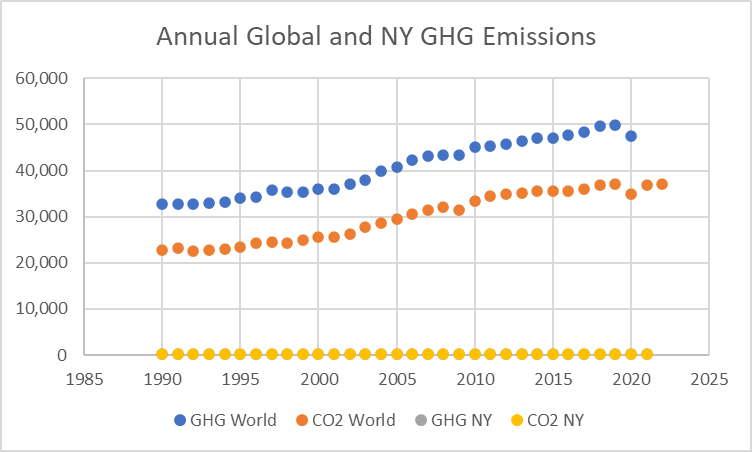
The data used are shown in the following table.
Global and New York State GHG and CO2 Emissions (million metric tonnes)

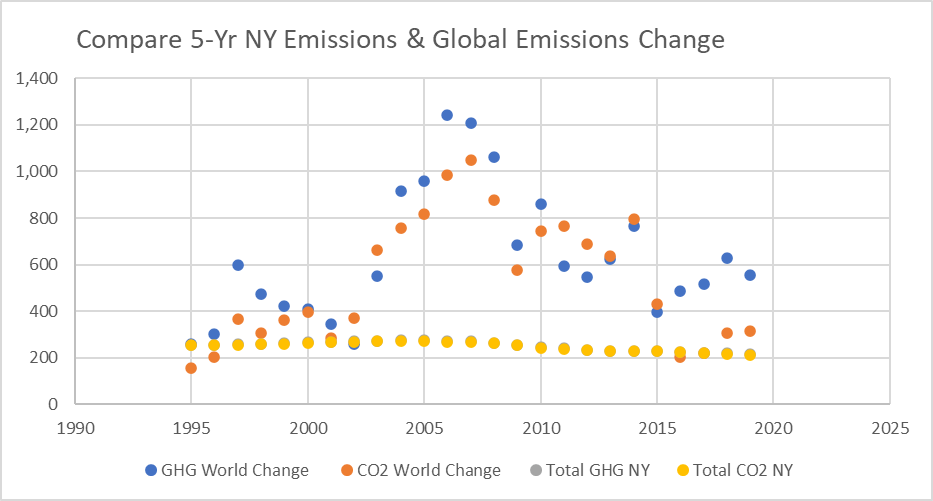
The following graph lists the five-year annual average GHG and CO2 NY emissions and the annual change in the five-year global GHG and CO2 emissions. Note that for most years the global change in emissions is greater than New York emissions. Anything New York does to reduce emissions will be supplanted by emission increases elsewhere in less than a year.
Conclusion
By any measure New York’s complete elimination of GHG emissions is so small that there will not be any effect on the state’s climate and global climate change impacts to New York. I previously showed that although New York’s economy would be ranked ninth relative to other countries, New York’s emissions are only 0.45% of global emissions which ranks 35th. This post graphically shows New York emissions are negligible compared to global emissions. The change to global warming from eliminating New York GHG emissions is only 0.01°C by the year 2100 which is too small to be measured much less influence any of the purported damages of greenhouse gas emissions. Finally, this post shows global emissions have increased more than New York’s total share of global emissions consistently since 1990. In other words, whatever New York does to reduce emissions will be supplanted by global emissions increases in a year.
The only possible conclusion is that the Climate Act emissions reduction program is nothing more than virtue-signaling. Given the likely significant costs, risks to reliability, and other impacts to New York society, I think that the schedule and ambition of the Climate Act targets needs to be re-assessed for such an empty gesture.


The Province of Ontario is in a similar position to the state of New York. The following article offers useful analysis. https://co2coalition.org/wp-content/uploads/2023/05/OntarioClimate-Wijngaarden.pdf\
LikeLike
Great reference! Thank you.
LikeLike